Category: Soccer/Union

  • Matt Crocker’s call for the youth game to help U.S. Soccer draws support from Philly-area leaders

    Matt Crocker’s call for the youth game to help U.S. Soccer draws support from Philly-area leaders

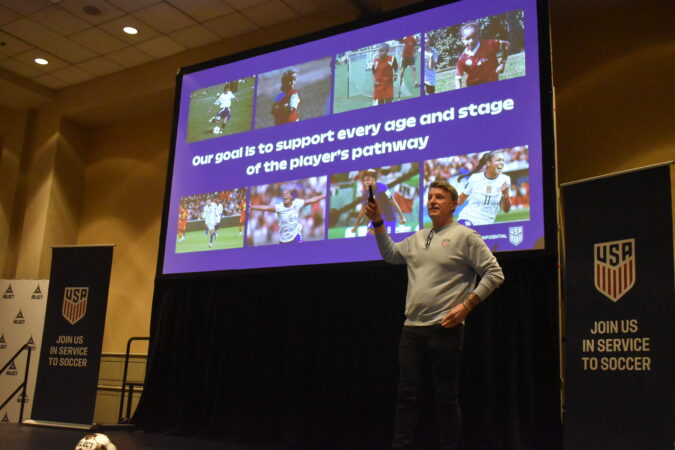
    When U.S. Soccer Federation sporting director Matt Crocker asked for the youth game’s help at last month’s United Soccer Coaches Convention, not a lot of people were in the room to hear it.

    But that doesn’t mean his message wasn’t received.

    There was significant interest, including from two of the most prominent figures in the Philadelphia region’s youth soccer scene.

    “Our soccer ecosystem has needed this for a long time,” Eastern Pennsylvania Youth Soccer CEO Chris Branscome said. “There has been a growing chorus of voices supporting more direction from the top. The current administration at U.S. Soccer, led by Cindy Cone and JT Batson, have heard us and has taken on the responsibility.”

    Branscome’s counterpart across the Delaware River, New Jersey Youth Soccer CEO Evan Dabby, agreed.

    “I have been in my role at New Jersey Youth Soccer for about 12 years now, and I don’t recall a time that U.S. Soccer has been more engaged with the youth soccer members,” Dabby said. “As a leader at a state association, I believe New Jersey Youth Soccer can benefit from a clear national vision and more national alignment, and those themes are present in Matt’s words.”

    It’s noteworthy that state-level leaders are willing to be led from the top. That hasn’t always been the case, and it doesn’t necessarily mean that every local youth club has the same view.

    But there’s a long history of youth administrators telling U.S. Soccer to stop ordering them around, and this time the tone does seem different. From the room where Crocker spoke in January to the one where he spoke at last year’s coaches’ convention, the reception has been, if not always warm, at least quite a bit warmer.

    ‘Dollars over development’ doesn’t help

    “It’s important to us that he’s not just focused on the national teams; he’s focused on all players at all levels,” said Branscome, who also serves as one of 10 commissioners on U.S. Soccer’s youth council. Its chair is U.S. Youth Soccer board of directors chair Tina Rincon, and co-chairs include veteran U.S. Club Soccer CEO Mike Cullina.

    “We’re working collectively and collaboratively to define our player pathways and provide more resources,” Branscome said. “It won’t be easy, but it’s necessary. It’s a major focus for us over the next few years. We’ve seen that dollars over development doesn’t necessarily help us grow the game or make players better.”

    He added that “the game inherently doesn’t require high costs, but that’s what’s happened here.”

    Those words undoubtedly will get lots of agreement, even if there’s perennial disagreement on how to bring costs down. Whatever the cost to a player’s family, there’s still a bill being paid somewhere.

    One obvious way to make things cheaper is to reduce travel distances for teams. More than once in Crocker’s speech last month, he noted how difficult it is for clubs to play local opponents because they’re in different leagues.

    “That team can’t play that team, and they go all the way past them and jump on a plane and spend hundreds of dollars to go and play [another] team because that league fell out with that league,” he said. “Just crazy. This is about children. This is about the best opportunities for children.”

    Dabby found those words “motivating,” as he did when he heard another of Crocker’s speeches to U.S. Soccer donors and sponsors in December.

    He noted that New Jersey Youth Soccer recently launched an Open Cup tournament for teams from any league in the state. MLS, where Dabby used to work, gave an assist to get clubs in its MLS Next leagues into the event. But he made it clear that the competition was created with “not just the New Jersey Youth Soccer community.”

    Eastern Pennsylvania Youth Soccer makes regular use of the Union’s WSFS Bank Sportplex in Chester for its tournaments.

    Branscome said Eastern Pennsylvania would like to have a similar event, but it hasn’t been able to get the entities that would be involved to agree on a schedule.

    “It’s unfortunate that your neighboring club doesn’t play your rivals anymore because they are in other member organizations of the Federation,” he said. “It’s almost like the Big 5.”

    ‘Saying these things out loud’

    The most significant point Crocker made — and the one that will be hardest to execute on — was calling on the youth game to value player development more and winning less.

    He knew, as does everyone around the game, how tall a hill that is to climb. Can Crocker be the one who finally convinces a youth club coach to risk their job by winning less or convinces a parent who believes winning is the best way to a college scholarship?

    “Soccer in the U.S. has entrepreneurialism and a culture of winning attached to our player development,” Branscome said. “Matt knows that’s not the right learning environment and wants to raise the standards. It’s great that someone in Matt’s position is finally saying these things out loud and providing support to the grassroots.”
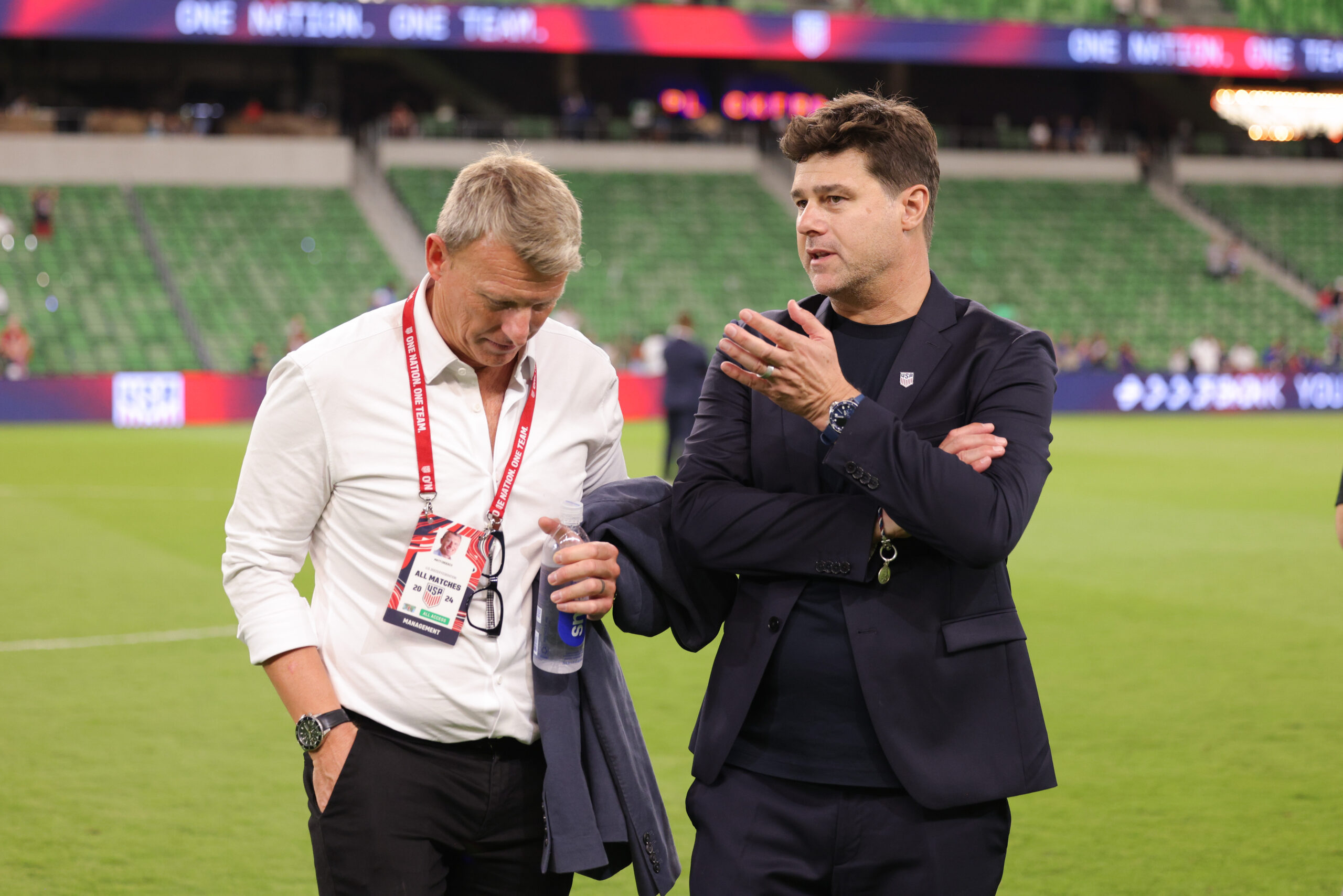
    Matt Crocker (left) walking with U.S. men’s national team manager Mauricio Pochettino at a game last year.

    If you’re an outsider to this, it might be hard to believe there’s so much fuss. But there is, and has been for a long time.

    Crocker is the latest of U.S. Soccer’s leaders to try to untangle the knot. So far, his effort has been a bit more polite than some of his predecessors. Will it work?

    “What I might appreciate above all else is Matt refers to children, not players,” Branscome said, and Crocker has done that emphatically in some of his remarks. That the Wales native has come in as an outsider has led him to say things that insiders perhaps wouldn’t say aloud. One of them is that for a lot of people in youth soccer, the children playing matter less than the adult decision-makers.

    “Soccer provides various opportunities for children and they learn and mature at different speeds,” Branscome said. “Matt knows coaches need to be educators and keep development at the forefront of the experience.”

    Crocker has a long way to go to get to where he wants to be. But it’s always nice to have support, and he’d probably be pleased to know he has it around here.
  • FIFA held a surprise World Cup presale this week aimed at select fans — but ticket prices were again sky high

    FIFA held a surprise World Cup presale this week aimed at select fans — but ticket prices were again sky high

    Many soccer fans hoping to score early World Cup tickets have been unable to do so after missing out on previous presale windows. In an effort to appease those fans, FIFA offered a 48-hour special opportunity for supporters to purchase tickets to select matches in their desired markets. But prices remained sky high, availability was severely limited, and details — like where you’d actually be sitting — were minimal.

    Over the course of three separate presales, which began in September with a special draw for Visa cardholders, FIFA claims more than 500 million fans have expressed interest, with many registering in ticket lotteries. These lotteries and presales come before what’s expected to be a free-for-all in April, FIFA’s last-minute sales phase, in which tickets will be available on a first-come, first-served basis, “processed as real-time transactions.”

    So the surprise that FIFA offered a special, unannounced 48-hour presale to select fans — starting at 11 a.m. on Wednesday and ending the same time on Friday — came as a welcome shock for those looking for seats before they hit the secondary market.

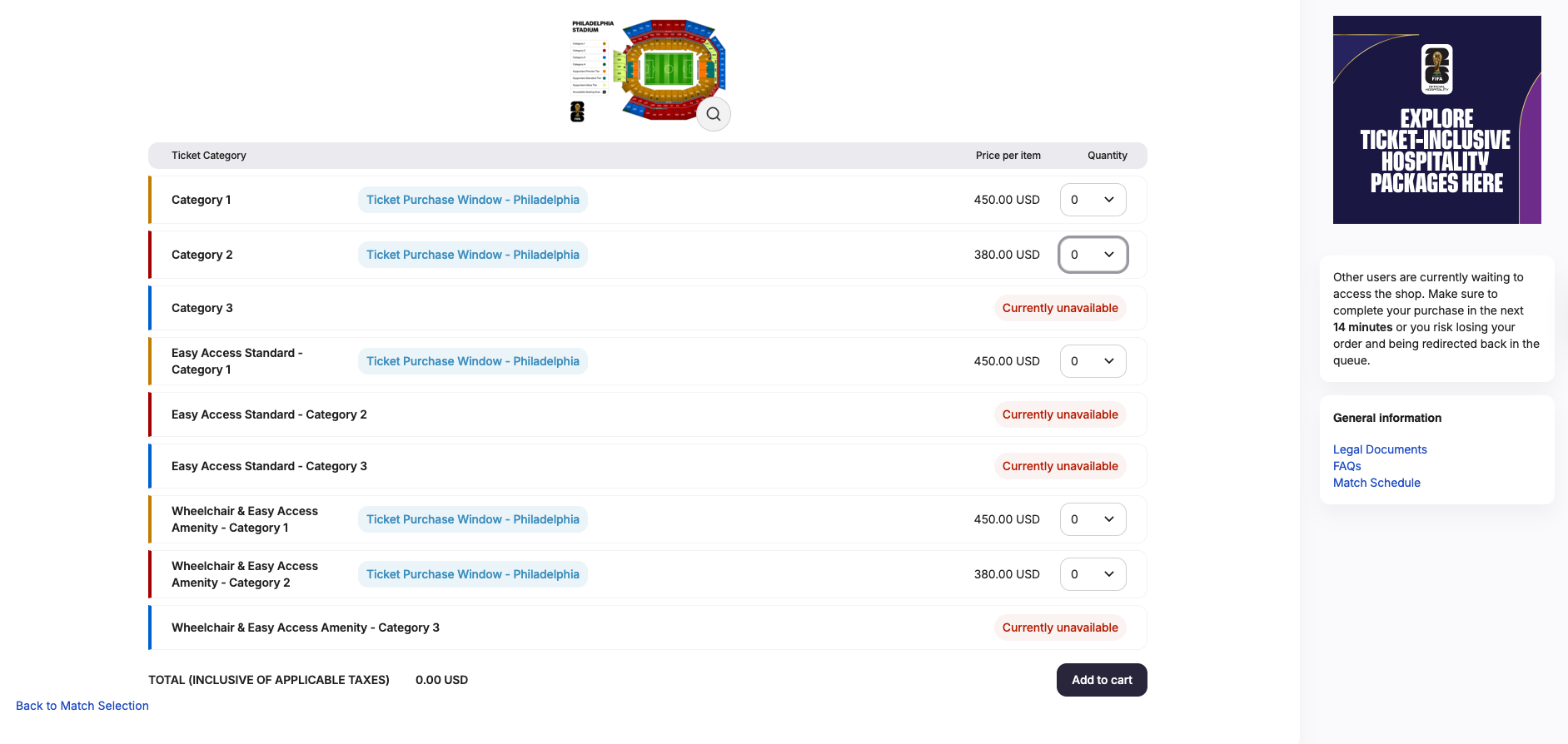
    However, for some fans, the real shock arrived after they bypassed FIFA’s queue and gained access to the ticket portal. By Friday morning in Philadelphia, the only game left available was the Group E match between the Ivory Coast and World Cup first-timers Curaçao on June 25 (4 p.m., FS1).

    It’s unknown if FIFA offered more than one match during this special presale or if it was just that one match, and requests for comment to its media team regarding the number of matches made available, as well as the number of matches in neighboring markets like New York for this presale, went unanswered at the time of this report.

    Select fans looking to attend the World Cup in Philly were granted a special presale this week, but were still faced with high prices for match tickets to one game by Friday.

    FIFA, which offers tickets in three categories ranging from Category 1 (the most expensive) to Category 3 (the least expensive), had seating in this special presale only for Categories 1 and 2 remaining on Friday morning. They started at $360 per ticket. For a seat in Category 1? $450.

    These prices mirrored the original ticket prices for matches in Philly when they were first released in December, with Category 2 tickets in this latest special presale just $20 cheaper than the original $380 asking price.

    Following global backlash in that same month, FIFA offered what they called a Supporter Entry Tier ticket, selling off a few hundred Category 3 seats across all 16 venues for just $60.

    Lincoln Financial Field will host six World Cup matches, including a July 4 Round-of-16 knockout match.

    However, it appears prices, fueled by FIFA’s employment of dynamic pricing for the first time in World Cup history, are back in the hundreds of dollars.

    To some in this latest presale, the juice just didn’t feel worth the squeeze.

    “Who can afford that for that game?” said Daniel Quinn, a Northeast Philly native who works in retail management. Quinn said he didn’t even notice the email from FIFA until Thursday night, as it hit his spam folder.

    He rushed to the portal on Friday morning to see what was left.

    “I just stared at my phone and laughed,” Quinn said. “Listen, I know it’s the World Cup, but I can’t justify paying $360 to watch a game where I can’t tell you a single soul playing on the field. Like, I know the Ivory Coast has good players, but for that to be the only game available and then to offer seats at those prices, just felt silly.”

    One more surprise remained. The presale still only guaranteed fans what’s known as a “right to buy” ticket, meaning that seat selection, even after purchasing, remained a mystery and would only be made available as the match drew closer.

    “Why are these still right to buy tickets?” Quinn continued. “This late in the game, I should know where I’ll sit so I can make an informed decision. Does a Cat 1 seat get me in the back [of the lower bowl] at the Linc, or a Cat 2, where I’m sitting up higher, but I might be in front? If you’re going to spend that type of money, I feel like you should at least know that.”

    The total cost for two tickets for the June 25 game between the Ivory Coast and Curaçao inclusive of taxes and fees through a special presale FIFA offered select fans on Wednesday.

    Earlier this week, a FIFA spokesperson told The Athletic that the fans chosen for its latest presale were “a defined group of applicants” selected in order to maximize fairness and acknowledge fans who have already demonstrated strong interest in the tournament.”

    But the fact that, with just hours left before the Friday mid-morning deadline, the opportunity was availability for one game across the five group-stage matches coming to Philly beginning June 14, and that the cost to attend was still so high, rubbed soccer fans like Quinn the wrong way.

    “Listen, shoutout to the people who can afford these [tickets],” he said. “I’m a lifelong soccer fan, and I’ve been to a lot of [soccer] games at the Linc. I went to the Club World Cup last year, and having the World Cup not just here in the States but literally where the Birds play feels like a bucket list [item]. But I think I’ll wait, man. Either these [ticket prices] drop because there are people like me who are laughing at what they’re charging, and prices will go way down, or people will snatch these up, and I’ll watch it for free on TV.

    “At this point, either way works for me.”

  • The Union have their new left back in 20-year-old Philippe Ndinga

    The Union have their new left back in 20-year-old Philippe Ndinga

    It took a long time to seal the deal, but the Union finally have their new starting left back.

    The team’s signing of Philippe Ndinga, a 20-year-old from Swedish first-division club Degerfors, became official on Friday. A source with knowledge of the matter told The Inquirer that the Union agreed a transfer fee of around $1 million, plus incentive-based bonuses.

    “Philippe is a dynamic defender with the ability to play confidently with both feet, which gives us valuable flexibility in the back line,” Union manager Bradley Carnell said in a statement. “His aggressive style of defending fits our system well, and we’re excited to welcome him to the club.”

    Because of Ndinga’s age, he qualified for MLS’s Under-22 initiative, which means the transfer fee won’t affect the salary cap. (Transfer fees usually count in the budget math for MLS teams, but under-22 players get preset cap hits of up to $200,000.)

    Ndinga was born in Libreville, Gabon, and spent his late teens coming up through French lower-league clubs. His international affiliation is with Congo, and he played three games for the country’s under-23 team last summer.

    He took his first professional step last August when he signed with Degerfors of Sweden’s top flight. It didn’t take long for him to get attention from elsewhere, with suitors reportedly including Los Angeles FC, the Houston Dynamo, and Greece’s Panathinaikos.

    Ndinga hasn’t finished all of the required visa paperwork, even though the contract is signed, so he can’t play in a game for the Union yet.

    “I would say a couple of days still before we can welcome him here to Philly,” Carnell said in a news conference Friday afternoon, ahead of Sunday’s game against New York City FC (4:30 p.m., Apple TV). “Still a couple of things to iron out and a couple appointments to be had in Sweden. I don’t want to put days on it, but probably another week, week and a half.”

    Carnell also referred to “dealing with visas, and applications, and timelines from embassies and governments and what have you.”

    Ndinga also hasn’t played in an official game since Nov. 9, so he might need some time to get back to full fitness.

    “We’ll put that in the hands of Ryan Cotter to do the baseline testing,” Carnell said, referring to the Union’s head of performance. He added that Cotter and Ndinga have already been in contact.

    “If he now joins in 10 days’ time and then it takes a week or two to get up and ready — I mean, yeah, it’s possible to start [and] hit the ground running,” Carnell said. “We’ve seen it with players who’ve left into other leagues and not been match-ready and play already [in] games. So it is possible, just depending on the individual and depending how fit they are coming in.”

    Frankie Westfield will stay atop the left back depth chart until Ndinga is settled in, though he’s currently sidelined with a minor hamstring injury. Once Ndinga gets going, Westfield will be able to switch to right back.

    Transactions

    The Union loaned forward Markus Anderson to Brooklyn FC of the second-tier USL Championship. Midfielder CJ Olney also likely is going on loan there, a source with knowledge of the matter told The Inquirer.

    Brooklyn’s manager is former Union reserve team coach Marlon LeBlanc, so he knows both players well.

  • Inside Cavan Sullivan’s biggest game yet for the Union, and not just because of his goals

    Inside Cavan Sullivan’s biggest game yet for the Union, and not just because of his goals

    If you wondered why this Union game, out of all of them, landed on a good TV channel, you weren’t alone.

    The answer wasn’t just because FS1 had some time to spare at the hour when the Union’s second leg against Defence Force FC kicked off. Or just because Fox wanted to showcase the Concacaf Champions Cup, though that’s always welcome.

    No, the appeal was in televising (there’s that word again) Cavan Sullivan. He’s on the list of MLS players whom people want to see, and on Thursday, they could see him on a channel that also shows the Phillies and Villanova.

    The game was another blowout win, 7-0, to make a 12-0 aggregate score. But the audience, including a sparse crowd at Subaru Park, got what it came for.

    Sullivan scored his first two goals for the Union’s first team, and delivered two well-placed assists, too. Even better, not only were his parents, Brendan and Heike, and brother, Quinn, in the stands, but so were his uncle, Danny; cousin, Jackson; and grandparents, Kathleen and Larry — the latter the dean of Philadelphia soccer’s most famous family.

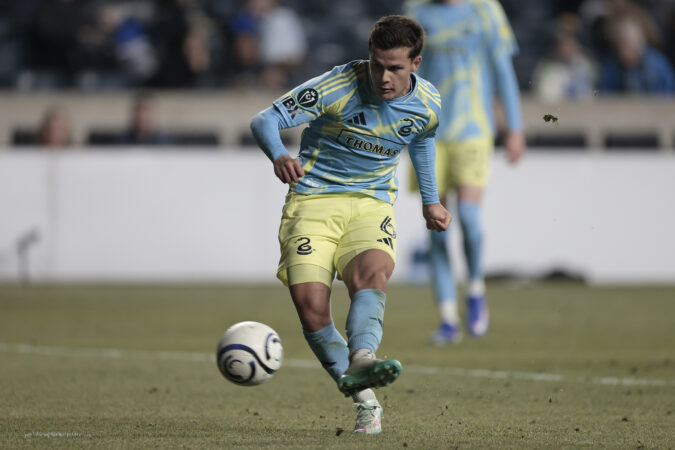
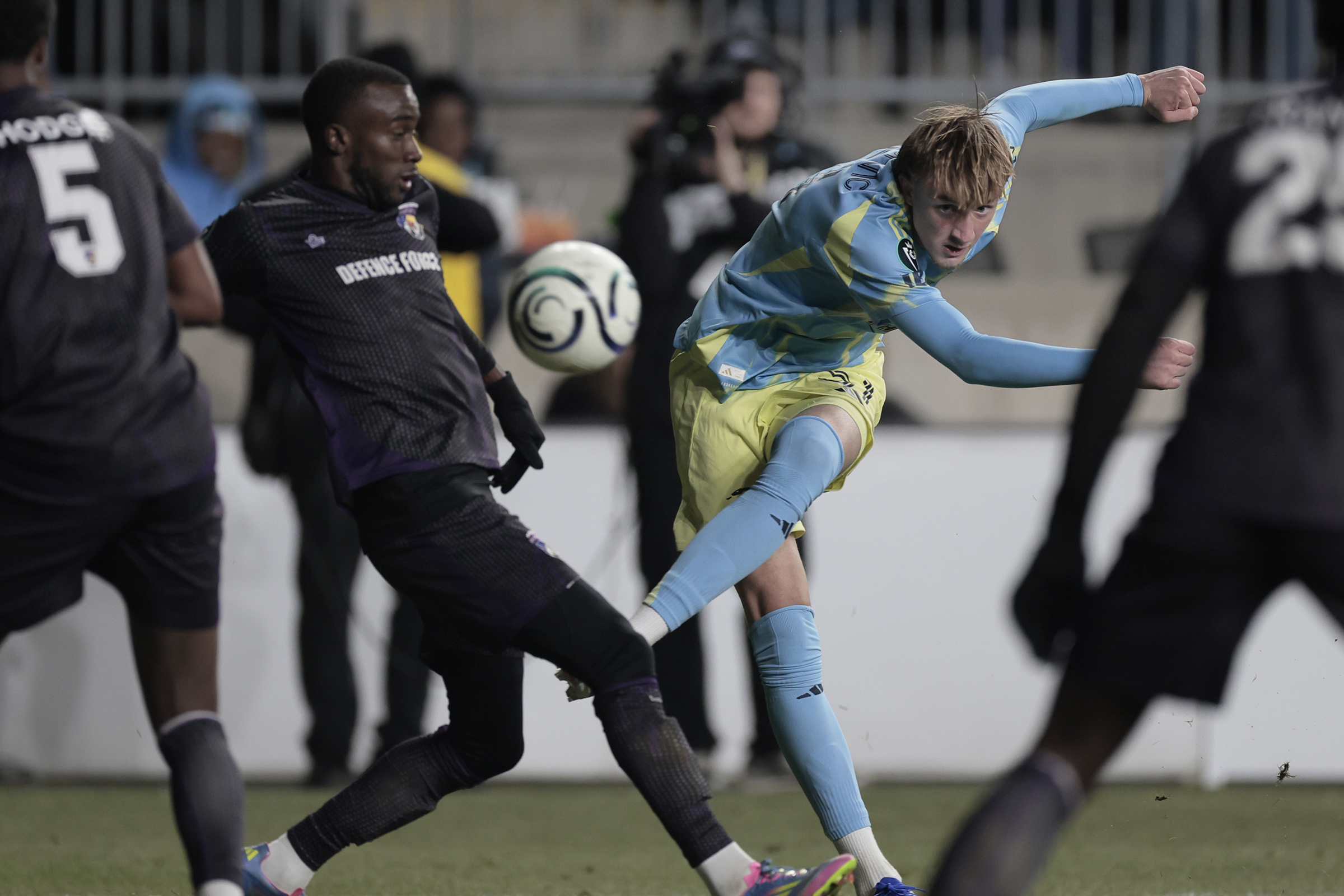
    The goals will get the most attention, especially the first one. In the 76th minute, Sullivan teamed up with Ezekiel Alladoh to force a turnover off pressing, then ran into the open space with the ball and shot home. His second tally, in the 88th, was a close-range slide on the goal line to cap off a counterattack he led upfield.

    But the assists bear highlighting because those plays were part of why the goals could come later. The first assist was a back-heel in tight space to Stas Korzeniowski in the 12th minute, and his second was a floated pass to Ben Bender in the 53rd. They were good plays, but, importantly, they were part of teamwide actions.

    Last week, after Sullivan played very well in the first game of this series, Union manager Bradley Carnell said he had “seen a lot more maturity from Cavan over the last couple of weeks.” Thursday’s first hour or so was another example.

    Sullivan mostly kept it simple with good passing and movement. He did the defensive work too, with a few tackles and the pressing that the Union demand from every player.

    “I’m still very critical in certain moments,” Carnell said with a laugh, but he definitely was pleased. “You can see Cavan tries in the final third to make every moment a moment that counts, which is great, and we like that about Cav.”

    The second goal also was part of a teamwide move and had Sullivan thinking about something he’d learned beyond the Union’s film room.

    “It’s something I’m working on every day, just slowing the game down, learning when to drive and accelerate, and learning when to just find the safe space,” he said. “It’s something I work on with my dad a lot and with the coaches.”

    Later in the play, the voice in his head became that of Lieutenant Larry, as generations of players from St. Joseph’s, Villanova, Father Judge, and Camden Catholic called him.

    “Like my grandfather always says, ‘Get in the box,’” Cavan said, “and I was there to just tap it in.”

    Yes, sir, and Larry was there to see it. Cavan spoke about that too, with some emotion.

    “I think it embodies what us Sullivans are about, in being there for each other,” he said. “Being there when we’re down, but also when we’re up. I’m thankful that they were all here to watch me play, and I dedicate this to them because without them, I wouldn’t be here.”

    Malik Jakupović’s first-team debut

    Sullivan wasn’t the only big-time teen to play for the Union on Thursday. Striker Malik Jakupović made his first-team debut as a substitute in the 59th minute.

    Though the 16-year-old is on a reserve team contract, Concacaf rules allow him to be on the Champions Cup roster. So the Union added Jakupović and 20-year-old outside back Giovanny Sequera, and the latter started at left back.

    Jakupović has garnered media attention and continues to turn heads among scouts. His last game action before Thursday was with the U.S. under-17 national team earlier this month, where he scored eight goals in three games to lead the Americans through Concacaf’s World Cup qualifying tournament.

    “We knew he was in a good way with us in preseason, and he goes and shows that with the national team,” Carnell said. “That’s what I said to him tonight, ‘I want to see a bit of what you showed with the national team for us as well.’ He came close once or twice and he worked well to come back in the game and found a good relationship with [Alladoh].”

    Malik Jakupović tries a shot on goal that didn’t miss by much.

    The next under-17 World Cup is in November in Qatar, and Jakupović could be on a first-team contract before then. He didn’t find the net in this game, but he showed his skill with a pretty cutback in the 69th for a shot that he put just over the bar.

    “It’s good to be noticed really young, and now I’m just trying to fight every single day to get more and more, and try and to get better every single day. And at the end of the day, be with the first team fully,” Jakupović said, “… It’s surreal — I mean, I’m a professional, but not professional because I still have to do school and everything — but, yeah, I’m really happy.”

    Korzeniowski impresses too

    Sullivan and Jakupović got the most attention Thursday, but Korzeniowski also deserves some. In his third game for the Union’s first team, he scored his first two top-flight goals.

    Two years ago, he was playing college soccer for Penn on an artificial turf field tucked between Walnut Street and the Amtrak tracks. Now the 23-year-old is making it as a pro.

    “For me to go from there to where I am now, it’s a position not many people get to be in, and I recognize that privilege,” he said. “But I’m so excited to be in those positions, and I’m really not afraid by it. If anything I’m very encouraged, because there’s really nothing to lose. It’s just more experience, more opportunity, and to grow from that is all I want to do.”

    As for the sparse crowd? That won’t be the case for Sunday’s first MLS home game of the year, a rematch of last year’s playoff game against perennial rival New York City FC. Nor will it be the case when the Union play in the next round of the Champions Cup later in March, against Mexican juggernaut Club América.

    The first game of the series will be March 10 at Subaru Park, and the second will be March 18 in Mexico City.

    As with the last time these teams met in the tournament, in 2021, the atmosphere should be vibrant and overwhelmingly pro-América. But that is for down the road. Thursday was about talented young players getting a shot, and they took it.

  • Voorhees’ Riley Tiernan features in a new ESPN behind-the-scenes series on NWSL players

    Voorhees’ Riley Tiernan features in a new ESPN behind-the-scenes series on NWSL players

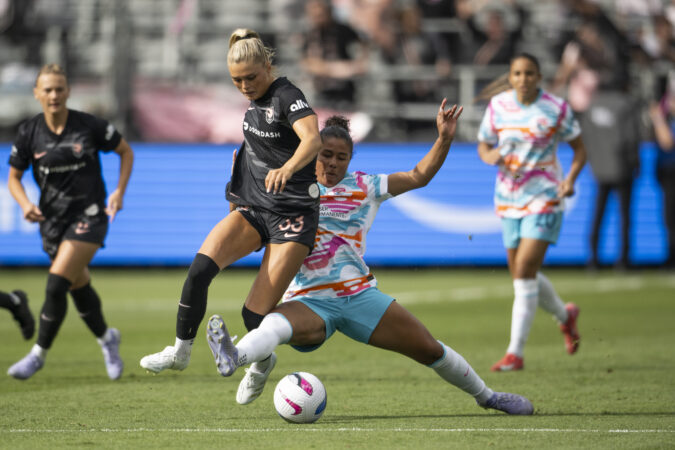
    A new behind-the-scenes series on NWSL players features Voorhees native Riley Tiernan as one of the main characters.

    NWSL: The Final Third is co-produced by ESPN and two firms the network knows well, Words + Pictures and Omaha Productions. The former has done many 30 for 30 documentaries — and women’s soccer content for other platforms like Netflix and Amazon’s Prime Video — and the latter has done a raft of shows with ESPN, including the Monday Night Football Manningcast. (Peyton Manning is one of Omaha’s co-owners.)

    The three-episode set is centered on Tiernan, Angel City teammate Christen Press (in her last season as a pro), Kansas City’s Lo’eau LaBonta, and Washington’s Trinity Rodman, Hal Hershfelt, and Esme Morgan.

    “I always say the key to making series like this successful is choosing characters who are excited by the opportunity and understand that there is a level of vulnerability that’s required,” said Marie Margolius, the show’s director, who’s a devotee of the sport and played at Harvard. “Riley, specifically, certainly understands that. And I think her trajectory in the league has sort of resonated with people because of her vulnerability and because she’s opened up about the challenged road that she’s had.”

    Many viewers will pay attention to Press, a longtime U.S. national team star; and Rodman, the American game’s newest phenom. (Among the series’ fun stories is Rodman’s first-person account of how she met her boyfriend, tennis pro Ben Shelton.) LaBonta also is widely popular among women’s soccer fans, thanks to her vibrant personality and viral goal celebrations.

    Tiernan isn’t as well-known yet, partially because last year was her pro debut. But this miniseries might help change that.

    ‘South Jersey is more gritty’

    “It was such a cool opportunity,” Tiernan told The Inquirer. “I think any chance I’m given to do things like that is really important to take. They were great people, and they wanted me to just be as raw and authentic as possible, so I just tried my best to to do that.”

    We see Tiernan at her southern California apartment with her boyfriend, former Rutgers pitcher Gavin Stellpflug. They met when Tiernan played soccer for the Scarlet Knights, and he moved west to join her last summer.

    “He’s been one of the most supportive people throughout my journey here, especially,” Tiernan said. “So just being able to have him not only be here with me in California, but to also want to be involved in all the opportunities I get, I think it shows how much he really cares and how he’s willing to show up for me — even in times where he might not feel super comfortable being on camera and stuff like that. But, yeah, I can’t thank him enough for just being there for me in every way possible through the good and the tough times.”

    The show takes viewers through Tiernan’s rookie season in LA, but also back in time a bit through her growth in South Jersey and at Rutgers.

    “I would say South Jersey is more gritty, putting in the dirty work,” Tiernan says in the show, amid a montage of old photos and video clips. It was an easy line for TV to seize, but also one of a few that could draw attention from casual viewers who might see the show and decide to tune in to games. The NWSL craves that audience as much as any other sports league does.

    “I’m super wild and crazy and a little bit fearless too, so I think that helps me with sports a lot and difficult situations,” Tiernan says later.

    The series includes one of those situations: surviving a preseason tryout with Angel City. That was the only way she could get there, since last year was the first after the NWSL abolished its college draft.

    ‘The toughest player on the field’

    Her debut season included eight goals, the most by any rookie in the league, and a Rookie of the Year nomination. That drew praise from interviewees, including former U.S. women’s national team star Sam Mewis, who now hosts a popular podcast on the Men In Blazers media network.

    “You may think she’s going to go out on the field and she’s going be dainty and fast, and she’s going to flick her ponytail,” Mewis says. “Riley is the toughest player on the field. … I just think it’s so impressive what she’s brought to a franchise that is really important to the league.”

    We also see Tiernan on the night of the NWSL’s inaugural awards show, where she was nominated for Rookie of the Year, though the award ultimately went to Gotham FC defender Lilly Reale.

    “She’s a star,” Stellpflug says in one of his cameos. “It’s been crazy to watch. She has a look, she’s got the spirit, she’s got the hunger, the tenacity, and, of course, the talent.”

    Julie Uhrman, one of Angel City’s cofounders and its CEO, consoled Tiernan at the event: “You will be MVP next year if I have anything to do with it. You’re amazing. You’re f— amazing. OK? You’re amazing.”

    The moment brought Tiernan to tears.

    Uhrman will step down from the CEO job at the end of March, transitioning to an advisory role and a seat on the club’s board. But Tiernan isn’t going anywhere: last month, she signed a contract extension through 2028.

    What happens next is beyond Hollywood’s control because sports is the ultimate reality show. The NWSL regular season starts March 13, Angel City’s opener is two days later, and from there, Tiernan will get to write her own story on the field.

    “Her journey to being a contender for Rookie of the Year is one that is full of resilience and mental fortitude and physical strength that I think is really inspiring,” Margolius said. “She also just has this casual, fun vibe to her that I think is going to be really beneficial for the league and the sport. People are going to root for Riley Tiernan — everybody on the production team, by the end of production, was rooting for Riley Tiernan.”

    All three episodes went live in ESPN’s streaming app on Wednesday. They will be televised on ESPN2 on Monday starting at 9 p.m. and will also be available to Disney+ subscribers from March 2-31.

  • Historic night for Cavan Sullivan, who scores twice in the Union’s Champions Cup rout of Defence Force

    Historic night for Cavan Sullivan, who scores twice in the Union’s Champions Cup rout of Defence Force

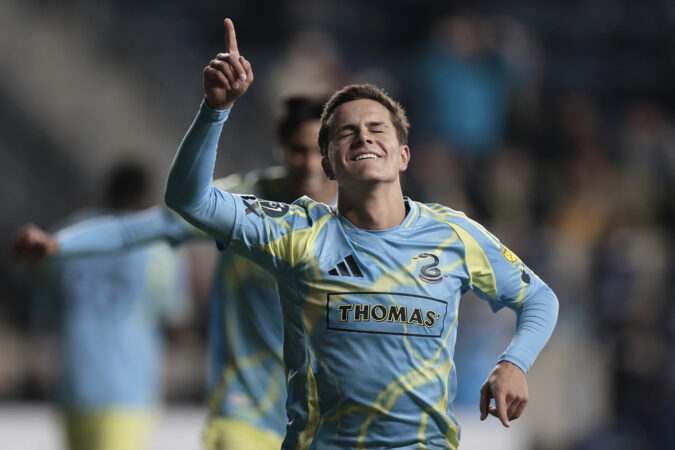
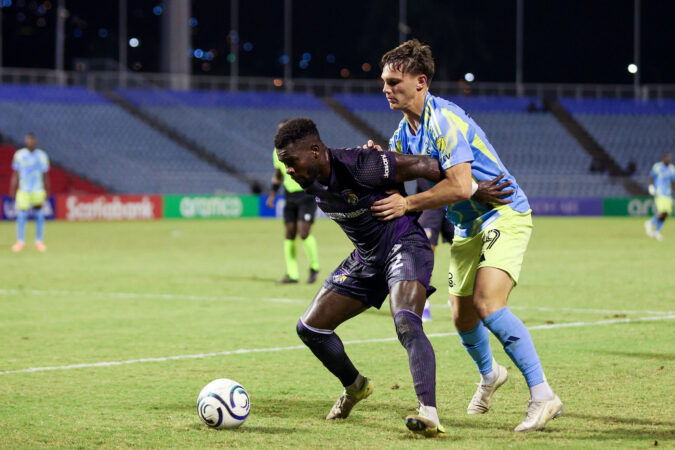
    Cavan Sullivan scored twice for the Union in the team’s 7-0 rout of Defence Force F.C. at Subaru Park on Thursday night, netting his first in the 76th minute and a second in the 88th.

    Despite being the club’s most talked about prospect, Sullivan, the team’s 16-year old midfielder who will join Manchester City at the end of 2027, had been scoreless for the Union in 19 appearances leading up to Thursday night’s match.

    But his two goals, which were also coupled with two assists, found him become the youngest goalscorer in Champions Cup history.

    “Happy to score my first goal,” Sullivan said. “Two of them, actually. It was pretty special.”

    Former Penn product Stas Korzeniowski also scored twice in the win, while Geiner Martínez, Jovan Lukić, and Ben Bender each scored once for the Union.

    The first series in the Concacaf Champion Cup saw the Union outscore Defence Force, 12-0, over two legs. Now, with their first round series win, the Union advance to face Liga MX giant Club América in the round of 16.

    Martínez opens the floodgates

    Geiner Martínez opened the scoring with a goal in the seventh minute. It was his first goal for the club, which signed the centerback in the offseason.

    Jovan Lukić scored a second from the penalty spot in the 10th. Jeremy Rafanello earned the penalty after being brought down in the 18-yard box, and Lukić converted the kick past Defence Force goalkeeper Isaiah Williams.

    Thursday night was the first appearance of the season for Lukić, who missed the Union’s previous two games with a minor injury.

    Korzeniowski added a third in the 12th minute, his first for the Union’s first team since the club selected the former Quakers striker in the 2024 MLS SuperDraft.

    Cavan Sullivan was credited with an assist on the goal after sending Korzeniowski past Defence Force’s back line. Sullivan’s flick was the final pass of a five-pass combination, one that took the Union into halftime up, 3-0. Sal Olivas and Bender entered the game as second half substitutes, replacing Lukić and Olwethu Makhanya.

    Korzeniowski scored his second goal of the night to put the Union up, 4-0, in the 48th minute. Ezekiel Alladoh, a forward the club acquired for $4.5 million in December, was credited with an assist on Korzeniowski’s goal.

    Bender scored in the 53rd minute, giving Sullivan earning another assist. Sullivan played a lofted ball to Bender in the 18-yard box that Bender collected before sending a strike into the back of the net.

    Malik Jakupovic made his Union debut in the 59th minute, coming off the bench to replace Korzeniowski. The 16-year old forward is a product of the Union’s academy who has played for the U.S.’s under-17 youth national team.

    Jesús Bueno replaced Alejandro Bedoya in the 75th minute, which stood as the final substitution of the night for the Union. And then it was Sullivan’s night to ice the cake.

    “It was a good statement from us as a club,” Union manager Bradley Carnell said. “Just to be able to play all the young guys and get rewarded, and guys getting goals and contributions.”

    Up next…

    After a 1-0 loss at D.C. United last weekend, the Union will host New York City FC in their first home match of the Major League Soccer season on Sunday (4:30 p.m., Apple TV).

    New York (0-0-1, 1 point) knocked the Union out of the playoffs last season with a 1-0 victory in the Eastern Conference semifinals.

    “Everybody wants to be part of Sunday,” Carnell said. “Everyone wants to play and put off a good performance. It’s a derby. We know what it’s all about.”

    The Union’s next Champions Cup match will be against Liga MX giant Club América at Subaru Park on March 10. The away leg of the two-game series is scheduled for March 18 at famed Estadio Azteca in Mexico City.

  • The injury bug has bitten the Union early in the season

    The injury bug has bitten the Union early in the season

    There shouldn’t be too much to worry about at Subaru Park on Thursday in a Concacaf Champions Cup game against Defence Force FC of Trinidad (7 p.m., FS1, TUDN), with the Union bringing a 5-0 aggregate lead into the second leg. But that doesn’t mean all is well.

    Outside back Frankie Westfield, centerback Finn Sundstrom, and forward Agustín Anello are dealing with minor injuries at the moment. Westfield is the biggest concern, both because of how his absence impacts the starting lineup and because it’s a hamstring tweak.

    “Frankie’s still working on the side, getting closer to the team day by day, and I think that’s his status: day by day,” manager Bradley Carnell said Wednesday. “It’s pretty much all day-to-day stuff [with the trio], and hope to have them back pretty soon.”

    Although the Union have a commanding lead in the series, Carnell isn’t taking this game lightly, especially after a loss Saturday at D.C. United in the MLS opener. Another game also quickly follows this one, against rival New York City FC at Subaru Park on Sunday (4:30 p.m., Apple TV.)

    “Tomorrow’s halftime of the series, and we have to be fully focused,” he said. “We have a lot of things that we need to work on, and we have a lot of things that we are still not really happy with right now, with our own performance and putting things in our own control. … Regardless of opponent now, we have to take the baton in the hand and really focus on ourselves right now.”

    Milan Iloski, who sat next to Carnell on the podium, concurred.

    “I think we’re never going to be where we want to be,” Iloski said. “We’re always going to be chasing perfection, but soccer’s a game where it’s never going to be perfect, I think we’re working every day to improve and to get better — of course, there’s still a lot of good faces, and we’re building chemistry and we’re building relationships every day.”

    Carnell also said he has spoken with Ezekiel Alladoh about the striker’s red card on Saturday, and with officials who confirmed it was for “inappropriate language.”

    MLS teams can appeal direct red cards, and can lose twice in a year. The Union aren’t appealing this one.

    “We’ve addressed the issue internally, and we’ll learn and grow from that and move on,” Carnell said.

  • Milan Iloski’s on-field role has changed. How much will it benefit him and the Union?

    Milan Iloski’s on-field role has changed. How much will it benefit him and the Union?

    Milan Iloski had no strong opinion.

    If he did, he certainly wasn’t sharing it on this day, doubling as a model for the Union’s new home kit, one that pays homage to America’s 250th birthday and coincides with the FIFA World Cup passing through Philadelphia this summer.

    But the question last month was plain. As the Union’s new No. 10, the number generally designated for a team’s playmaker, how does it suit his strengths, and more importantly, his role on the team?

    Will the move create opportunities for his partners sitting behind the forward in Bradley Carnell’s modified 4-4-2 (essentially 4-2-2-2) formation? Will it create chances for him running off them? Which would make sense given the imposing size of Ezekiel Alladoh, the team’s new 6-foot-3, 170-pound powerhouse up top?

    Will it be both?

    Some might suggest that two games into the regular season and a handful of televised preseason matches are still too small a sample size to determine where Iloski exactly fits and where he’ll be most effective. In that same time, however, credit him with four goals and a Man-of-the-Match award after a 5-0 rout of Trinidad’s Defence Force in the club’s Concacaf Champions Cup opener.

    It is certainly not a bad thing to be a bit of an unknown for a team looking to surprise early in the season in defense of its 2025 Supporters’ Shield crown.

    That continues this week as the Union have their Champions Cup return leg against Defence Force at Subaru Park on Thursday (7 p.m., FS2), followed by the team’s MLS home opener against Eastern Conference rival New York City FC on Sunday (4:30 p.m., Apple TV).

    If that’s the case, one has to wonder what the coaching staff has told Iloski it’s looking for from him in the No. 10 jersey.

    “I think stepping up in a big way,” said Iloski, a 26-year-old native of California. “I was brought here midseason last year to help bring a trophy. And you know, we were happy to win the Supporters’ Shield, but we fell short in other places. Now, it’s for me to be an important player on the team and really be a leader in the locker room and make sure to implement those core values and, you know, things that this club stands for.”

    But the answer was a bit more complex from Carnell, who noted during a recent news conference the variety of ways Iloski can be used, with none of them sounding like a one-size-fits-all approach to the second-year Union player.

    Union manager Bradley Carnell says that plans have been created that fuse the team’s attack with Milan Iloski’s skill set.

    “We have a bunch of things drawn up in my [coaches] room,” the manager said. “There are different scenarios on tactical sheets of paper. We have an overload of strikers with us right now. So [we just need] Milan to build his foundation, I would say.

    “We know what he brought us last year, through the summer [when he arrived] and down the stretch. He’s a real weapon in both phases, whether it’s in the possession phase or in the transition phase. … He has a bunch of things to learn even in the [No. 10] spot. But using him in the striker spot is an option as well. Right now, he’s being used in that 10 spot, and we’re confident we’ll get greater value out of him there.”

    It’s no secret that Iloski provides value. His eight goals in a five-game tear for San Diego last season made him a midseason commodity that the Union pounced on. He collected four goals and five assists in just 14 games for the Union in all competitions, drilling home the fact that he’s anything but one-dimensional.

    But a shift in position means a shift in mindset, and at the end of the day, Iloski is happiest around the box angling on goal. Proof came in the five shots, two on goal, from the Union’s loss to D.C. United on Saturday. It also arrived in a preseason wonder goal he scored running off the ball against CF Montréal.

    It’s where he likes to be, his happy place if you will.

    In his new role, Milan Iloski (left) is expected to be the creative provider for strikers like newcomer Ezekiel Alladoh (right) and others as the Union’s No. 10.

    “I think in an ideal world, I enjoy being around the goal more,” Iloski said. “I came here because I enjoyed playing next to someone, that’s one thing I’ve talked with the coaching staff a lot about. I love playing next to someone up top.”

    But that’s not his role anymore — at least not game over game. Which is why in the same breath, the leadership he spoke of earlier came through.

    “I also know I can be that creative player who can come inside or can float underneath the strikers,” he said. “So, you know, for me, I’m open to anything that can help the team. And you know, I’m totally bought in. So whatever the staff needs from me is what I’ll try and provide.”

  • Mexican cartel clashes fuel worries in lead-up to FIFA World Cup

    Mexican cartel clashes fuel worries in lead-up to FIFA World Cup

    GUADALAJARA, Mexico — Hugo Alejandro Pérez was in his house a few miles from the Mexican stadium that is slated to host FIFA World Cup games when gunfire and explosions erupted just outside his door.

    The 53-year-old restaurant owner was already skeptical about his city, Guadalajara, hosting the international sporting event.

    He saw a government that failed to fix basic things, like water service to his home, along with cartel violence in the surrounding state of Jalisco and shook his head. The surge of bloodshed this week following the Mexican military’s killing of the country’s most powerful cartel boss offered more confirmation of his doubts.

    “I don’t think they should host the World Cup here,” Peréz said. “We have so many problems, and they want to invest in the World Cup? With all the violence, it’s not a good idea.”

    Peréz joined other people Tuesday in questioning Guadalajara’s capacity to be a host city for the summer soccer competition, even as the Mexican government vowed that the international event — hosted jointly by Mexico, the United States and Canada — will not be affected.

    President offers ‘every guarantee’ for World Cup

    President Claudia Sheinbaum was asked at her daily news briefing what guarantees there are that World Cup matches will be held in Jalisco. “Every guarantee,” she said, adding that there was “no risk” for fans coming to the tournament.

    Jalisco Gov. Jesús Pablo Lemus said he had spoken with local FIFA officials, who have “absolutely no intention of removing any venues from Mexico. The three venues remain completely unchanged.”

    The same day, the Portuguese soccer federation said it was “closely monitoring the delicate situation” in Mexico.” Its national team was scheduled to play Mexico’s team in a friendly on March 28 at the newly renovated Azteca Stadium in Mexico City, which is scheduled to host the opening World Cup match on June 11.

    Jalisco, in western Mexico, was already facing scrutiny. The state has been plagued by some of the starkest examples of cartel violence in recent years, including the discovery of a cartel killing site at a ranch last March and a crisis of disappearances.

    The state, with Guadalajara as its capital, is the central hub for the Jalisco New Generation Cartel, whose leader Nemesio Oseguera Cervantes, or “El Mencho,” was killed Sunday in a capture attempt by the military.

    The operation and waves of violence killed 70 people. Cartel gunmen set fire to cars to block streets in states across the country, namely Jalisco, and fought with Mexican forces into Monday as the government said the conflict was under control.

    The death of Oseguera Cervantes came as Mexico’s government has stepped up its offensive against cartels in an effort to meet demands by U.S. President Donald Trump to crack down on criminal groups. The cartel, also known as CJNG, is one of the fastest-growing criminal networks in Mexico.

    The White House confirmed that the U.S. provided intelligence support to capture the cartel leader and applauded Mexico’s army for taking down a man who was one of the most wanted criminals in both countries.

    Drug lord’s death could lead to more violence

    Peréz, the restaurant owner, also commended Sheinbaum’s efforts to go after cartels, saying the government has taken cartel violence more seriously than her predecessors. At the same time, he said, local authorities in Jalisco have fallen short in protecting civilians.

    The root concern for many is that the death of “El Mencho” could pave the way for more violence. Killing capos, in what’s become known as the “kingpin strategy,” has been criticized by Sheinbaum herself because it can often spark internal conflict between cartel factions and push rival cartels to make territorial grabs.

    Vanda Felbab-Brown, an academic at the Brookings Institution, said she doesn’t see more acts of “revenge” by the cartel as likely, but the future remains uncertain, especially after leading figures in both CJNG and the Sinaloa Cartel have been knocked out in recent years.

    “If there is no clear line of succession (in CJNG), we might see a lot of fighting within the cartel, its breakup, and there are a lot of scenarios,” she said.

    On Sunday, when firefights broke out between the cartel and soldiers, and gunmen began to burn a car just feet in front of Peréz’s house, he let people on the street scramble inside his home to seek cover. The fighting raged for an hour.

    Now he says he doesn’t see the point of holding the games, adding that he doubts any of the money from the games will trickle down to businesses in working-class neighborhoods like his, even if they are just a 10-minute drive from the stadium. Similar tensions have simmered in Mexico City.

    The World Cup is expected to be a $3 billion economic engine in Mexico, according to the Mexican Soccer Federation.

    “It doesn’t help us residents at all, honestly. They should move it to Monterrey or Mexico City. But right now here, we’re not convinced,” he said. “Things aren’t in good enough shape for foreigners to be coming to Jalisco for an event like this.”

    On Monday, some foreign tourists trapped in the violence in the city of Puerto Vallarta took to social media to warn of the violence, with a few remarking that they didn’t plan to return.

    Hope of snapping back to normal

    Despite that, Guadalajara was snapping back to its normal rhythm Tuesday. Many businesses opened their doors for the first time in two days, and streets were packed with traffic.

    Workers were busy fixing up the exterior of the soccer stadium that will host World Cup matches. Cyclists zipped around outside the stadium, and parents played with children in parks.

    Heavily armed police officers and National Guard members roamed the city, a sign for some that the government had the situation under control.

    Juan Carlos Pila, a 55-year-old taxi driver, rolled his eyes at the reports of violence after spending two days waiting with his family for things to calm down. He said social media and local news outlets were overplaying the extent of the violence.

    “People should come, man. Everyone is welcome,” he said.

    Others, like Maria Dolores Aguirre, simply hoped for the best. Aguirre runs a small corner story in the cobblestoned tourist town of Tapalpa tucked away in Jalisco’s mountains, where Mexico’s military killed “El Mencho.”

    Aguirre’s family business of over 50 years depends on the flow of tourists to the normally sleepy town. Now she worries bloodshed will deal a blow to her livelihood and change towns like hers.

    “It’s going to affect us. It’s collateral damage,” Aguirre said. “The government is going to have to have a lot of security. … The entire world just saw what happened and, of course, people are going to think twice about coming.”

  • Carli Lloyd’s return to Fox’s World Cup coverage comes with goals for herself and the USMNT

    Carli Lloyd’s return to Fox’s World Cup coverage comes with goals for herself and the USMNT

    In 2022, Fox Networks threw Carli Lloyd into the proverbial fire — on the other side of the world.

    Barely a year removed from her own retirement from professional soccer, the Delran native was announced as one of the primary studio analysts for the network’s monthlong coverage of the FIFA World Cup in Qatar.

    She handled it all in stride, finding her voice while taking cues from longtime on-air personalities Rob Stone and Alexi Lalas, but it was the first time she’d be a consistent presence, and a different look from what’s customary, with her observations of each match being critiqued and analyzed by soccer fans all over the world.

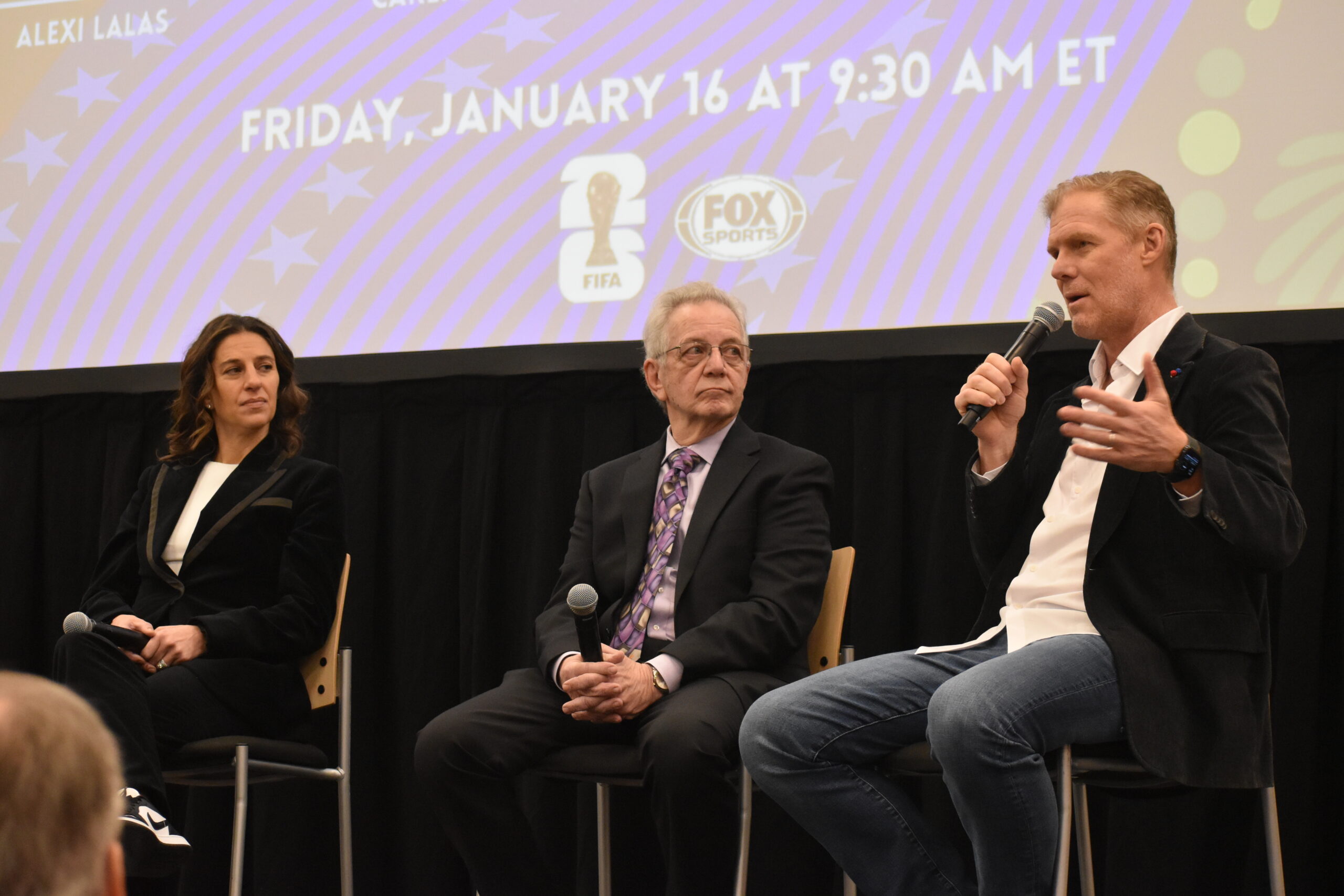
    From left, Fox Sports soccer broadcasters Carli Lloyd, JP Dellacamera, and Alexi Lalas speak at the United Soccer Coaches Convention in Philadelphia last month.

    “It was a lot to learn really fast, a lot to take in,” Lloyd recalled during the United Soccer Coaches Convention in Philadelphia last month. “But I was fortunate enough to learn from guys like Alexi and [Fox commentator] Stu [Holden] who helped me along the way really feel confident and like I can really do this.”

    Lloyd did it well enough that she’ll be among Fox’s lead crew of studio analysts once again for the 2026 World Cup as the tournament makes six stops through Philadelphia as part of a 104-match schedule this summer.

    It’s a task she says she’s “ready and excited for” after getting her feet wet in 2022, in addition to the commentary she’s been able to provide in the years since — some of which along the way stirred up a bit of controversy.

    But a new year finds the tournament on home soil, with the United States hosting the bulk of scheduled matches, also spread across Canada and Mexico. It’s the perfect time for the United States to return to the biggest stage and show the world just how far it has evolved as a soccer nation, Lloyd says.

    “I wouldn’t say there’s immense pressure in winning the World Cup,” Lloyd said. “But there’s the pressure to show the country that they are there to compete and they’re going to fight, and they’re going to give everything they have for our country.”

    Made to inspire

    Lloyd can recall being a 12-year-old girl watching the 1994 World Cup, the last time the men’s edition was held in America. That tournament, she recalled, sparked her excitement and love for the sport.

    Follow that up with the unforgettable 1999 women’s edition, also hosted in the States, and those two moments galvanized the idea that Lloyd would do all she could to pursue it as a career.

    The World Cup, Lloyd says, has that effect.

    Carli Lloyd celebrates scoring her third goal against Japan in the 2015 women’s World Cup final in Vancouver.

    “I don’t think we all know yet just how massive this is going to be, and the impact that it’s going to have on generations to come,” Lloyd said. Those 1994 and 1999 World Cups “jump-started my dream; they were life-changing for me. But I think it’s only going to be massive in the United States of America if our team shows up with that grit and that fight and that mentality.”

    But it’s not just on the fans’ side. Lloyd said U.S. manager Mauricio Pochettino’s decision to leave a lot of the USMNT’s bigger names off the roster for the Concacaf Gold Cup, deciding to bring top American talent from Major League Soccer and elsewhere — like the Union’s Quinn Sullivan and Nathan Harriel — was an eye-opening experience for those players who might work a bit harder to remain on Pochettino’s radar.

    “For me personally, I think the Gold Cup was the turning point for this team, leaving a lot of those well-known players off the roster,” Lloyd said. “I think it was the best thing that could have happened to this team going into this World Cup. It gave a lot of the non-European [American] players the confidence, the belief, and [allowed Pochettino] to instill the culture he wants to build.”

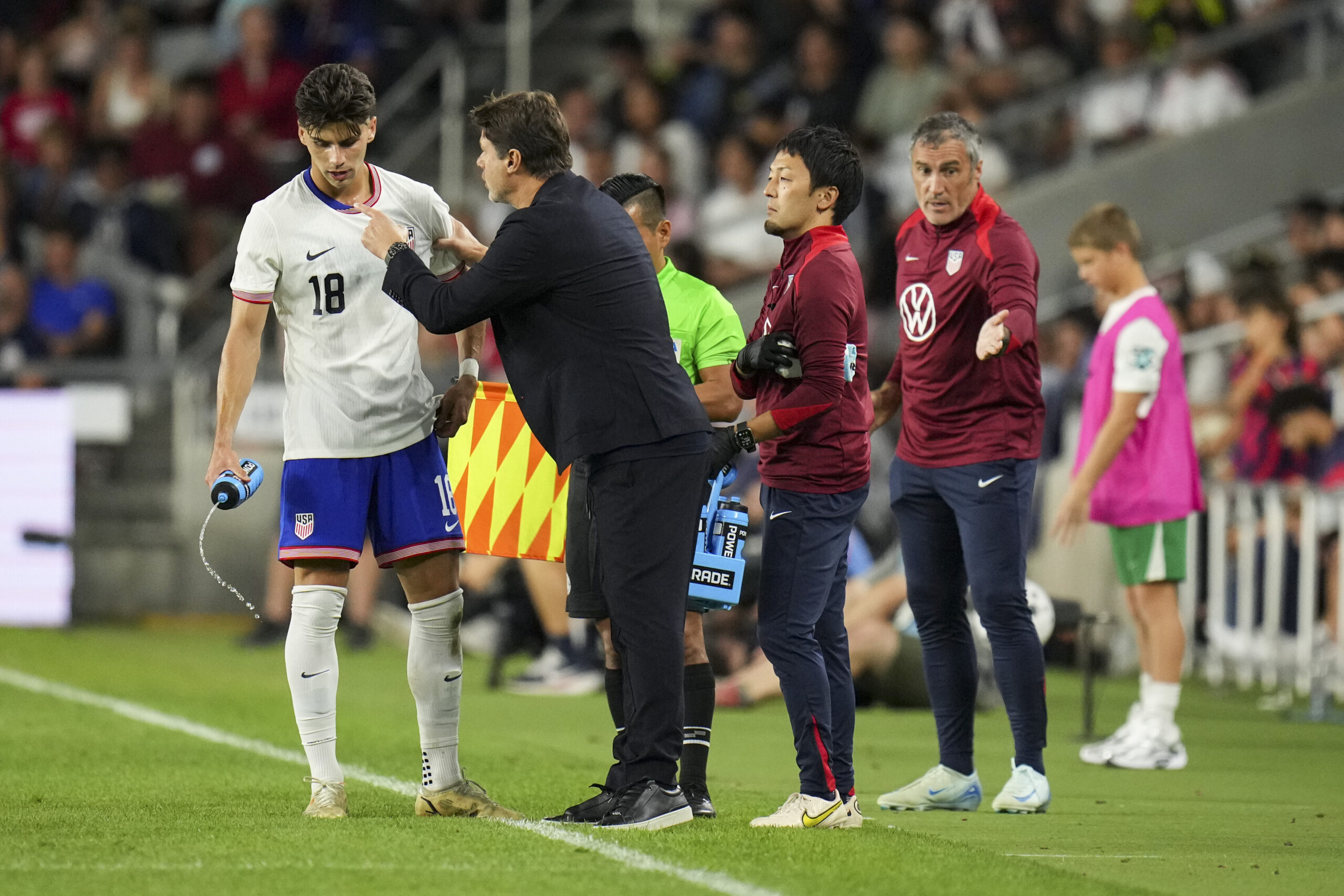
    U.S. manager Mauricio Pochettino, second from left. Carli Lloyd said the manager’s decision to bring fresh faces into the national team last summer and in the November cycle reinvigorated the team ahead of the World Cup.

    Games and opportunity

    Lloyd compared all of that to the success U.S. women’s coach Emma Hayes achieved in a short span, becoming the change that was needed after the Americans’ shocking exit at the 2023 women’s World Cup.

    There’s no reason, she says, that Pochettino can’t find similar success — despite being off to a noticeably slower start.

    “Obviously, the 2023 [women’s] World Cup didn’t end well,” Lloyd said. “The team needed change and almost needed to be blown up in order to be rebuilt again. Emma Hayes comes in. A lot of players retire. She selects different rosters, and they instantly change the culture, the mentality, the pride of wearing the jersey again, and that happened very quickly.

    “But with the men’s team, I feel like it took a lot of time, and I don’t know why it took time. Maybe it was the language barrier [between] coach and the team, and the lack of games and opportunities that they had together.”

    The U.S. seemed to find continuity during November’s qualifying cycle with a pair of exhibition wins, against Paraguay in Chester and a 5-1 rout of Uruguay in Tampa, Fla., to close the year.

    Pochettino will call up a number of players for matches against Belgium on March 28 (3:30 p.m., TNT, Peacock) and Portugal on March 31 (7 p.m., TNT, Peacock), in what will surely be a final audition for many on that roster.

    Both matches will be in Atlanta, home of U.S. Soccer’s new multimillion-dollar national training center. Lloyd noted that the investment and the caliber of nations the U.S. is bringing in show a commitment to improvement on the global stage.

    Now, it’s up to the players to cash in, she says.

    “I think we saw that fight [during this last FIFA window] in November,” Lloyd said. “You can see there’s a different tone within this group. And I’m glad that they found it when they did. There were some big wake-up calls for some players … and I think that’s all we’ve been wanting to kind of see, these guys having the pride when you put on that jersey. And they sure showed that those last two games in November.

    “It’s not a vacation when you come into the men’s national team anymore. There should be an excitement around it where you want to come in and lay your body on the line and do everything possible for the team and for your country.”