FIFA began the process of selling another 1 million tickets for next year’s World Cup on Monday, with the opening of a new ticket draw marking the start of the tournament’s second phase of sales.
The World Cup will take place this summer in 16 cities across the U.S., Canada, and Mexico, including in Philadelphia, where six matches will be played at Lincoln Financial Field.
This draw, which runs through 11 a.m. Friday, includes a domestic exclusivity time slot for residents of the three host countries. Fans from those countries, whose entries are selected out of this draw, will have the opportunity to buy single-match tickets for games taking place inside their home nation.
The phase is open to all fans, regardless of which country they live.
“We already have seen massive interest from around the world for this tournament, and especially from within the host countries as Canada, Mexico and the United States prepare to host the biggest FIFA World Cup yet,” said Heimo Schirgi, the tournament’s chief operating officer. “This second phase, with its host country domestic exclusivity time slot, will allow us to say ‘thank you’ to these local fans, while ensuring global opportunity as well.”
Those fans from the U.S, Canada and Mexico who enter the draw before it closes Friday have a chance to receive, through what FIFA says is a randomized process, a time slot during which they can buy tickets starting on Nov. 12. Those slots will be issued through Nov. 15. Fans who win those chances will receive word at least 48 hours before their time slot opens.
Residents of the three host countries — the U.S., Canada and Mexico, in that order — purchased more tickets than those from any other nation in the initial phase of ticketing. England, Germany, Brazil, Spain, Colombia, Argentina and France, in that order, rounded out the top 10.
Once the domestic exclusivity time slot ends, more fans will be eligible to obtain a purchasing slot starting on Nov. 17. Additional tickets will be made available in subsequent phases, FIFA said.
FIFA announced earlier this month that more than 1 million tickets have already been sold for next year’s World Cup, with people from 212 countries and territories having already purchased. So far, 28 of the 48 spots for teams in the field have been filled.
The start of ticket sales doesn’t take away from how there are unique questions for consumers heading into the tournament, particularly about how they’ll get visas, if necessary, to visit the U.S. as the country cracks down on immigration. An international friendly match between defending World Cup champion Argentina — featuring Lionel Messi — and Puerto Rico was moved from Chicago to Fort Lauderdale, Fla., because of lagging ticket sales that some believe were in response to the immigration crackdown.
Based on the listed stadium attendance figures, there are roughly 7.1 million seats to fill for the 104 matches for the tournament around 16 North American venues. It is unknown how many of those seats will be available for sale to the public.
Ticket data has shown that the lowest-priced seats — set at $60 — were available for at least 40 matches. Almost all seats for the vast majority of matches were set at a much higher price. The opening match for the U.S., to be played at Inglewood, Calif., had prices ranging from $560 to $2,735 when sales opened. On the resale site, at least one ticket for that opening U.S. match on June 12 was listed for more than $60,000 earlier this month.
Fans with the option to purchase could choose seats in one of four categories; Category 1 is what FIFA officials call the best seats, Category 4 is somewhere around the tops of stadiums. Ticket costs are expected to fluctuate as soccer’s biggest event utilizes dynamic pricing for the first time.
Two years isn’t a long time to wait between playoff games, in MLS or any other sport. But the Union’s return to the postseason brought an intensity to the air at Subaru Park that hadn’t been felt for a while, even with the many soccer spectacles that have come to town since then.
It also brought a very compelling game, if not always for the right reasons. At the end of the night, it felt like the series-opening win over Chicago had been four games in one: the scoreless first 70 minutes, the Union’s surge to a 2-0 lead, the Fire’s comeback, and the penalty-kick shootout.
Let’s take each in turn to go inside how the home team prevailed.
Three is a magic number
The first stanza was defined as much by referee Sergii Boyko as by the lack of goals. He seemed to have little interest in calling most of the first half’s contact as fouls, less interest in the crowd’s opinion of him, and the least in Chicago goalkeeper Chris Brady’s repeated time-wasting on the ball.
Those antics took much of the energy out of a crowd of 19,019 that for once was in the stands well before kickoff. Perhaps that was helped by the starting time being advertised in some places as 5:30 p.m., though it was long known and correctly printed elsewhere as 5:55. (Cue the joke that the time should be printed wrong more often.)
The fans were alive when Chicago’s starting lineup was introduced, launching a storm of boos at manager Gregg Berhalter for his previous tenure with the U.S. men’s national team. Then they shook the rafters when Quinn Sullivan was unveiled as the pregame drummer, a few weeks after surgery on a torn ACL that ended his season.
And they were touchingly silent during a pregame tribute to Brad Youtz, one of the Sons of Ben supporters’ club’s founding members, who died earlier this month. His loyalty began even before the Union existed, as he helped lead the fan movement that brought an expansion team here.
The view of what transpired next looked familiar to any watcher, from Youtz upstairs to the new generation in his old River End seats.
With the Supporters’ Shield mounted in the River End, an impeccably-observed moment of silence at the first Union home game since Brad Youtz’s passing.
My longtime friend has the best seat in the house today.
Berhalter’s 3-4-3 tactics had helped the Fire build a six-game winning streak heading into their first playoff berth in eight years. That setup turned the screws on the Union, the latest proof that for all that has improved in Bradley Carnell’s first year as manager, the team can still struggle to solve three-back defenses.
Uhre delivers again
The game changed when Carnell turned to his own toolbox, with the first substitutions in the 64th minute. One of them, Mikael Uhre, broke the game open.
It was a classic quick move down the field, with Milan Iloski sending Uhre down the right side. He was one-on-one with former Union teammate Jack Elliott and drew on some inside knowledge.
“He probably knows that normally I would go on my right,” Uhre said. “So I was thinking, let me cut it in and then see how it opens up. And then I could see Indy making the run on the back post.”
That was Indiana Vassilev, and Uhre found him with a dazzling, lofted pass across the 18-yard box. A quick trap, a quick shot, and Brady was flattened.
Five minutes later, the player who arguably changed this team’s whole season had another defining moment. Here came the Union again, this time with Iloski on the ball on the right flank. He had Vassilev and Uhre charging up the middle, and Chicago’s defense was expecting a pass.
Instead, Iloski kept the ball, cut left on Elliott, and slammed a shot into the top corner.
“As I was dribbling forward, I noticed there wasn’t a lot of options,” Iloski said. “I knew off the dribble I could beat anyone in this league. Once I let the guy kind of get close to me … I just got the ball out of my feet and then focused on hitting the ball on target.”
That same self-confidence would come in handy just over 20 minutes later. But there was still a long way to go.
Chicago’s comeback
Even after Jonathan Bamba’s goal out of a corner kick traffic jam in the 84th, there was little reason to believe the Union would blow the lead.
But between Chicago’s goals, Berhalter made a tweak that turned the game, subbing in attacking midfielder Brian Gutiérrez for centerback Sam Rogers. Removing a defender ended up helping Iloski, but the Fire benefited more, and for the second game in a row Gutiérrez showed why he’s a U.S. national team prospect.
“He was playing in these half spaces — that was really difficult for us, and they had some success to the end of the game,” Union goalkeeper Andre Blake said. “We couldn’t stop him from getting on the ball and he’s a great player, so he was able to create some dangerous plays for them.”
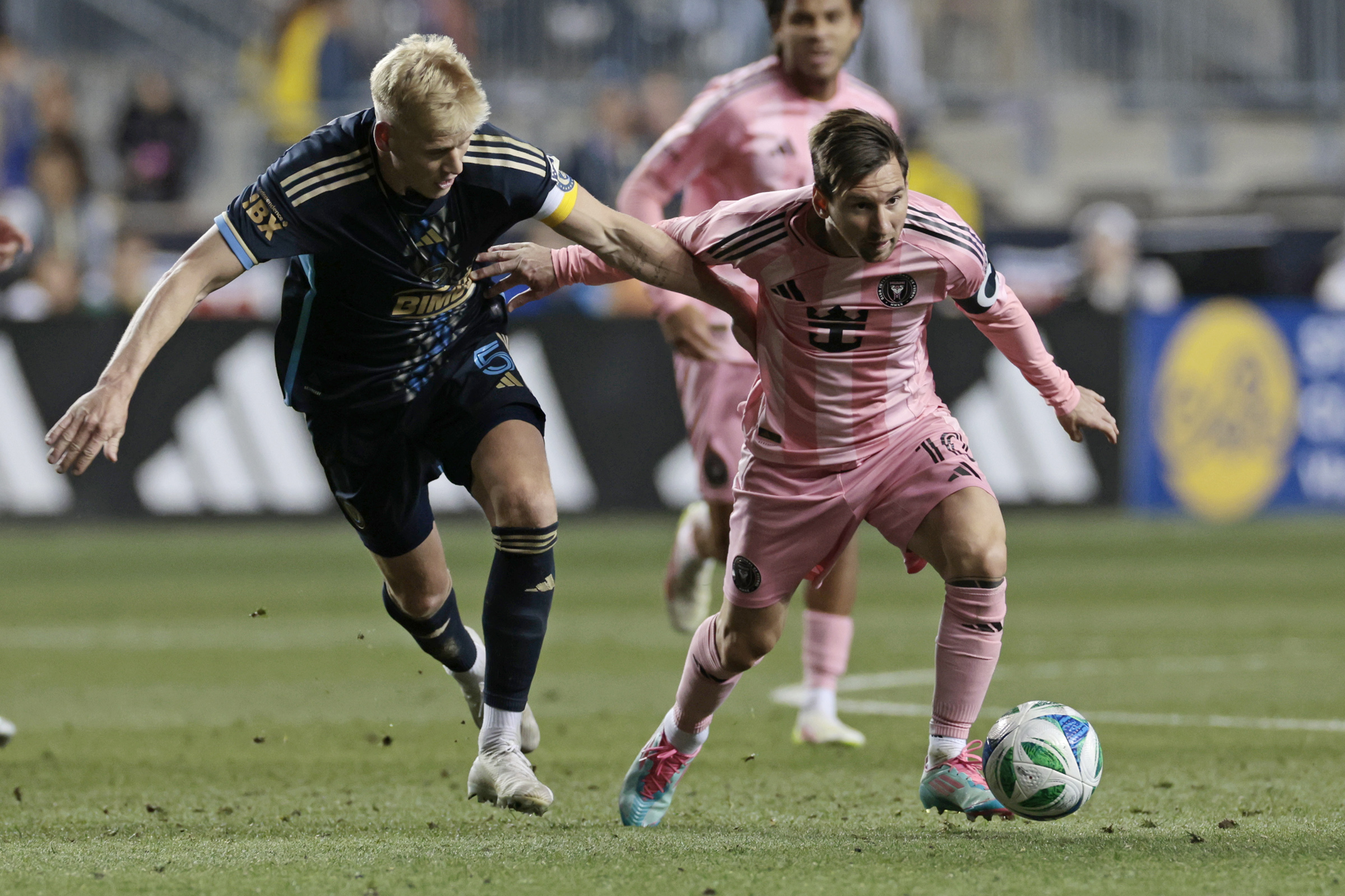
At the start of stoppage time, Jakob Glesnes tripped Mauricio Pineda just outside the Union’s 18-yard box. And just as happened a previous time when Glesnes tripped Lionel Messi against Miami in May, this was a game-changing moment.
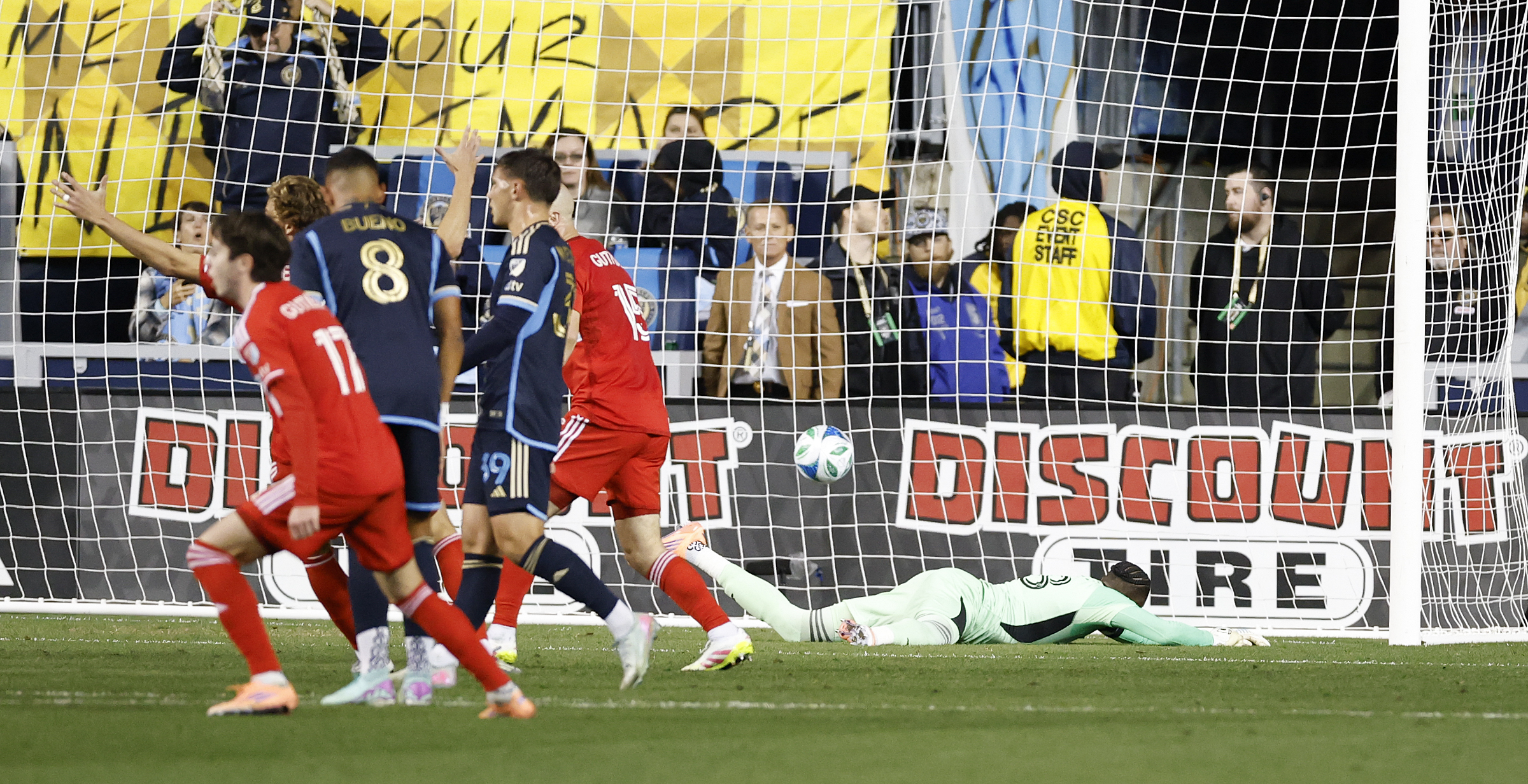
Bamba shot the free kick into the wall, the ball came right back to him, and he laid it off for Elliott to fire from 30 yards — low, hard, and straight past his former teammates. That he did not celebrate made the moment even more resonant.
Andre Blake (right) looks back at his net after Jack Elliott’s game-tying free kick goal got by.
When Boyko finally blew the whistle to end regulation, the game headed straight to penalty kicks. It was a moment that both elevated the drama and exposed again the strangeness of the MLS playoff format: a best-of-three first round and single-game knockouts the rest of the way.
Plenty of other competitions around the world these days go straight to penalties after regulation, as a kindness to players’ health. But none so contort things by making a score barely matter over the course of a series.
MLS used to do what the rest of the sport has long done: single-game rounds all the way, or a two-game, home-and-away series in which the aggregate goal tally decides the winner. In this best-of-three setup, it doesn’t matter if you win 2-0, 2-1, or by any other score; or if the tie after 90 minutes is 2-2, 1-1, 0-0, or 5-5. All that counts is which team wins.
It helped the Union this time, and it’s certainly an American tradition. But that doesn’t make it a good soccer principle.
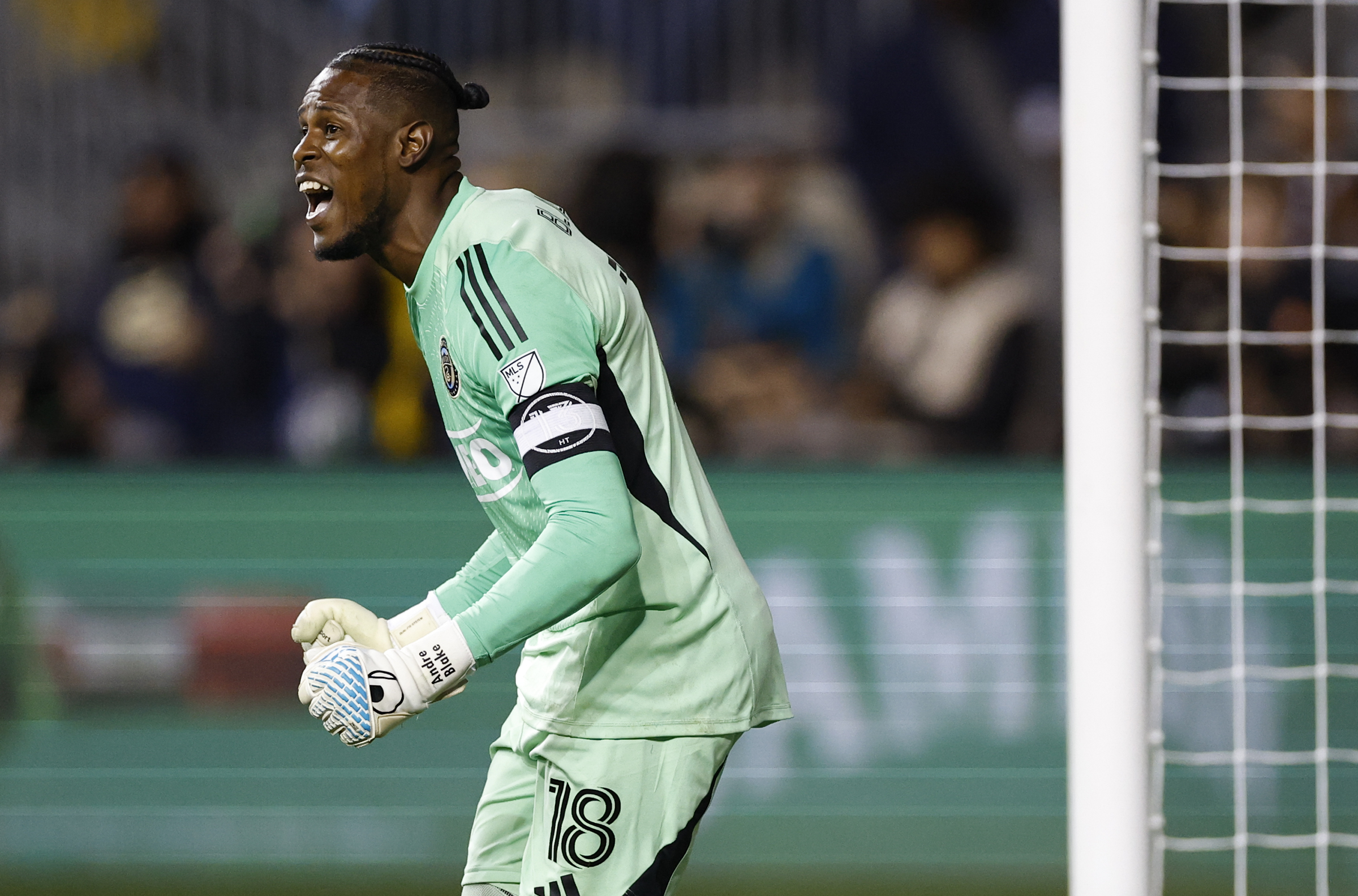
Andre Blake celebrates after Chicago’s Joel Waterman put his penalty kick off the crossbar.
Blake’s shootout heroics
Carnell offered the zinger of the night when he called the game “a contrasting of two styles — one team just trying to waste every second and try and get out of here. Probably, they got what they wanted, [which] was penalties.”
Be careful what you wish for, because you just might get it.
Blake had studied Chicago’s takers with the Union’s outstanding goalkeeper coach, Phil Wheddon. A veteran of the U.S. men’s and women’s national teams and American clubs going back to the early 2000s, Wheddon delivered again this time, working out a set of signals from the bench that Blake needed only a glance to see.
While Brady ran his mouth, the best goalkeeper in MLS for a decade running did his job. Blake stuffed Elliott, got a big piece of Hugo Cuypers’ shot even though it went in, and psyched Joel Waterman into hitting the crossbar.
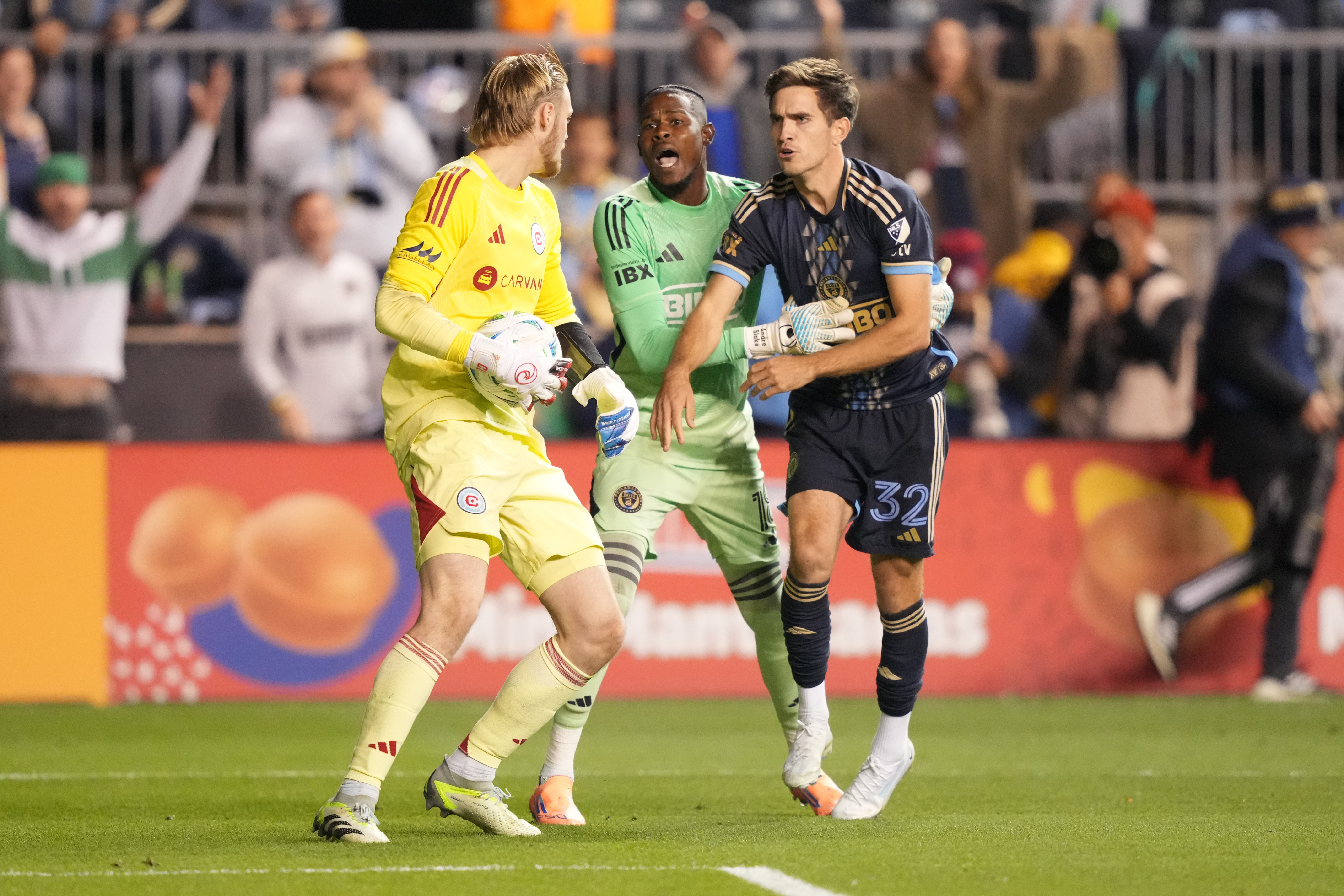
Andre Blake (center) and Milan Iloski (right) had enough of the antics of Chicago goalkeeper Chris Brady during the shootout.
That easily overcame Uhre being saved on the Union’s first turn of the shootout. Iloski, Frankie Westfield, Tai Baribo, and Jesús Bueno were perfect afterward.
“In truth, I was a little bit nervous before my penalty kick,” Bueno said. “But when Blake gave me the ball, I just looked at him in the eye, and we laughed, and we knew that everything was going to be OK.”
After playing to a 2-2 draw in regulation, the Union claimed a 1-0 series lead in their first-round playoff matchup against the Chicago Fire with a 4-2 penalty-shootout win Sunday night at Subaru Park. Jesús Bueno scored the decisive attempt in the five-round shootout.
Indiana Vassilev and Milan Iloski scored second-half goals in quick succession to open the scoring. Vassilev scored from a Mikael Uhre cross in the 70th minute, and Iloski added a second goal in the 75th minute off a feed from Tai Baribo. The Union struggled to place shots on target throughout the first half.
Chicago answered the Union with its own pair of goals in the final 15 minutes of the match. Jonathan Bamba bested Andre Blake in the 84th minute to cut the Union’s lead to one, and former Union player Jack Elliott scored in the 93rd minute to level the score at 2.
The Union had scoring chances during the remaining portion of stoppage time, but could not find the back of the net again in regulation.
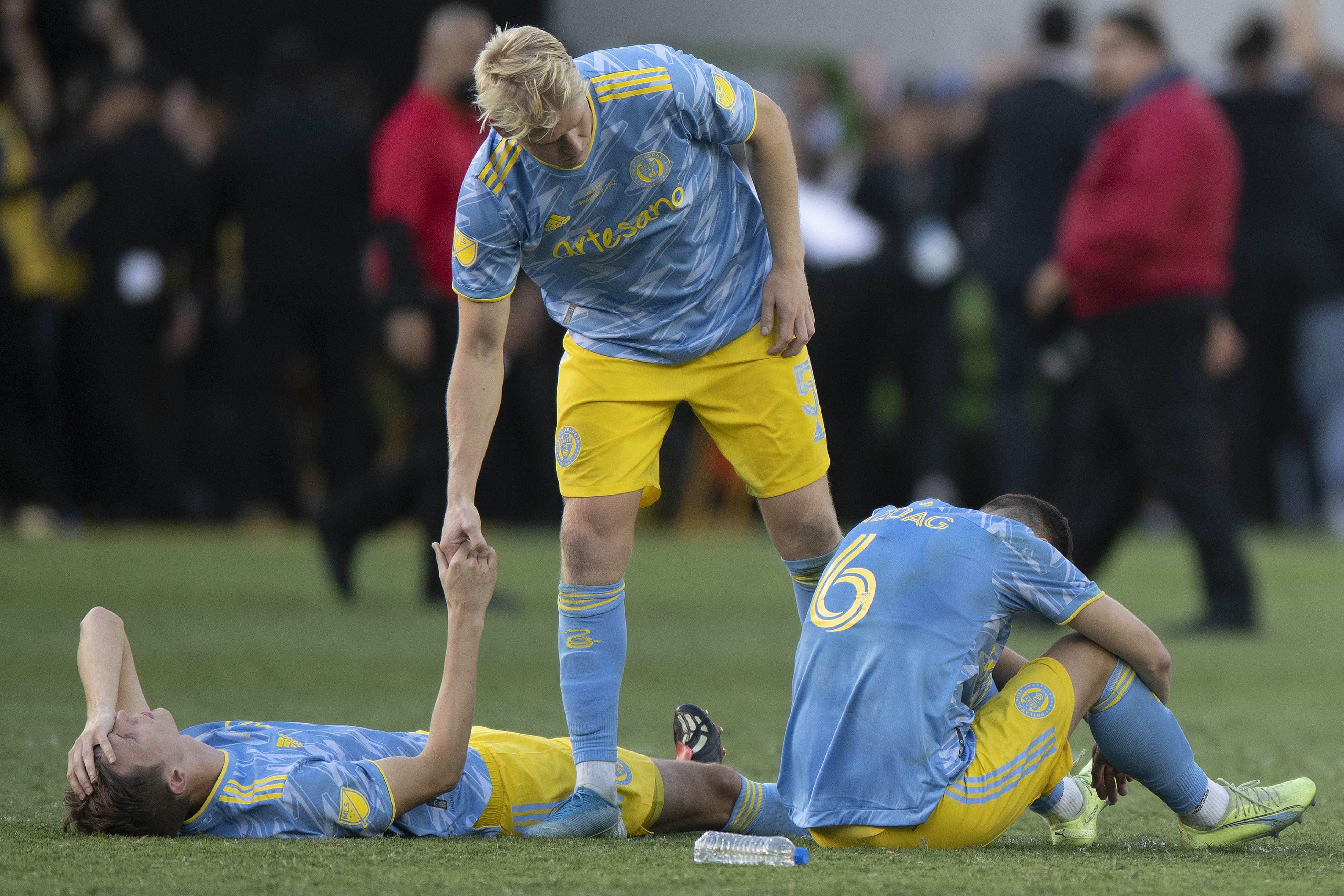
Union goalkeeper Andre Blake lies on the ground after the Chicago Fire’s Jack Elliott tied the game in the 93rd minute.
In playoff matches before the MLS Cup Final, the league’s rule book opts to decide tied games through a penalty shootout, rather than extra time.
Chicago goalie Chris Brady saved the Union’s first penalty kick, diving to his right to stop Uhre’s shot. Blake responded with a save of his own, denying Elliott.
“Jack [Elliott] takes great penalties,” Blake said. “I happened to guess right, and I was there to make the save. I’m just grateful for that.”
Frankie Westfield converted his attempt to get the Union on the board, but Brian Gutierrez brought the Fire even with a shootout goal of his own. Iloski made the Union’s third attempt, and Hugo Cuypers answered after scoring past Blake to level the shootout at 2. Baribo made the Union’s fourth penalty kick and Joel Waterman hit the Fire’s fourth shot off the crossbar, leaving the Union up, 3-2, after four rounds.
Bueno stepped up and converted the decisive penalty to give the Union a 4-2 shootout win.
“I was a little nervous for the penalty kick,” Bueno said through a translator. “But when Blake gave me the ball, I just looked at him in the eye and we laughed. We knew that everything was going to be OK.”
The Union’s pair of goals in regulation came shortly after Bradley Carnell made substitutions in the 64th minute. Carnell sent Westfield for Nathan Harriel and Uhre for Bruno Damiani. The Union outshot Chicago, 16-13, but Vassilev’s 70th-minute goal was the first shot on target for the Union.
“We worked in transition,” Carnell said. “We showed what we can do. We created chaos moments. We took the opportunities when they came. Just unfortunate the way we give up two moments. … We were excited about the full game.”
The match was physical, with 20 fouls issued between the two teams. The Fire’s Sergio Oregel was issued a red card in the 94th minute, and will be unavailable for Game 2.
“They got what they wanted — penalties,” Carnell added. “I’m glad that we came through on the other side.”
Playoff push
With their win over the Fire, the Union can advance to the semifinals by winning Game 2 at SeatGeek Stadium in Bridgeview, Ill., on Saturday (5:30 p.m., Apple TV+). The Union claimed a 1-0 win over the Fire in their lone regular-season trip to Chicago. If the Fire win on Saturday, the two teams will play a decisive Game 3 at Subaru Park on Nov. 8.
EAST HARTFORD, Conn. — Olivia Moultrie scored two goals and the U.S. women’s national team bounced back against Portugal with a 3-1 victory on Sunday after honoring former goalkeeper Alyssa Naeher.
The United States was coming off a 2-1 loss to Portugal in the first game of the international window on Thursday in Chester. It was Portugal’s first victory over the U.S. and just the third loss for the national team under coach Emma Hayes.
Moultrie scored just 45 seconds into the game to give the USWNT the early lead. Portugal leveled in the fifth minute on Jessica Silva’s header off a cross from Beatriz Fonseca.
Moultrie added her second in the 10th to put the Americans back in front. The 20-year-old has a pair of two-goal games in 10 international appearances.
Sam Coffey, who came into the game as a substitute in the 77th minute, put the game away with a goal in the 82nd. Coffey and Moultrie are teammates on the Portland Thorns in the National Women’s Soccer League.
Hayes made eight changes to the starting lineup from the group she started on Thursday.
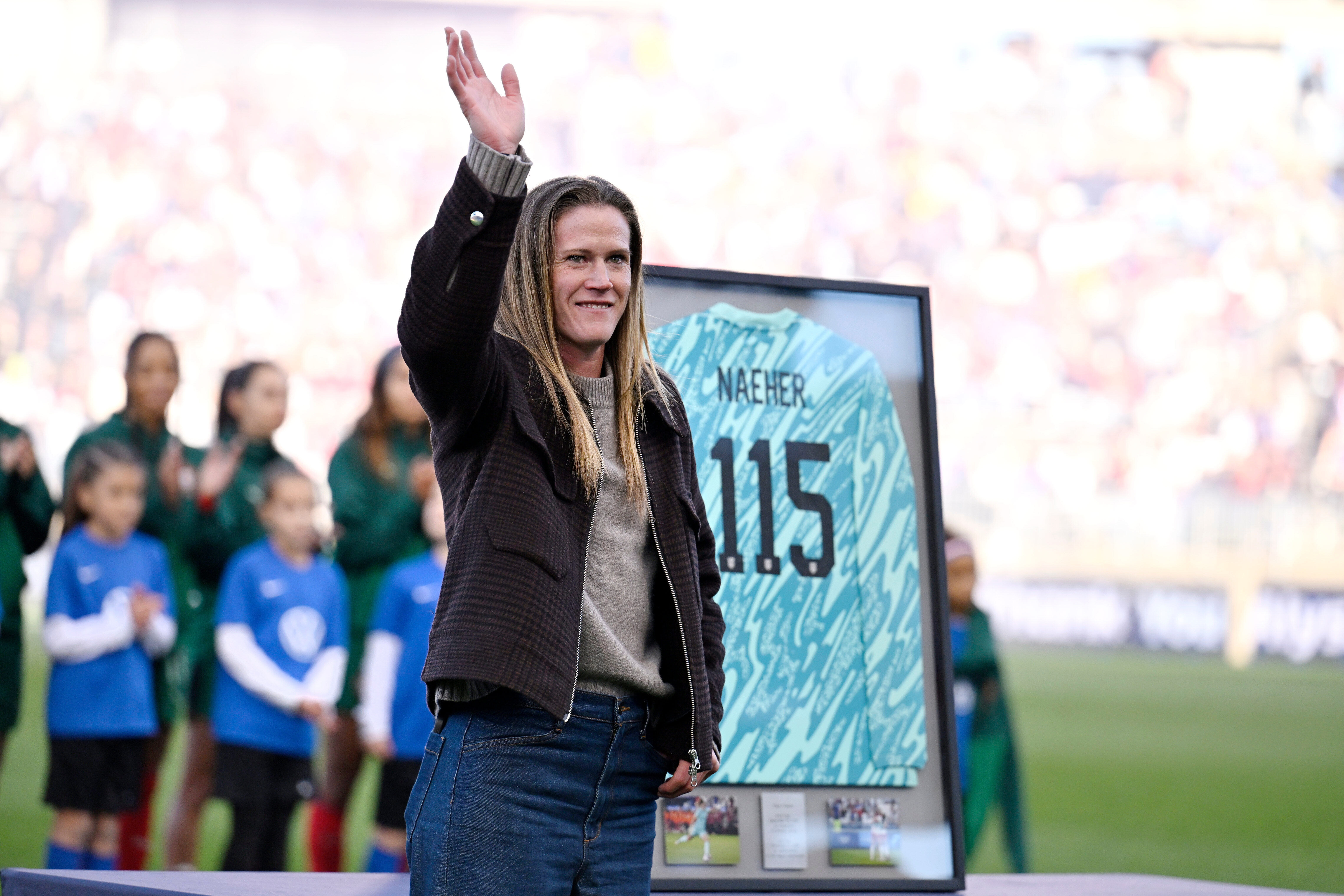
Before the match at Pratt & Whitney Stadium, the United States honored Naeher, a Connecticut native, who retired from the national team late last year after winning a gold medal at the Paris Olympics.
Naeher was the starting goalkeeper for the U.S. team that won the Women’s World Cup in 2019 and the 2024 Olympics. She’s the only U.S. goalkeeper to earn a shutout in both a World Cup and an Olympic final.
Alyssa Naeher waves to the crowd in her home state during her retirement ceremony.
The team was without some of its star players. Trinity Rodman was nursing an MCL sprain in her right knee that she sustained Oct. 15 during a CONCACAF W Champions Cup match with her club team, the Washington Spirit.
Defender Naomi Girma remained sidelined with a calf injury that occurred before the start of Chelsea’s season in September.
Forward Lynn Biyendolo, who was left off the U.S. roster because of a knee injury, announced on Saturday that she and her husband are expecting their first child. Other prominent national team players who have taken maternity time off this year include Sophia Wilson and Mallory Swanson.
Hayes said that U.S. Soccer was developing more comprehensive “pre- and postpregnancy” protocols to be announced in the future.
The United States has one more match during the current international window, against New Zealand on Wednesday at CPKC Stadium in Kansas City, Mo.
Don’t talk to him about the next five years; he doesn’t want to discuss them. Will his contract get extended with the Union next season? He says he has no clue.
In fact, as he arrived for an interview to discuss his career and where it’s going from here, he joked that he didn’t even know where he was supposed to go after this meeting for a scheduled team-bonding activity — one that apparently involved barbecue.
Bedoya is an enigma. Right now, he might be one of the few people whose off-the-field portfolio, at first glance, shows many avenues. But on this day, as captain of the No. 1 team in MLS’s Eastern Conference … no plans.
Well, except for one: Get back to the MLS Cup final. That’s it.
“Five years from now? I don’t know. I couldn’t tell you,” Bedoya said as he leaned back in his cushioned chair inside the Union’s film room. “What I can tell you? This team is special, and we’ve been special since preseason. We knew this team was special that long ago. I want to be a part of the team that brings an MLS Cup to this club and home to Philly.
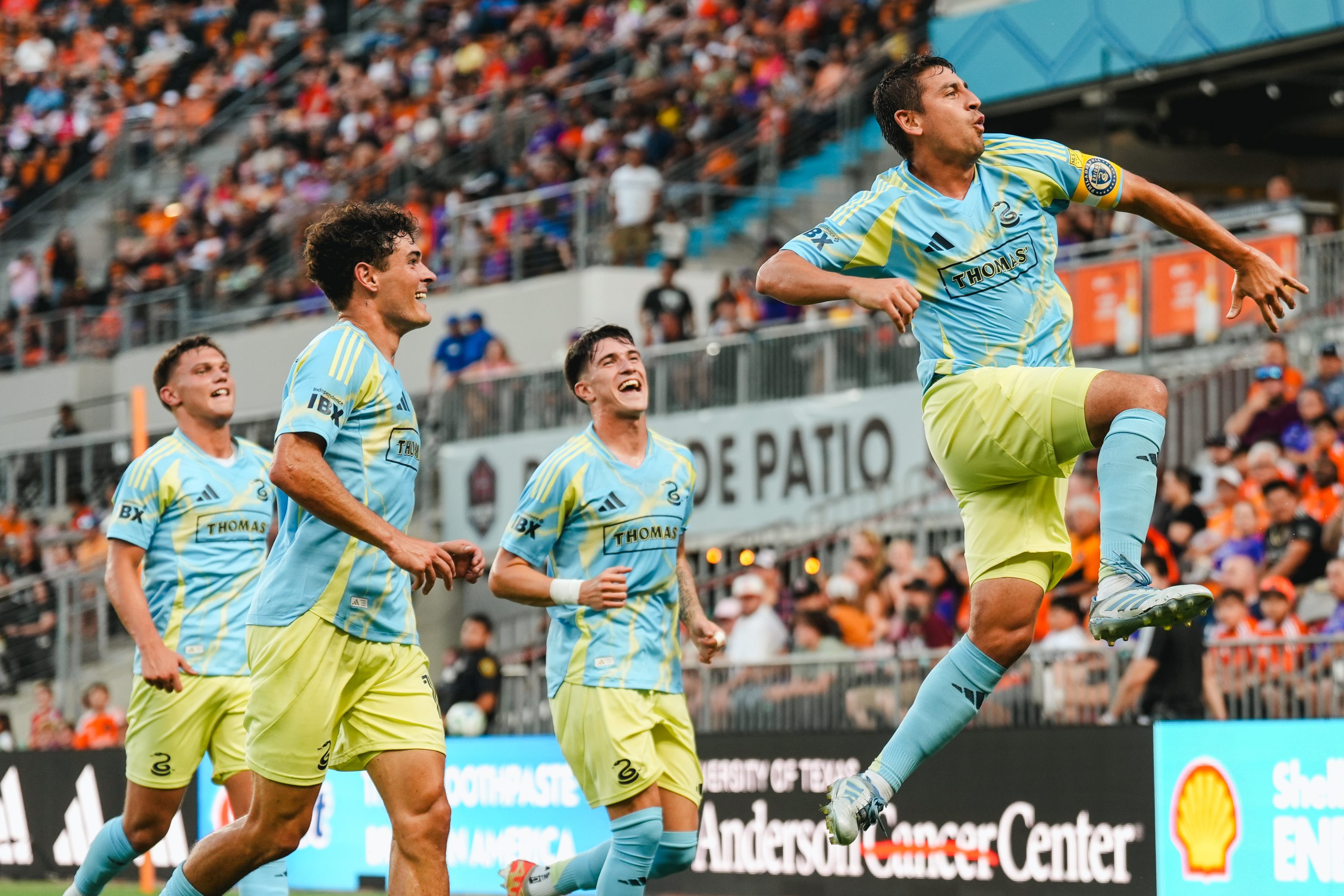
Alejandro Bedoya (right) celebrates scoring a goal in the first half of the Union’s win against the Houston Dynamo on July 29.
“So, to be honest, I’m not thinking about [anything past that]. I made it a point this season, especially now that we’ve been so successful, to be focused on the team. I don’t want to think too far down the line and cause any disruptions to talk about this or that or what may happen or might not.”
It’s been an interesting 10-year run in Philly for Bedoya. He’s been the team’s leader since arriving from FC Nantes of the French first division in 2016. He’s been a vocal ambassador for ending gun violence. He’s been a staunch advocate for growing the youth game from a grassroots level.
However, this season, he’s mainly been the utilityman that first-year manager Bradley Carnell needs.
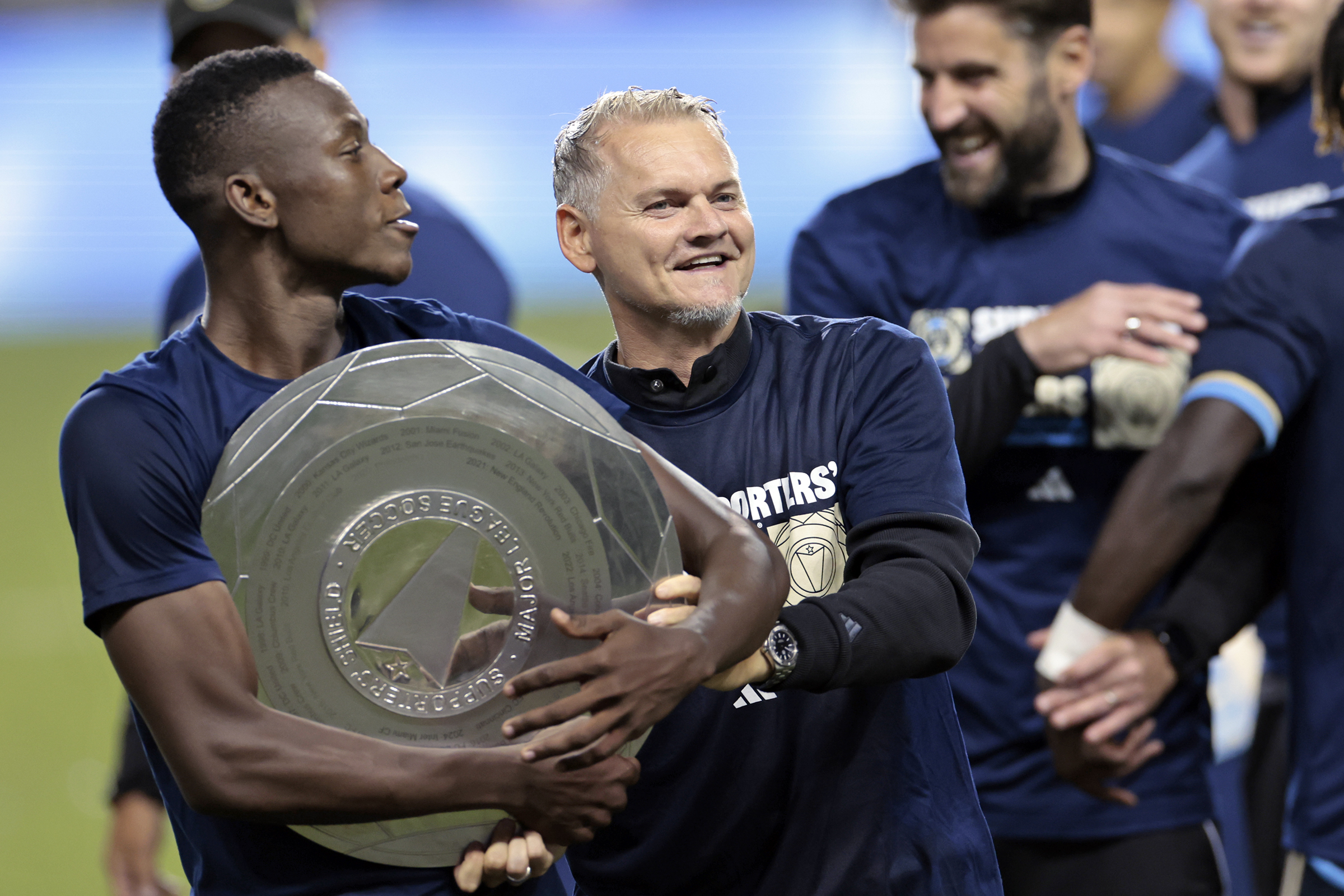
Things get real now for the Union. Coming off a high two weeks earlier after the club captured its second Supporters’ Shield, given to the team that finishes with the best regular-season record, Bedoya now leads the Union into the playoffs with every opponent looking to beat the best.
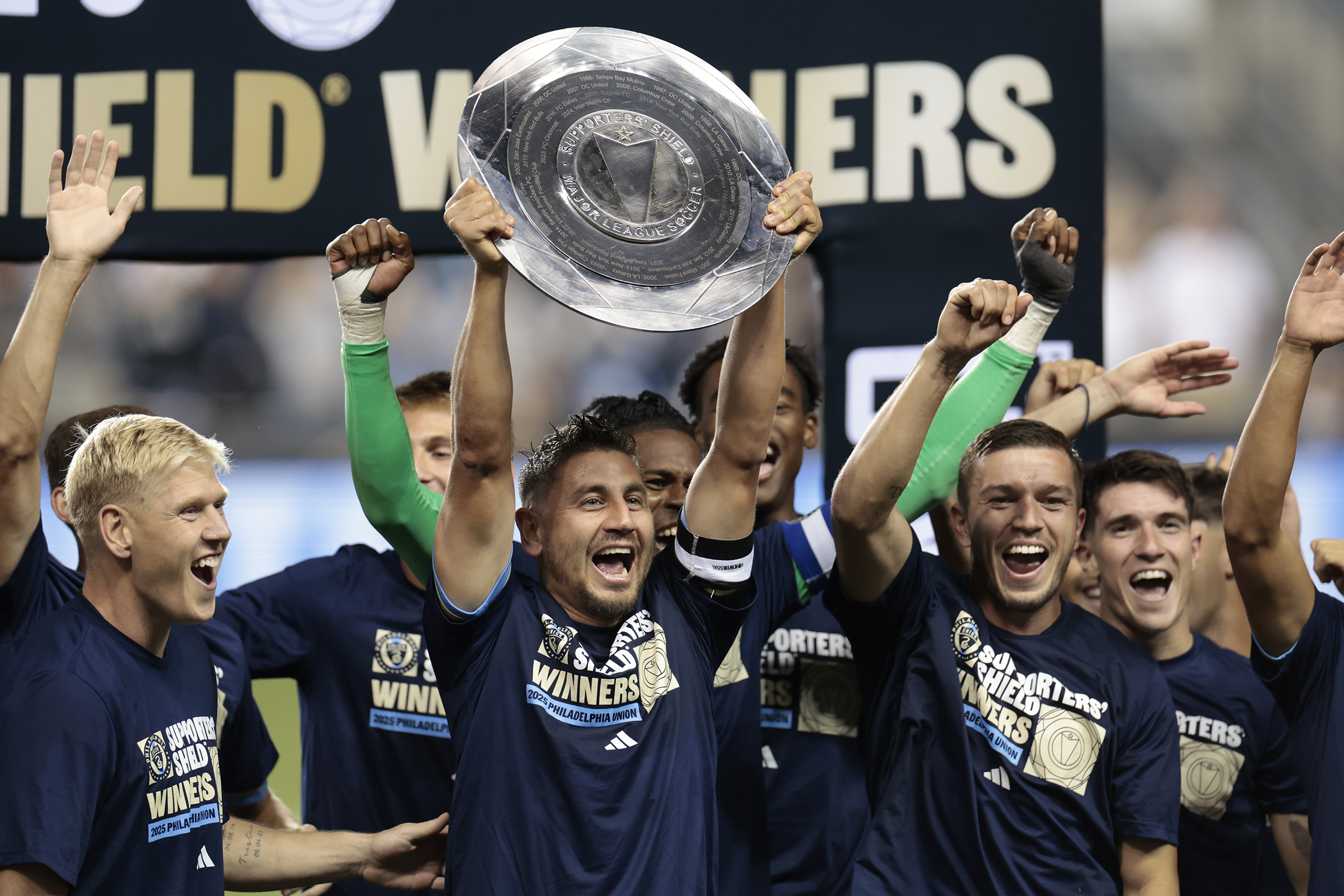
Alejandro Bedoya raises the Supporters’ Shield after beating New York City FC at Subaru Park on Saturday, Oct. 4.
First up is Chicago in Game 1 of a best-of-three series on Sunday (5:55 p.m., FS1, Apple TV+).
“He’s our leader. He’s one of the guys who holds us together,” Carnell said earlier this season of Bedoya. “That’s why he’s here. He’s committed to doing what he has to for the club. And from a leadership standpoint, there’s no one better. He’s great with the young guys, he’s great with the guys [who] have been here, and he knows what it takes to get to where we’re trying to go.”
Taste for more
It was 2022, and the rays of a sunny Los Angeles afternoon beamed onto Banc of California Stadium (now known as BMO Stadium), the site of the MLS Cup final. Led by then-manager Jim Curtin, Bedoya, clad in the Union’s unmistakable lightning bolt kit, took the field for warmups. He didn’t start that day, but his impact to that point was immeasurable.
That season, at age 36, he’d played in 30 regular-season games for the club and started 27 of them. He played nearly 2,500 minutes and scored six goals along with six assists, highlighted by two goals against D.C. United on July 8, which made him just the third player in club history to join the 20-20 club.
The fruits of his labor culminated in an Eastern Conference title and a trip to MLS’s final. But as team captain, his leadership guided the Union to its first MLS Cup appearance — and arguably one of the greatest MLS Cup finals ever.
So what’s changed in his roles and responsibilities from that moment with that coach to this moment with this coach?
“To be honest? Not much,” Bedoya said. “I’m still one of the captains, whether it’s me, [goalkeeper Andre] Blake or [defender] Jakob [Glesnes]. I, more so maybe than others, act as like that intermediary between the coaching staff, the technical staff, and the locker room. … I’ve been more of a glue guy, if you will. And this year, more than ever.”
The glue-guy approach has been the case on the field too. Each year, Bedoya’s minutes have dwindled from everyday starter to strategic, none more than this season, when he was used in situations to which he’s unaccustomed, like in the Union’s 7-0 loss to Vancouver on Sept. 13, when he started at right back following the suspension of defender Olwethu Makhanya.
In that match, the decision — and result — spoke for itself. Bedoya even acknowledged as much. But in the same breath, he noted that ebbs and flows happen in a club-first mindset.
I’ll be the first to apologize for my personal performance tonight and accept responsibility for the result tonight. Simply not good enough or anywhere near our standards and expectations. One thing is for sure. One result/game will NOT define us this season. On to the next one!
“We had to rotate a little bit, obviously,” Bedoya said. “Maybe I’m not the best right back. So I took that on the chin there, but we’re all about the collective here … and you have to be an unselfish guy. I think in Bradley [Carnell’s] system this year, I’ve been playing more even on the left side of midfield, which typically I haven’t played in years past. But as I said before, man, whatever it takes, I’m ready to step up and help the team out in any way.”
A plan for now
Despite a refusal to look into crystal balls right now, Bedoya’s future does have a number of paths. He has a certification from Harvard Business School and has become an entrepreneur and investor across several ventures.
He has diversified, but not necessarily in a way where all roads leads back to soccer. Instead, it’s in a way that when he’s not on the field, he can spend more time doing things with his family, namely his children, Santino, age 10, and Milena, 8.
Bedoya says the two, along with his wife, Bea Hilland, are his biggest supporters. He said he loves doing dad things, like taking them to soccer, dance, and doing school pickups when he’s not on the road.
But in true dad fashion, sometimes he wants to just sit on the couch and watch football. He says they’re cool with that, too.
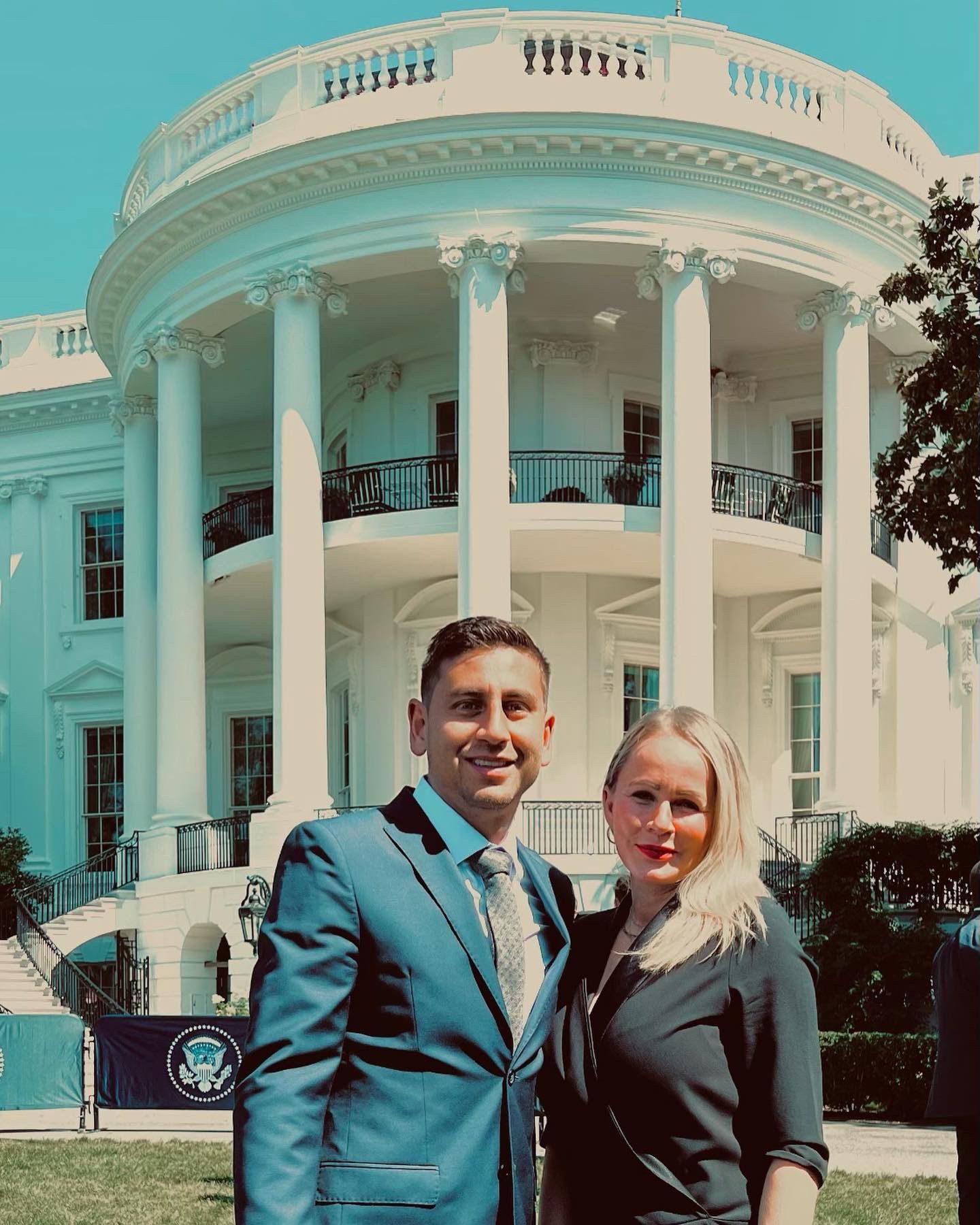
Alejandro Bedoya (left) and his wife Beatrice Hilland (right) were on hand at the White House in 2022 for a celebration of then-President Joe Biden signing new federal gun control legislation.
“My wife will be the first one to tell you that she plays a major role in the house, with the kids, especially as much as we travel to games,” he said. “And as an old guy myself, you feel more pain, you get more sore the day after games. And you know those Sundays when maybe we have the days off, the younger guys can come in and do even more work, but I just want to sit on a Sunday and watch [NFL] RedZone all day, you know?
“I make it a routine to make sure every time I’m home, I do a drop off at school and pick up at school. I make sure that even when I do want to be lazy or try to recover on the sofa, that I got both of them next to me on my side … I get emotional sometimes thinking about after we won a Supporters’ Shield, like how happy they were. They’re FaceTiming friends saying, ‘We won the Shield,’ not just ‘Dad won the Shield.’ What I do matters to them, and to me, that’s everything.”
So how does he juggle a portfolio that doesn’t seem to stop?
“It’s finding the right balance with them,” Bedoya said. “My kids are at the age where they’re playing sports now. They’re in soccer. They’re in dance; they’re in baseball. I like being part of those special moments. I think part of the beauty of being a father and still being a player is being able to share these moments with them.”
“Let’s go finish this thing”
Over the course of his 15-minute interview, the only times Bedoya wasn’t stoic was when he discussed his family and what’s next for the Union. The latter only has a handful of more games before it could be bringing home MLS’s biggest prize.
And after 10 seasons in the same league with the same team on the same mission, Bedoya knows he’s not getting any younger. There are no more long-term contracts. His playing career has become a year-over-year proposition with a goal that has been the same since Day 1.
Bring an MLS Cup back to the Chester waterfront.
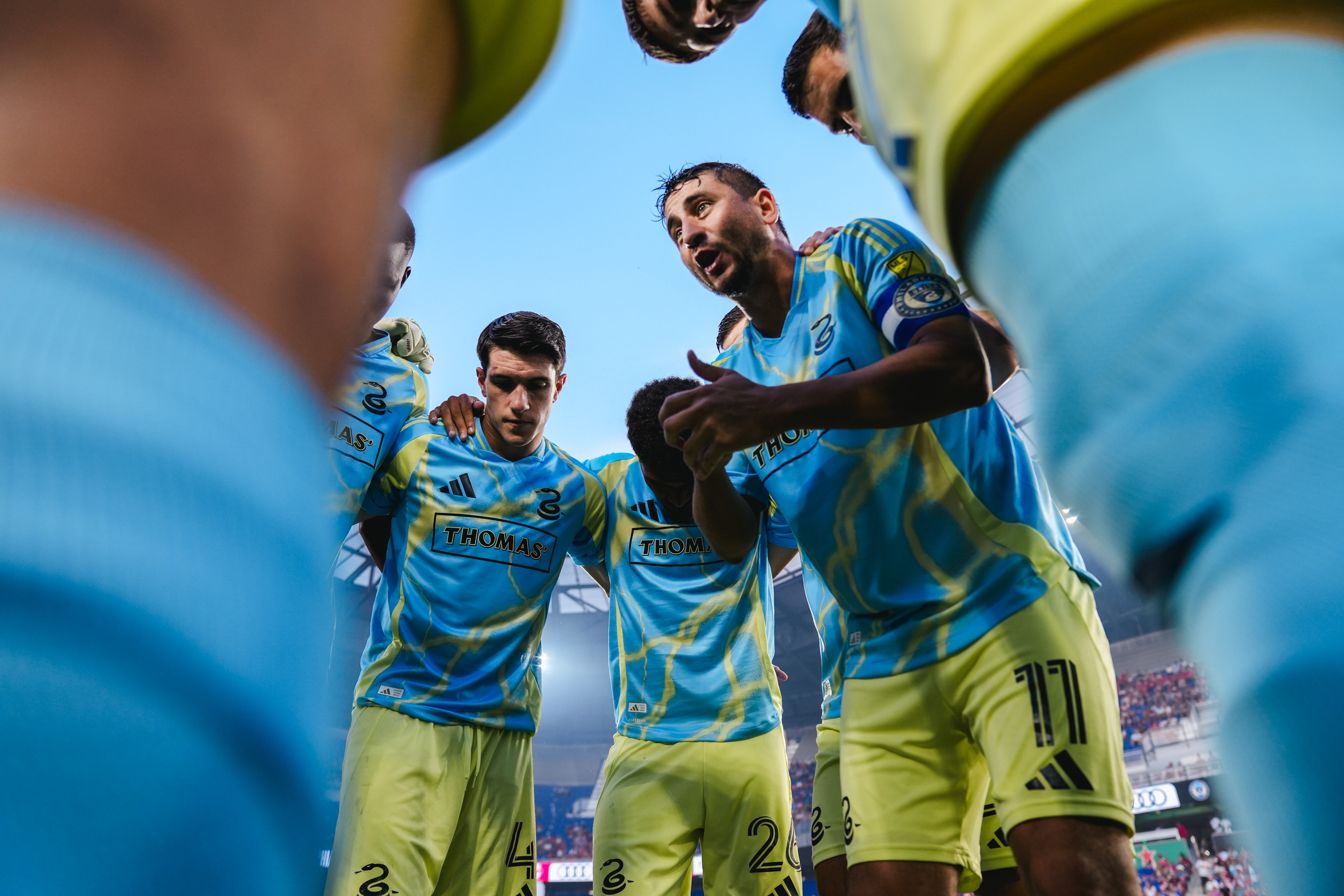
Union captain Alejandro Bedoya is ready to be the leader the team needs as it enters into the 2025 postseason as the No. 1 team in the Eastern Conference.
This is the year he truly feels offers the best chance to do that. Whatever happens after that, Bedoya has already affirmed is wait-and-see.
“I can tell you from that first week [of preseason training] in Marbella [Spain], I could sense that there was something brewing,” Bedoya said. “We already had a basic kind of philosophy, philosophical model of how we want to play, but Bradley and the staff came in and amped that up to another level, to another notch.
“As far as my place? Like I said, I’m maybe not a starter anymore, but I’ve shown even this year that even when I do start, I can still impact the game in a positive way.”
He paused and added:
“This team is special, I think our record and our run to this point reflects that. The standard in training and in games is high, every day. We’re the team to beat and now it’s about going out there and being dominant. Let’s go finish this thing.”
NEW YORK — Here’s something that Union principal owner Jay Sugarman has in common with his team’s fans.
He, too, has spent much of this year seeing Lionel Messi, Son Heung-Min, and Thomas Müller dominate the headlines, even though his team topped them all in the standings.
And he, like those fans — well, let’s keep things polite in the C-suite — would like to see the spotlight spread out a little more.
“Any press for MLS, I’m good with,” he said. “Messi’s been fantastic for this league. Son’s been fantastic, Müller’s fantastic. We don’t want to take away their press. We just want more coverage for a different kind of story.”
So Sugarman decided to put himself out there this week. The Union invited a group of media outlets, including The Inquirer, to MLS headquarters, and Sugarman held court, as he spent an hour talking about the success of his team.
Jakob Glesnes (left) and the Union could see Lionel Messi and Inter Miami again in the playoffs.
“We’ve got to show it on the field,” he said. “But so far the results, you know, I think are worthy of people paying attention. And saying, whether it’s a player or a fan: ‘Hey, I kind of like that team. They work really hard, they don’t ever give up, they’re a tough team in a tough city, and they bring it every game.’”
Sugarman praised manager Bradley Carnell’s work this year, and Ernst Tanner’s work over many years. He praised the players for their feats and the culture they’ve all built together.
He laid out a series of impressive statistics: the fewest goals conceded this year, and the most total shots taken, corner kicks won, tackles, interceptions, and counter-press regains — those moments when high-pressing forces turnovers.
“It was a bit eye-opening to see how many categories we could track to say, when does a defense become offense?” Sugarman said of conversations he had with Tanner about this very subject.
Bradley Carnell (right) helped the Union win the Supporters’ Shield in his first year as the team’s manager.
This all came as the Union recorded the league’s worst pass completion percentage, the lowest number of touches in their own half, and the second-lowest number of one-on-one take-ons. But they also had the most goals scored from crosses.
A surprising admission
Sugarman then ran all this through the eye test.
“It means we’re putting the ball in places where the defense has to put it out of play — that’s their best choice,” he said. “But where we do pass to, where we do touch the ball, is usually pretty dangerous, and it leads to dangerous things, crosses, shots, corner kicks, throw-ins deep. Anything in that deep attacking zone, I think Ernst would tell you, is a good place to be.”
Then he offered something that many outsiders have felt instinctively, but might have never expected the team to admit.
“We don’t rely so much on guys creating their own shot,” Sugarman said. “We don’t expect people to dribble through defenders. … We’re not about individual moments of brilliance breaking down a defense. But we will get into dangerous places, and our team working together will create opportunities.”
Kai Wagner (left) and Tai Baribo are some of the players who most symbolize the Union’s direct style.
The payoff for all of this has come in the statistics that matter most.
The Union have totaled the most standings points of any team in the league since 2020, and the second-highest total since Tanner’s first full year in 2019. They’ve won two Supporters’ Shields for the league’s best regular-season record, made the playoffs every year but one along the way, reached two conference finals, and came a breath from winning it all in 2022.
Sugarman believes in an organizational philosophy of continuous improvement, and there has been a lot in recent times. He also knows as well as anyone that the hardest part of improvement in sports is the last part.
Jay Sugarman was in a celebratory mood when the Union won their second Supporters’ Shield earlier this month.
A reporter from a sports business publication asked Sugarman how the team’s success on the field has translated to the team’s bank accounts.
“It’s a lot more fun to be part of a successful club,” he said to start his answer. “So we know that’s a helpful part of the conversation with sponsors and fans.”
“Our goal right now is to win a [MLS] Cup,” he said. “You can feel it in the players, you can feel it in the coaching staff, you can feel it at the ownership level. It feels like the one thing we haven’t quite gotten our hands on.”
Jakob Glesnes (center) is one of the players still left from the 2022 Union team that came so close to winning the MLS Cup final.
Now the heart of the matter was truly on the table. For as much as this year has been better than expected, there’s been real pressure on the Union to turn these many years of success into trophies.
It’s why there have been stern demands to win a U.S. Open Cup. It’s why, once that quest failed this year, the pressure skyrocketed to win the Supporters’ Shield.
It’s why the air was so thick as kickoff approached on the night they clinched it, earlier this month against New York City FC. And it’s why there was such an explosion of joy around Subaru Park when that final whistle blew.
“Everybody knows this is the best sports town, maybe the toughest sports town,” Sugarman said. “We said, maybe our MLS tagline should be ‘the toughest team in the toughest city with the toughest fans.’ They want, they demand, success — we knew that going in. So we can’t deliver anything less than that for them.”
The Union will play all but one of their playoff games this year at Subaru Park.
He was still willing to defend his long-term vision for reaching success, even as he knew those same fans want it faster. But that’s for another moment.
This moment — this month, this week, this Sunday evening playoff opener against the Chicago Fire at Subaru Park (5:55 p.m., FS1, Fox Deportes, and Apple TV) — is about right now.
“It’s great that we’re going to be at home. Our fans are going to give us that extra 10%,” Sugarman said. “I think this is the year that everybody feels like we need to do everything we can.”
He caught himself for a breath, but not much more.
“It’s hard to put the kind of pressure on to say we must do it,” he said, “but this feels like the moment where — I’ve watched the joy on this team when they win. It is infectious. When they get rolling, I think it’s going to be hard to stop this.”
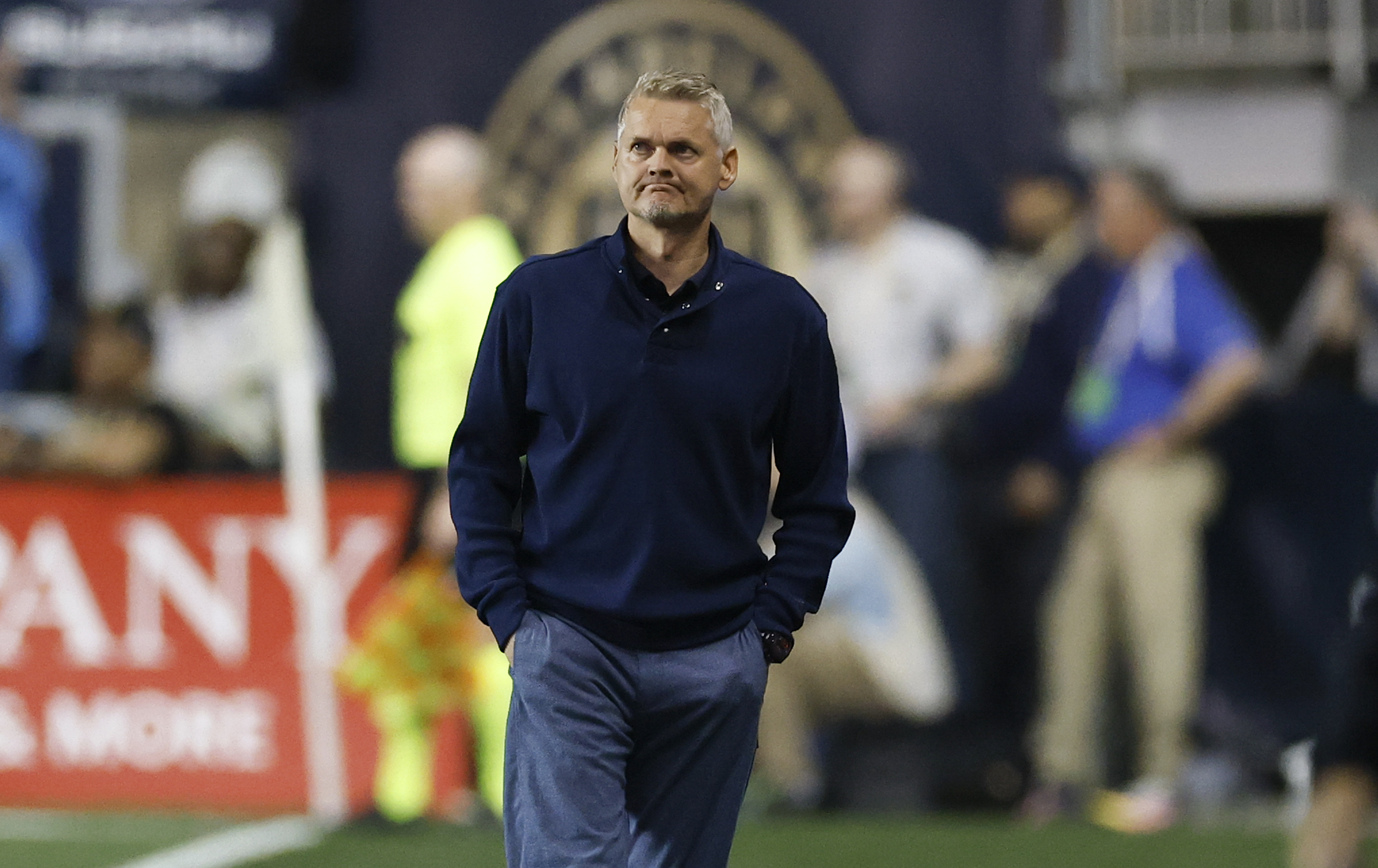
When the ball rolls on Sunday at Subaru Park in the Union’s playoff opener vs. Chicago (5:55 p.m., FS1, Fox Deportes, Apple TV), most of the spotlight will be where it usually is: on the players.
But a little more than usual will be on manager Bradley Carnell, and not just because he’s a finalist for MLS’s Coach of the Year award.
A lot of people have been waiting all year for his first return to the playoffs since 2023, when he guided St. Louis City SC to the Western Conference’s best record in their expansion season.
The club crashed out of the playoffs in the first round to cross-state rival Sporting Kansas City. They weren’t just being swept in the best-of-three series but lost decisively: 4-1 at home in the first game and 2-1 on the road in the second.
Bradley Carnell on the St. Louis City sideline in 2023.
How much of a fluke was that? How different are the circumstances with this Union team, having not just many veterans but many players who’ve been here for a while?
Given how much Carnell dislikes talking about himself, it wasn’t surprising that he didn’t want to answer those questions in his pregame news conference Friday. Nor was it surprising that the media present tried to find multiple ways to ask them.
Everyone knew they would come, and that this was the time.
“I think that’s a loaded question — it needs maybe a lot more time,” Carnell said when asked one of them.
“I do a disservice now planning for three games, as opposed to just planning for one every match day for 34 match days,” he said to another.
Bradley Carnell (center) celebrating on the field with his players after the final whistle of their Supporters’ Shield-clinching win.
A moment later, he came the closest he got, but that was as far as he went.
“We don’t want to go back in the history books,” Carnell said. “It’s a clean slate now. It’s three games, and it starts with one, and everyone has to be dialed in from the very get-go.”
He preferred to talk about the team as a whole and how far it has come since he took the reins at the start of the year.
“I think everyone has grown” Carnell said. “You have to face a bit of adversity to see what you can battle through and fight the demons and come out on the other side. And I think as a staff, as players, we’ve all been through this adversity from January, to find ourselves now to fight for something that’s greater than each and every individual one of us.”
Bradley Carnell gets an ice water bath at the end of his speech:
He praised his group for its sacrifices, then realized he wanted a different word.
“If you have to call it a sacrifice, it means somebody’s forcing you to do something, right?” he said. “I think we all love to do what we do, and I think we all enjoy the process right now. So for us to give willingly, whatever, we’ve gone to great lengths to to get where we are and to earn ourselves [being] in a position where we are, credit to everyone.”
Carnell even admitted that his team has exceeded its own expectations.
“Now that we’ve won the Supporters’ Shield, I can tell you that our target was top four” in the standings, he said. “We wanted I think, 55, 58 points — [that was] the target was for the boys, and that’s thinking big picture. You have a big picture, break it down into small cycles, and that’s the way you go about building the puzzle.”
The one moment where Carnell did talk about himself was when he was asked about being a Coach of the Year finalist.
“I’m so grateful to be in this community, the soccer community in the States,” he said. “It’s been eight years now, just growing and pursuing what I love to do, and what I love to do is my job and [to] help players develop.”
Bradley Carnell on the Subaru Park sideline earlier this year.
It means something to him that honor comes partially from his coaching peers, along with media, players, and front office staff.
“We look out for each other,” he said of the coaching fraternity. “And, yeah, we’re competitive, but we also have a lot of compassion for each other because we know what sort of job this is We’re the first ones when people are talking good things, and we’re the first ones when it doesn’t really go your way … and I’ve experienced both in a short span of time.”
The Union’s reserve squad has reached the second round of the MLS Next PRO league playoffs, and will host Huntsville City — Nashville SC’s reserve squad — on Saturday at Subaru Park (6 p.m., Apple TV).
Union II finished second in the Eastern Conference this year and beat FC Cincinnati’s reserves, 2-1, in the first round last weekend. This game’s winner will face the reserves of the No. 1 New York Red Bulls II or No. 6 Chicago Fire II next weekend in the conference final.
Brace for Stas on the assist from CJ for the lead! 🙌
There have been strong performances this year some few young players on first-team contracts, particularly Cavan Sullivan (six goals and five assists in 14 games) and Neil Pierre (MLS Next PRO’s Defender of the Year). In this game, many eyes will be on two other players: midfielder CJ Olney and 16-year-old striker Malik Jakupovic.
Olney also is on a first-team deal, but he didn’t crack the squad this year and then plateaued with the reserves. The Union tried to spark some improvement with a loan to Lexington SC of the second-tier USL Championship, but he didn’t play much there.
Since his return to town, though, the 18-year-old has been in great form: six assists in five games, and his team has won them all.
“I’m really happy for him that he went through this,” Union II coach Ryan Richter said. “Trying to develop as a professional is also how you respond to setbacks and how you respond to adversity and some of the low moments that you might have in your career. … For him to get back in [and] get on with it after a tough couple months, that shows a lot about his character.”
Jakupovic has been getting hype from scouts for a while, and has started to deliver. The 6-foot-3 Michigan native signed his first pro contract in May — after the Union fended off many European teams that wanted him — and has scored eight goals in 17 games.
“If he would have signed up for playing significant minutes in playoff games, and scoring eight goals this season — we all would have signed up for that in the beginning,” Richter said. “But he earned every minute that he got, and he’s performed well in every opportunity that he’s had on the field.”
Tickets for Saturday’s contest are $17 including fees, with all seating general admission.
When a team gives up a goal on a corner kick, it’s rarely just down to one person. But when a team gives up two goals on corner kicks in one game, there likely will be alarm bells.
That’s what happened Thursday night at Subaru Park, where the U.S. women were upset by Portugal, 2-1.
Manager Emma Hayes was frustrated afterward, as were many of her players. There are few things — sometimes nothing — a soccer coach dislikes more than giving up goals on set pieces.
Nor did it help that this U.S. squad looked unusually disjointed, even for a group that hadn’t been together in four months and had just two days of practice before kickoff.
“I didn’t recognize us,” Hayes said. “ I felt that we just rushed everything. We went direct. We didn’t look like the team that we’ve been working on, but that’s what happens when you got 113 days apart.”
She admitted she had “felt it the last two days in training,” seeing “so many misconnections, just taking a bit of time for us to get on the same page.”
And she offered a few of the rhetorical flourishes that have long made her popular among fans and players.
“Sometimes you need a kick up the back side like that,” she said at one point.
“I was frustrated this evening because it felt like a game of Whac-a-Mole,” she said at another. ”I felt like I put something out, and then I was whacking that — that’s how the game felt for me as a coach. And I’ve been doing this for so long, I hate them games.”
Hayes wasn’t going to pick at individual players or positions, to no surprise. She knew, though, that the U.S. team’s decades of success have also earned it the right to be criticized, and she usually doesn’t mind that when it’s warranted.
There will be questions about the centerbacks and forwards. The latter certainly falls under Hayes’ remark that “there’s so many decisions we made” that felt like the wrong one.
“I’m like, ‘Is it the right moment to take a shot? Slip a player in?’” she said. “No, we didn’t make those decisions.”
And from up in the press box, there were questions about a position that has faced several lately.
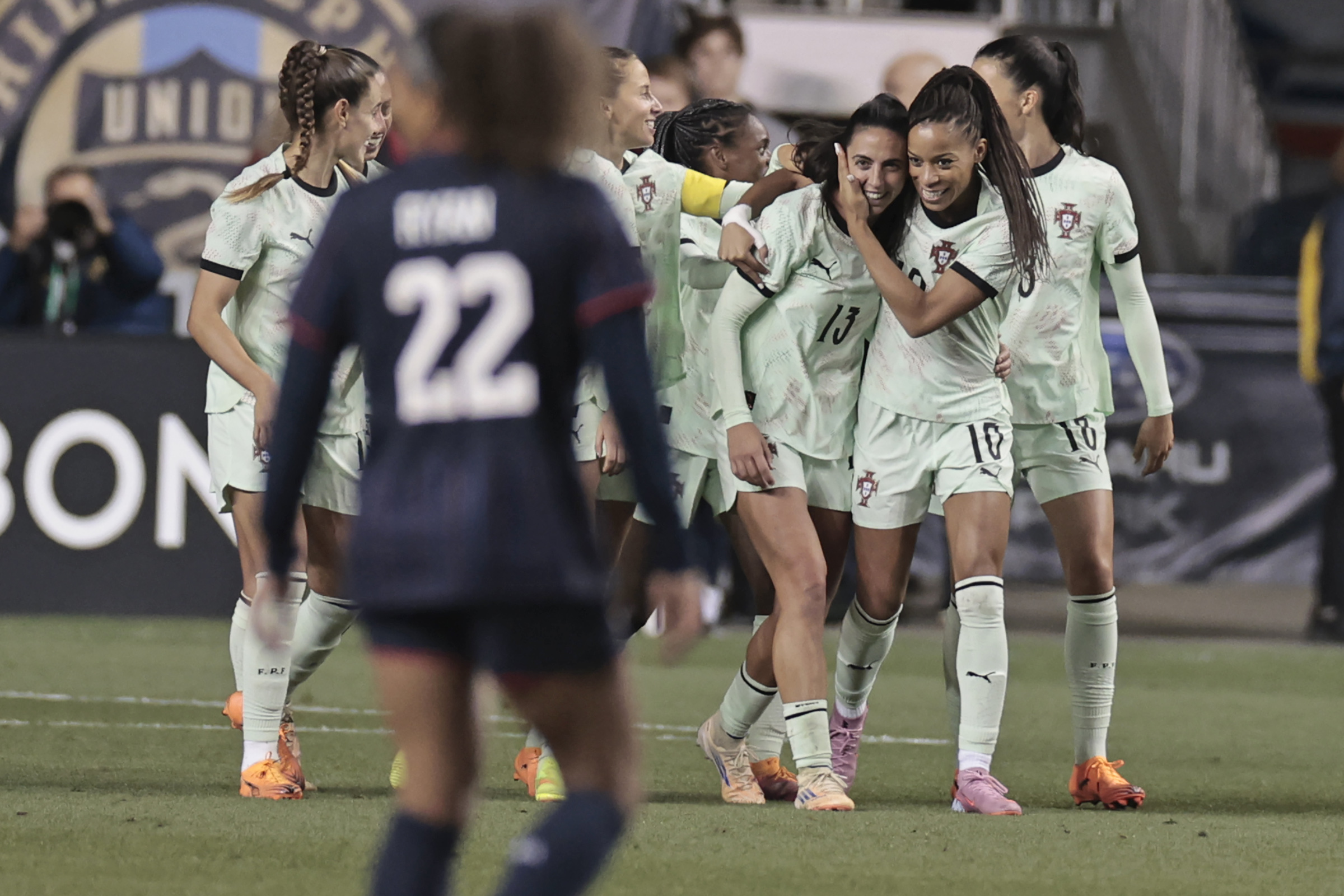
Portugal’s Fatima Pinto (center) celebrates after scoring the game-winning goal.
Minding the net
For much of the night, goalkeeper Phallon Tullis-Joyce didn’t play badly. She was credited with two saves, the best of which was a close-range stop on Tatiana Pinto after a misplay by U.S. centerback Tara McKeown.
But Tullis-Joyce didn’t look good on either of those corners.
Again, neither solely were her fault. On the first, Diana Gomes jumped amid three U.S. players to win the header and knocked it low, beating Tullis-Joyce on the bounce.
The second was off an outswinging corner that Tullis-Joyce wouldn’t have gotten to in any circumstance, and Fatima Pinto’s shot bounced off two U.S. players. So it’s nitpicking to say Tullis-Joyce’s reaction time wasn’t ideal. But the standard is high, and it felt like just enough to plant a seed of doubt.
“Those were tough to take on the chin,” Tullis-Joyce said.
Asked about her play on those corner kicks, she said: “They had some driven corners into that back post area. I’m sure I’ll take a look at the clips afterward to see whether or not maybe I could play a bigger role in that, but that’s just for me to look and review afterward.”
Hayes likely will stick with Tullis-Joyce as her new No. 1 goalkeeper for a while. The 29-year-old New Yorker has generally played well for the U.S., and is playing quite well at club level for England’s Manchester United.
Still, we’ll see if anyone else gets minutes over the next two games during Sunday’s rematch vs. Portugal (4 p.m., TNT, Universo) — coincidentally Alyssa Naeher’s retirement tribute — and Wednesday’s game vs. New Zealand in Kansas City (8 p.m., TNT, Universo).
Current No. 2 Claudia Dickey presumably would be first in line for that shot. And if after that, Aubrey Kingsbury leads the Washington Spirit on a second straight run to the NWSL title game, there might be some clamor for her to get a call-up for the first time since June of last year.
“It felt really individual out there,” said midfielder Rose Lavelle, who scored the U.S.’s goal just 33 seconds after kickoff. “I think everyone was trying to maybe fix it on their own. That’s something that, when the going gets tough, we’ve got to make sure we’re sticking together, playing together.”
Sam Coffey was particularly miffed about conceding on those corner kicks. Asked how she’d assess the plays, she responded promptly: “Obviously, we got scored on them, so I wouldn’t assess them very high.”
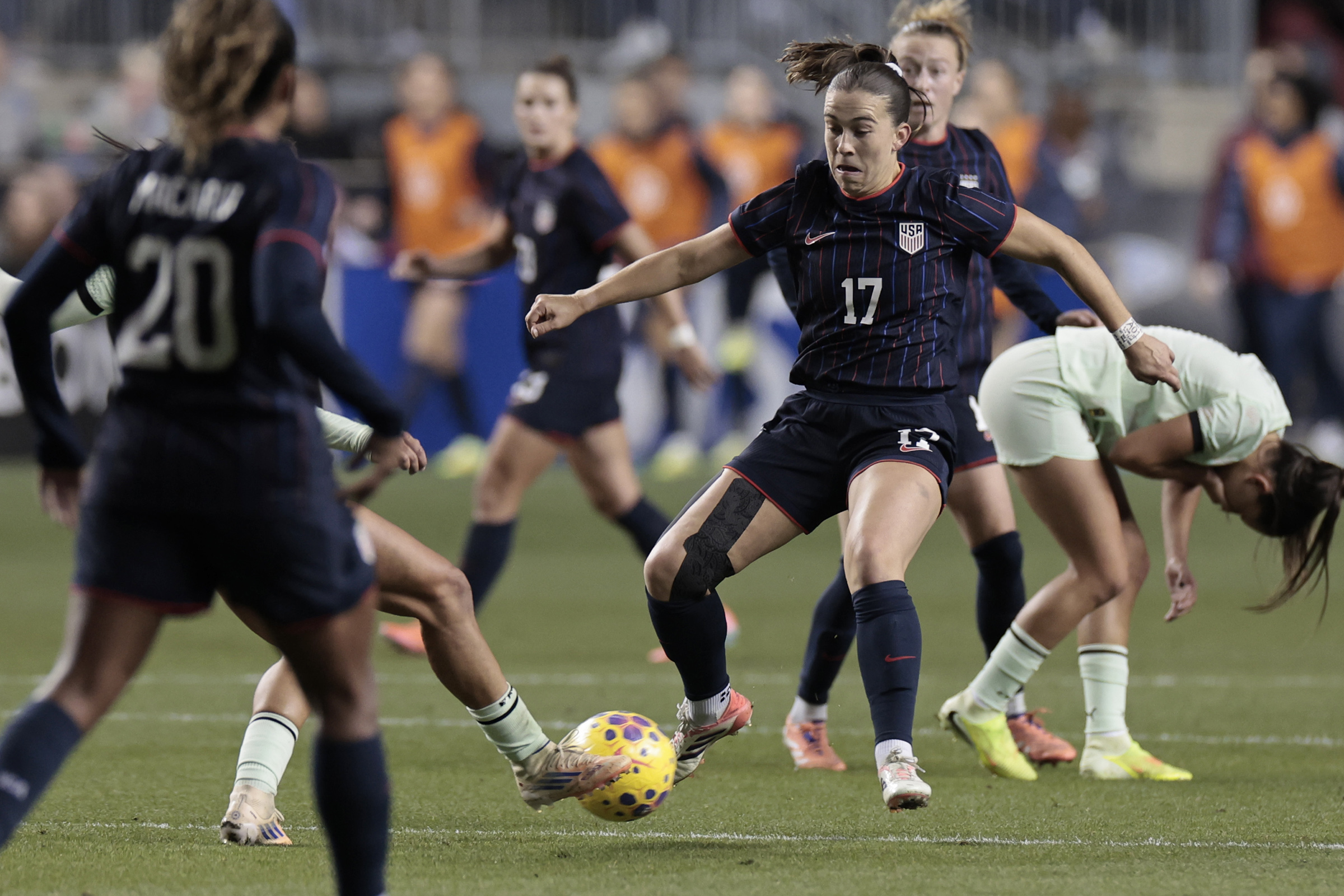
Sam Coffey (center) on the ball in the middle of the action.
She credited Portugal, and rightly so. Though the Navegadoras are No. 23 in FIFA’s global rankings, they’ve got more talent than a few teams ahead of them — as they showed in tying reigning European champion England in February, then Italy at this summer’s Euros.
Those results are more telling than the one that naturally stuck in many American fans’ minds Thursday night, the scoreless tie Portugal pulled against the U.S. at the 2023 World Cup.
But Coffey saved most of her words for her own side, which also was the right move.
“I think whether we’re not locked in enough in those moments or we’re not doing good enough in our man-marking or being alive for a second phase [when a ball is recycled after being cleared], I think that’s an area we’ve always prided ourselves on, and that was not up to our standard tonight,” she said. “Set pieces win championships, win games. And for them to capitalize on those and win the game that way, I think is really disappointing for us, and we have to be better.”
Diana Gomes (center) celebrates scoring Portugal’s first goal.
It is obviously better to lose in an off-year friendly than in an actual tournament. And on top of any loss lighting a spark under this group, they know they’ll see the same team again a couple days.
“The lucky thing for us is we have a second shot at this,” Lavelle said. “There’s no months of time between the next time we can maybe get better from this loss. So we have three days to turn around and show up better.”
Tullis-Joyce was even more blunt: “Revenge, for sure.”
It will no doubt get attention, as this team always does.
For the first 33 seconds this time, it looked like things had changed. But by the end of the night, Portugal had the Americans’ number again — this time a 2-1 win as the visitors at Subaru Park.
It was the U.S.’s first loss in a visit to the Philadelphia area since 2004 and the current team’s first loss in seven games dating back to February.
Those 33 seconds were how long it took for the U.S. to open the scoring through Rose Lavelle. Catarina Macario set the play up with a dazzling move, running and dancing amid Portugal’s defense before feeding the assist.
It was the seventh-fastest goal in U.S. women’s team history, and it will not be recorded that Lavelle clearly was offside. But with no video review in this friendly, the goal stood, and the crowd of 17,297 — including U.S. legend Alex Morgan and many ex-teammates honoring her retirement ceremony — cheered.
Lavelle nearly scored again on a breakaway in the ninth, sprung beautifully by Alyssa Thompson. But Portugal goalkeeper Inês Pereira denied her with a charge off her line and a tip of the ball to just the right side of the post.
From there, Portugal turned the tide. In the 37th minute, Kika Nazareth spun around Lavelle, passed wide to Andreia Jacinto, and she tried a chip attempt that landed on top of the crossbar. Two minutes later, a misplay by Tara McKeown let Tatiana Pinto get free on goal, and U.S. goalkeeper Phallon Tullis-Joyce had to come off her line for a sprawling stop.
Portugal scored on the ensuing corner kick, as Diana Gomes beat Emily Sonnett on the jump.
The U.S. looked livelier early in the second half, but Thompson flubbed a chance, and Macario got caught up to on a breakaway just in time to have the ball poked from behind.
Nor could the Americans capitalize on a close-in free kick from the right wing, served well by Sam Coffey but not finished by anyone in the crowded 18-yard box.
U.S. manager Emma Hayes took her time to make substitutions, but when she did, it was a quadruple move in the 69th minute. In came midfielders Claire Hutton and Lily Yohannes and forwards Yazmeen Ryan and Emma Sears; out went Coffey, Lindsey Heaps, Michelle Cooper, and Macario.
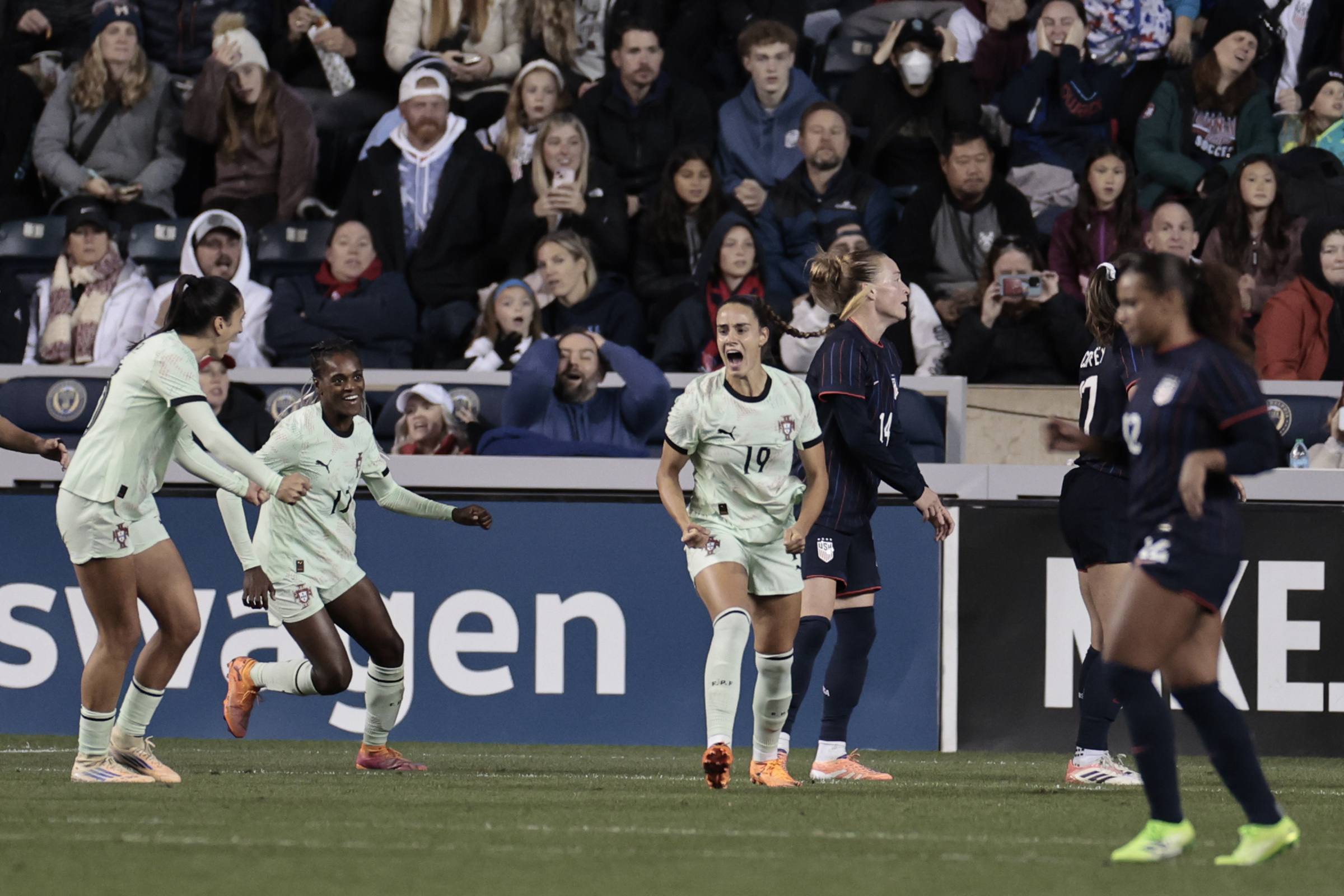
Three minutes later, Portugal took the lead off another corner kick when Fátima Pinto trapping the service wonderfully and shooting low past Tullis-Joyce. There was a bit of a deflection, but Tullis-Joyce looked a little too frozen, and Hayes did not hide her frustration.
Jaedyn Shaw was next to enter for the U.S. in the 78th, replacing Lavelle.
The U.S. did not lack for scoring chances, but it couldn’t finish them. Outside back Avery Patterson forced a sharp save from Pereira in the 81st, and Yohannes headed right at Pereira a few seconds later.
As the U.S. searched for an equalizer, Sears sent a well-placed pass through the 18-yard box in the 93rd that no teammate caught up to. And in the last seconds, Thompson shot when she could have passed — one of a few less-than-ideal decisions she made on the ball — and Yohannes lofted a cross that Pereira caught.
That felt like the night in a nutshell, right as the final whistle blew to end it.
Joel Embiid says he did not start playing basketball until age 16. A young Embiid had dreams of being a footballer until the 7-footer grew too tall for that to be in the cards.
Even though he can’t play anymore, he’s still a passionate fan of Real Madrid and, of course, the Cameroonian national team. With the World Cup set to come to Philadelphia in 2026, there might not be anyone more excited than Embiid.
Soccer “is already huge, but having a World Cup here, it’s going to be even bigger,” Embiid said on the Switch the Play podcast with Roger Bennett of Men in Blazers. “I’m excited. I’m going to be all over the place. I’ve never been to a World Cup game before, so I’m going to go to a lot of them, especially to follow some of the best teams. Hopefully Cameroon makes it. Right now it doesn’t look likely.”
Cameroon is in second place in its qualifying group and is tied for fourth in points for a group runner-up spot. The top four runners-up advance to a playoff that gives them a second chance to qualify for the World Cup. If Cameroon can’t make it, Embiid is also intrigued to follow England, but he expects that team to “choke again.”
Embiid said he thinks his experience playing soccer growing up helped improve his footwork for basketball.
“Hakeem [Olajuwon] was another one that started so late and made it into basketball, and he credits his football skills to be able to get better so fast. I think there’s a lot of similarities where — I’ve always been a type of guy to observe, and then you show me one thing, and I’m able to do it after one or two tries, and just pick stuff up so fast. If you’re not coordinated enough, or if you don’t have good footwork, that’s not going to be possible, and that goes back to football, using your feet and having soft feet.”
His experiences growing up playing other sports before getting into basketball have him encouraging his young son to do the same. So Embiid won’t push him to specialize in any one sport — except for soccer, which he plays every Sunday. But Arthur is already enjoying following in his father’s footsteps.
“He seems to be in love with basketball, but that’s where I struggle,” Embiid said. “I started at 16, and maybe I was lucky. It takes a lot of work to be able to make it to the NBA within three years of starting playing basketball, maybe a little bit of luck, but it took a lot of work. That’s where you’re like, if I started at 16, why should any kid start playing basketball at 6 years old? That’s where you’ve got to find that balance.”