Category: Sports

Sports news, scores, and analysis

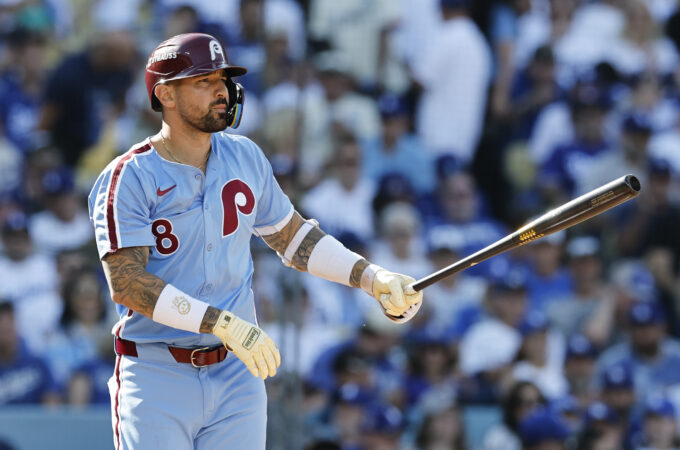
  • A beer in the dugout, a benching, and a rift with his manager: Inside the final Phillies season for Nick Castellanos

    A beer in the dugout, a benching, and a rift with his manager: Inside the final Phillies season for Nick Castellanos

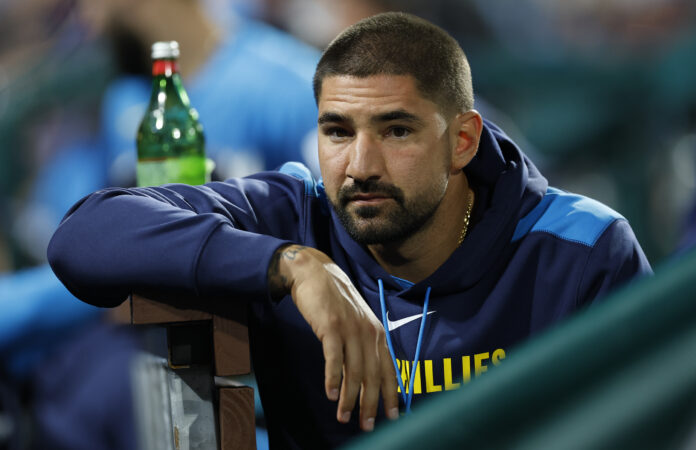
    CLEARWATER, Fla. — After getting replaced for defense late in a close game, the worst defensive outfielder in baseball since 2022 based on defensive runs saved brought a beer into the dugout and lectured his manager.

    Brought a beer into the dugout.

    Let those words wash over you. They belong, incidentally, to the player himself. The Phillies released Nick Castellanos on Thursday after trying to trade him for three months. And when the deed was finally done, the $100 million right fielder laid bare the June 16 incident in Miami that precipitated his unceremonious departure.

    “I brought a Presedente [sic] into the dugout,” Castellanos said in a handwritten letter posted on Instagram. “I then sat right next to Rob [Thomson] and let him know that too much slack in some areas and to [sic] tight of restrictions in others are not condusive [sic] to us winning.”

    That was 241 days ago.

    And it was the beginning of the end.

    There were other tension points. Castellanos, a two-time All-Star with 250 career homers and an everyday player in the majors for a decade, lost his job in August while producing at a less-than-league-average clip. In September, he accused Thomson of “questionable” communication.

    As president of baseball operations Dave Dombrowski put it in explaining why the Phillies-Castellanos relationship soured like a lemon with $20 million left on the final season of his five-year contract, “I don’t think it was necessarily one incident.”
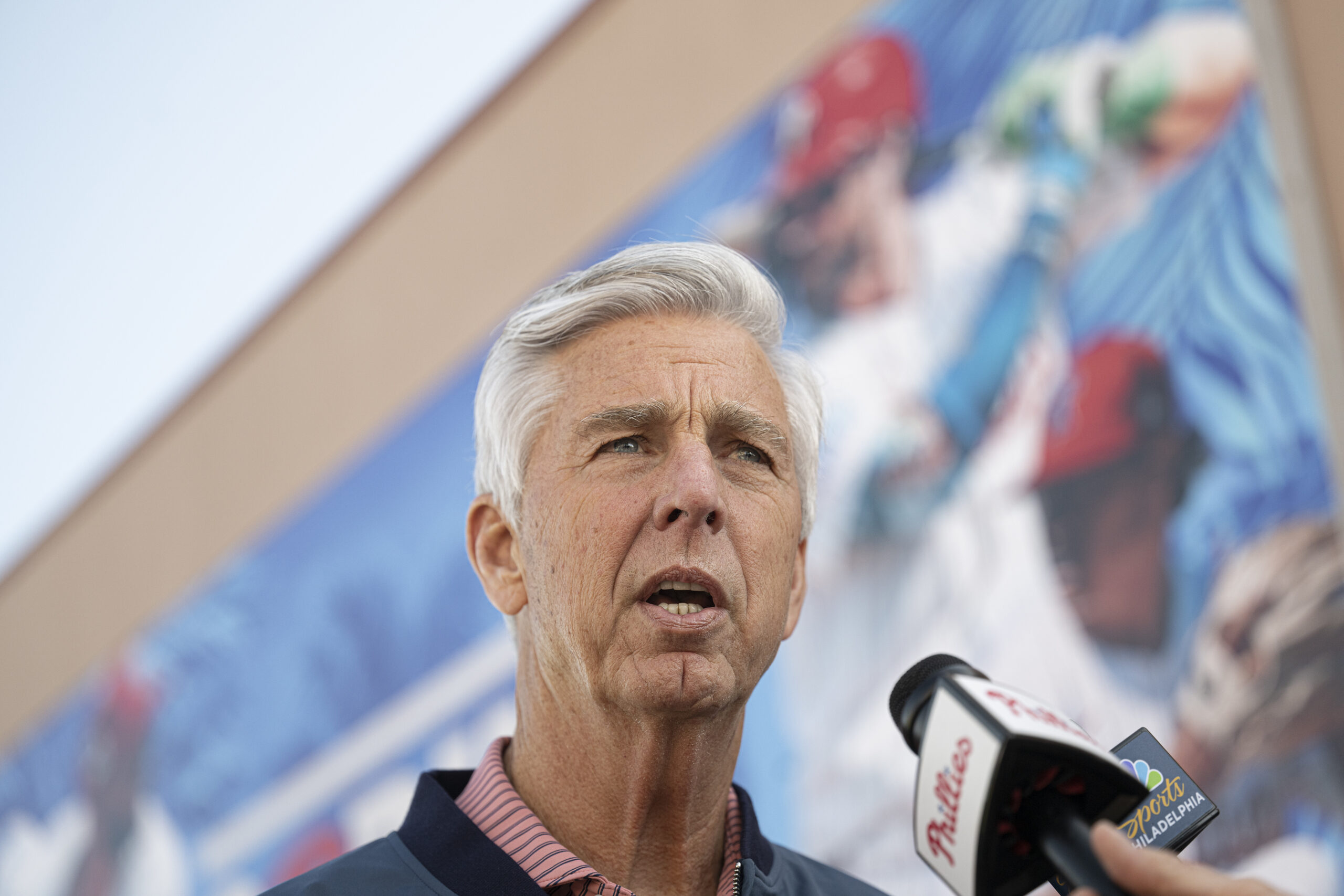
    Phillies president of baseball operations Dave Dombrowski talks to the media on Thursday after releasing Nick Castellanos.

    In truth, Castellanos was always a strange match for Philly.

    His introductory news conference in March 2022 — after signing the contract that put the Phillies over the luxury tax for the first time in their history — revealed an edgy personality, a directness that didn’t always sit well with everyone even in the clubhouse, and a penchant for taking things personally.

    “He’s a little different,” former teammate Whit Merrifield said recently on The Inquirer’s Phillies Extra podcast. “And he’ll tell you, he’s just a little different. He’s very, very blunt. He’ll tell you exactly how he feels.

    “There are just some things that happened that Casty didn’t like along the way, and he’s not the guy to hide his feelings or sugarcoat it. And I think it just kind of came to a head.”

    It didn’t help that Castellanos struggled on the field in 2022, his first year with the Phillies, posting the lowest full-season OPS of his career (.694) — until he matched it last year.

    He often quibbled over his spot in the batting order, especially when Thomson dropped him to the seventh or eighth spot, insisting he felt more comfortable in the top half of a lineup. And when coaches worked with him at, say, reducing his rate of swings at pitches out of the zone, Castellanos often pushed back, noting that he’s “always been a free swinger.”

    But Castellanos could also be supportive of teammates. He encouraged young outfielder Mickey Moniak to stay around the team after breaking his hand on the last day of spring training. And after Orion Kerkering made a series-ending error in the postseason last year, Castellanos raced in from right field to be at his side.

    “He treated me and my family wonderfully,” left fielder Brandon Marsh said Thursday. “He’s always got my respect and I always got love for [No.] 8.”
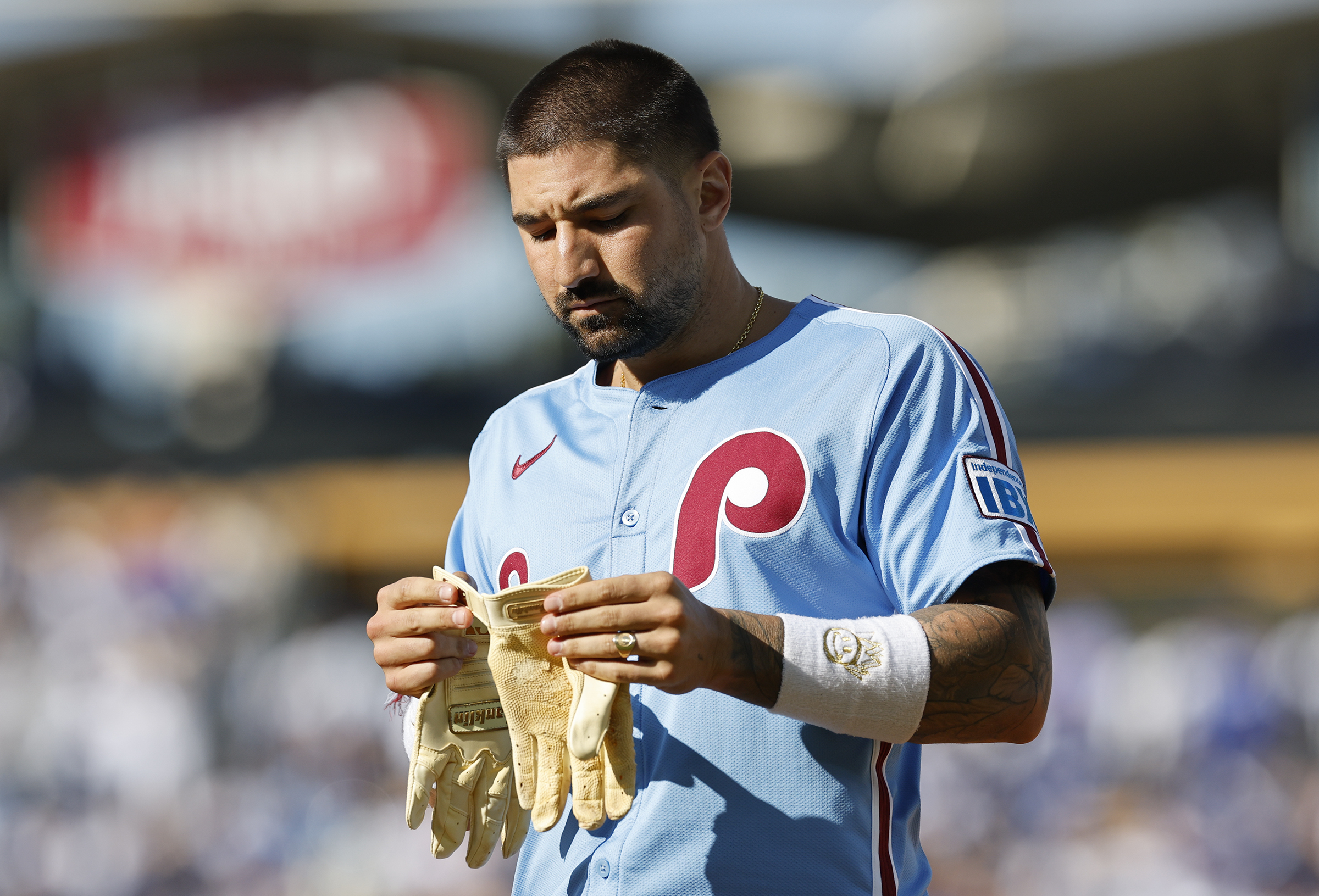
    Nick Castellanos bookended his four-year run as a Phillie with .694 OPS seasons.

    It was all part of the enigma of Castellanos. Dombrowski knew all about it. He was running the Tigers’ baseball operations in 2010 when Detroit drafted Castellanos out of high school.

    “He’s been a very good player, he’s had a nice career, and he probably will continue to do so,” Dombrowski said. “Things happened, things changed over a 15-year period, and I’ve still had a good relationship with Nick and his family members. You always wish things end up on a good point, but it doesn’t always happen.”

    In his four-page letter, Castellanos thanked owner John Middleton, Dombrowski, staff members, outfield coach Paco Figueroa (who often coached Castellanos’ son, Liam, on the field before games), and “my teammates,” though none by name.

    Notably omitted: Thomson and hitting coach Kevin Long.

    But Castellanos didn’t spare the details of his confrontation with Thomson in what he termed the “Miami incident.” He gave a “shout out” to special assistant Howie Kendrick and teammates for “taking the beer out of my hands before I could take a sip,” as if actively drinking would’ve made the whole thing worse.

    Castellanos noted that he met with Dombrowski and Thomson after the game.

    “We aired our differences,” Castellanos wrote, “and the conversation ended with me apologizing for letting my emotions get the best of me.”

    Thomson benched Castellanos the next day, ending a streak of 236 consecutive games started. Castellanos conceded that “there are rules and I broke one in Miami.” Dombrowski said the Phillies didn’t consider a harsher punishment, such as releasing Castellanos midway through last season.
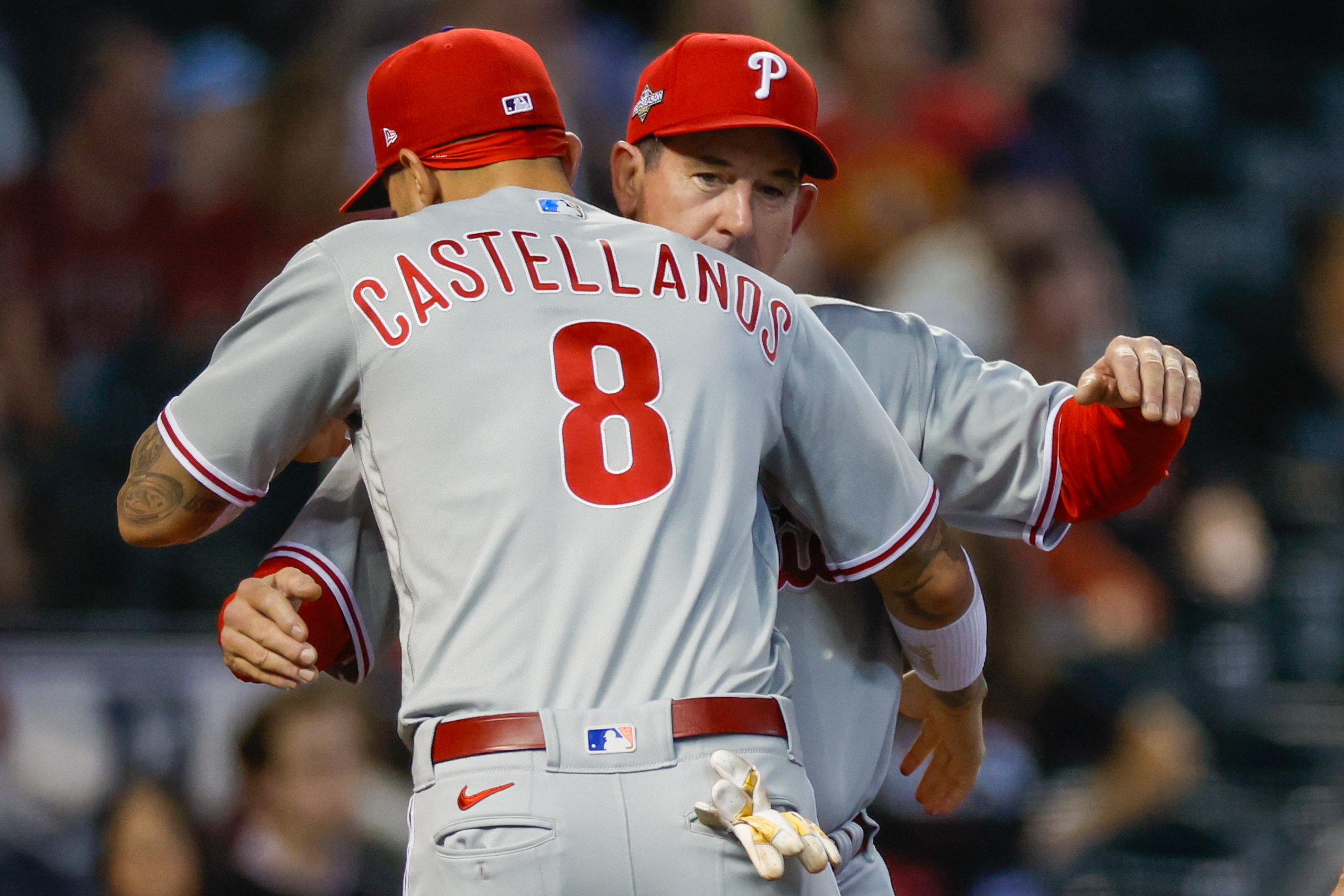
    Nick Castellanos played for manager Rob Thomson with the Phillies since 2022.

    “That [incident] wasn’t the final or determining factor,” Dombrowski. “Because if it was, we would’ve done it at that particular time.”

    Beyond that, Dombrowski wasn’t interested in discussing an incident that happened seven months ago. Besides, by the time the Phillies got knocked out of the postseason in the divisional round, it was clear to everyone that they were moving on from Castellanos, who said in September that he and Thomson didn’t talk much last season.

    Dombrowski called Castellanos after the playoffs and said he thought a change of scenery was best. Castellanos didn’t disagree.

    “I think that we all felt that it was probably in the best interest,” Dombrowski said, “to have a change of scenery.”

    Throughout the offseason, Dombrowski didn’t conceal the Phillies’ intention to move on from Castellanos. Early in the winter, they were hoping to find a team that would pay more of Castellanos’ salary.

    But over the last few weeks, they hoped to simply move him off the roster, even if it meant paying down most of his salary. In releasing Castellanos, the Phillies must pay his $20 million salary minus the league minimum salary ($780,000) if he signs elsewhere.

    “I know the dollars weren’t standing in the way at this point of clubs taking him,” Dombrowski said.

    Maybe the whole thing will be humbling to Castellanos. He punctuated his letter with this: “I love this game. I love being a teammate and I am addicted to winning. I will learn from this.”

    But after the eighth inning June 16 in Miami, it wasn’t ever going to be with the Phillies.
  • Selfish, insubordinate Nick Castellanos  released by Phillies, then issues a wild manifesto on Instagram

    Selfish, insubordinate Nick Castellanos released by Phillies, then issues a wild manifesto on Instagram

    This is a make-or-break season for the Phillies, so they aren’t taking any chances with any clubhouse cancers.

    A fading talent who will be 34 in less than a month, malcontent right fielder Nick Castellanos was released by the club on Thursday afternoon. That was one day after pitchers and catchers officially reported and four days before full-squad workouts begin, but position players typically trickle in a day or two early.

    The Phillies didn’t want Castellanos showing up. Not after the crap he pulled last season, when he put his desires above the team. And not after the crap he pulled Thursday. In fact, nobody might want Castellanos after his latest stunt.

    It will cost the Phillis the last $20 million on the five-year, $100 million contract that he has never played up to. Twenty mil is a bargain to remove a player like this.

    Their decision to release Castellanos immediately gained merit. Upon his release, Castellanos posted on Instagram a page-and-a-half screed scrawled on loose-leaf notebook paper explaining the notorious incident in Miami last season that betrayed his selfishness, insubordination, and disrespect for the game.

    It was a manifesto that would have made Sam Hinkie proud.

    The details of the incident had been shrouded in mystery. The Phillies said only that Castellanos had been insubordinate to Phillies manager Rob Thomson. Castellanos refused to provide details. As it turns out, according to his post, Castellanos actually brought a beer from the clubhouse to the bench, and then began berating his manager in front of the team.

    He should have been released that night.

    To review:

    On June 16 in Miami, Thomson replaced Castellanos in right field for a defensive replacement. Castellanos is rated by Baseball Savant as the second-worst outfielder in the majors since he arrived with the Phillies in 2022.

    Amid all of the bizarre aspects of the Castellanos situation, that Castellanos took offense to being replaced — a move that clearly benefited the team — is the most appalling aspect. Every star on the Phillies roster has sacrificed preferences at some point.

    Castellanos is a Florida native. He had friends and family in the ballpark that night. He was embarrassed. So, after he left the game, he went to the dugout, got a bottle of Presidenté, and went back to the dugout to insult his boss.

    “I then sat right next to Rob and let him know that too much slack in some areas and to [sic] tight of restrictions in others are not condusive [sic] to us winning,” Castellanos wrote Thursday.

    You know what’s conducive to winning?

    Getting Nick Castellanos out of right field every chance you get.

    Castellanos wrote that, after the game, he, Thomson, and president of baseball operations Dave Dombrowski “[a]ired out our differences” in Thomson’s office and he apologized. Castellanos was benched for the next night’s game as punishment. He wrote that the team told him not to divulge the details of the incident.

    He also wrote that his confession Thursday was spurred not by any heartfelt impulse to make things right, but rather by pure, unadulterated self-preservation; as usual, Nick’s looking out for Nick. Castellanos wrote that he was preempting a story about the incident being written “without my consent or comment.”

    What’s going on in that mind of his? The media have sought his comment for months. The media do not need his consent to write about him.

    At any rate, to Thomson’s discredit, Castellanos got his way.

    Thomson never again pulled Castellanos for defensive purposes. By the end of the season, Castellanos was playing so poorly that he’d been reduced to a platoon role with Max Kepler.

    With Castellanos clearly poised to exit the team one way or another, Thomson was asked at the end of the season if he would have issues managing Castellanos again. Thomson said he would not have a problem.

    Castellanos clearly did have a problem with Thomson.

    As part of the Instagram post, Castellanos included a similar, separate goodbye message for the fans, his teammates, principal owner John Middleton, Dombrowski, and most Phillies personnel. He singled out outfield coach Paco Figueroa, who has spent endless hours working on Castellanos’ defense the past 3½ seasons (after Castellanos conceded that he wasn’t always engaged when playing outfield). To his credit, Castellanos, a converted infielder who is leaden-legged and devoid of outfield instinct, worked hard to improve as a fielder.

    Notably, though, Castellanos clearly made it a point to exclude Thomson in his thanks.

    That “apology” on June 16 certainly was not heartfelt.

    We’re not naive here. If Castellanos had earned his money at the plate, he’d still be a Phillie. If he’d hit .300 with 30 homers every year, he could’ve brought a keg into the dugout and done keg-stands. “Topper” would’ve held his feet.

    However, Castellanos hit just 82 home runs in the next four seasons, which tied for 60th among all players. His OPS of .732 ranked 130th, three points lower than former Phillies prospect Mickey Moniak.

    It will be interesting to see how other teams view Castellanos as a player and a person. Despite his oddities and antics, he remained a popular character in the Phillies’ clubhouse. He has a big personality, he works hard, he is kind, and he is a devoted father.

    There’s plenty of tread left on his tires. He’ll find a home with some team as a right-handed designated hitter. But he’ll be a DH with baggage.

    He wrote in his Miami manifesto:

    “I will learn from this.”

    We’ll see.

  • Injury slows Gabriel Rincones Jr.; Otto Kemp ‘for sure’ can be platoon LF; Andrew Painter has no limitations

    Injury slows Gabriel Rincones Jr.; Otto Kemp ‘for sure’ can be platoon LF; Andrew Painter has no limitations

    CLEARWATER, Fla. — The Phillies’ first full-squad workout isn’t until Monday, but many position players have already reported and have been filtering in and out of the BayCare Ballpark clubhouse.

    Kyle Schwarber, Brandon Marsh, Bryson Stott, Otto Kemp, Johan Rojas, Aidan Miller, and Justin Crawford are among the position players already at the Phillies facilities in Clearwater.

    So is outfield prospect Gabriel Rincones Jr., though he will start the spring a bit behind, as he is dealing with left knee soreness. Rincones, who will turn 25 next month, is still able to hit and throw, but the Phillies are taking it slow.

    “I think you will see him in games, probably towards the middle of the schedule,” said manager Rob Thomson.

    President of baseball operations Dave Dombrowski mentioned Rincones this offseason as a player the Phillies like “a lot.” Rincones hit 18 home runs in 119 triple-A games last season.

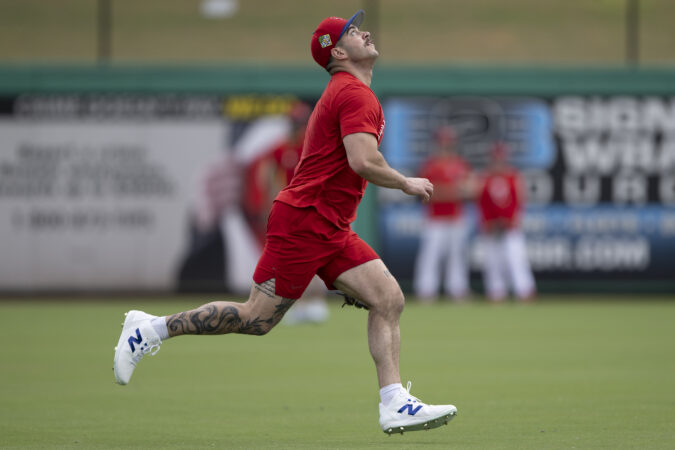
    During catchers’ batting practice on Thursday, Kemp was in left field shagging fly balls alongside Marsh. Kemp will also get infield work at third, second, and first base this spring.

    Kemp learned the outfield on the fly last year after he was called up to the major leagues, and posted minus-1 outs above average at the position. Thomson is confident that with a full spring of work, Kemp will develop into a serviceable platoon left fielder with Marsh.

    “I’m positive he can be a platoon outfielder, for sure,” Thomson said. “He’s a baseball player. He is. He figures it out and part of that is that he’s not scared of anything. If I asked him to go play center field, or go behind the plate and catch, he probably would. Not that I’d ask him, but he just goes out and plays a game. He’s got great aptitude. So he learns very quickly.”

    Also in the mix for the platoon spot with Marsh is Rojas and Bryan De La Cruz, a nonroster invite to spring training. Rojas is coming off a strong showing in the Dominican Winter League, where he slashed .302/.377/.395 in 34 games.

    “Controlling the strike zone is always a big thing for [Rojas], and using the short game is a big thing for him, and using the field,” Thomson said. “I think he’s improved over the winter, and it’ll be good to see him in here, see what he can do.”

    Andrew Painter will compete for a spot in the Phillies’ rotation this spring.

    Normal spring for Painter

    Top pitching prospect Andrew Painter will be under no limitations this spring as he competes for a spot in the Phillies’ rotation. He is set to appear in Grapefruit League games for the first time since prior to his ulnar collateral ligament injury and subsequent Tommy John elbow surgery in 2023.

    “I’m sure he’s excited. It’s really the first full year where he’s completely healthy, and where he’s got everything back,” Thomson said. “And when I’m talking about everything, I’m talking about stuff, combined with command and control. So I think he’s really excited. I would think so. I’m excited for him, because I’m thinking he’s really going to be a big piece for us.”

    Extra bases

    The Phillies players who are planning to participate in the World Baseball Classic are set to leave camp on March 1, though some may stay longer before joining their federations to get as many starts as possible. … Miller took grounders at shortstop Thursday with Stott at second. Miller will also get reps at third base this spring. … The Phillies are scheduled to start live at-bats on Friday.

  • Ukrainian athlete barred from Olympic skeleton event over helmet images

    Ukrainian athlete barred from Olympic skeleton event over helmet images

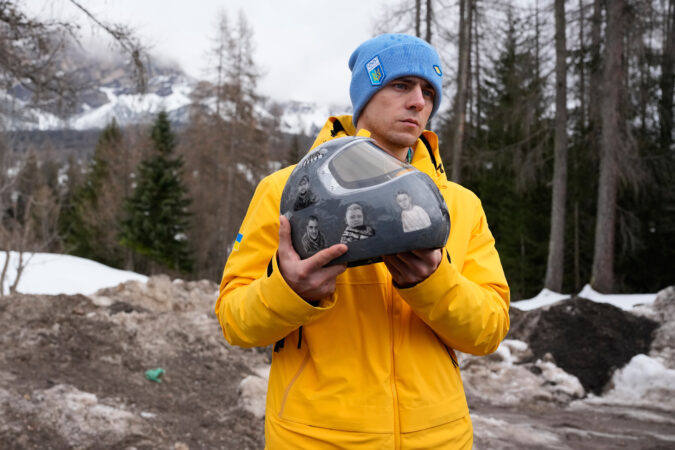
    MILAN — A Ukrainian skeleton athlete was barred from competing at the Winter Olympics just hours before his race Thursday after he refused to remove a helmet honoring compatriots killed in Russia’s invasion of Ukraine. It is the latest twist in a controversy that has cast a shadow over the opening days of these Games.

    Vladyslav Heraskevych was removed from the starting list for the men’s skeleton event after the jury of the International Bobsleigh and Skeleton Federation ruled that the helmet he intended to wear violated the Olympic Charter and the International Olympic Committee’s Guidelines on Athlete Expression.

    His removal came after an early morning meeting with IOC President Kirsty Coventry that an IOC spokesman described as “respectful,” in which Coventry tried to find a way for Heraskevych to compete wearing a different helmet, but he refused.

    Heraskevych has appealed his disqualification to the Court of Arbitration for Sport, arguing that he violated no Olympic rules and was denied the same treatment afforded to other athletes.

    The men’s skeleton event began Thursday morning in Cortina d’Ampezzo without Heraskevych. Two qualifying heats were run Thursday in the men’s skeleton event. Heraskevych is arguing he should either be allowed back into the semifinal Friday or be allowed to do a run by himself, supervised by race officials. CAS, which has an ad hoc division at the Games, has 24 hours to rule, but Heraskevych would need a quick ruling.

    Later Thursday, Ukrainian President Volodymyr Zelensky awarded the Order of Freedom to Heraskevych. The decree said the award is for “selfless service to the Ukrainian people, civic courage, and patriotism in defending the ideals of freedom and democratic values.”

    “I never wanted a scandal with the IOC, and I did not create one,” Heraskevych said in Ukrainian in a social media video. “The IOC created it through its interpretation of the rules, which many consider discriminatory. While the IOC’s actions made it possible to speak loudly about Ukrainian athletes who were killed, the very existence of the scandal diverts a huge amount of attention away from the competition itself and from the athletes taking part in it. That is why I, once again, propose bringing this scandal to an end.”

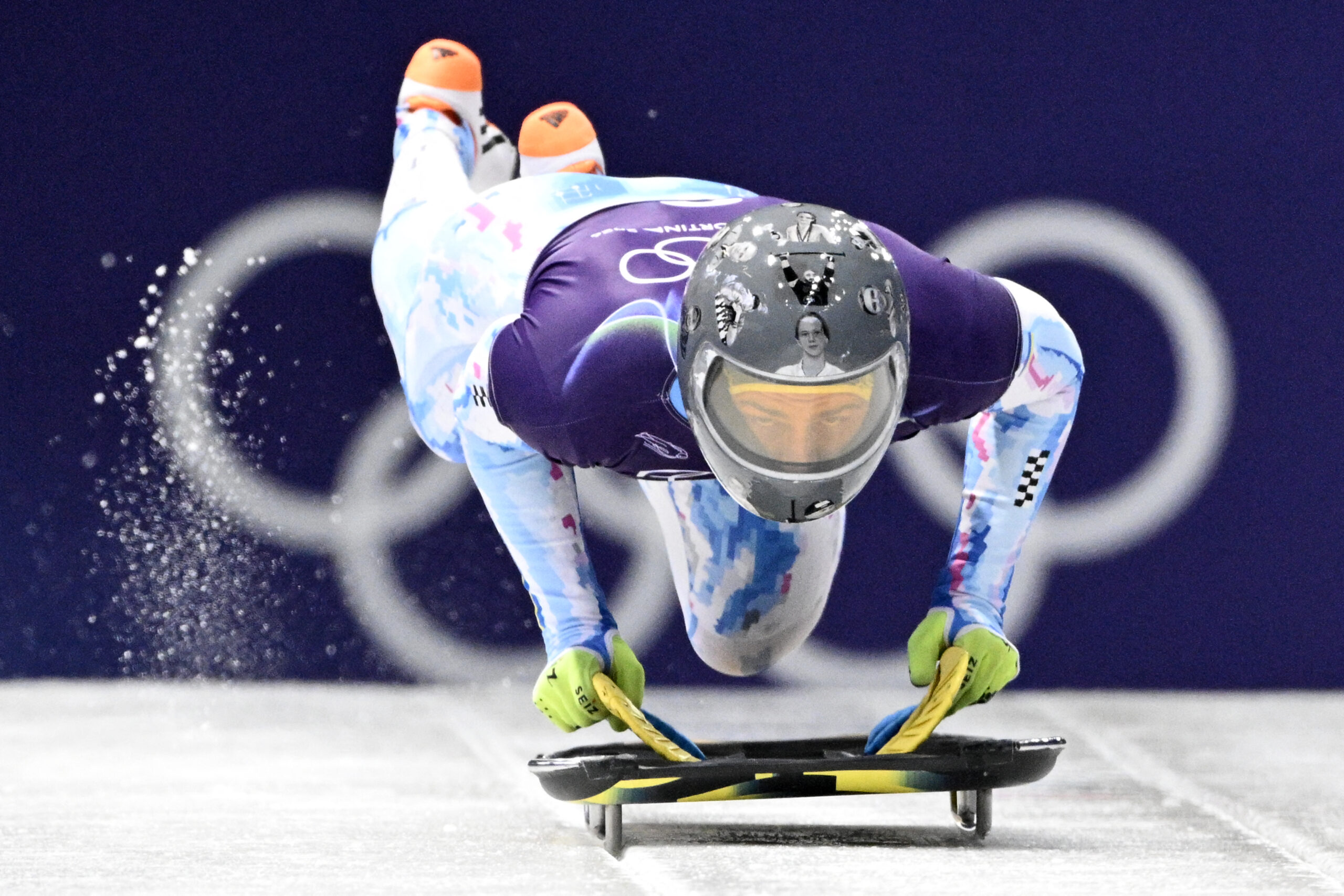
    Ukraine’s Vladyslav Heraskevych takes part in the skeleton men’s training session at Cortina Sliding Centre during the Milano Cortina 2026 Winter Olympic Games in Cortina d’Ampezzo on February 11, 2026.

    The IOC had been wrestling with the matter for several days. The Olympic governing body said under long-standing Olympic rules, athletes are prohibited from making political demonstrations on the field of play or during medal ceremonies. In recent days, IOC officials worked repeatedly with Heraskevych and Ukrainian team officials to come up with a compromise. He was allowed to wear the helmet during training runs and the IOC first suggested he wear a black armband, eventually offering him a chance to wear the helmet after he finished his competition run as well as carry it through the post-event interview area known as the mixed zone.

    “We dearly wanted him to compete,” IOC spokesman Mark Adams said in a Thursday morning news conference in Milan. “It would have sent a very powerful message. We were happy to provide him with a number of occasions to express his grief.”

    The IOC originally said Heraskevych would be stripped of his accreditation, meaning he would likely be forced to leave the Games, but after Coventry appealed to the IOC’s disciplinary commission, she announced he will be allowed to remain at the Olympics.

    Athlete protests have long been a thorny issue for the IOC, whose officials have wrestled for years with trying to balance the right for athletes to speak about controversial causes while also maintaining the neutrality the organization feels it must have to be fair to all countries. It tries to stamp out any indication of protest in actual competition.

    “Sport without rules cannot function,” Adams said. “If we have no rules, we have no sport.”

    Russia’s 2022 full-scale invasion of Ukraine has been particularly challenging for the IOC. The organization moved quickly to push global sports federations to suspend Russian teams from competitions, then barred the Russian Olympic Committee over Russia’s attempts to claim athletes in seized Ukrainian territories as Russian. In the Paris 2024 Games and in Milan Cortina, the IOC is allowing a handful of Russian athletes to compete as what it calls individual neutral athletes, forbidding them to show support for Russia’s aggression in Ukraine and prohibiting them from wearing Russian colors or displaying Russian flags.

    The IOC’s hard line against Russia has appeared to soften in recent months, and many in the Olympic world expect the IOC to find a way to bring Russia back before the 2028 Los Angeles Olympics. The IOC’s slight warming toward Russia has alarmed Ukrainians, however.

    Heraskevych said he plans to appeal his disqualification to the Court of Arbitration for Sport, arguing that he violated no Olympic rules and was denied the same treatment afforded to other athletes. CAS, which has an ad hoc division at the Games, had not registered a complaint before Thursday’s qualifying runs.

    “I still believe we did not break any rules and had every right to compete wearing that helmet, on equal terms with other athletes who did similar things earlier at these Olympic Games,” Heraskevych said Thursday in comments to Ukrainian public broadcaster Suspilne Sport.

    Heraskevych challenged IOC claims that the helmet with the faces of the deceased athletes is a political statement.

    “The helmet itself carries no political message,” Heraskevych said. “I believe I had the full right to compete in it.”

    He expressed “serious doubts” about Coventry’s commitment to Ukraine and balked at the idea of wearing the helmet before and after the race.

    “I believe I deserve the same rights as athletes in other sports from other countries,” Heraskevych said. “For some reason, I was not granted those rights.”

    His father and coach, Mykhailo Heraskevych, said Coventry argued during their meeting that displaying images of athletes killed by Russia could “create chaos” within the Olympic movement and interfere with celebration of the Games.

    “It felt like bargaining,” Mykhailo Heraskevych said. “That is unacceptable, because the memory of Ukrainian heroes is not for sale, and never will be.”

    He added that the origins of the Olympic Games lie in honoring fallen warriors. “Our helmet emphasized the very foundation of the Olympic tradition,” he said. “It is painful that the IOC — and its president, herself an Olympic champion — appear to have forgotten that history.”

    “Vlad was in peak condition. Based on recent training results, he would have been competing in the medal zone,” he said. “That opportunity was taken away. But more importantly, the IOC attempted to erase the memory of Ukrainian heroes.”

    He argued that the disqualification extended beyond the athlete.

    “The IOC did not disqualify Vladyslav — it disqualified Ukraine,” he said, citing support from Ukraine’s president, parliament, sports ministry, national Olympic committee and frontline soldiers. “This is the disqualification of democracy in favor of private interests,” he added, alleging there was pressure from Russia.

    “Sport shouldn’t mean amnesia, and the Olympic movement should help stop wars, not play into the hands of aggressors,” Zelensky said in a message on X. “Unfortunately, the decision of the International Olympic Committee to disqualify Ukrainian skeleton racer Vladyslav Heraskevych says otherwise. This is certainly not about the principles of Olympism, which are founded on fairness and the support of peace.”

    Late Thursday morning, Coventry spoke to reporters near the competition venue and repeated what other IOC officials had said — pulling Heraskevych from the event was not about protecting Russia or silencing Ukrainian athletes.

    “No one — especially me — is disagreeing with the messaging,” she said. “The messaging is a powerful message. It’s a message of remembrance. It’s a message of memory.”

  • David M. Jordan, prolific author, historian, and longtime lawyer, has died at 91

    David M. Jordan, prolific author, historian, and longtime lawyer, has died at 91

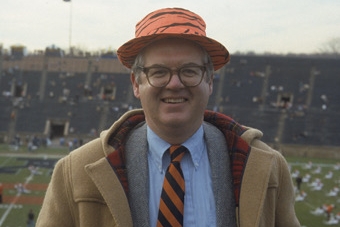
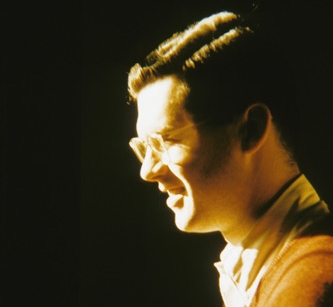
    David M. Jordan, 91, formerly of Jenkintown, prolific author, eclectic historian, retired lawyer, former president of the Jenkintown Borough Council, veteran, and lifelong baseball fan, died Saturday, Jan. 24, of sepsis at Bryn Mawr Hospital.

    Born in Philadelphia, Mr. Jordan grew up in Wyncote, Abington, and Huntingdon Valley in Montgomery County. He played high school baseball, graduated from William Penn Charter School, and earned his law degree at what is now the University of Pennsylvania’s Carey School of Law.

    He was fanatical about the old Philadelphia Athletics baseball team that moved to Kansas City in 1954 and later, a bit reluctantly, followed the Phillies. He attended the Phillies’ last home game at long-gone Connie Mack Stadium in 1970, their first and last home games at long-gone Veterans Stadium in 1971 and 2003, and their first home game at Citizens Bank Park in 2004.

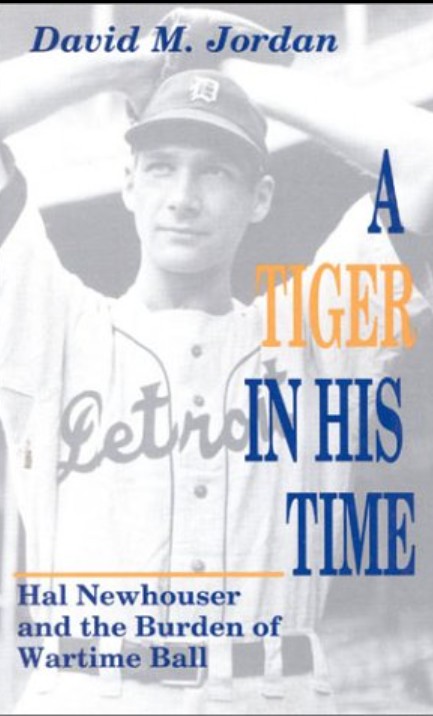
    He shared his fascination with baseball by writing books about the Athletics and Phillies, iconic stadiums around the country, and star players Pete Rose and Hal Newhouser. Newhouser even credited Mr. Jordan’s 1990 book, A Tiger in His Time: Hal Newhouser and the Burden of Wartime Ball, with helping him get elected into the National Baseball Hall of Fame in 1992.

    Writing “seemed to come naturally,” Mr. Jordan told the Princeton University Alumni Weekly in 2017. “I enjoy the creative part, to put my thoughts down on paper on a subject I have picked out for particular reasons.”

    He wrote The Athletics of Philadelphia in 1999, and a reviewer for the Baseball Almanac said: “Jordan’s account is full of fascinating insights and interesting stories that make this fine franchise and those associated with it come alive.” He was interested in politics as well and built on his 1956 senior thesis research at Princeton by writing Roscoe Conkling of New York: Voice in the Senate in 1971.

    The 477-page book was considered for a Pulitzer Prize, and a reviewer for the journal Pennsylvania History called it “readable and well-balanced” in a review. He said Mr. Jordan’s “treatment of Conkling is judicious, avoiding the pitfalls of hero worship or cynicism.”

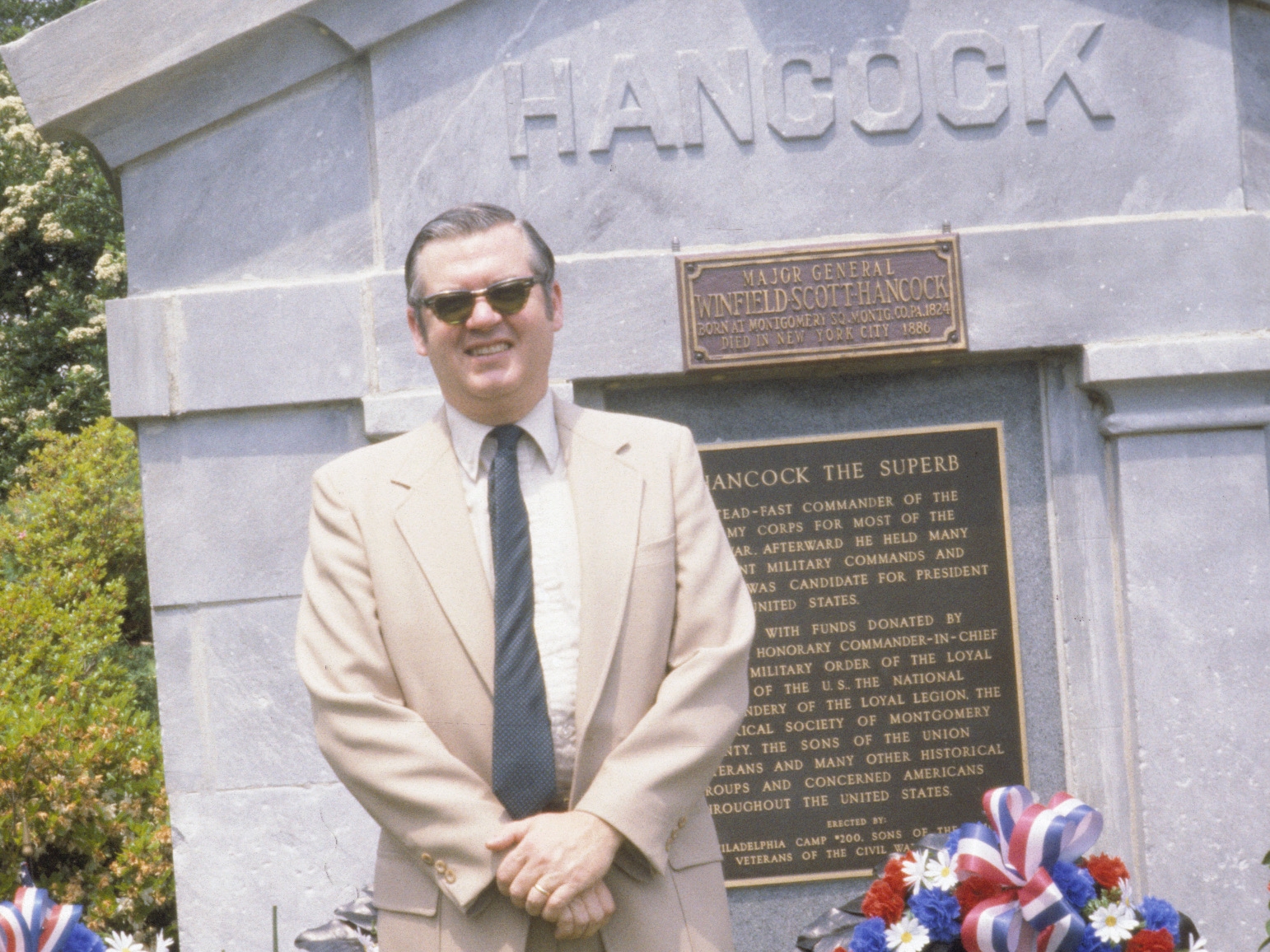
    He also wrote history books about Civil War generals Winfield Scott Hancock and Gouverneur K. Warren, former Secretary of Defense Robert A. Lovett, and the 1944 presidential election. In 1989, a book reviewer for The Inquirer called Mr. Jordan’s Winfield Scott Hancock: A Soldier’s Life “a complete life of Montgomery County’s greatest son, and it, too, is superb.”

    Mr. Jordan, shown here at General Winfield Scott Hancock’s tomb in Montgomery County, did deep research on his book subjects.

    “These people are sort of lost in history,” Mr. Jordan told The Inquirer in 2000. “But with people who are fairly well known, it’s hard to find something new to say about them.”

    Mr. Jordan earned his law degree at Penn in 1959 and specialized in trust, estate, and municipal issues for 40 years in Philadelphia and later as a partner at Wisler Pearlstine in Montgomery County. He said in 2000 that he usually worked on his books every night after work from 7:30 to 10:30 p.m. and on weekends. “I don’t watch much television,” he said.

    He traveled to New York, Missouri, California, and elsewhere to visit historical sites and research his subjects. He was a member of the Society for American Baseball Research and president of the Philadelphia Athletics Historical Society for 12 years in the 2000s.

    He lectured often about baseball at symposiums and conventions, and was featured in The Inquirer and on podcasts. “He had a passion for knowledge,” his daughter Diana said. “He was a consumer of information.”

    This 1990 book by Mr. Jordan was said to have helped Hal Newhouser get into the National Baseball Hall of Fame in 1992.

    Mr. Jordan became active in Democratic politics after college in the 1960s and served as president of the Jenkintown Borough Council, Democratic state committeeman, and state platform committeeman. As Montgomery County Democratic chair in the 1970s, he told The Inquirer that he disliked gerrymandering and favored giving county executives extensive staff appointment powers.

    He enlisted in the Army after law school. “He was absolutely the most congenial person,” his daughter Diana said. “He was kind and caring.”

    David Malcolm Jordan was born Jan. 5, 1935. He earned a bachelor’s degree in history at Princeton, was secretary and president of the Class of 1956, and returned to the campus often for reunions and other events.

    He married Barbara James in 1960, and they had daughters Diana, Laura, and Sarah, and lived in Jenkintown. His wife died in 2006. He married Jean Missimer Liddell in 2007, and they lived in Wayne and Haverford.

    His daughter Diana said Mr. Jordan “never stopped. He was passionate about everything.”

    Mr. Jordan enjoyed college basketball games at Penn’s Palestra, especially if Princeton was in town. He went to the Metropolitan Opera House in New York often and collected baseball cards and stamps. He was an avid reader and on the board at the Jenkintown Library.

    “I guess I just had a lot of available energy to practice law, write books, and help run Jenkintown,” he told the Princeton Alumni Weekly. “It didn’t seem so hard at the time, though looking back makes me wonder.”

    His daughter Diana said: “He never stopped. He was passionate about everything.”

    In addition to his wife and daughters, Mr. Jordan is survived by three grandchildren, a sister, and other relatives. A brother died earlier.

    This 1971 book by Mr. Jordan was based on his interest in politics and history.

    A private celebration of his life is to be held later.

    Donations in his name may be made to the Jenkintown Library, 460 York Rd., Jenkintown, Pa., 19046.

  • Unable to trade him, Phillies release Nick Castellanos with $20 million left on his contract

    Unable to trade him, Phillies release Nick Castellanos with $20 million left on his contract

    CLEARWATER, Fla. — The Phillies released Nick Castellanos, the team announced on Thursday.

    The drawn-out saga reached its conclusion three days before position players were set to report to the Phillies facilities for spring training. This winter, the Phillies had repeatedly indicated their interest in finding a change of scenery for the outfielder, who will be 34 next month.

    In December, they signed free-agent outfielder Adolis García to a one-year, $10 million contract to take Castellanos’ position in right field. The Phillies sought to find a trade partner to offset at least some of the $20 million that Castellanos is owed for the 2026 season in the final year of his contract, but ultimately released him.

    “We’ve spent a long time trying to make a trade,” president of baseball operations Dave Dombrowski said Thursday. “And when I say that, trying to move his contract for a minimum return from a dollar perspective and player perspective, but just hasn’t worked out. …

    “We have felt that we need to get a change of scenery for Nick and wish him nothing but the best.”

    Dombrowski was general manager of the Detroit Tigers in 2010 when they drafted Castellanos out of high school. He said there were clubs that showed interest in trading for Castellanos starting in November, but nothing materialized.

    Castellanos had a .260 batting average and .732 OPS over his four years with the Phillies. His minus-12 outs above average in right field in 2025 positioned him as one of the major leagues’ worst outfielders by StatCast metrics.
    That, combined with a drop-off in offensive production, led to him losing his everyday job in the second half of the season.

    “A lot of times when a good player has their role change with the club, it can cause some friction,” Dombrowski said. “And his role changed last year from where it was. I mean, he played every single day for a lot of years in a row, and so sometimes that can contribute to it.”

    In September, Castellanos criticized manager Rob Thomson for “questionable” communication about his diminished role.

    “[Thomson has] done a very good job of communicating with me,” Dombrowski said. “And I think overall, I can’t tell you that every situation is always handled perfectly by any of us, but I think he’s a very good communicator.”

    Castellanos posted a letter Thursday on Instagram, thanking principal owner John Middleton, Dombrowski, the Phillies staff, outfield coach Paco Figueroa, his teammates, and the city of Philadelphia.

    Phillies president of baseball operations Dave Dombrowski talks to the media on Thursday after releasing Nick Castellanos.

    He also addressed what he called the “Miami Incident,” in which Castellanos was benched for one game during a road series in his hometown in June, ending what had been a 236-game iron man streak.

    The right fielder had been taken out for a defensive substitution in the eighth inning of a close game the night before and made what Thomson described at the time as an “inappropriate comment” out of frustration, leading to his benching.

    In his letter, Castellanos said he had taken a can of Presidente beer into the dugout after being lifted from the game.

    “I then sat next to Rob and let him know that too much slack in some areas and to [sic] tight of restrictions in others are not condusive [sic] to us winning,” Castellanos wrote.

    He added that the beer was taken out of his hands before he could take a sip and that he had a conversation with Dombrowski and Thomson afterward and apologized.

    Dombrowski said Thursday that the events in Miami were not directly correlated to the Phillies’ decision to release Castellanos.

    “That contributed, by all means, to why he was benched for the game,” Dombrowski said. “That wasn’t the final or determining factor [for being released] because if that was, we would have done that at that particular time.”

  • St. Joseph’s AD Jill Bodensteiner is leaving to become the commissioner of the Horizon League

    St. Joseph’s AD Jill Bodensteiner is leaving to become the commissioner of the Horizon League

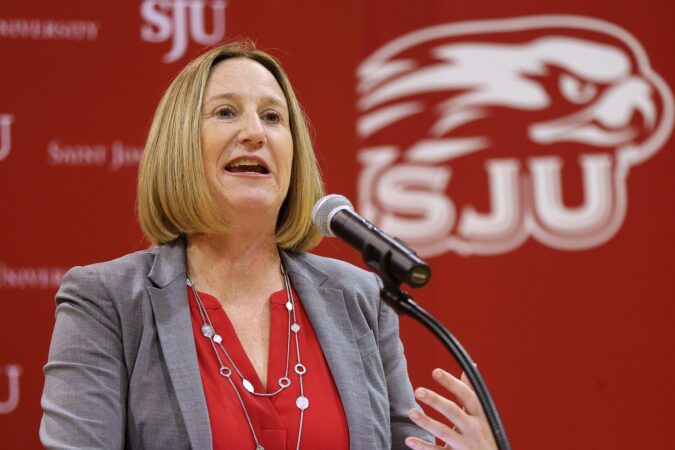
    Jill Bodensteiner is stepping down from her post as St. Joseph’s athletic director, according to an announcement from the university on Thursday.

    Bodensteiner is set to become the next commissioner of the Horizon League. Her last day at St. Joe’s will be April 15.

    Eric Laudano, St. Joe’s executive senior associate athletics director, will serve as interim athletic director while a search is conducted, the school said in a release.

    An Indiana native, Bodensteiner will take over a league headquartered in Indianapolis. She has been the AD on Hawk Hill since June 2018.

    “Jill is a national leader in intercollegiate athletics,” St. Joe’s president Cheryl A. McConnell said in a statement. “We are profoundly grateful for her vision, dedication and service to the Hawks. She leaves our athletics program strong and well-positioned for continued success. We wish her the best on her return home to Indiana and her role with the Horizon League.”

    Bodensteiner’s tenure at St. Joe’s started with a bang. She fired longtime men’s basketball coach Phil Martelli less than a year after taking over as athletic director. She replaced Martelli with Billy Lange, whose six-year run ended in the fall when he abruptly left the program for an assistant’s role with the New York Knicks. Lange posted an 81-104 record with the Hawks.

    Though the men’s program has failed to get back to prominence in the new era of college basketball, St. Joe’s has had successful runs in non-revenue sports like field hockey, which played in the national championship game in 2024; men’s and women’s lacrosse, which made inaugural NCAA Tournament appearances; and baseball, which won the Atlantic 10 regular-season title in 2023.

  • Julius Erving remembers Philly fans forever reminding him of the debt he owed them — until it was ‘paid in full’

    Julius Erving remembers Philly fans forever reminding him of the debt he owed them — until it was ‘paid in full’

    Throughout basketball history, few players have been as transformative a talent and cultural figure as NBA Hall of Famer Julius Erving.

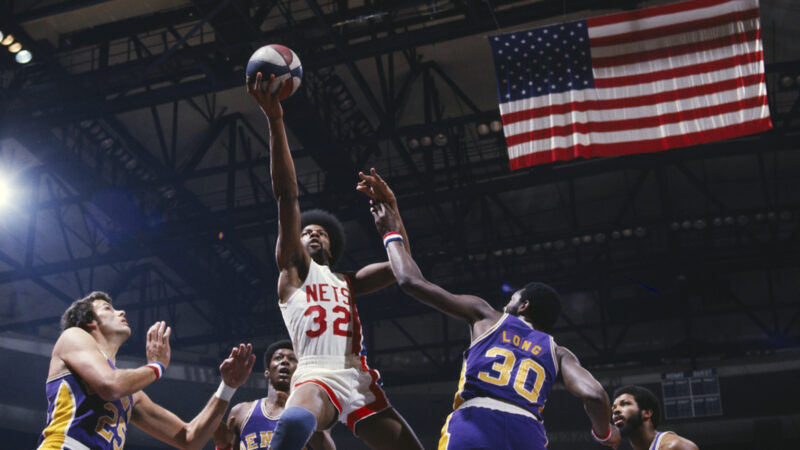
    Footage of the former Philadelphia 76er’s thunderous dunks, stylish finger rolls, and suave demeanor off the court still draw applause from basketball fans, decades after his 1987 retirement. The iconic forward is still championed by Sixers fans for bringing the city an NBA title in 1983.

    It was in Philly where Erving embraced one of the world’s most impassioned fan bases and learned of the phrase, “You owe us one,” after falling short in the NBA finals three times between 1977 and 1982.

    “I was like, ‘What the hell does that mean?’” he said to The Inquirer. “I was getting pissed. I was not happy with the situation.”

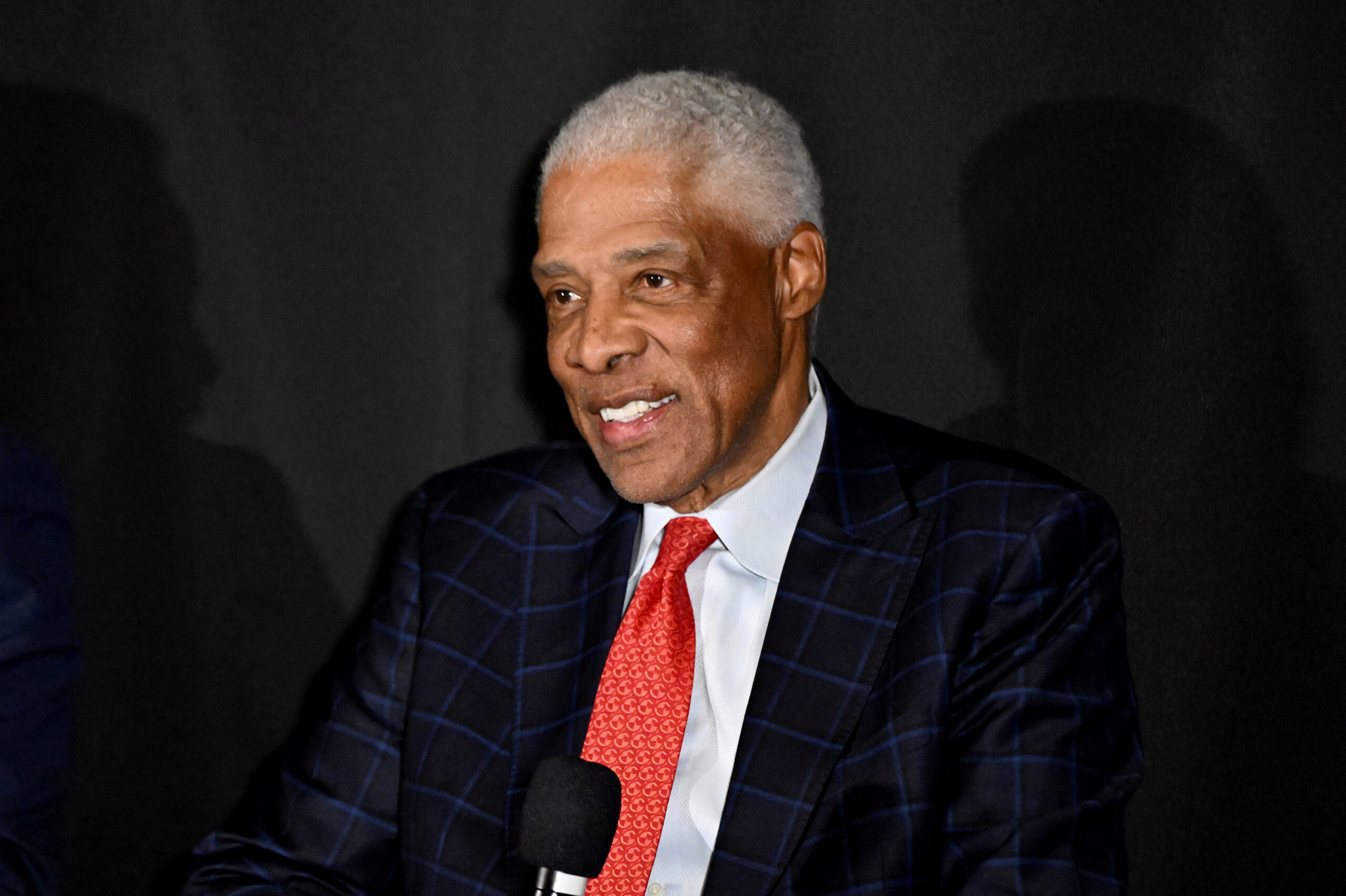
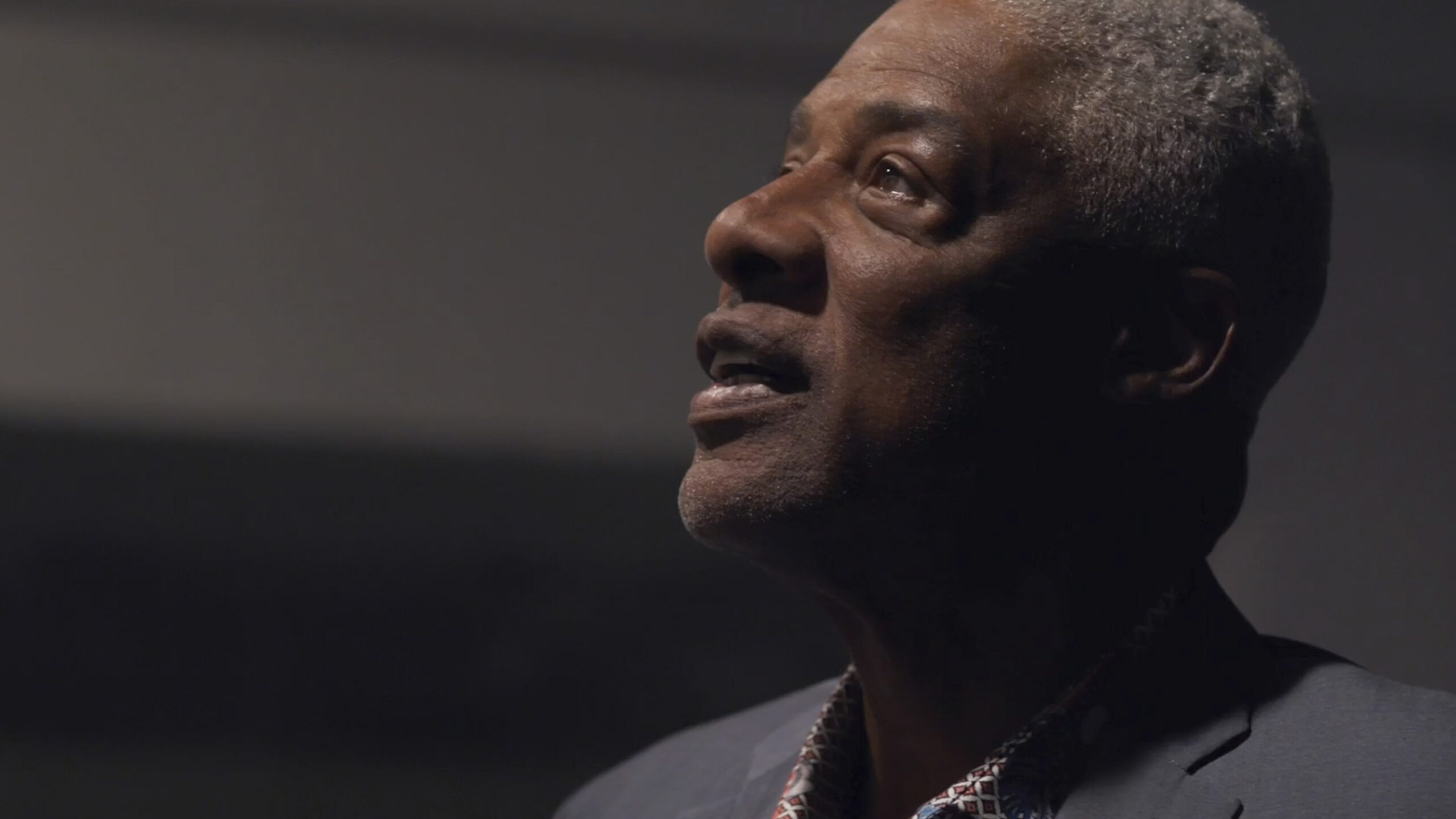
    Julius Erving speaks during the “Soul Power: The Legend Of The American Basketball Association” world premiere at Regal Cinemas Union Square on February 10, 2026 in New York City. (Photo by Slaven Vlasic/Getty Images for Prime Video)

    The fans were reminding Erving that he owed the city a championship. It was only after he and fellow Hall of Famer Moses Malone swept the Los Angeles Lakers in the 1983 finals that he paid his debt to the City of Brotherly Love. Fans shouted out the words that have stuck with him all these years on: “Paid in full.”

    Erving, affectionately and fittingly known as “Dr. J,” surgically dissected opposing defenses. He and fellow NBA star David Thompson went on to inspire talents like Michael Jordan and Kobe Bryant.

    But veteran sports fans know Erving’s legacy was cemented years before he took his first steps on the floors of South Philly’s Spectrum. One of his early visits to Philadelphia was in April 1971, when he signed to the American Basketball Association to play for the Virginia Squires.

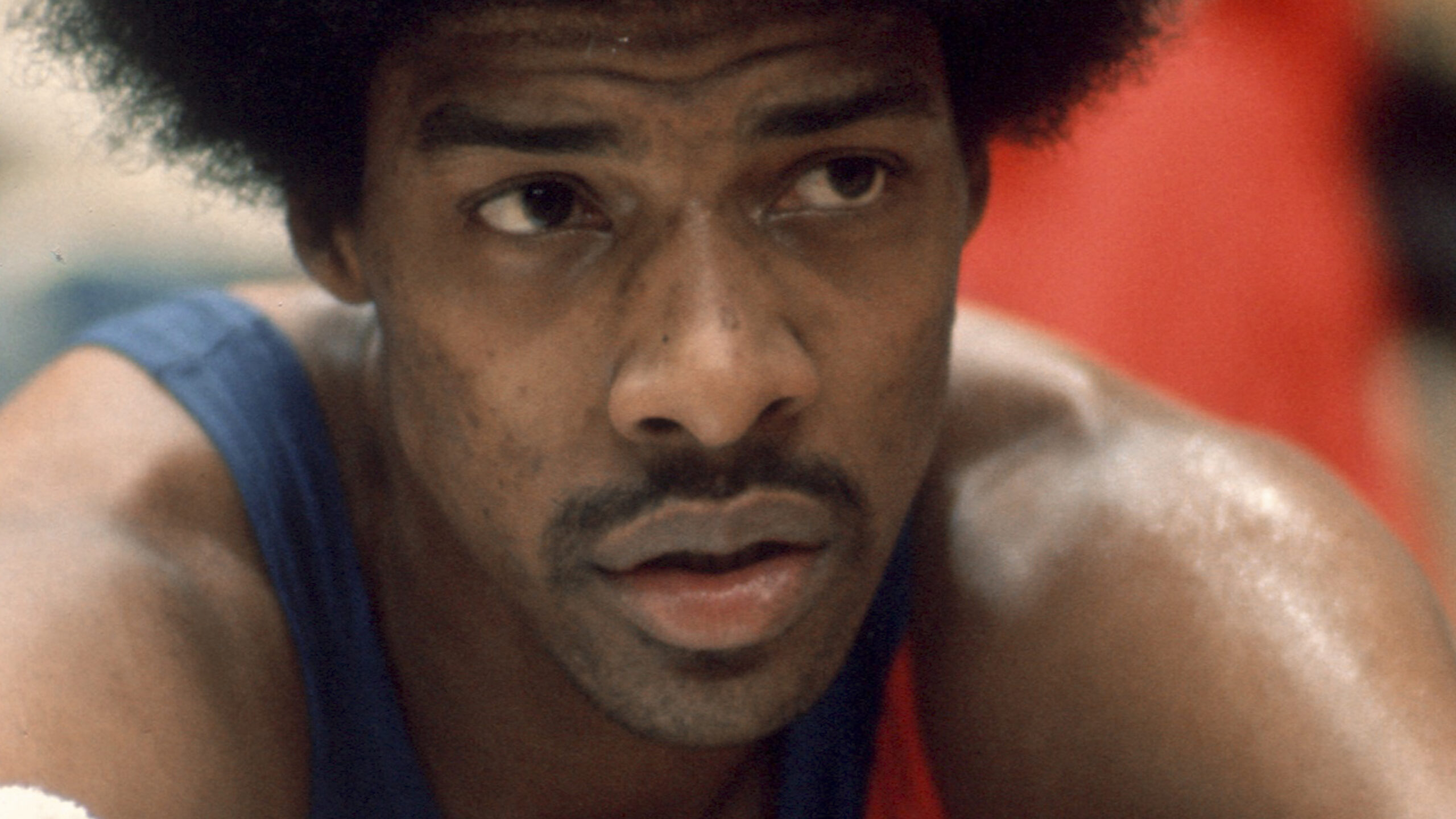
    An image of Julius “Dr. J” Erving from the Prime Video docuseries, “Soul Power: The Legend of the American Basketball Association.”

    Erving went on to win two ABA championships and three MVP awards in five seasons. He joined ABA greats Rick Barry, Artis Gilmore, Connie Hawkins, and Spencer Haywood as the faces of a league that would soon merge with the NBA in 1976.

    The merger brought a new brand of fast-paced, high-flying action to the NBA, and elements like the three-point line, dunk contest, underclassmen signees, and other additions that continue today.

    The legacy of those ABA greats and visionaries are the subject of the new sports docuseries, Soul Power: The Legend of the American Basketball Association.

    “It just sets the stage for the memories that I have, the friendships that were developed, and the history that was established with the ABA,” Erving said.

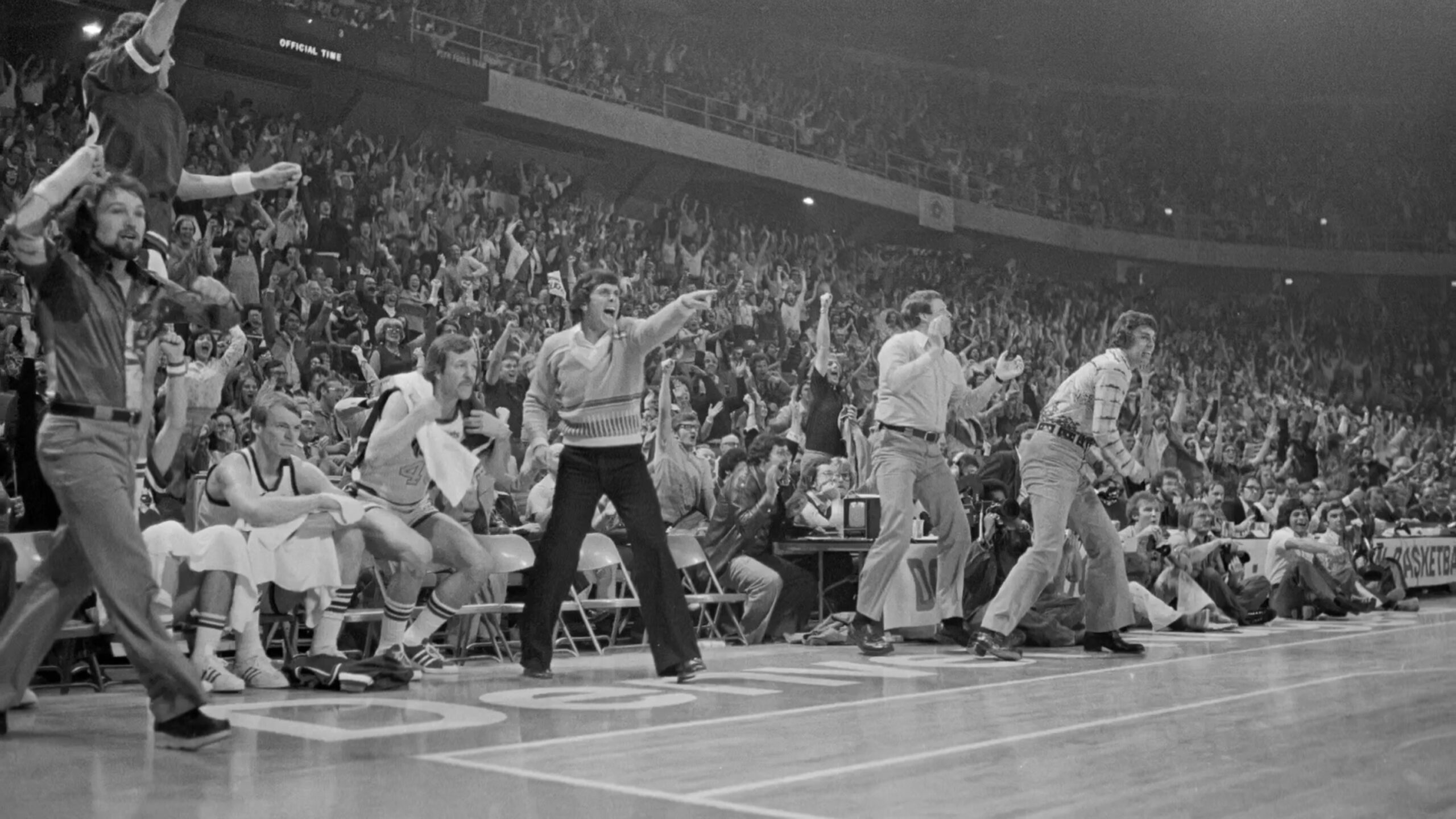
    Image of ABA coaches and crowds from the Prime Video docuseries, “Soul Power: The Legend of the American Basketball Association.”

    The four-part series, streaming on Amazon Prime Video to commemorate 50 years of the ABA-NBA merger, chronicles the ABA’s formation, triumphs, and challenges during the late 1960s and ’70s.

    Emmy-winning director Kenan K. Holley said he wanted the series to be a “player-driven” story that addressed the league’s on-court innovations and debunked the idea that the ABA was an inferior semipro league.

    “Amazon executives saw the vision. They saw the ABA story was worth telling, and told us to lean into the characters,” he said. “That gave my team the North Star creatively. We knew we had the goods because of all the guys in the league, from Rick Barry to George ‘the Iceman’ Gervin, Dr. J, and others. That was the key.”

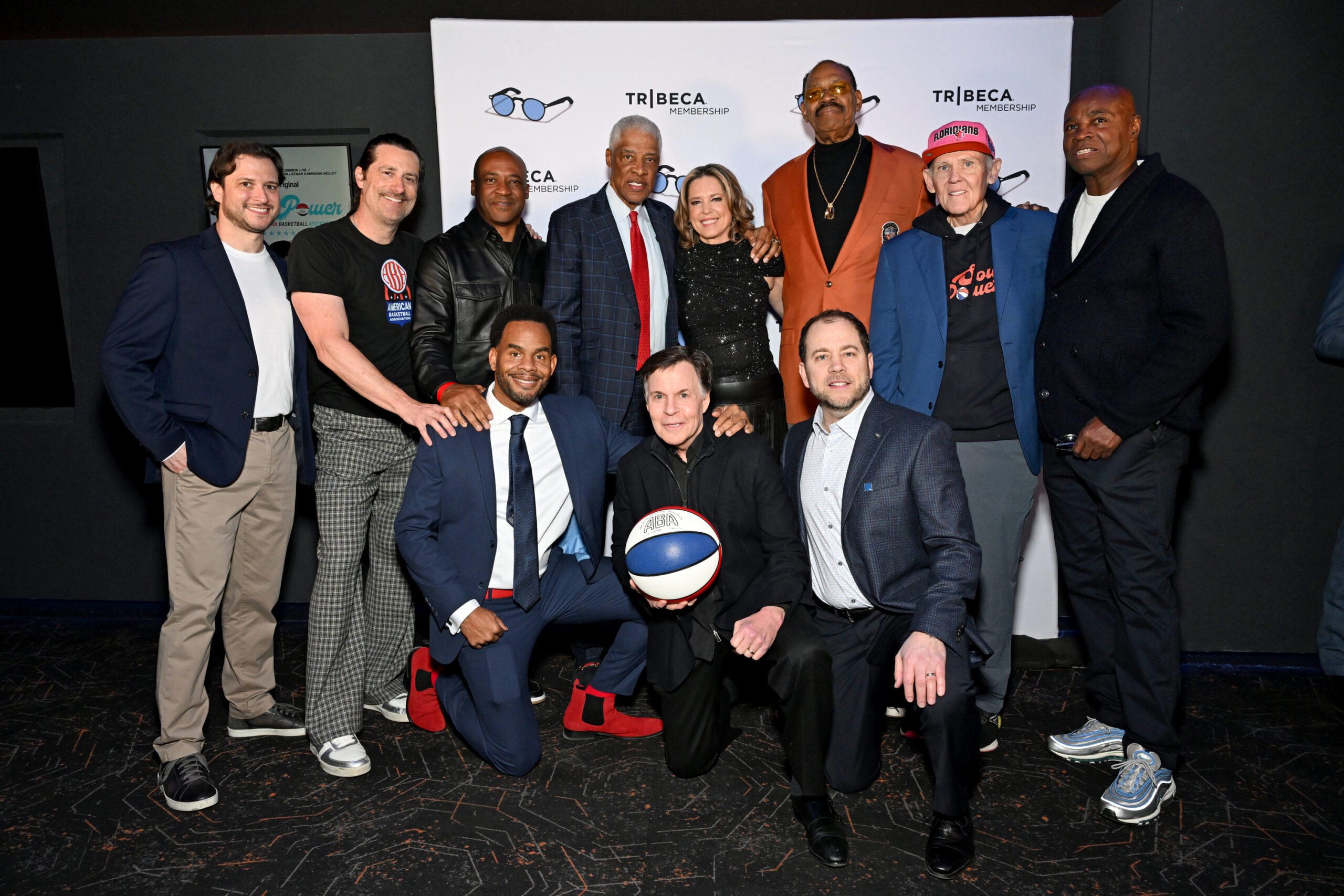
    (L-R) Tony Curotto, Todd Lieberman, Derrick Mayes, Kenan Kamwana Holley, Julius Erving, Bob Costas, Hannah Storm, Brett Goldberg, Artis Gilmore, George Karl and Brian Taylor attend the “Soul Power: The Legend Of The American Basketball Association” world premiere at Regal Cinemas Union Square on February 10, 2026 in New York City. (Photo by Slaven Vlasic/Getty Images for Prime Video)

    The series highlights the hotly-contested rivalry between ABA and NBA players, the personal, financial, and legal battles ABA stars faced, and the early advancements in women’s team ownership.

    There are even brief flashes of downtown Philadelphia and City Hall, depicting the moments leading up to Erving’s ABA signing.

    Soul Power shows how players like Erving were trying to save a league that made such an imprint on sports, but it was faltering due to disinvestment.

    “It wasn’t a fun position to be put in, especially if you know you’re trying to fight for rights of players who gave a commitment to the league and made the sacrifices to keep it afloat for the years that it was around,” Erving said.

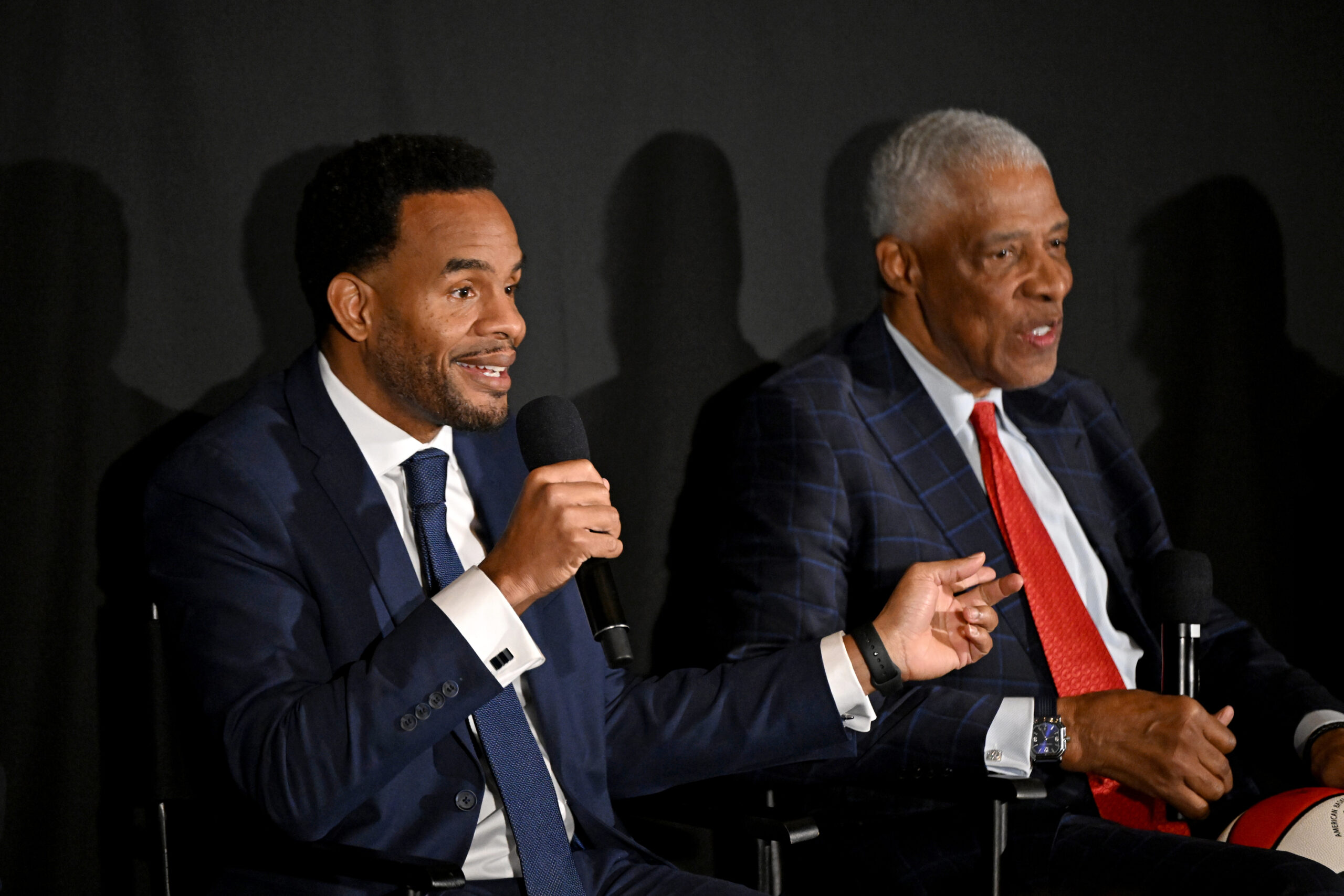
    (L-R) Kenan Kamwana Holley and Julius Erving speak during the “Soul Power: The Legend Of The American Basketball Association” world premiere at Regal Cinemas Union Square on February 10, 2026 in New York City. (Photo by Slaven Vlasic/Getty Images for Prime Video)

    Holley also wanted Soul Power to right the wrongs of past depictions of the ABA. To do that, he needed to earn the trust of figures like George Karl, Barry, Ralph Simpson, and Erving.

    “They have a chip on their shoulder because the way the league’s been handled in the past with certain documentaries,” Holley said. “There was a serious trust-building period where we had to let them know look, ‘If I tell your story, it will be a player-driven story.’”

    Erving was approached about the project five years ago. The first year was largely information gathering, Erving said, but Holley soon stepped in to tie all the narrative threads together.

    Julius “Dr. J” Erving pictured during the filming of the Prime Video docuseries, “Soul Power: The Legend of the American Basketball Association.”

    To be among the leading voices in the series, which earned him an executive production credit, Erving said, was a “gift.” And at the core of the project, he’s proud to see the series reflective of the brotherhood shared between him and the other pioneers who contributed to the series and ABA history.

    “It was a one for all, all for one approach we shared,” he said. “There was no hating. It was a genuine feeling of relief like, ‘Wow, they’re recognizing my guy or us,’ and it was shared.”

    Holley said he’s excited for younger sports fans to see how influential the ABA was, not just in basketball, but the sports world at large.

    “It does my heart good, and I feel grateful to have played any part in helping bring these guys the validation that they deserve,” Holley said.

    “Soul Power” is available to stream on Amazon Prime Video.

  • The Sixers’ best players should benefit from the NBA All-Star break — but not everyone will be off

    The Sixers’ best players should benefit from the NBA All-Star break — but not everyone will be off

    The NBA All-Star break has finally arrived for the Sixers, and it couldn’t have come at a better time for the team’s three most important pieces: Joel Embiid, Tyrese Maxey, and VJ Edgecombe.

    “I think everybody’s looking forward to it,” coach Nick Nurse said of the time off. “I think we need it. It’ll be pretty good timing for us.”

    Yes, Wednesday’s 138-89 loss to the New York Knicks was embarrassing, but despite the Sixers’ ups and downs this season, they are firmly in a playoff spot. Still, the Sixers need a physical and mental reset, even if some of their stars won’t be entirely off.

    Maxey will be heading to Los Angeles as an All-Star Game starter, with Edgecombe in tow to play in the Rising Stars game. But Embiid will have a full, much-needed weeklong break.

    Embiid missed his second consecutive game Wednesday with right knee soreness. Quentin Grimes also missed Wednesday’s game, while Dominick Barlow, who missed the final game of the road trip at Portland, returned to play 30 minutes, 37 seconds on Wednesday.

    Nurse said before Wednesday’s game that there was “not a ton of concern” about Embiid’s knee long-term.

    Joel Embiid has missed the Sixers’ last two games with right knee soreness.

    Embiid has appeared in 31 of the Sixers’ 54 games so far this year, skipping one leg of back-to-backs and missing most of November. But since that month, Embiid has quickly rounded back into form.

    “He’ll still tell you that he’s — I don’t know, you can have him tell you — but still not near 100%, not close,” Nurse said. “I think that’s encouraging because he’s starting to look pretty good again in a lot of different areas.”

    Some might consider Embiid’s exclusion from the All-Star Game a snub, but because of the break, the Sixers don’t play again until Feb. 19.

    That’s a full week for Embiid to stay off his knee and recover while the Sixers can stay locked into their sixth-place spot in the East. Since January, the Sixers are 12-5 with Embiid in the lineup, and 1-5 without him.

    “It’s hard,” Maxey said of playing without Embiid. “You go from one way to play without him early in the season, he comes back, you’ve got to play that way, then play a different way when he’s there — which is OK, it’s fine. It’s the reality of it, and we’ll be all right. I think he’ll be here more than he isn’t here when we get back, and we’ve just got to maintain those games that he’s not there.”

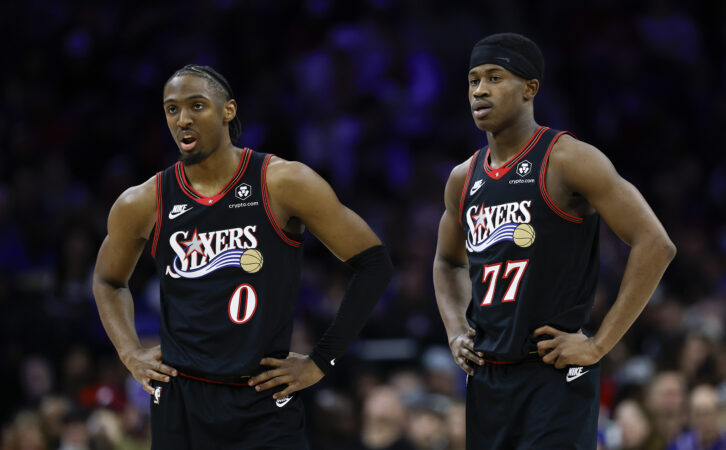
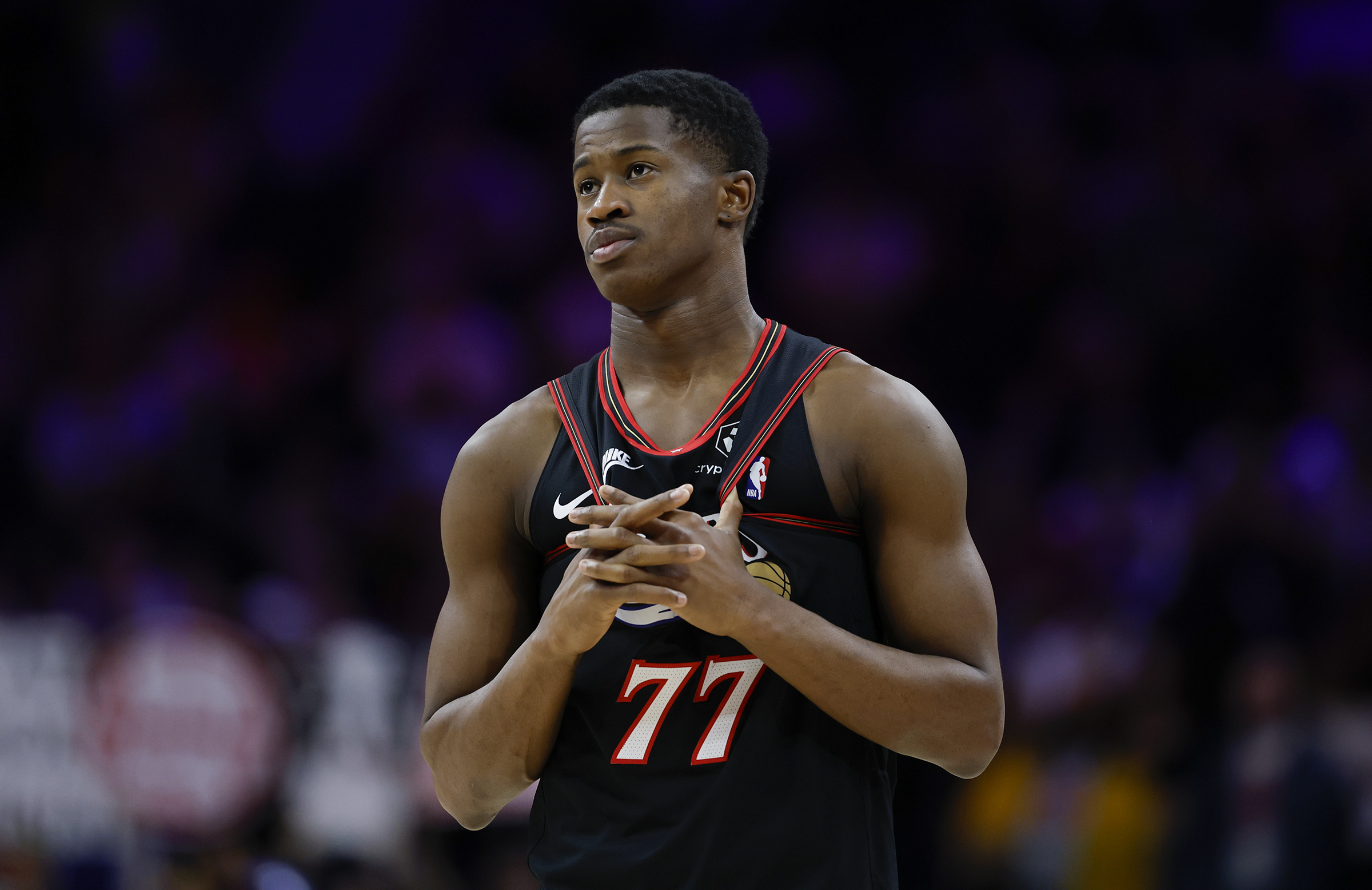
    It’s not just Embiid who can benefit from the time off. Edgecombe will be competing in the Rising Stars event at All-Star Weekend, but the rookie, who has played in 50 of the Sixers’ 54 games, will get a brief, needed reprieve from the grind of the NBA schedule.

    “He’s never played these type of minutes in his life,” Maxey said. “Even playing a 40-minute basketball game in college is way different than this. … We’re asking him to do a lot, so he’s probably definitely tired, but it’s OK. This is what the break is for.”

    Rookie VJ Edgecombe has already played in 17 more games than he did all of last season at Baylor.

    Entering the final game before the break, Edgecombe averaged 35.4 minutes, the most of any rookie, and ranked ninth in the NBA. Edgecombe played just 33 games at Baylor last year.

    Edgecombe ended Wednesday night with 14 points on 6-for-16 shooting, displaying his incredible physical tools and his recent shooting woes. Early in his career, Maxey learned how seriously he needs to take recovery in order to keep playing big NBA minutes.

    “I used to be like, ‘I don’t need treatment.’ I thought I was Superman,” Maxey said.

    He’s making sure Edgecombe is taking that feedback.

    But there might not be anyone on the team who needs rest more than Maxey. He has taken on the role as the Sixers’ top offensive option, and he is playing a career- and league-high 38.6 minutes per game.

    Maxey has also made 52 starts and played the most games of anyone on the Sixers. He scored 32 points in 32:07 on Wednesday but sat for the entire fourth quarter of the blowout. He’ll get a little less rest than his teammates, since he’s making his first All-Star Game start — and taking part in Saturday night’s three-point contest — but said he still would make plenty of time for relaxation.

    “I just want to get out there and just chill, sit in my hotel room, relax, get some good weather,” Maxey said. “I’ll get some relaxation and be good to go by Thursday.”

  • La Salle’s loyal baseball community restored the program. Now it’s time to get it ‘back on the map.’

    La Salle’s loyal baseball community restored the program. Now it’s time to get it ‘back on the map.’

    Kevin Ibach reached a milestone as Tampa Bay Rays assistant general manager in September 2020. The Rays defeated the Toronto Blue Jays in the wild-card round, marking the first time in Ibach’s 20-year career in baseball that he made it past the opening round. Before the team opened its next series against the New York Yankees, though, Ibach received news that crushed his mood.

    La Salle, his alma mater, was shutting down its baseball program after the 2020-21 school year. Ibach played middle infield for the Explorers from 1996-2000, but the program that helped forge his baseball career was suddenly on its way out.

    The Rays reached their second World Series that year, but the success was stained for Ibach.

    “I have a ring to this day from that journey and at the same time, it was the low point,” Ibach said. “A program that I cared so much about. Four years that were instrumental in my life and my development that probably led me to my job today. Getting that email that they were shutting the doors was pretty disheartening.”

    When Ashwin Puri took over as La Salle’s athletic director in July 2023, he ensured that those doors did not stay closed. With a three-phase plan centered on facility upgrades, fundraising and fan experience, Explorers baseball was officially welcomed back in April 2024, targeting a return this year.

    “What I soon realized after being here for two or three months was that every other conversation was about baseball,” Puri said. “I don’t know if it was fate or chance, but I felt an amazing sense of pride and connection to the university. A lot of people love baseball and care about baseball.”

    La Salle spent 2025 preparing to throw its first pitch in four years. Now, the program’s return is right around the corner. The Explorers will open their season against Maryland Eastern Shore on Friday (2 p.m.) at Hank DeVincent Field.

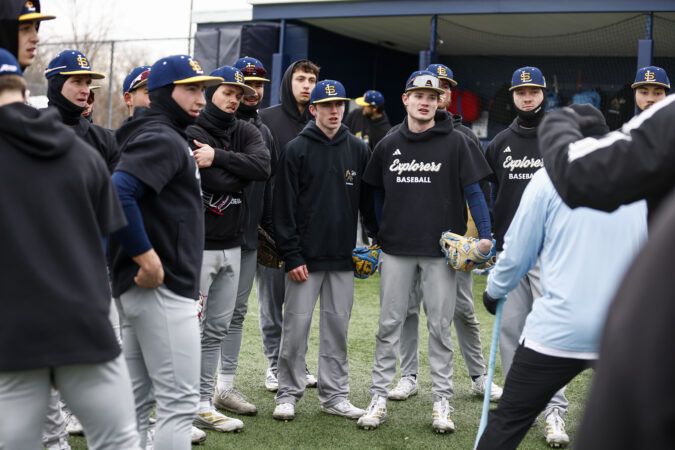
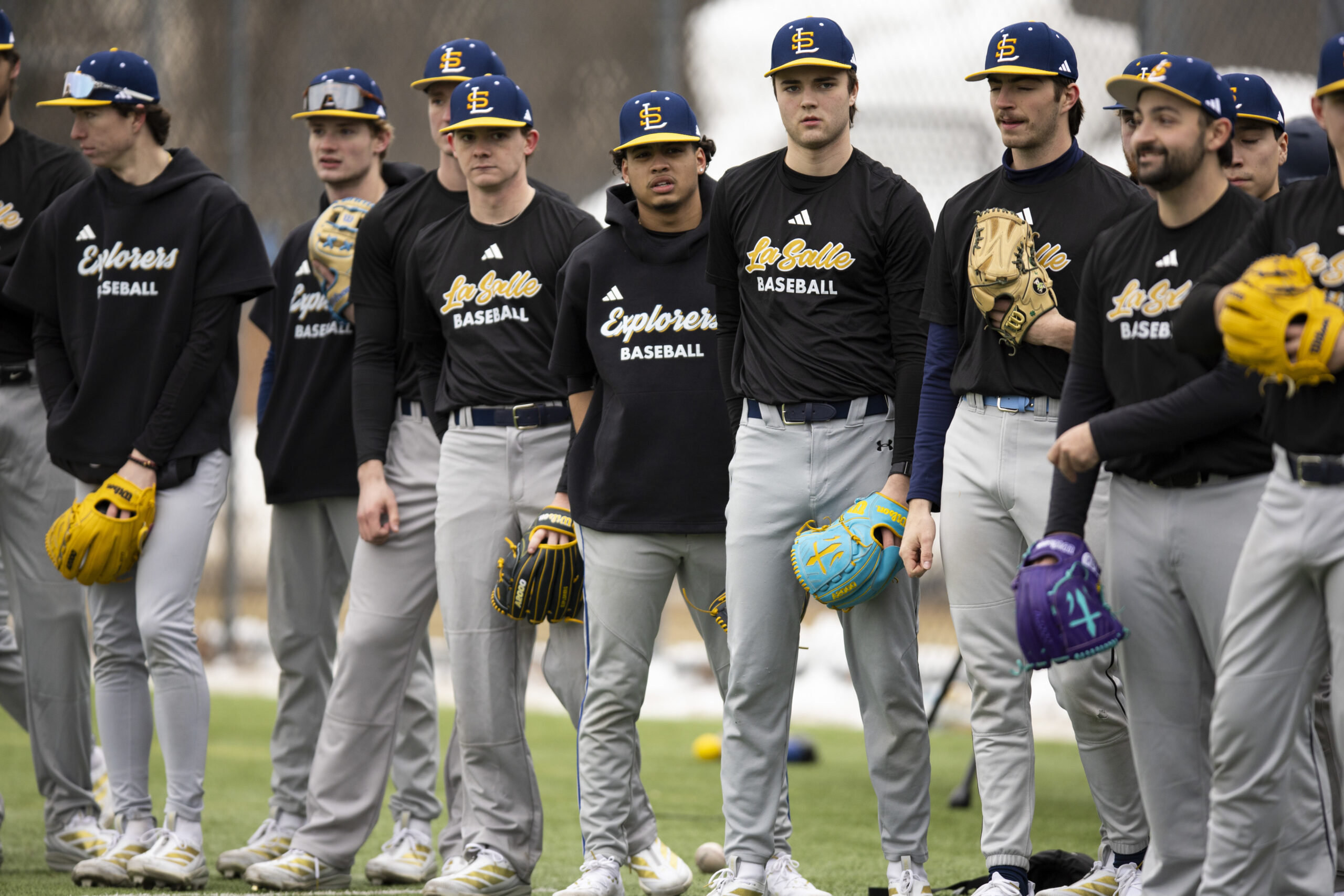
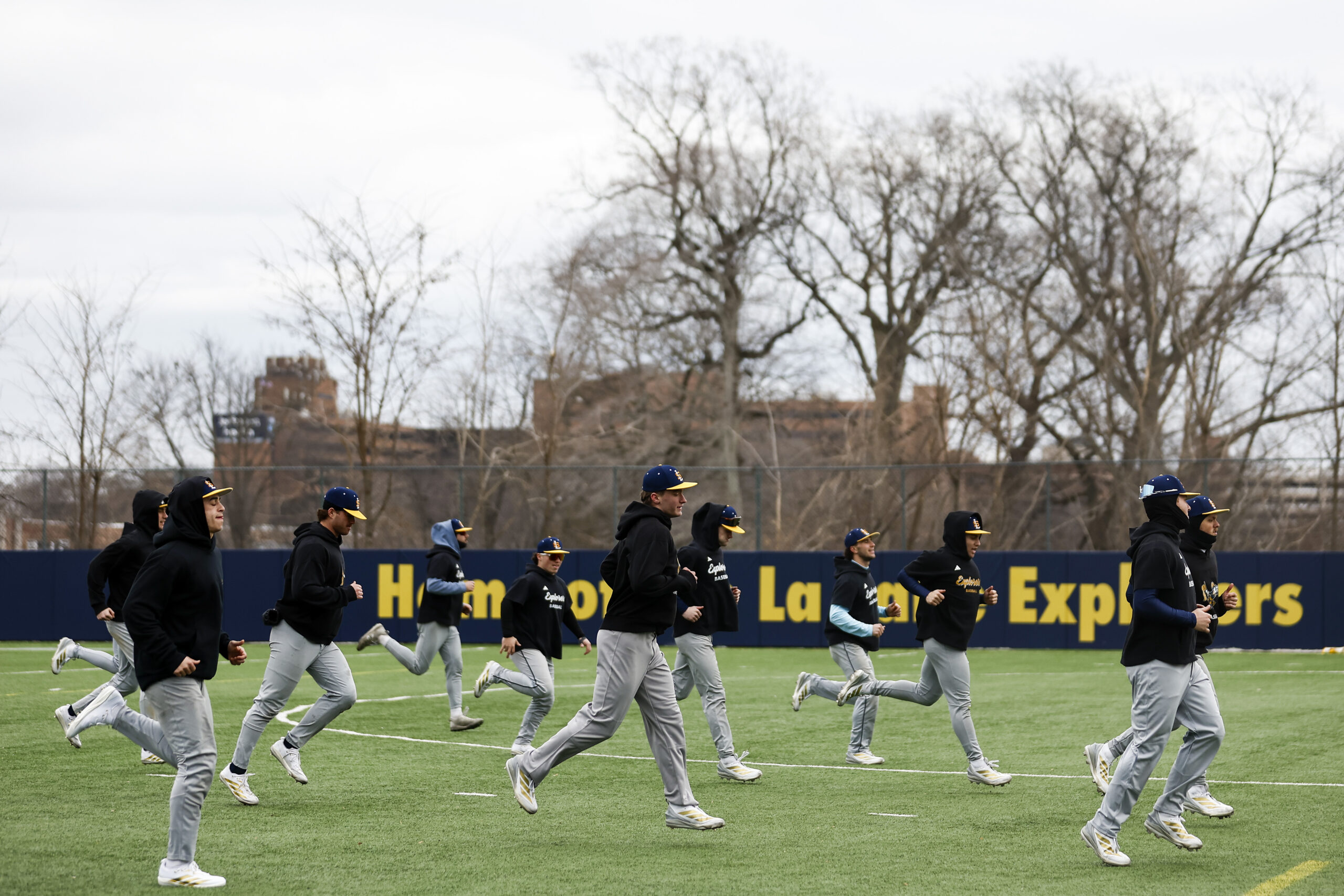
    La Salle baseball players practicing Wednesday at Hank De Vincent Field.

    Coach David Miller constructed a roster that is ready to write a new chapter of La Salle baseball while remembering the history that brought the Explorers to this point.

    “It’s going to be a lot of hard work that everybody collectively did to make this happen,” Miller said. “That first pitch, hopefully that first win, it’s going to be a great day for La Salle athletics.”

    Bringing a vision to life

    The main step in getting the program off the ground was improving the stadium and facilities while raising the necessary funds. An alumni advisory board formed to lead the operation helped focus on alumni outreach, and after a few months the progress in donations became notable.

    “When baseball came back, there was a small group of us that were excited to have the program back,” said Bill Watts, who played at La Salle from 1991-94 and serves on the advisory board. “Ashwin reached out and asked, ‘Would you be willing to be part of the rising here?’ I thought about it for a while and talked it over with some of my teammates and decided if we did it, we needed to do it the right way.”

    The feedback and excitement from alumni have been encouraging. More than 200 former players and alumni attended a “La Salle first pitch” dinner as an official welcome back for the program. While the program may have taken a few years off, the history and tradition carried on.

    The Explorers held alumni games in 2023 and 2024 at Hank DeVincent Field. La Salle made its conference tournament nine times before the program shut down. In its last season, La Salle finished with 32 wins, the most in program history.

    It is important, Puri said, that the program’s history is remembered in a new era.

    “I think history is a big part of it, but we also want to do things a little different this time,” Puri said. “We are going to take baseball very seriously. We are going to invest and we want to compete.”

    Building the team

    To put a team back on the field, Puri and the advisory board knew it started with one man: Miller.

    Miller was named La Salle’s head coach in 2018 and had the Explorers on an upward trajectory before the program shut down. They went 14-41 in his first season, then improved to 25-31 in 2019. After a shortened 2020 season, Miller led La Salle to one of its best performances in program history in 2021, finishing 32-21. Miller was named Atlantic 10 coach of the year and believed he was on the verge of accomplishing something special.

    That momentum was halted when the program shut down.

    Miller coached at Manhattan for two years before he got the offer to return to La Salle. Despite having to take a year off from coaching in 2025, the former Penn Charter coach decided it was worth it.

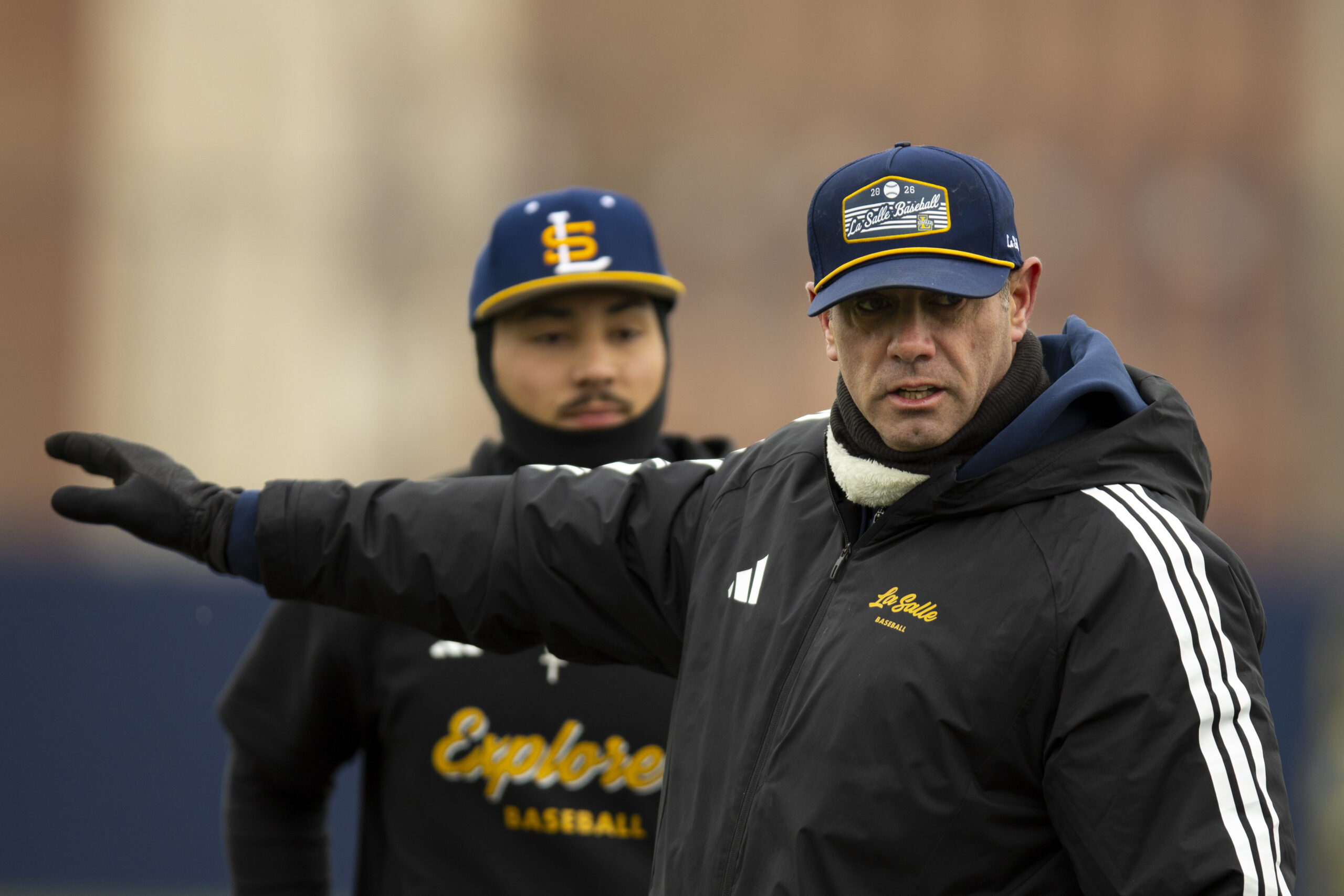
    David Miller returned to La Salle as the head coach, after serving at the helm for four seasons before the program was cut.

    “There’s just something about this place that draws me,” Miller said. “It’s like home to me. When my time is up here, I want La Salle baseball to be a destination baseball program in the northeast. And I don’t see why we can’t be.”

    With Miller back at the helm, the next step was putting the roster together. It was no easy task, considering he was starting from scratch.

    La Salle netted the 17th-ranked recruiting class by Perfect Game in 2025, bringing in 36 commitments. Next, its attention turned to the transfer portal.

    The Explorers brought in seniors who were looking for one more season to play college baseball or underclassmen seeking a fresh start. For utility man Chase Swain, a transfer from West Virginia, playing at La Salle brings his college career full circle.

    “I was committed here for like two years in high school,” said Swain, who played at Woodstown High. “… [The program getting cut] threw everything into a tailspin for me, recruiting-wise. So this place coming back, it was always in the back of my mind. I wonder what it would have been like there. I stayed loyal and the second that they brought it back, it was like a light bulb went off in my head, and I thought I would really enjoy playing there.”

    Underdog mentality

    With a completely new team, the players understand that expectations from the outside are low. The Explorers know a restarted program won’t be picked as a preseason favorite in the Atlantic 10 Conference, but they are using that as a chip on their shoulders and carrying an underdog mentality into the season.

    Because of the weather, La Salle has been forced to travel about an hour away to find an indoor facility for practice. The team has embraced the challenges.

    La Salle coach David Miller says his team is “more excited now than ever to play.”

    “I think we can take the motivation of being a gritty program because we don’t have all the facilities and everything that a lot of other schools have in Division I baseball,” said shortstop Justin Szestowicki, a transfer from Elon out of Kingsway High. “But I think we take that as an advantage. We have more of a chip on our shoulder, just knowing that, based on our opportunities to create a grittier play style, instead of just being taken care of all the time, we have to take some accountability for ourselves to be successful.”

    The players and coaches counted down the days until Friday, when they can say La Salle baseball is back and the two-year rebuilding process has come to fruition.

    Miller is ready to show the college baseball world who the Explorers are.

    “You’re seeing all these high-profile fans from Tennessee and LSU saying, ‘La — who?’” Miller said. “And we embrace that. That’s now my hashtag for the year. We’re going to show you who it is. These kids are more excited now than ever to play, because all the vision that we talked about, and getting them to see what’s coming, is here.”

    Ibach added: “I think that a lot of players who will be playing can take that inspiration to show the world, show the city, that La Salle baseball’s back on the map.”