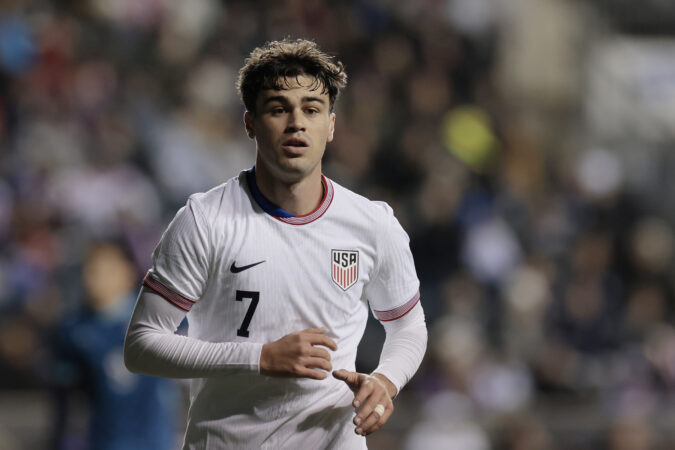
From the moment the U.S. men’s soccer team’s starting lineup was announced Saturday, all eyes were fixed on Gio Reyna.
Not only was he about to play for his country for the first time since late March, but he was starting for the first time since last year’s Copa América group stage finale — a loss to Uruguay that sent the U.S. out in the group stage on home soil, and sent manager Gregg Berhalter out of his job.
Reyna, 23, didn’t make any of Mauricio Pochettino’s squads until the Nations League final four in March because of a groin injury. Then he didn’t play in the semifinal loss to Panama, and was an ineffective second-half substitute in the third-place game loss to Canada.
For all Reyna’s talents — and he has perhaps the most natural talent of any U.S. player besides Christian Pulisic — Pochettino declared him not “ready to play in the way that we expect from him” on the eve of the third-place game.
Gio Reyna hadn’t been with the U.S. men’s soccer team since March.
That was how far he had fallen, in terms of fitness, form, and playing time at his club, Germany’s Borussia Dortmund.
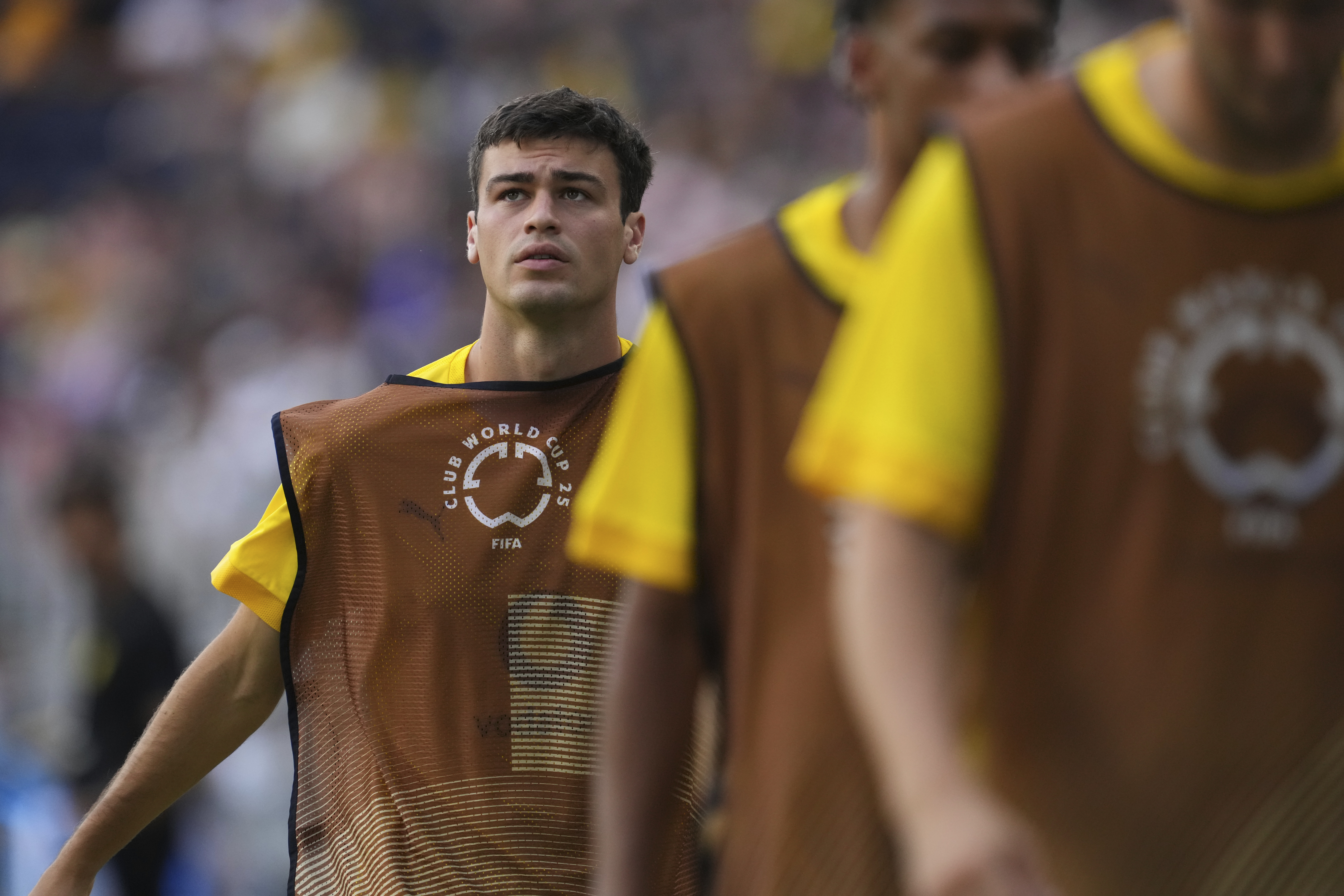
Nor was he done falling. Reyna went to the Club World Cup with Dortmund instead of the Gold Cup and the friendlies before it, because Dortmund wanted him at their games and Pochettino didn’t want players at the friendlies whom he wouldn’t have afterward.
Would that be salvation? No, it was almost the opposite. Reyna got off the bench only once in Dortmund’s five tournament games, a mostly useless 12-minute cameo in the group stage finale.
Only after that did he finally leave for newer pastures, a move many outsiders had hoped to see for years. Borussia Mönchengladbach bought him for about $4.5 million up front and $3 million in incentives. It was miles below what Dortmund expected when a 17-year-old Reyna made his first-team debut in early 2020.
Gio Reyna watched almost all of Borussia Dortmund’s Club World Cup run this summer from the bench, finally leaving the club afterward.
It was to be a fresh start, but it barely started before Reyna suffered the latest of seemingly countless muscle injuries in September. He returned to action in mid-October, but only as a substitute.
So it was a pretty big surprise when Pochettino called him up to the national team this month. But over the course of the week in Chester, it felt increasingly inevitable that he would start Saturday against Paraguay at Subaru Park.
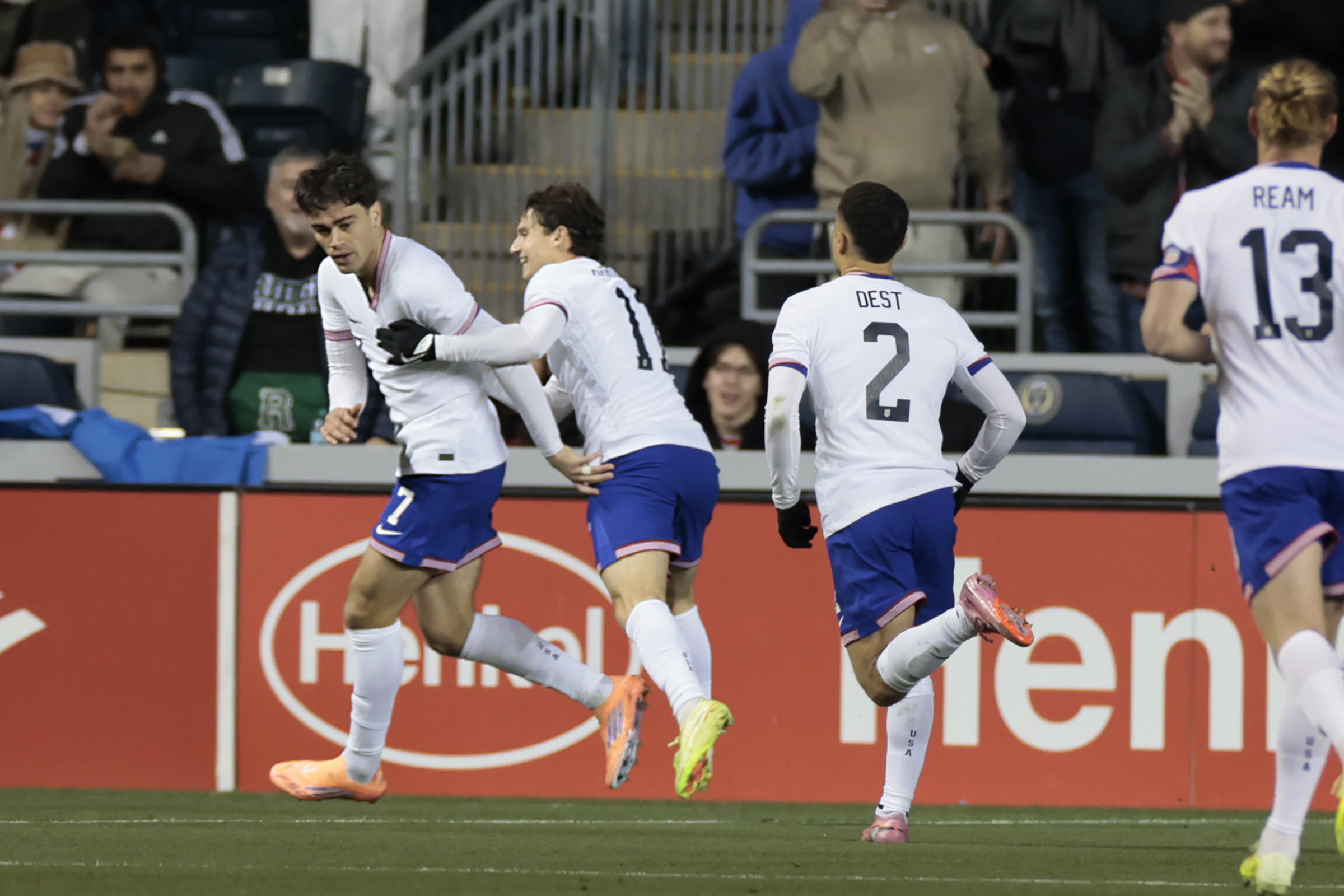
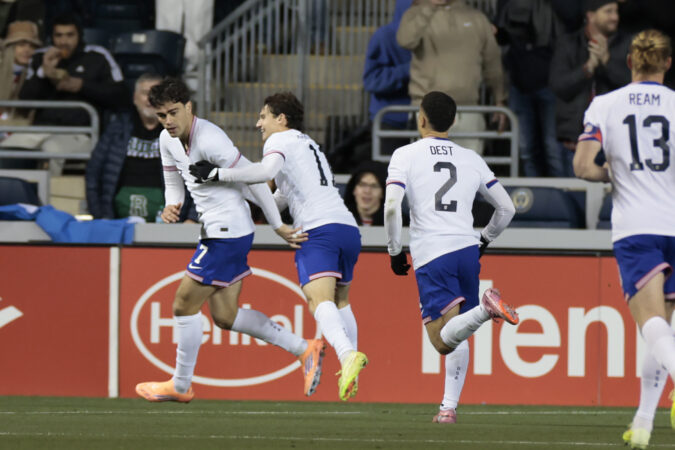
It was a broken play out of a corner kick, the ball pinging around off all manner of limbs on both teams. Eventually, it fell to Max Arfsten, and he chipped a cross into the crowd. Reyna rose highest and met it with a header that caromed in off the crossbar.
As the crowd roared, Reyna ran toward the corner flag, pointing to the U.S. badge on his jersey. Within seconds, his teammates had swarmed him to celebrate.
“I know the kind of player he is, and I’m just really happy for him — he deserves it,” said Medford’s Brenden Aaronson, who started with Reyna in the attacking midfield spots. “He’s been through a lot with injuries, with all this stuff. But whenever he plays for the national team, he’s always there, and it’s awesome to see. … He’s confident in his ability, he knows what he can do, and that’s the beauty of him.”
There wasn’t time in the moment to point out that Reyna has not in fact always been “there” when with the national team. That was the whole point of the 2022 World Cup scandal that nearly torpedoed him.
When that goal went in, though, it was a moment for his immense burden of history to be a privilege, not a weight. The tally was his ninth for the U.S., passing his legendary father Claudio’s eight.
Gio Reyna (left) celebrates with Brenden Aaronson (center) and other teammates after scoring the game’s opening goal.
And for once, Claudio wasn’t invoked because of that scandal, or all the times Claudio interfered with U.S. Soccer officials before then, or yelled at referees from the sidelines in Gio’s youth days, or by genetics passed his ego on to his son.
By the time Gio emerged from the locker room to meet one of the biggest media packs at a U.S. game in quite a while, he had already texted with his father.
“It was just fun, love,” Gio said. “He was obviously happy for me that I passed him, but I had no idea. So he was more making fun of me for the fact that it was my first header I’ve ever scored.”
The pressure on him is earned
The negative side of the burden struck twice after that. On Paraguay’s 10th-minute equalizer, Reyna was late and slow to challenge Junior Alonso before he launched the long ball that sprung Miguel Almirón for a dazzling assist on Alex Arce’s goal.
The scale tilted back his way in the 71st. Reyna combined superbly with Folarin Balogun to create the winning goal. The man of the hour had delivered again, and the U.S. went on to close out a 2-1 win.
“I think in the end, performances like this that can help everybody here,” Reyna said. “But I want to have, more importantly, seven or eight good months in the rest of the season with Gladbach. And then I believe if I keep performing like I did tonight, then I’ll have a good chance to make the team and have an impact there, too.”
Folarin Balogun's third goal in his last four USMNT games restores the lead 🫡 pic.twitter.com/fe85pV30M2
There’s still a ways to go, and as Pochettino said, plenty for Reyna to do to earn a seat on the plane next summer. But in a moment when he was asked to step up, he did, and in national team soccer there are never many moments. So when you get one, you have to take it.
“He showed why he started, and yes, confirmed that he’s a player that needs to improve because he needs to play more in his club,” Pochettino said. “But we can see today that he was great: scored and assisted. And the way that [he has] always the capacity to read the game, and find the free space in between the lines, I think that was a nightmare for Paraguay, and I think he did a very good job.”
Reyna thanked Pochettino in turn, with some notable humility.
“I knew it was an opportunity for me to to show that I belong here,” he said. “He’s been great with me all week, working with him, and just trying to give me the freedom and the confidence to sort of be myself. So I can’t thank him enough, obviously, for the start and just for the relationship that we’ve really built this camp.”
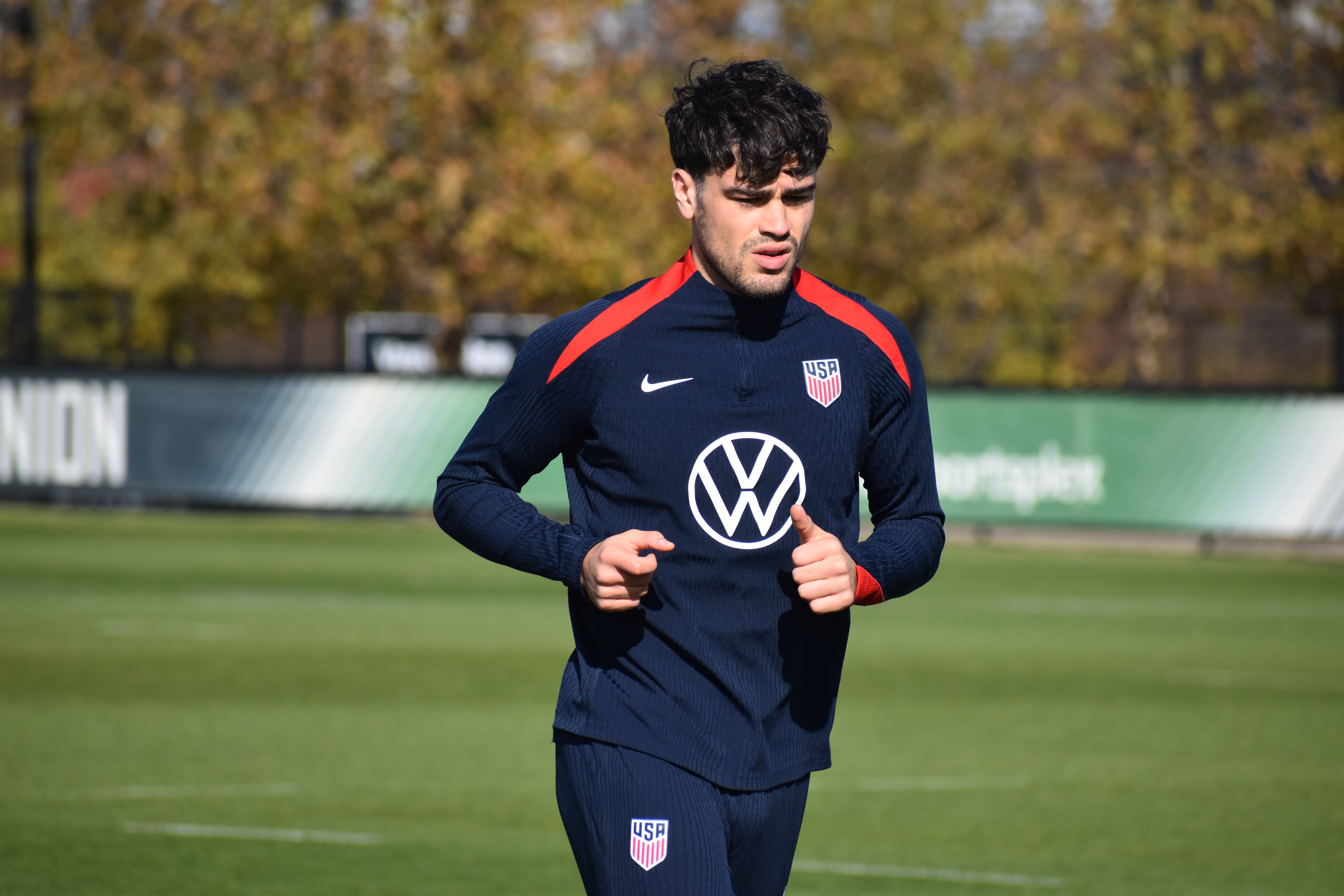
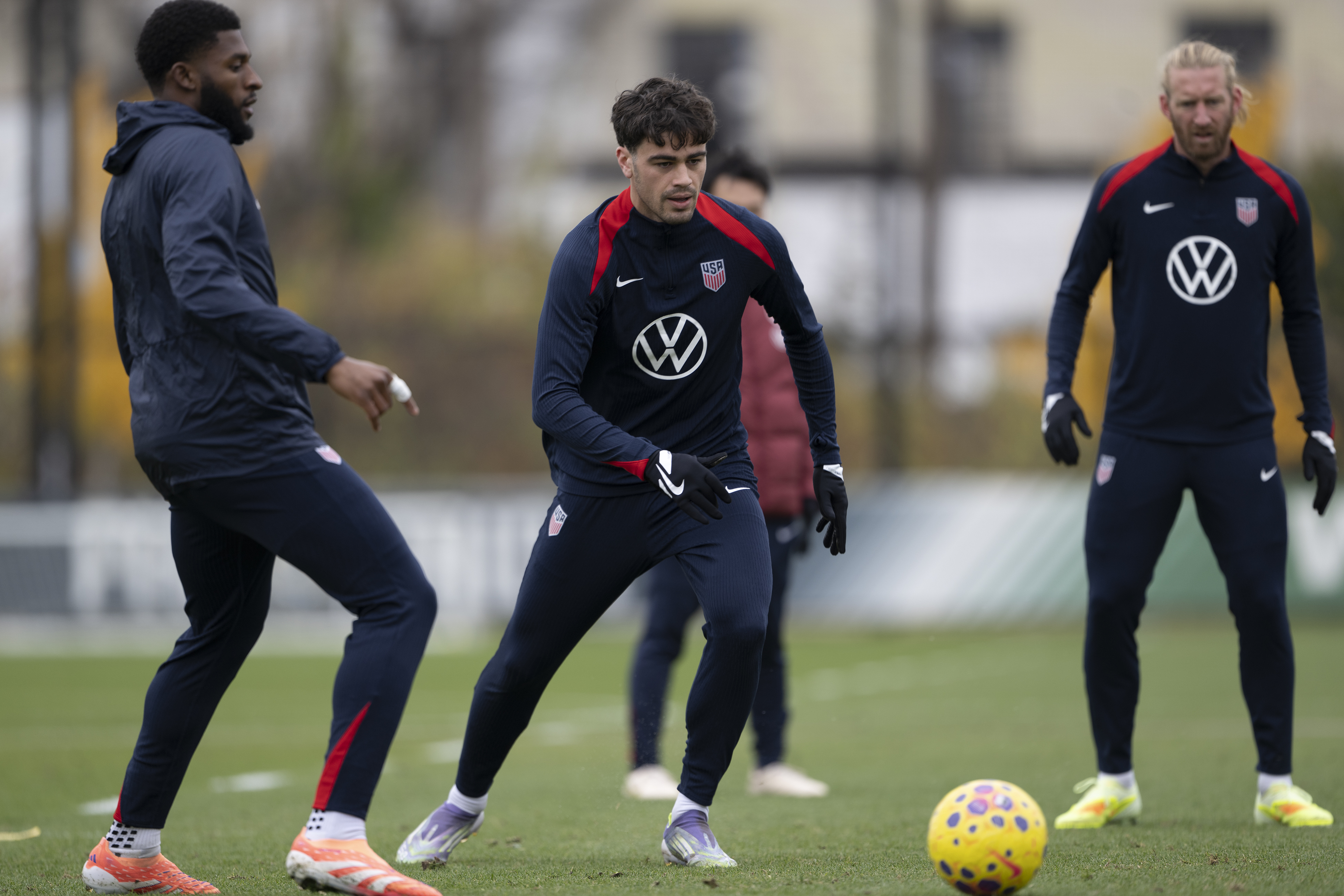
Gio Reyna (center) working in practice during the week.
The stakes only get higher from here, and so does the quality of opponent the U.S. will face. After meeting Uruguay on Tuesday in Tampa, Fla. (7 p.m., TNT, Universo), to close out this month, it’s expected that March’s games will see big-time opponents from Europe. Portugal, France, and Belgium are reportedly on the radar, with Atlanta’s Mercedes-Benz Stadium set as a fittingly big-time venue.
Time will tell if Reyna earns the right to be there. For now, he’s only in the race. But that alone is the best place he’s been in for a long time.
After waiting six years to see the U.S. men’s soccer team in town again, Philadelphia soccer fans got their money’s worth on Saturday.
Gio Reyna scored in the fourth minute and assisted Folarin Balogun’s winner in the 71st to give the Americans a 2-1 win over Paraguay, extending their unbeaten run this fall to four games.
Reyna was the man of the hour from the moment the lineups came out. This was his first U.S. game since the Concacaf Nations League final four in March and his first start since last year’s Copa América group stage finale. It also was just his fifth start of the calendar year in any game for club or country because of injuries and bad form.
Reyna leapt to meet Max Arfsten’s cross after a corner kick got broken up. The 23-year-old attacking midfielder with so much unfulfilled talent ran to the corner flag, pointing to the U.S. crest on his jersey along the way, and his teammates joined him for a big group hug next to the TV cameras.
Paraguay equalized just over five minutes later with a lightning-fast and impressive play. Junior Alonso hit a long ball down the left flank for Miguel Almirón — after Reyna waited too long to press — and the Atlanta United star hit an inch-perfect first-time cross. Alex Arce was right on time, and slammed the finish past a frozen Matt Freese.
Almirón might have been an inch offside when the pass was played, but he otherwise left Joe Scally in the dust — in Scally’s first U.S. game since the Nations League flop. Arce then easily beat Miles Robinson, who has been a regular under manager Mauricio Pochettino but isn’t a surefire starter.
The Paraguay fans in the bipartisan crowd of 17,221, many of whom arrived early to tailgate, were thrilled.
After that, the game settled down for a while, and fans could observe how the U.S. was trying to play.
Pochettino set out a lineup that looked on paper like the 3-4-2-1 he’s used lately, but it had some wrinkles. Arfsten, who played left wingback, sat a bit deeper than usual, while right wingback Sergiño Dest pushed up so high that it often looked like he was an attacking midfielder.
The result looked at times like a 4-2-3-1, with Scally as the right back, Medford’s Brenden Aaronson in a central attacking midfield role, Dest to Aaronson’s right, and Reyna to the left — though Aaronson and Reyna had the freedom to switch places.
Folarin Balogun led the line up top, Cristian Roldan and Tanner Tessmann were the central midfielders, and Tim Ream and Robinson stood at centerback.
It was a fluid setup all in all, and it produced some entertaining soccer.
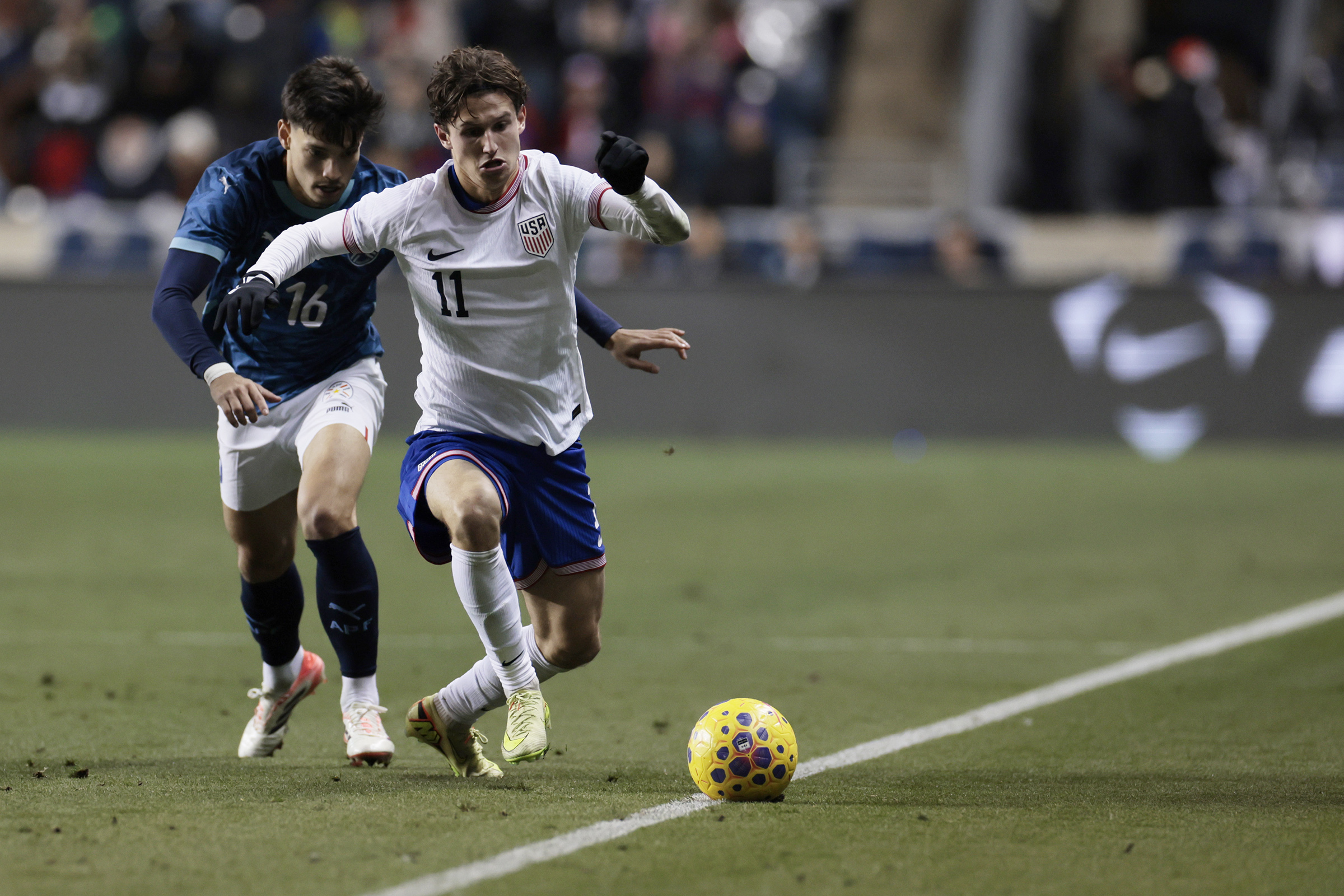
Brenden Aaronson (right) runs past Paraguay’s Damian Bobadilla to chase a loose ball.
The starting lineup stayed intact until the 67th minute and was just as lively as the first half. Aaronson was on the ball a lot, and Dest ripped a shot from atop the 18-yard box that Paraguay goalkeeper Orlando Gill tipped over his bar.
That shot was Dest’s last action, as he and Scally departed for Diego Luna and Alex Freeman. The swaps shifted the U.S. formation to a traditional 4-2-3-1, with Freeman at right back and Luna, Reyna, and Aaronson in the attacking midfield roles from left to right.
Balogun struck for the lead in the 71st, after first intercepting a loose pass forced by Juan Cacéres. Roldan and Luna forced it with some hustle, and when Balogun got the ball he held it up to spring Reyna down the left flank. Reyna returned the favor with a square pass that was deflected but fell right for Balogun to finish.
Folarin Balogun's third goal in his last four USMNT games restores the lead 🫡 pic.twitter.com/fe85pV30M2
Four minutes later, Pochettino sent in three more subs: Ricardo Pepi for Balogun at striker, Timothy Tillman for Reyna in attacking midfield, and Aidan Morris for Roldan in the center.
Freese made his big save for the night in the 78th, denying a long-range blast from Almirón.
After the ensuing corner kick, the U.S. went down the field, and Pepi should have made it 3-1 in front of an open net. But he was off-balance receiving it, and by the time he turned to his favored right foot, Paraguay’s Gustavo Gómez had raced to the goal line to block the shot.
The last U.S. sub was Sebastian Berhalter for Aaronson in the 80th, and the hometown hero got a big ovation from the crowd on his way out.
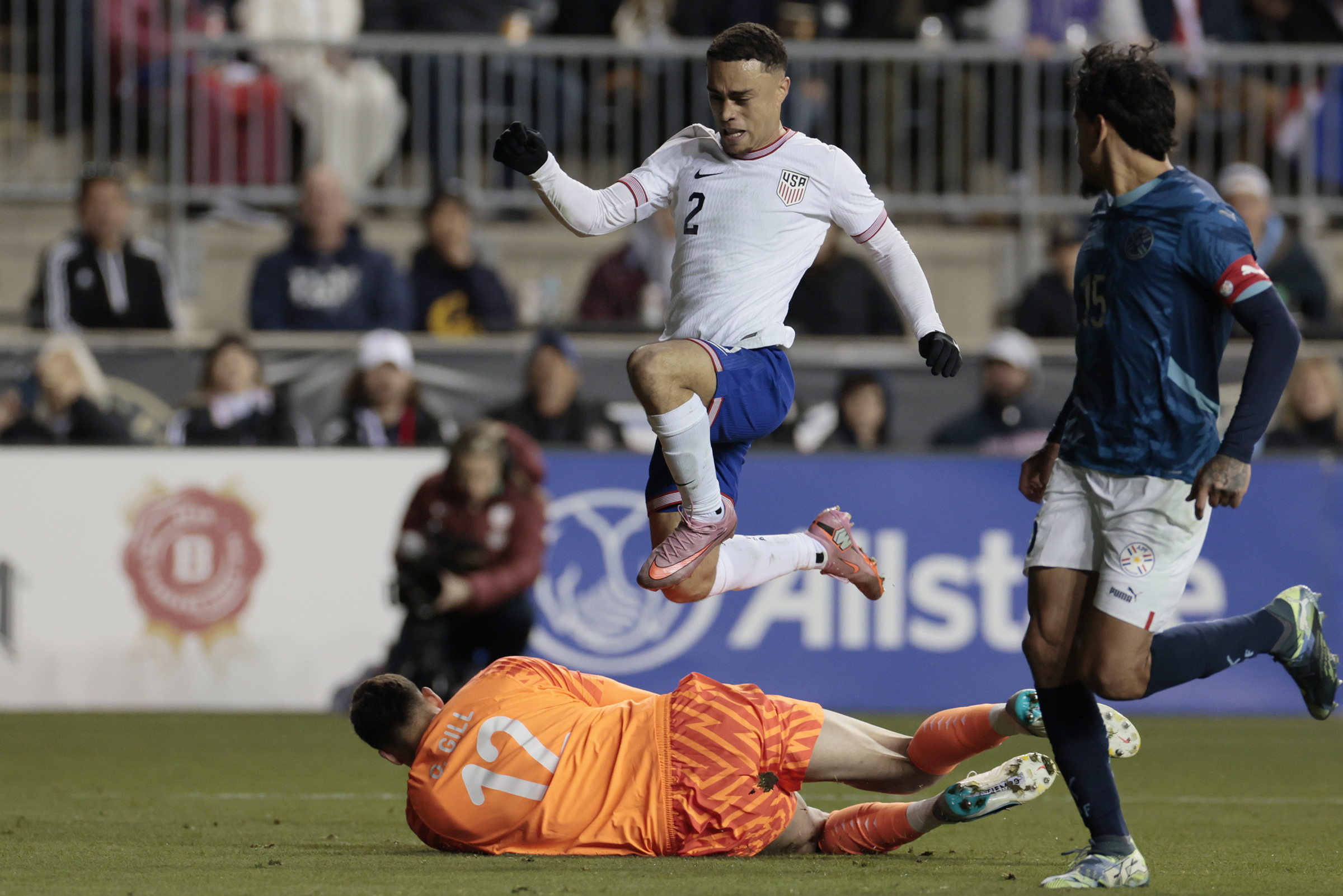
Sergiño Dest (center) jumps over a diving Paraguay goalkeeper Orlando Gill on a U.S. scoring attempt during the second half
Things got dicey from there for the U.S., including a deflection off Arfsten right on 90 minutes that rolled inches wide of Freese’s far post.
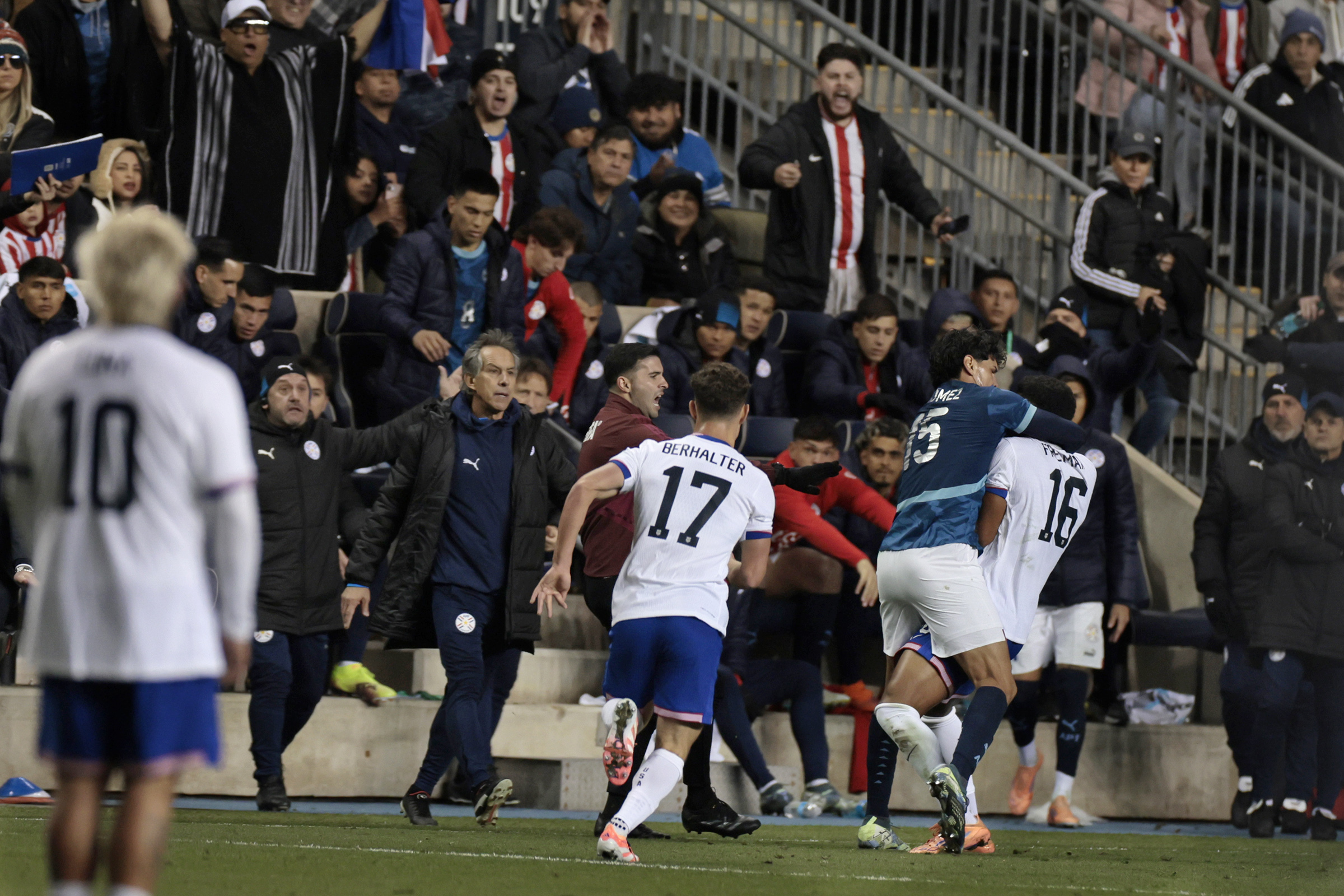
Just over a minute later, a brawl erupted by the benches after Gómez and Freeman briefly argued over who would claim a dead ball on the field. Gómez put Freeman in a headlock, which sparked a melee that ensnared both teams’ active players and benches, coaches included. It was a sight rarely seen in soccer, but especially in a friendly without official stakes.
Referee Cristhofer Corado of Guatemala dished out a few yellow cards, and would have been well within his rights to end the game there instead of waiting out the announced four minutes of stoppage time. But play did resume, and the clock ran to 96 minutes when the final whistle came.
Long before U.S. men’s soccer team manager Mauricio Pochettino unveiled a 3-4-2-1 formation for his players, outsiders debated the possibility.
Though the program went decades without playing that way, the rise of high-flying outside backs like Sergiño Dest made the idea start to sound sensible.
But since Pochettino made the switch in September, Dest hasn’t gotten to play in the new setup much. He was a second-half substitute in the momentum-turning win over Japan, then had to miss October’s games because of an injury.
That makes this month’s games crucial for the 25-year-old, who plays his club soccer at Dutch power PSV Eindhoven. The odds are good that fans will see him play a major role Saturday at Subaru Park when the U.S. faces Paraguay (5 p.m., TNT, Telemundo 62).
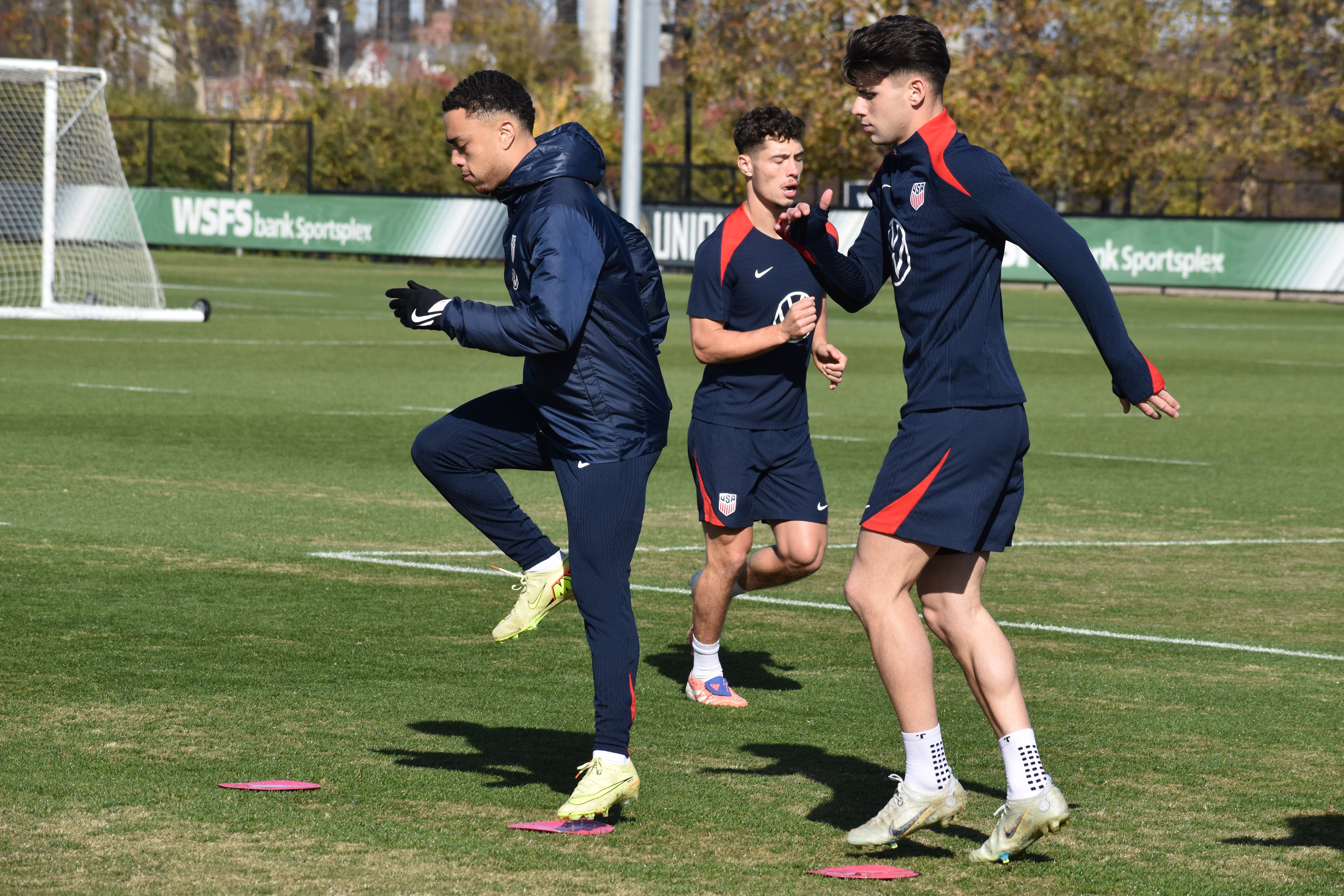
Sergiño Dest (left) and left wingback Max Arfsten (right) working out together at Friday’s practice.
“Yeah, I feel like it’s really important,” Dest said at Friday’s practice in Chester. “Because the rosters are a little bit different. For me personally, because I was injured, I didn’t really have that much time to play with everyone, the players that I didn’t know before. It needs time.”
Dest has historically played on the right side of a four-defender setup with both club and country. The right wingback spot ahead of three centerbacks isn’t too different, but as with any tactical change, there are subtleties.
“It’s a little bit different, but obviously, that’s the way we play at the moment, so I feel like you have to adapt to that formation,” Dest said. “For me personally, I’ve always been an attacking outside back, so I feel like it’s not that hard. But you still need some time.”
Dest can also play on the left side, as he did against Japan. That could matter even more if longtime starter Antonee Robinson can’t overcome his longstanding knee issues. A combination of Dest and Tim Weah (who’s out injured right now) as the wingbacks would be quite dynamic — though with plenty of defense needed between them.
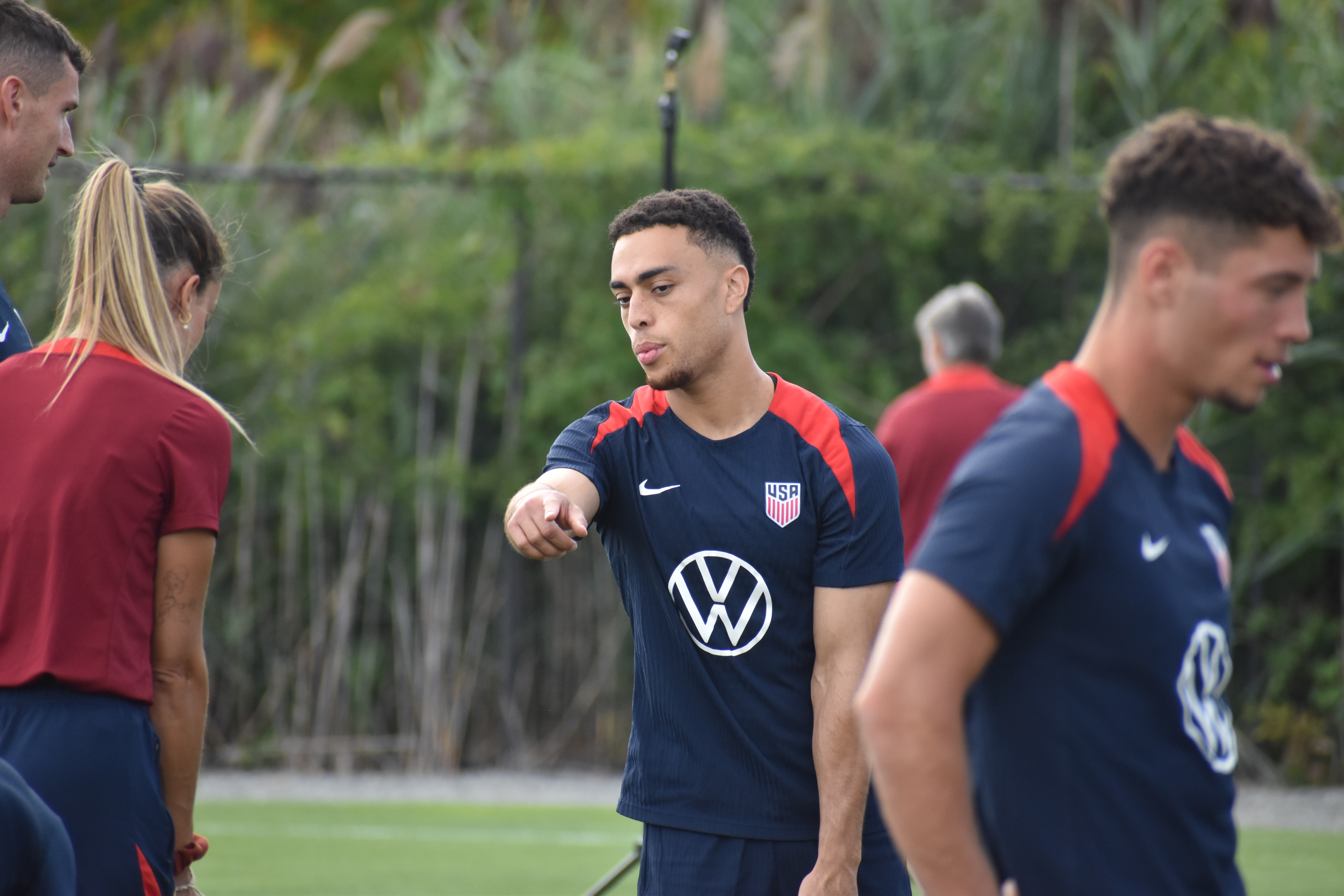
Sergiño Dest (center) at a U.S. practice in September, the last time he was with the team.
“Now is a good opportunity for him,” Pochettino said. “I think we have good players in that position [in this squad] like Alex Freeman and Joe Scally, that are very competitive and they can play in different [roles]. Sergiño is more offensive than defensive — he needs to improve in defensive areas — but I think it’s a great opportunity for us to know him, to see the capacity to adapt to our demands that are completely different for his club, or were in the past year. “
Whatever Dest is asked, he made it clear he’s ready to answer the call.
“I always want to play for the national team,” he said. “I feel like it’s an honor to be here and to fight for my spot. I always wanted to be here, but to have some extra training and some extra rest between some games, especially after the injury I came from, I think it’s also not bad, especially with the long season we still have ahead.”
Gio Reyna in the spotlight
While local fans will obviously be focused on the four Philly-area products on this squad, many eyes nationally will be on Gio Reyna’s return to the squad. The talented young playmaker had been on a downward slide for a while, but has finally started to trend back up in the last few weeks.
Gio Reyna (center) on the ball at Wednesday’s practice.
If he can make an impression in these two games, it will be a big deal in his quest to make a second straight World Cup team.
Reyna hasn’t spoken with the media yet this week, but veteran U.S. centerback Tim Ream had praise for Reyna’s work in practice.
“He’s not really letting the challenges overseas seep into camp, which is great to see,” said Ream, who wears the captain’s armband under Pochettino as the squad’s most experienced player. “He’s speaking up a lot more in the trainings, in terms of, ‘OK, I’m seeing this, what are you seeing?’ He’s really getting involved in the understanding of the movements and what we’re doing in the buildup and in the defensive shape.”
Ream said he has observed a better mentality in Reyna, too. That has long been a question about the attacking midfielder, dating back to the scandal with former U.S. coach Gregg Berhalter at the 2022 World Cup.
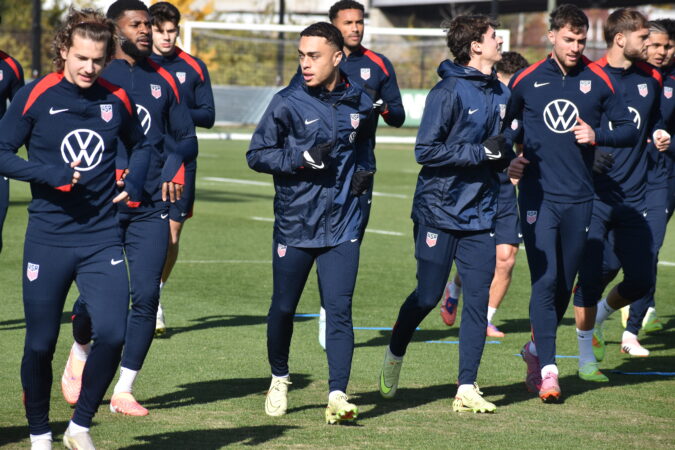
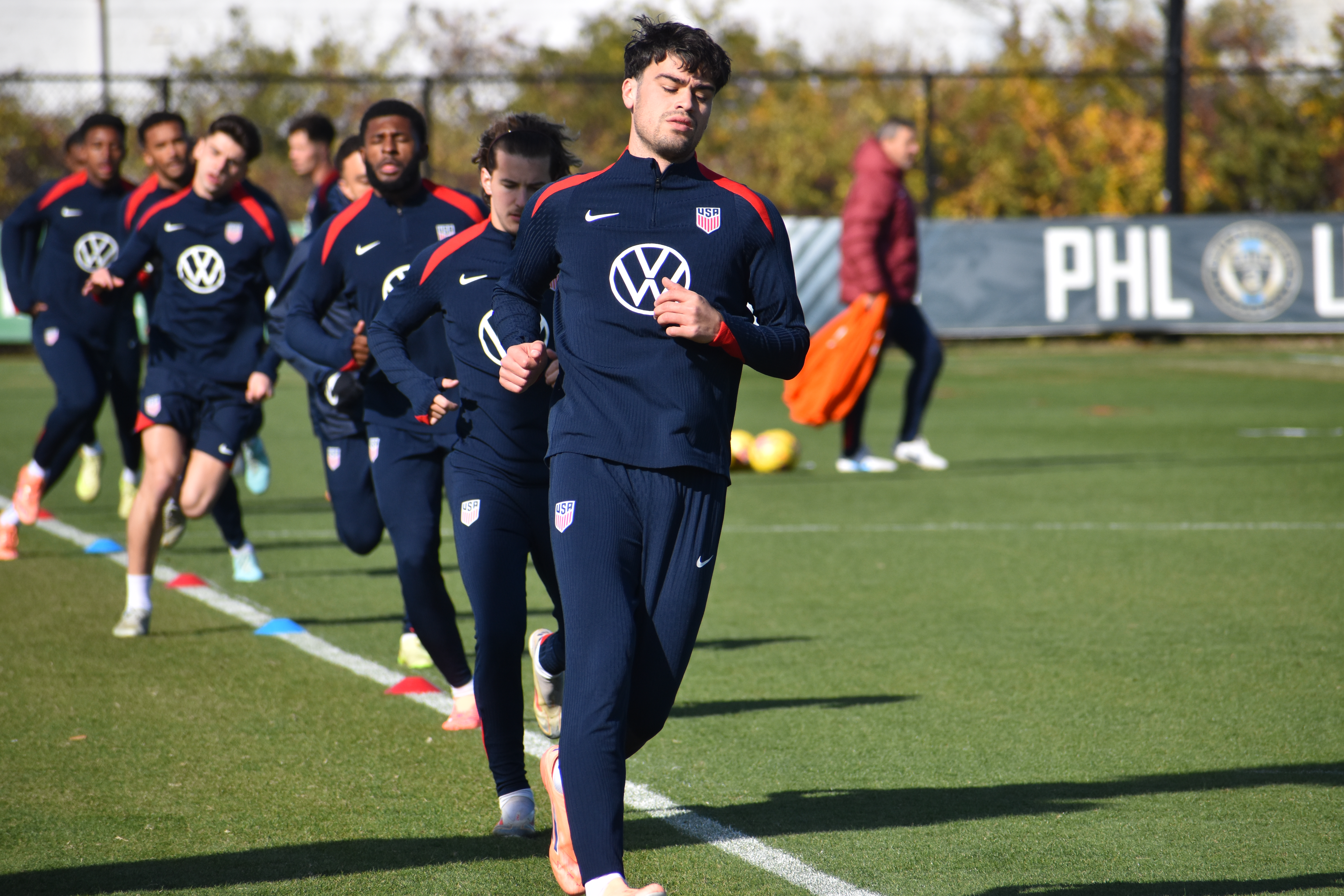
Gio Reyna leading the jogging line at the start of Friday’s practice.
“I feel like he’s more in tune and more focused on the field than I’ve seen in the past, which is a great thing,” Ream said. “And I think whether it was injury or other things that were going on, I think his focus is so much greater now, and that’s a good thing.”
The mention of “other things” didn’t need further detail. Just last month, Reyna talked about it with the Associated Press, and his lack of contrition did not go over well.
This U.S. squad is the first one where Reyna has worked with Sebastian Berhalter, Gregg’s son. Gio’s famed father, Claudio, was as close as could be with Berhalter until the scandal erupted.
Pochettino was asked whether the subject had come up between the sons, and he said it has not.
“I hear some things, but for me it’s not important, because in front of everything is the national team,” he said. “I cannot judge, I cannot take decisions from the past. … Now it’s a completely different environment. And what I saw from day one — good synergy, good teammates — I think the interaction and the communication is fantastic.”
As VJ Edgecombe prepared to leave the 76ers’ locker room Sunday, following the team’s second set of back-to-back games in less than a week, veteran teammate Andre Drummond noticed the rookie looked “exhausted.”
So Drummond offered direct instructions for Edgecombe heading into the Sixers’ mandatory off day.
“Don’t get up until 6 p.m. tomorrow,” Drummond publicly reiterated in front of reporters a few minutes later. “6 p.m., VJ. So if you see this, keep your [butt] in bed.”
Perhaps no Sixer will benefit more than Edgecombe from this light stretch of the Sixers’ early schedule, when their only game in five days is Friday at the Detroit Pistons. After a torrid scoring start — including a historic 34-point outburst in the Sixers’ opener at the Boston Celtics — Edgecombe has shot 27.9% (17 of 61) from the floor and 25% (5 of 20) from three-point range and averaged 9.4 points during his past five games.
The mini slump is understandable for a rookie going through the demanding 82-game NBA schedule for the first time, and playing heavy minutes for a competitive Sixers team in record (7-4) and in number of “clutch” games played (nine, tied for the NBA lead entering Thursday). And there is no substitution for Edgecombe simply experiencing the grind.
“It’s not weighing on me,” Edgecombe said of his recent struggles. “Why I say it’s not is because it’s an 82-game season. Nobody’s going to remember these games early. I mean, I’m a rookie, man. I’ve got to give myself some grace. Obviously, I set a pretty high standard when I came and had a good debut scoring the ball.
“But at the end of the day, I just want to win. That’s the main thing for me. I just want to win.”
Coach Nick Nurse said that Edgecombe’s “tremendous engine” — the 20-year-old guard can “work really long days, and then do it again the next day,” the coach added — and mental fearlessness have been present since the Sixers drafted him this summer.
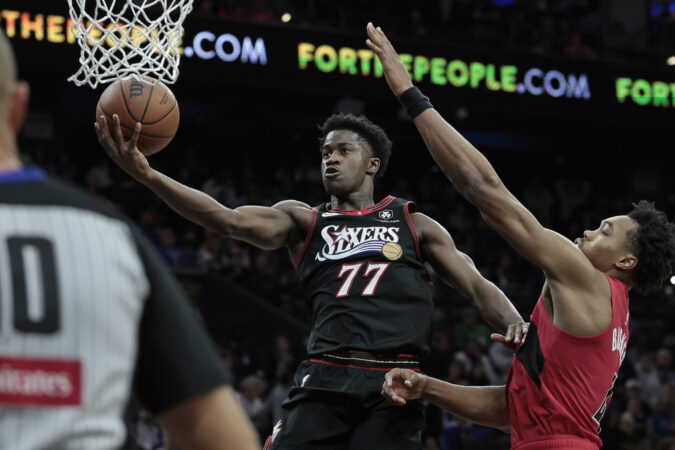
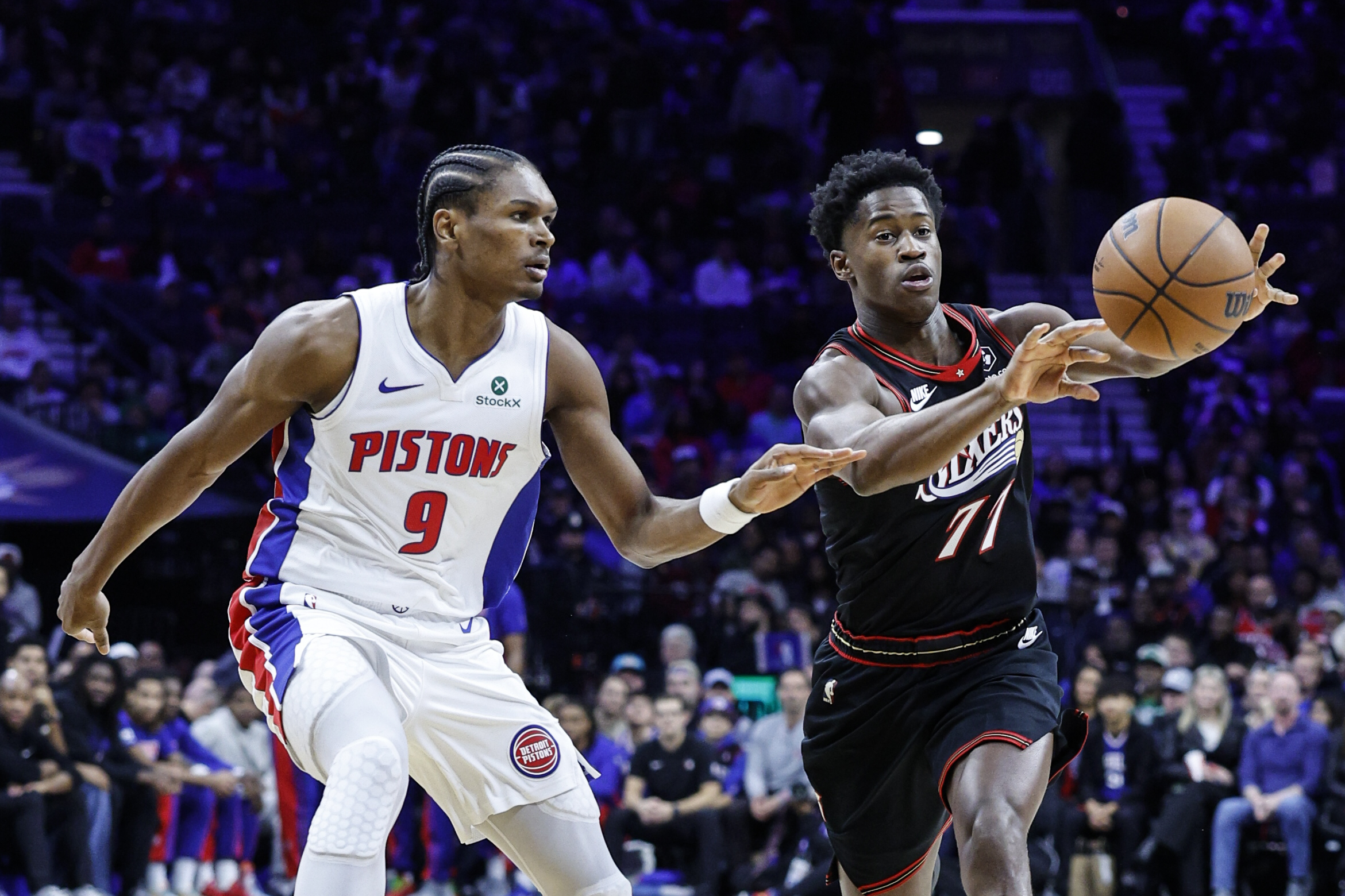
Sixers Vj Edgecombe has shot 27.9% from the floor and 25% from three-point range and averaged 9.4 points during his past five games.
That motor has already been put to use. Entering Thursday, Edgecombe ranked second in the NBA in minutes played (37.3 per game), only behind teammate Tyrese Maxey (40.5 per game). And after playing 35 total games his one college season at Baylor — “and 12 of them don’t really count,” Nurse quipped — Edgecombe logged 11 NBA games in less than three weeks. That included three back-to-backs, which Edgecombe acknowledged was “tough for me personally.”
“I don’t know if I can prepare myself for that,” Edgecombe said.
And it is not just the avalanche of games, but everything in between. Last week, the Sixers completed their first multigame road trip to Brooklyn, Chicago, and Cleveland. That typically means leaving one city immediately after a game, landing in the next city in the middle of the night, then needing to be ready to jump into practice or game preparation a few hours later.
Maxey said Tuesday that, in Year 6, he has just begun to figure out a maintenance routine that works for him. Justin Edwards, who was a rookie last season, learned preventive treatment such as sitting in a cold tub, “flush” massages, and red light therapy are crucial.
So far, Edgecombe spends nights without a game sitting on his couch in recovery boots that alleviate leg soreness. On game days, he takes a nap and speaks to his family. His goal is to keep his mind peaceful, following a mantra from high school coach John Buck that “you can’t be grateful and stressed at the same time.”
Edgecombe had already earned the trust of teammates and coaches with his work ethic and temperament. Nurse praised that Edgecombe was “everywhere” the team asked during the offseason, even canceling a visit home to the Bahamas.
That is why Nurse was not hesitant about immediately inserting Edgecome into the starting lineup. Or keeping him with the closing group, even when he struggled with his shot or turnovers earlier in the game. Edgecombe is already one of the Sixers’ better perimeter defenders. He also always has the potential to flash his insane athleticism as a driver or finisher. And he has already shown a knack for knocking down clutch shots, while averaging 15.4 points, 5.5 rebounds, and 4.3 assists so far this season.
“He’s got great composure. He’s calm. He doesn’t make too many mistakes,” Nurse said. “I super believe in him. … He needs to be out there and learn this stuff, and he’s produced.”
Like during the Sixers’ win over Celtics Tuesday night. Edgecombe missed eight of his first nine shots, including an air-balled three-pointer to begin the third quarter that prompted him to mouth “Oh my God” in surprise (or self-deprecation).
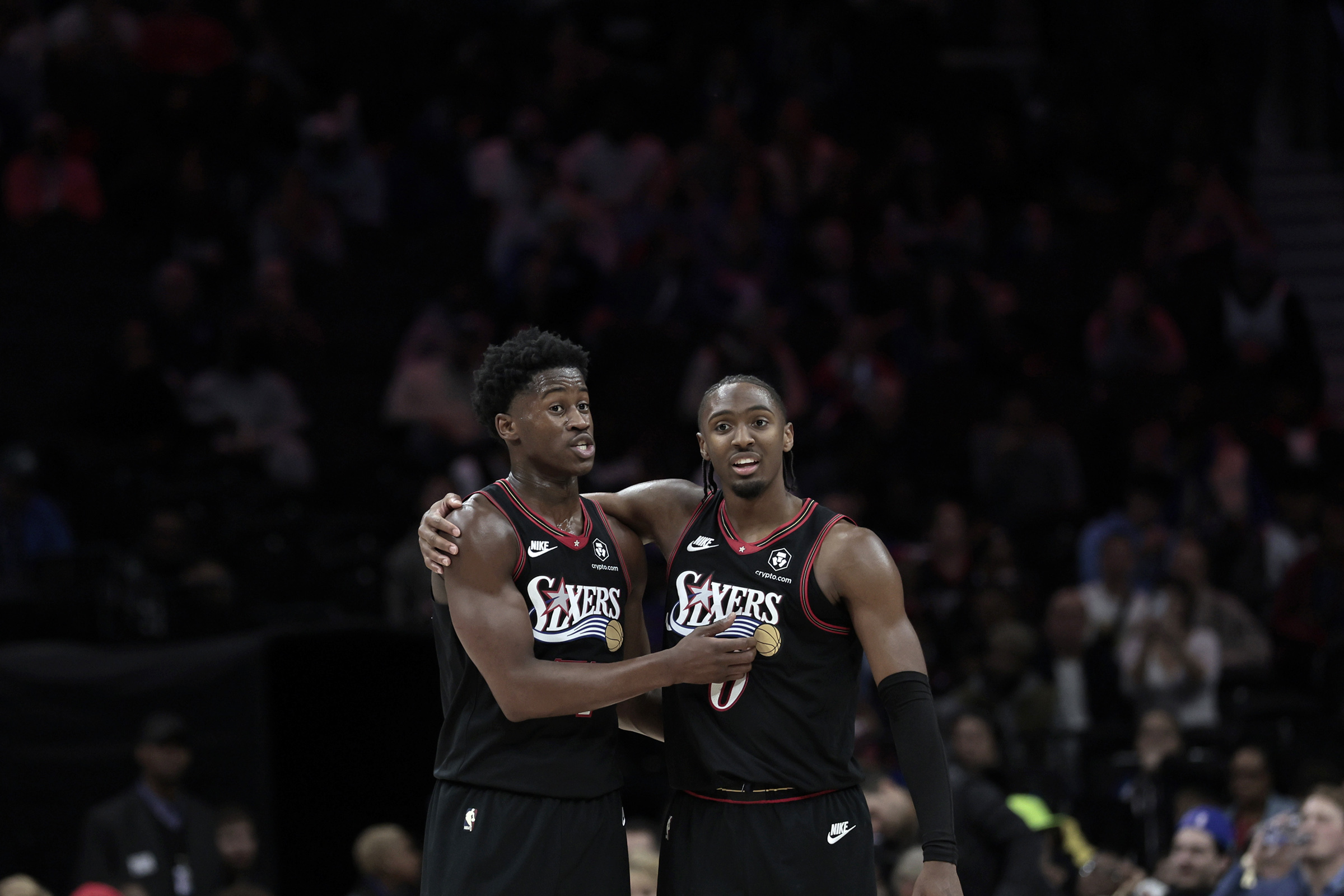
Sixers guards VJ Edgecombe and Tyrese Maxey occupy the NBA’s top two spots in minutes played per game.
But with about five minutes remaining, Edgecombe elevated to block All-Star Jaylen Brown’s dunk attempt, then pushed the ball ahead to Edwards for a three-pointer. Then with 2 minutes, 20 seconds to play, Edgecombe let an open three-pointer fly — and watched it bounce high off the rim and through the net to give the Sixers a four-point lead. Perhaps that was a reward for Edgecombe’s summer work to get more arc on his shot, and “give it a chance to get in the rim,” he said.
“It’s been a rough couple days, but I won’t stop shooting the ball,” Edgecombe said. “I will continue shooting the ball if I’m wide-open, if it’s the right shot.”
That is one of several on-court lessons for Edgecombe during these first 11 games. Another is that he cannot expect to outjump competitors for a rebound, because “they’re 7-foot and they’re gonna get there quicker than me.” Nurse added that Edgecombe must get downhill more aggressively while playing alongside Joel Embiid, in order to draw the defender away from the former MVP and open opportunities for Edgecombe to pass to a rolling or popping Embiid. Even the speedy Edgecombe notices the increased pace at the NBA level, and that he needs to sharpen his defensive positioning.
And though Edgecombe feels empowered by coaches and teammates to be himself on the court, Nurse acknowledged Thursday that the staff can more deliberately put Edgecombe in situations with the ball in his hands.
“Come hell or high water, this is your play,” Nurse said. “Go make something happen.”
After Tuesday’s sputters, Edgecombe believes he is “due for a game to get back on track.” Nurse added that Edgecombe’s past two days have been filled with “constant film work,” which is “still [a] pretty heavy load mentally, no matter if he’s on the court or not.”
But that approach does allow Edgecombe to take Drummond’s advice. On Monday, Edgecombe said he woke up after noon, then was back asleep by 5 p.m. So it is fair to assume he will aim to maximize this lighter early-season stretch, with one game in five days.
“When I get home, in my bed,” Edgecombe said, “that’s the best thing.”
Roman Catholic coach Rick Prete said it best: Every team in the state playoffs is good, and this is what each program has prepared all year for. What they’re playing for is different.
For the Cahillites, it’s getting back to the state final after making their first appearance in school history last season, when Roman Catholic fell in overtime to Harrisburg’s Bishop McDevitt for the PIAA Class 5A crown at Cumberland Valley High School.
The heartbreaker has been Roman Catholic’s fuel all season, and this time Prete believes his team is “in a good place” to reach the final.
The Cahillites (8-3) handed La Salle College High its first loss of the season, nearly beat St. Joseph’s Prep (in a 40-39 double overtime loss), and are riding a four-game winning streak entering a matchup against Whitehall of District 11 in the first round of the PIAA playoffs on Friday night.
“We’re the only team that can get in our own way,” said Prete, who has been at the helm since 2019. “We have to stay focused and get better every day. … From the beginning of the year to now, it’s been about staying out of our way and understanding that if we play our best, we’re the best team in Pennsylvania.”
Roman Catholic is led by Akron-bound quarterback Semaj Beals, who has passed for 2,456 yards this season. His main targets have been Ashdan Roberts (12 touchdowns) and Eyan Stead Jr. (eight), who both recently committed to Temple.
Prete also credited center/guard Dom Ramos and defensive end Julian Enoch as the team’s vocal leaders. The two seniors “lead by example and try to hold guys accountable,” Prete said.
“We tell them to be where their feet are,” he said. “We’re not focused on coming off of four wins. We’re coming off of a loss in the state title game. We’re coming off a loss in essentially the PCL championship game. … Roman has been coming back from a loss. That’s been our mindset.”
Pennridge eyes history
Pennridge High has never won a district or state championship. The Rams (11-1) are having their best season under third-year coach Kyle Beller after going 3-7 in 2023 and 4-7 in 2024. They opened the season on a seven-game winning streak, with victories against conference foes North Penn and Neshaminy.
District 1 Class 6A includes top competition. Pennridge, which earned a Suburban One League title outright and was seeded No. 1 in districts, barely got past No. 16 Plymouth-Whitemarsh to open the district playoffs, 22-21.
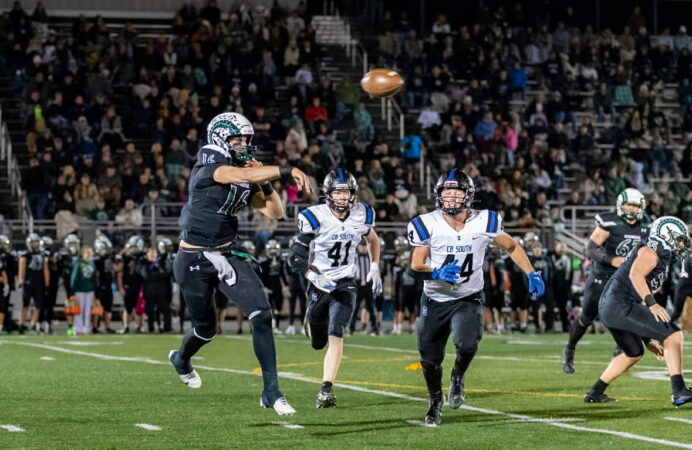
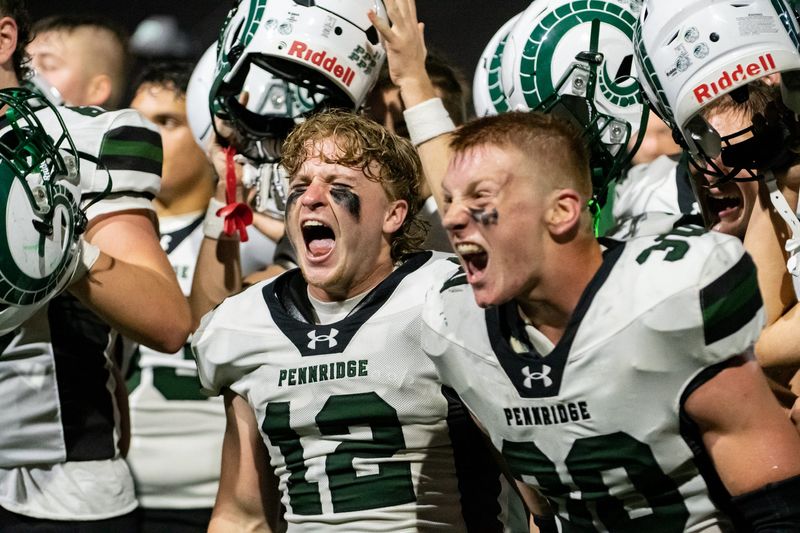
Pennridge celebrates its victory over Neshaminy on Oct. 3.
“Plymouth-Whitemarsh is a very good program,” Beller said. “We’re talking about the 16th seed and their record is 7-3 — that’s a pretty darn good football team. When you’re looking at that top to bottom there, we knew we had our work cut out for us.
“We have three of the four teams left in District 1 right now, playing for the district championship. That’s how good the conference is [Suburban One National]. It’s the best conference in this side of the state and one of the best in the state.”
Pennridge has found ways to win — against schools it hasn’t beaten in some time. Beller has been building the program for this moment. Pennridge is one win away from a district final appearance, but first must take down Coatesville in the District 1 semifinal on Friday night.
“It’s about consistency,” Beller said. “We’ve had that for three years.”
Following in his footsteps
Cardinal O’Hara coach Michael Ewing reminded his team to stay level-headed entering its matchup with Bonner Prendergast in the Class 4A Catholic League final last Saturday.
“They’re our school’s biggest rival,” said Ewing, in his fourth season at the helm. “Any time we play them in any sport, both schools’ student sections, the alumni, everybody shows out. It’s a great atmosphere.”
The Lions (8-4) silenced the defending 4A state champions, 24-3, marking the first time that O’Hara has beaten Bonner in nine years. O’Hara will face West Philadelphia at the Northeast Supersite on Saturday in the District 12 championship with the chance — at least to Ewing’s knowledge — to win the program’s first district title.
There’s also a unique opportunity for Ewing, who is the grandson of Bob Ewing, the winningest coach at O’Hara and a hall of famer. Michael recalled when his late grandfather won a city title at Veterans Stadium in 1979.
Saturday is his chance to earn the team a city title, following in his grandfather’s footsteps, and he hopes “to do something that he was never able to do” in the state playoffs — win the school’s first PIAA crown.
“My dad coached on his staff as well,” Michael Ewing said. “I grew up at O’Hara — for the first nine years of my life I was on the sidelines, in the locker room, and the coaches’ rooms. They didn’t do the daycare thing back then. …
“The school has a special place in my heart. That’s why I came back to it. That’s why I wanted to try and bring them back to where they once were.”
Here’s a look at the full schedule of the local teams competing in the first round of the PIAA playoffs:
PIAA Class 1A
Belmont Charter at York Catholic, York County, on Saturday (1 p.m.).
PIAA Class 2A
Lansdale Catholic vs. Lakeland, Lackawanna County, at Germantown Supersite on Saturday (1 p.m.).
PIAA Class 3A
Neumann Goretti will play in the quarterfinals next weekend against the winner of Berks Catholic and Trinity High School. Time and location to be determined.
PIAA Class 4A
North Pocono, Lackawanna County, at Bishop Shanahan on Friday (7 p.m.).
Cardinal O’Haravs. West Philadelphia at the Northeast Supersite on Saturday (11 a.m.) for the District 12 title.
PIAA Class 5A
Roman Catholic at Whitehall on Friday (7 p.m.).
Strath Haven at Springfield (Delco) on Friday (7 p.m.).
West Chester Rustin at Chester on Saturday (1 p.m.).
PIAA Class 6A
La Salle vs. Imhotep at Northeast High on Saturday (3 p.m.) in the District 12 championship.
NEW YORK — As a group of Columbia women’s basketball players struggled to break a press defense and advance the ball up the court, Megan Griffith’s voice rang through the gym.
“I need more active participation with your voice!” the coach said. “Can you please get back to playing like us?”
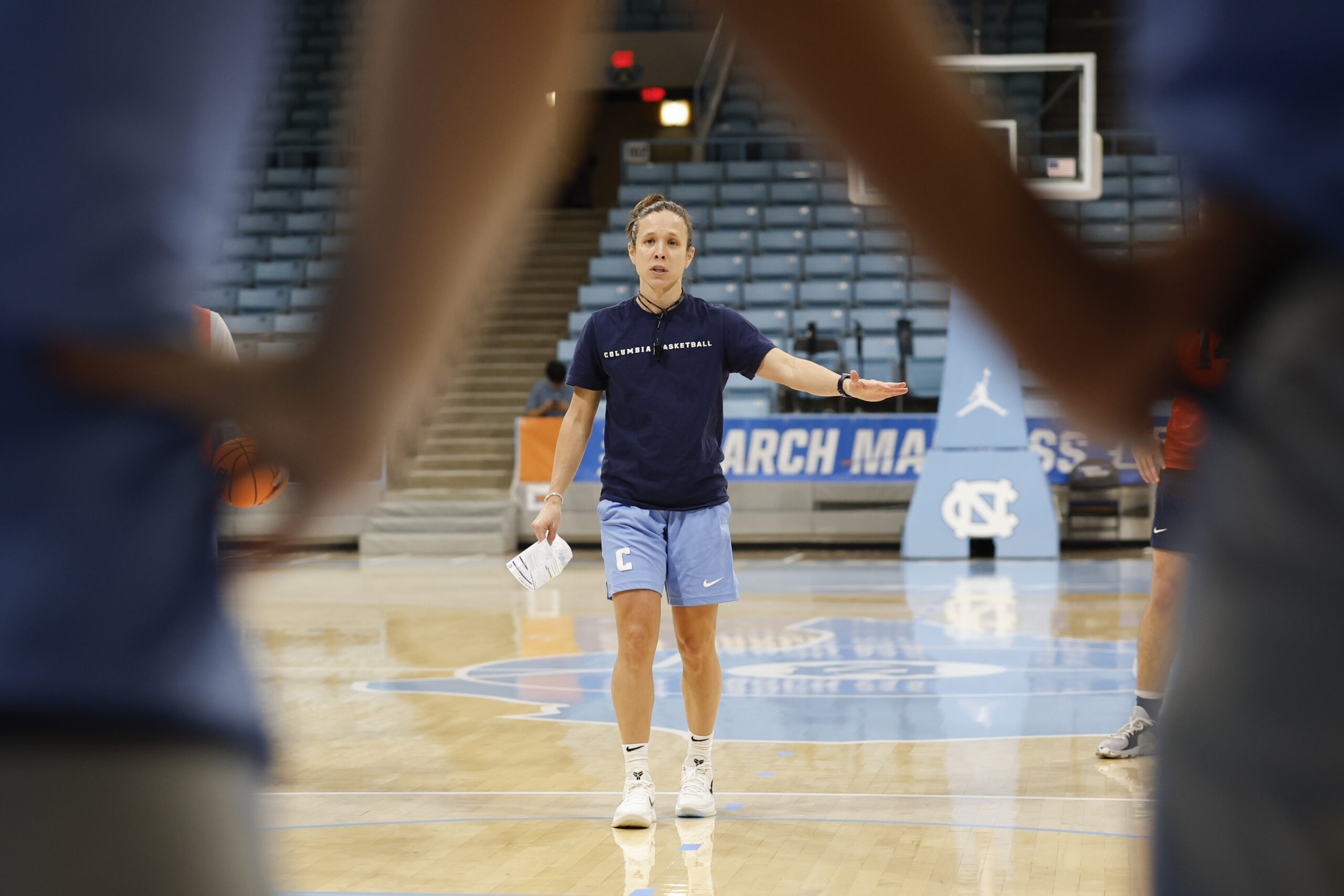
That is one of the go-to phrases that Griffith, a King of Prussia native, reinforces during this October preseason practice. They are all designed to “make things sticky” and keep the team process-focused, Griffith said.
“How you do anything, is how you do everything,” Griffith and standout guard Perri Page will both rattle off within the same hour.
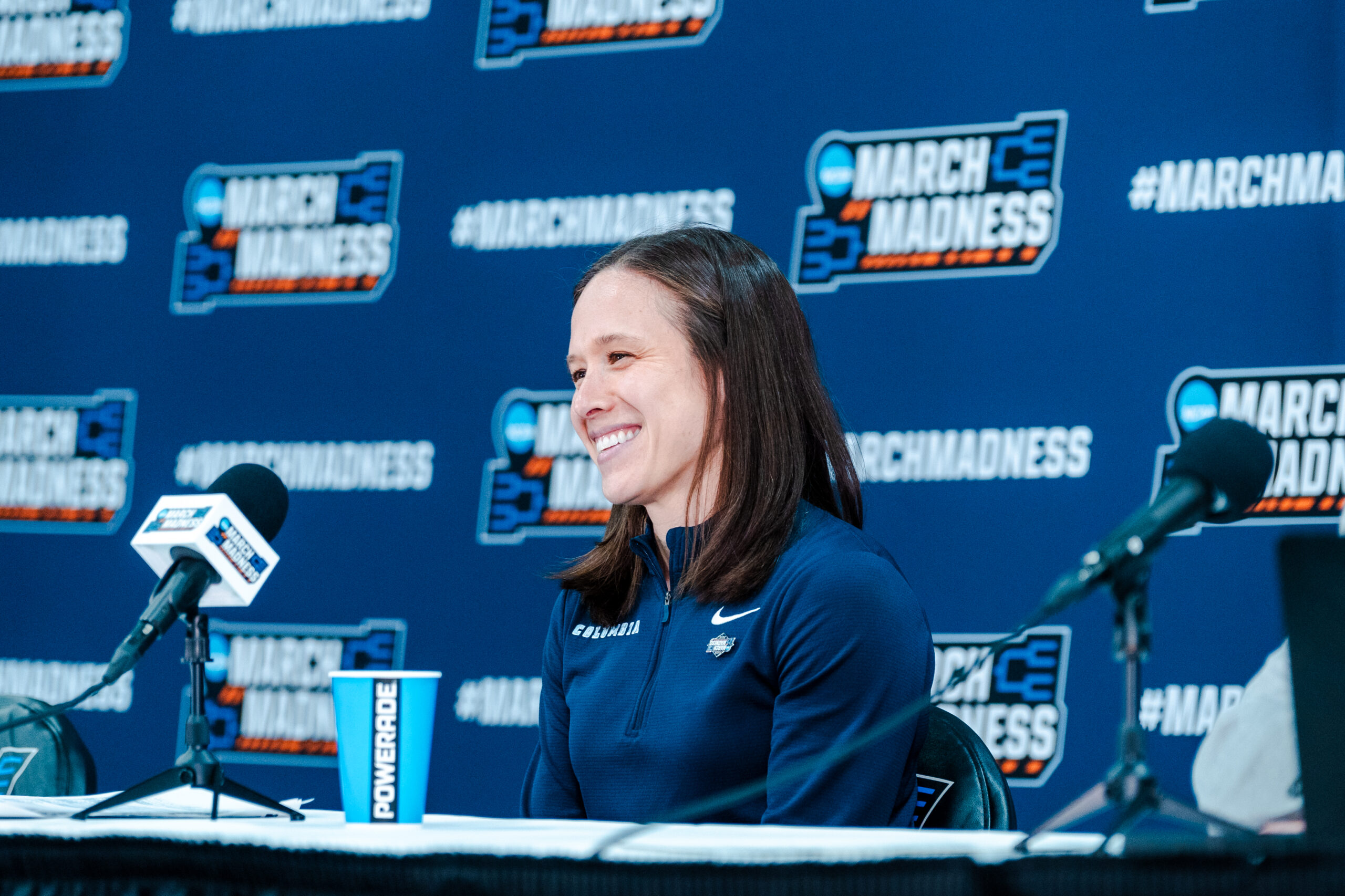
Those callbacks have fueled a remarkable turnaround as Griffith enters her 10th season as the head coach at her alma mater.
Columbia was one of women’s college basketball’s worst programs for decades before clinching at least a share of three consecutive Ivy League regular-season championships and winning its first NCAA Tournament game in school history last season.
And it received an at-large bid to the Big Dance in each of the past two seasons, typically unheard of for Ivy League programs. The Lions are 2-0 to begin the 2025-26 season, heading into a marquee home opener against reigning Atlantic 10 regular-season champion Richmond Saturday night.
Griffith, a finalist last season for the Women’s Basketball Coaches Association’s Coach of the Year award, has displayed her Philly roots while making breakthrough after breakthrough during this rebuild.
There’s the influence of her high school coach, Villa Maria Academy’s Kathy McCartney, whose motivational style Griffith describes in a way that her current players now talk about her. And her childhood being raised by a father from Delaware County and a mother who immigrated from Hong Kong, before they met at Villanova. The emphasis on running a high-powered offensive system spearheaded by dynamic guard play? A no-brainer for a 40-year-old who grew up watching the Allen Iverson Sixers era.
That culture has already elevated Columbia to historic heights, and a stability Griffith and players now strive to protect. Now, the coach has the Lions believing they can — again — become the best team in program history.
“She’s a force,” Page said. “Honestly, do not mess with her. She is going to go out and get whatever she wants. … I can’t see myself playing for any other coach in the country.”
‘A determined little bugger’
Diane and Bob Griffith still are in awe when they watch their daughter coach, or when she speaks during news conferences. She actually was a shy kid in everyday life, taking hold of Dad’s pant leg whenever the family was out in public.
But as soon as there were competitive stakes, Megan turned into “a determined little bugger,” Bob said. Diane remembers a T-ball game when a young Megan rounded third base, and the umpire told Bob, who coached Megan’s youth sports teams, that “this kid can slide better than most adult men can.”
“Once that light turned on or that game clock started, she was tenacious, even as a small kid,” Bob said. “ … When you look back on it, she was probably one of the most aggressive kids out there on the court.”
Megan concedes today that she probably should have pursued soccer (“Look at me. I’m 5-5,” she quips). But she gravitated toward the intimacy of smaller basketball rosters and how the game never stops moving.
Neither did she, because she was fast. When Griffith first arrived at Villa Maria, McCartney remembers the teenage point guard could not always control her dribble in transition … because she literally outran the ball.
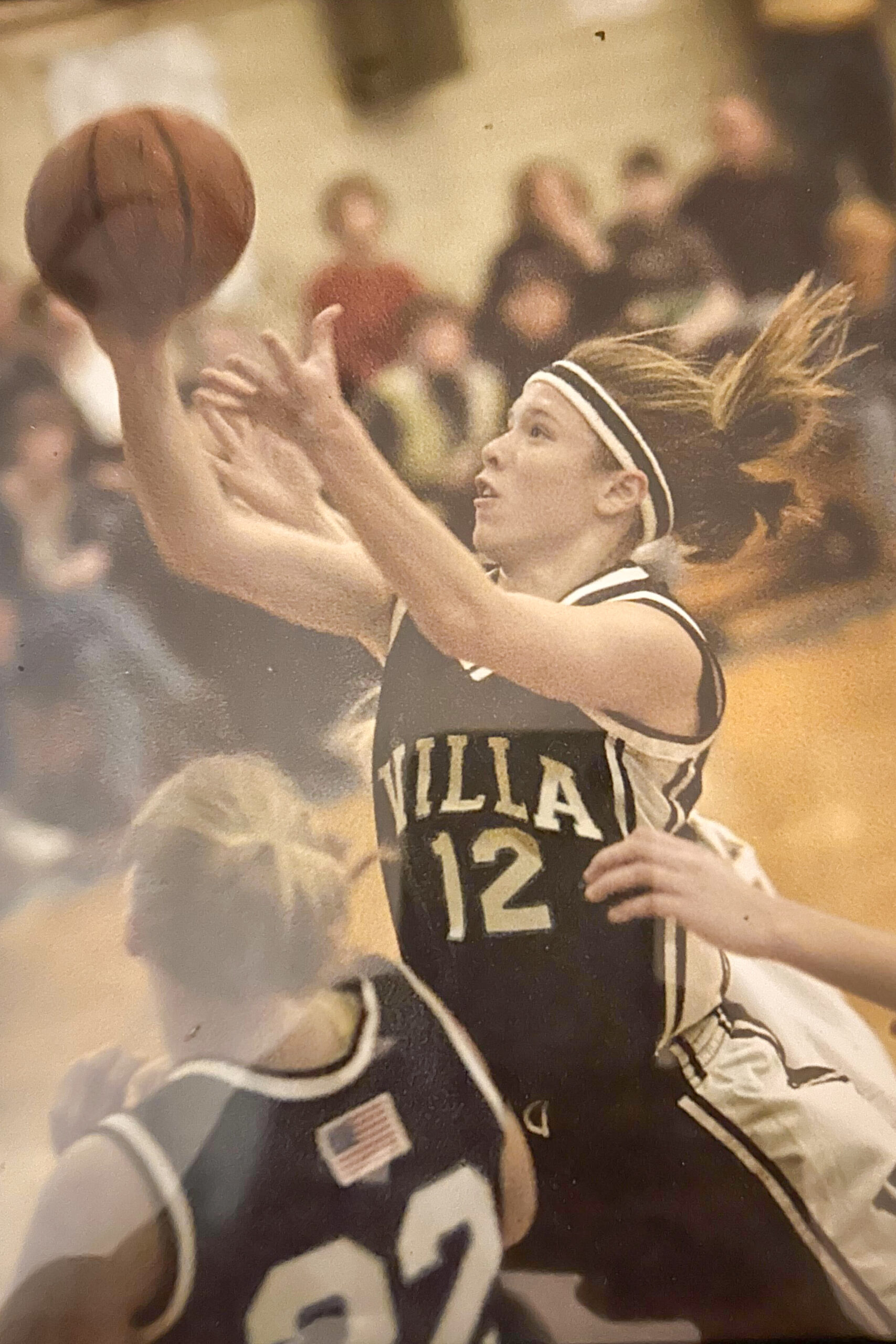
King of Prussia native Megan Griffith played her high school ball at Villa Maria Academy.
So McCartney told a steely eyed Griffith that she was not ready to play on the varsity team as a freshman. She needed to learn how to mold those natural athletic gifts into a ballhandler who could anticipate the defense’s next move. Griffith clocked that, while being coached by a woman for the first time, she was receiving a similar combination of intensity and care that her father provided in those settings.
“When I started getting [that tough love] from somebody else, it was like, ‘Oh, this is also how other people do this,’” Griffith said. “And it just really resonated with me. … That allowed me to really gain the confidence as a young woman, to then take that next step in my career and play college.”
By her senior high school season, Griffith was the point guard and defensive menace for a team that won its first 21 games. She had chosen to play for Columbia, which does not offer athletic scholarships, over an offer from LIU-Brooklyn.
And the hug McCartney and Griffith shared as she walked off the court for the final time as a high schooler has “stuck with me for years,” the coach said.
“It kind of solidified in my head the difference a coach can make,” McCartney said. “And I think — I hope — it has helped her in some way. I remember whispering in her ear, ‘You’ve got big things ahead of you, girl.’”
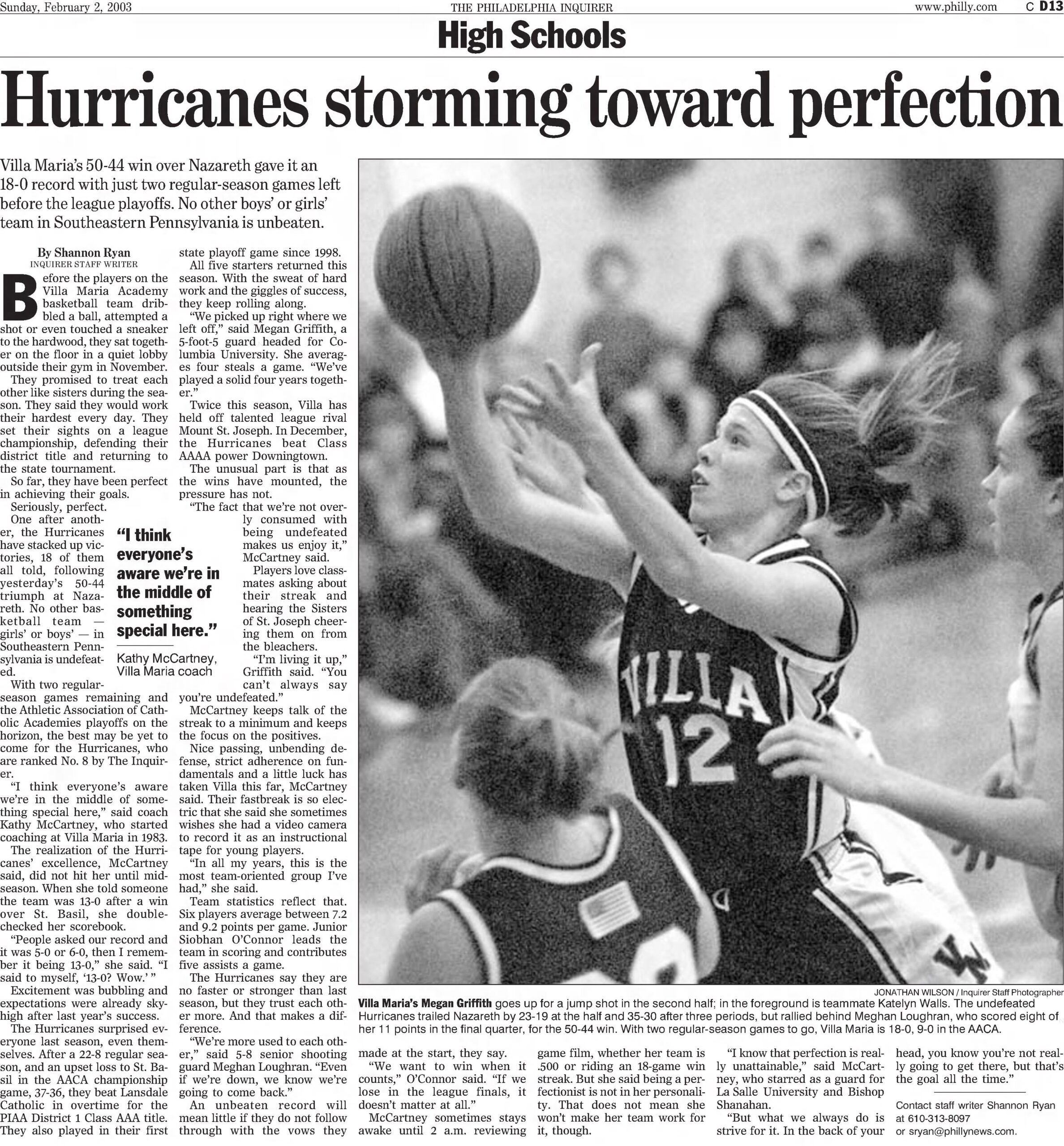
A clipping from the Philadelphia Inquirer sports section of February 2, 2003, showing Megan Griffith driving to the basket for Villa Maria Academy high school. Griffith is now the head women’s basketball coach at Columbia University.
‘I can go prove everybody wrong’
Columbia’s program was in a tumultuous state during Griffith’s playing career, from 2003 to 2007. She had four coaches in four seasons. The Lions’ record during that span was 38-70.
But that is where Griffith learned how to “stack days,” not just with her on-court training but in daily habits such as nutrition and sleep. Bob watched his daughter morph from a “very predictable” freshman who was “trying to please her coach too much,” to a 1,000-point scorer and two-time all-Ivy League selection.
“I was like, ‘Wow, I’ve had it the complete wrong way,’” Megan said. “I was so focused on the results all the time. Starting. Trying to come in as a freshman and change the program. I was like, ‘Wow, if I can just focus on what I can control …’”
Megan Griffith was an 1,000-point scorer at Columbia. The King of Prussia native now coaches her alma mater.
She also had an Ivy League education and a job lined up at Lincoln Financial in Philly upon graduating with an economics degree. She turned that offer down to continue playing overseas in Finland and then the Netherlands.
Griffith called that experience “transformational.” She leaned into exploring her new surroundings and connecting with her local teammates. An assistant coach began involving her in game-planning and strategizing, which she said “channeled my competitive energy very differently.” She learned enough Dutch to help coach kids. When she came home during off-seasons, she held youth skills clinics.
“I could see just how these kids just looked up to her,” Diane said. “ … I think that was probably the first glimpse of her maybe, possibly becoming a coach.”
When Megan no longer found as much satisfaction in that daily grind, she knew it was time to pivot from playing. She was hired as the director of basketball operations at Princeton, and was intrigued by then-coach Courtney Banghart, who led the program to its first Ivy League title.
Banghart, now the coach at 11th-ranked North Carolina, quickly made Griffith the Tigers’ recruiting coordinator. Griffith was hesitant at first, instead wanting more tactical responsibilities. But she was organized and a people person.
“What I learned there is that, actually, the most important thing is relationships,” Griffith said. “You have to know things and be smart. But at the end of the day, everybody can learn an offense. But what do you do with talent? How do you get talent? How do you get people that are bought into a common language, and an ethos, and a culture?”
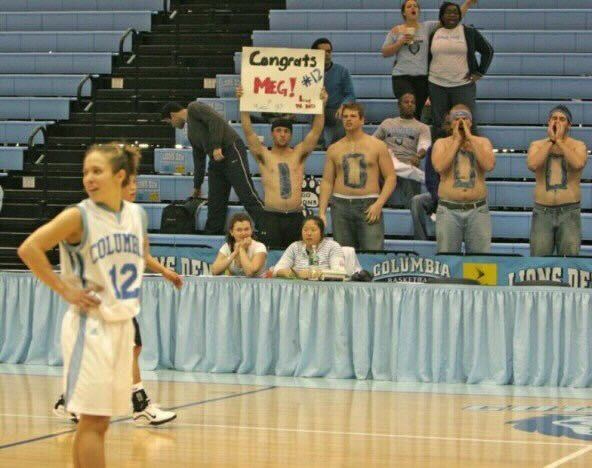
In 2016, Columbia’s head-coaching job came open. Griffith, then 30, went to athletic director Peter Pilling with a detailed plan on how she would run her alma mater. And she thought back to conversation in the car with her father, while she was still playing overseas.
“[I said], ‘Dad, I feel I’m meant for something, like, big and different,’” she said. “I didn’t know what that meant at that time. So when this opportunity came up it was like, ‘Wow, I can go prove everybody wrong.’
“And I love that. I love the underdog. That’s who I am at my core.”
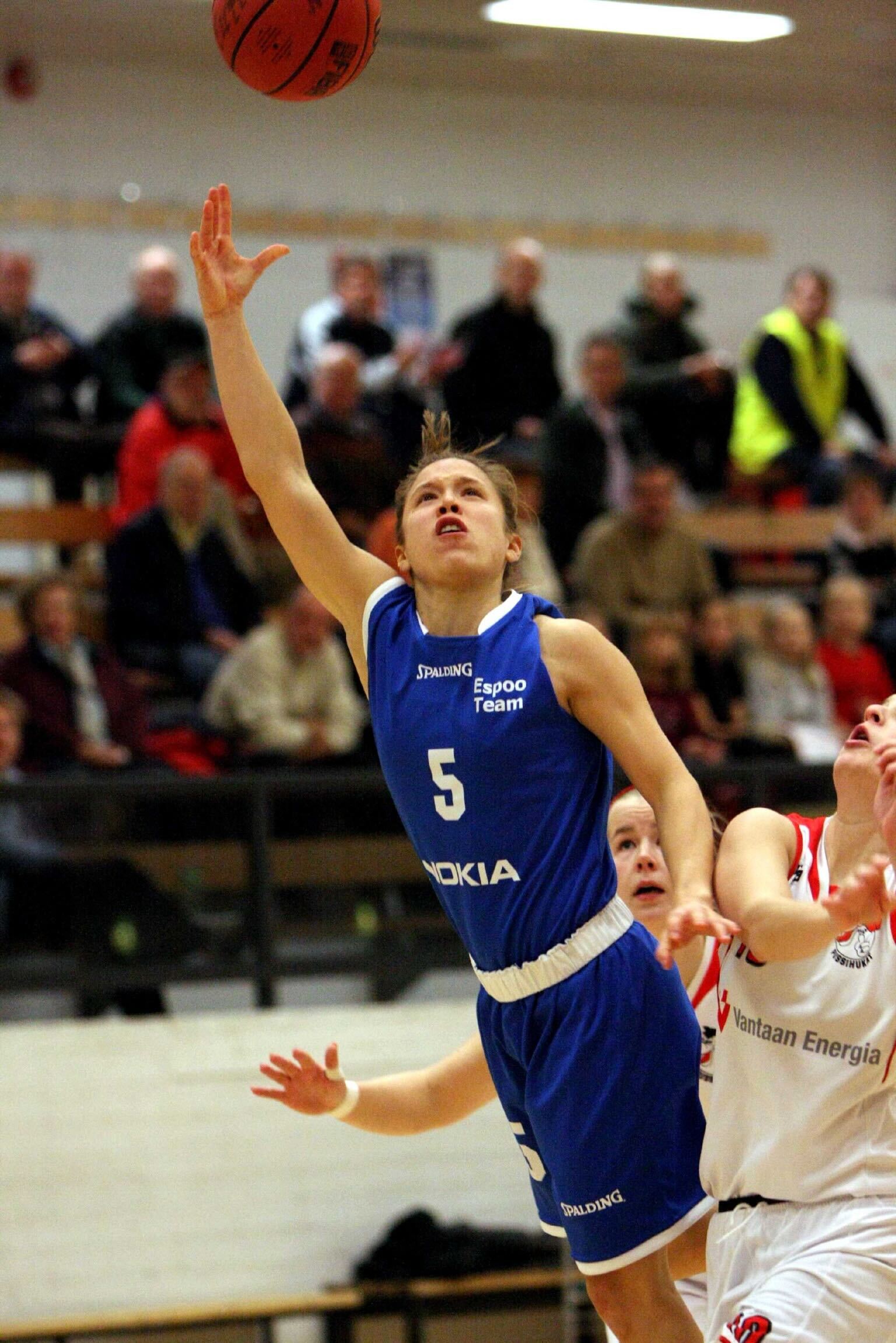
Megan Griffith played professional basketball in Finland.
‘It’s why you do it’
Tyler Cordell was “a little intimidated” the first time she spoke to Griffith. While interviewing for a job as Princeton’s director of basketball operations when Griffith was promoted to assistant coach, Cordell left the phone conversation thinking, “I don’t know if I’m smart enough to follow up in her footsteps.”
Now, Griffith and Cordell have worked together for 14 years. Cordell said it was a “no-brainer” to join Griffith’s staff at Columbia. Griffith calls Cordell an example of the “builders” the program needed.
“You start with the people,” Griffith said.
That meant thorough — and unconventional — recruiting.
The coaching staff went into southern states, such as Florida and Georgia. And internationally, to Spain and Australia. Today, nine players on Columbia’s 2025-26 roster are from outside the United States.
And there was perhaps nobody better to pitch Columbia than Griffith, who experienced the top-tier academics, limited athletic resources, and basketball struggles firsthand.
“It’s not like we’re in the same sandbox as a lot of schools,” Griffith said. ” … But we’ve never been.”
Griffith needed to power through the early on-court woes as a coach, including back-to-back eight-win seasons from 2017 to 2019 that left Diane worried about Megan’s health. Still, accolades began to surface. Their first victories over programs from the Atlantic Coast Conference (Boston College) and Big East (Providence). Their first Ivy League Rookie of the Year in Sienna Durr. The commitments of Abbey Hsu and Kaitlyn Davis, who became “young, hungry freshmen” and, eventually, conference champions and WNBA draft picks.
Those players could emulate an on-court style — with athletic, guard-heavy rosters that could pressure defensively and get out in transition — that led to sustained success for other mid-majors. It evolved into a system that, from 2022 to 2025, averaged more than 70 points per game.
King of Prussia native Megan Griffith has built Columbia women’s basketball into an Ivy League power.
Griffith, meanwhile, strives to make people feel important, even when demands are high. She will get on a player’s case during practice, but then help them make their first resumé or ask about their dog. During the COVID-19 pandemic, when Columbia’s 2020-21 season was canceled, the staff created a space for players to talk. Page actually took her recruiting “visit” on Zoom and was blown away by the staff’s energy and attention to detail in less-than-ideal circumstances.
“That’s what made me say, ‘Wow, they put a lot of thought and effort into everything that they do,’” she said. “ … I was like, ‘If you can make this look good, imagine what it looks like on the court, too.’”
Once the Lions returned to to play, the avalanche of checkpoints continued.
A 2021 signature comeback win at Clemson? Check.
Qualifying for the four-team Ivy League tournament for the first time? Check.
Four consecutive 20-win seasons? Check.
Advancing to the WNIT quarterfinals in 2021, then the championship game the following season? Check.
First Ivy League regular-season titles, as co-champions in 2023 and 2024 and then as the outright winner last season? Check.
First NCAA tournament appearance in 2024, when they lost a tight First Four matchup against Vanderbilt? Check.
“That’s what’s been so cool about our journey,” Cordell said. “Because we haven’t skipped one step.”
The most recent: Last season’s NCAA First Four. The Lions at halftime flipped how they were guarding Washington’s post players, and rallied from 13 points down to win and advance to the round of 64.
“It was just the next thing we had to do in our journey,” Griffith said. “I feel like we manifested it, but at the same time, it was supposed to happen. …
“When the buzzer sounded, it’s why you do it. It’s why I’ve coached the last nine years — to be in that moment and be able to share that with my staff and this team.”
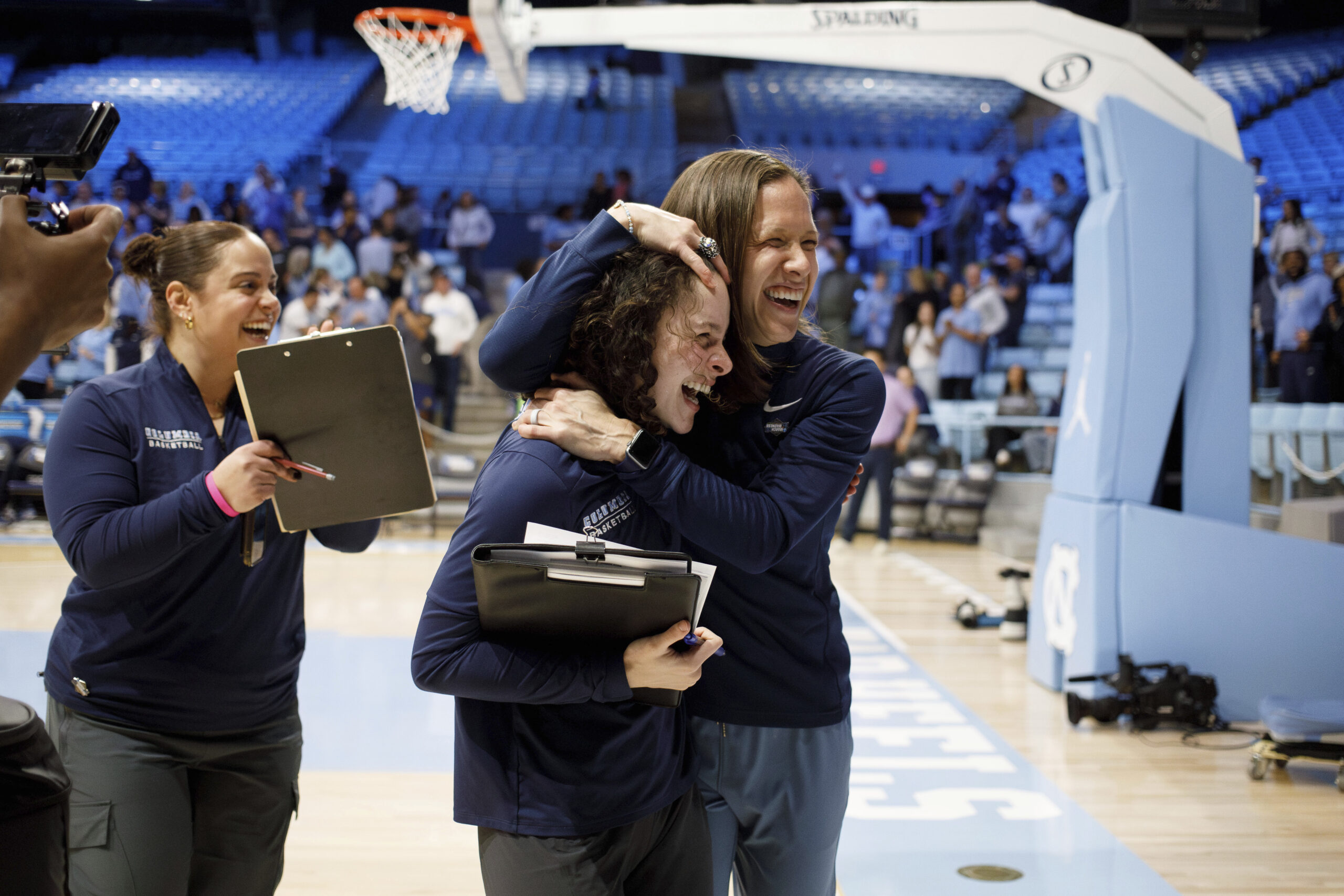
Columbia head coach Megan Griffith (right) celebrates with assistant coach Cy Lippold after beating Washington in a First Four game in last season’s NCAA Tournament.
‘Coach-led, player-fed’
Those back home also have relished in Griffith’s rise.
McCartney still texts Megan and her parents, and loves telling friends “that’s one of my kids” while watching Columbia play. Megan’s godmother, who lives in Australia, wakes up at 4 a.m. to tune in to games. Supporters are in the stands whenever Columbia plays Penn in Philly, where Griffith takes pride in those who knew her as a player recognizing similar qualities in her teams.
And Diane and Bob are regular visitors to campus. While watching a recent scrimmage, they noticed Megan being “really tough” on the freshmen. Up in the coach’s offices, a veteran told one of those first-year players, “She’s tough, but you have to listen to Coach. She knows what she’s talking about.”
“Yes, she yells at you a lot,” Diane said. “She screams in your face. You think she hates you. But she really does care about you, and she wants to make you a better player and person.”
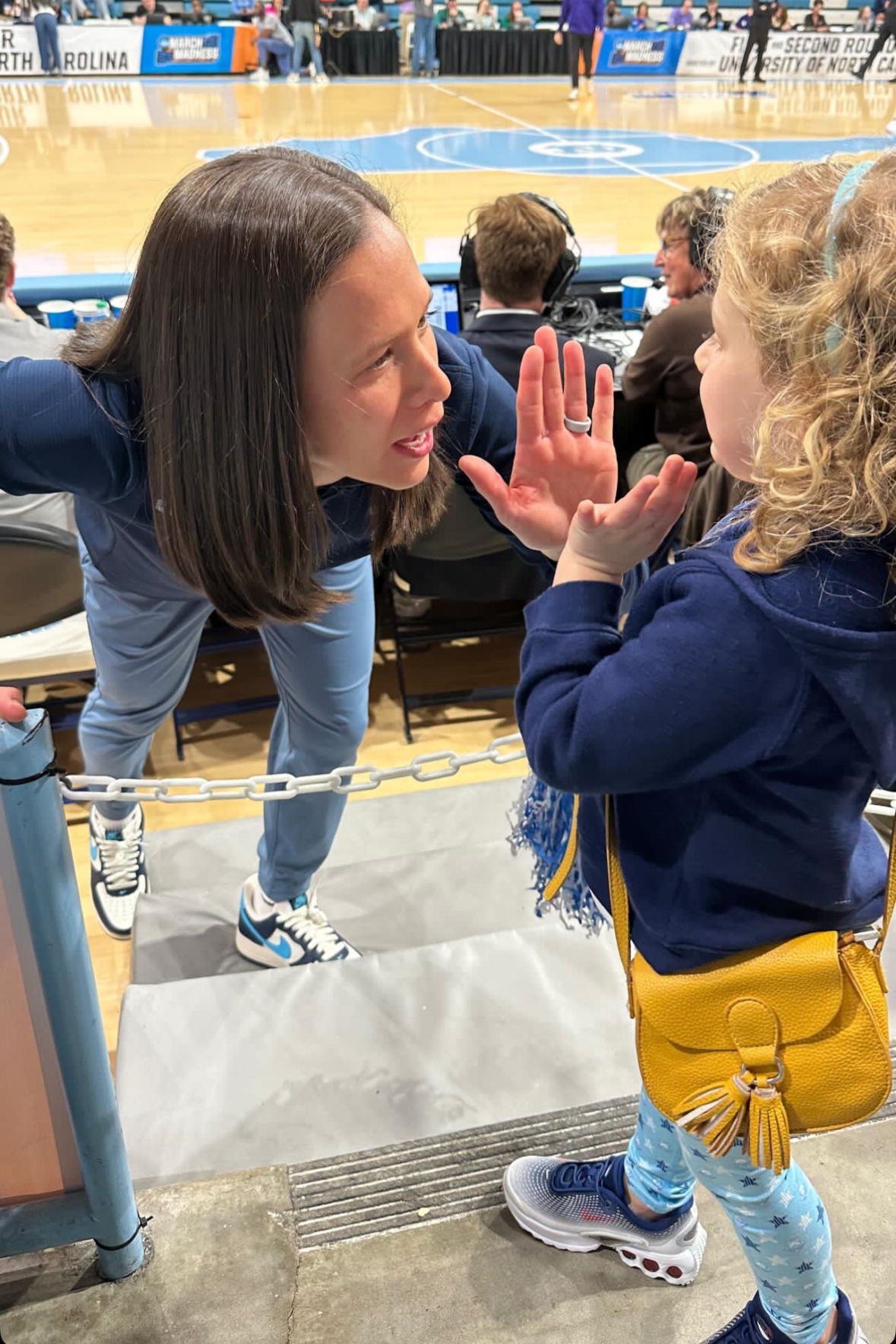
Columbia women’s basketball coach and King of Prussia native Megan Griffith (left) high-fives her niece, Carmen, who calls her Titi.
Like during that October practice, when new assistant coach Kizmahr Grell needed to tell Griffith to take a deep breath. The Lions have a taller roster and fewer ballhandlers this season, forcing some tweaks to their on-court identity. That was particularly apparent with Page sitting out this practice, prompting a direct challenge from Griffith to be a better leader from the sideline.
“It just gets me so fired up, too,” Page said of those interactions. “ … I take it, like, this is my program. This is my baby. When she gives a task, I am ready to attack it, always. Because I want to do right for her, but I want to do right for this program, as well.”
Columbia coach Megan Griffith talks to her team at practice last season.
That’s an example of another Griffith callback: “Coach-led, player-fed.” It’s why a practice that began with harsh words ended with everybody gathering at midcourt for a calm circle, where players individually spoke up to encourage and hold each other accountable. They snapped in agreement of each player’s input. When Griffith asked who got better today, every player raised their hand.
Those mantras have become sticky, establishing Columbia’s foundational culture. They have fueled the Lions’ historic rise.
So what is the next breakthrough, with Griffith’s 10th season underway?
“That’s my big challenge right now, is just continue to teach when the expectations are higher — and self-imposed,” Griffith said. “Nobody here is like, ‘Hey, you need to win more.’ Everybody is like, ‘Look at everything you’ve done,’ but that’s just not who I am.
“I don’t just think we can continue to win Ivy League championships. I think we can make deep runs into March. As long as we keep getting the right people here, why couldn’t we go to the Elite Eight?”
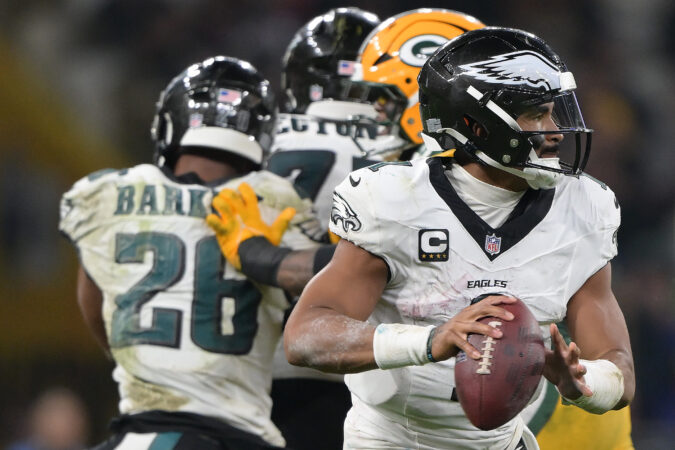
The Eagles will play their first game in 15 days when they take on the Green Bay Packers tonight on ESPN’s Monday Night Football.
Unfortunately, some fans in Philly and across the country won’t be able to tune in.
An ongoing dispute between YouTube TV and Disney has left ESPN, ABC, and a handful of other channels dark on the so-called “skinny bundle” for more than a week, with no end in site.
The two sides continued to negotiate throughout the day Monday but remained far apart on dollars — Disney wants more money than parent-company Google wants to pay.
On Sunday, hopes of a potential deal got dimmer when YouTube TV announced a $20 credit for customers due to the continued outage of Disney’s channels.
YouTube TV has grown into the third-largest cable distributor in the country with about 10 million subscribers, trailing only Comcast and Charter. Not surprisingly, ESPN’s college football and Monday Night Football ratings were down slightly last week, which most experts attribute to the blackout.
Networks ending up blacked out over carriage disputes is rare, and ones lasting this long are even rarer, though they happen. TelevisaUnivision has been dark on YouTube TV since late September, and Disney-owned Fubo hasn’t had TNT or TBS since April 2024 due to a carriage dispute with Warner Bros. Discovery.
It’s the first of two Monday Night Football appearances this season for the Eagles. Hopefully, this dispute is settled before the Birds take on the Los Angeles Chargers on ESPN Dec. 8.
Here’s everything you need to know to watch or stream Eagles-Packers.
How to watch Eagles at Packers
Where: Lambeau Field, Green Bay, Wisc.
When: 8:15 p.m., Monday
TV: ABC, ESPN (Joe Buck, Troy Aikman, Lisa Salters, Laura Rutledge)
Radio: 94.1 WIP (Merrill Reese, Mike Quick, Devan Kaney)
Streaming: ESPN Unlimited
How to stream Eagles at Packers
There are plenty of options to stream Eagles-Packers tonight.
While ESPN will likely remain blacked out on YouTube, there are a host of services that will stream tonight’s Monday Night Football game.
The most obvious is ESPN Unlimited, the network’s new subscription streaming service that includes every game that airs on all 12 ESPN networks. The service runs $29.99 a month.
You can also stream tonight’s game on a host of other skinny bundles, including Hulu + Live TV ($64.99 a month for three months), Sling ($4.99 for one day pass, $60.99 a month), Fubo ($84.99 a month with a free trial), and DirecTV Stream ($94.99 a month with a free trial).
If you’re just planning to watch the game on your phone or tablet, you can stream it on NFL+, the league’s mobile subscription streaming service. NFL+ runs $6.99 a month.
Because the game is simulcasting on ABC, most fans who live in and around Philadelphia and other cities should be able to stream the game for free using a digital antenna.
6abc’s signal in Philadelphia can be finicky. The station suggests an all-band antenna that covers Low-VHF, High VHF and UHF with long elements (rabbit ears for those of you old enough) that should be fully extended.
The Channel Master website has specific information about what channels are available using your address.
Jason Kelce takes a serious turn on tonight’s Monday Night Countdown
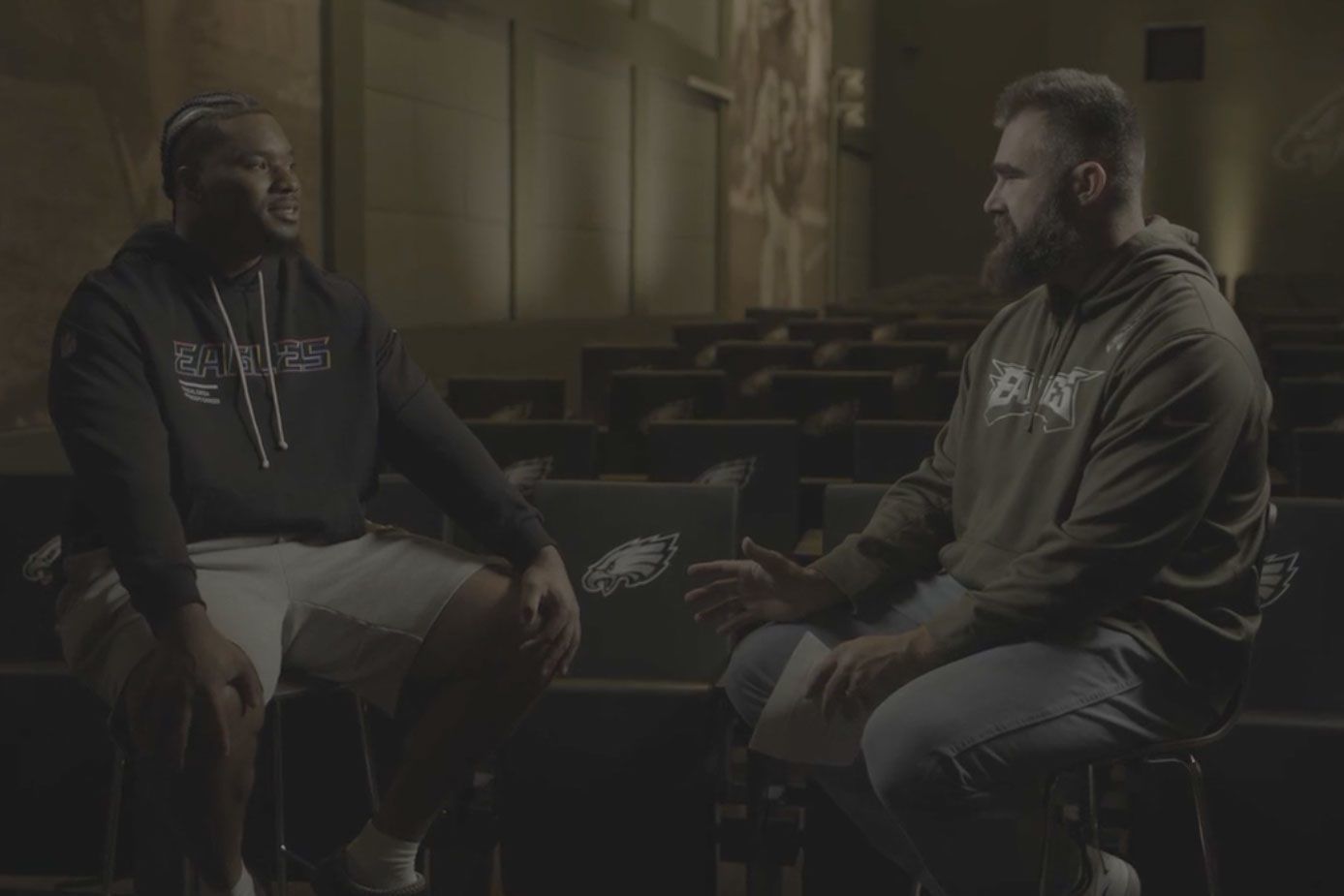
Eagles offensive lineman Tyler Steen (left) was interviewed by Jason Kelce for “Monday Night Countdown” ahead of Birds-Packers.
In his second season with ESPN, former Eagles star Jason Kelce has become known for his crowd-pleasing antics and fun-loving outfits, from his “South Philly tuxedo” to a Bills Mafia getup inspired by Fred Flintstone.
For tonight’s game, Kelce took a more serious tone for a featured story about Rodney Davis, the grandfather of Eagles offensive lineman Tyler Steen, whose heroic death during the Vietnam War saved the lives of several members of his platoon.
Davis was posthumously awarded the Medal of Honor after jumping on a grenade that landed in a bunker where he and five other soldiers were pinned down by enemy fire in 1967. He was 25, the same age Steen is now.
“He gave his life for his, for his …” said an emotional Samantha Steen, Davis’ daughter and Steen’s mother. “He gave up his life for other Marines.”
Quinta Brunson, Shane Gillis will be guests on the Manningcast
“Abbott Elementary” star Quinta Brunson at a Phillies game in August.
Peyton and Eli Manning will be back on ESPN2 tonight for the Manningcast, and they’ll be welcoming some Philly star power to their Monday Night Football alternative broadcast
Quinta Brunson, the star and creator of Abbott Elementary, and comedian Shane Gillis will appear as guests tonight. It’s unclear when either will join the show.
Also joining the show will be Disney CEO Bob Iger, a lifelong Packers fan whose appearance coincided with the company’s dispute with YouTube TV.
It’ll be the sixth time the Eagles have appeared on the Manningcast, which is quietly in its fifth season at ESPN. Last season, Peyton and Eli turned to Downingtown native Miles Teller during the Eagles’ loss to the Atlanta Falcons in Week 2.
Eagles quarterback Jalen Hurts — who attended the Mannings’ quarterback camp while a sophomore at Alabama — was a guest in 2022, where he revealed he liked to watch game tape of former San Diego Chargers quarterback Philip Rivers and wore a hoodie with the phrase, “God bless whoever hating on me.”
“Other teams, it’s a copycat league, and if you can copycat it, you will. If you can’t, then you probably complain that it’s not fair,” Manning told The Inquirer. “So I’m on the Eagles’ side of it. I think it’s their niche, and it works, and they make it happen.”
How to “tush push” according to @JasonKelce: Head 👇, a$$ 👆. Got it.
The Eagles were overtaken Sunday by the Seattle Seahawks, who moved into the top spot in the NFC thanks to their blowout win against the Arizona Cardinals.
If the Eagles win tonight, they’ll move back into first place because they’d hold the tiebreaker against the Seahawks with a better conference record.
NFC standings
window.addEventListener(“message”,function(a){if(void 0!==a.data[“datawrapper-height”]){var e=document.querySelectorAll(“iframe”);for(var t in a.data[“datawrapper-height”])for(var r,i=0;r=e[i];i++)if(r.contentWindow===a.source){var d=a.data[“datawrapper-height”][t]+”px”;r.style.height=d}}});
NFC East standings
!function(){“use strict”;window.addEventListener(“message”,function(a){if(void 0!==a.data[“datawrapper-height”]){var e=document.querySelectorAll(“iframe”);for(var t in a.data[“datawrapper-height”])for(var r,i=0;r=e[i];i++)if(r.contentWindow===a.source){var d=a.data[“datawrapper-height”][t]+”px”;r.style.height=d}}})}();
Although the Eagles are on their bye week, Lincoln Financial Field was put to good use on Thursday night. Delaware State, coached by former Eagles receiver DeSean Jackson, hosted Norfolk State, coached by former Eagles quarterback Michael Vick.
The two former teammates made a return to their former home for their first battle as college football head coaches in a primetime HBCU matchup. From the halftime show to special appearances from mainstream stars, HBCU excellence was on full display.
Here are the highlights of what took place on Thursday night…
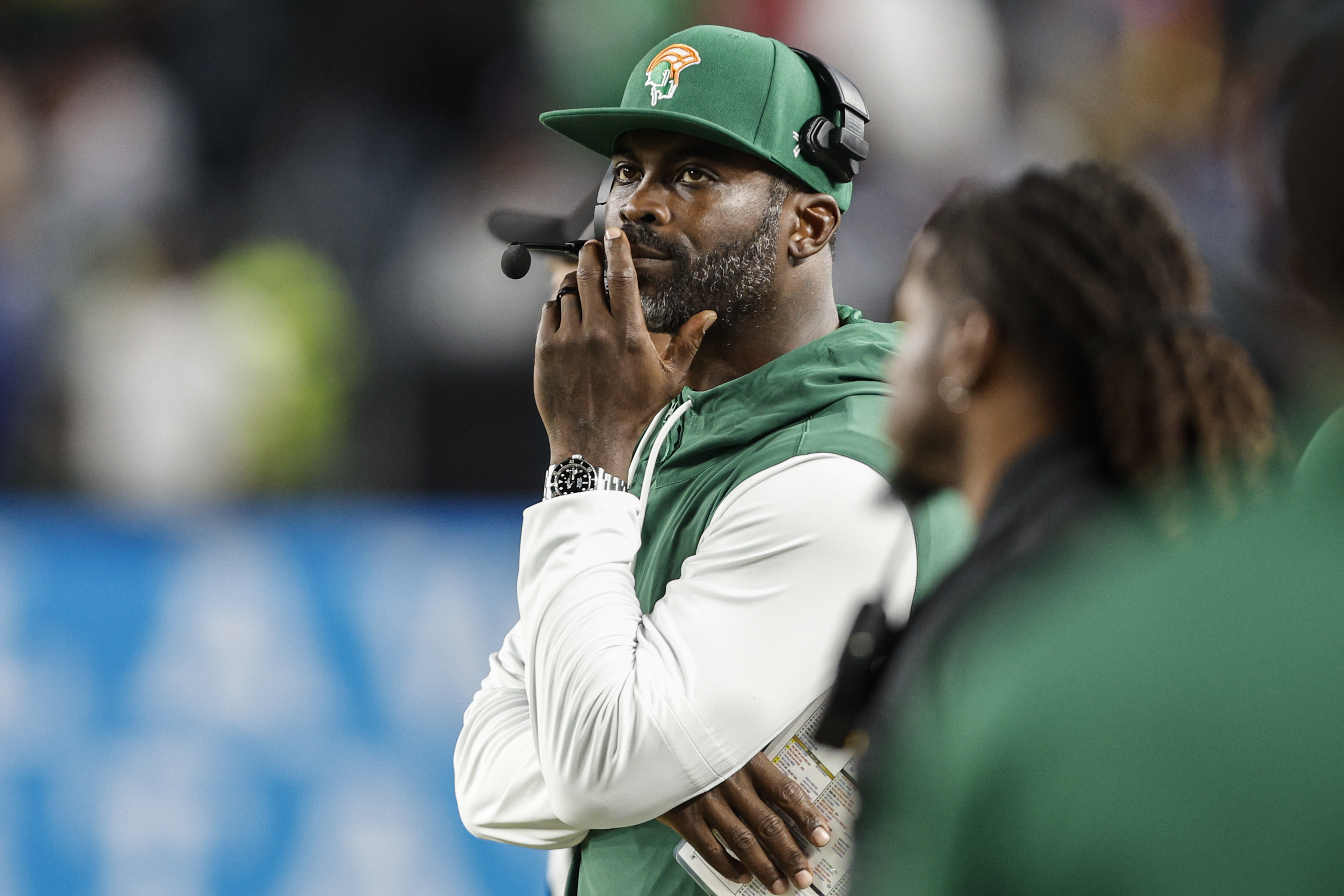
Norfolk State head coach Michael Vick watches in the waning moments of his team’s loss to Delaware State in Thursday night’s HBCU showdown at Lincoln Financial Field.
Stars were out at the Linc
In addition to the action on the field, the star power on the sideline was worth the admission. The easiest one to spot was former quarterback Cam Newton.
At halftime, wearing an all-tan fit with a massive fedora decorated in pins, the three-time Pro Bowler danced and posed with fans just moments before North Philly rapper Meek Mill walked along the sideline.
Plenty of fans made their way through the main concourse excited to watch both HBCU teams play at Lincoln Financial Field. Whether they were representing the colors of Delaware State or Norfolk State, wearing vintage Eagles’ Jackson and Vick jerseys, or showing off their Greek letters, they gathered together with pride of belonging to an HBCU.
Anthony, 68, and Brigette Washington, 67, made the trip from Florida on Thursday morning to attend the game despite the stormy weather. Anthony attended Florida A&M University. Meanwhile, Brigette attended Morgan University. Although neither have connections to Delaware State or Norfolk State, they wanted to show support to all HBCUs.
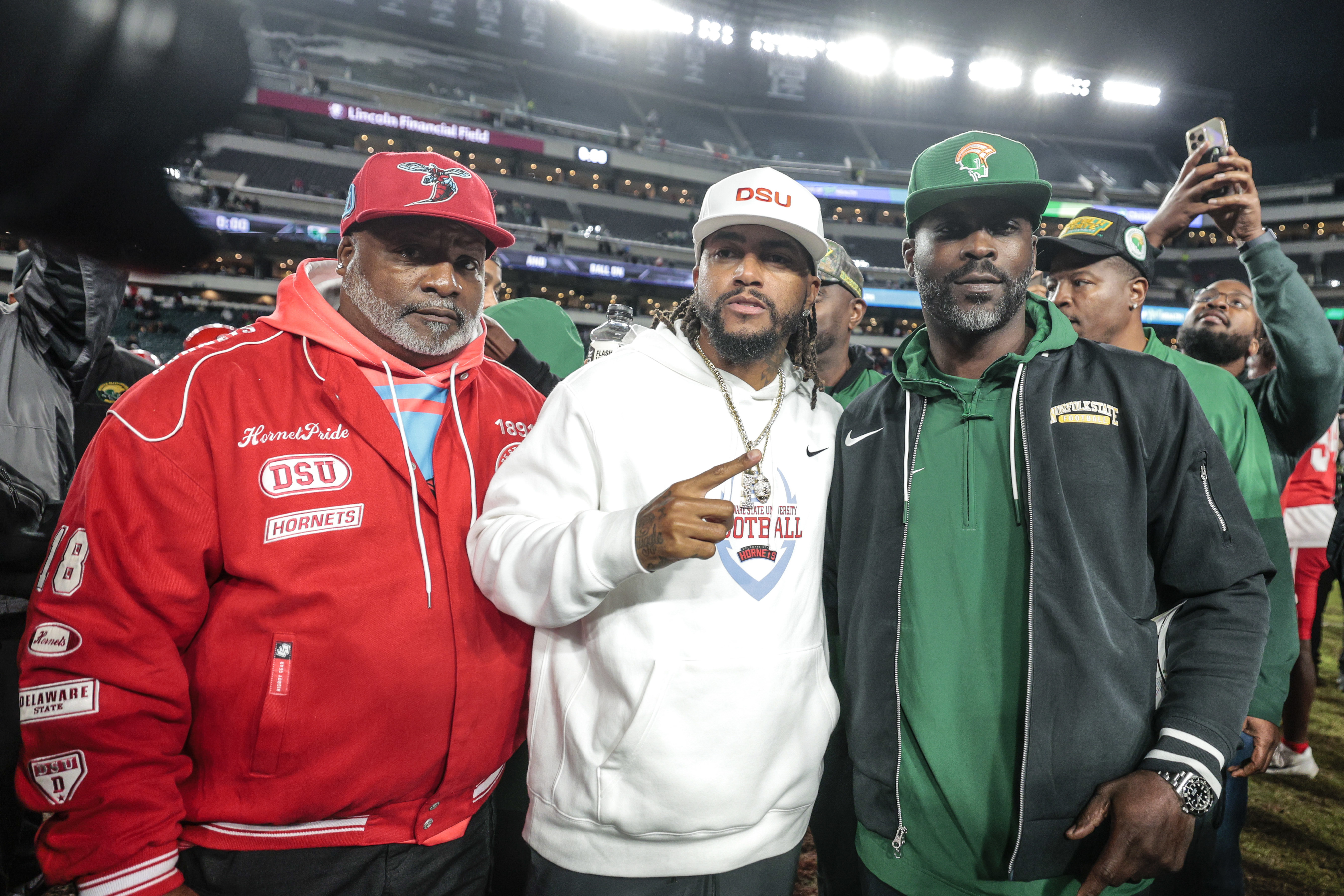
Former Eagles players in now Delaware State head coach DeSean Jackson, center, and Norfolk State head coach Michael Vick, right, hug after Delaware State beat Norfolk State 27-20 at Lincoln Financial Field on Thursday.
“[HBCU’s] are family oriented,” Anthony said. “Once you step foot and you become an HBCU alumnus, you’ll always go back. Like what we’re doing now. We’re 70 and we’re still going back to the games. We just want to support both schools.”
Plenty of alumnus repped their colors, including 59-year-old Delaware native John Robinson. Robinson graduated from Delaware State in 1990 and is proud to see two HBCU teams getting to display their talents on such a big stage.
“What I’m looking forward to seeing tonight is HBCU excellence and the opportunity to show that to the entire world,” Robinson said. “I’m just thrilled that we have this opportunity and this platform to show who we are, how we support our schools and how necessary they are and also to show the world the top of NFL elite talent is willing to invest in HBCUs as we see with the coaching platforms of DeSean Jackson and Michael Vick.”
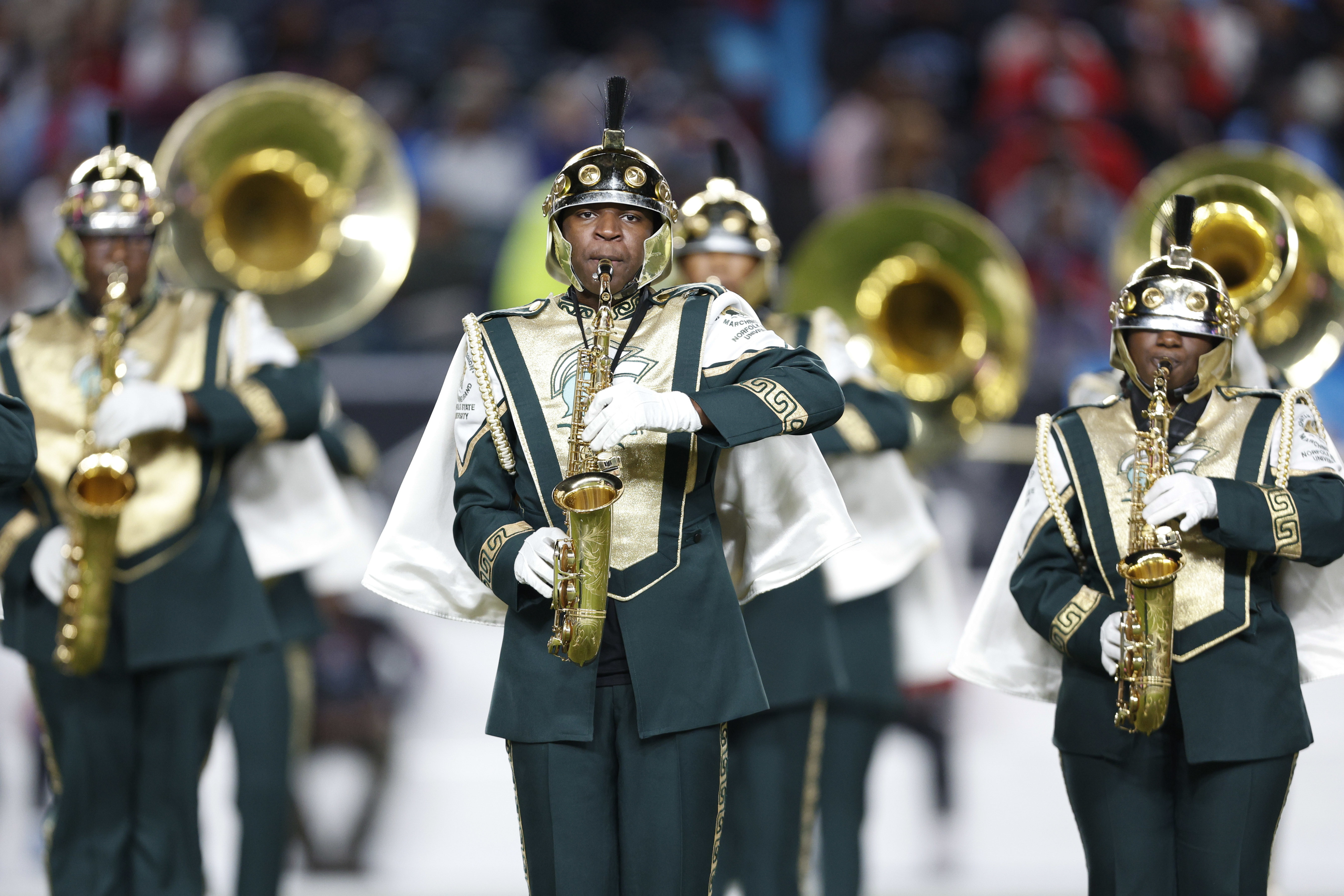
Norfolk State’s drum major dresses as Mickey Mouse during halftime of their game against Delaware State at Lincoln Financial Field on Thursday.
‘Approaching Storm’ stuns at halftime
When it comes to HBCU games, there are no bathroom breaks at halftime. For many fans, halftime is the real show. HBCU’s are known for their electric marching bands and Delaware State’s ‘Approaching Storm’ did not disappoint.
As soon as the band was introduced, fans reacted with one of the loudest cheers of the night. And as soon as silence rang through the stadium, the sounds of Boyz II Men’s “Motown Philly” echoed throughout the Linc followed by Danity Kane’s “Damaged.”
“That’s a tradition that’s been engraved in HBCUs going back as far as you want to look,” Robinson said. “The band and the drumline, that’s the fabric. That’s how we express who we are. That’s how we tell our story through song during sporting events and it’s heritage. It’s black pride. It’s culture.”
Delaware state representative, and Cheney graduate, Franklin Cooke Jr. added: “[Halftime shows are] very important. They’re just like athletes, you know doing all the steps, doing all the routines. It’s very, very important.”
Earlier in the week, 45-year-old West Philadelphia native Will Abbamont discussed the significance of attending an HBCU. Growing up on 46th and Fairmount, he didn’t see college as an option. Eventually, the Cheney graduate, and leader of the Sixers drumline, the Stixers, used percussion as a way to save his life.
“For me to get accepted to Cheney, it changed my life,” Abbamont said. “[My grandma] said you can either take these drumsticks, the jail cell or a graveyard. I picked the drumsticks. Didn’t know what to do with them. I asked her what to do with them and she said you will figure it out. That right there led me on the road to my goal to go to an HBCU.”
Norfolk State’s band plays during halftime of Thursday’s game against Delaware State at Lincoln Financial Field.
Abbamont graduated from Cheney in 2001, where he majored in accounting and minored in computer programming. During his tenure at the school, he was part of Cheney’s drumline.
“The drumline is the culture,” Abbamont said. “The drumline sets the tone. To be honest with you, I know our HBCUs really weren’t known for their sports. For example, I went to Cheney. My Cheney football team wasn’t really that good. But everyone came to see the band.
“The band is the culture of the HBCU. The band is the heartbeat, the band is the lifeline, the band is what draws the attention. The sports team being good is a bonus when it comes to an HBCU…Halftime for us is when the game starts.”
Although there wasn’t much country music blaring from the sound system inside Xfinity Mobile Arena, there was some honky-tonk goodness for the home team on Thursday night.
Despite losing captain Sean Couturier to injury after the first period, the Flyers skated away with a 4-1 win against the visiting Nashville Predators. The Orange and Black have now won three straight and six of their last eight games while improving to 6-1-0 at home.
This win was backed by Trevor Zegras’ second two-goal performance in three nights, Matvei Michkov’s first two-point performance this season, and 32 saves by Dan Vladař.
"When you come to a sports town like Philadelphia, you don't want to embarrass yourself."
Trevor Zegras has become the second player in franchise history to begin their tenure in Orange & Black with a seven-game home point streak. #LetsGoFlyerspic.twitter.com/24NHYotHTy
Couturier did not return after the first intermission due to an undisclosed injury. He took a shot from teammate Noah Juulsen with 14 minutes, 37 seconds left in the opening frame, and, while he was shown on the broadcast in pain, he played the rest of the period.
Zegras gave the Flyers a 1-0 lead in the second period with his third goal of the season. After Michkov gained the offensive zone, he withstood pressure from Predators defenseman Nick Blankenburg to control the puck and chip it to Zegras. The New York native carried the puck to the center and sent a whipping wrister from above the circles past goalie Juuse Saros.
He extended the Flyers’ lead to 3-1 with a one-timer on a power play in the third period. Noah Cates won the faceoff back to Cam York, who fed his former United States National Team Development Program teammate in the right circle.
Zegras now has six points in his last three games and 10 points in seven games at Xfinity Mobile Arena.
On Wednesday, Michkov was practicing the famous “Michigan” lacrosse-style scoop shot in Voorhees. Maybe the Predators saw that because when the Russian winger got the puck behind the net less than 3 minutes later, everyone in the building — including them — looked like they thought he was going to attempt it.
Instead, Michkov — who did confirm postgame he was thinking it initially — faked everyone out and fed Jamie Drysdale for a quick shot from just above the goal line. The goal is the blueliner’s first of the season, to accompany his three assists.
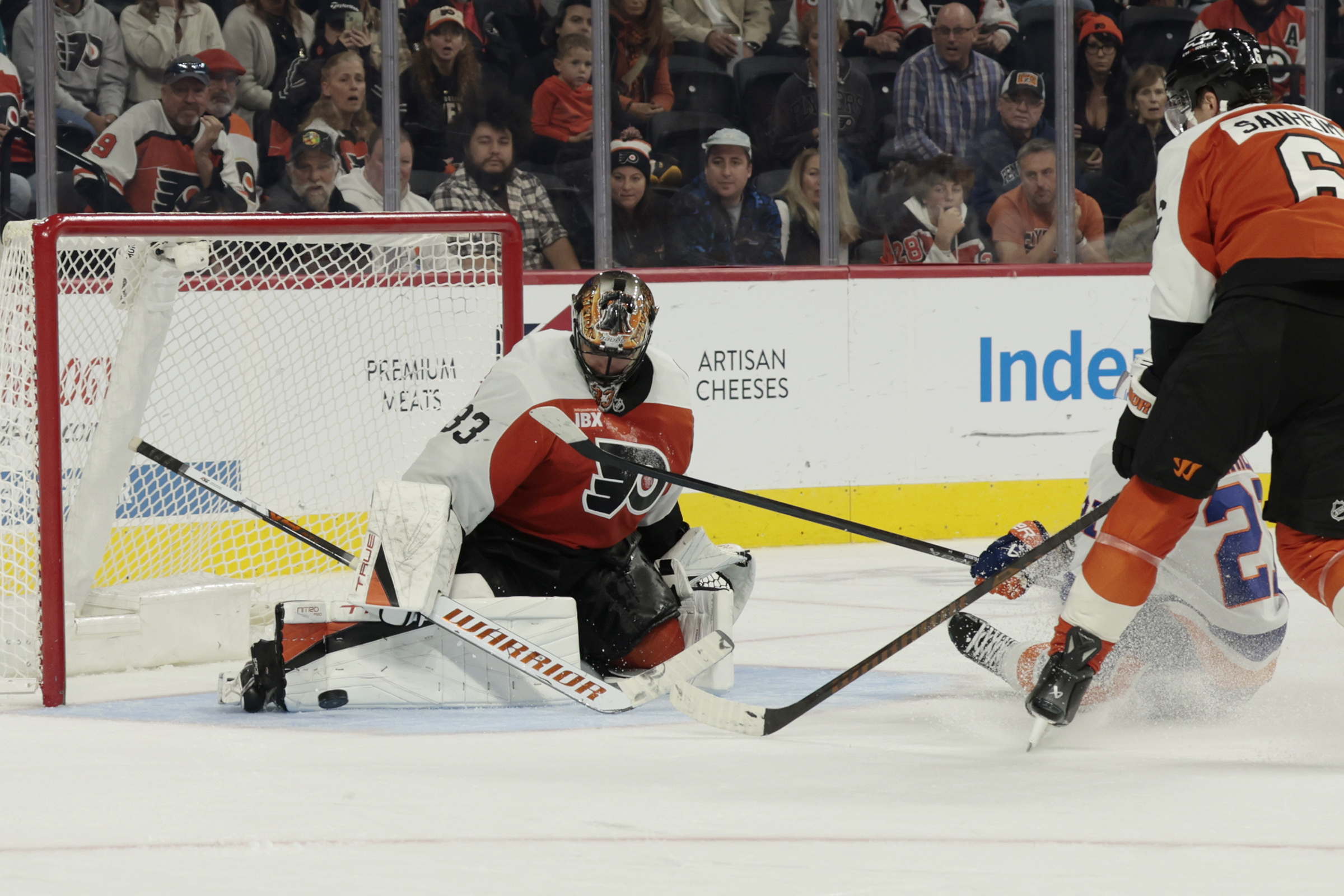
Vladař was once again impressive. He made 10 saves in the opening frame, including stoning Erik Haula atop the crease after he received a nifty between-the-legs pass from Jonathan Marchessault. With time winding down in the first, he stopped Ryan O’Reilly’s one-timer with a kick save during a delayed penalty.
In the third period, with 5:28 left and the Flyers holding on to a two-goal lead, he made a big-time save on Michael Bunting from 12 feet out. The netminder allowed one goal to Matthew Wood after Owen Tippett’s clearing attempt was intercepted by Haula at the Flyers’ blue line.
The Flyers placed goalie Sam Ersson on injured reserve due to a lower-body injury.
Breakaways
Emil Andrae played his second game of the season. … Aleksei Kolosov, who was recalled from Lehigh Valley of the American Hockey League on Thursday, served as the backup. Sam Ersson went on injured reserve with a lower-body injury. … Travis Konecny powered through Predators defenders along the boards to score an empty-netter during four-on-four action.
Call it Reunion Weekend. Scott Laughton returns with the Toronto Maple Leafs on Saturday (7 p.m., NBCSP) and Joel Farabee, Morgan Frost, and the Calgary Flames visit on Sunday (7 p.m., NBCSP+).
The Flyers may be without their captain for a bit.
Sean Couturier did not return after the first intermission Thursday night against the Nashville Predators because of an undisclosed injury.
With 14 minutes, 37 seconds left in the opening frame, Couturier took a sharp wrister by defenseman Noah Juulsen off the torso. He was spotted on the broadcast in pain on the bench and was seen by head athletic trainer Tommy Alva.
However, Couturier skated another four full shifts, including two well over a minute. A key penalty killer, he was on the ice after getting hit by the puck for a 59-second shift when Jamie Drysdale was called for hooking Jonathan Marchessault.
After the game, coach Rick Tocchet said he did not have an update but did confirm the injury came off a shot from the point. “We’ll evaluate. Can’t tell right now,” he added.
Couturier has been off to a solid start, entering the night with two goals and nine points in the first nine games. Under new coach Rick Tocchet, he had been averaging 19:35 of ice time. It is the most since the 2021-22 season, when he played 29 games before undergoing two back surgeries and missed the entire 2022-23 season.