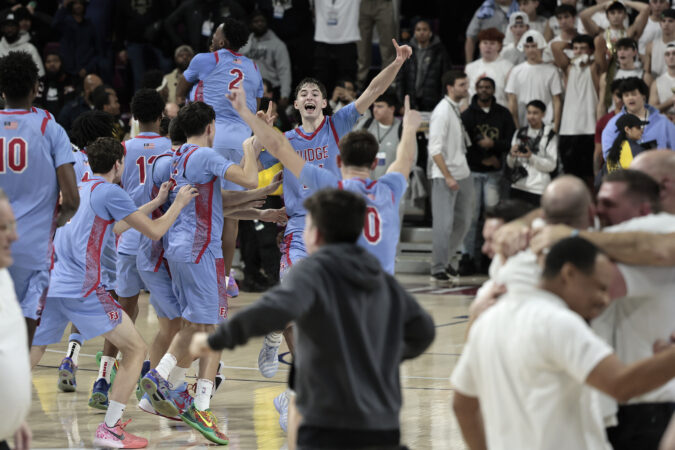
The Philadelphia Catholic League title is staying on Solly Avenue.
After a 27-year hiatus without winning a PCL crown, sixth-seeded Father Judge won its second straight with a 55-52 victory against No. 4 seed Neumann Goretti on Sunday at the Palestra.
Father Judge held off a late Saints comeback attempt in the final seconds. Neumann Goretti’s Deshawn Yates hit a three-pointer with 18.8 seconds left to make it a one-point game, but the Crusaders sealed the win with free throws down the stretch.
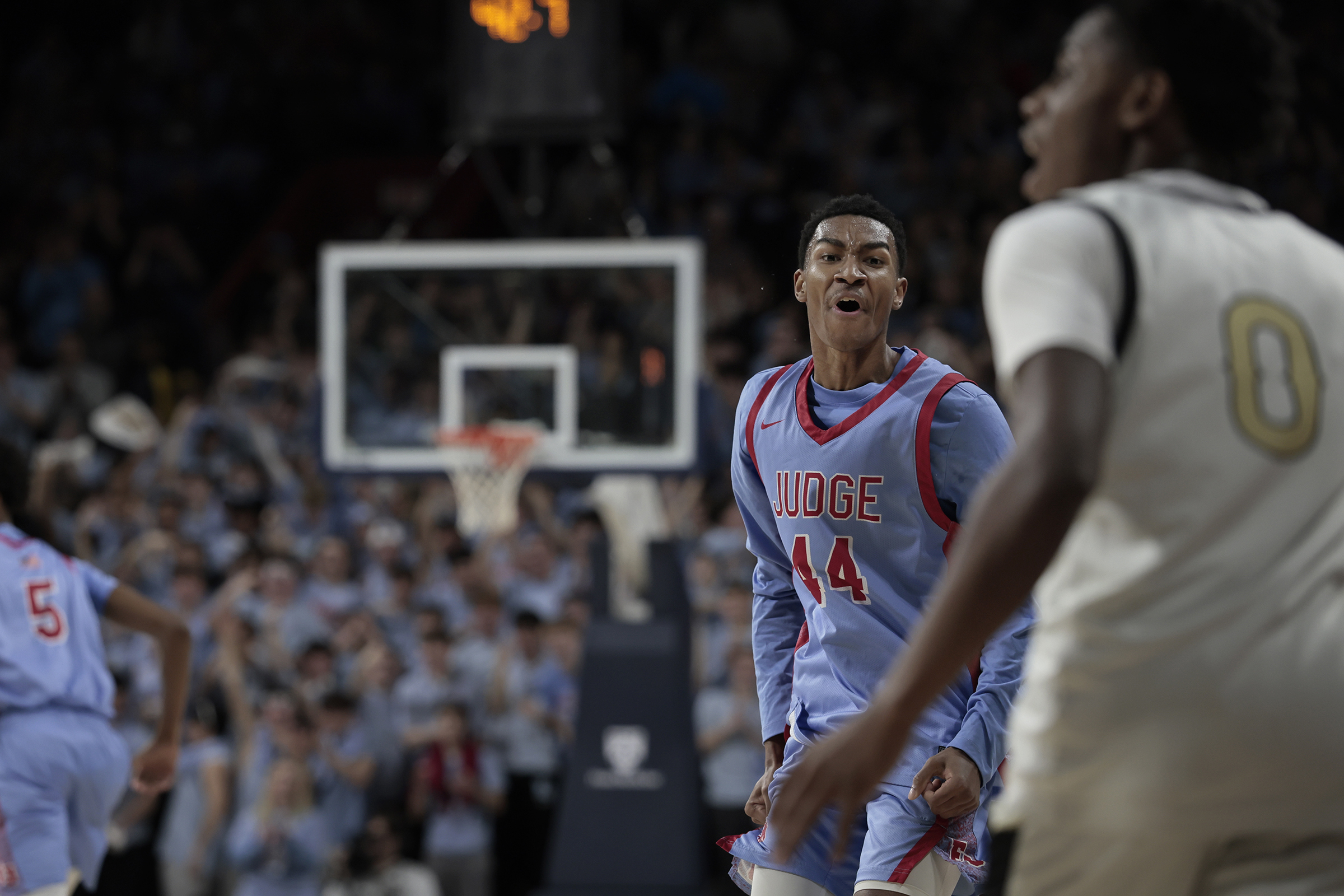
Senior Derrick Morton-Rivera led the champions with 14 points and junior Nazir Tyler added 12. Junior Marquis Newson had a game-high 19 points for the Saints.
At one point this season, Father Judge was 4-8, and the Crusaders lost to Neumann Goretti, 71-66, on Feb. 1. But on Sunday, the sixth-seeded team cut down the nets.
Father Judge’s Derrick Morton-Rivera (44) reacts after sinking a three-pointer in front of Neumann Gorretti’s Deshawn Yates.
“When we first got here, we talked about the Palestra and everybody thought we were crazy,” fifth-year Father Judge coach Chris Roantree said. “The players thought we were crazy. And then it just continued to build. You’ve got guys that have come through and accepted the culture, accepted being coached hard. … I think you have a community that’s invested. You have coaches who are invested. You have players who are invested. It makes it easy, but it also makes it enjoyable.”
Father Judge went on a 19-5 run that stretched over the first and second quarters to establish a 25-16 lead at halftime. Seven players wound up scoring in the title game for the winners.
Senior Max Moshinski, who has committed to Iona, dominated the paint for Father Judge, collecting a majority of the team’s rebounds.
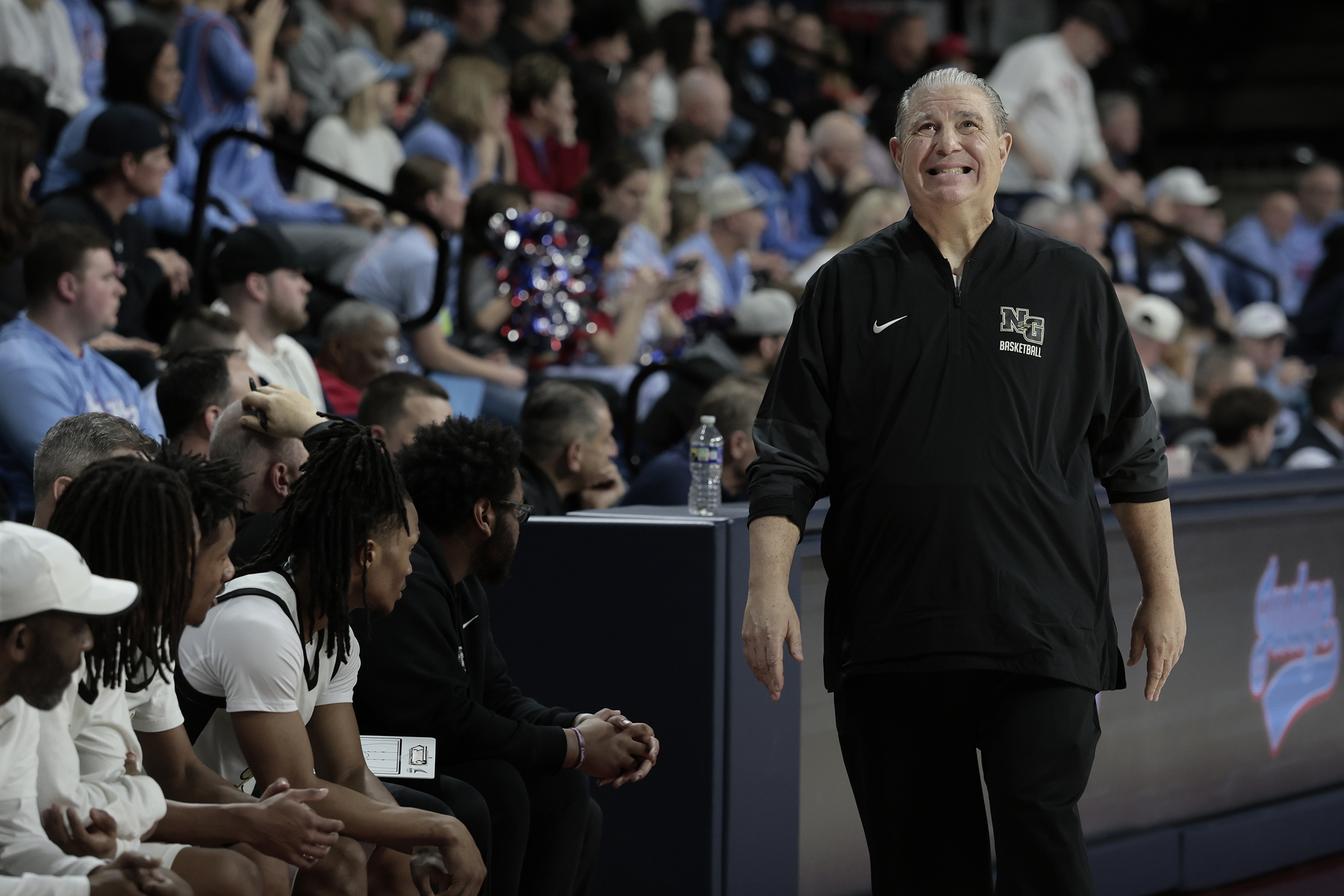
Neumann Goretti coach Carl Arrigale looks at the scoreboard in the second half against Father Judge.
It all came down to the fourth quarter when Neumann Goretti began to chip away at Father Judge’s double-digit lead, staying within three and five points in the final minutes. Yates’ three-pointer with 18.8 seconds left was the closest the Saints got to taking a lead since they started the game with a 4-0 advantage.
But Father Judge leaned on its defense to force Neumann Goretti into bad decisions and the Crusaders wrapped it up with free throws.
“[Already] being in those situations and being in those moments, when it comes, we’re not fazed,” Tyler said. “Give credit to our coaching staff as well. They schedule some tough games in December. So when we get into these moments in January [and February], we’re ready for them. … None of us was nervous.”
Next up, Father Judge will prepare for the PIAA Class 6A state tournament, which begins on March 7.
“There are some guys that are waking up at 6.30 a.m. to get themselves to school, and they’re on time,” Roantree said. “But, they want to be a part of something special. And I think we have something special.”
Audenried entered Sunday’s Philadelphia Public League girls championship with a chance to win its fourth straight title. The Lady Rockets took down Imhotep last year and had a chance to repeat history.
The school’s last three championship teams were keyed by guard Shayla Smith, Philadelphia’s all-time leading scorer. Even without Smith, who now plays at Penn State, Audenried proved it could still bring home the title.
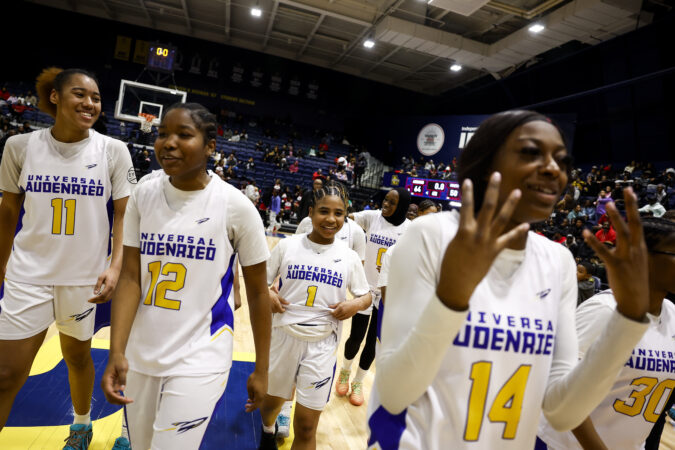
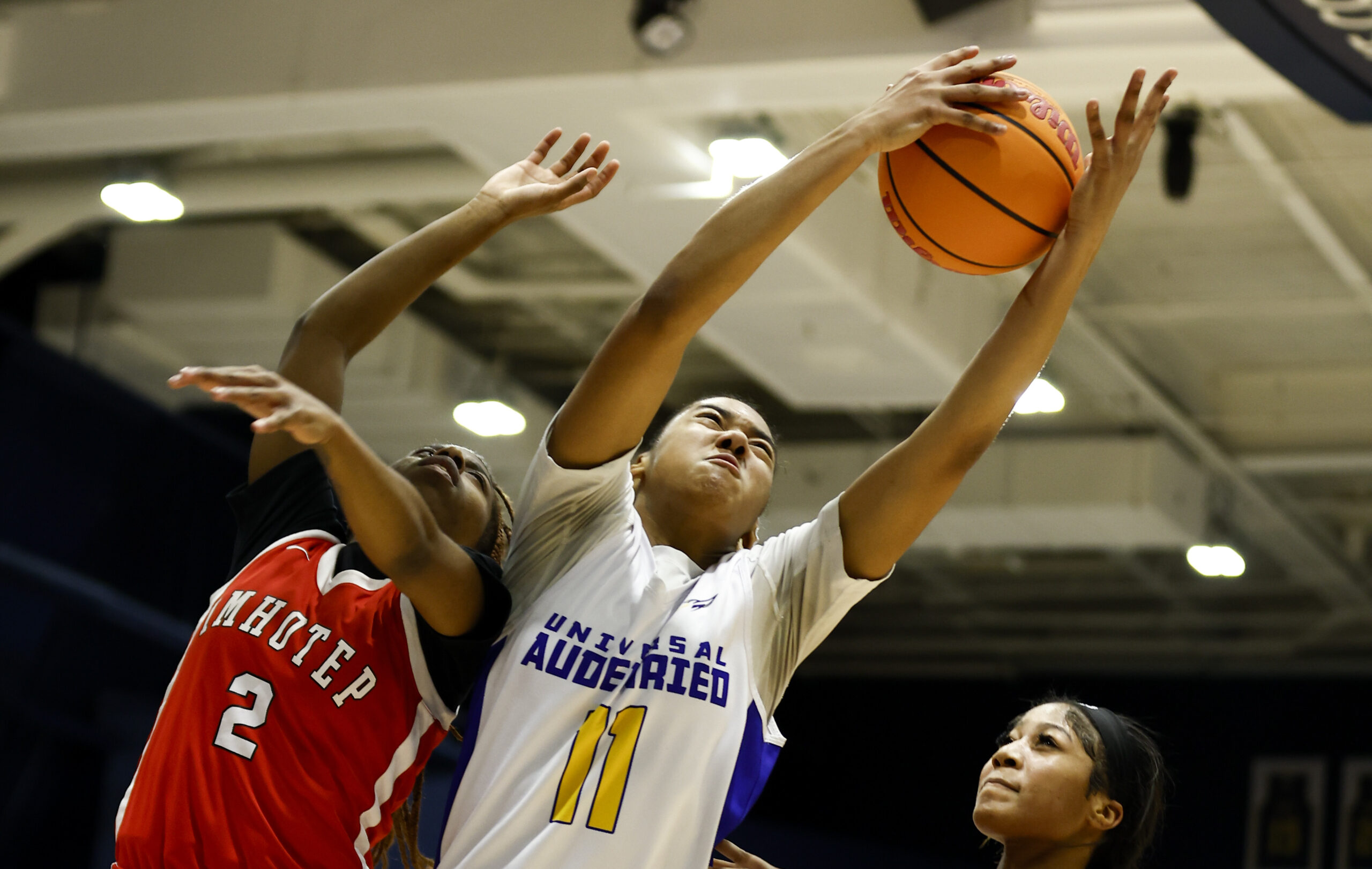
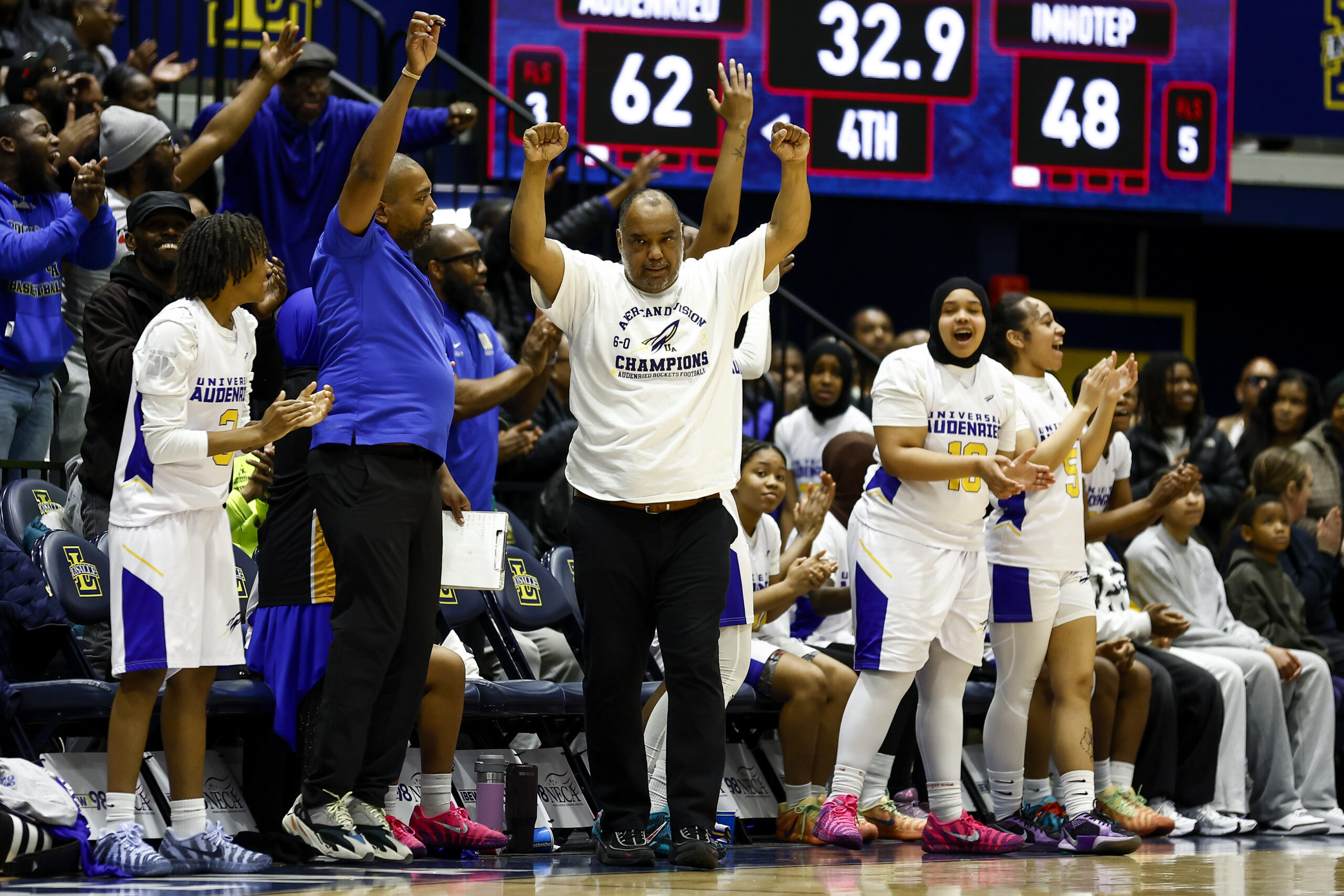
Behind 22 points from forward Nasiaah Russell, Audenried (22-4, 6-0) cruised to its fourth straight PPL title, and second straight against Imhotep (14-10, 5-1), with a 64-50 win. The Lady Rockets grabbed a comfortable lead in the first quarter and never looked back.
“I feel awesome,” coach Kevin Slaughter said. “I feel great. Four straight Public League championships and some of my mentors came to the game today.”
Russell dominated the paint in all four quarters against the Panthers. She had a game-high 22 points and recorded 12 rebounds to take home MVP honors. Senior guard Heaven Reese added 14 points while sophomore guard Chloe Kham chipped in 12.
Audenried Charter’s Nasiaah Russell dominated in the PPL girls championship. Russell is headed to St. John’s in two seasons.
Guard Geren Hawthorne led Imhotep with 16 points.
“This is my fourth championship and it’s my first time being MVP,” Russell said. “It means a lot to me, even though last year it meant a lot to me, but other people got more recognition. So now that it’s all me, I feel appreciative.”
Imhotep jumped out to a 5-0 lead after it received two technical free throws to start the game. The Lady Rockets marched back behind Russell. The St. John’s recruit had seven straight points to keep Audenried close before a 10-0 run by Audenried near the end of the first quarter gave the Lady Rockets a 24-14 lead that they did not relinquish.
Audenried struggled offensively in the second quarter, scoring only eight points as Imhotep closed the deficit to 32-26 at the half. But Audenried started the second half on a 9-3 run, punctuated by two threes from Reese that gave it a 41-29 advantage.
Every run that Imhotep attempted was answered by the Lady Rockets. Audenried scored three straight buckets to end the third quarter with a comfortable 50-35 lead. Imhotep never got closer than nine points in the final quarter.
Audenried Charter coach Kevin Slaughter reacts as his Lady Rockets near another PPL title.
“As a team, our sets and our stuff we were trying to run, we were not doing it right,” Slaughter said. “We were not efficient early, but as the game went on, our defense changed the game. Our defense and consistency. We are used to winning.”
Imhotep continued to hang around midway through the fourth quarter, but Kham stepped up to help Audenried put the game out of reach.
The 5-foot-1 guard got free for a layup to push the Lady Rockets’ lead back to double digits, recorded a steal a couple of possessions later, and scored another layup to make it 62-48. Kham extinguished Imhotep’s comeback hopes and helped Audenried close out a fourth straight title.
Bob Nark made certain to go to Mass on Saturday night. That way, he would be free Sunday morning to turn on his television to NBC, to United States vs. Canada in Milan, to an unforgettable hockey game with an unforgettable finish, to a celebration that moved him and hundreds more people throughout South Jersey to tears.
Nark taught chemistry at Gloucester Catholic High School for 48 years, and one of those years, he happened to have Johnny Gaudreau in class. Before Gaudreau was a seven-time All-Star with the Calgary Flames and Columbus Blue Jackets, before he won a national championship at Boston College, while he was forging his legend as the star of stars within the South Jersey hockey community, he was to Nark just a conscientious student who would raise his hand to answer a question when no one would. “Besides being a great hockey player,” Nark, whose son Jason is an Inquirer staff writer, said by phone Sunday afternoon, “he was a great kid. I loved him.”
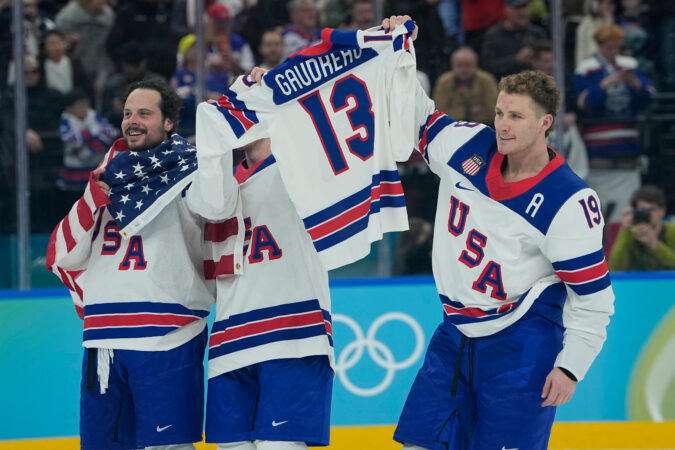
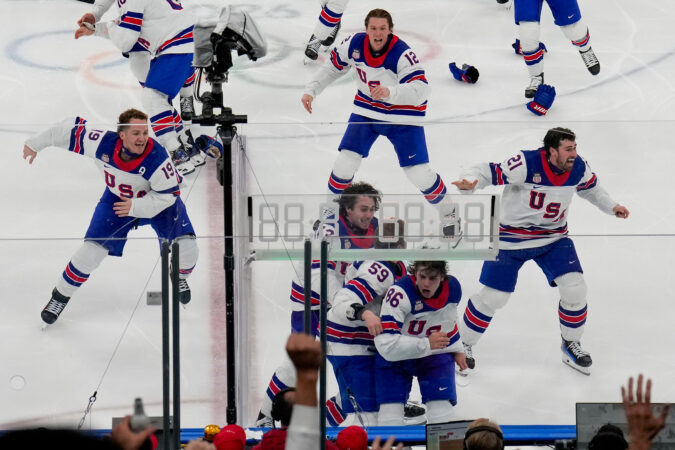
So Nark made certain to watch not just the United States’ thrilling 2-1 victory but its emotional aftermath. Jack Hughes scored 101 seconds into overtime. The Americans won their first gold medal since the “Miracle on Ice” 46 years ago. And now three players — Auston Matthews, Zach Werenski, and Matthew Tkachuk — had lifted a Team USA jersey over their heads and were carrying it around the Milano Santagiulia Ice Hockey Arena like a flag.
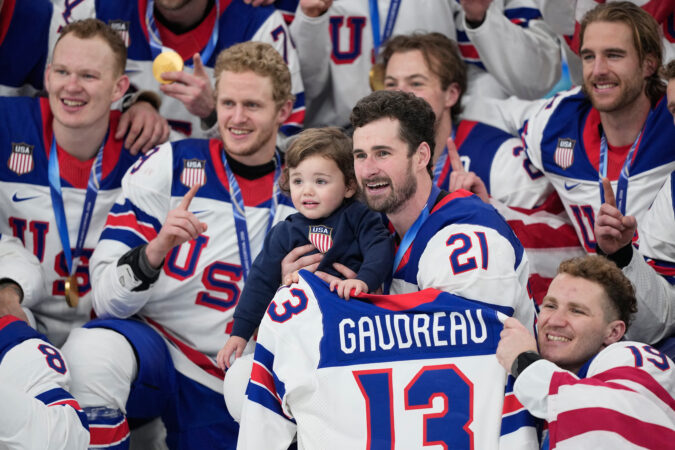
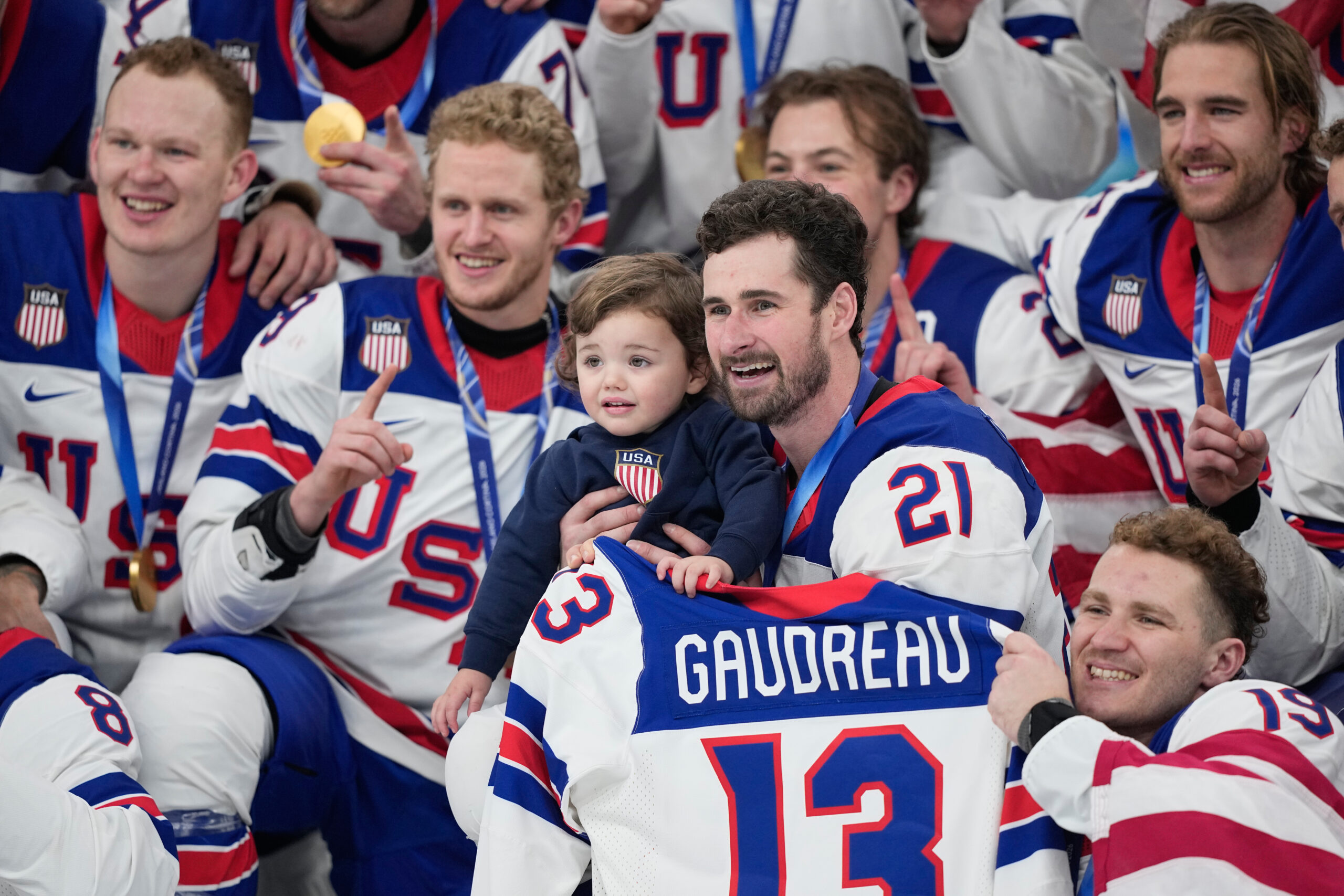
U.S. star Matthew Tkachuk carries Noa Gaudreau, the daughter of the late Johnny Gaudreau, on the ice after the gold medal win.
A Gaudreau jersey, with his No. 13 on the back, for the teammate who would have been, for the friend they had lost in August 2024, when an allegedly drunken driver struck and killed Johnny, 31, and his brother, Matt, 29 — on the night before their sister, Katie, was to be married — as they rode bicycles along County Route 551.
“I was so proud they remembered him for how great he was,” Nark said. “Today brought back a lot of memories, seeing them march his jersey around the ice.”
That entire postgame sequence — from the players’ gesture with the jersey to their scurrying into the stands to make sure Johnny’s two eldest children, 3-year-old Noa and 2-year-old Johnny Jr., joined them for the team picture — sent a quiver across a region that the Gaudreau family turned into a hockey hotbed years ago. Guy Gaudreau, Johnny’s father, had helped to form the program at Gloucester Catholic, forging it into a powerhouse before Matt eventually coached there, too. All the while, Johnny was the example that every youth coach could hold up to every youngster who was wobbling on skates but dreaming big dreams.
“Just an inspiration,” former Gloucester Catholic coach Tom Bunting once said. “As a parent, you could tell your players or your kid, ‘Hey, anything’s possible.’”
The days and weeks immediately after Johnny and Matt’s deaths had been nothing but a trauma for the entire community, a collective mourning that still hasn’t ended. “You never get past something like that,” said Tom Iacovone, Gloucester Catholic’s principal. “Johnny’s and Matt’s impact on us, it’ll never leave.” The challenge since has been to embrace what Ed Beckett, one of Iacavone’s predecessors as principal, called “the deeper Catholic tradition of remembrance, of the living memory of those who have gone before us.”
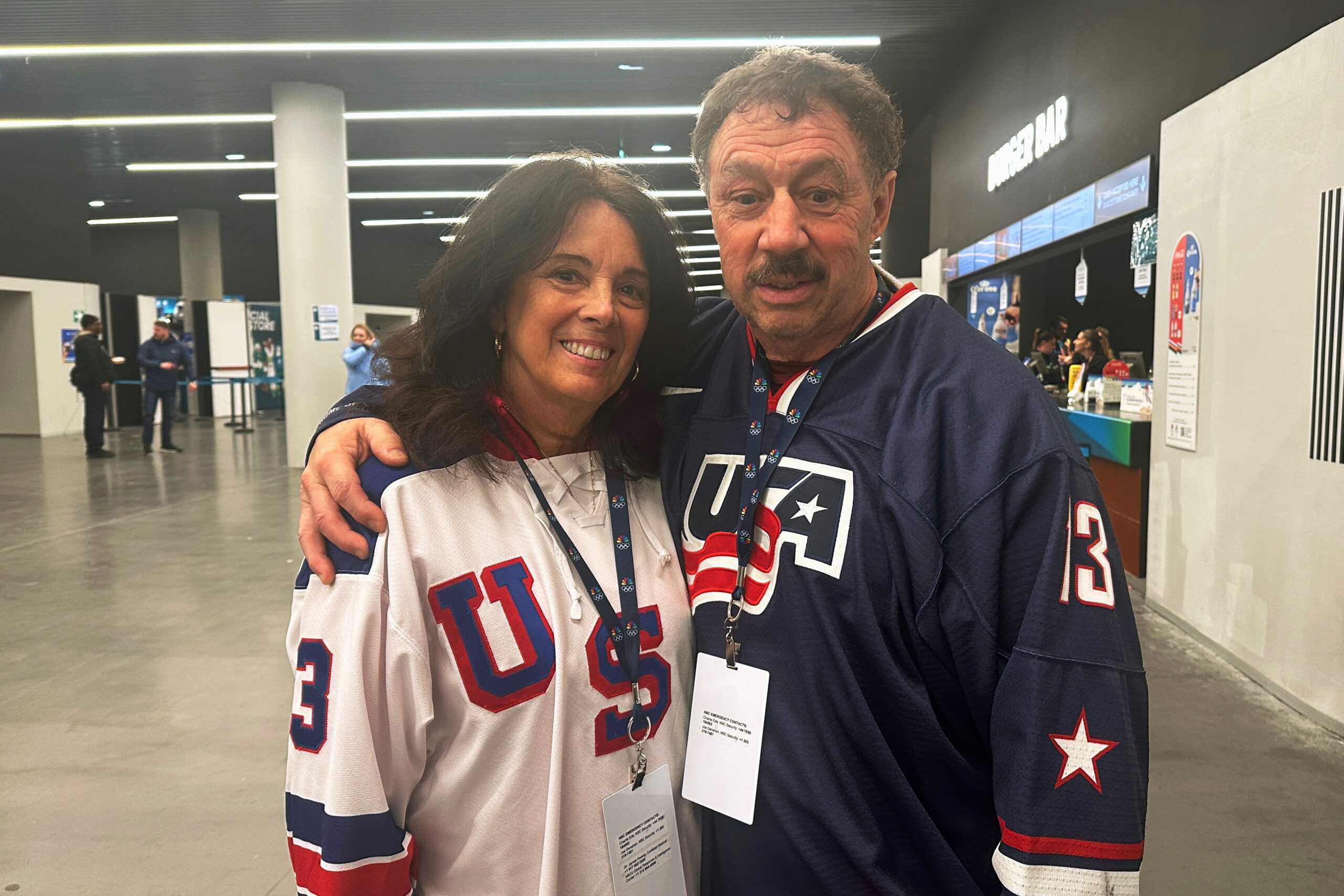
Jane and Guy Gaudreau, the parents of the late Matthew and Johnny Gaudreau, at the U.S. team’s semifinal against Slovakia on Friday.
So there are a golf tournament and fundraisers. There are photos and hockey sweaters hanging on the walls inside Hollydell Ice Arena in Sewell, where the brothers played and coached. And on Sunday, in a city more than 4,000 miles away, across an ocean, there was a moment when Johnny Gaudreau’s jersey and spirit were there for the world to see, a moment that choked the breath of everyone who knew and loved him.
He never had the chance to compete for Team USA on this stage. These Olympics were the first since the 2014 Games in Sochi, Russia, to include NHL players. But with his family in the arena for the gold-medal game, with the United States’ players clearly keeping him at the front of their minds and the bottom of their hearts, with so many joyous and tender phone calls and text messages traveling among those connected to Gloucester Catholic and South Jersey hockey, Johnny Gaudreau was as alive Sunday as he has ever been since that dark night on County Route 551. After the game, Tom Iacovone took a picture of his daughter, Nora, who is 7 years old. She was wearing a Team USA scarf with the No. 13 on it. He texted the photo to Katie Gaudreau. A great and unforgettable day to remember a great and unforgettable kid, gone too soon.
Rookie big man Johni Broome suffered a torn meniscus in his right knee during the third quarter of the Delaware Blue Coats’ loss to the Maine Celtics on Saturday, the 76ers said Sunday afternoon.
Broome “will consult with medical professionals to determine the next steps of his treatment plan,” the team said in a news release.
“Obviously pretty serious injury,” Sixers coach Nick Nurse said Sunday during his pregame news conference in Minneapolis. “I don’t think they’re 100% ready on the next steps quite yet, but he’s going to be out a considerable amount of time. Probably for the remainder of the season, I would think.”
Broome, the Sixers’ second-round pick in last summer’s draft, had appeared in 11 NBA games and averaged 0.9 points and 1.5 rebounds in five minutes. He had gotten more experience in the G League, where he scored a team-high 27 points in 23 minutes Saturday before the injury. He had a 50-point, 17-rebound game for the Blue Coats last month.
A 6-foot-10, 235-pound frontcourt player, Broome was an All-American last season at Auburn and the winner of the Karl Malone Award given to men’s college basketball’s best power forward.
Alexis Eberz stood along the sideline at the Palestra on Sunday afternoon, dribbling out the final seconds of Archbishop Carroll’s 42-33 Catholic League championship win over Cardinal O’Hara.
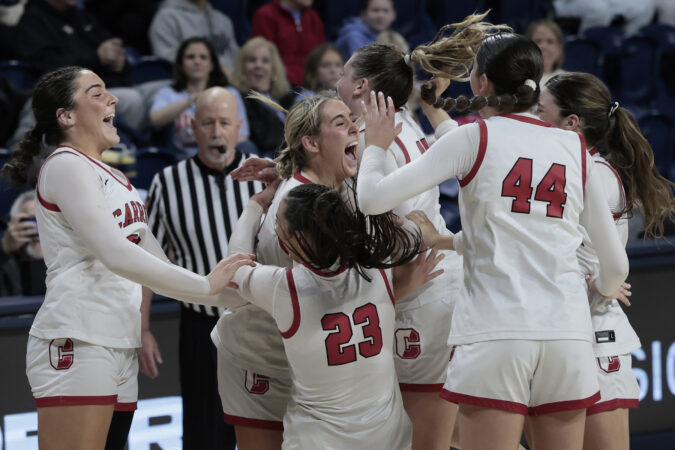
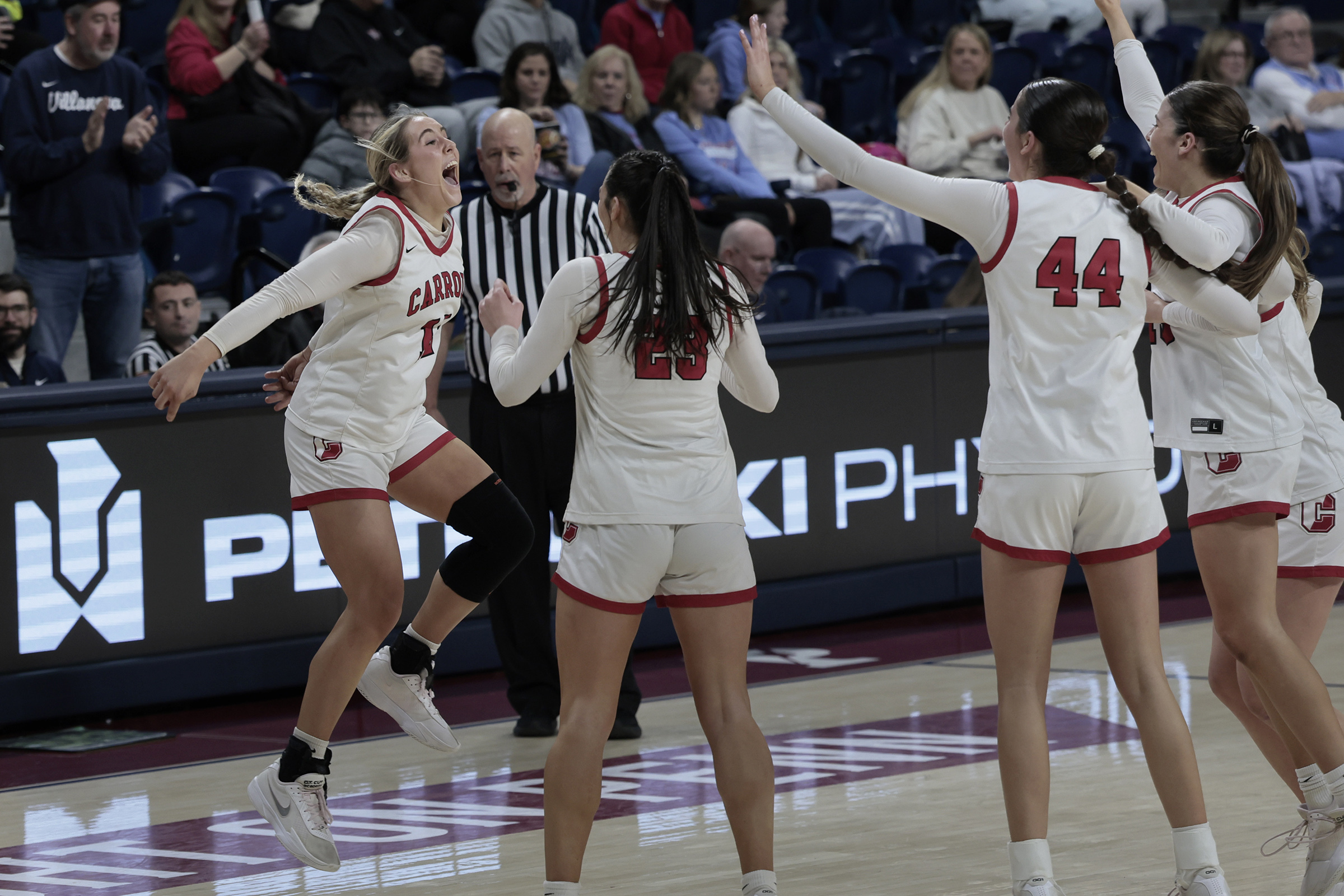
Eberz, a senior guard who will play at Villanova next season, threw the ball in the air as time expired and joined her teammates, including her younger twin sisters, Kayla and Kelsey, in celebrating Carroll’s first Catholic League title since 2019 and an undefeated season in league play.
“We had a target on our back, especially being undefeated this year,” Alexis Eberz said. “So, going out, playing our game that we played all year round, it’s amazing.”
All three Eberz sisters shared the court for the first time since Kelsey suffered a knee injury in December 2024, combining for 29 of Carroll’s 42 points.
“Nothing’s changed, you couldn’t even tell,” Kayla Eberz said of her twin sister’s return. “[After] all the stuff she’s been through, she came out and showed who she is.”
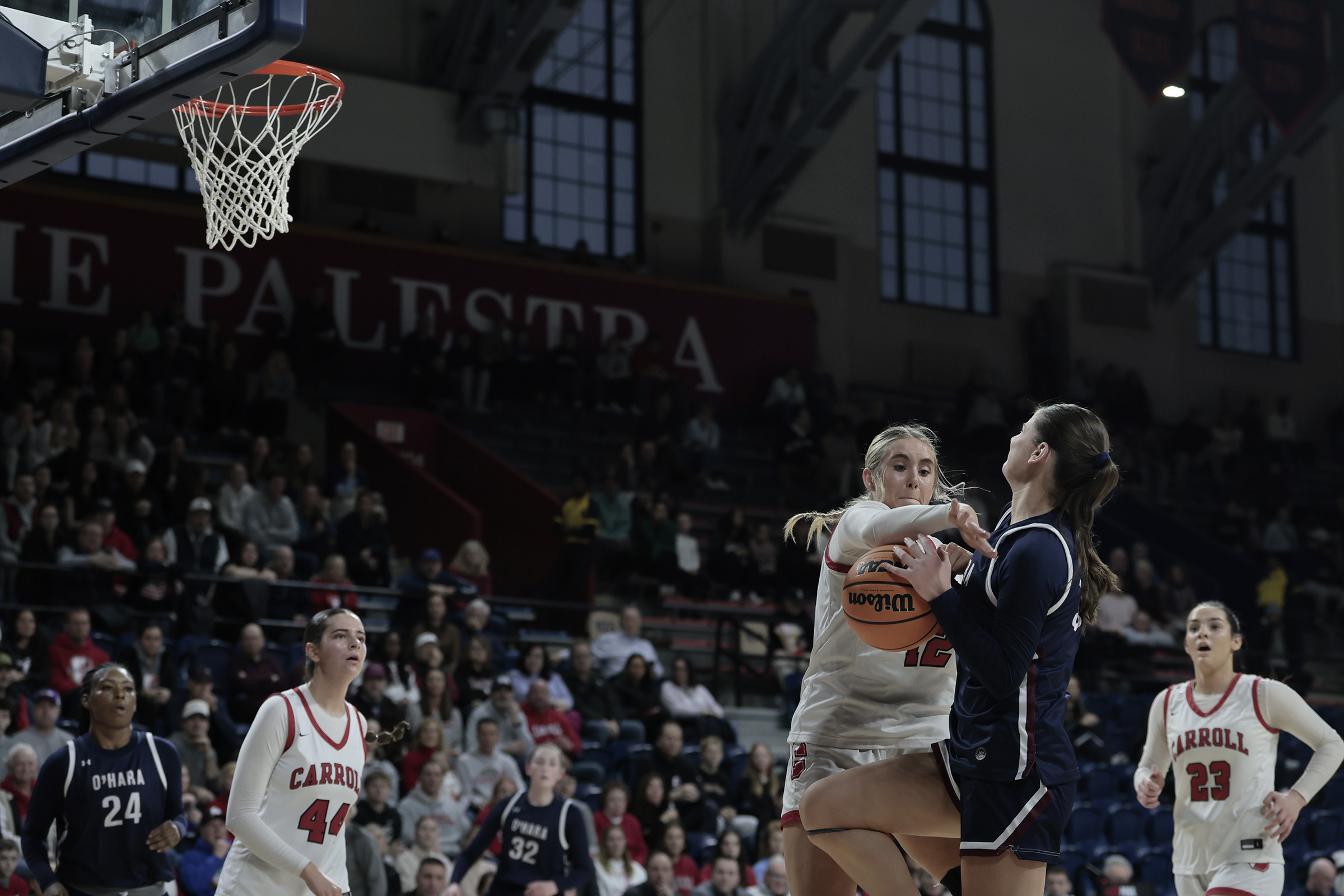
Archbishop Carroll’s Alexis Eberz knocks the ball away from Cardinal O’Hara’s Megan Rullo (right) during the Catholic League title game at the Palestra.
Kayla, a sophomore guard, scored 22 points. Alexis, who was named the Catholic League’s MVP this season, added five, and Kelsey, also a guard, added two. All five of Carroll’s starters scored, including nine points from Abbie McFillin, a junior guard.
“I knew that I was probably going to have some opportunities because they were going to be all over the Eberzes,” McFillin said.
Brigidanne Donohue led Cardinal O’Hara with 12 points. Bre Davis scored seven points off the bench for the Lions, while Megan Rullo, a senior who will play at Drexel next season, scored six.
The championship tipped off at 11 a.m., an hour earlier than scheduled. Both the girls’ and boys’ title games were moved up an hour because of the winter storm that was expected to hit the Philadelphia area on Sunday evening.
Carroll jumped out to a 14-7 lead after the first quarter and held a 22-17 advantage at halftime. The Patriots’ lead grew to 13 after three periods. O’Hara outscored Carroll, 11-7, in the fourth quarter, but Carroll’s lead was never threatened.
“You could tell playing against O’Hara that they were done,” McFillin said. “They lost before the fourth quarter even was over.”
Archbishop Carroll’s Alexis Eberz (left) jumps into the arms of her teammates after the final buzzer at the Palestra.
Renie Shields’ Carroll team reached the league’s title game in 2024 and 2025 but lost both times. Sunday’s win gives Shields her second PCL championship in 10 seasons as head coach.
“I’ve been here, but for these guys, it’s their time,” Shields said, gesturing to her players. “It’s not about us, it’s about them. We work so hard so that we can put them in a position where they can succeed.”
Carroll will move on to the PIAA Class 6A state tournament, which will begin on March 6.
Carroll’s seniors, Alexis Eberz and Bridget Grant, already won a PIAA title with the team as freshmen in 2023. But after back-to-back losses in title games at the Palestra, the two players were determined to end their Catholic League careers with a championship.
“Me and Bridget didn’t want to feel that way three years in a row,” Alexis Eberz said. “It’s so surreal, especially when I’m with my sisters.”
The dramatic Olympic gold medal win by the United States men’s hockey team on Sunday, which snapped a 46-year drought for the Americans, will be remembered forever.
But amid the celebrations and flowing tears of joy in Milan after Jack Hughes’ overtime goal against the Canadians, Team USA’s players had one of their fallen teammates at the front of mind.
Former USA Hockey and NHL star Johnny Gaudreau grew up in Salem County and was killed in August 2024 alongside his brother Matthew by an allegedly drunk driver in Oldmans Township, N.J. Gaudreau was supposed to be on this team in Milan skating around with a gold medal around his neck. But as they have all tournament, and in previous ones since his tragic death, Johnny Gaudreau’s former U.S. teammates ensured that he was there in spirit, as captain Auston Matthews and close friends Matthew Tkachuk and Zach Werenski skated around the ice holding up his No. 13 Team USA jersey. Tkachuk and Werenski played with Gaudreau in Calgary and Columbus, respectively.
The moment was especially touching given that Gaudreau’s parents, Guy and Jane, his widow, Meredith, and two of his children, Noa and Johnny Jr., were in the stands Sunday at Milano Santagiulia Ice Hockey Arena. The American players later brought Noa and Johnny Jr. onto the ice to sit in for the team picture alongside their father’s jersey. Werenski and Dylan Larkin held the children during the photo, while Tkachuk held up Gaudreau’s jersey front and center. Sunday, in addition to being the anniversary of the 1980 Miracle on Ice at Lake Placid, was Johnny Jr.’s second birthday.
Gaudreau, who represented Team USA at the 2013 World Junior Championship as well as World Championships in 2014, 2017, 2018, 2019, and 2024, is the United States’ all-time leading scorer at World Championships. His mother told reporters in Italy on Friday that playing on this team was their dream.
After Team USA’s win in the semifinals, Larkin, Werenski, and several other teammates spoke about how important Gaudreau was to them and USA Hockey.
“It means everything — we all know he should be here with us,” said Larkin, who played with Gaudreau at multiple World Championships. “He should be with us. We love him, and I like that we continue to think about him and I wouldn’t imagine it any other way.”
Werenski added Friday how excited he was to have Gaudreau’s family in Italy cheering them on: “It’s great having them here, and it’s super special,” Werenski said. “We’re happy that we made it to the gold-medal game so they can watch that and be a part of it. It’s on us to make them proud.”
Gaudreau, who had just turned 31 before his death, racked up 743 points in 763 NHL games across 10-plus seasons, eight plus one game with the Flames and two with the Blue Jackets. He is considered the best hockey player to hail from the Philadelphia/South Jersey area, and his career 0.97 points per game mark in the NHL is the 10th-best all-time among Americans.
The United States’ Dylan Larkin (21) holds Johnny Gaudreau Jr. while posing with teammates after the gold medal victory against Canada.
The former Gloucester Catholic star, who later went on to win an NCAA title and the Hobey Baker Award as the best player in college hockey at Boston College, was a seven-time NHL All-Star. His brother Matthew also played at BC and carved out a four-season pro career, reaching as high as the American Hockey League. “Matty” was 29 when he and Johnny, riding bicycles on the night before their sister’s wedding, were run off the road on Aug. 30, 2024.
After the brothers’ deaths, tributes poured in across the hockey world, including in South Jersey and with the Flyers, and across the NHL and beyond. USA Hockey has repeatedly honored Gaudreau’s legacy over the last few years and has made him and his family a constant presence. Gaudreau’s jersey has hung in the locker room at several international tournaments, including this year’s Olympics, while Guy Gaudreau, a longtime coach in South Jersey, has been invited to speak and help coach with Team USA.
“It meant everything,” said Werenski, who assisted on Hughes’ golden goal Sunday. ”This is something John would have been at. And to see his family here supporting us and seeing his kids, bringing them on the ice, we talked about playing for him, making him proud, and I think we did that. Super special to see them and to have kids on the ice, he was a huge part of USA Hockey.”
MILAN (AP) — No miracle needed. The United States is on top of the hockey world for the first time in nearly a half-century.
Jack Hughes scored in overtime and the U.S. defeated Canada 2-1 in the gold medal final at the Milan Cortina Olympics on Sunday to earn the nation’s third men’s title at the Games and its first since the “Miracle on Ice” in 1980 — 46 years to the day of the famous upset over the Soviet Union, too.
Unlike that ragtag group of college kids that pulled off one of the biggest shockers in sports history, the Americans in Milan were a machine that rode goaltender Connor Hellebuyck and a stacked roster full of NHL players through the tournament unbeaten.
“This is all about our country right now,” Hughes said. “I love the USA. I love my teammates. It’s unbelievable. The USA Hockey brotherhood is so strong.”
Hughes’ goal off the rush after a pass from Zach Werenski just 1 minute, 41 seconds into three-on-three overtime, sent players into a wild celebration as Canada’s entire team watched from the bench. Werenski and Matthew Tkachuk, former teammates of Johnny Gaudreau, carried a Gaudreau No. 13 around the ice as the latest tribute to the beloved player who was killed along with his brother in 2024 by an alleged drunk driver while riding his bicycle in South Jersey’s Salem County.
Gaudreau’s parents, Guy and Jane, his widow, Meredith, and their oldest children were in attendance. It was John Jr.’s 2nd birthday.
Hellebuyck was by far the best player on the ice, stopping 41 of the 42 shots he faced as Canada tilted the ice toward him. He made the save of the tournament by getting his stick on the puck on a shot from Devon Toews in the third period, then minutes later denied Macklin Celebrini on a breakaway — something he also did to Connor McDavid earlier.
“Unbelievable game by Hellebuyck,” Hughes said. “He was our best player by a mile.”
It was only fitting the Americans needed to go through Canada, their northern neighbor that beat them at the 4 Nations Face-Off a year ago and has won every international competition over the past 16 years that featured the world’s best players.
Not anymore.
Winning a fast-paced, riveting game that was full of big hits and plenty of post-whistle altercations, the U.S. got a goal from Matt Boldy 6 minutes in and led until Cale Makar tied it late in the second period. Hellebuyck and the penalty kill were a perfect 18 for 18 at the Olympics.
“I can’t even believe this,” Hughes said. “I mean it’s such an unbelievable game, USA-Canada. Such a good game. There’s so many great players. We’re a great team. That’s exactly how we wanted it to go. We’re underdogs to Canada, [but we] beat them. It could have gone either way.”
The U.S. finally came through after generations of churning out talent from the grassroots level like a production line. All but two of the 25 players on the team went through USA Hockey’s National Team Development Program.
That group of 23 includes captain Auston Matthews, the top line of Brady and Matthew Tkachuk and Jack Eichel, and the second set of brothers, Jack and Quinn Hughes. Much of the team played together either at the program, under-18s, the World Junior Championship, or some combination of them.
The U.S. winning silenced criticism of general manager Bill Guerin and his management group choosing a roster full of experienced veteran players to fill specific roles and leaving four of the top 10 American goal scorers in the NHL this season at home. Some decisions were no-doubters, like coach Mike Sullivan giving the net to Hellebuyck, who was the best goalie in the tournament.
Canada, back-to-back Olympic champions in 2010 and ’14 and winners of three of the first five, fell short while playing without injured captain Sidney Crosby. The 38-year-old two-time gold medalist and three-time Stanley Cup champion left the quarterfinal game against Czechia and sat out the semifinal game against Finland.
McDavid, the widely considered best player in the world who wore the “C” in Crosby’s absence, suffered another devastating defeat on the doorstep of a title. He and the Edmonton Oilers have lost to Matthew Tkachuk and the Florida Panthers in the Stanley Cup Final each of the past two years.
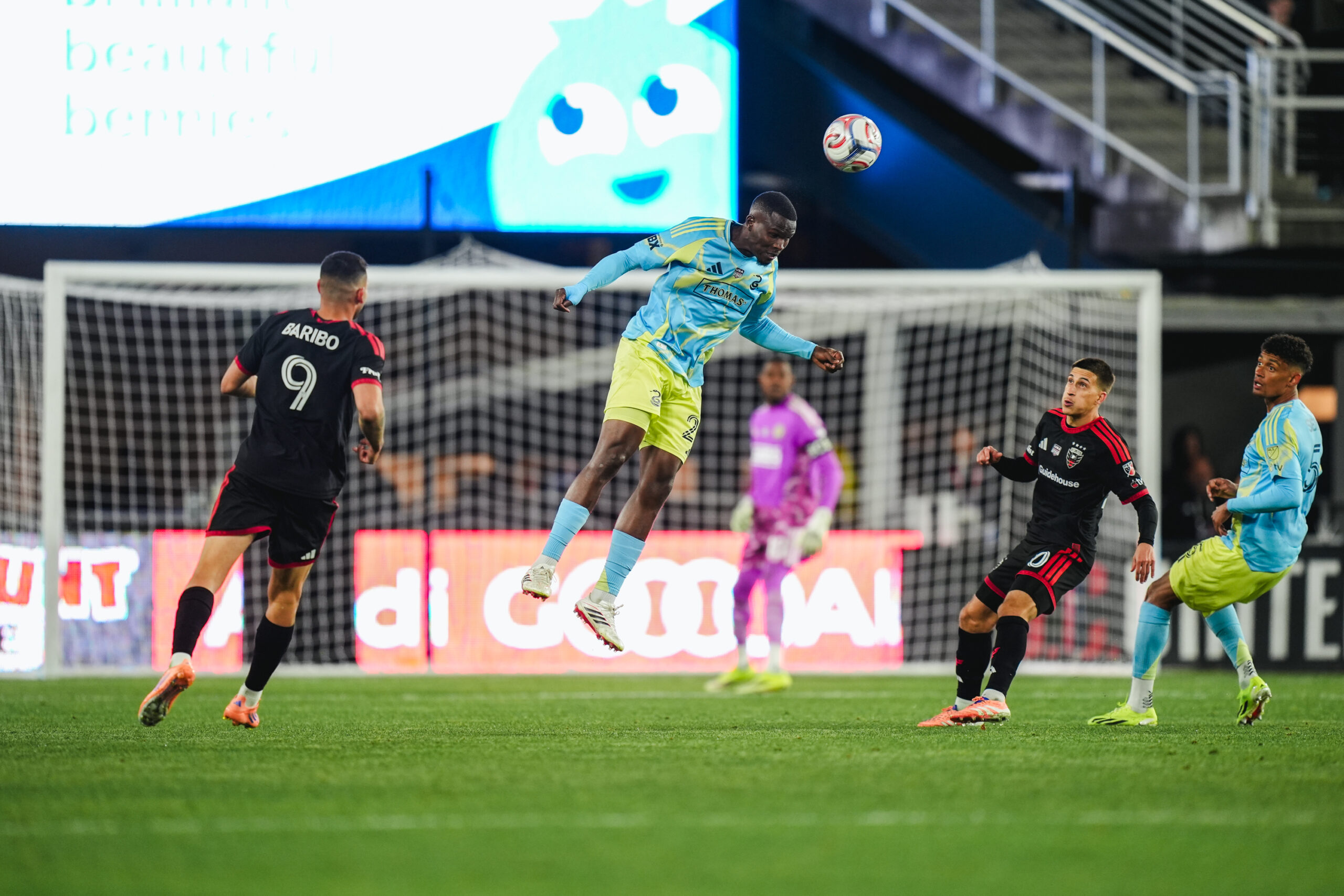
WASHINGTON — On another night, the Union might have at least found an equalizer against D.C. United. Even down a man, the attacking substitutions were clearly wearing down D.C.’s defense in the final minutes Saturday.
But there was no equalizer, and when the final whistle blew, the biggest talking point from the Union’s side wasn’t Tai Baribo’s goal against his old team. Or the fact that United looked the most competent they have in years, against a new group of Union players that was further upended when Frankie Westfield was scratched from the lineup just before kickoff.
It wasn’t surprising that Baribo scored, since the “law of the ex” is as strong in soccer as in every other sport. He was polite after the game about the screams he released in the goal celebration, but one word he emphasized got a point across.
“It’s not because of Philly,” he said. “I love Philly, I love the fans, I love the club. But here I celebrate with my club, and I love the club here, and I love the fans here.”
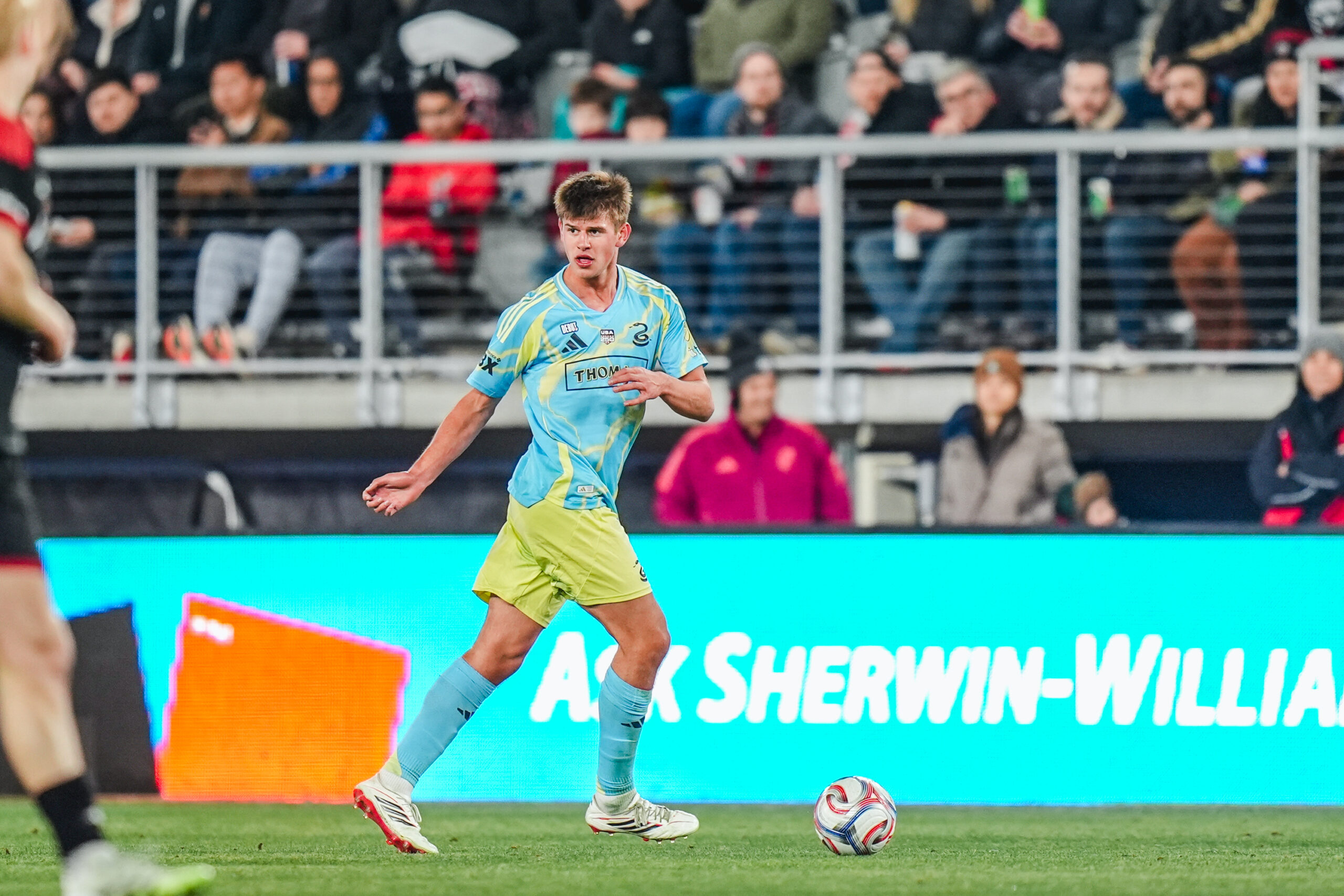
It was even less surprising that the Union player most responsible for the play was Finn Sundstrom, the 19-year-old centerback who got thrown in the deep end at left back in his first MLS game. D.C.’s Gabriel Pirani snatched Sundstrom’s dinner money with a great bit of holdup play before feeding João Peglow to start a three-on-two break that Baribo finished with aplomb.
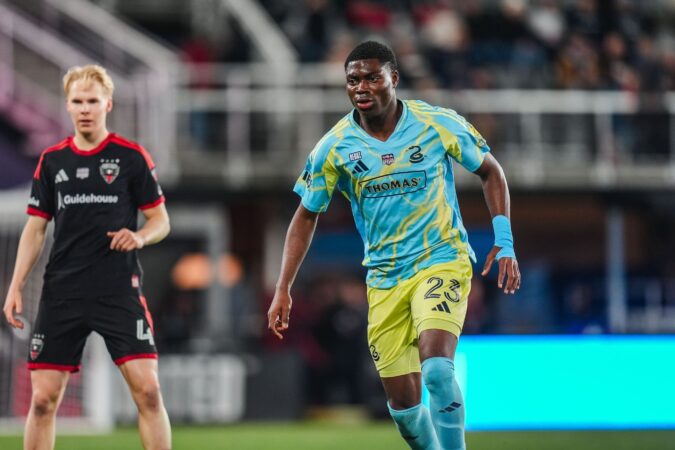
No, the thing that ended up mattering most was Ezekiel Alladoh’s red card in the 59th minute. The Union’s new record signing was battling for the ball with D.C. centerback Lucas Bartlett near the end line, shoved Bartlett over, then appeared to lean toward him and offer something. After that, as Alladoh walked away, he turned back toward Bartlett, pointed at him, and said a few more words.
The only replay shown on the Apple broadcast was from a camera too far away to make clear exactly what was said. But referee Guido Gonzales Jr. heard it — in part because Audi Field was far from full — and did not hesitate to send Alladoh off.
In a written statement to the pool reporter from Washington’s WTOP radio station after the game, Gonzales said Alladoh “directed an obscene gesture and language” at Bartlett, and was ejected for “offensive, insulting, abusive language/actions.” No further details were given, and it remains to be seen if specifics will be published.
He did say Alladoh was taught during the preseason about MLS’s rules on derogatory speech, as all players and staff are.
“It’s easy when you’re in a classroom and on your zoom and you go through it, and you have a cold drink in your hand, and it’s all good,” Carnell said. “But when it’s the emotions, and there’s fans and everything, under those stress-pressure tests, I would call them, we just have to usher and nurture our guys within that environment. And hopefully they get to a point where they can regulate and then move on from one moment to another play.”
One moment from the aftermath bears highlighting for a positive reason. As a few Union players pleaded their case to Gonzales, Olwethu Makhanya went into the middle of them and pulled Alladoh out, telling him he needed to leave the field no matter what.
“Obviously we didn’t want it to get into our heads,” Makhanya said. “As soon as you realize you’ve got a red card — and he’s a new guy, he doesn’t understand some of the rules — but knowing the rules that as soon as you get a red card, you need to be off the field as soon as possible, that’s why I had to rush to him and try to get him off the field.”
The moment was the latest sign of Makhanya’s growth as a leader on this team.
“He’s leading by doing, he’s leading by talking, and just his professionalism through the preseason,” Carnell said. “You can see a lot of growth from him over the last two months, assuming this role as a leader in that group.”
The Union’s Olwethu Makhanya jumps for a header during the first half.
Why Sundstrom?
It raised a few eyebrows that Carnell turned to Sundstrom when Westfield said he couldn’t play, citing lingering effects of the hamstring tweak he suffered in Trinidad on Wednesday.
Carnell liked Sundstrom’s work in the preseason, and Sundstrom was serviceable in his late-game run at Defence Force. But starting an MLS game is a different beast.
Sundstrom played only the first half Saturday, withdrawn at halftime due to what Carnell said was a swollen ankle. Both Carnell and Japhet Sery Larsen praised Sundstrom’s overall work in the game, but that moment stands above everything else.
“Coming in today, thrown in, I think Finn did quite well,” Sery Larsen said. “He did his best. He was playing out of position as well. … It’s not easy, but we appreciate the job he did.”
Finn Sundstrom on the ball during Saturday’s game.
And for the record, it did not raise eyebrows that Westfield wasn’t fully healthy. Grabbing a hamstring during a game needs little interpretation, even if there isn’t major damage — and even though Carnell said last Thursday that “it should be good.”
Westfield was walking gingerly as he left the Union’s locker room Saturday night. Although he said he’d be fine, his tone of voice gave the rest of the context.
At least help is on the way. The Union’s acquisition of left back Philippe Ndinga is over the line, a source with knowledge of the matter told The Inquirer. It’s just a matter of time until the official announcement, and crucially until Ndinga’s visa paperwork is settled.
Unfortunately, that is not to be taken for granted these days with the Gabon native who plays internationally for Congo — just as it’s unfortunate that the Colombia-born Geiner Martínez also faces visa issues. The club can only hope that both matters are settled quickly, given how much of the process is out of its hands.
Philippe Ndinga (right) is on the way to the Union from Swedish club Degerfors.
At the attacking end
The Union held an 11-7 edge in total shots, and 3-1 in shots on target. But the expected goals sums went 0.91 to 0.41 in D.C.’s favor, and the eye test went United’s way as well until the late stages.
“We won’t get too low on this result, but for sure we understand what teams are expecting against us, and how they’re going to play against us,” Carnell said. “And that’s something for us to be tuned into and dialed into from the very get-go.”
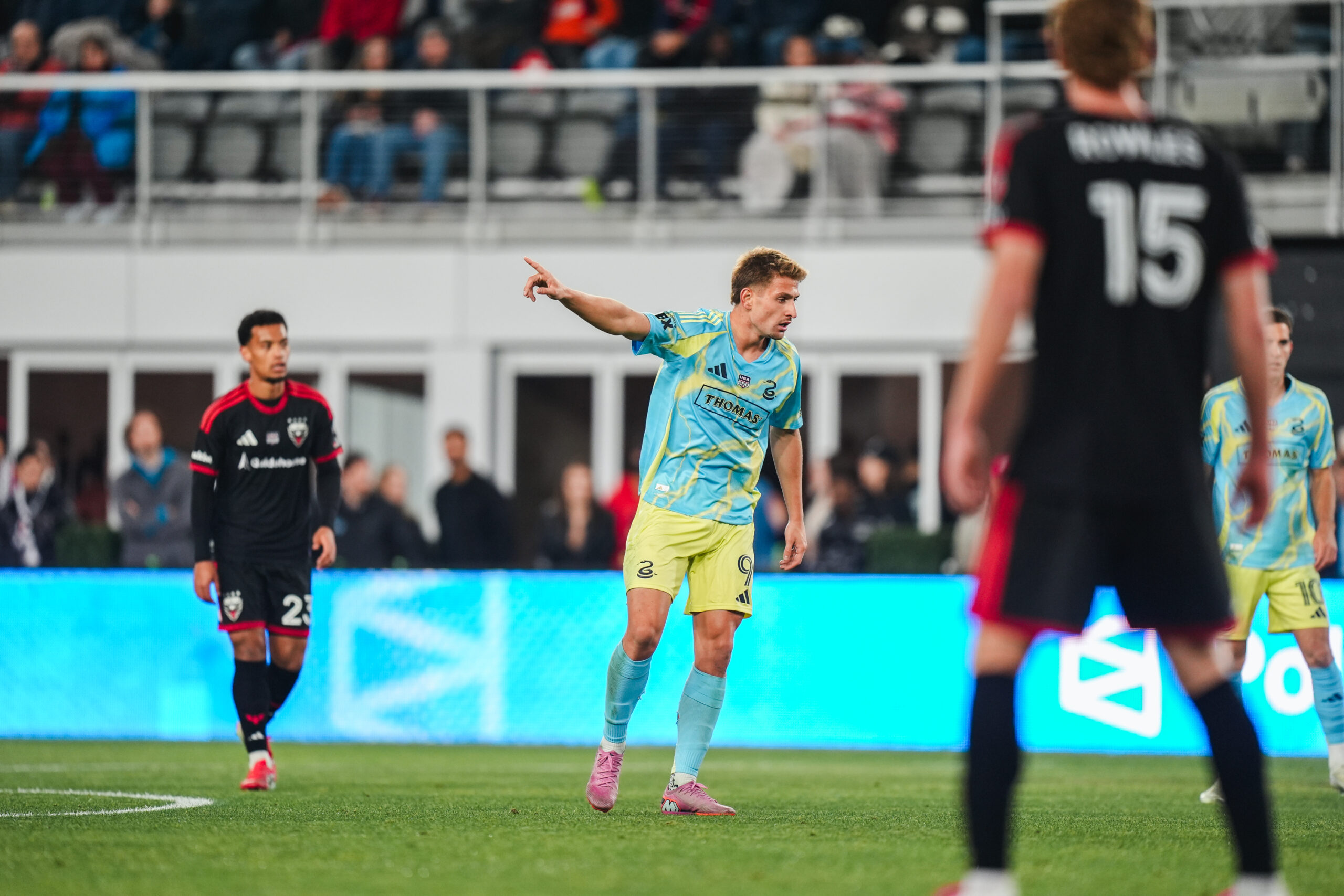
Striker Bruno Damiani was clear-eyed about what didn’t work.
“Mostly we were always playing through the right side, and [D.C.] realized really quick,” he said. “So they [were] in to jump every time the ball went to that side. We created a very predictable attack, and I think that was our mistake.”
Bruno Damiani (center) making a point to teammates on the field.
Damiani did not mention Westfield’s absence from the left side, but the rest of us could guess that it affected the balance. He did praise Cavan Sullivan’s positive contributions as a 70th-minute substitution, with impacts in open play and on a few well-served set pieces.
“I’ve been really, tough with him, because I want him to improve,” Damiani said. “I think he has everything that he needs to have success. … I’m happy that he is improving. I wish he keeps going that way, and maybe scoring a goal or getting more assists will still give more and more confidence to him.”
NEW ORLEANS — Bryce McGowens extended his right arm for the “ice in his veins” celebration directly in front of the 76ers’ bench after draining a corner three-pointer as part of the Pelicans’ long-range onslaught.
New Orleans looked like the playoff contender with fresh legs Saturday night at the Smoothie King Center, not the Western Conference bottom-dweller playing short-handed on the second night of a back-to-back. The Pelicans bulldozed the Sixers in the second half of an eventual 126-111 result, handing them their fourth consecutive loss and perhaps their most troubling defeat of the season.
That puts the 30-26 Sixers at an inflection point, and they know it.
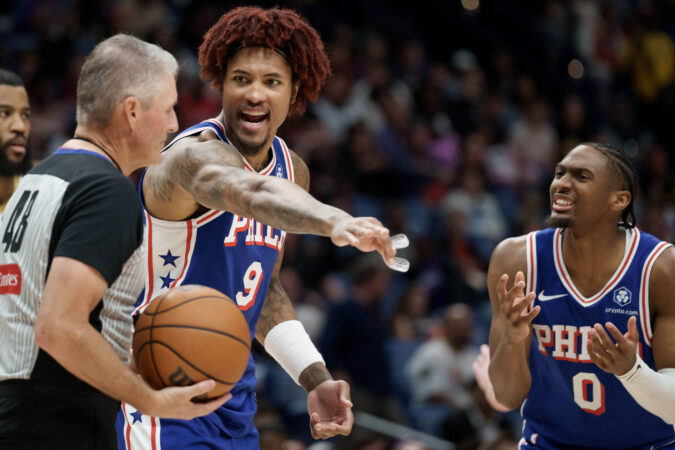
Coach Nick Nurse initially called it the “toughest moment of the season, for sure. All year. Without question” during his postgame news conference. And though the visitors’ locker room was not overly tense, panicked, or dejected, veteran wing Kelly Oubre Jr. also offered a blunt assessment of the state of his team and this suddenly teetering season with 26 regular-season games to play.
“I don’t think anything’s funny right now. I don’t think anything is fun,” said Oubre, the New Orleans native who scored 25 points Saturday. “I just hope that we get mad. I think we’ll play better if we’re mad. We’ll play better if we’re desperate.
“I think we’re a little too entitled right now. Teams aren’t going to roll over and let us win any of those games. … We’ve got to whoop them the same way people come into our house and whoop us.”
Perhaps most frustrating for the Sixers is that this skid comes on the heels of what Nurse believes was his team’s best stretch this season — even after starting wing Paul George was abruptly suspended for 25 games for violating the NBA’s anti-drug policy.
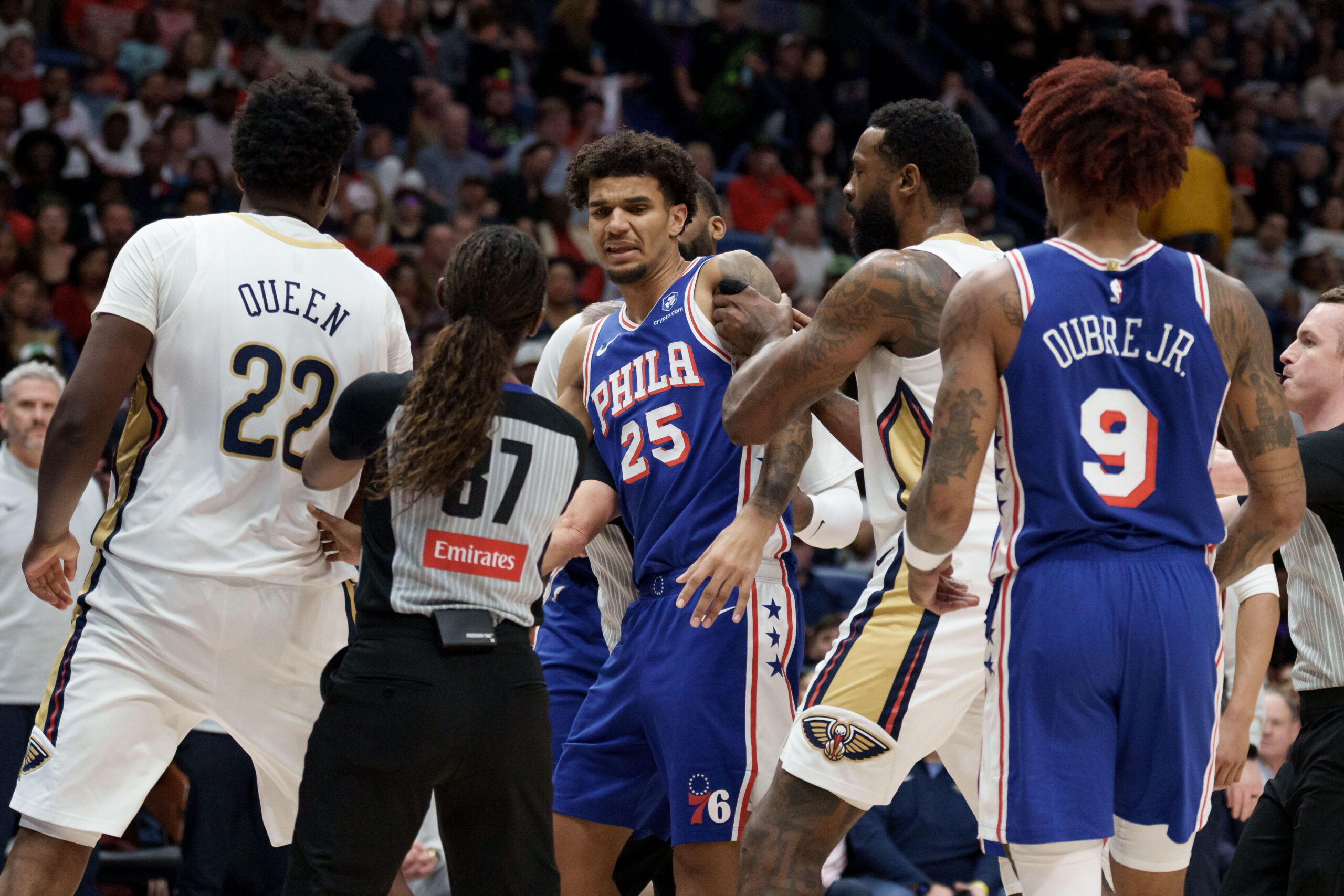
Pelicans center DeAndre Jordan (center right) holds back Sixers forward Dominick Barlow during a scuffle on Saturday in New Orleans.
The Sixers headed West on Feb. 1 for a five-game road trip and won three of their first four matchups. Starting forward Dominick Barlow said “the vibes were great” throughout that jaunt, even with the trade deadline — and the emotional departure of second-year guard Jared McCain — plopped in the middle.
But after a Feb. 8 victory at the Phoenix Suns, the Sixers were blown out at the Portland Trail Blazers and at home against the rival New York Knicks. In their first game after the All-Star break, the Sixers lost to an Atlanta Hawks team that has overhauled its roster and is fighting for a spot in the play-in tournament. Then came Saturday’s defeat to a Pelicans team that entered the game with a 15-42 record, at a rest disadvantage — and set to start veteran center DeAndre Jordan, who had not played since Oct. 29, in a jumbo lineup.
About 90 minutes before tipoff, Nurse vocalized the Sixers’ need to halt this “hiccup.” He also was honest about his team’s inconsistency throughout the season, saying that “we can play at the highest levels. We can play at the lowest levels” regardless of opponent.
“It wouldn’t matter where we were or who we were playing,” Nurse said. “ … We’ve got to get ourselves corrected.”
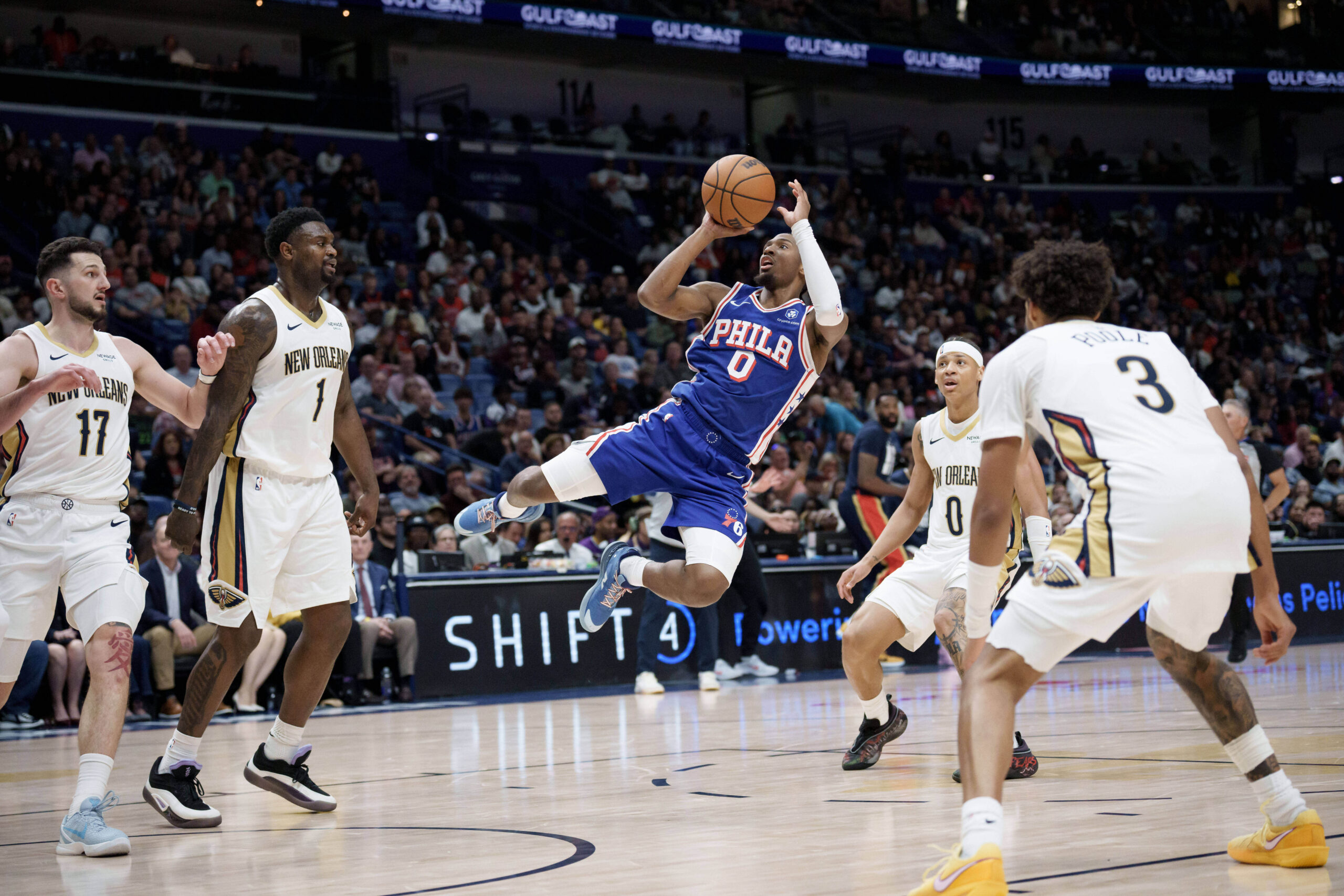
It would be easy to blame this slide solely on the absence of former MVP Joel Embiid, who has missed all four games with knee and shin issues after a dominant month-plus stretch. These Sixers have resembled the team that rapidly torpedoed when Embiid and George were sidelined for the bulk of last season, with All-Star point guard Tyrese Maxey manufacturing points (and playing tons of minutes) but struggling with efficiency while getting swarmed defensively. Maxey totaled 27 points, seven assists, and five steals Saturday, but went 2-of-11 from three-point range and 9-of-23 overall from the floor.
And Saturday night, the 2025-26 Sixers’ most glaring problem arose again.
Tyrese Maxey scored 27 points against the Pelicans, but went 2-of-11 from three-point range and 9-of-23 overall from the floor.
They surrendered 40 points during a dreadful third quarter, swiftly reversing an 11-point advantage early in the frame into an eight-point hole. That deficit continued to balloon to 21 points in the final period, thanks to the Pelicans’ 12-of-20 three-point barrage after the break. The Sixers made only three of their 24 long-range attempts in the second half, providing New Orleans with consistent opportunities to push the ball off misses, penetrate the lane, and kick out to open shooters.
“We just didn’t make any of them, and they made them all,” Nurse said, “It really flipped the game really quickly, and we just could never really get back on track.”
The Sixers exited the All-Star break with a strength of schedule that ranked 23rd out of the NBA’s 30 teams, according to Tankathon. That theoretically should prove beneficial in the Eastern Conference postseason race, where the Sixers entered Sunday in danger of slipping into play-in territory. They were percentage points ahead of the seventh-place Miami Heat (31-27), and a half-game up on the eighth-place Orlando Magic (29-26).
Following Wednesday’s practice, Maxey emphasized that the regular season’s home stretch is when playoff teams “take advantage of whoever they’re playing against.”
“If it’s a team that’s at the bottom of the standings,” Maxey added, “playoff teams normally go out there and handle their business professionally. … It’s time to buckle down. It’s time to go out here and increase our seed, increase the way we’re playing and figure it out, and get ready for this postseason run.”
After Saturday’s failure in that exact scenario, Maxey understood why a reporter circled those words back to him. He stressed that the Sixers must stick together and are the only ones who “can climb ourselves out” of this four-game slump. Barlow cautioned against overreacting, yet acknowledged that “getting a win after each loss becomes harder and harder.” Nurse audibly exhaled as he left the room housing his postgame news conference.
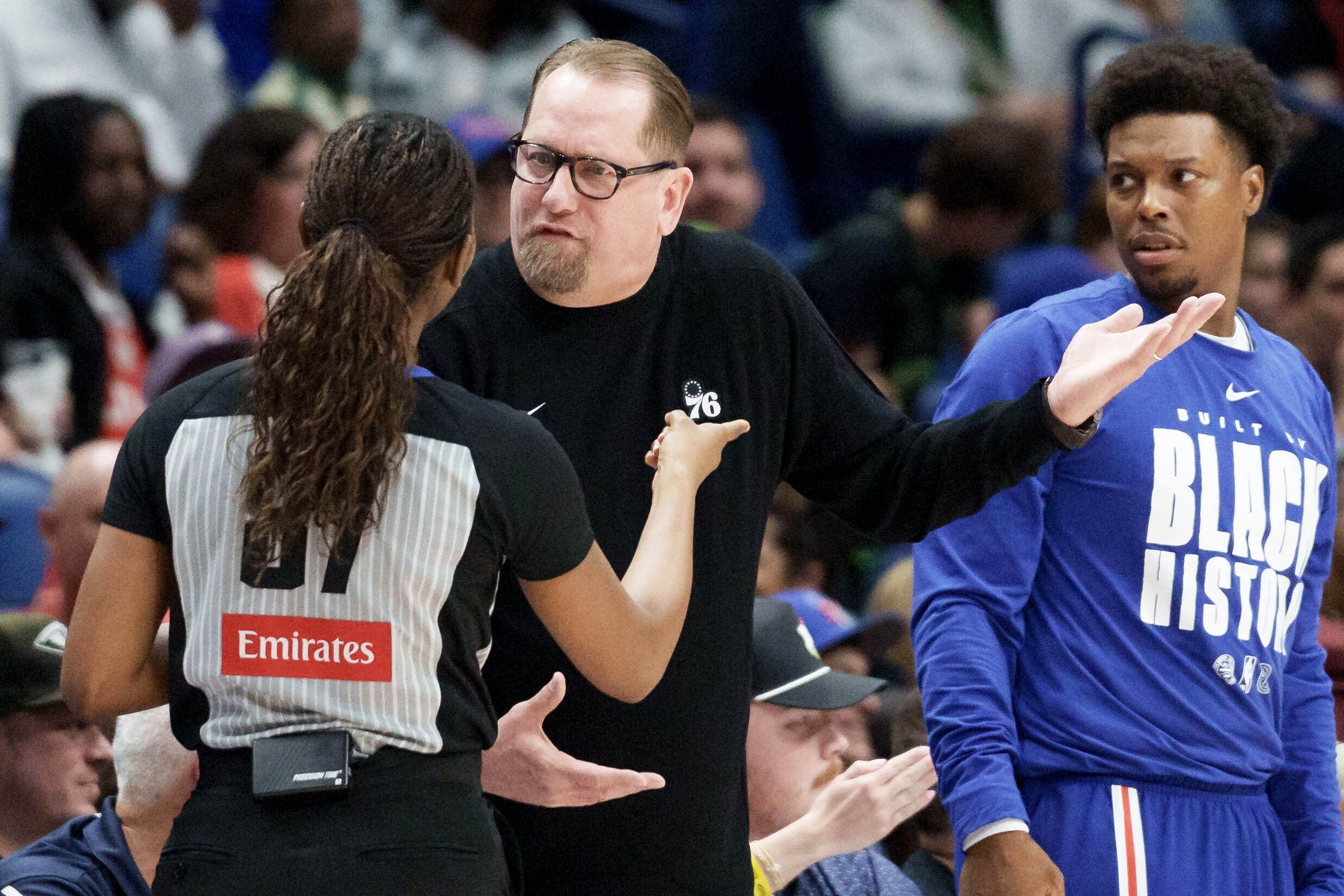
Sixers coach Nick Nurse talks to referee Danielle Scott during Saturday’s loss to the Pelicans.
The beauty (and curse) of the NBA schedule? The Sixers play again Sunday night at the Minnesota Timberwolves, before a Tuesday game against an Indiana Pacers team with the worst record in the Eastern Conference (15-42).
Oubre hopes that, for those matchups, his team plays mad.
“Now is the time to not make any more excuses,” he said. “ … It’s just do-or-die time. It’s time for us to muscle up, put our hard hats on, and actually learn how to win NBA games — and do it efficiently and consistently.”
Julius Erving will celebrate his 76th birthday on Sunday, just a few weeks after the 50th anniversary of the event that led to his milestone signing by the 76ers: the American Basketball Association’s Slam Dunk Contest. Erving’s victory in the five-man competition — held in Denver on Jan. 27, 1976, during the ABA’s final season, while he was starring for the New York Nets — marked his breakthrough into America’s sports and pop-culture consciousness.
In this excerpt from his book “Magic in the Air: The Myth, the Mystery, and the Soul of the Slam Dunk,” Inquirer columnist Mike Sielski details why the contest was so significant to Erving, to the Sixers, and to the evolution of professional basketball.
Julius “Dr. J” Erving celebrated his 76th birthday this week.
The people in charge of the ABA were under no illusions about the condition of their league as it entered its ninth season. Despite its star power — Connie Hawkins, George McGinnis, Erving, more — franchises were folding, or relocating then folding, every year. Two, the San Diego Sails and Utah Stars, went under during that 1975-76 season. Rather than committing to keep the league afloat, its top-drawing teams — the Nets, with Erving, and the Denver Nuggets, with their sky-walking star, David Thompson — were eyeballing the NBA, looking to bolt to a stabler, more lucrative situation.
To juice interest, and with less to lose with each passing day, the league’s decision-makers tried a new format for its midseason All-Star Game at McNichols Arena: The Nuggets, as the defending champions and the game’s hosts, would take on a squad of players picked from the ABA’s other six teams. That wasn’t all. The country-western singers Glen Campbell and Charlie Rich would perform before the game, and, at the suggestion of Jim Bukata, the league’s public-relations director, there would be a slam-dunk contest at halftime.
Five players, all of whom would already be in Denver for the game, would take part: Erving, Thompson, George Gervin, Artis Gilmore, and Larry Kenon. Including a non-All-Star in the contest would have required flying in a non-All-Star for the contest, and no one in the league was about to spend that extra money. Erving asked Kevin Loughery, the Nets’ head coach, if the contest ought to have a white participant, and in fact, the league invited the Nuggets’ Bobby Jones to compete. Jones declined. “I wanted to win the All-Star Game,” he told me. “I didn’t have the energy to do what those guys did.”
On Jan. 27, 1976, with 17,798 — the largest crowd in ABA history — on hand, with $1,200 in prize money at stake, the five competitors were briefed on the rules before commencing with the contest. Each of them could attempt up to five dunks in a two-minute span. One of the dunks had to be from a stationary position; one had to have the player start his move from the foul line, 10 feet away, or beyond. Two contestants would dunk on one basket and three would dunk on the other, the public-address announcer told everyone, “to take pressure off the rims and backboards.”
Based on “artistic ability, imagination, body flow, and fan response,” four judges would determine the winner. The panel: former Knicks star and Nuggets general manager Vince Boryla; Nuggets super-fan Alberta Worthington; high school standout LaVon Williams, who was “Mr. Basketball” in Colorado before heading off to the University of Kentucky; and Barry Fey, a former guard at Penn who, as a concert promoter, had set up the pregame festivities with Campbell and Rich.
Gilmore, the tallest competitor at 7-foot-2, appeared unsure of what to do, as if he hadn’t practiced or planned his dunks or was, for whatever reason, holding back. Gervin and Kenon were a little looser, but there was a mood of tentativeness in the arena until Thompson got the ball.
Fresh from a remarkable career at North Carolina State and in his rookie season with the Nuggets, he had been nervous throughout the days leading into the contest, so eager was he to live up to the home crowd’s expectations and hopes. His teammates had been pumping him up, encouraging him, letting him know which of his dunks they thought were his best. From the right side, he charged toward the hoop and hammered down a powerful right-handed slam. Working quickly, he ripped off a double-pump two-handed reverse and, from the left baseline, a 360-degree spin and jam, establishing himself as the man to beat.
But now, it was Erving’s turn. Standing directly under the basket, he dunked two balls at once — a nod, perhaps unconsciously, to his days at Roosevelt High School on Long Island, when he pulled off the trick as a teenager. Then he walked out to halfcourt, then back to the free-throw line, then back to the opposite free-throw line, counting and measuring his steps as he went.
Before the contest, he had made a $1,500 bet with Doug Moe, then an assistant coach with the Nuggets, that he could take off from the foul line and dunk during his descent. He paused, bent at the waist, then started, a slight stutter step, then a sprint into four floor-eating strides from the midcourt stripe to just inside the foul line, then … whoosh. Up.
“I’ve described Julius as more of a glider than a jumper,” Jones told me. “He was more of a long jumper.”
New York Nets forward Julius Erving, left, raises his arms as he is hugged by a teammate following the Nets victory over the Denver Nuggets at the Nassau Coliseum, Uniondale, N.Y., on May 7, 1976.
The crowd let out a communal Whoa. Erving lost the bet to Moe, but he didn’t need another dunk to win the contest. After a reverse from the right side, he swooped in from the left side, grabbing the rim with his left hand and windmilling the ball through the hoop with his right, then finishing with an “Iron Cross” dunk from the right baseline, spreading his arms and dunking the ball without looking at the basket. All the game’s players greeted him at halfcourt to congratulate him. The judges’ decision was a formality.
“It was something else,” Erving told me. “It’s still talked about today. I didn’t know it would have such a lasting effect on basketball history, and neither did any of the other players. I don’t think any of us really knew. We were the ABA, and we were crowd-pleasers. Yes, we made history, but the intention wasn’t making history.”
The All-Star Game — and, in turn, the dunk contest — was supposed to have been broadcast nationally but ended up being televised in just five markets: Denver, Indianapolis, Louisville, San Antonio, and St. Louis. Since the game didn’t end until after 2 a.m. Eastern time, the ripples from the contest didn’t start spreading immediately. Only after Good Morning, America and The Today Show featured Erving and Thompson did the magnitude of the event begin to reveal itself.
“Merger plans had long been in the works between the ABA and the NBA,” ESPN’s Eric Neel once wrote, “but the contest no doubt hastened them.”
Afterward, Erving said that he was unlikely to compete in another dunk contest ever again, that his knees were “75 percent of what they used to be.” (He did, in fact, compete in another: the NBA’s 1984 contest, where he finished second to the Phoenix Suns’ Larry Nance.) But he and the ABA had already ignited, or at least accelerated, an insurrection within pro basketball. The slam dunk was cool, and the ABA had embraced it, which made the ABA cool, which made the NBA seem stuffy and stiff in comparison, mostly because it didn’t have the athlete who, more than anyone, had made the slam dunk cool.
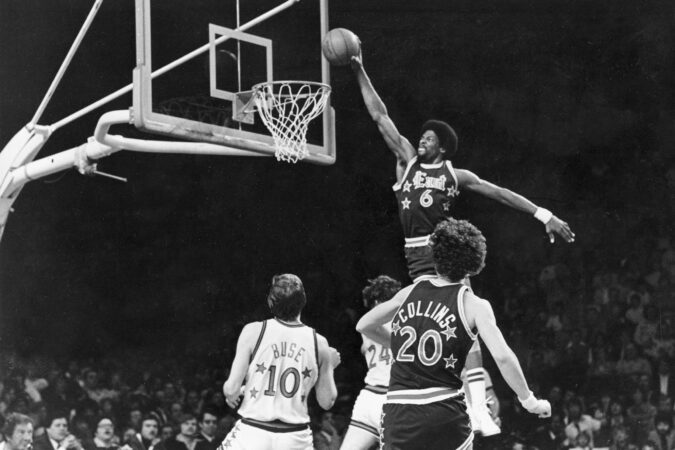
Julius Erving of the New York Nets, known as “Dr J,” scores during an ABA game at Nassau Coliseum, in Uniondale, N.Y., on Nov. 29, 1975.
In Philadelphia, 76ers general manager Pat Williams had watched those TV highlights of the contest.
“That,” he told me, “is what really put Julius on the stage.”
Erving never missed a game during his three-year career with the Nets, leading them to the league championship in 1974 and 1976, and was at times seemingly too good to be true. Long before San Antonio Spurs coach Gregg Popovich figured out that he could scream at his franchise centerpiece, Tim Duncan, and that Duncan would take the criticism without complaint, and that the other, lesser players would understand Popovich gave the team’s superstar no special dispensation, Kevin Loughery used the same psychological tactic with Erving. Doc messed up, even when he didn’t. Doc was no different, even if he was.
One night, Erving dunked over three defenders, and Loughery called a timeout for no reason other than to pull Erving aside and tell him, You just played the greatest three-minute stretch of basketball I’ve ever watched. Rod Thorn, an assistant under Loughery, had never seen a player catch and dunk an alley-oop pass with one hand until he saw Erving do it. The shame was that his exploits took place so often under the blanket of the ABA’s obscurity.
In Game 6 of the ‘76 ABA Finals, Erving scored 31 points, pulled down 19 rebounds, and blocked four shots as the Nets rallied from a 22-point deficit in the third quarter to beat the Denver Nuggets, 112-106, and win the series in six games. As they stormed the Nassau Coliseum court, Nets fans nearly trampled Nuggets’ play-by-play voice Al Albert, who climbed atop a table to escape. Albert lost his microphone and headset. The phone and cable lines he needed for his broadcast were cut. His television monitor crashed to the floor.
The chaotic scene was a bittersweet valedictory for The Doctor’s tenure: The passion and adoration that he would earn over his career in the NBA, with the Sixers, would manifest itself in that final game … and never again with the Nets. Attendance was low throughout the ABA. So was revenue. The franchises were too regional. The league was falling apart.
“Everybody thought we were in the hinterlands,” Bill Melchionni, a member of that ‘75-75 Nets team, told me. “We were minor-league.”
Four ABA teams merged with the NBA in June 1976. “I can say without a doubt,” broadcaster John Sterling, who was the Nets’ radio play-by-play voice at the time, once said, “that what finally convinced the NBA to merge was a chance to get Julius in the league.” Melchionni, who had become the Nets’ general manager immediately after that championship series, began fielding phone calls from civic leaders and chambers of commerce around the country, begging to have Erving and the Nets come to their cities to play exhibition games, offering as much as $50,000 as enticement.
“We were scheduled to play two games in Vegas,” Melchionni told me. “Guys would ask, ‘How many minutes is he going to play?’ And I’d say, ‘It’s an exhibition game. He’s not going to play 48 minutes.’”
The calls stopped, of course, after Wednesday, Oct. 20, 1976. The last day that Julius Erving belonged to the ABA. The first day that the NBA belonged to Julius Erving.