When they eventually install microcameras into the corneas of our eyes, we’ll still be watching this hockey highlight.
This was Kerri Strug vaulting on one leg in 1996. Bob Beamon shattering the long jump in Mexico City in 1968. Sid the Kid in 2010, only much, much cooler.
It was more than historic. It was iconic.
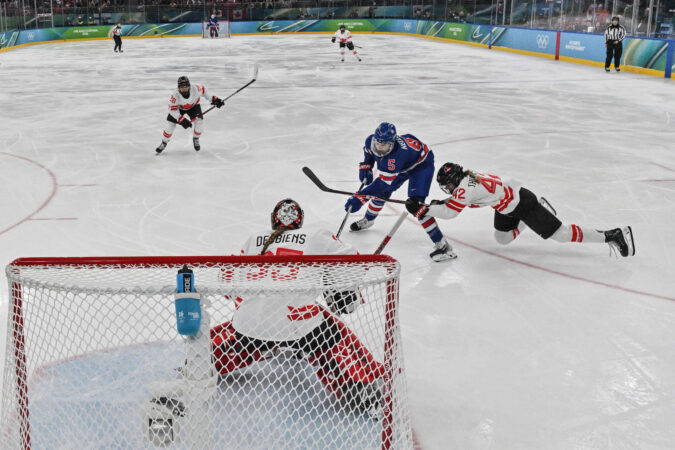
In overtime of the gold-medal game at the 2026 Winter Olympics, Team USA defenseman Megan Keller deked Canadian defender Claire Thompson and left her in the dust, flailing with her stick.
Keller then beat goalie Ann-Renée Desbiens with a backhand to the short side.
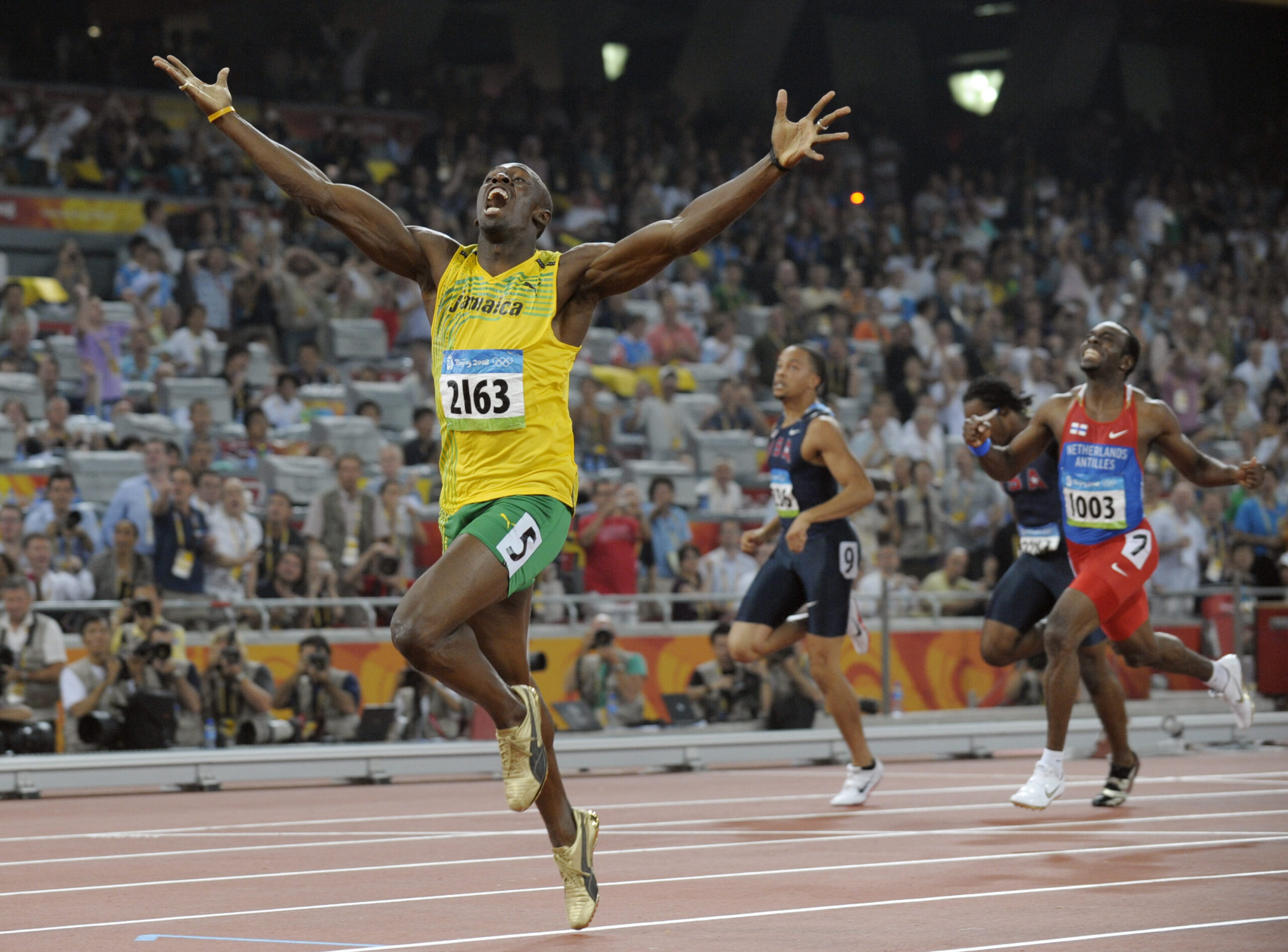
It’s hard to compare this Olympic moment with Romania’s Nadia Comăneci, who scored gymnastics’ first perfect 10 in 1976 at the age of 14. It’s not really the same as Usain “Lightning” Bolt, the Jamaican sprinter who broke Michael Johnson’s world record in the 200 meters in 2008 or Michael Phelps, who, at those same Beijing Games, swam his way to eight golds; their moments were parts of aggregations. And it certainly lacks the social significance of Black sprinter Jesse Owens, who won a then-record four golds in 1936 in front of host Adolf Hitler.
Jamaica’s Usain Bolt celebrates as he wins the men’s 200-meter final with a world record during the 2008 Beijing Olympics.
I was there for Bolt and Phelps. All of those moments took your breath away the way only great moments in sport leave you breathless.
None was quite as magical as Keller’s golden goal.
Sidney Crosby did something similar for Canada in 2010, and he did it against Team USA, and I was there for that, too. But Crosby’s goal was simpler: He carried the puck in, had a weak shot deflected away, got it back, went to the boards, passed to teammate Jarome Iginla, skated away from suddenly inattentive defenseman Brian Rafalski, got the pass back from Iginla, and snapped a shot past goaltender Ryan Miller.
Hockey legend Wayne Gretzky and film legend Donald Sutherland, both great Canadians, were sitting right behind me. They’d probably disagree with my assertion here.
Keller’s goal isn’t quite the same event as Team USA’s upset of the Soviets in 1980. That was a true underdog story, mostly U.S. college kids playing an elite set of professionals who’d won the last four golds. It might be the biggest upset in sports history — but it wasn’t an overtime game, or even a gold-medal game, and there was no defining, game-ending moment like Keller’s.
Pity poor Thompson, but not too much. She’d been a hero in China with 11 assists and two goals, an Olympic record for defensemen, when the Canadians won the gold in 2022.
There are plenty of caveats surrounding what should be the play of the year. None of them of Keller’s making.
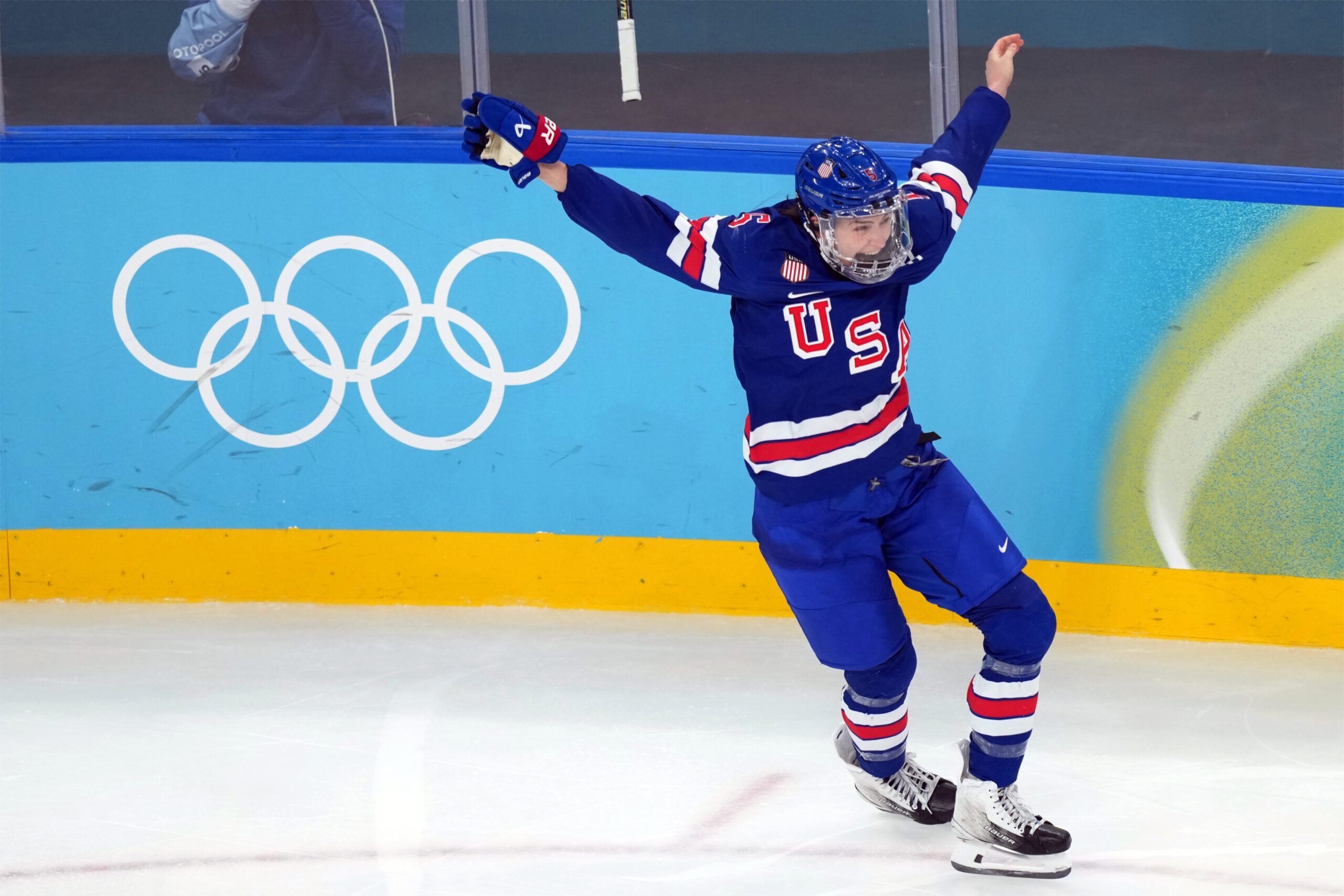
Megan Keller celebrates after scoring one of the best golden goals you will ever see in hockey.
Crosby scored his goal in a four-on-four setting, but overtime rules were changed ahead of the 2022 Olympics to make it three-on-three.
The teams in 2010 were more evenly matched, while the U.S. team in Milan, Italy, was heavily favored, having outscored opponents, 31-1, in a 6-0 run that included a 5-0 win over Canada in the preliminary round. However, Canada’s strategy and execution Thursday had the reigning champs holding onto a 1-0 lead before American captain Hilary Knight tied the game with 2 minutes, 4 seconds left in regulation.
Finally, no teams besides Canada (five) and the U.S. (three) have won a gold medal, and they have met in the gold-medal game seven of the eight times it has been played. To date, it is not a sport in which the field offers the titans much resistance.
This should not diminish the moment. Keller and her teammates can only beat opponents they meet.
This golden goal is one of the best plays you will ever see.
In fact, as a spontaneous athletic maneuver of incomparable audacity and breathtaking skill, seizing the biggest moment in a player’s life, I struggle to find its equal.
You never know how Jeffrey Lurie sees his team, but, after two Super Bowl trips and two post-Super Bowl disasters, it feels more than ever like there’s a one-year window in which Nick Sirianni and Jalen Hurts can save their jobs in Philadelphia.
Their chances got a lot better Thursday.
That’s when The Inquirer reported that right tackle Lane Johnson, arguably the greatest Eagle ever and inarguably the greatest Eagles offensive lineman, would return for a 14th season. The Birds are 110-57-1 with Johnson, 18-27 without. He’s the only Eagle on either offense or defense to start in both of their Super Bowl wins. Johnson considered retirement after missing the last seven games with a foot injury and after offensive line coach Jeff Stoutland resigned.
Thursday also was when both The Inquirer and former Eagles TV reporter Derrick Gunn reported that left guard Landon Dickerson, whose body has endured multiple injuries beginning in college, will return for a sixth season. Before this season, Dickerson was voted onto the three previous Pro Bowl teams.
Despite his frustrations with health issues Landon Dickerson is planning to return for the 2026 season … per source.
There has been a lot of noise since the Eagles’ season ended a month ago: A.J. Brown’s dissatisfaction; the firing of offensive coordinator Kevin Patullo; the tortuous pursuit of his replacement, who turned out to be little-known Sean Mannion; and the possibility of losing defensive coordinator Vic Fangio to retirement.
None of those issues mattered as much as the possible loss of Johnson and Dickerson.
Replacing either of them would have been difficult.
Replacing both would have been catastrophic.
That’s because Hurts has shown little capacity for success in the NFL unless he plays behind an elite offensive line. When the Eagles went to Super Bowls after the 2022 and 2024 seasons, the offensive lines were elite and stable. They were markedly less so in 2023 and 2025, seasons in which the Eagles lost their first playoff game.
Not coincidentally, Sirianni’s offenses have flourished when Johnson, Dickerson, & Co. have been healthy and wisely utilized, relying on a turnover-averse run-first attack.
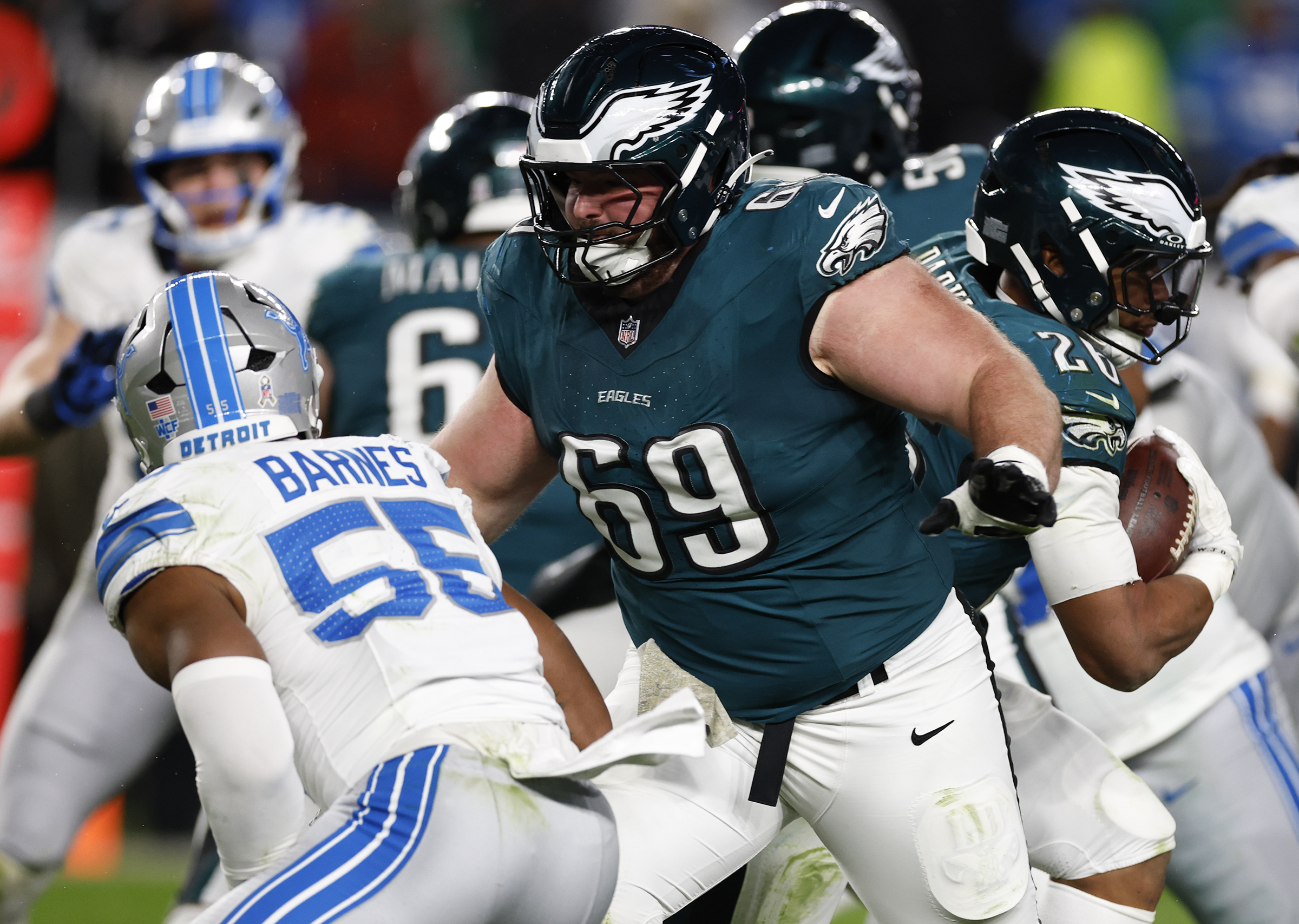
Eagles guard Landon Dickerson blocks Detroit Lions linebacker Derrick Barnes.
When healthy, Johnson and Dickerson, both athletic freaks, are voracious run-blockers.
An ancillary benefit of Johnson returning relates to the departure of Stoutland. “Stout” is the only offensive line coach Johnson has ever had in the NFL; for that matter, that’s true of every other Eagles starter.
But no other Eagles lineman has either the base of knowledge or capacity to impart that knowledge on teammates like Johnson. He founded and runs an annual offensive line offseason camp every summer in Texas called OL Masterminds.
Almost every lineman that has ever played with him testifies that Johnson has, at some point, acted as a sort of assistant coach when Stoutland or his offensive line assistants weren’t fully able to get their message across.
More than anything, Johnson brings a level of intensity and professionalism to every game and practice that few others in the NFL can match. It is why he is great, and that sort of greatness is contagious. Certainly, Dickerson has benefited.
So, their return not only could save the 2026 season, but it also could extend the Philadelphia shelf-life of both coach and quarterback.
Granted, there are contingents of fans and pundits who would rather that either one or both leave the employ of Lurie sooner than later, and so this development on the offensive line might not be met with unrestrained joy.
But one never should be thankless for news that is, on the whole, good for their own self-interests.
You have to start there. It is the independent variable. You have to define it in order to solve the rest of the equation. You can’t have an opinion on how the Eagles should proceed with their All-Pro wide receiver if you don’t first have an opinion on what they should do without him.
Feel free to take as much time as you need. Just make sure that you don’t dwell too long on the internal options. Right now, there aren’t any.
Aside from DeVonta Smith, the Eagles have exactly two pass-catchers under contract who had a target for them last season. Darius Cooper and Britain Covey combined for 11 catches on 112 yards. Other than that, your options are limited to 2024 sixth-round pick Johnny Wilson, who missed last season with a knee injury. The tight end room doesn’t even have anyone to turn on the lights.
So … what’s the plan?
The draft is not a serious option. Not where the Eagles are picking, at least. Last year’s draft yielded 11 wide receivers and tight ends who played at least 50% of their team’s snaps. Four of those players were selected before pick No. 23. Five others played for the Titans, Browns or Jets. Maybe they’ll be in a position to draft this year’s Emeka Egbuka (No. 19 to the Bucs in 2024). But they could just as easily end up with this year’s Matthew Golden (No. 23 to the Packers). The best way to get yourself in trouble on draft day is to try to solve this year’s problems.
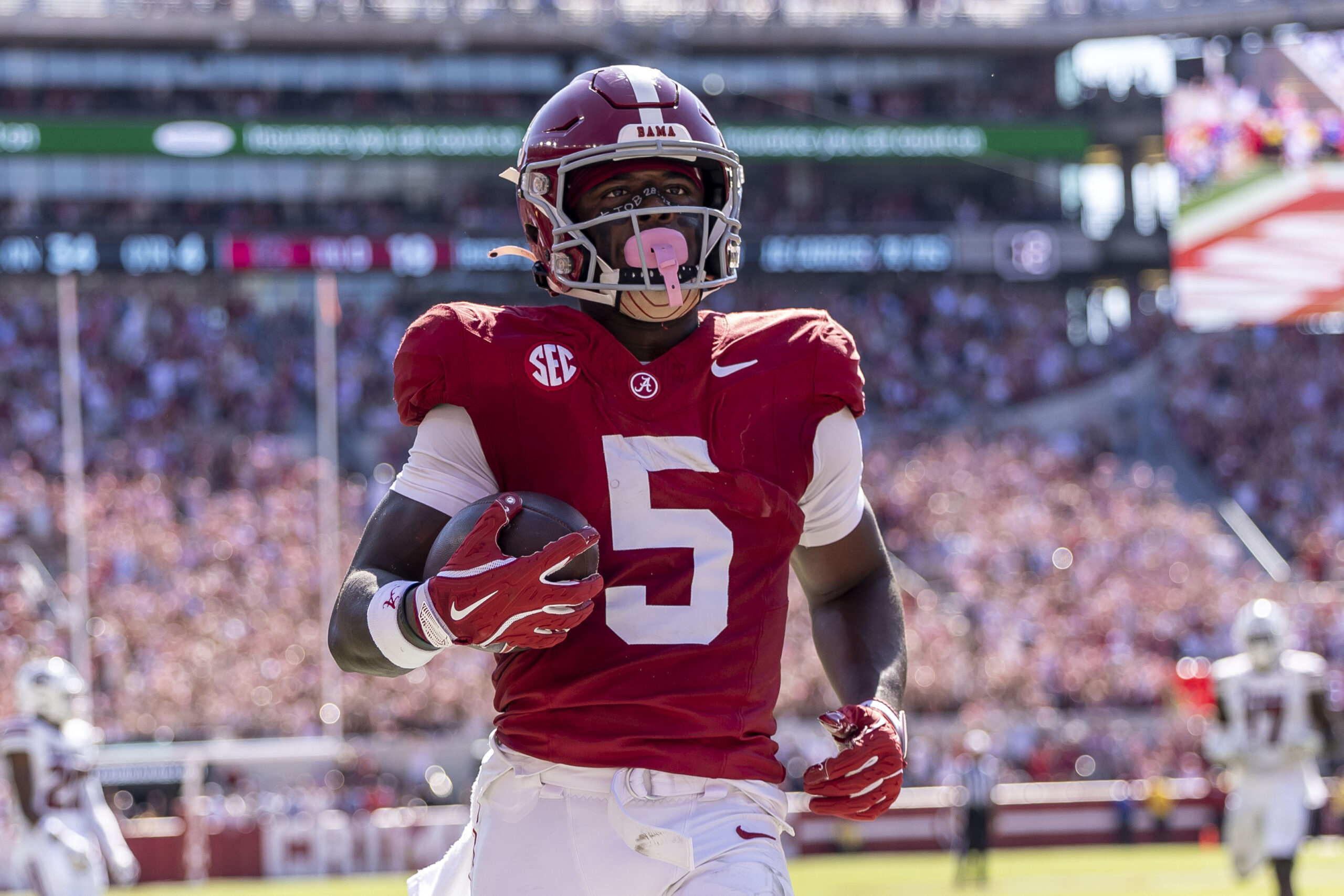
It isn’t outlandish to think Alabama wide receiver Germie Bernard might be capable of what Deebo Samuel did as a rookie when the 49ers drafted him in 2019.
That’s not to say they shouldn’t be looking. Nor that they won’t find some help. Alabama’s Germie Bernard would make a worthy target, even at No. 23. Whatever he measures at the combine, the game speed is there, as is the hybrid 6-foot-1, 204-pound frame. It isn’t outlandish to think he could do what Deebo Samuel did as a rookie after the 49ers drafted him at No. 36 overall in 2019: 57 catches, 802 yards, 14 carries, 159 yards. But to feel comfortable trading Brown, you need a lot more certainty than “isn’t outlandish.”
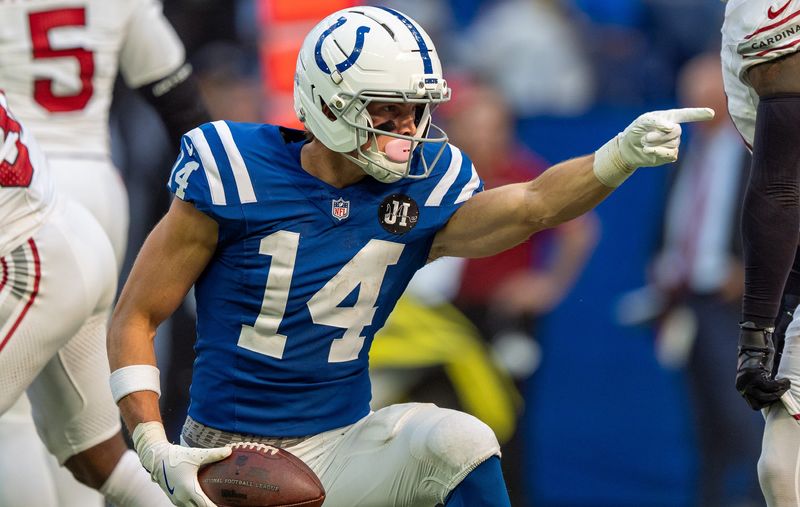
Free agents? Sure, let’s talk. Alec Pierce would be a no-brainer. At 25 years old, the Colts wideout caught 47 passes for 1,003 yards with Daniel Jones, Philip Rivers and Riley Leonard at quarterback. He isn’t anywhere close to Brown as a singular talent. Still, if you combine him with a draft pick like Bernard, he could be part of a radical and positive identity shift in both the short- and long-term.
Only one problem: The Eagles are one of 32 teams that can bid on free agents. A team like the Patriots can offer more cap room and a better quarterback and an acute need at the position. I’m skeptical the Eagles would win out.
The free agent crop is interesting even beyond Pierce and presumptive Cowboys franchisee George Pickens. Jauan Jennings and Mike Evans could replace some of Brown’s physicality in traffic and in 50/50 situations. Again, though, you have to wonder. Will players who have multiple options err on the side of a team with a run-heavy approach and Jalen Hurts at quarterback?
The conundrum is the same as it was three months ago, when the annual pre-trade-deadline nonsense reached its crescendo. The dream that the Eagles might part ways with their WR1 died in a head-first collision with reality. However disgruntled Brown was, however diminished his skills were, nobody else on the roster would have done enough in his stead to survive such a move. To suggest otherwise was to betray a fundamental misunderstanding of how this Eagles passing offense works. It would not have functioned without him.
Colts wide receiver Alec Pierce had his first 1,000-yard season with Daniel Jones, Philip Rivers, and Riley Leonard throwing to him.
True, the Eagles barely functioned with Brown. But that only matters if you think they should have given up on the season at the trade deadline. That’s what they would have been doing by trading Brown. Look at their track record without him. Brown missed four (meaningful) games in his first three seasons with the Eagles. The Eagles lost three of them, and they scored 15 points in the game that they won. In 2025, the Eagles scored 38 points against the Giants without Brown. They also threw the ball 20 times. Smith was the only wide receiver to catch more than one of them.
Plenty of NFL teams have managed to win without two WR1 types. But we’ve never seen Hurts have to do it. Right now, the Eagles don’t even have a WR2 who is better than replacement level. Keep in mind, the Eagles already have a hugely pressing need at tight end. They could need to spend big bucks to retain Jaelan Phillips, or to sign a replacement. In the draft, they will be hard-pressed to turn down an opportunity to add another offensive lineman to their feeder system.
The preponderance of the circumstances says the Eagles probably shouldn’t trade Brown. Life would be a lot easier if they didn’t need to. The onus is on the case for how they can do so and survive. If you can make one, I’m sure they’d love to hear it.
NBA commissioner Adam Silver last week fined the Utah Jazz $500,000 for tanking. He fined the Indiana Pacers $100,000 for doing the same.
The Jazz paid Lauri Markkanen more than $500,000 for each of the games in which he was benched to ensure losses. The Pacers paid Pascal Siakam more than five times their fine for sitting him on Feb. 3. The teams literally paid the players more than the fines to not play.The fines were nothing more than performative outrage. The fines were a joke.
The NBA is fast becoming a joke.
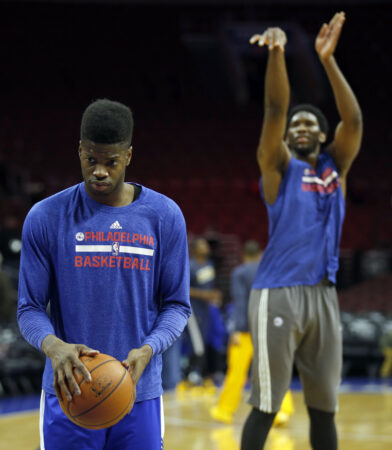
For years, the NBA has faced the existential threat of dwindling interest because its uninteresting product is infected with the simultaneous practices of tanking, losing on purpose to secure a better draft position; and load management, not playing available players to better ensure their availability in the postseason. The Sixers have been on the vanguard of both of these reprehensible movements; first, by instituting “The Process” 13 years ago, and then by coddling premier players like current centerpiece Joel Embiid.
Load management might never go away. After all, it kept Kawhi Leonard viable for the Raptors’ 2019 title run, and it’s keeping LeBron James viable at the age of 65, or however old he is (he’s now up to 41).
Tanking? That’s another story. The NBA could fix that in a hot minute if it wanted to. It is a blight on the sport, a fraud perpetrated on fans, media partners, and sponsors on a nightly basis, all brazenly executed, and with no real penalty.
It is a league descending into fringe status, one without a universally likable face this century besides, at its very beginning, Michael Jordan, and even he turned out to be kind of a jerk.
Silver said at his All-Star Game press conference Saturday, “There is talk about every possible remedy now to stop this behavior.”
There is a simple remedy to stop this behavior: Kick the cheaters out of the lottery and replace them with honestly mediocre teams.
This penalizes the egregious tankers, but still gives them a reasonable chance to improve despite their crimes against basketball. It rewards non-tankers who played just well enough to miss the lottery.
This is not the only solution.
One thought: Silver could fine teams even more. ESPN’s Kendrick Perkins suggested $5 million per infraction.
The problem: That’s still chump change. The Pacers owners have a combined net worth of about $16 billion; co-owner Steven Rales spends $5 million on biotech research and development every day.
"I wish Adam Silver would've fined them $5M for disrespecting the game of basketball. Let's stop being nice about it and throwing out the word 'tanking.' No, it's actually throwing games."
Another idea: The NBA could abolish the draft entirely. On Monday, David Aldridge of The Athletic wrote exhaustively about such a proposal.
The problems:
Teams that play in states without a state income tax, such Florida’s Heat and Magic and Texas’ Mavericks, Spurs, and Rockets, would have a significant financial advantage in attracting young talent. Similarly, big-market teams in Los Angeles and New York would attract big-endorsement players, whose endorsers would make it worth their while to be a Laker or a Knick.
Ask any 19-year-old kid if he’d rather stay warm with the Heat and make more after-tax money, play for the Clippers in the epicenter of hedonism, or spend six months in frigid, turgid Milwaukee?
The better solution:
If you get caught tanking in the manner of the Sixers from 2013-16, when they won a total of 47 games in three seasons, then you lose your place in the lottery. Your chance at the top-tier players of the best draft in eight years — gone.
In the NBA draft, the top 14 draft slots are lottery slots. That means teams with those picks have a chance for the No. 1 overall pick. Generally speaking, the worst teams have the best chances at the higher picks.
If a team is found guilty of tanking, they’re out of the lottery. They move to the 15th slot in the draft, and the 15th team moves into 14th and therefore into the lottery.
If a team has two lottery slots in the draft, their higher-slotted pick gets moved down.
If a team is found guilty of tanking twice in the same season, they move from 15th to last, or 30th, and the other 15 non-lottery teams move up one slot.
If a team has two lottery slots in the draft and is found guilty of tanking twice in the same season, that lottery slot is moved to 15th, which bumps their previous lottery slot from 15th to 16th, and it bumps the team with the original 16th slot into 14th, the team with the original 15th slot to 13th, etc.
It might sound complicated but it’s not. You violate the spirit of the process (delicious usage there), you lose your privilege. It’s not as draconian as it might be.
You still get to draft, and thereby get a little better.
Unless you’re an idiot and offend repeatedly, you still get to draft at a decent spot. Tyrese Maxey, Siakam, Jarrett Allen, and Jalen Brunson all were drafted 16th or lower.
Then again, so were Wade Baldwin, Justin Patton, and, of course, former Sixers prospect Zhaire Smith.
That should be enough to scare off any would-be tankers.
Inside a half-empty John E. Glaser Arena on La Salle’s campus Tuesday night, Robert Moore lounged at the end of the Constitution boys’ basketball team’s bench, head back, arms folded, legs crossed, as if he had resigned himself to being powerless to stop the blowout before him. He wasn’t. He could have. He hadn’t.
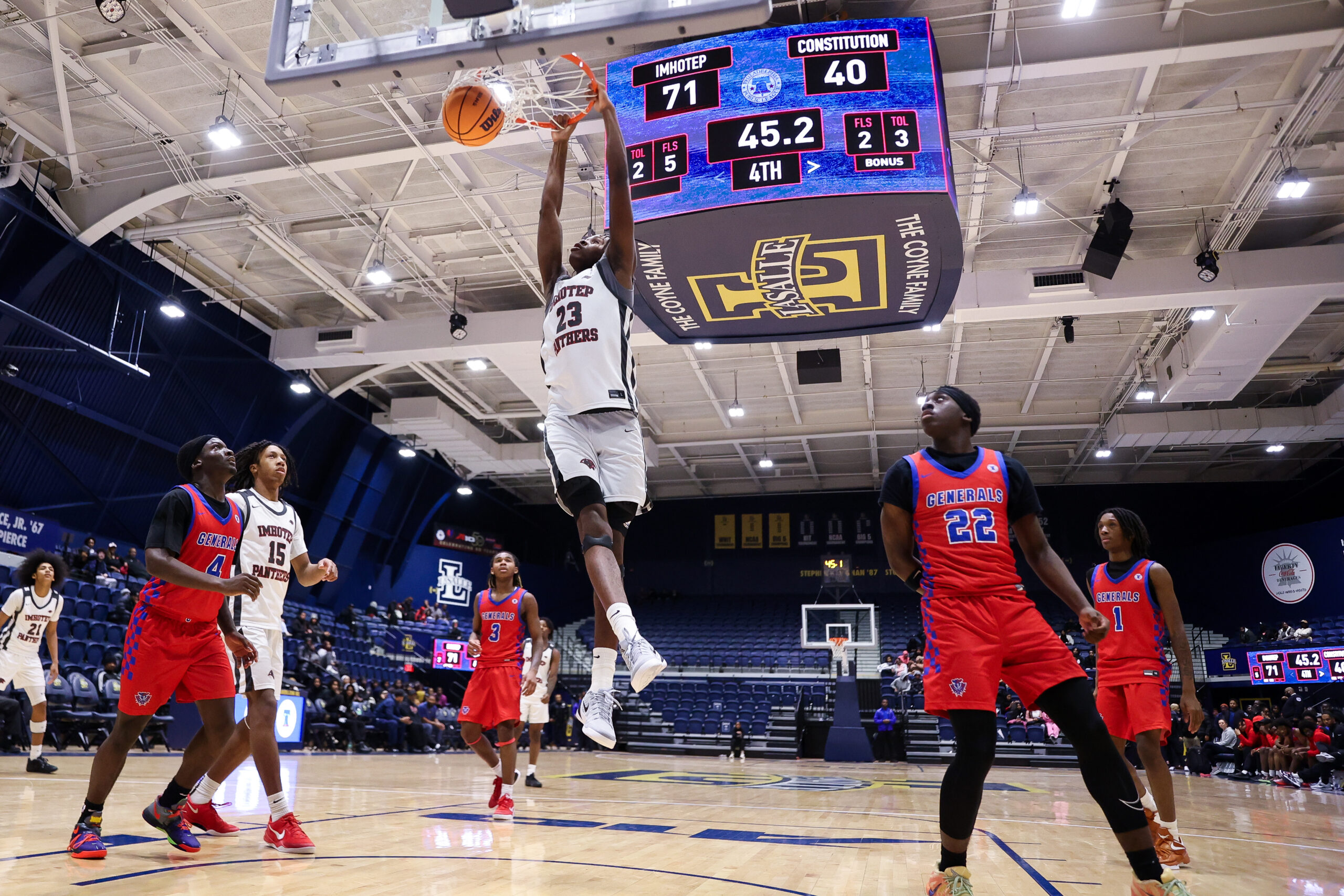
The second game of the Public League semifinals was a rout from the start, a 73-41 Imhotep Charter victory that was never close, was never in doubt, and never should have been played. Constitution was there only because its previous opponent, Carver Engineering & Science, had been forced to forfeit their quarterfinal matchup when an altercation marred the game’s final minutes. With his team down by 12 points, with 71 seconds left in regulation, a Constitution player had shoved an E&S player, sparking an on-court confrontation among athletes, coaches, and fans. E&S’s bench had emptied, which, according to Public League rules, disqualified E&S from the tournament, allowing Constitution to move on to face Imhotep.
From that ugly set of circumstances, Moore, his team, and Constitution’s administration received a gift that they never should have accepted. Constitution was on its way to losing in the quarterfinals until one of its players committed the act that ignited the chaos. And even if the Public League was following the letter of the law by confirming that E&S had to forfeit — “Constitution did the right thing,” league president Jimmy Lynch said, “by not entering the floor during the incident” — Moore and Constitution still could have done the honorable thing and declined to play in the semis, too.
It would have sent a powerful message to Constitution’s players, and to the league as a whole, that certain principles are more important than playing a game. It would have turned this fiasco into a teachable moment, a cautionary tale that Constitution’s kids hadn’t earned the right to compete against Imhotep, against the Public League’s dominant program. It would have been a better resolution than the scene Tuesday night at La Salle, where security and city police officers stood poised at the corners of the court and the public-address announcer admonished spectators to stay off the floor and let the referees do their jobs.
“We didn’t feel like it would be a great look for the league,” Moore said, “not having a team here to play in a semifinal game, [having] rented out an arena.”
Sorry, it would have been an admirable stand for the Public League and its leaders to take. And while Moore deserves credit for facing some questions about the incident and Constitution’s and the league’s courses of action, his explanations sounded more like excuses for the failure to make the difficult but correct decision here. The price of renting Glaser, for instance, was already a sunk cost. That money was gone one way or another, so why not use that second semifinal game as a stage to show everyone what class and responsibility look like?
“It’s really an administrative thing,” Moore said. “Honestly, after reviewing everything, we felt like the people who needed to be suspended were suspended.”
Imhotep defeated Constitution, 73-41, in the Public League boys’ basketball semifinal on Tuesday.
Yes, the Public League suspended two Constitution players for their roles in the melee, but that was the minimum discipline for an embarrassing situation that those young athletes had created and escalated. The incident happened last Thursday. By Friday afternoon, someone from Constitution, from the Public League, from District 12, or from the PIAA should have been on the phone, arranging a meeting, getting the right people in the same room or on a Zoom call to settle on a solution that didn’t let Constitution benefit from its own mistakes.
Instead, Moore called coaches around the league, starting with Imhotep’s Andre Noble: “I said, ‘What do you want?’ He said, ‘I want to play a game. … I kind of left it up to the kids as well.” Except this wasn’t Noble’s call to make, and it certainly wasn’t the kids’. Of course an opposing coach wouldn’t want an important postseason game canceled. Of course teenagers would want such an incident to be wiped away with few consequences. And of course, E&S’s parents and players have been lobbying for absolution and justice for themselves, as if anyone comes out of a mess like this with clean hands.
“To be fair, we’ve tried to take the high road, but we felt like we’ve been basically scapegoated as we were in the wrong with everything that happened,” Moore said. “In actuality, with all the facts the district had to deal with, it just wasn’t the case. …
“There were a lot of moving parts, and we evaluated everything when we looked at it. Obviously the district and the PIAA had all of this information, so what you’re getting is — and I completely understand — parents who are unhappy about the situation. I completely understand that.
“I’m a coach and an athletic director. I answer to a principal, who answers to an assistant superintendent. There are so many people above me.”
From Congress to college sports, through virtually every institution in American society, there’s a deep and desperate need for someone in a position of authority to be a genuine leader, to stand up and stand firm and say, This is who we’re expected to be. This is the right thing for those we’re supposed to serve. This is what we’re supposed to do, and this is how and why we’re going to do it. Yet here was another example where no one put the greater good and a larger lesson above appearances and self-interest. Here was another occasion where no one bothered to be an adult.
Moore and Constitution and the Public League had a chance, a real chance, to teach young people the value of accountability and the power of grace. They had an opportunity to be true educators, and they passed up that opportunity. They decided it was more important to play a game whose result was all but certain and would be quickly forgotten, and by the fourth quarter Tuesday night, Robert Moore was stretched out in his seat at the end of the bench, striking that posture that suggested he was content to have taken the easy way out. His team lost by 32 points. Hope it was worth it.
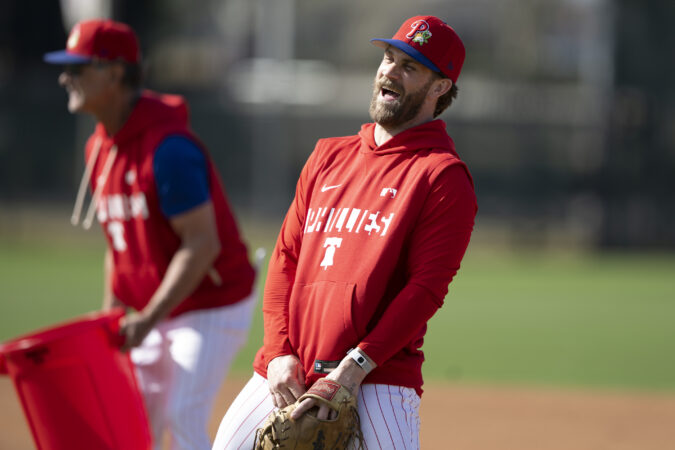
The best way to understand Bryce Harper is to think about all the things he can’t say.
He can’t say that Alec Bohm is a seven-hole hitter at best. He can’t say that Adolis García is much closer to Nick Castellanos than he is a legitimate four- or five-hole hitter. He can’t say that J.T. Realmuto isn’t the guy he was three years ago. He can’t say that he’d swing at fewer pitches out of the zone if he had more confidence that the guys behind him would get the job done.
Given all of those things, Harper also can’t say that Dave Dombrowski has not been an elite personnel boss for at least a couple of years. He can’t say that Dombrowski’s lack of eliteness is chiefly to blame for the Phillies’ run-scoring struggles. Harper can’t say that he was much closer to the hitter the Phillies needed in 2025 than Dombrowski was to being the roster-constructor they needed.
To throw shade at Dombrowski would be to implicitly throw shade at teammates whose “underperformance” is mostly a function of Dombrowski needing them to be something they aren’t.
Harper could have gone deeper. He could have said that the Phillies lost to the Dodgers last season because Dombrowski cobbled together a playoff roster that didn’t allow Rob Thomson to pinch-run for Castellanos. He could have said that the Phillies have finished the last three seasons one reliever short. That they lost to the Diamondbacks in 2023 because Gregory Soto, Craig Kimbrel, and Orion Kerkering were pitching in roles where the Phillies should have had a prime high-leverage arm.
Harper could have pointed to Austin Hays, to Whit Merrifield, to Max Kepler, to David Robertson. He could have asked why he, or we, should have any faith in the decisions to sign García or trade away Matt Strahm when those decisions were made by the same man who made all the previous ones.
But Harper didn’t say those things. He couldn’t say those things. Instead, he said things that could lead one to conclude that he is a little too sensitive, a little too close to the prima donna archetype, a man in possession of emotions triggered by even the faintest whiff of criticism.
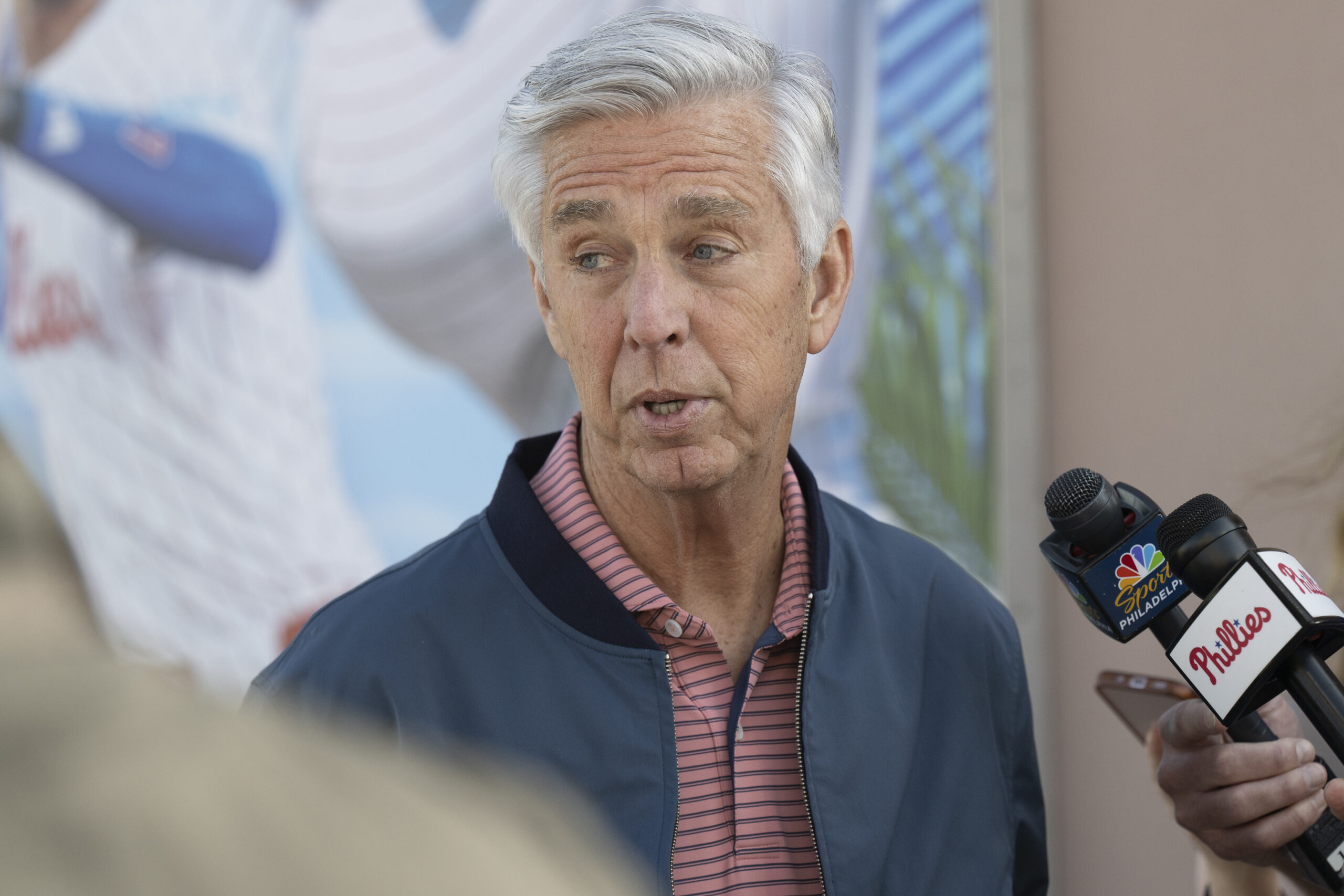
Phillies president of baseball operations Dave Dombrowski at BayCare Ballpark last week.
When Dombrowski raised the question of whether Harper would ever be the elite player he’d once been, Harper could have raised a question of his own:
Who are you to talk, suit?
Instead, he said things like this:
“It was kind of wild, the whole situation,” Harper said Sunday when he arrived at spring training. “I think the big thing for me was, when we first met with this organization, it was, ‘Hey, we’re always going to keep things in-house, and we expect you to do the same thing.’ When that didn’t happen, it kind of took me for a run a little bit. I don’t know. It’s part of it, I guess. It’s kind of a wild situation, you know, that even happening.”
It only makes sense in conjunction with the other things we heard from Harper and his camp. In October, in an interview with MLB.com, agent Scott Boras pointed to the number of pitches Harper saw in the zone (43%, fewest out of 532 qualifying players). On Sunday, Harper riffed on that theme, pointing out the paltry production the Phillies got out of the lineup spot directly behind his usual place in the three-hole.
Look at last season’s Mount Rushmore of hitters and you’ll see the source of Harper’s frustration.
One of the common bonds for Aaron Judge, Shohei Ohtani, and Cal Raleigh was the talent that followed them in the batting order.
Hitting behind Judge were Cody Bellinger, Ben Rice, Jazz Chisholm, and Giancarlo Stanton. Each of those players finished the season with at least 24 home runs and an .813 OPS.
Ohtani’s supporting cast needs no introduction. Mookie Betts and Freddie Freeman are both former MVPs. Will Smith has been an All-Star in three straight seasons.
Raleigh was most often followed directly by Julio Rodriguez, Josh Naylor, Eugenio Suárez, and Jorge Polanco. Three of those players finished 2025 with at least 26 home runs.
Each of those three superstars — the three leading vote-getters on AL and NL MVP ballots — were followed in the batting order by at least three players who finished the season with at least 20 home runs. Compare that to Harper, who usually had two players behind him with more than 12 home runs, neither of whom is on the roster this season (Kepler 18, Castellanos 17).
If anything, Harper was underselling the situation when he met with the media Sunday in Clearwater. The two-time MVP limited his focus to the Phillies’ struggles in the cleanup spot, where they ranked 20th in the majors in OPS last season.
“I think the four spot has a huge impact,” Harper said. “I think the numbers in the four spot weren’t very good last year for our whole team. I think whoever’s in that four spot is going to have a big job to do, depending on who’s hitting three or who’s hitting two.”
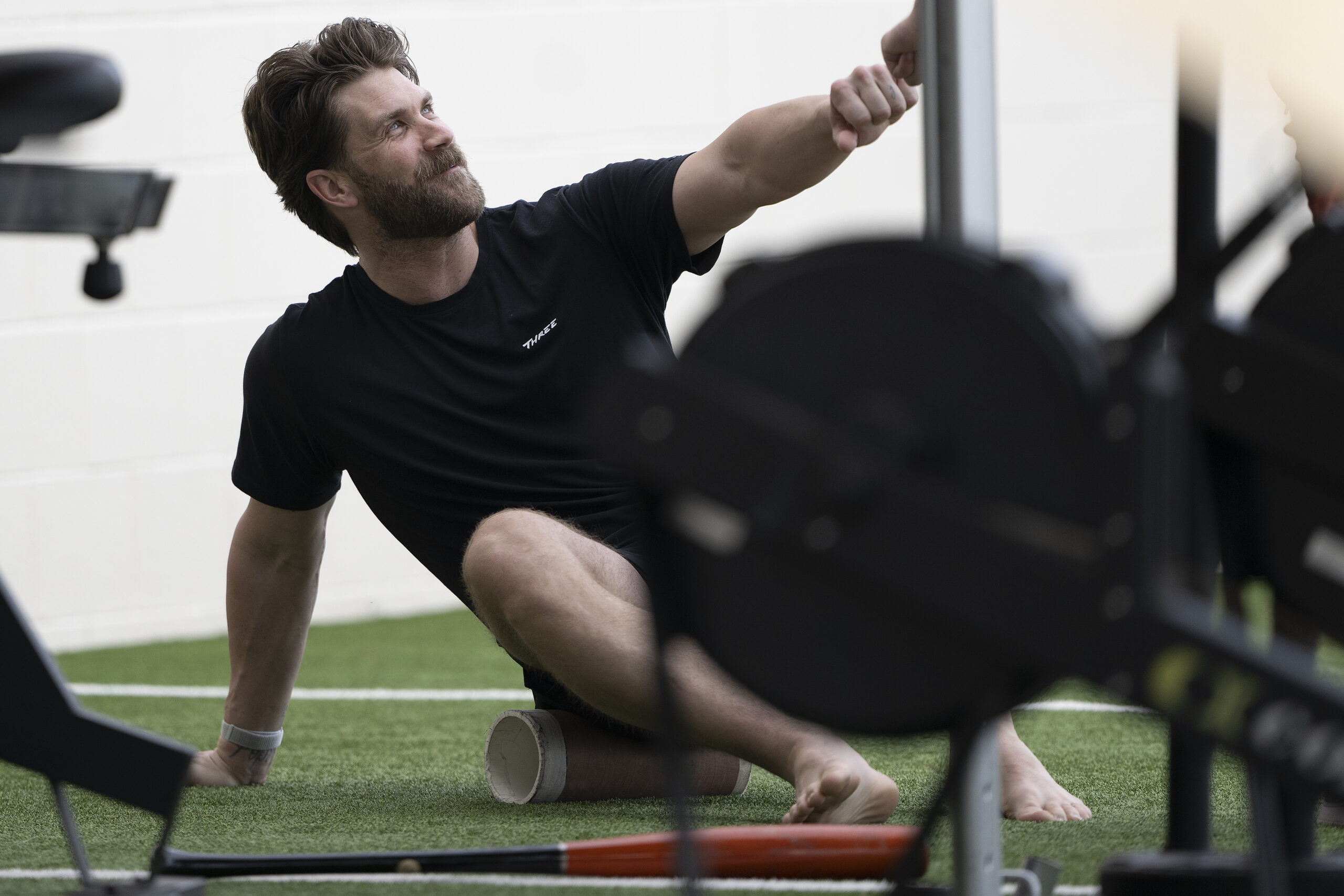
Bryce Harper fist-bumps Phillies teammates Sunday ahead of the team’s workout in Clearwater, Fla.
But the issues behind Harper — and/or Kyle Schwarber, depending on the configuration — are deeper than the next-man-up. As we saw last season, pitchers are more than willing to pitch around two hitters when those hitters are Harper and Schwarber, especially when the guys behind them allow for an extended period of exhalation. Lineup protection is a cumulative thing.
We saw that in 2022, didn’t we? A big reason the Phillies thrived with Schwarber leading off and Harper batting third was the presence of Rhys Hoskins (30 homers, .794 OPS) and Realmuto (22 homers, .820 OPS) behind them. Even in 2023, they had some combination of Castellanos (29 homers, .788 OPS), Realmuto (20 homers, .762 OPS), and Bohm (10 homers, .765 OPS).
Boras and Harper have zeroed in on the number of pitches he sees out of the zone. It’s part of the story, no doubt. Over the last three seasons, he has seen a lower percentage of pitches in the zone than any previous three-year stretch of his career. When he was NL MVP in 2021, he saw a career-high 46.7% of pitches in the zone.
At the same time, Harper was pretty darn good in 2023, when he saw 41.2% of pitches in the zone, the second-lowest of his career, according to FanGraphs. Just as important is what Harper chooses to do with the pitches he sees.
Last year, his chase rate was 36%. In 2021, it was 25.5%. But he wasn’t necessarily chasing more pitches. His swing percentage on pitches in the zone was 78.3%, up from 72.1% in 2021.
Protection is a mindset as much as it is an externality. The more protected a hitter feels, the more comfortable he is waiting for his pitch rather than trying to do too much. Pitchers won’t necessarily approach Harper differently if they feel more danger from the hitters behind him. But Harper will absolutely feel more comfortable taking whatever pitchers give him.
The Phillies acknowledged as much with their openness about their failed pursuit of Bo Bichette. Dombrowski knows what the Phillies need. They need what they had in 2021 and 2022 in prime Hoskins and prime Realmuto (and company).
They will need to get lucky to have it this season. Their decision-making will need to be filtered through this context. Aidan Miller, Justin Crawford, the trade deadline. Bohm and García will get the first chances. Dombrowski’s future as the bossman will be determined by how they perform, and then by what happens if they don’t.
In 2014, after one season as the Eagles’ head coach, Chip Kelly decided he’d had enough of DeSean Jackson, who’d been kind of a headache. Jeffrey Lurie had given Kelly power over the roster, and Kelly cut Jackson.
Jackson proceeded to lead the NFL in yards per catch in three of the next five seasons, two of which were 1,000-yard seasons. The Eagles would have just one 1,000-yard wide receiver in the next eight seasons (2014-21). They later had two in the same year, 2022, and the No. 1 receiver was A.J. Brown.
Today, 12 years after Kelly’s first foolish move — he also traded running back LeSean McCoy and he drafted disappointing receivers Nelson Agholor and Jordan Matthews — the Eagles again have a high-production receiver who’s been kind of a headache. NFL sources say they Eagles are considering trading him, even though such a trade would carry severe salary-cap ramifications; about $16 million, minimum.
That receiver is A.J. Brown.
Trading him would be crazy.
The Eagles should not even entertain offers for Brown. He is 28. He is driven. He is dedicated. He is irreplaceable. He’s spent the last four years making quarterback Jalen Hurts look good. That’s got to count for something.
Sure, he’s a diva, but then, he’s always been a diva. He was a diva when they traded for him four years ago. Brown immediately hung an “Always Open” sign above his locker. Huge diva move.
He has, at times, looked exasperated on the field. He has argued with coach Nick Sirianni on the sideline. For the last two seasons he’s continually criticized the offense both in person and on social media. The Eagles let him get away with it because they knew he’d still play well. They also let him get away with it because they knew, when they made the trade, and when they extended his contract twice, that he was likely to act like this.
Think about it: If you let your kid throw tantrums on the floor of the grocery store for three years, you can’t expect him to stop throwing tantrums when he’s 4. You just hope the tantrums aren’t so bad you can’t keep shopping.
Could this behavior be a distraction? On most teams, yes. But nobody in the Eagles locker room pays much attention to Brown’s antics.
“There is a genuine appreciation for A.J,” Jason Kelce said Wednesday on 94 WIP.
Kelce has been retired for two seasons, but he remains well-connected to his former coaches and teammates. On Wednesday, Kelce also noted that Brown’s frustrations might be limiting the receiver’s effectiveness. Kelce certainly would know. In his final season, Kelce, himself an emotional player, counseled Brown on harnessing frustration.
Both Kelce and Brown’s current teammates know Brown for who he is. They also know the Eagles cannot afford the luxury of sudden sanctimony.
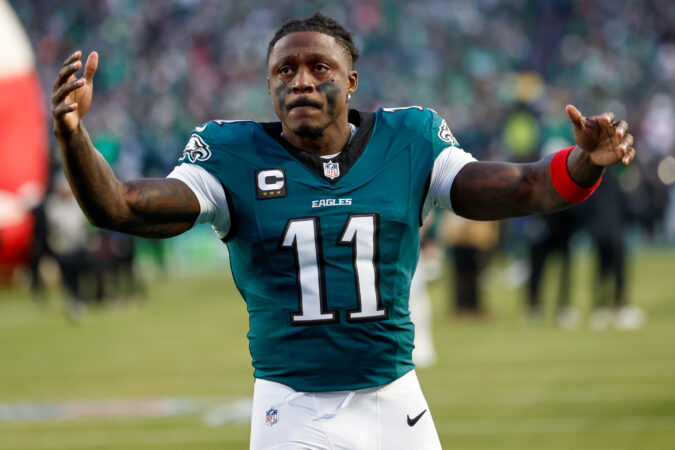
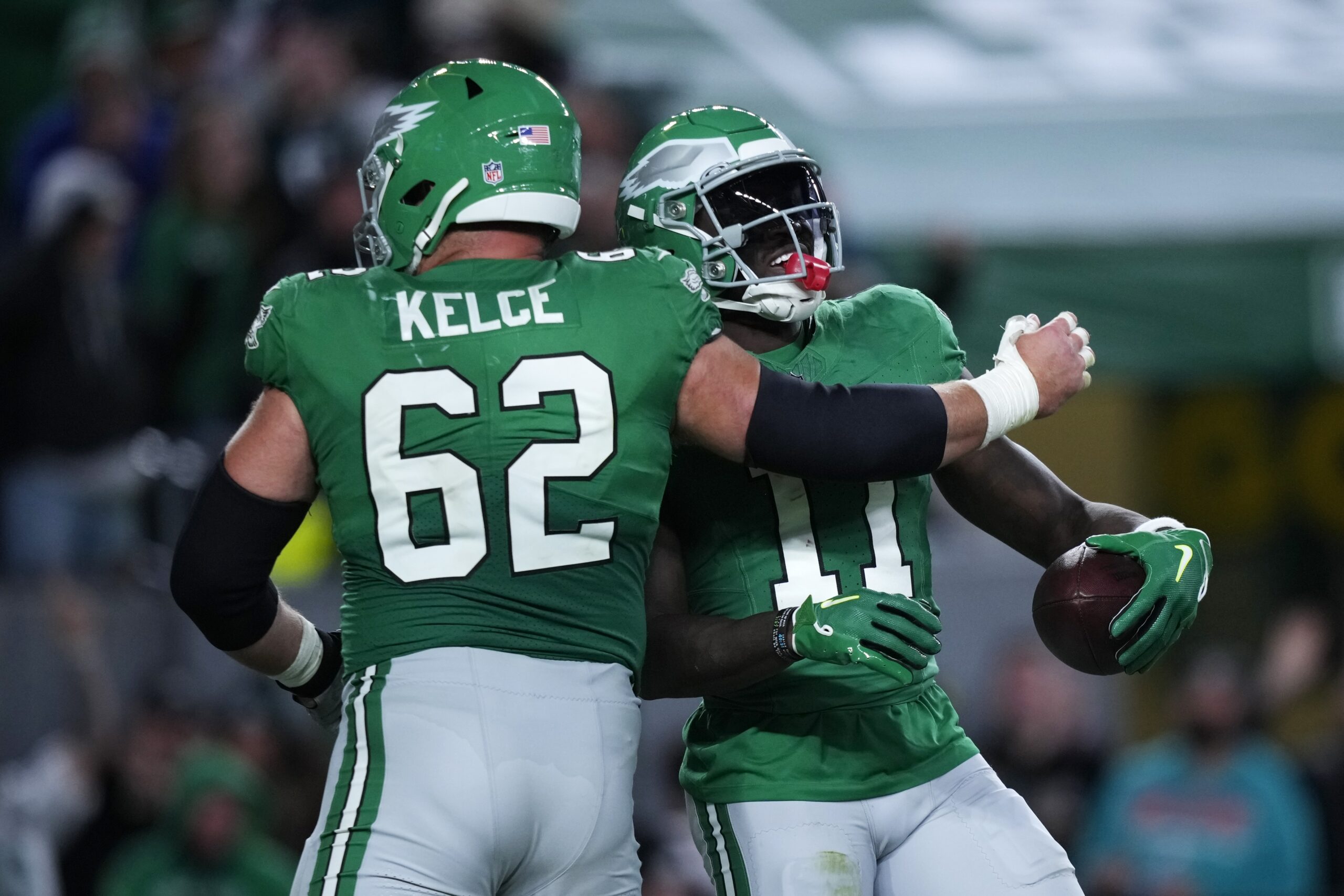
Eagles wide receiver A.J. Brown (11) celebrates a touchdown with center Jason Kelce during the 2023 season.
But does he really want to be here?
Brown hinted during the season that he might want to leave Philadelphia, posting the Bible verse Mark 6:11 after Week 4 on X: “If you’re not welcomed, not listened to, quietly withdraw. Don’t make a scene. Shrug your shoulders and be on your way.”
He then ignored the media for the season’s final two months. When he departed the locker room after the Eagles’ home playoff loss to the 49ers, he hugged several teammates in scenes that looked like permanent goodbyes.
However, last week, Brown broke his media silence on Micah Parsons’ podcast, apparently to send the message that he’d be happy to return to the Eagles.
“As an offense, we just come back and just really watch the tape and rediscover ourselves,” Brown said.
Asked if he was excited about new offensive coordinator Sean Mannion, he replied, “I’m excited for the season. I’m excited for what’s to come.”
In the bigger picture, it’s less important whether Brown wants to return than whether the Eagles can win another championship without him.
They cannot.
The Eagles have a shrinking window in which to reach another Super Bowl without a significant rebuild. They went to two of the last four Super Bowls. Get rid of Brown, and you can forget reaching a third any time soon.
He just had a 1,000-yard season in only 15 games, and that was his worst season in Philly. In 2024 he had a 1,000-yard season and played in just 13 games. He gave up on a few routes this season, and he disappeared in the wild-card playoff loss, but even when he’s bad, he’s good.
He’s gained 5,034 receiving yards on 339 catches in four seasons. That’s 387 more yards and 76 more catches than Mike Quick’s best four seasons, 986 yards and 104 catches than Harold Carmichael’s best four seasons, and 1,097 yards and 131 catches more than Tommy McDonald’s best four seasons as an Eagle. They played in different eras, especially McDonald, but if you think A.J. Brown wouldn’t have dominated in the 1950s and ’60s, then you need to YouTube some NFL Films.
Why would you trade the best receiver in team history if he’s still in his prime?
Which opens another discussion: Is Brown still in his prime?
If you look at simple stats, then probably yes. If you look at some advanced metrics, you might think his moon is waning.
For instance, Brown’s average separation last season, according to NFL Next Gen Stats, was 2.2 yards, eighth-lowest among qualified receivers. It also was an improvement; his 2.1 average in 2024 was third-lowest. But does it matter? After all, when he went to the Pro Bowl in 2022 and 2023 his separation averages were 2.6 and 2.4 yards, respectively.
Brown still consistently draws coverage from the other team’s best cornerback. He still consistently draws double teams. Last season, Pro Football Focus ranked him 11th in all-around play among receivers with at least 60 targets. He was No. 2 in drop rate.
That’s not to say he couldn’t have played better, but then, the wide receiver position is more dependent on the rest of the team than any other position.
The Eagles passing offense has averaged fewer than 195 yards per game each of the last two seasons, which seems absurd considering the weapons at Hurts’ disposal, but nobody in their right mind would consider this issue to fall at the feet of Brown, nor DeVonta Smith, nor Dallas Goedert.
In 2024, with defenses having discovered Hurts’ shortcomings and challenged Hurts’ arm, veteran offensive coordinator Kellen Moore leaned on running back Saquon Barkley and a historically dominant offensive line. That’s how the Eagles won the Super Bowl.
In 2025, opposing defenses sold out to stop Barkley, which worked, since the line had deteriorated due to age and injury. Challenged again, and with a first-time coordinator in Kevin Patullo, Hurts failed.
Not Brown. Hurts.
Let’s be real, folks.
You’re talking about trading the wrong damned guy.
This is a make-or-break season for the Phillies, so they aren’t taking any chances with any clubhouse cancers.
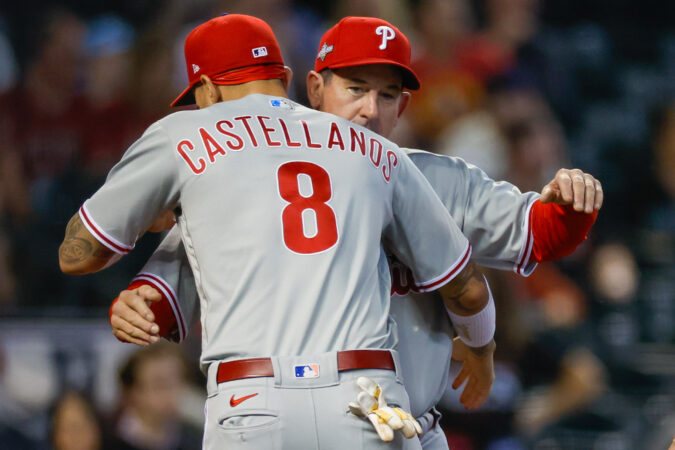
A fading talent who will be 34 in less than a month, malcontent right fielder Nick Castellanos was released by the club on Thursday afternoon. That was one day after pitchers and catchers officially reported and four days before full-squad workouts begin, but position players typically trickle in a day or two early.
The Phillies didn’t want Castellanos showing up. Not after the crap he pulled last season, when he put his desires above the team. And not after the crap he pulled Thursday. In fact, nobody might want Castellanos after his latest stunt.
It will cost the Phillis the last $20 million on the five-year, $100 million contract that he has never played up to. Twenty mil is a bargain to remove a player like this.
Their decision to release Castellanos immediately gained merit. Upon his release, Castellanos posted on Instagram a page-and-a-half screed scrawled on loose-leaf notebook paper explaining the notorious incident in Miami last season that betrayed his selfishness, insubordination, and disrespect for the game.
It was a manifesto that would have made Sam Hinkie proud.
The details of the incident had been shrouded in mystery. The Phillies said only that Castellanos had been insubordinate to Phillies manager Rob Thomson. Castellanos refused to provide details. As it turns out, according to his post, Castellanos actually brought a beer from the clubhouse to the bench, and then began berating his manager in front of the team.
He should have been released that night.
To review:
On June 16 in Miami, Thomson replaced Castellanos in right field for a defensive replacement. Castellanos is rated by Baseball Savant as the second-worst outfielder in the majors since he arrived with the Phillies in 2022.
Amid all of the bizarre aspects of the Castellanos situation, that Castellanos took offense to being replaced — a move that clearly benefited the team — is the most appalling aspect. Every star on the Phillies roster has sacrificed preferences at some point.
Castellanos is a Florida native. He had friends and family in the ballpark that night. He was embarrassed. So, after he left the game, he went to the dugout, got a bottle of Presidenté, and went back to the dugout to insult his boss.
“I then sat right next to Rob and let him know that too much slack in some areas and to [sic] tight of restrictions in others are not condusive [sic] to us winning,” Castellanos wrote Thursday.
You know what’s conducive to winning?
Getting Nick Castellanos out of right field every chance you get.
Castellanos wrote that, after the game, he, Thomson, and president of baseball operations Dave Dombrowski “[a]ired out our differences” in Thomson’s office and he apologized. Castellanos was benched for the next night’s game as punishment. He wrote that the team told him not to divulge the details of the incident.
He also wrote that his confession Thursday was spurred not by any heartfelt impulse to make things right, but rather by pure, unadulterated self-preservation; as usual, Nick’s looking out for Nick. Castellanos wrote that he was preempting a story about the incident being written “without my consent or comment.”
What’s going on in that mind of his? The media have sought his comment for months. The media do not need his consent to write about him.
At any rate, to Thomson’s discredit, Castellanos got his way.
Thomson never again pulled Castellanos for defensive purposes. By the end of the season, Castellanos was playing so poorly that he’d been reduced to a platoon role with Max Kepler.
With Castellanos clearly poised to exit the team one way or another, Thomson was asked at the end of the season if he would have issues managing Castellanos again. Thomson said he would not have a problem.
Castellanos clearly did have a problem with Thomson.
As part of the Instagram post, Castellanos included a similar, separate goodbye message for the fans, his teammates, principal owner John Middleton, Dombrowski, and most Phillies personnel. He singled out outfield coach Paco Figueroa, who has spent endless hours working on Castellanos’ defense the past 3½ seasons (after Castellanos conceded that he wasn’t always engaged when playing outfield). To his credit, Castellanos, a converted infielder who is leaden-legged and devoid of outfield instinct, worked hard to improve as a fielder.
Notably, though, Castellanos clearly made it a point to exclude Thomson in his thanks.
That “apology” on June 16 certainly was not heartfelt.
We’re not naive here. If Castellanos had earned his money at the plate, he’d still be a Phillie. If he’d hit .300 with 30 homers every year, he could’ve brought a keg into the dugout and done keg-stands. “Topper” would’ve held his feet.
However, Castellanos hit just 82 home runs in the next four seasons, which tied for 60th among all players. His OPS of .732 ranked 130th, three points lower than former Phillies prospect Mickey Moniak.
It will be interesting to see how other teams view Castellanos as a player and a person. Despite his oddities and antics, he remained a popular character in the Phillies’ clubhouse. He has a big personality, he works hard, he is kind, and he is a devoted father.
There’s plenty of tread left on his tires. He’ll find a home with some team as a right-handed designated hitter. But he’ll be a DH with baggage.
There is no Philadelphia sports figure without blemish.
The Phillies’ hitters failed again, and Zack Wheeler is hurt. The Eagles collapsed en masse after winning their second Super Bowl; even Saquon Barkley took hits before and during the season. The Flyers remain mired in a rebuild. And no team has engendered as much disappointment, if not disgust, as the Sixers over the past 14 years.
With one exception.
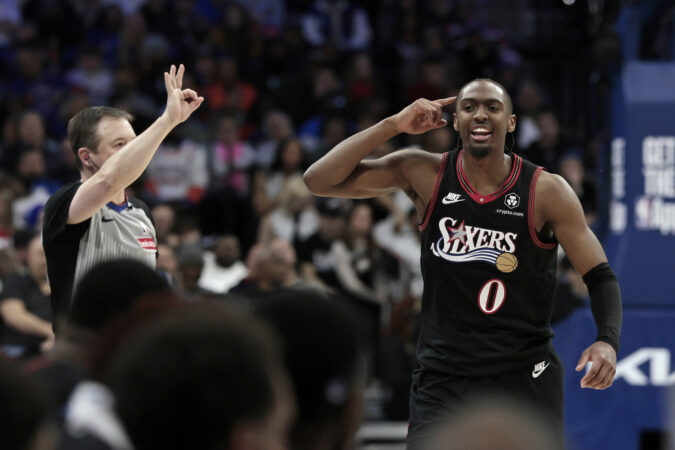
Tyrese Maxey.
With his incandescent smile, his irrepressible joy, his boundless energy, and what has turned into a sterling set of skills and talents, Maxey is a beacon among the blurred and foggy landscape of Philadelphia sports.
Everybody loves Maxey. He’s the breath of fresh air Philly sports needed. He’s never worried about the score of the game. You never see him dog it. He’s Pete Rose with a jump shot.
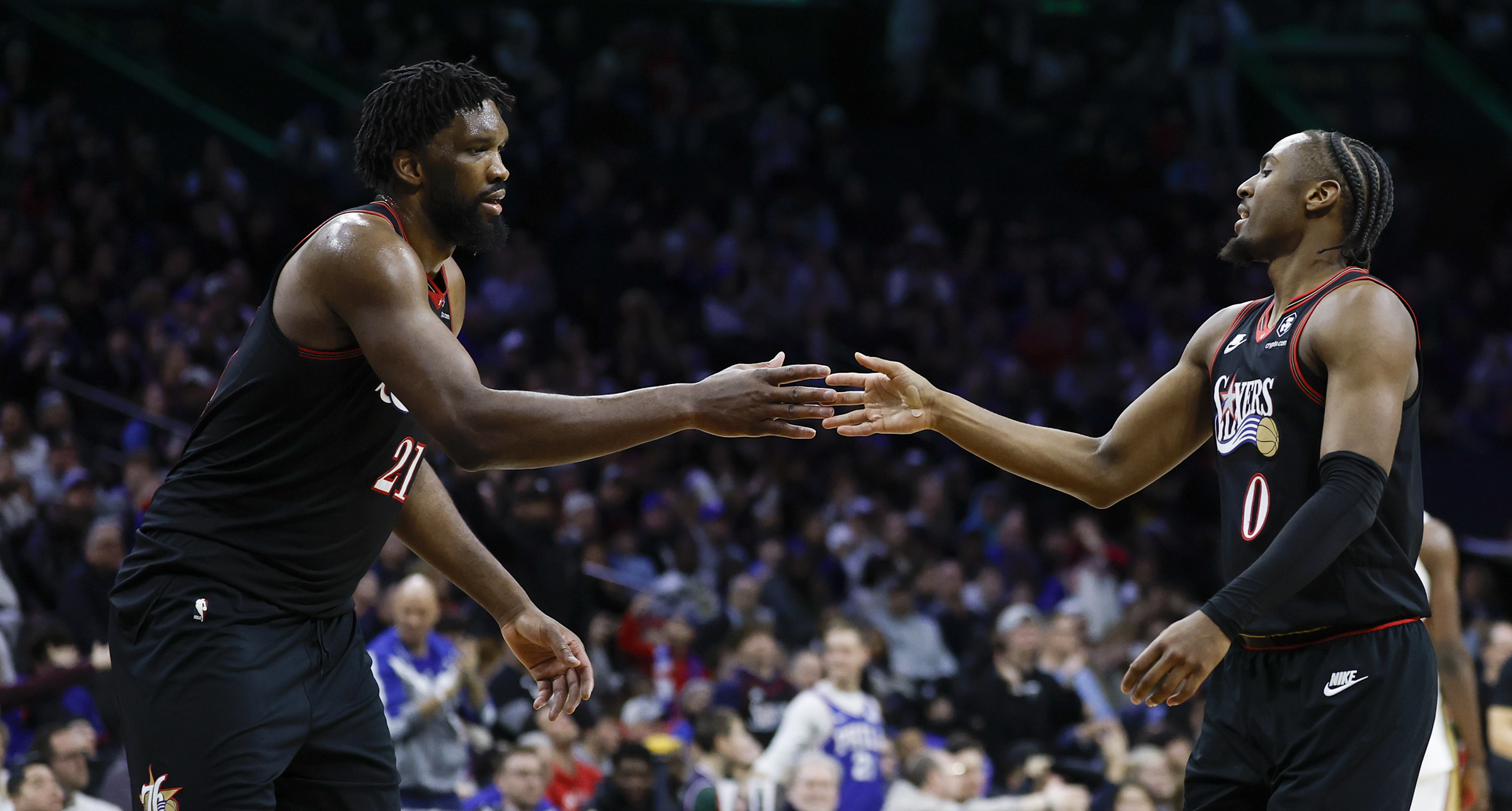
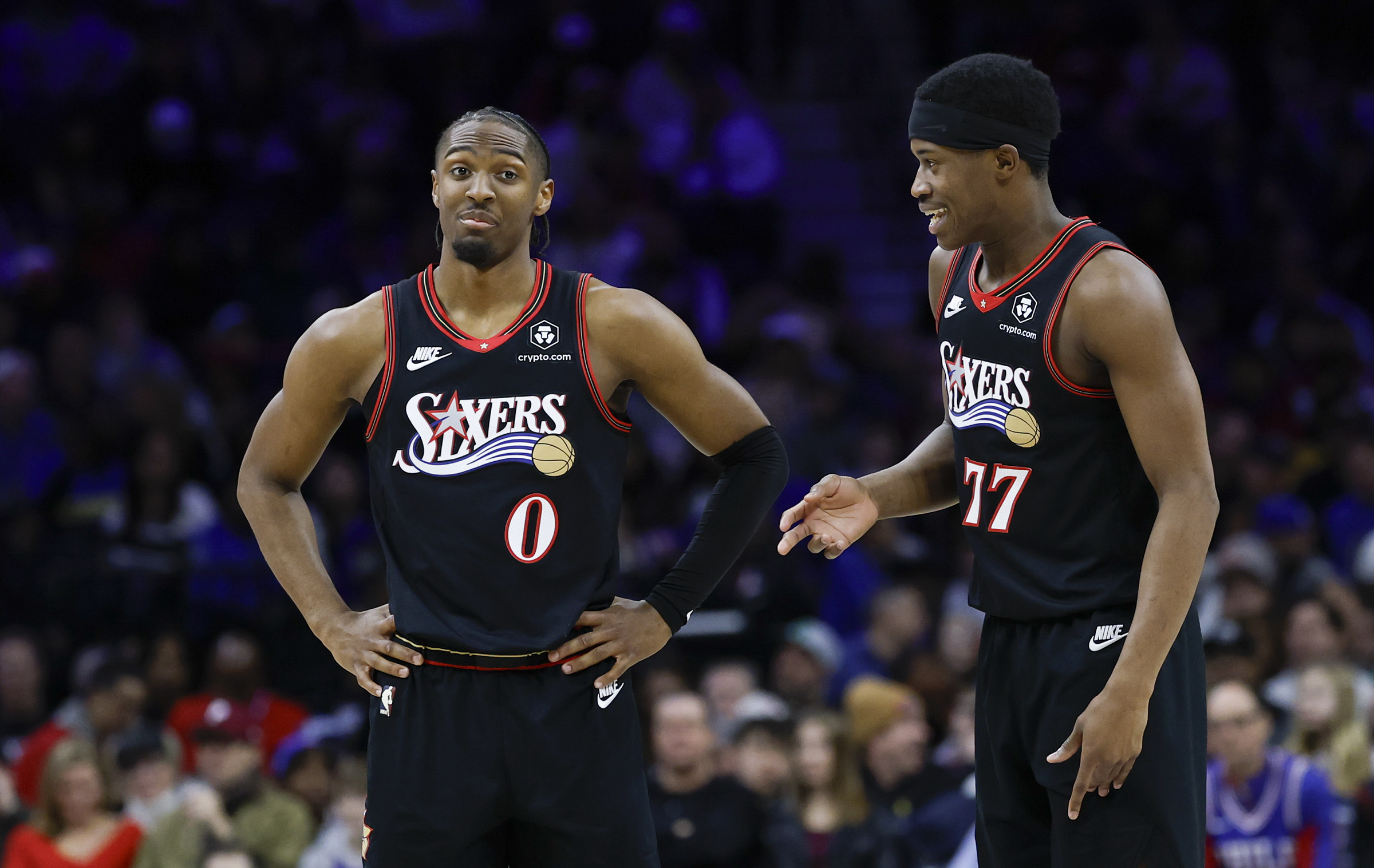
Sixers guard Tyrese Maxey (right) no longer has to play second fiddle to Joel Embiid.
Maxey will represent the Sixers as an NBA All-Star Game starter in Los Angeles on Sunday. This is fitting, since he’s the embodiment of what the Sixers hope to be and emblematic of how Philadelphia sees itself.
Joel Embiid represents “The Process,” has been diminished as a part-time role player, and is a reminder of the disastrous slash-and-burn rebuild that began in 2013.
Paul George represents the failed philosophy of Sixers president Daryl Morey, who bet everything on James Harden both in Houston and Philadelphia and made a similarly bad bet on George, addled by injury and seven games into a 25-game drug suspension.
Rookie guard VJ Edgecombe was the MVP of the Rising Stars All-Star competition Friday night and represents the future, but it is a future that depends on working in harness with Maxey.
Maxey represents the Philly of today: a city that sees itself as a collection of hardworking, well-meaning, decent, and spirited underdogs.
Philly guy
From Vince Papale to Rocky Balboa to the 2017 Eagles, Philly loves an underdog.
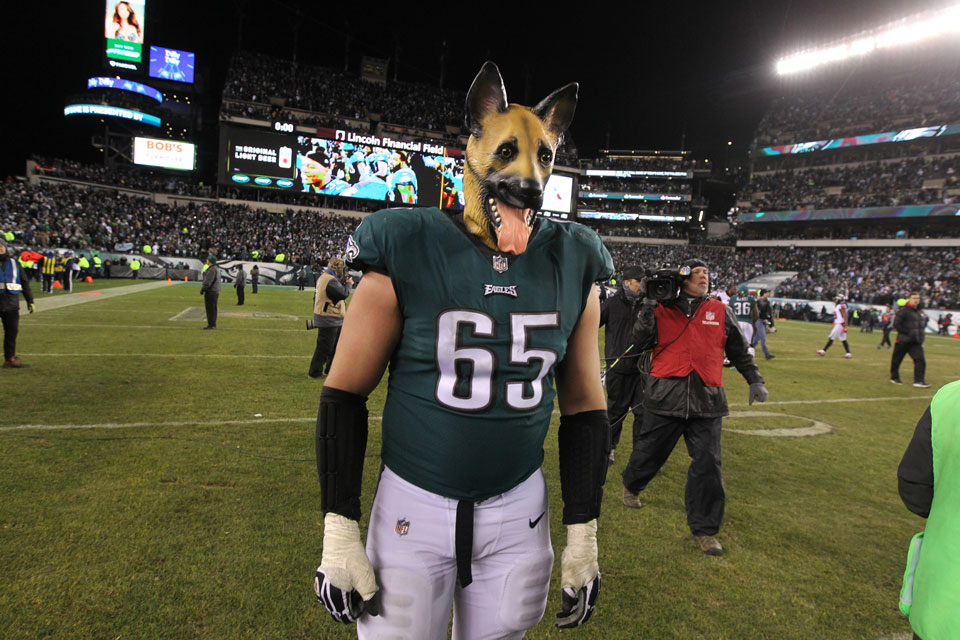
Eagles tackle Lane Johnson dons a dog mask after a playoff victory against the Atlanta Falcons on Jan. 13, 2018.
Maxey has always been an underdog.
He was never touted as an AAU player. He played for Kentucky for one uninspired season. He then was the 21st overall pick of the COVID-19 draft in 2020, behind the likes of Killian Hayes (seventh) and Kira Lewis (13th). A poor shooter, he started just eight games as a Sixers rookie. The Sixers hoped he’d be Dario Šarić or Landry Shamet, players drafted outside of the top 10 who have become dependable, if limited, NBA performers.
His maniacal offseason workout regimen focused on shooting and turned him from a 30.1% three-point shooter as a rookie into a 42.7% bomber in his second season. His scoring average over the years went from 8 points to 17.5 to 20.3 to 25.9, which made him the 2023-24 Most Improved Player and an All-Star reserve. He missed much of last season with injuries and still averaged 26.3 points, and now he’s at nearly 29 points per game, an All-Star starter, and an MVP candidate.
Like former Eagles offensive line coach Jeff Stoutland said: Hungry dogs run faster.
Maxey stays hungry. Hungry for wins.
“I just want everybody to know I try extremely hard, I work extremely hard, and I leave it all out there on the court every single night. I play through whatever,” he said recently. “That’s the legacy I want to leave behind. But the main thing is to win.
“This is a town that believes in winning. And I believe in winning.”
Tyrese Maxey (left) and VJ Edgecombe form a potent combination at guard for the Sixers.
Ravenous
Maxey used to practice so much they had to take away his keys to the gym.
He never was expected to play point guard. The Sixers drafted Maxey while Ben Simmons was on the team, then traded Simmons for Harden, then, when Harden forced a trade in 2023, Maxey took over the point. It was not pretty. He went to work.
He’s a complete point guard today. His ballhandling and passing have advanced so much that his Player Efficiency Rating this season is 22.72, about three points higher than his last All-Star season and fifth among point guards. He trails reigning MVP Shai Gilgeous-Alexander, five-time top-10 MVP candidate Luka Dončić, two-time MVP Steph Curry, and 2026 All-Star and NBA champ Jamal Murray. Which is why Maxey is an MVP candidate himself.
“I play three different roles on this team,” he said. “Sometimes I’ve got to shoot 30 times. Sometimes I’ve got to get Joel the ball. Sometimes I have to play full-time point guard and guard [elite] people. That’s OK. Whatever it takes to win.”
He didn’t just develop a three-point shot, he developed Harden‘s three-point shot after pestering Harden to teach him during the Beard’s 1½ seasons with the Sixers. The result: a lethal, sidestep-stepback, coil-and-release mortar shell whose range knows no limit.
This season, he mastered the most important skill of any backcourt scorer: the pull-up jumper, the most lethal weapon in basketball, from Jerry West to Michael Jordan to Kobe Bryant to Kevin Durant.
How far has he come? He’d dropped in the draft because he couldn’t shoot. Now, on Saturday, he’ll be the first Sixer to compete in the three-point shooting contest since Kyle Korver in 2005.
He remains driven by that disrespect, but he isn’t disrespectful, and that endears him to Philly even more. Sure, Philly’s a rough place. Some people got a kick out of Embiid and his Twitter-beefing with players like Karl-Anthony Towns. Some people loved it when Bryce Harper stared down mouthy Atlanta Braves shortstop Orlando Arcia in the 2023 playoffs.
But those incidents also rubbed some people the wrong way. Maxey seems to always rub folks the right way.
What’s not to like? After all, Maxey is the No. 1 dog dad in a canine-crazed city.
Maxey owns three dogs. His first is named Apollo, after the Apollo Creed character in Rocky. Then he got Aries and Arrow. They are his family. Maxey told Sixers videographers that when he bought a house in South Jersey, he insisted it have lots of land: “Try to create a happy home for my dogs. Let them run around in this big backyard.”
He made a cameo appearance at the National Dog Show when it visited the Philadelphia area in November.
So, he loves dogs. He loves kids, too.
Maxey won the Bob Lanier Community Assist Award in 2024 for his offseason work with youths in Philadelphia and his native Dallas.
The NBA today announced @sixers guard Tyrese Maxey as the @nbacares Bob Lanier Community Assist Award winner for the offseason.
Maxey is being recognized for his efforts in supporting youth in Philadelphia and his hometown of Dallas through the Tyrese Maxey Foundation.
I ran an informal Twitter/X poll Tuesday into Wednesday that asked, “Who’s your favorite Philly athlete?” I listed Harper, Kyle Schwarber, Saquon Barkley, and Maxey. (X only allows four entries.) Maxey won with 38% of the votes. Schwarber got 23%, Harper got 15%, and Barkley got 24%.
No, it’s not a scientific poll, and yes, it drew only about 400 respondents, but it makes sense nevertheless.
When the local TV broadcast spotted Maxey’s parents, Tyrone and Denyse (his name is a combination of theirs) at the Sixers’ game Saturday in Phoenix, play-by-play announcer Kate Scott called them “the Royal Family of Philadelphia.”
That’s because, at this moment, their son is king.
Always ‘us,’ never ‘me’
In an era of shameless self-promotion, Maxey never lobbies for personal accolades. He has never deemed himself an All-Star or an MVP until somebody else deemed him thus.
He’s always accountable, but he spreads the love. When Embiid dropped 40 on Jan. 31, Maxey detailed how the big guy’s game had developed to the point that Embiid found Maxey late in the game instead of forcing his own shot: “He played the right way.”
When George got suspended in the middle of a playoff push, Maxey never wavered: “We stand with Paul.”
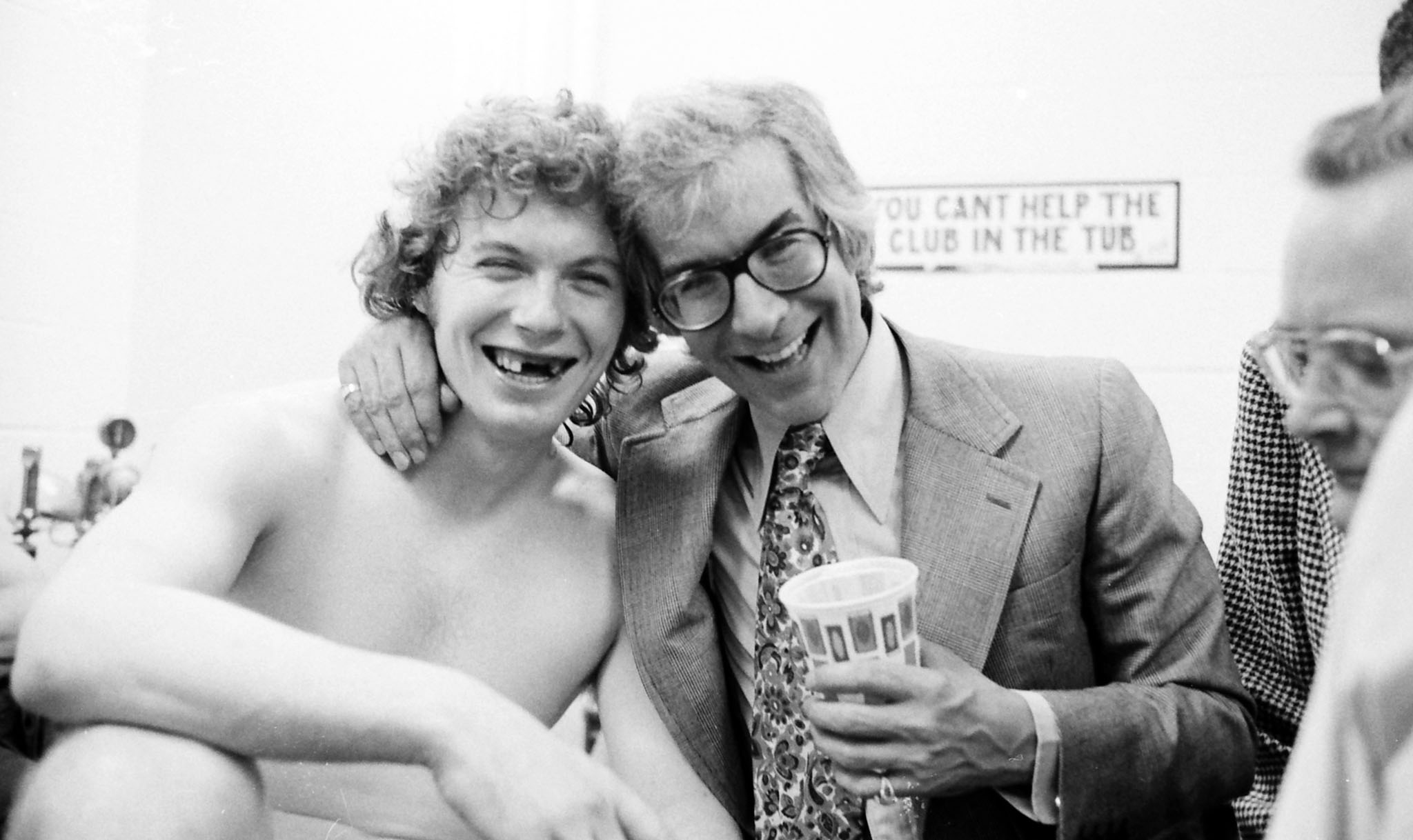
He plays a child’s game with a child’s glee. It isn’t perfect, but Maxey has the most recognizable Philly smile since Flyers legend Bobby Clarke, and he flashes it all the time.
Bobby Clarke and Ed Snider in the Flyers’ locker room in 1974. (Spectrum Archives)
From diet to conditioning to practice to rest, he adores the process and the progress as much as he relishes the result.
It was Maxey who, in a team meeting last season, finally confronted Embiid about his selfishly tardy habits: how he kept teammates waiting at meetings, on buses, and on planes.
Maxey just shows up on time, pays attention, and plays his hardest every second. He’s the type of player Philadelphians swear they would be if they had the chance. He understands that he has a gift, and that he should rejoice in his gift, even if it doesn’t take him to the top of the mountain.
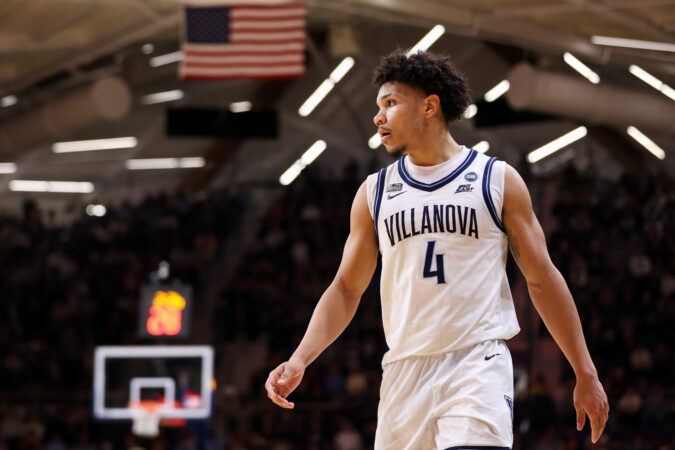
In the rotunda of the Finneran Pavilion late Tuesday night, the longest tenured Villanova player paused to crane his head toward the ceiling, toward the national championship, Final Four, and Big East championship banners that hang there in V formation, like a flock of birds in flight. On this Wildcats team, he’s the one whose name is called last in the pregame introductions.
He’s the one everyone knows a little better than everyone else on the roster. For a program once accustomed to having its stars stay for three years, four years, sometimes even five, it has to be jarring that Tyler Perkins, a junior who transferred from Penn in 2024, is the closest thing to a keeper of that flame.
“I take pride in it,” he said. “Last year, I was able to learn a lot about this place from guys like Eric Dixon, Jordan Longino, guys who have been here for three years, five years. I was able to pick their brains. Just walking these halls, looking at these banners, it makes you hungry. You want to bring it back to this place.”
The whole idea of a player recognizing and appreciating a particular program’s history and culture seems quaint in this era of college basketball. It certainly doesn’t have the pull and power that it once did.
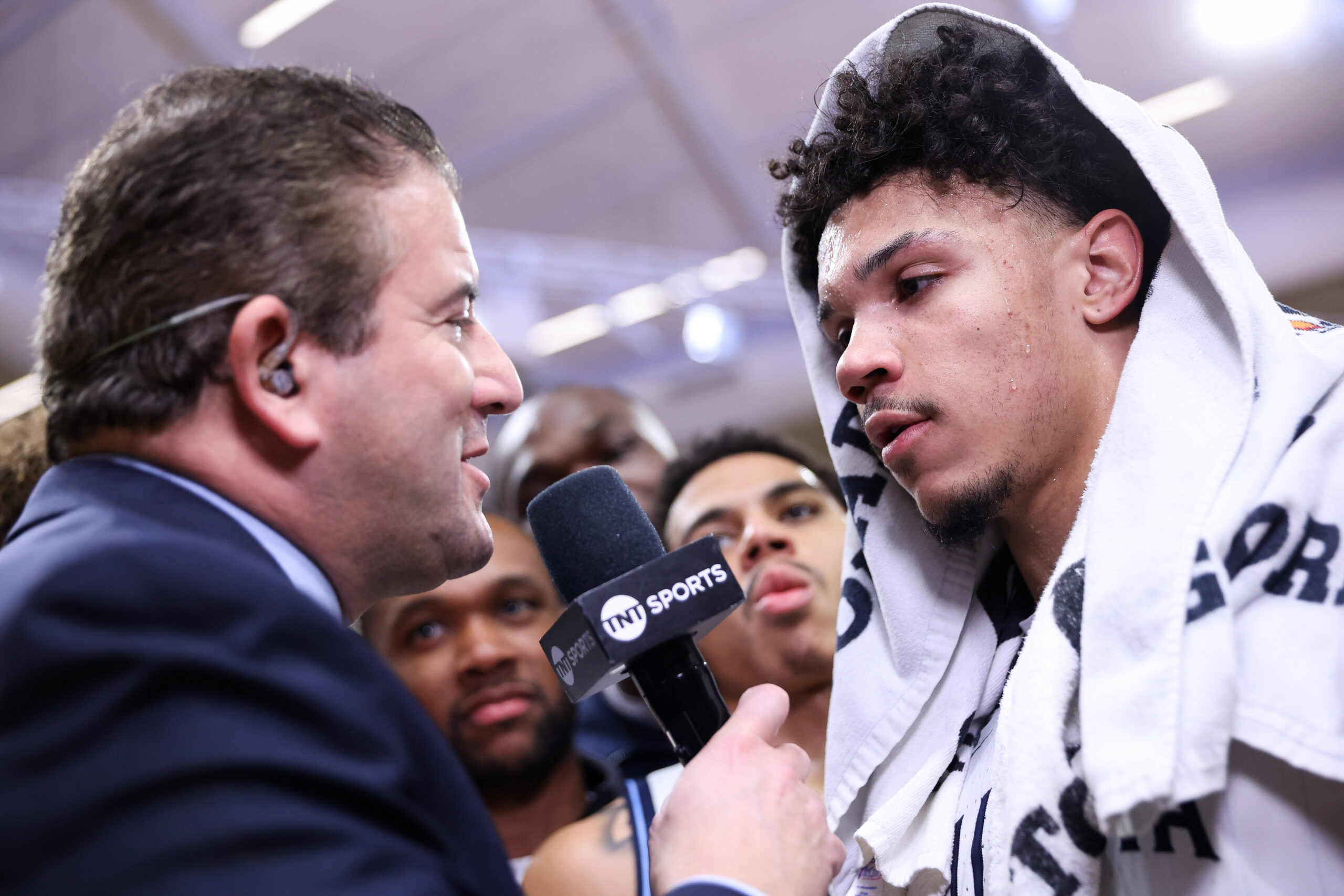
Tyler Perkins (right) is interviewed by Andy Katz after Villanova’s 77-74 win against Marquette at the Finneran Pavilion on Tuesday.
Now, paying players is an above-board course of action, athletes pass through the transfer portal like it’s an open doorway, and the story that played out at the Pavilion on Tuesday, in Villanova’s 77-74 victory over Marquette, showed just how much everything has changed.
Perkins pretty much saved the Wildcats, now 19-5 and on track for their first NCAA Tournament appearance in four years, from losing a Big East game to a lesser opponent. He scored a team-high 22 points, hit three late three-pointers to help ’Nova quickly wipe out a nine-point deficit, grabbed six offensive rebounds, and blocked a three-point attempt by the Golden Eagles’ Adrien Stevens on the game’s final possession.
It was the kind of performance that a savvy upperclassman — Josh Hart, Mikal Bridges, Collin Gillespie, Dixon — once would have delivered for Villanova … except in this case, the savvy upperclassman is a kid who has been on campus less than two years, and he was having a lousy defensive game until he snuffed Stevens’ shot at the end.
“Once he figures out he can affect the game without shooting or having to shoot, that’s when he’s going to take a monster step,” Wildcats coach Kevin Willard said. “And he’s starting to get there. He is.”
Willard is so certain that Perkins will become a great player that, after the Wildcats’ win over Seton Hall last week, he didn’t back away from comparing him to Hart — a first-team All-American and a national champion at ’Nova, a nine-year NBA vet and an invaluable piece of a New York Knicks team that could reach the Finals.
During Tuesday’s postgame media availability, Willard playfully chided Perkins for his mostly poor defense against Marquette, then pointed out that Hart’s all-around game is what made him such a headache when Willard, while at Seton Hall, was coaching against him.
“I tell the story all the time,” Willard said. “One of the last times we played against him, I called timeout, and I cursed out my team. I was like, ‘Can somebody please stop Josh Hart?’ And he hadn’t taken a shot. He hadn’t taken a shot, and they’re all looking at me like, ‘Well, he’s not shooting.’ He’s got three steals. He’s got four offensive rebounds. He’s got five assists. And he didn’t take a shot. That’s why he’s in the NBA.
Villanova coach Kevin Willard believes Tyler Perkins shares many of the same qualities as former Wildcats guard Josh Hart.
“He” — he tipped his head to the right, toward Perkins — “can do that. He just has to figure it out at times, ‘I don’t need to shoot the ball to be out here and be effective.’ Because he does so many other things.”
Perkins has met Hart just once — last September, when Hart and Jalen Brunson returned to campus to record an episode of their podcast, The Roommates Show. Their on-paper profiles are practically identical. Both are from the Washington area.
They are about the same height (6-foot-4) and roughly the same weight (210-215 pounds). The biggest difference, at the moment anyway, might be that the conditions that allowed Hart to develop over his four seasons at Villanova, from 2013 to 2017, are harder to replicate. These days, it takes a welcoming atmosphere; a rewarding athletic, academic, and social experience … and, of course, a big, fat check.
"It's February basketball. You're going to have to grind and find ways to win. Watching Marquette's last five games, Shaka's done a great job with that group, especially on the defensive end. But we found a way, that's all that matters." -Coach Willard
Make no mistake: The money is and will be the major motivator for keeping a promising basketball player on any campus. A program that wants to keep a star into his senior season is going to have to pony up accordingly. But those first two factors still matter some, at least some of the time, and apparently to Perkins.
“I don’t really care about all the extra stuff that’s going on in college basketball right now,” he said. “I find joy in playing the game, and I felt like this place was the most comfortable place for me to play.”
Imagine the comfort he’ll feel a year from now, two years from now, three, if he can stand inside the Pavilion, look up at that ceiling, and see a banner he helped to hang.