Category: Sports Columnists

  • Is Nick Sirianni ‘legendary’? Is Jalen Hurts salty? Is Julian Lurie a worthy heir? Eagles revelations abound.

    Is Nick Sirianni ‘legendary’? Is Jalen Hurts salty? Is Julian Lurie a worthy heir? Eagles revelations abound.

    It’s rare that, in the same week in June, you see three separate stories that pull back the curtain on the most secretive team in town, the Philadelphia Eagles.

    That’s what’s happened over the past few days. They sent NFL junkies into paroxysms of delight. They turned radio waves all atwitter with fresh meat during a typical time of famine.

    The most significant and best done of the three pieces involved a look at Julian Lurie, who will one day ascend to the throne occupied by his father Jeffrey, who has owned the Eagles since 1993. Jeff McLane of The Inquirer gave us our first look at the sensitive 31-year-old who already lends his voice to the team’s biggest decisions, just as a crown prince should do.

    Mike Silver was the most prolific and capable NFL profile writer when Sports Illustrated remained the industry standard 30 years ago, and he has not lost his fastball at the Athletic. Silver joined combustible coach Nick Sirianni at the Eagles’ annual playground construction project and walked away with superb detail regarding Sirianni‘s unlikely interview and subsequent hiring in 2021, all done from the beach, in flip-flops with a white board. But Silver also got an endorsement of Sirianni from superstar running back Saquon Barkley that sparked debate about how valuable and competent Sirianni is compared with his peers.

    Finally, our old friend (and sometimes colleague) Joe Santoliquito, a local freelancer who specializes in in-depth exposés and, apparently, in infuriating Eagles executives. He dropped a brief piece on the Bleeding Green Nation website about the most polarizing figure in the city. The story indicates that starting quarterback Jalen Hurts is upset that the Eagles seem willing to replace him if he struggles to produce better numbers for a third straight season.

    McLane‘s trademark thoroughness left little room for controversy or discussion despite the delicate nature of his subject, but that’s to be expected, since McLane is the best-sourced reporter in town.

    But Barkley’s contention to Silver that Sirianni is “legendary,“ and Santoliquito‘s revelation that Hurts is unhappy … well, those struck a nerve.

    Legendary?

    Only four coaches who have coached at least 60 games, including playoffs, have a better winning percentage than Sirianni. All of them — Guy Chamberlin, Vince Lombardi, John Madden, and George Allen — are in the Pro Football Hall of Fame.

    Sounds pretty legendary, right?

    Barkley thinks so, as he told Silver:

    “He doesn’t get enough credit at all, in my opinion. I don’t get why he doesn’t. Like, what he’s doing, in real time, is legendary.”

    Is it, though?

    A head coach’s primary job is to win games, to reach the playoffs, and to battle for a title. Sirianni has not missed the playoffs in any of his five seasons. He’s reached the Super Bowl twice. He’s won it once.

    Sirianni did all that winning while developing Hurts, a quarterback of limited skills but unlimited ambition — a mirror, in some ways, of Sirianni himself. But that’s a different topic for a different day. He won while handling malcontent receiver A.J. Brown. He won while handling distractions that Sirianni himself created, mainly jeering fans of both his opponents and his own team.

    Which brings us to the crux of the matter. Fairly, or not, the narrative surrounding Sirianni is that the team often wins in spite of its coach.

    He has been heavily involved in the offense three times: 2021, 2023, and 2025. Each time, it foundered. The other two seasons, the Eagles went to the Super Bowl and the offensive coordinators were hired away as head coaches.

    An elite defense and a legendary season from Barkley sent the Eagles to their second Super Bowl. Sirianni has no involvement with the defense, which was run by first-year coordinator Vic Fangio, and Sirianni is considered a pass-first coach.
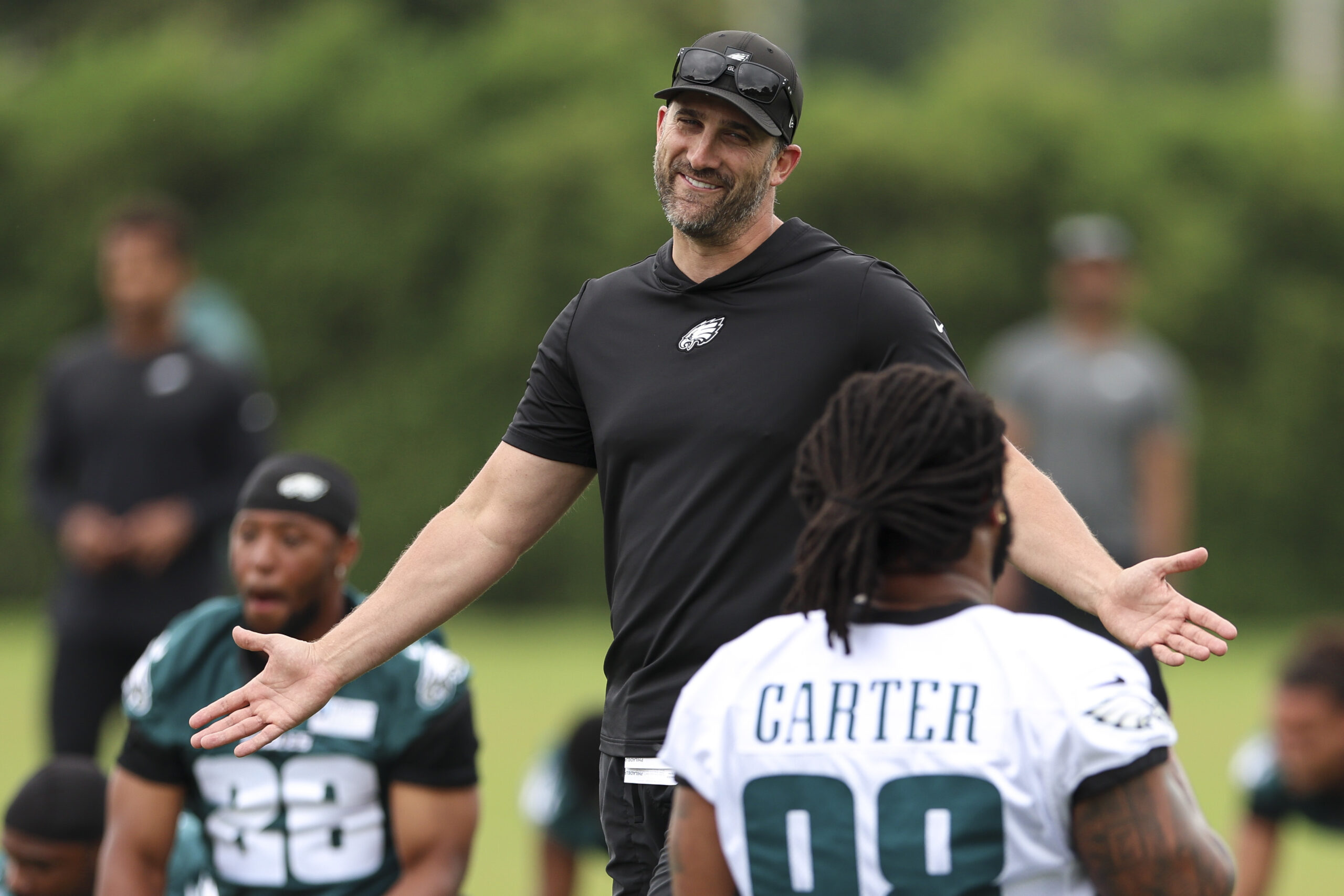
    The Eagles have made the playoffs in each of Nick Sirianni’s five seasons as coach.

    When Sirianni was hired in 2021, he was required to retain Jeff Stoutland, the assistant coach who ran the best overall offensive line in the NFL from 2013-2025. Stoutland, like Fangio, operated with almost complete autonomy, and he was the run-game coordinator to boot.

    Sirianni also took over a talent-heavy team from Doug Pederson, who was fired mainly because Carson Wentz didn’t want him around any more. Sirianni inherited a wealth of mature locker-room leaders with incredible pedigrees: elite tackles Lane Johnson and Jordan Mailata as well as center Jason Kelce; first-round receiver DeVonta Smith; defensive tackle Fletcher Cox; and defensive end Brandon Graham.

    Finally, general manager Howie Roseman has consistently replenished the talent pool — Jalen Carter, Quinyon Mitchell, Cooper DeJean, Jordan Davis, Zach Baun, Landon Dickerson, Cam Jurgens, and Brown — to the degree that it’s fair to wonder if any coach could have failed to win, and win big.

    So now you have a portrait of a coach with a sterling record but without a tangible identity. Nobody questions the character of Vince Lombardi, John Madden, or George Allen, and they all coached for at least a decade.

    It’s hard to call anybody “legendary” five years into a career. Very good? Sure. Excellent? Maybe.

    Legendary?

    Let’s let that one breathe.

    After all, Sirianni has always had stability at quarterback. Is that about to change?
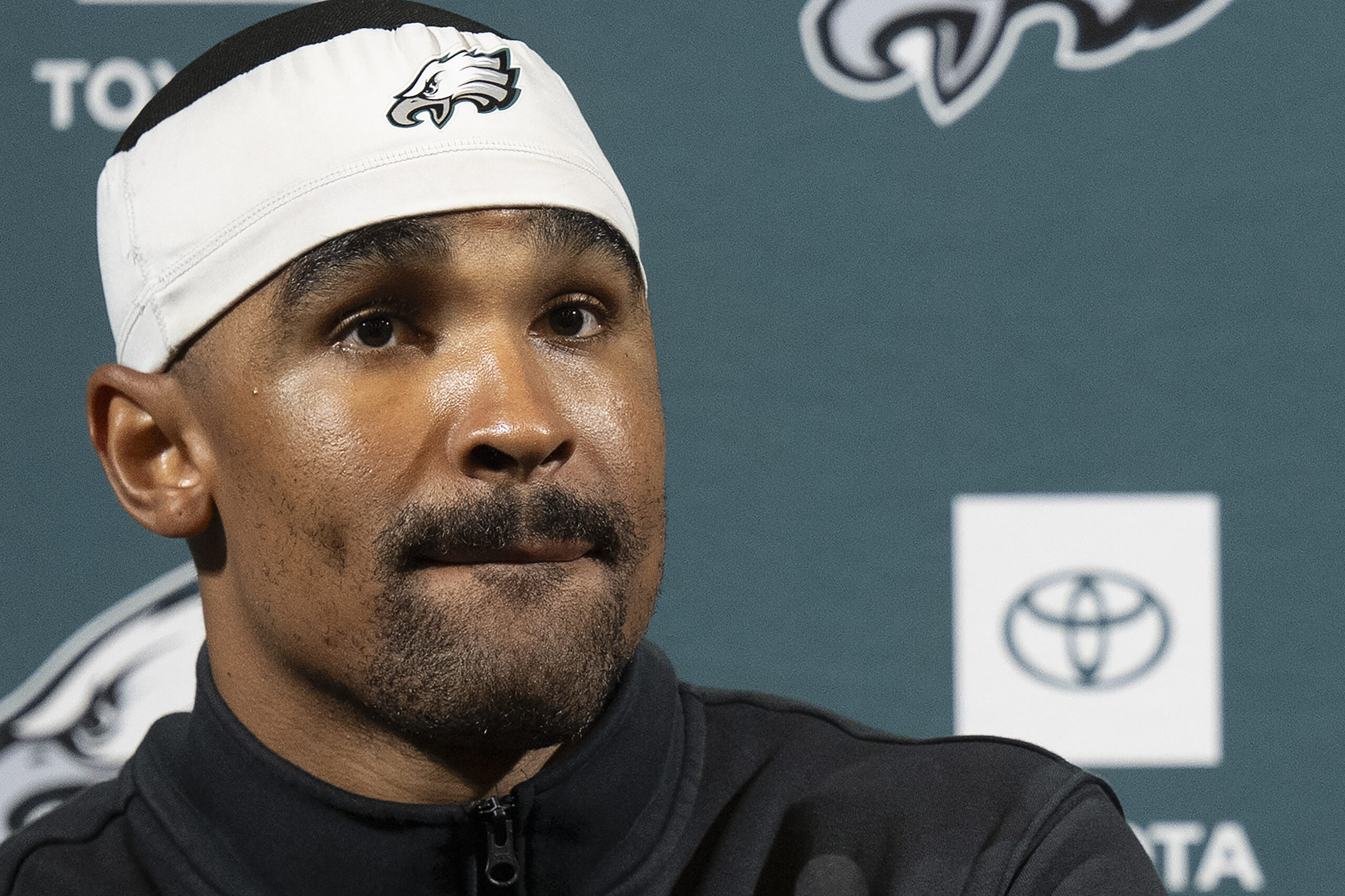
    The 2026 season is shaping up to be a big one for Jalen Hurts.

    Hurt feelings?

    Like McLane, Santoliquito specializes in long-play reporting that coalesces into bombshell stories that cause a sensation. Such was the case in 2019, when his piece just after the disappointing 2018 season included Eagles sources who called Wentz “selfish,” “uncompromising,” and “egotistical,” with crippling insecurities. After the story ran, Santoliquito received death threats, had property vandalized, and was castigated by both the Eagles organization and by Wentz’s camp.

    I ripped him, too, for not giving the Eagles a fairer chance to respond. He admitted his error to me.

    Within weeks, however, Santoliquito’s reporting was largely confirmed … by Wentz himself.

    Unlike the landmark Wentz story, the recent article about Hurts was an opinion piece. The headline read, “Philadelphia better watch itself, or it will lose another superstar,” and Santoliquito wrote, “The fear here is that Philadelphia may be pushing another superstar out of the door.”

    On that: No athlete since Phillies slugger Dick Allen was “pushed out” of Philadelphia by either the fans, the team, or the media. Not future Hall of Fame third baseman Scott Rolen, who was traded after contract negotiations collapsed; not ace Curt Schilling or stud Charles Barkley, who embraced trades after the Phillies and Sixers proved unable to build around them; and not even, as Santoliquito suggested, Wilt Chamberlain, who sought the brighter lights and cooler culture of Los Angeles as the Sixers underwent seismic changes after the 1967-68 season.

    In this instance, Santoliquito, who has long been close to people in Hurts’ camp, relays signals from those contacts that Hurts is displeased that:

    1. The Eagles, who wrote the book on saving money with early contract extensions, have not offered Hurts an extension; and,
    2. The Eagles did not support him well enough when an ESPN story on April 1, citing sources on the team, painted Hurts as stubborn, uncoachable, and reluctant. The fallout from the story created a narrative that these traits have the Eagles considering moving on from Hurts if he struggles with the more complex scheme of new coordinator Sean Mannion.

    Two things.

    First: So what? So what if 2026 is a prove-it year for Hurts? If he plays well, he gets paid. Trust me, he won’t turn down cash. If he doesn’t play well he might get traded.

    Second: The Eagles were irate that, as in 2019, Santoliquito did not come to them for comment in a timely manner (or at all, in this instance). Broadly, that’s a fair point. However, it’s a strange complaint in this instance, since it’s irrelevant whether Eagles players, executives, and coaches actually sufficiently supported Hurts. They did have a few words of support to offer, but it was not overwhelming.

    What’s relevant is that Hurts, or his camp, feels that they didn’t support him enough.

    In Santoliquito’s opinion, that might cost the Eagles the services of Hurts at some point in the future.
  • For Haiti, a lopsided World Cup loss to Brazil didn’t matter much. Just being here meant everything.

    For Haiti, a lopsided World Cup loss to Brazil didn’t matter much. Just being here meant everything.

    Luc Cherisson did not have to come as far and live as long and hard as so many who have been waiting to watch Haiti in the World Cup again. But he had his own way to make. The general manager of a rental-car business in Atlanta, an immigrant who left his homeland for America when he was just 20, Cherisson is 36 now, with a friendly face and an amiable disposition that suggest he is always happy to assist his customers with their SUV reservations. He flew into Philadelphia International Airport on Friday morning for his home country’s World Cup match against Brazil, and he would fly back to Atlanta on Saturday morning, a little hungover if a slight miracle materialized at Lincoln Financial Field.

    “Even if we lose, it’s still a win for me,” he said a few hours before the match, as he lingered in a parking lot outside Xfinity Mobile Arena. “And if Haiti wins, it will be a party all night.”

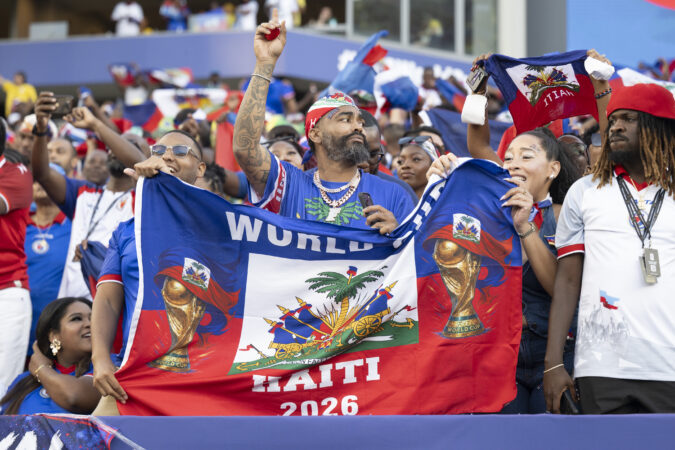
    There was no miracle. There was only an easy 3-0 victory for Brazil, though Cherisson and the thousands of Haitian natives and fans who attended the match may yet have caroused deep into the Philadelphia night, just for the sake of their home country’s presence here. This is Haiti’s first appearance in the World Cup since its only other one, in 1974. For Cherisson and those like him, for a nation long riven with poverty and corruption and violence, where roving gangs control the capital city of Port-au-Prince and practically govern the country, there is honor and glory merely in earning the right to be here.

    “It’s amazing,” Cherisson said. “It’s the biggest sporting event in the world. Just being part of the World Cup is fantastic.”

    It might sound silly and Pollyannish to regard just competing at the highest level and grandest stage of the world’s most popular sport as worthy of such pride. How much of FIFA’s multibillion-dollar budget goes toward orange slices and participation trophies? But one has to have just an inkling of the hold that soccer has in Haitian society to appreciate why Cherisson would pay a small fortune to travel to Boston to see Haiti’s 1-0 loss to Scotland last Saturday, to make that 24-hour trip into town for Friday night’s game, and to secure tickets for Haiti’s match against Morocco in Atlanta next Wednesday. Why no one at the Linc much cares that Haiti has now been outscored 18-2 in the five World Cup matches in its history. Why this all matters so much.

    The author Madison Smartt Bell, for instance, who in 2014 completed a trilogy of rich and gorgeously written historical novels about Toussaint Louverture and the Haitian Revolution, still owns a patch of land in the northern part of the country, not far from the forests where the revolution was conceived in 1791. One day, Bell saw several children scurrying around on rough, spiny ground, playing soccer not with a ball or even an empty can of condensed milk, but with a rock.

    On his next visit to Haiti, he brought them a regulation soccer ball. The children were ecstatic, but after 10 minutes, they paused their game for a moment. Something sharp had punctured and deflated the ball. So they went back to kicking and passing and shooting the stone.

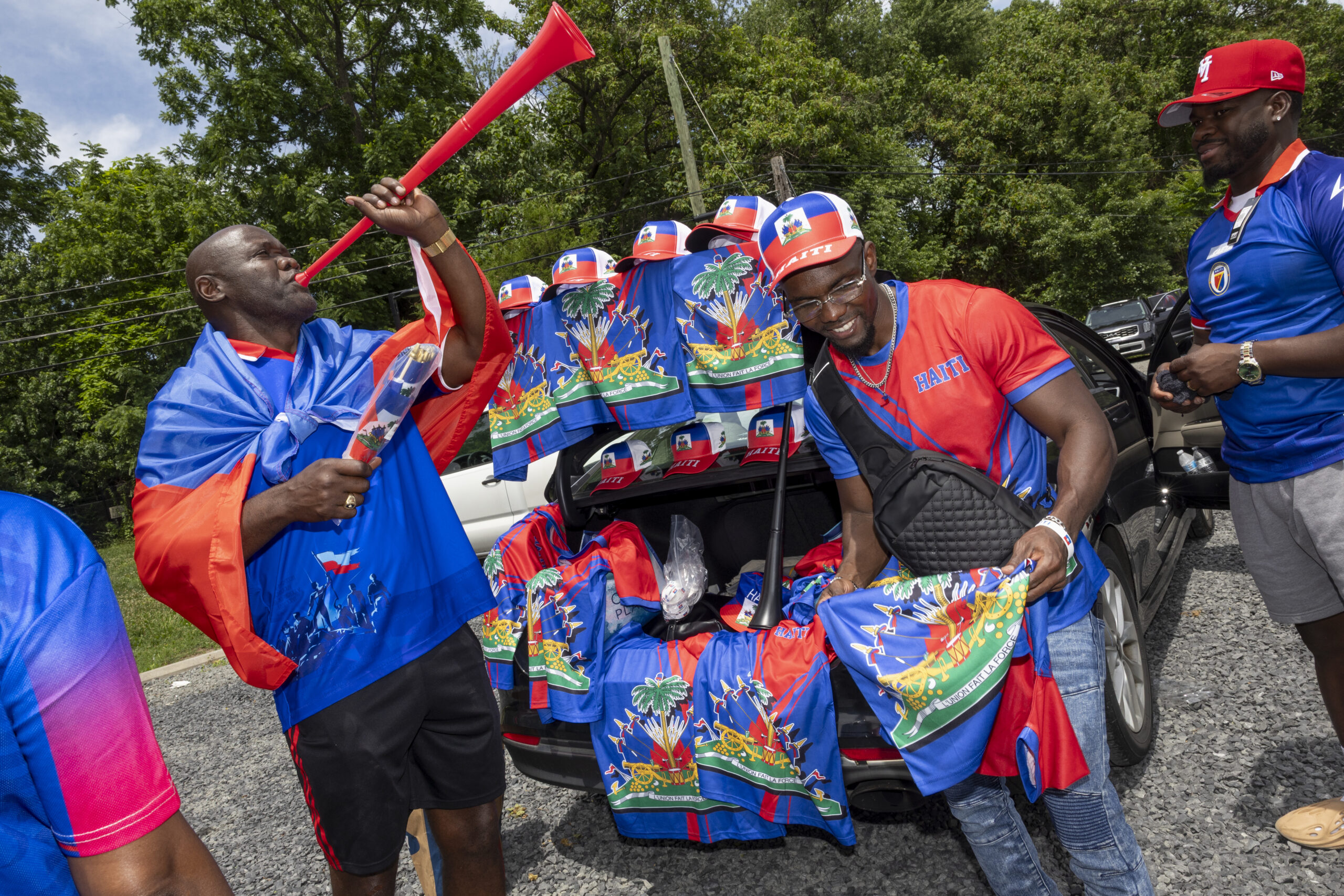
    A Haiti soccer fan blows a plastic horn outside of the Discovery Center in Philadelphia earlier on Friday.

    “I think that gives you some idea,” Bell said in an email, “of the importance of soccer in Haitian culture.”

    If that doesn’t, this might: Before Haiti’s first match in the ‘74 World Cup, against Italy, “extraordinary legends spread all throughout the country,” said Terry Rey, a Temple University professor of Latin American studies who has written extensively about Haiti and even lived there for six years in the 1990s. Customarily, because their national team had not qualified for the World Cup yet, Haitians divided their loyalties when the event commenced every four years. The poor rooted for Brazil, the elites for Argentina.

    But now Haiti, at last, was part of the spectacle. So peasants somehow found the funds to buy transistor radios and batteries so they could listen to the match. People painted and decorated tap taps, the vans and pickup trucks that are used as taxis in the country, with renditions of the team’s players. And when Haitian star Emmanuel Sanon scored the game’s first goal, “people will tell you there wasn’t a place in the entire nation where you didn’t hear someone screaming,” Rey said. Italy won the match, 3-1.

    Are these unfavorable final scores irrelevant to the Haitian people? No. It’s just that the sport itself carries so much meaning there, offers so cleansing a respite from all that ails the country. The 1994 World Cup began in July with Haiti trapped amid a period of tumult and persecution, its people under the thumb of a junta regime run by Raoul Cédras, the former head of Haiti’s military, who had taken power in a coup three years earlier. From January to June that year, there was no electricity available anywhere. Then, just in time for the World Cup, the lights went on. There was electricity, and there was cable TV. Cédras had bought the rights to broadcast the tournament, and the opportunity to watch it would quell any widespread desire for a revolt against the regime.

    “Haitians love soccer,” Rey said. “It’s just powerful.”

    They loved it Friday night, despite the lopsided outcome, despite another loss for a nation waiting for a win that would mean everything. Late into the match, late into the night, having traveled so far and still waiting so long, they were chanting and singing in the parking lots and stomping their feet in the stands and standing to cheer, happy to have reason to be proud. Funny. In a city where there is a long and treasured tradition of telling outsiders and interlopers to go kick rocks, this celebration was still joyous enough.

  • For the Phillies, it still comes down to Trea Turner

    For the Phillies, it still comes down to Trea Turner

    The Phillies entered the season as a team whose fate would be determined mostly by how little went wrong. That’s somewhat true for most teams, but it is especially true for a team that basically skipped a development cycle while building and retaining a roster via trades, free agency and contract extensions.

    In Major League Baseball, there are three main sources of year-to-year improvement.

    • External additions via free agency and trade.
    • Internal additions from the minor league system.
    • Internal improvement from young players who have yet to reach their peak.

    Every now and then, you’ll see a mid-career bump by a player like Cristopher Sánchez or Brandon Marsh. For the most part, though, a team’s upside is a function of its young potential breakout candidates combined with whatever payroll it adds. Otherwise, what you end up seeing will look a lot like what you’ve previously gotten, along with whatever regression occurs.

    That tracks, right?

    Nearly halfway through the schedule, the Phillies are exactly what you’d expect to get if you took last year’s team and subbed in a leadoff hitter who is batting .223/.276/.334 instead of .304/.355/.457. Marsh’s quasi-breakout has given them enough margin for error to withstand the rookie inconsistency they’ve seen from Justin Crawford and Andrew Painter at the bottom of the lineup and the rotation. But something dramatic is going to need to change for the Phillies to stop yo-yoing back and forth between .500 and a 90-win pace. Right now, the most likely something is the aforementioned leadoff hitter.

    Trea Turner is the man with the keys to the Phillies’ offense for the rest of the season. That’s really all there is to it. You can talk about the trade deadline, talk about the pitcher Painter was supposed to be, talk about the 31-16 record under Don Mattingly … all of it is noise. The Phillies simply aren’t a team that is capable of winning 95 games when one of their megacontract hitters isn’t hitting even half his worth.

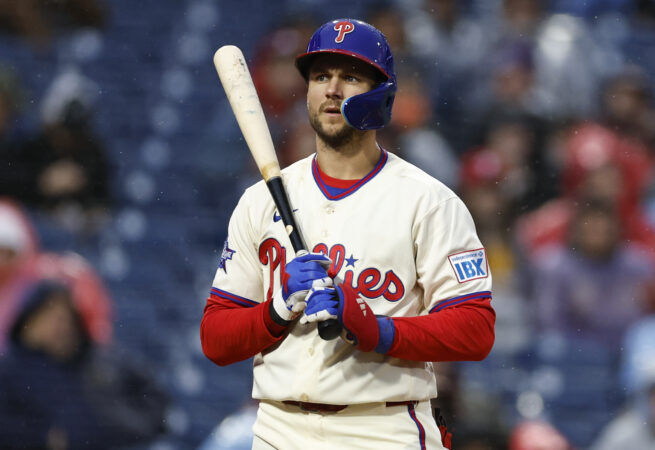
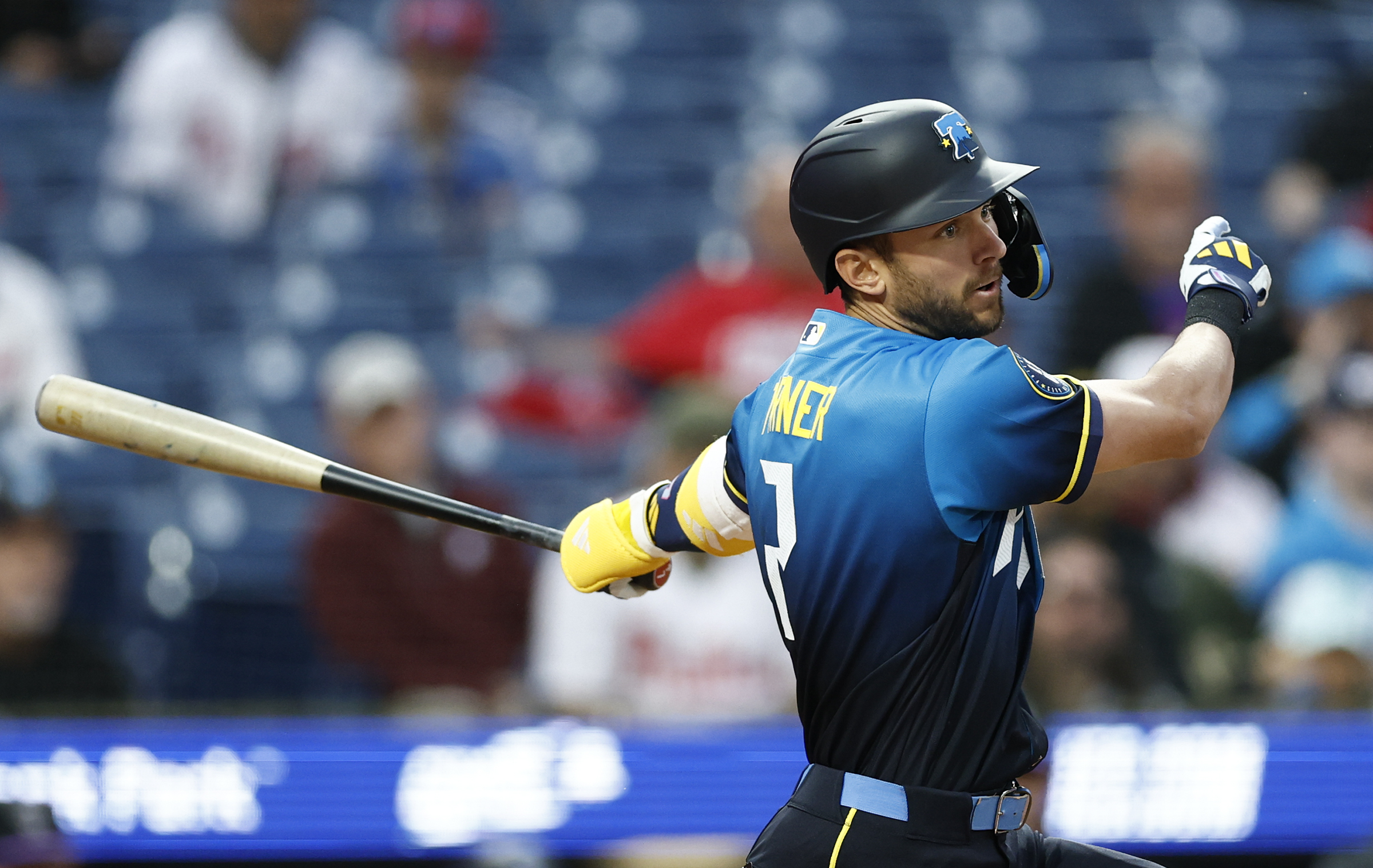
    Phillies shortstop Trea Turner entered the weekend with a .610 OPS. His career mark is .816.

    Mattingly knows this. It’s the reason for the patience he continues to exhibit with Turner at the top of the lineup. Getting him right is the Phillies’ only hope at making a late charge at the Braves. That 31-16 record since Rob Thomson’s firing is glitter more than gold. Seven of those wins came against teams that are 12-plus games under .500. Another seven have come against the Marlins and Athletics. The Phillies are 5-7 against their four opponents who entered Thursday at least four games over .500. Series losses to the Brewers, Dodgers, and Guardians. Their 96-win pace over the last month is more representative than 113.

    Even 96 wins is overstating things. We got a little taste of what a 96-win offense looks like a couple of days ago when Turner was out of the lineup with a sore wrist. Mattingly seized the opportunity to get a little funky with his lineup. The hot-hitting Marsh took the place of Turner in the leadoff spot, giving the Phillies three straight lefties at the top of the order with Kyle Schwarber and Bryce Harper following Marsh.

    Mattingly’s lack of regard for convention paid dividends. Marsh reached base twice, scored two runs, and had two RBIs, which is something Turner has not done since last August. The top three hitters in the Phillies’ order combined to reach base six times and score five runs in an 8-2 win. Sometimes, different is good.

    The next day, Mattingly went back to the old drawing board. Turner went 3-for-5 with a double, his first three-hit game since May 9. It needs to be the start of something, although he left Thursday’s game after again being hit by a pitch.

    Turner is the reason everybody thinks the Phillies need to make a big splash at the trade deadline. President of baseball operations Dave Dombrowski will be hard-pressed to find a hitter who would be more of an improvement than the Turner of last year returning. If he doesn’t, 87 wins is as good as it is going to get.

    The Phillies don’t have many other pathways. They are long on veterans and short on potential upside. It is a daunting position to be in at this stage of a season.

    Look at the teams that overperform their expectations and you’ll find that the differentiator is almost always someone who is at the stage of his career where improvement comes in leaps and bounds. Drake Baldwin will continue to improve for the Braves. Same goes for Andy Pages and Dalton Rushing with the Dodgers. Ben Rice with the Yankees. For all the hand-wringing about the Dodgers and their limitless payroll, they’ve also had five rookies hit 19-plus home runs since 2013.

    The Phillies don’t have any obvious candidates right now. Harper and Schwarber have been about as good as you could hope. Alec Bohm, Bryson Stott, and J.T. Realmuto have been about what you’d expect. Turner’s is the one spot in the lineup where the potential for significant improvement exists. At least, they better hope it still exists.

  • A wild Saturday stampede of stars validates the PGA Championship and Aronimink

    A wild Saturday stampede of stars validates the PGA Championship and Aronimink

    The footsteps of giants were echoing behind him, each one louder than the last.

    All Maverick McNealy could do was wait.

    The PGA Championship co-leader after two rounds was still 40 minutes away from teeing off when he walked off of the practice green and came face-to-face with the avalanche at his heels. On a giant video leaderboard rising in the distance, the household names were floating toward the surface like the first bubbles of a boil. By the time McNealy and fellow longshot Alex Smalley teed off, the 36-hole co-leaders would be joined in first place by Rory McIlroy. Not long after that, they would be leaders no more.

    For all of the grumbling that emanated from the starriest of corners of the players’ locker room during the first two days at Aronimink Golf Club, the mayhem that golf’s titans unleashed in Round 3 will only embolden tournament officials. Long a major in search of an identity, the PGA Championship suddenly has set itself up for a finish that can command the attention of even the casuals. The biggest names, the best games, all will be there, almost without exception.

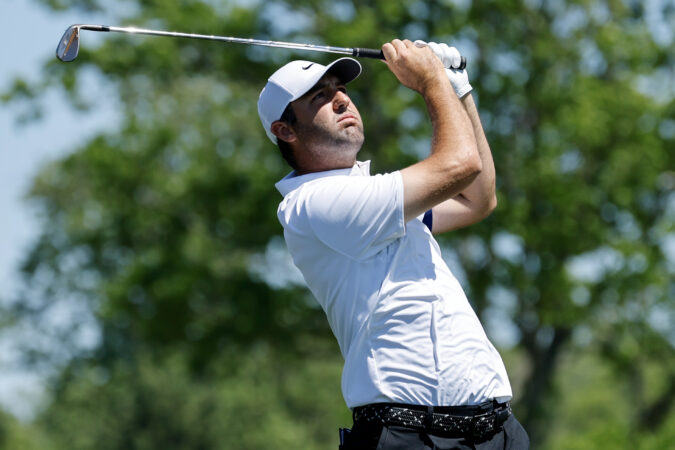
    McIlroy, Xander Schauffele, Jon Rahm, Ludvig Aberg, Patrick Reed … all will enter Sunday’s final round within two or three strokes of the lead. Right on their heels are the likes of Scottie Scheffler, Justin Rose, Brooks Koepka, and Rickie Fowler.

    Represented in that group are five of the six pre-tournament betting favorites.

    But Smalley, the man who enters Sunday with a two-stroke lead, is a relative unknown who bogeyed three of his first four holes but shot three-under on the back nine to regain the lead.

    “I mean, my PGA Tour career isn’t necessarily very long at this point, but I’ve never seen anything like it,” said Aberg, who shot a 68 to stand in a group of five players two shots behind Smalley. “It’s very tight. I think there’s a lot of good players within striking distance going into tomorrow, and it’s a cool thing, I think, for the viewers. I think it’s cool to see that many guys have a chance to win a tournament.”

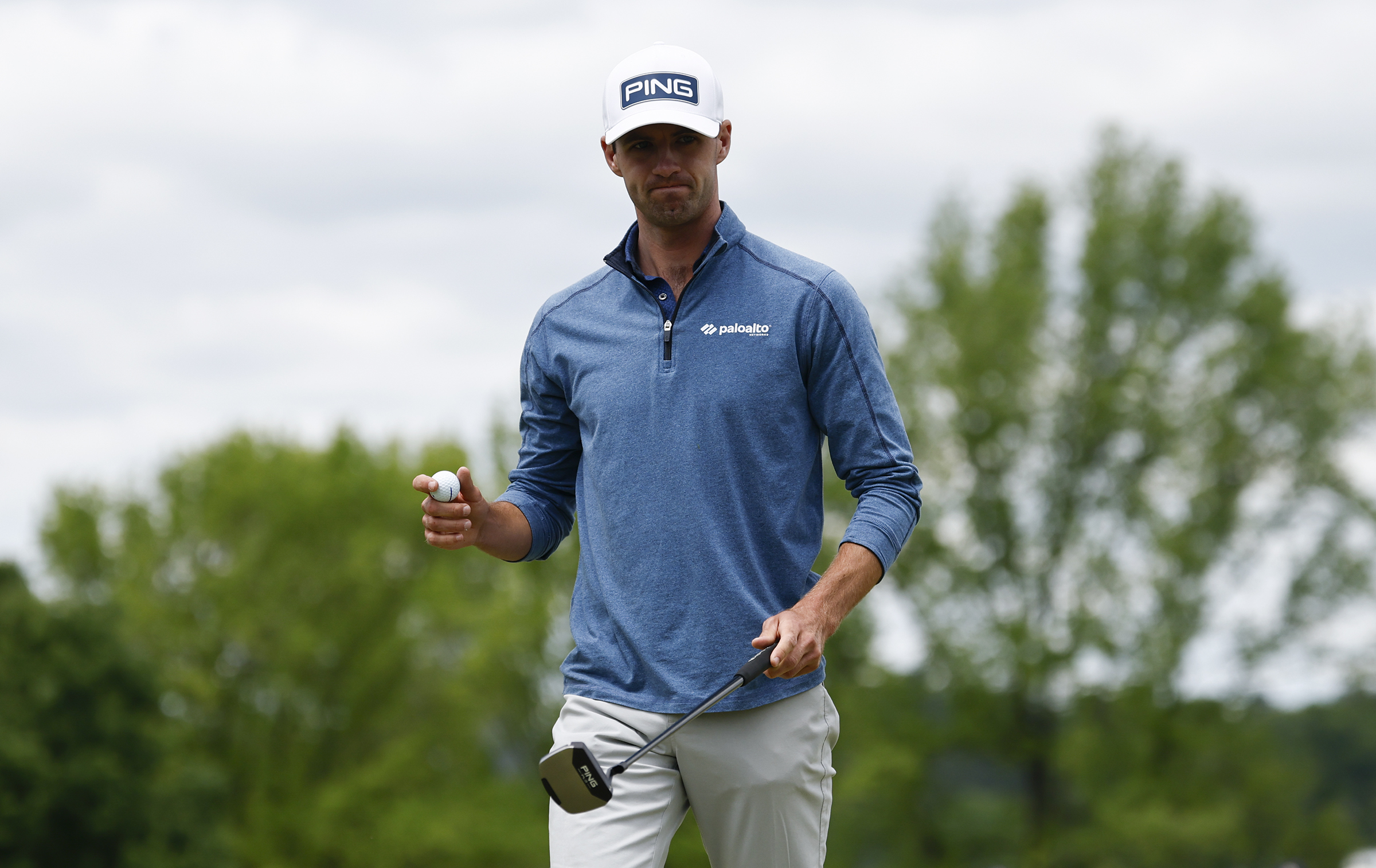
    Alex Smalley holds his golf ball after making a birdie putt on the par-4 fourth hole during the second round of the PGA Championship at Aronimink Golf Club.

    PGA officials deserve plenty of credit for that, especially after the veiled and not-so-veiled criticism they received from the likes of McIlroy, Scheffler and Reed for the setup at Aronomink during the first two rounds. The player’s critiques regarding pin positioning were both understandable and fair. A golf course is supposed to allow for players to differentiate themselves based on their skill. When pin positions are so difficult that they becomes more a matter of chance, it introduces a degree of randomness that can have a leveling effect, particularly in a field as big as the PGA Championship. That was certainly the case in the early going at Aronimink, with 15 players within two strokes of the lead after 36 holes, and with five of the world’s 13 top-ranked golfers missing the cut entirely.

    That being said, the early-round variability played a direct role in what could end up being one of the more memorable weekends of drama. With course conditions loosening, weather warming, and the toughest pin locations exhausted, the final two rounds of the tournament will allow the remaining superstars to battle each other at near-unprecedented level.

    “Credit to the PGA for the setup,” Rahm said. “They found some incredible hard pin locations out there. . . As hard as it is to play, the challenge can also be kind of fun if you do well. That’s probably the reason why the leaderboard is so bunched up and it’s going to be such a good Sunday tomorrow. So in that sense, showmanship-wise, they’ve done a great job.”

    Smalley thickened the plot considerably late in the day, birdieing five of his last 10 holes to separate himself from a pack of seven golfers who had been tied for the lead. That pack at minus-4 also includes longshots Matti Schmid, Nick Taylor, Aaron Rai, and McNealy.

    But the story that will resonate is Saturday’s stampede of superstars. Rose, last year’s Master’s runner-up, shot a 65, with McIlroy and Schauffele shooting 66 and Rahm a 67.

    “It’s a different challenge, and that’s the cool thing about it is it’s on its own,” Reed said. “But the great thing about all the golf courses we play, no matter where it is, whatever major championship we’re playing, if you’re hitting the ball well and you’re putting well, you’re going to be able to handle anything. We’re the best players in the world, so when they throw a really hard challenge at us, that’s when the top players are going to show up.”

  • Jalen Hurts needs another weapon. The Eagles need to prioritize one in the draft.

    Jalen Hurts needs another weapon. The Eagles need to prioritize one in the draft.

    Eight days out from the draft, and the biggest question of the offseason has yet to be answered.

    What is the Eagles’ plan for the post-A.J. Brown Era?

    This isn’t a question that you can shrug off. It would be just as pressing if Brown were guaranteed to return in 2026. He and Dallas Goedert almost certainly won’t be with the team in 2027 or beyond. Even if they are, they are highly unlikely to be anywhere close to the players they were when the Eagles’ offense was at its best. The chapters are short in the NFL. The pages must be turned.

    The story of this year’s draft better be the pass catchers. Even if the Eagles somehow think their passing game can tread water with Dontayvion Wicks and Marquise Brown as their second and third options out wide, and with a 31-year-old and clearly diminished Goedert at tight end, those aren’t long-term solutions. The Eagles desperately need to find at least one in this year’s draft after going four years without selecting a pass catcher higher than 152nd.

    A few points of emphasis:

    You don’t find a lot of franchise-level offensive tackles in the second half of the first round.

    Not since 2017 has a future All Pro tackle been drafted between picks No. 17 and 49. Even multiyear Pro Bowlers are few and far between. The Cowboys nabbed left tackle Tyler Smith at No. 24 in 2022. Before that, Garrett Boles was the biggest success story, going to the Broncos at No. 20 in 2017. Boles was the first offensive lineman off the board that year, thanks in part to a confluence of circumstances. Going before him were three quarterbacks, two unicorn running backs, and the first three members of a loaded cornerback class (Marshon Lattimore, Marlon Humphrey, Adoree’ Jackson).

    The Eagle know first hand how hard it is to find a fixture in the second half of the first round. The last two offensive linemen they drafted there were Andre Dillard and Danny Watkins. There simply isn’t a lot of logic in the idea that the Eagles will be prioritizing an eventual Lane Johnson replacement at No. 23.

    “If you’re forcing something, you’re not really filling the need anyway,” general manager Howie Roseman said on Tuesday.

    The Texans went 4-12 in 2020. And while Deshaun Watson put up the best numbers of his career — 4,823 yards, 33 touchdowns, seven interceptions, a 70.2 completions percentage — the game script had something to do with them.

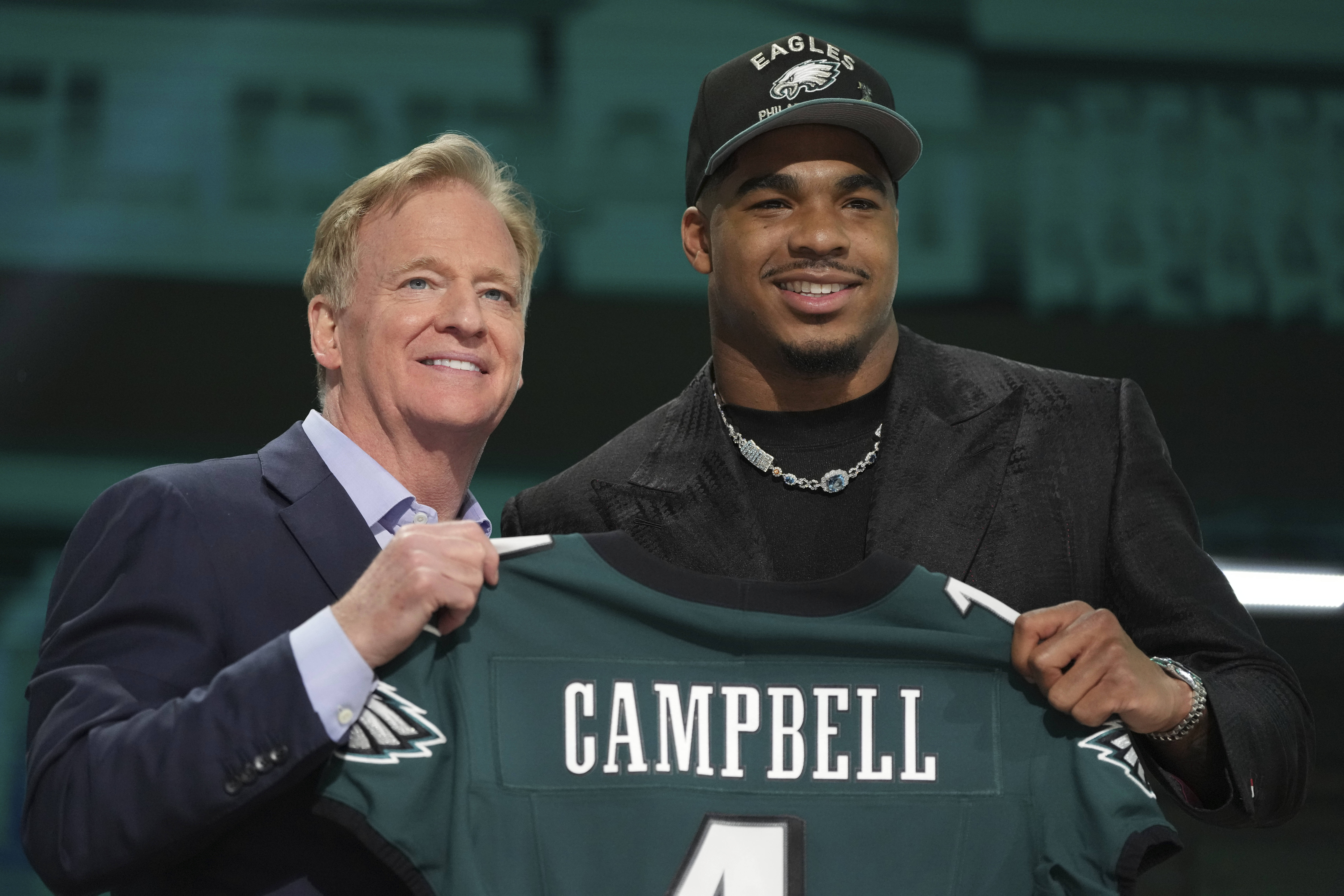
    Jihaad Campbell was the Eagles’ pick at No. 31 overall during the 2025 draft.

    The Eagles have spent a lot of draft capital on the defensive line over the last several seasons.

    Again, that’s not to say that they’d turn down an opportunity to draft an edge rusher they have graded as a potential elite talent who can start immediately. Chances are, anybody who fits that profile will be long gone by the time the Eagles are on the clock. They used the No. 31 pick on Jihaad Campbell last season. They drafted Nolan Smith at No. 30 in 2023. Of the last 11 picks that the Eagles have made inside the Top 115 overall, 10 have come on the defensive side of the football.

    Jalen Hurts is a quarterback who needs an elite weapon that a defense can’t shade coverage to on every play.

    DeVonta Smith counts as an elite weapon. But people need to pump the brakes on the idea that he is Jaxon Smith-Njigba in waiting. Several different media outlets have mentioned the construct in their reporting on the Brown situation. The theory goes something like this: with Brown gone, Smith will be better than he ever has been, similar to how Smith-Njiba blew up in 2025 after the Seahawks traded away D.K. Metcalf.

    The problem with that reasoning is that Metcalf’s departure was the least significant of three major variable changes in the Seahawks offense last season. The first two were a new quarterback and a new offensive coordinator.

    In fact, you might consider it four variable changes if you include Geno Smith’s departure in addition to Sam Darnold’s arrival. Jakobi Meyers’ decreased production year-over-year after Smith’s arrival at quarterback looks suspiciously similar to Smith-Njigba’s increased production in the wake of Smith’s departure. Meyers saw a 23% drop in his targets and a 36% drop in his receiving yardage on a per-game basis in his seven weeks with Smith compared to his 2024 output. And Meyers didn’t have to play in the shadow of Metcalf, either.

    The real yin to Smith-Njigba’s yang was Justin Jefferson. In 2024, he caught 103 passes for 1,533 yards with Darnold as starter. This, despite the presence of Jordan Addison, whose numbers were practically identical to Metcalf’s. Addison was still there last year. Darnold wasn’t. Jefferson caught 84 passes for 1,048 yards.

    A tidier summation:

    • Jefferson without Darnold vs. ’24: 13 less targets, 19 less receptions, 485 less yards.
    • Smith-Njigba with Darnold vs. ’24: 26 more targets, 19 more receptions, 663 more yards

    Fairly symmetrical, no?

    Smith-Njigba’s breakout happened because he had a quarterback who could make all of the throws, including those in traffic in the middle of the field. Hurts hasn’t shown to be that quarterback.

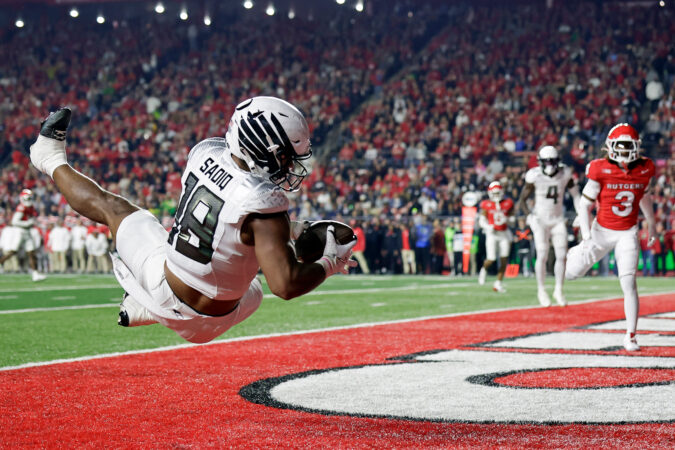
    Oregon tight end Kenyon Sadiq should be at the top of the Eagles draft board. But don’t bet on him falling close to their range.

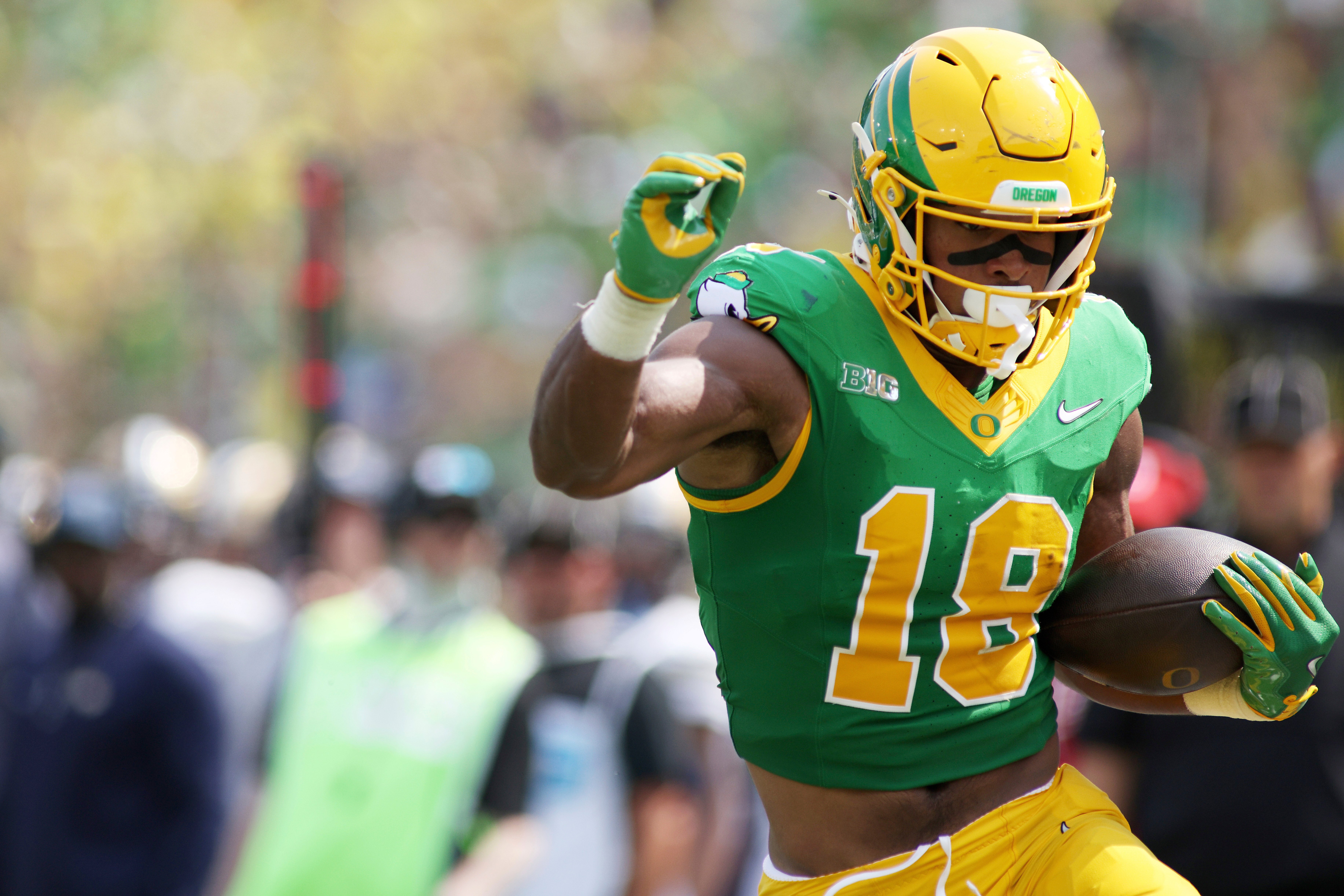
    I’m still a bit puzzled that the majority of mock drafts have Sadiq falling into the second half of the first round. He is a physical specimen who tested off the charts at the combine. The only guy in his class over the last 20 years was future All-Pro Vernon Davis. The college production wasn’t eye-popping, but it also wasn’t much different from Colston Loveland, who went 10th overall to the Bears last season. All it takes is one team higher than the Eagles to fall in love with him. I’ll be surprised if he falls beyond No. 15.

    Oregon’s Kenyon Sadiq is the top projected tight end in the NFL draft.

    That being said, if the Eagles somehow find a way to get themselves in position to draft Sadiq, they would have a tidy answer to their question of where to go after Brown (and Goedert). Sadiq is the one player in this draft outside the projected Top 5 who has the potential to immediately fix a lot of the Eagles’ offensive question marks, run-blocking included.

    Even if Sadiq isn’t an option, the Eagles have good reason to hope they can nab a player who can help them in both the short and long-term.

    Neither Texas A&M’s K.C. Concepcion nor Alabama’s Germie Bernard profile as the sort of outlier that Brown is/was. But both have skill sets and polish that would pair nicely with DeVonta Smith. Both are players who could exploit whatever attention defenses pay to Smith. Concepcion has a lot of Stefon Diggs to his profile, while Bernard looks like a potential Deebo Samuel with the frame and rushing ability to go with his hands. I’ve seen a few mock drafts that have Bernard on the board when the Eagles pick at No. 54. That would be a stroke of luck on the level of Cooper DeJean.

    The moral of the story is simple. The Eagles can’t afford to force a pick at any position. But they also aren’t in a situation where they can afford to go purely for the best player available. They need to factor in their future salary cap and talent distribution. You can’t have too many All-Pro cornerbacks, but you can have too many who you need to pay.

    Further, you can have too few players at positions that have shown themselves to be just as important to the Eagles’ success over the last several seasons.

    Roseman shouldn’t get trapped into picking the best pass-catcher available. But he does need to hope a viable one is there.

  • Sixers are fully healthy for a stretch run. Eagles, Phillies, and Flyers look good, too

    Sixers are fully healthy for a stretch run. Eagles, Phillies, and Flyers look good, too

    It’s never fashionable to be optimistic about sports in Philadelphia, but at this moment, convention be damned.

    It’s been maybe 16 years since all four Philadelphia teams provided as much near-future hope as they provided in a 24-hour period between Wednesday night and Thursday night.

    The Sixers won, then the Eagles got great news, then the Phillies won, then the Flyers won. Hurrah.

    I understand the reluctance to embrace this wellspring of positivity, and I realize that everything could go south with the next twinge in Joel Embiid‘s knee. But hope springs eternal, and it’s only been a week since spring has sprung, so enjoy the warmth of the weather and the moment.

    Nothing happened Friday, so Philly entered the weekend on an unaccustomed high.

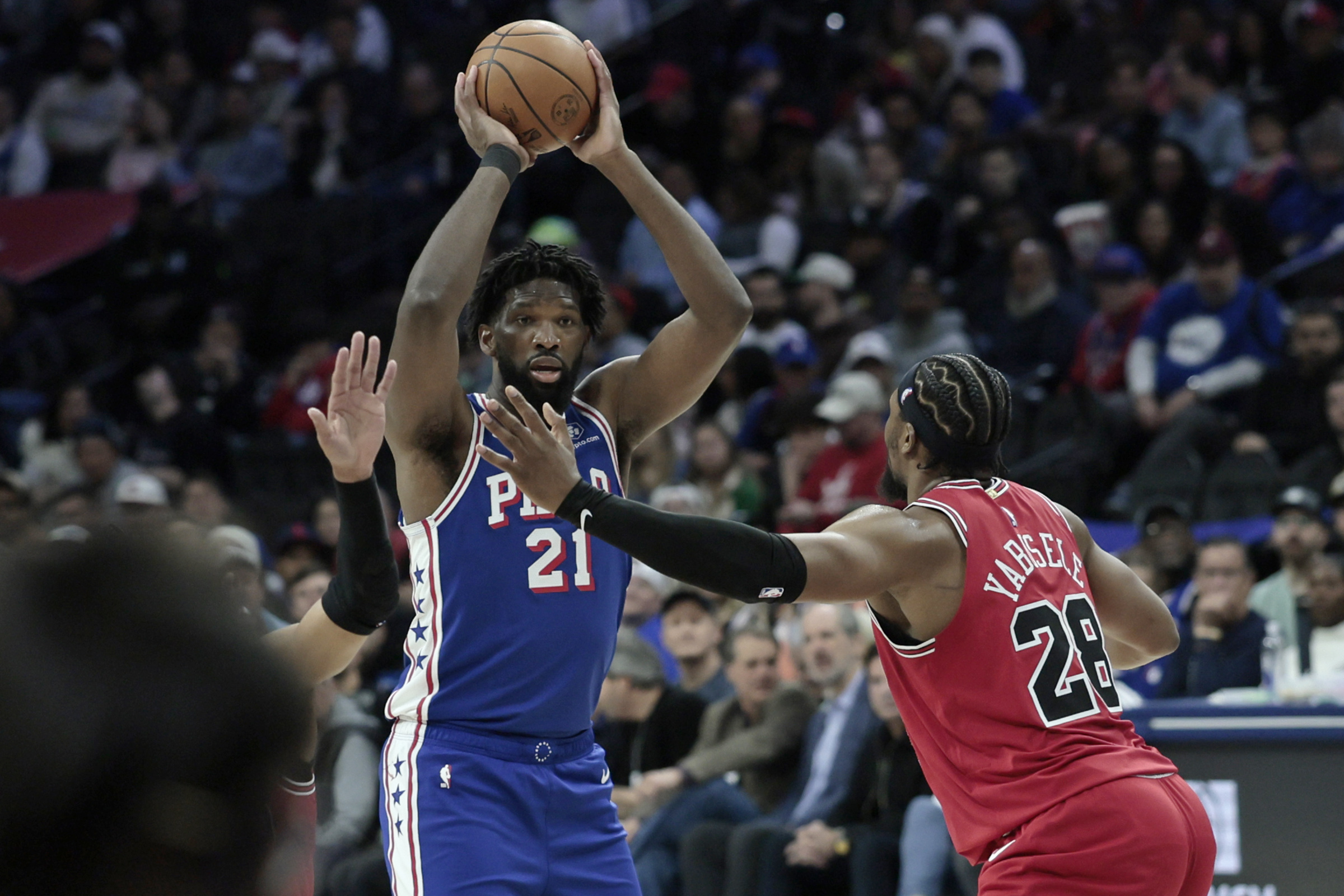
    On Wednesday, the Sixers beat the Bulls by 20. They scored 157 points, their most in 56 years. They did it without their best player, Tyrese Maxey.

    The Flyers beat the Blackhawks and did it without their best, or at least their most important player, Dan Vladař.

    Sixers

    The Sixers went first, and best. Granted, the Bulls are 14 games under .500, but Paul George, in his return from a 25-game suspension for violating the NBA’s antidrug policy, looked like he’s 25, not 35, for one game at least. Embiid seemed to realize his limitations, in that he didn’t play like a freshman trying to make varsity.

    More than anything, though, rookie VJ Edgecombe, the franchise’s most exciting true rookie since Allen Iverson, took his latest step forward. In his last four games — all without Maxey and the first three without Embiid and George — Edgecombe averaged 29.3 points, 8.0 rebounds, and 6.3 assists. He shot 54.8% from the floor and hit 48.4% of his three-pointers.

    Considering the abysmal state of the Eastern Conference — Detroit’s Cade Cunningham is injured, the Celtics are flawed, the Knicks are a mirage, and the Cavaliers have James Harden — a fully fortified Sixers lineup can beat almost anyone.

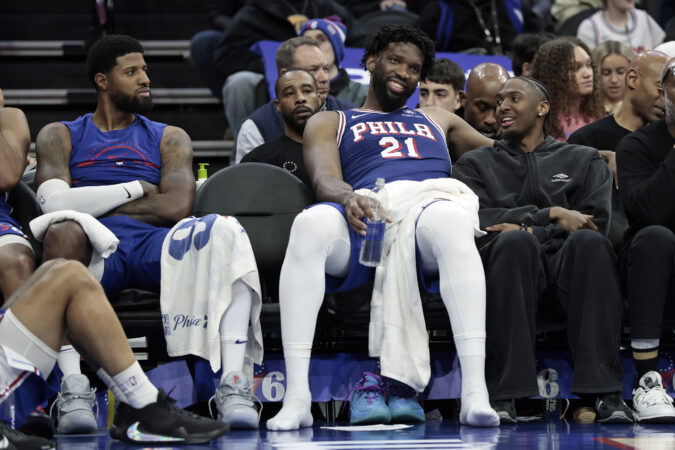
    Joel Embiid returned from a 13-game absence in the Sixers’ 20-point win on Wednesday.

    Maxey and Kelly Oubre Jr. also returned Saturday.

    Sixers coach Nick Nurse was so happy about the previous and imminent returns that he actually smiled after Friday’s practice.

    “I’m certainly more optimistic now,” said Nurse, who considers the recent dependency on reserves as building depth that otherwise would not exist. “If you add all those things up — other guys getting valuable growth, and these guys coming back — the sum of all of that together could be pretty good.”

    Edgecombe might wear down, but the other four starters should be fresh.

    “Definitely got some good rest,” said Maxey, who leads the league at 38.3 minutes per game.

    Again, with this assemblage of vanity and fragility, anything can happen. The Sixers are scheduled to visit the surging Hornets on Saturday and the dangerous Heat on Monday, which will provide a better sense of where this team is right now.

    Birds

    The Eagles struggled last season mainly because of injuries along their offensive line, the best unit during their 13-year run of relevance. Early Friday afternoon, news broke that Pro Bowl center Cam Jurgens was saying the stem cell treatments on his back were already working.

    Left guard Landon Dickerson, who went to three straight Pro Bowls before last season, also had stem cell therapy on his knees and ankles.

    Right tackle Lane Johnson last week told the Fitz & Whit podcast that the sprained foot that ended his season in mid-November is fully recovered.

    All this means that the Eagles will be better. Period.

    Phils

    On Thursday evening, the Phillies beat the Rangers on opening day, and they did it without their best player, Zack Wheeler.

    Cy Young Award runner-up Cristopher Sánchez, who signed a $107 million extension last week, pitched like it.

    Kyle Schwarber hit a home run for the third time in five opening days since joining the Phillies.

    Justin Crawford had two hits in his big-league debut in front of his father, Carl, a former All-Star.

    There’s more.

    Wheeler, who had a rib removed to address thoracic outlet syndrome, was scheduled to begin a 30-day rehab stint on Saturday — 60 days early.

    Last year’s cleanup hitter, Alec Bohm, batting cleanup on opening day, hit a three-run homer, a few weeks after Bryce Harper opened spring training by ripping last year’s cleanup hitters. Bohm did this on the day news broke that he’s suing his own parents for ripping him off.

    Andrew Painter, who lost two seasons to elbow surgery then stunk in triple A in 2025, gave up just three runs in four starts in spring training. He’s scheduled to pitch Tuesday against the visiting Nationals.

    Flyers

    The Flyers are 10-3-1 in their last 14 games. With 82 points they’re unlikely to make the playoffs — they trail the last wild-card spot by five points and have to get past three teams — but they’re playing very good hockey, and with 11 games to play, they could reach the 90-point mark for the first time since 2018. Second-year talent Matvei Michkov has matured. Vladař and veteran defenseman Rasmus Ristolainen are under contract through next season.

    And it might be next season before the Flyers really matter.

    However, for the rest of the teams, the time is now.

    Right now.

  • Jesús Luzardo endures attacks after declining Venezuela’s World Baseball Classic plea and staying with Phillies

    Jesús Luzardo endures attacks after declining Venezuela’s World Baseball Classic plea and staying with Phillies

    CLEARWATER, Fla. — It usually takes about a day for social media to ruin everything. In the case of Jesús Luzardo, it’s right on time.

    Monday was one day after the news broke that Luzardo and the Phillies decided it would be best for him to decline an invitation from Team Venezuela to pitch in the World Baseball Classic final on Tuesday if Venezuela made it that far.

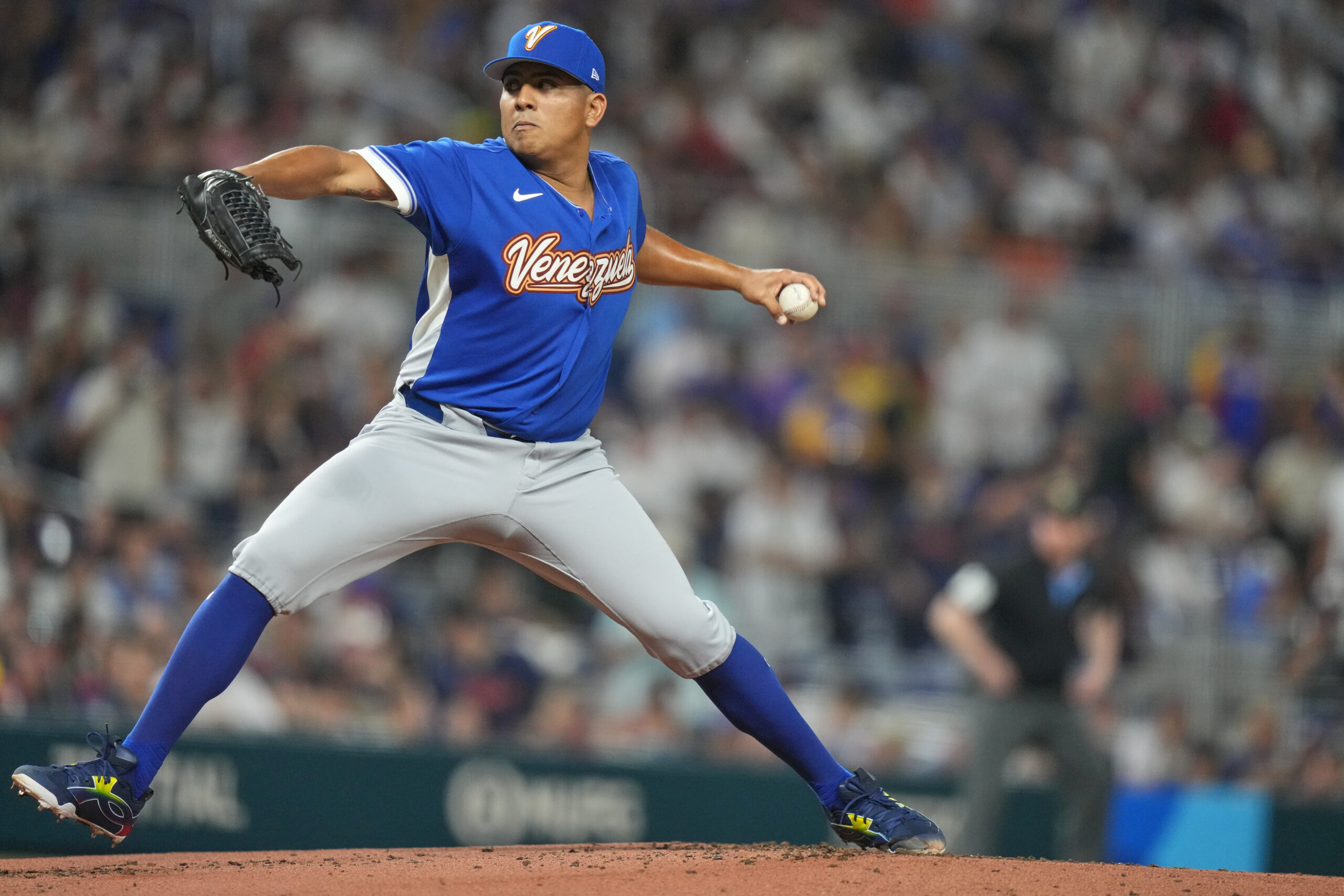
    Luzardo was born in Peru, but his family is from Venezuela, for whom he pitched brilliantly in the 2023 WBC and who placed him on the reserve list. He also grew up in the Miami area, where the semifinal and final are being played. That’s why he told two reporters Sunday that it “breaks my heart not being able to be there.”

    On Monday morning, his heart was breaking for another reason. Many Venezuelan fans were angry that he didn’t accept the invitation.

    “I feel like sometimes, you get painted as a traitor, or, you know, you get painted in this, like, negative light, because of some things that people say — you know, not only me, but my family,” Luzardo said Monday morning. “And I think that that’s tough. People from Venezuela are, like, ‘Why aren’t you helping us out?’”

    Jesús Luzardo signed a five-year, $135 million contract extension with the Phillies last week.

    Traitor? Really? A quick scan of popular social media outlets uncovered zero references to Luzardo as a traitor.

    I asked Luzardo at lunchtime if he was sure about all the negative feedback.

    “It’s there,” he replied, with a pained smile. “I know.”

    Where? Twitter? Instagram?

    “I’m not on social,” he said. “I just know what I saw and what I heard.”

    Hmm. Here’s a thought: Maybe he was hearing it in Spanish, not English.

    Bingo.

    And there it was.

    Comments under Instagram posts announcing Luzardo’s decision were … harsh.

    They questioned his commitment to Venezuela, and many told him to pitch for Peru. They questioned his manhood. One poster dropped a poop emoji.

    Why all the acrimony?

    It’s important to understand the significance of the tournament to Venezuelans, for whom baseball is not just the national sport, but a pastime bordering on the religious. It’s sort of like Jalen Hurts turning down a Team USA for football.

    To be fair, some folks understood and supported Luzardo’s decision. There were several rational replies. A few commented on comments and defended Luzardo’s decision. But the majority of the reactions were negative, personal, and hurtful.

    It wasn’t just the mean tweets and nasty ’grams, either.

    “When a headline came out the other day, and said [Team Venezuela] called me, and I just said, ‘No,’ because I didn’t want to — couldn’t be further from the truth, right?” Luzardo asked. “I think that really kind of rubbed me the wrong way, because that wasn’t truth.”

    The truth is, Luzardo loves the World Baseball Classic, and he loves representing Venezuela.

    The truth is, he said in 2023 that he’d fulfilled his grandfather’s dream by pitching for Team Venezuela.

    The truth is, Luzardo was negotiating an arbitration settlement with Miami the first time Venezuela asked him to play. That paid him $2.45 million in 2023. He signed a five-year, $135 million contract extension with the Phillies last week.

    Former Phillie Ranger Suárez joined Venezuela for the World Baseball Classic.

    The truth is, after missing time in 2019, 2022, and 2024 with injuries, Luzardo enjoyed a superb 2025 and is finally fulfilling the immense promise that made him the No. 18 prospect in all of baseball when the Athletics called him up in 2019. After being traded to Philadelphia from Miami on Dec. 22, 2024, Luzardo went 15-7 with a 3.92 ERA, finished seventh in National League Cy Young Award voting, and pitched well as a starter and a reliever in the Phillies’ brief playoff run.

    The truth is, Luzardo logged a career-high 191⅓ innings including playoffs, he has a history of injuries, and he is on a precise buildup program this spring. That’s partly because Luzardo’s profile in the rotation this year will be two clicks higher to start the season: Staff ace Zack Wheeler is coming back from thoracic outlet decompression surgery that will cost him at least the first month, and Ranger Suárez has departed to the Red Sox via free agency.

    Yes, two weeks ago, as Luzardo declined his initial invitation, he said that if Venezuela made the final four, “If they need me, I’ll go.” That gave Venezuela reasonable hope.

    Things change.

    “When I spoke to Venezuela about being on the reserves, I said, ‘No promises,’” Luzardo said Monday. “They said, ‘We’ll understand if you’re not able to come.’ … It was for multiple reasons, it wasn’t able to come to fruition. Not only the contract situation, but other situations here that, you know — my obligations to this team. They want me to be ready to go. I have to make those [obligations] right.”

    The truth is, it would have been foolish for Luzardo to risk an appearance in the WBC, no matter how important the tournament might be to Venezuela, or to him.

    “I’m hopeful that in the next Classic, you know, they’ll take me into account,” Luzardo said. “I’d love to be there again.”

  • The Eagles whiffed on Maxx Crosby. It should remind them of what they stand to lose with A.J. Brown.

    The Eagles whiffed on Maxx Crosby. It should remind them of what they stand to lose with A.J. Brown.

    Lane Johnson let it be known Feb. 19 that he would return for a 14th season with the Eagles.

    Johnson let it be known Thursday afternoon whom he wanted on his team: five-time Pro Bowl defensive end Maxx Crosby of the Las Vegas Raiders.

    Johnson tweeted an eyes-alerted emoji and tagged Crosby, who was on the trade block. It was a clear indication of what Johnson thought Howie Roseman should do.

    The general manager should’ve heeded his best player’s advice, especially because it might be his best player’s last season. The Eagles have a one-year Lane Johnson window, and they would be foolish to not take advantage of it. When Johnson quits, the offensive line will implode. It no longer will mask the shortcomings of quarterback Jalen Hurts and head coach Nick Sirianni.

    As things stand, assuming their offensive line returns healthier — left guard Landon Dickerson and center Cam Jurgens have injury issues as well — and assuming they don’t do something stupid, like trade star receiver A.J. Brown, then the Eagles will be the best team in the NFC East, again.

    If they’d somehow managed to land Crosby, then they might have been able to offset the talent deficit left by trading Brown. As it stands, Brown remains as precious as ever.

    The move also seems to take one of the most likely suitors for Brown off the table. The Ravens just spent their trade capital on Crosby, which leaves the Patriots and Broncos as the Eagles’ most likely trade partners.

    Howie, don’t even pick up the phone.

    False alarm

    Nobody who’s been around Johnson for more than a minute believed that he was seriously considering retirement after the 2025 season. Johnson will be 36 when the season starts, he remains a superior right tackle, and, despite missing eight games with a foot injury last season (including playoffs), he has been remarkably durable. Also, he absolutely loves being Lane Johnson.

    Beyond next season? That’s a different story.

    A team source told me last month that he believes Johnson’s career beyond 2026 depends on how 2026 goes. It depends on how much Johnson likes new offensive line coach Chris Kuper, who replaced legendary Jeff Stoutland, who quit. It depends on how much Johnson likes new offensive coordinator Sean Mannion, who will replace foundations of Sirianni’s basic offensive tenets. And, more than anything, it will depend on how much success the Eagles have after their massive Super Bowl hangover season of frustration and malcontent.

    Johnson wants to go out on top. He knew that Crosby would immediately have made the Eagles the league’s top dog.

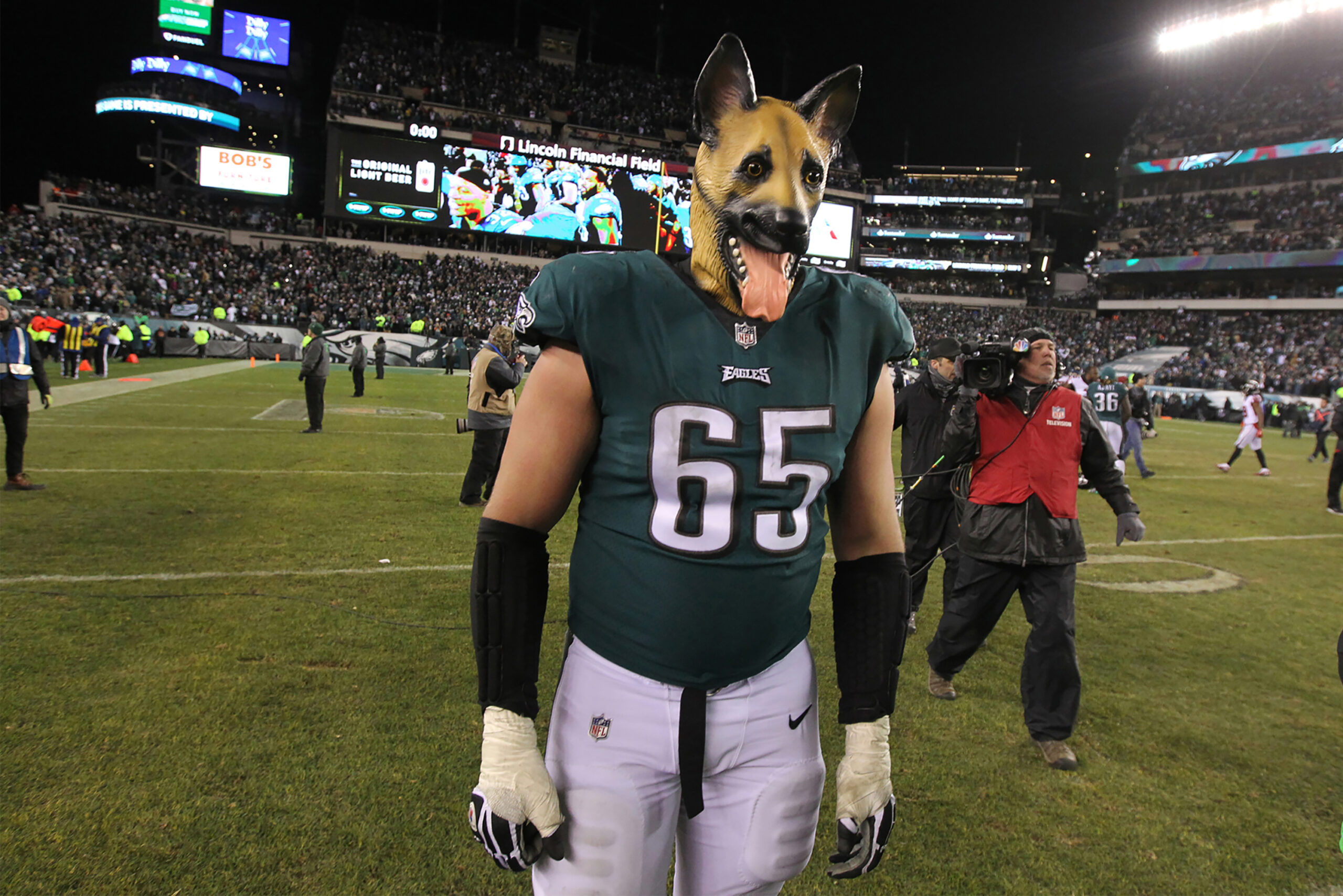
    Eagles offensive lineman Lane Johnson dons a dog mask as he walks off the field following the team’s 15-10 playoff win over the Atlanta Falcons on Jan. 13, 2018.

    The Price

    It would’ve been expensive.

    A deal for Crosby cost the Ravens this year’s first-round pick and next year’s first-round pick, and first-round picks in Philly are golden. With DeVonta Smith, Jordan Davis, Carter, and Quinyon Mitchell, Howie’s been on a first-round roll.

    Crosby also makes about $30 million each of the next two seasons.

    It would have been worth it. If they’re considering giving Jaelan Phillips $25 million per season — they shouldn’t, but they are — then they shouldn’t have blinked at Crosby’s price tag.

    The disappointment resonates louder because the Birds considered adding costly edge talent before.

    They pursued Micah Parsons last offseason, but the Cowboys, wary of reinforcing their chief rival, refused to trade him to the Eagles. They instead traded Parsons to the Packers, who sent Dallas two first-round picks and defensive tackle Kenny Clark.

    Why fret over a deal that didn’t get done? Because Crosby is great.

    Since 2022, only five players have more than his 44½ sacks. No one has more than his 90 tackles for loss, and he led all edge players with 186 solo tackles.

    He is great, and he would make the D-Line great again. Don’t forget that it was a monster D-line that took the Birds to their second title two years ago.

    Saquon Barkley might have set a rushing record, but the Eagles’ top-ranked defense was the top-ranked defense because it had the top-ranked pass defense, and that was predicated on a dominant defensive line. Free agency cost that line Josh Sweat and Milton Williams. Injury cost Carter three games and diminished him for several others. The defense dipped from No. 1 to No. 13.

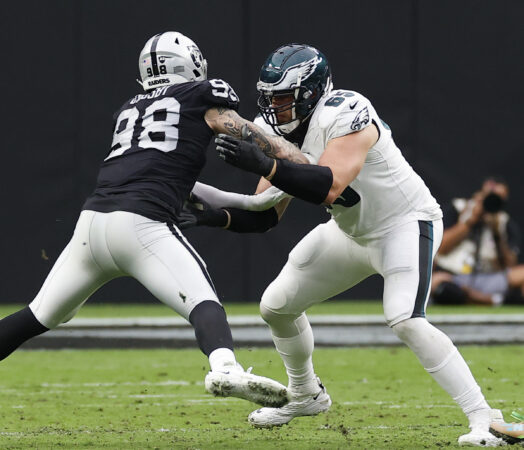
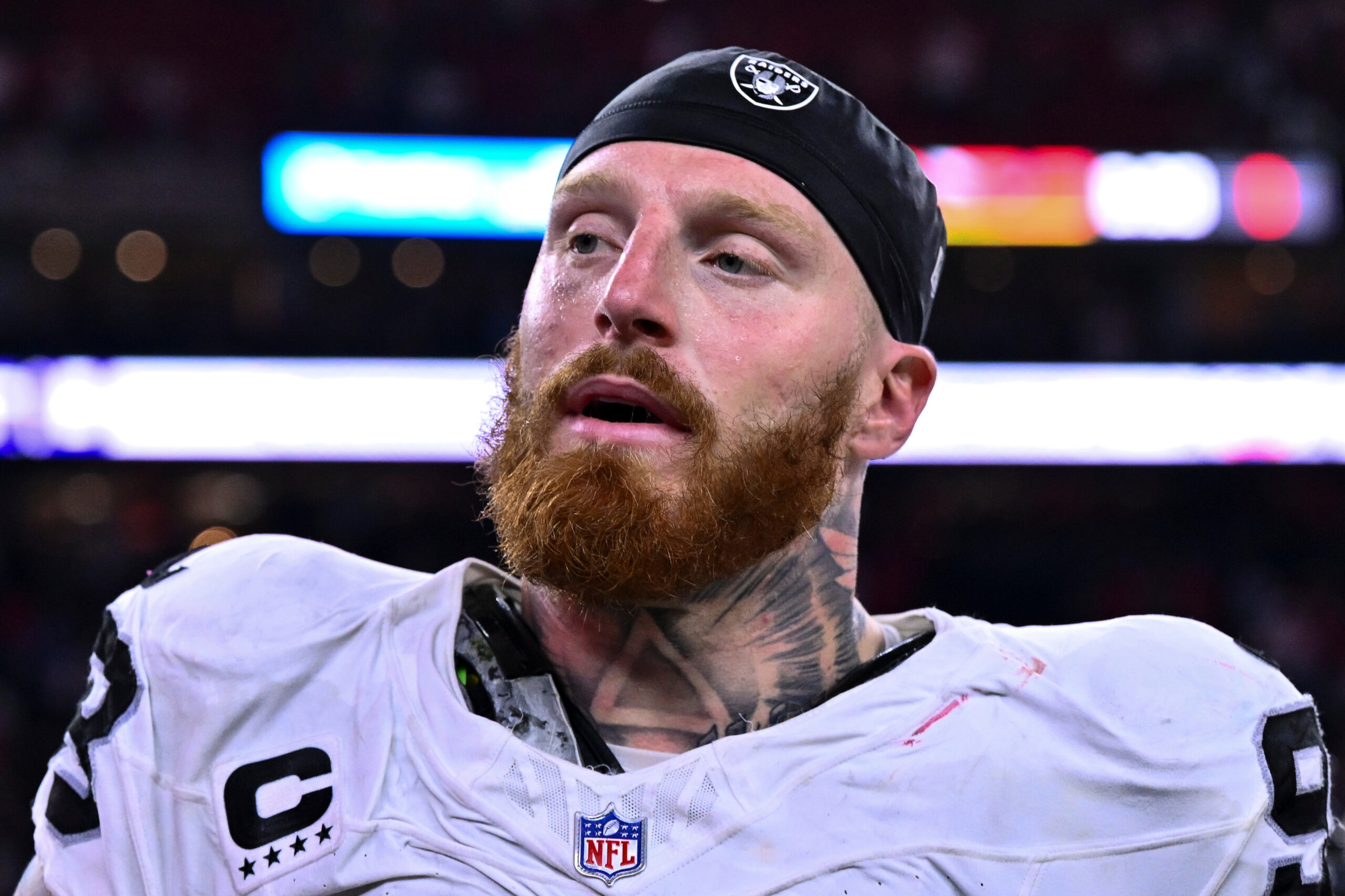
    A deal for Maxx Crosby (98), now a Raven, might have helped Lane Johnson land his third Super Bowl title as an Eagle.

    Too good to be gone

    There is no argument that Johnson is an all-time Eagles great, and by far the best Bird during the current nine-year Golden Era. In fact, considering his consistent excellence over these nine seasons, there’s an argument that Johnson might be the best Eagle ever. Johnson might at least be the third-best Eagle in history, after Chuck Bednarik and Reggie White.

    A third Super Bowl title would cement Johnson’s status as an all-timer not just in Philadelphia but in the NFL. It would help folks forget his two PED suspensions. It would help ease his path to the Pro Football Hall of Fame as the best player on a dynastic team that won three Super Bowls in 10 years.

    But, as Johnson knows, he can’t do it by himself. As Johnson knows, there may be no tomorrow. That’s why he wanted Crosby.

    It’s why the Eagles must retain Brown, warts and all.

    Brown has complained about the passing game’s inefficiency in each of the past two seasons. Last season, Brown even reportedly asked to be traded, multiple times.

    Deal with it.

    In his four seasons as an Eagle, Brown ranks fifth in the NFL in total yards, and his 14.8 yards-per-catch average is better than any of the four players ahead of him. He’s also sixth in touchdown catches. This, despite ranking 10th among wide receivers in total catches — a byproduct of Hurts’ reluctance to pass in general, and his reluctance to pass into the tight windows of coverage Brown’s excellence attracts.

    Brown already is the best receiver in franchise history. He’s an all-timer, just like Johnson.

    If the Eagles had added Crosby, 2026 would have been theirs.

    Now that he’s gone, they cannot afford to lose what they’ve got.

  • Acquiring David Jiříček is the latest example of the Flyers’ unorthodox approach to rebuilding. It’s worth the risk.

    Acquiring David Jiříček is the latest example of the Flyers’ unorthodox approach to rebuilding. It’s worth the risk.

    With one trade Friday morning, the Flyers got more interesting. Not immediately. They’re still likely to miss the playoffs this season, which would be the sixth in a row that they’ve failed to qualify for the postseason. For all that time and longer, they’ve been the NHL’s version of late-career Martin Scorsese: Back in the day, they were great and fascinating, and now they’re one suspenseless snoozefest after another. (Seriously, has Killers of the Flower Moon ended yet?)

    Their decision to send winger Bobby Brink to the Minnesota Wild for defenseman David Jiříček was an eyebrow-raiser, though. The move in and of itself wasn’t all that surprising, in that the Flyers have a surplus of wingers both on their roster and in their farm system. They were bound to say goodbye to one of them at this trade deadline, and Brink was a prime candidate: At 24, he’s a relatively promising player on a cap-friendly contract.

    No, the intrigue of the Brink trade comes from its context. It’s the latest thread in a larger pattern that general manager Danny Brière and team president Keith Jones have been weaving since they took control of the Flyers’ player-personnel department in 2023. Rather than having the team bottom out over a full season or two and ending up with a pick or picks that are at worst among the top five in their drafts, the Flyers are taking risks, some more calculated than others, by acquiring young players who were high draft picks for other clubs.

    They did it with Jamie Drysdale, whom the Anaheim Ducks had picked sixth in 2020 before trading him to the Flyers for Cutter Gauthier in January of 2024. They did it with Trevor Zegras — another Ducks draftee, ninth overall in 2019 — when they got him last offseason for Ryan Poehling and two draft picks. They did something similar in 2023 when they drafted Matvei Michkov, who fell to them at No. 7 in part because of worries among NHL clubs that he wouldn’t be leaving Russia for three years, if he was able to leave at all.

    Now they’ve done it with Jiříček. Drafted sixth overall in 2022 by the Columbus Blue Jackets, he reportedly was unhappy that the Blue Jackets thought he needed to spend time in the minors. They shipped him to Minnesota in November 2024; there, he bounced between the Wild and its farm team until Friday.

    Flyers forward Trevor Zegras has been a shrewd addition after struggling the past two seasons in Anaheim.

    At first glance, that’s not an especially appealing player profile: a high draft pick who has been traded twice before his 23rd birthday, once because he was malcontented, once because he couldn’t stick on an NHL roster. And it’s generally acknowledged that Jiříček’s skating has to improve substantially. Still, he is just 22, and he is 6-foot-4 and rugged, and he has a booming slap shot. There are tools there, and there is still time for him to mature into the player he was projected to be.

    The Flyers are attempting a daring bit of raindrop-dodging here. They haven’t tanked. They don’t want to tank. They believe it would be corrosive to the franchise as a whole and to the locker room in particular (and it certainly would be to their ticket-sales department). So they are banking — and a team source confirmed Friday that this element was part of their approach — that head coach Rick Tocchet, his staff, and the other power people in the organization can cultivate a strong enough culture that Drysdale, Zegras, Jiříček, and players like them can develop and thrive here even though they didn’t elsewhere.

    Michkov is again an instructive example in this regard. After entering the season out of shape and seeing Tocchet limit his ice time, he has been a better player since the Olympic break. The fears within the fan base that Tocchet was angering or alienating him have quelled, and Tocchet’s strategy for handling the most important player on the roster seems to be working, for the time being anyway.

    Drysdale hasn’t been the same caliber of player that Gauthier has been — someday, someone will get the full story on why the relationship between the Flyers and Gauthier deteriorated to the point that they felt they had to trade him — but he has come a long way and is just 23. Zegras, 24, has been an excellent addition so far. The Flyers are in need of two major components of a Stanley Cup-contending team — a No. 1 center and a No. 1 defenseman — and Jiříček’s pedigree suggests that he can one day be a top-tier defenseman, assuming a team can figure out how to get the best out of him.

    He may or may not become that kind of player. Whether he does or doesn’t isn’t really the point. The point is that the only way the Flyers are going to return to respectability again is by taking some chances and having those gambles pay off. They’re past playing it safe. They might end up exactly where they are now or in even worse shape, but at least they’ve stepped into the casino.

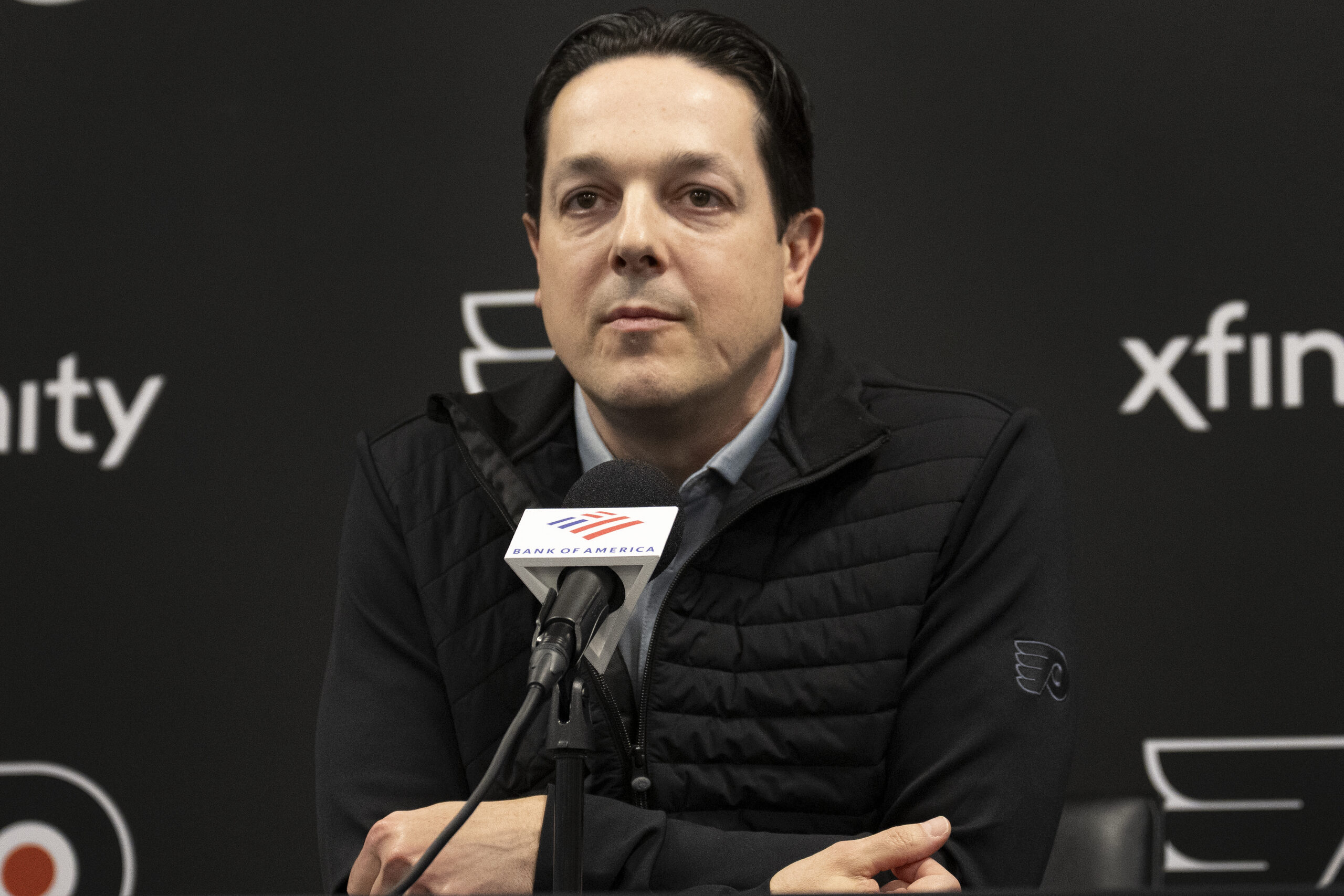
    Danny Brière has taken an unconventional and risky path to rebuilding. Time will tell if it pays off.
  • A.J. Brown’s pool of trade suitors is smaller after the Bills’ D.J. Moore move. The Eagles must demand a first-round pick for Brown.

    A.J. Brown’s pool of trade suitors is smaller after the Bills’ D.J. Moore move. The Eagles must demand a first-round pick for Brown.

    The biggest Eagles-related takeaway from the D.J. Moore trade?

    A lot of NFL general managers are a lot less capable than Howie Roseman.

    As for A.J. Brown, the impact of the Bills’ acquisition of Moore is being overstated.

    Roseman may get the first-round pick he reportedly is seeking in exchange for Brown, but it’s no more likely now that the Bears have somehow managed to finagle a second-round pick out of the Bills for Moore. If anything, Roseman might deserve credit for driving up the price for Moore, who was the Bears’ fourth receiving option by the end of a season in which he caught just 50 passes for 682 yards. Buffalo had a clear need for a primary receiver. Dealing a second-round pick for Moore might sound more reasonable when your other option is trading a first- and second-round pick for Brown. What we know for sure is that the small pool of teams that made obvious sense as a trade partner for the Eagles just shrunk by one.

    Here’s what else we know:

    The Trent McDuffie trade could be just as much of a harbinger in the opposite direction.

    A two-time All-Pro at a premium position (cornerback) entering his age-26 season, McDuffie is headed to the Rams for the No. 29 pick in this year’s draft, a future third, and change. I don’t think it’s accurate to say that the McDuffie deal is an indication of the elite cornerback market, at least not relative to Brown. Keep in mind, the Colts traded away two first-round picks and Adonai Mitchell for Sauce Gardner at the deadline. One of those picks ended up at No. 16 this year. Who knows what next year’s will be. That’s the elite cornerback market.

    The McDuffie trade does give us a neat and tidy for-instance. Given the sacrifice the Chiefs just made at a more premium position, would they then be willing to turn around and trade the No. 29 pick they received for McDuffie to the Eagles for Brown? Maybe they would. Hey, maybe they will. They sure do need a wide receiver. That said, it seems far more likely that they are looking at that No. 29 pick the same way the Eagles would in justifying a trade of Brown: as a chance to add another five years of well-below-market-rate production in the form of a rookie.

    The overall point is that you can talk yourself silly trying to project the market based on one deal. The Moore deal can just as easily be construed as the price a team is willing to pay to not pay the price the Eagles are asking for Brown.

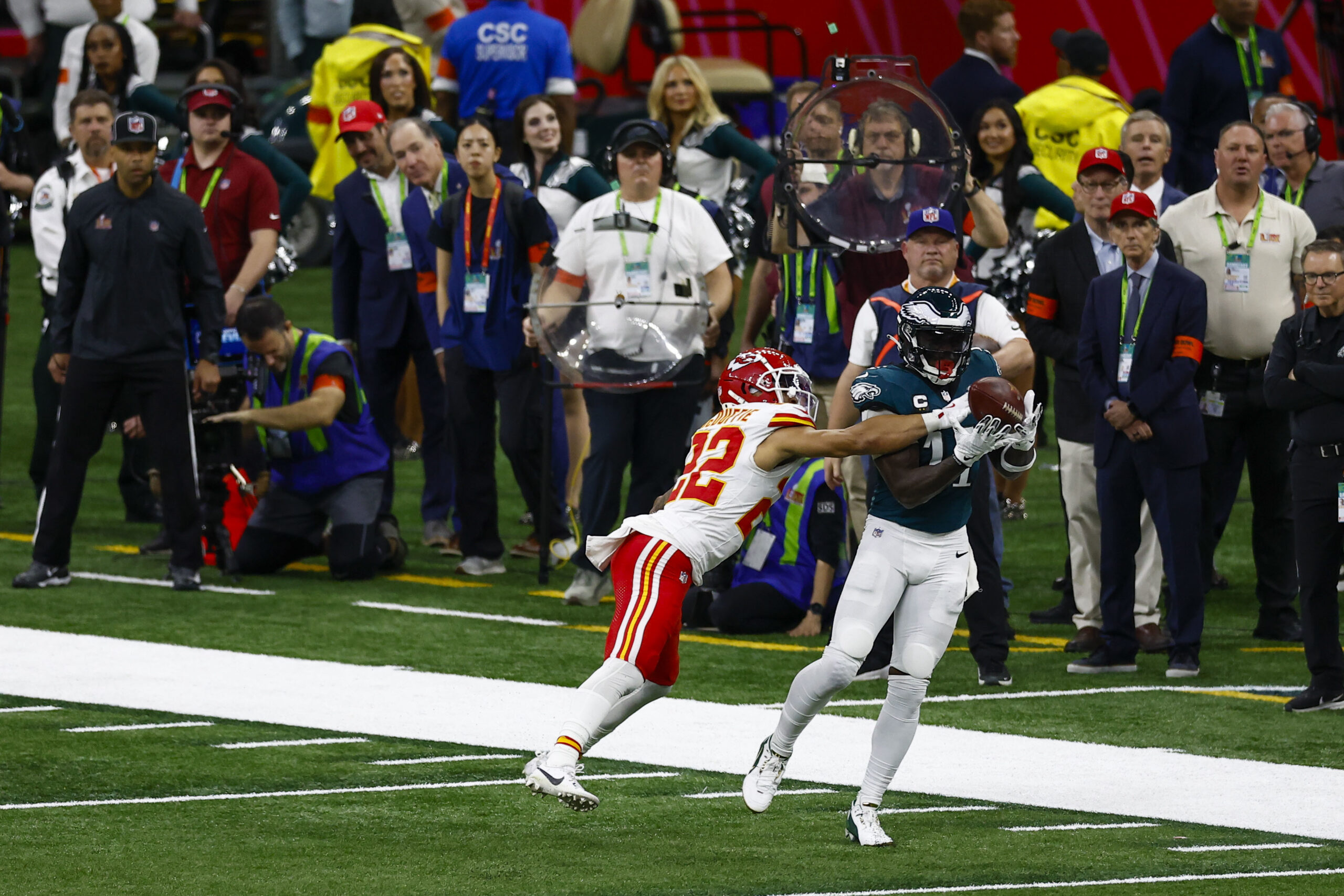
    Chiefs cornerback Trent McDuffie (left) was traded to the Rams for the 29th pick in this year’s draft. Could Eagles wide receiver A.J. Brown fetch a similar haul?

    The Eagles are justified in asking for a first- and second-rounder for Brown, assuming what they really expect is a first-rounder and an assortment of mid-to-late-round picks.

    There are plenty of comps.

    • The Raiders acquired 29-year-old Davante Adams from the Packers for No. 22 overall and No. 53 overall in 2022.
    • The Bills acquired 26-year-old Stefon Diggs for No. 22 overall and change from the Vikings in 2020.
    • The Chiefs acquired No. 29 overall, No. 50 overall and change from the Dolphins for 28-year-old Tyreek Hill in 2022.

    It’s easy to see the genesis of Roseman’s current reported asking price. It’s also easy to see why that asking price has drawn snickers.

    Consider:

    • The first-round pick the Bills traded to the Vikings turned out to be Justin Jefferson.
    • The second-rounder that the Raiders traded to the Packers turned out to be Alec Pierce (after Green Bay traded the pick to draft Christian Watson). The first-rounder was Quay Walker, a four-year starter at linebacker.
    • The Chiefs used the No. 29 pick they landed for Hill to trade up to draft McDuffie at No. 21.

    On the other side of these deals were two of the worst organizations in the NFL (Dolphins, Raiders), and the team that just traded a second-round pick for Moore and has the second-most expensive wide receiver room in the NFL without a true WR1 to show for it.

    There aren’t many other for-instances. The Texans traded away DeAndre Hopkins for No. 40 overall in 2020, but that deal included running back David Johnson in the return and was universally panned regardless. Last offseason, the Steelers traded away No. 52 overall for 27-year-old DK Metcalf, whose four-year averages were worse than Brown’s 2025.

    There aren’t many teams that can give the Eagles what they need.

    I use the word “need” for a reason. The Eagles need a first-round pick to justify trading Brown. The only way they might otherwise justify it is by landing a future first plus a 2026 second, i.e. the “Ravens Scenario.” We’ll get to that in a second. First, let’s explain what we mean when we say the Eagles “need” a first-rounder.

    This is not abstract. Concretely, the Eagles need to be able to replace Brown. The best way to do it is via the draft, where there happens to be a number of players who could help them and who are projected to be within striking distance of No. 23. But the Eagles need plenty else besides a replacement for Brown. We saw that this year, when they had Brown. To justify trading Brown, they need to at least end up with a pick that maximizes their odds of replacing him (even if they end up “replacing” him with a star at another position). Bare minimum is a top-50ish pick. But only if they feel like they need to trade him for the best offer. Right now, their best leverage is their willingness to bring him back. Which is why they are making that willingness known.

    Not many teams are in a position to give them what they need. Cross off the Bills. Presumably the Chiefs, unless Andy Reid and Brett Veach have radically changed the philosophy under which they traded away Hill to pave the way for McDuffie. Nobody is giving up a top-10 pick for Brown, so cross them off too.

    Could the Ravens be in the market to trade for Eagles wide receiver A.J. Brown?

    The Dolphins (No. 11) are more likely to trade Jaylen Waddle for a Brown-type package than to trade for Brown. The Cowboys (No. 12) don’t need a wide receiver, nor do the Rams (No. 13), who just traded their expendable first-rounder to the Chiefs for McDuffie. The Bucs (No. 15) are brimming with wide receivers, including last year’s first-rounder Emeka Egbuka. The Lions (No. 17) have a lot of needs more pressing than the skill positions. Same goes for the Vikings (No. 18). The Panthers (No. 19) spent significant draft capital on Tetairoa McMillan last year. Brown doesn’t fit their timeline.

    Next up is Dallas again at No. 20, then the Steelers, who just traded for Metcalf and like to build from within. The Chargers don’t have the luxury of trading No. 22 for Brown. Forget the Browns (No. 24). We’ve already covered the Bears (No. 25). Cross off the Texans (No. 28), who have Nico Collins and youth around him.

    That leaves us with the Ravens at No. 14, the 49ers at No. 27, the Broncos at No. 30, the Patriots at No. 31, and the Seahawks at No. 32.

    If the Eagles are reluctant to trade Brown to a fellow NFC contender, that would leave three teams: Ravens, Broncos, Patriots. Denver and New England would need to offer their first-rounder, because the next best 2026 picks are No. 62 and No. 63, which isn’t nearly good enough. The Ravens are in the opposite boat. Their No. 14 overall pick is too high. Their second-rounder (No. 45) is borderline, and would only make sense if coupled with a high future pick.

    The Eagles’ ability to land a first-rounder is contingent on the Ravens’ willingness to give up a future first or the Patriots/Broncos (or Seahawks/49ers) belief in the players who will be on the board at the end of this year’s first round.

    None of that is impacted by the cost of trading for Moore. The Ravens and the Patriots are the two obvious teams, assuming we remove the Chiefs and the NFC contenders. The Ravens aren’t going to give up No. 14 for Brown, and No. 45 is only worth it for the Eagles if they have 45 players they love on their draft board. A future first from Baltimore would give them an opportunity to move up. The Pats’ first-rounder would work if coupled with a pick that also gives the Eagles ammo to move up from No. 23 or No. 31 to draft a guy they covet.

    This is a pass-fail sort of thing. There is a bare minimum return the Eagles need in order to justify the competitive hit they’d take without Brown in 2026. It is a return where only a team’s best available draft pick is good enough. There are only a few teams that might consider it. That was the case before the Bills traded for Moore. It remains the case now.