Category: Sports Columnists

  • Jeffrey Lurie admired Kellen Moore as OC in Dallas and hired a similar coach, Sean Mannion, for the Eagles

    Jeffrey Lurie admired Kellen Moore as OC in Dallas and hired a similar coach, Sean Mannion, for the Eagles

    Folks keep trying to compare little-known Sean Mannion with previous Eagles hires. In fact, the best comp was in Dallas.

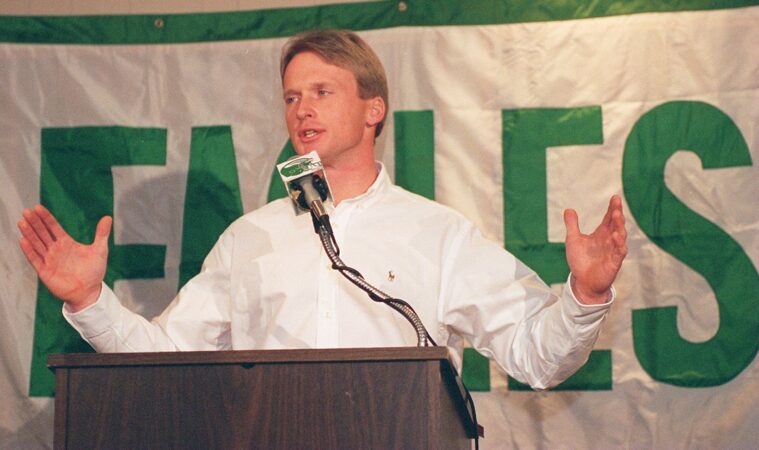
    It’s true that Mannion, the new offensive coordinator, shares some characteristics with former Eagles OC Jon Gruden, a former wide receivers coach whom Jeffrey Lurie and the Eagles hired at the age of 31. Similarly, when the Eagles hired 40-year-old Packers quarterbacks coach Andy Reid to be their head coach in 1999, Reid had never called plays, established a scheme, or formulated a game plan.

    But by 1999 Reid had been a coach for 17 years, and by 1995 Gruden had been a coach for nine years. Mannion, by contrast, has been a coach for just two years, both with the Packers, one of them as Matt LaFleur’s “offensive assistant,” the NFL’s equivalent of an unpaid internship.

    That doesn’t mean Mannion can’t do the job.

    After all, Mannion is no bigger risk for the Eagles than Kellen Moore was for the Cowboys in 2019.

    When Jerry Jones named Moore the offensive coordinator in Dallas, Moore was a short-term, insignificant NFL backup with only one year of coaching experience, as the Cowboys’ quarterbacks coach. He was 29.

    Mannion is a short-term, insignificant NFL backup with one year of experience as a position coach. He is 33.

    He also is a consolation prize.

    The Eagles wanted a Josh McDaniels-type OC like Mike McDaniel or Brian Daboll, former head coaches and accomplished coordinators. McDaniel chose the Chargers. Daboll went to Tennessee.

    The Birds got Mannion. He’s not nothing.
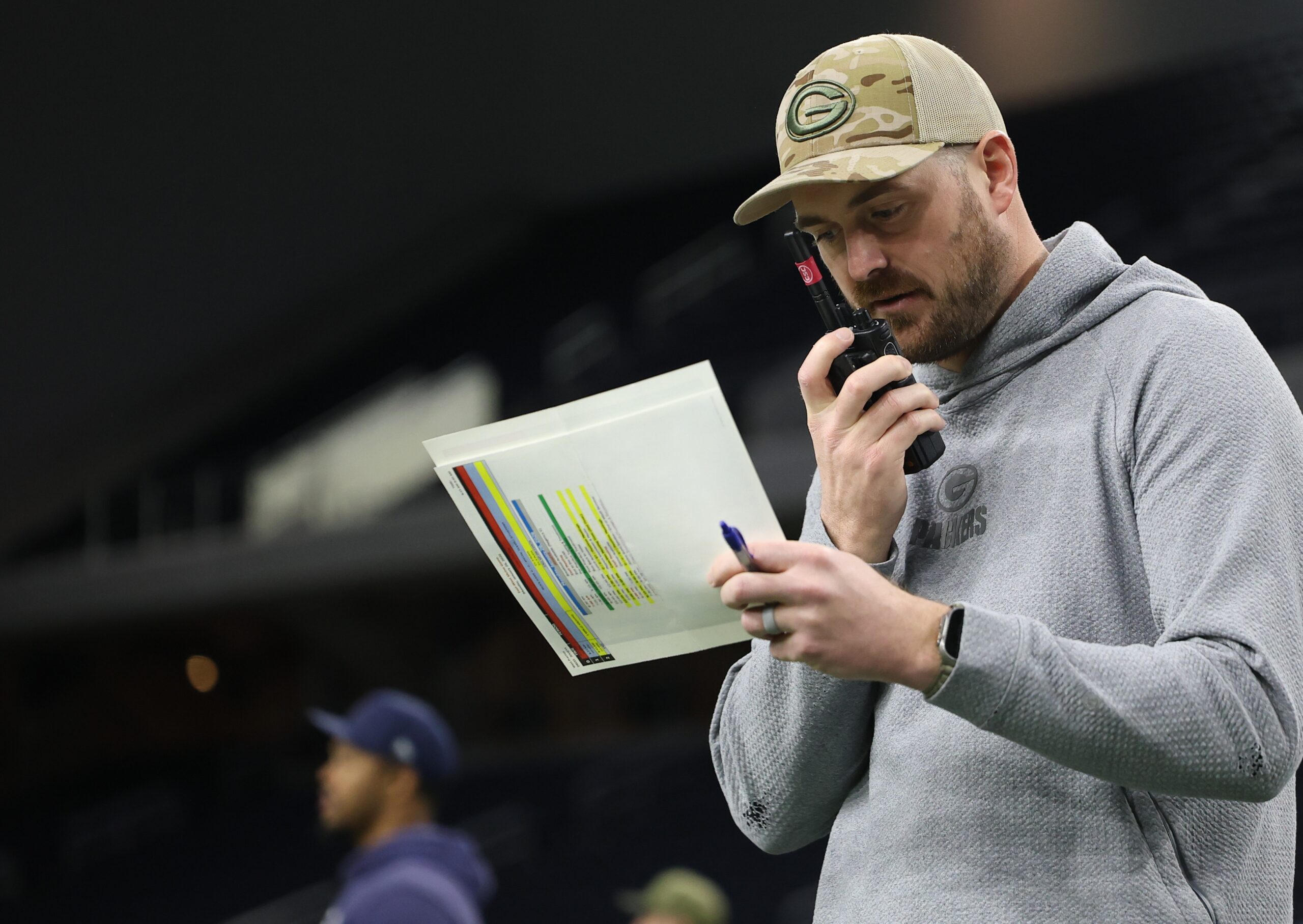
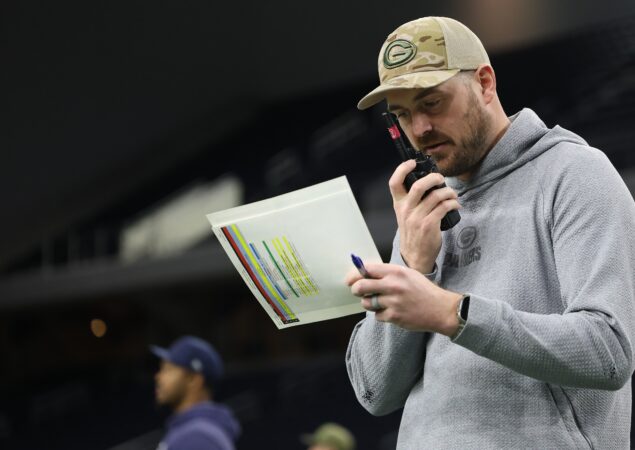
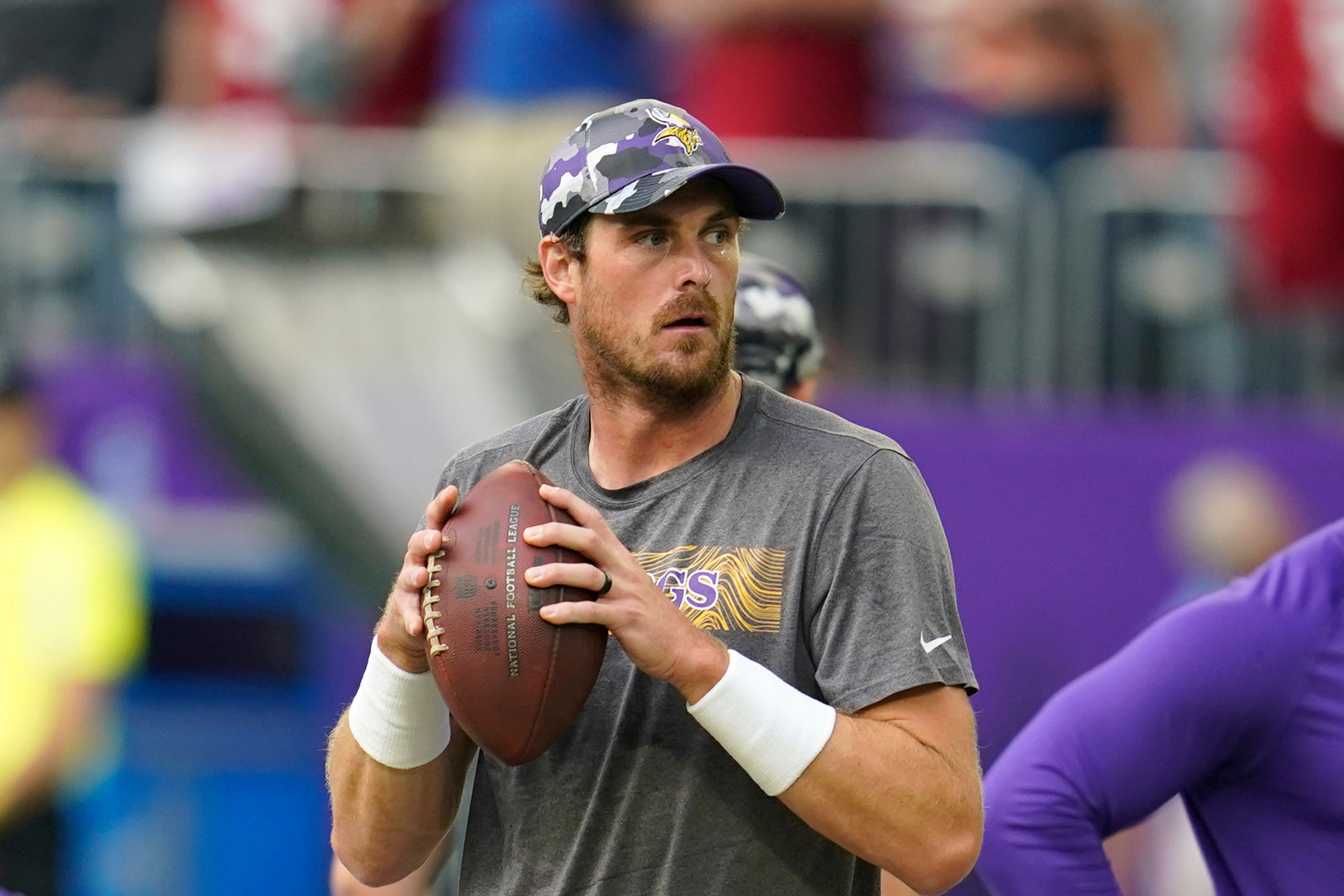
    Sean Mannion, 33, has two years of coaching experience in the NFL.

    This might sound like a desperate attempt to cope with what legitimately should be cast as a repudiation of the Eagles by the best and the brightest. This also might sound like an attempt to diminish the injury concerns the Eagles have at offensive line, the commitment concerns they have with A.J. Brown, and the performance concerns they have with Jalen Hurts.

    Maybe it is, a little bit.

    Sometimes, though, as anyone who’s been married can tell you, your first choice isn’t your best choice.

    Sometimes, you don’t get what you want. You get what you need.

    A grudging admiration

    Few owners keep their ear to the ground the way Lurie does. Over his three decades of ownership he routinely has attended the Senior Bowl, which serves as the NFL’s de facto job fair, where aspiring young coaches gather to distribute resumés and a place where executives meet to gossip about hot new coaching prospects.

    As soon as Moore quit playing in 2017, his sixth season in the NFL and his third with Dallas, including practice squads, he was identified as a comer. In 2018, as QB coach, he corrected Dak Prescott’s slump. In 2019, when Wade Wilson retired, Jones controversially promoted Moore, who wasn’t even 30 and looked like he wasn’t even 20.
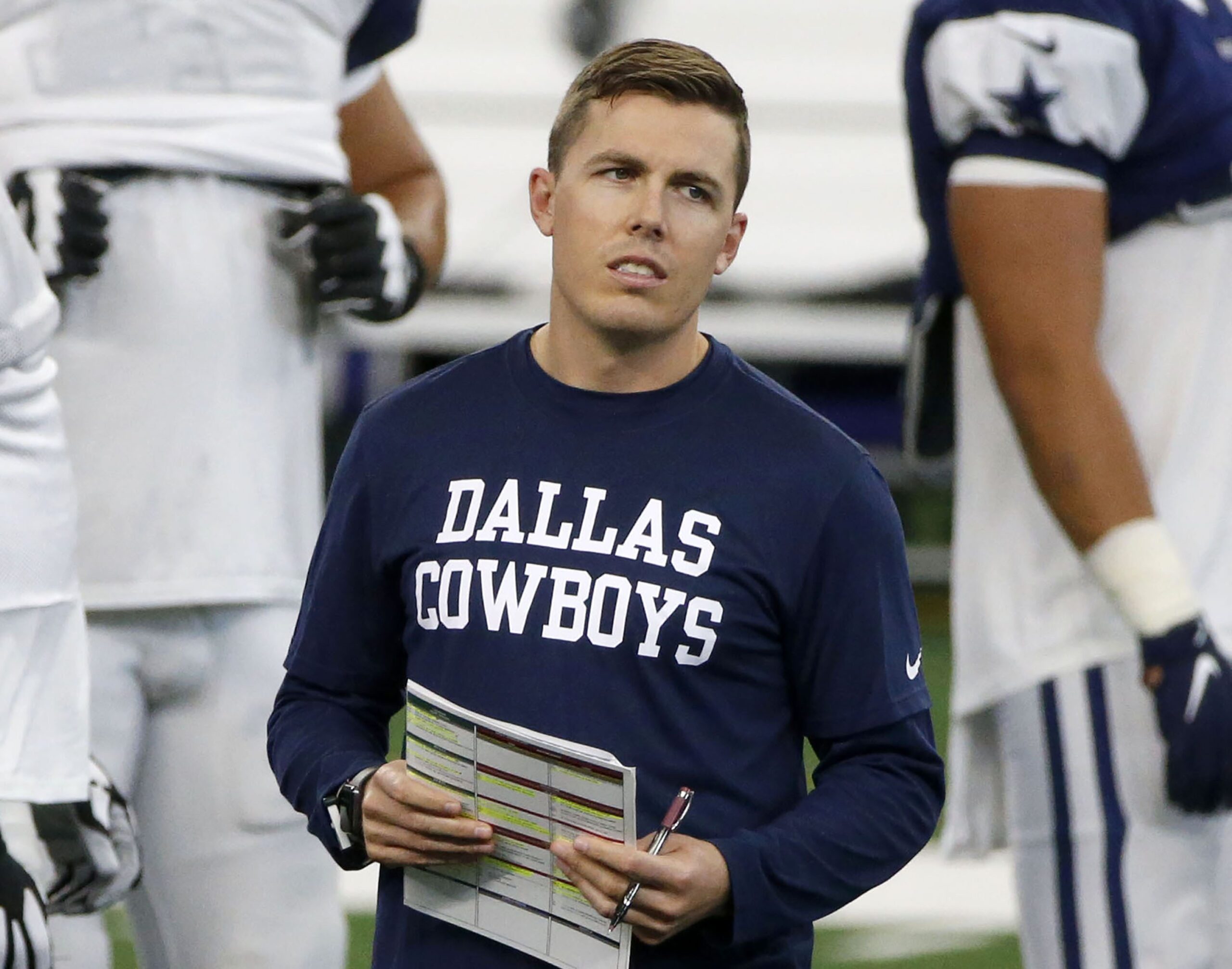
    Dallas Cowboys offensive coordinator Kellen Moore watching practice in 2020.

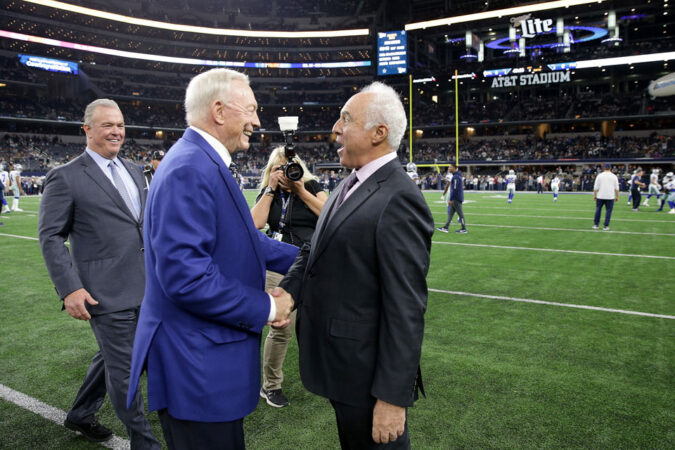
    According to an Eagles executive at the time, no one was more impressed by Jones hiring such an outside-the-box candidate than the NFL owner who spends most of his time thinking outside of the box: Jeffrey Lurie.

    Jones’ gamble paid off.

    In 2019, as OC, Moore pushed Dallas’ offense from 22nd to No. 1. That didn’t save the job of head coach Jason Garrett, but it did convince Jones to ask incoming head coach Mike McCarthy keep Moore as the OC. Sure enough, after a dip in 2020, Dallas was No. 1 in 2021, too.

    All along, Lurie was watching Moore’s success and acknowledging the wisdom of Jones, his archrival, with grudging admiration.

    The Cowboys offense then ranked No. 4 in 2022, but by the end of that season McCarthy had so badly mismanaged the Cowboys that he needed a scapegoat. He chose Moore to be his fall guy, and so fired him. (Two years later, Moore was interviewing for McCarthy’s job.)

    Later that winter the Eagles lost OC Shane Steichen, who became the head coach in Indianapolis. Why didn’t Lurie pounce on Moore then?

    Because the Eagles were coming off a Super Bowl appearance, and, according to league sources, head coach Nick Sirianni, having gained even more authority over his staff, wanted to promote from within. Hurts, in line for a huge contract extension, had earned a seat at the hiring table, too. Quarterbacks coach Brian Johnson had been hired in 2021 in part because of Johnson’s preexisting relationship with Hurts. With Hurts’ blessing, Sirianni promoted Johnson.

    Moore instead went west in 2023 as the offensive coordinator for Justin Herbert and the Chargers. A year later, as part of a purge by new head coach Jim Harbaugh, Moore was available again. Johnson had struggled in 2023, and was fired. Lurie pounced. Moore became the Eagles’ OC. The Birds won the Super Bowl after the 2024 season. Moore then got the head coaching job in New Orleans.
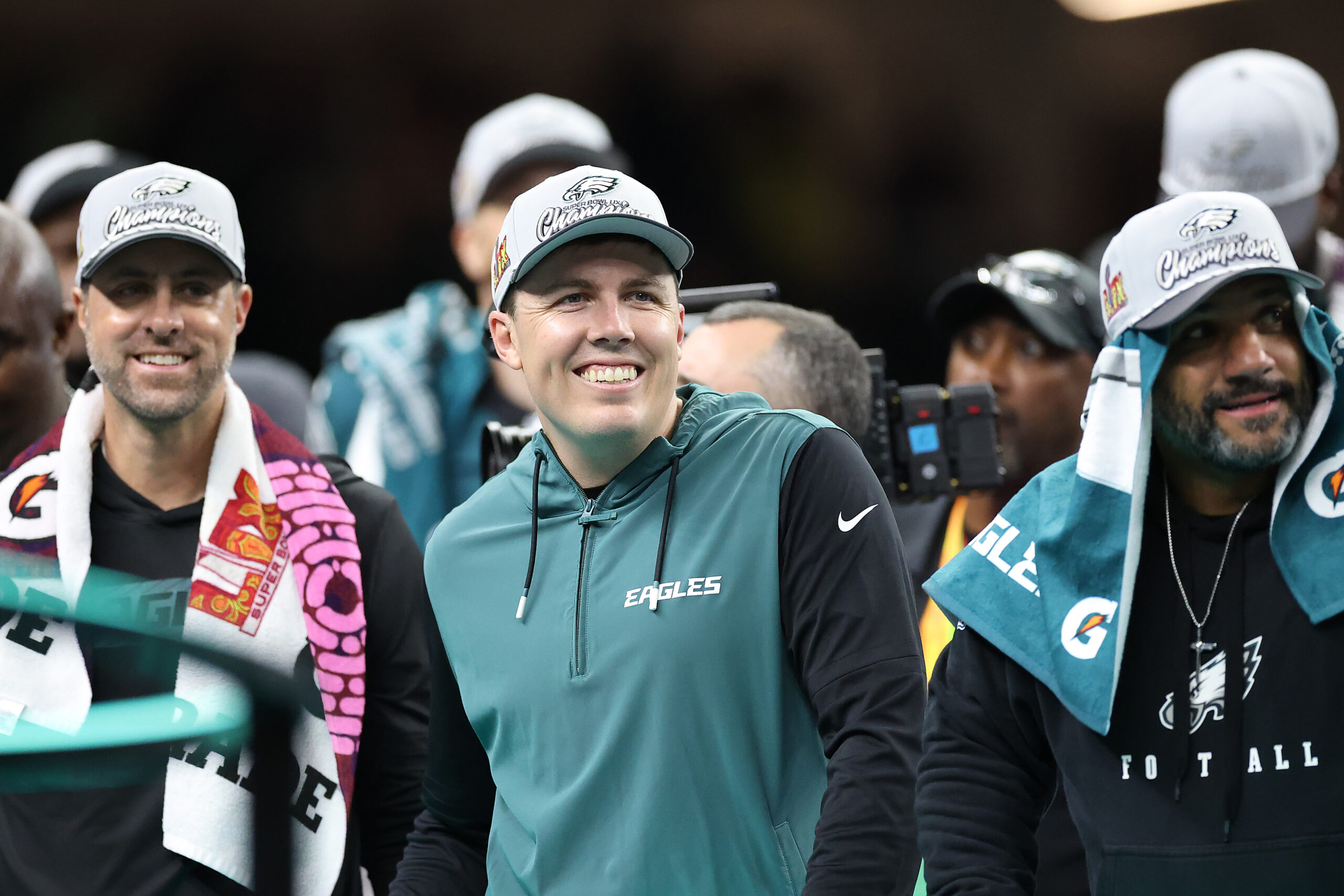
    The Eagles won Super Bowl LIX with Kellen Moore as their offensive coordinator.

    He remains the only offensive coordinator in Eagles history to win a Super Bowl calling his own plays — thereby, arguably, the greatest offensive coordinator in Eagles history.

    Those are big shoes for Mannion to fill.

    Déjà vu and Nick Foles

    Moore declined to comment for this column, which is unfortunate, because, in 2019, he nearly was in Mannion’s exact position as an unproven coordinator in a high-pressure market. He also inherited an offensive roster full of pedigreed players, such as running back Ezekiel Elliott, offensive linemen Tyron Smith and Zack Martin, wideout Amari Cooper, and of course, Prescott, who was an overachieving, second-tier draftee who had not completely polished his game.

    The same can be said of Hurts, who is surrounded by a similarly pedigreed cast: four Pro Bowl offensive linemen, two 1,000-yard receivers, and a running back halfway to the Hall of Fame.

    There are differences, of course. Upon becoming OC, Moore had spent four seasons in Dallas as either a player or coach, and so was familiar with the players, coaches, and the unique culture inside The Star, the Cowboys’ training compound.

    Also, Mannion won’t inherit as stable a situation as Moore, who followed Scott Linehan, who had the job for four years. Mannion will be succeeding Kevin Patullo, Sirianni’s longtime right-hand man who was removed from the job on Jan. 13 following a disastrous one-year run.

    On the other hand, Mannion has more connections than Moore. Between playing and coaching, Mannion has been around accomplished offensive minds such as Packers head coach Matt LaFleur, for whom Mannion worked the last two seasons, and Rams head coach Sean McVay, for whom Mannion played in 2017 and 2018.

    It’s also worth noting that, when Mannion was a rookie in the 2015, the Rams’ starting quarterback was a former Pro Bowl MVP named Nicholas Edward Foles.

    Endorsements

    In 2019, immediately after promoting Moore, Jones defended the move by citing Moore’s ability to communicate clearly, Moore’s high football IQ, and Moore’s strength of character.

    Immediately before the promotion, Moore’s candidacy received a major endorsement from Prescott, who not only had been coached by Moore but also had been Moore’s teammate. On a Dallas radio station, Prescott called Moore a “genius phenom. … He’s special. He knows a lot about the game. Just the way he sees the game, the way he’s ahead of the game. He can bring a lot to us, a lot of creativity.”

    Lurie likely won’t offer comments regarding Mannion until he speaks with the press at the owners’ meetings at the end of March in Phoenix.

    Packers quarterback Jordan Love, in his third season as a starter, cut his interception total from 11 in 2023 and 2024 to six in 2025. Backup Malik Willis got better, too. Neither has called Mannion a “genius phenom.”

    Neither has Sirianni, who has issued the only statement from the Eagles, who have not scheduled a media availability with Mannion and his bosses.
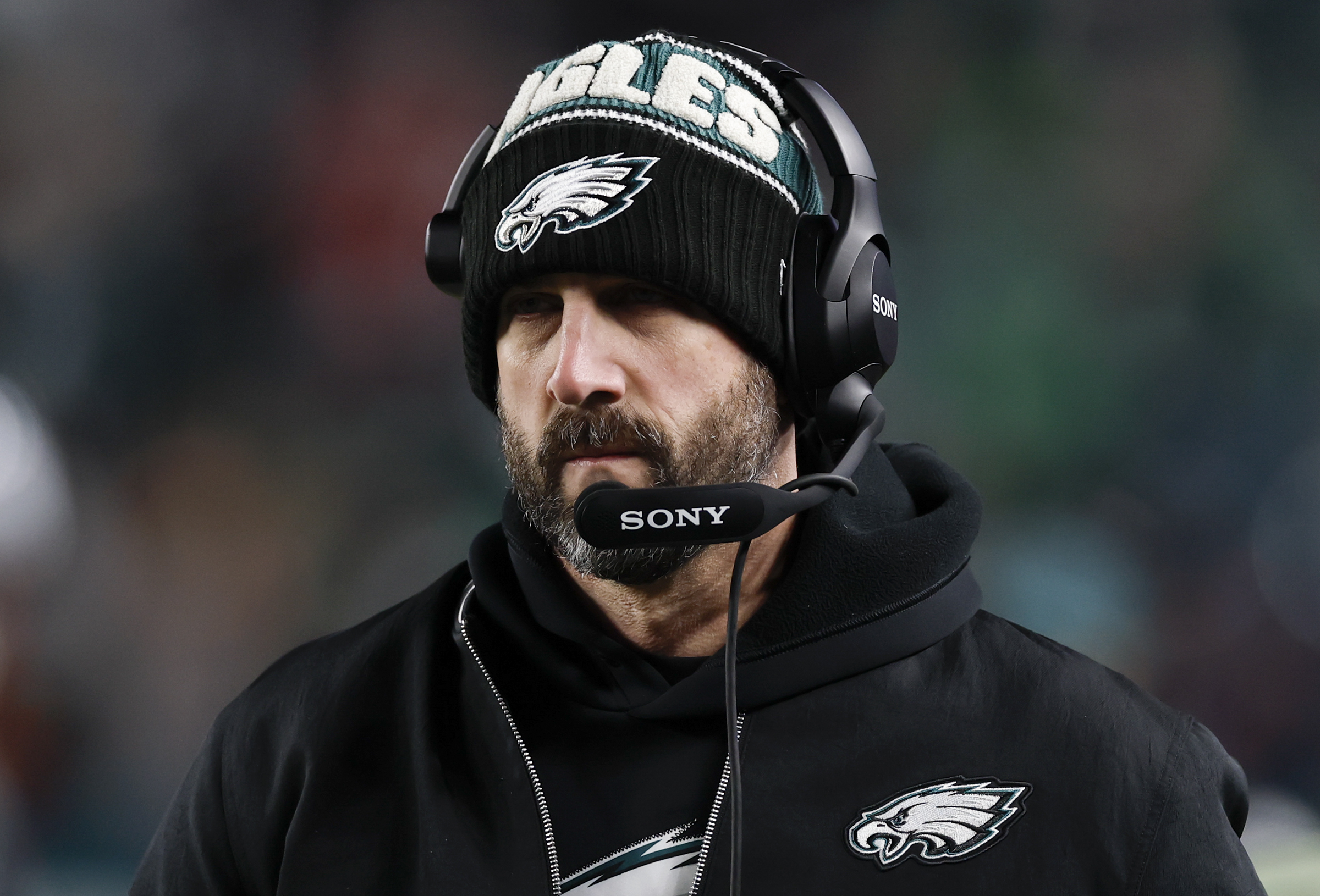
    Eagles head coach Nick Sirianni is welcoming yet another offensive coordinator.

    In a statement that defined banality, Sirianni called Mannion “a bright young coach with a tremendous future ahead of him in this league. I was impressed by his systematic views on offensive football and his strategic approach.”

    The franchise’s excitement paled in comparison to the region’s fascination with this hire.

    Over the last three weeks or so, the process of replacing Patullo received unprecedented media attention, considering it was the hiring of an assistant coach. That’s partly due to intensified media coverage of everything NFL, but also because the Eagles are in a window to win right now. Fairly or not, no one bore as much blame for the 2025 one-and-done playoff run as Patullo. No one will face as much pressure for 2026 as Mannion.

    This is similar to the situation Moore inherited in Dallas in 2019, and he shined.

    That doesn’t mean Mannion will, too, but, in Lurie, Eagles fans can take heart.

    With Gruden and Reid in his history, Lurie has a wonderful track record when over-hiring position coaches from Green Bay.
  • Forget about trading VJ Edgecombe for Giannis. Or anybody.

    Forget about trading VJ Edgecombe for Giannis. Or anybody.

    The following is a list of players who began their NBA careers with 1,500 minutes, 650 points, 225 rebounds, 175 assists and a .534 true shooting percentage in their first 43 games.

    • Oscar Robertson
    • Larry Bird
    • Magic Johnson
    • Michael Jordan
    • Chris Paul
    • VJ Edgecombe

    This shouldn’t need to be said, but the Sixers aren’t going to trade VJ Edgecombe for Giannis Antetokounmpo. Nor should they. Which also shouldn’t need to be said.

    Just in case, let’s say it again.

    No Edgecombe for Giannis. No Edgecombe for anyone. No Edgecombe at the trade deadline. No Edgecombe in the offseason.

    No Edgecombe, know peace.

    The conversation is worth having just to make sure we’re all on the same page. It isn’t every day that a superstar the caliber of Giannis hits the trade market. Even less often are the Sixers identified as a team that “intrigues” said superstar, as they were in a report by the Stein Line over the weekend. Giannis is smart to fancy the idea of teaming up with Tyrese Maxey, who has exploded into the realm of legitimate superstars this season. The Sixers would be foolish not to find out what it would take to land the perennial MVP candidate.

    Draft picks, Jared McCain, maybe even Joel Embiid? Sure, let’s talk.

    Edgecombe?

    Nope. Click.

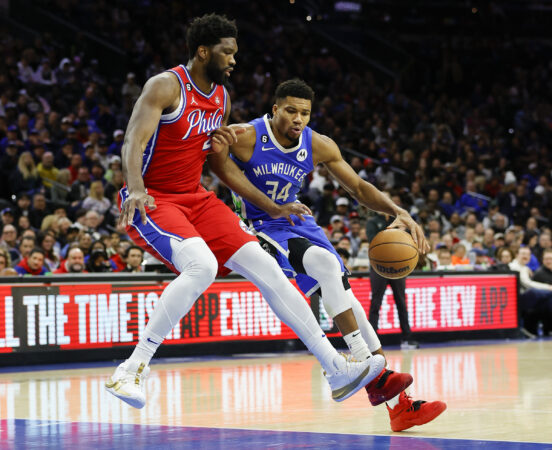
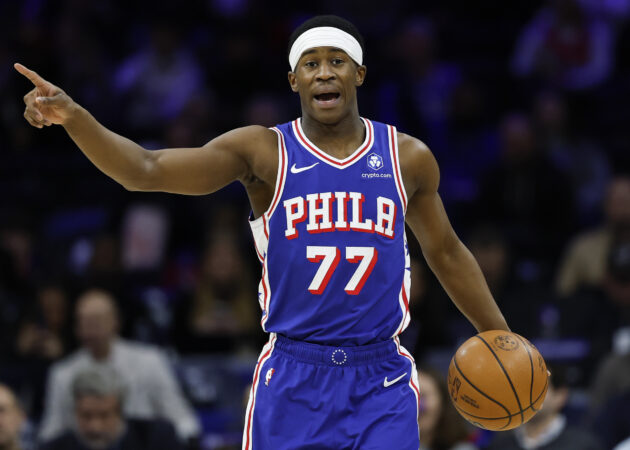
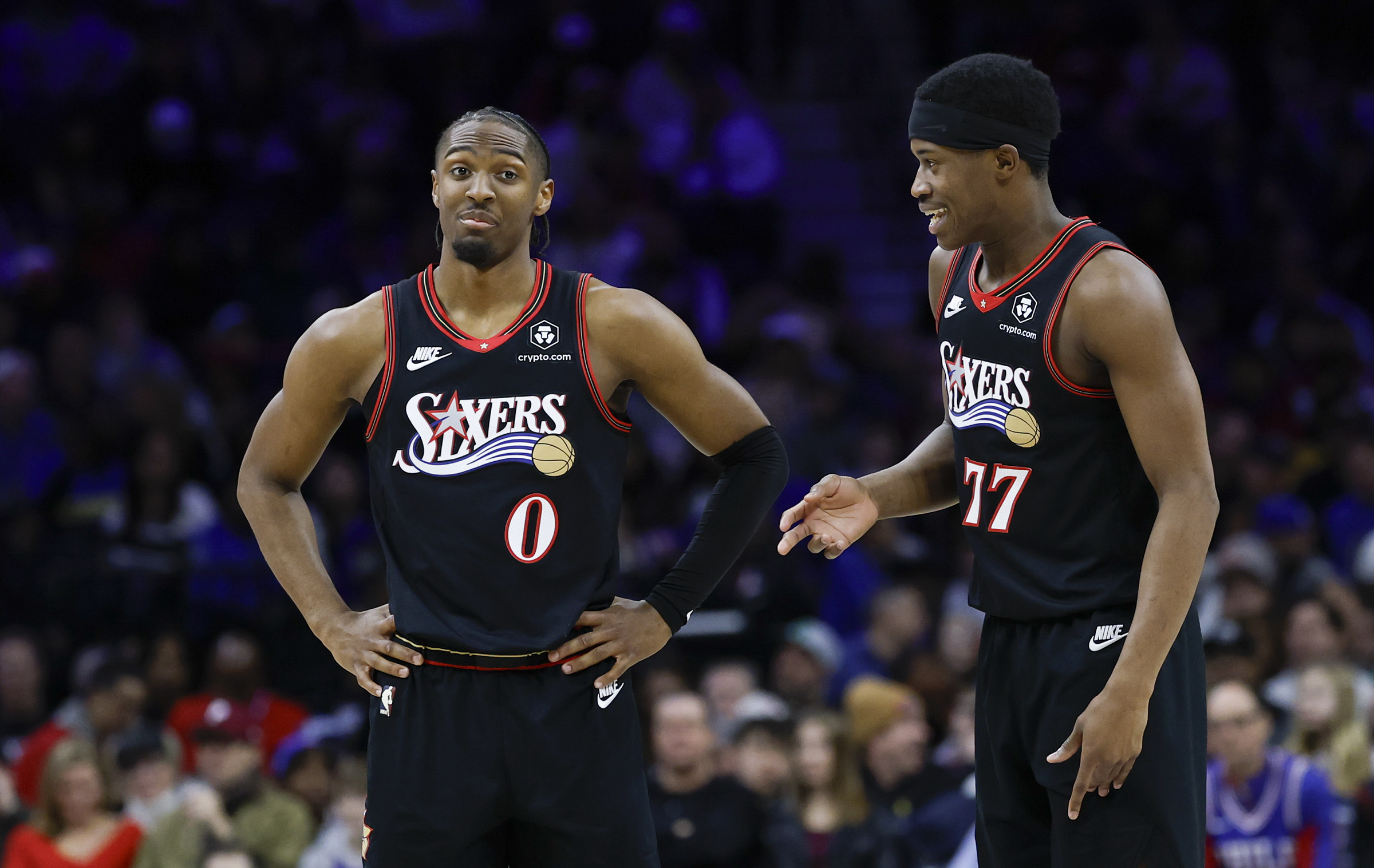
    Tyrese Maxey (left) and rookie VJ Edgecombe give the Sixers a dynamic backcourt combination.

    To be clear, this isn’t about Giannis. He’s in the midst of the most efficient season of his career, by virtually every measure. His .666 effective field goal percentage is 70 points higher than his career average and 46 points higher than his mark last season. While he largely abandoned his three-point shot after connecting on just 28.3% of his attempts from 2022-24, he already has more makes than he did all last season. His career-best .395 shooting clip from deep comes with a giant asterisk: a mere 38 attempts in 30 games. But, hey, making is better than missing. Giannis still does all of the stuff that has made him a top-five MVP finisher for a remarkable seven straight seasons. Rebounds, assists, steals — all of his numbers are at or above his five-year averages on a per possession basis. His 46.8 points per 100 possessions would be the highest of his career.

    This is purely about Edgecombe. To understand his immense present and future value, you have to watch him on the court. It’s incredibly rare for a 20-year-old rookie to average 35.6 minutes per night for a team that is six games over .500 and has a legitimate chance to make a playoff run. It’s even rarer for said rookie to do it with the maturity and grace that Edgecombe exhibits at both ends of the court. And it’s rarer still for a rookie to possess that veteran-level basketball IQ while also possessing such an electric athletic upside.

    Edgecombe’s polish is evident in two pieces of his stat line, beyond the top-line numbers. He is one 18 players in NBA history to have 178 assists and fewer than 80 turnovers in his first 43 games. That’s incredibly hard to do for any player who routinely has the ball in his hands, let alone a player who expends the amount of energy Edgecombe does on the defensive end of the court. Simply put, he is a winning basketball player, as evidenced by his cumulative plus-minus. The Sixers are outscoring opponents by nearly 1.5 points per game in Edgecombe’s minutes on the court. Again, very rare to see out of a rookie.

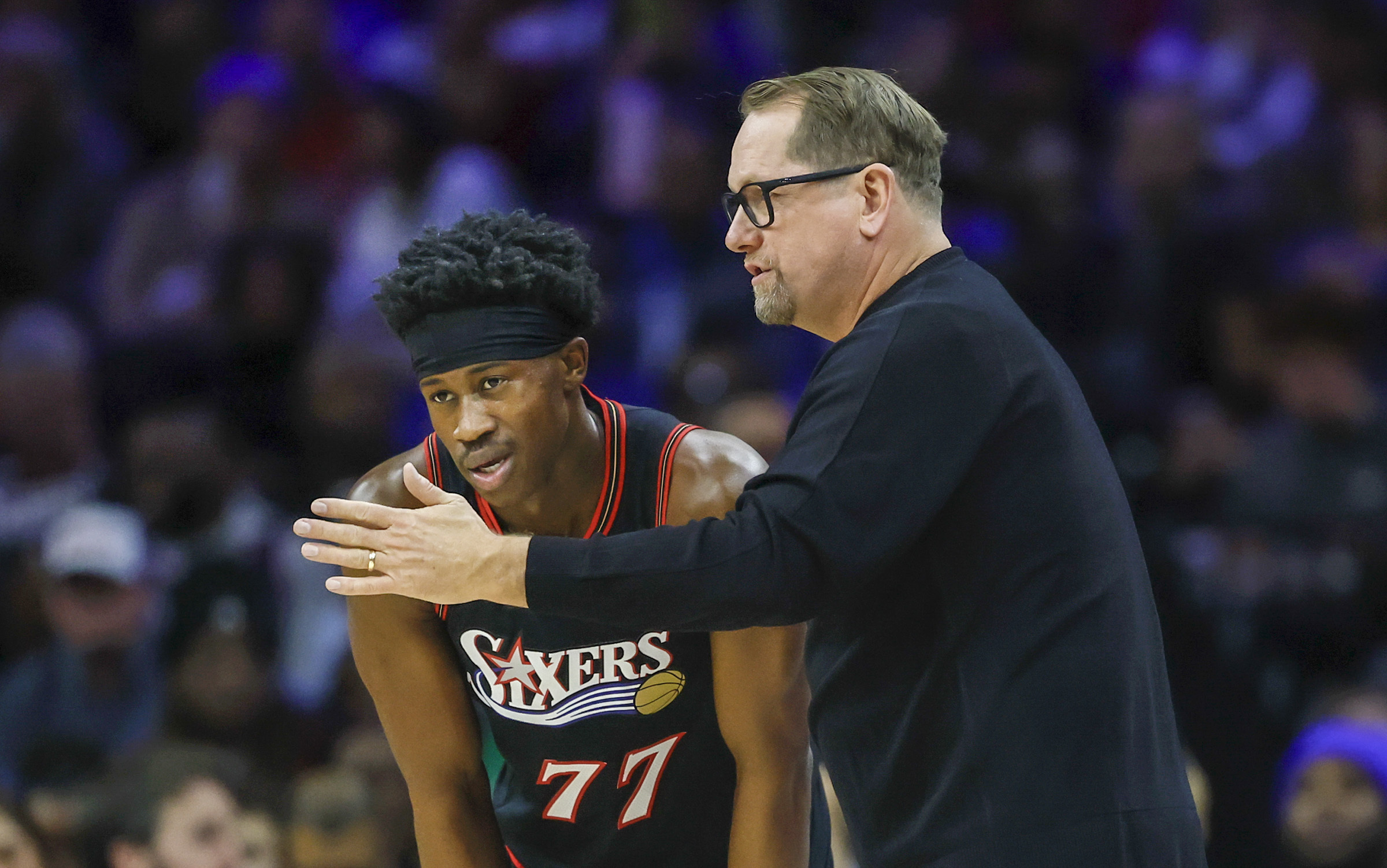
    Sixers coach Nick Nurse knows what he has in rookie guard VJ Edgecombe.

    The Sixers’ state of play in advance of this week’s trade deadline took a hard right turn over the weekend. It did so in a manner that was quintessential Sixers. Paul George’s 25-game suspension for a violation of the NBA’s anti-drug policy was the exact sort of nowhere-on-the-bingo-card development that has come to define the organization in the post-Process era. Unexpected? Only if you forget who you’re dealing with.

    In our defense, the Sixers had done a heck of a job lulling us to sleep over the first half of the season. Maxey was an All-Star starter and MVP candidate while averaging an efficient 29.2 points and 6.9 assists. Embiid was playing basketball reminiscent of his MVP prime. Even George had bounced back from his disastrous debut season, shooting .382 from three-point range while averaging 16 points per night.

    Yet the brightest development of them all has been the kid with the double sevens on his jersey. Edgecombe’s per-game numbers may not look like the stuff of legends: 15.1 points, 5.3 rebounds, 4.2 assists, a .510 effective field goal percentage. But keep in mind: What we are witnessing right now is the floor. At the very least, he is a winning basketball player who would have a spot in the starting lineup of any contending team. A good defender, a willing rebounder, a capable scorer, an improving passer. Combine that floor with the ceiling afforded him by his explosive physical gifts and you have the sort of player whose trajectory could easily follow Maxey’s into the realm of the NBA’s elite. That’s not the kind of thing a team can afford to trade away.

    Not for Giannis. Not for anybody.

  • Paul George’s 25-game suspension is just the latest example of the Sixers’ bad karma from The Process

    Paul George’s 25-game suspension is just the latest example of the Sixers’ bad karma from The Process

    In what sort of hellish karmic vortex do the Philadelphia 76ers exist?

    They’d won two consecutive games Tuesday and Thursday. On Tuesday, Paul George made a record nine three-pointers. On Thursday, the win came thanks to a last-second shot by their best and most popular player, All-Star starter Tyrese Maxey.

    They were 26-21 and held the No. 6 spot in the Eastern Conference, with ammunition on the roster for the trade deadline this coming Thursday.

    After last season was lost to injury, and half of this season sputtered through lingering ailments, the Big Three — of Maxey, George, and Joel Embiid — were cooking. With the deadline looming, both Embiid and George, high-mileage thirty-somethings with injury baggage and maximum contracts, finally had played themselves into marketability. The Sixers also finally had assets to trade to augment the current roster, if they wished.

    There was even more to feel good about.

    On Saturday, the Sixers planned to celebrate the 25th anniversary of the 2000-01 team with Allen Iverson that made it to the NBA Finals — which also is the last time the franchise was truly relevant. They are in the 14th year of a scorched-earth rebuild dubbed The Process. However, as Embiid and George gelled with Maxey and rookie VJ Edgecombe, the Sixers looked like they could make a serious postseason run in an Eastern Conference decimated by injury.

    That might still happen, but they’ve hit another roadblock.

    On Friday, Josh Harris appeared in the notorious Epstein files as a business associate of sex trafficker Jeffrey Epstein. While Harris was not implicated in Epstein’s crimes, that’s a hard stench to wash away.

    Then, George was suspended 25 games for violating the NBA’s antidrug policy beginning with Saturday night’s game against the visiting New Orleans Pelicans.

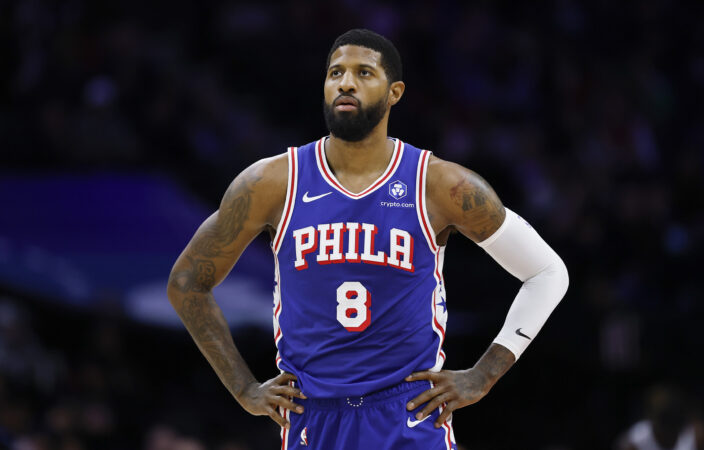
    It goes without saying that George’s carelessness and selfishness are inexcusable. George told ESPN that he mistakenly took a banned medication to address a mental health concern.

    We’re all in favor of addressing mental health, we’re also in favor of telling team doctors about every chemical you put in your body. That’s how you stay available. That’s how you earn that four-year, $211 million contract, the biggest free-agent deal in franchise history.

    The Phillies had a similar issue this past season, when reliever José Alvarado was suspended 80 games in the middle of the season, as well as for the entire postseason, for taking an unvetted weight-loss drug last winter. There is simply no excuse.

    It’s as if all that losing on purpose — The Process — cursed the team indefinitely.

    Since the day Harris bought them in 2011, the Sixers have been an entertaining, if star-crossed, clown show. Much of it has been of their own doing. Following the Andrew Bynum deal in 2012, then the worst trade in Philadelphia history, roster builders Sam Hinkie, Bryan Colangelo, and now Daryl Morey have drafted poorly, have been held hostage by unaccomplished stars, and have hired ill-suited coaches.

    Home-grown cornerstone players declined to properly develop: Nerlens Noel and Ben Simmons refused to learn to shoot, while Embiid, moody and undisciplined, refused to mature into the jaw-dropping professional he might have become.

    But Noel, who was drafted ahead of Giannis Antetokounmpo; Embiid, whom they drafted over Nikola JokićJokic; Jahlil Okafor, whom they drafted over Kristaps Porziņģis; and Simmons, whom they drafted over Jaylen Brown, all were injured almost as soon as they were assigned a jersey number.

    By his third season at the helm, Hinkie, brilliant in some aspects, proved unable to manage a franchise. Colangelo turned out to be more than just a nepotistic mis-hire: He and his wife were accused of using burner social media accounts to criticize Sixers players. Yes, you read that correctly. Former coach Doc Rivers so seriously offended Simmons that he forced his way out of town. James Harden did the same thing after Morey, who’d traded for him and extended his contract once, declined to offer Harden the maximum-salary money he believed Morey had promised.

    There have been dozens of other rake-stepping incidents by the Sixers. None is more consequential than the Sixers’ aggressive initiative to build a downtown arena, only to pull the rug from the project at the last minute and instead build in South Philly.

    That happened about this time last year in the middle of yet another lost season for Embiid, who played just 19 games as he dealt with a knee injury that limited him the previous season, but which did not deter him from a meaningless appearance in the 2024 Olympics. George and Maxey also missed significant time due to injury last season.

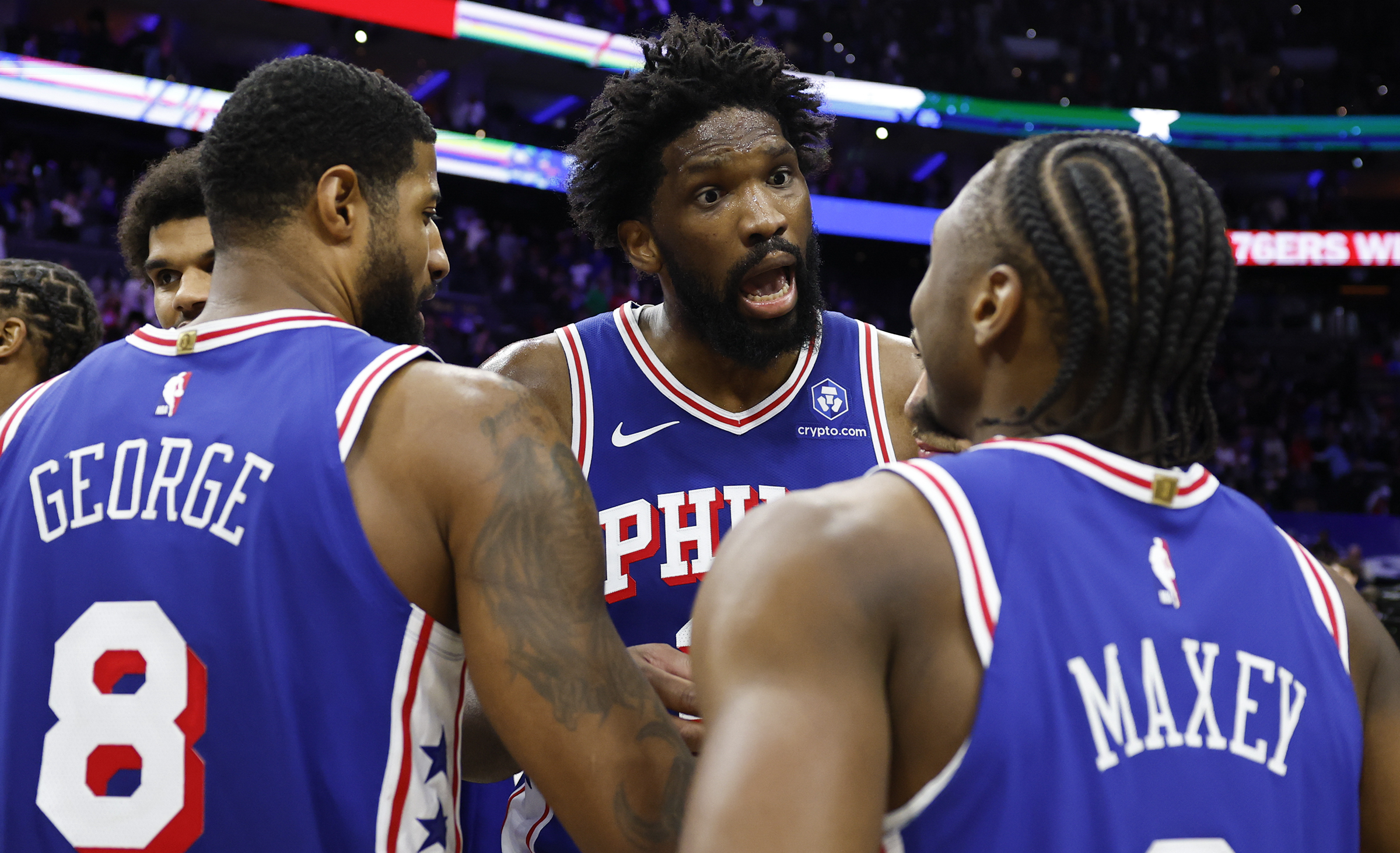
    The Sixers started to look promising, especially when Joel Embiid, Tyrese Maxey, and Paul George were on the court tougether.

    But, as of this past week, things seemed to be rounding into form for the franchise. The Big Three played together Thursday, and, after a disastrous start to the season when playing together, they improved to 9-8.

    Embiid had played in 20 of 27 games, averaging 27.9 points, 8.2 rebounds, and 32.8 minutes. George played in 27 of 35 games, averaging 16.0 points, 5.1 rebounds, and 30.5 minutes.

    For the first time since the end of the 2022-23 season, when they squandered a 3-2 lead in the second round of the Eastern Conference playoffs, things looked legitimately promising.

    Then, on Saturday, George got banned until March.

    You know what they say about karma.

    Rhymes with witch.

  • The Eagles hired a young, green OC in Sean Mannion. Just like they did with Jon Gruden.

    The Eagles hired a young, green OC in Sean Mannion. Just like they did with Jon Gruden.

    Sean Mannion, the Eagles’ new offensive coordinator, is 33 years old, has been a coach — not just an NFL coach, but a coach of any kind — for only two years, and reportedly will call plays next season even though he has never called plays before. If it sounds like the Eagles have entered uncharted territory here, if it seems they’ve brought on board a neophyte who’s too green to succeed in such an important role at such an important moment for the team, rest easy. Mannion’s youth and inexperience are nothing compared to the first OC the Eagles hired during Jeffrey Lurie’s ownership tenure.

    Because that guy, in his first week in town, tried to buy a beer one night at a hotel bar. And got carded.

    “I said, ‘Huh?’” Jon Gruden told the Daily News in February 1995. “I know I look young, but that young?”

    Gruden was 31 when Ray Rhodes picked him to oversee and orchestrate the Eagles’ offense. The two of them had worked together in Green Bay, and though Gruden had coached in the NFL for four years — twice as long as Mannion has — he had never been a coordinator or called any plays with the Packers. Plus, Gruden was right. With his boyish face and while wearing his ever-present backward visor at practice, he looked like he might still be in college. He was younger than some of the Eagles’ offensive players, including two starting linemen — center Raleigh McKenzie and guard Guy McIntyre — and quarterback Randall Cunningham.

    “Age is not the issue,” Gruden said back in ‘95. “The issue is, ‘Can you do the job?’ … I’m not one of these guru kinds of guys who thinks he has all the answers. I’m just a guy who tried to learn as much football as he could in hopes that someday I’d get a chance to use it. And this is my shot.”

    Mannion is in a similar situation — a better one, in fact. The notion that he is stepping out from under the safe cover of being the Packers’ quarterbacks coach into the tropical storm of serving as the Eagles’ OC has some truth to it, sure. The pressure that Mannion will feel from Lurie and Howie Roseman will equal or exceed any that the Eagles’ fan base might apply. But he is still accepting a plum job with an organization that won a Super Bowl last year and is coming off a season that was a disappointment by the standard that the Eagles have established for themselves.

    They won 11 games. They finished first in their division. They have talent to spare on offense. “If I’m an offensive play-caller,” Fox analyst and former Pro Bowl tight end Greg Olsen said recently on the New Heights podcast, “I’m doing everything in my power to get that job.” This ain’t a bad gig.

    Gruden’s was, or at least it wasn’t as good as Mannion’s. And it’s worthwhile to remind those Eagles fans and observers who either have forgotten or never bothered to familiarize themselves with the team’s history that yes, a relatively lengthy search for a new coordinator is not exactly a new low point for the franchise.

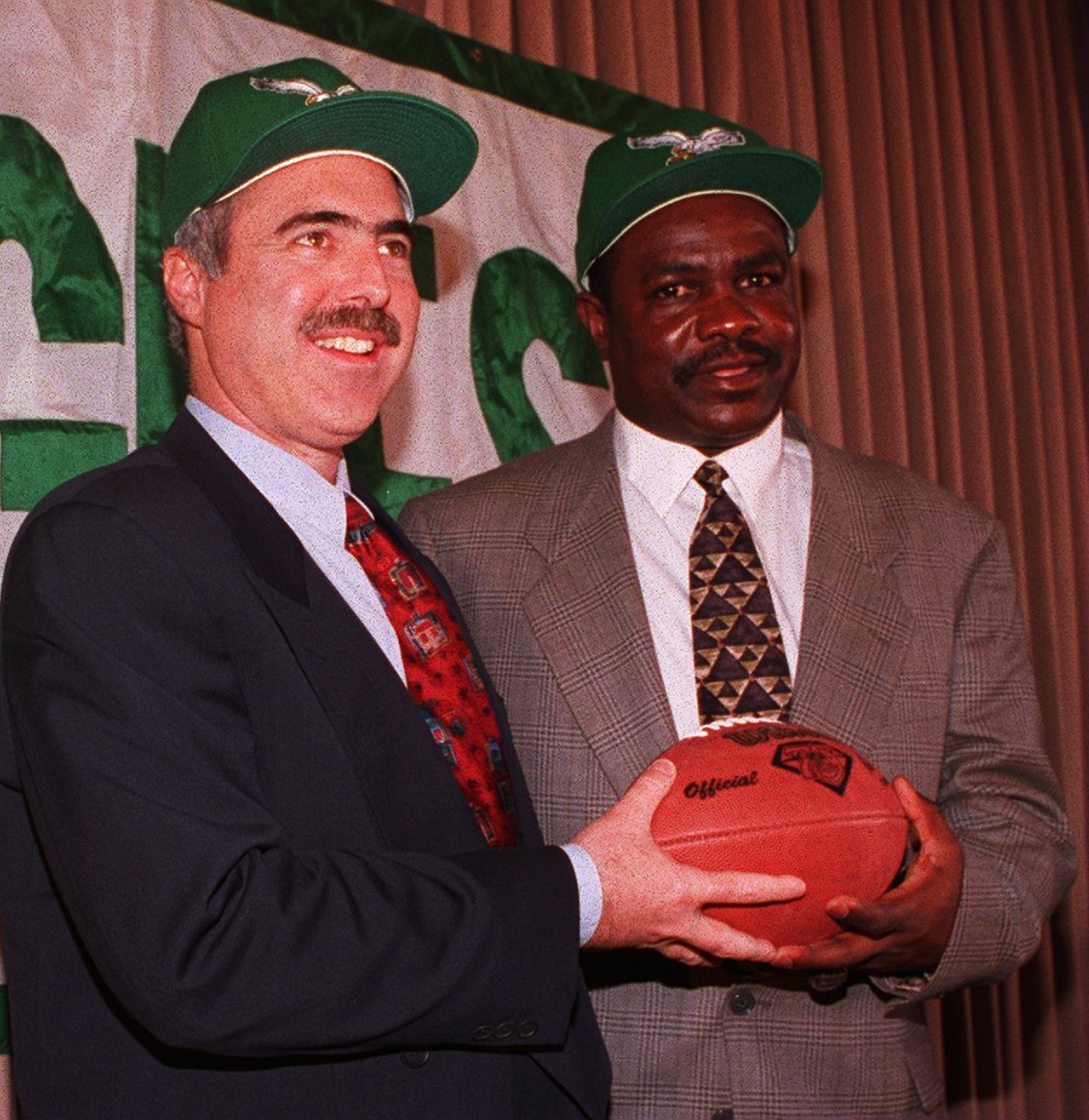
    New owner Jeffrey Lurie (left) and coach Ray Rhodes were viewed with skepticism, and not just in their OC hire.

    When Gruden was hired, Lurie had assumed control of the Eagles just eight months earlier. Rhodes not only had never been a head coach before, but he was the team’s first Black head coach, a distinction that in 1995 presented its own fierce set of pressures, expectations, and obstacles. The Eagles had not reached the Super Bowl in 14 years and had not yet won one. Veterans Stadium was decrepit, a dangerous place to play for its treacherous artificial turf, a horrible work environment for any coaching staff.

    Cunningham’s skill set was not a fit for Gruden’s version of the West Coast Offense — a system based on three-step drops, perfect timing, and precision accuracy on short and intermediate passes — so backup Rodney Peete eventually replaced him as the starter. And still the Eagles went 10-6 in each of Gruden’s first two seasons as their OC, and in ‘96, they ranked fourth in the league in total offense and in passing yards, with Ty Detmer and Peete as their QBs. If Mannion can come close to matching that measure of productivity — even with Jalen Hurts, with Saquon Barkley, with DeVonta Smith, with (presumably) A.J. Brown — he’ll be doing just fine.

  • Sixers boss Daryl Morey should trade Joel Embiid for Giannis Antetokounmpo — while he still can

    Sixers boss Daryl Morey should trade Joel Embiid for Giannis Antetokounmpo — while he still can

    If I had told you in October, as Joel Embiid recovered from his fourth knee surgery, that the 76ers star would, three months later, have played in 15 of the last 20 games and averaged 28.7 points and 8.1 rebounds in 33.5 minutes per game, you’d have been satisfied.

    If I had told you in October that Giannis Antetokounmpo would, by late January, be open to moving on from Milwaukee, you would have been intrigued.

    And if I had told you in October that Antetokounmpo reportedly would welcome a trade to the Sixers to be paired with starting All-Star guard Tyrese Maxey, you would have been excited.

    Hopefully, Sixers president Daryl Morey is excited. Hopefully, he’s on his smartphone right now, speaking with Bucks GM Jon Horst. Nicely. Generously.

    Hopefully, Morey is trying to trade Embiid for Giannis before the trade deadline Thursday.

    Hopefully, Morey is not swayed by the recency bias that is inevitable when Embiid plays well and when a player like rookie VJ Edgecombe begins to emerge.

    Reports Thursday indicated that the Sixers have not contacted the Bucks, but then, it’s trade season, and everybody lies about everything. Sixers fans should hope that this report is as hollow as the Sixers’ postseason runs over the past 25 years.

    Because, incredibly, against all odds, fate has delivered Morey and the Sixers a miraculous escape route that would repair his recent mistakes and erase the entire 13-year stench of The Process.

    It’s no sure bet, but Morey simply has to push all his chips in and snag the Greek Freak. He should do it today, before anybody else does, and before Embiid gets hurt again. Because, as sure as Democrats are going to cave to Donald Trump on the budget, Embiid — be it feet, eyes, knees, back, or hand — is going to get hurt again.

    Morey needs this as much as the team and the city need it. Since arriving in 2020, he has been a big-move disaster.

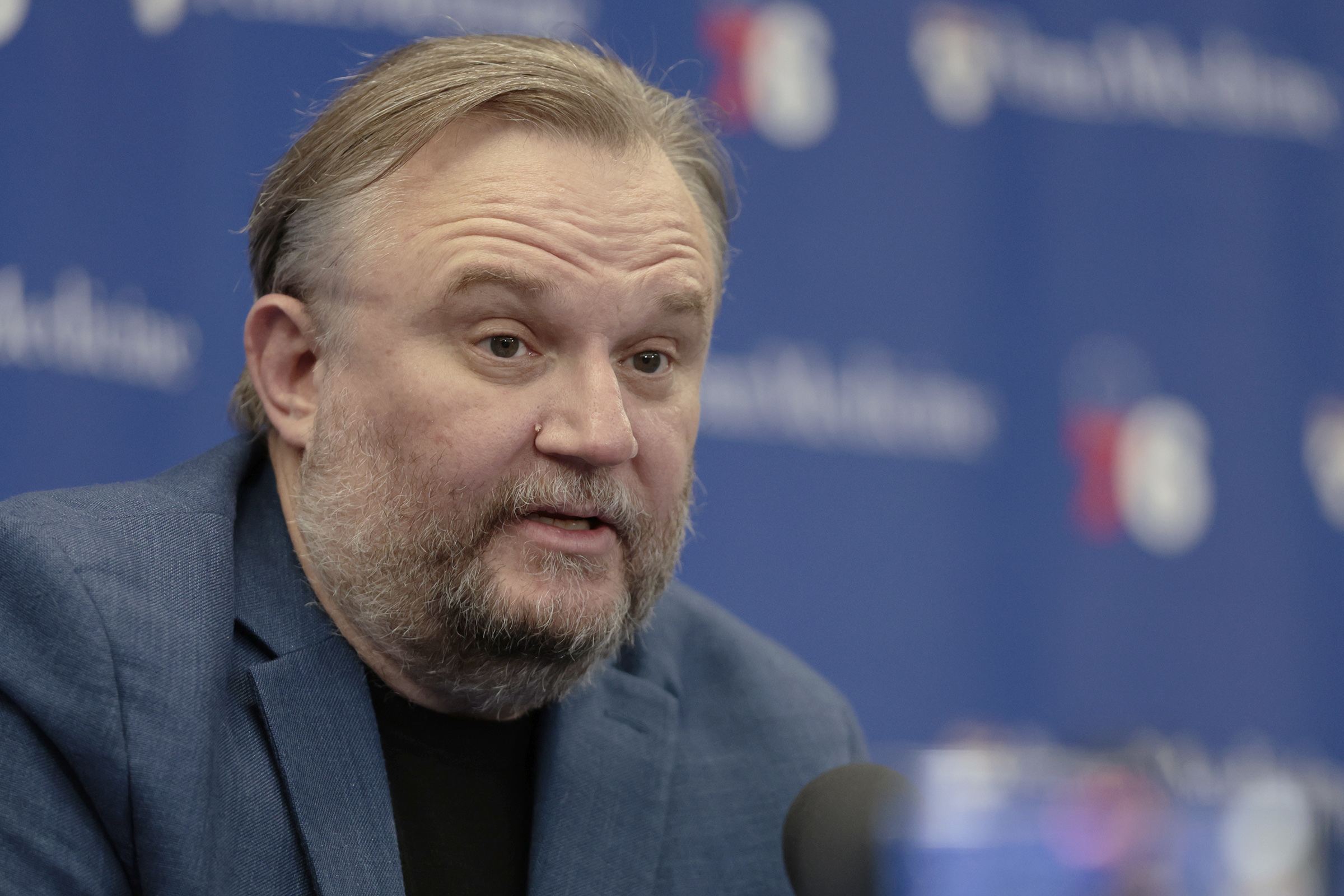
    Sixers president Daryl Morey’s signature moves have not been dazzling so far.

    Morey’s signature transactions: trading for, then extending James Harden, who held out and forced a trade; extending Embiid’s contract before last season, when Embiid was still injured; and, in July 2024, signing 34-year-old Paul George, who has been playing hurt since the ink dried on that deal.

    These are not the sorts of moves Sixers owner Josh Harris hired Morey to make, but they might be the sorts of moves that convince Harris to fire him. Securing Antetokounmpo for the last four-plus seasons of his prime might not win the Sixers their first title since “Thriller” topped the charts, but it could, at least, buy Morey a little more time.

    The Freak won’t come cheap.

    Acquiring Giannis surely would mean trading not only Embiid and Edgecombe but maybe more, too. Perhaps second-year shooter Jared McCain. Perhaps even the Sixers’ next first-round pick, which, thanks to previous deals and contingencies, likely will come in 2027.

    So what.

    While there’s no guarantee Giannis is worth it, there are years of evidence that Embiid is not.

    Antetokounmpo might never come cheaper. In this moment he has a right calf injury hat has lingered since early December, and there’s no timeline for his return, so he might not help much this season. He’s also 31, and he has a history of injury with his left calf. Calf injuries can lead to other issues, especially Achilles tendon injuries; just ask Tyrese Haliburton.

    Again: So what.

    Get the Freak a slant board, or a ProStretch, or whatever. I’ve got an extra one here at home.

    For that matter, get him a litter carried by servants, like Cleopatra.

    Get him whatever he needs.

    Just get his butt to Philly.

    No matter what his current status, Giannis is a far better bet for long-term health than is Embiid, whose long-term health isn’t even debated anymore. Hell, his short-term health is a constant issue. He’s been day-to-day every damn day of his 12-year career, and that’s a lot of days.

    Entering Thursday night he had missed 451 of a possible 929 regular-season games in his career, or just under 49%. I’ve had three-owner used cars more dependable than The Process.

    That said, when Embiid does play these days, he’s playing better basketball, and playing more minutes, than anyone could have reasonably expected in October. He’s in better condition than he’s been since 2017-18, his first full season (and his fourth in the league). For the first time in years, to use Sam Hinkie’s favorite expression, Embiid is a valuable asset.

    You don’t believe Embiid’s a valuable asset? OK, neither do I, really. Fine. That doesn’t matter. It’s Morey’s job to make Horst believe it.

    Morey must convince Horst that Embiid, who is owed an average of $62.7 million for the next three seasons, can help the Bucks in about 50 of their 82 regular-season games. Embiid’s availability for the postseason should be manageable, too; he’s missed only eight of 59 playoff games, and those games aren’t played back-to-back.

    Don’t be sentimental. Be sensible.

    Losing Edgecombe might hurt, but growth requires pain. Entering Thursday’s game, Edgecombe was averaging 15.4 points, 5.4 rebounds, 4.2 assists, and 1.5 steals, hitting 37.2% of his three-pointers. He makes two or three thrilling hustle plays per game and jumps out of the gym. He’s only 20 but he’s mature beyond his years. For that matter, he’s mature beyond Embiid’s years.

    VJ is an excellent prospect with the ceiling of, say, Dwyane Wade. But he’s just that: a prospect, a player you hope develops in the future.

    Giannis is a proven, top-three NBA star, today. For me, it goes Nikola Jokić, Luka Dončić, Freak-ić, and you can argue me into putting Giannis on top.

    Last year, at 30, he ranked among the top five in most advanced metrics. He finished third in MVP voting, his fifth straight year in the top five after winning it twice in a row. It’s a waste of space here to extol Giannis’ inarguable skill and talent … even if former Sixers coach and current Bucks coach Doc Rivers might disagree.

    “Joel’s the most talented player I’ve ever coached,” Rivers said Tuesday after the Sixers beat the visiting Bucks.

    Rivers has coached several Hall of Famers, including Kevin Garnett, and, of course, Giannis.

    Rivers is wrong. He might be nuts, or he might be cagey.

    Doc has a history of sending messages through the media, however ill-advised or awkward. Tuesday’s statement might be aimed at making Giannis even more eager to leave Wisconsin. It also might grease the skids for Embiid to come to Milwaukee. If so, good Doctor, tamper away.

    Giannis and Embiid make about the same amount of money, but, thanks to the labyrinthine NBA collective bargaining agreement, Antetokounmpo needs the deal to be done by the trade deadline so he will be eligible for a four-year, $275 million extension this fall.

    Morey needs the deal to be done by Thursday to save the franchise.

    And, maybe, his job.

  • Sean Mannion needs to be a Jalen Hurts whisperer. Play-calling is only part of that.

    Sean Mannion needs to be a Jalen Hurts whisperer. Play-calling is only part of that.

    It almost surely did not escape Jeffrey Lurie’s notice that his offense turned out OK the last time he hired a Packers quarterbacks coach.

    It shouldn’t escape ours, either.

    Sean Mannion may not be the next Andy Reid. The Eagles didn’t hire the 33-year-old Green Bay assistant with the thought that he would become Reid. But Reid was Mannion at one point in time: an under-the-radar position coach without play-calling experience who was hired for a big boy job well ahead of schedule. This was back when Mannion was six years old, of course.

    Has it really been 27 years?

    It has. Mannion and Reid don’t have much of a connection apart from having both sat at the same desk (figuratively … although, knowing Lambeau Field, maybe literally, too). Matt LaFleur is not Mike Holmgren. Sean McVay is not Bill Walsh. The lineage of Packers quarterbacks coaches who became offensive coordinators includes one Ben McAdoo. Having occupied the position is a trait neither prescriptive nor predictive. It is descriptive in one sense, though. A lack of play-calling experience should not be a deal-breaker for a team that is looking to overhaul its offensive identity.

    In fact, play-calling isn’t the thing that will determine Mannion’s success or failure as Eagles offensive coordinator. It is the thing that we will focus on, no doubt. For a variety of reasons. First, because play-calling is the only part of the job that we actually get to see. Second, because guys like Walsh and Reid and McVay (and Mike Martz, Kyle Shanahan, etc.) have led us all to believe that football games are won the same way Jimmy Woods won video games in The Wizard. Which is silly, when you stop and examine the time card. Even at 70 plays per game and a full 40 seconds between plays, an offensive coordinator spends less than an hour of his work week calling the plays. The bulk of the job is the 79 hours that precede it.

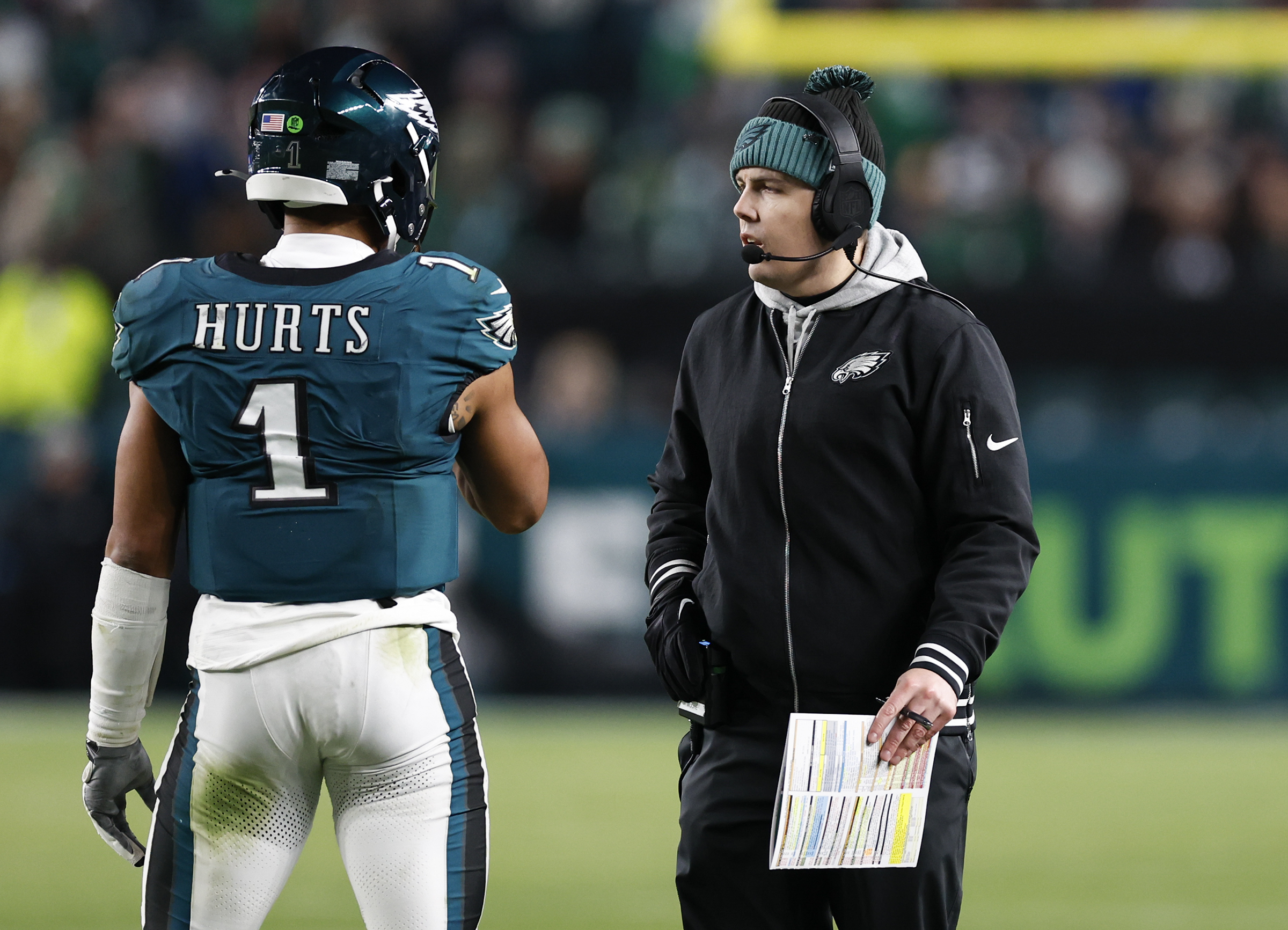
    Can Sean Mannion have the same strong working relationship with Jalen Hurts that Kellen Moore (right) experienced?

    The Eagles need Mannion to be a good coach. Jalen Hurts needs Mannion to be a good coach. Those two things are one and the same. Because Jalen Hurts is the Eagles. Where they go from here as an offense depends almost entirely on who he is as a quarterback. Rather, it depends on who Hurts can be. Who he is? That isn’t good enough. All of us saw that this season. Not all of us understood what we saw. But we saw it. Plain as unflavored yogurt.

    That’s not to say the Eagles’ disappointing 2025 campaign was all on Hurts’ shoulders. Seven months isn’t nearly long enough to transform from a player capable of winning a Super Bowl MVP to a player who simply isn’t good enough. His advocates are correct in that. Hurts would have been equally capable of winning the honor this season as he was in 2024, assuming the rest of the offense was also as capable as it had been. Therein lies the disconnect. You’ll make a you-know-what out of yourself if you’re assuming Hurts’ supporting cast will ever be as good again.

    It’s funny. Nick Sirianni’s detractors constantly portray him as the unwitting beneficiary of a world-class roster. He is the dim-witted only son bequeathed an empire, a head coach who happened to stay at a Holiday Inn Express last night. He showed up in board shorts at his interview and then rode the wave of Howie Roseman’s roster. But a roster that good doesn’t stay it for long.

    Rarely is the same rubric applied to the quarterback. No, A.J. Brown wasn’t the same singularly dominant receiver he has been, which compounded his general malaise. No, the offensive line didn’t manhandle opponents the way it had in previous seasons. Yes, Saquon Barkley was a little less dynamic than he was when he was jumping backward over erect defenders. Each of those claims is perfectly valid. As is the rebuttal: welcome to life as most NFL quarterbacks live it.

    Hurts can’t be the same as he was. He needs to be better. That’s going to take some very good coaching, provided he is no longer willing and/or capable of being the freewheeling scrambler he was in 2022. Being that player afforded Hurts the luxury of not needing to do the things that most other championship quarterbacks must do. He didn’t need to parallel process his pocket navigation, feeling pressure subconsciously while focusing downfield. He didn’t need to recognize that the deep crosser would clear before settling for the hitch in his foreground. He didn’t need to wait for a defense to man-up Brown on a vertical route to generate an explosive play.

    It’s probably time to acknowledge that Jalen Hurts’ supporting cast isn’t going to suddenly revert to its 2024 form.

    Hurts needs to do those things now. That’s the problem. Those things aren’t sustainable. Lane Johnson isn’t going to play forever. Even if he does, he won’t always be the same player. And the four guys alongside him won’t all remain healthy as consistently as he has.

    Same goes for the pass-catchers. Here’s a quick a thought exercise. In the four years since the Eagles traded a first-round pick for Brown on draft day, has any other team managed to swing a move at the position that was even 75% as impactful? The Chiefs have spent five off-seasons trying to replace Tyreek Hill. The Patriots haven’t had a receiver of that caliber since Randy Moss. A great quarterback makes the most of what he has.

    Just to reiterate: Hurts doesn’t need to be Tom Brady. He needs to be better than he was in 2025 in order to win with the supporting cast most quarterbacks have, which is the supporting cast he is likely to have moving forward. Mannion will play a significant role. His profile is intriguing.

    Nobody can understand a quarterback like somebody who has played the position. Kellen Moore was a quarterback. His quarterbacks coach was a quarterback (former NFL backup Doug Nussmeier). Shane Steichen was a quarterback. None of them were as good as Hurts. But they understood what quarterbacks see, how they process, what they need. Sirianni and Kevin Patullo were wide receivers. So were McVay and Shanahan. Again, neither prescriptive nor predictive. But we are talking about Mannion.

    Mannion is a quarterback, and he has played the position in lots of different settings, under lots of different coaches, including McVay and Kevin O’Connell, as well as Klint Kubiak and Kevin Stefanski. He has coached under LaFleur, who has won a lot of games with a quarterback (Jordan Love) who lacks a lot of what Hurts brings to the table. Mannion’s coaching profile is about as ideal as you can draw up for a guy who has only been a coach for two seasons.

    Sean Mannion understands quarterbacks because he was one… very recently, in fact.

    It is also a vote of confidence in Sirianni. The Eagles could easily have opted for a coach who possessed the play-calling experience that Patullo lacked. Jim Bob Cooter, Matt Nagy, Bobby Slowik — any would have made a fine interim-head-coach-in-waiting. Instead, they went with a coach who lacks anything close to the political capital that Moore brought to the table when they hired him to replace Brian Johnson after 2023.

    Will it work? Who knows. It is the only honest answer. All we can say: it is a sensible move. In the end, it all depends on the quarterback.

  • Brooks Koepka’s prodigal return from LIV begins the healing the PGA Tour needs

    Brooks Koepka’s prodigal return from LIV begins the healing the PGA Tour needs

    If you’ve never heard the parable of the “Prodigal Son,” you can watch it unfold in real time over the next few months on the PGA Tour.

    LIV defector Brooks Koepka is back.

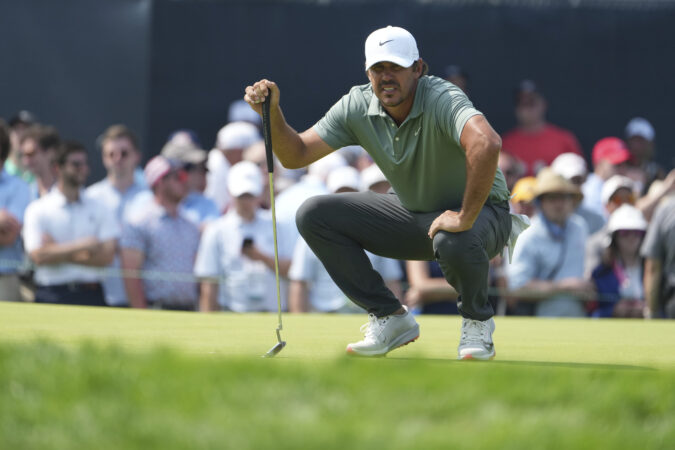
    It’s the biggest moment in golf since Phil Mickelson announced he was joining the renegade league on June 6, 2022. Koepka, a five-time major championship winner, an all-American success story, is the first LIV player to kneel and beg forgiveness of the men that he betrayed.

    This is biblical, if you will, in its importance to the golf world.

    Briefly: Jesus, in Luke 15: 13-31, tells a tale in which the younger son of a rich man asks to have his inheritance immediately, so he can seek his fortune in the world. The son soon squanders the money, the economy collapses, and he hits rock bottom feeding pigs (sorry, LIV fans). The son then crawls back home, hoping his father will hire him as a servant. Instead, the father rejoices at his son’s return and calls for a feast, featuring a fatted calf.

    In this analogy, Koepka is the son. New PGA Tour CEO Brian Rolapp is the father — or, perhaps the stepfather, considering Jay Monahan ran the Tour when Koepka followed dozens of other LIV defectors, all of whom Monahan banned, and who remain banned by Rolapp.

    The feast of the fatted calf? That would be the Farmers Insurance Open, Koepka’s first tournament during his season of mild penance. It begins Thursday at Torrey Pines in San Diego. Harris English is the defending champion. Two-time major winner Xander Schauffele, ranked sixth, and U.S. Open champion J.J. Spaun, ranked seventh, lead a 147-player field that includes 25 of the top 50 players in the world.

    But make no mistake: This is Brooks Koepka’s party.

    But he’s bringing guests.

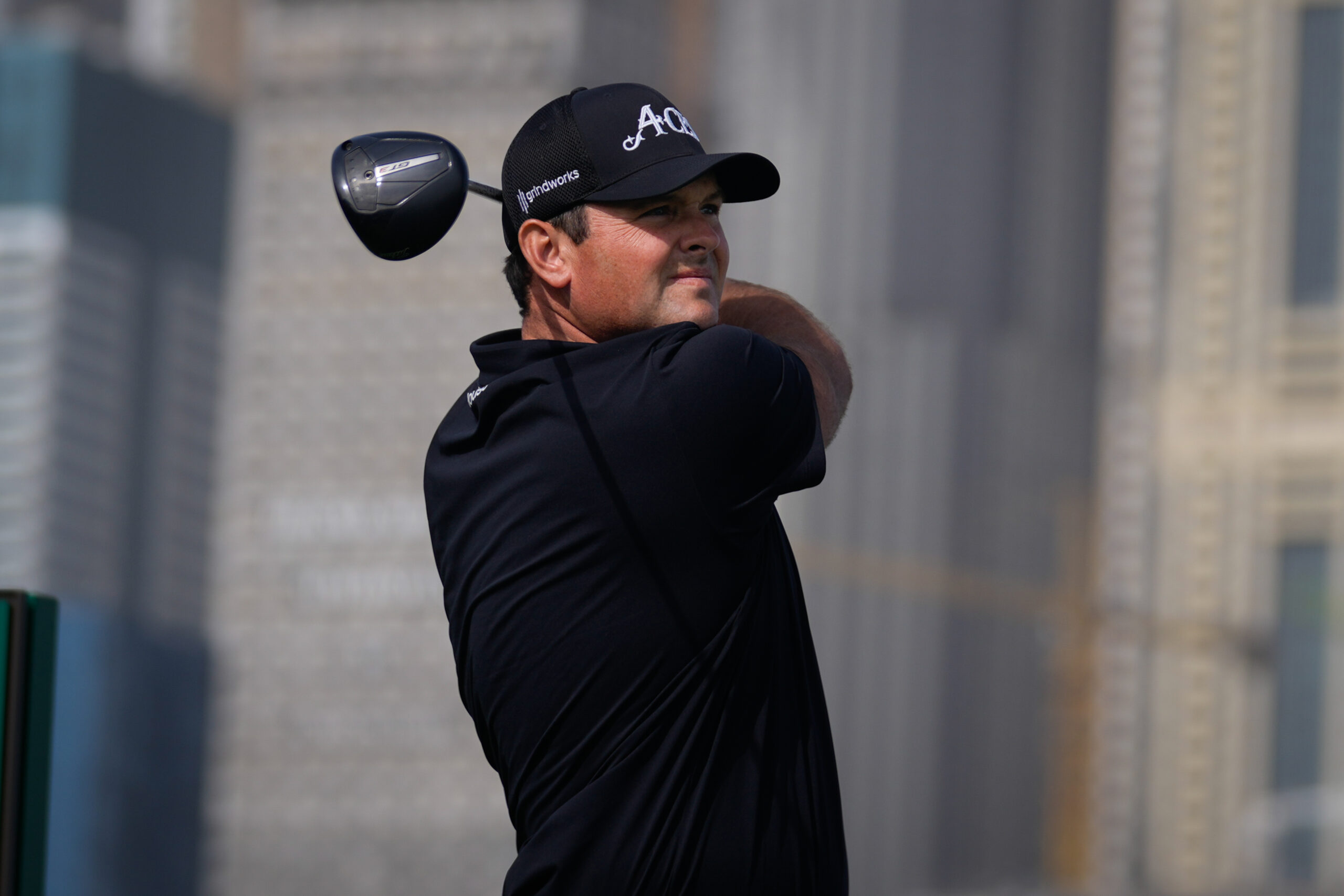
    About 24 hours before Koepka’s marquee comeback tee time, golf’s biggest brat, LIV dud Patrick Reed, announced that he will return to the PGA Tour, too. Reed, who won just once on LIV, on Wednesday said in a statement that he will leave LIV and compete on the DP World Tour until Aug. 25, when he will be eligible to play in PGA Tour events. His DP performances have him ranked 29th in the world, which, along with his lifetime exemption as a Masters champion, virtually assures him entry to all four majors this year.

    The parameters of Reed’s imminent return are murky, and he has applied to return to the PGA Tour in 2027 as a past champion (he has nine wins), but he is not subject to the hastily constructed Returning Player Program (RPP) that Koepka’s interest spurred and targets only the biggest names on LIV.

    One of the facets of the program produced a 147-player field at the Farmers. It would have been a 144-player field, but according to Rolapp’s RPP, the Tour couldn’t kick out an actual qualifier to add Koepka. However, adding Koepka made it necessary to add two other players to balance out the three-player groups. That meant alternates Lanto Griffin and Jackson Suber got spots.

    The eventual return of Reed indicates that Rolapp is eager to build his business and to siphon talent from LIV, no matter how bad the optics or how minor the love. Reed, who won the Dubai Desert Classic last week on the DP World Tour, is a far less formidable presence than Koepka. Further, he has a reputation as a longtime cheater with a bad temper, a potty mouth, and little time for fellow competitors.

    Patrick Reed, who won just once on LIV, is returning to the PGA Tour.

    Rolapp might not kill the fatted calf for Reed, but, as Rolapp knows from his NFL days dealing with Bill Belichick and Tom Brady, every sport needs villains.

    With a 12:32 p.m. EST tee time Thursday and a 1:38 p.m. tee time Friday, Koepka will be part of the featured group with Ludvig Åberg, an inoffensive rising Eurostar, and Max Homa, the PGA Tour’s social media genius.

    The program is open to any LIV player who won a major from 2022-25 and has been away from the PGA Tour for at least two years, a group that includes only Koepka, Jon Rahm, Bryson DeChambeau, and Cameron Smith, all of whom have, so far, decided to stay with LIV. They have until Monday to change their minds, and then the application window closes.

    So, for the foreseeable future, it’s the Brooks Koepka Returning Player Program.

    As a punitive measure, the program restricts Koepka earning power from ancillary means, such as FedEx Cup bonus money and the Player Equity Program, for varied periods of time; makes sure that Koepka doesn’t bump anyone from any field; requires that he plays in at least 15 events this season; and demands a $5 million donation to charity.

    None of this is especially “punitive” for the likes of Koepka, who reportedly made $165 million in signing bonus and winnings on LIV, added to his $43 million he made on the Tour.

    Why does this matter?

    Because it is the first real, tangible, important step into reconciling the best LIV players with the best players in the world, which is what fans deserve.

    The Tour suffered from the absences of superb players in their primes such as Koepka, Rahm, DeChambeau, young Chilean star Joaquin Niemann, who has been the cream of the LIV Tour, and even Mickelson, whose game is garbage but whose name still would sell tickets on both the PGA and Champions tours.

    The careers and games of all of the LIV players suffered, playing benign, inferior courses in 54-hole tournaments against laughable competition.

    The game also lost personalities to LIV obscurity: Koepka’s surliness, Rahm’s earnestness, Dustin Johnson’s goofiness, Mickelson’s buttery condescension, and DeChambeau’s energetic petulance which, thanks to YouTube, has somehow transformed into energetic affability.

    None of the LIV stars has sworn to never return to the PGA Tour, but no one is better suited to begin reconciliation than Koepka.

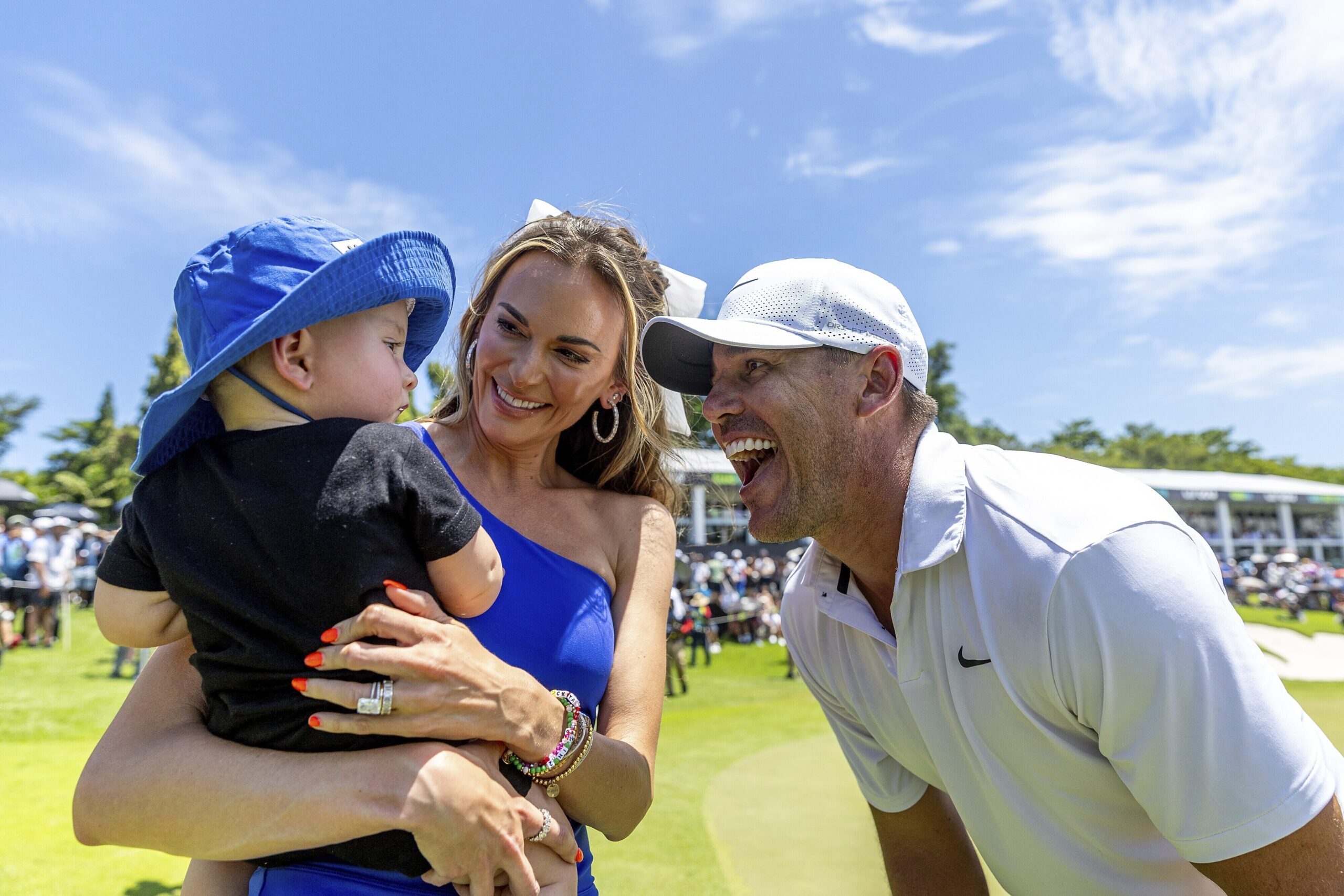
    Brooks Koepka celebrates after a LIV win in 2024 with his wife, Jena Sims, and son Crew.

    When he joined LIV in 2022, in contrast to most players who were clearly interested in only the sportswashing money offered by the Saudi-backed rival tour, Koepka was cast as a reluctant defector — a massive talent who feared that the injuries he’d been dealing with for months might derail the career of the most promising player since Rory McIlroy.

    Koepka, mellowed by years of insignificance and decline, seemed repentant when he addressed his return at a Farmers news conference Tuesday. He was less like the Koepka who belligerently denied cheating at the 2023 Masters, when his caddie told Koepka’s playing partner which club Koepka had used, and more like the Koepka who, in 2018 at Shinnecock, won a second consecutive U.S. Open: reflective, appreciative, mature.

    There are reasons for that.

    Since winning the 2023 PGA Championship, which keeps him qualified for all majors, Koepka has finished inside the top 25 of his last eight majors just once. In 2025, he finished tied for 30th in the LIV rankings among just 52 regular players, many of them the definitions of “washed” and “obscure.” Koepka’s game is poor, and, at 35, time is running out.

    His family life has changed, too. His wife, Jena Sims, suffered a miscarriage last fall.

    Koepka, who has a 2½-year old son named Crew, enjoys fatherhood, and the international nature of the LIV Tour, combined with playing DP World Tour events in Europe to accumulate world golf ranking points, made a normal family life more difficult than he’d imagined.

    “Just having my family around’s really important. I’ve grown up a lot over the last few years, and especially the last few months,” he said.

    The timeline of his decision seems dubious on its face, both from him and the PGA Tour.

    Koepka said Tuesday that he negotiated his release from LIV, finalized on Dec. 23, before contacting any PGA Tour entities regarding reinstatement. He said only then did he contact Tiger Woods, the chairman of the PGA Tour’s competition committee, and, voilá, just 19 days later, over the busiest holiday season of the calendar year, the PGA Tour had devised a comprehensive Return to Play protocol for the Koepka crowd.

    It took five years for these guys to agree on how to limit golf ball flight. So, yeah.

    The machinations that led to Koepka’s return are far less important than the reality of Koepka’s return. In many ways, Koepka was the PGA Tour’s biggest loss to LIV.

    Rahm was more dynamic, DeChambeau was more interesting, Koepka was the best player, was the best athlete, was American, and was a major championship-winning machine.

    Does McIlroy win eight times in Koepka’s absence? Does he complete the career Grand Slam last April if Koepka’s in good form?

    More significantly, does Scottie Scheffler win 17 times, including three majors, if Koepka’s not honing his skills against Pat Perez on a burned-out course in Indiana? (Notably, Perez, Kevin Na, and Hudson Swafford also have been reinstated, sort of, pending unspecified penalties. Perez plans to join the Champions Tour when he turns 50 in March, pending penalties and fines.)

    Maybe Koepka delays Scottie’s ascension, and maybe he slows Rory’s roll. Maybe not.

    He isn’t likely to make much noise any time soon, especially at Torrey, where he’s missed four of five cuts at the Farmers.

    At any rate, the game will be better for the presence of Koepka’s talent. His penalties aren’t nearly harsh enough, considering the hundreds of millions of dollars players like Sheffler, McIlroy, Rickie Fowler, Jordan Spieth, and Justin Thomas left on the table by declining LIV offers, but that isn’t Rolapp’s main objective.

    Rolapp, the NFL’s former chief media and business officer, oversaw much of the growth of the most lucrative league in the history of the planet. Don’t expect Monday to be the last chance for the biggest LIV stars to return. Rolapp clearly will do anything he needs to do to accommodate the return of any player who can help the PGA Tour heal.

    Just after noon on Thursday, Koepka, the prodigal son, begins that healing.

  • Bill Belichick’s cheating cost him first-ballot Hall of Fame induction. It might have also cost the Eagles a Super Bowl title.

    Bill Belichick’s cheating cost him first-ballot Hall of Fame induction. It might have also cost the Eagles a Super Bowl title.

    You’ve probably never heard of Eugène Sue, a French surgeon under Napoleon and later the writer credited with first use of the phrase, “La vengeance se mange très-bien froide.”

    Loosely translated, it means, “Revenge is a dish best served cold.” It has been uttered by characters as diverse as Vito Corleone in The Godfather novel, to Khan Noonien Singh, a Klingon warlord in “Star Trek II: The Wrath of Khan.”

    Now, Philadelphia and the Eagles can say it, too.

    Now, in Bill Belichick’s hour of disappointment and shame, Philly can savor revenge.

    Despite winning a record six Super Bowls, Belichick — whose era as Patriots coach coincided with two of the most notorious cheating schemes in NFL history — failed to secure the minimum 40 of 50 votes required to enter the Pro Football Hall of Fame. He will not be a first-ballot inductee, according to an ESPN.com report Tuesday.

    This shocked the sports world.

    Former defensive lineman J.J. Watt, who never played for Belichick, said on Twitter/X that there is “not a single world whatsoever” in which Belichick shouldn’t be a first-ballot inductee.

    Voters are not required to reveal their votes, but Hall of Fame coach Jimmy Johnson said voters who do not admit to omitting Belichick from their ballot are “cowardly.”

    Like so many, they were shocked. Like so many, they were outraged.

    They should not have been.

    Hall of Fame voters hate cheaters.

    Carlos Beltrán, who helped run an illegal sign-stealing scheme for the Houston Astros, had to wait four years to gain entrance to the Baseball Hall of Fame. Barry Bonds, Alex Rodriguez, Manny Ramirez, and Roger Clemens, Herculean heroes all implicated in PED scandals, might never make it in.

    I voted for all of those guys, and I’d have voted for Belichick, too, if I’d had a vote (the panel is a rotating hodgepodge of 50 mostly credible experts). But I understand. I understand why at least 10 voters banned Bill.

    Why should Belichick, a proven and penalized two-time cheater, be treated any better than other scofflaw? He might not be Pete Rose, but he ain’t Bill Walsh, either.

    Bill Belichick’s wins are a matter of record but some of his off-field tactics apparently gave voters pause.

    The voters convened on Jan. 13 to discuss the fates of the Hall of Fame finalists, among them Belichick, whose 302 wins are a record in the Super Bowl era (30 of Don Shula’s 328 wins predate the Super Bowl). Reportedly amid the discussion: Belichick’s role in “Spygate,” an illegal videotaping scheme that Belichick conducted from 2000, the year he was hired as the Patriots’ head coach, through early 2007, when they were caught red-handed while taping the Jets’ sideline during a road game.

    This incident came just over a year after the league issued a memorandum reminding teams of the parameters and definitions of illegal recording.

    The penalty was a $500,000 fine for Belichick, a $250,000 fine for the Patriots, and the loss of their first-round pick in the 2008 draft.

    But there was no way to secure reparations from the teams who had been cheated — possibly among them, the 2004 Eagles in Super Bowl XXXIX.

    Thanks in part to the efforts of former U.S. Sen. Arlen Specter of Pennsylvania, it has since been established that the Patriots recorded opponents’ signs before and after that game.

    It was a hot topic. How hot?

    Shanin Specter, a Philadelphia attorney and the late senator’s son, told The Inquirer in 2021 that, in 2008, President Donald Trump — then a private citizen — appeared to offer Specter’s father a bribe if he would drop his investigation into Spygate.

    The real ones didn’t need an investigation. They knew what was happening as it was happening.

    In a story in 2018, former Eagles defensive backs coach Steve Spagnuolo told a Philadelphia radio station that, at Super Bowl XXXIX, Eagles defensive coordinator Jim Johnson accused the Patriots of stealing the Eagles’ signs during the game. The Patriots seemed to know what was coming even when the Eagles employed rarely-used schemes and plays.

    How did this specter of cheating arise so many years later?

    The ESPN report indicated that Bill Polian, a Hall of Fame member as an NFL executive and a current voter, lobbied against Belichick during that Jan. 13 meeting. He cited the incidence of Belichick’s cheating, and he had skin in the game.

    Polian was president and GM of the Colts when the Patriots, in the middle of their Spygate era, knocked them out of the playoffs after the 2003 and 2004 seasons. On Tuesday night, Polian denied to ESPN that he had told voters that Belichick should serve a one-year penance, but, incredibly — as in, not credibly — Polian said he was unable to recall if he’d voted for Belichick.

    Polian wasn’t with Indianapolis after 2011, but he remained close to the franchise, so he wasn’t happy when the Colts were victims of Belichick’s other moment of ignominy.

    At halftime of the 2014 AFC championship game in New England, NFL officials were alerted by Colts players that the footballs the Patriots were using seemed soft. The balls were examined, deemed to be illegal, and an investigation commenced.

    That’s how Belichick and the Patriots were implicated in “Deflategate.” Eventually, they were found to have routinely, intentionally, and illegally deflated footballs they used on game days to make them easier to pass, catch, and hold on to. Furthermore, Patriots quarterback Tom Brady was found to have destroyed evidence during the investigation. (Belichick denied knowledge of the matter, and the Wells Report into Deflategate found that Belichick was not involved, but many observers remain unconvinced).

    This time the league fined the Patriots $1 million, suspended Brady for the first four games of the 2015 season, and took away the Patriots’ 2016 first-round pick and their 2017 fourth-round pick.

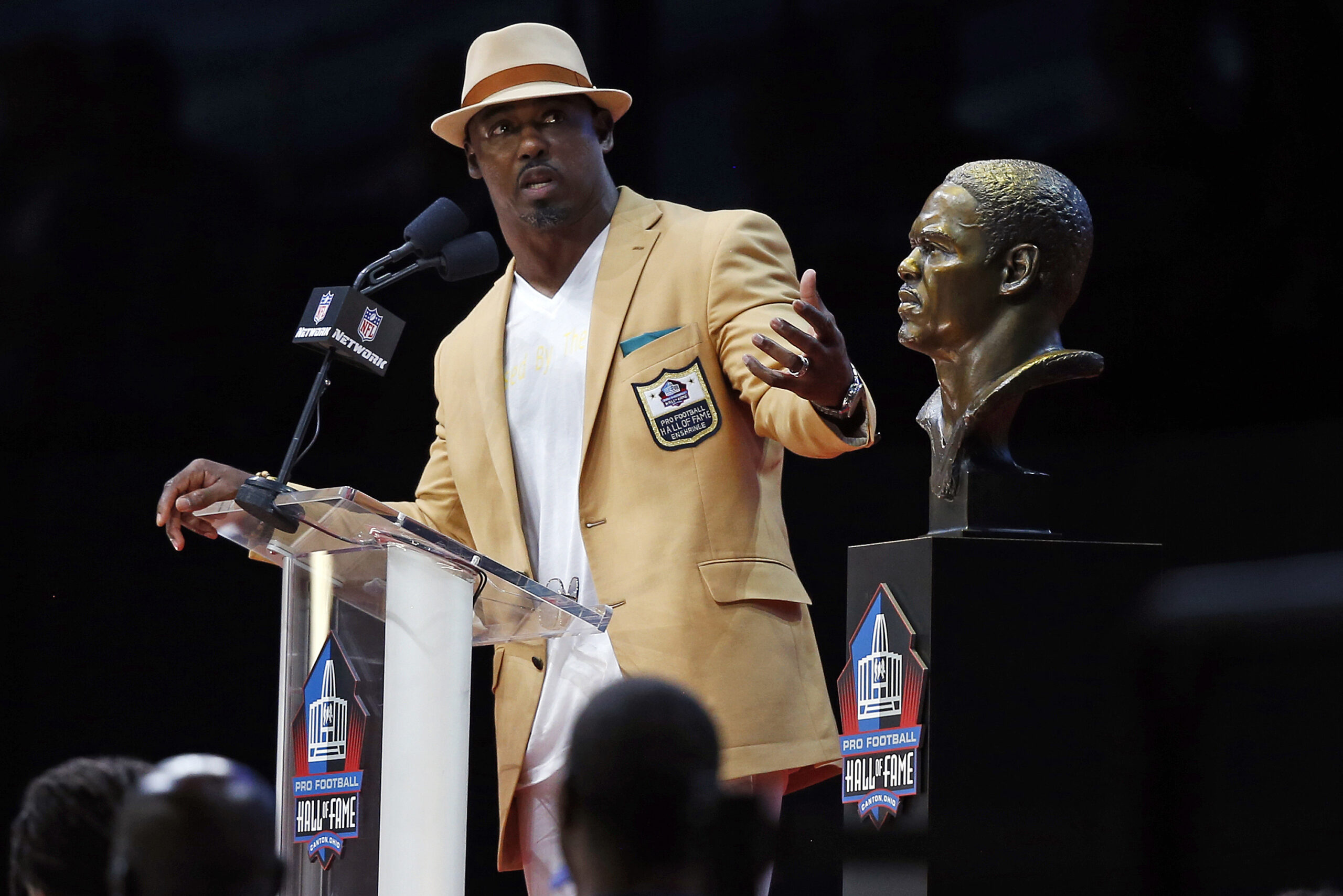
    Bill Belichick will not join former Eagle Brian Dawkins in the Pro Football Hall of Fame … at least this year.

    Today, most folks look past Belichick’s cheating, especially on Tuesday, when the story broke. They point at his innovation, his preparation, and his ability to maximize the abilities of every player, from Brady to Richard Seymour to Rob “Gronk” Gronkowski.

    But just enough folks apparently did not. Just enough folks think Belichick should have to wait a bit before he gets his bust and his jacket.

    Just enough folks did not look past Belichick’s sins.

    Shula died in 2020, but somewhere, you have to think ol’ Don’s smiling. He despised Belichick’s methodology.

    “The ‘Spygate’ thing has diminished what they’ve accomplished. You would hate to have that attached to your accomplishments,“ Shula said in 2007, during the Patriots’ failed attempt to match his 1972 Dolphins’ perfect season.

    Seven years later, when asked about Belichick’s feats to that point, Shula replied with the nickname Belichick’s detractors had given him: “Beli-Cheat?”

    Yes.

    Beli-cheat.

    “La vengeance se mange très-bien froide.”

  • Believe it or not, Aidan Miller and the Dodgers are more connected than one might think

    Believe it or not, Aidan Miller and the Dodgers are more connected than one might think

    The fun part of the baseball offseason is the illusion of control.

    Unless you are Dave Dombrowski.

    In which case, you’re a sitting duck. Or, even worse, you’re a floating duck, whose legs are tied, except they are tied beneath the surface, and so everybody thinks you’re a dumb little ducky because you don’t know how to swim.

    The Phillies president has earned some of the criticism being lobbed his way. As ridiculous as it may seem for the Mets to pay Bo Bichette $42 million in annual average value, is it any more ridiculous than paying Taijuan Walker and Nick Castellanos a combined $38 million in AAV?

    The substitution costs are always what get you. Thirty-eight million dollars would have been enough to have Jeff Hoffman and Carlos Estévez in your bullpen last season. It would have been enough to have Edwin Díaz in your bullpen this season. General managing is all about the tradeoffs you make.

    The irony is that the Castellanos and Walker contracts are easy ones to stumble into for the same reason that everyone thinks Dombrowski has done a lousy job this offseason. If you happened to be someone who pointed out the overinflated and potentially ill-advised nature of those deals at the time they were signed, you were met with a shrug of the shoulders.

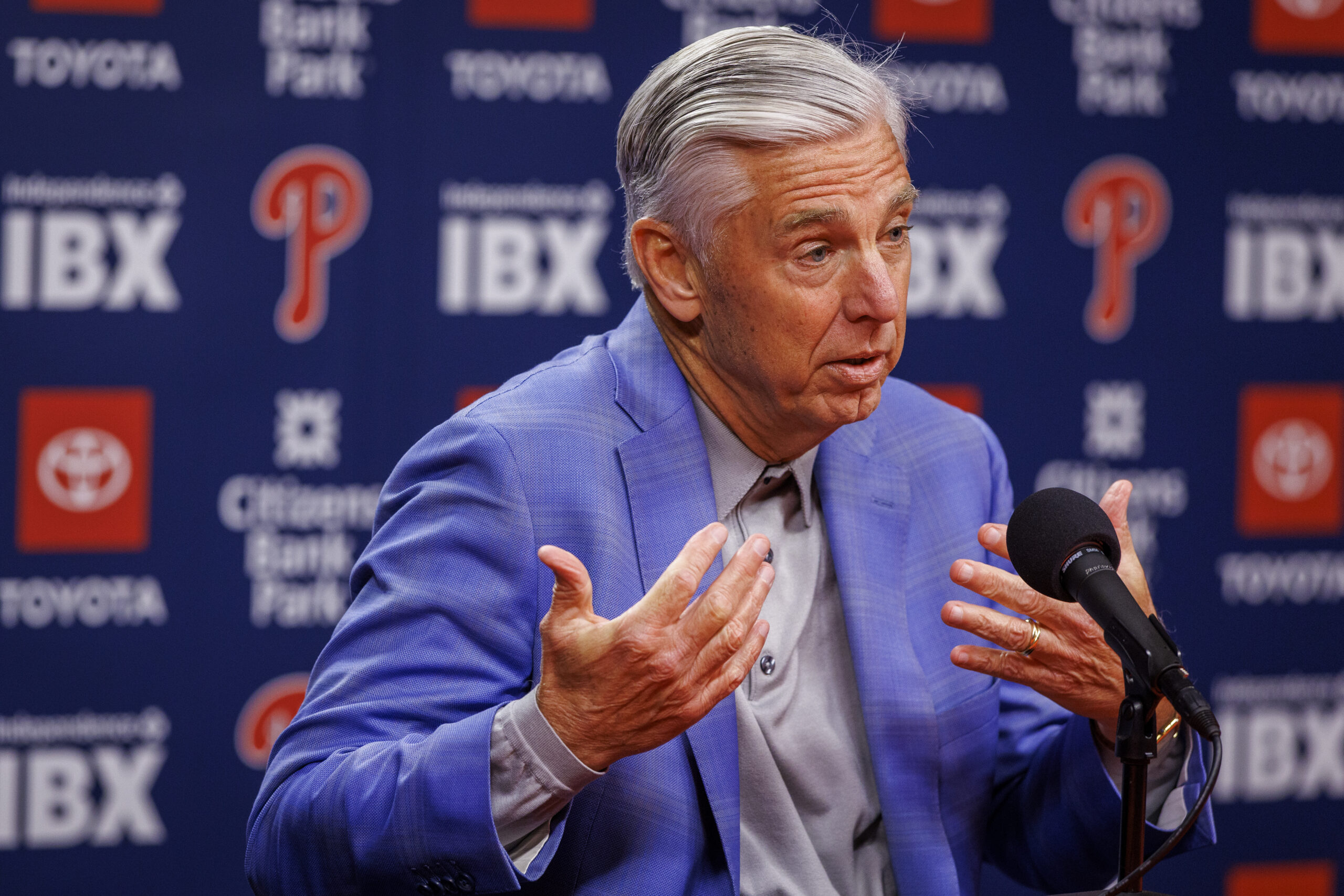
    Phillies president David Dombrowski has been the brunt of a few jokes this offseason as the team looks to retool for this upcoming year.

    Who cares? It’s not our money.

    Well, it’s nobody’s money now.

    But let’s get back to our original point. Whatever nickel-and-diming we do in hindsight, it wouldn’t erase the only conclusion we can draw from this offseason. No amount of fiscal prudence would have given the Phillies the means to catch up to, let alone keep pace with, the Dodgers. Over the last three offseasons, they have signed Shohei Ohtani, Blake Snell, Tyler Glasnow, Yoshinobu Yamamoto, and now Kyle Tucker and Díaz to contracts ranging from $22 million to $57 million in average annual value.

    John Middleton might be a billionaire, but the Dodgers’ annual payroll is pushing half a billion once you factor in the luxury tax. How many billions? That’s the question you need to answer to compete at this level of spending.

    The Phillies know this. Could Middleton and his minority owners rub their pennies together a little harder? Sure. Their attempt to sign Bichette was a sign that they aren’t operating by any hard spending limits. What they lack — what everybody lacks, except for the Dodgers and Mets — is the ability to sign such contracts with the knowledge that they can outspend any mistakes. The Dodgers have plenty of seemingly dead money on their books after last year’s bullpen spending spree. But it doesn’t seem to matter.

    Chasing Bo Bichette, who signed with the Mets, was admirable of the Phillies. But what would the cost have been if they landed him?

    The ability to sign Bichette for what would have been a reasonable seven-year, $200 million deal is a lot different from the ability to spend that money on whoever happens to be available. That’s how you end up hamstringing yourself by overpaying for players like Walker and Castellanos.

    Those contracts only make sense if you can outspend the mistakes. The Phillies aren’t there, nor have they ever pretended to be. It’s plenty fair to criticize Dombrowski and Middleton for offering those deals to begin with. But you can’t fault them for their inability and/or unwillingness to offer another batch of them.

    Which brings us to the illusory aspect of the baseball offseason. Regardless of how the last few months would have played out, the Phillies were always going to enter spring training needing to look inward in order to catch up to the Dodgers. In more ways than one. They are going to need to get some sort of impact from their minor league system. And they are going to need to get the intestinal fortitude to create opportunities for it to happen.

    The best news of the offseason might have come over the last week, when all of the national outlets released their Top 100 prospects lists. Aidan Miller showed up in the Top 10 of two of those lists: No. 6 on The Athletic’s and No. 10 on ESPN’s.

    News? Perhaps not. But confirmation that the national scouting industry agrees with what all of us local yokels have seen with our own two eyes for the last two years. Miller is the kind of prospect who can alter a team’s long-term trajectory while massively boosting its present-day World Series odds.

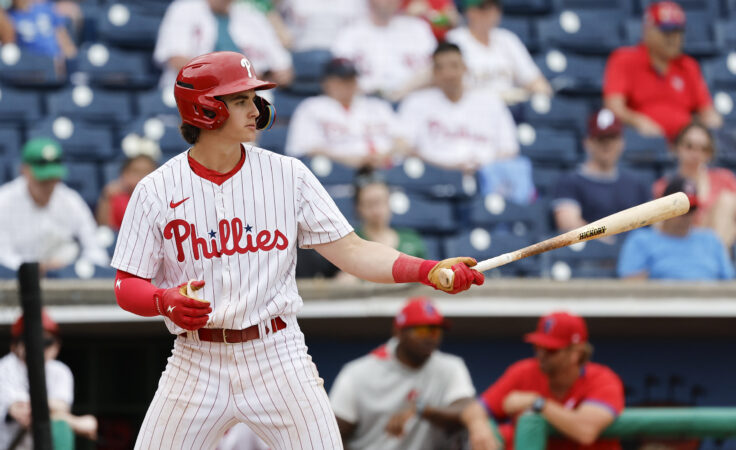
    Many believe Phillies minor league infielder Aidan Miller is the kind of prospect who can alter a team’s long-term trajectory.

    Years ago, the Dodgers had one of those prospects in Corey Seager. He broke into the big leagues at 21 on a team managed by Don Mattingly. Mattingly happens to be the new Phillies bench coach and the father of the team’s general manager. The Dodgers went to the NLCS the following season, when Seager was 22, and the World Series the year after, when he was 23. Miller will be 22 in June.

    Prospects are largely responsible for writing their own future. Miller needs to start the season the way he ended the last one. If he does, the Phillies need to do their part and find him a spot in the lineup. It could involve difficult conversations, but they will be necessary ones.

    Same goes elsewhere. With Andrew Painter. With Gage Wood. With lesser-heralded prospects like Gabriel Rincones and Jean Cabrera. The Phillies need to be willing and flexible to bring guys up and find out what they have.

    The Dodgers have set the bar high. The Phillies have no choice but to reach for it.

  • The NFL is primed to open up passing offenses again. The Eagles’ new coordinator had better be ready.

    The NFL is primed to open up passing offenses again. The Eagles’ new coordinator had better be ready.

    There’s a lot of anxiety in the ether these days about the Eagles, particularly about the fact that they haven’t hired an offensive coordinator yet to replace Kevin Patullo.

    Just look at some of the candidates who have been scooped up elsewhere or who decided to stay where they were: Mike McDaniel, Brian Daboll, Joe Brady, Mike Kafka, and Charlie Weis Jr.

    We can call this group the “Guys We’ve Heard Of” group, and they’re the biggest drivers of this collective worry that the Eagles will end up hiring some nincompoop who can’t call plays or, worse, calls the same kinds of plays Patullo did. I don’t know much about McDaniel other than he digs capri pants and tinted sunglasses. But I recognize his name, which means he must be smart, and the Eagles must be stupid for not hiring him.

    Mike McDaniel (left) was a player high on the list of potential replacements for Kevin Patullo as offensive coordinator. Until he accepted the role with the Chargers.

    Then there’s the “Guys I’m Googling” group. They’re the up-and-coming coordinators and quarterback coaches who aren’t as well known to the casual NFL follower but who aspire to become branches on the Sean McVay tree or the Kyle Shanahan tree or whatever metaphorical foliage the Eagles happen to prefer. The way the Eagles’ search is shaping up — the time they’re taking, the three still-vacant head coaching jobs around the league — they’re likely to settle on someone from this group.

    Hiring such a candidate, one with relatively little experience and no discernible track record, could turn out to be a problem for the Eagles, who might end up with another play-caller who isn’t quite ready for the role. But it would be a boon for the team’s fans and media, who could start second-guessing and complaining about the guy as early as Week 1.

    No matter who the Eagles bring on board, they would do well to take a big-picture factor into consideration when they make their choice. In the short term, sure, the new coordinator’s primary concerns will be centered on improving an offense that may or may not have A.J. Brown, may or may not have Lane Johnson, may or may not have a decent tight end or two, and could use a bounce-back season from Jalen Hurts. But in the longer term, they should be mindful that they’ve been part of a strategic shift across the NFL, and they should be prepared in case Roger Goodell and the league’s owners try to shift things back.

    Here’s what I mean: During this regular season, the average NFL team passed for 209.7 yards a game. That figure represents the lowest such average since 2006. It has been two decades, in other words, since NFL passing offenses were as anemic (or as conservative, depending on how you want to look at it) as they were this season.

    Eagles quarterback Jalen Hurts was among an NFL passing collective that accounted for an average of just 209.7 yards per game, the lowest since 2006.

    Why? You don’t have to be Bill Walsh to figure it out. After years of franchises chasing franchise quarterbacks and brilliant scheme designers and elite wide receivers — and tight ends who could catch and run like wideouts — a funny thing started happening: Certain teams geared up to counteract their opponents’ dynamic passing games and to exploit smaller, faster defenses. That is, certain teams won championships because of their defenses and/or their run games.

    The 2023 Kansas City Chiefs had Patrick Mahomes, yes, but they ranked 15th in scoring offense and second in scoring defense. The story of the 2024 Eagles is practically gospel around here: the dominance of Saquon Barkley and the offensive line, a stout defense overseen by Vic Fangio and built from the secondary in, the reality that the team didn’t want to and didn’t have to rely on Hurts’ arm to win.

    Now we have the New England Patriots and Seattle Seahawks in Super Bowl LX. Drake Maye had a great second season, and Sam Darnold is a great story. But both the Patriots’ and Seahawks’ defenses finished among the league’s top four in fewest points allowed and among the top eight in fewest yards allowed.

    Simply put, the passing game — the aspect of football that leads to high scores, general excitement, and the rise of the sport’s biggest celebrities and product-movers (i.e., star quarterbacks) — ain’t what it used to be. Hell, we were three points away from having a Super Bowl with Darnold and Jarrett Stidham as the starting QBs … not exactly an electrifying matchup of two all-time greats/household names.

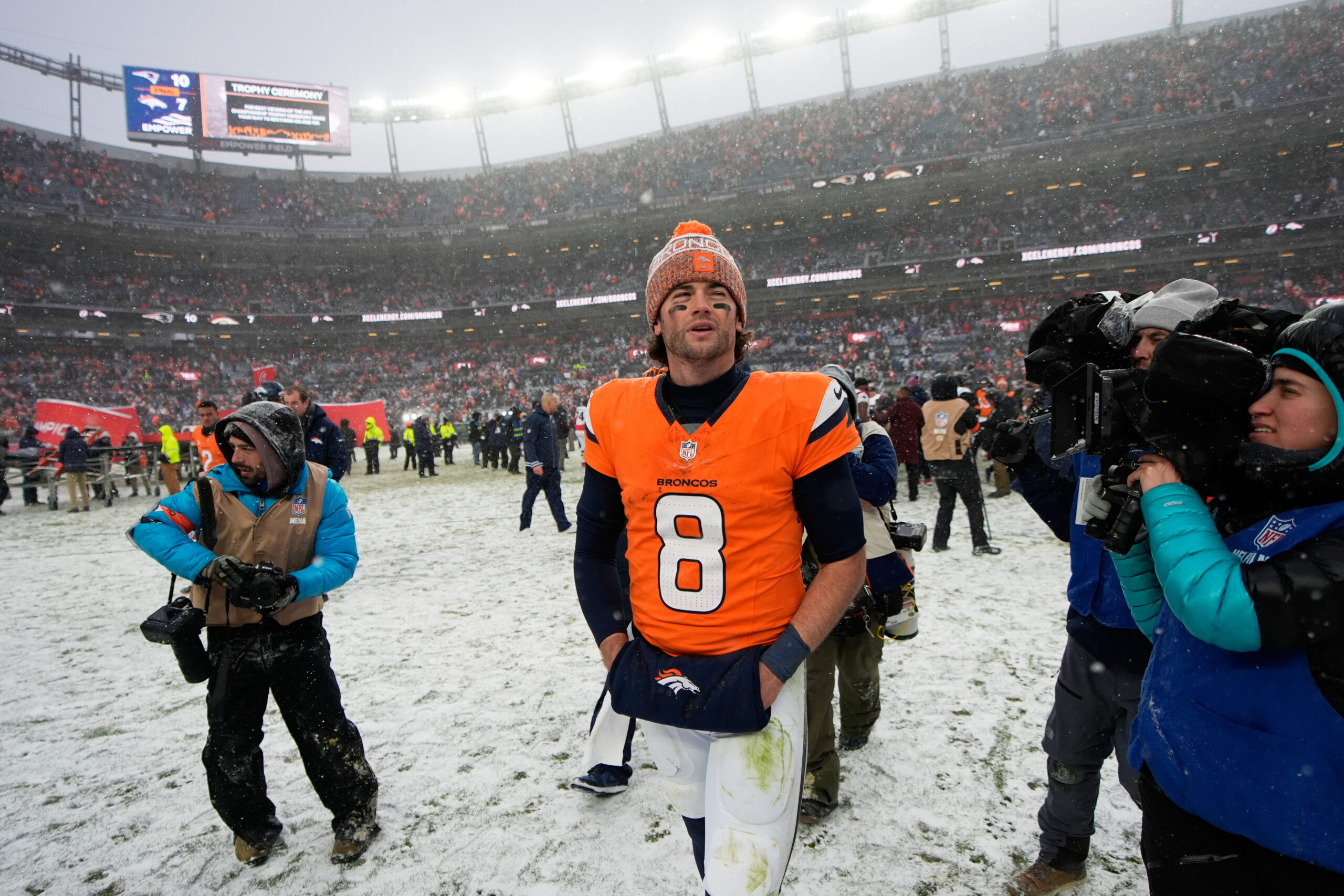
    Broncos backup quarterback Jarrett Stidham leaves the field after the team’s loss in the AFC championship against the New England Patriots.

    For all the moaning that Sunday’s Patriots-Broncos game was boring and unwatchable because of the snow at Empower Stadium, for all the silly calls for holding conference-title games in domes from now on, the weather wasn’t what made it dull. What made it dull was that Maye played as if he was trying not to lose the game (sound familiar, Eagles fans?), and Stidham wasn’t capable of winning it.

    The last time the NFL went through a stretch similar to this one was a quarter-century ago, when four consecutive Super Bowls were won by teams primarily defense-oriented: the 2000 Baltimore Ravens, the 2001 and 2003 Patriots, and the 2002 Tampa Bay Buccaneers. Consider some of the quarterbacks, too, who were reaching those Super Bowls back then: Trent Dilfer, Kerry Collins, Brad Johnson, Rich Gannon, Jake Delhomme, and a rookie named Tom Brady.

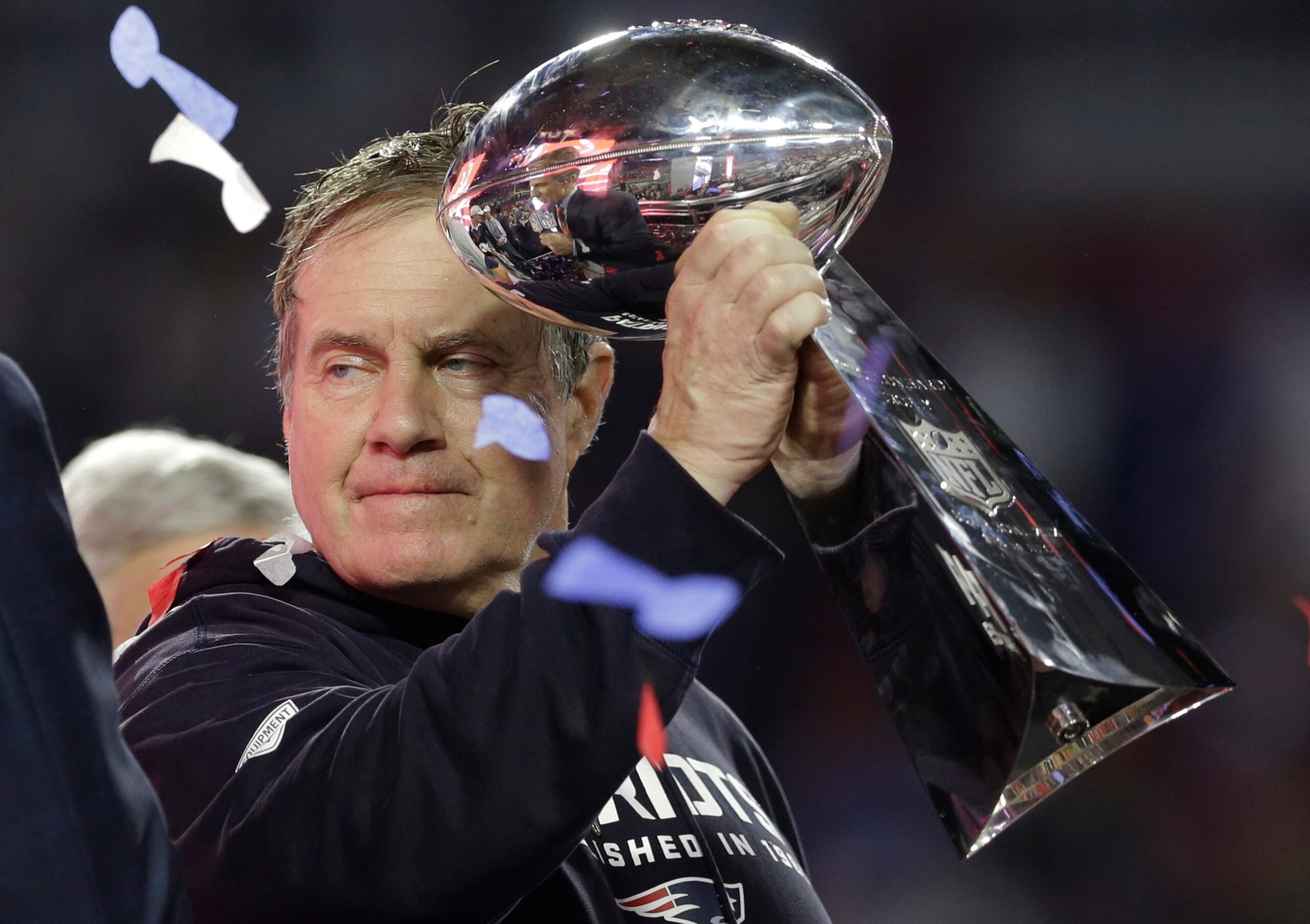
    Former Patriots coach Bill Belichick might have had Tom Brady for the Super Bowls he racked up, but he also boasted some good defenses as well.

    In the aftermath of that ’03 Patriots run — Bill Belichick’s defensive backs manhandled the Indianapolis Colts’ receivers in the AFC title game — the NFL decided to crack down on illegal contact, defensive holding, and pass interference infractions. In 2003, NFL teams averaged 200.4 passing yards. In 2004, that average jumped by more than 10 yards, to 210.5, and it kept rising for years thereafter.

    That surge has stopped. The game has slowed down, and it’s a safe bet that the NFL won’t allow it to stay this way for too much longer. The Eagles were among those applying the brakes, but the sport is poised to open up again, and they and their new man at the wheel, whoever he might be, need to be ready.