Category: Sports Columnists

  • The 2025 Eagles played not to lose. In the end, that’s why they did.

    The 2025 Eagles played not to lose. In the end, that’s why they did.

    The play that encapsulated everything the Eagles offense wasn’t this season was a play that they themselves didn’t even run. First snap of the fourth quarter Sunday night for the San Francisco 49ers, first-and-10 from the Eagles’ 29-yard line, and there was Kyle Shanahan, calling a double-wing reverse pass that made one of the NFL’s best defenses look like a bunch of suckers. Brock Purdy handed the football to Skyy Moore, who pitched it to Jauan Jennings, who rainbowed a pass toward the end zone to Christian McCaffrey, who didn’t have an Eagles player within 5 yards of him.

    A six-point Eagles lead suddenly was a one-point deficit. And though that touchdown technically wasn’t the winning score in the 49ers’ 23-19 wild-card victory, it was the perfect symbol for the difference between a team that played like it had nothing to lose and a team that played like it was fearful of taking the slightest of chances.

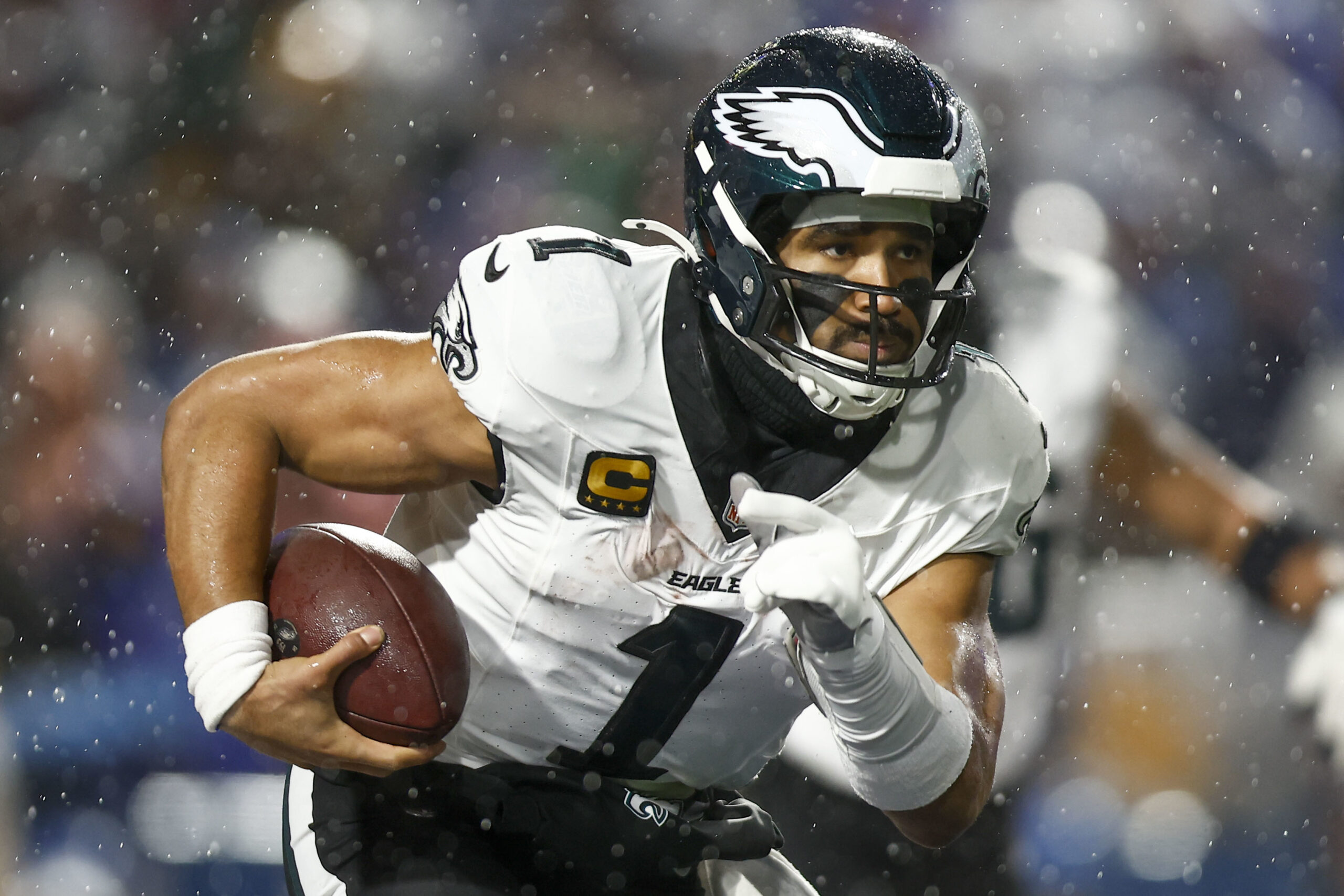
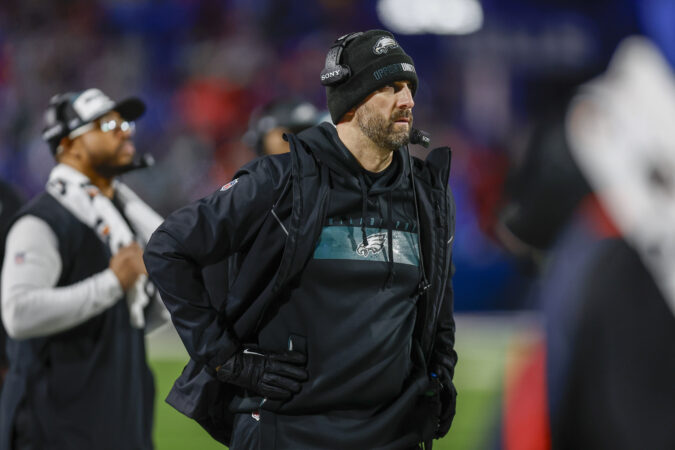
    From Nick Sirianni to Kevin Patullo to Jalen Hurts, the Eagles spent too much of this season acting as if being daring was taboo for them. Sirianni preached the importance of minimizing turnovers, citing the Eagles’ marvelous record during his tenure as head coach when they protected the football better than their opponents. But it turned out that a Super Bowl champion cannot defend its title on caution alone. The 49ers committed two turnovers. The Eagles didn’t commit any. And the final score was the final score.

    In the locker room afterward, player after player used the same word as the cause of the Eagles’ struggles during the regular season and their quick exit from the postseason: execution. “If there are multiple players saying that,” tackle Jordan Mailata asked, “why don’t you believe us?” Good question. Here’s why: It’s a familiar, sometimes default way of thinking among elite athletes: It doesn’t matter what the coach calls. It doesn’t matter if my opponent knows what’s coming. If I do exactly what I’m supposed to do exactly when I’m supposed to do it, nothing can stop me, and nothing can stop us.

    “I don’t think we were playing conservatively,” running back Saquon Barkley said. “I think it comes down to execution. A lot of the same calls we have — I know it was a new offensive coordinator and new guys, but we kind of stuck with the same script, to be honest, of what we did last year. It’s easy to say that when you’re not making the plays. … If we’re making the plays, no one is going to say we’re being conservative.”

    The Eagles could get away with following that mantra last season. Their offensive line was the best in the league, and they shifted midseason from having Jalen Hurts throw 30-plus passes a game to giving the ball to Barkley and counting on him for consistent yardage and big plays. But, as Barkley acknowledged, they returned this season with pretty much the same offense — after the other 31 teams had an offseason to study what the Eagles had done and come up with ways to neutralize it.

    “If they call inside zone and we call inside zone and they run it better than us, they just ran it better than us,” Barkley said. “They executed better than us. That’s just my mindset. Maybe I’m wrong.”

    He is. There rarely was any surprise to the Eagles’ attack this season, rarely any moments when A.J. Brown or DeVonta Smith was running free and alone down the field, when Barkley wasn’t dodging defenders in the backfield, when anything looked easy for them. When everyone in the stadium knows you’re likely to call a particular play in a particular situation, yes, you had better be perfect in every aspect of that sequence. But when you catch a defense off guard — as Shanahan did on Jennings’ pass — your execution can be less than ideal, and the play will still work.

    Look at Sunday: Barkley had 15 carries in the first half and 11 in the second. He had 71 yards in the first half and 35 in the second; after halftime, the 49ers started sending more players toward the line of scrimmage just before Hurts took the snap. The proper countermove would have been to throw the ball downfield more often, but the Eagles were reluctant to court such risk. It doesn’t much matter whether Patullo couldn’t scheme up such plays or whether, even if Patullo had opened up the offense, Hurts would have held the ball anyway. The result was the same. They settled for what was safe.

    “I think that’s always the go-to. … People think you take your foot off the gas,” Sirianni said. “We didn’t create enough explosives. They did.”

    To the end, the head coach struggled to see the connection between his conservatism and the problems that plagued his offense. No Super Bowl appearance, no title defense, not even a spot in the playoffs’ second round. Over 18 games, this team wrote its own epitaph.

    The 2025 Eagles: They played not to lose. Which is why they did.
  • Kevin Patullo’s offense wastes two Quinyon Mitchell interceptions in crushing Eagles playoff loss

    Kevin Patullo’s offense wastes two Quinyon Mitchell interceptions in crushing Eagles playoff loss

    This time last year, few fans outside of the most rabid of the NFL knew who Kevin Patullo was. For the record, he was the Eagles’ passing game coordinator and coach Nick Sirianni’s favorite lieutenant.

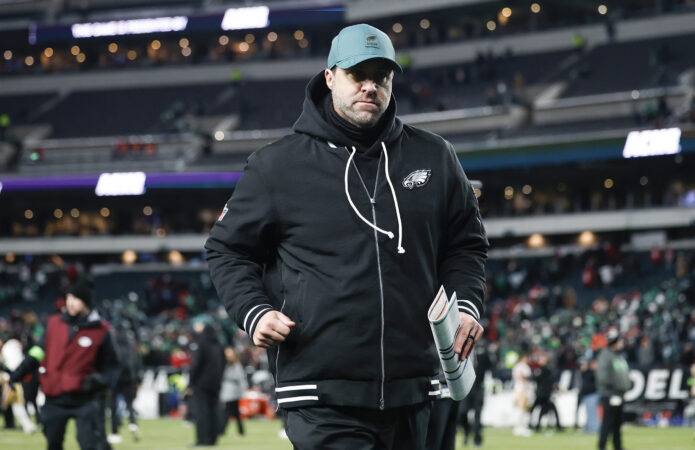
    Now, everybody knows his name. After 18 games of ineptitude as the Eagles’ offensive coordinator, Patullo will bear the blame for the lost season of 2025, no matter how much he looks like his buddy, Nick.

    Patullo cannot survive the week. The blame will fall to him.

    It might not be true. The defense needed two months to round into shape.

    It might not be fair. Sixty percent of the offensive line was injured to some degree all season, and neither wide receiver A.J. Brown nor running back Saquon Barkley played to his usual standards.

    Still, it’s hard to believe that owner Jeffrey Lurie, who spent $128 million on an offense that cost him more than twice what the defense cost, will give another chance to the least popular assistant coach since Juan Castillo moved from offensive line to defensive coordinator in 2011. Castillo was fired in October 2012, two months ahead of Andy Reid’s departure.

    An offense that featured Barkley, Brown, Jalen Hurts, DeVonta Smith, Dallas Goedert, and a well-paid, pedigreed offensive line scored two early touchdowns against the visiting 49ers on Sunday night. And then just six more points.

    It had been 22 years since the Eagles suffered such a gutting home playoff loss, a 14-3 collapse in the NFC championship game. Move over, Carolina.

    The Eagles gave away a 23-19 wild-card playoff loss to a 49ers team that had crossed three time zones with a depleted roster, that, after the second quarter, also had lost one of its better players, tight end George Kittle. Hurts and Patullo’s offense had a chance to score the winning touchdown in the closing minutes, but the drive broke down and failed at the 21-yard line on the quarterback’s fourth-down incompletion intended for Goedert with 40 seconds left.

    Asked his evaluation of Patullo’s first season, Hurts replied: “We’ve all got to get better.”

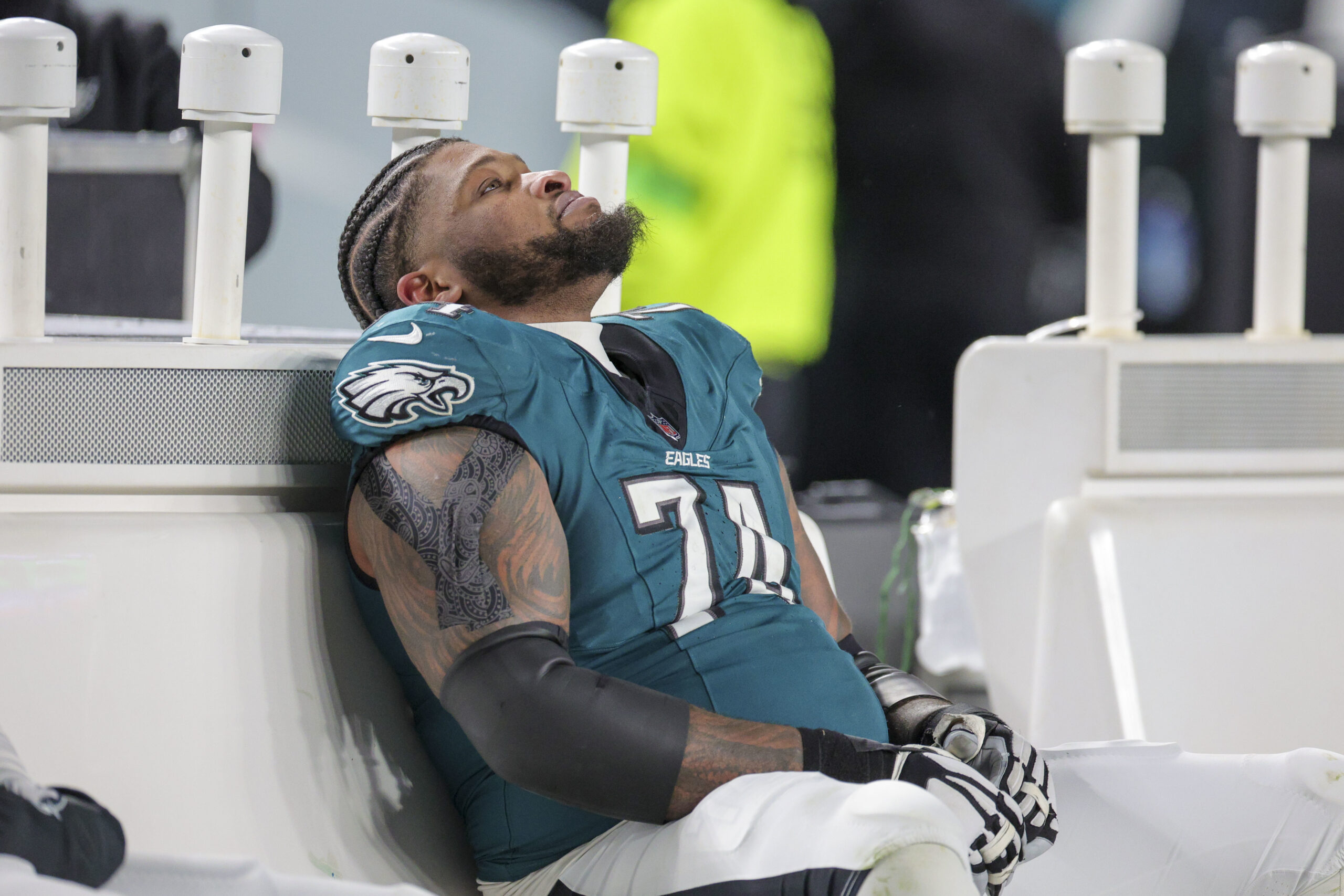
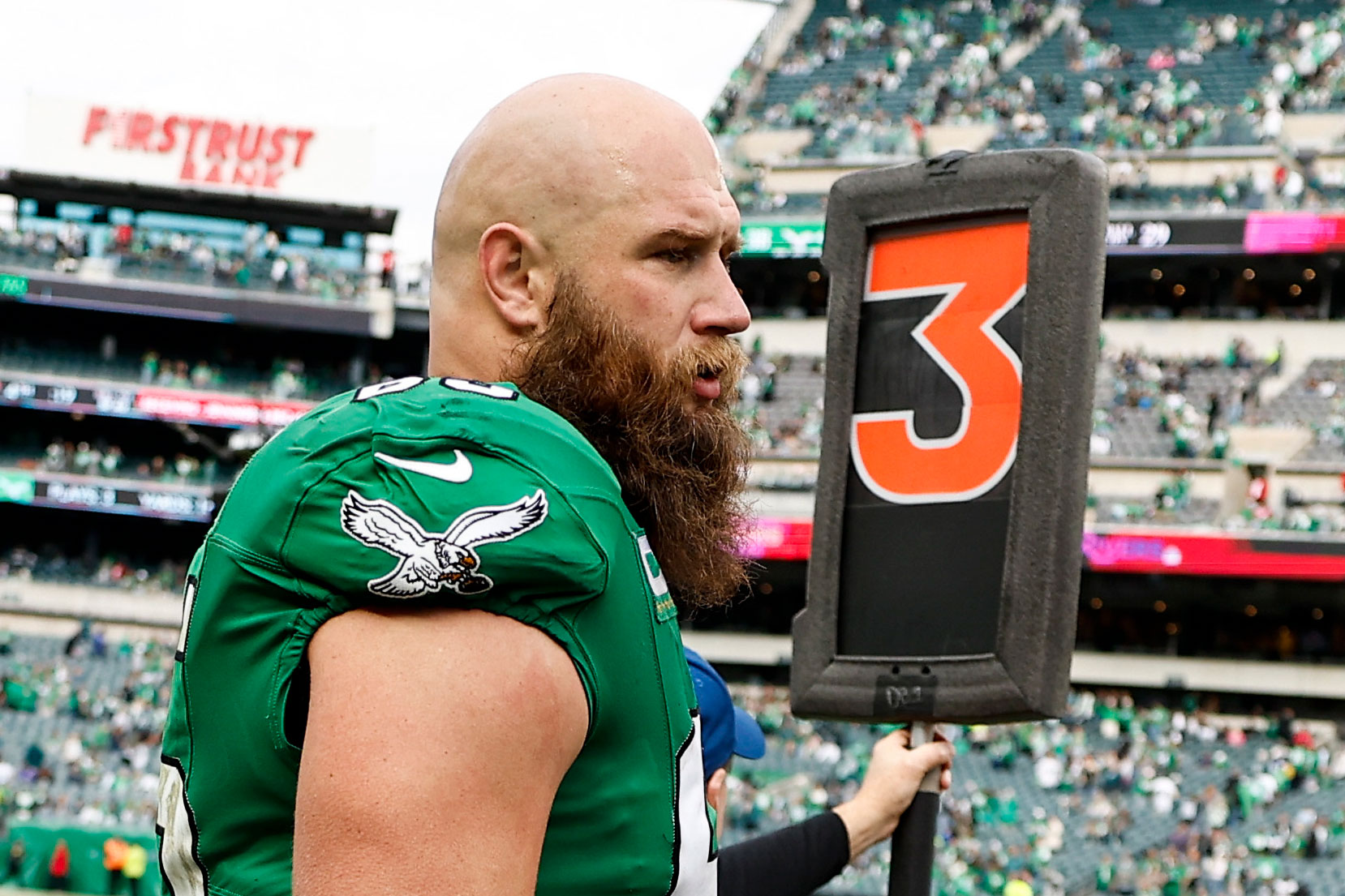
    Eagles tackle Fred Johnson sits on the bench after the loss to the San Francisco 49ers at Lincoln Financial Field.

    Left tackle Jordan Mailata said, effectively, let he who is without sin cast the first stone:

    “Nobody wants to blame the guy we paid $22 million, so let’s blame the offensive coordinator,” said Mailata, who averages $22 million per season.

    Niners coach Kyle Shanahan acts as his team’s play-caller, and, despite absences and injury, he gave Patullo a master class in scheme and preparation.

    The 49ers’ first possession, comprised mainly of passes for 61 and 11 yards, lent credence to the people who wanted the Eagles to play their starters instead of resting them in Game 17 the week before. The defense looked more than just rusty. It looked inept.

    The Eagles’ maligned offense somehow stayed sharper than their celebrated defense. On its first possession, six runs from Barkley helped move the Eagles to the 1, where tight end Goedert ran the ball for just the fourth time in his career and scored his first rushing touchdown.

    The Eagles’ next score happened because Barkley waited for Landon Dickerson to block a defender on a 20-yard screen pass. Later, Hurts waited for a defender to clear the path between himself and Goedert, whom Hurts found for a 9-yard touchdown pass.

    The game was punctuated by a sideline incident with 2 minutes, 2 seconds to play in the first half as the Eagles prepared to punt. Head coach Nick Sirianni ran 30 yards down the sideline toward the touchy wide receiver Brown, who, in Sirianni’s view, was taking too much time exiting the field. Brown stopped and appeared to heatedly argue the point. Security chief Dom DiSandro separated them.

    A few seconds later Brown left the bench and shouted in Sirianni’s direction, and was ushered away by sideline personnel and teammates.

    Some of the stars starred.

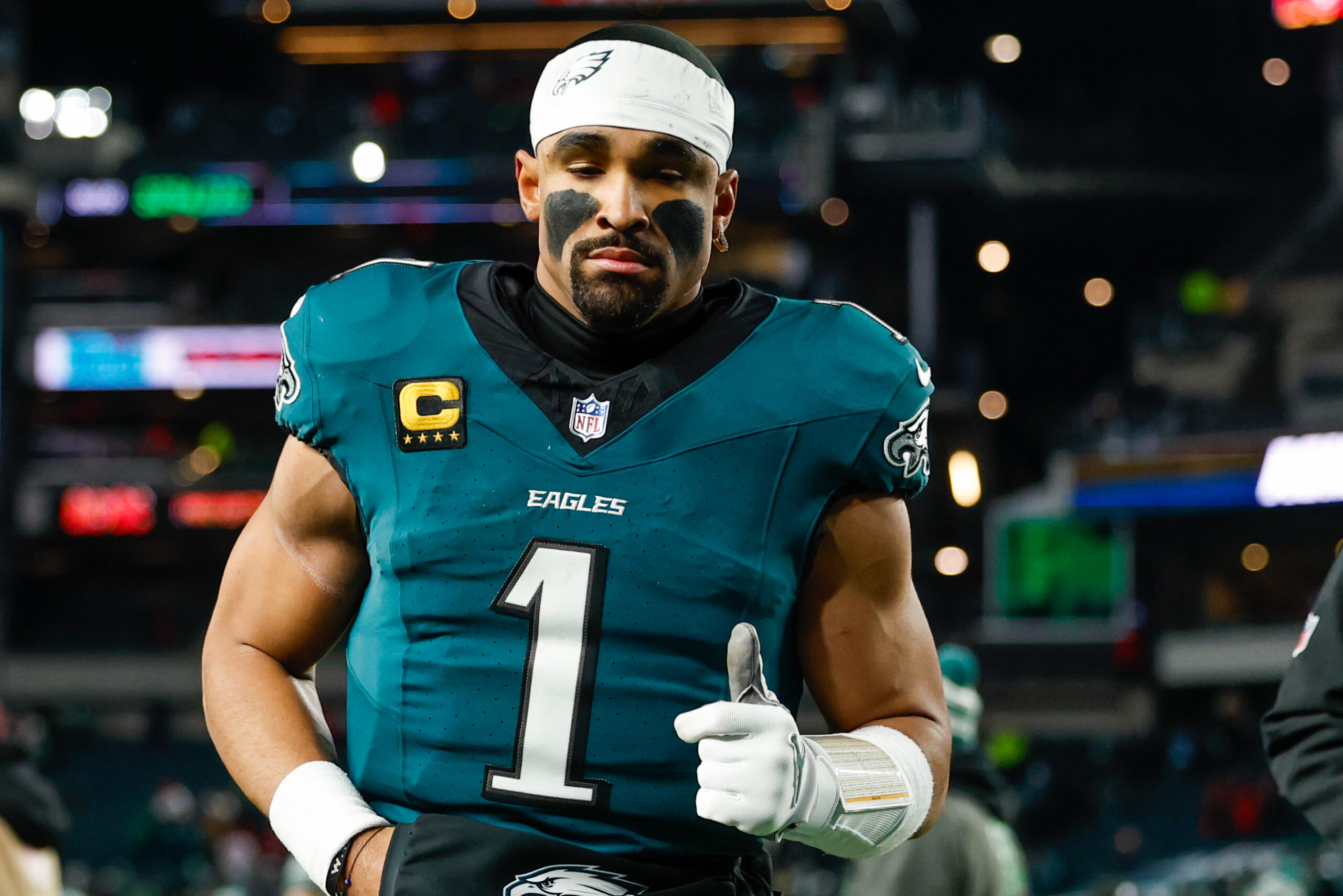
    Eagles quarterback Jalen Hurts runs off the field after the loss to the 49ers.

    Goedert, who this season set an Eagles record with 11 touchdown catches, tied for the league lead, ran for one touchdown — the first tight end to do so in NFL playoff history — and caught another.

    Quinyon Mitchell, the team’s best defensive back since Brian Dawkins, collected his third and fourth interceptions in his five career playoff games.

    Barkley ran 26 times for 106 yards and caught a 20-yard pass.

    Brown? He managed just three catches for 25 yards. He failed on two consecutive deep shots to connect with Hurts, disconnects that immediately preceded his latest sideline incident.

    Brown often has expressed frustration with the Eagles offense the past two seasons. Sunday, as he has done for more than a month, he left the locker room without fulfilling his league-mandated obligation to speak with reporters.

    It continued the season’s theme:

    Brown wearing a frown.

    Patullo’s offense breaking down.

    Philly might have seen the last of both of them.

  • Ray Didinger wrote ‘Tommy and Me’ in 2016. He and his play are now the subject of a film 10 years in the making.

    Ray Didinger wrote ‘Tommy and Me’ in 2016. He and his play are now the subject of a film 10 years in the making.

    Ray Didinger is gone. Gone on vacation, gone to the other side of the world, gone to places he has never been before and will never visit again.

    He and his wife, Maria, left last Sunday on a five-month Magellan-like cruise, a journey to Bora Bora, to the Hawaiian Islands, to New Zealand and Tasmania, to the Far East, to Canada and Alaska and back home again to their 15th-floor apartment in Center City.

    He will not be in Philadelphia to watch Super Bowl LX — a prospect, given the very real possibility that the Eagles will return to the big game and win it again, that once would have been unthinkable. Didinger, after all, is regarded as the foremost authority on the franchise and its history, having covered, commented on, and written comprehensive books about the Eagles over his half-century-plus in journalism and media.

    He also wrote a play tied to the Eagles, Tommy and Me, about his relationship with Hall of Fame wide receiver Tommy McDonald, and the play is the thing that makes the timing of his once-in-a-lifetime trip so ironic. Ten years after Tommy and Me’s debut, Boys to Fame — a documentary/feature film, produced by Sam Katz, about Didinger, his play, and McDonald — became available for purchase and viewing on Sunday morning.

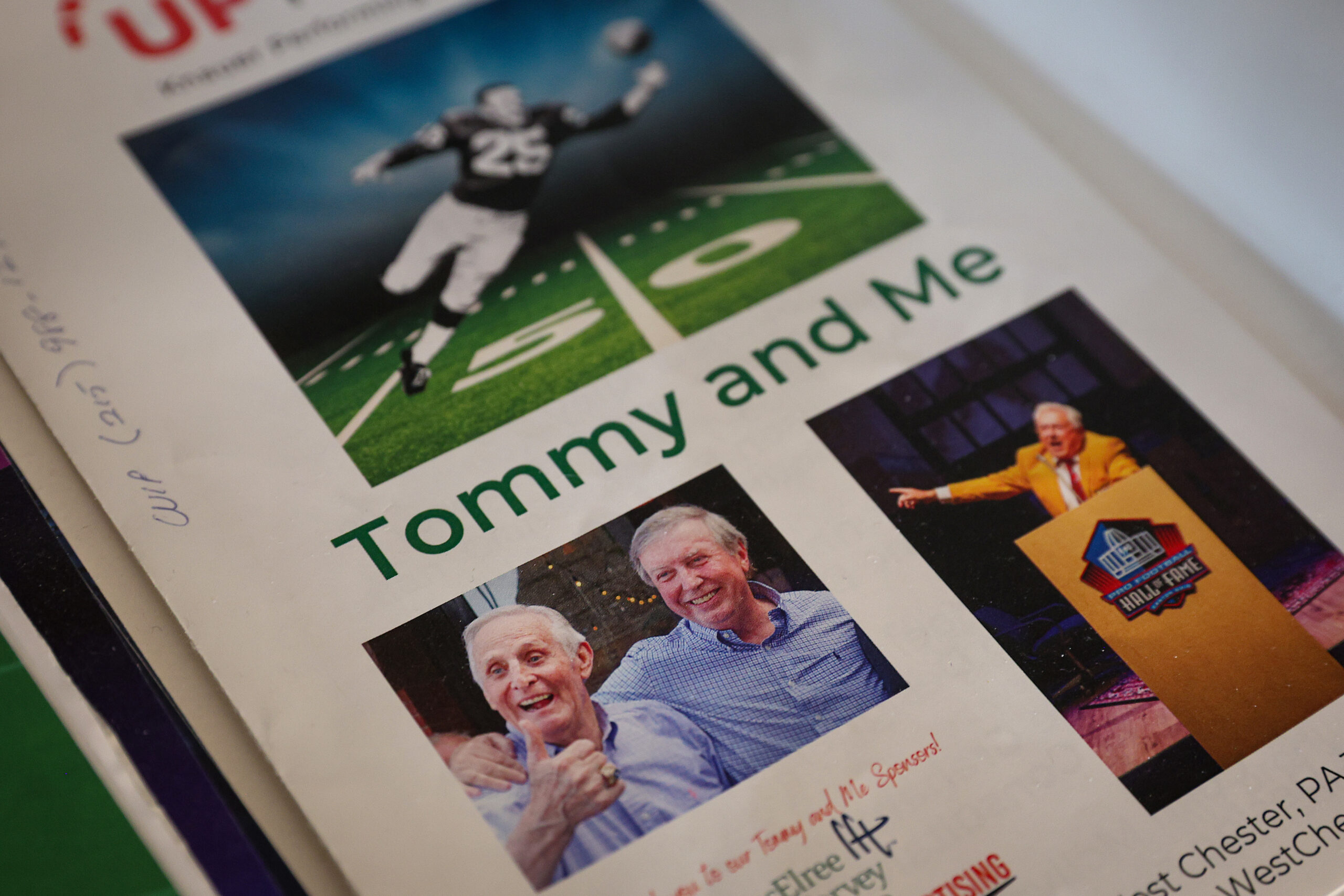
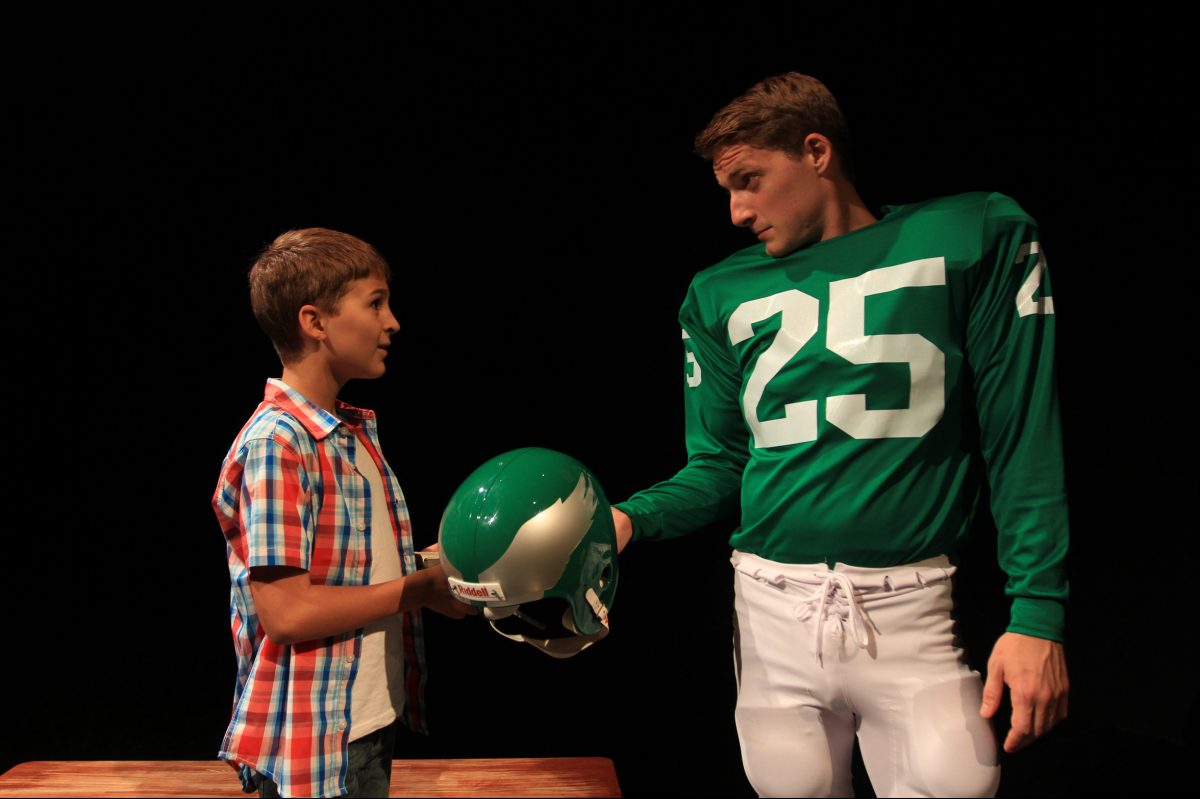
    Tommy and Me, the play created by Ray Didinger, chronicles his childhood and its close relationship to former Eagles great Tommy McDonald.

    Didinger, a week into his journey, isn’t around for the release. And there was no chance he would be.

    “I would rather be here to help Sam promote it as best I could,” he said before embarking on the cruise. “But this trip has been two years in the making, so there was no way to be here and tell Maria, ‘Honey, we’ve got trip insurance. Let’s just bag this thing.’ It’s a long fall from the 15th floor to Locust Street.”

    Katz, 76, has seen his career evolve into multiple iterations that he still maintains simultaneously: a player in Philadelphia and Pennsylvania politics — he ran for mayor three times — a venture capitalist, and a filmmaker. Through his company, History Making Productions, he has produced documentaries about Philadelphia’s filmmaking history, the rise of classical music in China, and one about Detroit’s bankruptcy, Gradually, Then Suddenly, which in 2021 won the Library of Congress’ Lavine/Ken Burns Prize for Film.

    When he saw Tommy and Me in 2016, its first run, he thought the play was worthy of film treatment — a film about the play and Didinger, that is. “The play itself was powerful, emotional, and a really incredible story of a relationship between two men,” he said. “I felt that a feel-good story like this would be timely, and I still feel that way.”

    He worried, though, that funding such a project would be a challenge.

    His other documentaries, all historical and to one degree or another educational in nature, lent themselves to philanthropic contributions. A film delving into the life of a sportswriter, even one as well-known and locally admired as Didinger, required Katz to find private investors — and contribute money himself.

    He found a group willing to back the film, former City Council member Allan Domb and Bullpen Capital founder Paul Martino among them, and decided, instead of pursuing a deal with a streaming service or television station, to release the film independently. It will be available on a website, boystofame.com, on a pay-per-view basis — “I’m selling it direct to the Philadelphia sports fan,” Katz said — and he hopes to generate attention and interest through grass-roots media coverage and screenings at film festivals and private clubs.

    In the play Tommy and Me, Ray Didinger (left, Simon Canuso Kiley) meets boyhood hero, and Eagles player Tommy McDonald (right, Ned Pryce) in the late 1950s in Theatre Exile’s world premiere of the play in 2018.

    The 82-minute film covers topics, features voices, and reveals details and emotions that Tommy and Me, by its singular focus on the big brother/little brother dynamic between McDonald and Didinger, and on Didinger’s efforts to get McDonald into the Hall of Fame, didn’t and couldn’t.

    Katz interviewed Didinger for more than five hours, talked to all four of McDonald’s children and several members of his Hall of Fame class, and even tracked down Billie Jo Boyajian, who was McDonald’s Queen’s Court escort at the 1998 induction weekend — and whom McDonald scooped up in his arms and carried to the stage during the Hall of Fame dinner.

    (In a fascinating side note, Boyajian pleaded guilty last January to charges of theft, forgery, and misuse of credit cards while she was the treasurer of a Canton high school basketball booster club. Katz had interviewed her for Boys to Fame years earlier.)

    The documentary bookends both McDonald’s life and Didinger’s. It directly confronts the fact that in 2021, three years after his death at 84, McDonald was diagnosed with the brain disease chronic traumatic encephalopathy, commonly known as CTE.

    Tommy and Me at Bucks County Playhouse in New Hope, with (left to right) Matt Pfeiffer and Tom Teti.

    The McDonalds gave Katz access to scrapbooks that Tommy’s parents had begun keeping of his exploits when he was a high school phenom in Roy, N.M., in the early 1950s. They also provided him with a video of McDonald’s reaction — joyful tears, dozens of thank-yous and thank-Gods — when he received the phone call to tell him that he finally would be inducted into the Hall of Fame.

    “I’ve seen it a hundred times, and I still get a lump in my throat,” Didinger said, “because it’s so raw and real and so true to the guy I know.”

    To Katz, though, it was important to give Didinger’s background and story — his childhood in southwest Philadelphia, his careers at The Bulletin and The Daily News, NFL Films and WIP and NBC Sports Philadelphia — as much weight as McDonald’s. To recreate Didinger’s youth, Katz took over The Barn, a pub near his vacation home in Eagles Mere, Pa., for two days and transformed it into Didinger’s grandfather’s bar, the place where Didinger, as a kid, spent hours wowing patrons with his encyclopedic Eagles knowledge. Katz hired several of The Barn’s regulars and a 10-year-old boy, none of whom had ever acted before, to star in the film.

    To depict the vacations that Didinger’s family would take to Hershey each summer to watch the Eagles at training camp, Katz coaxed a collector of antique cars to bring three 1955 vehicles to the Eagles Mere community center. “I insisted on everything being better,” he said.

    The most poignant moments of the film come when Didinger describes in depth his last visit with McDonald, on the day before McDonald died.

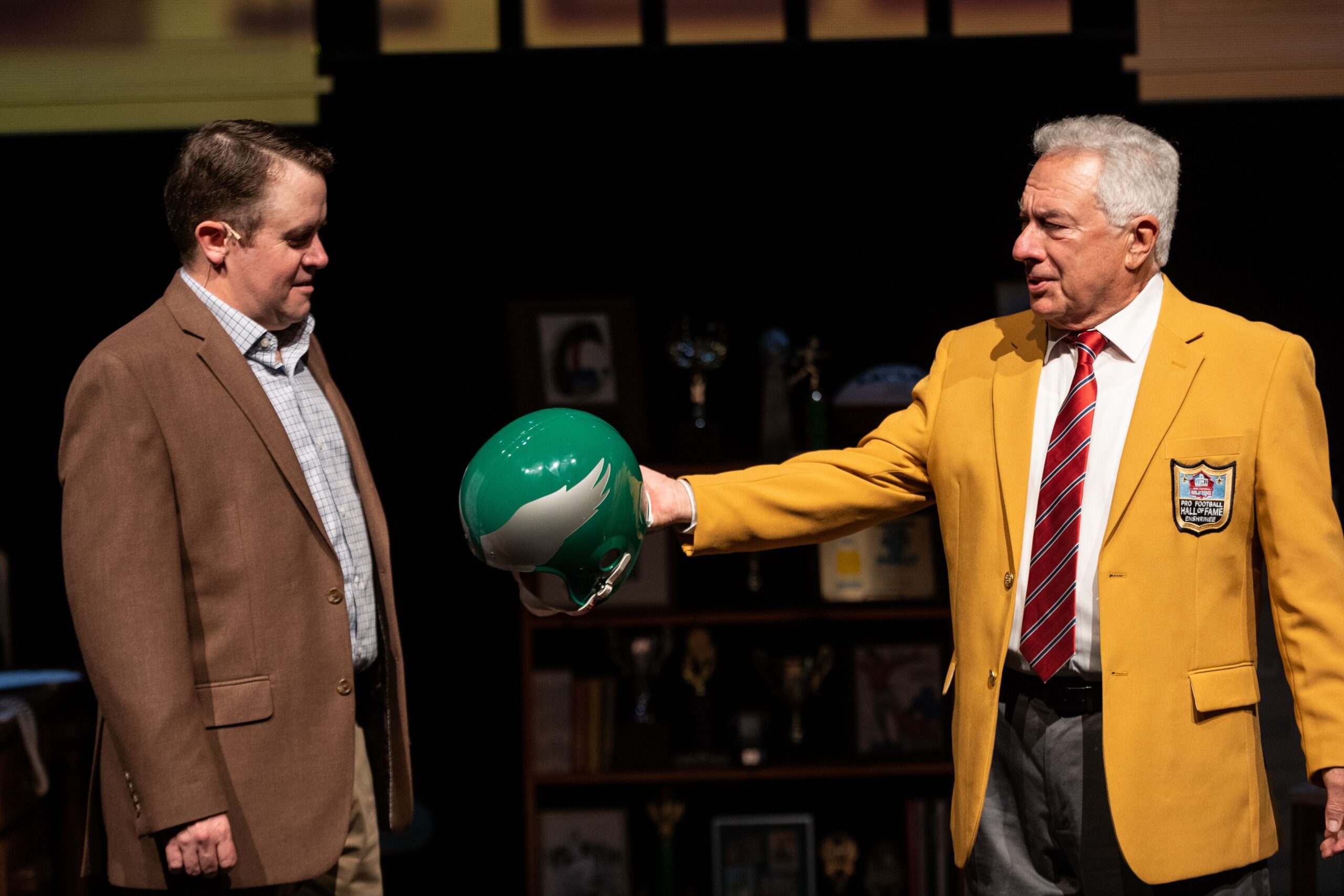
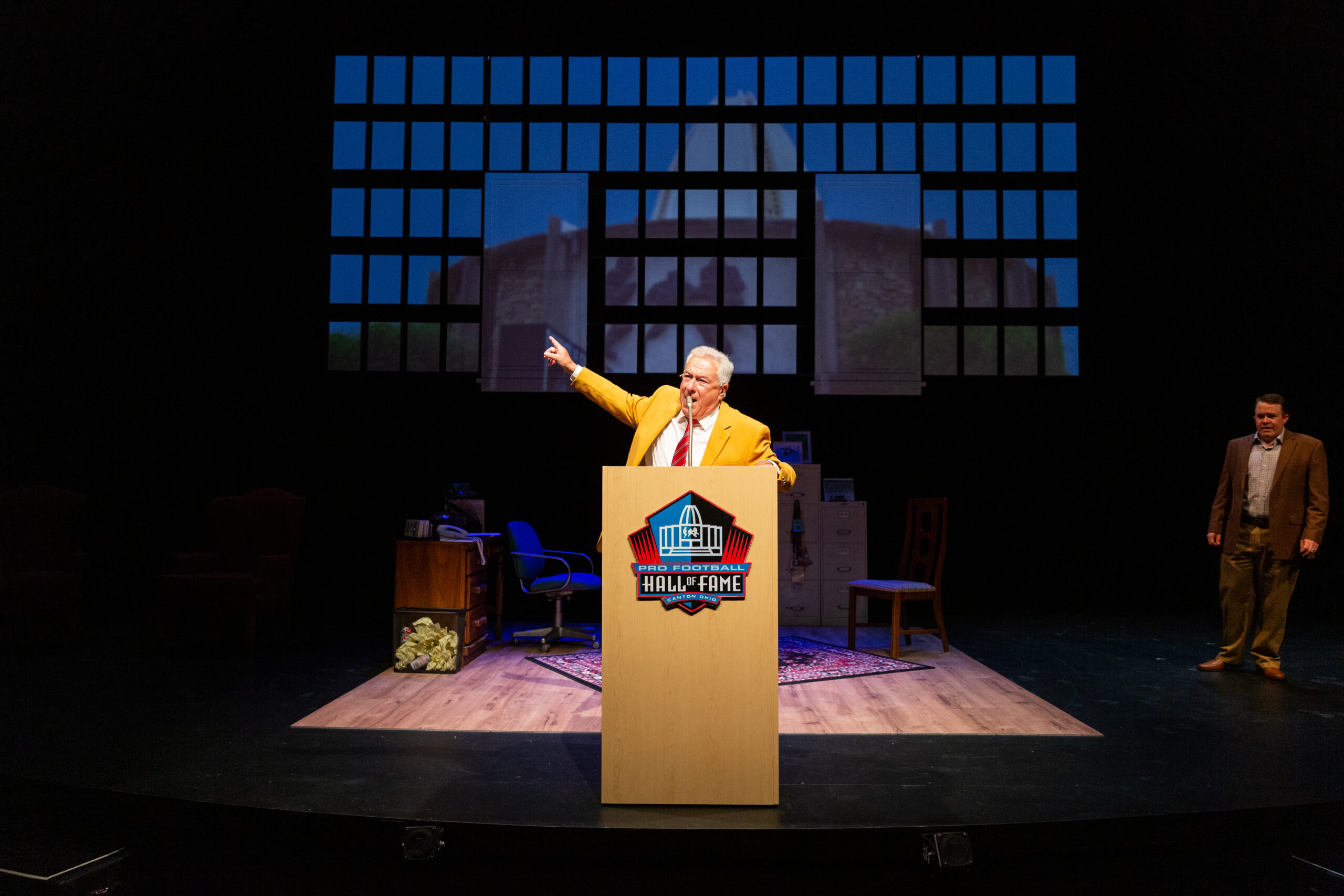
    A play about ex-Eagle Tommy McDonald‘s road to the Pro Football Hall of Fame, and his connection with legendary sports writer Ray Didinger, at People’s Light Theatre last year. The play is being turned into a film by Sam Katz.

    “Sam kept telling me, ‘For this thing to work, I need you to open your kimono,’” Didinger said. “That was the hardest and least comfortable aspect for me, but that day Tommy and I spent together had to be talked about.”

    In the film’s final scene, Didinger and his son, David, sit together on the couch in Ray’s home, watching an Eagles game. On Feb. 8, the day of this year’s Super Bowl, the Didingers’ cruise ship is scheduled to be off the coast of New Caledonia.

    If the Eagles do make it to Santa Clara for the big game, it would hardly be surprising if Ray stood atop the bow, hurled himself into the South Pacific, washed up on the beach in Sea Isle City, and was in front of his TV, pen and yellow legal pad in hand, by kickoff. Sorry, but that would be a better ending to the doc. Prepare accordingly for a reshoot, Mr. Katz.

    Columnist’s note: In the interest of full disclosure, I succeeded Didinger as a WIP co-host in July 2022, and I appear briefly in the documentary.

  • What if everything isn’t Kevin Patullo’s fault? What if the Eagles’ aging, exhausted offense just stinks?

    What if everything isn’t Kevin Patullo’s fault? What if the Eagles’ aging, exhausted offense just stinks?

    It’s become fashionable to pile on first-year offensive coordinator Kevin Patullo. He’s the target of local and national self-styled experts, none of whom, you might note, works for an NFL or college team.

    Certainly, no matter how close his friendship with Nick Sirianni, Patullo won’t survive next week if the offense again struggles and the Eagles don’t beat the San Francisco 49ers on Sunday. The offense averaged 22.3 points, down 4.9 points from the Super Bowl team of 2024, and 311.2 yards, down 56 yards from last year.

    If you know anything about the Eagles front office, without a deep postseason run, that sort of performance simply will not stand.

    Jeffrey Lurie and Howie Roseman have standards that are not being met.

    Howie Roseman spent $128 million of Jeffrey Lurie’s money on that side of the ball, more than twice what they spent on defense. No matter how badly the players have executed, a quick playoff exit will spell the end for at least Patullo, and probably quarterbacks coach Scot Loeffler as well. No player on the team has regressed as much as Jalen Hurts.

    But if the day after the wild-card game turns out to be Black Monday for Patullo, his defenders, if they exist, should have some ammunition. Because regardless of the plays called, the real problem lies with the players running them. These are not failures of scheme or sequence. These are failures of execution, focus, and maybe even heart.

    Is it age? Right tackle Lane Johnson is 35, but A.J. Brown and Saquon Barkley are just 28. Then again, in the NFL, high-usage receivers and backs age in dog years.

    Is it fatigue? Maybe. The Eagles enter Sunday having played 38 games in the past two seasons, more than any other team. Including playoffs, Barkley had 482 total touches last season, second-most in NFL history.

    Is it injury? Maybe. Offensive linemen Cam Jurgens, Landon Dickerson, and Johnson, who have 11 Pro Bowls among them, have been limited or absent all season. Brown battled a hamstring issue in training camp and through at least the first eight games, and he managed the lowest yardage total of his four-year tenure in Philly — but just 76 yards lower than last year.

    In fact, as much as folks want to criticize the Eagles’ passing game, it actually averaged 6.4 more yards per game this season (194.3) than it did in 2024 (187.9).

    Jason Kelce isn’t walking through that door, and it’s fair to ask how much the Eagles have really overcome his absence.

    The brutal truth is the passing offense hasn’t been the same since center Jason Kelce retired after 2023, despite Jurgens making the last two Pro Bowls.

    Are there other factors at work?

    Was last year’s passing offense a casualty of Barkley’s 2,504 rushing yards, which is an NFL record, playoffs-inclusive? Or was it because the passing game wasn’t sharp in 2024, either? After all, Hurts threw for seven more touchdowns and 321 more yards in 2025.

    Two things appear to have happened in 2025.

    First, the line got banged up and older.

    Second, opposing defenses more steadfastly forced Hurts — and, of course, Patullo — to beat them through the air.

    You can’t blame Patullo for the stagnation of Hurts’ game. His processing remains slow, his footwork remains clunky, his arm strength no better than average.

    But what Patullo will be blamed for, fairly or not, is that he did not make more of Lurie’s $255 million man. It won’t matter that Patullo’s predecessor didn’t, either.

    Kellen Moore was hired to maximize Hurts’ abilities the way he’d allegedly done with Dak Prescott as the Dallas Cowboys’ quarterbacks coach or offensive coordinator from 2018 to 2022 — emphasis on allegedly.

    History has been kind to Kellen Moore … perhaps too kind.

    Prescott’s passer rating during Moore’s five seasons was 98.8. His quarterback rating was 55.2. Since Moore left, it’s 99.4 and 73.4. Justin Herbert’s passer rating of 93.2 in 2023, Moore’s single season as the Chargers’ OC, matched Herbert’s career-low.

    Just saying: Maybe Moore wasn’t the reason the Eagles shined as brightly as they did. After all, four healthy potential Hall of Famers on any offensive line can cover up lots of shortcomings.
    Nobody likes watching Patullo call passing plays that give Hurts limited options and require too long to throw. Nobody likes watching running plays that, given the defensive alignment, appear doomed on conception. Those are on Patullo — but those also are infrequent. Besides, no OC nails every call.

    Nobody likes watching Hurts deal with pressure in his face from up the middle on every third dropback because his center and guards get blown off the ball. Nobody likes seeing tight end Dallas Goedert rounding off his routes.

    We’ve also seen Brown give up on routes and short-arm passes, seen Barkley hit holes soft, misread blocks, and run out of bounds when he didn’t have to, and we’ve seen Hurts miss wide-open receivers, sometimes two on the same play. He clearly has no interest in running the football much anymore; he ran 105 times this season, one-third less than his average over the last four seasons.

    Sure, some of that is Patullo.

    But a lot of it is a worn-down Hurts and his quickly aging cast.

  • With Mike McDaniel and Kliff Kingsbury looming, Kevin Patullo needs to have himself a big postseason

    With Mike McDaniel and Kliff Kingsbury looming, Kevin Patullo needs to have himself a big postseason

    With all due respect to Ralph Waldo Emerson, a door can be a wall sometimes, too.

    Take poor Kevin Patullo, for instance.

    The goal of every NFL assistant on either side of the football is to eventually land a coordinator gig. It can be a tough slog. In addition to the long hours and relative anonymity, a position coach must contend with the weight of the knowledge that his fate is only partially within his control. There are a lot of positions on a football team, and only so many ways to distinguish oneself from his peers. At times, a promotion to play-calling duties can feel more like a function of internal politics and personal relationships than good old-fashioned gridiron merit.

    Last February, after climbing the coaching ranks for two decades, Patullo finally got his chance to hold the laminated play sheet and talk into the magic microphone. Two of the last three men to hold the position with the Eagles had landed head coaching gigs within a year. His door had finally opened. All Patullo had to do now was repeat as Super Bowl champion and make sure a historically great running game didn’t take a step backward despite a short offseason and a tougher schedule and another year of age tacked on to a veteran core that had remained uniquely healthy in 2024.

    Jalen Hurts and the Eagles offense have sputtered under coordinator Kevin Patullo.

    I’ll pause here to acknowledge the counterargument from Eagles fans.

    Boooooooooooooooo!

    Point taken. I’m not trying to paint Patullo as Gavroche in a headset. But I do wonder sometimes if he feels a little bit like Wile E. Coyote trying to run through a tunnel.

    The Eagles offense took a lot of well-deserved heat during the regular season. Patullo has overseen a unit that fell from seventh in the league in scoring under Kellen Moore in 2024 with 463 points to 19th with 379 points. The Eagles likewise saw a significant drop in total yards, from eighth in the NFL to 24th, and yards per play, from 11th to 22nd. But the numbers also say that the bulk of the decline in overall production is attributable to something other than the passing concepts that have become the rage bait of choice of every amateur internet film sleuth with an NFL+ subscription. The Eagles offensive line was unsustainably dominant last season. This year, that dominance has not been sustained.

    You can see it with your eyes. The numbers will back them up. Last season, Eagles rushers averaged 3.2 yards before contact, as good of a common statistical measure as there is for judging run-blocking. This year, they have averaged 2.6 yards. The difference between those two numbers is basically the difference between their overall yards-per-carry average last season and this year. They averaged 1.7 yards after contact in 2024, and 1.6 yards after contact in 2025.

    Once can certainly argue that the selection and sequencing of plays can have an impact on an offensive line’s ability to block. One can also argue that the best coordinators are counterpunchers. What worked for a team last year, against last year’s opponents, may require adaptation in order to fit the present reality. But one can’t argue that the best coordinators can turn Fred Johnson into Lane Johnson, or Tyler Steen into Mekhi Becton. Nor can they fix whatever physical ailments have limited players like Landon Dickerson and Cam Jurgens.

    The absence of star tackle Lane Johnson with a foot injury has not helped the Eagles offense.

    Patullo certainly has a role in overcoming these things. I’m just not convinced that this year’s offense would look any different if Moore had remained at coordinator.

    The pertinent question for Patullo and the Eagles now is what the offense will look like moving forward. This is a weird time of year. Sunday’s wild-card game against the 49ers could be the start of a month of football that leaves us memory-holing our four months of angst. Or, it could be the start of the offseason, and a litany of questions that sound way closer to January 2024 than January 2025.

    The 49ers are something of a fresh start for Patullo. A new opportunity. The offensive line is rested. Lane Johnson is expected to be back. The Eagles have essentially had two weeks to prepare for the playoffs after their conscious mailing-in of Week 18. The opponent is ripe for a statement. The 49ers defense is a legacy unit that right now looks a lot closer to Hewlett Packard than Apple.

    The Niners are a lot worse than even those of us who know how bad they’ve been probably realize. They finished the regular season with one of the NFL’s 10 worst defenses in yards per play (5.6, 22nd), net yards per pass attempt (6.5, 23rd) and turnover percentage (8.4, 23rd). The overall numbers looked good in Week 18 against the Seahawks, but Seattle punted once and twice had the ball inside the 10-yard-line and walked away with no points. All told the Seahawks left at least nine points and more accurately closer to 13 on the field. This, in a game when they only really had seven possessions.

    Over the last four weeks, the 49ers have allowed 138 yards on 17 carries to Tony Pollard and Tyjae Spears, 92 on 17 to D’Andre Swift and Kyle Monangai, and 171 on 33 to Kenneth Walker and Zach Charbonnet. Bryce Huff is starting for them. Enough said.

    Patullo needs this one.

    Potential replacements are no doubt keeping a keen eye. Mike McDaniel, the former 49ers offensive coordinator recently fired by the Dolphins, is one of the best run-game schemers in the league. Since he arrived in Miami in 2022, the Dolphins rank sixth in the NFL rushing average at 4.5 yards per attempt. Kliff Kingsbury, who recently parted ways with the Commanders, led an offense that ranked third in the NFL in yards per carry in his two seasons at the helm. That includes 5.4 yards per attempt this year, despite missing Jayden Daniels for much of it.

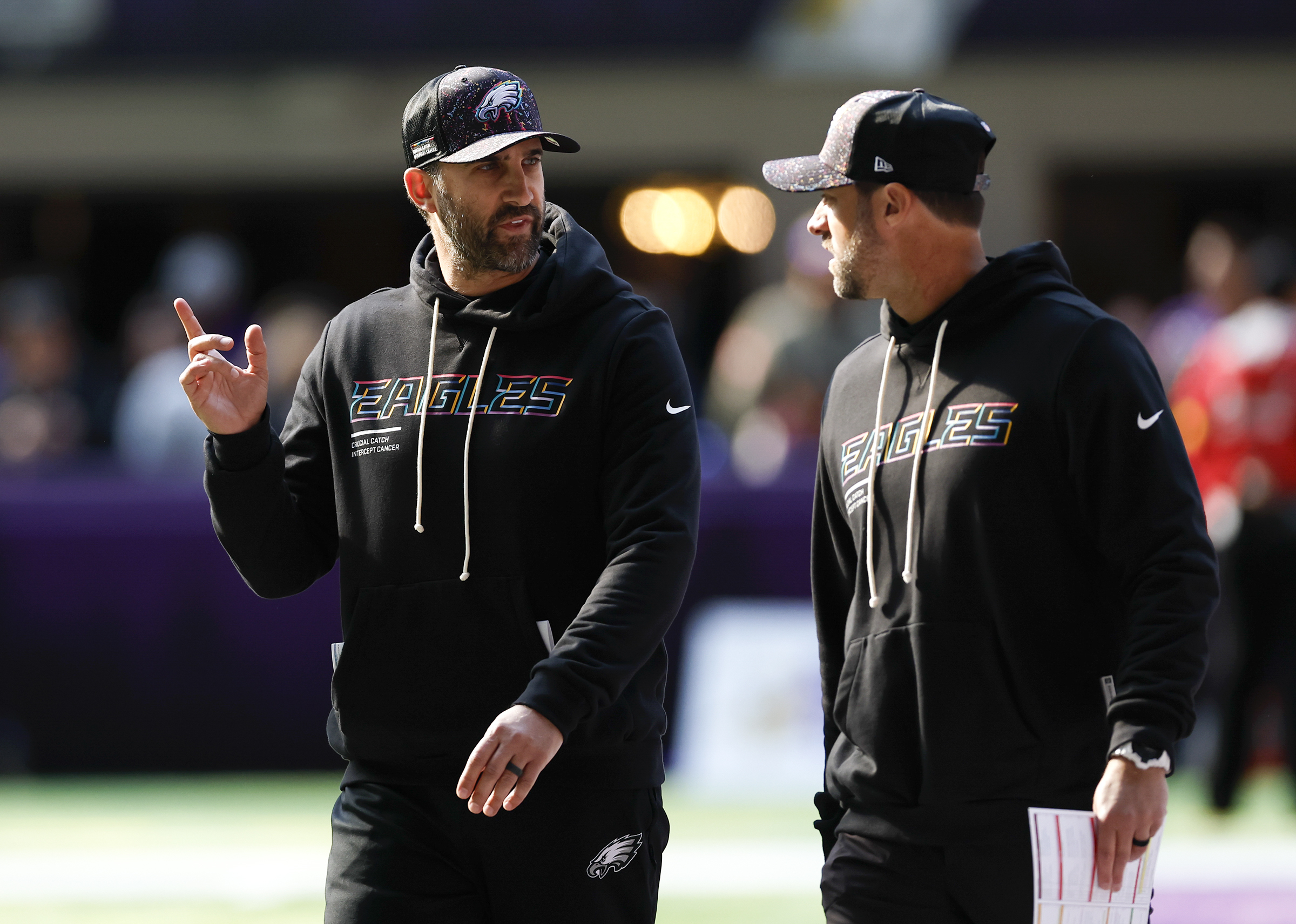
    Coach Nick Sirianni with offensive coordinator Kevin Patullo before the Eagles played the Minnesota Vikings on Oct. 19.

    The Eagles moved decisively at the coordinator position in 2023. With four losses in their last seven regular-season games and a wild-card loss, 2025 would look different only in the level of drama that accompanied a late-season swoon.

    The Eagles are better than the 49ers. They need to be a team that scores plenty of points against this sort of opponent, in this sort of situation. This is a time of year when the scoreboard matters much more than individual coaching careers. Sunday will matter for both.

  • The Eagles’ toughest playoff opponent won’t be the 49ers or Rams or Seahawks. It’ll be themselves.

    The Eagles’ toughest playoff opponent won’t be the 49ers or Rams or Seahawks. It’ll be themselves.

    Is anyone on or around the Eagles having any fun? It doesn’t seem that way. It hasn’t seemed that way all season. Sure, Jordan Davis has a personality as big and buoyant as he is, and Brandon Graham’s return from retirement has brought some effervescence back to the locker room. But on the whole, things have been pretty dour, or at least kind of grave and serious and humorless, for a team that’s coming off a championship.

    The examples are everywhere. Jalen Hurts has won a Super Bowl, was named the most valuable player in that Super Bowl, plays his best in the Eagles’ most important games, and has a smile that would stop a beauty shop. Yet in public, he often has a demeanor that suggests that, if he so much as grinned, his face would split open down the middle. Before he left the lineup because of his foot injury, Lane Johnson had not spoken after a game since the Eagles’ loss to the New York Giants on Oct. 9, when he called out the team’s offense for being “too predictable.” Not exactly Once more into the breach, dear friends stuff.

    Hurts’ relationship with A.J. Brown has been a source of speculation and tension for months. Brown has made his feelings about getting the ball — or, more accurately, not getting the ball — plain on social media, and his complaints sparked a ridiculous discussion about whether the Eagles might/should trade him in the middle of this season. Adoree’ Jackson and Kelee Ringo have, at various times, been considered the single worst cornerback in team history, as if Izel Jenkins, Nnamdi Asomugha, or Bradley Fletcher had never lined up against a decent receiver and immediately been burnt like toast. And if you want to be the ultimate Debbie Downer at a friendly get-together, just say the words Kevin Patullo, and you’re bound to start one of the partygoers ranting like a wing nut online influencer. Hell, your house might even wind up covered in egg yolk.

    Eagles quarterback Jalen Hurts, the Super Bowl LIX MVP, has come under criticism this season.

    The point here is not to suggest that the Eagles have been beyond criticism. Of course they haven’t. The point is that their entire season has felt like one of their offensive possessions. It has been a generally joyless slog that, even when it leads to a good outcome — a touchdown, a victory, a second straight NFC East title — hasn’t inspired much optimism or hope that the team will repeat or sustain that success.

    You don’t need to be a gridiron genius or a Philly sports sociologist to understand why. There are plenty of cities and markets where, if a team won a Super Bowl in the manner that the Eagles did last season — winning 16 of its final 17 games, dominating the conference championship game and the Super Bowl itself — the celebratory buzz would last for years. Championship? Who needs another championship? We just won one! That backup long-snapper never has to buy a drink in this town again.

    Philadelphia is not one of those cities or markets. Here, winning is the most addictive of drugs, and when it doesn’t happen, or when it doesn’t happen in the most satisfying manner, the entire region goes into a collective withdrawal, and a more powerful hit — a higher high — is required for everyone to level off.

    From Eagles fans to the players themselves, there has seemed to be an ever-present blanket of expectations weighing on them. It’s as if the only thing that would make anyone happy and relieved at any moment this season would be another Super Bowl victory — a benchmark so lofty that it virtually guarantees people will be worried at best and miserable at worst unless the Eagles win every game 49-0.

    Jeffrey Lurie and his Eagles are chasing that Super Bowl glow again.

    The one person who appears to acknowledge this dynamic, and appears to be fighting against it, is Nick Sirianni. He has spoken since the middle of last season about his attempts to “bring joy” to every practice, every game, every day of work, as if to lighten the burden that his staff and players were bearing.

    “In professional football,” he said recently, “there are all these pressures, these ups and downs and everything like this, but we got into this game because we loved it. I think that’s a really important thing. In the world, you can let things beat you down a lot and not really give knowledge to all the things you have going on that are really good.”

    Hanging on a wall in Sirianni’s office is a photograph of him and his three children. The photo was taken after the Eagles’ 20-16 victory over the Cleveland Browns last season — the game after which Sirianni brought the kids into his postgame news conference and was criticized bitterly for it. I did some of the criticizing, and I stand by it. The gesture was silly and tone-deaf at the time, mostly because the Eagles were 3-2 and playing terribly and Sirianni’s career-dissipation light was flickering. No one was about to give him or them the benefit of the doubt then.

    But now that they have won a championship, it’s easier to see that moment as part of a continuing effort by a head coach to keep the pressure of meeting that standard from crushing his team. In that way, the Eagles’ toughest opponent in this postseason won’t be the San Francisco 49ers or the Los Angeles Rams or the Seattle Seahawks or whatever team they meet in Super Bowl LX if they happen to make it that far. Their toughest opponent will be, and has been all along, themselves.

  • Little-known Zack Baun has been the Eagles’ best player the last two seasons. Why? He trains like Steph Curry.

    Little-known Zack Baun has been the Eagles’ best player the last two seasons. Why? He trains like Steph Curry.

    He’s the first first-team, All-Pro linebacker from the Eagles since Jeremiah Trotter in 2000, and he might become the first multiple All-Pro linebacker since 1975 when voting results are announced soon.

    He’s the first Pro Bowl linebacker from the Eagles since Trotter in 2005.

    Yet most football fans in Philadelphia don’t appreciate how good Zack Baun is.

    What’s worse, most football fans outside of Philadelphia don’t even know who Zack Baun is — at least, not beyond a painfully cute social media post and his involvement in one of the worst injuries of the 2025 season.

    But here’s the reality.

    For the entirety of two seasons Baun has been the best football player on the best roster in Eagles history. Better than future Hall of Famers Saquon Barkley and A.J. Brown. Better than young defenders Quinyon Mitchell and Jalen Carter.

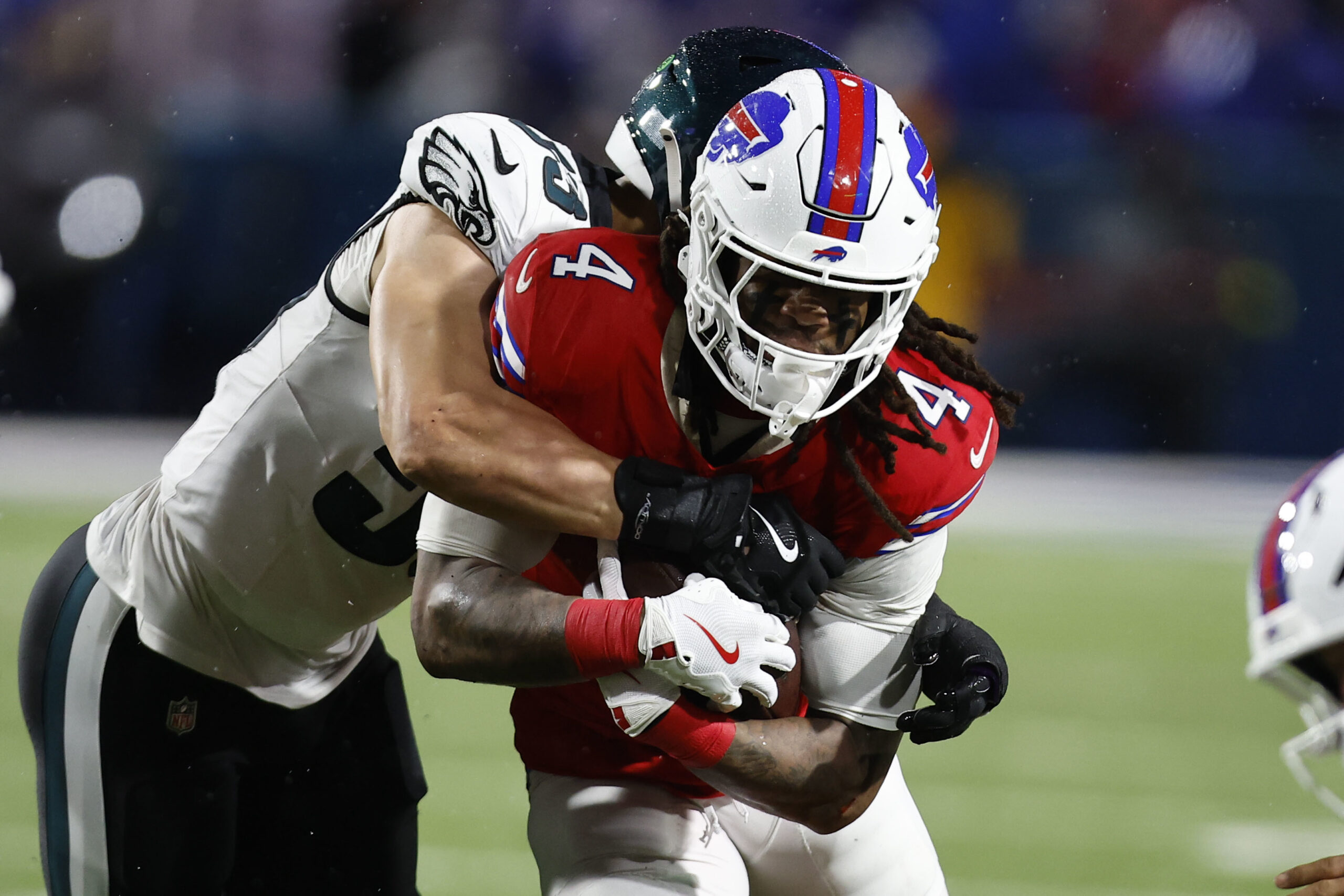
    Eagles linebacker Zack Baun tackles running back James Cook during the win against the Bills.

    “Absolutely,” said veteran defensive lineman Brandon Graham. “And I’m thankful for him.”

    Still, as I drove south on I-95 a couple of days ago, my passenger, a native fan who regularly watches the Eagles, saw a billboard outside Lincoln Financial Field promoting Sunday’s playoff game against the 49ers. The artwork was simply one player, bareheaded and in high definition, his mouth open in a celebratory scream.

    My passenger said, “Who’s that?”

    It was Zack Baun. The best linebacker in football over the last two seasons. The man tasked Sunday with covering and tackling Christian McCaffrey, the best offensive player in football, and George Kittle, the league’s best tight end.

    In a city that still worships linebackers like Chuck Bednarik, Seth Joyner, and Bill Bergey, Baun somehow remains largely anonymous.

    Maybe the reason is that Baun arrived in the NFL, and then in Philly, without fanfare.

    The Saints drafted him in the third round in 2020 but never developed him. The Eagles signed him to a modest, $3.5 million prove-it deal in 2024. He proved so much so fast that the Eagles pursued him over Josh Sweat and Milton Williams, other top Eagles defenders who became free agents. They re-signed Baun to a three-year, $51 million extension and hoped he’d stay hungry.

    He’s ravenous.

    “He’s still working,” Graham said. “Got that chip on his shoulder.”

    The result: Baun’s play and his production have been the most consistent element on a team that won the Super Bowl last season and repeated as NFC East champions this season.

    He’s simply their best.

    And it’s not particularly close.

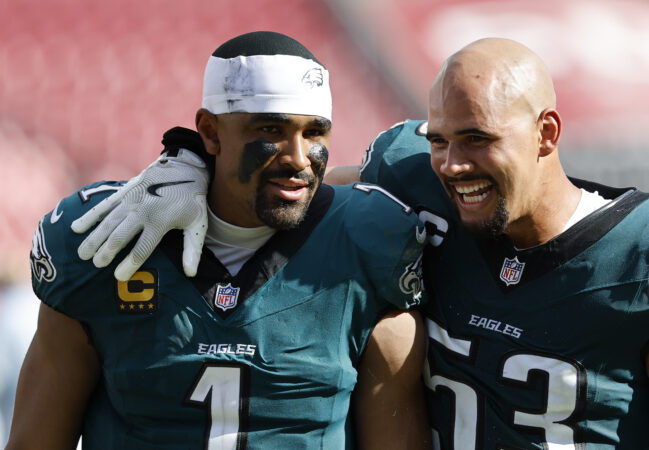
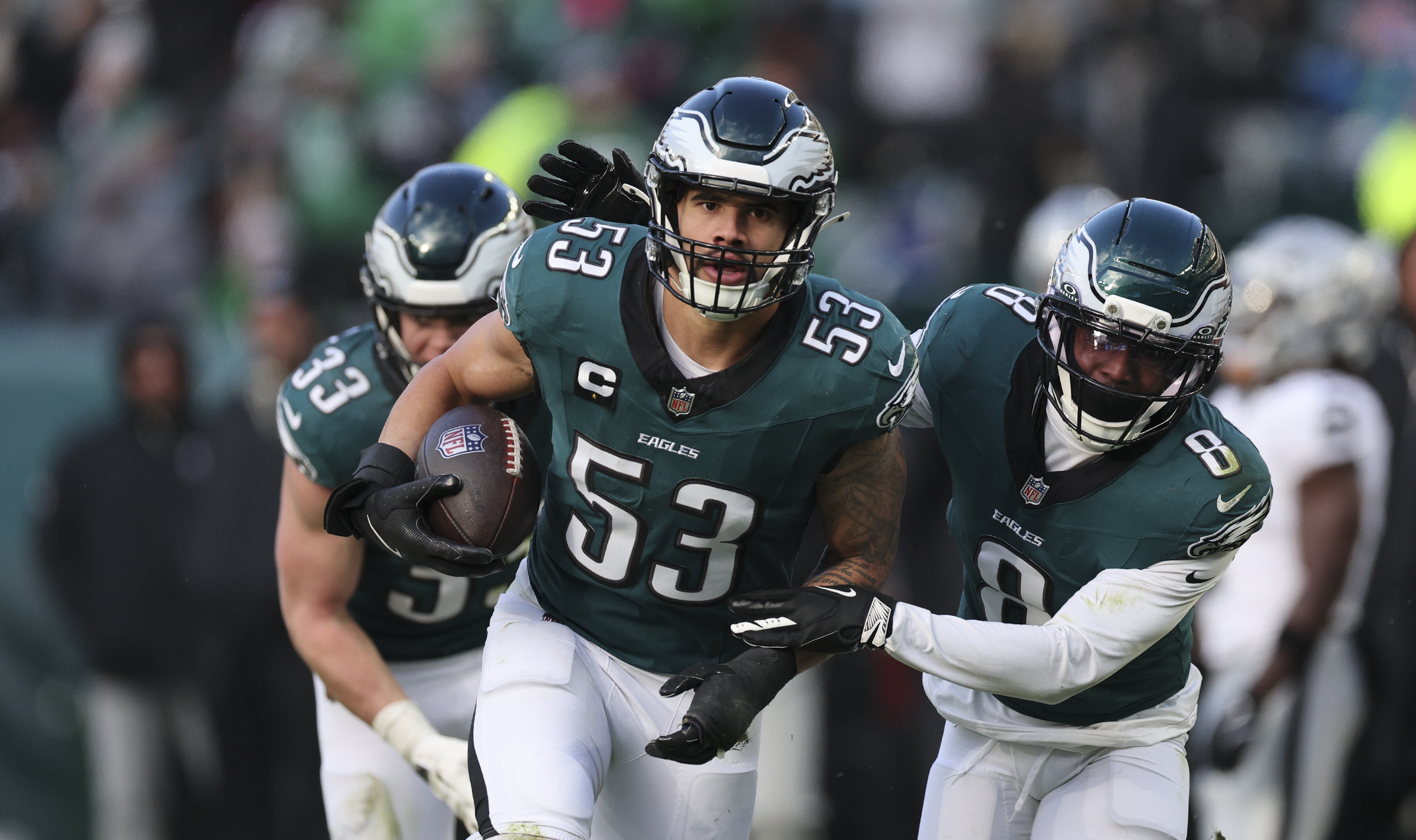
    Zack Baun (53) celebrates his interception against the Raiders with cornerback Adoree’ Jackson on Dec. 14.

    On the map

    In a world of shameless self-promoters, Baun is a mild-mannered, soft-spoken, shaven-headed Wisconsinite whose closely clipped goatee gives him the air of an affable extra on a pirate movie. He has 154,000 Instagram followers, 100,000 fewer than kicker Jake Elliott. Baun’s social media posts could have been drawn by Norman Rockwell.

    For one of the league’s top-10 defenders, his modesty is as remarkable as his ascent.

    After converting from quarterback to linebacker at Wisconsin, Baun was a part-time player in New Orleans, where he thrived on special teams as he was trying to make a mark as an outside linebacker and pass rusher.

    In 2024, Vic Fangio’s first season as Eagles defensive coordinator, the coaches and GM Howie Roseman believed Baun would fit well into the Birds’ scheme. They were right. Baun excelled.

    “He kind of burst onto the scene to the outside world,” coach Nick Sirianni said.

    But at the same time Carter exploded as a defensive tackle, Mitchell and Cooper DeJean instantly became the best cornerback tandem in football, and Barkley set a rushing record (including playoffs). Even after the defense dominated the Chiefs in Super Bowl LIX, Baun was overshadowed. He intercepted Patrick Mahomes, but then, so did DeJean, who ran his back for a touchdown.

    The two incidents that brought Baun’s existence to light for most folks who exist outside of sports Twitter had little to do with his play.

    After the Eagles won the NFC championship in a rout of the Commanders, Baun gained worldwide fame when millions of people viewed a viral social media post of his toddler son Elian playing with confetti on the turf at Lincoln Financial Field.

    Then, on Oct. 26, Baun tackled Giants rookie Cam Skattebo, who suffered a dislocated ankle and broken fibula. The combination of Skattebo’s rising stardom, his brutal running style, the fact that he plays for a marquee team in a marquee city, and the simmering controversy surrounding “hip-drop” tackles thrust Baun into an uneasy spotlight.

    Baun was neither penalized on the play nor fined by the NFL afterward, but that isn’t the issue here. The issue is, we’re witnessing greatness, and we’d better start paying closer attention.

    Top grades

    Due to how they are used — Do they cover? Do they blitz? — and where they line up — Are they inside, outside, on the defensive line? — the performance of linebackers is difficult to quantify. Regardless, Baun has great numbers both objectively — raw stats — and subjectively, as graded by websites like Pro Football Focus.

    He had 3½ sacks this season and last, and each season only five linebackers had more. He had one interception last season and added two more in the playoffs; his first against Green Bay in the wild-card game, then the pick in the Super Bowl. He had two more interceptions this season, which tied for fifth among linebackers.

    His PFF grade last season of 90.1 ranked No. 1. His grade this season, 83.9, is No. 2 among linebackers who played at least 900 snaps.

    It’s a solid showing, but the grade doesn’t really reflect Baun’s improvement.

    “Last year was a lot of willy-nilly out there, honestly,” Baun said. “Of course, I did some amazing things, but I think I’m doing a better job overall this year.”

    This is a sensitive issue, since the biggest question regarding Baun becoming an every-down ’backer involved his ability to cover.

    PFF rated him the No. 1 coverage linebacker in both 2024 and 2025.

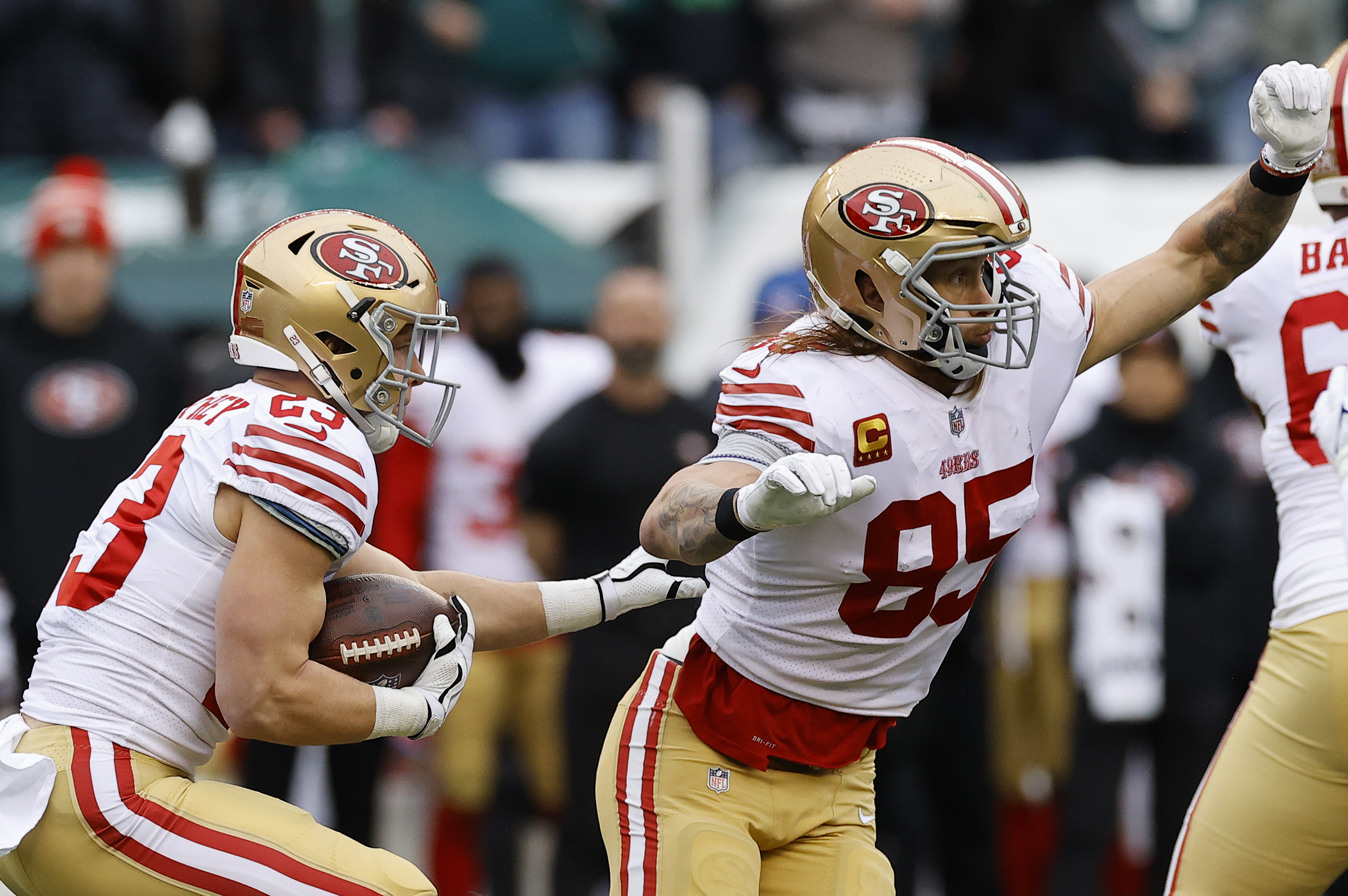
    San Francisco running back Christian McCaffrey (left) and tight end George Kittle will challenge the Eagles defense on Sunday.

    Question answered. Next test: McCaffrey, Kittle, and 49ers head coach Kyle Shanahan, whose pre-snap trickery is as befuddling as any coach’s in the last decade.

    Baun is as ready as he’ll ever be.

    Asked in which areas he’d improved most from last year to this, he replied, “Play recognition.”

    And then?

    “Definitely, in my cover stuff. I saw that as a strength of mine last year, and I wanted to make it even better. Footwork. Route identification.”

    And, of course, practice.

    Five hundred shots

    Improvement has become something of an obsession for Baun. When the last whistle sounds for a regular practice, Sirianni, frustrated hooper, offers players the chance for extra work, Steph Curry style.

    “It’s what we call 500 shots,” Baun said of the on-field routine after practice. “Coach describes it as a basketball player hitting 500 shots before he leaves.”

    That’s where Baun drills his feet and hips and shoulders.

    “It’s mostly footwork stuff, because I’m asked to do a lot of stuff in coverage — a lot of different coverage responsibilities,” Baun said. “I’m asked to cover a lot of ground and take away a lot of different zones. So my footwork really has to be on point.”

    Reps matter, both during the week and on game day. He hasn’t missed a game since he became a starter in 2024. This is one of the reasons he should be considered the Eagles’ best defender, if not their best player. Carter’s the only defender who has made as many plays, but he has missed time this season.

    “He’s played more than anybody these last two years,” Sirianni acknowledged, “but, like, he just keeps getting better and better and better.”

    Another reason Baun should be considered the top Eagle:

    Unlike Mitchell and DeJean, who also have not missed a game, Baun hasn’t had a steady sidekick. Fellow starter Nakobe Dean was lost to injury with two regular-season games to play in 2024 and did not play in the playoffs. Dean has missed seven games so far this season.

    So there you have Baun. He’s an iron-man linebacker who stacks sacks and picks and grades out among the best in the business, but he seems to get so little credit.

    For Baun, the winning is enough.

  • Eagles-49ers is really a matchup of Nick Sirianni and Kyle Shanahan, savants in their own ways

    Eagles-49ers is really a matchup of Nick Sirianni and Kyle Shanahan, savants in their own ways

    For most of professional football’s history, few people among the millions who tuned in every Sunday and every Monday night actually understood what was happening on the field. There was a quarterback, of course, dashing and rugged, the clear leader. There were collisions of giant bodies. There were smaller, faster men with a ballet dancer’s flexibility and a sprinter’s speed who made breathtaking plays. But no one really knew how those men freed themselves, or were freed, to make those plays. How did anyone get open? Who was supposed to block that blitzing linebacker?

    This is a newer, more informed era. This is the era of All-22 film, available to everyone, showing everything. This is the era of the next-level analyst, the football-aholic who grinds tape, the mind who can demystify an entire sport for you. Which means that, when it comes to NFL coaches, this is the era of the great play-caller, the great play-designer, the great scheme-creator, the brilliant and beautiful brain. The players are more than just athletes with distinct strengths and roles and personalities. They are clusters of pixels on a screen, moving as if drawn by a magnet on a particular route to a particular spot on the field.

    Kyle Shanahan, the head coach of the San Francisco 49ers, whom the Eagles face Sunday in the NFC wild-card round, is considered one of these savants. He is a terrific coach in just about every regard, having guided the 49ers to two Super Bowls and two other appearances in the NFC championship game. But it is in his creativity and orchestration of the team’s offense where he is truly elite.

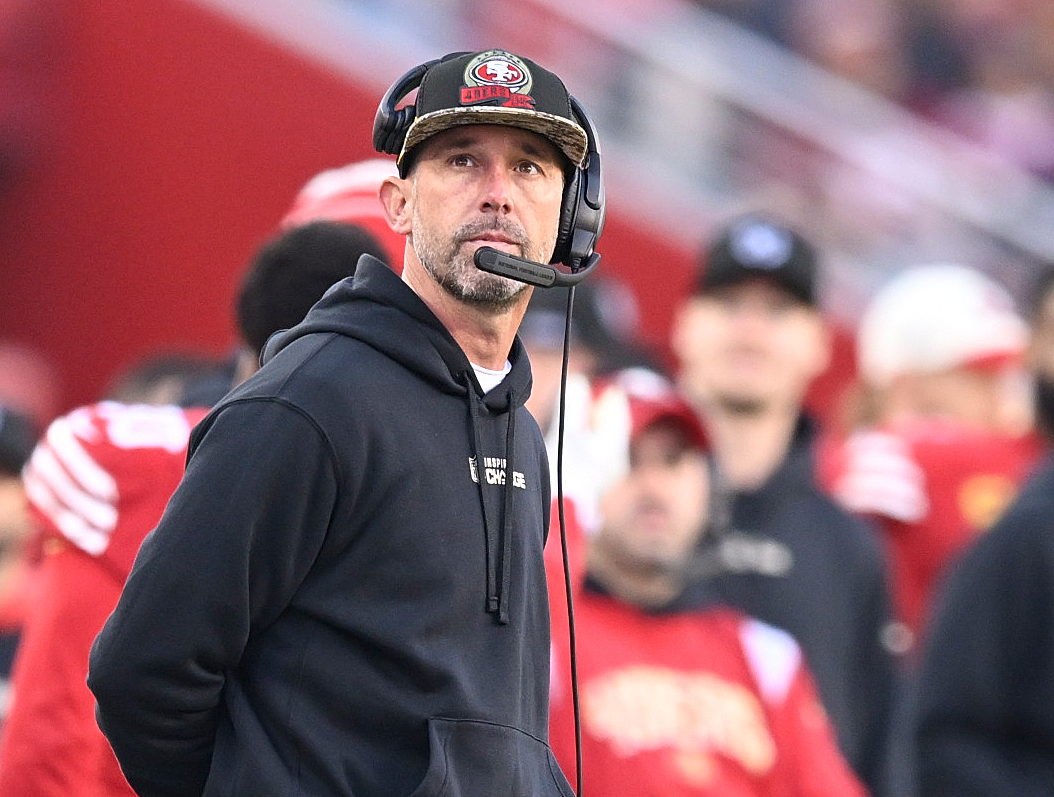
    San Francisco 49ers coach Kyle Shanahan has had his share of success, but a Super Bowl title has eluded him.

    Shanahan calls all the 49ers’ plays, and his offense is so quarterback-friendly that the team has reached those two Super Bowls and four NFC title games with Jimmy Garoppolo, who backed up Tom Brady in New England, and Brock Purdy, who was the last player picked in the 2022 draft, as its starters at the position. Loaded with motion and deception, based on a zone-running attack that features Christian McCaffrey, Shanahan runs as close to a plug-and-play system for a quarterback as it gets in the NFL, and it works. San Francisco has finished among the top 10 teams in scoring in four of the last seven years.

    “They have a really good scheme,” Eagles defensive coordinator Vic Fangio said Tuesday. “It’s all packaged together very nicely. They give you a lot of good motions. Everything they do is with a purpose and they do a really good job of it.”

    Nick Sirianni, the Eagles’ head coach, and Kevin Patullo, their offensive coordinator, are not considered the same kinds of coaches that Shanahan is. Say what you want about them — and a lot of what is said about them around here, especially about Patullo, can’t be repeated in decent company — but generally they are not among the first names mentioned when anyone starts listing the top offensive minds in the NFL. Sirianni stopped calling plays, for instance, in 2021, his first season as a head coach. Patullo had never been an NFL coordinator or play-caller before this season, and the Eagles’ up-and-down (to put it kindly) performance has made him a convenient and oft-deserved target of criticism.

    Nick Sirianni has yet to have a losing season or miss the playoffs in his five years with the Eagles.

    NFL coaching, though, is about more than being an offensive wizard. Shanahan hasn’t won a Super Bowl in his career yet, and one of the reasons is that, when he and his teams have had opportunities to bury their opponents, they’ve failed to do it. He was the offensive coordinator of the 2016 Atlanta Falcons, who infamously blew a 28-3 lead in Super Bowl LI to the Patriots in part because Shanahan got too aggressive in his late-game play selection. Under him, the 49ers had double-digit fourth-quarter leads in Super Bowl LIV and in the 2021 season’s NFC title game … and lost both. And in Super Bowl LVIII against the Kansas City Chiefs, Shanahan took the ball first in overtime, opted to kick a field goal on fourth-and-4 from the Chiefs’ 9-yard line, and handed the ball back to Patrick Mahomes with a chance to win the game. Patrick Mahomes, to no one’s surprise, won the game.

    Sirianni, meanwhile, has won a Super Bowl, has reached another, and has yet to have a losing season or miss the playoffs in his five years with the Eagles. Does he need a Shanahan-like or Shane Steichen-style play-caller to make his offense go? The presence of such an assistant certainly helps. But by all indications, he makes up for whatever shortcomings his coordinators — or, in fairness, his quarterback, Jalen Hurts — might have with his abilities as a culture-builder.

    “Week-to-week, day-to-day, his energy, his passion, everything you want in a leader who stands in front of this team in team meetings and at practice, he gives you,” Patullo said. “His attention to detail — we talk about core values all the time: toughness, together, detailed, all that stuff. And when we look at those things, that’s what he embodies and brings that to the team. Every day, he’s consistent in who he is. You’re not going to get somebody who goes back and forth on what they say, and I think when he speaks, everybody receives it and they’re ready to go.”

    There’s more than one way to be an excellent head coach, even if one of those ways gets a little more attention, a little more scrutiny, a little more credit these days. The film can tell you how good a coach Kyle Shanahan is. What Nick Sirianni does well sometimes isn’t so easy to see. Come Sunday, may the best savant win.

  • How Bo Bichette could wind up with the Phillies

    How Bo Bichette could wind up with the Phillies

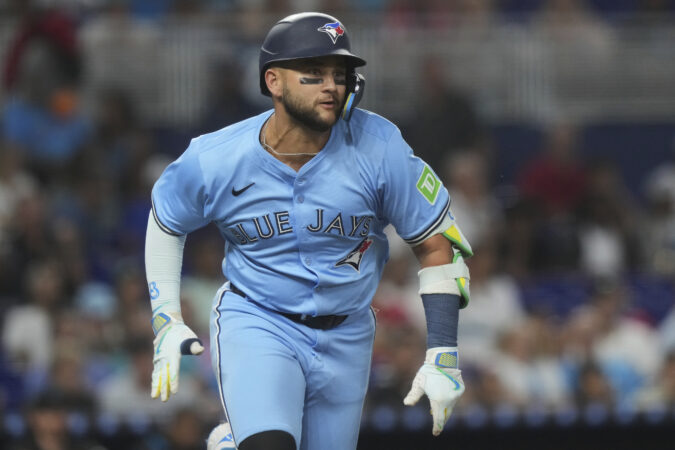
    There is a long list of reasons that you shouldn’t waste your daydreams on visions of Bo Bichette wearing red pinstripes and hitting behind Bryce Harper. The Phillies’ reported interest in the Blue Jays star only barely distinguishes them from the 29 other major league teams that likewise are interested in signing very good baseball players at the right price. Interest is not a differentiator. You can’t buy a Bentley with affection.

    Circumstance, context, and logic suggest that Bichette will end up signing elsewhere. And that’s great if you’re into those things. The rest of us will be over here indulging ourselves. On the 12th day of Christmas, the New York Post’s Jon Heyman gave to us a vaguely worded, thinly sourced report connecting the Phillies to a big-ticket free agent. What are we supposed to do? Underreact?

    The least we can do is try to proceed with some level of dignity and decorum. This often is easiest to do under the guise of asking questions. There are no dumb questions, only dumb questioners, right? So let’s fire away.

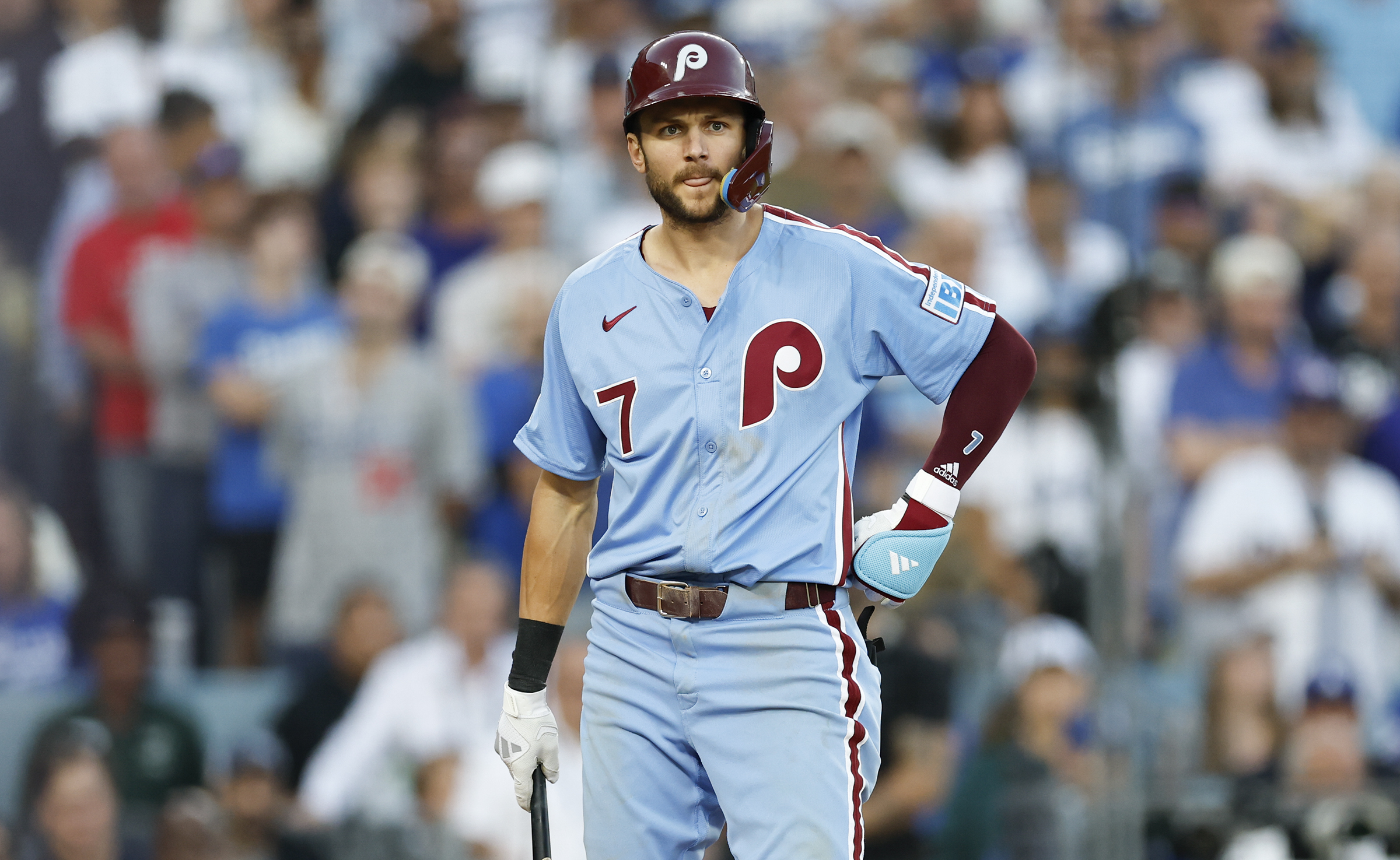
    The Phillies already have a shortstop in Trea Turner. Presumably, Bo Bichette would move to second base in any scenario that brought him to Philadelphia.

    Only a few weeks ago, Dave Dombrowski sounded like a man who didn’t expect any more major additions to his roster. What would have caused that to change? Is Bitcoin about to spike again?

    This is the however-many-million-dollar question. Five weeks out from pitchers and catchers reporting, the roster looks pretty close to set. Ken Rosenthal of The Athletic reported Monday that the Phillies still were in the market for another right-handed-hitting outfielder, which is encouraging, because they really could use a viable Plan B in case Justin Crawford turns out to be late-stage Juan Pierre or Ben Revere. They don’t need anything major. Veteran Randal Grichuk, whom the report mentioned specifically, would make a lot of sense. Otherwise, there isn’t an obvious opening that would compel the Phillies to make an offer with the sort of necessity premium that often distinguishes a winning bid from the rest.

    One thing that may have changed is Dombrowski’s evaluation of the market. Not much has happened since the last time he spoke. Not only do most of the major free agents remain unsigned, we aren’t even seeing smoke. Bichette, Cubs outfielder Kyle Tucker, Red Sox third baseman Alex Bregman, Yankees outfielder Cody Bellinger, Mariners third baseman Eugenio Suárez, not to mention Ranger Suárez and the rest of the starting pitchers … the complete lack of movement at the top of the market is abnormal.

    We’ve seen slow-moving markets before. But there is some reason to believe that this one is reaching a point of collapse. The money may not be out there this year. Virtually all of the big-market teams already are at or above the luxury tax threshold with the money on their books. Last year, the Phillies were at a disadvantage because teams like the Mets, Red Sox, and Cubs were in payroll expansion mode. Other teams simply had more money to spend than they did. That may not be the case this year.
    The Cubs still are a potential market maker, with roughly $80 million in space before the first luxury tax threshold. It shouldn’t surprise anybody if they make a flurry of moves that alters the current narrative about the NL landscape. Same goes for the Mets, who presumably have whatever money they would have paid to Pete Alonso and Edwin Díaz before both signed elsewhere. The Orioles are always lingering. The Blue Jays are pushing $300 million but seem to be operating with the taste of blood in their mouths. So there still is plenty of reason to doubt that the Phillies can win via aggression.

    But there are a lot of players out there. And there don’t seem to be the usual dark-horse lurkers among the midmarket clubs. It’s worth noting the situation in Minnesota, where the Twins are shedding payroll as if they need to make rent. The middle class might be content to sit this one out, especially with next year’s labor talks looming.

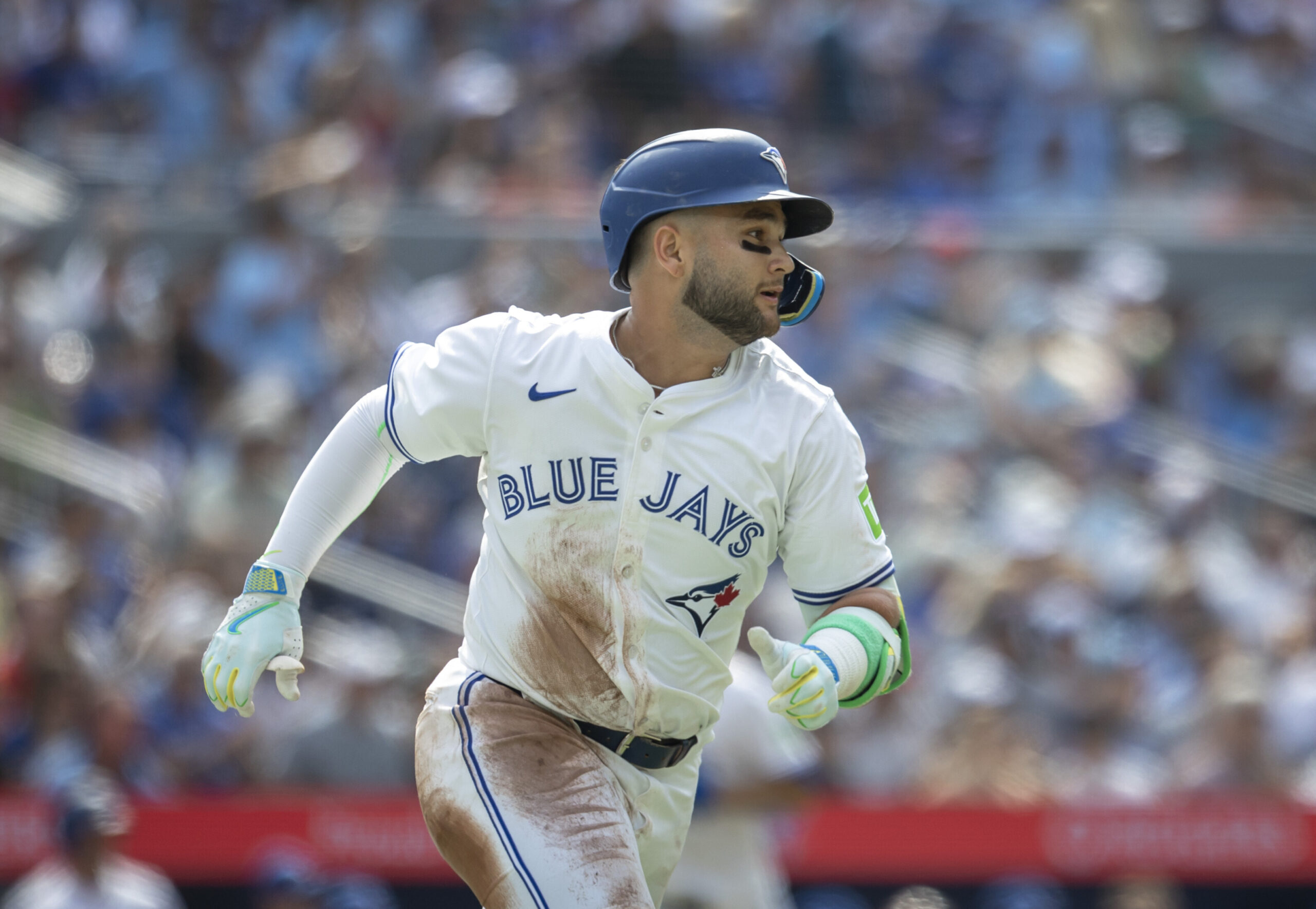
    Bo Bichette was an MVP-level hitter after he broke out of an extended slump last season.

    So Bichette might be more affordable than the Phillies thought?

    Yes and no. It’s awfully hard to project a contract for a player who is an anomaly in terms of his age (only 28 this season), career production (24 home runs per 162 games and 121 OPS+) and pedigree (Dante Bichette’s kid), but who also is less than a year removed from a brutal 18-month stretch in which he posted a .651 OPS in 651 plate appearances. Trea Turner’s career numbers were nearly identical (minus the steals) when the Phillies signed him to an 11-year, $300 million contract heading into his 30-year-old season. FanGraphs had Bichette projected at seven years and $189 million entering the offseason. ESPN recently updated its projection to five years and $150 million. If that second number is close to reality, the Phillies may well readjust their expectations.

    What’s this about Bichette posting a .651 OPS in 651 plate appearances? Isn’t that a concern?

    It is. But it also might be an opportunity, if other teams are worried. Once he snapped out of his funk early last season, Bichette was an MVP-level hitter. In his last 102 games, he hit .325/.372/.528 with 17 home runs. From the right side of the plate. While playing middle infield. He has always had the kind of skill set scouts drool over. Bichette’s contact rate ranked in the top 20% of qualified hitters last season. At 83.2%, it would have ranked third among Phillies regulars, behind Alec Bohm (87%) and Bryson Stott (86.1%). His chase rate also ranked at the high end of the spectrum — in a bad way. Only 18 qualified hitters chased more often: Bichette’s 37.9% ranked just behind Bryce Harper (38.1%).

    That said, Bichette did make some steady progress last season. It’s fair to wonder if he emerged from his slump as a different hitter. Only 10 hitters in baseball had a lower strikeout rate after the All-Star Break — his 11.1% was a dramatic improvement over an already-solid roughly 15%. He coupled that with a huge boost in his walk rate, from an anemic 5.5% to a slightly-better-than-average 8.8%. If the Phillies think they can get a $250 million player for $175 million, that might change things.

    Bo Bichette scoring a run for the Blue Jays in June as Phillies catcher J.T. Realmuto tries to catch the throw.

    Why wouldn’t the Blue Jays just match any offer?

    I guess Christmas is over, isn’t it? Assuming Bichette likes Toronto, which seems to be the case, and the Blue Jays are willing to spend, which seems to be the case, the Phillies presumably would need to land Bichette the old-fashioned way: by guaranteeing him more than anybody else is willing to guarantee him. They have close to $60 million coming off the books next season and theoretically would be able to accommodate another big deal, biting the bullet on the luxury tax this season while freeing up $15 million to $20 million by trading Bohm and Edmundo Sosa and finding someone to pay a little bit of Nick Castellanos’ salary.

    But, then, we’d be back where we started. Realizing that Bichette probably won’t be here.

  • Can Don Mattingly save Phillies skipper Rob Thomson from himself?

    Can Don Mattingly save Phillies skipper Rob Thomson from himself?

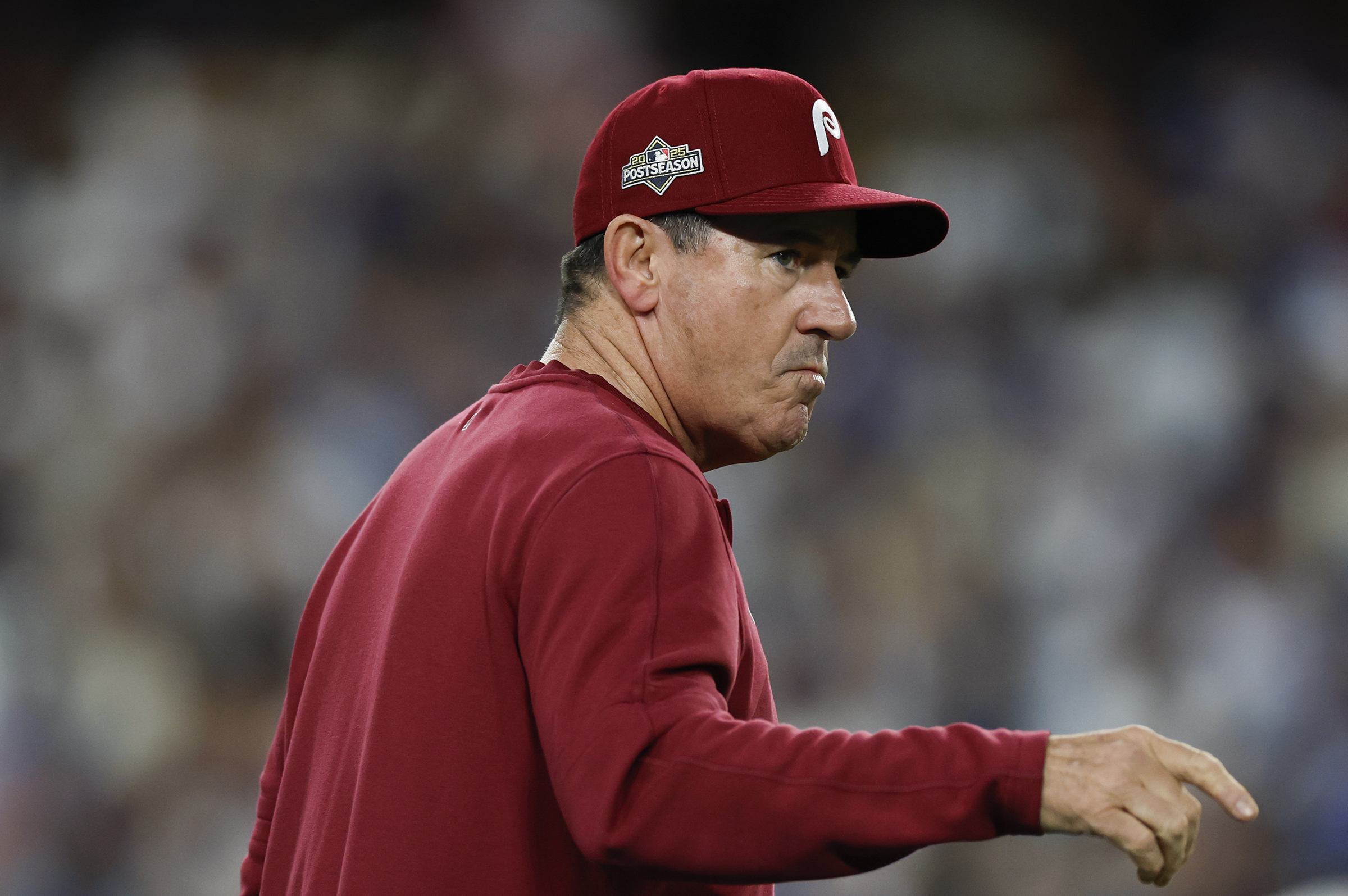
    David Robertson, 40 and unemployed until July, put out a fire in the sixth inning of the Phillies’ first playoff game of 2025, but he hadn’t pitched an “up-down” all season — ending one inning and beginning another. With a one-run lead, Rob Thomson sent him back out for the seventh. Robertson hit one batter and another singled. Thomson then brought in Matt Strahm, who hadn’t inherited a runner in six weeks. Strahm got two outs, then gave up a three-run homer. The Phillies lost Game 1 of the NLDS to the Dodgers.

    Two nights later, with a slow runner on second base and nobody out in the ninth inning of a one-run game, Thomson directed Bryson Stott to bunt. Twice. The Dodgers ran a “wheel” play and nailed the runner at third. The Phillies lost Game 2 of the NLDS.

    These are the latest blemishes on Thomson’s thin resumé. He was elevated from longtime major league bench coach to first-time manager in June 2022, and the Phillies have at least played to the level of their payroll ever since, but they’ve faltered in the fall. Fairly or not, from pulling Zack Wheeler early in Game 6 of the 2022 World Series to not pinch-hitting early for Johan Rojas in Game 7 of the 2023 NLCS, the popularity of the affable, accountable skipper has steadily waned.

    Enter Donnie Baseball.

    After an intense, two-month recruiting effort, the Phillies on Monday hired Yankees legend Don Mattingly, 64, to replace Mike Calitri as bench coach. Immediately after the four-game NLDS loss to the Dodgers, the Phillies reassigned Calitri to the post of major league field coordinator, which means he’ll retain his myriad administrative duties as they pertain to scheduling and number-crunching. But he no longer will be Thomson’s chief lieutenant; no longer the voice of reason in tight situations.

    Phillies manager Rob Thomson will have an experienced bench coach in the dugout with him in 2026 with the addition of Don Mattingly.

    That louder, deeper voice will belong to Mattingly.

    Thomson was asked Monday if some of his playoff missteps might have been averted had Mattingly been on the bench, protesting.

    “Possibly,” Thomson replied. “Possibly. You never know.”

    “Missteps” might be unfair, but Thomson has addressed each one with honest reevaluation. His authenticity and his absence of ego are part of his charisma.

    Charisma doesn’t win World Series.

    Anyway, the dugout’s charisma just grew by a factor of 10.

    For a decade, Mattingly was the face of the Yankees, then the biggest sports franchise in America. His .307 career average, .830 OPS, and nine Gold Glove awards make him a logical Hall of Fame candidate who has been cursed by a largely illogical voting bloc. With a husky build, full mustache, and thick, full head of dark hair, he was an archetype of a baseball player for a generation. Even today, as the cleft in his chin grows deeper with age, he looks like a movie-star version of a once-great athlete.

    He managed the Dodgers to the playoffs three times and the Marlins once, in 2020, when he was National League Manager of the Year. He has coached for the Yankees, Dodgers, and, for the last three seasons, for the Blue Jays, who lost the World Series to the Dodgers in seven games. Mattingly expected Game 7 to be the last of his career.

    But Phillies president Dave Dombrowski was on the phone the next day, and the day after that, and so forth. Finally, Mattingly agreed.

    From now on, every decision — who pitches the eighth inning, who sits for a defensive replacement, who steals and who sacrifices — will go through a man with credentials Thomson simply doesn’t have.

    Don Mattingly managed the Marlins for seven seasons after leading the Dodgers for five.

    “We can now blame Don for it,” Thomson joked.

    Mattingly might have agreed to support Thomson for the next two seasons, but he agreed to much more than just making sure that Topper doesn’t bunt again in the ninth with nobody out.

    Superstar Don

    Mattingly immediately validates a coaching room full of excellent, but anonymous, teachers of the game. With a roster that includes Bryce Harper, Kyle Schwarber, Trea Turner, and Wheeler, in a game in which nothing carries more weight than having withstood the brightest lights yourself, this cannot be overstated.

    “He’s a great sounding board for our stars because he’s been there and done all these things,” Thomson said. “The rest of us really can’t [say] that.”

    Sheriff Don

    One of the most important services a bench coach provides is as a buffer between a manager and the players or as an enforcer who snuffs sparks before they become fires. It’s doubtful that Nick Castellanos’ insubordination or Strahm’s frequent criticisms would have proliferated if Mattingly had been around the clubhouse.

    Manager Don

    Asked if he ever wanted to wear the skipper hat again, Mattingly was steadfast and insistent in his reply.

    “I feel like those days have passed me by; I don’t have any aspirations to manage,” Mattingly said. “I don’t think I have the energy for that anymore.”

    Well, then, he took the wrong job.

    If the Phillies stumble early in 2026, or if, heaven forbid, something incapacitates Thomson, Mattingly will be the obvious choice to replace him. You simply don’t take a job as bench coach without the understanding that you will manage the team in case of dismissal or emergency. Also …

    Preston Mattingly (right) with Dave Dombrowski, is going into his second season as Phillies general manager.

    Daddy Don? Spy Don?

    The Phillies and Mattingly want us to believe that the presence of Preston Mattingly as the Phillies’ general manager is almost entirely coincidental to their pursuit of him and of him delaying retirement. Mattingly swore that, even though Press is his son, he never would betray the sanctity of the dugout and clubhouse to the front office.

    “I’m not a voice running upstairs to talk about anything and everything,” Don said, clearly aware that some organizations are run in exactly that manner. “I came from a different era where that is not something that happens.”

    That said, after more than four decades of playing and working in the majors, Mattingly admitted that he has envisioned the sweetness of winning the first World Series with his son as his boss.

    “To be able to do that with him would be incredible,” Don said.

    Incredibly difficult.

    In fact, even chiming in on Thomson’s occasional cockeyed decisions, and even riding herd over a roster full of coddled princelings, maintaining a normal father-son relationship while balancing a strictly professional GM-bench coach relationship will be the hardest part of old Don Mattingly’s new job.