Category: Associated Press

  • Macron arrives in Syria as first major western leader to visit war-torn country under new leadership

    Macron arrives in Syria as first major western leader to visit war-torn country under new leadership

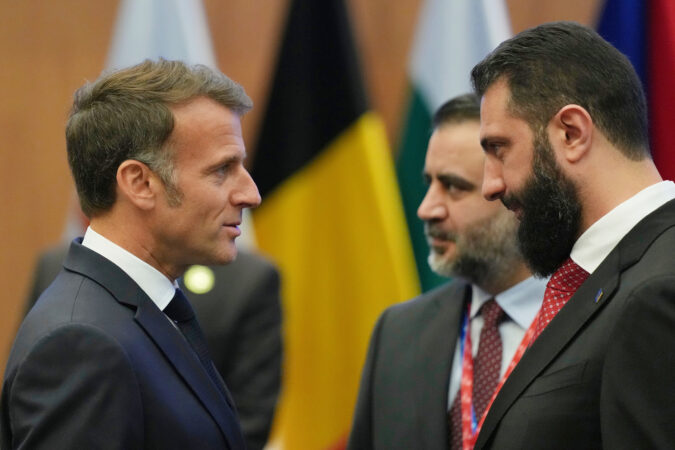
    DAMASCUS, Syria — French President Emmanuel Macron arrived Monday in Syria, making him the first major western leader to visit the war-torn country since the ouster of Bashar al-Assad in 2024.

    Ukrainian President Volodymyr Zelensky visited in April but Macron is the first leader from western Europe or North America to do so.

    The French president’s visit comes during a period of relative calm in the Middle East after the monthslong war in Iran and Lebanon. He will travel next to Ankara, Turkey, for the NATO summit, where Syrian President Ahmad al-Sharaa is also expected to attend and hold a high-profile meeting with U.S. President Donald Trump.

    Syria’s state-run SANA news agency said Macron would visit with a business delegation to discuss regional security as well as business and investment opportunities.

    The French president was greeted at Damascus airport by Syrian Foreign Minister Asaad al-Shibani.

    “I have come to express France’s commitment to the Syrian people. For a sovereign Syria, united in its diversity and at peace with its neighbors,” Macron said in a post on X. “Together, let us open a new chapter of stability and peace.”

    France supports all those who can “contribute to build a new Syria” in line with the aspirations expressed since the 2011 Arab Spring, Macron’s office said, referring to a period of widespread uprisings across the Middle East that called for political change and reform.

    Macron will meet with al-Sharaa at the presidential palace and “engage directly with diverse Syrian people,” his office said.

    The French president’s meetings are scheduled throughout Tuesday, beginning with members of Syrian civil society, his office said, though no details were disclosed. Macron will then meet with al-Sharaa, before holding economic talks and signing memorandums of understanding. The two leaders will hold a joint news conference afterward.

    Macron hosted al-Sharaa in Paris in May 2025, where he urged European and U.S. leaders to lift longstanding sanctions on Damascus. Most of those sanctions have since been lifted.

    Paris supported Syria’s new leadership even at a time where others were skeptical of al-Sharaa’s Islamist-led rule and former role as the head of the Hayat Tahrir al-Sham militant group, previously linked to al-Qaida.

    Western governments were especially concerned about the treatment and inclusion of women and minorities, and whether Syria’s new government would transition into a more democratic rule.

    Syria has managed to sidestep the region’s recent conflicts, but the country is still battered from 13 years of war that left much of it in ruins, drove millions into poverty, and will cost hundreds of billions of dollars to rebuild. While Syria has signed memorandums of understanding with states and large companies for large investment projects, they have not yet come to fruition.

  • Former officer describes finding a ‘sniper pad’ on nearby rooftop after Charlie Kirk assassination

    Former officer describes finding a ‘sniper pad’ on nearby rooftop after Charlie Kirk assassination

    PROVO, Utah — A former campus police officer testified Monday that he found an apparent “sniper pad” on a rooftop near where Charlie Kirk was assassinated, as prosecutors sought to convince a state judge they have enough evidence to put a Utah man on trial for murder.

    Former Utah Valley University Officer Christopher Bagley said he witnessed Kirk’s shooting as the conservative activist spoke to a crowd of thousands last year. Soon after, he went to a nearby gravel rooftop, where it appeared someone had been lying prone with a clear sightline to Kirk’s location, Bagley said.

    “It looks like a sniper pad,” Bagley said, adding, “you’ve got markings of elbows, knees, and feet.”

    The testimony came as Kirk’s parents, Kathryn and Robert, and widow, Erika, were in the courtroom for the first time since the case began, along with Donald Trump Jr., President Donald Trump’s son.

    Prosecutors are seeking the death penalty for defendant Tyler Robinson. A five-day preliminary hearing that began Monday marks the most significant presentation of evidence to date in the case.

    Robinson’s parents also were present, sitting a few rows behind the Kirks as the hearing began. The 23-year-old defendant is charged with aggravated murder in the Sept. 10 assassination of Kirk, a conservative activist and ally of the president, at Utah Valley University. Robinson turned himself in the day after the shooting.

    Prosecutors allege he confessed in a note left for his roommate, who was also his romantic partner, that read: “I had the opportunity to take out Charlie Kirk and I’m going to take it.”

    Robinson has not yet entered a plea, and his attorneys have not commented on his guilt or innocence. They have, however, sought to get the death penalty taken off the table, so far unsuccessfully.

    A low threshold for prosecutors

    Robinson sat quietly between his attorneys on Monday, looking at the prosecution’s exhibits on a monitor and occasionally taking notes. He wore a gray suit, and his wrists were shackled to a chain around his waist.

    Charlie Kirk’s parents and widow walked out of the courtroom when a police officer started testifying about Kirk’s arrival on campus the day he was shot. They later returned.

    The proceeding resembles a minitrial, but prosecutors need only demonstrate that there are reasonable grounds to believe Robinson killed Kirk. The standard is lower than for a trial, where prosecutors must prove guilt “beyond a reasonable doubt.”

    Prosecutors as a result should have little trouble advancing their case, said Mark Kouris, a former prosecutor and state judge in Salt Lake City.

    “This standard is extremely low and the chances of them not getting through it are, quite frankly, almost nothing,” said Kouris, now an adjunct professor at the University of Utah’s S.J. Quinney College of Law.

    Bagley, the prosecution’s first witness, said he could see the right side of Charlie Kirk’s body as Kirk spoke on campus. Kirk was answering a question when Bagley heard a gunshot.

    “I saw him go to the left … I could no longer see the right side of his body,” Bagley said. “Then everybody started getting up and started to run, more of a chaos situation.”

    Defense attorney Kathryn Nester asked Bagley about finding an empty pistol holster on the ground after the crowd fled. Bagley acknowledged he never took custody of the holster and didn’t know if it was fingerprinted.

    Nester repeatedly objected to evidence introduced by prosecutors, but was overruled by the judge. Any evidence from this week’s hearing would have to be reintroduced again to be used at trial.

    Roommate’s recorded testimony could be focal point

    Prosecutors can use secondhand information, or hearsay, to help present their case. They expect to present between 40 and 50 exhibits during this week’s hearing.

    Chief Deputy Utah County Attorney Chad Grunander told state District Judge Tony Graf that the exhibits will include several videos of the Sept. 10 shooting, which occurred as Kirk was addressing a crowd of thousands at Utah Valley University. The videos will be shown on a courtroom monitor that is being set up so that it won’t be captured by the press videographer in the courtroom, said Graf.

    Prosecutors have said they plan to present DNA evidence linking Robinson to the suspected murder weapon, autopsy findings, witness statements, and video of Kirk’s killing. They are also expected to argue the shooting endangered others at Kirk’s campus event — an aggravating circumstance that could make the crime punishable by death under Utah law.

    Once the hearing is finished, Graf must determine whether there is enough evidence for the case to proceed to trial.

    Robinson’s roommate is not expected to testify in person during the hearing. Still, the roommate’s recorded testimony could be a focal point for prosecutors.

    In addition to the alleged confession note, Robinson reportedly texted his roommate that he targeted Kirk because he “had enough of his hatred,” prosecutors have said.

    Erika Kirk says court proceedings are a ‘painful reminder’

    Before his death, Kirk and the organization he co-founded, Turning Point USA, galvanized the conservative youth vote to help Trump win a second term.

    The Republican president has said he hopes Robinson receives the death penalty.

    Erika Kirk said during her husband’s memorial service that she forgives Robinson.

    Ahead of Monday’s hearing, she thanked supporters in a statement for their kindness and prayers.

    “Every court proceeding serves as a painful reminder of his death,” she wrote, “and the loss that has irrevocably impacted our lives and the lives of his children.”

    She added that the public outpouring “has sustained us during the darkest days of our lives.”

  • Russia’s missile and drone attacks on Ukraine kill at least 22

    Russia’s missile and drone attacks on Ukraine kill at least 22

    KYIV, Ukraine — Russia unleashed waves of missiles and drones at Ukraine early Monday, killing at least 22 people in attacks that exposed widening gaps in the country’s air defenses more than four years into Moscow’s full-scale invasion, authorities said.

    All of the ballistic missiles launched by Russia struck their targets, underscoring Kyiv’s need for more U.S.-made Patriot interceptor missiles — a point Ukrainian President Volodymyr Zelensky will likely reiterate at a NATO summit in Ankara, Turkey, this week.

    Fifteen people were killed in the capital of Kyiv, which was Russia’s main target, and 56 were injured, according to administrative head Tymur Tkachenko. Another seven people were killed in the wider Kyiv region and 29 were injured, according to Ukraine’s emergency service.

    Emergency workers searched for survivors in the rubble of residential high-rises in two locations that suffered direct hits.

    Moscow has stepped up attacks on Kyiv in retaliation for Ukraine’s recent long-range strikes, according to the Russian Defense Ministry. Those Ukrainian attacks have caused severe fuel shortages and put pressure on President Vladimir Putin.

    On Thursday, a Russian strike killed 31 people in Kyiv, the deadliest attack in the capital this year.

    Ukraine’s advances in drone technology have given it an edge in recent months, analysts and Western officials say, striking supply routes behind the front line, stripping the Russian army of momentum on the battlefield, and slowing its advance.

    But Russia now is exploiting vulnerabilities in Ukraine’s air defenses, which remain heavily reliant on the Patriot missile systems to intercept ballistic missiles it can rarely shoot down. The war in the Middle East has strained the global supply of Patriot interceptors — a shortage now felt keenly in Ukraine.

    Zelensky notes gaps in stopping ballistic missiles

    Ukraine’s air force said Russia fired 351 drones and 68 missiles overnight, targeting mainly Kyiv, and all 29 ballistic missiles struck their targets.

    “To intercept ballistics, we need the means for interception,” air force spokesperson Yurii Ihnat said on national television. “Russians are certainly using the fact that there is a serious deficit of interceptor missiles now, in Ukraine and the world.”

    Ahead of the NATO summit in Turkey, Zelensky said Ukrainian forces had performed well against drones and cruise missiles but not against ballistic missiles — a shortfall he blamed on insufficient supplies of interceptors. He urged U.S. and European partners at the summit to bolster Ukraine’s air defense and protect civilians.

    “As long as Patriot missiles remain in our allies’ stockpiles, Russia is only encouraged to keep ‘vanquishing’ residential buildings. The United States and Europe have enough strength to stop this terror,” he said on X following the attack.

    Russia’s Defense Ministry said any increase in the supply of drones, missiles, and ammunition produced in the West “will not go unnoticed and will be countered by a corresponding increase in the number and power of retaliatory strikes by the Russian armed forces on Ukrainian territory.”

    Ukraine’s Defense Minister Mykhailo Fedorov said Russia is deliberately ramping up ballistic missile attacks on a scale unseen before, exploiting the acute shortage of Patriot interceptors. “Fewer such missiles are produced worldwide each month than the enemy fires at Ukraine in that same period,” he said.

    Russia’s Defense Ministry said the attack targeted weapons factories in Kyiv, including sites it said produce drones, armored vehicles, and missiles, as well as facilities repairing air defense systems and fuel and energy infrastructure in the capital and surrounding region. The claims could not be independently verified.

    Russia’s attacks have repeatedly hit civilian areas. More than 16,000 Ukrainian civilians have been killed in the war, according to the United Nations.

    “These are residential buildings. Places where people slept and lived their ordinary lives,” Tkachenko said in a post on Telegram.

    A residential building in the Podilskyi district partially collapsed, he said. In the Darnytsia district, several multistory buildings were damaged and people were believed to be buried in the rubble.

    In Kyiv’s suburb of Vyshneve, about 600 residents were evacuated due to the risk of unexploded munitions, Ukraine’s Emergency Service said.

    Witnesses recount their harrowing escapes

    Khrystyna Piatetska, 20, a resident of Kyiv’s Darnytskyi district, said she began screaming after the first strike, which was followed by a second blast that blew out the windows in her apartment building.

    The lights went out, a burning smell filled the air, and the stairwell was thick with smoke, she said.

    “When we were leaving the building, bodies were lying there,” Piatetska said. “When we got downstairs, cars started exploding, and we came out from under the rubble straight into the fire.”

    Halina Ivanivna, 61, said she was awakened by the first strike about 2 a.m. Moments later, her apartment building began collapsing around her.

    “Everything was falling down,” she said. Water poured through the building as smoke filled the air while emergency crews rushed to evacuate residents.

    About five minutes after the initial impact, a second strike hit, she said.

    Ukrainian strikes reach from Russian-held Crimea to Siberia

    Russia’s Defense Ministry said its air defenses downed 613 of 625 Ukrainian drones overnight.

    Ukraine’s military said its Special Operations Forces struck the Omsk oil refinery in western Siberia, nearly 1,550 miles from Ukraine’s border. That appeared to be the farthest oil refinery in Russia’s east that Ukraine has ever struck, and added to a long list of key refineries hit in recent months.

    Omsk regional Gov. Vitaly Khotsenko confirmed a Ukrainian attack on the refinery in a Telegram post but provided no details, saying only that “most of the drones” targeting the facility were destroyed and that there were no casualties.

    The Omsk refinery is Russia’s largest, boasting a capacity of around 460,000 barrels a day, said Gary Peach, oil markets analyst at Energy Intelligence. As of the end of June, it was producing close to capacity, accounting for 12% of all Russian refining output, Peach said.

    “Depending on the extent of the damage, a sustained outage of even part of Omsk’s capacity will exacerbate Russia’s woes on the domestic fuel market and make the need to find import replacements even more urgent,” he said.

    Russia has been grappling with a widespread fuel crisis from Ukraine’s repeated strikes on refineries and other infrastructure inside the country. Gasoline shortages and fuel rationing have been reported in multiple regions, with drivers waiting for hours to fill their tanks.

    In Crimea, which Russia illegally annexed in 2014, an energy provider reported a blackout across the peninsula following Ukrainian attacks early Monday. The Moscow-appointed head of the city of Sevastopol, Mikhail Razvozhayev, said the attacks cut power that was restored with backup equipment.

    Ukraine’s military confirmed it struck several Russian energy and military facilities used to supply Russia’s armed forces with fuel and support its war efforts.

    In the Russian city of Yaroslavl, two people were wounded in an attack in which over 70 Ukrainian drones were downed, according to regional Gov. Mikhail Yevrayev. He didn’t say if any facilities were damaged, but the Astra online news outlet said they caused a fire at an oil refinery.

    Ukrainian drone attack on the Leningrad region north of Moscow damaged unspecified infrastructure at the Luga training ground, as well as in the areas of Baltic Sea ports of Ust-Luga and Vysotsk, Gov. Alexander Drozdenko said.
  • Obamacare rolls shrank dramatically in many states over the past year, new federal data shows

    Obamacare rolls shrank dramatically in many states over the past year, new federal data shows

    NEW YORK — States across the country saw steep drops in the number of people covered by the Affordable Care Act over the past year, with Ohio and Oklahoma each losing nearly one-third of enrollees, according to new federal data that provides the first complete 50-state breakdown of sharp enrollment declines following the January expiration of enhanced subsidies.

    The data, posted in late June by the Trump administration and first reported on by the Associated Press, reveals how changes in each state’s insured population led to around 2.6 million fewer Americans having Obamacare plans in February compared with the same time last year.

    It captures not only how many people signed up for or were automatically reenrolled in plans in 2026, but how many paid their first monthly premiums to keep coverage, according to Cynthia Cox, a vice president and director of the ACA program at the healthcare research nonprofit KFF, who reviewed the dataset. She said it accounts for people who were retroactively removed from coverage after a nonpayment grace period ended.

    “This is the first time we’ve seen state-level data that shows how much ACA marketplace enrollment truly fell,” Cox said. “It’s in line with our expectations, but it does show a very steep drop in the number of people with ACA coverage.”

    Healthcare affordability is a central issue to voters

    Health analysts have kept a close eye on changes in ACA enrollment since the expiration of so-called enhanced premium tax credits caused many Americans’ monthly health insurance fees to double or triple, forcing some to forgo coverage entirely. The subsidies had been at the center of a bitter fight in Congress last fall, with Democrats and some Republicans calling for their renewal.

    Health insurance costs have been rising across ACA and other health insurance programs at a time when voters in the approaching November elections say affordability is among their top concerns.

    In a report released last week, the U.S. Department of Health and Human Services suggested the significant drop in enrollment this year could be attributed to a federal crackdown on fraudulent or “phantom” enrollment. But analysts have said it was more likely related to the Jan. 1 expiration of federal subsidies, and other changes, including tightened requirements on which immigrants could access subsidized plans.

    Ohio, Oklahoma, Arizona saw the most significant drop-offs

    An AP analysis of the data finds that Ohio and Oklahoma each saw a more than 32% decline in ACA enrollment over the past year. They lost larger shares of their covered populations than any other state.

    Following closely behind, and losing more than a fourth of their enrollees, were Arizona, South Carolina, Minnesota, Indiana, Michigan, Mississippi, Louisiana, and Missouri.

    Florida, a state that relies highly on ACA insurance in part because it did not expand Medicaid and is home to many gig workers and entrepreneurs, still has more residents in the marketplace than any other state, at nearly 4 million. But it also saw the highest number of enrollees drop coverage this year — around 443,000.

    The data doesn’t show whether people who dropped ACA health insurance this year found coverage elsewhere, and chances are some of them became insured through employer plans or other options. But Cox said most people who left the marketplace are likely going without insurance, because it is typically a “place of last resort” to get health coverage for people who aren’t eligible elsewhere.

    Some of the states that saw the largest enrollment declines were the same ones that saw the biggest enrollment gains after the federal government introduced enhanced subsidies during the COVID-19 pandemic. Cox said that isn’t surprising, because those states likely had large numbers of people who enrolled only because the enhanced subsidies made coverage much more affordable.

    Only one state saw an increase in its covered population. New Mexico gained some 14% more enrollees in the government health insurance program compared with the same time last year. It was the only state in the nation that fully replaced the lost federal subsidies using its own funds.

    Federal marketplace states saw biggest enrollment losses

    About three in five states use the federal marketplace Healthcare.gov, while the rest operate their own state-based marketplaces for ACA insurance.

    The new data shows that federal marketplace states overall lost larger shares of enrollees than states with state-based exchanges.

    One reason for that could be that many states with their own marketplaces took steps to offset costs for their residents when the enhanced subsidies expired in January.

    New Mexico, which saw double-digit enrollment gains, is the most extreme example of that. In a special legislative session last fall, lawmakers in the state approved a plan to use state funds to make up for the missing subsidies through mid-2026. In March, the state’s governor signed a bill to continue making up the difference through mid-2027.

  • A new ICE facility could speed up deportations for families and kids

    A new ICE facility could speed up deportations for families and kids

    NEW ORLEANS — The Trump administration plans to open a 528-bed holding facility for migrant families and unaccompanied children next to an airport hub, positioning itself to speed up deportations.

    The location in Alexandria, La., would remove logistical headaches caused by wrangling children from foster homes and shelters across the country and not having anywhere to put them during final preparations for flight. Those obstacles were apparent last year when Guatemalan children were awoken at night and given almost no time to get to Harlingen, Texas, where they waited on an airport tarmac for hours.

    A federal judge prevented their deportation, but the chaotic episode illustrated the challenges authorities face because they don’t have anywhere to put families and children near the airport. U.S. Immigration and Customs Enforcement is calling the Alexandria facility a “staging area,” not a detention center, and says people would only be there a few days at most.

    However, several immigration advocates expressed concern that children could be held at the new facility for weeks or months, which has happened at other federal immigration holding sites. These advocates are also concerned about oversight, and say the facility represents a departure from how the government manages those children.

    “It’s an expansion of the deportation system in ways we haven’t seen before,” said Leecia Welch, chief legal counsel at the nonprofit Children’s Rights. “There’s just so much that could go wrong with this facility.”

    ICE taps private prison company to run deportation facility

    Unaccompanied children who are in the U.S. without parents or close relatives are not taken to facilities overseen by ICE. Instead, the law says they must be swiftly placed in the care of state-licensed shelters and foster care programs.

    Those are run by the Office of Refugee Resettlement in the Department of Health and Human Services. However, that agency isn’t involved in the Alexandria facility’s operation, according to a spokesperson at the airfield where it’s being built.

    Instead, the facility would be run by a nonprofit arm of LaSalle Corrections, a private prison contractor, according to Ralph Hennessy, executive director of the England Airpark Authority. He said it could be operational as early as August.

    ICE officials signed a contract late last month to build the facility at the former military base near Alexandria International Airport, roughly 175 miles northwest of New Orleans, Hennessy said.

    It would operate as a 72-hour holding center for migrants awaiting deportation, according to records obtained by the Associated Press.

    Compass Connections, a Texas-based nonprofit that runs shelters for unaccompanied immigrant children, had originally been tapped to help operate the facility and laid out plans during a public presentation in February.

    But the company’s president, Sonya Thompson, told the AP last week that it was no longer involved. She did not elaborate.

    Officials have said facility is for “self-deporting” families

    In public board meetings, airpark officials said the facility is a “humanitarian effort” for families that are “self-deporting.” Immigration advocates say families and unaccompanied children sometimes make that decision under pressure or because they don’t understand their options.

    “These are people that are volunteering to go back home and they’re going back home as a family unit,” Hennessy told the AP.

    The facility would sit next to the nation’s largest hub for deportations. More than 4,400 immigration enforcement flights came into and out of the Alexandria International Airport in 2025, according to data from the ICE Flight Monitor, an initiative of Human Rights First. ICE planning documents say families and children at the facility “are in the legal custody of ICE and can only be released at the direction of ICE.”

    The agency has instructed contractors that families at the facility cannot be referred to as prisoners, detainees, or inmates, records show. The agency ordered contractors to not use bars or cages when transporting families and unaccompanied children. The facility will not be required to engage in headcounts and should allow families to “wear their own clothes,” the agency added.

    Private prison company runs other ICE detention centers

    Louisiana-based LaSalle Corrections runs a range of private prisons and federal immigration detention centers throughout the South, including the “Louisiana Lockup” inside the state’s maximum-security prison in Angola.

    The official contractor for the new ICE holding facility will be the company’s nonprofit arm, the LaSalle Family Foundation. According to its tax records, the nonprofit provides chaplain services and educational programming in correctional facilities.

    However, LaSalle Corrections itself will be involved in operating the holding facility and ensuring compliance, the company’s chief financial officer, Tim Kurpiewski, wrote in an email reviewed by the AP.

    LaSalle spokesperson Scott Sutterfield declined to comment.

    The deaths of two detainees have been reported since April at a LaSalle-run ICE facility in the state.

    Winn Correctional Center was also found in June to have violated standards governing environmental health and safety, food service, use of force, medical care, and other subjects, according to the Department of Homeland Security’s Office of Inspector General.

  • Ebola deaths in Congo top 500 as health workers threaten to strike

    Ebola deaths in Congo top 500 as health workers threaten to strike

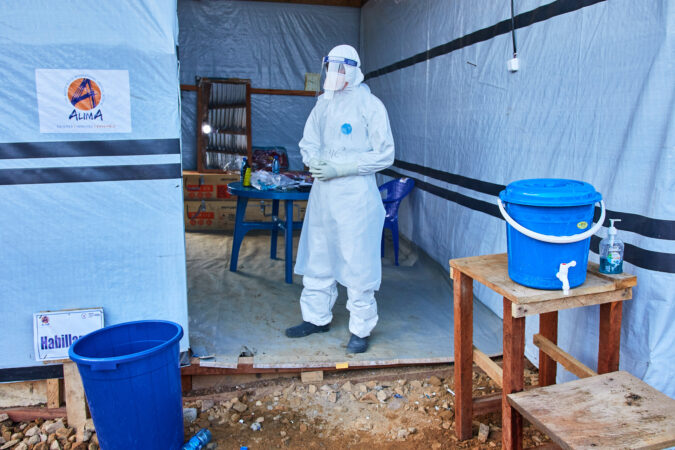
    BUNIA, Congo — At least 500 people have died out of over 1,500 confirmed cases in Congo’s Ebola outbreak, authorities said, as front line workers threatened to go on strike on Monday over unpaid benefits and poor working conditions.

    The outbreak has recorded 1,561 cases, including 506 deaths, since it was declared on May 15 as the spread continues to outpace response, Congo’s Ministry of Health said in its latest update on Sunday night.

    Front line workers deployed in Ituri province, the epicenter of the outbreak, issued a 24-hour notice on Sunday threatening to strike if authorities fail to pay them and improve their working conditions.

    The workers include mostly health professionals who have been laboring with little rest as they battle attacks from angry residents and widespread skepticism about the virus.

    In the notice to the government, a copy of which was seen by the Associated Press, the workers both in and outside hospitals said they had not been paid benefits since the outbreak began and they do not have adequate supplies for their work.

    They also complained of poor salaries, the “arrogance” of teams sent from Congo’s capital of Kinshasa, and the “excessive” use of labor from other provinces without prioritizing local labor in Ituri, as well as the lack of adequate equipment.

    The strike threats come just days after enrollment for clinical trials started, raising concerns in the epicenter about its possible impact. Any strike could also hamper efforts to slow the spread of the outbreak, which is now confirmed in three eastern provinces including North Kivu and South Kivu.

    The lack of approved vaccines or treatments for the Bundibugyo virus, which is responsible for the latest Ebola outbreak, has complicated response efforts. The more common Zaire virus, for which there is a vaccine, was responsible for most of Congo’s past 16 outbreaks of the disease.

    Officials are yet to identify the outbreak’s patient zero and still need to trace possibly tens of thousands of people who have come in contact with infected individuals.

    The first month of this Ebola outbreak was already the worst on record, the World Health Organization has said.

  • Trump rings Wall Street’s opening bell as he ties his presidency to stock market gains

    Trump rings Wall Street’s opening bell as he ties his presidency to stock market gains

    WASHINGTON — President Donald Trump on Monday rang the opening bell for the New York Stock Exchange and the Nasdaq from the golden confines of the Oval Office, a symbolic act that reflects how he has increasingly tied his presidency to the stock market.

    With high inflation hurting Trump’s popularity, the Republican president has tried to get more Americans to focus on their 401(k) investments, saying that his policies should get the credit for any gains, particularly as the November midterm elections draw closer.

    “It’s going to go up — I think the market’s going to go through the roof,” said Trump after formally launching the start of trading.

    Only 33% of U.S. adults approve of Trump’s economic leadership, according to a June survey by the Associated Press-NORC Center for Public Affairs Research.

    Still, the act of ringing the opening bell suggests why the president’s emphasis on the stock market might not help his party much with voters this fall.

    The Oval Office event was promoting the launch of Trump Accounts, which were created as a vehicle for children to have investments in stock indexes as part of Republicans’ big 2025 tax and spending cuts bill.

    In championing the accounts, Treasury Secretary Scott Bessent has emphasized that many Americans have no direct exposure to stocks.

    This means that millions of people are not benefiting from investments that largely accrue to more affluent households or that the benefits they’re receiving are for retirements decades away.

    Bessent declared before the bell ringing that “38% of American families do not have any exposure to our great equity markets.”

    The S&P 500 stock index posted gains of 17.9% in 2025, but that came after annual returns of 25% in 2024 and 26.3% in 2023, during the presidency of Democrat Joe Biden. The benchmark stock index has risen roughly 10% so far this year.

    But just as inflation crushed public support for Biden, Trump has also seen his approval fall prey to a cycle of rising prices. Trump won the 2024 election by promising to bring down costs, but his tariffs and the start of the war in Iran created new inflationary pressures.

    The Consumer Price Index has climbed 4.2% over the past 12 months, up from 3% when Trump started his second term in January 2025.

    Trump, however, is betting that the stock investments that are being seeded by the government and by some prominent companies and billionaires will give future generations a deeper stake in the U.S. economy. The accounts already have gotten a boost from billionaires beyond the $1,000 from the government.

    Michael Dell, the founder of Dell Technologies, and his wife, Susan, appeared by Trump on Monday as they have pledged $6.25 billion for the accounts, while there have been separate pledges by billionaires including investor Ray Dalio and SpaceX president Gwynne Shotwell, who said Monday that she would donate stock in the Elon Musk-led company to the accounts.

    Trump jokingly acknowledged that children had missed the stock market gains that have occurred so far because of the delay in launching the Trump Accounts.

    “We should have acted faster,” Trump said.

  • Hamas dissolves its government in Gaza to transfer power to a U.N.-backed committee

    Hamas dissolves its government in Gaza to transfer power to a U.N.-backed committee

    DEIR AL-BALAH, Gaza Strip — The Hamas militant group said Monday it had dissolved its government in Gaza and is preparing to transfer power to a technical committee backed by the United Nations as part of a U.S.-brokered ceasefire deal.

    Hamas did not say whether it planned to take the crucial step of disarming or handing over security to an international force, but described its decision as evidence of its commitment to Gaza’s reconstruction after years of war.

    It was unclear if the move, announced by a lower-level official, would lead to any meaningful change on the ground.

    The Board of Peace, the new entity led by President Donald Trump with the mandate of governing and rebuilding Gaza, said it was aware of the Hamas announcement but would assess the impact based on “actions, not promises.” The board stressed in a statement on X that the technocratic committee must control all weapons in Gaza, as laid out in the ceasefire agreement.

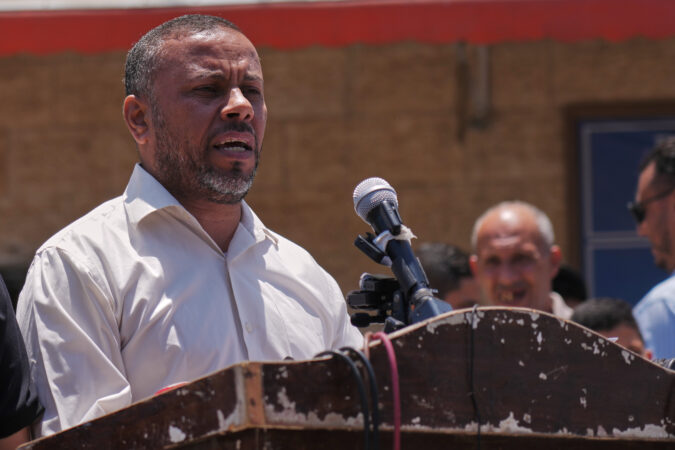
    At a news conference Monday, Ismail al-Thawabta, general director of the Hamas-run Government Media Office, said “only technical and professional staff” would remain in their positions to run the Palestinian enclave’s day-to-day affairs.

    “All employees working in service provision are ‘state employees’ and are fully prepared to work under the National Committee for the Administration of Gaza,” al-Thawabta said during a news conference in the courtyard of Al-Aqsa Hospital in Deir al-Balah. Hamas spokesperson Hazem Qassem called it “a positive step forward on the path to implement the ceasefire deal.”

    Israeli Foreign Minister Gideon Saar dismissed the move, saying it was designed to avoid disarmament. “As long as Hamas retains its weapons, any civilian government will of course operate as Hamas dictates,” he wrote on X.

    The committee of technocrats, which is based in Cairo, is chaired by Ali Shaath, a Gaza-born engineer and former official with the Palestinian Authority. It has a mandate to restore essential services and oversee civilian affairs under the supervision of the U.N. and the Board of Peace.

    In a statement on X, Shaath acknowledged the Hamas announcement Monday and said that in order for the committee to function effectively, there must be “a single governing authority operating under one legal framework” and “a unified security apparatus accountable to that authority.”

    Nine months after the ceasefire was signed, negotiations between Israel and Hamas remain largely deadlocked over the implementation of its second phase, including the disarmament of Hamas and the reconstruction of Gaza.

    Hamas has insisted on implementing the first phase before moving to discuss its weapons.

    The Oct. 7, 2023, attack by Hamas-led militants that sparked the war killed some 1,200 people in Israel and saw 251 others taken hostage. Israel’s retaliatory offensive in Gaza has killed 73,098 Palestinians, according to Gaza’s Health Ministry.

    The ministry, part of the Hamas-led government, is staffed by medical professionals and maintains detailed records viewed as generally reliable by U.N. agencies and independent experts. It does not distinguish between civilians and militants but says women and children make up around half of all fatalities.

    Israeli strikes have lessened considerably since the ceasefire took effect on Oct. 10, but they continue almost daily. Israel’s military says it targets Hamas and other militants, often asserting they were planning attacks. The strikes have also killed many civilians.

    On Monday, Israeli strikes killed at least five people in Gaza, including three in Khan Younis in the south and two in an apartment in Gaza City, health officials said.

    The Israeli military said it targeted a Hamas operative in the Gaza City strike and a militant from the Palestinian Islamic Jihad militant group in the attacks in Khan Younis.

    Militants have carried out shooting attacks against Israeli troops in Gaza, and five Israeli soldiers have been killed since the ceasefire.

  • Islandwide blackout hits Cuba as its fuel reserve dwindles and aging grid crumbles

    Islandwide blackout hits Cuba as its fuel reserve dwindles and aging grid crumbles

    HAVANA, Cuba — An islandwide blackout hit Cuba on Monday as fuel reserves dwindle and its electric grid continues to crumble.

    The blackout in the country of 10 million people was reported by the state-run Electric Union, which said on X that the cause is under investigation. The Ministry of Energy and Mines wrote on X that it has activated protocols to restore electricity.

    Fuel has been running out across Cuba since January, when U.S. President Donald Trump threatened tariffs on any country that sells or provides oil to the island, deepening the island’s ongoing economic and financial crisis. Public transportation has largely been halted, and officials have canceled tens of thousands of surgeries.

    Cuba produces only 40% of the fuel it needs, while the 730,000 barrels of oil delivered by a Russian tanker in late March ran out by the end of April.

    The government also has been rationing power with intentional outages that can stretch to more than 24 consecutive hours.

    A blackout in mid-May affected the island’s eastern provinces, while a blackout in mid-March struck the entire island.

  • Trump says red card call on Folarin Balogun was ‘horrible’ but insists he left outcome to FIFA

    Trump says red card call on Folarin Balogun was ‘horrible’ but insists he left outcome to FIFA

    Editor’s note: This article was updated to reflect a statement made by FIFA president Gianni Infantino

    President Donald Trump on Monday took credit for getting FIFA to review a red card issued against the United States’ star forward Folarin Balogun at the World Cup but said he did not demand an outcome.

    “All I did was ask for a review,” Trump said when asked about it during an unrelated Oval Office event. “I didn’t say, ‘You have to do this.’”

    Trump confirmed that he called FIFA president Gianni Infantino and asked for a second look at the punishment against Balogun in the United States’ 2-0 win against Bosnia-Herzegovina last week. But he said FIFA made the final call to lift Balogun’s mandatory one-game ban for a foul tackle, allowing him to play in Monday’s round of 16 match with Belgium in Seattle.

    Hours later, Infantino released a statement coming off of Trump’s remarks, which read, in part:

    “Yes, I regularly discuss matters related to the FIFA World Cup with the President of the United States, and on this matter, I did receive a call from President Donald Trump, just as I receive calls from heads of state, government officials, football stakeholders, and business executives from around the world on many different issues.

    “During our conversation, I explained that there was an ongoing legal process involving FIFA’s independent judicial bodies and that the case would be decided in due course by those competent bodies. That is how FIFA’s system works, and it is a principle I will always uphold. I read the decisions of the FIFA Disciplinary Committee when they are issued. Sometimes, I am surprised by them. Sometimes I agree with them, and sometimes I disagree.”

    FIFA’s decision to suspend the one-game ban was celebrated by many in the United States but brought condemnation in the international sports world, where some called it an improper intrusion.

    In remarks on Monday, Trump called the referee’s decision a “horrible” call. He added that it would have been a stain on the tournament if Balogun, the U.S.’s leading scorer at this year’s World Cup with three goals, was held out against Belgium and the U.S. lost. He praised FIFA for making what he described as a brilliant decision in suspending the punishment.

    “I didn’t think it was a foul,” Trump said. “I thought it was two great athletes that crashed into each other and got entangled.”

    The president, who said he understands sports “really well,” acknowledged that he did not initially know what a red card is or the consequences it brings. When he learned it would lead to a one-game suspension for Balogun, he said, he decided to step in. He also took issue with the use of video review to issue the red card, arguing that slowed-down reviews can make plays look aggressive.

    Among those joining Trump for the Oval Office event was Republican Sen. Ted Cruz of Texas, who thanked Trump for stepping in.

    “On behalf of all Americans, thank you for getting rid of that ridiculous red card,” Cruz said. “It was spectacular. There was a reason the FIFA trophy sat here for as long as it did.”

    Cruz appeared to be referring to a White House event last year at which Infantino visited and brought the World Cup trophy.