Category: Associated Press

  • Trump rolls out his Board of Peace, but many top U.S. allies aren’t participating

    Trump rolls out his Board of Peace, but many top U.S. allies aren’t participating

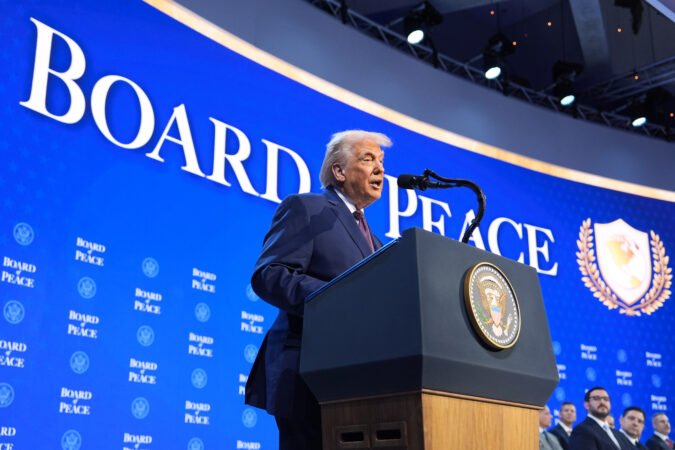
    DAVOS, Switzerland — President Donald Trump on Thursday inaugurated his Board of Peace to lead efforts at maintaining a ceasefire in Israel’s war with Hamas, insisting that “everyone wants to be a part” of the body he said could eventually rival the United Nations — despite many U.S. allies opting not to participate.

    In a speech at the World Economic Forum, Trump sought to create momentum for a project to map out a future of the war-torn Gaza Strip that has been overshadowed this week, first by his threats to seize Greenland, then by a dramatic retreat from that push.

    “This isn’t the United States, this is for the world,” he said, adding, “I think we can spread it out to other things as we succeed in Gaza.”

    The event featured Ali Shaath, the head of a new, future technocratic government in Gaza, announcing that the Rafah border crossing will open in both directions next week. But there was no confirmation of that from Israel, which said only that it would consider the matter next week.

    The Gaza side of the crossing, which runs between Gaza and Egypt, is currently under Israeli military control. Shaath, an engineer and former Palestinian Authority official from Gaza, is overseeing the Palestinian committee set to govern the territory under U.S. supervision.

    The new peace board was initially envisioned as a small group of world leaders overseeing the ceasefire, but it has morphed into something far more ambitious — and skepticism about its membership and mandate has led some countries usually closest to Washington to take a pass.

    Trump tried not to let those not participating ruin his unveiling party, saying 59 countries had signed onto the board — even though heads of state, top diplomats and other officials from only 19 countries plus the U.S. actually attended the event. He told the group, ranging from Azerbaijan to Paraguay to Hungary, “You’re the most powerful people in the world.”

    Trump has spoken about the board replacing some U.N. functions and perhaps even making that entire body obsolete one day. But he was more conciliatory in his remarks on the sidelines of the forum in the Swiss alps.

    “We’ll do it in conjunction with the United Nations,” Trump said, even as he denigrated the U.N. for doing what he said wasn’t enough to calm some conflicts around the globe.

    Secretary of State Marco Rubio said some countries’ leaders have indicated they plan to join but still require approval from their parliaments.

    Why some countries aren’t participating

    Big questions remain, however, about what the eventual board will look like.

    Russian President Vladimir Putin said his country is still consulting with Moscow’s “strategic partners” before deciding to commit. The Russian was hosting Palestinian President Mahmoud Abbas on Thursday in Moscow.

    Others are asking why Putin and other authoritarian leaders had even been invited to join. Britain’s foreign secretary, Yvette Cooper, said her country wasn’t signing on “because this is about a legal treaty that raises much broader issues.”

    “And we do also have concerns about President Putin being part of something which is talking about peace, when we have still not seen any signs from Putin that there will be a commitment to peace in Ukraine,” she told the BBC.

    Norway and Sweden have indicated they won’t participate. France declined after its officials stressed that while they support the Gaza peace plan, they were concerned the board could seek to replace the U.N.

    Canada, Ukraine, China, and the executive arm of the European Union also haven’t committed. Trump calling off the steep tariffs he threatened over Greenland could ease some allies’ reluctance, but the issue is still far from settled.

    The Kremlin said Thursday that Putin plans to discuss his proposal to send $1 billion to the Board of Peace and use it for humanitarian purposes during his talks with Abbas — if Russia can use of those assets the U.S. had previously blocked.

    Others voice reservations

    The idea for the Board of Peace was first laid out in Trump’s 20-point Gaza ceasefire plan and even was endorsed by the U.N. Security Council.

    But an Arab diplomat in a European capital said that Middle Eastern governments coordinated their response to Trump’s invitation to join the Board of Peace and that it was crafted to limit the acceptance to the Gaza plan as mandated by the U.N. Security Council.

    Speaking on the condition of anonymity to discuss the matter more freely, the diplomat said the announced acceptance is “preliminary” and that the charter presented by the U.S. administration contradicts in some parts the United Nations’ mission. The diplomat also said that other major powers are unlikely to support the board in its current form.

    Months into the ceasefire, Gaza’s more than 2 million Palestinians continue to suffer the humanitarian crisis unleashed by more than two years of war. And violence in Gaza continues.

    Key to the truce continuing to hold is the disarming of Hamas, something that the militant group that has controlled the Palestinian territory since 2007 has refused to do, despite Israel seeing it as non-negotiable. Trump on Thursday repeated his frequent warnings that the group will have to disarm or face dire consequences.

    He also said the war in Gaza “is really coming to an end” while conceding, “We have little fires that we’ll put out. But they’re little,” and they had been “giant, giant, massive fires.”

    Iran looms large

    Trump’s push for peace also comes after he threatened military action this month against Iran as it carried out a violent crackdown against some of the largest street protests in years, killing thousands of people.

    Trump, for the time being, has signaled he won’t carry out any new strikes on Iran after he said he received assurances that the Islamic government would not carry out the planned hangings of more than 800 protesters.

    But Trump also made the case that his tough approach to Tehran — including strikes on Iran’s nuclear facilities in June last year — was critical to the Israel-Hamas ceasefire deal coalescing.

    Meanwhile, Trump also spoke behind closed doors for about an hour with Ukrainian President Volodymyr Zelensky and called the discussion “very good” without mentioning major breakthroughs. Trump’s special envoy Steve Witkoff and his son-in-law Jared Kushner are expected in Moscow for talks aimed at ending Russia’s nearly 4-year-old war in Ukraine.

    Zelensky later addressed the Davos forum and said there would be two days of trilateral meetings involving the U.S., Ukraine and Russia in the United Arab Emirates starting Friday — following the U.S. talks in Moscow.

    “Russians have to be ready for compromises because, you know, everybody has to be ready, not only Ukraine, and this is important for us,” Zelensky said.


  • ‘Sinners’ makes Oscars history with 16 nominations

    ‘Sinners’ makes Oscars history with 16 nominations

    Ryan Coogler’s blues-steeped vampire epic Sinners led all films with 16 nominations to the 98th Academy Awards on Thursday, setting a record for the most in Oscar history.

    Academy of Motion Picture Arts and Sciences voters showered Sinners with more nominations than they had ever bestowed before, breaking the 14-nomination mark set by All About Eve, Titanic, and La La Land. Along with best picture, Coogler was nominated for best director and best screenplay, and double-duty star Michael B. Jordan was rewarded with his first Oscar nomination, for best actor.

    Paul Thomas Anderson’s father-daughter revolutionary saga One Battle After Another, the favorite coming into nominations, trailed in second with 13 of its own. Four of its actors — Leonardo DiCaprio, Teyana Taylor, Benicio del Toro, and Sean Penn — were nominated, though newcomer Chase Infiniti was left out in best actress.

    Double-duty “Sinners” star Michael B. Jordan was rewarded with his first Oscar nomination for best actor.

    In those two top nominees, the film academy put its full force behind a pair of visceral and bracingly original American epics that each connected with a fraught national moment. Coogler’s Jim Crow-era film — the rare horror movie to win the academy’s favor — conjures a mythical allegory of Black life. In One Battle After Another, a dormant spirit of rebellion is revived in an out-of-control police state.

    Both are also Warner Bros. titles. In the midst of a contentious sale to Netflix, the 102-year-old studio had one of its best Oscar nominations mornings ever, with 30 nods. As the fate of Warner Bros., which Netflix is buying for $72 billion, hangs in the balance amid a challenge from Paramount Skydance, Hollywood is bracing for potentially the largest realignment in the film industry’s history.

    A coronation for Coogler

    For Coogler, the 39-year-old filmmaker of Fruitvale Station and Black Panther, it was a crowning moment. One of Hollywood’s most esteemed yet humble filmmakers, Coogler has called Sinners — a film that he will own outright 25 years after its release — his most personal movie.

    “I wrote this script for my uncle who passed away 11 years ago,” Coogler said in an interview Thursday morning. “I got to imagine that he’s listening to some blues music right now to celebrate.”

    Reached by phone an hour after the nominations were read, Coogler — speaking alongside his wife and producer Zinzi Evans and producer Sev Ohanian — was still trying to process the movie’s record-breaking haul.

    “I love making movies. I’m honored to wake up every day and do it. I was writing last night. That’s why I didn’t get too much sleep,” said Coogler, chuckling. ”Honestly, bro, I still feel a little bit asleep right now.”

    The other top nominees

    The 10 films nominated for best picture are Bugonia, F1, Frankenstein, Hamnet, Marty Supreme, One Battle After Another, The Secret Agent, Sentimental Value, Sinners, and Train Dreams.

    Guillermo del Toro’s lush Mary Shelley adaptation Frankenstein, Josh Safdie’s period Ping-Pong odyssey Marty Supreme, and Joachim Trier’s family drama Sentimental Value all scored nine nominations. Chloé Zhao’s speculative Shakespeare drama Hamnet collected eight nods. With the notable exception of del Toro, those filmmakers filled up a best director category of Anderson, Coogler, Safdie, Trier, and Zhao, who in 2021 became the first woman of color to ever win the award.

    The nine nods for Marty Supreme included a third best actor nod for 30-year-old Timothée Chalamet, the favorite in the category he narrowly missed winning last year for A Complete Unknown. With Jordan and Chalamet, the nominees are Leonardo DiCaprio for One Battle After Another, Ethan Hawke for Blue Moon and Wagner Moura for The Secret Agent.

    Nominated for best actress was the category favorite, Jessie Buckley (Hamnet), along with Rose Byrne (If I Had Legs I’d Kick You), Kate Hudson (Song Sung Blue), Renate Reinsve (Sentimental Value) and two-time winner Emma Stone, who landed her sixth nomination, for Bugonia.

    ‘KPop’ leads a field light on big hits

    The year’s most-watched movie, with more than half a billion views on Netflix, KPop Demon Hunters, scored nominations for both best song (“Golden”) and best animated feature. Sony Pictures developed and produced the film, but, after selling it to Netflix, watched it become a worldwide sensation.

    Blockbusters otherwise had a difficult morning. Universal Pictures’ Wicked: For Good was shut out entirely. While Avatar: Fire and Ash notched nominations for costume design and visual effects, it became the first Avatar film not nominated for best picture. The biggest box-office hit nominated for Hollywood’s top award instead was F1, an Apple production that landed four nominations. The streamer partnered with Warner Bros. to distribute the racing drama.

    This year, the Oscars are introducing a new category for casting. That new honor helped Sinners and One Battle After Another pad their already impressive stats. Along with those two films, the nominees are Hamnet, Marty Supreme, and The Secret Agent.

    An international shift continues

    The academy, which has expanded its overseas membership in recent years, also continued its tilt toward international films. Every category included one international nominee. For the eighth year in the row, a non-English-language film was nominated for best picture. More non-English performances were nominated than ever before.

    The top nominee of them all was Trier’s Norwegian drama Sentimental Value. It cleaned up in the supporting actor categories, with nods for Stellan Skarsgård, Inga Ibsdotter LilIeaas, and Elle Fanning. Also nominated for best supporting actress, in addition to Taylor: Amy Madigan for Weapons and Wunmi Mosaku for Sinners. In supporting actor, the nominees included Jacob Elordi for Frankenstein and, in a surprise that likely dislodged Paul Mescal of Hamnet, Delroy Lindo for Sinners.

    A competitive best international feature category mirrored the turbulent state of the world. That included the Iranian revenge drama and Palme d’Or winner It Was Just an Accident, by the often-imprisoned filmmaker Jafar Panahi. He’s spoken passionately against the ongoing crackdown of demonstrators in his home country. France nominated the film.

    Also nominated: the Tunisian entry The Voice of Hind Rajab, about volunteers at the Palestine Red Crescent Society; the timely Brazilian political thriller The Secret Agent; the apocalyptic Spanish road movie Sirât; and Sentimental Value. Four of those nominees came from one independent distributor: Neon. The company, which has had an enviable streak of Palme d’Or wins, was second only to Warner Bros. with a collective 16 nominations.

    The 98th Academy Awards will take place on March 15 at the Dolby Theatre in Los Angeles and will be televised live on ABC and Hulu. YouTube’s new deal to exclusively air won’t take effect until 2029. This year, Conan O’Brien will return as host.

  • Mets acquire ace pitcher Freddy Peralta from Brewers in trade

    Mets acquire ace pitcher Freddy Peralta from Brewers in trade

    NEW YORK — The active New York Mets acquired ace pitcher Freddy Peralta and right-hander Tobias Myers from Milwaukee on Wednesday night in a trade that sent two prized young players to the Brewers.

    Milwaukee received pitcher Brandon Sproat and minor league infielder/outfielder Jett Williams. Both were rated among the game’s top 100 prospects by Baseball America.

    Peralta gives the new-look Mets a front line starter after their rotation faltered in the second half of a hugely disappointing 2025 season. The move came hours after New York formally introduced free agent addition Bo Bichette at a Citi Field news conference, and one night after the team obtained talented center fielder Luis Robert Jr. in a trade with the Chicago White Sox.

    “Acquiring Freddy adds another established starter to help lead our rotation,” Mets president of baseball operations David Stearns said in a statement. “Throughout the offseason, we sought to complement our rotation with another front-end pitcher, and we’re thrilled we are able to bring Freddy to the Mets.”

    Peralta went 17-6 with a 2.70 ERA in 33 starts last season, when he led the National League in wins and finished fifth in Cy Young Award voting. He struck out 204 batters in 176⅔ innings and earned his second All-Star selection.

    The 29-year-old Peralta hasn’t been on the injured list since 2022, when the right-hander was sidelined by a strained lat and later elbow inflammation. He is set to make $8 million this season and can become a free agent following the World Series. He is the latest former Brewers player acquired by Stearns, who ran Milwaukee’s front office from 2015-23.

    “He obviously knows the players well. Look, he and I have worked very well together for many, many years. I obviously care about him a lot,” Brewers president of baseball operations Matt Arnold said. ”Today’s his anniversary and I was at his wedding. We go back a long way. I think I might have ruined his anniversary dinner. Look, he’s a dear friend. Hopefully, again, these are the types of trades that work out for both guys.”

    Myers, 27, was 9-6 with a 3.00 ERA in 25 starts and two relief appearances as a rookie in 2024 before going 1-2 with a 3.55 ERA in six starts and 16 relief outings last year as Milwaukee won its third consecutive division title and advanced to the NL Championship Series.

    “Over the past two seasons, Tobias has become an extremely valuable major league pitcher,” Stearns said. “His ability to pitch out of both the rotation and bullpen allows him to help our team in multiple ways.”

    Peralta’s departure marks the third straight offseason in which the cost-conscious Brewers have traded a star pitcher entering the final year of his contract.

    Two years ago, they dealt 2021 NL Cy Young Award winner Corbin Burnes to Baltimore for infielder Joey Ortiz and left-hander DL Hall. Last winter, the Brewers sent two-time All-Star reliever Devin Williams to the New York Yankees for left-hander Nestor Cortes and third baseman Caleb Durbin.

    “These decisions are always tough,” Arnold said. ”We loved having Freddy Peralta here and everything he meant to this franchise. I just had an emotional call with him.”

    Burnes and Williams both spent just one season with the teams that acquired them from Milwaukee before signing elsewhere in free agency. Burnes agreed to a $210 million, six-year contract with Arizona before the 2025 season, and Williams signed a $51 million, three-year deal with the Mets last month.

    Although the Brewers won’t have Peralta to anchor their rotation, they do bring back two-time All-Star Brandon Woodruff, who accepted the team’s $22,025,000 qualifying offer. Woodruff went 7-2 with a 3.20 ERA last year after missing the 2024 season with a shoulder injury.

    Hard-throwing right-hander Jacob Misiorowski got called up last June and was quickly picked for the All-Star team as a rookie. He finished 5-3 with a 4.36 ERA and 87 strikeouts in 66 innings.

    “We feel we have a really good core of starters to deal from,” Arnold said. “I still feel like we’ll have a very strong rotation.”

    Arnold said Sproat and Williams will compete for spots on the opening-day roster.

    The 25-year-old Sproat made his major league debut in September and went 0-2 with a 4.79 ERA in four starts for the Mets, who selected him in the second round of the 2023 amateur draft from the University of Florida. He was rated the fifth-best prospect in New York’s system by MLB.com.

    “He’s a guy we’ve liked going back to the draft. He’s major league ready. He’s going to compete for a spot in our rotation,” Arnold said. “This guy has incredible stuff. Very high octane, really good movement on his four-seamer and two-seamer. Really good secondary weapons and a really good changeup.”

    The 5-foot-7 Williams, 22, batted .261 with 17 homers, 34 doubles and 52 RBIs in 130 games combined at Double-A Binghamton and Triple-A Syracuse last year. He was drafted No. 14 overall by the Mets in 2022 out of high school in Texas and was their third-rated prospect, according to MLB.com.

    “This kid’s a gamer. He’s not that big, but I can tell you he plays with a ton of heart and he’s got incredible tools,” Arnold said. “He’s one of the fastest players in the minor leagues. I think his versatility is something that’s going to fit very, very well for this team.”

    Peralta is 70-42 with a 3.59 ERA and 1,153 strikeouts in 931 innings over eight major league seasons, all with Milwaukee. He joins a Mets rotation that also includes Nolan McLean, Clay Holmes, David Peterson, Sean Manaea and Kodai Senga.

    Peralta ranks second in the majors with 40 wins since 2023. He and Dylan Cease are the only two pitchers with at least 200 strikeouts in each of the past three years.

    To open space on their 40-man roster, the Mets designated right-hander Cooper Criswell for assignment.

  • Iconic Coney Island hot dog hawker Nathan’s Famous is sold for $450 million

    Iconic Coney Island hot dog hawker Nathan’s Famous is sold for $450 million

    Nathan’s Famous, which opened as a 5-cent hot dog stand in Coney Island more than a century ago, has been sold to packaged meat giant Smithfield Foods in an all-cash $450 million deal, the companies announced Wednesday.

    Smithfield, which has held rights to produce and sell Nathan’s products in the U.S. and Canada and at Sam’s Clubs in Mexico since 2014, will acquire all of Nathan’s outstanding shares for $102 each.

    Like almost every food company, Nathan’s has been under significant inflationary pressure. Nathan’s sales costs of branded products rose 27% compared with last year in its most recent quarter, the company said in a filing with the U.S. Securities and Exchange Commission. There was a 20% increase in the average cost per pound of hot dogs, it said.

    Nathan Handwerker opened the first Nathan’s hot dog stand on Coney Island in 1916 with a $300 loan, according to the company. After opening a handful of other locations around New York over the years, the Handwerker family sold the Nathan’s Famous business to investors in 1987. The franchise has continued to expand.

    Nathan’s has an outsized cultural presence in the U.S. both because of its history and the famous, or infamous, hot dog-eating contest held at its flagship Coney Island shop, where contestants from around the world gather every July 4 to see who can down the most hot dogs in 10 minutes.

    The restaurant sits on the same lot where Handwerker opened his first hot dog stand.

    American Joey Chestnut is the reigning Nathan’s hot dog-eating champion after eating 70.5 hot dogs and buns last year. Chestnut has won 17 of the last 19 events, setting a record in 2021 after wolfing down 76 hot dogs and buns.

    While the first recorded hot dog-eating contest was held in 1972, Nathan’s says informal contests began the year the stand opened early in the 20th century. It says the 2025 contest was its 103rd.

    Smithfield said Wednesday that the event, which has been televised on ESPN with a crowd estimated at 30,000 at Coney Island each year, will continue.

    Smithfield said it expects to achieve annual savings of about $9 million within two years of closing the deal.

    “As a long-time partner, Smithfield has demonstrated an outstanding commitment to investing in and growing our brand while maintaining the utmost quality and customer service standards,” said Nathan’s CEO Eric Gatoff.

    Nathan’s board of directors, which own or control nearly 30% of the outstanding shares of Nathan’s Famous common stock, approved the buyout and agreed to recommend to its shareholders to vote in favor of the deal.

    Smithfield, which also owns the Gwaltney bacon and Armour frozen meat brands, rang up more than a billion dollars in operating profit in 2024 on sales of $14.1 billion.

    Smithfield shares closed down 1.1% Wednesday.

    In fiscal 2025, Nathan’s reported profit of $24 million on revenue approaching $150 million. Its acquisition is expected to close in the first half of this year.

  • Trump pushes for lower rates and ban on investor home purchases in bid to make homes more affordable

    Trump pushes for lower rates and ban on investor home purchases in bid to make homes more affordable

    President Donald Trump‘s plans for bringing homeownership within reach of more Americans involve pushing for lower interest rates on home loans and credit cards, and banning large institutional investors from buying single-family homes.

    In his address Wednesday at the World Economic Forum in Davos, Switzerland, Trump outlined four policies his administration is pursuing in a bid to make homeownership more affordable. Each had been previously mentioned by him or his administration in recent weeks, part of a broader push to address affordability generally, a hot-button issue with voters heading into the midterms.

    The U.S. housing market has been in a sales slump dating back to 2022, when mortgage rates began to climb from pandemic-era lows. The combination of higher mortgage rates, years of skyrocketing home prices and a chronic shortage of homes nationally following more than a decade of below-average home construction have left many aspiring homeowners priced out of the market. Sales of previously occupied U.S. homes remained stuck last year at 30-year lows.

    In his remarks, Trump stressed the need to lower interest rates on home loans and credit cards in order to give aspiring homebuyers more financial flexibility to save up for a down payment on a home and more purchasing power when it comes time to buy.

    “We can drop interest rates to a level, and that’s one thing we do want to do,” said Trump. “That’s natural. That’s good for everybody. You know, the dropping of the interest rate, we should be paying a much lower interest than we are.”

    Trump noted that he has directed the federal government to buy $200 billion in mortgage bonds, a move he said would help reduce mortgage rates. Trump said earlier this month that Fannie Mae and Freddie Mac have $200 billion in cash that would be used to buy mortgage bonds. However, some economists have said such a move would likely have only a minimal impact on mortgage rates.

    Trump, who spent much of last year demanding that the Federal Reserve lower interest rates, also reiterated that he will be announcing a new Fed chair soon to replace Jerome Powell, whose term as chair is due to end in May.

    “I think they’ll do a very good job,” he said.

    Still, Fed rate cuts don’t always translate into lower mortgage rates. That’s what happened in the fall of 2024 after the central bank cut its main rate for the first time in more than four years. Instead of falling, mortgage rates marched higher, eventually cresting above 7% in January this year. At that time, the 10-year Treasury yield was climbing toward 5%.

    More recently, the average rate on a 30-year mortgage was at 6.06% last week, its lowest level in more than three years, according to mortgage buyer Freddie Mac.

    While lower mortgage rates help boost homebuyers’ purchasing power, the biggest hurdle many aspiring homeowners face is being able to save up for a down payment.

    To that end, Trump said he is asking Congress for legislation that would mandate credit card issuers cap interest rates at 10% for one year — after the industry ignored his demand earlier this month that they implement the cap by Jan. 20. The average rate on credit cards is around 21%, according to the Federal Reserve Bank of New York.

    Trump also reiterated that he wants to block large institutional investors from buying single-family homes, so that Americans don’t have to compete with such well-funded rivals when they shop for a home.

    “Homes are built for people, not for corporations, and America will not become a nation of renters,” he said.

    While touting his plans to open up the housing market to more Americans, Trump stressed that he didn’t want to take any actions that would tip the housing market too far in favor of buyers at the expense of millions of homeowners who have benefited from strong home equity gains.

    “Every time you make it more and more and more affordable for somebody to buy a house cheaply, you’re actually hurting the value of those houses, obviously, because the one thing works in tandem with the other,” he said, adding: “Now, if I want to really crush the housing market, I could do that so fast that people could buy houses, but you would destroy a lot of people that already have houses.”

    Trump didn’t specify which policies would cause that to happen.

    Trump issued an executive order late Tuesday directing his administration to review the laws that govern how big institutional investors make large purchases of single-family homes and determine whether such investors are engaging in anti-competitive practices.

    The order, which exempts companies that build homes for rent, also includes provisions to give ordinary home shoppers the opportunity to buy foreclosed homes before investors do and bars government housing agencies from guaranteeing, insuring, or otherwise facilitating large institutional investors from buying single-family homes.

    Still, it’s unclear how the administration will define a large investor. And while some metro areas, like Atlanta and Phoenix, have a larger share of corporate-owned single-family homes for rent, the vast majority of rental houses are owned by small individual investors, which wouldn’t be barred from buying more homes.

    “It probably won’t make a noticeable impact on the housing market,” said Daryl Fairweather, chief economist at Redfin.

    Trump was expected to give more details about his housing policy in the speech, but devoted most of it to other subjects. Kevin Hassett, director of Trump’s National Economic Council, told Bloomberg that Trump was just “foreshadowing” an upcoming policy announcement. The White House is reportedly considering a new way for Americans with a 401(k) retirement savings plan to fund the down payment on a home, among other policies.

  • Washington Post seeks court order for government to return electronics seized from reporter’s home

    Washington Post seeks court order for government to return electronics seized from reporter’s home

    WASHINGTON — The Washington Post asked a federal court on Wednesday for an order requiring federal authorities to return electronic devices that they seized from a Post reporter’s Virginia home last week, accusing the government of trampling on the reporter’s free speech rights and legal safeguards for journalists.

    A magistrate judge in Alexandria, Va., temporarily barred the government from reviewing any material from the devices seized from Post reporter Hannah Natanson’s home. The judge also scheduled a Feb. 6 hearing on the newspaper’s request.

    Federal agents seized a phone, two laptops, a recorder, a portable hard drive, and a Garmin smart watch when they searched Natanson’s home last Wednesday, according to a court filing. The search was part of an investigation of a Pentagon contractor accused of illegally handling classified information.

    “The outrageous seizure of our reporter’s confidential newsgathering materials chills speech, cripples reporting, and inflicts irreparable harm every day the government keeps its hands on these materials,” the Post said in a statement.

    The seized material spanned years of Natanson’s reporting across hundreds of stories, including communications with confidential sources, the Post said. The newspaper asked the court in Virginia to order the immediate return of all seized materials and to bar the government from using any of it.

    “Anything less would license future newsroom raids and normalize censorship by search warrant,” the Post’s court filing says.

    The Pentagon contractor, Aurelio Luis Perez-Lugones, was arrested earlier this month on a charge of unauthorized removal and retention of classified documents. A warrant said the search of Natanson’s home was related to the investigation of Perez-Lugones, the Post reported.

    Natanson has been covering Republican President Donald Trump’s transformation of the federal government, The Post recently published a piece in which she described gaining hundreds of new sources from the federal workforce, leading one colleague to call her “the federal government whisperer.”

    Attorney General Pam Bondi said that the search was done at the request of the Defense Department and that the journalist was “obtaining and reporting classified and illegally leaked information from a Pentagon contractor.”

    Perez-Lugones, a U.S. Navy veteran who resides in Laurel, Md., has not been charged with sharing classified information or accused in court papers of leaking.

    The Justice Department has internal guidelines governing its response to news media leaks. In April, Bondi issued new guidelines restoring prosecutors’ authority to use subpoenas, court orders and search warrants to hunt for government officials who make “unauthorized disclosures” to journalists.

    The new guidelines rescinded a policy from Democratic President Joe Biden’s administration that protected journalists from having their phone records secretly seized during leak investigations.

    Reporters Committee for Freedom of the Press president Bruce Brown said the unprecedented search of the reporter’s home, “imperils public interest reporting and will have ramifications far beyond this specific case.”

    “It is critical that the court blocks the government from searching through this material until it can address the profound threat to the First Amendment posed by the raid,” Brown said in a statement Wednesday.

  • Immigration officers assert sweeping power to enter homes without a judge’s warrant, memo says

    Immigration officers assert sweeping power to enter homes without a judge’s warrant, memo says

    WASHINGTON — Federal immigration officers are asserting sweeping power to forcibly enter people’s homes without a judge’s warrant, according to an internal Immigration and Customs Enforcement memo obtained by The Associated Press, marking a sharp reversal of longstanding guidance meant to respect constitutional limits on government searches.

    The memo authorizes ICE officers to use force to enter a residence based solely on a more narrow administrative warrant to arrest someone with a final order of removal, a move that advocates say collides with Fourth Amendment protections and upends years of advice given to immigrant communities.

    The shift comes as the Trump administration dramatically expands immigration arrests nationwide, deploying thousands of officers under a mass deportation campaign that is already reshaping enforcement tactics in cities such as Minneapolis.

    For years, immigrant advocates, legal aid groups and local governments have urged people not to open their doors to immigration agents unless they are shown a warrant signed by a judge. That guidance is rooted in Supreme Court rulings that generally prohibit law enforcement from entering a home without judicial approval. The ICE directive directly undercuts that advice at a time when arrests are accelerating under the administration’s immigration crackdown.

    The memo itself has not been widely shared within the agency, according to a whistleblower complaint, but its contents have been used to train new ICE officers who are being deployed into cities and towns to implement the president’s immigration crackdown. New ICE hires and those still in training are being told to follow the memo’s guidance instead of written training materials that actually contradict the memo, according to the whistleblower disclosure.

    It is unclear how broadly the directive has been applied in immigration enforcement operations. The Associated Press witnessed ICE officers ramming through the front door of the home of a Liberian man in Minneapolis on Jan. 11 with only an administrative warrant, wearing heavy tactical gear and with their rifles drawn.

    The change is almost certain to meet legal challenges and stiff criticism from advocacy groups and immigrant-friendly state and local governments that have spent years successfully urging people not to open their doors unless ICE shows them a warrant signed by a judge.

    The Associated Press obtained the memo and whistleblower complaint from an official in Congress, who shared it on condition of anonymity to discuss sensitive documents. The AP verified the authenticity of the accounts in the complaint.

    The memo, signed by the acting director of ICE, Todd Lyons, and dated May 12, 2025, says: “Although the U.S. Department of Homeland Security (DHS) has not historically relied on administrative warrants alone to arrest aliens subject to final orders of removal in their place of residence, the DHS Office of the General Counsel has recently determined that the U.S. Constitution, the Immigration and Nationality Act, and the immigration regulations do not prohibit relying on administrative warrants for this purpose.”

    The memo does not detail how that determination was made nor what its legal repercussions might be.

    When asked about the memo, Homeland Security spokeswoman Tricia McLaughlin said in an emailed statement to the AP that everyone the department serves with an administrative warrant has already had “full due process and a final order of removal.”

    She said the officers issuing those warrants have also found probable cause for the person’s arrest. She said the Supreme Court and Congress have “recognized the propriety of administrative warrants in cases of immigration enforcement,” without elaborating. McLaughlin did not respond to questions about whether ICE officers entered a person’s home since the memo was issued relying solely on an administrative warrant and if so, how often.

    Recent arrests shine a light on tactics

    Whistleblower Aid, a nonprofit legal organization that assists workers exposing wrongdoings, said in the whistleblower complaint obtained by The Associated Press that it represents two anonymous U.S. government officials “disclosing a secretive — and seemingly unconstitutional – policy directive.”

    A wave of recent high-profile arrests, many unfolding at private homes and businesses and captured on video, has shined a spotlight on immigration arrest tactics, including officers’ use of proper warrants.

    Most immigration arrests are carried out under administrative warrants, internal documents issued by immigration authorities that authorize the arrest of a specific individual but do not permit officers to forcibly enter private homes or other non-public spaces without consent. Only warrants signed by judges carry that authority.

    All law enforcement operations — including those conducted by ICE and Customs and Border Protection — are governed by the Fourth Amendment of the Constitution, which protects all people in the country from unreasonable searches and seizures.

    People can legally refuse federal immigration agents entry into private property if the agents only have an administrative warrant, with some limited exceptions.

    Federal agents this month rammed the door of the Minneapolis home of a Liberian man with a deportation order from 2023, who was then arrested. Documents reviewed by The AP revealed that the agents only had an administrative warrant — meaning there was no judge who authorized the raid on private property.

    Memo shown to ‘select’ officials

    The memo says ICE officers can forcibly enter homes and arrest immigrants using just a signed administrative warrant known as an I-205 if they have a final order of removal issued by an immigration judge, the Board of Immigration Appeals or a district judge or magistrate judge.

    The memo says officers must first knock on the door and share who they are and why they’re at the residence. They’re limited in the hours they can go into the home — after 6 a.m. and before 10 p.m. The people inside must be given a “reasonable chance to act lawfully.” But if that doesn’t work, the memo says, they can use force to go in.

    “Should the alien refuse admittance, ICE officers and agents should use only a necessary and reasonable amount of force to enter the alien’s residence, following proper notification of the officer or agent’s authority and intent to enter,” the memo reads.

    The memo is addressed to all ICE personnel. But it has been shown only to “select DHS officials” who then shared it with some employees who were told to read it and return it, Whistleblower Aid wrote in the disclosure.

    One of the two whistleblowers was allowed to view the memo only in the presence of a supervisor and then had to give it back. That person was not allowed to take notes. A whistleblower was able to access the document and lawfully disclose to Congress, Whistleblower Aid said.

    Although the memo was issued in May, David Kligerman, senior vice president and special counsel at Whistleblower Aid, said it took time for its clients to find a “safe and legal path to disclose it to lawmakers and the American people.”

    ICE told to rely on administrative warrants, memo says

    ICE has been rapidly hiring thousands of new deportation officers to carry out the president’s mass deportation agenda. They’re trained at the Federal Law Enforcement Training Center in Brunswick, Georgia.

    During a visit there by The Associated Press in August, ICE officials said repeatedly that new officers were being trained to follow the Fourth Amendment.

    But according to the whistleblowers’ account, newly hired ICE officers are being told they can rely solely on administrative warrants to enter homes to make arrests even though that conflicts with written Homeland Security training materials.

    ICE officers often wait for hours for the person they’re hoping to arrest to come outside so they can make the arrest on the sidewalk or at the person’s work — public places where they are allowed to operate without the risk of infringing on the person’s Fourth Amendment rights.

    Whistleblower Aid called the new policy a “complete break from the law” and said it undercuts the “Fourth Amendment and the rights it protects.”

  • Trump cancels tariff threat over Greenland, says NATO agreed to ‘framework’ of future Arctic deal

    Trump cancels tariff threat over Greenland, says NATO agreed to ‘framework’ of future Arctic deal

    DAVOS, Switzerland — DAVOS, Switzerland — President Donald Trump on Wednesday scrapped the tariffs that he threatened to impose on eight European nations to press for U.S. control over Greenland, pulling a dramatic reversal shortly after insisting he wanted to get the island “including right, title and ownership.”

    In a post on his social media site, Trump said he had agreed with the head of NATO on a “framework of a future deal” on Arctic security, potentially defusing tension that had far-reaching geopolitical implications.

    He said “additional discussions” on Greenland were being held concerning the Golden Dome missile defense program, a multilayered, $175 billion system that for the first time will put U.S. weapons in space.

    Trump offered few details, saying they were still being worked out. But one idea NATO members have discussed as part of a compromise with Trump was that Denmark and the alliance would work with the U.S. to build more U.S. military bases on Greenland.

    That’s according to a European official familiar with the matter but not authorized to comment publicly. The official, who spoke on condition of anonymity, said it was not immediately clear if that idea was included in the framework Trump announced.

    Trump has backed off tariffs before

    The president has threatened tariffs before only to back away. In April, after first saying he would slap massive import levies on nations from around the world, which prompted a sharp negative market reaction, Trump eased off.

    But his change of heart this time came only after he used his speech at the World Economic Forum in the Swiss Alps to focus on Greenland and threatened to upend NATO, an alliance that has been among the globe’s most unshakable since the early days of the Cold War.

    In his address, Trump said he was asking for territory that was “cold and poorly located” and that the U.S. had effectively saved Europe during World War II while declaring of NATO: “It’s a very small ask compared to what we have given them for many, many decades.”

    “We probably won’t get anything unless I decide to use excessive strength and force, where we would be frankly unstoppable. But I won’t do that, OK?” Trump said.

    But Trump has also said repeatedly that, while the U.S. will defend NATO, he wasn’t convinced the alliance will backup Washington, if needed, and suggested that was at least part of the reason for his aggressive stance toward Greenland. That prompted NATO Secretary General Mark Rutte, in a post-speech event with Trump, to say that the alliance would stand with the U.S. if it is attacked.

    “You can be assured, absolutely,” Rutte said. A short time later came Trump’s post canceling the tariffs.

    Danish Foreign Minister Lars Løkke Rasmussen said he welcomed Trump ruling out taking “Greenland by force” and pausing ”the trade war with Europe.”

    “Now, let’s sit down and find out how we can address the American security concerns in the Arctic while respecting the red lines of the Kingdom of Denmark,” he said in a statement.

    President cites national security

    Trump argues that the U.S. needs Greenland for national security and to counter threats from Russia and China in the Arctic region, despite America already having a large military base there. He threatened to impose steep U.S. import taxes on Denmark and seven other allies unless they negotiate a transfer of the semi-autonomous territory.

    The tariffs were to have started at 10% next month and climb to 25% in June.

    Trump often tries to increase pressure on the other side when he believes it can lead to a favorable agreement. His threats at Davos appeared on the verge of rupturing NATO, which was founded by leading European nations, the U.S. and Canada to counter the Soviet Union.

    The alliance’s other members were steadfast in saying Greenland is not for sale and cannot be wrested from Denmark, while angrily rejecting Trump’s promised tariffs.

    A Danish government official told The Associated Press after Trump’s speech that Copenhagen was ready to discuss U.S. security concerns. But the official, who was not authorized to comment publicly and spoke on condition of anonymity, underscored the government’s position that “red lines”— namely Denmark’s sovereignty — must be respected.

    It was not immediately clear how Trump’s canceling of tariffs might change such calculations.

    Greenland tells citizens to prepare

    In the meantime, Greenland’s government responded by telling its citizens to be prepared. It has published a handbook in English and Greenlandic on what to do in a crisis that urges residents to ensure they have sufficient food, water, fuel and supplies at home to survive for five days.

    “We just went to the grocery store and bought the supplies,” said Tony Jakobsen in Greenland’s capital Nuuk said, showing off the contents of bags that included candles, snacks and toilet paper.

    Jakobsen said he thought Trump’s rhetoric toward Greenland was “just threats… but it’s better to be ready than not ready.”

    Before backing down, Trump had urged Denmark and the rest of NATO to stand aside, adding an ominous warning.

    “We want a piece of ice for world protection, and they won’t give it,” Trump said. “You can say yes, and we will be very appreciative. Or you can say no, and we will remember.”

    He also called for opening “immediate negotiations” for the U.S. to acquire Greenland. In subsequent comments to reporters, he declined to name a price that might be paid, saying only, “There’s a bigger price, and that’s the price of safety and security and national security and international security.”

    His arrival in Davos was delayed after a minor electrical problem on Air Force One forced a return to Washington to switch aircraft. As Trump’s motorcade headed down a narrow road to the speech site, onlookers — including some skiers — lined the route, some making obscene gestures.

    Financial markets that had fallen sharply on Trump’s threatened tariffs bounced back Wednesday. Also breathing a sigh of relief were a number of U.S. officials who had also been concerned that Trump’s hard-line stance and bellicose rhetoric toward Greenland, Denmark and other NATO allies could harm other foreign policy goals.

    Trump’s Davos speech was originally supposed to focus on how to lower U.S. housing prices — part of a larger effort to bring down the cost of living. Greenland instead carried the day, though Trump mistakenly referred to it as Iceland four times during his speech.

    “This enormous unsecured island is actually part of North America,” Trump said. “That’s our territory.”

    When he finally did mention housing, Trump suggested he did not support a measure to encourage affordability. He said bringing down rising home prices hurts property values and makes homeowners who once felt wealthy because of the equity in their houses feel poorer.

    ‘Now there’s another threat’

    Before Trump announced that he was abandoning the tariffs and potentially easing international pressure, his speech left people in Nuuk preparing for the worst.

    Resident Johnny Hedemann said it was “insulting” that Trump “talks about the Greenlandic people and the Greenlandic nation as just an ice cube.” He spoke while heading out to buy a camping stove and instant mashed potatoes.

    “Living in this nature, you have to be prepared for almost anything. And now there’s another threat — and that’s Trump,” Hedemann said.

  • Trump to meet with Zelensky as Ukraine endures a bitter winter after Russian attacks

    Trump to meet with Zelensky as Ukraine endures a bitter winter after Russian attacks

    KYIV, Ukraine — About 4,000 buildings in Kyiv remained without heating Wednesday, and nearly 60% of the Ukrainian capital was without power, Ukraine’s President Volodymyr Zelensky said, after days of Russian bombardment of Ukraine’s power grid and as President Donald Trump prepared to hold talks with the Ukrainian leader.

    With temperatures falling as low as minus-4 F in Kyiv, Ukraine is seeing one of the coldest winters in years, deepening the hardship of Ukrainians almost four years after Russia launched a full-scale invasion.

    A yearlong push by the Trump administration to stop the fighting hasn’t yielded any breakthrough, despite the American president issuing a series of deadlines, though efforts were set to continue.

    Trump said at the World Economic Forum in Davos, Switzerland that he would meet Thursday with Zelensky.

    “I want to stop it,” Trump said of the fighting Wednesday. “It’s a horrible war.”

    U.S. special envoy Steve Witkoff told The Associated Press on Wednesday that he plans to discuss peace proposals with Putin as well as hold talks with a Ukrainian delegation.

    “We need a peace,” Witkoff said at Davos.

    Putin confirmed late on Wednesday that Witkoff and Trump’s son-in-law Jared Kushner are expected in Moscow on Thursday for talks. The Russian leader said that Moscow and Washington, among other things, are discussing the possibility of using Russian assets frozen in the U.S. for rebuilding “territories damaged by the hostilities” after a peace agreement is reached.

    But with a dispute over Greenland’s future largely eclipsing other transatlantic issues at Davos, discussions about Ukraine’s defense looked likely to be sidelined.

    Zelensky said last week his envoys would try to finalize with U.S. officials documents for a proposed peace settlement that relate to postwar security guarantees and economic recovery.

    He added that the U.S. and Ukraine could sign the documents in Davos this week, but on Tuesday he said he wouldn’t be traveling to Switzerland and would focus on restoring power in Ukraine.

    Ukraine’s Cabinet of Ministers is allocating 2.56 billion hryvnias (almost $60 million) from a reserve fund to purchase generators, Prime Minister Yuliia Svyrydenko said Wednesday.

    NATO Secretary-General Mark Rutte on Wednesday urged the 32-nation alliance’s military chiefs to press their national governments to supply desperately needed air defense systems to Ukraine, helping it fend off Russia’s aerial attacks.

    “Please use your influence to help your political masters to do even more,” Rutte said in a video message to top brass as they met at NATO’s Brussels headquarters.

    “Look deep into your stockpiles to see what more you can give to Ukraine, particularly air defense interceptors. The time really is now,” he said.

    Russia launched 97 drones and a ballistic missile at Ukraine overnight, the Ukrainian air force said.

    In the central Dnipropetrovsk region, attacks killed a 77-year-old man and a 72-year-old woman, according to Oleksandr Hanzha, head of the regional military administration.

    Russia’s Defense Ministry said that air defenses downed 75 Ukrainian drones over several regions.

    The international airports of Krasnodar, Sochi, Gelendzhik and Saratov briefly suspended flights overnight because of the drones.

    In Adygea, more than 120 miles from the Ukrainian border, a Ukrainian drone caused a fire at an apartment building that injured 11 people, including two children, according to Gov. Murat Kumpilov.

  • Immigration enforcement arrives in Maine as a court freezes restrictions on tactics in Minnesota

    Immigration enforcement arrives in Maine as a court freezes restrictions on tactics in Minnesota

    MINNEAPOLIS — Maine became the latest target of the Trump administration’s immigration enforcement crackdown, while a federal appeals court on Wednesday suspended a decision that prohibited federal officers from using tear gas or pepper spray against peaceful protesters in Minnesota.

    The 8th U.S. Circuit Court of Appeals was persuaded to freeze a judge’s ruling that bars retaliation against the public in Minnesota, including detaining people who follow agents in cars, while the government pursues an appeal. Operation Metro Surge, an immigration enforcement operation in Minnesota’s Twin Cities, has been underway for weeks.

    Attorney General Pam Bondi praised the appeals court on X, saying the Justice Department “will protect federal law enforcement agents from criminals in the streets AND activist judges in the courtroom.”

    Minnesota is a major focus of immigration sweeps by agencies under the Department of Homeland Security. State and local officials who oppose the effort were served with federal grand jury subpoenas Tuesday for records that might suggest they were trying to stifle enforcement.

    A political action committee founded by former Vice President Kamala Harris is urging donors to contribute to a defense fund in aid of Gov. Tim Walz, her 2024 running mate.

    “The Justice Department is going after Trump’s enemies,” Harris’ email said, referring to President Donald Trump.

    Feds turn to Maine as next target

    In Maine, the Department of Homeland Security named the enforcement operation Catch of the Day in an apparent play on the state’s seafood industry. Maine has relatively few residents who are in the United States illegally but has a notable presence of refugees in its largest cities, particularly from Africa.

    Secretary of State Shenna Bellows, a Democrat, said she won’t grant a request for confidential license plates sought by Customs and Border Protection, a decision that reflects her disgust over “abuses of power” by immigration enforcers. Renee Good was fatally shot by an ICE officer in Minneapolis on Jan. 7.

    “We have not revoked existing plates but have paused issuance of new plates. We want to be assured that Maine plates will not be used for lawless purposes,” Bellows said.

    A message seeking comment from CBP was not immediately returned.

    Portland City Council member Pious Ali, a native of Ghana, said there’s much anxiety about ICE’s presence in Maine’s largest city.

    “There are immigrants who live here who work in our hospitals, they work in our schools, they work in our hotels, they are part of the economic engine of our community,” Ali said.

    Conflicts emerge in shooting incident

    Greg Bovino of U.S. Border Patrol, who has commanded the Trump administration’s big-city immigration crackdown, said more than 10,000 people in the U.S. illegally have been arrested in Minnesota in the past year, including 3,000 “of some of the most dangerous offenders” in the last six weeks during Operation Metro Surge.

    Bovino defended his “troops” and said their actions are “legal, ethical and moral.”

    Julia Decker, policy director at the Immigrant Law Center of Minnesota, said advocates have no way of knowing whether the government’s arrest numbers and descriptions of the people in custody are accurate.

    Separately, a federal judge said he’s prepared to grant bond and release two men after hearing conflicting testimony about an alleged assault on an immigration officer. Prosecutors are appealing. One of the men was shot in the thigh by the officer during the encounter last week.

    The officer said he was repeatedly struck with a broom and with snow shovels while trying to subdue and arrest Alfredo Alejandro Aljorna following a car crash and foot chase.

    Aljorna and Julio Cesar Sosa-Celis denied assaulting the officer. Neither video evidence nor three eyewitnesses supported the officer’s account about the broom and shovels or that there had been a third person involved.

    Aljorna and Sosa-Celis do not have violent criminal records, their attorneys said, and both had been working as DoorDash drivers at night to avoid encounters with federal agents.

    U.S. Magistrate Judge Douglas Micko said they still could be detained by ICE even if released from custody in the assault case.