Category: Associated Press

  • Officers who defended the Capitol on Jan. 6 say their struggles linger, 5 years after the riot

    Officers who defended the Capitol on Jan. 6 say their struggles linger, 5 years after the riot

    WASHINGTON — As Donald Trump was inaugurated for the second time on Jan. 20, 2025, former Capitol Police Sgt. Aquilino Gonell put his phone on “do not disturb” and left it on his nightstand to take a break from the news.

    That evening, after Gonell spent time with family and took his dog on a long walk, his phone started to blow up with calls. He had messages from federal prosecutors, FBI agents, and the federal Bureau of Prisons — all letting him know that the new president had just pardoned about 1,500 people who had been convicted for their actions at the Capitol on Jan. 6, 2021. The pardons included rioters who had injured Gonell as he and other officers tried to protect the building.

    “They told me that people I testified against were being released from prison,” Gonell said. “And to be mindful.”

    Gonell was one of the officers who defended the central West Front entrance to the Capitol that day as Congress was certifying Democrat Joe Biden’s victory and hundreds of Trump’s supporters broke into the building, echoing his false claims of a stolen election. Gonell was dragged into the crowd by his shoulder straps as he tried to fight people off. He almost suffocated. In court, he testified about injuries to his shoulder and foot that still bother him to this day.

    “They have tried to erase what I did” with the pardons and other attempts to play down the violent attack, Gonell said. “I lost my career, my health, and I’ve been trying to get my life back.”

    Five years after the siege, Gonell and some of the other police officers who fought off the rioters are still coming to terms with what happened, especially after Trump was decisively elected to a second term last year and granted those pardons. Their struggle has been compounded by statements from the Republican president and some GOP lawmakers in Congress minimizing the violence that the officers encountered.

    “It’s been a difficult year,” said Officer Daniel Hodges, a Metropolitan Police Department officer who was also injured as he fought near Gonell in a tunnel on the West Front. Hodges was attacked several times, crushed by the rioters between heavy doors, and beaten in the head as he screamed for help.

    “A lot of things are getting worse,” Hodges said.

    An evolving narrative

    More than 140 police officers were injured during the fighting on Jan. 6, which turned increasingly brutal as the hours wore on.

    Former Capitol Police Chief Thomas Manger took over the department six months after the riot. He said in a recent interview that many of his officers were angry when he first arrived, not only because of injuries they suffered but also “they resented the fact that they didn’t have the equipment they needed, the training they needed ” to deal with the unexpectedly violent crowd.

    Several officers who fought the rioters told the Associated Press that the hardest thing to deal with has been the effort by many to play down the violence, despite a massive trove of video and photographic evidence documenting the carnage.

    Trump has called the rioters he pardoned, including those who were most violent toward the police, “patriots” and “hostages.” He called their convictions for harming the officers and breaking into the building “a grave national injustice.”

    “I think that was wrong,” Adam Eveland, a former District of Columbia police officer, said of Trump’s pardons. If there were to be pardons, Eveland said, Trump’s administration should have reviewed every case.

    “I’ve had a hard time processing that,” said Eveland, who fought the rioters and helped to push them off the Capitol grounds.

    The pardons “erased what little justice there was,” said former Capitol Police Officer Winston Pingeon, who was part of the force’s Civil Disturbance Unit on Jan. 6. He left the force several months afterward.

    Pushback from lawmakers and the public

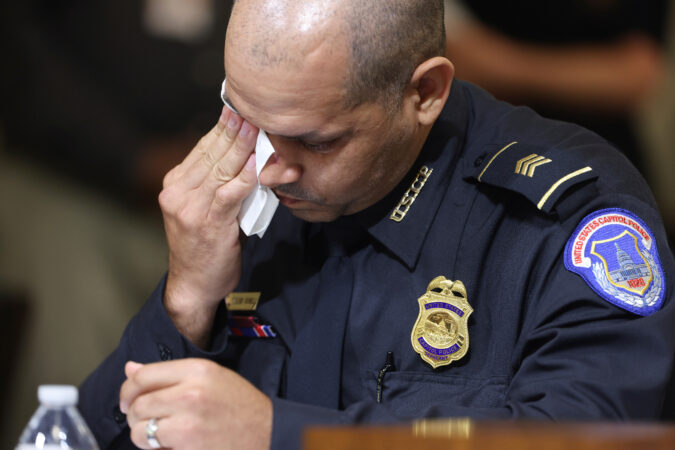
    Hodges and Gonell have been speaking out about their experiences since July 2021, when they testified before the Democratic-led House committee that investigated Jan 6. Since then, they have received support but also backlash.

    At a Republican-led Senate hearing in October on political violence, Hodges testified again as a witness called by Democrats. After Hodges spoke about his experience on Jan. 6, Sen. Peter Welch (D., Vt.) asked the other witnesses whether they supported Trump’s pardons of the rioters, including for those who injured Hodges. Three of the witnesses, all called by Republicans, raised their hands.

    “I don’t know how you would say it wasn’t violent,” says Hodges, who is still a Washington police officer.

    It has not just been politicians or the rioters who have doubted the police. It also is friends and family.

    “My biggest struggle through the years has been the public perception of it,” Eveland said, and navigating conversations with people close to him, including some fellow police officers, who do not think it was a big deal.

    “It’s hard for me to wrap my head around that, but ideology is a pretty powerful thing,” he said.

    Improvements in safety and support

    As police officers struggled in the aftermath, Manger, the former Capitol Police chief, said the department had to figure out how to better support them. There were no wellness or counseling services when he arrived, he said, and they were put in to place.

    “The officers who were there and were in the fight — we needed to make sure that they got the help that they needed,” Manger said.

    Manger, who retired in May, also oversaw major improvements to the department’s training, equipment, operational planning, and intelligence. He said the Capitol is now “a great deal safer” than it was when he arrived.

    “If that exact same thing happened again, they would have never breached the building, they would have never gotten inside, they would have never disrupted the electoral count,” Manger said.

    Pingeon, the former Capitol Police officer, said he believes the department is in many ways “unrecognizable” from what it was on Jan. 6 and when he left several months later.

    “It was a wake-up call,” he said.

    Pressing on

    Pingeon, who was attacked and knocked to the ground as he tried to prevent people from entering the Capitol, said Jan. 6 was part of the reason he left the department and moved home to Massachusetts. He has dealt with his experience by painting images of the Capitol and his time there, as well as advocating for nonviolence. He said he now feels ready to forgive.

    “The real trauma and heartache and everything I endured because of these events, I want to move past it,” he said.

    Gonell left the Capitol Police because of his injuries. He has not returned to service, though he hopes to work again. He wrote a book about his experience, and he said he still has post-traumatic stress disorder related to the attack.

    While many of the officers who were there have stayed quiet about their experiences, Eveland said he decided that it was important to talk publicly about Jan. 6 to try to reach people and “come at it from a logical standpoint.”

    Still, he said, “I’ve had to come to terms with the fact that just because something happened to me and was a major part of my world doesn’t mean that everyone else has to understand that or even be sympathetic to that.”

    He added: “The only thing I can do is tell my story, and hopefully the people who respect me will eventually listen.”
  • Hundreds march in silence to honor victims of Swiss bar fire that left 40 dead

    Hundreds march in silence to honor victims of Swiss bar fire that left 40 dead

    CRANS-MONTANA, Switzerland — Hundreds marched in silence Sunday to honor the victims of the New Year’s Eve fire at a bar in the Swiss Alpine resort of Crans-Montana, which left 40 dead and many severely injured.

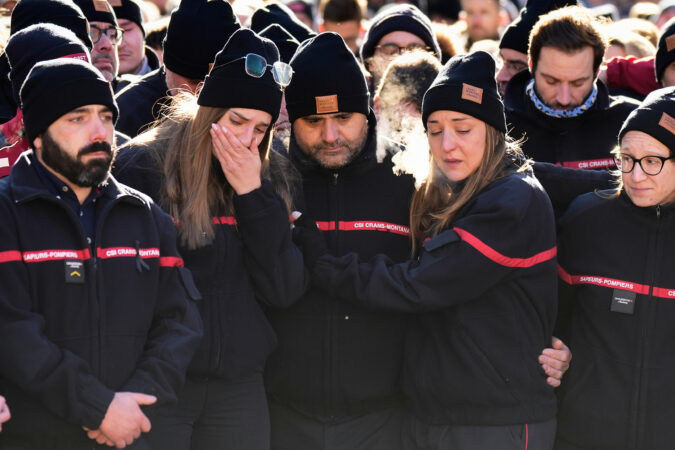
    Somber mourners, many with reddened eyes, filed silently out of the chapel to organ music after the hourlong Mass at the Chapelle Saint-Christophe in Crans-Montana. Some exchanged hugs before marching up a hill to Le Constellation bar.

    Many hundreds of people walked in the dense snaking procession in the bright sunlight past shuttered stores. Up on the mountain overlooking the town, snow machines sent plumes of white flakes into the air.

    At the top of the street, in front of Le Constellation — which is still largely shielded from view by white screens — the swelling crowd stood in near total silence, some weeping.

    Then they broke out into sustained applause for the rescue teams and police who rushed to the scene of horror, their hands in gloves and mittens against the cold. Mourners and well-wishers deposited bouquets at a makeshift memorial piled with flowers, cuddly toys, and other tributes. Some firefighters wiped their eyes too.

    “They went there to party”

    “Through this tragic event, I believe we must all remember that we are all brothers and sisters in humanity,” Véronique Barras, a local resident who knows grieving families, said. “It’s important to support each other, to hug each other, and to move forward towards light.”

    Cathy Premer said her daughter was out celebrating her 17th birthday on New Year’s Eve when she called in the early hours of the morning to say she was stuck because Le Constellation was cordoned off.

    “For the young — but even for adults — it’s hard to understand things that seem inexplicable,” she said. “They went there to party, it’s a destination for Dec. 31, it’s very festive, there were people of many nationalities … and it all turned into a tragedy.”

    In the crowd, Paola Ponti Greppi, an 80-year-old Italian who has a house in Crans-Montana, called for safety checks in bars. “We need more safety in these places because it’s not the only place like this. Why didn’t the town do the proper checks? For me that’s terrible.”

    A Mass for the victims

    During the Mass, the Rev. Gilles Cavin spoke of the “terrible uncertainty” for families unsure if their loved ones are among the dead or still alive among the injured.

    “There are no words strong enough to express the dismay, anguish, and anger of those who are affected in their lives today. And yet, we are here, gathered because silence alone is not enough,” he said.

    In the crowded pews, a grieving woman listened intently, her hands sometimes clasping rosary beads, as speakers delivered readings in German, French, and Italian.

    Forty people died and 119 were injured in the blaze that broke out around 1:30 a.m. on Thursday at Le Constellation bar. Police have said many of the victims were in their teens to mid-20s.

    By Sunday morning, Swiss authorities identified 24 out of the 40 fatalities. They include 18 Swiss citizens — aged as young as 14 — two Italians 16 years old, one dual citizen of Italy and the United Arab Emirates also 16 years old, an 18-year-old Romanian, a 39-year-old French person, and a Turkish citizen, 18.

    A grieving mother

    One of the victims was 16-year-old Arthur Brodard, whose mother had been frantically searching for him.

    “Our Arthur has now left to party in paradise,” a visibly shaken Laetitia Brodard said in a Facebook story posted on Saturday night, speaking to a camera. “We can start our mourning, knowing that he is in peace and in the light.”

    Brodard’s frenzied search for her son reflected the desperation of families of the young people who disappeared during the fire, who did not know whether their loved ones were dead or in the hospital.

    Swiss authorities said the process of identifying victims was particularly hard because of the advanced degree of the burns, requiring the use of DNA samples. Brodard also had given her DNA sample to help in the identification process.

    In her Facebook post, she thanked those who “testified their compassion, their love” and to those who shared information as she anxiously searched and waited for news of her son. Other parents and siblings are still waiting in anguish.

    Bar managers face a criminal investigation

    Swiss authorities have opened a criminal investigation of the bar managers.

    The two are suspected of involuntary homicide, involuntary bodily harm, and involuntarily causing a fire, the Valais region’s chief prosecutor, Beatrice Pilloud, told reporters Saturday. The announcement of the investigation did not name the managers.

    Regional police said Sunday there were no legal grounds so far that would require the managers to be held pending the legal process. They have not been deemed to be a flight risk.

    Investigators have said they believe festive sparkling candles atop Champagne bottles ignited the fire when they came too close to the ceiling of the crowded bar.

    Authorities are looking into whether sound-dampening material on the ceiling conformed with regulations and whether the candles were permitted for use in the bar. The investigation also centers on other safety measures on the premises, including fire extinguishers and escape routes, and whether previous work at the site was up to code.

    “Initial witness accounts cited a fire that spread quickly, generating a lot of smoke and a huge wave of heat,” the police statement Sunday said. “Everything happened very fast.”

    Swiss President Guy Parmelin announced a national day of mourning for the victims on Jan. 9.

    France’s Health Minister Stéphanie Rist said 17 patients have received care in France, out of a total of 35 transferred from Switzerland to five European countries. Other patients were planned to be transferred to Germany, Italy, and Belgium.

  • Tyrese Maxey’s 36 points power the Sixers past the New York Knicks for their third straight win

    Tyrese Maxey’s 36 points power the Sixers past the New York Knicks for their third straight win

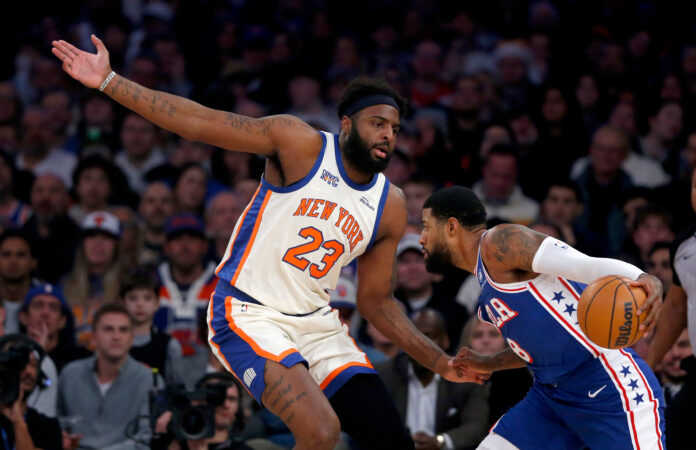
    NEW YORK (AP) — Tyrese Maxey scored 36 points, Joel Embiid and VJ Edgecombe each had 26 and the Philadelphia 76ers beat the New York Knicks 130-119 on Saturday night for their third straight victory.

    Paul George added 15 points and Quentin Grimes had 10 for the Sixers, who won at Madison Square Garden for the second time this season. Embiid also grabbed 10 rebounds.

    Philadelphia extended its streak to 9-0 when Edgecombe started the second quarter with a 3-pointer. Consecutive three-pointers from Anunoby and Jordan Clarkson put the Knicks back in the lead.

    Jalen Brunson scored 31 points for the Knicks, who have lost three straight for the second time this season. Karl-Anthony Towns, who returned after missing one game due to illness, added 23 points and 14 rebounds.

    Deuce McBride scored 20 points, OG Anunoby had 19 and Mikal Bridges added 12 for New York.

    The Knicks were ahead 30-25 when the Sixers scored the final six points of the first quarter and led 31-30.

    Trailing 38-37, the 76ers produced a 9-0 run and grabbed the lead for good. They went ahead by 13 before the Knicks scored the last five points of the second quarter and cut their deficit to 66-58 at halftime.

    Embiid’s two free throws gave Philadelphia its largest lead at 96-77 with 3 minutes, 13 seconds remaining in the third quarter. The Knicks’ 10-3 run pulled them within 99-87 heading into the fourth.

    Towns’ bucket opened the final quarter and his three-point play with 9:59 left brought the Knicks within 103-94.

    The 76ers regained a 15-point lead, but Anunoby’s free throws with 2:08 left got the Knicks within 121-114. However, a Maxey free throw, a layup from Grimes and a a decisive jam from Edgecombe would follow and the Knicks never got any closer.

    Next up for the Sixers is a return to Xfinity Mobile Arena to take on the Denver Nuggets on Monday (8:30 p.m., Peacock).

  • Venezuelans wonder who’s in charge as Trump claims contact with Maduro’s deputy

    Venezuelans wonder who’s in charge as Trump claims contact with Maduro’s deputy

    BUENOS AIRES, Argentina — Venezuelans on Saturday were scrambling to understand who is in charge of their country after a U.S. military operation that captured President Nicolás Maduro.

    President Donald Trump delivered a shocking pick: the United States, perhaps in coordination with one of Maduro’s most trusted aides.

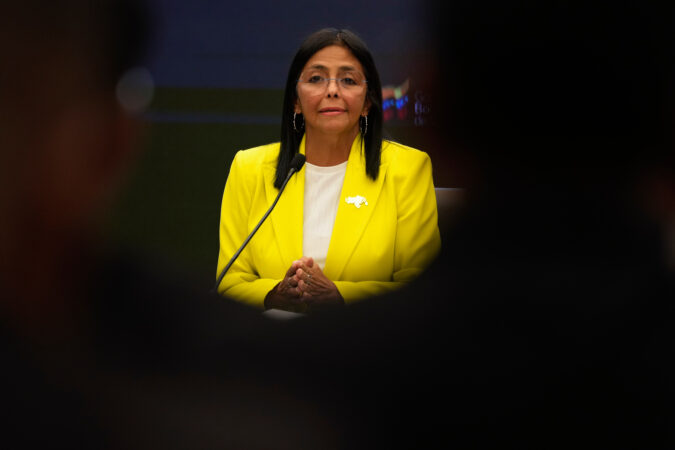
    Delcy Rodríguez has served as Maduro’s vice president since 2018, overseeing much of Venezuela’s oil-dependent economy as well as its feared intelligence service. But she is someone the Trump administration apparently is willing to work with, at least for now.

    “She’s essentially willing to do what we think is necessary to make Venezuela great again,” Trump told reporters of Rodríguez, who faced U.S. sanctions during Trump’s first administration for her role in undermining Venezuelan democracy.

    In a major snub, Trump said opposition leader Maria Corina Machado, who was awarded last year’s Nobel Peace Prize, didn’t have the support to run the country.

    Trump said Rodríguez had a long conversation with Secretary of State Marco Rubio in which Trump claimed she said, “‘We’ll do whatever you need.’”

    “I think she was quite gracious,” Trump added. “We can’t take a chance that somebody else takes over Venezuela that doesn’t have the good of the Venezuelan people in mind.”

    Rodríguez tried to project strength and unity among the ruling party’s many factions, downplaying any hint of betrayal. In remarks on state TV, she demanded the immediate release of Maduro and his wife, Cilia Flores, and denounced the U.S. operation as a flagrant violation of the United Nations charter.

    “There is only one president in this country, and his name is Nicolás Maduro,” Rodríguez said, surrounded by top civilian officials and military commanders.

    There was no immediate sign that the U.S. was running Venezuela.

    “What will happen tomorrow? What will happen in the next hour? Nobody knows,” Caracas resident Juan Pablo Petrone said.

    No sign of a swearing-in

    Trump indicated that Rodríguez had been sworn in already as president of Venezuela, per the transfer of power outlined in the constitution. However, state television has not broadcast any swearing-in ceremony.

    In her televised address, Rodríguez did not declare herself acting president or mention a political transition. A ticker at the bottom of the screen identified her as the vice president. She gave no sign that she would be cooperating with the U.S.

    “What is being done to Venezuela is an atrocity that violates international law,” she said. “History and justice will make the extremists who promoted this armed aggression pay.”

    The Venezuelan constitution also says a new election must be called within a month in the event of the president’s absence.

    But experts have been debating whether the succession scenario would apply here, given the government’s lack of popular legitimacy and the extraordinary U.S. military intervention.

    Venezuelan military officials were quick to project defiance in video messages.

    “They have attacked us but will not break us,” said Defense Minister Gen. Vladimir Padrino López, dressed in fatigues.

    Interior Minister Diosdado Cabello appeared on state TV in a helmet and flak jacket, urging Venezuelans to “trust in the political leadership and military” and “get out on the streets” to defend the country’s sovereignty.

    “These rats attacked and they will regret what they did,” he said of the U.S.

    Strong ties with Wall Street

    A lawyer educated in Britain and France, Rodríguez has a long history of representing the revolution started by the late Hugo Chávez on the world stage.

    She and her brother, Jorge Rodríguez, head of the Maduro-controlled National Assembly, have strong leftist credentials born from tragedy. Their father was a socialist leader who died in police custody in the 1970s, a crime that shook many activists of the era, including a young Maduro.

    Unlike many in Maduro’s inner circle, the Rodríguez siblings have avoided criminal indictment in the U.S. Delcy Rodríguez has developed strong ties with Republicans in the oil industry and on Wall Street who balked at the notion of U.S.-led regime change.

    Among her past interlocutors was Blackwater founder Erik Prince and, more recently, Richard Grenell, a Trump special envoy who tried to negotiate a deal with Maduro for greater U.S. influence in Venezuela.

    Fluent in English, Rodríguez is sometimes portrayed as a well-educated moderate in contrast to the military hard-liners who took up arms with Chávez against Venezuela’s democratically elected president in the 1990s.

    Many of them, especially Cabello, are wanted in the U.S. on drug trafficking charges and stand accused of serious human rights abuses. But they continue to hold sway over the armed forces, the traditional arbiter of political disputes in Venezuela.

    That presents major challenges to Rodríguez asserting authority. But experts say that Venezuela’s power brokers have long had a habit of closing ranks behind their leaders.

    “These leaders have all seen the value of staying united. Cabello has always taken a second seat or third seat, knowing that his fate is tied up with Maduro’s, and now he very well might do that again,” said David Smilde, a sociology professor at Tulane University who has conducted research into Venezuela’s political dynamics over the past three decades.

    “A lot depends on what happened last night, which officials were taken out, what the state of the military looks like now,” Smilde said. ”If it doesn’t have much firepower anymore, they’re more vulnerable and diminished, and it will be easier for her to gain control.”

    An apparent snub of the opposition

    Shortly before Trump’s news conference, Machado, the opposition leader, called on her ally Edmundo González — a retired diplomat widely considered to have won the country’s disputed 2024 presidential election — to “immediately assume his constitutional mandate and be recognized as commander-in-chief.”

    In a triumphant statement, Machado promised that her movement would “restore order, free political prisoners, build an exceptional country and bring our children back home.”

    She added: “Today we are prepared to assert our mandate and take power.”

    Asked about Machado, Trump was blunt: “I think it would be very tough for (Machado) to be the leader,” he said.

    “She doesn’t have the support or respect within the country.”

    Venezuelans expressed shock, with many speculating on social media that Trump had mixed up the two women’s names. Machado has not responded to Trump’s remarks.

  • Iran’s leader says rioters ‘must be put in their place’ as protest death toll reaches at least 10

    Iran’s leader says rioters ‘must be put in their place’ as protest death toll reaches at least 10

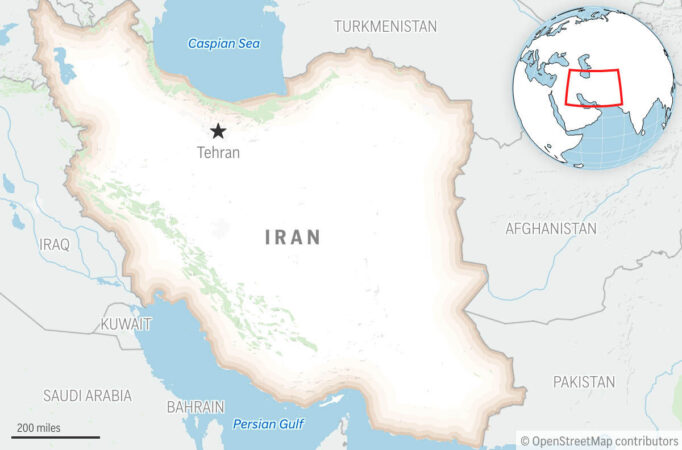
    DUBAI, United Arab Emirates — Iran’s supreme leader insisted Saturday that “rioters must be put in their place” after a week of protests that have shaken the Islamic Republic, likely giving security forces a green light to aggressively put down the demonstrations.

    The first comments by 86-year-old Ayatollah Ali Khamenei come as violence surrounding the demonstrations sparked by Iran’s ailing economy has killed at least 10 people. The protests show no sign of stopping and follow U.S. President Donald Trump warning Iran on Friday that if Tehran “violently kills peaceful protesters,” the United States “will come to their rescue.”

    While it remains unclear how and if Trump would intervene, his comments sparked an immediate, angry response, with officials within the theocracy threatening to target American troops in the Mideast. They also take on new importance after Trump said Saturday that the U.S. military captured Venezuelan President Nicolás Maduro, a longtime ally of Tehran.

    The protests have become the biggest in Iran since 2022, when the death of 22-year-old Mahsa Amini in police custody triggered nationwide demonstrations. However, the protests have yet to be as widespread and intense as those surrounding the death of Amini, who was detained over not wearing her hijab, or headscarf, to the liking of authorities.

    Khamenei makes first comments on protests

    State television aired remarks by Khamenei to an audience in Tehran that sought to separate the concerns of protesting Iranians upset about the collapse of the rial, Iran’s currency, from “rioters.”

    “We talk to protesters, the officials must talk to them,” Khamenei said. “But there is no benefit to talking to rioters. Rioters must be put in their place.”

    He also reiterated a claim constantly made by officials in Iran that foreign powers like Israel or the United States were pushing the protests, without offering any evidence. He also blamed “the enemy” for Iran’s collapsing rial.

    “A bunch of people incited or hired by the enemy are getting behind the tradesmen and shopkeepers and chanting slogans against Islam, Iran, and the Islamic Republic,” he said. ”This is what matters most.”

    Iran’s paramilitary Revolutionary Guard ranks include the all-volunteer Basij force, whose motorcycling-riding members have violently put down protests like the 2009 Green Movement and the 2022 demonstrations. The Guard answers only to Khamenei.

    Hard-line officials within the country are believed to have been pushing for a more aggressive response to the demonstrations as President Masoud Pezeshkian has sought talks to address protesters’ demands.

    But bloody security crackdowns often follow such protests. Protests over a gasoline price hike in 2019 reportedly saw over 300 people killed. A crackdown on the Amini protests of 2022, which lasted for months, killed more than 500 people and saw over 22,000 detained.

    “Iran has no organized domestic opposition; protesters are likely acting spontaneously,” the Eurasia Group said in an analysis Friday. “While protests could continue or grow larger (particularly as Iran’s economic outlook remains dire), the regime retains a large security apparatus and would likely suppress such dissent without losing control of the country.”

    Deaths overnight in protests

    Two deaths overnight into Saturday involved a new level of violence. In Qom, home to the country’s major Shiite seminaries, a grenade exploded, killing a man there, the state-owned IRAN newspaper reported. It quoted security officials alleging the man was carrying the grenade to attack people in the city, some 80 miles south of the capital, Tehran.

    Online videos from Qom purportedly showed fires in the street overnight.

    The second death happened in the town of Harsin, some 230 miles southwest of Tehran. There, the newspaper said, a member of the Basij died in a gun and knife attack in the town in Kermanshah province.

    Demonstrations have reached over 100 locations in 22 of Iran’s 31 provinces, the U.S.-based Human Rights Activists News Agency reported.

    The protests, taking root in economic issues, have heard demonstrators chant against Iran’s theocracy as well. Tehran has had little luck in propping up its economy in the months since its June war with Israel, in which the U.S. also bombed Iranian nuclear sites in Iran.

    Iran recently said it was no longer enriching uranium at any site in the country, trying to signal to the West that it remains open to potential negotiations over its atomic program to ease sanctions. However, those talks have yet to happen as Trump and Israeli Prime Minister Benjamin Netanyahu have warned Tehran against reconstituting its atomic program.

  • Security advisers discuss peace proposals in Ukraine ahead of leaders’ summit

    Security advisers discuss peace proposals in Ukraine ahead of leaders’ summit

    KYIV, Ukraine — National security advisers from Europe and other allies visited Kyiv on Saturday to discuss security guarantees and economic support as a U.S.-led diplomatic push to end the nearly 4-year-old war in Ukraine intensifies.

    President Volodymyr Zelenskyy, preparing to travel to Paris for a meeting with partners, said work on the peace proposals could now accelerate as Ukraine has shared all documents under discussion with the 18 national security advisers, including those on security guarantees.

    “We expect that this further work will now take place in the capitals of European countries as well as Canada, Japan, and other representatives of the Coalition of the Willing,” he said, referring to the approximately 30 countries who support Kyiv’s effort to end the war with Russia on acceptable terms.

    “We are not allocating a great deal of time for this process,” Zelensky added.

    He said representatives from Ukraine’s General Staff and military sector would meet on Monday in Paris, followed by a meeting Tuesday of European leaders, where he said he hoped documents on security guarantees would be finalized. He said there also would be meetings with U.S. representatives in Paris.

    In a briefing earlier in the day, Ukrainian negotiator Oleksandr Bevz said Kyiv is coordinating security guarantee plans with European partners that would include a multilateral framework agreement involving Ukrainian forces as the first line of defense, European-led troops deployed in Ukraine, and U.S. “backstop” support.

    Ukraine’s deputy prime minister, Taras Kachka, said international partners have reached consensus on an economic support package of about $800 billion for Ukraine over the next decade.

    The package, based on calculations by the World Bank, the International Monetary Fund, and the European Union, would cover damage compensation, reconstruction, economic stability, and a $200 billion growth “booster” and is tied to Ukraine’s EU accession reforms.

    Specific funding sources have not been identified, economy minister Oleksii Sobolev said, though roughly $500 billion is expected from public grants and concessional loans, with details to be worked out over the next two weeks.

    Also on Saturday, Zelensky announced further changes to the government, saying he had proposed Denys Shmyhal to become energy minister and first deputy prime minister.

    Shmyhal, who served most recently as defense minister and formerly as Ukraine’s longest-serving prime minister, is well respected. His proposed replacement in defense is Mykhailo Fedorov, who is widely credited with leading the introduction of drone technology into the army in his role as digital transformation minister.

    Zelensky on Friday appointed the head of Ukraine’s military intelligence as his new chief of staff. The president framed the appointment of Gen. Kyrylo Budanov as part of an effort to sharpen the focus on security, defense development, and diplomacy.

    Meanwhile, the death toll from a Russian missile attack on the city of Kharkiv on Friday increased to two, including a 3-year-old boy, Kharkiv regional head Oleh Syniehubov wrote on Telegram.

    An overnight Russian drone attack on the Mykolaiv region targeted critical infrastructure and left some communities without electricity, according to regional head Vitalii Kim. He said engineers spent the night working to restore power and there were no casualties reported.

  • Ouster of Maduro government sparks celebrations among Venezuelans in South Florida

    Ouster of Maduro government sparks celebrations among Venezuelans in South Florida

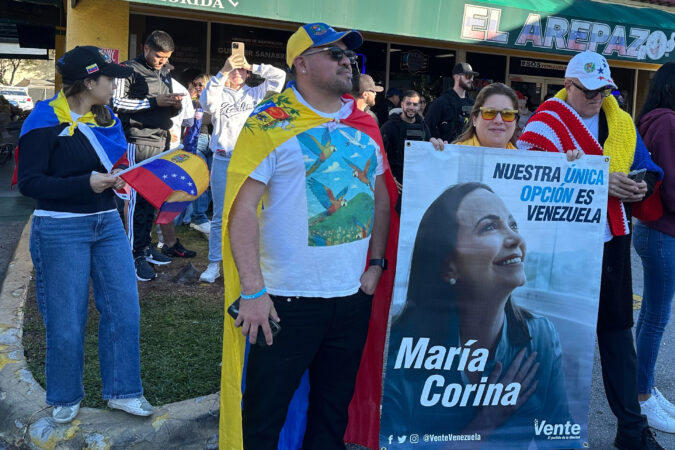
    DORAL, Fla. — Revelers chanted “liberty” and draped Venezuelan flags over their shoulders in South Florida on Saturday to celebrate the American military attack that toppled Nicolás Maduro’s government — a stunning outcome they had longed for but that left them wondering what comes next in their troubled homeland.

    People gathered for a rally in Doral, Fla. — the Miami suburb where President Donald Trump has a golf resort and where roughly half the population is of Venezuelan descent — as word spread that Venezuela’s president had been captured and flown out of the country.

    Outside the El Arepazo restaurant, a hub of the Venezuelan culture of Doral, one man held a piece of cardboard with “Libertad” scrawled with a black marker. It was a sentiment expressed by other native Venezuelans hoping for a new beginning for their home country as they chanted “Liberty! Liberty! Liberty!”

    “We’re like everybody — it’s a combination of feelings, of course,” said Alejandra Arrieta, who came to the U.S. in 1997. “There’s fears. There’s excitement. There’s so many years that we’ve been waiting for this. Something had to happen in Venezuela. We all need the freedom.”

    Trump insisted Saturday that the U.S. government would run the country at least temporarily and was already doing so. The action marked the culmination of an escalating Trump administration pressure campaign on the oil-rich South American nation as well as weeks of planning that tracked Maduro’s behavioral habits.

    About 8 million people have fled Venezuela since 2014, settling first in neighboring countries in Latin America and the Caribbean. After the COVID-19 pandemic, they increasingly set their sights on the United States, walking through the jungle in Colombia and Panama or flying to the U.S. on humanitarian parole with a financial sponsor.

    In Doral, upper-middle-class professionals and entrepreneurs came to invest in property and businesses when socialist Hugo Chávez won the presidency in the late 1990s. They were followed by political opponents and entrepreneurs who set up small businesses. In recent years, more lower-income Venezuelans have come for work in service industries.

    They are doctors, lawyers, beauticians, construction workers, and house cleaners. Some are naturalized U.S. citizens or live in the country illegally with U.S.-born children. Others overstay tourist visas, seek asylum, or have some form of temporary status.

    Niurka Meléndez, who fled her native Venezuela in 2015, said Saturday she’s hopeful that Maduro’s ouster will improve life in her homeland. Meléndez immigrated to New York City, where she co-founded Venezuelans and Immigrants Aid, a group striving to empower the lives of immigrants. She became a steadfast advocate for change in her home country, where she said her countrymen were “facing a humanitarian crisis.”

    She hopes those hardships will end as a result of American intervention.

    “For us, it’s just the start of the justice we need to see,” Meléndez said in a phone interview.

    Her homeland had reached a “breaking point” due to forced displacements, repression, hunger, and fear, she said. She called for international humanitarian support to help in Venezuela’s recovery.

    “Removing an authoritarian system responsible for these crimes creates the possibility, not a guarantee, but a possibility, for recovery,” she said. “A future without criminal control over institutions is the minimum condition for rebuilding a country based on justice, rule of law, and democratic safeguards.”

  • Wisconsin judge convicted of obstructing arrest of immigrant resigns as GOP threatens impeachment

    Wisconsin judge convicted of obstructing arrest of immigrant resigns as GOP threatens impeachment

    Embattled Wisconsin Judge Hannah Dugan, who was convicted of obstruction last month for helping an immigrant evade federal officers, has sent her resignation letter to the governor.

    The letter was sent Saturday. Republicans had been making plans to impeach her ever since her Dec. 19 conviction. A spokesperson for Gov. Tony Evers, a Democrat, said his office received Dugan’s letter, and he would work to fill the vacancy without delay.

    Dugan wrote that over the past decade she handled thousands of cases with “a commitment to treat all persons with dignity and respect, to act justly, deliberately and consistently, and to maintain a courtroom with the decorum and safety the public deserves.”

    But she said the case against her is too big of a distraction.

    “As you know, I am the subject of unprecedented federal legal proceedings, which are far from concluded but which present immense and complex challenges that threaten the independence of our judiciary. I am pursuing this fight for myself and for our independent judiciary,” Dugan said in her letter.

    Last April, federal prosecutors accused Dugan of distracting federal officers trying to arrest a Mexican immigrant outside her courtroom and leading the man out through a private door. A federal jury convicted her of felony obstruction.

    The case against Dugan was highlighted by President Donald Trump as he pressed ahead with his sweeping immigration crackdown. Democrats insisted the administration was trying to make an example of Dugan to blunt judicial opposition to the operation.

    Republican Wisconsin assembly Speaker Robin Vos praised Dugan’s decision.

    “I’m glad Dugan did the right thing by resigning and followed the clear direction from the Wisconsin Constitution,” Vos said.

    Democrat Ann Jacobs, who is chairperson of the Wisconsin Elections Commission board, said she agreed with Dugan that Milwaukee should have a permanent judge in place while this fight plays out.

    “Despite her situation, she is ever the champion of justice, wanting to remove the judiciary from a political battle over her fate. I’m sure this is terribly hard for her but she is true to her faith and her principles,” Jacobs said in a post on X.

    On April 18, immigration officers went to the Milwaukee County courthouse after learning 31-year-old Eduardo Flores-Ruiz had reentered the country illegally and was scheduled to appear before Dugan for a hearing in a state battery case.

    Dugan confronted agents outside her courtroom and directed them to the office of her boss, Milwaukee County Chief Judge Carl Ashley, because she told them their administrative warrant wasn’t sufficient grounds to arrest Flores-Ruiz.

    After the agents left, she led Flores-Ruiz and his attorney out a private jury door. Agents spotted Flores-Ruiz in the corridor, followed him outside, and arrested him after a foot chase. The U.S. Department of Homeland Security announced in November he had been deported.

  • Trump says U.S. has captured Venezuelan President Nicolás Maduro, will run the country

    Trump says U.S. has captured Venezuelan President Nicolás Maduro, will run the country

    CARACAS, Venezuela — The United States captured Venezuelan President Nicolás Maduro and flew him out of the country in an extraordinary military operation early Saturday that plucked a sitting leader from office. President Donald Trump insisted the U.S. government would run the country at least temporarily and would tap Venezuelan’s vast oil reserves to sell “large amounts” to other countries.

    The action marked the culmination of an escalating Trump administration pressure campaign on the South American country that consisted of months of strikes on boats officials said were smuggling drugs to the U.S. Behind the scenes, U.S. officials tracked Maduro’s behavioral habits, including what he ate and where he slept, in preparing to execute an operation that resulted in one of the more stunning regime changes in modern history.

    Maduro and his wife, seized overnight from their home on a military base, were aboard a U.S. warship on their way to New York, where they were to face criminal charges in connection with a Justice Department indictment accusing them of a role in narco-terrorism conspiracy.

    Trump said the U.S. planned to run Venezuela until a transition of power can take place. He claimed the American presence was already in place, though there were no immediate signs the U.S. was running the country. Venezuelan state TV continued to air pro-Maduro propaganda, broadcasting live images of supporters taking to the streets in Caracas in protest.

    Trump claimed that Venezuelan vice president Delcy Rodríguez had been sworn in as president shortly before he spoke to reporters and added she had spoken with Secretary of State Marco Rubio.

    “She is essentially willing to do what we think is necessary to make Venezuela great again. Very simple,” Trump said.

    Earlier, opposition leader María Corina Machado said that the opposition candidate Edmundo González should assume power, saying that he rightfully won the 2024 presidential election.

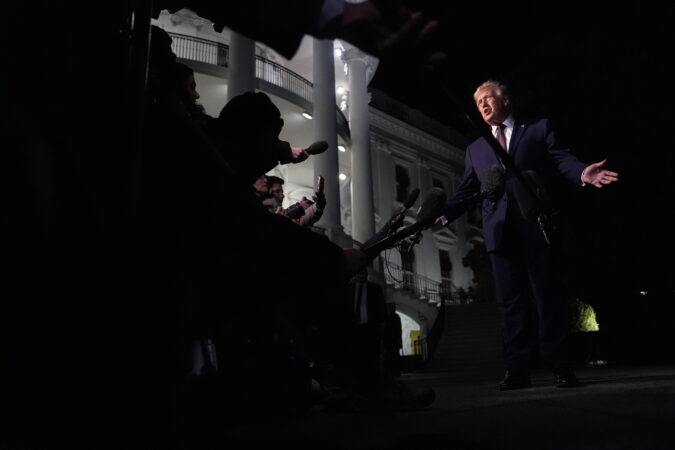
    “We’re going to run the country until such time as we can do a safe, proper and judicious transition,” Trump said at a Mar-a-Lago news conference where he boasted that this “extremely successful operation should serve as warning to anyone who would threaten American sovereignty or endanger American lives.”

    The legal authority for the attack, which echoed the 1990 U.S. invasion of Panama that led to the surrender and seizure of leader Manuel Antonio Noriega, was not immediately clear. The U.S. government does not recognize Maduro, who last appeared on state television Friday while meeting with a delegation of Chinese officials in Caracas.

    Maduro and other Venezuelan officials were indicted in 2020 on “narco-terrorism” conspiracy charges, but the Justice Department released a new indictment Saturday of Maduro and his wife, Cilia Flores, that described the regime as a “corrupt, illegitimate government” fueled by a drug trafficking operation that flooded the U.S with cocaine.

    Trump posted on his Truth Social account a photo that he said showed Maduro in custody, blindfolded and wearing a sweatsuit.

    Early morning attack

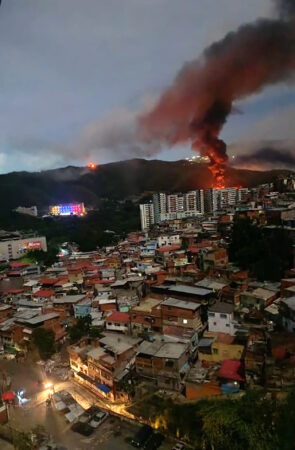
    Early Saturday, multiple explosions rang out and low-flying aircraft swept through the Venezuelan capital. Maduro’s government accused the United States of attacking civilian and military installations, calling it an “imperialist attack” and urging citizens to take to the streets.

    The attack lasted less than 30 minutes and the explosions — at least seven blasts — sent people rushing into the streets, while others took to social media to report what they’d seen and heard. Some Venezuelan civilians and members of the military were killed, said Vice President Delcy Rodríguez, without giving a number. Trump said some U.S. forces were injured in Venezuela but none were killed.

    “We think, we develop, we train, we rehearse, we debrief, we rehearse again, and again. not to get it right, but to ensure we cannot get it wrong,” said Dan Caine, the chairman of the Joint Chiefs of Staff.

    Video obtained from Caracas and an unidentified coastal city showed tracers and smoke clouding the landscape as repeated muted explosions illuminated the night sky. Other footage showed cars passing on a highway as blasts illuminated the hills behind them. The videos were verified by the Associated Press.

    Smoke was seen rising from the hangar of a military base in Caracas, while another military installation in the capital was without power.

    Venezuelan ruling party leader Nahum Fernández told the Associated Press that Maduro and Flores were at their home within the Fort Tiuna military installation when they were captured.

    “That’s where they bombed,” he said. “And, there, they carried out what we could call a kidnapping of the president and the first lady of the country.”

    The strike followed a monthslong Trump administration pressure campaign on the Venezuelan leader, including a major buildup of American forces in the waters off South America and attacks on boats in the eastern Pacific and Caribbean accused of carrying drugs. Last week, the CIA was behind a drone strike at a docking area believed to have been used by Venezuelan drug cartels — the first known direct operation on Venezuelan soil since the U.S. began strikes in September.

    As of Friday, the number of known boat strikes was 35 and the number of people killed at least 115, according to the Trump administration. Trump said that the U.S. is engaged in an “armed conflict” with drug cartels and has justified the boat strikes as a necessary to stem the flow of drugs into the U.S.

    Maduro has decried the U.S. military operations as a thinly veiled effort to oust him from power.

    Some streets in Caracas fill up

    Venezuela’s ruling party has held power since 1999, when Maduro’s predecessor Hugo Chávez took office, promising to uplift poor people and later to implement a self-described socialist revolution.

    Maduro took over when Chávez died in 2013. His 2018 reelection was widely considered a sham because the main opposition parties were banned from participating. During the 2024 election, ruling party-loyal electoral authorities declared him the winner hours after polls closed, but the opposition gathered overwhelming evidence that he lost by a more than 2-to-1 margin.

    In a demonstration of how polarizing a figure Maduro is, people variously took to the streets to deplore his capture and celebrate it.

    At a protest in the Venezuelan capital, Caracas Mayor Carmen Meléndez joined a crowd demanding Maduro’s return.

    “Maduro, hold on, the people are rising up!” the crowd chanted. “We are here, Nicolás Maduro. If you can hear us, we are here!”

    Earlier, armed people and uniformed members of a civilian militia took to the streets of a Caracas neighborhood long considered a stronghold of the ruling party.

    In other parts of the city, the streets remained empty hours after the attack, as residents absorbed events. Some areas remained without power, but vehicles moved freely.

    “How do I feel? Scared, like everyone,” said Caracas resident Noris Prada, who sat on an empty avenue looking down at his phone. “Venezuelans woke up scared, many families couldn’t sleep.”

    In the Chilean capital of Santiago, people waved Venezuelan flags and banged pots and pans as vehicles passed by honking at them.

    Questions of legality

    The Armed Services committees in both houses of Congress, which have jurisdiction over military matters, had not been notified by the administration of any actions, according to a person familiar with the matter and granted anonymity to discuss it.

    Lawmakers from both political parties in Congress have raised deep reservations and flat-out objections to the U.S. attacks on boats suspected of drug smuggling near the Venezuelan coast, and Congress has not specifically approved an authorization for the use of military force for such operations in the region.

    Connecticut Rep. Jim Himes, the top Democrat on the House Intelligence Committee, said he had seen no evidence that would justify Trump striking Venezuela without approval from Congress and demanded an immediate briefing by the administration on “its plan to ensure stability in the region and its legal justification for this decision.”

    Deputy Secretary of State Christopher Landau said the military action and seizure of Maduro marks “a new dawn for Venezuela,” saying that “the tyrant is gone.” He posted on X hours after the strike. His boss, Rubio, reposted a post from July that said Maduro “is NOT the President of Venezuela and his regime is NOT the legitimate government.”

    Cuba, a supporter of the Maduro government and a longtime adversary of the United States, called for the international community to respond to what President Miguel Díaz-Canel Bermúdez called “the criminal attack.”

    “Our zone of peace is being brutally assaulted,” he said on X. Iran’s Foreign Ministry also condemned the strikes.

  • With capture of Maduro, Trump claims successful operation as he treads into uncharted territory

    With capture of Maduro, Trump claims successful operation as he treads into uncharted territory

    WASHINGTON — With the capture of Venezuela’s Nicolás Maduro, President Donald Trump and his allies are calling the audacious military operation a major success as the U.S. leader once again demonstrated a willingness to use U.S. forces for risky missions that come with a potential big payoff.

    The operation has ousted a South American strongman blasted by Trump’s administration as an “illegitimate” dictator and a “narco-terrorist,” a scourge responsible for a steady of stream of illegal drugs poisoning U.S. and Europe.

    “It was a brilliant operation, actually,” Trump told the New York Times shortly after U.S. forces were cleared from Venezuelan airspace. He later added in an appearance on Fox & Friends that some U.S. troops were injured in the strike but none were killed.

    But the path ahead could certainly be treacherous as the White House faces a series of difficult questions.

    Who will fill the power vacuum now that Maduro is gone? How do you maintain stability in a country that’s already endured years of hyperinflation, food and medicine shortages and brain drain despite its vast oil wealth?

    What lessons will U.S. adversaries take from Trump’s decision to demonstrate American might in its sphere of influence as China’s Xi Jinping vows to annex the self-ruled island of Taiwan and Russia’s Vladimir Putin has designs on neighbor Ukraine and diminishing NATO’s eastern flank?

    Trump takes a big risk

    The operation to remove Maduro certainly marks another big moment for Trump’s foreign policy in his second term, as he hasn’t shied away from flexing U.S. military might even as he has vowed to keep America out of war.

    Trump has now twice used U.S. forces to carry out risky operations against American adversaries. In June, he directed U.S. strikes on key Iranian nuclear sites.

    Saturday’s action stirred fresh anxiety in capitals around the world that have sought to adjust to a new normal in Trump 2.0, where the idea of the U.S. trying to find global consensus on issues of war and peace is now passe. On Friday, Trump issued a new threat to Iran that if it “violently kills peaceful protesters” — in protests sparked by the collapse of Iran’s currency — the United States “will come to their rescue.”

    With the Venezuela operation, Trump followed through on a promise, spelled out in his National Security Strategy published last month, to assert U.S. dominance in the Western Hemisphere.

    More questions than answers

    Retired Navy Rear Adm. Mark Montgomery said the immediate path ahead for Trump in Venezuela could be more difficult to navigate than what he faced after the Iran strikes.

    “Unlike the [Iran] strikes where Trump did the action and then said ‘fights over,’ he will not have that luxury here in Venezuela,” said Montgomery, an analyst at the Foundation for Defense of Democracies, a hawkish think tank in Washington. “He needs to stay engaged in Venezuela to make sure that Maduro’s cronies — equally guilty of any crime he is — are also pushed out of power, and they may want to stay and fight as they don’t have too many places to run.”

    What’s next for Venezuela?

    European allies had expressed concern as Trump built up a massive presence of troops in the Caribbean in recent months and carried out dozens of lethal strikes on suspected drug smugglers — many that the administration claimed were effectively an arm of the Maduro government.

    Maduro was hardly viewed as a choir boy by the international community. His 2018 and 2024 elections were seen as riddled with irregularities and viewed as illegitimate.

    But many U.S. allies greeted news of Maduro’s capture with a measure of trepidation.

    European Commission President António Costa said he had “great concern” about the situation in Venezuela following the U.S. operation.

    “The EU has repeatedly stated that Mr Maduro lacks legitimacy and has defended a peaceful transition,” European Union foreign policy chief Kaja Kallas added on X. “Under all circumstances, the principles of international law and the UN Charter must be respected. We call for restraint.”

    France’s Foreign Minister Jean-Noël Barrot said “the military operation that led to the capture of Maduro infringes the principle of the non-use of force that underpins international law.”

    “France recalls that no lasting political solution can be imposed from outside and that sovereign peoples alone decide their future,” he said in a statement posted on X.

    The criticism from some Democrats over Trump’s military action to oust Maduro was immediate.

    “This war is illegal, it’s embarrassing that we went from the world cop to the world bully in less than one year.” Sen. Ruben Gallego of Arizona wrote on X. “There is no reason for us to be at war with Venezuela.”

    Russia’s Foreign Ministry condemned what it called a U.S. “act of armed aggression” against Venezuela in a statement posted on its Telegram channel Saturday. The ouster of Maduro, who was backed by the Russians, comes as Trump is urging Putin to end his nearly four-year brutal war on Ukraine.

    “Venezuela must be guaranteed the right to determine its own destiny without any destructive, let alone military, outside intervention,” the statement said.

    Similarly, China’s foreign ministry in a statement condemned the U.S. operation, saying it violates international law and Venezuela’s sovereignty.

    Capture follows months of pressure

    The operation was the culmination of a push inside the administration led by Secretary of State Marco Rubio and other like-minded foes of Maduro who have been urging Trump to take action against the Venezuelan leader for years dating back to Trump’s first administration.

    In South Florida — the epicenter of the Venezuelan diaspora opposition to Maduro that has influenced Rubio’s thinking — Saturday’s operation was cheered as an era-changing moment for democracy.

    Rep. Carlos Gimenez, a Florida Republican, said he had spoken to Rubio and thanked Trump for having “changed the course of history in our hemisphere. Our country & the world are safer for it,” he wrote on X, comparing Maduro’s ouster to the fall of the Berlin Wall.

    Maduro had sought a pathway to exit from power, while saving face.

    Venezuelan government officials had floated a plan in which Maduro would eventually leave office, the Associated Press reported in October.

    The proposal, which was rejected by the White House, called for Maduro to step down in three years and hand over to his vice president, Delcy Rodriguez, who would complete Maduro’s six-year term that ends in January 2031. Rodriguez would not run for reelection under the plan.

    But the White House had rejected the proposal because the administration questioned the legitimacy of Maduro’s rule and accused him of overseeing a narco-terrorist state.

    Maduro earlier this week said Venezuela was open to negotiating an agreement with the United States to combat drug trafficking and work with Washington on promoting U.S. further investment in the Venezuelan oil industry.

    But Trump for months has insisted that Maduro’s days in power were numbered.

    Shorty after Trump announced Maduro’s capture, the White House posted video on one of its social media accounts of Trump in October explicitly telling reporters that Maduro was feeling pressure from the U.S. campaign and trying to cut a deal.

    “He doesn’t want to f— around with the United States,” Trump said.

    Elliot Abrams, who served as U.S. special representative for Iran and Venezuela in the first Trump administration, said the president now must decide how invested his administration will be in shaping the next government in Caracas. Venezuela’s opposition says the rightful president is the exiled politician Edmundo González.

    “I think the real question is whether Trump will claim victory and be satisfied with Delcy Rodriguez making some promises or engaging in negotiations,” Abrams said. “Or will he insist on Gonzalez.”

    Trump in an appearance on Fox & Friends on Saturday morning said he wasn’t ready to commit to a certain leader but pledged his administration would be “very involved” in Venezuela.

    “We can’t take a chance of letting somebody else run it — just take over where [Maduro] left,” Trump said.