Category: Associated Press

  • Viral ‘6-7’ tops a 2025 list of overused words and phrases

    Viral ‘6-7’ tops a 2025 list of overused words and phrases

    Respondents to an annual Michigan college survey of overused and misused words and phrases say 6-7 is cooked and should come to a massive full-stop heading into the new year.

    Those are among the top 10 words on the 50th annual “Banished Words List,” released Thursday by Lake Superior State University in Sault Ste. Marie, Mich.

    The tongue-in-cheek roundup of overused slang started in 1976 as a New Year’s Eve party idea and is affectionately called the list of “Queen’s English for Mis-use, Over-use and General Uselessness.”

    Around 1,400 submissions came from all 50 states and a number of countries outside the U.S., including Uzbekistan, Brazil, and Japan, according to Lake Superior State.

    Also in the top 10 are demure, incentivize, perfect, gift/gifted, my bad, and reach out. My bad and reach out also made the list decades ago — in 1998 and 1994, respectively.

    “The list definitely represents the fad and vernacular trends of the younger generation,” said David Travis, Lake Superior State University president.

    “Social media allows a greater opportunity to misunderstand or misuse words,” Travis said. “We’re using terms that are shared through texting, primarily, or through posting with no body language or tone context. It’s very easy to misunderstand these words.”

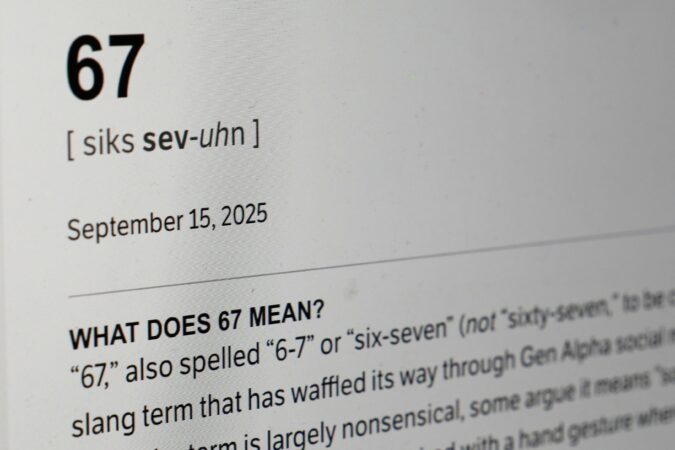
    Few phrases in 2025 befuddled parents, teachers and others over the age of, say 40, more than 6-7. Dictionary.com even picked it as its 2025 word of the year. Merriam Webster chose slop, and Oxford University Press picked rage bait.

    But what does 6-7 actually mean? It exploded over the summer, especially among Gen Z, and is considered by many to be nonsensical in meaning — an inside joke driven by social media.

    “Don’t worry, because we’re all still trying to figure out exactly what it means,” the dictionary’s editors wrote.

    Each number can be spoken aloud as “six, seven.” They even can be combined as the number 67; at college basketball games, some fans explode when a team reaches that point total.

    The placement of 6-7 at the top of the banished list puts it in good company. In 2019, the centuries-old Latin phrase quid pro quo was the top requested phrase to ban from popular use. In 2017, fake news got the most votes.

    Alana Bobbitt, a 19-year-old sophomore at the University of Michigan in Ann Arbor, is unapologetic about using 6-7.

    “I find joy in it,” Bobbitt said. “It’s a little bit silly, and even though I don’t understand what it means, it’s fun to use.”

    Jalen Brezzell says that a small group of his friends use 6-7 and that it comes up a couple of times each week. But he won’t utter it.

    “Never. I don’t really get the joke,” said Brezzell, a 19-year-old sophomore at the University of Michigan-Dearborn. “I don’t see what’s funny about it.”

    But banning it, even in jest, might be a bit of a stretch, he said, adding that he does use other words and phrases on the list.

    “I’ve always used the word cooked,” Brezzell said. ”I just think it got popular on the internet over this past year. It’s saying, like, ‘give it up, it’s over.’”

    Some of the phrases do have longevity, Travis said.

    “I don’t think they’ll ever go away, like ‘at the end of the day,’” he said. “I used ‘my bad’ today. I feel comfortable using it. I started using it when I was young. A lot of us older people are still using it.”

    Travis said that while some terms on the list “will stick around in perpetuity,” others will be fleeting.

    “I think 6-7, next year, will be gone,” he said.
  • NYC’s Mamdani sworn in on a Quran full of symbolism

    NYC’s Mamdani sworn in on a Quran full of symbolism

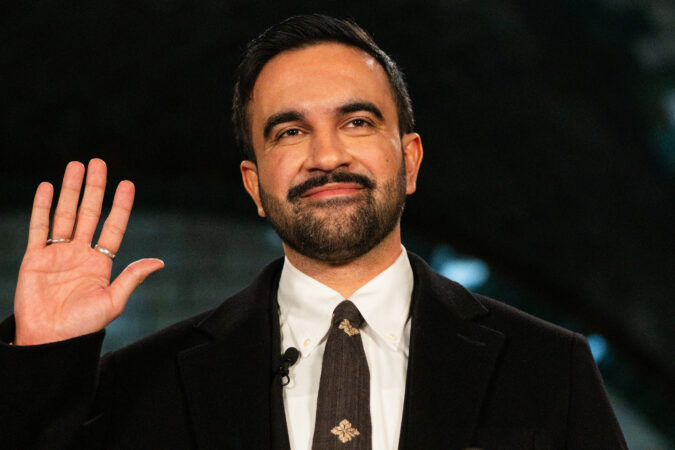
    NEW YORK — Incoming Mayor Zohran Mamdani took his midnight oath of office on a centuries-old Quran, marking the first time a mayor of New York City used Islam’s holy text to be sworn in and underscoring a series of historic firsts for the city.

    Mamdani, a 34-year-old Democrat, became mayor in a long-closed subway station beneath City Hall, the first Muslim, first South Asian, and first African-born person to hold that position.

    These milestones — as well as the historical Quran — reflect the longstanding and vibrant Muslim residents of the nation’s most populous city, according to a scholar who helped Mamdani’s wife, Rama Duwaji, select one of the books.

    Most of Mamdani’s predecessors were sworn in on a Bible, although the oath to uphold the federal, state, and city constitutions does not require the use of any religious text.

    And while he has focused heavily on the issue of affordability during his campaign, Mamdani was outspoken about his Muslim faith. He frequently appeared at mosques across the five boroughs as he built a base of support that included many first-time South Asian and Muslim voters.

    This photo provided by the New York Public Library shows the Schomburg Quran.

    A look at the three Qurans that Mamdani used

    Two Qurans were to be used during the subway ceremony: his grandfather’s Quran and a pocket-sized version that dates to the late 18th or early 19th century. It is part of the collection at the New York Public Library’s Schomburg Center for Research in Black Culture.

    That copy of the Quran symbolizes the diversity and reach of the city’s Muslims, said Hiba Abid, the library’s curator for Middle Eastern and Islamic Studies.

    “It’s a small Quran, but it brings together elements of faith and identity in New York City history,” Abid said.

    For a subsequent swearing-in ceremony at City Hall on the first day of the year, Mamdani used both his grandfather’s and grandmother’s Qurans. The campaign hasn’t offered more details on those heirlooms.

    One Quran’s long journey to Mamdani’s hand

    The manuscript was acquired by Arturo Schomburg, a Black Puerto Rican historian whose collection documented the global contributions of people of African descent. While it is unclear how Schomburg came into possession of the Quran, scholars believe it reflected his interest in the historical relationship between Islam and Black cultures in the United States and across Africa.

    Unlike ornate religious manuscripts associated with royalty or elites, this copy of the Quran is modest in design. It has a deep red binding with a simple floral medallion and is written in black and red ink. The script is plain and readable, suggesting it was created for everyday use rather than ceremonial display.

    Those features indicate the manuscript was intended for ordinary readers, Abid said, a quality she described as central to its meaning.

    “The importance of this Quran lies not in luxury, but in accessibility,” she said.

    Because the manuscript is undated and unsigned, scholars relied on its binding and script to estimate when it was produced, placing it sometime in the late 18th or early 19th century during the Ottoman period in a region that includes what is now Syria, Lebanon, Israel, the Palestinian territories and Jordan.

    Abid said the manuscript’s journey to New York mirrors Mamdani’s own layered background. Mamdani is a South Asian New Yorker who was born in Uganda, and Duwaji is American-Syrian.

    Identity and controversy

    The meteoric rise of a Muslim democratic socialist also brought a surge of Islamophobic rhetoric, amplified by national attention on the race.

    In an emotional speech days before the election, Mamdani said the hostility had only strengthened his resolve to be visible about his faith.

    “I will not change who I am, how I eat, or the faith that I’m proud to call my own,” he said. “I will no longer look for myself in the shadows. I will find myself in the light.”

    The decision to use a Quran has drawn fresh criticism from some conservatives. U.S. Sen. Tommy Tuberville of Alabama, a Republican, wrote on social media, “The enemy is inside the gates,” in response to a news article about Mamdani’s inauguration. The Council on American-Islamic Relations, a civil-rights group, has designated Tuberville as an anti-Muslim extremist based on past statements.

    Such backlash is not new. In 2006, Keith Ellison, a Democrat from Minnesota who was the first Muslim elected to Congress, faced condemnation from conservatives after he chose to use a Quran for his ceremonial oath.

    Following the inauguration, the Quran will go on public display at the New York Public Library. Abid said she hopes attention surrounding the ceremony — whether supportive or critical — will prompt more people to explore the library’s collections documenting Islamic life in New York, ranging from early 20th century Armenian and Arabic music recorded in the city to firsthand accounts of Islamophobia after the Sept. 11 attacks.

    “This manuscript was meant to be used by ordinary readers when it was produced,” Abid said. “Today it lives in a public library where anyone can encounter it.”

  • About 40 people dead and 115 injured in fire at Swiss Alpine bar during New Year’s celebration

    About 40 people dead and 115 injured in fire at Swiss Alpine bar during New Year’s celebration

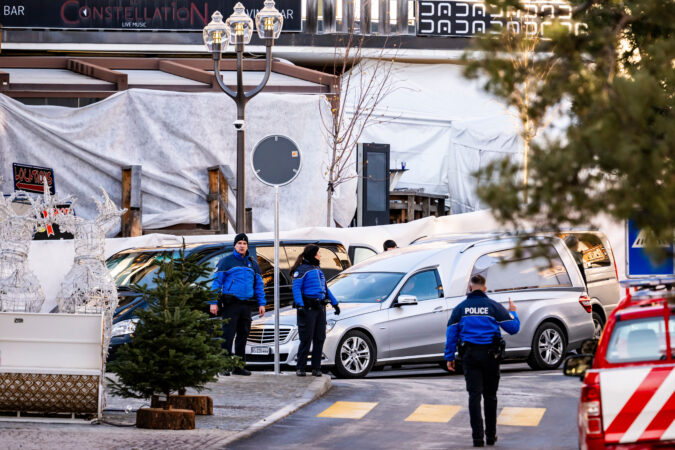
    CRANS-MONTANA, Switzerland — About 40 people were killed and another 115 injured, most of them seriously, after a fire ripped through a bar’s New Year celebration in a Swiss Alpine resort less than two hours after midnight Thursday, police said.

    Authorities did not immediately have an exact count of the deceased.

    The Crans-Montana resort is best known as an international ski and golf venue, and overnight, its crowded Le Constellation bar morphed from a scene of revelry into the site of one of Switzerland’s worst tragedies.

    Valais Canton police commander Frédéric Gisler said during a news conference that work is underway to identify the victims and inform their families, adding that the community is “devastated.”

    Beatrice Pilloud, Valais Canton attorney general, said it was too early to determine the cause of the fire. Experts have not yet been able to go inside the wreckage.

    “At no moment is there a question of any kind of attack,” Pilloud said.

    She later said the number of people who were in the bar is “currently totally unknown,” adding that its maximum capacity will be part of the investigation.

    “For the time being, we don’t have any suspect,” she added, when asked if anyone had been arrested over the fire. “An investigation has been opened, not against anyone, but to illuminate the circumstances of this dramatic fire.”

    Gisler said the priority until further notice would be identifying the victims, and added that “this work will have to take several days.”

    An evening of celebration turns tragic

    Axel Clavier, a 16-year-old from Paris who survived the blaze, described “total chaos” inside the bar. One of his friends died and “two or three” were missing, he told The Associated Press.

    He said he hadn’t seen the fire start, but did see waitresses arrive with Champagne bottles with sparklers, he said.

    Clavier said he felt like he was suffocating and initially hid behind a table, then ran upstairs and tried to use a table to break a Plexiglas window. It fell out of its casing, allowing him to escape.

    He lost his jacket, shoes, phone and bank card while fleeing, but “I am still alive and it’s just stuff.”

    “I’m still in shock,” he added.

    Two women told French broadcaster BFMTV they were inside when they saw a male bartender lifting a female bartender on his shoulders as she held a lit candle in a bottle. The flames spread, collapsing the wooden ceiling, they told the broadcaster.

    One of the women described a crowd surge as people frantically tried to escape from a basement nightclub up a narrow flight of stairs and through a narrow door.

    Another witness speaking to BFMTV described people smashing windows to escape the blaze, some gravely injured, and panicked parents rushing to the scene in cars to see whether their children were trapped inside. The young man said he saw about 20 people scrambling to get out of the smoke and flames and likened what he saw to a horror movie as he watched from across the street.

    Officials described how the blaze likely triggered the release of combustible gases that ignited violently and caused what English-speaking firefighters call a flashover or backdraft.

    “This evening should have been a moment of celebration and coming together, but it turned into a nightmare,” said Mathias Reynard, head of the regional government of the Valais Canton.

    The injured were so numerous that the intensive care unit and operating theater at the regional hospital quickly hit full capacity, Reynard said.

    Crans-Montana is less than 5 kilometers (3 miles) from Sierre, where 28 people, including many children, were killed when a bus from Belgium crashed inside a Swiss tunnel in 2012.

    Resort town sits in the heart of the Alps

    In a region busy with tourists skiing on the slopes, the authorities have called on the local population to show caution in the coming days to avoid any accidents that could require medical resources that are already overwhelmed.

    With high-altitude ski runs rising around 3,000 meters (nearly 9,850 feet) in the heart of the Valais region’s snowy peaks and pine forests, Crans-Montana is one of the top venues on the World Cup circuit. The resort will host the best men’s and women’s downhill racers, including Lindsey Vonn, for their final events before the Milan-Cortina Olympics in February. The town’s Crans-sur-Sierre golf club stages the European Masters each August on a picturesque course.

    The Swiss blaze on Thursday came 25 years after an inferno in the Dutch fishing town of Volendam on New Year’s Eve, which killed 14 people and injured more than 200 as they celebrated in a cafe.

    Swiss President Guy Parmelin, speaking on his first day in office, said many emergency staff had been “confronted by scenes of indescribable violence and distress.”

    “This Thursday must be the time of prayer, unity and dignity,” he said. “Switzerland is a strong country not because it is sheltered from drama, but because it knows how to face them with courage and a spirit of mutual help.”

  • Penn beats NJIT, 80-61, as AJ Levine comes up with seven steals

    Penn beats NJIT, 80-61, as AJ Levine comes up with seven steals

    Michael Zanoni scored 23 points Wednesday to lift Penn to an 80-61 victory against New Jersey Institute of Technology at the Palestra.

    AJ Levine posted seven steals for Penn, which put the game away with a 17-0 run early in the second half. Levin’s seven steals were the most by a Quakers player since Ibby Jaaber had seven against Navy on Dec. 7, 2006.

    Zanoni made 8 of 15 shots including 5 of 11 from beyond the arc for the Quakers (7-6). Levine scored 19 points and added five rebounds. Augustus Gerhart made 6 of 8 shots and finished with 16 points, adding nine rebounds.

    David Bolden tallied 18 points to lead the Highlanders (5-10).

    The Quakers will begin Ivy League play on Monday at 7 p.m. in a road game against Princeton.

  • Drummers pound in the new year as others mark 2026 with defiance or hope

    Drummers pound in the new year as others mark 2026 with defiance or hope

    MELBOURNE, Australia — From Paris to Dubai to Sydney, crowds began ringing in the new year with exuberant celebrations filled with thunderous fireworks or drumming, while others took a more subdued approach.

    A countdown to midnight was projected onto the Arc de Triomphe in Paris and Russians celebrated in snowy Moscow. In Japan, temple bells rang and some climbed mountains to see the year’s first sunrise and a light show with somersaulting jet skis twinkled in Dubai.

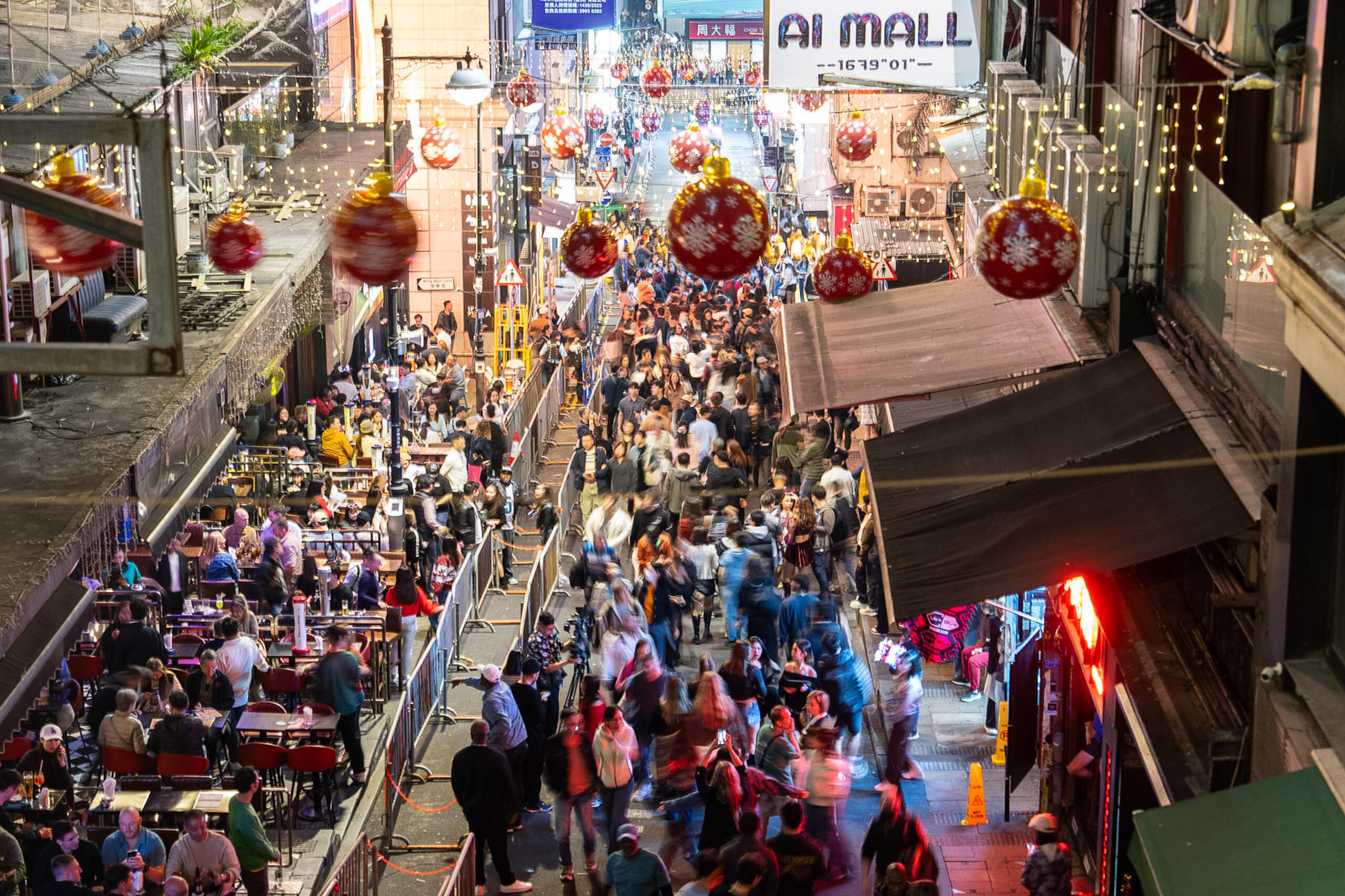
    Other events were more subdued. Hong Kong held limited celebrations following a recent fire at an apartment complex that killed 161 people. Australia saluted the new year with defiance less than a month after its worst mass shooting in almost 30 years.

    More security in Sydney

    A heavy police presence monitored crowds watching fireworks in Sydney. Many officers openly carried rapid-fire rifles, a first for the event, after two gunmen targeted a Hannukah celebration at Bondi Beach on Dec. 14, killing 15.

    An hour before midnight, victims were commemorated with a minute of silence, and the crowd was invited to show solidarity with Australia’s Jewish community.

    New South Wales Premier Chris Minns had urged residents not to stay away from festivities, saying extremists would interpret smaller crowds as a victory: “We have to show defiance in the face of this terrible crime.”

    People gather at Lan Kwai Fong to celebrate the start of 2026 in the Central district of Hong Kong.

    Shadows of war and disaster

    Indonesia scaled back festivities in solidarity with communities devastated by floods and landslides in parts of Sumatra a month ago that killed over 1,100. Fireworks on the tourist island of Bali were replaced with traditional dances.

    Hong Kong rang in 2026 without fireworks over Victoria Harbor after the massive fire in November. Facades of landmarks were turned into countdown clocks and a light show at midnight.

    And in Gaza, Palestinians said they hope the new year brings an end to the conflict between Israel and Hamas. “The war humiliated us,” said Mirvat Abed Al-Aal, displaced from the southern city of Rafah.

    People gather to celebrate the new year at the Zojoji Buddhist Temple in Tokyo.

    Around Europe

    Pope Leo XIV closed out the year with a plea for the city of Rome to welcome foreigners and the fragile. Fireworks were planned over European landmarks, from the Colosseum in Rome to the London Eye.

    In Paris, revelers converged toward the glittering Champs-Élysées avenue. Taissiya Girda, a 27-year-old tourist from Kazakhstan, expressed hope for a calmer 2026.

    “I would like to see happy people around me, no war anywhere,” she said. “Russia, Ukraine, Palestine, Israel, I want everybody to be happy and in peace.”

    In Scotland, where New Year’s is known as Hogmanay, First Minister John Swinney urged Scots to follow the message of “Auld Lang Syne” by national poet Robert Burns and show small acts of kindness.

    Greece and Cyprus turned down the volume, replacing traditional fireworks with low-noise pyrotechnics in capitals. Officials said the change is intended to make celebrations more welcoming for children and pets.

    Additional security in New York City

    Police in New York City planned additional anti-terrorism measures at the Times Square ball drop, with “mobile screening teams.” It was not in response to a specific threat, according to NYPD Commissioner Jessica Tisch.

    After the ball drops it will rise again, sparkling in red, white and blue, to mark the country’s upcoming 250th birthday. And Zohran Mamdani was taking office as mayor following a private ceremonial event around midnight in an old subway station.

    People pose for pictures near illuminated decorations on New Year’s Eve in Mumbai, India.
  • Capitol riot ‘does not happen’ without Trump, Jack Smith told Congress

    Capitol riot ‘does not happen’ without Trump, Jack Smith told Congress

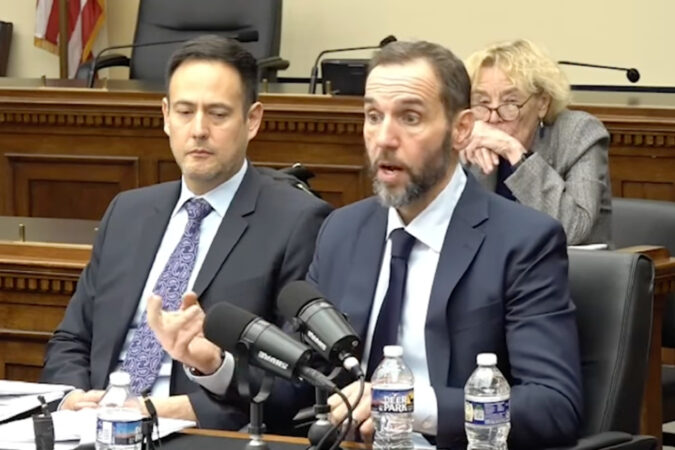
    WASHINGTON — The Jan. 6. riot at the U.S. Capitol “does not happen” without Donald Trump, former special counsel Jack Smith told lawmakers earlier this month in characterizing the Republican president as the “most culpable and most responsible person” in the criminal conspiracy to overturn the results of the 2020 election.

    The Republican-led House Judiciary Committee released on Wednesday a transcript and video of a closed-door interview Smith gave about two investigations of Trump. The document shows how Smith during the course of a daylong deposition repeatedly defended the basis for pursuing indictments against Trump and vigorously rejected Republican suggestions that his investigations were politically motivated.

    “The evidence here made clear that President Trump was by a large measure the most culpable and most responsible person in this conspiracy. These crimes were committed for his benefit. The attack that happened at the Capitol, part of this case, does not happen without him. The other co-conspirators were doing this for his benefit,” Smith said, bristling at a question about whether his investigations were meant to prevent Trump from reclaiming the presidency in 2024.

    “So in terms of why we would pursue a case against him, I entirely disagree with any characterization that our work was in any way meant to hamper him in the presidential election,” he added.

    The Dec. 17 deposition was conducted privately despite Smith’s request to testify publicly. The release of the transcript and video of the interview, so far Smith’s only appearance on Capitol Hill since leaving his special counsel position last January, adds to the public understanding of the decision-making behind two of the most consequential Justice Department investigations in recent history.

    Trump was indicted on charges of conspiring to undo the 2020 election he lost to Democrat Joe Biden, and of willfully retaining classified documents at his Mar-a-Lago estate in Florida. Both cases were abandoned after Trump’s 2024 election win, with Smith citing Justice Department policy against the indictment of a sitting president.

    Smith repeatedly made clear his belief that the evidence gathered against Trump was strong enough to sustain a conviction. Part of the strength of the Jan. 6 case, Smith said, was the extent to which it relied on the testimony of Trump allies and supporters who cooperated with the investigation.

    “We had an elector in Pennsylvania who is a former congressman, who was going to be an elector for President Trump, who said that what they were trying to do was an attempt to overthrow the government and illegal,” Smith said. “Our case was built on, frankly, Republicans who put their allegiance to the country before the party.”

    Accounts from Republicans willing to stand up against the falsehood that the election had been stolen “even though it could mean trouble for them” created what Smith described as the “most powerful” evidence against Trump.

    When it came to the Capitol riot itself, Smith said, the evidence showed that Trump “caused it and that he exploited it and that it was foreseeable to him.”

    Asked whether there was evidence that Trump had instructed supporters to riot at the Capitol, Smith said that Trump in the weeks leading to the insurrection got “people to believe fraud claims that weren’t true.”

    “He made false statements to state legislatures, to his supporters in all sorts of contexts and was aware in the days leading up to January 6th that his supporters were angry when he invited them and then he directed them to the Capitol,” Smith said.

    “Now, once they were at the Capitol and once the attack on the Capitol happened, he refused to stop it. He instead issued a tweet that without question in my mind endangered the life of his own Vice President. And when the violence was going on, he had to be pushed repeatedly by his staff members to do anything to quell it.”

    Some of the deposition focused on Republican anger at revelations that the Smith team had obtained, and analyzed, phone records of GOP lawmakers who were in contact with Trump on Jan. 6. Smith defended the maneuver as lawful and by-the-book, and suggested that outrage over the tactic should be directed at Trump and not his team of prosecutors.

    “Well, I think who should be accountable for this is Donald Trump. These records are people, in the case of the senators, Donald Trump directed his co-conspirators to call these people to further delay the proceedings. He chose to do that,” Smith said. “If Donald Trump had chosen to call a number of Democratic senators, we would have gotten toll records for Democratic senators.”

    The communications between Trump and Republican supporters in Congress were an important component of the case, Smith said. He cited an interview his office did with Mark Meadows in which Trump’s then-chief of staff referenced that Rep. Jim Jordan, an Ohio Republican and current chairman of the House Judiciary Committee, had been in touch with the White House on the afternoon of the riot.

    “And what I recall was Meadows stating that ‘I’ve never seen Jim Jordan scared of anything,’ and the fact that we were in this different situation now where people were scared really made it clear that what was going on at the Capitol could not be mistaken for anything other than what it was,” Smith said.

    Smith was also asked whether his team evaluated former White House aide Cassidy Hutchinson’s explosive claim that Trump that grabbed at the steering wheel of the presidential SUV when the Secret Service refused to let him go to the U.S. Capitol building after a rally at the Ellipse on Jan. 6, 2021.

    Smith told lawmakers that investigators interviewed the officer who was in the car, “who said that President Trump was very angry and wanted to go to the Capitol,” but the officer’s version of events “was not the same as what Cassidy Hutchinson said she heard from somebody secondhand,” Smith said.

  • Trump says he’s dropping push for National Guard in Chicago, LA, and Portland, Oregon, for now

    Trump says he’s dropping push for National Guard in Chicago, LA, and Portland, Oregon, for now

    WASHINGTON — President Donald Trump said he’s dropping — for now — his push to deploy National Guard troops in Chicago, Los Angeles and Portland, Ore., a move that comes after legal roadblocks held up the effort.

    “We will come back, perhaps in a much different and stronger form, when crime begins to soar again — Only a question of time!” he said in a social media post Wednesday.

    Governors typically control states’ National Guardsmen, and Trump had deployed troops to all three cities against the wishes of state and local Democratic leaders. He said it was necessary as part of a broader crackdown on immigration, crime and protests.

    The president has made a crackdown on crime in cities a centerpiece of his second term — and has toyed with the idea of invoking the Insurrection Act to stop his opponents from using the courts to block his plans. He has said he sees his tough-on-crime approach as a winning political issue ahead of next year’s midterm elections.

    Troops had already left Los Angeles after the president deployed them earlier this year as part of a broader crackdown on crime and immigration.

    In his post, Trump said the troops’ presence was responsible for a drop in crime in the three cities, though they were never on the streets in Chicago and Portland as legal challenges played out. When the Chicago deployment was challenged in court, a Justice Department lawyer said the Guard’s mission would be to protect federal properties and government agents in the field, not “solving all of crime in Chicago.”

    Portland Mayor Keith Wilson’s office in a statement said the city’s reduction in crime was due to the efforts of local police and public safety programs. Chicago officials echoed the sentiment, saying in a release Tuesday that the city had 416 homicides in 2025 — the fewest since 2014.

    Trump’s push to deploy the troops in Democrat-led cities has been met with legal challenges at nearly every turn.

    Governors react

    The Supreme Court in December refused to allow the Trump administration to deploy National Guard troops in the Chicago area. The order was not a final ruling but was a significant and rare setback by the high court for the president’s efforts.

    Illinois Gov. JB Pritzker wrote on X Wednesday that Trump “lost in court when Illinois stood up against his attempt to militarize American cities with the National Guard. Now Trump is forced to stand down.”

    Hundreds of troops from California and Oregon were deployed to Portland, but a federal judge barred them from going on the streets. A judge permanently blocked the deployment of National Guard troops there in November after a three-day trial.

    Oregon Gov. Tina Kotek said in a statement Wednesday that her office had not yet received “official notification that the remaining federalized Oregon National Guard troops can return home. They were never lawfully deployed to Portland and there was no need for their presence. If President Trump has finally chosen to follow court orders and demobilize our troops, that’s a big win for Oregonians and for the rule of law.”

    Trump’s decision to federalize National Guard troops began in Los Angeles in June, when protesters took to the streets in response to a blitz of immigration arrests in the area. He deployed about 4,000 troops and 700 Marines to guard federal buildings and, later, to protest federal agents as they carried out immigration arrests.

    The number of troops slowly dwindled until just several hundred were left. They were removed from the streets by Dec. 15 after a lower court ruling that also ordered control to be returned to Gov. Gavin Newsom. But an appeals court had paused the second part of the order, meaning control remained with Trump. In a Tuesday court filing, the Trump administration said it was no longer seeking a pause in that part of the order.

    “About time (Trump) admitted defeat,” Newsom said in a social media post. “We’ve said it from Day One: the federal takeover of California’s National Guard is illegal.”

    Troops will remain on the ground in several other cities. The U.S. Court of Appeals for the District of Columbia Circuit in December paused a lower court ruling that had called for an end to the deployment of National Guard troops in Washington, D.C., where they’ve been deployed since August after Trump declared a “crime emergency.”

    Trump also ordered the deployment of the Tennessee National Guard to Memphis in September as part of a larger federal task force to combat crime, a move supported by the state’s Republican Gov. Bill Lee and senators. A Tennessee judge blocked the use of the Guard, siding with Democratic state and local officials who sued. However, the judge stayed the decision to block the Guard as the state appeals, allowing the deployment to continue.

    In New Orleans, about 350 National Guard troops deployed by Trump arrived in the city’s historic French Quarter on Tuesday and are set to stay through Mardi Gras to help with safety. The state’s Republican governor and the city’s Democratic mayor support the deployment.

  • Department of Justice is reviewing more than 5.2 million documents related to Jeffrey Epstein

    Department of Justice is reviewing more than 5.2 million documents related to Jeffrey Epstein

    WASHINGTON — The Department of Justice has expanded its review of documents related to the convicted sex offender Jeffrey Epstein to 5.2 million as it also increases the number of attorneys trying to comply with a law mandating release of the files, according to a person briefed on a letter sent to U.S. Attorneys.

    The figure is the latest estimate in the expanding review of case files on Epstein and his longtime girlfriend Ghislaine Maxwell that has run more than a week past a deadline set in law by Congress.

    The Justice Department has more than 400 attorneys assigned to the review, but does not expect to release more documents until Jan. 20 or 21, according to the person briefed on the letter who spoke on the condition of anonymity because they were not authorized to discuss it.

    The expanding scope of the disclosure and the additional legal firepower committed to it showed how the Epstein file investigation will continue to occupy significant attention in Congress and the White House, almost ensuring that it remains a potent political force as the new year rolls toward midterm elections.

    The White House did not dispute the figures laid out in the email, and pointed to a statement from Todd Blanche, the deputy attorney general, who said the administration’s review was an “all-hands-on-deck approach.”

    Blanche said Wednesday that lawyers from the Justice Department in Washington, the FBI, the Southern District of Florida, and the Southern District of New York are working “around the clock” to review the files. The additional documents and lawyers related to the case were first reported by the New York Times.

    “We’re asking as many lawyers as possible to commit their time to review the documents that remain,” Blanche said. “Required redactions to protect victims take time, but they will not stop these materials from being released.”

    Still, Attorney General Pam Bondi is facing pressure from Congress after the Justice Department’s rollout of information has lagged behind the Dec. 19 deadline to release the information.

    “Should Attorney General Pam Bondi be impeached?” Rep. Thomas Massie, a Kentucky Republican who helped lead the effort to pass the law mandating the document release, asked on social media this week.

    Democrats also are reviewing their legal options as they continue to seize on an issue that has caused cracks in the Republican Party and, at times, flummoxed President Donald Trump’s administration.

    Senate Democratic Leader Chuck Schumer said on social media that the latest figures from the Department of Justice “shows Bondi, Blanche, and others at the DOJ have been lying to the American people about the Epstein files since day one” and pointed out that the documents released so far represented a fraction of the total.

    What’s expected next

    A late January release of documents would put the Department of Justice more than a month behind the deadline set in law, but some key lawmakers appeared willing to let the process play out before trying to take direct action against the Trump administration.

    Rep. Ro Khanna, a California Democrat who also led the effort to pass the law requiring the release, told the Associated Press that the Justice Department’s expanding review showed that the law is working.

    “We are willing to give DOJ a few extra weeks to comply, provided they release the survivors’ statements to the FBI naming the other rich and powerful men who abused them or covered up and the prosecution memos about charges that were dropped against Epstein and co-conspirators,” he said. “When all the information comes out, this will shock the conscience of the nation.”

    Massie has also said that he wants to see the release of statements that victims gave to the FBI. He has claimed that those could disclose the names of influential business figures and political donors who were involved or complicit in Epstein’s abuse.

    The pair has also argued that the expanding disclosure is evidence that more people were involved besides Epstein and Maxwell.

    What could the files mean for the midterms?

    The Trump administration has already struggled to move past the Epstein files for the better part of last year. While it’s not clear what else will be shown in the files, it will almost certainly give Democrats continued fodder to continue to seize on the issue.

    So far, Democrats, even though they are in the minority, have forced Congress to act on an issue that has caused splits in Trump’s political base.

    A tranche of documents released just before Christmas showed that Trump flew on Epstein’s private jet in the 1990s, when they had a friendship before a falling out. But the documents revealed little new information about their relationship. The initial release of documents also showed several photos of former President Bill Clinton with women whose faces were blacked out.

    Republicans on the House Oversight Committee have honed in on the connections to Clinton and are seeking to force him and former Secretary of State Hillary Clinton to appear for a deposition in January.

    Still, Democrats are trying to show that the Trump administration’s handling of the Epstein files shows that it cannot be trusted and is more concerned about the welfare of the rich and famous than working-class voters.

    “Unlike the President, we don’t care who’s in the files,” said Rep. Robert Garcia, the top Democrat on the oversight panel, on social media. “Anyone that’s involved in the abuse of women and girls should be held accountable.”

  • These bipartisan bills were noncontroversial — until Trump vetoed them

    These bipartisan bills were noncontroversial — until Trump vetoed them

    WASHINGTON — President Donald Trump issued the first vetoes of his second term on Tuesday, rejecting two low-profile bipartisan bills, a move that had the effect of punishing backers who had opposed the president’s positions on other issues.

    Trump vetoed drinking water pipeline legislation from Republican Rep. Lauren Boebert of Colorado, a longtime ally who broke with the president in November to release files on convicted sex offender Jeffrey Epstein. He also vetoed legislation that would have given the Miccosukee Tribe of Indians of Florida more control of some of its tribal lands. The tribe was among groups suing the administration over an immigration detention center in the Everglades known as ” Alligator Alcatraz.”

    Both bills had bipartisan support and had been noncontroversial until the White House announced Trump’s vetoes Tuesday night.

    Trump appeared to acknowledge the tribe’s opposition to the detention facility in a letter to Congress explaining his veto. “The Miccosukee Tribe has actively sought to obstruct reasonable immigration policies that the American people decisively voted for when I was elected,” Trump wrote.

    Trump did not allude to Boebert in his veto of her legislation, but raised concerns about the cost of the water pipeline at the heart of that bill.

    In an interview later Wednesday with Politico, Trump also criticized the state’s Democratic Gov. Jared Polis while saying that he issued the veto because “They’re wasting a lot of money and people are leaving the state. They’re leaving the state in droves. Bad governor.”

    Boebert, one of four House Republicans who sided with House Democrats early on to force the release of the Epstein files, shared a statement on social media suggesting that the veto may have been “political retaliation.”

    “I sincerely hope this veto has nothing to do with political retaliation for calling out corruption and demanding accountability. Americans deserve leadership that puts people over politics,” her statement said. Boebert added in another post: “This isn’t over.”

    The Florida legislation had been sponsored by Republican Rep. Carlos Gimenez, whom Trump has endorsed. Gimenez and the Miccosukee Tribe were not immediately available for comment on Wednesday.

    When asked whether the vetoes were punishment, the White House did not answer and instead referred to Trump’s statements explaining the vetoes.

    Congress can override the vetoes by a vote of two-thirds of the members of the House and the Senate, but it’s unclear if there’s enough support in the Republican-controlled chambers to do so, especially heading into a midterm election year where many of them will be on the ballot and many GOP members will count on Trump’s backing.

    Boebert’s legislation, the “Finish the Arkansas Valley Conduit Act,” aimed to improve access to clean drinking water in eastern Colorado.

    While the congresswoman has long been a staunch supporter of Trump, she found herself at odds with the president with her support this year for legislation that required the Justice Department to release files related to Epstein.

    Trump fought the proposal before reversing in the face of growing Republican support for releasing the files. Members of his administration even met with Boebert in the White House Situation Room to discuss the matter, though she didn’t change her mind.

    Republican Rep. Jeff Hurd of Colorado, who co-sponsored the legislation, said he was “deeply disappointed” by Trump’s veto.

    “This was a bipartisan, unanimous bill passed by Congress to uphold a long-standing federal commitment to southeastern Colorado,” Hurd said in a statement.

    He said the legislation did not authorize any new construction spending or expand the federal government’s original commitment to the pipeline project, but adjusted the terms of repaying its costs.

  • Patriots defensive lineman Christian Barmore accused of domestic assault

    Patriots defensive lineman Christian Barmore accused of domestic assault

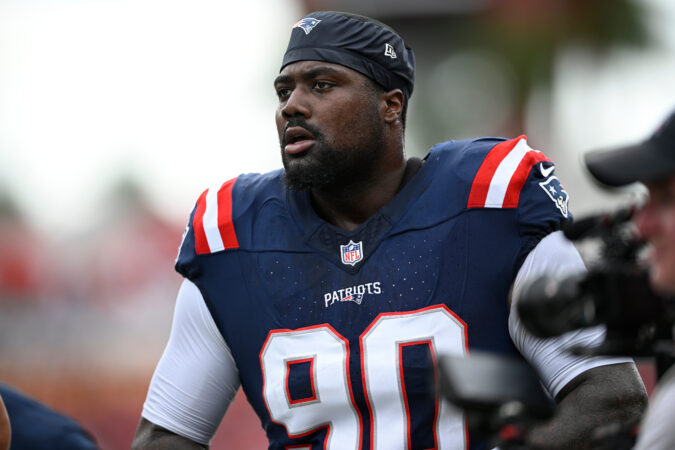
    New England Patriots defensive lineman Christian J. Barmore is facing a domestic assault and battery charge after his girlfriend told police he threw her to the ground in August at his home outside Boston.

    A criminal complaint issued Dec. 18 claims Barmore, 26, briefly took the woman’s phone, threw her to the ground, and grabbed her by the shirt inside the home in Mansfield, Mass.

    Mansfield Police Sgt. John Armstrong said the woman called police on Aug. 25 to report what had occurred almost three weeks earlier. The woman told police she had stayed at the home periodically during their relationship of several years.

    Barmore was a second-round draft pick in 2021 out of Alabama. He starred in high school at Lincoln before transferring to Neumann Goretti.

    Barmore’s lawyer, David Meier, issued a statement Wednesday saying “the evidence will demonstrate that no criminal conduct took place.” Meier called it a personal matter and said he expected it to be “resolved in the near future and both parties will move forward together.”

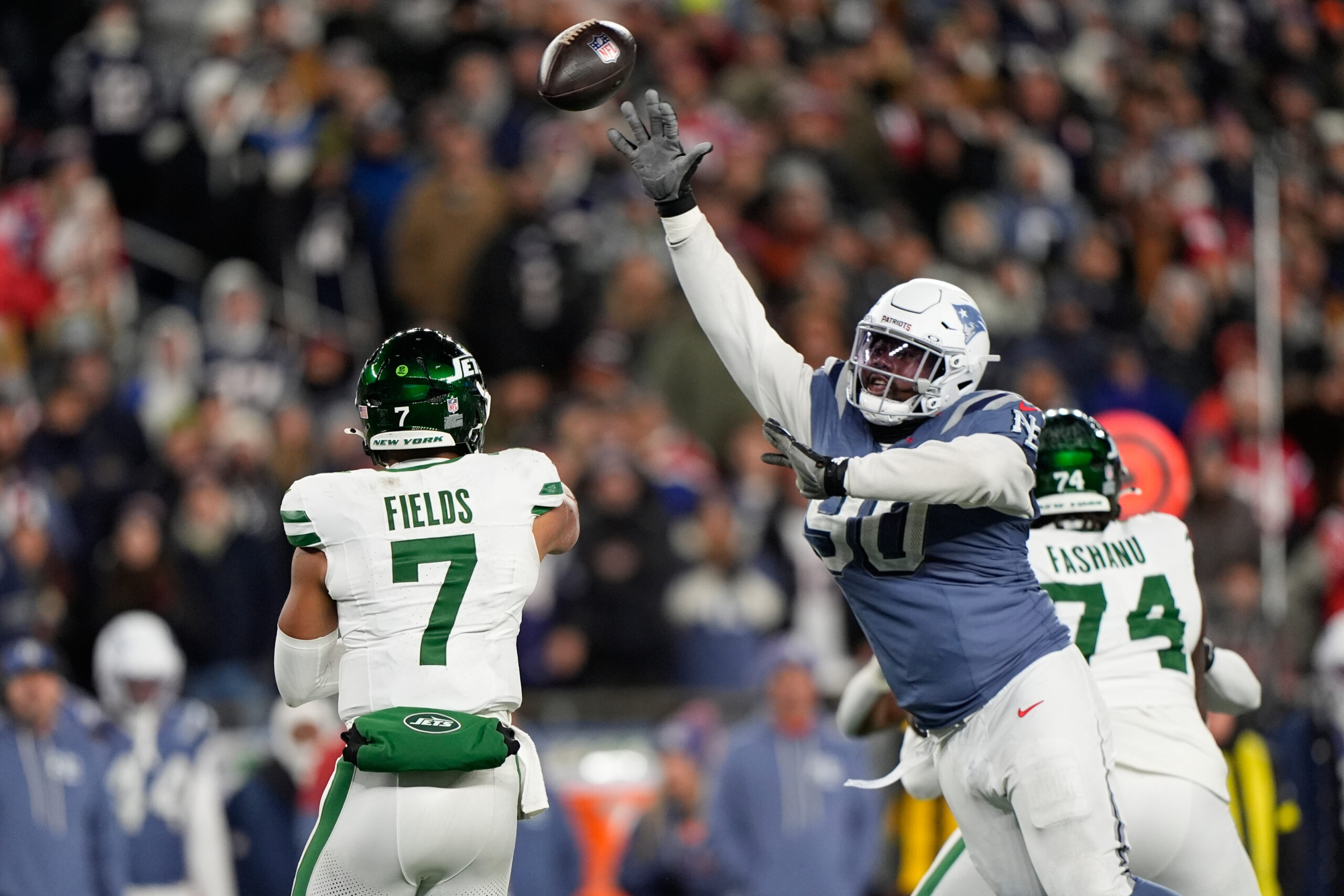
    Jets quarterback Justin Fields throws a pass under pressure from New England’s Christian Barmore on Nov. 13.

    The woman told police she took their daughter early the morning of Aug. 8 into Barmore’s bedroom, where Barmore was upset because the thermostat was 2 degrees warmer than he preferred. She said their daughter wanted to see him.

    She claimed Barmore “picked up the child, placed her on the floor just outside the master bedroom, turned back into the room and slammed the door shut,” according to police.

    As the woman packed her belongings to leave later in the day, Barmore took the phone from her hand and disconnected a call with the woman’s mother, according to the criminal complaint. When she headed for the front door to call for help, police said, Barmore allegedly “grabbed her before she could and threw her to the floor.”

    Barmore grabbed her by the shirt but “eventually let go” and the woman got up, she told police. A car provided by the team picked up the woman and their daughter and drove them to Delaware. She provided police with a photo showing bruises she said occurred when she was thrown to the floor.

    New England coach Mike Vrabel said that Barmore was away from the team with an illness Wednesday but that he hadn’t heard anything that would make him unavailable to play Sunday.

    “We’ve made a statement and we’ve taken the allegations very seriously,” Vrabel said, referring to allegations against both Barmore and receiver Stefon Diggs. Diggs has been charged with felony strangulation or suffocation and misdemeanor assault and battery in a dispute with his former private chef.

    “I don’t think we have to jump to any sort of conclusions right now. Let the process take its toll,” Vrabel said.

    An arraignment was scheduled for early February. The charge is a misdemeanor.

    The team’s public relations office e-mailed a statement saying it had been aware of the matter when it occurred and notified the league.

    “The matter remains part of an ongoing legal process. We will respect that process, continue to monitor the situation closely, as we have over the past few months, and cooperate fully with the league,” the Patriots said.