Category: Business Wires

  • U.S. resumes strikes on Iran after 3 tankers hit in Strait of Hormuz,

    U.S. resumes strikes on Iran after 3 tankers hit in Strait of Hormuz,

    DUBAI, United Arab Emirates — The U.S. military launched a series of strikes against Iran early Wednesday, hours after three merchant ships were struck in the waters off Oman in the Strait of Hormuz.

    The renewed attacks from both sides threaten the interim deal reached last month, with the U.S. and Iran both saying the strikes violate that initial agreement. The fresh assaults will add to the difficulty of the negotiations aimed at fully reopening the strait, rolling back Tehran’s disputed nuclear program, and reaching a permanent end to the war launched Feb. 28.

    In a statement posted to social media, U.S. Central Command said American forces launched the strikes “to impose heavy costs for targeting and attacking commercial shipping crewed by innocent civilians in an international waterway.”

    “Iran’s demonstrated aggression was unwarranted, dangerous, and a clear violation of the ceasefire,” the command said in their statement.

    The latest exchange followed a similar spate of Iranian attacks on shipping and U.S. retaliation that occurred late last month.

    Hours after the three tankers were struck by projectiles, the United States revoked a license that had authorized the sale of Iranian oil as part of the interim deal to end the fighting between the U.S. and Iran.

    The new assaults in the fuel-shipping waterway were the most in a single day since late April, according to the U.N. International Maritime Organization. The fresh attacks threatened to choke off the flow of traffic in the strait just as countries hoped to restore normal shipping practices and ease the global economic strain of the war.

    A U.S. official said the license was revoked because Iran’s actions in the strait were unacceptable and needed to be met with consequences. The official spoke with the Associated Press on the condition of anonymity to share insight into the reasoning behind the move.

    The Iranian mission to the United Nations did not immediately respond to a request for comment.

    One tanker caught fire after getting hit

    One tanker was traveling off the coast of Oman when it was hit and caught fire, the United Kingdom Maritime Trade Operations center said. Iranian state television said the liquefied natural gas tanker came under attack after ignoring warnings but did not directly claim the assault.

    The other two ships sustained some damage, but no one was injured, and both continued on their way, the U.K. maritime agency said.

    Tehran, which has repeatedly declared that only its approved route through the strait is safe, is suspected of attacking other ships that have used another route close to the Omani shore.

    Location details provided by the U.K. agency showed that all three attacks occurred off the coast of Oman or the neighboring United Arab Emirates, making it likely that the ships were using the route near Oman.

    Talks between U.S. and Iran are on hold

    The U.S. is eager to press ahead with negotiations with Iran aimed at fully reopening the strait, rolling back Tehran’s disputed nuclear program and reaching a permanent end to the war launched Feb. 28.

    Previous attacks in the strait have sparked retaliatory strikes by the U.S. Iran then attacked Gulf Arab states.

    In peacetime, a fifth of all traded oil and natural gas passed through the channel.

    The license issued by the U.S. authorized the production, delivery and sale of Iranian oil through Aug. 21. U.S. Vice President JD Vance said at the time that lengthy talks with senior Iranian officials in Switzerland created a “good foundation for a successful final deal” to end the war.

    U.S. sanctions on the purchase of Iranian oil had been in place since the 1979 Iranian Revolution. After the U.S. and Israel launched the war, and after the closure of the strait, the U.S. had authorized the temporary sale of Iranian oil at least twice as an incentive toward a deal.

    Meanwhile, talks between Iran and the U.S. appeared to be on hold until after the burial of Iran’s Supreme Leader Ayatollah Ali Khamenei, who was killed at the beginning of the war.

    Qatar calls attack a violation of international law

    One tanker was carrying liquid natural gas south through the strait near Limah, Oman, when a projectile hit the left-side engine room and sparked a fire, the U.K. Maritime Trade Operations center said.

    Majed Al-Ansari, a spokesperson for the Qatari Foreign Ministry, said the Qatari tanker Al Rekayyat was targeted in an “unacceptable attack” on international navigation and global energy security. He called it a “serious and explicit violation” of international law.

    In a post on X, he said Qatar holds Iran “fully legally responsible.”

    Later Tuesday, the U.K. maritime agency reported that an oil tanker was hit on its left side as it exited the strait near the Omani-Emirati border. A third tanker was struck by a drone off Oman, the agency said.

    The Joint Maritime Information Center, a multinational body overseen by the U.S. Navy, told shippers Monday that the route around Oman “has been expanded and remains available for all traffic.”

    Ships going to the north on the Iranian route must register with Tehran. Those going south work with Oman and the U.S.

    Iran and the United States agreed as part of an interim deal to allow ships to pass without paying charges for 60 days. But Tehran insisted it must control the vessels’ routes and later charge fees for passage, which would upend decades of practice in the waterway.

    The U.S. and many Gulf Arab states say they will not agree to Iran charging for passage through the strait.

    The data firm Kpler reported that at least 108 ships crossed through the strait last weekend using various routes.

    Mourners gather in Qom for Khamenei’s funeral

    Authorities flew Khamenei’s body to the Shiite seminary city of Qom, where mourners honored him Tuesday.

    Iranian state television aired live images of hundreds of thousands of people walking toward Jamkaran Mosque, just south of Qom, for the funeral service. Shiites believe the mosque once hosted Muhammad al-Mahdi, the 12th and last Shiite imam, who disappeared in the 9th century and is supposed to one day reappear to bring justice to the world.

    Khamenei’s son, Iran’s new Supreme Leader Ayatollah Mojtaba Khamenei, has yet to make an appearance at the ceremonies, which began Saturday in Tehran. He is believed to be in hiding after reportedly being wounded in the airstrike that killed his father.

    Khamenei’s body arrived late Tuesday in Najaf, Iraq, where it was received by senior officials from both countries. Processions are planned for Wednesday in Najaf and Karbala, the two holy cities of Iraqi Shiism. Iraq has a sizable Shiite population and is home to major Shiite religious sites and centers of learning.

    Khamenei, who was 86, will then be returned to Iran to be buried Thursday at the Imam Reza shrine in Mashhad, his birthplace.

  • Trump rings Wall Street’s opening bell as he ties his presidency to stock market gains

    Trump rings Wall Street’s opening bell as he ties his presidency to stock market gains

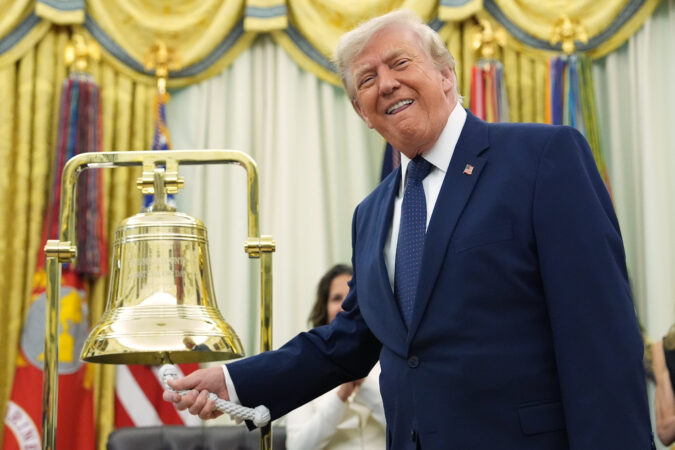
    WASHINGTON — President Donald Trump on Monday rang the opening bell for the New York Stock Exchange and the Nasdaq from the golden confines of the Oval Office, a symbolic act that reflects how he has increasingly tied his presidency to the stock market.

    With high inflation hurting Trump’s popularity, the Republican president has tried to get more Americans to focus on their 401(k) investments, saying that his policies should get the credit for any gains, particularly as the November midterm elections draw closer.

    “It’s going to go up — I think the market’s going to go through the roof,” said Trump after formally launching the start of trading.

    Only 33% of U.S. adults approve of Trump’s economic leadership, according to a June survey by the Associated Press-NORC Center for Public Affairs Research.

    Still, the act of ringing the opening bell suggests why the president’s emphasis on the stock market might not help his party much with voters this fall.

    The Oval Office event was promoting the launch of Trump Accounts, which were created as a vehicle for children to have investments in stock indexes as part of Republicans’ big 2025 tax and spending cuts bill.

    In championing the accounts, Treasury Secretary Scott Bessent has emphasized that many Americans have no direct exposure to stocks.

    This means that millions of people are not benefiting from investments that largely accrue to more affluent households or that the benefits they’re receiving are for retirements decades away.

    Bessent declared before the bell ringing that “38% of American families do not have any exposure to our great equity markets.”

    The S&P 500 stock index posted gains of 17.9% in 2025, but that came after annual returns of 25% in 2024 and 26.3% in 2023, during the presidency of Democrat Joe Biden. The benchmark stock index has risen roughly 10% so far this year.

    But just as inflation crushed public support for Biden, Trump has also seen his approval fall prey to a cycle of rising prices. Trump won the 2024 election by promising to bring down costs, but his tariffs and the start of the war in Iran created new inflationary pressures.

    The Consumer Price Index has climbed 4.2% over the past 12 months, up from 3% when Trump started his second term in January 2025.

    Trump, however, is betting that the stock investments that are being seeded by the government and by some prominent companies and billionaires will give future generations a deeper stake in the U.S. economy. The accounts already have gotten a boost from billionaires beyond the $1,000 from the government.

    Michael Dell, the founder of Dell Technologies, and his wife, Susan, appeared by Trump on Monday as they have pledged $6.25 billion for the accounts, while there have been separate pledges by billionaires including investor Ray Dalio and SpaceX president Gwynne Shotwell, who said Monday that she would donate stock in the Elon Musk-led company to the accounts.

    Trump jokingly acknowledged that children had missed the stock market gains that have occurred so far because of the delay in launching the Trump Accounts.

    “We should have acted faster,” Trump said.

  • Belgian diamond group that won tariff relief gifts Trump a lavishly encrusted ring

    Belgian diamond group that won tariff relief gifts Trump a lavishly encrusted ring

    BRUSSELS — Dozens of diamonds spell out two giant letter T’s next to the Stars and Stripes and “1776” and “2026.” Dozens more frame the numbers 45 and 47 in the shape of Superman’s logo. A diamond-winged eagle carries a ruby shield and clutches an olive branch of emeralds, below a radiant “250” and atop the phrase “250 YEARS USA” etched in 18-karat gold.

    All told, 321 diamonds, 56 sapphires, 13 emeralds and six rubies encrust the watch-sized gold ring presented this week to Bill White, the U.S. ambassador to Belgium, to give to President Donald Trump.

    “A very special thank you to my friends from Antwerp for the magnificent Freedom 250 ring,” Trump said in a prerecorded video message during an event marking America’s 250th birthday in Brussels.

    Isidore Mörsel, president of the Antwerp World Diamond Center, or AWDC, gifted the ring on behalf of the centuries-old diamond community in the Belgian port city, a central node in the worldwide trade of the precious stones that found itself struggling last year under the weight of Trump’s sweeping trade war.

    “May this ring serve as a lasting reminder that true partnership like the finest natural diamonds are formed under pressure, endure the test of time, and shine brightest when built on trust,” Mörsel said. The ring’s interior is engraved with the phrase “Crafted in Antwerp for Donald John Trump.”

    In dollar terms, the ring’s value pales beside gifts like the $400 million plane donated by Qatar that Trump ordered converted into a new Air Force One. But it’s a glitzy window into the role that ostentatious – and almost always gilded — gifts are playing for those seeking to curry favor with the U.S. president.

    A White House official, speaking on the condition of anonymity to discuss the matter, said Thursday that the ring has not been presented to Trump yet.

    Ring is latest in Trump’s break with White House custom

    The gift comes months after Belgium’s diamond industry won the removal of U.S. tariffs on diamond imports. In September, AWDC said it had “succeeded in securing a zero percent import tariff” on Antwerp’s annual export of more than $2 billion of polished diamonds to the U.S. A spokesperson for the group said on Thursday that the AWDC provided “input” to the European Commission as it negotiated with Trump on a broad deal on tariffs in 2025, but did not itself lobby the administration.

    U.S. presidents have considerable discretion to accept gifts from domestic and foreign sources and may determine themselves whether a gift was meant for them personally or the nation. The exception is those from foreign governments, which are prohibited by the foreign emoluments clause of the Constitution without congressional assent, though presidents could use personal funds to reimburse the Treasury for the full value of an official gift if they wish to retain it.

    Personal gifts are also supposed to be registered on the president’s annual financial disclosure. Trump’s 2025 disclosure, released this week, revealed a $250,000 gift of a sculpture depicting his triumphal gesture after surviving a 2024 assassination attempt at a campaign rally in Butler, Pa., and tickets to 10 sporting events, including 10 to the upcoming World Cup final in New Jersey from FIFA’s Gianni Infantino, valued at a collective $15,000.

    Four U.S. ethics experts told the Associated Press that Trump has broken with decades-old custom in the White House to avoid accepting such gifts.

    Ring’s value estimated at $25,000-$35,000

    To forge the ring, the AWDC turned to David Gotlib, an Antwerp-based high-end jeweler whose cufflinks can sell for more than 15,000 euros ($17,000).

    Neither AWDC nor Gotlib would provide a valuation of the ring, but two independent jewelers told AP they estimated the value between $25,000 and $35,000.

    Paris- and London-based jewelry consultant Alexander Levinson calculated the cost at $25,928, while David Saad, a third-generation luxury jeweler in Canada, priced the ring between $33,000 and $35,000. Both said half the cost was in materials, half in labor.

    After the ring was presented on a star-spangled stage in Brussels, musician Alexis Wilkins, the girlfriend of FBI Director Kash Patel, sang the U.S. national anthem to more than 8,000 people drinking Budweiser and bourbon from Tennessee and Kentucky.

    White said he raised more than $5.5 million for the 250th anniversary event from corporate sponsors like defense industry titans Lockheed Martin and Northrop Grumman and tech firms like Intel, Google, and Meta, as well as the European chocolate companies Leonidas and Ferrero. AWDC said it contributed funds, too.

    “The media was asking, ‘Why does it have to be so big?’” White said of the event. “Because we are the United States of America!”

    Meanwhile, the fate of the ring is not currently clear.

    On Wednesday, White posted a photo online of himself wearing the ring and giving a thumbs-up. The post has since been deleted.

  • Trump administration proposes a rule it says could save Medicare patients $1.1 billion on drugs

    Trump administration proposes a rule it says could save Medicare patients $1.1 billion on drugs

    WASHINGTON — The Trump administration proposed a new rule on Thursday to keep hospitals from charging markups on discounted drugs for Medicare patients and says that could save consumers $1.1 billion next year, according to estimates obtained by the Associated Press.

    The rule would apply to hospitals that serve low-income patients under what is known as the 340B program, which lets hospitals buy outpatient prescription drugs at discounted prices. But in many cases, hospitals can bill insurers at rates that exceed those costs, allowing hospitals to keep the difference and resulting in higher costs to patients.

    Under the proposed rule, the Centers for Medicare & Medicaid Services would change the formula for what hospitals participating in the program can get reimbursed, in an effort to cut costs for patients.

    The Republican administration has sought to show during an election year that it is tackling the challenges of affordability for U.S. families at a time when rising healthcare costs are driving financial strains for households and the government alike. While the administration has taken several steps it says will save money on medical treatment, it is unclear how much savings might ultimately materialize based on the complexity of the country’s healthcare system.

    The American Hospital Association said the proposed rule would compound the financial pressures its members face.

    “These proposals will undermine the ability of hospitals to maintain essential services and protect affordable access to care for those who depend on the 340B program,” said Ashley Thompson, the group’s senior vice president for public policy analysis and development.

    There is the risk that hospital systems could see their revenues decrease, which could have consequences in the communities they serve. The 340B program was initially designed as a way for healthcare providers to stretch scarce federal resources to better serve more patients. But it has long been at the center of a lobbying battle between hospitals and pharmaceutical companies, with each side attempting to enlist lawmakers in maintaining or changing the benefit.

    The agency estimates that the average older adult with Medicare Part B coverage who is administered one of these drugs would save $800 a year in co-payments. That would work out to a total savings of $1.1 billion for everyone with that coverage.

    The savings over 10 years could total about $20 billion, according to a White House official who requested anonymity to discuss the rule before the official announcement. The official said the proposed rule was not previewed for hospital groups before the release.

    In a policy draft of the rule, the administration gave a specific example of how the current system works for the prostate cancer drug Lupron Depot. Hospitals under the 340B program can acquire a dose for roughly $700, but they can receive about $4,000 in Medicare reimbursement for administering it and an additional $1,000 from the patient co-payment.

    The proposed rule would cut by roughly 40% that amount that hospitals in the discounted drug program could be paid through Medicare programs. If approved, the rule would go into effect at the start of next year.

    In 2018 during President Donald Trump’s first term, his administration tried to enact this same type of rule to reduce Medicare payments to hospitals. But the Supreme Court ruled in 2022 that the government could not provide a separate reimbursement plan for 340B hospitals.

    The president signed an executive order in April 2025 to survey how much hospitals spend to buy drugs. The result of that survey led to the proposed rule, which would cap Medicare reimbursement for participating hospitals at the average sales prices, minus 33.4%. The reason that the average reimbursement rate would be cut is because the hospitals acquired the drugs at discounted prices.

  • Taylor Swift and Travis Kelce donate $26M to charities ahead of wedding

    Taylor Swift and Travis Kelce donate $26M to charities ahead of wedding

    Taylor Swift and Travis Kelce have donated $26 million to charities this week ahead of their Friday wedding at Madison Square Garden.

    The donations were spread out across 20 local and national charities, according to Swift’s publicist, with many located in areas where the couple has deep ties. The announcement did not include any mention of Swift and Kelce’s wedding, but a law enforcement official briefed on security plans has told AP that the wedding will be held today, after a smaller rehearsal dinner Thursday night.

    Nine of the selected organizations are based in New York, ranging from the Food Bank For NYC, City Harvest, to Musical Mentors, a nonprofit that connects music teachers with students in need.

    Just how much each charity received was not disclosed.

    Other charities reflected where Swift and Kelce have also called home, including the Rhode Island Community Food Bank — where Swift owns an estate in Watch Hill — and the Children’s Mercy Hospital in Kansas City, Mo. — where Kelce plays tight end for the Kansas City Chiefs.

    A handful of national groups also received money: Dolly Parton’s Imagination Library, a book giveaway program spearheaded by the music legend; the American Society for the Prevention of Cruelty to Animals; and Feeding America.

    The large donations ahead of Swift and Kelce’s wedding are reminiscent of charitable gifts the couple has given in the past. Swift, a billionaire, gave millions to food banks ahead of her Eras Tour stops, while Kelce has been recognized by the Chiefs for winning “charity challenges” and operating his own nonprofit.

    Swift and Kelce have been in a relationship since 2023, enthralling millions around the world. Their relationship have been documented in countless shots of Swift celebrating at Chiefs games and fan videos of Kelce dancing along at Swift’s Eras concert tour as it traveled the globe. In 2025, they announced their engagement with the caption “Your English teacher and your gym teacher are getting married” but have remained mum on wedding details.

    Yet buzz has remained high around New York’s MSG, with multiple trucks and crews going in and out delivering materials for what is expected to be an elaborate event.

  • Retrofitted Qatari jet takes flight as Air Force One for Trump’s trip to North Dakota

    Retrofitted Qatari jet takes flight as Air Force One for Trump’s trip to North Dakota

    WASHINGTON — President Donald Trump on Wednesday took his maiden voyage on a new Air Force One — a retrofitted Boeing 747 worth $400 million gifted by Qatar that embeds his personality more deeply into the institution of the American presidency.

    Gone is the trademark light blue hull that helped Air Force One blend into the sky. The refurbished jet is painted to Trump’s preferred color scheme of a navy blue belly and red and gold stripes.

    It has the luxury features that the president believes a commander-in-chief’s entourage should have — plush carpets, lie-flat seats, wood paneling, and a presidential seal on the seat belts, according to reported tours of the plane.

    Trump told reporters that he was proud of the luxurious plane. “You can do two things: You can low-key it, or you can show it,” he said.

    Reporters are generally not permitted to take photographs on the plane unless Trump is present. But on Wednesday, Trump administration staffers posted images of the plane’s interior on social media.

    White House communications director Steven Cheung posted a photo of aides gathered around a circular table that had off-white place mats and leather captain’s chairs. Monica Crowley, the chief of U.S. protocol, posted a picture of herself perched on a leather couch between a pair of Air Force One throw pillows. Mounted on the wall behind her was a framed photo of the Thomas Jefferson Memorial.

    The jet carried Trump to North Dakota to see the Theodore Roosevelt Presidential Library, the first official visitor ahead of its opening on the nation’s 250th anniversary.

    The jet, a gift from the Middle Eastern power, raised ethical concerns, but Trump saw the plane as a necessary replacement to the 35-year-old planes that had previously ferried him as president.

    “This is a gift from a country that has treated us very well,” Trump said.

    The new jet will only temporarily be in the nation’s service only temporarily, as Boeing is expected to deliver in 2028 long-delayed planes that will permanently serve as Air Force One. Trump, a Republican, has said in the past that the Qatar plane would end up in a presidential library.

    The Air Force has said that it did little to change the cabin layout of the plane and that it spent less than $400 million on security upgrades.

  • What the Supreme Court’s ruling in the Cook case means for Federal Reserve independence

    What the Supreme Court’s ruling in the Cook case means for Federal Reserve independence

    WASHINGTON — The Supreme Court on Monday said the Federal Reserve, unlike any other agency in Washington, has a measure of independence from the presidency and day-to-day politics. But the court didn’t define to what extent.

    The case is the latest round in an unprecedented fight between the Fed and President Donald Trump. More political interference at the Fed could upend financial markets around the world, which closely follow its interest rate moves.

    Trump has repeatedly demanded that the central bank cut its key interest rate to lower borrowing costs for homeowners, businesses, and even the government itself. Trump sought to fire a Fed governor, Lisa Cook, last August after accusing her of mortgage fraud — a charge she denies. Cook was appointed by former President Joe Biden and removing her would give Trump the opportunity to name a more amenable official in her place.

    In a 5-4 decision, the court ruled that the president cannot fire the seven members of the Fed’s board of governors without a clear cause. The decision endorses the Fed’s independent structure even as the court eliminated such protections for leaders of other agencies, including the Federal Trade Commission, whom the president can fire at-will.

    “That’s a big deal,” said Scott Alvarez, the central bank’s former top lawyer. “That’s one of the things that makes the Fed independent.”

    While the decision is a boost for the Fed, it does leave Cook vulnerable to further attempts by the Trump administration to fire her. Trump said on his social media site, Truth Social, that “we will take appropriate action immediately” to remove Cook. But for now, she will keep her job while the case is fought in lower courts.

    The court said the Fed’s independent structure is constitutional

    In a separate case Monday, the justices ruled 6-3 that the Constitution allows the president to fire the heads of federal agencies that had previously been considered independent. But in the Cook case, the court carved out a clear exemption for the Fed.

    The Fed has a “unique historical status and role,” Chief Justice John Roberts wrote, similar to the First and Second Banks of the United States that existed in the early 1800s and that operated “at a deliberate remove from the ordinary political process.”

    If the president could fire a Fed governor for any reason, it would undermine that official’s ability to make decisions independently, Roberts wrote.

    The ruling provides some additional protection for new chair Kevin Warsh, who was nominated by Trump but has said that getting inflation back to the Fed’s 2% target is his top priority. About half the Fed’s policymakers support a rate hike to achieve that goal, while Trump has spoken out against hikes.

    Still, Kathryn Judge, a law professor at Columbia University, said the justices’ decision to strike down the independence of other agencies erodes the Fed’s standing by leaving it as the only remaining such body in Washington. The principle of independent, non-political judgment has been undercut, she added.

    “Fed independence lives on for another day, but is not as robust as it was prior to these decisions,” she said.

    Cook and other governors are still vulnerable

    And the court did not fully close the door on Trump’s efforts to fire Cook. Trump’s lawyers accepted that Trump could only fire her “for cause,” but they argued that the White House could define the cause and it couldn’t be second-guessed by courts.

    The Supreme Court instead said that “for cause” likely involved serious misconduct that wasn’t related to their professional duties, but didn’t provide much detail. More importantly, they also threw out the higher standard that Cook’s lawyers had pushed, which would have allowed governors to only be fired for inefficiency, neglect of duty, or malfeasance on the job. Since the alleged mortgage fraud occurred before she joined the Fed, such a standard would have likely shut down the case.

    The court also said that Cook had to be given formal notice of her firing — the president only announced it last August on Truth Social — and an opportunity to formally respond, though the court did not specify what the process should look like. Indeed, Roberts included a footnote in his opinion noting that nothing forbids Trump from “trying again” to fire her, provided she is given proper notice and a chance to contest it.

    Why the Fed’s independence matters

    The court battle will likely further define the boundaries of Fed independence.

    The Fed wields extensive power over the U.S. economy. By cutting the short-term interest rate it controls — which it typically does when the economy falters — the Fed can make borrowing cheaper and encourage more spending, accelerating growth and hiring. When it raises the rate — which it does to cool the economy and combat inflation — it can weaken the economy and cause job losses.

    Economists have long preferred independent central banks because they can more easily take unpopular steps to fight inflation, such as raise interest rates, which makes borrowing to buy a home, car, or appliances more expensive.

    The importance of an independent Fed was cemented for most economists after the extended inflation spike of the 1970s and early 1980s. Former Fed Chair Arthur Burns has been widely blamed for allowing the painful inflation of that era to accelerate by succumbing to pressure from President Richard Nixon to keep rates low heading into the 1972 election. Nixon feared higher rates would cost him the election, which he won in a landslide.

    Paul Volcker was eventually appointed chair of the Fed in 1979 by President Jimmy Carter, and he pushed the Fed’s short-term rate to the stunningly high level of nearly 20%. (It is currently 3.6%.) The eye-popping rates triggered a sharp recession, pushed unemployment to nearly 11%, and spurred widespread protests.

    Yet Volcker didn’t flinch. By the mid-1980s, inflation had fallen back into the low single digits. Volcker’s willingness to inflict pain on the economy to throttle inflation is seen by most economists as a key example of the value of an independent Fed.

  • Comcast plans to split into two public companies by spinning off NBCUniversal and Sky

    Comcast plans to split into two public companies by spinning off NBCUniversal and Sky

    NEW YORK — Communications giant Comcast is planning to split itself into two: one media-centered business that would include brands like NBCUniversal and Sky and a separate company focused on broadband and wireless services.

    In a Monday announcement, Comcast said the breakup will put both of these operations in a better position to pursue their own priorities and growth. The move arrives as communications companies continue to wrestle with years of cord-cutting, and shifting habits in how consumers now buy subscriptions for anything from their phone plans to streaming budgets more broadly.

    “The world is changing faster than ever,” Comcast Chairman and co-CEO Brian Roberts said on a Monday call — adding that it “has become clear” the company’s technology and media businesses each “have compelling opportunities in front of them that are distinct in nature and best pursued with dedicated focus.”

    Brian L. Roberts: “The world is changing faster than ever.”

    Upon the spinoff’s completion, both businesses would become their own publicly-traded companies. Comcast said it expects to complete the process in about a year, pending regulatory approvals and a final greenlight from its board.

    That means consumers shouldn’t feel immediate impacts. But a host of major brands currently sit under Comcast’s umbrella — from internet and wireless provider Xfinity to streaming platform Peacock, NBC News, and Universal Studios. And analysts are eyeing what those businesses could look like further down the road.

    What could be in store for NBCUniversal and Comcast

    “In the short term, bundles, pricing, and distribution will likely hold,” said Mike Proulx, a vice president and research director at market research firm Forrester. For NBCUniversal — set to head the media-centered company Comcast is spinning off — the split in itself carries little effect on its current business, he noted, and is “more to do with what it becomes longer term.”

    Proulx is bracing for future acquisitions in this space, adding that “Comcast is following a playbook we have already seen.” He pointed to Warner Bros. Discovery, which announced its own intention to split just last June — before becoming a takeover target that erupted into a messy tug-of-war between Netflix and Skydance-owned Paramount. Paramount eventually became victorious, and is now edging closer to closing its $81 billion buyout of Warner’s entire company.

    Comcast executives have appeared to so far dismiss the possibility of heading toward a similar fate. When asked on Monday’s call whether investors should view the separation as a step toward “potential strategic transactions” for either business, Roberts said: “Absolutely not.”

    Mike Cavanaghis co-CEO of Comcast and set to become chief executive of the NBC Universal spinoff in the split. (Comcast Corp./TNS)

    His co-CEO Mike Cavanagh — who is set to become the chief executive of the NBCUniversal spinoff — echoed that sentiment. Cavanagh reiterated plans to “build and invest for growth” with more freedom as a standalone business.

    Still, analysts like Proulx speculate that even if NBCUniversal doesn’t become a takeover target, “it’ll likely be the company doing the acquiring.”

    “As it stands, traditional TV is dying, and Peacock alone isn’t enough to compete at scale against the biggest streaming services,” Proulx said via email. “One way or the other, NBCU’s entertainment business will look different within the next couple of years.”

    This isn’t the first spinoff for Comcast

    Like other companies, Comcast in recent years has shifted its business emphasis away from traditional cable toward streaming and other sources of revenue, such as its movie studio, theme parks, and home wireless and internet services.

    NBCUniversal includes that theme parks division, Universal film and television studios, NBC and Telemundo networks, Peacock, and Bravo — and with the spinoff, European media business Sky will also be part of that portfolio led by Cavanagh.

    Meanwhile, Philadelphia-based Comcast will continue providing internet services to residential and business customers. Comcast’s former Chief Financial Officer Michael Angelakis will become the CEO of that company following its separation.

    Comcast has split off assets before. Monday’s move arrives just months after the company officially completed its separation of Versant Media Group — which, as first announced in November 2024, is the new home of networks like USA, Oxygen, E!, SYFY, and Golf Channel, as well as CNBC and MSNBC (now MS NOW). Movie ticketing platform Fandango and the Rotten Tomatoes movie rating site were also included.

    Once the latest split is complete, Comcast shareholders will own shares in both Comcast and NBCUniversal. Comcast expects to keep a stake of up to 19.9% ownership position in NBCUniversal for up to one year after the spinoff is complete.

    Comcast shares jumped more than 6% as of midday trading following Monday’s announcement. Shares still are down over 10% since the start of 2026.

  • NASA races to save Swift telescope from falling back to Earth with daring rescue mission

    NASA races to save Swift telescope from falling back to Earth with daring rescue mission

    CAPE CANAVERAL, Fla. — NASA is racing to save an aging telescope from falling back to Earth with a daring rescue mission.

    The $30 million salvage operation gets underway as soon as this week with the planned launch of a robotic lifesaver.

    NASA hired startup Katalyst Space Technologies to boost the Swift Observatory to a higher orbit where it can continue hunting for some of the universe’s biggest explosions. A three-armed spacecraft built by Katalyst will chase after Swift once it takes off from an atoll in the Pacific’s Marshall Islands aboard an airplane-launched Pegasus rocket. Liftoff could occur as early as Tuesday.

    Scanning the cosmos since its launch in 2004, Swift has been sinking faster and faster because of recent intense solar activity. It needs to get to a higher, more stable orbit as soon as possible to survive.

    NASA’s Hubble Space Telescope — also at risk — could be next.

    Like Swift, Hubble is losing altitude as the sun erupts with one flare after another. Katalyst Space CEO Ghonhee Lee said his company’s next-generation robot, still in development, could save the day for the much bigger Hubble in a couple years.

    Only China has attempted a mission like the upcoming one, successfully boosting a satellite into a higher graveyard orbit four years ago.

    “This is the first American space robot to go up and do anything like this,” Lee told the Associated Press. “NASA has all these big senior observatories … all of them can benefit from a service like this. So what we’re proving with this mission is this is a new play in the playbook that’s available.”

    It will take Katalyst’s autonomous spacecraft, named Link, about a month to rendezvous with Swift and catch it, and another couple of months to raise its orbit from the current 224 miles to the desired 373 miles.

    The 1.6-ton gamma ray observatory must be above 185 miles for the rescue to work. It’s expected to reach that point of no return in October, according to the latest estimates.

    Roughly the size of a small kitchen refrigerator with a 40-foot solar wingspan, Link sports three arms with a reach of just over 3 feet. Each arm has two fingerlike pinching grippers that resemble the hands of a Lego mini figure.

    If all goes well, Swift could be back in business by September, according to Lee.

    Worth hundreds of millions of dollars, Swift was never designed to be repaired, let alone retrieved by hands — human or otherwise. That’s what makes this so challenging, according to company officials, who stress there is no guarantee it will work.

    NASA signed a contract with Katalyst last September with only two requests: It has to be a rush job, but please don’t make things worse. Nine months later, the company is ready to rumble.

    “I have to be honest. No one thought it was going to be possible. No one thought we would get as far as we’ve already gotten today,” said Shawn Domagal-Goldman, NASA’s astrophysics director.

    NASA has bought a little more time for Swift, turning off all scientific instruments to slow its descent. Observations ceased in February.

    NASA’s science mission chief Nicky Fox said it’s worth the effort.

    “If we let Swift reenter, we would lose that telescope. We would lose a lot of capability,” she said. “We don’t currently have the budget to build another one to replace that.”

    While not everything can be saved in space, Swift is special, said Domagal-Goldman.

    True to its name, Swift is designed to pivot quickly to capture late-breaking astronomical events such as gamma ray bursts and exploding stars. With more discoveries expected by the Webb Space Telescope and soon-to-launch Roman Space Telescope, Swift, if saved, would be busier than ever as “NASA’s first responder.”

    Katalyst sees Swift as the jumping-off point for a new repair business in space. The company’s next-generation robotic rescuer, scheduled to fly next year, will tackle satellites as high as 22,300 miles up. Lee envisions hundreds of robots in orbit one day, not only fixing and hoisting satellites but also refueling them and building solar farms, data centers, and other platforms.

    Hubble, which is 36 years old and received repeat servicing by spacewalking astronauts during the shuttle era, could follow in 2028 with a life-extending Katalyst boost.

    “It’s a national treasure,” Fox said. “People love Hubble.”

  • Iran attacks Bahrain and Kuwait following U.S. strikes and threatens to halt talks

    Iran attacks Bahrain and Kuwait following U.S. strikes and threatens to halt talks

    DUBAI, United Arab Emirates — Iran again launched drone and missile attacks Sunday targeting Bahrain and Kuwait in response to new U.S. airstrikes against the Islamic Republic, and threatened a “complete halt” in negotiations to end the war if Washington continues its attacks.

    Efforts to reopen the Strait of Hormuz without Iran’s direct oversight sparked the days of crossfire and have imperiled the talks for a lasting ceasefire. A multinational maritime body overseen by the U.S. Navy said Saturday it would expand a route near Oman for inbound and outbound traffic, setting up a new flashpoint with Tehran.

    The global community has long considered the strait an international passageway, despite its location in Iran and Oman’s territorial waters. In recent days, Iran has twice attacked vessels going through a route on the Omani side in an evacuation effort backed by a United Nations agency.

    Iran insists that it alone must govern the strait, the narrow mouth of the Persian Gulf that once carried a fifth of the world’s oil and natural gas. Iranian Foreign Minister Abbas Araghchi reiterated the claim on Sunday.

    “Any attempt to establish new or separate arrangements from those currently being carried out by the Islamic Republic of Iran will only lead to further complications, delay the reopening of the Strait of Hormuz and increase the level of tension,” Araghchi said.

    The United States and Iran have been debating the terms of an interim deal, including shipping arrangements on the strait, the removal of a U.S. blockade on Iranian ports and sanctions on Iran, and the future of Iran’s stockpile of highly enriched uranium. Under the memorandum of understanding signed this month, they have 60 days to iron out details.

    The interim deal is meant to end fighting on all fronts before certain key issues can be discussed. Continued fighting in Lebanon, where an Israeli soldier was killed by Hezbollah fire early Sunday, also threatens the agreement.

    Strikes target Gulf states hosting U.S. military

    Iran’s paramilitary Revolutionary Guard claimed responsibility for the attacks in Bahrain and Kuwait.

    Kuwait’s military said air defenses intercepted Iranian drones and missiles just after the U.S. strikes in Iran. Kuwait, which hosts a major U.S. military base, said it intercepted two ballistic missiles. There were no reports of injuries or damage.

    Bahrain’s Interior Ministry said the Iranian strikes damaged a residential building near the international airport but no one was killed. The ministry released photos of an eight-story building, its top floor destroyed and windows blown out.

    Bahrain is home to the U.S. Navy’s 5th Fleet, whose base came under repeated attack during the war. The damaged building was not near the fleet’s headquarters.

    Bahrain’s Foreign Ministry denounced what it called “a dangerous escalation that reveals that what Tehran is doing is not a passing act, nor an isolated incident, but rather a deliberate approach and a systematic pattern of repeated aggression.”

    Trump accuses Iran of violating ceasefire with ship attack

    The U.S. military’s Central Command said it struck Iranian military “surveillance infrastructure, communication systems, air defense sites, drone storage facilities, and minelayer capabilities” following an attack on a ship at sea Saturday. The Panamanian-flagged tanker Kiku carried crude oil for the state-run energy company of Qatar, a key mediator between Iran and the U.S.

    President Donald Trump on social media accused Iran of violating the ceasefire and warned of a point where the U.S. may no longer be reasonable “and will be forced to militarily complete the job.”

    “If that happens, the Islamic Republic of Iran will no longer exist!” Trump wrote.

    The exchanges of fire began when an Iranian drone struck a merchant vessel off Oman on Thursday and the U.S. military retaliated with strikes.

    Ship traffic on the strait had increased over the past 72 hours, off both Iran and Oman, the multinational maritime body overseen by the U.S. Navy said Sunday, adding that “U.S.-assisted commercial transits continued uninterrupted despite the elevated threat environment.”

    It said 89 such transits had been made, still below the historical average of 138 vessels a day.

    Iran calls for new “conflict control unit” in Lebanon

    Last week, Israel and the Lebanese government signed a framework agreement to end the latest fighting between Israel and the Iranian-backed Hezbollah militant group, which began two days after the Iran war began when Hezbollah fired at Israel. Israel responded with an invasion that has occupied large swaths of southern Lebanon, and it has said it will not withdraw until Hezbollah is disarmed.

    But last week’s deal did not include Iran or Hezbollah, which has criticized the deal and rejected calls to disarm.

    On Sunday, Araghchi again said the U.S. must force Israel to halt attacks and withdraw. Israel occupies around 231 square miles in southern Lebanon, which it says it needs as a security buffer.

    But sporadic clashes have continued, and Hezbollah’s leader said Saturday that the group would continue fighting until Israel withdraws from Lebanon.

    Key Iranian negotiator and parliament Speaker Mohammad Bagher Qalibaf said Sunday that a new “conflict control unit” formed among Iran, the United States, and Lebanon should meet as soon as possible, Iran’s state broadcaster reported.

    The frequency of Israeli strikes in Lebanon has decreased significantly since the Iran-U. S. deal was signed, but two separate strikes hit southern Lebanon on Sunday morning — one in Taybeh town and the other in the Nabatiyeh area, according to Lebanon’s National News Agency. There was no immediate word on casualties.

    Overnight, Hezbollah militants killed an Israeli soldier in Deir Siryan village in southern Lebanon, according to Israel’s military. Hezbollah did not comment.

    “We are prepared to rapidly resume offensive operations in both Lebanon and Iran if required,” said Israel’s military chief of staff, Lt. Gen. Eyal Zamir.