Category: Business Wires

  • Zelensky: Talks will address security guarantees and reconstruction

    Zelensky: Talks will address security guarantees and reconstruction

    KYIV, Ukraine — Ukrainian President Volodymyr Zelensky said Friday that he will meet with U.S. President Donald Trump in Florida over the weekend.

    Zelensky told journalists that the two leaders will discuss security guarantees for Ukraine during Sunday’s talks, and that the 20-point plan under discussion “is about 90% ready.”

    An “economic agreement” also will be discussed, Zelensky said, but added that he was unable to confirm “whether anything will be finalized by the end.”

    The Ukrainian side will also raise “territorial issues,” he said. Moscow has insisted that Ukraine relinquish the remaining territory it still holds in the Donbas — an ultimatum that Ukraine has rejected. Russia has captured most of Luhansk and about 70% of Donetsk — the two areas that make up the Donbas.

    Zelensky said that Ukraine “would like the Europeans to be involved,” but doubted whether it would be possible at short notice.

    “We must, without doubt, find some format in the near future in which not only Ukraine and the U.S. are present, but Europe is represented as well,” he said.

    The announced meeting is the latest development in an extensive U.S.-led diplomatic push to end the nearly four-year Russia-Ukraine war, but efforts have run into sharply conflicting demands by Moscow and Kyiv.

    Zelenskyy’s comments came after he said Thursday that he had a “good conversation” with U.S. special envoy Steve Witkoff and Jared Kushner, Trump’s son-in-law.

    Kremlin spokesman Dmitry Peskov told reporters on Friday that the Kremlin had already been in contact with U.S. representatives since Russian presidential envoy Kirill Dmitriev recently met with U.S. envoys in Florida.

    “It was agreed upon to continue the dialogue,” he said.

    Trump is engaged in a diplomatic push to end Russia’s all-out war, which began on Feb. 24, 2022, but his efforts have run into sharply conflicting demands by Moscow and Kyiv.

    Zelensky said Tuesday that he would be willing to withdraw troops from Ukraine’s eastern industrial heartland as part of a plan to end the war, if Russia also pulls back and the area becomes a demilitarized zone monitored by international forces.

    Though Russian Foreign Ministry spokeswoman Maria Zakharova said Thursday that there had been “slow but steady progress” in the peace talks, Russia has given no indication that it will agree to any kind of withdrawal from land it has seized.

    On the ground, two people were killed and six more wounded Friday when a guided aerial bomb hit a busy road and set cars aflame in Ukraine’s second biggest city, Kharkiv, mayor Ihor Terekhov wrote on Telegram.

    One person was killed and three others were wounded when a guided aerial bomb hit a house in Ukraine’s Zaporizhzhia region, while six people were wounded in a missile strike on the city of Uman, local officials said Friday.

    Russian drone attacks on the city of Mykolaiv and its suburbs overnight into Friday left part of the city without power. Energy and port infrastructure were damaged by drones in the city of Odesa on the Black Sea.

    Meanwhile, Ukraine said that it struck a major Russian oil refinery on Thursday using U.K.-supplied Storm Shadow missiles.

    Ukraine’s General Staff said that its forces hit the Novoshakhtinsk refinery in Russia’s Rostov region.

    “Multiple explosions were recorded. The target was hit,” it wrote on Telegram.

    Rostov regional Gov. Yuri Slyusar said that a firefighter was wounded when extinguishing the fire.

    Ukraine’s long-range drone strikes on Russian refineries aim to deprive Moscow of the oil export revenue it needs to pursue its full-scale invasion. Russia wants to cripple the Ukraine’s power grid, seeking to deny civilians access to heat, light and running water in what Ukrainian officials say is an attempt to “weaponize winter.”


  • China sanctions 20 U.S. defense companies and 10 executives over massive arms sales to Taiwan

    China sanctions 20 U.S. defense companies and 10 executives over massive arms sales to Taiwan

    BEIJING — Beijing imposed sanctions on Friday against 20 U.S. defense-related companies and 10 executives, a week after Washington annoucned large-scale arms sales to Taiwan.

    The sanctions entail freezing the companies’ assets in China and banning individuals and organizations from dealing with them, according to the Chinese foreign ministry.

    The companies include Northrop Grumman Systems Corporation, L3Harris Maritime Services and Boeing in St. Louis, while defense firm Anduril Industries founder Palmer Luckey is one of the executives sanctioned, who can no longer do business in China and are barred from entering the country. Their assets in the East Asian country have also been frozen.

    The announcement of the U.S. arms-sale package, valued at more than $10 billion, has drawn an angry response from China, which claims Taiwan as its own and says it must come under its control.

    If approved by the American Congress, it would be the largest-ever U.S. weapons package to the self-ruled territory.

    “We stress once again that the Taiwan question is at the very core of China’s core interests and the first red line that must not be crossed in China-U.S. relations,” the Chinese foreign ministry said in a statement on Friday. “Any company or individual who engages in arms sales to Taiwan will pay the price for the wrongdoing.”

    The ministry also urged the U.S. to stop what it called “the dangerous moves of arming Taiwan.”

    Taiwan is a major flashpoint in U.S.-China relations that analysts worry could explode into military conflict between the two powers. China says that the U.S. arms sales to Taiwan would violate diplomatic agreements between China and the U.S.

    China’s military has increased its presence in Taiwan’s skies and waters in the past few years, holding joint drills with its warships and fighter jets on a near-daily basis near the island.

    Under the American federal law, the U.S. is obligated to assist Taiwan with its self-defense, a point that has become increasingly contentious with China. Beijing already has strained ties with Washington over trade, technology and other human rights issues.

  • Virtual reality opens doors for older people to build closer connections in real life

    Virtual reality opens doors for older people to build closer connections in real life

    LOS GATOS, Calif. — Like many retirement communities, the Terraces serves as a tranquil refuge for a nucleus of older people who no longer can travel to faraway places or engage in bold adventures.

    But they can still be thrust back to their days of wanderlust and thrill-seeking whenever caregivers at the community in Los Gatos, Calif., schedule a date for residents — many of whom are in their 80s and 90s — to take turns donning virtual reality headsets.

    Within a matter of minutes, the headsets can transport them to Europe, immerse them in the ocean depths, or send them soaring on breathtaking hang-gliding expeditions while they sit by one another. The selection of VR programming was curated by Rendever, a company that has turned a sometimes isolating form of technology into a catalyst for better cognition and social connections in 800 retirement communities in the United States and Canada.

    A group of Terraces residents who participated in a VR session earlier this year found themselves paddling their arms alongside their chairs as they swam with a pod of dolphins while watching one of Rendever’s 3D programs. “We got to go underwater and didn’t even have to hold our breath!” exclaimed 81-year-old Ginny Baird following the virtual submersion.

    During a session featuring a virtual ride in a hot-air balloon, one resident gasped, “Oh, my God!” Another said with a shudder: “It’s hard to watch!”

    The Rendever technology can also be used to virtually take older adults back to the places where they grew up as children. For some, it will be the first time they have seen their hometowns, virtually or otherwise, in decades.

    A virtual trip to her childhood neighborhood in New York City’s Queens borough helped sell Sue Livingstone, 84, on the merits of the VR technology even though she still is able to get out more often than many residents of the Terraces, which is located in Silicon Valley, about 55 miles south of San Francisco.

    “It isn’t just about being able to see it again. It’s about all the memories that it brings back,” Livingstone said. “There are a few people living here who never really leave their comfort zones. But if you could entice them to come down to try out a headset, they might find that they really enjoy it.”

    Adrian Marshall, the Terraces’ community life director, said that once word about a VR experience spreads from one resident to another, more of the uninitiated typically become curious enough to try it out — even if it means missing out on playing Mexican Train, a dominoes-like board game that is popular in the community.

    “It turns into a conversation starter for them. It really does connect people,” Marshall said of Rendever’s VR programming. “It helps create a human bridge that makes them realize they share certain similarities and interests. It turns the artificial world into reality.”

    Rendever, a privately owned company based in Somerville, Mass., hopes to build upon its senior living platform with a recent grant from the National Institutes of Health that will provide nearly $4.5 million to study ways to reduce social isolation among seniors living at home and their caregivers.

    Some studies have found VR programming presented in a limited viewing format can help older people maintain and improve cognitive functions, burnish memories, and foster social connections with their families and fellow residents of care facilities. Experts say the technology may be useful as an addition to — not a replacement for — other activities.

    “There is always a risk of too much screen time,” said Katherine “Kate” Dupuis, a neuropsychologist and professor who studies aging issues at Sheridan College in Canada. “But if you use it cautiously, with meaning and purpose, it can be very helpful. It can be an opportunity for the elderly to engage with someone and share a sense of wonder.”

    For older people, VR headsets may be an easier way to interact with technology than fumbling around with a smartphone or another device that requires navigating buttons or other mechanisms, said Pallabi Bhowmick, a researcher at the University of Illinois Urbana-Champaign who is examining the use of virtual reality with older adults.

    “The stereotypes that older adults aren’t willing to try new technology needs to change, because they are willing and want to adapt to technologies that are meaningful to them,” Bhowmick said. “Besides helping them to relieve stress, be entertained, and connect with other people, there is an intergenerational aspect that might help them build their relationships with younger people who find out they use VR and say, ‘Grandpa is cool!’”

    Rendever CEO Kyle Rand’s interest in helping his own grandmother deal with the emotional and mental challenges of aging pushed him down a path that led him to cofound the company in 2016 after studying neuroengineering at Duke University.

    “What really fascinates me about humans is just how much our brain depends on social connection and how much we learn from others,” Rand said. “A group of elderly residents who don’t really know each other that well can come together, spend 30 minutes in a VR experience together, and then find themselves sitting down to have lunch together while continuing a conversation about the experience.”

    It’s a large enough market that another VR specialist, Dallas-based Mynd Immersive, competes against Rendever with services tailored for senior living communities.

    Besides helping create social connections, the VR programming from both Rendever and Mynd has been employed as a possible tool for potentially slowing down the effects of dementia. That’s how another Silicon Valley retirement village, the Forum, sometimes uses the technology.

    Bob Rogallo, a Forum resident with dementia that has rendered him speechless, seemed to be enjoying taking a virtual hike through Glacier National Park in Montana as he nodded and smiled while celebrating his 83rd birthday with his wife of 61 years.

    Sallie Rogallo, who does not have dementia, said the experience brought back fond memories of the couple’s visits to the park during the more than 30 years they spent cruising around the U.S. in their recreational vehicle.

    “It made me wish I was 30 years younger so I could do it again,” she said of the virtual visit to Glacier. “This lets you get out of the same environment and either go to a new place or visit places where you have been.”

    In another session at the Forum, 93-year-old Almut Schultz laughed with delight while viewing a virtual classical music performance at the Red Rocks Amphitheatre in Colorado and later seemed to want to play with a puppy frolicking around in her VR headset.

    “That was quite a session we had there,” Schultz said with a big grin after she took off her headset and returned to reality.

  • Cloudy future for bourbon has Jim Beam closing Kentucky distillery for a year

    Cloudy future for bourbon has Jim Beam closing Kentucky distillery for a year

    Bourbon maker Jim Beam is halting production at one of its distilleries in Kentucky for at least a year as the whiskey industry navigates tariffs from the Trump administration and slumping demand for a product that needs years of aging before it is ready.

    Jim Beam said the decision to pause bourbon making at its Clermont location in 2026 will give the company time to invest in improvements at the distillery. The bottling and warehouse at the site will remain open, along with the James B. Beam Distilling Co. visitors center and restaurant.

    The company’s larger distillery in Boston, Ky., will continue to operate, the company said.

    “We are always assessing production levels to best meet consumer demand,” the company said in a statement that added they were talking with the distillery’s union to determine whether there will be layoffs or other reductions.

    Bourbon makers have to gamble well into the future. Jim Beam’s flagship bourbon requires at least four years of aging in barrels before being bottled.

    Whiskey makers are dealing with back-and-forth arguments over tariffs in Europe and in Canada, where a boycott started after the Trump administration suggested annexing the country into the U.S.

    Overall exports of American spirits fell 9% in the second quarter of 2025 compared to a year ago, according to the Distilled Spirits Council of the United States. The most dramatic decrease came in U.S. spirits exports to Canada, which fell 85% in the April-through-June quarter

    Bourbon production has grown significantly in recent years. As of January, there were about 16 million barrels of bourbon aging in Kentucky warehouses — more than triple the amount held 15 years ago, according to the Kentucky Distillers’ Association.

    But sales figures and polling show Americans are drinking less than they have in decades.

    About 95% of all bourbon made in the U.S. comes from Kentucky. The trade group estimated the industry brings more than 23,000 jobs and $2.2 billion to the state.

  • Venezuela seeks to criminalize oil tanker seizures as Trump puts pressure on Maduro

    Venezuela seeks to criminalize oil tanker seizures as Trump puts pressure on Maduro

    CARACAS, Venezuela — Venezuela’s National Assembly on Tuesday approved a measure that criminalizes a broad range of activities that can hinder navigation and commerce in the South American country, such as the seizure of oil tankers.

    The bill — introduced, debated, and approved within two days — follows this month’s seizures by U.S. forces of two tankers carrying Venezuelan oil in international waters. The seizures are the latest strategy in U.S. President Donald Trump’s four-month pressure campaign on Venezuela’s leader Nicolás Maduro.

    The tankers are part of what the Trump administration has said is a fleet Venezuela uses to evade U.S. economic sanctions.

    The unicameral assembly, which is controlled by Venezuela’s ruling party, did not publish drafts on Tuesday nor the final version of the measure. But as read on the floor, the bill calls for fines and prison sentences of up to 20 years for anyone who promotes, requests, supports, finances, or participates in “acts of piracy, blockades, or other international illegal acts” against commercial entities operating with the South American country.

    Venezuela’s political opposition, including Nobel Peace laureate María Corina Machado, has expressed support for Trump’s Venezuela policy, including the seizure of tankers.

    The bill, which now awaits Maduro’s signature, also instructs the executive branch to come up with “incentives and mechanisms for economic, commercial, and other protections” for national or foreign entities doing business with Venezuela in the event of piracy activities, a maritime blockade or other unlawful acts.

    The U.S. Coast Guard on Saturday seized a Panama-flagged vessel called Centuries that officials said was part of the fleet moving sanctioned cargo. With assistance from the U.S. Navy, it seized a rogue tanker called Skipper on Dec. 10. That ship was registered in Panama.

    Trump, after that first seizure, said the U.S. would carry out a “blockade” of Venezuela. He has repeatedly said that Maduro’s days in power are numbered.

    “If he wants to do something, if he plays tough, it’ll be the last time he’ll ever be able to play tough,” Trump said of Maduro Monday as he took a break from his Florida vacation to announce plans for the Navy to build a new, large warship.

  • Resilient U.S. consumers drive strongest economic expansion in two years

    Resilient U.S. consumers drive strongest economic expansion in two years

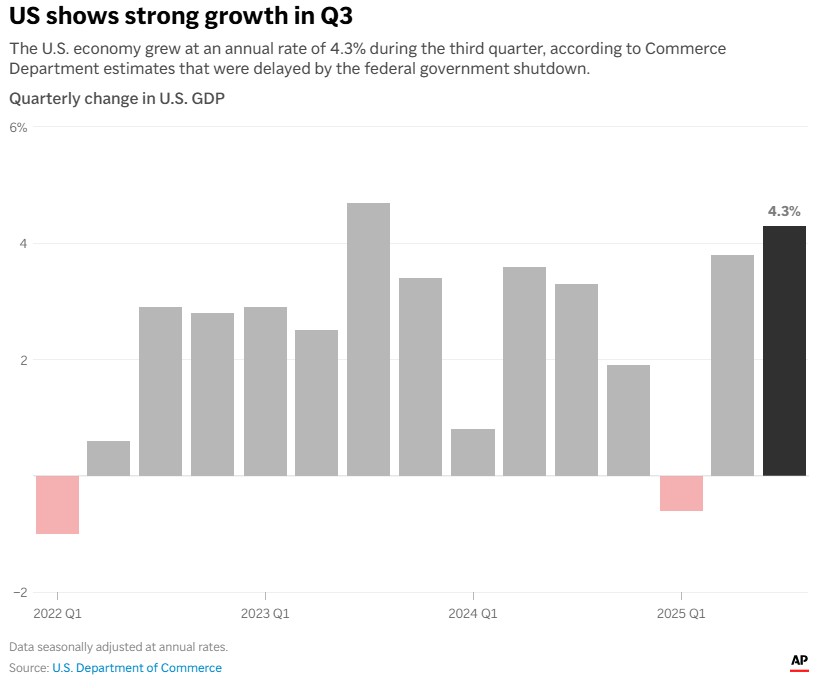
    WASHINGTON — The U.S. economy grew at a surprisingly strong 4.3% annual rate in the third quarter, the most rapid expansion in two years, driven by consumers who continue to spend in the face of ongoing inflation.

    U.S. gross domestic product from July through September — the economy’s total output of goods and services — rose from its 3.8% growth rate in the April-June quarter, the Commerce Department said Tuesday in a report delayed by the government shutdown. Economists surveyed by the data firm FactSet forecast growth of just 3% in the period.

    The U.S. economy grew at an annual rate of 4.3% during the third quarter, according to Commerce Department estimates that were delayed by the federal government shutdown.

    As has been the case for most of this year, the consumer is providing the fuel that is powering the U.S. economy. Consumer spending, which accounts for about 70% of U.S. economic activity, rose to a 3.5% annual pace last quarter. That’s up from 2.5% in the April-June period.

    A number of economists, however, believe the growth spurt may be short-lived with the extended government shutdown dragging on the economy in the fourth quarter, as well as a growing number of Americans fatigued by stubbornly high inflation.

    A survey published by the Conference Board Tuesday showed that consumer confidence slumped close to levels not seen since the U.S. rolled out broad tariffs on its trading partners in April.

    “The jump in consumer spending reminds me a lot of last year’s (fourth quarter),” said Stephen Stanley, chief U.S. economist at Santander. “Consumers were stretching. So, as was the case entering this year, households probably need to take a breather soon.”

    However, at least in recent years, consumer spending has held up even when data suggests they’ve grown more anxious about money.

    Tuesday’s GDP report also showed that inflation remains higher than the Federal Reserve would like. The Fed’s favored inflation gauge — called the personal consumption expenditures index, or PCE — climbed to a 2.8% annual pace last quarter, up from 2.1% in the second quarter.

    Excluding volatile food and energy prices, so-called core PCE inflation was 2.9%, up from 2.6% in the April-June quarter.

    Economists say that persistent and potentially worsening inflation could make a January interest rate cut from the Fed less likely, even as central bank official remain concerned about a slowing labor market.

    “If the economy keeps producing at this level, then there isn’t as much need to worry about a slowing economy,” said Chris Zaccarelli, chief investment officer for Northlight Asset Management, adding that inflation could return as the greatest threat to the economy.

    Another consistent driver in the U.S. economy, spending on artificial intelligence, was also evident in the latest data.

    Investment in intellectual property, the category that covers AI, grew 5.4% in the third quarter, following an even bigger jump of 15% in the second quarter. That figure was 6.5% in the first quarter.

    Consumption and investment by the government grew by 2.2% in the quarter after contracting 0.1% in the second quarter. The third quarter figure was boosted by increased expenditures at the state and local levels and federal government defense spending.

    Private business investment fell 0.3%, led by declines in investment in housing and in nonresidential buildings such as offices and warehouses. However, that decline was much less than the 13.8% slide in the second quarter.

    Within the GDP data, a category that measures the economy’s underlying strength grew at a 3% annual rate from July through September, up slightly from 2.9% in the second quarter. This category includes consumer spending and private investment, but excludes volatile items like exports, inventories and government spending.

    Exports grew at an 8.8% rate, while imports, which subtract from GDP, fell another 4.7%.

    Tuesday’s report is the first of three estimates the government will make of GDP growth for the third quarter of the year.

    Outside of the first quarter, when the economy shrank for the first time in three years as companies rushed to import goods ahead of President Donald Trump’s tariff rollout, the U.S. economy has continued to expand at a healthy rate. That’s despite much higher borrowing rates the Fed imposed in 2022 and 2023 in its drive to curb the inflation that surged as the United States bounced back with unexpected strength from the brief but devastating COVID-19 recession of 2020.

    Though inflation remains above the Fed’s 2% target, the central bank cut its benchmark lending rate three times in a row to close out 2025, mostly out of concern for a job market that has steadily lost momentum since spring.

    Last week, the government reported that the U.S. economy gained a healthy 64,000 jobs in November but lost 105,000 in October. Notably, the unemployment rate rose to 4.6% last month, the highest since 2021.

    The country’s labor market has been stuck in a “low hire, low fire” state, economists say, as businesses stand pat due to uncertainty over Trump’s tariffs and the lingering effects of elevated interest rates. Since March, job creation has fallen to an average 35,000 a month, compared to 71,000 in the year ended in March. Fed Chair Jerome Powell has said that he suspects those numbers will be revised even lower.

  • Trump administration suspends 5 wind projects off East Coast

    Trump administration suspends 5 wind projects off East Coast

    WASHINGTON — The Trump administration on Monday suspended leases for five large-scale offshore wind projects under construction along the East Coast due to what it said were national security risks identified by the Pentagon.

    The suspension, effective immediately, is the latest step by the administration to hobble offshore wind in its push against renewable energy sources. It comes two weeks after a federal judge struck down President Donald Trump’s executive order blocking wind energy projects, calling it unlawful.

    The administration said the pause will give the Interior Department, which oversees offshore wind, time to work with the Defense Department and other agencies to assess the possible ways to mitigate any security risks posed by the projects. The statement did not detail the national security risks. It called the move a pause, but did not specify an end date.

    “The prime duty of the United States government is to protect the American people,” Interior Secretary Doug Burgum said in a statement. “Today’s action addresses emerging national security risks, including the rapid evolution of the relevant adversary technologies, and the vulnerabilities created by large-scale offshore wind projects with proximity near our east coast population centers.”

    Wind proponents slammed the move, saying it was another blow in an ongoing attack by the administration against clean energy. The administration’s decision to cite potential national security risks could complicate legal challenges to the move, although wind supporters say those arguments are overstated.

    Paused over national security concerns

    The administration said leases are paused for the Vineyard Wind project under construction in Massachusetts, Revolution Wind in Rhode Island and Connecticut, Coastal Virginia Offshore Wind, and two projects in New York: Sunrise Wind and Empire Wind.

    The Interior Department said unclassified reports from the U.S. government have long found that the movement of massive turbine blades and the highly reflective towers create radar interference called “clutter.” The clutter caused by offshore wind projects can obscure legitimate moving targets and generate false targets in the vicinity of wind projects, the Interior Department said.

    National security expert and former commander of the USS Cole Kirk Lippold disputed the administration’s national security argument. The offshore projects were awarded permits “following years of review by state and federal agencies,” including the Coast Guard, the Naval Undersea Warfare Center, the Air Force, and more, he said.

    “The record of decisions all show that the Department of Defense was consulted at every stage of the permitting process,” Lippold said, arguing that the projects would benefit national security because they would diversify the country’s energy supply.

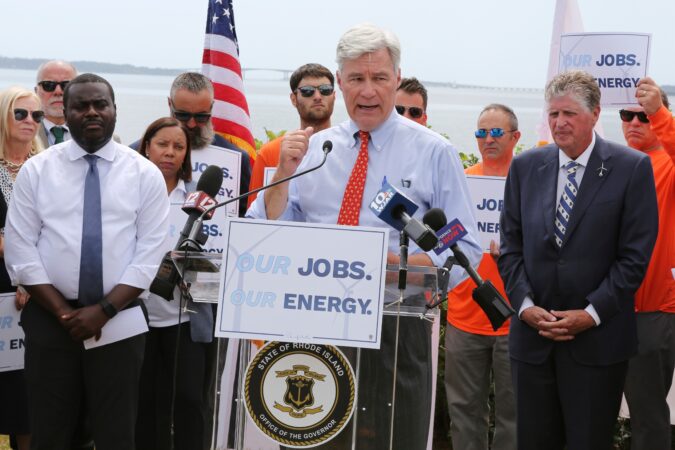
    Sen. Sheldon Whitehouse (D., R.I) said Revolution Wind was thoroughly vetted and fully permitted by the federal government, “and that review included any potential national security questions.” Burgum’s action “looks more like the kind of vindictive harassment we have come to expect from the Trump administration than anything legitimate,’’ he said.

    A judge ruled blocking wind projects was unlawful

    The administration’s action comes two weeks after a federal judge struck down Trump’s executive order blocking wind energy projects, saying the effort to halt virtually all leasing of wind farms on federal lands and waters was “arbitrary and capricious” and violates U.S. law.

    Judge Patti Saris of the U.S. District Court for the District of Massachusetts vacated Trump’s Jan. 20 executive order blocking wind energy projects and declared it unlawful.

    Saris ruled in favor of a coalition of state attorneys general from 17 states and Washington, D.C., led by New York Attorney General Letitia James, that challenged Trump’s Day One order that paused leasing and permitting for wind energy projects.

    Trump has been hostile to renewable energy, particularly offshore wind, and prioritizes fossil fuels to produce electricity. Trump has said wind turbines are ugly, expensive, and pose a threat to birds and other wildlife.

    Wind proponents slam the move

    Wind supporters called the administration’s actions illegal and said offshore wind provides some of the most affordable, reliable electric power to the grid.

    “For nearly a year, the Trump administration has recklessly obstructed the build-out of clean, affordable power for millions of Americans, just as the country’s need for electricity is surging,” said Ted Kelly of the Environmental Defense Fund.

    “Now the administration is again illegally blocking clean, affordable energy,” Kelly said. “We should not be kneecapping America’s largest source of renewable power, especially when we need more cheap, homegrown electricity.’’

    The administration’s actions are especially egregious because, at the same time, it is propping up aging, expensive coal plants “that barely work and pollute our air,” Kelly said.

    Connecticut Attorney General William Tong called the lease suspension a “lawless and erratic stop-work order” that revives an earlier, failed attempt to halt construction of Revolution Wind.

    “Every day this project is stalled is another day of lost work, another day of unaffordable energy costs, and other day burning fossil fuels when American-made clean energy is within reach,” Tong said. “We are evaluating all legal options, and this will be stopped just like last time.”

    Suspension praised by anti-wind group

    A New Jersey group that opposes offshore wind hailed the administration’s actions.

    “Today, the president and his administration put America first,’’ said Robin Shaffer, president of Protect Our Coast New Jersey, a nonprofit advocacy group.

    “Placing largely foreign-owned wind turbines along our coastlines was never acceptable,” he said, arguing that Empire Wind, in particular, poses a threat because of its close proximity to major airports, including Newark Liberty, LaGuardia, and JFK.

    Offshore wind projects also pose a threat to commercial and recreational fishing industries, Shaffer and other critics say.

    Dominion Energy, which is developing Coastal Virginia Offshore Wind, said the project is essential for national security and meeting Virginia’s dramatically growing energy needs, driven by dozens of new data centers.

    “Stopping CVOW for any length of time will threaten grid reliability … lead to energy inflation and threaten thousands of jobs,” the company said in a statement.

    The Conservation Law Foundation, a Boston-based environmental group, called the pause “a desperate rerun of the Trump administration’s failed attempt to kill offshore wind,’’ noting that courts have already rejected the administration’s arguments.

    “Trying again to halt these projects tramples on the rule of law, threatens jobs and deliberately sabotages a critical industry that strengthens — not weakens — America’s energy security,” said Kate Sinding Daly, senior vice president for law and policy at the law foundation.

  • ‘60 Minutes’ pulls story about Trump deportations from its lineup

    ‘60 Minutes’ pulls story about Trump deportations from its lineup

    CBS News abruptly pulled an investigative 60 Minutes segment on the Trump administration’s deportations of Venezuelan migrants to El Salvador’s CECOT prison after the administration refused to grant an interview, according to a correspondent who shared her concerns in an email obtained by the Washington Post.

    The decision came directly from the network’s editor in chief, Bari Weiss, according to an internal email sent to producers from the segment’s correspondent, Sharyn Alfonsi, who called the decision tantamount to handing the White House a “kill switch.”

    “If the administration’s refusal to participate becomes a valid reason to spike a story, we have effectively handed them a ‘kill switch’ for any reporting they find inconvenient,” Alfonsi wrote.

    Weiss defended the decision in a Monday morning editorial meeting.

    “As of course you all have seen, I held a 60 Minutes story, and I held that story because it wasn’t ready,” Weiss told staffers, according to a person who attended the meeting and spoke on the condition of anonymity to share nonpublic comments. “The story presented very powerful testimony of abuse at CECOT, but that testimony has already been reported on by places like the Times. The public knows that Venezuelans have been subjected to horrific treatment in this prison. So to run a story on this subject, two months later, we simply need to do more.”

    She continued: “And this is 60 Minutes. We need to be able to make every effort to get the principals on the record and on camera. To me, our viewers come first, not a listing schedule or anything else, and that is my North Star, and I hope it’s the North Star of every person in this newsroom.”

    The segment’s production team had sent questions and requested comment from the White House, the State Department, and the Department of Homeland Security for the story, according to the email. But the administration declined to grant the journalists an interview.

    “Government silence is a statement, not a VETO,” Alfonsi wrote. “Their refusal to be interviewed is a tactical maneuver designed to kill the story.”

    “The 60 Minutes report on ‘Inside CECOT’ will air in a future broadcast,” a CBS News spokesperson said in a statement. “We determined it needed additional reporting.” Alfonsi did not respond to a request for comment.

    The segment, titled “Inside CECOT,” was set to cover the Trump administration’s deportations of Venezuelan migrants to Centro de Confinamiento del Terrorismo (CECOT), one of El Salvador’s most notorious prisons. The network had teased the segment for days, but by Sunday the trailer and promotional materials had been removed from CBS News’ website.

    The original preview said that Alfonsi spoke with released prisoners, who describe “brutal and torturous conditions” inside the prison.

    Hundreds of Venezuelans who have been deported to El Salvador under President Donald Trump’s immigration crackdown have endured systematic torture and abuse — including sexual assault — during their detention, according to a November report by Human Rights Watch. The report said conditions at CECOT breached the United Nations’ minimal rules for the treatment of prisoners.

    In the email to her team, Alfonsi wrote that she learned Saturday that Weiss killed the story, which she says was screened five times and cleared by both the standards department and the network’s attorneys.

    Weiss was named CBS’s top editor this fall after David Ellison’s newly formed Paramount Skydance bought the Free Press, the opinion website she founded, for $150 million. While the two properties are still technically separate, Weiss runs both. Her early days at the network have been marked by rapid changes, including restructuring and layoffs. Weiss launched a town hall series including an interview with Erika Kirk, the widow of conservative activist Charlie Kirk. Earlier in December, CBS promoted Tony Dokoupil, who has co-anchored CBS Mornings since 2019, to anchor CBS Evening News, one of the most prominent jobs in television journalism. Ellison is the son of Oracle co-founder Larry Ellison, one of the world’s richest people and a Trump political ally.

    In the email, Alfonsi said the sources in the segment “risked their lives to speak with us.” She added: “We have a moral and professional obligation to the sources who entrusted us with their stories.”

    “If the standard for airing a story becomes ‘the government must agree to be interviewed,’ then the government effectively gains control over the 60 Minutes broadcast. We go from an investigative powerhouse to a stenographer for the state,” Alfonsi wrote.

    “It is factually correct,” she added. “In my view, pulling it now — after every rigorous internal check has been met — is not an editorial decision, it is a political one.”

    Democratic critics of Weiss were swift to condemn what they characterized as censoring a story to appease the Trump administration.

    “What is happening to CBS is a terrible embarrassment and if executives think they can build shareholder value by avoiding journalism that might offend the Mad King they are about to learn a tough lesson,” Sen. Brian Schatz (D., Hawaii) wrote on X. “This is still America and we don’t enjoy bullshit like this.”

    Sen. Edward J. Markey (D., Mass.) said in a social media post that it’s a “sad day for 60 Minutes and journalism,” and said that the Trump administration’s involvement in approving Skydance’s $8 billion deal to buy Paramount led to this. Skydance agreed to concessions to get the deal approved by the Republican-controlled Federal Communications Commission, chaired by Brendan Carr.

    The company promised a review of CBS content, appointed an ombudsman with Republican Party ties to interrogate claims of bias, and said it would refrain from diversity initiatives. Carr had previously threatened to block any mergers for companies engaged in diversity, equity, and inclusion practices.

    “This is what government censorship looks like,” Markey wrote. “Trump approved the Paramount-Skydance merger. A few months later, CBS’s new editor in chief kills a deeply reported story critical of Trump.”

  • Trump administration pauses five offshore wind projects on the East Coast

    Trump administration pauses five offshore wind projects on the East Coast

    WASHINGTON — The Trump administration said Monday it is pausing leases for five large-scale offshore wind projects under construction in the East Coast due to unspecified national security risks identified by the Pentagon.

    The pause is effective immediately and will give the Interior Department, which oversees offshore wind, time to work with the Defense Department and other agencies to assess the possible ways to mitigate any security risks posed by the projects, the administration said.

    “The prime duty of the United States government is to protect the American people,” Interior Secretary Doug Burgum said in a statement. “Today’s action addresses emerging national security risks, including the rapid evolution of the relevant adversary technologies, and the vulnerabilities created by large-scale offshore wind projects with proximity near our east coast population centers.”

    The administration said leases are paused for the Vineyard Wind project under construction in Massachusetts, Revolution Wind in Rhode Island and Connecticut, Coastal Virginia Offshore Wind, and two projects in New York: Sunrise Wind and Empire Wind.

    The Interior Department said unclassified reports from the U.S. government have long found that the movement of massive turbine blades and the highly reflective towers create radar interference called “clutter.” The clutter caused by offshore wind projects obscures legitimate moving targets and generates false targets in the vicinity of wind projects, the Interior Department said.

    The action comes two weeks after a federal judge struck down President Donald Trump’s executive order blocking wind energy projects, saying the effort to halt virtually all leasing of wind farms on federal lands and waters was “arbitrary and capricious” and violates U.S. law.

    Judge Patti Saris of the U.S. District Court for the District of Massachusetts vacated Trump’s Jan. 20 executive order blocking wind energy projects and declared it unlawful.

    Saris ruled in favor of a coalition of state attorneys general from 17 states and Washington, D.C., led by New York Attorney General Letitia James, that challenged Trump’s Day One order that paused leasing and permitting for wind energy projects.

    Trump has been hostile to renewable energy, particularly offshore wind, and prioritizes fossil fuels to produce electricity.

  • ‘60 Minutes’ pulled a story about Trump deportations from its lineup

    ‘60 Minutes’ pulled a story about Trump deportations from its lineup

    An internal CBS News battle over a “60 Minutes” story critical of the Trump administration has exploded publicly, with a correspondent charging it was kept off the air for political reasons and news chief Bari Weiss saying Monday the story did not “advance the ball.”

    Two hours before airtime Sunday, CBS announced that the story where correspondent Sharyn Alfonsi spoke to deportees who had been sent to El Salvador’s notorious CECOT prison, would not be a part of the show. Weiss, the Free Press founder named CBS News editor-in-chief in October, said it was her decision.

    The dispute puts one of journalism’s most respected brands — and a frequent target of President Donald Trump — back in the spotlight and amplifies questions about whether Weiss’ appointment was a signal that CBS News was headed in a more Trump-friendly direction.

    Alfonsi, in an email sent to fellow “60 Minutes” correspondents said the story was factually correct and had been cleared by CBS lawyers and its standards division. But the Trump administration had refused to comment for the story, and Weiss wanted a greater effort made to get their point of view.

    “In my view, pulling it now after every rigorous internal check has been met is not an editorial decision, it is a political one,” Alfonsi wrote in the email. She did not immediately respond to requests for comment from The Associated Press.

    Alfonsi said in the email that interviews were sought with or questions directed to — sometimes both — the White House, State Department and Department of Homeland Security.

    “Government silence is a statement, not a VETO,” Alfonsi wrote. “Their refusal to be interviewed is a tactical maneuver designed to kill the story. If the administration’s refusal to participate becomes a valid reason to spike a story, we have effectively handed them a ‘kill switch’ for any reporting they find inconvenient.”

    “Spike” is a journalist’s term for killing a story. But Weiss, in a statement, said that she looked forward to airing Alfonsi’s piece “when it’s ready.”

    Speaking Monday at the daily CBS News internal editorial call, Weiss was clearly angered by Alfonsi’s memo. A transcript of Weiss’ message was provided by CBS News.

    “The only newsroom I’m interested in running is one in which we are able to have contentious disagreements about the thorniest editorial matters with respect and, crucially, where we assume the best intent of our colleagues,” Weiss said. “Anything else is completely unacceptable.”

    She said that while Alfonsi’s story presented powerful testimony about torture at the CECOT prison, The New York Times and other outlets had already done similar work. “To run a story on this subject two months later, we need to do more,” she said. “And this is ‘60 Minutes.’ We need to be able to get the principals on the record and on camera.”

    It wasn’t clear whether Weiss’ involvement in seeking administration comment was sought. She reportedly helped the newscast arrange interviews with Jared Kushner and Steve Witkoff this past fall to discuss Trump’s Middle East peace efforts. Trump himself was interviewed by Norah O’Donnell on a “60 Minutes” telecast that aired on Nov. 2.

    Trump has been sharply critical of “60 Minutes.” He refused to grant the show an interview prior to last fall’s election, then sued the network over how it handled an interview with election opponent Kamala Harris. CBS’ parent Paramount Global agreed to settle the lawsuit by paying Trump $16 million this past summer. More recently, Trump angrily reacted to correspondent Lesley Stahl’s interview with Trump former ally turned critic Marjorie Taylor Greene.

    “60 Minutes” was notably tough on Trump during the first months of his second term, particularly in stories done by correspondent Scott Pelley. In accepting an award from USC Annenberg earlier this month for his journalism, Pelley noted that the stories were aired last spring “with an absolute minimum of interference.”

    Pelley said that people at “60 Minutes” were concerned about what new ownership installed at Paramount this summer would mean for the broadcast. “It’s early yet, but what I can tell you is we are doing the same kinds of stories with the same kind of rigor, and we have experienced no corporate interference of any kind,” Pelley said then, according to deadline.com.