Category: Nation World News Wires

  • Pete Hegseth faces deepening scrutiny from Congress over boat strikes

    Pete Hegseth faces deepening scrutiny from Congress over boat strikes

    WASHINGTON — Pete Hegseth barely squeaked through a grueling Senate confirmation process to become secretary of defense earlier this year, facing lawmakers wary of the Fox News Channel host and skeptical of his capacity, temperament and fitness for the job.

    Just three months later, he quickly became embroiled in Signalgate as he and other top U.S. officials used the popular Signal messaging application to discuss pending military strikes in Yemen.

    And now, in what may be his most career-defining moment yet, Hegseth is confronting questions about the use of military force after a special operations team reportedly attacked survivors of a strike on an alleged drug boat off the coast of Venezuela. Some lawmakers and legal experts say the second strike would have violated the laws of armed conflict.

    “These are serious charges, and that’s the reason we’re going to have special oversight,” said Sen. Roger Wicker of Mississippi, the Republican chair of the Senate Armed Services Committee.

    The scrutiny surrounding Hegseth’s brash leadership style is surfacing what has been long-building discontent in Congress over President Donald Trump’s choice to helm the U.S. military. And it’s posing a potentially existential moment for Hegseth as the congressional committees overseeing the military launch an investigation amid mounting calls from Democratic senators for his resignation.

    Hegseth vowed a ‘warrior culture,’ but lawmakers take issue

    Since working to become defense secretary, Hegseth has vowed to bring a “warrior culture” to the U.S. government’s most powerful and expensive department, from rebranding it as the Department of War to essentially discarding the rules that govern how soldiers conduct themselves when lives are on the line.

    Hegseth on Tuesday cited the “fog of war” in defending the follow-up strike, saying that there were explosions and fire and that he did not see survivors in the water when the second strike was ordered and launched. He chided those second-guessing his actions as being part of the problem.

    Yet the approach to the operation was in line with the direction of the military under Hegseth, a former infantry officer with the Army National Guard, part of the post-Sept. 11 generation, who was deployed to Iraq and Afghanistan and earned Bronze Stars.

    During a speech in September, he told an unusual gathering of top military brass whom he had summoned from all corners of the globe to the Quantico Marine Corps Base in Virginia that they should not “fight with stupid rules of engagement.”

    “We untie the hands of our warfighters to intimidate, demoralize, hunt and kill the enemies of our country,” he said. “No more politically correct and overbearing rules of engagement, just common sense, maximum lethality and authority for warfighters.”

    But now lawmakers and military and legal experts say the Sept. 2 attack borders on illegal military action.

    “Somebody made a horrible decision. Somebody needs to be held accountable,” said Sen. Thom Tillis, a North Carolina Republican who in January held out support for Hegseth until only moments before casting a crucial vote for his confirmation.

    “Secretary Talk Show Host may have been experiencing the ‘fog of war,’ but that doesn’t change the fact that this was an extrajudicial killing amounting to murder or a war crime,” said Sen. Chris Van Hollen, D-Md. “He must resign.”

    Rep. Don Bacon, a Republican who served 30 years active duty in the Air Force, finishing his career at the rank of brigadier general, said he hasn’t been a fan of Hegseth’s leadership. “I don’t think he was up to the task,” Bacon said.

    Will Hegseth keep Trump’s support?

    Trump, a Republican, has largely stood by his defense secretary, among the most important Cabinet-level positions. But the decisions by Wicker, alongside House Armed Services Chair Mike Rogers of Alabama and the top Democrats on the committees, to open investigations provide a rare moment of Congress asserting itself and its authority to conduct oversight of the Trump administration.

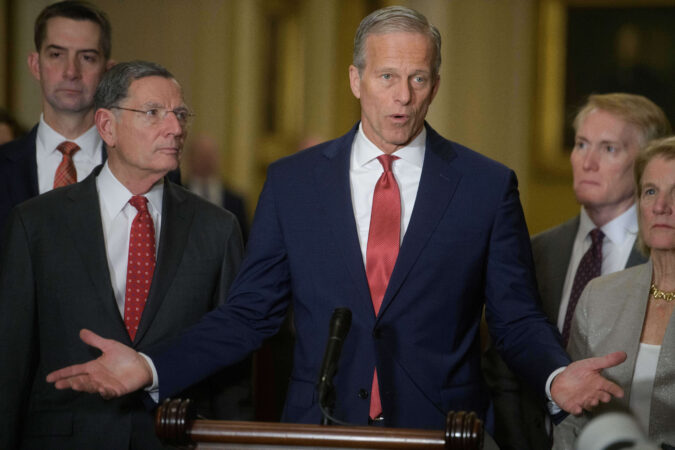
    Senate Majority Leader John Thune, R-S.D., who shepherded the defense secretary’s nomination to confirmation, has said the boat strikes are within Trump’s authority as commander in chief — and he noted that Hegseth serves at the pleasure of the president.

    “I don’t have, at this point, an evaluation of the secretary,” Thune said at the start of the week. “Others can make those evaluations.”

    But Hegseth also has strong allies on Capitol Hill, and it remains unclear how much Republicans would actually be willing to push back on the president, especially when they have spent the first year in his administration yielding to his various demands.

    Vice President JD Vance, who cast a rare tiebreaking vote to confirm Hegseth, has vigorously defended him in the attack. And Sen. Eric Schmitt, another close ally to Trump, dismissed criticism of Hegseth as “nonsense” and part of an effort to undermine Trump’s focus on Central and South America.

    “He’s not part of the Washington elite,” said Schmitt, R-Mo. “He’s not a think tanker that people thought Trump was going to pick. … And so, for that reason and others, they just, they don’t like him.”

    Tension between some Republican lawmakers and the Pentagon has been rising for months. Capitol Hill has been angered by recent moves to restrict how defense officials communicate with lawmakers and the slow pace of information on Trump’s campaign to destroy boats carrying drugs off the coast of Venezuela.

    As he defends his job, Hegseth has spoken to both Wicker and Rogers, the top lawmakers overseeing the military. Rogers said he was “satisfied” with Hegseth after that conversation, while Wicker said that he told Hegseth that he would like him to testify to Congress.

    Hegseth at first tried to brush aside the initial report about the strike by posting a photo of the cartoon character Franklin the Turtle firing on a boat from a helicopter, but that only inflamed criticism of him and angered lawmakers who felt he was not taking the allegations seriously.

    Senate Democratic leader Chuck Schumer of New York called Hegseth a “national embarrassment,” adding the defense secretary’s social media post of the cartoon turtle is “something no serious leader would ever think of doing.”

    What information will Congress get?

    Later this week, the chairs of the armed services committees, along with the top Democrats on the committees, will hear private testimony from Navy Vice Adm. Frank “Mitch” Bradley, who the White House has said ordered the second strike on the survivors.

    Republicans have been careful to withhold judgment on the strike until they complete their investigation, but Democrats say that these problems with Hegseth were a long time coming.

    Sen. Tim Kaine, a Virginia Democrat, pointed back to Hegseth’s tumultuous confirmation hearing, at which issues were raised with his management of nonprofits, as well as allegations of a sexual assault and abuse, and drinking on the job. Hegseth had vowed not to consume alcohol if confirmed.

    “You don’t suddenly change your judgment level or change your character when you get confirmed to be secretary of defense,” Kaine said. “Instead, the things that have been part of your character just become much more dire and existential.”

  • A raccoon went on a drunken rampage in a Virginia liquor store and passed out on the bathroom floor

    A raccoon went on a drunken rampage in a Virginia liquor store and passed out on the bathroom floor

    ASHLAND, Va. — The masked burglar broke into the closed Virginia liquor store early on Saturday and hit the bottom shelf, where the scotch and whisky were stored. The bandit was something of a nocturnal menace: bottles were smashed, a ceiling tile collapsed and alcohol pooled on the floor.

    The suspect acted like an animal because, in fact, he’s a raccoon.

    On Saturday morning, an employee at the Ashland, Virginia-area liquor store found the trash panda passed out on the bathroom floor at the end of his drunken escapade.

    Broken bottles are seen after a raccoon ransacked a liquor store in Ashland, Va., on Nov. 29.

    “I personally like raccoons,” said Samantha Martin, an officer who works at the local animal control. “They are funny little critters. He fell through one of the ceiling tiles and went on a full-blown rampage, drinking everything.”

    Martin said she took the raccoon back to the animal shelter, though she had her fair share of giggles along the way.

    “Another day in the life of an animal control officer, I guess,” she said.

    The Hanover County Animal Protection and Shelter commended Martin for handling the break-in, and confirmed the raccoon had sobered up.

    “After a few hours of sleep and zero signs of injury (other than maybe a hangover and poor life choices), he was safely released back to the wild, hopefully having learned that breaking and entering is not the answer,” the agency said.

  • Chances dwindling for renewal of healthcare subsidies, risking premium spikes for millions

    Chances dwindling for renewal of healthcare subsidies, risking premium spikes for millions

    WASHINGTON — Hopes for an extension of healthcare subsidies were diminishing in Congress this week as Republicans and Democrats largely abandoned the idea of bipartisan talks on the issue, increasing the odds that millions of Americans could see sharp premium spikes starting Jan. 1.

    Democrats who agreed earlier this month to reopen the government in exchange for a December healthcare vote were hoping they could work with Republicans to extend the COVID-era Affordable Care Act tax credits that help many Americans pay for their health coverage. But lawmakers in both parties have spent most of the time since talking among themselves instead, while rehashing longstanding partisan arguments over the law in public.

    “I don’t think at this point we have a clear path forward, I don’t think the Democrats have a clear path forward,” Senate Majority Leader John Thune said Tuesday after Republicans met and discussed different proposals to overhaul the law.

    The impasse means the Senate vote, expected next week, could be a party-line messaging exercise with no real chance of passage. Under the deal struck to end the shutdown, Democrats can determine the legislation that comes up for a vote. But Senate Democratic Leader Chuck Schumer has indicated they are leaning toward a vote on a straight extension of the subsidies with no new limits or tweaks to the law, which Republicans have already rejected.

    “So far the Republicans are in total disarray and have no plan,” Schumer said Tuesday. “We have a plan.”

    Democrats say they are willing to negotiate on the issue, and some have said they would be open to new limits on the subsidies. But they argue that two main issues are holding up talks: the lack of input from President Donald Trump, and Republicans’ insistence that abortion funding be part of the discussion.

    “Our Republican colleagues aren’t going to engage with us” unless Trump weighs in, Sen. Peter Welch (D., Vt.) said. “That’s the paralysis here.”

    Abortion issue holds up compromise

    Maine Sen. Angus King, an independent who caucuses with the Democrats, was part of the group that struck a deal to end the shutdown. He says there have been some informal bipartisan discussions since then, but says they stalled as Republicans insisted on stricter abortion restrictions on Affordable Care Act plans.

    “They have set up a red line that is also a red line for the Democrats,” King said of Republicans. “So they’re going to own these increases.”

    Missouri Sen. Josh Hawley, who has said he wants to see the tax credits extended, said the issue “should not be a deal-killer” since a ban on federal funding for abortions is already in the law.

    Democrats say current law should be sufficient. While many states ban abortion coverage from all plans in the ACA marketplaces, others allow or require abortion coverage that isn’t paid for with federal funding.

    Republicans weigh different plans

    Beyond the abortion issue, many Republicans have said for years that they want to see the ACA scrapped or overhauled. But there is still little consensus in the GOP about whether to do that or how.

    Republican senators have discussed several competing proposals in recent weeks. Louisiana Sen. Bill Cassidy and Florida Sen. Rick Scott have suggested creating different types of health savings accounts that would change the way people buy insurance — an idea that Trump has endorsed in social media posts without much detail. Other senators have suggested extending the subsidies with new limits on income.

    Thune said Tuesday that “we will see where the Republicans come down, but that conversation continues.”

    Republicans want to work on a constructive solution, he said, “but that hasn’t landed yet.”

    In the House lawmakers were also discussing different ideas. But there was no indication that any of them could be ready by the end of the year or generate enough bipartisan support.

    “Healthcare is a very complicated issue,” House Speaker Mike Johnson (R., La.) said Tuesday, while insisting that Republicans were still “pulling ideas together.”

    Trump gives little guidance

    Lawmakers in both parties have said it will be hard to move forward without Trump’s support for a plan. But the president has yet to formally endorse any legislation.

    Last week, the White House circulated a proposal to extend the subsidies with some limits, like new income caps and a requirement that all recipients pay some sort of premium. The proposal would also have allowed those in lower-tier plans, such as the bronze-level or catastrophic plans, to put money into health savings accounts.

    But the proposal was never released.

    Asked last week whether he wants to extend the subsidies, Trump appeared to refer to the leaked plan, saying that “somebody said I wanted to extend it for two years. … I’d rather not extend them at all.”

    Still, he acknowledged that some sort of extension may be “necessary.”

  • U.S.-Russia talks on Ukraine were productive but work remains, Putin adviser says

    U.S.-Russia talks on Ukraine were productive but work remains, Putin adviser says

    Talks between Russia and the U.S. on ending the nearly four-year war in Ukraine were productive, but much work remains, Yuri Ushakov, a senior adviser to President Vladimir Putin, told reporters on Wednesday.

    Putin met President Donald Trump’s envoy Steve Witkoff and son-in-law Jared Kushner in the Kremlin in talks that began late Tuesday as part of a renewed push by the Trump administration to broker a peace deal. Both sides agreed not to disclose the substance of the talks.

    Ushakov called the five-hour conversation “rather useful, constructive, rather substantive,” but added that the framework of the U.S. peace proposal was discussed rather than “specific wording.”

    Putin’s aide also said that “so far, a compromise hasn’t been found” on the issue of territories, without which, he said, the Kremlin sees “no resolution to the crisis.”

    “Some of the American proposals seem more or less acceptable, but they need to be discussed. Some of the wording that was proposed to us doesn’t suit us. So, the work will continue,” Ushakov said.

    There were other points of disagreement, although Ushakov did not provide further details. “We could agree on some things, and the president confirmed this to his interlocutors. Other things provoked criticism, and the president also didn’t hide our critical and even negative attitude toward a number of proposals,” he said.

    Trump peace plan is center of effort to end the war

    The meeting came days after U.S. officials held talks with a Ukrainian team in Florida and which Secretary of State Marco Rubio described in cautiously optimistic terms.

    At the center of the effort is Trump’s peace plan that became public last month and raised concerns about being tilted heavily toward Moscow. The proposal granted some of the Kremlin’s core demands that Kyiv has rejected as nonstarters, such as Ukraine ceding the entire eastern region of the Donbas to Russia and renouncing its bid to join NATO. Negotiators have indicated the framework has changed, but it’s not clear how.

    On Tuesday, Putin accused Kyiv’s European allies of sabotaging U.S.-led efforts to end the war in Ukraine.

    “They don’t have a peace agenda, they’re on the side of the war,” Putin said of the Europeans.

    Putin‘s accusations appeared to be his latest attempt to sow dissension between Trump and European countries and set the stage for exempting Moscow from blame for any lack of progress.

    He accused Europe of amending peace proposals with “demands that are absolutely unacceptable to Russia,” thus “blocking the entire peace process” and blaming Moscow for it. He also reiterated his long-held position that Russia has no plans to attack Europe — a concern regularly voiced by some European countries.

    “But if Europe suddenly wants to wage a war with us and starts it, we are ready right away. There can be no doubt about that,” Putin said.

    Russia started the war in 2022 with its full-scale invasion of a sovereign European country, and European governments have since spent billions of dollars to support Ukraine financially and militarily, to wean themselves from energy dependence on Russia, and to strengthen their own militaries to deter Moscow from seizing more territory by force.

    They worry that if Russia gets what it wants in Ukraine, it will have free rein to threaten or disrupt other European countries, which already have faced incursions from Russian drones and fighter jets, and an alleged widespread Russian sabotage campaign.

    Trump’s peace plan relies on Europe to provide the bulk of the financing and security guarantees for a postwar Ukraine, even though no Europeans appear to have been consulted on the original plan. That’s why European governments have pushed to ensure that peace efforts address their concerns, too.

    Coinciding with Witkoff’s trip, Ukrainian President Volodymyr Zelensky went to Ireland, continuing his visits to European countries that have helped sustain his country’s fight against Russia’s invasion.

    High-stakes negotiations

    Zelensky said Tuesday he was expecting swift reports from the U.S. envoys in Moscow on whether talks could move forward, after Trump’s initial 28-point plan was whittled down to 20 items in Sunday’s talks between U.S. and Ukrainian officials in Florida.

    “The future and the next steps depend on these signals. Such steps will change throughout today, even hour by hour, I believe,” Zelensky said at a news conference in Dublin with Irish Prime Minister Micheál Martin.

    “If the signals show fair play with our partners, we then might meet very soon, meet with the American delegation,” he said.

    “There is a lot of dialogue, but we need results. Our people are dying every day,” Zelensky said. “I am ready … to meet with President Trump. It all depends on today’s talks.”

    Building on progress in Florida

    After months of frustration in trying to stop the fighting, Trump deployed officials to get traction for his peace proposals. The talks have followed parallel lines so far, with Rubio sitting down with Ukrainian officials.

    Zelensky said he met Tuesday with the Ukrainian delegation that returned from the negotiations with U.S. representatives in Florida. Rubio said those talks made progress, but added that “there’s more work to be done.”

    Zelensky said the Florida talks took as their cue a document that both sides drafted at an earlier meeting in Geneva. The Ukrainian leader said that document was now “finalized,” although he didn’t explain what that meant.

    Ukrainian diplomats are working to ensure that European partners are “substantially involved” in decision-making, Zelensky said on the Telegram messaging app, and warned about what he said were Russian disinformation campaigns aimed at steering the negotiations.

    European leaders want a say

    Zelensky met with political leaders and lawmakers in Dublin on his first official visit. Ireland is officially neutral and isn’t a member of NATO but has sent nonlethal military support to Ukraine. More than 100,000 Ukrainians have moved to Ireland since Russia launched its war on Feb. 24, 2022.

    Although this week’s consultations could move the process forward, few details have become public. It remains unclear how envoys are going to bridge the gap between the two sides on such basic differences as who keeps what territory. European officials say the road to peace will be long.

    European leaders want to make their voices heard after being largely sidelined by Washington. They are also working on future security guarantees for Ukraine.

    Zelensky was in Paris on Monday, and French President Emmanuel Macron said they spoke by phone with Witkoff. They also spoke to leaders of eight other European countries as well as top European Union officials and NATO Secretary-General Mark Rutte.

    Diplomats face a hard time trying to bridge Russian and Ukrainian differences and persuading them to strike compromises. The key obstacles — over whether Kyiv should cede land to Moscow and how to ensure Ukraine’s future security — appear unresolved.

    Zelensky under pressure

    Zelensky is under severe pressure in one of the darkest periods of the war for his country. As well as managing diplomatic pressure, he must find money to keep Ukraine afloat, address a corruption scandal that has reached the top echelons of his government, and keep Russia at bay on the battlefield.

    The Kremlin late Monday claimed that Russian forces have captured the key city of Pokrovsk in the Donetsk region of eastern Ukraine. Zelensky, however, said in Paris that fighting was still ongoing in Pokrovsk on Monday.

    Ukraine’s general staff on Tuesday also denied Russia’s claims to have captured Pokrovsk, saying it was a propaganda stunt. The Ukrainian army is readying additional logistic routes to deliver supplies to troops in the area, the Facebook post said.

  • The first big snowstorm of the winter hits the Northeast, but not Philadelphia

    The first big snowstorm of the winter hits the Northeast, but not Philadelphia

    PORTLAND, Maine — The first major storm of the winter covered parts of the Northeast and Mid-Atlantic with snow and ice Tuesday, making roads hazardous, disrupting travel, and closing schools as some areas braced for several inches of heavy snowfall.

    The storm could deliver up to a foot of snow as well as wind and heavy rain across Massachusetts, New Hampshire, Vermont, Maine, Connecticut, and New York, although some areas were spared the predicted high totals. Winter storm warnings and weather advisories were in place throughout the day.

    “It looks like winter wonderland at the moment,” said John Marino in New York’s Catskill Mountains, which could get up to 8 inches of snow. As co-owner of a ski shop, he said he’s grateful that several inches had already accumulated by Tuesday afternoon, a welcome bonus as the season gets into gear.

    Some light freezing rain, sleet, and random snowflakes were reported across the Philadelphia region around daybreak Tuesday, and several school districts in Chester and Montgomery Counties opted for two-hour delays.

    Small accumulations of freezing rain, under a tenth of an inch, were measured in the Doylestown and Pottstown areas.

    For the record, the National Weather Service in Mount Holly reported that the city recorded its second official “trace” of snow, defined as a trained spotter’s sighting at least one flake at Philadelphia International Airport.

    Hundreds of flights were delayed and roads across the region turned hazardous before sunrise, slowing commutes. In West Virginia, a tractor-trailer driver was rescued unhurt when his cab dangled off a bridge for several hours after losing control in snowy conditions early Tuesday, news outlets reported.

    The storm came just as the Midwest began to escape the snow and ice that snarled travel after the Thanksgiving holiday. Chicago O’Hare International Airport set a record for the highest single calendar day snowfall in November at the airport, with more than 8 inches, according to the weather service. The previous record was set in 1951.

    Winter weather arrives in the Northeast

    “It’s going to be the first snowfall of the season for many of these areas, and it’s going to be rather significant,” said Andrew Orrison, a meteorologist at the National Weather Service.

    Meteorological winter, which covers December through February, is used by climate scientists for consistent recordkeeping and differs from the astronomical seasons found on most calendars.

    The National Weather Service warned that snow and ice would make travel dangerous in coastal Maine from Tuesday morning until Wednesday morning and urged residents to delay trips if possible. Several Northeast states also shut schools and as the snow began falling before dawn, making roads slippery during the morning commute. Numerous highway crashes were reported.

    The first wallop of December snow brought back a new tradition in New Hampshire, where residents were invited to submit names for the state’s second annual name-a-plow competition.

    “We have orange snowplows just waiting for the perfect name,” the Department of Transportation said on social media. Last winner’s top name was Ctrl-Salt-Delete. This season’s winners will be announced in January.

    The storm’s path

    The snowstorm sweeping the Mid-Atlantic and Northeast began as a weaker system over the central U.S. but strengthened as it neared the coast, said Ashton Robinson Cook at the NWS’s Weather Prediction Center.

    These kinds of storms are uncommon but not “too far out of the realm of possibility,” he said. The next system could also bring winter weather to the Mid-Atlantic through Friday and Saturday.

    Schools closed, roads jammed, crashes reported

    Winter weather advisories remained across Ohio on Tuesday, as the icy conditions snarled traffic and shuttered schools. Snowfall overnight left accumulations of 3 to 5 inches in some southern parts of the state, according to the National Weather Service.

    A portion of I-70 West through Cleveland had to be closed as a crash was cleared, while highways around Columbus saw dangerous slowdowns. Troopers in New York also reported multiple weather-related crashes and vehicles off the road along Interstate 87 north of Albany.

    Vehicle restrictions were imposed on many interstates in the eastern half of Pennsylvania, including on the turnpike system’s Northeast Extension, from the Lehigh Valley to Clarks Summit.

    Snow was falling steadily in the Lehigh Valley by Tuesday morning.

    “We really prepare for snow all year long,” Orbanek said.

    Staff writer Anthony R. Wood contributed to this article.

  • Trump administration says it will withhold SNAP from Democrat-led states if they don’t provide data

    Trump administration says it will withhold SNAP from Democrat-led states if they don’t provide data

    WASHINGTON — President Donald Trump’s administration said Tuesday that it will move to withhold SNAP food aid from recipients in most Democratic-controlled states starting next week unless those states provide information about those receiving the assistance.

    Agriculture Secretary Brooke Rollins said at a cabinet meeting Tuesday that the action is looming because those states are refusing to provide data the department requested such as the names and immigration status of aid recipients. She said the cooperation is needed to root out fraud in the program. Democratic states have sued to block the requirement, saying they verify eligibility for SNAP beneficiaries and that they never share large swaths of sensitive data on the program with the federal government.

    Marissa Saldivar, a spokesperson for California Gov. Gavin Newsom, a Democrat, was skeptical about whether funding will really be taken away.

    “We no longer take the Trump Administration’s words at face value — we’ll see what they actually do in reality,” she said in a statement. “Cutting programs that feed American children is morally repugnant.”

    Twenty-two states and the District of Columbia previously sued over the request for information, which was initially made in February. A San Francisco-based federal judge has barred the administration, at least for now, from collecting the information from those states.

    The federal government last week sent the states a letter saying that it was time to comply, as other states have, but the parties all agreed to give the states until Dec. 8 to respond.

    Approximately 2 million Pennsylvanians receive SNAP benefits, or nearly one in six of the state’s residents.

    This fall, Gov. Josh Shapiro, a Democrat, joined 21 other states in his capacity as Pennsylvania’s governor in suing the USDA to prevent the department from withholding its SNAP payments. A federal judge in California in October ruled in favor of the Democratic-led states and temporarily blocked the USDA effort from going into effect.

    A spokesperson for Shapiro on Tuesday declined to comment.

    Administration says data is needed to spot fraud

    About 42 million lower-income Americans, or 1 in 8, rely on SNAP to help buy groceries. The average monthly benefit is about $190 per person, or a little over $6 a day.

    Rollins has cited information provided by states that have complied, saying it shows that 186,000 deceased people are receiving SNAP benefits and that 500,000 are getting benefits more than once.

    “We asked for all the states for the first time to turn over their data to the federal government to let the USDA partner with them to root out this fraud, to make sure that those who really need food stamps are getting them,” Rollins said, “but also to ensure that the American taxpayer is protected.”

    Her office has not released detailed data, including on how much in benefits obtained by error or fraud are being used.

    It’s also not clear which states have handed over the information. Rollins said 29 have complied and 21 have not. But 22 have sued to block the order.

    Additionally, Kansas, which was not part of the lawsuit, has not provided it. The USDA told the state in September that SNAP funds would be cut off. The state asked the agency to reverse the action. A spokesperson for Gov. Laura Kelly, a Democrat, said there had not yet been a reply as of Tuesday. North Carolina appears to be the only state with a Democratic governor that has handed over the information.

    Experts say that while there is certainly fraud in a $100 billion-a-year program, the far bigger problems are organized crime efforts to steal the benefit cards or get them in the name of made-up people — not wrongdoing by beneficiaries.

    Democratic officials question administration’s motives

    U.S. Rep. Jahana Hayes, a Connecticut Democrat who is a co-sponsor of legislation to undo recent SNAP changes, said Rollins is trying to make changes without transparency — or without a role for Congress — and that she is mischaracterizing the program.

    “Individuals who are just trying to buy food, those aren’t the ones who are gaming the system in the way that the administration is trying to portray,” Hayes said in an interview on Tuesday before Rollins announced her intention.

    Democratic officials responded to Rollins’ announcement by blasting the administration.

    “The Governor wishes President Trump would be a president for all Americans rather than taking out his political vendettas on the people who need these benefits the most,” said Claire Lancaster, a spokesperson for Minnesota Gov. Tim Walz, a Democrat. ”Whether it’s threatening highway funding or food assistance, the President is making malicious decisions that will raise prices and harm families.”

    In response to Rollins’ comments, New York Gov. Kathy Hochul tweeted, “Genuine question: Why is the Trump Administration so hellbent on people going hungry?”

    SNAP has been in the spotlight recently

    The program is not normally in the political spotlight, but it has been this year.

    As part of Trump’s big tax and policy bill earlier in the year, work requirements are expanding to include people between the ages of 55 and 64, homeless people and others.

    And amid the recent federal government shutdown, the administration planned not to fund the benefits for November. There was a back-and-forth in the courts about whether they could do so, but then the government reopened and benefits resumed before the final word.

    In the meantime, some states scrambled to fund benefits on their own and most increased or accelerated money for food banks.

    Staff writer Gillian McGoldrick contributed to this article.

  • Hegseth cites ‘fog of war’ in defending follow-on strike on alleged drug boat

    Hegseth cites ‘fog of war’ in defending follow-on strike on alleged drug boat

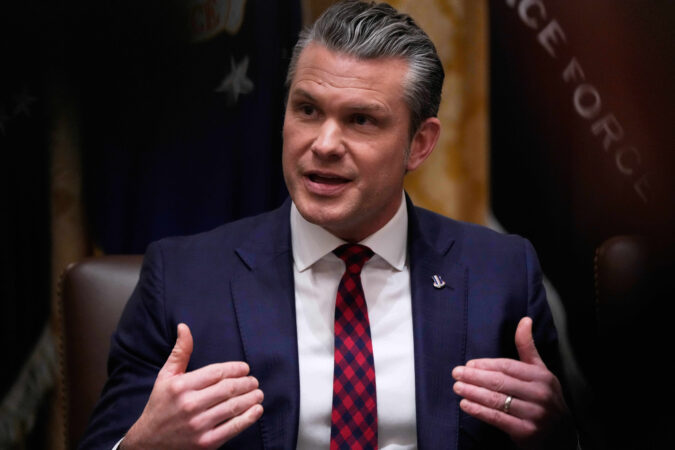
    Defense Secretary Pete Hegseth said Tuesday that “a couple of hours” passed before he was made aware that a September military strike he authorized and “watched live” required an additional attack to kill two survivors, further distancing himself from an incident now facing congressional inquiry.

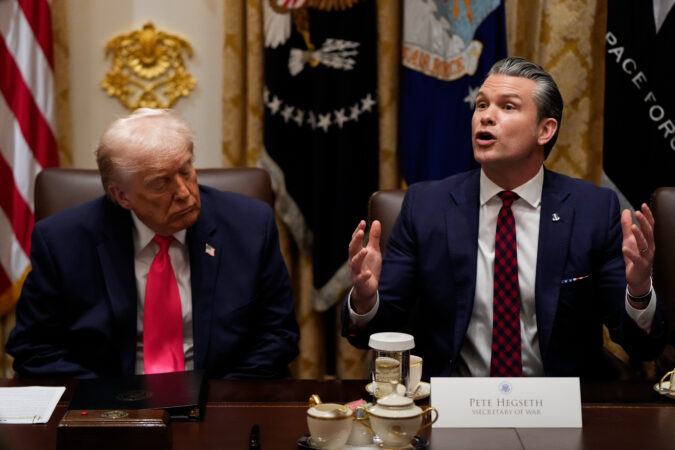
    Speaking in the Cabinet Room alongside President Donald Trump, Hegseth delivered the most extensive public accounting yet of his involvement in the strike on alleged drug smugglers in the Caribbean Sea. Lawmakers and law of war experts have questioned whether the episode constitutes a war crime and, if so, who bears responsibility.

    “I did not personally see survivors,” he said in response to a reporter’s question, “ … because that thing was on fire and was exploded, and fire, smoke, you can’t see anything. You got digital, there’s — this is called the fog of war.”

    Hegseth and Trump deflected responsibility for the killing of two survivors, pointing instead to the senior military officer in charge of the operation on Sept. 2, Adm. Frank M. Bradley. And while they praised the military for conducting the mission, both sought to make clear they had not known that a second order was given to kill the survivors as they were clinging to the boat’s wreckage.

    “I didn’t know about the second strike. I didn’t know anything about people. I wasn’t involved, and I knew they took out a boat,” Trump said during a meeting with members of his cabinet.

    Spokespeople for U.S. Special Operations Command, where Bradley is the top commander, have not commented publicly on the matter.

    Hegseth said he had observed a live video of the initial attack before he “moved on to my next meeting.”

    “I watched that first strike live,” Hegseth said, noting that he did not witness the entire sequence of events that unfolded next.

    “As you can imagine,” he added, at the Defense Department “we got a lot of things to do. So I didn’t stick around for the hour and two hours, whatever. … A couple of hours later, I learned that that commander had made the — which he had the complete authority to do, and by the way, Admiral Bradley made the correct decision to ultimately sink the boat and eliminate the threat.”

    The Washington Post reported Friday that Hegseth gave a spoken order before the first missile strike to kill the entire crew of a vessel thought to be ferrying narcotics in the Caribbean, the first of nearly 20 such strikes directed by the administration since early September. When two survivors were detected, Bradley directed another strike to comply with Hegseth’s order that no one be left alive, people with direct knowledge of the matter told the Post.

    The Trump administration has said 11 people were killed as a result of the operation.

    It is unclear whether separate written orders explicitly detailed plans to kill suspected drug traffickers or contained more comprehensive information about what options were available in the event of any survivors. Military officials, in planning subsequent missions, have put greater emphasis on rescuing those who have survived the strike, according to people familiar with the matter. It is unclear who directed the change in protocol and when.

    Hegseth has called the Post’s reporting “fabricated,” even as he and other administration officials have corroborated aspects of it in recent days.

    For instance, in his remarks at the White House on Tuesday, Hegseth said he was directly involved early on as the administration began its military campaign in Latin America.

    “Now, the first couple of strikes, as you would, as any leader would want, you want to own that responsibility,” he said. “So I said, I’m going to be the one to make the call after getting all the information and make sure it’s the right strike.”

    Karoline Leavitt, the White House press secretary, said Monday that Hegseth had authorized Bradley to conduct the strikes on Sept. 2, asserting that the admiral “worked well within his authority and the law, directing the engagement to ensure the boat was destroyed.”

    Legal experts have said the survivors who were killed did not pose an imminent threat to U.S. personnel and thus were illegitimate targets. A group of former military lawyers and senior leaders who have scrutinized the Trump administration’s military activities in Latin America said in a statement issued over the weekend that the targeting of defenseless people is prohibited — regardless of whether the United States is in an armed conflict, conducting law enforcement or other military operations.

    On Capitol Hill, two Republican-led committees have opened bipartisan fact-finding inquiries into the attack. Sen. Roger Wicker (R., Miss.), who chairs the Senate Armed Services Committee, has said he spoke this week with Hegseth and the Joint Chiefs chairman, Gen. Dan Caine, and that he expects to speak with Bradley also.

    Wicker has said that he is seeking video and audio recordings of the strikes and that once those materials are received, he will decide how to proceed.

    Lawmakers in the Senate and the House have criticized the administration for withholding information related to its military campaign and the legal arguments supporting the deadly boat strikes, even as Hegseth has vowed to continue the attacks.

    In October, Wicker and his Democratic counterpart, Sen. Jack Reed (Rhode Island), published two letters they had sent to the Pentagon weeks earlier requesting videos and orders documenting the strikes, which so far have killed more than 80 people. To date, the Pentagon has not complied, Wicker and Reed have said.

  • Mass wedding in Gaza celebrates new life after years of war and tragedy

    Mass wedding in Gaza celebrates new life after years of war and tragedy

    KHAN YOUNIS, Gaza Strip — Eman Hassan Lawwa was dressed in traditional Palestinian prints and Hikmat Lawwa wore a suit as they walked hand-in-hand past the crumbled buildings of southern Gaza in a line of other couples dressed in exactly the same way.

    The 27-year-old Palestinians were among 54 couples to get married Tuesday in a mass wedding in war-ravaged Gaza that represented a rare moment of hope after two years of devastation, death and conflict.

    “Despite everything that has happened, we will begin a new life,” Hikmat Lawwa said. “God willing, this will be the end of the war,” he said.

    Weddings are a key part of Palestinian culture that have become rare in Gaza during the war. The tradition has begun to resume in the wake of a fragile ceasefire, even if the weddings are different from the elaborate ceremonies once held in the territory.

    As roaring crowds waved Palestinian flags in the southern city of Khan Younis, the celebrations were dampened by the ongoing crisis across Gaza. Most of Gaza’s 2 million residents, including Eman and Hikmat Lawwa, have been displaced by the war, entire areas of cities have been flattened and aid shortages and outbursts in conflict continue to plague the daily lives of people.

    The young couple, who are distant relatives, fled to the nearby town of Deir al-Balah during the war and have struggled to find basics like food and shelter. They said they don’t know how they’re going to build their lives together given the situation around them.

    “We want to be happy like the rest of the world. I used to dream of having a home, a job, and being like everyone else,” Hikmat said. “Today, my dream is to find a tent to live in.”

    “Life has started to return, but it’s not like we hoped it would,” he added.

    The celebration was funded by Al Fares Al Shahim, a humanitarian aid operation backed by the United Arab Emirates. In addition to holding the event, the organization offered couples a small sum of money and other supplies to start their lives together.

    For Palestinians, weddings are often elaborate dayslong celebrations, seen as both an important social and economic choice that spells out the future for many families. They include joyful dances and processions through the streets by massive families in fabric patterns donned by the couple and their loved ones and heaping plates of food.

    Weddings can also be a symbol of resilience and a celebration of new generations of families carrying on Palestinian traditions, said Randa Serhan, a professor of sociology at Barnard College who has studied Palestinian weddings.

    “With every new wedding is going to come children and it means that the memories and the lineages are not going to die,” Serhan said. “The couples are going to continue life in an impossible situation.”

    On Tuesday, a procession of cars carrying the couples drove through stretches of collapsed buildings. Hikmat and Eman Lawwa waved Palestinian flags with other couples as families surrounding them danced to music blaring over crowds.

    Eman, who was cloaked in a white, red, and green traditional dress, said the wedding offered a small moment of relief after years of suffering. But she said it was also marked by the loss of her father, mother, and other family members who were killed during the war.

    “It’s hard to experience joy after such sorrow,” she said, tears streaming down her face. “God willing, we will rebuild brick-by-brick.”

  • Eugene Hasenfus, key figure in 1980s Iran-Contra affair, dies at 84

    Eugene Hasenfus, key figure in 1980s Iran-Contra affair, dies at 84

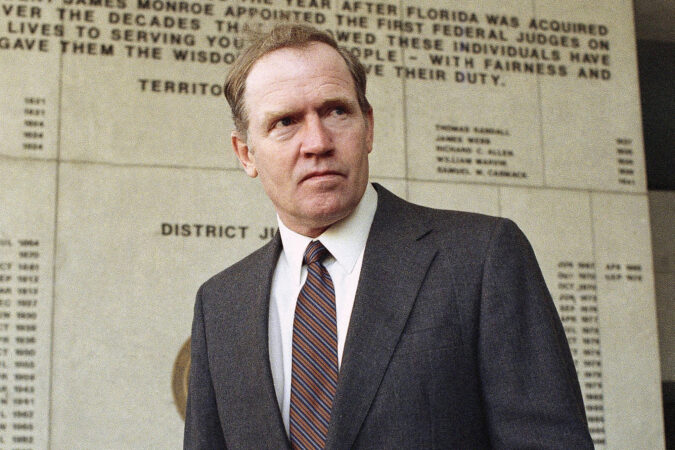
    MADISON, Wis. — Eugene Hasenfus, who played a key role in unraveling the Iran-Contra affair after his CIA-backed supply plane was shot down over Nicaragua in 1986, has died.

    Mr. Hasenfus died on Nov. 26 in Menominee, Mich., after a nine-year battle with cancer, according to his obituary from the Hansen-Onion-Martell Funeral Home in Marinette, Wis. He was 84.

    Mr. Hasenfus was born Jan. 22, 1941, in Marinette. He served with the Marines in Vietnam and continued a private career in aviation before he became a key figure in the Cold War’s Iran-Contra scandal in 1986.

    In 1981, President Ronald Reagan authorized the CIA to support the anti-communist right-wing guerrilla force known as the Contras who were working against the Sandinistas in the Nicaraguan government. Congress cut off all military assistance to the Contras in 1984.

    Months before the cutoff, top officials in Reagan’s administration ramped up a secret White House-directed supply network to the Contras. The operation’s day-to-day activities were handled by National Security Council aide Oliver North. The goal was to keep the Contras operating until Congress could be persuaded to resume CIA funding.

    The secrecy of North’s network unraveled after one of its planes with Mr. Hasenfus on board was shot down over Nicaragua in October 1986. Three other crew members died, but Mr. Hasenfus parachuted into the jungle and evaded authorities for more than 24 hours.

    He was captured by the leftist Nicaraguan government and charged with several crimes, including terrorism.

    Mr. Hasenfus said after his capture that the CIA was supervising the supply flights to the Contras. At first, Reagan administration officials lied by saying that the plane had no connection to the U.S. government.

    Congress, spurred by controversy over the Hasenfus flight, eventually launched an investigation.

    Mr. Hasenfus was convicted in Nicaragua of charges related to his role in delivering arms to the Contras and sentenced to 30 years in prison. Nicaraguan President Daniel Ortega pardoned Mr. Hasenfus a month later and he returned to his home in northern Wisconsin.

    In 1988, he filed an unsuccessful lawsuit seeking $135 million in damages against two men and two companies linked to the Iran-Contra arms deals.

    In 2003, he pleaded guilty in Brown County Circuit Court to a charge of lewd, lascivious behavior after he exposed himself in the parking lot of a grocery store. His probation was revoked in 2005 and he spent time in jail, according to online court records.

    He is survived by his four children and eight grandchildren.

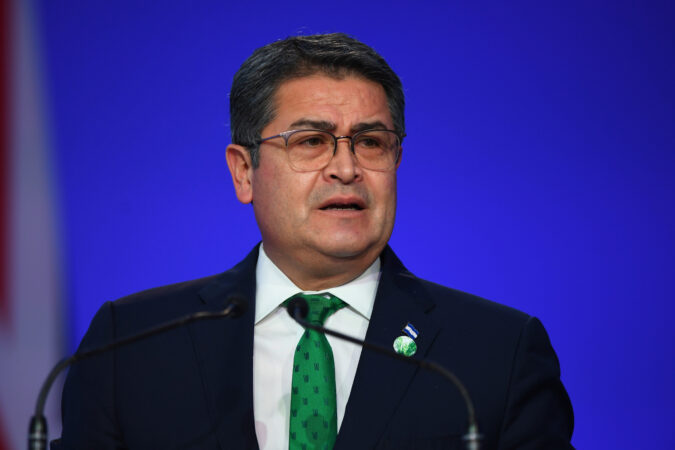
  • Former Honduras President Juan Orlando Hernández is freed from prison after a pardon from Trump

    Former Honduras President Juan Orlando Hernández is freed from prison after a pardon from Trump

    TEGUCIGALPA, Honduras — Former Honduras President Juan Orlando Hernández, sentenced last year to 45 years in prison for his role in a drug trafficking operation that moved hundreds of tons of cocaine to the United States, was released from prison following a pardon from President Donald Trump, officials confirmed Tuesday.

    Hernández was released Monday from U.S. Penitentiary Hazelton in West Virginia, a spokesperson for the Federal Bureau of Prisons told the Associated Press. The bureau’s online inmate records also reflected his release.

    The release of Hernández — a former U.S. ally whose conviction prosecutors said exposed the depth of cartel influence in Honduras — comes just days after the country’s presidential election. Trump defended the decision aboard Air Force One on Sunday, saying Hondurans believed Hernández had been “set up,” even as prosecutors argued he protected drug traffickers who moved hundreds of tons of cocaine through the country.

    The pardon also unfolds against the backdrop of Trump’s aggressive counter-narcotics push that has triggered intense controversy across Latin America. In recent months, U.S. forces have repeatedly struck vessels they say were ferrying drugs north, a series of lethal maritime attacks that the administration argues are lawful acts of war against drug cartels — and that critics say test the limits of international law and amount to a pressure campaign on Venezuela’s President Nicolás Maduro.

    The Trump administration has carried out 21 known strikes on vessels accused of carrying drugs, killing at least 83 people. The administration has justified the attacks as a necessary escalation to stem the flow of drugs into the United States and asserted the U.S. is engaged in an “armed conflict” with drug cartels, similar to the war against al-Qaida following the Sept. 11 attacks.

    Hernández’s wife applauds his release

    Ana García thanked Trump for pardoning her husband via the social platform X early Tuesday.

    Speaking to reporters Tuesday outside her home in Tegucigalpa, she thanked Trump for pardoning her husband and drew a parallel between the two men.

    “Today the whole world realizes that, like they did with President Donald Trump, the same Southern District, the same prosecutor created a political case,” García said.

    She said Hernández called her Monday evening to say he was in the office of the prison head and had been told he will be released. García said Hernández is in an undisclosed location for his safety, but that he plans to address the Honduran people on Wednesday.

    Hernández’s attorney Renato Stabile said in an emailed statement he also would not share the former president’s current location.

    García said the process to seek a pardon began several months ago with a petition to the office of pardons. Then on Oct. 28, Hernández’s birthday, he wrote a letter to Trump. He announced he was pardoning Hernández last Friday.

    “My husband is the president who has done the most for Honduras in the fight against organized crime,” Garcia said.

    Trump’s rationale for the pardon

    Trump was asked Sunday why he pardoned Hernández.

    “I was asked by Honduras, many of the people of Honduras,” Trump told reporters traveling with him on Air Force One.

    “The people of Honduras really thought he was set up, and it was a terrible thing,” he said.

    “They basically said he was a drug dealer because he was the president of the country. And they said it was a Biden administration setup,” Trump said. ”And I looked at the facts and I agreed with them.”

    Stabile, the attorney, said Hernández is glad the “ordeal” is over.

    “On behalf of President Hernández and his family I would like to thank President Trump for correcting this injustice,” Stabile said.

    Democratic lawmakers expressed condemnation and disbelief that Trump issued the pardon.

    “They prosecute him, find him guilty of selling narcotics through these cartels into the United States. Can you think of anyone more reprehensible than that? Selling drugs to this country, finding more victims by the day,” said Sen. Dick Durbin of Illinois in a speech on the Senate floor.

    “This is not an action by a President trying to keep America safe from narcotics,” Durbin added.

    The Trump administration has declared drug cartels to be unlawful combatants and has carried out strikes in the Caribbean against boats the White House says were carrying drugs.

    The case against the former president

    Hernández was arrested at the request of the United States in February 2022, weeks after current President Xiomara Castro took office.

    Two years later, Hernández was sentenced to 45 years in prison in a New York federal courtroom for taking bribes from drug traffickers so they could safely move some 400 tons of cocaine north through Honduras to the United States.

    Hernández maintained throughout that he was innocent and the victim of revenge by drug traffickers he had helped extradite to the United States.

    During his sentencing, federal Judge P. Kevin Castel said the punishment should serve as a warning to “well educated, well dressed” individuals who gain power and think their status insulates them from justice when they do wrong.

    Hernández portrayed himself as a hero of the anti-drug trafficking movement who teamed up with American authorities under three U.S. presidential administrations to reduce drug imports.

    But the judge said trial evidence proved the opposite and that Hernández employed “considerable acting skills” to make it seem that he strongly opposed drug trafficking while he deployed his nation’s police and military to protect the drug trade.

    Hernández is not guaranteed a quick return to Honduras.

    Immediately after Trump announced his intention to pardon Hernández, Honduras Attorney General Johel Zelaya said via X that his office was obligated to seek justice and put an end to impunity.

    He did not specify what charges Hernández could face in Honduras. There were various corruption-related investigations of his administration across two terms in office that did not lead to charges against him. Castro, who oversaw Hernández’s arrest and extradition to the U.S., will remain in office until January.

    The pardon promised by Trump days before Honduras’ presidential election injected a new element into the contest that some said helped the candidate from his National Party Nasry Asfura as the vote count proceeded Tuesday.