Category: Nation World News Wires

  • Advocacy groups urge parents to avoid AI toys this holiday season

    Advocacy groups urge parents to avoid AI toys this holiday season

    They’re cute, even cuddly, and promise learning and companionship — but artificial-intelligence toys are not safe for kids, according to children’s and consumer advocacy groups urging parents not to buy them during the holiday season.

    These toys, marketed to kids as young as 2 years old, are generally powered by AI models that have already been shown to harm children and teenagers, such as OpenAI’s ChatGPT, according to an advisory published Thursday by the children’s advocacy group Fairplay and signed by more than 150 organizations and individual experts such as child psychiatrists and educators.

    “The serious harms that AI chatbots have inflicted on children are well-documented, including fostering obsessive use, having explicit sexual conversations, and encouraging unsafe behaviors, violence against others, and self-harm,” Fairplay said.

    AI toys, made by companies including Curio Interactive and Keyi Technologies, are often marketed as educational, but Fairplay says they can displace important creative and learning activities. They promise friendship but disrupt children’s relationships and resilience, the group said.

    “What’s different about young children is that their brains are being wired for the first time, and developmentally it is natural for them to be trustful, for them to seek relationships with kind and friendly characters,” said Rachel Franz, director of Fairplay’s Young Children Thrive Offline Program. Because of this, she added, the amount of trust young children are putting in these toys can exacerbate the harms seen with older children.

    Fairplay, a 25-year-old organization formerly known as the Campaign for a Commercial-Free Childhood, has been warning about AI toys for years. They just weren’t as advanced as they are today. A decade ago, during an emerging fad of internet-connected toys and AI speech recognition, the group helped lead a backlash against Mattel’s talking Hello Barbie doll that it said was recording and analyzing children’s conversations.

    This time, though AI toys are mostly sold online and are more popular in Asia than elsewhere, Franz said some have started to appear on store shelves in the U.S. and more could be on the way.

    “Everything has been released with no regulation and no research, so it gives us extra pause when all of a sudden we see more and more manufacturers, including Mattel, who recently partnered with OpenAI, potentially putting out these products,” Franz said.

    It’s the second big seasonal warning against AI toys since consumer advocates at U.S. PIRG last week called out the trend in its annual Trouble in Toyland report that typically looks at a range of product hazards, such as high-powered magnets and button-sized batteries that young children can swallow. This year, the organization tested four toys that use AI chatbots.

    “We found some of these toys will talk in-depth about sexually explicit topics, will offer advice on where a child can find matches or knives, act dismayed when you say you have to leave, and have limited or no parental controls,” the report said. One of the toys, a teddy bear made by Singapore-based FoloToy, was later withdrawn, its CEO told CNN this week.

    Dana Suskind, a pediatric surgeon and social scientist who studies early brain development, said young children don’t have the conceptual tools to understand what an AI companion is. While kids have always bonded with toys through imaginative play, when they do this they use their imagination to create both sides of a pretend conversation, “practicing creativity, language, and problem-solving,” she said.

    “An AI toy collapses that work. It answers instantly, smoothly, and often better than a human would. We don’t yet know the developmental consequences of outsourcing that imaginative labor to an artificial agent — but it’s very plausible that it undercuts the kind of creativity and executive function that traditional pretend play builds,” Suskind said.

    Beijing-based Keyi, maker of an AI “petbot” called Loona, didn’t return requests for comment this week, but other AI toymakers sought to highlight their child safety protections.

    California-based Curio Interactive makes stuffed toys, like Gabbo and rocket-shaped Grok, that have been promoted by the pop singer Grimes. The company said it has “meticulously designed” guardrails to protect children, and the company encourages parents to “monitor conversations, track insights, and choose the controls that work best for their family.”

    In response to the earlier PIRG findings, Curio said it is “actively working with our team to address any concerns, while continuously overseeing content and interactions to ensure a safe and enjoyable experience for children.”

    Another company, Miko, based in Mumbai, India, said it uses its own conversational AI model rather than relying on general large language model systems such as ChatGPT in order to make its product — an interactive AI robot — safe for children.

    “We are always expanding our internal testing, strengthening our filters, and introducing new capabilities that detect and block sensitive or unexpected topics,” said CEO Sneh Vaswani. “These new features complement our existing controls that allow parents and caregivers to identify specific topics they’d like to restrict from conversation. We will continue to invest in setting the highest standards for safe, secure and responsible AI integration for Miko products.”

    Miko’s products are sold by major retailers such as Walmart and Costco and have been promoted by the families of social media “kidfluencers” whose YouTube videos have millions of views. On its website, it markets its robots as “Artificial Intelligence. Genuine friendship.”

    Ritvik Sharma, the company’s senior vice president of growth, said Miko actually “encourages kids to interact more with their friends, to interact more with the peers, with the family members etc. It’s not made for them to feel attached to the device only.”

    Still, Suskind and children’s advocates say analog toys are a better bet for the holidays.

    “Kids need lots of real human interaction. Play should support that, not take its place. The biggest thing to consider isn’t only what the toy does; it’s what it replaces. A simple block set or a teddy bear that doesn’t talk back forces a child to invent stories, experiment, and work through problems. AI toys often do that thinking for them,” she said. “Here’s the brutal irony: When parents ask me how to prepare their child for an AI world, unlimited AI access is actually the worst preparation possible.”
  • U.S. employers added a surprisingly solid 119,000 jobs in September, the government said in a delayed report

    U.S. employers added a surprisingly solid 119,000 jobs in September, the government said in a delayed report

    WASHINGTON — U.S. employers added a surprisingly solid 119,000 jobs in September, the government said, issuing a key economic report that had been delayed for seven weeks by the federal government shutdown.

    The increase in payrolls was more than double the 50,000 economists had forecast.

    Yet there were some troubling details in the delayed report.

    Labor Department revisions showed that the economy lost 4,000 jobs in August instead of gaining 22,000 as originally reported. Altogether, revisions shaved 33,000 jobs off July and August payrolls. The economy had also shed jobs in June, the first time since the 2020 pandemic that the monthly jobs report has gone negative twice in one year.

    And more than 87% of the September job gains were concentrated in two industries: healthcare and social assistance and leisure and hospitality.

    “We’ve got these strong headline numbers, but when you look underneath that you’ll see that a lot of that is driven by healthcare,’’ said Cory Stahle, senior economist at the Indeed Hiring Lab. ”At the end of the day, the question is: Can you support an economic expansion on the back of one industry? Anybody would have a hard time arguing everybody should become a nurse.”

    The unemployment rate rose to 4.4% in September, highest since October 2021 and up from 4.3% in August, the Labor Department said Thursday. The jobless rate rose partly because 470,000 people entered the labor market — either working or looking for work — in September and not all of them found jobs right away.

    The data, though late, was welcomed by businesses, investors, policymakers and the Federal Reserve. During the 43-day shutdown, they’d been groping in the dark for clues about the health of the American job market because federal workers had been furloughed and couldn’t collect the data.

    The report comes at a time of considerable uncertainty about the economy. The job market has been strained by the lingering effects of high interest rates and uncertainty around Trump’s erratic campaign to slap taxes on imports from almost every country on earth. But economic growth at midyear was resilient.

    Healthcare and social assistance firms added more than 57,000 jobs in September, restaurants and bars 37,000, construction companies 19,000 and retailers almost 14,000. But factories shed 6,000 jobs — the fifth straight monthly drop. The federal government, targeted by Trump and billionaire Elon Musk’s DOGE cost cutters, lost 3,000 jobs, the eighth straight monthly decline..

    Average hourly wages rose just 0.2% from August and 3.8% from a year earlier, edging closer to the 3.5% year-over-year increase that the Federal Reserve’s inflation fighters like to see.

    The latest reading on jobs Thursday makes a rate cut by the Fed officials at their next meeting in December less likely. Many were already leaning against a cut next month, according to minutes of their October meeting released Wednesday. Steady hiring suggests the economy doesn’t need lower interest rates to expand.

    The September jobs report will be the last one the Fed will see before its Dec. 9-10 meeting. Officials are split between those who see stubbornly high inflation as the main challenge they need to address by keeping rates elevated, and those who are more concerned that hiring is sluggish and needs to be supported by rate reductions.

    Hiring has been strained this year by the lingering effects of high interest rates engineered to fight a 2021-2022 spike in inflation and uncertainty around Trump’s campaign to slap taxes on imports from almost every country on earth and on specific products — from copper to foreign films.

    Labor Department revisions in September showed that the economy created 911,000 fewer jobs than originally reported in the year that ended in March. That meant that employers added an average of just 71,000 new jobs a month over that period, not the 147,000 first reported. Since March, job creation has fallen farther — to an average 59,000 a month.

    With September numbers out, businesses, investors, policymakers and the Fed will have to wait awhile to get another good look at the numbers behind the American labor market.

    The Labor Department said Wednesday that it won’t release a full jobs report for October because it couldn’t calculate the unemployment rate during the government shutdown.

    Instead, it will release some of the October jobs data — including the number of jobs that employers created last month — along with the full November jobs report on Dec. 16, a couple of weeks late.

    The 2025 job market has been marked by an awkward pairing: relatively weak hiring but few layoffs, meaning that Americans who have work mostly enjoy job security – but those who don’t often struggle to find employment.

    Megan Fridenmaker, 28, lost her job last month as a writer for a podcast network in Indianapolis. She’s applied for at least 200 jobs and landed just one interview. “I am far from the only unemployed person in my friend group,’’ she said. “Where the job market’s at right now – people will apply for hundreds and hundreds (of jobs) before getting one interview.’’

    “Out of everything I’ve applied for, I get a response from maybe a quarter of them,’’ she said. “And the vast majority of the responses are the automated – ‘Thank you so much, but we’ve gone with another candidate.’ ‘Thank you so much, but we’ve already filled the position.’

    “The whole job-hunting experience has felt so cold and so distant and so removed from who we are as humans.”

  • CDC website changed to contradict scientific conclusion that vaccines don’t cause autism

    CDC website changed to contradict scientific conclusion that vaccines don’t cause autism

    NEW YORK — A Centers for Disease Control and Prevention website has been changed to contradict the longtime scientific conclusion that vaccines do not cause autism, spurring outrage among a number of public health and autism experts.

    The CDC “vaccine safety” webpage was updated Wednesday, saying “the statement ‘Vaccines do not cause autism’ is not an evidence-based claim.”

    The change is the latest move by the U.S. Department of Health and Human Services to revisit — and foster uncertainty about — long-held scientific consensus about the safety of vaccines and other pharmaceutical products.

    It was immediately decried by scientists and advocates who have long been focused on finding the causes of autism.

    “We are appalled to find that the content on the CDC webpage ‘Autism and Vaccines’ has been changed and distorted, and is now filled with anti-vaccine rhetoric and outright lies about vaccines and autism,” the Autism Science Foundation said in a statement Thursday.

    Widespread scientific consensus and decades of studies have firmly concluded there is no link between vaccines and autism. “The conclusion is clear and unambiguous,” said Dr. Susan Kressly, president of the American Academy of Pediatrics, in a statement Thursday.

    “We call on the CDC to stop wasting government resources to amplify false claims that sow doubt in one of the best tools we have to keep children healthy and thriving: routine immunizations,” she said.

    The CDC has, until now, echoed the absence of a link in promoting Food and Drug Administration-licensed vaccines.

    But anti-vaccines activists — including Robert F. Kennedy Jr., who this year became secretary of Health and Human Services — have long claimed there is one.

    It’s unclear if anyone at CDC was actually involved in the change, or whether it was done by Kennedy’s HHS, which oversees the CDC.

    Many at CDC were surprised.

    “I spoke with several scientists at CDC yesterday and none were aware of this change in content,” said Dr. Debra Houry, who was part of a group of CDC top officials who resigned from the agency in August. “When scientists are cut out of scientific reviews, then inaccurate and ideologic information results.”

    The updated page does not cite any new research. It instead argues that past studies supporting a link have been ignored by health authorities.

    “HHS has launched a comprehensive assessment of the causes of autism, including investigations on plausible biologic mechanisms and potential causal links. Additionally, we are updating the CDC’s website to reflect gold standard, evidence-based science,” said HHS spokesman Andrew Nixon, in an email Thursday.

    A number of former CDC officials have said that what CDC posts about certain subjects — including vaccine safety — can no longer be trusted.

    Dr. Daniel Jernigan, who also resigned from the agency in August, told reporters Wednesday that Kennedy seems to be “going from evidence-based decision making to decision-based evidence making.”

    U.S. Sen. Bill Cassidy, a Louisiana Republican, earlier this year played a decisive role in approving Kennedy’s nomination for HHS secretary. Cassidy initially voiced misgivings about Kennedy, but in February said Kennedy had pledged — among other things — not to remove language from the CDC website pointing out that vaccines do not cause autism.

    The new site continues to have a headline that says “Vaccines do not cause autism,” but HHS officials put an asterisk next to it. A note at the bottom of the page says the phrasing “has not been removed due to an agreement with the chair of the U.S. Senate Health, Education, Labor, and Pensions Committee that it would remain on the CDC website.”

    Cassidy’s spokespersons did not immediately respond to a request for comment.

  • Trump administration threatens to withhold $75 million from Pennsylvania over immigrant truck drivers

    Trump administration threatens to withhold $75 million from Pennsylvania over immigrant truck drivers

    The Trump administration threatened Thursday to withhold nearly $75 million in funding if Pennsylvania does not immediately revoke what the administration claims are illegally issued commercial driver’s licenses to immigrants.

    The move by U.S. Transportation Secretary Sean Duffy to target Pennsylvania follows similar action against California. Both states are run by Democratic governors who have criticized President Donald Trump’s administration and who are viewed as potential top-shelf contenders to be the party’s 2028 presidential nominee.

    Duffy has made it a priority to scrutinize how the licenses are issued since August, when a tractor-trailer driver not authorized to be in the U.S. made an illegal U-turn and caused a crash in Florida that killed three people. That incident thrust the issue into the public’s consciousness.

    In a statement Thursday, DOT spokesperson Danna Almeida said all states were being reviewed.

    It’s unclear how many people would be affected in Pennsylvania. In any case, Pennsylvania Gov. Josh Shapiro ‘s administration said the federal government didn’t identify a single commercial driver’s license issued to someone who wasn’t eligible.

    Still, a letter Thursday from the Republican administration to Shapiro cited an audit that found two out of 150 people whose licenses exceeded their lawful presence in the country.

    In four cases it had reviewed, the federal government said Pennsylvania provided no evidence that it had required noncitizens to provide legitimate proof that they were legally in the country at the time they got the license.

    The Trump administration called on Pennsylvania to stop issuing new, renewed and transferred commercial driver’s licenses and permits, as well as conduct an audit to identify those licenses whose expirations exceed the driver’s lawful stay in the U.S.

    It is also asking the state to void noncompliant licenses and remove those drivers from the road. The administration said approximately 12,400 noncitizen drivers hold an unexpired commercial learner’s permit or commercial driver’s license issued by Pennsylvania.

    The governors of California and Pennsylvania — Gavin Newsom and Shapiro — are tough critics of Trump, and both have been repeated targets of Trump’s administration.

    Shapiro’s administration said the state transportation department ceased issuing commercial driver’s licenses to noncitizens after the Federal Motor Carrier Safety Administration published a regulation in late September that would severely limit which immigrants can get one.

    A federal court has put the rule on hold for now, but Shapiro’s administration said its transportation department still hasn’t resumed issuing what are called “non-domiciled CDLs.”

    Pennsylvania’s transportation department said Thursday that it follows federal rules for verifying an immigrant applicant’s lawful presence in the country by checking the U.S. Department of Homeland Security’s database.

    But Shapiro this week suggested that DHS was falling short by failing to properly maintain that database, which states use to check an immigrant’s legal status before issuing a driver’s license to a noncitizen.

    His comments came after DHS said it had arrested an Uzbek national with a commercial driver’s license issued by Pennsylvania. The man, who had a work authorization granted in 2024, was wanted in his home country for belonging to a terrorist organization, the department said.

    But Shapiro said the state transportation department checked the federal database over the summer before issuing a CDL to the man, and he was authorized to get one. The state rechecked the database this week, and it still listed him as qualified to get a CDL, Shapiro said.

    “They clearly are not minding the shop, and they’ve gotta get better, because every single state in the country relies on this database when making a determination as to who qualifies for a CDL. We relied on the feds before issuing this one,” Shapiro said.

    California, which said it would revoke 17,000 licenses, is the only state the administration has acted against because it was the first one where an audit was completed. The government shutdown delayed reviews in other states, but the Transportation Department is urging all of them to tighten their standards. ___ Catalini reported from Trenton, New Jersey, and Levy from Harrisburg, Pennsylvania. Associated Press writer Josh Funk contributed.

  • Respect and remembrance for Cheney from Bush, Biden and past vice presidents as Trump is excluded

    Respect and remembrance for Cheney from Bush, Biden and past vice presidents as Trump is excluded

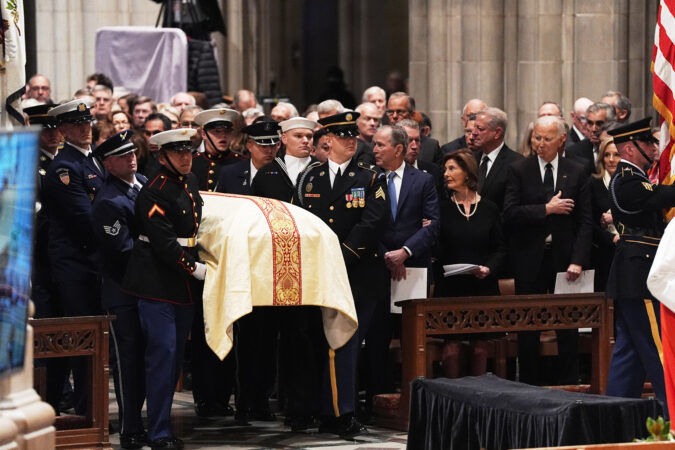
    WASHINGTON — They gathered at the Washington National Cathedral on Thursday — former presidents, vice presidents, sworn political foes and newfound friends — in a show of respect and remembrance for Dick Cheney, the consequential and polarizing vice president who became an acidic scold of President Donald Trump.

    Trump, who has been publicly silent about Cheney’s death Nov. 3, was not invited to the memorial service.

    Two ex-presidents came: Republican George W. Bush, who eulogized the man who served him as vice president, and Democrat Joe Biden, who once called Cheney “the most dangerous vice president we’ve had probably in American history” but now honors his commitment to his family and to his values.

    “Solid and rare and reliable,” Bush said at the service of his vice president, praising a man whose “talent and restraint” exceeded his ego. “Smart and polished, without airs.”

    Former President George W. Bush, speaks a tribute during the funeral service for former Vice President Dick Cheney at the Washington National Cathedral on Thursday.

    Bush and others noted the understated demeanor of a man who nevertheless wielded great influence in government. “Above all,” Bush said, “I wanted someone with the ability to step into the presidency without getting distracted by the ambition to seek it.”

    Among the eulogists, Liz Cheney, the eldest daughter, only obliquely addressed what amounted to a father-daughter feud with the president — a man her dad had called a “coward” for trying to overturn his loss in the 2020 election.

    She spoke of her father’s conviction that when confronted with a choice between defending the country and a political party, the country must come first. “Bonds of party must always yield to the single bond we share as Americans,” she said.

    Liz Cheney is a former high-ranking House member whose Republican political career was shredded by a MAGA movement angered by her investigation of the Jan. 6, 2021, riot at the Capitol. Thursday, she chose not to speak directly of Trump.

    She spoke of seeing clouds in the shape of angels just before her father died.

    A Who’s Who of Washington, minus you know who

    Moments before the service began, figures of recent but now receded power mingled: Bush and Biden and their wives sitting in a row together, former Vice Presidents Kamala Harris and Mike Pence chatting side by side in their pew with Al Gore and Dan Quayle together behind them.

    Biden greeted Republican Sen. Mitch McConnell, the former longtime Senate leader, and his wife, former labor and transportation secretary Elaine Chao. Behind them sat Democratic Rep. Nancy Pelosi, who spent time talking with another former House speaker, Republican John Boehner. All gathered among the soaring interior columns of the grand cathedral known as “a spiritual home for the nation.”

    Others delivering tributes at Thursday’s funeral were Cheney’s longtime cardiologist, Dr. Jonathan Reiner; former NBC News correspondent Pete Williams, who was Cheney’s spokesman at the Pentagon; and several of the former vice president’s grandchildren.

    “I’m happy to report that I haven’t given many eulogies,” Reiner said in his remarks. “Nobody wants a doctor who is great at funerals.”

    Reiner recalled doctors telling Cheney decades ago, after the first of multiple heart attacks, that he should abandon his political ambitions then. Yet he kept winning elections as a Wyoming congressman for years after that.

    Cheney, he said, was always the “calmest person in the room.”

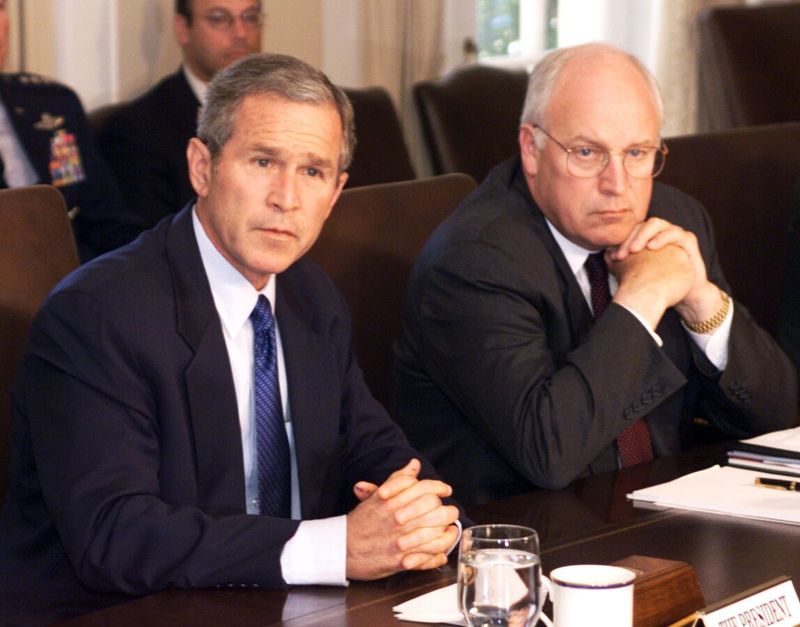
    President George W. Bush and Vice President Dick Cheney meet in Washington, D.C., on Sept. 12, 2001, with members of the president’s national security team in the Cabinet room.

    Cheney had lived with heart disease for decades and, after the Bush administration, with a heart transplant. He died at age 84 from complications of pneumonia and cardiac and vascular disease, his family said.

    Trump’s vice president, JD Vance, on stage at another event in the morning, was asked about Cheney and said: “Obviously there’s some political disagreements there but he was a guy who served his country. We certainly wish his family all the best in this moment of grieving.”

    Vance was also not invited to the funeral, according to a person familiar with the details who was not authorized to speak publicly and spoke on condition of anonymity.

    The White House lowered its flags to half-staff after Cheney’s death, as it said the law calls for, but Trump did not issue the presidential proclamation that often accompanies the death of notable figures, nor has he commented publicly on his passing.

    The deeply conservative Cheney’s influence in the Bush administration was legendary and, to his critics, tragic.

    He advocated for the U.S. invasion of Iraq on the basis of what proved to be faulty intelligence and consistently defended the extraordinary tools of surveillance, detention and inquisition employed in response to the Sept. 11, 2001, attacks. Bush credited him with helping to keep the country safe and stable in a perilous time.

    Bad blood between the Cheneys and Trump

    After the 2020 election won by Biden, Liz Cheney served as vice chair of the Democratic-led special House committee that investigated the Jan. 6 Capitol riot. She accused Trump of summoning the violent mob and plunging the nation into “a moment of maximum danger.”

    For that, she was stripped of her Republican leadership position and ultimately defeated in a 2022 Republican primary in Wyoming. In a campaign TV ad made for his daughter, Dick Cheney branded Trump a “coward” who “tried to steal the last election using lies and violence to keep himself in power after the voters had rejected him.”

    Last year, it did not sit well with Trump when Cheney said he would vote for the Democrat, Harris, in the presidential election.

    Trump told Arab and Muslim voters that Dick Cheney’s support for Harris should give them pause, because he “killed more Arabs than any human being on Earth. He pushed Bush, and they went into the Middle East.”

  • What’s next now that Trump has signed bill releasing the Epstein files

    What’s next now that Trump has signed bill releasing the Epstein files

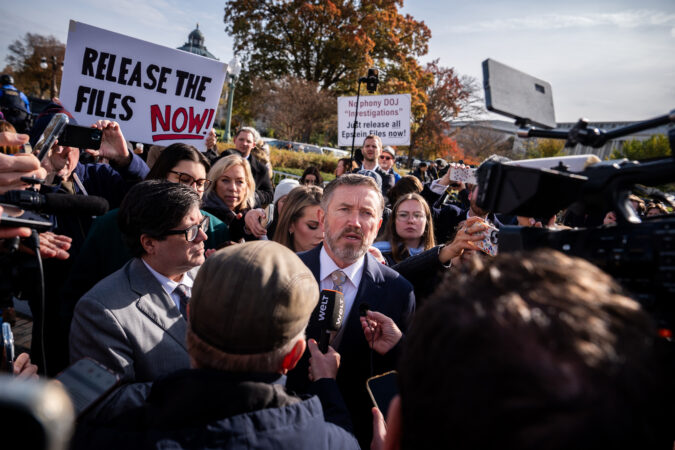
    WASHINGTON — President Donald Trump has signed a bill to compel the Justice Department to make public its case files on the convicted sex offender Jeffrey Epstein, a potentially far-reaching development in a yearslong push by survivors of Epstein’s abuse for a public reckoning.

    Both the House and Senate passed the bill this week with overwhelming margins after Trump reversed course on his monthslong opposition to the bill and indicated he would sign it. Now that the bill has been signed by the president, there’s a 30-day countdown for the Justice Department to produce what’s commonly known as the Epstein files.

    “This bill is a command for the president to be fully transparent, to come fully clean, and to provide full honesty to the American people,” Senate Democratic Leader Chuck Schumer of New York said Wednesday.

    Schumer added that Democrats were ready to push back if they perceive that the president is doing anything but adhering to “full transparency.”

    In a social media post Wednesday as he announced he had signed the bill, Trump wrote, “Democrats have used the ‘Epstein’ issue, which affects them far more than the Republican Party, in order to try and distract from our AMAZING Victories.”

    The swift, bipartisan work in Congress this week was a response to the growing public demand that the Epstein files be released, especially as attention focuses on his connections to global leaders including Trump, former President Bill Clinton, Andrew Mountbatten Windsor, who has already been stripped of his royal title as Prince Andrew over the matter, and many others.

    There is plenty of public anticipation about what more the files could reveal. Yet the bill will most likely trigger a rarely seen baring of a sprawling federal investigation, also creating the potential for unintended consequences.

    What does the bill do?

    The bill compels Attorney General Pam Bondi to release essentially everything the Justice Department has collected over multiple federal investigations into Epstein, as well as his longtime confidante and girlfriend Ghislaine Maxwell, who is serving a 20-year prison sentence for luring teenage girls for the disgraced financier. Those records total around 100,000 pages, according to a federal judge who has reviewed the case.

    It will also compel the Justice Department to produce all its internal communications on Epstein and his associates and his 2019 death in a Manhattan jail cell as he awaited charges for sexually abusing and trafficking dozens of teenage girls.

    The legislation, however, exempts some parts of the case files. The bill’s authors made sure to include that the Justice Department could withhold personally identifiable information of victims, child sexual abuse materials and information deemed by the administration to be classified for national defense or foreign policy.

    “We will continue to follow the law with maximum transparency while protecting victims,” Bondi told a news conference Wednesday when asked about releasing the files.

    The bill also allows the Justice Department to withhold information that would jeopardize active investigations or prosecutions. That’s created some worry among the bill’s proponents that the department would open active investigations into people named in the Epstein files in order to shield that material from public view.

    Rep. Marjorie Taylor Greene, a longtime Trump loyalist who has had a prominent split with Trump over the bill, said Tuesday that she saw the administration’s compliance with the bill as its “real test.”

    “Will the Department of Justice release the files, or will it all remain tied up in investigations?” she asked.

    In July, the FBI said in a memo regarding the Epstein investigation that, “we did not uncover evidence that could predicate an investigation against uncharged third parties.” But Bondi last week complied with Trump’s demands and ordered a federal prosecutor to investigate Epstein’s ties to the president’s political foes, including Clinton.

    Still, Rep. Thomas Massie, a Kentucky Republican who sponsored the bill, said “there’s no way they can have enough investigations to cover” all of the people he believes are implicated in Epstein’s abuse.

    “And if they do, then good,” he added.

    The bill also requires the Justice Department to produce reports on what materials it withheld, as well as redactions made, within 15 days of the release of the files. It stipulates that officials can’t withhold or redact anything “on the basis of embarrassment, reputational harm, or political sensitivity, including to any government official, public figure, or foreign dignitary.”

    Who could be named?

    There’s a widely held expectation that many people could be named in case files for investigations that spanned over a decade — and some concern that just because someone is named, that person would be assumed guilty or complicit.

    Epstein was a luminary who kept company with heads of state, influential political figures, academics and billionaires. The release of his emails and messages by a House Oversight Committee investigation last week has already shown his connections with — and private conversations about — Trump and many other high-powered figures.

    Yet federal prosecutors follow carefully constructed guidelines about what information they produce publicly and at trial, both to protect victims and to uphold the fairness of the legal system. House Speaker Mike Johnson raised objections to the bill on those grounds this week, arguing that it could reveal unwanted information on victims as well as others who were in contact with investigators.

    Still, Johnson did not actually try to make changes to the bill and voted for it on the House floor.

    For the bill’s proponents, a public reckoning over the investigation is precisely the point. Some of the survivors of trafficking from Epstein and Maxwell have sought ways to name people they accuse of being complicit or involved, but fear they will face lawsuits from the men they accuse.

    Massie said that he wants the FBI to release the reports from its interviews with the victims.

    Those reports typically contain unvetted information, but Massie said he is determined to name those who are accused. He and Greene have offered to read the names of those accused on the House floor, which would shield their speech from legal consequences.

    “We need names,” Massie said.

  • Energy Department loans $1B to help finance the restart of nuclear reactor on Three Mile Island

    Energy Department loans $1B to help finance the restart of nuclear reactor on Three Mile Island

    HARRISBURG — The U.S. Department of Energy said Tuesday that it will loan $1 billion to help finance the restart of the nuclear power plant on Pennsylvania’s Three Mile Island that is under contract to supply power to data centers for tech giant Microsoft.

    The loan is in line with the priorities of President Donald Trump’s administration, including bolstering nuclear power and artificial intelligence.

    For Constellation Energy, which owns Three Mile Island’s lone functioning nuclear power reactor, the federal loan will lower its financing cost to get the mothballed plant up and running again. The 835-megawatt reactor can power the equivalent of approximately 800,000 homes, the Department of Energy said.

    The reactor had been out of operation for five years when Constellation Energy announced last year that it would spend $1.6 billion to restart it under a 20-year agreement with Microsoft to buy the power for its data centers.

    Constellation Energy renamed the functioning unit the Crane Clean Energy Center as it works to restore equipment, including the turbine, generator, main power transformer, and cooling and control systems. It hopes to bring the plant back online in 2027.

    The loan is being issued under an existing $250 billion energy infrastructure program initially authorized by Congress in 2022. Neither the department nor Constellation released terms of the loan.

    The plant, on an island in the Susquehanna River just outside Harrisburg, was the site of the nation’s worst commercial nuclear power accident, in 1979. The accident destroyed one reactor, Unit 2, and left the plant with one functioning reactor, Unit 1.

    In 2019, Constellation Energy’s then-parent company Exelon shut down the functioning reactor, saying it was losing money and Pennsylvania lawmakers had refused to subsidize it to keep it running.

    The plan to restart the reactor comes amid something of a renaissance for nuclear power, as policymakers are increasingly looking to it to shore up the nation’s power supply, help avoid the worst effects of climate change, and meet rising power demand driven by data centers.

  • Trump signs bill to release Jeffrey Epstein case files after fighting it for months

    Trump signs bill to release Jeffrey Epstein case files after fighting it for months

    WASHINGTON — President Donald Trump signed legislation Wednesday that compels his administration to release files on convicted sex offender Jeffrey Epstein, bowing to political pressure from his own party after initially resisting those efforts.

    Trump could have chosen to release many of the files on his own months ago.

    “Democrats have used the ‘Epstein’ issue, which affects them far more than the Republican Party, in order to try and distract from our AMAZING Victories,” Trump said in a social media post as he announced he had signed the bill.

    Now, the bill requires the Justice Department to release all files and communications related to Epstein, as well as any information about the investigation into his death in a federal prison in 2019, within 30 days. It allows for redactions about Epstein’s victims for ongoing federal investigations, but DOJ cannot withhold information due to “embarrassment, reputational harm, or political sensitivity.”

    It was a remarkable turn of events for what was once a farfetched effort to force the disclosure of case files from an odd congressional coalition of Democrats, one GOP antagonist of the president, and a handful of erstwhile Trump loyalists. As recently as last week, the Trump administration even summoned one Republican proponent of releasing the files, Rep. Lauren Boebert of Colorado, to the Situation Room to discuss the matter, although she did not change her mind.

    But over the weekend, Trump did a sharp U-turn on the files once it became clear that congressional action was inevitable. He insisted the Epstein matter had become a distraction to the GOP agenda and indicated he wanted to move on.

    “I just don’t want Republicans to take their eyes off all of the Victories that we’ve had,” Trump said in a social media post Tuesday afternoon, explaining the rationale for his abrupt about-face.

    The House passed the legislation on a 427-1 vote, with Rep. Clay Higgins, R-La., being the sole dissenter. He argued that the bill’s language could lead to the release of information on innocent people mentioned in the federal investigation. The Senate later approved it unanimously, skipping a formal vote.

    It’s long been established that Trump had been friends with Epstein, the disgraced financier who was close to the world’s elite. But the president has consistently said he did not know of Epstein’s crimes and had cut ties with him long ago.

    Before Trump returned to the White House for a second term, some of his closest political allies helped fuel conspiracy theories about the government’s handling of the Epstein case, asserting a cover-up of potentially incriminating information in those files.

  • Larry Summers takes leave from teaching at Harvard after release of Epstein emails

    Larry Summers takes leave from teaching at Harvard after release of Epstein emails

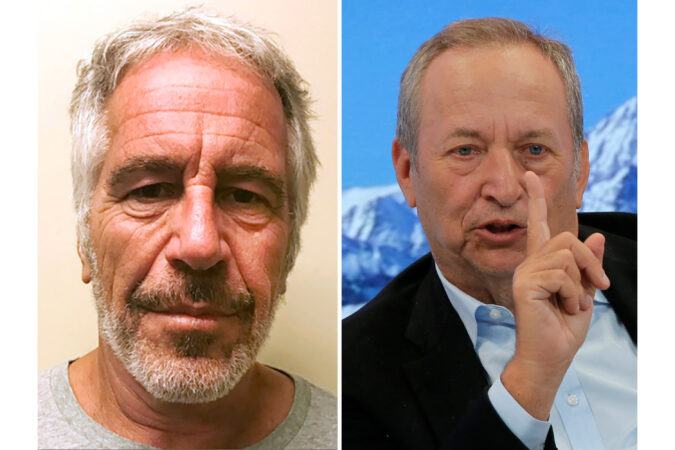
    Former U.S. Treasury Secretary Larry Summers abruptly went on leave Wednesday from teaching at Harvard University, where he once served as president, over recently released emails showing he maintained a friendly relationship with Jeffrey Epstein, Summers’ spokesperson said.

    Summers had canceled his public commitments amid the fallout of the emails being made public and earlier Wednesday severed ties with OpenAI, the maker of ChatGPT. Harvard had reopened an investigation into connections between him and Epstein, but Summers had said he would continue teaching economics classes at the school.

    That changed Wednesday evening with the news that he will step away from teaching classes as well as his position as director of the Mossavar-Rahmani Center for Business and Government with the Harvard Kennedy School.

    “Mr. Summers has decided it’s in the best interest of the Center for him to go on leave from his role as Director as Harvard undertakes its review,” Summers spokesperson Steven Goldberg said, adding that his co-teachers would finish the classes.

    Summers has not been scheduled to teach next semester, according to Goldberg.

    A Harvard spokesperson confirmed to The Associated Press that Summers had let the university know about his decision. Summers decision to go on leave was first reported by The Harvard Crimson.

    Harvard did not mention Summers by name in its decision to restart an investigation, but the move follows the release of emails showing that he was friendly with Epstein long after the financier pleaded guilty to soliciting prostitution from an underage girl in 2008.

    By Wednesday, the once highly regarded economics expert had been facing increased scrutiny over choosing to stay in the teaching role. Some students even filmed his appearance in shock as he appeared before a class of undergraduates on Tuesday while stressing he thought it was important to continue teaching.

    Massachusetts Sen. Elizabeth Warren, a Democrat, said in a social media post on Wednesday night that Summers “cozied up to the rich and powerful — including a convicted sex offender. He cannot be trusted in positions of influence.”

    Messages appear to seek advice about romantic relationship

    The emails include messages in which Summers appeared to be getting advice from Epstein about pursuing a romantic relationship with someone who viewed him as an “economic mentor.”

    “im a pretty good wing man , no?” Epstein wrote on Nov. 30, 2018.

    The next day, Summers told Epstein he had texted the woman, telling her he “had something brief to say to her.”

    “Am I thanking her or being sorry re my being married. I think the former,” he wrote.

    Summers’ wife, Elisa New, also emailed Epstein multiple times, including a 2015 message in which she thanked him for arranging financial support for a poetry project she directs. The gift he arranged “changed everything for me,” she wrote.

    “It really means a lot to me, all financial help aside, Jeffrey, that you are rooting for me and thinking about me,” she wrote.

    New, an English professor emerita at Harvard, did not respond to an email seeking comment Wednesday.

    An earlier review completed in 2020 found that Epstein visited Harvard’s campus more than 40 times after his 2008 sex-crimes conviction and was given his own office and unfettered access to a research center he helped establish. The professor who provided the office was later barred from starting new research or advising students for at least two years.

    Summers appears before Harvard class

    On Tuesday, Summers appeared before his class at Harvard, where he teaches “The Political Economy of Globalization” to undergraduates with Robert Lawrence, a professor with the Harvard Kennedy School.

    “Some of you will have seen my statement of regret expressing my shame with respect to what I did in communication with Mr. Epstein and that I’ve said that I’m going to step back from public activities for a while. But I think it’s very important to fulfill my teaching obligations,” he said.

    Summers’ remarks were captured on video by several students, but no one appeared to publicly respond to his comments.

    Epstein, who authorities said died by suicide in 2019, was a convicted sex offender infamous for his connections to wealthy and powerful people, making him a fixture of outrage and conspiracy theories about wrongdoing among American elites.

    Summers served as treasury secretary from 1999 to 2001 under President Bill Clinton. He was Harvard’s president for five years from 2001 to 2006. When asked about the emails last week, Summers issued a statement saying he has “great regrets in my life” and that his association with Epstein was a “major error in judgement.”

    Other organizations that confirmed the end of their affiliations with Summers included the Center for American Progress, the Center for Global Development and the Budget Lab at Yale University. Bloomberg TV said Summers’ withdrawal from public commitments included his role as a paid contributor, and the New York Times said it will not renew his contract as a contributing opinion writer.

  • Netflix gets Phillies’ Field of Dreams game as part of new MLB media deal

    Netflix gets Phillies’ Field of Dreams game as part of new MLB media deal

    ESPN and Major League Baseball appeared headed for an ugly separation after the network opted out of its rights deal in February.

    Nine months later, it appears to be the best thing to happen to both parties.

    ESPN has a reworked deal that includes out-of-market streaming rights while NBC and Netflix will televise games as part of a new three-year media rights agreement announced Wednesday by MLB.

    Commissioner Rob Manfred also was able to maximize rights for the Home Run Derby and wild-card series.

    NBC/Peacock will become the new home of Sunday Night Baseball and the wild-card round while Netflix will have the Home Run Derby and two additional games.

    Netflix will have MLB at Field of Dreams in Dyersville, Iowa, on Aug. 13 when the Phillies face the Minnesota Twins. It will be the first time the game has been played in Dyersville since 2022.

    Netflix also has the first game of the season on March 25 when the New York Yankees visit the San Francisco Giants. It also has the Home Run Derby and will stream an MLB special event game each year.

    The three deals will average nearly $800 million per year. ESPN will still pay $550 million while the NBC deal is worth $200 million and Netflix $50 million.

    How ESPN benefits

    ESPN, which has carried baseball since 1990, loses postseason games and the Home Run Derby but gains something more valuable for its bottom line by becoming the rights holder for MLB.TV, which will be available on the ESPN app.

    ESPN also gets the in-market streaming rights for the six teams whose games are produced by MLB — San Diego, Colorado, Arizona, Cleveland, Minnesota, and Seattle.

    Even though ESPN no longer has Sunday Night Baseball, it will have 30 games, primarily on weeknights and in the summer months.

    Baseball is the second league that has its out-of-market digital package available in the U.S. on ESPN’s platform. The NHL moved its package to ESPN in 2021.

    Welcome back, NBC

    NBC, which celebrates its 100th anniversary next year, has a long history with baseball, albeit not much recently. The network carried games from 1939 through 1989. It was part of the short-lived Baseball Network with ABC in 1994 and ’95 and then aired playoff games from 1996 through 2000.

    Its first game will be on March 26 when the defending two-time champion Los Angeles Dodgers host the Arizona Diamondbacks.

    The 25 Sunday night games will air mostly on NBC with the rest on the new NBC Sports Network. All will stream on Peacock.

    The first Sunday Night Baseball game on NBC will be April 12 with the next one in May after the NBA playoffs.

    The addition of baseball games gives NBC a year-around night of sports on Sundays. It has had NFL games on Sunday night since 2006 and will debut an NBA Sunday night slate in February.

    NBC will also have a prime-time game on Labor Day night.

    The Sunday early-afternoon games also return to Peacock, which had them in 2022 and ’23. The early-afternoon games will lead into a studio whip-around show before the Sunday night game.

    NBC/Peacock will also do the Major League Futures game during All-Star week and coverage of the first round of the MLB amateur draft.

    Don’t forget the others

    The negotiations around the other deals were complicated due to the fact that MLB was also trying not to slight two of its other rights holders. MLB receives an average of $729 million from Fox and $470 million from Turner Sports per year under deals that expire after the 2028 season.

    Fox’s Saturday nights have been mainly sports the past couple of years with a mix of baseball, college football, college basketball, and motorsports.

    Apple TV has had Friday Night Baseball since 2022.

    The deals also set up Manfred for future negotiations. He would like to see MLB take a more national approach to its rights instead of a large percentage of its games being on regional sports networks.