Category: Nation World News Wires

  • Mexico sends 37 cartel members to U.S. in latest offer to Trump administration

    Mexico sends 37 cartel members to U.S. in latest offer to Trump administration

    MEXICO CITY — Mexico’s security minister said Tuesday that it had sent another 37 members of Mexican drug cartels to the United States, as the Trump administration ratchets up pressure on governments to crack down on criminal networks it says are smuggling drugs across the border.

    Mexican Security Minister Omar García Harfuch wrote in a social media post on X that the people transferred were “high impact criminals” that “represented a real threat to the country’s security.”

    It is the third time in less than one year that Mexico has sent detained cartel members to the U.S. as the country attempts to offset mounting threats by U.S. President Donald Trump. García Harfuch said the government has sent 92 people in total.

    Video shared by Mexican authorities shows a line of handcuffed prisoners surrounded by heavily-armed and masked officers being loaded onto a military jet at an airport on the outskirts of Mexico City.

    “As the pressure increases, as demands from the White House dial up, [Mexico’s government] needs to resort to extraordinary measures, such as these transfers,” said David Mora, a Mexico analyst at the International Crisis Group.

    The U.S. State Department and Justice Department did not immediately respond to a request for comment.

    Tuesday’s transfer included a handful of important figures from the Sinaloa Cartel, the Beltrán-Leyva cartel, Jalisco New Generation Cartel, the Northeast Cartel, a remnant of the infamous Zetas based in the Mexican border state of Tamaulipas, across from Texas. Mexican authorities said that all had pending U.S. cases.

    Among those transferred was María Del Rosario Navarro Sánchez, the first Mexican citizen to face charges in the U.S. for providing support to a terrorist organization, after being accused of conspiring with a cartel.

    Trump has publicly entertained the idea of military action on Mexican cartels, language that has only gotten more combative since a U.S. military operation in Venezuela deposed former President Nicolás Maduro earlier this month.

    Turning his attention to Mexico shortly after the Venezuela attack, Trump said in an interview with Fox News: “We’ve knocked out 97% of the drugs coming in by water and we are going to start now hitting land, with regard to the cartels.”

    Last week, Mexico President Claudia Sheinbaum spoke with Trump, telling him that U.S. intervention in Mexico was “not necessary,” but emphasizing that the two governments would continue to collaborate.

    Last February, Mexico sent 29 cartel figures to the U.S., including drug lord Rafael Caro Quintero, who was behind the killing of a U.S. DEA agent in 1985. In August, a second round saw 26 Mexican cartel figures sent to the U.S. None had the profile of Caro Quintero, but spanning multiple cartels, the figures could help U.S. prosecutors build cases.

    After the August transfer, García Harfuch said it was a public safety decision, because Mexico did not want them to continue operating their illicit businesses from inside Mexican prisons.

    Another transfer of prisoners to the U.S. had been rumored for weeks. Mexico has sought to assure the Trump administration that it continues to be a willing partner in combating drug traffickers.

    “For the Trump administration and the Trump base, what is going to matter in the end is some wins that Trump can actually bring back and say ‘Look this is what I’m getting out of Mexico,’” said Mora.

  • Trump’s ICE force is sweeping America. Billions in his tax and spending cuts bill are paying for it

    Trump’s ICE force is sweeping America. Billions in his tax and spending cuts bill are paying for it

    WASHINGTON — A ballooning Immigration and Customs Enforcement budget. Hiring bonuses of $50,000. Swelling ranks of ICE officers, to 22,000, in an expanding national force bigger than most police departments in America.

    President Donald Trump promised the largest mass deportation operation in U.S. history, but achieving his goal wouldn’t have been possible without funding from the big tax and spending cuts bill passed by Republicans in Congress, and it’s fueling unprecedented immigration enforcement actions in cities like Minneapolis and beyond.

    The GOP’s big bill is “supercharging ICE,” one budget expert said, in ways that Americans may not fully realize — and that have only just begun.

    “I just don’t think people have a sense of the scale,” said Bobby Kogan, senior director of federal budget policy at the Center for American Progress and a former adviser to the Biden administration’s Office of Management and Budget.

    “We’re looking at ICE in a way we’ve never seen before,” he said.

    Trump’s big bill creates massive law enforcement force

    As the Republican president marks the first year of his second term, the immigration enforcement and removal operation that has been a cornerstone of his domestic and foreign policy agenda is rapidly transforming into something else — a national law enforcement presence with billions upon billions of dollars in new spending from U.S. taxpayers.

    The shooting death of Renee Good in Minneapolis showed the alarming reach of the new federalized force, sparking unrelenting protests against the military-styled officers seen going door to door to find and detain immigrants. Amid the outpouring of opposition, Trump revived threats to invoke the Insurrection Act to quell the demonstrations and the U.S. Army has 1,500 soldiers ready to deploy.

    But Trump’s own public approval rating on immigration, one of his signature issues, has slipped since he took office, according to an AP-NORC poll.

    “Public sentiment is everything,” said Rep. Nydia M. Velázquez (D., N.Y.) at a news conference at the Capitol with lawmakers supporting legislation to impeach Homeland Security Secretary Kristi Noem.

    Americans, she said, are upset at what they are seeing. “They didn’t sign on for this,” she said.

    Border crossings down, but Americans confront new ICE enforcements

    To be sure, illegal crossings into the U.S. at the Mexico border have fallen to historic lows under Trump, a remarkable shift from just a few years ago when President Joe Biden’s Democratic administration allowed millions of people to temporarily enter the U.S. as they adjudicated their claims to stay.

    Yet as enforcement moves away from the border, the newly hired army of immigration officers swarming city streets with aggressive tactics — in Los Angeles, Chicago, and elsewhere — is something not normally seen in the U.S.

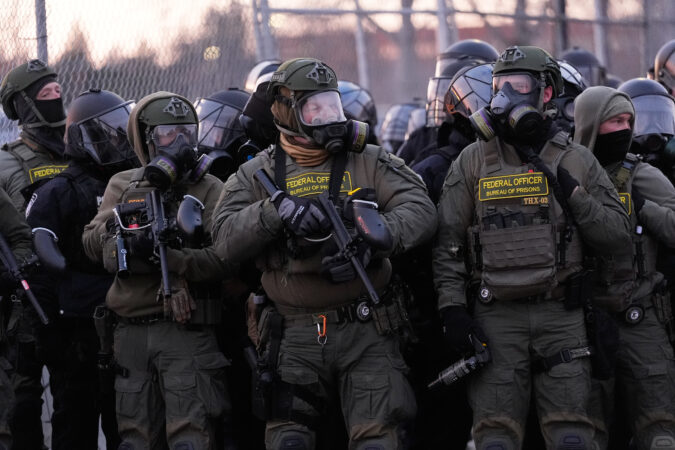
    Armed and masked law enforcement officers are being witnessed smashing car windows, yanking people from vehicles and chasing and wrestling others to the ground and hauling them away — images playing out in endless loops on TVs and other screens.

    And it’s not just ICE. A long list of supporting agencies, including federal, state, and local police and sheriff’s offices, are entering into contract partnerships with Homeland Security to conduct immigration enforcement operations in communities around the nation.

    House Speaker Mike Johnson (R., La.) has warned Democrats that this is “no time to be playing games” by stirring up the opposition to immigration enforcement officers in Minneapolis and other places.

    “They need to get out of the way and allow federal law enforcement to do its duty,” Johnson said at the Capitol.

    Noem has said the immigration enforcement officers are acting lawfully. The department insists it’s targeting criminals in the actions, what officials call the worst of the worst immigrants.

    However, reports show that noncriminals and U.S. citizens are also being forcibly detained by immigration officers. The Supreme Court last year lifted a ban on using race alone in the immigration stops.

    Trump last month called Somali immigrants “garbage,” comments that echoed his past objections to immigrants from certain countries.

    The Trump administration has set a goal of 100,000 detentions a day, about three times what’s typical, with 1 million deportations a year.

    Money from the big bill flows with few restraints

    With Republican control of Congress, the impeachment of Noem or any other Trump official is not a viable political option for Democrats, who would not appear to have the vote tally even among their own ranks.

    In fact, even if Congress wanted to curtail Trump’s immigration operations — by threatening to shut down the government, for example — it would be difficult to stop the spend.

    What Trump called the “big, beautiful bill” is essentially on autopilot through 2029, the year he’s scheduled to finish his term and leave office.

    The legislation essentially doubled annual Homeland Security funding, adding $170 billion to be used over four years. Of that, ICE, which typically receives about $10 billion a year, was provided $30 billion for operations and $45 billion for detention facilities.

    “The first thing that comes to mind is spending on this level is typically done on the military,” said Kathleen Bush-Joseph, a policy analyst at the Migration Policy Institute. “Trump is militarizing immigration enforcement.”

    Ahead, Congress will consider a routine annual funding package for Homeland Security unveiled Tuesday, or risk a partial shutdown Jan. 30. A growing group of Democratic senators and the Congressional Progressive Caucus have had enough. They say they won’t support additional funds without significant changes.

    Lawmakers are considering various restrictions on ICE operations, including limiting arrests around hospitals, courthouses, churches and other sensitive locations and ensuring that officers display proper identification and refrain from wearing face masks.

    “I think ICE needs to be totally torn down,” said Sen. Ruben Gallego (D., Ariz.) on CNN over the weekend.

    “People want immigration enforcement that goes after criminals,” he said. And not what he called this “goon squad.”

    Big spending underway, but Trump falls short of goals

    Meanwhile, Homeland Security has begun tapping the new money at its disposal. The department informed Congress it has obligated roughly $58 billion — most of that, some $37 billion, for border wall construction, according to a person familiar with the private assessment but unauthorized to discuss it.

    The Department of Homeland Security said its massive recruitment campaign blew past its 10,000-person target to bring in 12,000 new hires, more than doubling the force to 22,000 officers, in a matter of months.

    “The good news is that thanks to the Big Beautiful Bill that President Trump signed, we have an additional 12,000 ICE officers and agents on the ground across the country,” Assistant Secretary Tricia McLaughlin said in a December statement.

    The department also announced it had arrested and deported about 600,000 people. It also said 1.9 million other people had “voluntarily self-deported” since January 2025, when Trump took office.

  • Syrian military, Kurdish-led forces announce new truce after guards leave camp housing IS families

    Syrian military, Kurdish-led forces announce new truce after guards leave camp housing IS families

    RAQQA, Syria — Guards from the Kurdish-led Syrian Democratic Forces abandoned a camp Tuesday in northeast Syria housing thousands of people linked to the Islamic State group, and the Syrian military said that allowed detainees to escape.

    Hours later, the Syrian government and the SDF announced a new four-day truce after a previous ceasefire broke down. The two sides have been clashing for two weeks, amid a breakdown in negotiations over a deal to merge their forces together.

    The al-Hol camp houses mainly women and children who are relatives of IS members. Thousands of accused IS militants are separately housed in prisons in northeast Syria.

    Syria’s interior ministry accused the SDF of allowing the release of “a number of detainees from the ISIS militant [group] along with their families.” The AP could not independently confirm if detainees had escaped from the camps or how many.

    The SDF subsequently confirmed that its guards had withdrawn from the camp, but did not say whether any detainees escaped. The group blamed “international indifference toward the issue of the [IS] terrorist organization and the failure of the international community to assume its responsibilities in addressing this serious matter.”

    It said its forces had redeployed in other areas “that are facing increasing risks and threats” from government forces.

    An official with the U.S. military’s Central Command who spoke on condition of anonymity because they were not authorized to speak publicly said, “We are aware of the reports and are closely monitoring the situation.”

    The SDF and the government also traded blame over the escape Monday of IS members from a prison in the northeastern town of Shaddadeh.

    The Syrian defense ministry in a statement said it is prepared to take over al-Hol camp and the prisons and accused the SDF of using them as “bargaining chips.”

    Al-Hol holds tens of thousands of detainees

    At its peak in 2019, some 73,000 people were living at al-Hol camp. Since then the number has declined with some countries repatriating their citizens.

    Sheikhmous Ahmad, a Kurdish official overseeing camps for displaced in northeastern Syria, told the Associated Press that the al-Hol’s current population is about 24,000, about 14,500 of whom are Syrians and nearly 3,000 Iraqis.

    He added that about 6,500 from other nationalities are held in a highly secured section of the camp, many of whom are die-hard IS supporters who came from around the world to join the extremist group.

    Government and SDF trade blame over prison break

    Earlier Tuesday, Syria’s interior ministry said that 120 IS members had escaped Monday from the prison in Shaddadeh, amid clashes between government forces and the SDF. Security forces recaptured 81 of them, the statement said.

    Also Tuesday, the SDF accused “Damascus-affiliated factions” of cutting off water supplies to the al-Aqtan prison near the city of Raqqa, which it called a “blatant violation of humanitarian standards.”

    The SDF, the main U.S.-backed force that fought IS in Syria, controls more than a dozen prisons in the northeast where some 9,000 IS members have been held for years without trial.

    IS was defeated in Iraq in 2017 and in Syria two years later, but the group’s sleeper cells still carry out deadly attacks in both countries.

    Under a deal announced Sunday, government forces were to take over control of the prisons from the SDF, but the transfer did not go smoothly.

    New ceasefire deal announced

    The Syrian military announced Tuesday evening a new four-day ceasefire. The SDF confirmed the deal and said “it will not initiate any military action unless our forces are subjected to attacks.”

    Elham Ahmad, a senior official with the Kurdish-led local administration in northeast Syria, told journalists Tuesday that an earlier ceasefire had fallen apart after SDF leader Mazloum Abdi requested a five-day grace period to implement the conditions and Syrian Interim President Ahmad al-Sharaa refused.

    She blamed the government for violating the agreement but called for a return to dialogue.

    In response to a journalist’s question regarding whether the SDF had requested help from Israel — which previously intervened in clashes between government forces and groups from the Druze religious minority last year — Ahmad said “certain figures” from Israel had communicated with the SDF. She added that the SDF is ready to accept support from any source available.

    A statement from al-Sharaa’s office said that government forces will not enter Kurdish-majority areas until plans are agreed upon for their “peaceful integration” and that Kurdish villages will be patrolled by “local security forces drawn from the residents of the area.”

    It said Abdi will put forward nominees from the SDF for the posts of deputy defense minister, governor of al-Hassakeh province, representatives in the parliament, and for other positions in Syrian state institutions.

    SDF officials have expressed disappointment that the U.S. did not intervene on their behalf. The group was long the main U.S. partner in Syria in the fight against IS, but that has changed as the Trump administration has developed closer ties with al-Sharaa’s government.

    U.S. envoy to Syria Tom Barrack in a statement Tuesday urged the SDF to move forward with integration into the new Syrian government and army and appeared to warn the Kurdish-led force that no help would be coming from Washington if it continued fighting.

    He said SDF’s role as the primary anti-IS force “has largely expired, as Damascus is now both willing and positioned to take over security responsibilities” and that “recent developments show the U.S. actively facilitating this transition, rather than prolonging a separate SDF role.”

    Since toppling Bashar Assad in December 2024, Syria’s new leaders have struggled to assert full authority over the war-torn country. An agreement was reached in March that would merge the SDF with Damascus, but it didn’t gain traction.

    Earlier this month, clashes broke out in the city of Aleppo, followed by the government offensive that seized control of Deir el-Zour and Raqqa provinces, critical areas under the SDF that include oil and gas fields, river dams along the Euphrates and border crossings.

    Al-Sharaa postponed a planned trip to Germany Tuesday amid the ongoing tensions.

  • Researchers find Antarctic penguin breeding is heating up sooner, and that’s a problem

    Researchers find Antarctic penguin breeding is heating up sooner, and that’s a problem

    WASHINGTON — Warming temperatures are forcing Antarctic penguins to breed earlier and that’s a big problem for two of the cute tuxedoed species that face extinction by the end of the century, a study said.

    With temperatures in the breeding ground increasing 5.4 degrees Fahrenheit (3 degrees Celsius) from 2012 to 2022, three different penguin species are beginning their reproductive process about two weeks earlier than the decade before, according to a study in Tuesday’s Journal of Animal Ecology. And that sets up potential food problems for young chicks.

    “Penguins are changing the time at which they’re breeding at a record speed, faster than any other vertebrate,” said lead author Ignacio Juarez Martinez, a biologist at Oxford University in the United Kingdom. “And this is important because the time at which you breed needs to coincide with the time with most resources in the environment and this is mostly food for your chicks so they have enough to grow.’’

    For some perspective, scientists have studied changes in the life cycle of great tits, a European bird. They found a similar two-week change, but that took 75 years as opposed to just 10 years for these three penguin species, said study co-author Fiona Suttle, another Oxford biologist.

    Researchers used remote control cameras to photograph penguins breeding in dozens of colonies from 2011 to 2021. They say it was the fastest shift in timing of life cycles for any backboned animals that they have seen. The three species are all brush-tailed, so named because their tails drag on the ice: the cartoon-eye Adelie, the black-striped chinstrap and the fast-swimming gentoo.

    Warming creates penguin winners, losers

    Suttle said climate change is creating winners and losers among these three penguin species and it happens at a time in the penguin life cycle where food and the competition for it are critical in survival.

    The Adelie and chinstrap penguins are specialists, eating mainly krill. The gentoo have a more varied diet. They used to breed at different times, so there were no overlaps and no competition. But the gentoos’ breeding has moved earlier faster than the other two species and now there’s overlap. That’s a problem because gentoos, which don’t migrate as far as the other two species, are more aggressive in finding food and establishing nesting areas, Martinez and Suttle said.

    Suttle said she has gone back in October and November to the same colony areas where she used to see Adelies in previous years only to find their nests replaced by gentoos. And the data backs up the changes her eyes saw, she said.

    “Chinstraps are declining globally,” Martinez said. “Models show that they might get extinct before the end of the century at this rate. Adelies are doing very poorly in the Antarctic Peninsula and it’s very likely that they go extinct from the Antarctic Peninsula before the end of the century.”

    Early bird dining causes problems

    Martinez theorized that the warming western Antarctic — the second-fasting heating place on Earth behind only the Arctic North Atlantic — means less sea ice. Less sea ice means more spores coming out earlier in the Antarctic spring and then “you have this incredible bloom of phytoplankton,” which is the basis of the food chain that eventually leads to penguins, he said. And it’s happening earlier each year.

    Not only do the chinstraps and Adelies have more competition for food from gentoos because of the warming and changes in plankton and krill, but the changes have brought more commercial fishing that comes earlier and that further shortens the supply for the penguins, Suttle said.

    This shift in breeding timing “is an interesting signal of change and now it’s important to continuing observing these penguin populations to see if these changes have negative impacts on their populations,” said Michelle LaRue, a professor of Antarctic marine science at the University of Canterbury in New Zealand. She was not part of the Oxford study.

    People’s penguin love helps science

    With millions of photos — taken every hour by 77 cameras for 10 years — scientists enlisted everyday people to help tag breeding activity using the Penguin Watch website.

    “We’ve had over 9 million of our images annotated via Penguin Watch,” Suttle said. “A lot of that does come down to the fact that people just love penguins so much. They’re very cute. They’re on all the Christmas cards. People say, ‘Oh, they look like little waiters in tuxedos.’”

    “The Adelies, I think their personality goes along with it as well,” Suttle said, saying there’s “perhaps a kind of cheekiness about them — and this very cartoonlike eye that does look like it’s just been drawn on.”

  • Russia batters Ukraine’s power grid again as officials seek momentum in U.S.-led peace talks

    Russia batters Ukraine’s power grid again as officials seek momentum in U.S.-led peace talks

    KYIV, Ukraine — Russia bombarded Ukraine with more than 300 drones and ballistic and cruise missiles in its latest nighttime attack on the Ukrainian power grid, President Volodymyr Zelensky said Tuesday, as Moscow gives no public sign that it’s willing to end the invasion of its neighbor anytime soon.

    The attack knocked out heating to more than 5,600 apartment buildings in the capital, Kyiv Mayor Vitali Klitschko said. Nearly 80% of the affected buildings had recently had their heating supply restored after a major Russian barrage on Jan. 9 that plunged thousands of people into a dayslong blackout, he said.

    Ukraine is enduring one of its coldest winters for years, with temperatures in Kyiv falling to minus 4 Fahrenheit. At the same time, Russia has escalated its aerial attacks on the electricity supply, aiming to deny Ukrainians heat and running water and wear down their resistance almost four years after Moscow launched its full-scale invasion on Feb. 24, 2022.

    Meanwhile, Ukrainian officials are trying to keep up the momentum of U.S.-led peace talks. A Ukrainian negotiating team arrived in the United States on Saturday. Their main task was to convey how the relentless Russian strikes are undermining diplomacy, according to Zelensky.

    The Ukrainian leader said last week that the delegation would also try to finalize with U.S. officials documents for a proposed peace settlement that relate to postwar security guarantees and economic recovery. If American officials approve the proposals, the U.S. and Ukraine could sign the documents at the World Economic Forum in Davos, Switzerland, this week, he said.

    Kremlin spokesman Dmitry Peskov said Tuesday that presidential envoy Kirill Dmitriev plans to meet with some American representatives at Davos.

    He refused to name the officials Dmitriev would meet with, but media reports said they would include U.S. envoy Steve Witkoff and U.S. President Donald Trump’s son-in-law, Jared Kushner.

    Attacks described as ‘cruel’

    Ukrainian Foreign Minister Andrii Sybiha said his country needs urgent assistance and additional sanctions on Russia to make Moscow change course.

    Russian President Vladimir Putin’s “barbaric strike this morning is a wake-up call to world leaders gathering in Davos,” Sybiha said on X.

    U.N. Human Rights Chief Volker Türk said that he was outraged by the repeated large-scale attacks on Ukraine’s energy infrastructure, which especially affect children, older people, and those with disabilities.

    The strikes “can only be described as cruel,” he said in Geneva. “They must stop. Targeting civilians and civilian infrastructure is a clear breach of the rules of warfare.”

    Several electrical substations providing power vital for nuclear safety in Ukraine were affected, said Rafael Mariano Grossi, director-general of the International Atomic Energy Agency.

    Air defense systems are expensive

    Ukraine’s air force command said that 27 missiles and 315 drones were shot down or jammed, while five missiles and 24 drones hit 11 locations.

    The Russian Defense Ministry claimed that its forces targeted Ukrainian military and industrial installations as well as energy and transport infrastructure used by the Ukrainian armed forces.

    The constant attacks have stretched Ukraine’s air defenses and, according to Zelensky, some systems recently ran out of ammunition before a new shipment arrived.

    The fight is also expensive: the air defense ammunition that Ukraine used against the Russian missiles overnight cost about 80 million euros ($93 million), Zelensky said.

    Ukrainian air defenses are adopting a new approach, with the appointment of a new deputy air force commander, Pavlo Yelizarov, according to Zelensky.

    “This system will be transformed,” he said late Monday, without providing details.

    Ukraine relies on sophisticated air defense systems produced by Western countries, especially the U.S., to thwart Russia’s missile and drone attacks.

  • Indiana completes undefeated season and wins first national title, beating Miami 27-21 in CFP final

    Indiana completes undefeated season and wins first national title, beating Miami 27-21 in CFP final

    MIAMI GARDENS, Fla. (AP) — Fernando Mendoza bulldozed his way into the end zone and Indiana bullied its way into the history books Monday night, toppling Miami 27-21 to put the finishing touch on a rags-to-riches story, an undefeated season, and the national title.

    The Heisman Trophy winner finished with 186 yards passing, but it was his tackle-breaking, sprawled-out 12-yard touchdown run on fourth-and-4 with 9 minutes, 18 seconds left that defined this game — and the Hoosiers’ season.

    Indiana would not be denied.

    “I had to go airborne,” said Mendoza, who had his lip split and his arm bloodied by a ferocious Miami defense that sacked him three times and hit him many more. “I would die for my team.”

    Mendoza’s touchdown gave turnaround artist Curt Cignetti’s team a 24-14 lead — barely enough breathing room to hold off a frenzied charge by the hard-hitting Hurricanes, who came to life in the second half behind 112 yards and two scores from Mark Fletcher but never took the lead.

    The College Football Playoff trophy now heads to the most unlikely of places: Bloomington, Indiana — a campus that endured a nation-leading 713 losses over 130-plus years of football before Cignetti arrived two years ago to embark on a revival for the ages.

    “Took some chances, found a way. Let me tell you: We won the national championship at Indiana University. It can be done,” Cignetti said.

    Indiana finished 16-0 — using the extra games afforded by the expanded 12-team playoff to match a perfect-season win total last compiled by Yale in 1894.

    In a fitting bit of symmetry, this undefeated title comes 50 years after Bob Knight’s basketball team went 32-0 to win it all in that state’s favorite sport.

    That hasn’t happened since, and there’s already some thought that college football — in its evolving, money-soaked era — might not see a team like this again, either.

    Players like Mendoza — a transfer from California who grew up just a few miles away from Miami’s campus, “The U” — certainly don’t come around often.

    Two fourth-down gambles by Cignetti in the fourth quarter, after Fletcher’s second touchdown carved the Hurricanes’ deficit to three, put Mendoza in position to shine.

    The first was a 19-yard-completion to Charlie Becker on a back-shoulder fade those guys have been perfecting all season. Four plays later came a decision and play that wins championships.

    Cignetti sent his kicker out on fourth-and-4 from the 12, but quickly called his second timeout. The team huddled on the field and the coach drew up a quarterback draw, hoping the Hurricanes would be in a defense they had shown before.

    “We rolled the dice and said, ‘They’re going to be in it again and they were,’” Cignetti said. “We blocked it well, he broke a tackle or two, and got in the end zone.”

    Not known as a run-first guy, Mendoza slipped one tackle, then took a hit and spun around. He kept his feet, then left them, going horizontal and stretching the ball out — a ready-made poster pic for a title run straight from the movies.

    Maybe they’ll call it “Hoosiers.” This was a program so bad that a coach once stopped the game early to take a picture of the scoreboard when it read “Indiana 7, Ohio State 6.” The Hoosiers lost 47-7.

    This year, though, they beat Ohio State in the Big Ten title game on their way to the top seed in the playoff.

    Indiana quarterback Fernando Mendoza celebrates after scoring against Miami during the second half of Monday’s CFP title game.

    They won their first two games by a combined score of 94-25 and Mendoza threw more touchdown passes (eight) than incompletions (five).

    This one was nowhere near as easy.

    Fletcher was a one-man force, hitting triple digits for the third time in four playoff games and turning a moribund offense into something much more.

    It ended as a one-score game, and the ’Canes — the visiting team playing on their home field — moved into Indiana territory before Carson Beck’s heave got picked off by Jamari Sharpe, a Miami native who made sure the only miracle in this season would be Indiana’s.

    “Did I think something like this was possible? Probably not,” Cignetti said. “But if you keep your nose down and keep working, anything is possible.”

  • Russian court jails U.S. Navy veteran for 5 years for illegally transporting weapons

    Russian court jails U.S. Navy veteran for 5 years for illegally transporting weapons

    MOSCOW — A Russian court has convicted and sentenced an American on charges of illegally transporting weapons, court officials revealed Monday.

    Chuck Zimmerman, 58, was handed a 5-year sentence by a court in Russia’s Black Sea resort of Sochi after a firearm was found on his yacht in June, the Krasnodar regional courts’ press service said in a statement. Russian authorities found the weapon while inspecting it upon arrival in Sochi, the statement said.

    A website set up in support of Zimmerman describes him as a U.S. Navy veteran, a father of two, and an electrician. His family has rejected the charges against him as a “setup” for a future prisoner exchange.

    Court records seen by the Associated Press showed that Zimmerman was convicted in October, and the Sochi court verdict was upheld two months later by the Krasnodar regional court.

    Zimmerman told the court that he traveled to Russia to meet a woman he had previously contacted online and that he had the gun for self-defense, unaware of Russian laws, according to the court’ press service statement. He has fully admitted guilt, the statement said.

    Zimmerman’s sister Robin Stultz said her brother was intercepted while sailing in international waters with “absolutely no intention to enter Russia.”

    “He was sailing from the U.S. to New Zealand, so of course he had a firearm on board,” she told the AP in a statement. ”You can’t just call 911 if something goes wrong out at sea. He voluntarily disclosed it to them and they charged him with arms smuggling. This is an obvious setup to get another American they can trade. He needs to be declared wrongfully detained,” Stultz said.

    She added: “I wouldn’t trust any ‘confession’ the Russians claim he’s given. He hasn’t been able to meet with anyone from the U.S. Embassy since his arrest.”

    There was no immediate comment from U.S. officials.

    Zimmerman is one of a few Americans who remain in Russian custody after a series of high-profile prisoner exchanges with the United States in recent years. Arrests of Americans in Russia and subsequent prisoner swaps have become increasingly common as relations between Moscow and Washington have sunk to Cold War lows.

  • Bulgaria’s left-leaning president Rumen Radev says he is stepping down

    Bulgaria’s left-leaning president Rumen Radev says he is stepping down

    SOFIA, Bulgaria — Bulgaria’s left-leaning president Rumen Radev announced on Monday that he is stepping down.

    In a televised address, Radev said that he will formally submit his resignation to the Constitutional Court Tuesday.

    Under the constitution, the current vice president, Iliana Yotova, must be sworn in by parliament to take the post until the end of the presidential mandate.

    “The battle for the future of our homeland lies ahead, and I believe we will face it together with all of you — the worthy, the inspired, and the unyielding! We are ready. We can, and we will succeed!” Radev said in his address.

    Radev’s decision comes amid public expectation that he will form a new political party.

    His resignation, the first by a head of state in Bulgaria’s post-communist history, comes as the country — which is a member of the European Union and NATO — struggles to overcome a prolonged political crisis.

    Large anti-corruption protests last month forced the resignation of the governing coalition, led by the center-right GERB party. Attempts to form a new government within the current parliament have subsequently failed, and the country is headed towards its eighth parliamentary election since 2021.

    Radev, whose second mandate ends this year, has repeatedly indicated he may take part in new elections. The 62-year-old former Air Force general has been a vocal opponent of the leader of the GERB party, Boyko Borissov, and of politician and oligarch Delyan Peevski, who has been under U.S. and U.K. sanctions, and whose MRF New Beginning party has repeatedly backed the outgoing GERB-led coalition.

    Radev did not mention on Monday what his plans are. Asked recently about forming a new party, he said there was a need for a party that “unites all democrats — left and right — regardless of where they belong or whether they are politically active at all, because we all need fair elections and democratic, free development.”

  • ICE says immigrant who died in sprawling Texas detention facility killed himself

    ICE says immigrant who died in sprawling Texas detention facility killed himself

    EL PASO, Texas — An immigrant from Nicaragua was found dead at a Texas immigration detention facility last week, federal officials said.

    Victor Manuel Diaz appears to have killed himself Wednesday at the sprawling tent complex at the U.S. Army’s Fort Bill base in El Paso, Immigration and Customs Enforcement said in a statement. The federal investigation into his death continues.

    It’s the same facility where ICE said another detainee died earlier this month as staff members tried to keep him from killing himself. But a fellow detainee said at least five officers were restraining the handcuffed inmate and at least one had an arm around his neck.

    (Editor’s note — This story includes discussion of suicide. If you or someone you know needs help, the national suicide and crisis lifeline in the U.S. is available by calling or texting 988.)

    Diaz was swept up on Jan. 6 in the federal crackdown on immigration in Minnesota and sent to Texas, ICE said.

    Diaz entered the United States in March 2024 and Border Patrol officers took him into custody. He was released on parole pending a court date and a judge ordered him to leave the U.S. in an August hearing that Diaz did not attend, ICE said.

    Diaz was given a final order for removal on Jan. 12, two days before he was found unconscious in his room, authorities said.

    ICE did not release any other details on Diaz’s death. The agency notifies Congress and releases a statement on its website of all in-custody deaths.

    Diaz, 36, was being held at Camp Montana East where ICE said another detainee, Geraldo Lunas Campos, died as staff members tried to prevent him from killing himself.

    But a preliminary investigation by the El Paso County Medical Examiner’s Office found Lunas Campos, 55, died from asphyxia from chest and neck compression and said the death would likely be classified a homicide.

    A fellow detainee told the AP that Lunas Campos was handcuffed and refused to go back into his cell when at least five guards pinned him to the floor. The detainee said at least one of the guards squeezed an arm around Lunas Campos’ neck.

    ICE said it is still investigating that death.

  • AP Source: Fed Chair Powell to attend Supreme Court argument on Cook case

    AP Source: Fed Chair Powell to attend Supreme Court argument on Cook case

    WASHINGTON — Federal Reserve Chair Jerome Powell will attend the Supreme Court’s oral argument Wednesday in a case involving the attempted firing of Fed governor Lisa Cook, an unusual show of support by the central bank chair.

    The high court is considering whether President Donald Trump can fire Cook, as he said he would do in late August, in an unprecedented attempt to remove one of the seven members of the Fed’s governing board. Powell plans to attend the high court’s Wednesday session, according to a person familiar with the matter, who spoke on condition of anonymity.

    It’s a much more public show of support than the Fed chair has previously shown Cook. But it follows Powell’s announcement last week that the Trump administration has sent subpoenas to the Fed, threatening an unprecedented criminal indictment of the Fed Chair. Powell — appointed to the position by Trump in 2018 — appears to be casting off last year’s more subdued response to Trump’s repeated attacks on the central bank in favor of a more public confrontation.

    Powell issued a video statement Jan. 11 condemning the subpoenas as “pretexts” for Trump’s efforts to force him to sharply cut the Fed’s key interest rate. Powell oversaw three rate cuts late last year, lowering the rate to about 3.6%, but Trump has argued it should be as low as 1%, a position few economists support.

    The Trump administration has accused Cook of mortgage fraud, an allegation that Cook has denied. No charges have been made against Cook. She sued to keep her job, and the Supreme Court Oct. 1 issued a brief order allowing her to stay on the board while they consider her case.

    If Trump succeeds in removing Cook, he could appoint another person to fill her slot, which would give his appointees a majority on the Fed’s board and greater influence over the central bank’s decisions on interest rates and bank regulation.