Category: Nation World News Wires

  • Judge disqualifies federal prosecutor in investigation into New York Attorney General Letitia James

    Judge disqualifies federal prosecutor in investigation into New York Attorney General Letitia James

    ALBANY, N.Y. — A judge disqualified a Trump administration federal prosecutor from overseeing investigations into New York Attorney General Letitia James, ruling Thursday that he is not lawfully serving as an acting U.S. attorney.

    U.S. District Judge Lorna G. Schofield blocked subpoenas requested by John Sarcone, the acting U.S. attorney for the Northern District of New York. The judge said the Department of Justice did not follow statutory procedure after judges declined to extend Sarcone’s tenure last year.

    Schofield joined several other federal judges across the country who have ruled that actions taken by top federal prosecutors were invalid because of unusual methods that the Trump administration used to get them the jobs. People were given the power of a U.S. attorney outside of the normal U.S. Senate confirmation process or were allowed to serve until federal judges in their district could decide whether they could stay.

    “When the Executive branch of government skirts restraints put in place by Congress and then uses that power to subject political adversaries to criminal investigations, it acts without lawful authority. Subpoenas issued under that authority are invalid. The subpoenas are quashed, and Mr. Sarcone is disqualified from further participation in the underlying investigations,” the judge said in her decision.

    Schofield said Sarcone is not lawfully serving as acting U.S. attorney and that any “of his past or future acts taken in that capacity are void or voidable as they would rest on authority Mr. Sarcone does not lawfully have.”

    James, a Democrat, had challenged Sarcone’s authority after he issued subpoenas seeking information about lawsuits she filed against Republican President Donald Trump, claiming he had committed fraud in his business dealings, and separately against the National Rifle Association and some of its former leaders.

    Justice Department lawyers argued Sarcone was appointed properly and that the subpoenas were valid. James claims the inquiry into her lawsuits is part of a campaign of baseless investigations and prosecutions of Trump’s perceived enemies.

    The department said in a email Thursday it “will continue to fight and defend the President and the Attorney General’s authority to appoint their U.S. Attorneys.”

    James’ office issued a statement calling Thursday’s ruling “an important win for the rule of law.”

    “We will continue to defend our office’s successful litigation from this administration’s political attacks,” the statement said.

    Emails seeking comment were sent to the U.S. Attorney’s Office and the Department of Justice.

    Last month, a panel of judges from the 3rd U.S. Circuit Court of Appeals in Philadelphia sided with a lower-court judge’s ruling disqualifying Alina Habba from serving as New Jersey’s top federal prosecutor.

    In November, a federal judge dismissed criminal cases against former FBI Director James Comey and James after concluding that the hastily installed prosecutor who filed the charges, Lindsey Halligan, was unlawfully appointed to the position of interim U.S. attorney for the Eastern District of Virginia.

    A similar dynamic has played out in Nevada, where a federal judge disqualified the Trump administration’s pick to be U.S. attorney there. And a federal judge in Los Angeles disqualified the acting U.S. attorney in Southern California from several cases after concluding he had stayed in the job longer than allowed.

    In New York, U.S. Attorney General Pam Bondi appointed Sarcone to serve as the interim U.S. attorney in March. When his 120-day term elapsed, judges in the district declined to keep him in the post.

    Bondi then appointed Sarcone as a special attorney and designated him first assistant U.S. attorney for the district, moves that federal officials say allow him to serve as an acting U.S. attorney.

    The judge, who sits in New York City, took issue with the Justice Department’s actions.

    On “the same day that the judges declined to extend Mr. Sarcone’s appointment, the Department took coordinated steps — through personnel moves and shifting titles — to install Mr. Sarcone as Acting U.S. Attorney. Federal law does not permit such a workaround,” she wrote.

    “The people of the Northern District of New York deserve a qualified, independent prosecutor, not a political loyalist,” Senate Democratic leader Chuck Schumer said in a prepared statement.

    Sarcone was part of Trump’s legal team during the 2016 presidential campaign and worked for the U.S. General Services Administration as the regional administrator for the Northeast and Caribbean during Trump’s first term.

    Schofield said the federal government could reissue the subpoenas at the direction of a lawfully authorized attorney.

    Joshua Naftalis, a Manhattan federal prosecutor for 11 years before entering private practice in 2023, said Schofield was agreeing with the other judges who have disputed the authority of designated top prosecutors.

    “It’s always a big deal when judges say that the U.S. attorney doesn’t have the authority,” he said.

    He said subpoenas aren’t typically issued by a single prosecutor so the ruling might not directly affect other investigations brought through the prosecutor’s office.

  • NASA, in a rare move, cuts space station mission short after an astronaut’s medical issue

    NASA, in a rare move, cuts space station mission short after an astronaut’s medical issue

    NEW YORK — In a rare move, NASA is cutting a mission aboard the International Space Station short after an astronaut had a medical issue.

    The space agency said Thursday the U.S.-Japanese-Russian crew of four will return to Earth in the coming days, earlier than planned.

    NASA canceled its first spacewalk of the year because of the health issue. The space agency did not identify the astronaut or the medical issue, citing patient privacy. The crew member is now stable.

    NASA officials stressed that it was not an onboard emergency, but are “erring on the side of caution for the crew member,” said Dr. James Polk, NASA’s chief health and medical officer.

    Polk said this was the NASA’s first medical evacuation from the space station although astronauts have been treated aboard for things like toothaches and ear pain.

    The crew of four returning home arrived at the orbiting lab via SpaceX in August for a stay of at least six months. The crew included NASA’s Zena Cardman and Mike Fincke along with Japan’s Kimiya Yui and Russia’s Oleg Platonov.

    Fincke and Cardman were supposed to carry out the spacewalk to make preparations for a future rollout of solar panels to provide additional power for the space station.

    It was Fincke’s fourth visit to the space station and Yui’s second, according to NASA. This was the first spaceflight for Cardman and Platonov.

    “I’m proud of the swift effort across the agency thus far to ensure the safety of our astronauts,” NASA administrator Jared Isaacman said.

    Three other astronauts are currently living and working aboard the space station including NASA’s Chris Williams and Russia’s Sergei Mikaev and Sergei Kud-Sverchkov, who launched in November aboard a Soyuz rocket for an eight-month stay. They’re due to return home in the summer.

    NASA has tapped SpaceX to eventually bring the space station out of orbit by late 2030 or early 2031. Plans called for a safe reentry over ocean.

  • After delays, the missing Jan. 6 plaque will be displayed at the Capitol

    After delays, the missing Jan. 6 plaque will be displayed at the Capitol

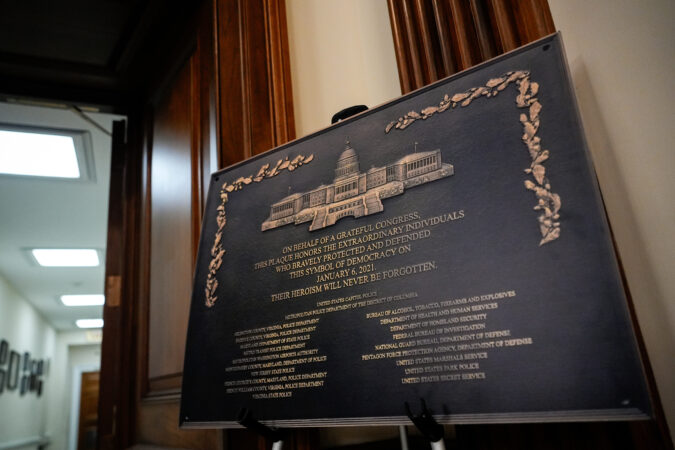
    WASHINGTON — The Senate has agreed to display a plaque honoring the police who defended the Capitol during the Jan. 6, 2021, attack, rebuffing House Speaker Mike Johnson who has said the commemorative memorial does not comply with the law.

    The action happened swiftly, with brief debate, in floor action Thursday. Republican Sen. Thom Tillis of North Carolina had announced during this week’s fifth anniversary of the Capitol siege that he would seek to ensure the plaque is installed, partnering with Democratic Sen. Jeff Merkley of Oregon, who was also working on the situation, and Sen. Alex Padilla of California. No senators objected.

    “A lot of people said it was a dark day for democracy,” Tillis said about Jan. 6, 2021, describing his memory of hearing the thousands of people — “thugs,” he said — lay siege to the Capitol as Congress was tallying the 2020 election results.

    He said that because of the work of the law enforcement officers, it became a great day for democracy. “We came back and completed our constitutional duty to certify the election,” he said. “We owe them eternal gratitude and this nation is stronger because of them.”

    This week, senators stepped up after learning the plaque, which had been approved by Congress more than three years ago, was nowhere to be found at the Capitol. Instead, many House lawmakers have been hanging up replicas outside their office doors.

    The Senate also appeared to be motivated by the shifting narrative from President Donald Trump ‘s White House about what happened Jan. 6, 2021, when his supporters stormed the building after he urged them go to Capitol Hill to confront Congress over Democrat Joe Biden’s 2020 election victory.

    Trump himself shifted blame for the attack during a speech this week in which he said he only intended for his supporters to march peacefully to the Capitol. Moreover, the White House produced a glossy new report also shifting blame for the deadly riot — on Democrats, for Biden’s victory over Trump, and on the police for their response to the mob.

    “It’s so important we be honest with the American people about what happened,” Merkley said, as he called the resolution up for passage.

    “It’s so important we recognize those who defended our democratic republic on that day,” he said, and that “people know we can back, as senators and House members, and finished our work that day, for the peaceful transfer of power.”

    Padilla said part of the context is the White House’s new website that he said is an “attempt to rewrite history.” He said that “dishonors” the officers.

    “The Senate bipartisan commitment to real history is strong,” he said.

    The plaque, according to the law, was intended to be placed at the West front of the Capitol where some of the fiercest fighting took place. It was required to be installed in 2023, a year after the legislation had passed.

    The new resolution directs the Architect of the Capitol to “prominently display” the plaque in a “publicly accessible” location in the Senate wing of the Capitol until it can be placed in its permanent location.

    To display the plaque in its intended location would require agreement with the House.

    The office of Johnson, a Republican who before becoming the House speaker led efforts to object to the 2020 election results, said this week that the plaque, as constructed, does not comply with the law.

    Police have sued to have the plaque put on display, as required, but Trump’s Justice Department is trying to dismiss the lawsuit.

    Tillis said part of the “technical implementation problem” was a concern that the law specified the plaque would honor all the officers involved, but the plaque only lists the various law enforcement agencies that responded to help the Capitol Police that day.

    He said there will be a digital component, presumably a website, that will list all the names. The number of officers runs into the thousands.

    “You’ll see how many people came here,” he said.

  • Tens of thousands flee Aleppo neighborhoods as Syrian government clashes with Kurds intensify

    Tens of thousands flee Aleppo neighborhoods as Syrian government clashes with Kurds intensify

    ALEPPO, Syria — Clashes between government and Kurdish forces in a contested area in Syria’s northern city of Aleppo intensified Thursday after Syrian authorities ordered civilians to evacuate.

    Syrian authorities opened a corridor for civilians to evacuate for a second day and tens of thousands fled.

    The government of Aleppo province gave residents until 1 p.m. local time to evacuate in coordination with the army. State news agency SANA, citing the army, said the military would begin “targeted operations” against the Kurdish-led Syrian Democratic Forces in the neighborhoods of Sheikh Maqsoud, Achrafieh and Bani Zaid half an hour after that deadline.

    The military later issued a series of maps with the areas under evacuation order.

    An Associated Press journalist at the scene heard sporadic sounds of shelling as civilians streamed out of the area Thursday morning. More than 142,000 people have been displaced across the province, according to the Aleppo Central Response Committee.

    “There’s a large percentage of them with difficult medical issues, elderly people, women, and children,” said Mohammad Ali, operations director with the Syrian Civil Defense in Aleppo.

    Kurdish forces said at least 12 civilians were killed in the Kurdish-majority neighborhoods, while government officials reported at least nine civilians have been killed in the surrounding government-controlled areas in the fighting that broke out Tuesday. Dozens more on both sides have been wounded. It was not clear how many fighters were killed on each side.

    Each side has accused the other of deliberately targeting civilian neighborhoods and infrastructure, including ambulance crews and hospitals.

    Clashes intensified in the afternoon, with continuous exchanges of shelling and drone strikes, and tanks could be seen rolling into the contested neighborhoods. The SDF-affiliated Internal Security Forces said they had “destroyed two armored vehicles and inflicted casualties on the attackers” as they advanced.

    Aleppo governor Azzam al-Gharib, meanwhile, said Thursday evening that “a large number” of SDF fighters had defected or fled. Late in the evening, as clashes subsided, government forces began to deploy in largely-abandoned neighborhoods where the fighting had taken place.

    Churches hosting displaced people

    St. Ephrem Syrian Orthodox Church in Aleppo city was hosting about 100 people who had fled the fighting. Parishioners donated mattresses, blankets and food, priest Adai Maher said.

    “As soon as the problems started and we heard the sounds (of clashes), we opened our church as a shelter for people who are fleeing their homes,” he said.

    Among them was Georgette Lulu, who said her family is planning to travel to the city of Hasakeh in SDF-controlled northeast Syria when the security situation allows.

    “There was a lot of bombing and loud noises and a shell landed next to our house,” she said. “I’ve been through these circumstances a lot so I don’t get frightened, but my niece was really afraid so we had to come to the church.”

    Hassan Nader, a representative of the Ministry of Social Affairs in Aleppo said about 4,000 were staying in shelters in the city while tens of thousands had gone to other areas of the province, and the ministry was working with NGOs to supply them with food, medicine and other necessities.

    Political impasse

    The clashes come amid an impasse in political negotiations between the central state and the SDF.

    The leadership in Damascus under interim President Ahmad al-Sharaa signed a deal in March with the SDF, which controls much of the northeast, for it to merge with the Syrian army by the end of 2025. There have been disagreements on how it would happen. In April, scores of SDF fighters left Sheikh Maqsoud and Achrafieh as part of the deal.

    Officials from the central government and SDF met again on Sunday in Damascus, but government officials said that no tangible progress had been made.

    Some of the factions that make up the new Syrian army, formed after the fall of former President Bashar Assad in a rebel offensive in December 2024, were previously Turkey-backed insurgent groups that have a long history of clashing with Kurdish forces.

    In the city of Qamishli in the Kurdish-controlled northeast, thousands of protesters gathered Thursday, chanting, “SDF, we are with you until death.”

    Sawsan Khalil, a protester in Qamishli who was displaced from Afrin in Aleppo province in a 2018 Turkish offensive against Kurdish forces there, called for the international community “to feel for the Syrian people who have been killed for no reason” in Aleppo.

    Izzeddin Gado, co-chair of the Qamishli City Council accused the government forces of “following a foreign and regional agenda from Turkey.”

    International concerns

    The SDF has for years been the main U.S. partner in Syria in fighting against the Islamic State group, but Turkey considers the SDF a terrorist organization because of its association with the Kurdistan Workers’ Party, or PKK, which has waged a long-running insurgency in Turkey. A peace process is now underway.

    Despite the long-running U.S. support for the SDF, the Trump administration in the U.S. has also developed close ties with al-Sharaa’s government and has pushed the Kurds to implement the March deal.

    A U.S. State Department official said in a statement Thursday that U.S. envoy Tom Barrack was trying to facilitate dialogue between the two sides.

    Barrack later posted on X, “Just this past week, we stood on the threshold of successfully concluding the March 10, 2025 integration agreement,” a goal that he said remains “eminently achievable.”

    “Together with our allies and responsible regional partners, we stand ready to facilitate efforts to de-escalate tensions and to afford Syria and its people a renewed opportunity to choose the path of dialogue over division,” he said.

    Turkey’s Ministry of National Defense said Thursday that the “operation is being carried out entirely by the Syrian Army” while Turkey is “closely monitoring.”

    “Syria’s security is our security,” the statement said, adding that “Turkey will provide the necessary support should Syria request it.”

    Turkish Foreign Minister Hakan Fidan described the SDF as the “greatest obstacle for peace in Syria.”

    The United Nations expressed concern at the violence and called for de-escalation.

  • Denmark, Greenland envoys meet with White House officials over Trump’s call for a ‘takeover’

    Denmark, Greenland envoys meet with White House officials over Trump’s call for a ‘takeover’

    Denmark and Greenland’s envoys to Washington have begun a vigorous effort to urge U.S. lawmakers as well as key Trump administration officials to step back from President Donald Trump’s call for a “takeover” of the strategic Arctic island.

    Denmark’s ambassador, Jesper Moller Sorensen, and Jacob Isbosethsen, Greenland’s chief representative to Washington, met on Thursday with White House National Security Council officials to discuss a renewed push by Trump to acquire Greenland, perhaps by military force, according to Danish government officials who were not authorized to comment publicly and spoke on the condition of anonymity.

    The White House did not respond to a request for comment about the meeting.

    The envoys have also held a series of meetings this week with American lawmakers as they look to enlist help in persuading Trump to back off his threat.

    Secretary of State Marco Rubio is expected to meet next week with Danish officials.

    Trump, in a New York Times interview published Thursday, said he has to possess the entirety of Greenland instead of just exercising a long-standing treaty that gives the United States wide latitude to use Greenland for military posts.

    “I think that ownership gives you a thing that you can’t do with, you’re talking about a lease or a treaty. Ownership gives you things and elements that you can’t get from just signing a document,” Trump told the newspaper.

    The U.S. is party to a 1951 treaty that gives it broad rights to set up military bases there with the consent of Denmark and Greenland.

    Meanwhile, Vice President JD Vance told reporters that European leaders should “take the president of the United States seriously” as he framed the issue as one of defense.

    “What we’re asking our European friends to do is take the security of that landmass more seriously, because if they’re not, the United States is going to have to do something about it,” Vance said.

    In a floor speech Thursday, Sen. Lisa Murkowski (R., Alaska) warned that the rhetoric from some in the Trump administration is “profoundly troubling.”

    “We’ve got a lot ahead of us in 2026,” Murkowski said. “Greenland — or taking Greenland, or buying Greenland — should not be on that list. It should not be an obsession at the highest levels of this administration.”

    Danish officials were hopeful about the upcoming talks with Rubio in Washington.

    “This is the dialogue that is needed, as requested by the government together with the Greenlandic government,” Danish Defense Minister Troels Lund Poulsen told Danish broadcaster DR.

    The island of Greenland, 80% of which lies above the Arctic Circle, is home to about 56,000 mostly Inuit people.

    Vance criticizes Denmark

    Vance said on Wednesday that Denmark “obviously” had not done a proper job in securing Greenland and that Trump “is willing to go as far as he has to” to defend American interests in the Arctic.

    In an interview with Fox News, Vance repeated Trump’s claim that Greenland is crucial to both the U.S. and the world’s national security because “the entire missile defense infrastructure is partially dependent on Greenland.”

    He said the fact that Denmark has been a faithful military ally of the U.S. during World War II and the more recent “war on terrorism” did not necessarily mean they were doing enough to secure Greenland today.

    “Just because you did something smart 25 years ago doesn’t mean you can’t do something dumb now,” Vance said, adding that Trump “is saying very clearly, ‘you are not doing a good job with respect to Greenland.’”

    Right to self-determination

    Earlier, Rubio told a select group of U.S. lawmakers that it was the Republican administration’s intention to eventually purchase Greenland, as opposed to using military force.

    “Many Greenlanders feel that the remarks made are disrespectful,” Aaja Chemnitz, one of the two Greenlandic politicians in the Danish parliament, told The Associated Press. ”Many also experience that these conversations are being discussed over their heads. We have a firm saying in Greenland, ‘Nothing about Greenland, without Greenland.’”

    She said most Greenlanders “wish for more self-determination, including independence” but also want to “strengthen cooperation with our partners” in security and business development as long as it is based on “mutual respect and recognition of our right to self-determination.”

    Chemnitz denied a claim by Trump that Greenland is “covered with Russian and Chinese ships all over the place.”

    Greenland is “a long-standing ally and partner to the U.S. and we have a shared interest in stability, security, and responsible cooperation in the Arctic,” she said. “There is an agreement with the U.S. that gives them access to have bases in Greenland if needed.”

    France’s President Emmanuel Macron has denounced the “law of the strongest” that is making people “wonder if Greenland will be invaded.”

    In a speech to French ambassadors at the Elysee presidential palace on Thursday, Macron said: “It’s the greatest disorder, the law of the strongest, and everyday people wonder whether Greenland will be invaded, whether Canada will be under the threat of becoming the 51st state (of the United States) or whether Taiwan is to be further circled.”

    He pointed to an “increasingly dysfunctional” world where great powers, including the U.S and China, have “a real temptation to divide the world amongst themselves.”

    The United States is “gradually turning away from some of its allies and freeing itself from the international rules,” Macron said.

    Surveillance operations for the U.S.

    “Greenland belongs to its people,” Antonio Costa, president of the European Council, said on Wednesday. “Nothing can be decided about Denmark and about Greenland without Denmark, or without Greenland. They have the full solid support and solidarity of the European Union.”

    The leaders of Canada, France, Germany, Italy, Poland, Spain and the U.K. joined Denmark’s Prime Minister Mette Frederiksen on Tuesday in defending Greenland’s sovereignty in the wake of Trump’s comments about Greenland, which is part of the NATO military alliance.

    After Vance’s visit to Greenland last year, Danish Foreign Minister Lars Løkke Rasmussen published a video detailing the 1951 defense agreement between Denmark and the U.S.. Since 1945, the American military presence in Greenland has decreased from thousands of soldiers over 17 bases and installations on the island, Rasmussen said, to the remote Pituffik Space Base in the northwest with some 200 soldiers today. The base supports missile warning, missile defense and space surveillance operations for the U.S. and NATO.

    The 1951 agreement “offers ample opportunity for the United States to have a much stronger military presence in Greenland,” Rasmussen said. “If that is what you wish, then let us discuss it.”

    ‘Military defense of Greenland’

    Last year, Denmark’s parliament approved a bill to allow U.S. military bases on Danish soil. The legislation widens a previous military agreement, made in 2023 with the Biden administration, where U.S. troops had broad access to Danish air bases in the Scandinavian country.

    Denmark is moving to strengthen its military presence around Greenland and in the wider North Atlantic.

    Last year, the government announced a 14.6 billion-kroner ($2.3 billion) agreement with parties including the governments of Greenland and the Faroe Islands, another self-governing territory of Denmark, to “improve capabilities for surveillance and maintaining sovereignty in the region.”

    The plan includes three new Arctic naval vessels, two additional long-range surveillance drones and satellite capacity.

    Denmark’s Joint Arctic Command, headquartered in Nuuk, is tasked with the “surveillance, assertion of sovereignty and military defense of Greenland and the Faroe Islands,” according to its website. It has smaller satellite stations across the island.

    The Sirius Dog Sled Patrol, an elite Danish naval unit that conducts long-range reconnaissance and enforces Danish sovereignty in the Arctic wilderness, is also stationed in Greenland.

  • Judge blocks Trump administration from purging DEI-related terms from Head Start grant applications

    Judge blocks Trump administration from purging DEI-related terms from Head Start grant applications

    WASHINGTON — A federal judge has temporarily blocked the Trump administration’s efforts to remake Head Start, ordering it to stop purging words it associates with diversity, equity and inclusion from grant applications and barring it from laying off any more federal employees in the Office of Head Start.

    The order came this week in a lawsuit filed in April against Department of Health and Human Services Secretary Robert F. Kennedy Jr. and other officials. The lawsuit accuses the Trump administration of illegally dismantling Head Start by shutting down federal Head Start offices and laying off half the staff. It also challenges the administration’s attempts to bar children who are in the U.S. illegally from Head Start programs and to ban language they view as suggestive of DEI.

    The plaintiff organizations representing Head Start providers and parents said in a court filing last month that officials told a Head Start director in Wisconsin to axe the terms “race,” “belonging” and “pregnant people” from her grant application. They later sent a list with nearly 200 words the department discouraged her from using in her application, including “Black,” “Native American,” “disability” and “women.”

    A Health and Human Services spokesperson said he could not comment on the judge’s order.

    Head Start, founded six decades ago as part of President Lyndon B. Johnson’s War on Poverty, is an early education and family support program that serves hundreds of thousands of children who come from low-income households, foster homes or homelessness. It is federally funded but operated by nonprofits, schools and local governments.

    Joel Ryan, who heads the Washington State Head Start & Early Childhood Education and Assistance Program, said the order halts an attack on Head Start centers.

    “When a Head Start program has their funding withheld because of their efforts to provide effective education to children with autism, serve tribal members on a reservation, or treat all families with respect, it is an attack on the fundamental promise of the Head Start program,” Ryan said.

    The directive on the forbidden words raised confusion for Head Start directors, who must describe how they will use the money in grant applications and are required by law to provide demographic information about the families they serve. A director in Washington state said in a court filing the guidance led her to cancel staff training on how to support children with autism and children with trauma.

    The order from U.S. District Judge Ricardo S. Martinez of Seattle, published Monday, bars Health and Human Services from cutting any more employees and from punishing Head Start providers if they use the prohibited language.

  • As a shooting unfolded at Brown, students turned to anonymous app for answers before official alerts

    As a shooting unfolded at Brown, students turned to anonymous app for answers before official alerts

    PROVIDENCE, R.I. — When a gunman began firing inside an academic building on the Brown University campus, students didn’t wait for official alerts warning of trouble. They got information almost instantly, in bits and bursts — through phones vibrating in pockets, messages from strangers, rumors that felt urgent because they might keep someone alive.

    On Dec. 13 as the attack at the Ivy League institution played out during finals week, students took to Sidechat, an anonymous, campus-specific message board used widely at U.S. colleges, for fast-flowing information in real time.

    An Associated Press analysis of nearly 8,000 posts from the 36 hours after the shooting shows how social media has become central to how students navigate campus emergencies.

    Fifteen minutes before the university’s first alert of an active shooter, students were already documenting the chaos. Their posts — raw, fragmented, and sometimes panicked — formed a digital time capsule of how a college campus experienced a mass shooting.

    As students sheltered in place, they posted while hiding under library tables, crouching in classrooms and hallways. Some comments even came from wounded students, like one posting a selfie from a hospital bed with the simple caption: #finalsweek.

    Others asked urgent questions: Was there a lockdown? Where was the shooter? Was it safe to move?

    It would be days before authorities identified the suspect and found him dead in New Hampshire of a self-inflicted gunshot wound, later linking him to the killing of a Massachusetts Institute of Technology professor.

    Here’s a look at how the shooting unfolded.

    Stream of collective consciousness

    Described by Harvard Magazine as “the College’s stream of collective consciousness,” Sidechat allows anyone with a verified university email to post to a campus feed. On most days, the Brown feed is filled with complaints about dining hall food, jokes about professors, and stress about exams — fleeting posts running the gamut of student life.

    On the Saturday afternoon just before the shooting, a student posted about how they wished they could “play Minecraft for 60 hours straight.” Then, the posts abruptly shifted.

    Crowds began pouring out of Brown’s Barus and Holley building, and someone posted at 4:06 p.m.: “Why are people running away from B&H?”

    Others quickly followed. “EVERYONE TAKE COVER,” one wrote. “STAY AWAY FROM THAYER STREET NEAR MACMILLAN 2 PEOPLE JUST GOT SHOT IM BEING DEAD SERIOUS,” another user wrote at 4:10 p.m.

    Dozens of frantic messages followed as students tried to fill the information gap themselves.

    “so r we on lockdown or what,” one student asked.

    By the time the university alert was sent at 4:21 p.m., the shooter was no longer on campus — a fact Brown officials did not yet know.

    “Where would we be without Sidechat?” one student wrote.

    A university spokesperson said Brown’s alert reached 20,000 people minutes after the school’s public safety officials were notified shots had been fired. Officials deliberately didn’t use sirens to avoid sending people rushing to seek shelter into harm’s way, said the spokesperson, Brian E. Clark, who added Brown commissioned two external reviews of the response with the aim of enhancing public safety and security.

    Long hours of hiding

    Long after the sun had set, students sheltered in dark dorm rooms and study halls. Blinds were closed. Doors were barricaded with dressers, beds, and mini fridges.

    “Door is locked windows are locked I’ve balanced a metal pipe thing on the handle so if anyone even tries the handle from the outside it’ll make a loud noise,” one student wrote.

    Students reacted to every sound — footsteps in hallways, distant sirens, helicopters overhead. When alerts came, the vibrations and ringtones were jarring. Some feared that names of the dead would be released — and that they would recognize someone they knew.

    Law enforcement moved through campus buildings, clearing them floor by floor.

    A student who fled Barus and Holley asked whether anyone could text his parents to let them know he had made it out safely. Others said they had left phones behind in classrooms when they fled, unable to reach frantic loved ones. Ironically, those closest to the shooting often had the least information.

    Many American students expressed emotions hovering between numbness and heartbreak.

    “Just got a text from a friend I haven’t spoken to in nearly three years,” one student wrote. “Our last messages? Me checking in on her after the shooting at Michigan State.” Multiple students replied, saying they’d had similar experiences.

    International students posted about parents unable to sleep on the other side of the world.

    “I just want a hug from my mom,” one student wrote.

    Anxiety sets in

    As the hours dragged on, students struggled with basic needs. Some described urinating in trash cans or empty laundry detergent bottles because they were too afraid to leave their rooms. Others spoke of drinking to cope.

    “I was on the street when it happened & suddenly I felt so scared,” one student wrote. “I ran and didn’t calm down for a while. I feel numb, tired, & about to throw up.”

    Another wrote: “I’m locked inside! Haven’t eaten anything today! I’m so scared i don’t even know if I get out of this alive or dead.”

    Some students posted into the early morning, more than 10 hours into the lockdown, saying they couldn’t sleep. Sidechat also documented acts of kindness, including a student going door to door with macaroni and cheese cups in a dark dorm.

    Information, and its limits

    Students repeatedly asked the same questions — news? sources? — and challenged one another to verify what they saw before reposting it.

    “Frankly I’d rather hear misinformation than people not report stuff they’ve heard,” one student wrote.

    Others pushed back, sharing a Google Doc that would grow to 28 pages where students could find the most updated, verified information. Some posted police scanner transcriptions or warned against relying on artificial intelligence summaries of the developing situation. Professors — who rarely post on the app — joined the feed, urging caution and offering reassurance.

    “If you’re talking about the active situation please add a source!!!” one student wrote.

    But “reliable information,” students noted, often arrived with a delay.

    Within about 30 minutes of the shooting, posts incorrectly claimed the shooter had been caught. Reports of more gunshots — later proven false — continued into the night and the next day, fueling fear and frustration. Asked one student, what are police doing “RIGHT NOW”?

    Replies came quickly.

    “They are trying their best,” one person responded. “Be grateful,” another added. “They are putting their lives in danger at this moment for us to be safe.”

    A campus changed

    Students awoke Sunday to a campus they no longer recognized. It had snowed overnight — the first snowfall of the academic year.

    In post after post, students called the sight unsettling. What was usually a celebration felt instead like confirmation something had irrevocably shifted.

    “It truly hurt seeing the flakes fall this morning, beautiful and tragic,” one student wrote.

    Even as the lockdown lifted, many said they were unsure what to do — where they could go, whether dining halls were open, whether it was safe to move.

    “What do I do rn?” one student posted. “I’m losing my mind.”

    Students walked through fresh snow in a daze, heading to blood donation centers. Others noticed flowers being placed at the campus gates and outside Barus and Holley.

    Many mourned not only the two students killed, but the innocence they felt had been stripped from their campus.

    “Will never see the first snow of the season and not think about those two,” one student wrote.

    With the lockdown ended, students returned to their dorms as Sidechat continued to fill with grief and reflection. Many said Brown no longer felt the same.

    “Snow will always be bloody for me,” one person posted.

  • At CES, auto and tech companies transform cars into proactive companions

    At CES, auto and tech companies transform cars into proactive companions

    LAS VEGAS — In a vision of the near future shared at CES, a girl slides into the back seat of her parents’ car and the cabin instantly comes alive. The vehicle recognizes her, knows it’s her birthday, and cues up her favorite song without a word spoken.

    “Think of the car as having a soul and being an extension of your family,” Sri Subramanian, Nvidia’s global head of generative AI for automotive, said Tuesday.

    Subramanian’s example, shared with a CES audience on the show’s opening day in Las Vegas, illustrates the growing sophistication of AI-powered in-cabin systems and the expanding scope of personal data that smart vehicles may collect, retain, and use to shape the driving experience.

    Across the show floor, the car emerged less as a machine and more as a companion as automakers and tech companies showcased vehicles that can adapt to drivers and passengers in real time — from tracking heart rates and emotions to alerting if a baby or young child is accidentally left in the car.

    Bosch debuted its new AI vehicle extension that aims to turn the cabin into a “proactive companion.” Nvidia, the poster child of the AI boom, announced Alpamayo, its new vehicle AI initiative designed to help autonomous cars think through complex driving decisions. CEO Jensen Huang called it a “ChatGPT moment for physical AI.”

    But experts say the push toward a more personalized driving experience is intensifying questions about how much driver data is being collected.

    “The magic of AI should not just mean all privacy and security protections are off,” said Justin Brookman, director of marketplace policy at Consumer Reports.

    Unlike smartphones or online platforms, cars have only recently become major repositories of personal data, Brookman said. As a result, the industry is still trying to establish the “rules of the road” for what automakers and tech companies are allowed to do with driver data.

    That uncertainty is compounded by the uniquely personal nature of cars, Brookman said. Many people see their vehicles as an extension of themselves — or even their homes — which he said can make the presence of cameras, microphones, and other monitoring tools feel especially invasive.

    “Sometimes privacy issues are difficult for folks to internalize,” he said. “People generally feel they wish they had more privacy but also don’t necessarily know what they can do to address it.”

    At the same time, Brookman said, many of these technologies offer real safety benefits for drivers and can be good for the consumer.

    On the CES show floor, some of those conveniences were on display at automotive supplier Gentex’s booth, where attendees sat in a mock six-seater van in front of large screens demonstrating how closely the company’s AI-equipped sensors and cameras could monitor a driver and passengers.

    “Are they sleepy? Are they drowsy? Are they not seated properly? Are they eating, talking on phones? Are they angry? You name it, we can figure out how to detect that in the cabin,” said Brian Brackenbury, director of product line management at Gentex.

    Brackenbury said it’s ultimately up to the car manufacturers to decide how the vehicle reacts to the data that’s collected, which he said is stored in the car and deleted after the video frames, for example, have been processed.

    “One of the mantras we have at Gentex is we’re not going to do it just because we can, just because the technology allows it,” Brackenbury said, adding that “data privacy is really important.”

  • U.S. suspends assistance to Somalia’s federal government, alleging it seized food aid

    U.S. suspends assistance to Somalia’s federal government, alleging it seized food aid

    WASHINGTON — The State Department said Wednesday that it has suspended all U.S. assistance to Somalia’s federal government over allegations that Somali officials destroyed an American-funded warehouse belonging to the World Food Program and seized 76 metric tons of food aid intended for impoverished civilians.

    “The Trump Administration has a zero-tolerance policy for waste, theft, and diversion of life-saving assistance,” the department said in a statement.

    “The State Department has paused all ongoing U.S. assistance programs which benefit the Somali Federal Government,” it said. “Any resumption of assistance will be dependent upon the Somali Federal Government, taking accountability for its unacceptable actions and taking appropriate remedial steps.”

    The suspension comes as the Trump administration has ratcheted up criticism of Somali refugees and migrants in the United States, including over well-publicized fraud allegations involving child care centers in Minnesota. It has slapped significant restrictions on Somalis wanting to come to the U.S. and made it difficult for those already in the United States to stay.

    It was not immediately clear how much assistance would be affected by the suspension because the Trump administration has slashed foreign aid expenditures, dismantled the U.S. Agency for International Development and not released new country-by-country data.

    The U.S. had provided $770 million in assistance for projects in Somalia during the last year of Democratic President Joe Biden’s administration, but only a fraction of that went directly to the government.

    The Trump administration made the move after authorities at the Mogadishu Port demolished the WFP warehouse at the direction of President Hassan Sheikh Mohamud “with no prior notification or coordination with international donor countries, including the United States,” according to a U.S. official familiar with the alleged incident.

    The official spoke on condition of anonymity to discuss private reporting from American diplomats in the region.

    Located in the Horn of Africa, Somalia is one of the world’s poorest nations and has been beset by chronic strife and insecurity exacerbated by multiple natural disasters, including severe droughts, for decades.

  • Trump immigration policies and a lower fertility rate slow US growth projection, budget office says

    Trump immigration policies and a lower fertility rate slow US growth projection, budget office says

    WASHINGTON — The U.S. population is projected to grow by 15 million in 30 years, a smaller estimate than in previous years, due to President Donald Trump’s hard-line immigration policies and an expected lower fertility rate, the Congressional Budget Office said Wednesday.

    The nonpartisan budget office projected that the U.S. population will grow from 349 million people this year to 364 million people in 30 years, a 2.2% smaller gain than it had predicted in 2025. In September, the office issued a revised demographics report that showed Trump’s plans for mass deportations and other strict immigration measures would result in roughly 320,000 people removed from the United States over the next 10 years.

    The country’s total population is projected to stop growing in 2056 and remain roughly the same size as in the previous year, the CBO said. But without immigration, the population would begin to shrink in 2030 as deaths start to exceed births, making immigrants an increasingly important source of population growth, according to the report.

    Even if the limits on immigration and increased deportations end with the Trump administration in three years, “it’s still a demographic shock,” said William Frey, a demographer at the centrist Brookings Institution.

    Social Security and Medicare, which are already buckling under an aging population, will be under increasing pressure with even fewer than expected people in the labor force paying taxes. By the end of the decade, all of the nation’s baby boomers, born between 1946 and 1964, will be over age 65.

    With fewer immigrants in the labor force and projections for U.S. fertility rates showing a long-term decline below replacement levels, “that reduces the number of kids who are going to be born in that four-year period” of the second Trump administration, Frey said.

    The latest numbers come as Trump has pushed for the largest mass deportation campaign in history. The CBO’s numbers account for the success of those efforts in the first year of his second term in office.

    The administration has used a variety of methods to remove people from the country, including through a visa ban on applications for immigrants from some countries and deploying Immigration and Customs Enforcement agents in U.S. cities to track down immigrants who are in the country illegally.

    Trump’s tax and spending law, passed by Congress and signed in July, included roughly $150 billion to ramp up his deportation agenda over the next four years. This includes money for extending the U.S.-Mexico border wall, building detention centers and adding thousands of law enforcement staff.

    When it comes to estimating the nation’s population and future growth, immigration is always the wild card because it varies much more year to year than the number of births and deaths. Immigration has fueled U.S. population growth this decade because of an aging population and fertility lower than the replacement rate. For a generation to replace itself in the absence of immigration, the fertility rate needs to be 2.1 births per woman. But it was expected to be 1.58 in 2026 and is projected to drop to 1.53 in 2036 where it will remain over the next two decades.

    The U.S. Census Bureau said that immigration increased by 2.8 million people in 2024 over the previous year.

    Since Trump returned to office in January 2025, though, demographers and economists have struggled to decipher the impact of his policies on immigrant growth in the United States.

    The bureau’s population estimates for last year have not been released yet, but the Current Population Survey estimated that the number of adult immigrants fell by 1.8 million people from January to November 2025. But those numbers have come under scrutiny, with some experts claiming they may reflect a decline in participation by immigrants in the survey rather than a dramatic drop in immigrant numbers.

    Last September, the CBO reduced its immigration estimate for 2025 by 1.6 million people, and it said Wednesday that the U.S. added 410,000 immigrants last year. Immigration is projected to gradually increase through 2030, and then grow more slowly through 2036 because of fewer international students and temporary workers, before jumping up to an average of 1.2 million people a year from 2037 to 2056, the CBO said.

    “These immigrants bring both themselves and the potential for children in the near term,” Kenneth Johnson, a senior demographer at the University of New Hampshire, said in an email. “They contribute both to the labor force through their arrival but also to the potential future growth of the US population through their potential to have children in the near term.”