The agreement took effect at noon and calls for a halt in military movements and airspace violation for military purposes.
Only Thailand has carried out airstrikes, hitting sites in Cambodia as recently as Saturday morning, according to the Cambodian Defense Ministry.
The deal also calls for Thailand, after the ceasefire has held for 72 hours, to repatriate 18 Cambodian soldiers it has held as prisoners since earlier fighting in July. Their release has been a major demand of the Cambodian side.
Within hours of the signing, Thailand’s Foreign Ministry protested to Cambodia that a Thai soldier sustained a permanent disability when he stepped on an anti-personnel land mine it charged had been laid by Cambodian forces.
Defense ministers met at the border
The agreement was signed by the countries’ defense ministers, Cambodia’s Tea Seiha and Thailand’s Nattaphon Narkphanit, at a border checkpoint. It followed three days of lower-level talks by military officials.
It declares that the sides are committed to an earlier ceasefire that ended five days of fighting in July and follow-up agreements.
The original July ceasefire was brokered by Malaysia and pushed through by pressure from U.S. President Donald Trump, who threatened to withhold trade privileges unless Thailand and Cambodia agreed. It was formalized in more detail in October at a regional meeting in Malaysia that Trump attended.
Despite those deals, the countries carried on a bitter propaganda war and minor cross-border violence continued, escalating in early December to widespread heavy fighting.
On Saturday, U.S. Secretary of State Marco Rubio welcomed the ceasefire announcement and urged Cambodia and Thailand to fully honor it and the terms of the peace accord reached earlier in Malaysia.
Civilians bore the brunt of the fighting
Thailand has lost 26 soldiers and one civilian as a direct result of the combat since Dec. 7, according to officials. Thailand has also reported 44 civilian deaths.
Cambodia hasn’t issued an official figure on military casualties, but says that 30 civilians have been killed and 90 injured. Hundreds of thousands of people have been evacuated on both sides of the border.
“Today’s ceasefire also paves the way for the displaced people who are living in the border areas to be able to return to their homes, work in the fields, and even allow their children to be able to return to schools and resume their studies,” Cambodia’s Seiha told reporters after the signing.
Each side blamed the other for initiating the fighting and claimed to be acting in self-defense.
The agreement also calls on both sides to adhere to international agreements against deploying land mines, a major concern of Thailand.
Thai soldiers along the border have been wounded in at least 10 incidents this year by what Thailand says were newly planted Cambodian mines. Cambodia says the mines were left over from decades of civil war that ended in the late 1990s.
Following the latest injury on Saturday, Thailand’s Foreign Ministry noted that the new agreement “includes key provisions on joint humanitarian demining operations to ensure the safety of military personnel and civilians in the border areas as soon as possible.”
Another clause says the two sides “agree to refrain from disseminating false information or fake news.”
The agreement calls for a resumption of previous measures to demarcate the border. The sides also agreed to cooperate in suppressing transnational crimes. That’s primarily a reference to online scams perpetrated by organized crime that have bilked victims around the world of billions of dollars each year. Cambodia is a center for such criminal enterprises.
Malaysia’s leader hails agreement
Malaysia’s Prime Minister Anwar Ibrahim, who was instrumental in putting together the original ceasefire, said the new agreement “reflects a shared recognition that restraint is required, above all in the interest of civilians.”
Many clauses similar to those in Saturday’s agreement were included in October’s ceasefire document, and were open to various interpretations and generally honored only in part. These included provisions concerning land mines and the Cambodian prisoners.
The fragility of the new agreement was underlined by Thailand’s Defense Ministry spokesperson Surasant Kongsiri in a news briefing after Saturday’s signing. He said that the safe return of civilians to their homes would indicate the situation had stabilized enough to allow the repatriation of the captured Cambodian soldiers.
“However, if the ceasefire does not materialize, this would indicate a lack of sincerity on the Cambodian side to create sure peace,” he said. “Therefore, the 72- hour ceasefire beginning today is not an act of trust nor unconditional acceptance but a time frame to tangibly prove whether Cambodia can truly cease the use of weapons, provocations, and threats in the area.”
Kennedy Center President Richard Grenell has sent a scathing letter criticizing a musician’s decision to abruptly pull out of a scheduled annual holidayperformance at the institutionand threatening him with legal action.
Drummer and vibraphonist ChuckRedd is the longtime host of the center’s Christmas Eve Jazz Jam, which was canceled this year shortly after the board of the John F. Kennedy Center for the Performing Arts announced that it was renaming the storied arts institution after President Donald Trump.
“Your decision to withdraw at the last moment — explicitly in response to the Center’s recent renaming, which honors President Trump’s extraordinary efforts to save this national treasure — isclassic intolerance and very costly to a non-profit Arts institution,”Grenell said in his letter to Redd, a copy of which the center shared Friday with the Washington Post.
He added,“This is your official notice that we will seek $1 million in damages from you for this political stunt.”
Redd did not immediately respond to requests for comment late Friday.He told the Associated Press on Wednesday that upon seeing the name change,he had decided tocall off the concert, which he described as a “very popular holiday tradition” that it was “very sad to have had to cancel.”
Grenell, a Trump ally, was appointed to lead the Kennedy Center in February, the same month thepresident fired the majority of its board and became its chairperson. Grenell formerly served as the U.S. ambassador to Germany and as acting director of national intelligence during the first Trump administration. Under President George W. Bush, he was also a State Department spokesperson to the United Nations.
His letter to Redd, which is undated, was first reported by the Associated Press.
In it, he said Redd’s decision “surrenders to the sad bullying tactics employed by certain elements on the left, who have sought to intimidate artists into boycotting performances at our national cultural center.”
Roma Daravi, the center’s vice president of public relations, added in an emailed statementto the Post: “Any artist cancelling their show at the Trump Kennedy Center over political differences isn’t courageous or principled — they are selfish, intolerant, and have failed to meet the basic duty of a public artist: to perform for all people.”
The Kennedy Center, which is visited by approximately 2 million people a year, is a public-private institution that was founded to be the nation’s cultural center and was designated in 1964 as a living memorial to President John F. Kennedy following his assassination.
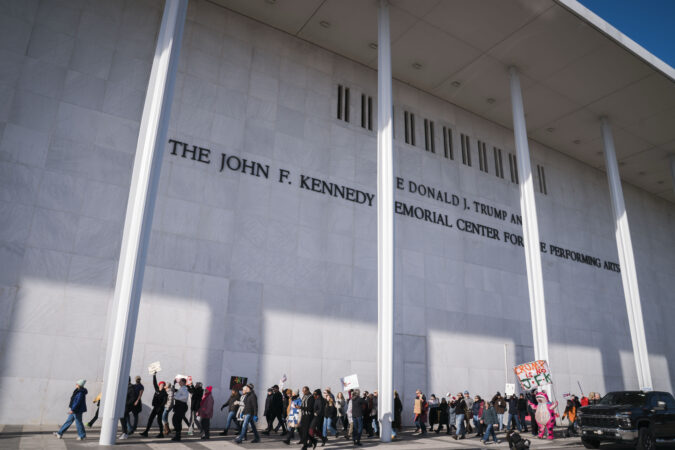
Its board of trustees voted last weekto rename the institution “The Donald J. Trump and the John F. Kennedy Memorial Center for the Performing Arts,” but the move was swiftly challenged by Rep. Joyce Beatty (D., Ohio), who filed a lawsuit Monday arguing that an act of Congress was required to officially change its name.
Somemembers of the Kennedy family including Maria Shriver, a niece of John F. Kennedy, and Joe Kennedy, a former Democratic congressman from Massachusetts, expressed disbelief and dismay over the vote.
The Kennedy Center has experienced a steep decline in ticket sales since Trump’s takeover of the institution compared with the same period last year, the Post reported. Sales for orchestra, theater, and dance performances are the worst they have been since the coronavirus pandemic, according to a Post analysis.
In the weeks after the February board changes, at least 20 productions were canceled or postponed, with names such as comedian and actor Issa Rae pulling out of planned performances at the center, and musical artist Ben Folds and opera singer Renée Fleming announcing they were stepping down as artistic advisers.
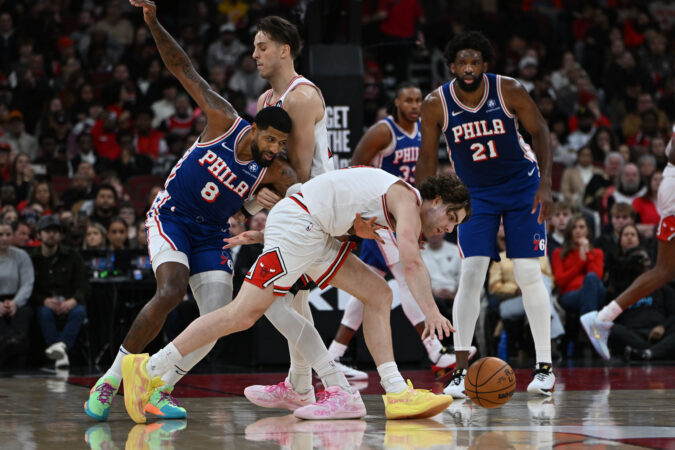
CHICAGO — Jalen Smith sparked a game-ending run with a thunderous dunk on Joel Embiid, and the Chicago Bulls matched a season high with their fifth straight win, beating the Philadelphia 76ers 109-102 on Friday night.
The Bulls scored the final 10 points of the game, starting with Smith’s driving dunk. Tre Jones and Zach Collins each had 15 points, and Coby White scored 13, helping the Bulls match their best streak since a 5-0 start. They also evened their record at 15-15.
Embiid led Philadelphia with 31 points. Tyrese Maxey scored 27 and had five 3-pointers. Paul George shook off a slow start to finish with 15 points and a season-high 12 rebounds, but the 76ers lost for the fourth time in as many games this season with their three stars in the lineup.
The Sixers led 102-99 after Embiid backed in with 2:45 remaining, but that was all the scoring for them. Smith then drove the baseline and dunked on a rotating Embiid with about 2:30 remaining, bringing the crowd to its feet.
White then nailed a step back 3, drawing more roars, and Jones hit a reverse layup. After a driving Maxey got blocked by Nikola Vucevic, Jones tracked down a loose ball and laid it in with 47 seconds left. He added a free throw with 17 seconds remaining.
Embiid, who has missed 15 games mainly due to right knee soreness, scored 16 points as the cold-shooting Sixers grabbed a 52-49 halftime lead.
Philadelphia made just 3 of 15 3-pointers and was 19 of 50 from the field through the first two quarters. Even so, the Sixers went from leading 13-2 to trailing by 11 early in the second to taking a three-point advantage to the locker room.
ORCHARD PARK, N.Y. — Buffalo’s James Cook reflected on his offseason contract dispute with pride, a sense of unfinished business and a nod to Philadelphia’s Saquon Barkley.
Though the Bills’ fourth-year running back might already be outperforming the four-year, $46 million contract extension he signed in August following a week-long hold-in, the NFL’s rushing leader enters Week 17 feeling vindicated for banking on himself.
“You got to do what you got to do. You need to take care of your family, and that’s what I did,” Cook said Friday, referring to his contract dispute that included him skipping all of the team’s spring voluntary practices.
At the same time, Cook thinks he has more to prove.
“The job’s not even finished,” he said. ”So just keep going.”
With a career-best 1,532 yards rushing, Cook has a 43-yard lead over the Colts’ Jonathan Taylor in what stands as a two-way race for the rushing title.
What’s fitting for Cook this weekend as the Bills (11-4) prepare to host the Eagles (10-5) on Sunday is him owing his on- and off-field achievements to Barkley. If not for the Philadelphia running back raising the payroll bar for all players at his position, Cook figured he might still be spinning his wheels while seeking a pay raise.
“He set the standard. He set the mark,” Cook said of Barkley turning his league-leading 2,005 yards rushing last year into a two-year contract $41.2 million extension that made him the NFL’s first running back to average more than $20 million a season.
“Last year, he set the rushing title,” Cook added. ”And I’m just trying to replicate it.”
Two of the NFL’s premier running backs will square off in expected sloppy conditions, with the forecast calling for a wintery mix of snow and rain Sunday.
In Buffalo, Cook has scored 12 touchdowns and topped 100 yards nine times while taking the load off quarterback Josh Allen and contributing to the Bills reaching the playoffs for a seventh consecutive season.
In Philadelphia, Barkley has found his footing and the defending Super Bowl champion Eagles appear to have rediscovered their balanced offensive identity.
Barkley has topped 100 yards twice in the past three games after doing so just once in the first 12. The Eagles have won two in a row and are coming off a 29-18 win over Washington during which they became the first team to clinch consecutive NFC East titles since they did so over a four-year span from 2001-04.
Barkley said he “never lost faith” in the offense or coordinator Kevin Patullo, who was criticized for the Eagles’ sluggish start.
“It’s always not going to be pretty. The stat line isn’t always going to be 100 rushing yards,” he said. “When we get our running game going, we’re going to be a hard team to beat.”
Barkley noted he exchanged messages on Instagram with Cook this week.
“He’s the leading rusher right now and I sent him a message, like, ‘Go finish,” he said. “He’s a guy who’s had a heck of a year. … Super excited to go against him. Wish him the best, but not too well against our team.”
Barkley has an opportunity to thrive against a Bills defense that has allowed 150 or more yards rushing seven times this season, and will be missing three defensive tackles to injury.
The Bills, however, can counter with Cook, whose 12 TDs rushing are tied for fourth in the NFL.
“The week to week intensity is different than last year,” McDermott said. “He had some big games last year, but the look in his eye each week, the intensity that he shows up with, it’s really been influential on our whole football team.”
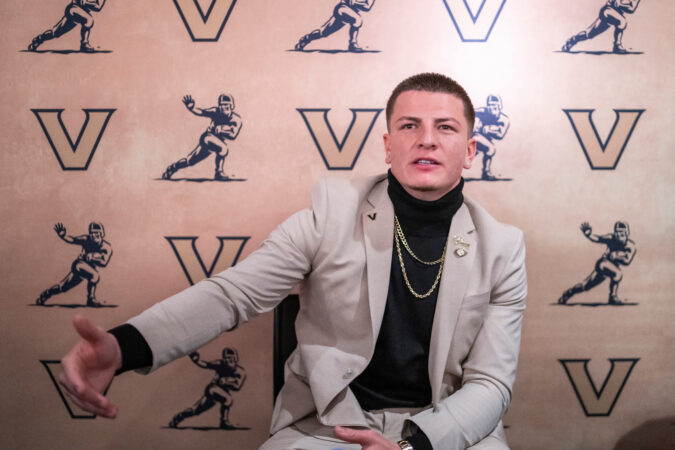
NASHVILLE, Tenn. — A lawyer for Heisman Trophy runner-up Diego Pavia and 26 other football players has cited the NCAA’s decision to allow an NBA draft pick to return to college basketball as a reason that a federal judge should let his clients play in 2026 and 2027.
Although Pavia plans to enter the NFL draft, he is continuing the lawsuit, which challenges an NCAA rule that counts seasons spent at junior colleges against players’ eligibility for Division I football.
On Wednesday, Baylor announced that 7-foot center James Nnaji had joined the Bears after four seasons playing professionally in Europe, a span that included Nnaji being drafted No. 31 overall by the Detroit Pistons. His rights were traded to Charlotte and later the New York Knicks.
Attorney Ryan Downton seized on that news in a memorandum he filed Friday in a Tennessee federal court to support his antitrust lawsuit against the NCAA. He’s asking U.S. District Judge William L. Campbell to block the NCAA from enforcing its eligibility rules.
With Nnaji’s arrival at Baylor having been announced on Christmas Eve, Downton began his memo with a reference to Clement Clarke Moore’s poem “A Visit from St. Nicholas.”
“When what to my wandering eyes should appear, but … the hypocrisy of the NCAA granting four years of eligibility to a 21-year-old European professional basketball player with four years of professional experience who was drafted by an NBA team two years ago,” the attorney wrote.
The memo noted that Nnaji, who also played in the NBA Summer League, will be 25 before he runs out of eligibility.
“Meanwhile, the NCAA argues to this court that high school seniors are harmed if a 22- or 23-year-old former junior college player plays one more year of college football,” according to the filing.
Pavia initially sued the NCAA in November 2024 and won a preliminary injunction weeks later that allowed him to play this season. He led Vanderbilt to a No. 13 ranking in the AP poll and the best season in program history. The Commodores will play Iowa in the ReliaQuest Bowl on Dec. 31.
The lawsuit has since added 26 other plaintiffs, including Tennessee quarterback Joey Aguilar.
NCAA rules give athletes five years to play four seasons under an eligibility clock that starts at any “collegiate institution” regardless of whether that school is an NCAA member.
Pavia started playing at New Mexico Military Institute in 2020; the NCAA did not count that season toward eligibility because of the COVID-19 pandemic. He led the junior college to the 2021 national championship, then played at New Mexico State in 2022 and 2023 before transferring to Vanderbilt for 2024, making this season his sixth in college football but only his fourth at the Division I level.
The NCAA is facing several eligibility lawsuits, and Downton is representing players in another lawsuit over the NCAA’s redshirt rule, with Vanderbilt linebacker Langston Patterson a lead plaintiff.
LOUISVILLE, Ky. — A Cuban immigrant who had built a new life working at a Kentucky scrapyard died on Christmas Day from severe burns suffered in last month’s UPS cargo plane crash, raising the death toll to 15, officials said.
Alain Rodriguez Colina was on the ground when the plane, fully loaded with fuel for a flight to Hawaii, plowed into businesses after departing Louisville’s airport, exploding in a massive fireball. Gov. Andy Beshear and Louisville Mayor Craig Greenberg confirmed his death via social media.
“May Alain’s memory be a blessing,” the mayor said late Thursday.
Three pilots and multiple people died after the plane’s left engine detached during takeoff on Nov. 4, and cracks were later found where the engine connected to the wing, the National Transportation Safety Board said. Louisville’s Muhammad Ali International Airport is home to the largest UPS package delivery hub.
Colina had worked since 2023 at the nearby Grade A Auto Parts & Recycling, moving up rapidly to the position of metal buyer, said owner and CEO Sean Garber in a phone interview Friday. Colina embraced the company’s culture and life in Louisville, even becoming a University of Kentucky fan. His mother and siblings lived in the area and he had a daughter in Cuba, he said.
Workers at the scrapyard have described the scramble to help survivors after the crash. Colina had been with a customer and a coworker who died, Garber said. Colina got out but was burned over 50% of his body, and doctors didn’t have much hope for a recovery.
He was in an induced coma, never regaining consciousness. His family visited often. It seemed like he was starting to heal, Garber said, but on Thursday he took a turn for the worse.
Colina was a good man, Garber said, with a big heart who cared about the business, customers, and his family.
“He believed in the opportunity he got in the United States and really made the most of it,” Garber said. “He should still be with us.”
Earlier this month, a lawyer filed two wrongful death lawsuits that allege that the company kept flying older aircrafts without increasing maintenance beyond what’s regularly scheduled. The lawsuit also names General Electric, which made the plane’s engine. Both UPS and GE have said they don’t comment on pending lawsuits but safety remains their top priority as they assist the federal investigation. That litigation does not include Colina.
Local businesses and more than 90 people affected by the crash, including Colina, plan to file another lawsuit in the coming weeks, said attorney Masten Childers III, whose firm is one of two representing those plaintiffs.
“Alain fought hard,” Childers said. “Alain’s passing must be honored by holding those responsible for his death accountable.”
The Federal Aviation Administration has grounded all MD-11s, the type of plane involved in the crash, which have been used only for hauling cargo for more than a decade.
The Trump administration is widening efforts to screen visa applicants for online speech considered dangerous and “anti-American” as the government moves to restrict legal migration and remove people from places the president has called “garbage.”
The State Department earlier this month expanded new regulations requiring foreign students and people on academic and cultural exchange programs to disclose five years of their social media histories and make all of their posts public. All applicants for H-1B employment visas and their dependents will now also be subject to the more rigorous online review.
“A U.S. visa is a privilege, not a right,” officials said in announcing the expansion.
The administration is also considering a similar rule for visitors from countries whose citizens are allowed to enter the United States for up to 90 days without a visa, including France, Germany, the United Kingdom and Japan.
The increased online screening began with the administration’s crackdown on antisemitism on college campuses and has accelerated in a way that immigrant rights advocates say is chilling public discourse. In September, authorities announced plans to review more than 55 million U.S. visa holders for potential violations that could lead to deportations, raising concerns that the government is leveraging speech for visa approval or denial.
“You never think you would have this here” in the United States, said Suresh Naidu, an economics professor at Columbia University. He said he reduced his own public profile while applying to become a naturalized citizen this year. “The idea that this country would start to think of its visa systems as a privilege that could be revoked arbitrarily — this is supposed to be a democracy.”
Despite a federal judge’s ruling in September that immigrants in the country lawfully are protected by the First Amendment, federal authorities have continued to revoke visas from foreign visitors over statements the administration has called dangerous and un-American. They included six foreigners who the administration said “celebrated” the fatal shooting in September of conservative activist Charlie Kirk and a British news commentator critical of Israel’s war in Gaza whose visa was revoked in late October.
In October, several major labor unions — the United Auto Workers (UAW), the American Federation of Teachers (AFT), and the Communications Workers of America — filed a lawsuit alleging the government is deploying a “vast surveillance apparatus” powered by artificial intelligence and other emerging technology that has stifled participation in public life among noncitizens.
Union members who fear adverse immigration actions have chosen to refrain from expressing “views remotely related to the topics the government disfavors,” according to the lawsuit, which said unions are experiencing a reduction in online organizing activity. The unions cited internal surveys that found many noncitizens have taken steps to reduce their online speech, including erasing posts, hiding their identities and eliminating social media accounts.
“We’re trying to make sure that people still have the right to speak and to engage and to do what America’s known for, which is freedom,” AFT President Randi Weingarten said in an interview.
Trump administration officials said they are acting to protect public safety against terrorist sympathizers and those who wish harm upon Americans. In a statement, Department of Homeland Security assistant secretary Tricia McLaughlin disputed the suggestion that the administration is stifling free speech.
“DHS takes its role in addressing threats to the public and our communities seriously, and the idea that enforcing federal law in that regard constitutes some kind of prior restraint on speech is laughable,” she said.
A federal judge disagreed. In September, U.S. District Judge William G. Young of Massachusetts ruled that the Trump administration had misused its sweeping powers in a manner “that continues unconstitutionally to chill freedom of speech to this day.”
That case centers on claims by the American Association of University Professors that the targeting of pro-Palestinian campus organizers in the spring left noncitizen students and faculty fearful of attending protests, posting on social media and voicing opinions in class. Young has set a hearing for January to determine remedial measures.
The plaintiffs are asking Young to enjoin the administration from revoking more visas or making “coercive threats” based on pro-Palestinian advocacy; set aside the administration’s policy of arresting and detaining noncitizens “based on pro-Palestinian or anti-Israel speech or association”; and require the State Department to notify individuals if visa revocations are based in part on speech- or protest-related activity.
“Since the start of this litigation, the government has vigorously maintained a willful ability to deport noncitizens over their political expression, and they have doubled down on their legal claims since the court ruling,” said Ramya Krishnan, a lawyer for the plaintiffs who serves as a senior staff attorney at the Knight First Amendment Institute at Columbia University.
British political commentator Sami Hamdi on Nov. 13, upon his return to the United Kingdom after he was arrested by U.S. Immigration and Customs Enforcement on Oct. 26 while on a speaking tour.
She pointed to the 18-day detention of British commentator Sami Hamdi, a target of far-right Trump supporters for his criticism of Israel. His nonimmigrant visa was revoked by the State Department on Oct. 26 while he was on a U.S. speaking tour.
In a phone interview from his home in London, Hamdi said he entered the country on a 10-year business and tourism visa that he had obtained in 2018. After speaking at a Council on American-Islamic Relations gala in Sacramento, he said, he was detained by federal immigration officers at San Francisco International Airport. They told him he had overstayed his visa, which had been canceled two days earlier, unbeknownst to him.
On their social media accounts, the State Department and DHS accused Hamdi — who maintains that Israel committed genocide in Gaza — of supporting terrorism and “undermining the safety of Americans.” But he was not charged with any crime, such as abetting terrorism, before striking an agreement with the State Department to return home, Hamdi’s lawyers said.
Hamdi believes he was arrested because of pressure from far-right activists, including prominent Trump supporters Dinesh D’Souza, who called him a “Muslim Brotherhood jihadi,” and Laura Loomer and Amy Mek, who posted on social media demanding his removal and celebrating his arrest.
“I did nothing illegal in the U.S.,” said Hamdi, who was released by Immigration and Customs Enforcement on Nov. 13 after he voluntarily agreed to return to London. “My visa was revoked because of my advocacy for Palestine. It was revoked because an extremist group went to the State Department and leveraged whatever influence it had to specifically target me.”
The State Department declined to comment.
McLaughlin called Hamdi an “illegal alien and terrorist sympathizer” who requested voluntary departure. She said that Homeland Security Secretary Kristi L. Noem “has made it clear that anyone who thinks they can come to America and hide behind the First Amendment to advocate for anti-American and anti-Semitic violence and terrorism — think again.”
Trump signed an executive action in January aimed at combating antisemitism on college campuses, but free speech advocates say the campaign is rapidly expanding into broader surveillance.
In August, U.S. Citizenship and Immigration Services said immigrants seeking to become naturalized U.S. citizens would be subject to a “good moral character” review that includes an assessment of their “behavior, adherence to societal norms, and positive contributions.” Also that month, that agency said it would begin considering “anti-American” views in determining whether to provide immigrants benefits.
“People are free to make whatever statements they want on social media or anywhere else, and anyone who does not support the same candidate that I support, that’s not what we’re talking about here,” the agency’s director, Joseph Edlow, told CBS News in October. “We’re talking about beyond the pale. We’re talking about people actively supporting the violent overthrow of this country or otherwise providing material support to terrorist organizations across the world.”
Edlow spoke a day after the State Department revoked the visas of a half-dozen foreign nationals — from Argentina, Brazil, Germany, Mexico, Paraguay, and South Africa — who purportedly “celebrated” Kirk’s death. The department said that “the United States has no obligation to host foreigners who wish death on Americans.”
Nhlamulo Baloyi, a South African music executive, was among them. He wrote on X that “Charlie Kirk won’t be remembered as a hero” and said Kirk led a “movement of white nationalist trailer trash.”
Baloyi, 35, who once worked for a Sony Music subsidiary based in New York, has been outspoken online about anti-Black racism and his country’s history of racial apartheid. In a phone interview, he said right-wing Afrikaners have flagged and reported his posts in an effort to get him banned from X and other social media platforms.
Baloyi suggested that noncitizens in the United States must seriously “consider holding their tongues” or risk being expelled and losing their right to live and work in this country. But he also pointed to virulent online criticism from U.S. citizens aimed at former vice president Dick Cheney after his death this month and suggested foreigners are being held to a double standard.
“I don’t think anything I might have said about Charlie Kirk is remotely equated to the attacks Dick Cheney has faced,” Baloyi said.
Naidu, the Columbia professor, is from Canada and is married to an American. He had been active on X, sharing his thoughts on a range of economic and political topics with more than 16,000 followers. He deleted his account after Trump was elected last year over concerns that discussing political issues could adversely affect his citizenship application. It was approved in July, but he has not rejoined X.
“I’m less nervous about it. But just overall being at Columbia and Columbia being in the crosshairs — my content would not be the most offensive to the administration, but why risk it?” Naidu said.
Nicole M. Bennett, a researcher at Indiana University who studies the federal government’s approach to data governance and digital technologies, called social media the “new front line” in immigration enforcement — one that is expanding into around-the-clock monitoring. Powered by artificial intelligence, new search tools have the potential to vastly expand investigations beyond an immediate target and surveil people around them who had not been suspected of wrongdoing, including family members, friends or co-workers, she said.
“If you’re in a video, you could be pulled into that dragnet, and maybe they find something because they are looking,” Bennett said. “The biggest change is that instead of an investigation being based on evidence, the investigation is based on correlated data.”
Hamdi said his agreement with the State Department to leave the country voluntarily does not prohibit him from applying for reentry to the United States, and he is determined to give it a try. But he acknowledged that other foreigners might think twice. Pointing to soccer’s World Cup in U.S. cities next summer, Hamdi expressed concern for fans who come to root for their teams.
“What happens if a fan waves a Palestinian flag at a stadium — does that mean they will have their visa revoked?” he said. “And if their visa is revoked without notifying the individual, does that mean they could wind up in detention, too?”
Since returning to the White House in January, President Donald Trump has overturned decades of U.S. trade policy — building a wall of tariffs around what used to be a wide open economy.
His double-digit taxes on imports from almost every country have disrupted global commerce and strained the budgets of consumers and businesses worldwide. They have also raised tens of billions of dollars for the U.S. Treasury.
Trump has argued that his steep new import taxes are necessary to bring back wealth that was “stolen” from the U.S. He says they will narrow America’s decades-old trade deficit and bring manufacturing back to the country. But upending the global supply chain has proven costly for households facing rising prices. The taxes are paid by importers who typically attempt to pass along the higher costs to their customers. That includes businesses and ultimately, U.S. households.
And the erratic way the president rolled out his tariffs — announcing them, then suspending or altering them before conjuring up new ones — made 2025 one of the most turbulent economic years in recent memory.
Here’s a look at the impact of Trump’s tariffs over the last year, in four charts.
Effective U.S. tariff rate
A key number for the overall impact of tariffs on U.S. consumers and businesses is the “effective” tariff rate — which, unlike headline figures imposed by Trump for specific trade actions, provides an average based on the actual imports coming into the country.
In 2025, per data from the Yale Budget Lab, the effective U.S. tariff rate peaked in April. But it’s still far higher than the average seen at the start of the year. Before finalizing shifts in consumption, November’s effective tariff rate was nearly 17% — seven times greater than January’s average and the highest seen since 1935.
Tariff revenue vs America’s trade deficit
Among selling points to justify his tariffs, Trump has repeatedly said they would reduce America’s longstanding trade deficit and bring revenue into the Treasury.
Trump’s higher tariffs are certainly raising money. They’ve raked in more than $236 billion this year through November — much more than in years past. But they still account for just a fraction of the federal government’s total revenue. And they haven’t raised nearly enough to justify the president’s claim that tariff revenue could replace federal income taxes — or allow for windfall dividend checks for Americans.
The U.S. trade deficit, meanwhile, has fallen significantly since the start of the year. The trade gap peaked to a monthly record of $136.4 billion in March, as consumers and businesses hurried to import foreign products before Trump could impose his tariffs on them. The trade gap narrowed to $52.8 billion in September, the latest month for which data is available. But the year-to-date deficit was still running 17% ahead of January-September 2024.
Import shifts with America’s biggest trading partners
Trump’s 2025 tariffs hit nearly every country in the world — including America’s biggest trading partners. But his policies have had the biggest impact on U.S. trade with China, once the biggest source of American imports and now No. 3 behind Canada and Mexico. U.S. tariffs on Chinese imports now come to 47.5%, according to calculations by Chad Bown of the Peterson Institute for International Economics.
The value of goods coming into the U.S. from China fell nearly 25% during the first three-quarters of the year. Imports from Canada also dropped. But the value of products from Mexico, Vietnam, and Taiwan grew year-to-date.
Market swings
For investors, the most volatile moments on the stock market this year arrived amid some of the most volatile moments for Trump’s tariffs.
The S&P 500, an index for the biggest public companies in the U.S., saw its biggest daily and weekly swings in April — and largest monthly losses and gains in March and June, respectively.
Top officials in President Donald Trump’s administration posted messages from their government accounts hailing Christmas in explicitly sectarian terms, such as a day to celebrate the birth of “our Savior Jesus Christ.”
The Department of Homeland Security posted three messages on social media Thursday and Friday, twice declaring, “Christ is Born!” and once stating, “We are blessed to share a nation and a Savior.” One DHS video posted on X displayed religious images, including Jesus, a manger and crosses.
The messages sharply diverged from the more secular, Santa Claus-and-reindeer style of Christmas messages that have been the norm for government agencies for years. The posts provided the latest example of the administration’s efforts to promote the cultural views and language of Trump’s evangelical Christian base.
That drew criticism from advocates of a strict separation of church and state.
Those social media posts are “one more example of the Christian Nationalist rhetoric the Trump administration has disseminated since Day One in office,” Rachel Laser, president and CEO of Americans United for Separation of Church and State, said in a statement. “Our Constitution’s promise of church-state separation has allowed religious diversity — including different denominations of Christianity — to flourish in America.
“People of all religions and none should not have to sift through proselytizing messages to access government information,” she added. “It’s divisive and un-American.”
Administration officials aggressively defended their approach. Asked about the Christmas morning post on Defense Secretary Pete Hegseth’s official X account declaring, “Today we celebrate the birth of our Lord and Savior, Jesus Christ,” Pentagon press secretary Kingsley Wilson provided a one-sentence reply: “Merry Christmas to all, even the fake news Washington Post!”
Conservative Christians make up an important part of Trump’s political support, even as the country has become less Christian in recent decades.
The Pew Research Center’s most recent Religious Landscape Study, released earlier this year, found that 62% of Americans identify as Christian, a 16-point drop since 2007. The share of Americans who said they have no religion — including atheists, agnostics and those who say “nothing in particular” — was 29%, up from 16% in 2007. The share of the population following other religious traditions — Jews, Muslims, Hindus, Buddhists and others — has remained fairly constant, at around 6%.
Just under 1 in 4 Americans identify as evangelical Christians. But those evangelical voters play a central role in Trump’s electoral coalition. He won 81% of white evangelical voters in the 2024 election, according to a separate Pew study of voters. Those voters made up about 3 in 10 of his supporters in the election.
In 2015, as Trump campaigned for president, he told voters, “We’re going to be saying Merry Christmas again.” A decade later, officials in his second term have gone further in overtly seeking to align the administration with Christian advocacy in both language and action.
Most recently, on Thursday, Trump justified airstrikes against alleged Islamic State camps in northwestern Nigeria by saying he was aiming to “stop the slaughtering of Christians.” Nigerian officials said they approved of the strikes but said Trump was wrongly injecting religion into a situation that was primarily about terrorism.
How to celebrate Christmas while respecting the Constitution’s ban on “establishment of religion” has been an issue for federal officials at least since 1870 when President Ulysses S. Grant, seeking to unite the country after a brutal Civil War, designated Christmas — along with Thanksgiving and New Year’s Day — as federal holidays.
Government officials sought to balance the celebration of a federal holiday rooted in a religious tradition with the country’s tradition of pluralism and secular public spaces. The result was often a Christmas message that avoided specific references to Christianity. For decades, it was common for government officials on both sides of the aisle to share celebratory yet secular messages about Christmas with images that did not carry overt religious meanings, like snowflakes and Christmas trees.
Many still do. The State Department, for example, posted a secular Christmas message this year, directed at “all Americans.”
Many of the Trump administration’s officials who are most active on social media, however, took a different approach.
Just before 9 a.m. on Christmas Day, for example, Harmeet K. Dhillon, head of the Justice Department’s civil rights division, posted a message on X wishing “Christians nationwide” a happy holiday “celebrating the birth of Jesus!”
In the post was a video more than a minute long in which Dhillon said the department uses the principle of “religious liberty” and the First Amendment on “a daily basis to protect Christians.” She did not mention protecting other religions.
About two hours later, DHS’s official account posted on X that “we are blessed to share a nation and a Savior.” A video in the post began with text that said, “Remember the miracle of Christ’s birth,” followed by 90 seconds of religious images, including Jesus, Mary, and a manger, as well as several of Trump.
Just before 3 p.m. the department posted another message on X, stating, “Christ is Born!”
Hegseth posted his message around 8:30 a.m. Less than an hour later, Agriculture Secretary Brooke Rollins posted a video on X in which she stood in front of a Christmas tree and said “the very best of the American spirit … flows from the very first Christmas, when God gave us the greatest gift possible: the gift of his son and our savior, Jesus Christ.”
Just after 10 a.m., Education Secretary Linda McMahon posted on X about how “we celebrate the birth of our Savior.” And just after 1 p.m., the Department of Labor wrote on X, “Let Earth Receive Her King.”
Representatives for the departments of Justice, Agriculture, Education, Labor and Homeland Security did not respond to questions about their posts.
Among the tens of thousands of Jeffrey Epstein files released so far by the Justice Department are documents that provide new details on one of the most discussed aspects of the case — his death in federal custody in 2019.
Epstein, who was indicted in July 2019 on federal sex-trafficking charges, had been locked up in the now-closed Metropolitan Correctional Center in New York for five weeks when, on Aug. 10, at roughly 6:30 a.m., he was found dead in his cell.
He had been denied bail and, at age 66, was facing a potential 45-year sentence if convicted on all charges. The day before his death, federal judges in a separate civil lawsuit had unsealed 2,000 pages of records containing allegations of his sexual abuse of girls and young women.
Six days after his death, New York City’s chief medical examiner, Barbara Sampson, whose office had conducted an autopsy of Epstein’s body, issued a finding that he had hanged himself.
Ever since, a wide range of people, including members of Congress and some prominent supporters of President Donald Trump, have challenged that conclusion, asserting with no evidence that Epstein was killed and proffering theories about who might have done it.
The documents released so far provide no support for those theories. They do offer additional evidence for the conclusion reached by previous investigations — both by the Justice Department and media organizations — that jail officials failed to properly monitor Epstein even though they had previously put him on suicide watch.
Two jail staff members were charged after Epstein’s death with failing to watch him. Prosecutors said they slept through part of their shift, whiled away time shopping online and falsified log books to conceal their failure to conduct rounds every 30 minutes. They ultimately reached a deal to avoid trial. Jail officials also left Epstein alone in his cell, despite strict instructions not to do so.
In the early hours of July 23, 2019, a couple of weeks after Epstein arrived at the jail, workers found him semiconscious on the floor of his cell with a makeshift orange noose around his neck, according to an investigative report from the Federal Bureau of Prisons included in Monday’s batch of documents. That previous apparent suicide attempt had been widely reported, but the newly released documents provide new details.
The Bureau of Prisons did not respond to questions about Epstein’s confinement and death.
After struggling to stand him up, staff members put Epstein in hand and leg restraints and carried him out on a gurney, the report said. A medical assessment found redness and abrasions around his neck. Photos in the report, timestamped 1:45 a.m. and labeled “possible suicide attempt,” show a disheveled Epstein in a blue antisuicide smock, his skin faintly red above the collarbone.
Officials placed Epstein on suicide watch. An observation log from the morning of that apparent suicide attempt was also among the documents the Justice Department released this week. It shows handwritten notes from two staffers, entered at 15-minute intervals.
A note from 2:15 a.m. says Epstein “states his cellmate tried to kill him.” The investigative report also states that Epstein told an officer that his cellmate had “attempted to kill him and had been harassing him.”
At the time, Epstein was housed with Nicholas Tartaglione, a former police officer who was later convicted of a quadruple murder and sentenced to life in prison. Tartaglione and Epstein each said later that they did not have problems with each other, according to prison documents. Investigators did not find significant evidence that Tartaglione assaulted Epstein.
A 2:30 a.m. note in the suicide watch log reads: “inmate sitting on bed trying to remember what happened.” Later notes simply read, “inmate sitting on bed” and “inmate standing at door.”
Epstein told investigators in a July 31 interview that he hadn’t slept in “approximately 20 days,” according to the investigative report. He said he had woken up on the floor to the sound of snoring that turned out to be his own.
Tartaglione said he had been asleep on the cell floor when he felt something hit his foot, the report says. He awoke to see Epstein snoring with his eyes open and thought he was having a heart attack, according to the report.
Epstein appeared to recover quickly from the apparent suicide attempt, according to a Bureau of Prisons medical form filled out that morning. A healthcare provider noted that he was breathing normally, didn’t appear distressed and smiled during the visit. He declined to talk about what led to the incident, the document states, saying only that he “went to drink a little water and [woke] up snorting.”
A separate document appears to contain notes from an interview with a prison psychologist who observed Epstein over the following two weeks.
Epstein avoided questions about the incident, according to the notes, and said it was against his religion to kill himself. “E said he doesn’t like pain and didn’t want to hurt himself,” one bullet point read.
“No signs in logbooks showing suicidality, participating in legal meetings,” read another. Other notes indicate Epstein tried to avoid being transferred back to special housing.
Another logbook, dated July 24 through July 30, 2019, shows Epstein was allowed basic comforts while under psychological observation, including regular clothes, newspapers and magazines, books, legal mail, and a “safety toothbrush.” He made small talk with staffers about investment strategies and jail life, visited with lawyers, showered and slept, according to the logs.
The documents also contain correspondence from the same period between a prison associate warden and a Bureau of Prisons regional director who asked for daily updates on Epstein after his apparent suicide attempt.
A Bureau of Prisons spokesperson did not respond to a message seeking comment about those arrangements or other details in the correspondence.
Less than 48 hours after the apparent suicide attempt, the associate warden emailed the regional director to say that Epstein could face a disciplinary hearing for violating the prison’s prohibition on “self-mutilation.”
A doctor had “indicated that most likely he will be found competent because he is not mentally ill,” the email said. “We have supporting memorandums from the responding officers who indicated they observed inmate Epstein with a makeshift noose around his neck.”
Further emails from senders whose names are redacted appear to show prison officials tracking Epstein’s progress in the days leading up to his death in custody.
In a July 26 email, the prison’s chief psychologist indicated that a psychologist in the Bureau of Prisons headquarters in Washington “was concerned I stepped him down to psych obs rather than keeping him on SW,” probably referring to suicide watch.
“I gave my justification and feel it is appropriate, but I just want to make sure I still feel that way when he is interviewed today,” the email read.
Another exchange suggested that Epstein had spent “about 12 hours” with his attorney and had complained about being dehydrated because of limited bathroom breaks.
“He also complained about having to go back up to SHU,” the July 27 email read, referring to the special housing unit, which is used for inmates with psychiatric problems and those requiring extra monitoring.The sender added that Epstein was “anxious about it and not being able to sleep there because of the noise of inmates banging and screaming at night.”
An email dated the following morning read, “Inmate Epstein seems psychologically stable.”
Prison workers sent Epstein back to special housing on July 30.
Over the following days, Epstein’s lawyers wrote to prison officials with complaints about his conditions. They said he had no toilet paper, that his CPAP machine, used for sleep apnea, had been disconnected and that he had been allowed only two 15-minute calls on speaker phone with officers present, according to redacted emails.
On Aug. 10, prison staffers delivering Epstein’s breakfast found him unresponsive in his cell, documents show.