SHAKOPEE, Minn. — Mike Lindell, the fervent supporter of President Donald Trump known to TV viewers as the “MyPillow Guy,” officially entered the race for Minnesota governor Thursday in hopes of winning the Republican nomination to challenge Democratic Gov. Tim Walz.
“I’ll leave no town unturned in Minnesota,” Lindell told The Associated Press in an interview ahead of a news conference set for Thursday.
He said he has a record of solving problems and personal experiences that will help businesses and fight addiction and homelessness as well as fraud in government programs. The fraud issue has particularly dogged Walz, who announced in September that he’s seeking a third term in the 2026 election.
A TV pitchman and election denier
Lindell, 64, founded his pillow company in Minnesota in 2009 and became its public face through infomercials that became ubiquitous on late-night television. But he and his company faced a string of legal and financial setbacks after he became a leading amplifier of Trump’s false claims that the 2020 election was stolen. He said he has overcome them.
“Not only have I built businesses, you look at problem solution,” Lindell said in his trademark rapid-fire style. “I was able to make it through the biggest attack on a company, and a person, probably other than Donald Trump, in the history of our media … lawfare and everything.”
While no Republican has won statewide office in Minnesota since 2006, the state’s voters have a history of making unconventional choices. They shocked the world by electing former professional wrestler Jesse Ventura as governor in 1998. And they picked a veteran TV pitchman in 1978 when they elected home improvement company owner Rudy Boschwitz as a U.S. senator.
Lindell has frequently talked about how he overcame a crack cocaine addiction with a religious conversion in 2009 as MyPillow was getting going. His life took another turn in 2016 when he met the future president during Trump’s first campaign. He served as a warm-up speaker at dozens of Trump rallies and co-chaired Trump’s campaign in Minnesota.
Trump’s endorsement could be the key to which of several candidates wins the GOP nomination to challenge Walz. But Lindell said he doesn’t know what Trump will do, even though they’re friends, and said his campaign isn’t contingent on the president’s support.
Lindell’s outspoken support for Trump’s false claims that the 2020 election was stolen triggered a backlash as major retailers discontinued MyPillow products. By his own admission, revenue slumped and lines of credit dried up, costing him millions. Several vendors sued MyPillow over billing disputes. Fox News stopped running his commercials. Lawyers quit on him.
Lindell has been sued twice for defamation over his claims that voting machines were manipulated to deprive Trump of a victory.
A federal judge in Minnesota ruled in September that Lindell defamed Smartmatic with 51 false statements. But the judge deferred the question of whether Lindell acted with the “actual malice” that Smartmatic must prove to collect. Smartmatic says it’s seeking “nine-figure damages.”
But Lindell won a victory in July when a federal appeals court overturned a judge’s decision that affirmed a $5 million arbitration award to a software engineer who disputed data that Lindell claimed proved Chinese interference in the 2020 election. The engineer had accepted Lindell’s “Prove Mike Wrong Challenge,” which he launched as part of his 2021 “Cyber Symposium” in South Dakota, where he promised to expose election fraud.
The campaign ahead
Lindell said his crusade against electronic voting machines will just be part of his platform. While Minnesota uses paper ballots, it also uses electronic tabulators to count them. Lindell wants them hand-counted, even though many election officials say machine counting is more accurate.
“These guys haven’t lived what I live,” Lindell said.
Lindell wouldn’t commit to abiding by the Minnesota GOP endorsement and forgoing the primary if he loses it, expressing confidence that he’ll win. He also said he’ll rely on his supporters to finance his campaign because his own finances are drained. “I don’t have the money,” he acknowledged.
But he added that ever since word got out last week that he had filed the paperwork to run, “I’ve had thousands upon thousands of people text and call, saying from all around the country … ‘Hey, I’ll donate.’”
GREENBELT, Md. — A federal judge in Maryland ordered Kilmar Abrego Garcia freed from immigration detention on Thursday while his legal challenge against his deportation moves forward.
U.S. District Judge Paula Xinis ruled that Immigration and Customs Enforcement must release Abrego Garcia from custody immediately.
“Since Abrego Garcia’s return from wrongful detention in El Salvador, he has been re-detained, again without lawful authority,” the judge wrote. “For this reason, the Court will GRANT Abrego Garcia’s Petition for immediate release from ICE custody.”
Justice Department and Homeland Security spokespeople didn’t immediately respond to messages seeking comment on the judge’s order. Messages seeking comment were left with Abrego Garcia’s attorney Simon Sandoval-Moshenberg.
Abrego Garcia, a Salvadoran national, has an American wife and child and has lived in Maryland for years, but he originally immigrated to the U.S. illegally as a teenager. An immigration judge in 2019 ruled Abrego Garcia could not be deported to El Salvador because he faced danger from a gang that targeted his family. When Abrego Garcia was mistakenly deported there in March, his case became a rallying point for those who oppose President Donald Trump’s immigration crackdown.
Abrego Garcia was returned to the U.S. under a court order. Since he cannot be deported to El Salvador, ICE has been seeking to deport him to a series of African countries. His lawsuit in federal court claims Trump’s Republican administration is illegally using the deportation process to punish Abrego Garcia over the embarrassment of his mistaken deportation to El Salvador.
Meanwhile, in a separate action in immigration court, Abrego Garcia is petitioning to reopen his immigration case to seek asylum in the United States.
Additionally, Abrego Garcia is facing criminal charges in federal court in Tennessee, where he has pleaded not guilty to human smuggling. He has filed a motion to dismiss the charges, claiming the prosecution is vindictive.
A judge has ordered an evidentiary hearing to be held on the motion after previously finding some evidence that the prosecution against Abrego Garcia “may be vindictive.” The judge said many statements by Trump administration officials “raise cause for concern.”
The judge specifically cited a statement by Deputy Attorney General Todd Blanche that seemed to suggest the Justice Department charged Abrego Garcia because he won his wrongful deportation case.
WASHINGTON — President Donald Trump’s approval on the economy and immigration have fallen substantially since March, according to a new AP-NORC poll, the latest indication that two signature issues that got him elected barely a year ago could be turning into liabilities as his party begins to gear up for the 2026 midterms.
Perhaps most worryingly for Trump, who’s become increasingly synonymous with his party, he’s slipped on issues that were major strengths. Just a few months ago, 53% of Americans approved of Trump’s handling of crime, but that’s fallen to 43% in the new poll. There’s been a similar decline on immigration, from 49% approval in March to 38% now.
The new poll starkly illustrates how Trump has struggled to hold onto political wins since his return to office. Even border security — an issue on which his approval remains relatively high — has declined slightly in recent months.
The good news for Trump is that his overall approval hasn’t fallen as steeply. The new poll found that 36% of Americans approve of the way he’s handling his job as president, which is down slightly from 42% in March. That signals that even if some people aren’t happy with elements of his approach, they might not be ready to say he’s doing a bad job as president. And while discontent is increasing among Republicans on certain issues, they’re largely still behind him.
Declining approval on the economy, even among Republicans
Republicans are more unhappy with Trump’s performance on the economy than they were in the first few months of his term. About 7 in 10 Republicans, 69%, approve of how Trump is handling the economy in the December poll, a decline from 78% in March.
Larry Reynolds, a 74-year-old retiree and Republican voter from Wadsworth, Ohio, said he believes in Trump’s plan to impose import duties on U.S. trading partners but thinks rates have spiraled too high, creating a “vicious circle now where they aren’t really justifying the tariffs.”
Reynolds said he also believes that inflation became a problem during the coronavirus pandemic and that the economy won’t quickly recover, regardless of what Trump does. “I don’t think it’ll be anything really soon. I think it’s just going to take time,” he said.
Trump’s base is still largely behind him, which was not always the case for his predecessor, President Joe Biden, a Democrat. In the summer of 2022, only about half of Democrats approved of how Biden was handling the economy. Shortly before he withdrew from the 2024 presidential race two years later, that had risen to about two-thirds of Democrats.
More broadly, though, there’s no sign that Americans think the economy has improved since Trump took over. About two-thirds of U.S. adults, 68%, continue to say the country’s economy is “poor.” That’s unchanged from the last time the question was asked in October, and it’s broadly in line with views throughout Biden’s last year in office.
Why Trump gets higher approval on border security than immigration
Trump’s approval ratings on immigration have declined since March, but border security remains a relatively strong issue for him. Half of U.S. adults, 50%, approve of how Trump is handling border security, which is just slightly lower than the 55% who approved in September.
Trump’s relative strength on border security is partially driven by Democrats and independents. About one-third of independents, 36%, approve of Trump on the border, while 26% approve on immigration.
Jim Rollins, an 82-year-old independent in Macon, Georgia, said he believes that when it comes to closing the border, Trump has done “a good job,” but he hopes the administration will rethink its mass deportation efforts.
“Taking people out of kindergarten, and people going home for Thanksgiving, taking them off a plane. If they are criminals, sure,” said Rollins, who said he supported Trump in his first election but not since then. “But the percentages — based on the government’s own statistics — say that they’re not criminals. They just didn’t register, and maybe they sneaked across the border, and they’ve been here for 15 years.”
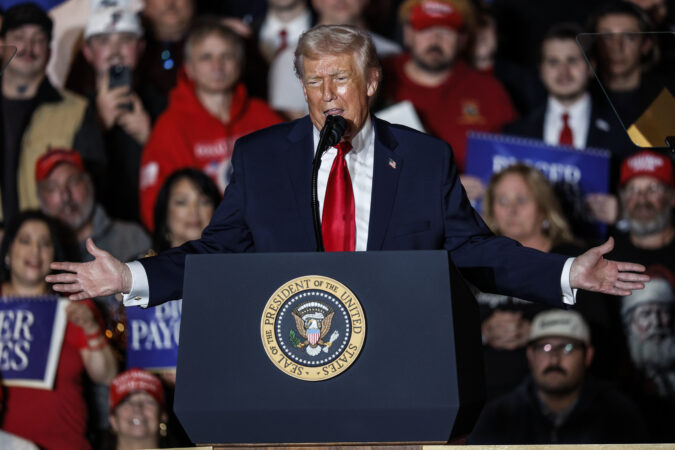
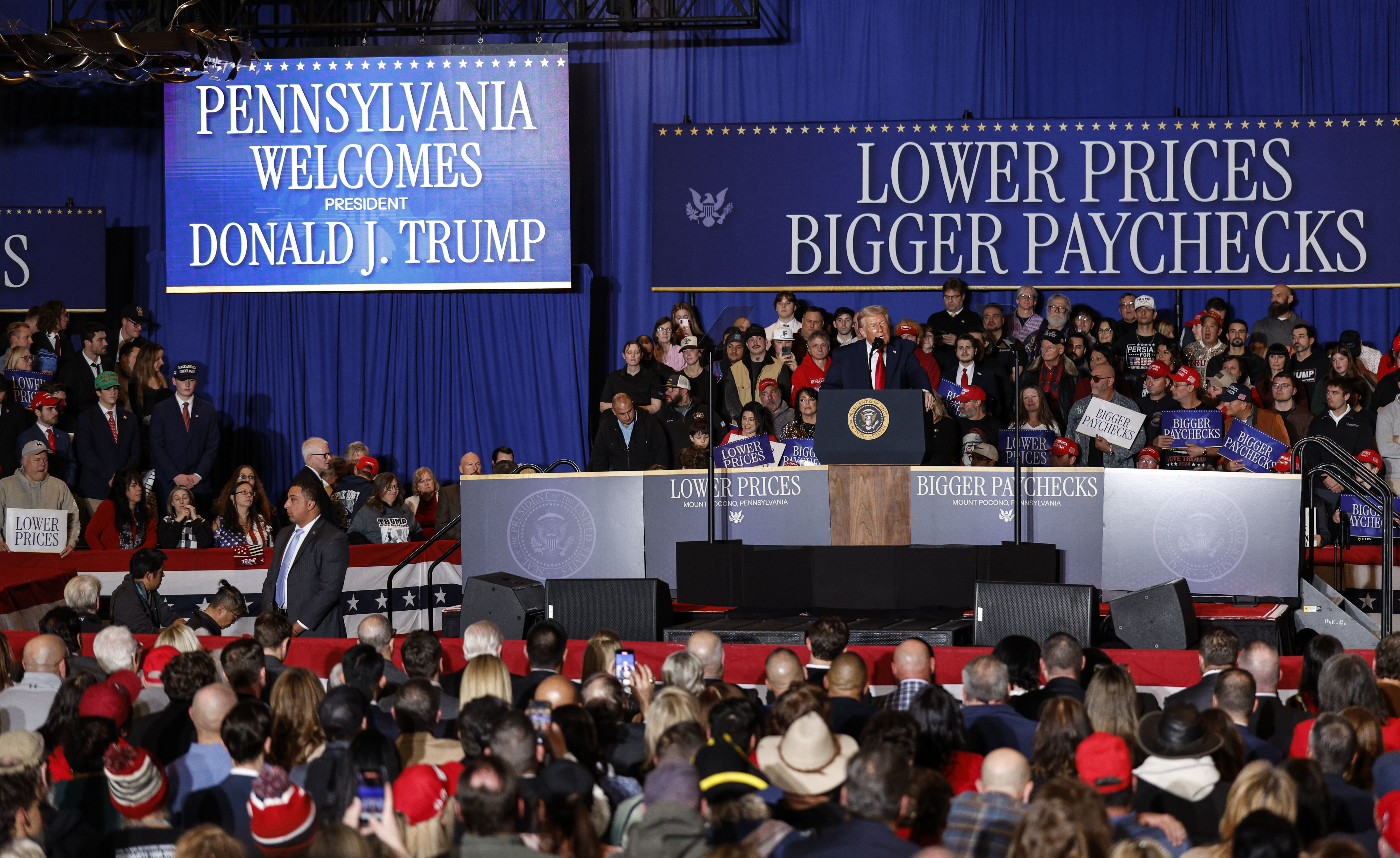
President Donald Trump made his first stop on an “economic tour” in Mt. Pocono, Pa., on Tuesday, Dec. 9.
Other polls have shown it’s more popular to increase border security than to deport immigrants, even those who are living in the country illegally. Nearly half of Americans said increasing security at the U.S.-Mexico border should be “a high priority” for the government in AP-NORC polling from September. Only about 3 in 10 said the same about deporting immigrants in the U.S. illegally.
Shaniqwa Copeland, a 30-year-old independent and home health aide in St. Augustine, Florida, said she approves of Trump’s overall handling of the presidency but believes his immigration actions have gone too far, especially when it comes to masked federal agents leading large raids.
“Now they’re just picking up anybody,” Copeland said. “They just like, pick up people, grabbing anybody. It’s crazy.”
Health care and government management remain thorns for Trump
About 3 in 10 U.S. adults approve of how Trump is handling health care, down slightly from November. The new poll was conducted in early December, as Trump and Congress struggled to find a bipartisan deal for extending the Affordable Care Act subsidies that will expire at the end of this month.
That health care fight was also the source of the recent government shutdown. About one-third of U.S. adults, 35%, approve of how Trump is managing the federal government, down from 43% in March.
But some Americans may see others at fault for the country’s problems, in addition to Trump. Copeland is unhappy with the country’s health care system and thinks things are getting worse but is not sure of whether to blame Trump or Biden.
“A couple years ago, I could find a dentist and it would be easy. Now, I have a different health care provider, and it’s like so hard to find a dental (plan) with them,” she said. “And the people that do take that insurance, they have so many scheduled out far, far appointments because it’s so many people on it.”
The AP-NORC poll of 1,146 adults was conducted Dec. 4-8 using a sample drawn from NORC’s probability-based AmeriSpeak Panel, which is designed to be representative of the U.S. population. The margin of sampling error for adults overall is plus or minus 4 percentage points.
The “Architects of AI” were named Time’s person of the year for 2025 on Thursday, with the magazine citing this year as when the potential of artificial intelligence “roared into view” with no turning back.
“For delivering the age of thinking machines, for wowing and worrying humanity, for transforming the present and transcending the possible, the Architects of AI are TIME’s 2025 Person of the Year,” Time said in a social media post.
The magazine was deliberate in selecting people — the “individuals who imagined, designed, and built AI” — rather than the technology itself, though there would have been some precedent for that.
“We’ve named not just individuals but also groups, more women than our founders could have imagined (though still not enough), and, on rare occasions, a concept: the endangered Earth, in 1988, or the personal computer, in 1982,” wrote Sam Jacobs, the editor-in-chief, in an explanation of the choice. “The drama surrounding the selection of the PC over Apple’s Steve Jobs later became the stuff of books and a movie.”
One of the cover images resembling the “Lunch Atop a Skyscraper” photograph from the 1930s shows eight tech leaders sitting on the beam: Meta CEO Mark Zuckerberg, AMD CEO Lisa Su, Tesla CEO Elon Musk, Nvidia CEO Jensen Huang, OpenAI CEO Sam Altman, the CEO of Google’s DeepMind division Demis Hassabis, Anthropic CEO Dario Amodei and AI pioneer Fei-Fei Li, who launched her own startup World Labs last year.
Another cover image shows scaffolding surrounding the giant letters “AI” made to look like computer componentry.
It made sense for Time to anoint AI because 2025 was the year that it shifted from “a novel technology explored by early adopters to one where a critical mass of consumers see it as part of their mainstream lives,” Thomas Husson, principal analyst at research firm Forrester, said by email.
The magazine noted AI company CEOs’ attendance at President Donald Trump’s inauguration this year at the Capitol as a herald for the prominence of the sector.
“This was the year when artificial intelligence’s full potential roared into view, and when it became clear that there will be no turning back or opting out,” Jacobs wrote.
AI was a leading contender for the top slot, according to prediction markets, along with Huang and Altman. Pope Leo XIV, the first American pope whose election this year followed the death of Pope Francis, was also considered a contender, with Trump, Israeli Prime Minister Benjamin Netanyahu and New York Mayor-elect Zohran Mamdani topping lists as well.
LOS ANGELES – Golden State Warriors Coach Steve Kerr sparked a moment of introspection for the NBA last month when he said his team’s medical staff believed modern basketball’s fast pace and heavy mileage were contributing to a rash of injuries. After bemoaning the lack of practice and recovery time, Kerr demurred when asked whether he thought the league would consider shortening its 82-game schedule in an attempt to protect player health.
“The tricky part is all the constituents would have to agree to take less revenue,” Kerr said. “In 2025, in America, good luck in any industry. … That’s not happening.”
Kerr’s doubt was well founded, because the NBA’s business is booming: Commissioner Adam Silver recently struck new media rights deals worth $76 billion over 11 years, the league’s 30 teams combined to generate a record $12.25 billion in revenue last season, and a record 16 players will earn at least $50 million in salary this season.
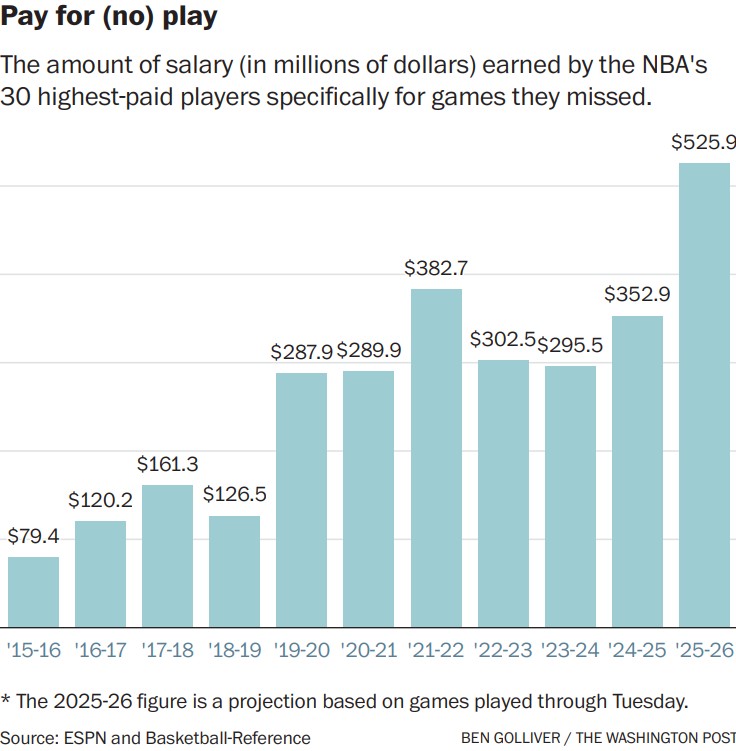
But as the NBA’s top-line financial metrics continue to increase, so, too, do the skyrocketing costs associated with lost productivity for injured stars. Remarkably, if early trends hold, the NBA’s 30 highest-paid players, according to salary data compiled by ESPN, could combine to cost their teams more than $525 million in empty salary associated with games they do not play this season.
Stephen Curry (who will earn $59.6 million) is sidelined with a quadriceps injury. Joel Embiid ($55.2 million) has missed more games than he has played because of recurring knee problems, Kawhi Leonard ($50 million) has already missed 10 games because of a foot injury, and Bradley Beal ($53.7 million including a contract buyout) played only six games before suffering a season-ending hip injury. LeBron James ($52.6 million) and Anthony Davis ($54.1 million) missed the first four weeks of the season because of injury, and Giannis Antetokounmpo ($54.1 million) and Ja Morant ($39.4 million) are out with muscle strains.
Jayson Tatum, Damian Lillard, Tyrese Haliburton and Kyrie Irving are on the books for $204.4 million combined but have yet to play because of major injuries suffered last season. During one recent loss, the New Orleans Pelicans took the court without their five highest-paid players, who will combine to earn more than $140 million.
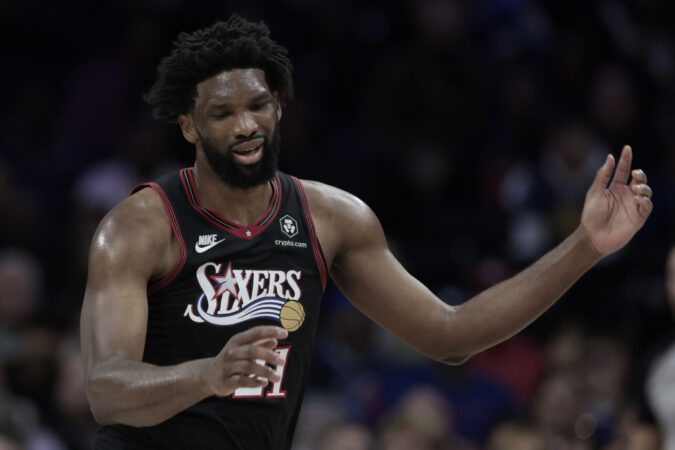
Stephen Curry is currently sidelined with a quadriceps injury.
Many of those absences have directly led to trouble in the standings. Haliburton’s Indiana Pacers, who reached the NBA Finals in June, have dropped to 14th in the Eastern Conference. Antetokounmpo’s Milwaukee Bucks are at risk of missing the playoffs for the first time since 2015-16 and must pay Lillard $113 million over the next five seasons after waiving him using the league’s stretch provision. And the Los Angeles Clippers, wobbly with Leonard and Beal missing time, are on track for their first losing season since 2010-11.
“When you lose your best player and a top-10 player when he’s on the floor, it’s hard to make up for that,” Clippers Coach Tyronn Lue said last week. “I know a lot of people say ‘next man up,’ but if [Leonard] is making [$50] million and your next man up is making $400,000, it’s not really the same.”
In two notable cases, star injuries have already contributed to major personnel changes. Without Davis and Irving, the Dallas Mavericks struggled out of the gate and fired general manager Nico Harrison less than a month into the season. And well before Zion Williamson’s latest injury, a hip strain that will keep him out for weeks, the Pelicans had crashed into the Western Conference’s basement and fired Willie Green after he coached just 12 games.
“We have a lot of guys that are in street clothes,” Mavericks Coach Jason Kidd said shortly after Harrison’s firing. “We’ve got over, I think, $100 million sitting on the sideline.”
More injuries, more problems
The rise in star injuries goes well beyond this season’s most extreme examples of the Pacers, Clippers, Mavericks and Pelicans.
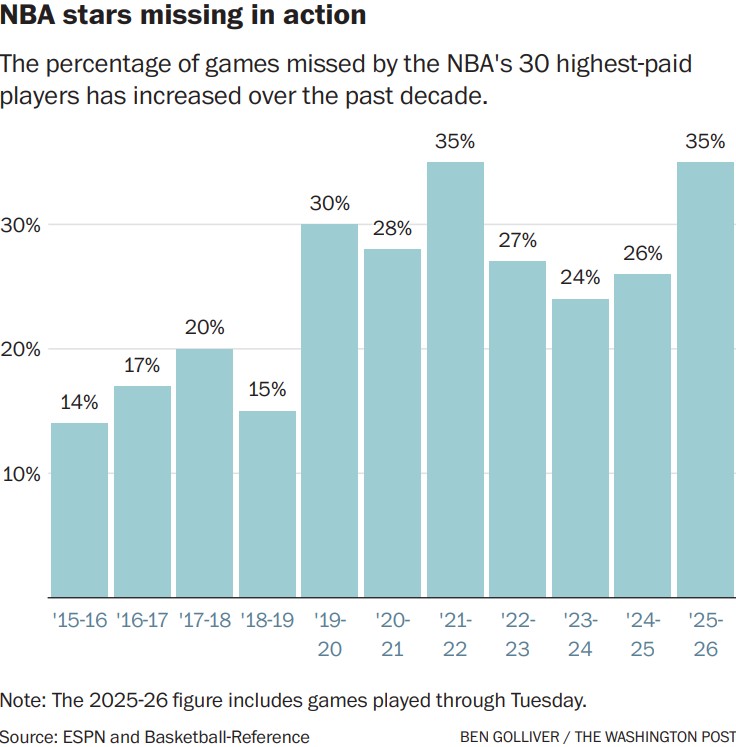
Flash back one decade: During the 2015-16 season, NBA teams averaged 102.7 points, 24.1 three-point attempts and 95.8 possessions per game. That year, the league’s 30 highest-paid players combined to miss just 14 percent of their teams’ games.
This season, teams entered Wednesday averaging 116.6 points, 36.9 three-point attempts and 100 possessions per game. The league’s highest-paid players have combined to miss 35 percent of their teams’ games. A faster, higher-scoring and more rigorous sport appears to be taxing players like never before.
John DiFiori, the NBA’s director of sports medicine, said the league views the 2019-20 season as an “inflection point” for star injuries. During the four seasons before that campaign, which was interrupted by the coronavirus pandemic, the NBA’s 30 highest-paid players missed between 14 and 20 percent of their teams’ games. Since 2019-20, that number has jumped, ranging from 24 percent to 35 percent. The missed games rate has remained elevated in the years after the NBA stopped requiring players to sit out if they tested positive for the coronavirus.
“Injury rates are going up,” DiFiori said. “When we look back at what we’ve been doing the last 10 or 12 years, it’s a moving target. The game doesn’t stay the same. We’re trying to reduce injuries, and the game is also changing. All these other factors, the pace of play and what players are doing in training, those are all moving targets. To wrap our arms around that is a challenge. It’s something we’re quite focused on. … [Teams are] spending a lot of time and money and bringing in a lot of expertise. Despite all of that, we’re seeing an increase in injuries. It’s not for teams’ lack of focus on it.”
The percentage of games missed by the NBA’s 30 highest-paid players has increased over the past decade.
The NBA instituted the Player Participation Policy (PPP) before the 2023-24 season to address what it calls “a statistically significant increase” in star absences and to curb “load management,” a strategy used by some teams to rest players throughout the season. With the NBA negotiating new media rights deals and debuting the NBA Cup in-season tournament to spark interest, then-league executive Joe Dumars met with all 30 teams to remind them that the NBA is an “82-game league.” To reinforce that message, the PPP mandated that players appear in at least 65 games to be eligible for end-of-season awards, and the league began fining teams if they rested healthy players for nationally televised games.
The PPP enjoyed some initial success: The 30 highest-paid players missed just 24 percent of games in 2023-24, the league’s best mark since the pandemic. That progress proved short-lived, however; the availability of the NBA’s highest-paid players has regressed noticeably over the past three seasons. During the 2025 playoffs, Tatum, Lillard and Haliburton all suffered season-ending Achilles tendon injuries during a span of less than two months.
Muscle strains have been another point of immediate concern. The Mavericks shocked the basketball world by trading franchise player Luka Doncic last season while he was recovering from a calf strain; Antetokounmpo, Davis, Morant and Victor Wembanyama are among the stars who have been sidelined by the same injury this season. Haliburton was still recovering from a calf strain when he tore his Achilles during Game 7 of the NBA Finals, but the NBA’s medical staff has yet to identify clear evidence that suggests a prior calf injury increases the risk of an Achilles tear.
“When you have a small prevalence of injury, it’s hard to scientifically study that,” DiFiori said. “Typically over the last 15 years, we average about two Achilles tendon injuries per year. Last year, we had seven. That’s a lot. One year prior, also with a high pace of play, we had zero. We’re taking it very seriously. We’re concerned about it, but I don’t think we have our finger on what’s the driver here or what factors may have led to last season’s unusually high number.”
More injuries, more money
Kerr is hardly the only voice in the basketball and medical communities raising the alarm about the increase in injuries. A range of theories abound.
The NBA cut its preseason to three weeks in 2017, reducing the amount of time players have to ramp up for game action to spread out the regular season more evenly and eliminate instances of four games in five nights. The league changed its shot clock reset to 14 seconds and emphasized greater freedom of movement for players to encourage faster and less restrictive play in 2018. The pandemic created calendar disruptions and shortened schedules in 2020-21 and 2021-22, and the NBA has tweaked its regular season schedule in each of the past three seasons to accommodate the NBA Cup in November and December.
Aside from those legislative moves and the possibility of unintended consequences, the use of analytics has swept through the league and transformed the sport into a perimeter-dominated endeavor. Playing at a fast pace and shooting a high volume of three-pointers are now generally viewed as optimal strategies for underdogs hoping to increase variance against more talented opponents.
The Pacers’ unexpected Finals run, driven by a breakneck offense and high-pressure defense, has spawned copycats. The results haven’t always been positive: The Portland Trail Blazers made waves by regularly deploying a full-court press to start the season, only to endure injuries to their guards in recent weeks.
It’s also worth noting that a cohort of superstars such as Curry and James has remained highly productive late into their lengthy careers. While these older players have remained among the league’s biggest earners, their durability has tended to decrease as they proceed through their late 30s.
On the flip side, a younger generation of high draft picks – such as Williamson, Morant, LaMelo Ball and Ben Simmons – has encountered recurring injuries before they reach their late 20s, which have typically been viewed as the prime years for basketball players. NBA executives have long expressed serious concerns that the modern generation of players is arriving to the NBA with preexisting injuries or risks that result from playing too many games at the youth level and specializing in only one sport.
The amount of salary (in millions of dollars) earned by the NBA’s 30 highest-paid players specifically for games they missed.
As the NBA and its fans continue to debate possible solutions, the injury epidemic has reached staggering heights when it comes to lost productivity. Back in 2015-16, the 30 highest-paid players combined to earn roughly $560 million. Because those players only combined to miss 14 percent of their teams’ games, their teams combined to pay roughly $79 million in empty salary.
Last year, the empty salary mark reached more than $352 million. This season, with the 30 highest-paid players combining to earn more than $1.49 billion and missing 35 percent of their teams’ games entering Wednesday, the number is on pace to exceed $525 million.
That would easily set a record for lost productivity. As Lue and Kidd might say, NBA teams could soon have a half-billion dollars sitting on the sideline.
The science: Everyone loves a good cold remedy — vitamins, homemade concoctions, nasal irrigation systems. And zinc, a mineral, is a popular one, sold over the counter as lozenges, quick-dissolve tablets, and nasal sprays.
While there’s no conclusive evidence that zinc can prevent a cold, there is research suggesting it might help shave a little time off the duration of a cold, which usually runs for seven to 10 days.
“If you’re trying to get better, say, before you go see your brand-new grandchild or because you have a big presentation coming up at work, it may cut a day or two off your cold but you might still have persistent symptoms,” said Rebecca Andrews, a professor at the University of Connecticut School of Medicine and chair of the Board of Regents for the American College of Physicians.
Scientists have hypothesized that zinc may prevent rhinoviruses — which are common viruses thatcauseabout 50% of colds — from infecting ourcells, said Roy Gulick, the chief of the Division of Infectious Diseases at Weill Cornell Medicine and attending physician at New York Presbyterian Hospital in New York City.
The mineral also enhances immune function and responses to infection, among other things, he said.
In a 2024 Cochrane review, researchers analyzed 34 trials using zinc to prevent and treat colds. The authors found little to no evidence that zinc, when taken proactively, can prevent a cold or reduce the number of colds a person gets.
For people who already have a cold, the reviewers found some evidence that zinc might shorten the duration of symptoms by about two days compared with a placebo. However, they also found that zinc was associated with mild side effects such as nasal and oral irritation, problems with taste, stomach pain, constipation, diarrhea, and vomiting, among others.
Outside those trials, some people who use certain zinc nasal products have reported a loss of smell. It prompted the Food and Drug Administration to issue a public health advisory in 2009, warning people about the link between some zinc nasal products and long-lasting or permanent loss of smell.
Our bodies don’t produce zinc, which we need for proper immune system and metabolism functioning and wound healing. Adult women should get 8 milligrams of zinc from their diets each day and men 11 mg, according to federal health authorities. Zinc-rich foods include meat, fish, and seafood such as oysters.
The optimal zinc dose for the treatment of colds is uncertain because researchers conduct studies in different ways, and test different forms of zinc and different doses. However, a number of studies on zinc as cold treatments use doses of 80 mg or more per day. Many over-the-counter zinc lozenges are supposed to be taken every few hours, which amounts to about 80 mg.
But Andrews said that if you exceed 50 mg of zinc per day, you increase your likelihood of side effects. And don’t use it to prevent a cold — only to treat an ongoing one, she said.
“When you supplement, you’re going to get a lot more than what you need in your diet, which is more likely to cause stomach upset and send you either into my office or an urgent care, where you might get treated for something that you don’t have because the symptom could be from the zinc,” she said.
What else you should know
Before taking zinc, speak with your healthcare provider, as the mineral can interact with some medications. For instance, high zinc intake may make certain chemotherapy drugs less effective, Andrews said.
If you want to try zinc to treat a cold, consider these suggestions:
Don’t use zinc supplements as a preventive, only a treatment. Because there’s little to no evidence that zinc can prevent a cold and it’s associated with a number of side effects, use it only when you have symptoms of a cold.
Try lozenges, but in moderation. Most studies have evaluated the effectiveness of zinc lozenges over other formulations, probably because they are easy to take and may help ease sore throats, a common symptom of a cold, Andrews said. But don’t overdo it. If you exceed 50 mg daily, you increase your risk of stomach upset and other side effects, she said.
Don’t take zinc with certain foods. High-fiber foods, legumes, and grains, foods rich in calcium and iron, and excessive alcohol, among other things, can reduce zinc absorption.
Zinc aside, build up your immune system. Eating a healthy, well-balanced diet, drinking plenty of water, and getting enough sleep are key for ensuring your immune system “is top-notch from a cold-fighting perspective,” Andrews said.
The bottom line: While zinc is unlikely to prevent a cold, it may help reduce the duration of a cold by a day or two. But potential benefits of zinc, particularly at higher levels, may be offset by adverse reactions, including irritation in the nose and mouth, an upset stomach, and other side effects.
U.S. data agencies need urgent help from the Trump administration and Congress to ensure they can carry out their basic duties and restore public confidence amid a deepening crisis, according to a new report by some of the country’s top statistics experts.
The agencies are struggling with fragile capacity and eroding trust — as well as diminished safeguards for data integrity — and need more money and staff, says the study led by the American Statistical Association. It cites challenges that have grown more acute since last year’s inaugural version of the report, published before President Donald Trump returned to office.
Government departments such as the Bureau of Labor Statistics, Bureau of Economic Analysis, and Census Bureau are tasked with publishing all kinds of data, which cover the economy and many other topics, and are key to decisions by policymakers, investors, and companies as well as the wider public. Their work has been made harder by longstanding problems such as shrinking budgets and falling response rates for surveys — as well as more recent threats to their independence and integrity.
“Immediate action must be taken to halt the severe decline in the federal statistical agencies’ ability to meet their basic mission and be positioned to keep up with increasing information needs and to address uncertainty in the trustworthiness of federal statistics,” says the report, which was published Wednesday.
In Trump’s second term, the strain on federal statistics has intensified. His administration’s campaign to downsize the government left gaping holes in many agencies, with data products becoming collateral damage of the staffing cuts. Organizations such as the ASA have created dashboards to keep an eye on changes to datasets and highlight any that disappear.
Headcount at the BLS was down 20% last fiscal year compared with the previous one, and the BEA has seen a 25% drop since 2019, the report says. Trump has proposed further cuts in his 2026 budget.
Trump’s most drastic action so far on the data front came when he fired the head of the BLS in August after a weak jobs report — accusing her, without providing evidence, of rigging the numbers to make him look bad. Economists and statisticians have lined up to reject that claim. The administration pointed to large revisions in employment data and said the numbers needed to be “fair and accurate.”
Just a day before all this drama unfolded, the statistics experts behind Wednesday’s study had published an interim report saying they were confident that data could be trusted and there were no signs of meddling by the executive branch. Trump’s move against the BLS forced a rapid rethink. The document was amended to say that the president’s actions “undermine trust in the future by accusing statistical agency heads of past political manipulation.”
The group’s new report cites a survey which found the share of the public expressing trust in federal data had declined to 52% in September, from 57% in June.
It calls out other administration actions this year that undermined official statistics, like the termination of advisory committees, failure to fill leadership roles, and elimination of datasets without consulting Congress or the public. It notes that the positions of chief statistician and Census director have been staffed with political appointees who already held other full-time positions, and argues this could further erode trust.
The report urges the Trump administration to exempt key data-agency positions from the federal hiring freeze, and calls on Congress to fund research and enhancements in IT infrastructure that can help improve the quality of statistics. Such measures would “begin to restore the system’s capacity to deliver the timely, relevant, and trustworthy statistics the nation depends upon,” it says.
Scientists have discovered the oldest evidence of ancient humans igniting fires: a 400,000-year-old open-air hearth buried in an old clay pit in southern England.
The study, published in the journal Nature, is based on a years-long examination of a reddish patch of sediment excavated at a site in Barnham. It pushes back the timeline on fire-making by about 350,000 years.
The nebulous question of how far back human ancestors conjured fire is deeply intertwined with some of the biggest outstanding mysteries about human evolution. The ability to reliably set fires would have allowed humans to cook food, expanding the range of what they could eat and making meals more digestible. That, in turn, could have supported bigger brains that consumed more energy, catalyzing new social behaviors as humans gathered around campfires.
But campfires don’t leave fossils. It takes painstaking work to reconstruct these ephemeral uses of technology. And what remains unclear is who set them. No telltale bones have been recovered at Barnham, but researchers think it was Neanderthals, close cousins of our species who interbred with our ancestors.
“The evidence of fire is incredibly difficult to preserve. If you get to ash and charcoal, it can wash away. Sediment can get washed away,” said Nicholas Ashton, curator of Paleolithic collections at the British Museum and one of the leaders of the work. “We just found this one pocket — quite a large site — where it happens to be preserved.”
Even when traces of fire remain, the task of distinguishing incidental flames sparked by lightning strikes or wildfires from those set by people is difficult. Perhaps most challenging is distinguishing between fires ignited by humans with the know-how from those produced by scavenging embers from wildfires.
The study could spark more debate.
“The authors did an excellent job with their analysis of the Barnham data, but they seem to be stretching the evidence with their claim that this constitutes the ‘earliest evidence of fire making,’” Wil Roebroeks, an archaeologist at Leiden University, said in an email, calling the evidence “circumstantial.”
Ségolène Vandevelde, an archaeologist and adjunct professor at the University of Quebec at Chicoutimi, praised the multidisciplinary approaches the authors used and said the finding was “solid.”
Pyroarchaeology
In the Paleolithicera, the Barnham site would have been a woodland with a seasonal pond — set away from the main river valley, where predators might have roamed, according to Robert Davis, an archaeologist at the British Museum and one of the authorsof the study. The wildlife would have included elephants, lions, deer, fish and other small mammals.
Despite the fleetingnature of fire, it can leave traces under the right conditions. At the site in Barnham, where artifacts such as heat-shattered flint hand axes were also found, researchers were intrigued by a layer of reddish sediment — a result of iron-rich sediments being heated to produce a mineral called hematite. For four years, they studied it, trying to determine whether it was the result of a wildfire or deliberate human activity.
One of the first questions they asked was whether this was a one-time blaze or something closer to a fireplace that was lit and relit many times.
To deconstruct this question, scientists studied the magnetism of the sediment, which is altered by heating. They conducted modern experiments, to see if they could come up with an estimate of how many heating events might have resulted in the magnetic profile of the sediment — and found that after about a dozen heating events, each one four hours long, their modern samples mimicked the archaeological one.
Then they examined the chemistry of the site — scrutinizing particular chemical compounds left behind. The patterns they found suggested humans had been using these fires.
The last element was small pieces of cracked flint scattered about the site — as well as two bits of pyrite, which can create a spark when struck together. A geological study of the area showed that pyrite was scarce in the local landscape, leading the authors to argue that the inhabitants had carried it there for the specific purpose of making fire.
Scavenging sparks vs. setting fires
The archaeological record with examples of fires used by hominins — the ancestors of humans — stretches back more than a million years ago in Africa.
But what interests scientists is not just the ability to successfully scavenge sparks from wildfires or lightning strikes, but also the ability to reliably create it — possibly by striking flint and pyrite together to create sparks.
The oldest accepted evidence of fires purposefullyset are from a Neanderthal site dated to 50,000 years ago in France. That evidence is considered convincing in part because there are chunks of flint showing “microwear traces of having been struck” to create sparks, Roebroeks said. But at Barnham, there are no microwear traces, leaving room for disagreement.
“It’s a very contentious debate that’s been going on for some time,” Davis said.
Early hominins would have learned to harvest fire by collecting embers, harvesting the right fuel and tending the fire. And eventually, they had to learn how to make it on demand — which would allow them to live in colder places, cook, fend off predators and socialize after dark.
The study does not suggest that Barnham was where fire originated; it was probably widespread across the ancient world. But it does offer a rare, preserved snapshot of prehistoric life.
“The maintenance of fire requires social cooperation, cultural rules and work coupled with knowledge of wood types, and means that a complicated tradition is at play,” said John Hawks, a paleoanthropologist at the University of Wisconsin at Madison.
WASHINGTON — The House voted to pass a sweeping defense policy bill Wednesday that authorizes $900 billion in military programs, including a pay raise for troops and an overhaul of how the Department of Defense buys weapons.
The bill’s passage comes at a time of increasing friction between the Republican-controlled Congress and President Donald Trump’s administration over the management of the military.
The annual National Defense Authorization Act typically gained bipartisan backing, and the White House has signaled “strong support” for the must-pass legislation, saying it is in line with Trump’s national security agenda. Yet tucked into the more than-3,000-page bill are several measures that push back against the Department of Defense, including a demand for more information on boat strikes in the Caribbean and support for allies in Europe, such as Ukraine.
Overall, the sweeping bill calls for a 3.8% pay raise for many military members as well as housing and facility improvements on military bases. It also strikes a compromise between the political parties — cutting climate and diversity efforts in line with Trump’s agenda, while also boosting congressional oversight of the Pentagon and repealing several old war authorizations. Still, hard-line conservatives said they were frustrated that the bill does not do more to cut U.S. commitments overseas.
“We need a ready, capable and lethal fighting force because the threats to our nation, especially those from China, are more complex and challenging than at any point in the last 40 years,” said Rep. Mike Rogers, the GOP chair of the House Armed Services Committee.
Lawmakers overseeing the military said the bill would change how the Pentagon buys weapons, with an emphasis on speed after years of delay by the defense industry. It’s also a key priority for Defense Secretary Pete Hegseth. Rep. Adam Smith, the top Democrat on the armed services panel, called the bill “the most ambitious swing at acquisition reform that we’ve taken.”
Still, Smith lamented that the bill does not do as much as Democrats would like to rein in the Trump administration but called it “a step in the right direction towards reasserting the authority of Congress.”
“The biggest concern I have is that the Pentagon, being run by Secretary Hegseth and by President Trump, is simply not accountable to Congress or accountable to the law,” he said.
The legislation next heads to the Senate, where leaders are working to pass the bill before lawmakers depart Washington for a holiday break.
Several senators on both sides of the aisle have criticized the bill for not doing enough to restrict military flights over Washington. They had pushed for reforms after a midair collision this year between an Army helicopter and a jetliner killed all 67 people aboard the two aircraft near Washington’s Ronald Reagan National Airport. The National Transportation Safety Board has also voiced opposition to that section of the bill.
Here’s what the defense bill does as it makes its way through Congress:
Boat strike videos and congressional oversight
Lawmakers included a provision that would cut Hegseth’s travel budget by a quarter until the Pentagon provides Congress with unedited video of the strikes against alleged drug boats near Venezuela. Lawmakers are asserting their oversight role after a Sept. 2 strike where the U.S. military fired on two survivors who were holding on to a boat that had partially been destroyed.
The bill also demands that Hegseth allow Congress to review the orders for the strikes.
Reaffirm commitments to Europe, Korea
Trump’s ongoing support for Ukraine and other allies in Eastern Europe has been under doubt over the last year, but lawmakers included several positions meant to keep up U.S. support for countering Russian aggression in the region.
The defense bill requires the Pentagon to keep at least 76,000 troops and major equipment stationed in Europe unless NATO allies are consulted and there is a determination that such a withdrawal is in U.S. interests. Around 80,000 to 100,000 U.S. troops are usually present on European soil. It also authorizes $400 million for each of the next two years to manufacture weapons to be sent to Ukraine.
Additionally, there is a provision to keep U.S. troops stationed in South Korea, setting the minimum requirement at 28,500.
Cuts to climate and diversity initiatives
The bill makes $1.6 billion in cuts to climate change-related spending, the House Armed Services Committee said. U.S. military assessments have long found that climate change is a threat to national security, with bases being pummeled by hurricanes or routinely flooded.
The bill also would save $40 million by repealing diversity, equity and inclusion offices, programs and trainings, the committee said. The position of chief diversity officer would be cut, for example.
Iraq War resolution repeal
Congress is putting an official end to the war in Iraq by repealing the authorization for the 2003 invasion. Supporters in both the House and Senate say the repeal is crucial to prevent future abuses and to reinforce that Iraq is now a strategic partner of the U.S.
The 2002 resolution has been rarely used in recent years. But the first Trump administration cited it as part of its legal justification for a 2020 U.S. drone strike that killed Iranian Gen. Qassim Suleimani.
Lawmakers imposed economically crippling sanctions on the country in 2019 to punish former leader Bashar Assad for human rights abuses during the nearly 14-year civil war. After Syrian President Ahmed al-Sharaa led a successful insurgency to depose Assad, he is seeking to rebuild his nation’s economy.
Advocates of a permanent repeal have said international companies are unlikely to invest in projects needed for the country’s reconstruction as long as there is a threat of sanctions returning.
Lack of IVF coverage
Democrats criticized House Speaker Mike Johnson (R., La.) for stripping a provision from the bill to expand coverage of in vitro fertilization for active duty personnel. An earlier version covered the medical procedure, known as IVF, which helps people facing infertility have children.
WASHINGTON — Foreigners who are allowed to come to the United States without a visa could soon be required to submit information about their social media, email accounts and extensive family history to the Department of Homeland Security before being approved for travel.
The notice published Wednesday in the Federal Register said Customs and Border Protection is proposing collecting five years’ worth of social media information from travelers from select countries who do not have to get visas to come to the U.S. The Trump administration has been stepping up monitoring of international travelers and immigrants.
The announcement refers to travelers from more than three dozen countries who take part in the Visa Waiver Program and submit their information to the Electronic System for Travel Authorization (ESTA), which automatically screens them and then approves them for travel to the U.S. Unlike visa applicants, they generally do not have to go into an embassy or consulate for an interview.
DHS administers the program, which currently allows citizens of roughly 40 mostly European and Asian countries to travel to the U.S. for tourism or business for three months without visas.
The announcement also said that CBP would start requesting a list of other information, including telephone numbers the person has used over the past five years or email addresses used over the past decade. Also sought would be metadata from electronically submitted photos, as well as extensive information from the applicant’s family members, including their places of birth and their telephone numbers.
The application that people are now required to fill out to take part in ESTA asks for a more limited set of questions such as parents’ names and current email address.
Asked at a White House event whether he was concerned the measure might affect tourism to the U.S., President Donald Trump said no.
“We want safety, we want security, we want to make sure we’re not letting the wrong people come into our country,” Trump said.
The public has 60 days to comment on the proposed changes before they go into effect, the notice said.
CBP officials did not immediately respond to questions about the new rules.
The announcement did not say what the administration was looking for in the social media accounts or why it was asking for more information.
But the agency said it was complying with an executive order that Trump signed in January that called for more screening of people coming to the U.S. to prevent the entry of possible national security threats.
Travelers from countries that are not part of the Visa Waiver Program system are already required to submit their social media information, a policy that dates back to the first Trump administration. The policy remained during Democratic President Joe Biden’s administration.
But citizens from visa waiver countries were not obligated to do so.
Since January, the Trump administration has stepped up checks of immigrants and travelers, both those trying to enter the U.S. as well as those already in the country. Officials have tightened visa rules by requiring that applicants set all of their social media accounts to public so that they can be more easily scrutinized and checked for what authorities view as potential derogatory information. Refusing to set an account to public can be considered grounds for visa denial, according to guidelines provided by the State Department.
U.S. Citizenship and Immigration Services now considers whether an applicant for benefits, such as a green card, “endorsed, promoted, supported, or otherwise espoused” anti-American, terrorist or antisemitic views.
The heightened interest in social media screening has drawn concern from immigration and free speech advocates about what the Trump administration is looking for and whether the measures target people critical of the administration in an infringement of free speech rights.