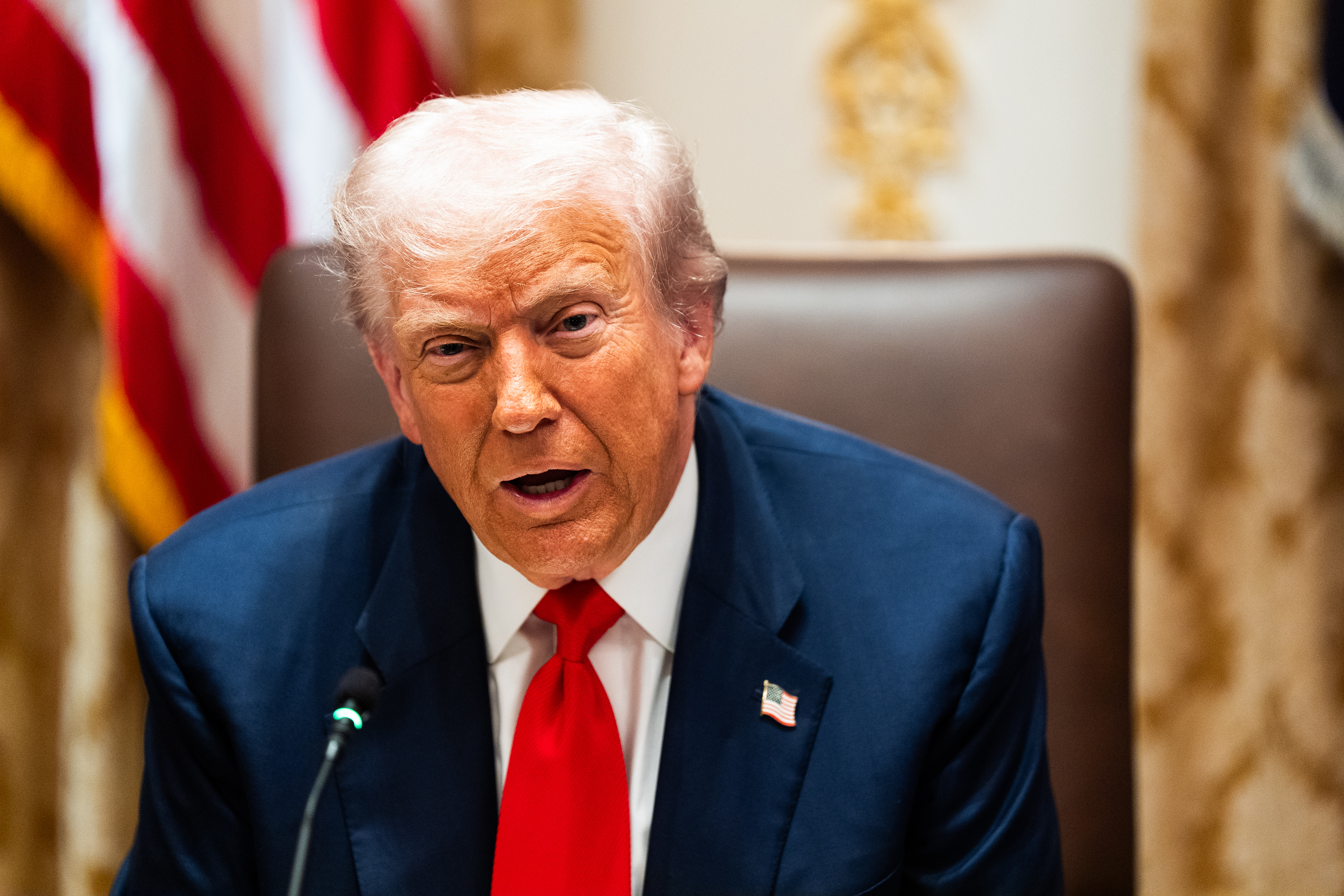
KYIV, Ukraine — President Donald Trump said Monday that while he thinks it is possible that Ukraine can defeat Russia, he’s now doubtful it will happen.
The comments from Trump added a fresh layer of skepticism toward Kyiv as he plans to meet again in the coming weeks with Russian President Vladimir Putin for face-to-face talks in Budapest, Hungary, on ending the war.
“They could still win it. I don’t think they will, but they could still win it,” Trump told reporters on Monday at the start of a White House meeting with Australian Prime Minister Anthony Albanese.
But after a lengthy call with Putin last week followed by a meeting with Ukrainian President Volodymyr Zelenskyy, Trump made another reversal and called on Kyiv and Moscow to “stop where they are” and end their brutal war.
Asked on Monday about his whiplashing opinion on Kyiv’s position, Trump offered the dour assessment about Ukraine’s chances. He added, “I never said they would win it. I said they could. Anything can happen. You know war is a very strange thing.”
Earlier Monday, Zelenskyy said that during the White House meeting Trump informed him that Putin’s maximalist demand — that Ukraine cede the entirety of its eastern Donetsk and Luhansk regions — was unchanged.
Still, Zelenskyy described the meeting as “positive,” even though Trump also rebuffed his request for long-range Tomahawk cruise missiles.
In public comments in the weeks leading up to his meeting with Zelenskyy, Trump had appeared to warm to the possibility of sending the Tomahawks, which would allow Ukrainian forces to strike deeper into Russian territory.
But the U.S. leader’s tone changed after his latest call with Putin and he made clear that he was reluctant to send Ukraine the missile system, at least for the time-being.
“In my opinion, he does not want an escalation with the Russians until he meets with them,” Zelenskyy told reporters on Sunday. His comments were embargoed until Monday morning.
Zelenskyy also expressed skepticism about Putin’s proposal to swap some territory it holds in the Kherson and Zaporizhzhia regions if Ukraine surrenders Donetsk and Luhansk, saying the proposal was unclear. The Donetsk and Luhansk regions make up the Donbas.
Ukraine’s leader said Trump ultimately supported a freeze along the current front line.
“We share President Trump’s positive outlook if it leads to the end of the war,” Zelenskyy said, citing “many rounds of discussion over more than two hours with him and his team.”
Zelenskyy was diplomatic about his meeting with Trump despite reports that he faced pressure to accept Putin’s demands. The meeting followed the disastrous Oval Office spat on Feb. 28 when the Ukrainian president was scolded on live television for not being grateful for U.S. support.
Zelenskyy said he has not been invited to attend but would consider it if the format for talks were fair to Kyiv.
He also took a shot at Hungarian Prime Minister Viktor Orban, saying he does not believe that a prime minister “who blocks Ukraine everywhere can do anything positive for Ukrainians or even provide a balanced contribution.”
Zelenskyy said he thinks that all parties have “moved closer” to a possible end to the war.
“That doesn’t mean it will definitely end, but President Trump has achieved a lot in the Middle East, and riding that wave he wants to end Russia’s war against Ukraine,” he added.
Ukraine is hoping to purchase 25 Patriot air defense systems from U.S. firms using frozen Russian assets and assistance from partners, but Zelenskyy said procuring them would require time because of long production waits. He said he spoke to Trump about help procuring them more quickly, potentially from European partners.
Zelenskyy said the United States is interested in bilateral gas projects with Ukraine, including the construction of an LNG terminal in the southern port city of Odesa. Other projects of interest include those related to nuclear energy and oil.
A divided U.S. appeals court ruled on Monday that Donald Trump can send National Guard troops into Portland, Oregon, despite objections by the leaders of the city and state, giving the Republican president an important legal victory as he dispatches military forces to a growing number of Democratic-led locales.
A three-judge panel of the 9th U.S. Circuit Court of Appeals granted the Justice Department’s request to put on hold a judge’s order that had blocked the deployment while a legal challenge to Trump’s action plays out.
The court said that sending in the National Guard was an appropriate response to protesters, who had damaged a federal building and threatened U.S. Immigration and Customs Enforcement officers.
The unsigned majority opinion was joined by Circuit Judge Bridget Bade and Circuit Judge Ryan Nelson, who were both appointed by Trump in his first term. Nelson also wrote a concurring opinion saying that courts have no ability to even review the president’s decision to send troops.
Circuit Judge Susan Graber, an appointee of Democratic President Bill Clinton, dissented. She said that allowing troops to be called in response to “merely inconvenient” protests was “not merely absurd” but dangerous, and she said the full 9th Circuit should overturn the ruling before Trump has a chance to send troops.
White House spokeswoman Abigail Jackson welcomed the ruling, saying Trump had exercised his lawful authority to protect federal assets and personnel from protesters.
Portland’s city attorney did not immediately respond to a request for comment.
On October 4, Portland-based U.S. District Judge Karin Immergut, who Trump appointed during his first term as president, ruled that Trump likely acted unlawfully when he ordered troops to Portland. She had blocked Trump from sending any National Guard troops to Portland at least until the end of October, and has scheduled a non-jury trial set to begin on October 29 to determine whether to impose a longer-term block.
DEMOCRATIC-LED STATES SEEK TO HALT DEPLOYMENTS
In an extraordinary use of the U.S. armed forces for domestic purposes, Trump has sent National Guard troops into Los Angeles, Washington, D.C., and Memphis, and announced plans for deployments to Portland and Chicago.
Democratic-led states and cities have filed lawsuits seeking to halt the deployments, and courts have not yet reached a final decision on the legality of Trump’s decisions to send the National Guard to U.S. cities.
Trump has asked the U.S. Supreme Court to weigh his authority to send troops to Democratic-led cities, after another U.S. appeals court ruled against his decision to send troops to Chicago.
City and state officials sued the administration in a bid to stop the Portland deployment, arguing that Trump’s action violates several federal laws that govern the use of military forces as well as the state’s rights under the U.S. Constitution’s 10th Amendment.
The lawsuit accused Trump of exaggerating the severity of protests against his immigration policies to justify illegally seizing control of state National Guard units.
Trump on September 27 ordered 200 National Guard troops to Portland, continuing his administration’s unprecedented use of military personnel in U.S. cities to suppress protests and bolster domestic immigration enforcement. Trump called the city “War ravaged” and said, “I am also authorizing Full Force, if necessary.”
Police records provided by the state showed that protests in Portland were “small and sedate,” resulting in only 25 arrests in mid-June and no arrests in the 3-1/2 months since June 19.
A federal law called the Posse Comitatus Act generally restricts the use of the U.S. military for domestic law enforcement purposes. In ordering troops to California, Oregon and Illinois, Trump has relied on a law – Section 12406 of Title 10 of the U.S. Code – that allows a president to deploy state National Guard to repel an invasion, suppress a rebellion or allow the president to execute the law.
The National Guard serves as state-based militia forces that answer to state governors except when called into federal service by the president.
During arguments in the case on October 9, the two Trump-appointed judges suggested that Immergut had focused too closely on protests in the city in September without fully considering more serious protests two months before the troop deployment. Circuit Judge Ryan Nelson said that courts should not engage in a “day by day” review of whether troops were needed at any given time.
Immergut issued decisions against the administration on October 4 and October 5, first ruling that Trump could not take over Oregon’s National Guard and then ruling that he could not circumvent that decision by calling in National Guard troops from other states.
The judge said there was no evidence that recent protests in Portland rose to the level of a rebellion or seriously interfered with law enforcement, and she said Trump’s description of the city as war-ravaged was “simply untethered to the facts.”
Immergut is one of three district court judges who have ruled against Trump’s use of the National Guard, and no district court judge has yet ruled for Trump in the National Guard cases.
Appeals courts have split over the issue so far, with the 9th Circuit previously backing Trump’s use of troops in California and the 7th Circuit ruling that troops should stay out of Chicago for now.
Despite strong pressure from the Trump administration, including a call with the White House on Friday, colleges and universities are largely rejecting the president’s offer of preferential treatment for funding in exchange for compliance with his ideological priorities.
Six of nine universities offered the deal earlier this month had publicly said no to the White House request by Monday’s deadline.
The administration has said it is seeking to make sure the country’s schools are merit-based, but many universities and higher education advocates said the White House’s proposed agreement would undermine the merit-based process currently utilized to award research grants.
The “Compact for Academic Excellence in Higher Education” is a new attempt by the administration to get schools to eliminate diversity, equity and inclusion policies and ensure more conservative viewpoints and values are integrated into campus life.
The Trump administration offered it to nine colleges earlier this month, casting it as a means to gain competitive advantage for federal and philanthropic benefits and invitations to White House events in return for what the administration described as compliance with civil rights law and “pursuing Federal priorities with vigor.”
The ideological tension was reflected during a call on Friday, which the White House organized and presented as a chance to workshop the terms of the compact in partnership with colleges and universities that had not yet responded, according to a person close to the situation, who spoke on the condition of anonymity because of the sensitivity of the matter.
From the Trump administration, Education Secretary Linda McMahon; White House Domestic Policy Director Vincent Haley, Special Assistant Eric Bledsoe and adviser May Mailman; Josh Gruenbaum of the General Services Administration; and billionaire Marc Rowan were on the call, the person said.
But within a day of the call, University of Virginia and Dartmouth College rejected the compact, joining ranks with MIT, Brown University, the University of Pennsylvania and the University of Southern California. The University of Texas at Austin was invited to sign on and the chair of the University of Texas System Board of Regents expressed enthusiasm. The University of Arizona and Vanderbilt University have not publicly responded.
Echoing a term that has been often used by the Trump administration, U-Va.’s president said the agreement violated the merit-based nature of the competition for federal research funding. The federal government currently awards billions of dollars in research grants based on peer reviews and scientific merit.
On Saturday, Dartmouth President Sian Beilock wrote to McMahon, Mailman and Haley that she welcomed further engagement on enhancing the partnership between the federal government and research universities and ensuring that higher education “stays focused on academic excellence.” But, she wrote, “I do not believe that the involvement of the government through a compact-whether it is a Republican- or Democratic-led White House-is the right way to focus America’s leading colleges and universities on their teaching and research mission.”
White House spokeswoman Liz Huston described the Friday call as “productive.”
“The Administration hosted a productive call with several university leaders. They now have the baton to consider, discuss, and propose meaningful reforms, including their form and implementation, to ensure college campuses serve as laboratories of American greatness,” Huston said in a statement. “These leaders are working steadfastly to improve higher education and have been invited to the table to share ideas with the Administration, and we look forward to discussing transparent ways that, together, we will produce future generations of American excellence.”
A White House official, speaking anonymously to discuss private conversations, said universities will not lose their federal funding because they decided not to engage in the compact.
The sweeping terms of the compact called on schools to adopt the administration’s priorities, including pledging to freeze tuition for five years, cap international enrollment at 15 percent of a college’s undergraduate student body, and bar the consideration of factors such as gender, race and political views in admissions and other areas.
Some legal scholars said the terms were unconstitutional. Trump administration officials have insisted they are protecting free speech by compelling universities to reject a culture that suppresses far-right thought.
Officials asked for “limited, targeted feedback” in writing no later than Oct. 20, with hopes of a signed agreement by Nov. 21.
As schools turned it down, citing similar concerns – Christina H. Paxson, Brown’s president, wrote in a letter to the White House that provisions in the compact restricting the university’s academic freedom and institutional autonomy would impede its mission – the Trump administration invited more universities to participate. Washington University in St. Louis, the University of Kansas and Arizona State University joined Friday’s call.
In a Monday statement, Washington University Chancellor Andrew Martin said he had not endorsed or signed on to the compact but agreed to discuss it with the Trump administration. “We believe it is in the best interest of our university, and higher education more broadly, for us to participate constructively, share our experience and expertise, and help inform policies that strengthen the nation’s research and education ecosystem,” Martin said.
Some of the wording in the compact is vague. But the magnitude of the stakes is clear: The Trump administration has frozen billions of dollars of federal research funding at multiple colleges that it has accused of violating federal civil rights laws for issues such as having diversity, equity and inclusion policies and allegedly not doing enough to prevent antisemitism.
At Harvard University, which has filed two lawsuits to fight the government’s actions, the administration has tried to bar international students and scholars from campus, threatened to revoke the university’s tax-exempt status and has begun an effort to block the school from receiving any federal grants.
Faculty, alumni and students at many of the nine schools urged university leaders not to sign. Rallies against the compact occurred on multiple campuses, and student leaders from seven of the nine original schools issued a joint statement opposing it. More than 30 higher education associations issued a statement of opposition Friday, saying “the conditions it outlines run counter to the interests of institutions, students, scholars, and the nation itself.” A coalition formed of alumni groups opposed to the compact.
President Donald Trump wrote on social media that the administration would continue efforts to swiftly enforce federal law at universities that “continue to illegally discriminate based on Race or Sex,” but that “those Institutions that want to quickly return to the pursuit of Truth and Achievement” were “invited to enter into a forward looking Agreement with the Federal Government to help bring about the Golden Age of Academic Excellence in Higher Education.”
MEXICO CITY – The Trump administration’s justification for blowing up suspected drug traffickers off the Venezuelan coast has been clear and consistent: These people aren’t just criminals; they’re “narco-terrorists” smuggling a “deadly weapon poisoning Americans” at the behest of terrorist organizations.
“We take them out,” Trump told the nation’s three- and four-star generals and admirals last month. “Every boat kills 25,000 on average – some people say more. You see these boats, they’re stacked up with bags of white powder that’s mostly fentanyl and other drugs, too.”
Claiming the power to summarily kill traffickers as though they’re enemy troops, Trump has authorized the U.S. military to strike at least six speedboats the administration has deemed suspicious, killing dozens of people since the beginning of September. At least half of the strikes and 21 of the killings, locals say, have transpired in the waters between Venezuela and Trinidad and Tobago – nations so close that on clear days they’re within eyesight of each other.
But records and interviews with 20 people familiar with the route or the strikes, including current and former U.S. and international officials, contradict the administration’s claims. The passage, they said,is not ordinarily used to traffic synthetic opioids such as fentanyl, present in 69 percent of drug overdose deaths last year. Nor are the drugs typically headed for the United States.
Trinidad and Tobago, a Caribbean nation more than 1,000 miles south and 1,200 miles east of Miami, is both a destination market for marijuana and a transshipment point for South American cocaine bound for West Africa and Europe, according to U.S. officials, Trinidadian police and independent analysts. The fentanyl seized in the United States, in contrast, is typically manufactured in Mexico using precursors from China and smuggled in through the land border, most often by U.S. citizens.
The military strikes are unlikely, as a result, to cut overdose deaths in the United States, officials say – but it has brought U.S. forces into striking distance of Venezuelan President Nicolás Maduro.Trump has accused the authoritarian socialist, who claimed reelection last year despite ballot audits showing he lost the vote, of leading the Venezuela gang Tren de Aragua to push lethal drugs into America.
“When I saw [an internal document on the strikes],” a senior U.S. national security official said, “I immediately thought, ‘This isn’t about terrorists. This is about Venezuela and regime change.’ But there was no information about what it was really about.”
The official, like others quoted in this report, spoke on the condition of anonymity to provide his candid assessment.
The White House declined to share evidence to support the claims that Trump has used to justify the strikes. A spokeswoman defended the killings as necessary to protect Americans.
“All of these decisive strikes have been against designated narco-terrorists bringing deadly poison to our shores,” spokeswoman Anna Kelly said. “The president will continue to use every element of American power to stop drugs from flooding into our country and to bring those responsible to justice.”
Two family members of the 11 men killed in September in the first attack acknowledged by Trump did not deny that the men aboard had been taking marijuana and cocaine from Venezuela to Trinidad. But they said Trump’s allegation in his announcement was inaccurate that they’d worked for the Venezuelan gang Tren de Aragua.
“I knew them all,” said one of the family members, who spoke on the condition of anonymity for fear of retribution. “None of them had anything to do with Tren de Aragua. They were fishermen who were looking for a better life” by smuggling contraband.
On Tuesday, Trump said, a new strike had killed“six male narco-terrorists” off the Venezuelan coast. That afternoon, one mother in the Trinidadian community of Las Cuevas received a call from her brother, a fisherman. Her son Chad Joseph, the second of her six children, had been killed in the explosion.
Speaking by phone Thursday morning, Leonore Burnley was furious. Her son had been deprived a trial. And she’d been deprived of any chance of closure.
“You can’t get the body to bury it,” she said.
Joseph had spent the last three months in Venezuela working odd jobs, Burnley said. He had written her recently to say he would be returning home.
She called Trump’s claim he had been involved in trafficking drugs a lie.
“They are judging him wrong,” she said. “He was no drug dealer. Chad was a good boy, anything you want, he would help; he was a loving child.”
“Twenty-six years he have,” she said.
Claiming the power to summarily kill traffickers as though they’re enemy troops, Trump has authorized the U.S. military to strike at least six speedboats the administration has deemed suspicious, killing dozens of people since the beginning of September.
How cocaine courses through Venezuela
In recent years, drug cartels in Colombia and other South American nations have supercharged cocaine production. The rush to bring it to market – largely the United States and Europe, but increasingly West Africa – has transformed the continent’s criminal landscape, fueling the rise of new transnational gangs and threatening weaker national governments with limited power of state.
Venezuela, too, has been swept into the boom. Economically battered by years of socialist mismanagement and punishing international sanctions, a nation that was once Latin America’s wealthiest has become increasingly involved in the trade. Along its border with Colombia, cocaine is now produced for sale and shipment abroad.
U.S. federal prosecutors in March 2020 accused senior government officials in the Maduro regime, including Maduro himself, of leading the Cártel de Los Soles – “Cartel of the Suns” – a criminal networkthat extorts drug trafficking groups and controls routes and product itself.
Venezuela, U.S. investigators say, is now a narco free-for-all filled with armed groups from throughout Latin America.
“The Mexicans are there,” one former Drug Enforcement Administration agent said. “The Colombians are there, sometimes on behalf of the Mexicans. Sometimes the Hondurans and Guatemalans have guys there, too.”
Most of the South American cocaine bound for North America flows through the Pacific, but some does depart Venezuela through the Caribbean, according to U.S. officials and analysts who track drug routes. Much of it courses overland through the western states of Zulia and Falcón before shipping northward to Puerto Rico, the U.S. Virgin Islands and the Dominican Republic. Some travels by air, departing clandestine airstrips in Maracaibo or Apure state for Central America and onward to Mexico and the United States.
It’s less common, investigators say, to ship U.S.-bound cocaine northeast into the Sucre peninsula and across the narrow Bocas del Dragón channel to Trinidad – the route the administration has targeted. Trinidad is used far more frequently as a gateway to Europe. Spanish authorities seized 1.65 tons of cocaine that had transited through the island, the State Department reported in 2024. Portuguese authorities in June recovered 1.66 tons of cocaine that traversed the same route.
“When you look at a map, countries like Trinidad and Tobago and Suriname are used as transshipment points of massive amounts of cocaine from Colombia into Venezuela [and then onward] to West Africa and Europe,” a former senior U.S. security official said. He added that routes may change based on pressure.
One recently retired senior Trinidadian police official, asked whether Sucre traffickers were bringing drugs intended for the United States, chuckled.
“Why would they use Trinidad and Tobago to transport drugs to the United States, when you have Colombia and Mexico and all of these other places that are closer?”
The waters between Sucre and Trinidad
The Sucre peninsula, known for its paradisiacal beaches and green-thatched mountains, has always been poor. But its fortunes turned decidedly for the worse in recent years, as the economy melted down and the state slipped into lawlessness.
With few opportunities to work, fishermen turned to the smuggling route that has long tethered Sucre to Trinidad, a half-hour boat ride away.
The former senior Trinidadian police official has investigated the route since 1989. It has historically carried manykinds of contraband: guns, cigarettes, alcohol, honey, exotic animals and people. But in recent years, as more drugs poured into Venezuela, it began to be used as a route to bring over marijuana and cocaine.
“It’s 80 percent marijuana,” said one Trinidad criminologist who has studied seizure data. “Cocaine is a much, much smaller amount.”
While Tren de Aragua has had a presence in Sucre, locals and drug trafficking analysts say it doesn’t control the trade. The drugs are instead moved by other local gangs.
“We have found no links between Tren de Aragua and multinational smugglers,” said Jeremy McDermott, co-founder of Insight Crime, whose team recently visited the region. “There was an attempt by them to penetrate Sucre, but they were ejected by local gangs.”
“The evidence,” he added, “does not support the claims” by the Trump administration.
One man who grew up in San Juan de Unare along the Sucre coast, but moved to Caracas after his community plunged into poverty, said his cousin Reibys Gomez was among the first fishermen to take drugs to Trinidad. He said his cousin had a young family to support.
“People are in need,” he said. “They live off fishing and hunting, and that’s it.”
Now Reibys is dead, and the man said his family has “deteriorated” in San Juan de Unare – unable to collect his body and haunted by questions over why the U.S. military killed him.
“They were going to Trinidad,” he said. “They weren’t going to the United States.”
NEW YORK — Wall Street is concerned about the health of the nation’s regional banks, after a few of them wrote off bad loans to commercial customers in the last two weeks and caused investors to wonder if there might be more bad news to come.
Zions Bank, Western Alliance Bank, and the investment bank Jefferies surprised investors by disclosing various bad investments on their books, sending their stocks falling sharply this week. JPMorgan Chase CEO Jamie Dimon added to the unease when he warned there might be more problems to come for banks with potentially bad loans.
“When you see one cockroach, there are probably more,” Dimon told investors and reporters on Tuesday, when JPMorgan reported its results.
The KBW Bank Index, a basket of banks tracked by investors, is down 7% this month.
There were other signs of distress. Data from the Federal Reserve shows that banks tapped the central bank’s overnight “repo” facilities for the second night in a row, an action banks have not needed to take since the COVID-19 pandemic. This facility allows banks to convert highly liquid securities like mortgage bonds and treasuries into cash to help fund their short-term cash shortfalls.
Zions Bancorp shares sank Thursday after the bank wrote off $50 million in commercial and industrial loans, while Western Alliance fell after the bank alleged it had been defrauded by an entity known as Cantor Group V LLC. This came on top of news from Jefferies, which told investors it was might experience millions of dollars in losses from its business with bankrupt auto parts company First Brands.
All three stocks recovered a bit Friday. Jefferies’ CEO told investors that the company believes it was defrauded by First Brands and that there were no broader concerns in the lending market.
The last banking flare-up, in 2023, also involved midsize and regional banks that were overly exposed to low-interest loans and commercial real estate. The crisis caused Silicon Valley Bank to fail, followed by Signature Bank, and led to the eventual sale of First Republic Bank to JPMorgan Chase in a fire sale. Other banks like Zions and Western Alliance ended up seeing their stocks plummet during that time period.
While banks do fail or get bought at fire sale prices, all bank deposits are insured by the Federal Deposit Insurance Corporation, up to $250,000 per account, in case of a bank failure. In the nearly 100 years since the FDIC was created in 1933, not one depositor has lost their insured funds.
Still, even the larger banks aren’t immune in this latest round of trouble. Several Wall Street banks disclosed losses this week in the bankruptcy of Tricolor, a subprime auto dealership company that collapsed last month. Fifth Third Bank, a larger regional bank, recorded a $178 million loss from Tricolor’s bankruptcy.
That said, the big banks believe that any losses will be manageable and do not reflect the broader economy.
“There is no deterioration, we’re very confident with our credit portfolio,” Deutsche Bank CEO Christian Sewing said, in an interview on Bloomberg Television on Friday.
While the big Wall Street banks get most of the media and investor attention, regional banks are a major part of the economy, lending to small- to medium-sized businesses and acting as major lenders for commercial real estate developers. There are more than 120 banks with between $10 billion and $200 billion in assets, according to the FDIC.
While big, these banks can run into trouble because their businesses are not as diverse as the Wall Street money center banks. They’re often more exposed to real estate and industrial loans, and don’t have significant businesses in credit cards and payment processing that can be revenue generators when lending goes south.