Category: Wires

  • Trump rolls out his Board of Peace, but many top U.S. allies aren’t participating

    Trump rolls out his Board of Peace, but many top U.S. allies aren’t participating

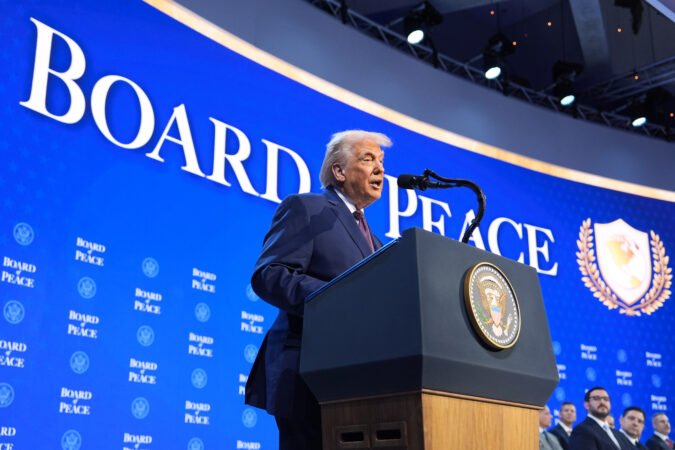
    DAVOS, Switzerland — President Donald Trump on Thursday inaugurated his Board of Peace to lead efforts at maintaining a ceasefire in Israel’s war with Hamas, insisting that “everyone wants to be a part” of the body he said could eventually rival the United Nations — despite many U.S. allies opting not to participate.

    In a speech at the World Economic Forum, Trump sought to create momentum for a project to map out a future of the war-torn Gaza Strip that has been overshadowed this week, first by his threats to seize Greenland, then by a dramatic retreat from that push.

    “This isn’t the United States, this is for the world,” he said, adding, “I think we can spread it out to other things as we succeed in Gaza.”

    The event featured Ali Shaath, the head of a new, future technocratic government in Gaza, announcing that the Rafah border crossing will open in both directions next week. But there was no confirmation of that from Israel, which said only that it would consider the matter next week.

    The Gaza side of the crossing, which runs between Gaza and Egypt, is currently under Israeli military control. Shaath, an engineer and former Palestinian Authority official from Gaza, is overseeing the Palestinian committee set to govern the territory under U.S. supervision.

    The new peace board was initially envisioned as a small group of world leaders overseeing the ceasefire, but it has morphed into something far more ambitious — and skepticism about its membership and mandate has led some countries usually closest to Washington to take a pass.

    Trump tried not to let those not participating ruin his unveiling party, saying 59 countries had signed onto the board — even though heads of state, top diplomats and other officials from only 19 countries plus the U.S. actually attended the event. He told the group, ranging from Azerbaijan to Paraguay to Hungary, “You’re the most powerful people in the world.”

    Trump has spoken about the board replacing some U.N. functions and perhaps even making that entire body obsolete one day. But he was more conciliatory in his remarks on the sidelines of the forum in the Swiss alps.

    “We’ll do it in conjunction with the United Nations,” Trump said, even as he denigrated the U.N. for doing what he said wasn’t enough to calm some conflicts around the globe.

    Secretary of State Marco Rubio said some countries’ leaders have indicated they plan to join but still require approval from their parliaments.

    Why some countries aren’t participating

    Big questions remain, however, about what the eventual board will look like.

    Russian President Vladimir Putin said his country is still consulting with Moscow’s “strategic partners” before deciding to commit. The Russian was hosting Palestinian President Mahmoud Abbas on Thursday in Moscow.

    Others are asking why Putin and other authoritarian leaders had even been invited to join. Britain’s foreign secretary, Yvette Cooper, said her country wasn’t signing on “because this is about a legal treaty that raises much broader issues.”

    “And we do also have concerns about President Putin being part of something which is talking about peace, when we have still not seen any signs from Putin that there will be a commitment to peace in Ukraine,” she told the BBC.

    Norway and Sweden have indicated they won’t participate. France declined after its officials stressed that while they support the Gaza peace plan, they were concerned the board could seek to replace the U.N.

    Canada, Ukraine, China, and the executive arm of the European Union also haven’t committed. Trump calling off the steep tariffs he threatened over Greenland could ease some allies’ reluctance, but the issue is still far from settled.

    The Kremlin said Thursday that Putin plans to discuss his proposal to send $1 billion to the Board of Peace and use it for humanitarian purposes during his talks with Abbas — if Russia can use of those assets the U.S. had previously blocked.

    Others voice reservations

    The idea for the Board of Peace was first laid out in Trump’s 20-point Gaza ceasefire plan and even was endorsed by the U.N. Security Council.

    But an Arab diplomat in a European capital said that Middle Eastern governments coordinated their response to Trump’s invitation to join the Board of Peace and that it was crafted to limit the acceptance to the Gaza plan as mandated by the U.N. Security Council.

    Speaking on the condition of anonymity to discuss the matter more freely, the diplomat said the announced acceptance is “preliminary” and that the charter presented by the U.S. administration contradicts in some parts the United Nations’ mission. The diplomat also said that other major powers are unlikely to support the board in its current form.

    Months into the ceasefire, Gaza’s more than 2 million Palestinians continue to suffer the humanitarian crisis unleashed by more than two years of war. And violence in Gaza continues.

    Key to the truce continuing to hold is the disarming of Hamas, something that the militant group that has controlled the Palestinian territory since 2007 has refused to do, despite Israel seeing it as non-negotiable. Trump on Thursday repeated his frequent warnings that the group will have to disarm or face dire consequences.

    He also said the war in Gaza “is really coming to an end” while conceding, “We have little fires that we’ll put out. But they’re little,” and they had been “giant, giant, massive fires.”

    Iran looms large

    Trump’s push for peace also comes after he threatened military action this month against Iran as it carried out a violent crackdown against some of the largest street protests in years, killing thousands of people.

    Trump, for the time being, has signaled he won’t carry out any new strikes on Iran after he said he received assurances that the Islamic government would not carry out the planned hangings of more than 800 protesters.

    But Trump also made the case that his tough approach to Tehran — including strikes on Iran’s nuclear facilities in June last year — was critical to the Israel-Hamas ceasefire deal coalescing.

    Meanwhile, Trump also spoke behind closed doors for about an hour with Ukrainian President Volodymyr Zelensky and called the discussion “very good” without mentioning major breakthroughs. Trump’s special envoy Steve Witkoff and his son-in-law Jared Kushner are expected in Moscow for talks aimed at ending Russia’s nearly 4-year-old war in Ukraine.

    Zelensky later addressed the Davos forum and said there would be two days of trilateral meetings involving the U.S., Ukraine and Russia in the United Arab Emirates starting Friday — following the U.S. talks in Moscow.

    “Russians have to be ready for compromises because, you know, everybody has to be ready, not only Ukraine, and this is important for us,” Zelensky said.

  • After ‘good’ Trump meeting, Zelensky pushes Europe hard to do more

    After ‘good’ Trump meeting, Zelensky pushes Europe hard to do more

    KYIV — Ukrainian President Volodymyr Zelensky aimed a blistering speech at Europe during the World Economic Forum on Thursday after a last-minute meeting with President Donald Trump, which both leaders described as “good,” saying framework documents between the two countries — in hopes of ending the conflict — were nearing the final stages.

    After nearly four years of full-scale war, Zelensky described how life in Ukraine felt like the movie Groundhog Day with ramped-up attacks coming amid a brutally cold winter. All the while Europe is still unequipped to defend itself against Russia, he said, which has not slowed its assault since 2022.

    In the face of European weakness, Zelensky said, “the backstop of Trump is needed” with no security guarantees functioning without the United States. He emphasized that Europe needed to be a united force: “Europe should not be a salad of small and middle powers.”

    “Europe loves to discuss the future but avoids taking action today, action that defines what kind of future we will have,” Zelensky said in his speech in Davos, Switzerland, following the hourlong meeting with Trump. “If [Russian President Vladimir] Putin decides to take Lithuania or strike Poland, who will respond? … Tomorrow you may have to defend your way of life.”

    The speech, which received a standing ovation, didn’t appear to have been originally scheduled. Zelensky scrambled to get to Switzerland after Trump on Wednesday unexpectedly said that he planned to meet with Zelensky that very day, adding that he might even “be in the audience.”

    In fact, Zelensky was still in Kyiv. He had told reporters on Tuesday — as the forum was already underway — that he would likely remain in the capital, “choosing Ukraine, not an economic forum,” as millions of Ukrainians froze in their homes and workers rushed to fix an electrical grid battered by Russian drones and missiles.

    Some had hoped a bilateral meeting might lead to the inking of frameworks for security guarantees and postwar economic recovery, with officials hinting the two countries were close to the finish line. But a senior Ukrainian official on Thursday said that no documents had been prepared for signing in Davos, and a key priority of the meeting was to discuss additional air defense systems.

    In his speech, however, Zelensky did say that the documents to end the war “are nearly ready and that really matters.” He added, however, that more pressure needed to be put on Russia to make it agree to end the war and Ukraine couldn’t be the only country making compromises.

    The meeting in the Swiss Alps was closed to the press and there were no statements at its conclusion. On his way out, however, Trump told reporters that “the meeting was good with President Zelensky, we still have a ways to go” — stepping back from his message on Wednesday, that both sides were “reasonably close” and “at a point now where they can come together and get a deal done. And if they don’t, they’re stupid.”

    He added that the message his envoys would take to Putin Thursday night in Moscow would be “the war needed to end.”

    At a question-and-answer session following his speech Thursday, Zelensky acknowledged that “this last mile is very difficult” and “Russians have to be ready for compromises, not just Ukraine.”

    Despite the optimism expressed by the White House, the two sides still appear to be far apart in negotiations. In a news conference Tuesday, Russian Foreign Minister Sergei Lavrov called into question any deal that allowed the continuing existence of the current Ukrainian government.

    “Any settlement proposal founded on the primary goal of preserving the current Nazi regime in what remains of the Ukrainian state is, naturally, completely unacceptable to us,” he said.

    White House envoy Steve Witkoff and Trump’s son-in-law Jared Kushner — who met with lead Ukrainian negotiator Rustem Umerov on the sidelines of the forum — will meet with Putin late on Thursday. Speaking at the forum’s Ukrainian Breakfast on Thursday morning, Witkoff said that he felt “encouraged” and described the Ukrainian people as “so courageous in this fight … under some real difficult conditions.”

    “I think we’ve got it down to one issue, and we have discussed iterations of that issue,” Witkoff said, appearing to gesture at territorial concessions, one of the most contentious aspects of the negotiations and a red line for Ukraine. “That means it’s solvable. So if both sides want to solve this, we are going to get this solved; that’s my view.”

    Previous meetings between Witkoff and Putin have lasted hours and will likely continue into early Friday morning, though Witkoff said he will not be spending the night and will continue on to Abu Dhabi, capital of the United Arab Emirates, afterward. Two days of trilateral meetings will be held there between Ukraine, the United States and Russia.

    Kremlin spokesman Dmitry Peskov declined to comment on whether the Kremlin shared Witkoff’s optimism that a deal was close. At a news conference, Putin said he would also discuss Russia’s contribution to Trump’s Board of Peace with Witkoff and Kushner.

    As world leaders congregated in Davos, enjoying mountain views, plush lodges and crackling fireplaces, Ukraine’s power grid remained crippled during one of the coldest winters in years. Without electricity, many Ukrainians sought refuge in restaurants and coffee shops, kept running by generators. Outside, inches of ice slicked the streets and sidewalks. The windows of thousands of apartments remained dark.

    Concluding his speech, Zelensky said, “Let’s end this Groundhog Day.”

  • Former Uvalde officer acquitted for response to 2022 school shooting

    Former Uvalde officer acquitted for response to 2022 school shooting

    A Texas jury on Wednesday acquitted a former Uvalde school police officer on 29 counts of child endangerment after he remained outside Robb Elementary School instead of immediately confronting the gunman who killed 19 children and two teachers in their classrooms in 2022.

    The verdict is a major setback for prosecutors, who portrayed the case against Adrian Gonzales as a way to deliver justice and accountability for one of the deadliest school shootings in U.S. history.

    Instead, jurors appeared to agree with Gonzales’ lawyers, who described him as unfairly singled out among the hundreds of law enforcement officers who arrived on the scene — a response that investigators said was marked by significant communication failures and poor decision-making.

    Had he been convicted, Gonzales, 52, faced up to two years in prison.

    The former officer of the six-member Uvalde Consolidated Independent School District Police Department was one of the first law enforcement personnel to respond on that sunny May day, when a teenage shooter walked into Robb Elementary through an unlocked door and opened fire inside two adjoining fourth-grade classrooms.

    Prosecutors argued that Gonzales bore particular responsibility for the tragedy. They focused on his initial encounter with a frantic woman fleeing the school, who pointed toward the general location of the shooter as gunfire was heard inside, and his subsequent decision not to immediately rush in, which they said went against his active-shooter training.

    However, defense lawyers noted that four other officers got to the school at almost the same time but also did not enter right away to confront the gunman. Unlike Gonzales, three of them were in a position to see the assailant, his lawyers said. One thought he spotted the shooter outside the school and asked for permission to fire, his superior officer testified.

    Minutes after he arrived, Gonzales did go into the school with several other officers. Gunman Salvador Ramos, armed with an AR-style rifle, shot at them, grazing two, and the group retreated.

    Nearly 400 officers ultimately converged on the school but did not breach the classroom where Ramos was located until more than an hour after he’d entered the building. A tactical unit shot and killed him.

    Emotions ran high during the three-week trial, which featured wrenching testimony from teachers who survived the shooting and parents whose children were among the murdered and wounded.

    The prosecution is “trying to hijack your emotion to circumvent your reason,” defense attorney Nico LaHood told jurors. Gonzales was “easy pickings,” he said. “The man at the bottom of the totem pole.”

    Both of Gonzales’ lawyers repeatedly acknowledged the grief of families and the community. “There’s nothing that’s going to bring these kids back,” Jason Goss said during closing arguments Wednesday. “Nothing is ever going to solve that pain.”

    But, he added, “You do not honor their memory by doing an injustice in their name.”

    Gonzales is one of two former officers to be charged in connection with the mass killing. Pete Arredondo, the former chief of Uvalde’s school district police, is also set to stand trial on charges of child endangerment. Arredondo has pleaded not guilty.

    Wednesday’s verdict marks the second time that a jury has declined to convict a school police officer for failing to stop a school shooting. In 2023, Scot Peterson, a sheriff’s deputy who worked as a security officer at Marjory Stoneman Douglas High School in Parkland, Fla., was acquitted of similar charges. Five years earlier, a gunman had killed 17 students, teachers and staff members at the school.

    Gonzales’ trial took place before Judge Sid Harle in Corpus Christi, more than 200 miles from Uvalde, after the defense argued that a change of venue was necessary to obtain an impartial verdict. Jurors began deliberating early afternoon Wednesday.

    Gonzales, in a blue suit and a tie patterned with crosses, wept and hugged one of his lawyers after the verdict was read. He had not testified in his own defense, but prosecutors played an hour-long video, recorded not long after the shooting, in which he recounted his actions at the school.

    Christina Mitchell, the district attorney for Uvalde County, had told jurors that returning a guilty verdict would send a message to all law enforcement officers about their duties to members of the public and children in particular.

    The children inside Robb Elementary had followed their lockdown training, staying quiet and hidden, she said, while Gonzales did not run to confront the shooter, as his training suggested.

    “We’re not going to continue to teach children to rehearse their own death and not hold [officers] to the training that’s mandated by the law,” Mitchell said. “We cannot let 19 children die in vain.”

    Mothers of several of the children killed in the massacre cried together outside the Nueces County courthouse Wednesday night. Relatives of another victim, 9-year-old Jacklyn Cazares, reacted with fury immediately after the verdict.

    “I’m angry,” said her father, Javier Cazares, in video provided by local television station KSAT. “We had a little hope, but it wasn’t enough.”

  • ‘Sinners’ makes Oscars history with 16 nominations

    ‘Sinners’ makes Oscars history with 16 nominations

    Ryan Coogler’s blues-steeped vampire epic Sinners led all films with 16 nominations to the 98th Academy Awards on Thursday, setting a record for the most in Oscar history.

    Academy of Motion Picture Arts and Sciences voters showered Sinners with more nominations than they had ever bestowed before, breaking the 14-nomination mark set by All About Eve, Titanic, and La La Land. Along with best picture, Coogler was nominated for best director and best screenplay, and double-duty star Michael B. Jordan was rewarded with his first Oscar nomination, for best actor.

    Paul Thomas Anderson’s father-daughter revolutionary saga One Battle After Another, the favorite coming into nominations, trailed in second with 13 of its own. Four of its actors — Leonardo DiCaprio, Teyana Taylor, Benicio del Toro, and Sean Penn — were nominated, though newcomer Chase Infiniti was left out in best actress.

    Double-duty “Sinners” star Michael B. Jordan was rewarded with his first Oscar nomination for best actor.

    In those two top nominees, the film academy put its full force behind a pair of visceral and bracingly original American epics that each connected with a fraught national moment. Coogler’s Jim Crow-era film — the rare horror movie to win the academy’s favor — conjures a mythical allegory of Black life. In One Battle After Another, a dormant spirit of rebellion is revived in an out-of-control police state.

    Both are also Warner Bros. titles. In the midst of a contentious sale to Netflix, the 102-year-old studio had one of its best Oscar nominations mornings ever, with 30 nods. As the fate of Warner Bros., which Netflix is buying for $72 billion, hangs in the balance amid a challenge from Paramount Skydance, Hollywood is bracing for potentially the largest realignment in the film industry’s history.

    A coronation for Coogler

    For Coogler, the 39-year-old filmmaker of Fruitvale Station and Black Panther, it was a crowning moment. One of Hollywood’s most esteemed yet humble filmmakers, Coogler has called Sinners — a film that he will own outright 25 years after its release — his most personal movie.

    “I wrote this script for my uncle who passed away 11 years ago,” Coogler said in an interview Thursday morning. “I got to imagine that he’s listening to some blues music right now to celebrate.”

    Reached by phone an hour after the nominations were read, Coogler — speaking alongside his wife and producer Zinzi Evans and producer Sev Ohanian — was still trying to process the movie’s record-breaking haul.

    “I love making movies. I’m honored to wake up every day and do it. I was writing last night. That’s why I didn’t get too much sleep,” said Coogler, chuckling. ”Honestly, bro, I still feel a little bit asleep right now.”

    The other top nominees

    The 10 films nominated for best picture are Bugonia, F1, Frankenstein, Hamnet, Marty Supreme, One Battle After Another, The Secret Agent, Sentimental Value, Sinners, and Train Dreams.

    Guillermo del Toro’s lush Mary Shelley adaptation Frankenstein, Josh Safdie’s period Ping-Pong odyssey Marty Supreme, and Joachim Trier’s family drama Sentimental Value all scored nine nominations. Chloé Zhao’s speculative Shakespeare drama Hamnet collected eight nods. With the notable exception of del Toro, those filmmakers filled up a best director category of Anderson, Coogler, Safdie, Trier, and Zhao, who in 2021 became the first woman of color to ever win the award.

    The nine nods for Marty Supreme included a third best actor nod for 30-year-old Timothée Chalamet, the favorite in the category he narrowly missed winning last year for A Complete Unknown. With Jordan and Chalamet, the nominees are Leonardo DiCaprio for One Battle After Another, Ethan Hawke for Blue Moon and Wagner Moura for The Secret Agent.

    Nominated for best actress was the category favorite, Jessie Buckley (Hamnet), along with Rose Byrne (If I Had Legs I’d Kick You), Kate Hudson (Song Sung Blue), Renate Reinsve (Sentimental Value) and two-time winner Emma Stone, who landed her sixth nomination, for Bugonia.

    ‘KPop’ leads a field light on big hits

    The year’s most-watched movie, with more than half a billion views on Netflix, KPop Demon Hunters, scored nominations for both best song (“Golden”) and best animated feature. Sony Pictures developed and produced the film, but, after selling it to Netflix, watched it become a worldwide sensation.

    Blockbusters otherwise had a difficult morning. Universal Pictures’ Wicked: For Good was shut out entirely. While Avatar: Fire and Ash notched nominations for costume design and visual effects, it became the first Avatar film not nominated for best picture. The biggest box-office hit nominated for Hollywood’s top award instead was F1, an Apple production that landed four nominations. The streamer partnered with Warner Bros. to distribute the racing drama.

    This year, the Oscars are introducing a new category for casting. That new honor helped Sinners and One Battle After Another pad their already impressive stats. Along with those two films, the nominees are Hamnet, Marty Supreme, and The Secret Agent.

    An international shift continues

    The academy, which has expanded its overseas membership in recent years, also continued its tilt toward international films. Every category included one international nominee. For the eighth year in the row, a non-English-language film was nominated for best picture. More non-English performances were nominated than ever before.

    The top nominee of them all was Trier’s Norwegian drama Sentimental Value. It cleaned up in the supporting actor categories, with nods for Stellan Skarsgård, Inga Ibsdotter LilIeaas, and Elle Fanning. Also nominated for best supporting actress, in addition to Taylor: Amy Madigan for Weapons and Wunmi Mosaku for Sinners. In supporting actor, the nominees included Jacob Elordi for Frankenstein and, in a surprise that likely dislodged Paul Mescal of Hamnet, Delroy Lindo for Sinners.

    A competitive best international feature category mirrored the turbulent state of the world. That included the Iranian revenge drama and Palme d’Or winner It Was Just an Accident, by the often-imprisoned filmmaker Jafar Panahi. He’s spoken passionately against the ongoing crackdown of demonstrators in his home country. France nominated the film.

    Also nominated: the Tunisian entry The Voice of Hind Rajab, about volunteers at the Palestine Red Crescent Society; the timely Brazilian political thriller The Secret Agent; the apocalyptic Spanish road movie Sirât; and Sentimental Value. Four of those nominees came from one independent distributor: Neon. The company, which has had an enviable streak of Palme d’Or wins, was second only to Warner Bros. with a collective 16 nominations.

    The 98th Academy Awards will take place on March 15 at the Dolby Theatre in Los Angeles and will be televised live on ABC and Hulu. YouTube’s new deal to exclusively air won’t take effect until 2029. This year, Conan O’Brien will return as host.

  • Mets acquire ace pitcher Freddy Peralta from Brewers in trade

    Mets acquire ace pitcher Freddy Peralta from Brewers in trade

    NEW YORK — The active New York Mets acquired ace pitcher Freddy Peralta and right-hander Tobias Myers from Milwaukee on Wednesday night in a trade that sent two prized young players to the Brewers.

    Milwaukee received pitcher Brandon Sproat and minor league infielder/outfielder Jett Williams. Both were rated among the game’s top 100 prospects by Baseball America.

    Peralta gives the new-look Mets a front line starter after their rotation faltered in the second half of a hugely disappointing 2025 season. The move came hours after New York formally introduced free agent addition Bo Bichette at a Citi Field news conference, and one night after the team obtained talented center fielder Luis Robert Jr. in a trade with the Chicago White Sox.

    “Acquiring Freddy adds another established starter to help lead our rotation,” Mets president of baseball operations David Stearns said in a statement. “Throughout the offseason, we sought to complement our rotation with another front-end pitcher, and we’re thrilled we are able to bring Freddy to the Mets.”

    Peralta went 17-6 with a 2.70 ERA in 33 starts last season, when he led the National League in wins and finished fifth in Cy Young Award voting. He struck out 204 batters in 176⅔ innings and earned his second All-Star selection.

    The 29-year-old Peralta hasn’t been on the injured list since 2022, when the right-hander was sidelined by a strained lat and later elbow inflammation. He is set to make $8 million this season and can become a free agent following the World Series. He is the latest former Brewers player acquired by Stearns, who ran Milwaukee’s front office from 2015-23.

    “He obviously knows the players well. Look, he and I have worked very well together for many, many years. I obviously care about him a lot,” Brewers president of baseball operations Matt Arnold said. ”Today’s his anniversary and I was at his wedding. We go back a long way. I think I might have ruined his anniversary dinner. Look, he’s a dear friend. Hopefully, again, these are the types of trades that work out for both guys.”

    Myers, 27, was 9-6 with a 3.00 ERA in 25 starts and two relief appearances as a rookie in 2024 before going 1-2 with a 3.55 ERA in six starts and 16 relief outings last year as Milwaukee won its third consecutive division title and advanced to the NL Championship Series.

    “Over the past two seasons, Tobias has become an extremely valuable major league pitcher,” Stearns said. “His ability to pitch out of both the rotation and bullpen allows him to help our team in multiple ways.”

    Peralta’s departure marks the third straight offseason in which the cost-conscious Brewers have traded a star pitcher entering the final year of his contract.

    Two years ago, they dealt 2021 NL Cy Young Award winner Corbin Burnes to Baltimore for infielder Joey Ortiz and left-hander DL Hall. Last winter, the Brewers sent two-time All-Star reliever Devin Williams to the New York Yankees for left-hander Nestor Cortes and third baseman Caleb Durbin.

    “These decisions are always tough,” Arnold said. ”We loved having Freddy Peralta here and everything he meant to this franchise. I just had an emotional call with him.”

    Burnes and Williams both spent just one season with the teams that acquired them from Milwaukee before signing elsewhere in free agency. Burnes agreed to a $210 million, six-year contract with Arizona before the 2025 season, and Williams signed a $51 million, three-year deal with the Mets last month.

    Although the Brewers won’t have Peralta to anchor their rotation, they do bring back two-time All-Star Brandon Woodruff, who accepted the team’s $22,025,000 qualifying offer. Woodruff went 7-2 with a 3.20 ERA last year after missing the 2024 season with a shoulder injury.

    Hard-throwing right-hander Jacob Misiorowski got called up last June and was quickly picked for the All-Star team as a rookie. He finished 5-3 with a 4.36 ERA and 87 strikeouts in 66 innings.

    “We feel we have a really good core of starters to deal from,” Arnold said. “I still feel like we’ll have a very strong rotation.”

    Arnold said Sproat and Williams will compete for spots on the opening-day roster.

    The 25-year-old Sproat made his major league debut in September and went 0-2 with a 4.79 ERA in four starts for the Mets, who selected him in the second round of the 2023 amateur draft from the University of Florida. He was rated the fifth-best prospect in New York’s system by MLB.com.

    “He’s a guy we’ve liked going back to the draft. He’s major league ready. He’s going to compete for a spot in our rotation,” Arnold said. “This guy has incredible stuff. Very high octane, really good movement on his four-seamer and two-seamer. Really good secondary weapons and a really good changeup.”

    The 5-foot-7 Williams, 22, batted .261 with 17 homers, 34 doubles and 52 RBIs in 130 games combined at Double-A Binghamton and Triple-A Syracuse last year. He was drafted No. 14 overall by the Mets in 2022 out of high school in Texas and was their third-rated prospect, according to MLB.com.

    “This kid’s a gamer. He’s not that big, but I can tell you he plays with a ton of heart and he’s got incredible tools,” Arnold said. “He’s one of the fastest players in the minor leagues. I think his versatility is something that’s going to fit very, very well for this team.”

    Peralta is 70-42 with a 3.59 ERA and 1,153 strikeouts in 931 innings over eight major league seasons, all with Milwaukee. He joins a Mets rotation that also includes Nolan McLean, Clay Holmes, David Peterson, Sean Manaea and Kodai Senga.

    Peralta ranks second in the majors with 40 wins since 2023. He and Dylan Cease are the only two pitchers with at least 200 strikeouts in each of the past three years.

    To open space on their 40-man roster, the Mets designated right-hander Cooper Criswell for assignment.

  • I’m a gastroenterologist. Here are some surprising GLP-1 gut benefits. | Expert Opinion

    I’m a gastroenterologist. Here are some surprising GLP-1 gut benefits. | Expert Opinion

    Q: I’m worried that GLP-1s are bad for my gut. Should I avoid them altogether for this reason?

    A: In the original clinical trials of GLP-1 medications for weight loss, the most common side effects were gastrointestinal, including nausea, vomiting, and constipation. Ask almost anyone who’s been on one, and they’ll probably tell you that they’ve had some GI issues — even if very mild.

    So you might be surprised that as a gastroenterologist, when my patients tell me they’re considering starting a GLP-1 (the class of drug that includes Ozempic, Wegovy, and Zepbound, among others), my answer is often highly enthusiastic: Do. It.

    We hear all the time about the weight loss or heart health benefits of GLP-1s, but as a scientist who studies GLP-1 and the stomach in my own laboratory, I’ve seen firsthand how powerful and beneficial they can be for gut health. The GI effects of GLP-1s that I wish more people talked about? Randomized controlled trials have found that they can, in some cases, improve outcomes for people with fatty liver disease and fibrosis — or liver scarring — which previously no drugs could reliably achieve.

    GLP-1s are also associated with a lower risk of stomach ulcers, according to research I conducted with my colleagues and — here’s a big one — they’re linked to lower odds of colorectal cancer. Many of these potential associated benefits are unrelated to weight loss, although the weight loss alone can start a cascade of wins.

    For example, one of my patients who started a GLP-1 lost about 20 pounds after six months. Losing that 20 pounds helped her knees, which had been aching all the time, and allowed her to begin exercising regularly. She began walking daily and then, before long, joined a Zumba class. This would have been unheard of for her before taking a GLP-1. Now, even though her weight has remained steady, she’s a healthier person because she stays active, something that lowers the risk of cancer and heart disease regardless of her weight.

    That doesn’t mean I downplay the GI issues, rather in my practice, I anticipate them and make a proactive plan. With each patient, I have an honest discussion about the possibility of unwanted side effects, including the possibility of more serious, although rare, complications such as pancreatitis.

    Let’s be real: The majority of people taking GLP-1s do experience symptoms like nausea or constipation. However, in most cases, these symptoms are mild to moderate and transient: Fewer than 5% of people stop treatment because of GI symptoms. So if someone wants to stick with their GLP-1, I like to help give them every chance I can. And with a pill version of Wegovy now available, they’re going to become increasingly accessible.

    Everyone interested in GLP-1s should have that clear-minded discussion with their own physician who knows their own medical history and goals. To help start that conversation, here are some of the most common questions I get:

    What exactly are GLP-1 medications doing to my gut?

    You’ve probably heard that GLP-1, or glucagonlike peptide 1, is a hormone produced by the body that is involved in hunger signaling. But GLP-1 medications do so much more than this. For instance, they suppress stomach acid production and fortify the protective mucus layer along the stomach’s lining, which is at least partly how scientists like myself hypothesize they may help reduce the risk of ulcers. Perhaps most evident to anyone taking them is that GLP-1s slow the stomach down. As a result, food sits inside longer before it gets emptied into the small intestine, and that can create an uncomfortable sense of fullness and queasiness. (Hello, Ozempic burps!) A similar slowing occurs in the colon. Because one of the colon’s primary jobs is to absorb water, the longer the waste sits there, the drier and harder it becomes. Hence, constipation.

    We still have much to learn about GLP-1’s other effects on the gut and body. How GLP-1 medication influence our microbiome is an emerging area of research, but some limited studies in humans suggest that they may influence the production of beneficial bacterial metabolites. They also appear to help reduce chronic inflammation, which plays a big role in multiple diseases.

    How can I treat the unwanted side effects?

    You should explore possible treatments with your physician, who can make tailored recommendations. The goal isn’t for you to “suffer through” therapy with GLP-1 in the name of good health, but to make taking a GLP-1 drug as sustainable as possible. I tell my patients when starting these drugs to expect side effects and plan for them. And no, GI symptoms like nausea are not what drives weight loss, so don’t hold back seeking help.

    Let your hunger cues guide you

    Contrary to how many of us eat otherwise, when taking a GLP-1 it’s important to try to eat only when actually hungry, eat slowly, and respond to your body’s cues saying you’re full. It’s common for people to eat smaller portions than they’re used to, but still feel satisfied.

    Be proactive about bowel issues

    Anyone who struggles with their bowel movements at baseline, speak up now: We need to be especially proactive. Sometimes it’s as simple as starting a daily fiber supplement, which can be helpful for diarrhea or constipation (both are possible with GLP-1s). In the case of constipation, over-the-counter laxatives like a capful of powdered polyethylene glycol (like in Miralax) can help, while for diarrhea, loperamide (like in Imodium) can be great. But don’t give up if these feel inadequate — there are also several prescription medications that can help get your colon back on track.

    Try OTC remedies for nausea and heartburn

    For nausea, sometimes the fix can be to simply lower the dose of the GLP-1 you’re taking, although there are medications that can help. Over-the-counter remedies like bismuth subsalicylate (like in Pepto-Bismol), dimenhydrinate (like in Dramamine), or ginger tea can provide quick relief. If these are insufficient, your doctor may consider prescription antinausea medications. Because of the delay in stomach emptying, heartburn can also show up, but over-the-counter treatments like histamine-2 blockers (like Pepcid AC and Zantac 360) can help.

    Who is more likely to experience side effects?

    In real-world studies of people taking these medications, men appear to have half the risk of experiencing GI side effects as women. The most important advice to avoid side effects is to start on a low dose and increase slowly.

    Are certain GLP-1s more likely to cause side effects?

    Head-to-head trials comparing semaglutide (Ozempic, Wegovy) with liraglutide (Victoza, Saxenda) show broadly similar GI side effects overall, though results vary somewhat by study and dose. The good news is that major trials have found that these side effects were more common in the first few days or weeks of starting treatment, when they peaked, but then tended to subside. So I tell my patients that even if they experience GI symptoms initially, there’s a good chance they’ll get better.

    What I want my patients to know

    GLP-1 drugs are often spoken of as weight loss tools but, to me, that really misses the point. Obesity is a chronic, inflammatory disease that drives up the risk of heart disease, Type 2 diabetes, and certain cancers. Using a medication to treat a medical condition is not a moral failing — as some of my patients have been made to feel. There are fewer more powerful steps someone can take for their health than to reduce that constant state of inflammation, and as a doctor, I will always find that worth celebrating and supporting.

    Trisha Pasricha is an assistant professor of medicine at Harvard Medical School and author of the forthcoming book “You’ve Been Pooping All Wrong.”

  • Iconic Coney Island hot dog hawker Nathan’s Famous is sold for $450 million

    Iconic Coney Island hot dog hawker Nathan’s Famous is sold for $450 million

    Nathan’s Famous, which opened as a 5-cent hot dog stand in Coney Island more than a century ago, has been sold to packaged meat giant Smithfield Foods in an all-cash $450 million deal, the companies announced Wednesday.

    Smithfield, which has held rights to produce and sell Nathan’s products in the U.S. and Canada and at Sam’s Clubs in Mexico since 2014, will acquire all of Nathan’s outstanding shares for $102 each.

    Like almost every food company, Nathan’s has been under significant inflationary pressure. Nathan’s sales costs of branded products rose 27% compared with last year in its most recent quarter, the company said in a filing with the U.S. Securities and Exchange Commission. There was a 20% increase in the average cost per pound of hot dogs, it said.

    Nathan Handwerker opened the first Nathan’s hot dog stand on Coney Island in 1916 with a $300 loan, according to the company. After opening a handful of other locations around New York over the years, the Handwerker family sold the Nathan’s Famous business to investors in 1987. The franchise has continued to expand.

    Nathan’s has an outsized cultural presence in the U.S. both because of its history and the famous, or infamous, hot dog-eating contest held at its flagship Coney Island shop, where contestants from around the world gather every July 4 to see who can down the most hot dogs in 10 minutes.

    The restaurant sits on the same lot where Handwerker opened his first hot dog stand.

    American Joey Chestnut is the reigning Nathan’s hot dog-eating champion after eating 70.5 hot dogs and buns last year. Chestnut has won 17 of the last 19 events, setting a record in 2021 after wolfing down 76 hot dogs and buns.

    While the first recorded hot dog-eating contest was held in 1972, Nathan’s says informal contests began the year the stand opened early in the 20th century. It says the 2025 contest was its 103rd.

    Smithfield said Wednesday that the event, which has been televised on ESPN with a crowd estimated at 30,000 at Coney Island each year, will continue.

    Smithfield said it expects to achieve annual savings of about $9 million within two years of closing the deal.

    “As a long-time partner, Smithfield has demonstrated an outstanding commitment to investing in and growing our brand while maintaining the utmost quality and customer service standards,” said Nathan’s CEO Eric Gatoff.

    Nathan’s board of directors, which own or control nearly 30% of the outstanding shares of Nathan’s Famous common stock, approved the buyout and agreed to recommend to its shareholders to vote in favor of the deal.

    Smithfield, which also owns the Gwaltney bacon and Armour frozen meat brands, rang up more than a billion dollars in operating profit in 2024 on sales of $14.1 billion.

    Smithfield shares closed down 1.1% Wednesday.

    In fiscal 2025, Nathan’s reported profit of $24 million on revenue approaching $150 million. Its acquisition is expected to close in the first half of this year.

  • Trump pushes for lower rates and ban on investor home purchases in bid to make homes more affordable

    Trump pushes for lower rates and ban on investor home purchases in bid to make homes more affordable

    President Donald Trump‘s plans for bringing homeownership within reach of more Americans involve pushing for lower interest rates on home loans and credit cards, and banning large institutional investors from buying single-family homes.

    In his address Wednesday at the World Economic Forum in Davos, Switzerland, Trump outlined four policies his administration is pursuing in a bid to make homeownership more affordable. Each had been previously mentioned by him or his administration in recent weeks, part of a broader push to address affordability generally, a hot-button issue with voters heading into the midterms.

    The U.S. housing market has been in a sales slump dating back to 2022, when mortgage rates began to climb from pandemic-era lows. The combination of higher mortgage rates, years of skyrocketing home prices and a chronic shortage of homes nationally following more than a decade of below-average home construction have left many aspiring homeowners priced out of the market. Sales of previously occupied U.S. homes remained stuck last year at 30-year lows.

    In his remarks, Trump stressed the need to lower interest rates on home loans and credit cards in order to give aspiring homebuyers more financial flexibility to save up for a down payment on a home and more purchasing power when it comes time to buy.

    “We can drop interest rates to a level, and that’s one thing we do want to do,” said Trump. “That’s natural. That’s good for everybody. You know, the dropping of the interest rate, we should be paying a much lower interest than we are.”

    Trump noted that he has directed the federal government to buy $200 billion in mortgage bonds, a move he said would help reduce mortgage rates. Trump said earlier this month that Fannie Mae and Freddie Mac have $200 billion in cash that would be used to buy mortgage bonds. However, some economists have said such a move would likely have only a minimal impact on mortgage rates.

    Trump, who spent much of last year demanding that the Federal Reserve lower interest rates, also reiterated that he will be announcing a new Fed chair soon to replace Jerome Powell, whose term as chair is due to end in May.

    “I think they’ll do a very good job,” he said.

    Still, Fed rate cuts don’t always translate into lower mortgage rates. That’s what happened in the fall of 2024 after the central bank cut its main rate for the first time in more than four years. Instead of falling, mortgage rates marched higher, eventually cresting above 7% in January this year. At that time, the 10-year Treasury yield was climbing toward 5%.

    More recently, the average rate on a 30-year mortgage was at 6.06% last week, its lowest level in more than three years, according to mortgage buyer Freddie Mac.

    While lower mortgage rates help boost homebuyers’ purchasing power, the biggest hurdle many aspiring homeowners face is being able to save up for a down payment.

    To that end, Trump said he is asking Congress for legislation that would mandate credit card issuers cap interest rates at 10% for one year — after the industry ignored his demand earlier this month that they implement the cap by Jan. 20. The average rate on credit cards is around 21%, according to the Federal Reserve Bank of New York.

    Trump also reiterated that he wants to block large institutional investors from buying single-family homes, so that Americans don’t have to compete with such well-funded rivals when they shop for a home.

    “Homes are built for people, not for corporations, and America will not become a nation of renters,” he said.

    While touting his plans to open up the housing market to more Americans, Trump stressed that he didn’t want to take any actions that would tip the housing market too far in favor of buyers at the expense of millions of homeowners who have benefited from strong home equity gains.

    “Every time you make it more and more and more affordable for somebody to buy a house cheaply, you’re actually hurting the value of those houses, obviously, because the one thing works in tandem with the other,” he said, adding: “Now, if I want to really crush the housing market, I could do that so fast that people could buy houses, but you would destroy a lot of people that already have houses.”

    Trump didn’t specify which policies would cause that to happen.

    Trump issued an executive order late Tuesday directing his administration to review the laws that govern how big institutional investors make large purchases of single-family homes and determine whether such investors are engaging in anti-competitive practices.

    The order, which exempts companies that build homes for rent, also includes provisions to give ordinary home shoppers the opportunity to buy foreclosed homes before investors do and bars government housing agencies from guaranteeing, insuring, or otherwise facilitating large institutional investors from buying single-family homes.

    Still, it’s unclear how the administration will define a large investor. And while some metro areas, like Atlanta and Phoenix, have a larger share of corporate-owned single-family homes for rent, the vast majority of rental houses are owned by small individual investors, which wouldn’t be barred from buying more homes.

    “It probably won’t make a noticeable impact on the housing market,” said Daryl Fairweather, chief economist at Redfin.

    Trump was expected to give more details about his housing policy in the speech, but devoted most of it to other subjects. Kevin Hassett, director of Trump’s National Economic Council, told Bloomberg that Trump was just “foreshadowing” an upcoming policy announcement. The White House is reportedly considering a new way for Americans with a 401(k) retirement savings plan to fund the down payment on a home, among other policies.

  • Washington Post seeks court order for government to return electronics seized from reporter’s home

    Washington Post seeks court order for government to return electronics seized from reporter’s home

    WASHINGTON — The Washington Post asked a federal court on Wednesday for an order requiring federal authorities to return electronic devices that they seized from a Post reporter’s Virginia home last week, accusing the government of trampling on the reporter’s free speech rights and legal safeguards for journalists.

    A magistrate judge in Alexandria, Va., temporarily barred the government from reviewing any material from the devices seized from Post reporter Hannah Natanson’s home. The judge also scheduled a Feb. 6 hearing on the newspaper’s request.

    Federal agents seized a phone, two laptops, a recorder, a portable hard drive, and a Garmin smart watch when they searched Natanson’s home last Wednesday, according to a court filing. The search was part of an investigation of a Pentagon contractor accused of illegally handling classified information.

    “The outrageous seizure of our reporter’s confidential newsgathering materials chills speech, cripples reporting, and inflicts irreparable harm every day the government keeps its hands on these materials,” the Post said in a statement.

    The seized material spanned years of Natanson’s reporting across hundreds of stories, including communications with confidential sources, the Post said. The newspaper asked the court in Virginia to order the immediate return of all seized materials and to bar the government from using any of it.

    “Anything less would license future newsroom raids and normalize censorship by search warrant,” the Post’s court filing says.

    The Pentagon contractor, Aurelio Luis Perez-Lugones, was arrested earlier this month on a charge of unauthorized removal and retention of classified documents. A warrant said the search of Natanson’s home was related to the investigation of Perez-Lugones, the Post reported.

    Natanson has been covering Republican President Donald Trump’s transformation of the federal government, The Post recently published a piece in which she described gaining hundreds of new sources from the federal workforce, leading one colleague to call her “the federal government whisperer.”

    Attorney General Pam Bondi said that the search was done at the request of the Defense Department and that the journalist was “obtaining and reporting classified and illegally leaked information from a Pentagon contractor.”

    Perez-Lugones, a U.S. Navy veteran who resides in Laurel, Md., has not been charged with sharing classified information or accused in court papers of leaking.

    The Justice Department has internal guidelines governing its response to news media leaks. In April, Bondi issued new guidelines restoring prosecutors’ authority to use subpoenas, court orders and search warrants to hunt for government officials who make “unauthorized disclosures” to journalists.

    The new guidelines rescinded a policy from Democratic President Joe Biden’s administration that protected journalists from having their phone records secretly seized during leak investigations.

    Reporters Committee for Freedom of the Press president Bruce Brown said the unprecedented search of the reporter’s home, “imperils public interest reporting and will have ramifications far beyond this specific case.”

    “It is critical that the court blocks the government from searching through this material until it can address the profound threat to the First Amendment posed by the raid,” Brown said in a statement Wednesday.

  • Supreme Court appears likely to allow Lisa Cook to remain on Fed board

    Supreme Court appears likely to allow Lisa Cook to remain on Fed board

    The Supreme Court on Wednesday appeared likely to block President Donald Trump from immediately firing Democratic-appointed Lisa Cook from the Federal Reserve board, a move that would prevent Trump from exerting greater influence over the powerful central bank that guides the economy.

    Nearly all of the justices asked skeptical questions of Solicitor General D. John Sauer during roughly two hours of arguments, taking issue with most aspects of the government’s case that the president had met the legal bar to remove Cook while a lawsuit challenging her removal plays out. Such unanimity is rare on high-profile cases for a deeply polarized court.

    Conservative Justice Brett Kavanaugh said the Trump administration’s position that it could remove Fed governors without judicial review or due process “would weaken if not shatter the independence of the Federal Reserve.” He said presidents of both parties could gin up reasons to remove governors under such a system with dangerous implications for a central bank that Congress created to operate independently.

    “It incentivizes a president to come up with … trivial or inconsequential or old allegations that are very difficult to disprove,” Kavanaugh said. “It incentivizes sort of the search and destroy … no process, nothing, you’re done … what are we doing when we have a system that incentivizes that?”

    The president has complained for months that the Fed is not dropping interest rates quickly enough. He has tried to oust Cook over mortgage fraud allegations, and his Justice Department has launched a criminal probe of Fed Chair Jerome Powell over whether he lied to Congress.

    Both Cook and Powell have denied wrongdoing and accused Trump of manufacturing pretexts to undermine the independence of the central bank to achieve his policy goals. The campaign has alarmed many economists, who fear keeping interest rates artificially low could spark long-term inflation.

    The Supreme Court’s ruling, which is expected in the coming weeks or months, is one of the most significant tests to date of Trump’s push to expand presidential power and place parts of the government that for decades have operated independently under tighter control. It could also have major ramifications for the economy and is being closely watched by businesses and the markets.

    In a sign of the stakes, both Powell and Cook attended the arguments, as did former Fed Chair Ben Bernanke.

    The justices have repeatedly backed Trump’s bids to fire the heads of independent agencies in emergency rulings in his second term, but in a major shift Wednesday justices at both ends of the court’s political spectrum seemed ready to draw a red line around the Fed. Many signaled that they wanted additional legal proceedings, perhaps in the lower courts, before deciding a novel and weighty legal issue on the merits, while Chief Justice John Roberts signaled he might favor going ahead and ruling.

    Conservative Justice Samuel Alito asked Sauer why the Trump administration was asking the court to resolve such a momentous case in a “hurried manner.” Justice Amy Coney Barrett, also a conservative, pointed to a friend-of-the-court brief by former Fed governors warning that removing Cook could trigger a recession and counseled caution.

    Liberal Justice Sonia Sotomayor said the public’s confidence in the court’s decision would benefit from hashing out significant factual and legal issues before issuing a decision.

    “We know that the independence of the agency is very important and that that independence is harmed if we decide these issues too quickly and without due consideration.” Sotomayor said.

    Congress set up the Fed to be insulated from control by the president so it could make difficult decisions, such as raising interest rates, that might not be politically popular but that are good for the overall health of the economy.

    No president in the 112-year history of the Fed had tried to fire a governor from the board before Trump targeted Cook in August. He alleged that she claimed two homes as primary residences at the same time to get a better mortgage rate. Cook denies the allegations.

    The issue before the justices was whether the effort to fire her complied with the Federal Reserve Act, which says Fed board members can be removed only “for cause.” A federal judge and a divided appeals court temporarily blocked Cook’s removal, prompting the administration to appeal to the high court.

    In October, the justices allowed Cook to temporarily remain in her job while they heard the emergency appeal from the Trump administration.

    Sauer told the justices that the alleged mortgage fraud by Cook met the legal bar to remove her and that the president had lost confidence in her ability to do the job. He also said courts did not have the authority to review the president’s decision, a contention a handful of the justices disputed.

    “The American people should not have their interest rates determined by someone who was, at best, grossly negligent in obtaining favorable interest rates for herself,” Sauer said.

    Paul Clement, Cook’s attorney, said judges did have the power to review Cook’s ouster. He also said the mortgage fraud allegations, even if true, would not meet the legal bar to fire Cook, because she applied for her mortgages before she was appointed to the Fed by President Joe Biden in 2022. He added that Cook was never given the opportunity to defend herself.

    “There is no reason to abandon more than 100 years of central bank independence on an emergency application,” Clement said.

    The justices quizzed attorneys for both sides about what the removal of a Fed governor should entail, often questioning whether the Trump administration had provided due process for Cook.

    Justice Ketanji Brown Jackson, a liberal, sounded incredulous when Sauer said it was enough that the president had indicated on social media that he intended to fire Cook. Jackson asked how Cook was supposed to defend herself from the allegations without some kind of hearing.

    “Like, she was supposed to post about it [on social media] and that was the opportunity to be heard?” Jackson asked.

    David Wilcox, a senior fellow at the Peterson Institute for International Economics and the director of U.S. economic research at Bloomberg Economics, said he expects the justices to send the case back to lower courts. He said the lower courts need to resolve a key procedural question: whether Cook was afforded adequate process, such as notice that she could be fired and an opportunity to be heard.

    “My guess is what the court will do is kick the can down the road,” he said, adding that it is risky to predict the outcome of the case based on oral arguments alone.

    Some legal experts said administration officials may have damaged their chances by launching the criminal probe of Powell earlier this month, creating the impression that Trump’s efforts are more about reshaping the Fed board and policy than any alleged malfeasance by its leaders.

    The Justice Department is probing whether Powell misled Congress about a $2.5 billion renovation of the Fed’s headquarters. Powell forcefully pushed back on those allegations, calling them “pretexts” in a video posted on the Fed’s website.

    “The threat of criminal charges is a consequence of the Federal Reserve setting interest rates based on our best assessment of what will serve the public, rather than following the preferences of the President,” Powell said.

    The arguments Wednesday were a notable shift from a case in December dealing with the legality of Trump’s firing of a Democrat from the Federal Trade Commission without cause. That case could also affect Cook’s job at the Fed.

    In that case, Sauer told the justices that Trump had the inherent authority under the Constitution to remove members of independent agency boards, even though Congress set up those agencies to operate at a remove from the executive.

    Some of the court’s conservative justices and many in the Trump administration have expressed support for an idea known as unitary executive theory, which holds that the Constitution gives the president broad authority to fire officials and that Congress cannot limit it.

    Agencies like the FTC, Securities and Exchange Commission, and Federal Election Commission operate as “a headless fourth branch” of government not fully accountable to the voters who elected the president, Sauer told the justices in the FTC case.

    The conservative majority on the court seemed to embrace that argument, possibly clearing the way for them to strike down a 90-year-old precedent, known as Humphrey’s Executor, that says that Congress could limit the president’s ability to dismiss the heads of independent agencies.

    “I think broad delegations to unaccountable independent agencies raise enormous constitutional and real-world problems for individual liberty,” said Justice Brett M. Kavanaugh.

    But Kavanaugh also suggested that the court sees the central bank as different and might carve out a rule protecting it. Whether it affects the Fed, a ruling striking down Humphrey’s Executor would be one of the largest shifts to the structure of government in decades. A decision in that case is also expected by the summer.

    Some Fed watchers said Wednesday the Cook case appeared unlikely to deal a fatal blow to the central bank’s independence. They also warned that the Fed is increasingly on the defensive – reacting to political pressure rather than setting the terms – and that without pushback from Congress and the markets, Trump could continue reshaping the institution in ways that erode its autonomy.

    “It sounds to me that this case will not be the Waterloo for Fed independence,” said Mark Spindel, an investment manager who co-wrote a history of the central bank’s independence. “But the institution is clearly playing defense.”