Category: Wires

  • Syrian military, Kurdish-led forces announce new truce after guards leave camp housing IS families

    Syrian military, Kurdish-led forces announce new truce after guards leave camp housing IS families

    RAQQA, Syria — Guards from the Kurdish-led Syrian Democratic Forces abandoned a camp Tuesday in northeast Syria housing thousands of people linked to the Islamic State group, and the Syrian military said that allowed detainees to escape.

    Hours later, the Syrian government and the SDF announced a new four-day truce after a previous ceasefire broke down. The two sides have been clashing for two weeks, amid a breakdown in negotiations over a deal to merge their forces together.

    The al-Hol camp houses mainly women and children who are relatives of IS members. Thousands of accused IS militants are separately housed in prisons in northeast Syria.

    Syria’s interior ministry accused the SDF of allowing the release of “a number of detainees from the ISIS militant [group] along with their families.” The AP could not independently confirm if detainees had escaped from the camps or how many.

    The SDF subsequently confirmed that its guards had withdrawn from the camp, but did not say whether any detainees escaped. The group blamed “international indifference toward the issue of the [IS] terrorist organization and the failure of the international community to assume its responsibilities in addressing this serious matter.”

    It said its forces had redeployed in other areas “that are facing increasing risks and threats” from government forces.

    An official with the U.S. military’s Central Command who spoke on condition of anonymity because they were not authorized to speak publicly said, “We are aware of the reports and are closely monitoring the situation.”

    The SDF and the government also traded blame over the escape Monday of IS members from a prison in the northeastern town of Shaddadeh.

    The Syrian defense ministry in a statement said it is prepared to take over al-Hol camp and the prisons and accused the SDF of using them as “bargaining chips.”

    Al-Hol holds tens of thousands of detainees

    At its peak in 2019, some 73,000 people were living at al-Hol camp. Since then the number has declined with some countries repatriating their citizens.

    Sheikhmous Ahmad, a Kurdish official overseeing camps for displaced in northeastern Syria, told the Associated Press that the al-Hol’s current population is about 24,000, about 14,500 of whom are Syrians and nearly 3,000 Iraqis.

    He added that about 6,500 from other nationalities are held in a highly secured section of the camp, many of whom are die-hard IS supporters who came from around the world to join the extremist group.

    Government and SDF trade blame over prison break

    Earlier Tuesday, Syria’s interior ministry said that 120 IS members had escaped Monday from the prison in Shaddadeh, amid clashes between government forces and the SDF. Security forces recaptured 81 of them, the statement said.

    Also Tuesday, the SDF accused “Damascus-affiliated factions” of cutting off water supplies to the al-Aqtan prison near the city of Raqqa, which it called a “blatant violation of humanitarian standards.”

    The SDF, the main U.S.-backed force that fought IS in Syria, controls more than a dozen prisons in the northeast where some 9,000 IS members have been held for years without trial.

    IS was defeated in Iraq in 2017 and in Syria two years later, but the group’s sleeper cells still carry out deadly attacks in both countries.

    Under a deal announced Sunday, government forces were to take over control of the prisons from the SDF, but the transfer did not go smoothly.

    New ceasefire deal announced

    The Syrian military announced Tuesday evening a new four-day ceasefire. The SDF confirmed the deal and said “it will not initiate any military action unless our forces are subjected to attacks.”

    Elham Ahmad, a senior official with the Kurdish-led local administration in northeast Syria, told journalists Tuesday that an earlier ceasefire had fallen apart after SDF leader Mazloum Abdi requested a five-day grace period to implement the conditions and Syrian Interim President Ahmad al-Sharaa refused.

    She blamed the government for violating the agreement but called for a return to dialogue.

    In response to a journalist’s question regarding whether the SDF had requested help from Israel — which previously intervened in clashes between government forces and groups from the Druze religious minority last year — Ahmad said “certain figures” from Israel had communicated with the SDF. She added that the SDF is ready to accept support from any source available.

    A statement from al-Sharaa’s office said that government forces will not enter Kurdish-majority areas until plans are agreed upon for their “peaceful integration” and that Kurdish villages will be patrolled by “local security forces drawn from the residents of the area.”

    It said Abdi will put forward nominees from the SDF for the posts of deputy defense minister, governor of al-Hassakeh province, representatives in the parliament, and for other positions in Syrian state institutions.

    SDF officials have expressed disappointment that the U.S. did not intervene on their behalf. The group was long the main U.S. partner in Syria in the fight against IS, but that has changed as the Trump administration has developed closer ties with al-Sharaa’s government.

    U.S. envoy to Syria Tom Barrack in a statement Tuesday urged the SDF to move forward with integration into the new Syrian government and army and appeared to warn the Kurdish-led force that no help would be coming from Washington if it continued fighting.

    He said SDF’s role as the primary anti-IS force “has largely expired, as Damascus is now both willing and positioned to take over security responsibilities” and that “recent developments show the U.S. actively facilitating this transition, rather than prolonging a separate SDF role.”

    Since toppling Bashar Assad in December 2024, Syria’s new leaders have struggled to assert full authority over the war-torn country. An agreement was reached in March that would merge the SDF with Damascus, but it didn’t gain traction.

    Earlier this month, clashes broke out in the city of Aleppo, followed by the government offensive that seized control of Deir el-Zour and Raqqa provinces, critical areas under the SDF that include oil and gas fields, river dams along the Euphrates and border crossings.

    Al-Sharaa postponed a planned trip to Germany Tuesday amid the ongoing tensions.

  • Researchers find Antarctic penguin breeding is heating up sooner, and that’s a problem

    Researchers find Antarctic penguin breeding is heating up sooner, and that’s a problem

    WASHINGTON — Warming temperatures are forcing Antarctic penguins to breed earlier and that’s a big problem for two of the cute tuxedoed species that face extinction by the end of the century, a study said.

    With temperatures in the breeding ground increasing 5.4 degrees Fahrenheit (3 degrees Celsius) from 2012 to 2022, three different penguin species are beginning their reproductive process about two weeks earlier than the decade before, according to a study in Tuesday’s Journal of Animal Ecology. And that sets up potential food problems for young chicks.

    “Penguins are changing the time at which they’re breeding at a record speed, faster than any other vertebrate,” said lead author Ignacio Juarez Martinez, a biologist at Oxford University in the United Kingdom. “And this is important because the time at which you breed needs to coincide with the time with most resources in the environment and this is mostly food for your chicks so they have enough to grow.’’

    For some perspective, scientists have studied changes in the life cycle of great tits, a European bird. They found a similar two-week change, but that took 75 years as opposed to just 10 years for these three penguin species, said study co-author Fiona Suttle, another Oxford biologist.

    Researchers used remote control cameras to photograph penguins breeding in dozens of colonies from 2011 to 2021. They say it was the fastest shift in timing of life cycles for any backboned animals that they have seen. The three species are all brush-tailed, so named because their tails drag on the ice: the cartoon-eye Adelie, the black-striped chinstrap and the fast-swimming gentoo.

    Warming creates penguin winners, losers

    Suttle said climate change is creating winners and losers among these three penguin species and it happens at a time in the penguin life cycle where food and the competition for it are critical in survival.

    The Adelie and chinstrap penguins are specialists, eating mainly krill. The gentoo have a more varied diet. They used to breed at different times, so there were no overlaps and no competition. But the gentoos’ breeding has moved earlier faster than the other two species and now there’s overlap. That’s a problem because gentoos, which don’t migrate as far as the other two species, are more aggressive in finding food and establishing nesting areas, Martinez and Suttle said.

    Suttle said she has gone back in October and November to the same colony areas where she used to see Adelies in previous years only to find their nests replaced by gentoos. And the data backs up the changes her eyes saw, she said.

    “Chinstraps are declining globally,” Martinez said. “Models show that they might get extinct before the end of the century at this rate. Adelies are doing very poorly in the Antarctic Peninsula and it’s very likely that they go extinct from the Antarctic Peninsula before the end of the century.”

    Early bird dining causes problems

    Martinez theorized that the warming western Antarctic — the second-fasting heating place on Earth behind only the Arctic North Atlantic — means less sea ice. Less sea ice means more spores coming out earlier in the Antarctic spring and then “you have this incredible bloom of phytoplankton,” which is the basis of the food chain that eventually leads to penguins, he said. And it’s happening earlier each year.

    Not only do the chinstraps and Adelies have more competition for food from gentoos because of the warming and changes in plankton and krill, but the changes have brought more commercial fishing that comes earlier and that further shortens the supply for the penguins, Suttle said.

    This shift in breeding timing “is an interesting signal of change and now it’s important to continuing observing these penguin populations to see if these changes have negative impacts on their populations,” said Michelle LaRue, a professor of Antarctic marine science at the University of Canterbury in New Zealand. She was not part of the Oxford study.

    People’s penguin love helps science

    With millions of photos — taken every hour by 77 cameras for 10 years — scientists enlisted everyday people to help tag breeding activity using the Penguin Watch website.

    “We’ve had over 9 million of our images annotated via Penguin Watch,” Suttle said. “A lot of that does come down to the fact that people just love penguins so much. They’re very cute. They’re on all the Christmas cards. People say, ‘Oh, they look like little waiters in tuxedos.’”

    “The Adelies, I think their personality goes along with it as well,” Suttle said, saying there’s “perhaps a kind of cheekiness about them — and this very cartoonlike eye that does look like it’s just been drawn on.”

  • Russia batters Ukraine’s power grid again as officials seek momentum in U.S.-led peace talks

    Russia batters Ukraine’s power grid again as officials seek momentum in U.S.-led peace talks

    KYIV, Ukraine — Russia bombarded Ukraine with more than 300 drones and ballistic and cruise missiles in its latest nighttime attack on the Ukrainian power grid, President Volodymyr Zelensky said Tuesday, as Moscow gives no public sign that it’s willing to end the invasion of its neighbor anytime soon.

    The attack knocked out heating to more than 5,600 apartment buildings in the capital, Kyiv Mayor Vitali Klitschko said. Nearly 80% of the affected buildings had recently had their heating supply restored after a major Russian barrage on Jan. 9 that plunged thousands of people into a dayslong blackout, he said.

    Ukraine is enduring one of its coldest winters for years, with temperatures in Kyiv falling to minus 4 Fahrenheit. At the same time, Russia has escalated its aerial attacks on the electricity supply, aiming to deny Ukrainians heat and running water and wear down their resistance almost four years after Moscow launched its full-scale invasion on Feb. 24, 2022.

    Meanwhile, Ukrainian officials are trying to keep up the momentum of U.S.-led peace talks. A Ukrainian negotiating team arrived in the United States on Saturday. Their main task was to convey how the relentless Russian strikes are undermining diplomacy, according to Zelensky.

    The Ukrainian leader said last week that the delegation would also try to finalize with U.S. officials documents for a proposed peace settlement that relate to postwar security guarantees and economic recovery. If American officials approve the proposals, the U.S. and Ukraine could sign the documents at the World Economic Forum in Davos, Switzerland, this week, he said.

    Kremlin spokesman Dmitry Peskov said Tuesday that presidential envoy Kirill Dmitriev plans to meet with some American representatives at Davos.

    He refused to name the officials Dmitriev would meet with, but media reports said they would include U.S. envoy Steve Witkoff and U.S. President Donald Trump’s son-in-law, Jared Kushner.

    Attacks described as ‘cruel’

    Ukrainian Foreign Minister Andrii Sybiha said his country needs urgent assistance and additional sanctions on Russia to make Moscow change course.

    Russian President Vladimir Putin’s “barbaric strike this morning is a wake-up call to world leaders gathering in Davos,” Sybiha said on X.

    U.N. Human Rights Chief Volker Türk said that he was outraged by the repeated large-scale attacks on Ukraine’s energy infrastructure, which especially affect children, older people, and those with disabilities.

    The strikes “can only be described as cruel,” he said in Geneva. “They must stop. Targeting civilians and civilian infrastructure is a clear breach of the rules of warfare.”

    Several electrical substations providing power vital for nuclear safety in Ukraine were affected, said Rafael Mariano Grossi, director-general of the International Atomic Energy Agency.

    Air defense systems are expensive

    Ukraine’s air force command said that 27 missiles and 315 drones were shot down or jammed, while five missiles and 24 drones hit 11 locations.

    The Russian Defense Ministry claimed that its forces targeted Ukrainian military and industrial installations as well as energy and transport infrastructure used by the Ukrainian armed forces.

    The constant attacks have stretched Ukraine’s air defenses and, according to Zelensky, some systems recently ran out of ammunition before a new shipment arrived.

    The fight is also expensive: the air defense ammunition that Ukraine used against the Russian missiles overnight cost about 80 million euros ($93 million), Zelensky said.

    Ukrainian air defenses are adopting a new approach, with the appointment of a new deputy air force commander, Pavlo Yelizarov, according to Zelensky.

    “This system will be transformed,” he said late Monday, without providing details.

    Ukraine relies on sophisticated air defense systems produced by Western countries, especially the U.S., to thwart Russia’s missile and drone attacks.

  • Justice Department weighs rollback of gun regulations

    Justice Department weighs rollback of gun regulations

    The Justice Department is considering loosening a slate of gun regulations as it seeks to bolster support from ardent Second Amendment advocates, according to three people familiar with the changes who spoke on the condition of anonymity to discuss plans that have not been made public.

    Some of the changes are expected to ease restrictions on the private sale of guns and loosen regulations on shipping firearms.

    Other changes to Bureau of Alcohol, Tobacco, Firearms and Explosives regulations under consideration would change the types of firearms that can be imported and make licensing fees refundable. Officials are also expected to change the form required to purchase guns to have applicants list their biological sex at birth. The current form asks applicants to list their sex.

    Federal officials had considered announcing the changes to coincide with the National Shooting Sports Foundation gun trade show in Las Vegas, which began on Tuesday. Deputy Attorney General Todd Blanche is scheduled to speak at the annual show. The NSSF SHOT Show is one of the nation’s largest firearm trade shows, and Justice Department officials in both Democratic and Republican administrations have regularly attended it.

    But officials are still finalizing their new regulations and the timing of the announcement, the people familiar with the matter said.

    The back-and-forth over the rollout of the new gun rules highlights the Justice Department’s challenges as it seeks to placate a part of the president’s base that believes the administration has not been aggressive enough in easing firearm restrictions — while also preserving the law enforcement capabilities of ATF, which some gun rights advocates have sought to abolish.

    The Trump administration has installed prominent gun rights advocates in senior political positions, and the president has allied himself with conservative advocacy groups, such as Gun Owners of America. The administration has pushed to slash about 5,000 law enforcement officers from ATF, cutting the number of inspectors who ensure gun sellers are in compliance with federal laws.

    But some gun rights advocates have publicly expressed disappointment with Attorney General Pam Bondi, who as attorney general of Florida supported gun restrictions after the 2018 school shooting in Parkland.

    Bondi and the Trump administration have faced criticism for not going as far as some lawmakers and gun rights advocates have demanded.

    “The Biden Administration waged war against the Second Amendment, but that era has come to an end under Attorney General Bondi, who has led the Justice Department’s effort to protect the Second Amendment through litigation, civil rights enforcement, regulatory reform, and by ending abusive enforcement practices,” a Justice Department spokesperson said in a statement.

    “Whenever law-abiding gun owners’ constitutional rights are violated, the Trump Administration will fight back in defense of freedom and the Constitution.”

    Because ATF crafts regulations based on its interpretation of laws passed by Congress, Justice Department officials are allowed to amend its rules, though any changes risk legal challenges. ATF is part of the Justice Department, responsible for regulating the sales and licensing of firearms and working with local law enforcement to solve gun crimes. Federal and local law enforcement officials tout ATF’s gun tracing capabilities with helping to combat violent crime.

    In the first months of the Trump administration, the Justice Department proposed merging the Drug Enforcement Administration with ATF — a move that ATF’s backers feared would leave the agency powerless. Opponents of ATF, meanwhile, feared that the merger would give the agency too much power. The merger plans have not come to fruition and, instead, the Trump administration in November quietly nominated a respected ATF veteran to lead the agency.

    The nominee, Robert Cekada, is scheduled to have his hearing next month, and administration officials are worried about how the announcement of the new regulations could boost or hurt his nomination chances, according to one person familiar with the nomination process. Announcing the loosening of regulations ahead of his nomination hearing could risk the support of moderate Republicans, said the people, who spoke on the condition of anonymity to discuss personnel issues.

    Winning confirmation to serve as ATF director is notoriously difficult. Only two people have won Senate approval as director since the position began requiring Senate confirmation in 2006. During his first term, President Donald Trump had to pull a nominee, Chuck Canterbury, the former head of the national Fraternal Order of Police, because some conservative Republicans thought he would restrict gun rights.

    Trump had originally tapped FBI Director Kash Patel to simultaneously serve as ATF director. The Washington Post reported at the time that Patel never showed up to ATF headquarters and had scarce interaction with staff. The administration replaced Patel in early April with Army Secretary Dan Driscoll, who holds the two roles simultaneously. Cekada has been running the day-to-day operations of ATF since the ousting of the second-in-command at ATF in April.

    The nomination of Cekada was considered a win for Bondi, who had wanted a law enforcement veteran leading the agency. Some Second Amendment groups had pushed for an advocate at the head of the organization.

    Bondi pushed out ATF’s longtime general counsel and replaced her with a political appointee, Robert Leider — a former law professor who believes in a strict interpretation of the Second Amendment and has publicly written about how ATF too heavily regulates firearms.

    The Post reported this past summer that the U.S. DOGE Service sent staff to ATF with the goal of revising or eliminating at least 47 rules and gun restrictions — an apparent reference to Trump’s status as the 47th president — by July 4, according to multiple people with knowledge of the efforts. Those plan hit roadblocks, in part, because the political appointees failed to realize how complicated and legally cumbersome it is to amend regulations, according to one person familiar with the process.

    In addition to the regulatory changes, Leider and his team have been working to shrink the legally mandated 4473 Form that most buyers are required to fill out when purchasing a firearm, making it quicker to read and fill out the paperwork required to purchase and sell firearms.

    In December, Assistant Attorney General Harmeet K. Dhillon, who heads the Civil Rights Division, announced creation of a new Second Amendment group within her division focused on expanding gun rights. In its first days, the newly created group filed a lawsuit challenging an assault weapon ban in D.C.

    It’s unclear how much support Dhillon’s new group has received. Top Justice Department officials have not fully backed it, in part because Congress needs to approve the creation of a new section within the Civil Rights Division, according to people familiar with the group.

    Dhillon so far has not hired many attorneys with legal expertise in the Second Amendment to work in the group, the people said. Instead, she has used existing attorneys within the Civil Rights Department to staff some of the group’s projects.

    Top Democratic lawmakers on the Senate Judiciary Committee have questioned the creation and legality of Dhillon’s group.

    “Since President Trump took office, you have decimated the Division’s nonpartisan workforce and changed the Division’s enforcement priorities to serve the President’s agenda in lieu of our federal civil rights laws,” Sens. Peter Welch (D., Vt.) and Dick Durbin (D., Ill.) wrote in a letter to Dhillon this month. “The creation of the Second Amendment Section is another example of this profound retreat from the core mission of the Civil Rights Division.”

    Last week, the Justice Department’s Office of Legal Counsel issued an opinion saying that a federal ban on mailing firearms through Postal Service is unconstitutional. An OLC opinion is not binding, but it provides legal guidance across the federal government on how federal prosecutors view laws and signals the Justice Department’s future stances in court.

  • Indiana completes undefeated season and wins first national title, beating Miami 27-21 in CFP final

    Indiana completes undefeated season and wins first national title, beating Miami 27-21 in CFP final

    MIAMI GARDENS, Fla. (AP) — Fernando Mendoza bulldozed his way into the end zone and Indiana bullied its way into the history books Monday night, toppling Miami 27-21 to put the finishing touch on a rags-to-riches story, an undefeated season, and the national title.

    The Heisman Trophy winner finished with 186 yards passing, but it was his tackle-breaking, sprawled-out 12-yard touchdown run on fourth-and-4 with 9 minutes, 18 seconds left that defined this game — and the Hoosiers’ season.

    Indiana would not be denied.

    “I had to go airborne,” said Mendoza, who had his lip split and his arm bloodied by a ferocious Miami defense that sacked him three times and hit him many more. “I would die for my team.”

    Mendoza’s touchdown gave turnaround artist Curt Cignetti’s team a 24-14 lead — barely enough breathing room to hold off a frenzied charge by the hard-hitting Hurricanes, who came to life in the second half behind 112 yards and two scores from Mark Fletcher but never took the lead.

    The College Football Playoff trophy now heads to the most unlikely of places: Bloomington, Indiana — a campus that endured a nation-leading 713 losses over 130-plus years of football before Cignetti arrived two years ago to embark on a revival for the ages.

    “Took some chances, found a way. Let me tell you: We won the national championship at Indiana University. It can be done,” Cignetti said.

    Indiana finished 16-0 — using the extra games afforded by the expanded 12-team playoff to match a perfect-season win total last compiled by Yale in 1894.

    In a fitting bit of symmetry, this undefeated title comes 50 years after Bob Knight’s basketball team went 32-0 to win it all in that state’s favorite sport.

    That hasn’t happened since, and there’s already some thought that college football — in its evolving, money-soaked era — might not see a team like this again, either.

    Players like Mendoza — a transfer from California who grew up just a few miles away from Miami’s campus, “The U” — certainly don’t come around often.

    Two fourth-down gambles by Cignetti in the fourth quarter, after Fletcher’s second touchdown carved the Hurricanes’ deficit to three, put Mendoza in position to shine.

    The first was a 19-yard-completion to Charlie Becker on a back-shoulder fade those guys have been perfecting all season. Four plays later came a decision and play that wins championships.

    Cignetti sent his kicker out on fourth-and-4 from the 12, but quickly called his second timeout. The team huddled on the field and the coach drew up a quarterback draw, hoping the Hurricanes would be in a defense they had shown before.

    “We rolled the dice and said, ‘They’re going to be in it again and they were,’” Cignetti said. “We blocked it well, he broke a tackle or two, and got in the end zone.”

    Not known as a run-first guy, Mendoza slipped one tackle, then took a hit and spun around. He kept his feet, then left them, going horizontal and stretching the ball out — a ready-made poster pic for a title run straight from the movies.

    Maybe they’ll call it “Hoosiers.” This was a program so bad that a coach once stopped the game early to take a picture of the scoreboard when it read “Indiana 7, Ohio State 6.” The Hoosiers lost 47-7.

    This year, though, they beat Ohio State in the Big Ten title game on their way to the top seed in the playoff.

    Indiana quarterback Fernando Mendoza celebrates after scoring against Miami during the second half of Monday’s CFP title game.

    They won their first two games by a combined score of 94-25 and Mendoza threw more touchdown passes (eight) than incompletions (five).

    This one was nowhere near as easy.

    Fletcher was a one-man force, hitting triple digits for the third time in four playoff games and turning a moribund offense into something much more.

    It ended as a one-score game, and the ’Canes — the visiting team playing on their home field — moved into Indiana territory before Carson Beck’s heave got picked off by Jamari Sharpe, a Miami native who made sure the only miracle in this season would be Indiana’s.

    “Did I think something like this was possible? Probably not,” Cignetti said. “But if you keep your nose down and keep working, anything is possible.”

  • She helped him flee a rally, then learned he was a right-wing provocateur

    She helped him flee a rally, then learned he was a right-wing provocateur

    Daye Gottsche let the stranger into the car without knowing he was a right-wing provocateur who had been leading a march to support President Donald Trump’s immigration crackdown.

    She didn’t realize that the demonstrators she saw on her drive had gathered at Minneapolis City Hall on Saturday to counterprotest — and were chasing him away, throwing punches at him. Gottsche did not recognize that this man was Jake Lang, who had been accused of beating police officers with a baseball bat during the Jan. 6, 2021, attack on the U.S. Capitol and was jailed for four years before Trump pardoned him.

    She saw only a man in need of rescue.

    “Please help me,” Lang said, standing outside her friend’s car door, Gottsche told the Washington Post. “They hurt me bad.”

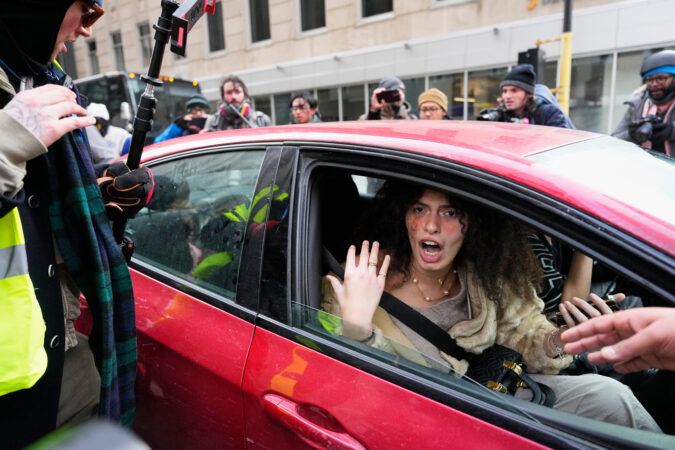
    Gottsche saw a cut on his lip and scrapes on his face. From the driver’s side, her friend unlocked the doors. Lang jumped in the back seat.

    As they waited for the stoplight to turn green, protesters swarmed them, shouting “That’s him!” according to video of the incident and interviews with Gottsche and Lang. People pried open the doors and kicked Lang. Some hit the car itself. Finally, Lang, Gottsche, and her friend sped away.

    Within minutes, footage of the moment surfaced online. It fueled speculation about how Lang had escaped the reach of counterprotesters and who had helped him pull it off. The reality was simpler — and in some ways, more complicated — than what most guessed.

    Inside the car was Gottsche, a 22-year-old transgender woman and singer-songwriter who said the choice to help Lang felt easy. She thought he might have been hurt by ICE officers, carrying with him the same fear that she and her neighbors have felt for weeks.

    But minutes before Lang was begging for help outside the car, he had been blasting “Ice Ice Baby” to support federal immigration agents and yelling about how immigrants were “replacing” white Americans. After facing attacks from the crowd, he was seen bleeding from the back of his head.

    Gottsche said if she had to relive the encounter, she would make the same decision to help Lang.

    “I don’t necessarily know if he deserved our kindness, but I would not change anything that happened,” she said.

    Afraid for her own safety, Gottsche had sat out the anti-ICE protests roiling Minneapolis. But, she said, she opposes the presence of the thousands of federal officers who have spent their days stopping people to ask for paperwork, pepper-spraying protesters and door-knocking in search of undocumented immigrants. Now, Gottsche sees her decision to rescue Lang as a sort of ironic intervention.

    “I feel like it was meant to happen, because who knows — had we not stopped, he might have died,” she said. “He was really hurt, and I would hate to have something like that on my conscience.”

    To Lang, receiving help from people who disagreed with him presented “a powerful kind of imagery,” a reminder of a higher power at play. He said he wanted to believe that had they known his beliefs, they still would have helped — but he doubts it, given public social media posts he saw from Gottsche afterward. He referenced one video in which she said, “We’re letting the wolves have you next time.”

    “That’s very sad and disappointing,” he told the Post. “And I pray God checks their heart on that.”

    Asked about the video, Gottsche said she had made it just minutes after Lang left the car and before she had even begun to process what had transpired. She said she may have taken her remarks too far.

    But, Gottsche said, she wondered whether, if the roles had been reversed, Lang would have helped her. In the 48 hours since the interaction, Gottsche said she and her friend have been the target of derogatory, threatening messages and posts with false information from right-wing social media accounts.

    Since an ICE officer shot and killed 37-year-old Renée Good on Jan. 7, protests have spilled into the streets of Minneapolis daily. In a different world, Gottsche might have joined them.

    After a police officer murdered George Floyd in 2020, Gottsche, then a high school student, joined thousands in Minnesota to protest police brutality. Gottsche, who is half Black, marched with a sign reading, “Stop killing us.”

    But she doesn’t feel safe anymore, she said. She had seen videos of the shooting of Good, a white woman who had been in her car, blocks away from home. She had watched Vice President JD Vance say the ICE officer who killed Good had “absolute immunity.”

    “I felt like that was my warning to just not” protest, Gottsche said. “That’s not normal.”

    So she chose to keep her support of the Minneapolis demonstrations subtle. She honked when driving by protesters. Then she went about her day.

    On Saturday, Gottsche and her friend decided to grab drinks. The bar they wanted to try was blocks away from Minneapolis’ city hall and federal courthouse, where Lang planned to hold an anti-immigration protest. He had been preparing to protest for months as part of a series of anti-Muslim rallies he has held across America. He said his desire to demonstrate in Minneapolis only grew after he heard Trump blame Somali immigrants for a yearslong welfare fraud probe in the state and saw that residents there were clashing with ICE officers.

    As he was chased by the crowd of counterprotesters Saturday, Lang ran into a hotel and left through a side door. He said he took off the military-style vest he had been wearing with patches reading “Infidel” and “47,” a reference to Trump.

    Then Lang approached the red sedan where Gottsche and her friend, Aleigha, were sitting at a traffic light. Gottsche said that she rolled down her window as she saw Lang running toward them, and that he asked for help. She and her friend looked at each other, trying to figure out whether to let him inside the car.

    Suddenly, the car was surrounded. From the passenger’s side, with the window still down, Gottsche panicked, trying to explain to the people outside that she did not know the man and was just trying to help.

    “Drive!” Lang shouted, according to video and an interview with him. “Drive! Drive!”

    Soon after, they tore away from the crowd.

    Gottsche turned to face Lang and asked him what had happened. It was then that she realized “that we had someone that’s not on our side in our car.” Lang said he recognized that Gottsche was trans and her friend was also a woman of color, and he thought to himself that “they probably are not sympathetic to my stance as a pro-ICE supporter.”

    Lang thanked Gottsche and her friend but did not directly answer their questions about what had led him to their car, Gottsche said. He identified himself only as “Jake” and as a Christian who loves God. He offered to pay for the damage to the car and shared a phone number, Gottsche said. She texted the number and confirmed that the message had gone through.

    The ride was short. They reached the bar, and Lang got out of the car.

    Gottsche still didn’t know who exactly he was.

    Then friends and social media followers who had started to see videos of Lang’s escape sent her messages: Did she know she had just saved an anti-immigrant influencer? They sent videos of the rally he had just held and links to his social media pages, where he had repeatedly made incendiary posts about immigrants and Muslims. Some people seeing the photos and videos of the moment assumed Gottsche was a fan of Lang.

    She took to TikTok to clarify how she had ended up in the now-viral exchange. In one video, she lip-synced to “No Good Deed” from Wicked, with the caption: “When you try to help an injured man in the street but it turns out he was Jake Lang.”

    In the hours that followed, Gottsche still felt it was a “right place, right time” moment — a twist of fate that landed two people otherwise unlikely to talk to one another in the same car. She told Lang in a text message that she hopes the interaction sparks a reconsideration of his stances.

    “I also wanna add while i do not whatsoever support you or ur ideals, im happy to see that you are gonna be okay, and i hope this has some sort of impact on you,” Gottsche wrote to the number Lang had shared with her.

    “Because the fear and urgency you felt trying to escape that crowd is what people here feel everyday. America was never ours to begin with, so how does it make sense that we cant share, especially with people seeking safety and shelter?”

    By Monday afternoon, a reply had not come.

  • New protest art on National Mall takes aim at Trump and Epstein files

    New protest art on National Mall takes aim at Trump and Epstein files

    A massive replica of a birthday note and crude drawing signed with the typed name “Donald J. Trump” and a “Donald” signature that was part of a 2003 book of birthday wishes for the deceased convicted sex offender Jeffrey Epstein was placed on the National Mall early Monday morning, the latest installation of artwork critical of the president by a group that identifies itself as “The Secret Handshake.”

    The group, whose members are anonymous, has previously placed installations at the same location, including a statue of Trump and Epstein holding hands and skipping, a mock tribute to Trump from the world’s authoritarian leaders, and a replica of the desk of former House Speaker Nancy Pelosi (D., Calif.) with a pile of fake excrement on it that ridiculed the Jan. 6, 2021, rioters who sought to overturn the 2020 election.

    The new installation, located on the Mall on Third Street NW between Jefferson and Madison drives, stands 10 feet high by 12 feet wide. A National Park Service permit will allow the work to remain at that location through Friday.

    Trump has denied writing the note and has told reporters that the signature is not his. The White House did not immediately respond to a request for comment on the new installation.

    In front of the replica card is a stack of marble blocks made to resemble a filing cabinet, with each drawer labeled “The Files” and overflowing with hundreds of strips of paper. Atop the files is a box of Sharpies and an invitation for visitors to sign the card with a message to the administration. It notes, “Please refrain from any promotional, violent or hateful speech or it will be removed.”

    The towering placard replicates the message found in a “birthday book” given to Epstein for his 50th birthday by friends and acquaintances. It was one of a tranche of documents released in September by the House Oversight Committee that it had received from Epstein’s estate.

    The sketch is of a woman’s nude form and includes a dialogue between “Donald” and Epstein, ending with a handwritten signature and the typed words “Donald J. Trump” above it.

    The exchange between “Donald” and “Jeffrey” appears inside the contours of a woman’s body. “We have certain things in common, Jeffrey,” “Donald” says. “Enigmas never age, have you noticed that?”

    “Happy birthday — and may every day be another wonderful secret,” “Donald” ends the note.

    Last year, Trump sued the Wall Street Journal and others at the news organization, alleging defamation after the newspaper published its story revealing the letter. The case is pending in federal court in Miami.

    On its permit application, the artists wrote that the purpose of the work was “to use creative and artistic free speech about one of the most relevant political issues of this moment, and to highlight the conversation about President Donald Trump’s friendship and relationship with Jeffrey Epstein using his own reported language and correspondence. As well, to highlight the heavily redacted files that have been released and those that haven’t.”

    The Mall was quiet Monday morning as the nation took a day off to honor Martin Luther King Jr. By midmorning, there were just a few messages written on the giant card, all with negative sentiments toward the president.

    “Looking forward to your jail sentence, DJT!”

    “The people will rise. We already are.”

    D.C. resident Susan Fritz, 61, stopped to take a look during her morning run. “What I really like about it is that they didn’t have to make anything up. They just had to blow it up and put it out here.”

    But she was pretty sure the installation’s message would not be received well by the administration.

    “I’ll be surprised if it stays up,” she said.

    “I think everyone should see it,” said Anders Williams, 45, who stopped in front of card on his way to the Air and Space Museum with his wife and young child. “It shows that someone lived in a very different world from the rest of us at some point. It’s just weird.”

    Ying Yong, 33, also from the District, said he spotted the card from a distance and came over to check it out.

    “It’s great, it’s hilarious,” he said. “Nothing more to be said.”

    A woman bundled up against the morning cold said she was a federal worker and declined to provide her name. But she wanted to comment on the new installation, so she picked up a Sharpie and approached the card.

    On it she quoted King. “Darkness cannot drive out darkness, only light can do that.”

  • Source: Jeff Hafley reaches agreement with Dolphins to become their coach

    Source: Jeff Hafley reaches agreement with Dolphins to become their coach

    The Miami Dolphins and Jeff Hafley have reached an agreement to make the former Boston College head coach and Packers defensive coordinator their coach, a person with knowledge of the decision told The Associated Press on Monday.

    The person spoke on condition of anonymity because a contract hadn’t been finalized.

    Hafley replaces Mike McDaniel, who was fired after going 35-33 in four seasons. The Dolphins also fired longtime general manager Chris Grier during the season.

    Hafley, who spent two seasons in Green Bay, met with the Dolphins for a second interview earlier Monday before he was offered the job. He will rejoin new GM Jon-Eric Sullivan in Miami.

    The 46-year-old Hafley left his job at Boston College in 2024 to become defensive coordinator in Green Bay, where he worked with Sullivan for the past two seasons.

    Sullivan, formerly Green Bay’s vice president of player personnel, spent 22 seasons with the Packers before becoming the Dolphins’ GM.

  • Harvard men slip past Penn, 64-63

    Harvard men slip past Penn, 64-63

    BOSTON — Thomas Batties II and Tey Barbour each scored 17 points Monday as Harvard held off Penn, 64-63, in an Ivy League game at Lavietes Pavilion.

    Barbour made a driving layup with 13 seconds left to extend Harvard’s lead to 64-59 and the Crimson held off a comeback by the Quakers.

    Ethan Roberts led the way for the Quakers (9-8, 2-2 Ivy) with 27 points and two steals. AJ Levine added 15 points, eight rebounds, four assists and four steals. TJ Power also had 12 points. Penn saw a two-game winning streak come to an end.

    Batties also contributed six rebounds and three blocks for the Crimson (10-8, 3-1). Barbour shot 6 for 11, including 3 for 8 from beyond the arc. Robert Hinton shot 5 for 13 to finish with 11 points.

    Next up for Penn is a home game against Yale on Saturday at 2 p.m. (ESPNU).

  • How EPA ethics officials cleared former industry insiders for regulatory roles

    How EPA ethics officials cleared former industry insiders for regulatory roles

    Environmental Protection Agency ethics officials have interpreted impartiality guidelines in a way that has allowed several former industry insiders to oversee dramatic changes to chemical regulations, documents obtained under the Freedom of Information Act show.

    Those ethics decisions have cleared the way for a former agriculture lobbyist to help reinstate a pesticide that had been banned twice by federal courts, as well as for two former chemical industry executives to help reassess the agency’s stance on the dangers of formaldehyde.

    Internal emails and documents obtained by the Center for Biological Diversity and shared with the Washington Post show EPA ethics officials determined that Kyle Kunkler’s recent lobbying on behalf of the American Soybean Association did not require his recusal from pesticide regulation, including decisions about dicamba, a pesticide that soybean farmers have wanted to see reinstated.

    According to federal loss-of-impartiality regulations, new government employees are supposed to have a yearlong “cooling-off period” on matters that directly involve their previous employer, unless given written authorization by the ethics office.

    Emails show that before Kunkler started as EPA’s top official on pesticides in late June, ethics officials began prepping him on recusal strategies and answered questions about his ability to work on pesticide regulations given his previous role.

    An email exchange from after his first week shows officials knew he had helped develop his association’s comments to the EPA on dicamba. In light of that, he should not “participate in any meetings, discussions or decisions about ASA’s specific comments,” one ethics office lawyer wrote in a July 3 email, but “he could still work on comments submitted by other parties about dicamba, including those that may overlap with ASA’s comments.”

    On July 23, the EPA announced plans to bring back dicamba. The agency is slated to make reregistration official in the coming weeks.

    In a statement, EPA ethics office director Justina Fugh said “a federal employee’s ‘previous lobbying efforts’ do not constitute any conflict of interest as defined by existing federal ethics laws or regulations” and that only Kunkler’s direct interaction with his former employer would violate loss-of-impartiality rules.

    “The federal ethics rules simply do not preclude him from working as part of his EPA duties on general issues or topics,” Fugh said. “He is therefore permitted under the federal ethics rules to work on pesticide registrations generally, including EPA actions on dicamba, even though he previously worked on that same topic.”

    The ethics decision is legally correct but still raises concerns about bias in regulatory decision-making, said Richard Briffault, a professor of legislation at Columbia Law School.

    “There is a legitimate concern that people who have made a career out of representing or advocating for an industry that has a stake in regulation will be predisposed to favor that industry’s position when they make decisions as regulators – that they will be biased and not impartial,” Briffault said.

    The federal impartially standards are designed to ensure government decisions are not made on the basis of personal bias, personal connection, or loyalty to a former employer, said Kathleen Clark, a government ethics lawyer and a law professor at Washington University in St. Louis. Clark said barring Kunkler from comments and meetings is “relatively unimportant” given his ability to participate in the government approval of pesticides he once lobbied for.

    “It seems strange to me that they would say that it would be inappropriate for him to respond to comments but, on the other hand, he can absolutely participate in what presumably is something extremely important to his former employer,” said Clark, who reviewed some of the documents at the Post’s request.

    “It’s sort of like hiring the fox to guard the hen house,” she said.

    The American Soybean Association did not respond to request for comment.

    The EPA originally approved dicamba in 2016 for use on soybeans and cotton that had been genetically modified to withstand what would otherwise be a damaging dose. But in 2020, a federal court vacated that approval over concern that the pesticide was drifting to and damaging other crops and wild plants. The EPA reapproved dicamba months later with additional application restrictions, but a court revoked that approval in 2024, saying drift damage remained a problem.

    Kunkler had been among those lobbying for dicamba’s reinstatement. Calendar records show he had a virtual meeting in March with officials from the office he would later join, the Post reported last year.

    He once likened the dicamba dispute to the “legal and regulatory equivalent of a Wimbledon court littered with land mines.” He told his association’s members: “ASA knows just how vital it is for your operations to have choices in the crop protection tools available to you, and we will continue to advocate strategically and vigorously to defend your access to them.”

    Nathan Donley, a senior scientist at the Center for Biological Diversity, said it’s not surprising that the new registration plans for dicamba closely mirror proposals from ASA.

    “I don’t see any limitations on what he can or cannot do based on his past work,” said Donley, whose organization has sued the EPA three times over dicamba. “It assures that industry interests are going to be considered above what’s in the public interest.”

    Kunkler’s role in the reinstatement of dicamba in some ways parallels the involvement of two former chemical industry executives who helped drive the EPA’s reassessment of formaldehyde, a cancer-causing chemical used in furniture, wood adhesives, and body preservation at funeral homes.

    Toxicologist Nancy Beck heads the EPA’s Office of Chemical Safety and Pollution Prevention. Lynn Dekleva, an environmental engineer, serves as her deputy.

    Both fought to roll back chemical regulations as part of the first Trump administration. Afterward, Beck joined the chemicals practice at law firm Hunton Andrews Kurth, where her clients included top industry trade groups. Dekleva signed on with the American Chemistry Council trade group as a senior director. Both criticized the EPA’s risk assessment model, and Dekleva directly pressed the agency to reassess the model in relation to formaldehyde.

    But when they joined the second Trump administration, both Beck and Dekleva received written approval from the agency’s ethics office to work on chemical regulation, as reported by E & E News last year.

    “I conclude that the interest of the United States Government in your participation outweighs any concerns about your impartiality,” Fugh wrote in March.

    She told the Post that while federal ethics guidelines proscribe engaging with former employers or clients in activities such as grant-making and enforcement actions, matters with “general applicability” — such as rule- or policymaking — aren’t prohibited.

    The new approach to formaldehyde announced by the EPA last month is the one favored by the industry. It assumes there can be a safe threshold of exposure, and that some carcinogens pose no health risk at lower levels. Under the Biden administration, the agency took the position that even small exposures could pose risks.

    The proposed revisions nearly double the amount of formaldehyde considered safe to inhale.

    Briffault said the real issue may be less about ethical interpretations and than about political decisions — namely, the administration’s pick of proindustry people for top regulatory appointments.

    Asked whether Beck and Dekleva’s appointments influenced the EPA’s shift, agency spokesperson Brigit Hirsch said EPA Administrator Lee Zeldin made the decision and it was based on “the most advanced, gold standard scientific methods.”

    “EPA’s move to a threshold approach for formaldehyde does not at all mean the agency is relaxing its standards or giving industry a pass,” Hirsch said. “By using this science, EPA can set limits that are more protective, not less, because they are based on the most sensitive biological changes that occur before serious health effects develop.”

    In a statement to the Post, the American Chemistry Council said the EPA’s revised approach was recommended by their own peer reviewers and is consistent with other international authorities. “ACC supports risk evaluation approaches that are grounded in sound science and protective of public health, consistent with [Toxic Substances Control Act] requirements.”