Category: Wires

  • Rams shake off wild TD pass by Caleb Williams to force OT, beat Bears 20-17 to reach NFC title game

    Rams shake off wild TD pass by Caleb Williams to force OT, beat Bears 20-17 to reach NFC title game

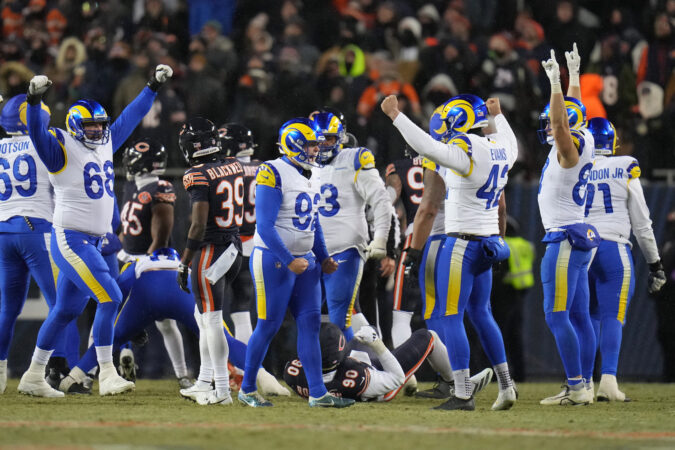
    CHICAGO — Matthew Stafford and the Los Angeles Rams survived an incredible throw by Caleb Williams that forced overtime, beating the Chicago Bears 20-17 on Sunday night to advance to the NFC championship game.

    Harrison Mevis kicked a 42-yard field goal in OT after Kam Curl intercepted a deep pass by Williams on the Bears’ first possession of the extra period. Stafford completed a 16-yard pass to Puka Nacua to get the Rams into field-goal range and set up Mevis, known as the “Thiccer Kicker,” for the game-ending kick. He was mobbed by teammates while a crowd that was rocking earlier watched in near silence.

    The Rams (14-5) will visit NFC West rival Seattle next Sunday in their first trip to the conference championship game since the 2021 team won the Super Bowl. The Seahawks beat San Francisco 41-6 on Saturday.

    “It was crazy,” Stafford said. “It was back and forth. We didn’t play our best on offense. Our defense dominated the game. It was unbelievable to watch. Hell of a play on fourth down by Caleb to get his team to overtime. And just glad we got the ball back.”

    Los Angeles led 17-10 in the final minute and the Bears faced fourth-and-4 from the 14-yard line when Williams backpedaled to avoid the pass rush and heaved the ball to Cole Kmet for the tying touchdown with 18 seconds left. Although officially a 14-yard pass, the ball traveled 51.2 yards in the air, according to the NFL’s Next Gen Stats.

    Williams threw for two touchdowns but was intercepted three times as the Bears (12-7) — who pulled off seven fourth-quarter comeback wins under first-year coach Ben Johnson — came up short this time. They won the NFC North after finishing last in the division a year ago.

    Stafford led a 91-yard touchdown drive in the fourth quarter, with Kyren Williams scoring from the 5 to give the Rams a 17-10 lead with 8:50 remaining. Nacua kept the possession going on the previous play with a 2-yard run on fourth-and-5.

    The Bears then drove to the 2, but Omar Speights broke up Williams’ fourth-down pass to Luther Burden just inside the goal line.

    Chicago got the ball back at midfield with just under two minutes remaining after Ethan Evans shanked a 33-yard punt, setting up Williams’ heroics.

    In overtime, the Bears won the toss and deferred. They quickly got the ball back when the Rams went three-and-out, forced to punt after Blake Corum was stopped for a 1-yard loss on third-and-1 at the 36.

    Chicago took over at the 16. Williams kept the drive going with a 3-yard keeper on fourth-and-1 near midfield. But Curl picked off Williams’ pass intended for DJ Moore two plays later.

    Stafford was 20 of 42 for 258 yards and took four sacks. Nacua had 56 yards receiving after going for 111 in a wild-card win over Carolina, and Kyren Williams ran for 87 yards and two scores.

    Caleb Williams completed 23 of 42 passes for 257 yards. Moore had a touchdown catch, and D’Andre Swift ran for 76 yards.

  • Drake Maye throws 3 TD passes, C.J. Stroud has 4 INTs as Patriots top Texans to advance to AFC title game

    Drake Maye throws 3 TD passes, C.J. Stroud has 4 INTs as Patriots top Texans to advance to AFC title game

    FOXBOROUGH, Mass. — Mike Vrabel returned to New England on a mission to have the franchise playing again in meaningful games in January — as he did so often as a player.

    In his first year as the head coach, he wanted to do it by building a culture of players that wanted to perform for each another. Their most complete team effort of the season has the Patriots one win from a trip to the Super Bowl.

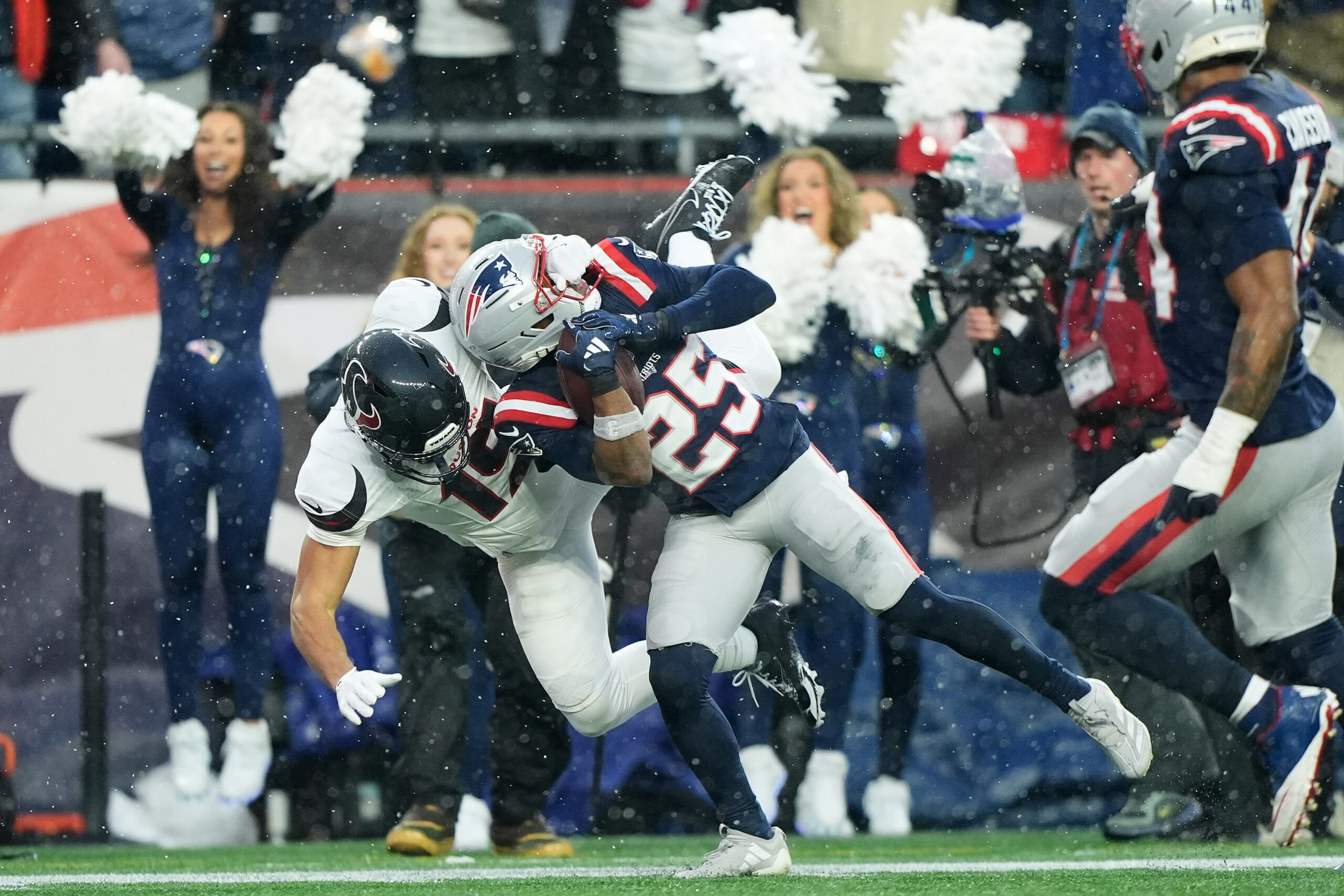
    Drake Maye threw three touchdown passes in the snow and rain, Marcus Jones returned one of C.J. Stroud’s four interceptions for a score and the Patriots defeated the Houston Texans 28-16 on Sunday to advance to the AFC championship game for the first time in seven years.

    The Patriots (16-3) will take on the Broncos (15-3) in Denver next Sunday, with the winner advancing to the NFL’s title game in three weeks.

    “Everybody’s stepping up. We’re using everybody. Everybody’s making plays. Everybody’s helping us win,” said Vrabel, who won three Super Bowls as a playmaking linebacker for the Patriots. “I’m excited for these guys, but also, they’re not satisfied, and I can tell that.”

    The Patriots — winners of 15 of their last 16 games — will make their 16th conference championship game appearance and first since their run to their sixth Super Bowl title under Bill Belichick in the 2018 season. New England has won its last nine divisional round games.

    Maye finished 16 of 27 for 179 yards, but had an interception and fumbled four times, losing two in cold conditions in which snow and rain fell throughout. One of Maye’s fumbles set up Houston’s first touchdown.

    “Just proud of the guys,” Maye said. “Battled the elements. This is New England. This is what we’re trying to embrace and we want to embrace all season long. Props to our defense, played a hell of a game. We’ve got to protect the football better, but we made enough plays to win it.”

    Carlton Davis III had two interceptions for New England. Craig Woodson added an interception and fumble recovery.

    New England Patriots cornerback Marcus Jones (25) returns an interception for a touchdown against Houston Texans wide receiver Xavier Hutchinson (19) during the first half of an NFL divisional playoff football game, Sunday, Jan. 18, 2026, in Foxborough, Mass. (AP Photo/Robert F. Bukaty)

    “They bring it every week,” Maye said of his defense. “It’s fun to watch. And we could help them out some more, but just proud of the guys. Enjoy this one, and we’re back on the road.”

    The eight combined turnovers — Woody Marks also lost a fumble for Houston — were the most in a playoff game since 2015 when the Cardinals and Panthers combined for eight in the NFC championship game.

    The Texans (13-6) have lost in the divisional round in three straight seasons under coach DeMeco Ryans. The franchise fell to 0-7 in this round.

    “It’s tough to win a game when you turn the ball over five times,” Ryans said.

    Stroud finished 20 of 47 with a TD pass. All of his interceptions came in the first half as he became the first player with five or more INTs and five or more fumbles in a single postseason. Will Anderson forced two fumbles for the Texans.

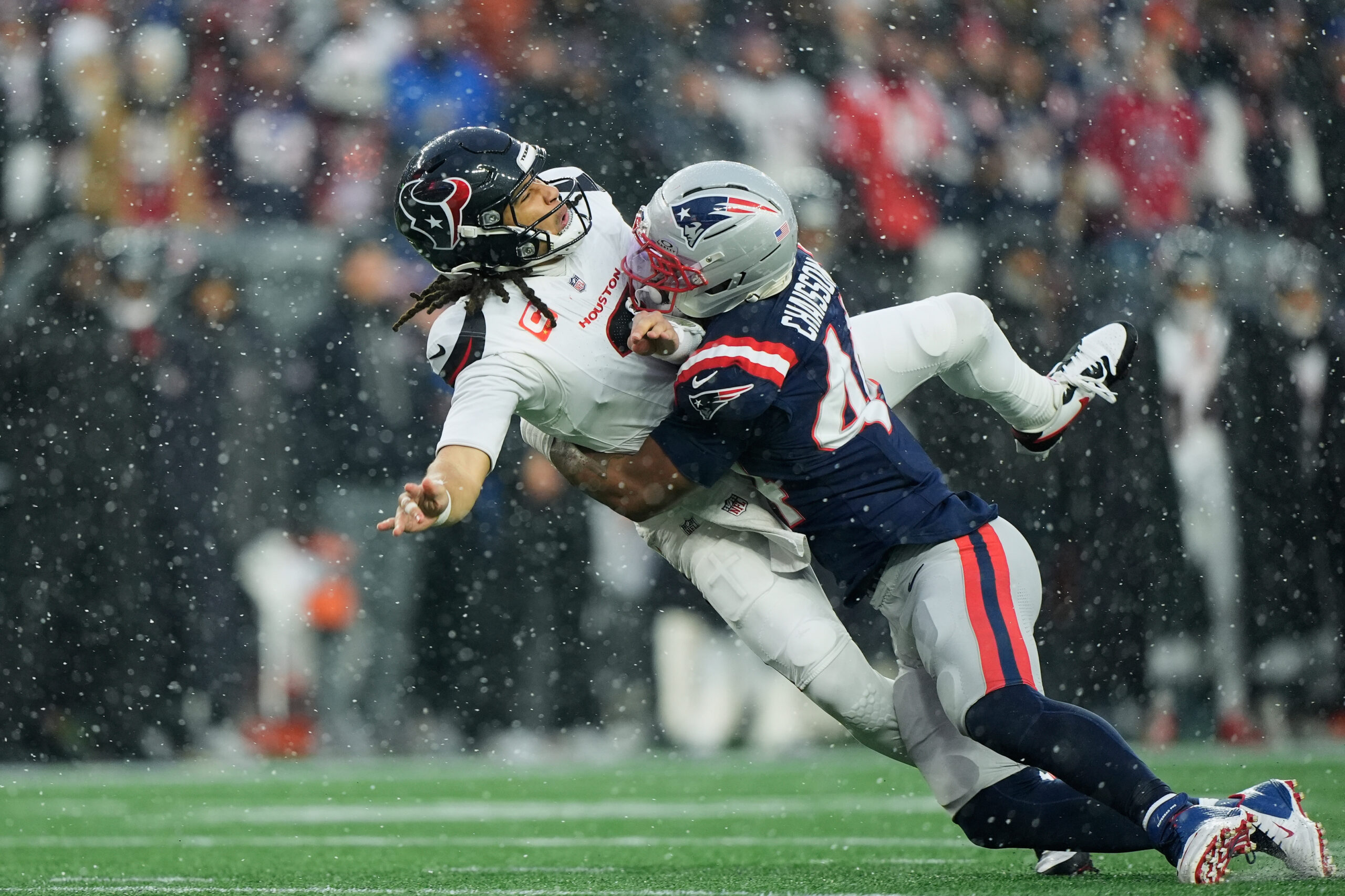
    New England Patriots linebacker K’lavon Chaisson, right, hits Houston Texans quarterback C.J. Stroud during the first half of an NFL divisional playoff football game, Sunday, Jan. 18, 2026, in Foxborough, Mass. (AP Photo/Robert F. Bukaty)

    “I feel like I let people down,” Stroud said. “I’m not happy with that. It hurts. I’m not used to it.”

    Leading 21-16 in the fourth quarter, the Patriots stretched their lead to 27-16 when Kayshon Boutte got behind Derek Stingley Jr. and pulled in a diving, one-hand catch in the corner of the end zone for a touchdown.

    The Texans had the ball with 5:48 to play, but punted on fourth-and-18 at their own 21 with 4:18 remaining.

    New England’s next drive took the clock under two minutes. But the Texans turned it over on downs when Stroud’s fourth-down pass to Xavier Hutchinson was batted down by Robert Spillane.

    The Patriots now go back on the road, where they are 8-0 this season.

    “We feel like we deserve to be here,” Maye said. “I like our chances with those guys in the locker room.”

    Early action

    With the Patriots leading 7-3 early, a series of miscues produced the next two scores.

    Maye was strip-sacked by Danielle Hunter deep in Patriots territory, but left tackle Will Campbell fell on the ball and the Patriots punted.

    The Texans gave it right back when Stroud’s deep pass along the sideline was intercepted by Davis III.

    Maye fumbled again when he attempted to run on a busted play and had the ball stripped by Tommy Togiai and recovered by Azeez Al-Shaair. Six plays later, Stroud linked up with Christian Kirk on a 10-yard touchdown pass.

    But on Houston’s next drive, Stroud was rushed up the middle by K’Lavon Chaisson and he lofted a pass that was intercepted by Jones and returned for the score to put New England back in front.

    Later in the quarter, the Patriots’ lead increased to 21-10 when they capped a five-play, 56-yard drive with a 7-yard TD pass from Maye to Stefon Diggs.

    Mr. Pick-6

    Jones scored on an interception return for the second time this season. It was the first of his career in the playoffs and first for New England in the postseason since Asante Samuel had one vs. Indianapolis on Jan. 21, 2007, in the AFC championship game.

    Injuries

    Texans: TE Dalton Schultz (calf) left in the first quarter and didn’t return. … LG Tytus Howard limped off in the second quarter. … TE Cade Stover left in the fourth with a knee injury and didn’t return.

    Patriots: LB Robert Spillane left in the first quarter with a thumb injury, but returned. … RB TreVeyon Henderson was shaken up after a second quarter run before jogging off. … S Craig Woodson exited after his INT with a head injury, but returned. … RB Rhamondre Stevenson left in the second quarter with an eye issue. … Davis injured his head in the fourth quarter.

  • FBI opened probe on Minneapolis shooting; none exists now, Justice Dept. says

    FBI opened probe on Minneapolis shooting; none exists now, Justice Dept. says

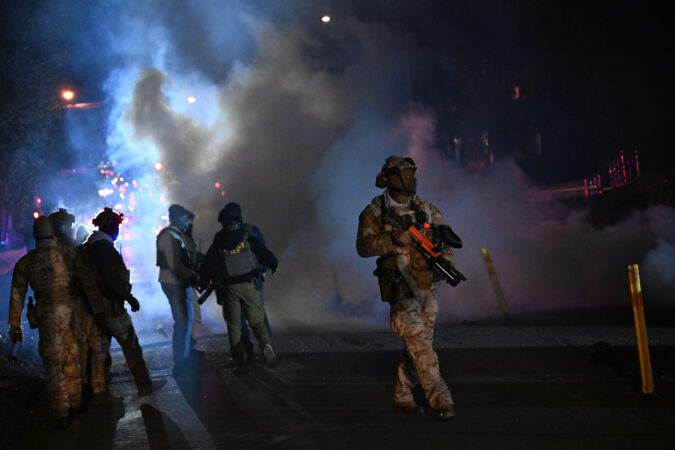
    In the immediate aftermath of the death of Renée Good in Minneapolis, FBI agents launched a civil rights investigation into the actions of the immigration officer who shot her, according to three people familiar with the investigation.

    An agent in Minnesota conducted an initial review of the shooting and determined that sufficient grounds existed to open a civil rights probe into the actions of Jonathan Ross, the officer who shot Good, according to the people, who spoke on the condition of anonymity to discuss internal deliberations.

    The existence of the civil rights investigation stands in sharp contrast to public statements made by Deputy Attorney General Todd Blanche, who said on Fox News Sunday that the shooting of Good does not warrant a federal investigation.

    “There are over 1,000 shootings every year where law enforcement are put in danger by individuals, and they have to protect themselves, and they have a lawful right to do so,” Blanche said. “The Department of Justice doesn’t just stand up and investigate because some congressmen thinks we should, because some governor thinks that we should.”

    “We investigate when it’s appropriate to investigate,” Blanche added. “And that is not the case here. It was not the case when it happened and is not the case today.” Instead of a civil rights investigation, Justice Department leaders have tried to pursue a probe against Good’s partner, multiple people familiar with the probe said.

    Legal experts said that there is a low threshold for the FBI to open a civil rights investigation, and prosecutors and FBI agents occasionally disagree about when criminal investigations should be pursued.

    The FBI declined to comment about the decisions regarding the investigation.

    Any federal use-of-force investigation into an officer’s conduct is considered a civil rights investigation because the provision under which officers can be charged is a civil rights statute that covers deprivation of a person’s rights “under color of law.”

    On Jan. 7, an Immigration and Customs Enforcement officer in Minneapolis shot three times into the car of Good, a 37-year-old American citizen. Good’s partner was protesting ICE officers nearby in the moments before the shooting.

    About a dozen senior prosecutors in Washington and Minnesota have said they would be leaving their jobs amid turmoil over the Trump administration’s handling of the shooting death of Good.

    At least five prosecutors in Minnesota — including the office’s second-in-command — were furious that Justice Department leaders demanded that they investigate Good’s partner, prompting them to resign, according to people familiar with their decision, who spoke on the condition of anonymity to discuss personnel matters.

    In Washington, multiple senior prosecutors in the criminal section of the Civil Rights Division left, in part, because they were excluded from the Good investigation. People familiar with their departures said that, before the shooting, many of them had already planned to take early retirement because they believed that Justice Department leaders were undermining their work. The handling of the Minneapolis shooting, the people said, hastened their departure dates.

    “No responsible prosecutor should determine what an outcome should be in such a case until a such an investigation is completed,” said W. Anders Folk, who served as acting U.S. attorney for Minnesota during the Biden administration. “I am concerned that without a thorough, impartial, and transparent investigation, the public’s confidence in law enforcement, prosecutors, and public safety professionals will suffer.”

    A robust federal investigation could determine that the officer was justified in shooting Good, legal experts noted. Law enforcement officers are rarely charged for using lethal force, in part because the law provides significant leeway for officers to decide when use of force is needed.

    An accurate conclusion can only be reached, however, if law enforcement officials examine all relevant state and federal laws, and their application to the facts in the case, the legal experts said. A thorough investigation, for example, might conclude that the officer’s first shot at Good was justified, but that the next two were not.

    Minnesota Gov. Tim Walz and Minneapolis Mayor Jacob Frey, both Democrats, have said that state officials have been blocked from conducting an investigation into the shooting, with the FBI taking over the probe and denying state agencies access to evidence. Justice Department and FBI leaders have not publicly explained what their probe entails, only saying that a civil rights investigation is not warranted.

    The Justice Department has since launched a federal investigation into Walz and Frey, examining whether the two Democratic leaders are impeding federal law enforcement officers’ abilities to do their jobs in the state, the Washington Post reported Friday. Federal prosecutors are expected to serve the two leaders with subpoenas in the coming days.

    Walz and Frey have denied any wrongdoing and have accused the Trump administration of weaponizing law enforcement for political purposes.

  • Officials estimate that at least 21 people were killed in high-speed train crash in southern Spain

    Officials estimate that at least 21 people were killed in high-speed train crash in southern Spain

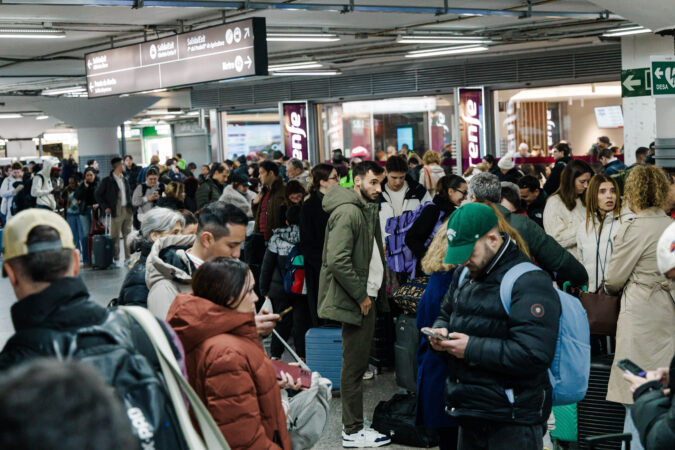
    BARCELONA — A high-speed train derailed, jumped onto the track in the opposite direction and slammed into an oncoming train Sunday in southern Spain, killing at least 21 people and injuring dozens more, the country’s transport minister said.

    The tail end of an evening train between Malaga and Madrid with some 300 passengers went off the rails near Córdoba at 7:45 p.m. local time and slammed into a train with some 200 passengers coming from Madrid to Huelva, another southern Spanish city, according to rail operator Adif.

    Spain’s Transport Minister Óscar Puente updated the death toll to 21 confirmed victims after midnight when he said that rescues had removed all the survivors. But Puente said there could be more victims still to be confirmed. Emergency services in Andalucia, the province where the accident happened, said it had recorded 25 people with severe injuries.

    The regional Civil Protection chief, María Belén Moya Rojas, told Canal Sur that the accident happened in an area that is hard to reach.

    Local people were taking blankets and water to the scene to help the victims, she said.

    Salvador Jiménez, a journalist for Spanish broadcaster RTVE, was on board one of the derailed trains and told the network by phone that “there was a moment when it felt like an earthquake and the train had indeed derailed.”

    He said passengers used emergency hammers to break the windows, and that some had walked away without serious injuries. Videos from people on site show some people crawling out of windows at some points to escape the wreckage with carriages leaning at an angle.

    European Commission President Ursula von der Leyen said in a post on X that she was following “the terrible news” from Cordoba.

    “Tonight you are in my thoughts,” she wrote in Spanish.

    ADIF said train services between Madrid and cities in Andalucia would not run Monday.

  • Ukrainian drone strikes cut power to hundreds of thousands in Russia-occupied southern Ukraine

    Ukrainian drone strikes cut power to hundreds of thousands in Russia-occupied southern Ukraine

    KYIV, Ukraine — Ukrainian drone strikes damaged energy networks in Russia-occupied parts of southern Ukraine, leaving hundreds of thousands of people without power on Sunday, according to Kremlin-installed authorities there.

    Meanwhile, Moscow has kept up its hammering of Ukraine’s energy grid in overnight attacks that killed at least two people, according to Ukrainian officials.

    More than 200,000 households in the Russia-held part of Ukraine’s southern Zaporizhzhia region had no electricity on Sunday, according to the Kremlin-installed local governor.

    In a Telegram post, Yevgeny Balitsky said that nearly 400 settlements have had their supply cut, because of damage to power networks from Ukrainian drone strikes.

    Russia has hammered Ukraine’s power grid, especially in winter, throughout the nearly four-year war. The strikes aim to weaken Ukrainians’ will to resist in a strategy that Kyiv officials call “weaponizing winter.”

    Russia targeted energy infrastructure in Odesa region overnight on Sunday, according to Ukraine’s Emergency Service. A fire broke out and was promptly extinguished.

    At least six people were wounded in the Dnipropetrovsk region from Russian attacks, the emergency service said.

    Ukrainian President Volodymyr Zelensky said in a Telegram post that repairing the country’s energy system remains challenging, “but we are doing everything we can to restore everything as quickly as possible.”

    He said that two people were killed in overnight attacks across the country that struck Sumy, Kharkiv, Dnipro, Zaporizhzhia, Khmelnytskyi, and Odesa.

    In total, more than 1,300 attack drones, 1,050 guided aerial bombs, and 29 missiles of various types were used by Russia to strike Ukraine this week, Zelensky said.

    U.S. talks

    “If Russia deliberately delays the diplomatic process, the world’s response should be decisive: more help for Ukraine and more pressure on the aggressor,” Zelensky said.

    He spoke the day after a Ukrainian delegation arrived in the United States for talks on a U.S.-led diplomatic push to end the war.

    On Friday, Zelensky said that the delegation would try to finalize with U.S. officials documents for a proposed peace settlement that relate to postwar security guarantees and economic recovery.

    If American officials approve the proposals, the U.S. and Ukraine could sign the documents next week at the World Economic Forum in Davos, Switzerland, Zelensky said at a Kyiv news conference with Czech President Petr Pavel. U.S. President Donald Trump plans to be in Davos, according to organizers.

    Russia would still need to be consulted on the proposals.

    Drones strike Russian Caucasus

    Separately, in Russia’s Caucasus Mountains, two children and an adult were wounded overnight as debris from a Ukrainian drone fell on a five-story residential building in North Ossetia, according to the regional governor.

    Seventy people had to be evacuated from the building, in the town of Beslan, and there was damage to its roof and windows, Gov. Sergei Menyaylo said in a Telegram post on Sunday morning.

    Russia’s Defense Ministry said that its forces shot down or suppressed 63 Ukrainian drones overnight over Russia and the occupied Crimean Peninsula. One person was hospitalized in Russia’s Krasnodar region east of Crimea following a drone strike, local authorities said.

    Nuclear plant repairs

    Ukrainian crews have started repair work on the backup power line connecting the Zaporizhzhia Nuclear Power Plant to the power grid, under a ceasefire brokered by the International Atomic Energy Agency, the Vienna-based U.N. organization said in an X post on Sunday.

    The fate of the plant, occupied by Russia and the largest in Europe, is a central issue in ongoing U.S.-brokered peace talks.

    “Crucial repair works on the essential back up Ferosplavna-1 330 kV power line connecting Ukraine’s ZNPP to the grid have begun under another IAEA-brokered ceasefire,” the agency said in the post.

    The 330-kilovolt power line, which was damaged and disconnected because of fighting, is crucial to supplying the plant with electricity.

  • Syria says it has reached ceasefire with U.S.-backed Kurdish militia

    Syria says it has reached ceasefire with U.S.-backed Kurdish militia

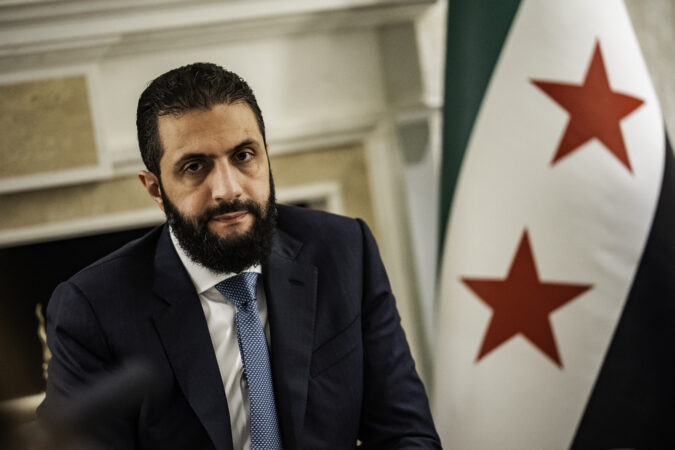
    ISTANBUL — Syria’s government said Sunday that it had signed a “ceasefire and full integration” agreement with a powerful Kurdish-led militia that controlled large swaths of territory in the country’s northeast — a critical step, if the agreement is implemented, toward unifying a fractured Syria after years of civil war and the precipitous fall of its dictatorship.

    There was no immediate statement on the agreement from the Kurdish-led group, the Syrian Democratic Forces, a longtime military ally of the United States in the battle against the extremist Islamic State militant group. In a post on X, Tom Barrack, the U.S. envoy to Syria, hailed the agreement while saying that the “challenging work of finalizing” its details “begins now.”

    The announcement late Sunday came after a day of stunning battlefield developments, with Syrian state media saying that government forces, allied tribal fighters, and locals had captured key cities and towns that had been controlled for years by the SDF. Tensions between the government and the SDF had simmered for more than a year, since rebels led by Syria’s interim president Ahmed al-Sharaa toppled the dictatorship of former Syrian leader Bashar al-Assad in December 2024.

    Sharaa has long insisted that the SDF, which over the past decade has claimed territory and declared autonomy in a large swath of northern and eastern Syria, integrate with the new Syrian government. But a March agreement between the two sides aimed at that goal was not implemented by its deadline, at the end of last year.

    The ceasefire agreement Sunday called for the “full and immediate administrative and military” handover by the SDF to the government in three provinces, as well as the surrender of Syria’s border crossings and oil and gas fields, according to a text of the deal posted by the country’s information minister — conditions that seemed to spell the end of a Kurdish proto-state that had sprung up in the chaos of Syria’s 13-year civil war.

    Before the announcement, clashes between government forces and the SDF pitted two of Syria’s most powerful armed groups against each other in a long-feared confrontation that posed a dilemma for the United States, which is allied with both.

    Syria’s state-run SANA news agency reported Sunday that government forces had seized SDF-controlled territory in Tabqa, on the Euphrates River, a dividing line between the two forces and the site of Syria’s largest dam. The Syrian Ikhbariya news channel also reported that the SDF had been expelled from Raqqa city, after what it called a local uprising, and what it said were mass defections by SDF forces.

    The city, it said, would be handed over to the Syrian government, amid reports that SDF fighters had also lost control of territory to local forces in the Deir al-Zour province, as well as several important oil fields there.

    In a statement Saturday, U.S. Central Command said it was urging the Syrian government to “cease any offensive actions” between the city of Aleppo, in northern Syria and Tabqa — before Syrian media reported that government forces had taken Tabqa.

    Beyond the statement, there was little sign Sunday that the Trump administration was intervening to protect its Kurdish allies, once its only Syrian partner against the Islamic State group. In recent months, though, the United States has touted Syrian government forces as a critical counterterrorism partner, as part of a broader vote of confidence in Sharaa’s government that has included the lifting of Assad-era sanctions against the country.

    Sunday’s territorial losses, and the ceasefire agreement that followed, marked a stunning turn of fortune for the SDF, which received global recognition for its sacrifices fighting Islamic State militants after they seized control of large areas in Iraq and Syria beginning in 2014. The SDF received weapons and other support from the United States and remained a key ally, continuing to guard prisons holding Islamic State captives and their families.

    Going forward, Syria’s government would assume “full legal and security responsibility” for the camps, Sunday’s ceasefire agreement said.

    The clashes between the SDF and the government were the latest violent convulsions that have shaken the country since the fall of Assad. Since taking power, Sharaa, a former leader of a Sunni Islamist rebel faction that was once affiliated with al-Qaeda, has sent his forces to put down armed challengers in the south of the country, in the city of Sweida, and on its coast, in confrontations that have killed thousands of people.

    There were signs that the government conducted its latest offensive against the SDF with more care, or at least tried to convey that sense. After days of armed clashes between SDF and government forces in the city of Aleppo and its surrounding areas this month, Sharaa issued a decree Friday recognizing Kurdish as a national language and granting citizenship to Kurds who lost their status in Syria more than 60 years ago, among other measures.

    Analysts said the government, which had gained little trust from Syria’s minorities, would have to do more to dispel minority fears. “The fact is that apolitical Kurds in northern Syria are rightfully afraid of undisciplined government forces,” Dareen Khalifa, a senior adviser with the International Crisis Group, wrote on X, before the ceasefire was announced.

    “They have seen what happened in Sweida and in the coast and cannot take chances with their lives. While this operation has been relatively restrained, it’s on Damascus to continue reassuring Kurds there’ll be no repeat of past disasters,” she wrote.

    If the SDF autonomous region was seen as a haven by many Kurds, Arab-majority areas under the group’s control chafed under its rule, complaining of heavy-handed tactics by its fighters and forced recruitment into its armed cadres. And Turkey, Syria’s northern neighbor, viewed the SDF as a threat, because of its links to the Kurdistan Workers’ Party, or PKK, which fought a long insurgency against the Turkish state.

    Before the ceasefire was announced, the rapid and violent unraveling of the status quo was rattling some of Syria’s foreign backers. French President Emmanuel Macron, in a post Sunday on X, said he had spoken with Sharaa and expressed his “deep concern” at the Syrian government’s offensive.

    “A permanent ceasefire is necessary, and an agreement must be reached on the integration of the Syrian Democratic Forces into the Syrian state, on the basis of the exchanges from last March. The unity and stability of Syria depend on it.”

  • New Hampshire bishop warns clergy to prepare for ‘new era of martyrdom’

    New Hampshire bishop warns clergy to prepare for ‘new era of martyrdom’

    CONCORD, N.H. — A New Hampshire Episcopal bishop is attracting national attention after warning his clergy to finalize their wills and get their affairs in order to prepare for a “new era of martyrdom.”

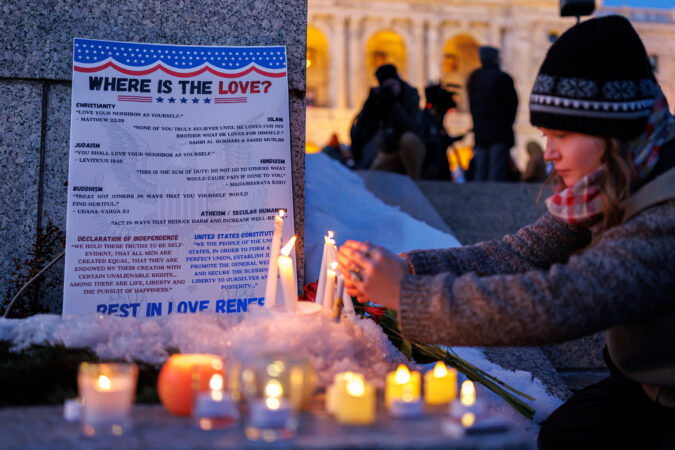
    Bishop Rob Hirschfeld of the Episcopal Church of New Hampshire made his comments earlier this month at a vigil honoring Renee Good, who was fatally shot on Jan. 7 behind the wheel of her vehicle by a U.S. Immigration and Customs Enforcement officer.

    The Trump administration has defended the ICE officer’s actions, saying he fired in self-defense while standing in front of Good’s vehicle as it began to move forward. That explanation has been panned by Minneapolis Mayor Jacob Frey, Minnesota Gov. Tim Walz, and others based on videos of the confrontation.

    Hirschfeld’s speech cited several historical clergy members who had risked their lives to protect others, including New Hampshire seminary student Jonathan Daniels, who was shot and killed by a sheriff’s deputy in Alabama while shielding a young Black civil rights activist in 1965.

    “I have told the clergy of the Episcopal diocese of New Hampshire that we may be entering into that same witness,” Hirschfeld said. “And I’ve asked them to get their affairs in order, to make sure they have their wills written, because it may be that now is no longer the time for statements, but for us with our bodies, to stand between the powers of this world and the most vulnerable.”

    Hirschfeld did not call for violence, but instead said people of Christian faith should not fear death.

    “Those of us who are ready to build a new world, we also have to be prepared,” he said. “If we truly want to live without fear, we cannot fear even death itself, my friends.”

    Other religious leaders have also called on Christians to protect the vulnerable amid the uptick in immigration enforcement under the Trump administration, including Sean W. Rowe, the presiding bishop of the Episcopal Church.

    “We keep resisting, advocating, bearing witness, and repairing the breach,” Rowe said during a prayer earlier this week. “We keep sheltering and caring for those among us who are immigrants and refugees because they are beloved by God, and without them, we cannot fully be the church.”

    In Minnesota, Craig Loya, a priest, urged people not to meet “hatred with hatred” but instead focus on love in “a world obviously not fine.”

    “We are going to make like our ancient ancestors, and turn the world upside down by mobilizing for love,” he said. “We are going to disrupt with Jesus’ hope. We are going agitate with Jesus’ love.”

  • U.S.-based activist agency says it has verified 3,919 deaths from Iran protests

    U.S.-based activist agency says it has verified 3,919 deaths from Iran protests

    DUBAI, United Arab Emirates — A U.S.-based activist agency said Sunday it has verified at least 3,919 deaths during a wave of protests that swept Iran and led to a bloody crackdown, and fears the number could be significantly higher.

    The Human Rights Activists News Agency posted the revised figure, up from the previous toll of 3,308. The death toll exceeds that of any other round of protest or unrest in Iran in decades, and recalls the chaos surrounding the 1979 revolution.

    The agency has been accurate throughout the years of demonstrations in Iran, relying on a network of activists inside the country that confirms all reported fatalities. The Associated Press has been unable to independently confirm the toll.

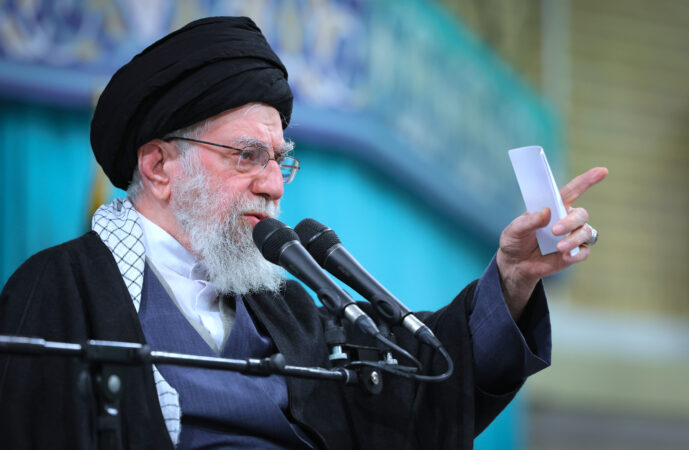
    Iranian officials have not given a clear death toll, although on Saturday, the country’s Supreme Leader Ayatollah Ali Khamenei said the protests had left “several thousand” people dead — and blamed the United States for the deaths. It was the first indication from an Iranian leader of the extent of the casualties from the wave of protests that began Dec. 28 over Iran’s ailing economy.

    The Human Rights Activists News Agency says 24,669 protesters have been arrested in the crackdown.

    Iranian officials have repeatedly accused the United States and Israel of fomenting unrest in the country.

    Tension with the United States has been high, with U.S. President Donald Trump repeatedly threatening Tehran with military action if his administration found the Islamic Republic was using deadly force against anti-government protesters.

    Iranian President Masoud Pezeshkian, in a post Sunday on X, blamed “longstanding enmity and inhumane sanctions” imposed by the U.S. and its allies for any hardships the Iranian people might be facing. “Any aggression against the Supreme Leader of our country is tantamount to all-out war against the Iranian nation,” he wrote.

    During the protests, Trump had told demonstrators that “help is on the way” and that his administration would “act accordingly” if the killing of demonstrators continued or if Iranian authorities executed detained protesters.

    But he later struck a conciliatory tone, saying that Iranian officials had “canceled the hanging of over 800 people” and that “I greatly respect the fact that they canceled.”

    A family member of detained Iranian protester Erfan Soltani said Sunday that the 26-year-old is in good physical health and was able to see his family days after his planned execution was postponed.

    Somayeh, a 45-year-old close relative of Soltani who is living abroad, told AP that his family had been told his execution would be set for Wednesday but it was postponed when they reached the prison in Karaj, a city northwest of Tehran.

    “I ask everyone to help in securing Erfan’s freedom,” Somayeh, who asked to be identified by first name only for fear of government reprisal, said in a video message.

    On Saturday, Khamenei branded Trump a “criminal” for supporting the rallies and blamed the U.S. for the casualties, describing the protesters as “foot soldiers” of the United States.

    Trump, in an interview with Politico on Saturday, called for an end to Khamenei’s nearly 40-year reign, calling him “a sick man who should run his country properly and stop killing people.”

    No protests have been reported for days in Iran, where the streets have returned to an uneasy calm. Instead, some Iranians chanted anti-Khamenei slogans from the windows of their homes on Saturday night, the chants reverberating around neighborhoods in Tehran, Shiraz, and Isfahan, witnesses said.

    Authorities have also blocked access to the internet since Jan. 8. On Saturday, very limited internet services functioned again briefly. Access to some online services such as Google began working again on Sunday, although users said they could access only domestic websites, and email services continued to be blocked.

  • In Iran crisis, Trump confronted limits of U.S. military power

    In Iran crisis, Trump confronted limits of U.S. military power

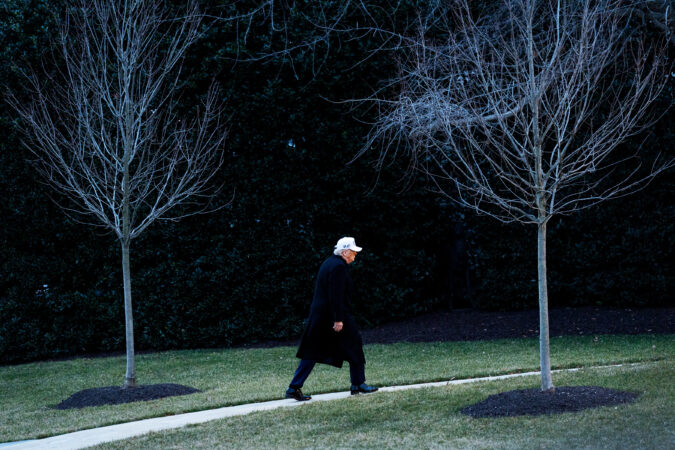
    It was late morning Wednesday and much of the Middle East and official Washington seemed certain President Donald Trump would launch punishing airstrikes against Iran, his second major use of American military power in as many weeks after the daring Delta Force raid into Venezuela to seize leader Nicolás Maduro and his wife.

    Trump had not officially given the strike order, but his top security advisers expected him to imminently authorize one of the military options presented to him and were girding themselves for a late night.

    The Pentagon advertised that a guided-missile destroyer, the USS Roosevelt, had entered the Persian Gulf. Allies had been alerted that a U.S. strike was likely, according to a person familiar with the matter, and ships and planes were on the move. Personnel at the sprawling al-Udeid U.S. air base in Qatar were advised to evacuate to avoid an expected Iranian counterstrike.

    “HELP IS ON ITS WAY,” Trump had promised Iranian protesters, encouraging them in a social media post Tuesday morning to “take over” regime institutions. While many U.S. and foreign officials took that to mean the United States would intervene militarily, Trump remained open to help in the form of pressuring Iran to stop killing demonstrators.

    The key moment came Wednesday, when Trump received word through envoy Steve Witkoff that Iran’s government canceled the planned executions of 800 people, according to a senior U.S. official. “We’re going to watch and see,” Trump then told reporters in the Oval Office. On Thursday, U.S. intelligence confirmed the executions didn’t happen, the official said.

    Trump’s rapid evolution midweek, which left many of his advisers feeling whiplashed and Iranian dissidents feeling abandoned, reflected intense domestic and foreign pressures, according to interviews with more than a dozen current and former U.S. and Middle Eastern officials, who spoke on the condition of anonymity to describe sensitive diplomatic conversations and ongoing military preparations.

    The president came face to face with the unpredictability of potentially destabilizing another Middle Eastern country and the limitations of even the vast American military machine, several of them said. Having deployed an aircraft carrier strike group and an accompanying armada to the Caribbean on Trump’s orders, Pentagon officials worried that there was less U.S. firepower in the Middle East than would be ideal to repulse what was expected to be a major Iranian counterstrike.

    Israel shared that concern, having expended vast numbers of interceptor rockets against incoming Iranian missiles during their 12-day war in June, one current and one former U.S. official said.

    Key U.S. allies, including Saudi Arabia, Qatar, and Egypt, contacted the White House to urge restraint and diplomacy, a senior Arab diplomat and a gulf official said. Those Sunni Muslim-majority nations have long felt threatened by Shiite-majority Iran, but they fear spasms of instability across their region even more.

    Perhaps most of all, several officials said, Trump realized that Iran strikes would be messy and might bring possible economic convulsions, wider warfare, and threats to the 30,000 U.S. troops in the Middle East — not like the “one and done” operations he has ordered to destroy alleged drug boats and seize Maduro, target Islamic State fighters in Syria, or damage Iran’s nuclear program.

    “He wants [operations like] Venezuela,” said a former U.S. official briefed on the decision-making. “This was going to be messier.”

    The Iranian protests, the largest in the Islamic republic’s 46-year history, appear to have subsided for now in the face of a violent government crackdown that human rights groups estimate has killed more than 3,000 people. A true accounting of the toll is difficult, as Tehran maintains a total shutdown of internet and telecommunications.

    “The regime looks to have dodged a bullet,” said a senior European official in direct contact with Iranian leadership. But Iranians who risked going out in the streets to demonstrate are furious with Trump’s step-back, he said. They “feel betrayed and are utterly devastated.”

    While a strike appears off for now, Trump and his senior advisers are keeping their options open — and possibly buying time — as the USS Abraham Lincoln aircraft carrier strike group is dispatched to the Middle East, two officials said. The Lincoln was in the South China Sea on Friday, officials familiar with the matter said, putting it more than a week away from the Middle East.

    “Nobody knows what President Trump will do with respect to Iran besides the President himself,” White House press secretary Karoline Leavitt said in a statement. “The President has smartly kept many options on the table and as always, he will make decisions in the best interest of America and the world.”

    ‘A cost-benefit analysis’

    Inside the White House, Trump was receiving conflicting advice.

    Vice President JD Vance, who has long been skeptical of foreign entanglements, supported strikes on Iran, a U.S. official and a person close to the White House said. Vance reasoned that Trump had drawn a red line by warning Iran not to kill protesters and had to enforce it, the person close to the White House said.

    In the Oval Office on Tuesday evening, CIA Director John Ratcliffe, an Iran hawk, used a secure iPad reserved for presidential intelligence briefings to show Trump clandestinely acquired videos of regime violence against Iranian protesters and bodies in the streets, the former official briefed on the decision-making said. Emotive images have swayed Trump in past crises: Disturbing images of a Syrian chemical weapons attack on its own people in 2017 moved Trump to order missile strikes.

    The CIA had been tasked with collecting intelligence on the violence, though it is unclear whether Ratcliffe offered his views on military strikes.

    Other Trump advisers urged caution, including Witkoff and Chief of Staff Susie Wiles, the person close to the White House said. Witkoff in particular had heard directly the concerns of Arab allies in the region and wanted to avoid another round of tit-for-tat violence, said a senior U.S. official. Treasury Secretary Scott Bessent argued for waiting and letting economic sanctions on Iran work, another person said.

    Gen. Dan Caine, chairman of the Joint Chiefs of Staff and a trusted Trump adviser, was at the White House throughout the day, a person familiar with the matter said.

    Trump was given presentations by the Defense Department and U.S. intelligence agencies of his available attack options. But he determined that the benefit was not there and that the consequences were too great, an individual close to the Trump administration said.

    “Would a strike have resulted in regime change? The answer is clearly ‘no,’” this individual said. “The negative impact of any attack outweighed any benefit in terms of punishing the regime. And I mean, at the end of the day it’s a cost-benefit analysis.”

    Iran had become aware that the United States was moving military assets, making a strike look imminent. Tehran contacted the Trump administration. A text from Iranian Foreign Minister Abbas Araghchi to Witkoff “kind of also defused the situation,” according to the individual.

    Soon after learning of that message, Trump told reporters in the Oval Office that he learned the killings would stop, according to a U.S. official. “I greatly respect the fact that they canceled,” Trump said Friday as he prepared to leave the White House for his Mar-a-Lago estate.

    Tens of thousands of demonstrators have been arrested and are in Iranian prisons, which human rights groups say are known for torture and other abuses.

    The message: ‘Avoid military action’

    Iran wasn’t the only concerned country to urgently communicate with the White House.

    Saudi Arabia, the United Arab Emirates, Qatar, Oman, and other Arab allies united to urge Trump to maintain his diplomatic options with Iran, said the senior Arab diplomat and gulf official.

    “The message to Washington is to avoid military action,” the gulf official said. “Saudi Arabia, Qatar, Oman, and Egypt were on the same page in the sense that there will be consequences for the wider region in terms of security and the economy as well, which will ultimately impact the U.S.”

    Saudi Crown Prince Mohammed bin Salman, the country’s de facto leader, spoke to Trump by phone during the week to plead his case, according to a Saudi diplomat and a U.S. official. Salman and the leaders of other U.S. allies in the Middle East were concerned about how Iran would retaliate in the event of U.S. strikes.

    Iran had begun warning gulf states that its retaliation would not be as calibrated as it had been after the U.S. attack on its nuclear facilities in June, when Iran telegraphed its intentions and then lobbed roughly a dozen missiles at the Al-Udeid Air Base, according to multiple officials. There were also concerns that Iran’s proxies, including Hezbollah, could launch their own attacks, which would pose a more serious risk without an American aircraft carrier strike group in the region.

    Israel wasn’t ready either, particularly without a large supporting U.S. naval presence. Prime Minister Benjamin Netanyahu, who had launched a massive military and intelligence operation against Iran’s nuclear facilities and scientists in June, called Trump on Wednesday and asked him not to strike because Israel was not fully prepared to defend itself, the person close to the White House said. The leaders spoke twice, a U.S. official said.

    A key factor contributing to Israel’s vulnerability was the absence of major U.S. military assets, which Israel has relied on increasingly to shoot down retaliatory strikes from Iran in exchanges between the two nations over the past 21 months, a U.S. official said. The U.S. support has come at a rising cost to Washington’s stockpile of interceptors, the official said.

    Throughout Wednesday, Washington’s Arab allies were unsure whether their overtures would succeed. But a factor in their favor was Trump’s uncertainty that the military options in front of him would have a decisive and predictable outcome, and wouldn’t result in problematic consequences for the region — or his own sterling track record of using U.S. military power quickly and cleanly, the senior Arab diplomat said.

    The diplomatic lobbying encouraged Trump to stand down, according to a Saudi diplomat, two European officials, and an individual briefed on the matter.

    At the Pentagon on Wednesday, aides to senior leaders were prepared to stay late into the night in anticipation of U.S. strikes. Around 3:30 p.m., they got word they could go home as normal.

    Vance ultimately agreed with the president’s decision to hold off, a person familiar with the process said.

    The president will have another opportunity to sign off on strikes against Iran in the next two to three weeks, when U.S. assets headed toward the region will be in place, helping allay Israel’s concerns about its own protection, officials said.

    The threat level is not expected to subside soon: The U.S. military’s Central Command has been directed to plan staffing for 24/7 high-level support “for the next month,” a person monitoring the situation told the Washington Post.

  • How Gen Z is making millennials look cool again

    How Gen Z is making millennials look cool again

    Step inside a Hollister store today and get a millennial retrospective: low-rise baggy and flare jeans, baby doll tops, fur-trimmed cable-knit V-necks, and sweatpants with numbers and words like “Senior” printed on the backside.

    Walk outside, and you may notice teens sporting Longchamp totes and Ugg slippers. Or digital cameras, which are seeing a resurgence after years of being sidelined by smartphones.

    These are the markers of “Millennial Core” — or the “Y2K aesthetic,” depending on whom you ask — a Gen Z reimagining of the trends its elders (now roughly 29 to 45 years old) made mainstream in the late 1990s and early aughts. Though it’s not unusual for teens and young adults to resurrect styles of the past — fashion trends tend to have 20-year cycles — the current moment speaks to a yearning for what they perceive as simpler times, when people their age weren’t tied to their phones, endlessly scrolling, and battling brain rot, industry experts say.

    “It is such a foreign concept to Gen Z and younger because it’s a world they will never be able to experience,” said Jenna Drenten, a marketing professor at Loyola University Chicago. “Some of these consumer choices … are a tangible way of trying to capture some of what that culture was.”

    Teens are taking cues from influencers and peers on social media. And brands are capitalizing on this, reacting quickly to emerging styles and sending products to TikTok stars to show off to their followers.

    But it’s more than just staying on-trend — curating a modern Y2K style is both a creative outlet and a form of escapism for Gen Z, who run from approximately age 13 to 28, said Michael Tadesse, a marketing professor at George Washington University. During times of social, economic, climate, and political instability, they search for “an emotional anchor.”

    “So when they go to Coach, Longchamp, and others, [the brands] are familiar, comforting and also safe to experiment” because older generations have shopped there, said Tadesse, who studies how technology and psychology shape marketing and retail. “Our brains are wired to find comfort in things that we’ve seen repeatedly.”

    It’s no coincidence that Gen Z is drawn to these brands, said Mark Silverstein, the chief business officer and co-founder of Cafeteria, an app that pays teens and young adults to offer their insights on brands, retailers, and trends. The most successful brands are known for quality and value, do frequent-enough discounting, and have physical stores. They also marry nostalgia with modern style, he said.

    “If you don’t have all these elements, you’re not capturing this group,” Silverstein said.

    The payoff is clear when you do: Birkenstock’s revenue rose 16% in fiscal 2025. Tapestry, which owns Coach, said net sales surged 13% last quarter, year over year. Notably, of the 2.2 million new customers it acquired globally during that time, 35% were Gen Z.

    Hollister, which is owned by Abercrombie & Fitch, outperformed the namesake store in its last quarter, A&F chief executive Fran Horowitz said in a November earnings call. Same-store sales at Hollister grew 15% year over year.

    Industry experts expect that this nostalgic style will only grow in 2026.

    “It’s going from trend to acceptance,” Silverstein said.

    Vicarious nostalgia

    Though the idea of feeling nostalgia for an era you didn’t actually experience might be counterintuitive, Chris Beer said it’s a “constant rule” for marketers.

    “Younger people are almost paradoxically more nostalgic,” said Beer, a senior data journalist at global insights company GWI. “It’s to do with life disruptions, and of course when you’re young you go through so many milestones and rites of passage.”

    Drenten, who as a teenager in the late 1990s and early 2000s remembers her mom saying she had the same halter top at her age, calls it “vicarious nostalgia” when a cultural zeitgeist gets reformed for a new generation. But the difference now is that tweens, teens, and young adults have more exposure to former trends and cultural touchstones than their predecessors, who had to draw inspiration from old photos, magazines, album covers, and TV shows.

    “Gen Z — and even Gen Alpha — has a much bigger access portal to this generational hand-me-down, which is the internet,” said Drenten, who studies digital consumer culture. “Now you have social media, you have search, Google, and Pinterest.”

    They can still find 2006 outfit inspiration boards on Pinterest with baggy, low-rise jeans, slim sunglasses, miniskirts, and Ralph Lauren polos.

    There are other triggers outside social media that are filtering into the marketplace, Drenten said, with current economic uncertainty amid a slowing job market and inflation, and geopolitical instability in the Middle East and Russia being reminiscent of the early 2000s: “There’s a bigger bubble or radius of where there’s millennial comparisons being made.”

    Ironically, Silverstein said, many of the teenagers and young adults his company surveys talk about a desire to “retreat to nostalgia” to get away from these conditions, as well as feeling chained to technology and AI that “are just flooding the internet with junk.”

    They’re not just expressing Y2K aesthetic in their clothes and handbags — they’re also buying analog media such as vinyl, CDs, and cassettes, as well as digital and disposable cameras, coloring books, charm bracelets, and collectible cards and figurines.

    Though CDs and DVDs are still niche, revenue declines are leveling. Sales fell 3% in the third quarter of 2025, according to the trade organization Digital Entertainment Group; a year earlier, they tumbled nearly 26%.

    But sales of point-and-shoot cameras climbed 48%, year over year, in the 52 weeks ended Jan. 3, according to market research firm Circana. The number of units sold spiked 89%.

    “Waiting for a photo to develop, or download, or print, increases emotional reward,” Tadesse said. “It’s delayed gratification. … They’re trying to figure out a way to appreciate what they have because everyone’s told them that they want everything now, and life doesn’t work that way.”

    Curators, not consumers

    The brands with the most “iconic Y2K vibes” keep finding new ways to refresh the millennial look, Silverstein said. Ugg launched a line of Mini boots and its Tasman slipper. Birkenstock released more colorways and variations on its popular clogs and sandals. Hollister is constantly refreshing its in-store inventory. Other brands bubbling back up are Juicy Couture, Ed Hardy, and True Religion, Silverstein said.

    The teens and young adults Cafeteria surveys say these brands “‘get it’ as far as modern styling with the aesthetic,” Silverstein said.

    Then there are brands such as Coach and Longchamp, Millennial Core staples that come with a level of “recognizable status,” he said. These shoppers may have spotted these brands in their mom’s closet.

    The Coach Brooklyn purse — a popular tote that ranges in size — goes for $295 to $495. A Longchamp Le Pliage original tote bag costs $180.

    “It’s expensive enough to signal quality and status, but there is this aspirational-purchase language they use around them: ‘I’m waiting to buy this,’ ‘I’m saving up for it,’ ‘I’m having it in my cart for the right time,’” Silverstein said. “They have identified the product they want. … It is the goal.”

    The internet has played a crucial role in how Gen Z has adapted their style. They have endless inspiration and everything they could want on their devices, Tadesse said. Unlike millennials, who were mostly limited to discovering what was cool by reading the same magazines, watching the same TV shows, and visiting the same stores in the mall, Gen Z is less constrained, and it’s reflected in their fashion choices, Tadesse said.

    “They’re curators,” he said. “They’re able to mix and match, and do things their own way. And so that gives them the irony, the play and the ability to control traditional sense [of style], but they bring their own flavor of what’s cool.”

    “Something that could be cringe is also cool,” he said.