Category: Wires

  • Trump to pardon ex-Puerto Rico governor Vázquez in campaign finance case, official says

    Trump to pardon ex-Puerto Rico governor Vázquez in campaign finance case, official says

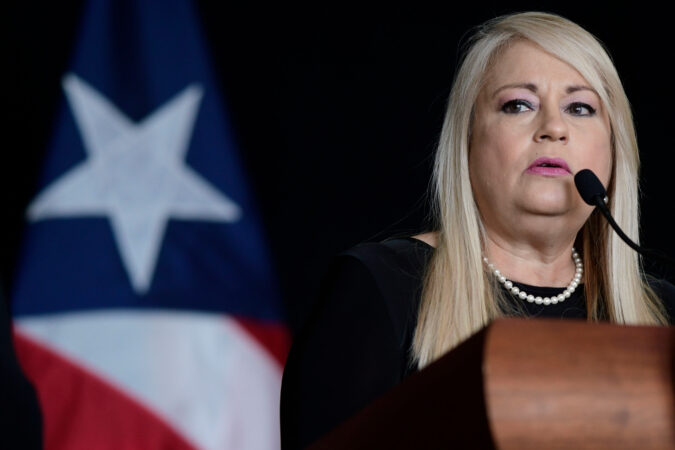
    WASHINGTON — President Donald Trump plans to pardon former Puerto Rico Gov. Wanda Vázquez, a White House official said Friday.

    Vázquez pleaded guilty last August to a campaign finance violation in a federal case that authorities say also involved a former FBI agent and a Venezuelan banker. Her sentencing was set for later this month.

    Federal prosecutors had been seeking one year behind bars, something that Vázquez’s attorneys opposed as they accused prosecutors of violating a guilty plea deal reached last year that saw previous charges including bribery and fraud dropped.

    They noted that Vázquez had agreed to plead guilty to accepting a promise of a campaign contribution that was never received.

    Attorneys for Vázquez did not immediately respond to requests for comment.

    The official who confirmed the planned pardon indicated Trump saw the case as political prosecution and said the investigation into Vázquez, a Republican aligned with the pro-statehood New Progressive Party, had begun 10 days after she endorsed Trump in 2020. The official wasn’t authorized to reveal the news by name and spoke on the condition of anonymity.

    CBS News was the first to report the plan to pardon Vázquez.

    Pablo José Hernández, Puerto Rico’s representative in Congress and a member of the island’s main opposition party, condemned a pardon for Vázquez.

    “Impunity protects and fosters corruption. The pardon … undermines public integrity, shatters faith in justice, and offends those of us who believe in honest governance,” said Hernández, a Democrat with Puerto Rico’s Popular Democratic Party.

    Vázquez, an attorney, was the U.S. territory’s first former governor to plead guilty to a crime, specifically accepting a donation from a foreigner for her 2020 political campaign.

    She was arrested in August 2022 and accused of engaging in a bribery scheme from December 2019 through June 2020 while governor. At the time, she told reporters that she was innocent.

    Authorities said that Puerto Rico’s Office of the Commissioner of Financial Institutions was investigating an international bank owned by Venezuelan Julio Martín Herrera Velutini because of alleged suspicious transactions that had not been reported by the bank.

    Authorities said Herrera and Mark Rossini, a former FBI agent who provided consulting services to Herrera, allegedly promised to support Vázquez’s campaign if she dismissed the commissioner and appointed a new one of Herrera’s choosing.

    Authorities said Vázquez demanded the commissioner’s resignation in February 2020 after allegedly accepting the bribery offer. She also was accused of appointing a new commissioner in May 2020: a former consultant for Herrera’s bank.

    Vázquez was the second woman to serve as Puerto Rico’s governor and the first former governor to face federal charges.

    She was sworn in as governor in August 2019 after former Gov. Ricardo Rosselló resigned following massive protests. Vázquez served until 2021, after losing the primaries of the pro-statehood New Progressive Party to former Gov. Pedro Pierluisi.

  • How the Trump administration erased centuries of Justice Department experience

    How the Trump administration erased centuries of Justice Department experience

    WASHINGTON — Michael Ben’Ary was driving one of his children to soccer practice on an October evening last year when he paused at a red light to check his work phone. He was in the middle of a counterterrorism prosecution so important that President Donald Trump highlighted it in his address to Congress.

    Ben’Ary said he was shocked to see his phone had been disabled. He found the explanation later in his personal email account, a letter informing him he had been fired.

    A veteran prosecutor, Ben’Ary handled high-profile cases over two decades at the Justice Department, including the murder of a Drug Enforcement Administration agent and a suicide bomb plot targeting the U.S. Capitol. Most recently he was leading the case arising from a deadly attack on American service members in Afghanistan.

    Yet the same credentials that enhanced Ben’Ary’s resumé spelled the undoing of his government career.

    His termination without explanation came hours after right-wing commentator Julie Kelly told hundreds of thousands of online followers that Ben’Ary had previously served as a senior counsel to Lisa Monaco, the No. 2 Justice Department official in Democratic President Joe Biden’s administration. Kelly also suggested Ben’Ary was part of the “internal resistance” to prosecuting former FBI Director James Comey, even though Ben’Ary was never involved in the case.

    As Trump’s attorney general, Pam Bondi, approaches her first year on the job, the firings of lawyers such as Ben’Ary have defined her turbulent tenure. The terminations and a larger voluntary exodus of lawyers have erased centuries of combined experience and left the department with fewer career employees to act as a bulwark for the rule of law at a time when Trump, a Republican, is testing the limits of executive power by demanding prosecutions of his political enemies.

    Interviews by the Associated Press of more than a half-dozen fired employees offer a snapshot of the toll throughout the department. The departures include lawyers who prosecuted violent attacks on police at the Capitol on Jan. 6, 2021; environmental, civil rights, and ethics enforcers; counterterrorism prosecutors; immigration judges; and attorneys who defend administration policies. This week, several prosecutors in Minnesota moved to resign amid turmoil over an investigation into the shooting of a woman in Minneapolis by an Immigration and Customs Enforcement officer.

    “To lose people at that career level, people who otherwise intended to stay and now are either being discharged or themselves are walking away, is immensely damaging to the public interest,” said Stuart Gerson, a senior official in the George H.W. Bush administration and acting attorney general early in Bill Clinton’s administration. “We’re losing really capable people, people who have never viewed themselves as political and attempted to do the right thing.”

    Justice Connection, a network of department alums, estimates that more than 230 lawyers, agents, and other employees from across the department were fired last year, apparently because of their work on cases they were assigned or past criticism of Trump, or seemingly for no reason. More than 6,400 employees are estimated to have left a department that at the end of 2025 had roughly 108,000, the group says.

    The Justice Department says it has hired thousands of career attorneys over the past year. The Trump administration has characterized some of the fired and departed workers as out of step with its agenda.

    Ben’Ary left with unfinished business, including the prosecution stemming from the airport bombing in Kabul, the Afghan capital, and the national security unit he led at the U.S. attorney’s office for the Eastern District of Virginia.

    Left to pack his belongings, he posted a typed note near his door that functioned as a distress call, reminding colleagues they had sworn an oath to follow the facts “without fear or favor” and “unhindered by political interference.”

    But, he warned, “In recent months, the political leadership of the Department have violated these principles, jeopardizing our national security and making American citizens less safe.”

    Unparalleled in scale, scope, and motivation

    Since its founding in 1870, the Justice Department has occupied elevated status in American democracy, sustained through transitions of power by reliance on facts, evidence, and law.

    To be sure, there has always been a political component to the department, with lawyers appointed by the president.

    But even during turbulent times, when attorneys general have been pushed out by presidents or resigned rather than accede to White House demands — as in the Watergate-era “Saturday Night Massacre” — the department’s rank and file have generally been insulated thanks to long-recognized civil service protections.

    “This is completely unprecedented in both its scale and scope and underlying motivation,” said Peter Keisler, a senior official in the George W. Bush Justice Department.

    In his first term, Trump pushed out one attorney general and accepted another’s resignation, but the workforce remained largely intact. He returned to office in January 2025 seething over Biden-era prosecutions of him and vowing retribution.

    The firings began even before Bondi arrived in February. Prosecutors on special counsel Jack Smith’s team that investigated Trump were terminated days after the inauguration, followed by prosecutors hired on temporary assignments for cases resulting from the Capitol insurrection in 2021.

    “The people working on these cases were not political agents of any kind,” said Aliya Khalidi, a Jan. 6 prosecutor who was fired. “It’s all people who just care about the rule of law.”

    The firings have continued, at times surgical, at times random and almost always without explanation.

    Adam Schleifer, a Los Angeles prosecutor targeted in a social media post by far-right activist Laura Loomer over past critical comments about Trump, was fired in March. The Justice Department the following month fired attorney Erez Reuveni, who conceded in court that Salvadoran national Kilmar Abrego Garcia was mistakenly deported. Reuveni later accused the department of trying to mislead judges to execute deportations. Department officials deny the assertion.

    Two weeks after Maurene Comey completed a sex trafficking trial against Sean “Diddy” Combs, the New York prosecutor was fired, also without explanation. Like Ben’Ary, she wrote a pointed farewell, telling colleagues that “fear is the tool of a tyrant.” Her father, the former FBI director who was a frequent Trump target, said those same words after being indicted in September in a case that has been dismissed.

    Among the most affected sections is the storied Civil Rights Division. A recent open letter of protest was signed by more than 200 employees who left in 2025, with several supervisors recently giving notice of plans to depart. The Public Integrity Section, which prosecutes sensitive public corruption cases, has also been hollowed out by resignations.

    The Justice Department has disputed the accounts of some of those who have been fired or quit and has defended the termination of those who investigated Trump as “consistent with the mission of ending the weaponization of government.”

    “This is the most efficient Department of Justice in American history, and our attorneys will continue to deliver measurable results for the American people,” the department said in a statement. More than 3,400 career attorneys have been hired since Trump took office, the department says.

    The departures have caused backlogs and staff shortages, with senior leaders soliciting job applications. It has affected the department’s daily business as well as efforts to fulfill Trump’s desires to prosecute political opponents.

    Desperate for lawyers willing to file criminal cases against Comey and New York Attorney General Letitia James, the administration in September forced out the veteran U.S. attorney for the Eastern District of Virginia, replacing him with Lindsey Halligan, a White House aide with no experience as a federal prosecutor.

    Halligan secured the indictments but the win was short-lived.

    One judge later identified grave missteps in how Halligan presented the Comey case to a grand jury. Another dismissed both prosecutions outright, calling Halligan’s appointment unlawful.

    Smith, the special counsel who investigated Trump but left before he could be fired, has himself lamented the losses. “These are not partisans,” he recently told lawmakers.

    “They just want to do good work,” he added, “and I think when you lose that culture, you lose a lot.”

    ‘Our dream was to be federal prosecutors’

    Khalidi joined the department in 2023 in a group of new prosecutors hired to help with the hundreds of cases stemming from the Capitol riot.

    Upon Trump’s return to the White House, she watched cases she prosecuted get dismantled by Trump’s sweeping clemency for all 1,500 defendants charged in the riot, including those who attacked police.

    Less than two weeks later, a Justice Department demand for the names of FBI agents involved in Jan. 6 investigations triggered rumors of potential mass firings. Worried about the agents she worked with, Khalidi spent the day checking in on them. But as she started preparing dinner one Friday evening, she received an email suggesting she had lost her own job.

    Attached was a memo from then-acting Deputy Attorney General Emil Bove ordering the firings of prosecutors such as Khalidi who had been hired for temporary assignments but were moved into permanent roles after Trump’s win, a maneuver Bove called “subversive personnel actions by the previous administration.” Neither the email nor memo identified the fired prosecutors, leaving them to guess.

    Khalidi grabbed a suitcase to collect family photos and other personal items she kept at work and rushed to the office, retreating with fellow shocked prosecutors to a bar where they received termination emails.

    The group of 15 fired attorneys later assembled to surrender their computers and phones, entering the same room where they gathered on their first day in 2023.

    “For a lot of us, our dream was to be federal prosecutors,” Khalidi said. “And so we had happy memories of that room, of being excited on our first day. So it was just kind of surreal to be back there turning in our stuff.”

    The news came for Anam Petit, an immigration judge, during a break between hearings.

    Hired during the Biden administration, she said she felt a little uneasy when Trump won the election but also figured her position would probably be safe because immigration judges generally have job stability and because they bear responsibility for issuing removal orders for those who are in the United States illegally, a core presidential priority.

    Petit arrived on Sept. 5 bracing for bad news because it was the Friday of the pay period before her two-year work anniversary, when her probationary appointment was poised to become permanent. Though she said she had received strong performance reviews and had already exceeded her case completion goal for the year, she had become anxious as colleagues were fired amid an administration push to accelerate deportations.

    She was in the courtroom between hearings when she learned via email that she had been fired. She left to text her husband, then returned to the courtroom to render a decision in the case before her.

    “I just put my phone back in my pocket and went into the courtroom and delivered my decision, with a very shaky voice and shaky hands, trying to center myself back to that decision just so that I could relay it,” Petit said.

    Joseph Tirrell was mindful of his job security from the very start of the Trump administration. As the department’s chief ethics officer, he had affirmed that Smith, the special counsel, was entitled to a law firm’s free legal services, a decision he sensed had the potential to rile incoming leadership.

    But he remained in the position and over the ensuing months counseled Bondi’s staff on the propriety of accepting various gifts, including a cigar box from mixed martial arts fighter Conor McGregor.

    He was fired in July, just before a FIFA Club World Cup final in New Jersey that Tirrell had said Bondi could not ethically accept a free invitation to. He was not terribly surprised, he says, when it was later reported that Bondi attended in Trump’s box. The Justice Department said in a statement that none of Tirrell’s advice “was ever overruled” and that “the Attorney General obtained ethics approval to attend this event in her official capacity as a member of the FIFA Task Force.”

    “There’s a great deal of fear there just because I was fired and just because so many others were summarily fired,” Tirrell said. “Are you going to get fired because you provided ethics advice? Are you going to get fired because you have a pride flag on your desk?”

    ‘Our country depends on you’

    Trump was promoting his administration’s commitment to counterterrorism during his address to Congress in March when he announced a success: the capture of a militant from the Islamic State group’s Afghanistan affiliate who was charged in the Kabul airport bombing that killed 13 American service members during the 2021 withdrawal from the country.

    Mohammad Sharifullah arrived the following day in the United States, encountering Ben’Ary in an Alexandria, Va., courtroom.

    Ben’Ary spent the next several months working on the case, but on Oct. 1, he was fired. It was the apparent result, he told colleagues, of a social media post he said contained “false information” — a reference to the one from Kelly, the commentator.

    The termination was so abrupt that Ben’Ary could not tell his colleagues where he had saved important filings and notes. Another prosecutor listed on the case, James Comey’s son-in-law, Troy Edwards, had resigned days earlier upon Comey’s indictment. Once set for trial last month, the case has been postponed.

    In his farewell note, Ben’Ary observed that he was not alone, that in “just a few short months” career employees like himself had been removed from U.S. attorneys offices, the FBI “and other critical parts of DOJ.”

    “While I am no longer your colleague, I ask that each of you continue to do the right thing, in the right way, for the right reasons,” Ben’Ary wrote. “Follow the facts and the law. Stand up for what we all believe in — our Constitution and the rule of law. Our country depends on you.”
  • Mixed signals and suspicions fueled clash between Fed and prosecutors

    Mixed signals and suspicions fueled clash between Fed and prosecutors

    The battle between the Federal Reserve and Trump administration prosecutors accelerated over the past few weeks amid mixed signals and mutual suspicion, according to interviews with a half-dozen figures with knowledge of both sides of the dispute.

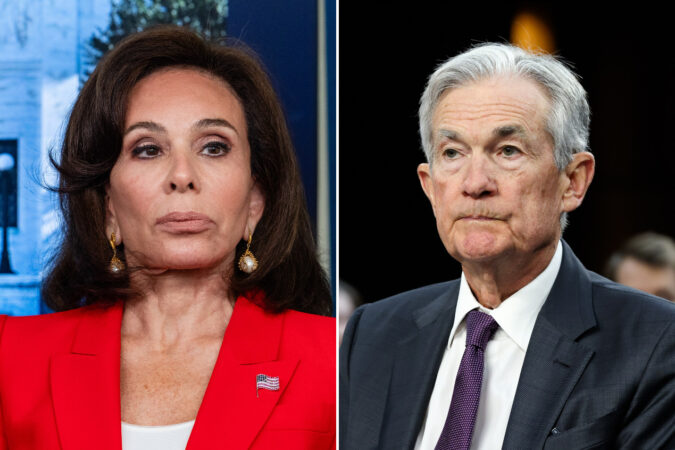
    Late last month, Fed officials grew concerned that the Justice Department was preparing a criminal case against them when they received two casually worded emails from a prosecutor working for Jeanine Pirro, the U.S. attorney for Washington, D.C. The messages sought a meeting or phone call to discuss renovations at the central bank’s headquarters, according to three people familiar with the matter, who like most others interviewed spoke on the condition of anonymity to discuss an open investigation.

    The emails, sent Dec. 19 and Dec. 29, came from Assistant U.S. Attorney Carlton Davis, a political appointee in Pirro’s office whose background includes work for House Oversight Committee Chairman James Comer (R., Ky.), the people said.

    The messages struck Fed officials as breezy in tone.

    “Happy to hop on a call,” one of the missives read in part.

    The casual approach generated suspicions at the Fed. Chair Jerome H. Powell, who by that point had sustained months of criticism from President Donald Trump and his allies over the central bank’s handling of interest rates, retained outside counsel at the law firm Williams & Connolly. Fed officials opted not to respond to Davis, choosing to avoid informal engagement on a matter that could carry criminal implications, according to a person familiar with the decision.

    That led Pirro, a former Fox News host and longtime personal friend of Trump’s, to conclude that the Fed was stonewalling and had something to hide, according to a Justice Department official familiar with the matter.

    “The claim that, ‘Oh, they didn’t think it was a big deal’ is naive and almost malpractice,” the official said. “We gave them a deadline. We said the first week of January.”

    The investigation centers on the Fed’s first large-scale renovation of its headquarters on the National Mall since it was built in the 1930s and whether proper cost controls are in place. Powell testified to Congress in June about the scope of a project that had ballooned to $2.5 billion in costs, up from about $1.9 billion before the coronavirus pandemic.

    Trump, his aides, and some congressional Republicans have sought to cast the renovation as overly luxurious and wildly over budget, claims that Powell has strenuously disputed. Fed officials have said that the economic disruptions following the pandemic triggered a jump in the price of steel, cement, and other building materials.

    Powell and the Fed’s defenders say the renovation claims are being used to pressure the independent central bank to lower interest rates, as Trump has called for, and potentially to bully Powell into resigning.

    The emails from Davis to a Federal Reserve lawyer did not indicate the existence of a criminal investigation because prosecutors had not yet opened one, according to two people with knowledge of the matter. There was no FBI involvement when Pirro’s office opened a fact-gathering inquiry in November, and the bureau remains uninvolved, according to two other people familiar with the matter.

    In the emails, Davis asked “to discuss Powell’s testimony in June, the building renovation, and the timing of some of his decisions,” a Justice Department official said. “The letter couldn’t have been nicer,” that official said. “About 10 days after that, we sent another, saying, ‘We just want to have a discussion with you.’ No response through January 8.”

    “We low-keyed it,” the official added. “We didn’t publicize it. We did it quietly.”

    The subpoenas were served the next day. They seek records or live testimony before a grand jury at the end of the month.

    Powell publicly disclosed the probe Sunday evening in a video statement, saying the Fed had received subpoenas “threatening a criminal indictment.”

    “The threat of criminal charges is a consequence of the Federal Reserve setting interest rates based on our best assessment of what will serve the public, rather than following the preferences of the president,” he said.

    In a post on X, Pirro said the outreach had been benign, writing: “The word ‘indictment’ has come out of Mr. Powell’s mouth, no one else’s. None of this would have happened if they had just responded to our outreach.”

    Conducting an investigation without using the FBI is an approach Pirro’s office has used on at least one previous occasion. In August, one of the prosecutors now assigned to the Fed inquiry, Steven Vandervelden, was tasked with reviewing numerous complaints that the D.C. police, under then-Police Chief Pamela A. Smith, had been incorrectly categorizing some crimes to paint a rosier picture than the reality on the ground.

    That inquiry relied on voluntary interviews with more than 50 police officers and other witnesses, as well as cooperation from the mayor’s office and the police department’s internal affairs unit, according to a seven-page report Pirro and Vandervelden issued at its conclusion. The report recommended changes to police practices while saying the classification issues did not rise to the level of criminality. No subpoenas were issued in that probe, according to a person familiar with the matter, and the report does not mention any.

    But Smith announced her resignation shortly before the report was released.

  • Trump says he may punish countries with tariffs if they don’t back the US controlling Greenland

    Trump says he may punish countries with tariffs if they don’t back the US controlling Greenland

    COPENHAGEN, Denmark — U.S. President Donald Trump suggested Friday that he may punish countries with tariffs if they don’t back the U.S. controlling Greenland, a message that came as a bipartisan Congressional delegation sought to lower tensions in the Danish capital.

    Trump for months has insisted that the U.S. should control Greenland, a semiautonomous territory of NATO ally Denmark, and said earlier this week that anything less than the Arctic island being in U.S. hands would be “unacceptable.”

    During an unrelated event at the White House about rural healthcare, he recounted Friday how he had threatened European allies with tariffs on pharmaceuticals.

    “I may do that for Greenland too,” Trump said. “I may put a tariff on countries if they don’t go along with Greenland, because we need Greenland for national security. So I may do that,” he said.

    He had not previously mentioned using tariffs to try to force the issue.

    Earlier this week, the foreign ministers of Denmark and Greenland met in Washington with U.S. Vice President JD Vance and Secretary of State Marco Rubio.

    That encounter didn’t resolve the deep differences, but did produce an agreement to set up a working group — on whose purpose Denmark and the White House then offered sharply diverging public views.

    European leaders have insisted that it is only for Denmark and Greenland to decide on matters concerning the territory, and Denmark said this week that it was increasing its military presence in Greenland in cooperation with allies.

    A relationship ‘we need to nurture’

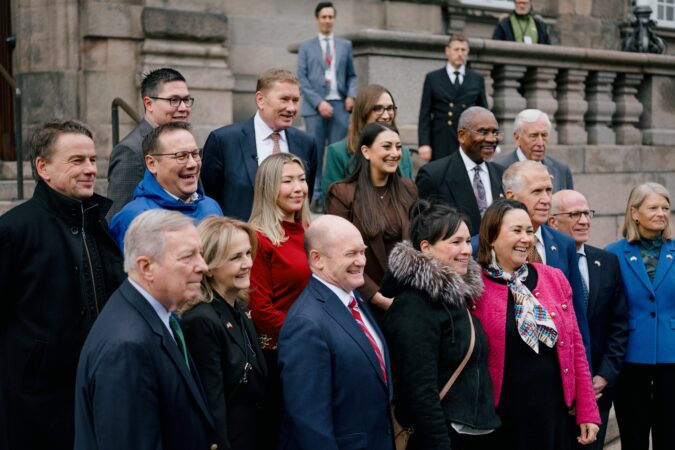
    In Copenhagen, a group of senators and members of the House of Representatives met Friday with Danish and Greenlandic lawmakers, and with leaders including Danish Prime Minister Mette Frederiksen.

    Delegation leader Sen. Chris Coons, a Delaware Democrat, thanked the group’s hosts for “225 years of being a good and trusted ally and partner” and said that “we had a strong and robust dialogue about how we extend that into the future.”

    Sen. Lisa Murkowski, an Alaska Republican, said after meeting lawmakers that the visit reflected a strong relationship over decades and “it is one that we need to nurture.” She told reporters that “Greenland needs to be viewed as our ally, not as an asset, and I think that’s what you’re hearing with this delegation.”

    The tone contrasted with that emanating from the White House. Trump has sought to justify his calls for a U.S. takeover by repeatedly claiming that China and Russia have their own designs on Greenland, which holds vast untapped reserves of critical minerals. The White House hasn’t ruled out taking the territory by force.

    “We have heard so many lies, to be honest, and so much exaggeration on the threats towards Greenland,” said Aaja Chemnitz, a Greenlandic politician and member of the Danish parliament who took part in Friday’s meetings. “And mostly, I would say the threats that we’re seeing right now is from the U.S. side.”

    Murkowski emphasized the role of Congress in spending and in conveying messages from constituents.

    “I think it is important to underscore that when you ask the American people whether or not they think it is a good idea for the United States to acquire Greenland, the vast majority, some 75%, will say, we do not think that that is a good idea,” she said.

    Along with Sen. Jeanne Shaheen, a New Hampshire Democrat, Murkowski has introduced bipartisan legislation that would prohibit the use of U.S. Defense or State department funds to annex or take control of Greenland or the sovereign territory of any NATO member state without that ally’s consent or authorization from the North Atlantic Council.

    Inuit council criticizes White House statements

    The dispute is looming large in the lives of Greenlanders. Greenland’s prime minister, Jens-Frederik Nielsen, said on Tuesday that “if we have to choose between the United States and Denmark here and now, we choose Denmark. We choose NATO. We choose the Kingdom of Denmark. We choose the EU.”

    In Nuuk, the chairperson of the Greenland-based Inuit Circumpolar Council, which represents around 180,000 Inuit from Alaska, Canada, Greenland, and Russia’s Chukotka region on international issues, said persistent statements from the White House that the U.S. must own Greenland offer “a clear picture of how the U.S. administration views the people of Greenland, how the U.S. administration views Indigenous peoples, and peoples that are few in numbers.”

    Sara Olsvig told the Associated Press in Nuuk that the issue is “how one of the biggest powers in the world views other peoples that are less powerful than them. And that really is concerning.”

    Indigenous Inuit in Greenland do not want to be colonized again, she said.

  • Trump thanks Iran for canceling executions as senior cleric issues threats

    Trump thanks Iran for canceling executions as senior cleric issues threats

    WASHINGTON — President Donald Trump took the unusual step on Friday of thanking the Iranian government for not following through on executions of what he said was meant to be hundreds of political prisoners.

    “Iran canceled the hanging of over 800 people,” Trump told reporters while leaving the White House to spend the weekend at his Mar-a-Lago estate in Palm Beach, Fla. He added, “and I greatly respect the fact that they canceled.”

    The Republican president also suggested on his social media site that more than 800 people had been set to be executed, but he said they now won’t be.

    “Thank you!” he posted.

    Those sentiments come after Trump spent days suggesting that the U.S. might strike Iran militarily if its government triggered mass killings during widespread protests that have swept that country.

    The death toll from those protests continues to rise, activists say. Still, Trump seemed to hint that the prospects for U.S. military action were fading since Iran had held off on the executions.

    The president’s rosy assessment did not match the more complicated situation on the ground in Iran but appeared to be Trump backing away from his early pronouncements that suggested a U.S. attack on that country might be imminent.

    Trump had previously posted of Iran and the protesters there, “Help is on the way.” But asked if that was still the case on Friday, he replied: “Well, we’re going to see.”

    Questioned about who convinced him to back down on seeming suggestions that he would strike Iran, Trump said, “Nobody convinced me. I convinced myself.”

    “You had yesterday scheduled over 800 hangings. They didn’t hang anyone,” Trump said. “They canceled the hangings. That had a big impact.”

    Cleric warns of ‘hard revenge’ on Trump, Netanyahu

    As Iran returned to uneasy calm, a senior hard-line cleric called Friday for the death penalty for detained demonstrators and directly threatened Trump — evidence of the rage gripping authorities in the Islamic Republic.

    Harsh repression that has left several thousand people dead appears to have succeeded in stifling demonstrations that began Dec. 28 over Iran’s ailing economy and morphed into protests directly challenging the country’s theocracy.

    There have been no signs of protests for days in Tehran, where shopping and street life have returned to outward normality, though a week-old internet blackout continued. Authorities have not reported any unrest elsewhere in the country.

    The U.S.-based Human Rights Activists News Agency on Friday put the death toll, at 2,797. The number continues to rise.

    Iran’s exiled Crown Prince Reza Pahlavi urged the U.S. to make good on its pledge to intervene, calling Trump “a man of his word.”

    Ayatollah Ahmad Khatami’s sermon, carried by Iranian state radio, sparked chants from those gathered for prayers, including: “Armed hypocrites should be put to death!” Executions, as well as the killing of peaceful protesters, are two of the red lines laid down by Trump for possible military action against Iran.

    Khatami, a member of Iran’s Assembly of Experts and Guardian Council long known for his hard-line views, described the protesters as the “butlers” of Israeli Prime Minister Benjamin Netanyahu and “Trump’s soldiers.” He insisted their plans “imagined disintegrating the country.”

    “They should wait for hard revenge from the system,” Khatami said of Netanyahu and Trump. “Americans and Zionists should not expect peace.”

    His fiery speech came as allies of Iran and the United States alike sought to defuse tensions. Russian President Vladimir Putin spoke Friday to both Iranian President Masoud Pezeshkian and Israel’s Netanyahu, Kremlin spokesperson Dmitry Peskov said.

    Peskov said “the situation in the region is quite tense, and the president is continuing his efforts to help de-escalate it.”

    Russia had previously kept largely quiet about the protests. Moscow has watched several key allies suffer blows as its resources and focus are consumed by its 4-year-old war against Ukraine, including the downfall of Syria’s former President Bashar Assad in 2024, last year’s U.S. and Israeli attacks on Iran, and the U.S. seizure of Venezuelan leader Nicolas Maduro this month.

    Exiled Iranian royal calls for fight to continue

    Days after Trump pledged “help is on its way” for the protesters, both the demonstrations and the prospect of imminent U.S. retaliation appeared to have receded. One diplomat told the Associated Press that top officials from Egypt, Oman, Saudi Arabia, and Qatar had raised concerns with Trump that a U.S. military intervention would shake the global economy and destabilize an already volatile region.

    Yet the Trump administration has warned it will act if Iran executes detained protesters. Pahlavi, whose father was overthrown by Iran’s 1979 Islamic Revolution, said he still believes the president’s promise of assistance.

    “I believe the president is a man of his word,” Pahlavi told reporters in Washington. He added that ”regardless of whether action is taken or not, we as Iranians have no choice to carry on the fight.“

    Despite support by diehard monarchists in the diaspora, Pahlavi has struggled to gain wider appeal within Iran. But that has not stopped him from presenting himself as the transitional leader of Iran if the regime were to fall.

    Iran and the U.S. traded angry accusations Thursday at a session of the United Nations Security Council, with U.S. ambassador Mike Waltz saying that Trump “has made it clear that all options are on the table to stop the slaughter.”

    Gholam Hossein Darzi, the deputy Iranian ambassador to the U.N., blasted the U.S. for what he said was American “direct involvement in steering unrest in Iran to violence.”

    Iran authorities list protest damage

    Khatami, the hard-line cleric, also provided the first overall statistics on damage from the protests, claiming 350 mosques, 126 prayer halls, and 20 other holy places had sustained damage. Another 80 homes of Friday prayer leaders — an important position within Iran’s theocracy — were also damaged, likely underlining the anger demonstrators felt toward symbols of the government.

    He said 400 hospitals, 106 ambulance, 71 fire department vehicles, and another 50 emergency vehicles also sustained damage.

    Even as protests appeared to have been smothered inside Iran, thousands of exiled Iranians and their supporters have taken to the streets in cities across Europe to shout out their rage at the government of the Islamic Republic.

    Amid the continuing internet shutdown, some Iranians crossed borders to communicate with the outside world. At a border crossing in Turkey’s eastern province of Van, a trickle of Iranians crossing Friday said they were traveling to get around the communications blackout.

    “I will go back to Iran after they open the internet,” said a traveler who gave only his first name, Mehdi, out of security concerns.

    Also crossing the border were some Turkish citizens escaping the unrest in Iran.

    Mehmet Önder, 47, was in Tehran for his textiles business when the protests erupted. He said laid low in his hotel until it was shut for security reasons, then stayed with one of his customers until he was able to return to Turkey.

    Although he did not venture into the streets, Önder said he heard heavy gunfire.

    “I understand guns, because I served in the military in the southeast of Turkey,” he said. “The guns they were firing were not simple weapons. They were machine guns.”

    In a sign of the conflict’s potential to spill over borders, a Kurdish separatist group in Iraq said it has launched attacks on Iran’s paramilitary Revolutionary Guard in recent days in retaliation for Tehran’s crackdown on protests.

    A representative of the Kurdistan Freedom Party, or PAK, said its members have “played a role in the protests through both financial support and armed operations to defend protesters when needed.” The group said the attacks were launched by members of its military wing based inside Iran.

    The death toll of at least 2,797, provided by the Human Rights Activists News Agency, exceeds that of any other round of protest or unrest in Iran in decades and recalls the chaos surrounding the 1979 revolution.

    The agency has been accurate throughout years of demonstrations, relying on a network of activists inside Iran that confirms all reported fatalities. The AP has been unable to independently confirm the toll. Iran’s government has not provided casualty figures.

  • Mixed signals and mutual suspicions fueled the clash between the Federal Reserve and Trump administration prosecutors

    Mixed signals and mutual suspicions fueled the clash between the Federal Reserve and Trump administration prosecutors

    The battle between the Federal Reserve and Trump administration prosecutors accelerated over the past few weeks amid mixed signals and mutual suspicion, according to interviews with a half-dozen figures with knowledge of both sides of the dispute.

    Late last month, Fed officials grew concerned that the Justice Department was preparing a criminal case against them when they received two casually worded emails from a prosecutor working for Jeanine Pirro, the U.S. attorney for Washington, D.C. The messages sought a meeting or phone call to discuss renovations at the central bank’s headquarters, according to three people familiar with the matter, who like most others interviewed spoke on the condition of anonymity to discuss an open investigation.

    The emails, sent Dec. 19 and Dec. 29, came from Assistant U.S. Attorney Carlton Davis, a political appointee in Pirro’s office whose background includes work for House Oversight Committee Chairman James Comer (R-Kentucky), the people said.

    The messages struck Fed officials as breezy in tone.

    “Happy to hop on a call,” one of the missives read in part.

    The casual approach generated suspicions at the Fed. Chair Jerome H. Powell, who by that point had sustained months of criticism from President Donald Trump and his allies over the central bank’s handling of interest rates, retained outside counsel at the law firm Williams & Connolly. Fed officials opted not to respond to Davis, choosing to avoid informal engagement on a matter that could carry criminal implications, according to a person familiar with the decision.

    That led Pirro, a former Fox News host and longtime personal friend of Trump’s, to conclude that the Fed was stonewalling and had something to hide, according to a Justice Department official familiar with the matter.

    “The claim that, ‘Oh, they didn’t think it was a big deal’ is naive and almost malpractice,” the official said. “We gave them a deadline. We said the first week of January.”

    The investigation centers on the Fed’s first large-scale renovation of its headquarters on the National Mall since it was built in the 1930s and whether proper cost controls are in place. Powell testified to Congress in June about the scope of a project that had ballooned to $2.5 billion in costs, up from about $1.9 billion before the coronavirus pandemic.

    Trump, his aides and some congressional Republicans have sought to cast the renovation as overly luxurious and wildly over budget, claims that Powell has strenuously disputed. Fed officials have said that the economic disruptions following the pandemic triggered a jump in the price of steel, cement and other building materials.

    Powell and the Fed’s defenders say the renovation claims are being used to pressure the independent central bank to lower interest rates, as Trump has called for, and potentially to bully Powell into resigning.

    The emails from Davis to a Federal Reserve lawyer did not indicate the existence of a criminal investigation because prosecutors had not yet opened one, according to two people with knowledge of the matter. There was no FBI involvement when Pirro’s office opened a fact-gathering inquiry in November, and the bureau remains uninvolved, according to two other people familiar with the matter.

    In the emails, Davis asked “to discuss Powell’s testimony in June, the building renovation, and the timing of some of his decisions,” a Justice Department official said. “The letter couldn’t have been nicer,” that official said. “About 10 days after that, we sent another, saying, ‘We just want to have a discussion with you.’ No response through January 8.”

    “We low-keyed it,” the official added. “We didn’t publicize it. We did it quietly.”

    The subpoenas were served the next day. They seek records or live testimony before a grand jury at the end of the month.

    Powell publicly disclosed the probe Sunday evening in a video statement, saying the Fed had received subpoenas “threatening a criminal indictment.”

    “The threat of criminal charges is a consequence of the Federal Reserve setting interest rates based on our best assessment of what will serve the public, rather than following the preferences of the president,” he said.

    In a post on X, Pirro said the outreach had been benign, writing: “The word ‘indictment’ has come out of Mr. Powell’s mouth, no one else’s. None of this would have happened if they had just responded to our outreach.”

    Conducting an investigation without using the FBI is an approach Pirro’s office has used on at least one previous occasion. In August, one of the prosecutors now assigned to the Fed inquiry, Steven Vandervelden, was tasked with reviewing numerous complaints that the D.C. police, under then-Police Chief Pamela A. Smith, had been incorrectly categorizing some crimes to paint a rosier picture than the reality on the ground.

    That inquiry relied on voluntary interviews with more than 50 police officers and other witnesses, as well as cooperation from the mayor’s office and the police department’s internal affairs unit, according to a seven-page report Pirro and Vandervelden issued at its conclusion. The report recommended changes to police practices while saying the classification issues did not rise to the level of criminality. No subpoenas were issued in that probe, according to a person familiar with the matter, and the report does not mention any.

    But Smith announced her resignation shortly before the report was released.

  • The White House and a bipartisan group of governors, including Josh Shapiro, want to fix AI-driven power shortages and price spikes

    The White House and a bipartisan group of governors, including Josh Shapiro, want to fix AI-driven power shortages and price spikes

    Washington — The Trump administration and a bipartisan group of governors on Friday tried to step up pressure on the operator of the nation’s largest electric grid to take urgent steps to boost power supplies and keep electricity bills from rising even higher.

    Administration officials said doing so is essential to win the artificial-intelligence race against China, even as voters raise concerns about the enormous amount of power data centers use and analysts warn of the growing possibility of blackouts in the Mid-Atlantic grid in the coming years.

    “We know that with the demands of AI and the power and the productivity that comes with that, it’s going to transform every job and every company and every industry,” Interior Secretary Doug Burgum told reporters at the Eisenhower Executive Office Building, next to the White House. “But we need to be able to power that in the race that we are in against China.”

    Trump administration says it has ‘the answer’

    The White House and governors want the Mid-Atlantic grid operator to hold a power auction for tech companies to bid on contracts to build new power plants, so that data center operators, not regular consumers, pay for their power needs.

    They also want the operator, PJM Interconnection, to contain consumer costs by extending a cap that it imposed last year, under pressure from governors, that limited the increase of wholesale electricity payments to power plant owners. The cap applied to payments through mid-2028.

    “Our message today is just to try and push PJM … to say, ‘we know the answer.’ The answer is we need to be able to build new generation to accommodate new jobs and new growth,” Energy Secretary Chris Wright said.

    Govs. Josh Shapiro of Pennsylvania, Glenn Youngkin of Virginia, and Wes Moore of Maryland appeared with Burgum and Wright and expressed frustration with PJM.

    “We need more energy on the grid and we need it fast,” Shapiro said. He accused PJM of being “too damn slow” to bring new power generation online as demand is surging.

    Shapiro said the agreement could save the 65 million Americans reliant on that grid $27 billion over the next several years. He warned Pennsylvania would leave the PJM market if the grid operator does not align with the agreement, a departure that would threaten to create even steeper price challenges for the region.

    PJM wasn’t invited to the event.

    Grid operator is preparing its own plan to meet demand

    However, PJM’s board is nearing the release of its own plan after months of work and will review recommendations from the White House and governors to assess how they align with its decision, a spokesperson said Friday.

    PJM has searched for ways to meet rising electricity demand, including trying to fast-track new power plants and suggesting that utilities should bump data centers off the grid during power emergencies. The tech industry opposed the idea.

    The White House and governors don’t have direct authority over PJM, but grid operators are regulated by the Federal Energy Regulatory Commission, which is chaired by an appointee of President Donald Trump.

    Trump and governors are under pressure to insulate consumers and businesses alike from the costs of feeding Big Tech’s data centers. Meanwhile, more Americans are falling behind on their electricity bills as rates rise faster than inflation in many parts of the U.S.

    In some areas, bills have risen because of strained natural gas supplies or expensive upgrades to transmission systems, to harden them against more extreme weather or wildfires. But energy-hungry data centers are also a factor in some areas, consumer advocates say.

    Ratepayers in the Mid-Atlantic grid — which encompasses all or parts of 13 states stretching from New Jersey to Illinois, as well as Washington, D.C. — are already paying billions more to underwrite power supplies to data centers, some of which haven’t been built yet, analysts say.

    Critics also say these extra billions aren’t resulting in the construction of new power plants needed to meet the rising demand.

    Tech giants say they’re working to lower consumer costs

    Technology industry groups have said their members are willing to pay their fair share of electricity costs.

    On Friday, the Information Technology Industry Council, which represents tech giants Google, Meta, Microsoft, and Amazon, said it welcomed the White House’s announcement and the opportunity “to craft solutions to lower electricity bills.” It said the tech industry is committed to “making investments to modernize the grid and working to offset costs for ratepayers.”

    The Edison Electric Institute, which represents investor-owned electric companies, said it supports having tech companies bid — and pay for — contracts to build new power plants.

    The idea is a new and creative one, said Rob Gramlich, president of Grid Strategies LLC, a Washington, D.C.-based energy markets and transmission consultancy.

    But it’s not clear how or if it’ll work, or how it fits into the existing industry structure or state and federal regulations, Gramlich said.

    Part of PJM’s problem in keeping up with power demand is that getting industrial construction permits typically takes longer in the Mid-Atlantic region than, say, Texas, which is also seeing strong energy demand from data centers, Gramlich said.

    In addition, utilities in many PJM states that deregulated the energy industry were not signing up power plants to long-term contracts, Gramlich said.

    That meant that the electricity was available to tech companies and data center developers that had large power needs and bought the electricity, putting additional stress on the Mid-Atlantic grid, Gramlich said.

    “States and consumers in the region thought that power was there for them, but the problem is they hadn’t bought it,” Gramlich said.

    Associated Press writer Matthew Daly and The Washington Post contributed to this article.

  • Grok blocked from undressing images in places where it’s illegal, X says

    Grok blocked from undressing images in places where it’s illegal, X says

    BANGKOK — Elon Musk’s AI chatbot Grok won’t be able to edit photos to portray real people in revealing clothing in places where that is illegal, according to a statement posted on X.

    The announcement late Wednesday followed a global backlash over sexualized images of women and children, including bans and warnings by some governments.

    The pushback included an investigation announced Wednesday by the state of California, the U.S.’s most populous, into the proliferation of nonconsensual sexually explicit material produced using Grok that it said was harassing women and girls.

    Initially, media queries about the problem drew only the response, “legacy media lies.”

    Musk’s company, xAI, now says it will geoblock content if it violates laws in a particular place.

    “We have implemented technological measures to prevent the Grok account from allowing the editing of images of real people in revealing clothing such as bikinis, underwear and other revealing attire,” it said.

    The rule applies to all users, including paid subscribers, who have access to more features.

    xAI also has limited image creation or editing to paid subscribers only “to ensure that individuals who attempt to abuse the Grok account to violate the law or our policies can be held accountable.”

    The Associated Press confirmed on Thursday morning that the image editing tool was still available to free users on X using the “Edit image” button, as well as on the standalone Grok website and app. The tool was also able to generate images of people in bikinis on a free account based in California.

    Grok’s “spicy mode” had allowed users to create explicit content, leading to a backlash from governments worldwide.

    Malaysia and Indonesia took legal action and blocked access to Grok, while authorities in the Philippines said they were working to do the same, possibly within the week. The U.K. and European Union were investigating potential violations of online safety laws.

    France and India have also issued warnings, demanding stricter controls. Brazil called for an investigation into Grok’s misuse.

    The British government, which has been one of Grok’s most vociferous critics in recent days, has welcomed the change, while the country’s regulator, Ofcom, said it would carry on with its investigation.

    “I shall not rest until all social media platforms meet their legal duties and provide a service that is safe and age-appropriate to all users,” Technology Secretary Liz Kendall said.

    California Attorney General Rob Bonta urged xAI to ensure there is no further harassment of women and girls from Grok’s editing functions.

    “We have zero tolerance for the AI-based creation and dissemination of nonconsensual intimate images or of child sexual abuse material,” he said.

    California has passed laws to shield minors from AI-generated sexual imagery of children and require AI chatbot platforms to remind users they aren’t interacting with a human.

    But Democratic Gov. Gavin Newsom also vetoed a law last year that would have restricted children’s access to AI chatbots.

  • Federal immigration agents filmed dragging a woman from her car in Minneapolis

    Federal immigration agents filmed dragging a woman from her car in Minneapolis

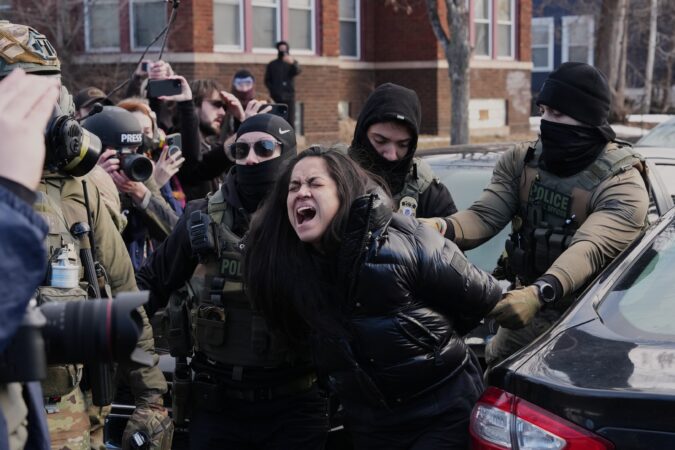
    A U.S. citizen on her way to a medical appointment in Minneapolis was dragged out of her car and detained by immigration officers, according to a statement released by the woman on Thursday, after a video of her arrest drew millions of views on social media.

    Aliya Rahman said she was brought to a detention center where she was denied medical care and lost consciousness. The Department of Homeland Security said she was an agitator who was obstructing ICE agents conducting arrests in the area.

    That video is the latest in a deluge of online content that documents an intensifying immigration crackdown across the midwestern city, as thousands of federal agents execute arrests amid protests in what local officials have likened to a “federal invasion.”

    Dragged from her car

    Rahman said that she was on her way to a routine appointment at the Traumatic Brain Injury Center when she encountered federal immigration agents at an intersection. Video appears to show federal immigration agents shouting commands over a cacophony of whistles, car horns and screams from protesters.

    In the video, one masked agent smashes Rahman’s passenger side window while others cut her seatbelt and drag her out of the car through the driver’s side door. Numerous guards then carried her by her arms and legs towards an ICE vehicle.

    “I’m disabled trying to go to the doctor up there, that’s why I didn’t move,” Rahman said, gesturing down the street as officers pulled her arms behind her back.

    A spokesperson for the Department of Homeland Security disputed that account in an emailed statement on Thursday, saying that Rahman was an agitator who “ignored multiple commands by an officer to move her vehicle away from the scene.” She was arrested along with six other people the department called agitators, one of whom was accused of jumping on an officer’s back.

    The department did not specify if Rahman was charged or respond to questions about her assertion that she was denied medical treatment.

    Barrage of viral videos draw scrutiny

    The video of Rahman’s arrest is one of many that have garnered millions of views in recent days — and been scrutinized amid conflicting accounts from federal officials and civilian eyewitnesses.

    Often, what’s in dispute pertains to what happened just before or just after a given recording. But many contain common themes: Protesters blowing whistles, yelling or honking horns. Immigration officers breaking vehicle windows, using pepper spray on protesters and warning observers not to follow them through public spaces. Immigrants and citizens alike forcibly pulled from cars, stores or homes and detained for hours, days or longer.

    In one video, heavily armed immigration agents used a battering ram to break through the front door of Garrison Gibson’s Minneapolis home, where his wife and 9-year-old child also were inside. The video shot inside the home captures a woman’s voice asking, “Where is the warrant?” and, “Can you put the guns down? There is kids in this house.”

    Another video shows ICE agents, including Border Patrol Cmdr. Gregory Bovino, detain two employees at a Target store in Richfield, Minnesota. Both are U.S. citizens who were later released, according to social media posts from family members.

    Monica Bicking, 40, was leaving the homeless shelter where she works as a nurse when she took a video that appears to show a federal agent kneeing a man at least five times in the face while several other agents pin him facedown on the pavement in south Minneapolis.

    Bicking works full time, so she says she doesn’t intentionally attend organized protests or confrontations with ICE. But she has started to carry a whistle in case she encounters ICE agents on her way to work or while running errands, which she says has become commonplace in recent weeks.

    “We’re hypervigilant every time we leave our houses, looking for ICE, trying to protect our neighbors, trying to support our neighbors, who are now just on lockdown,” Bicking said.

    ‘I thought I was going to die’

    Rahman said in her statement that after her detainment, she felt lucky to be alive.

    “Masked agents dragged me from my car and bound me like an animal, even after I told them that I was disabled,” Rahman said.

    While in custody, Rahman said she repeatedly asked for a doctor, but was instead taken to the detention center.

    “It was not until I lost consciousness in my cell that I was finally taken to a hospital,” Rahman said.

    Rahman was treated for injuries consistent with assault, according to her counsel, and has been released from the hospital.

    She thanked the emergency department staff for their care.

    “They gave me hope when I thought I was going to die.”

  • Senate passes more spending bills, but Homeland Security dispute looms

    Senate passes more spending bills, but Homeland Security dispute looms

    WASHINGTON — Congress is halfway home in approving government funding for the current budget year that began Oct. 1 after the Senate on Thursday overwhelmingly passed a three-bill package.

    Now comes the hard part. Lawmakers still must negotiate a spending bill for the Department of Homeland Security amid soaring tensions on Capitol Hill after the shooting of a Minnesota woman by an Immigration and Customs Enforcement agent.

    Lawmakers are working to complete passage of all 12 annual spending bills before Jan. 30, the deadline set in a funding patch that ended a 43-day government shutdown in November. With the Senate’s action on Thursday, six of those bills have now passed through both chambers of Congress. The measure before the Senate passed by a broadly bipartisan vote of 82-15. It now goes to President Donald Trump to be signed into law.

    That recent success would greatly reduce the impact of a shutdown, in the unlikely event that there is one at the end of January, since lawmakers have now provided full-year funding for such agencies as the Departments of Agriculture, Commerce, Energy, Interior and Justice.

    Lawmakers from both parties are determined to prevent another lapse in funding for the remaining agencies. The House’s approval of a separate two-bill package this week nudges them closer to getting all 12 done in the next two weeks.

    “Our goal, Mr. President is to get all of these bills signed into law. No continuing resolutions that lock in previous priorities and don’t reflect today’s realities,” said Sen. Susan Collins, the Republican chair of the Senate Appropriations Committee. “No more disastrous government shutdowns that are totally unnecessary and so harmful.”

    ICE shooting inflames debate on funding

    The biggest hurdle ahead is the funding bill for the Department of Homeland Security. The plan was to bring that bill before the House this week, but Rep. Tom Cole, the chairman of the House Appropriations Committee, said the decision was made to pull the bill and “buy some time” as lawmakers respond to the Minneapolis shooting.

    Democrats are seeking what Rep. Rosa DeLauro called “guardrails” that would come with funding for ICE.

    “We can’t deal with the lawlessness and terrorizing of communities,” said DeLauro (D., Conn.), the top Democrat on the House Appropriations Committee. “We’re going back and forth with offers, and that’s where we are.”

    Trump’s deportation crackdown, focused on cities in Democratic-leaning states, has incensed many House Democrats who demand a strong legislative response. Last week, an Immigration and Customs Enforcement officer shot and killed Renee Good in a shooting that federal officials said was an act of self-defense but that the mayor described as reckless and unnecessary.

    Some 70 Democrats have signed onto an effort to impeach Homeland Security Secretary Kristi Noem. Others are seeking specific changes to how the agency operates, such as requiring ICE agents to wear body cameras.

    “There are a variety of different things that can be done that we have put on the table and will continue to put on the table to get ICE under control so that they are actually conducting themselves like every other law enforcement agency in the country, as opposed to operating as if they’re above the law, somehow thinking they’ve got absolute immunity,” said Democratic leader Hakeem Jeffries.

    The Congressional Progressive Caucus, which includes nearly 100 Democratic members, formally announced opposition to any funding to immigration enforcement agencies within the Department of Homeland Security “unless there are meaningful and significant reforms to immigration enforcement practices.”

    Looking for a solution

    Cole said any changes to the Homeland Security funding bill would need sign-on from the White House. He said one possible answer would be to let Democrats have a separate vote on the Homeland Security bill. If passed, it would then be combined with some other spending bills for transmittal to the Senate. Republicans used a similar procedural tactic to get a previous spending package over the finish line in the House.

    The options for Democrats on Homeland Security are all rather bleak. If Congress passes a continuing resolution to fund the agency at current levels, that gives the Trump administration more discretion to spend the money as it wants.

    Meanwhile, any vote to eliminate funding for ICE won’t stop massive sums from flowing to the agency because Trump’s tax cut and border security bill, passed last summer, injects roughly $170 billion into immigration enforcement over the next four years.

    Also, any vote to eliminate funding could put some Democrats in tough reelection battles in a difficult position this fall as Republicans accuse them of insufficiently supporting law enforcement.