Category: Wires

  • Trump softens tone as some federal agents expected to leave Minneapolis

    Trump softens tone as some federal agents expected to leave Minneapolis

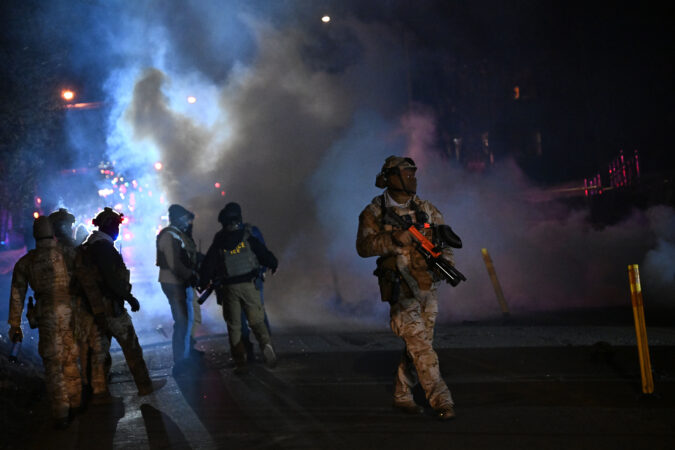
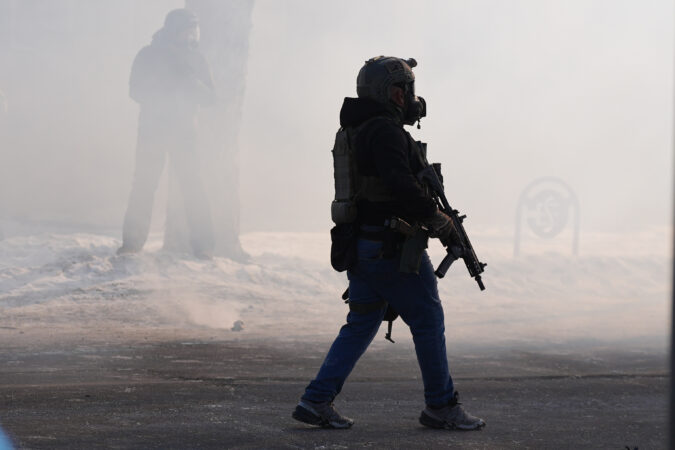
    MINNEAPOLIS — President Donald Trump softened his tone Monday on the immigration crackdown in Minnesota, touting productive conversations with the governor and Minneapolis mayor as he sent the border czar to take charge of much of the enforcement effort. Some federal agents were expected to leave as soon as today.

    Minneapolis Mayor Jacob Frey said he spoke by phone with Trump, who praised the discussion and declared that “lots of progress is being made.” Frey said he asked Trump in a phone call to end the immigration enforcement surge and that Trump agreed the present situation cannot continue.

    The mayor said some agents would soon leave and that he would keep pushing for others involved in Operation Metro Surge to go.

    Among those who are expected to depart was senior Border Patrol commander Greg Bovino, a person familiar with the matter told the Associated Press. The person was not authorized to publicly discuss details of the operation and spoke to AP on condition of anonymity.

    Bovino has been at the center of the administration’s aggressive enforcement surge in cities nationwide. His departure marks a significant public shift in federal law enforcement posture amid mounting outrage over the fatal shooting of 37-year-old ICU nurse Alex Pretti by Border Patrol agents.

    Bovino’s leadership of highly visible federal crackdowns, including operations that sparked mass demonstrations in Los Angeles, Chicago, Charlotte, and Minneapolis, has drawn fierce criticism from local officials, civil rights advocates, and congressional Democrats.

    Criticism has increased around Bovino in the last few days after his public defense of the Pretti shooting and disputed claims about the confrontation that led to his death.

    The border czar, Tom Homan, will take charge of Immigration and Customs Enforcement operations in Minnesota.

    Judge hears arguments on crackdown

    A federal judge heard arguments Monday over Minnesota’s challenge to the Trump administration’s immigration enforcement crackdown, posing skeptical questions to both sides about the effort that has led to two fatal shootings by federal officers.

    U.S. District Judge Katherine Menendez is considering whether to grant requests by the state and the cities of Minneapolis and St. Paul to temporarily halt the immigration operation. She said the case was a priority, though she issued no immediate ruling.

    Menendez questioned the government’s motivation behind the crackdown and expressed skepticism about a letter recently sent by Attorney General Pam Bondi to Minnesota Gov. Tim Walz. The letter asked the state to give the federal government access to voter rolls, to turn over state Medicaid and food assistance records, and to repeal sanctuary policies.

    “I mean, is there no limit to what the executive can do under the guise of enforcing immigration law?” Menendez asked. She noted that the federal requests are the subject of litigation.

    Lawyers for the state and the Twin Cities argued that the situation on the street is so dire as to require the court to halt the federal government’s enforcement actions.

    “If this is not stopped right here, right now, I don’t think anybody who is seriously looking at this problem can have much faith in how our republic is going to go in the future,” Minnesota Assistant Attorney General Brian Carter said.

    Brantley Mayers, counsel to the Justice Department’s assistant attorney general, said the government’s goal is to enforce federal law. Mayers said one lawful action should not be used to discredit another lawful action.

    “I don’t see how the fact that we’re also doing additional things that we are allowed to do, that the Constitution has vested us with doing, would in any way negate another piece of the same operation, the same surge,” Mayers said.

    Menendez questioned where the line was between violating the Constitution and the executive’s power to enforce the law. She also asked whether she was being asked to decide between state and federal policies.

    “That begins to feel very much like I am deciding which policy approach is best,” she said.

    At one point, while discussing the prospect of federal officers entering residences without a warrant, the judge expressed reluctance to decide issues not yet raised in a lawsuit before her.

    “I can’t be the global keeper of all things here. Like, presumably that will be litigated,” she said to the state’s attorney.

    The state of Minnesota and the cities sued the Department of Homeland Security earlier this month, five days after Renee Good was shot by an Immigration and Customs officer. The shooting of Alex Pretti by a Border Patrol officer on Saturday added urgency to the case.

    Border czar to Minnesota

    In other developments, Trump said he had a “very good” call with Gov. Tim Walz about the latest shooting and that they are now on a “similar wavelength.” It was an abrupt shift from Trump, who frequently derides Walz for his actions on immigration issues in Minnesota.

    Trump also said he would send border czar Tom Homan to Minnesota. The president’s statement comes after Homeland Security Secretary Kristi Noem and Bovino, who has become the public face of the crackdown, answered questions at news conferences over the weekend about Pretti’s shooting. Trump posted on social media that Homan will report directly to him.

    Since the original court filing, the state and cities have substantially added to their request in an effort to restore the conditions that existed before the administration launched Operation Metro Surge on Dec. 1.

    The lawsuit asks the judge to order a reduction in the number of federal law enforcement officers and agents in Minnesota back to the level before the surge and to limit the scope of the enforcement operation.

    Justice Department attorneys have called the lawsuit “legally frivolous” and said Minnesota “wants a veto over federal law enforcement.” They asked the judge to reject the request or to at least stay her order pending an anticipated appeal.

    Democratic Minnesota Attorney General Keith Ellison said Sunday that the lawsuit is needed because of “the unprecedented nature of this surge. It is a novel abuse of the Constitution that we’re looking at right now. No one can remember a time when we’ve seen something like this.”

    During a briefing on Monday, White House press secretary Karoline Leavitt said that a trio of “active investigations” and internal probes of the shooting were underway by federal agencies.

    Leavitt said that the Department of Homeland Security and the FBI were investigating the shooting and that U.S. Customs and Border Protection was “conducting their own internal review.”

    Leavitt said at the briefing that she has not heard Trump commit to release body camera footage from federal immigration officers involved in the shooting and killing of Alex Pretti.

    Leavitt later said that the administration is talking with members of Congress about requirements to have federal immigration officers wear body cameras.

    Leavitt said the shooting and killing of Pretti by a federal immigration officer “occurred as a result of a deliberate and hostile resistance by Democrat leaders in Minnesota.”

    Walz, Minneapolis Mayor Jacob Frey, and other elected Democrats “were spreading lies about federal law enforcement officers,” Leavitt said at the White House briefing.

    Other state implications

    The case has implications for other states that have been or could become targets of ramped-up federal immigration enforcement operations. Attorneys general from 19 states plus the District of Columbia, led by California, filed a friend-of-the-court brief supporting Minnesota.

    “If left unchecked, the federal government will no doubt be emboldened to continue its unlawful conduct in Minnesota and to repeat it elsewhere,” the attorneys general wrote.

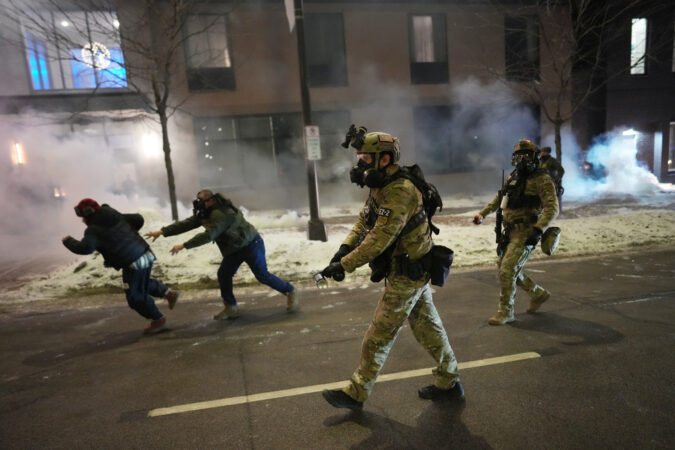
    Menendez ruled in a separate case on Jan. 16 that federal officers in Minnesota cannot detain or tear gas peaceful protesters who are not obstructing authorities, including people who follow and observe agents.

    An appeals court temporarily suspended that ruling three days before Saturday’s shooting. But the plaintiffs in that case, represented by the American Civil Liberties Union of Minnesota, asked the appeals court late Saturday for an emergency order lifting the stay in light of Pretti’s killing.

    The Justice Department argued in a reply filed Sunday that the stay should remain in place, calling the injunction unworkable and overly broad.

    In yet another case, a different federal judge, Eric Tostrud, issued an order late Saturday blocking the Trump administration from “destroying or altering evidence” related to Saturday’s shooting. Ellison and Hennepin County Attorney Mary Moriarty asked for the order to try to preserve evidence collected by federal officials that state authorities have not yet been able to inspect.

    A hearing in that case was scheduled for Monday afternoon in federal court in St. Paul.

    “The fact that anyone would ever think that an agent of the federal government might even think about doing such a thing was completely unforeseeable only a few weeks ago,” Ellison told reporters. “But now, this is what we have to do.”
  • Stranded by winter weather? Here’s what airlines owe you.

    Stranded by winter weather? Here’s what airlines owe you.

    Winter weather can upend even the best-laid travel plans, but one less thing to worry about is losing money if your flight is canceled: U.S. airlines are required to provide refunds.

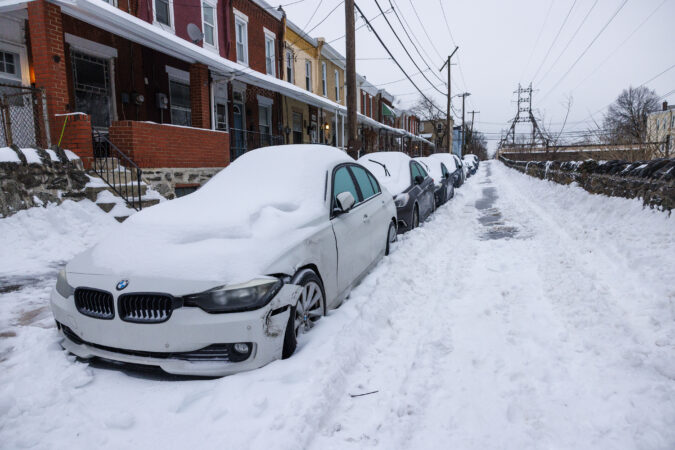
    A monster storm started to wreak havoc across parts of the country over the weekend, with 12,200 weekend flights and counting canceled. Forecasters warned that catastrophic damage, especially in areas pounded by ice, could rival that of a hurricane.

    Here’s a guide for winter travelers as flight disruptions pile up:

    Keep an eye on weather forecasts

    When airlines expect bad weather to create problems for flights, they often give travelers a chance to postpone their trips by a few days without having to pay a fee. Search online for your airline’s name and “travel alerts” or similar phrases to look for possible rescheduling offers.

    American Airlines, for example, said it is waiving change fees for passengers impacted by the storm and adding extra flights around the country in an effort to help passengers reach their destination after the storm passes.

    Check before going to the airport

    Use the airline’s app to make sure your flight is still on before heading to the airport.

    Cancellations can happen hours — or even days — before departure time. Consider American and Delta Air Lines: By midday Saturday, each carrier had canceled more than 1,000 of its scheduled Sunday flights, according to flight tracking site FlightAware.

    Oklahoma’s largest airport suspended all flights Saturday, while Dallas–Fort Worth International Airport, a major hub, saw more than 700 departing flights canceled and nearly as many arriving flights called off. Flight disruptions also were stacking up at airports in Chicago; Atlanta; Nashville; and Charlotte, N.C.

    Disruptions continued to intensify on Sunday.

    My flight was canceled, now what?

    If you’re already at the airport, get in line to speak to a customer service representative. If you’re still at home or at your hotel, call or go online to connect to your airline’s reservations staff. Either way, it helps to also research alternate flights while you wait to talk to an agent.

    Most airlines will rebook you on a later flight for no additional charge, but it depends on the availability of open seats.

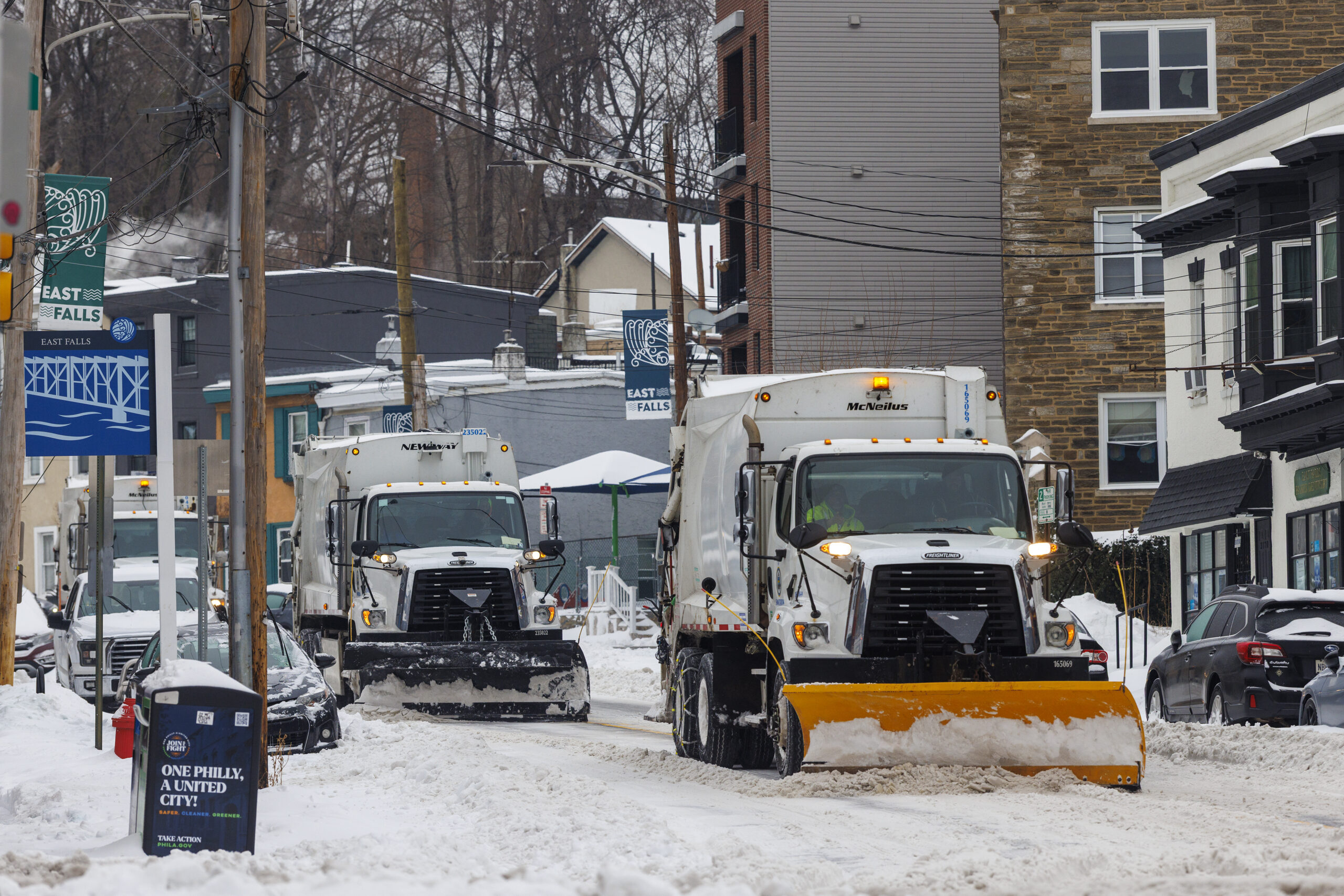
    Snow is plowed in the East Falls section of Philadelphia on Monday.

    Can I get booked on another airline?

    You can, but airlines aren’t required to put you on another carrier’s flight. Some airlines, including most of the biggest carriers, say they can put you on a partner airline, but even then it can be a hit or miss.

    Am I owed a refund?

    If your flight was canceled and you no longer want to take the trip, or you’ve found another way to get to your destination, the airline is legally required to refund your money — even if you bought a non-refundable ticket. It doesn’t matter why the flight was canceled.

    The airline might offer you a travel credit, but you are entitled to a full refund. You are also entitled to a refund of any bag fees, seat upgrades or other extras that you didn’t get to use.

    When will I get my refund?

    If you paid with a credit card, a refund is due within seven business days after you decline an offer from the airline for another flight or a voucher, and within 20 calendar days if you paid for the ticket with a check or cash, according to the U.S. Department of Transportation.

    What else will my airline cover?

    U.S. airlines aren’t required by the Transportation Department to compensate passengers for meals or lodging when an airline cancels or significantly delays a flight during an “uncontrollable” event like bad weather.

    Each airline, however, does have its own policies for assisting passengers who are stranded by a so-called “controllable” flight cancellation or long delay. These include disruptions caused by maintenance issues, crew shortages, or computer outages that halt operations. The Transportation Department can hold airlines accountable for these commitments and maintains a website that lets travelers see what each airline promises if a major disruption is their fault.

    Other tips

    If the weather forecast is troubling, Kyle Potter, executive editor of Thrifty Traveler, suggests looking into booking a backup flight. Some airlines stand out as potential backups, Potter says, because they let customers get a full refund as long as they cancel within 24 hours of booking.

    The customer service phone lines will be slammed if flight cancellations and delays start stacking up during a bad storm. If you’re traveling with someone who has a higher frequent-flyer status, call the airline using their priority number. Another trick: Look up the airline’s international support number. Those agents can often rebook you just the same.

  • Sam Darnold and Seahawks advance to Super Bowl with thrilling 31-27 win over Rams in NFC title game

    Sam Darnold and Seahawks advance to Super Bowl with thrilling 31-27 win over Rams in NFC title game

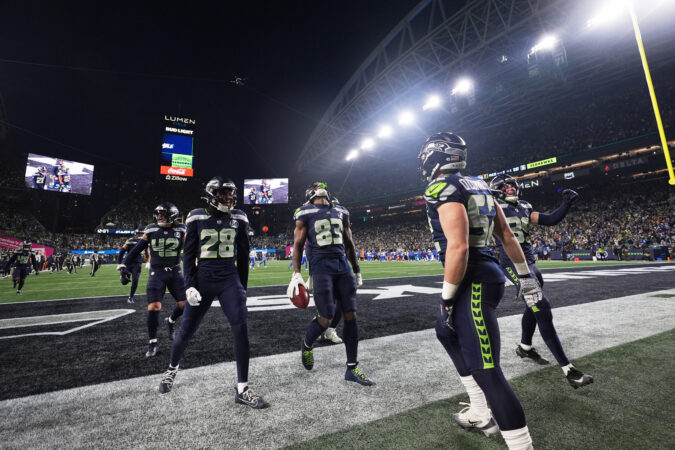
    SEATTLE — Sam Darnold threw for three touchdowns, the Seahawks’ “Dark Side” defense came up with a critical fourth-down stop, and Seattle advanced to the Super Bowl, beating the Los Angeles Rams 31-27 in an electrifying NFC championship game on Sunday.

    Led by second-year coach Mike Macdonald and Darnold — an eight-year veteran playing for his fifth team — the Seahawks (16-3) reached the fourth Super Bowl in franchise history and first in 11 years. Seattle lost that most recent appearance to New England, its opponent in two weeks at Levi’s Stadium in Santa Clara, California.

    With Los Angeles (14-6) facing fourth-and-4 at the Seattle 6, coach Sean McVay elected to go for it and Matthew Stafford’s pass was broken up in the end zone by Devon Witherspoon. The Rams didn’t get the ball back until there were 25 seconds left, and Puka Nacua was tackled inbounds near midfield on the final play.

    Stafford threw for 374 yards and three touchdowns, but the Rams were undone by critical errors, including a muffed punt by Xavier Smith in the third quarter. On the next play, Darnold connected with Jake Bobo for a 17-yard touchdown.

    Darnold, who flopped in his playoff debut last season with the Minnesota Vikings, played through an oblique injury and completed 25 of 36 passes for 346 yards with no turnovers. Jaxon Smith-Njigba had 153 yards receiving and a touchdown on 10 catches.

  • Trump says it’s ‘too late’ to stop White House ballroom construction

    Trump says it’s ‘too late’ to stop White House ballroom construction

    President Donald Trump on Sunday insisted his proposed ballroom is a done deal — even as Justice Department lawyers in court present the plans as flexible and subject to federal reviews.

    In a lengthy post to his Truth Social platform, Trump said the project could not realistically be reversed because key materials have been lined up, writing that “there is no practical or reasonable way to go back” and declaring: “IT IS TOO LATE!”

    The president’s comments contrast with his administration’s position in federal court, where three days earlier Justice Department lawyers told a judge that the ballroom plans can be modified and that the White House intends to wait for two federal advisory panels to review the project before beginning aboveground construction in April. U.S. District Judge Richard Leon, an appointee of President George W. Bush, said he intends to rule in the coming weeks on whether the project may advance.

    The White House did not immediately respond to questions about how Trump’s post about the ballroom aligned with his administration’s legal argument. Trump and his deputies have said that the ballroom project is personally important to him, and the president wrote Sunday that it is a national security matter.

    “Stoppage of construction, at this late date, when so much has already been ordered and done, would be devastating to the White House, our Country, and all concerned,” Trump wrote in a late-morning note that published as much of the United States was under a weather alert connected to a significant winter storm. He also listed materials that he said had either been ordered or were “ready” to be obtained: “All of the Structural Steel, Windows, Doors, A.C./Heating Equipment, Marble, Stone, Precast Concrete, Bulletproof Windows and Glass, Anti-Drone Roofing, and much more.”

    The roughly 450-word statement came in between two posts that referenced Minnesota, the site a day earlier of another fatal shooting connected to immigration enforcement that roiled domestic politics and raised the possibility of a government shutdown. Democrats pledged to block a funding package that must be approved by Friday to keep much of the government open, saying that they could not support continued funding for federal immigration enforcement without operational changes.

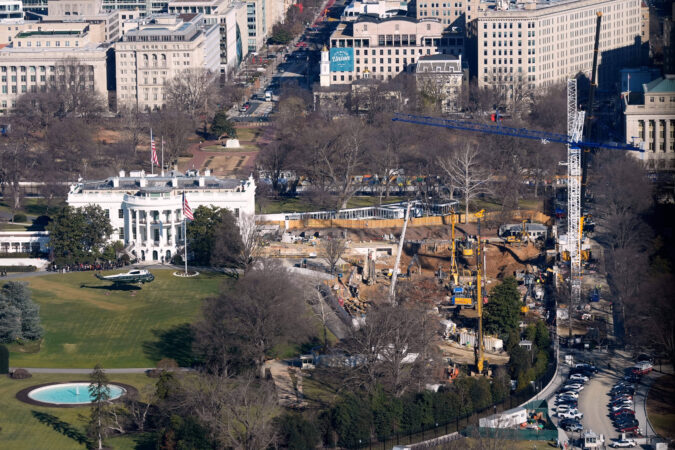
    Trump in October rapidly demolished the White House’s East Wing annex to make way for his planned ballroom addition, prompting criticism from Democrats, watchdogs, and some conservatives who said the administration should have sought public comment before making such significant changes to a building long described as the “People’s House.” The White House has begun construction on the underground elements of the project, deploying workers, construction machinery, and a tower crane, with administration officials saying the work is necessary to protect the president.

    The National Trust for Historic Preservation, a nonprofit group charged by Congress with helping to preserve historic buildings, sued the Trump administration in December, saying it failed to undergo legally required reviews or receive congressional authorization for the project. The group has asked Leon to pause construction until those reviews take place, arguing that every additional day of work locks the project into place.

    “We are fully committed to upholding the interests of the American public and advocating for compliance with all legally required review and approval processes — and an opportunity for the American people to weigh in on a project that impacts one of the most historically significant buildings in our country,” the National Trust said in a statement Sunday following Trump’s post, which also took aim at the group.

    The Justice Department has argued that Trump has significant authority to make changes to White House grounds. The department also submitted testimony from an engineer working on the ballroom project who said the planned building can still accommodate significant design changes. The National Trust has submitted testimony from architect William Bates, former president of the American Institute of Architects, who said in a sworn statement that a building’s subterranean infrastructure essentially predetermines critical aspects of what can be built aboveground.

    “Altering these conditions after the fact would require major demolition and redesign,” Bates wrote last month.

    Leon, who is hearing the case at the U.S. District Court in Washington, D.C., on Thursday, appeared skeptical of the administration’s arguments and pressed the Justice Department to explain how Trump had the legal right to fund the project using hundreds of millions of dollars in private donations. Publicly identified donors, such as Amazon, Google, and Lockheed Martin, collectively have billions of dollars in contracts before the administration. (Amazon founder Jeff Bezos owns the Washington Post.)

    The two federal panels set to review the ballroom project — the Commission of Fine Arts and the National Capital Planning Commission — are now led by Trump appointees after the president removed members named during the Biden administration. White House officials have said they hope to win approval from the panels by March, and the panels’ leaders have signaled support for ballroom construction.

    “I know the President wants to get on with this, and we need to let him do his job,” Rodney Mims Cook Jr., the chairperson of the Commission of Fine Arts, said at a hearing last week.

  • Patriots punch ticket to 12th Super Bowl with gritty 10-7 win over Broncos in snowy Denver

    Patriots punch ticket to 12th Super Bowl with gritty 10-7 win over Broncos in snowy Denver

    DENVER — Drake Maye ran for 68 yards and threw for 86 in sloppy, snowy conditions and scored New England’s only touchdown on a 6-yard keeper, propelling the Patriots to their 12th Super Bowl with a 10-7 win over the Denver Broncos on Sunday.

    Christian Gonzalez intercepted Jarrett Stidham, starting in place of an injured Bo Nix, at New England’s 36 with 2:11 remaining and the Patriots (17-3) iced their first playoff win in Denver when Maye ran for 7 yards on third-and-5 from his 41.

    New England became the third team in the Super Bowl era to win a conference championship with 10 points or less. Buffalo beat Denver 10-7 in the 1991 AFC title game, and the Los Angeles beat Tampa Bay 9-0 in the 1979 NFC championship game.

    The Broncos (15-4) finished one step shy of fulfilling Sean Payton’s preseason prediction of a trip to Super Bowl 60.

    Both kickers missed two field goals in the frigid conditions with Denver’s Wil Lutz and New England’s Andy Borregales wide on long tries just before the snow came in at halftime.

    The Patriots fell behind 7-0, but had a key fourth-down stop near their own end zone to spark the comeback. Their victory was their 40th in the playoffs, breaking a tie with the San Francisco 49ers for the most in NFL history.

    It was sunny at kickoff with a temperature of 26 degrees, but by halftime the snowflakes began falling and grounds crews had to use snowblowers to mark the hashmarks and yard lines by the fourth quarter, when it was 16 degrees.

    After gaining just 72 yards in the first half, the Patriots opened the second half in swirling snow with a 16-play, 64-yard drive that ate up 9 1/2 minutes and ended with a 23-yard field goal by Borregales that gave New England its first lead at 10-7.

    The Patriots managed just four first downs and 72 yards in the first half, punting five times and missing a field goal. But they capitalized on a short field when New England’s defense set up Maye at the Denver 12 with a takeaway and Maye took it in from 6 yards out to tie it at 7 at halftime.

    Stepping in for the injured Nix (ankle surgery), Stidham’s first completion since the 2023 regular-season finale was a 52-yard dart to Marvin Mims Jr. to the New England 7 that set up Courtland Sutton’s 6-yard touchdown catch that started the scoring.

  • DOJ, FBI take back seat in Minnesota shooting, state vows investigation

    DOJ, FBI take back seat in Minnesota shooting, state vows investigation

    In the 24 hours after an immigration officer fatally shot a protester in Minneapolis, the federal agencies that would typically be involved in investigating an officer-involved shooting have been on the sidelines.

    Federal law enforcement leaders in Minnesota haven’t made public statements or appearances. FBI agents and prosecutors in the state are confused about what — if anything — their involvement will be in the investigation, according to multiple people familiar with the U.S. attorney’s office in Minnesota, who spoke on the condition of anonymity due to fear of retaliation.

    In the apparent absence so far of the Justice Department, Minnesota authorities have vowed to pursue an investigation under state laws into the shooting of Alex Pretti, a 37-year-old ICU nurse. That has set up a potential legal clash between state and federal authorities. Already, the state has sued the federal government, successfully asking a judge over the weekend to ensure that federal law enforcement officials do not destroy evidence.

    The Justice Department’s apparent back seat in the investigation contrasts with how the agency has frequently handled similar fatal officer-involved shootings. Typically, federal investigators would take the lead, deploying FBI agents and Civil Rights Division prosecutors — the department’s experts in investigating use-of-force cases.

    That typical federal deployment of resources has not occurred in this case, according to two people familiar with the matter, who spoke on the condition of anonymity to discuss internal decisions that have not been made public.

    “This is extremely out of the norm,” said Bryna Godar, staff attorney for the State Democracy Research Initiative at the University of Wisconsin Law School, who has studied use-of-force investigations. “Typically, whether or not a shooting is ultimately found to be justified, these types of shootings are taken very seriously.”

    Rather than the Justice Department, the Department of Homeland Security, of which the Border Patrol is a part, has taken the lead in the investigation, with the FBI assisting, according to a law enforcement official familiar with the matter.

    That internal probe is at least in part examining whether Border Patrol agents adhered to protocol when Pretti was shot. Homeland Security doesn’t have independent authority to prosecute crimes, but if its examination finds evidence of criminal wrongdoing, DHS officials could refer the investigation to the Justice Department, the law enforcement official said.

    That typical federal deployment of resources has not occurred after the most recent shooting, according to two people familiar with the matter, who spoke on the condition of anonymity to discuss internal decisions that have not been made public.

    Justice Department officials have said in recent weeks that they only investigate police officers under the civil rights laws involving excessive force if they believe such a probe is warranted. The recent shootings by immigration officers do not necessitate federal criminal investigations, they have said.

    Legal experts, however, have noted that while the threshold to charge a police officer is high, the only way to determine if a prosecution is warranted is for the Justice Department and FBI to conduct thorough investigations.

    FBI Director Kash Patel, in an interview with Fox News’ Sunday Morning Futures, said he trusted Homeland Security Secretary Kristi L. Noem and her agency to “do the right thing.”

    “I don’t want to comment on their ongoing investigation,” he said.

    In the shooting on Saturday, federal agents wrestled Pretti to the ground and secured a handgun he was carrying moments before Pretti was shot multiple times, according to a Washington Post analysis of videos that captured the incident from several angles.

    It is not clear from the video whether all the agents realized Pretti had been disarmed. Local officials have said Pretti had a permit to carry the weapon, and Minnesota law allows the open carrying of firearms.

    On the day after the shooting, Justice Department officials sought to shift blame for it onto state and local authorities, who they assert have egged on protesters, and deferred the responsibility to investigate to other agencies.

    Deputy Attorney General Todd Blanche appeared on Meet the Press Sunday and said the problem was that local police officers were not assisting federal law enforcement in the state.

    “I’m very confused why the conversation is about what you’re talking about instead of focusing on what really matters, which is why in one city, in one place we have these problems,” Blanche told NBC’s Meet the Press, suggesting that Minnesota officials had contributed to the tensions that provoked Pretti’s shooting.

    The immigration crackdown in the Minneapolis-St. Paul region began in early January, despite protests from state officials. The deployment of thousands of federal and immigration agents to the Twin Cities has transformed the region into a center of resistance to the administration’s deportation policies.

    Those protests mounted after Jan. 7, when an Immigration Customs and Enforcement officer shot Renée Good while she was in her car. Good and her partner, who was outside the car at the time of the shooting, had been protesting the immigration crackdown.

    The FBI briefly opened a civil rights investigation into the shooting of Good, but closed it and instead focused on investigating Good’s partner and protesters, the Washington Post reported last week. The handling of that investigation prompted about a half-dozen experienced federal prosecutors to leave the U.S. attorney’s office in Minnesota, leaving the office severely understaffed. The FBI agent who initially opened the investigation resigned, according to two people familiar with the matter, who spoke on the condition of anonymity to discuss personnel matter.

    In the days since, the department has focused its resources on investigating state and local leaders, challenging what Attorney General Pam Bondi has described as “unprecedented judicial activism” in court, and arresting demonstrators, including protesters who interrupted a Jan. 18 church service in St. Paul.

    State and local officials have vowed to conduct their own investigation of both the Good and Pretti shootings, but said they’ve been stymied by federal agents denying them access to the scenes.

    Late Saturday evening, a U.S. district judge, acting on a request from the Hennepin County Attorney’s Office, barred the Department of Homeland Security, the Justice Department, or the FBI from “destroying or altering evidence” related to the shooting.

    Drew Evans, superintendent of the Minnesota Bureau of Criminal Apprehension, said his agency took the unusual step Saturday of obtaining a search warrant from a state court to access the shooting scene after initial efforts to respond were rebuffed. Federal agents ignored the warrant and continued to deny access to state investigators, he said.

    “In my 20-plus years at the BCA, prior to 2026, I had never encountered a situation in which federal authorities blocked BCA access to an incident where there is concurrent federal and state jurisdiction,” he wrote in a declaration filed with the court Saturday night. Hennepin County Attorney Mary Moriarty took to social media urging anyone to submit footage they’d filmed at the scene.

    Hurdles for possible prosecution

    If state authorities determine the shooting was unlawful, they could seek to prosecute agents involved. But any attempt to do so would face stiff legal hurdles.

    Any agent charged with state crimes would probably seek to move the case to federal court and claim federal immunity from prosecution.

    Officers are shielded from prosecution for many actions taken in the line of duty. Federal officers facing state prosecution can claim immunity based on the constitutional doctrine of federal supremacy. Those protections only apply, however, if a judge deems the agents’ actions to have been authorized by federal law and “necessary and proper” in fulfilling their federal duties.

    Local authorities do sometimes move ahead with cases against federal agents, including a recent instance in Virginia that underscores the extent to which such attempts can get bogged down in litigation spanning years.

    In 2020, after the Justice Department declined to file charges, state authorities in Virginia secured involuntary manslaughter indictments against two U.S. Park Police officers who fatally shot an unarmed motorist in Fairfax County in 2017.

    The case was tied up in litigation over the immunity question for years, and the charges at one point were dismissed by a federal judge. Local authorities were pursuing an appeal of that decision in 2021 when Republican Jason Miyares was elected attorney general. Miyares abandoned the effort in 2022.

  • William Foege, 89, leader in smallpox eradication

    William Foege, 89, leader in smallpox eradication

    ATLANTA — William Foege, a leader of one of humanity’s greatest public health victories — the global eradication of smallpox — has died.

    Dr. Foege died Saturday in Atlanta at the age of 89, according to the Task Force for Global Health, which he co-founded.

    The 6-foot-7 inch Dr. Foege literally stood out in the field of public health. A whip-smart medical doctor with a calm demeanor, he had a canny knack for beating back infectious diseases.

    He was director of the U.S. Centers for Disease Control and Prevention in the late 1970s and early 1980s, and later held other key leadership roles in campaigns against international health problems.

    But his greatest achievement came before all that, with his work on smallpox, one of the most lethal diseases in human history. For centuries, it killed about one-third of the people it infected and left most survivors with deep scars on their faces from the pus-filled lesions.

    Smallpox vaccination campaigns were well established by the time Dr. Foege was a young doctor. Indeed, it was no longer seen in the United States. But infections were still occurring elsewhere, and efforts to stamp them out were stalling.

    Working as a medical missionary in Nigeria in the 1960s, Dr. Foege and his colleagues developed a “ring containment” strategy, in which a smallpox outbreak was contained by identifying each smallpox case and vaccinating everyone who the patients might come into contact with.

    The method relied heavily on quick detective work and was born out of necessity. There simply wasn’t enough vaccine available to immunize everyone, Dr. Foege wrote in House on Fire, his 2011 book about the smallpox eradication effort.

    It worked, and became pivotal in helping rid the world of smallpox for good. The last naturally occurring case was seen in Somalia in 1977. In 1980, the World Health Organization declared smallpox eradicated from the Earth.

    “If you look at the simple metric of who has saved the most lives, he is right up there with the pantheon. Smallpox eradication has prevented hundreds of millions of deaths,” said former CDC director Tom Frieden, who consulted with Dr. Foege regularly.

    Dr. Foege was born March 12, 1936. His father was a Lutheran minister, but he became interested in medicine at 13 while working at a drugstore in Colville, Wash.

    He got his medical degree from the University of Washington in 1961 and a master’s in public health from Harvard in 1965.

    He was director of the Atlanta-based CDC from 1977 to 1983, then held other international public health leadership roles, including stints as executive director at the Carter Center and senior fellow at the Bill and Melinda Gates Foundation.

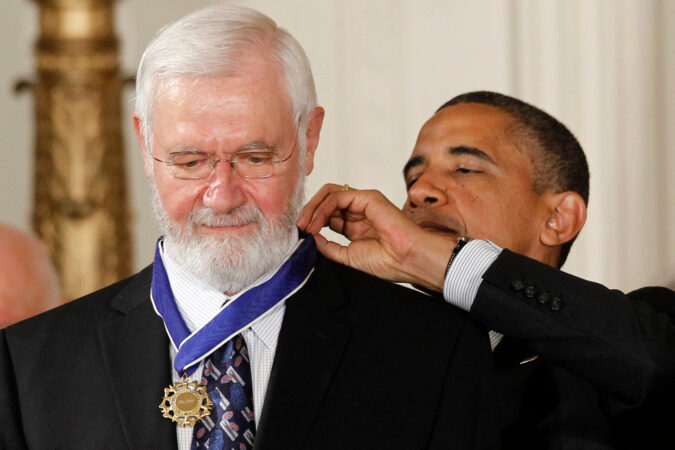
    In 2012, President Barack Obama presented Dr. Foege with the Medal of Freedom, the nation’s highest civilian honor. In 2016, while awarding Dr. Foege an honorary degree, Duke University President Richard Brodhead called him “the Father of Global Health.”

    “Bill Foege had an unflagging commitment to improving the health of people across the world, through powerful, purpose-driven coalitions applying the best science available,” Task Force for Global Health CEO Patrick O’Carroll said in a statement. “We try to honor that commitment in every one of our programs, every day.”

  • Minnesota shooting scrambles America’s gun debate

    Minnesota shooting scrambles America’s gun debate

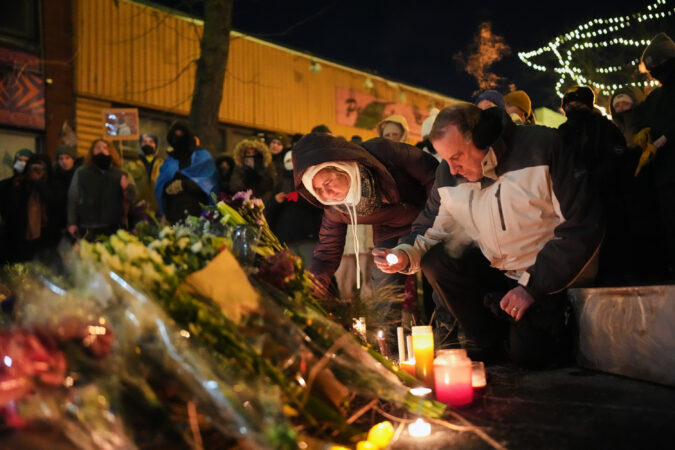
    The killing of Alex Pretti in Minneapolis has scrambled America’s gun debate, another reflection of the bitterness and polarization that have engulfed the dispute over the national crackdown on immigration by federal agents.

    Pretti, a 37-year-old ICU nurse, was carrying a gun in or near his waistband when he was killed on Saturday, but videos show he had not drawn it and was disarmed before being shot multiple times. Local authorities believe he had a permit to carry the gun.

    With Americans split between those supporting the Trump administration and those backing anti-ICE protesters, multiple conservatives — including those strongly supportive of gun rights in the past — have justified Pretti’s shooting on the grounds that his carrying of a holstered gun showed he had violent intentions.

    Asked if Pretti ever brandished his gun, Homeland Security Secretary Kristi L. Noem said Saturday, “I don’t know of any peaceful protester that shows up with a gun and ammunition rather than a sign. This is a violent riot when you have someone showing up with weapons and are using them to assault law enforcement officers.”

    Sen. Markwayne Mullin (R., Okla.) told Fox News, “A deranged individual who came in to cause massive damage with a loaded pistol, with an extra mag that was completely loaded, was shot and killed. How much more does it have to go on before the Democrat leaders there take responsibility for their words?”

    Those positions are at odds with the usual stance of many gun rights supporters, who often defend the rights of Americans to carry firearms in almost all situations.

    In 2020, Kyle Rittenhouse, a conservative 17-year-old from the Chicago suburbs, brought an AR-15 to a racial justice protest in Wisconsin, killing two people and injuring another. Liberals said he was obviously looking for trouble, but Rittenhouse, arguing he had acted in self-defense, became a hero to many conservatives and was later acquitted of murder.

    In another episode that year, Mark and Patricia McCloskey waved guns at Black Lives Matter protesters, albeit from their front yard. They were celebrated by gun rights backers and invited to speak at the Republican National Convention.

    Pretti is being framed very differently by many supporters of the Second Amendment.

    “Don’t let the left kid you with this, that this is just a normal protest where people are peacefully protesting. No it’s not,” Rep. Jeff Van Drew (R., N.J.) told Fox News. “Peaceful protesters don’t have 9-millimeter weapons with two extra magazines.”

    Liberals, including gun control supporters, in contrast emphasize that Pretti’s legal possession of a weapon in no way reflects on his intentions at the protest, and certainly cannot justify his killing at the hands of federal agents.

    The divide underlines how much American politics in the Trump era has departed from a debate over principles — to the extent that it was ever that — and has settled firmly into a battle of us-versus-them, where actions are lauded or vilified depending on who is behind them.

    Rosa Brooks, a law professor at Georgetown University who specializes in national security, said there is a certain consistency to people insisting their “side” is always right, even if that involves shifting positions on some issues.

    “If your vision of the America you want to protect is ‘My tribe wins,’ then it’s not hypocritical,” said Brooks, who has served as a reserve D.C. police officer. “Some would say ‘I support the police when they are doing the right thing,’ which some people define really tribally.”

    Even so, some Democrats predicted that the unusually tough tactics of Immigration and Customs Enforcement and Border Patrol agents in Minneapolis and elsewhere will ultimately trigger a backlash against the Trump administration’s tactics among conservatives. There are some signs that process has haltingly begun.

    A faction of the conservative movement has long been suspicious of federal law enforcement, seeing it as a way for the government to oppress ordinary citizens. The recent emergence of an ICE memo instructing agents that they can enter homes without a judicial warrant, and now the killing of two protesters, could fuel that backlash, some Democrats said.

    “There is considerable blowback even among a lot of right-leaning folks at the image of federal agents in masks without cause or control, patrolling the streets of American cities and suburbs and pulling people out of their homes and cars more or less at random,” Sen. Sheldon Whitehouse (D., R.I.) told reporters recently.

    Robert Spitzer, a professor emeritus and expert on criminal law and gun control at the State University of New York at Cortland, said the Minneapolis shooting highlights contradictions in the reality of the Second Amendment — specifically the argument that an “armed society is a safe society.”

    “This is another instance where slogans and ideology run smack-dab against reality,” Spitzer said.

    While the U.S. Supreme Court has affirmed the right of people to carry a firearm, Spitzer said there are virtually no instances where an armed citizen using a gun against the federal government would be viewed in court as lawful.

    “One reason some people acquire guns is in case they need to ‘confront the tyrannical government.’ But there’s a wealth of problems with that whole notion, not the least of which being that as soon as you’re talking in that realm, you’re brushing up against the edge of lawbreaking,” Spitzer said. “That’s because the whole idea of the American system is that it’s designed and structured to resolve disputes peacefully, not through arms.”

    Some Second Amendment activists did express concern about Pretti’s shooting, and especially the use of his gun possession as a justification.

    When Bill Essayli, an assistant U.S. attorney in California, posted a message on social media appearing to broadly justify the shooting, he received pushback from unusual quarters. “If you approach law enforcement with a gun, there is a high likelihood they will be legally justified in shooting you,” Essayli posted on Saturday. “Don’t do it!”

    The National Rifle Association hit back hard.

    “This sentiment from the First Assistant U.S. Attorney for the Central District of California is dangerous and wrong,” the organization said. “Responsible public voices should be awaiting a full investigation, not making generalizations and demonizing law-abiding citizens.”

    That statement was all the more notable because the NRA earlier Saturday seemed to join others on the right in blaming Democratic leaders for the violence, saying their demonization of immigration agents had predictably violent results.

    “Unsurprisingly, these calls to dangerously interject oneself into legitimate law enforcement activities have ended in violence, tragically resulting in injuries and fatalities,” the NRA said in its earlier statement about the Pretti shooting.

    The NRA is not the only gun rights organization to challenge the rush by some Republicans to portray Pretti as a gun-toting firebrand agitator who, if he did not deserve what he got, at least had a hand in provoking it.

    The Minnesota Gun Owners Caucus cautioned that an independent investigation has yet to be conducted, but it added that so far no evidence has surfaced that Pretti intended to harm the officers.

    “Every peaceable Minnesotan has the right to keep and bear arms — including while attending protests, acting as observers, or exercising their First Amendment rights,” the Gun Owners Caucus said. “These rights do not disappear when someone is lawfully armed, and they must be respected and protected at all times.”

    For now, the deployment of federal agents into major American cities, including Minneapolis, Portland, Chicago, and Los Angeles, has produced open hostility between these largely Democratic strongholds and the Trump administration, with mayors and governors begging the federal agents to withdraw.

    Gil Kerlikowske, a former commissioner of U.S. Customs and Border Protection, said the federal agents are acting in unprecedented ways.

    “It’s completely unheard of,” said Kerlikowske, a former police chief in Seattle and Buffalo. “They have jumped into these cities with no coordination, no communication, no joint command post. They are marching to rock music, wearing masks. … Their deployment has been horrific. And it’s been unsuccessful.”

  • Federal agent secured gun from Minn. man before fatal shooting, videos show

    Federal agent secured gun from Minn. man before fatal shooting, videos show

    Federal agents who were wrestling a man to the ground in Minneapolis early Saturday secured a handgun he was carrying moments before shooting him multiple times, according to a Washington Post analysis of videos that captured the incident from several angles.

    As many as eight agents were attempting to detain Alex Pretti, a 37-year-old ICU nurse, videos show. One emerged from the scrum holding Pretti’s gun, and less than a second later, the first of what appear to be 10 shots was fired. It is not clear from the video whether the other agents realized Pretti — who local authorities believe had a permit to carry the weapon — had been disarmed.

    Pretti was the third person in recent weeks to be shot, and the second to be killed, by federal agents in Minneapolis, the epicenter of nationwide upheaval sparked by the Trump administration’s immigration crackdown.

    Department of Homeland Security officials have said agents were on Nicollet Street conducting a “targeted operation” against another person when they encountered the man later identified as Pretti. DHS posted to X that “an individual approached US Border Patrol officers with a 9 mm semi-automatic handgun.” The statement said it appeared the man wanted to “massacre” law enforcement.

    “The officers attempted to disarm this individual, but the armed suspect reacted violently,” Homeland Security Secretary Kristi L. Noem said at a news conference. “Fearing for his life and for the lives of his fellow officers around him, an agent fired defensive shots.”

    Although it is not clear exactly how Pretti’s interaction with federal agents began, bystander footage reviewed by the Post raises questions about that account. A DHS spokesperson did not respond to messages seeking comment.

    Early Saturday morning, bystanders gathered to protest the DHS operation, some blowing whistles to warn residents of the agents’ presence and others recording. One video, filmed from a passing car, shows Pretti in the street, speaking to officers and filming them with his phone. He is not holding a gun in either hand. An officer moves him back toward the sidewalk. It is not clear how the interaction began or what words were exchanged.

    A second video, filmed a short time later, shows Pretti on the same block. He walks toward the officers, still appearing to film with his phone in his right hand and not holding a gun. The audio does not pick up what was said between Pretti and the officer. One of the officers pushes a person who appears to be a bystander or protester down onto the sidewalk.

    Pretti steps between them, and the officer pepper sprays him. Pretti begins to interact with the person who was pushed, an exchange that is inaudible in the footage. An officer appears to try to pull him away and is joined by other agents who attempt to force him to the ground.

    Over roughly the next 10 seconds, Pretti never appears to be fully prone on the ground or to yield fully. At times, his knees are tucked under his body, agents holding him down, their hands on his back.

    As at least four agents attempt to subdue Pretti, an officer wearing a gray jacket approaches. His gloved hands are empty, video shows.

    The agent in the gray jacket crouches down, reaches toward Pretti, and lifts a gun from his back near his waistband, according to videos taken from multiple angles. The agent turns and begins to walk away while holding the weapon, pointing it toward the ground.

    Another agent, standing beside the agent in the gray jacket, unholsters his gun at virtually the same moment and points it at Pretti’s back at close range. At least two agents are attempting to hold him down. A split second later comes the crack of the first gunshot, though the videos do not clearly show which agent fired. Pretti gets up on one knee and falls over as the agent who had unholstered his weapon fires in rapid succession.

    The agent in the gray coat retreats. The gun, with an optical attachment, is clearly visible in his hand. It appears to match an image that the Department of Homeland Security posted of what it said was the handgun agents recovered from Pretti.

  • Israel launches ‘large scale operation’ to locate last hostage in Gaza

    Israel launches ‘large scale operation’ to locate last hostage in Gaza

    NAHARIYA, Israel — Israel said Sunday its military was conducting a “large-scale operation” to locate the last hostage in Gaza, as Washington and other mediators pressure Israel and Hamas to move into the next phase of their ceasefire.

    The statement came as Israel’s cabinet met to discuss the possibility of opening Gaza’s key Rafah border crossing with Egypt, and a day after top U.S. envoys met with Prime Minister Benjamin Netanyahu about next steps.

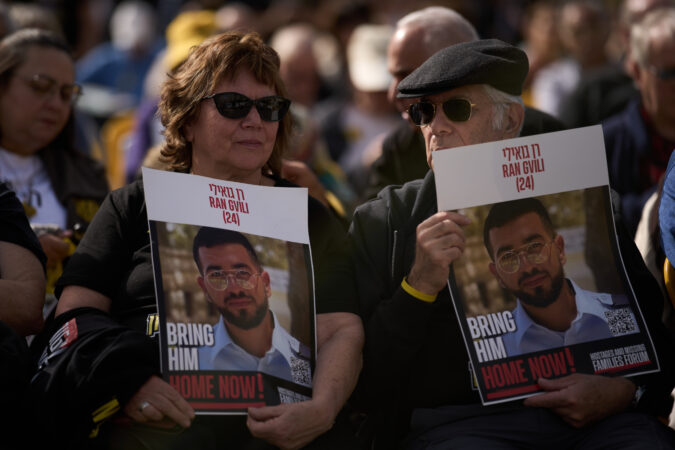
    The return of the body of the remaining hostage, Ran Gvili, has been widely seen as removing the remaining obstacle to moving ahead with opening the Rafah crossing, which would signal the ceasefire’s second phase.

    The return of all remaining hostages, alive or dead, has been a central part of the first phase of the ceasefire that took effect on Oct. 10. Before Sunday, the previous hostage was recovered in early December.

    While Israel has carried out search efforts before for Gvili, more detail than usual was released about this one. Israel’s military said it was searching a cemetery in northern Gaza near the Yellow Line, which marks off Israeli-controlled parts of the territory.

    Separately, an Israeli military official said Gvili may have been buried in the Shujaiyya–Daraj Tuffah area, and that rabbis and dental experts were on the ground with specialized search teams. The official spoke on condition of anonymity because they were discussing an operation still underway.

    Gvili’s family has urged Netanyahu’s government not to enter the ceasefire’s second phase until his remains are returned.

    But pressure has been building, and the Trump administration has already declared in recent days that the second phase is underway.

    Israel has repeatedly accused Hamas of dragging its feet in the recovery of the final hostage. Hamas in a statement Sunday said it had provided all the information it had about Gvili’s remains, and accused Israel of obstructing efforts to search for them in areas of Gaza under Israeli military control.