BOSTON — A federal judge on Thursday halted President Donald Trump’s executive order that sought to create a federal voter list and limit who can receive a mail ballot.
U.S. District Court Judge Indira Talwani, who was nominated by Democratic President Barack Obama, sided with a coalition of nearly two dozen states that challenged the Republican president’s order in granting a summary judgment. Her ruling applies to this year’s midterm election cycle.
Plaintiffs argued in two lawsuits, both filed in federal court in Boston, that Trump’s order should be found unconstitutional because the states and Congress, not the president, have the power to set election rules. The judge agreed, noting in her ruling that the provisions of Trump’s order “unconstitutionally violate the separation of powers.”
It was the second ruling in as many days against executive orders Trump has signed seeking oversight of the nation’s elections. A separate ruling Wednesday prohibited an executive order he had signed last year that would have required people to show documents proving their citizenship when registering to vote.
The administration, in its motions to dismiss the lawsuits challenging the order seeking to establish a federal voter list, argued that the motions are premature and that plaintiffs lacked the legal basis to bring their claim based on the Administrative Procedure Act, which governs how federal agencies develop and issue regulations.
But in an interim order before Thursday’s ruling, Talwani said the motions pertaining to this year’s election cycle were relevant: “In light of the EO’s specific deadlines over the next three months, and the reality that elections will be occurring throughout this period with the November 3, 2026 midterm occurring in just five months, postponing judicial review is impracticable and may inflict significant hardship on Plaintiffs,” she wrote. That order denied the Trump administration’s motion to dismiss the challenges.
Trump’s executive order, the second one aimed at elections during his second term, comes as he continues to raise the specter of widespread voting by noncitizens as a reason to change election rules. But states already have detailed processes aimed at keeping their voter rolls accurate, and voting by noncitizens has been shown to be rare. It also is a felony that can be punishable by deportation.
Trump issued his second order in March after a bill he supported to overhaul voting stalled in Congress. The order would have had the federal government create a list of eligible voters and then directed the U.S. Postal Service to deliver mail ballots only to those on the list. Election officials argued that it was ripe for abuse and could cause chaos, and the postal union has objected to the idea of mail carriers policing ballots.
The Postal Service has published a proposed rule required by Trump’s executive order in the Federal Register. Among other things, the rule would not apply to primary elections or overseas ballots.
The lawsuit seeking summary judgment was filed by Democratic attorneys general representing 22 states and the District of Columbia. Also signing on were attorneys representing Democratic Gov. Josh Shapiro of Pennsylvania, which has a Republican attorney general.
“Donald Trump’s illegal and unconstitutional Executive Order sought to undermine eligible voters’ ability to make their voices heard in our democracy,” Pennsylvania Shapiro posted on X Thursday. “Our Constitution is clear: the authority to set our election rules belongs to the states.”
The states also told the court that the move imposes a costly burden on election officials to comply and would spread fear about the possibility of prosecution. Stephen Pezzi, a lawyer for the Trump administration, had argued that no one would be prosecuted for violating the order.
In a separate lawsuit filed against the executive order, a federal judge in Washington, D.C., in May agreed with the Trump administration that it was too early to block the order because it had yet to be implemented. That lawsuit was brought by Democratic and civil rights groups, who have appealed.
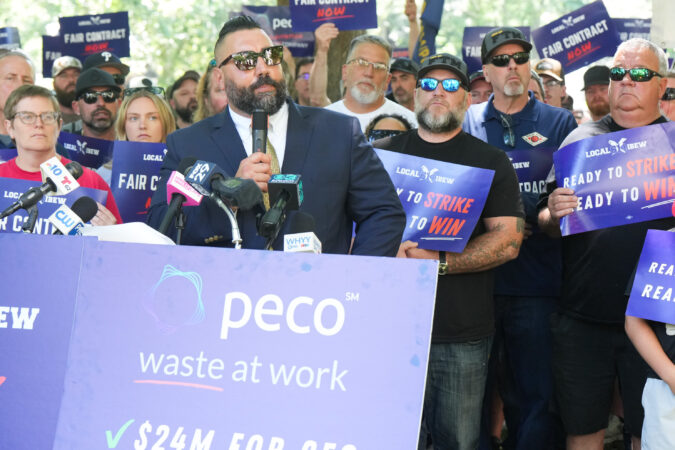
Peco workers plan towalk off the jobon the Fourth of Julyif they don’t have a contract by then, their union announced Thursday.
IBEW Local 614, whichrepresents roughly 1,500 Peco employees including gas and electric field workers and call center staff, has been negotiating for a new contract for months. They include employees who work to restore electricity during power outages.
The workers voted at the end of May to authorize a strike if their union called for it, with over 1,000 participating in the vote.It would be the first worker strikein the company’s history.
“We’ve exhausted every avenue to reach a deal,” IBEW Local 614 president Larry Anastasi said in a statement Tuesday. “If Peco won’t invest in the workers who keep the lights on, we’ve got no choice but to stand together and demand the respect we’ve earned.”
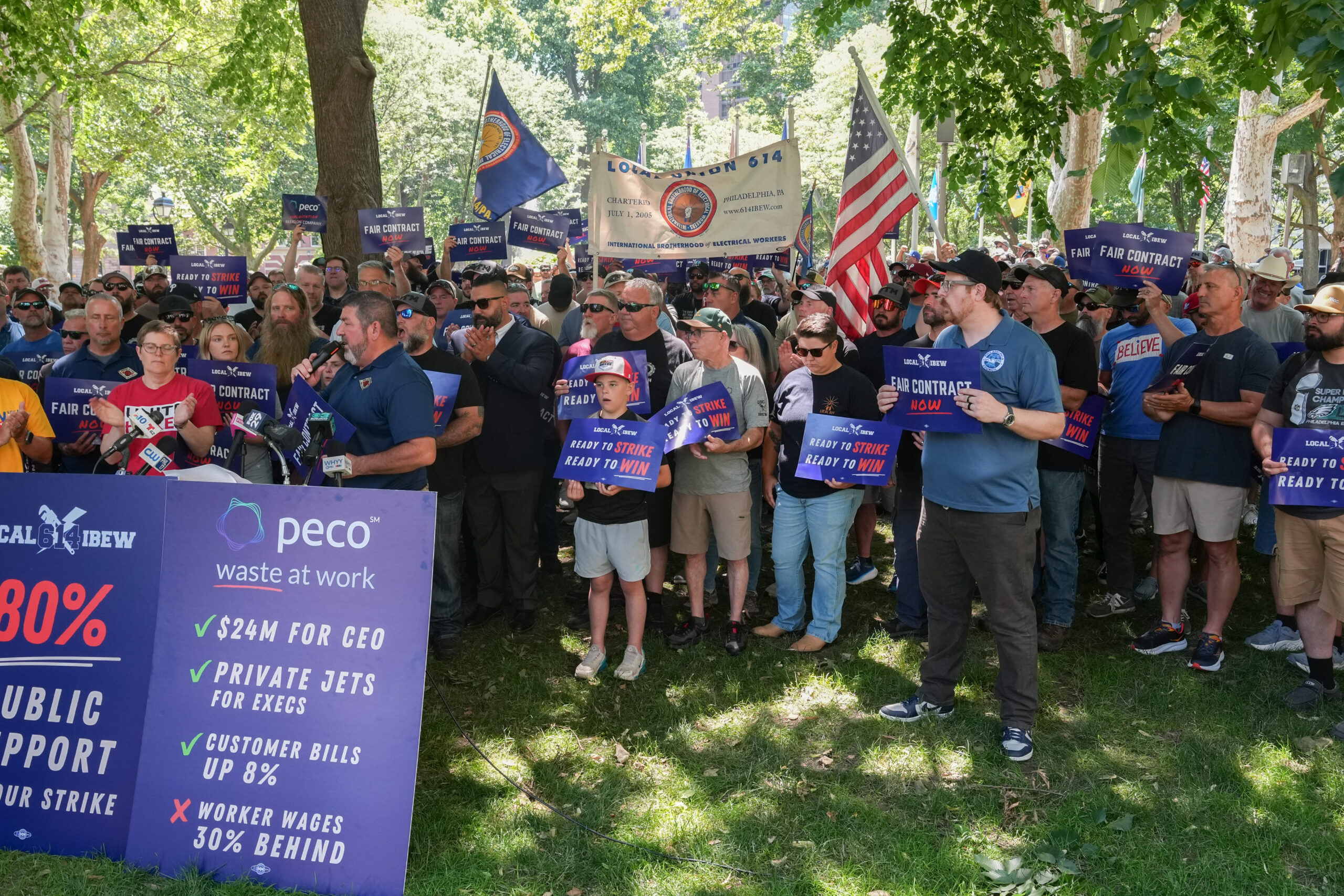
Under its most recent contract, the union is required to provide Peco with at least seven days’ notice before going out on strike. A large crowd, including leaders of other area unions, gathered at Washington Square Park on Thursday morning for the union’s strike date announcement.
Peco spokesperson Candice Womer said in a statement Thursday morning ahead of the strike date announcement that the company is committed to negotiating in good faith for an agreement that “is fair to our employees, while supporting the long-term needs of our customers and the communities we serve.”
“We have presented a strong, market-competitive compensation and benefits package,” Womer said.
Customers should not expect delays or interruptions in service, said Nicole LeVine, Peco’s chief operating officer.
“We’re an emergency response company,” LeVine said. “We’ve been working on contingency planning in the event of a strike, and we were well prepared to execute our plan if needed.”
LeVine said some workers who would be called on during a strikeare “familiar with our specific system,” and others “are coming in from outside of the region.” She declined to say how many workers are part of the contingency plan.
Jim McGill, a union representative with local 614 (holding microphone), speaks to workers and union representatives who gathered in Washington Square Park on Thursday.
The union workers’ most recent five-year contract expired March 31, and negotiations, which started in January, have led to some tentative agreements, Peco has said. But sticking points have emerged around wages and benefits, the union says.
The most recent bargaining session was June 19, and the next one is scheduled for July 2, LeVine said. She noted that the company would like to conduct that session sooner.
Peco has suggested using a federal mediator to reach an agreement, LeVine said. “If we get a mediator in here, he can help making sure both parties are participating in negotiations, and we can reach a good deal,” she said.
Hundreds of Peco workers and supporters met in Washington Square Park on Thursday, a little after 11 a.m., some holding signs that read “Ready to strike. Ready to win.”
When Anastasi, the local president, announced that workers would go out on strike at 12:01 a.m. on the Fourth of July, the crowd behind him erupted in cheers. Anastasi said the union had not made the decision lightly.
“We didn’t want to do this,” Stephen Giorgio, a Peco employee for nearly three years, said after the news conference. But, he added, the union has been negotiating for months, and “enough’s enough.”
Giorgio, who works in the western suburbs, is part of a Peco team that gets called upon when a customer’s power is out.
“We’re out there day and night, weekends, holidays,” he said. “My wife forgets what I look like sometimes.”
His line of work is dangerous, he says, and can include climbing a 60-foot pole in the rain — but he wouldn’t trade it for another job.
“I love this job,” Giorgio said. “I can never see myself doing anything else. Took me 10 years to get here, and now I’m here, and I don’t ever plan on looking back.”
Sparkling wines are having a moment, and it’s hard to beat Spain in this category when it comes to great value. The country may be most commonly associated with red wine, but sparkling, white, and even rosé wines from Spain are all seeing significant growth in total exports. While there are other sparkling wine appellations in Spain, the vast majority — including this example — are labeled as cava.
Where most wine appellations take their name from a place — think Champagne from France’s Champagne region — cava is different. The term means “cave” or “cellar,” referring to how it is made. Cava wines must, by law, follow the same traditional method of production as Champagne, which involves a second fermentation that takes place inside each bottle. The mechanism for adding the bubbles and letting the wine patiently age in a cellar is also central to its quality.
Cava’s appellation was first conceived as a means for wineries across Spain to be able to sell a high-quality sparkling wine regardless of their region. In practice, however, most cava is grown and produced in northeastern Catalonia, near Barcelona, using native Spanish grapes such as macabeo, parellada, and xarel-lo. That’s the case for this wine as well, which is labeled under the name of a Rioja-based brand better known for their reds. In Spain, it’s not uncommon for large wineries in one region to extend their range by sourcing wines from partners elsewhere.
Cava wines can be found at every level of ambition and price, from the cheap and cheerful to the ambitious and gastronomic. This wine falls at the simpler end of the continuum (as the price might suggest), with a delicate mouthfeel and refreshing flavors of apple, lemon, and blanched almond. It’s an ideal choice for relaxed day-drinking — mimosas highly recommended.
Gran Campo Viejo Cava Brut Reserva
Gran Campo Viejo Cava Brut Reserva
Spain; 11.5% ABV
PLCB Item #6563 — $10.49 through July 5 (regularly $13.49)
For most Americans, the U.S. Supreme Court occupies a seat on the back burner. We know it is important, but so much of what it does seems unconnected to our daily lives.
Every now and then, it pops up in the news when something major is on the table and briefly grabs our attention — overturning Roe v. Wade and the constitutional right to choose to have an abortion grabbed the headlines, as did throwing out Donald Trump’s tariffs. But, outside of the circles of lawyers, judges, and academics, most of what the court does goes unnoticed. For a brief moment, the nation pays attention. Then the spotlight moves on.
Enduring consequences
Over the next two to three weeks, before the justices depart for their four-month summer recess, the court will issue a series of decisions in cases it has been considering for months. They have listened to the lawyers argue their cases for hours, reviewed thousands of pages of briefs submitted by lawyers, interested organizations, and government officials, and debated among themselves.
Any day now, decisions will be handed down that could alter the legal landscape for decades to come. These cases will affect millions of people, directly and indirectly. These decisions become the law of the land, and their impact will endure for decades. While the court can later reverse its own decisions, it rarely does. So the decisions it makes in the next two to three weeks will endure long after many of us are dead. In 1954, for example, the court’s decision in Brown v. Board of Education finally ended desegregation, 50 years after the same court had infamously approved it in Plessy v. Ferguson.
More recently, in 2022, the court reversed Roe v. Wade, ending a constitutional right to abortion that had been established since 1973.
In short, the decisions it makes in the next couple of weeks are not likely to change for half a century or more. Given what the court is about to decide, all of us have a stake in the outcome.
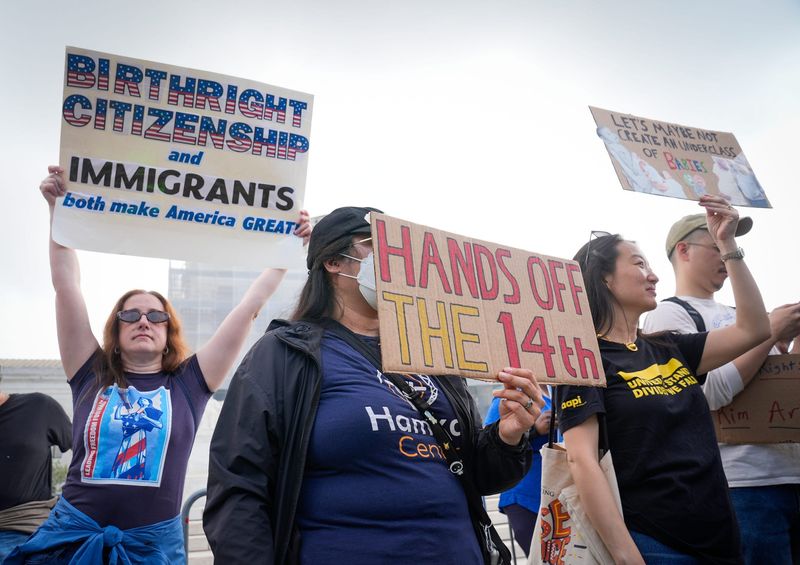
People demonstrate outside the U.S. Supreme Court Building in 2025 before justices hear oral arguments in a birthright citizenship case, one of many critical issues before the court.
President Trump signed an executive order ending automatic citizenship for those born in the United States unless they meet certain conditions, despite the Constitution (in the 14th Amendment) explicitly conferring it to “all persons” born in the United States.
The stakes in this case extend far beyond immigration policy or the end of birthright citizenship.
The issue is not simply whether birth in the United States confers automatic citizenship. More fundamentally, it asks whether a president may effectively amend the Constitution, eviscerating rights and guarantees formerly entrenched in American society, literally with the stroke of a pen.
The Constitution is meant to endure and survive political winds — and it has for 250 years. In that time, aside from the Bill of Rights, there have been only 17 amendments. The Constitution provides a process for changing its provisions. It is purposefully neither quick nor easy. The framers understood that fundamental rights should not fluctuate like a weather vane depending on who occupies the White House. Constitutional rights are meant to endure and survive political winds — and they have for 250 years.
Executive orders signed by the president, any president, are not among the methods the Constitution provides for rewriting its guarantees.
Critical decisions
The decision is critical. If a president’s signature on an executive order can override constitutional guarantees in one area, where does that authority end? What’s next? The right to remain silent? Free speech? The freedom to practice your religion, safe from government interference? The right to counsel? The guarantee of a fair trial? Presidential term limits? Can Trump end the constitutionally mandated two-term limit with his signature?
Free speech is a central issue. Can students be punished for participating in peaceful demonstrations on college campuses because officials disagree with their views? Does freedom of expression apply equally to all viewpoints, or only to favored ones? If the government can silence one unpopular group today, what prevents it from silencing another tomorrow?
Among the issues that will be decided in the next few weeks are whether states can exclude transgender women from participating in female athletic competitions. Earlier, the court addressed whether states may prohibit licensed therapists from discussing certain issues relating to gender identity with their patients — can they prohibit some of it, or all of it, or none of it. The First Amendment won that battle. Surprisingly. But transgender rights are not a favored policy, and the administration is unashamedly hostile to them, and civil liberties advocates are not hopeful.
The court was asked to revisit long-standing Fourth Amendment protections against unreasonable searches and seizures. Under what circumstances may police officers enter a person’s home without a warrant, probable cause, or judicial authorization? How far may a warrant reach before it undermines the constitutional guarantee that people should be secure in their homes?
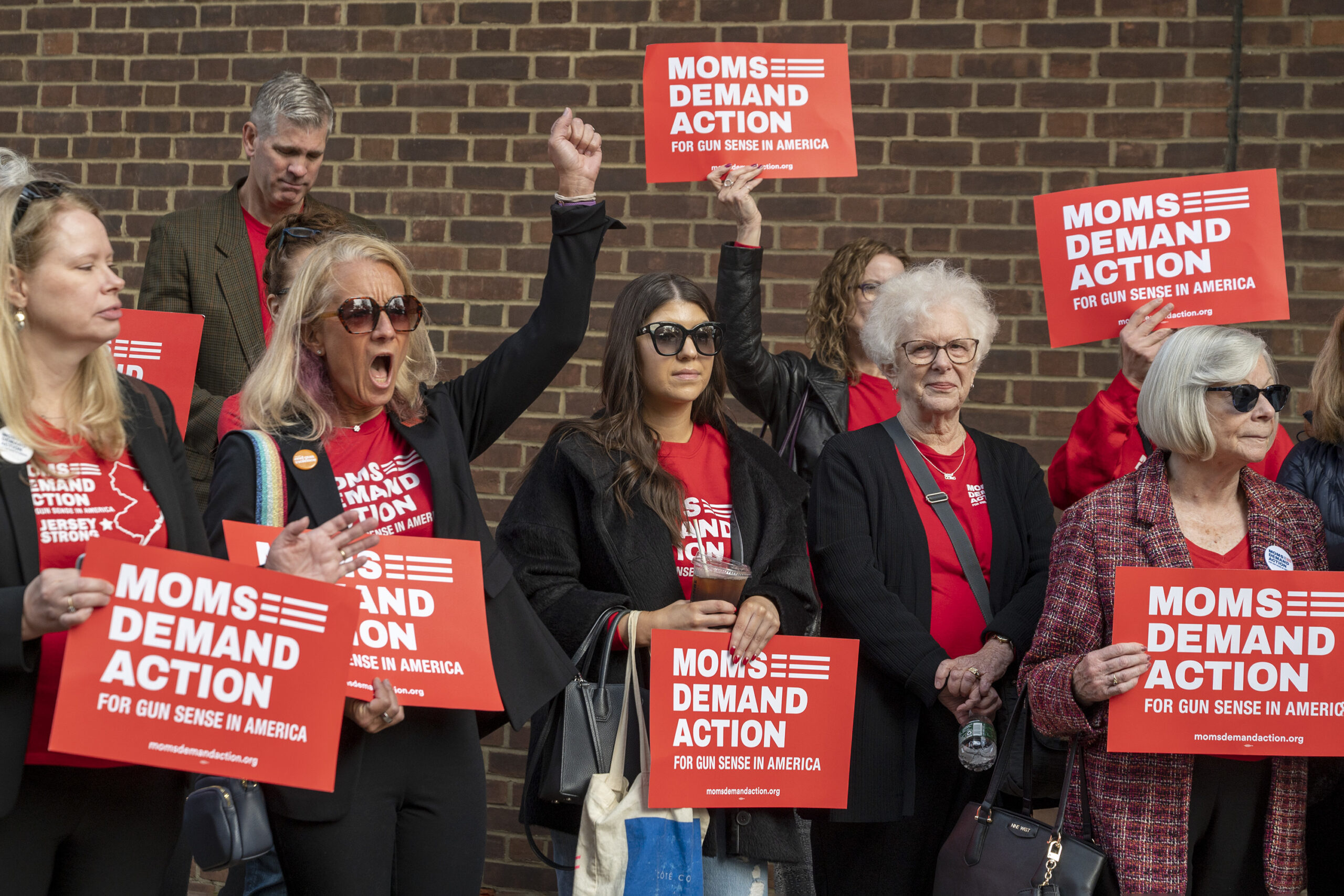
Gun safety advocates rally outside federal court in Philadelphia in 2023 as the Third Circuit Court of Appeals hears oral arguments about a New Jersey law keeping guns out of parks, playgrounds, bars, and other sensitive places. The law was challenged by the National Rifle Association and other gun lobby groups.
The Second Amendment and gun control remain among the most active areas of constitutional law. If school shootings and the murder rate are important to us, we need to be paying attention.
Beyond individual rights, the courts are increasingly confronting questions concerning executive power and the structure of the federal government itself. May a president deploy National Guard troops without the consent of state officials? Can federal employees be dismissed without cause? Does the president have the authority to remove senior agency officials at will, or are there constitutional limits on that power?
Shaping lives
The fundamental right to vote is also at stake, as the plethora of decisions already announced on redistricting and voter rights will undoubtedly shape the political landscape. In the next few weeks, the court’s decisions on mail-in ballot restrictions will add to that mix.
These are not abstract legal debates. They are questions that go to the heart of citizenship, liberty, equality, and the limits of governmental power. They will shape lives, influence public policy, and define constitutional rights long after today’s political battles have faded from memory.
The Supreme Court may not dominate our daily conversations, but the decisions it issues in the coming days will touch every American in one way or another. Whether we agree with the outcomes or not, this is one of those moments when paying attention is not merely advisable — it is essential.
Susan Sullivan is a lawyer and professor of constitutional law and politics at Temple University.
BUFFALO, N.Y. — The excitement on the other end of the phone from Nathan Quinn was unmistakable.
But this conversation, for the most part, wasn’t focused on Quinn, the Flyers’ sixth-rounder in 2025, who had a tremendous season for Québec of the Quebec Maritimes Junior Hockey League. It was about his linemate, road-trip roommate, and buddy Maddox Dagenais, who is on the verge of being drafted into the NHL.
What if it were the Flyers snagging Dagenais at No. 21?
“Oh, it’ll be awesome,” Quinn said emphatically. “Just being at the [development] camp a couple of days after together, it’s another step to your life, too. If you want to make it to the pro level, being with someone that you know, you may be more comfortable [with], and of course, one of my best friends, so it would be an incredible thing.”
Ready to Start
Dagenais moved around a lot as a kid. It’s what happens when your dad is chasing his own hockey dreams. Pierre Dagenais was drafted twice by the New Jersey Devils, in 1996 and then two years later. The first time it was in the second round, 47th overall, and yes, Maddox and his dad have a little competition going to see which Dagenais is selected higher.
Pierre played 142 games in the NHL, mostly for the Montreal Canadiens, while also spending time in the American Hockey League and in Europe. The shuffling around didn’t stop the younger Dagenais from working on his own game.
“Every house had a net to shoot on,” he told The Inquirer, recalling some were in the basement, some in the garage, and others were outside, like the one he has today.
“Every night, just a couple of 100 pucks, even a thousand pucks … become natural with me to just go out there and shoot pucks with my dad or myself.”
And that work paid off as his shot is considered his biggest strength, with draft analysts like FloHockey draft and prospect analyst Chris Peters liking his release, and The Athletic’s senior NHL prospects writer Corey Pronman calling it one of the better shots in the draft.
Following a tough first season in the QMJHL as a 16-year-old, where he potted only 12 goals in 43 games, Dagenais stayed in Quebec City that summer to train. The potential was always there, but he learned that he needed to compete.
And at the end of this past season, Dagenais had notched 30 goals, making him one of 22 players out of the 521 to skate in at least one game in the QMJHL to hit the mark, while chipping in 32 assists across 62 games. He added another three goals and six points in 11 playoff games.
Maddox Dagenais considers his wrist shot his strong shot and wants to work on his slap shot more after potting 30 goals this past season, with 10 coming on the power play.
“He probably has the best shot I’ve ever seen, to be honest with you,” said Quinn, who finished with 73 points in 58 games. “When you give him the puck in the slot, or on his one-timers, it’s a goal almost every time. So it’s fun to play with a guy that can create space, but also put the puck in the back of the net.”
When he was drafted with the No. 1 pick into the “Q” by the Remparts in 2024 — the Dagenais’ are the first father-son duo to go first overall — he was a center. He is also listed as a center by Central Scouting, and did win 51.3% of the 545 faceoffs he took this past season.
However, the left-handed Dagenais actually spent the majority of the time as Quinn’s right winger. For one thing, Flyers general manager Danny Brière will like the versatility as Dagenais is being projected to play on the wing in the NHL.
So how did this happen? As the Remparts’ general manager explained it, centers look to pass the puck, and wingers look to shoot. He feels Dagenais is the latter, having put the fourth-most shots on goal in the league with his shoot-first mentality. And this GM knows a thing or two about scoring goals himself: Simon Gagné scored the 10th-most in Flyers history (264).
“[Whichever] team is going to pick him, he’s going to score goals for them. … The sky is really high for Maddox. … He’s a type of player that I’m sure the fans will love to have on their team, and I’m sure [the Flyers] organization as well,” Gagné told The Inquirer during a recent phone interview.
“When you look at your player like that, to where the ceiling is at, and for Maddox, I think he’s just starting … but the ceiling is really high for him. And he’s a kid that loves to come to the rink, loves to want to learn, and wants to get better. He’s a geek for that, so that’s always a good thing to see that from a player.”
‘Ring the bells’
When Drew Bannister first saw the 6-foot-3¾, 198-pound Dagenais on video, he wasn’t too sure of his game. The former NHL player and coach, who was figuring out his roster for Canada’s U18 team, thought he was being opportunistic and hung back a little behind the play.
Dagenais learned what he needed to do to gain Bannister’s trust. He changed his game and was one of the players who surprised the coach by the end of the U18 World Championship this past spring. Although he only scored once in five games, it wasn’t for lack of opportunity. “Just didn’t have any puck luck,” Bannister said.
Known to use his size and physicality to create space, he brought his reverse hits to the international stage with one scout telling Daily Faceoff after a big-time hit during the U18 tournament, “It’s kind of his thing. He’s terrifying.”
“Oh, it’s impressive,” exclaimed Quinn when asked about the reverse hits Dagenais can lay. “I remember one time in Moncton, I think the guy was like maybe 6-6 or 6-7 and like 230 and [he hit him] like the guy was like 140 and like 5-7.”
Maddox Dagenais Film Room coming soon.
In the meantime, here's two minutes of him throwing the nastiest reverse hits in the Q.
The two players, who play video games like Fortnite together and are always talking strategy, plays, and small details, usually stay on the ice after practice to work on things, but rarely is it the reverse hit; Dagenais said he is “not trying to hurt my teammates.”
Although it is a good tool to have in the toolbox as the reverse hit creates time and space on the ice for himself and his teammates, usually because the guy he hit fell, and now the Remparts have a five-on-four advantage for a few seconds at least.
“He’s a big kid. He’s starting to use his physique at his advantage now. … That reverse hit, that some Flyers fans remember with Peter Forsberg doing it, Maddox started to do that a couple times last year, and it kind of reminded me of … Peter Forsberg when I played with him,” Gagné said.
Dagenais knows he is a big body, and he focuses on using it to be physical and to create offense. He considers his comparables to be Buffalo Sabres forward Tage Thompson and Canadiens forward Juraj Slafkovský. He is a solid puck protector and can use his skating to his advantage.
However, while there are some small concerns about his attention to detail, one major issue that consistently pops up in conversations is that while he is physical and competitive, it’s only when he wants to be.
It’s something that will have to be buttoned up as his career progresses, because while there are some concerns about how impactful he will be, the consensus is that he will be an NHLer.
Now the only question is, where will Dagenais be drafted? Will he go earlier than the consensus expects, as Peters thinks? Will it be by the Flyers, who have kept tabs on the right winger this season? And if that does happen, who will be more excited, Quinn or Dagenais?
“He’s texting me every day about it,” Dagenais said at the combine in early June. “It would be nice if I were drafted with him.”
An overwhelming majority of Philadelphians feel safe in their neighborhoods and more than 40% believe that the city has become cleaner under the leadership of Mayor Cherelle L. Parker, according to a new poll, suggesting that city residents see significant progress on the mayor’s key campaign promises.
However, there is not a broad citywide consensus on Parker’s tenure as she heads into an expected reelection campaign next year, and there were also red flags for her and the city, including alarmingly bad evaluations of the public school system.
That is according to a recent Suffolk University/Philadelphia Inquirer poll that surveyed 500 Philadelphians across the city on issues including crime, quality of life, city services, and education. More than half of those surveyed said they would rate Philly as a “good” or “excellent” place to live.
About 83% of residents reported feeling safe in the city just five years after record-high rates of gun violence in Philadelphia, with respondents in neighborhoods most affected by violent crime most likely to say they feel that crime has decreased since Parker took office in 2024.
And the city’s public school system emerged as a primary concern, with 45% saying they would rate Philadelphia’s schools as of “poor” quality, while more than half of the poll’s respondents said that schools play an important role in whether they stay in the city or move out.
The survey was conducted last week, after the financially struggling Philadelphia School District and its controversial school closure plan dominated local headlines for more than a month.
David Paleologos, director of the Suffolk University Political Research Center in Boston, said the poll provides Philadelphia policymakers with a blueprint for how to keep people in the city: continue progress on crime and improve the public schools.
“If that happens,” he said, “then Philadelphia is poised to be a renaissance city.”
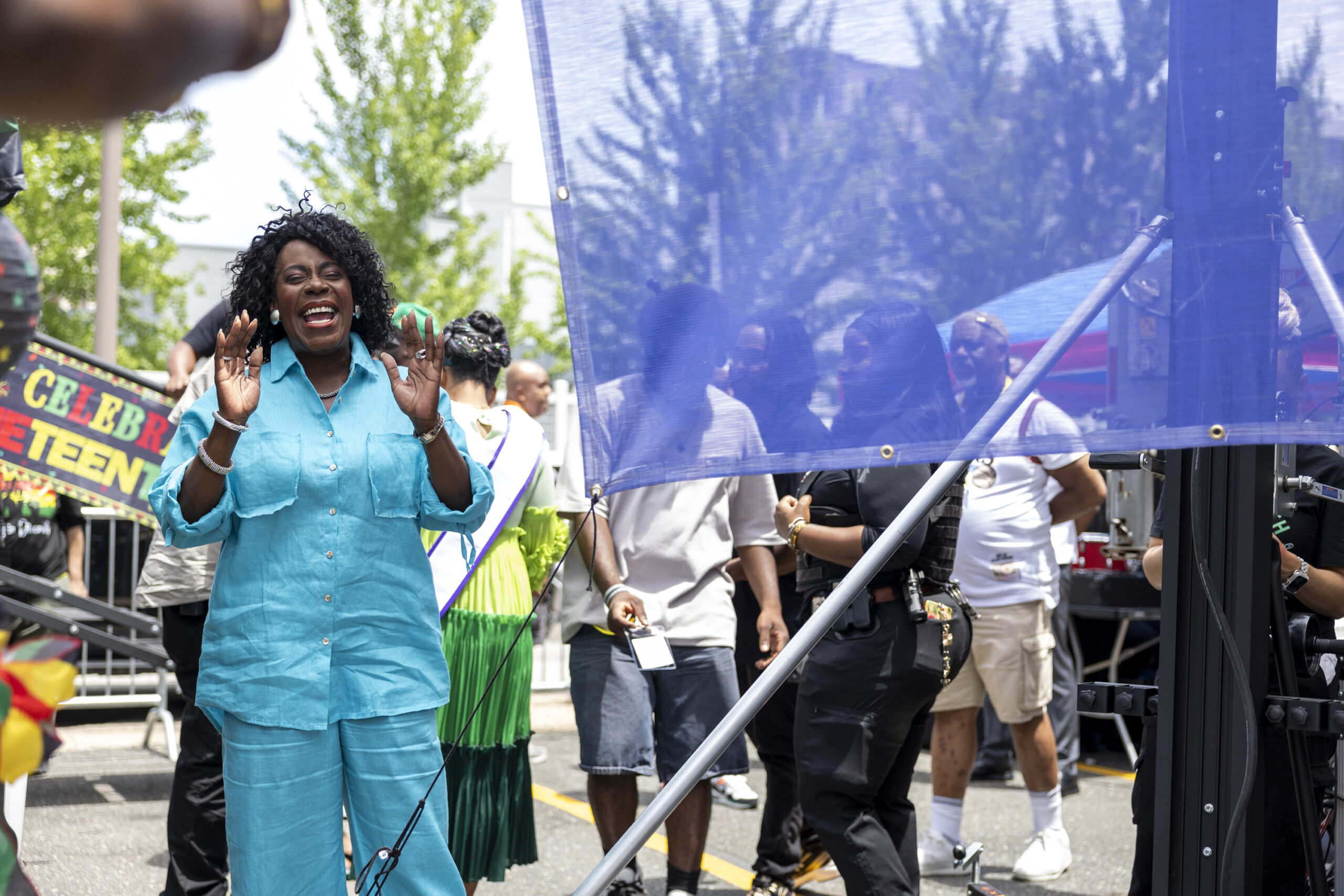
Mayor Cherelle L. Parker attending the Juneteenth Block Party at the African American Museum in Philadelphia on June 19.
Parker said in a statement that her administration “values both qualitative and quantitative information.”
“The real-life, lived experiences of people in this city are what matters most,” she said. “Polling is not my North Star in how I govern. My solutions always come from the ground up, from what people can see, touch, and feel.”
For Parker’s political fortunes, the poll represents mixed results. It showed that the substantial base of support that lifted the mayor to office in 2023 is holding up, with Black residents and older Philadelphians most likely to say they have a favorable view of her and see progress on her campaign promises.
But Parker has not consolidated broad citywide enthusiasm, with 44% of respondents saying that they have a favorable view of the mayor and 35% saying they have an unfavorable one. That is positive territory for Parker more than halfway through her first term, but not overwhelmingly so.
Her biggest vulnerability is with young people — respondents under age 45 were more likely to say that they had an unfavorable view of the mayor than a favorable one. White residents were also more sour on Parker.
(function(){function e(){window.addEventListener(`message`,function(e){if(e.data[`datawrapper-height`]!==void 0){var t=document.querySelectorAll(`iframe`);for(var n in e.data[`datawrapper-height`])for(var r=0,i;i=t[r];r++)if(i.contentWindow===e.source){var a=e.data[`datawrapper-height`][n]+`px`;i.style.height=a}}})}e()})();
Paleologos said that the poll shows there are “pockets of strength” that make Parker, a centrist Democrat, electorally strong, but that he would not consider her support broad-based.
Those results come as the city’s most prominent progressive political groups are weighing whether to mount a challenge against Parker next year. As the incumbent, Parker would be the hands-down favorite in any contest, as no Philadelphia mayor has lost a campaign for reelection in modern history.
Aren Platt, the executive director of People for Parker, the mayor’s political arm, said in a statement that Parker’s support “has always been under-counted, especially in public polling.” He cited polling conducted during the 2023 mayor’s race that showed her tied with or trailing her top opponents in the Democratic primary, in which Parker prevailed by a commanding 10 percentage points.
Platt also said the Suffolk University/Inquirer poll is not necessarily predictive of how the mayor could perform in a theoretical reelection race. The poll was of Philadelphia residents, not likely primary voters.
“This poll may reflect the demographics of Philadelphia, but elections are decided by the people who show up to vote on election day,” he said. “In Philadelphia, those are two very different universes.”
The poll also showed relatively positive marks for one of Parker’s potential successors: City Council President Kenyatta Johnson. He has said that he supports Parker for reelection, but Philadelphia mayors are limited to two terms and Johnson is widely seen as a potential future contender for the city’s top office.
Overall, 48% of respondents said they had a favorable view of Johnson and only 12% had an unfavorable one. Johnson is also far less publicly known than Parker, with 40% of those surveyed saying they had either never heard of him or were undecided on their view of him.
Negative reviews of the Philadelphia School District
About one in five respondents said that schools and education are the most important issue in the city, making it second only to crime. Paleologos said that is somewhat unique to Philadelphia — in other major cities where he has polled public opinion, he said, respondents often rank jobs and the economy as greater concerns.
(function(){function e(){window.addEventListener(`message`,function(e){if(e.data[`datawrapper-height`]!==void 0){var t=document.querySelectorAll(`iframe`);for(var n in e.data[`datawrapper-height`])for(var r=0,i;i=t[r];r++)if(i.contentWindow===e.source){var a=e.data[`datawrapper-height`][n]+`px`;i.style.height=a}}})}e()})();
Nearly 75% of respondents said they would rate the quality of Philadelphia’s public schools as “fair” or “poor.” Younger residents were far more likely than older ones to rate the schools as “poor,” and more than half of all respondents said the public schools are an important factor in determining whether they and their family stay in the city or move away.
“That’s a big number,” Paleologos said. “That research alone gives the policymakers a bird’s-eye view of what they need to do to keep people here in Philadelphia.”
The survey also shows that residents see issues across the school system. When asked what should be the highest priority in improving the schools, there was little consensus among respondents: About a third said teacher pay, while a quarter said school safety, and another quarter said building repairs.
Just 4.4% said the highest priority should be instituting year-round school, an initiative that Parker campaigned on and that the district is piloting.
Superintendent Tony B. Watlington Sr., School Board President Reginald L. Streater, and Mayor Cherelle L. Parker stand together during an announcement at the School District of Philadelphia Headquarters on June 10.
In a statement provided to The Inquirer after the initial publication of this story, Monique Braxton, a spokesperson for the School District of Philadelphia, said district leaders share “the public’s sense of urgency to significantly improve public schools in the City of Philadelphia.”
She said the district is making progress toward the superintendent’s goal of making the district the “fastest improving large urban district in the nation.”
Braxton added that the district’s own survey suggests most parents are satisfied. The district’s 2024-25 survey, Braxton said, found that 90.3% of more than 26,000 parents whose students attend district schools said they were pleased with the quality of education their child received.
The quality of Philadelphia’s public schools has been a perennial concern, and city leaders have long pointed to the chronic underfunding of the Philadelphia School District. In 2023, the state Commonwealth Court ruled that Pennsylvania had for years unconstitutionally deprived students in low-wealth districts of an adequate education, and state lawmakers are now funding schools under a new formula.
District leaders have undertaken significant efforts in recent years to improve academic performance. There have been some positive results, including improvement on test scores and a recent report that said Philadelphia School District students’ learning post-pandemic was tops in the nation among large urban districts.
The district also earlier this year adopted a sweeping, $3.3 billion effort to renovate and modernize 169 schools. That multiyear plan was hotly debated, as it included the closure of 17 schools.
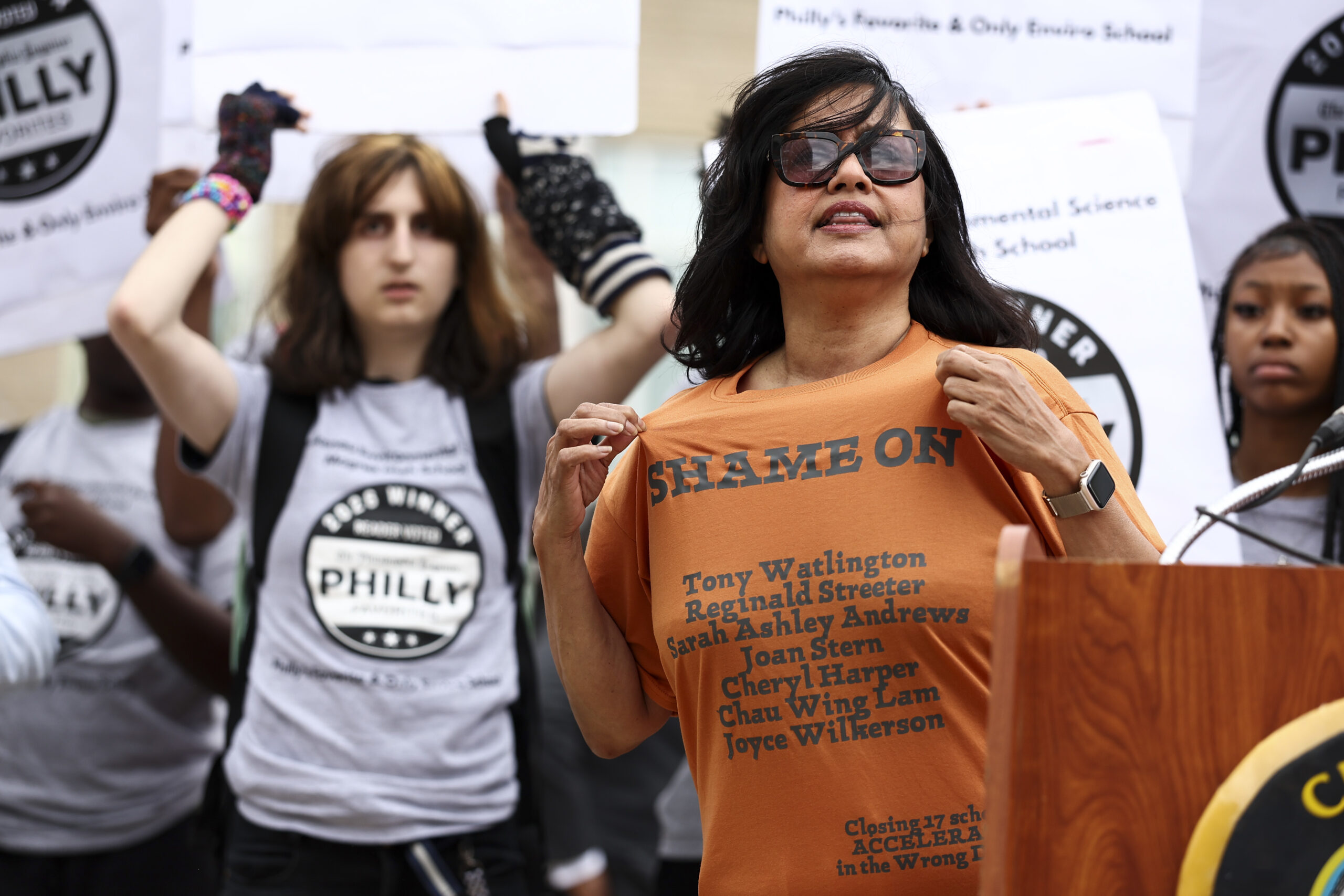
Councilmember Nina Ahmad shows off her T-shirt during a rally outside of the School District of the Philadelphia School District headquarters building on May 28. Council members rallied to oppose the school closure plan.
Parker said the Commonwealth Court “got it right” in declaring that low-wealth districts like Philadelphia’s are chronically underfunded.
“If we had all the resources we need, we’d see even more enhanced improvements in our schools,” Parker said. “I’ll never stop fighting for our children and their right to a high-quality education.”
Crime is the top concern, but most residents feel safe
Despite rates of violent crime in the city plummeting to record lows under Parker, public safety remains the top concern for three in 10 Philadelphia residents, suggesting that people who live in the city are still anxious about crime.
When asked about whether they believe crime in their neighborhood has increased or decreased over the last two years, a third of respondents said they believe it has increased, about 32% said it has decreased, and 28% said they believe it has stayed the same.
(function(){function e(){window.addEventListener(`message`,function(e){if(e.data[`datawrapper-height`]!==void 0){var t=document.querySelectorAll(`iframe`);for(var n in e.data[`datawrapper-height`])for(var r=0,i;i=t[r];r++)if(i.contentWindow===e.source){var a=e.data[`datawrapper-height`][n]+`px`;i.style.height=a}}})}e()})();
(function(){function e(){window.addEventListener(`message`,function(e){if(e.data[`datawrapper-height`]!==void 0){var t=document.querySelectorAll(`iframe`);for(var n in e.data[`datawrapper-height`])for(var r=0,i;i=t[r];r++)if(i.contentWindow===e.source){var a=e.data[`datawrapper-height`][n]+`px`;i.style.height=a}}})}e()})();
A closer look at the results shows that a plurality of respondents in the neighborhoods most affected by violent crime, including North and West Philadelphia, believe that crime has decreased.
The respondents most likely to say that they believe crime in their area has increased live in Northeast Philly. But public data maintained by the Philadelphia District Attorney’s Office show overall crime has decreased there, too. There are five Northeast Philadelphia police districts, and the total number of crime incidents reported to police declined in all of them between 2023, the year before Parker took office, and last year.
Despite the mixed poll results, a vast majority of Philadelphians — nearly 83% — said that they feel safe in their own neighborhood.
That is good news for Parker, who ran for office as a tough-on-crime Democrat amid a historic wave of gun violence and who vowed often to “bring order back to our city.”
Philadelphia police officers stand along the 2800 block of Kensington Ave. after a police involved shooting on May 23. Police shot a robbery suspect.
Parker said in a statement that the polling results are evidence that her public safety strategy is working, calling it her “number one priority.”
She also vowed to continue her administration’s efforts in Kensington, the epicenter of the city’s opioid crisis. The Parker administration has deployed a multipronged approach, including increased police patrols in the neighborhood and an expansion of offerings for people in addiction.
But 53% of poll respondents said they do not believe the mayor’s efforts there are working, and those who live closest to the problem were the least supportive. In the region that encompasses the Lower Northeast and the river wards, where Kensington is located, 68% of people said Parker’s strategy is not working while only 18% said it is.
The mayor’s overall favorability was also lowest in that area of the city, the only region where more respondents said they had an unfavorable view of the mayor than a favorable one.
(function(){function e(){window.addEventListener(`message`,function(e){if(e.data[`datawrapper-height`]!==void 0){var t=document.querySelectorAll(`iframe`);for(var n in e.data[`datawrapper-height`])for(var r=0,i;i=t[r];r++)if(i.contentWindow===e.source){var a=e.data[`datawrapper-height`][n]+`px`;i.style.height=a}}})}e()})();
Parker acknowledged that there is “much more work to do” in Kensington and said that “changing culture and going to war with the status quo is never easy.“
Parker’s ‘clean and green’ message is landing
For a city derisively called “Filthadelphia” and where cleanliness has been a longtime concern, a significant number of people seem to think Philadelphia is getting cleaner.
When asked about trash and litter, 41% of poll respondents said they believe the city has gotten cleaner over the last two years. Just 19% said Philadelphia has gotten dirtier, and 38% said it has stayed the same.
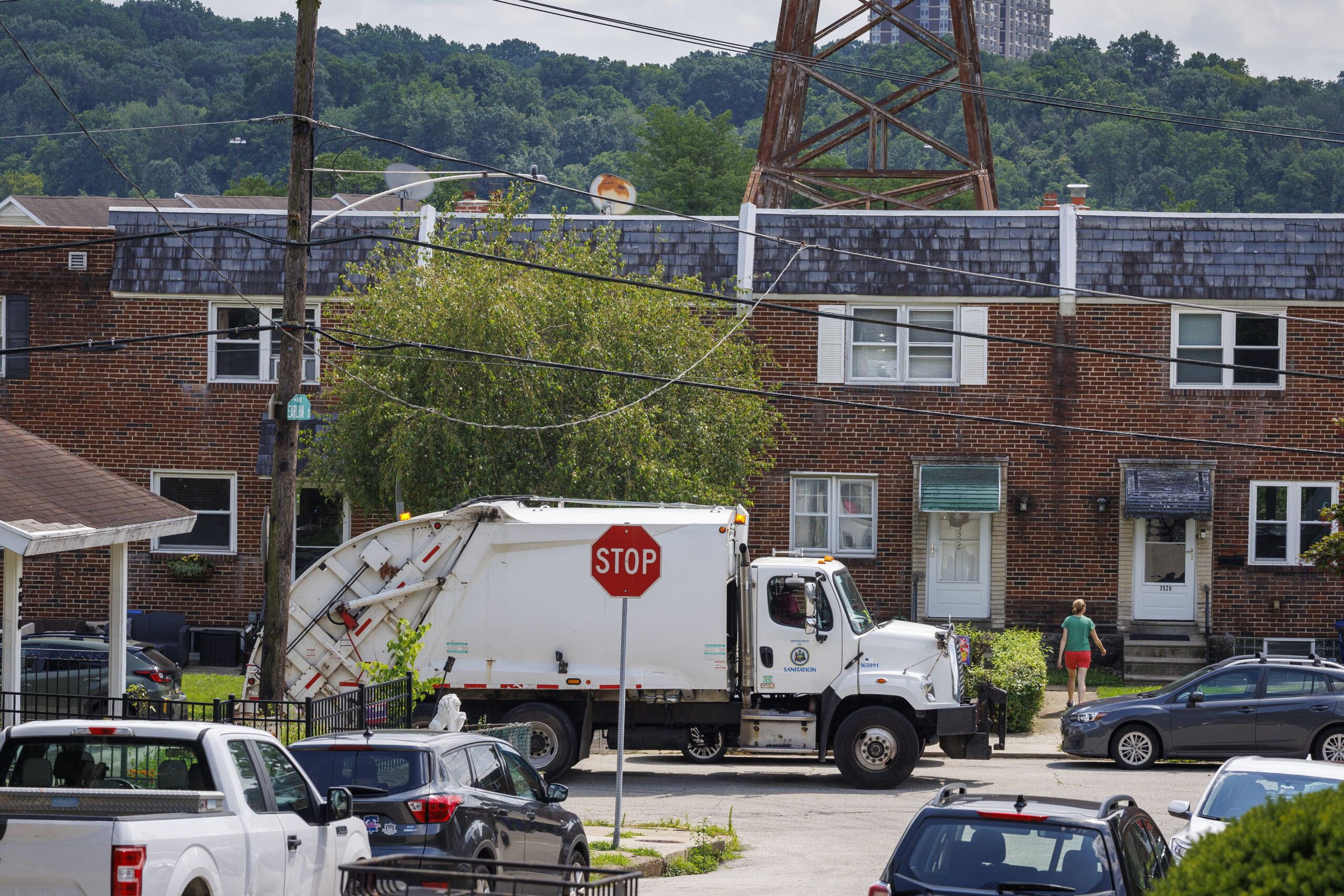
A sanitation department truck is seen along Cresson Street at West Earlham Street in Philadelphia on the first day of trash collection after a strike on July 14, 2025.
Those are positive marks for a mayor whose slogan is “safer, cleaner, greener” and who has instituted new programs including twice-weekly trash pickup in the densest parts of the city.
Despite those efforts, Philadelphians gave worse reviews to the overall quality of city services in their neighborhood. About six in 10 respondents said the quality was either “fair” or “poor,” while 40% said “good” or “excellent.”
Staff writer Michelle Baruchman contributed to this article.
Consensa Francisca Silva Silva moved to Camden from Costa Rica more than two years ago knowing nobody. She lived on the street for two months, she said, and thenwas bouncing from house to house when a young man in the neighborhood told her to check out the Hispanic Women’s Resource Center in Camden, one of several such centers in the state.
She went. With help from the program, Silva received food, obtained a work permit, made a down payment for a studio apartment, and started a job at McDonald’s.
That statewide initiative is now facing detrimental cutsunder DemocraticGov. Mikie Sherrill’s budget proposal. The governor has proposed cutting nearly 80% ofits funding, and Silva worries that other immigrant women looking to improve their circumstances will not get the help she received.
“It was very hard to come here without knowing anyone, and it was really hard because at first I couldn’t find any work,” Silva, who is Nicaraguan, said in Spanish, translated by Jesselly De La Cruz, the executive director of the Latino Action Network Foundation, which funds the centers.
Sherrill and legislative leaders announced Tuesday they had come to an “agreement” on a budget totaling$60.7 billion, the same price tag Sherrill proposed in March. But it has not been made public and it is unclear how far into the details they have gotten. They have until Tuesday to figure it out.
And the process is still underway. State Sen. Nilsa Cruz-Perez, a Camden Democrat who sits on the Senate Budget and Appropriations Committee, has been a supporter of the centers.She was unable to speak Wednesday afternoon because she was in a committee budget hearing.
Client Consensa Francisca Silva Silva (right) participates in a workshop at the Hispanic Women’s Resource Center in Camden Thursday, June 11, 2026.
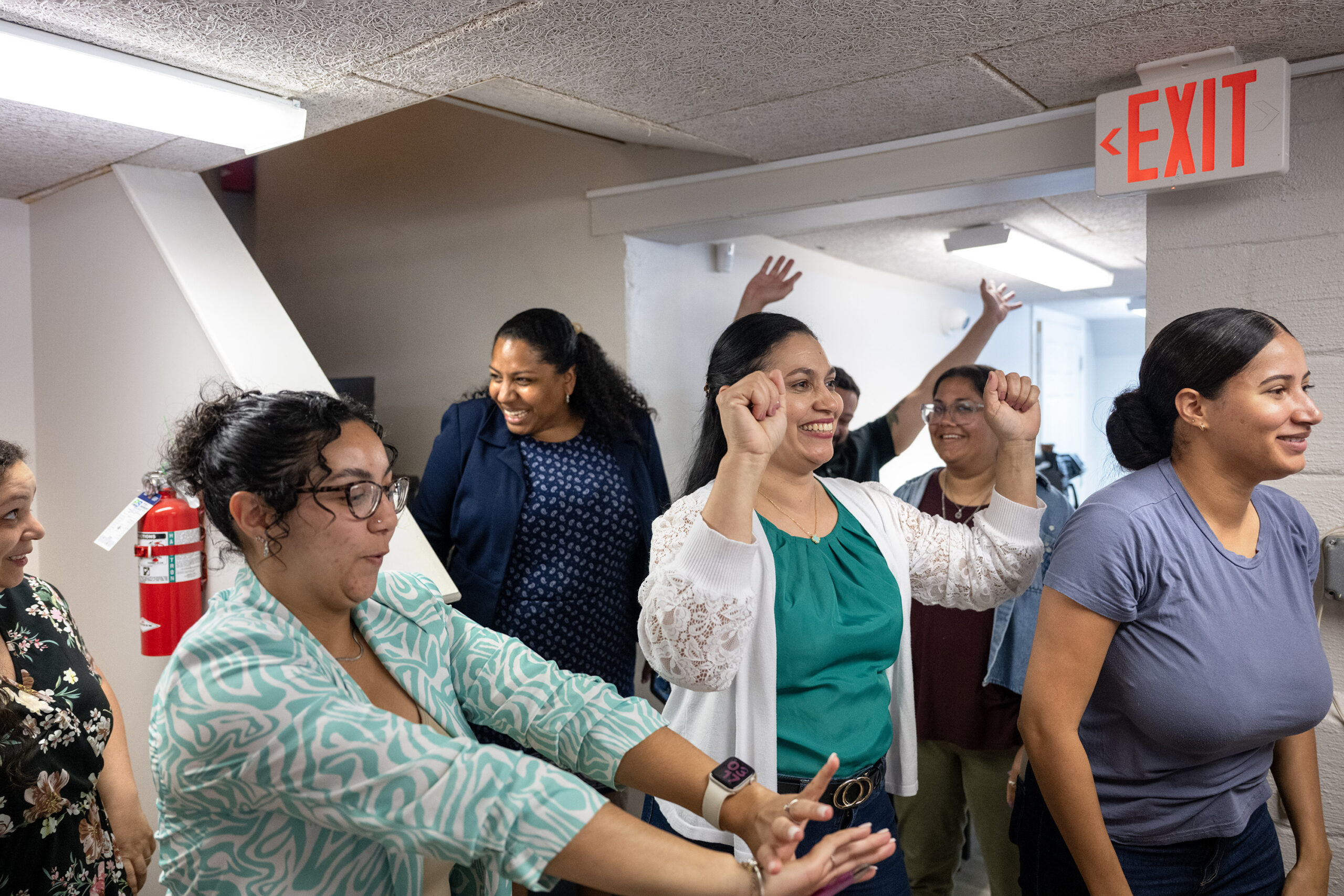
On a recent Thursday, Silva participated in a healthy life skills workshop in Spanish at the Camden center, where she learned about taking care of herself as summer temperatures get hotter in the city. About 20 adults clapped for one another with big smiles on their faces, and they received goody bags with sunscreen, lip balm, a towel to keep cool, and a little fan. A young girl played with magnetic tiles and a baby was kept calm, passed between women.
The governor proposed cutting funding for the center’s programs to$535,000, down from more than $2.5 million this year and more than $3 million in 2025. Murphy had proposed a similar cut last year, but the funding was restored during budget negotiations.
Hispanic Women’s Resource Centers were established through 1991 legislation to address the wage gap for Latinas. New Jersey is one of the states with the biggest wage gap for Latina workers, according to the National Women’s Law Center.
Staff members observe from back of the room during a workshop at the Hispanic Women’s Resource Center in Camden Thursday, June 11, 2026.
The Latino Action Network Foundation funds these resource centers in partnership with six nonprofits across 14 sites, including five in South Jersey. The Camden center is located at the nonprofit Healthy Families and Communities, and there are centers in Vineland in Cumberland County, Hammonton in Atlantic County, Pennsville in Salem County, and Rio Grande in Cape May County.
Sherrill’s proposal would “drastically cut” the number of resource centers, and sites in Hammonton and in Lakewood, in Ocean County, would likely be on the chopping block, De La Cruz said, adding that services would need to be cut in eight of 11 counties.
Martha Infante, 38, who lives in Pennsauken, said she was disoriented when she moved to South Jersey from the Dominican Republic. But through the Camden center, she found out how to apply for work online and learned basic English. She obtained coats for her daughters’ first U.S. winter, and a staffer accompanied her to a New Jersey Department of Motor Vehicles center to get her driver’s license.
“I came here and my mind was all over the place, I didn’t know where things were,” she said in Spanish.
She now works as a home health aide, thanks to training she got through the center, and even participated in a program where she learned about advocating for her community in Trenton.
“Don’t cut these funds, Gov. Sherrill,” she pleaded. “Don’t cut the funds! This is like a family. It’s like a home for the community.”
Client Martha Infante (left) talks with staff member Chailienisse Vega (right) after participating in a workshop at the Hispanic Women’s Resource Center in Camden Thursday, June 11, 2026.
Some of the women in the program are fleeing domestic violence and seeking financial independence. Others are struggling to get a work permit, or may have lost a family member who helped pay the bills to deportation. A lot of former “Dreamers” — undocumented immigrants who came to the U.S. as children — utilize the center as well, De La Cruz said.
The need for the centers has only escalated under President Donald Trump’s second administration, she said.
The social worker-turned-executive said she was surprised by the severity of Sherrill’s proposed cut, especially because of the governor’s efforts to push back against Trump’s immigration policies.
A 2023 Rutgers study funded by the Latino Action Network Foundation found that the most popular services at these resource centers were English-language classes and employment services, such as job referrals, assistance filling out applications, resume writing, and interview preparation.
Staff member Andreina Pardo pauses to stretch with participants as she leads a workshop at the Hispanic Women’s Resource Center in Camden Thursday, June 11, 2026.
“Aside from helping them with the technical aspects of job hunting, the assistance from the Centers seemed to provide a boost of confidence for many of the women, giving them an additional push to apply for positions even if they felt hesitant to do so at first,” the study said.
Gladys, 48, who declined to give her last name due to concerns over her safety, said in Spanish that the free English courses made her feel like she could “come up for air and breathe” after not being able to communicate.
The Camden resident had been an ecologist in Nicaragua and has gotten involved in the center’s community garden. She said she would love to pursue a career teaching children about the environment, but her plans are on hold because her work visa was canceled.
In the meantime, Gladys said, activities at the center like art classes have made her feel less alone. She has been able to connect with women in the same situation as her, and those who migrated to the U.S. earlier who can give her advice from their experiences.
“Maybe my circumstances don’t change, but my emotional well-being changes because I’m able to connect with others,” she said in Spanish.
What are the foods that tourists should try on their trip to North America for the World Cup? Apparently, the Philly cheesesteak is way up there, even higher than tacos in Los Angeles or Cuban sandwiches in Miami.
With the 2026 World Cup spanning 16 host cities across three countries, writer Amy Harris found a tour of 16 “completely different food cultures” for this guide. Canada Sports Betting scored the “hero” dish of every host city based on source frequency, local support, tourist recognition, city-specificity, and cultural significance. The result: a ranking of the most unique city-specific dishes.
In Philadelphia, “the cheesesteak … defines the city’s entire culinary reputation internationally,” Harris wrote. The iconic sandwich with “shaved rib eye on a hoagie roll with Whiz, provolone, or American was invented by Pat Olivieri in South Philadelphia in 1930,” she continued. “Locals will tell you DiNic’s roast pork at Reading Terminal Market is actually the city’s best sandwich. That internal argument is part of what makes Philadelphia interesting.“
The cheesesteak is, for better or worse, depending on your point of view, No. 3 on The Inquirer’s 76 iconic Philly foods, with only one other sandwich — the hoagie — surpassing it. (Water ice was also rated above cheesesteaks on The Inquirer list.)
“The cheesesteak, much like the city in which it was invented, is a working-class sandwich,“ wrote Inquirer reporter Tommy Rowan. “Its rugged beauty is in its simplicity.“
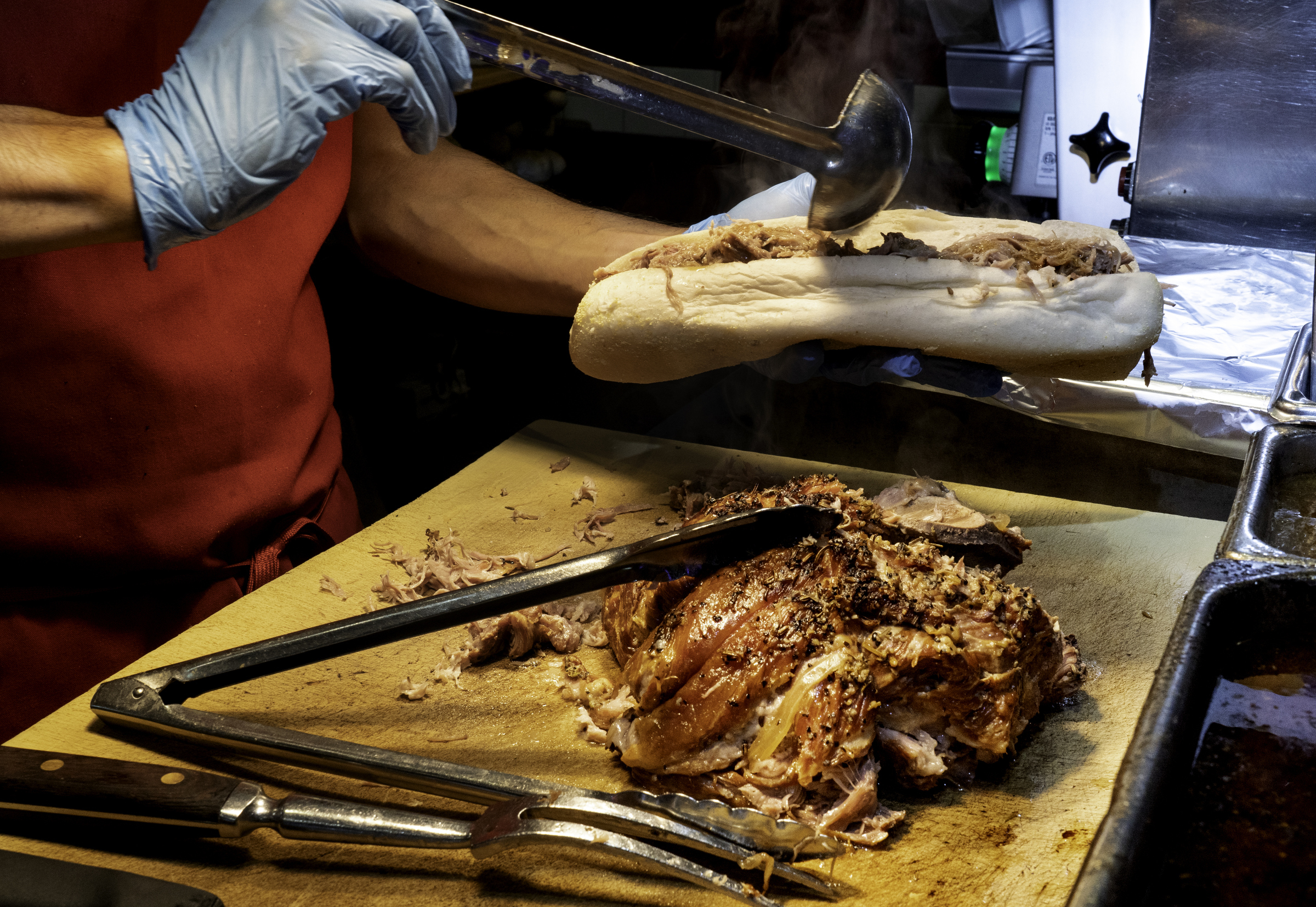
The pulled pork at DiNic’s Roast Pork, Reading Terminal Market, Tuesday, September 26, 2018, in Philadelphia. JESSICA GRIFFIN / Staff Photographer
Guadalajara’s torta ahogada landed in first place, followed by the Viet-Cajun crawfish in Houston. Cabrito al pastor — young goat roasted over live coals — from Monterrey came in third; and the burnt ends — charred tips of a smoked brisket point — from Kansas was fourth.
And all the way in 15th place: New York pizza.
“New York ranks 15th not because its food is unremarkable, but because its most iconic dish has become the world’s most replicated food,” Harris wrote. “New York pizza is made everywhere from Tokyo to Nairobi. That is a consequence of the city’s cultural influence, not a failure of its food.”
But a great cheesesteak? Sorry, you have to come to Philly for that.
Congress has failed to address the workforce disruption that artificial intelligence could generate. The White House, excited about the upside for stocks and investment, has downplayed the potential for widespread job losses.
Now, amid growing public anger over AI and a debate over how to regulate it, a group of employers, state governors, and foundations has raised $500 million to try to answer some of those questions themselves.
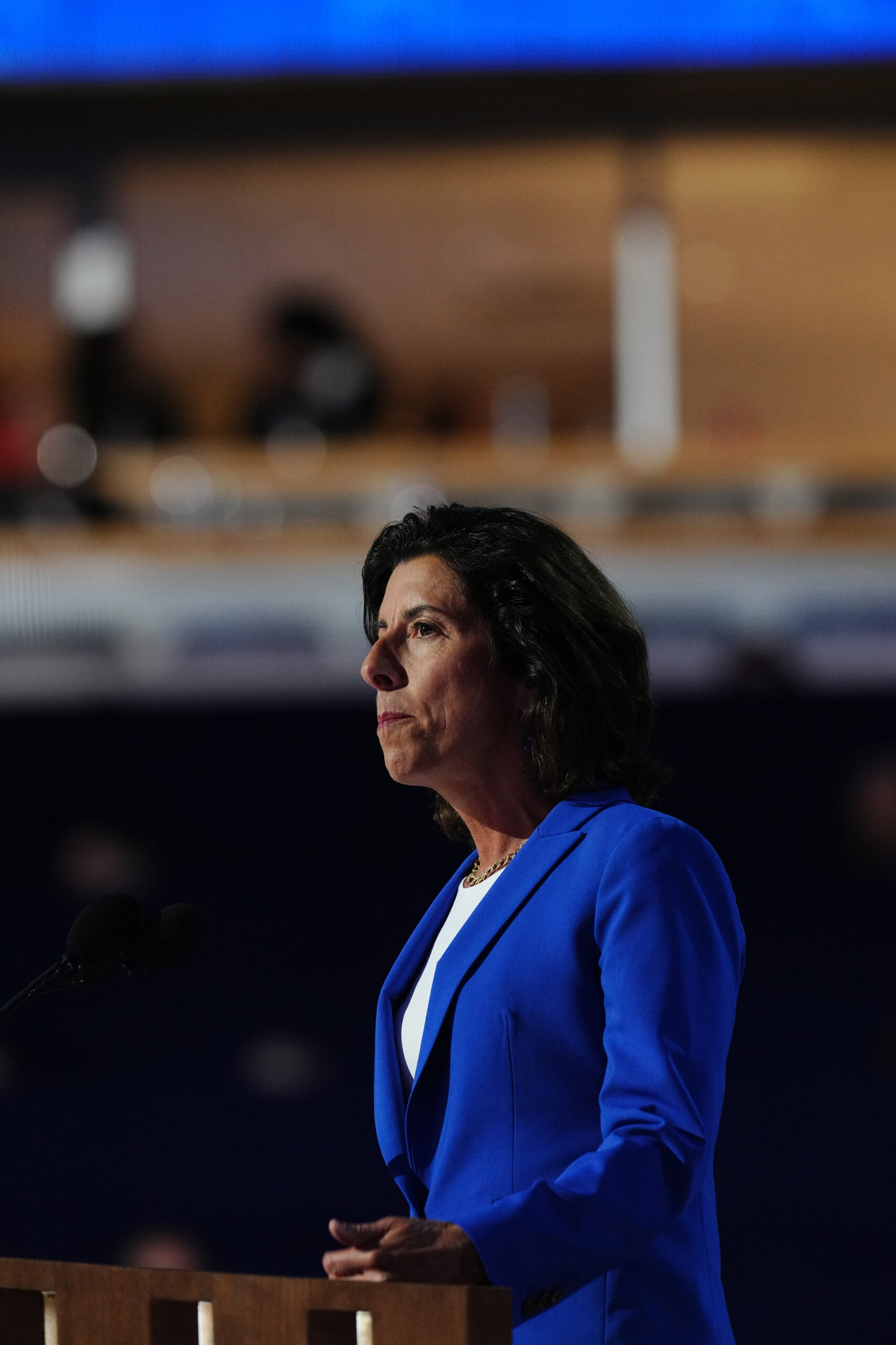
The funders include AI labs preparing to go public, like OpenAI and Anthropic, as well as established corporate giants such as Bank of America and Amazon. Their new nonprofit, called Raise Us, is led by Gina Raimondo, a former commerce secretary and Rhode Island governor who since leaving office has called for companies and the government to do more to orient American workers in a new AI era.
Tech companies and other corporate giants have signed on to an effort called Raise Us led by Gina Raimondo, former commerce secretary and Rhode Island governor.
“This is an independent effort,” Raimondo said. “It’s the first one I know of where competitors in the tech industry have put aside their competition to say, ‘We’re going to write big checks and, in the service of our country, do what we can to figure out this transition.’”
Estimates of the magnitude of job dislocation in store for the American workforce vary widely, from half of all entry-level white-collar jobs to a few thousand jobs here and there. Although layoffs are currently very low across the economy, the employee ratings site Glassdoor has found that worker sentiment toward AI has been worsening. Companies have made headlines by citing AI as a reason for deep job cuts. They include Workday and IBM, which are part of the new nonprofit, as well as Meta and Oracle, which are not.
The organization will work primarily with governors, starting with those in Utah, Arkansas, Maryland, and Connecticut. The theory: States generally control their community college systems, which can translate workforce policy through course offerings and industry partnerships. The bulk of the budget will fund pilot programs overseen by about 15 staff members and consultants.
For example, Maryland will establish a “service year” for recent high school graduates to provide experience in fields where there are shortages, such as healthcare. In other states, Raise Us hopes to offer “wage insurance” for workers who take lower-paying jobs rather than dropping out of the workforce entirely.
The group plans to furnish technical assistance for companies that want to retain workers as AI changes their roles, rather than eliminating them. Microsoft, one of the companies backing the organization, said it had already found a promising model: cross-training its entry-level lawyers in different parts of the organization and equipping them with AI skills in order for them to be repositioned as technology evolves.
“You can think of doing that with almost any job we have,” said Brad Smith, vice chair and president at Microsoft. “It creates an opportunity to transfer people from jobs that are being eliminated to jobs that are being created.”
Retraining displaced workers has always been a difficult task, and historically not a very successful one. Raimondo called past efforts “ineffective.”
Sam Manning, a senior research fellow with GovAI, a think tank, said the new group’s work offered a new opportunity to learn about what could work best.
“This model — of let’s work within states and try to do pilots and demonstration programs, build more evidence, learn what works for different types of workers with different constraints — does seem to me like a pretty good thing to do,” Manning said.
Congress has slashed funding for its flagship workforce development law since passing it in 1973. Planned overhauls of the statute have sputtered out. Research has found that while federal workforce programs do help place workers in new jobs, their long-term success is limited by the lack of high-paying positions for workers without college degrees.
Jane Oates ran the Labor Department’s Employment and Training Administration under President Barack Obama. Despite funding cuts, she said, states as disparate as Texas and Massachusetts have found ways to raise private capital and work with employers to meet their talent needs.
“I don’t know that she’s been anywhere else to look at the amazing, innovative things that are done in small and large places around the country,” Oates said of Raimondo.
Part of the Raise Us mission is to adapt existing budgets to the particular challenges of AI-driven disruption. The nonprofit includes a policy lab, funded by philanthropies rather than corporations, that will incubate new ideas that governments may carry out down the line.
Raimondo also serves as a chair on a commission, organized by the right-leaning American Enterprise Institute and the left-leaning Urban Institute, that will come up with policy recommendations to address the effect of AI on the workforce and the demands it may create. That effort is funded by Google.
On the policy front, the groups join a crowded landscape. The air has been thick in recent months with proposals for minimizing the potential downsides of AI while harnessing its benefits.
Sen. Bernie Sanders (I., Vt.) has suggested confiscating half of the stock value of top AI companies and depositing it in a publicly owned fund. Others have floated the idea of shifting the tax burden from payroll taxes to the computing power that is necessary to run sophisticated AI models. The Raise Us board includes Liz Shuler, president of the AFL-CIO, the labor federation, which has a technology institute that has emphasized protections for workers as AI develops.
Raimondo’s initiatives, underwritten by corporations that have much at stake, may seem ill-positioned to make recommendations that would burden the engines of America’s AI dominance. But Harry Holzer, a professor of public policy who is part of the joint American Enterprise Institute-Urban Institute commission, said its members would not shy away from doing so.
“I don’t think we’re going to hesitate to talk about resources,” Holzer said. “If the AI companies and tech companies start making money hand over fist, there might be an excess-profits way of dealing with that.”
Raimondo and her colleagues are not fans of a universal basic income, an idea that has gained popularity in Silicon Valley as an answer to job disruption. They emphasize that work provides more than just wages, and plan to focus on helping people find pathways to new jobs.
But it’s unclear whether AI will create jobs at the rate that it will destroy them. Jack Malde studied workforce policy for the Bipartisan Policy Center and is now going to work for the Windfall Trust, another AI-focused think tank. He said long-term income support might be necessary, even if better models for transitioning workers were found.
“The truth is, there’s still a lot of uncertainty,” Malde said. “What we think is resilient now might not be resilient later. We’re not going to get everything right, so we’re going to need those strong safety-net programs.”
Eventually, the backers of Raise Us think, federal action will be necessary to replicate successful policies across states and employers who aren’t early adopters. Raimondo said she had been in touch with the acting labor secretary, Keith Sonderling, whose department is establishing its own data hub for AI effects.
But at the moment, she thinks that there’s no time to wait for alignment from Washington. As a historical parallel, she cited the Committee for Economic Development, an organization formed by big businesses in 1942 with the goal of absorbing American soldiers back into the economy after World War II ended and defense production was scaled back. It encouraged ways to fight inflation and foster full employment, helping to head off postwar stagnation.
“I think this technology will lead to more productive people, new jobs and new industries, and I want to get there,” Raimondo said. “But I also worry about the transition, and a window where people could get hurt. The politics could get uglier. So I just want to get started now to build the infrastructure to be prepared to manage the transition.”
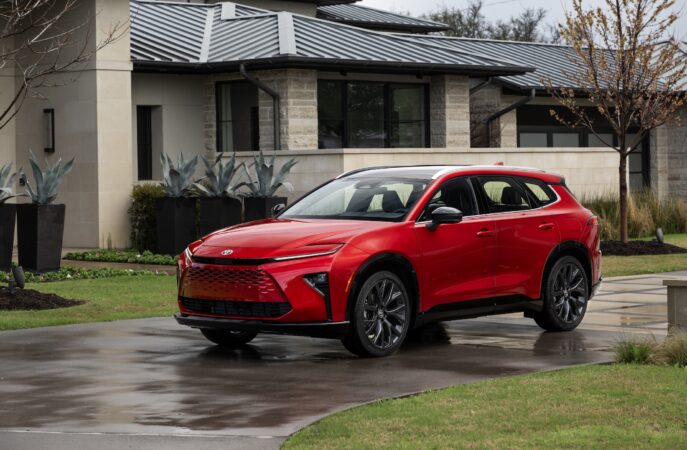
2026 Subaru Outback Touring XT vs. Toyota Crown Signia Limited: New ways to get around.
This week: Toyota Crown Signia
Price: $48,990 for the Limited model.
What others are saying: “Highs: Lexus-like interior, plush ride quality, thrifty hybrid powertrain. Lows: Noisy engine under acceleration, bland handling, underperformed its EPA highway fuel economy rating in real-world testing,” says Car and Driver.
What’s new: While I billed this competition as new ways to get around, the Crown Signia is only new to Driver’s Seat testing. This hybrid-only SUV debuted for the 2025 model year, replacing the Venza.
The Venza was a model I really enjoyed, but it got very little respect from car lovers. Both models have a reputation for boring drivers, but I loved the comfy seats and easy controls of the Venza — and the 36 mpg — enough to recommend it heartily. Would the Crown Signia bring the same kind of experience?
As for the Outback vs. Crown Signia comparison, two cars with more opposite market aims could hardly fit into the same category, and they could hardly have come to testing in more opposing conditions. The Outback endured 20-degree days while the Crown Signia was here for the 90s. Both offered some hesitation before they were warmed up, so we’ll just have to say that’s a feature, not a bug.
Up to speed: A new 240-horsepower 2.5-liter four-cylinder is mated to an electric motor, and it adds 21 horses over the Venza. It gets to 60 mph in 7 seconds, according to Car and Driver; with 20 fewer horses than the Outback turbo tested, it’s almost a second slower. You go, Subaru.
Shifty: The Crown Signia uses the Prius shifter, electronically shifting up and left for Reverse and down and left for Drive.
On the road: On-demand all-wheel drive makes the handling acceptable, and Sport mode is a little nicer. The Crown Signia lends itself to driving sedately and looking at the scenery.
The pretty interior of the 2026 Toyota Crown Signia turns the comfort level to 11.
Driver’s Seat: Comfort is definitely the name of the game behind the wheel of the Crown Signia. Convenience as well. This is where I realize the Crown Signia is a nice replacement for the Venza; that too offered luxury and comfort closer to Lexus’ standard than Toyota’s.
No ground is really broken here, as the controls match most of Toyota crossovers and cars. The Outback wins this category.
Friends and stuff: The rear seat provides comfort in both cushion quality and spaciousness. Legroom, headroom, and foot room are all generous. The middle seat is not too bad as the floor hump sits low and wide, and the console doesn’t intrude too much.
Cargo space is 24.8 or 66.1 cubic feet, a growth spurt over the Venza that may help improve sales. But it’s still no match for the Outback’s 80 cubes.
In and out: The Crown Signia is at a perfect height for people of almost any age. No real climb or limbo required.
Play some tunes: A lone volume button is the only nod to the Before Times from the stereo control people. The screen is big and easy to follow.
Sound from the system is clear and aimed correctly, an A- to an A. Advantage, Crown Signia.
Keeping warm and cool: Toggles control all the features, and this functions nicely. Except for the seat heaters and coolers, which sit above a different toggle, so that confuses until you get used to it. It keeps us out of the touchscreen, at least. A small screen tells you what’s blowing where and how hard.
An annoying feature of the Crown Signia HVAC (something I noticed in the 4Runner hybrid as well) is the AC turns itself off with each restart. So I’d be blasting the fan on myself after crossing a 90-degree parking lot and wondering why I never got cool. I’m sure it’s easy to get used to but also, why? At least it’s not a touchscreen control, which would certainly malfunction when the interior exceeds 120 degrees.
Fuel economy: I averaged close to 36 mpg during my week of testing, much nicer than the Outback turbo (as can be expected). Strong win for the Crown Signia.
Where it’s built: Aichi, Japan
How it’s built:Consumer Reports gives the Crown Signia a four out of five for reliability.
In the end: The Crown Signia carries the torch of the Venza: Fun may not be part of the vocabulary, but it sure is a nice, efficient ride. The Subaru is also a nice ride, but I’m not sure 0.8 seconds off the 60-mph run-up is worth another 10 cents a mile forever.
And at 50 grand each, a Thomas Crown-worthy heist may be needed to help pay either of these vehicles off.