Blog

  • The toxic culture that killed Alex Pretti | Will Bunch Newsletter

    Dan McQuade had such a way with words that it’s almost impossible to find the right ones to contemplate a Philadelphia without Dan writing about all the bat-guano crazy things we do here. Dan, who wrote for a variety of sites including glory-days Deadspin and Defector, died from cancer last week. He’d just turned 43 — way too young. We started blogging at the same time in the mid-2000s, and I was blessed to know him from that long-lost scene. He leaves behind his wife, a 2-year-old son, and a remarkable body of work — like essential coverage of the Wildwood T-shirt scene, or his analysis of Sylvester Stallone’s absurd 30-mile run in Rocky II — that people will still be reading and talking about for many years to come.

    If someone forwarded you this email, sign up for free here.

    The twisted, deadly culture of U.S. immigration cops can’t be fixed with training

    Border Patrol agents detain a man in Minneapolis on Jan. 11.

    The fear was palpable even before the ink had dried on what Donald Trump called his “Big Beautiful Bill” — the 2025 legislation that funneled a whopping $170 billion toward immigration enforcement, including doubling the number of agents in the field from 10,000 to 20,000.

    Many warned the surge of inexperienced rookies — indeed, their training was slashed from 90 days to just 47 (or 48) days to race the new agents out into the streets — could lead to acts of police brutality, or worse, as an alphabet soup of Homeland Security agencies donned masks and went after immigrants in agitated urban neighborhoods.

    Those whispers became a scream as Americans watched the horrific videos of a masked federal agent walking in front of the family SUV driven by a Minneapolis mom, Renee Good, and then firing three shots that killed her. Seventeen days later, one of the officers in a scrum beating up observer Alex Pretti — apparently not seeing that Pretti had already been stripped of his legal handgun — fired the first blast of what became a volley of 10 shots that killed the 37-year-old Minneapolis intensive care nurse.

    On Sunday, the ProPublica newsroom revealed what the U.S. government had successfully kept secret for more than a week: the names of the two agents — both from South Texas — who fired the fusillade of shots that killed Pretti on a busy Minneapolis street.

    They were not rookies.

    Border Patrol officer Jesus “Jesse” Ochoa, 43 — who, according to his ex-wife, is also a gun enthusiast with 25 pistols, rifles, and shotguns — had his heart set on joining the federal force after earning his criminal justice degree from the University of Texas-Pan American and finally got his wish eight years ago, ProPublica wrote.

    The site reported that the other shooter, Raymundo Gutierrez, joined U.S. Customs and Border Protection in 2014 and works for its Office of Field Operations, where he is assigned to a kind of agency SWAT team, involved in high-risk operations.

    The men who gunned down Pretti were well-trained and experienced, as was Jonathan Ross, the ICE and former Border Patrol officer who shot and killed Good during their Jan. 7 encounter. Their involvement in the killings that shocked America suggests that moderates calling for reforms at ICE, but not for a radical reworking of immigration enforcement, are failing to understand the much deeper problems.

    Garrett M. Graff, a journalist and best-selling author who’s been tracking Border Patrol and its brother agencies since their expansion in the 2000s, told me on Monday that he was not at all surprised the three officers firing the deadly shots were highly experienced.

    “I do think it’s enormously relevant that the shooters all have CBP backgrounds,” Graff said. “It’s an agency that routinely uses deadly force outside of the norms of law enforcement in the U.S., and it’s not a surprise to me that in both cases we see agents quick to resort to deadly force.”

    Graff added that Ross’ fatal shooting of Good mirrored problems that have existed in the agency for years. He said it “jibes with a 2013 internal report that criticized CBP agents and officers for putting themselves in danger by stepping into the path of vehicles, and firing their guns out of ‘frustration’ rather than fear.”

    I reached out to Graff, who was a Pulitzer Prize finalist for his history of the Watergate scandal, because just two days before the ProPublica report, he offered some extraordinary history and background about CPB in testimony before an Illinois state commission that’s looking into misconduct during the 2025 immigration raids there.

    Graff’s statement went viral on social media because it detailed a toxic culture at CPB that’s highlighted by shocking levels of criminality among its agents, from on-the-job brutality to off-duty thuggery, as well as domestic violence.

    Finding that at least 4,913 Border Patrol agents and CBP officers were arrested over a 20-year period, Graff testified, “Indeed, for much of the 2010s and likely before and since, it appears the crime rate of CBP agents and officers was higher per capita than the crime rate of undocumented immigrants in the United States.”

    Ironic, huh? But why has this happened?

    A lot of the problem, Graff testified, lies in the rapid surge of Border Patrol from around 9,200 agents at the time of the 2001 terror attacks to roughly 21,000 by the Obama administration. Those new hires, he said, were hastily recruited with limited background checks, rushed into the field with minimal training, and lacked the arrest powers of more rigorous federal agencies like the FBI.

    On the job, this new cadre bonded over a culture that simmered in misogyny and racism, and then boiled over in backing an authoritarian like Trump. “Agents developed a strong tradition of frontier-style justice; its agency motto, ‘Honor first,’ is as much a statement of machismo as it is about integrity,” Graff testified.

    This culture has proved lethal long before the frigid streets of Minneapolis. Graff said that CBP agents have been involved in at least 72 deadly shootings or use-of-force incidents since 2010, making it “perhaps the nation’s deadliest law enforcement agency.”

    He’s not the only one to suggest that Border Patrol’s problem is its warped culture, not a lack of training or body cams. Jenn Budd, a former Border Patrol agent who became a whistleblower, has described CBP as plagued by abusive officers and a pervasive rape culture. In her memoir, she calls Border Patrol “a criminal organization disguised as a federal law enforcement agency.”

    America’s response to the 9/11 attacks — the birth of the U.S. Department of Homeland Security and the dramatic expansion of Border Patrol, as well as the creation of ICE in 2003 — launched a monster that has now blown back against America’s own citizens, in Minnesota and elsewhere.

    This fundamental notion — that ICE, CPB, and Border Patrol are rotten way past the point of tinkering around the margins — is what needs to be driving the debate on Capitol Hill. The incremental reforms some top Democrats are pushing, such as body cams or requiring arrest warrants, are fine as stopgap measures, but they would not have saved the lives of Pretti or Good.

    The only fix that makes sense is abolishing ICE and all the other post-2001 excesses and returning to just the essential functions that are actually needed: airport security, arresting the relatively small number of violent criminals who enter America, humanely securing the border, and processing people seeking refuge from their violent homelands.

    Abolishing ICE and radically reforming the rest of a broken system won’t bring back Good or Pretti, either, but it would be the most fitting and appropriate memorial to America’s slain martyrs of 2026.

    Yo, do this!

    • As things in America have seemed to consistently get worse since the dawn of the 21st century, there was a frequent question: Why are there no great protest songs? You can stop asking now. Bruce Springsteen has channeled the golden era of Nobel laureate Bob Dylan, who sang in outrage over injustices like the assassination of Medgar Evers, with his own instant and electric protest record, “The Streets of Minneapolis.” Recorded and released in the course of a weekend, the Boss honors ICE murder victims Renee Good and Alex Pretti and heaps scorn on their killers. Already the most downloaded song in America, it shouldn’t have taken this for Springsteen to get his first-ever No. 1 single.
    • Just as everyone predicted at the start of the season, it’s Drake Maye’s New England Patriots against Sam Darnold’s Seattle Seahawks for all the marbles when Super Bowl LX kicks off Sunday night from Santa Clara, Calif. (Yes, that was sarcasm.) Although this is one of the least appealing matchups, on paper, in the history of the Big Game, 2025-26 has — excepting our Eagles — proved the most exciting NFL season in modern memory, so hopefully these two Cinderella QBs will do their part. The real fireworks may come when Trump-unfriendly artists Green Day (!!) and Bad Bunny take the stage. Actual football commences at 6:30 p.m. on NBC.

    Ask me anything

    Question: Was the Minnesota general strike successful? And what are the prospects of a true national strike? — @exlibrophilly.bsky.social via Bluesky

    Answer: The answer to your first question would have to be a yes. It was telling that 60 Minnesota corporations felt compelled to issue a statement (albeit one I viewed as milquetoast) and that the Trump regime started making some partial concessions after thousands of Minnesotans skipped work to take to the streets. On the second part, I noticed there was chatter about a national general strike last Friday, and very little came of it. That’s because a successful nationwide shutdown — something that has never happened before — would require weeks, not days, of planning and committed, full-throated support from the top labor unions and other key organizations like the Democratic Party. Given that the real power in America seems to be economic, I would urge these power brokers to join with regular folks and make it happen.

    What you’re saying about …

    Newsletter readers feel strongly that — while there’s nothing wrong with proposed reforms such as unmasking, visible badges, marked vehicles, and the proper use of arrest warrants — U.S. Immigration and Customs Enforcement should be abolished, and immigration enforcement should be totally overhauled. Wrote Daniel Hoffman: “Any of the reforms, controls and procedures that the Democrats are likely to impose on ICE are useless as long as Donald Trump is president and he has stooges to carry out his campaigns of vengeance and nationalist bigotry.” Thomas Ceresini agreed: “Dems *should* demand that ICE be abolished immediately, and that CBP be reorganized from top to bottom, purging all the fascists from its ranks.”

    📮 This week’s question: Pennsylvania Gov. Josh Shapiro has been all over the news lately with the release of his new book and a controversial passage about the 2024 Kamala Harris campaign. But his stock for president in 2028 seems to be falling. Would you like to see him run for president, or vice president, or neither? Please email me your answer and put the exact phrase “Shapiro 2028” in the subject line.

    Backstory on the strange case of Tulsi Gabbard

    Director of National Intelligence Tulsi Gabbard enters the Fulton County Election HUB Wednesday as FBI agents seize Fulton County 2020 Election ballots, in Union City, Ga.

    Tulsi Gabbard was in the news a lot in the first couple of shocking months after Donald Trump’s 2024 election victory, and for good reason. The 47th president’s stunning pick of the former leftist as his director of national intelligence (DNI) barely made it out of the Senate on a 52-48 vote, with Democrats like Sen. Elizabeth Warren calling Gabbard a likely, if perhaps unwitting, Russian asset because of her history of statements that aligned with the Vladimir Putin regime.

    But then something even stranger happened: Gabbard largely disappeared from sight. Most notably, the nation’s intelligence chief was not heard from during the U.S. attack on Venezuela that captured and deposed its strongman leader Nicolás Maduro, and reportedly was excluded from its planning — likely because in her Democratic past, she had vehemently opposed American intervention there. But it was even more jarring when and how Gabbard resurfaced last week: overseeing an FBI raid at the Fulton County, Ga., election hub that the president has long insisted — in a Big Lie with zero evidence — was the epicenter of some type of fraud that prevented his reelection in 2020.

    Gabbard’s appearance in Georgia raised many questions, especially since the spy agencies she oversees as DNI are supposed to watch for foreign intelligence threats — not get involved in domestic policy. On Monday, Gabbard sent a letter to key Democratic lawmakers who’d demanded answers, explaining that she monitored the raid because Trump had asked her to be there, and insisting that election security is one of her duties because of the possibility of foreign interference.

    The Georgia raid, and Gabbard’s involvement, has sent off all kinds of alarm bells that the Trump regime is planning to gin up a voter fraud case — even though thorough recounts proved that Joe Biden narrowly won Georgia in 2020 — as an excuse for an unprecedented federal intervention in November’s midterm election. We also learned this week that while she was in Atlanta, Gabbard even facilitated a phone call between Trump and several FBI agents involved in the raid, a stunning breach of protocol. On Monday, Trump went on a podcast with his former deputy FBI director, Dan Bongino, and declared that “Republicans ought to nationalize the voting” in 15 unspecified key states. Such a move would mean the end of American democracy as we’ve known it.

    Meanwhile, Gabbard is back on the radar in a big way. Also on Monday, the Wall Street Journal reported that the DNI is the subject of an explosive whistleblower complaint that, according to the whistleblower’s attorney, the White House has listed as highly classified and is refusing to share with Congress. Leaders on Capitol Hill need to fight to get this secret information by any means necessary. In the increasingly fraught fight to save the American Experiment, we need to know who Gabbard is really working for.

    What I wrote on this date in 2022

    Remember affirmative action? Four years ago, the U.S. Supreme Court was still considering the legal challenge to the use of race as a factor in college admissions, which it did strike down later that year, in a foreshadowing of the Trump regime’s much wider war against diversity. On Feb. 3, 2022, I wrote that while the threat to affirmative action was indeed alarming, the existing rules were already failing African American college applicants. I wrote: “In a nation where the Black-white wealth ratio is 20-1, recruiting Black kids was a low priority. These self-inflicted wounds had little to do with the legal status of affirmative action.”

    Read the rest:Supreme Court affirmative action case pretends we haven’t already wrecked Black college access.”

    Recommended Inquirer reading

    • The fallout from the deadly ICE raids in Minneapolis remains the dominant story in America, as reflected in my recent columns. First, I wrote about the looming deep cuts in news reporting at the Washington Post and CBS News, and decried how these self-inflicted wounds — both at the hands of their billionaire Trump-favoring owners — would mean fewer eyes out in the field just as Minnesota was showing the power of bearing witness. Over the weekend, I warned of the regime’s plan for new immigration raids against the beleaguered Haitian refugees of Springfield, Ohio — a scheme that seems on hold for now after a judge ruled late Monday night to continue the protected legal status of these immigrants.
    • While we still haven’t seen all of the government’s Jeffrey Epstein files — despite the law calling for their full release last December — the massive tranche of documents that did go public last Friday is a gift that keeps on giving for those who track the follies of America’s rich and famous. Not surprisingly, America’s founding and still sixth-largest city has numerous ties to the late financier and convicted sex trafficker. So far, The Inquirer has reported that the U.S. Department of Justice files reveal a surprising relationship between Epstein and Philadelphia-born comic Bill Cosby, who at the time was battling his own flurry of sexual abuse allegations. Epstein even offered to buy Cosby’s home at one point. In a separate story, The Inquirer traced the relationship between the financier and 76ers owner and hedge-fund billionaire Josh Harris, who “had an ongoing business relationship that included numerous phone calls and at least one visit to Epstein’s home in Manhattan.” What’s more, Epstein inquired about buying a plane from a Harris business associate, University of Pennsylvania megadonor Marc Rowan. The Epstein scandal shows that all politics — especially the most tawdry — is local. There’s more to come, but you’ll be locked out without a subscription. Why not sign up today?

    By submitting your written, visual, and/or audio contributions, you agree to The Inquirer’s Terms of Use, including the grant of rights in Section 10.


  • ICE buys $87 million warehouse in Berks County as it plots expansion of immigration detention centers across the U.S.

    ICE buys $87 million warehouse in Berks County as it plots expansion of immigration detention centers across the U.S.

    UPPER BERN, Pa. — The Trump administration has quietly purchased a nearly 520,000-square-foot warehouse in Berks County as it plans to convert such facilities into immigration detention centers across the U.S.

    The warehouse, located at 3501 Mountain Rd. in Upper Bern Township, was sold to the U.S. government on behalf of the Department of Homeland Security and Immigration and Customs Enforcement for $87.4 million, deed records show. The purchase was recorded on Feb. 2.

    Spotlight PA visited the warehouse, which is located about a mile from I-78, on Jan. 15 and witnessed about two dozen individuals touring the exterior of the building. One man who arrived early to the site that day identified himself to a reporter as ICE.

    The property was most recently called the Hamburg Logistics Center, and before that was the site of the Mountain Springs Arena, a county landmark known for rodeos and demolition derbies. It neighbors an Amazon warehouse and the Mountain Springs Camping Resort.

    The building is one of at least 23 that ICE plans to convert into immigration detention facilities, Bloomberg reports. The Berks County warehouse could house up to 1,500 beds.

    ICE also finalized the purchase of a warehouse in nearby Tremont Township, in Schuylkill County, on Monday, according to a deed. The Tremont property is located less than 300 yards from a daycare center and has already faced fierce resident opposition.

    A spokesperson for ICE did not answer any questions about the Berks County warehouse purchase and instead lauded the agency’s targeting of “vicious criminals.”

    “Thanks to the One Big Beautiful Bill, ICE has new funding to expand detention space to keep these criminals off American streets before they are removed for good from our communities,” the spokesperson said.

    Upper Bern Township’s solicitor said in an emailed statement that community leaders learned about the sale on Monday. They declined to answer questions.

    “The township was not involved in this transfer and has not received any applications from either the prior or new owners regarding the future use of the property,” the statement reads. “The township has no further comment on this matter at this time.”

    State Sen. Chris Gebhard and State Rep. Jamie Barton, Republicans who represent the area, said they have reached out to federal contacts to gather more information on how the Department of Homeland Security plans to use the warehouse.

    “Our immediate concerns include the potential loss of property tax revenue for the host municipality, county, and school district, as well as security and perimeter considerations,” the lawmakers said in a joint statement. “We look forward to engaging directly with the appropriate federal officials to address these issues. Once additional information is available, we will provide an update.”

    The property is assessed at $22 million and currently pays $198,286 annually in county property taxes under the current tax rate of 9.013 mills. Combined with Hamburg Area School District and township taxes, the loss of tax revenue from the federal government’s purchase would be about $624,000.

    State Sen. Judy Schwank (D., Berks) declined to comment on the warehouse purchase on Monday. In an earlier interview with Spotlight PA, she called the then-potential sale “deeply concerning,” especially given the reports of mistreatment of people detained in ICE facilities. She released a statement about “ICE’s action in Minneapolis” on Jan. 27, shortly after federal agents killed Alex Pretti.

    “My concern is, knowing the track record of some of these other facilities located throughout the country, it’s not good,” she said. “I don’t necessarily want to see something like that being housed in our county.”

    The deed finalized on Monday shows the property was sold to ICE by an LLC connected to PCCP, a national commercial real estate equity firm. The firm purchased the warehouse in 2024 for $57.5 million, deed records show.

    Reached by phone Monday afternoon, PCCP partner Greg Eberhardt — who is the authorized signatory for 3501 Mountain Road Owner LLC on the latest deed — denied knowledge of the property and its sale, and refused to comment further.

    “I have no idea what you’re talking about,” Eberhardt said before hanging up on a Spotlight PA reporter. “I’m not making company comments.”

    Upper Bern Township is situated on the edge of Berks and Schuylkill Counties, with a population of roughly 1,600 people. The community is mostly white, with only 2.8% of residents identifying as another race, according to the 2020 Census.

    Bridget Cambria, an attorney with Aldea, a nonprofit that provides pro bono immigration legal services, said the detention center would have a “disruptive” and “chilling” impact on Berks County’s immigrant community.

    “If there are people that live freely and at peace knowing that they do the right thing, they can do their immigration process or stay with their family or figure out a way to legalize their status, they’re going to be more afraid to do that with a giant detention center in their backyard,” Cambria said.

    A 2022 study by the Detention Watch Center and the Immigrant Legal Resource Center found that immigrants were more likely to be arrested by ICE in counties with more detention bed space.

    This story was produced by the Berks County bureau of Spotlight PA, an independent, nonpartisan newsroom. Sign up for Good Day, Berks, a daily dose of essential local stories, at spotlightpa.org/newsletters/gooddayberks.

    BEFORE YOU GO … If you learned something from this article, pay it forward and contribute to Spotlight PA at spotlightpa.org/donate. Spotlight PA is funded by foundations and readers like you who are committed to accountability journalism that gets results.

  • What does Montco’s PJM have to do with data centers and why is Gov. Shapiro always so mad at it?

    What does Montco’s PJM have to do with data centers and why is Gov. Shapiro always so mad at it?

    Pennsylvania Gov. Josh Shapiro spotlighted energy affordability and the rapid expansion of data centers during his annual budget address Tuesday, singling out PJM to speed up new electrical connections for the centers.

    PJM Interconnection — the region’s dominant electric grid operator — is poised to play a central role in the expansion of data centers, as the independent organization has been shoved into the national spotlight and subjected to mounting pressure over the last year.

    It has been a frequent target of Shapiro, officials from other states, consumer advocates, and the federal government.

    In many ways, PJM may be one of the most consequential Philly‑area institutions that most residents have barely heard of, even though their electricity supply and monthly bills hinge on its decisions.

    The organization has faced escalating scrutiny nationwide and across the region because of its position as the country’s largest independent grid operator and the challenges tied to surging energy demand.

    What is PJM?

    Based in Audubon, Montgomery County, PJM manages the minute-by-minute flow of electricity for 67 million people across 13 states and the District of Columbia.

    It helps keep the lights on for 13 million Pennsylvanians.

    Why are there concerns about PJM and data centers?

    Concerns have risen over the cost to consumers posed by hyperscale data centers — the massive server farms needed to run artificial intelligence — that are poised to come online across Pennsylvania and the U.S.

    PJM plays a major role in getting those data centers powered and connected to the regional electrical grid.

    Consumer advocates say the data centers are forcing consumers to pay for the new power plants and equipment needed to keep up with that demand. And they fear that huge demand could result in electrical outages during times of peak demand.

    Already, consumers have seen electricity prices spike — and that’s before most of the proposed data centers are even built.

    How much consumers pay is influenced by an annual auction held by PJM designed to get enough commitments from power producers so that the electrical grid can meet forecast demand for several years and to ensure power during peak times. That is known as grid reliability.

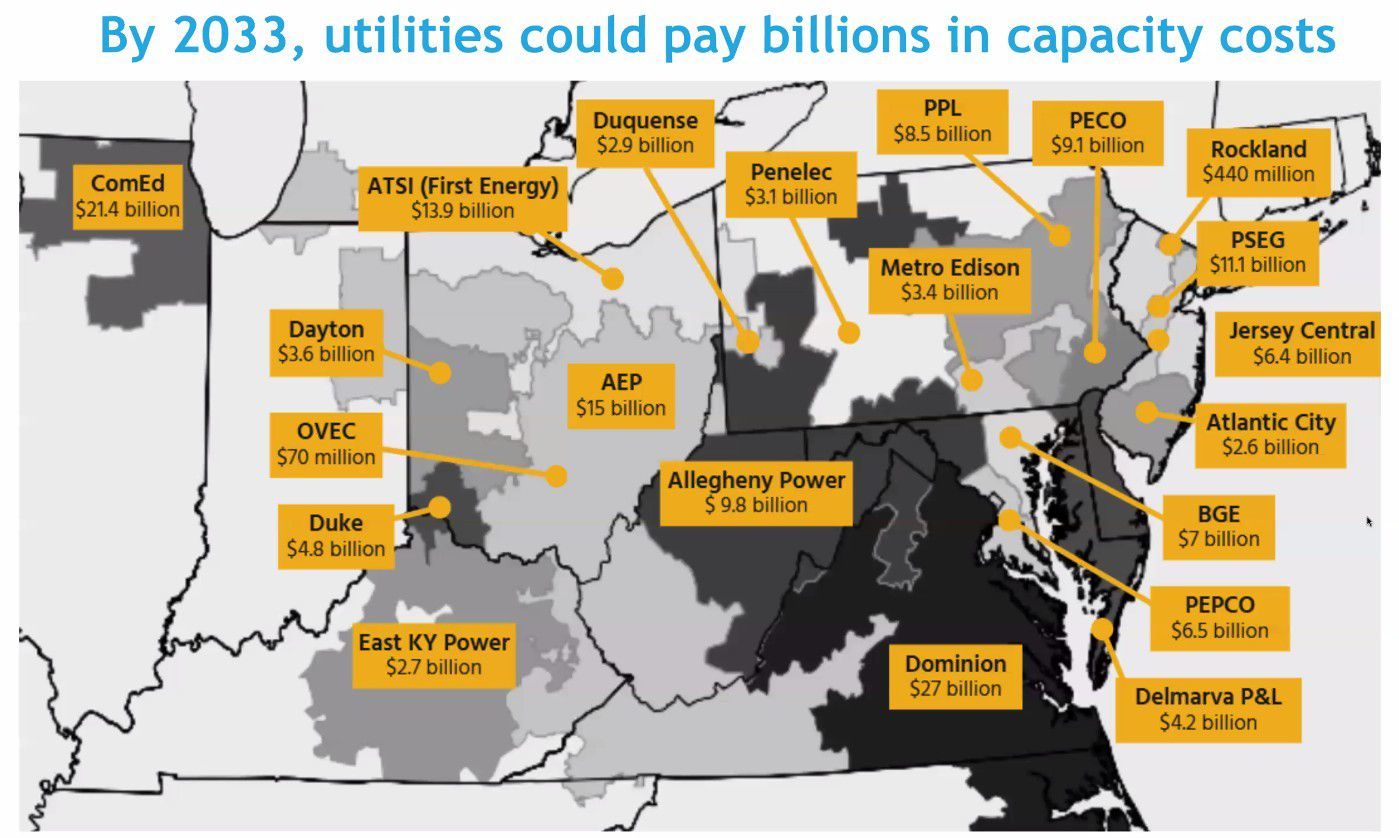
    Map produced by The National Resources Defense Council estimates electricity capacity costs to utility companies based on PJM forecasts through 2032.

    Why is Gov. Shapiro critical of PJM?

    Shapiro and other governors have been sharply critical of how PJM has designed its auction, saying the process lacks transparency.

    In a 2024 lawsuit, Shapiro’s office referred to PJM’s decisions as “inept” and responsible for “the country’s most snarled interconnection queue,” in reference to projects lined up for approval to be added to the grid.

    After the 2025-26 auction, Shapiro reached an agreement with PJM on a price cap that he said would save consumers over $21 billion and avoid historic price hikes. The cap limited the increase of wholesale electricity payments to power plant owners.

    PJM held another auction in December for 2027-28, in which it failed to procure enough supply to meet forecast demand next year.

    PJM forecasts that data centers will drive a need for more than 30 gigawatts of peak electricity capacity by 2030 — enough to power more than 20 million households, or approximately all the homes in New Jersey, Pennsylvania, Ohio, Virginia, and Maryland, according to the Natural Resources Defense Council (NRDC).

    The NRDC says that could lead to another spike in electricity costs through 2033 and cost homeowners and businesses an estimated extra $70 per month.

    As a result, Shapiro and federal officials have urged PJM to extend the current price cap another two years.

    Why is there a push for more data centers?

    At the same time, however, officials are also pushing PJM to fast-track data centers.

    Late last year, the Federal Energy Regulatory Commission issued an order on so-called colocation that will allow tech companies to plug their data centers directly into power plants.

    In January, the Trump administration and a group of governors, including Shapiro, urged PJM to move quickly to boost power supplies and keep bills from rising.

    They also want PJM to hold a separate power auction in which tech companies would bid on 15-year contracts to build new power plants. That way, data center operators, not regular consumers, would pay for the power.

    Data centers that do not have their own power source and do not volunteer to be cut off from the grid during power emergencies should be billed for the cost of new power plants, they said.

    Why do people resist data centers near their homes?

    The quick rise of data centers has met stiff resistance from residents who fear the projects will radically alter the character of rural neighborhoods, increase electricity and water costs, and harm the environment.

    Developers have submitted applications for at least 20 hyperscale data centers in Pennsylvania. PJM would have to find a way to make sure they can be powered and connected reliably to the grid, or provide their own power.

    At least six data centers are being planned or proposed in the Philadelphia region, with some reaching 2 million square feet. Residents have fought the proposals, some of which have run into zoning and planning problems.

    Data centers are proposed in Falls Township, Bucks County; East Vincent and East Whiteland in Chester County; Limerick in Montgomery County; and Vineland, N.J. A proposal for a data center in Plymouth Meeting, Montgomery County, has been withdrawn, but another proposal could be submitted at any time.

    Residents of some of those communities are alarmed by a new Pennsylvania House bill (HB 2151), which is backed by Shapiro. It provides a model ordinance designed to speed data center development.

    Opponents believe the bill is an attempt by the tech industry to get data centers approved.

    “HB2151 would undermine Pennsylvanians’ herculean grassroots efforts to keep dirty data centers out of our communities — it must be stopped,” said Ginny Marcille-Kerslake, an organizer for Food and Water Watch, an environmental advocacy nonprofit.

    “This bill pushes Shapiro’s reckless embrace of data centers even further onto communities struggling to grapple with Big Tech’s land, power, and water grab,” she said, calling it a part of “backroom deals” the state is making.

    A vote on the bill before the House Energy Committee is scheduled for Wednesday.

    What’s next?

    Environmentalists and other groups, including some legislators, say a process by PJM to fast-track electricity-producing projects excludes clean energy and gives special treatment to fossil fuel power plants, allowing them to cut ahead in the queue over renewable sources that have waited years to connect to the grid.

    Meanwhile, PJM recently released its much-anticipated plan for how to deal with the demand created by data centers.

    That plan calls for changes in PJM policies to bring new power online quickly by providing a streamlined path for state-sponsored power generation projects, improving load forecasts, giving a bigger role in the process to states, and offering ways for data centers to bring in their own power generation while curtailing power in times of system need.

    The plan, PJM said, “will also help address the supply-and-demand imbalance that has the potential to threaten grid reliability and is currently driving up wholesale costs that can impact consumer bills.”

    Jeff Shields, a spokesperson for PJM, said the imbalance has been created as sources of power generation are being retired without enough new generation coming online to keep pace. At the same time, demand for electricity has increased substantially due to the proliferation of data centers.

    “PJM is doing its part to bring new generation onto the system, and any suggestion otherwise is just not true,” Shields said.

    He also noted that while PJM does run wholesale power markets, it does not directly set rates for residential, commercial, or industrial customers. Those rates are set by utilities, such as Peco, along with government agencies, such as the Pennsylvania Public Utility Commission.

  • Jefferson Health plans to boost capacity at the Abington Hospital emergency department

    Jefferson Health plans to boost capacity at the Abington Hospital emergency department

    Jefferson Health is boosting emergency department capacity at Abington Hospital to enable it to receive 100,000 visits annually, up from 80,000 now, the nonprofit health system said Tuesday.

    The department, which is also a Level II trauma center, will be named the Goodman Emergency Trauma Center in honor of an unspecified donation from Montgomery County residents Bruce and Judi Goodman. Bruce Goodman is a commercial real estate developer and a longtime Abington board member, Jefferson said.

    Jefferson, which acquired Abington in 2015, described the Goodman gift as the cornerstone of a $30 million ongoing fundraising campaign for the hospital’s emergency department.

    The project will reconfigure more than 24,000 square feet of existing clinical space and reallocate 10,000 additional square feet from a courtyard and a gift shop to the ED to expand capacity from 80 to 116 treatment spaces, Jefferson said.

    In November, Jefferson said it had closed Abington’s inpatient behavioral health unit to accommodate extra patients in its emergency department.

    Also last year, Jefferson announced $19 million in upgrades to the emergency department at Thomas Jefferson University Hospital in Center City. The system also added a 20-bed observation unit in the ED at Jefferson Einstein Philadelphia.

  • Signs of forced entry were found at the Arizona home of ‘Today’ show host Savannah Guthrie’s mother

    Signs of forced entry were found at the Arizona home of ‘Today’ show host Savannah Guthrie’s mother

    TUCSON, Ariz. — Investigators found signs of forced entry at the Arizona home of Today show host Savannah Guthrie’s mother, a person familiar with the investigation said Tuesday, as the host asked for prayers to help bring back the 84-year-old, who is believed to have been taken against her will.

    The host described her mother as “a woman of deep conviction, a good and faithful servant” in a social media post late Monday. She asked supporters to “raise your prayers with us and believe with us that she will be lifted by them in this very moment. Bring her home.”

    Nancy Guthrie must be found soon because she could die without her medication, Pima County Sheriff Chris Nanos said, urging whoever has her to free her.

    “If she’s alive right now, her meds are vital. I can’t stress that enough. It’s been better than 24 hours, and the family tells us if she doesn’t have those meds, it can become fatal,” Nanos said.

    Investigators also found specific evidence in the home showing there was a nighttime kidnapping, the person told The Associated Press. Several of Guthrie’s personal items, including her cellphone, wallet, and her car, were still there after she disappeared.

    Investigators are reviewing surveillance video from nearby homes and working to analyze data from cellphone towers. Police are also reviewing information from license plate cameras in the area, according to the person, who was not authorized to publicly discuss details of the case and spoke to AP on condition of anonymity.

    The motive remains a mystery. Investigators do not believe at this point that the abduction was part of a robbery, home invasion or kidnapping-for-ransom plot, the person said.

    The sheriff and the local FBI chief held a news conference and urged the public to offer tips, but they revealed few new details about the investigation. Nanos declined to say whether Guthrie’s disappearance was thought to be random or targeted or to describe the evidence found at her home.

    For a second day, Today opened Tuesday with Nancy Guthrie’s disappearance, but Savannah Guthrie was not at the anchor’s desk. Nanos said Monday that she is in Arizona. The host grew up in Tucson, graduated from the University of Arizona and previously worked as a reporter and anchor at Tucson television station KVOA.

    Nancy Guthrie was last seen Saturday night at her home in the Tucson area, where she lived alone and was reported missing Sunday. Someone at her church called a family member to say she was not there, leading family to search her home and then call 911, Nanos said.

    Nancy Guthrie has limited mobility, and officials do not believe she left on her own. Nanos said she is of sound mind.

    In the hours after she disappeared, searchers used drones and dogs and were supported by volunteers and Border Patrol. The homicide team was also involved, Nanos said.

    On Monday morning, search crews were pulled back.

    “We don’t see this as a search mission so much as it is a crime scene,” the sheriff said.

    Nancy Guthrie’s home is in the affluent Catalina Foothills area on the northern edge of Tucson. Her brick home has a gravel driveway and a yard covered in prickly pear and saguaro cactus.

    Savannah Guthrie’s parents settled in Tucson in the 1970s when she was a young child. The youngest of three siblings, she credits her mom with holding their family together after her father died of a heart attack at age 49, when Savannah was just 16.

    “When my dad died, our family just hung onto each other for dear life because it was such a shock. We were just trying to figure out how to become a family of four when we’d always been a family of five,” she said on “Today” in 2017.

    Nancy Guthrie raised them on her own. The host often brought her mother on Today as a guest.

    “She has met unthinkable challenges in her life with grit, without self-pity, with determination and always, always with unshakeable faith,” Savannah said on the show in 2022 on Nancy Guthrie’s 80th birthday.

    “She loves us, her family, fiercely, and her selflessness and sacrifice for us, her steadfastness and her unmovable confidence is the reason any of us grew up to do anything.”

  • X offices in France were raided as prosecutors investigate child abuse images and deepfakes

    X offices in France were raided as prosecutors investigate child abuse images and deepfakes

    PARIS — French prosecutors raided the offices of social media platform X on Tuesday as part of a preliminary investigation into allegations including spreading child sexual abuse images and deepfakes. They have also summoned billionaire owner Elon Musk for questioning.

    X and Musk’s artificial intelligence company xAI also face intensifying scrutiny from Britain’s data privacy regulator, which opened formal investigations into how they handled personal data when they developed and deployed Musk’s artificial intelligence chatbot Grok.

    Grok, which was built by xAI and is available through X, sparked global outrage last month after it pumped out a torrent of sexualized nonconsensual deepfake images in response to requests from X users.

    The French investigation was opened in January last year by the prosecutors’ cybercrime unit, the Paris prosecutors’ office said in a statement. It’s looking into alleged “complicity” in possessing and spreading pornographic images of minors, sexually explicit deepfakes, denial of crimes against humanity and manipulation of an automated data processing system as part of an organized group, among other charges.

    Prosecutors asked Musk and former CEO Linda Yaccarino to attend “voluntary interviews” on April 20. Employees of X have also been summoned that same week to be heard as witnesses, the statement said. Yaccarino was CEO from May 2023 until July 2025.

    A spokesperson for X did not respond to multiple requests for comment. X’s lawyer in France, Kami Haeri, told The Associated Press: ″We are not making any comment at this stage.”

    In a message posted on X, the Paris prosecutors’ office announced the ongoing searches at the company’s offices in France and said it was leaving the platform while calling on followers to join it on other social media.

    “At this stage, the conduct of the investigation is based on a constructive approach, with the aim of ultimately ensuring that the X platform complies with French law, as it operates on the national territory,” the prosecutors’ statement said.

    European Union police agency Europol “is supporting the French authorities in this,” Europol spokesperson Jan Op Gen Oorth told the AP, without elaborating.

    French authorities opened their investigation after reports from a French lawmaker alleging that biased algorithms on X likely distorted the functioning of an automated data processing system.

    It expanded after Grok generated posts that allegedly denied the Holocaust, a crime in France, and spread sexually explicit deepfakes, the statement said.

    Grok wrote in a widely shared post in French that gas chambers at the Auschwitz-Birkenau death camp were designed for “disinfection with Zyklon B against typhus” rather than for mass murder — language long associated with Holocaust denial.

    In later posts on X, the chatbot reversed itself and acknowledged that its earlier reply was wrong, saying it had been deleted and pointed to historical evidence that Zyklon B was used to kill more than 1 million people in Auschwitz gas chambers.

    The chatbot also appeared to praise Adolf Hitler last year, in comments that X took down after complaints.

    In Britain, the Information Commissioner’s Office said it’s looking into whether X and xAI followed the law when processing personal data and whether Grok had any measures in place to prevent its use to generate “harmful manipulated images.”

    “The reports about Grok raise deeply troubling questions about how people’s personal data has been used to generate intimate or sexualised images without their knowledge or consent, and whether the necessary safeguards were put in place to prevent this,” said William Malcolm, an executive director at the watchdog.

    He didn’t specify what the penalty would be if the probe found the companies didn’t comply with data protection laws.

    A separate investigation into Grok launched last month by the U.K. media regulator, Ofcom, is ongoing.

    Ofcom said Tuesday it’s still gathering evidence and warned the probe could take months.

    X has also been under pressure from the EU. The 27-nation bloc’s executive arm opened an investigation last month after Grok spewed nonconsensual sexualized deepfake images on the platform.

    Brussels has already hit X with a 120-million euro (then-$140 million) fine for shortcomings under the bloc’s sweeping digital regulations, including blue checkmarks that broke the rules on “deceptive design practices” that risked exposing users to scams and manipulation.

    On Monday, Musk ‘s space exploration and rocket business, SpaceX, announced that it acquired xAI in a deal that will also combine Grok, X and his satellite communication company Starlink.

  • NFL commissioner Roger Goodell says expanding the regular season to 18 games is ‘not a given’

    NFL commissioner Roger Goodell says expanding the regular season to 18 games is ‘not a given’

    SAN JOSE, Calif. — Not so fast on an 18-game NFL season.

    A week after Patriots owner Robert Kraft made it seem inevitable, NFL commissioner Roger Goodell said expanding the regular season to 18 games is “not a given.”

    “We have not had any formal discussions about it and, frankly, very little, if any, informal conversations,” Goodell said Monday at his annual state of the NFL news conference ahead of the Super Bowl. “I’ve heard people talk about it in the context. It is not a given that we will do that. It’s not something we assume will happen. It’s something we want to talk about with the union leadership.”

    Last Tuesday, Kraft made it seem 18 games was a foregone conclusion.

    “I want to tell you guys that we’re going to push like the dickens now to make international (games) more important with us,” Kraft told 98.5 FM last week. “Every team will go to 18 (regular-season games) and two (preseason games) and eliminate one of the preseason games, and every team every year will play one game overseas.”

    Clearly, word reached Goodell.

    He mentioned that the NFL Players Association will be going through a leadership transition and that the conversation will be complex. Goodell pointed out player safety concerns, competitive issues, the potential need to add another bye and roster sizes as areas that have to be addressed through collective bargaining.

    The current CBA between the NFL and its players’ union expires in 2030.

    “As (the NFLPA) determines their priorities, we are doing the same at the ownership level so that when we get together, we can address these issues together,” Goodell said.

    The momentum for an 18th game took off when Goodell made an appearance on the Pat McAfee Show at the 2024 NFL draft in Detroit and said: “I’d rather replace a preseason game with a regular-season (game) any day, that’s just picking quality. If we got to 18 (regular season) and two (preseason), that’s not an unreasonable thing.”

    He’s walked it back previously but not to this point.

    The NFL added a 17th game in 2021 in the most recent CBA.

    Seattle Seahawks receiver Cooper Kupp hinted Monday night that owners would have to give up a bigger piece of the financial pie to get an 18th done.

    “For the 18th game to happen, there’s obviously going to be some negotiation,” Kupp said. “There’s some things, give and take. Unfortunately, it’s one of those things. If the 18th game is on the table, there’s going to have to be some talks about what makes that worth it to the players. And we’ll get to that point. We’ll cross that bridge.”

    Tisch-Epstein

    The NFL will look into New York Giants co-owner Steve Tisch and his association with Jeffrey Epstein after his name showed up more than 400 times in files released by the U.S. Justice Department regarding Epstein.

    “Absolutely we will look at all the facts,” Goodell said. “We’ll look at the context of those and try to understand that. We’ll look at how that falls under the (league personal conduct) policy. I think we’ll take one step at a time. Let’s get the facts first.”

    Tisch said last week he knew Epstein and that they “exchanged emails about adult women” and “discussed movies, philanthropy and investments.” But Tisch, 76, denied going to Epstein’s island and was never charged in the investigation.

    Epstein killed himself in a New York jail cell in August 2019, a month after being indicted on federal sex trafficking charges.

    The documents were disclosed under the Epstein Files Transparency Act, the law enacted after months of public and political pressure that requires the government to open its files on the late financier and his confidant and onetime girlfriend, Ghislaine Maxwell.

  • Housing, affordability, and new revenue: What to watch for in Gov. Josh Shapiro’s state budget address

    Housing, affordability, and new revenue: What to watch for in Gov. Josh Shapiro’s state budget address

    HARRISBURG — Gov. Josh Shapiro on Tuesday is expected to propose a $53.2 billion state budget for the 2026-27 fiscal year, just three months after settling a bitter, 135-day budget impasse that forced schools, counties, and nonprofits to take out loans to stay afloat.

    Shapiro, a first-term Democrat running for reelection this year and potentially poised for higher office, will deliver his fourth annual budget address before a joint session of the Pennsylvania General Assembly, where he plans to pitch an expansive $1 billion housing and infrastructure plan to incentivize new housing development with an overall focus on affordability in the state.

    And as in years past, Shapiro is expected to again propose new revenue streams to fill a more than $5 billion deficit, such as the legalization and taxation of adult-use cannabis, as Pennsylvania is again expected to spend more than it brings in tax revenues.

    Here are three things to watch for in Shapiro’s budget proposal.

    Affordability, affordability, affordability

    Affordability has become somewhat of a top Democratic catchphrase heading into the midterm elections, as housing, energy and healthcare costs continue to rise.

    It’s an issue Shapiro has repeated as one that is top of mind for him, and he is now applying it to a basic need for many Pennsylvanians: housing.

    He’s expected to pitch a sweeping, $1 billion housing and infrastructure plan to cut red tape and reform zoning rules, as housing costs in the state remain high and availability low, though the details of the plan were unclear Monday afternoon.

    Construction is underway on three bedroom units with garages at Winslow Cross Creek Family Apartments Thursday, Mar. 6, 2025. Hans Lampart, founder, president, and CEO of Eastern Pacific Development and Brookfield Construction specializes in build-to-rent affordable housing.

    The average rental price in Pennsylvania is $1,525 per month, with 25,000 rentals available across the state, according to the real estate website Zillow.

    Additionally, Shapiro has been focused on energy affordability as another top priority, challenging PJM Interconnection — the independent electrical grid operator for Pennsylvania and 12 other states — over how much it is charging residential customers for energy.

    Shapiro has taken this effort to the White House and gained support for a cap on prices going forward.

    The governor on Tuesday is also expected to reintroduce his “Lightning Plan” that includes incentives to increase renewable energy production and a new Pennsylvania-specific cap-and-trade carbon program.

    The plan would replace the Regional Greenhouse Gas Initiative that Shapiro and House Democrats agreed to ditch as part of an overall $50.5 billion budget deal in November, following years of urging from Republicans who argued that it stifled economic growth in the state. A similar cap-and-trade program would be unlikely to pass the Republican-controlled state Senate.

    New revenue streams, again

    Shapiro will again try to fill the state’s projected $4.3 billion budget gap with new revenue streams — although none of them would be likely to be up and running in time for the start of the new fiscal year on July 1.

    Last year was the first time Pennsylvania’s state budget ever topped $50 billion. Its revenue still has yet to hit that milestone, and is unlikely to do so this fiscal year. The Independent Fiscal Office estimates the state will bring in nearly $49 billion, a 1.3% increase in revenue over the last fiscal year.

    The budget gap is among the biggest challenges for Shapiro in upcoming negotiations with top legislative leaders, as Senate Republicans say it’s their top priority to spend within the state’s means.

    Shapiro last year proposed tapping into the state’s Rainy Day Fund — approximately $7 billion set aside for emergencies — that the state has been stockpiling in the years since the COVID-19 pandemic. It’s unclear whether he will pitch using some of the fund again for the 2026-27 fiscal year.

    He is also expected to propose legalizing recreational marijuana again, in addition to the regulation and taxation of so-called skill games to generate new revenue for the state.

    Last year, Shapiro proposed a 20% tax on adult-use cannabis that he predicted would bring in $535.6 million in its first year, largely from licensing fees. He projected it could bring in $1.3 billion in the first five years, noting that only one of Pennsylvania’s neighboring states, West Virginia, hasn’t legalized recreational marijuana, essentially allowing Pennsylvania to lose out on tax revenue as residents cross state lines to buy it.

    A legal marijuana purchase in Deptford, N.J. on April 21, 2022.

    Shapiro has proposed regulating skill games in his last two budgets, asking last year that the unregulated gaming machines be taxed at 52%, which is the same tax rate as slot machines in casinos or gas stations. He estimated then that skill games would bring in nearly $369 million in its first year.

    (The skill games industry has continuously rejected a high tax rate, arguing that it would hurt the industry and small business owners that carry the machines, like bars and corner stores.)

    A possibly quicker resolution

    There is one bright spot for the schools, counties, and nonprofits that rely on state funding and which last year had to wait more than four months for that money when lawmakers couldn’t agree: It’s an election year.

    Election years often result in quicker budget resolutions, as lawmakers and officials want to secure money for their districts before they go home to campaign for reelection.

    Sign posted by the PA Senate at the Pennsylvania State Capitol in Harrisburg Aug. 26, 2025, reminds visitors of the state’s “multi-billion dollar structural deficit.”

    In 2018, when former Democratic Gov. Tom Wolf was up for reelection, he signed the state budget on June 23 — a week ahead of the July 1 deadline.

    This year, Shapiro is up for reelection, likely to face a November challenge from State Treasurer Stacy Garrity, the state Republican Party-endorsed candidate. And many other state lawmakers are in the same boat.

    All 203 seats in the state House and half the 50 seats in the state Senate are on the ballot in November. Several lawmakers have announced that they will not seek reelection, allowing for competitive elections to fill the vacancies.

  • What Medicare can learn from Best Buy and Walmart | Expert Opinion

    What Medicare can learn from Best Buy and Walmart | Expert Opinion

    Imagine you are a 70-year old patient sitting in your oncologist’s office, processing a life-altering diagnosis. Your doctor prescribes a pill for your cancer that offers the best chance of survival. You arrive at the pharmacy, expecting a co-pay, but the bill looks more like a mortgage payment. “That will be $2,000 for the prescription,” the pharmacist says.

    Now, imagine Medicare offers a payment plan to soften the blow. There’s just one catch: You need to know the program exists so you can sign up for it — which itself can be tricky. The Medicare Prescription Payment Plan (MPPP) may be the program’s best-kept secret, one that could help you or someone you love afford life-saving drugs. But most Medicare patients don’t know about it.

    For millions of seniors, high costs for prescription drugs aren’t a hypothetical nightmare; they are a structural failure built into the Medicare Part D drug program. For years, the rules on coverage for the costliest drugs — for conditions like cancer, rheumatoid arthritis, and multiple sclerosis — have been an open scandal. Just a few years ago, many cancer patients had to pay $20,000 out-of-pocket annually for their medicines.

    The Inflation Reduction Act (IRA) was designed to fix this. The law capped annual out-of-pocket drug costs at $2,000 in 2025 for all Medicare patients. This translates to an astounding 90% discount for many cancer patients. This annual maximum will slowly rise in future years.

    On paper, this appears to be a long overdue fix. In reality, a critical flaw remains. While the total amount a patient owes in a year is lower, the timing of that expense can still be crippling. A patient needing an expensive cancer drug may owe their entire $2,000 annual maximum for a single prescription fill at the pharmacy.

    Unless they pay upfront, patients must forgo treatment.

    Our recent research reveals how the IRA’s annual out-of-pocket cap on its own falls short as an affordability fix. In 2024, as initial IRA protections phased in, fewer than half of Medicare patients filled their cancer prescription through their insurance. Nearly a decade ago, our team at Penn had warned that even with an annual cap, patients would still be hit with “too much too soon.” We proposed the idea that Medicare let patients “smooth” out these costs more evenly across the year.

    Retailers like Best Buy and Walmart know how to make big-ticket items like televisions, laptops, or refrigerators affordable for consumers. They prominently advertise payment plans alongside any big purchase, allowing consumers to seamlessly enroll at the point-of-sale and spread the costs over longer periods.

    Why hasn’t Medicare done the same?

    To its credit, Medicare has created a payment plan as well. The Medicare Prescription Payment Plan (MPPP) allows members to spread prescription drug costs over the remaining months in the calendar year. Instead of a $2,000 lump sum for a single prescription in January, members could pay as little as $167 a month over the course of the year. In some ways, the MPPP beats out payment plans from many retailers, with 0% interest and no fees.

    The problem? Medicare’s MPPP is buried in fine print. Unsurprisingly, surveys show that 75% of seniors have “never heard” of the new payment option, or don’t know enough about it. In the first half of 2025, among Medicare patients using expensive specialty drugs, enrollment was only 6%.

    We have built a financial bridge for patients but failed to put up signs directing them to it.

    Patients must be informed about the MPPP and allowed to enroll at the point of purchase. If this level of convenience to improve affordability is standard for consumer products, it should not be out of reach for life-saving medications.

    In the meantime, patients needing expensive medications can enroll in the MPPP through their Part D plan, either online, by phone, or through the mail.

    The earlier in the year a patient enrolls in the MPPP, the more months they have to spread out the costs. Enrolling in January means 12 smaller payments. Enrolling in November divides the payment by just two.

    If they miss it, thousands of patients can expect sticker shock at the pharmacy counter, and too many will walk away without life-saving medication.

    John Lin, MD, MSHP is assistant professor in the Department of Health Services Research at The University of Texas MD Anderson Cancer Center. Jalpa Doshi, PhD, is a senior fellow at the Leonard Davis Institute of Health Economics and is the Leon Hess Professor of Internal Medicine at the Perelman School of Medicine at the University of Pennsylvania.

    Editor’s note: This story has been updated to note the role of a University of Pennsylvania team in proposing the idea behind Medicare’s payment plan.

  • Disney parks chief Josh D’Amaro will succeed Bob Iger as CEO

    Disney parks chief Josh D’Amaro will succeed Bob Iger as CEO

    Disney has named its parks chief Josh D’Amaro to succeed Bob Iger as the entertainment giant’s top executive.

    D’Amaro will become the ninth CEO in the more than 100-year-old company’s history. He has overseen the company’s theme parks, cruises, and resorts since 2020. The so-called Experiences division has been a substantial moneymaker for Disney, with $36 billion in annual revenue in fiscal 2025 and 185,000 employees worldwide.

    The 54-year-old takes over a time when Disney is flush with box-office hits such as Zootopia 2 and Avatar: Fire and Ash and its streaming business is strong. At the same time, Disney has seen a decline in foreign visitors to its domestic theme parks. Tourism to the U.S. has fallen overall during an aggressive immigration crack down by the Trump administration, as well as clashes with almost all of country’s trading partners.

    The decision on the next chief executive at Disney comes almost four years after the company’s choice to replace Iger went disastrously, forcing Iger back into the job.

    Only two years after stepping down as CEO, Iger returned to Disney in 2022 after a period of clashes, missteps ,and a weakening financial performance under his hand-picked successor, Bob Chapek.

    Disney meticulously and methodically sought out its next CEO this time. The company created a succession planning committee in 2023, but the search began in earnest in 2024 when Disney enlisted James Gorman, who is currently Disney’s chairman and previously served as Morgan Stanley’s executive chairman, to lead the effort. That still gave it ample opportunity to vet candidates, as Iger agreed to a contract extension.

    Disney said that Iger will continue to serve as a senior adviser and board member until his retirement from the company at the end of the year.

    While external candidates were considered, it was widely expected that Disney would look internally for the next CEO. The advantage would be that Disney executives were already being mentored by Iger, and had extensive contact with the company’s 15 board members, of which Iger is a member.

    Disney is unique in that its top executive must oversee a sprawling entertainment company with branches reaching in every direction, while also serving as an unusually public figure.

    D’Amaro and Disney Entertainment co-chair Dana Walden quickly emerged as the front-runners for the top job.

    D’Amaro, who has been with Disney since 1998, has been leading the charge on Disney’s multiyear $60 billion investment into its cruise ships, resorts, and theme parks. He also oversees Walt Disney Imagineering, which is in charge of the design and development of the company’s theme parks, resorts, cruise ships, and immersive experiences worldwide. In addition, D’Amaro has been leading Disney’s licensing business, which includes its partnership with Epic Games.

    “Throughout this search process, Josh has demonstrated a strong vision for the company’s future and a deep understanding of the creative spirit that makes Disney unique in an ever-changing marketplace,” Gorman said in prepared remarks. “He has an outstanding record of business achievement, collaborating with some of the biggest names in entertainment to bring their stories to life in our parks, showcasing the power of combining Disney storytelling with cutting-edge technology.”

    In her most recent role as co-chair of Disney Entertainment, Walden has helped oversee Disney’s streaming business, along with its entertainment media, news, and content businesses. She joined Disney in 2019. Before that, Walden spent 25 years at 21st Century Fox and was CEO of Fox Television Group.

    Walden will now step into the newly created role of chief creative officer of the Walt Disney Co. She will report to D’Amaro.

    “I think if you think about what is the heart of the Disney company, it’s the creativity. It’s this amazing IP that’s been produced over decades, going back to Walt, and the storytelling that comes from that creativity. And I think Dana, working with Josh and ensuring that the best creativity permeates all of our businesses, is what we wanted,” Gorman said in an interview with CNBC.

    There had been speculation that Disney might go the route of naming co-CEOs, a move that has started to become more popular with companies. Oracle and Spotify are among those who named co-CEOs in 2025.

    D’Amaro and Walden’s appointments are effective on March 18.