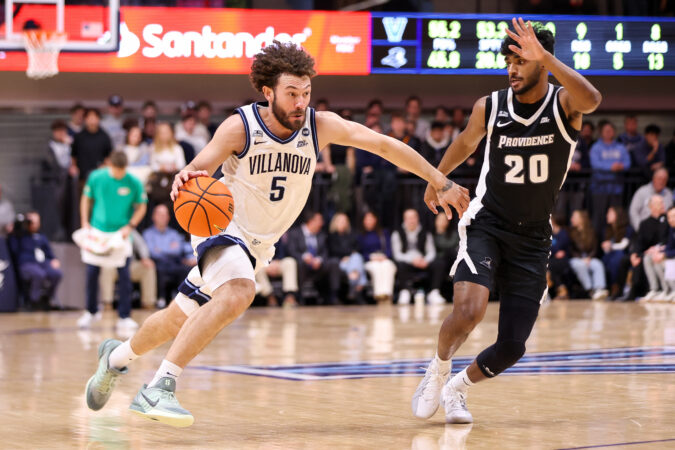
Villanova leaned on sixth man Devin Askew’s team-high 20 points to defeat Providence, 87-73, on Friday night at Finneran Pavilion.
Villanova (16-5, 7-3 Big East) shot 47% from three-point range in the first half to build a 17-point cushion. Askew went 4-for-5 from three and scored 17 first-half points. He now has four games with 20 or more points off the bench this season.
“[We are] trying to get [Devin] to play off his strengths ever since he’s now kind of back to strength,” said Villanova coach Kevin Willard. “He had a great week of practice. I think that was the big thing. I think everybody did. We had three really good days of practice, and that’s the way he played for the last three days.”
Askew, who suffered a major knee sprain over the summer, is averaging 15.8 points in his last six games. He missed about two months of practice as the team prepared to open the season.
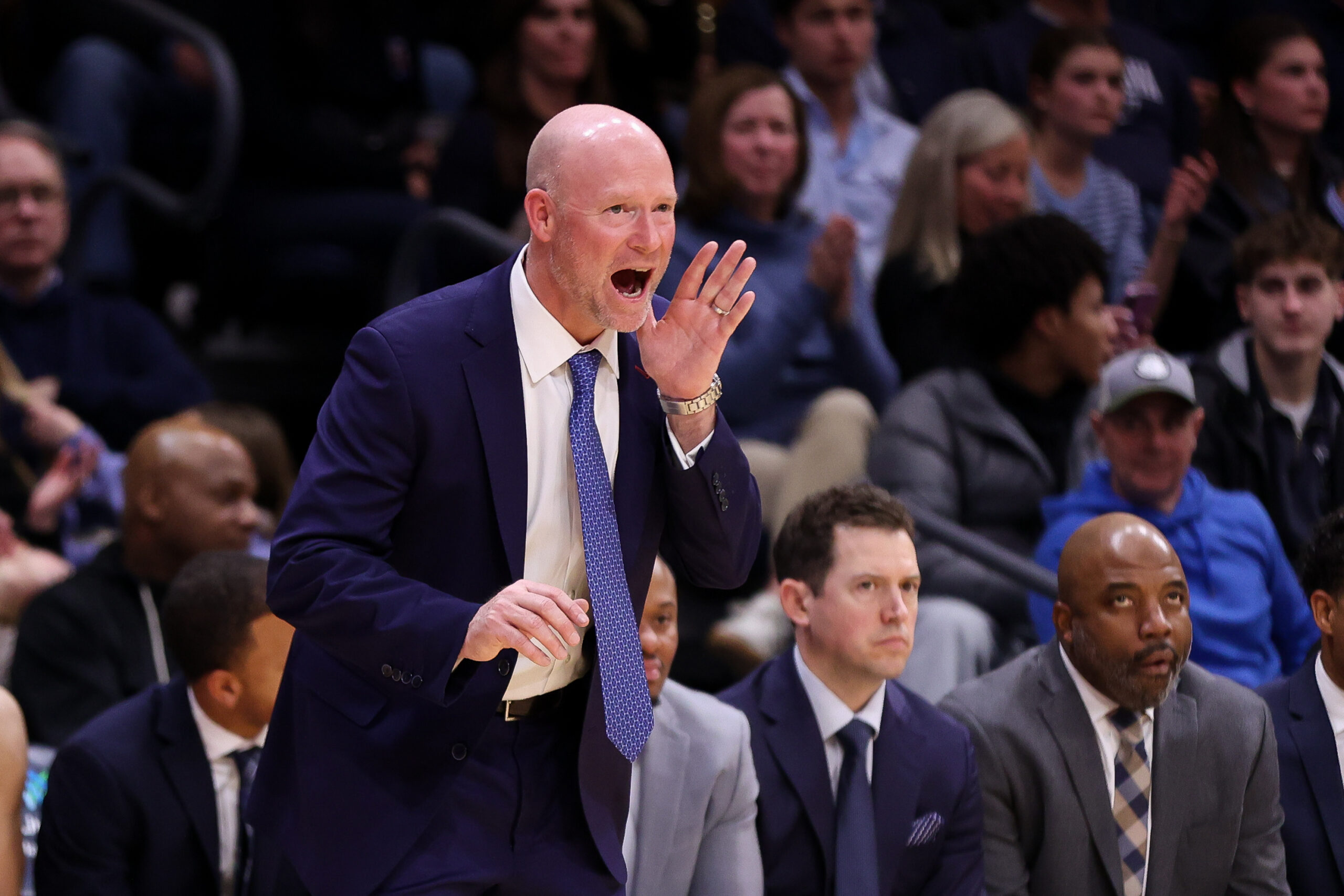
Villanova coach Kevin Willard reacts in the second half against Providence on Friday.
“I feel really good out there,” Askew said when asked about his health. “But just like always, I still have some work to do. Still got to get better every day.”
Junior guard Tyler Perkins scored 19 points, marking his fifth consecutive game in double digits. He shot 6-for-11 from the field, including 3-for-6 from three-point range.
“I just [have] been in the gym,” Perkins said. “We have a great strength coach in [Justin McClelland], and he gets us better every day, especially in the summer. We do ‘Strong Man,’ and that’s a big part of just being in shape and getting your body right for the season. So it’s just a testament to the coaching staff that we have around us.”
Villanova shot 51% from the field and made a conference-high 13 three-pointers (45%).
Villanova scored 20 fast break points to Providence’s two. Askew and Perkins were a main reason why Villanova was successful on fast break opportunities.
“We’re a really good transition team,” Perkins said. “We got a bunch of good shooters like Devin, Bryce [Lindsay], so if we get out and run, we got a good opportunity to score.”
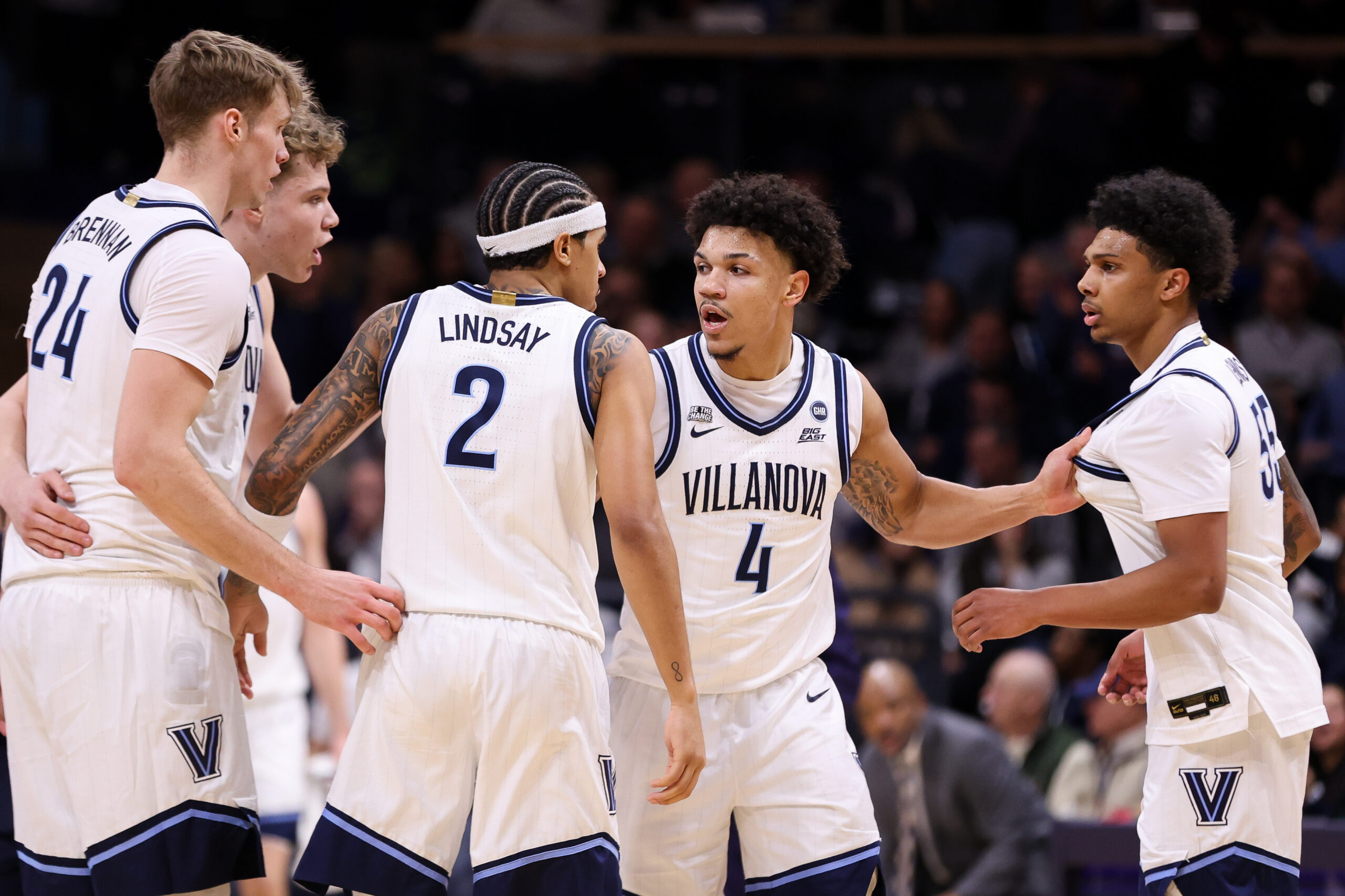
Villanova guard Tyler Perkins gathers teammates Bryce Lindsay, Duke Brennan, and Acaden Lewis against Providence on Jan. 30.
Villanova forced Providence (9-13, 2-9) into 10 first-half turnovers, including seven steals, three by freshman guard Acaden Lewis. Villanova scored 15 first-half points off those forced turnovers.
The Wildcats currently rank 36th in KenPom’s defensive ratings after the win over Providence.
Slow second half
Despite being a strong second-half team, Villanova came out flat. The Wildcats missed their first ten field goal attempts, allowing Providence to cut its deficit to eight points.
“I think the defensive end we kind of gave, [Stefan Vaaks], he’s good,” Willard said. “He’s a pro with his size and the way he shoots it. We left him [open] twice to start the second half, and kind of gave them nine points and let them right back into the game. So I thought we did a much better job of just sitting down, defending.”
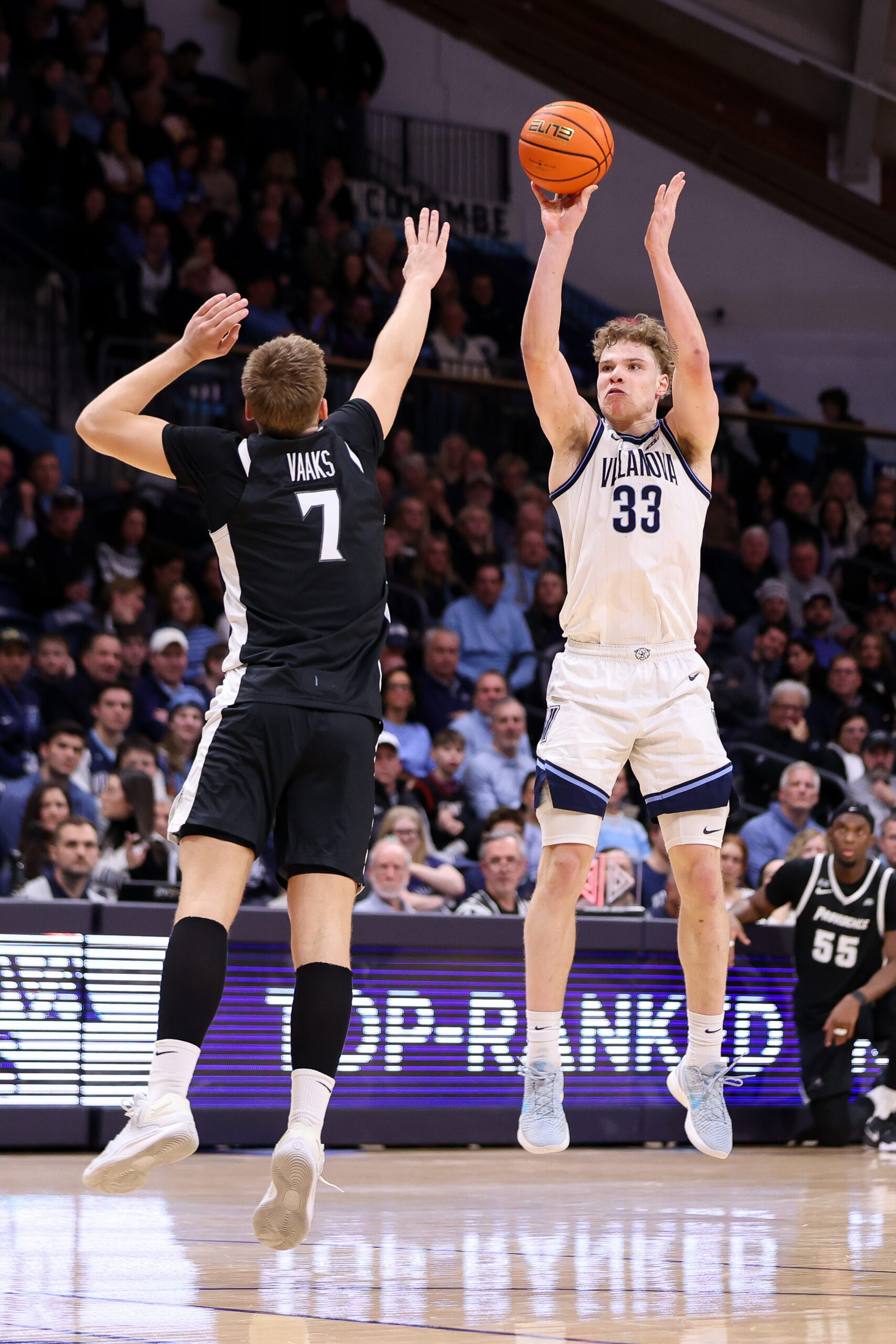
Villanova forward Matt Hodge shoots a three-pointer against Providence guard Stefan Vaaks, who finished a game-high 25 points, on Friday.
Vaaks, a 6-foot-7 freshman guard, finished with a game-high 25 points
In the final 11 minutes of play, however, Villanova went 12-for-13 from the field, which included an 11-1 scoring run.
“They don’t fold,” said Providence coach Kim English. “They stick to that process. We guarded them [well] to start the second half. They didn’t score for a long time to start, think it was like 20% or something. But they stuck with their process. They’re a really good shot quality team, and that’s what it takes. Paint decisions was the game.”
Villanova will host Seton Hall (15-6, 5-5) on Wednesday (6:30 p.m., Peacock). In its last meeting, Villanova beat Seton Hall, 64-56, to pick up a Quad 1 win in the NCAA NET Rankings. This time, it would be a possible Quad 2 victory. This season, Villanova is 3-4 in Quad 1 wins and 2-1 in Quad 2.
The U.S. Senate passeda bill late Friday to fund the federal government, but a short-term shutdown still went into effect Saturday.
Senate Democratic leadership struck a deal earlier this week with President Donald Trump to separate Department of Homeland Security funding from the budget for other federal agencies after a national backlash to the ongoing ICE operation in Minnesota.
The agreement with the White House emerged late Thursday after every Democrat, including Sen. John Fetterman of Pennsylvania, and several Republicans voted down the original package.
Fetterman was among 23 Democrats to cross the aisle to vote for the compromise bill. With their support, the bill passed 71-29, despite five GOP defections.
Here’s how the senators from the Philadelphia area voted:
Sen. John Fetterman (D., Pa.): Yes.
Sen. Dave McCormick (R., Pa.): Yes.
Sen. Andy Kim (D., N.J.): No.
Sen. Cory Booker (D., N.J.): No.
Sen. Chris Coons (D., Del.): Yes.
Sen. Lisa Blunt Rochester: (D., Del.): No.
Even with the Senate passage, a partial government shutdown took effect Saturday because the bill still needs to pass the House, which is not expected to take up the legislation until Monday.
It’s the second shutdown to begin since October when the federal government entered a 43-day shutdown, the longest in its history.
Democrats took issue with funding in the earlier bill for DHS, the department that oversees the two agencies involved in fatal shootings of civilians this month in Minnesota.
The Senate worked late Fridayas some Republicans objected to the deal. McCormick, the lone Republican senator in the region, voted for the measure as expected.
“I’m just not in favor of shutting down the government or stopping funding the government, and that’s the position that I’ve had through the last shutdown,” McCormick said Tuesday.
The affected departments include the Departments of Defense, State, Transportation, Education, Labor, Treasury, Health and Human Services, and Housing and Urban Development, in addition to DHS.
The deal struck with the White House would provide two weeks of funding for DHS, but funds the rest of the departments through September.
Democrats on Thursday halted the original package that would have provided long-term funding for DHS, which oversees ICE and the Border Patrol.
Fetterman had called for the DHS funding to be separated from the other departments as a compromise, which is ultimately what happened.
The DHS funding dispute came after the national furor over the killings of Renee Good, a poet and mother, and Alex Pretti, a nurse who worked at a VA hospital, both of whom protested the ongoing operation in Minnesota and were fatally shot by federal agents.
Democrats pushed for provisions to curb ICE’s immigration enforcement operations in order to fund DHS. Their demands include increased training for ICE agents, requiring warrants for immigration arrests and for agents to identify themselves, and for the Border Patrol to stay on the border instead of helping ICE elsewhere.
A 4-week-old baby girl came into the emergency room because she’d been fussy for a full day, and wouldn’t drink from her bottle. On further questioning, the parents said that she had not pooped for 3 days, had been drooling more, had a weaker cry, and seemed very floppy.
In the ER, she was very weak with low muscle tone, droopy eyelids, and a significant amount of drool. The ER physicians could not elicit her normal newborn reflexes. Due to her severe weakness and concern for her ability to keep breathing on her own, the decision was made to insert a breathing tube into her airway to help her breathe.
Low muscle tone and weakness in a newborn baby can have many different causes. Some of these causes include infection, low blood sugar, thyroid problems, neuromuscular diseases, brain bleeds, drug exposure, and genetic or metabolic disorders.
All babies are screened 48 hours after birth for a variety of genetic and metabolic conditions. This baby had a normal newborn screen, so metabolic disorders were unlikely, though. The ER also collected thyroid studies which were normal. This baby had been healthy with normal muscle tone prior to this event, probably eliminating other genetic disorders such as trisomy 21.
Infections, such as sepsis (blood infection), meningitis (brain infection), pneumonia (lung infection), and urinary tract infections can also present with low muscle tone in newborns. In this patient a lumbar puncture, or spinal tap, proved negative for meningitis. Urine and blood cultures were negative for infection. A chest X-ray did not show pneumonia, and a nasal swab was negative for any respiratory viruses.
Drug ingestions or exposures can also present with altered mental status or low muscle tone, but neither turned up in a urine drug screen.
Problems within the brain, such as a tumor or bleed, can also cause low muscle tone. But a head CT scan on our patient was normal.
Finally, low muscle tone can be a feature of some disorders of the neuromuscular system, which is the pathway between the brain and muscles that make muscles work properly. Some examples of these disorders are spinal muscular atrophy, myasthenia gravis, Guillan-Barre syndrome, or infant botulism.
The solution
Given this patient’s age and symptoms, and after eliminating other possibilities, a test for botulism in the baby’s stool was performed. While awaiting the results, this outcome appeared so likely that the baby was treated for presumed botulism.
Botulism is caused by the bacteria Clostridium botulinum, which causes a neuromuscular paralysis that starts with symptoms at the head and descends to the toes. It can occur when infants ingest spores of these bacteria, which sometimes appear in dirt and honey, among other sources. It predominantly affects babies younger than 12 months. Because of the immaturity of a baby’s gut microbiome, the spores can stay in their intestines longer than they would in an older child or adult, and release the botulism toxin.
Pennsylvania has one of the highest rates in the country of these spores, accounting for 17% of all cases in the United States in 2018. It is most commonly reported in infants who live near construction zones. This infant’s father was a construction worker and had a project going on in their backyard.
Fortunately, a treatment exists. It is called botulism immunoglobulin, otherwise known as BabyBig. This treatment provides antibodies to the bacteria, which bind to and neutralize the toxin. Even with this therapy, recovery is a slow process that can take several months. However, patients who are hospitalized and treated quickly should expect a full recovery.
This patient is doing well, and no longer needed the breathing tube after receiving BabyBig. She still has some trouble with feeding and required a feeding tube for some time.
Her treatment was started immediately because test results take so long, and the treatment would not have harmed her if she hadn’t tested positive. In her case, we got the results after she went home from the hospital and it confirmed the botulinum toxin.
Our advice
Do not give honey to any baby under the age of 12 months. If a family member works in construction, especially in high-risk states, make sure to bathe and change into clean clothes before touching a young baby..
BriarRose Edwins is a second-year pediatric resident and Hayley Goldner is a pediatrician in the adolescent medicine department at Nemours Children’s Hospital, Delaware.
At a Friday hearing, a federal judge chastised a Trump administration attorney for making “dangerous” arguments over the abrupt removal of slavery-related exhibits from the President’s House. The judge said she will visit the site at Independence Mall before deciding the fate of the dismantled displays.
One year ago today, a deadly medical jet crash devastated Northeast Philadelphia. City officials plan to hold a memorial observance this evening to honor its victims.
Newly released emails reveal an ongoing business relationship between Jeffrey Epstein and Sixers co-owner Josh Harris. The records — buried within 3 million documents — shed light on a yearslong correspondence.
While Di Bruno Bros. shoppers lamented the imminent closure of three grocery stores, some said that they weren’t surprised and that they had noticed a change in quality over the last few years.
A month after dangerous winds led Mummers string bands to cancel their New Year’s Day Parade competition, one string band says it’ll be too cold to play Saturday’s makeup show at the Linc. Here’s how the Eagles and other Philly pro sports teams pulled strings of their own to help make the event happen.
Journalist, tireless community activist, and “Philadelphia institution” Dan McQuade has died at 43. “He understood Philadelphians better than anyone because he was one,” a colleague said, “quirky and funny, competitive and humble, loyal and kind.”
Eli Lilly plans to build a $3.5 billion pharmaceutical plant in the Lehigh Valley to expand manufacturing capacity for next-generation weight-loss medicines.
A federal jury in Philadelphia ruled that Comcast owes a start-up company $240 million for infringing on its patent and using its voice-remote technology.
With the snow sticking around, slopes across the Philadelphia region are still being used for sledding fun.
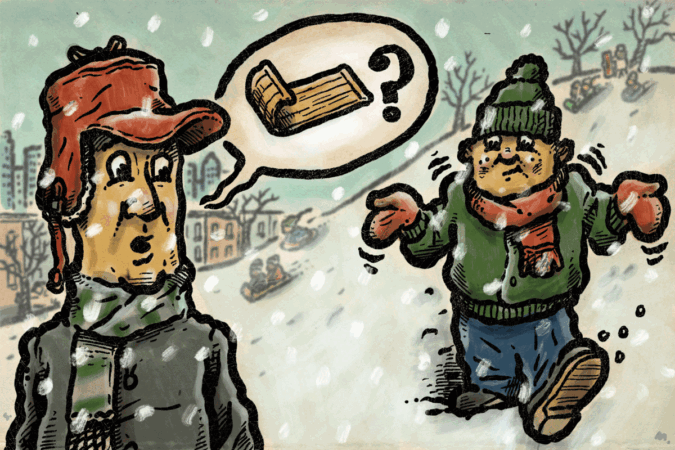
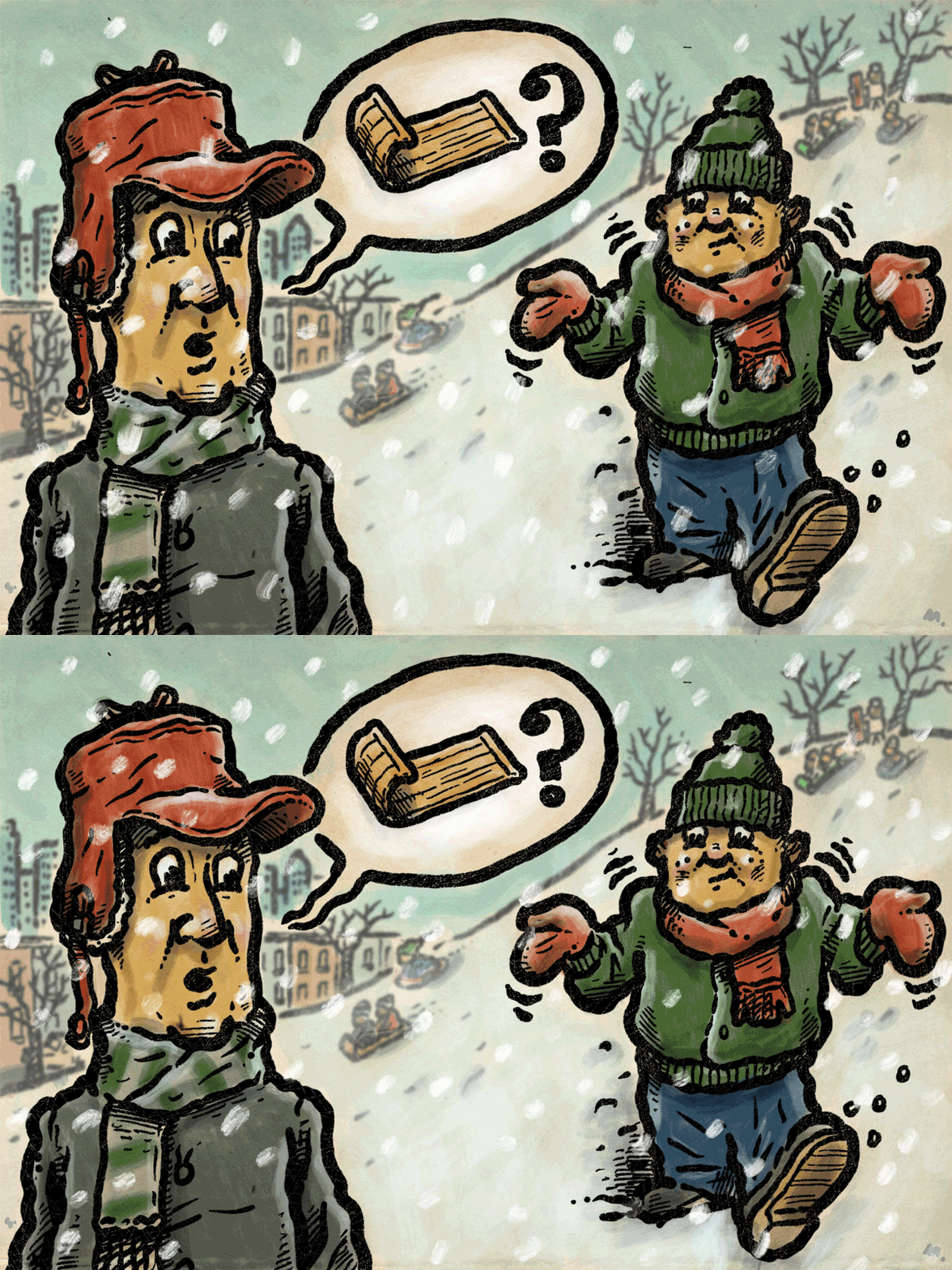
But what happens if you come across a lonely sled? We’re answering this reader question: Every time we go sledding, my kids somehow inevitably lose a sled. And every time, there seem to be extra, unclaimed sleds lying around. Is taking one of those stealing (from a child!), or just part of the karmic redistribution of sleds?
To discuss sled etiquette, Inquirer editor Evan Weiss called on two other fathers, reporters Jason Nark and Mike Newall. Their chat touched on every possible option, from posting about a found sled on Facebook to borrowing it for the afternoon — and then just leaving it be.
They also reminisced on the “rough business” of being a kid and fighting for your sled, and using things like garbage can lids as makeshift sleds. (That reminded me of this absolutely wild reel of a guy trying his luck with a suitcase, a mattress, and … a frying pan.)
Cheers to Maria Francesconi, who correctly guessed Friday’s answer: Atlantic City. The resort hub’s international airport is getting more southbound flights on Breeze Airways.
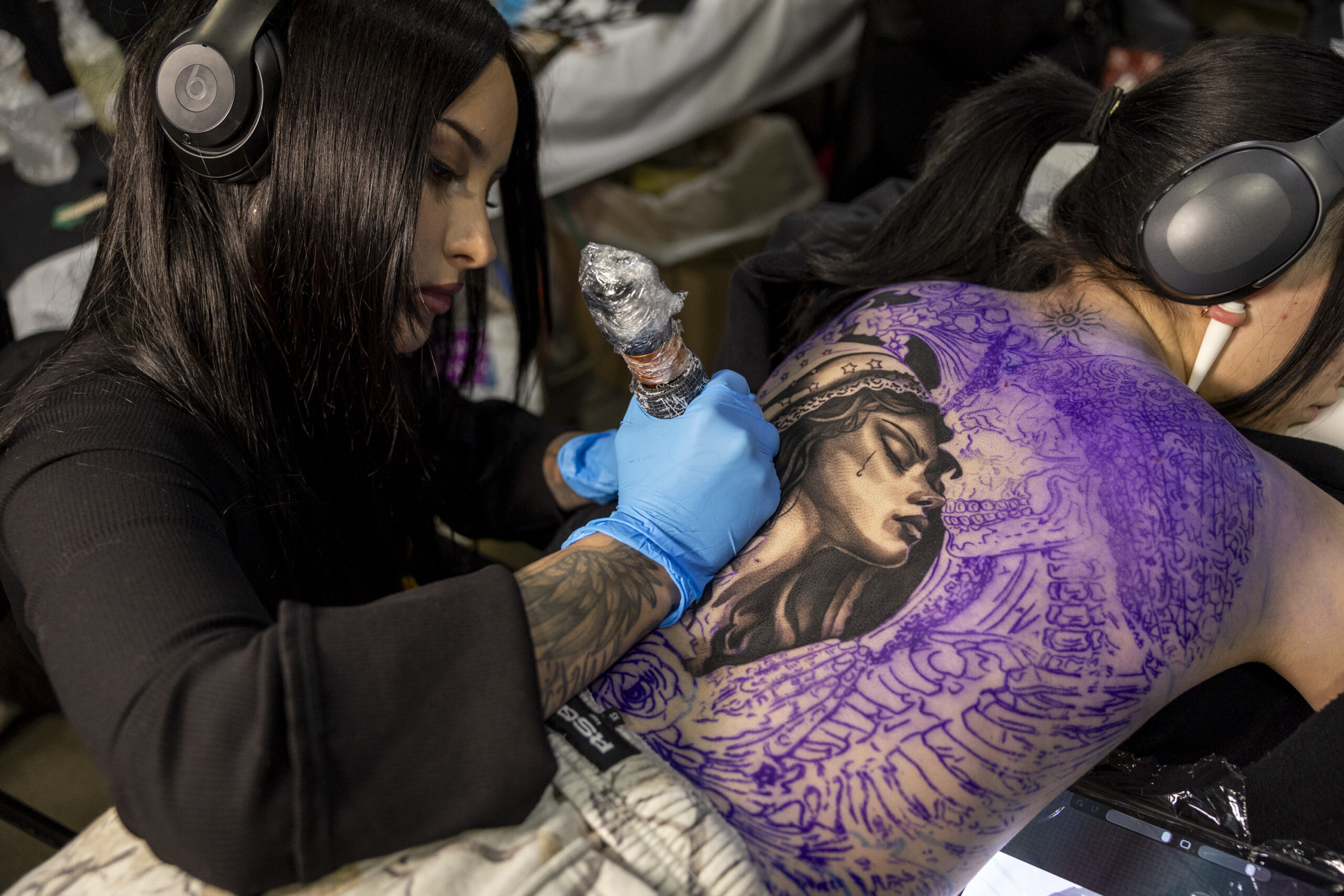
Juli Pasquale, of Painted Lady Tattoo Co. in Las Vegas, tattoos the Virgin Mary and La Santa Muerte on the back of Giselle Bewley, of Los Angeles.
Hundreds of the world’s best tattoo artists and their fans got together at the Villain Arts Tattoo Festival in Philadelphia Jan. 23 to 25. Staff photographer Tyger Williams captured the ink in action.
Manuel Contreras, the head of the secret police during Chile’s dictatorship, which reigned from 1973 to 1989, once explained why so many seeming innocents — students, union leaders, local activists — were murdered by the state: “The guerrilla tries to act like a normal citizen, honest and good, and lies even to his family. When discovered, he will always deny the facts.”
The regime does not make mistakes.
“The lack of specific information … demonstrates that they are terrorists with regard to whom we lack a complete profile.”
I am a scholar of authoritarian politics at the University of Pennsylvania. I research and teach about repression and censorship. The Trump administration is engaged in state terror. And, in a page ripped from the autocrat’s playbook, they are trying to convince us that the victims deserve it.
On Jan. 7, Secretary of Homeland Security Kristi Noem claimedRenee Good — shot in the head by an ICE agent while observing a raid — engaged in an “act of domestic terrorism.” Noem said that Good “weaponized” her car (the same car with a glove compartment overflowing with her child’s stuffed animals and a friendly dog in the back).
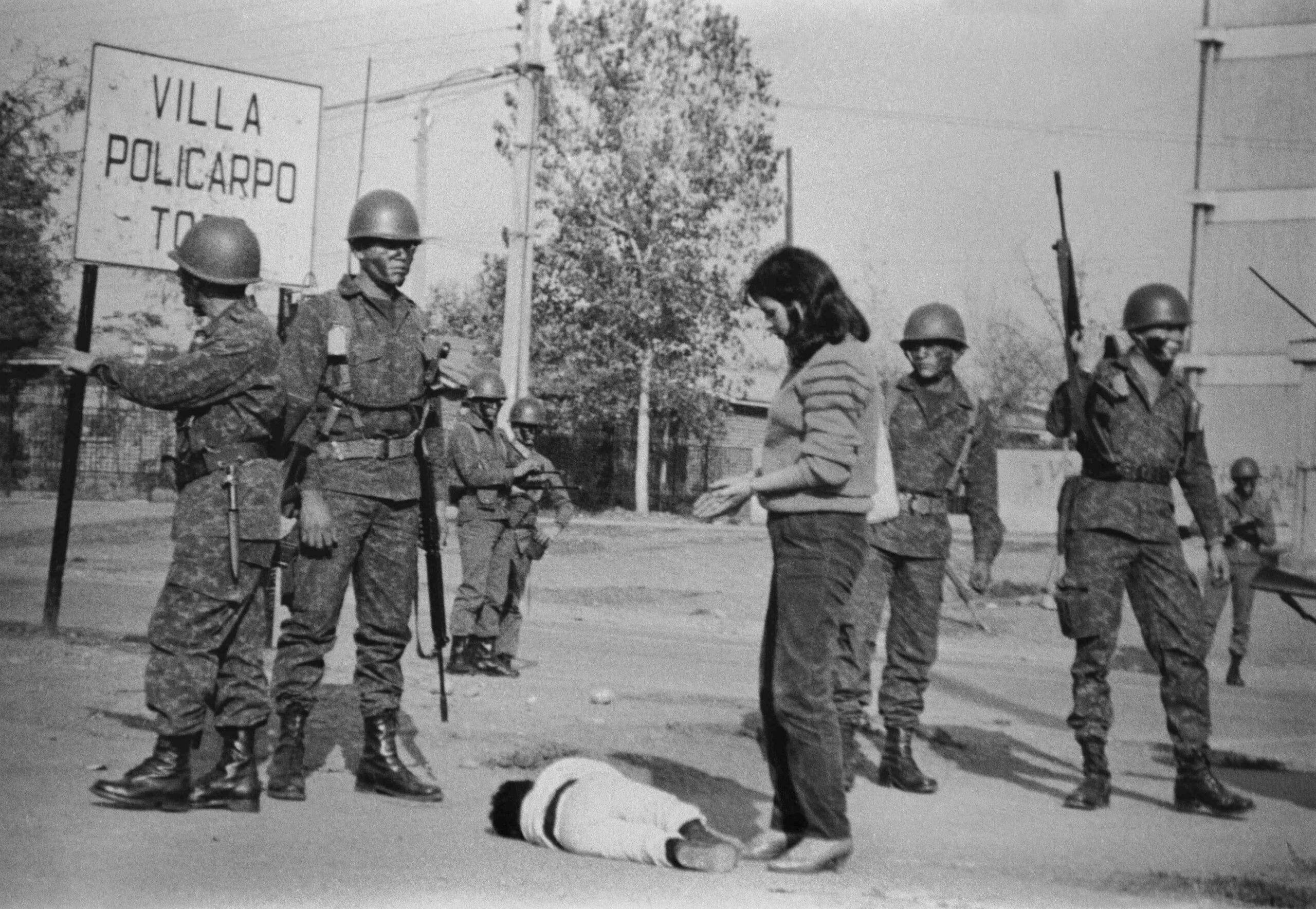
These are the same lies Augusto Pinochet told in Chile, where the regime frequently falsified reports that blamed the victims for their own deaths. Rather than executions, victims died in “shootouts.” The official government account of the death of one 28-year-old activist was that he was a “subversive” killed while attacking a barracks. But witnesses saw him being arrested two days earlier. A miner with no known political affiliation, the press claimed, “tried to seize a policeman’s weapon … and so he was shot.” Two victims executed by army troops were accused of “criminal or subversive activities.”
A boy lies weeping by his mother after his father was arrested by soldiers in Santiago, Chile, during the Pinochet reign in 1986.
Like Pinochet, the Trump administration wants you to believe the people they are terrorizing and killing deserve it. They want us to accept, or even celebrate, their crimes. Because if a victim deserves what happened to them, if there is a reason for it, then perhaps it can be stomached, or excused away, or ignored.
During Argentina’s brutal 1970s dictatorship, civilians often justified repression using the phrase “Por algo será” — roughly, “There must be a reason for it.”
Victimization implied that the victims were guilty of something. People are thrown out of planes while drugged. Por algo será. They are taken from their families in the middle of the night. Por algo será. Bodies are dumped in mass graves. Por algo será.
And if there is a reason for it, then anyone can avoid being a victim by staying home. By not fighting. By letting the administration do whatever it wants, with no pushback.
Good was a 37-year-old white mother from Colorado, her death filmed at multiple angles, all of which make the government’s lies harder to swallow for an American audience. But who the victim is should not matter: The government is violating fundamental human rights.
It is our responsibility to refuse to accept these lies. To demand — and to pressure our representatives to demand — accountability for these crimes.
Jane Esberg is an assistant professor of political science focused on authoritarian repression and censorship, particularly in Latin America, at the University of Pennsylvania.
I spoke with a Friends School class this week, primarily about my photos decades ago of unhoused men in Center City. It was part of their week working with PhotoVoice, a research method where participants photograph their own lives to highlight community strengths and challenges, and advocate for social change.
After the class, and following many thoughtful questions from the middle schoolers about how in general I approach people before I photograph them, and specifically people in vulnerable situations, a student came up to ask me a more practical question: “How do you take pictures in bad weather?”
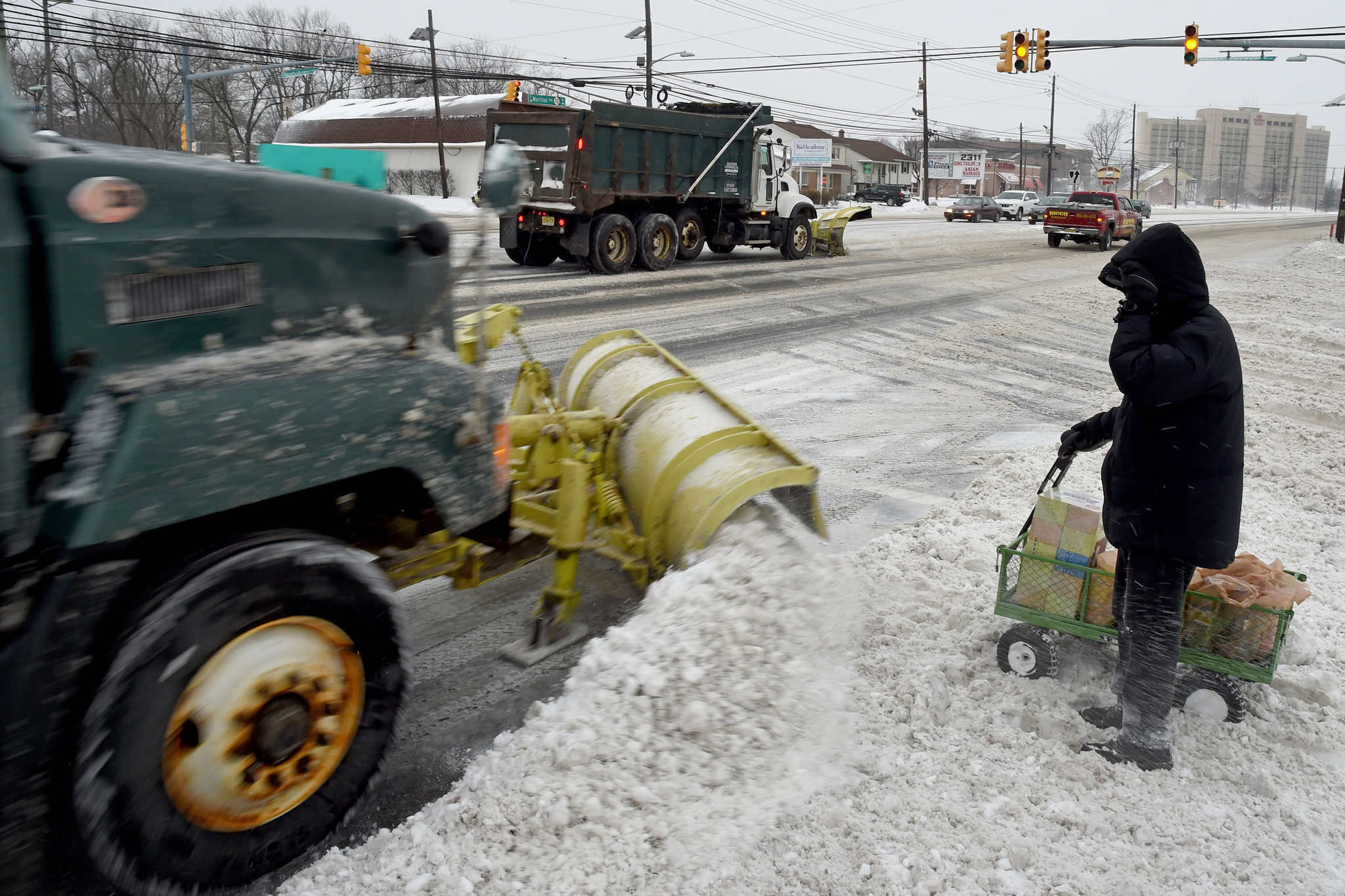
Pedestrians and plows on Rt. 70 in Cherry Hill in Januiary, 2018.
I don’t have an all-weather, sealed camera, so besides dressing as best I can for the conditions (and always having a spare pair of thick, dry wool socks in my car) keeping my camera protected is the biggest priority. I not only need to stave off mechanical/electronic breakdown, but have to keep my lens clear of the elements.
I told him I do have a dedicated rain sleeve but I’ve only used it once or twice at rainy sporting events (they’re priced from $2 each up to $200).
Mostly I use plastic bags or a large umbrellas (watching that I not catch the edges in my frame). I also try to find dry areas to stand in — while watching and photographing others out in the elements. I seek cover under a roof, awning, or doorway. I go into parking garages or subway entrances.
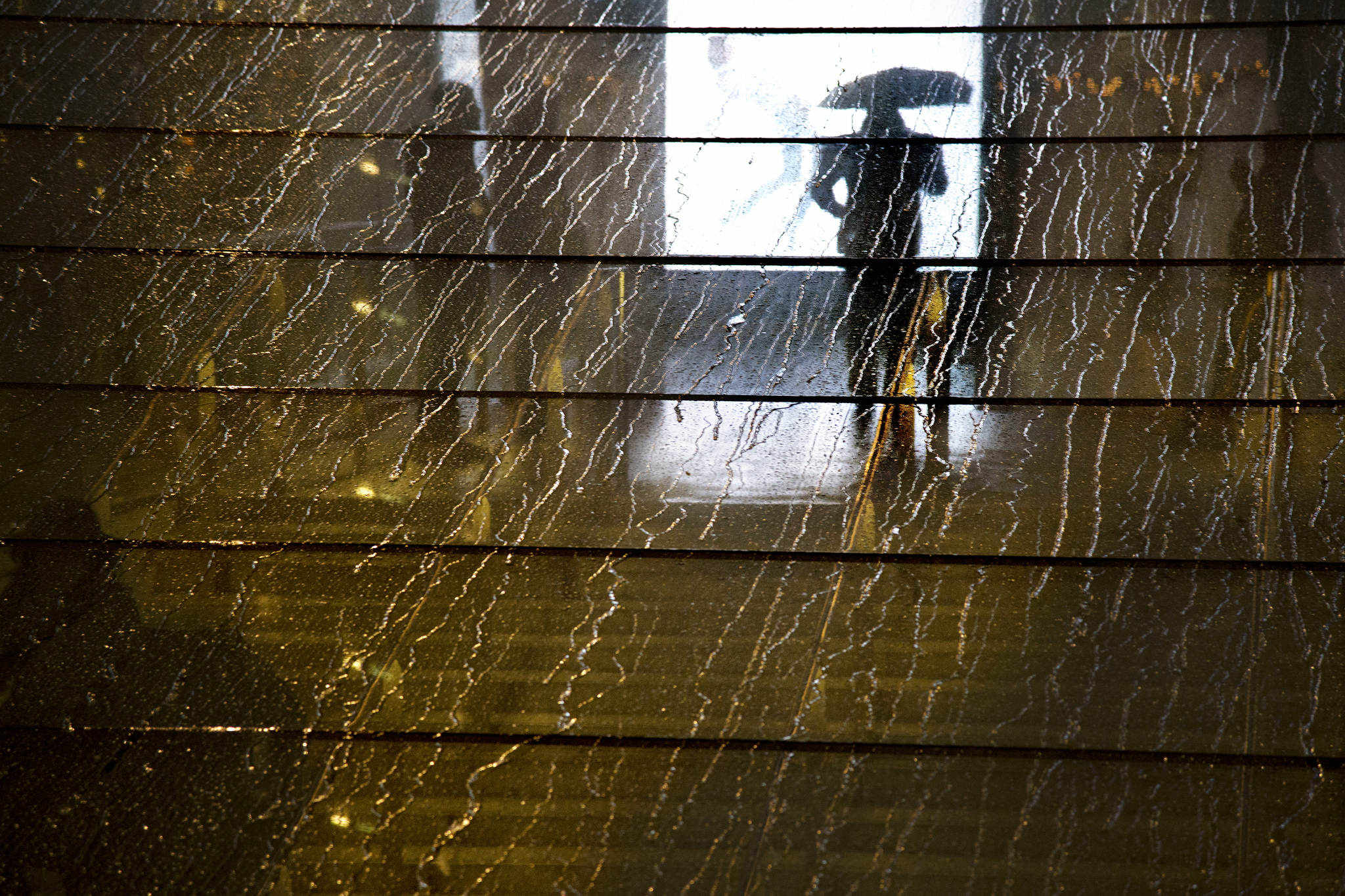
The glass entrance to SEPTA’s underground concourse at Dilworth Park by City Hall.
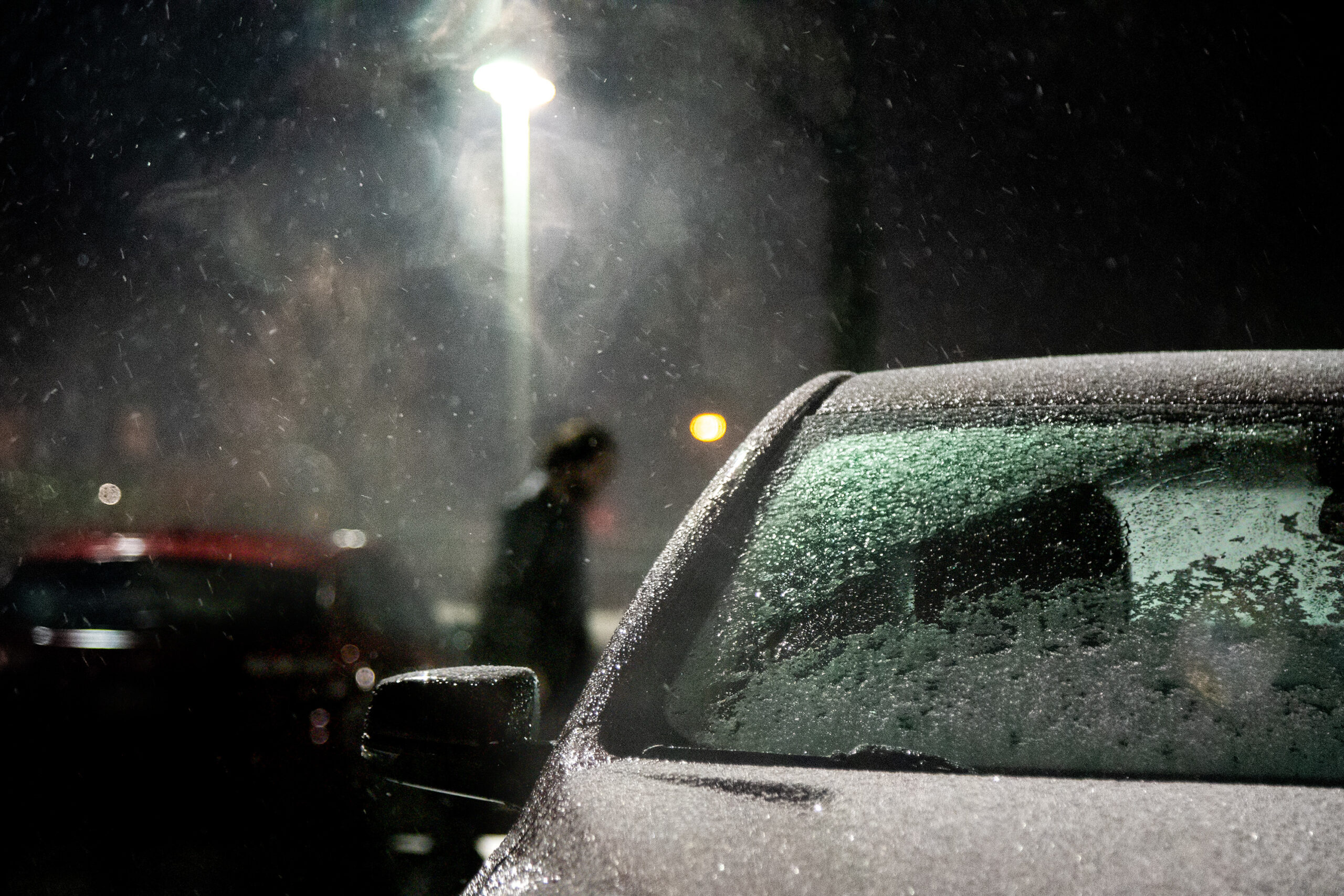
Sometimes I safely park my car where I can briefly open my leeward (downwind!) window. Other times the rain or snow on glass can even be an effective way to portray the “dab” weather. It can be in or out of focus to create a bokeh-like effect or blurred to convey mood. Your choice of a fast shutter or slow shutter can either stop the drops or show their movement.
Precipitation — some snow and some rain — falls on cars in a parking lot on City Avenue.
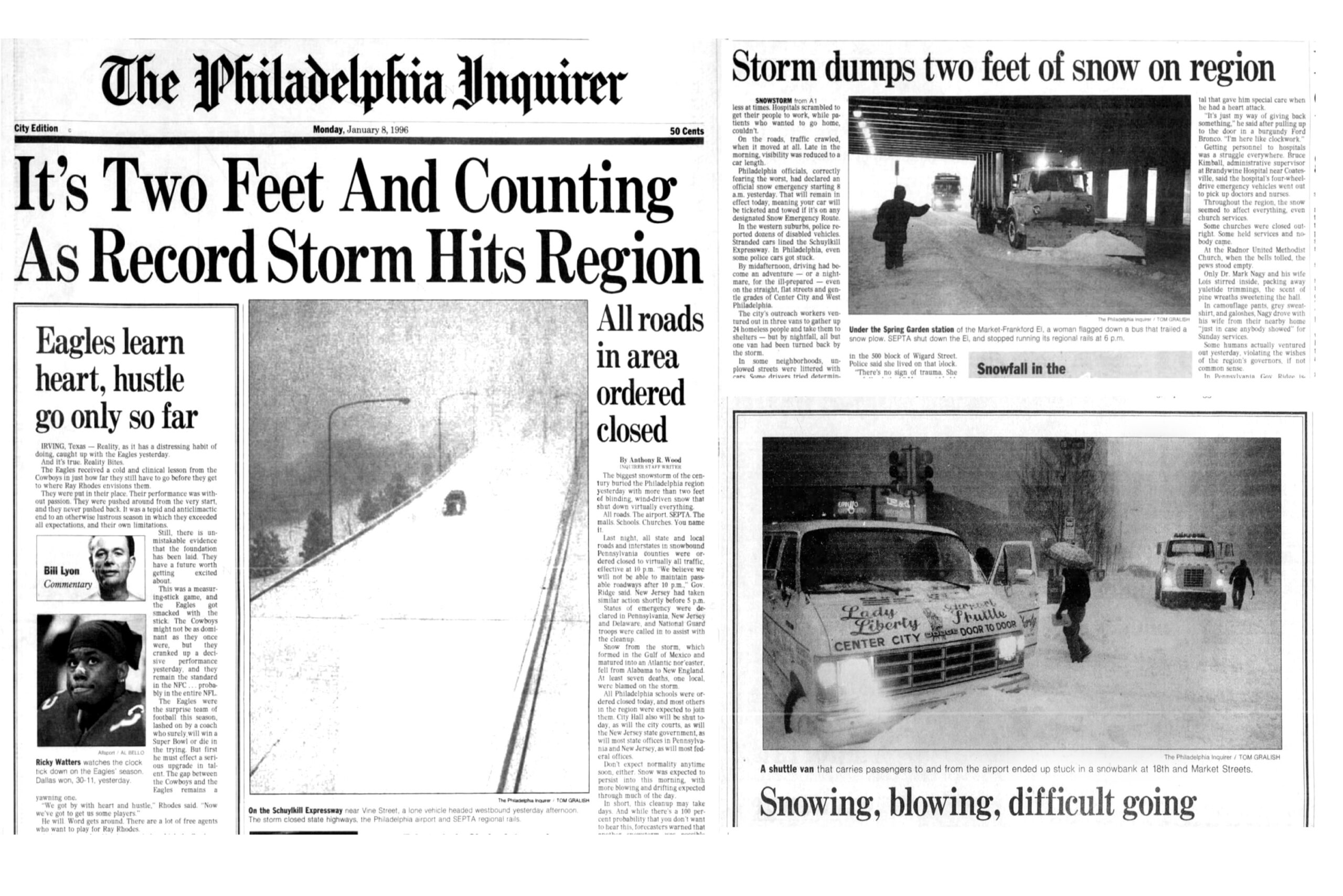
I’ve covered all of the biggest storms of the past few decades, including the historic “Blizzard of the Century” thirty years ago this month.
Front page and inside photos from The Philadelphia Inquirer. January 8, 1996.
So, I took my own advice while preparing to go out last Sunday. Knowing the roads would get worse as the day went on, I drove out of my South Jersey neighborhood while an early pass of the plows left main arteries somewhat passable, and headed straight to the nearest Wawa that I knew would have a clear-ish parking lot.
Stepping out from under the overhang — I made a few photos before walking out into on the wide street to get the few passing cars and plowing crews in a nearby shopping center.
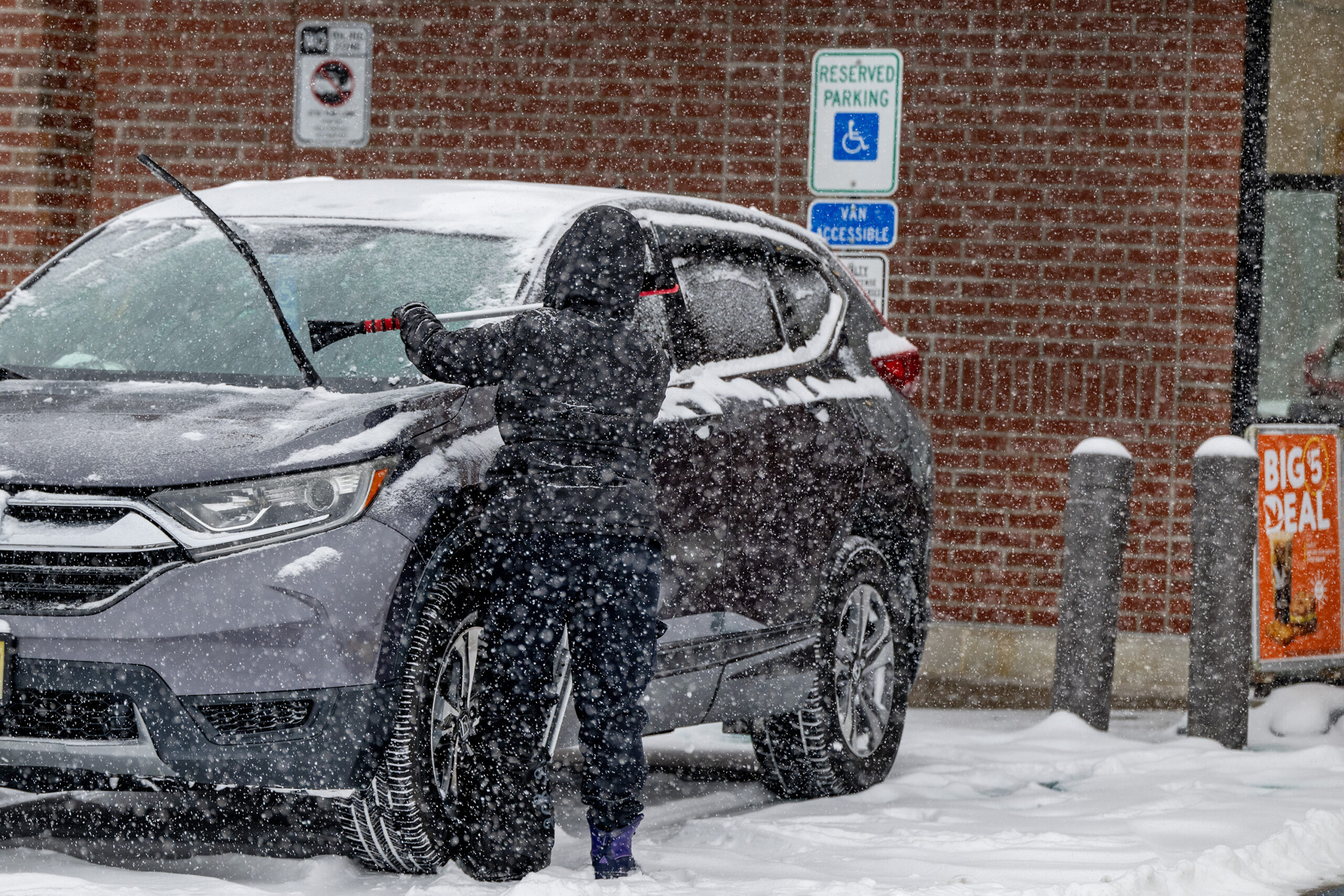
Carmen Roman clears snow off her car at a Cherry Hill Wawa early Sunday morning, Jan. 25, 2026, as heavy snow bands move through the region generating snowfall rates of 1 to 2 inches an hour.
From there, confirming my fears the roads would be more difficult to drive on, I headed the Westmont PATCO station, finding a safe place to park even as workers were hard at it, clearing the lot.
I made photos from the elevated platform before taking a train to Collingswood, where — standing on the leeward side of the stairwell shelter — I took more pictures then walked into downtown.
Haddon Avenue was plowed and relatively empty of cars, but the sidewalks were impassible. I sent in my best photo of people walking along the middle of the downtown street.
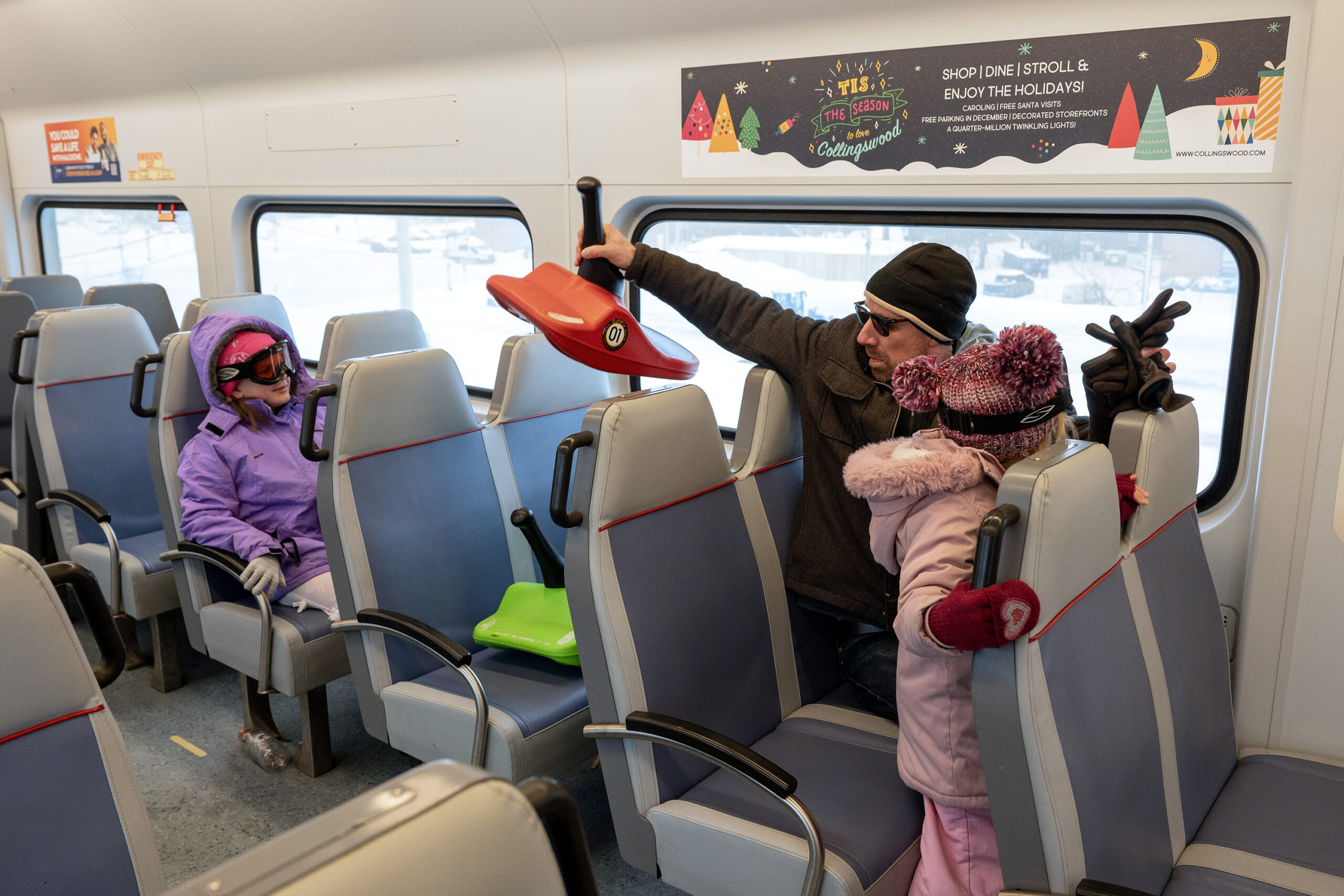
It was then I saw Mike Doveton and his daughters. Not wanting to repeat my earlier image, I asked if they were headed to or from sledding.
They were walking to the PATCO station to sled in Haddonfield, so I tagged along.
On the train headed to sled.
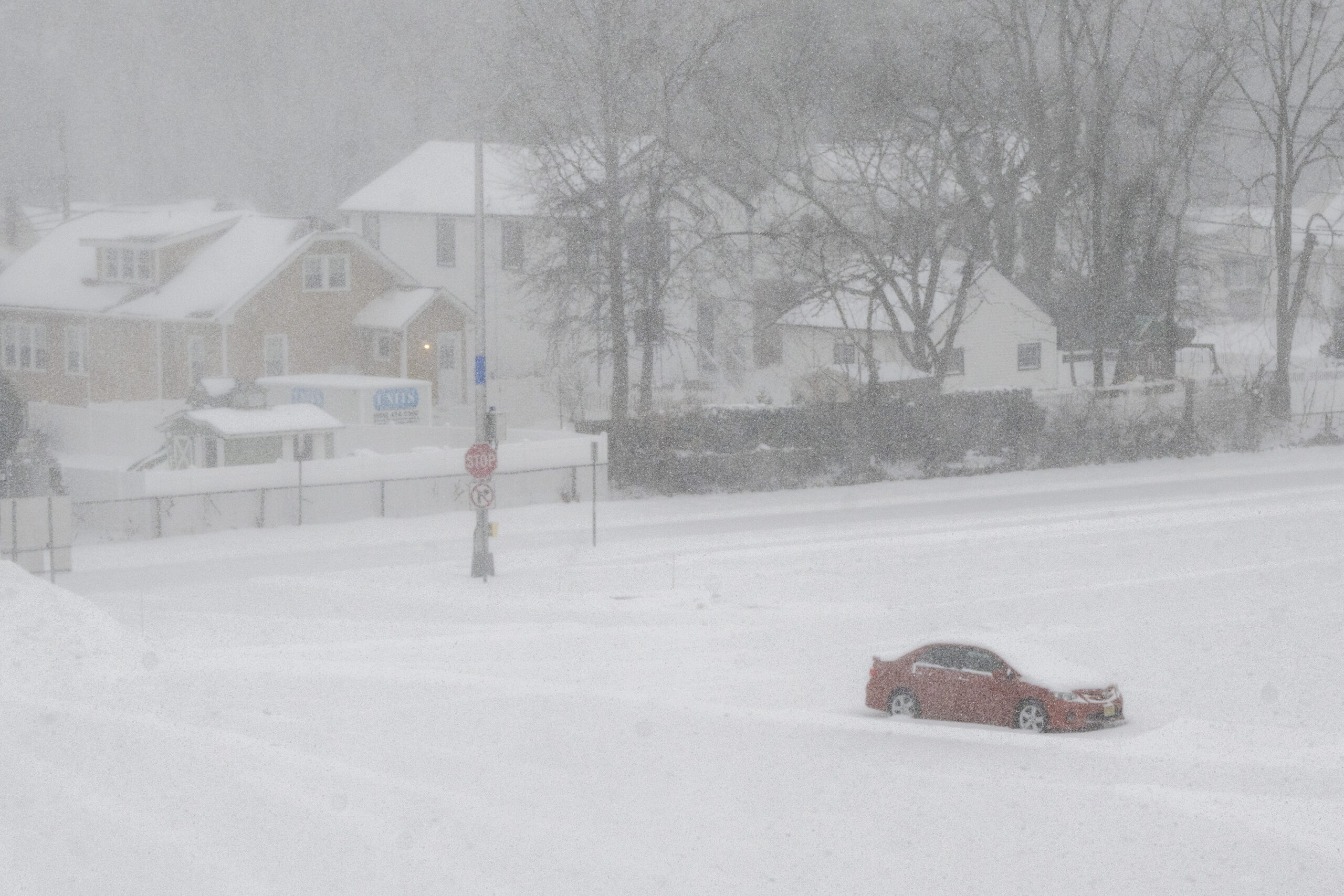
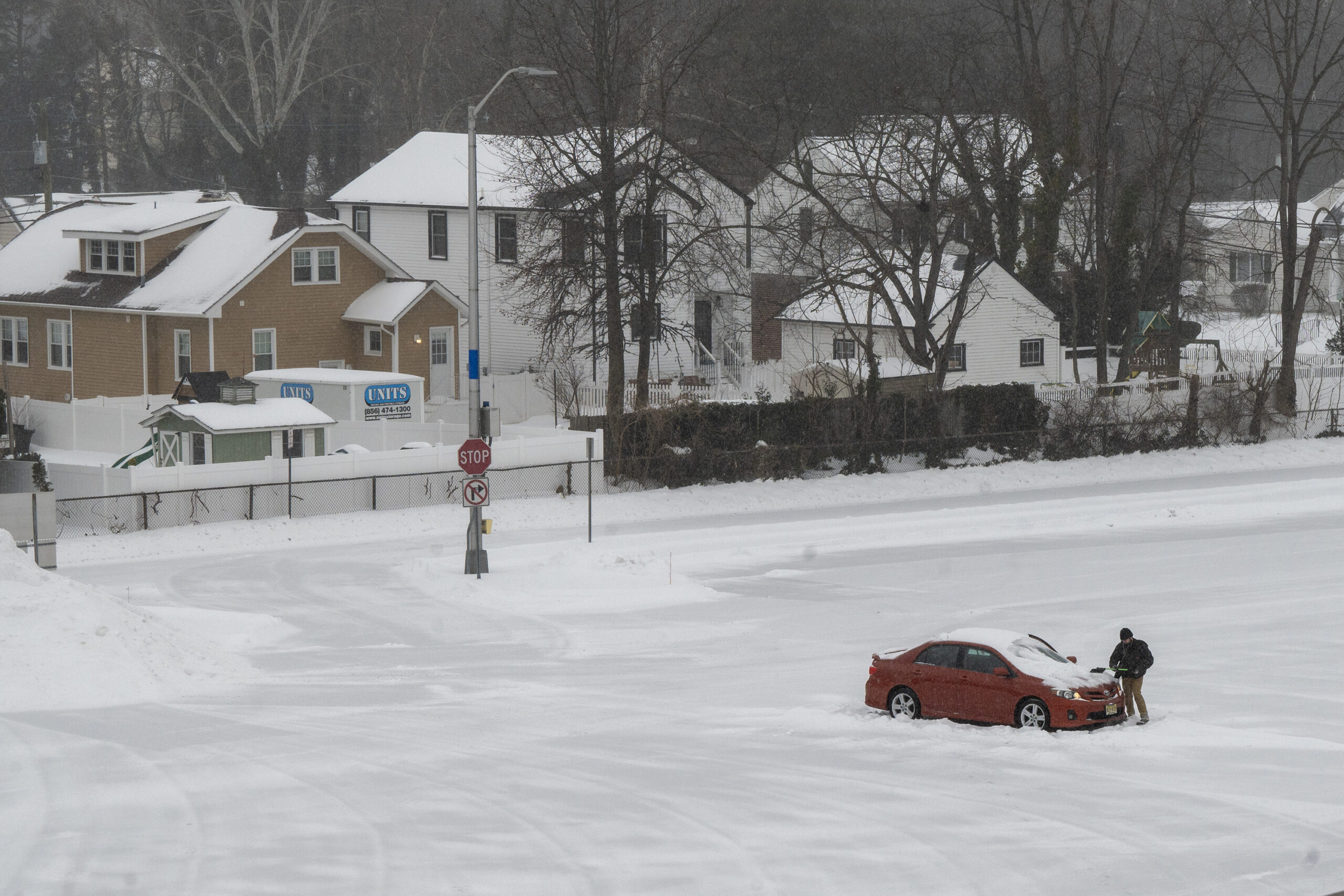
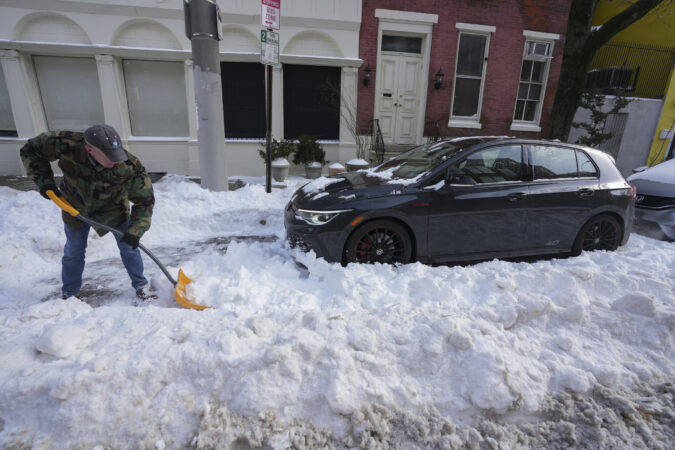
I went with them to their destination, but didn’t want another kids-on-a-hill photo, so I got back on the train returning to the Westmont station, and my car, calling it a day. Until I saw someone digging out their car — the same one I had photographed hours earlier. I got as close as I could to the spot on the platform and made an “after” photo.
Before and after in the Westmont PATCO station parking lot.
Luis Nova had left his car there on Friday, and was in Philadelphia all weekend helping friends move and going to a goodbye party. He spent the morning sledding with friends in Clark Park in West Philadelphia. Like me, he had experience with storms. “I spent four years in Rochester [NY],” he told me. “So I knew what I was signing up for and was ready. I left all my equipment to get myself out.”
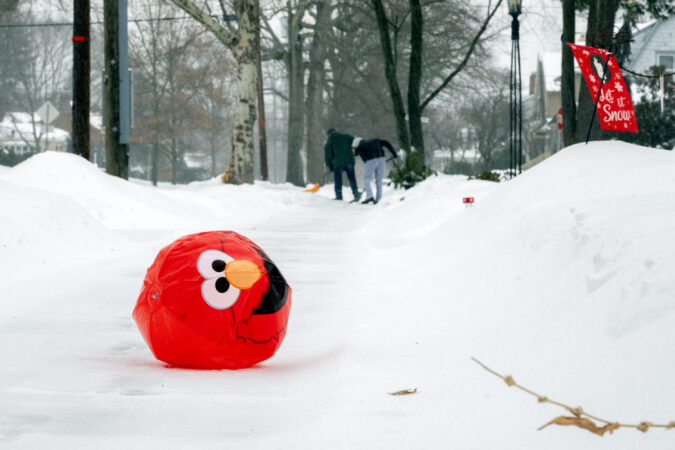
But the highlight of the day was at the very end, as I headed for home as the snow was turning to sleet. Two hours earlier, in the middle of the storm my grandson snapped a photo out our front window of an Elmo head in the middle of the street before the wind blew it away, and shared the picture with our family. As I approached my house, I see a red ball rolling fast down the street toward me. I almost drove into a snow bank laughing.
Not really, but I did pull into the driveway, grab a camera, jump out of my car and go chasing after it. The wind was really moving it, and I couldn’t see where it was, which was hard to imagine, being as the road and everything else was all white. I came up to a couple of guys shoveling and asked, “Did you see an Elmo head come this way?” They had, and said it went up a driveway and jumped onto the sidewalk. I found it and just as I was lining up my photo the wind took it again and it started spinning.
Since 1998 a black-and-white photo has appeared every Monday in staff photographer Tom Gralish’s “Scene Through the Lens” photo column in the print editions of The Inquirer’s local news section. Here are the most recent, in color:
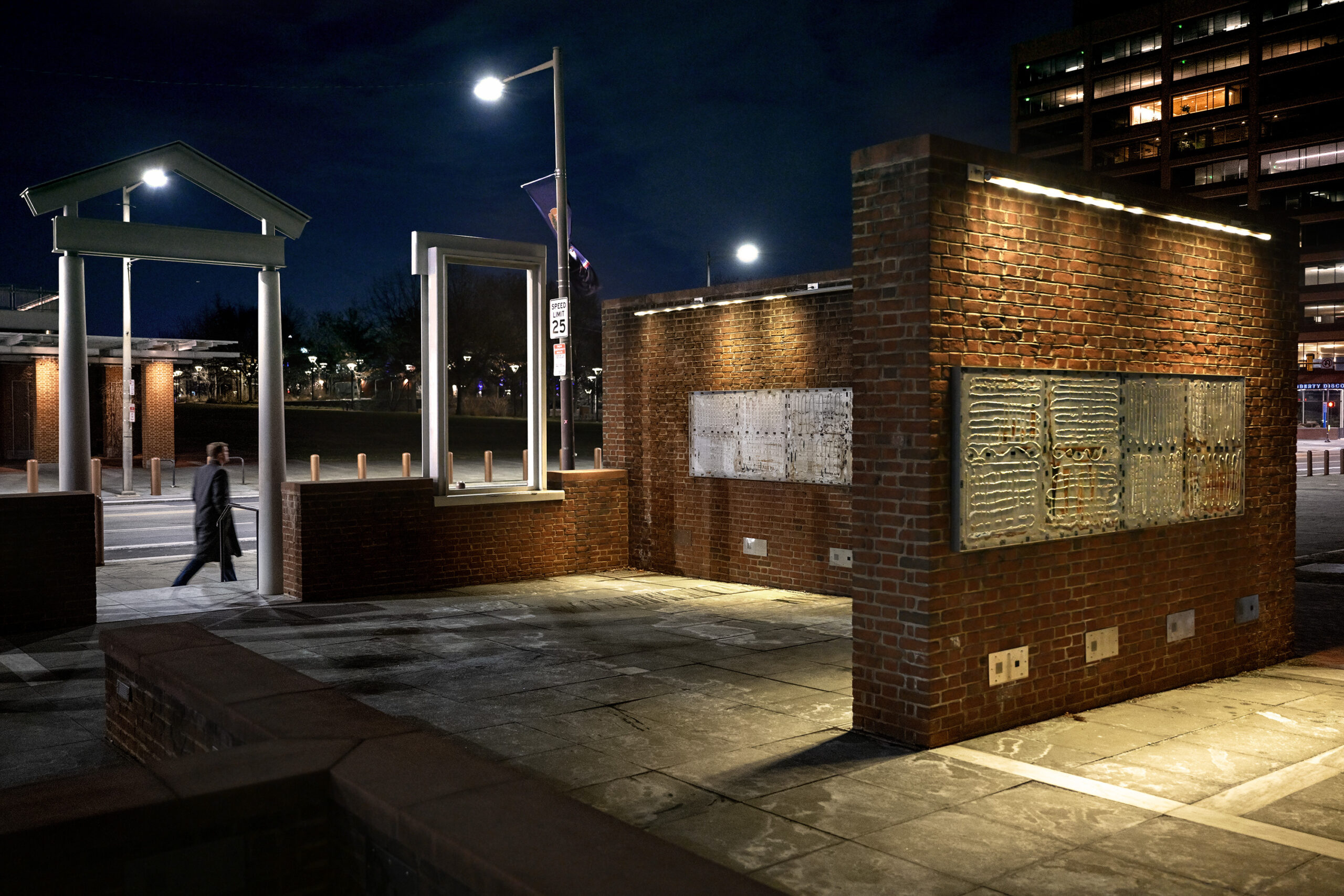
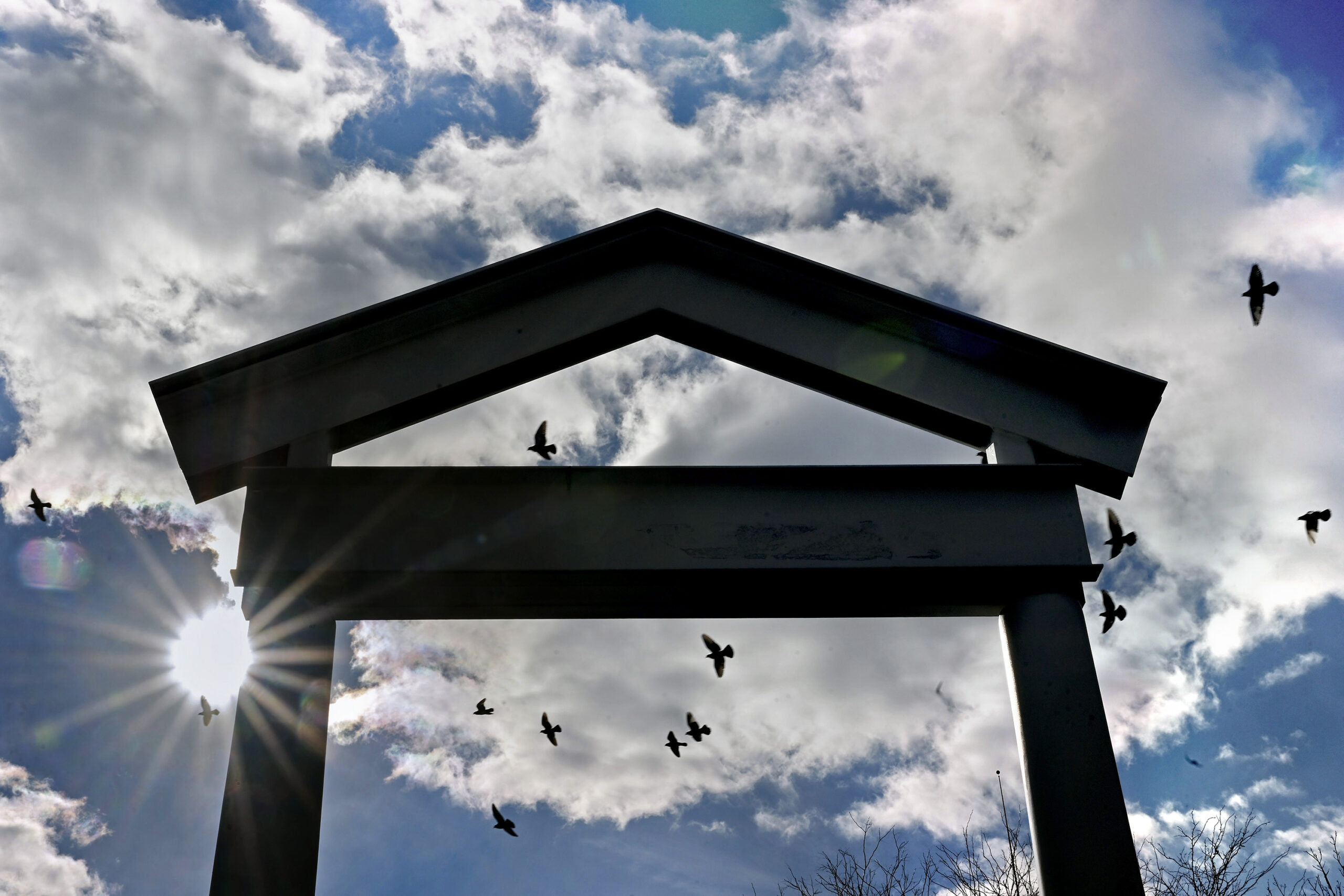
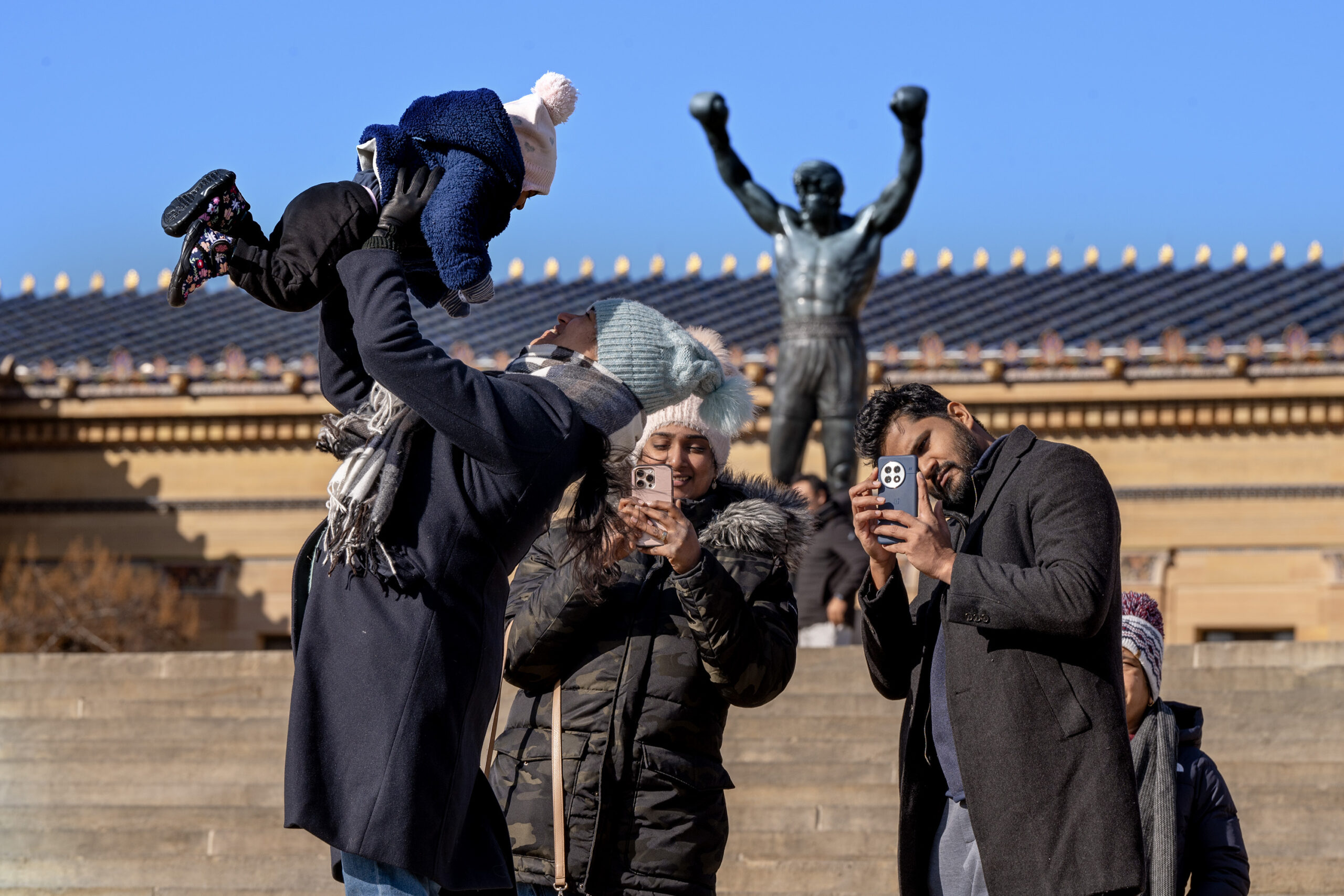
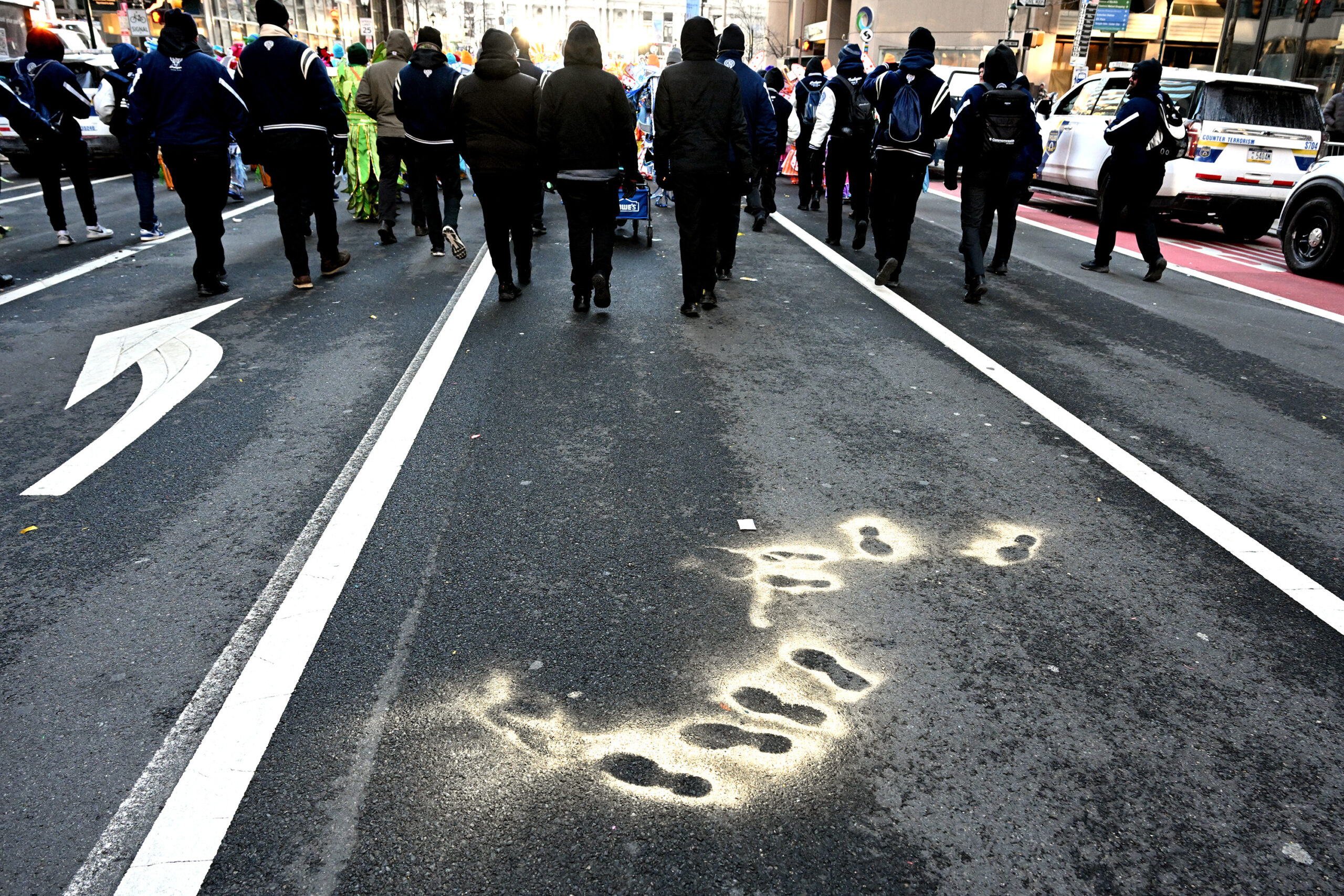
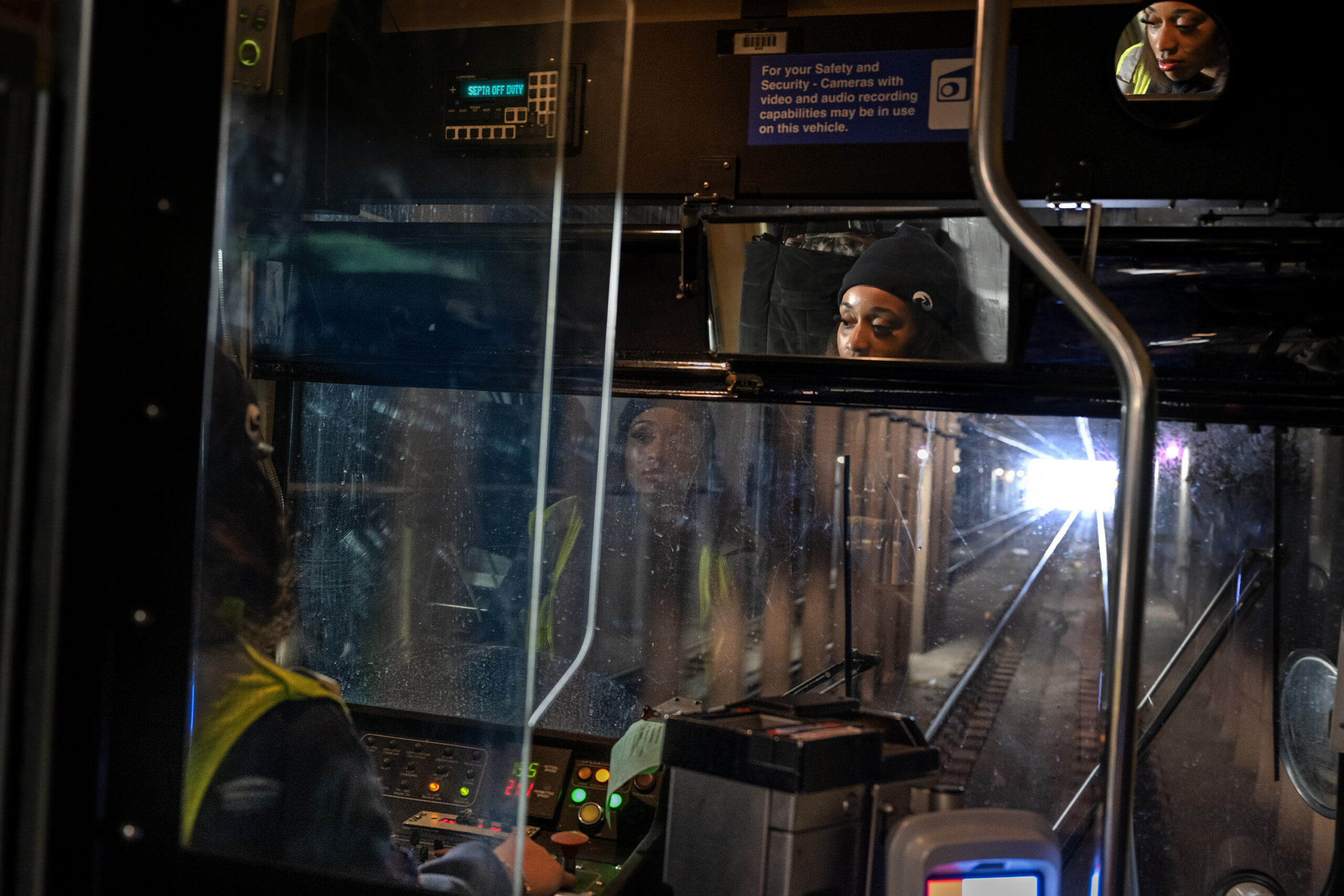
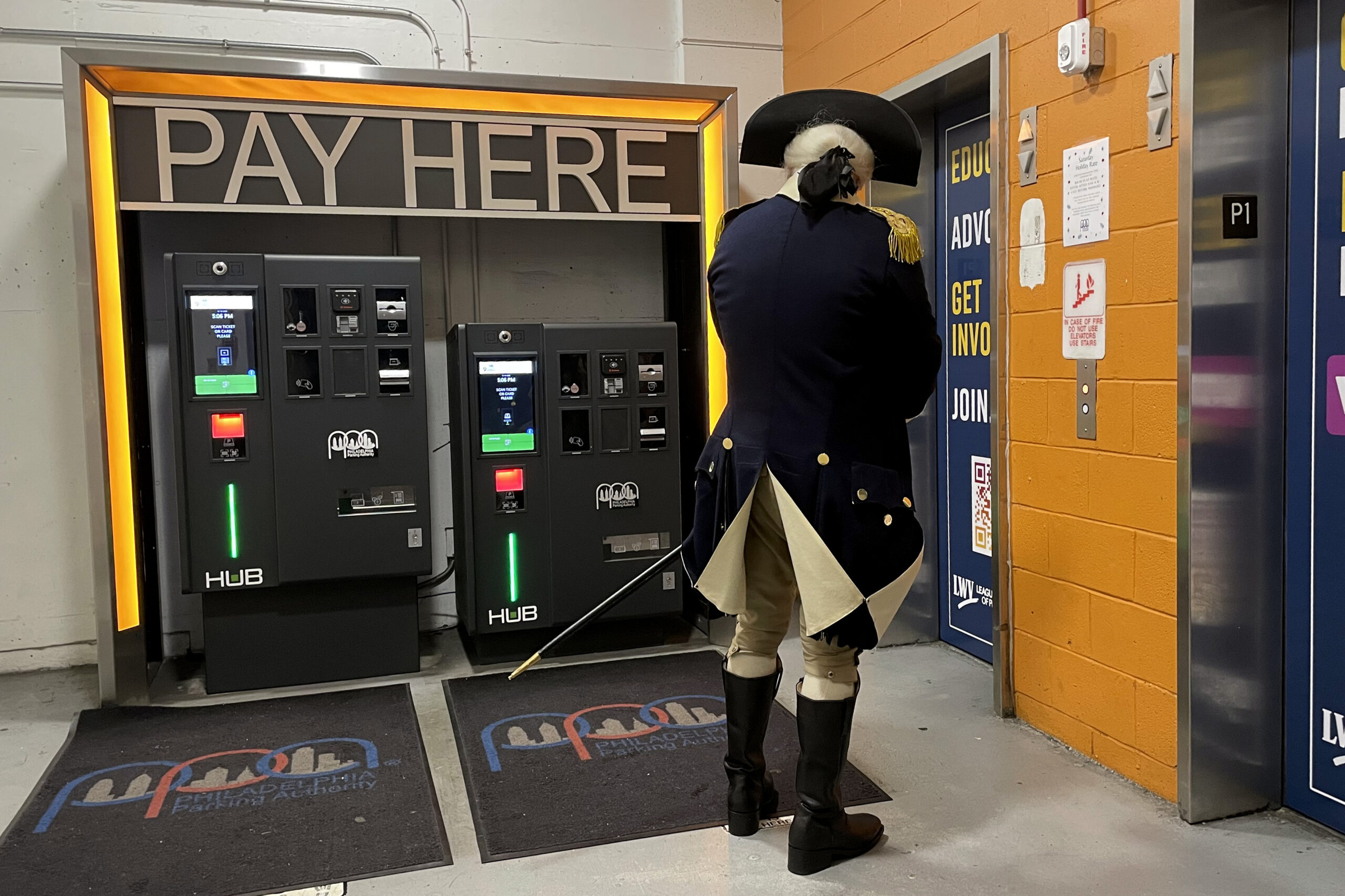
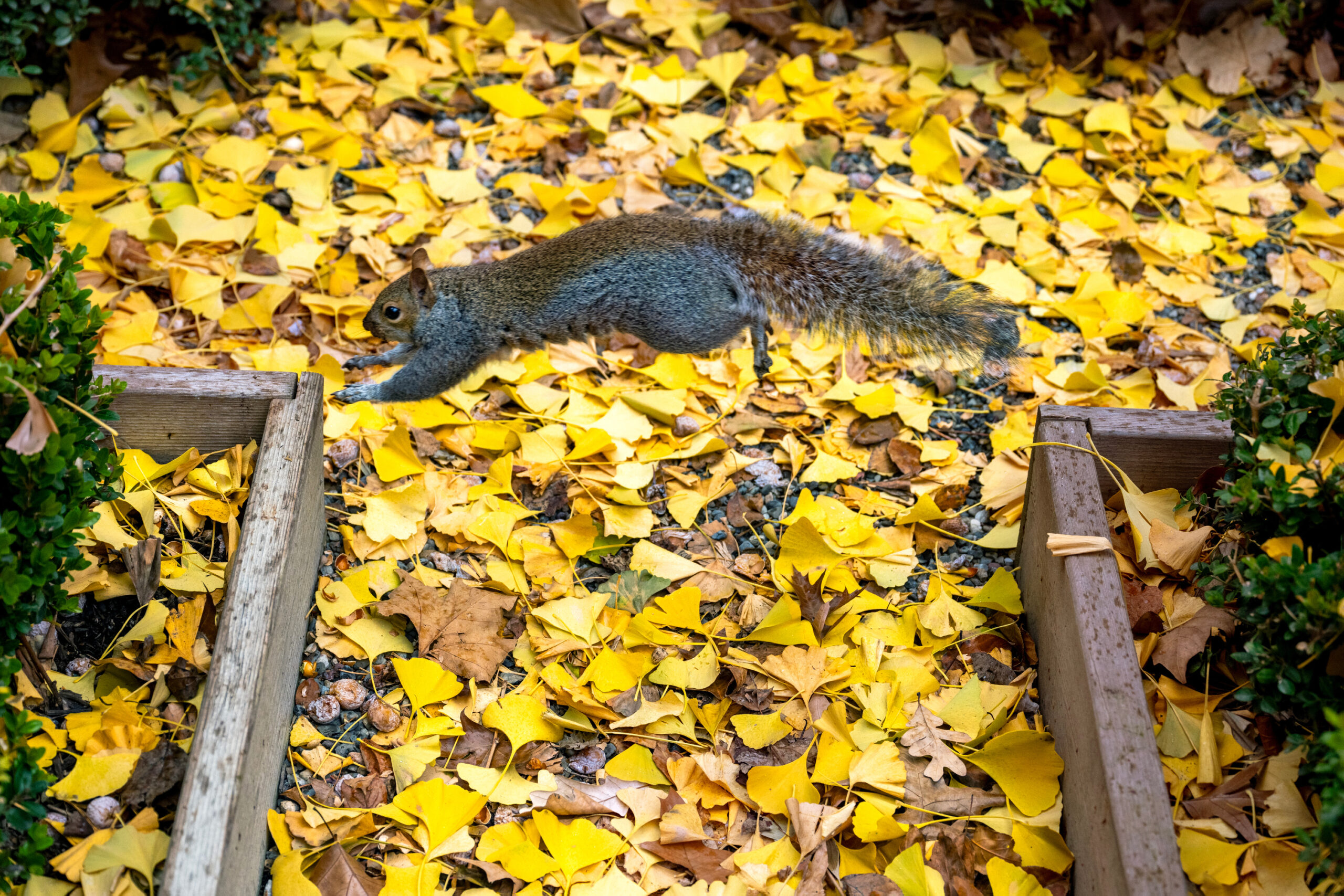
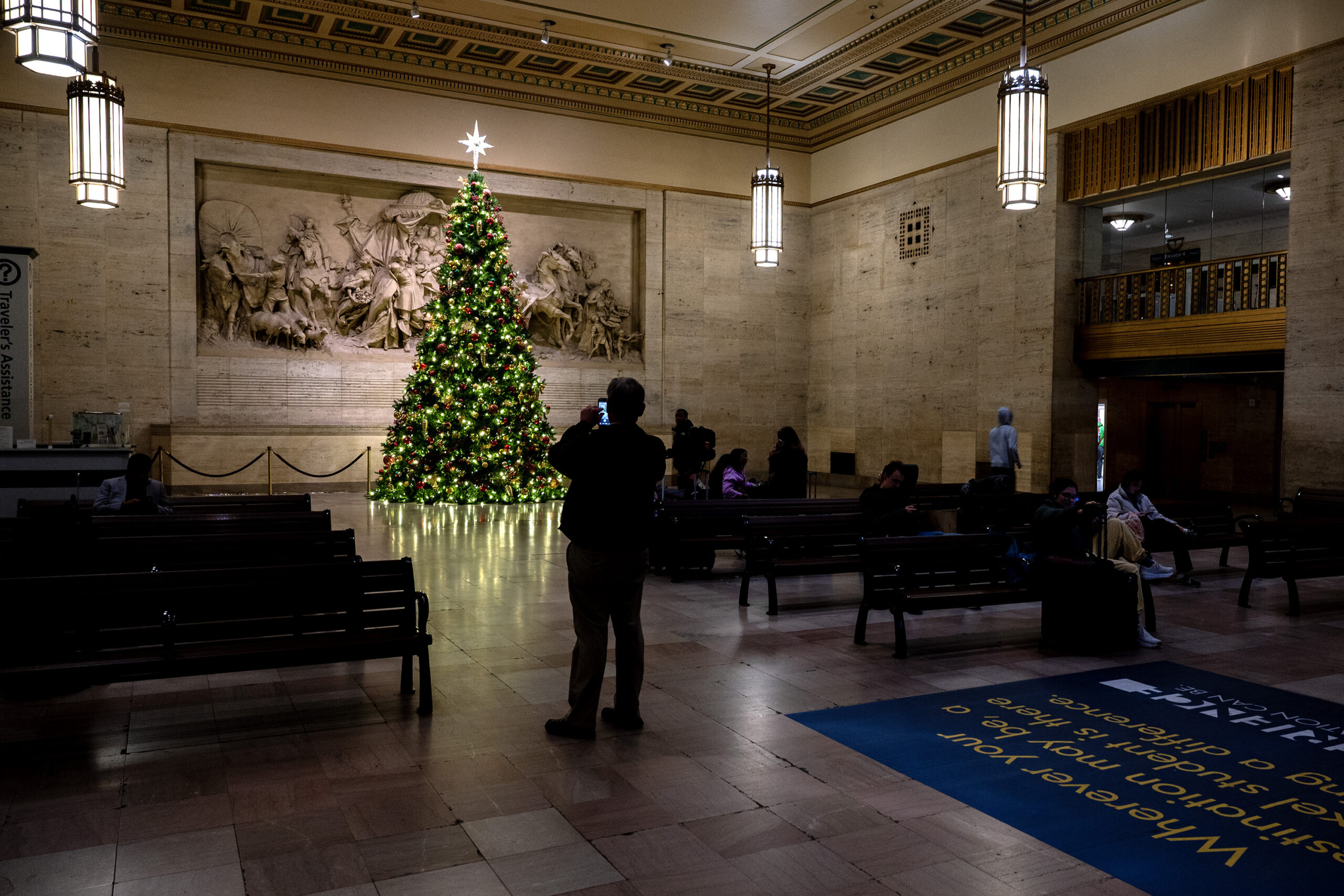
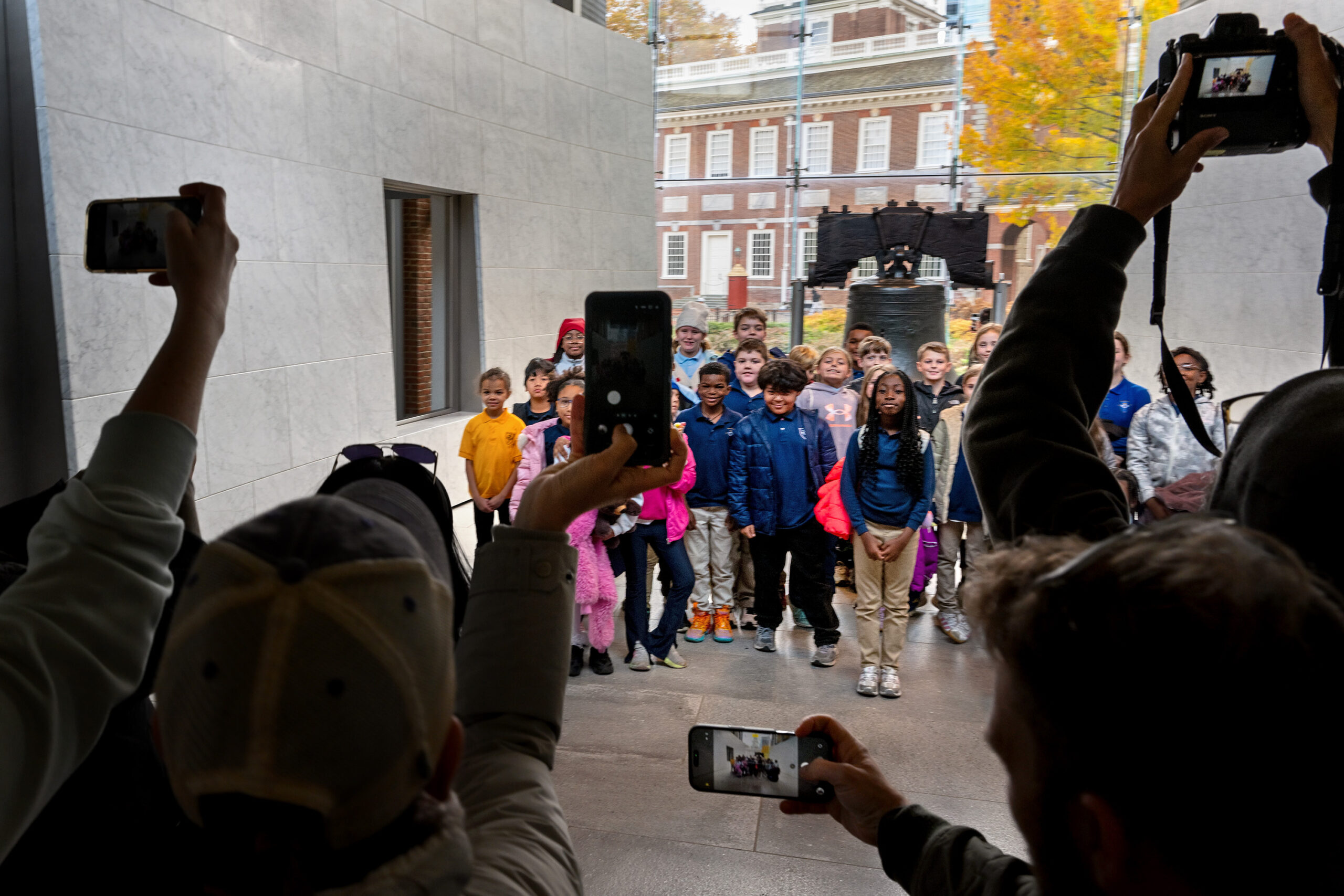
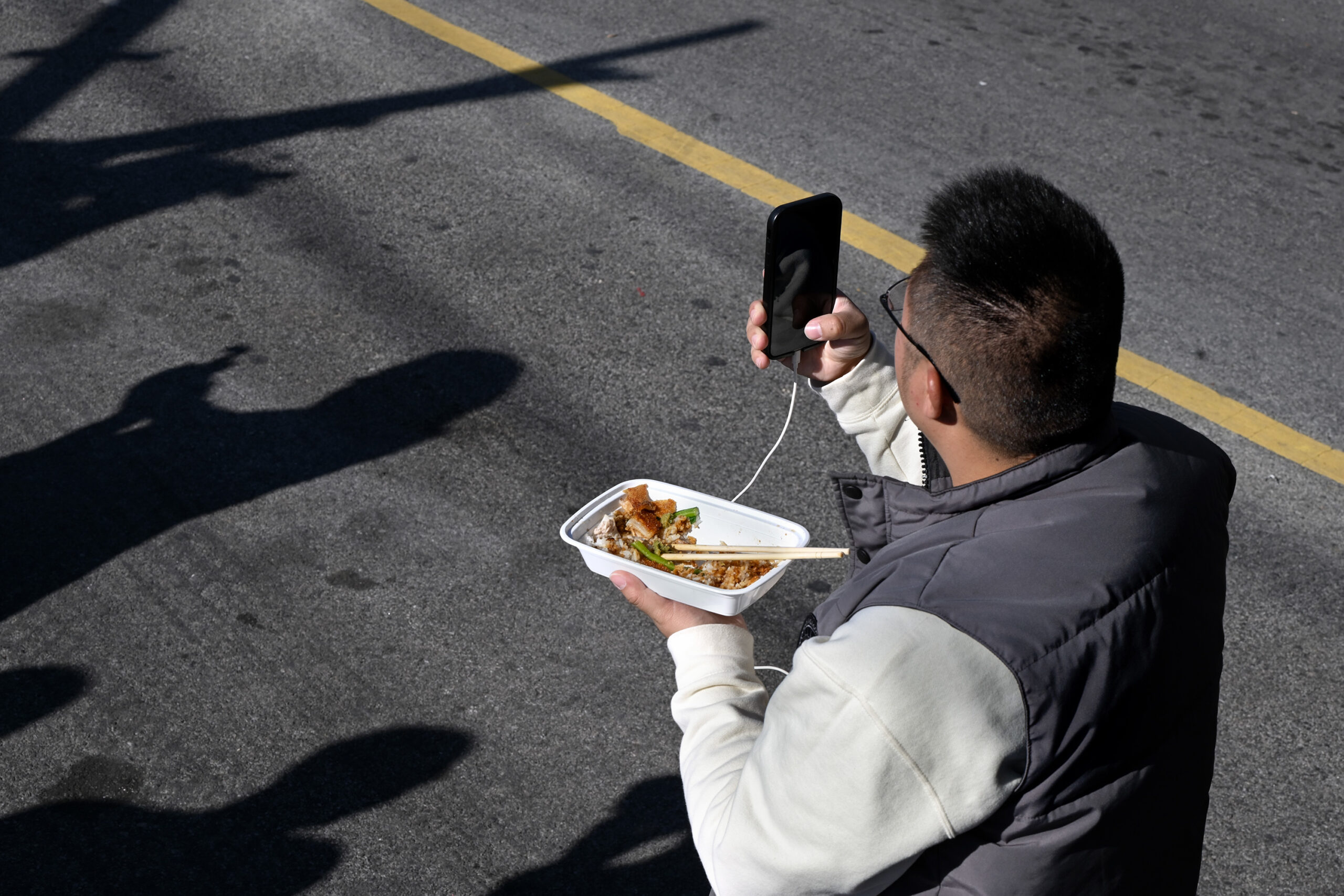
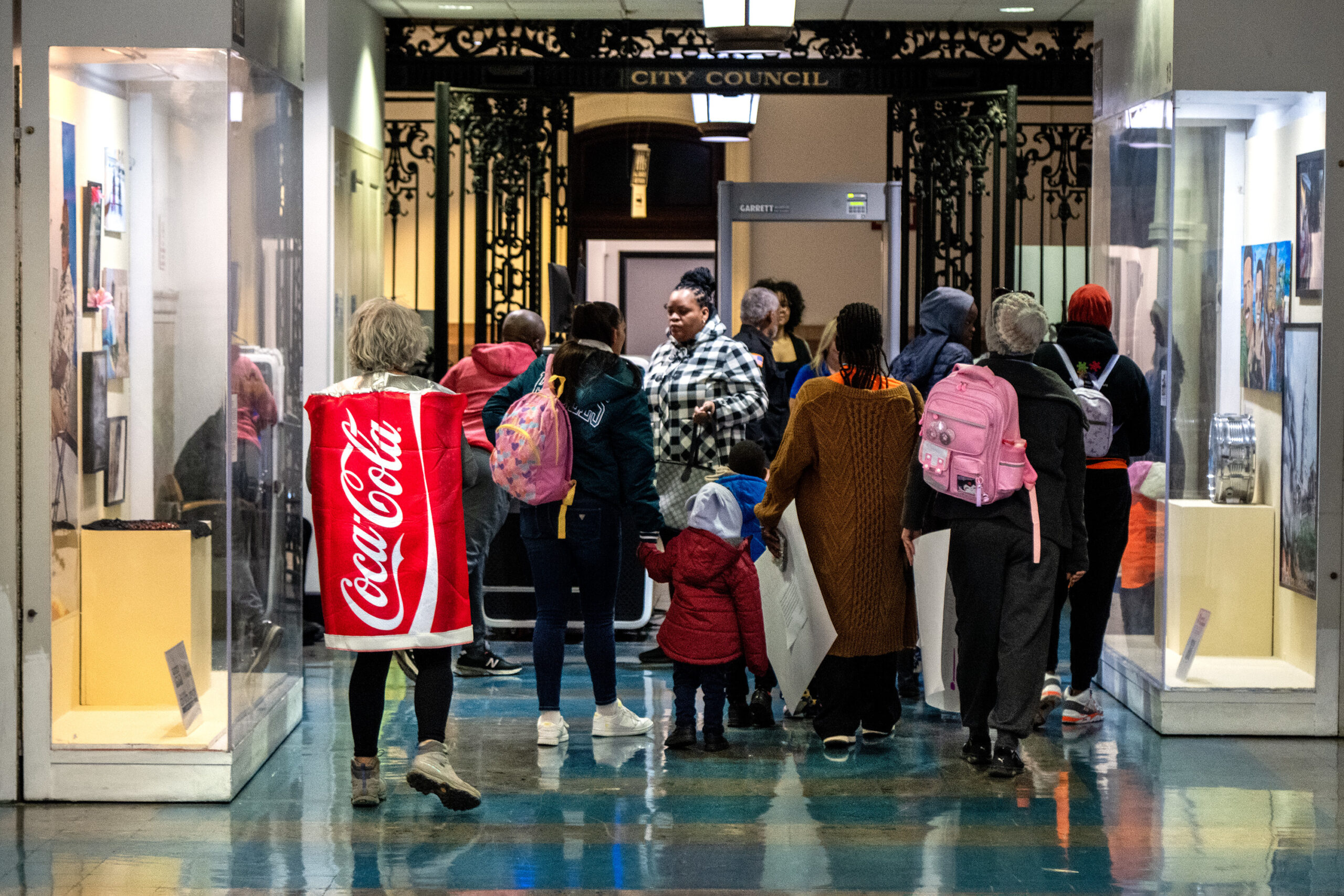
January 26, 2026: The President’s House in Independence National Historical Park hours Jan, 22, after all historical exhibits were removed following President Trump’s Executive Order last March that the content at national parks that “inappropriately disparage” the U.S. be reviewed. The site, a reconstructed “ghost” structure titled “Freedom and Slavery in the Making of a New Nation” (2010), serves as a memorial to the nine people George Washington enslaved there during the founding of America.January 19, 2026: A low-in-the-sky winter sun is behind the triangular pediment of the “front door” of the open-air President’s House installation in Independence National Historical Park. The reconstructed “ghost” structure with partial walls and windows of the Georgian home known in the 18th century as 190 High St. is officially titled, “Freedom and Slavery in the Making of a New Nation” (2010). It is designed to give visitors a sense of the house where the first two presidents of the United States, George Washington and John Adams, served their terms of office. The commemorative site designed by Emanuel Kelly, with Kelly/Maiello Architects, pays homage to nine enslaved people of African descent who were part of the Washington household with videos scripted by Lorene Cary and directed by Louis Massiah. Deepika Iyer holds her niece Ira Samudra aloft in a Rockyesque pose, while her parents photograph their 8 month-old daughter, in front of the famous movie prop at the top of the steps at the Philadelphia Art Museum. Iyer lives in Philadelphia and is hosting a visit by her mother Vijayalakshmi Ramachandran (partially hidden); brother Gautham Ramachandran; and her sister-in-law Janani Gautham who all live in Bangalore, India.January 5, 2026: Parade marshals trail behind the musicians of the Greater Kensington String Band heading to their #9 position start in the Mummers Parade. Spray paint by comic wenches earlier in the day left “Oh, Dem Golden Slippers” shadows on the pavement of Market Street. This year marked the 125th anniversary of Philly’s iconic New Year’s Day celebration.Dec. 29, 2025: Canada geese at sunrise in Evans Pond in Haddonfield, during the week of the Winter Solstice for the Northern Hemisphere. December 22, 2025: SEPTA trolley operator Victoria Daniels approaches the end of the Center City Tunnel, heading toward the 40th Street trolley portal after a tour to update the news media on overhead wire repairs in the closed tunnel due to unexpected issues from new slider parts.December 15, 2025: A historical interpreter waits at the parking garage elevators headed not to a December crossing of the Delaware River, but an event at the National Constitution Center. General George Washington was on his way to an unveiling of the U.S. Mint’s new 2026 coins for the Semiquincentennial, December 8, 2025: The Benjamin Franklin Bridge and pedestrians on the Delaware River Trail are reflected in mirrored spheres of the “Weaver’s Knot: Sheet Bend” public artwork on Columbus Boulevard. The site-specific stainless steel piece located between the Cherry Street and Race Street Piers was commissioned by the City’s Public Art Office and the Delaware River Waterfront Corporation and created and installed in 2022 by the design and fabrication group Ball-Nogues Studio. The name recalls a history that dominated the region for hundreds of years. “Weaver’s knot” derives from use in textile mills and the “Sheet bend” or “sheet knot” was used on sailing vessels for bending ropes to sails. November 29, 2025: t’s ginkgo time in our region again when the distinctive fan-shaped leaves turn yellow and then, on one day, lose all their leaves at the same time laying a carpet on city streets and sidewalks. A squirrel leaps over leaves in the 18th Century Garden in Independence National Historical Park Nov. 25, 2025. The ginkgo (Ginkgo biloba) is considered a living fossil as it’s the only surviving species of a group of trees that existed before dinosaurs. Genetically, it has remained unchanged over the past 200 million years. William Hamilton, owner the Woodlands in SW Phila (no relation to Alexander Hamilton) brought the first ginkgo trees to North America in 1785.November 24, 2025: The old waiting room at 30th Street Station that most people only pass through on their way to the restrooms has been spiffed up with benches – and a Christmas tree. It was placed there this year in front of the 30-foot frieze, “The Spirit of Transportation” while the lobby of Amtrak’s $550 million station restoration is underway. The 1895 relief sculpture by Karl Bitter was originally hung in the Broad Street Station by City Hall, but was moved in 1933. It depicts travel from ancient to modern and even futuristic times. November 17, 2025: Students on a field trip from the Christian Academy in Brookhaven, Delaware County, pose for a group photo in front of the Liberty Bell in Independence National Historical Park on Thursday. The trip was planned weeks earlier, before they knew it would be on the day park buildings were reopening after the government shutdown ended. “We got so lucky,” a teacher said. Then corrected herself. “It’s because we prayed for it.” November 8, 2025: Multitasking during the Festival de Día de Muertos – Day of the Dead – in South Philadelphia.November 1, 2025: Marcy Boroff is at City Hall dressed as a Coke can, along with preschoolers and their caregivers, in support of former Mayor Jim Kenney’s 2017 tax on sweetened beverages. City Council is considering repealing the tax, which funds the city’s pre-K programs. October 25, 2025: Austin Gabauer, paint and production assistant at the Johnson Atelier, in Hamilton Twp, N.J. as the finished “O” letter awaits the return to Philadelphia. The “Y” part of the OY/YO sculpture is inside the painting booth. The well-known sculpture outside the Weitzman National Museum of American Jewish History was removed in May while construction continues on Market Street and has been undergoing refurbishment at the Atelier at the Grounds for Sculpture outside of Trenton.
This isn’t a typical report card item, and it shouldn’t be.
This week made it impossible not to understand who Dan McQuade was — and how deeply he mattered to Philadelphia — just by reading what people shared about the journalist and Philadelphia superfan after he died of cancer this week at age 43.
Colleagues, friends, editors, and readers kept circling the same truths: how funny he was, how kind he was, how precise his understanding of the city felt. Not in a forced or caricatured way, but in the way that comes from paying close attention, loving a place, and never taking it (or yourself) too seriously.
Dan had a gift for finding meaning in the everyday. He treated Philly’s quirks, tics, and absurdities not as punchlines to exploit, but as things worth documenting, celebrating, and occasionally poking fun at with affection. He gave people permission to laugh at the city without laughing at it. That’s harder than it sounds.
His impact was everywhere this week: in stories about Rocky runs and boardwalk T-shirts, in memories of long happy hours that turned into lifelong friendships, in anecdotes about him being the go-to fact-checker for all things Philly, in the way people described him as both brilliant and generous. A writer who made others better. A friend who showed up. A presence that made rooms, and timelines, lighter.
The tributes weren’t performative or flowery. They were specific. Personal. Grounded. Which feels fitting. McQuade’s work was never about being loud or self-important. It was about noticing things, connecting dots, and reminding people that there’s joy, and humor, in paying attention to where you live.
Philadelphia lost a journalist. But it also lost one of its clearest interpreters. Someone who understood that “Philadelphianness” isn’t a brand or a gimmick, but a way of moving through the world with skepticism, warmth, and a well-timed joke.
An A+ doesn’t feel like enough. But it feels right to say this much: Philly is better for having had Dan McQuade in it. And it won’t quite be the same without him.
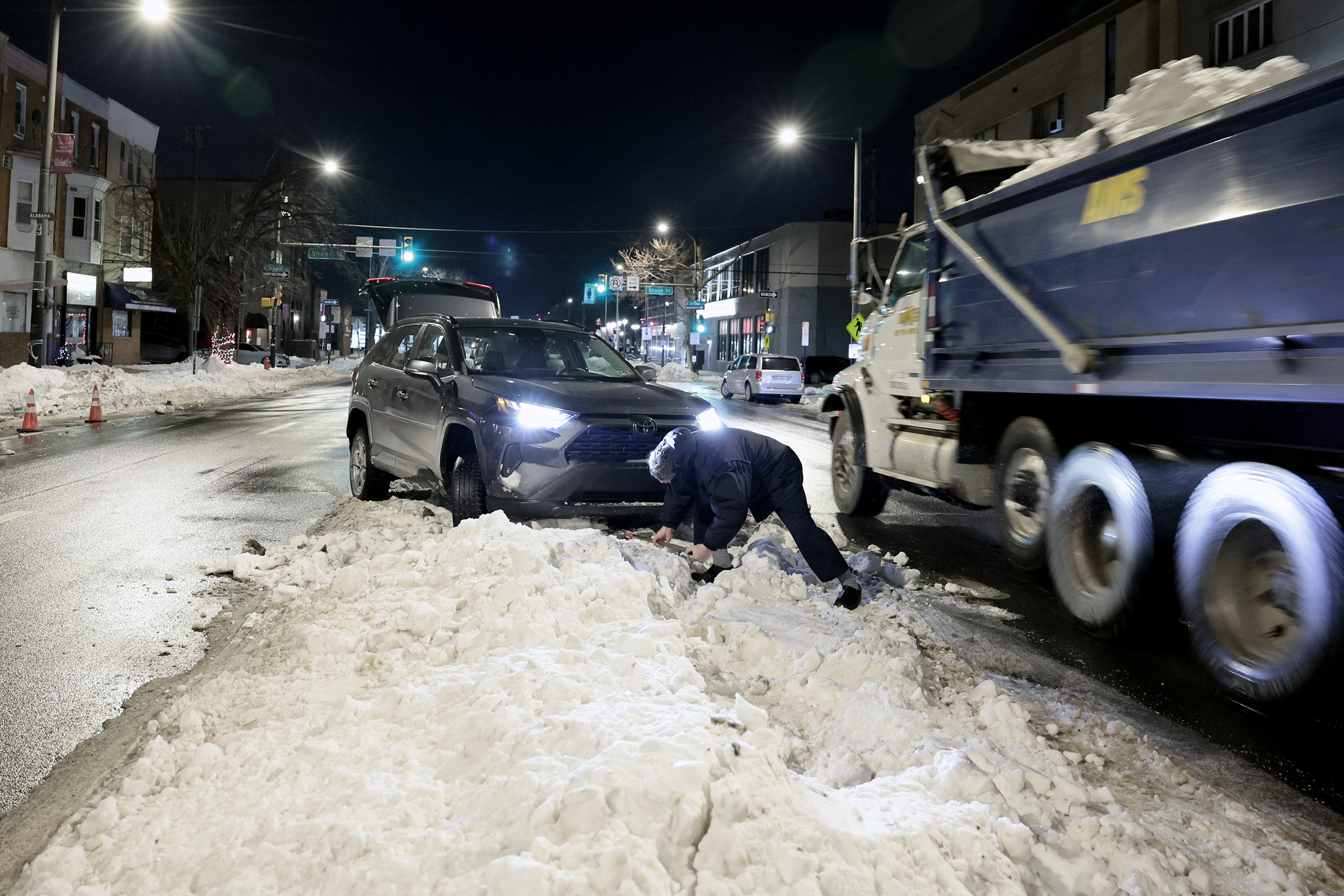
A man shovels snow from underneath his car after it became hung up while trying to park in the middle of South Broad Street in the early morning hours of Jan. 28, 2026. Dump trucks filled with snow from the city’s snow removal operations were zooming by as he worked to get his car free.
The snowstorm delivered. The plowing did not: F-
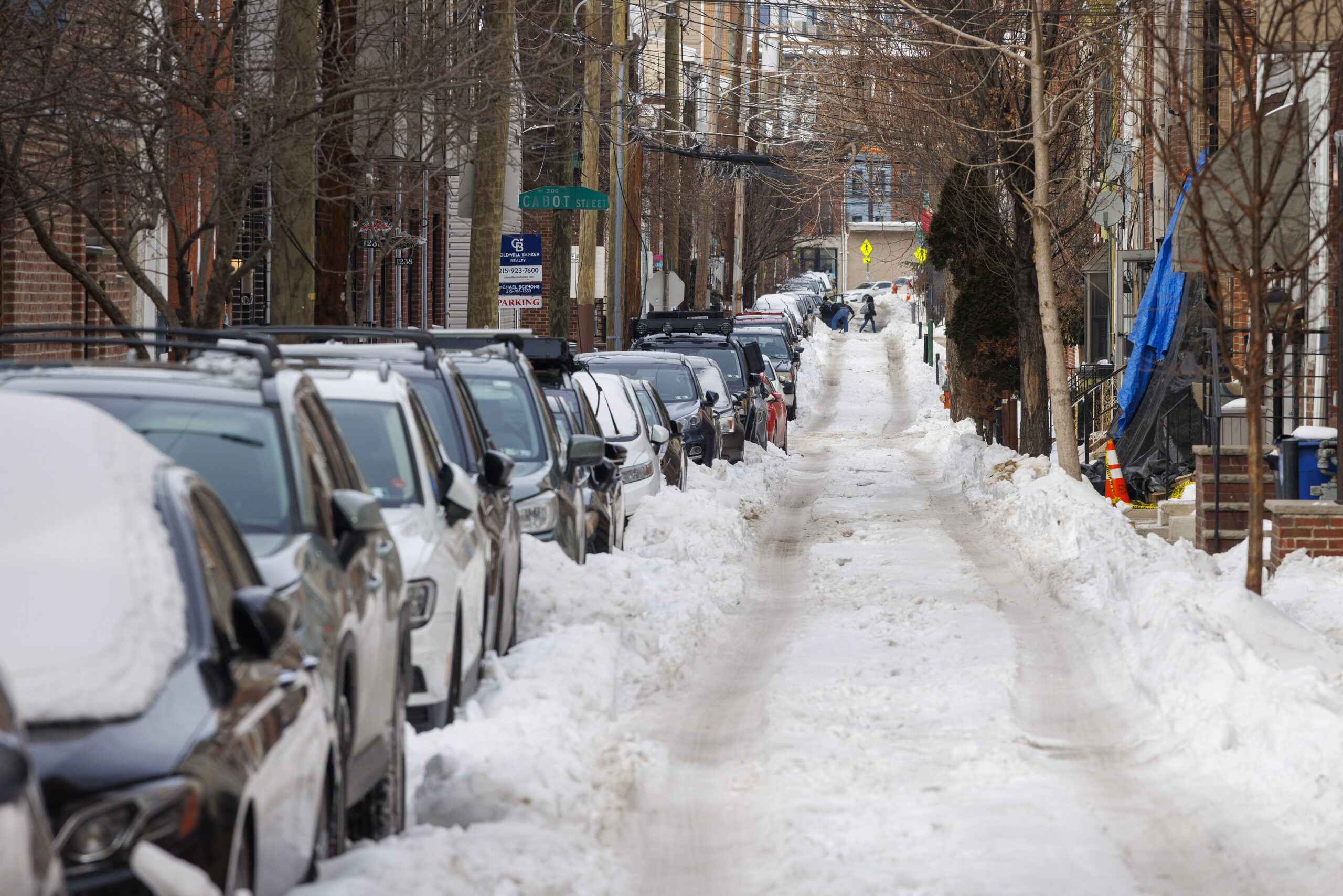
Let’s be clear: The snow itself did what snow is supposed to do. Nine-plus inches, pretty at first, historic enough to brag about, disruptive enough to cancel plans and spark group-chat meteorology. Fine. That’s winter.
What came after? That’s where everything fell apart.
The city promised differently. Mayor Cherelle L. Parker stood in front of cameras before the storm and said every street would get attention “as long as it takes.” That message mattered because Philadelphians have heard this story before, and expectations were deliberately raised.
Then reality hit.
Plow data show roughly a quarter of city streets got no treatment at all after the storm ended. Not plowed. Not salted. Nothing. And the longer it sat, the worse it got — snow compacting into ice, intersections blocked by frozen berms, cars effectively entombed.
This isn’t just an inconvenience. People with limited mobility are stuck. Workers can’t get out. Streets department explanations about sleet, freezing rain, and illegally parked cars may be true, but they don’t change the fact that many blocks are still uncleared a week later.
This is the part where Philly frustration kicks in hardest: The storm wasn’t unprecedented, but the response feels familiar in the worst way. The expectation has long been “don’t count on a plow,” and this week did little to change that.
New York tries to claim ‘Delco.’ Pennsylvania says absolutely not: A
Every so often, something happens that instantly unites Delco. Snowstorms. Eagles runs. Wawa shortages. And now: a county in upstate New York attempting to brand itself as “Delco.”
Absolutely not.
Stephanie Farr laid out the case perfectly: Delco isn’t just shorthand for Delaware County. It’s a culture. A personality. A way of life built on hoagie trays, Catholic school rivalries, beach flags, and a shared, deeply ingrained chip on the shoulder.
New York’s Delaware County is rural. Ours is suburban chaos packed into 184 square miles, powered by Wawa coffee, tailgating energy, and a pride so aggressive it gets tattooed on bodies and planted in Jersey Shore sand like a territorial marker.
The funniest part isn’t that there’s another Delaware County (there are several). It’s that this one thought it could simply adopt the nickname, slap it on merch, and call it authenticity. That’s not how Delco works. Delco is earned.
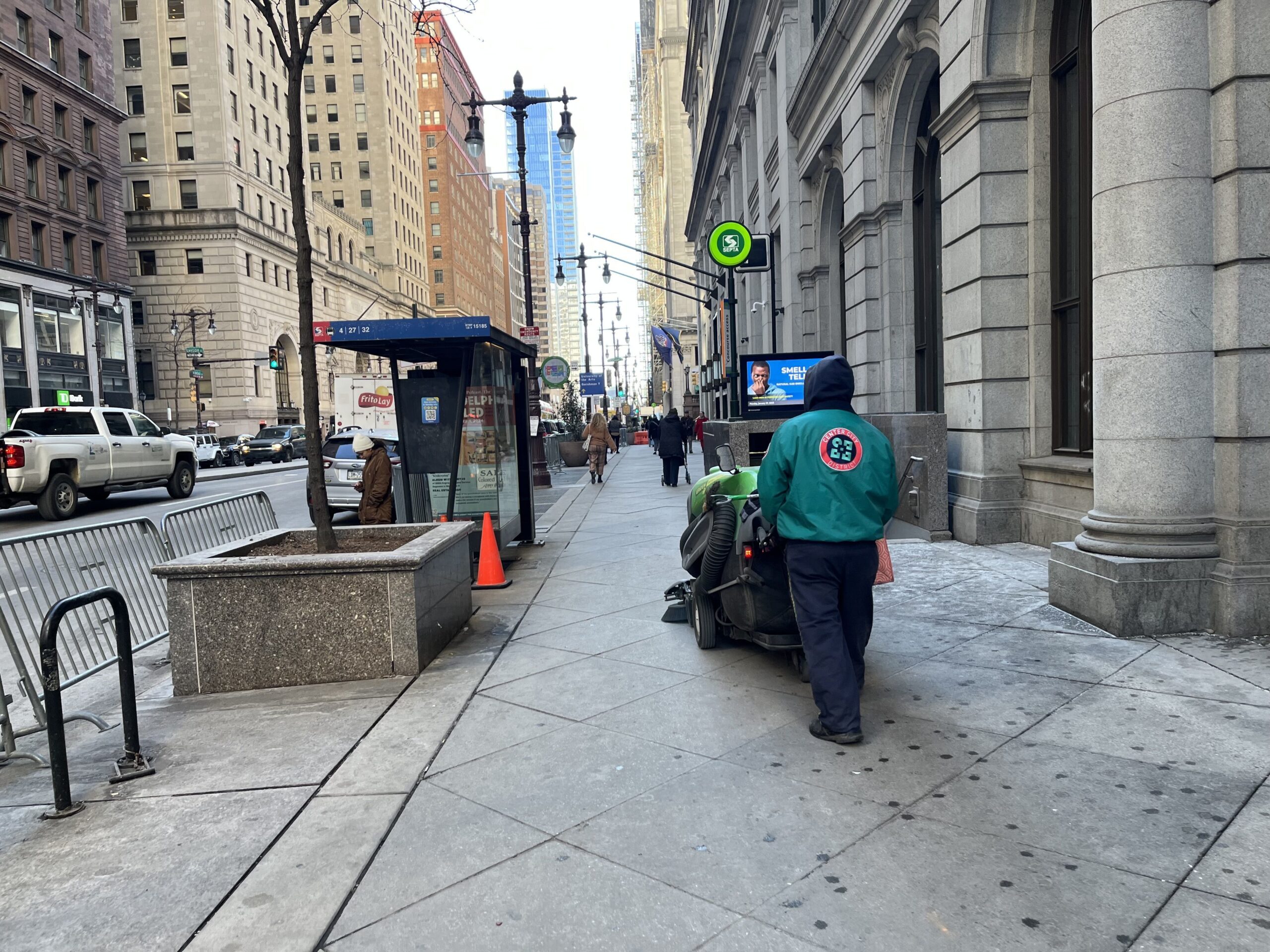
A Center City District worker cleaning the sidewalk on Broad Street the morning after the Philadelphia Eagles won the NFC Championship.
Center City West sidewalks are getting grimy (and it’s not your imagination): C
For nearly a decade, a lot of Center City West quietly benefited from something most people never realized existed: a privately funded sidewalk cleaning program that swooped in after city trash pickup and handled the leftover mess.
Asthe Fitler Focus reported, that program ended when the Center City Residents’ Association let its contract expire at the end of 2025. Not out of neglect, but necessity. The cost had ballooned to about 41% of CCRA’s projected 2026 budget, which is an unsustainable chunk for what was essentially backstopping city services.
The result has been immediate and visible. Trash bags torn open overnight. Litter lingering days after pickup. Sidewalks that used to reset themselves now just… don’t. CCRA deserves credit for being upfront about the trade-off and pivoting toward enforcement, even if it won’t bring immediate results.
The frustrating part is that the rules haven’t changed. Trash placement regulations exist. Containers are required. Enforcement is technically possible. But in reality, it’s complaint-driven, slow, and uneven. Meaning the difference between a clean block and a gross one often comes down to who has the time and energy to call 311 and wait on hold.
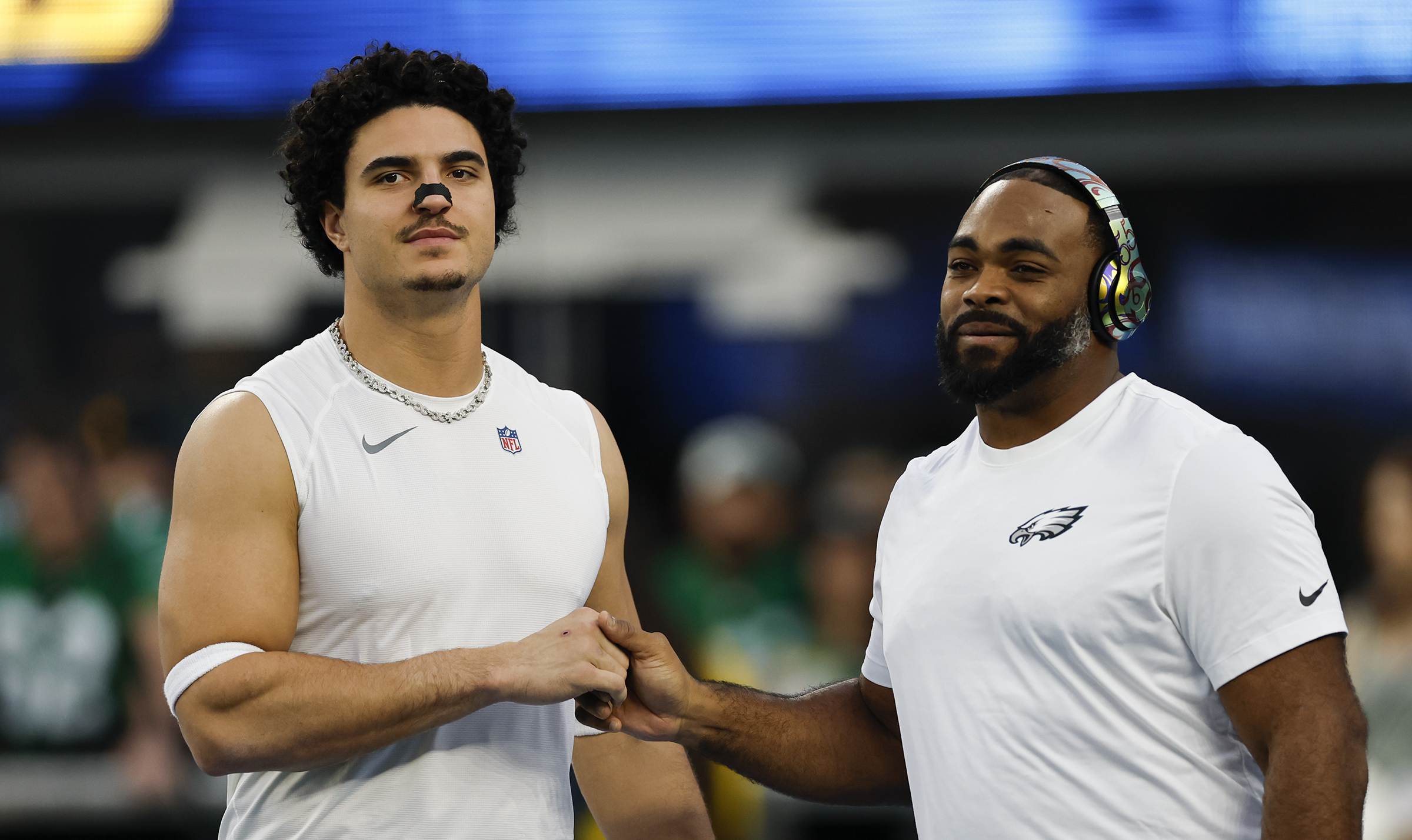
Eagles linebacker Jaelan Phillips (left) and defensive end Brandon Graham during warm-ups before the Eagles play the Los Angeles Chargers on Dec. 8, 2025 at SoFi Stadium in Inglewood, Calif.
Eagles fans agree on almost everything — except the part that actually hurts: B
In this year’s Inquirer Stay or Go poll, Eagles fans were unusually aligned on who still feels like the future: young defensive studs, the offensive line pillars, the rookies who look like actual hits. Cooper DeJean and Quinyon Mitchell clearing 96% stay feels less like optimism and more like self-preservation. The message is clear: The defense isn’t the problem. Or at least, it’s not our problem.
Where things get interesting is offense. Not because fans are confused, but because they’re suddenly colder. Jalen Hurts is still trusted, but not untouchable. A.J. Brown’s dip is real and telling: not rage, not rejection, just disappointment, Philly’s least favorite emotion. Fans didn’t turn on him. They just stopped defending him reflexively, which in this city is its own warning sign.
And then there’s Brandon Graham, the emotional Rorschach test of the poll. A franchise legend. A locker room heartbeat. A guy people want to want back. The split vote says everything: respect battling reality. Philly loves its icons, but it hates lying to itself more.
No one landed in the mushy middle. Fans know who they’re done with. They know who they’re attached to. There’s little patience left for “maybe.”
This wasn’t a meltdown poll. It was a sorting exercise. And the conclusion fans keep circling is uncomfortable but consistent: The Eagles don’t need vibes. They need clarity — and probably a few hard goodbyes.
The Inquirer mapped Philly’s dive bars (and proved how much the city loves them): A
When The Inquirer put out a call for Philly’s favorite dive bars, the response was immediate and overwhelming. Nearly 400 submissions poured in, which tracks for a city where dive bars aren’t just places to drink. They’re personal landmarks.
What the map really shows isn’t just where to grab a cheap beer. It’s how attached people are to the bars that feel like theirs. The ones tied to first jobs, postgame rituals, bad breakups, good Tuesdays, and nights that went exactly nowhere and somehow mattered anyway. These are rooms where nobody’s performing, the prices are low on purpose, and the atmosphere is set by regulars, not a concept.
It also surfaced one of Philly’s most reliable debates: Is being called a dive bar a compliment or an insult? Some owners bristle at the label. Others embrace it. Many bars live in the gray area: cheap, unpretentious, deeply loved, and absolutely uninterested in how they’re categorized. Very Philly.
Are there bars missing? Of course. There always will be. Philly has too many neighborhood institutions, and too many people willing to argue for them, for any list to feel definitive. But that’s not a failure of the map, it’s a feature of the city.
This isn’t a checklist. It’s a snapshot of how much Philadelphians still value places that don’t try to be anything other than what they are.
Snow savesies are back, and Philly is absolutely feral about it: C+
Every major snowstorm in Philly brings back the same question we never resolve: If you shovel out a spot, is it yours, or is public parking still public? This week’s viral Reddit thread, sparked by a wooden chair left in a shoveled space with a handwritten threat (“Move these chairs & I will destroy your car. Try me.”), confirms we are once again incapable of calm thought.
Some commenters were immediately in the respect the chair camp. One wrote, “After digging my s— out from snow past my knees I just want to one time come back to a spot,” while another argued, “Normally vehemently anti-savesies, but I feel like spending an hour digging out earns you a [savesie] or two.” This group is running on sore backs, wet boots, and pure principle.
Then there’s the other side: the chaos agents. “I’d move the chair and watch someone else park there,” one commenter said, which feels less like civic engagement and more like performance art. Another proudly added, “I take peoples cones all the time when I’m walking around. F— em.” (This explains so much.)
Somewhere in the middle were people admitting the quiet truth: Everyone dug out a spot. “The person who’s parked there dug out their car this morning, too,” one commenter noted, puncturing the idea that only one hero labored for the block.
So where does that leave us? With a very Philly stalemate. The chair is obnoxious. The threat is unhinged. The labor is real. The fear of retaliation is realer.
However, Mannion did serve as the offensive coordinator for the West team during the East-West Shrine Bowl game earlier this week. While the play-calling and offensive structure was largely simplistic due to the environment of college players trying to showcase their skills for NFL scouts, the game film provides some clues on what Mannion’s vision for an offense may look like.
Here’s a look at some of the influences Mannion may draw from ahead of his first NFL play-calling opportunity next season, and where Grizzard’s concepts could have an impact:
Under-center runs and play-action
The Mannion-led offense in the Shrine Bowl moved up and down the field in a 21-17 win over the East team, with the majority of the 72 offensive snaps coming from under-center. One frequent play call was play-action, specifically bootlegs where the quarterback would roll to the left or right after faking the handoff, effectively moving the pocket.
The play-action bootlegs are staples for Matt LaFleur, Kyle Shanahan, and Sean McVay-led offenses. They typically give the quarterback two or three options, with a flat route from the front or backside tight end and a crossing route from the backside receiver. The tight wide receiver alignments Mannion had his Shrine Bowl receivers in are a direct comparison to LaFleur’s offense, which utilizes a lot of tight wide receiver splits. Packers quarterback Jordan Love had the fifth-highest play-action rate in the NFL in 2025.
New #Eagles OC Sean Mannion has never called plays in an NFL game, but was the OC for the West team at the Shrine Bowl earlier this week. While most of the offensive install were fairly simple, there's some Matt LaFleur and Kyle Shanahan influences in the small sample size.… pic.twitter.com/At7YvzPNkI
Beyond play-action bootlegs, Mannion also dialed up more traditional play-action passes, and incorporated a concept similar to dagger, where a deep crossing vertical route occupies the safety and allows for a deep intermediate middle-of-the-field route to be run right behind it.
Several teams run the passing concept, but the 49ers and Vikings run it from under-center and on play-action throws more frequently than the Rams or Packers. Mannion spent two seasons of his playing career being coached by McVay and his final year playing quarterback was with the Vikings in 2023, under Kevin O’Connell.
Would like to see Sean Mannion bring some of this playcalling to the #Eagles as well. Big play-action here in 12 personnel during the Shrine Bowl and Mark Gronowski hits the deep dig route with the slot receiver clearing out on a crosser.
From a running game perspective, in the limited plays from the Shrine Bowl, Mannion seemed to draw on Shanahan’s run game philosophy. The first example was the inside toss play, which allows a running back to get downhill quickly. It’s also a play Mike McDaniel took with him to Miami and will likely now implement with Chargers.
Again, this is only observations from Sean Mannion's playcalling at the East-West Shrine Bowl since he doesn't have NFL playcalling experience, but the new #Eagles OC used a run scheme staple from Kyle Shanahan, utilizing the inside run toss a few times on Tuesday night. pic.twitter.com/cge0yBr1Sj
The other example was under-center power scheme runs, which pull the backside guard across the formation with the fullback kicking out the playside edge defender. Kyle Juszczyk had the most run blocking snaps among fullbacks in 2025, according to Pro Football Focus.
The Eagles tried to do more fullback runs last season, so Cameron Latu could be an option to fill a similar role as Juszczyk should Mannion decide to utilize more fullback run-blocking schemes.
Saw more run-game influence from Kyle Shanahan when new #Eagles OC Sean Mannion called plays for the West team during the Shrine Bowl. 49ers use a lot of FB run elements, and Mannion used that from under-center during the Shrine Bowl, primarily running power run schemes during… pic.twitter.com/zm3SFeVan6
During the Shrine Bowl game, Mannion also mixed in some outside zone run schemes from under-center to keep the defense honest. Outside zone runs are big staples of the McVay and Shanahan offenses.
Mannion and Grizzard employ similar concepts
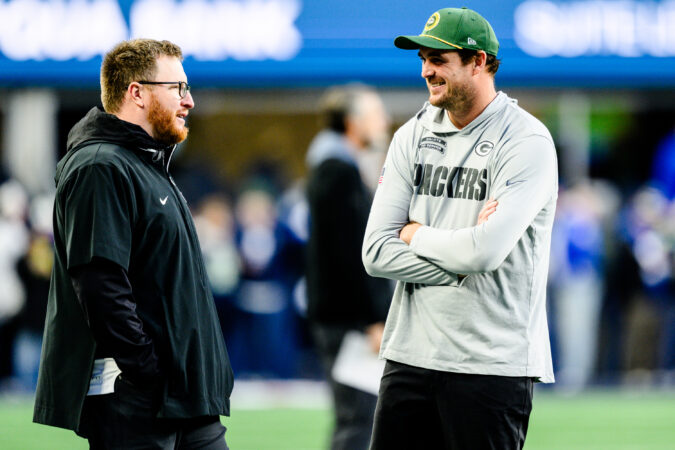
The Packers last season threw out routes at one of the highest rates in the NFL last season. Could that become a staple for the Eagles in 2026?
During the Shrine Bowl game, Mannion called at least three passing concepts that required the outside receivers to run out-breaking routes toward the sideline, and two of them were completed for first downs. Throwing such routes require timing and accuracy, because mislocating the football gives defensive backs a chance to break on the football.
In the limited sample size from the Shrine Bowl game on Tuesday, new #Eagles OC Sean Mannion dialed up out routes at least three times in the game, and two the passes were completed along the sideline. Would imagine this could be a part of the offense next season. https://t.co/8sCT4wGWGFpic.twitter.com/DU7vv0aclL
During the Shrine Bowl game, Mannion also called mesh concepts twice, an approach that has two receivers running shallow crossing routes across the field going opposite directions, and a route sitting over the ball behind the two receivers. It could also include the running back releasing from the backfield on a wheel route.
Grizzard ran mesh quite a bit as the Buccaneers’ offensive coordinator in 2025. The passing concept can beat both man and zone coverages and is difficult to defend if defenders end up chasing the crossing routes.
With Josh Grizzard as the new #Eagles PGC, I wonder if they run mesh passing concepts like he did as the #Bucs OC. During the Shrine Bowl game, Sean Mannion called Mesh twice, including mesh rail, which is shown on the Bucs TD attached to this. https://t.co/RyX6jsz8mVpic.twitter.com/Fop4oRsRff
Grizzard also utilized a lot of screens in the passing game in Tampa, getting the ball in the hands of Bucky Irving, Emeka Egbuka and others behind the line of scrimmage. The first offensive play that Mannion called in the Shrine Bowl was a tight end screen. The screen game is also a staple in LaFleur’s offense, though the Green Bay coach is far more creative in presenting them.
Tackling Bucky, never easy.
Bucs love this escort screen, having a lot of success running it for Bucky with Cade doing the dirty work pic.twitter.com/MBCbY6NgI7
While the Shrine Bowl gave a glimpse into Mannion’s influences from LaFleur, McVay, and Shanahan, how the Eagles’ offense looks in their season-opener is a mystery. Leaning into more under-center play-action and moving the pocket with Jalen Hurts seem like logical additions to an Eagles offense that struggled with their identity in 2025.
Adding in an experienced playcaller like Grizzard into the fold can help give the Eagles some formational advantages and add less predictability to the offense. More pre-snap motion seems to be in the cards too. The Packers ranked eighth in motion rate and the Buccaneers ranked ninth, according to Sharp Football Analysis.
One thing is likely: the Eagles offense will be modernized and look vastly different from the previous iterations under Nick Sirianni.
I invited two other Inquirer fathers to discuss this submitted question, which is haunting the slight slopes of our region as the snow sticks around.
Have a question of your own? Or an opinion? Email me.
Evan Weiss, Deputy Features Editor
OK, the question is…
Every time we go sledding, my kids somehow inevitably lose a sled. And every time, there seem to be extra, unclaimed sleds lying around. Is taking one of those stealing (from a child!), or just part of the karmic redistribution of sleds?
Mike Newall, Life & Culture Reporter
Nark is a woodsman. He probably whittles sleds while eating tins of premade forest food.
Jason Nark, Life & Culture Reporter
Ha. When I think of sledding, as a child, it was rough business. No parents around. There were fights. Blood. Nothing worse than an older kid asking to “borrow” your sled.
I sled at the same place for years, so I never would have thought of taking a sled.
Mike Newall
Same. I’m pretty sure the old wooden sled in my house growing up first appeared in It’s a Wonderful Life. Ancient. Wooden. Rusted. We did the garbage can lid thing too. We sled in an enclosed grassy area adjacent to a belt parkway off-ramp. No parents. Chaos.
Jason Nark
Later I moved to a golf-course community (I didn’t want to) that was also one of South Jersey’s biggest sledding destinations. There were lots of sleds left behind after a few days but most were broken.
I don’t think I would have ever considered taking one, unless it was very nice… then I’d probably post it in a Facebook group to try to find the owner.
Mike Newall
I’m a city parent myself now. Every big storm, I inevitably wake up in a panic and think, “Oh no, we don’t have a sled. Where and how shall my boy sled?” So I run to five stores, buy the only sled available, rush him to some grassy lot with an incline, and push him down. Boom. My boy sleds. If the sled makes it home, it’s a bonus.
Those sleds were left for a reason. Either the kid was crying and hated it. Or the parents left it. Either way, look at it like one of those free library stands, except for sleds.
Evan Weiss
But I can’t imagine taking one home. What if, as you’re walking away, a little kid yells, “Hey, that’s my sled!”
Mike Newall
I just mean, if there are a few clearly discarded sleds, then use away. Like if there’s an old ball at the playground. Use it!
We live in a tiny rowhouse. Who wants a $14 plastic sled eating up valuable basement space? I’m not naturally wasteful. But no problem group-sharing sleds. Just use it and leave it.
Evan Weiss
So leave it? Don’t take it?
Jason Nark
I think so, yeah.
Mike Newall
Yeah, that would be plain-old sled-stealing.
Evan Weiss
Borrow for the hill, not for the home.
Mike Newall
(Unless, it’s a really nice sled that you just have to have. Kidding. Maybe.)
We hear often that it’s good to run things in life like a business. It’s said especially loudly about women’s sports, in Philadelphia and elsewhere.
So let’s do that.
The 21,490 fans who packed Xfinity Mobile Arena for Friday’s Unrivaled basketball showcase clearly had business on their minds. It was the largest announced attendance in arena history, helped by Unrivaled’s three-on-three court being smaller than regulation, and it was full of wallets.
They were opened often, to buy T-shirts, hats, hoodies, hot dogs, and all the fancier food and drinks on offer these days.
The crowd roared for hometown heroes Natasha Cloud and Kahleah Copper, but not just for them. Paige Bueckers, Kelsey Plum, Chelsea Gray, and Marina Mabrey also drew big cheers.
Kahleah Copper during player introductions before the Rose game against the Lunar Owls in Game 2 of the Philly is Unrivaled doubleheader on Friday.
“I think it was awesome to see them come out and support us like that,” Mabrey said after scoring an Unrivaled game record 47 points in the Lunar Owls’ 85-75 win over Rose. “I don’t know what I expected, but I didn’t realize it was going to be so much hype around it and so much support.”
There was celebrity wattage from Wanda Sykes, Leslie Jones, Freeway, and Jason and Kylie Kelce. Dawn Staley was in the front row, of course. The 76ers’ Tyrese Maxey, Kyle Lowry, Andre Drummond, Trendon Watford, and Dominick Barlow had courtside seats too.
They all helped answer a question that’s been simmering in town for a while.
At any business school, they’ll teach you that the most fundamental rule of economics is supply and demand. But how can you prove there’s demand when there’s no supply in the first place?
One way, for sure, is to not try in the first place. That was the case with women’s basketball in Philadelphia for 28 years, the time between the end of the Philadelphia Rage in 1998 and now. It’s mostly been the case with women’s soccer since the Independence folded in 2011, though at least the U.S. national team visits every few years.
Yet Philadelphia has now set two women’s sports attendance records in recent years. In 2019, Lincoln Financial Field hosted 49,504 fans for a U.S. women’s soccer game, and that’s still the largest crowd for a standalone home friendly. On Friday, the arena across 11th Street hosted the largest crowd to watch a regular-season professional women’s basketball game.
Another path to travel invokes another rule of economics. In a free market, shouldn’t someone be able try something? If they fail, so be it, and if they succeed, they profit.
The people who brought Unrivaled here, and those who will bring a WNBA team here in 2030, chose the second road.
‘It wasn’t a charity event’
On the day in October when Unrivaled announced it would come here, Comcast Spectacor chief financial officer Blair Listino watched her phone light up with notifications of ticket sales.
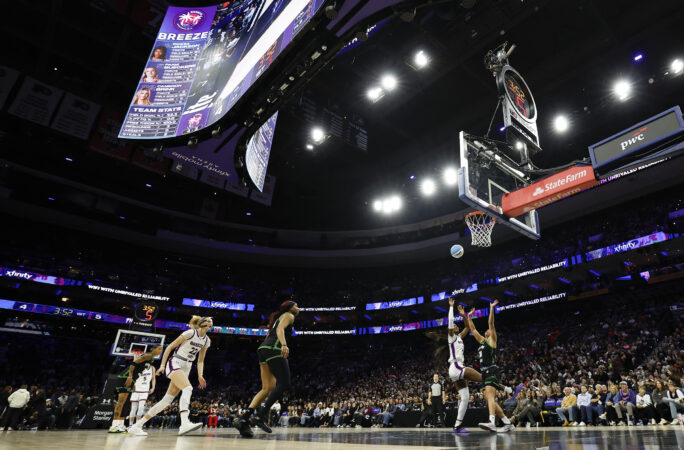
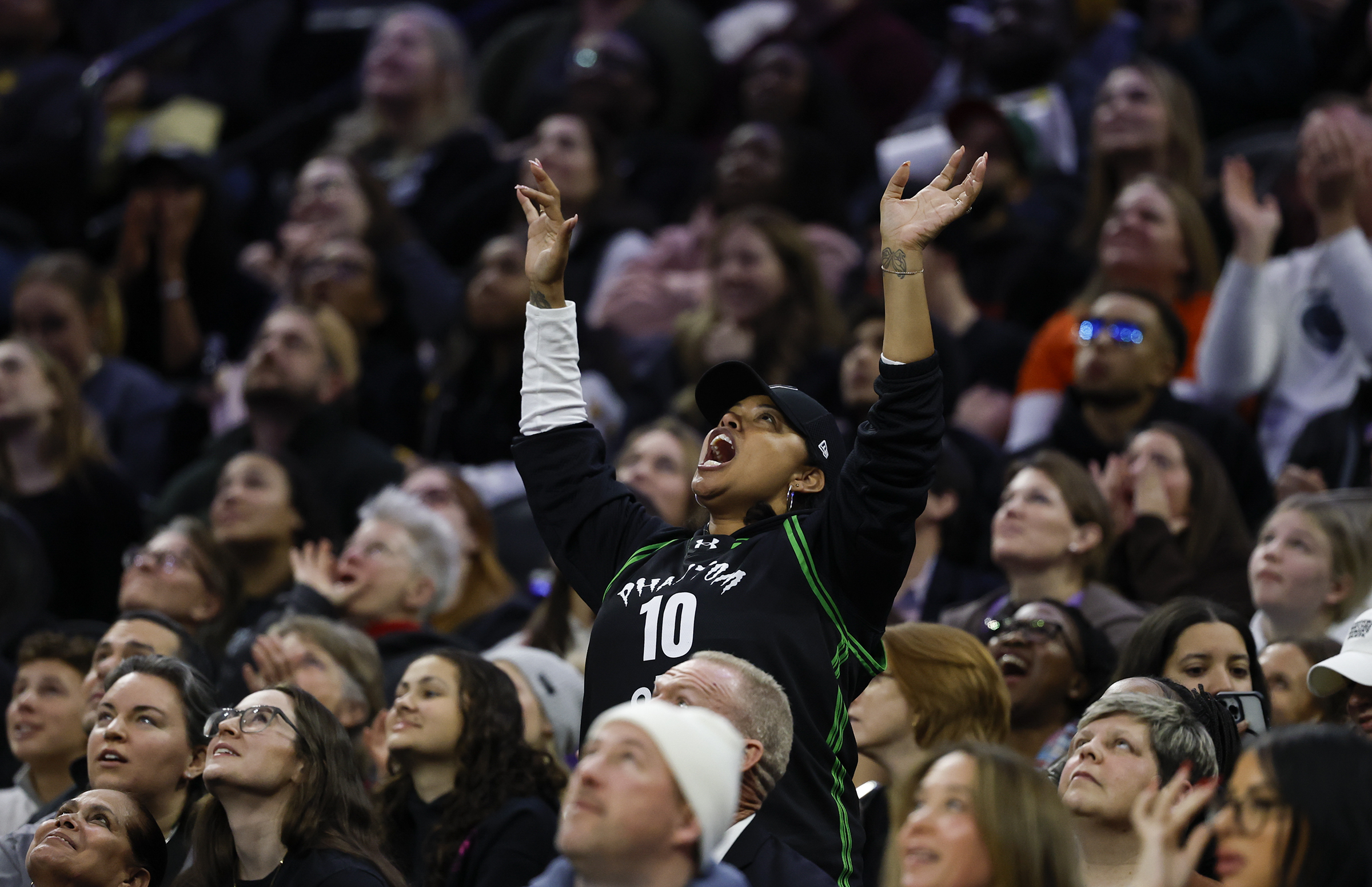
A Phantom fan cheers the team during its game against Breeze.
“While we were sitting there waiting for the [announcement] event to happen,” she told The Inquirer, “7,000 tickets were sold within the first few hours of the event being on sale. So right then and there, I knew, ‘OK, there is demand.’”
Listino also is an alternate governor of the Flyers. She was the team’s CFO from 2019 to 2023 and has worked for Comcast in a range of finance-related capacities since 2011. So she has plenty of experience with measuring what Philadelphia sports fans want — and with making hard business deals.
“We worked with Unrivaled management, and we treated it like any other event,” she said. “It wasn’t a charity event; we didn’t give them a sweetheart deal. It was a true rental agreement where we said, ‘We believe in you, we think that you’ll be able to sell out this building, and we’ll all be profitable from it.’”
That made it, she said, “good business sense for both us and Unrivaled.”
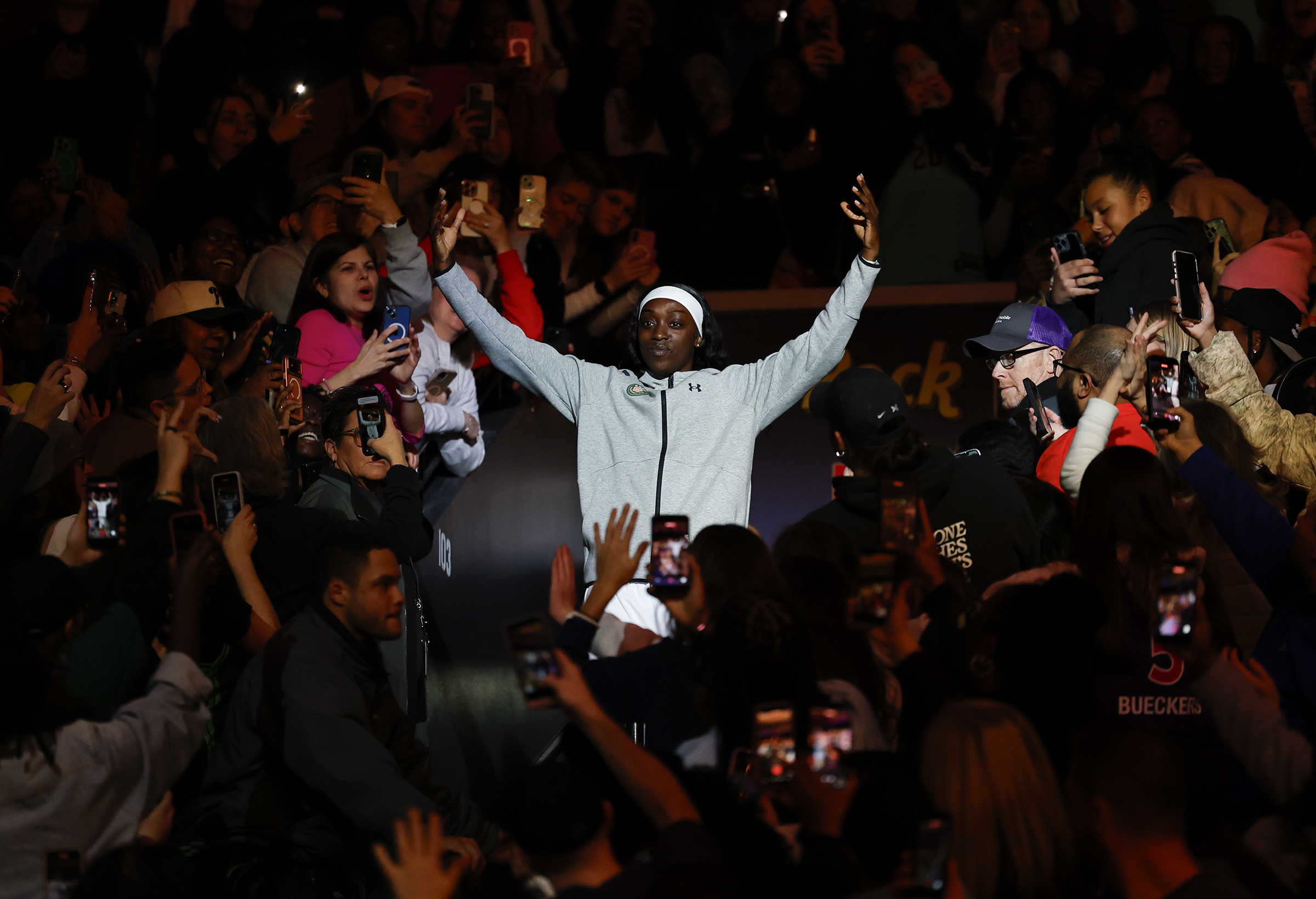
Philadelphia welcomes Paige Bueckers to the floor:
It was not just based on Jen Leary, the founder of Watch Party PHL, holding events and selling out of “Philly Is A Women’s Sports Town” T-shirts for over a year. Or Chivonn Anderson opening Marsha’s, a women’s sports bar on South Street. Or any number of people on social media, or in this reporter’s inbox, or so on.
No, this was Philadelphia’s biggest company believing that women’s sports can be profitable in its city. And now there’s proof.
Along with that, an Unrivaled spokesperson told The Inquirer on Saturday that the night delivered $2 million in revenue to the league, including over $1 million in ticket sales and $400,000 in merchandise sales at the arena.
“I think when choosing a market that doesn’t necessarily have a team, but there’s demand, you take a leap of faith into your decision,” said Cloud, whose Phantom beat Breeze, 71-68. “And Unrivaled chose the right city, the right sports town, and the right fan base.”
The crowd returned the favor many times over Friday, bringing the Broomall native to tears in a postgame interview on court.
“You just give us the opportunity to actually do it,” North Philadelphia’s Copper said. She recalled playing a WNBA preseason game in Toronto with the Chicago Sky in 2023 in front of a sellout crowd at the city’s NBA arena. That moment lit a spark that led to the Toronto Tempo, an expansion team that will tip off this year.
“How they were able to kind of lead up and have that build up, I think it’s kind of the same,” she said. “And I think the city has been wanting it. So this is a good introduction, and we’ll give them something to look forward to.”
It’s not just the local products who’ve felt that. Players from elsewhere who are used to big crowds at their games were excited to be part of a first here.
“Kudos to Alex [Bazzell], our president, and the whole league having ‘Tash’ and ‘Kah’ be spokespersons for this amazing city,” said Breeze’s Cameron Brink, who played collegiately for Stanford and is now with the WNBA’s Los Angeles Sparks. “Kah has done so much for women’s basketball in this city and the resources that are now available. I’m just proud that we saw that this is a city that wants to cheer on women’s basketball — so hopefully there’s more of it in the future.”
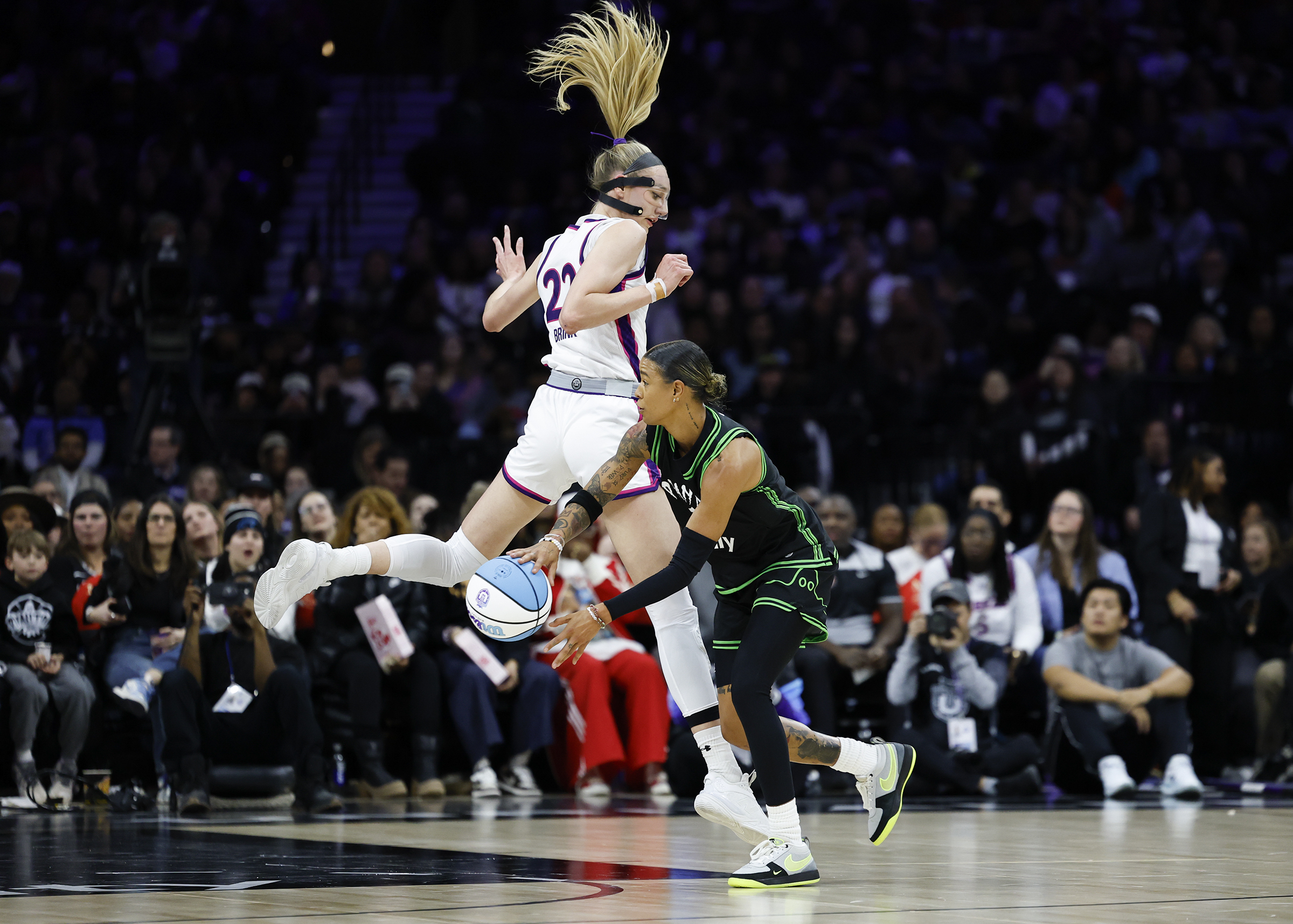
Cameron Brink leaps past Natasha Cloud (right) during the first quarter of the Breeze-Phantom game.
Brink grew up in Princeton, N.J., and her parents played college basketball at Virginia Tech. She moved to the Portland, Ore., suburbs at age 8, but heard plenty of stories from her mother, Michelle, about the East Coast.
“I was talking with her the other day — she’s like, ‘I honestly can’t believe women’s basketball has gotten to this point,’” Brink said. “I mean, we’ve always believed, but it’s really special that we get to soak in this moment. So I just think back to the women before me, and I’m just thankful for how they paved the way.”
Kate Martin of Unrivaled’s Breeze has played for Iowa and the WNBA’s Golden State Valkyries, both of which draw huge crowds to every game. She knew Philadelphia doesn’t have that track record, so she was excited to be part of a first.
“I think it’s really important for young girls to be able to see people that they want to be like,” Martin said. “I think it’s important for them to be able to see if they want to be a women’s basketball player, to see that in their city, and be able to have access to going to a game.”
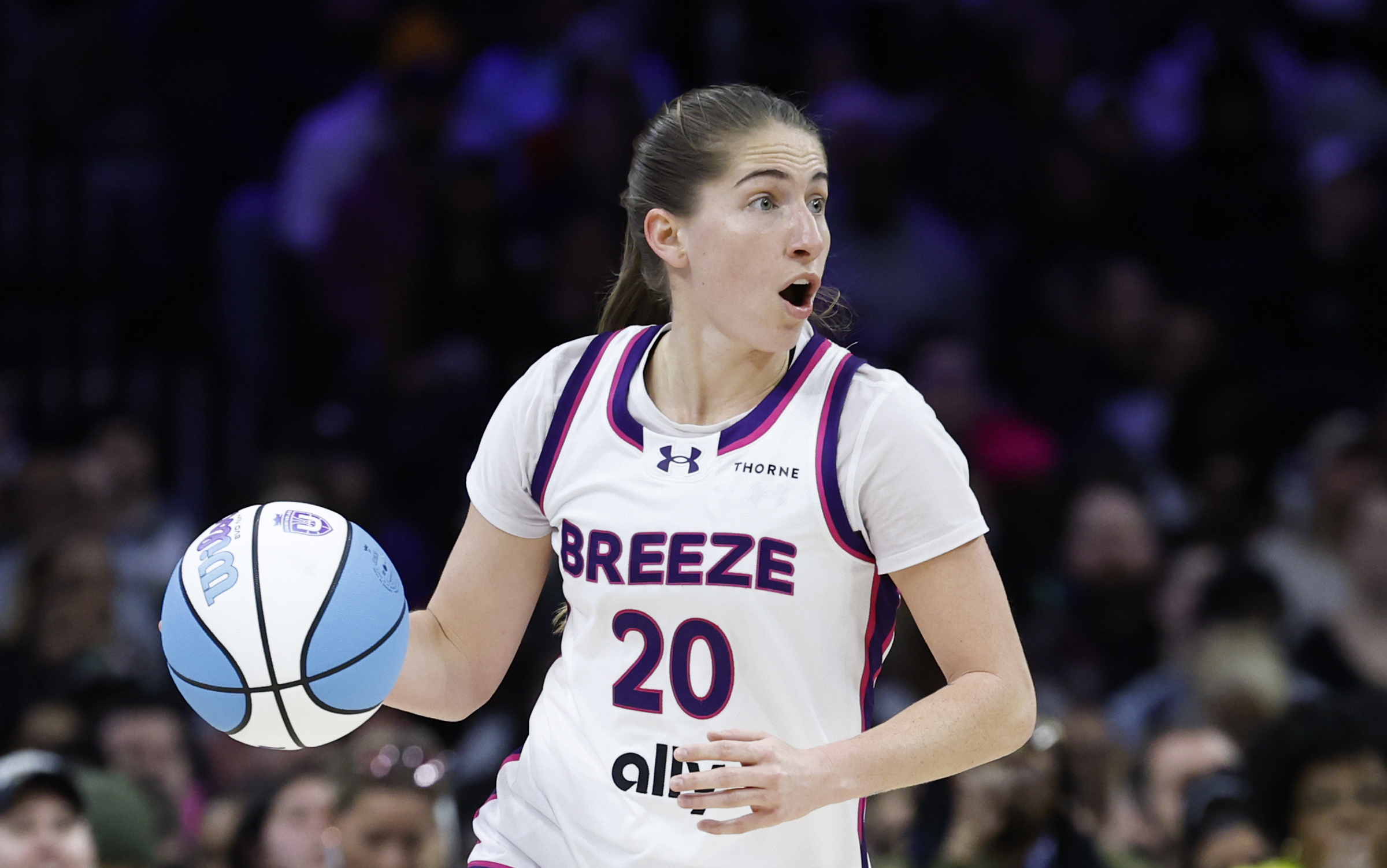
Kate Martin in action Friday.
Friday’s spectacle undoubtedly will push Unrivaled to take more of its games on the road next season, and they may well come back here. There might not be another full house with the novelty factor gone, and one night in 2026 doesn’t mean the future WNBA team will sell out all of its games years later.
Nor does it mean that what’s true today was true in past years, when Cloud and Copper weren’t yet big names.
But it does mean there’s demand for a product right now, and that it can make money right now. Philadelphia finally got an opportunity, and took it.