Blog

  • As health insurance prices climb, HRAs offer small businesses a flexible option | Expert Opinion

    As health insurance prices climb, HRAs offer small businesses a flexible option | Expert Opinion

    Finding and retaining employees remains a top concern among small-business owners, and offering affordable healthcare benefits continues to be a significant challenge. Because of this, health reimbursement arrangements, or HRAs, have become more popular.

    Simply put, an HRA allows an employer (or an employee) to make tax-free (and tax-deductible to the employer) contributions to an individual’s HRA account.

    The employee can use those funds to reimburse uncovered healthcare expenses or purchase their own health insurance, either from outside brokers or on the Pennsylvania, New Jersey or Delaware healthcare marketplaces.

    HRA options

    A small business can consider a few different HRA options.

    A general HRA is funded entirely by just the employer and often used alongside existing group insurance plans to help reimburse expenses not covered by their existing insurance. These expenses could include co-pays, over-the-counter medication, or even dental and vision care.

    Alternatively, health savings accounts (HSAs) allow employees to contribute pretax dollars for the same purpose.

    “An employer can buy a high-deductible group plan, then use HRA funds to cover part of that deductible,” said Robert Deninno, a founding principal of Precision Benefits Group in Philadelphia. “The appeal is that unused HRA money remains with the employer, unlike HSA funds, which belong to the employee.”

    Deninno said employers can use HRA language to fill in specific gaps in a group plan, such as hospital costs, rather than paying a much higher premium for a richer underlying plan.

    An individual coverage HRA (ICHRA) allows employers to reimburse employees for premiums on health insurance the employee independently purchases.

    A qualified small-employer HRA (QSEHRA) is designed specifically for businesses with fewer than 50 employees that do not offer a group plan. It is more formalized and is similar to an ICHRA.

    HRA popularity

    These arrangements give employers wide discretion, said Ed MacConnell, owner of Total Benefits Solutions in Feasterville.

    “Employers can determine reimbursement levels, caps, frequency, and categories,” MacConnell said. ”That matters because most employers are trying to balance two competing goals: doing right by employees while staying within budget.”

    Many people assume employers just want the cheapest plan possible, MacConnell said, but in his experience the opposite is usually true.

    “Most employers genuinely care about how their choices affect employees and their families,” he said. “HRAs can help by letting them target limited dollars more intentionally.”

    All of these plans have their nuances and it’s best to speak with a health benefits consultant or your payroll company to determine what’s best for your business.

    You won’t be alone. ICHRAs alone grew 52% among small employers from 2024 to 2025 with 83% of employers who previously didn’t offer health insurance options now offering either ICHRAs or QSEHRAs, according to a recent report from the HRA Council, an advocacy organization.

    HRA benefits

    That surge in popularity is because offering HRAs — in addition to or in lieu of group coverage — provides an employer with three significant benefits.

    The first is cost control. The cost of group insurance is expected to rise as much as 10% in 2026, but with an HRA, an employer can contribute whatever amount they can afford, unbeholden to the insurance company’s premiums. With certain HRA plans, an employer no longer has to negotiate with a group insurance provider, and is less exposed to potential privacy violations of an employee’s health history.

    “The employer can decide what to reimburse, how much to reimburse, and under what limits,” MacConnell said. “This flexibility makes HRAs attractive to smaller employers that want to start somewhere rather than do nothing.”

    Another benefit: because an employee can use these funds to purchase their own insurance, they’re no longer limited to the options their employer offers and they may be able to buy more affordable or more suitable plans.

    Finally, there’s the recruiting benefit. Offering an HRA plan allows small businesses to have a response when a prospective employee inevitably asks about health benefits. By contributing even a nominal amount — and allowing an employee to contribute their own pretax dollars — a small business has a healthcare benefit option and becomes more competitive when pursuing talent.

    HRA challenges

    There are challenges with these types of plans. For example, administration can be messy, especially as the company grows or employee situations become more diverse.

    “If 10 employees buy 10 different plans, the employer and broker lose the efficiencies that come with one group carrier and one group policy,” said Deninno. “When employees are scattered across different individual plans, it becomes much harder to resolve claims problems or coverage issues.”

    MacConnell emphasizes the need for a third-party administrator, particularly when a company exceeds 10 to 15 employees.

    “Outsourcing becomes worthwhile when the alternative is tracking many different employees, many different plans, and constant premium changes,” he said.

    For HRAs to work well, it’s also important to educate employees and make sure it fits the company culture. Experts recommend meeting frequently and providing employees with as much support as possible.

    “A good broker or administrator will act as a coworker with your employees,” said MacConnell. “They should help both employers and their employees choose the right plans, answer questions, and act as an advocate.”


  • Original mid-century features and colorful vintage design in Delco

    Original mid-century features and colorful vintage design in Delco

    It may have been the pink and green bathroom that sold Genevieve DeChellis on the mid-century, 1,450-square-foot, five-bedroom brick house in Clifton Heights in early 2024. Or perhaps the colorful lighting above the basement bar sealed the deal.

    She and her fiancé, Jesse Blankschen, had been on the hunt for a house for a while, but nothing felt quite right.

    “We didn’t fully know what we wanted, but we knew what we didn’t want,” DeChellis recalled. “No millennial gray, or millennial beige, or a house without any sign of life.”

    When they spotted the Zillow listing for this home, they instantly knew it was the one. The house not only was filled with color, but it had only been lived in by just one owner who had built the house for his family. It was evident he took great care of the house.

    “The fact that I have a pink and green bathroom feels like a cosmic design,” DeChellis said. “There is so much beautiful tile work in homes and so often it just gets torn out. It’s so happy and I love those two colors together.”

    The pink and green tiled bathroom was one of the features that drew DeChellis to the house.
    The living room’s orange velvet sectional draws the eye, surrounded by secondhand, vintage, and mid-century decor.

    The couple is putting their own personal stamp on the house through aesthetic changes. They’ve been replacing the original wallpaper with fresh paint and thrifting unique items to fill meaningful spaces.

    At the same time, they are preserving the integrity of the home — “those pink and green tiles aren’t going anywhere,” DeChellis insisted.

    She and Blankschen are avid thrifters, and some of their favorite finds come from the Dust Shuttle, an online antiques auctioneer. They’ve snagged unusual art, funky lamps in the shape of a fish and an ice cream cone, and an array of furniture.

    The mid-century kitchen features a yellow GE oven, a stained-glass ceiling soffit light, and a stained-glass pendant light. A red metal table à la 1950s diner is surrounded by red and white vinyl chairs, a Facebook Marketplace purchase.

    The kitchen features soffit lighting and a pendant lamp in stained glass.
    The table and chairs in the kitchen were secondhand finds.
    The mustard-yellow oven is not equipped with modern features.

    “I messaged my mother about how to clean the oven and she said to turn on the self-cleaning function,” DeChellis recalled. “I said, ‘Mother, this is not a 21st-century oven.’”

    The living room contains a comfortable velvet orange-brown sectional couch. That’s where the couple, who plan to marry in May, relax and watch TV. The bookshelf is home to some of their funky thrift finds, including the fish lamp.

    The cozy basement is perfect for movie nights where friends gather to watch films from a projector, displayed onto a screen. Guests lounge on the blue couch with attached Formica end tables or in the pair of vintage wire Mexican Acapulco chairs — one orange and one green. The couple found the chairs at the Elephant’s Trunk Flea Market in Connecticut, and managed to squeeze them into their car for the ride home.

    “They are very comfortable, which is kind of surprising,” DeChellis said.

    The basement, where the couple enjoy movie nights with friends.

    The vintage wooden bar, with a faux stone facade and Formica top, set under colorful stained-glass lighting, evokes a scene from Mad Men. The bar is home to the vanilla ice cream lamp that stands about two feet tall, a very special thrifting find. She first spotted a similar one years ago, then again at a friend’s house.

    “I thought it was a sign” that such a distinctive lamp crossed her path twice, recalled DeChellis. “A few weeks later I found it at a thrift store. Somewhere out there a chocolate one and strawberry one are waiting for me.”

    DeChellis finds beauty in the rich histories of the pieces she thrifts. They lived a life making someone else happy, and now it’s her turn.

    The ice cream lamp sits on the bar in the basement.
    The Mexican Acapulco chairs, in orange and green, are surprisingly comfortable, DeChellis said.
    A whale lamp in the dining room.
    Decor on the landing of the stairwell.

    “We’ve always loved to thrift and antique and have found a lot of meaning and purpose in older things,” DeChellis said.

    The couple also enjoy their outdoor spaces, which include the front porch and enclosed backyard. DeChellis’s first experiment with a small cut flower garden was an initial success.

    “We grew pink and orange zinnias and put them in a fish vase that we got from the Dust Shuttle Auction,” she said.

    The couple has a table on their front porch, where they peacefully take in the neighborhood surroundings.

    Their front porch is a peaceful respite where they look out at the woods and playground surrounding their home.

    “I love living in Delaware County,” DeChellis said. “It’s a very tight-knit community where everyone is looking out for their neighbors. Getting to start our lives here and have this be our first home felt really special.”

    Is your house a Haven? Nominate your home by email (and send some digital photographs) at properties@inquirer.com.

  • The man who made musical instruments out of everything: glass bowls, trees, buildings, and even an island

    The man who made musical instruments out of everything: glass bowls, trees, buildings, and even an island

    David Tudor was born in West Philly in 1926 and, at least for a musical prodigy, his career started out conventionally enough.

    He began studying the piano at age 6 before switching his focus to the pipe organ at 11. By his mid-teens he was working regularly at places where you’d expect to find an organist — churches like St. Mark’s in Center City and Trinity Episcopal in Swarthmore, or playing the famed midday concerts at John Wanamaker’s department store.

    But as exemplified by a recent concert of works associated with Tudor, presented by Bowerbird earlier this month at the Community Education Center, Tudor’s music became extremely unconventional over the course of his lifetime.

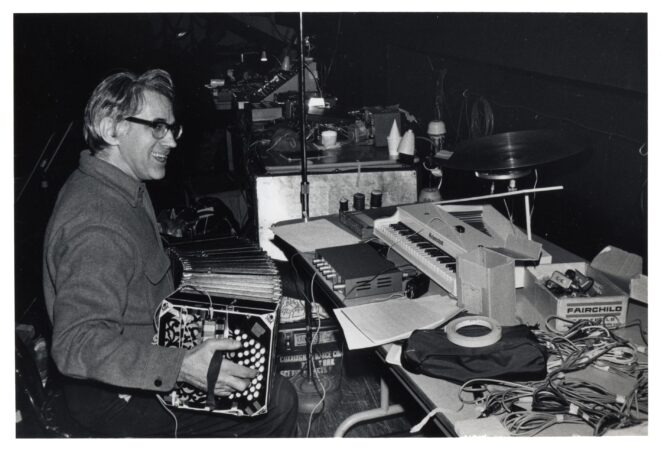
    David Tudor at the piano in 1953.

    Just a few miles from the composer’s alma mater, Overbrook High, a half dozen musicians were seated emulating Tudor’s music making process, behind tables piled high with an impenetrable tangle of boxes, wires, knobs, and switches; electronic tendrils snaked from these sources to a bewildering array of objects: glass bowls, a suspended box fan, an oversized die, a copper pot still, even a tree. Each was connected to transducers that took advantage of their resonant properties, turning them into natural amplifiers.

    A century after his birth and three decades since his death in August 1996, David Tudor’s music still seems like something created in a distant, if more analog, future.

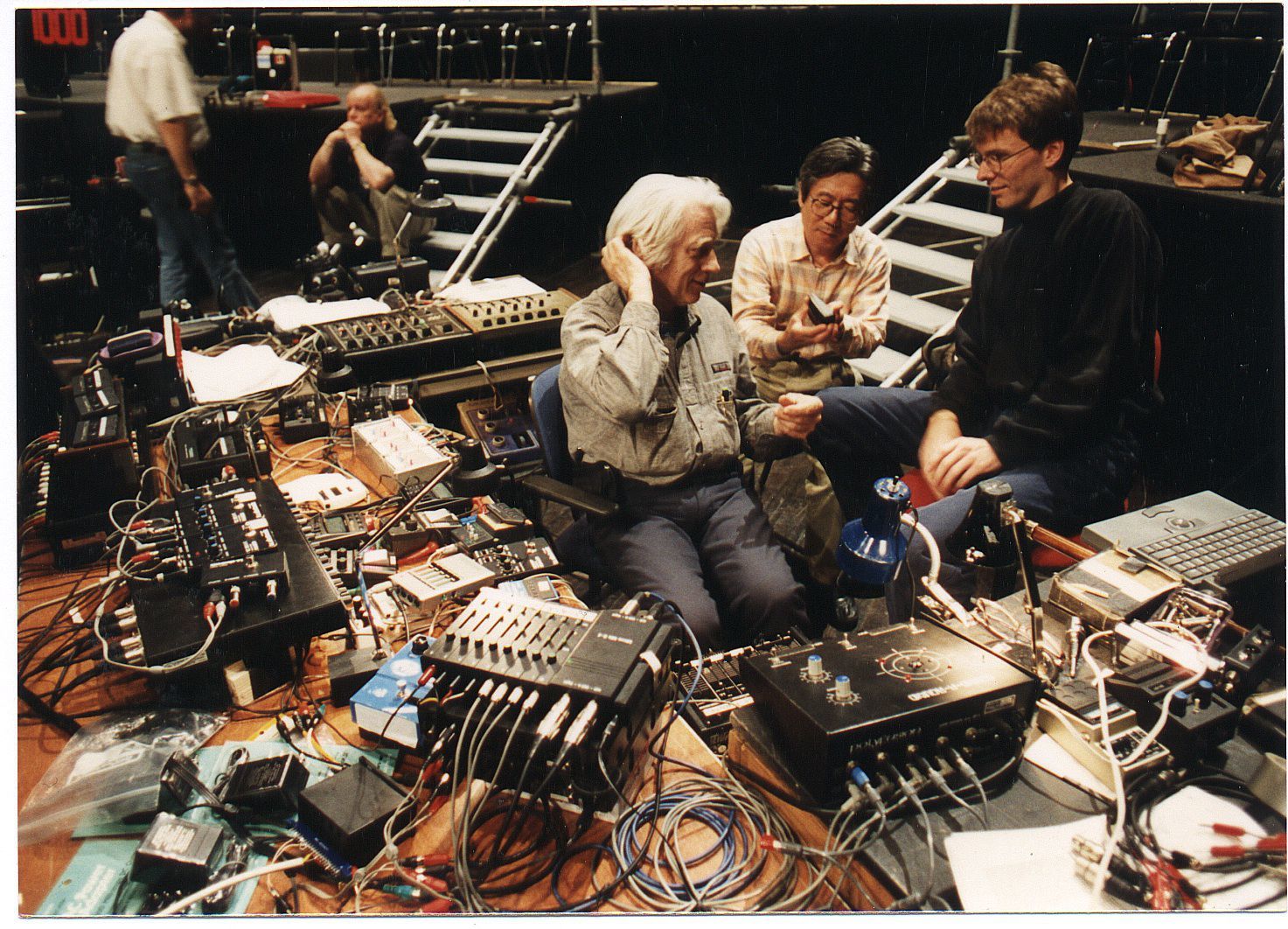
    David Tudor with composer Takehisa Kosugi and musician/engineer John D.S. Adams on the set of Ocean, a collaboration with the Merce Cunningham Dance Company

    Years before, the AI-generated “band” Velvet Sundown grabbed headlines by chalking up more than 1 million subscribers on streaming services and fooling journalists, Tudor was experimenting with machine-learning systems in the early ‘90s, working with engineers from Intel on a project called the Neural Network Synthesizer.

    Those experiments evolved from Tudor’s work with the generation of contemporary classical composers that emerged in the decades after World War II, when he became the pianist and collaborator of choice for such groundbreaking artists as John Cage, Morton Feldman, Earle Brown, Merce Cunningham, and Robert Rauschenberg.

    He was a particularly vital collaborator with Cage, who found in Tudor the ideal vehicle for the use of chance operations in his compositions.

    David Tudor with composer John Cage.

    The turning point for Tudor came at Settlement Music School in South Philly, where he studied with the pianist Irma Wolpe. The young pianist became close with Wolpe and her husband, the modernist composer Stefan Wolpe, and the couple introduced Tudor to new developments in modern music at the time.

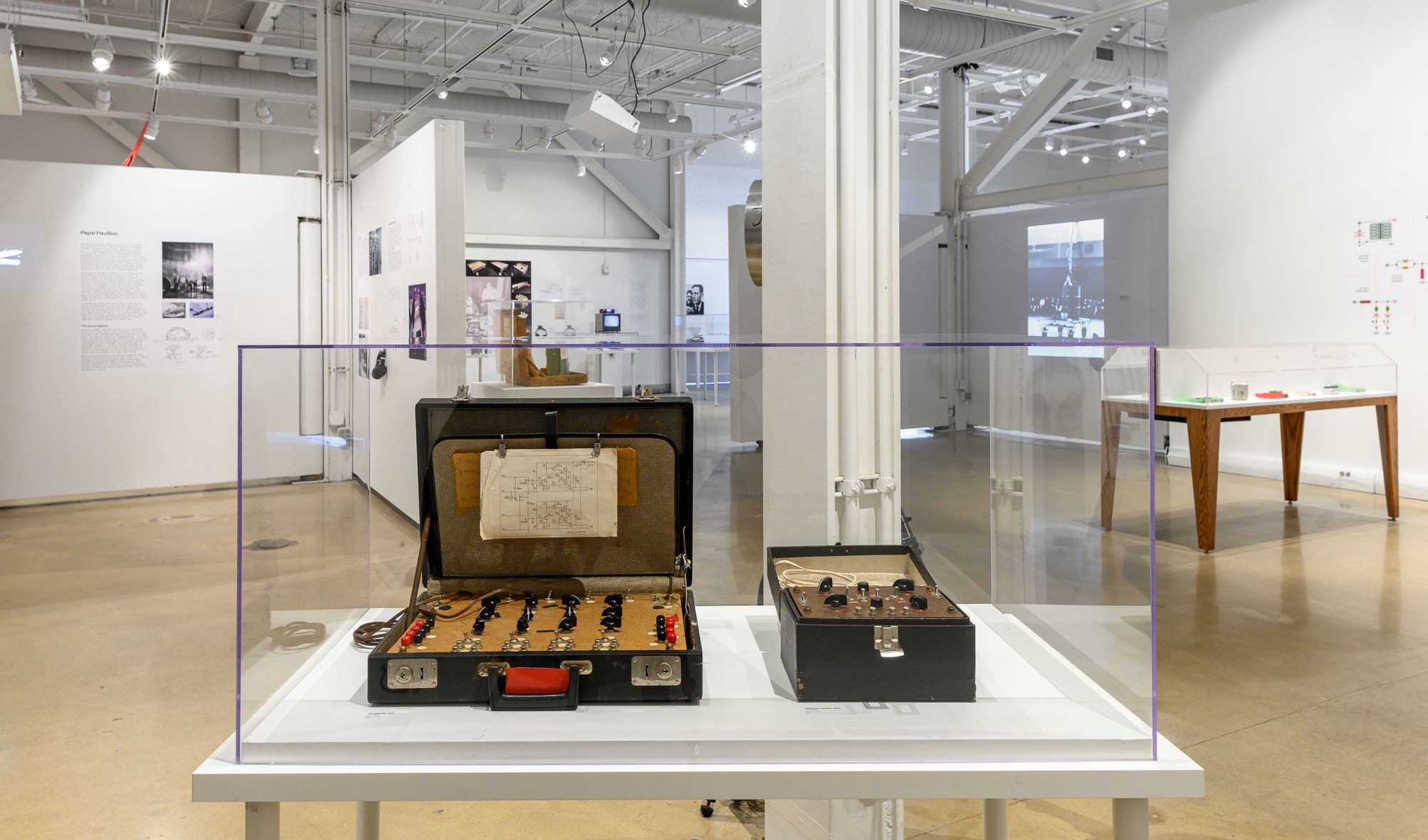
    An ongoing exhibition at Drexel University’s Pearlstein Gallery, “David Tudor: A View From Inside,” traces the roots of his iconoclastic approach to performance and composition back to his early days in Philly.

    The pipe organ — an instrument that literally surrounds the performer, and that they play from within — proved to be a foundational influence on Tudor’s musical philosophy for the rest of his life, said Dustin Hurt, co-curator and director of Philly presenting organization Bowerbird.

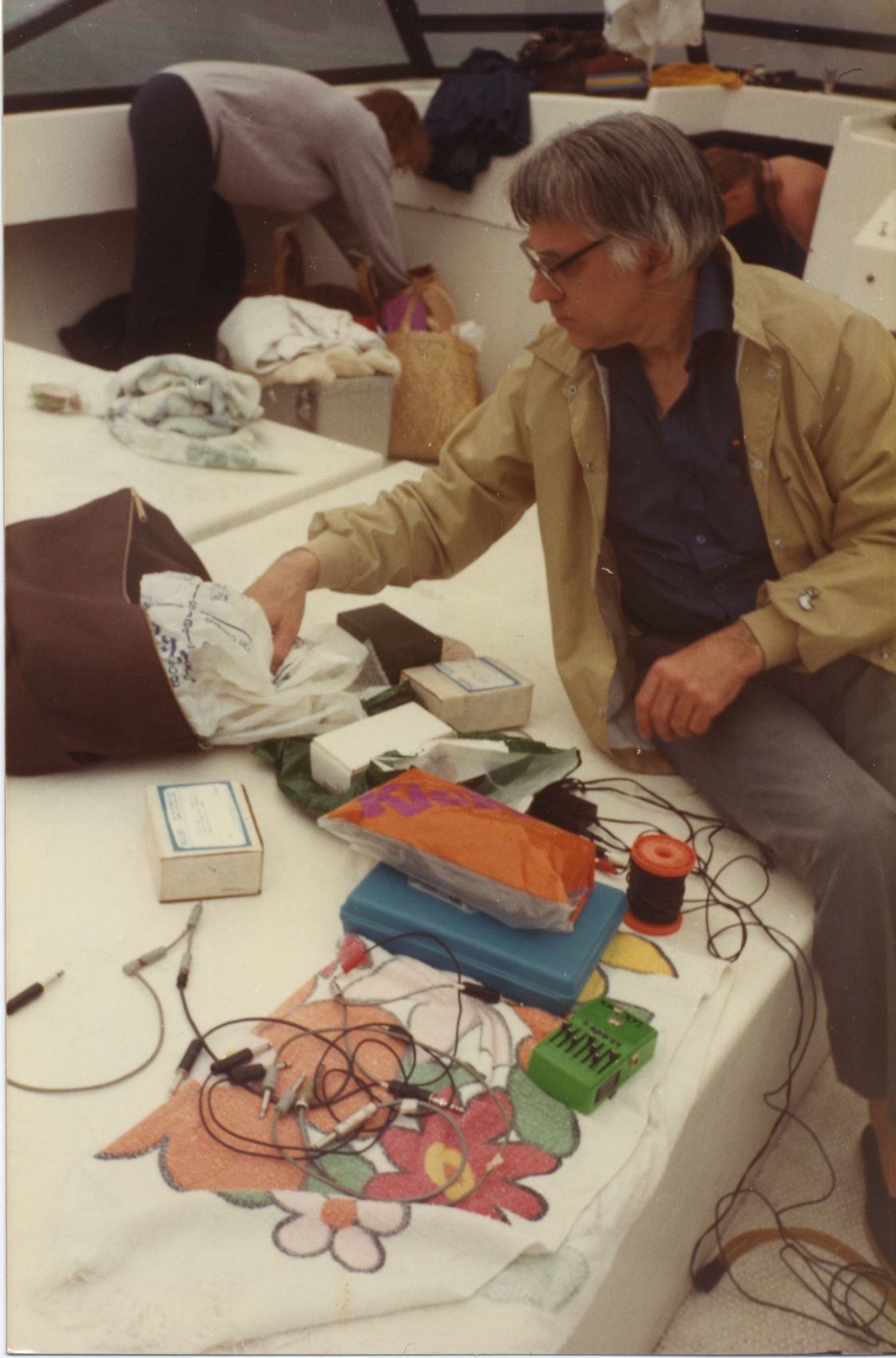
    David Tudor in the Bahamas during the filming of Sea Tails, a project that included sounds collected underwater.

    “That led to the more metaphorical angle of David’s music, which involved discovering what the instruments do on their own,” said Hurt. “That’s the ‘View From Inside.’ He’s not saying, ‘I want to make this music, let me find the instruments that do it.’ He’s saying, ‘This is the stuff that I have. Let’s see what it does.’”

    Discovering Tudor’s fascination with puzzles, composers presented him with scores that offered problems to solve rather than music to play. The exhibition includes mind-boggling lists of calculations and measurements that the pianist meticulously assembled in preparation of performing certain pieces.

    By the 1960s, he started to abandon the piano altogether, modifying small electronic devices to craft unpredictable music from feedback.

    “David Tudor: A View From Inside” is on view at Drexel University’s Pearlstein Gallery through March 21

    “Tudor was such a skilled virtuoso on the piano, but he showed no interest in performing the classical repertoire,” said co-curator You Nakai, a professor at the University of Tokyo and author of Reminded By the Instruments: David Tudor’s Music.

    “He would only perform scores that challenged him to solve them and produce music that the composer never really thought of,” said Nakai. “So when he started making his own instruments, he strongly focused on ways to implement indeterminacy within the workings of the instruments themselves.”

    Composer Stanley Lunetta includes the following instructions in his “Piece for Bandoneon and Strings”: “If you are already David Tudor, you will have no problem performing this piece; if you are not David Tudor, you must study hard, for you must be him during this performance.”

    “David Tudor: A View From Inside” is on view at Drexel University’s Pearlstein Gallery through March 21.

    The strings in the piece were not the expected violins and cellos, but tethers from Tudor’s limbs to a group of puppeteers who triggered him to play sections of Lunetta’s score.

    Gradually, Tudor’s vision of an instrument that could be inhabited grew in scale far beyond even a department store-sized pipe organ. For Expo ‘70, the 1970 world’s fair in Osaka, Japan, he transformed an entire building into an instrument by mounting loudspeakers in the dome of the Pepsi Pavilion. A few years later, he drew up plans to convert an entire island into an instrument by recording the natural sounds of the space, manipulating them, and playing them back via speakers scattered throughout the island.

    That project wasn’t realized until 2024, long after his passing, off the coasts of Japan and Norway via a collaborative project spearheaded by Nakai.

    “David Tudor: A View From Inside” is on view at Drexel University’s Pearlstein Gallery through March 21.

    Tudor’s pioneering experiments with electronic music seemed to make him an apt collaborator for the Intel engineers and their new neural network chip, but his interest in the technology was diametrically opposed to theirs.

    For all his love of puzzles, “Tudor showed no interest in repeating his past,” said Nakai.

    “He opened it up, went inside the circuitry and figured out how to let the instrument speak for itself. He didn’t understand everything, but he didn’t need to because he was making music that he liked.”

    “David Tudor: A View From Inside” runs through March 21, Pearlstein Gallery in Drexel University’s URBN Annex, 3401 Filbert St. bowerbird.org

  • Bill Gates’ nuclear company plans $450 million plant in Philly’s Bellwether District making radioactive cancer treatments

    Bill Gates’ nuclear company plans $450 million plant in Philly’s Bellwether District making radioactive cancer treatments

    TerraPower Isotopes, part of a nuclear power company founded by Bill Gates, plans a $450 million plant in the Bellwether District to make radioactive molecules for cancer research and potential treatments, Gov. Josh Shapiro announced Tuesday.

    Bellwether’s developer HRP Group will build a 250,000-square-foot facility for the Bellevue, Wash., company at the former refinery site. TerraPower Isotopes is expected to employ 225 people in Philadelphia to meet anticipated demand for a type of molecule that can be used to kill tumors without damaging surrounding tissue.

    TerraPower’s material, an isotope called actinium-225, is ultimately derived from weapons-grade uranium. Researchers are exploring precision cancer treatments that involve attaching actinium-225 to an antibody that is targeted to specific cancer cells. The isotope then emits high doses of radiation at close range.

    “This new facility is a testament to the demand for actinium-225 as part of the growing industry, which is transforming how cancer is treated,” TerraPower Isotopes President Scott Claunch said in Shapiro’s announcement. “Our team is proud to be building a large-scale manufacturing facility in Philadelphia, which will play a pivotal role in expanding global access to this rare isotope.”

    Pennsylvania government is supporting the project with $10 million in grants. The Bellwether District is in a Keystone Opportunity Zone that has tax benefits through 2043. That means TerraPower Isotopes won’t have to pay many state and local taxes, though it will remain responsible for city wage taxes.

    TerraPower Isotopes, part of a bigger nuclear sciences company called TerraPower, is the second radiopharmaceutical company to announce a factory in the region. In 2024, Nucleus RadioPharma, which counts Fox Chase Cancer Center among its investors, shared plans for a 48,000-square-foot facility in Spring House, Montgomery County.

    TerraPower’s move to South Philadelphia is the third significant life sciences development announced this year by Shapiro and his economic development team.

    Eli Lilly & Co. said in January that it is building a $3.5 billion pharmaceutical plant in the Lehigh Valley to expand manufacturing capacity for next-generation weight-loss medicines. Last month, Johnson & Johnson shared plans for a $1 billion cell therapy plant in Montgomery County.

    TerraPower is the second tenant in the 1,300-acre Bellwether District, which HRP is trying to develop into a new industrial and life sciences hub. Late last year, it announced that California-based canned beverage manufacturer DrinkPAK will build a 1.4 million-square-foot factory that will product 3 billion cans a year.

  • This app is quietly reformulating America’s food supply

    This app is quietly reformulating America’s food supply

    Julie Chapon was 26 when she finally learned what was in her Nestlé Fitness cereal.

    “I’d eaten this cereal for 10 years,” by 2016 said Chapon, and she considered it to be healthy. “When I checked the label, one quarter of this product was made with sugar,” she recalls. “That’s when we realized we can’t trust the brand and the marketing.”

    So Chapon conceived Yuka, a smartphone app that gives users X-ray vision into the health impacts of 6 million foods and cosmetics.

    Scan a barcode and the app will show you a detailed breakdown of a product’s ingredients based on Nutri-Score, a food labeling system developed by scientists, as well as the presence of additives and organic certification. (Nestlé did not respond to requests for comment. Fitness cereal has been reformulated since Chapon’s encounter.)

    Yuka rates each product with a simple color code: Excellent (green), good (light green), poor (yellow) or bad (red). More than 80 million people, including 25 million in the United States, have used the app to scan groceries or personal care products since it launched in 2017. Yuka said it has 20 million active users worldwide each month and is financed almost entirely by user subscriptions: Premium users pay at a rate they can afford, between $10 to $50.

    The consulting firm BCG coined the term “Yuka Effect” to describe how the app shapes what goes in — or stays out — of shopping carts. Yuka says survey data suggests 94 percent of its users put products back on the shelf after the app shows them low scores. That’s helping to pressure manufacturers to reformulate products to score better, despite objections from some experts that the app oversimplifies complex diet decisions.

    In France, where Yuka says one in three citizens have signed up since its launch, the app appears to be acting as an unofficial food regulator. The supermarket chain Intermarché, noting the app’s influence, has reformulated more than 2,300 private-label products, removing controversial additives, reducing sodium levels and slashing added sugars.

    When France’s charcuterie industry sued Yuka for defamation and unfair business practices regarding its warnings about nitrites, it lost on appeal. Preserved meat producers are now removing nitrates and nitrites from their recipes without a regulatory mandate.

    Yuka, now available in 12 countries, says it is signing up over 25,000 users per day in the United States, where it has been embraced by everyone from average shoppers to leaders of the MAHA movement. Health and Human Services Secretary Robert F. Kennedy Jr. has told reporters that he uses the app.

    That’s adding to pressure on consumer packaged goods manufacturers to change their products. Sales of ultra-processed foods have slowed or contracted, according to BCG, and researchers are calling them a “clear global threat to our health.” Public officials, using the same legal strategies once used against the tobacco industry to target Big Food, have sued major food companies for precipitating a public health crisis by engineering and marketing ultra-processed foods.

    Some U.S. brands are already trimming sugar, salt and additives to cross Yuka’s scoring thresholds, such as moving from a red to yellow rating, said Lauren Taylor, who leads BCG’s research into consumer markets, although few have announced it publicly.

    By making nutrition, additives and processing levels instantly visible at the point of purchase, Yuka is influencing product standards without needing to change the law and quietly reordering R&D priorities across the industry.

    “Regulation moves the floor.” Taylor said. “Consumers, enabled by transparency tools, move the ceiling.”

    That’s now central to Yuka’s mission, Chapon said. Merely offering shoppers the power to make an informed choice wasn’t enough, because few healthy options existed in many categories. “So our approach evolved,” she said, prompting the company to add a “Call-Out” feature that allows shoppers to ask brands to remove additives and free tools to help manufacturers reformulate their products. “Yuka is not only about informing consumers,” she said. “It’s also about shifting the market.”

    The backlash against ultra-processed

    A modern American grocery store carries about 31,800 different unique products. Good luck finding the healthy ones outside the produce aisles: 73 percent of the American food supply is “ultra-processed,” estimates Giulia Menichetti, senior research scientist at Northeastern’s Network Science Institute. These industrial formulations are engineered for maximum shelf-life and “hyper-palatability,” she wrote.

    “Food manufacturers have actually figured out what the bliss point is in ultra-processed foods,” said Tara Schmidt, a registered dietitian at the Mayo Clinic, referring to the precise ratio of salt, sugar, and fat that overrides people’s sense of feeling full, so they keep eating.

    Not all processed foods are unhealthy — breads, pasta, frozen vegetables, for example — and most are fine in moderation. But more than half of all calories consumed by Americans now come from ultra-processed food, which is associated with higher rates of obesity, diabetes, mental health disorders and certain cancers, as well as a 50 percent higher risk of dying from cardiovascular disease.

    That makes what we eat the leading cause of death in the U.S., Schmidt said, responsible for an estimated 500,000 deaths annually from poor diets.

    Two decades ago, David Katz, a doctor, medical researcher and founding director of the Yale-Griffin Prevention Research Center, tried to tackle the same problem. His company, NuVal, which debuted in grocery stores in 2007, rating foods on a nutritional quality index of 1 to 100. It was supposed to help shoppers trade up. “In every supermarket, there is a pasta sauce with more added sugar than ice cream per calorie,” Katz said. “Right next to it is a pasta sauce with no added sugar. The average shopper has no clue.”

    NuVal scores were eventually displayed on products in more than 1,600 grocery stores. Kroger agreed to roll them out after a pilot — then canceled the program. Years later, Katz said, he heard from a former Kroger employee that NuVal was canceled at the behest of PepsiCo. Major food brands, which pay grocery chains for favorable shelf displays, were typically ranked poorly for soft drinks and chips. A PepsiCo spokesperson did not answer questions about the incident, but said “the company uses science‑based standards and regulatory guidance – not any single app – to inform our product decisions.” Kroger declined to comment.

    NuVal folded in 2017. Katz now says it was a mistake to only work with supermarkets. “We needed to put this in the hands of consumers,” he said.

    Does Yuka work?

    Yuka displays a simple score based on nutritional quality (60 percent of a food’s score), additive risk (30 percent), and organic certification (10 percent). It sets limits — such as sugar, sodium, saturated fat and calories — and offsets them with positive elements such as fiber, protein and the proportion of fruits and vegetables. Yuka’s toxicology and nutritional experts rely on published studies, especially the Nutri-Score, a nutritional assessment adopted by several European governments.

    Even as someone who reads food labels, the app changed how I shop. First, I scanned my pantry. Some snacks (oh, crackers) were ranked worse than I expected, while other foods proved far healthier (Tasty Bite’s Indian food pouches). On grocery runs, I could instantly assess the ingredients of almost any item and browse for better choices steps away.

    Some recommendations struck me as silly: My jar of mayonnaise was predictably rated red for being high in saturated fat and calories, as were most indulgences. But I was no longer guessing about obscure ingredients. Just how bad is disodium phosphate, anyway?

    While Yuka’s scores are easy to follow, some scientists and dietitians contend they oversimplify the notoriously nuanced question of what is “healthy.”

    Dariush Mozaffarian, a Tufts University cardiologist and director of its Food Is Medicine Institute, faults Nutri-Score as relying on “outdated science,” such as penalizing some healthy fats, while lacking evidence it leads individuals to eat meaningfully better over time. “It’s not terrible,” he said, “but I don’t think it’s great.” (Mozaffarian has helped develop his own nutritional index called the Food Compass).

    Other food experts say Yuka unhelpfully demonizes additives that can be dangerous at high doses but are usually present in tiny amounts. Some may not be “high-risk” at all: Yuka puts MSG in that category, despite scientific bodies from the FDA to WHO declaring them safe in typical amounts after multiple randomized controlled studies.

    Schmidt of the Mayo Clinic said Yuka’s focus on specific additives can be misleading. “It’s rarely about the individual ingredient,” she said. “Look at the rest of your diet before we demonize these foods. … All foods can fit.”

    Yuka’s Chapon said the company has submitted its scoring system and behavior change research to peer-reviewed journals and expects users to learn how to maker better choices, rather than completely cutting out sweets and snacks.

    Better choices may be on the way. When I contacted 13 leading U.S. food brands and grocery retailers, none would confirm whether they had reformulated products to meet the app’s standards.

    But Yuka has said companies such as Nestlé and Unilever have already done so, with more likely. “We are contacted almost daily by U.S. brands seeking to reformulate their products and asking how they can improve their Yuka score,” Chapon said.

    Yuka is still unlikely to end Americans’ appetite for sweet, salty and ultra-processed food. Nor does it intend to. “The right approach to nutrition isn’t telling people to stop eating pizza or cookies,” said Chapon. “If you want to eat a pizza, there is a better choice. There is always a better choice.”

    There will always be unhealthier choices, too. McKee Foods, maker of Little Debbie snack cakes, says it has no plans to reformulate, despite its products’ “poor” ratings on Yuka.

    “There is no need,” wrote Mike Gloekler, a spokesperson for McKee. “The vast majority buy our cookies and cakes because they love them as they are.”

  • Hundreds of migrants are vanishing in the Mediterranean. Authorities are withholding information

    Hundreds of migrants are vanishing in the Mediterranean. Authorities are withholding information

    ROME — Bodies washing ashore day after day. Phone calls from relatives going unanswered. Migrants’ tents abandoned overnight.

    Migrants trying to reach Europe are vanishing in droves in what are known as “invisible shipwrecks” but governments responsible for search and rescue are withholding information about what they know.

    The beginning of 2026 ranks as the deadliest start to any year for people trying to cross the Mediterranean — an unprecedented 682 confirmed missing as of March 16 — according to the United Nations’ International Organization for Migration. But the real death toll is almost certainly much higher.

    Human rights groups are increasingly struggling to verify tolls as Italy, Tunisia and Malta have quietly restricted information on migrant rescues and shipwrecks along the deadliest migration route in the world. The news barely makes headlines, in part because the lack of transparency prevents journalists from confirming reports.

    “It’s a strategy of silence,” said Matteo Villa, a researcher focusing on migration and data at the Italian Institute for International Political Studies think tank.

    The organization Refugees in Libya and other human rights groups have been sounding the alarm since late January, reporting more than 1,000 people missing after Cyclone Harry hit the region. But authorities have not confirmed, denied or corrected those reports.

    In the weeks that followed the cyclone, more than 20 decomposing bodies washed ashore in Italy and Libya while other human remains were spotted floating in the middle of the sea.

    For the families of missing migrants, not knowing their fate is excruciating.

    “Europe should know that these people who got drowned in the sea have family members, have dreams, have passions,” Josephus Thomas, a migrant from Sierra Leone and community leader in Tunisia’s coastal town of El Amra, told AP.

    Sparse information means fewer deaths recorded

    Even the U.N.’s migration agency is increasingly unable to verify cases of migrants who die in what are known as “invisible shipwrecks” because of the growing lack of information.

    Last year, at least 1,500 people were reported missing whose fates IOM could not confirm, said Julia Black, who leads the organization’s Missing Migrants Project. The issue persists in 2026.

    “We started a new secondary data set of what we are calling unverifiable cases because it’s just become so many,” Black said. For this year, they already have more than 400 missing they could not verify.

    Many humanitarian organizations that previously filled some of the information gaps are no longer able to do so because of the global wave of funding cuts and government-imposed restrictions across the region.

    “We’ve seen the restriction of access for humanitarian actors, which is not right. And now we’re seeing even the restriction of information,” Black said.

    The Associated Press repeatedly asked authorities in Tunisia, Italy and Malta why they aren’t sharing information related to migrant rescues at sea and what their policies are. Not one responded.

    Countries quiet on reports of boats missing after cyclone

    Over the years, authorities in the Mediterranean have gradually reduced information related to migrants. But their silence was even more pronounced in late January after Cyclone Harry unleashed heavy rainfall, winds of 100 kph (62 mph), and 9-meter-tall (30 feet) waves.

    Hundreds of people had departed from Tunisia’s coastal region of Sfax and disappeared, according to information the group Refugees in Libya gathered from migrants in Tunisia and their relatives abroad.

    The group acknowledged it was difficult to be precise “because there is no central system recording departures, losses, or recoveries,” but it warned that the death toll was likely even higher.

    “We are looking at boats that never counted how many kids are inside,” Refugees in Libya founder David Yambio told AP.

    The AP sent five email requests to the Italian coast guard seeking information on the boats reported missing and search efforts but received no response. An officer who answered the phone said the coast guard did not have “any further verified and confirmed information regarding the circumstances.” AP also filed a Freedom of Information request, which is pending.

    The coast guard also declined to comment on an alert it issued on Jan. 24 asking vessels sailing between the Italian island of Lampedusa and Tunisia to be on the lookout for eight small boats in distress carrying some 380 people. The alert was made public by Italian journalist Sergio Scandura.

    One survivor rescued from the boats

    There is only one known survivor from the boats reported missing during Cyclone Harry. He was floating in the water when a merchant vessel rescued him on Jan. 22. The man told crew members he had been traveling with another 50 people, some of whose bodies could be seen in the water in video of the rescue. Thanks to his testimony, their deaths were included in IOM’s tally.

    According to the captain, the survivor was evacuated to Malta. The Maltese Armed Forces did not respond to multiple requests about their involvement or reports that they recovered the man and the bodies.

    The Tunisian Foreign Ministry and the Tunisian National Guard also have not responded to multiple requests for information by email and phone.

    Frontex, a European Union agency that assists nations with border surveillance, told AP that it spotted eight boats carrying about 160 migrants between Jan. 14 and 24 when the cyclone hit. It said six boats were rescued by Italian authorities, but the fate of the other two remains unknown.

    On Feb. 8, migrants prayed and cried during a memorial ceremony in the olive groves near Sfax, presuming their loved ones could not be alive after so many days without news.

    “All of us here are in deep trauma, are in deep agony,” Dr. Ibrahim Fofana, a migrant in Tunisia whose relatives have been missing since late January, said in a video shared by Refugees in Libya. He pleaded for authorities to identify the bodies that washed ashore in Italy.

    Tighter information follows migration crackdown

    Until mid-2024, Tunisian authorities regularly shared the number of migrants they were intercepting at sea, eager to show their European partners compliance with a 2023 deal to curb migration in exchange for financial aid. But the deal was also followed by a brutal crackdown against migrants on land that resulted in thousands being detained or dumped in the desert.

    Nongovernmental organizations such as the Tunisian Forum for Economic and Social Rights, known by its French acronym FTDES, which used to compile and share reports on migrant interceptions, were also caught in the crackdown.

    In June 2024, Tunisia’s Ministry of Interior stopped releasing any information on migrants, citing security reasons, said Romdhane Ben Amor, FTDES’ spokesperson. But in his opinion, the motives were political. The numbers were incompatible with the narrative that Tunisia was not Europe’s border guard, he said.

    Italy’s erosion of information on migrant rescues is even older than Tunisia’s. The Italian coast guard used to provide detailed monthly data on migrants rescued. The monthly reports became quarterly before stopping completely in 2020, Villa said. In 2022, previous reports were also removed from the coast guard’s website.

    This year, the Italian coast guard did not share any migration-related press releases despite nearly 5,000 migrants disembarking on Italian shores, according to Italy’s Interior Ministry statistics.

    “It is very clearly a political strategy to repress as much information as possible from the public,” Villa said.

  • Suspected suicide bombers target Nigeria’s Maiduguri city, killing 23 people

    Suspected suicide bombers target Nigeria’s Maiduguri city, killing 23 people

    MAIDUGURI, Nigeria — At least 23 people were killed and more than 100 wounded in suspected suicide bombings Monday night that targeted Maiduguri city in northeastern Nigeria, police said Tuesday. It was one of the deadliest attacks in the conflict-battered city in recent history.

    Residents and emergency services earlier told The Associated Press that three explosions were reported in crowded places in Maiduguri, the capital of Borno state, including in a major market and at the entrance of the University of Maiduguri Teaching Hospital.

    “Regrettably, a total of 23 persons lost their lives, while 108 others sustained varying degrees of injuries,” Borno police spokesperson Nahum Kenneth Daso said in a statement that blamed the attacks on suspected suicide bombers.

    No group has claimed responsibility for the attacks, but suspicion quickly fell on the Boko Haram jihadi group, which in 2009 launched an insurgency in northeastern Nigeria to enforce their radical interpretation of Shariah.

    Boko Haram has since become stronger, with thousands of fighters and different factions, including the Islamic State West Africa Province, which is backed by the Islamic State group.

    Maiduguri city has been at the heart of the deadly violence but has in recent years experienced relative peace even as the countryside is often battered by extremists.

    The attack took place less than 24 hours after the Nigerian military repelled attacks by militants on the outskirts of Maiduguri, in what some residents say could have been planned as a distraction.

    By Tuesday morning, there was heavy security deployment in the affected locations and along major roads in the city, but many public places remained closed amid heightened fear.

    “Investigations are ongoing to further ascertain the circumstances surrounding the incidents and to bring perpetrators to justice,” the Borno police command said.

    Explosions rocked crowded places almost simultaneously

    The first explosion was recorded at about 7:30 p.m. at the entrance of the teaching hospital, while the second and third followed few minutes later at the popular Monday Market and nearby Post Office business hub, both located about 2.5 miles from the hospital.

    Witnesses recounted the chaos that followed at the scenes and at hospitals as security forces and the emergency services quickly intervened.

    “This attack has been one of the deadliest in Maiduguri in years,” said Mohammed Hassan, a member of a volunteer group assisting security forces in fighting extremists. “We’re in dire need of blood,” he said of the situation hours after the attack.

    The extremists have intensified their attacks against Nigerian military bases in recent weeks, killing several senior officers and soldiers, and stripping the bases of stocks of weaponry and ammunition.

    The multiple attacks could be seen as a major victory for the jihadis in a city seen as impregnable despite the jihadis often targeting troops and villages on the outskirts of the city.

    Past attacks in the city have been limited to one-off incidents that occur once in a long while, including a suicide attack that killed five at a mosque on Christmas Eve last year.

    “Maiduguri being attacked is like an insult for the security forces … and for the (jihadi) groups, it is symbolic because it shows nowhere is out of their reach,” said Malik Samuel, a Nigerian security researcher with Good Governance Africa.

  • Republicans are launching a voting bill debate that could last days or even weeks

    Republicans are launching a voting bill debate that could last days or even weeks

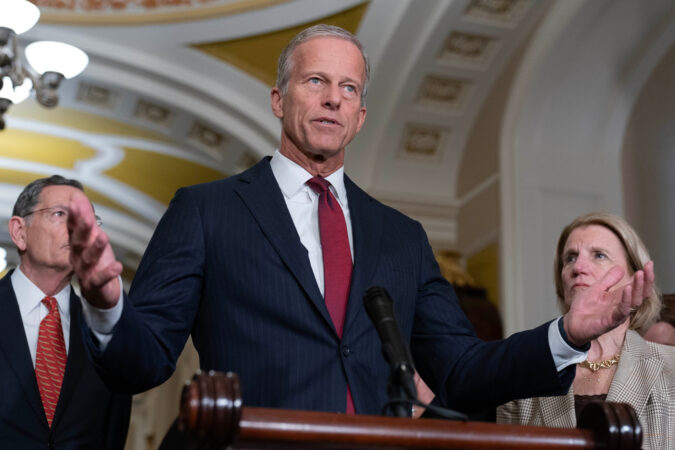
    WASHINGTON — Republicans are launching an unprecedented effort on Tuesday to hold the Senate floor and talk for days about a bill that they know won’t pass — an attempt to capture public attention on legislation requiring stricter voter registration rules as President Donald Trump pressures Congress to act before November’s midterm elections.

    The talkathon could last a week or longer, potentially through the weekend, as Senate Majority Leader John Thune tries to navigate Trump’s insistence on the issue and Democrats’ united opposition. Trump has urged Thune to scrap the legislative filibuster, which triggers a 60-vote threshold in the 100-member Senate, or find another workaround to pass the bill, but Thune has repeatedly said he doesn’t have the votes to do that.

    Instead, Republicans intend to make a long, noisy show of support for the legislation, which would require Americans to prove they are U.S. citizens before they register to vote and to show identification at the polls, among other things. It’s a risky strategy, with no guarantee it will be enough for Trump, who has said he won’t sign other bills until the Safeguard American Voter Eligibility Act — also known as the SAVE America Act or the SAVE Act — is passed.

    The floor debate is expected to eventually end with a failed vote. Republicans need 60 votes to advance the bill to a final vote, but they hold 53 seats, and all 45 Democrats and both independents, who caucus with the Democrats, oppose it.

    Still, the debate will “put Democrats on the record,” Thune said last week.

    Creating strict voter registration rules

    Trump says, without evidence, that Democrats can only win in the midterms if they cheat and explicitly said Republicans need the SAVE America Act to win in November. The House passed the legislation earlier this year, but the Senate turned to other issues as it became clear that Republicans didn’t have the votes to pass it.

    But Trump made clear he wasn’t satisfied and pushed the Senate to act. The Republican president has said he won’t sign other legislation, including a bipartisan housing bill backed by the White House, until the voting bill passes.

    The bill contains a slew of provisions that Trump and his most loyal supporters have pushed as part of a broad effort to assert federal control over elections. It would require voters nationwide to provide proof of citizenship when they register and to show accepted voter identification when casting a ballot.

    It would also create new penalties for election workers who register voters without proof of citizenship and require states to hand voter data over to the Department of Homeland Security so federal officials could screen for voters who are in the country illegally.

    Trump also wants new provisions added to the bill, including a ban on most mail-in ballots.

    “It’ll guarantee the midterms,” Trump said of the bill last week. “If you don’t get it, big trouble.”

    Democratic opposition to the bill is firm

    Democrats and many groups that champion voter access say there is little evidence of noncitizens voting and say the bill would disenfranchise millions of voters — including Republicans — by creating new burdens to prove citizenship.

    It is already illegal to vote if you are not a U.S. citizen, but the bill would lay out strict new rules for paperwork that people would have to present to register to vote. Opponents of the measure say those documents are not always readily available for many people.

    “There is no new problem to solve here,” said Janai Nelson, president and director-counsel of the Legal Defense Fund, a civil rights law advocacy group. “There is an apparatus already to ensure that elections are safe and secure and that only eligible voters are casting ballots in our elections.”

    Senate Democratic leader Chuck Schumer said that Democrats are not opposed to voter identification but “this is about purging the voter rolls in a massive way, so you never even get the chance to show a voter ID when you showed up to vote because you’d be knocked off the rolls.”

    Expect a show on the Senate floor

    Trump, backed by Republican Sen. Mike Lee of Utah, has pushed for a talking filibuster, which would force Democrats to talk for days or weeks to delay passage of the bill. But Thune and the larger GOP conference rejected that idea, arguing that it would end in failure after giving Democrats a stage and the opportunity to offer endless amendments, potentially adding their priorities to the bill.

    Republicans are instead taking over the floor with their own speeches, proceeding under regular order but operating outside the normal time limits that are customary when debating legislation. Democrats are expected to answer with their own procedural hijinks, potentially forcing Republicans to come to the floor at all hours for votes, meaning they will need to stay close to the Senate for the duration.

    Lee said last week that it’s unclear how it will all play out. He said he thinks Trump “understands that we need to put in an aggressive effort here.”

    “And a lot of that,” he said, “is going to have to be determined in real time as we go about it.”

    The extent of Trump’s satisfaction with the process, Lee said, “will depend on whether, in his view, we gave it everything we have.”

    On Monday night, Lee was rallying Trump’s base voters on X.

    “Once we’re on this bill,” he wrote, “we must stay on it until it’s passed into law.”

  • A journalist reported a missile strike. Then came the death threats.

    A journalist reported a missile strike. Then came the death threats.

    The message appeared in English on Emanuel Fabian’s phone.

    “You have 90 minutes left to update the lie,” said a WhatsApp message reviewed by The Washington Post. “If you do this — you solve in a minute the most serious problem you have caused yourself in life. And you won’t remember me anymore in a week.”

    Five days earlier, Fabian, a 28-year-old war correspondent at the Times of Israel newspaper, had published a short blog post reporting that an Iranian missile had struck an open area outside a Jerusalem suburb, harming no one.

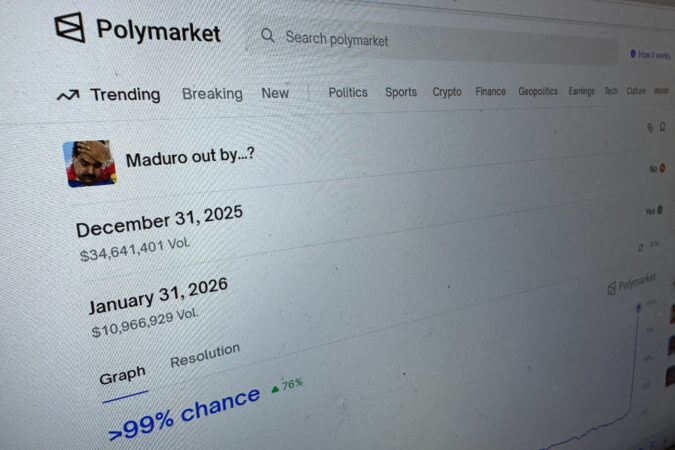
    Until he began to receive messages that threatened his life and family, Fabian didn’t know his brief report had triggered a dispute over bets on the prediction market Polymarket on whether an Iranian missile would strike Israel on March 10. For those with money down, millions of dollars were potentially riding on his blog post.

    Fabian was spooked enough by the threats to at least entertain the idea of revising his published reporting, he told The Post in a phone interview Monday. That could score a win for Polymarket users who had bet against a missile strike occurring that day — and at least one had offered to send Fabian a share of the profits.

    Instead, he stood by his post, reported the threats to the police and wrote an article for the Times of Israel chronicling the harrowing experience. Fabian said he decided to publicize the story in the hope that “anyone who’s ever thinking about threatening a journalist will maybe think twice.”

    Fabian’s run-in with disgruntled bettors follows a string of recent controversies triggered by prediction markets, fast-growing online platforms that host markets where people can bet on the outcome of future events such as elections or the Academy Awards.

    In January, an anonymous user on Polymarket, which bars U.S. users, won $400,000 betting on the ouster of Venezuelan leader Nicolás Maduro just hours before U.S. forces took him into custody. In February, Fabian reported that an Israel Defense Forces reservist was indicted along with a civilian for using classified information to place bets on Polymarket.

    This month, users of rival Kalshi, which is approved to serve U.S. bettors, complained after the site declined to pay out on bets that Iran’s Ayatollah Ali Khamenei would be ousted, citing a policy of not allowing bets on a person’s death.

    Polymarket and Kalshi say they monitor their platforms for insider trading and improper activity, but U.S. lawmakers have raised concern about the harmful incentives prediction markets create.

    “Polymarket condemns the harassment and threats directed at Emanuel Fabian, or anyone else for that matter,” a company spokesperson told The Post. “This behavior violates our terms of service and has no place on our platform or anywhere else. Prediction markets depend on the integrity of independent reporting. Attempts to pressure journalists to alter their reporting undermine that integrity and undermine the markets themselves.”

    The company added in a post on X that it had “banned the accounts for all involved” and would pass on their information to authorities.

    The bet that would turn into a nightmare for Fabian hinged on whether at least one Iranian missile would strike Israel on March 10.

    As sirens sounded across Jerusalem and the West Bank that day, indicating ballistic missiles in flight from Iran, Fabian began contacting authorities to see whether anything had landed or been intercepted. Within minutes, he published a brief post noting that medics were responding to reports of an impact near Beit Shemesh, a city about 20 miles west of Jerusalem. Soon after, he posted on X a dashcam video provided by a witness that showed a fiery explosion in a forested area not far from a residential complex.

    “One missile struck an open area just outside Beit Shemesh, first responders say and footage shows,” Fabian wrote, noting that no injuries were reported.

    Fabian moved on with his day, but on Polymarket, controversy was brewing. At the end of March 10, about $200,000 was at stake, according to a Post analysis of Polymarket data from crypto analytics data platform Dune and the website Polymarket Analytics.

    His blog post appeared to seal a win for users who had put money on at least one Iranian missile striking Israel that day. But in a group chat on the messaging platform Discord, a user pointed out that a daily report from the Israel Defense Forces did not mention any missile strikes on March 10. That user and others suggested the explosion may have been shrapnel from an intercepted missile.

    Under the terms of the bet on Polymarket, intercepted missiles did not count as strikes. And the terms said that if confirmation of a strike could not be provided within 48 hours, those who bet “no” would be declared the winners.

    Polymarket determines the “truth” used to resolve bets on its platform via a complex system of voting by users who have bought a particular cryptocurrency token. As those users debated who should win the bet over missile strikes on March 10 in the days following the blast, more Polymarket bettors piled in, wagering another $7 million, with some individuals standing to win more than $1 million if the market resolved to “yes.” And Fabian began to receive messages from strangers encouraging him to revisit his reporting.

    At first the messages were polite. “I’d appreciate it if you could update your article, as in its current form it does not reflect reality,” one correspondent told Fabian, according to his Times of Israel article. “Alternatively, if you have information that it was indeed a full missile that was not intercepted, I would be glad to be corrected.”

    Fabian said he didn’t know at the time why the person was so interested in what seemed to be a minor detail, given that the blast had not caused serious damage. His confusion grew as he began to receive similar messages from other strangers.

    “I started getting all these replies on Twitter, or X, where people asked me, ‘Hey, why aren’t you updating this story from the 10th of March?’,” he recounted. “I was so confused. Then I looked at the profiles, and I realized they’re all Polymarket bettors. That’s when it kind of clicked.”

    By Sunday morning one person’s messages to Fabian had grown menacing.

    In messages written in Hebrew on WhatsApp, which Fabian quoted in his published reporting and also shared with The Post, a user who called themselves “Haim” said if Fabian caused him to lose his $900,000 bet, “we will invest no less than that to finish you.” Alternatively, the message said, Fabian could change the article, “end this with money in your pocket, and also earn back the life you had until now.”

    When Fabian didn’t respond, Haim began sending messages counting down the minutes, and claimed that he knew exactly where Fabian lived and who his family members were. Eventually, Haim switched from Hebrew to English, telling Fabian he had “90 minutes to update the lie.”

    Fabian told The Post that he considered conceding to Haim’s demands.

    “I thought, ‘Do I just change it? Because it doesn’t really matter,’” he said. “But then I thought, ‘You know, if I do this now, they’re going to come back to me again and asked for other things to be changed.’ They would have probably never stopped doing that if they knew they could make money this way.”

    Instead, Fabian filed a police report, he said, and began working with his editor at the Times of Israel to publish a first-person account of the attempted shakedown. He said he hopes that the publicity will deter bettors from threatening other journalists in the future. But Fabian said he worries he won’t be the last — and that other journalists might respond differently.

    Asked whether it’s possible the bettors were right and the explosion was from the remains an intercepted missile, Fabian said he was confident it was a warhead, due to the size of the blast and verbal confirmation from the IDF. But he added that it’s not something he’d usually follow up on after a minor blast, given that it doesn’t matter to most people — unless they have money riding on the answer.

    Asked late Monday if they had any more information on the March 10 blast, an IDF spokesperson said they did not have any on hand but would look into it.

    As of Monday, Polymarket was still accepting bets on the March 10 missile strike, nearly a week after something struck the ground near Beit Shemesh. “No” bets were far cheaper than “yes” bets, because bettors appeared to judge that the odds heavily favored “yes.”

    Latecomers to the market were effectively betting not on what hit the ground in Israel but on how the mostly-anonymous voters in Polymarket’s system will ultimately settle the dispute. One trader with the username “poorsob” would win $1.6 million if the market resolved to “yes.” BenzoateOstylezeneBicarbonate would win $1.3 million. But, if the bet ended up as a “no,” Sofia1 and AAAAGAAaA65 would win about $400,000 each.

    Sen. Chris Murphy (D-Connecticut) and Rep. Greg Casar (D-Texas) are expected to introduce draft legislation on Tuesday called the BETS OFF Act, for “Banning Event Trading on Sensitive Operations and Federal Functions.” They were inspired in part by predictions market bets on Maduro’s ouster and the Iran strikes.

    The bill “would put a stop to these corrupt wagers, crack down on prediction markets that flout the law with offshore platforms, and reject the idea that we should commodify every part of our lives,” Murphy’s office said in a statement.

    Amanda Fischer, policy director at the financial advocacy group Better Markets, said the “chilling” threats against Fabian underscore the need for stronger oversight of prediction markets.

    Fabian’s choice to go public rather than change his story “speaks to his integrity,” said Fischer, a former chief of staff at the Securities and Exchange Commission. But she added that pressure like he experienced could add to the risks faced by war reporters.

    “The last thing they need now,” she said, “is folks with a gambling position on life or death harassing them and trying to coerce them to change their reporting so they can get a payout.”

    Jeremy Merrill contributed to this report.

  • Israel says 2 top Iranian officials killed in airstrikes in blow to Tehran leadership

    Israel says 2 top Iranian officials killed in airstrikes in blow to Tehran leadership

    DUBAI, United Arab Emirates — Iran’s top security official and the head of the Revolutionary Guard’s Basij militia were both killed in overnight strikes in a blow to the country’s leadership, Israel’s defense minister said Tuesday, while Tehran defiantly fired new salvos of missiles and drones at its Gulf Arab neighbors and Israel.

    Both security official Ali Larijani and Gen. Gholam Reza Soleimani were “eliminated last night,” Israeli Defense Minister Israel Katz said in a statement. Iran’s 86-year-old Supreme Leader Ayatollah Ali Khamenei died in an airstrike Feb. 28, the first day of the war launched by the United States and Israel, and other top leaders from the Iranian theocracy have been killed since then.

    Iranian state media did not immediately confirm either death. However, it said a message from Larijani’s office would be published shortly.

    The announcement came after the Israeli military had earlier said it had carried out a “wide-scale wave of strikes” across Iran’s capital and stepped up strikes on Iran-backed Hezbollah militants in Lebanon. Israel also reported two incoming salvos before dawn from Iran at Tel Aviv and elsewhere, and said Hezbollah targeted Israel’s north.

    Incoming Iranian missiles on the United Arab Emirates prompted Dubai, a major transit hub for international travel, to briefly shut its airspace and a man was killed by the debris of a missile intercepted over Abu Dhabi.

    Israel says it has killed two top Iranian officials

    Larijani hails from one of Iran’s most famous political families. A former parliamentary speaker and senior policy adviser, he was appointed to advise the late Khamenei on strategy in nuclear talks with the Trump administration.

    He also served as the secretary of Iran’s Supreme National Security Council, its top security body.

    Soleimani, meantime, was the head of the Basij militia forces, which Israel’s military called an “armed apparatus of the Iranian terror regime.”

    “During internal protests in Iran, particularly in recent periods as demonstrations intensified, Basij forces under Soleimani’s command led the main repression operations, employing severe violence, widespread arrests and the use of force against civilian demonstrators,” Israel’s military said in a statement.

    The U.S. Treasury lists Soleimani as having been born in 1965. He has been sanctioned by the U.S., the European Union and other nations over his role in helping suppress dissent for years through the Basij.

    Killing Soleimani would likely further strain the command and control of the Basij, which would be crucial in putting down any uprising against the theocracy. The Basij and other internal security forces have been a target of attack by both the Americans and the Israelis so far.

    Iranian strikes pressure neighbors and oil markets

    Iran kept up the pressure on the energy infrastructure of its Gulf Arab neighbors, hitting an oil facility in Fujairah, a UAE emirate on the country’s east coast with the Gulf of Oman that has been repeatedly targeted. State-run WAM news reported that no one had been injured in the blast from the drone strike.

    The man killed by falling debris from an intercepted missile was the eighth person to die in the UAE since the start of the war, authorities said.

    Iran’s attacks on Gulf nations and its grip on the Strait of Hormuz, through which a fifth of the world’s oil is transported, has given rise to increasing concerns of a global energy crisis. Early Tuesday it hit a tanker anchored off the coast of Fujairah, one of about 20 vessels hit since Israel and the United States started the war with an attack on Iran on Feb. 28.

    Iran’s parliamentary speaker, Mohammad Bagher Qalibaf, said his country had been given no choice but to keep up its pressure on shipping traffic in the strait.

    “They are flying, launching missiles, should we just sit back and do nothing in response?” he said in an interview on state television.

    With Washington under increasing pressure over rising oil prices, Brent crude, the international standard, remained over $100 a barrel, up more than 40% since the war started.

    U.S. President Donald Trump said he had demanded that roughly a half-dozen countries send warships to keep the Strait of Hormuz open. But his appeals brought no immediate commitments, with many saying they are hesitant to get involved in a war with no defined exit plan and skeptical that they could do more than the U.S. Navy.

    UAE briefly closes airspace as Iran launches new attacks on Gulf neighbors

    The UAE shut down its airspace early Tuesday as its military reported it was “responding to missile and drone threats from Iran.” The closure was soon lifted, and not long after the sounds of explosions could be heard as the military worked to intercept incoming fire.

    The snap announcement on its airspace showed the balancing act Emirati authorities face in trying to keep their long-haul carriers, Emirates and Etihad, flying as Iranian attacks continue to target the country.

    Saudi Arabia’s Defense Ministry reported intercepting a dozen drones Tuesday morning over the country’s vast Eastern Province, home to oil infrastructure.

    In Qatar, the sounds of explosions boomed over the capital early in the day as defenses worked to intercept incoming fire. Qatar’s Defense Ministry said later that it had successfully thwarted a missile attack on the city, though a fire broke out in an industrial area from a downed projectile.

    Attacks from Iran-linked proxy forces continued in Iraq, as the U.S. Embassy in Baghdad was hit with shrapnel from drones that had been intercepted.

    The embassy’s air defenses were able to shoot down all four drones targeting the facility, according to two Iraqi security officials, speaking on condition of anonymity to discuss intelligence matters.

    A separate strike targeted a house in the heavily fortified Presidential Compound in Baghdad’s al-Jadriya area, the officials said. It wasn’t clear who carried out either attack but Iran-allied militias have regularly been attacking American targets inside Iraq since the conflict began.

    Israel launches new attacks on Tehran and steps up strikes on Beirut

    The Israeli military early Tuesday said it had launched new attacks across Tehran in addition to the Lebanese capital targeting Hezbollah militants.

    In Iran, it said it hit command centers, missile launch sites and air defense systems. There was no immediate confirmation from Iran, where little information has been coming out due to internet outages, round-the-clock airstrikes and tight restrictions on journalists.

    Israel did not immediately release details of its attacks on Lebanon, but the Lebanese army said two of its soldiers were seriously wounded in an airstrike on the village of Kfar Sir.

    More than 1,300 people have been killed in Iran since the start of the conflict, according to the Iranian Red Crescent.

    Israel’s strikes have also displaced more than 1 million Lebanese — or roughly 20% of the population — according to the Lebanese government, which says some 850 people have been killed.

    Some Israeli troops have pushed into southern Lebanon, and there are fears Israel is preparing a large-scale invasion.

    The military’s chief of staff, Lt. Gen. Eyal Zamir, said Monday on a visit to the northern border that Israel’s army is “determined to deepen the operation until all of our objectives are achieved” and that the military’s Northern Command is being reinforced with additional soldiers.

    Israel reported two Iranian salvos early Tuesday fired toward Tel Aviv and an area south of the Sea of Galilee. More launches from Lebanon were also reported.

    In Israel, 12 people have been killed by Iranian missile fire. At least 13 U.S. military members have been killed.

    Closure of Strait of Hormuz pressures oil shipping

    The virtual shutdown of the Strait of Hormuz is unnerving the world economy, driving up energy prices, threatening food shortages in poor countries, destabilizing fragile states and complicating efforts by central banks to drive down prices for consumers.

    There have been a handful of ships getting through, primarily Iranian but also from other countries including India and Turkey, and Iran has said it technically remains open — just not for the United States, Israel and its allies. Iraq said Tuesday it was in talks with Iran about allowing passage for its ships.

    Underscoring the danger of even getting close to the strait, a tanker anchored off the eastern coast of the United Arab Emirates was hit by a projectile early Tuesday morning and sustained minor damage, according to the United Kingdom Maritime Trade Operations center, run by the British military.