NEW YORK — Kevin Willard spent his formative years in coaching working under Rick Pitino, first with the Boston Celtics and then later in the college ranks at the University of Louisville.
So the Villanova coach didn’t have to imagine what practice was like for Pitino’s No. 15 St. John’s team this week after it was blown out and embarrassed by No. 6 UConn Wednesday night.
He lived it.
“I don’t have hair because of him,” Willard said after Villanova was throttled in an 89-57 loss — the worst defeat for the program in 29 years — that was all but over before halftime. “I had a full set of hair when I started working for him. It’s the most miserable experience in life. You fear for your life every day. Everyone laughs when I say that, but no, you think you’re going to get fired, and it’s miserable.”
The game was already going to be hard to begin with. Villanova (22-7, 13-5) is on its way to the NCAA Tournament, but it has failed to show it can compete with the two teams at the top of a Big East conference that will send just three teams to the dance, barring a miracle run at Madison Square Garden in two weeks. Add to the equation that St. John’s was coming off a 32-point drubbing, the Garden was sold out, and those rough and rowdy Red Storm practices this week, and you get a recipe for disaster.
St. John’s coach Rick Pitino walks by the bench against Villanova on Saturday.
Pitino told reporters ahead of Saturday that the game against UConn was the biggest since he arrived on campus in 2023. It is the hyperbole you resort to after you lose a game by 32. St. John’s held a White Out and gave out white t-shirts for lower-level ticket holders, and Pitino emerged from the tunnel onto the floor before the game wearing a white suit. The crowd loved it, and Pitino’s players made sure they continued having things to cheer about.
It was 11-2 after three quick Villanova turnovers. Later, two more consecutive turnovers led to easy dunks and a 28-14 deficit. Willard used multiple timeouts during the first half, but Villanova had no answers for the defensive pressure and intensity from St. John’s. It was 48-23 by the time the first-half buzzer mercifully sounded, and the first-half stats told the story.
St. John’s held an 18-0 advantage in points off turnovers. Villanova had more turnovers (eight) than it did made baskets (seven). The Wildcats shot 25.9%. Tyler Perkins, Villanova’s leading scorer, was minus-32 in 17 first-half minutes.
“I think the biggest difference is that they’re a veteran team,” Willard said. “You knew Zuby [Ejiofor] wasn’t going to come out and lay an egg, and he didn’t.”
The St. John’s center became the fourth known Red Storm player to record a triple-double. He had 16 points, 12 rebounds, and 10 assists. The superlatives didn’t stop with him. The 32-point victory was the largest St. John’s has ever recorded vs. Villanova in what was the 135th matchup between the two teams.
Further, it was the worst Villanova loss since the Wildcats lost by 37 in a February 1997 game vs. Kentucky.
Who coached that Kentucky team? Pitino.
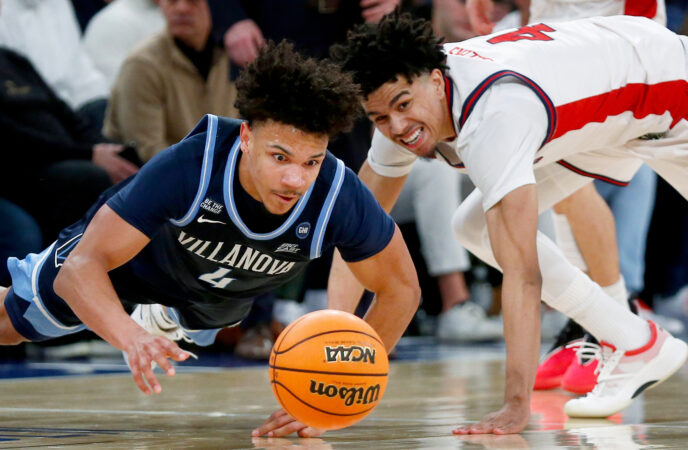
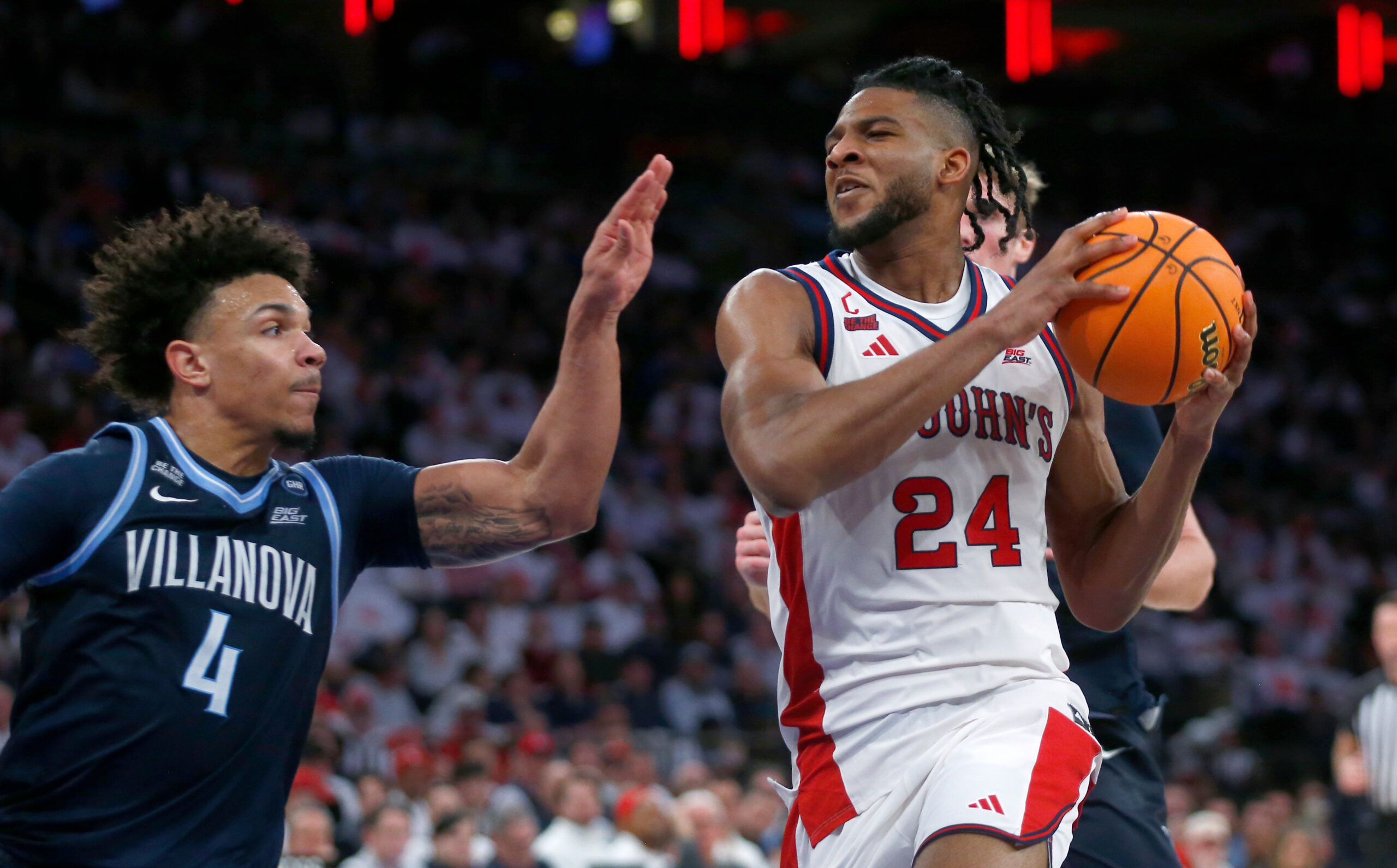
Villanova guard Tyler Perkins defends St. John’s forward Zuby Ejiofor on Saturday.
Back to the present day, Willard’s Wildcats on consecutive Saturdays received a dose of reality vs. the conference’s elite, but they also survived a rough stretch during Wednesday’s win over Butler.
“We still won seven out of nine games,” Willard said when asked if he was concerned about the timing of it all. “We lost to UConn and St. John’s. Unfortunately, I caught UConn after they played their worst game of the year and it seems like God is punishing me for my sins.
“We’re going to move on. We have two more games left. Life happens, man. You get your [butt] kicked every once in a while.”
Willard had a similar thing to say last week after a 10-point loss to UConn that wasn’t as close as the final score indicated. Villanova bused home late Saturday night and is back on the road for a Wednesday night game at DePaul. The regular season finishes Saturday with a home game vs. Xavier before the Big East tournament begins.
How will Villanova respond to its worst loss of the season?
Perhaps Willard can channel Pitino at Monday’s practice.
No update on Matt Hodge’s injury
Villanova redshirt-freshman forward Matt Hodge went down with what appeared to be a right leg injury early in the second half. Hodge was on the floor in pain for a few moments and then struggled to put any weight on his right foot as he was helped off the floor and into the locker room.
Willard did not have an update on Hodge’s status after the game.
Villanova forward Matt Hodge goes to the floor with an apparent injury during the second half against St. John’s on Saturday.
Wildcats locked into Big East seed
The loss Saturday means Villanova can’t possibly climb higher than third in the Big East conference. For reference, the Wildcats were picked seventh in the preseason poll. But there appears to be a steep drop off from UConn and St. John’s at the top.
The No. 3 seed means the Wildcats will open the Big East tournament with a 9:30 p.m. quarterfinal game vs. the winner of the game between No. 6 and No. 11.
As a matter of journalistic duty, I forced myself to watch the endless State of the Union reality show.
Punting on all serious issues, President Donald Trump stoked the applause meter by delivering awards to a 100-year-old vet and a brave U.S. pilot, and inviting the entire U.S. men’s Olympic hockey team to celebrate their gold medal win.
Trump was relentlessly racist (with disgusting slurs against all Somali Americans in Minnesota). His lies were dangerously predictive about the 2026 elections, never tiring of the Big Whopper about winning in 2020 and claiming Democrats must be stopped because they “only win if they cheat.”
In short, the union is in a dangerous state under an amoral, unprincipled, delusional commander in chief.
What disturbed me most as I watched Trump rant on is how a president could be so wholly indifferent to the liberal democratic values that underlie the existence of our nation. Although often honored in the breach, they are what have made this country unique. Yet, the sycophants in his administration, along with most GOP legislators, have chosen to abandon those values, or never believed in them from the start.
For that reason, I’d rank Secretary of State Marco Rubio’s speech at the recent Munich Security Conference as far more important than Trump’s sad State of the Union guff.
That’s because Rubio laid out an alternative set of U.S. values promoted abroad and at home by the political theologians of the Trump regime. Precepts that would make the Founding Fathers revolt anew.
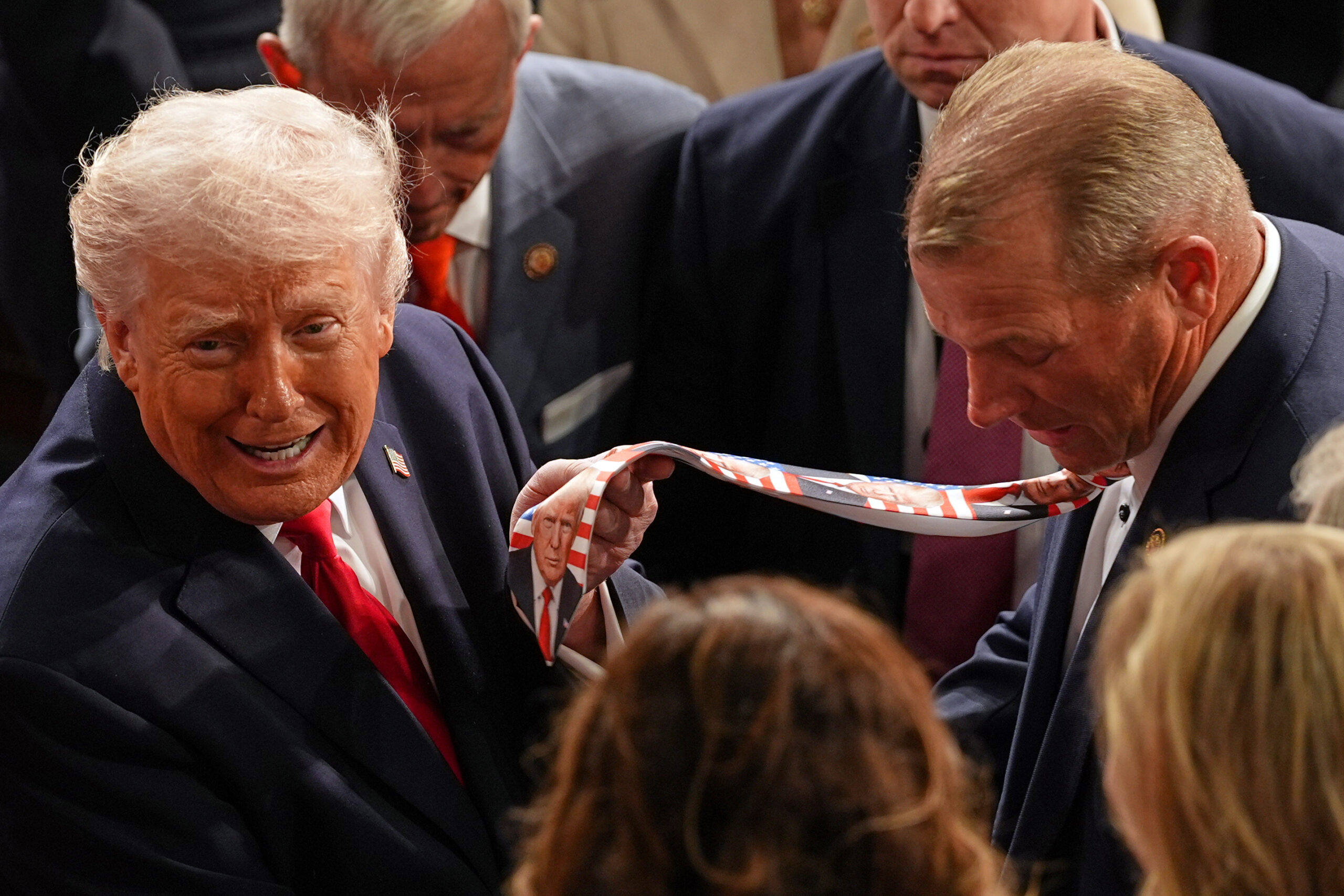
President Donald Trump holds up U.S. Rep. Troy Nehls’ (R., Texas) tie with his face on it as he departs after delivering the State of the Union address to a joint session of Congress in the House chamber at the U.S. Capitol in Washington, Tuesday.
The new theology revolves around the theme of saving “thousands of years of Western civilization” from the depredations of “woke” liberal democracy. It is an extension of language long used by white nationalists, and which came back to prominence during the rise of Islamist terrorism in the Mideast, which led to an influx of Syrian and Afghan immigrants into Europe fleeing civil wars at home. It became even more useful to Trumper populists when fanning fears of immigrants at home.
Former Trump adviser Steve Bannon and current Deputy White House Chief of Staff Stephen Miller latched onto the “saving Western civilization trope” a decade ago, and have embraced its transition into saving Western “Christian civilization.” Somehow, the term, which had been commonly used to describe shared Western religious and cultural identity for decades — Judeo-Christian civilization — has conveniently been shortened.
Never mind the historical inaccuracy of a term that tries to combine thousands of years of shifting, melding populations, ideas, and religions into one neat sum.
Yes, there are obvious philosophical threads from Athens to Rome to the Magna Carta, and ultimately to the values of the Enlightenment. But there are centuries of religious, ethnic, and philosophical wars, as well.
When Vice President JD Vance tried to promote the concept at the Munich Security Conference last year — and to promote white Christian populist parties in Europe as the saviors of “Western civilization” — the audience of European leaders, officials, and think tankers reacted with shock. More so when he berated German leaders for not inviting the neofascist Alternative für Deutschland (AfD) party into the government, even though its leaders have downplayed Adolf Hitler’s crimes. To add insult to injury, he pointedly paid a visit to the AfD’s political leader.
Vice President JD Vance addresses the audience during the 2025 Munich Security Conference at the Bayerischer Hof Hotel in Munich.
But Rubio was supposed to be different: the realistic, savvy foreign policy adviser who tried to save Trump from his worst instincts. When the secretary of state delivered remarks that praised U.S.-European ties, the eager audience was at first won over — until reality sank in, and many participants read the text of his speech.
Indeed, Rubio was warmed-over Vance, blaming liberal democracy (which, in the Enlightenment sense, means individual freedoms, human rights and rule of law, and observance of science) for all the West’s ills, and urging Europeans to junk “the global rules-based order.”
It got tiresome hearing Rubio tout the dangers of Western “civilizational erasure.” As Hillary Clinton noted — on a panel titled “The West-West Divide” — “When Rubio talks about Western ‘civilization,’ I never knew he was so supportive of Native Americans.” Then she added, “He is wrong historically.”
Indeed. “Western civilization” has become the MAGA dog whistle that stands for bashing all immigration and playing to racial fears.
No surprise, Rubio had not a word of criticism for the Russian invasion of Ukraine as an attack on “Western civilization,” although Vladimir Putin’s war crimes have upended the relatively peaceful, post-World War II order. And not a word of apology for Trump’s threat to seize Greenland from a NATO ally, which also threatened that order.
Nor any word of recognition that a dog-eat-dog world of unrestrained big power dominance resulting from an end to global “rules” will lead back to the violent era preceding World War II.
Instead, Rubio urged the Europeans not to be “shackled by guilt and shame,” which is a key buzz phrase for the AfD, which urges its members to stop apologizing for Nazi crimes.
Secretary of State Marco Rubio (left) and Hungarian Prime Minister Viktor Orbán shake hands after a news conference in Budapest, Hungary, on Feb. 16.
And right after his speech, the secretary rushed off to Hungary to praise the pro-Putin Prime Minister Viktor Orbán, a Trump ally who has done his best to destroy Hungarian democracy, including press and judicial freedom — and is trying to block European Union aid to Ukraine.
Yet, Orbán’s corruption and Hungary’s economic decline have become so overwhelming that he may be defeated in an April election. But Trump sent Rubio to bolster this antisemitic autocrat who repeats the “saving white Christian civilization” line.
It is no wonder the Munich scene erupted into debate about the West-West division over democratic values. As Germany’s Green Party coleader and Bundestag member, Franziska Brantner, stated: “Our values are rooted in the Enlightenment, in reason, science, freedom of religion, equal rights. The Enlightenment is a project, not a period in history. It is about very concrete individual freedoms, about free elections dependent on the will of the people, not run by oligarchs.”
“I don’t want to go back in history,” Brantner said flatly.
Norwegian Finance Minister Jens Stoltenberg added, in a restrained poke at Trump, “For all those who believe in liberal values and protection of the truth, it is difficult when we see that not all of our allies agree on these values.”
In Europe, at least, there is an active debate about the consequences of the junking of rules and history by the world’s most powerful democracy. The dangers to democracy are more immediately apparent to those who live closer to Russia and Ukraine.
Watching Trump’s performance and Rubio’s subservience, those dangers may seem obvious to many Americans. But they must find a way to get that message across more clearly to those who still doubt the danger here.
“Why would you not want to study the thing that lets you study,” said Schechtman-Taylor, a senior from New York City. “The brain, that’s our entire world.”
Neuroscience has become the most popular major on the highly selective liberal arts campus on Philadelphia’s Main Line, counting nearby Bryn Mawr College students who also take classes at Haverford. And it’s only been around since 2021 when the two colleges — which have had a minor in the discipline since 2013 — decided to administer the joint major.
At Haverford, there were 24 majors the year it started; now there are 60. Bryn Mawr saw similar growth and currently has 49. Enrollment in Haverford’s neuroscience classes including both Bryn Mawr and Haverford students grew from 154 in 2014 to nearly 800 last fall.
“We knew that neuroscience was going to be popular, but we did not anticipate this growth,” said Helen White, Haverford’s provost, who noted the school recently hired another neuroscience professor to accommodate more students.
The major’s popularity is also growing at schools around the Philadelphia region — and across the country. Students and professors say neuroscience is popular because it’s interdisciplinary, involving psychology, biology, and chemistry, and can lead to a variety of careers. It can also be personal, because it involves studying diseases like Alzheimer’s and Parkinson’s, which have no cures, and the treatment of strokes and traumatic brain injuries.
“I would say about 90% of my students are coming into my lab because they have someone in their family with one of these diseases,” said Rob Fairman, a Haverford biology professor whose research focuses on neuroscience.
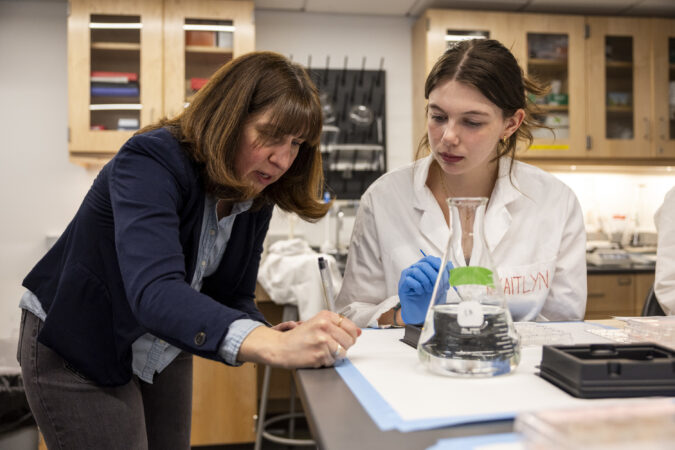
Haverford senior Alina Schechtman-Taylor, 21, of New York City, works as a teacher assistant in professor Laura Been’s lab.
A growing major
In 2008, 110 colleges nationally offered neuroscience majors; now, it’s about 330, said Raddy Ramos, associate professor in the Department of Biomedical Sciences at the New York Institute of Technology. Ramos, who coauthored studies on the topic, said there were more than 2,000 neuroscience graduates in 2008; in 2019, that number had grown to more than 7,200.
window.addEventListener(“message”,function(a){if(void 0!==a.data[“datawrapper-height”]){var e=document.querySelectorAll(“iframe”);for(var t in a.data[“datawrapper-height”])for(var r,i=0;r=e[i];i++)if(r.contentWindow===a.source){var d=a.data[“datawrapper-height”][t]+”px”;r.style.height=d}}});
Pennsylvania is a hot spot, with 36 colleges having programs in 2022-23, Ramos said — more than than any other state.
Drexel University, which has had a minor since 2015, launched its undergraduate major in neuroscience in 2024.
“We have seen a 45% increase in applications over the last two years,” a university spokesperson said.
Pennsylvania State University in November announced it was launching two new undergraduate majors in neuroscience, one offered by the biology department and the other by the biobehavioral health department.
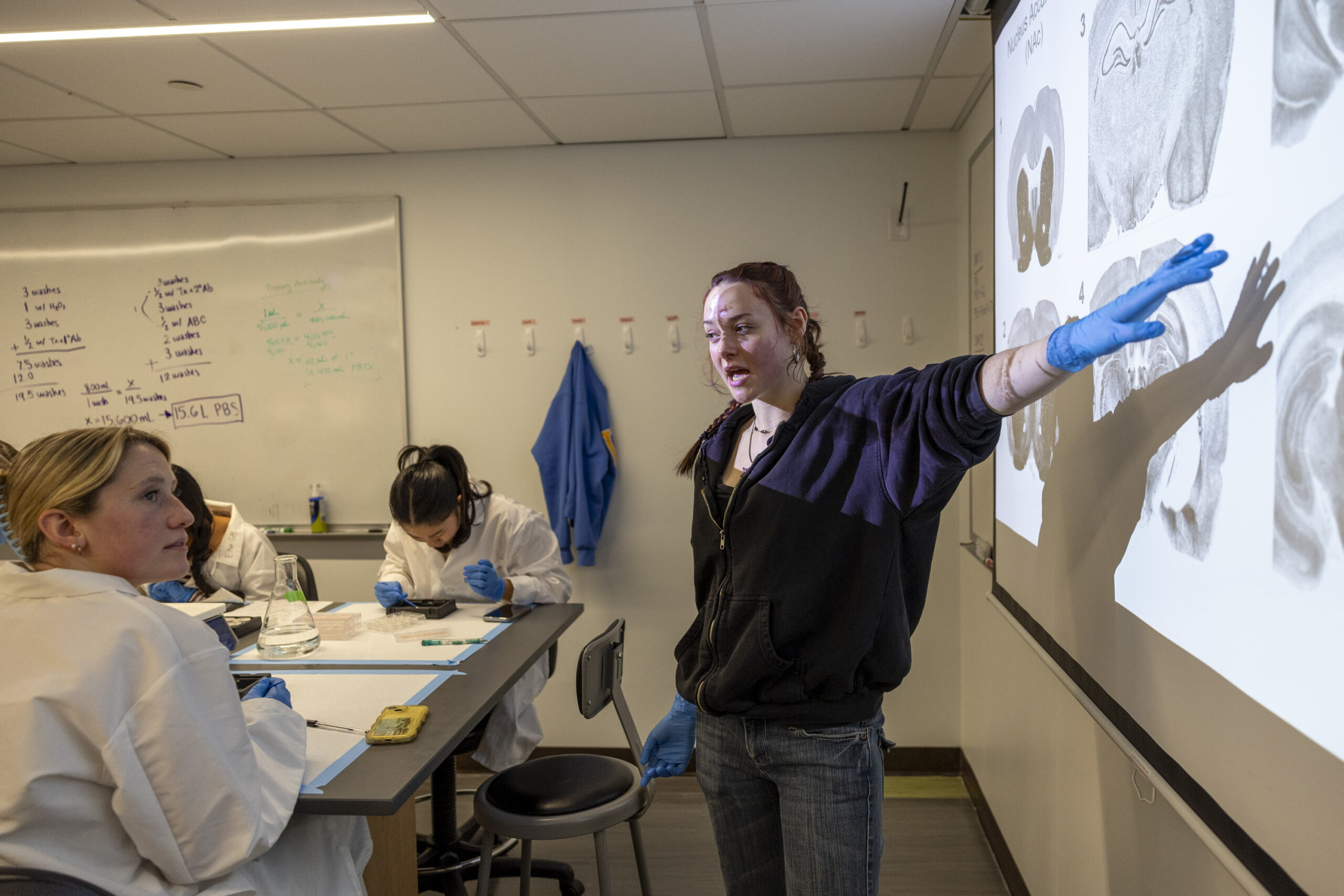
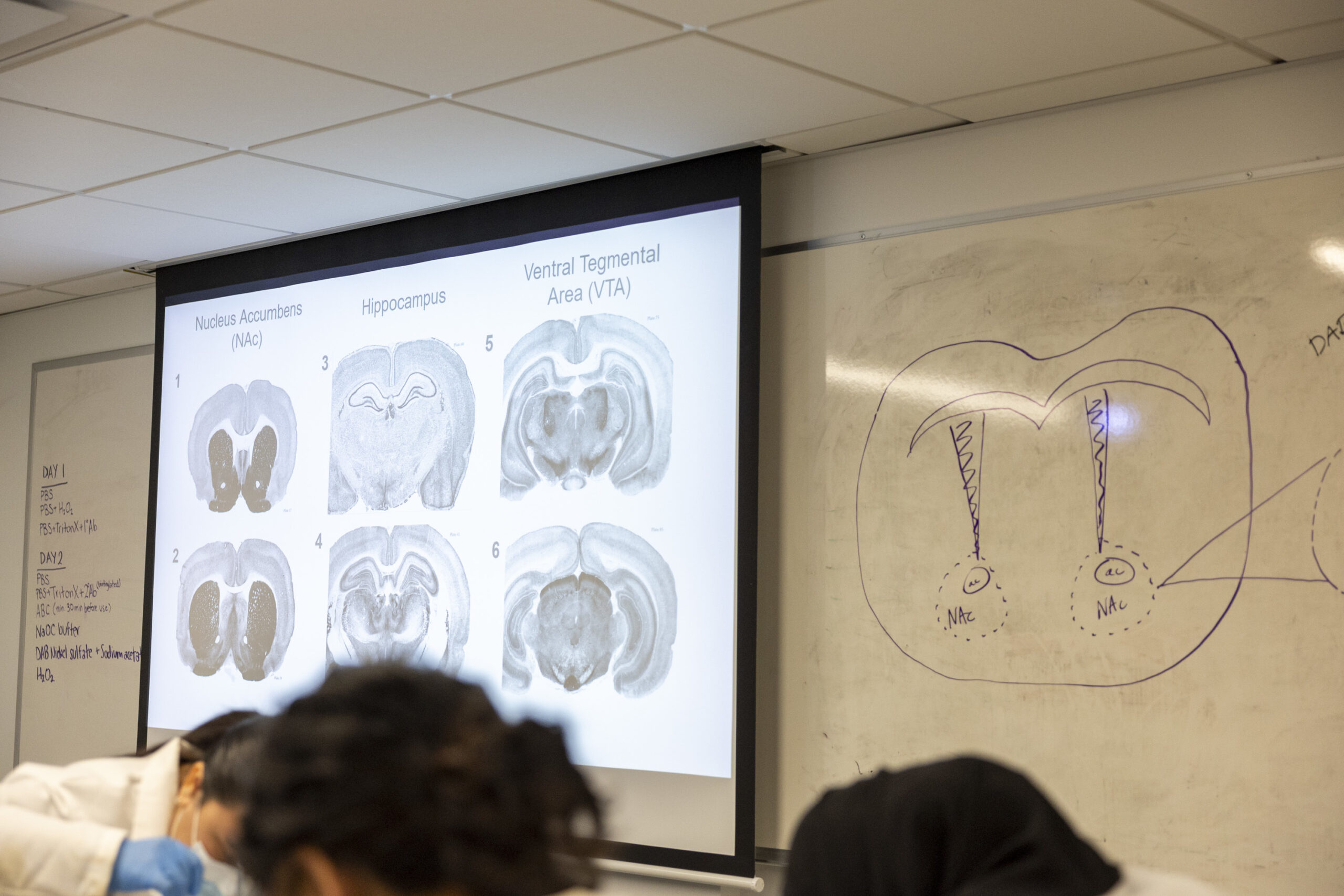
Students look for sections of rat brains that match the sections projected on the screen in a Haverford College lab.
Neuroscience has become especially popular among pre-med majors, school officials say. Otherpotential career paths include biotechnology, pharmacology, psychology, and neuroengineering, while somestudents go on to law school, business, or public policy.
“There’s a lot more awareness that mental health conditions are due to changes in the brain, and people want to understand that,” said Lisa Briand, associate professor and program director for Temple University’s neuroscience program.
At Temple, neuroscience has become the fourth largest of 30 majors in liberal arts, Briand said. The psychology department a few years ago changed its name to psychology and neuroscience, she said.
At the University of Pennsylvania a decade ago, 100 to 120 neuroscience majors graduated annually, said Lori Flanagan-Cato, associate professor of psychology and codirector of the undergraduate neuroscience program.
“Twice in the past 3 years we have had over 150,” she said.
Swarthmore College, a highly selective small liberal arts college, graduated 10 to 12 neuroscience majors a year about a decade ago, said Frank Durgin, professor of psychology who oversees the program.
“This year, we anticipate graduating 24 majors,” he said. “Next year, it’s 30.”
The college has added two professors in the last two years to accommodate growth, he said.
Why students study neuroscience
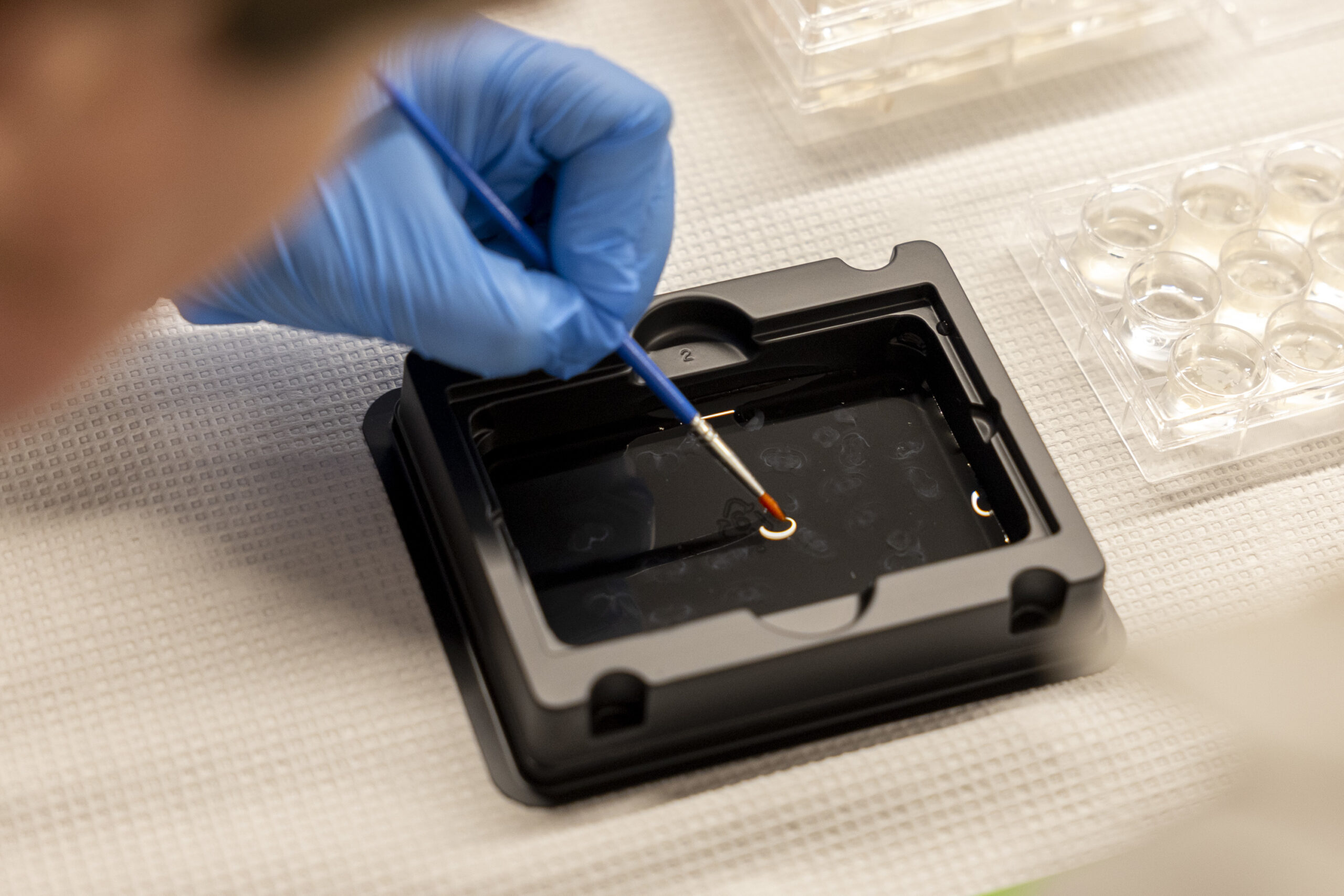
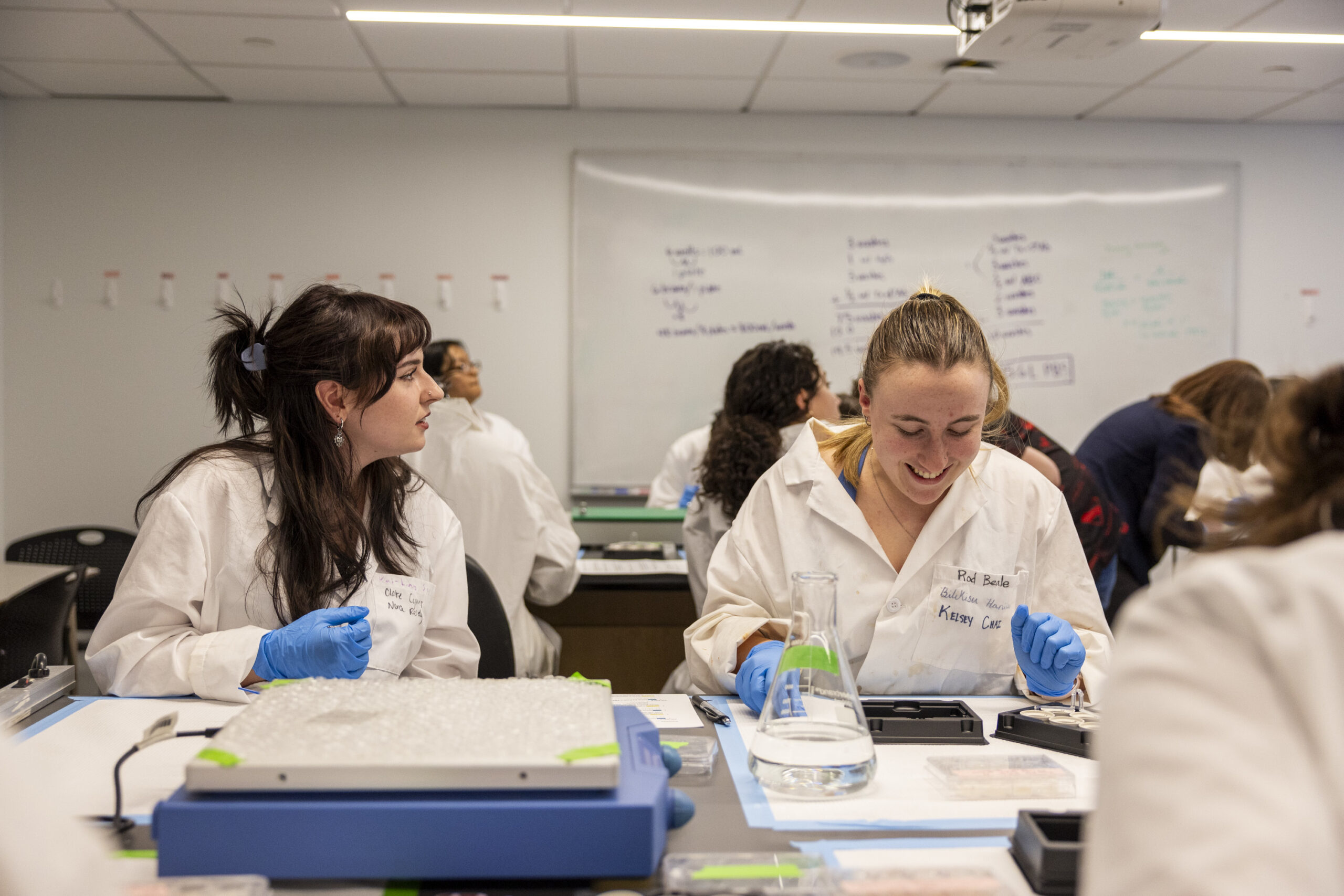
In a lab at Haverford one afternoon last month, 16 students in white lab coats poked with paintbrush tips at thin slices of rat brain in preservative fluid, preparing to stain them to look for which neurons were activated. Some of the rats received the drug Ritalin, commonly used for attention deficit disorder, while others did not. Students were trying to discern differences in their brains when they performed certain tasks, said Laura Been, associate professor of psychology and director of the bi-college neuroscience program.
A neuroscience student works with sections of rats’ brains in a lab at Haverford College.
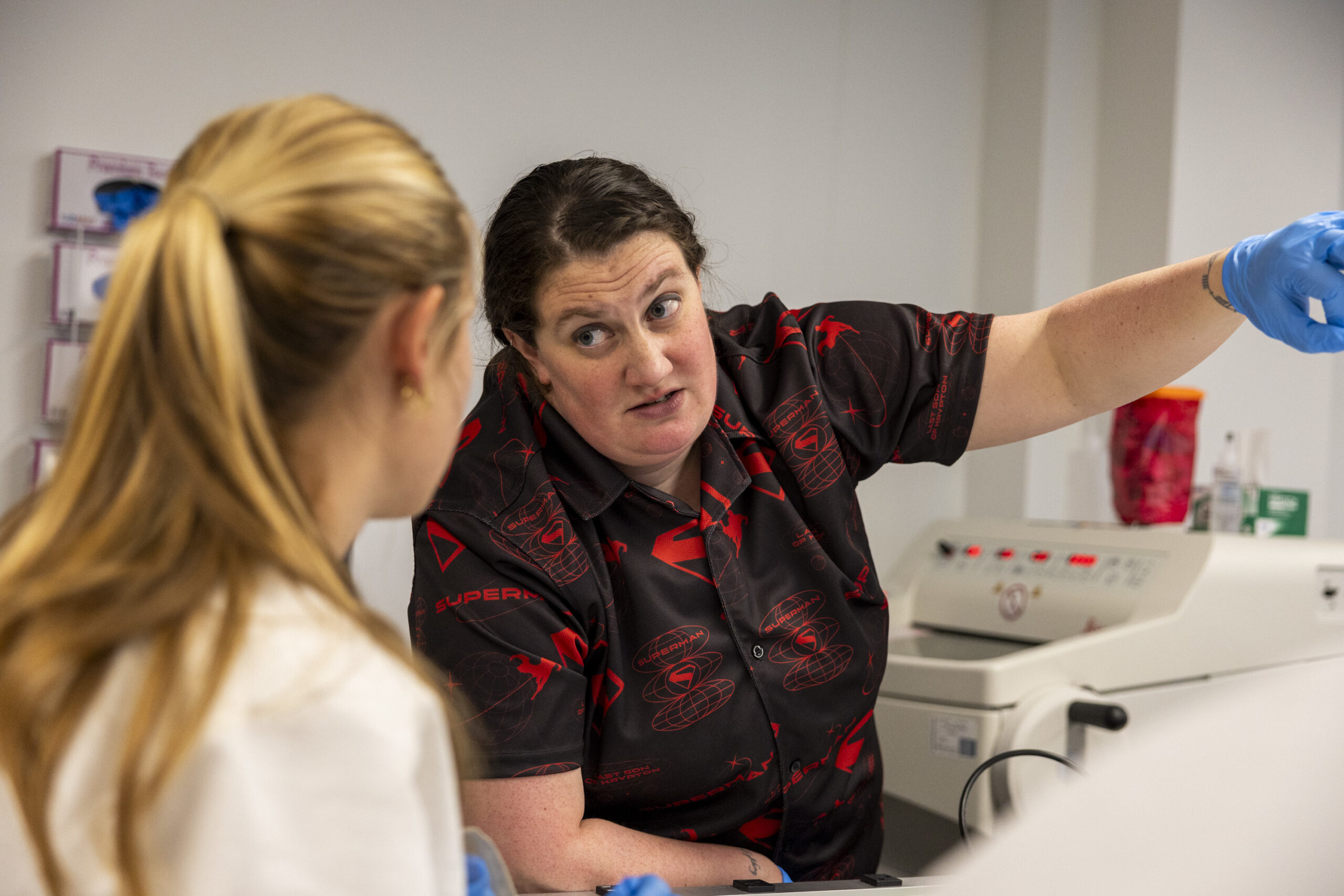
“We can … try to learn something more about how this sort of drug treatment impacts the brain,” said Been, whose area of interest is behavioral neuroendocrinology, which looks at the relationship between hormones, the brain, and behavior.
Students in Been’s class had varied reasons for studying neuroscience.
Emily Black, visiting assistant professor of neuroscience at Haverford College, helps Savannah Shaw, 22, of Downingtown, during neuroscience lab work. “I really like the variety of the classes we can take in the major,” said Shaw, a senior who plans to go to medical school, possibly to become a neurologist. “You can go more the psychology route or go more biology.”
Sophia Lipari, 21, a junior from Jacksonville, Fla., whose father is a reproductive endocrinologist, is interested in hormones and the field of fertility.
Riley Fass, 20, a junior from Claremont, Calif., wants to be a special-education teacher. She already sees the connection between neuroscience and her job as a teacher’s assistant at a school where children have traumatic brain injuries and cerebral palsy.
“The topics we discuss — an injury here will result in this — I can actually see it in my students,” she said.
Iris Goxhaj (left), 21, of Northeast Philadelphia, and Riley Fass, 20, of Claremont, Calif., work with sections of rats’ brains in a lab at Haverford College.
Deeya Abrol’s interest was stoked when she worked with a child on the autism spectrum as a swim instructor. Abrol, 22, a senior from Los Gatos, Calif., plans to go to medical school.
Schechtman-Taylor meanwhile wants to pursue biomedical engineering and specifically developing medicines for the treatment of neurodegenerative disorders.
“I want to work on the treatment side,” she said.
Fairman, the Haverford biology professor, said a recent graduate’s mother had died of Huntington’s disease, meaning she has a 50% chance of getting it, he said. She worked in his lab and wanted to be involved in hisresearchon protein clumping in the brain and its effect on diseases such as Parkinson’s and Alzheimer’s.
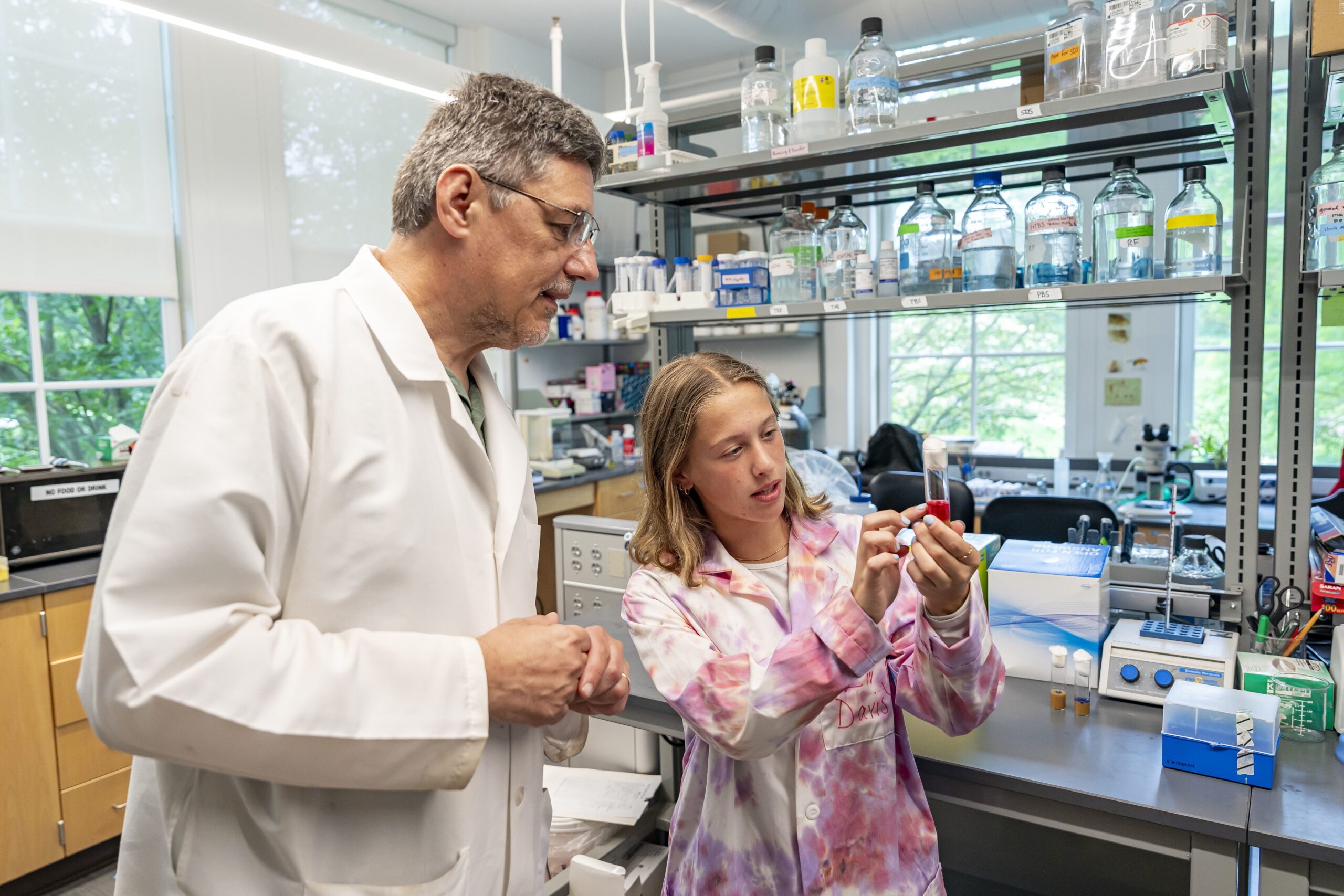
Rob Fairman, a professor of biology at Haverford College, and student Liv Davis are testing the effects of natural products on animal models with neurodegenerative diseases.
Junior Liv Davis, 21, wanted to help find a cure for Parkinson’s, which struck her grandmother in 2020.
“She’s had two falls in the last year and a half because it’s progressed pretty quickly,” said Davis, of Lanoka Harbor, N.J. “It’s hard to see someone you love so much live with it, but it makes it all the more rewarding to work toward fixing it.”
Davis, who has worked in Fairman’s lab since her freshman year, tried to get into an introduction to neuroscience class early on. But there wasn’t room. She ended up majoring in biology, which she thinks probably would have happened anyway.
About half the students working in Fairman’s lab are neuroscience majors, he said.
Davis is currently studying the effect of a chemical on sleeping fruit flies that have been genetically modified to carry the protein associated with Parkinson’s.
Last summer, she received an inaugural research fellowship funded by Shamir Khan, a Haverford alumnus and psychologist who was diagnosed with early-onset Parkinson’s.
Her grandmother was glad she could continue the research, said Davis, who plans to become a doctor.
“She always jokes with me,” Davis said. “‘Give me a spoonful of that chemical, whatever it is. If you need a test subject, you let me know.’”
To be a privy digger in Philadelphia is to be part excavator, part flea market authority, and part pirate. First, you must be able to dig — sometimes 30-plus feet in rocky soil — to get to the bottom of a centuries-old outhouse. Whatever you find buried in the organic waste there, you must research. And much of this digging and discovery takes place in secret in the middle of the night, on open construction sites across the city where you’re not exactly supposed to be.
“Obviously, it’s sketchy. We would have the police come,” said Matt Waholek,39, a longtime Philadelphia privy digger who now lives on Long Island. “They would be like, ‘Alright, you’re not burying bodies, right?’”
Privy diggers are not burying bodies. Instead, Waholek and his fellow diggers are hobbyistsprobing for a certain kind of treasure — ceramic cups and bowls, clay pipes, glass bottles — that long-ago Philadelphians threw into their outhouses before the existence of citywide trash collection.
Most of the diggers are only interested in land that was developed before 1880, when the rise of factory production led to fewer handmade objects. One digger described finding half a dozen handblown glass devices from the mid-19th century that turned out to be early breast pumps.
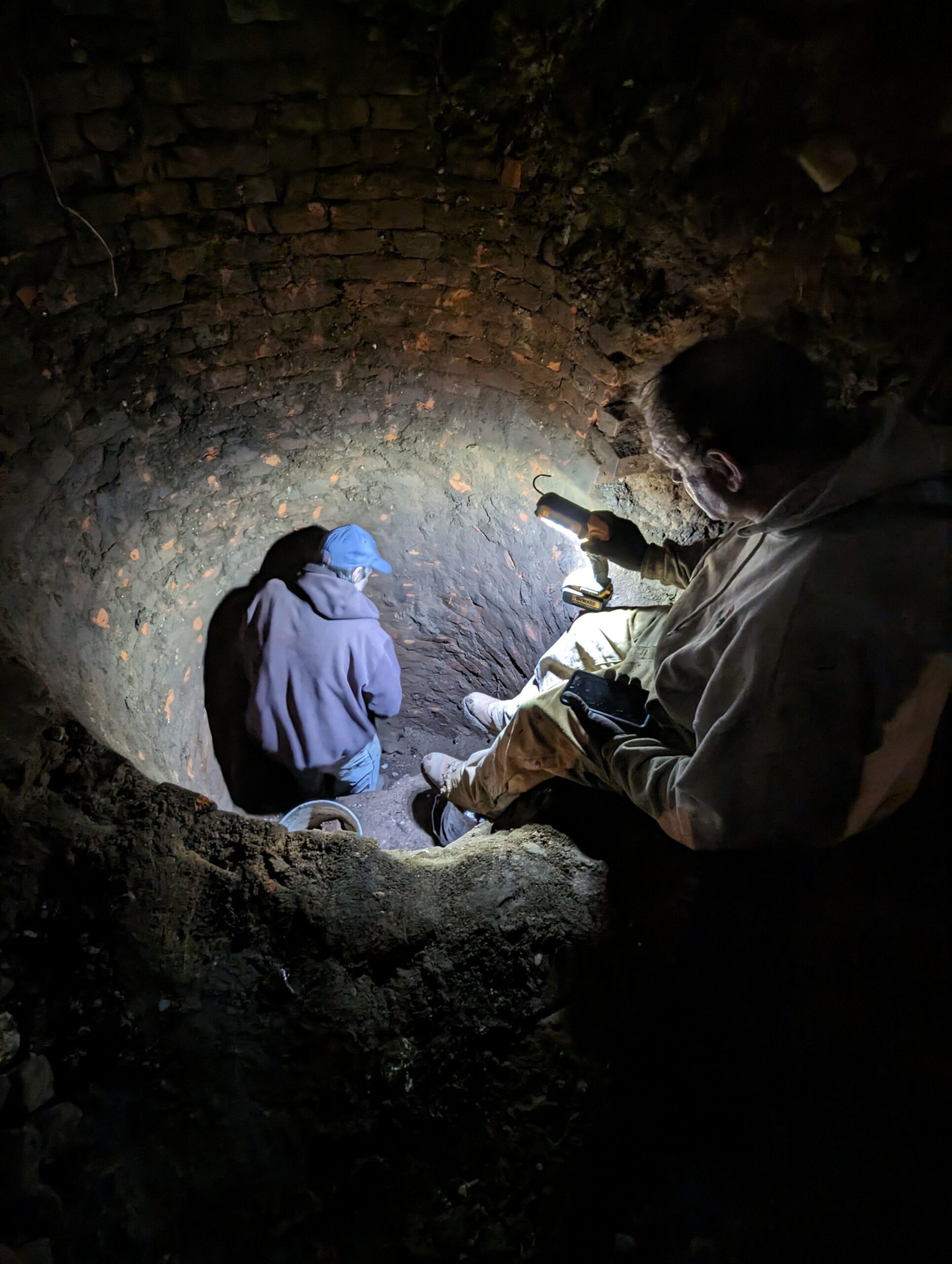
Privy digging is often done at night, when construction workers are not on-site, and diggers often work in pairs or teams because the digging itself can be dangerous. This photo was taken during a dig in Old City in November 2023.
It’s a largely male, macho subculture, rife with big characters and rumors of those who are not to be trusted because they absconded with their fellow diggers’ treasure.
“One guy was checking his car for pipe bombs ‘cause he thought I was gonna blow his car up,” said George Mathes, owner of the thrift store Thunderbird Salvage in Kensington, who has dug about 1,000 privies over the years. (He said he did not blow up anyone’s car.) He estimated there are about 15 privy diggers excavating today in the city.
As America’s 250th birthday approaches, Philadelphia is in the national spotlight, being counted on to reflect the country’s history back to itself. The question of how to preserve and tell that history has become more pressing than ever.
With its 300-year-old neighborhoods and relatively lax oversight, Philly is alsoa center of clandestine digging. People are legally allowed to keep almost anything they find under the ground on their own properties; privy diggers describe legally digging on someone else’s property as being “on a permission.”
A collection of bottles from the 1850s, dug out by Matt Waholek and other diggers from a privy in Queen Village in 2015. The collection includes pontil soda and beer bottles, as well as stoneware beer bottles. The clay used to make the bottles was sourced in Philadelphia, and most of the glass was probably produced here.
But there’s also a fair amount of trespassing, and some of the privy diggers sell what they find. (Prosecution is rare, though Mathes was arrested and sentenced to 24 hours community service for digging on someone else’s property in Old City in 2010, he said.)
All of this has frustrated professional archaeologists, whose job is not just to remove particularly interesting relics from the earth, but to document exactly where they were found and what relation they had to one another, in an attempt to tell a whole, contextualized story about the past.
They say Philadelphia has done little to protect its buried history. Unlike other historic cities, such as Boston or Alexandria, Va., Philadelphia does not have a city archaeologist, who would be responsible for guiding the city’s historical commission and offering insight to residents.
Into that breach, some see the amateurs — “whether you want to call them looters or private collectors,” as Doug Mooney, president of the nonprofit Philadelphia Archaeological Forum, put it — as taking and selling collective artifacts while recklessly destroying historical sites in the process.
Much of what professional archaeologists are interested in is not glamorous, said Jed Levin, an archaeologist for more than 50 years and the vice president of the forum. They are just as compelled by the preserved remains of human intestinal parasites and hundreds-year-old pollen grains as they are by whole glass bottles. Such microscopic information can reveal what Philadelphians were eating and growing hundreds of years ago.
Yet that kind of detail is lost to amateur diggers, who are far more interested in removing intact artifacts, some of which might net them hundreds or thousands of dollars.
“They dig indiscriminately through soil layers,” said Levin. “Once you dig through a site, you’ve destroyed it. It’s gone.”
Matt Dunphy digs a privy pit near his home in Old City in May 2021. The dark column of soil in the right corner is indicative of the nitrogen-rich soil (also called “night soil”) found in a privy pit. This particular pit was 7 feet wide and 20 feet deep, likely dating to the 1740s.
The code of the privy pirates
Privy digging as a hobby surged in Philadelphia in the late 1960s, when the construction of Interstate 95 uprooted miles of soil across the city.
Over the decades, it became a passionate pursuit and then an underground industry. It’s driven largely by obsession: Diggers might find treasure, but they also might find nothing at all. Some end up with hundreds or thousands of broken pottery pieces. When I asked Waholek what he did with all the things he found over two decades, he replied, “Do you want some of it?”
Both the city’s amateur diggers and the professional archaeologists contend that they’re the ones working in the public interest, aiming to make their findings available to the most people.
“I don’t like the word ‘amateur.’ I probably know a lot more than some archaeologists. They focus mainly on one topic,” said Waholek, who calls himself an “avocational archaeologist.”
Some privy diggers say they are particularly moved to preserve objects that otherwise might be forgotten. Mathes, of Thunderbird Salvage, said he had found spearheads and Native American artifacts in his digs, objects which he does not sell. (Repatriation laws don’t apply to private property owners).
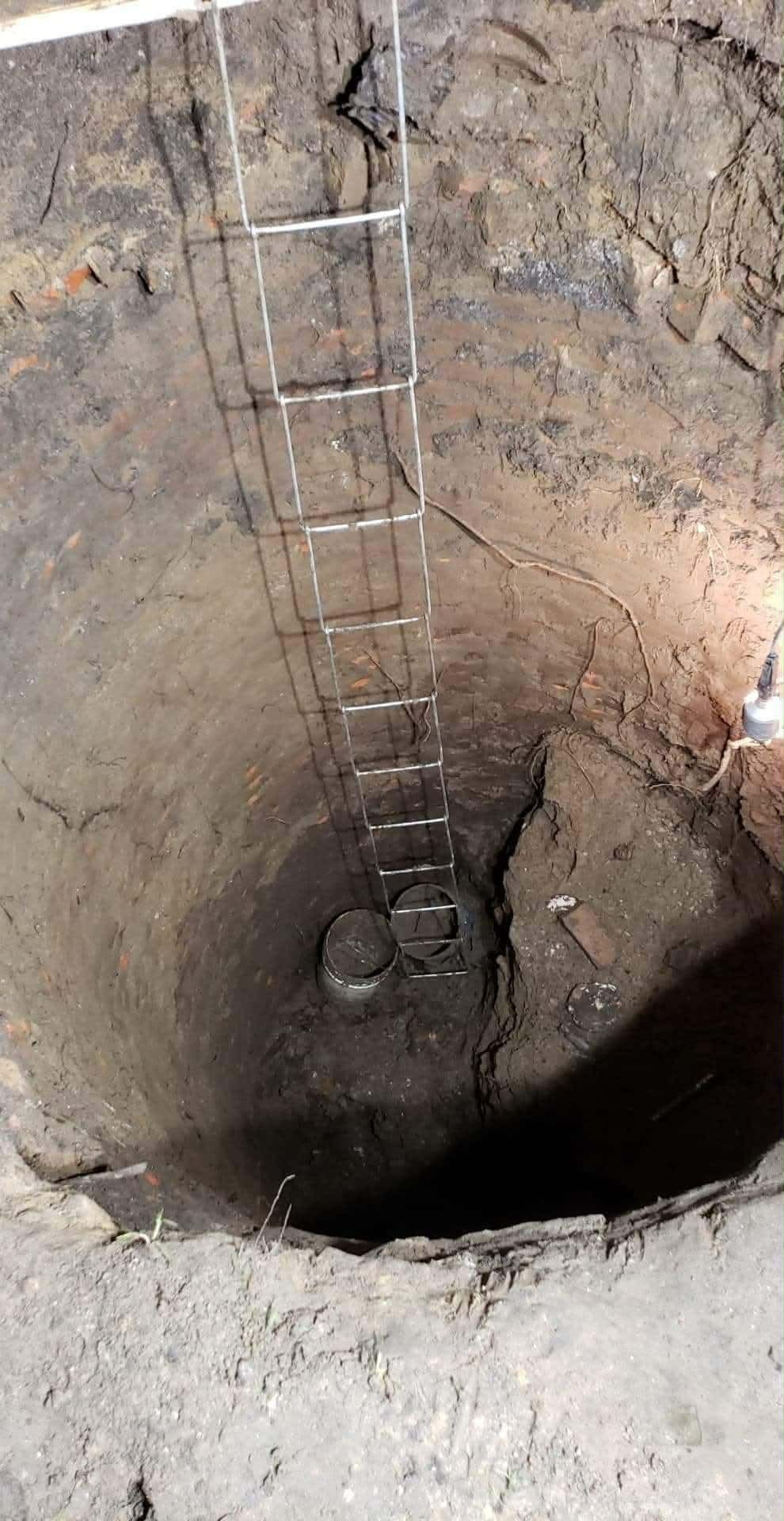
A brick-lined privy in North Philadelphia, pictured here in 2015. The ladder is an antique fire escape salvaged from a demolition on Frankford Avenue.
“To me, they’re more spiritual. I display those with the greatest of respect. I show them off to people, I like to hold them,” he said. “To donate them to a museum, most of the time they’re going to get put in a drawer and not displayed because there’s limited space.”
Over the years, some diggers have formed relationships with construction workers and police. One local developer described learning about the hobby when he encountered a group of men trespassing on his construction site carrying what he believed to be spears. (They were actually handmade metal probes, which the diggers use alongside shovels, clam rakes, pickaxes, and tripods and pulleys.) The developer was disturbed until he, too, became fascinated.
As with any subculture, there are rules about how to dig with integrity, said Michael Frechette, 60, an artist and veteran privy digger who lives in Kensington. Among them: Always ask permission; never dig on federal land where archaeologists are already working; fill in the hole you make; respect other diggers’ claims; and maintain honor within your own group — equal work should lead to equal bounty.
But, of course, as Mathes put it: “There’s pirates that work with you and there’s pirates that’ll work against you.”
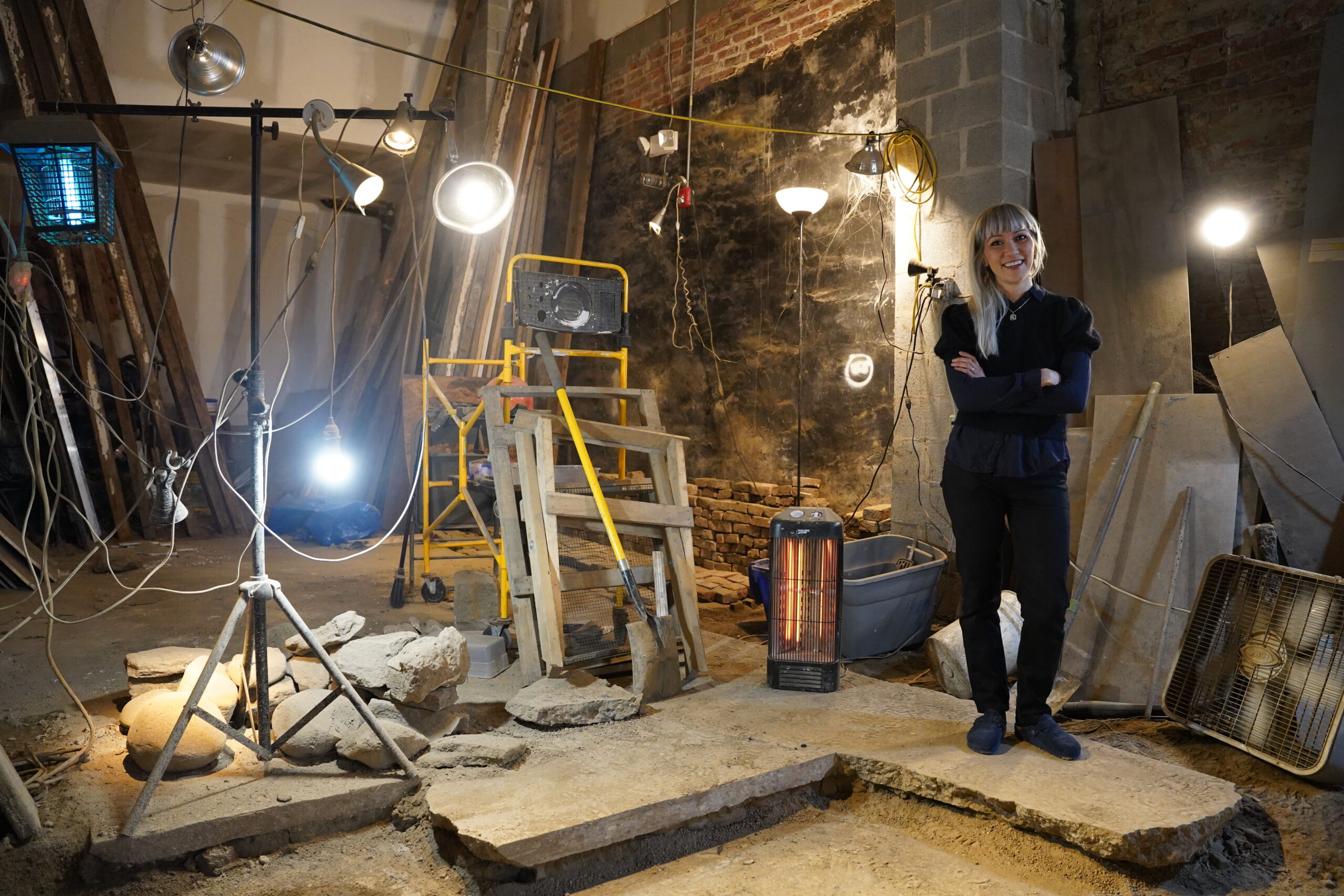
Melissa Dunphy, pictured here in 2022, stands in the ground level of her Old City property. It was here that Dunphy and her husband, Matt, discovered two privies filled with 18th century artifacts.
Who gets to call themselves an archaeologist
The non-sketchy, wholesome representatives of the privy digging community in Philadelphia are Melissa and Matt Dunphy, who call themselves “citizen archaeologists.” She’s a composer with a doctorate in music; he’s an e-commerce engineer.
They fell down the rabbit hole of privy digging about a decade ago after they bought a shuttered magic theater in Old City with a deed dating back to 1745 and began to renovate.
The construction workers uncovered two privies on their property, one of which the Dunphys excavated right away. Since then, they’ve dug six more privies in the vicinity and launched a podcast, The Boghouse, about their discoveries.
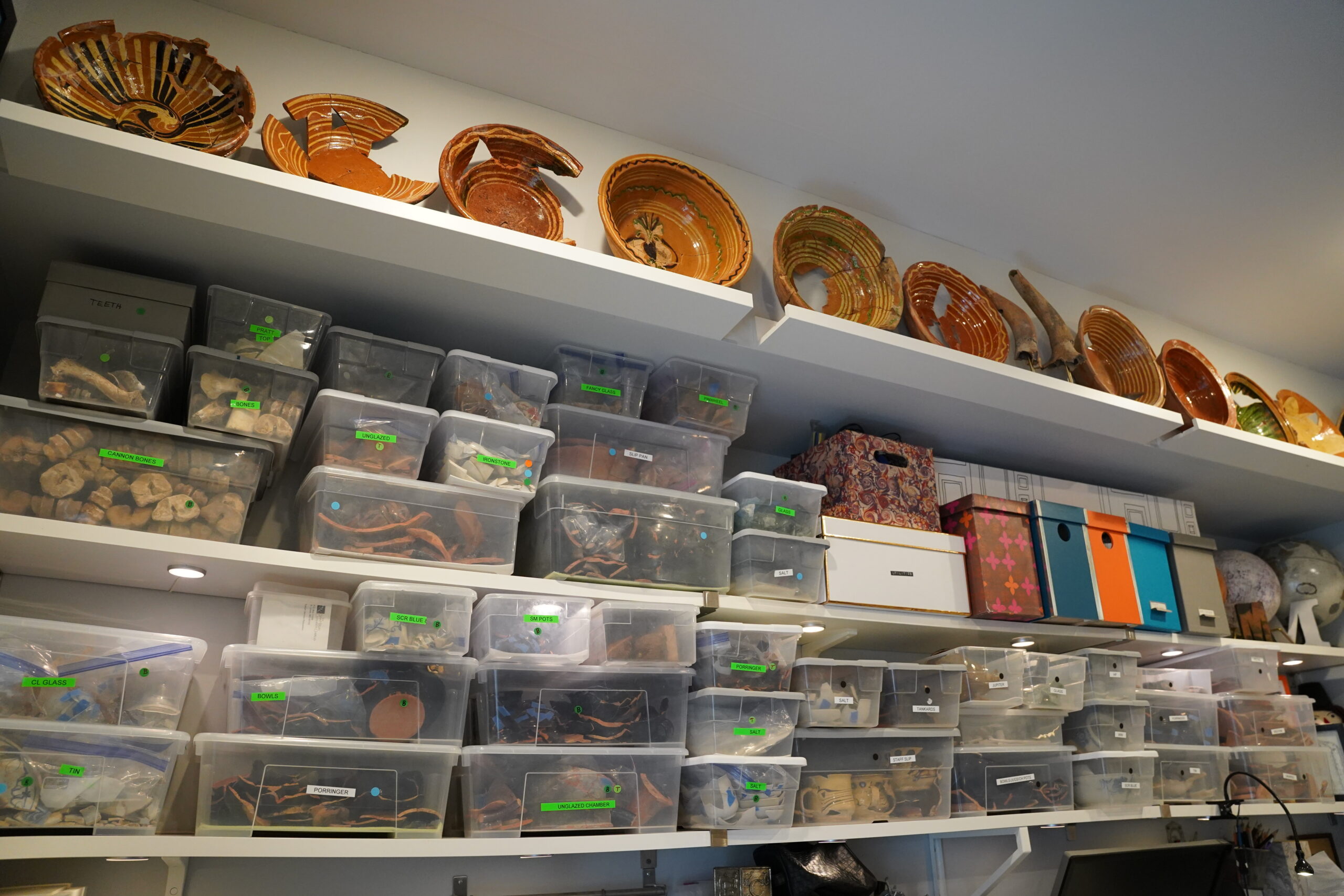
Every inch of the Dunphys’ walls are taken up by artifacts they’ve dug up in privies near their home in Old City.
The two have become “obsessed at the level that now we give talks at Colonial Williamsburg,” Matt Dunphy said.
Their apartment, on the third floor of the former magic theater, is packed floor to ceiling with thousands upon thousands of shards of pottery and other artifacts. The bathroom has relics displayed on every wall, and the glass cabinets in the kitchen are filled not with matching plates but with broken teapots, chamber pots, punch bowls, and cups, each with their own carefully researched backstory.
The Dunphys are amateurs whohave not formally studied archaeology, but they are brimming with intellectual curiosity and knowledge about what they’ve found.
They mostlydon’t sell their discoveries (Melissa Dunphy has sold some found teeth) and are instead working to build a museum on the ground floor of the theater, which they hope to open by July. They want to call it “The Necessary Museum,” because privies were often called necessaries.
“These objects — even something as simple as a bowl — tell you something about the people who used them, the people who made them, the journey that that object took,” Melissa Dunphy said. “This is like a passing of stewardship of this little postage stamp-sized corner of the world.”
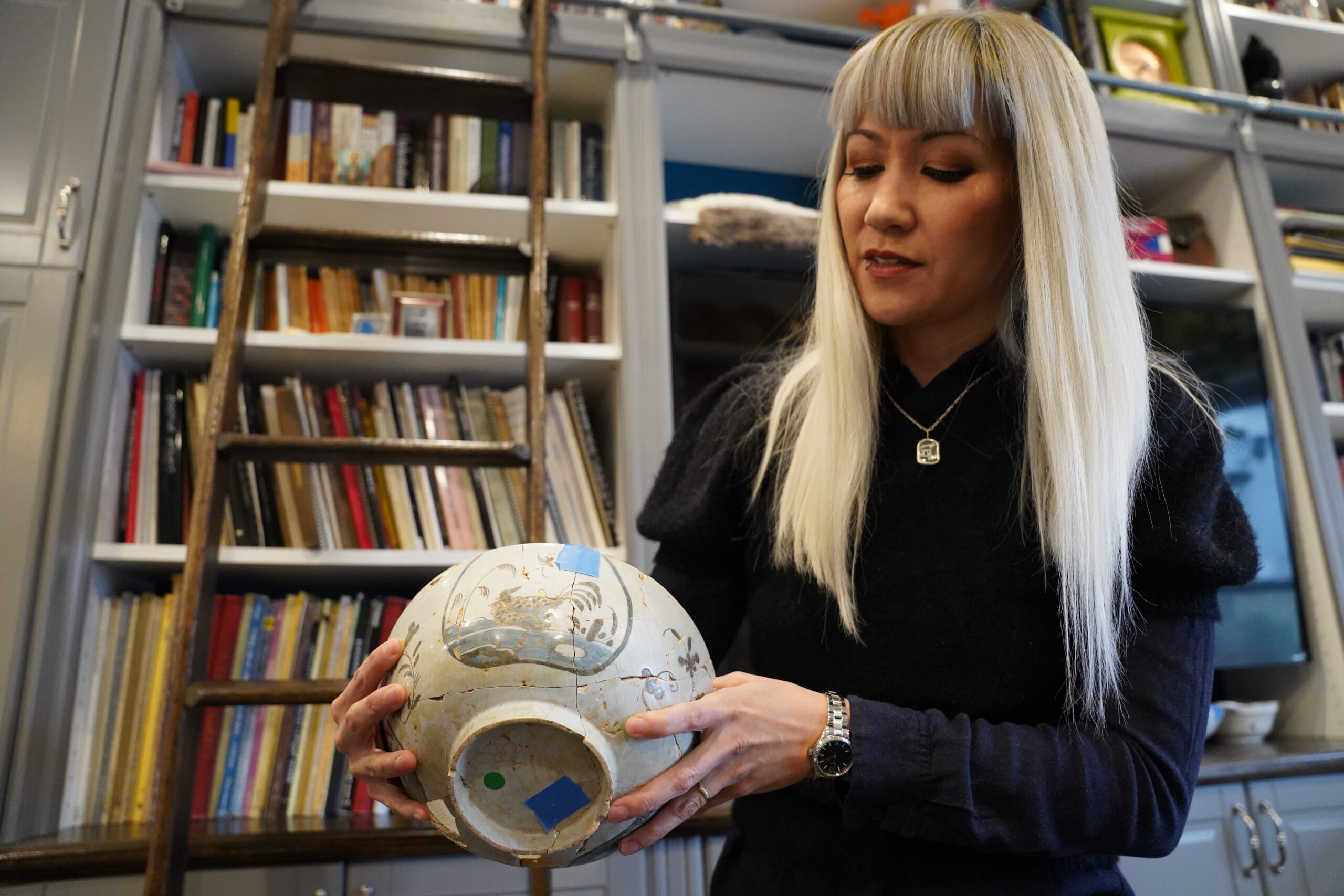
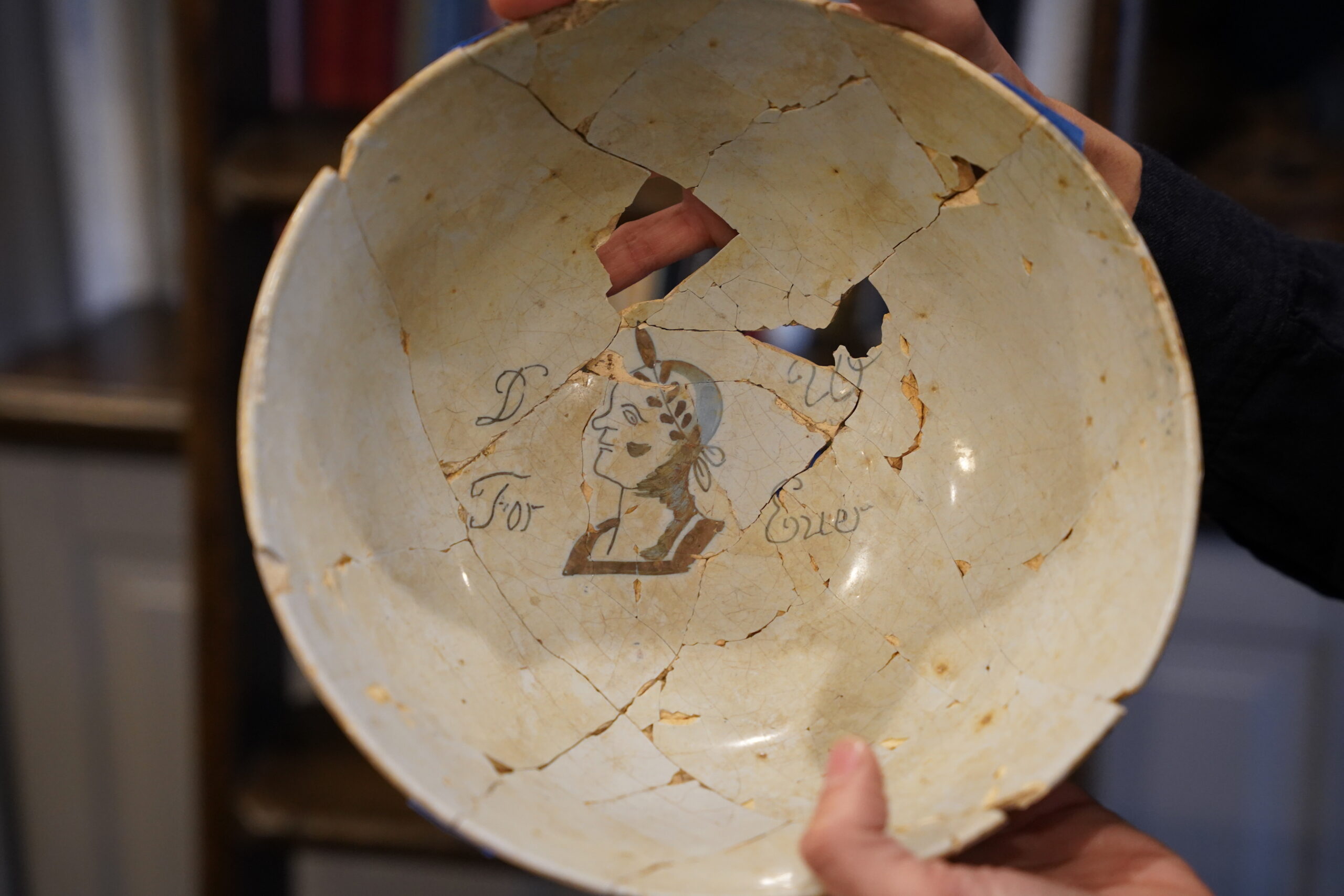
Melissa Dunphy, pictured here in 2022, holds a delft punch bowl which she pieced together from pieces found in the privies below her house. The bowl commemorates Britain’s victory over the Scottish Jacobite Army at The Battle of Culloden in 1746.
“What an anti-Jacobite bowl is doing in my privy is such an exciting question to me,” Dunphy said.
Melissa Dunphy, pictured here in 2022, holds a bowl at the Dunphy’s home.
Unlike those who work in secret, the Dunphys are in close touch with archaeologists at the National Park Service and local museums, speak at archaeology conferences, and regularly text with the editor of the academic journal Ceramics in America, whom they consider a mentor.
When they first found glass bottles in the privy in their backyard back in 2016, they tried reaching out to various archaeologists and museums in the city asking how they should proceed, they said. But no one was particularly helpful, and they only had a week before the hole would be filled in.
So they set about trying to “rescue” as much as they could themselves.
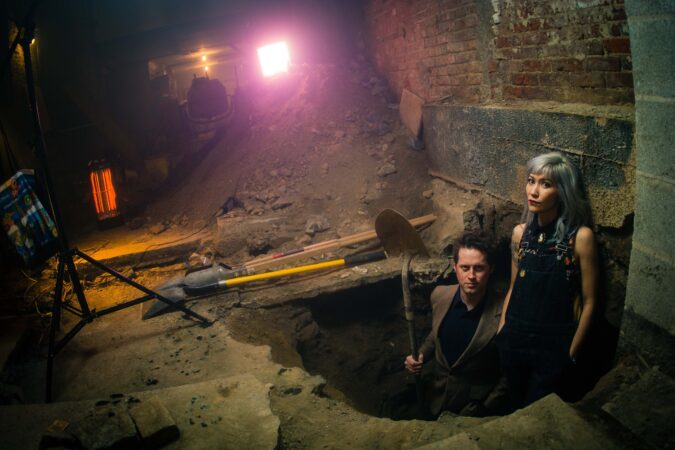
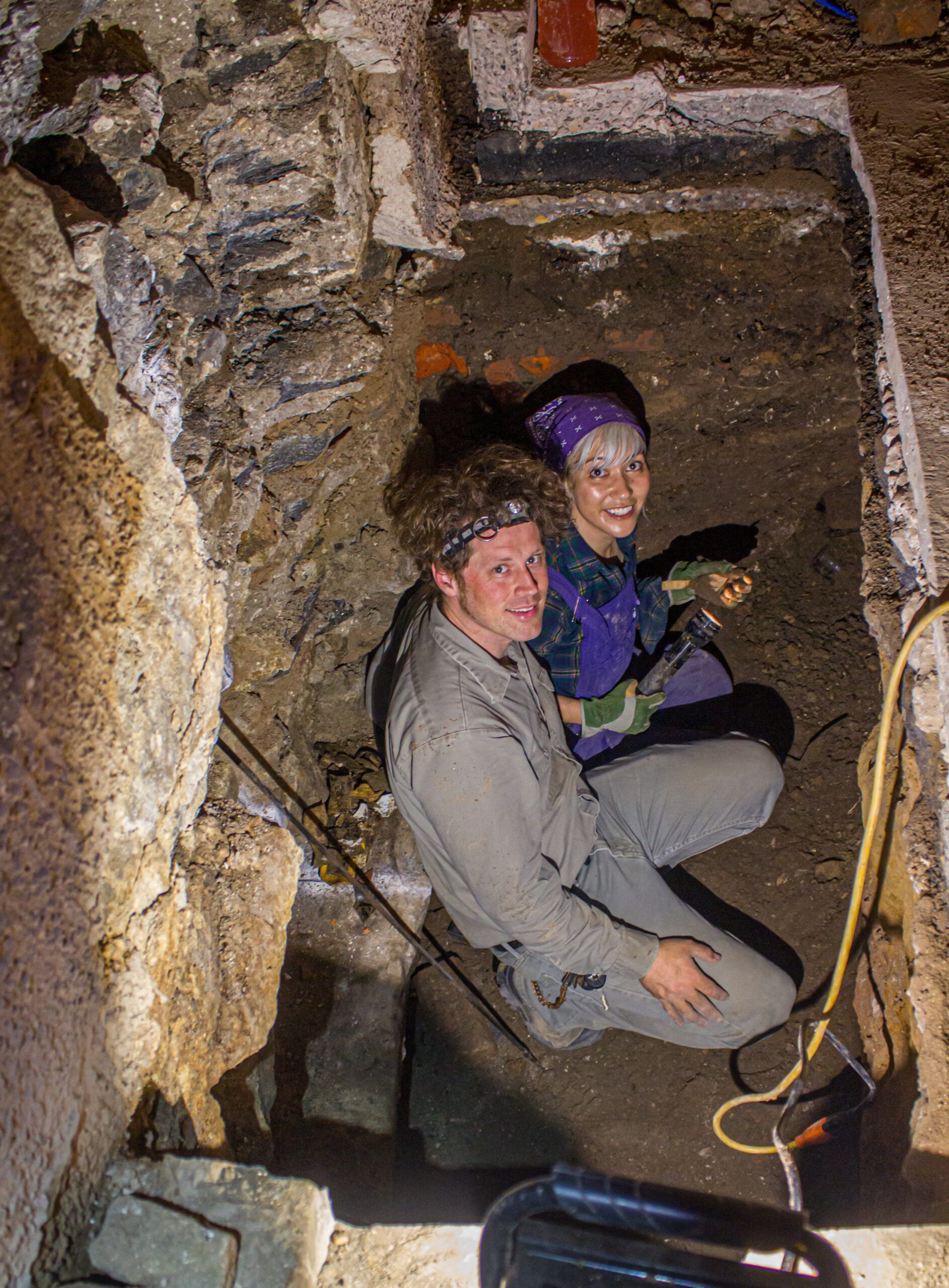
Matt and Melissa Dunphy pose in their first privy dig, in this photo from July 2016. While foundation work was being done on the shuttered magic theater they had just bought, workers unearthed two colonial-era privy pits. The Dunphys excavated them, fueling a decade-long obsession.
“My assumption then was that this archaeology is probably everywhere in Philly, and it’s probably not that important. So I don’t have to feel academically guilty about doing it myself, without any real expertise,” Melissa Dunphy said. She descended the privy hole in a cobbled-together archaeological outfit: Duluth Trading Co. coveralls, a “Rosie the Riveter” scarf, a camping headlamp.
The couple fashioned screens from chicken wire they bought at Home Depot to sift pottery from dirt, and Matt Dunphy photoshopped a picture of a ruler he saw at the Museum of the American Revolution to measure the objects they uncovered.
Scott Stephenson, president of that museum, who in the years since has gotten to know the Dunphys well, said he supports people doing “citizen archaeology” alongside professionals.
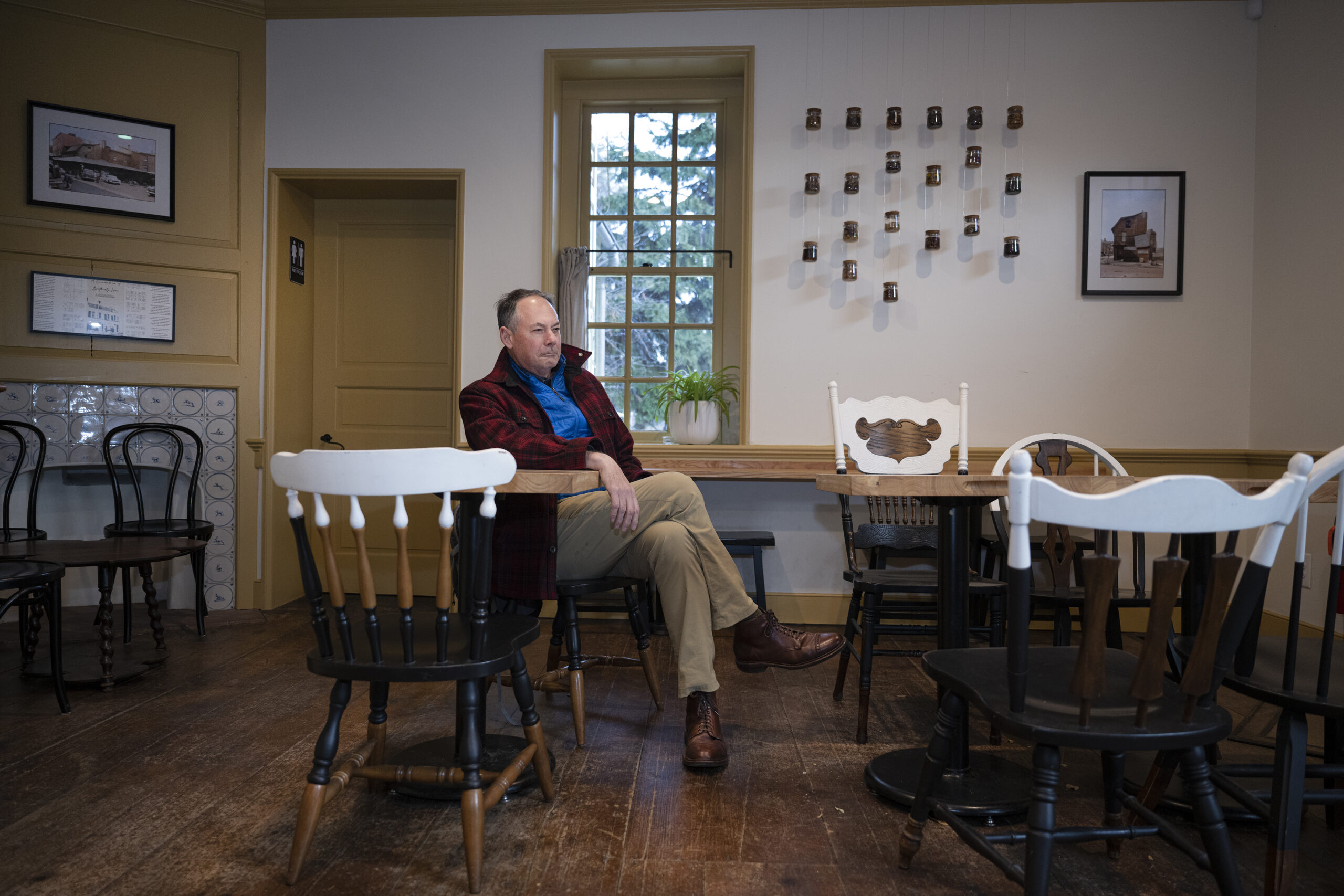
Museum of the American Revolution head Scott Stephenson, pictured here at Philly’s Revolutionary-era tavern, A Man Full of Trouble, likens each archeological site to a diary that can only be read once.
But he likens each archaeological site to a diary that you can only read once, because the story is as much about the objects that are buried as it is about the relationship between them. When amateurs “read the diary,” it’s like they’re “only recording three words off of an entire page,” he said.
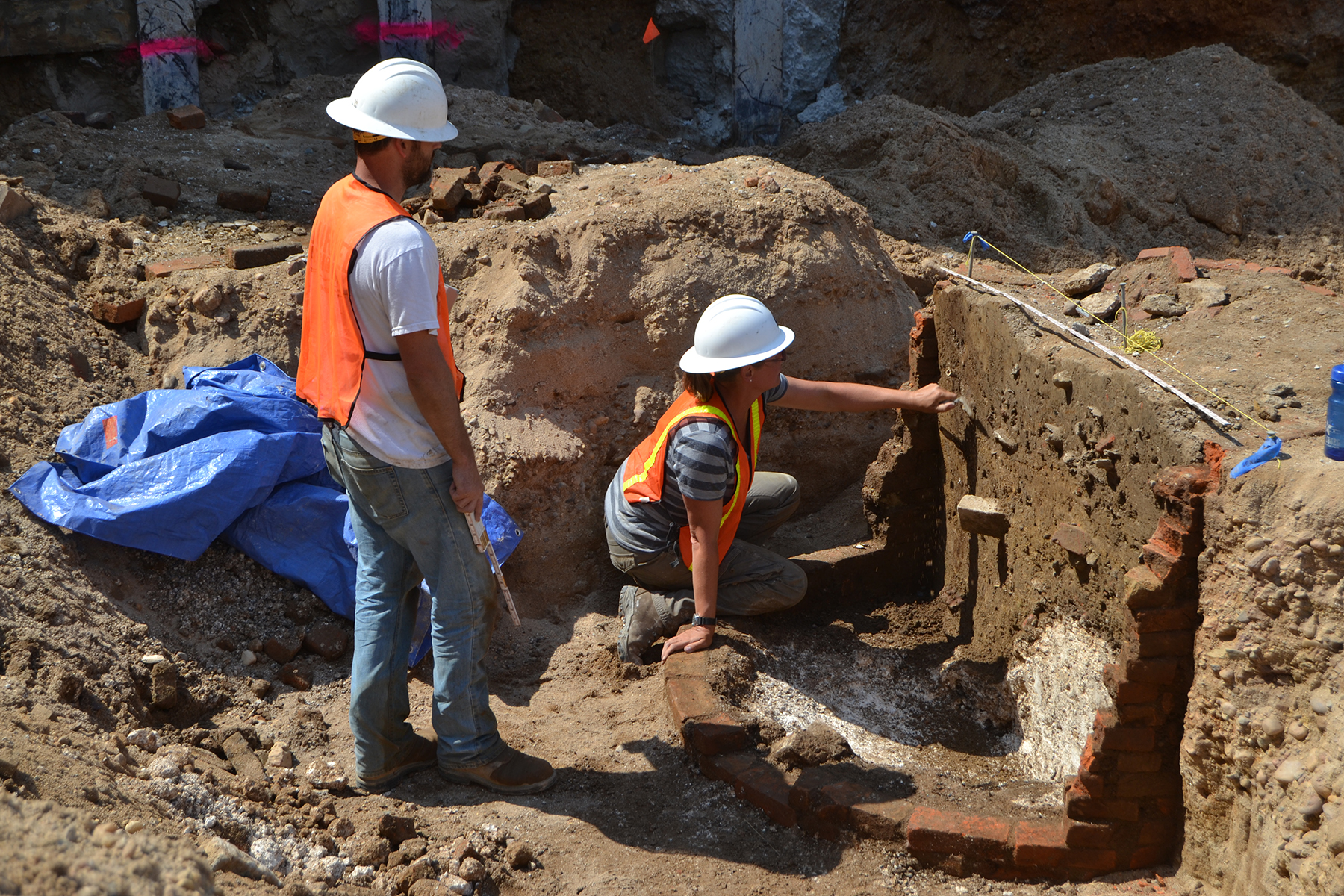
Before the Museum of the American Revolution opened, it conducted a massive archaeological dig on its site that included multiple privies. The recovered artifacts are part of a display at the museum called “Trash Tells the Truth.”
Before opening, the Museum of the American Revolution conducted its own privy dig with professional archeologists.
The Dunphys acknowledge that they don’t document the stratigraphy, or the exact chronological layering, of the privies they have dug. But they also see themselves as democratizing an important effort, saving bits of the past that would otherwise be wholly lost. It’s not as if the city’s professional archaeologists have the time or ability to carefully dig every backyard under construction across Philadelphia.
“We have watched with our own eyes archaeological features being crushed up and destroyed during construction in our neighborhood,” Melissa Dunphy said.
Some archaeologists are frustrated by the very notion of “citizen archaeology.”
“Would we talk about an ‘amateur doctor?’ No. Medicine takes training and following a set of techniques and ethics. Archaeology, the same thing,” said Levin of the Archaeological Forum. Of privy diggers, he said, “They are not amateur archaeologists. They are no stripe of archaeologist.”
Pieces of artifacts at the Dunphys’ home, pictured here in 2022.
Piecing the past back together
On a recent afternoon, Matt Dunphy donned black rubber gloves, filled an Ikea strainer with sudsy water in the sink, and began to scrub pottery shards with a small denture brush. Centuries-old dirt trickled down the drain.
Next to him, pieces of clean pottery lay on a towel to dry. Many privy diggers don’t take the time to piece together the hundreds of broken pieces they find, because it can seem like a nearly impossible task. But Melissa Dunphy sees it as puzzle-making “boss level.” To repair a single ceramic bowl might take a week of 16-hour days, she said.
She uses painters tape to keep related pieces together, and when they seem to fit, she uses archival-grade museum glue diluted with a syringe full of acetone to seal them back together.
The thrill of bringing something back to life — it’s like nothing else.
“This is the first time that someone has seen this bowl,” she said, “the way that it’s supposed to be, in hundreds of years.”
After reading “Jesse and Matt Ito’s big Japan adventure,” I will never refer to writer Craig LaBan as just a restaurant critic. This essay — concise and cogent, but also expansive and even emotional — is one of the best I’ve ever read in The Inquirer, or anywhere else. I’m a sushi fan who relies on the menu translations when I order, and although LaBan’s piece is full of details about sushi styles, dishes, ingredients, and sources, he fed me a lot of information in digestible form. The same is true of his account of touring remote Japan with the Itos (though I did appreciate the map). Best of all, he wove three generations of Ito family history into the narrative, including some of the tough stuff families endure, evoking the real importance of their trip to their lives together. A must-read for anyone who must work, likes to eat, or has a family.
Joe Jones,Mount Holly
Political malpractice
Many concerned and worried Americans are calling out and condemning the transparent total politicization and weaponization of the U.S. Department of Justice, and deservedly so. But let’s not forget that it was a totally apolitical attorney general, Merrick Garland, whose extreme lack of political sensibility — combined with extreme and debilitating timidity — can rightfully be called out as a primary factor that allowed Donald Trump to run for and subsequently win the presidency. Garland’s interminable two years of foot-dragging before he appointed special counsel Jack Smith to investigate the president were unconscionable.
Smith, in recent testimony before Congress, stated with categorical certainty that the evidence he compiled could have proved, beyond a shadow of a doubt, that Trump was guilty of crimes, and that he quite likely would have obtained a conviction if he’d had an opportunity to present his evidence. Maybe a modest touch of political awareness would have spared us from enduring and suffering through a second Trump presidency, with consequences whose outline can be seen but have yet to fully unfold.
Ken Derow,Swarthmore
West Bank killing
The Feb. 19 Associated Press story “Israeli settlers kill 19-year-old Palestinian American” included multiple other issues, including Israeli “ethnic cleansing” of Palestinians in the West Bank, Israeli torture of Palestinians journalists, and the basic needs for Palestinians in Gaza. While each subhead in the report deserved a full article, the headline story certainly should receive more attention in a Philadelphia newspaper. The young man killed by Israeli settlers, Nasrallah Abu Siyam, was born here. According to news reports, he was shot while trying to stop settlers from stealing dozens of sheep. The AP story included some context but not all, such as the Israeli government’s de facto approval of the annexation of Palestinian land. Philadelphians should demand that the U.S. Department of State not only “condemn the violence,” but also cease military funding of Israel.
Donna Sharer, Philadelphia
Join the conversation: Send letters to letters@inquirer.com. Limit length to 150 words and include home address and day and evening phone number. Letters run in The Inquirer six days a week on the editorial pages and online.
ARIES (March 21-April 19). No path is inherently better or worse, only different. You needn’t agonize over finding the absolute best route, nor should you feel pressured to make a good choice. You’re the one who makes the choice good.
TAURUS (April 20-May 20). They want you to buy what you don’t need, and some of it is downright bad for you. Consumerism pulls your focus into systems optimized for someone else’s goals. Power flows toward whoever sets the frame — let that be you.
GEMINI (May 21-June 21). No person can be entirely summed up by what they do. The roles and responsibilities describe what you manage, not who you are. Someone is trying to know your interior life — your imagination, longings, contradictions and more.
CANCER (June 22-July 22). The one who said, “Truth does not blush” wasn’t paying close attention. Today’s truth is bright red — impossible to miss. Still, you might pretend not to notice to help someone save face, which is a noble kindness.
LEO (July 23-Aug. 22). Connections often don’t start in showy, obvious ways. You may be fuzzy on the details of how some of your favorite people came into your life. Just know that it’s happening again. New bonds are forming now, growing organically out of a life circumstance.
VIRGO (Aug. 23-Sept. 22). Nothing brings out a person’s potential like the problem that requires more work than anticipated, more talent than you knew was there or more generosity than was thought available. Dig deeper. You’re living fully.
LIBRA (Sept. 23-Oct. 23). When you get frustrated, try not to stay there for long. You can use this feeling as a signal you read and then heed. It’s telling you something needs to change here. Usually, it’s the time frame or the tools. Investigate your options.
SCORPIO (Oct. 24-Nov. 21). Relationships can only be as free as the circumstances around them allow. Social norms and expectations, roles and alliances, emotional complexities and more can limit your options. But today, these limits make the story more interesting.
SAGITTARIUS (Nov. 22-Dec. 21). You’ll be reminded how the simple, obvious choice can bring the most joy, relief or benefit. For instance, exercise, sunshine, hydration, human contact and a healthy lunch are the stuff of a good life.
CAPRICORN (Dec. 22-Jan. 19). You’ve got your poker face on, and your cards are close to the vest. But there’s someone who knows you so well that they seem to read your mind and vibes. To this person, your silence speaks.
AQUARIUS (Jan. 20-Feb. 18). The relationship was a fully illuminated house, but now you’re in the dark, patting the walls to find the light switch that won’t turn on. Power outages happen. But when you can’t see the way, other senses come alive.
PISCES (Feb. 19-March 20). Your steadiness doesn’t come from swagger, cleverness or control. It comes from a deep, reliable decency that’s built into you. Kindness isn’t something you perform or ration — it’s your default. It shows up today both deliberately and spontaneously, in ideas and in action.
TODAY’S BIRTHDAY (March 1). Welcome to your Year of Grounded Goodwill. Your orientation toward people is generous, and others follow your lead, which creates a culture of kindness around you with ever-expanding connections doing remarkable work in the world. More highlights: Fantastic gifts come by way of a blind box, random surprise or stroke of dumb luck. Each season features love, celebration and just what you need to live beautifully. Cancer and Leo adore you. Your lucky numbers are: 4, 29, 14, 3 and 16.
DEAR ABBY: My spouse and I host regular meetings of a book club. It has been very successful; lots of people attend. We serve wonderful food and wine. Two attendees rarely miss this event, although they have never actually been invited. They come by default with their spouses, whom we did invite many years ago.
We are not fond of these two women because they are whiny and annoying. They go on and on about their ailments and life problems, and they rarely have anything insightful to say about the books we discuss.
My spouse and I wonder if they have ever read any book, much less one of the books we cover. We’re not sure if anyone else who attends feels the same way, but we do know that some of our friends have hung out with them. I often tell my spouse we need to drop them from the invitation list. She says we can’t because the other attendees will notice, and we’ll look like the bad guys.
Is my partner right? Is there any way to stop inviting them without looking mean? I’m worried we will be stuck hosting the pair forever into our old age.
— HATES THIS PLOT IN THE WEST
DEAR HATES THIS PLOT: You very well may wind up hosting those two pills in perpetuity, UNLESS at the next meeting, you establish some rules that should have been made clear from the beginning. In order to participate in these get-togethers, members of the group must have read the book under discussion and refrain from discussing other topics during the meetings. To do this is not unreasonable.
** ** **
DEAR ABBY: My mom and I recently got into an argument about her mortgage. I’m on the mortgage and title to her home because she couldn’t afford to be on it by herself and needed my income and credit to help her. So, I did. I helped her.
I am now married, and my husband would like to refinance our home. The problem is, I’m still on the mortgage to my mother’s house. I have asked her twice before to let me off the mortgage, and she responded by saying, “I can’t. I need you.” When I asked again this last time, she blew up at me.
She thinks my husband is controlling me or manipulating me to ask her to let me off the mortgage. Now she “hates him” and doesn’t want to see him or his family. She’s barely talking to me and acting super-cruel and vindictive. It hurts me that she is acting like a 5-year-old having a temper tantrum. I’m so sad. I just don’t know what to do anymore. Advice?
— ENSLAVED IN MARYLAND
DEAR ENSLAVED: You have my sympathy. Getting your name (and the financial guarantee that goes with it) off your mother’s mortgage may not be as simple as you would wish. It’s time you spoke about this with an attorney with an expertise in real estate, because extricating yourself may be both time consuming and expensive.
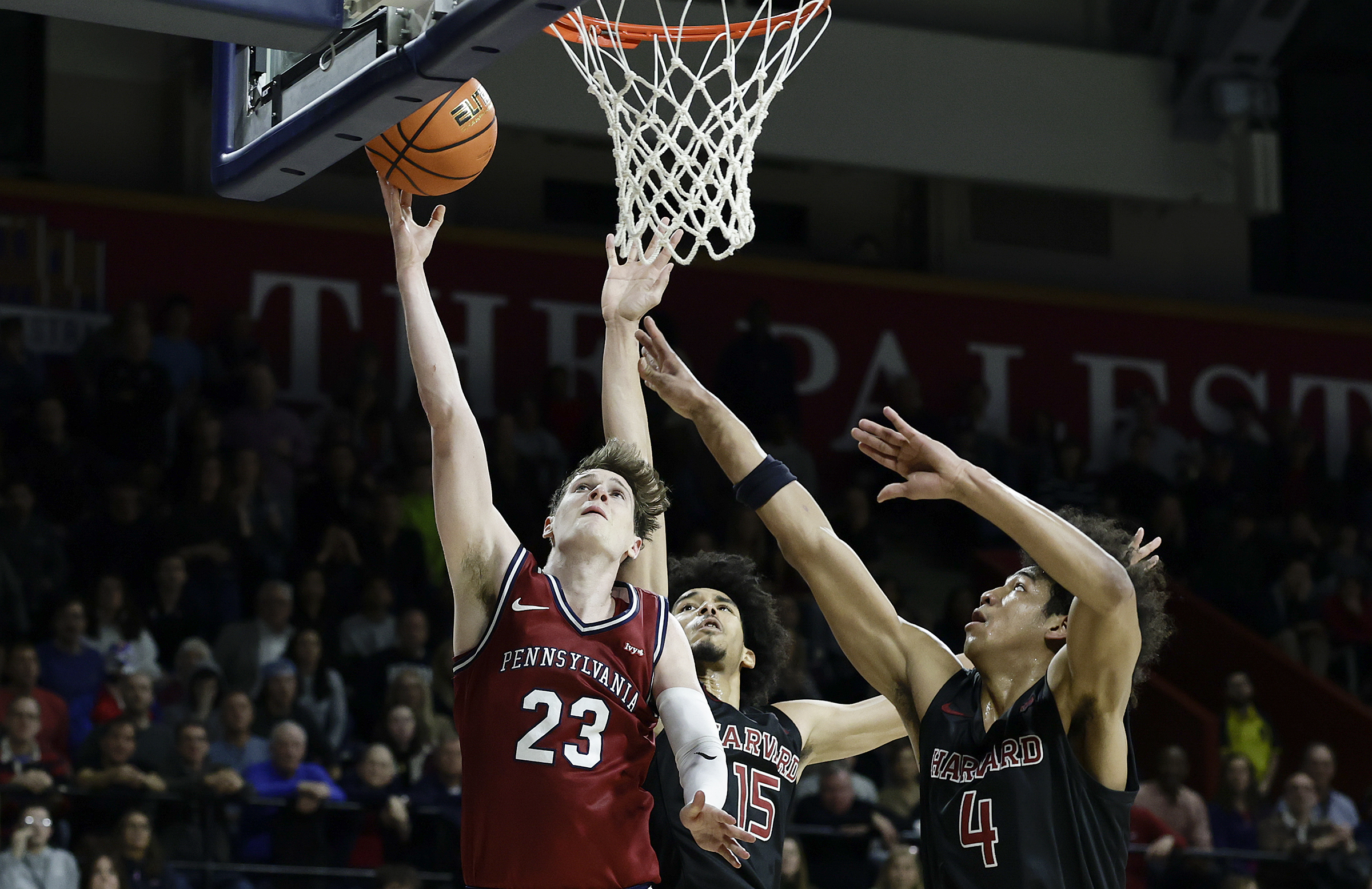
On Saturday, Penn men’s basketball took down Harvard, 64-61, securing a bid to the Ivy League Tournament. As the game came down to a back-and-forth, one-possession game, senior forward Ethan Roberts (21 points) took over for the Quakers — scoring eight straight in the final minutes to secure the victory.
“It meant everything,” Roberts said. “I kind of blacked out when the buzzer hit. This is what we wanted our entire year. Since last summer, we had a coaching change. We see McCaffery coming here, and to see that we’re in this position today, it’s like, back me up, this is literally all we work for. Our North Star. It’s emotional, and I can’t really put it into words.”
Roberts, along with Cam Thrower, Dylan Williams, and Johnnie Walter, were honored pregame as a part of Penn’s senior night celebrations.
The Quakers took control of their own destiny by defeating Harvard, with the win securing Penn an Ivy League tournament bid in head coach Fran McCaffery’s first year as head coach.
Penn last won the Ivy League tournament in 2018, and will look ahead to a rematch with Harvard, the two seed, in the semi-final round on March 14th at noon in Ithaca, New York.
“It’s not like we don’t know each other,” McCaffery said in reference to Harvard. “We have a lot of respect for them. We played twice, we won by three and they lost by one. Expect a good fight; we expect to have our guys ready.”
The Quakers can’t wait for Ivy Madness to start, with the team being proud of their “roller coaster” regular season nearing its end.
“This ivy season has been a roller coaster,” AJ Levine said. “It’s been so hard fought. I mean, we know every single game we go into, we have an opportunity to win. We’ve had so many close games, some that we won, some that we lost, but you know, those all make us better, and they all prepare us for this postseason.”
Comeback kids
Harvard’s league-leading defense dismantled Penn in the first half, holding the Quakers to only 21 points on 24 percent shooting, forcing six turnovers en route to a 10 point halftime lead, 31-21.
The Quakers’ three-headed attack of TJ Power, Michael Zanoni, and Ethan Roberts went a collective 2 of 19 from the field — with starting point guard AJ Levine only playing 10 minutes.
In the second, in just the first four minutes of play, Penn turned the tide — forcing four turnovers and scoring an electric 15 points, with every point coming from one of Roberts, Power, or Levine.
Penn forward Ethan Roberts lays up the basketball past Harvard forward Thomas Batties III (center) and guard Robert Hinton during the second half on Saturday.
“I think the huge thing is defensive intensity,” Levine said in reference to what the team changed at half time. “ [We were} a little quiet on defense and not as energetic, and that was a huge point at halftime, that we’re gonna come out, and we’re gonna get stops, we’re gonna get on this glass and push the ball, that’s where our best offense is, and we want to really capitalize on that.”
Quakers continued to pile on, with the trio scoring a collective 36 of the team’s 41 points in the second half. Power provided much-needed versatility — hitting three of four from behind the arc with four boards, while Levine was ferocious downhill, going four of five with two made free throws for 10 points.
“But to his credit, he showed maturity today,” McCaffery said regarding Levine. “Figured it out. And I think you could know, with all due respect to the game Ethan had, I think you could really look at AJ and say, Okay, that was a difference. The way you played at the start of the second half changed everything.”
Roberts, in his final regular-season home game donning the Red and Blue, controlled the pace, using his physicality and outside touch to uphold the offense, scoring 17 in the second half.
In the end, the former transfer sealed the game for the Quakers and showed emotion after his final home game with Penn.
“I love this place,” Roberts said regarding his performance. “And I just want to give everything back to Penn. How much it means to me to wear this jersey. So to do that means a lot, and I hope that caps off my legacy, but I still got more to go, because, you know, I want to win.”
Zanoni, a senior, was left out of the senior night celebrations. McCaffery, when questioned post-game, confirmed that Zanoni is expected to return to Penn next year.
While Zanoni struggled tonight, his impact this season has been felt — as the Greensboro, North Carolina, native averages 12.1 point per game.
His best performances came against Providence (30 points) and Ivy League leading Yale (20 points), with his outside shooting looking to boost McCaffery’s fast-paced offense for at least one more year.
Maybe the curtain hasn’t come down on the Flyers just yet.
Entering Saturday’s matinee against the Boston Bruins, they saw themselves eight points back of Boston for the last wild card in the Eastern Conference, and the third spot in the Metropolitan Division, which the New York Islanders hold, and retained after an overtime win on Saturday against the Columbus Blue Jackets.
And thanks to Sean Couturier sealing the 3-1 Flyers win over the Bruins with an empty-net goal, they took a step closer.
The goal also ended his 31-game goal drought in the last minute. “I’ll take them any way right now, honestly,” he said. “… Overall, just happy we got the win. That’s all that matters.”
It is the first time the Flyers have won two straight since they beat the Edmonton Oilers and Anaheim Ducks on Jan. 3 and Jan. 6.
The line of Christian Dvorak, Trevor Zegras, and Travis Konecny was buzzing all night.
According to Natural Stat Trick, when they were on the ice at five-on-five, the Flyers had 11 shot attempts, with six coming from a high-danger spot, seven scoring chances, and five shots on goal. They were on the ice for 10 shot attempts against and six scoring chances by Boston, but the only stat that mattered was the two goals for and zero against.
“I think they did a good job of game management,” coach Rick Tocchet said. “And that’s really something that they got to work on to be a top line, like tonight, I thought they did a nice job for us.”
“Nothing crazy, keep it simple,” Dvorak said when asked what their plan was going into the game. “Play a hard game, get in on the forecheck, and I think we just needed to get pucks and bodies to the net a little bit more than the previous couple of games. So that was kind of the goal tonight, and we did a pretty good job doing that.”
They came close in the second period. Halfway through, after some pressure in the Bruins’ end, Dvorak got the Zegras ring-around and sent it back down the boards. Konecny picked it up behind the net and swooped it around in front on his forehand for a shot as he was falling.
Zegras tried to score on the rebound, but the puckwent off the skate of defenseman Henri Jokiharju. Dvorak came barreling in but was robbed with the glove of Jeremy Swayman.
But on the Flyers’ 11th shot of the game, Konecny finally cashed in.
Less than four minutes into the third period, Dvorak got the puck along the boards inside the Flyers’ blue line and patiently waited as the Bruins gave him space. He skated the puck up the left wing boards and dumped it in. The puck went off a stanchion and in front of the net, bouncing along the way.
Swayman stuck his stick out, trying to play the puck, but it bounced away from him — are the Flyers finally getting a bounce their way? — and Dvorak was there to send an almost no-look backhand pass in front to Konecny. “I could see in the corner of my eye, him coming in behind me,” Dvorak said postgame of Konecny, who also had a breakaway chance late in the game.
The alternate captain, who had made a beeline to the net, put it into the open space and sent a fist pump into the air after giving the Flyers a 1-0 lead. The Flyers’ leader in goals and points, Konecny now has 23 goals and 56 points in 58 games this season. Dvorak’s assist is his 23rd of the season, setting a new career high.
Gettin’ Drysy with it
Later in the period, that same line was on the ice when Jamie Drysdale made it 2-0.
The Flyers got into the Bruins’ zone and set up before the puck ended up on the stick of Drysdale as he skated down the right wing boards. He carried it around and got the puck to Konecny before heading back to the point, but on the left side.
Konecny and Dvorak, who went up to the point to cover, had a give-and-go before Konecny hit Drysdale as he skated into the middle of the ice. The defenseman skated down into the high slot and ripped the wrister past Swayman.
Jamie Drysdale celebrates after scoring the Flyers’ second goal of the game in a 3-1 win against the Bruins on Saturday.
“I think the opportunities kind of have been there. It’s nice to see a few of them go in, and it’s nice to see the team win,” said Drysdale, who was doing extra work with assistant coach Jaroslav “Yogi” Svejkovský in Voorhees the last week.
“The guys have been making great plays. So tonight, TK made a [heck] of a play to me, and I had all the time in the world.”
Drysdale now has six goals on the season, one shy of his career high set in 2024-25. The goal on Saturday was his third across the five games in February.
“He’s working on his shot,” Tocchet said. “This summer’s a big summer for him. … I think Drysy can get that shot a little bit harder, which he’s been working on, and it’s paying off. That was a [heck] of a shot. I thought Swayman was good tonight, too, and to beat him, that was a great shot.”
Dan Vladař was moving exceptionally well in this one. He was dropping down with ease and popping back just as loosely. The Czech netminder, who was playing in his 35th game, was sliding well, checking his posts, and tracking the puck.
“I came here to win, to be successful,” he said when asked about his workload this season, which has seen him blow past his previous career high of 30 games. “Unless we play past those 82 games, I’m not going to be happy and satisfied. So, I’m not happy yet.”
The first shot he faced on Saturday was from the point by Hampus Lindholm at 15 minutes, 21 seconds, which Vladař snagged easily with the glove despite some traffic. Boston ended up with six shots on goal in the period, including a shot by Michael Eyssimont as he skated in two-on-none against Vladař.
But it was in the second period where Vladař shone the brightest in front of a sold-out Xfinity Mobile Arena. He faced 16 shots and stopped them all.
His best save of the period was a masterful right pad kick save on Morgan Geekie as he shot the puck off a pass by David Pastrňák from the slot. The forward had just pushed off Flyers defenseman Rasmus Ristolainen to create space.
“He’s just so positive; being real, being honest, also,” Couturier said. “When it’s time to pick it up, he lets us know. And when it’s time to keep pushing, keep defending well, he’s a great support back there. He’s playing great, so he makes it easy for us when we have breakdowns.”
Flyers goaltender Dan Vladař saved 16 shots in the second period against the Bruins on Saturday.
Later in the period, he stopped a high-rising Viktor Arvidsson shot, which appeared to sting the 6-foot-5 goalie, and made a save on a Lindholm wrister less than a minute later that saw Pavel Zacha, who was injured just before the 2026 Milan Cortina Olympics and was unable to play for Czechia, give him a stick tap.
With over five minutes to go, he stopped Sean Kuraly as he got behind Bobby Brink, who couldn’t handle the puck along the neutral zone boards, and defenseman Emil Andrae.
“He’s the loudest guy in the room, yeah, majorly,” Drysdale said of Vladař. “He does so much for us off the ice as well. In the locker room, in between periods, he’s always talking, just saying whatever’s on his mind, and usually it’s awesome stuff coming out of his mouth.
“So, real positive guy, and he’s been real good for us.”
In the opening two minutes of the third period, the Bruins thought they had broken the ice when it looked like a point shot by Lindholm had beaten Vladař. But the referee, Francis Charron, immediately waived it off for goalie interference. Eyssimont had bumped Vladař right before the shot as he tried to set a screen.
The Bruins did eventually break through. Zacha won a face-off against Couturier and sent it to Lindholm, who sent a zing of a pass through a seam to Charlie McAvoy, his defensive partner, who had rotated down along the inside of the right circle. It looked like the puck bounced off his leg and past Vladař.
Breakaways
Forward Denver Barkey was a healthy scratch for the first time since Jan. 14. In 24 games since being recalled in late December, he has two goals, nine points, and is minus-7 while skating on average 13:36. His last goal was Jan. 23, and in the eight games since, he had one assist — against the Bruins in Boston —and was minus-5. … With Barkey sitting, Nic Deslauriers slotted in on the fourth line. He appeared to have a long chat with Tanner Jeannot during warmups, and the duo dropped the gloves in the first period. … The Flyers went 0-for-2 on the power play, with the unit of Konecny, Drysdale, Zegras, Dvorak, and Brink getting the best looks. The penalty kill went 3-for-3; Boston had 10 shot attempts and seven shots on goal. … According to a team source, the Flyers have hired Daniel Bove to lead the athlete performance and wellness department. He will take over the role that was previously held by Ian McKeown until October, when he went back to Australia to work for the Adelaide Football Club. A Philly area native and graduate of Penn State, Bove was recently the New Orleans Pelicans director of performance and sports science.
DUNEDIN, Fla. — Bryce Harper boarded his flight to Arizona on Saturday on a positive note.
In his final at-bat in his final Grapefruit League game before heading to Team USA’s camp in preparation for the World Baseball Classic, Harper bashed a homer to right field. It came off Blue Jays pitcher Connor Seabold in the Phillies’ 7-5 loss to Toronto and marked his first spring training homer since 2022.
Harper said he feels his swing is in a good spot ahead of the tournament. But it can be a big adjustment to go from playing in exhibition games to competition that some Phillies players have compared to playoff games.
“It’s going to be tough,” Harper said. “Guys are going to come in and be ready to go, pitchers being ready to go, guys that played winter ball offseason and things like that, from other Latin American countries or Mexico and a lot of other places. So it’s going to be real, and it’s going to happen real quick.”
In four spring training games, Harper is 3-for-8 with two doubles to go with the homer. He has three walks and three strikeouts.
“You don’t want to get so amped up and so excited that your swing goes to crap,” he said. “So just try to stay as calm as I can, and the game’s going to speed up no matter what. So I’ve tried to do that pretty much all camp, just trying to get pitches in the zone and swing at strikes and taking the walks when I can. I think I’ve done a pretty good job of that for the first four games that I played, but just trying to slow down.”
Brad Keller and Kyle Schwarber joined Harper on the flight to Arizona. Team USA will play exhibition games against the Giants on Tuesday and the Rockies on Wednesday, while pool play will begin Friday in Houston with an opener against Brazil. Great Britain, Mexico, and Italy also are in the U.S. pool. Taijuan Walker is pitching for Mexico, and Aaron Nola is pitching for Italy.
Aaron Nola is one of 10 Phillies on the 40-man roster who are set to participate in the World Baseball Classic. He will pitch for Team Italy.
According to Phillies manager Rob Thomson, the players who are gearing up to participate in the tournament have seemed more prepared in camp. Ten members of the Phillies’ 40-man roster currently are set to play.
“They put a lot of work in, not only in the offseason, but some extra work here in spring training,” Thomson said.
Harper said he’s excited about the potential of facing some of his teammates at the WBC. He could face Cristopher Sánchez in the semifinals or finals if the U.S. and the Dominican Republic advance out of their respective pools.
Harper has never faced Sánchez — not even in a live batting practice session on a backfield — though of course he’s gotten an up-close look from standing in the field with him.
“Really good stuff,” Harper said. “You better pick and choose what you want to swing at, stuff moving all over the place. One of the best in baseball right now from the left side. So it’d definitely be a tall task.”
Blue Jays hitters whiffed on all seven changeups Cristopher Sánchez threw in his outing today.
Harper has a strong international resumé from his youth. He represented the U.S. on the 16U team at the 2008 Pan Am “AA” Championships, and on the 18U team at the 2009 Pan Am “AAA” Championships. Both teams went undefeated en route to a gold medal.
“Had some really good teams and some really good pitching and good groups,” Harper said. “If we can go out there and do what we need to do, then there’s a possibility to do the same thing. I know a lot of guys are looking forward to it. We got a really good group of guys, really good group of pitchers and position players, great staff. Just really looking forward to it.”
Bryce Harper has never faced Phillies teammate Cristopher Sánchez. That could change during the World Baseball Classic.
Extra bases
Jesús Luzardo pitched a simulated game on Saturday at the Phillies complex. “He was really good,” Thomson said. “Velocity was good, throwing strikes. There’s no intensity level, not the same as in a game. So we’ll see what he’s like in a true game. But today was good.” Luzardo is scheduled to start on Thursday against the Boston Red Sox.