Blog

  • Gardening roots bring Philadelphians to the Flower Show

    Gardening roots bring Philadelphians to the Flower Show

    The Pennsylvania Horticultural Society Philadelphia Flower Show is back at the Convention Center, full of colors, scented exhibits, flowery crowns, and roots.

    Through March 8, visitors can celebrate the 197th edition of the region’s premier botanical show. This year’s installment commemorates the nation’s 250th anniversary under the theme “Rooted: Origins of American Gardening.”

    The displays honor the people, places, and traditions that shaped gardening in the United States. So, we asked attendees on Saturday, the show’s opening day:

    “What roots you into gardening?”

    Learning to let go

    Judy Baskin, 70, and her husband, Richard Tassano, 77, have been gardening together for over 30 years.

    Between raised beds, produce, and a mutual hatred of mowing, the Bala Cynwyd couple found in gardening a way to maintain and strengthen their connection with each other and their community.

    “It’s really nice to do it together,” Baskin said. “But if you were to listen to us, there is a lot of ‘I don’t want that there,’ or ‘Move that there.’”

    Richard Tassano, 77, and Judy Baskin, 70, of Bala Cynwyd, Pa., pose for a portrait at the Flower Show in Philadelphia, Pa., on Saturday, Feb. 28, 2026. The two have been gardening together growing mainly vegetables and few flowers to help pollination for their plants. “Every year we learn something new,” Richard said.

    Those green debates have prompted better communication, and an easier time choosing their battles.

    “You learn something new every year,” Tassano said. “You have to learn to let go and go figure out what you are going to sacrifice to the squirrels and raccoons.”

    But the couple don’t just garden for themselves. Their tomatoes, lettuce, pesto, garlic, brussels sprouts, and peppers (hot and sweet) have also prompted better relationships with their neighbors.

    “We have Cambodian neighbors we can’t talk to,” Baskin said, referencing a language barrier. “But we exchange vegetables that go from our gardens to our tables.”

    Memories from a distant past

    For Mayumi Welman, 61, gardening brings back memories of loved ones and places she can now access only in her mind.

    She drove three hours from Virginia to experience the Flower Show for the first time with her son, New Jersey resident Millan Welman.

    As she and her son walked around, tiny flowers reminded Mayumi of her mother and her love for dianthus.

    Mayumi Welman, 61, of Fairfax, Va., poses for a portrait with her son Millan Welman, 25, of Princeton, N.J., at the Flower Show in Philadelphia, Pa., on Saturday, Feb. 28, 2026. Mayumi has been gardening for about 40 plus years. Her favorite flowers are Tulips and Roses.

    The poppies brought back memories of her kindergarten teacher, back in her native Japan, whose kindness with plants inspired a green thumb for a then-6-year-old Welman.

    “Different plants bring back different memories of different people,” Welman said. “Tulips and roses are my favorites, but it’s too hard to pick because they are like choosing my favorite child.”

    Despite not being a gardener himself, Welman’s only child, Millan, has learned a lot about life through seeing his mom care for plants.

    “She gave me an appreciation and respect for the natural world,” Millan Welman said. “I look at her and I feel respect for that level of commitment and a certain nostalgia because it’s a sight I grew up with.”

    More oxygen, less seasonal depression

    Megan Robbins and her husband, Hunter, have over 50 plants at home, including a three-foot-high baby monstera.

    The Bellmawr couple got into gardening in 2024, looking to improve air quality in their home, and found an unexpected love that brought them closer.

    “It’s an intentional time spent together; you have to be locked in and there is always something you can do,” Hunter Robbins, 34, said. “It’s like having a kid.”

    For Megan Robbins, also 34, gardening has helped with her seasonal depression just by touching her plants when she is feeling down.

    “It’s really calming,” she said. “There is a sense of accomplishment that you are growing something that you created, an ecosystem. It feels like we are giving back.”

    The greenery has also turned their living room and other corners of their home into a concert venue.

    Megan Robbins plays classical music for the plants and her husband tunes them in to hip-hop to help them grow.

    “The world is crazy enough, so it’s nice to have this space to set up long term and look forward to seeing grow in the future,” Hunter Robbins said.

    Robin Posner, 37, of West Philadelphia, Pa., (left), and Megan Robbins, 34, of Bellmawr, N.J., (right), pose for a photo together at the Flower Show in Philadelphia, Pa., on Saturday, Feb. 28, 2026.

    Named for a sunflower

    Lorann Powell inherited her love for gardening from her parents, who gave her Sunflower as a middle name.

    “I followed my mom around as she was a landscaper,” Powell said. “She grew everything, so I grew up learning to cultivate and feeding the neighborhood with our vegetables.”

    Lorann Sunflower Powell, 65, of Graduate Hospital, poses for a portrait at the Flower Show in Philadelphia, Pa., on Saturday, Feb. 28, 2026. Lorann has been gardening all her life, beginning with learning from her mother, who was a landscaper.

    The Graduate Hospital area still carries that love language. Powell, 65, spends the summers planting seasonal flowers for her neighbors to “make the block beautiful,” she said.

    Sunflowers are her favorite things to plant, and she has already passed on the tradition of cultivating them to her children.

    “It’s rooted in my system; it is my history and story,” Powell said. “I’m rooted to plant things and let it grow.”

    Gardening in the heart of the city

    Dana Napier, of Grays Ferry, Pa., 79, poses for a portrait at the Flower Show in Philadelphia, Pa., on Saturday, Feb. 28, 2026. Dana has been gardening all her life and has been going to the show for over 40 years now.

    For Dana Napier, 79, gardening means life — and resilience, particularly when practiced within the city limits.

    “It’s important to have a garden when you live in the city,” Napier said. “It gets you off the grid and a lot of wonderful Philadelphia birds come through.”

    To her, gardening has become a way of connection, not only with her Grays Ferry neighbors but also with the animal life of Philly. Groundhogs and raccoons have become regular visitors in her backyard.

    “It makes me feel like I’m still self-sufficient,” she said. “It gives me peace and my thoughts can go someplace else.”


  • Juan Valdez, 88, the last Marine to leave Vietnam, has died

    Juan Valdez, 88, the last Marine to leave Vietnam, has died

    Standing on the U.S. Embassy roof as tanks rumbled toward Saigon and gunfire rang out below, Juan Valdez wondered if he and his fellow Marines might have actually been forgotten.

    Working through the night, as a mob of desperate people pressed against the compound’s gates and spilled over its walls, he had helped evacuate nearly 2,100 Americans and Vietnamese fleeing the collapse of South Vietnam. But after Ambassador Graham Martin was airlifted to safety with the embassy’s American flag, the helicopter evacuation had been canceled — the result of a misunderstanding, as air staff didn’t realize a group of Marines was still waiting to be picked up.

    A call for help went out. And Master Sgt. Valdez waited for what “seemed like an eternity” for the last helicopter to arrive.

    When it landed, he nearly didn’t make it on board. After telling his 10 fellow Marines to get on, and waiting to ensure they boarded safely, he slipped as he stepped onto the ramp. The helicopter began to take off as one of the Marines, Mike Sullivan, did a head count. They were one man short.

    “I remember looking at the ramp, and two hands were over the top of it,” Sullivan recalled in Last Days in Vietnam, an Oscar-nominated 2014 documentary. Master Sgt. Valdez was yanked on board as the chopper departed.

    It was 7:58 a.m. on April 30, 1975, just a few hours before the North Vietnamese burst through the gates of the presidential palace, hoisted a Viet Cong flag, and celebrated the end of a war that had lasted 20 years, costing the lives of more than 58,000 Americans and untold Vietnamese.

    Master Sgt. Valdez, the last Marine to leave Vietnam, was 88 when he died Feb. 15 in Tucson, Ariz., where he was living. To the leathernecks who served under him, it was only fitting that he was the last of their unit to depart Saigon.

    “He was a model leader, always looking after his troops,” said one of those Marines, Doug Potratz. “When I went to his house 40 years after the fall of Saigon, he had all our individual ID pictures on the mantel of his fireplace. He never forgot us.”

    “In some ways he was like a dad to us,” said Dave Norman, one of the 11 Marines on the last helicopter out of Saigon. “But in other ways he was like a principal. If you screwed up, you didn’t want to be in the principal’s office.”

    Mr. Valdez spent 32 years in the Marine Corps, retiring in 1987 as a master gunnery sergeant. Even then, he remained intimately involved with the Corps, working as a civilian in the housing office of Camp Pendleton, the primary Marine base on the West Coast.

    “He was always a Marine, taking care of Marines,” Potratz said.

    During his first tour in Vietnam, from 1965 to 1967, Mr. Valdez served as a platoon sergeant in an amphibious assault vehicle unit. He returned to the country in September 1974 as the top noncommissioned officer — affectionately known as “Top” — in the embassy’s Marine security guard detachment, with a commander, Maj. James Kean, who was based out of Hong Kong before being summoned to Saigon.

    Following the departure of American combat troops in 1973, the embassy Marines were among the last U.S. service members in Vietnam. “We were there to protect American lives, as well as American property. It was just a day-to-day job,” Mr. Valdez said.

    As the North Vietnamese advanced toward the capital, he and Kean played a critical role evacuating Americans and their allies. More than 50,000 people were flown out of Tan Son Nhut Air Base before rocket and artillery fire made the flights unsafe. Some 7,000 others were then airlifted as part of Operation Frequent Wind, the final stage of the evacuation, which the U.S. military later called the largest helicopter evacuation in history.

    At the embassy, helicopters landed every 10 minutes on the roof or in the parking lot, where Marines chopped down a tamarind tree to expand the makeshift landing zone.

    The operation got underway on April 29, 1975, after two of the detachment’s young Marines, Darwin Judge and Charles McMahon, were killed in a predawn rocket attack at Tan Son Nhut. Later that day, Armed Forces Radio delivered a not-so-secret signal to indicate that the airlift was on.

    “The temperature in Saigon is 105 degrees and rising,” an announcer intoned. Then the station played the holiday song “White Christmas.”

    Master Sgt. Valdez and Kean “didn’t pull any punches,” Potratz said in a phone interview. “They got us in the conference room after Judge and McMahon were killed. They said, ‘There are almost 100,000 North Vietnamese surrounding the city. We don’t know if they’re going to evacuate us or not. But if we die, we die like Marines.’ That kind of stuck to us. After that, we stuck together and did the best we could.”

    As thousands of people rushed to the embassy, Master Sgt. Valdez and other Marines guarded the perimeter. He later recalled lifting people over the gates, helping them inside the compound before realizing there wouldn’t be enough helicopters to evacuate everyone.

    “Please, at least take my children out,” he was told by parents. “I’ll stay, but take my little girl now.”

    Those who were allowed into the compound were searched for weapons — guns were thrown into the embassy pool — before being escorted to a helicopter.

    According to Kean’s after-action report, some 10,000 people eventually breached the embassy gates. Master Sgt. Valdez and the remaining Marines prepared to be evacuated while locking down the elevators and barricading doors, using fire extinguishers and other equipment to block off the rooftop.

    For many, images of the chaotic withdrawal came to symbolize the futility of a war that should never have been prolonged, let alone started.

    Mr. Valdez said that the departure was painfully resonant in 2021, when the U.S. withdrawal from Afghanistan ended in chaos and bloodshed. As he saw it, the U.S. had repeated some of the same mistakes in both wars.

    “We spent so much money, so many weapons, and so many Marine and Army deaths, and for what?” he asked in an interview with Noticias Telemundo. “For what?”

    Juan Jose Valdez was born in San Antonio, Texas, on Aug. 19, 1937. His father was a landscaper, and his mother was a homemaker from Mexico. He enlisted in the Marines in 1955, at age 17.

    Mr. Valdez died of pneumonia, said his sons Anthony and Michael Valdez. In addition to his children, survivors include a brother; two sisters; a grandson; and three great-granddaughters.

    Late in life, Mr. Valdez participated in frequent reunions with his Vietnam detachment, including in a 2015 trip to Saigon — now Ho Chi Minh City — where a plaque was dedicated to McMahon and Judge, the last Americans killed in action on the ground in Vietnam. The unit’s surviving members had reconnected in 2000, when they traveled to Judge’s Iowa hometown for a memorial service honoring their fallen comrades.

    “For a period I went through survivor guilt,” Mr. Valdez said in prepared remarks for the service. “Why wasn’t it me instead. Why did I, who had been in country longer, and had already served a previous tour in Vietnam, lived and these two men died. There were, and still are, no easy answers.”

    But “more than anything else,” he added, “we need one another now. Each of us grieves, and when we grieve together, the healing begins.”

  • Pennsylvania, N.J. lawmakers react to U.S.-Israel joint strike on Iran

    Pennsylvania, N.J. lawmakers react to U.S.-Israel joint strike on Iran

    By Saturday morning, when many Americans were waking to the news that the U.S. and Israel had launched a missile attack on Iran, U.S. Sen. John Fetterman (D., Pa.) had already spoken in support of the bombings.

    “Operation Epic Fury,” Fetterman said on X at 4:18 a.m., using the name given to the campaign by the Trump administration. “President Donald Trump has been willing to do what’s right and necessary to produce real peace in the region.”

    “God bless the United States, our great military, and Israel,” Fetterman said.

    The missile strikes were focused on the home of Iran’s leader and a number of targets in Tehran and other cities. Trump called on the Iranian people to take over the government and put an end to the country’s decades of theocratic rule.

    People sit in a shelter after warning sirens sound following Israeli strikes on Iran, in Tel Aviv, Israel, Saturday, Feb. 28, 2026. (AP Photo/Ohad Zwigenberg)

    The possibility of such an attack was anticipated for weeks as tensions rose between Iran and Israel and the U.S. positioned warships in the region.

    Pennsylvania Gov. Josh Shapiro criticized Trump in a statement Saturday for acting “without Congressional approval,” while adding that the Iranian regime “must never be allowed to possess nuclear weapons.”

    Trump and his administration “have not demonstrated to the American people that we have a clear plan with this mission — and by taking unilateral action, without a broad coalition of international partners, he is putting our brave servicemembers at greater risk and undermining our national security interests,” Shapiro, a Democrat, said.

    U.S. Sen. Dave McCormick (R., Pa.) said he is praying for U.S. troops and allies “during this challenging and noble mission.”

    “For decades, the Iranian regime has killed Americans, threatened Israel and our allies in the region with their ballistic missiles and nuclear ambitions, and butchered tens of thousands of its own people,” McCormick said on X.

    “The president has given the ayatollahs a chance for a deal, and they have rejected a path to peace and prosperity,” McCormick added.

    Pennsylvania’s U.S. senators, Democrat John Fetterman, left, and Republican Dave McCormick, in Braddock, Pa., on Feb. 2.

    On Saturday afternoon, several dozen protesters gathered outside Philadelphia City Hall, chanting “death to America” and “free Palestine,” and speaking about the U.S. incursion.

    McCormick noted earlier this week that Iranian citizens have been embroiled in protests against its government in recent weeks. The government responded with an internet blackout and a violent crackdown. More than 7,000 citizens have died as a result of the crackdown, according to a U.S.-based human rights agency.

    McCormick, an Army veteran of the first Persian Gulf War, added that people in the U.S. are distrustful of prolonged military operations overseas.

    Both McCormick and Fetterman have spoken in support of a strong U.S. backing of Israel, and like many lawmakers have received campaign donations from pro-Israel lobbying groups such as the American Israel Public Affairs Committee, according to a political group critical of U.S. support for Israel that tracks such public spending.

    In the U.S. House of Representatives, Rep. Chrissy Houlahan (D., Chester), an Air Force veteran, said the attack lacks a clear explanation or new threat posed to the U.S.

    “Make no mistake, Iran is a very bad actor on the world stage, and has been for a long time, but the American people have not been given any evidence of any appreciable change and Congress did not authorize any action,” Houlahan said in an emailed statement.

    “President Trump, who promised no wars, is now again putting the lives of our men and women in uniform in grave danger all while trampling all over the Constitution,” Houlahan said.

    The Trump administration’s strike was initiated without a vote by Congress. Houlahan said that House Speaker Mike Johnson (R., La.) canceled votes for next week, a move she believes is to prevent floor time for lawmakers to weigh in on the attack.

    “Speaker Johnson has forfeited Congress’s authority, rendering Congress and the Constitution immaterial,” Houlahan said. “Now we will all pay the price, whatever that is.”

    U.S. Rep. Brian Fitzpatrick (R., Bucks) said Congress needs to have a say in any further military actions in Iran.

    “The American people deserve clarity of mission, defined objectives, and disciplined oversight,” said Fitzpatrick, a senior member of the House Intelligence Committee and chairman of the Central Intelligence Agency Subcommittee.

    Fitzpatrick called Iran “the world’s foremost state sponsor of terrorism” and said it cannot be allowed to possess nuclear weapons.

    Democratic Sen. Andy Kim of New Jersey called for lawmakers to return to Congress immediately to vote on whether the U.S. should be at war.

    “It’s just very clear that the American people don’t want this,” Kim posted to social media on Saturday.

    Sen. Cory Booker (D., N.J.), a member of the Senate Foreign Relations Committee, critized the president’s actions for presenting “no strategy for what happens if the Iranian regime collapses.”

    Booker said American service members “deserve leadership guided by strategy, grounded in law, and worthy of their sacrifice — not reckless decision making that places them in the path of escalating danger.”

    U.S. Rep. Brendan Boyle (D., Philadelphia) also criticized the attack.

    “The regime in Iran is evil and poses a serious threat,” Boyle said in an emailed statement. “But no president can unilaterally launch a war. Any use of force that risks dragging us into war must be debated and authorized by Congress. The American people want lower costs and affordable health care, not yet another costly foreign war.”

    U.S. Rep. Dwight Evans (D., Philadelphia) said the House and Senate should vote on a war powers resolution “to stop Trump’s reckless warmongering.”

    “After claiming last June he ‘completely and totally obliterated’ Iran’s nuclear program, President Trump launched yet another illegal, ill-conceived attack on Iran,” Evans said in an emailed statement. “These escalations only put American lives, at home and abroad, at greater risk and drag our country towards another endless war.”

    South Jersey Democratic U.S. Reps. Herb Conaway Jr. and Donald Norcross were both critical of the attack. While calling the Iranian regime “brutal,” Conaway said Trump’s actions were illegal and reckless. And Norcross said the American people deserve to understand why the strikes were undertaken. He called for “an immediate classified briefing to Congress to fully explain the rationale for this action and the path forward.”

    Republican U.S. Rep. Jeff Van Drew (R., N.J.) praised the action.

    “Operation Epic Fury shows that America will confront evil, defend our people, and stand by our allies,” he wrote on social media.

    New Jersey Gov. Mikie Sherrill, a Democrat, said in a statement that as a precautionary measure, law enforcement would increase patrols at houses of worship and other sensitive sites.

    “My office is closely monitoring the situation in Iran, Israel, and elsewhere in the Middle East,” Sherrill said, adding that there was no known threat to the state.

    And the Philadelphia Police Department said it was monitoring developments overseas.

    “While there are no credible threats to Philadelphia, we’ve increased patrols at religious & cultural sites out of caution,” police said.

  • Quakertown police chief is on leave, as the Bucks County DA’s office continues its investigation

    Quakertown police chief is on leave, as the Bucks County DA’s office continues its investigation

    Quakertown Police Chief Scott McElree, a center of controversy for his role in a confrontation with anti-ICE protesters last week, has been placed on leave.

    In response to a request for comment, McElree said Saturday he is “out with workman’s comp injuries.” He did not elaborate on what the injuries entailed.

    On Friday, the Bucks County District Attorney’s Office said it was continuing its investigation into the Feb. 20 incident that resulted in the arrest of five teenagers on assault charges.

    Quakertown’s solicitor said that McElree, who also is the borough manager, was placed on workers’ compensation leave for both positions, according to NBC10 and the Bucks County Courier Times. Efforts to reach other borough officials for comment were unsuccessful.

    McElree, 72, has held his unusual dual role since 2007.

    McElree had no record of alleged police abuses before the incident on Feb. 20, when bystander footage showed him apparently putting a teenage girl in a chokehold on a sidewalk as other youths scuffled with him.

    The teens were among 35 Quakertown Community High School students who walked out of class to protest Immigration and Customs Enforcement activities.

    Videos show McElree arriving at the protest, not in uniform, and confronting a group of students. In the footage, teenagers appear to strike McElree as he attempts to grab a student.

    Police said the students were entering traffic and damaging property.

    A parent makes remarks to the Quakertown Community School District Board at its meeting Thursday, Feb. 26, 2026, in Quakertown, Pa. Critics who addressed the board accused the district of not doing enough to support the students arrested during last week’s ICE protest.

    A GoFundMe campaign was created to raise money for the arrested students’ legal fees, court costs, and medical and other expenses. So far, over $130,000 has been donated.

    During a Thursday night board meeting, angry school parents pressed for consequences for both the Quakertown Community School District and McElree.

    On Friday, the district attorney’s office encouraged anyone with cell phone footage or photos of the incident to come forward and contact county detectives.

    It was unclear who would assume McElree’s duties as chief and borough manager.

    Staff writer Brett Sholtis contributed to this article.

  • War powers debate intensifies after Trump orders attack on Iran without approval by Congress

    War powers debate intensifies after Trump orders attack on Iran without approval by Congress

    WASHINGTON — Key members of Congress are demanding a swift vote on a war powers resolution that would restrain President Donald Trump’s military attack on Iran unless the administration wins their approval for what they warn is a potentially illegal campaign that risks pulling the United States into a deeper Middle East conflict.

    Both the House and Senate, where the president’s Republican Party has a slim majority, had already drafted such resolutions long before the strikes Saturday. Now they are ready to plunge into a rare war powers debate next week that will serve as a referendum on Trump’s decision to go it alone on military action without formal authorization from Congress.

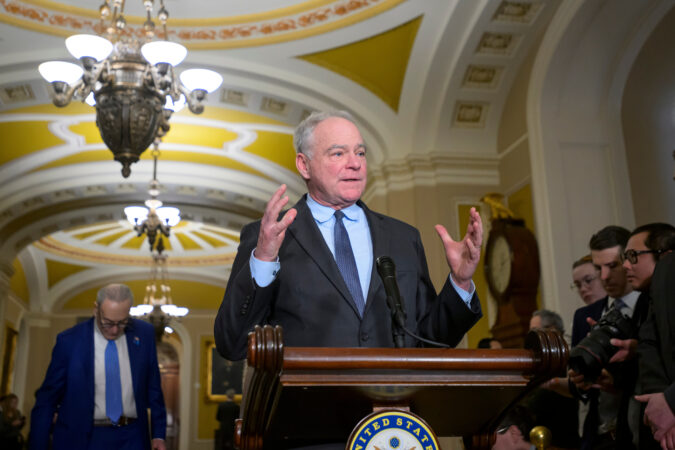
    “Has President Trump learned nothing from decades of U.S. meddling in Iran and forever wars in the Middle East?” said Sen. Tim Kaine (D., Va.), a leader in the bipartisan effort. He said the strikes on Iran were “a colossal mistake.”

    In the House, Reps. Ro Khanna (D., Calif.) and Thomas Massie (R., Ky.) are demanding Congress go on record with a public vote on their own bipartisan measure. “Congress must convene on Monday to vote,” Khanna said, “to stop this.”

    Massie blasted Trump’s own presidential campaign slogan and said: “This is not ‘America First.’”

    But most Republicans, particularly their leaders, welcomed Trump’s move against Iran. Many cited the longtime U.S. adversary’s nuclear programs and missile capabilities as requiring a military response.

    “Well done, Mr. President,” said Sen. Lindsey Graham (R., S.C.). “As I watch and monitor this historic operation, I’m in awe of President Trump’s determination to be a man of peace but at the end of the day, evil’s worst nightmare.”

    War powers debate tests Congress

    The administration’s decision to launch, with Israel, what appears to be an open-ended joint military operation aimed at changing the government in Tehran is testing the Constitution’s separation of powers in deep and dramatic ways. Nearly two months earlier, Trump ordered U.S. strikes that toppled Venezuelan leader Nicolás Maduro.

    While presidents have the authority as the commander in chief to conduct certain strategic military operations on their own, the Constitution vests Congress with the power to wage war. Before the Iraq War began in March 2003, Republican President George W. Bush made a monthslong push to secure congressional authorization. No such vote was attempted on Iran, and an earlier Senate effort to halt Trump’s actions after last summer’s strike on Iran failed.

    The congressional debate over war powers would mostly be symbolic. Even if a resolution were to pass the narrowly split Congress, Trump likely would veto it and Congress would not have the two-thirds majority needed to overturn that rejection. Congress has often failed to block other U.S. military actions, including in a Senate vote on Venezuela, but the roll calls stand as a public record.

    Republican leaders back Trump’s action

    The response by House Speaker Mike Johnson reflected the party’s long-standing views. Iran, he said, is facing “the severe consequences of its evil actions.”

    Johnson (R., La.) said the leaders of the House and Senate and the respective intelligence committees had been briefed in detail earlier in the week that military action “may become necessary” to protect U.S. troops and citizens in Iran. He said he received updates from Secretary of State Marco Rubio and will stay in “close contact” with Trump and the Defense Department “as this operation proceeds.”

    Senate Majority Leader John Thune (R., S.D.) commended Trump “for taking action to thwart these threats.”

    Thune said he looked forward to administration officials briefing all senators — a signal that lawmakers are seeking more answers to their questions about Trump’s plans ahead.

    Democrats warn strikes are illegal

    Many Democrats are calling the operation illegal, saying the Constitution gives Congress alone the power to declare war. To them, the administration has failed to lay out its rationale or plan for the military strikes, and the aftermath.

    Sen. Chris Van Hollen, who serves on the Senate Foreign Relations Committee, said the president has undertaken “illegal, regime-change war against Iran.”

    “This is not making us safer & only damages the US & our interests,” Van Hollen (D., Md.) said in a social media post. “The Senate must immediately vote on the War Powers Resolution to stop it.”

    House Democratic leader Hakeem Jeffries of New York said while Iran is a “bad actor and must be aggressively confronted” for its human rights abuses and the threat it poses to the U.S. and allies, the administration ”must seek authorization for the preemptive use of military force that constitutes an act of war.”

    New York Sen. Chuck Schumer, the Democratic leader, demanded that Congress be briefed immediately on the administration’s plans.

    “Iran must never be allowed to attain a nuclear weapon but the American people do not want another endless and costly war in the Middle East when there are so many problems at home,” he said.

  • Musk asked Epstein for ‘the wildest party,’ but now he claims to stand up for victims

    Musk asked Epstein for ‘the wildest party,’ but now he claims to stand up for victims

    During an explosive feud with President Donald Trump last spring, Elon Musk reached for the nuclear button. “Time to drop the really big bomb,” he wrote on X in June, “@realDonaldTrump is in the Epstein Files.”

    “The truth will come out,” the Tesla CEO added. He later deleted the posts and reconciled with Trump. In the months since, Musk has issued a steady drum beat of X posts calling for the arrest or prosecution of people linked to Jeffrey Epstein, a convicted sex offender who cultivated relationships with powerful figures in tech, finance, and politics.

    But when the Justice Department released what it said were millions of pages of documents last month from its investigation of the deceased financier, Musk featured prominently in the files.

    The entrepreneur had repeated email exchanges with Epstein, as did Kimbal Musk, his brother and fellow Tesla board member, the documents show. Elon Musk’s messages included inquiries about parties. Musk and Epstein also discussed arranging to meet on Epstein’s island and their assistants arranged a visit for the two at the entrepreneur’s rocket maker, SpaceX. On Christmas Day in 2012, Musk wrote to Epstein and asked: “Do you have any parties planned?” He added that “I’ve been working to the edge of sanity” and wanted to “let loose.”

    The revelations have thrust Musk in the awkward position of trying to cast himself as a stalwart defender of Epstein’s victims while also defending his own interactions with the convicted sex offender. Epstein pleaded guilty in 2008 to two charges of soliciting prostitution, including one involving a minor. He was arrested on federal sex trafficking charges in 2019 and died in federal custody later that year. Judges and lawmakers say that he abused, trafficked, and molested scores of girls over decades.

    In recent weeks, Musk has taken aim in online posts at other political and business figures over their alleged interactions with Epstein — including LinkedIn co-founder Reid Hoffman, former Trump chief strategist Stephen K. Bannon, and billionaire Les Wexner.

    “The big difference between you and me, Reid, is that you went and I did not,” Musk said in a post on X directed at Hoffman in early February, referring to Epstein’s island, adding later, “UNLIKE YOU, I came to my senses and declined to go.” Hoffman has acknowledged visiting Epstein’s island, as part of work to help the Massachusetts Institute of Technology “fundraise from Epstein,” and said that he regretted ever interacting with the sex offender.

    Wexner told Congress this month that he had been “duped” by Epstein and was not aware of his crimes. Bannon did not respond to a request for comment. Musk has refrained from making further allegations against Trump and stayed silent about the Justice Department files linking administration figures to Epstein, including Commerce Secretary Howard Lutnick, who told Congress this month that he once took his family to lunch on Epstein’s island but “did not have any relationship with him.”

    Musk has written on X that he “REFUSED” to visit Epstein’s island, even as the documents show him appearing to seek a visit. “When should we head to your island on the 2nd?” Musk asked Epstein on Christmas Day in 2013, in an apparent reference to a visit for the following January, the documents show.

    Musk and his brother, Kimbal Musk, did not respond to requests for comment for this story. Appearing in the documents released by the Justice Department does not indicate wrongdoing.

    At times, Musk’s attempts to focus on his preferred narrative about Epstein have backfired. Earlier this month, the billionaire reshared an X post from Mohamad Safa, executive director of the human rights group Patriotic Vision. “As someone works in human rights, I’ve never seen anything like the Epstein files in my 15-year career,” Safa wrote. “I don’t understand how we’re not having a global revolution right now.”

    After Musk distributed that message to his around 235 million followers on X, Safa responded to point out that the billionaire was overlooking something.

    “Elon, you’ve got it wrong,” Safa wrote. “It’s a revolution against every person in the Epstein files.”

    Safa told the Washington Post that the Tesla CEO was wrongly trying to lump himself in with the human rights community demanding accountability in relation to Epstein.

    “Elon bought Twitter to mislead the public on global issues, and he is now using it to mislead about his connection to Jeffrey Epstein,” Safa said.

    After the release of the latest trove of files raised new questions about the extent of Musk’s contact with Epstein over the years, Musk issued a late-night statement on X last month in a 1:50 a.m. Eastern reply to a user known as “DogeDesigner.”

    “No one pushed harder than me to have the Epstein files released and I’m glad that has finally happened,” Musk wrote. “I had very little correspondence with Epstein and declined repeated invitations to go to his island or fly on his ‘Lolita Express’,” he said, referring to Epstein’s airplane, “but was well aware that some email correspondence with him could be misinterpreted and used by detractors to smear my name.”

    Musk added, “I don’t care about that, but what I do care about is that we at least attempt to prosecute those who committed serious crimes with Epstein, especially regarding heinous exploitation of underage girls.”

    The Justice Department files reviewed by the Post, including dozens that refer to Musk or his brother Kimbal, paint a vastly different picture of Epstein’s relationship with the Tesla CEO.

    “What day/night will be the wildest party on your island?” Elon Musk asked Epstein in an email from November 2012, as he sought to plan a visit accompanied by actor Talulah Riley — Musk’s ex-wife — the files show. A month later, he wrote to Epstein again about partying.

    “Do you have any parties planned?” he asked. “I’ve been working to the edge of sanity this year and so, once my kids head home after Christmas, I really want to hit the party scene in St Barts or elsewhere and let loose.”

    Musk added, “The invitation is much appreciated, but a peaceful island experience is the opposite of what I’m looking for.”

    The newly released correspondence appears to show the entrepreneur interacting and making plans with Epstein over a period of more than a year that took place several years after Epstein pleaded guilty in 2008.

    In 2013, Musk and Epstein’s assistants planned a visit for the disgraced financier to SpaceX, Musk’s rocket building company. The visit included a scheduled lunch for Musk and Epstein. Epstein was scheduled to travel with three female assistants — one South African and two Russian — whose passports were vetted by SpaceX, a government contractor, for security clearance reasons, according to the emails. While the visit took place as planned, according to the emails, it was not immediately clear whether the two men met for lunch.

    Musk has said he blocked and ultimately “ghosted” Epstein.

    The files also show that Kimbal Musk corresponded with Epstein about an apparent romantic partner whom another person warned him not to mistreat. “Jeffrey: Message received wide and clear. ;)” Kimbal Musk replied, in a message on which he copied Epstein.

    Years later, Epstein wrote in an email: “I gave another girl to kimball and he is thrilled.”

    Kimbal Musk said in a statement that Epstein did not introduce him to his romantic partner at the time of the earlier emails, and that she was an adult.

    “In 2012 I started dating a woman who was 30 years old,” Kimbal Musk posted on X. “I met her through a friend. Epstein did not introduce us. My only meeting with that demon was in his New York office during the day. I never met with him again and I never went to his island.”

    He added that Epstein subscribed to a newsletter of his, leading his email address to appear in searches of the Epstein files numerous times.

    “My heart goes out to the many victims of Jeffrey Epstein, as it does for all who have suffered any kind of sexual abuse or harassment,” Kimbal Musk said.

    Soon after the Justice Department’s release of files last month, the nonprofit organization behind Burning Man, a massive cultural festival held annually in the Nevada desert, announced that Kimbal Musk was no longer on its board of directors. That decision was made by Kimbal Musk “based on other commitments and priorities” and came “well before” the revelations, the organization said.

    Elon Musk, meanwhile, continues to face an uphill battle to convince skeptics that his support for Epstein victims is genuine.

    Scott Berkowitz, president and founder of RAINN, a nonprofit organization aimed at ending sexual violence, said he did not know what is in Musk’s heart, but said one way the entrepreneur could effect change for victims of sexual abuse would be by reining in the Grok chatbot offered by his company xAI, which recently came under fire for allowing the creation of nonconsensual sexualized images of real people.

    “RAINN is working to make the country safer from sexual violence. If Elon Musk wants to be a part of that and to use his influence to make life safer, there’s a long list of ways that he could be part of the solution,” Berkowitz said. “Partner with us to make Grok the model for AI safety and ensure it never creates another nonconsensual image, whether child or adult.”

    On X, many have lobbed criticism at Musk over his messaging on the Epstein files, seeing it as an effort to reframe the narrative around his involvement.

    Given “Elon Musk’s involvement with Epstein and his lies about it, it feels dirty to use this platform, which increasingly feels like his own propaganda machine and PR agency” Fred Lambert, the editor in chief of Electrek, an electric vehicle-focused publication, said in an X post last week.

    Safa, of Patriotic Vision, said he is not convinced by Musk’s sudden interest in accountability. “He should be investigated like any other individual whose name has been mentioned, regardless of social, political, or financial status,” Safa said, adding, “Why did he wait until now to speak out?”

  • Vatican removes salty white film coating Michelangelo’s ‘The Last Judgment’

    Vatican removes salty white film coating Michelangelo’s ‘The Last Judgment’

    VATICAN CITY — Michelangelo’s The Last Judgement is getting a facial, with restorers removing a chalky white film of salt that has accumulated over the Renaissance masterpiece since its last major renovation three decades ago.

    The Vatican on Saturday gave the media a sneak peak to the cleaning operation, which is taking place on a floor-to-ceiling scaffolding that has obscured the imposing fresco of heaven and hell that dominates the front of the Sistine Chapel.

    The cleaning operation is expected to be completed by Easter, in the first week of April. The public can continue to visit in the meantime, but will have to settle for a reproduction of The Last Judgment superimposed on a screen that covers the scaffolding.

    Vatican Museum officials on Saturday described a simple but important cleaning operation to remove the white film of salt that has accumulated on the fresco thanks to the nearly 25,000 people who pass through the Vatican Museums each day.

    “This salt is created because, above all, when we sweat, we emit lactic acid, and unfortunately lactic acid reacts with the calcium carbonate present on the wall,” said Fabio Moresi, in charge of the scientific research team at the Vatican Museums that is overseeing the cleaning.

    Climate change also has a role to play, since the visitors who do come tend to sweat more, creating even more humidity that reacts with the fresco, he said.

    Vatican Museums chief Barbara Jatta described the film as a “cataract” that is easy enough to remove: Restorers dip sheets of Japanese rice paper into distilled water and apply them to the fresco, and carefully wipe away the salt film.

    Viewed up close on Saturday on the scaffolding, the difference between before and after is remarkable: Sections of the fresco that haven’t been cleaned look as if they are coated in a chalky dust; the cleaned sections show the vibrant colors and detail of the original. On the figure of Jesus, for example, at the center of the fresco, a privileged visitor can see how Michelangelo painted his hair and the wounds of his crucifixion.

    The Sistine Chapel is named after Pope Sixtus IV, an art patron who oversaw the construction of the main papal chapel in the 15th century.

    But it was a later pontiff, Pope Julius II, who commissioned Michelangelo to paint the famous ceiling, the Creation of Adam showing God’s outstretched hand, between 1508 and 1512. A later pontiff, Pope Clement VII, commissioned Michelangelo in 1533 to return to paint The Last Judgment.

    The other frescos of the Sistine Chapel, where Pope Leo XIV was elected in May, undergo yearly cleaning with restorers working at night on cherry-pickers that can be removed each morning before the public arrives.

    But such machines can’t access all of The Last Judgement because the fresco is located behind the altar, which is itself raised up on marble steps. That logistical impediment required the mounting of a fixed scaffolding to access the full fresco to clean it.

    The Sistine Chapel underwent a complete restoration between 1979 and 1999, when centuries of smoke, grime, and wax buildup was removed. The Vatican has left small patches of the pre-restored fresco intact to show the difference, which are now visible on the upper floors of the scaffolding and show a nearly blackened wall.

    Rather than radically reduce the number of visitors who can access the Sistine Chapel, the Vatican is studying ways to address humidity levels, through filtration systems and other technologies, so that the salty film doesn’t form again.

  • A mad king’s illegal war on Iran is a cry for regime change … in Washington

    A mad king’s illegal war on Iran is a cry for regime change … in Washington

    It turns out that democracy really does die in darkness — at 1:30 a.m. Eastern time, to be exact.

    The pilastered chambers of the U.S. Capitol — where 535 lawmakers who, under the Constitution, wield the sole authority to send the nation to war — were empty when the first cruise missiles slammed into Tehran, 6,300 miles and eight-and-a-half time zones away.

    Like Congress, many Americans — only 27% of whom, according to a poll last week, have great confidence in Donald Trump’s ability to make the right decisions about using military force — were likely sound asleep when the war started, perhaps dreaming of the normality of brunch or the dog park on an unseasonably warm Saturday.

    Trump was not even in the White House Situation Room — the multimillion-dollar mancave that exists for a commander in chief to run our too-frequent military ops — but was instead ensconced at his gilded Florida palace at Mar-a-Lago, addressing the nation in an eight-minute video after a Friday night of partying. His wild, uncoiffed midnight hair was crammed under a hat hailing the country whose founding principles he’d just demolished, “USA.”

    It’s normal for invaders to attack under the cover of darkness, yet Saturday’s massive attack on Iran — launched jointly with our sister 2020s global pariah, Israel — occurred in bright morning sunshine in downtown Tehran, its streets packed with commuters and school buses at the start of the Arab world’s workweek.

    It seems that this time, the dead-of-night deception was aimed at the American people, in an assault on everything the United States was intended to stand for.

    While many words will be written or uttered in the coming days about who is winning this U.S.-Israel war of choice, the next military targets, the inevitable spike in the price of oil, and the fate of Iran’s tottering regime, there is one fact that matters more than any other.

    This war — and, yes, it is a “war,” with an expected loss of American blood, as Trump himself acknowledged from Mar-a-Lago — is illegal.

    Full stop.

    Article 1, Section 8 of the U.S. Constitution, hashed out here in Philadelphia, could not be more explicit on that point, stating in plain 18th-century English that only Congress has the power “To declare War, grant Letters of Marque and Reprisal, and make Rules concerning Captures on Land and Water.”

    America’s founders knew exactly what they were doing — seeking to prevent one unchecked or unhinged president from arbitrarily launching a lethal conflict that might be in his own best interest, but not the nation’s. “The constitution supposes,” James Madison wrote in 1798, “what the History of all Governments demonstrates, that the Executive is the branch of power most interested in war, and most prone to it.”

    David Janovsky, acting director of the Constitution Project at the Project on Government Oversight, told Time magazine last week that any attack on Iran ordered by White House fiat would be flat-out unconstitutional.

    “There’s no indication that there’s any sort of circumstance that would give the president the unilateral authority to order military action,” Janovsky said. “It’s true that presidents have some inherent authority to deploy the military as commander in chief, but that’s really limited to true emergency circumstances where there is an attack underway that needs to be repelled, or maybe an extremely clear imminent attack. But there’s no suggestion that that’s the case today — that would make the strikes illegal.”

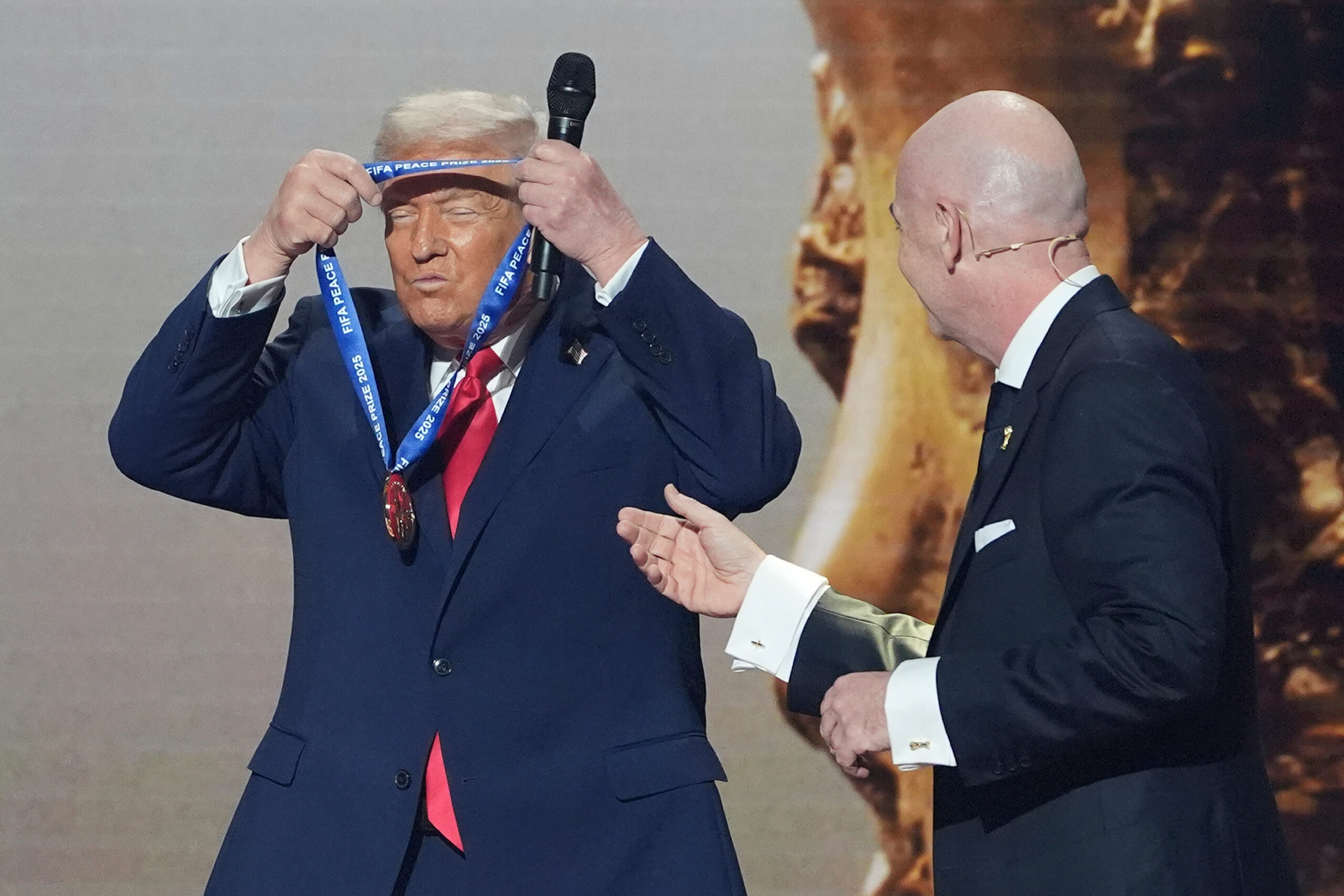
    And it’s not only unconstitutional. An aggressive and unprovoked war — which this unambiguously is — is also a blatant violation of international law and the post-World War II global order that we once encouraged with the United Nations, in the hope of preventing the emergence of some future tyrant. Who knew that the greatest threat to world security in the 21st century would come from the current holder of the coveted FIFA Peace Prize™ and the chairman of his own much-ballyhooed Board of Peace?

    When the rise of our Cold War national security state after 1945 led to prolonged, unpopular, and undeclared wars in Korea and Vietnam, Congress passed the 1973 War Powers Act that meant to require consultation and its mandated involvement, a seeming solution that is now increasingly honored in the breach.

    It’s worth noting that when the George W. Bush regime decided to launch a war of choice against Saddam Hussein’s Iraq in the early 2000s, its case was larded with lies, including a 16-word whopper that the president uncorked during his 2003 State of the Union address. But a generation ago, Bush, Dick Cheney, and their merry band of war criminals at least felt it was necessary to get a congressional authorization, and to spend months wooing the public and the pundits.

    Trump had a similar chance to lobby the American people and the world in his State of the Union address last week, and he largely whiffed. He included only a brief and perfunctory recitation of the long-standing and, in fairness, justifiable grievances against Iran’s brutal repression of its own people, its nuclear ambition, and its backing of violent proxy groups.

    To be sure, we should be alarmed about the destructive threat of nuclear bombs in the hands of unconstrained strongmen backed by religious fanatics — whether that’s in Tehran, Jerusalem, or Washington. And most of the world wants freedom for Iran’s long-repressed masses, but U.S. and Israeli bombs might be the worst possible way to make that happen.

    Already, as I write this in the very early hours of the war, there are reports that the bombing of a girls’ school in southern Iran has killed as many as 85 people, most of them innocent children. We are spilling the blood of the very people we are promising to liberate. Are we really expecting to be someday greeted with rose petals?

    Again?

    Indeed, there are many painful echoes of Bush 43’s disastrous conflict with Iraq, including shameless lying by the commander in chief. Trump’s 3 a.m. claims that Iran poses an “imminent” threat to the United States and is close to developing ballistic missiles that can reach our shores are almost as ludicrous as his Big Lie about the 2020 election.

    Just like early 2003, when Iraq opened up to outside weapons inspectors, but we invaded them anyway, Trump’s all-out attack came in spite of reports that Iran was making “significant” concessions at the bargaining table in Geneva, regarding both the nuclear program and the kind of big-money stuff like oil and minerals that warm the heart of our corrupt kleptocracy. All this after Barack Obama had a successful deal, negotiated with years of hard work, to halt Iran’s nuclear enrichment that Trump 45 came in and scuttled because ¯_(ツ)_/¯.

    Trump seems to be bored with peace. For whom? For what?

    President Donald Trump is presented with the inaugural FIFA Peace Prize by FIFA President Gianni Infantino during the 2026 FIFA World Cup draw at the Kennedy Center in December.

    It seems way too spot on that the Pentagon is calling this massive attack “Operation Epic Fury” — a fitting tribute to a president who reportedly launched into an epic Downfall-level rage when even a right-wing U.S. Supreme Court struck down his also-unconstitutional tariffs, whose U.S. Department of Justice is covering up the Jeffrey Epstein files, and who is considering a “national emergency” around the 2026 midterms that smells like a Reichstag fire.

    Sure, the Iran war is a massive distraction from Trump’s cratering poll numbers at home, but aggressive war is also just a thing strutting strongmen do to consolidate their illegitimate powers. Bush’s Iraq War was the last throes of a decaying democracy, while Trump’s actions are those of an unrestrained dictator — exactly the mad king that Madison sought to warn us about 228 years ago.

    So now what?

    “Trump has launched an illegal regime change war in Iran with American lives at risk,” Democratic Rep. Ro Khanna of California, a Bucks County native and a top critic of unchecked militarism, posted on X after the attack. He said he and his GOP renegade ally, Rep. Thomas Massie of Kentucky, plan to go ahead Monday with a vote to invoke the War Powers Act — even as the prospect of that vote may be why Trump pushed the button now.

    Not only do the odds of success for Khanna and Massie seem dim, but the War Powers Act seems too late, yet also too little. In a nation that has pressed impeachment or resignation on four presidents, including Trump 45, Trump 47’s unlawful and murderous war on Iran already seems the worst abuse of presidential power in American history.

    A cruise-missile assault aiming to change the government in Iran is, in reality, a desperate plea for regime change in Washington, D.C. Democrats, who could gain power in the House as early as this year thanks to GOP scandals and illness, must make clear that Trump’s impeachment and an end to American autocracy are their main priority.

    For now, we have unnecessarily injected ourselves into a long-troubled corner of the world where there are almost no good guys, where theocratic dictators are unceasingly slaughtering the citizens of other theocratic dictators. Maybe that’s because, over the course of 250 increasingly tragic years, the United States has finally become exactly like them.

    The only epic fury should be our own.

  • Pentagon assault on Anthropic sends shockwaves across Silicon Valley

    Pentagon assault on Anthropic sends shockwaves across Silicon Valley

    The Trump administration’s declaration that AI company Anthropic would be cut off from all government contracts shook the tech industry late Friday, hardening political and cultural battle lines across Silicon Valley over military use of artificial intelligence.

    President Donald Trump ordered government agencies to “immediately cease” using Anthropic’s technology, in a post on Truth Social on Friday, and Defense Secretary Pete Hegseth labeled the company a “supply chain risk to national security” in his own post on X, after the company refused to allow its technology to be used for domestic surveillance and autonomous weapons.

    The Trump administration’s assault on Anthropic appeared to put the company on course to lose billions of dollars of potential revenue, although the startup said in a blog post late Friday that it would challenge Hegseth’s designation in court.

    The firm’s conversational assistant, Claude, is being deployed or tested in at least five government agencies, including the Pentagon, the Department of Health and Human Services, the Department of Homeland Security, and the Department of Energy, according to recent disclosures of AI use mandated by law and an executive order.

    Friday’s aggressive moves by the Trump administration put all of Silicon Valley on notice that tech companies seeking Pentagon contracts risk massive political and business fallout if they don’t back administration policies and cede control of how their technology is used. Rivals of Anthropic including Elon Musk and other tech allies of Trump seized on the conflict to pledge that their own companies would not question Pentagon policies, positioning themselves as loyal patriots.

    Conflict has bubbled between Anthropic and the Trump administration since last year. The company leveraged its relationship with investor Amazon to become the first company to be integrated into classified systems.

    But Anthropic, co-founded in 2021 by CEO Dario Amodei, his sister Daniela, and other former employees of ChatGPT-maker OpenAI, also rankled tech allies of Trump by positioning itself as more safety conscious than other AI developers. (Amazon founder Jeff Bezos owns the Washington Post, which has a content partnership with OpenAI.)

    In the fall, Trump’s AI and crypto czar David Sacks accused Anthropic of attempting to manipulate the government with “fearmongering” about AI technology. Around the same time, Semafor reported that Anthropic displeased the White House by raising ethical objections to how the administration wanted to use its technology, including for surveillance.

    Those tensions flared into an unprecedented public fight between the Pentagon and the tech company this week. Frantic talks between the two sides continued right up until Hegseth’s announcement late Friday that he was declaring Anthropic a risk to national security, according to an X post from Emil Michael, the Pentagon’s technology chief, and a person familiar with the talks.

    Michael was on the phone with Anthropic, suggesting that the company agree to allow analysis of some bulk data on Americans, at the same moment Hegseth said in his X post that Anthropic had been designated a supply chain risk, according to the person, who spoke on the condition of anonymity to discuss the talks.

    Anthropic said in a statement responding to Hegseth on Friday that it would legally challenge his declaration against the company, suggesting that the dispute is far from over. Experts said that Anthropic had strong legal grounds for a challenge.

    A company can only be designated a supply chain risk through a legal process, said Steven Feldstein, a senior fellow at the Carnegie Endowment for International Peace who researches the use of AI in war. “It isn’t legally sufficient to simply proclaim or label [a supply chain risk] and have this be the final word,” he said. “It’s a major overreach.”

    Jessica Tillipman, an associate dean at George Washington University’s law school, said Anthropic could probably make a strong argument in court that it had been unfairly targeted. “This is on incredibly shaky ground,” she said of Hegseth’s declaration on Friday. “I don’t think you have seen a case for more politicized use.”

    Hegseth’s post also asserted that all companies that do business with the U.S. military are now prohibited from doing any commercial activity with Anthropic. Although the legal basis for that sweeping ban was unclear, it could have disastrous consequences for Anthropic, which has received billions of dollars in investment from partners like Amazon, Microsoft, and Nvidia that also supply the military. The companies didn’t respond to requests for comment.

    Should the Pentagon prevail, the U.S. military will need to adapt fast. Claude is deeply integrated into the Maven Smart System, an AI tool built with the technology company Palantir that runs on Amazon’s cloud. It provides troops with a unified picture of intelligence streaming in from multiple sensors, said retired Air Force Lt. Gen. Jack Shanahan, who served as the first director of the Pentagon’s Joint Artificial Intelligence Center and is now an adjunct senior fellow at the Center for a New American Security, a think tank.

    After the U.S. seizure of Venezuelan strongman Nicolás Maduro, an image circulated that showed Claude operating alongside Maven during the operation, Shanahan said, which prompted Anthropic officials to ask Palantir questions about its use in the operation.

    Claude is the “single most widely deployed AI system in the U.S. military,” Shanahan said. He added that it wouldn’t make sense to try to extract the AI tool from all of the Defense Department systems it helps, just as service members are getting skilled with the technology.

    In Silicon Valley, debate raged Friday over whether Anthropic should be celebrated for taking a stand, criticized as unpatriotic, or scoffed at for being strategically naive.

    Right-leaning leaders such as Palmer Luckey, founder of the defense startup Anduril, and investor Keith Rabois posted in support of the military’s decision. Anthropic employees cheered its moves in online posts, and hundreds of employees of Google and OpenAI signed a public letter backing the company’s stance.

    Anthropic’s rivals were poised and at the ready to take advantage of its blunders.

    OpenAI chief executive Sam Altman wrote in a memo to all staff late on Thursday that he had been negotiating with the Pentagon, according to a copy reviewed by the Post. The memo was first reported by the Wall Street Journal.

    Altman wrote that the dispute between Anthropic and the Pentagon had become “an issue for the whole industry,” and that the spat was not about the use of AI but about “control.” The country, he said, “absolutely needs help with AI for defense if we want to continue to enjoy peace and prosperity.”

    But Altman added that he was seeking a deal with the Defense Department that would find middle ground. It would see OpenAI agree to cover any use except those that are “unlawful or unsuited to cloud deployments, such as domestic surveillance and autonomous offensive weapons,” he wrote. And he said the company could deploy technical safeguards and personnel “to partner with the government to ensure things are working correctly.”

    Late on Friday, Altman wrote in a post on X that he had reached such an agreement with the Defense Department to deploy OpenAI’s technology in classified U.S. networks.

    “Two of our most important safety principles are prohibitions on domestic mass surveillance and human responsibility for the use of force, including for autonomous weapon systems,” Altman wrote. The Pentagon “agrees with these principles, reflects them in law and policy, and we put them into our agreement.”

    Jeremy Lewin, under secretary of state for foreign assistance, humanitarian affairs, and religious freedom, wrote in a post on X that the new OpenAI deal permitted the Pentagon the freedom of “all lawful use” of AI that it had sought from Anthropic. The agreement represented “a compromise that Anthropic was offered, and rejected,” he wrote.

    Musk, whose company xAI was certified to work with classified military systems this week, also stepped into the fray. “Anthropic hates Western civilization,” he wrote in a post Friday on his social network X. Musk and xAI did not respond to requests for comment.

    Lewin held up the billionaire as showing a better way for AI firms to engage with the government.

    “Elon and xAI have already agreed to the ‘all lawful uses’ principle — meaning that he’s already agreed not to shut off U.S. systems for nonlegal prudential discretionary reasons,” Lewin, a former staffer for Musk’s government efficiency initiative, the U.S. DOGE Service, wrote on X. “So there’s your difference. Anthropic wants to add additional conditions — Elon has agreed to promise he won’t pull the plug for our systems.”

  • Friends’ Central wins first PAISAA girls’ basketball title in program history

    Friends’ Central wins first PAISAA girls’ basketball title in program history

    When Friends’ Central’s Ryan Carter limped off the court with 3 minutes, 40 seconds left in the PAISAA girls’ basketball championship game at Hagan Arena on Friday night, it felt like history was repeating itself.

    Carter, a junior guard who spent last season at Archbishop Wood, went down with an injury in the 2025 PIAA Class 5A championship. She played through the pain but was unable to lead Wood to a win.

    But this time, in a different jersey and a different state championship game, Carter got back on the floor and helped upset Westtown, 62-54.

    “These girls, I didn’t want to let them down,” Carter said. “This is the one team where I’ve felt like people have always had my back, no matter what. It’s a true family.”

    The Friends’ Central girls celebrate after winning the PAISAA state title against Westtown on Friday.

    Zya Small led the Phoenix (27-6) with 18 points as they claimed their first PAISAA state title in program history. Kayla Snyder and Carter added 14 and 12 points, respectively.

    “This group of girls, they just work so hard,” Friends’ Central coach Vinny Simpson said. “And they believe. That’s the difference in this year’s group. They believe, they work hard. … That’s how we figured it out.”

    Westtown (28-2) entered Friday night’s game having won four consecutive PAISAA titles. It beat Friends’ Central in the state title game in 2024 and 2025, as well as in the regular season and Friends League championship this year.

    “That’s a ton [of times] to lose to a team,” said Faith Watson, a sophomore center who scored 10 points for the Phoenix. “So this feels great.”

    Jordyn Palmer led Westtown with 27 points. The junior forward is ranked as the sixth best prospect by ESPN. Friends’ Central’s Carter (No. 12) and Small (No. 47) also are among the top 60 prospects in the 2027 class.

    Friday night’s loss was the final game of Atlee Vanesko’s Westtown career. The senior guard, who’s No. 74 in the 2026 class and will play at Ohio State next season, scored six points and fouled out with 1 minute, 49 seconds remaining.

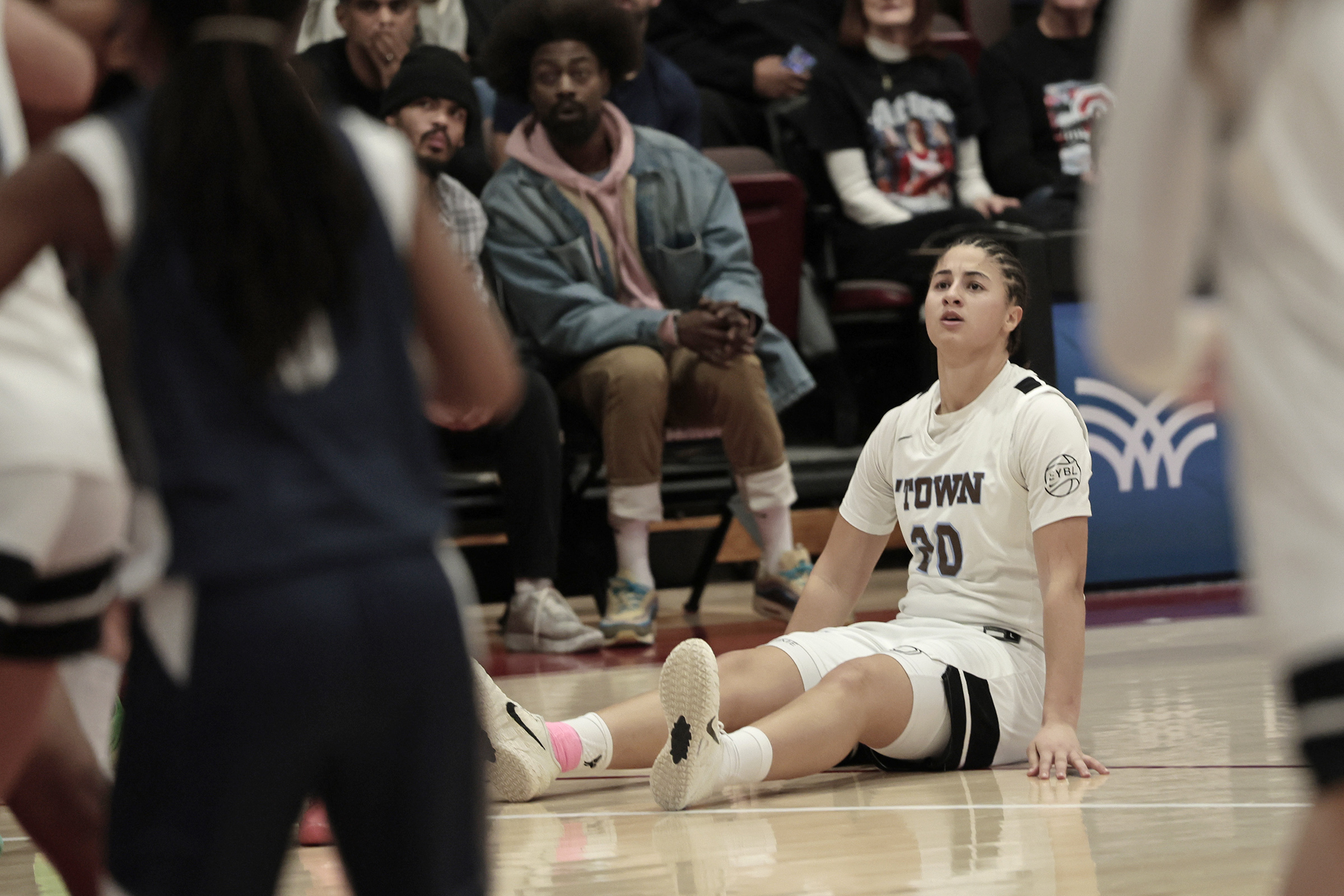
    Westtown’s Jordyn Palmer watches the ball from the floor after taking a shot in the PAISAA girls’ basketball final on Friday.

    Friends’ Central will continue its season in The Throne, a single-elimination national tournament run by the National Basketball Players Association. The seventh-seeded Phoenix will face second-seeded Princess Anne (Va.) in East Rutherford, N.J., in the tournament’s first round on March 19.

    The Hill School defeats Phelps

    Ben Natal and Ethan Johnston led the Hill School as it beat the Phelps School, 74-56, in a rematch of last season’s state title game.

    Natal, a fifth-year guard, scored 21 points , while Johnston, a senior guard who will play at Marquette next season, added 22. The pair of guards helped to lift the Hill School (24-9) to its first state title since 2018.

    Johnston scored 13 of his 22 in the third quarter. The Hill School outscored Phelps, 27-9, in the third, which gave the Rams a 28-point lead entering the fourth.

    The Hill School players pose for a photo after it won the PAISAA boys’ basketball final against Phelps School on Friday.

    “Last year, we didn’t play a complete game,” Johnston said. “We didn’t execute late. I think this year we took more of an initiative to execute late and just stay together.”

    The Hill School coach Seth Eilberg began to empty his bench with three minutes remaining. The team has eight players graduating, including Natal, Johnston, and Zane Conlon, who scored 11 on Friday.

    “We’ve played a really tough schedule,” Eilberg said. “We’ve taken a couple of hits here and there. They stayed together, and we kept getting better, and we kept having fun with it.”

    Jahrel Vigo led Phelps (24-12) with 19 points. The senior guard, who will play at Buffalo next season, was the only Phelps player to reach double figures in scoring.