Blog

  • The promise, peril, and whimsy of a potential double-digit snowfall in Philly

    The promise, peril, and whimsy of a potential double-digit snowfall in Philly

    Informal plans for a snowball fight in Rittenhouse Square. Debates on the best snow to craft the most aerodynamic orb.

    A run on ice salt. Public denunciations of said runs.

    Searches for snow shovelers.

    Love it or hate it, Philadelphia could be racking up its first double-digit snowfall since 2016, and residents are bursting at the seams of their snowsuits with the peril and promise of a real, old-school winter wonderland.

    Alex Janconski, a manager at Stanley True Value, a hardware store in Roxborough, said the recent snow dustings in the city had already proved to be good for business but this weekend’s forecast had made it hard for suppliers to keep up. People seem to be stocked up on shovels at this point, Janconski said, but in recent days salt has been a hot commodity.

    People are taking whatever they can get — rock salt, fast melt, magnesium chloride.

    Janconski said the urgency felt by his customers is reminiscent of the COVID-19 days. Three pallets of ice melt sold within 15 minutes of opening Thursday. He suspects the demand has to do with the significant snow projections.

    “In terms of the inches, it’s hard to get away from that number and feel like, oh, I can get away with just having nothing,” he said.

    While the traditional run on stores before a storm is a strongly held American tradition, there is an added novelty in a city like Philadelphia, where some generations can still wax poetic about staring at the TV waiting for school closure announcements that would give them the all-clear to sled down the Art Museum steps, at Clark Park, or on Fairmount Park’s Belmont Plateau.

    Snowfall in the digital age, as the rarity that it is, has lost much of the whimsy.

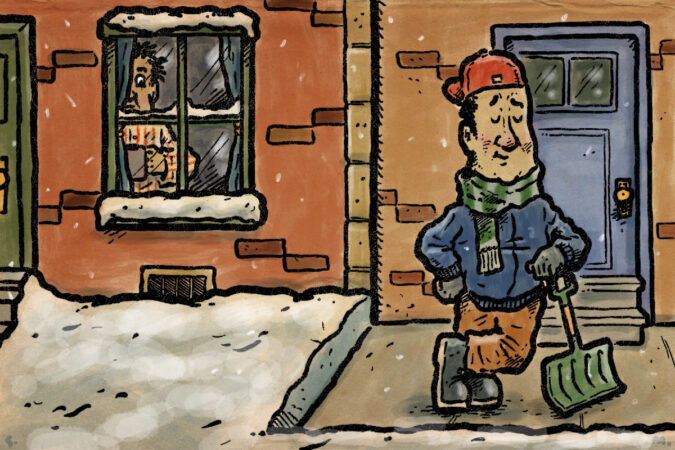
    The specter of a dusting feels more like a chore. The kids can learn virtually and the responsibilities for homeowners and renters are the same — six hours to shovel or risk up to a $300 fine in Philadelphia.

    And is it true that the teens no longer do shoveling side-hustles anymore?

    The online space has also given the cynics multiple platforms from which to thumb their nose at the forecasts.

    Meteorologist Glenn “Hurricane” Schwartz, formerly of NBC10 and legendary for his bow tie collection, is one voice pushing back.

    “Forecasts of any type are going to be imperfect,” he said in a TikTok video, after announcing Wednesday that he would be doing two weather updates a day until the storm hits.

    “You got any sports forecasts that are correct? Political forecasts? Economic forecasts? It’s hard to predict the future.”

    @hurricane.schwartz i’ll be back later today with a more detailed update… #winterstorm2026 #philly ♬ original sound – Hurricane Schwartz

    Fans delighted in Schwartz’s coming “out of retirement,” even if it meant sharing his prognostication talents with the rest of the country.

    Whether or not the storm ends up being more modest than expected, there are plenty in Philadelphia who want to make the most of the occasion.

    A Reddit thread echoed childlike wonder as a poster asked if there was chatter of a collective snowball fight Sunday.

    “Dual [sic] at high noon?” asked the poster, whom, sadly, The Inquirer could not reach to ask about what makes a great snowball fight setting.

    Another thread pitched a pond hockey game at FDR Park should the ice be thick enough. Supportive commenters already began work to get the Philadelphia Flyers and Gritty to join.

    Meanwhile, contingency plans abound ahead of the potential weekend dump. Businesses are calling it and closing their doors, and state agencies are fully activated, adjusting their various plowing and emergency response plans.

    Even the 25th Annual Keystone Sacred Harp Convention at the Rotunda finds itself adjusting to potential snow.

    The members of the group, who don’t actually play any harps, practice a style of early American a cappella singing called shape-note singing that uses a series of different shapes rather than typical oval-shaped note heads. The notation was invented in Philadelphia in the 1700s, according to the convention’s chair, Rachel Hall.

    About 200 people from across the country were originally slated to come to the events over the weekend, Hall said. But, if the snow falls as predicted, Hall plans on hosting the singers in the living room of her West Philly home Sunday for those willing to make the trudge. She said she likes how the activity brings people together.

    “We have a lot of traditions that enable us to come together and think about things that are beyond ourselves,” Hall said.

    Besides, what’s an inch (or 14) of snow?

  • New Jersey officials confirm 2026’s first case of bird flu in a commercial flock

    New Jersey officials confirm 2026’s first case of bird flu in a commercial flock

    Federal and state agriculture officials announced Thursday that they have identified a case of highly pathogenic avian flu on a commercial bird farm in Burlington County.

    The New Jersey Department of Agriculture said in a news release that the case was the first confirmed in the state in 2026.

    The farm’s owner contacted agriculture officials after birds on the farm began dying, and highly pathogenic avian influenza was later found in samples submitted to state officials.

    The farm has been quarantined and no new birds will arrive there until a “thorough cleaning and disinfection” to eliminate the virus, officials said in a news release.

    Health and agricultural officials have been monitoring outbreaks of HPAI in commercial flocks across the country since 2022, including in the Philadelphia area. Though the virus has also spread in dairy cattle elsewhere in the country, it has not been detected in cattle in Pennsylvania or New Jersey.

    HPAI has infected humans, although none in either state, and New Jersey officials said there is little risk to the public.

    Human infections typically occur after close or lengthy unprotected contact with infected birds or cattle, or the places they have touched, officials said.

    People who have had unprotected contact with infected birds should monitor themselves for symptoms for 10 days, including fever, cough, a sore throat, eye irritation or redness, aches, and diarrhea. If symptoms emerge, they should call a doctor.

    Poultry farmers should notify state officials if they notice their birds exhibiting symptoms of avian flu, including coughing, sneezing, lethargy, eating or drinking less, or dying suddenly, officials said.

    State officials said they are also monitoring cases of avian flu in wild birds after “an outbreak of wild bird deaths in various parts of the state.”

    The rise in cases in wild birds, which started in November, affects a number of species of wild birds, “including but not limited to waterfowl, raptors, and scavenger birds,” officials said.

    The New Jersey Department of Environmental Protection asked residents to avoid directly touching sick or dead wildlife. If they find a dead wild bird on their property and want to dispose of it, residents should wear personal protective equipment and thoroughly wash their hands and disinfect non-disposable gear afterward.

    Dead birds should be double-bagged in trash bags with a zip tie and placed in an outdoor trash can that pets or other wildlife cannot access.

  • House approves final spending bills as Democrats denounce ICE funding

    House approves final spending bills as Democrats denounce ICE funding

    WASHINGTON — The House passed this year’s final batch of spending bills on Thursday as lawmakers, still smarting from last fall’s record 43-day shutdown, worked to avoid another funding lapse for a broad swath of the federal government.

    The four bills total about $1.2 trillion in spending and now move to the Senate, with final passage needed next week before a Jan. 30 deadline to avoid a partial government shutdown.

    Three of the bills had broad, bipartisan support. They funded Defense and various other departments, including Education, Transportation and Health and Human Services. A fourth bill funding the Department of Homeland Security was hotly disputed as Democrats voiced concerns that it failed to restrain President Donald Trump’s mass deportation efforts.

    Republicans were able to overcome the Democratic objections and muscle the Homeland Security bill to passage in a 220-207 vote. The broader package, which funds a 3.8% pay raise for the military, passed in a 341-88 vote.

    Before the votes, House Democratic leaders announced their opposition to the Homeland Security bill as the party’s rank-and-file demanded a more forceful stand in response to the Republican president’s immigration crackdown. Trump’s efforts have recently centered in the Minneapolis area, where more than 2,000 officers are stationed and where a U.S. Immigration and Customs Enforcement officer fatally shot Renee Good, a mother of three.

    In a joint statement, the Democratic leaders said Trump promised the American people that his deportation policy would focus on violent felons in the country illegally, but instead, ICE has targeted American citizens and law-abiding immigrant families.

    “Taxpayer dollars are being misused to brutalize U.S. citizens, including the tragic killing of Renee Nicole Good. This extremism must end,” said the statement from Democratic leader Hakeem Jeffries, Democratic Whip Katherine Clark and Democratic Caucus Chair Pete Aguilar.

    Democrats had limited options

    Democrats had few good options to express their opposition to Homeland Security funding.

    Lawmakers, when confronting a funding impasse, generally turn to continuing resolutions to temporarily fund agencies at their current levels. But doing so in this case would simply cede more Homeland Security spending decisions to Trump, said Connecticut Rep. Rosa DeLauro, the top Democrat on the House Appropriations Committee.

    Also, there was concern that a failure to fund Homeland Security would hurt disaster assistance programs and agencies such as the Transportation Security Administration, while ICE and Customs and Border Protection would simply carry on. They could use funding from Trump’s big tax cut and immigration bill to continue their operations. ICE, which typically receives about $10 billion a year, was provided $30 billion for operations and $45 billion for detention facilities through Republicans’ “one big beautiful bill.”

    This year’s Homeland Security bill holds the annual spending that Congress provides ICE roughly flat from the prior year. It also restricts the ability of Homeland Security Secretary Kristi Noem to unilaterally shift funding and allocate federal dollars as she sees fit. The bill also allocates $20 million for the purchase and operations of body cameras for ICE and CBP officers interacting with the public during immigration enforcement operations. And it will require Homeland Security to provide monthly updates on how it plans to spend money from Trump’s bill.

    “It’s not everything we wanted. We wanted more oversight. But look, Democrats don’t control the House. We don’t control the Senate or the White House. But we were able to add some oversight over Homeland,” said Rep. Henry Cuellar (D., Texas), a member of the Appropriations panel.

    Republicans countered that the Homeland Security bill helps lawmakers accomplish their most important duty — keeping the American people safe.

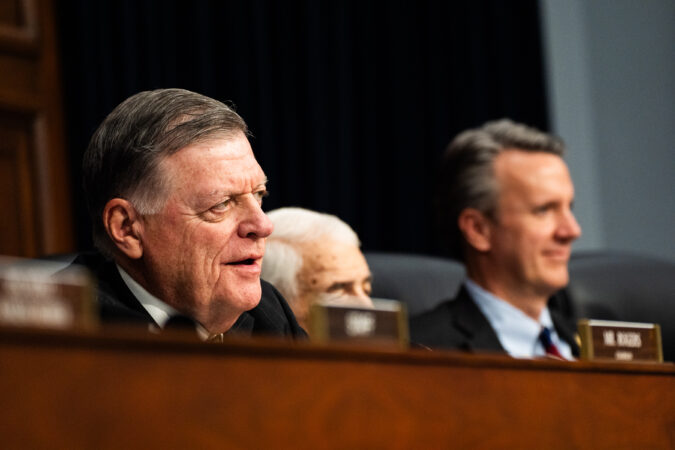
    “This legislation delivers just that and upholds the America first agenda,” said Rep. Tom Cole, the Republican chairman of the House Appropriations Committee.

    Republicans also celebrated the avoidance of a massive, catchall funding bill known as an omnibus as part of this year’s appropriations process. Such bills, often taken up before the holiday season with lawmakers anxious to return home, have contributed to greater federal spending, they say. This year’s effort, while a few months behind schedule, manages to keep non-defense spending just below current levels, they emphasized.

    “It sends a clear, powerful message back home — the House is back at work. We are back to governing,” said Rep. Mark Alford (R., Mo.).

    Anger on the House floor

    One by one, Democratic lawmakers lined up to voice their opposition to the Homeland Security bill with a particular focus on ICE, which has been rapidly hiring thousands of new deportation officers to carry out the president’s mass deportation agenda.

    Rep. Betty McCollum (D., Minn.) said residents of her state were being racially profiled on a mass scale and kidnapped from their communities.

    “Masked federal agents are seizing parents, yes, in front of terrified children,” McCollum said. “And many of these people we’re finding had no record and were here legally.”

    “I will not fund an agency that acts like an American gestapo,” said Rep. Jerrold Nadler (D., N.Y.).

    “This is about the political retribution of a vengeful president,” said Clark of Massachusetts. “I will not rubberstamp the federal government’s use of political violence against its own people and I ask every member to join me in voting no.”

    Cole decried some of the comments about ICE on the House floor.

    “It’s reckless, encouraging people to believe that we have masses of bad actors in a particular agency,” Cole said.

    In a last-minute add to the package, the House tacked on a provision that would repeal the ability of senators to sue the government over the collection of their cellphone data as part of special counsel Jack Smith’s investigation into the Jan. 6, 2021, attack on the Capitol.

    Senators had previously allowed suits claiming up to $500,000 in damages in an earlier funding bill, but the provision drew sharp criticism. The House unanimously agreed to block it.

  • Vance lands in Minneapolis blaming the ‘far left’ for turmoil over White House deportation efforts

    Vance lands in Minneapolis blaming the ‘far left’ for turmoil over White House deportation efforts

    MINNEAPOLIS — Insisting that he was in Minnesota to help “lower the temperature,” Vice President JD Vance on Thursday blamed “far-left people” and state and local law enforcement officials for the chaos that has convulsed the state during the White House’s aggressive deportation campaign.

    He also defended federal agents who detained a 5-year-old boy while making an immigration arrest.

    The recent turmoil “has been created, I think, by a lot of very, frankly, far-left people, also by some of the state and local law enforcement officials who could do a much better job in cooperating,” the Republican vice president said.

    “We’re doing everything that we can to lower the temperature,” Vance said, adding that he wants “state and local officials to meet us halfway.”

    The Justice Department is investigating Minnesota’s Democratic leaders, including Gov. Tim Walz and Minneapolis Mayor Jacob Frey, over whether they have obstructed or impeded law enforcement through their public statements. Walz and Frey have described the investigation as an attempt to bully the political opposition.

    Federal officers stood in a row behind Vance as he spoke, and there were two Immigrants and Customs Enforcement vehicles emblazoned with the slogan “Defend the Homeland.”

    His visit follows weeks of aggressive rhetoric from the White House, including President Donald Trump, who has threatened to invoke the Insurrection Act — and send in military forces — to crack down on unrest in the state. Asked about that option, Vance said, “Right now, we don’t think that we need that.”

    Trump dispatched thousands of federal agents to Minnesota after reports of child care fraud by Somali immigrants. Minneapolis-area officials, including Frey, as well as the police, religious leaders and the business community have pushed back, and outrage grew after an agent fatally shot Renee Good, a mother of three, during a confrontation this month.

    Vance defends actions by ICE agents

    Vance has played a leading role in defending that agent, and the vice president previously said Good’s death was “a tragedy of her own making.” On Thursday, he repeated claims that Good “rammed” an agent with her car, an account that has been disputed based on videos of the incident.

    Minnesota faith leaders, backed by labor unions and hundreds of Minneapolis-area businesses, are planning a day of protests Friday. Nearly 600 local business have announced plans to shut down, while hundreds of “solidarity events” are expected across the country, according to MoveOn spokesperson Britt Jacovich.

    Vance pushed back against such criticism and defended ICE agents who detained the young boy as he was arriving home from preschool.

    “When they went to arrest his illegal alien father, the father ran,” Vance said. “So the story is that ICE detained a 5-year-old. Well, what are they supposed to do?”

    The boy, who was taken by federal agents along with his father to a detention facility in Texas, was the fourth student from his Minneapolis suburb to be detained by immigration officers in recent weeks.

    During an appearance in Ohio earlier in the day, Vance praised the arrest of protesters who disrupted a church service in Minnesota on Sunday and said he expects more prosecutions to come. The protesters entered the church chanting “ICE out” and “Justice for Renee Good.”

    “They’re scaring little kids who are there to worship God on a Sunday morning,” Vance said. “Those people are going to be sent to prison so long as we have the power to do so.”

    He added: “Just as you have the right to protest, they have a right to worship God as they choose. And when you interrupt that, that is a violation of the law.”

    The economy and the midterms

    Vance’s stop in Ohio was focused primarily on bolstering the Republican administration’s positive economic message on the heels of Trump’s appearance at the World Economic Forum in Davos, Switzerland. The vice president also took the opportunity to boost some of Republicans’ important statewide candidates in this fall’s midterm elections, including gubernatorial contender Vivek Ramaswamy and U.S. Sen. Jon Husted.

    Convincing voters that the nation is in rosy financial shape has been a persistent challenge for Trump during the first year of his second term. Polling has shown that the public is unconvinced that the economy is in good condition and majorities disapprove of how Trump’s handling of foreign policy.

    Vance urged voters to be patient on the economy, saying Trump had inherited a bad situation from Democratic President Joe Biden.

    “You don’t turn the Titanic around overnight,” Vance said. “It takes time to fix what is broken.”

  • Federal officers detain a 5-year-old boy who school official says was used as ‘bait’

    Federal officers detain a 5-year-old boy who school official says was used as ‘bait’

    A 5-year-old boy arriving home from preschool in Minnesota was taken by federal agents along with his father to a detention facility in Texas, school officials and the family’s lawyer said, making him the fourth student from his Minneapolis suburb to be detained by immigration officers in recent weeks.

    Federal agents took Liam Conejo Ramos from a running car while it was in the family’s driveway on Tuesday afternoon, Columbia Heights Public Schools Superintendent Zena Stenvik said during a news conference Wednesday. The officers then told him to knock on the door to his home to see if other people were inside, “essentially using a 5-year-old as bait,” she said.

    Stenvik said the family has an active asylum case and has not been ordered to leave the country.

    “Why detain a 5-year-old?” she asked. “You cannot tell me that this child is going to be classified as a violent criminal.”

    Department of Homeland Security spokesperson Tricia McLaughlin said in a statement that “ICE did NOT target a child.”

    She said Immigration and Customs Enforcement was conducting an operation to arrest the child’s father, Adrian Alexander Conejo Arias, who McLaughlin said is from Ecuador and in the U.S. illegally. He ran, “abandoning his child,” she said.

    “For the child’s safety, one of our ICE officers remained with the child while the other officers apprehended Conejo Arias,” McLaughlin said, adding that parents are given the choice to be removed with their children or have them placed with a person of their choosing.

    Liam Conejo Ramos, 5, is detained by U.S. Immigration and Customs Enforcement officers after arriving home from preschool Tuesday in a Minneapolis suburb.

    Stenvik said another adult who lives at the home was outside when the father and son were taken, but agents wouldn’t leave Liam with that person. DHS didn’t immediately respond to an email Thursday asking if Conejo Arias had asked to keep his son with him.

    Liam and his father were being held in a family holding cell in Texas, Marc Prokosch, the family’s lawyer, said during the news conference.

    “Every step of their immigration process has been doing what they’ve been asked to do,” Prokosch said of the family’s asylum claim. “So this is just cruelty.”

    During a Thursday visit to Minneapolis where he met with local leaders, Vice President JD Vance said he heard the “terrible story” about Liam but later learned the boy was only detained, not arrested.

    “Well, what are they supposed to do? Are they supposed to let a 5-year-old child freeze to death? Are they not supposed to arrest an illegal alien in the United States of America?” said Vance, noting that he’s the parent of a 5-year-old.

    Vance wasn’t asked about why immigration officers allegedly wouldn’t leave the boy with the other adult who lives at the home and offered to take him.

    Minnesota has become a major focus of immigration sweeps by DHS-led agencies. Greg Bovino, a U.S. Customs and Border Protection official who has been the face of the crackdowns in Minneapolis and other cities, said immigration officers have made about 3,000 arrests in Minnesota in the last six weeks.

    Julia Decker, policy director at the Immigrant Law Center of Minnesota, said advocates have no way of knowing whether the government’s arrest numbers and descriptions of the people in custody are accurate.

    Liam is the fourth student from Columbia Heights Public Schools who has been detained by ICE in recent weeks, said Stenvik. A 17-year-old student was taken Tuesday while heading to school, and a 10-year-old and a 17-year-old have also been taken, she said.

    The district is made up of five schools and about 3,400 students from pre-K to 12th grade, according to its website. The majority of the students come from immigrant families, according to Stenvik.

    She said they’ve noticed their attendance drop over the past two weeks, including one day where they had about one-third of their students out from school.

    Ella Sullivan, Liam’s teacher, described him as “kind and loving.”

    “His classmates miss him,” she said. “And all I want is for him to be safe and back here.”

  • The Philadelphia school district’s facilities plan did not go over well in City Council

    The Philadelphia school district’s facilities plan did not go over well in City Council

    City Councilmember Jamie Gauthier said the Philadelphia School District showed “just a complete lack of thought and consideration for really important programs” when crafting its long-anticipated facilities plan, released Thursday.

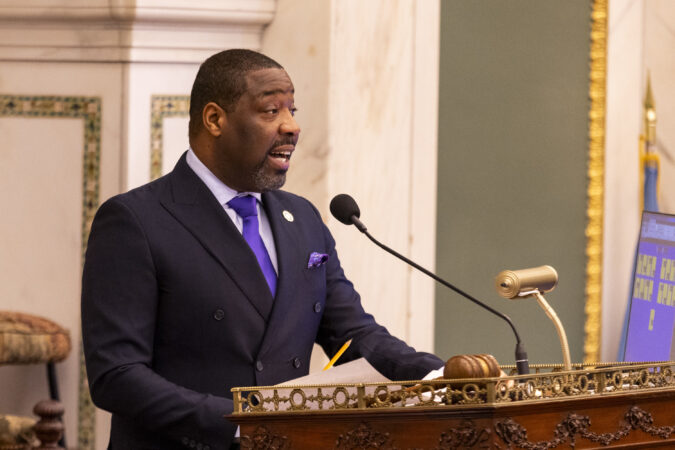
    Council President Kenyatta Johnson said his members had “a lot of concerns.”

    And City Councilmember Jeffery “Jay” Young Jr. went so far as to propose amending the city Home Rule Charter to allow Council to remove the school board members who will consider the proposed closures.

    “If you are closing schools during a literacy crisis, then you should be held directly accountable to the people you serve,” Young said.

    To put it mildly, the district’s plan did not go over well in Council.

    In many ways, it’s unsurprising Council members would speak out against a plan that would close or consolidate schools in their districts. But the pushback from lawmakers Thursday was notably strong, and Young’s proposal to allow Council to remove school board members could dramatically reshape the politics of the district.

    (function() {
    var l2 = function() {
    new pym.Parent(‘school_closing1’,
    ‘https://media.inquirer.com/storage/inquirer/projects/innovation/arcgis_iframe/school_closing1.html’);
    };
    if (typeof(pym) === ‘undefined’) {
    var h = document.getElementsByTagName(‘head’)[0],
    s = document.createElement(‘script’);
    s.type = ‘text/javascript’;
    s.src = ‘https://pym.nprapps.org/pym.v1.min.js’;
    s.onload = l2;
    h.appendChild(s);
    } else {
    l2();
    }
    })();

    Currently, the mayor appoints the nine members of the school board, and Council votes to confirm them. Allowing lawmakers to remove board members would shift the balance of power toward the legislative branch and effectively leave the district’s leaders with 18 bosses — the mayor and the 17 Council members.

    Significantly, Johnson immediately endorsed Young’s plan, which would have to be approved by city voters in a ballot question.

    “It’s a good check-and-balance in terms of the process, and also allows us to have the ability and the opportunity to make sure that anything that the school board does is done with transparency,” Johnson told reporters. “I‘m always for, as members of City Council and this body in this institution, having the opportunity to provide accountability.”

    Left unsaid was that the long-awaited facilities plan did not come from the school board — its members have yet to approve the proposal, which was presented to lawmakers this week by Superintendent Tony B. Watlington Sr.

    Still, the pushback was notable in part because it came from lawmakers who are often on opposite sides of debates about education policy. Johnson is an advocate for charter schools, while Gauthier is a progressive ally of the teachers union who is often critical of the so-called school choice movement.

    Gauthier said the plan would limit opportunities in her West Philadelphia-based 3rd District. She pointed to changes including Robeson High School and Parkway West ceasing to exist as standalone schools (Robeson would merge into Sayre and Parkway West into SLA Beeber), and the Workshop School colocating with Overbrook High. (The Workshop, however, would remain a distinct school, just in a new location.)

    “What are people supposed to do for good high school options in West Philadelphia?” Gauthier said in an interview.

    Jamie Gauthier. First day of fall session, Philadelphia City Council, Thursday, September 11, 2025.

    Gauthier added that while Watlington has talked at length about the district avoiding the mistakes of its widely criticized 2012 school closure plan, it appears doomed to repeat that history.

    “That’s a great thing to hold up every time we have this conversation, but how are you solving for it?” Gauthier said. “You can’t state all of the things that went wrong and then present a plan that seems to lack care in the same way as the plan in 2012.”

    Johnson said the discussion over the plan was far from complete.

    “I’m sure it’s going to be a very, very robust process,” he said. “These are only recommendations. This isn’t the final product.”

    Watlington’s plan will touch every part of the city. It includes 20 school closures, six colocations, with two separate schools existing inside a single building, and more changes. It also includes modernizing more than 150 schools over 10 years, though officials have not yet revealed which buildings will get the upgrades.

    In total, the blueprint would cost $2.8 billion — though the district is proposing funding only $1 billion of that with capital borrowing. The rest of the money would come from the state and from philanthropic sources, and if those dollars don’t come through, fewer repairs could happen.

    Nearly all Council members on Thursday said they understood the need to consolidate schools, but each had concerns about how individual closures would affect the communities they serve.

    Councilmember Curtis Jones Jr., whose district includes parts of West and Northwest Philadelphia, said some of the changes are encouraging, including an expansion of career and technical education planned for some schools, including Overbrook High.

    But, he said, others could combine students who come from different neighborhoods and backgrounds, and the district must consider the social impacts of merging those populations.

    “The places where the kids come from, that is always a dynamic that is under-considered,” Jones said. “If I live in this neighborhood and got to travel to that neighborhood, what are the historical dynamics?”

    And Councilmember Cindy Bass, who represents parts of North and Northwest Philadelphia, said two of the schools in her district slated for closure — Fitler Academics Plus School and Parkway Northwest High School — “are models of great public education.”

    “I don’t understand why they are targeted when they are very well-regarded and lots of kids want to go there,” Bass said. “If it’s not broken, why are we trying to fix this?”

    It’s unclear how much sway members will have over where the district ultimately lands. Councilmember Isaiah Thomas, who chairs the Education Committee and represents the city at-large, warned of a “long and emotional” journey ahead.

    “There’s always an emotional attachment to schools,” he said. “They are a pillar in a lot of neighborhoods.”

    Staff writer Jake Blumgart contributed to this article.

  • The slavery exhibits at the President’s House have been removed following Trump administration push

    The slavery exhibits at the President’s House have been removed following Trump administration push

    The National Park Service dismantled exhibits about slavery at the President’s House Site in Independence National Historical Park, provoking a lawsuit from Philadelphia Mayor Cherelle L. Parker’s administration.

    The President’s House, which serves as a memorial to the nine people George Washington enslaved there during the founding of the United States, has come under increased scrutiny from President Donald Trump’s administration. The president and Interior Secretary Doug Burgum last spring ordered displays at national parks that “inappropriately disparage” the U.S. to be reviewed and potentially removed.

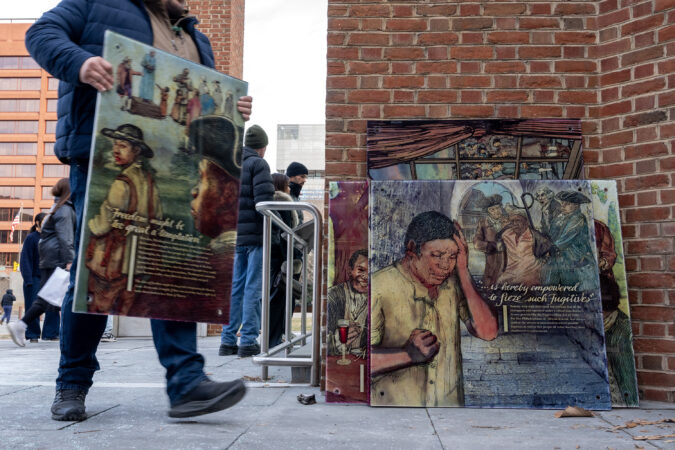
    Around 3 p.m. Thursday, an Independence Park employee who would not give his name told an Inquirer reporter that his supervisor had instructed him to take down all the displays at the iconic site earlier that day. Three other individuals later joined the employee to help remove the educational exhibits. The final display was removed at 4:30 p.m. The displays were then loaded into the back of a white Park Service pickup truck.

    “I’m just following my orders,” the employee repeatedly said, not acknowledging if he was tasked with removing the displays because of the executive order.

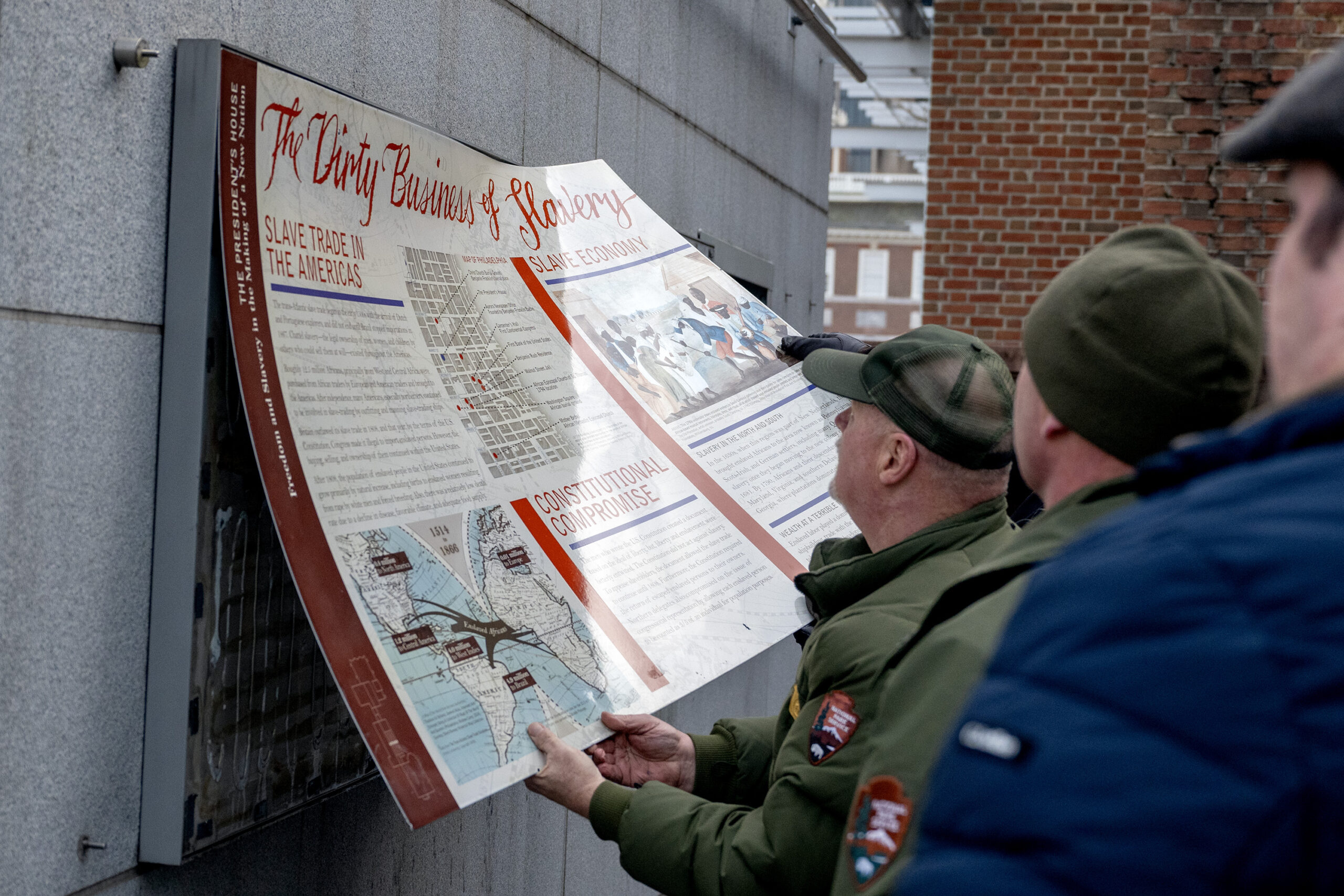
    Workers remove the display panels about slavery at the President’s House site in Independence National Historical Park Thursday, Jan. 22, 2026. The fate of exhibits at the site, which serves as a memorial to the nine people George Washington enslaved there during the founding of America, had been in limbo since President Trump’s executive order, “Restoring Truth and Sanity to American History,” directed the Department of the Interior to review over 400 national sites to remove or modify interpretive materials that “inappropriately disparage Americans past or living.”

    One by one, the exhibits — including those titled “Life Under Slavery” and “The Dirty Business of Slavery” — were taken down.

    The demolition Thursday, with wrenches and crowbars, elicited questions — and exclamations, like “this is crazy” and “damn shame” — from a few passersby.

    At least one asked if the exhibits are coming down “because of this administration.”

    Another, Jali Wicker, 74, was walking through Independence Mall when he stopped and asked why the content was being removed.

    Wicker, who recorded as NPS workers unscrewed bolts from the brick walls, said the sight overwhelmed and disturbed him.

    “You can try to erase our history, but we’re still going to survive,” Wicker said. “History has shown that, slavery has shown that. … And you want to go back?”

    Michael Coard, leader of the Avenging the Ancestors Coalition, which has helped lead an effort to protect the President’s House from the Trump administration, said in an interview Thursday that the removal of the displays is an “abomination” and called Trump a “monstrosity in the White House.”

    “It’s a disgrace, and that’s an understatement,” Coard said. “I cannot say what I’m thinking, because as a criminal defense attorney, I know better. What’s going on now is absolutely unheard of in the history of the United States of America.”

    Jack Williams, 47, shouted at NPS workers as they loaded the panels into the bed of a department pickup truck.

    “It’s absolutely sickening,” Williams said. He took issue with workers complying with the executive order, and urged defiance by federal employees.

    Williams’ message: “Take a day off, call in sick. Don’t be the one on the news … whitewashing history.”

    Mijuel Johnson, a community organizer who leads the Black Journey: African American History Walking Tour and works with Avenging the Ancestors, called the action “outrageous.”

    “We see how brave [NPS employees] are,” Johnson said. “My ancestors were brave enough to run from tyranny and these guys can’t be brave enough to oppose an order to take down some plaques.”

    Johnson added: “Our history will be taught — it’ll be taught as it should be, warts and all.”

    Representatives of the Department of the Interior and the National Park Service did not immediately return a request for comment.

    The move comes in advance of the 250th anniversary of the founding of the United States on July Fourth, when Philadelphia and its historic exhibits will be in the national spotlight.

    The fate of exhibits at the President’s House has been in limbo for months since the Department of the Interior signaled it would review and potentially remove flagged displays.

    More than a dozen displays about slavery were flagged for the Trump administration’s review, with the President’s House coming under particular scrutiny, The Inquirer reported. Removal of noncompliant displays was initially slated to come on Sept. 17.

    But that didn’t happen — until now.

    Instead, Philadelphians continued their advocacy and efforts to protect the President’s House. Leading the charge is the President’s House/Slavery Memorial Alliance, spearheaded by Avenging the Ancestors and other stakeholders who helped shape the site in the early 2000s.

    Coard said Thursday that his team anticipated something like this happening and that “we have a plan.”

    Elected officials, including Gov. Josh Shapiro and members of Philadelphia City Council, previously condemned the sanitization of historical exhibits.

    Parker on Thursday, after her administration filed its lawsuit, said that the city and federal government in 2006 signed a cooperative agreement that may require advance notice for changes to the site. The city is reviewing its options, she said.

    “We are right now researching and reviewing the cooperative agreement between the City of Philadelphia and federal government that dates back to 2006,” she said. “It requires parties to meet and confer if there are any changes to be made to any exhibit, so anything that is outside that agreement, it requires that our Law Department review it.”

    Parker, the city’s first Black female mayor, has avoided confrontation with Trump since he took office last year. Asked what her personal feelings are about the federal government removing material on slavery, Parker demurred.

    “In moments like this, it requires that I be the leader that I need to be for our city, and I can’t allow my pride, ego, or emotions to dictate what my actions will be,” she said.

    The city’s lawsuit names Interior Secretary Doug Burgum and acting National Park Service Director Jessica Bowron. The complaint asks a judge to order that the removal of “interpretive panels referencing slavery” was an “arbitrary and capricious” act, making it unlawful.

    There is no dispute over the fact that slaves resided at the President’s House or that Washington owned slaves, the suit says.

    Furthermore, the President’s House has been designated a National Underground Railroad Network to Freedom site pursuant to a 1998 act of Congress. In removing exhibits referencing slavery, the Trump administration acted without statutory authority, the city argues.

    “Defendants have provided no explanation at all for their removal of the historical, educational displays at the President’s House site, let alone a reasoned one,” the lawsuit says.

    Independence Park employees were tasked with evaluating displays for content that “inappropriately disparage Americans past or living,” according to Trump’s March 2025 executive order.

    A total of 13 items across six exhibits at the President’s House were initially flagged for the Trump administration’s review, but on Thursday everything was taken down.

    This included parts of displays titled: “Life Under Slavery,” “History Lost & Found,” “The Executive Branch,” “The Dirty Business of Slavery,” “The House and the People Who Worked & Lived In It,” and an illustration with the words “An Act respecting fugitives from Justice.”

    Other exhibits across the park were flagged for review, but it is unclear if there are plans for park employees to also remove those displays.

    Staff writers Abraham Gutman and Sean Collins Walsh contributed to this article.

  • NATO chief Mark Rutte shows he’s a ‘Trump whisperer’ with Greenland diplomacy

    NATO chief Mark Rutte shows he’s a ‘Trump whisperer’ with Greenland diplomacy

    THE HAGUE, Netherlands — For days it seemed there was no way out of the latest standoff between Europe and the United States: President Donald Trump insisted he must have Greenland — and would settle for nothing short of total ownership.

    Even after he dropped the threat of force in a speech in Davos, Switzerland, on Wednesday, the impasse remained. Enter: Mark Rutte.

    The NATO secretary-general may have been instrumental in persuading Trump to scrap the threat of slapping punitive tariffs on eight European nations to press for U.S. control over Greenland — a stunning reversal shortly after insisting he wanted to get the island “including right, title and ownership.”

    In a post on his social media site, Trump said he had agreed with Rutte on a “framework of a future deal” on Arctic security at the World Economic Forum in Davos, potentially defusing tensions that had far-reaching geopolitical implications.

    Little is known about what the agreement entails or how crucial Rutte’s intervention was, and Trump could change course again. But for now, Rutte has earned his reputation as a “Trump whisperer.”

    That’s only the latest nickname for the man long known as “Teflon Mark” during his domination of Dutch politics for a dozen years.

    ‘Trump whisperer’

    Rutte’s reputation for successfully charming the U.S. president took flight last year when he referred to Donald Trump as “daddy” during an alliance summit in The Hague and sent him a flattering text message.

    Matthew Kroenig, vice president and senior director of the Atlantic Council’s Scowcroft Center for Strategy and Security, said the dramatic scenes in Davos underscored Rutte’s ability to keep NATO’s most powerful leader on board.

    “I think Secretary-General Rutte has emerged as one of Europe’s most effective diplomats and Trump whisperers,” Kroenig said. “He does seem to have a way of speaking to Trump that keeps the United States and the Trump administration engaged in NATO in a constructive way.”

    Rutte’s success in dealing with Trump appears to revolve around his willingness to use charm and flattery while revealing little of what the two leaders discuss. It’s a tactic that Rutte used to marshal coalition partners in nearly 13 years as Dutch prime minister.

    Trump himself highlighted Rutte’s effusive friendliness before he set off for Davos this week, publishing a text message from the NATO chief on his Truth Social platform. In it, Rutte addresses “Mr. President, dear Donald” and praises Trump for his diplomacy in Syria, Gaza and Ukraine.

    “I am committed to finding a way forward on Greenland. Can’t wait to see you. Yours, Mark,” the message ended.

    Teflon Mark

    Rutte became a poster boy for Dutch consensus politics while leading four often fractious ruling coalitions on his way to becoming the Netherlands’ longest-serving leader, surviving a number of domestic political scandals over the years and earning the nickname “Teflon Mark” because the fallout never seemed to stick to him for long.

    The back cover of a 2016 book about Rutte by Dutch journalist Sheila Sitalsing, who followed him when he was prime minister, calls him “a phenomenon.”

    “With indestructible cheerfulness he navigates the fragmented political landscape, recklessly forges the most extraordinary alliances and steadily works towards a new Netherlands,” it adds.

    Rutte and his government resigned in 2021 to take responsibility for a childcare allowance scandal in which thousands of parents were wrongly accused of fraud. But he bounced back to win national elections two months later with a slightly larger share of the vote and began his fourth and last term in office.

    In another scandal that he survived, Rutte said in an interview that he couldn’t recall being informed about the Dutch bombing of Hawija that killed dozens of Iraqi civilians in 2015. In 2022, he survived a no-confidence motion in parliament in a debate about deleting messages from his old-school Nokia cell phone. Critics accused him of concealing state activity — but he insisted the messages just took up too much space in his phone.

    Opposition lawmaker Attje Kuiken quipped: “It appears that the prime minister’s phone memory is used just as selectively as the prime minister’s own memory.”

    His winning smile and enduring optimism, along with his habit of riding his bicycle to work while chomping on an apple seemed to help cement his popularity in the Netherlands, where such down-to-earth behavior is prized. When his last coalition collapsed in 2023 in a dispute over reining in migration, Rutte again leaned on that image, driving an old Saab station wagon to a royal palace to hand his resignation to King Willem-Alexander.

    From The Hague to Brussels

    Just landing the NATO chief’s job showed how adept Rutte is at navigating turbulent geopolitical waters. He managed to convince entrenched doubters, including Hungarian Prime Minister Viktor Orbán and Turkish President Recep Tayyip Erdogan, to back his candidacy.

    “It took a very long time. It’s a complicated process, but it’s an honor that it appears to have happened,” Rutte told reporters after securing all the support he needed to become secretary-general.

    Rutte’s soft diplomatic skills were seen as a key asset for the leader of the 32-nation alliance as it faced Trump’s repeated criticism while navigating how to support Ukraine in the war against Russia.

    Several hours before Trump made his dramatic reversal on Greenland, Finnish President Alexander Stubb — another European leader credited with having a way with Trump — was asked during a panel discussion on European security in Davos “who or what can diffuse the tensions” over Greenland?

    “Oh, Mark Rutte,” Stubb said, to laughter in the audience and among the panel that included the Dutchman himself.

  • 🥶 A snowy, sweet, and boozy weekend | Things to do

    🥶 A snowy, sweet, and boozy weekend | Things to do

    Unless you’ve been living under a rock, you’ve probably heard about the great blizzard rolling into Philadelphia this weekend.

    We’re expecting more than a foot of snow, people! I’m from Ohio and I don’t remember an arctic blast forcing me to wade through that many blockades of ice.

    But if you have any memories of the record-setting blizzard of 1996, when the city literally hauled out snow and dumped it into the Schuylkill and Delaware River, then you know the weather won’t stop Philadelphians from enjoying their weekend plans.

    Lucky for you, I have a list of events that will make your time out in the cold worthwhile. (As long as your car doors aren’t frozen shut, and you’ve put enough salt down to open your front door, that is.)

    — Earl Hopkins (@earlhopkins_, Email me at thingstodo@inquirer.com)

    If someone forwarded you this email, sign up for free here.

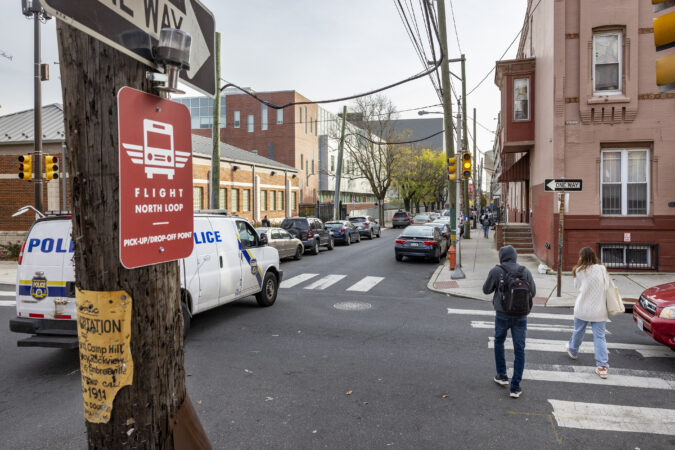
    (From left to right) Philadelphia Zoo Garden Service workers Joseph Mineer, of Fairmount, Naeem Price, of North Philadelphia, and David Wallace, of Southwest Philadelphia, are shoveling snow on the sidewalks near the bus drop offs in Philadelphia, Pa., on Saturday, Jan. 17, 2026.

    A major winter storm is looking inevitable for Philly, with snow expected to stick around

    Philly is getting SNOW this weekend — some forecasts are even calling for 17 inches. A winter storm watch is in effect for the entire region this weekend, meaning you might be spending a lot of time at home.

    Expect canceled plans, back pain from shoveling, and empty grocery store shelves. The Inquirer’s weather expert, Tony Wood, has you covered with what to know about the impending storm.

    We also have a full breakdown of what you need to do once the snow lands. Shoveling rules (and the possible fines if you disobey), and what you need to know if you’re parked along a snow emergency route.

    The best things to do this week

    🍫 Chocolate and booze, please: Want a warm and sweet buzz? Take a trip down to the Greater Philadelphia Expo Center on Saturday for the Philly Chocolate, Wine & Whiskey Festival. This trio will make for a luscious and savory time.

    🎤 The return of an opera classic: For the first time in 15 years, Capriccio returns to the Academy of Vocal Arts stage. The Piet Mondrian-inspired run of Richard Strauss’ final opera runs through Sunday.

    🔍 Here’s a Clue: Three words: Murder, mystery, and mayhem. That’s what’s on the menu for the theatrical whodunit, Clue, based on the classic board game and 1985 movie of the same name. The musical runs at Walnut Street Theater through Sunday. Are you in?

    🎋 Honoring an iconic landscape designer: A documentary honoring Piet Oudolf, the man responsible for shaping the beautiful varieties at Calder Gardens, will play at the meditative green space starting Thursday through Jan. 30.

    📅 My calendar picks this week: Lucky Girl Market at Bok, Dinos After Dark, World Sportscar Champion Demo Day

    Four of the Philly area’s 15 James Beard semifinalists in 2026 (clockwise from top left): chefs Greg Vernick, Omar Tate, Amanda Shulman, and Frankie Ramirez.

    The Philly area receives 13 James Beard Award semifinalist nominations

    The momentum continues for Philly restaurateurs.

    After Philly was granted Michelin honors this past November, the James Beard Foundation has handpicked 13 local award semifinalists for 2026.

    According to my colleague Michael Klein, this year’s list of James Beard Award semifinalists reads like a who’s who of the local dining scene, including a few surprises. Namely, Russ Cowan or Cherry Hill, N.J.’s Radin’s Delicatessen.

    The list of semifinalists will be gleaned, and finalists will be announced on March 31. Winners will be announced at a gala on June 15 at the Lyric Opera of Chicago.

    Read the full list of nominees.

    Winter fun this week and beyond

    🖌️ It’s ink o’clock: Bring your wildest ideas to the tattoo table. Dozens of tattoo artists are setting up shop at the Pennsylvania Convention Center this week at the annual Villain Arts Tattoo Festival.

    🎭 A new James Ijames creation: Arden Theatre Company’s Good Bones, the latest creation of Pulitzer Prize-winning playwright James Ijames, explores the soul of a city in the face of looming gentrification. The play runs through March 15.

    ‘Face to Face’ with artistic greatness: Staged at Isaiah Zagar’s most famed masterpiece, the Magic Gardens Museum, comes another example of his artistic wizardry. The iconic artist’s new exhibition, “Face to Face: Isaiah Zagar’s Mosaicked Portraits,” displays intimate artworks of the people who influenced his life, work, and imagination. The exhibition is on view through April 12.

    The take: Don’t be the neighbor who doesn’t shovel their sidewalk

    Is it technically fine to shovel just your own patch of sidewalk? Sure. Is it how you earn a good reputation on a Philly block? Absolutely not. So we debated it for you — and the consensus is this: one missed storm happens, but making a habit of stopping exactly at the property line (especially when elderly neighbors are around) is how people quietly clock you as that neighbor.

    Snow melts. Reputations don’t. And in Philly, your block definitely notices. What are your thoughts?

    Staffer picks

    Pop music critic Dan DeLuca lists the top concerts this weekend and a few holiday pop-up jams happening this month.

    🎤 Thursday: Rakim, arguably the most influential rapper during hip-hop’s golden age, takes over the Main Stage at City Winery on Thursday.

    🎸 Friday: Singer and guitarist Alec Ounsworth, known as the face of the iconic indie band Clap Your Hands Say Yeah, kicks off his solo tour, “Piano & Voice,” in his hometown. Ounsworth plays at World Cafe Live on Friday and the Philadelphia Ethical Society on Saturday.

    🎤 Saturday: The “Winter Carnival Tour,” headlined by rap duo Atmosphere, and featuring hip-hop luminaries such as R.A. the Rugged Man and Kool Keith, kicks off at the Brooklyn Bowl on Saturday.

    🎸 Sunday: After completing a full bank tour for his new album, I Believe in You, My Honeydew, singer-songwriter Josh Ritter makes his way to Lancaster’s West Art for his solo tour.

    The weather may temporarily halt your weekend plans, but as you can see, there are plenty of things to do before and after the storm hits. Stay warm and diligent, folks!

    – Earl Hopkins

    Courtesy of Giphy.com
  • Three people targeted, two of them Temple University students, in armed robberies near campus this week

    Three people targeted, two of them Temple University students, in armed robberies near campus this week

    A Temple student and another individual not associated with the university were robbed by armed men near the school’s North Philadelphia campus early Thursday, according to university officials.

    Around 1:30 a.m., the Temple student was walking near the 1500 block of Oxford Street when two men approached with a handgun and stole the student’s phone, Jennifer Griffin, Temple’s vice president for public safety and chief of police, said in a statement.

    The men ran off and fired one shot in the air as they fled.

    Minutes earlier, in a separate incident several blocks away, those men robbed another individual, stealing that person’s phone, near the 1300 block of Carlisle Street.

    The robberies were the second instance of phone theft near Temple’s campus this week.

    Around 6:15 a.m. on Wednesday, a man with a handgun approached a Temple student walking on the 1800 block of West Montgomery Avenue and stole that person’s phone, Griffin said in an earlier statement.

    The robber fled north on 18th Street. No arrests have been made in the incidents.

    On Thursday, Griffin announced that Temple and Philadelphia police would be coordinating a concentrated presence in the area as both departments investigate the robberies.

    “Incidents like this are deeply troubling,” Griffin said.

    Later in the day, Temple’s public safety department released an image of two suspects wanted in connection with Thursday’s robberies, urging anyone who recognized them to contact Investigations@temple.edu or call 215-204-6200.

    Griffin also highlighted that students who were affected by the incidents may use the campus’ walking escort program, its nighttime fixed-route shuttle service, and the school’s personal safety app.