Blog

  • Dear Abby | Couple’s marriage mired in the doldrums of middle age

    DEAR ABBY: My husband and I have been together 30-plus years. When our love was new, it was all smiles, hand-holding and thrills when we saw each other after a long day at work or school. And, I guess, that’s normal.

    Now, three kids and three grandkids later, we’re edging past our mid-50s and there isn’t much left. There are no more smiles and no more hand-holding, only two sad adults. We still love each other. Neither of us wants to be apart from the other, but we don’t know how to bring back happiness.

    We hardly touch, and neither of us remembers the last time we smiled or even really laughed. We sit in the same room, living two completely different lives. I am partially disabled, so there are no more long walks or outside activities, which we used to do 20 years ago.

    We are now wondering: Is this the rest of our lives? Are we going to spend the next 20-plus years in a depressing marriage in which we love each other but no longer have anything in common? Our youngest daughter is 8, and our youngest grandson is 5. We watch the kids (15, 9, 8, 5) in the evening so our eldest can work. Is there any hope for us?

    — SAD SPOUSE IN NEW YORK

    DEAR SAD SPOUSE: You say that you and your husband love each other. There is hope for reviving your marriage if you agree to go to couples counseling together. Marriage involves more than smiles, hand-holding and thrills. It is a deep and caring partnership. Few couples can sustain the excitement of their honeymoon years. You and your husband have already done the hard work. Now you need to find your way back together.

    ** ** **

    DEAR ABBY: My husband and I were dining with friends in a high-end restaurant. The food was great, and so was the conversation. My husband leaned close to me and whispered, “She’s brushing her teeth!” I glanced to my left. I had thought the gal at the next table was just using a toothpick. No, she was vigorously brushing with a full-sized toothbrush!

    After about a minute, she placed the toothbrush into a cosmetic bag and pulled out a denture container. She then proceeded to insert and adjust her retainer. We were flabbergasted. Never in all my years have I seen such appalling table manners. Perhaps we shouldn’t have been staring, but it was one of those moments in which you are frozen to the spot.

    Abby, that restaurant has very nice bathrooms. What is happening to our society?

    — SHOCKED IN THE SOUTH

    DEAR SHOCKED: I understand why this woman’s performance stopped you cold. But, please, don’t blame “society” for her ignorance of the rules of etiquette, which dictate that to avoid grossing out those around us in public, we should excuse ourselves from the table and take care of our oral hygiene privately, IN THE RESTROOM if needed.

  • The Flyers waste an early three-goal lead, fall in overtime to the Mammoth

    The Flyers waste an early three-goal lead, fall in overtime to the Mammoth

    SALT LAKE CITY ― The Flyers were in control until they weren’t.

    After ending a six-game losing streak on Monday, and snapping the Vegas Golden Knights’ seven-game winning streak in the process, they lost to the Utah Mammoth, 5-4, in overtime on Wednesday.

    The Flyers had a 3-0 lead early in the second and led by two going into the final frame. It was only the fourth time after leading after two periods that they did not come out victorious.

    Clayton Keller scored in overtime from the slot after he tied the game with 35 seconds left in regulation during a six-on-five situation.

    The Utah captain tied the game when he knocked a bouncing puck away from Travis Sanheim. Keller skated around the defenseman, cut across the crease, and backhanded one over Sam Ersson. On the game-winner, Travis Konecny lost the puck deep in the Utah zone to Dylan Guenther, who carried it up the ice and eventually fed Keller for the shot.

    Philly had chances to extend its lead several times, with Owen Tippett ringing one off the post after a sick dangle with 5 minutes, 55 seconds left, and Garnet Hathaway with the puck on his stick and skating in alone toward an empty net with just under 1:30 to play. But Hathaway didn’t pull the trigger fast enough and had his pocket picked by Nick Schmaltz.

    It was a stinging loss as the Flyers led the game just 30 seconds in.

    Defenseman Cam York slammed home the rebound on a turnaround shot by Sanheim. The goal came off sustained pressure by the defensive pair with the line of Christian Dvorak, Konecny, and Trevor Zegras, with the latter two using the boards before Konecny fed Sanheim.

    The goal was York’s fourth of the season, tying his total from last year across 66 games.

    Just over four minutes later, the Flyers were up 2-0 for the first time since Jan. 4 against the Edmonton Oilers. The Flyers broke out of their own end with Noah Juulsen sending an outlet pass up in the air to Konecny at center ice.

    Konecny knocked the puck down and led Dvorak with the pass and he took off. The center skated between the defense, cut across the crease, and put the puck around the right pad of Karel Vejmelka.

    The Flyers took a 3-0 lead with a power-play goal 58 seconds into the second period. After a clean zone entry, the unit of Zegras, Konecny, Jamie Drysdale, and Bobby Brink got to work.

    Zegras and Drysdale played catch above the circles before Zegras put a shot on goal from inside the blue line. Brink had been in the bumper but then rotated into the left circle before dropping down and burying the rebound on Zegras’ shot.

    The goal was Brink’s 12th of the season, tying his career high set last season.

    Utah started to pick up its game after a hard and borderline high hit by Liam O’Brien on Tippett in the neutral zone. Initially, the referees called a major penalty, but after a video review, ruled that it did not warrant a penalty. Tippett left the game but returned to the bench later in the second period.

    The Mammoth then scored two quick goals 36 seconds apart, the first by JJ Peterka and the second by Lawson Crouse.

    On the goal by Peterka, there was a scramble at the side of the net, and he jammed in the loose puck. The Crouse goal came after Sean Durzi’s shot went off the stick of Brink, and Emil Andrae couldn’t handle the bobbling puck. Crouse knocked it away from the Flyers defenseman, and Schmaltz fed Crouse for the quick snapshot.

    Flyers coach Rick Tocchet called a timeout to settle down his club, and it worked.

    The Orange and Black had some chances, and then Dvorak added his second of the night with a power-play goal. He got the puck in the neutral zone, gained the zone, and fired a wrister from the right circle. Vejmelka couldn’t control the rebound, and Dvorak knocked the follow-up in.

    With his second multigoal game of the season, Dvorak now has 12 goals, tying his total last season with the Montreal Canadiens. His career high is 18 set in 2019-20.

    Utah cut it to a one-goal game with 7:13 left when Barrett Hayton deflected a Guenther shot from the left circle on a power play past Ersson. The Mammoth had the man advantage after Juulsen dropped the gloves with Jack McBain and got an extra two minutes for roughing. Juulsen went after McBain, who ran over Drysdale.

    Breakaways

    Making the start for the second straight game — the first time since Dec. 18-20 — Ersson stopped 22 of 27 shots. … Forward Carl Grundström was a healthy scratch for the first time since entering the lineup on Dec. 9. In that 21-game span, he had seven goals and nine points. … Defenseman Hunter McDonald and forward Nic Deslauriers were also healthy scratches. … The Flyers extended their point streak to two games.

    Up next

    The Flyers head to Denver to face the NHL’s best team, the Colorado Avalanche — who have only five losses in regulation on the season — on Friday (9 p.m., NBCSP).

  • Washington Post seeks court order for government to return electronics seized from reporter’s home

    Washington Post seeks court order for government to return electronics seized from reporter’s home

    WASHINGTON — The Washington Post asked a federal court on Wednesday for an order requiring federal authorities to return electronic devices that they seized from a Post reporter’s Virginia home last week, accusing the government of trampling on the reporter’s free speech rights and legal safeguards for journalists.

    A magistrate judge in Alexandria, Va., temporarily barred the government from reviewing any material from the devices seized from Post reporter Hannah Natanson’s home. The judge also scheduled a Feb. 6 hearing on the newspaper’s request.

    Federal agents seized a phone, two laptops, a recorder, a portable hard drive, and a Garmin smart watch when they searched Natanson’s home last Wednesday, according to a court filing. The search was part of an investigation of a Pentagon contractor accused of illegally handling classified information.

    “The outrageous seizure of our reporter’s confidential newsgathering materials chills speech, cripples reporting, and inflicts irreparable harm every day the government keeps its hands on these materials,” the Post said in a statement.

    The seized material spanned years of Natanson’s reporting across hundreds of stories, including communications with confidential sources, the Post said. The newspaper asked the court in Virginia to order the immediate return of all seized materials and to bar the government from using any of it.

    “Anything less would license future newsroom raids and normalize censorship by search warrant,” the Post’s court filing says.

    The Pentagon contractor, Aurelio Luis Perez-Lugones, was arrested earlier this month on a charge of unauthorized removal and retention of classified documents. A warrant said the search of Natanson’s home was related to the investigation of Perez-Lugones, the Post reported.

    Natanson has been covering Republican President Donald Trump’s transformation of the federal government, The Post recently published a piece in which she described gaining hundreds of new sources from the federal workforce, leading one colleague to call her “the federal government whisperer.”

    Attorney General Pam Bondi said that the search was done at the request of the Defense Department and that the journalist was “obtaining and reporting classified and illegally leaked information from a Pentagon contractor.”

    Perez-Lugones, a U.S. Navy veteran who resides in Laurel, Md., has not been charged with sharing classified information or accused in court papers of leaking.

    The Justice Department has internal guidelines governing its response to news media leaks. In April, Bondi issued new guidelines restoring prosecutors’ authority to use subpoenas, court orders and search warrants to hunt for government officials who make “unauthorized disclosures” to journalists.

    The new guidelines rescinded a policy from Democratic President Joe Biden’s administration that protected journalists from having their phone records secretly seized during leak investigations.

    Reporters Committee for Freedom of the Press president Bruce Brown said the unprecedented search of the reporter’s home, “imperils public interest reporting and will have ramifications far beyond this specific case.”

    “It is critical that the court blocks the government from searching through this material until it can address the profound threat to the First Amendment posed by the raid,” Brown said in a statement Wednesday.

  • Marshall scores 25 off the bench, La Salle takes down Dayton

    Marshall scores 25 off the bench, La Salle takes down Dayton

    Jaeden Marshall’s 25 points off of the bench led La Salle to a 67-64 victory over Dayton on Wednesday.

    Marshall shot 7 of 11 from the field, including 4-for-7 in three-pointers, and went 7-for-7 from the line for the Explorers (7-13, 3-4 Atlantic 10). Josiah Harris scored 10 points while shooting 4 of 7 from the field. Jerome Brewer Jr. had seven points, including two free throws with 21 seconds remaining.

    Keonte Jones led the Flyers (14-5, 5-1) in scoring, finishing with 14 points, 10 rebounds, and two steals. Dayton also got 11 points and five assists from Javon Bennett. Bryce Heard also had 10 points. The loss ended a five-game winning streak for the Flyers.

    Marshall scored 12 points in the first half for La Salle, which led 40-29 at the break. Marshall led La Salle with 13 points in the second.

  • ‘Abbott Elementary’ lands on the (fictional) Philadelphia Inquirer front page

    ‘Abbott Elementary’ lands on the (fictional) Philadelphia Inquirer front page

    On this week’s episode of the sitcom Abbott Elementary, the teachers get a visit from a surprise guest: a reporter from The Philadelphia Inquirer.

    But don’t worry, it’s all good news.

    The character Tracy, played by actor Samantha Cutaran, shows up to cover the unexpected success that the school has seen while operating out of an abandoned mall. (They were forced to relocate after Abbott’s furnace broke.)

    Four weeks into the disruptive move, student grades begin improving and incidents go down.

    “You’re changing the face of education,” Tracy tells the teachers. “So much so, we think this is worthy enough for the front page. You guys are rock stars!”

    It would’ve been funny to see how each of these characters would act in an interview — Janine (creator Quinta Brunson) might be nervous about saying the wrong thing, Jacob (Chris Perfetti) would (hopefully) praise the free press, and Melissa (Lisa Ann Walter) would be skeptical and uncooperative — but the show cuts directly to the newspaper delivery. (Yes, we’re still in print!)

    “Extra, extra, read all about … us!” says Barbara (Sheryl Lee Ralph) as she drops the paper on a table.

    Designed by Abbott Elementary’s props and production team, the mock front page pictures the teachers and principal Ava (Janelle James) surrounded by students with the headline, “Do schools even need schools?”

    A mock front page of the Philadelphia Inquirer as seen in Season 5 of ‘Abbott Elementary.’

    Janine is thrilled that the article includes her quote, “Teaching is fun.”

    “Did they use mine?” Melissa asks. “‘The Giants suck.’ Is that in there?”

    (Sadly, it’s not.)

    The reporter, in her objectivity, excluded that insight (no matter how many real readers would agree), but Melissa is still impressed.

    “The Schemmenti family name on the front page,” she says, “and nowhere does it say ‘evasion, tax, or conviction.’”

    The Inquirer calls the Abbott crew “heroes” for the work they have done, drumming up positive press for the school district and leading Scholastic to donate new school supplies.

    But the excitement peters out when the shrewd guidance counselor (Marcella Arguello) points out that the school district continues to be vague whenever the teachers ask when they’ll be returning to Abbott. The students are performing so well, she reminds them, so there’s “no sense of urgency.”

    They later discover that the district has pulled Abbott’s construction crew to address facility problems at other schools.

    It’s not all bad news, though: While the rest of Abbott Elementary was caught up with The Inquirer (we love that for us), Mr. Johnson (William Stanford Davis) clashed with the new janitor who was sent to help him clean the massive mall. Miss Carroll is played by newcomer Khandi Alexander.

    “I may be old-fashioned, but women have no business cleaning,” Mr. Johnson tells the camera. “You ask me? They need to get back to where they belong — in the Wall Street board room and coaching in the NFL.”

    William Stanford Davis (Mr. Johnson), Tyler James Williams (Gregory Eddie), and Quinta Brunson (Janine Teagues) in “Abbott Elementary.”

    The feud doesn’t last as the two bond over using the same homemade cleaning solution. It’s a sweet turn for the mysterious Mr. Johnson; audiences have heard many tales of his backstories, from being a Jill Scott stalker to a member of the Mafia, but he hasn’t yet had a romance plot.

    Until this episode, that is.

    Mr. Johnson’s odd jobs — some 400 before he came to Abbott — are part of the fun for Davis.

    “I’m always surprised at what they want me to do, and I try to embrace that and have as much fun with it as I can,” said the actor in a recent interview with The Inquirer.

    Davis himself has worked his fair share of odd jobs, throughout his career, like DJing a country western radio station, driving a limousine, cooking at a truck stop, and other “survival gigs,” as he calls them.

    “I try to bring those real-life experiences to Mr. Johnson, because they weren’t all very pleasant either, but it helps me to continue to develop this character,” said Davis.

    “As an actor, you’re supposed to be able to play everything that a human being can be, and so I try to connect to Mr. Johnson’s truth, even though his truth is a little stranger than most people’s … He’s an honest, living, breathing human being. He’s just a little different than everyone else, and he’s a little smarter than everyone else.”

    There is one job that Davis hopes the writers will work into Mr. Johnson’s lore: “I’m waiting on them to make me an astronaut.”

  • Supreme Court appears likely to allow Lisa Cook to remain on Fed board

    Supreme Court appears likely to allow Lisa Cook to remain on Fed board

    The Supreme Court on Wednesday appeared likely to block President Donald Trump from immediately firing Democratic-appointed Lisa Cook from the Federal Reserve board, a move that would prevent Trump from exerting greater influence over the powerful central bank that guides the economy.

    Nearly all of the justices asked skeptical questions of Solicitor General D. John Sauer during roughly two hours of arguments, taking issue with most aspects of the government’s case that the president had met the legal bar to remove Cook while a lawsuit challenging her removal plays out. Such unanimity is rare on high-profile cases for a deeply polarized court.

    Conservative Justice Brett Kavanaugh said the Trump administration’s position that it could remove Fed governors without judicial review or due process “would weaken if not shatter the independence of the Federal Reserve.” He said presidents of both parties could gin up reasons to remove governors under such a system with dangerous implications for a central bank that Congress created to operate independently.

    “It incentivizes a president to come up with … trivial or inconsequential or old allegations that are very difficult to disprove,” Kavanaugh said. “It incentivizes sort of the search and destroy … no process, nothing, you’re done … what are we doing when we have a system that incentivizes that?”

    The president has complained for months that the Fed is not dropping interest rates quickly enough. He has tried to oust Cook over mortgage fraud allegations, and his Justice Department has launched a criminal probe of Fed Chair Jerome Powell over whether he lied to Congress.

    Both Cook and Powell have denied wrongdoing and accused Trump of manufacturing pretexts to undermine the independence of the central bank to achieve his policy goals. The campaign has alarmed many economists, who fear keeping interest rates artificially low could spark long-term inflation.

    The Supreme Court’s ruling, which is expected in the coming weeks or months, is one of the most significant tests to date of Trump’s push to expand presidential power and place parts of the government that for decades have operated independently under tighter control. It could also have major ramifications for the economy and is being closely watched by businesses and the markets.

    In a sign of the stakes, both Powell and Cook attended the arguments, as did former Fed Chair Ben Bernanke.

    The justices have repeatedly backed Trump’s bids to fire the heads of independent agencies in emergency rulings in his second term, but in a major shift Wednesday justices at both ends of the court’s political spectrum seemed ready to draw a red line around the Fed. Many signaled that they wanted additional legal proceedings, perhaps in the lower courts, before deciding a novel and weighty legal issue on the merits, while Chief Justice John Roberts signaled he might favor going ahead and ruling.

    Conservative Justice Samuel Alito asked Sauer why the Trump administration was asking the court to resolve such a momentous case in a “hurried manner.” Justice Amy Coney Barrett, also a conservative, pointed to a friend-of-the-court brief by former Fed governors warning that removing Cook could trigger a recession and counseled caution.

    Liberal Justice Sonia Sotomayor said the public’s confidence in the court’s decision would benefit from hashing out significant factual and legal issues before issuing a decision.

    “We know that the independence of the agency is very important and that that independence is harmed if we decide these issues too quickly and without due consideration.” Sotomayor said.

    Congress set up the Fed to be insulated from control by the president so it could make difficult decisions, such as raising interest rates, that might not be politically popular but that are good for the overall health of the economy.

    No president in the 112-year history of the Fed had tried to fire a governor from the board before Trump targeted Cook in August. He alleged that she claimed two homes as primary residences at the same time to get a better mortgage rate. Cook denies the allegations.

    The issue before the justices was whether the effort to fire her complied with the Federal Reserve Act, which says Fed board members can be removed only “for cause.” A federal judge and a divided appeals court temporarily blocked Cook’s removal, prompting the administration to appeal to the high court.

    In October, the justices allowed Cook to temporarily remain in her job while they heard the emergency appeal from the Trump administration.

    Sauer told the justices that the alleged mortgage fraud by Cook met the legal bar to remove her and that the president had lost confidence in her ability to do the job. He also said courts did not have the authority to review the president’s decision, a contention a handful of the justices disputed.

    “The American people should not have their interest rates determined by someone who was, at best, grossly negligent in obtaining favorable interest rates for herself,” Sauer said.

    Paul Clement, Cook’s attorney, said judges did have the power to review Cook’s ouster. He also said the mortgage fraud allegations, even if true, would not meet the legal bar to fire Cook, because she applied for her mortgages before she was appointed to the Fed by President Joe Biden in 2022. He added that Cook was never given the opportunity to defend herself.

    “There is no reason to abandon more than 100 years of central bank independence on an emergency application,” Clement said.

    The justices quizzed attorneys for both sides about what the removal of a Fed governor should entail, often questioning whether the Trump administration had provided due process for Cook.

    Justice Ketanji Brown Jackson, a liberal, sounded incredulous when Sauer said it was enough that the president had indicated on social media that he intended to fire Cook. Jackson asked how Cook was supposed to defend herself from the allegations without some kind of hearing.

    “Like, she was supposed to post about it [on social media] and that was the opportunity to be heard?” Jackson asked.

    David Wilcox, a senior fellow at the Peterson Institute for International Economics and the director of U.S. economic research at Bloomberg Economics, said he expects the justices to send the case back to lower courts. He said the lower courts need to resolve a key procedural question: whether Cook was afforded adequate process, such as notice that she could be fired and an opportunity to be heard.

    “My guess is what the court will do is kick the can down the road,” he said, adding that it is risky to predict the outcome of the case based on oral arguments alone.

    Some legal experts said administration officials may have damaged their chances by launching the criminal probe of Powell earlier this month, creating the impression that Trump’s efforts are more about reshaping the Fed board and policy than any alleged malfeasance by its leaders.

    The Justice Department is probing whether Powell misled Congress about a $2.5 billion renovation of the Fed’s headquarters. Powell forcefully pushed back on those allegations, calling them “pretexts” in a video posted on the Fed’s website.

    “The threat of criminal charges is a consequence of the Federal Reserve setting interest rates based on our best assessment of what will serve the public, rather than following the preferences of the President,” Powell said.

    The arguments Wednesday were a notable shift from a case in December dealing with the legality of Trump’s firing of a Democrat from the Federal Trade Commission without cause. That case could also affect Cook’s job at the Fed.

    In that case, Sauer told the justices that Trump had the inherent authority under the Constitution to remove members of independent agency boards, even though Congress set up those agencies to operate at a remove from the executive.

    Some of the court’s conservative justices and many in the Trump administration have expressed support for an idea known as unitary executive theory, which holds that the Constitution gives the president broad authority to fire officials and that Congress cannot limit it.

    Agencies like the FTC, Securities and Exchange Commission, and Federal Election Commission operate as “a headless fourth branch” of government not fully accountable to the voters who elected the president, Sauer told the justices in the FTC case.

    The conservative majority on the court seemed to embrace that argument, possibly clearing the way for them to strike down a 90-year-old precedent, known as Humphrey’s Executor, that says that Congress could limit the president’s ability to dismiss the heads of independent agencies.

    “I think broad delegations to unaccountable independent agencies raise enormous constitutional and real-world problems for individual liberty,” said Justice Brett M. Kavanaugh.

    But Kavanaugh also suggested that the court sees the central bank as different and might carve out a rule protecting it. Whether it affects the Fed, a ruling striking down Humphrey’s Executor would be one of the largest shifts to the structure of government in decades. A decision in that case is also expected by the summer.

    Some Fed watchers said Wednesday the Cook case appeared unlikely to deal a fatal blow to the central bank’s independence. They also warned that the Fed is increasingly on the defensive – reacting to political pressure rather than setting the terms – and that without pushback from Congress and the markets, Trump could continue reshaping the institution in ways that erode its autonomy.

    “It sounds to me that this case will not be the Waterloo for Fed independence,” said Mark Spindel, an investment manager who co-wrote a history of the central bank’s independence. “But the institution is clearly playing defense.”

  • Immigration officers assert sweeping power to enter homes without a judge’s warrant, memo says

    Immigration officers assert sweeping power to enter homes without a judge’s warrant, memo says

    WASHINGTON — Federal immigration officers are asserting sweeping power to forcibly enter people’s homes without a judge’s warrant, according to an internal Immigration and Customs Enforcement memo obtained by The Associated Press, marking a sharp reversal of longstanding guidance meant to respect constitutional limits on government searches.

    The memo authorizes ICE officers to use force to enter a residence based solely on a more narrow administrative warrant to arrest someone with a final order of removal, a move that advocates say collides with Fourth Amendment protections and upends years of advice given to immigrant communities.

    The shift comes as the Trump administration dramatically expands immigration arrests nationwide, deploying thousands of officers under a mass deportation campaign that is already reshaping enforcement tactics in cities such as Minneapolis.

    For years, immigrant advocates, legal aid groups and local governments have urged people not to open their doors to immigration agents unless they are shown a warrant signed by a judge. That guidance is rooted in Supreme Court rulings that generally prohibit law enforcement from entering a home without judicial approval. The ICE directive directly undercuts that advice at a time when arrests are accelerating under the administration’s immigration crackdown.

    The memo itself has not been widely shared within the agency, according to a whistleblower complaint, but its contents have been used to train new ICE officers who are being deployed into cities and towns to implement the president’s immigration crackdown. New ICE hires and those still in training are being told to follow the memo’s guidance instead of written training materials that actually contradict the memo, according to the whistleblower disclosure.

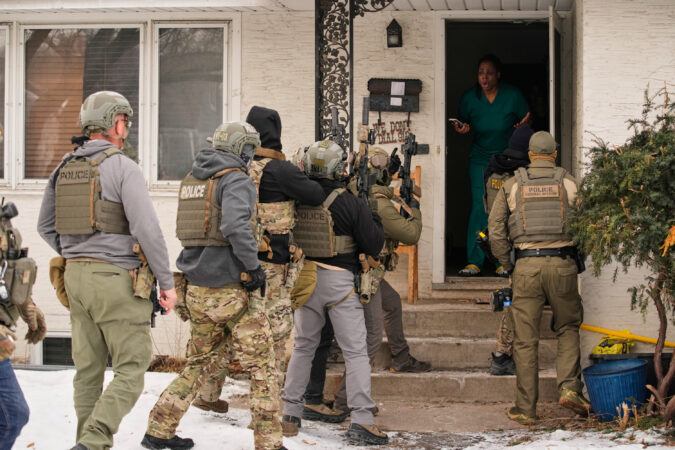
    It is unclear how broadly the directive has been applied in immigration enforcement operations. The Associated Press witnessed ICE officers ramming through the front door of the home of a Liberian man in Minneapolis on Jan. 11 with only an administrative warrant, wearing heavy tactical gear and with their rifles drawn.

    The change is almost certain to meet legal challenges and stiff criticism from advocacy groups and immigrant-friendly state and local governments that have spent years successfully urging people not to open their doors unless ICE shows them a warrant signed by a judge.

    The Associated Press obtained the memo and whistleblower complaint from an official in Congress, who shared it on condition of anonymity to discuss sensitive documents. The AP verified the authenticity of the accounts in the complaint.

    The memo, signed by the acting director of ICE, Todd Lyons, and dated May 12, 2025, says: “Although the U.S. Department of Homeland Security (DHS) has not historically relied on administrative warrants alone to arrest aliens subject to final orders of removal in their place of residence, the DHS Office of the General Counsel has recently determined that the U.S. Constitution, the Immigration and Nationality Act, and the immigration regulations do not prohibit relying on administrative warrants for this purpose.”

    The memo does not detail how that determination was made nor what its legal repercussions might be.

    When asked about the memo, Homeland Security spokeswoman Tricia McLaughlin said in an emailed statement to the AP that everyone the department serves with an administrative warrant has already had “full due process and a final order of removal.”

    She said the officers issuing those warrants have also found probable cause for the person’s arrest. She said the Supreme Court and Congress have “recognized the propriety of administrative warrants in cases of immigration enforcement,” without elaborating. McLaughlin did not respond to questions about whether ICE officers entered a person’s home since the memo was issued relying solely on an administrative warrant and if so, how often.

    Recent arrests shine a light on tactics

    Whistleblower Aid, a nonprofit legal organization that assists workers exposing wrongdoings, said in the whistleblower complaint obtained by The Associated Press that it represents two anonymous U.S. government officials “disclosing a secretive — and seemingly unconstitutional – policy directive.”

    A wave of recent high-profile arrests, many unfolding at private homes and businesses and captured on video, has shined a spotlight on immigration arrest tactics, including officers’ use of proper warrants.

    Most immigration arrests are carried out under administrative warrants, internal documents issued by immigration authorities that authorize the arrest of a specific individual but do not permit officers to forcibly enter private homes or other non-public spaces without consent. Only warrants signed by judges carry that authority.

    All law enforcement operations — including those conducted by ICE and Customs and Border Protection — are governed by the Fourth Amendment of the Constitution, which protects all people in the country from unreasonable searches and seizures.

    People can legally refuse federal immigration agents entry into private property if the agents only have an administrative warrant, with some limited exceptions.

    Federal agents this month rammed the door of the Minneapolis home of a Liberian man with a deportation order from 2023, who was then arrested. Documents reviewed by The AP revealed that the agents only had an administrative warrant — meaning there was no judge who authorized the raid on private property.

    Memo shown to ‘select’ officials

    The memo says ICE officers can forcibly enter homes and arrest immigrants using just a signed administrative warrant known as an I-205 if they have a final order of removal issued by an immigration judge, the Board of Immigration Appeals or a district judge or magistrate judge.

    The memo says officers must first knock on the door and share who they are and why they’re at the residence. They’re limited in the hours they can go into the home — after 6 a.m. and before 10 p.m. The people inside must be given a “reasonable chance to act lawfully.” But if that doesn’t work, the memo says, they can use force to go in.

    “Should the alien refuse admittance, ICE officers and agents should use only a necessary and reasonable amount of force to enter the alien’s residence, following proper notification of the officer or agent’s authority and intent to enter,” the memo reads.

    The memo is addressed to all ICE personnel. But it has been shown only to “select DHS officials” who then shared it with some employees who were told to read it and return it, Whistleblower Aid wrote in the disclosure.

    One of the two whistleblowers was allowed to view the memo only in the presence of a supervisor and then had to give it back. That person was not allowed to take notes. A whistleblower was able to access the document and lawfully disclose to Congress, Whistleblower Aid said.

    Although the memo was issued in May, David Kligerman, senior vice president and special counsel at Whistleblower Aid, said it took time for its clients to find a “safe and legal path to disclose it to lawmakers and the American people.”

    ICE told to rely on administrative warrants, memo says

    ICE has been rapidly hiring thousands of new deportation officers to carry out the president’s mass deportation agenda. They’re trained at the Federal Law Enforcement Training Center in Brunswick, Georgia.

    During a visit there by The Associated Press in August, ICE officials said repeatedly that new officers were being trained to follow the Fourth Amendment.

    But according to the whistleblowers’ account, newly hired ICE officers are being told they can rely solely on administrative warrants to enter homes to make arrests even though that conflicts with written Homeland Security training materials.

    ICE officers often wait for hours for the person they’re hoping to arrest to come outside so they can make the arrest on the sidewalk or at the person’s work — public places where they are allowed to operate without the risk of infringing on the person’s Fourth Amendment rights.

    Whistleblower Aid called the new policy a “complete break from the law” and said it undercuts the “Fourth Amendment and the rights it protects.”

  • Trump cancels tariff threat over Greenland, says NATO agreed to ‘framework’ of future Arctic deal

    Trump cancels tariff threat over Greenland, says NATO agreed to ‘framework’ of future Arctic deal

    DAVOS, Switzerland — DAVOS, Switzerland — President Donald Trump on Wednesday scrapped the tariffs that he threatened to impose on eight European nations to press for U.S. control over Greenland, pulling a dramatic reversal shortly after insisting he wanted to get the island “including right, title and ownership.”

    In a post on his social media site, Trump said he had agreed with the head of NATO on a “framework of a future deal” on Arctic security, potentially defusing tension that had far-reaching geopolitical implications.

    He said “additional discussions” on Greenland were being held concerning the Golden Dome missile defense program, a multilayered, $175 billion system that for the first time will put U.S. weapons in space.

    Trump offered few details, saying they were still being worked out. But one idea NATO members have discussed as part of a compromise with Trump was that Denmark and the alliance would work with the U.S. to build more U.S. military bases on Greenland.

    That’s according to a European official familiar with the matter but not authorized to comment publicly. The official, who spoke on condition of anonymity, said it was not immediately clear if that idea was included in the framework Trump announced.

    Trump has backed off tariffs before

    The president has threatened tariffs before only to back away. In April, after first saying he would slap massive import levies on nations from around the world, which prompted a sharp negative market reaction, Trump eased off.

    But his change of heart this time came only after he used his speech at the World Economic Forum in the Swiss Alps to focus on Greenland and threatened to upend NATO, an alliance that has been among the globe’s most unshakable since the early days of the Cold War.

    In his address, Trump said he was asking for territory that was “cold and poorly located” and that the U.S. had effectively saved Europe during World War II while declaring of NATO: “It’s a very small ask compared to what we have given them for many, many decades.”

    “We probably won’t get anything unless I decide to use excessive strength and force, where we would be frankly unstoppable. But I won’t do that, OK?” Trump said.

    But Trump has also said repeatedly that, while the U.S. will defend NATO, he wasn’t convinced the alliance will backup Washington, if needed, and suggested that was at least part of the reason for his aggressive stance toward Greenland. That prompted NATO Secretary General Mark Rutte, in a post-speech event with Trump, to say that the alliance would stand with the U.S. if it is attacked.

    “You can be assured, absolutely,” Rutte said. A short time later came Trump’s post canceling the tariffs.

    Danish Foreign Minister Lars Løkke Rasmussen said he welcomed Trump ruling out taking “Greenland by force” and pausing ”the trade war with Europe.”

    “Now, let’s sit down and find out how we can address the American security concerns in the Arctic while respecting the red lines of the Kingdom of Denmark,” he said in a statement.

    President cites national security

    Trump argues that the U.S. needs Greenland for national security and to counter threats from Russia and China in the Arctic region, despite America already having a large military base there. He threatened to impose steep U.S. import taxes on Denmark and seven other allies unless they negotiate a transfer of the semi-autonomous territory.

    The tariffs were to have started at 10% next month and climb to 25% in June.

    Trump often tries to increase pressure on the other side when he believes it can lead to a favorable agreement. His threats at Davos appeared on the verge of rupturing NATO, which was founded by leading European nations, the U.S. and Canada to counter the Soviet Union.

    The alliance’s other members were steadfast in saying Greenland is not for sale and cannot be wrested from Denmark, while angrily rejecting Trump’s promised tariffs.

    A Danish government official told The Associated Press after Trump’s speech that Copenhagen was ready to discuss U.S. security concerns. But the official, who was not authorized to comment publicly and spoke on condition of anonymity, underscored the government’s position that “red lines”— namely Denmark’s sovereignty — must be respected.

    It was not immediately clear how Trump’s canceling of tariffs might change such calculations.

    Greenland tells citizens to prepare

    In the meantime, Greenland’s government responded by telling its citizens to be prepared. It has published a handbook in English and Greenlandic on what to do in a crisis that urges residents to ensure they have sufficient food, water, fuel and supplies at home to survive for five days.

    “We just went to the grocery store and bought the supplies,” said Tony Jakobsen in Greenland’s capital Nuuk said, showing off the contents of bags that included candles, snacks and toilet paper.

    Jakobsen said he thought Trump’s rhetoric toward Greenland was “just threats… but it’s better to be ready than not ready.”

    Before backing down, Trump had urged Denmark and the rest of NATO to stand aside, adding an ominous warning.

    “We want a piece of ice for world protection, and they won’t give it,” Trump said. “You can say yes, and we will be very appreciative. Or you can say no, and we will remember.”

    He also called for opening “immediate negotiations” for the U.S. to acquire Greenland. In subsequent comments to reporters, he declined to name a price that might be paid, saying only, “There’s a bigger price, and that’s the price of safety and security and national security and international security.”

    His arrival in Davos was delayed after a minor electrical problem on Air Force One forced a return to Washington to switch aircraft. As Trump’s motorcade headed down a narrow road to the speech site, onlookers — including some skiers — lined the route, some making obscene gestures.

    Financial markets that had fallen sharply on Trump’s threatened tariffs bounced back Wednesday. Also breathing a sigh of relief were a number of U.S. officials who had also been concerned that Trump’s hard-line stance and bellicose rhetoric toward Greenland, Denmark and other NATO allies could harm other foreign policy goals.

    Trump’s Davos speech was originally supposed to focus on how to lower U.S. housing prices — part of a larger effort to bring down the cost of living. Greenland instead carried the day, though Trump mistakenly referred to it as Iceland four times during his speech.

    “This enormous unsecured island is actually part of North America,” Trump said. “That’s our territory.”

    When he finally did mention housing, Trump suggested he did not support a measure to encourage affordability. He said bringing down rising home prices hurts property values and makes homeowners who once felt wealthy because of the equity in their houses feel poorer.

    ‘Now there’s another threat’

    Before Trump announced that he was abandoning the tariffs and potentially easing international pressure, his speech left people in Nuuk preparing for the worst.

    Resident Johnny Hedemann said it was “insulting” that Trump “talks about the Greenlandic people and the Greenlandic nation as just an ice cube.” He spoke while heading out to buy a camping stove and instant mashed potatoes.

    “Living in this nature, you have to be prepared for almost anything. And now there’s another threat — and that’s Trump,” Hedemann said.

  • South Jersey man is accused of drugging, molesting men renting room at his home

    South Jersey man is accused of drugging, molesting men renting room at his home

    A 60-year-old man has been accused through an indictment of drugging and sexually molesting two men who at different times rented a room from him at his home, Burlington County Prosecutor LaChia L. Bradshaw said Wednesday.

    Craig M. Cardella, of Mansfield Township, pleaded not guilty on Tuesday at his arraignment in Superior Court in Mount Holly. He was charged by indictment in December with multiple counts of kidnapping, aggravated criminal sexual contact, and related offenses.

    Robert M. Perry, Cardella’s lawyer, declined to comment Wednesday evening.

    The charges involved two victims during separate time periods, Bradshaw said.

    In late 2024, a man renting a room from Cardella contacted Mansfield Township police and said he awakened at night to find Cardella in bed with him, holding a mask over his mouth and nose and touching him sexually, Bradshaw said.

    A search warrant was obtained for Cardella’s home and a safe was discovered in a closet that contained two bottles of chloroform, along with prescription sleep medication, medical masks, a camcorder and digital storage devices, Bradshaw said.

    Prosecutors allege that Cardella used the chloroform to prevent his victims from waking while they were being molested.

    Anyone who believes they were victimized by Cardella can contact Detective Ken Allen at allen@mansfieldpd.org.

  • Trump to meet with Zelensky as Ukraine endures a bitter winter after Russian attacks

    Trump to meet with Zelensky as Ukraine endures a bitter winter after Russian attacks

    KYIV, Ukraine — About 4,000 buildings in Kyiv remained without heating Wednesday, and nearly 60% of the Ukrainian capital was without power, Ukraine’s President Volodymyr Zelensky said, after days of Russian bombardment of Ukraine’s power grid and as President Donald Trump prepared to hold talks with the Ukrainian leader.

    With temperatures falling as low as minus-4 F in Kyiv, Ukraine is seeing one of the coldest winters in years, deepening the hardship of Ukrainians almost four years after Russia launched a full-scale invasion.

    A yearlong push by the Trump administration to stop the fighting hasn’t yielded any breakthrough, despite the American president issuing a series of deadlines, though efforts were set to continue.

    Trump said at the World Economic Forum in Davos, Switzerland that he would meet Thursday with Zelensky.

    “I want to stop it,” Trump said of the fighting Wednesday. “It’s a horrible war.”

    U.S. special envoy Steve Witkoff told The Associated Press on Wednesday that he plans to discuss peace proposals with Putin as well as hold talks with a Ukrainian delegation.

    “We need a peace,” Witkoff said at Davos.

    Putin confirmed late on Wednesday that Witkoff and Trump’s son-in-law Jared Kushner are expected in Moscow on Thursday for talks. The Russian leader said that Moscow and Washington, among other things, are discussing the possibility of using Russian assets frozen in the U.S. for rebuilding “territories damaged by the hostilities” after a peace agreement is reached.

    But with a dispute over Greenland’s future largely eclipsing other transatlantic issues at Davos, discussions about Ukraine’s defense looked likely to be sidelined.

    Zelensky said last week his envoys would try to finalize with U.S. officials documents for a proposed peace settlement that relate to postwar security guarantees and economic recovery.

    He added that the U.S. and Ukraine could sign the documents in Davos this week, but on Tuesday he said he wouldn’t be traveling to Switzerland and would focus on restoring power in Ukraine.

    Ukraine’s Cabinet of Ministers is allocating 2.56 billion hryvnias (almost $60 million) from a reserve fund to purchase generators, Prime Minister Yuliia Svyrydenko said Wednesday.

    NATO Secretary-General Mark Rutte on Wednesday urged the 32-nation alliance’s military chiefs to press their national governments to supply desperately needed air defense systems to Ukraine, helping it fend off Russia’s aerial attacks.

    “Please use your influence to help your political masters to do even more,” Rutte said in a video message to top brass as they met at NATO’s Brussels headquarters.

    “Look deep into your stockpiles to see what more you can give to Ukraine, particularly air defense interceptors. The time really is now,” he said.

    Russia launched 97 drones and a ballistic missile at Ukraine overnight, the Ukrainian air force said.

    In the central Dnipropetrovsk region, attacks killed a 77-year-old man and a 72-year-old woman, according to Oleksandr Hanzha, head of the regional military administration.

    Russia’s Defense Ministry said that air defenses downed 75 Ukrainian drones over several regions.

    The international airports of Krasnodar, Sochi, Gelendzhik and Saratov briefly suspended flights overnight because of the drones.

    In Adygea, more than 120 miles from the Ukrainian border, a Ukrainian drone caused a fire at an apartment building that injured 11 people, including two children, according to Gov. Murat Kumpilov.