Blog

  • Letters to the Editor | Jan. 16, 2026

    Letters to the Editor | Jan. 16, 2026

    Taking over

    Vladimir Putin’s excuse for invading Ukraine was that it belongs to Russia because it used to be part of the Soviet Union. I don’t think any American bought that idea. Now, Donald Trump wants to take over Greenland for our national security before Russia or China takes it over. Does anyone buy that argument now? Why was it wrong for Russia to invade Ukraine, but it is OK for the U.S. to take over Greenland? Since when is it OK for the U.S. to take over another country? How about an autonomous territory of a NATO ally? How can any American (Republican, Democrat, independent, MAGA, progressive) think this is all right? Trump says he’s doing what his voters want. Did anyone who voted for Trump want him to take over Greenland?

    June Siegel, Elkins Park

    Fear or anger

    After reviewing the multiple videos of the horrific shooting of Renee Good in Minneapolis, we are asked to believe the U.S. Immigration and Customs Enforcement agent was motivated by fear for his life as he got out of the way of Good’s SUV. I would suggest another emotion that motivated him: anger. In other videos, an expletive directed toward Good can be heard. After the ICE agent shoots through the front windshield and the SUV passes him by, he continues to shoot through the open driver’s side window when he is no longer allegedly in danger. If one wanted to explain the term gaslighting, there are few better examples than the interpretation of this video we are hearing from ICE and Homeland Security chief Kristi Noem. In other words, “Don’t believe what you see.”

    Pasquale Procacci, West Palm Beach, Fla.

    Circle of violence

    The story of Nyshyia Thomas is gut-wrenching. While her one son was killed as an innocent victim of a random shooting, her other son and her partner devastated their family through pure recklessness. Despite the second son owning his gun legally, he and his formerly incarcerated father prioritized violence over their family by arming themselves and running toward gunfire rather than retreating. Thomas blames “the system” for swallowing the two men — but the reality is that the system has no hunger for people who don’t marinate in guns and violence.

    Rosamond Kay, Philadelphia

    It’s time

    On Sept. 11, 1976, 1,500 people gathered at the Lewis Quadrangle at Independence Hall. They were there to launch a time capsule created by the Women For Greater Philadelphia (the nonprofit stewards of historic Laurel Hill Mansion in East Fairmount Park). Children 10 years old or younger were asked to include their names in the capsule. The 816 children whose names were included received a certificate. It charged each one to open and reseal the time capsule in 2026, and tell their children to open it again in 2076. A letter from then-Mayor Frank Rizzo, written to the current mayor, and from Gov. Milton Shapp to the people of Pennsylvania, is also in the capsule.

    The capsule will be opened sometime this fall during a ceremony with representatives from the state as well as other dignitaries. If you were present at the filling of the time capsule in 1976 and received a certificate charging you with the privilege and responsibility to carry the “Spirit of 76” forward to future generations, we’d like to hear from you at womenforgreaterphiladelphia.org/time_capsule.html.

    Barbara Frankl, chairperson of the board, Laurel Hill Mansion, Blue Bell

    Flu surges

    Americans are terribly exhausted and stressed. Chronic anxiety over the affordability of basic needs like food, housing, and healthcare wears people down. Rapid technological changes like artificial intelligence and robotics are threatening U.S. employment. The climate change crisis continues, and people fear violence. No wonder there is a flu surge this season — our immune systems are shot, rendering us vulnerable to not only influenza but also other infectious and noninfectious diseases.

    Richard A. Lippin, Southampton

    Legal shield

    The recent arson at the Beth Israel Congregation synagogue in Jackson, Miss., is the consummate example of antisemitism. What is not antisemitism is criticizing the state of Israel for the genocide it is implementing, the famine it is enforcing, and the ceasefire it is violating under the guise of national defense. House Bill 6090, which allows for the criticism of the government of Israel to be considered as antisemitism, passed the U.S. House, with Pennsylvania Reps. Brian Fitzpatrick, Madeleine Dean, Brendan Boyle, and New Jersey Reps. Jeff Van Drew and Donald Norcross are all voting to squash your right to free speech in order to protect the state of Israel from criticism. This is anti-American.

    Roy Lehman, Woolwich Township

    Two questions

    Growing antisemitic violence worldwide — with hate sanctioned through sentiments like those expressed by Vice President JD Vance at the recent Turning Point USA conference — compels me to share a personal story. The Baltimore of my youth was a time marred by disgraceful, degrading Jim Crow laws. Large signs were posted throughout neighborhoods and establishments reading, “No Jews, Negroes, or Dogs.” With regularity, our school classes traveled to Philadelphia to visit the Liberty Bell, which is inscribed with words from Leviticus 25:10: “Proclaim liberty throughout the land unto all inhabitants thereof.” No teacher ever referenced the disparity between these words and life as endured in Baltimore.

    Following the April 4, 1968, assassination of the Rev. Dr. Martin Luther King Jr., parts of inner-city Baltimore erupted in flames. My father’s business, a fuel oil company started by his father, was destroyed, including the trucks that serviced families with necessary heating oil and the accounts receivable. Although most of his customers lived far from the business location, my father cared about those living near his business, providing heat for countless families, never expecting payment, contributing to all charities he knew about, and, when invited, attending church services with our family. On April 10, eight months pregnant with my first child, I stood in front of my father’s former business, scorched and burned, the smell of destruction ever-present. I heard a man my dad recognized taunt us with a slur. My anguished mother quietly responded, not to the man but to me, “Why are we so hated?”

    Our beloved rabbi, Uri Miller, urged my father to declare bankruptcy, but he refused. My parents sold their comfortable home, most furnishings, and cashed in savings. As soon as his debts were paid, he and my mother moved to a small apartment in Florida. My father believed he had dishonored his father’s name, failed his wife, and disgraced his family. Eventually, my father kept his promise to my mother, bringing her home to be buried in the same Baltimore cemetery as her parents. Several years later, he was buried beside her. More than 30 years after her death, my mother’s haunting question remains: Why are Jewish people so hated? Or to draw on the prescient, thought-provoking insights of Holocaust survivor and activist on behalf of the protection and well-being of all people, Elie Wiesel: Are Jews only spoken up for once we are dead?

    SaraKay Smullens, Philadelphia

    Join the conversation: Send letters to letters@inquirer.com. Limit length to 150 words and include home address and day and evening phone number. Letters run in The Inquirer six days a week on the editorial pages and online.


  • Dear Abby | Couple’s relationship has withered on the vine

    DEAR ABBY: I am a senior woman in great shape. I am active, and I have never had a problem attracting men. Five years ago, I married a man I had known for many years. We used to have a pretty active sex life, but it has been four years since he has touched me in an intimate way. He says he doesn’t know why, and that it is due to lack of confidence.

    I’m afraid that if I don’t leave, I’ll never know the loving arms of a man around me again. In other ways, we get along fine, but as time has progressed, I no longer find him attractive. If he did make a move today, I think I would reject it because too much hurt has happened.

    Financially, leaving would be a disaster. Our friends and family think we are a great couple, but no one knows the truth. I feel like I am sinking into a morass with each long, lonely day. Please advise.

    — UNTOUCHED IN COSTA RICA

    DEAR UNTOUCHED: Before you sink further into depression, I urge you to discuss this with your doctor and get a referral to a licensed psychotherapist. Make no hard-and-fast decisions about your marriage until you are feeling better. I don’t know what caused your husband’s problem. Neither do you, and it’s possible that neither does he.

    Is your husband aware of how strongly you feel about this and that you are seriously considering leaving? If he isn’t, would he be willing to explore possible solutions and perhaps heal your relationship? And, finally, if he is, would YOU be willing to try again? I know I am giving you more questions than answers, but they are worth considering.

    ** ** **

    DEAR ABBY: As the compliance officer at a university, it’s my job to run mandatory training for faculty and staff. They know the dates, times and schedules for the meetings weeks in advance. I try hard to keep these training sessions as short and as few in number as possible, which means we need to use all the time available.

    My issue is that whenever we call a short break, some subset of people will wander away to unknown destinations. Are they looking for coffee? A bandage? A reevaluation of their life goals? We never know.

    I am left with two choices: Hold everyone up and wait for them to return, which is polite but ensures we will all end the day late, or start without them. The ruder option means I must deny their certification until they meet with me to catch up on what they missed. Both options are frustrating.

    I’ve learned that the longer the break, the more people who will go missing. No number of warnings or amount of cajoling will bring everyone back on time. So which option is better: starting, or waiting?

    — RUNNING THE SHOW IN MASSACHUSETTS

    DEAR RUNNING: Stop being such a pushover. At the beginning of each meeting, explain to the attendees that everyone must be present for the entire presentation OR YOU CANNOT CERTIFY THEM. Then follow through. Do not continue to make yourself available for those who skip out, because it is disrespectful of the folks who stayed.

  • Horoscopes: Friday, Jan. 16, 2026

    ARIES (March 21-April 19). You’ll consider the time someone has spent to create or maintain the things that keep your world spinning, and you’ll be humbled by their efforts. There’s nothing you need to pay back, and plenty to pay forward.

    TAURUS (April 20-May 20). Difficult people will test your patience, and offering it will be worth your while. The steadier you are now, the richer you’ll be later — in dollars and in what matters even more.

    GEMINI (May 21-June 21). You might be amazed at how few people listen as well as you. Today your listening will carry more weight than speaking. Tune in, notice subtleties and respond only when it feels essential. You’ll discover something in your quiet observation that will help you in the weeks to come.

    CANCER (June 22-July 22). Paradoxically, when you go at the problem as though help will never arrive, you realize you might not even need help because you are more amazing at this than you think — and of course, that’s when help will find you.

    LEO (July 23-Aug. 22). Your magnetic presence is further amplified when you step into a role of generosity. As you offer attention, encouragement and kindness, people will respond in ways you can’t predict, and your energy will multiply.

    VIRGO (Aug. 23-Sept. 22). The details you usually scrutinize so carefully can take a back seat today. Focus instead on the bigger picture, the patterns and the possibilities. Precision is valuable, but insight lives in the spaces between the lines.

    LIBRA (Sept. 23-Oct. 23). Collaboration will shine if you release the idea of perfect balance. Give more than you take, speak honestly and trust that harmony is a dynamic, living thing, and not a fixed equation. Mutual growth will surprise you.

    SCORPIO (Oct. 24-Nov. 21). What draws your eye? What makes you hungry for more? What makes you want to reach out? Follow inspiration today because even the slightest movement toward your attractions will reward you.

    SAGITTARIUS (Nov. 22-Dec. 21). Curiosity is your favorite fuel — better than protein shakes or coffee, better than romance, anger or competition. Curiosity opens new topics and bonds you with new people, and today has you finally and happily trying a path you’ve been hesitant about.

    CAPRICORN (Dec. 22-Jan. 19). Discipline is your signature, but today flexibility is your ally. As you loosen the grip on how things “should” unfold, opportunities just appear. Success sneaks in through doors you didn’t plan to open.

    AQUARIUS (Jan. 20-Feb. 18). Today, your originality will be most effective because you pair it with practical action. Ideas are abundant, but of course execution is everything. Don’t wait for perfection, because progress is the real magic.

    PISCES (Feb. 19-March 20). There will be no shortage of ideas for you today. It’s like the world is your think tank. Pick one and pursue it to the first milestone. Beginnings are a bit rocky no matter which choice you make, and that just goes with the territory.

    TODAY’S BIRTHDAY (Jan. 16). This is your Year of Spacious Living, marked by room to think, rest and recalibrate. Your calendar breathes. Your mind stretches. With fewer constraints, you hear yourself more clearly and make choices that feel intentional and clean. More highlights: What begins as a small opportunity expands wildly. You’ll broaden your world with new work, new social circles, a new sense of belonging. Taurus and Sagittarius adore you. Your lucky numbers are: 9, 17, 8, 31 and 7.

  • Cheltenham High football ‘toxic’ culture led to hazing, investigation concludes; team may not play in 2026

    Cheltenham High football ‘toxic’ culture led to hazing, investigation concludes; team may not play in 2026

    Nearly 20 people witnessed an assault in the Cheltenham High football team’s locker room last fall, according to an external investigation commissioned by the school district.

    No one tried to stop it, “and several participated freely in it,” Superintendent Brian Scriven told the Cheltenham community in an e-mailed message Thursday. “Several students also filmed the assault.”

    The assault — which happened Sept. 3 — ultimately resulted in the cancellation of the team’s season in October and led to the hazing investigation, for which Scriven released the results Thursday night. His message did not include additional details about the assault.

    Though a pattern of hazing was “not fully substantiated,” Scriven wrote, other troubling findings include: inadequate student supervision in the locker room, “a failure to prioritize student safety by the coaching staff and/or adult volunteers,” no anti-bullying or anti-hazing education for team members, and “a toxic and negative culture within the current football program.”

    The team’s head coach, according to a 2025 Cheltenham news release, had been Terence Tolbert, a business teacher at the school and a former semi-professional football player. When reached Thursday, Tolbert declined to comment.

    Cheltenham’s football program will be rebuilt eventually, Scriven said, and the district will adopt investigators’ recommendations, including identifying, hiring, and training a “new coaching staff with strong commitment to leading student-athletes in a positive and responsible manner,” and strengthening team supervision.

    But, Scriven said, fielding a team in 2026 is not a given for the district.

    The superintendent alluded to “a general lack of credibility on the part of many of those interviewed during the investigatory process” and said parent, student, and staff cooperation going forward is crucial.

    “Those students who were not involved in this situation are especially important to rebuilding the culture of our program,” Scriven said. “If all of these conditions are met, the district will stand up a football team for the 2026 season.”

    It is not yet clear whether the students involved could face punishment or criminal charges. Multiple students have ongoing Title IX and disciplinary matters, which could affect their eligibility to play football. Cheltenham Township police and the Montgomery County District Attorney’s Office are both still investigating the incident, according to the district’s message Thursday.

    Staff writer Robert Moran contributed to this article.

  • Federal immigration agents filmed dragging a woman from her car in Minneapolis

    Federal immigration agents filmed dragging a woman from her car in Minneapolis

    A U.S. citizen on her way to a medical appointment in Minneapolis was dragged out of her car and detained by immigration officers, according to a statement released by the woman on Thursday, after a video of her arrest drew millions of views on social media.

    Aliya Rahman said she was brought to a detention center where she was denied medical care and lost consciousness. The Department of Homeland Security said she was an agitator who was obstructing ICE agents conducting arrests in the area.

    That video is the latest in a deluge of online content that documents an intensifying immigration crackdown across the midwestern city, as thousands of federal agents execute arrests amid protests in what local officials have likened to a “federal invasion.”

    Dragged from her car

    Rahman said that she was on her way to a routine appointment at the Traumatic Brain Injury Center when she encountered federal immigration agents at an intersection. Video appears to show federal immigration agents shouting commands over a cacophony of whistles, car horns and screams from protesters.

    In the video, one masked agent smashes Rahman’s passenger side window while others cut her seatbelt and drag her out of the car through the driver’s side door. Numerous guards then carried her by her arms and legs towards an ICE vehicle.

    “I’m disabled trying to go to the doctor up there, that’s why I didn’t move,” Rahman said, gesturing down the street as officers pulled her arms behind her back.

    A spokesperson for the Department of Homeland Security disputed that account in an emailed statement on Thursday, saying that Rahman was an agitator who “ignored multiple commands by an officer to move her vehicle away from the scene.” She was arrested along with six other people the department called agitators, one of whom was accused of jumping on an officer’s back.

    The department did not specify if Rahman was charged or respond to questions about her assertion that she was denied medical treatment.

    Barrage of viral videos draw scrutiny

    The video of Rahman’s arrest is one of many that have garnered millions of views in recent days — and been scrutinized amid conflicting accounts from federal officials and civilian eyewitnesses.

    Often, what’s in dispute pertains to what happened just before or just after a given recording. But many contain common themes: Protesters blowing whistles, yelling or honking horns. Immigration officers breaking vehicle windows, using pepper spray on protesters and warning observers not to follow them through public spaces. Immigrants and citizens alike forcibly pulled from cars, stores or homes and detained for hours, days or longer.

    In one video, heavily armed immigration agents used a battering ram to break through the front door of Garrison Gibson’s Minneapolis home, where his wife and 9-year-old child also were inside. The video shot inside the home captures a woman’s voice asking, “Where is the warrant?” and, “Can you put the guns down? There is kids in this house.”

    Another video shows ICE agents, including Border Patrol Cmdr. Gregory Bovino, detain two employees at a Target store in Richfield, Minnesota. Both are U.S. citizens who were later released, according to social media posts from family members.

    Monica Bicking, 40, was leaving the homeless shelter where she works as a nurse when she took a video that appears to show a federal agent kneeing a man at least five times in the face while several other agents pin him facedown on the pavement in south Minneapolis.

    Bicking works full time, so she says she doesn’t intentionally attend organized protests or confrontations with ICE. But she has started to carry a whistle in case she encounters ICE agents on her way to work or while running errands, which she says has become commonplace in recent weeks.

    “We’re hypervigilant every time we leave our houses, looking for ICE, trying to protect our neighbors, trying to support our neighbors, who are now just on lockdown,” Bicking said.

    ‘I thought I was going to die’

    Rahman said in her statement that after her detainment, she felt lucky to be alive.

    “Masked agents dragged me from my car and bound me like an animal, even after I told them that I was disabled,” Rahman said.

    While in custody, Rahman said she repeatedly asked for a doctor, but was instead taken to the detention center.

    “It was not until I lost consciousness in my cell that I was finally taken to a hospital,” Rahman said.

    Rahman was treated for injuries consistent with assault, according to her counsel, and has been released from the hospital.

    She thanked the emergency department staff for their care.

    “They gave me hope when I thought I was going to die.”

  • World War II POW from Wilmington, Delaware, positively IDed from remains, U.S. says

    World War II POW from Wilmington, Delaware, positively IDed from remains, U.S. says

    A Wilmington native who died while being held as a prisoner by Japanese forces during World War II has been positively identified through analysis of his remains, U.S. military officials said this week.

    Army Lt. Col. Louis E. Roemer was taken prisoner in the Philippines when the Japanese captured the island fortress of Corregidor in May 1942 after American forces lost the Bataan Peninsula, according to historical news accounts.

    He remained a POW in the Philippines until late 1944, when the Japanese began to move prisoners as an American invasion force retook the occupied territory.

    Roemer may have survived transport on two Japanese “hell ships” — which had reputations for inhumane conditions and cruel treatment — that were both attacked by Allied forces, only to die afterward of an illness, reportedly on Jan. 22, 1945. He was 43.

    He had been loaded in Manila onto the transport ship Oryoku Maru, destined for Japan. However, U.S. carrier-borne aircraft attacked the Oryoku Maru, and it eventually sank in Subic Bay on Dec. 15, 1944.

    Roemer was then transported to Formosa, now known as Taiwan, aboard the Enoura Maru. While that ship was docked at the Port of Takao in Formosa and still loaded with prisoners of war, it was hit by Allied aircraft on Jan. 9, 1945. Approximately 400 Allied POWs were killed.

    According to the Defense POW/MIA Accounting Agency, the Japanese reported that after the Enoura Maru was attacked, Roemer was placed aboard the Brazil Maru, bound for Moji, Fukuoka Prefecture, Japan. Roemer reportedly died of acute colitis during the last stage of transport, the Japanese reported.

    “However, since historical and contemporary evidence indicate that the Japanese government-reported Brazil Maru casualties list contains errors, he conceivably could have died at any point during this December 1944 to January 1945 POW transport, including the Jan. 9 attack on the Enoura Maru,” the Defense POW/MIA Accounting Agency said.

    In 1946, a U.S. military search-and-recovery team exhumed a mass grave on a beach at Takao in Formosa and recovered 311 bodies. Attempts to identify the remains were unsuccessful, and they were buried in the National Memorial Cemetery of the Pacific, known as the Punchbowl, in Honolulu.

    In 2022 and 2023, remains linked to the Enoura Maru were disinterred from the Punchbowl for analysis. Scientists used dental and anthropological analysis, as well as circumstantial evidence, the Defense POW/MIA Accounting Agency said. Scientists also used mitochondrial, Y-chromosome, and autosomal DNA analysis.

    Roemer was officially accounted for on July 28, 2025, the agency said Wednesday. The announcement was made after Roemer’s family received a briefing on his identification.

    Roemer will be buried in Pittsburgh, the agency said.

    According to historical news accounts, Roemer was one of three brothers who served as high-ranking military officers during World War II. He was born in Wilmington and graduated from the University of Delaware in 1922 with a chemical engineering degree. He was inducted into the Army through the ROTC.

    Before the war, he was assigned to the Chemical Warfare Service on the Bataan Peninsula in the Philippines under Maj. Gen. Jonathan M. Wainwright.

    Japan attacked the Philippines just hours after Pearl Harbor. On April 9, 1942, American and Filipino forces surrendered on the Bataan Peninsula, and Corregidor fell about a month later.

    Roemer was subjected to the notorious Bataan Death March, which led to the death of thousands of POWs.

    His family did not know what had happened to him until December 1942, when they were notified by the U.S. War Department that he was a prisoner of war in the Philippines.

    Roemer was able to send a couple of postcards to his family through a system facilitated by the International Red Cross, and on one occasion a freed POW was able to communicate a message to Roemer’s family he had heard through a POW “grapevine.”

    Col. Louis D. Hutson wrote to Roemer’s wife, Mary, and said Roemer “was in very good health and quite cheerful and he asked in case I were returned to the States before he returned that I write you and send you and his boys and his mother all his love,” the Wilmington News Journal reported on March 30, 1945.

    At that point, Roemer had already been dead for at least two months.

    His family did not learn about his death for about five more months.

    Roemer was posthumously awarded a Bronze Star Medal with V device and the Legion of Merit award.

    “Colonel Roemer saved hundreds of lives during the famed Bataan Death March, but it was for his service before the surrender of American troops that he was decorated,” a 1947 News Journal article said.

    Another news story relayed an account by Sgt. Alfred Torrisi, who said that during the Bataan Death March, Roemer “often slipped out of camp at night into the jungle to get wood for charcoal, from which he made the only soothing medicine available for the sick men.”

    Torrisi said Roemer was in charge of hospital service at the Cabanatuan prison camp, where “practically everyone was a patient.”

  • Senate passes more spending bills, but Homeland Security dispute looms

    Senate passes more spending bills, but Homeland Security dispute looms

    WASHINGTON — Congress is halfway home in approving government funding for the current budget year that began Oct. 1 after the Senate on Thursday overwhelmingly passed a three-bill package.

    Now comes the hard part. Lawmakers still must negotiate a spending bill for the Department of Homeland Security amid soaring tensions on Capitol Hill after the shooting of a Minnesota woman by an Immigration and Customs Enforcement agent.

    Lawmakers are working to complete passage of all 12 annual spending bills before Jan. 30, the deadline set in a funding patch that ended a 43-day government shutdown in November. With the Senate’s action on Thursday, six of those bills have now passed through both chambers of Congress. The measure before the Senate passed by a broadly bipartisan vote of 82-15. It now goes to President Donald Trump to be signed into law.

    That recent success would greatly reduce the impact of a shutdown, in the unlikely event that there is one at the end of January, since lawmakers have now provided full-year funding for such agencies as the Departments of Agriculture, Commerce, Energy, Interior and Justice.

    Lawmakers from both parties are determined to prevent another lapse in funding for the remaining agencies. The House’s approval of a separate two-bill package this week nudges them closer to getting all 12 done in the next two weeks.

    “Our goal, Mr. President is to get all of these bills signed into law. No continuing resolutions that lock in previous priorities and don’t reflect today’s realities,” said Sen. Susan Collins, the Republican chair of the Senate Appropriations Committee. “No more disastrous government shutdowns that are totally unnecessary and so harmful.”

    ICE shooting inflames debate on funding

    The biggest hurdle ahead is the funding bill for the Department of Homeland Security. The plan was to bring that bill before the House this week, but Rep. Tom Cole, the chairman of the House Appropriations Committee, said the decision was made to pull the bill and “buy some time” as lawmakers respond to the Minneapolis shooting.

    Democrats are seeking what Rep. Rosa DeLauro called “guardrails” that would come with funding for ICE.

    “We can’t deal with the lawlessness and terrorizing of communities,” said DeLauro (D., Conn.), the top Democrat on the House Appropriations Committee. “We’re going back and forth with offers, and that’s where we are.”

    Trump’s deportation crackdown, focused on cities in Democratic-leaning states, has incensed many House Democrats who demand a strong legislative response. Last week, an Immigration and Customs Enforcement officer shot and killed Renee Good in a shooting that federal officials said was an act of self-defense but that the mayor described as reckless and unnecessary.

    Some 70 Democrats have signed onto an effort to impeach Homeland Security Secretary Kristi Noem. Others are seeking specific changes to how the agency operates, such as requiring ICE agents to wear body cameras.

    “There are a variety of different things that can be done that we have put on the table and will continue to put on the table to get ICE under control so that they are actually conducting themselves like every other law enforcement agency in the country, as opposed to operating as if they’re above the law, somehow thinking they’ve got absolute immunity,” said Democratic leader Hakeem Jeffries.

    The Congressional Progressive Caucus, which includes nearly 100 Democratic members, formally announced opposition to any funding to immigration enforcement agencies within the Department of Homeland Security “unless there are meaningful and significant reforms to immigration enforcement practices.”

    Looking for a solution

    Cole said any changes to the Homeland Security funding bill would need sign-on from the White House. He said one possible answer would be to let Democrats have a separate vote on the Homeland Security bill. If passed, it would then be combined with some other spending bills for transmittal to the Senate. Republicans used a similar procedural tactic to get a previous spending package over the finish line in the House.

    The options for Democrats on Homeland Security are all rather bleak. If Congress passes a continuing resolution to fund the agency at current levels, that gives the Trump administration more discretion to spend the money as it wants.

    Meanwhile, any vote to eliminate funding for ICE won’t stop massive sums from flowing to the agency because Trump’s tax cut and border security bill, passed last summer, injects roughly $170 billion into immigration enforcement over the next four years.

    Also, any vote to eliminate funding could put some Democrats in tough reelection battles in a difficult position this fall as Republicans accuse them of insufficiently supporting law enforcement.

  • Trinity Rodman’s future remains uncertain, and the biggest story in women’s soccer

    Trinity Rodman’s future remains uncertain, and the biggest story in women’s soccer

    Washington Spirit president of soccer operations Haley Carter knows better than anyone that Trinity Rodman’s future is the biggest story in the women’s game right now.

    Carter also is sworn to secrecy over the superstar’s contract talks, a fact she reiterated as she spoke Thursday at the United Soccer Coaches Convention here at the Pennsylvania Convention Center. But that did not stop her from talking about Rodman in other ways, including her impact on the NWSL and the sport as a whole.

    Carter saw The Inquirer’s recent feature on U.S. captain Lindsey Heaps, which made the point that only five teams in Europe are at a truly high enough level to be worth it for the top American talent: England’s Arsenal, Chelsea, and Manchester City, France’s OL Lyonnes, and Spain’s Barcelona. All but Barcelona have top U.S. players, with City signing Penn State product Sam Coffey this week.

    A veteran of two NWSL teams’ front offices, two national team coaching staffs, and the Houston Dash bench as a player, Carter agreed with the point. Many other teams in Europe are trying to raise their games, but none has reached the level of those five yet.

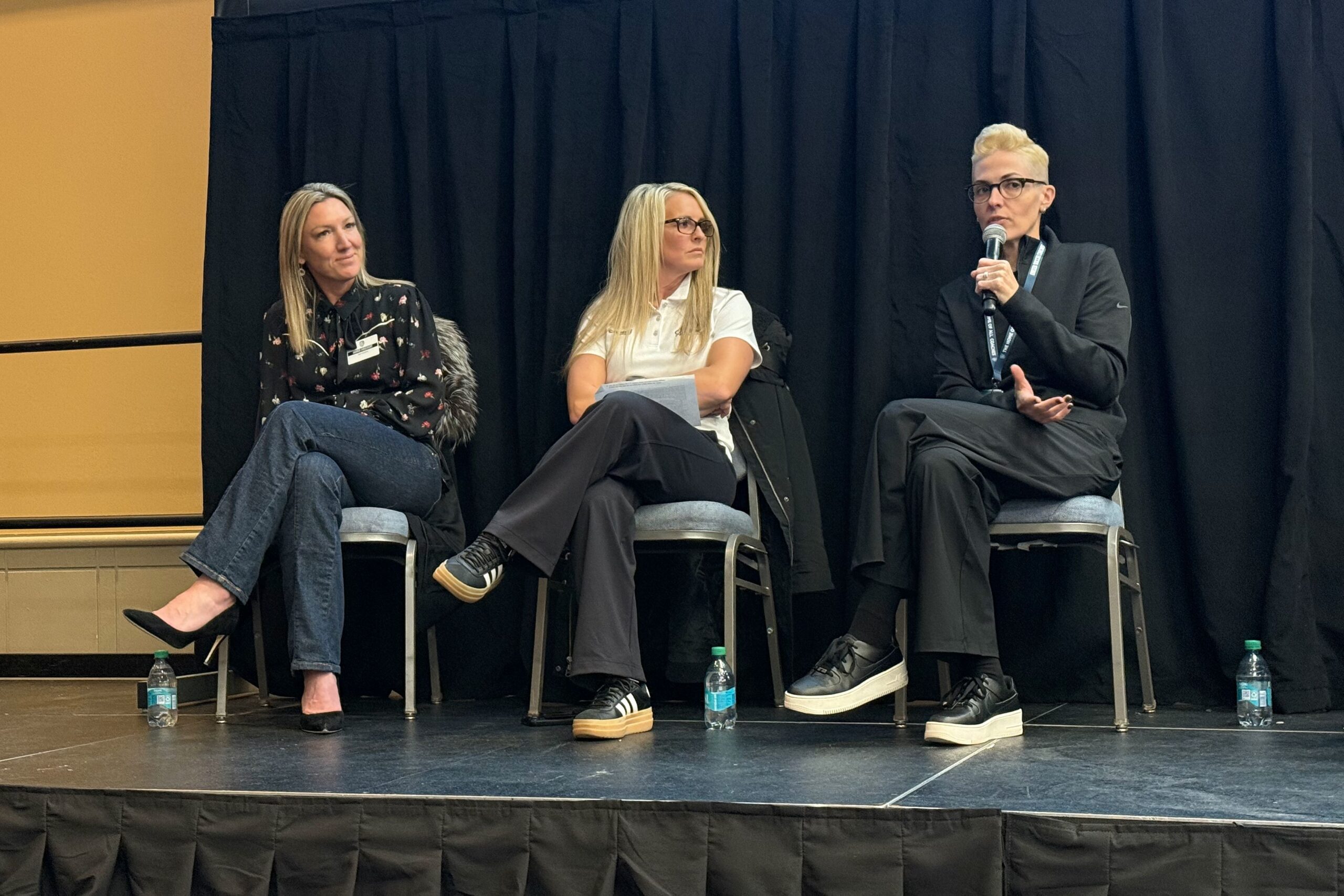
    Haley Carter (right) speaking on a panel at the United Soccer Coaches convention on Thursday with USL Super League president Amanda Vandervort (left) and Women’s Premier Soccer League commissioner Kendra Halterman (center).

    Does that matter when trying to sign not just Rodman, but other players from around the world?

    “We’re not necessarily competing with leagues, per se, for U.S. talent — we are competing with very specific clubs, and we have to be cognizant of that” Carter told The Inquirer. “That being said, though, more teams and more leagues are starting to make major investments. So the number of teams that we’re competing with is going to grow every year, right?”

    Indeed it is, and many have said the NWSL should compete accordingly. Raising the salary cap by $1-2 million this winter would be the fastest way to do it, and far less controversial than the league’s High Impact Player status that is set to take effect in July.

    The NWSL Players Association formally filed a grievance against that on Wednesday, six weeks after filing a grievance over commissioner Jessica Berman’s veto of a contract that Spirit owner Michele Kang offered Rodman.

    Washington Spirit owner Michele Kang already offered a contract to superstar Trinity Rodman, but it was vetoed by NWSL commissioner Jessica Berman.

    It is widely understood that Rodman wants to stay in Washington but wants a deal that will pay her what she’s worth. Kang, who also owns OL Lyonnes and England’s London City Lionesses, is clearly ready to offer it.

    Rodman isn’t just a star in the U.S.

    For now, everyone else is stuck waiting. But that did not stop Carter from offering a few words in a seminar Thursday that will raise the heat a bit.

    “The reasoning behind having a salary cap is to have competitive parity,” she said. “And I think you hear the phrase ‘best league in the world’ thrown around a lot about the NWSL, but the reality is we are the most competitive league in the world; we are not the best league in the world. I wouldn’t even know how you would measure that.”

    There surely are ways, whether subjective or statistical. The former would include the endorsements international players make when they come over here, such as one Gotham FC and Spain striker Esther González gave to Sports Illustrated last year.

    “Every match you play in, you have to prepare like it is a final,” she said. “There are a lot of international players who are at the top of their game and want to play in the NWSL, and there’s a reason for that.”

    Esther González (right) on the ball for Gotham FC during last year’s NWSL championship game.

    Carter said that point “still resonates with players. Players want to play in a league where every match is a meaningful match.”

    But some of her other remarks, on the business side of the game, might have framed Rodman’s importance even more strongly.

    “How can we tap into that international fan base and find a way to monetize that?” Carter said. “If you look at Trinity Rodman for instance — Trinity Rodman’s kit sells like crazy in the U.K. How can we do that for more of our athletes? How do we create that buzz and excitement?”

    Rodman’s jersey sells plenty well in the U.S. too, whether it’s her Spirit one or her U.S. national team one. Just the potential of her presence at Washington’s Audi Field on a game day helped the Spirit draw an average attendance of 15,259 last year, third-best of the NWSL’s 14 teams.

    “One of the reasons I came to the Washington Spirit was because of the work that Michele Kang has done specifically to make the Spirit a cultural icon within that city,” said Carter, who took the job in early December.

    She tied that to the Spirit’s grassroots work in Washington as much as anything else, but specter of Rodman still hung over the moment for many people in the room.

    The next global measuring stick

    A milestone of a different kind will come later this month when FIFA stages its inaugural Women’s Champions Cup in London. In the semifinals, Gotham will play Brazil’s Corinthians, and Arsenal will play Morocco’s AS FAR — all winners of their respective continental championships.

    Those games will be single moments among many, but they’ll still be a measuring stick.

    Gotham FC won last season’s Concacaf women’s Champions Cup to qualify for FIFA’s inaugural global tournament.

    “It may not necessarily reflect whether your league is the best league in the world, but it gives a good opportunity for us to put our best teams against other best teams,” Carter said.

    It might also make a point about another measuring stick that gets attention: player rankings by the international media. This year’s edition strongly favored European players, partially because some major U.S. players have been out of action — Rodman and Rose Lavelle with injuries, Sophia Wilson and Mallory Swanson while pregnant.

    But beyond that, many voters are based in Europe, so they might favor players whom they see more. And now the rankings have even more significance because the NWSL is using them to judge players’ eligibility for HIP status.

    “I always take those player ratings with a bit of a grain of salt,” Carter said, and wondered aloud why the players should care about things “that in the big scheme of things are very subjective, anyhow.”

    But there is a reason, she admitted: “Now you look at the HIP criteria, and so much of the HIP criteria is based on these ranking and ratings.”

  • Man charged with sexually assaulting a woman in her 90s in Montgomery County

    Man charged with sexually assaulting a woman in her 90s in Montgomery County

    A 22-year-old man was charged with sexually assaulting a woman in her 90s during one of four home break-ins last year in Montgomery County, authorities said Thursday.

    John Vernon Gray of Telford was arrested Jan. 10 and was charged with rape and related offenses. He was being held without bail at the Montgomery County Correctional Facility.

    The four nighttime break-ins occurred around Towamencin Township and involved four women who Gray allegedly believed were living alone, authorities said.

    On May 10, around 2:25 a.m., a 79-year-old woman was awakened by a man trying to enter her house on Dock Drive through her bedroom window, authorities said. She screamed and scared him away.

    About an hour later, a man entered a residence in the Dock Woods Senior Living Community and sexually assaulted the occupant, a woman in her 90s, authorities said.

    On Nov. 8, two more break-ins occurred. Police responded around 3 a.m. to a home on Dock Drive where a 72-year-old woman reported being awakened by a man in her bedroom who attempted to lift her nightgown, authorities said. The woman screamed and the man fled.

    About 30 minutes later, a man entered a residence on Crosshill Court in Towamencin Township through a rear sliding glass door, entered the bedroom, and touched a 46-year-old woman, authorities said. The man fled when the woman screamed for her husband.

  • Federal substance abuse and mental health grants were cut and then restored with little explanation

    Federal substance abuse and mental health grants were cut and then restored with little explanation

    Physicians Zsofi Szep and Judy Chertok have spent the last three years working to connect Penn Medicine patients with addiction treatment — with the help of a federal grant that they learned was terminated in a form letter Tuesday.

    They rushed to find a way to keep caring for their patients, many with HIV or hepatitis C and needing supports such as housing and food after treatment. The salaries of two staffers helping to connect people with such resources had been entirely grant-funded.

    “To stop this from one day to the next was obviously devastating,” Szep said. “It’s not possible to stop patient care. We continued to do what we were doing.”

    The Substance Abuse and Mental Health Services Administration had abruptly rescinded funding for thousands of grants dealing with mental health and addiction treatment, only to reverse itself a day later with little explanation.

    NPR reported that some $2 billion in grants were cut off, and grantees like Szep and Chertok received form letters that said only that their projects no longer aligned with agency priorities.

    The move sparked immediate outrage from providers and legislators alike. U.S. Rep. Madeleine Dean (D., Montgomery) helped marshal 100 congressional representatives to sign a bipartisan letter to Health and Human Services Secretary Robert F. Kennedy Jr., demanding the funding be restored.

    By Wednesday night, it had been, The Associated Press reported — still with little explanation from federal officials. HHS did not return a request for comment Thursday. The agency also declined to answer questions about the reasons for the rescissions from The Associated Press.

    But providers at the programs affected by the whiplash of rescinded, then restored, funding said they were shaken by a chaotic 24 hours and worried about what the move signaled.

    Since President Donald Trump took office last January, his administration has fired thousands of federal workers and attempted to slash federal grants at unprecedented levels, creating chaos among researchers, health providers, and nonprofits.

    As of late Thursday, one Philadelphia provider who receives SAMHSA grants said she had not yet received notice from the agency that funding had been restored.

    “It’s a message that what we’re doing is not important,” said Barbara Schindler, the medical director of the women’s addiction treatment program Caring Together.

    “The people that work day to day on the front lines, we’re dealing with folks that are living on the edge and need all the help they can get. To feel like your rug can get pulled out from underneath you at any one point, both as a provider as well as a participant, is very upsetting.”

    Uncertainty amid attempted cuts

    It’s unclear how many programs in the Philadelphia area were affected.

    Gaudenzia, an addiction treatment provider with locations across Pennsylvania, Maryland, and Delaware, had grants rescinded, then restored, that were related to expanding treatment access, addiction prevention, and support services, a spokesperson said.

    Gaudenzia’s president and CEO, Deja Gilbert, said she understood the need for “fiscal responsibility at the federal level,” but funding changes should be made in collaboration with providers.

    “Abrupt funding actions — even when reversed — create uncertainty for providers and the people we serve,” she said in a statement.

    Szep and Chertok’s program at Penn, which has served about 125 patients over the last few years, is aimed at some of the health system’s most vulnerable patients, connecting patients in the hospital or outpatient clinics with addiction treatment.

    “It’s a very sick and complicated group of patients, who are specifically referred to an extra-specialized team,” Chertok said.

    They were relieved when their funding was restored on Thursday but remain worried about the future.

    “So many other people have similar grants in our city through SAMHSA — the amount of people that are getting care through these types of programs is really dramatic, and we don’t have other ways of getting them care,” Chertok said.

    Schindler, a professor of psychiatry and pediatrics at Drexel University, said SAMHSA funding through two grants allows her 36-year-old clinic to support medication for women with opioid use disorder and a reentry program for women incarcerated for drug-related crimes.

    “It allows us to have more addiction counselors and staff that can address the incredible needs these ladies have,” she said. “It really enhances the program.”

    She said she was “on pins and needles” waiting to hear that her funding had been restored.

    ‘Incompetence and cruelty’

    Dean said she learned of the cuts when a staffer pulled her aside to share a news article, reporting that SAMHSA had abruptly rescinded $2 billion in funding from more than 2,000 grants. Almost immediately afterward, the head of a Pennsylvania network of addiction treatment providers called her.

    They began working to determine how many local grants had been affected, an effort that’s still ongoing.

    “Immediately, what I thought was, this will cost lives. People will die as a result of this level of incompetence and cruelty,” Dean said.

    She said she had not received answers from the administration on the reasoning behind the cuts.

    Dean called the terminations hypocritical, noting that President Donald Trump has justified military operations in Venezuela as an effort to combat drug trafficking even as his administration attempted to cut billions in drug treatment funding at home.

    “It’s incompetent, illegal, unconstitutional, and we got no notice,” she said.

    Dean said she was pleased that programs were seeing their funding restored, although she was still unsure what had prompted the decision, and was concerned about the precedent the move set.

    “I’m of the mind that it will happen again. And there is real harm — I don’t care if the interruption is 24 hours,” she said. “Interruptions can have large impacts.”