Blog

  • PHA took over its first private-sector apartment building. Tenant reviews are mixed.

    PHA took over its first private-sector apartment building. Tenant reviews are mixed.

    The Philadelphia Housing Authority embarked on a strategy last year unlike anything it has done before.

    The agency is known as the largest affordable housing provider in the city. But in 2025, under the leadership of CEO Kelvin Jeremiah, it began buying struggling private-sector apartment buildings all over the city to expand the affordable housing supply.

    Over the last 14 months, the Philadelphia Housing Authority (PHA) has spent $280.6 million to acquire 17 multifamily properties, totaling 1,515 units. Some have been student apartments or largely empty new buildings. But most have been full of tenants paying market-rate rents, ranging from $1,106 to $2,323.

    That’s a new demographic for PHA, whose renter base often makes less than $30,000 a year.

    PHA plans to fill these buildings with Section 8 voucher holders, who often have a difficult time finding rentals in higher income areas.

    “It’s part of the strategy … to give residents the broadest possible options in terms of their housing choice and one that is not limited to particular neighborhoods,” Jeremiah said.

    In an innovation, the agency intends to keep renting some units in the newly acquired buildings at the market rate, using the income to support operating expenses.

    The first PHA purchase in 2025 was The Dane, a 233-unit building in Wynnefield. It now houses some tenants paying market-rate rents and others using government subsidies.

    Last year, several tenants contacted The Inquirer with concerns about what they described as a rocky transition to PHA ownership. Since then, interviews with 18 tenants at The Dane have laid out challenges within PHA’s new model — and the potential difficulty of retaining renters with options elsewhere.

    Eighty-six people have moved out of The Dane over the last year. That’s about half the original occupants as the building was only 75% occupied when purchased.

    The overwhelming majority of tenants interviewed by The Inquirer said PHA is a better landlord than the previous owner, Cross Properties. But most have moved out or are planning to.

    “The management staff that are there now are better than what we had, but they’re still pretty mediocre,” said one resident, who, like many of the tenants, asked that their name be withheld to preserve relations in the building.

    “Everybody’s very polite; everybody’s very cordial, but it’s only maybe one or two maintenance people,” this multiyear resident said. “The trash pileup is very bad right now … I plan to move elsewhere.”

    Jeremiah noted that most of the properties PHA acquired have not experienced the kind of turnover that The Dane has seen. The building is now almost completely occupied with both market-rate and subsidized tenants, said a PHA spokesperson.

    He said some tenants moved out after the agency began collecting rent again. Many had been withholding payments to Cross, which lacked a rental license at the end of its tenure.

    It’s possible that the turnover at The Dane is largely the result of a difficult property transfer from a troubled previous owner. (Cross Properties is no longer in business.) In that case, the tenant exodus may not be a predictor for PHA’s larger ambitions.

    But given the skepticism PHA faces in many neighborhoods, outside observers say, the agency’s new expansion strategy faces high expectations to get everything right.

    “PHA is under a tremendous amount of pressure,” said Akira Rodriguez, a professor of housing policy at the University of Pennsylvania. “There’s going to be experiences that are uneven for tenants as they navigate this new model of housing provision … [and The Dane] is a really high visibility example.”

    A long troubled apartment building

    In November 2024, residents of The Dane were fed up. Their hot water wasn’t working — again — in apartments where many households paid over $2,000 a month in rent.

    “The owner [Cross Properties] was not the best,” said Akeesha Washington, who has lived in The Dane since 2020. “He just didn’t maintain the building. Over the years, you saw the amenities dwindle.”

    Cross Properties acquired the building in 2016 when it was the Penn Wynn House and converted the rent-subsidized building into market-rate apartments.

    When Washington moved in, she was impressed. The staff were kind to her in 2020 when she contracted COVID-19. They coordinated care with Washington’s mother so she had access to medication without infecting anyone.

    “It was a really nice community. It’s luxury in the 19131 section, where not everyone feels like they can afford it,” said Washington, who loves the diversity of the tenants, which included university students, working-class residents, and doctors and lawyers.

    “You had so many layers of people living and coexisting in this building,” Washington recalled. Rents ranged from $1,100 for a studio to $2,200 for a two-bedroom unit with two bathrooms.

    But by 2024, most tenants said, building management had fallen off. Trash wasn’t picked up regularly; lawns went unmowed and snow unshoveled, and basic amenities like the parking garage door often didn’t work.

    Shortly after another hot water outage, tenants got news in late 2024 that Cross Properties was out.

    “When residents heard it was being acquired, we were excited because we won’t have to deal with not having hot water, especially during the holidays,” Washington said.
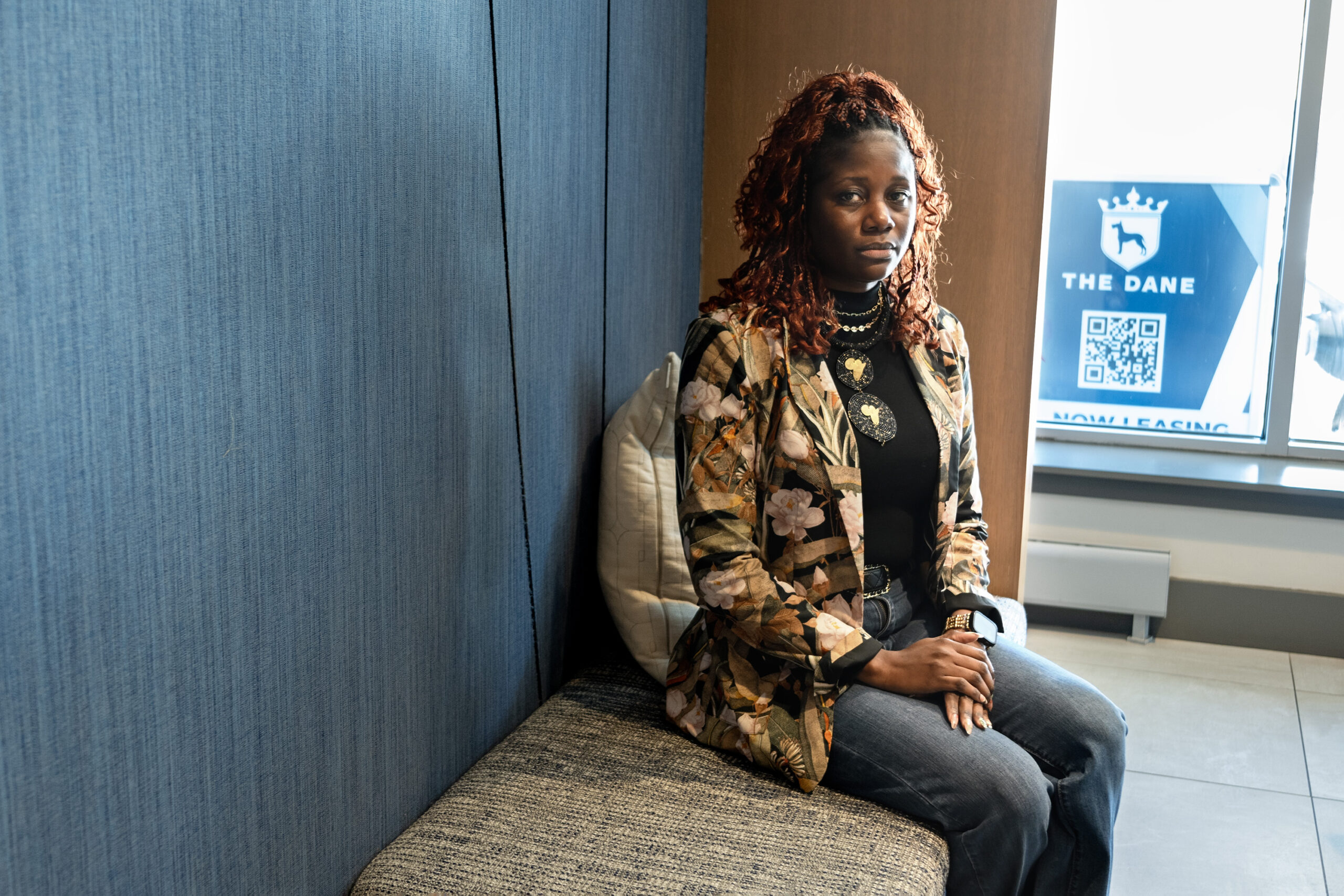
    Akeesha Washington in the lobby of her apartment building in the Wynnefield neighborhood in December. She was living in the market-rate building before the Philadelphia Housing Authority (PHA) purchased it to expand the city’s affordable housing supply.

    New management, new problems

    When PHA purchased The Dane, the building had many unresolved issues, said Tonya Looney, who worked for Cross Properties as the building’s manager. And she said there was scarce planning for the details of the transfer.

    “To be fair, this is something new and I understand from a real estate professional’s perspective that there’s going to be hiccups,” said Looney, who stopped working at The Dane last May, although she still manages 15 apartments for long-term corporate stays in the building.

    Looney is in a legal dispute with PHA, which says she owes substantial back rent. “We do not intend to renew the leases that she has in her name,” Jeremiah said. “I do not think she is a good arbiter of the facts in this case.”

    Both Jeremiah and Looney say that after the sale closed, Cross Properties shut down the operating software, cutting off tenants’ ability to pay rent online, see their rental histories, and submit maintenance requests.

    “We had 200 people with no way to log in to pay their rent, no way to submit a maintenance ticket, no idea who to talk to about any issues at the building unless they came downstairs to see what’s going on,” Looney said. “Needless to say, it was chaotic.”

    For much of 2025, residents had to pay with checks, which sometimes went uncashed, according to Washington and Looney.

    Jeremiah says that Cross Properties’ owner asked PHA to pay to access the former tenant management system, although PHA eventually figured out how to get the records.

    Despite the chaotic transition, many tenants said PHA’s ownership brought improvements from previous conditions, especially after Maryland-based HH Redstone was brought in to operate The Dane in August. (That’s when online payments, for example, started working again.)

    “HH Redstone is doing what they can, and I’ve re-signed my lease for one year because I am willing to see what change they can continue to make,” said another tenant who asked not to be named.

    Why tenants are leaving, even with improved conditions

    Other tenants say property services continue to suffer.

    Trash pickup is still persistently late, several tenants said. Pest outbreaks such as bedbug, mouse, and cockroach infestations flare up, which is new in the building, according to Washington and two other tenants. The dog washing station and the dog run are often messy. The garage door continues to break down. This winter, a rash of burglaries spooked residents.

    Jeremiah said PHA is addressing these concerns, and in some cases — such as the dirty dog run — residents are expected to clean up after themselves. He also noted that the agency installed 24-hour security.

    “The idea that this is a new phenomenon to that building, given where it’s located, is just nonsense,” Jeremiah said of the security concerns. “We have a very robust set of layered access control systems in place [and] CCTVs.”

    As PHA was negotiating to buy The Dane, it also sought to save the Brith Sholom House, a dilapidated nearby senior complex linked to a national fraud scheme. After assessing the depths of the building’s issues, PHA determined that to repair it, tenants would have to move out.

    The exterior of Brith Sholom House on May 8, 2023.

    When they first arrived at The Dane, some elderly residents were not getting the care they need, Washington said.

    One man she ran into frequently often smelled of urine and would walk around with visibly wet pants. She said building management addressed the issues by spraying Febreze on benches the tenant used after he left an area. He has since died.

    Another man screamed for help from his balcony and has since been moved out of the building.

    “We are very used to all kinds of things happening here, from the students being wild to elderly being wild, but not to the level of being unable to take care of themselves,” Washington said.

    Jeremiah says that PHA keeps tabs on the rehoused Brith Shalom residents — who previously were living with no oversight, although there are limits to what it can do. He encouraged tenants to report anyone who needs aid.

    “We provide a robust set of social services to residents we inherited at Brith Shalom,” Jeremiah said. “PHA is not a healthcare provider. We are a housing provider, though we provide access to opportunities for residents who are interested in aging in place.”

    A former Brith Shalom resident had no complaints with The Dane and praised PHA for the improvements in his life.

    “I have no problem with them. I’m happy,” said Barry Brahn, who is blind and has AIDS. “They’re slow at getting things fixed, but they can only do so much and they’ll eventually get on it.”

    What comes next?

    Some aspects of the rocky transition from Cross Properties to PHA have eased. Since October, tenants were able to pay their rent online and submit maintenance requests. Washington says she does not see obviously distressed elderly residents any longer.

    But tensions remain.

    “The transition to PHA has been challenging, and their communication has been sorely lacking,” said Lanese Rogers, who has lived in The Dane for two years. “As someone who pays unsubsidized rent, they deal with us in a condescending manner.”

    Kelvin Jeremiah, PHA president and chief executive officer, at PHA headquarters, in Philadelphia.

    Jeremiah says he believes some of the pushback against PHA is due to class prejudice and bias against subsidized tenants.

    “I don’t believe that there is anywhere any Philadelphian, whether or not they’re high income, middle income, low income, shouldn’t be permitted to live,” Jeremiah said.

    He is committed to providing accessibility and affordability throughout the city, he said, and he hopes to retain mixed-income residency in newly acquired buildings with existing tenants.

    So far at The Dane, many of the market-rate tenants are leaving.

    “If I could pick up my apartment and move it to another location, I would,” Rogers said. “The building is changing, and I don’t like the direction it’s moving in.”


  • Letters to the Editor | Feb. 20, 2026

    Letters to the Editor | Feb. 20, 2026

    National holiday

    I am an avid Eagles fan. I was convinced they would be in the Super Bowl this year, but it was not to be. However, I still love to watch the game and did so a couple of weekends ago with friends and family.

    For millions of Americans, Super Bowl Sunday is a welcome day of celebration. This year’s game was watched by about 125 million people. In any given year, many Americans take “sick days” on the Monday after the game, including this year: An estimated 26 million people were expected to miss work, up from 16 million in 2025 when the Birds won.

    Here’s an idea: Instead of holding the Super Bowl on the second Sunday in February, the NFL should move the game to the third Sunday of the month. Why? The following day is Presidents Day, a national holiday, always observed on the third Monday of February — and a day in which millions of Americans don’t have to go to work.

    The number of people taking part in “Super Sick Monday” would be greatly reduced, and it would be a change welcomed by many.

    Ed Vreeswyk, Yardville

    Epstein class

    While the Trump administration continues to fail to keep the Jeffrey Epstein scandal out of the headlines, I keep thinking of my favorite Maya Angelou quote: “When someone shows you who they are, believe them.”

    As director of Sudan and South Sudan Programs at the U.S. Agency for International Development, my firsthand experience of the Epstein class came in the form of Elon Musk’s Department of Government Efficiency. The U.S. Department of Justice’s latest release of the Epstein files featured more than 1,000 mentions of Musk.

    As the president, another one of the Epstein files’ main characters, allowed the unelected billionaire to go about “feeding USAID into the wood chipper,” Marco Rubio promised USAID’s “lifesaving” programming would be spared. My colleagues and I desperately argued that our work saved lives. It wasn’t a hard case to make — Sudan and South Sudan represent two of the world’s largest humanitarian catastrophes.

    By the end of February 2025, DOGE had cut 90% of USAID’s programming. Estimates indicate approximately 762,000 people have died, including more than 500,000 children. One study warns that the dismantling of USAID could lead to more than 14 million deaths by 2030.

    These lives, like the lives of those trafficked by Epstein, were of no consequence to the Epstein class. They have shown us who they are. We need to believe them.

    Maura O’Brien, Ardmore

    War on scientists

    The present administration has worked hard to discredit science and remove scientific researchers from any government positions. They have labeled climate change as a liberal hoax and claimed that children receive too many vaccinations. Measles, all but eradicated, has made a strong resurgence. As a result of this “war on science,” more than 10,000 science workers have left the government. In an effort to profit from these foolish policy decisions, the European Union has created a fund to attract these scientists to Europe. We are driving away the occupations that have created the greatness that was America.

    Edward Hackett, Phoenixville

    Join the conversation: Send letters to letters@inquirer.com. Limit length to 150 words and include home address and day and evening phone number. Letters run in The Inquirer six days a week on the editorial pages and online.

  • Horoscopes: Friday, Feb. 20, 2026

    ARIES (March 21-April 19). It used to feel weird to witness the one who seemed to have it all and act like you weren’t inwardly comparing yourself. Now you’ll notice you’re over it. You actually enjoy the inspiration. It sparks ideas. You try things.

    TAURUS (April 20-May 20). You do not need approval to proceed, but don’t let that stop you from sharing. People will love being in on your process. This is how bonds are made. When they feel they’ve have been in on your plans from the start, future rewards will be wonderful for many.

    GEMINI (May 21-June 21). A possession takes more time than you want to give. It’s your cue to make a change. It’s not about upgrading or downsizing but about finding the balance of maintenance to benefit that fits the rest of your life.

    CANCER (June 22-July 22). This week you’re less like the naturally and brilliantly defended crab and more like a snail, half inside your house and half out, as comfortable as you are vulnerable. In this state, any number of things could happen. You could receive a message on the wind, learn a new pleasure or pain, or fall in love.

    LEO (July 23-Aug. 22). You can build bonds through work or play. The work will be easier today though because structure is built in. The rules and expected outcomes are a natural environment for getting to know people and building trust, and you’ll do both.

    VIRGO (Aug. 23-Sept. 22). Whatever you most want from the day can happen if you’re willing to make everything else wait while you put all your focus into priority No. 1. It’s going to take more than a statement of intent. You may have to go somewhere no one will bother you.

    LIBRA (Sept. 23-Oct. 23). Like other kinds of ailments, healing times vary for wounds of the spiritual heart. The important thing is that you know you can bounce back, like you have before. So you also know that love is worth the risk.

    SCORPIO (Oct. 24-Nov. 21). Winning isn’t everything. Having the highest score isn’t always for the highest good for all. You’ll assess the game from a different vantage today and consider ways to “win” that hadn’t occurred to you before.

    SAGITTARIUS (Nov. 22-Dec. 21). Neatness doesn’t automatically improve the substance of work. A messy but brilliant idea is still brilliant. But today, presentation will make your work user-friendly and strongly influence the number of people who engage with it. So all your efforts to polish will pay you back.

    CAPRICORN (Dec. 22-Jan. 19). Novelty can be a pleasure, but pleasure isn’t always about novelty. Today’s self-care will involve returning to your familiar favorite things. What tops your list is no accident. You’ve tried a lot of different things to find out what you like.

    AQUARIUS (Jan. 20-Feb. 18). Busyness is to importance as distraction is to the “ta-da” in a magic trick. They look connected. Maybe they are; maybe it’s smoke and mirrors. Either way, the kind of busyness that counts? Being there for the people who need you.

    PISCES (Feb. 19-March 20). You’ve known that kind of inspiration that feels like a lightning strike from the clouds. This time it’s very different. Intuition comes up from the ground, energizing you while you work. It’s like you’re suddenly plugged in.

    TODAY’S BIRTHDAY (Feb. 20). Welcome to your Year of the Grapevine Knot when your hope holds because it commits. You grip tighter under load, never slip once set, and will not return to any shape you’ve already been — ever forward, ever true. More highlights: fun friends, finding and deepening love, doing the right work over and over until the windfall, and a living arrangement that is so elegantly yours. Your lucky numbers are: 11, 23, 38, 7 and 29.

  • Dear Abby | Fifty years later, former couple again cross paths

    DEAR ABBY: I met “Bobbie” when we were in college in the early 1970s. We fell in love, got married, and stayed together for seven years. Things changed; our divorce was amicable. We went on to successful professional lives and happy second marriages. We stayed in touch over the years, mostly through holiday cards.

    A few years ago, I started getting emails from Bobbie about things and ideas we shared together. She lost her husband earlier this year, and I lost my wife about the same time. I stopped by to see her last summer during a visit with some other friends, and we had a nice visit over brunch. She looked good.

    Would I be crazy to see if I could rekindle our relationship after 50 years? She lives a long way away now, but I’ve thought several times about moving back to the area where I grew up. It’s clear we still share the ideals of our youth, and I’ll admit I’ve always had a soft spot for her. I don’t have much to offer these days, but I get kind of lonely.

    — LOOKING BACK IN WYOMING

    DEAR LOOKING BACK: I don’t think it would be crazy at all to explore rekindling your relationship with her, but please take your time. If you want to move back to the area where you grew up, keep that issue separate from the romance. It would be unfortunate if you relocated, things didn’t work out as you hoped, you had given up all of your social contacts and you had to start completely over solo.

    ** ** **

    DEAR ABBY: My son married my daughter’s best friend, “Kayla.” I have loved this young lady since she was a little girl. When Kayla became part of the family, I was overjoyed.

    Kayla and my son now have had a baby, and I am not allowed to see the child. The only people who get to see the baby are Kayla’s mother and her mother’s family. Kayla’s parents are divorced, so her father doesn’t see his grandchild often either, but it’s far more often than my husband and I do. I wrote a text to my son. It wasn’t a nice one, but please remember I haven’t been able to see my grandchild.

    I don’t know what to do. I’m heartbroken. I did tell them I was sorry and I shouldn’t have written what I did, but they still keep me at arm’s length. In addition, they have just announced that I’m going to be a grandmother again.

    I’m not overjoyed about the news, knowing what it’s been like with this first child. I’m sure it will be more of the same with the new baby. I love my grandchildren and their parents, but I’m tired of being the bad guy. Advice?

    — KEPT AWAY IN TENNESSEE

    DEAR KEPT AWAY: It is not unusual for new mothers to gravitate toward their own mothers after the birth of a child. Why do I suspect there may be more to this estrangement than one nasty text written to your son? I wish you had mentioned what may have caused a rift between you and Kayla, whom you say you have loved since she was a little girl.

    Because apologizing to your son and daughter-in-law was not enough to assuage their anger, you are finally going to have to accept that this regrettable situation is one you cannot change on your own.

  • Why changes in a Florida ocean current could wreak havoc worldwide

    Why changes in a Florida ocean current could wreak havoc worldwide

    STRAITS OF FLORIDA — At 2 a.m., oceanographer Ryan Smith was headed into his 12th hour of work with little sleep when trouble started.

    From the rear deck of the University of Miami’s research boat, he guided the vessel’s winch to lower a cage containing 14 long, gray tubes, collectively weighing about 1,000 pounds, hundreds of meters deep into the Atlantic Ocean, to record the temperature, salinity and density of the water. But after running smoothly for the first two-thirds of the trip, the sensors now suddenly stopped transmitting data.

    There was no time for a hiccup. With urgency mounting, Smith signaled to bring the cage to the surface.

    At sea, there is no helpline to call for a broken instrument at this hour (or any hour). If the team couldn’t fix it, they would need to make a 12-hour slog back to Miami through the fast-moving Florida Current — the precise subject they were trying to measure.

    For 43 years, scientists have been studying the strength of the water flow between Florida and the Bahamas to learn what drives its changes over time. The information could help scientists answer a pressing question: Is the Florida Current, one of the world’s fastest ocean currents, slowing down? If so, it could indicate weakening of the larger circulation system in the Atlantic Ocean — what scientists call the Atlantic Meridional Overturning Circulation (AMOC) — which could be disastrous.

    Even Hollywood has imagined the harm that could result from a collapse of this system of currents, which acts like a conveyor belt as it transports water, nutrients, and heat through the Atlantic.

    While scientists doubt the scenario sketched out in the 2004 movie The Day After Tomorrow, in which the AMOC’s failure prompts a calamitous ice age across the Northern Hemisphere, researchers say rain patterns could change or fail in Southeast Asia and parts of Africa, disease may spread to new populations, and temperatures would probably drop across Western Europe. Iceland has even declared that the risk of such a collapse is a national security threat.

    But climate scientists are at odds over how soon, or whether, the circulation system may weaken. Researchers largely agree that the AMOC may weaken over this century as the world warms, but they differ on whether the system is already slowing down.

    Direct observations of the AMOC’s and the Florida Current’s flow, velocity, temperature and salinity could help clarify this. The Florida Current, which helps shuttle water north, is a key component in calculating the system’s strength.

    Traveling between Miami and the Bahamas, a crew from the University of Miami and the National Oceanic and Atmospheric Administration homed in on the Florida Current, the world’s longest nearly continuously observed ocean current. Over 36 sleep-deprived hours, six researchers and seven crew members traversed the ocean, dove underwater, and collected gigabytes of measurements. These expeditions gather data that generations of scientists can use to better understand the state of our oceans — and humanity’s future.

    Tyler Christian, a marine scientist, takes a photo of a waterspout during a research trip to collect data on the Florida Current.

    The AMOC debate

    For more than four decades, scientists have almost continuously measured water flow across the Florida Current, largely with the help of a decommissioned AT&T telecommunications cable running from West Palm Beach to Grand Bahama Island.

    The telephone line wasn’t intended for ocean research, but NOAA scientists noted that it picked up tiny voltages induced by seawater flowing across the Florida Straits, which changed depending on the current’s flow. Using direct measurements of the waterway from research cruises, scientists can convert the voltages into the volume of water carried each second through the strait.

    In 2005, British oceanographer Harry Bryden tapped these cable measurements and the limited available ship measurements in a seminal paper that suggested a possible slowdown in the AMOC between 1957 and 2004. Using data across the Atlantic Basin today, scientists have found that the AMOC varies, daily and seasonally, yet it also appears to have experienced a slight weakening over the past two decades.

    But is it on a long-term decline because of human-induced planetary warming? Debatable.

    At about 4 a.m., oceanographer Denis Volkov, right, checks in on Jay Hooper, who helps the team with data management

    The Florida Current is one of the main forces that make up the western boundary of the AMOC. The warm Florida waters feed into the mighty Gulf Stream, which merges with the warm North Atlantic Current headed toward Europe. As the current reaches the Arctic, air temperatures cool the water, which becomes denser. The water sinks and moves south toward the equator, where it is again warmed by the sun and returns north.

    “The role of the AMOC in the climate is it carries a huge amount of heat from the equator towards the poles,” said Denis Volkov, who is a co-principal investigator of NOAA’s Western Boundary Time Series project along with Smith.

    But scientists say a warming world is throwing off this balance. As Arctic ice melts, freshwater enters the North Atlantic — making the ocean water less dense, so it is less likely to sink. As a result, scientists propose that it cannot power the ocean conveyor belt as well, so less salty, warm water is getting transported northward.

    A major shift in the Atlantic Ocean’s circulation could create severe drought in some areas and damaging floods in others. Sea level could rise by a foot or more along the U.S. East Coast if it collapsed.

    Scientists have typically used data that indirectly hints at the current’s movement — such as sea surface or air temperature — to reconstruct the oceans in models and track whether the overall system is weakening, but they have reached mixed conclusions.

    For instance, a 2018 study plugged sea surface temperatures into computer models to show that the AMOC is weakening. Then, a paper released last January reported no evidence of weakening over the past 60 years after examining data on heat exchanges between the air and the ocean called air-sea fluxes.

    The dive boat takes scientists to a site to collect data on the Florida Current.

    Volkov and his colleagues are helping approach the puzzle with observations. In 2024, they reassessed the cable data from the Florida Current, adjusting for changes from Earth’s geomagnetic field. First, they found that the current had remained stable over the past four decades. Then, they updated calculations of the AMOC in this region, which has been monitored for only 20 years or so, with the corrected data and found that the AMOC wasn’t weakening as much as previously calculated at this latitude.

    “But there is a caveat that observational data is very short,” said Volkov. He said scientists would need another 20 years of AMOC observations to determine if the small decline is a robust feature and not part of natural variability.

    And the AMOC can still weaken even if the Florida Current remains strong, he said, since it is the sum of currents across the basin. But long-term changes in the Florida Current can serve as an indicator of trouble for the rest of the system.

    One snag, said Volkov: The serendipitous cable that provided data for more than 40 years malfunctioned in 2023 — perhaps broke. Until it’s fixed, researchers are ramping up their diving operations to recover data from underwater acoustic barometers on the ocean floor.

    Volkov, left, and Smith watch as a sampling instrument drops into the water.

    The expedition

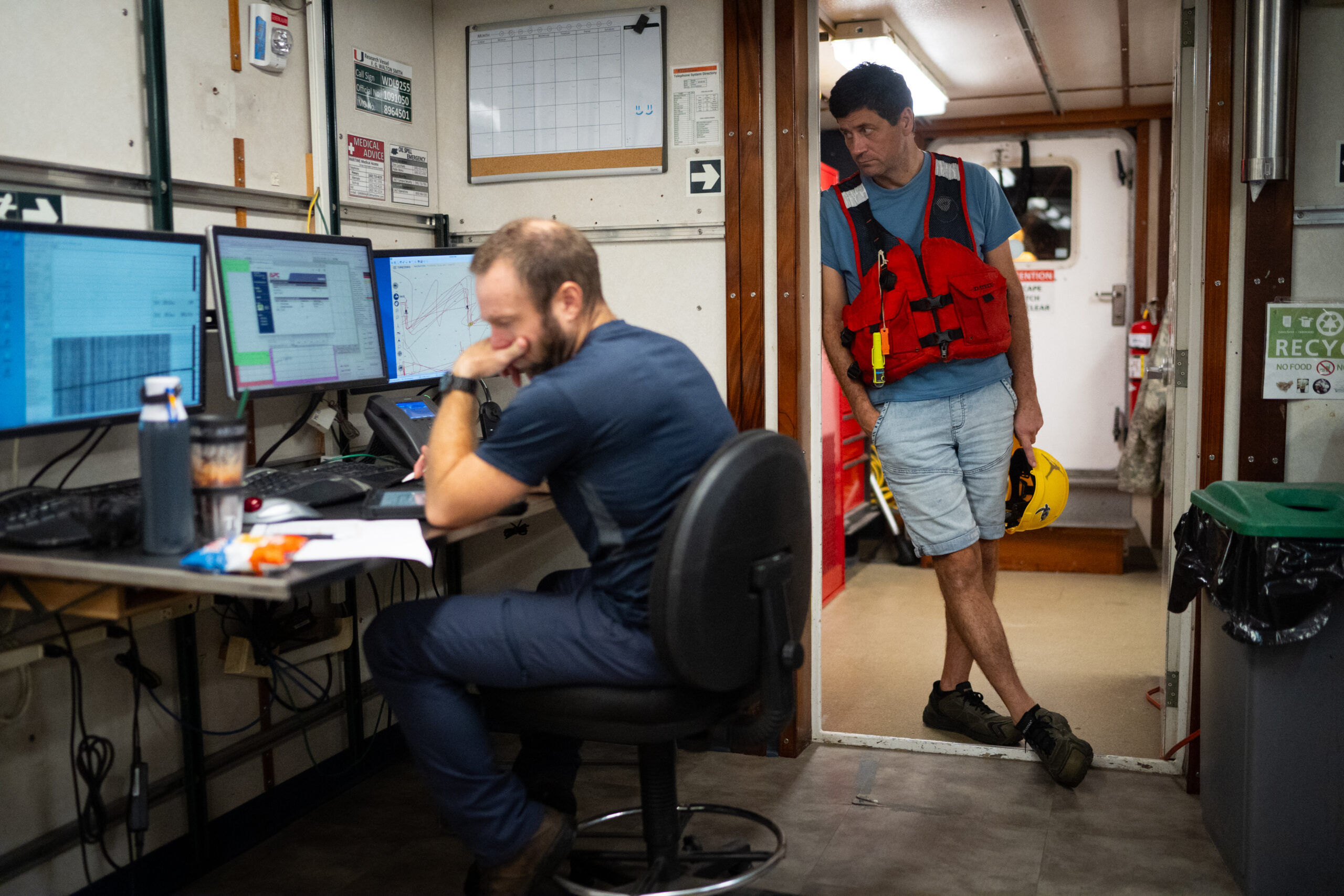
    When the research vessel departed from the university’s dock around 4 a.m. on Sept. 3, the sun and most of the science staff were down for the night. A few shipmates gazed at the illuminated cityscapes from the stern deck, next to the diesel engine’s deep rumble. After traversing rocking waves, the crew reached scenic Bahamian waters eight hours later.

    The green F.G. Walton Smith, 96 feet long, and its crew make this overnight trip about six times a year, traveling 93 nautical miles diagonally from Miami toward the Little Bahama Bank. From there, they go west and collect data at nine sites from the boat and dive underwater at two others.

    The team’s goal is to determine the amount of water flowing north through the Florida Current per second through a series of underwater instruments, from the boat and from satellites. They also collect temperature, salinity, density and velocity data; velocity and temperature, for example, can be combined to calculate the amount of heat transported across an area.

    Chomiak, left, and Zach Barton, a technician and engineer, return from diving to the seafloor to place a data-collection instrument.

    At the first dive site, a remora — a long, torpedo-shaped suckerfish — circled the two scuba divers less than a mile from the boat. The slender fish is known for a unique fin on its head that suctions itself to sharks, whales, and turtles to feed off their detritus. And for a quick moment, it latched onto Leah Chomiak’s head. And her thigh.

    Chomiak focused on the barometer in front of her. Her bulky gloves made it harder to use a screwdriver 50 feet below the Bahamian surface. She and her fellow diver held onto the long tubes that had been recording data every five minutes for the previous two months, since the last time divers brought the instruments to the surface and downloaded the data.

    “Now we decided to service them more frequently, because, at the moment, this is the only source of data for our Florida Current transport estimates,” Volkov said. The scientists can use the pressure data to help calculate the amount of water flowing through the area.

    Next, the ship arrived at the first of nine hydrographic stations and lowered a cage of sensors known as a CTD-rosette sampler (CTD stands for conductivity, temperature and depth, although it measures many more properties). Researchers can use the temperature and salt concentrations of a particular mass of water to infer where it came from and how it reaches other parts of the world.

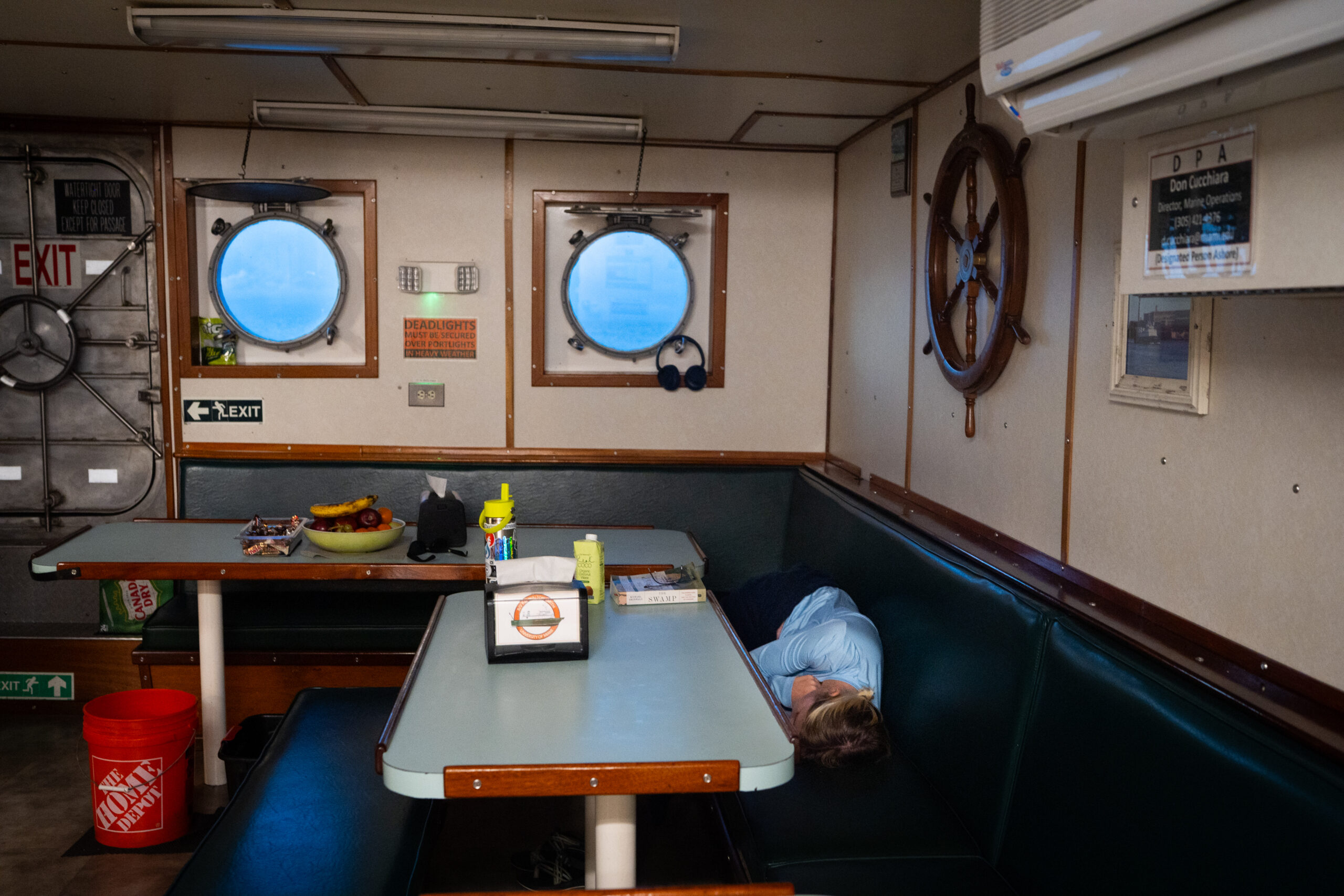
    Christian takes a quick nap in the galley as the vessel travels back to Miami.

    Jay Hooper, who has been on these trips for 10 years and helps with data management, sat at the ship’s computer station.

    “Ready whenever you are,” he said into his headset.

    From the top deck, the captain lowered the rosette into the water, dropping 60 meters each minute. As the instruments approached the bottom at 486 meters, Hooper said to slow down.

    Lines of various colors — representing salinity, temperature, and density — squiggled down on Hooper’s computer screen as the sensors dropped. Temperature decreased and density increased as the instruments descended. Seventeen minutes later, the rosette was brought back onto the boat.

    After hours of gathering data, Hooper and Smith hit a snag at the seventh station. The rosette now wasn’t sending any information to the computer. Was it human error? Did the instrument break?

    The two tried different solutions as the other scientists slept. Then they replaced the sensors’ cable, and as they lowered the rosette, data filled the computer screen.

    The boat stopped for the last dive near the Florida coast to retrieve the second set of underwater acoustic barometers. But the water was so cloudy, thick and green that the divers couldn’t see their hands, so they decided they would try on the next trip.

    Captain John Cramer pilots the vessel back to the university.

    For the next 12 hours, the boat fought against the Florida Current to take the crew home. Some aboard mustered up energy to sing “Happy Birthday” to one of the crew members.

    The next morning, Smith and his colleagues processed the data to upload to NOAA’s Atlantic Oceanographic & Meteorological Laboratory website. There were no notes about a cable malfunction, encounters with remoras or sleep deprivation.

    The Excel spreadsheet had a single note for each station it recorded: “Profile looks good; use these data.”

  • Imhotep is back in the Public League girls’ basketball final after beating Central

    Imhotep is back in the Public League girls’ basketball final after beating Central

    Business as usual.

    For the 14th year in a row, Imhotep Charter is headed back to the Public League championship. In Thursday’s semifinal, the Panthers eked out a 52-45 win against Central at La Salle’s John Glaser Arena. Imhotep led for the entire game, but Central kept it close until the final whistle. Taylor Linton’s team-high 17 points lifted the Panthers back to the final.

    “Out of all the teams throughout Imhotep history that have contributed to the streak, the commonality between all of those teams is that everybody is pushing,” said Imhotep coach David Hargrove. “Pushing to be better — number one. But then, pushing to be better teammates — number two. That allows us to keep that standard of competitiveness and championship-quality basketball.”

    Late in the fourth quarter, down by six, Central sophomore guard Ava Yancey stole the ball and passed to junior point guard Stevie Hall, who was fouled and sent to the line. She made both free throws.

    But Imhotep kept on pushing.

    Panthers junior guard McKenna Alston responded with a lay-in of her own to quiet Central’s fans. Alston then stole the ball on the next two Lancers possessions to swing the momentum back to the Panthers.

    “We challenge our kids about making connecting plays. A lot of people think that’s [just on offense]. But for us … it’s on defense too,” Hargrove said. “We were able to put pressure to the ball, be in passing lanes, and be active.”

    Linton added: “[The end] was very intense. I think what was important is that we kept our poise … and we stayed connected.”

    Imhotep senior point guard Anai Kenyatta controlled the pace for the Panthers. Whenever the Lancers gained momentum, Kenyatta answered the call, finishing with 13 points. Senior forward Crystal Hawthorne added 11.

    For Central, sophomore forward Janai Bellinger led with a game-high 18 points. After Imhotep took a quick nine-point lead behind a 7-2 run to start the second half, Bellinger kept her team within striking distance until the final whistle.

    Audenried trounced Lincoln 67-28 earlier Thursday, meaning Imhotep will meet Audenried in the Public League championship for the fourth year in a row on Sunday. The Panthers lost to the Shayla Smith-led Rockets in the championship the past three matchups. With Smith now at Penn State, Sunday’s results could look different from previous years.

    “Sunday’s matchup — we anticipate it to be a classic. It’s what has become an Imhotep-Audenried matchup, which is always going to be a back-and-forth, competitive game,” said Hargrove. “Some players are going to step up, some might step down, but it’s going to be a competitive game, and our kids have really been building for this moment all season.”

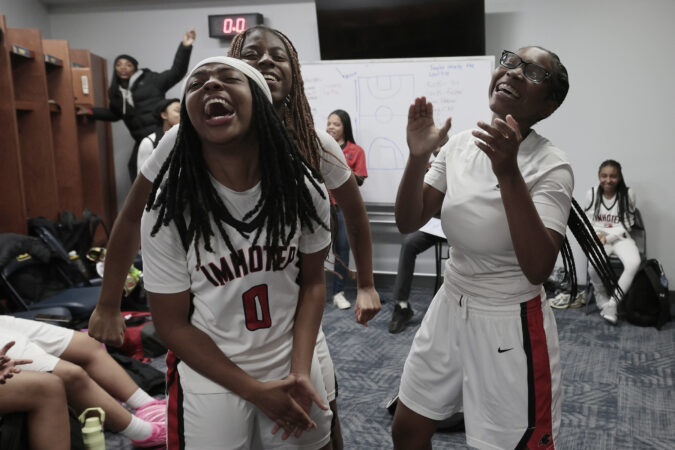
    Before Imhotep prepares for Audenried, the Panthers celebrated in the locker room after Thursday’s win.

    “It was quiet at first when we all walked in because it was like, ‘Dang,’” Linton said. “And then the coaches started coming in, and it was like, ‘OK, we going to the chip.’ It was real. Everybody was cheering and everyone was really, really happy.”

  • Sixers’ losing streak reaches three after 117-107 loss to the Atlanta Hawks

    Sixers’ losing streak reaches three after 117-107 loss to the Atlanta Hawks

    Jalen Johnson had 32 points and 10 rebounds and CJ McCollum added 23 points as the Atlanta Hawks beat the 76ers 117-107 on Thursday night in the teams’ first game after the All-Star break.

    Dyson Daniels finished with 15 points, Nickeil Alexander-Walker scored 14, and Zaccharie Risacher and Jock Landale each had 10 as the Hawks snapped a three-game losing streak with their third win over the Sixers this season.

    Tyrese Maxey scored 28 points and Rising Stars MVP VJ Edgecombe added 20 for the Sixers, who were without center Joel Embiid, who missed the game due to right shin soreness.

    Kelly Oubre Jr. scored 17 points and Quentin Grimes scored 10 of his 14 points in the first half for Philly. Andre Drummond contributed 10 points and 14 rebounds as the Sixers lost their third in a row and for the fourth time in five games.

    The Hawks built an 11-point lead with approximately six minutes remaining before the Sixers charged back and closed within 108-104 with less than three minutes left. Atlanta closed the game with a 9-3 run that included five points by Johnson, who shot 14-for-16 from the line.

    The 76ers said Embiid experienced soreness in his shin while participating in a right knee injury management program over the break. After consulting with doctors, Embiid has received daily treatment, while progressing through on-court work and strength and conditioning.

    Coach Nick Nurse said before the game against the Hawks that the plan is to get Embiid on the court on Friday and “see how he looks from there.” Nurse said he “don’t anticipate it being a long time.”

    Embiid is averaging 26.6 points, 7.5 rebounds and 3.6 assists in 31 games this season.

    The Sixers will face the Pelicans on Saturday in New Orleans (7 p.m., NBCSP).

  • Eric Dane, ‘Grey’s Anatomy’ and ‘Euphoria’ star, has died at 53

    Eric Dane, ‘Grey’s Anatomy’ and ‘Euphoria’ star, has died at 53

    Eric Dane, the celebrated actor best known for his roles on Grey’s Anatomy and Euphoria and who later in life became an advocate for ALS awareness, died Thursday. He was 53.

    His representatives said Mr. Dane died from amyotrophic lateral sclerosis, known also as Lou Gehrig’s disease, less than a year after he announced his diagnosis.

    “He spent his final days surrounded by dear friends, his devoted wife, and his two beautiful daughters, Billie and Georgia, who were the center of his world,” said a statement that requested privacy for his family. “Throughout his journey with ALS, Eric became a passionate advocate for awareness and research, determined to make a difference for others facing the same fight. He will be deeply missed, and lovingly remembered always. Eric adored his fans and is forever grateful for the outpouring of love and support he’s received.”

    Mr. Dane developed a devoted fan base when his big break arrived in the mid-2000s: He was cast as Dr. Mark Sloan, aka McSteamy, on the ABC medical drama Grey’s Anatomy, a role he would play from 2006 until 2012 and reprise in 2021.

    Although his character was killed off on the show after a plane crash, Mr. Dane’s character left an indelible mark on the still-running show: Seattle Grace Hospital became Grey Sloan Memorial Hospital.

    In 2019, he did a complete 180 from the charming McSteamy and became the troubled Cal Jacobs in HBO’s provocative drama Euphoria, a role he continued in up until his death.

    Mr. Dane also starred as Tom Chandler, the captain of a U.S. Navy destroyer at sea after a global catastrophe wiped out most of the world’s population, in the TNT drama The Last Ship. In 2017, production was halted as Mr. Dane battled depression.

    In April 2025, Mr. Dane announced he had been diagnosed with ALS, a progressive disease that attacks nerve cells controlling muscles throughout the body.

    ALS gradually destroys the nerve cells and connections needed to walk, talk, speak, and breathe. Most patients die within three to five years of a diagnosis.

    Mr. Dane became an advocate for ALS awareness, speaking a news conference in Washington on health insurance prior authorization. “Some of you may know me from TV shows, such as Grey’s Anatomy, which I play a doctor. But I am here today to speak briefly as a patient battling ALS,” he said in June 2025. In September of that year, the ALS Network named Mr. Dane the recipient of their advocate of the year award, recognizing his commitment to raising awareness and support for people living with ALS.

    Mr. Dane was born on Nov. 9, 1972, and raised in Northern California. His father, who the actor said was a Navy veteran and an architect, died of a gunshot wound when Mr. Dane was 7. After high school, he moved to Los Angeles to pursue acting, landing guest roles on shows like Saved by the Bell, Married … With Children, Charmed, and X-Men: the Last Stand, and one season of the short-lived medical drama Gideon’s Crossing.

    A memoir by Mr. Dane is scheduled to be published in late 2026. Book of Days: A Memoir in Moments will be released by Maria Shriver’s The Open Field, a Penguin Random House imprint. According to Open Field, Mr. Dane’s memoir covers key moments in his life, from his first day at work on Grey’s Anatomy to the births of his two daughters and learning that he had ALS.

    “I want to capture the moments that shaped me — the beautiful days, the hard ones, the ones I never took for granted — so that if nothing else, people who read it will remember what it means to live with heart,” Mr. Dane said in a statement about the book. “If sharing this helps someone find meaning in their own days, then my story is worth telling.”

    Mr. Dane is survived by his wife, actor Rebecca Gayheart, and their two teen daughters, Billie Beatrice and Georgia Geraldine. Gayheart and Mr. Dane wed in 2004 and separated in September 2017. Gayheart filed for divorce in 2018, but later filed to dismiss the petition. In a December essay for New York magazine’s The Cut reflecting on Mr. Dane’s diagnosis, Gayheart called their dynamic “a very complicated relationship, one that’s confusing for people.” She said they never got a divorce, but dated other people and lived separately.

    “Our love may not be romantic, but it’s a familial love,” she said. “Eric knows that I am always going to want the best for him. That I’m going to do my best to do right by him. And I know he would do the same for me. So whatever I can do or however I can show up to make this journey better for him or easier for him, I want to do that.”

  • Audenried will defend its Public League girls’ basketball title after blowout win over Lincoln

    Audenried will defend its Public League girls’ basketball title after blowout win over Lincoln

    The Universal Audenried Charter girls’ basketball team entered the Public League semifinals Thursday night as three-time reigning champions, but the journey for its fourth title looks different.

    Guard Shayla Smith led the Rockets the last four seasons and became Philadelphia’s all-time leading scorer, but she graduated and moved on to Penn State.

    Against Abraham Lincoln, Audenried showed it still can win. Behind junior forward Nasiaah Russell and senior guard Heaven Reese, the Rockets are heading to their fourth straight Public League title game after beating Lincoln, 67-28, at La Salle’s John Glaser Arena. Audenried will face Imhotep on Sunday.

    After a sluggish first four minutes, Audenried dominated the rest of the way. The Rockets outscored Lincoln by 19 points in the second half by forcing turnovers and scoring in transition. Four players scored in double figures, led by Reese’s 16 points and sophomore guard Chloe Kham’s 15 off the bench.

    “Us making it back to the championship after Shayla leaving is huge for me,” said Audenried coach Kevin Slaughter. “A lot of people were saying once Shayla left, we were done, and to get back is big for us.”

    Audenried found stability behind Reese, who has been part of the winning culture at Audenried and knows what it takes to bring home a Public League crown.

    The experience of Reese, a Coppin State commit; Russell, who’s committed to St. John’s; and guard Aniyah Cheeseboro made overcoming the loss of Smith easier.

    “The last three years, we have all been behind Shayla and the other seniors,” Reese said. “So for us to [go win without her], it just means a lot.”

    The Rockets ended the first quarter on a 16-1 run to take a 12-point lead. Kham hit back-to-back threes early in the second to push Audenried’s lead to 16. The sophomore was a significant factor for Audenried with her deep shooting and layups in transition.

    “Chloe has been a person who’s been struggling a bit this season … and I think it was her first high school experience because she didn’t really play at Neumann Goretti last year,” Slaughter said. “So for her to come out and have 15 points is huge for us.”

    Audenried took a 40-18 halftime lead with another championship appearance in sight. Lincoln scored the first three points of the second half before the Rockets put the game away.

    They scored 27 straight points to enter the final eight minutes with a 67-21 lead. Reese and Russell led the charge with 12 during the run.

    Audenried girls’ basketball will have a rematch with Imhotep in the Public League title game on Sunday.

    The championship game will pit Audenried against Imhotep for a fourth straight year. The Rockets won, 65-52, last year behind 35 points from Smith. They may not have Smith, but their confidence in winning a fourth straight Public League title remains high.

    “Me personally, I always thought we were going to get back here,” Slaughter said. “Because a lot of the kids who were ninth and 10th graders when Shayla was there, they got to see it. … They have been in these wars.”

  • Jason and Travis Kelce helped U.S. hockey player’s family see the Olympic gold medal win

    Jason and Travis Kelce helped U.S. hockey player’s family see the Olympic gold medal win

    MILAN, Italy — As soon as U.S. hockey defender Laila Edwards skated onto the Olympic ice ahead of Thursday’s gold medal win against Canada, she scanned the stands for the real MVP: Her 91-year-old grandmother.

    Their shared ritual was on display before Team USA’s 2-1 triumph Thursday — made possible through an outpouring of donations to a GoFundMe drive, with by far the biggest individual contribution — $10,000 — coming from NFL brother tandem Travis and Jason Kelce, who also grew up in Cleveland.

    “As she comes in, she’s looking around,” her grandmother, Ernestine Gray, told the Associated Press earlier this week. “Then I say, ‘I won’t do anything to distract her.’ Then she did see me and I wave to her and then she waved back.”

    Edwards, the first Black female hockey player to represent the United States at the Olympics, fielded a team of her own in Milan. The fundraiser enabled 10 family members and four friends to travel to Italy. Still others paid their own way.

    After the semifinals game earlier this week, Edwards, a senior at Wisconsin, told the AP that her family’s presence in Milan “means everything to me.”

    “They helped me get here and make this team and achieve my dream, so it means a lot,” she said.

    Edwards had an assist for the first of the two goals that would win the game.

    ‘Queen of Cleveland’

    The Kelce brothers grew up in the same town as Edwards. They have been fans of hers since 2023, when she became the first Black player to make the U.S. senior women’s national team, and shouted her out on their popular podcast, New Heights.

    The top donation to the GoFundMe was $10,000, from someone remaining anonymous; Edwards has confirmed that it came from the Kelces. By Thursday, the Edwards family had raised more than $61,000.

    What’s more, Travis Kelce reached out to provide advice to the “Queen of Cleveland,” a nickname her teammates gave her following a U.S.-Canada game played there in November. And Jason Kelce and his wife, Kylie, were in the stands Monday to cheer on the U.S. team during their 5-0 win over Sweden. Edwards, a forward-turned-defender, had an assist then, too.

    Generosity from the Kelces and locals is another example of how the tight-knit town operates, her parents said, even though their daughter moved away at a young age. Edwards, considered the future face of women’s hockey, has also inspired the Black community in Ohio and beyond.

    While diversity is reflected in many sports such as soccer, it hasn’t made a dent in winter sports and there are very few Black athletes in the Milan Cortina Olympic Games. Men’s and women’s hockey globally, including in the U.S., remains predominantly white.

    “Just to hear all the people of color talking about, ‘I’ve never watched hockey before and I’m tuning in,’” said Edwards’ mother, Charone Gray-Edwards. “I would love to know what the ratings are. Because everybody at home, everybody is talking about it. All these people are trying to buy jerseys.”

    For Gray-Edwards, some of the most meaningful moments have been seeing little boys come up to her daughter for an autograph.

    “That means they’re not like, ‘Oh, this is a girl that plays hockey.’ They’re like, ‘This a good hockey player.’ So it doesn’t matter if she’s Black, a woman — she’s a good player,” Gray-Edwards said.

    But Gray-Edwards’ most treasured memories likely won’t be about Thursday’s gold medal win — they will stem from watching her 91-year-old mother and her 22-year-old daughter together at the rink.

    “You can just see them waving at each other. My mother’s like jumping and, oh, she just loves it,” Gray-Edwards said.

    ‘How would we afford it’

    Hours before the puck dropped for Monday’s semifinal, the Edwards family was ready.

    Gray-Edwards has strict rules about travel. She mandated that everyone meet in the hotel lobby 2½ hours before game time, dressed in their Team USA finest. They called a taxi van to fit the large group — including Edwards’ parents, grandmother, aunt, cousin, and older brother — and loaded up.

    Her parents weren’t sure the entire family would be able to make the journey when she called them a month before the Olympics to say she’d been chosen for the team.

    They could cover the costs for two people, but the full family roster — all of whom have supported her over the years — would have been far too expensive. And they hadn’t booked early flights or locked in cheaper hotel rates for fear of jinxing her.

    “We had to start talking about how to get money,” Gray-Edwards said. “Who would go? How would we afford it?”

    The family is accustomed to watching her from afar. When Edwards was 13, she left home to attend the Bishop Kearney Selects Academy in Rochester, N.Y., before moving on to the University of Wisconsin, where she is playing her senior season for the top-ranked Badgers.

    The consensus is that Edwards will be selected in the top three of the Professional Women’s Hockey League draft in June, along with Wisconsin teammate Caroline Harvey and Minnesota’s Abbey Murphy.

    Still, Edwards’ Olympic debut was something everyone wanted to see.

    Her father, Robert Edwards, started the GoFundMe drive “Send Laila’s Family to the Olympics to Cheer Her On!” He set an ambitious goal of $50,000 so they wouldn’t have to choose between a ticket to one of her games and paying the electric bill back in Cleveland Heights, Ohio.

    “There’s a lot of ups and downs in playing hockey at this high level and so she’s going to need somebody there,” her father said. “So I was like, ’Well, pride be damned: We’re going to do a fundraiser.’”