Moscow agrees with President Donald Trump’s view that Ukraine is holding up a peace deal to end the almost four years of fighting since Russia invaded its neighbor, a Kremlin official said Thursday.
Kremlin spokesperson Dmitry Peskov said, “Yes, we can agree with it, it’s indeed so.” His comments came after Trump said in published remarks Wednesday that Ukrainian President Volodymyr Zelensky is an obstacle in U.S.-led peace talks.
That assessment is at odds with the sentiment of European officials, who have repeatedly accused Russian President Vladimir Putin of stalling in negotiations while his bigger army tries to push deeper into Ukraine and Russia relentlessly bombards Ukrainian cities.
“I think he’s ready to make a deal,” Trump was quoted as saying of the Russian president in an interview with Reuters. “I think Ukraine is less ready to make a deal,” he said, naming Zelensky as obstructing a settlement.
Polish Prime Minister Donald Tusk, who along with many European and NATO member nations has strongly backed Ukraine, pushed back on Trump’s reported comments.
“It is Russia who rejected the peace plan prepared by the U.S.,” not Zelensky, Tusk posted on X on Thursday. “The only Russian response (was) further missile attacks on Ukrainian cities. This is why the only solution is to strengthen pressure on Russia. And you all know it.”
Putin said Thursday that Moscow, like Ukraine, demands security guarantees as part of a prospective peace deal.
“We must proceed from the premise that security must be truly universal, and therefore equal and indivisible, and it cannot be ensured for some at the expense of the security of others,” Putin said after receiving credentials from foreign ambassadors in the Kremlin.
“In the absence of it, Russia will continue to consistently pursue the goals it has set,” Putin added.
Trump’s position appeared to deviate from recent comments by U.S. officials that the American president is running out of patience with Putin.
U.S. Sen. Lindsey Graham (R., S.C.) said last week that Trump is on board with a tough sanctions package intended to economically cripple Russia.
“This will be well-timed, as Ukraine is making concessions for peace and Putin is all talk, continuing to kill the innocent,” Graham said in a statement.
Also, the United States accused Russia on Monday of a “dangerous and inexplicable escalation” of its war at a time when the Trump administration is trying to advance negotiations toward peace.
The Institute for the Study of War, a Washington think tank, said late Wednesday that “the Kremlin has been delaying the peace process for months in order to protract the war and achieve Russia’s original war aims through military means.”
A Russian drone struck a playground in the western city of Lviv overnight, according to the head of the regional military administration Maksym Kozytskyi. The blast shattered over a hundred windows in the area, though nobody was injured, he said.
Peskov, the Kremlin spokesman, said that no date has been agreed for U.S. presidential envoy Steve Witkoff to make another visit to Moscow for further peace talks.
More than two dozen people participated in a multiyear scheme to fix basketball games in the NCAA and the Chinese professional league, federal prosecutors in Philadelphia alleged Thursday — a conspiracy that affected dozens of games and involved tens of thousands of dollars in bribes and millions in fraudulent bets.
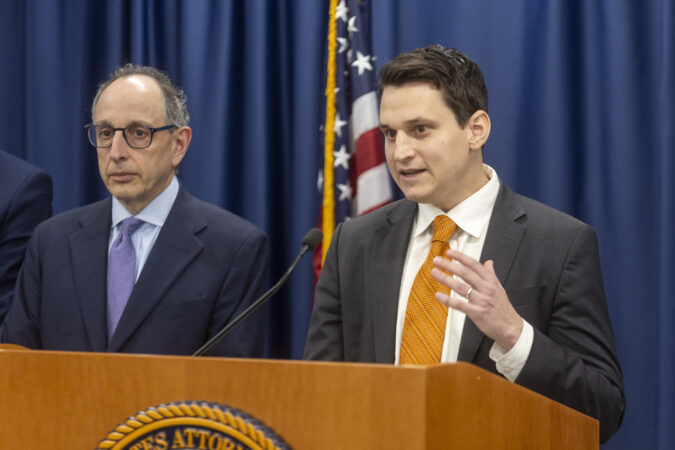
Twenty basketball players and six so-called fixers were charged in federal court in Philadelphia with crimes including bribery, conspiracy, and wire fraud, according to U.S. Attorney David Metcalf, who described the case as “historic.”
Metcalf said the fixers — professional gamblers or others with ties to the basketball world — would recruit players to underperform in forthcoming games, then bettors would wager against that player’s team. Players were bribed for their efforts, Metcalf said, while gamblers ultimately collected millions of dollars in illicit winnings.
“When criminals rig the outcome of games for the purpose to lose … we all lose,” said Metcalf, who spoke at a morning news conference alongside officials including Andrew Bailey, deputy director of the FBI, and Wayne Jacobs, the FBI’s top official in Philadelphia.
Players involved included Antonio Blakeney, a onetime Chicago Bulls player who later played for the Jiangsu Dragons in China, prosecutors said, as well as a number of Division 1 college players from programs including Tulane University, Nicholls State University, Northwestern State University, and North Philadelphia’s La Salle University.
Antonio Blakeney, who once played for the Chicago Bulls, has been charged with accepting bribes when he later played for a Chinese basketball team to influence its games.
In all, prosecutors said, the scheme involved 39 players on more than 17 Division 1 NCAA teams, with bettors wagering huge sums on at least 29 games. Some of the bets were placed at Rivers Casino in Philadelphia.
The allegations are similar in theme to those leveled last fall against NBA players including the Miami Heat’s Terry Rozier, who has also been federally charged with altering his performance to benefit gamblers.
At that time, the charges against Hennen — and the earlier dismissal of Temple University guard Hysier Miller — were rumored to extend to a more far-reaching probe into the NCAA.
Metcalf said the new investigation was distinct from that case, which is being prosecuted in New York. In that matter, Metcalf said, Rozier and others were accused of providing confidential information to bettors — such as a player’s injury status — to help boost the odds of a wager succeeding.
In the newest case, Metcalf said, players were directly participating in the conspiracy — and benefiting from it, even as they sought to help their teams lose.
“There is a really important difference between wagering on predicted outcomes [based on] insider information, and wagering on determined outcomes — outcomes that you control,” Metcalf said. “The former is a crime against sports betting markets. The latter is a crime against the sport itself … and that’s what makes it different and, in my opinion, worse.”
An American scheme in China
In a unique twist, prosecutors said, the scheme targeting one of America’s most popular sports was launched in China.
According to the indictment, Hennen and another professional gambler, Marves Fairley, recruited Blakeney — then playing for the Jiangsu Dragons — to join their so-called point-shaving scheme in 2022.
Blakeney at the time was a top scorer in the Chinese Basketball Association. And, according to the indictment, Hennen and Fairley offered him bribes in exchange for deliberately underperforming and hurting his team’s chances of winning.
After he agreed, prosecutors said, Hennen and Fairley placed large bets at the Rivers Casino sportsbook in Fishtown, known as “BetRivers.” In one instance, prosecutors said, the men wagered $198,300 on the Guangdong Southern Tigers to beat the Dragons in a March 6, 2023, game.
Blakeney averaged 32 points a game that season, but scored just 11 in the contest, which the Dragons lost, 127-96.
Hennen was apparently pleased with his new investment. Later that spring, the indictment said, he sent a text to another schemer offering reassurance about a game involving Blakeney.
“Nothing gu[a]rantee[d] in this world,” Henner wrote, ”but death taxes and Chinese basketball.”
A spokesperson for Rivers Casino declined to comment on the case.
After the season, Fairley left $200,000 in cash in a Florida storage unit Blakeney controlled, the indictment said. In intercepted text messages, Hennen and Fairley also described “giving $20,000” to other players recruited by Blakeney to fix matches during his absence.
The Chinese betting ring then became a template, prosecutors alleged — one that the conspirators used to begin rigging games much closer to home.
Targeting NCAA games
In 2024, prosecutors said, Hennen and Fairley recruited college basketball trainers Jalen Smith and Roderick Winkler to help rig NCAA games. Prosecutors said the trainers’ status in the basketball world gave them access to, and credibility with, NCAA athletes.
The men then used that influence to recruit about 20 players from a variety of schools to participate in the point-shaving operation, prosecutors said.
Several players had ties to the Philadelphia region, including former Temple University forward Elijah Gray, who was approached while playing at Fordham; Micawber “Mac” Etienne, who was approached at DePaul but later played for La Salle; and Delaware State University point guard Camian Shell, who is alleged to have thrown games while at North Carolina A&T State University. C.J. Hines, a current player on Temple’s roster, was also charged with taking bribes in 2024, when he was playing at Alabama State, court documents show. A Temple spokesperson said Thursday that the university was “reviewing this new information” and noted that Hines has not played for the Owls due to ongoing eligibility questions.
The scheme worked much as in China, prosecutors contended: Hennen and Fairley would bribe players to throw games, then place bets on their opponents.
But the gamblers took a less visible role this time, the indictment said, generally sending brief texts to a number of people who could place high-stakes bets on their behalf.
“Queens ny -1 first half and money line,” Hennen texted a straw bettor, seeking to place a $20,000 bet that the Queens University Royals would cover the first-half spread by at least 1½ points in a March 1, 2024, game against Kennesaw State.
The men let Smith handle much of the dirty work, the indictment said. In one example, he texted with Kennesaw State players Simeon Cottle and Demond Robinson the day of a game.
“I need both of y’all on FaceTime with me twice today,” he wrote. “Just to make sure y’all good and really locked in … [This] money guaranteed, ima be at the game with the money.”
In some cases, Smith is alleged to have flown to Philadelphia to pay players their bribes. In other instances, the indictment said, Smith was intensely involved with pressuring players to underperform even while games were progressing.
In March 2024, for example, the indictment said, Smith texted DePaul’s Etienne that his teammates who were playing well needed to “chilllll [the f—] out.”
In another episode, the indictment said, he wrote to to Alabama State players Shawn Fulcher and Corey Hines, saying: “Lose by 6 full game no excuses,” then sent a photo of a large stack of cash.
When the players complained that they were struggling to throw the game because their opponent — the University of Southern Mississippi — was “so bad,” Smith sent an all-caps response, the indictment said.
“LET [the Southern Mississippi players] LAY IT UP,” he wrote.
Sports impacted by ‘monetization’
While Hennen is accused of orchestrating many of his crimes in Philadelphia, the indictment painted a more limited picture of his role with local teams.
In 2024, for example, Smith and Blakeney attempted to recruit players from La Salle to join the scheme for a game against St. Bonaventure, the indictment said. But prosecutors did not name any La Salle players as having done so, and they said all the bets Hennen and Fairley placed on the game were unsuccessful.
A spokesperson for La Salle said Thursday that the university would cooperate with all investigations into the matter, and that “neither the university, current student-athletes, or staff are subjects of the indictment.”
Metcalf said the “monetization” of college sports in recent years — and the proliferation of legalized sports gambling across the country — “furthered the enterprise in this case.”
And he said that although college athletes can now be legally paid for their name, image, and likeness, some of those who participated in this scheme were targeted because they did not feel they were making enough money in that new landscape.
Metcalf said many Americans are drawn to sports because they offer a venue for teams and players to participate in honest competition.
“This,” Metcalf said, “totally flies in the face of all of that.”
Staff writer Isabella DiAmore contributed to this article.
Top officials across the Philadelphia region are taking a stand against partnerships with ICE.
On Wednesday, newly inaugurated Bucks County Sheriff Danny Ceisler terminated a 287(g) agreement with ICE initiated by his Republican predecessor that enabled deputies to act as immigration enforcement officers.Haverford Township also passed a resolution barring participation in a 287(g) agreement.
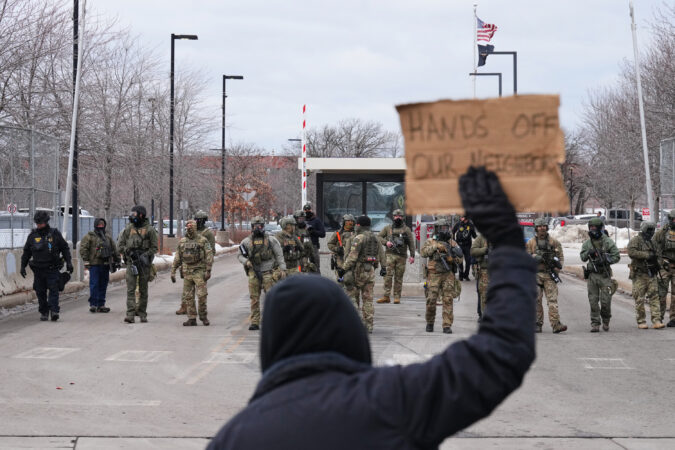
These developments come as protests escalate against President Donald Trump’s deployment of U.S. Immigration and Customs Enforcement agents to U.S. cities, after an agent shot and killed Renee Nicole Good in Minneapolis last week. Good, a poet and mother of three, was in her SUV when the agent fired into the vehicle.
Also on Wednesday, Trump said on his social media platform, Truth Social, that federal funding would be cut from any states that have sanctuary cities. These jurisdictions, which limit local law enforcement cooperation with ICE, have been increasingly targeted by the president’s administration.
As local leaders continue to grapple with the ever-changing and escalating Trump immigration policy, here’s what to know about how local governments are interacting with federal immigration authorities:
Everyone has a theory as to why that might be: Could Trump be avoiding the largest city in the most important swing state? Has Mayor Cherelle L. Parker’s decision to refrain from publicly criticizing Trump played a role?
But regardless of the name, a 2016 executive order signed by former Mayor Jim Kenney on ICE cooperation remains in place under Parker’s administration. The directive orders city authorities to not comply with ICE-issued detainer requests to hold people in custody unless there is a judicial warrant.
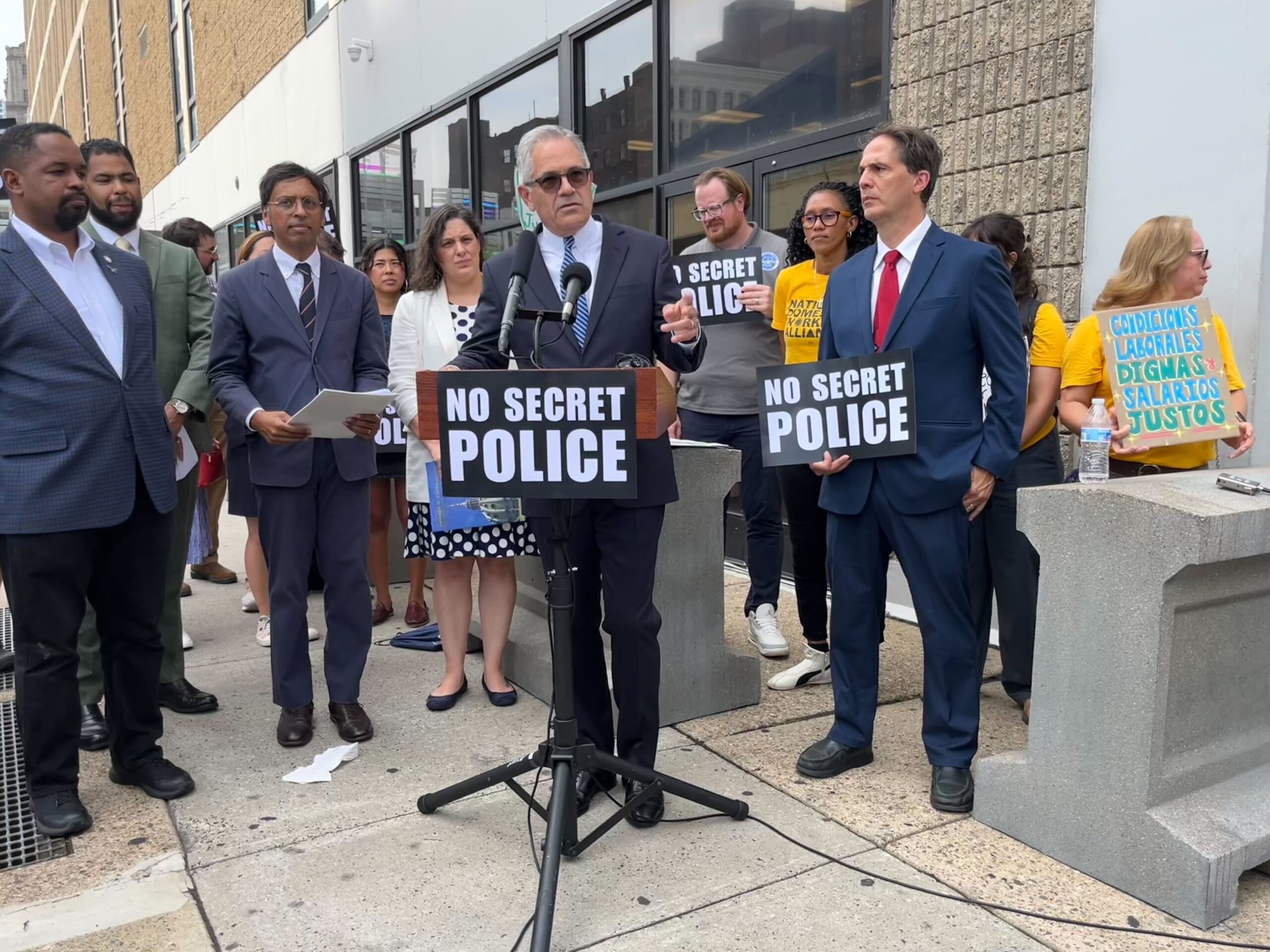
Philadelphia District Attorney Larry Krasner speaks at a news conference outside the Philadelphia Field Office for Immigration Customs Enforcement in Center City in August.
The sheriff terminated a 287(g) agreement with ICE — what does that mean?
Essentially, it means that sheriff deputies are no longer allowed to act as immigration authorities.
Last April, Ceisler’s predecessor, Fred Harran, a Trump-aligned Republican, signed on to thepartnership with ICE, stirring upcontroversy in the swingcounty. Ceisler, a Democrat who defeated Harran in November, made terminating the agreement a focal point of his campaign.
No one in Bucks had been detained under the 287(g) agreement, Ceisler said.
On Wednesday, Ceisler signed another order that prohibits deputies from asking crime victims, witnesses, and court observers their immigration status.
Does Bucks County still work with ICE?
Yes. Bucks County is not a sanctuary county and, in the words of Ceisler, “will never be.”
The Bucks County Department of Corrections will continue to share information with law enforcement agencies, including ICE. The federal agency will also continue to have access to county jails and Bucks will honor judicial warrants from immigration enforcement.
Bucks County Sheriff Danny Ceisler announces the termination of the county’s partnership with ICE, an agreement formally known as 287(g), during a press conference at the Bucks County Justice Center in Doylestown, Pa., on Wednesday, Jan. 14, 2026.
“It’s sporadic, it’s reports,” Ceisler said of ICE’s presence in Bucks.
“I can’t get ICE out of Bucks County,” he added. “I have no authority over them. All I can do is prevent 16 deputies from participating in a program that enables them to perform immigrant enforcement in the community.”
Bucks County was the only county in the Philadelphia region that did not appear on an initial list published by the Trump administration of sanctuary jurisdictions that could have federal funding at risk. That list was later deleted. The most recent list, published by the administration in August, also does not feature Bucks.
Haverford Township
Will Haverford Township participate in a 287(g) agreement?
While the police department has not requested to enter an alliance with ICE, township commissioners passed the resolution as a preventive measure.
Montgomery County
What is Montgomery County’s policy on immigration?
Montgomery County’s Democratic commissioners have not passed a formal ordinance or a resolution labeling Montco a sanctuary or welcoming county, citing limits to their power, concerns about creating a false sense of security, and a preference for internal policy changes.
In early 2025, county officials approved a policy that limits communication between county employees and ICE officials and said they would not answer prison detainer requests without warrants.
Montgomery County activists hold a news conference about ICE incidents in the county last month.
What do Montco residents think about it?
County residentshave urged individual municipalities within the county to limit collaboration with ICE, especially as the county has become a hot spot for immigration enforcement. Norristown, a heavily Latino community, has specifically become a target for ICE.
“ICE has created a crisis in our neighborhoods, and we cannot afford silence, mixed signals, or leadership that only reacts once harm has already happened,” Stephanie Vincent, a resident and leader of Montco Community Watch, said last month during a news conference at a West Norriton church.
As of early December, local organizers estimated that only six out of 62 municipalities had enacted policies, though they consider some to be lackluster.
Staff writer Katie Bernard contributed to this article.
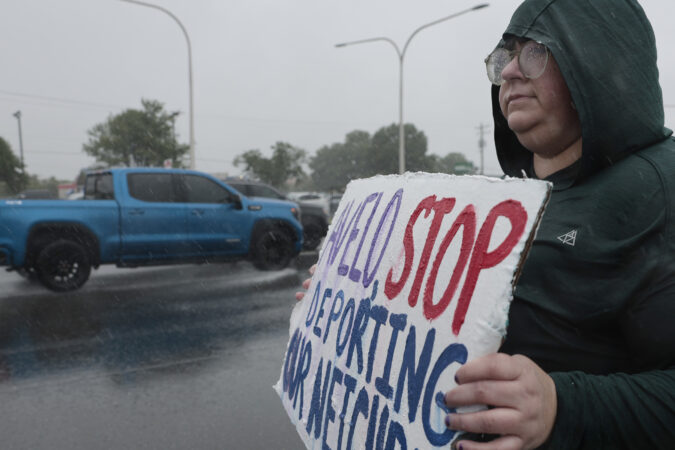
When the Rev. Jack Perkins Davidson and other parishioners in his socially active Spring Glen Church in Connecticut learned last year that budget carrier Avelo Airlines — with a major hub at nearby Tweed New Haven Airport — was also operating U.S. government deportation flights, the pastor kept thinking about one thing.
What would the Rev. Dr. Martin Luther King Jr. do?
Davidson said King’s 1955 Montgomery bus boycott against segregation — the iconic protest that launched the civil rights movement of the mid-20th century — was an inspiration as he and a coalition of activists pressured Avelo to stop aiding U.S. Immigration and Customs Enforcement and its mass deportation campaign.
“I often think about how the Montgomery bus boycott was a very local action, but it became national news,“ Davidson told me by phone recently. ”Sometimes when I feel so overwhelmed by the state of the world, I take hope in that example — that acting in the local level is a way to create national impact.”
Davidson and his congregation’s allies, like Connecticut Students for a Dream and the New Haven Immigrant Coalition, spent nine months pressuring Avelo to drop ICE — staging noisy protests, but also doing what the minister called “the unglamorous work” of gathering petition signatures and attending airport board meetings. Last summer, New Haven’s mayor signed their petition as the city banned official travel on Avelo.
Spotify confirms that they are no longer running ICE recruitment ads.
Last October, the company faced backlash for running ICE recruitment ads after receiving $74,000 from the Department of Homeland Security to promote the Trump's plan to hire 10,000 new deportation officers by… pic.twitter.com/4M7l4HGg0K
The Connecticut crusaders were joined by activists at other Avelo hubs, including Wilmington. It’s impossible to know exactly how much boycotting air travelers hurts the bottom line of the private, Texas-based corporation, but earlier this month, Avelo made a U-turn. A spokesperson said the airline would halt working with ICE, which “ultimately did not deliver enough consistent and predictable revenue to overcome its operational complexity and costs.”
Avelo’s exit from the ugly business of flying often handcuffed and shackled migrants out of the United States was a huge win for the growing movement against the Trump regime’s mass deportation raids — but it was not an isolated incident.
In recent days, the leading music streamer Spotify announced it was no longer running recruitment ads for new ICE agents. The spots urged would-be applicants to “fulfill your mission to protect America,” but sparked outrage among listeners opposed to the agency’s masked goons and its violent raids that have roiled cities from New Orleans to Minneapolis.
As with Avelo, Spotify’s ties to ICE — the U.S. Department of Homeland Security paid the Swedish-based streamer $74,000, according to Rolling Stone — sparked a nationwide campaign for a boycott that was led by Indivisible, a leading organizer of the massive “No Kings” protests.
Thousands canceled their paid subscriptions, and some artists pulled their music from Spotify to protest both the ICE ads and the company’s ties to a defense contractor.
These economic wins come amid a deadly and chaotic start to 2026 that has battered America’s already damaged national psyche. The stunning Jan. 7 Minneapolis murder of Renee Nicole Good, a 37-year-old poet and mother of three, by an ICE agent has only upped the anxiety and the stakes.
A new Quinnipiac Poll released this week showed that 57% of Americans now disapprove of the way ICE and other federal agencies are enforcing immigration laws, with 53% saying Good’s killing was not justified. A separate Economist/YouGov survey found respondents favoring the abolition of ICE by a 46%-43% majority — a first for that political hot-button question.
So, as you can imagine, in a healthy functioning democracy like the United States, the opposition party Democrats are forming a united front in working to abolish ICE, including the withholding of money in the latest budget battle on Capitol Hill, right?
Right?
Um, not exactly. To be sure, Good’s murder and the appalling scenes in Minnesota have triggered a more radical response from some Democrats, including more than 50 members, so far, who’ve signed on for the impeachment of DHS Secretary Kristi Noem. But many in Congress are insisting ICE can somehow be reformed — including an utterly bizarre proposal to put scannable QR codes on immigration agents so the public can identify them. It’s an echo of the tepid reform ideas that failed to stop police brutality after George Floyd’s 2020 murder.
BREAKING: Heavy police and state trooper presence in Minneapolis as noise protest continues outside the Canopy by Hilton where ICE agents are reported staying.
Protests press into the night, demanding Walz and Frey arrest ICE officer Jonathan Ross. pic.twitter.com/lONV4RaUeD
“Clearly, significant reform needs to take place as it relates to the manner in which ICE is conducting itself,” House Minority Leader Hakeem Jeffries of New York told MS Now on Tuesday night — minutes before agents in Minneapolis reportedly shot a flash-bang grenade into a moving car and injured six children, including a baby.
You don’t significantly reform the brand of fascism that we can all see on the icy streets of the Twin Cities. You fight it like the existential crisis for American democracy that it is. Millions of everyday Americans are both feeling that urgency and dismayed that the institutions theythought would oppose autocracy — Congress, the media, the U.S. Supreme Court — aren’t standing with them.
No wonder people are fighting with the only real ammunition they have under late-stage capitalism: their dollars.
Nearly one year into the second coming of Trump, many of the major victories by citizens resisting his regime have come through the fingertips of everyday folks clicking on a “cancel” button.
The best-known example came last summer when Disney-owned ABC briefly suspended late-night host Jimmy Kimmel in a flap over some (fairly tame) comments he made after the assassination of right-wing activist Charlie Kirk. The network raced to put Kimmel back on the air after the cancellation rates for two lucrative Disney-owned streaming services, Disney+ and Hulu, doubled. And Disney recently extended the contract of Trump’s least-favorite comic by another year.
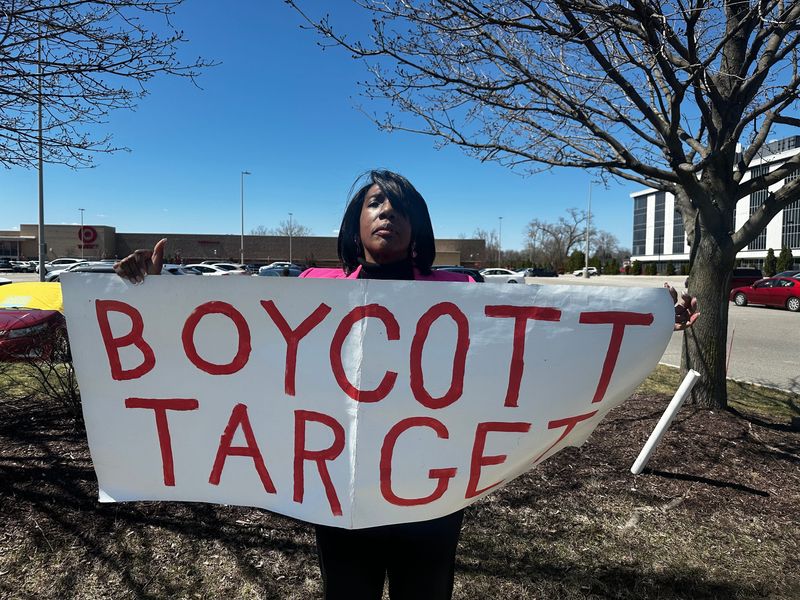
Other economic pressure campaigns have badly damaged U.S. brands without getting results … yet. The best example is the giant retailer Target, whose decision to end its diversity initiatives after Trump’s inauguration sparked calls for a boycott by prominent Black activists and some labor unions. Since then, foot traffic at Target stores has dropped (while increasing at more “woke” rival Costco), and the stock price of the Minnesota-based company has plunged by 33%.
This hasn’t yet inspired Target’s management to fully restore its diversity initiatives, and it more recently has angered some activists by insisting it has no power to stop ICE agents from using its parking lots and even entering its stores to make arrests. None of this should deter the public from keeping the pressure on Target.
Allison Folmar of West Bloomfield joined the protesters who advocated for a boycott against Target in April.
The weeks of Minnesota mayhem have focused attention on a new corporate bête noire: Hilton Worldwide Holdings. Two of the hotel chain’s properties in Greater Minneapolis have been the scene of noisy, all-night protests after reports that out-of-town ICE agents are staying there. And Hilton further infuriated activists and sparked calls for a boycott by delisting a third Minneapolis hotel after an employee said ICE was not welcome.
I will not stay at any Hilton hotel as long as the company thinks it’s OK to host masked thugs who are snatching laborers off the street and shooting or tear-gassing anyone who objects to that, and I hope you would consider doing the same.
As New Haven’s Davidson rightly said, using economic pressure to end injustice takes time and hard work that isn’t always glamorous or made for the cable-TV cameras. Some 71 years ago in Montgomery, Ala., the King-led bus boycott took 381 days and a lot of sacrifice from unsung heroes like Claudette Colvin, who died this week at age 86, and working-class Black people who walked or carpooled to their jobs until claiming victory.
The bottom line has not changed since MLK’s time. The color that matters most to corporate America is the color of money. The pursuit of profit is why cowardly law firms or TV networks like CBS are aiding American dictatorship instead of fighting it. But it’s also what makes them reverse course when they realize that hate is actually bad for business in a consumer society.
Boycotts aren’t the only solution, but in a world where feckless institutions have given up, they have become an essential tool. Spend your dollars with any company that still believes in a decent, diverse America, and put the collaborators out of business. Consider it an early birthday present for Dr. King.
This week, owner Kimco Realty and developer Bozzuto Development announced the opening of Coulter Place, the first apartment community in the Ardmore shopping destination.
The five-story, mixed-use development includes 131 apartments with one to three bedrooms and about 20,000 square feet of ground-floor retail space. Amenities for residents include a fitness center, clubroom, game room, pool, coworking spaces, and pet-care spaces. It has two courtyards and garage parking with electric-vehicle charging stations.
The promise of apartment residents helped attract new retailers to Suburban Square, including New Balance, Sugared + Bronzed, and the apparel brand Rhone on the ground floor of the apartment building.
The complex is one of a few projects planned in recent years that have added or will add hundreds of apartments near Lancaster Avenue in Ardmore. One Ardmore, a 110-unit apartment complex, opened in 2019 after a yearslong campaign by residents to stop it. The long-awaited Piazza development is expected to add 270 apartments and almost 30,000 square feet of retail space when it opens in a couple of years.
This rendering shows the outdoor pool at Coulter Place.
Conor Flynn, CEO of Kimco Realty, said in a statement that Suburban Square is an “iconic, walkable destination” and that the addition of apartments creates “a more vibrant, connected experience for residents, retailers, and visitors alike.”
“Coulter Place represents the next chapter in Suburban Square’s evolution and a clear example of how we’re unlocking long-term value through thoughtful mixed-use development,” Flynn said.
The apartments are across from Trader Joe’s and the Ardmore Farmers Market and within walking distance to the Ardmore station for SEPTA and Amtrak trains.
Apartments available for lease at Coulter Place range from one-bedroom, one-bathroom units for about $3,030 per month to a three-bedroom, two-bathroom unit for $7,035 per month.
Philadelphia-based JKRP Architects designed the apartment building.
Suburban Square was developed in 1928 and now has about 80 shops, restaurants, fitness spaces, and more. Businesses include Apple, SoulCycle, Warby Parker, Van Leeuwen Ice Cream, CAVA, and Di Bruno Bros.
This rendering shows one of the courtyards for residents of Coulter Place.
At morning skate on Wednesday at KeyBank Center, things were looking up as defenseman Jamie Drysdale was set to make his return to the lineup.
But just a few short hours later, the injury bug resupplied its stinger and stung several times.
Defenseman Rasmus Ristolainen, who was a full participant at morning skate and took power-play reps with the top unit, is now listed as day-to-day with an upper-body injury. He did not dress for warmups.
Then, goalie Dan Vladař suffered what looked to be a lower-body injury in the first period of the Flyers’ 5-2 loss to the Buffalo Sabres before allowing two goals on five shots. Coach Rick Tocchet did not have an update when he spoke postgame, and according to a team source on Thursday, the team is still awaiting test results to determine the extent of the injury.
On the first Sabres goal, it appeared that Vladař moved awkwardly when he wasn’t sure where a missed shot by Josh Doan went. He was slow to get up and was able to reset, but Rasmus Dahlin beat him from the point with Jason Zucker setting a screen on a power play.
Here is the video of potential Dan Vladar injury. When he was pushing to his left after the initial save, it looked like he was laboring a little. Was slow to get up after the goal went in as well. #LetsGoFlyerspic.twitter.com/vrUH40Pfir
Losing Vladař for any amount of time would be a significant blow, especially as the Flyers jockey for playoff position in a tightly-contested Eastern Conference. The Czech goaltender has arguably been the team’s most valuable player this season, posting a 16-7-4 record and a .905 save percentage in 28 starts. Vladař is also set to play at the Olympics for his country after being named to the Czech Republic’s team last week.
According to a team source on Thursday afternoon, the Flyers may have avoided the worst-case scenario on Ristolainen and Vladař’s injuries. While the early findings are positive, they won’t know more for a few days.
So, with the Flyers needing a roster spot for a goalie replacement, on Thursday morning, forward Bobby Brink was placed on injured reserve. It is retroactive to Jan. 6, when Brink was injured on a blindsided hit by Anaheim Ducks forward Jansen Harkins just 2 minutes, 38 seconds into the first period.
Brink has practiced in Philly but was not spotted on the trip to Western New York. He can come off injured reserve at any time, as it is retroactive and has been a minimum of seven days since his injury and time missed.
The Flyers recalled goaltender Aleksei Kolosov from Lehigh Valley of the American Hockey League on Thursday.
Aleksei Kolosov was recalled from Lehigh Valley of the American Hockey League to complete the Flyers’ goalie tandem with Sam Ersson in the interim. In 19 games with the Phantoms, Kolosov is 9-9-1 with a 2.54 goals-against average, .908 save percentage, and two shutouts.
On Dec. 31, he had a 31-save shutout against rival Hershey, and he has won three of his past four starts. The shutout came during a two-game stretch in which he went 2-0-0 with a 0.50 GAA and a .984 save percentage, and was named the AHL’s Player of the Week.
It’s a marked improvement from last season with the Phantoms, when Kolosov had an .884 save percentage in 12 games, and from his first experience in North America, when he posted .885 across two games in 2023-24. Kolosov also struggled mightily at the NHL level last season after making his NHL debut Oct. 27, 2024. His .867 save percentage across 17 games and 13 starts last year ranked dead last among the 71 goalies to make at least 10 starts.
“He is a different player, different personality,” assistant general manager Brent Flahr told The Inquirer in December. “He’s really trying to fit in. He’s very athletic, very competitive, and he’s giving our team a chance to win down there almost every night. He’s a talented kid, so he’s got a chance to be an NHL goalie now. He just skipped a step last year. Now he’s building it back up again here, and we’ll see where it goes.”
The Belarusian has also appeared in two games for the Flyers this season, when Ersson was placed on injured reserve in late October. On Nov. 1, he stopped all seven shots he faced against the Toronto Maple Leafs in relief of Vladař, before stopping 19 of 21 the next night in a 2-1 loss to the Calgary Flames.
The Flyers play at the Pittsburgh Penguins on Thursday night (7 p.m., ESPN), and Ersson will start. He played the final two periods on Wednesday, allowing two goals on eight shots. The Swede, who is sporting a disappointing .855 save percentage on the season, has allowed at least four goals in four of his last five starts, including seven on Saturday against Tampa Bay.
Breakaways
On the same day that Denver Barkey was named the Phantoms’ representative to the 2026 AHL All-Star Classic, the forward will return to the Flyers lineup. Barkey, who was a healthy scratch for the first time in his career on Wednesday, has one goal and three points across 11 games since being called up. He struggled in his last two games, both against the Tampa Bay Lightning, and had the puck stolen by Brayden Point ahead of Nikita Kucherov’s first goal on Saturday and Nick Paul’s goal later in the game. Nic Deslauriers will draw out of the lineup.
Actor Amanda Seyfried put a major spotlight on her hometown of Allentown during her appearance on The Late Show with Stephen Colbert this week.
Following the Golden Globes — where she was nominated for best actress in a mini-series for Kensington-set show Long Bright River and best actress in a musical or comedy movie for her recent film, The Testament of Ann Lee — Seyfried discussed the real-life historical figure she played. Lee founded the Shakers religious group in the 18th century.
But before that, she spent a few minutes joking about Allentown.
Colbert’s recurring Community Calendar segment invites celebrity guests from small towns to advertise “actual events that are actually happening in and around their actual hometowns,” the host explained. Previous featured guests were Nick Offerman, Melissa McCarthy, Adam Driver, and Wilmington native Aubrey Plaza.
Seyfried joined Colbert on a set reminiscent of old talk show sets from public access TV (complete with grainy camera quality) to hype happenings in Allentown and greater Lehigh County.
“As we like to say, you’ll be ‘all in’ on All-entown,’ said Seyfried.
As Ann Lee, Amanda Seyfried portrays a woman at the center of the Shaker religious movement in America. William Rexer/Searchlight Pictures
The pair highlighted several local businesses and quirky events, including Colonial Pizza Easton’s all-you-can-eat pasta Wednesdays, a board game night at Quakertown’s Naugle Funeral & Cremation Service, speed dating for seniors at Tipsy’s Bar & Lounge, and a pirate-themed murder mystery at Stony Run Winery.
“As always, the killer is scurvy,” Seyfried quipped.
At Easton’s State Theatre, Seyfried added, audiences can see the Naked Magicians next month. “Come for the jokes about a ‘magic wand,’ stay to see where they pull a rabbit out of,” she said.
The Mamma Mia star also shouted out the Pennsylvania Dutch tradition Fastnacht Day.
“Celebrate the last day before Lent by heading to Mary Ann Donut Kitchen for Fastnacht Day, where you can enjoy some traditional Pennsylvania Dutch treats made with lard, sugar, fat, butter, and sometimes potatoes — which is why all the items come with the warning, ‘May contain trace amounts of vegetable,’” she said.
“Well it’s not everyday that we are mentioned on national television!” wrote the bakery on Facebook. “Thank you and we love you, Amanda!”
Seyfried concluded the segment with another funny fictional saying: “As we like to say, you don’t have to be high to love Lehigh. But it doesn’t hurt!”
For hours, Raelyn Duffy searched for any information that could lead to the whereabouts of her son, Jose Roberto “Beto” Ramirez, who that morning had been forcibly removed from his aunt’s car and detained by masked federal immigration officers in Robbinsdale, Minn.
Ramirez, 20, is Native American — and a U.S. citizen. But video of his arrest last Thursday shows that the officers were unmoved by his aunt’s panicked screams informing them of his legal status. They yanked Ramirez from the passenger’s seat, slammed him on the hood of another car, handcuffed him and took him away.
Friends identified Ramirez from a Facebook Live video of the arrest and alerted Duffy, who rushed home, grabbed her son’s birth certificate and called Immigration and Customs Enforcement.
Ramirez, a descendant of the Red Lake Nation, a federally recognized Ojibwe tribe in northern Minnesota, was held in custody for about 10 hours, his mother said in an interview. He is among several Native Americans who have allegedly been swept up in the Trump administration’s surge in immigration enforcement operations in the Minneapolis area that began late last month and has escalated since a U.S. citizen was fatally shot by an ICE agent last week.
Despite widespread protests over the killing of Renée Good, Trump administration officials say they are surging hundreds more immigration officers into the city and surrounding areas.
Tribal leaders and members who live in the greater Minneapolis area say Indigenous family members, friends and neighbors have been stopped, questioned, harassed and, in some cases, detained solely on the basis of their skin color or theirnames. Some immigration experts suggested ICE officers might have racially profiled them and mistaken them for being Hispanic.
Like Ramirez, four members of the Oglala Sioux Tribe were detained by ICE officers soon after the Minneapolis operation began, according to tribal president Frank Star Comes Out. Tribal leaders for days unsuccessfully sought information about their status before learning that one man had been released, he said in a statement Tuesday.
The other three remain in custody at the B.H. Whipple Federal Building in Fort Snelling, on the outskirts of Minneapolis, where ICE has detained people arrested in the enforcement operation, he said.
“Members of the Oglala Sioux Tribe are United States citizens,” Star Comes Out said. “We are the first Americans. We are not undocumented immigrants, and we are not subject to unlawful immigration enforcement actions by ICE or Homeland Security.”
Star Comes Out did not identify the men; he said he is basing his accounts of their arrests on information offered by the tribal community. The Washington Post was unable to independently verify the men’s names or confirm their arrests.
The Whipple Building stands on the site of a military fort that, during the Dakota War of 1862 between Native American and white settlers, was used to imprison Indigenous people. Two Dakota leaders were executed at Fort Snelling in 1865.
“The irony is not lost on us,” Star Comes Out said in the statement. “Lakota citizens who are reported to be held at Fort Snelling … underscores why treaty obligations and federal accountability matter today, not just in history.”
The Department of Homeland Security disputed the tribe’s allegations, saying it has no record of its immigration officers detaining the tribe members.
“We have not uncovered any claims by individuals in our detention centers that they are members of the Oglala Sioux tribe,” a spokesperson said in response to questions from the Post.
In Ramirez’s case, Duffy said she heard from him only after he had been held for hours at the Whipple Building. Upon his release, Ramirez regained access to his phone and called her to tell her what had happened.
“The upper part of his back, back of his neck, you could just see all of it — scratches, or like marks from being hit,” Duffy said, describing injuries she said resulted from his arrest. “He was all marked up. His hands had cuts from the handcuffs.”
She added: “It’s racial profiling. It’s crazy.”
The DHS spokesperson did not respond to the Post’s question about Ramirez.
Elizabeth Hidalgo Reese, Yunpoví, a scholar of American Indian tribal law at Stanford Law School who was born in the Nambé Pueblo, a Tewa-speaking tribe in northern New Mexico, noted that Minnesota has 11 federally recognized tribes and suggested that Native Americans are “getting caught up in this search for Brown people who look a certain way.”
Some Democratic state lawmakers are speaking out. State Sen. Mary Kunesh and state Reps. Heather Keeler and Liish Kozlowski, members of the Native American Caucus, expressed concerns in recent days that “countless” Native American community members in Minnesota have reported “being harassed, stopped without cause, and interrogated for documentation.”
The Oglala Sioux Tribe’s leaders said they notified federal officials that detaining tribal members under federal immigration authority is not only unlawful but also violates binding treaties between the federal government and the tribe.
“These are sovereign nations,” Kunesh said in an interview. “Using members of the tribe as pawns in micromanaging or emotionally manipulating tribes is just abhorrent.”
Star Comes Out said that federal authorities said they would provide more information on the detained tribe members only if tribal leaders entered into an agreement with ICE that would empower the leaders to help make immigration arrests.
The Trump administration has pressured localities across the country into what are known as “287(g) agreements,” which deputize local law enforcement to assist in federal immigration enforcement. More than 1,300 jurisdictions across 40 states have entered the agreements, according to ICE. That is up from 135 at the end of fiscal 2024, according to a study by the Migration Policy Institute.
In a letter to several Trump administration officers, including Homeland Security Secretary Kristi Noem and Interior Secretary Doug Burgum, Star Comes Out said the tribe would not entertain such an agreement.
“We will not enter an agreement that would authorize, or make it easier, for ICE or Homeland Security to come onto our tribal homeland to arrest or detain our tribal members,” he wrote.
Kathleen Bush-Joseph, an analyst with the Migration Policy Institute,said the idea that DHS would leverage information on detainees to pressure tribes to enter 287(g) pacts raises “very real concerns.”
Asked about the allegations, the DHS spokesperson said: “ICE did NOT ask the tribe for any kind of agreement. We have simply asked for basic information on the individuals, such as names and date of birth so that we can run a proper check to provide them with the facts.”
Kozlowski, who is of Anishinaabe Ojibwe and Mexican American descent, said the situation highlights the imperative for Native Americans in Minnesota to remain outspoken and vigilant about defending their rights.
“Trump [is] saying: If you don’t come along with our agenda and enter into agreements and your places of business and lands don’t support us, then we will crush you,” Kozlowski said. “But the thing is that they’ve never been able to crush our spirits — ever.”
The intimate dining room is hushed but for the clinking of glasses and silverware clattering on gleaming plates. There are only 32 seats. The polished wooden chairs are plushly upholstered. The paintings and a stylized metalwork map that adorn the room are tasteful. A glass wine room, lit golden from within, casts soft light on the silver damask-swathed tables, as do the Napa winery-esque modern chandeliers.
This is Carlton Commons, the heart of senior-living, life-planning community Waverly Heights in Gladwyne.
The mansion in which this dining room is housed was once the elegant Main Line estate of a railway baron. Now, it has the air of a very quiet cruise ship, complete with a dress code: dresses for women, dinner jackets for men.
Dining room at the Waverly Heights in Gladwyne, Pa., on Tuesday, Dec. 30, 2025.
This is a restaurant that has a waiting list that’s ostensibly 710 people, about as long as Royal Sushi’s notorious Resy waitlist. But it‘s arguably far more difficult to get into. You need to be 62 years of age to be a resident (who can bring guests of any age), and the cost of admission for a one-bedroom dwelling requires a $336,000 minimum down payment. (Deluxe apartments start at over a million dollars — not a surprise for wealthy Gladwyne.)
An osso buco collapses into a tangle of tender fibers at the prod of a fork, melting into the slightly tangy goat cheese polenta puddled beneath. Crunchy fried potato slivers add pleasing texture to each bite. A butternut squash risotto is just as satisfying, a master class in texture, with creamy squash trapped in distinct grains of arborio, beset with balsamic-scented curls of slow-cooked sweet onion.
If I closed my eyes, I could very well think I was dining at Le Virtù.
Chicken cutlet with rigatoni and vodka sauce at Waverly Heights.
There’s a perfectly al dente rigatoni alla vodka upon which a crisp chicken cutlet is nestled, then topped with an oozing cloud of burrata. (It’s almost identical to the thoroughly satisfying one I just had at Center City’s Wine Dive.)
The specialty of the house is a curiously delicious tomato aspic, served with a tiny slice of cucumber and a dollop of Hellman’s mayo. No staff member was able to explain its origins, as it predated all of them. “It was always here,” said Waverly Heights’ white-toqued executive chef Michael F. Tiernan, 47. “And it is a fan favorite.”
Tomato aspic with mayo and cucumber.
When Tiernan interviewed for the position in 2017, he was expressly told to not touch the tomato aspic. He could change the shape — the kitchen’s cookie-cutter collection forms it into hearts, circles, and triangles — but he was not permitted to riff on the recipe, which consists of unflavored gelatin, tomato juice, vegetable juice, celery, onion, and olives. “It’s a very traditional, Old World-style recipe,” said CEO Tom Garvin.
Tiernan has worked at Waverly Heights for eight years, with a cumulative 18 years under his belt cooking at continuing-care facilities. In addition to managing Carlton Commons and changing its menu every three months, he cooks for a packed calendar of special events. On one of my visits, he was preparing for New Year’s Eve with poached lobster and filet mignon for a dinner that would be a prelude to dancing. The only major difference between a New Year’s party at Waverly Heights and a typical one: Their ball drops at 9 p.m. “We celebrate like we’re in Australia,” Garvin quipped.
Executive Chef Michael Tiernan at Waverly Heights in Gladwyne, Pa.
I dined at Carlton Commons twice, once as a guest of a friend’s parents who are residents and again after I contacted the life-plan community (the preferred term over retirement community, as I was informed by Garvin), who indulged my request for an interview with no small amount of incredulousness. But I loved my first meal there.
And I was deeply curious. A bookshelf in the community’s library is stacked with books written by residents, including volumes on psychology, cardiovascular disorders, and politics. Carlton Commons’ regular diners had careers as physicians, ambassadors, and scientists. How does one cook for residents like those of Waverly Heights?
Well, first, by changing the menu every 90 days, and then by packing it with global influences, frequently rendered into Italian-rooted comfort foods. And hosting lots of themed parties and events.
Wine cellar displayed near the entrance of the dining room at the Waverly Heights in Gladwyne, Pa., on Tuesday, Dec. 30, 2025.
The back of house is, by necessity, an institutional operation. Carlton Commons and Waverly Heights’ other dining rooms and cafes are executed in partnership with Unidine, the life-plan community’s version of Aramark, though Carlton Commons’ chef has significant creative control over the menus. The pasta that winds up on my plate tastes far less institutional at many places I’ve eaten, including the 100-layer lasagna at Borromini in Rittenhouse.
The prices for me, a single guest, are shockingly low. It’s $37.50 plus tax for a full meal, including an appetizer, soup or salad, entree, and dessert. No tipping is permitted. I am unable to pay more than $5.75 for a glass of chardonnay, and a nip of Maker’s Mark costs $4.75. (There’s no sommelier on staff, but there is a wine committee consisting of opinionated residents.)
My first dinner there had some slight hiccups. One of my dining companions ordered a steak “still pink inside” that arrived well done, but it was swiftly replaced by an appropriately cooked one. Another dining companion was startled to discover that her iced tea was presweetened, which took more than a few minutes to rectify.
The butternut squash risotto at Waverly Heights in Gladwyne, Pa., on Tuesday, Dec. 30, 2025.
My edamame dumplings swam in a too heavy-handed pour of bracingly salty soy sauce that would have worked better as a dipping sauce, but the dumplings themselves were delightful crispy golden pockets of gently mashed soybeans. My miso sea bass was pristinely roasted, flaking apart into succulent morsels with a gentle nudge.
Overall, the food is comforting, gently refined, and on trend in every which way, even to the surprise of Waverly Heights’ staff (down to the baked potatoes, available as a side every night). And the veryearly reservations — Carlton Commons seats diners between 5:30 and 7:15 p.m., and everyone is asleep by last call — reflect recent data that indicate diners are eating out earlier than ever. And I assure you, many of those residents listen to vinyl records, just like in Philly’s listening bars.
Dining at Carlton Commons reminded me that sometimes, the best meals aren’t found in the places you’d expect.
The 76ers relish the opportunity to play the Cleveland Cavaliers again on Friday at Xfinity Mobile Arena.
The matchup will be two days after the Sixers lost, 133-107, to the Cavaliers at the same venue. It was the Sixers’ fifth series loss in six meetings against Cleveland.
“So, absolutely [excited] to get a chance to play them again,” Paul George said. “It’s a test for us. And, you know, see how we respond.”
Donovan Mitchell finished with a game-high 35 points, seven rebounds, and nine assists on Wednesday. The six-time All-Star has scored 35, 46, and 37 points in his last three games vs. the Sixers. And he’s averaging 28.0 points and 6.6 assists in 10 games against the Sixers (22-17) after being traded to Cleveland (23-19) from the Utah Jazz on Sept. 3, 2022.
Meanwhile, Evan Mobley had 17 points and game highs of 13 rebounds and four blocks on Wednesday for his 15th double-double of the season. The 7-foot power forward and reigning defensive player of the year has averaged 19.2 points, 9.8 rebounds, and 1.8 blocks in his last five games against the Sixers.
But the All-Stars aren’t alone in their dominance.
Cleveland had five double-figure scorers, shot 53.3% — including 18 of 44 three-pointers — in a 132-121 victory over the Sixers on Nov. 5. On Wednesday, they shot 52.6%, and made 20 of 46 three-pointers. Their 41 assists on Wednesday were the most an opposing team has posted against the Sixers this season.
Tyrese Maxey was shut down in the Sixers’ loss to the Cavaliers, producing only 14 points on 5 of 16 shooting.
“It wasn’t just a win, but how we played,” Cleveland coach Kenny Atkinson said. “Forty-one assists on 50 made baskets is kind of college basketball [numbers] the way we moved it.
“And defensively, we were good.”
They shut down Tyrese Maxey (14 points on 5-for-16 shooting) and VJ Edgecombe (nine points on 3-for-10) on Wednesday.
The Cavaliers showed Maxey two defenders several times to get the ball out of his hands quickly.
“I started off slow, kind of, energy-wise, and let them kind of box me in a little bit,” said Maxey, who had nine points on 3-for-10 at halftime. “But, yeah, sometimes you just got to make the right plays. I felt like some times I came off, and there were two or three bodies, and I just got off the ball.
“That’s how I play basketball. If I see multiple bodies and I don’t think I have an advantage, like, somebody else on my team should have an advantage.”
And as in the teams’ previous meeting, Wednesday’s outcome was all but decided after three quarters.
Nick Nurse is eager to see how the Sixers respond on Friday.
“I think it’s a great test for us,” the coach said. “It’s a great test for us to see if we can snap out of the energy funk that we were in [Wednesday night] and dig in and guard something and execute something on offense because we didn’t … scheme right or execute right.”
Sixers power forward Dominick Barlow missed most of Wednesday’s game after suffering a back contusion early in the third quarter. Barlow was expected to have an MRI on Thursday. His injury is a tough blow for the Sixers, as he is a solid glue guy who started alongside George, Joel Embiid (20 points), Edgecombe, and Maxey.
Meanwhile, Cleveland’s Darius Garland (right foot) and Sam Merrill (right hand) also left the game because of injuries. Atkinson said he doubts that they’ll play on Friday.
“Dom is a big piece for us, but it is, it’s another gut punch, man, that somebody else goes down,” said George, whose squad has dealt with injuries all season. “Soon as we finally start to get healthy and there’s some consistency with the starting group. It’ll be another starting group come Friday, so that has been a challenge.”