Blog

  • Philadelphia’s Managing Director Adam Thiel was once everywhere. Now, he’s largely faded from public view.

    Philadelphia’s Managing Director Adam Thiel was once everywhere. Now, he’s largely faded from public view.

    When Mayor Cherelle L. Parker stood in the city’s emergency management center last month and announced that her administration was preparing for the worst winter storm Philadelphia had seen in years, she was flanked by the police commissioner, the head of public schools, and a dozen other deputies.

    Missing from the news conference of Philadelphia’s top officials was Managing Director Adam K. Thiel, whose job it is to oversee the delivery of city services.

    It wasn’t the only time over the last year that Thiel, Philadelphia’s No. 2 public official, was noticeably absent.

    Thiel, who is effectively the city’s chief operating officer, was out of office last year for a total of nearly five months, much of which he spent on military leave, according to 2025 payroll register records obtained by The Inquirer. His increasingly low profile in Philadelphia City Hall has generated frustration and fueled questions about his job performance among some lawmakers, especially as the city faced criticism over the recent snow cleanup.

    Almost half of Thiel’s $316,200 city salary last year was for paid time off, according to payroll records. He is one of the highest-paid officials in the government and made more than Parker, who last year earned $280,000.

    In addition to his top city role, Thiel is a major in the U.S. Army Reserves. He joined the reserves in August 2024, eight months after beginning his job as managing director.

    Thiel also holds other positions outside government. In 2024, while he was managing director, he made more than $300,000 working as a consultant, according to financial disclosures. He is an adjunct faculty member at two universities and sits on several nonprofit boards.

    Five City Council members told The Inquirer that it has been months since they interacted directly with Thiel.

    “The managing director of the city is an extremely important job,” said Councilmember Jamie Gauthier, a Democrat from West Philadelphia. “I do not understand how someone who is absent as much as Thiel is able to carry out this job effectively.”
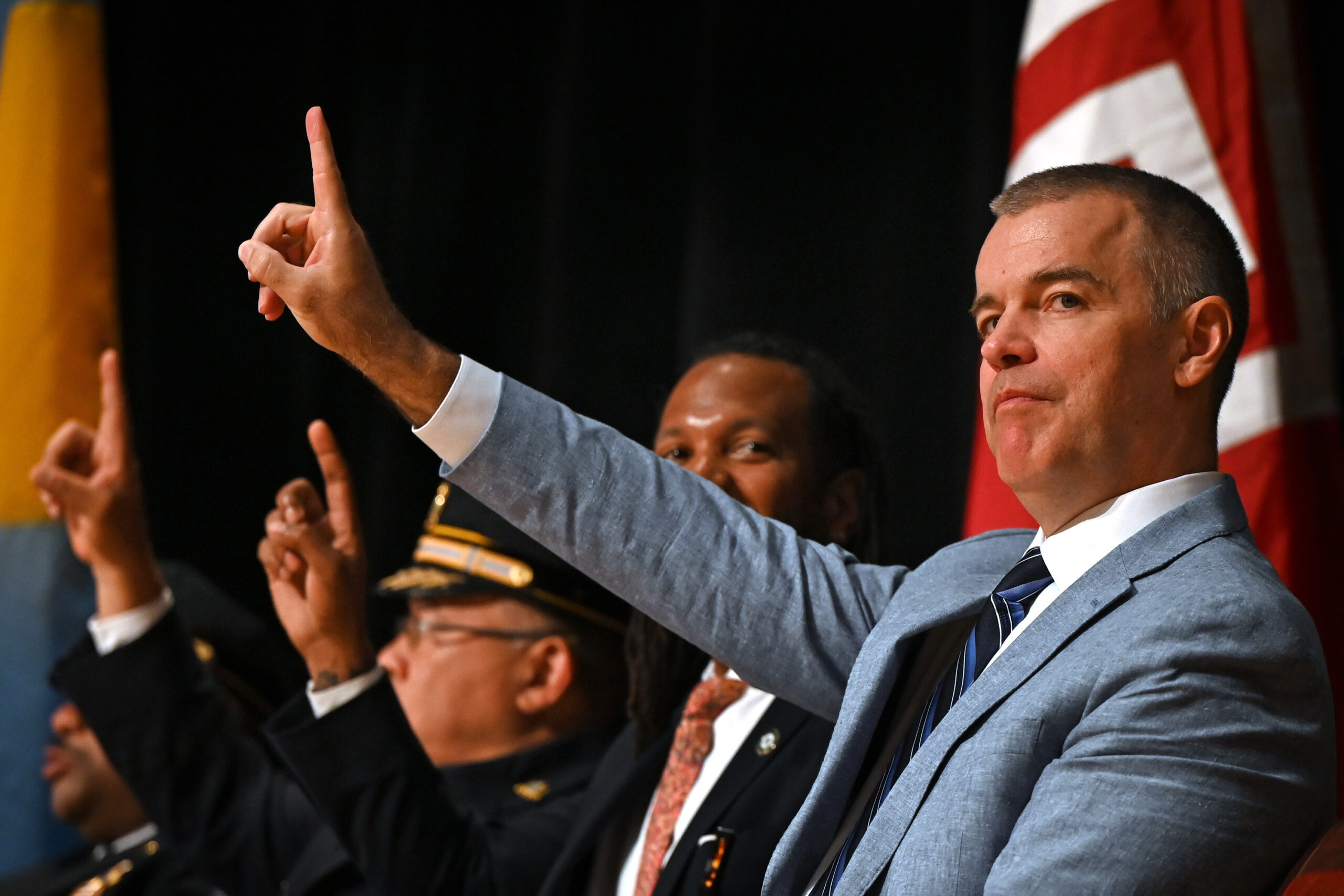
    Managing Director Adam Thiel during graduation ceremonies for the police academy Class #402 of the Philadelphia Police Department and Temple University Police Department at Temple University Performing Arts Center June 17, 2024.

    The administration declined requests to interview Thiel and Parker for this article. In a statement, Thiel thanked Parker for her “continued support of our city of Philadelphia employees who also serve the United States of America.”

    Sharon Gallagher, a spokesperson for the managing director’s office, said in a statement that Thiel has been employed by the city for nearly 10 years and “earns leave offered by the city the same way as other city employees accrue vacation, sick days, family, medical, military and other leave categories.”

    Payroll records show that Thiel logged six weeks of military leave time last year — the maximum amount the city offers employees. Gallagher said he also used 11 weeks of accrued vacation time to cover additional military assignments.

    The administration declined to answer questions about Thiel’s military service, including details about his location and unit. His LinkedIn page says he “helps provide emergency management subject matter expertise to combatant commands and partner nations.”

    Thiel is also founding partner of one consulting firm and the president of a second, though the specific nature of that work is not known and he has declined to disclose his clients publicly.

    In 2024, Thiel said his consulting work took fewer than 10 hours per week. Gallagher said Tuesday that “nothing has changed” since then.

    The Parker administration did not publicly announce when Thiel was on leave last year, but officials acknowledged it once asked by reporters last summer. At the time, Deputy Managing Director Michael Carroll filled in on an interim basis.

    Thiel, 53, is a nationally recognized expert in emergency management. He held a variety of firefighting, public safety, and disaster preparedness roles across the country before coming to Philadelphia in 2016 to serve as fire commissioner and deputy managing director under former Mayor Jim Kenney.

    Despite that, he did not appear alongside the mayor at multiple briefings the city conducted to update residents on the response to last month’s snowstorm. Instead, the face of the snow emergency response was Carlton Williams, the head of the city’s Office of Clean and Green Initiatives, a position Parker created.

    Thiel said in a statement Tuesday that Williams was “the best choice to lead our city’s unified response to the recent snowstorm operation and is the right leader for future snow and ice events.”

    Gauthier said the city’s handling of the storm “needed a higher-level emergency response.” She said while she respects Thiel’s military service, she raised his consulting work as a concern.

    “A decision needs to be made what he wants to do. Does he want to serve locally, or does he want to do other things?” Gauthier said. “We need a managing director who will serve full time.”

    The administration did not answer questions about whether Thiel was in town through the duration of the city’s 26-day winter emergency response.

    Parker’s chief of staff, Tiffany W. Thurman, said in a statement that the city is proud to offer benefits such as military and administrative leave that support employee well-being and professional development.

    Thurman said Thiel “is always reachable and fulfills the responsibilities of his position as needed based on the situation.”

    “His leadership — as is the case with the leadership team of any large city — is not limited by time designated as leave,” she said.

    The purpose of the Philadelphia managing director

    The authors of the 1950s-era Philadelphia Home Rule Charter created the position of managing director to serve as a barrier between the mayor’s political appointees and the city’s operational departments.

    The idea was that having a bureaucrat at the helm would ensure city service delivery would be apolitical, and the mayor cannot fire the managing director without cause.

    In reality, different mayors have granted their managing directors varying levels of power.

    In this 2018 file photo, LOVE Park is by (left to right) then-Philadelphia Parks and Recreation Commissioner Kathryn Ott Lovell, former City Council President Darrell Clarke, former Philadelphia Mayor Jim Kenney and then-Managing Director Michael DiBerardinis.

    For example, former Mayor Michael Nutter dispensed with decades of tradition and assigned robust portfolios to several deputy mayors. While his managing directors were important figures in his administration, they oversaw fewer operating departments than their predecessors.

    Nutter’s first managing director, Camille Barnett, left the administration after facing criticism for going on a two-week vacation in 2009 while the Phillies made a World Series run and SEPTA workers went on strike.

    Kenney, Parker’s immediate predecessor, sought to re-empower the city’s managing director position, while his deputy mayors took on advisory roles. He reassigned almost all departmental oversight to the managing director’s office.

    “We’re going to have a managing director that’s actually a managing director,” Kenney said before he took office.

    Council members who were in office before Parker’s 2024 swearing-in became used to the managing director being accessible. Several lawmakers said that under Kenney’s administration, they routinely communicated about constituent services matters with ex-Managing Director Tumar Alexander and his predecessor, Brian Abernathy.

    That hasn’t been the case with Thiel in the role.

    “Since the beginning of this administration, I have gone to Carlton Williams,” said Councilmember Jeffery “Jay” Young Jr., a freshman Democrat who represents parts of North Philadelphia.
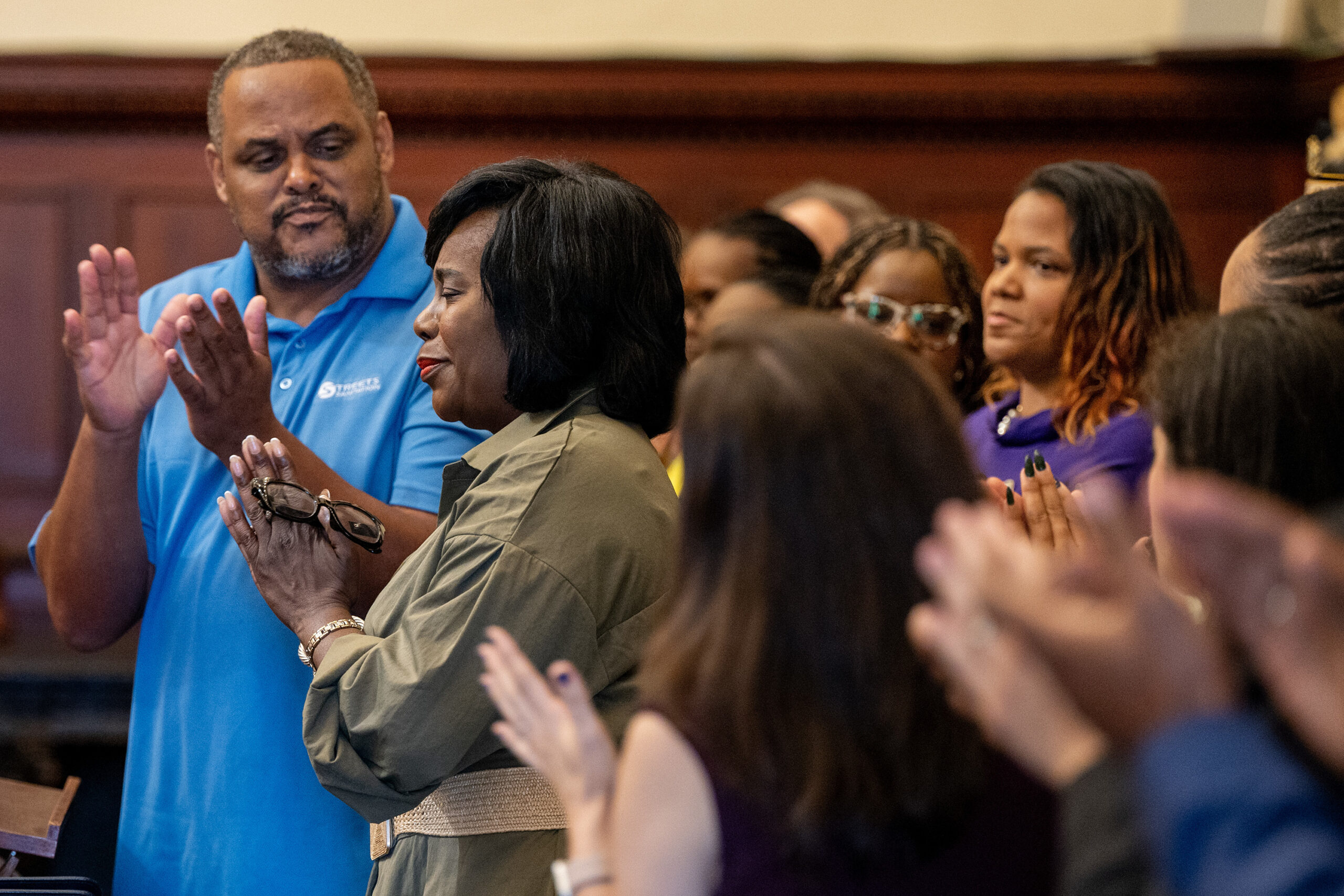
    Mayor Cherelle L. Parker is applauded by members of her administration at City Hall Wednesday, Jul. 9, 2025, hours after reaching a tentative contract agreement with District Council 33 leaders overnight, ending the workers’ strike. At left is Carlton Williams, director of the Office of Clean and Green Initiatives and Chief Deputy Mayor Sinceré Harris is behind the mayor at right.

    Several other members said that instead of going to the managing director’s office, they take administrative needs to legislative affairs staff, agency heads, or Thurman.

    “Almost everything goes through Tiffany, and she’s able to get things done,” said one Council member who spoke on the condition of anonymity to preserve relationships with the administration.

    Parker doesn’t deny that little happens at the top rungs of city government without Thurman’s involvement. The mayor has come to see her chief of staff as the central figure in her administration and calls her the city’s “chief air traffic controller.”

    Phil Goldsmith, who served as managing director for two years under former Mayor John F. Street, said Thiel’s minimized public role may be because Parker appears to favor “a very strong mayor’s office.”

    “It seems to me that the managing director may have to go through more hoops to get things done than, for example, I had to do,” Goldsmith said. “That’s just a function of what a mayor wants and feels comfortable with.”

    Fading out of public view

    Thiel’s lack of public appearances over the last year has been unusual for a managing director.

    It has been 10 months since he testified before City Council, despite the managing director in previous administrations being a mainstay in hearings to answer lawmakers’ questions about city services ranging from street repaving to emergency preparation.

    And in December, when a half-dozen top Parker administration officials spoke during the mayor’s State of the City event, Thiel was not on the roster.

    The decrease in visibility marks a departure from his first year in office, when Thiel had a more consistent public presence and was often seen beside the mayor.

    Ahead of a snowstorm in January 2024, Thiel stood with Parker during a news conference about preparations. He donned a suit while snowflakes fell, and he reassured the city that the administration was ready for the service disruptions that bad weather can bring.

    Mayor Cherelle L. Parker (center) with Managing Director, Adam Thiel (right) and at left Carlton Williams, Director of Clean & Green Initiatives, at a news conference with city officials in Northeast Philadelphia on Friday, Jan. 19, 2024 to share the city’s response to the snowstorm.

    Through his first year in the position, Thiel also faced scrutiny as the face of some of the mayor’s most controversial initiatives.

    He took a leading role in Parker’s efforts to end the open-air drug market in the city’s Kensington neighborhood, and he oversaw the development of the Riverview Wellness Center, a new city-owned recovery house for people with substance use disorder.

    Today, much of Kensington initiative is overseen by the public safety director, who reports directly to Parker. A new head of community wellness is leading development at Riverview, and Williams was the face of the storm response.

    Mayor Cherelle L. Parker finishes a news media briefing with her leadership team at the Tustin Playground at 60th St. and W Columbia Ave. Tuesday, Jul, 1, 2025, on the first day of the strike by District Council 33. At left are Carlton Williams (Phillies cap), Director of Clean and Green Initiative with the Dept. of Streets Sanitation Division; and Managing Director Adam Thiel (at lectern).

    Last summer, during the eight-day strike by municipal workers that brought city services to a halt for the first time in 40 years as trash piled on sidewalks and streets, Thiel initially spoke nearly every day at news conferences to update citizens on the crisis.

    But by the time the strike was resolved, Thiel had faded from public view, departing from his city job for one of his stints on military leave. After Parker reached an agreement with the union, she held a news conference with 20 top deputies and thanked each of them by name.

    Thiel, absent from the City Hall news conference, was not one of them.

    Staff writers Ryan W. Briggs and Sean Collins Walsh contributed to this article.

  • Should you feed a cold and starve a fever? Here’s what experts say.

    Should you feed a cold and starve a fever? Here’s what experts say.

    Most of us have heard the adage “Feed a cold, starve a fever.”

    It comes from an outdated theory that a cold makes your body cooler and eating can help warm it up, and that a fever makes your body warmer and fasting can help cool it down. The premise itself is flawed: While fevers do raise your body temperature, colds don’t make your body cold. You might even get a fever when you have a cold.

    As for whether you should eat more or less, in most cases, there’s no convincing evidence that limiting food intake when you’re sick plays a meaningful role in recovery, experts said.

    There may be a more accurate approach. “Feed a cold. Feed a fever, too,” said Roy Gulick, the chief of the infectious-disease division at Weill Cornell Medicine and an attending physician at New York-Presbyterian Hospital.

    Experts recommend staying hydrated and eating healthy foods — at least when your stomach will allow it — to support your body when you’re sick. The advice holds true whether you’re dealing with a cold, which is an upper-respiratory infection that can be caused by more than 200 viruses, or a fever, which can be caused by viral and bacterial infections, autoimmune issues, and reactions to medications, among other things.

    “If you are truly not feeling hungry, you don’t necessarily have to eat more than you feel like eating,” said Geeta Sood, an assistant professor in the infectious-disease division at Johns Hopkins University. However, you do want to make sure you’re getting enough calories, protein, and nutrients — and hydration — to help support your body as it heals, she said.

    What does the research show?

    Research in this area is limited — and mostly in animals. For example, in a 2016 study, mice were infected with either a bacterium that causes gastrointestinal illness or a virus that causes influenza. In mice with the bacterial infection, fasting was protective while nutritional supplementation was detrimental, the authors found. The pattern was reversed in mice with the flu and viral sepsis. While interesting fodder for further research, these results can’t be applied directly to humans, experts said.

    In humans, researchers who conducted a 2021 review concluded that there is some evidence that nutrients such as vitamins and minerals can help support the body’s immune response and help fight infections in general. And a 2024 review that included newer studies that were conducted during the pandemic suggested that nutritional needs may depend on the specific pathogen you’re fighting and other variables, such as the duration and severity of your illness — not simply on whether it’s a bacterium or virus.

    The reality is that most studies on how nutrition affects infections have looked at only a handful of pathogens, said David Schneider, a professor of microbiology and immunology at Stanford University. To further complicate matters, when you’re experiencing symptoms such as a runny nose or fever, you may not know whether you’re sick with a bacterium or virus, he said. Both of these things make it difficult to give generalized recommendations about what might be best for every cold or every fever, he said.

    Why do I lose my appetite when I’m sick?

    There is some rationale to the adage, because it’s common to lose your appetite when your body is fighting off an infection. As your immune system ramps up, it releases chemical messengers, known as cytokines, to rally immune cells to fight infection, and those same signals also tell the brain that eating isn’t a priority, said Sharon Bergquist, an internal medicine physician and associate professor at the Emory University School of Medicine.

    While not well understood, one theory states that a drop in calorie and protein intake triggers a process called autophagy, which helps recycle damaged cell parts and may play a role in immune defense, she said.

    That said, the process of fighting an infection is “metabolically really costly,” Bergquist said, explaining that although you can skip food for a day if you aren’t hungry, going longer than that may leave you without adequate nutrition. “It takes so much energy and calories that there’s a rationale for us needing to increase our food and our hydration during times of illness so that we can support our immune system,” she said.

    What can I do if I have an infection?

    Vaccines are the first-line defense to help prevent and lessen the severity of some viral infections, including COVID and the flu. If you get sick, however, you can try some medications that may help you recover faster.

    • Antibiotics target specific kinds of bacteria such as those that cause strep throat, pneumonia, or urinary tract infections.
    • Antiviral medications can help treat certain viral infections, including the coronavirus and influenza. Three antivirals — Paxlovid, remdesivir, and molnupiravir — are available by prescription to treat COVID in people who are at high risk of serious complications, and four antivirals are approved to treat the flu.

    There are also a few other things you can do to help support your body.

    • Stay hydrated. Losing water and electrolytes through sweat when you have a fever, as well as through diarrhea and vomiting, can put you at risk for dehydration, so it’s important to drink plenty of water and make sure you’re getting enough electrolytes, Gulick said. Pediatric beverages and sports drinks with added sodium and potassium can help you stay hydrated, and warm liquids such as soups, broths, and caffeine-free herbal teas can help ease symptoms such as congestion, body aches, and chills, Sood said. Avoid alcohol and caffeinated drinks because they are diuretics and can make dehydration worse.
    • Eat, when possible. Listen to your body, but when you have an appetite, eat healthy, whole foods rich in vitamins, minerals, and antioxidants such as fresh fruits and vegetables. One strategy is to make smoothies or soups, Bergquist said. Avoid foods high in saturated fats and processed carbohydrates.
    • Get rest. Take time to rest as your body does much of its repair work while you sleep, Bergquist said. “Don’t push your body because you want to dedicate that energy to your immune system,” she said.
    • Take hot showers or baths. The steam can help break up congestion and clear airways.
    • Try zinc. Zinc may help shorten a cold by a day or two. In a 2024 review, researchers found some evidence that zinc might reduce the duration of symptoms by about two days compared with a placebo, though the mineral was associated with mild side effects such as nasal and oral irritation, problems with taste, stomach pain, constipation, diarrhea, and vomiting. Most other supplements have no real advantage for colds, including vitamin C, which, when started at the onset of symptoms, doesn’t help lessen the duration or severity, research shows.
    • Use honey for a cough or sore throat. Adults and children older than 1 year can add honey to warm tea or water to help soothe sore throats and calm coughs.
  • Beach concerts are finally coming back to Atlantic City

    Beach concerts are finally coming back to Atlantic City

    Once again, there will be music on the beach in Atlantic City this summer.

    Australian electronic dance music trio Rüfüs Du Sol will perform on the ocean side of the A.C. boardwalk on Aug. 29 in what’s expected to be the first in a wave of shows to take place this year.

    That show by the Sydney-based pop/house music band, which is also playing Bonnaroo, Wrigley Field, and Madison Square Garden, will mark a return to the tradition of A.C. beach shows. The stage on the Arkansas Avenue beach will face north, with the Caesar’s Pier (formerly the Million Dollar Pier) behind it.

    Over the years, beach concerts have included Pink in 2017, the Vans Warped Tour in 2019, three-nights of Phish in 2021 and 2022, the pop-punk Adjacent Music Festival in 2023, and the TidalWave country fest in 2022 and 2023.

    Australian electronic dance music act Rufus Del Sol will perform on the Atlantic City beach on August 29.

    For the last two years, however, there have been no large scale A.C. beach shows (though Philly impresario Dave P. did stage an intimate Making Waves festival last year).

    Music fans had to travel north to Asbury Park for Sea. Hear. Now or south to Wildwood for the Barefoot Country to experience a surf side musical blowout.

    But now Visit Atlantic City, the public-private partnership funded by New Jersey’s Casino Reinvestment Development Authority, has announced a new Atlantic City collaboration with Live Nation.

    “With the help of Live Nation and our partners,” Gary Musich, Visit Atlantic City president and CEO said in a statement, the storied Jersey resort town aims to “attract a wide range of world class performers, energize our tourism economy, and continue delivering experience that resonate with visitors year round.”

    That means more shows and not just in the summer, Molly Warren, Live Nation senior vice president of booking said in a statement. The concert promotion company regularly books venues such as Boardwalk Hall, Hard Rock Hotel & Casino, Borgata Hotel Casino, or, Warren said, “even right on the beach.”

    No other 2026 Atlantic City beach concerts have been announced as of yet. Tickets for Rüfüs Du Sol go on sale on Thursday, Feb. 26, at 10 a.m. at RüfüsDuSol.com/live.

    J. Cole play Xfinity Mobile Arena in South Philly on July 20.

    In addition to the Rüfüs Du Sol and Bruce Springsteen & the E Street Band’s date at Xfinity Mobile Arena on May 8, it’s been a big week for concert announcements.

    Rapper J. Cole will bring his “Fall-Off Tour” to Xfinity Mobile Arena on July 20. It’s the Grammy-winning North Carolina producer and artist’s tour for his new album of the same name. It will take him not only across the U.S., but also to Europe and South Africa. Tickets for the Philly show go on sale Friday at 11 a.m. at thefalloff.com.

    Three days later, Shinedown, the Jacksonville, Fla., rock band led by singer Brent Smith and guitarist Zach Myers, will play the Xfinity Mobile Arena on their “Dance Kid Dance: Act II” Tour.

    Smith and Myers played a two-man acoustic set at the Pierre Robert tribute concert at the Fillmore in December. The band’s new album Ei8ht is due in May. Tickets go one sale Friday at 10 a.m. More information is at shinedown.com.

  • The Atlantic’s essay about measles was gut-wrenching. Some readers feel deceived.

    The Atlantic’s essay about measles was gut-wrenching. Some readers feel deceived.

    When Kelly McBride read Elizabeth Bruenig’s essay in the Atlantic about a child’s death from measles complications, she was moved and quickly shared the story on her Facebook account. She hadn’t realized that Bruenig’s family had been ravaged by virus and the well-known journalist had lost a child.

    McBride, a media ethicist and senior vice president at the Poynter Institute, also didn’t realize the story was a hypothetical scenario — and the child a composite character based on the author’s research — until a friend alerted her to an editor’s note at the bottom of the story. Then, McBride felt duped.

    “I feel deceived,” McBride said. “I spent all weekend talking about this story to my friends as if the reporter had experienced it.”

    Bruenig’s stirring account of a mother’s experience learning her child will die of the long-term effects of measles has remained one of the Atlantic’s most read stories since it was published Thursday, receiving more than 700 comments. Written in the second person, some readers have called the essay a visceral and gut-wrenching exposé of the human impacts of the measles epidemic.

    It has also generated controversy. Readers and media experts have condemned the story as breeching journalistic ethics by informing the reader that the story is fictionalized through a short editor’s note at the end of the 3,000-word essay. Some public health experts argued the story was a dangerous writing exercise that could evoke backlash and confusion as vaccine skepticism hits an all-time high across the country.

    “Grateful to @ebruenig for sharing her and her family’s ordeal,” Gabby Stern, a former World Health Organization communications director, wrote on X shortly after the story published. “Friends, please ensure that your children receive vaccinations against preventable diseases like measles.”

    She followed up soon after: “I missed the disclaimer at the bottom. Others did, too. You get to the end and you’re shattered, not looking for caveats and fine print. Disappointed in the magazine. The topic is too high-stakes for such shenanigans.”

    Adrienne LaFrance, executive editor at the Atlantic, told The Washington Post in a statement that the magazine was “pleased that so many people are reading and praising Liz’s remarkable essay.”

    “We trust our readers to understand all different kinds of writing and writerly devices,” she said. “And while we included a note about Liz’s methods for transparency’s sake, we’re finding that most readers already understand the second-person well enough to know that the ‘you’ referenced throughout the piece is not literally ‘you,’ the reader.”

    The Atlantic, one of the most popular American magazines with 1.4 million subscribers, has become a destination for health reporting in recent years. The Atlantic is among a cohort of outlets that have reported on rising measles cases across the United States, as well as the role that misinformation and shifting government guidelines have on childhood vaccinations. Once eliminated in the country, outbreaks have led to the highest count of measles cases in more than three decades. Atlantic staff writer Tom Bartlett was first to find and interview the parents of a child who died of measles in Texas, the first such death in a decade.

    Bruenig, a former Post opinion writer, has twice been a finalist for the Pulitzer Prize for feature writing, one of the industry’s top honors for narrative journalism. (This reporter worked for the Atlantic from 2017 to 2019.)

    Bruenig wrote the essay in the second person, detailing a scenario where two unvaccinated children attend a birthday party and catch measles from an infected-but-asymptomatic child. “Your daughter behaves normally over the next week while the virus slowly spreads inside her, infecting immune cells that carry it to the lymph nodes, where it replicates and spreads at a rapid pace.”

    It includes a short disclaimer at the bottom of the 3,000-word piece: “This story is based on extensive reporting and interviews with physicians, including those who have cared directly for patients with measles.”

    Reported hypotheticals have been used in other grim chronicles such as Outside Magazine’s 1997 story “Frozen Alive,” about freezing to death; a passage of Kathryn Schulz’s 2015 New Yorker essay “The Really Big One” about the risks of a large earthquake; and the 2024 Annie Jacobsen book “Nuclear War: A Scenario,” about how nuclear warfare could transpire. The first two stories also are written in second person.

    Many readers, including physicians, praised the Atlantic essay, writing that its evocative writing and storytelling forced readers to grapple with the impact of vaccine hesitancy. “Read this while holding my almost-one-month-old, and it absolutely wrecked me. What a powerful and important piece,” one commenter wrote. “Tragically realistic story exquisitely described by Ms. Breunig,” wrote another. “I’m a pediatrician who has never seen a case of measles but am awaiting my first one.”

    Others, however, expressed their confusion in the essay’s comments. “The fact that readers in the discussion are unsure of whether this is a true story or fiction highlights a fundamental failure on the part of the author, and the editor,” one reader wrote.

    “I know the internet is full of made up stuff, but I trusted the Atlantic,” another reader wrote. “I feel foolish that I told my husband about this as if it were the truth. Glad I didn’t share it with my sisters. We are all pro vaccines, and I’m concerned this story masquerading as a first person memoir will encourage people on the edge to blow off vaccines.”

    Tom Rosenstiel, a professor at University of Maryland’s Philip Merrill College of Journalism and former executive director of the American Press Institute, felt the piece did the reader a disservice by not being fully transparent about they were about to read. He said the Atlantic needed to clearly explain the unusual choices in the story upfront, avoiding deception.

    “Any time you’re answering questions about why you did something in the story after you’ve published it, you’re in a bad place,” he said.

    Some physicians argued the uncertainty around the essay could fan distrust of vaccines. Angela Rasmussen, a virologist at the University of Saskatchewan who edits the journal “Vaccine,” said she found the essay scientifically sound but extremely confusing. She initially believed the essay was about Bruenig’s real child and felt the essay could backfire. “We need effective communicators like this,” she said. “But if that effective communication is being presented in such a way that it actually diminishes trust further, then we’re in real trouble.”

    Rachael Bedard, a physician and writer, called herself an admirer of Bruenig, but expressed similar concerns in a series of posts on X.

    “One of the things that people who have actually interacted [with] anti-vaxxers know is that they often think the liberal media is lying to them about how bad measles is,” she wrote, writing that the Atlantic’s presentation of this essay as anything other than fiction “affirms all of those concerns.”

    Bruenig, in an interview with the website Nieman Lab, defended the structure of her essay. “It is a hypothetical account of a very real phenomenon based on careful reporting,” she said. “I would place it somewhere on the creative nonfiction spectrum.” She said that she interviewed doctors for her piece, and based the character of the mother on herself.

    “I have no doubt that there are a lot of people out there who are unhappy with the story or reject its premises, and they are entitled to their interpretations. I get it,” she said. “But my job is to report the truth about the world — and I use all kinds of literary, and narrative devices to do that. I do it because telling the truth is important in its own right, whether or not anyone finds it persuasive.”

  • Talks end in Geneva with no end to Russia’s war or hard-line demands

    Talks end in Geneva with no end to Russia’s war or hard-line demands

    U.S.-mediated talks between Moscow and Kyiv in Geneva, Switzerland, broke off on Wednesday without any significant progress or indication that Russia was ready to step back from its maximalist demands for subjugating Ukraine.

    The head of the Russian delegation, Vladimir Medinsky, tersely said the talks had been “difficult but businesslike” and had ended after just two hours of discussions on Wednesday following longer conversations the previous day.

    The reappearance of Medinsky, known to be a hard-line aide to Russian President Vladimir Putin, as head of the Kremlin’s delegation had signified that Russia was digging in its heels on core demands — including significant cuts to the Ukrainian military, the dismantling of Ukrainian President Volodymyr Zelensky’s government and guarantees for Ukraine’s neutrality, analysts said.

    Moscow has insisted that these steps are required to address what it describes as the “root causes” of the war. Ukraine’s position is that Russia’s invasion was unprovoked and that Moscow should end its illegal war of aggression and remove its troops that are occupying Ukrainian territory.

    Russian analysts said Moscow’s demands encompassed a far wider spectrum of issues than the territorial swaps proposed by President Donald Trump’s administration as a path to end the war.

    “As long as there is an armed anti-Russia on Ukrainian territory, there can be no peace,” said Sergei Markov, a pro-Kremlin political analyst. “I don’t think anyone had any big hopes that the talks would end in success. The positions are very, very far from each other.”

    “The idea of territorial swaps for peace is not Russia’s idea,” Markov added. “It is Trump’s.”

    Proponents of territorial exchanges envision that Russia would withdraw from some areas it occupies in Ukraine in exchange for Ukraine withdrawing its military from parts of the heavily fortified Donbas area, which Putin has failed to capture during four years of full-scale war.

    Zelensky’s administration has previously said it could agree to withdraw troops from the Donbas area. But Kyiv has said it would agree to a pullback only if the region becomes a demilitarized zone and if the United States first provides legally watertight security guarantees.

    Zelensky told reporters on Wednesday that the talks on “political” issues such as Russian demands for Ukraine to withdraw its forces from “the east” were “not easy” and that differences remain. But Zelensky also sought to put a positive spin on some of the trilateral discussions between Russia, the United States and Ukraine in Geneva, saying they had been “constructive” on ways to monitor any potential ceasefire.

    Zelensky appealed again at the Munich Security Conference over the weekend for U.S.-backed guarantees before he signs on to any deal with Russia to end the war. “Those guarantees answer the main question: how long there will be no war again,” he said then.

    The direct talks between Russia and Ukraine have stalled for weeks over core differences, namely territorial concessions, control of Europe’s largest nuclear power plant, which is occupied by Russia in Ukraine’s Zaporizhzhia region, and questions about Western guarantees for Kyiv, according to two European diplomats who spoke on the condition of anonymity to discuss sensitive diplomacy.

    “So far the Russian position is no boots on the ground from NATO allies, so there are outstanding points: territory, security guarantees and the future of the Zaporizhzhia plant,” one of those diplomats said. “Those are the big sticking points, so we need to see if it really happens.”

    In meetings with U.S. officials late last year, Ukraine’s chief European backers were encouraged by the U.S. interest in playing a role in securing a settlement to the war. France and Britain have led a coalition of allies planning ways to provide Ukraine with a U.S.-backed bulwark against future attack, including with some European troops and air or sea power.

    Still, the Trump administration appeared to want to sign a deal before fully committing, while Kyiv has maintained it needs the Western protection baked into any settlement, the diplomats said. Russia, meanwhile, has ruled out any presence of Western soldiers in Ukraine.

    Zelensky, who met with Secretary of State Marco Rubio over the weekend, has stressed Kyiv’s refusal to cede territory in the east that Russia does not militarily control and said Ukraine could only hold elections if there is a ceasefire.

    Analysts said it was clear the Kremlin had no intention of making any concessions.

    “As long as Putin is in power, Russia isn’t paralyzed by widespread protests, and there is at least some money left in the budget for weapons, the war will continue,” said Tatiana Stanovaya, a senior fellow at Carnegie Russia Eurasia Center, in a post on X. “The Kremlin will not make significant concessions even if faced with a protracted financial and economic crisis.”

    “That means there will be no final settlement either now or in the foreseeable future,” Stanovaya added. “Negotiations may intensify, a short-term ceasefire is possible, and documents may even be signed. But overall, this simulation of negotiations can only lead to the simulation of a ceasefire and the simulation of a settlement.”

    Russia has been facing increasing economic pressure after the U.S. administration imposed tough new sanctions on Russia’s two biggest oil companies, Rosneft and Lukoil, in October.

    The measures caused Russian oil revenue to plummet as Moscow was forced to accept discounts of more than $20 per barrel on its exports. Economists have warned of a nonpayment crisis as the economy grinds to a halt amid high inflation and high interest rates of 15.5% imposed by the Central Bank.

    Analysts say there are concerns in the Kremlin that Moscow could face a narrowing window to reach an advantageous deal because the Trump administration could grow distracted as midterm elections near — and then potentially could be weakened by the results.

  • Late-night host Stephen Colbert isn’t backing down from public dispute with CBS bosses

    Late-night host Stephen Colbert isn’t backing down from public dispute with CBS bosses

    Stephen Colbert isn’t backing down in an extraordinary public dispute with his bosses at CBS over what he can air on his late-night talk show.

    On The Late Show Tuesday, Colbert said he was surprised by a statement from CBS denying that its lawyers told him he couldn’t show an interview with Democratic Texas Senate candidate James Talarico — which the host said had happened the night before.

    He then took a copy of the network statement, wrapped it in a dog poop bag, and tossed it away.

    Colbert had instead shown his Talarico interview on YouTube, but told viewers why he couldn’t show it on CBS. The network was concerned about FCC Chairman Brendan Carr trying to enforce a rule that required broadcasters to give “equal time” to opposing candidates when an interview was broadcast with one of them.

    “We looked and we can’t find one example of this rule being enforced for any talk show interview, not only for my entire late-night career, but for anyone’s late-night career going back to the 1960s,” Colbert said.

    Although Carr said in January he was thinking about getting rid of the exemption for late-night talk shows, he hadn’t done it yet. “But CBS generously did it for him,” Colbert said.

    Not only had CBS been aware Monday night that Colbert was going to talk about this issue publicly, its lawyers had even approved it in his script, he said. That’s why he was surprised by the statement, which said that Colbert had been provided “legal guidance” that broadcasting the interview could trigger the equal time rule.

    “I don’t know what this is about,” Colbert said. “For the record, I’m not even mad. I really don’t want an adversarial relationship with the network. I’ve never had one.”

    He said he was “just so surprised that this giant global corporation would not stand up to these bullies.” CBS is owned by Paramount Global.

    Colbert is a short-timer now at CBS. The network announced last summer that Colbert’s show, where President Donald Trump is a frequent target of biting jokes, would end in May. The network said it was for economic reasons but others — including Colbert — have expressed skepticism that Trump’s repeated criticism of the show had nothing to do with it.

    This week’s dispute with Colbert also recalls last fall, when ABC took late-night host Jimmy Kimmel off the air for a remark made about the killing of conservative activist founder Charlie Kirk, only to reinstate him following a backlash by viewers.

    As of Wednesday morning, Colbert’s YouTube interview with Talarico had been viewed more than five million times, or roughly double what the comic’s CBS program draws each night. The Texas Democrat also reported that he had raised $2.5 million in campaign donations in the 24 hours after the interview.

  • Agustín Anello took the long way back to the United States, then found familiar faces with the Union

    Agustín Anello took the long way back to the United States, then found familiar faces with the Union

    Though Agustín Anello has lived more than half his life outside the United States, the Florida native still feels like an American.

    So when the Union called with an offer, he was interested. Even better, he had two friends already on the team in Nathan Harriel and Bruno Damiani. From there, Anello did his homework and decided it was time to come home.

    “The guys have really made it feel like home, so that’s quite nice,” Anello told The Inquirer. “You know how things work when a lot of things come together, and, yeah, the feeling of coming back to my country to play was also a big factor. So I feel a lot of things came together for this to to be possible.”

    He knew of the Union’s track record, including last year’s Supporters’ Shield, and of the style they play. That intrigued him too.

    Agustín Anello on the ball during the Union’s last preseason game against CF Montréal.

    “Philly reached out, and, obviously, the great season they had the year before, the way they train, the work ethic — they’re all factors that obviously push [and were] important factors, at least, for me to come,” Anello said. “I think it’s a style of play that fits my game style. There’s a lot of transitions, a lot of importance inside the attacking area, a lot of pressing, a lot of passion.”

    Anello sees himself fitting in one of the striker spots, but also in one of the attacking midfield spots. Union manager Bradley Carnell has the same idea.

    “He’s got a good technique with dribbling, so he can be off the shoulder of the outside back dribbling in a one-v-one,” Carnell said. “He can pick up in the pocket too, [which is] how we like to play as well with interior 10s [attacking midfielders]. So he shows a lot of flexibility within our game model.”

    An unusual journey to get here

    Anello was born in the Miami suburb of Hialeah to Argentine parents and grew up in Cape Coral, on the west side of South Florida near Fort Myers. He moved with his family to Barcelona, Spain, at age 10 because of his father’s work and didn’t set foot in the U.S. again until the summer of 2022.

    “I got to live what my parents lived, what my dad and uncles lived when they were little, playing in the streets with their friends,” he said. “That was a very big thing in my childhood. … I feel full American and full Argentinian at the same time, so, yeah, I think I have that blood running in me.”

    Anello rose through the youth ranks of Belgian club Lommel and turned pro there in 2021. In early 2023, he made the first of four moves around Europe over the next 16 months.

    He did well enough along the way to attract U.S. Soccer’s attention, and earn an invitation to an under-23 team camp in November 2023 that surveyed candidates for the 2024 Olympic team. His teammates there included Nathan Harriel and Jack McGlynn, whom the Union traded to the Houston Dynamo last February.

    That wasn’t when the seed for a move to MLS was planted, but it’s also a moment that Anello and Harriel remember well.

    “It was a long time ago, but at the same time, at the camp, he was a great guy,” Harriel said, noting that Carnell sought out him and Damiani when Anello’s name came on the radar. “He’ll be great for the locker room. He fits in really well, hard worker, creative, he’s a good dribbler.”

    In August 2024, Anello crossed the Atlantic to join Uruguayan club Boston River. His new teammates included Union prospect José Riasco, who was on loan there, and Damiani. Anello and Damiani became good friends, and that also ended up coming in handy down the road.

    “I talked with Bruno mostly,” Anello said, at times when Damiani came home to Uruguay during MLS’s breaks. “He told me good things about the club, how the boys were, the facilities, the training ethic. And, yeah, those things obviously are adding-up factors to take this step.”

    (Damiani was away getting his green card when this piece was reported, so wasn’t available for comment.)

    Off to a quick start

    Anello also had observed the growth of MLS, and American soccer as a whole, from the quality of play to stadiums and training facilities. It also does not hurt to come home in a year when the biggest World Cup in history will be here.

    “It’s exciting, to be honest, just seeing the league grow, the World Cup coming up,” he said. “I think there’s going to be a lot more eyes. So, yeah, me and my agents, my family, thought it was the best time to come.”

    He hasn’t had much time to train with his new club, since he only joined the squad this month. When Anello started the preseason finale against CF Montréal, he had only been in one full practice session with his teammates.

    But he fit in well enough to play the first half and delivered a sharp assist to Milan Iloski for the Union’s second goal of the game. The buildup was good, too: Ezekiel Alladoh made a strong run up the middle with the ball, Anello ran down the left side to get in position, and Alladoh put the pass on a plate.

    “It’s good to take a step at a time,” Anello said. “I just want to get integrated as fast as possible, start getting my qualities out, start to get comfortable with the team, and start making an impact.”

    That was sage advice, and he has lived up to it so far.

  • West Philly ‘stayed the path’ to get back to the Public League final

    West Philly ‘stayed the path’ to get back to the Public League final

    West Philadelphia High School has been in this situation before.

    The Speedboys cruised their way to the Public League championship during the 2022-23 season before suffering an 18-point loss to Imhotep Charter in the final. Now three years later, head coach Adrian Burke and his team are back in the title game, following a 68-47 win over Dobbins Technical High School in Tuesday’s semifinal.

    When Burke walked into the locker room at La Salle’s John Glaser Arena following the win, he was bombarded by his team, who dumped water on him to celebrate its championship appearance. Now, the Speedboys will look to knock off Imhotep, the defending champions, on Sunday.

    As for Burke, he feels a sense of pride for his team and coaches that West Philly got there.

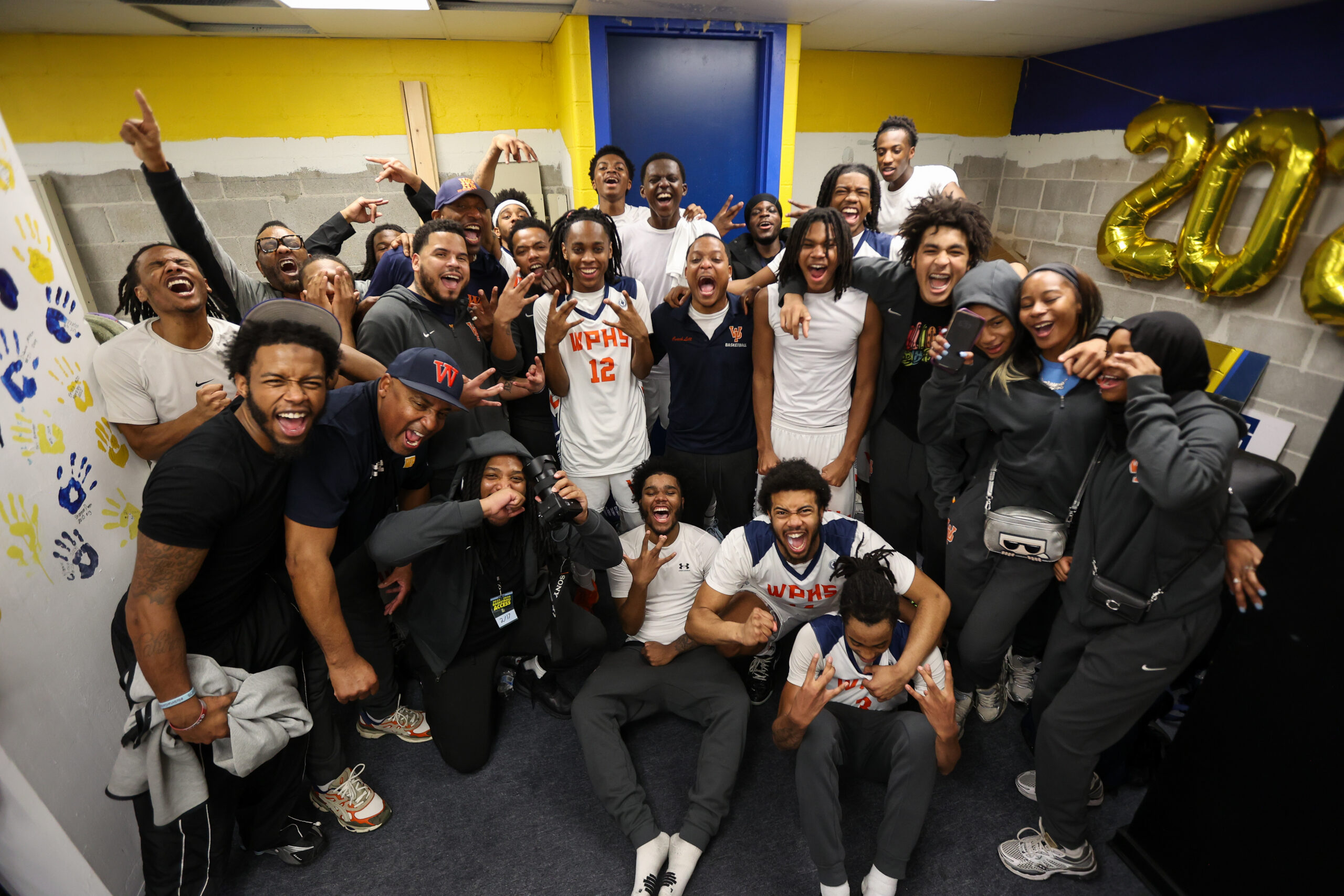
    West Philadelphia poses for a photo after its 68-47 win against Dobbins on Tuesday.

    “It feels great,” Burke said. “You put in a lot of work with these kids, and you never know what’s going to happen. From day in to day out, but these kids, they stayed the path. They stayed straight. We just kept fighting. I tell them, ‘Continue working hard, good things will happen for you.’”

    Senior guard Khabir Washington led the Speedboys with 18 points and sophomore forward Isaiah Powell-Smith added 17.

    The Speedboys have six seniors who were on the 2022-23 team and lost in the Public League championship. Now, they’ll get a second chance.

    “They’ve been playing hard,” Powell-Smith said. “They’ve been here since freshman year, but I feel like we should just give them another chance.”

    A game of runs

    Despite trailing, 32-25, at halftime, Washington and senior guard Xavier Howard helped propel West Philly through its rut. Though they let an early lead slip away, the Speedboys remained calm heading into the locker room.

    “Never get too high, never get too low,” Washington said. “Whether we [are] winning or we [are] down. Basketball is a game of runs, and as long as we make the final run, we always believe we’re going to be good.”

    Washington was the catalyst. He had four points in the first half, but drilled a three from deep as Howard knocked down another to power a 14-0 run.

    Dobbins didn’t score until the three-minute mark of the third quarter and had just 15 second-points as the Speedboys erupted.

    West Philadelphia’s Khabir Washington led the team with 18 points against Dobbins on Tuesday.

    “I said, ‘Look, we ain’t going to zone no more gimmicks. We going straight man-to-man. We’re going to put our will against their will, and let’s see what happens,’” Burke said. “That’s what happened.”

    Dobbins mounted a comeback behind three-pointers from guards Zahmir Green and Kyyir Roberts-Moore to cut the score to 42-39, but it wasn’t enough.

    Powell-Smith’s eight fourth-quarter points helped put Dobbins away.

    “​​He had a rocky start,” Burke said. “Halfway through the season, he just bought into everything we were doing.
Everything changed.”

    ‘Make it worthwhile’

    As West Philly prepares to face Imhotep in another Pub final, Burke noted that many of the players from that team that lost to the Panthers in 2023 are no longer with the program. The seniors sticking with him throughout all four seasons meant a lot.

    “These guys stuck with me when other guys left,” Burke said. “They told me, ‘We’re going to work as hard as we possibly can and get back.’ I said, ‘We’re going to get back. We just gotta keep working hard.’”

    The team feels the same way about Burke, and they hope to return the favor on Sunday.

    “I was here my freshman year, it took a lot to get back to this place,” Washington said. “Guys left. Guys stayed. I’m just happy for my head coach. We get an opportunity to play [for] a championship, and we’re going to make it worthwhile this year.”

  • Johnson & Johnson will spend $1 billion on a cell therapy plant in Montgomery County

    Johnson & Johnson will spend $1 billion on a cell therapy plant in Montgomery County

    Johnson & Johnson plans to spend more than $1 billion to build a cell therapy manufacturing facility in Montgomery County near Spring House, the New Jersey pharmaceutical and medical supplies giant said Wednesday.

    The Lower Gwynedd Township plant, part of an effort by the company to invest $55 million in the U.S. by early 2029, is expected to employ 500 people when fully operational in 2031, J&J said.

    The facility at 1201 Sumneytown Pike will add to J&J’s capacity to make cell therapy treatments for cancer, with a focus on multiple myeloma. That’s a type of cancer that attacks white blood cells in the bone marrow. Cell therapy is the use of engineered immune cells to treat disease.

    “Pennsylvania’s proud manufacturing legacy, from steel to today’s medicines and medical technologies and Johnson & Johnson’s roots here for seven decades, are part of why we are investing here.” Joaquin Duato, J&J’s chairman and CEO, said.

    Duato spoke during an event at the company’s Spring House research and development campus, where 2,500 scientists work in 70 laboratories. The Montgomery County site is J&J’s largest R&D center and it’s “where most of our discovery efforts start,” Duato said.

    The company based in New Brunswick, N.J., employs 5,885 people at 10 Pennsylvania facilities, according to the office of Gov. Josh Shapiro. The Shapiro administration has offered $41.5 million in state support for the J&J project.

    “With this investment, we are further cementing our place as a leader in life sciences,” Shapiro said. He said his administration’s efforts to cut red tape are among the reasons companies like J&J “are choosing to double down on their investments” in Pennsylvania.

    Eli Lilly & Co. last month announced plans to build a $3.5 billion pharmaceutical plant in the Lehigh Valley to expand manufacturing capacity for next-generation injectable weight-loss medicines.

    GSK said in September that it will build a biologics factory in Upper Merion Township, but did not specify how much it would spend there. That project is part of GSK’s plan to spend $1.2 billion on advanced manufacturing facilities.

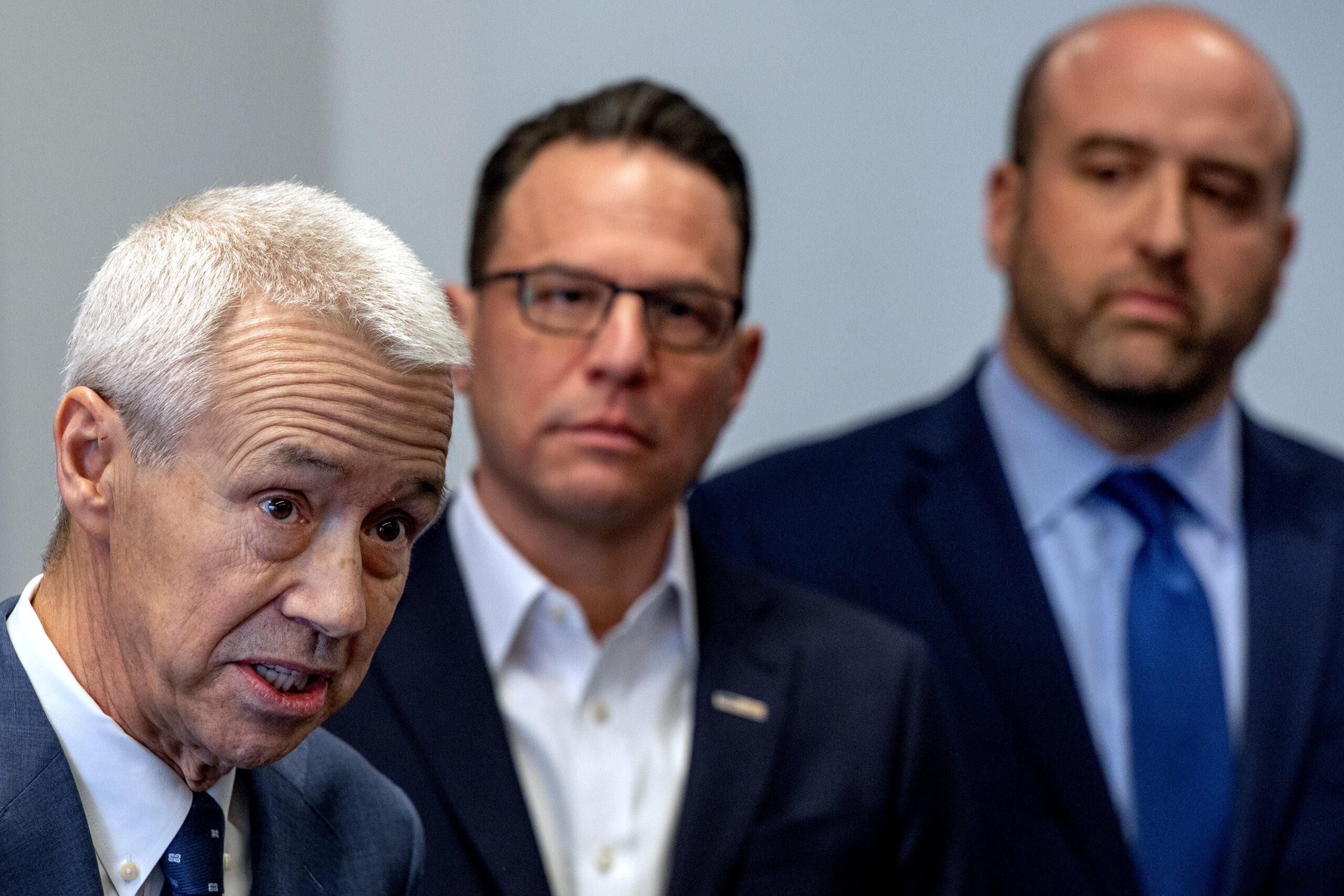
    Johnson & Johnson chairman and CEO Joaquin Duato (left), was joined by Gov. Josh Shapiro and Pa. Dept. of Community and Economic Development Secretary Rick Siger (right) on Wednesday when J&J announced it will spend $1 billion on a cell therapy plant on its campus in Lower Gwynedd Township.

    Merck, another New Jersey-based drug giant, last year announced plans for a $1 billion factory and lab near Wilmington. Merck also has major operations in Montgomery County, which is among the top-ranked counties nationally for pharmaceutical manufacturing jobs.

    J&J has a long legacy in the Philadelphia region. Among its major acquisitions here was the 1959 purchase of McNeil Laboratories, which later developed Tylenol. The pain reliever is still made at a plant in Fort Washington.

    Other major Philadelphia-area J&J deals include the 1999 purchase of Centocor, one of the country’s first biotech companies, and the 2012 deal for Synthes Inc., a Swiss medical device maker with its North American headquarters and major operations here.

    Separately from the new cell therapy manufacturing facility, J&J has two expansion projects planned for the Spring House R&D site.

    One is a new cell engineering and analytical sciences facility. The other is focused on CAR-T testing and manufacturing during research and development, with the goal of creating personalized therapies more quickly and efficiently. The company did not disclose the cost of those projects.

  • 260-apartment project is proposed for long-vacant site on Ridge Avenue in East Falls

    260-apartment project is proposed for long-vacant site on Ridge Avenue in East Falls

    A 260-apartment development, largely composed of one-bedroom units, is the latest residential project slated for 4401 Ridge Ave. in East Falls.

    The almost two-acre site has been long vacant and is now covered in trees. It is owned by the Philadelphia Housing Authority, which operated a dozen rental homes there until the late 1990s. The property is under an agreement of sale, according to the agency.

    Plans for the project were posted on the Philadelphia Planning Commission’s website Tuesday, showing a six-story building from Stokes Architecture & Design.

    The zoning paperwork in city records is signed by Eric Marshall, who is the principal with MGMT Residential. The company, based in Northwest Philadelphia, owns and manages hundreds of units in neighborhoods including Roxborough and Manayunk.

    MGMT itself is not the developer and will not own the property, according to the project’s zoning lawyer, Richard DeMarco, although the company will manage it once construction is completed.

    The development team declined to comment in advance of a neighborhood meeting Wednesday night.

    The plans show that the apartment building proposed for 4401 Ridge Ave. will offer 217 parking spaces. It will also host at least 8,000 square feet of commercial space, according to the East Falls Community Council, which has been negotiating with the developers.

    The neighborhood group’s zoning chair, Hilary Langer, reports progress at the discussions.

    He says that many neighbor concerns center on traffic, parking, and the preponderance of smaller units — a concern he does not personally share.

    “The … fact is that one-bedroom apartments are in demand and their vacancy rate is [almost] 10%, which is really the same as annual natural turnover,” Langer said in an email.

    Langer said that by his calculations, 115 two-bedroom apartments have been built in his neighborhood since 2021, and a quarter of them are still vacant. But 399 one-bedroom or studios have been constructed in that time frame, and only 12.5% of them are empty.

    An aerial rendering of the 260-unit apartment building proposed for 4401 Ridge Ave.

    The project needs approvals from the city’s Zoning Board of Adjustment to move forward, with a hearing set for March 25. It will appear before the advisory-only Civic Design Review committee on March 3.

    The last proposal for the site came in 2021 from Baltimore-based Atapco Properties. That project included 189 parking spaces for 185 apartments.

    That former proposal’s frontage was pushed back from Ridge Avenue, which the East Falls Community Council feared would make an already pedestrian unfriendly environment even worse.

    The newer development has the apartment building fronting on the sidewalk.

    “You’re not going to get walkability if you just put in plazas and parking lots,” Langer said. “This building, at the very least, it provides the chance of walkability.”