Blog

  • Claudette Colvin, who refused to move seats on a bus at start of civil rights movement, dies at 86

    Claudette Colvin, who refused to move seats on a bus at start of civil rights movement, dies at 86

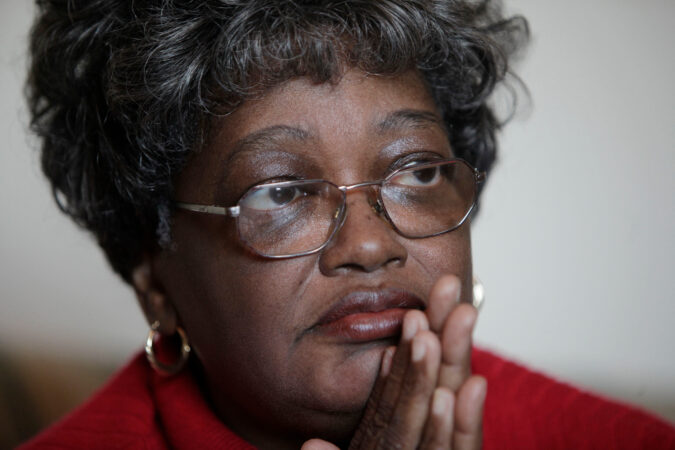
    On March 2, 1955, a 15-year-old Black high school junior named Claudette Colvin boarded a segregated city bus in Montgomery, Ala., taking a window seat near the back. When the driver ordered her to give up her seat so a white woman could be more comfortable, Ms. Colvin — who had been studying Black history in class, learning about abolitionists like Harriet Tubman and Sojourner Truth — did not budge.

    “History had me glued to the seat,” she said later, recalling how it felt as though Tubman and Truth had their hands on her shoulders, giving her “the courage to remain seated.”

    History would record that it was Rosa Parks, the longtime secretary of the local NAACP, who helped kick-start the modern civil rights movement by refusing to give up her seat on a crowded Montgomery bus.

    Yet it was Ms. Colvin, nine months earlier, who engaged in one of the first defiant challenges to the city’s Jim Crow transit system, remaining in her seat until police dragged her backward off the bus.

    While Parks’ stand proved far more consequential, leading to a year-long bus boycott that thrust the Rev. Dr. Martin Luther King Jr. to national prominence, Ms. Colvin’s arrest inaugurated what King described as a pivotal period for Black people in Montgomery. Community leaders formed a committee to meet with city and bus company officials, calling for improved treatment for Black passengers. Those discussions proved fruitless, King recalled in a memoir, but “fear and apathy” gradually gave way to “a new spirit of courage and self-respect.”

    Historian David Garrow said in an interview for this obituary that “Colvin’s experience proved a major motivating force for adult Black activists” including Jo Ann Robinson, who helped launch and sustain the bus boycott. Another leading figure in the boycott, lawyer Fred Gray, brought the federal lawsuit that overturned bus segregation, with Ms. Colvin serving as a plaintiff and star witness.

    “I don’t mean to take anything away from Mrs. Parks,” Gray said, “but Claudette gave all of us the moral courage to do what we did.”

    Ms. Colvin, who died Jan. 13 at 86, was almost forgotten in the annals of civil rights. Overshadowed by Parks and other activists, she spent decades in obscurity, caring for elderly patients as a nurse’s aide before gaining late-in-life recognition through the efforts of historians and writers such as Phillip Hoose, whose 2009 biography, Claudette Colvin: Twice Toward Justice, won the National Book Award for young people’s literature.

    “Young people think Rosa Parks just sat down on a bus and ended segregation, but that wasn’t the case at all,” Ms. Colvin told the New York Times in 2009. “Maybe by telling my story — something I was afraid to do for a long time — kids will have a better understanding about what the civil rights movement was about.”

    A movie based on her life, Spark, was announced in 2022, with actor Anthony Mackie lined up to make his directorial debut, and Saniyya Sidney slated to star.

    In the days after Ms. Colvin’s arrest, civil rights leaders in Montgomery wondered if her case might offer a chance to put segregation itself on trial. But, as Robinson later wrote in a memoir, “opinions differed where Claudette was concerned.”

    Some deemed her too young and immature, saying she was prone to profane outbursts. (Ms. Colvin said she never cursed.) There were also concerns about her class and background: She was looked down upon, Montgomery activist Gwen Patton once recalled with frustration, because she “lived in a little shack.”

    The deciding factor was the discovery by labor organizer E.D. Nixon, the local NAACP president, that Ms. Colvin was expecting a child. She later said that she became pregnant in the months after the bus standoff as a result of an encounter with a married man, which she described as statutory rape.

    “Even if Montgomery Negroes were willing to rally behind an unwed pregnant teenager — which they were not — her circumstances would make her an extremely vulnerable standard-bearer,” author Taylor Branch observed in Parting the Waters, a Pulitzer Prize-winning civil rights history.

    Ms. Colvin often said Nixon and other organizers were right to rally around Parks, who exuded a quiet authority, was familiar to activists from her work in the NAACP, and had an appeal that crossed class divisions through her job as a department-store seamstress.

    But Ms. Colvin remained frustrated by what she described as a lack of support and recognition in the years after she was arrested, when she struggled as a single mother to find work and eventually left Alabama for New York.

    “They wanted someone, I believe, who would be impressive to white people. … You know what I mean? Like the main star,” she told the Guardian in 2021. “And they didn’t think that a dark-skinned teenager, low income without a degree, could contribute. It’s like reading an old English novel when you’re the peasant, and you’re not recognized.”

    ‘I had had enough’

    Claudette Austin, as she was then known, was born in Birmingham, Ala., on Sept. 5, 1939. Her father, C.P. Austin, left the family when she was young.

    Her mother, Mary Jane Gadson, was unable to support Ms. Colvin and her younger sister by herself, and turned the children over to her aunt and uncle, Mary Ann and Q.P. Colvin. The older couple lived on a farm in Pine Level — the rural Alabama community where, by chance, Parks had gone to elementary school — and gave the girls their last name.

    When Ms. Colvin was 8, the family moved to nearby Montgomery, where her adoptive parents were hired by white families to do home and yard work. Her sister died of polio in 1952, shortly before Ms. Colvin started her first year at Booker T. Washington High School.

    Ms. Colvin was still grieving her sister’s death when her neighbor Jeremiah Reeves, an older schoolmate, was arrested and charged with raping a white woman. Following a confession he gave under duress and later retracted, he was convicted by an all-white jury, sentenced to death, and executed in 1958, at age 22.

    His arrest “was the turning point of my life,” Ms. Colvin said. As she saw it, the case embodied the hypocrisies of the legal system: Reeves was sent to death row as a juvenile because of a false confession, but when a white man raped a Black girl, “it was just his word against hers, and no one would ever believe her.”

    Ms. Colvin told Hoose that on the day the bus driver asked her to give up her seat, “rebellion was on my mind.”

    She was sitting in a row near the rear exit, joined by three schoolmates as the bus started filling up, and passengers stood in the aisle. Before long, a white woman was standing over Ms. Colvin and her peers. The driver asked for all four of their seats, so that the woman wouldn’t have to sit in the same row as a Black passenger.

    “I might have considered getting up if the woman had been elderly, but she wasn’t,” Ms. Colvin recalled. “She looked about 40. The other three girls in my row got up and moved back, but I didn’t. I just couldn’t.”

    Ms. Colvin remained seated as the driver grew exasperated — “Gimme that seat! Get up, gal!” — and hailed a transit policeman, who in turn summoned a squad car. Ms. Colvin said that as the police arrived, she began crying but remained defiant, telling the officers, “It’s my constitutional right to sit here as much as that lady. I paid my fare, it’s my constitutional right!”

    By her account, one of the officers kicked her as she was pulled off the bus. (One of the officers alleged that it was the other way around.) She was placed in handcuffs and put in a squad car, where, according to Ms. Colvin, the officers took turns trying to guess her bra size.

    Bailed out of jail by her minister, she returned home to fears of retaliation. Her adoptive father didn’t sleep that night, staying awake with a shotgun in case the Ku Klux Klan arrived. At school, classmates began to consider her a troublemaker, describing her as “that crazy girl off the bus.”

    Ms. Colvin was charged with assault and disorderly conduct in addition to violating the segregation law. Tried in juvenile court because of her age, she was found guilty of assault (a judge dismissed the other two charges), placed on indefinite probation and ordered to pay a small fine.

    Over the next few months, other Black women defied Montgomery’s segregated bus policy. The group included Lucille Times, who staged a one-woman boycott after an altercation with a driver, and 18-year-old Mary Louise Smith, who was arrested, convicted and fined after refusing to give up her seat.

    As with Ms. Colvin, organizers worried that Smith wasn’t right for a marquee case: Her father was said to be an alcoholic, and the family was deemed too low-class. It wasn’t until Parks’s arrest on Dec. 1, 1955, that a citywide bus boycott was organized.

    As the boycott progressed, Ms. Colvin became one of several plaintiffs in Browder v. Gayle, a federal lawsuit brought by Gray that challenged the city and state laws enforcing bus segregation in Montgomery. The case reached the U.S. Supreme Court, which ordered an end to bus segregation in late 1956.

    Ms. Colvin gave birth to her first son, Raymond, earlier that year. She never publicly identified the father and said she was expelled from high school as a result of her pregnancy.

    After passing a high school equivalency exam, she briefly attended Alabama State College in Montgomery and then moved in 1958 to New York, where she got a job as a live-in caregiver.

    She had a second son in 1960 and moved back and forth between New York and Montgomery — where her adoptive mother helped care for her children — before settling in New York City in 1968 and receiving training as a nurse’s aide.

    “The only thing I am still angry about is that I should have seen a psychiatrist,” she told The Washington Post in 1998, reflecting on her life after the movement. “I needed help. I didn’t get any support. I had to get well on my own.”

    Ms. Colvin’s death was confirmed by Ashley D. Roseboro, a spokesman for the family and for the Claudette Colvin Foundation. He said she died in hospice in Texas but did not share additional details.

    Her son Raymond died in 1993. Her younger son, Randy, worked as an accountant. He survives her, as do several sisters and grandchildren.

    In 2021, Ms. Colvin successfully petitioned to have her juvenile arrest record expunged, a symbolic act recognizing the injustice of the segregation laws.

    “I’m not doing it for me, I’m 82 years old,” she explained to the Times. “But I wanted my grandchildren and my great-grandchildren to understand that their grandmother stood up for something very important, and that it changed our lives a lot, changed attitudes.”

  • Trump is ending protected immigration status for Somalis, long a target of his anti-immigrant barbs

    Trump is ending protected immigration status for Somalis, long a target of his anti-immigrant barbs

    Donald Trump’s administration said Tuesday it will end temporary protected status for immigrants from Somalia, the latest move in the president’s mass deportation agenda.

    The move affects hundreds of people who are a small subset of immigrants with TPS protections in the United States. It comes during Trump’s immigration crackdown in Minneapolis, where many native Somalis live and where street protests have intensified since a U.S. Immigration and Customs Enforcement agent killed a U.S citizen who was demonstrating against federal presence in the city.

    The Department of Homeland Security said in a statement that affected Somalis must leave the U.S. by March 17, when existing protections, last extended by former President Joe Biden, will expire.

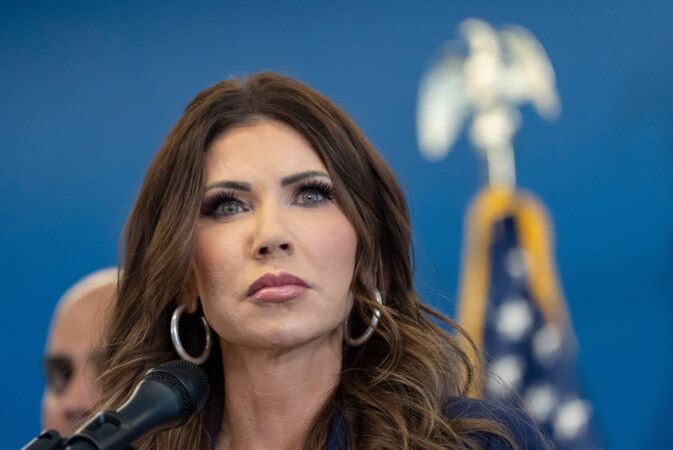
    “Temporary means temporary,” said Homeland Security Secretary Kristi Noem, adding that the decision puts “Americans first.”

    The Congressional Research Service last spring said the Somali TPS population was 705 out of nearly 1.3 million TPS immigrants. But Trump has rolled back protections across multiple countries in his second presidency.

    Congress established the Temporary Protected Status program in 1990 to help foreign nationals attempting to leave unstable, threatening conditions in their home countries. It allows the executive branch to designate a country so that its citizens are eligible to enter the U.S. and receive status.

    Somalia first received the designation under President George H.W. Bush amid a civil war in 1991. The status has been extended for decades, most recently by Biden in July 2024.

    Noem insisted circumstances in Somalia “have improved to the point that it no longer meets the law’s requirement for Temporary Protected Status.”

    Located in the horn of Africa, Somalia is one of the world’s poorest nations and has for decades been beset by chronic strife exacerbated by multiple natural disasters, including severe droughts.

    The 2025 congressional report stated that Somalis had received more than two dozen extensions because of perpetual “insecurity and ongoing armed conflict that present serious threats to the safety of returnees.”

    Trump has targeted Somali immigrants with racist rhetoric and accused those in Minneapolis of massively defrauding federal programs.

    In December, Trump said he did not want Somalis in the U.S., saying they “come from hell” and “contribute nothing.” He made no distinction between citizens and non-citizens or offered any opinion on immigration status.

    He has had especially harsh words for Rep. Ilhan Omar, a Minnesota Democrat who emigrated from Somalia as a child. Trump has repeatedly suggested she should be deported, despite her being a U.S. citizen, and in his rant last fall he called her “garbage.”

    Omar, who has been an outspoken critic of the ICE deployment in Minneapolis, has called Trump’s “obsession” with her and Somali-Americans “creepy and unhealthy.”

  • Trump visits a Ford pickup truck factory, aiming to promote his efforts to boost manufacturing

    Trump visits a Ford pickup truck factory, aiming to promote his efforts to boost manufacturing

    DETROIT — President Donald Trump offered a full-throated defense of his sweeping tariffs on Tuesday, traveling to swing-state Michigan to push the case that he’s boosted domestic manufacturing in hopes of countering fears about a weakening job market and still-rising prices that have squeezed American pocketbooks.

    Trump visited the factory floor of a Ford plant in Dearborn, where he viewed F-150s — the bestselling domestic vehicle in the U.S. — at various stages of production. That included seeing how gas and hybrid models were built, as well as the all-gas Raptor model, designed for off-road use.

    The president chatted with assembly line workers as well as the automaker’s executive chairman, Bill Ford, a descendent of Henry Ford. “All U.S. automakers are doing great,” Trump said.

    He later gave a speech to the Detroit Economic Club that was meant to be focused on his economic policies but veered heavily to other topics as well. Those included falsely claiming to have won Michigan three times (he lost the state in 2020 to Joe Biden) and recalling the snakes that felled workers during U.S. efforts to build the Panama Canal more than a century ago.

    “The results are in, and the Trump economic boom has officially begun,” the president said at the MotorCity Casino. He argued that “one of the biggest reasons for this unbelievable success has been our historic use of tariffs.”

    Trump insists tariffs haven’t increased costs

    The president said that tariffs were “overwhelmingly” paid by “foreign nations and middlemen” — even as economists say steep import taxes are simply passed from overseas manufactures to U.S. consumers, helping exacerbate fears about the rising cost of living.

    “It’s tariffs that are making money for Michigan and the entire country,” the president said, insisting that “every prediction the critics made about our tariff policy has failed to materialize.”

    But voters remain worried about the state of the economy. Tuesday’s visit — his third trip to a swing state since last month to talk about his economic policies — followed a poor showing for Republicans in November’s off-year elections in Virginia, New Jersey, and elsewhere amid persistent concerns about kitchen table issues.

    The White House pledged after Election Day that Trump would hit the road more frequently to talk directly to the public about what he is doing to ease their financial fears. The president tried to drive that home on Tuesday, but only amid lengthy asides.

    “I go off teleprompter about 80% of the time, but isn’t it nice to have a president who can go off teleprompter?” he said, before mocking Biden, suggesting his predecessor gave short speeches and doing an impression that included a dramatic clearing of his throat.

    Trump promised to unveil a new “health care affordability framework” later this week that he promised would lower the cost of care. He also pledged to soon offer more plans to help with affordability nationwide — even as he blamed Democrats for hyping up the issue.

    “One of our top priorities of this mission is promoting greater affordability. Now, that’s a word used by the Democrats,” Trump said. “They’re the ones who caused the problem.”

    Trump eased some auto tariffs

    Despite cheering tariffs, Trump has actually backed off the import taxes when it comes to the automobile sector. The president originally announced 25% tariffs on automobiles and auto parts, only to later relax those, seeking to provide domestic automakers some relief from seeing their production costs rise.

    Ford nonetheless announced in December that it was scrapping plans to make an electric F-150, despite pouring billions of dollars into broader electrification. That followed the Trump administration slashing targets to have half of all new vehicle sales be electric by 2030, eliminated EV tax credits and proposed weakening the emissions and gas mileage rules.

    While touring the assembly line, Trump suggested that a major North American trade agreement he negotiated during his first term, the United States-Mexico-Canada trade pact, was irrelevant and no longer necessary for the United States — though he provided few details.

    The pact, known as the USMCA, is up for review this year.

    Trump largely sidesteps Powell probe

    The president’s attempt to shift national attention to his efforts to spur the economy comes as his Department of Justice has launched a criminal investigation into Federal Reserve Chair Jerome Powell, a move that Powell says is a blatant endeavor to undermine the central bank’s independence in setting interest rates.

    Critics of the move include former Fed chairs, economic officials and even some Republican lawmakers. During the Michigan visit, Trump lobbed his often-repeated criticisms of Powell but offered little mention of the investigation.

    Some good economic news for Trump arrived, though, before he left Washington, with new data from December showing inflation declined a bit last month as prices for gas and used cars fell — a sign that cost pressures are slowly easing. Consumer prices rose 0.3% in December from the prior month, the Labor Department said, the same as in November.

    “We have quickly achieved the exact opposite of stagflation, almost no inflation and super-high growth,” he said in his speech.

    Other economic policy speeches

    The Michigan stop follows speeches Trump gave last month in Pennsylvania — where his gripes about immigrants arriving to the U.S. from “filthy” countries got more attention than his pledges to fight inflation — and North Carolina, where he also insisted his tariffs have spurred the economy, despite residents noting the sting of higher prices.

    Like in Michigan, Trump also used a casino as a backdrop to talk about the economy in Pennsylvania, giving his speech there at Mount Airy Casino Resort in Mount Pocono.

    Trump carried Michigan in 2016 and 2024, after it swung Democratic and backed Biden in 2020. He marked his first 100 days in office with a rally-style April speech outside Detroit, where he focused more on past campaign grudges than his administration’s economic or policy plans.

    Democrats seized on Trump’s latest visit to the state to recall his visit in October 2024, when Trump, then also addressing the Detroit Economic Club, said that Democrats’ retaining the White House would mean “our whole country will end up being like Detroit.”

    “You’re going to have a mess on your hands,” Trump said during a campaign stop back then.

    Michigan Democratic Party Curtis Hertel said in a statement that “Trump’s speech showed just how out-of-touch he is with reality, claiming that affordability is ‘fake’ as Michiganders have less money in their pocketbooks because of the Republicans’ price-hiking agenda.”

  • NYC Council employee’s arrest sparks protests and a dispute over his immigration status

    NYC Council employee’s arrest sparks protests and a dispute over his immigration status

    NEW YORK — A New York City Council employee detained in the Trump administration’s immigration crackdown is an asylum-seeker from Venezuela, according to a court petition seeking his release.

    Rafael Andres Rubio Bohorquez was arrested Monday at a scheduled immigration check-in, enraging city leaders and drawing protesters Tuesday to the Manhattan federal building where he is being held.

    U.S. Immigration and Customs Enforcement said Rubio Bohorquez had long overstayed a tourist visa, had once been arrested for assault and “had no legal right to be in the United States.”

    City Council Speaker Julie Menin disputed that, telling reporters that Rubio Bohorquez, a data analyst for the city legislative body, was legally authorized to work in the U.S. until October.

    Menin, a Democrat, said the Council employee signed a document as part of his employment confirming that he had never been arrested and cleared the standard background check conducted for all applicants.

    The court petition, reviewed Tuesday by The Associated Press, said Rubio Bohorquez — identified in the document as R.A.R.B. — had always been seeking asylum and was arrested at a U.S. Citizenship and Immigration Services asylum office in Bethpage, on Long Island.

    Menin called it a regular check-in that “quickly went awry.”

    The document, known as a petition for writ of habeas corpus, said Rubio Bohorquez has no criminal record — no arrests, charges or convictions. A hearing on the petition is scheduled for Friday.

    ICE confirmed Rubio Bohorquez’s name. Menin said she wanted to protect his identity and referred to him only as a Council employee.

    “We are doing everything we can to secure his immediate release,” Menin told reporters Monday. She decried the arrest as “egregious government overreach.”

    New York City Mayor Zohran Mamdani, a Democrat, said he was “outraged” by what he called “an assault on our democracy, on our city, and our values.”

    New York Gov. Kathy Hochul, a Democrat, referenced Rubio Bohorquez’s arrest in her state of the state speech on Tuesday, asking: “Is this person really one of the baddest of the bad? Is this person really a threat?”

    Hochul added: “I will do whatever it takes to protect New Yorkers from criminals, but people of all political beliefs are saying the same thing about what we’ve seen lately: Enough is enough.”

    Menin said officials were attempting to reach Rubio Bohorquez’s family and obtain contact information for his immigration lawyer.

    The nonprofit New York Legal Assistance Group filed the habeas petition on Rubio Bohorquez’s behalf. The organization’s president and CEO, Lisa Rivera, said it represents dozens of people who have been wrongfully detained by ICE and hundreds who are following immigration procedures in hopes of staying in the U.S.

    “This staffer, who chose to work for the city and contribute his expertise to the community, did everything right by appearing at a scheduled interview, and yet ICE unlawfully detained him,” Rivera said in a statement.

    According to ICE, Rubio Bohorquez entered the U.S. in 2017 on a B2 tourist visa and was required to leave the country by Oct. 22, 2017. He has been employed by the City Council for about a year, Menin said. His position pays about $129,315 per year, according to city payroll data.

    “He had no work authorization,” ICE said in a statement confirming Rubio Bohorquez’s arrest. The agency, part of the Department of Homeland Security, said that under Secretary Kristi Noem “criminal illegal aliens are not welcome in the United States. If you come to our country illegally and break our law, we will find you and we will arrest you.”

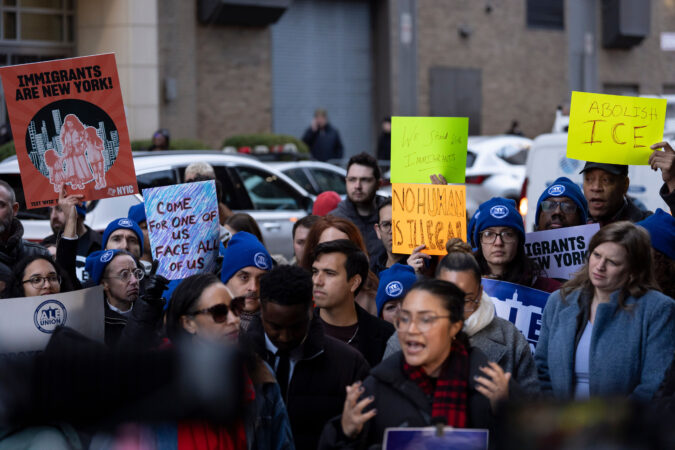
    Several dozen people protested Tuesday outside the Greater New York Federal Building, where Rubio Bohorquez was being held. Some carried signs that said “Abolish ICE” and “No Human Is Illegal.”’

    Venezuela, whose former President Nicolás Maduro was seized Jan. 3 by U.S. forces, has been roiled for years by violence and economic instability. Nearly 8 million people have fled the South American nation since 2014, according to the United Nations refugee agency.

    Last year, President Donald Trump’s administration ended Temporary Protected Status that had been allowing hundreds of thousands of Venezuelan refugees to live and work in the U.S. without fear of deportation. It wasn’t clear from court papers whether Rubio Bohorquez had been a part of that program.

    Disputes over an immigrant’s work authorization have arisen before, in part because many employers rely on E-Verify. The system compares information provided by employees with records available to the government but doesn’t automatically notify an employer if an employee’s right to work is later revoked.

  • Top prosecutors in D.C., Minneapolis leave amid turmoil over shooting probe

    Top prosecutors in D.C., Minneapolis leave amid turmoil over shooting probe

    Multiple senior prosecutors in Washington and Minnesota are leaving their jobs amid turmoil over the Trump administration’s handling of the shooting death of a Minneapolis woman.

    The departures include at least five prosecutors from the U.S. Attorney’s Office in Minneapolis, including the office’s second-in-command, according to emails obtained by The Washington Post and people familiar with the matter.

    Their resignations followed demands by Justice Department leaders to investigate the widow of Renée Good, the 37-year-old woman killed last week by an Immigration and Customs Enforcement officer who shot into her car, according to a person familiar with the resignations who spoke on the condition of anonymity out of concern for retaliation. Good’s wife was protesting ICE officers in the moments before the shooting.

    Five senior prosecutors in the criminal section of the Justice Department’s Civil Rights Division also said they are leaving, according to four people familiar with the personnel moves, who spoke on the condition of anonymity to discuss personnel matters.

    In another development, Deputy Attorney General Todd Blanche said in a statement that “there is currently no basis for a criminal civil rights investigation.” The statement, first reported by CNN, did not elaborate on how the department had reached a conclusion that no investigation was warranted.

    Federal officials have said that the officer acted in self-defense and that the driver of the Honda was engaging in “an act of domestic terrorism” when she pulled forward toward him.

    The departures wipe both the Civil Rights Division’s criminal section and U.S. Attorney’s Office in Minnesota of its most experienced prosecutors. The moves are widely seen as a major vote of no-confidence by career prosecutors at a moment when the department is under extreme scrutiny.

    The criminal section of the Civil Rights Division is the sole office that handles criminal violations of the nation’s civil rights laws. For years, the Justice Department has relied on the section to prosecute major cases of alleged police brutality and hate crimes. The departures followed the administration’s highly unusual decision to not include the Civil Rights Division in the initial investigation of the shooting.

    The Civil Rights Division departures include the criminal section’s longtime chief and deputy — Jim Felte and Paige Fitzgerald — career attorneys who served in their positions during President Donald Trump’s first administration and through President Joe Biden’s administration. Three other supervisors and senior litigators are also leaving.

    The prosecutors in Minnesota did not immediately respond to requests for comment. Felte and Fitzgerald also did not immediately respond to requests for comment Monday evening.

    The Civil Rights prosecutors informed their colleagues of their resignations Monday. People familiar with the section, who spoke on the condition of anonymity to discuss personnel matters, said the lawyers who are leaving did not attribute their decisions to the Minnesota investigation.

    The department has been offering voluntary early retirement packages to certain sections, and some of the departing civil rights prosecutors qualified for that option. Some indicated to their colleagues before the Minnesota shooting that they were considering the retirement packages.

    “Although we typically don’t comment on personnel matters, we can confirm that the Criminal Section Leadership gave notice to depart the Civil Rights Division and requested to participate in the Department of Justice’s Early Retirement Program well before the events in Minnesota. Any suggestion to the contrary is false,” a Justice Department official said in a statement.

    Deputy Attorney General Todd Blanche released a statement saying: “There is currently no basis for a criminal civil rights investigation” into the shooting.

    Trump’s appointees at the Justice Department pushed out and transferred many of the section heads and deputies in the Civil Rights Division in the early days of the administration. But the leadership of the criminal section was largely left intact.

    For months, however, frustration has been growing within the section, according to people familiar with the division who said that further resignations are likely. Many lawyers in the office have said they feel the administration has prevented prosecutors from doing their work. The administration has repeatedly reversed positions on cases that the section has spent years litigating.

    In July, for example, the Civil Rights Division told a judge that the Biden administration should not have prosecuted the Louisville police officer convicted in connection with a raid that resulted in Breonna Taylor’s death — and asked that the officer receive one day in jail. In November, the administration successfully pushed to dismiss a police brutality case in Tennessee, which was set to go to trial that month. The Civil Rights Division had been litigating that case for more than two years.

    Within the Justice Department, the Civil Rights Division typically experiences the sharpest swings in priorities between Republican and Democratic administrations. But several former officials interviewed by The Washington Post described the shifts implemented so far under the Trump administration as more intense than anticipated.

    In the first Trump administration, former Justice Department officials said, the division was largely left intact. The section did not pursue actions against police departments in the way that Democratic administrations had, but it prosecuted police brutality cases and continued to focus on prosecuting hate crimes, protecting disability rights and enforcing employment laws.

    During the current administration, the division has dramatically changed its mission. A majority of its nearly 400 attorneys left in 2025 as a result. The head of the Civil Rights Division, Harmeet Dhillon, changed mission statements across the sections to focus less on racial discrimination and more on fighting diversity initiatives. The division has also aggressively pursued cases alleging antisemitism and anti-Christian bias.

    After conservative activist Charlie Kirk was killed in September at a public event at Utah Valley University, the Civil Rights Division launched a hate-crime probe. The investigation is examining whether hate-crime charges can be pursued against the suspect because of anti-Christian bias, according to a person familiar with the probe.

    Prosecutors have also explored whether it would be possible to pursue hate-crime charges against the suspect, Tyler Robinson, if evidence shows motivation because of Kirk’s stance on transgender individuals — a move that would be a novel use of hate-crime laws. Robinson’s romantic partner was undergoing a gender transition at the time of the shooting, his mother told police.

    Dhillon has said she welcomes people to leave if they do not agree with the new direction for the department. Dhillon told conservative podcaster Glenn Beck in April that she intended to send a new message to her staff.

    “These are the president’s priorities,” Dhillon said on the podcast. “This is what we will be focusing on. Govern yourself accordingly.”

    MS NOW reported the civil rights resignations late Monday night.

    Dhillon has also said that her office is being flooded with applicants to fill vacant roles. But people familiar with the division said that just a fraction of the open roles have been filled, a process impeded by a lack of qualified candidates and bureaucratic delays. Some of the sections within the division are so understaffed that they cannot effectively complete their workloads.

    “This exodus is a huge blow signaling the disrespect and sidelining of the finest and most experienced civil rights prosecutors,” said Vanita Gupta, the head of the division during the Obama administration and the associate attorney general during the Biden administration. “It means cases won’t be brought, unique expertise will be lost, and the top career attorneys who may be a backstop to some of the worst impulses of this administration will have left.”

    The Civil Rights Division was established in 1957 as part of that year’s Civil Rights Act, which focused on fighting racial discrimination. Since its launch, the division has been tasked with upholding “the civil and constitutional rights of all people in the United States, particularly some of the most vulnerable members of our society,” according to the Justice Department’s website.

    The office has 12 sections that aim to combat discrimination in educational opportunities, housing, employment, voting and more.

    A Justice Department official also said that ICE has been conducting its own investigation of the Minnesota shooting.

    “As with any officer-involved shooting, each law enforcement agency has an internal investigation protocol, including DHS. As such, ICE OPR has its own investigation underway. This runs parallel to any FBI investigation,” the official said, referring to the Office of Professional Responsibility.

    This article includes information from the Associated Press.

  • Viral 11-year-old Eagles fan Sam Salvo wanted Kevin Patullo flipping burgers. Now he says ‘it worked.’

    Viral 11-year-old Eagles fan Sam Salvo wanted Kevin Patullo flipping burgers. Now he says ‘it worked.’

    When 11-year-old Sam Salvo woke up on Christmas morning, he was surprised with tickets to the Eagles’ wild-card game. When he woke up on Monday morning, after the Eagles’ loss, he was all over the internet, thanks to his viral postgame rant.

    “[When I got the tickets], I didn’t know who they were playing, but I was already excited,” Salvo said. “I thought they were going to win. I was like ready to do a backflip. I was so excited.”

    Salvo remembers the excitement leading up to kickoff. Lincoln Financial Field, covered in Eagles green as fans piled in to watch the Birds take on the San Francisco 49ers, was ready to erupt. The Eagles took a six-point lead into the fourth quarter, but their Super Bowl defense ended early with a 23-19 defeat.

    “It went from everyone being excited to be there, everyone getting ready for a dub,” Salvo said. “Then everyone got pretty sad really quickly. Everyone around me was sad.”

    However, one fan in the crowd said something that resonated with Salvo: Win or lose, we’re the [expletive] Birds.

    So Salvo left the stadium with his head held high, despite the crushing loss, and that’s when an opportunity presented itself. As he and his father walked toward the parking lot, they noticed 6abc reporter Briana Smith conducting interviews.

    “When we were walking past the broadcaster, my dad was like, ‘No, I’m not trying to waste any time here,’” Salvo said. “And then I said, ‘I want to do it.’ So, I did it.”

    The Blue Bell native stepped up to the microphone and let out what has become one of the most viral lines to come out of the Eagles’ playoff loss: I also want Kevin Patullo flipping burgers at the local McDonald’s.

    “Whenever he’s an offensive coordinator,” Salvo told the camera, “it’s like he’s flipping burgers. … One half he’s cooking, and the other half is completely raw.”

    The original post has more than a million likes. For Salvo, the attention was unexpected.

    “Absolutely not [was I expecting it to go viral]. I had no idea,” the sixth grader said. “I was just hyped that I was on the news. Small win. But I never thought that I would expand this far.”

    The video has gained more than 20 million views on Instagram alone — in fact, that’s just the original post, and does not count the tens of millions of views its received on other platforms and in other posts. Naturally, Salvo has become quite the popular kid.

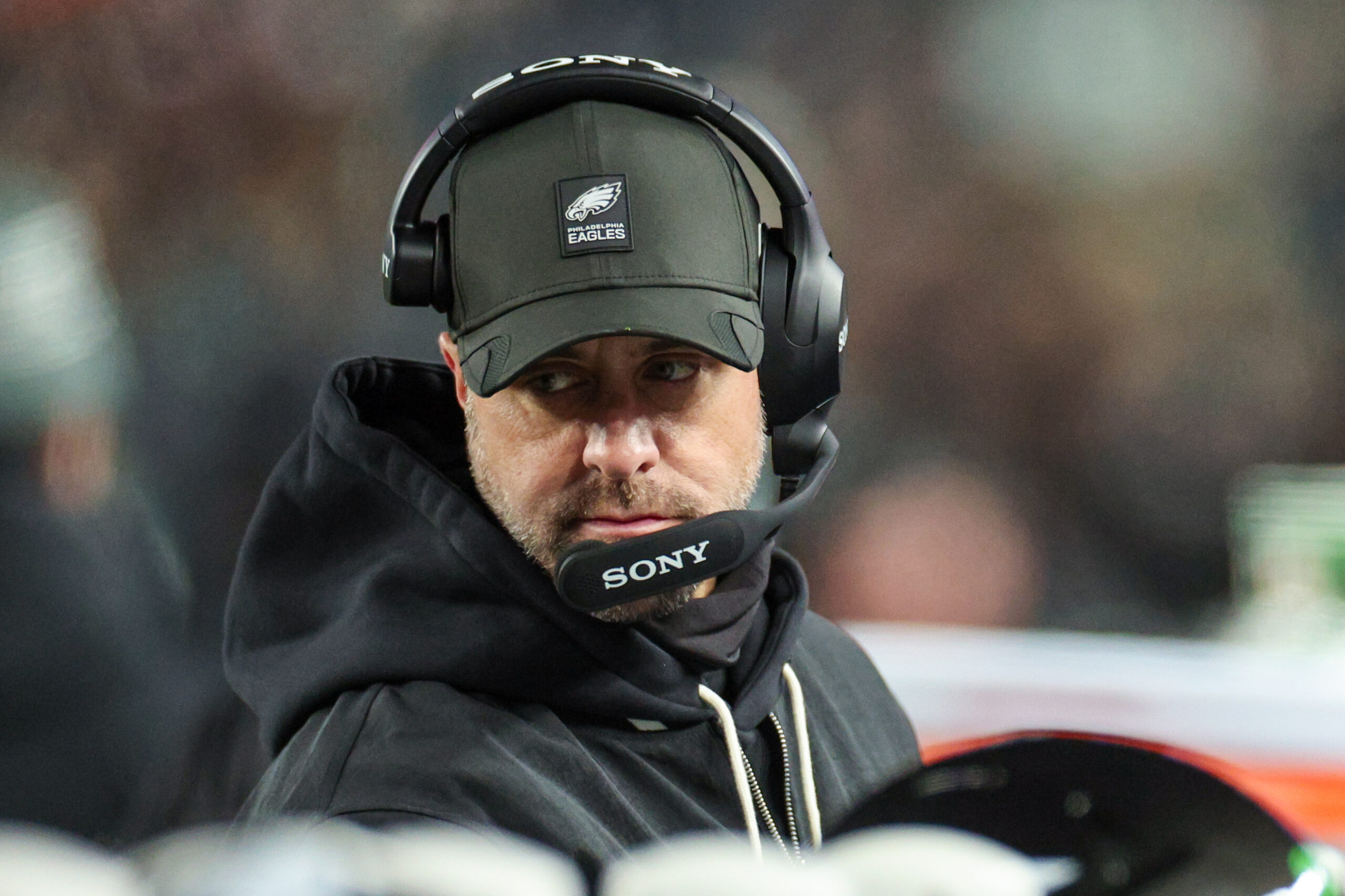
    But the thing Salvo is most excited about is that Patullo has now been removed as the Eagles offensive coordinator.

    “[After the game] I was thinking about how much the offense changed when Kevin Patullo came in,” Salvo said shortly after the news broke Tuesday. “So I just wanted to say anything about him that could get him fired. And it worked.

    “I’m feeling good about it. Now we can hire a new offensive coordinator. If we could get Mike McDaniel as offensive coordinator, I think that would be great.”

    Kevin Patullo lasted just one season as the Eagles offensive coordinator.

    Salvo says he’s been bleeding green ever since his uncle gave him his first jersey … when he was born. Now, he also enjoys watching and analyzing games, listening to New Heights with Travis and Jason Kelce, and tuning into The Pat McAfee Show.

    “He’s always been around grown-ups,” said his mother Zuzana. “So football Sundays have always been a huge thing. The talk and all that stuff has always been a big part of his life. You cannot stop that fire.”

    Salvo’s passion for football is something he hopes to turn into a career down the line, if he doesn’t become a pro tennis player.

    “I will absolutely try and be a football announcer,” Salvo said. “I don’t care if it’s college football, just any football.”

    And as far as next steps for the Eagles this offseason, Salvo has a few more opinions on Eagles wide receiver A.J. Brown, whom he also said also needs to go during his viral interview.

    “I’m not going to be mad if he stays, but I need him to show a little bit more effort,” Salvo said. “Because it’s been kind of annoying when we’ve been throwing him deep balls and he’s been showing no effort to even try and catch it.”

    Brown, who had a heated exchange with Nick Sirianni during Sunday’s loss, has dodged the media twice since the end of the season.

    But if anyone can get a reaction, it’s Salvo.

  • Russia launches another major strike on Ukraine’s power grid in freezing temperatures

    Russia launches another major strike on Ukraine’s power grid in freezing temperatures

    KYIV, Ukraine — Russia launched a second major drone and missile bombardment of Ukraine in four days, officials said Tuesday, aiming again at the power grid amid freezing temperatures in an apparent snub to U.S.-led peace efforts as Moscow’s invasion of its neighbor approaches the four-year mark.

    Russia fired almost 300 drones, 18 ballistic missiles and seven cruise missiles at eight regions overnight, Ukrainian President Volodymyr Zelensky said on social media.

    One strike in the northeastern Kharkiv region killed four people at a mail depot, and several hundred thousand households were without power in the Kyiv region, Zelensky said.

    The daytime temperature in Kyiv, which has endured freezing temperatures for more than two weeks, was about 10 degrees, with streets covered in ice and the rumble of generators heard throughout the capital.

    Kyiv has grappled with severe power shortages for days, although Mayor Vitali Klitschko said Monday night’s strikes caused the biggest electrical outage the city has faced so far.

    Kyiv residents huddle for warmth

    More than 500 residential buildings remained without central heating Tuesday. Throughout the city, bare trees were weighed down with icicles and snow was piled up next to sidewalks.

    Olena Davydova, 30, charged her phone at what is called a “Point of Invincibility” shelter in Kyiv’s Dniprovskyi district. The government-built temporary installations, often large tents on the sidewalk, provide food, drinks, warmth and electricity.

    Davydova said she had been without power for nearly 50 hours. That forced her to adopt some new routines: sleeping in one bed with her child and two cats, storing fresh food on the balcony, and using candles after dark.

    She says she is taking the changes in stride. “I still have enough patience. I’m not reacting to this in a very emotional way,” she told The Associated Press.

    Elsewhere, friends and relatives gathered in apartments still with power or hot water, at least temporarily, to charge their phones, take showers, or share a warm drink.

    Klitschko ordered the city to provide one hot meal per day to needy residents. He also announced that workers in the city’s water, heating and road maintenance services would receive bonuses for working “day and night” to restore critical infrastructure.

    U.S. calls out ‘inexplicable’ Russian escalation

    Four days earlier, Russia also sent hundreds of drones and dozens of missiles in a large-scale overnight attack and, for only the second time in the war, it used a powerful new hypersonic missile that struck western Ukraine in what appeared to be a clear warning to Kyiv’s NATO allies that it won’t back down.

    On Monday, the U.S. accused Russia of a “dangerous and inexplicable escalation ” of the fighting at a time when the Trump administration is trying to advance peace negotiations.

    Tammy Bruce, the U.S. deputy ambassador to the United Nations, told an emergency meeting of the U.N. Security Council that Washington deplores “the staggering number of casualties” in the conflict and condemns Russia’s intensifying attacks on energy and other infrastructure.

    Russia has sought to deny Ukrainian civilians heat and running water over the course of the war, hoping to wear down public resistance to Moscow’s full-scale invasion, which began on Feb. 24, 2022. Ukrainian officials describe the strategy as “weaponizing winter.”

    The attack in Ukraine’s Kharkiv region also wounded 10 people, local authorities said.

    In the southern city of Odesa, six people were wounded in the attack, said Oleh Kiper, the head of the regional military administration. The strikes damaged energy infrastructure, a hospital, a kindergarten, an educational facility and a number of residential buildings, he said.

    2025 deadliest year for Ukrainian civilians

    Last year was the deadliest for civilians in Ukraine since 2022 as Russia intensified its aerial barrages behind the front line, according to the U.N. Human Rights Monitoring Mission in the country.

    The war killed 2,514 civilians and injured 12,142 in Ukraine — 31% higher than in 2024, it said.

    “The sharp increase in long-range attacks and the targeting of Ukraine’s national energy infrastructure mean that the consequences of the war are now felt by civilians far beyond the front line,” Danielle Bell, the agency’s head, said in a statement Monday.

    Zelensky said Ukraine is counting on quicker deliveries of agreed upon air defense systems from the U.S. and Europe, as well as new pledges of aid to counter Russia’s latest onslaught.

    Meanwhile, Russian air defenses shot down 11 Ukrainian drones overnight, Russia’s Defese Ministry said Tuesday. Seven were reportedly destroyed over Russia’s Rostov region, where Gov. Yuri Slyusar confirmed an attack on the coastal city of Taganrog, about 24 miles east of the Ukrainian border, in Kyiv’s latest long-range attack on Russian war-related facilities.

    Ukraine’s military said its drones hit a drone manufacturing facility in Taganrog. The Atlant Aero plant designs, manufactures and tests Molniya drones and components for Orion unmanned aerial vehicles, according to the General Staff of the Armed Forces of Ukraine. Explosions and a fire were reported at the site, with damage to production buildings confirmed, the General Staff said.

    It wasn’t possible to independently verify the reports.

  • More Americans are surviving cancer — even the deadliest ones

    More Americans are surviving cancer — even the deadliest ones

    More Americans diagnosed with cancer are now surviving the disease — marking a positive trend that experts say reflects the effectiveness of early prevention and detection strategies, and advancements in treatment and care.

    New findings from the American Cancer Society’s annual report released Tuesday show for the first time that the five-year survival rate for all cancers has reached 70%, with the most notable survival gains occurring among people diagnosed with more fatal cancers such as myeloma (a blood cancer), liver cancer, and lung cancer.

    “Seven in 10 people now survive their cancer five years or more, up from only half in the mid-70s,” Rebecca Siegel, senior scientific director of surveillance research at ACS and lead author of the report, said in a news release. “This stunning victory is largely the result of decades of cancer research that provided clinicians with the tools to treat the disease more effectively, turning many cancers from a death sentence into a chronic disease.”

    Living longer

    The cancer mortality rate has continued to decline through 2023, averting 4.8 million deaths since 1991, according to the report. In 2026, the United States is expected to see upward of 2 million new cancer cases and more than 626,000 deaths related to the disease. Cancer incidence and mortality generally appears to be higher among men than women, the report found.

    Improvements in survival rates can largely be attributed to less tobacco use, better ways to detect cancers early, and the development of more effective treatments, said William Dahut, chief scientific officer for ACS. Importantly, he noted, advancements in cancer care, such as novel therapies, that have led to people living longer would not have been possible without funding research.

    In early 2025, the Trump administration slashed millions in health research grants, including money that had been earmarked for cancer studies.

    “The thing to focus on is really the importance of scientific funding and scientific discovery to really drive improvements in five-year survival,” said Dahut, who added that the trends being observed in patients with metastatic cancer, in which the disease has spread to other parts of the body, are “particularly striking.”

    The survival rate for people with metastatic rectal cancer, for instance, increased from 8% in the mid-1990s to 18%. Meanwhile, the percentage of patients who survive a diagnosis of metastatic lung cancer is up to 10% from 2%.

    “Overall, the findings in this report are highly encouraging and demonstrate that meaningful progress has been made in the fight against cancer,” said Sharon Giordano, chair of breast medical oncology at the University of Texas MD Anderson Cancer Center, who was not involved in the research.

    More to learn

    Experts emphasized that there is still work to be done to better understand different types of cancers and how to treat them.

    “Decades of research and work in this area have led to longer, better lives for millions of Americans with cancer,” said Cardinale Smith, chief medical officer at Memorial Sloan Kettering Cancer Center, who was not involved in the report. “This continued progress also depends on the sustained investment that we’ve had in the research that has gotten us here.”

    Despite reductions in smoking, the report found that lung cancer is expected to cause the most cancer deaths in 2026. While smoking continues to be the main driver of lung cancer cases, more people who have never smoked are also being diagnosed, and scientists are working to understand why. Some experts have called for changes to lung cancer screening guidelines that would increase the number of people who can be screened.

    The report also highlighted that racial disparities continue to exist.

    Native American people have the highest cancer mortality and are two times more likely than white people to die of kidney, liver, stomach, and uterine cervix cancers. Young people who are Alaskan Natives are most likely to be diagnosed with colorectal cancer, Dahut said, adding that rates of the disease in this population are “the highest in the world.”

    Cancer survival is lower among Black people than white people for nearly every cancer type, the report notes. Researchers largely attributed the gap to less access to high-quality care from prevention to diagnosis and treatment.

    Supporting survivors

    While better survival rates should inspire hope in people, Dahut said there is a critical need to improve care for the growing number of survivors.

    As of January last year, there were more than 18.6 million cancer survivors in the United States — a figure that is projected to exceed 22 million by 2035, according to ACS.

    “In our current medical system, we don’t really have a great model for who’s best to follow cancer survivors,” Dahut said. Many primary care providers don’t have expertise in survivorship and cancer recurrence, he added.

    “Having more and more survivors is great,” he said. “But I think we’re going to have to come up with strategies in order to ensure that they’re cared for in a way that’s consistent across the country.”

  • Jesús Luzardo ‘really interested’ in a contract extension with the Phillies

    Jesús Luzardo ‘really interested’ in a contract extension with the Phillies

    Jesús Luzardo hasn’t spoken with the Phillies yet about a contract extension.

    But it’s a conversation he would like to have.

    “It’s not something that I’m closed off to,” said Luzardo, appearing as a guest this week on Phillies Extra, The Inquirer’s baseball podcast. “I just got married and hopefully eventually have a family, and just being stable in a certain place, knowing that you’re comfortable within an organization … it’s something I would be really interested in.”

    Stability has eluded Luzardo since he got drafted in 2016. The 28-year-old lefty has been traded three times — from the Nationals to the Athletics in 2017, the Athletics to the Marlins in 2021, and the Marlins to the Phillies before last season.

    But Luzardo’s first year with the Phillies was the best of his career. He made 32 starts and worked 183⅔ innings, both career highs. He posted a 3.92 ERA that was inflated by nearly one run by back-to-back starts in which he believed he was tipping pitches. And he incorporated a sweeping slider that became his go-to breaking pitch.

    “It’s an organization that I had a really good time in,” Luzardo said. “I love the city, I loved where I lived, and the organization as a whole, how they treat us as players, how they treated my family. But at the end of the day, it’s not entirely up to me or in my hands.

    Jesús Luzardo, who pitched for Venezuela in 2023, said he’s skipping this year’s World Baseball Classic.

    “I’m a firm believer that what is supposed to happen will happen. I haven’t had any of those conversations yet. If they were to come, I would be open to hearing them.”

    Regardless, Luzardo said he won’t be in the World Baseball Classic despite receiving calls from Team USA and Venezuela. He pitched for Venezuela in 2023.

    “Going into a free-agency year, I made the decision that, unfortunately, I’m not going to be able to pitch in the Classic,” Luzardo said. “I want to take my time, take a slow spring training, fully get ready with the team, make sure my body bounced back after a career high in innings.”

    Meanwhile, lefty Cristopher Sánchez is interested in representing the Dominican Republic in the WBC, a major league source said this week. Sánchez was the Cy Young runner-up in the National League last year. Kyle Schwarber and Bryce Harper committed to playing for Team USA in the tournament, which runs from March 5-17; catcher Garrett Stubbs intends to play for Israel.

    Luzardo will make $11 million this year and could be in line to at least double that salary with another good season. Two potential barometers: Framber Valdez and former Phillies teammate Ranger Suárez, free-agent lefties who could sign nine-figure contracts before spring training.

    The Phillies will have $38 million rolling off the books after this season when Nick Castellanos and Taijuan Walker’s contracts expire. But they have $165.9 million committed to seven players for 2027: Zack Wheeler, Schwarber, Trea Turner, Harper, Aaron Nola, Brad Keller, and Sánchez. And they had a Zoom call Monday with free-agent infielder Bo Bichette about a long-term contract that would add another big salary.

    Extra bases

    The Phillies acquired righty reliever Chase Shugart from the Pirates for minor-league infielder Francisco Loreto. Shugart, 29, got designated for assignment after posting a 3.40 ERA in 35 appearances last season for Pittsburgh. He has minor-league options and figures to provide more depth to the bullpen.

  • Hundreds more Venezuelans come forward to register relatives as ‘political prisoners’

    Hundreds more Venezuelans come forward to register relatives as ‘political prisoners’

    GUANARE, Venezuela — Freedom came too late for Edilson Torres.

    The police officer was set to be buried Tuesday in his humble, rural hometown following his death in a Venezuelan prison, where he was held incommunicado since his December detention on what his family said were politically motivated accusations. Hours ahead of the ceremony, his children, neighbors, police officers, friends and dozens others gathered to pay their respects.

    Torres, 51, died of a heart attack on Saturday, just as his family awaited the government’s promised release of prisoners following the U.S. capture of then-President Nicolás Maduro. His death comes as scores of families like his — who once hesitated to approach advocacy groups — are now coming forward to register their loved ones as “political prisoners.”

    Alfredo Romero, director of the organization Foro Penal, a non-governmental organization that tracks and advocates for Venezuelan prisoners, said the group has received a “flood of messages” since last week from families.

    “They didn’t report it out of fear, and now they’re doing it because, in a way, they feel that there is this possibility that their families will be freed,” Romero said. “They see it as hope, but more importantly, as an opportunity.”

    The head of Venezuela’s national assembly, Jorge Rodríguez, said last week that a “significant number” of Venezuelan and foreigners imprisoned in the country would be released as a gesture to “seek peace” following the explosions that rocked the South American nation in the early hours of Jan. 3.

    The U.S. and Venezuela’s opposition have long demanded the widespread release of detained opposition figures, activists and journalists, whom they claim are used as a political tool by the ruling party.

    Venezuela’s government denies that there are prisoners unjustly detained, accusing them of plotting to destabilize Maduro’s government.

    ‘Pure and real kidnapping’

    Following Torres’ death, Venezuela’s Attorney General Tarek William Saab said in a statement that the case had been assigned to a terrorism unit and “was linked to criminal activities detected by state security agencies.” He did not offer any details, but the vague language tracks with past accusations leveled against real or perceived government critics.

    Romero explained that of the roughly 300 families who reached out, about 100 cases so far have been confirmed as politically motivated. Most of those reported over the past few days, he said, once worked for Venezuela’s military. That is on top of more than 800 people that the organization says continue to be detained for political reasons in Venezuela.

    As of Tuesday morning, Foro Penal had confirmed the release of 56 prisoners. While Venezuela’s government reported a higher figure of 116, it did not identify them, making it impossible to determine whether those freed were behind bars for political or other reasons.

    “My little brother, my little brother,” Emelyn Torres said between sobs after his casket, cloaked in Venezuela’s flag, arrived at her home for the wake. A few feet away, their grandmother nearly fainted as dozens of people crammed into the living room to pay their respects.

    Hours earlier, as a minivan transported the body of her brother 267 miles from the capital, Caracas, to Guanare, Torres learned that other men linked to the WhatsApp group that led to her brother’s arrest had just been released from prison. She wailed. He did not live long enough to walk free.

    Among those who have been released are: human rights attorney Rocío San Miguel, who immediately relocated to Spain; Biagio Pilieri, an opposition leader who was part of Nobel Peace Prize winner María Corina Machado’s 2024 presidential campaign; and Enrique Márquez, a former electoral authority and presidential candidate.

    Italian businessman Marco Burlò, who was released from prison Monday, told reporters outside an international airport in Rome Tuesday that he was kept isolated throughout his detention, which he characterized as a “pure and real kidnapping.”

    “I can’t say that I was physically abused, but without being able to talk to our children, without the right to defense, without being able to speak to the lawyer, completely isolated, here they thought that I might have died,” he said.

    A rare moment of hope

    The small set of releases over the past few days continues to fuel criticisms by families, human rights watchdogs at the United Nations and U.S. politicians, who have accused the government of not following through on their word of a wider release.

    But the rapid political shifts in the Latin American nation and the distant possibility of release simultaneously marked a rare moment of hope for many families who have spent years wondering if their loved ones would ever be freed.

    Part of the reason that Romero said he believed so many people had not come forward is the government’s ongoing crackdown on dissent since Venezuela’s tumultuous 2024 election, which Maduro claimed to have won despite ample credible evidence to the contrary.

    As mass street protests broke out, authorities said they detained more than 2,000 people. In the month after July elections, Venezuela’s government passed a law – dubbed the “anti-NGO law” by critics – making it easier for the government to criminalize human rights groups.

    That had a chilling effect, Romero said, making families hesitant to come forward — until now.