The old saying is if you can’t beat them, join them. For one of the Union’s longtime rivals, it seems that if you can’t beat them, sign one of their strikers.
On Friday, The Athletic reported that D.C. United has offered the Union a $4 million transfer fee to sign Tai Baribo and give him a Designated Player contract.
That is an enormous offer, even for a player who has scored 35 goals over the last year and a half for the Union. Though the Union took Baribo’s contract option for 2026, they had been hedging for a while on giving him a DP deal — especially with two strikers already at that level in Bruno Damiani and new signing Ezekiel Alladoh.
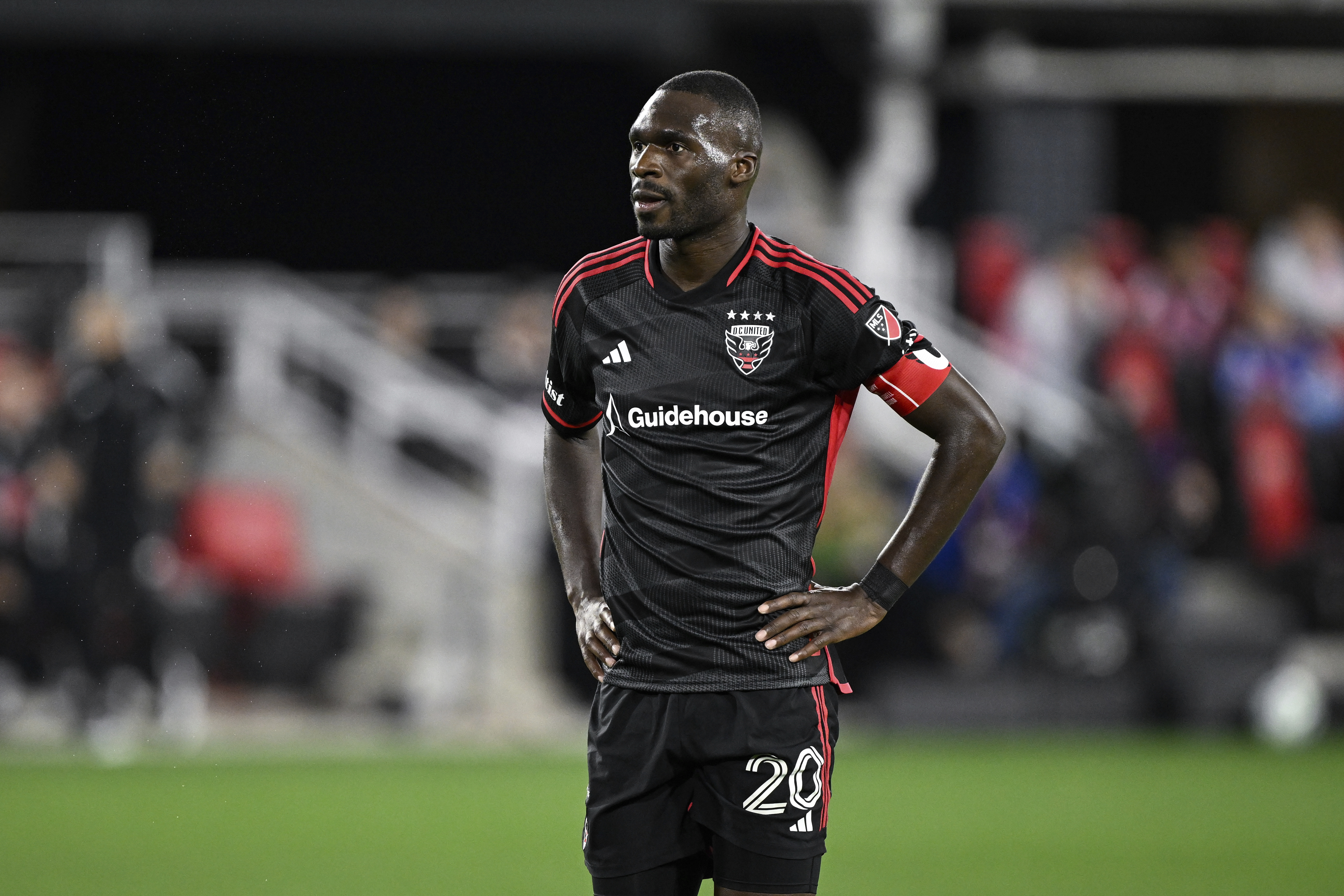
D.C. is looking for a replacement for Christian Benteke, the former English Premier League stalwart who led United’s attack for 3½ years and was MLS’s top scorer in 2023. It wasn’t Benteke’s fault that he lost a lot more games than he won there — D.C. finished 10th or worse in the East in all four of his seasons, and dead last leaguewide twice — but it was certainly noticed.
Christian Benteke departed D.C. United as a free agent.
Time will tell if Baribo suffers the same fate, or if the league’s original dynasty builds a good team around him. It’s been over two decades since United won their last MLS Cup, and nearly three decades since they were the league’s original dynasty.
It also was no secret in Chester, including in the stands, that Baribo isn’t exactly great at creating his own shot. Changing clubs within MLS will show to what degree his success was tied to the Union’s playbook.
The Union already have two examples of that on the record, in their multi-million-dollar sales of Jack McGlynn to Houston and Dániel Gazdag to Columbus last year. Houston didn’t make the playoffs, and Gazdag had six goals and seven assists in 32 games. (Nor, by the way, has Julián Carranza’s move to Europe been a great success.)
Perhaps that was why a fair few fans on social media reacted to the Baribo news without complaint. Everyone will find out together if he burns his old club, but until then, this deal looks like too much money to turn down.
Concacaf schedule set
The dates and times for the Union’s Concacaf Champions Cup first-round series against Defence Force FC of Trinidad & Tobago were announced Friday.
The series will start on Feb. 18, a Wednesday, at 6 p.m. at historic Haseley Crawford Stadium in Port of Spain, Trinidad.
The Union’s home leg will be eight days later, Feb. 26, at Subaru Park.
The Union’s MLS opener is Feb. 21 at D.C. United, and their home league opener is March 1 vs. New York City FC.
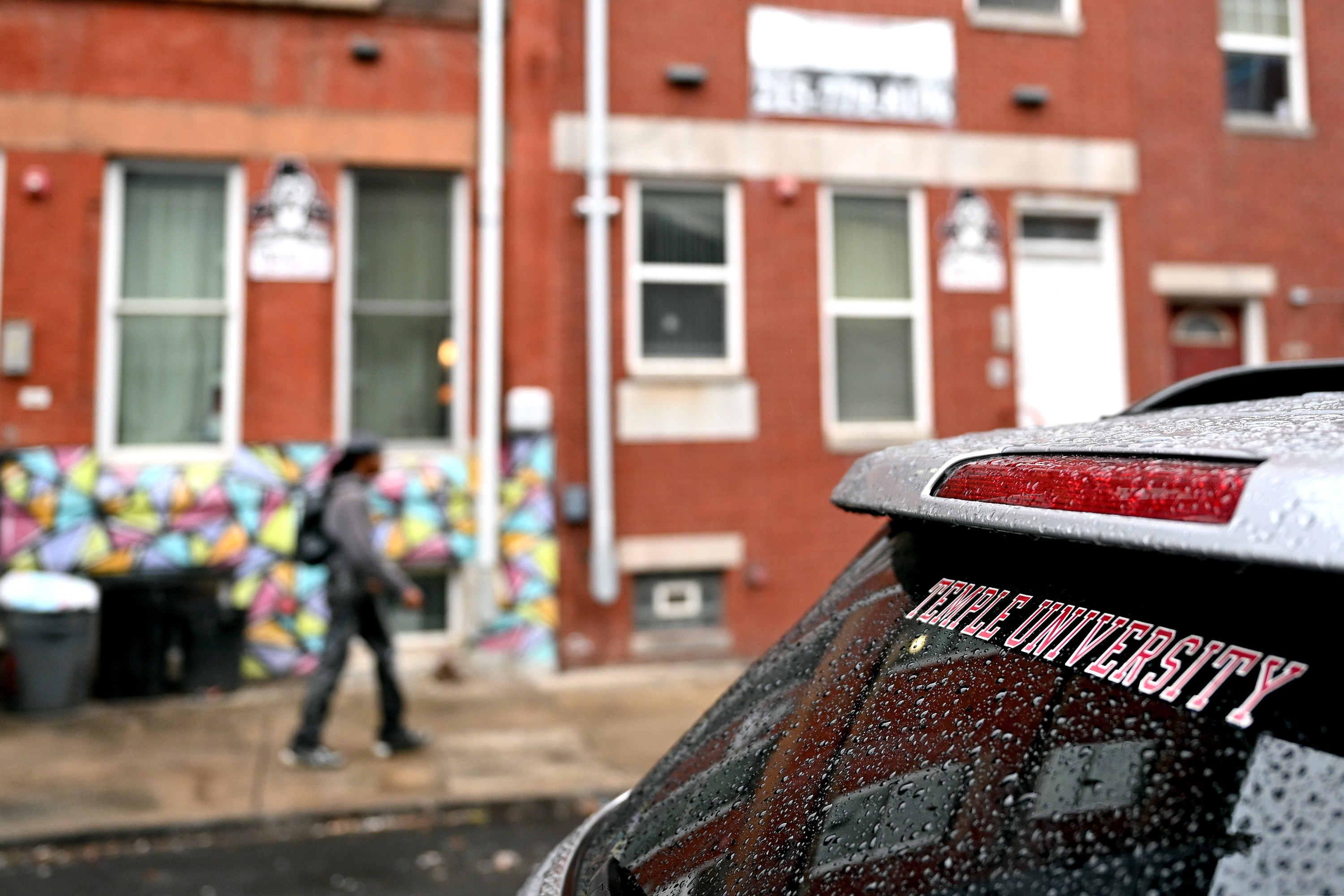
It’s no secret that times are tough for landlords around Temple University.
An eight-bedroom rowhouse at 1734 N. Gratz St., for example, languished on the real estate market after being listed for sale, like many dormlike apartments left in the wake of a rental boom that fizzled amid declining student enrollment.
The property went up for sale in April 2024 for $475,000 — $40,000 less than the owner had paid two years prior. It sat on the market for one year with no takers.
Then real estate agent Patrick C. Fay got involved.
In April 2025, the Gratz Street rowhouse was re-listed for $875,000. The very same day, it was listed as a pending sale, with Fay representing the buyer, according to real estate data from the Realtors Multiple Listing Service.
An Inquirer review of 33 other sales Fay brokered over the last year showed a similar pattern.
After properties went unsold at lower prices, Fay stepped in as the buyer’s agent and almost immediately arranged a sale for anywhere from $290,000 to nearly $550,000 more than sellers originally asked for.
On average, Fay’s clients have paid about double the original listing.
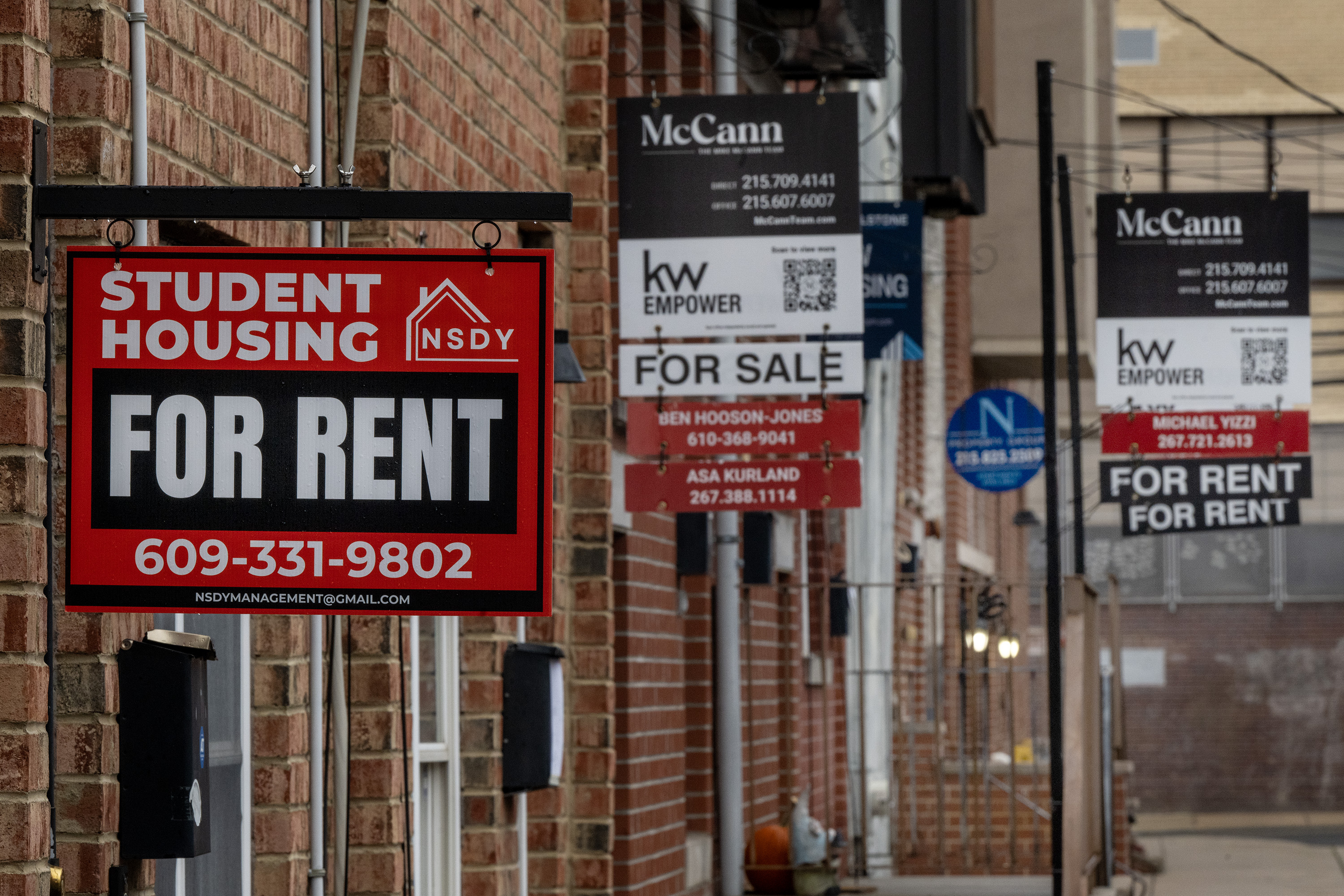
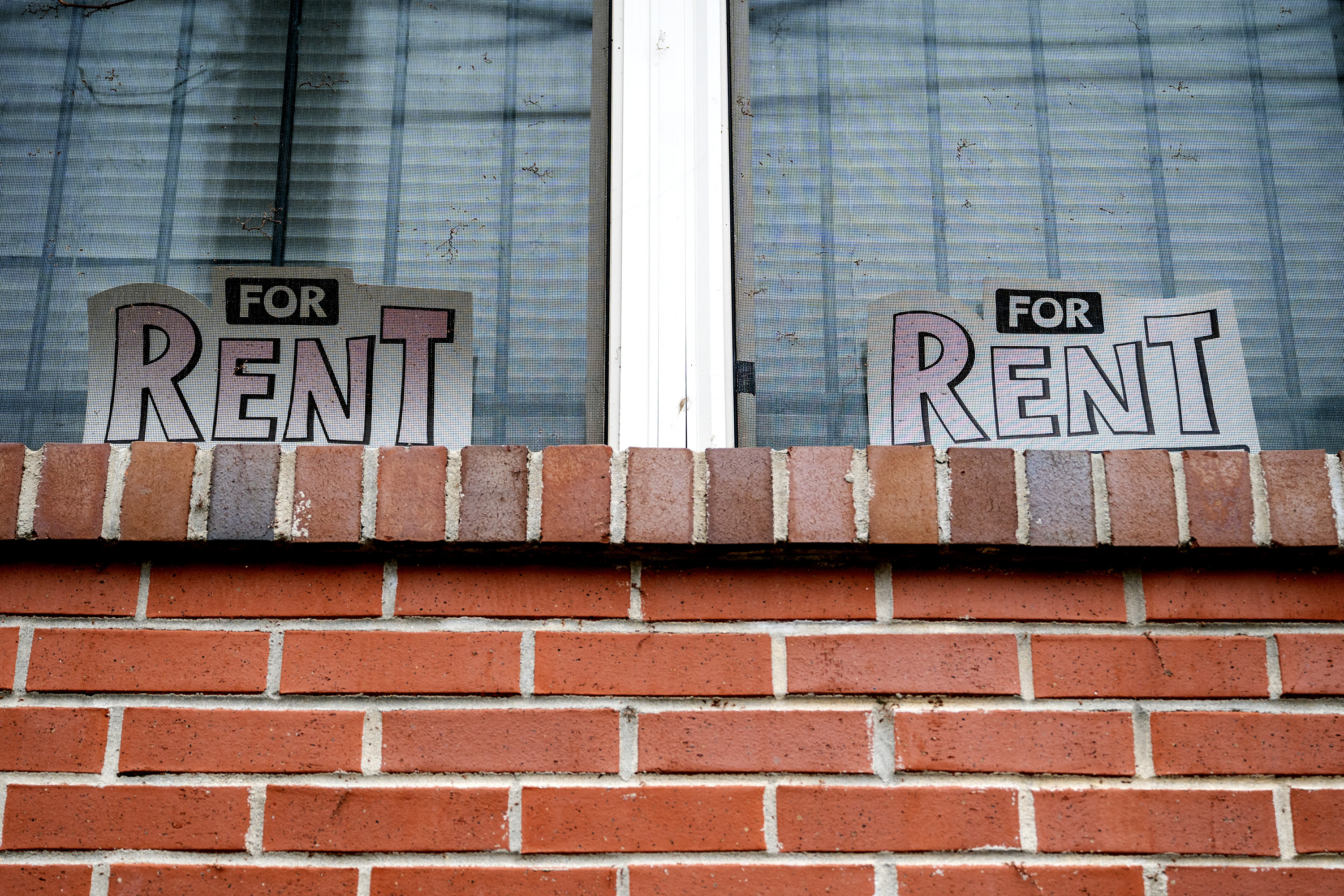
The value of rental properties around Temple has dipped in recent years. Many property owners have sold. Some blocks, like the 1700 block of Arlington St., are lined with for-rent and for-sale signs.
Fay, who worked out of Coldwell Banker’s offices in Old City and Moorestown, Burlington County, has now represented buyers in at least $40 million worth of settled or pending real estate deals involving multifamily properties around Temple.
(After this article published online Friday, the real estate firm cut ties with Fay and his biographical page was removed from its site. “The agent is no longer affiliated with Coldwell Banker Realty,” a company spokesperson said by email.)
Of about a dozen properties in the area that sold for more than $750,000 over the last 90 days, every one listed Fay as the buyer’s agent.
The Inquirer’s examination of the deals found the sales involve a small group of repeat buyers, including two linked to an earlier prosecution over a 2000s-era mortgage fraud scheme. In that case, federal investigators found that the group was involved with purchasing distressed homes using artificially inflated mortgages, pocketing the excess money and allowing the properties to lapse into foreclosure.
Fay, who is one of the top agents in his Coldwell office, said his transactions were all aboveboard. He credited the high sale prices to rebounding demand for student housing in the Temple University area.
“I think it’s a desirable area for sure,” said Fay, who lives in Moorestown. “They just had their biggest enrollment of all time.”
Pat Fay has been one of the top real estate agents this year in Coldwell Banker’s Old City office. His clients have been purchasing properties around Temple University, but at steep markups.
Actually, Temple’s head of admissions resigned last month after the university missed its annual enrollment goal. Its student population remains below 30,000, down from a high eight years ago of more than 40,000.
“This is not a good time for being a property owner around Temple,” said Nick Pizzola, vice president of the Temple Area Property Association, a group that represents many landlords and was formed to “encourage responsible development and property management” in the area.
“Rents are down, vacancies are up,” he said. “It’s a buyer’s market.”
The financing on Fay’s sales is provided by higher-risk private lenders, which grew in popularity as conventional bank lending contracted in the wake of the 2008 real estate crash.
Jon Hornik, head of the National Private Lenders Association, a trade group that represents firms like the ones that lent to Fay’s clients, recently flagged sales around Temple on a watch list the group maintains for suspicious transactions.
He had a simple explanation for these market-defying sales.
“These are bad actors inflating the value of the real estate through the sale structure, and therefore borrowing more money than they really should be able to,” Hornik said in an interview. “There’s real estate there. There’s a borrower there. But the values are off.”
Off-campus housing in North Philadelphia is still popular among some Temple students, but university President John Fry recently announced plans for a new dorm.
Fay, who describes himself on Instagram as a partnerin the upscale Center City Irish bar the Mulberry, has been pursued in New Jersey Superior Court by seven credit card companies or lenders in connection with roughly $57,000 in debts. Most were linked to unpaid credit card bills, and most have ended in default judgments.
Business records show Fay is listed as debtor to an Atlanta-based company called Real Commissions, which lets real estate agents tap into cash based solely on the promise of a forthcoming commission, so long as they have a signed agreement of sale in hand.
In an email Thursday, Fay cited several 2022 student rental sales in the $800,000 to $900,000 range to support his sale prices, insisting that “at no point did either party set or influence those values.” He did not respond to questions about why his clients would pay twice what a seller had initially been asking.
The real estate agent’s narrative of a booming rental market around Temple was also disputed by a recent seller in one of his deals.
The former property owner, who asked not to be named because he feared legal repercussions, acknowledged that he tried to unload his rental property last year but found no takers. He said his real estate agent then brought him Fay’s offer to broker a sale for $875,000, which he said was actually just the amount that would be recorded on the deed.
In reality, he said, he made the sale for only $385,000, or $15,000 less than what it was originally listed for.
The seller said he knew the deal was suspicious, but his agent advised him that he was unlikely to find a better deal.
“I had a mortgage, but I couldn’t get any renters,” the seller explained. “It’s called desperation.”
He took the deal, recording an official sale price that was more than $250,000 higher than any comparable properties recently sold on that block.
Then, anotherproperty across the street sold in June for the exact same price — $875,000 — shortly after being re-listed from $475,000.
The real estate agent on that sale: Pat Fay.
‘Strange stuff’
Historically a commuter school, Temple has long had room for just a fraction of its total student body in traditional dorms. But as Philadelphia’s fortunes improved in the 20th century and more students sought to live on or near campus, the housing shortage intensified.
Private developers stepped in. Blocks that had long served as home to mostly Black working-class residents transformed into rows of student housing units, sometimes prefabricated.
But during the pandemic, the boom in rentals came to a grinding halt. Classes went virtual, driving student renters away. Surging homicide rates — including the 2023 shooting death of a Temple police officer — drove a public-safety crisis for the university.
Recently, Temple president John Fry announced a plan to steer more students back to campus with the university’s first new dorm in years.
Today, even with homicide rates now at historic lows and enrollment creeping up again, many of the blocks once flooded with student housing are underpopulated.
For-rent and for-sale signs line both sides of the 1700 block of Arlington Street. Around the corner, on 18th Street, mailboxes overflow with unopened letters, and the chirps of dying smoke detector batteries in vacant units create an eerie birdsong.
Landlords on the 1900 block of N. 18th St and elsewhere are looking for renters. It is unclear why a small network of buyers is overpaying for nearby properties.
Pizzola said membership is down in the Temple Area Property Association as building owners have looked to get out of the rental business.
“Since COVID hit, it just turned the market upside down,” he said. “If you’re an investor who was buying off-campus housing right before COVID, you got slaughtered.”
Bart Blatstein, a developer who was heavily involved in the mid-2000s Temple-area housing boom, said the recent transactions are highly unusual.
“I’ll give you a commission if you can get twice what my properties are worth,” Blatstein joked.
Officially, more than 40 different corporations have purchased student rental buildings in sales brokered by Fay. But those companies trace back to a handful of purchasers, according to Pennsylvania corporate registries.
Some of these buyers, contacted by The Inquirer, described Fay more as a participant among a loose but unnamed group of “real estate investors,” rather than a mere agent.
Stephen L. Johnson, a Montgomery County resident, was linked to companies involved in six purchases, totaling $5.2 million. Several of the companies were registered to the home of Johnson’s mother, although in an interview she said she was unaware her rowhouse was being used as a nominal corporate headquarters and referred questions to her son.
Reached by phone, Johnson echoed Fay’s enthusiasm for the future of the real estate market around Temple, predicting a surge in values if the university seeks to expand.
“The investment was all about Temple buying up everything and making it better,” Johnson said of his purchases. “In 10 or 20 years, they’ll probably own all of North Philly.”
Johnson could not explainwhy one of his companies, 17th Street Estates LLC, had paid so much for properties like 2113 N. 17th St., which was listed for $475,000 but sold for $900,000.
“I’d have to talk to Patrick about that,” said Johnson, who referred to Fay as “the main guy.”
“It’s like a team,” he added. “We all help each other out.”
Another one of Fay’s clients, Tanjania Powell-Avery of Pottstown, Montgomery County, is a former real estate agent charged in 2010 by the U.S. Attorney’s Office as part of a mortgage fraud ring.
Prosecutors said Powell-Avery aided two men who “purchased distressed properties at low prices, found buyers for the properties at a much higher price, and submitted false documents to the mortgage lender in support of mortgage applications,” according to the federal indictment. She pleaded guilty and was sentenced to five years’ probation and nine months’ house arrest.
Despite this, and a 2012 bankruptcy, companies linked to Powell-Avery appeared in at least two recent sales around Temple, both brokered by Fay. These companies tapped $1.3 million in mortgages to close sales with a combined value of $1.6 million — each for about double its initial listing price.
Powell-Avery did not respond to a request for comment.
Her two codefendants in the 2010 federal indictment, Joseph Tookes and Othniel Tookes, also pleaded guilty. Both men are relatives of Abigail Tookes, a resident of a Norristown apartment complex who was pursued by creditors in 2020 after defaulting on a loan, leading to a $46,067 court judgment against her.
Even so, companies tied to Abigail Tookes were linked to at least $3.4 million in mortgages to finance the acquisition of at least five properties in sales involving Fay. In all five purchases, Tookes’ company recorded sale prices at double the original values.
Reached by phone, Tookes insisted the sales were “totally legitimate transactions.”
“There’s no fraudulent activity. It’s just an investment group,” she said. “There’s no story here. These are real estate transactions between the buyers and sellers. They all agreed to the sale. It doesn’t matter why.”
Other people linked to companies in Fay’s sales — Patrick M. Williams, Miles Fambro, and Angel Rodriguez — did not return calls for comment.
Many of the Temple-area sales featured the same mortgage broker: Viva Capital Group.
Reached by email, Viva president Juan Arguello said his Florida-based company operated “in full accordance with state and federal guidelines, rules, and regulations” and does “not have any contact with the sellers or their agents.”
He also said his company relied on an outside appraisal management company to approve mortgage values. He did not respond to questions about which appraiser had been used to support the Philadelphia sales.
Pizzola, who owns student-rental properties in the area, said these recent sale prices would eventually start driving up neighborhood property assessments, leading to higher tax bills, particularly on blocks where Fay’s clients have purchased multiple properties.
He said he suspects there is fraud involved.
“The fact that you’re seeing multiple sales at twice the average market value, it doesn’t pass the smell test,” he said.
Uncertain future
A prospectus for a property on Cecil B. Moore Avenue, listed for sale at $850,000 in October by several other real estate agents, included a string of Fay’s recent sales as comparable sales to justify the high asking price.
That property has yet to sell.
Over the last three weeks, at least three more properties near Temple have gone under contract — all with Fay as real estate agent.
Fay had been listed as an agent on a large apartment complex on the 1300 block of North Broad Street that was listed for sale at just under $6 million in late October. In November, the property was re-listed for $12 million.
The city has begun placing liens for unpaid water bills on the buildings in some of the earliest deals Fay arranged. Many of the properties have skipped out on biannual commercial trash hauling fees imposed by the city.
Some of the buildings do not appear to be occupied.
Someone appeared to have busted open a door, which was ajar with broken locks. A Temple sticker was on an upstairs window.
Hornik, from the NPLA, said that unless Fay’s purchasers figure out a way to extract enough rental income from these properties to cover mortgage costs, a mass foreclosure by lenders was likely in North Philadelphia — leaving the ownership of dozens of properties up in the air.
“If the loan goes negative, the lender has to foreclose,” he said, “and they’re not going to recover that money.”
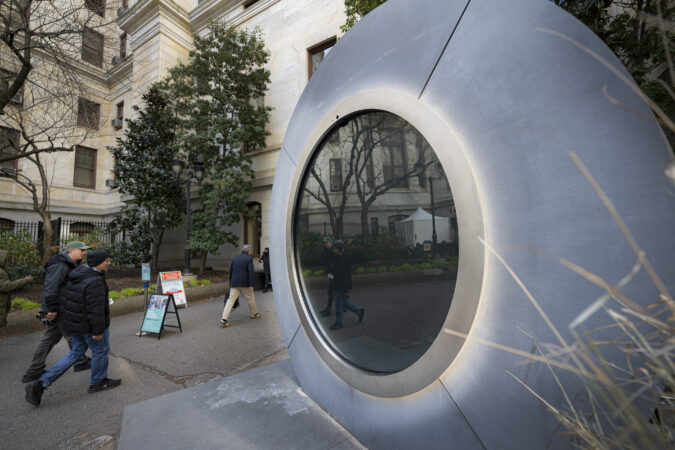
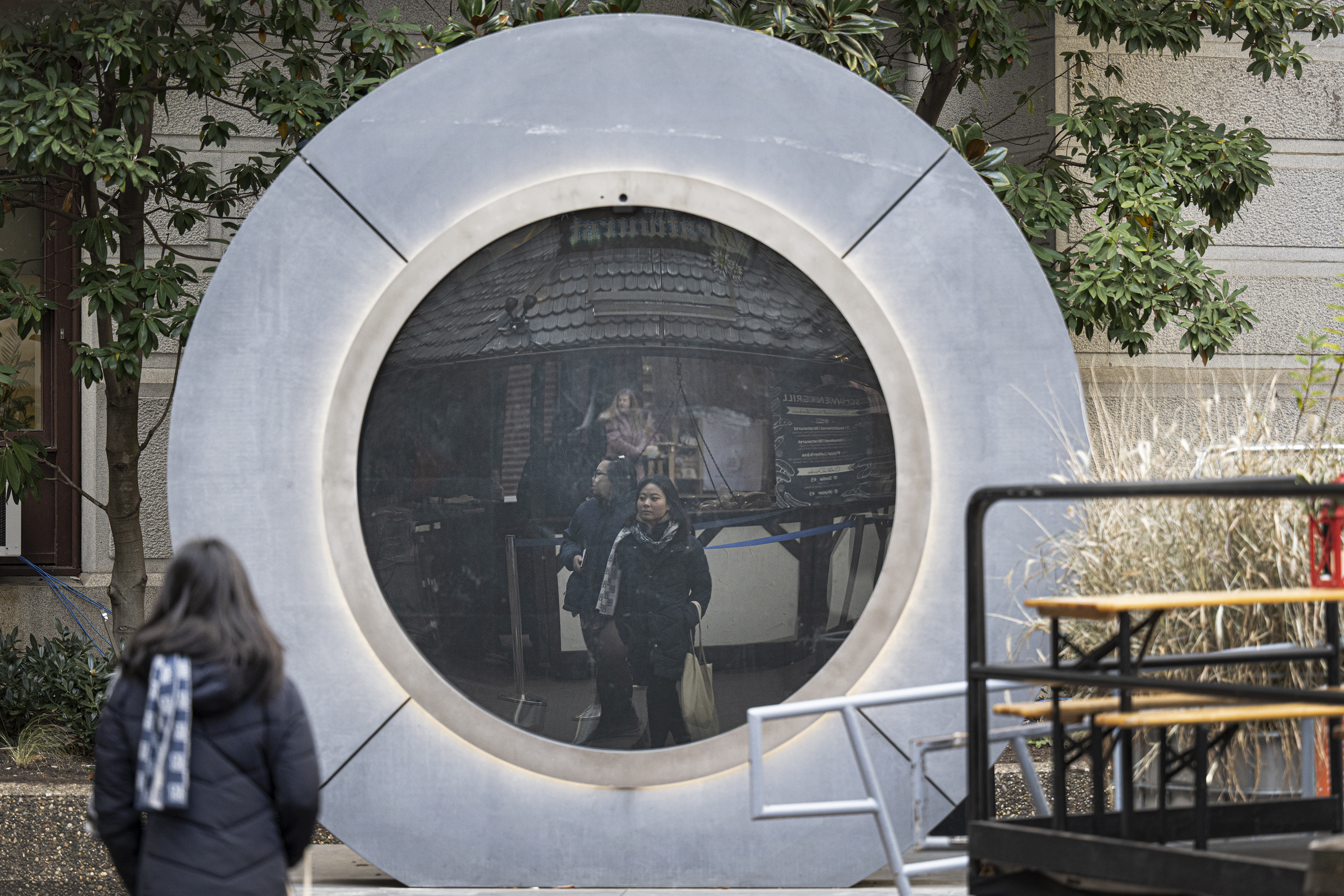
With its screen blank, the sculptural art installation that usually connects people in different cities around the world was akin to a void Friday afternoon, idling in the City Hall courtyard as the magic of Center City’s Christmas Village swirled around it.
It’s unclear exactly how long the Portal has been out of commission; according to city spokesperson Leah Uko, a technical issue “has disrupted the live stream in recent weeks,” and Portal officials expect a fix next week. The operators of the Portal did not respond to requests for comment by publication time.
“Turn the Portal back on, we demand it,” one onlooker said.
Another scoffed, “It must be nighttime there.”
Pedestrians walk by “The Portal” art installation on Friday, Dec. 12, 2025, in the Philadelphia City Hall courtyard.
Yonas Legesse, 22, and Martina Gebrail, 24, trekked more than two hours from Secaucus, N.J., and Jersey City, respectively, in hopes of seeing the famous Portal.
“We were definitely gonna stop here, go wave at some people, and now it’s off,” Legesse said. “It kind of hurts.”
Gebrail was amazed by the technology she saw on TikTok: The 3.5-ton circular video screen beams real-time, 24-hour, unfiltered livestreams from and to places like Dublin, Ireland; Vilnius, Lithuania; and Lublin, Poland.
Despite their disappointment, Legesse and Gebrail said they would come back to see an operative Portal. It’s expected to stay in Philadelphia through the country’s Semiquincentennial celebration in 2026.
WASHINGTON — After a spate of deadly accidents that have claimed the lives of 20 service members in the past four years, a Navy report acknowledges that the military failed to address a growing series of issues with the V-22 Osprey aircraft since it took flight almost 20 years ago.
“The cumulative risk posture of the V-22 platform has been growing since initial fielding,” according to the report by Naval Air Systems Command released Friday. It added that the office in charge of the aircraft “has not promptly implemented … fixes to mitigate existing risks.”
“As a result, risks continue to accumulate,” the report said.
The Associated Press reported last year that the most serious types of accidents for the Osprey, which is the only aircraft to fly like a plane but convert to land like a helicopter, spiked between 2019 and 2023 and that, unlike other aircraft, the problems did not level off as the years passed. The V-22 Ospreys are built at Boeing’s Ridley Park helicopter plant, and final assembly is done at a Bell helicopter plant in Texas.
“As the first and only military tilt-rotor aircraft, it remains the most aero-mechanically complex aircraft in service and continues to face unresolved legacy material, safety, and technical challenges,” the report said.
Commissioned in 2023 by NAVAIR, the Navy command responsible for the purchase and maintenance of aircraft, the investigation reveals that the Osprey not only has the “second highest number of catastrophic risks across all Naval Aviation platforms” but that those risks have gone unresolved for an average of more than 10 years.
By contrast, the average across other aircraft in the Navy’s inventory is six years.
The Navy’s response
Vice Adm. John Dougherty, commander of NAVAIR, said the service is “committed to improving the V-22’s performance and safeguarding the warfighters who rely on this platform.” He offered no details on any actions taken for years of failing to address the Osprey’s risks.
The command did not respond to questions about what, if any, accountability measures were taken in response to the findings.
The lack of details on accountability for missteps also came up when the Navy recently released investigations into four accidents during a U.S.-led campaign against Yemen’s Houthi rebels. A senior Navy official, who spoke to reporters on the condition of anonymity to offer more candid details, said that he didn’t believe the service had an obligation to make accountability actions public.
Risks were allowed to build up, the report says
The investigation lays much of the responsibility for the problems on the Osprey’s Joint Program Office. Part of the mission for this office, which operates within NAVAIR, is making sure the aircraft can be safely flown by the Marine Corps, the Navy and the Air Force, all of which use different versions of the aircraft for different missions.
The report found that this office “did not effectively manage or address identified risks in a timely manner, allowing them to accumulate,” and it faced “challenges” in implementing safety fixes across all three services.
Two major issues involve the Osprey’s complicated transmission. The aircraft has a host of gearboxes and clutches that, like a car’s transmission, are crucial to powering each propeller behind the Osprey’s unique tilting capability. The system also helps connect the two sides of the aircraft to keep it flying in the event of engine failure.
One problem is an issue in which the transmission system essentially shreds itself from the inside due to a power imbalance in the engines. That brought down a Marine Corps Osprey, killing five Marines in California in 2022.
The report reveals that this manufacturing issue went back to 2006 but the Osprey’s Joint Program Office did not formally assess or accept this risk until March 2024.
Besides these mechanical issues, the report found that the program office failed to ensure uniform maintenance standards for the aircraft, while determining that 81% of all the accidents that the Ospreys have had on the ground were due to human error.
Recommendations for the issues revealed
The report offers a series of recommendations for each of the issues it uncovered. They range from rudimentary suggestions like consolidating best maintenance practices across all the services to more systemic fixes like developing a new, midlife upgrade program for the Osprey.
While fixes for both mechanical issues are also in the report, it seems that it will take until 2034 and 2033 for the military to fully deal with both, respectively.
Naval Air Systems Command did not reply when asked if it had a message for troops who will fly in the aircraft in the meantime.
Watchdog also releases Osprey report
The Government Accountability Office, an independent watchdog serving Congress, made similar conclusions and recommendations in a separate report released Friday.
The GAO blamed most Osprey accidents on part failures and human error while service members flew or maintained the aircraft. It determined that the military hasn’t fully “identified, analyzed, or responded” to all of the Osprey’s safety risks.
The GAO said the Pentagon should improve its process for addressing those risks, while adding more oversight to ensure they are resolved. Another recommendation is for the Navy, Air Force and Marines to routinely share information on hazards and accidents to help prevent mishaps.
The odds are almost always stacked against a white Christmas around here, but it is looks like the region will experience a white Dec. 14.
The National Weather Service on Friday said Philadelphia was all but certain to get at least an inch of snow during the weekend, with a general 2 to 4 inches expected, said Joe DeSilva, a meteorologist in the Mount Holly office.
The weather service issued a winter-weather advisory for the entire region from 7 p.m. Saturday through 1 p.m. Sunday.
A storm forming along an Arctic front combined with a strung idsturbance in the upper atmosphere were forecast to begin shaking out snowflakes very late Saturday night or early Sunday. It’s possible that the snow may be mixed with rain, at least at the outset, especially south and east of the city.
And while this may be shocking, computer models continue to tweak outcomes, leaving “still a little bit of uncertainty how this low is going to track,” said DeSilva’s colleague Eric Hoeflich.
However, recent model runs overall have been a shade more bullish on snow amounts than they had been, and the U.S. model has bumped up amounts slightly, said DeSilva.
Timing and duration issues remained to be resolved, and snow could cause commuting issues in the morning. In addition to church-goers, tail-gaters will be commuting commuting to the Eagles game at Lincoln Financial Field in South Philly, and supermarkets typically experience brisk traffic in the run-up to Eagles’s games.
The snow, however, is forecast to end well before kickoff at the Linc, scheduled for 1:15 p.m., DeSilva said.
Some flakes were evident Thursday in the region, with Philadelphia International Airport, where winds gusted past 30 mph, reporting its third “trace” of the season.
The renegade flakes were flying from lake-effect snows, said Bill Deger, senior meteorologist with AccuWeather Inc.
The winds have shut off, and both Friday and Saturday were expected to be tranquil with daytime temperatures mostly in the 30s.
And this time, that holiday least-favorite, the “wintry mix,” wouldn’t be in the mix.
How much snow for Philly?
AccuWeather Inc. was calling for up to 3 inches.
If the storm is a quick mover, expect the inch, but if slows down and ripens a bit, it could be as much as 3, said AccuWeather senior meteorologist Bill Deger.
The weather service was pretty much on board with that estimate.
It painted 3 nches for Philly on its Friday morning snow map.
One near-certainty: This will change.
What time would the snow start?
It is likely to begin very late Saturday night or very early Sunday and continue until mid- or late morning, forecasters say.
Temperatures throughout the day are not expected to get past 30, with wind chills in the teens.
It might feel even colder if the Eagles lose to the lowly Las Vegas Raiders.
Regardless, everyone should be able to make it home.
“We’re not talking a major snowstorm,” Hoeflich said.
But this would be something a little bit different compared with recent local snow history.
Hoeflich noted that, as happened last winter, generous snow has fallen to the north, south, and west, leaving “a giant snow hole” over the Philadelphia area.
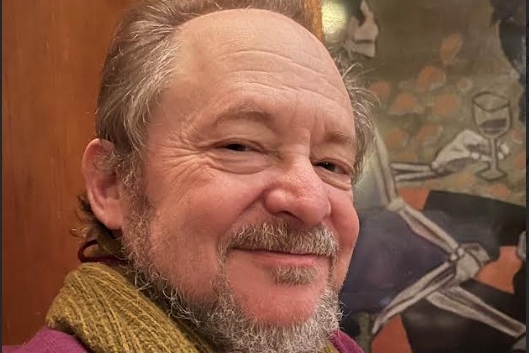
Aaron Goldblatt, 70, of Philadelphia, award-winning museum services partner emeritus at Metcalfe Architecture & Design, former vice president for exhibits at the Please Touch Museum, exhibit designer, sculptor, adventurer, and mentor, died Sunday, Dec. 7, of lung cancer at his home.
He joined business partner Alan Metcalfe in 2002 and specialized in constructing canopy walks, glass floors, elevated walkways, net bridges, abstract playgrounds, multimedia exhibits, and other unique designs in prominent locations. Visitors encounter their creations at the Museum of the American Revolution, the Independence Seaport Museum, Children’s Hospital of Philadelphia, the National Museum of Industrial History in Bethlehem, Pa., and the Whiting Forest at Dow Gardens in Michigan.
He and colleagues built the Lorax Loft on the Trail of the Lorax at the Philadelphia Zoo, the innovative garden and playground at Abington Friends School, and the lobby at Wissahickon Charter School. At Morris Arboretum, they built the celebrated Out on a Limb and Squirrel Scramble “treetop experiences” that Inquirer architecture critic Inga Saffron called “an irresistible allure, to young and old alike.”
He earned bachelor’s and master’s degrees in sculpture, hitchhiked from adventure to adventure around the country and South America after high school, and said in 2019 that “learning, laughter, and creating genuine connections between people, nature, and history … really inspire my design.”
Play, he said, is one of those genuine connections. “Wherever people are, as long as they are there long enough, play will happen,” he said in 2019. “It happens in schools, museums, and even prisons. Play is fundamental to being human.”
Together, Mr. Goldblatt, Metcalfe, and their colleagues earned design awards from the local chapter of the American Institute of Architects, the American Association of Museums, and other groups. In 2022, they earned the Wyck-Strickland Award from the historic Wyck house, garden, and farm for outstanding contributions to the cultural life of Philadelphia.
In a tribute, colleagues at Metcalfe said Mr. Goldblatt “transformed our studio into the place we are today.” They said: “His generosity, wisdom, and passion for play emanated throughout every conversation, punctuated only by his wit and sense of humor.”
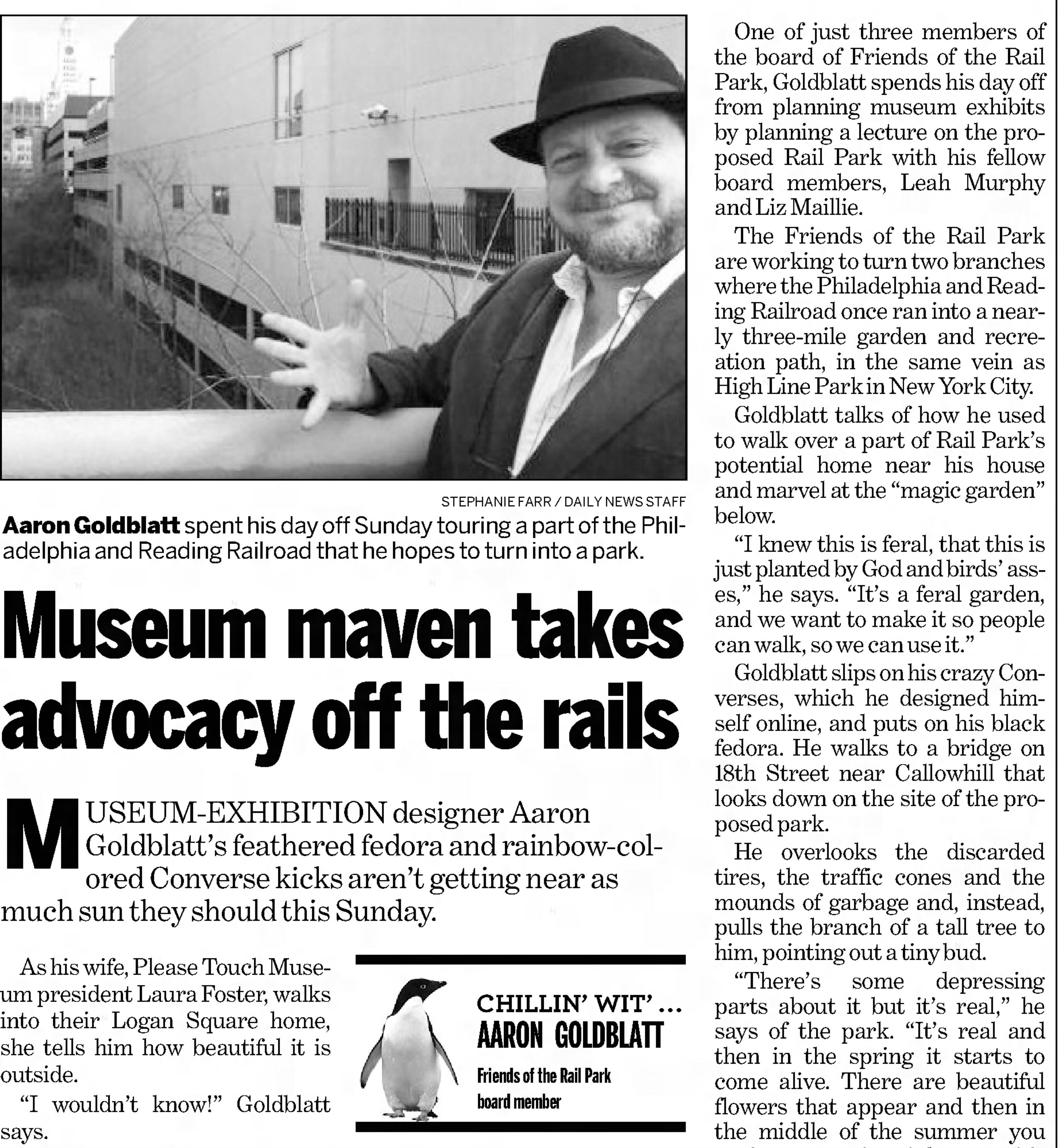
This photo and story about Mr. Goldblatt appeared in the Daily News in 2013.
From 1990 to 2002, he designed and developed exhibits at the Please Touch Museum. Earlier, he was director of exhibits for the Academy of Natural Sciences, assistant director at the Wagner Free Institute of Science, and studio assistant to sculptor Alice Aycock and other artists.
He helped design the Rail Park and was a cofounder and longtime board member of Friends of the Rail Park. He served on boards at the Print Center, the Wagner Free Institute of Science, and other groups, and taught postgraduate museum studies at the University of the Arts for 20 years.
“He developed a love of the process and philosophy of building,” said his daughter, Lillian. His wife, Susan Hagen, said: “He was always engaged, always asking questions. He was curious, funny, and extremely smart.”
Friends called him “lovely, smart, and witty” and “warm, wise, and creative” in Facebook tributes. One friend said: “He always had a spark.”
Aaron Shlomo Goldblatt was born March 22, 1955, in Cleveland. His father was in the Army, and Mr. Goldblatt grew up on military bases across the country and in Germany.
Mr. Goldblatt and his wife, Susan Hagen, married in 2023.
He graduated from high school in Maryland and earned his bachelor’s degree at Philadelphia College of Art in 1982 and master’s degree at Rutgers University in 1990. Before settling in Philadelphia, he worked on farms, painted houses, and spent time as a carpenter, a welder, and a potter.
He married Diane Pontius, and they had a daughter, Lilly. After a divorce, he married Laura Foster. She died in 2019. He married fellow artist Susan Hagen in 2023, and they lived in Spring Garden.
An engaging storyteller and talented cook, Mr. Goldblatt enjoyed all kinds of art, music, and books. He watched foreign films, wrote letters to politicians and the editor of The Inquirer, and visited the Reading Terminal Market as often as possible. He and his wife started birding during the pandemic.
“Aaron led with his heart, engaging deeply with the people and ideas around him,” his daughter said. “He could burst into song at any moment.”
Mr. Goldblatt smiles with his daughter, Lilly.
His wife said: “He was a family person, and everyone talks about his love and kindness.”
In addition to his wife and daughter, Mr. Goldblatt is survived by a grandson, a sister, a brother, his former wife, and other relatives.
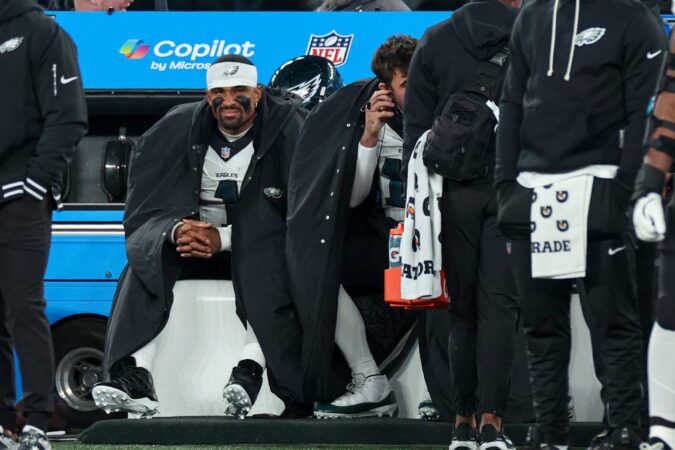
A nightmarish five-turnover game from Jalen Hurts in the Eagles’ Week 14 overtime loss to the Los Angeles Chargers led some to wonder aloud if it would be beneficial to bench the quarterback for the team’s Week 15 game against the Raiders.
Nick Sirianni called the idea of benching Hurts “ridiculous” Wednesday morning during an interview with 94 WIP, but the coach’s comments did not stop the wave of opinions about Hurts.
“You know what’s really, truly, magnificently ridiculous to think? That any quarterback could play as poorly as Hurts has played in back-to-back losses to the Bears and the Chargers without prompting some level of discussion about whether or not he should continue to start,” Inquirer columnist David Murphy wrote Friday. “As good as Hurts has played in his two Super Bowl appearances, that’s how bad he has played over the last couple of weeks.”
Meanwhile, fellow columnist Marcus Hayes also believes the conversation needs to at least happen, whether the Eagles ultimately go through with it or not — adding that one more bad game and the Birds might really need to consider sitting Hurts. And Eagles writer Jeff McLane opened the week by suggesting there’s “merit” to the idea of starting Tanner McKee against the Raiders, but that “opening that can of worms may cause more harm than good — especially in the long term.”
Needless to say, the national media has had plenty to say about the idea of benching Hurts. Here’s a look a what they’re saying ahead of Sunday’s game in Vegas …
‘We all know Tanner McKee ain’t playing’
Stephen A. Smith addressed the idea of benching Hurts in favor of backup Tanner McKee on Thursday morning’s episode of ESPN’s First Take. Smith dismissed the idea, largely on the basis that it would be irresponsible to give McKee, a 2023 sixth-round pick out of Stanford, his second career start in a pivotal game.
“Jalen Hurts ain’t going to be benched,” Smith said. “The backup quarterback’s name is Tanner McKee, right? We all know Tanner McKee ain’t playing. We just know this, OK? Down the line, in the future, sure, but this year, Tanner McKee is not going to replace the reigning defending Super Bowl champion and Super Bowl MVP.”
Smith said calls for Hurts benching is a way for Philly fans to “light a fire” under the team after a three-game losing streak.
“They’re saying, ‘What do we do? What do we have to do to light a fire under these dudes? Because, [expletive], what’s going on isn’t working, because Sirianni ain’t doing anything about it. [Offensive coordinator Kevin] Patullo ain’t doing anything about it. We got a problem.’ That’s the Philadelphia fan base,” Smith said. “There’s nobody with sense that would think for one second that Jalen Hurts is going to find himself on the bench in favor of Tanner McKee.”
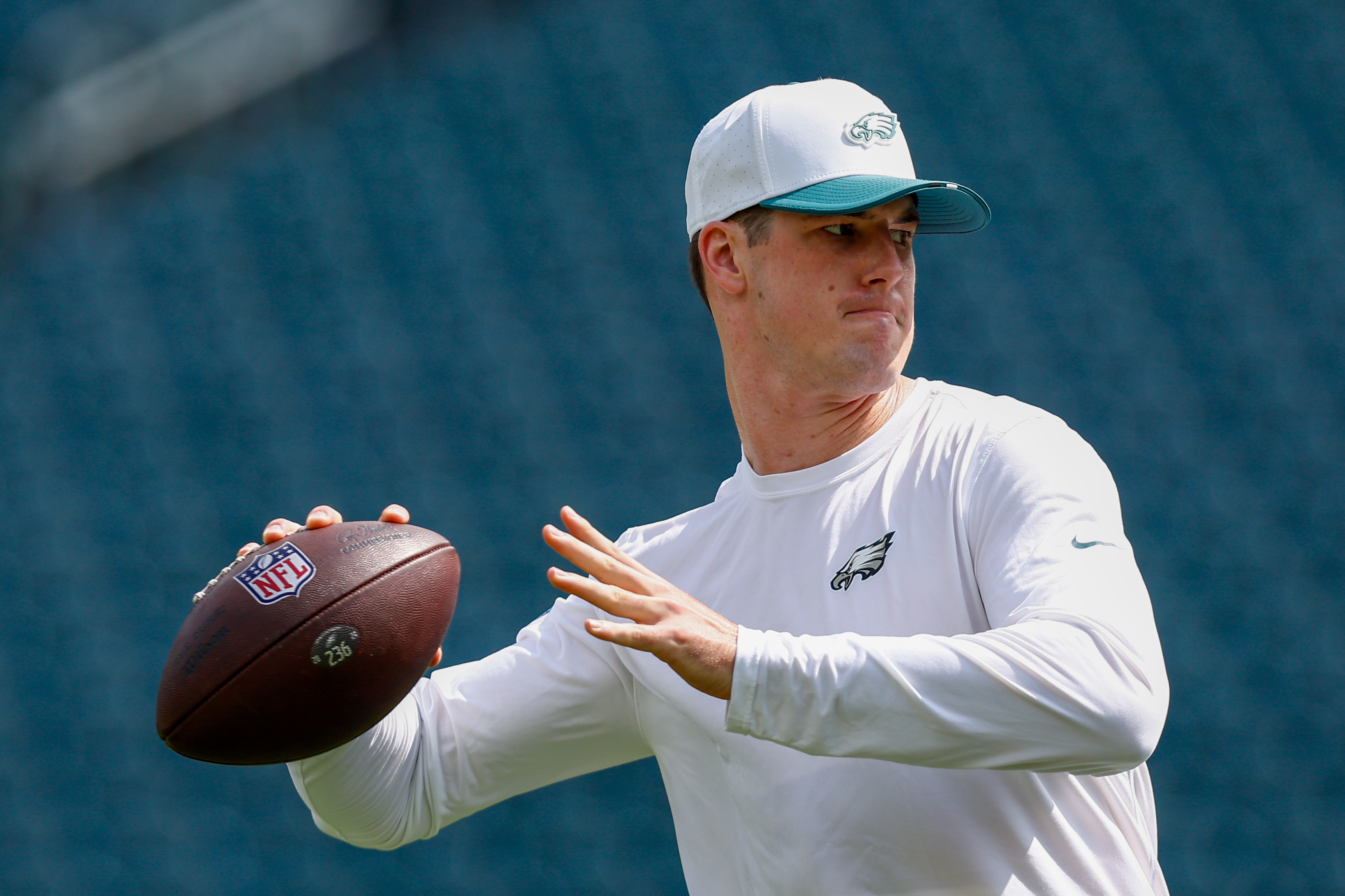
Eagles backup quarterback Tanner McKee’s last start came in the 2024 regular season finale.
‘Do you know how stupid of a question that is?’
Former NFL quarterback — and one-time Hurts critic — Dan Orlovsky agreed with his ESPNcolleague on Thursday’s First Take, calling the talk of benching Hurts “the dumbest conversation of the NFL season.”
“I was probably the most critical person of Jalen Hurts early in his career,” Orlovsky said. “He has gone to the playoffs four times. He’s gone to the Super Bowl twice. He’s won the Super Bowl once, and he was the MVP of the Super Bowl. And 10 months later — 10 months later from doing that — we’re going, ‘Do you think we should bench the quarterback?’ … Do you know how stupid of a question that is?”
.@danorlovsky7 believes Jalen Hurts is being OVERLY criticized right now 👀
"It's still crazy to have the quarterback in the NFL right now, who's fourth in touchdowns, have his job security in question." pic.twitter.com/qLl17wFmif
Orlovsky pointed out the absurdity of Hurts, whose 27 combined rushing and passing touchdowns are the fourth-most in the NFL, having his job security in question. Orlovsky, who has been critical of the Eagles’ struggling offense this season, said the team’s problems are too interconnected to blame on Hurts alone.
“Saquon Barkley is one of two running backs that have over 50 carries this year that have gone for either no yards or negative yards,” Orlovsky said. “Is that because Saquon can’t play anymore? Or is it all connected?”
His criticism of the Eagles quarterback runs deeper than a game or the remaining weeks of the season. Cowherd said on Wednesday’s episode of Fox Sports 1’s The Herd that Hurts’ size may be enough of a reason for the franchise to move on from the quarterback. Cowherd pointed out that many of the league’s best quarterbacks, including Justin Herbert and Josh Allen are 6-foot-3 and above.
“I’m 6-2,” Cowherd said. “I can’t be taller than your franchise quarterback.”
"The truth is: The more Jalen Hurts throws, the worse Philadelphia is. Those are the facts."@colincowherd wonders if the Eagles need to consider a change at quarterback pic.twitter.com/gF2vDqaFZ9
At 6-foot-1, Hurts is the same size as Brock Purdy, Tua Tagovailoa, and Baker Mayfield. Cowherd wondered if the league’s 17-game season is wearing on its smaller quarterbacks.
“[Hurts is] smart, he’s athletic, he’s tough,” Cowherd said. “He’s tiny. It’s not just the size and the length of the quarterback, it’s the length of the season. It’s now 17 games. NFL defensive players are now bigger, stronger, faster. The hits hurt more, they’re more punitive.”
However, Hurts did not shrink — nor did the NFL schedule grow — over the offseason, and neither seemed to be an issue during last year’s Super Bowl run.
This season, Hurts has not missed time due to injury, but he is on pace to finish with his fewest rushing carries since his rookie year. Hurts has carried the ball just 88 times this season.
The Eagles’ move away from running Hurts may protect his long-term health, but the team has struggled with Hurts throwing the ball more frequently. The Birds are 1-5 in games where Hurts throws more than 30 passes.
“The truth is, the more Jalen Hurts throws, the worse Philadelphia is,” Cowherd said. “Those are the facts.”
President Donald Trump’s U.S. attorney in Delaware abruptly resigned Friday amid a growing standoff over the administration’s authority to install loyalists in powerful prosecutorial roles while bypassing Senate confirmation and the courts.
Julianne Murray, a former chair of the Delaware Republican Party whom the Justice Department had appointed as interim U.S. attorney in the state this summer, announced her departure in a statement posted to social media. She said a recent ruling by the U.S. Court of Appeals for the 3rd Circuit disqualifying Trump’s U.S. attorney in New Jersey, Alina Habba, had made it clear to her she could no longer stay in her role.
Habba resigned from her post on Monday after the court ruled she had been unlawfully appointed through a process that administration officials had also used to keep Murray in her role. The Philadelphia-based 3rd Circuit handles appeals arising from Pennsylvania, New Jersey, Delaware, and the U.S. Virgin Islands, and its rulings extend throughout that jurisdiction.
“I naively believed that I would be judged on my performance and not politics,” Murray said in her statement. “Unfortunately that was not the case.”
Murray said she will continue to work for the Justice Department in a different capacity but did not indicate what her new job might be. Her former office will now be overseen by her first assistant U.S. attorney, Ben Wallace, who has worked as a prosecutor in the office since 2023.
Murray’s initial appointment in July drew controversy given her lack of prosecutorial experience and the fact that she was still serving as head of the Delaware Republican Party when she was named interim U.S. attorney. She resigned from that role shortly afterward.
Her statement Friday saying she would step down as U.S. attorney used many of the same turns of phrase as the resignation letter she submitted to the state party five months earlier. In both, she said she refused to allow her office “to be used as a political football.”
While the nation’s 93 U.S. attorneys are appointed through a political process and are often affiliated with the president’s party, their jobs have traditionally been viewed as largely apolitical. Most come from traditional legal backgrounds, not openly partisan roles.
Since Trump’s return to the White House, his administration has made installing loyalists in these position a priority.
In addition to Murray and Habba, his former personal lawyer, the Justice Department has appointed other controversial allies to U.S. attorney roles on an interim basis. They included Bill Essayli, a former GOP state assemblyman named U.S. attorney in Los Angeles; Sigal Chattah, a former GOP committeewoman in Nevada; and Lindsey Halligan, another former Trump lawyer, in Eastern Virginia.
Federal law limited each of their interim appointments to a period of 120 days and empowered the federal courts to appoint a replacement if there was no Senate-confirmed nominee by that deadline. But when the terms of Murray, Habba and the others expired, the Justice Department sought to keep Trump’s picks in their roles through complex maneuvers that the 3rd Circuit has ruled were illegal.
In Murray’s case, Delaware’s chief U.S. district judge, Colm Connolly, a Trump appointee, began soliciting applications for her replacement weeks before her 120 days were up. The move drew a sharp rebuke from Deputy Attorney General Todd Blanche, another former Trump attorney who now serves in the Justice Department’s No. 2 position.
When Murray’s interim term expired in November, Delaware’s judges declined to reappoint her but did not immediately name a replacement. The Justice Department responded by changing Murray’s title to “acting” U.S. attorney and maintained that the president had the authority to keep her in her job indefinitely.
Within hours of Murray’s resignation, the judges on Friday posted notice that they were appointing Wallace as acting U.S. attorney.
Unlike Habba, Chattah, Essayli, and Halligan, whose appointments federal courts have all ruled to be unlawful, Murray had not drawn a legal challenge questioning her legitimacy. In her statement Friday, she blamed Delaware’s U.S. senators — Chris Coons and Lisa Blunt Rochester, both Democrats — of sinking her prospects in the job.
Normally, the president must formally nominate his U.S. attorney picks, and they must be approved in a Senate vote. In the case of Murray and the others, their home-state senators — all Democrats — had said they would withhold their support should Trump formally nominate them to the role.
That decision effectively killed any chance of their nominations moving forward under a Senate custom known as the “blue slip,” which allows senators to veto judicial and U.S. attorney nominees for their states.
Trump has railed against the blue slip tradition, saying it interferes with his ability to install his chosen candidates. Sen. Chuck Grassley — the Iowa Republican who chairs the Senate Judiciary Committee — has resisted pressure from the president to abandon the custom, saying it gives senators of both parties an important voice in deciding who will fill powerful law enforcement roles in their states.
Coons and Blunt Rochester said they had concluded Murray “was not the right person” for the job after interviewing her and a number of other potential candidates.
“I look forward to working with the District Court’s appointed U.S. Attorney, Ben Wallace, and remain willing to work with the Trump administration to identify and confirm a mutually agreeable candidate,” Coons said in a statement.
Murray called the blue slip process “highly politicized” and “incredibly flawed,” saying it cost Delaware a U.S. attorney.
“The people that think they have chased me away will soon find out that they are mistaken,” she wrote. “I did not get here by being a shrinking violet.”
On Thursday, a three-coin set of the final pennies minted for circulation sold at auction for $800,000. Another of the sets sold for $180,000.
In all, the final pennies sold for a combined nearly $17 million.
Sold by Stack’s Bowers Galleries, the sets represented the 232 years since the penny was first minted in Philadelphia in 1793. Each included some of the last pennies struck for circulation at the U.S. Mint’s facilities in Philadelphia and Denver, plus a 24-karat gold penny minted in Philadelphia. Each coin bears a unique omega symbol (Ω), marking the end of the penny.
The Philadelphia U.S. Mint struck the final circulating one-cent coins in November after President Donald Trump ordered the Mint to stop producing new pennies earlier this year. The last small-change coin the government canceled was the half-cent in 1857.
Costly to produce and displaced by digital payment, the penny had grown almost as irrelevant as the half-cent. Still, pennies aren’t disappearing soon. Americans have hoarded 300 billion pennies, which remain legal tender, officials say. Killing penny production is estimated to save around $56 million a year, experts believe.
Thursday’s auction had been closely watched by collectors and numismatics, who had expected bidding to be high. None more than for the final lot, which eventually topped out at $800,000. The special lot came with the three origin dies used to strike the coins.
“This set represents the VERY LAST cents struck in the classic circulating finishing, the true Omega,” read for the listing for the final pennies. “It is impossible to overstate the historic nature of these three pieces, which are likely the most significant coins to emerge from the United States Mint this century.”
Only keen-eyed visitors will notice some of the subtle changes to George Washington’s Mount Vernon home, like a new finishing on the mantle in the former president’s study or the reworked underground framing of the house.
But curators say each minuscule change to the sprawling Virginia estate can help visitors better understand the nation’s past, and therefore their place in the world today.
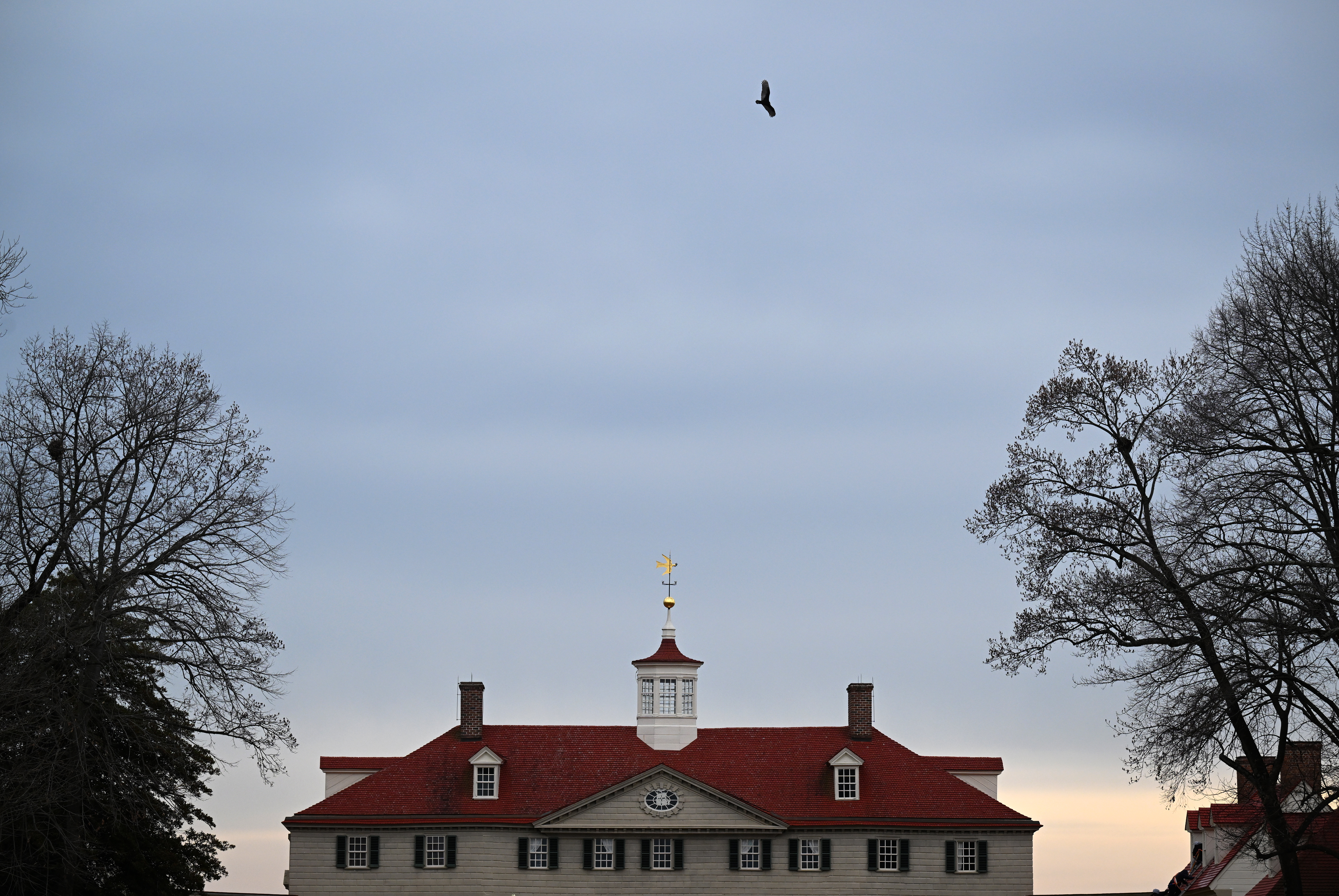
Construction fences have lined the back of the mansion for the better part of two years as work continues on a $40 million project to restore the building to its 18th century integrity. Though work is ongoing, the first and second floor of the home are now open to the public for the first time since January 2024.
A worker at the estate Wednesday, the day of an event marking the reopening of the first and second floors to the public.
Heading into America’s 250th anniversary, Mount Vernon President and CEO Doug Bradburn said bolstering authenticity at the estate is more important than ever.
“You cannot understand the United States of America’s founding without the indispensable George Washington,” Bradburn said. “You can’t understand him without Mount Vernon.”
Washington lived at the estate along the Potomac River with his wife, Martha, for the last 45 years of his life. When he inherited the mansion, it stood at about 3,500 square feet. The serene view of the Potomac welcomed Washington home after he led American forces to victory in the Revolutionary War. He retired to Mount Vernon after serving as the nation’s first president.
By the time Washington died in 1799, he had expanded the dwelling to more than triple that size, with more than 20 rooms. Most of the work was performed by people enslaved on the estate, officials have said.
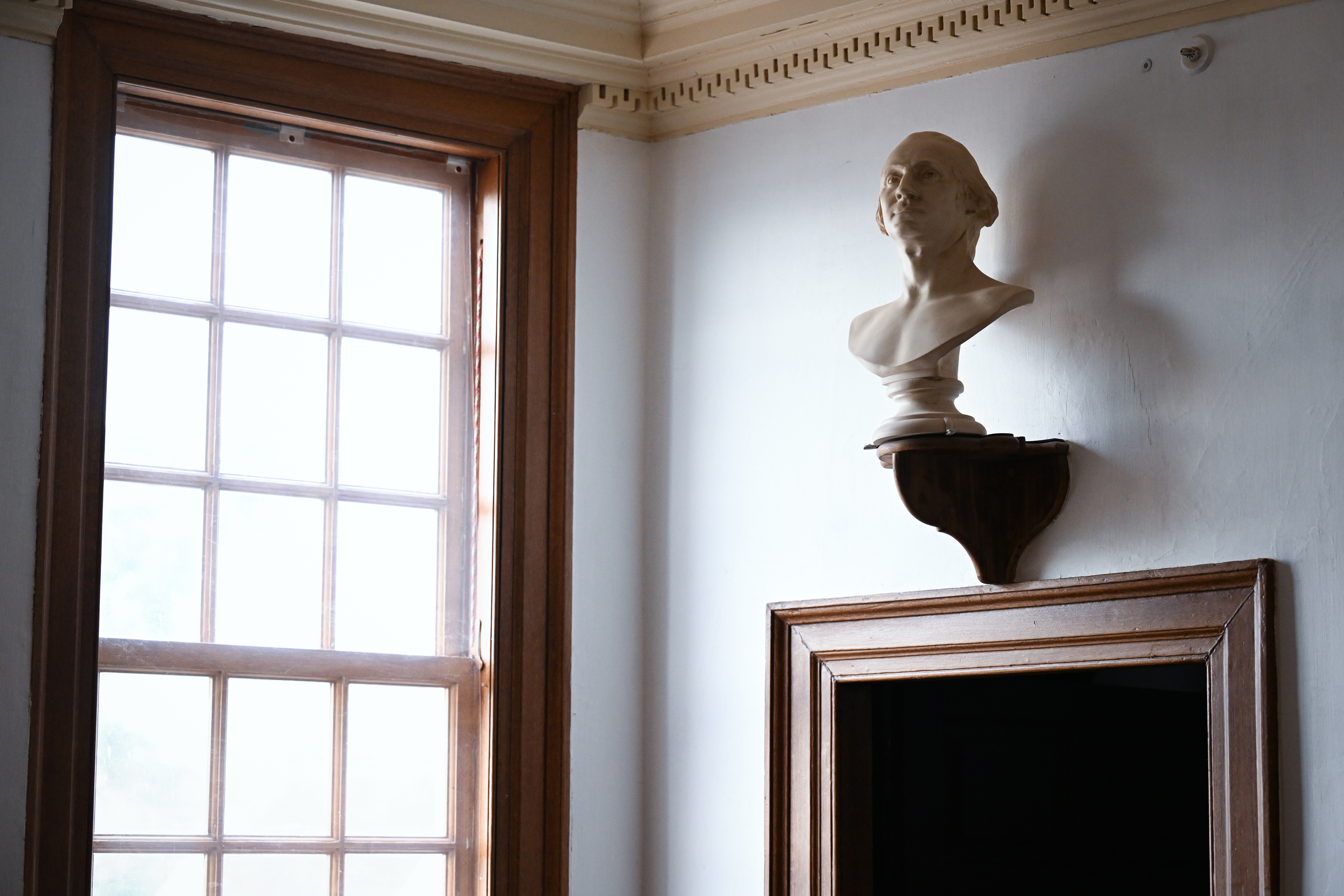
A bust of George Washington at the estate.
The estate passed down through family members after Washington’s death until the Mount Vernon Ladies Association secured it in 1860. Since then, the nonprofit has worked to restore the remaining 500 acres of property to how it appeared when Washington died. The association has never accepted any government funding, and it solely relies on earned income and donations.
Nearly 1 million people visit Washington’s home, located about 20 miles south of the nation’s capital, each year.
“We believe in the power of place,” said Anne Neal Petri, regent of the Mount Vernon Ladies Association. “We want to engage the visitor in ways that the history books just can’t achieve.”
This bout of rehabilitation is the largest in Mount Vernon’s history. Born from necessity after centuries of termite damage detached the building from its foundation, there wasn’t a single piece of original 18th century woodwork left underground, said Thomas Reinhart, director of the estate’s preservation.
Only parts of Mount Vernon closed during the restoration. The extensive grounds, Washington’s tomb and the quarters for enslaved people remained open. The renovations focused only on Washington’s living quarters, called the mansion.
To rebuild the mansion’s wooden frame, workers harvested white oak from the property, similar to how Washington would have sourced wood for the original construction. Only now, every piece of wood that touches masonry has added termite shields.
“Termites are quite tenacious,” Reinhart said.
From preservation carpenters, engineers, archaeologists and collection curators, it’s estimated about 350 people have worked on the restoration so far. Besides the structural changes, specialists throughout the house restoration performed paint analysis on doorframes and trims to make them accurate.
Painters at Mount Vernon on Wednesday.
The most noticeable visual differences are on the second floor, in the most intimate area of the house.
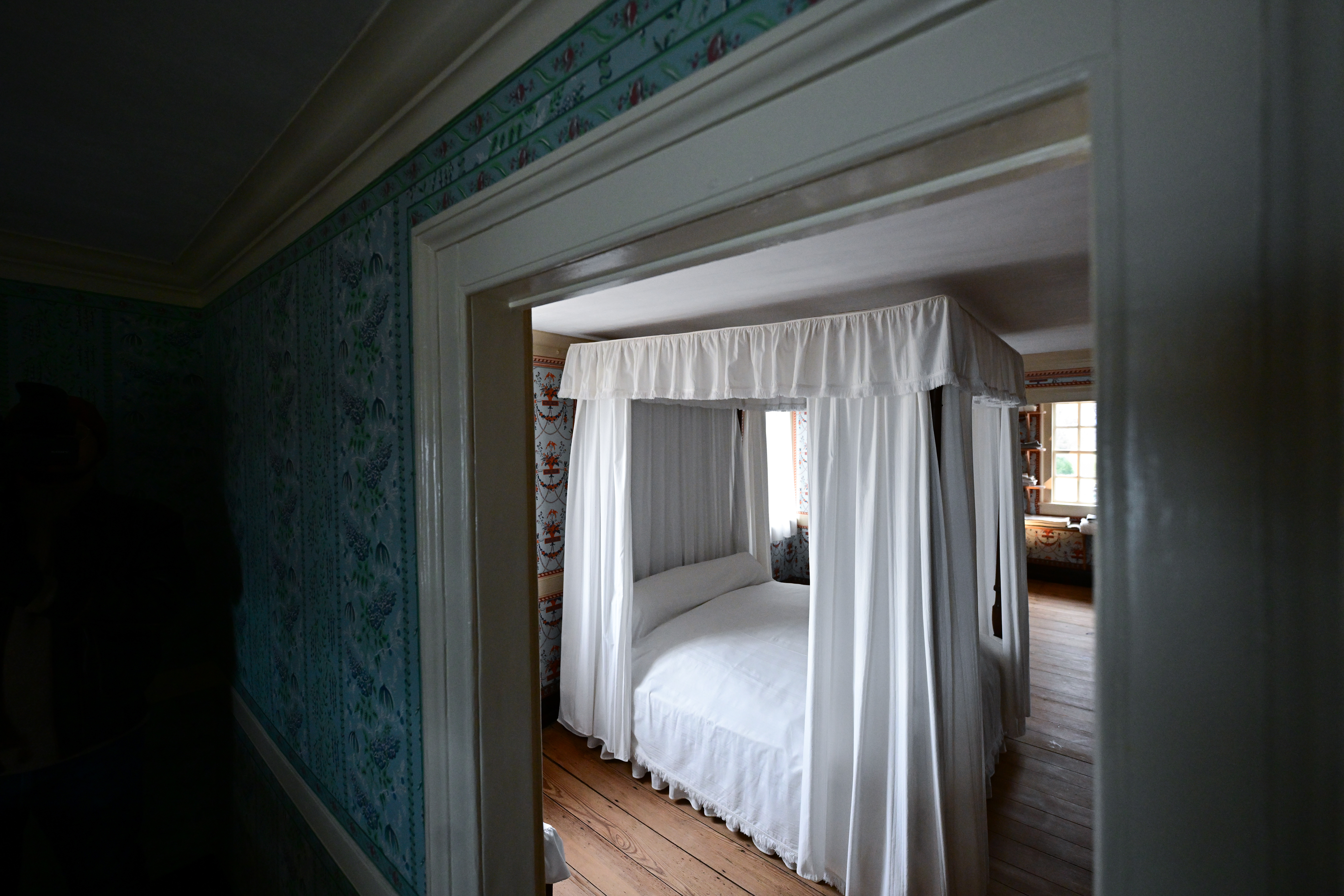
Step into Washington’s bedroom, and visitors will see walls newly enveloped by a soft blue wallpaper with a bright floral design featuring a birdbath and two bright orange lovebirds.
After referencing preserved documents, Amanda Isaac, a curator at the estate, said historians chose a replica 1790s French wallpaper based on a design that existed when Washington remodeled the home.
She said with the most recent changes — which also included tearing the walls down to the studs and replastering them with historically accurate techniques — is a room that most resembles how the home looked when the Washingtons lived at Mount Vernon. It has nine of the original furnishings of the room, including the exact bedframe Washington died on.
George and Martha Washington’s bedroom.
Perhaps the largest undertaking is still ongoing.
Underground, droves of people are still working to restore a cellar spanning the entire footprint of the house. That part of the home is being refinished to look like it did when it housed the enslaved Lee family, who served the Washingtons as valet, cook and butler. The estate is also adding an underground bunker to store an upgraded HVAC system created to better preserve and maintain the home.
Though it’s been centuries since Washington walked the property, signs of his life are still littered around the land. While excavating the cellar, archaeologists discovered 35 glass bottles of preserved berries, 20 of which are still intact and now on display at the Mount Vernon museum.
As the country looks to the future, Mount Vernon serves as a fixture of the past, forever reminding the nation how far it has come.
“You can’t go to Rome without seeing the Colosseum, and you can’t go to Washington, D.C., without seeing Mount Vernon,” Bradburn said.
Today’s rehabilitation is the largest in Mount Vernon’s history.