Blog

  • Radnor and Council Rock students made AI deepfakes of classmates. Parents say the schools failed to protect their daughters.

    Radnor and Council Rock students made AI deepfakes of classmates. Parents say the schools failed to protect their daughters.

    One night in early December, the phones of Radnor High School students started buzzing. Some freshmen girls were getting disturbing messages: A male classmate, they were told, had made pornographic videos of them.

    When one of the girls walked into school the next morning, “she said everyone was staring at her,” said her mother, who requested anonymity to protect her daughter’s identity. “All the kids knew. It spread like wildfire.”

    So-called AI deepfakes — pictures of a real person manipulated with artificial intelligence, sometimes with “nudify” features that can convert clothed photos into naked ones — have become the talk of school hallways and Snapchat conversations in some area schools.

    As Pennsylvania lawmakers have pushed new restrictions cracking down on deepfakes — defining explicit images as child sexual abuse material, and advancing another measure that would require schools to immediately alert law enforcement about AI incidents — schools say they have no role in criminal investigations, and are limited in their ability to police students off campus.

    But some parents say schools should be taking a more proactive stance to prepare for AI abuse — and are failing to protect victims when it happens, further harming students who have been violated by their peers.

    In the Council Rock School District, where AI-generated deepfakes were reported last March, parents of targeted girls said administrators waited five days to contact the police about the allegations and never notified the community, even after two boys were charged with crimes.

    “They denied everything and kind of shoved it under the rug and failed to acknowledge it,” said a mother in Council Rock, who also requested anonymity to protect her daughter’s identity. “Everybody thought it was a rumor,” rather than real damage done to girls, the mother said.

    Council Rock spokesperson Andrea Mangold said that the district “recognizes and understands the deep frustration and concern expressed by parents,” and that a police investigation “began promptly upon the district’s notification.”

    Mangold said that current laws were “insufficient to fully prevent or deter these incidents,” and that the district was “limited in what we know and what we can legally share publicly” due to student privacy laws.

    In Radnor, parents also said the district minimized the December incident. A district message last month said a student had created images of classmates that “move and dance,” and reported that police had not found evidence of “anything inappropriate” — even though police later said they had charged a student with harassment after an investigation into alleged sexualized images of multiple girls.

    A Radnor spokesperson said the alleged images were never discovered and the district’s message was cowritten by Radnor police, who declined to comment.

    The district “approaches all student-related matters with care and sensitivity for those involved,” said the spokesperson, Theji Brennan. She said the district was limited in what it could share about minors.

    In both Radnor and Council Rock, parents said their daughters were offered little support — and were told that if they were uncomfortable, they could go to quiet rooms or leave classes early to avoid crossing paths with boys involved in the incidents.

    “She just felt like no one believed her,” the Radnor mother said of her daughter.

    How an investigation unfolded in Radnor

    In Radnor, five freshman girls first heard they were victims of deepfakes on Dec. 2, according to parents of two of the victims who requested anonymity to protect their daughters’ identities. They said boys told their daughters that a male classmate had made videos depicting them sexually.

    In a Snapchat conversation that night, one boy said, “‘Nobody tell their parents,’” a mother of one of the victims recalled. Reading her daughter’s texts, “it quickly went from high school drama to ‘Wow, this is serious.’”

    The girls and their parents never saw the videos. In an email to school officials the next morning, parents asked for an investigation, discipline for the students involved, and efforts to stop any sharing of videos. They also asked for support for their daughters.

    School administrators began interviewing students. The mother of one of the victims said her daughter was interviewed alone by the male assistant principal — an uncomfortable dynamic, given the subject matter, she said.

    One mother said the principal told her daughter that it was the boys’ word against hers, and that he was “so glad nothing was shared” on social media — even though no one knew at that point where videos had been shared, the mother said.

    The principal said the school had no authority over kids’ phones, so the girl and her family would need to call the police if they wanted phones searched, the mother said.

    Brennan, the Radnor spokesperson, said that administrators contacted Radnor police and child welfare authorities the same day they spoke with families. “The district’s and the police department’s investigations have found no evidence that the images remain or were shared, posted, or otherwise circulated,” she said.

    The male classmate acknowledged making videos of the girls dancing in thong bikinis, the parents said police told them. But the app he used was deleted from his phone, and the videos were not on it, the police told them.

    The parents didn’t believe the admission.

    “I don’t think a 14-year-boy would report a TikTok video of girls in bikinis,” said one of the mothers, who said her daughter was told she was naked and touching herself in videos.

    The police told parents they did not subpoena the app or any social media companies, making it impossible to know what was created.

    Radnor Police Chief Chris Flanagan declined to comment, as did the Delaware County District Attorney’s Office.

    In a message sent to the district community Jan. 16 announcing the end of the police investigation, officials said a student, outside of school hours, had taken “publicly available” photos of other students and “used an app that animates images, making them appear to move and dance.”

    “No evidence shared with law enforcement depicted anything inappropriate or any other related crime,” the message said.

    A week later, the police released a statement saying a juvenile was charged with harassment after an investigation into “the possible use of AI to generate non-consensual sexualized imagery of numerous juveniles.”

    Asked why the district’s statement had omitted the criminal charge or mention of sexualized imagery, Brennan said the statement was also signed by Flanagan, who declined to comment on the discrepancy.

    Brennan said the district had provided ongoing support to students, including access to a counselor and social worker.

    Parents said the district had erred in failing to initiate a Title IX sexual harassment investigation, instead telling parents they needed to file their own complaints.

    “They kept saying, ‘This is off campus,’” the mother said. But “my daughter could not walk around without crying and feeling ashamed.”

    Parents say girls were ‘not supported’ in Council Rock

    In Council Rock, a girl came home from Newtown Middle School on March 17 and told her mother a classmate had created naked images of her.

    “I’m like, ‘Excuse me? Nobody contacted me,’” said the mother, who requested anonymity to protect her daughter’s identity. She called the school’s principal, who she said told her: “‘Oh, my God, I meant to reach out to you. I have a list of parents, I just have not gotten to it’ — you know, really downplaying it.”

    The mother and other victims’ parents later learned that administrators were alerted to the images on March 14, when boys reported them to the principal. But instead of calling the police, the principal met with the accused boy and his father, according to parents. Police told parents they were contacted by the school five days later. The Newtown police did not respond to a request for comment.

    Mangold, the Council Rock spokesperson, declined to comment on the specific timing of the school’s contact with police.

    Police ultimately obtained images after issuing a subpoena to Snapchat; in total, there were 11 victims, the parents said.

    Through the Snapchat data, police learned that a second boy was involved, the parents said, which made them question what was created and how far it spread.

    Parents said they believe there are more pictures and videos than police saw, based on what their daughters were told — and because the delayed reporting to police could have given boys an opportunity to delete evidence.

    “That’s kind of what the fear of our daughters is — like, what was actually out there?” said one mother, who also requested anonymity to protect her child’s identity.

    Manuel Gamiz, a spokesperson for the Bucks County district attorney, said Newtown Township police had charged two juveniles with unlawful dissemination of sexually explicit material by a minor. Gamiz said the office could not provide further information because the case involved juveniles.

    Juvenile cases are not public, but victims’ parents said both boys were adjudicated delinquent. While the boys had been attending Council Rock North High School with their daughters, the district agreed to transfer both after their cases were resolved, according to a lawyer representing four of the parents, Matthew Faranda-Diedrich.

    “How can you let this person be roaming the halls?” said Faranda-Diedrich, who said it took formal demand letters in order for the district to transfer the boys.

    He accused the district of mishandling the incident and “protecting the institution” rather than the victimized girls.

    “They’re putting themselves above these students,” Faranda-Diedrich said.

    Parents said school leaders warned their daughters against spreading rumors, and never sent a districtwide message about the incident.

    “These girls were victims,” one of the mothers said, “and they were not supported.”

    She and the other mothers who spoke to The Inquirer said the incident has deeply affected their daughters, from anxiety around what images may have been created — and how many people saw them — to a loss of trust in school leaders.

    Some of the girls are considering switching schools, one mother said.

    State law changes and a debate around education about deepfakes

    In Pennsylvania, AI-generated sexual images of minors are now classified as child sexual abuse material and people can also be charged with digital forgery for creating them.

    Those changes came in 2024 and 2025, after a scandal over deepfakes of nearly 50 girls at a Lancaster private school.

    Another bill that passed the state Senate unanimously in November would require school staff and other mandated reporters to report AI-generated explicit images of minors as child abuse — closing what prosecutors had cited as a loophole when they declined to bring charges against Lancaster Country Day School for failing to report AI images to the police. That legislation is now pending in the House.

    Schools can also do more, said Faranda-Diedrich, who also represented parents of victims in the Lancaster Country Day School incident. He has pressed schools to conduct mandated reporter training for staff. “By and large they refuse,” he said.

    In Radnor, parents urged the school board at last week’s committee meeting to make changes.

    Parent Luciana Librandi walks back to her seat after speaking during a Radnor school board committee meeting last week.

    Luciana Librandi, a parent of a freshman who said she had been “directly impacted by the misuse of generative AI,” called for timelines for contacting police following an AI incident, safeguards during student questioning, and annual education for students and parents on AI.

    Others called for the district to communicate the criminal charge to families, to enforce existing policies against harassment, and to independently review its response to the recent incident.

    Radnor officials said they are planning educational programming on the dangers of making AI images without a person’s consent.

    There is some debate on whether to teach children about “nudify” apps and their dangers, said Riana Pfefferkorn, policy fellow at the Stanford Institute for Human-Centered AI, who has researched the prevalence of AI-generated child sexual abuse material. Alerting kids to the apps’ existence could cause them “to make a beeline for it,” Pfefferkorn said.

    But widely publicized controversy over Elon Musk’s Grok AI chatbot producing sexualized images of women and children may have tipped the scale in favor of more proactive education, she said.

    While “this isn’t something that is epidemic levels in schools just yet,” Pfefferkorn said, “is this a secret we can keep from children?”

    One of the victims’ parents in Radnor said education on the topic is overdue.

    “It’s clearly in school,” the mother said. “The fact there’s no video being shown on the big screen in your cafeteria — we don’t live in that world anymore.”


  • About that outfield … | Sports Daily Newsletter

    About that outfield … | Sports Daily Newsletter

    The Phillies have changed things up in their outfield now that Nick Castellanos and Harrison Bader are gone. Rookie Justin Crawford and free-agent signee Adolis García (who batted .227 last season) are in, leading some critics to believe this outfield will be among the worst in the majors.

    Which brings us to Brandon Marsh, who is suddenly the Phillies’ longest-tenured outfielder. He still can’t hit left-handed pitching, which means he’s likely to be a platoon player, but he is putting a positive face on things. After all, Marsh went 0-for-29 last April and still salvaged his season, finishing with a .280 batting average.

    “I’m glad that bad stretch happened because it showed just to myself what I could crawl out of,” said Marsh, 28, who has two seasons before he reaches free agency. “I have that self-confidence now of feeling like you’re a dude, like you’re supposed to be here. That’s kind of where I’m at.”

    Scott Lauber looks at Marsh’s rebound, along with how García and Crawford can fit into the new-look outfield.

    — Jim Swan, @phillysport, sports.daily@inquirer.com.

    If someone forwarded you this email, sign up for free here.

    ❓How will the Phillies’ outfield stack up to last year’s version? Email us back for a chance to be featured in the newsletter.

    He’s a national star now

    Sixers guard Tyrese Maxey helped lead his team to victory in a surprisingly competitive All-Star Game.

    Tyrese Maxey admitted that he was nervous as a first-time All-Star in 2024. He said he didn’t know “when to talk, when not to talk.” But two years later he was a veteran among peers at the three-point contest and All-Star Game, and the leading American vote-getter ahead of legends like LeBron James, Stephen Curry, and Kevin Durant. He was recognized all over Los Angeles, appeared on a billboard alongside San Antonio Spurs star Victor Wembanyama, and was assigned to a formal news conference room reserved for the most in-demand players.

    Maxey is long beloved in Philly, but the weekend served as a reminder that he has arrived as a national star.

    He will be getting a reinforcement in the backcourt, as guard Cam Payne is returning to the Sixers.

    Also, the Sixers are upgrading two-way player Jabari Walker to a two-year standard contract.

    No Classic for Turner

    Phillies shortstop Trea Turner won the National League batting title last season with a .304 average.

    The last time they played the World Baseball Classic, in 2023, Trea Turner smacked five home runs. This time around, the Phillies shortstop did not get an invitation to play for Team USA. Turner says he’s OK with that. It gives him more time to prepare this spring for a season when he hopes to stay healthy. He missed time each of the last two years with hamstring strains.

    This spring also will give the Phillies time to fine-tune how they’ll handle the automated ball-strike challenge system, which goes into effect this season.

    Next up: The combine

    Clemson cornerback Avieon Terrell (tackling SMU’s Jordan Hudson) is a player who has been linked to the Eagles in multiple mock drafts.

    The NFL scouting combine returns to Indianapolis next week, giving the Eagles a chance to kick the tires on several top prospects for the draft. They’re likely to take a hard look at offensive linemen, tight ends, and defensive backs, three areas of need. Olivia Reiner examines how the Eagles are likely to handle their wish list at the combine.

    United they stand

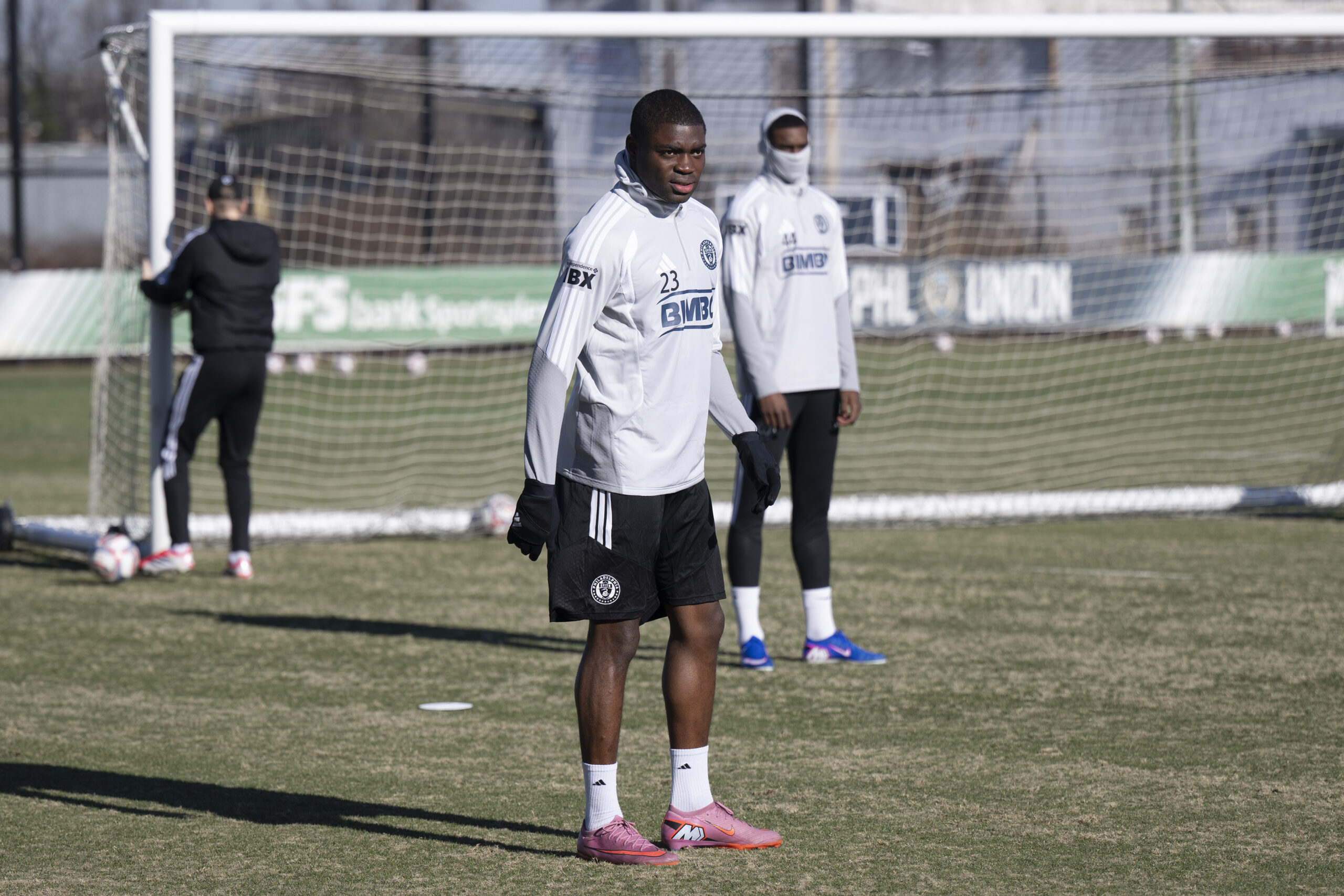
    The Union paid a team record $4.5 million to sign Ezekiel Alladoh.

    The Union will begin their season Wednesday in the Concacaf Champions Cup at Defence Force FC of Trinidad & Tobago (6 p.m., FS2, TUDN). Here’s a look at every player who will stock their roster.

    Sports snapshot

    Figure skater Isabeau Levito is competing in her first Olympics at age 18.

    🧠 Trivia time

    Who was the last Sixer to win the MVP award in the NBA All-Star Game? First with the correct answer here will be featured in the newsletter.

    A) Allen Iverson

    B) Joel Embiid

    C) Charles Barkley

    D) Julius Erving

    What you’re saying about Bryce Harper

    We asked: What kind of season do you expect out of Bryce Harper this year? Among your responses:

    Harper should have a very good year. He is capable of anything. I believe the team is unhappy with its performance in the last two playoff seasons and will come out battling to prove they can do it. Should be fun. — Gerard B.

    Staying healthy and having protection in the order should yield a typical .285, 30 HRs and 90 RBI season line. The past couple of years he has been chasing pitches outside the strike zone and simply forcing the issue. Hopefully Harper will focus, relax and stay healthy. — Bob C.

    Bryce Harper practices during the Phillies’ first full-squad workout of spring training Monday in Clearwater, Fla.

    Hopefully better than last year — Bill M.

    Above-avg OPS, but not elite. Dombrowski was right. — Tom M.

    If healthy I think Bryce will have an outstanding season. … I think Dombrowski was right to say it was not an elite season because it was not. Bryce went from 145 games played to 132 and his batting average, RBIs, and home runs were all down from 2024. And in 4 playoff games he hit .200 with no home runs and no RBIs. I think the “not elite” comment should drive him to have one of his best years ever and hopefully lead the Phillies back to the top. — Everett S.

    Harper is planning for the rest of his career, he wants to be a club general manager. I do not believe that he is fully motivated for the upcoming season. — John M.

    Bryce will be fine & bounce back to the player we love to see come to bat in the big moments. Even Hall of Famers have an off year. Dombrowski’s comments aside, he is still driven to bring more championships to the Phillies. Sometimes maybe too much. Last year he often looked like he had to hit a HR each AB. Maybe he needs to add some relaxation & mind control techniques to his game.

    My one concern. … What he can’t control is every year he seems to get hit, causing lost time. Maybe the Phils could do more to protect him? Any of our pitchers know how to pitch inside? — Janice M.

    We compiled today’s newsletter using reporting from Scott Lauber, Lochlahn March, Gina Mizell, DeAntae Prince, Olivia Reiner, Rob Tornoe, Jonathan Tannenwald, Matt Breen, and Colin Schofield.

    By submitting your written, visual, and/or audio contributions, you agree to The Inquirer’s Terms of Use, including the grant of rights in Section 10.

    Thank you for reading our newsletter. Bella will be at the controls tomorrow. — Jim

  • From East Berlin to Philadelphia: Springsteen’s long arc of protest

    From East Berlin to Philadelphia: Springsteen’s long arc of protest

    Philadelphia has always understood that music is never just music; sometimes rhythm becomes resistance. In this city, songs have spilled out of union halls and church basements, echoed off rowhouse walls, and marched alongside movements for labor rights and racial justice.

    That tradition shows why Bruce Springsteen’s music, and his choices, still matter, decades after a summer night in East Berlin when rock and roll quietly challenged both sides of a superpower rivalry.

    In 1988, nearly 300,000 young East Germans gathered for the largest rock concert in the history of the German Democratic Republic. The performer was Springsteen, a working-class songwriter whose music had already been widely misunderstood in the United States.

    Ronald Reagan appropriated the pounding chorus of “Born in the U.S.A.” as a patriotic anthem while ignoring its verses — the story of a Vietnam veteran sent off “to go and kill the yellow man,” only to return home abandoned by the country he served.

    In East Germany, those lyrics landed differently. Listeners heard the betrayal beneath the beat. They recognized themselves in the song’s moral tension. That understanding is why, unlike most Western rock stars, Springsteen was invited to play behind the Iron Curtain.

    Pressure to stop the concert came from both sides of the Cold War. The U.S. Embassy urged Springsteen to cancel, fearing the show would legitimize a communist regime. At the same time, the East German youth organization sponsoring the concert — without Springsteen’s knowledge — advertised it as a “solidarity concert” for Nicaragua’s Sandinista government.

    Springsteen refused both. He told U.S. officials he would not cancel. He told East German organizers he would not perform unless Sandinista banners were removed. His music, he insisted, belonged to ordinary working people, not to politicians.

    About an hour into the concert, Springsteen stopped and addressed the crowd in halting German. “It’s great to be in East Berlin,” he said. “I’m not here for or against any government. I came to play rock and roll for East Berliners in the hope that, one day, all barriers will be torn down.”

    He had wanted to say “walls,” but anxious officials begged him to soften the language. So he let the music finish the thought, launching into Bob Dylan’s “Chimes of Freedom,” a song written for the refugees, the silenced, the imprisoned, which Springsteen has lately reprised. A year later, the Berlin Wall fell. Many described the night as a widening crack — a moment when imagination briefly outran fear.

    Late last month, Springsteen’s new song “The Streets of Minneapolis” reached No. 1 on iTunes in 19 countries. Written in response to police violence and racial injustice, the song was dismissed last week by the White House as “irrelevant.” Millions of listeners disagreed.

    People protest against ICE outside the Bishop Henry Whipple Federal Building on Jan. 30 in Minneapolis.

    This pattern is familiar. Springsteen’s work has long been embraced by audiences while misread, or deliberately misunderstood, by power. His songs are moral arguments set to melody, like the Academy Award-winning tune “Streets of Philadelphia.” They insist the American dream is fragile. It collapses when dignity, accountability, and justice are denied.

    That message resonates deeply in Philadelphia, a city shaped by labor battles, civil rights struggles, and ongoing demands for racial justice. It also resonates with the white working-class men who have always been at the center of Springsteen’s audience — many of whom now make up the backbone of the MAGA movement.

    His message to them has never changed. Freedom does not come from walls. Power does not come from cruelty. The streets belong to everyone, or they belong to no one. Will this be the moment when they hear Donald Trump’s administration is destroying whatever is left of the American dream?

    Music alone does not tear down barriers — or walls. But it shapes what people are willing to imagine, what they are willing to demand, and who they are willing to stand beside.

    Springsteen’s music calls us to rise up against injustice, whether in the streets of Philadelphia, Berlin, or Minneapolis.

    Kristen Ghodsee is a professor of Russian and East European studies at the University of Pennsylvania. She is the author of 12 books and is currently on academic sabbatical as an honorary fellow of the Einstein Forum in Potsdam, Germany. Susan Neiman has been the director of the Einstein Forum since 2000. She is a philosopher, essayist, and the author of 10 books.

  • An analysis of the Union’s roster at the start of the season, with new players in the mix

    An analysis of the Union’s roster at the start of the season, with new players in the mix

    As we do every year to start a Union season, here’s a player-by-player look at the team’s roster.

    The list at each position is in order of what looks to be the depth chart heading into the campaign, which starts Wednesday in the Concacaf Champions Cup at Defence Force FC of Trinidad & Tobago (6 p.m., FS2, TUDN). The regular-season opener follows on Saturday at D.C. United (7:30 p.m., Apple TV).

    Goalkeeper

    Andre Blake

    This analysis has been going since 2018, and the same name has gone first every time. It will stay first for as long as Blake remains, not just as the Union’s No. 1, but as the best goalkeeper in MLS for a decade.

    Andre Blake has won MLS’s goalkeeper of the year award three times.
    Andrew Rick

    He showed again last year that he’s a safe pair of hands as the backup, and he’s still only 20 years old. The question will be if he’s willing to wait longer than Matt Freese did — understandably — to get more playing time. If he is, his time will come, but Blake isn’t going anywhere yet.

    Andrew Rick making a save during a U.S. Open Cup game last year.
    George Marks

    A short-term contract last year earned him a longer deal to be the No. 3 in net.

    George Marks in action for the Union’s reserve team last year.

    Left back

    A player who hasn’t been signed yet

    There’s no other way to put it right now. The Union are shopping for a new starter, and are close to sealing a deal for that player to be 20-year-old Philippe Ndinga from Swedish club Degerfors. But as Yogi Berra might say if he was a soccer fan, it’s not official until it’s official.

    Jon Scheer, the Union’s head of academy and professional development, has been the face of the front office this winter with Ernst Tanner on leave.

    Frankie Westfield

    Until Ndinga settles in, Westfield is likely to do the job. The rise of the Northeast Philadelphia native last year was one of the season’s great stories.

    Frankie Westfield was one of the Union’s breakout players last year.

    Right back

    Nathan Harriel

    He has definitely earned the starting job, even though his attacking contributions are still limited. Once Ndinga gets going, Harriel might start platooning with Westfield to play in certain matchups.

    Nathan Harriel played 31 games last year, often stepping in at centerback when the Union were short there.
    Olivier Mbaizo

    He’s highly regarded in the locker room, especially as part of the unofficial welcoming committee for new players who come from abroad. But that doesn’t guarantee playing time, and it’s tough to tell how much he’ll get this year.

    Olivier Mbaizo is going into his ninth season with the Union’s first team.

    Centerback

    Olwethu Makhanya

    He hadn’t played a second for the first team at the start of last year, but Bradley Carnell trusted his fellow South African to step up. Now the 20-year-old is a stalwart, and importantly the only returning player in the centerback group. That, perhaps, makes his role even bigger.

    Olwethu Makhanya was one of last year’s most impressive players.
    Japhet Sery Larsen

    The Union don’t often sign experienced players from abroad, preferring to find underrated names they can develop and sell. But they knew they needed a veteran to replace Jakob Glesnes, and the 25-year-old Denmark native fits the bill. Now, can he handle the physicality of MLS?

    Japhet Sery Larsen is expected to have a big role on the Union’s back line this year.
    Geiner Martínez

    We haven’t seen much of the 23-year-old Colombian yet, but it’s a safe bet that we will in time. The Union have a busy schedule with the Concacaf Champions Cup, Leagues Cup, and compressed stretches of the regular season around the World Cup. Rotating centerbacks will be as important as ever.

    Geiner Martinez during one of the Union’s preseason games.
    Finn Sundstrom

    A 19-year-old prospect who grew up with North Carolina FC of the second-tier USL Championship, Sundstrom is a name for the future, and likely will spend more time with the Union’s reserves than the first team this year.

    Finn Sundstrom working out during a preseason practice.
    Neil Pierre

    The best centerback prospect in the Union’s academy pipeline is on loan to Denmark’s Lyngby, where the Union own a stake, through June. Hopefully he will be closer to ready for first-team minutes when he returns.

    Neil Pierre (right) made his Union first-team debut last year.

    Defensive midfielders

    Jovan Lukić

    Perhaps the best of last year’s signings, Lukić jumped effortlessly into the midfield engine room. His tackles and his talking can be a little too robust sometimes, but the total package has been great.

    Jovan Lukić getting stuck during a game last summer.
    Danley Jean Jacques

    A great partner to Lukić, Jean Jacques is now set for a true star turn with Haiti at the World Cup. It can’t be said enough how special it will be if he plays in Philadelphia against Brazil this summer.

    Danley Jean Jacques also had a strong season in the Union’s midfield last year.
    Alejandro Bedoya

    The longtime captain is in his 11th season in Chester, and third in a series of one-year contracts. The mental side of his game is as sharp as ever, but the clock is inevitably running on a body that will turn 39 in April.

    Alejandro Bedoya models the Union’s new jersey this year.
    Jesús Bueno

    He probably deserves better than the playing time he gets. Carnell has hinted at it, too. Will this be the year it happens?

    Jesús Bueno in action last year.

    Attacking midfielder

    Milan Iloski

    His arrival in August was the turning point in the Union’s season. They likely would not have won the Supporters’ Shield without him. Carnell likes playing Iloski at forward sometimes, but the team as a whole is clearly better when he’s in midfield. That forces opposing defenses to open up.

    Indiana Vassilev

    Early on in his time in Chester, it looked like most of his contributions would come from industrious pressing. But over the course of last season, he blossomed into more, and finished last year with seven goals and four assists.

    Indiana Vassilev (center) celebrates scoring a goal for the Union in August.
    Quinn Sullivan

    When he returns from a torn ACL in July, after the World Cup break, it will give the team a huge boost. He’s been greatly missed on the field, although he’s fortunately been able to stay a vibrant presence off it.

    The Union greatly missed Quinn Sullivan (left) after his ACL injury in September, especially during the playoffs.
    Cavan Sullivan

    With two years to go until he leaves for Manchester City, the now-16-year-old is running out of time to make an impact on his hometown club. Or perhaps it’s better to say the club is running out of time for him to impact it. Will this be the year he breaks out?

    Lots of people around the soccer world are waiting for Cavan Sullivan to truly break out on the field.
    Jeremy Rafanello

    The Delran native has become the unofficial closer for Union wins, but he isn’t likely to overtake the players ahead of him here. It also bears saying that time given to him is time that Cavan Sullivan could get instead.

    Jeremy Rafanello (center) on the ball against Inter Miami last year.
    Ben Bender

    Carnell likes his willingness to sacrifice, which has led to testing the 24-year-old as an emergency left back. That doesn’t look likely to stand for the long term, but at least he has the manager’s respect.

    Ben Bender (right) has earned Bradley Carnell’s appreciation.
    CJ Olney

    He was a marquee prospect a few years ago, and is still just 19. But he has plateaued since signing a first-team contract in 2024.

    CJ Olney in action with Union II last year.

    Forward

    Bruno Damiani

    It was easy to see his strengths in his first season here: size, speed, physicality. But in the stats that mattered most, he tallied only nine goals and one assist in 40 games. That has to change this year, especially with Tai Baribo and Mikael Uhre gone.

    Ezekiel Alladoh

    You can tell just from practices why the Union broke their transfer fee record to sign the 20-year-old Ghana native. He’s still raw, though, and Carnell has preached patience. Alas, only so much will be given if he doesn’t find the net.

    The Union paid a team record $4.5 million to sign Ezekiel Alladoh.
    Agustín Anello

    He’s an intriguing signing: born in Florida to Argentine parents, raised in Spain, and a pro career in four countries by age 23. Even better, he played with Harriel and Damiani at some of his stops along the way. He projects as the No. 3 striker right now but should still see significant playing time.

    Agustín Anello (left) is settling in with the Union after arriving late in preseason.
    Stas Korzeniowski

    A promotion to the first team was a nice reward for the former Penn star’s 12 goals for Union II last year.

    Sal Olivas

    He showed promise in his brief shots with the first team last year. A few more shots this year would be a welcome sight.

    Sal Olivas (left) got a brief run with the Union’s first team last summer.
    Eddy Davis

    Definitely still a prospect, but his work rate and enthusiasm make him easy to root for.

    Markus Anderson

    He is reportedly going out on loan this year.

  • Letters to the Editor | Feb. 17, 2026

    Letters to the Editor | Feb. 17, 2026

    A criminal justice overhaul

    The Thursday print edition of The Inquirer provided several reasons why we should applaud the current presidential administration for its contributions to criminal justice reform. For example, unlike many liberal state and local politicians who have talked the talk about providing employment opportunities for former criminals, Associated Press writer Ryan J. Foley reported that enlightened managers from U.S. Immigration and Customs Enforcement have hired these individuals while they were still exhibiting criminal behavior. It should be mentioned that ICE has found creative ways for these individuals to sublimate their violent temperaments and offensive libidos into constructive law enforcement activities that have made cities like New York, Minneapolis, and Chicago so much safer.

    In that same edition of The Inquirer, Washington Post reporters described how the U.S. Department of Justice has successfully kept the names of sexual predators in the Jeffrey Epstein files out of the public eye. In an era in which progressives have rallied to “ban the box” that would otherwise require job applicants to describe their criminal history, the Justice Department has gone one step further in assuring Epstein criminals will not be economically penalized.

    It is refreshing to see that just like Lady Justice, the U.S. Departments of Homeland Security and Justice have undertaken their duties as if they were blindfolded.

    Coleman Poses, Philadelphia

    A cancer within?

    Recent reports that President Donald Trump is threatening to cancel elections and bypass Congress with an executive order on election reforms brought to mind another presidential power grab.

    In 1973, White House counsel John Dean famously warned President Richard Nixon that the Watergate cover-up was a “cancer within — close to the presidency.” He cautioned that this corruption would consume Nixon’s presidency if allowed to fester. History proved him right, as Nixon resigned in disgrace.

    Today, that warning rings with renewed urgency. By appointing Kurt Olsen as director of election security and Heather Honey as deputy assistant secretary for election integrity — both known election deniers — Trump has institutionalized systemic subversion. With his intent to nationalize elections on the heels of these appointments, the administration is poised to seize state-run processes, despite having no constitutional authority to do so.

    Had it not been for the stabilizing counsel from the president’s first-term advisers, who have since been replaced with yes-men and ideologues, the republic may not have survived. With these guardians of democracy gone, the American Experiment is in grave jeopardy.

    Jane Larkin, Tampa, Fla.

    Wrong-headed ‘housing’

    I read the article about plans by U.S. Immigration and Customs Enforcement to spend $38.3 billion on detention centers with revulsion.

    Donald Trump’s administration spends a fortune of our tax dollars to create concentration camps across the country. The cruelty is mind-boggling.

    Meanwhile, we have a housing crisis throughout the nation. Imagine if those funds were diverted from tormenting our immigrant neighbors and devoted to providing affordable housing for our communities.

    Judith Silver, Philadelphia

    . . .

    ICE is going to spend over $38 billion on detention centers. This country has so many needs — medical costs skyrocketing, a housing shortage, people mired in poverty, disaster relief, drunk drivers who kill 10,000 people per year (far more than ever have been killed by foreign nationals in the last half century), and the list goes on and on — and yet, the Trump administration believes this is a good use of our tax dollars. This surge to “mass deportation” is just another solution in search of a problem.

    Steven Morley, Philadelphia

    Join the conversation: Send letters to letters@inquirer.com. Limit length to 150 words and include home address and day and evening phone number. Letters run in The Inquirer six days a week on the editorial pages and online.

  • Dear Abby | Spouse’s world turned upside down by pair of revelations

    DEAR ABBY: My husband and I (both male) have been together for 28 years. The last few years have been less than romantic, but we remain close and in love (or so I thought).

    A few days ago, he called me from work (I’m retired) crying so hard I could hardly understand him. I rushed to his office, and he told me he had just learned from his doctor that he has AIDS. He then confessed that he’d had an affair with a contractor at his place of employment. He said it happened years ago when we were going through a rough patch, and swore it was the only time he had strayed. I am awaiting the results of my HIV test, heartbroken and crushed. What now? I’m so hurt; I don’t know if I should stay or go.

    — CRUSHED IN FLORIDA

    DEAR CRUSHED: Your first order of business should be to ensure you and your husband are getting the best medical advice and treatment possible. A diagnosis of HIV-positive does not necessarily mean the disease will progress to full-blown AIDS because with the advances in medication, it can be held in check. Whether you should stay with your husband or leave is a question that should be tabled until you are less traumatized and thinking rationally.

    ** ** **

    DEAR ABBY: Two of my children are planning weddings two months apart next year. I’m originally from the Netherlands, where my entire family still lives. My kids both want to invite these relatives (which is great), except my parents are 86 and 87 and can make it to only one wedding. For my sisters, nieces and nephews, it’s too costly to come to both. They don’t want to hurt anyone’s feelings, and I have no idea how to advise them about which wedding to attend. My son said he will help them financially if they need it so they can come to both, but even so, I know it would not be possible for my parents to come to both. Any advice?

    — CHALLENGED IN IDAHO

    DEAR CHALLENGED: I do have one suggestion: STEP BACK! It should not be your responsibility to orchestrate who will attend which wedding. Invitations should be sent to everyone. After that, I’m sure conversations will ensue. If financial help is needed, your son is offering it. Should your parents’ degree of infirmity prevent them from attending both celebrations, the decision about which they will attend should be theirs. Even if they can’t be there in person for both, these days many weddings are livestreamed, and photos and videos can be shared on social media.

    ** ** **

    TO MY ASIAN READERS WHO CELEBRATE THE LUNAR NEW YEAR: The Lunar New Year begins today. This is the Year of the Horse. According to Asian culture, individuals born in the year of the horse are dynamic, charming and adventurous. They thrive in settings that are bustling with activity and are often seen as natural leaders and motivators. A healthy, happy and prosperous New Year to you all. Tallyho!

    — LOVE, ABBY

    ** ** **

  • Horoscopes: Tuesday, Feb. 17, 2026

    ARIES (March 21-April 19). Noticing the gap between who you are and who you want to be? That’s a win. Accepting it without shame is the kind of mindset that makes real progress possible. It takes humility to grow, and humility like that will get you far.

    TAURUS (April 20-May 20). With billions of people on the planet, it’s only natural that some paths will cross in messy ways. Conflicts happen. Challenges are unavoidable. And that’s a good thing, especially today because they keep the adventure fun and the story interesting.

    GEMINI (May 21-June 21). Things that are always around get ignored. Things you can never have feel frustrating. The things that keep you wanting more? They show up sometimes, not all the time. That’s the sweet spot. The desire you chase or are chased by will illustrate the concept.

    CANCER (June 22-July 22). After an extended cycle of accommodating others, your own needs are a whisper. At this juncture, it would be normal not to know what you want. It would also be normal to turn the trend around.

    LEO (July 23-Aug. 22). Endless choice can feel like no choice at all because too many options make it hard to know what you like. Everything starts to feel the same. You’ll figure out what you like by choosing and sticking with something.

    VIRGO (Aug. 23-Sept. 22). The day’s dance is a kick line — a cumulative effect, beautiful in its conformity, requiring peripheral awareness. The line becomes one creature with many legs hitting the same rhythm and height. Dancers who can kick higher save it for another dance.

    LIBRA (Sept. 23-Oct. 23). You feel compelled to make a move even though you can’t imagine the outcome just yet. Inability to picture a future doesn’t mean the move is wrong. Right now, your instincts are simply ahead of your perception and imagination.

    SCORPIO (Oct. 24-Nov. 21). Can you be overeducated? Only if all that knowledge keeps you from doing anything. Not everything you learn is immediately useful. By taking action, you’ll learn which part of your education applies, and from there, experience will be your new professor.

    SAGITTARIUS (Nov. 22-Dec. 21). Take your time with today’s decisions, especially financial ones. Note that expensive things aren’t automatically better things, and sometimes they are worse, offered by the greedy to the ignorant, which is why you’ll do the research.

    CAPRICORN (Dec. 22-Jan. 19). Difficulty isn’t just the price of admission. It’s the weight that makes the muscle. Hard things aren’t the dues you pay to be awesome; they are why you’re awesome. The work required to earn them is what makes them transformative rather than hollow.

    AQUARIUS (Jan. 20-Feb. 18). Oddly enough, putting too much thought into a thing can make it less effective. The slapdash version will contain the most honest information, whether you’re on the giving or receiving end of it.

    PISCES (Feb. 19-March 20). Feeling stuck? There are options you’re not using — things you could say, decisions you could make, buttons to push, experiments just waiting for the scientist in you to try. Play a few of those hands and then see how you feel. You’re more powerful than you know.

    TODAY’S BIRTHDAY (Feb. 17). Welcome to your Year of the Bonsai Tree, when you grow in the direction you train in and create circumstances that bring about your most elegant form. Purposeful personal development will include making your own rules, helpful reinforcements and nurturing that has you continually warmed by emotional sunshine. More highlights: Romantic clarity, financial advantage, and spiritual insight that illuminates even your business decisions. Pisces and Capricorn adore you. Your lucky numbers are: 10, 26, 5, 37 and 15.

  • Frederick Wiseman, documentarian behind the Northeast High-filmed ‘High School,’ dies at 96

    Frederick Wiseman, documentarian behind the Northeast High-filmed ‘High School,’ dies at 96

    Frederick Wiseman, 96, the renowned documentarian who chronicled life at Northeast Philadelphia High School in a 1968 film that caused a yearslong controversy in the city, has died.

    Zipporah Films, a company that has distributed Mr. Wiseman’s films for more than 50 years, confirmed the filmmaker’s death in a statement Monday.

    Known for his direct cinema style, Mr. Wiseman started his career as a law professor at the Boston University Institute of Law and Medicine before turning to film. His lengthy filmography stretches back to 1967 with the release of Titicut Follies, a controversial exposé focused on the treatment of the patient-inmates of Bridgewater State Hospital for the Criminally Insane in Massachusetts.

    That film was banned in Massachusetts for more than two decades.

    His follow-up, 1968’s High School, a foundational cinema verite documentary filmed at Northeast High School in Philly between the assassinations of the Rev. Dr. Martin Luther King Jr. and Sen. Robert F. Kennedy, was similarly controversial. In fact, Northeast High leaders found it so incendiary that it did not receive a local premiere until 2001 — 32 years after its initial release — for Mr. Wiseman’s fear of legal action.

    At 75 minutes, High School depicted what viewers at the time saw as a bleak vision of life at Northeast High. Contemporary reviews agreed, with Variety writing that it showed the school taught “little but the dreary values of conformity, [and] blind respect for authority.” Newsweek noted that the film showed “high schools are prisons where the old beat down the young.”

    In one scene, a guidance counselor tells a student they may not be college material. In another, a teacher tells a girl her legs are too fat for a dress she sewed. Another shows a dean shutting down a student who was complaining about unfairly receiving detention.

    As early as mid-1969, Mr. Wiseman refused to make a copy of the film available locally, citing “legal repercussions,” according to Inquirer reports from the time. The Philadelphia Board of Education, meanwhile, declared the documentary “biased” and demanded it be shown to students and faculty.

    High School, however, would not receive its first official local public showing until August 2001, at the Prince Music Theater. About 400 people attended, The Inquirer reported, most of whom were faculty or alumni of Northeast High.

    Five days later, it aired on the PBS series POV Classic.

    “I took him to the annual press tour the year we aired High School and never had a funnier, more incisive companion to compare notes with on the state of cinema,” said Cara Mertes, who was then the executive producer of POV Classic. “He was perpetually young, incredibly smart, and did not suffer fools, and still he was always generous with his time and immense talent as one of America’s greatest chroniclers, in any medium.”

    Ten years before, in 1991, High School was selected for preservation in the United States National Film Registry by the Library of Congress.

    “It is everything you need to know about 1968 middle-class America in microcosm,” Mertes said. “So many scenes and characters have taken on iconic status. It captures the tectonic social shifts happening in the most ordinary of exchanges in the day-to-day of a touchstone of American life: the high school experience.”

    “Wiseman pulled a fast one on Northeast,” said English department head Irene Reiter after seeing the film. “It was a setup to attack the educational system.”

    Former students, however, largely seemed to disagree. Andrea Korman Shapiro, a student featured in a scene in which a vice principal admonishes her for wearing a minidress to prom, called it “accurate.”

    “[It’s] a chronicle of the inner life of people not permitted to speak,” she said.

    Even others who had more positive experiences at the school argued the film’s strengths outweighed its shortcomings. As Marilyn Kleinberg, a 1978 graduate, put it: “It felt real to me, even though I had an excellent experience.”

    Shapiro, meanwhile, said it would be wise to view High School as a “trauma model.”

    “A trauma, if it doesn’t get resolved, gets replayed and reenacted,” she said. “There needs to be some kind of learning to let it go.”

    The year High School debuted in Philadelphia, Mr. Wiseman told Current, a nonprofit news organization associated with American University’s School of Communication, that his concerns about legal action over the film were perhaps overblown.

    “This was soon after the Titicut Follies case, and I didn’t want another lawsuit on my hands,” he said. Possible legal threats, he added, were merely the “vague talk of no one particular individual.”

    In 2016, Mr. Wiseman received an honorary Oscar at the 89th Academy Awards for his “masterful and distinctive documentaries” that “examine the familiar and reveal the unexpected.” Making films, he said in his acceptance speech, presented opportunities to “learn something about a new subject.”

    “The variety and complexity of the human behavior observed in making one of the films, and cumulatively all of the films, is staggering,” Mr. Wiseman said in the speech. “And I think it is as important to document kindness, civility, and generosity of spirit as it is to show cruelty, banality, and indifference.”

    The article has been updated with quotes from Cara Mertes.

  • Nancy Guthrie kidnapping investigators work with Walmart after identifying suspect’s backpack

    Nancy Guthrie kidnapping investigators work with Walmart after identifying suspect’s backpack

    Investigators working on the disappearance of “Today” show host Savannah Guthrie’s mother are consulting with Walmart management to develop leads because a backpack the suspect was wearing is sold exclusively at the stores, the Pima County, Arizona, sheriff said Monday.

    Nancy Guthrie, 84, was last seen at her Arizona home on Jan. 31 and was reported missing the following day. Authorities say her blood was found on the front porch. Purported ransom notes were sent to news outlets, but two deadlines for paying have passed.

    The Federal Bureau of Investigation released surveillance videos of a masked person wearing a handgun holster outside Guthrie’s front door in Tucson the night she vanished. A porch camera recorded video of a person with a backpack who was wearing a ski mask, long pants, a jacket and gloves.

    Pima County Sheriff Chris Nanos said in a text message to The Associated Press on Monday that the 25-liter “Ozark Trail Hiker Pack” backpack was the only clothing item that has been “definitively identified.”

    “This backpack is exclusive to Walmart and we are working with Walmart management to develop further leads,” Nanos said.

    The suspect’s clothing “may have been purchased from Walmart but is not exclusively available at Walmart,” the Pima County Sheriff’s Department said in a statement Monday. “This remains a possibility only.”

    Investigators on Sunday announced that a glove discovered near the Guthrie home has been sent for DNA testing. The FBI said that it received preliminary results Saturday and was awaiting official confirmation. The development comes as law enforcement gathers more potential evidence and as the search for Guthrie’s mother heads into its third week. Authorities previously said they had not identified a suspect.

    The FBI said the suspect in the surveillance footage is a man about 5 feet, 9 inches tall with a medium build.

    Nanos said on Monday that members of Guthrie’s family, including siblings and spouses, are not suspects.

    “The family has been nothing but cooperative and gracious and are victims in this case,” Nanos said in a statement.

    Authorities have expressed concern about Nancy Guthrie’s health because she needs vital daily medicine. She is said to have a pacemaker and have dealt with high blood pressure and heart issues, according to sheriff’s dispatcher audio on broadcastify.com.

  • 3 killed, including suspect, in shooting during Rhode Island youth hockey game

    3 killed, including suspect, in shooting during Rhode Island youth hockey game

    PAWTUCKET, R.I. — Three people, including the suspect, were fatally shot during a Rhode Island youth hockey game Monday, authorities said.

    Pawtucket Police Chief Tina Goncalves told reporters that three other victims were hospitalized in critical condition. The shooter died from an apparent self-inflicted gun wound, she said.

    While police were not involved in the shooter’s death, authorities were still investigating, she said.

    “It appears that this was a targeted event, that it may be a family dispute,” she said.

    Goncalves did not provide details about the suspect or the ages of those who were killed, though she said it appeared that both victims were adults.

    She said investigators were trying to piece together what happened and speak with witnesses of the shooting inside Dennis M. Lynch Arena in Pawtucket, a few miles outside Providence. They also were reviewing video taken from the hockey game. Unverified footage circulating on social media shows players diving for cover and fans fleeing their seats after popping sounds are heard.

    Outside the arena, tearful families and high school hockey players still in uniform could be seen hugging before they boarded a bus to leave the area. Roads surrounding the arena were shut down as a heavy police presence remained and helicopters flew overhead.

    Monday’s shooting comes nearly two months after Rhode Island was rocked by a separate gun violence tragedy at Brown University, where a gunman killed two students and wounded nine others. That shooter went on to also fatally shoot a Massachusetts Institute of Technology professor. Authorities later found Claudio Neves Valente, 48, dead from a self-inflicted gunshot wound at a New Hampshire storage facility.

    “The fortunate thing is that the two incidents are not related, but it is very tragic,” said Pawtucket Mayor Don Grebien. “These are high school kids. They were doing an event, they were playing with their families watching, a fun time, and it turned into this.”

    Pawtucket is nestled just north of Providence and right under the Massachusetts state border. A city of just under 80,000, Pawtucket had up until recently been known as the home to Hasbro’s headquarters.