Blog

  • Looking for gluten-free baked goods on the Main Line? Flakely is open for business in Bryn Mawr.

    Looking for gluten-free baked goods on the Main Line? Flakely is open for business in Bryn Mawr.

    Gluten-free bakery Flakely has opened its doors in Bryn Mawr, bringing its signature pastries to the Main Line after five years of doing business out of a commercial kitchen in Manayunk. The cross-river move marks a major expansion for Flakely, which, for years, has sold most of its pastries in a frozen take-and-bake form because of space constraints.

    Now, Flakely is giving Main Line customers a rare opportunity to buy fresh gluten-free baked goods, namely its acclaimed croissants, which are a notoriously difficult item to make without gluten.

    Lila Colello owner of Flakely a gluten free bakery. She is rolling a plain croissant at her new location on Lancaster Avenue, Bryn Mawr, PA, Friday, Feb. 13, 2026.

    Flakely’s new Bryn Mawr headquarters is located at 1007 W. Lancaster Ave. in the former Grand Middle East hookah lounge (though one would never guess the storefront’s previous identity given all of the pastel pink decor that now adorns the walls).

    On the morning of Flakely’s soft opening last week, bakery staff bustled around the open concept kitchen. A glass display case of treats, including sweet and savory croissants and elegantly decorated cupcakes, shimmered in the early morning light.

    The move to the Main Line is “a homecoming” of sorts for owner Lila Colello, who grew up in Ardmore and attended the Shipley School. Colello worked her way up in Philadelphia’s dessert world, staging at the Ritz Carlton and serving as a pastry chef at Wolfgang Puck Catering. When she was diagnosed with celiac disease, an inflammatory autoimmune disorder triggered by eating gluten, in 2010, she feared her days in the pastry world were numbered.

    But instead, Colello mastered the art of the gluten-free pastry. She started Flakely in 2017 as a wholesale operation and moved into the commercial kitchen in Manayunk in 2021.

    Flakely was voted one of the best gluten-free bakeries in the country in 2024 by USA Today, and Inquirer restaurant critic Craig Laban said Colello had “found the secret” to making laminated pastry, like croissants.

    The Manayunk kitchen helped put Flakely on the map, but it also constrained Colello. Because there was so little foot traffic, Flakley couldn’t make fresh goods for fear of having to throw out large quantities at the end of the day.

    A box of gluten free pastries from Flakely, Lancaster Avenue, Bryn Mawr, PA, Friday, Feb. 13, 2026. Clockwise, Heart Shaped Twix, Plain Croissant and Vanilla Cupcake with Raspberry Curd and Whipped Honey Lemon Mascarpone Buttercream.

    Colello’s new storefront has given her the space to hire a larger staff, expand her fresh pastry offerings, and give patrons a true bakery experience.

    “I don’t know another place, maybe outside of New York, that has gluten-free croissants that you can even have fresh,” Colello said.

    “It’s a totally different experience,” she added.

    Demand for gluten-free goods is high in Lower Merion, Colello said. Many Main Line patrons used to make the trek to Manayunk to buy Colello’s take-and-bake goods and are happy to have a gluten-free option closer to home.

    Flakely joins a small contingent of gluten-free bakeries in the Philly suburbs, including The Happy Mixer, which has locations in Wayne, Chalfont, and Newtown, and Laine’s Gluten Free Bakery in Berwyn.

    Colello said Flakely is still figuring out its hours, but she plans to be open from 10 a.m. to 3 p.m., Tuesday through Friday, and from 10 a.m. to 2 p.m. on Saturday. For more information, you can visit Flakely’s Facebook or Instagram, where Colello will post weekly hours and menus.

    This suburban content is produced with support from the Leslie Miller and Richard Worley Foundation and The Lenfest Institute for Journalism. Editorial content is created independently of the project donors. Gifts to support The Inquirer’s high-impact journalism can be made at inquirer.com/donate. A list of Lenfest Institute donors can be found at lenfestinstitute.org/supporters.
  • One of Philly’s last architecturally intact old movie theaters is officially recognized as historic

    One of Philly’s last architecturally intact old movie theaters is officially recognized as historic

    The Circle Theatre in Frankford, built in 1929 for what was once the largest movie theater chain in the country, is now officially recognized as historic.

    The Philadelphia Historical Commission voted Friday to add the former movie theater on the 4600 block of Frankford Avenue to the Philadelphia Register of Historic Places.

    According to the nomination, the Circle Theatre is “a significant surviving example of a neighborhood theater from a period when many were built” in the 1910s and ‘20s. The theater’s architects, Hoffman-Henon Co., “significantly shaped Philadelphia’s built environment through their commissions for theaters and Catholic institutions,” such as churches and schools.

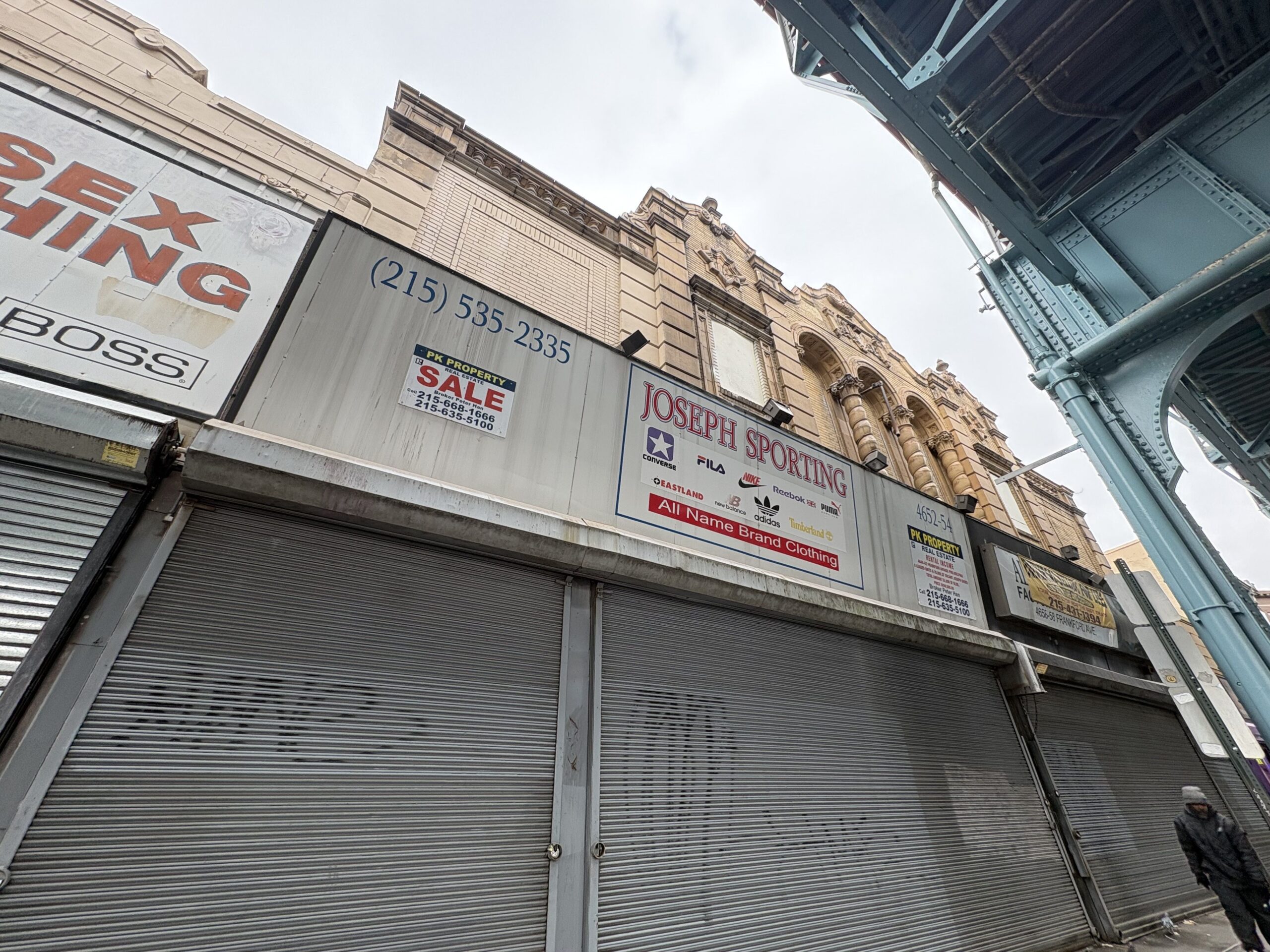
    The decorative facade of the Circle Theatre includes architectural terracotta with ornamental details and columns that have been preserved. The structure was a movie theater from the time it opened in 1929 until 1953, according to the nomination. The building, which included some commercial space, was then converted exclusively for commercial use and now includes both occupied and vacant storefronts.

    “The Circle Theatre is absolutely a landmark, and there’s still people who remember coming up [Frankford Avenue] to go there,” Ellie Devyatkin, director of economic development and neighborhood planning at the Frankford CDC, said during Friday’s Historical Commission meeting.

    According to the nomination, “while Philadelphia once had over 400 movie theaters, the Circle is one of relatively few survivors with significant architectural integrity.” The theater was nominated for designation by Historical Commission staff.

    The Hoffman-Henon architectural firm designed the Circle Theatre for the major movie theater chain Stanley Co. of America. The firm designed theaters for the company in Philadelphia, Atlantic City, Baltimore, and smaller municipalities throughout the tri-state area. Hoffman-Henon designed four Stanley theaters on Market Street in Philadelphia that the historic nomination called “movie palaces” that were “characterized by a large seating capacity and opulent interiors.”

    The Circle Theatre and the Warner Theatre, also known as the Embassy Theatre, on the Atlantic City boardwalk “included the most flamboyant interiors in the firm’s catalog,” according to the nomination. Both opened in 1929 after Warner Bros. acquired the Stanley Co.

    Emily Cooperman, a member of the Historical Commission and chair of its historic designation committee, said the committee was “very enthusiastic about this nomination” and appreciated the creation of an inventory of historical theaters by commission staffer Ted Maust.

    The Frankford CDC supported historic designation for the building, which is across from the community development corporation’s office. Through a Philadelphia Department of Commerce program, the organization worked with the owner of a produce market in the building to improve its facade and is working now with the owner of a salon, Devyatkin said.

    The Circle Theatre building now includes both vacant and occupied storefronts.

    Historic designation protects buildings from demolition but also requires permission for certain exterior changes. Building materials that preserve historic character and adhere to city guidelines can be expensive.

    “Particularly in neighborhoods where rents and property values are low, these designations can be difficult … when they do not come with financial assistance,” Devyatkin said. “There are other parts of the city where you can justifiably command a higher rent or a higher sales price for doing the right type of restoration or preservation work. But without subsidy, that’s really difficult … in many neighborhoods in Philly.”

    Oscar Beisert, a preservationist with the Keeping Society of Philadelphia, said he agreed and would like the city to show some “leniency, especially in areas where the economic viability is a lot lower.”

    He thanked staff at the Historical Commission for nominating the Circle Theatre for inclusion on the city’s historic register.

    “Frankford has a lot of great buildings,” Beisert said, “and it’s great to see one of them designated.”

  • Report: Dolphins releasing star receiver Tyreek Hill amid major roster cuts

    Report: Dolphins releasing star receiver Tyreek Hill amid major roster cuts

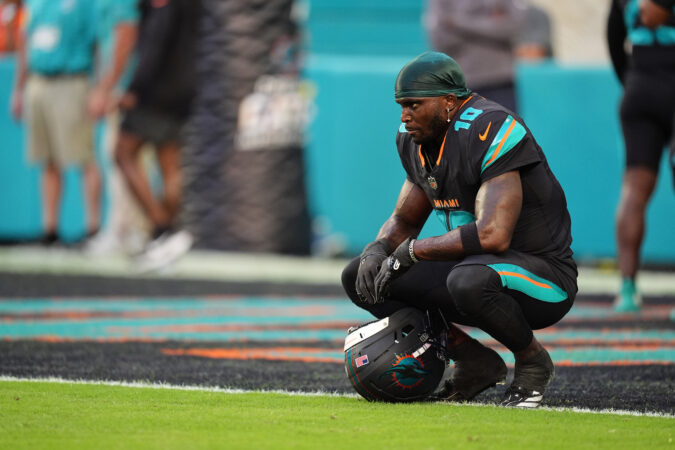
    MIAMI GARDENS, Fla. (AP) — The Dolphins are releasing star receiving Tyreek Hill, ending the All-Pro’s four-year tenure in Miami, a person familiar with the move told the Associated Press on Monday.

    Hill, who turns 32 on March 1, is recovering from a season-ending injury suffered in a game against the New York Jets on Sept. 29 that required surgery to repair significant damage to his left knee, including a torn anterior cruciate ligament.

    It is one of several major roster cuts the Dolphins made on Monday morning, the person said, speaking to the AP on condition of anonymity because the team had not made any announcements. Miami also will release two-time Pro Bowl pass rusher Bradley Chubb and cut offensive lineman James Daniels and receiver Nick Westbrook-Ikhine, the person said.

    The Dolphins acquired Hill in a trade with Kansas City ahead of the 2022 season and gave him a $120 million, four-year contract extension that made him the highest-paid player at his position at the time.

    His contract, which runs through 2026, would have represented around $51 million against Miami’s cap.

  • U.S. beats Sweden, 5-0, to reach Olympic women’s hockey final

    U.S. beats Sweden, 5-0, to reach Olympic women’s hockey final

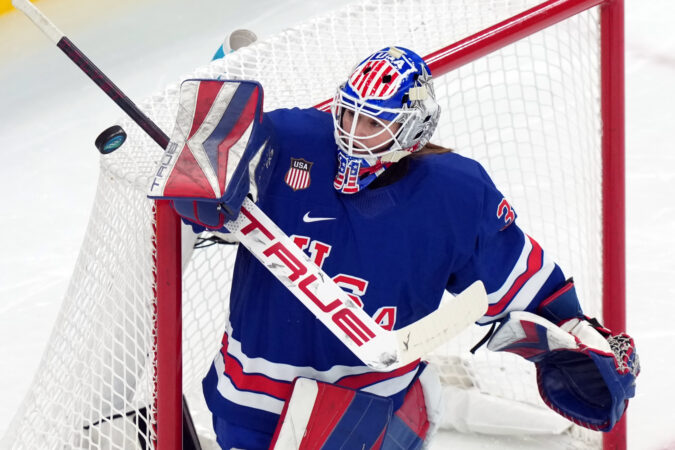
    MILAN — Aerin Frankel stopped 21 shots for her third shutout of the Olympic women’s hockey tournament and the favored United States advanced to the gold-medal game by defeating Sweden, 5-0, at the Milan Cortina Games on Monday.

    Abbey Murphy, Kendall Coyne Schofield, and Hayley Scamurra scored on consecutive shots over 2 minutes, 47 seconds late in the second period to blow the game open and put the Americans up 5-0. Cayla Barnes opened the scoring and Taylor Heise also scored.

    The Americans continued their roll through the tournament by improving to 6-0, outscoring their opponents by a combined 31-1. The U.S. has yet to trail or be tied after 0-0, and is in position to become the third women’s team to do so over the entire tournament, joining Canada in 2006 and 2010.

    The U.S. also extended its shutout streak to 331:23, going back to Czechia’s Barbora Jurickova beating Frankel on a breakaway in the second period of a tournament-opening 5-1 win.

    The win over Sweden sets up what could well be a seventh gold-medal showdown against Canada on Thursday. The defending Olympic champion Canadians play Switzerland in the day’s other semifinal game.

    The U.S. already beat Canada, 5-0, in a preliminary round game last week. The Americans won Olympic gold in 1998 and 2018, with Canada winning the other five tournaments.

    The United States’ Hayley Scamurra celebrates after scoring her team’s fifth goal against Sweden.

    Sweden will play for bronze on Thursday in an effort to medal for the third time in team history, and first since winning silver at the 2006 Turin Games after upsetting the U.S. in the semifinals.

    Ebba Svensson Traff stopped 19 of 23 shots before she was pulled after Schofield tipped in Laila Edwards’ shot from the blue line with 3:50 left in the second period.

    Emma Soderberg took over in goal, and was beaten by Scamurra, who tapped in Britta Curl-Salemme’s centering pass 1:49 later. Soderberg finished with 10 saves.

    Among those in attendance was former Eagles center Jason Kelce, who was shown on the scoreboard applauding the goal initially credited to Edwards. Kelce is from Edwards’ hometown of Cleveland Heights, Ohio, and he and his brother, Kansas City Chiefs tight end Travis Kelce, contributed to a GoFundMe drive to help pay for Edwards’ family to attend the Milan Cortina Games.

    The U.S certainly didn’t resemble a team that didn’t want to play Sweden, as coach Ulf Lundberg suggested after the Swedes beat Czechia in the quarterfinals.

    Though the Swedes kept the U.S. mostly to the perimeter in the opening period, they were still outshot 13-2.

    Barnes scored with a snap shot from the top of the right circle and beat Svensson Traff high on the short side. Barnes’ goal was her first point of the tournament, leaving seventh defender Rory Guilday as the lone American skater to not yet register a point through six games.

    Heise made it 2-0 at the 9:08 mark of the second period by one-timing in Hannah Bilka’s backhand pass through the middle. Svensson Traff got her glove on the shot, but the puck deflected across her body and into the net off the inside of her stick.

  • Jill Scott makes her Tiny Desk Concert debut

    Jilly from Philly is on the Tiny Desk.

    On Friday, Jill Scott released To Whom This May Concern, the North Philly singer and songwriter’s first album in 11 years.

    The 19-track stylistically wide-ranging project touches on jazz, hip-hop, R&B, spoken word, and blues. It features guests including Trombone Shorty, Ab-Soul, JID and Tierra Whack, and is produced by DJ Premier, Adam Blackstone, Andre Harris.

    On Monday, the actress and podcast host celebrated her return to music-making with her first-ever performance on NPR Music’s Tiny Desk Concert series.

    The episode was hyped over the weekend, calling Scott “one of the most requested artists on the Tiny Desk.” And Scott seemed thrilled to finally be at the makeshift performance space in the NPR newsroom in Washington, D.C. The series has had over 1,200 episodes since launching in 2008 and is a key promotional vehicle for artists that attracts over 15 million viewers a month.

    Leading a nine-member ensemble that included three backup singers, a flautist and a trumpet player, Scott said, “I gotta knock the nerves off. I‘m so excited to be here. I thought about you so much. I was like, ‘One day I’m going to be on the Tiny Desk!’”

    Scott led off with her signature song, “A Long Walk,” from her 2004 debut Who Is Jill Scott?: Words and Music Vol. 1 before moving soulfully and effortlessly into the new album’s “Beautiful People.”

    The five-song, 28-minute, set also includes a sensuous sing- and clap-along version of Who Is Jill Scott’s “The Way” and “Cross My Mind” from 2004’s Beautifully Human: Words & Sounds Vol. 2.

    Before To Whom This May Concern’s “Don’t Play,” Scott said she got the idea for the song after going down a TikTok rabbit hole watching videos of women complaining about their male partners’ lovemaking skills and thinking” “Let me be of service.”

    The song then addressed insensitive partners with words of admonition and advice — which she repeated a cappella after the song was finished — such as “Baby, don’t close your eyes, you can see and feel at the same time” and “You ain’t no jackhammer, and I ain’t no city street!”

    This album cover image released by The Orchard shows “To Whom This May Concern” by Jill Scott. (The Orchard/ via AP)
  • NAACP asks judge to protect against ‘misuse’ of voter data seized by FBI in Georgia’s Fulton County

    NAACP asks judge to protect against ‘misuse’ of voter data seized by FBI in Georgia’s Fulton County

    ATLANTA — The NAACP and other organizations are asking a judge to protect personal voter information that was seized by the FBI from an elections warehouse just outside Atlanta.

    Georgia residents entrusted the state with their “sensitive personal information” when they registered to vote, and the Jan. 28 seizure of ballots and other election documents from the Fulton County elections hub “breached that guarantee, infringed constitutional protections of privacy, and interfered with the right to vote,” the organizations said in a motion filed late Sunday.

    The motion asks the judge to “order reasonable limits on the government’s use of the seized data” and to prohibit the government from using the data for purposes other than the criminal investigation cited in the search warrant affidavit. That includes prohibiting any efforts to use it for voter roll maintenance, election administration, or immigration enforcement.

    They also want the judge to order that the government disclose an inventory of all documents and records seized, the identity of anyone who has accessed the records outside of those involved in the criminal investigation, any copying of the records, and all efforts to secure the information.

    The Department of Justice did not immediately respond Monday to a request for comment on the motion.

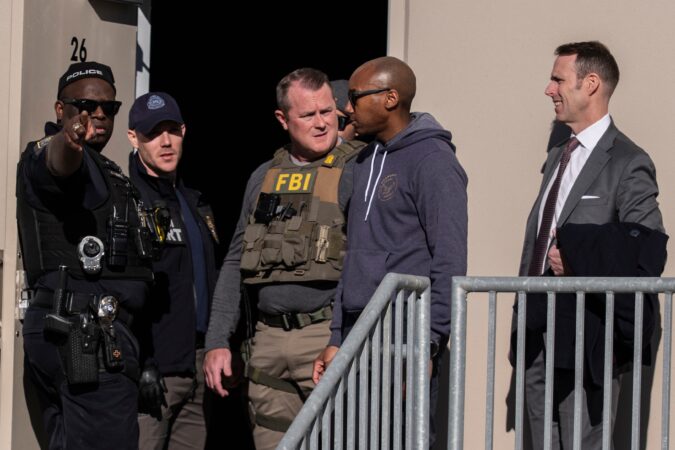
    FBI agents arrived at the elections hub just south of Atlanta with a search warrant seeking documents related to the 2020 election in Fulton County, including: all ballots, tabulator tapes from the scanners that tally the votes, electronic ballot images created when the ballots were counted and then recounted, and all voter rolls. The county has filed a motion seeking the return of the seized materials.

    President Donald Trump has fixated on Fulton, a Democratic stronghold and the most populous county in the state, asserting without evidence that widespread voter fraud there cost him victory in Georgia in 2020.

    An FBI agent’s affidavit presented to a magistrate judge to obtain the search warrant says the criminal investigation began with a referral from Kurt Olsen, who advised Trump as he tried to overturn his 2020 election loss and now serves as Trump’s director of election security and integrity with a mission to investigate Trump’s loss.

    The motion was filed by the Lawyers’ Committee for Civil Rights Under Law on behalf of the NAACP, Georgia and Atlanta NAACP organizations, and the Georgia Coalition for the Peoples Agenda. It notes that the seizure happened as the Justice Department has been seeking unredacted state voter registration rolls.

    The Justice Department has sued at least 23 states and the District of Columbia to try to get them to hand over detailed voter information. The agency has said it is seeking the data as part of an effort to ensure election security, but Democratic officials and other critics worry that federal officials want to use the sensitive data for other purposes. Federal courts in several states have rejected the Justice Department’s attempts to get the records.

    “These repeated efforts to access 2020 election records, including by the entity that now has custody of them, heightens concerns about the privacy and security of sensitive voter data and exacerbates the chill on voting rights,” the motion says.

  • Source: Guard Cam Payne rejoining Sixers for the rest of the season

    Source: Guard Cam Payne rejoining Sixers for the rest of the season

    The 76ers are bringing guard Cam Payne back to Philly as a pickup off the buyout market, a source confirmed Monday. The deal was first reported by SteinLine’s Marc Stein.

    Partizan Belgrade in Serbia announced Payne’s departure on social media, sharing a post that revealed his $1.75 million buyout. The Sixers can contribute only $875,000 to his release, Stein reports.

    Payne played with the Sixers in 2024 and averaged 9.3 points and 3.1 assists in 31 games. Team president Daryl Morey traded Patrick Beverley to Milwaukee in exchange for Payne and a second-rounder before the 2024 trade deadline.

    He served as a bench spark plug and offensive boost behind Tyrese Maxey. Payne, 31, should be expected to take on a similar role after the Sixers traded second-year guard Jared McCain to the Oklahoma City Thunder before the NBA trade deadline.

    A 10-year NBA veteran, Payne also has played for the Thunder, Bulls, Cavaliers, Suns, Bucks, and Knicks.

    The move strengthens a position the Sixers considered one of their strong points entering the season. With Maxey, McCain, VJ Edgecombe, and Quentin Grimes in the backcourt to start the season, the Sixers expected their backcourt to carry them as stars Joel Embiid and Paul George rounded into form. Both players ended up being ahead of schedule as Embiid morphed back into All-Star form and George provided a steady hand as a key defender and ballhandler.

    But with George suspended 25 games for violating the NBA’s anti-drug policy and McCain with the Thunder, the Sixers need reinforcements for the stretch run after All-Star break. Payne could provide that in short spurts.

  • Aliens are ‘real,’ Obama says, and Washington shrugs

    Aliens are ‘real,’ Obama says, and Washington shrugs

    Former President Barack Obama this weekend appeared to drop an otherworldly bombshell: Extraterrestrials exist.

    “They’re real, but I haven’t seen them,” Obama said in a podcast released Saturday. “There’s no underground facility, unless there’s this enormous conspiracy, and they hid it from the president of the United States.”

    The comments — coming in the 44th minute of a 47-minute interview with a popular liberal podcaster — sparked an outsize reaction on social media, including from UFO believers convinced the truth is out there and that government leaders have spent decades concealing it.

    It was also notable what didn’t happen, at least in official Washington. Political pundits didn’t discuss Obama’s comments on Sunday’s roster of talk shows. His foes didn’t rush to mock or condemn him; his allies didn’t jump to support him. Many mainstream media outlets initially ignored his comments on aliens while transcribing his other podcast remarks.

    In interviews, lawmakers and Capitol Hill staff members offered an explanation: The paranormal has become normal. They pointed to mounting political attention given to unidentified aerial phenomena, or UAPs — the term that has replaced UFOs — and polls that show a growing belief in extraterrestrials. Fifty-six percent of Americans believe that aliens exist, according to a November poll conducted by YouGov.

    Obama on Sunday night largely walked back his unearthly remarks, suggesting that he was offering a pithy response in the spirit of the podcast’s “lightning round” and that he was simply performing cosmic math.

    “Statistically, the universe is so vast that the odds are good there’s life out there,” Obama wrote on Instagram. “But the distances between solar systems are so great that the chances we’ve been visited by aliens is low, and I saw no evidence during my presidency that extraterrestrials have made contact with us. Really!”

    Not long ago, the former president’s 24-hour dalliance with E.T.s would have represented a political earthquake, liability, or both. When Dennis Kucinich, a former Democratic congressman from Ohio, affirmed at a 2007 presidential debate that he believed he had seen an unidentified flying object, Time magazine dubbed the comments one of the “screwups” of that political campaign cycle. Debate moderator Tim Russert then asked whether Obama, at the time a Democratic senator from Illinois, believed in extraterrestrial life, too.

    “I don’t know, and I don’t presume to know,” Obama responded, quickly pivoting from the question. “What I know is there is life here on Earth, and that we’re not attending to life here on Earth.”

    At the time, about a third of Americans believed in UFOs, according to an Associated Press/Ipsos poll released that month.

    But the political conversation has steadily shifted. Beginning in 2017, the New York Times and other media outlets have run reports on secret federal programs that have studied unusual, seemingly inexplicable phenomena. Government agencies have released videos of aircraft that appeared to defy the laws of physics.

    It’s a “legitimate question now,” former President Bill Clinton said in a 2022 appearance on The Late Late Show with James Corden.

    That curiosity is bipartisan. The GOP-led House Oversight Committee in 2024 held a hearing on “exposing the truth” about unidentified aerial phenomena, citing reports by naval aviators and government officials who claim to have witnessed or received reports of strange vehicles. Marco Rubio, the nation’s secretary of state and national security adviser, is among the now-dozens of officials and lawmakers who have demanded more information.

    “We have people with very high jobs in the U.S. Government that are either (a) liars; (b) crazy; or (c) telling the truth, and two of those three options are not good,” Rubio said in a Fox News interview in December, commenting on statements that he said he had heard while serving in the U.S. Senate. “I don’t know the answer.”

    Officials across multiple administrations have said they are unaware of proof of celestial beings.

    “I certainly wasn’t privy to any intelligence about alien life forms and believe me, I asked about it!” Sean Savett, the spokesperson for the White House National Security Council during the Biden administration, wrote in a text message on Sunday.

    Obama in 2021 said that he prioritized finding answers about extraterrestrial life as president, alluding to the conspiracy theories about Area 51 — a military base in Nevada that has been depicted in Hollywood productions as harboring alien technology and even alien beings.

    “When I came into office, I asked … ‘Is there the lab somewhere where we’re keeping the alien specimens and space ship?’ And, you know, they did a little bit of research and the answer was no,” Obama said in a 2021 appearance on The Late Late Show with James Corden.

    The current occupant of the Oval Office has been less publicly curious about interstellar matters. President Donald Trump told ABC News in 2019 that he had a “brief meeting” on UFOs during his first administration and that he didn’t particularly believe in aliens.

    While the White House press office did not respond to questions Sunday about Obama’s comments or whether Trump had updated his views, current staff members said they weren’t aware of Trump discussing the topic.

    “While POTUS often talks about things outside of my orbit, he’s never talked about things outside Earth’s orbit,” a White House official texted Sunday.

  • Former Penn president Liz Magill will lead Georgetown’s law school

    Former Penn president Liz Magill will lead Georgetown’s law school

    Former University of Pennsylvania president Liz Magill has been named the new executive vice president and dean of Georgetown University’s law school in Washington, D.C.

    The move comes a little more than two years after Magill resigned from Penn following a bipartisan backlash over her testimony to a congressional committee about the campus’ handling of antisemitism.

    “I am honored to join Georgetown Law, one of this country’s great law schools, and the university, an exceptional and distinctive research institution,” Magill said in an announcement posted Friday on the Jesuit institution’s website.

    Magill did not immediately return a request for comment.

    Magill, a lawyer and academic, previously served as dean of Stanford’s law school from 2012 to 2019 and had been executive vice president and provost of the University of Virginia before joining Penn. She resigned from Penn in December 2023 — just 18 months after she started the job — but has remained a faculty member at Penn Carey Law.

    She starts at Georgetown Aug. 1.

    “Liz Magill brings the experience and leadership that we need to lead Georgetown Law,” Thomas A. Reynolds, chair of Georgetown’s board of directors, said in the school’s announcement. “Her ability to connect with others, her humility and her unwavering belief in higher education will make her an exceptional next dean.”

    Three of Magill’s siblings have degrees from Georgetown Law School, the announcement noted.

    Magill became Penn’s president July 1, 2022, following the record-setting 18-year tenure of Amy Gutmann. Tensions began to mount about a year into her tenure, and her departure from Penn followed a tumultuous semester, marked by near-weekly student protests and complaints from deep-pocketed donors over the school’s response to antisemitism following Hamas’ attack on Israel in October 2023. There was also unrest over the school’s allowing the Palestine Writes Literature Festival to be held on campus in September of that year.

    Then, during her congressional testimony, U.S. Rep. Elise Stefanik (R., N.Y.) asked her about whether calling for the genocide of Jewish people would violate Penn’s code of conduct. “It is a context-dependent decision,” Magill had answered.

    Less than a week later, she stepped down. Scott L. Bok, then chair of the board of trustees, also resigned. And former Harvard president Claudine Gay, who also testified that day, resigned, too, less than a month later.

    “I provided this 30-second sound bite that went viral and just swamped everything else about what I’d said and my record at Penn,” Magill said last May when she and Bok talked about their experiences at the New York Public Library following the publication of Bok’s book that discussed the controversy. “And I really regret that. It hurt Penn. It hurt Penn’s reputation, and my job was to protect the institution that I led.”

  • Masks don’t belong on ICE agents — or on campus

    Masks don’t belong on ICE agents — or on campus

    When was the last time you changed your mind?

    That’s one of my favorite questions to ask students. I want them to scrutinize their most deeply held beliefs. When you do that, I tell them, you sometimes find out you don’t believe them any longer.

    A few weeks ago, a student put the same question to me. I thought about it for a few days, and then I came back with my answer: I changed my mind about protesters wearing masks on campus.

    I used to think they should be allowed to cover their faces, and that it was a mistake for universities to prohibit them from doing so. But I think differently now.

    And my reason has three letters: ICE.

    Like many other Americans, I’m appalled by the presence of masked agents from U.S. Immigration and Customs Enforcement on our streets. Even before they killed two protesters in Minnesota, I was afraid of them. Now, I’m terrified.

    And I’m proud of Democrats in Congress for demanding that ICE agents be prohibited from wearing masks that hide their identities. Blocking a GOP spending bill that lacked any new curbs on ICE, the Democrats forced a partial shutdown of the federal government over the weekend. They should hold out until the mask ban is in place.

    I also support a proposed City Council measure that would block law enforcement officers in Philadelphia — including ICE agents — from obscuring their identities with facial coverings.

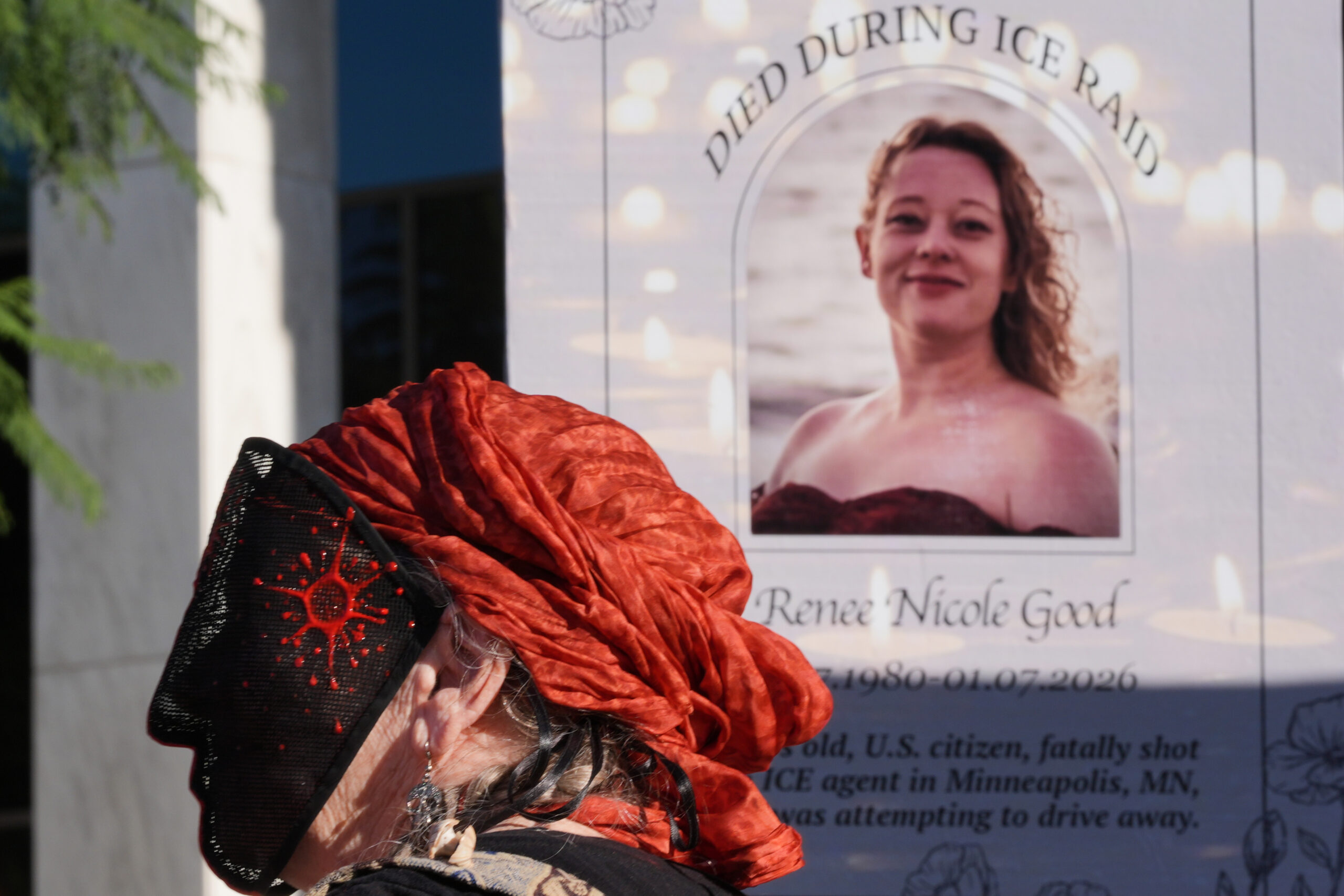
    A demonstrator in Los Angeles wears a mask in front of an image of Renee Good during a protest last month to denounce the Trump administration’s immigration enforcement polices.

    But now I believe campus demonstrators — like ICE agents — should also be barred from wearing masks. Their facial coverings stoke fear, too. And they make it next to impossible for officials to keep everyone else safe.

    If you think otherwise, consider what happened at Haverford College earlier this month. Interrupting a talk by a pro-Israel speaker, several masked demonstrators burst into the room. One of them shouted into a bullhorn that “Israeli occupation forces” were killing children. “When Gaza is burned, you will all burn, too,” she said.

    Most universities already have rules barring disruption of public events. But masks add something worse: intimidation.

    When the masked protesters entered the room, a Haverford professor said he thought they were “terrorists trying to get in and kill us.” Another witness said she worried she might be attacked.

    “No one knew who they were or whether they were armed,” the witness added. “Imagine fully masked people entering through emergency exits, hiding objects under their coats, blocking basic points of egress. It is reasonable to fear for your physical safety.”

    And it’s also reasonable for colleges to ban masks. In a statement, Haverford officials said the protester carrying the bullhorn was not a member of their community. But nobody could know that when she entered the room.

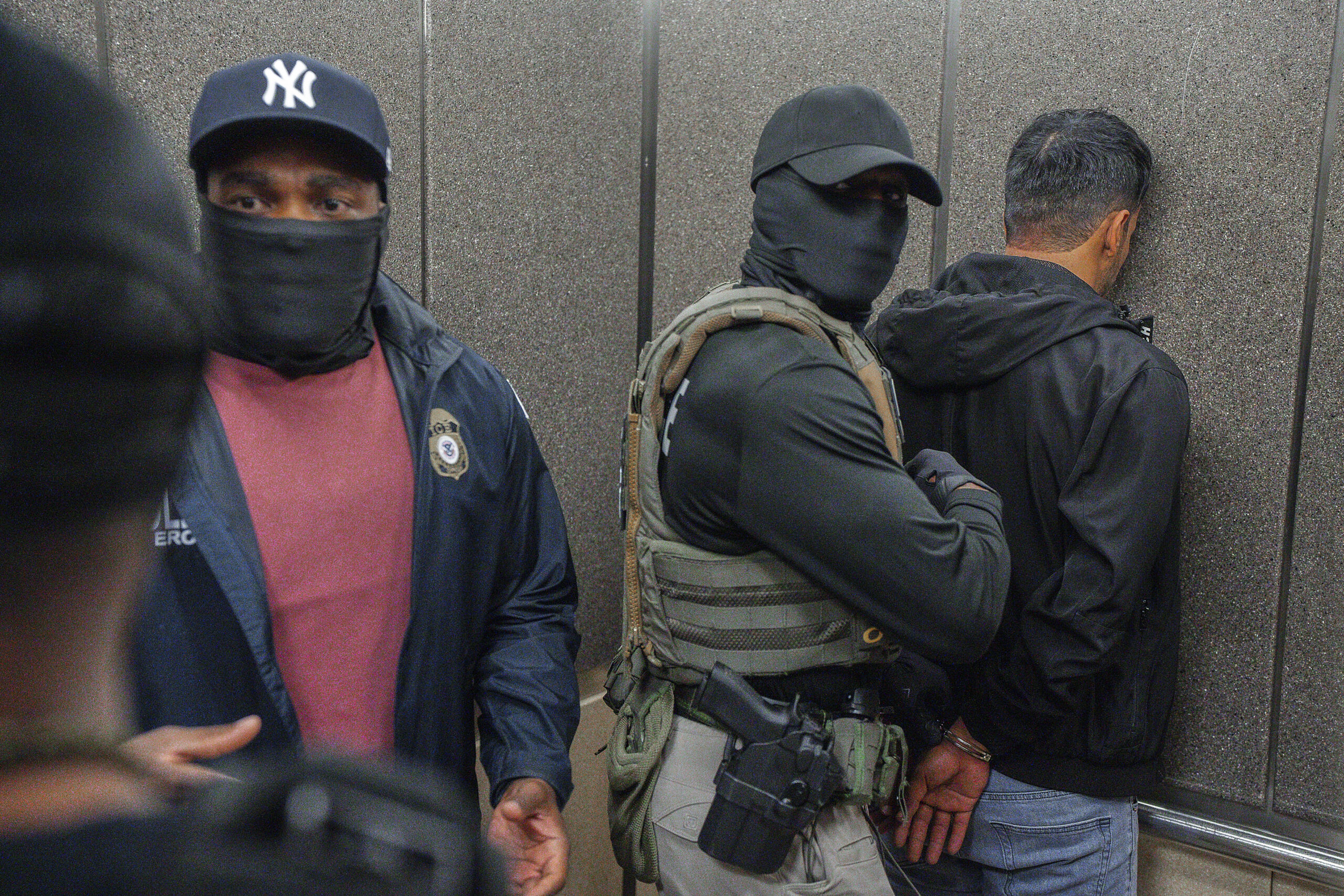
    Masked U.S. Immigration and Customs Enforcement agents escort a detained immigrant into an elevator after he exited an immigration courtroom in New York in June.

    How can we keep the university safe if we don’t know who is from the university and who isn’t?

    At the University of Pennsylvania, where I teach, only nine of 33 people arrested during the clearing of pro-Palestinian encampments in May 2024 were students at the university. At Swarthmore, just two of nine arrested demonstrators were members of the college community.

    I opposed the disbanding of the Penn encampments back then, and I still do. I also opposed the university’s new guidelines on open expression, which prohibited protests that “threaten or advocate violence” against “individuals or groups” on the basis of their race, religion, national origin, or sexual orientation. Under that rule, the Haverford protester’s comment about Gaza — “you will burn, too” — might be banned.

    It shouldn’t be. We need a free and open dialogue about Israel, and everything else. And that’s also why we should ban masks, which inhibit that same dialogue. You can’t have a conversation if you don’t know who is talking.

    I used to think masks were a form of free expression, so universities should allow them. I also thought protesters needed to hide their identities so they wouldn’t get doxed, which would subject them to violence and harassment.

    Then the Trump administration said the same thing about ICE agents — they need masks to protect them from doxing — and I changed my mind. Regular police officers don’t wear masks; instead, they wear numbers and name tags. That’s how we hold them accountable for their actions.

    Putting masks on ICE agents does the opposite: It lets them act with impunity. The goal of the masks is not to protect the agents. It’s to foster fear in our communities and our nation.

    They need to take their masks off. But so do we.

    Of course, we should make exceptions for people who cover their faces for reasons of health, religion, sports, or entertainment. I’d hate to see a college kid barred from wearing a Halloween mask, for example.

    But a protester? Let us see who you are. Don’t cower behind a mask. That’s what ICE does.

    Jonathan Zimmerman teaches history and education at the University of Pennsylvania. He is the author of “Whose America?: Culture Wars in the Public Schools.”