Blog

  • Kids get free dental care at this Philly school. Officials say it’s a model that could be replicated in schools with empty space.

    Kids get free dental care at this Philly school. Officials say it’s a model that could be replicated in schools with empty space.

    Crystal Edwards didn’t see a dentist until she had a deep cavity at age 10: growing up in a struggling Philadelphia family, the resources to access dental checkups just weren’t there.

    So she jumped at the opportunity to locate a dental clinic in the school where she is now principal, W.D. Kelley, a K-8 in North Philadelphia.

    “This dental clinic is saving lives,” said Edwards.

    Tucked into a converted science lab on the school’s third floor, the Dental Clinic at William. D. Kelley, operated by Temple University’s Maurice H. Kornberg School of Dentistry, is nearing its third year of operation. It is open to all Philadelphia children, including those who do not attend Kelley, regardless of insurance status.

    School district officials have pointed to the Kelley clinic as a model as it prepares to make facilities master plan decisions, which will result in closing, combining, and reconfiguring some school buildings. The clinic is an example, they say, of how the system could use available space in some of its schools for public good.
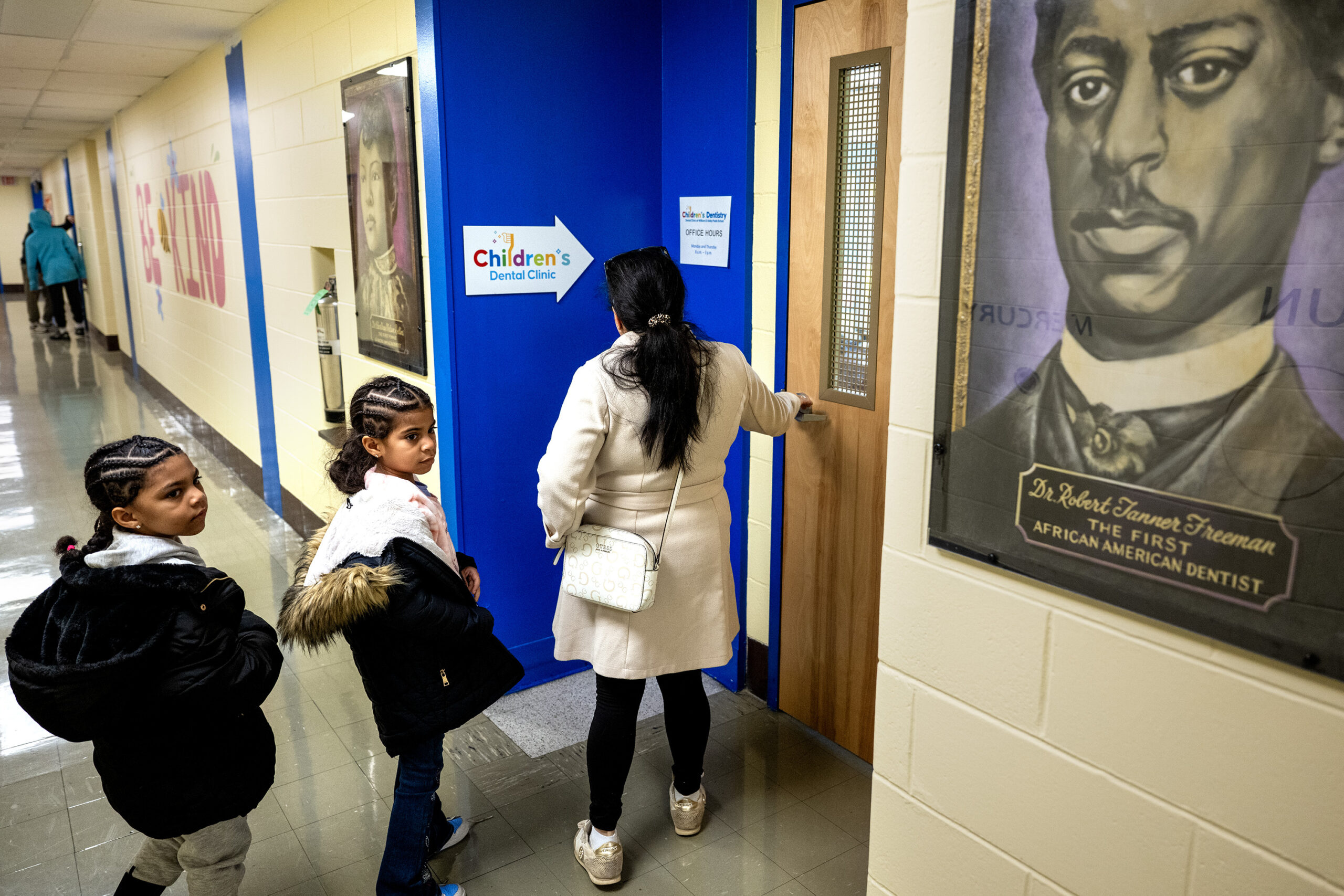
    Soribel Acosta arrives at the Dental Clinic at William D. Kelley public school on Thursday, with her children, Andrea Jimenez (left), 6. And Sayra Jimenez, 7.

    “This is certainly a great example of what can happen when a university partners with a school district to create life-changing opportunities and outcomes for young people,” Superintendent Tony B. Watlington Sr. said in a statement in 2023, when the clinic opened.

    Temple dental school officials said more clinics could follow elsewhere in the city.

    Taking care of every child

    The underlying concept is simple, said Eileen Barfuss, the Temple dental professor who leads the clinic.

    “If your tooth hurts, if you’re not feeling well, you’re not going to learn,” said Barfuss. “In the past, there have been a lot of barriers to care for dentistry that weren’t there for medicine, but preventative care is so important so it doesn’t get to the point of pain.”

    The clinic accepts all comers, including those who are uninsured or underinsured, and sometimes treats students’ parents. (Most, but not all, patients have Medicaid dental, and grants help cover treatment for those without insurance.)
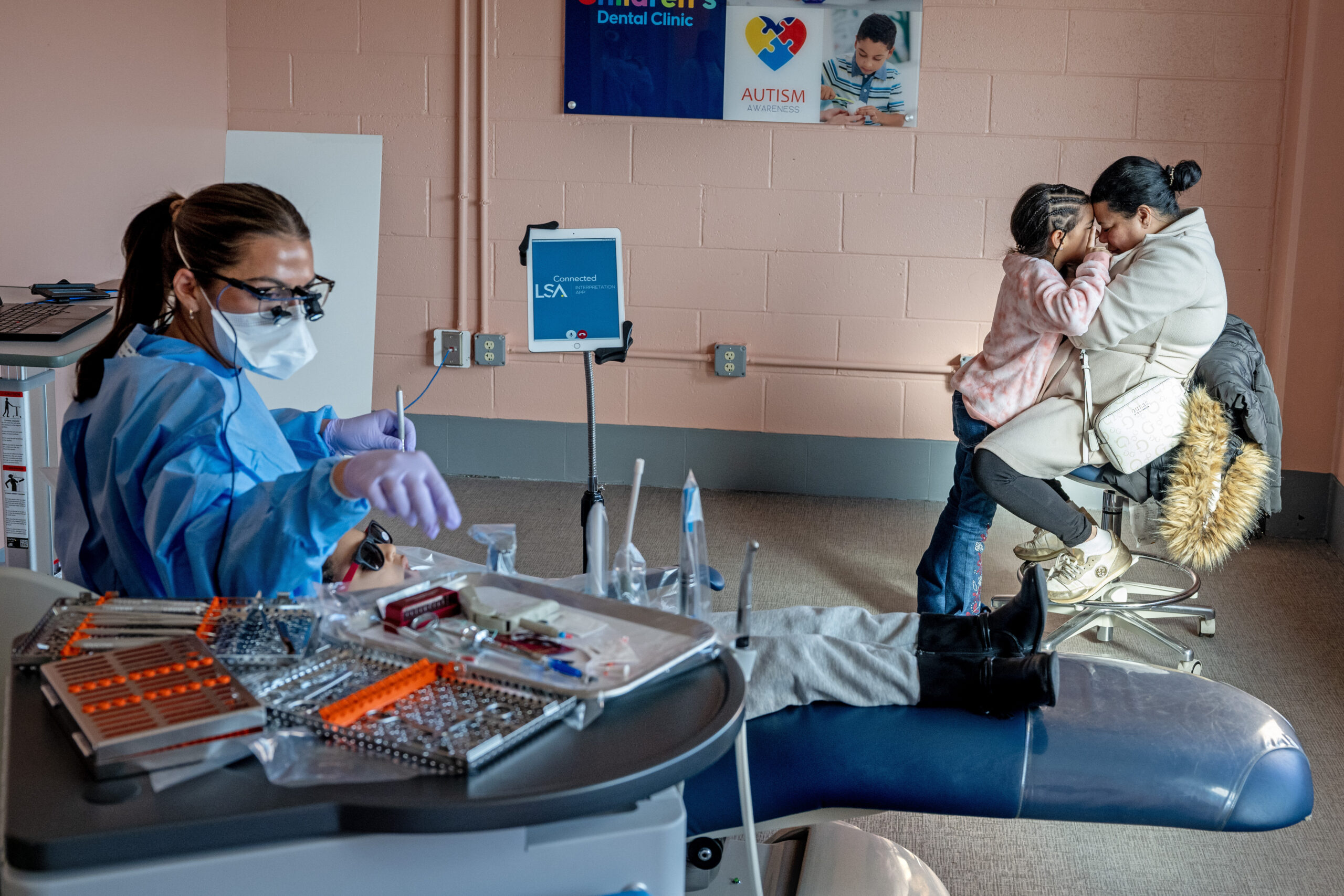
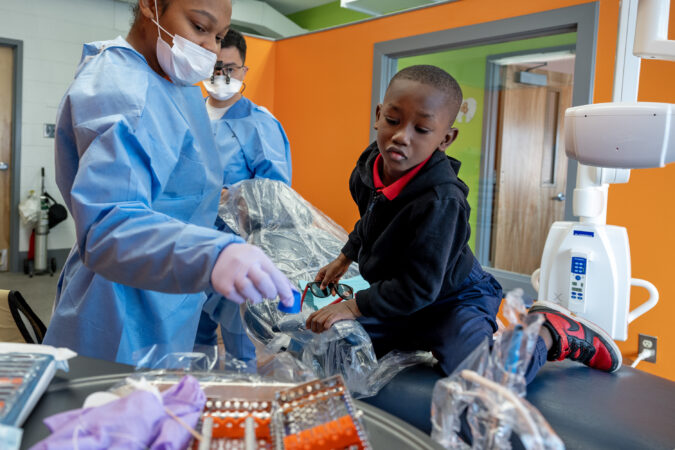
    Temple dentistry student Carly Pandit works on the teeth of Andrea Jimenez, 6, as her mother, Soribel Acosta, entertains sister Sayra Jimenez, 7, waiting her turn in the char at the dental clinic at William D. Kelley public school on Thursday.

    “We try to take care of every child in the Philadelphia School District,” said Barfuss. “There’s a place that they can come and get comprehensive care and establish a dental home.”

    To date, the clinic has seen nearly 700 patients, some of whom are repeat visitors. Patients are treated both by Barfuss and dental students she supervises.

    Students do come from other schools to the clinic; Barfuss said her team does outreach at community events and spreads the word through the district’s school nurses, who often send patients to the clinic. And staff teach lessons in Kelley classrooms on oral health and the importance of seeing a dentist twice a year.

    Being in a school helps normalize the dentist for many kids, who might poke their heads into the clinic to look around and see the friendly dental staff in their scrubs in the hallways, Barfuss said.

    ‘This is a good dentist’

    On Thursday, Fatoumata Bathily, a fourth grader with pink glasses and a bright smile, swung her legs down from a Kelley clinic dentist chair after a successful checkup.
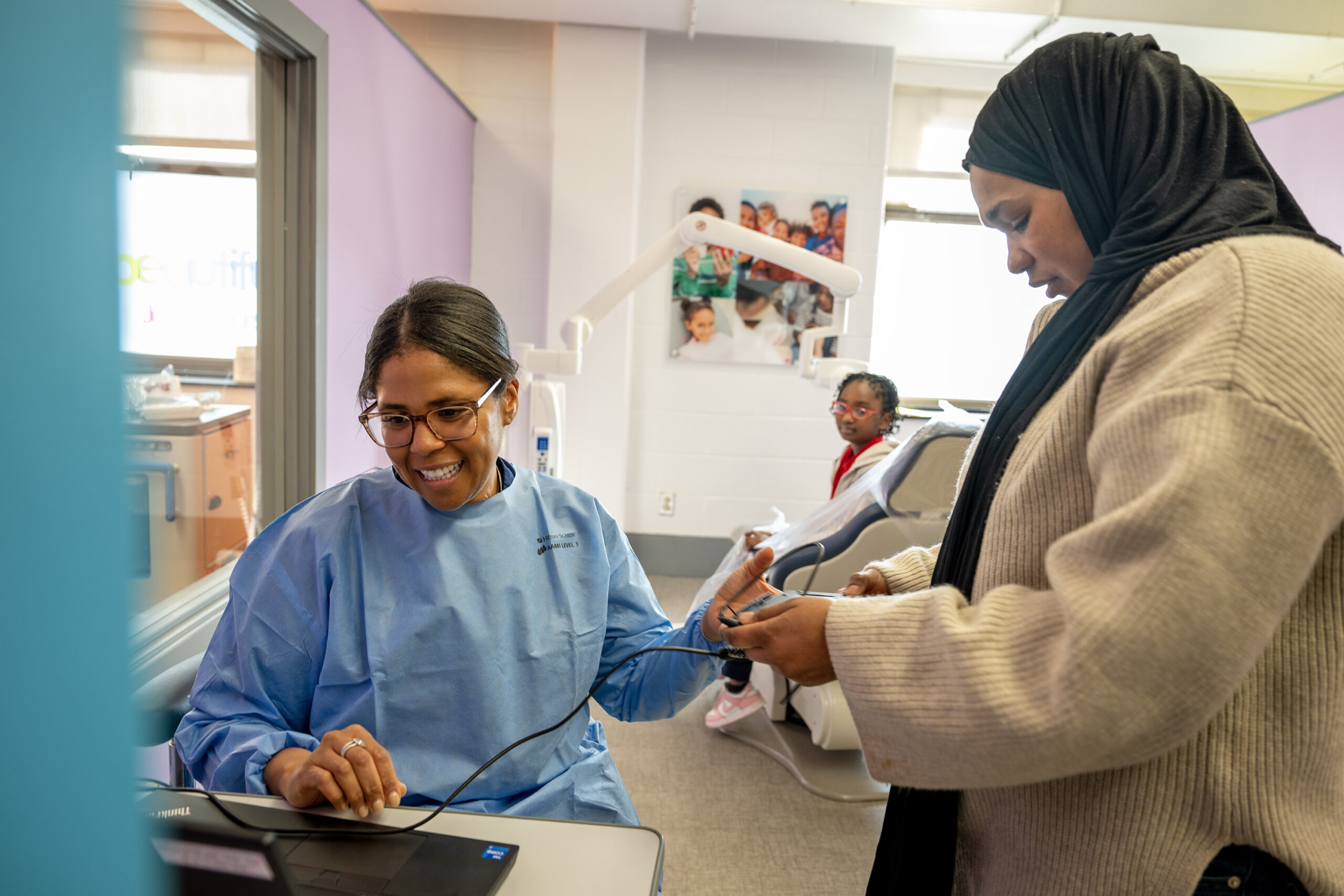
    Eileen K. Barfuss (left), a pediatric dentist and Temple dentistry instructor consults with Fily Dramera after her daughter Fatoumata Bathily (rear), 9, was seen by a Temple student dentist at the Dental Clinic at William D. Kelley public school on Thursday.

    “It’s good here,” said Fatoumata, who attends nearby Robert Morris Elementary, and came for preventive care along with her brother, Abubakr. “This is a good dentist. I like that it’s colorful, and the people are nice.”

    Amid Ismail has wanted to bring such a model to the city since he became dean of Temple’s dental school in 2008. Decades ago, some schools offered dental care via city services, but as funding dried up, those clinics went away, Ismail said.

    Ismail raised the idea of a Temple-district partnership, but it took several years to get off the ground. Edwards, an award-winning principal who takes pride in bringing the community into Kelley, got the vision intuitively, he said.

    Temple paid to transform a large science lab into the dental clinic; the district provides the space and does not charge rent. There are four chairs, including one in a space specifically designed for patients with autism who might need a quieter environment and more room. Rooms are bright and modern.

    “The message to the parents and caregivers is that this is a nice place where all treatment is provided,” Ismail said. “A lot of children do have dental problems, but here we can treat them easily — they miss one class, max, and they don’t have to stay a long time.”

    Soribel Acosta waits for their appointment with her children, Sayra Jimenez (left), 7; and Andrea Jimenez (right), 6, at the Dental Clinic at William D. Kelley public school on Thursday.

    The clinic, which is about to celebrate its third anniversary, just expanded its schedule — it’s open four days a week, and officials eventually hope it will be open five days.

    Edwards fought for the clinic to come to Kelley, and it’s been just the boon she had hoped, she said.

    “This is a historic community that was really devastated and hard hit by the crack and drug pandemic,” said Edwards. “The dental office has really given us leverage on how to serve the community better.”
  • Philly public defender launches new immigration unit amid growing federal arrests and deportations

    Philly public defender launches new immigration unit amid growing federal arrests and deportations

    The Defender Association of Philadelphia has launched a new initiative to help people facing immigration consequences both inside and outside the criminal-justice system.

    The move comes as the Trump administration pursues aggressive new enforcement, where even minor legal cases can put undocumented city residents at risk of detention, family separation, or deportation.

    The agency’s Immigration Law Practice is expected to grow to up to 11 staff members. Its creation is to be officially announced at a news conference on Wednesday.

    “This is necessary right now,” Chief Defender Keisha Hudson said in an interview. “We’re going to have to sustain this work and expand this work if we’re going to meet the moment.”

    The practice will be led by veteran immigration attorney Lilah Thompson, who often represents migrants facing complex legal challenges. She said the work would be done in collaboration with trial attorneys, social workers, and mitigation specialists to shape defense strategies that protect clients and their families.

    One area of concentration will be on clients who are in immigration detention despite having no criminal charges, another on people who could face serious immigration repercussions because of what are often minor offenses.

    In Philadelphia, attorneys say, people have been arrested by Immigration and Customs Enforcement as they’re enrolling in diversionary programs or heading to court to plead not guilty.

    The Trump administration maintains it is arresting dangerous immigrants, though figures show 74% of all those held in detention have no criminal convictions.

    The Defender Association also expects to handle more cases that push back against Trump administration efforts around mandatory detention. Federal judges in Philadelphia have ruled dozens of times against an administration policy that mandates detention for nearly all undocumented immigrants, joining a nationwide wave of decisions criticizing the government.

    A challenge is that those cases must be filed individually, and many of those in detention have neither a lawyer nor the money to hire one.

    The new practice consolidates and builds on work that was done at the Nationalities Service Center and the Pennsylvania Immigrant Family Unity Project, or PAIFUP.

    Thompson said the immigration practice will make sure that clients have accurate information, strong advocacy, and a chance to protect their futures.

    “The work changes every day, with the twists and turns of this administration, and the cruelty it inflicts on noncitizens,” she said. “We have to respond to the moment.”

  • More workers are stuck in part-time jobs, in warning for the economy

    More workers are stuck in part-time jobs, in warning for the economy

    In a slowing labor market, even people with jobs are increasingly making do with less-than-ideal arrangements. They’re stuck in part-time positions or patching together multiple jobs to make ends meet, employment data shows.

    The number of part-time workers who say they would prefer full-time positions jumped sharply in November to an eight-year high.

    Meanwhile, those with multiple jobs — 5.7% of the workforce — is at its highest level in more than 25 years, according to monthly figures from the Bureau of Labor Statistics. In all, a record 9.3 million Americans worked more than one job in November, a 10% increase from a year earlier.

    The data reflects, at least partially, disruptions from the recent government shutdown, which left hundreds of thousands of Americans furloughed without pay from Oct. 1 to Nov. 12. Many of those workers — along with contractors, consultants, and others who felt the ripples of the shutdown — may have picked up side jobs or part-time gigs to make up for lost pay.

    But economists also point to a broader shift in Americans’ finances and rising concerns about affordability that is driving them to pick up more work. Of particular note: The number of Americans with two full-time jobs jumped by 18% in the past year, with women making up the bulk of that increase.

    “When people start adding jobs, and certainly a second full-time job, that says something about affordability, and about needing more money to meet household expenditures,” said Laura Ullrich, director of economic research at the Indeed Hiring Lab. “In theory, yes, if people ‘want’ to have multiple jobs, and they’re able to find them, that’s a good thing. But from a human perspective, the fact that more people are working two full-time jobs is hard to think of as a positive development.”

    Although federal workers received back pay when the government reopened, that wasn’t the case for its network of contractors and consultants.

    Joshua Beers, a government contractor in Columbia, Md., took a second job delivering food for Uber Eats during the shutdown. Without his usual paychecks — or any hope of back pay – he quickly depleted his savings, and fell behind on credit card and loan payments. The $400 a week from his side hustle wasn’t much, he said, but it was enough to temporarily cover the basics.

    Now, even with his full-time job back, Beers is still making deliveries, late at night and on weekends, to make up for lost income. Plus, he said, he worries about the slowing job market: His wife has been looking for work for over a year.

    “The job market feels really confusing right now,” he said. “I don’t want to give up anything I can do for additional income on the side.”

    The U.S. labor market has cooled markedly in the past year. Employers added 584,000 jobs in 2025, an average of about 49,000 jobs per month. That’s a significant drop from the 2 million jobs added over 2024, or about 168,000 per month. The unemployment rate ticked down Friday to 4.4%.

    That’s left job-seekers in a tough position. Layoffs are still relatively low in a sign that companies would rather cut expansion plans than get rid of existing workers, making it difficult for newcomers to break in.

    To that end, the number of people working part-time because they couldn’t find full-time jobs has gradually picked up since 2023. The surge in November — a 62% increase from a year earlier — was the biggest annual jump on record, going back to 1956.

    “There’s been cooling in the labor market, but the most worrisome sign on its own is a big increase in the number of people working part-time for economic reasons,” said Guy Berger, director of economic research at the Burning Glass Institute. “This is a classic barometer of underemployment, and it tends to go up when the labor market is getting worse.”

    In Wisconsin, Rachel Fredrickson picked up a part-time job in retail in November, after eight months of unemployment from the manufacturing industry. Even with 14 years of experience in search engine optimization, she said it’s been impossible to find a full-time digital marketing position.

    Instead, Fredrickson has been working on a sales floor for up to 20 hours a week. Now, with the holiday rush over, she’s bracing for even fewer hours.

    “I’m back to having weeks where I don’t work at all,” said Frederickson, 38. “My husband and I are getting by, but we have virtually no savings left at this point.”

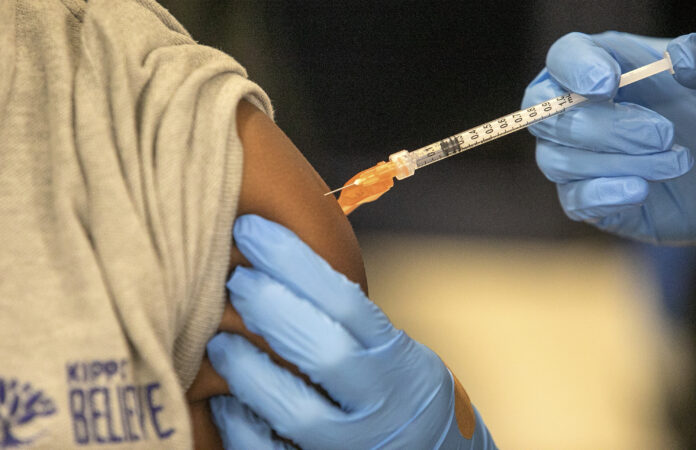
  • Pediatricians are grieving RFK Jr.’s changes to the childhood vaccine schedule. You should be, too.

    Pediatricians are grieving RFK Jr.’s changes to the childhood vaccine schedule. You should be, too.

    Several weeks ago, I watched a family lose their young child to bacterial meningitis — an infection of the tissues around the brain and spinal cord. By the time the child reached the hospital, the infection had progressed too far; our treatments could not stop or reverse the damage to the child’s brain. He died within a few hours.

    The bacteria we found growing in this child’s bloodstream was one that could be prevented with vaccination. This child was unvaccinated. As we cared for him in his last moments of life, many care team members echoed the same thought.

    “This is going to keep happening.”

    On Jan. 5, the Centers for Disease Control and Prevention released updated vaccine recommendations that decreased the recommended number of childhood vaccines. Based on this new schedule, children would receive routine vaccinations for 11 diseases instead of the previous schedule that protected against 18 ailments. The vaccinations no longer recommended include those for the flu, respiratory syncytial virus (RSV), hepatitides A and B (which cause liver disease), rotavirus (a gastrointestinal illness), and meningococcus (a cause of bacterial meningitis).

    Doctors react

    The American Academy of Pediatrics, the American Medical Association, and the American College of Physicians have all released statements opposing this move, calling it “dangerous” and “deadly.” According to the AAP’s statement, this “ill-considered decision will sow further chaos and confusion and erode confidence in immunizations.”

    The data is clear: Childhood vaccination saves lives, and we have seen increased morbidity as vaccination rates decline. But as a pediatrician, this also goes beyond the data.

    When I think about vaccines, I think about that young boy in the ICU. I think about how, if the circumstances were different, he might have lived. I think about his siblings, the ones who will no longer get to play in the yard with their younger brother. I think about his parents and how they will no longer get to hold their son or hear his voice. I think about what could have been.

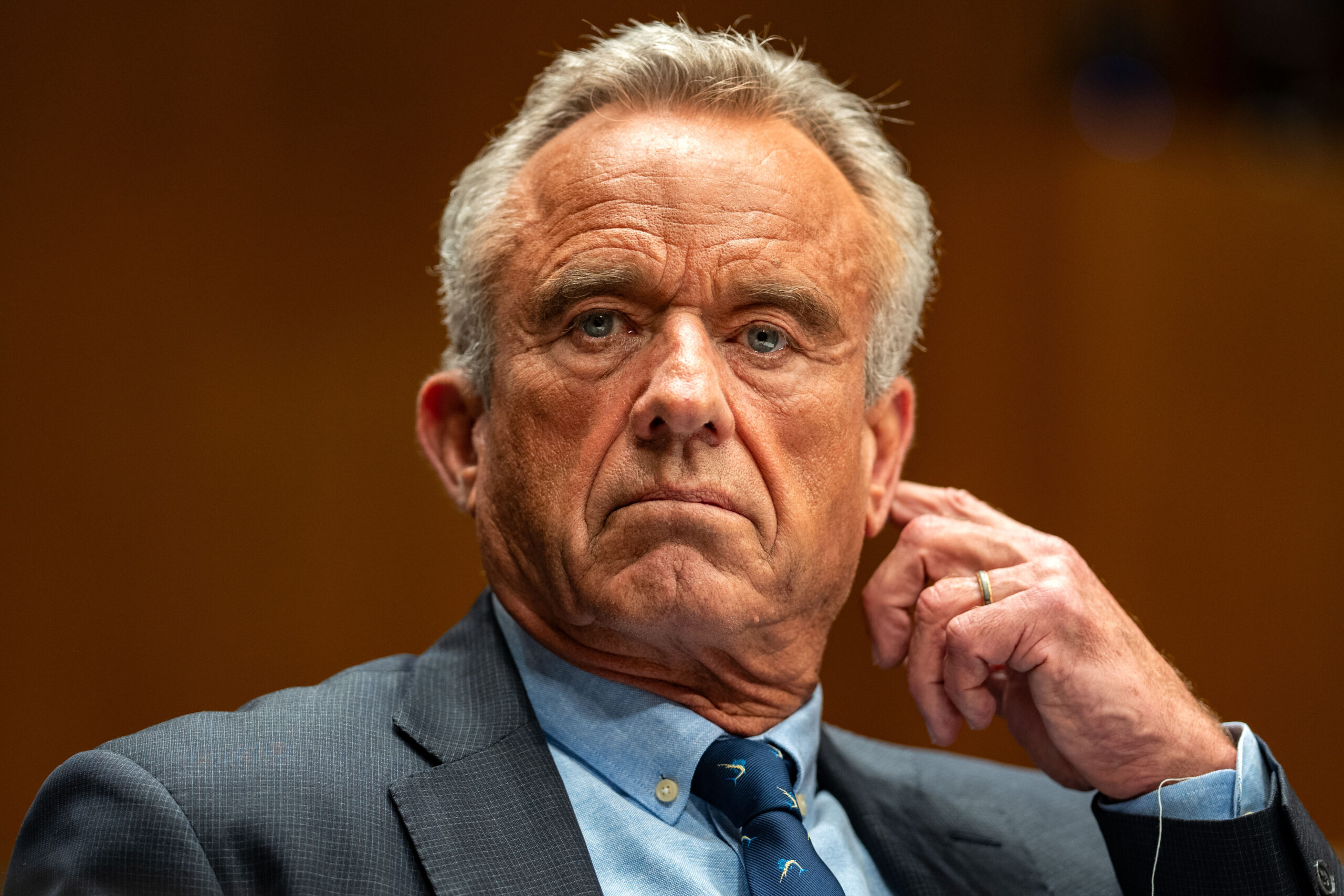
    Robert F. Kennedy Jr.’s radical overhaul of established health practices has included reducing the number of recommended childhood vaccinations from 18 to 11.

    Many parents will say the decision to vaccinate should be between a patient and their doctor.

    While I do my best to uphold the doctrine of shared decision-making with the families I see in practice, we must also acknowledge that the decision of whether to vaccinate ultimately impacts others.

    Eroding herd immunity

    For decades, we have relied on herd immunity to protect vulnerable patients — such as those too young to receive certain vaccines or those who are immunocompromised. With declining vaccine rates, herd immunity has been diminished, leading to outbreaks of preventable diseases. With fewer recommended vaccinations, our vulnerable patients will continue to suffer.

    Pediatricians are grieving the children we have already lost to vaccine-preventable illnesses, and we are grieving the losses that will come from these new recommendations.

    We urge parents to have open conversations with their pediatricians, look to verified sources such as the American Academy of Pediatrics for information, and trust that we pediatricians do have your child’s best interests in mind. We may be grieving, but we will never stop advocating for your children.

    Frances Avila-Soto is a pediatric resident in Philadelphia.

  • Pa. loggers want a bailout for Trump tariff damage. Without it, they say layoffs could be next

    Pa. loggers want a bailout for Trump tariff damage. Without it, they say layoffs could be next

    In Pennsylvania — Penn’s Woods — centuries after settlers began cutting native forests, decades after once-thriving furniture makers like Pennsylvania House and Home Line shut or moved away — lumber remains a basic industry. Upstate sawmills send logging crews to buy and cut walnut, cherry, and other hardwoods to export to global flooring and furniture enterprises.

    But dozens of the state’s remaining mills, loggers, and industry groups, long accustomed to blights and other natural disasters, say they now face a plague made in Washington, D.C. — and would welcome a government bailout.

    Some 48 of the state’s surviving mills, lumber companies, and industry groups joined 400 other U.S. forest-based businesses last month to ask President Donald Trump for relief payments to ease the impact of his U.S. import taxes and foreign retaliatory tariffs, which they say have slowed export demand for their products, while boosting the cost of buying and operating their machinery.

    These and other “rural, almost entirely family-owned businesses” and the workers and contractors who depend on them want to be included alongside farmers, whom Trump has promised a $12 billion tariff bailout, according to a statement by the Heartwood Heartland coalition formed to make their case. The U.S. Census counts more than 10,000 logging and sawmill firms, not counting lumber truckers and other related businesses.

    Earlier tariffs and foreign competition had already hurt U.S. hardwood exporters, who were excluded from a farm tariff compensation program in the previous Trump administration, according to the coalition.

    U.S. hardwood lumber sales dropped 20%, to around $2.7 billion, in 2022-2024, according to the coalition. Log sales fell 11% to around $1.8 billion, and employment in U.S. woods shrunk 10%, to around 360,000, as more sawmills closed, over the same period.

    The U.S. remains a leading exporter of hardwoods, but its share of the China market shriveled, from $1.5 billion or a third of the market in 2017, to around $700 million or one-fifth of the market in 2024, since the “trade war” during Trump’s first term drove importers to rival nations.

    Chinese manufacturers are buying more wood from Russia, Southeast Asia, and other regions. This threatens a collapse in the U.S. forest industry echoing the earlier “collapse of the U.S. furniture sector,” the coalition said in a December letter to the president and cabinet members.

    Further sales losses will result in the U.S. “losing the skilled workforce” and relying on more imports, predicts Dana Lee Cole, the federation’s executive director. That’s the opposite of the president’s stated goal in boosting protective tariffs.

    Among the signers were several businesses in Southeastern Pennsylvania, including Stoltzfus Forest Products LLC in Lancaster County. Philip Smith, chief operating officer of business and its affiliate, Stoltzfus Hardwoods, agreed to answer questions about his enterprise and the impact of tariffs. Edited for brevity and clarity.

    How old is your company and who works there?

    The parent company built a sawmill in 1990. We moved the location when we had a large expansion in 2016. We employ about 65 people at the two companies. We have three of our own logging crews, two mechanized and one that’s hand cutters. We use a subcontractor logger and trucker as well. The owners and a majority of the workers are Amish.

    What do you harvest and where?

    We take Appalachian hardwoods from up to about 175 miles of our location — white oak, poplar, walnut, hickory, a little soft maple, and cherry. We go down to the Eastern Shore of the Chesapeake, out toward Chambersburg, up into the Lehigh Valley and Schuylkill County.

    And the Philadelphia area, we just did a golf course. It got bought [by a developer], and we ended up harvesting the trees.

    We bring the trees to the mill [and make boards and trim-sized pieces]. We sell to molding companies, flooring companies, and to companies that make furniture and cabinets.

    What would be affecting us with the tariffs, we have material that will go to China and to Germany and [other] EU countries.

    Why don’t foreign importers pay the tariffs?

    To get an order, we have to agree, if the tariff went above a level, we pay part of the cost.

    In China, they made temporary agreements for when our lumber got ready. If it was on the ocean before the tariff dates, we weren’t affected.

    So we had a scare last spring [when Trump proposed punishing increases to wood tariffs]. And we had a scare again in the fall.

    So the full tariffs haven’t actually been implemented?

    The biggest thing we notice with tariffs is the uncertainty. The economy was already crappy. Now the tariffs bring another factor into the way people interpret [costs].

    For some reason, the U.S. sells logs to Vietnam, and then Vietnam is [milling] American walnut, selling it as American walnut, and undercutting finished American walnut [from the U.S.]. Vietnam is paying their people almost nothing. Add the tariffs, we are less competitive.

    Has that uncertainty cost you orders?

    It has affected how people perceive costs. It has affected cash flow. Some items are moving slower.

    There’s another thing: Equipment in the forest industry, a lot of it comes out of Canada. Log trucks. Specialty trailers.

    With the uncertainty, truckers that focus on logging tell us they have canceled stuff on order.

    And we use Leadermac wood-moulder machines that come out of Taiwan. There’s a tariff there, too. We were told there’s a 24% increase in price.

    Have you canceled equipment orders as a result?

    We have put the brakes on making some decisions.

    Despite the squeeze you are in today, can tariffs help move wood industry to the U.S. over time?

    With the tariffs, it’s not so much we are against the idea of leveling the playing field. There’s definitely countries abusing America. We are pro trying to fix this stuff.

    But there is pain in doing it. We are paying the tariff on equipment, but I don’t see any tax break. They are just adding another tax on us. You need to give us a break that we can recoup that money.

  • Letters to the Editor | Jan. 12, 2026

    Letters to the Editor | Jan. 12, 2026

    Offending decency, dignity

    “Might makes right,” “Greed is good,” “omertá,” phrases that offend human decency and American dignity.

    The MAGA government and its enablers have embraced these odious concepts. The Republican regime deploys the U.S. military and hooded secret police to terrorize American cities, murders foreign civilian sailors, invades a sovereign nation to capture its leader, schemes to steal a foreign nation’s oil reserves, plots invasion of our ally’s territory in Greenland, and threatens the sovereignty of Canada. Who offers a rationale?

    Steven Miller gleefully articulates MAGA principles: We do these things because we can. When MAGA sends military troops to invade our cities, attack foreign nations, steal foreign assets, or kill foreign civilians, corrupt and co-opted MAGA forces simply cannot be stopped.

    Is this our new U.S.? A brutish gangster nation? Do threatened civil rights at home, broken alliances abroad, transactional collusion with international criminals, dictators, and despots comport with our heritage?

    How can we restore the noble legacy of the Greatest Generation? Make decency at home and abroad our national goal? Prioritize the rule of law and accountability? When will U.S. power again be directed to support democratic ideals, international cooperation, and civil/human rights?

    What world will we pass to our progeny?

    Mike Shivers, Altoona, Pa.

    World of MAGA first

    The attack on Venezuela and the removal of former President Nicolás Maduro and his wife, together with administration statements thereafter, have at least given us a better understanding of what “America First” means and what it does not mean. America First does not mean doing anything for ordinary American people; it means doing everything for President Donald Trump’s family, his cronies, and major corporations.

    It does not mean helping Americans who are hungry or have problems accessing medical care.

    If it meant that, the administration would not be cutting back on SNAP benefits and acting to take away the health insurance of millions who were on Medicaid or had insurance through the Affordable Care Act. It does not mean helping Americans who have trouble affording high prices. If it meant that, the administration would not have raised prices through tariffs and failed to take any other action to rein them in.

    What it does mean is imposing American “rule” and hegemony over any country, at least in the Western Hemisphere, with whose policies we disagree and to whose resources we want access.

    So we remove Maduro and not his regime and expect to be able to coerce that regime to allow American energy companies to exploit Venezuelan oil. The administration also seeks to attack or coerce other countries in the region, including Panama, Colombia, and Greenland.

    This is not about helping the American people, much less the Venezuelan people. It is about enabling Trump and his henchmen to strut about on the world stage. And it is about making money for Trump’s family, his cronies, and corporations that do his bidding. Trump is making unconstitutional use of the U.S. military to achieve these goals. According to opinion polls, the American people do not support this mob boss-style imperialism. It is time for Congress, especially Republicans in Congress, to stand up and prevent further unauthorized and unconstitutional military ventures.

    Matthew Lawry, Elkins Park

    Join the conversation: Send letters to letters@inquirer.com. Limit length to 150 words and include home address and day and evening phone number. Letters run in The Inquirer six days a week on the editorial pages and online.

  • Dear Abby | Child is being kept away from father’s family

    DEAR ABBY: My son married a lovely woman, “Noelle,” two years ago. They live a couple of hours away and have a 1-year-old son, my third grandchild. Noelle’s parents live 10 miles from my home. She and the baby go there nearly every weekend but NEVER come by mine. I haven’t seen them since the baby’s birthday five months ago.

    My daughter lives down the street from Noelle’s parents. She wasn’t invited to the baby’s first birthday even though she’s the mother of his cousins, so I took her children with me. There were other people there, mostly adults and her cousin’s baby.

    We are not horrible people. There has never been any ugliness between any of us. I’m very hurt because they don’t recognize me as a grandmother or any of us as part of the family. My son’s father has never been allowed to meet the baby, and I don’t think he’s even met Noelle.

    I have asked my son and daughter-in-law to bring the baby, leave him for the day or even overnight so we can spend some time and get to know him, but it never happens. What can I say to make them understand how much they are hurting the family and the baby by avoiding us? I don’t want to make it worse.

    — DISAPPOINTED GRANDMA IN TEXAS

    DEAR GRANDMA: This is a subject you should discuss with your son, who appears to be clueless or entirely ineffectual. Does he recognize what has been happening — that his parents have been pushed entirely out of the picture? If the answer to that question is yes, perhaps he can shed some light on why. If the answer is no, tell HIM how this has made you feel. If you do, perhaps he will assert himself. Better late than never.

    ** ** **

    DEAR ABBY: One year ago, my heart was torn out of my chest when my wife died after a five-year battle with stage-4 breast cancer. It was the beginning of the end of my world. I’m alone now. We have two cats I still take care of and all the daily chores of a normal household.

    I have tried looking at dating sites, and I see a couple of women I might be interested to know. Here’s where I need a female stranger’s perspective: I still hurt inside, and I know I will for some time. I also feel that if I have someone to talk to, it’ll be the personal therapy I need to help get me back on track. However, I also feel that if I start dating, it will be like I’m cheating on my wife, and the hurt comes back. What am I supposed to do?

    — CONFLICTED IN CALIFORNIA

    DEAR CONFLICTED: Please accept my sympathy for the loss of your wife. If you feel you need a woman’s perspective, find a female licensed psychotherapist to help you get back on track. If you do this, you are less likely to dump your guilt and grief on someone who might take advantage of it or be driven away by it. If you can’t afford a therapist, joining a grief support group may help you expiate any guilt you feel about going on with your life.

  • Horoscopes: Monday, Jan. 12, 2026

    ARIES (March 21-April 19). No need to stare into the mist and wait for answers to materialize because you already see the future you want, and it’s crystal clear. Making it real will involve many steps, and the first one can start anywhere. Pick a step, any step, and then watch what happens next.

    TAURUS (April 20-May 20). You’re so good at planning right now, why stop at designing your own experience? Other people would gladly pay you for a winning plan. Your true genius is in tailoring the blueprint to the resources available.

    GEMINI (May 21-June 21). Instead of counting the number of tasks on your list today, count the number on someone else’s list. Thinking about the duties or the leisure of others will give you the perspective that helps you nestle into your own groove, glad that it’s yours.

    CANCER (June 22-July 22). Someone who gave you a treasure may now want it back. As always, you’re inclined to do what is fair, not what is easy. And anyway, the best things cannot be returned even if you wanted to: time, love and the truth.

    LEO (July 23-Aug. 22). People say there are no bad questions. Still, some questions move you forward faster than others. You’ll skip the fluff and flattery and zero in on the precise details at the heart of the matter. This frees up progress.

    VIRGO (Aug. 23-Sept. 22). You have been known to overcome physical discomfort by framing it as the price of fitness, fashion or responsibility. Similarly, you will endure a degree of injury to the ego in the name of love, harmony and emotional maturity.

    LIBRA (Sept. 23-Oct. 23). Your habits may feel a bit boring to you today, only because familiarity has dulled your emotional response. Spending time with someone who has a completely different style will stir the energy, and you’ll do the same for them.

    SCORPIO (Oct. 24-Nov. 21). You’re not meant to stick with everything you try. It’s so relatable to outgrow interests, clothes and even relationships. But now it’s time to focus on what you keep carrying forward year after year — the gold of your character that everyone else sees, too.

    SAGITTARIUS (Nov. 22-Dec. 21). Be wary of grandiosity. When the pendulum swings the other way, grandiosity turns into something else — usually absence — as a person realizes there’s no way they can make good on delusion-based promises.

    CAPRICORN (Dec. 22-Jan. 19). You’re brimming with creative potential today, and there are multiple ways to apply it. Decide what most needs your clever fix, your beautiful twist or your inventive hand. Then get to work, and in two hours things are already different.

    AQUARIUS (Jan. 20-Feb. 18). You’re like a reporter for a highly reputable publication that thoroughly checks the facts. Every bit of information that comes your way warrants further investigation. Reserve all conclusions for the final edit.

    PISCES (Feb. 19-March 20). Somehow, it is socially acceptable to feel sorry for others, why not yourself? Microdoses of self-directed pity and sympathy just acknowledge the injustice of an experience and give you a foundation to push off from.

    TODAY’S BIRTHDAY (Jan. 12). This is your Year of Code Cracking in which you figure out the problems that once perplexed you. Mysteries get solved, tests are passed, closed doors swing open, and suddenly you’re in the realm you were aiming for. How? You listen well and you’re persistent. You keep trying things until the puzzle comes together. More highlights: three financial bonuses, hot tickets with fun people and family coming together for fortifying causes. Aries and Virgo adore you. Your lucky numbers are: 4, 33, 29, 1 and 10.

  • Sixers takeaways: Inability to close out games and stop dribble drives are glaring in loss to Raptors

    Sixers takeaways: Inability to close out games and stop dribble drives are glaring in loss to Raptors

    The 76ers still have a problem closing out games.

    Their guards also need to do a better job of preventing straight-line drives.

    But on the positive side, Kelly Oubre Jr. is back to contributing on both ends of the floor.

    Those things stood out in Sunday’s 116-115 overtime loss to the Toronto Raptors at Scotiabank Arena.

    Inability to close out

    The Sixers (21-16) were trending in the right direction after winning two straight and five of their last six games heading into this matchup. And with Tyrese Maxey scoring a game-high 38 points, they appeared capable of overcoming the huge absences of Joel Embiid (left knee injury management/left groin soreness) and Paul George (left knee soreness).

    But an inability to close out the game reared its ugly head.

    Maxey hit a what appeared to be a 29-foot dagger three-pointer to give the Sixers a 107-103 cushion with 20.1 seconds left.

    However, they failed to inbound the ball. The Raptors (24-16) won two challenges and made two baskets to force overtime.

    The Sixers built a 112-108 lead with 2 minutes, 23 seconds remaining in overtime. But the Raptors responded with a 7-0 run to take a 115-112 lead after the Sixers missed two shots and committed a costly turnover.

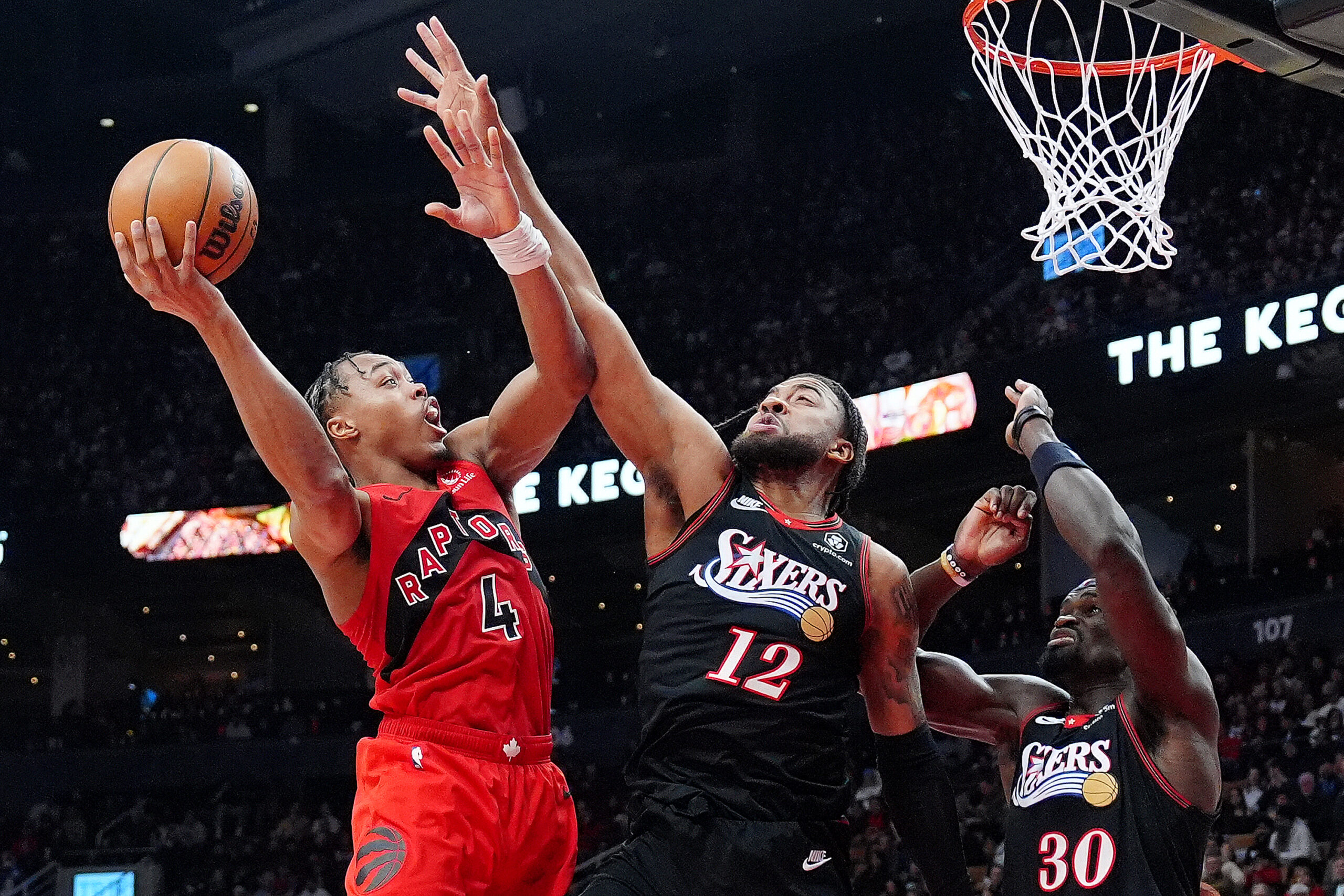
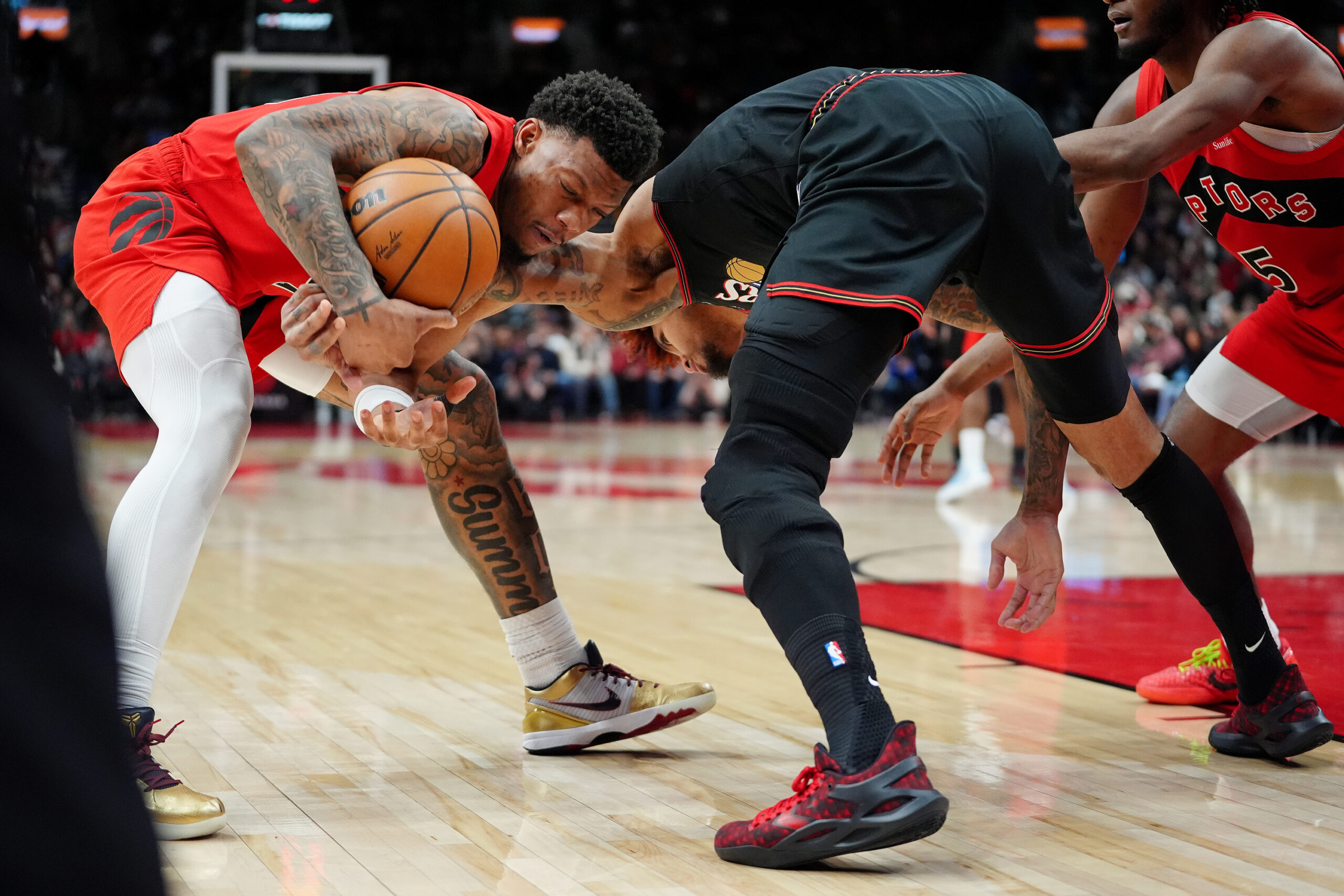
    Toronto Raptors forward Scottie Barnes (left) led the team in points with 31 against the Sixers.

    VJ Edgecombe made a 30-foot three-pointer to knot the score at 115. However, Scottie Barnes got away with initiating contact with Oubre, who was called for a foul, on a drive with 0.8 seconds left.

    Barnes, who finished with 31 points, eight assists, and seven rebounds, made the first foul shot and intentionally missed the second to win the game.

    The Sixers committed 22 turnovers and made just 8 of 31 three-pointers. But they were ultimately doomed by poor late-game execution. Something they need to correct.

    “We just got to be better, be more disciplined and stay together in those moments where we’re facing a little bit of adversity, because we both made runs,” Oubre said to reporters. “But you know, theirs was the final shot.”

    Too many straight line drives

    Barnes will get the credit for winning Sunday’s game. However, the Raptors backcourt of Immanuel Quickley and Jamal Shead had their way with the Sixers guards. Quickley finished with 20 points and seven assists, while Shead had 22 and six assists.

    The duo had several downhill drives in the lane. If they couldn’t score, they kicked the ball out to teammates. Late in the game, Shead and Quickley drove the lane. Once the Sixers provided help defense, the guard would dump the ball off to a big man for a dunk.

    “We just got out of position on some of that,” coach Nick Nurse said to reporters. “I felt we went to help a little too early, and obviously left too big a passing lane for those dumboffs late.”

    But it started with the Sixers guards needing to do a better job of keeping opposing perimeter players in front of them.

    Oubre’s impact

    Before missing 22 games with a sprained left knee ligament, Oubre was the quiet assassin for the Sixers. The 6-foot-8 small forward averaged 16.8 points, 5.1 rebounds, and 1.1 steals in his first 12 games. In addition to excelling when the ball was moving, Oubre did a solid job of guarding the opposing team’s best perimeter player.

    He returned on Wednesday and provided solid defense that night against the Washington Wizards and again on Friday vs. the Orlando Magic. However, he averaged one point on a combined 1-for-9 shooting in those two games.

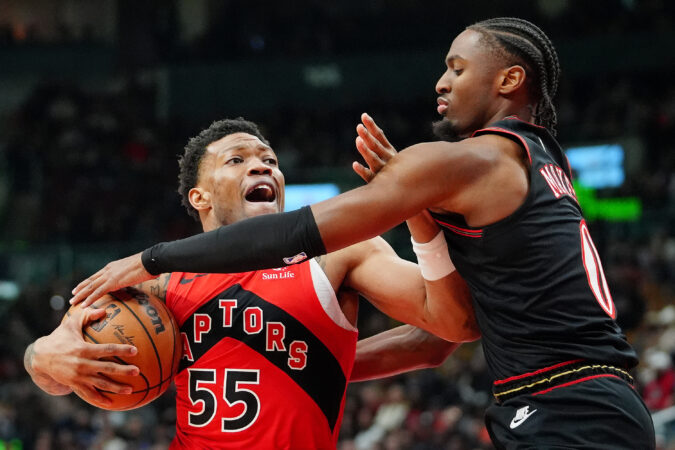
    Toronto Raptors guard Alijah Martin, left, strips the ball from Sixers’ Kelly Oubre Jr. during overtime.

    He had the complete package against the Raptors.

    Oubre finished with 13 points on 5-for-10 shooting to go with five rebounds and season highs of four steals and three blocks in his third game back. Nine of his points came in the third quarter.

    “He hasn’t really scored much since being back, so that’s obviously nice to see,” Nurse said. “He even hit a three, but had some really nice drives. He had a couple of good blocks and steals as well, which is why we ended up playing him as much as we did down the stretch.”

    He’ll go back to being an X-factor if he can keep this up.

    “It definitely felt good,” Oubre said. “It’s just, I think I could be better. I got blocked because I’m not trusting myself and the work that I put in.

    “So you know, just watching film, continue to just show up every day and get better. That’s all I can do. But it definitely felt good to get some run.”

  • The defense propped the Eagles up all season. On Sunday, it bent, broke, and the 49ers advanced.

    The defense propped the Eagles up all season. On Sunday, it bent, broke, and the 49ers advanced.

    In the days leading up to the Eagles’ Dec. 28 road game at the Buffalo Bills, defensive assistant Jeremiah Washburn, who coaches the Eagles edge rushers, handed out a new accessory to the entire defensive line.

    The green bracelet has “Isaiah 6:8″ and the phrase “send me” written in white. In the Bible verse, the prophet Isaiah hears the voice of God ask: “Whom shall I send? And who will go for us?” Isaiah responds: “Here I am. Send me.”

    That, defensive tackle Moro Ojomo said, was the mindset of the entire defensive line. And the entire Eagles’ defense.

    “Send us,” Ojomo said as he fiddled with the bracelet on his left wrist. “We want to be the ones to get the job done.”

    For most of the 2025 season, especially after the Eagles’ Week 9 bye, the defense answered the call. Vic Fangio’s unit propped up an inconsistent offense. It stifled good offenses and carried the team to victories that maybe it didn’t deserve. The Eagles beat Green Bay 10-7. They beat Detroit 16-9. They won that Bills game, 13-12. They entered the postseason, in what was a wide-open NFL playoffs, with a puncher’s chance to repeat as Super Bowl champions in large part because they had the talent on defense and Fangio, the mastermind, calling the shots.

    The season ended in abrupt fashion Sunday for myriad reasons, but the San Francisco 49ers advanced to the NFC’s divisional round in part because the Eagles didn’t have enough answers defensively down the stretch. The 49ers scored two fourth-quarter touchdowns. They had a 10-play, 66-yard touchdown drive that lasted more than five minutes and ended with less than three minutes on the clock.

    The strength of the Eagles defense was its ability to limit explosive plays and clamp down in the red zone.

    The 49ers threw the first haymaker. Lincoln Financial Field roared after Will Shipley crunched Brian Robinson on the opening kickoff and then the Eagles stuffed Christian McCaffrey’s first rushing attempt on San Francisco’s first play for a loss of one yard. But then Quinyon Mitchell allowed a 61-yard catch-and-run from Brock Purdy to Demarcus Robinson that set the 49ers up in the red zone at the Eagles’ 16-yard line. Four plays later, Purdy hit Robinson, who beat Mitchell for a 2-yard touchdown and the game’s first points.

    “I got to start the game off faster,” Mitchell said. “Maybe that could’ve changed the game in a way.”

    Mitchell would eventually atone. The Eagles forced punts on the next two San Francisco drives before allowing a field goal and then later stopping the 49ers as the second quarter ended. Mitchell then picked Purdy off on the 49ers’ first drive of the second half. He had another interception in the fourth quarter, too, but after the 49ers added another score.

    San Francisco, which was already banged up and lost star tight end George Kittle to an Achilles injury in the second quarter, dipped into the bag of tricks to open the fourth quarter. Out of the timeout, Kyle Shanahan dialed up a trick play, a reverse that found the ball in the hands of Jauan Jennings, who threw on the move to a streaking and wide-open McCaffrey for a 29-yard score.

    “We knew they liked to do some sort of trickery down in the red zone,” safety Reed Blankenship said. “We were just in a different call that allowed him to sneak through.”

    The Eagles took the lead back on a Jake Elliott field goal with eight minutes to play. The defense needed to deliver one final stop. Instead, the 49ers moved the ball with ease. The Eagles, who sacked Purdy once on the day, applied pressure at times, but not enough. Purdy felt the pressure and was excellent in escaping it. The 49ers didn’t face a third down on that 10-play, game-winning drive until the play they scored on, a 4-yard pass from Purdy to McCaffrey on third-and-goal. The 49ers converted six of their 11 third-down attempts.

    “They just made more plays than we did,” Blankenship said.

    Shanahan, Ojomo said, “is a hell of an offensive play-caller.”

    “At the end of the day, he kind of had a better plan and we should have executed at a higher level,” Ojomo said. “You got to play complementary football. After our scores, we needed to stop them. When we get turnovers, we need scores. We didn’t do that at a high enough level to win. That’s kind of the result when you’re in the playoffs. You’re playing good teams every week. You can’t have any hiccups.”

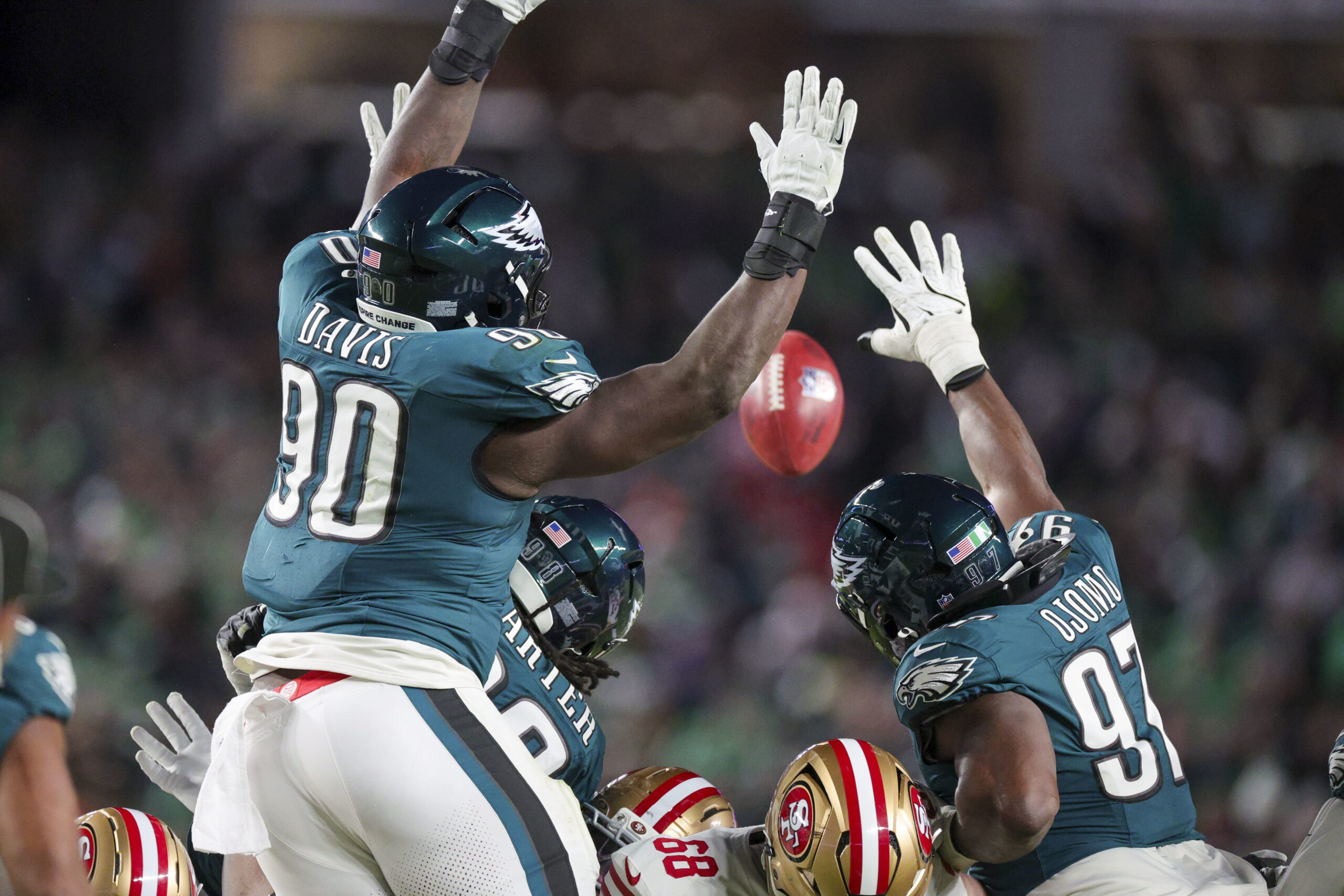
    Jordan Davis (90) and Moro Ojomo (97) were encouraging pieces of a fine Eagles defense in 2025.

    Especially not with an offense that rarely allowed for wiggle room. It was a lot to ask if the Eagles were going to try to repeat. The offense did not permit much in the way of a margin for error. It is a taxing way to play football, and it’s taxing on a defense that got better as the year went on. Ojomo, though, wanted to look only internally.

    “You could always get one more stop, one more turnover,” he said. “At the end of the day, we fell short as a defense. They don’t score, they don’t win. We didn’t get the job done.”

    The defense will look different next season. Blankenship is one of a few key free agents. The loss, he said, was tough.

    “This is one of the toughest things about football and about life,” he said. “You go through the challenges throughout the year, training camp, whatever. You create this relationship and these bonds and it ends so fast. You’re not really prepared for it and it’s tough.”

    How will the 2025 defense be remembered? It was the year of Jordan Davis’ breakout. Mitchell and Cooper DeJean, both second-year players, were named first-team All-Pros. Brandon Graham came out of retirement. Ojomo stepped in for a key free agent, Milton Williams, and shined.

    “I think everybody will just remember this game,” Blankenship said. “That’s the last game we played in and it wasn’t us.”

    You’re only as good as your last, they say.

    “You lose in the first round of the playoffs, I don’t think you’re remembered much,” Ojomo said. “That’s effed up. This defense played our tail off all year, young and hungry and filled with a bunch of guys who are selfless.”

    Washburn, Ojomo said, handed those bracelets out to provide some perspective. The message, he said, was received. The defense wanted to be the unit that carried the Eagles.

    “It’s sad,” Ojomo said. “I loved being on this defense.”