Blog

  • The Rev. Jesse Jackson, who led the Civil Rights Movement for decades, has died at 84

    The Rev. Jesse Jackson, who led the Civil Rights Movement for decades, has died at 84

    CHICAGO — The Rev. Jesse L. Jackson, a protégé of the Rev. Martin Luther King Jr. and two-time presidential candidate who led the Civil Rights Movement for decades after the revered leader’s assassination, died Tuesday. He was 84.

    As a young organizer in Chicago, Rev. Jackson was called to meet with King at the Lorraine Motel in Memphis shortly before King was killed, and he publicly positioned himself thereafter as King’s successor.

    Santita Jackson confirmed that her father, who had a rare neurological disorder, died at home in Chicago, surrounded by family.

    Rev. Jackson led a lifetime of crusades in the United States and abroad, advocating for the poor and underrepresented on issues, including voting rights, job opportunities, education, and healthcare. He scored diplomatic victories with world leaders, and through his Rainbow/PUSH Coalition, he channeled cries for Black pride and self-determination into corporate boardrooms, pressuring executives to make America a more open and equitable society.

    And when he declared, “I am Somebody,” in a poem he often repeated, he sought to reach people of all colors. “I may be poor, but I am Somebody; I may be young; but I am Somebody; I may be on welfare, but I am Somebody,” Rev. Jackson intoned.

    It was a message he took literally and personally, having risen from obscurity in the segregated South to become America’s best-known civil rights activist since King.

    “Our father was a servant leader — not only to our family, but to the oppressed, the voiceless, and the overlooked around the world,” the Jackson family said in a statement posted online. “We shared him with the world, and in return, the world became part of our extended family.”
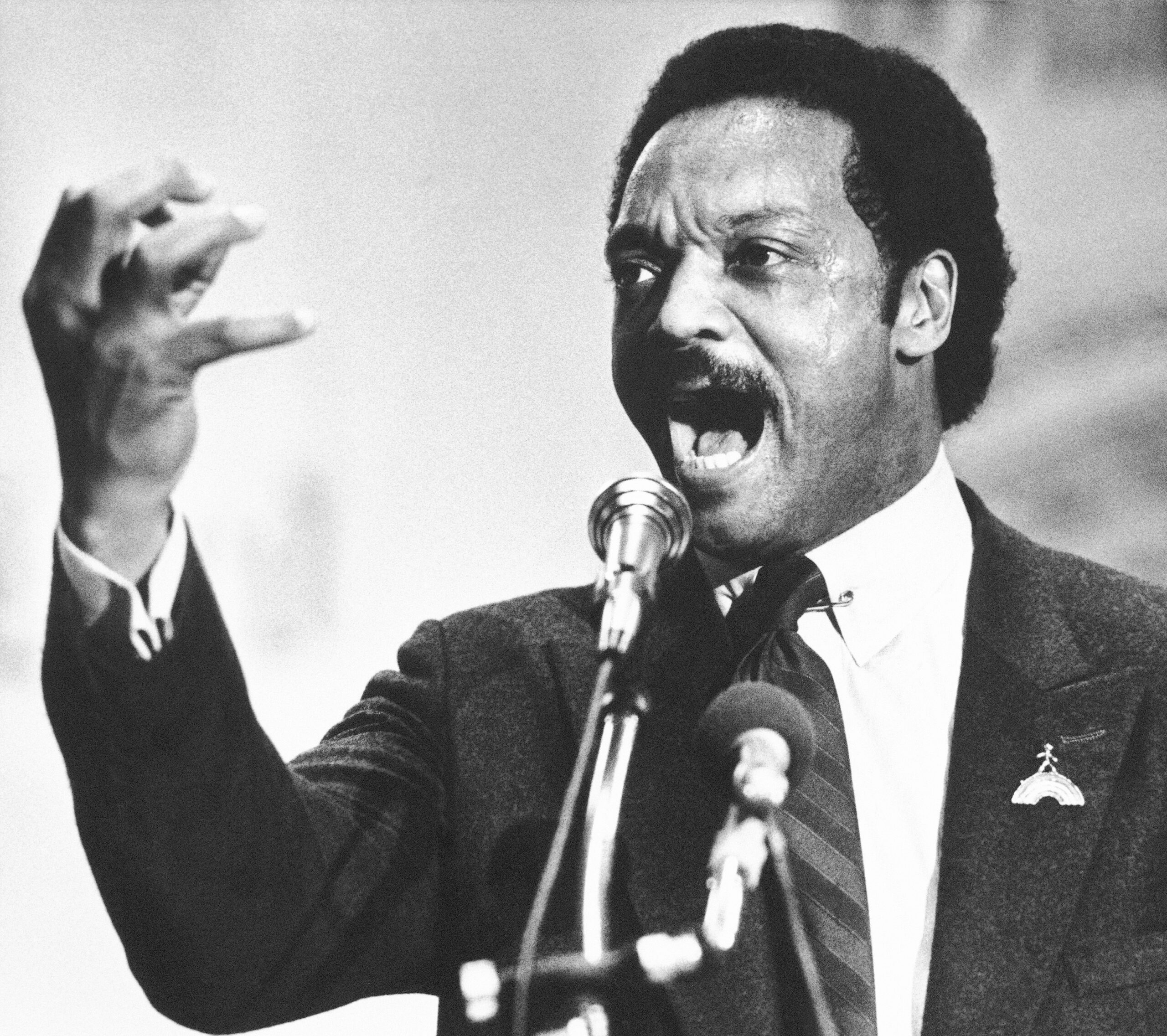
    Democratic presidential primary candidate Jesse Jackson speaks to a group of his supporters at a rally held at a Baptist Church in Dayton, Ohio, on April 14, 1984.

    Fellow civil rights activist the Rev. Al Sharpton said his mentor “was not simply a civil rights leader; he was a movement unto himself.”

    “He taught me that protest must have purpose, that faith must have feet, and that justice is not seasonal, it is daily work,” Sharpton wrote in a statement, adding that Rev. Jackson taught “trying is as important as triumph. That you do not wait for the dream to come true; you work to make it real.”

    Despite profound health challenges in his final years, including the disorder that affected his ability to move and speak, Rev. Jackson continued protesting against racial injustice into the era of Black Lives Matter. In 2024, he appeared at the Democratic National Convention in Chicago and at a City Council meeting to show support for a resolution backing a ceasefire in the Israel-Hamas war.

    “Even if we win,” he told marchers in Minneapolis before the officer whose knee kept George Floyd from breathing was convicted of murder, “it’s relief, not victory. They’re still killing our people. Stop the violence, save the children. Keep hope alive.”

    Calls to action, delivered in a memorable voice

    Rev. Jackson’s voice, infused with the stirring cadences and powerful insistence of the Black church, demanded attention. On the campaign trail and elsewhere, he used rhyming and slogans such as “Hope not dope” and “If my mind can conceive it and my heart can believe it, then I can achieve it,” to deliver his messages.

    Rev. Jackson had his share of critics, both within and outside of the Black community. Some considered him a grandstander, too eager to seek the spotlight. Looking back on his life and legacy, Rev. Jackson told the Associated Press in 2011 that he felt blessed to be able to continue the service of other leaders before him and to lay a foundation for those to come.

    “A part of our life’s work was to tear down walls and build bridges, and in a half century of work, we’ve basically torn down walls,” Rev. Jackson said. “Sometimes when you tear down walls, you’re scarred by falling debris, but your mission is to open up holes so others behind you can run through.”

    Barack Obama, then a senator. from Illinois, and the Rev. Jesse Jackson are seen at the Rev. Dr. Martin Luther King Jr. Scholarship Awards Breakfast in Chicago on Jan. 15, 2007.

    In his final months, as he received 24-hour care, he lost his ability to speak, communicating with family and visitors by holding their hands and squeezing.

    “I get very emotional knowing that these speeches belong to the ages now,” his son, Jesse Jackson Jr., told the AP in October.

    A student athlete drawn to the Civil Rights Movement

    Jesse Louis Jackson was born Oct. 8, 1941, in Greenville, S.C., the son of high school student Helen Burns and Noah Louis Robinson, a married man who lived next door. Jackson was later adopted by Charles Henry Jackson, who married his mother.

    Rev. Jackson was a star quarterback on the football team at Sterling High School in Greenville, and he accepted a football scholarship from the University of Illinois. But after reportedly being told that Black people couldn’t play quarterback, he transferred to North Carolina A&T in Greensboro, where he became the first-string quarterback, an honor student in sociology and economics, and student body president.

    Arriving on the historically Black campus in 1960 just months after students there launched sit-ins at a whites-only lunch counter, Rev. Jackson immersed himself in the blossoming Civil Rights Movement.

    By 1965, he joined the voting rights march King led from Selma to Montgomery, Alabama. King dispatched him to Chicago to launch Operation Breadbasket, a Southern Christian Leadership Conference effort to pressure companies to hire Black workers.
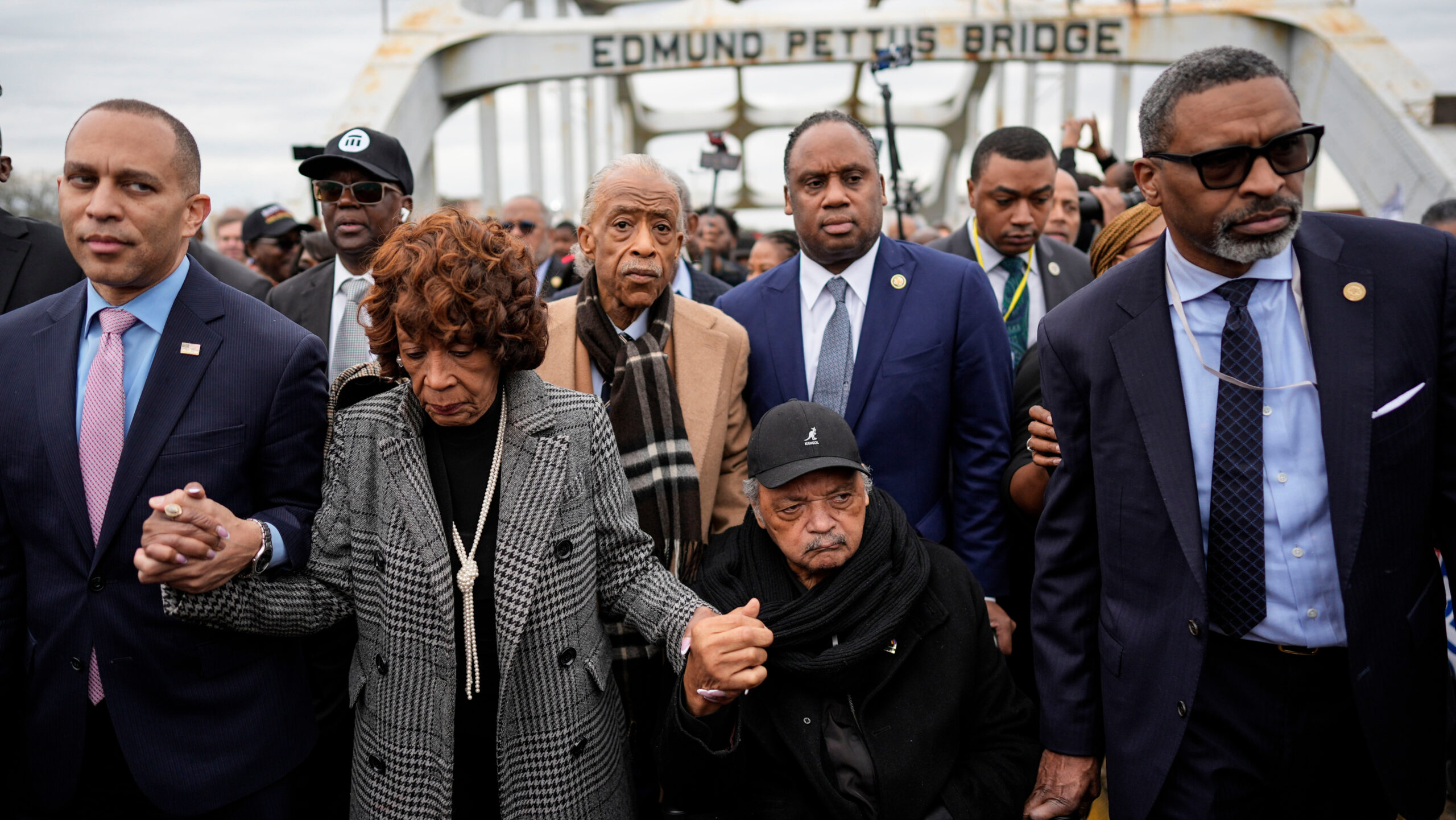
    U.S. Rep. Hakeem Jeffries (D., N.Y.), U.S. Rep. Maxine Waters (D., Calif.), the Rev. Al Sharpton, Rev. Jesse Jackson and NAACP President Derrick Johnson walk across the Edmund Pettus bridge in Selma, Ala., on March 9, 2025, during the 60th anniversary of the march to ensure that African Americans could exercise their constitutional right to vote.

    Rev. Jackson called his time with King “a phenomenal four years of work.”

    Rev. Jackson was with King on April 4, 1968, when the civil rights leader was slain. Rev. Jackson’s account of the assassination was that King died in his arms.

    Sharpton said he “always wondered how much trauma that must have been” for Rev. Jackson to witness King’s death. “He never would talk about it too much, but it drove him,” Sharpton said Tuesday. “He said, ‘We’ve got to keep Dr. King’s legacy alive.’”

    With his flair for the dramatic, Rev. Jackson wore a turtleneck he said was soaked with King’s blood for two days, including at a King memorial service held by the Chicago City Council, where he said: “I come here with a heavy heart because on my chest is the stain of blood from Dr. King’s head.”

    However, several King aides, including speechwriter Alfred Duckett, questioned whether Rev. Jackson could have gotten King’s blood on his clothing. There are no images of Rev. Jackson in pictures taken shortly after the assassination.

    In 1971, Rev. Jackson broke with the Southern Christian Leadership Conference to form Operation PUSH, originally named People United to Save Humanity. The organization based on Chicago’s South Side declared a sweeping mission, from diversifying workforces to registering voters in communities of color nationwide. Using lawsuits and threats of boycotts, Rev. Jackson pressured top corporations to spend millions and publicly commit to hiring more diverse employees.

    The constant campaigns often left his wife, Jacqueline Lavinia Brown, the college sweetheart he married in 1963, taking the lead in raising their five children: Santita Jackson, Yusef DuBois Jackson, Jacqueline Lavinia Jackson Jr., and two future members of Congress, U.S. Rep. Jonathan Luther Jackson and Jesse L. Jackson Jr., who resigned in 2012 but is seeking reelection in the 2026 midterms.

    The elder Jackson, who was ordained as a Baptist minister in 1968 and earned his master’s of divinity degree in 2000, also acknowledged fathering a child, Ashley Jackson, with one of his employees at Rainbow/PUSH, Karen L. Stanford. He said he understood what it means to be born out of wedlock and supported her emotionally and financially.

    On Tuesday, Harold Hall joined other mourners who stopped by the family home to pay their respects.

    Hall, who once lived in the same Chicago neighborhood as Rev. Jackson, left a bouquet of flowers outside Rev. Jackson’s door and recalled that he helped local street organizations in the late 1960s and early 1970s.

    Rev. Jackson “would come out and shoot ball and try to change the minds of many of our young folk,” urging them to stay out of trouble, Hall told reporters. “And in many instances, it happened. It worked.”

    Presidential aspirations fall short but help ‘keep hope alive’

    Despite once telling a Black audience he would not run for president “because white people are incapable of appreciating me,” Rev. Jackson ran twice and did better than any Black politician had before President Barack Obama, winning 13 primaries and caucuses for the Democratic nomination in 1988, four years after his first failed attempt.

    His successes left supporters chanting another Rev. Jackson slogan, “Keep hope alive.”

    “I was able to run for the presidency twice and redefine what was possible; it raised the lid for women and other people of color,” he told the AP. “Part of my job was to sow seeds of the possibilities.”

    U.S. Rep. John Lewis said during a 1988 C-SPAN interview that Rev. Jackson’s two runs for the Democratic nomination “opened some doors that some minority person will be able to walk through and become president.”

    Obama acknowledged Rev. Jackson’s efforts, saying he led some of the most significant movements for change in human history.

    Michelle Obama “got her first glimpse of political organizing at the Jacksons’ kitchen table when she was a teenager,” Obama wrote on X. “And in his two historic runs for president, he laid the foundation for my own campaign to the highest office in the world.”

    Rev. Jackson “was relentless in his belief that we are all children of God, deserving of dignity and respect,” the post read.

    Rev. Jackson also pushed for cultural change, joining calls by NAACP members and other movement leaders in the late 1980s to identify Black people in the United States as African Americans.

    “To be called African Americans has cultural integrity — it puts us in our proper historical context,” Rev. Jackson said at the time. “Every ethnic group in this country has a reference to some base, some historical cultural base. African Americans have hit that level of cultural maturity.”

    Rev. Jackson’s words sometimes got him in trouble.

    In 1984, he apologized for what he thought were private comments to a reporter in which he called New York City “Hymietown,” a derogatory reference to its large Jewish population. And in 2008, he made headlines when he complained that Obama was “talking down to Black people” in comments captured by a microphone he didn’t know was on during a break in a television taping.

    Still, when Rev. Jackson joined the jubilant crowd in Chicago’s Grant Park to greet Obama that election night, he had tears streaming down his face.

    “I wish for a moment that Dr. King or [slain civil rights leader] Medgar Evers … could’ve just been there for 30 seconds to see the fruits of their labor,” he told the AP years later. “I became overwhelmed. It was the joy and the journey.”

    Exerting influence on events at home and abroad

    Rev. Jackson also had influence abroad, meeting world leaders and scoring diplomatic victories, including the release of Navy Lt. Robert Goodman from Syria in 1984, as well as the 1990 release of more than 700 foreign women and children held after Iraq’s invasion of Kuwait. In 1999, he won the freedom of three Americans imprisoned by Yugoslav President Slobodan Milosevic.

    In 2000, President Bill Clinton awarded Rev. Jackson the Presidential Medal of Freedom, the country’s highest civilian honor.

    “Citizens have the right to do something or do nothing,” Rev. Jackson said, before heading to Syria. “We choose to do something.”

    In 2021, Rev. Jackson joined the parents of Ahmaud Arbery inside the Georgia courtroom where three white men were convicted of killing the young Black jogger. In 2022, he hand-delivered a letter to the U.S. Attorney’s Office in Chicago, calling for federal charges against former Chicago Police Officer Jason Van Dyke in the 2014 killing of Black teenager Laquan McDonald.

    Rev. Jackson, who stepped down as president of Rainbow/PUSH in July 2023, disclosed in 2017 that he had sought treatment for Parkinson’s, but he continued to make public appearances even as the disease made it more difficult for listeners to understand him. Last year, doctors confirmed a diagnosis of progressive supranuclear palsy, a life-threatening neurological disorder. He was admitted to a hospital in November for nearly two weeks.

    During the coronavirus pandemic, he and his wife survived being hospitalized with COVID-19. Rev. Jackson was vaccinated early, urging Black people in particular to get protected, given their higher risks for bad outcomes.

    “It’s America’s unfinished business — we’re free, but not equal,” Rev. Jackson told the AP. “There’s a reality check that has been brought by the coronavirus, that exposes the weakness and the opportunity.”

  • N.J. attorney general is dropping racketeering charges against George Norcross following court ruling

    N.J. attorney general is dropping racketeering charges against George Norcross following court ruling

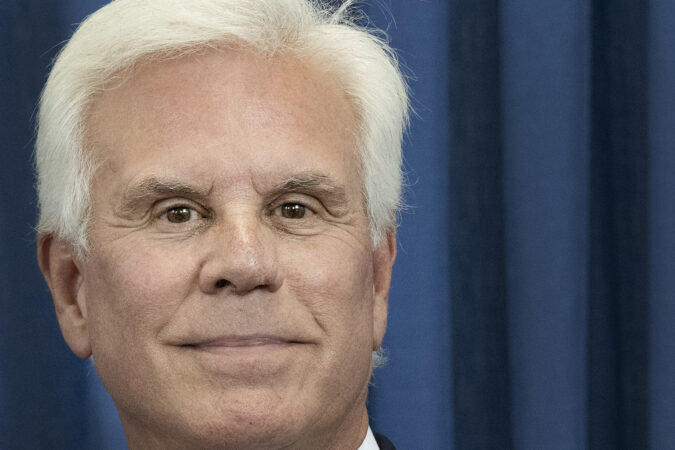
    New Jersey prosecutors are dropping racketeering charges against Democratic power broker George E. Norcross III, ending a high-profile case that law enforcement officials had framed as a reckoning on the state’s culture of corruption.

    Acting Attorney General Jennifer Davenport, an appointee of Democratic Gov. Mikie Sherrill, will not appeal a January appellate court ruling that upheld a judge’s decision to dismiss charges against Norcross and five codefendants, the attorney general’s office said Tuesday.

    Davenport could have asked the state Supreme Court to review the Appellate Division’s decision, but prosecutors concluded that their resources “would be best spent on other matters,” Sharon Lauchaire, a spokesperson for the New Jersey Attorney General’s Office, said in a statement.

    A three-judge panel said in a Jan. 30 decision that several of the racketeering conspiracy and extortion charges were time-barred under the statute of limitations. Other counts failed to state a crime, were untimely, or both, the panel said.

    Norcross, 69, is a former longtime member of the Democratic National Committee, founder of insurance brokerage Conner Strong & Buckelew, and chair of Cooper University Health Care. He was accused of using threats of economic and reputational harm — and his purported control of Camden’s government — to obtain valuable property on Camden’s waterfront from a developer and a nonprofit.

    His spokesperson on Tuesday portrayed the case against Norcross — announced in June 2024 by then-Attorney General Matthew J. Platkin — as a politicized abuse of the law similar to the Trump Justice Department’s targeting of perceived enemies.

    “We always knew that Matt Platkin brought this case for reasons other than its legal merits — and now multiple judges and Platkin’s successor as AG agree the allegations simply weren’t true,” Norcross spokesperson Dan Fee said in a statement.

    “The question now is whether Platkin’s supporters who cheered him on will take a serious look at what he did and whether other authorities will do the same,” he said. “We will certainly be making the case that he and anyone else who used lawfare against George should be held to account, no differently than Pam Bondi and her DOJ should.”

    Platkin, who was appointed to the post by Democratic Gov. Phil Murphy, has denied pursuing the case for political reasons. He noted on Tuesday that the case “was presented to a grand jury by career prosecutors over several months.”

    “Out of respect for the men and women who do brave work holding corruption to account, I won’t comment further — other than to say I remain proud to have supported their efforts at a time when trust in government is at an all-time low and I will never apologize for believing that everyone should be held to the same standards, no matter how powerful they may be,” Platkin said in a statement.

    Notwithstanding the decision to drop charges, Lauchaire said the attorney general’s office “remains committed to prioritizing public corruption prosecutions in this time of deepening mistrust in government.”

    “Wrongdoing by public officials undermines faith in our institutions, and the public rightfully demands and deserves that officials perform their duties with integrity and in accordance with the law,” she said. “We will never shy away from holding public officials accountable when they betray the public’s trust and behave unlawfully.”

    The prosecution faced an earlier setback last February, when a Superior Court judge found that the charges were not timely and said that even if the allegations in the indictment were proven true, they amounted to hard bargaining in real estate deals and did not cross the line into unlawful threats.

    Prosecutors appealed that ruling, arguing that the judge should review evidence presented to the grand jury before deciding whether the indictment was valid.

    The appeals court affirmed the trial judge’s order, though the panel focused on the statute of limitations violations and largely sidestepped the question of whether the threats underpinning the indictment met the legal requirements for alleging conspiracy to commit extortion.

    In addition to Norcross, prosecutors are dropping charges against his brother Philip Norcross, CEO of the law firm Parker McCay; attorney William Tambussi; former Camden Mayor Dana L. Redd; Sidney R. Brown, CEO of logistics firm NFI; and John J. O’Donnell, an executive at residential developer the Michaels Organization.

    “We are pleased and gratified that this misguided, baseless prosecution has been finally laid to rest,” said Kevin H. Marino, a lawyer for Philip Norcross.

    Henry Klingeman, an attorney for Redd, said his client “is relieved that this unjust and unnecessary ordeal is over.” The former mayor has “continued her unswerving commitment to bettering Camden,” Klingeman said.

    Brown said he was “innocent of these baseless charges” and added that Tuesday’s decision showed “justice was carried out based on the facts.”

    “Since its inception, this case was unfounded and attacked those of us who believed in the future of a thriving Camden,” the NFI CEO said in a statement.

    Tambussi’s lawyers, Jeff Chiesa and Lee Vartan, said their client “engaged in the routine practice of law.” They said Platkin’s attempted prosecution “did damage to the profession” and “was rightly rejected by both courts.”

  • The University of Pennsylvania soon may be off-limits to Army officers seeking tuition aid for graduate programs

    The University of Pennsylvania soon may be off-limits to Army officers seeking tuition aid for graduate programs

    The University of Pennsylvania soon may be off-limits to Army officers and other military service members who are seeking tuition aid to further their educations.

    The Ivy League university in West Philadelphia is among 34 schools the Army says are at risk of being banned from military funding for service members to pay for their graduate programs and other education, according to a CNN report. The messaging has caused confusion among military officers seeking advanced degrees in law, medicine, and nuclear engineering, the report states.

    The G.I. Bill and similar programs to pay for college have long been a major draw for people who join the military. But last week, Defense Secretary Pete Hegseth said the DOD “will discontinue graduate-level professional military education, fellowships and certificate programs” at Harvard.

    “Too many faculty members openly loathe our military,” said Hegseth, who obtained a master’s degree in public policy from Harvard in 2013. “They cast our armed forces in a negative light and squelch anyone who challenges their leftist political leanings, all while charging enormous tuition.”

    Hegseth, a former Army National Guard officer who served in Iraq and Afghanistan, said the department, which he calls the Department of War, is evaluating its relationships with other schools as well.

    “[We] will evaluate all existing graduate programs for active-duty service members at all Ivy League universities and other civilian universities,” he said. “The goal is to determine whether or not they actually deliver cost-effective strategic education for future senior leaders when compared to, say, public universities and our military graduate programs.”

    CNN obtained a “preliminary list of at-risk schools compiled by the Army,” which includes the University of Pennsylvania, as well as nearby Princeton University and Carnegie Mellon University in Pittsburgh. Officials at Princeton and Penn did not immediately respond to requests for comment Sunday.

    “We are aware of reports indicating that Carnegie Mellon is among several universities whose eligibility to support graduate training for military officers may be under review. At this time, we have received no formal notification confirming that any such review is underway,” a spokesperson for Carnegie Mellon said in a statement. “As always, CMU stands ready to engage constructively with the Department on ways to strengthen and advance military education.”

    Numerous schools on the list are the alma maters of Trump administration officials. In addition to attending Harvard, Hegseth obtained a bachelor’s degree in politics from Princeton. President Donald Trump holds a bachelor’s degree in economics from the Wharton School of the University of Pennsylvania. Vice President JD Vance holds a law degree from Yale University.

    Here is the preliminary list of “at-risk” schools:

    1. American University
    2. Boston College
    3. Boston University
    4. Brown University
    5. Carnegie Mellon
    6. Case Western University
    7. Columbia University
    8. College of William and Mary
    9. Cornell University
    10. Duke
    11. Emory
    12. Florida Institute of Technology
    13. Fordham
    14. Georgetown
    15. George Washington University
    16. Harvard
    17. Hawaii Pacific University
    18. Johns Hopkins University
    19. London School of Economics and Political Science
    20. MIT [Massachusetts Institute of Technology]
    21. Northeastern University
    22. Northwestern University
    23. New York University
    24. Pepperdine
    25. Princeton
    26. Stanford
    27. Tufts
    28. University of Miami
    29. University of Pennsylvania
    30. University of Southern California
    31. Vanderbilt
    32. Wake Forest
    33. Washington University in St Louis
    34. Yale

    Update: This article has been updated to include comment from Carnegie Mellon University.

  • Breaking down Isabeau Levito’s figure skating costumes over the years

    Breaking down Isabeau Levito’s figure skating costumes over the years

    Breaking down Isabeau Levito’s figure skating costumes over the years

    Since 2022, South Jersey’s Isabeau Levito has been one of figure skating’s biggest stars. Ahead of her Olympic debut Thursday in the women’s short program, we took a look back at her costumes since she burst onto the scene at 14 years old.

    Isabeau Levito competes during the women’s free skating competition at the U.S. Figure Skating Championships, Friday, Jan. 9, 2026, in St. Louis. (AP Photo/Stephanie Scarbrough)

    A star is born

    Isabeau Levito, of Mount Holly, competes in the short program at the 2022 U.S. Figure Skating Championships in Nashville. Levito went on to win the bronze medal, but at 14, she is too young to make the Winter Olympics team.

    Levito made her senior debut during the 2021-22 season at age 14. She skated her short program to “The Swan,” by Camille Saint-Saëns, performed by Joshua Bell.

    Isabeau Levito was too young for the Olympics in 2022, but she won the bronze medal at the U.S. Figure Skating Championships in this dress, made in Russia. She was also named to the World Junior Championships, where she skated to the “Russian Dance” from Swan Lake by Tchaikovsky, and won.

    Isabeau Levito competes in the women’s free skate program during the U.S. Figure Skating Championships Friday, Jan. 7, 2022, in Nashville, Tenn. (AP Photo/Mark Zaleski)

    Isabeau Levito wore a Spanish-inspired dress for her short program in the 2022-23 season. She skated to “Una noche más” by Yasmin Levy.

    Isabeau Levito performs during the women’s short program at the U.S. figure skating championships in San Jose, Calif., Thursday, Jan. 26, 2023. (AP Photo/Josie Lepe)

    National champion

    Isabeau Levito reacts after her performance during the women’s free skate at the U.S. figure skating championships in San Jose, Calif., Friday, Jan. 27, 2023. (AP Photo/Josie Lepe)

    In January 2023, Levito won the U.S. Figure Skating Championships in San Jose, Calif. She went on to place fourth at the World Figure Skating Championships in Saitama, Japan.

    Reputation era

    21 September 2023, Bavaria, Oberstdorf: Figure Skating: Challenger Series – Nebelhorn Trophy, Individual, Ladies, Short Program. Isabeau Levito from the USA on the ice. Photo by: Angelika Warmuth/picture-alliance/dpa/AP Images

    Early in the 2023-24 season, Levito wore a dress with a snake wrapped around her neck and the head on her arm. Ice dancers Madison Chock and Evan Bates had a snake program a few years before, and Chock advised Levito on this program.

    Switching gears

    COLUMBUS, OHIO – JANUARY 25: Isabeau Levito skates in the Women’s Short Program Dance during the U.S. Figure Skating Championships at Nationwide Arena on January 25, 2024 in Columbus, Ohio. (Photo by Matthew Stockman/Getty Images)

    Levito changed her short program midseason in 2023-24. Because of the Russian invasion of Ukraine, Levito stopped getting dresses made in Russia. This one was made by Josiane Lamond in Canada.

    Levito wore this layered black, white, and gray dress the first part of the 2023-24 season for her long program, skating to “The White Crow,” by Lisa Batiashvili. After placing third in the short program at Skate America that season, she finished second in the free skate to end in second overall.

    Isabeau Levito, of the United States, competes in the women’s free skate program during the Grand Prix Skate America Series in Allen, Texas, Sunday, Oct. 22, 2023. (AP Photo/Roger Steinman)

    Silver star

    Isabeau Levito, of the United States, poses with her silver medal at the world figure skating championships Friday, March 22, 2024, in Montreal. (Christinne Muschi/The Canadian Press via AP)

    Levito won the silver medal at the 2024 world championships in Montreal with this dress by Canada’s Lamond.

    Road to Milan

    Isabeau Levito of the United States skates in the Women’s Short Program in the 2025 Skate Canada International event in Saskatoon, on Friday, October 31, 2025. (Matt Smith/The Canadian Press via AP)

    Levito is wearing this red dress by Lisa McKinnon for her short program this Olympic season. She is skating to a compilation of sassy songs from Sophia Loren movies. At Skate Canada, a Grand Prix event, she placed second with this routine.

    Ticket punched

    Isabeau Levito performs during the women’s free skating competition at the U.S. Figure Skating Championships in St. Louis. She won the bronze medal.

    Levito is wearing this blue dress by McKinnon for her free skate (or long program) this season, and skates to “Cinema Paradiso” by Ennio Morricone. She won bronze at January’s U.S. Figure Skating Championships to earn the trip to Milan.

    A throwback

    South Jersey figure skater Isabeau Levito was announced as an Olympian on Sunday. She skated during the “Making Team USA” performance following the announcement.

    Levito was injured for a chunk of 2024-25 season, so she did not compete at the U.S. championships, but came back to place fourth at worlds. She wore this dress from that year’s program for the exhibition after making the Olympic team.

    Flying high

    Red Bull commissioned this dress for Isabeau Levito from dressmaker Lisa McKinnon, who made costumes for all three American women in 2026, as well as many of the international competitors. It was featured in an amusing campaign on social media.

    Red Bull commissioned this dress for Levito from McKinnon, who made costumes for all three American women in 2026, as well as many of the international competitors. It was featured in an amusing campaign on social media.

    dunkel_ellen

    This is the moment 18-year-old South Jersey figure skater Isabeau Levito has been waiting for

    Isabeau Levito is heading to the Olympics: ‘I feel like I really achieved my dream life’

  • Bruce Springsteen’s ‘Land of Hope and Dreams’ tour is coming to Philly

    Bruce Springsteen’s ‘Land of Hope and Dreams’ tour is coming to Philly

    The Boss is coming back.

    Bruce Springsteen & the E Street Band is headed out on the road this spring on its first U.S. tour dates in two years. These will be the band’s first performances since Springsteen made news last month with his anti-ICE protest song, “Streets of Minneapolis.”

    Appropriately enough, the “Land of Hope and Dreams American Tour” begins in Minneapolis on March 31 before making its way to the Xfinity Mobile Arena in South Philly on May 8.

    The itinerary includes east coast dates in Newark, N.J.; Long Island; Manhattan; and Brooklyn. There are 19 indoor arena shows in all, plus a closing night baseball stadium show in Washington on May 27.

    In a statement accompanying the tour announcement, Springsteen said: “We are living through dark, disturbing and dangerous times, but do not despair — the cavalry is coming! Bruce Springsteen and The E Street Band will be taking the stage this spring from Minneapolis to California to Texas to Washington, D.C., for the Land of Hope And Dreams American Tour.”

    Springsteen and the E Street Band last played Philadelphia with two shows at Citizens Bank Park in August 2024, and in October of that year he performed solo at the Liacouras Center in at Temple University in support of Kamala Harris’ presidential campaign.

    Tickets for the Philadelphia show go on sale Saturday, Feb. 21, at 10 a.m. via Ticketmaster.

    “We will be rocking your town in celebration and in defense of America — American democracy, American freedom, our American Constitution and our sacred American dream — all of which are under attack by our wannabe king and his rogue government in Washington, D.C.,” Springsteen said in the statement.

    Last year, the Boss made headlines while on tour in Europe for his pointed comments about the Trump administration, which he called “corrupt, incompetent, and treasonous” before performing his patriotic song “Land of Hope and Dreams.”

    Trump responded on Truth Social by calling Springsteen “highly overrated” as well as a “dried out prune of a rocker” and “not a talented guy — Just a pushy, obnoxious JERK.”

    Last month, Springsteen wrote “Street of Minneapolis” on the day that Alex Pretti was fatally shot by federal immigration enforcement agents in Minneapolis and released it three days later.

    Calling out “King Trump’s private army from the DHS,” Springsteen memorializes “two dead, left to die on snow-filled streets, Alex Pretti and Renee Good.”

    Springsteen performed the song as a guest of former E Street Band member Tom Morello at a benefit in Minneapolis in January. This month, he granted permission to filmmaker Robert Greenwald to use his often-misunderstood 1984 song “Born in the U.S.A.” in a short film of that name. The film tells stories of American citizens that have been targeted by ICE.

    “Everyone, regardless of where you stand or what you believe in, is welcome — so come on out and join the United Free Republic of E Street Nation for an American spring of Rock ‘n’ Rebellion! I’ll see you there!,” Springsteen said in the statement.

    Tickets for the Philadelphia stop of Bruce Springsteen’s “Land of Hope and Dreams” tour go on sale Feb. 21, 10 a.m. via Ticketmaster. The full tour itinerary is at BruceSpringsteen.net.

  • Union to open season Wednesday in Trinidad against Defense Force FC: ‘I think we’re always ready’

    Union to open season Wednesday in Trinidad against Defense Force FC: ‘I think we’re always ready’

    After 37 days of preseason, three centerback signings, three striker signings, and negotiations for a left back that aren’t done yet, the Union will play their first game of 2026 on Wednesday.

    Bradley Carnell’s squad should be favored in its visit to Defence Force FC of Trinidad & Tobago in the Concacaf Champions Cup (6 p.m., FS2). But this group of Union players hasn’t played an official game together, and, as the manager said in the preseason, you don’t know until you know.

    Now, it’s time to find out.

    “I think we’re always ready,” Carnell said in a news conference from Trinidad on Tuesday morning. “We know it’s early in our in our season, and we know that there’s a schedule coming up that’s really tough. And so we’ve been working hard over the last couple of weeks to get everybody integrated as best as we could.”

    Carnell had to contend with a series of absences during camp. Indiana Vassilev and Milan Iloski suffered injuries that they’ve recovered from, Bruno Damiani and Cavan Sullivan started the year with knocks, and Damiani was away for a few days this month to finish getting his U.S. green card.

    Jovan Lukić also was a late addition to the list, as Carnell revealed Tuesday that the midfielder took a hit to the ribs in a recent practice.

    “It’s preseason — there’s always a couple of things here and there,” he said. “But we’ve got a good competitive group here, ready to go.”

    Of Lukić’s status, he said, “we’re still assessing that, and we’ll see if that makes sense or not” for him to play Wednesday.

    Bruno Damiani (left) recently got his U.S. green card.

    The Union have never played Defence Force, partially because no team from Trinidad has reached the Champions Cup since the 2016-17 edition. Defence Force hasn’t qualified since 2002, though it has a notable history as winners in 1978 and 1985.

    The present-day squad is led by a familiar name, winger Kevin Molino. He played for Orlando, Minnesota, and Columbus from 2011 to 2023, then joined Defence Force in late 2024.

    “This is the challenge and the joy of the Champions Cup,” Carnell said.

    Carnival in Trinidad

    As if hosting a U.S. team in the region’s top soccer tournament wasn’t a big enough deal, Wednesday’s game will come right after Trinidad held its annual two-day Carnival around Mardi Gras.

    That should add even more buzz to the atmosphere at Hasely Crawford Stadium, one of Concacaf’s most historic venues. It’s the home of Trinidad and Tobago’s national soccer teams and the site of one of the U.S. men’s team’s all-time wins: the 1989 triumph to earn qualification for the 1990 World Cup, ending a 40-year tournament drought.

    Andre Blake is the only current Union player who has played a senior-level game in the venue, a World Cup qualifier last November that ended in a 1-1 tie. That might surprise some fans, but it’s true. Danley Jean Jacques hasn’t yet with Haiti, and Alejandro Bedoya never did with the United States.

    Union defender Nathan Harriel said that while “there’s temptation — it’s really easy to go out and want to be a part of something,” the team is making sure this stays a business trip.

    “There’s a lot of people here. It’s loud, noisy,” he said. “At the same time, we’re focused on the one thing at hand, and that’s getting a result on Wednesday. There’s distractions in any city you go to. … Just being able to manage that in the best way possible and just stay focused on the mission at hand is the most important.”

    And for those players who’ve played in Concacaf tournaments before, especially the Champions Cup, they know to always expect the unexpected.

    “I remember a few years ago in El Salvador, a dog ran on the field and grabbed the ball,” Harriel said, recalling the Union’s 2023 visit to Alianza. “So at the same time, you have to enjoy it, because you never know when you’ll be back. And you have to respect every opponent in this tournament — everybody is qualified to be in it, and we understand that.”

    The historic Hasely Crawford Stadium in Port of Spain, Trinidad, where the Union will play Defence Force FC in the Concacaf Champions Cup on Wednesday.
  • After 96 years, Pat’s King of Steaks is changing how it makes cheesesteaks

    After 96 years, Pat’s King of Steaks is changing how it makes cheesesteaks

    Like Major League Baseball installing the pitch clock or Apple dropping the headphone jack from iPhones, a small shift can have a major impact.

    The same is true of sandwiches: After 96 years, South Philadelphia landmark Pat’s King of Steaks has made two subtle but significant tweaks.

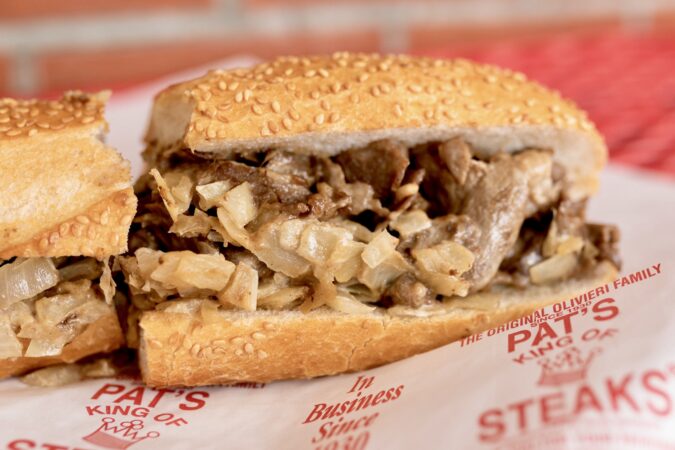
    The stand at the crossroads of Ninth, Passyunk, and Wharton is now offering seeded rolls, from longtime supplier Aversa Italian Bakery, alongside the plain hoagie-style rolls Pat Olivieri first used when he introduced the steak sandwich in 1930.

    An O.G.-style cheesesteak with Cheez Whiz on top at Pat’s King of Steaks in 2024.

    Owner Frank Olivieri said his father, Frank P. Olivieri, didn’t want seeded rolls “probably because his father [Harry] and his uncle [Pat] beat it into his head that he could not change the recipe whatsoever for whatever reason. But since my father unfortunately passed several weeks ago, I thought maybe it’s time to change up a little bit,“ he said. ”Seeded rolls are something that I do when I make them at home for myself.”

    Pat’s announced the “new school” seeded-roll option on Instagram as a limited-time offering, but Olivieri said it likely will be permanent. (Across the street, Geno’s still offers plain rolls only.)

    The second change — subtle but more significant — is happening on Pat’s grills.

    Since Pat’s began offering cheesesteaks in the 1950s, cooks layered the sliced cheese over the beef and let residual heat do the melting on the sandwich. Now, the cheese is melted into the meat and optional onions on the grill before everything gets mixed and goes into the roll.

    Pat’s is credited with inventing the steak sandwich in 1930.

    Olivieri said his father resisted melting cheese on the grill out of concern for maintaining the cooking surface. The new method produces a more integrated bite, with cheese distributed evenly. (Traditionalists, he said, can ask for the classic layered technique.)

    He said the updates reflect customer requests, not competitive pressure. Many newer shops favor seeded rolls and grill-melted cheese, arguing that the crunch and cohesion improve texture. Pat’s has adopted those elements — with limits.

    While newer operators often finely chop their steak, Pat’s remains committed to its sliced, or “slab,” style.

    “There’ll be no banging on the grill,” Olivieri said.

    Other additions have appeared. Two years ago, Pat’s started to offer chicken cheesesteaks and Cooper Sharp cheese — the darling of the new-gen shops. Pat’s still offers American, but Olivieri said he plans to phase it out. “It’s kind of redundant,” he said.

    The shop has tweaked things before.

    In the late 1970s, Olivieri said, he and his mother, Ritamarie, began offering mushrooms and peppers after hearing customers ask for them. His father didn’t notice at first.

    “He was looking at one of the invoices and said, ‘When the hell did we start selling mushrooms and peppers?’” Olivieri recalled. “I said, ‘Three weeks ago, Dad.’ He goes, ‘Oh, are they selling?’ I said, ‘Yes.’”

    They stayed.

    Still, Olivieri sets some boundaries. “I draw the line at pepperoni,” he said.

  • South Jersey guy becomes the face of ICE resistance | Will Bunch Newsletter

    I was cranking out the newsletter in Tuesday’s predawn darkness when we learned that the Rev. Jesse Jackson Sr., who’d been our greatest living bridge to the civil rights heroics of the 1960s and ‘70s, had died at age 84. Covering his groundbreaking 1984 campaign as a cub reporter at the Birmingham News is still a career highlight four-decades-plus later — a memory that was reinforced recently listening to Abby Phillip’s excellent new book on Jackson. He leaves us right when his victories for African Americans in arenas such as corporate hiring and college admissions are under attack, and it challenges us to fight to preserve them. RIP to an American original.

    If someone forwarded you this email, sign up for free here.

    How ICE protest by ‘an average Joe’ from Haddon Heights went viral

    “I never want to see a child run away from our own government again,” said this self-described first-time protester, Joseph Zobel from Haddon Heights, at a rally in Lindenwold, N.J., the day after children ran from a school bus stop after ICE appeared to conduct an operation in the area.

    Last Friday, “an average Joe who grew up in Haddon Heights” named Joseph Zobel was at work when he saw a viral video from the nearby South Jersey town of Lindenwold that shocked the nation, and shocked him.

    The clip from a Ring doorbell camera showed a gaggle of fourth and fifth graders running in a panic, screaming, “ICE! ICE!” as masked federal immigration agents had approached their morning bus stop the day before.

    “I just thought, ‘How can that be happening here in the United States?’” Zobel told me Monday in his first media interview, conducted by email. When he got home from work, he saw online that the group Cooper River Indivisible was holding an “ICE Out” protest at the Lindenwold municipal building at 4 p.m.

    He looked at the clock. It was 3:58.

    “Something inside of me said, ‘Go up there and stand with these people,’” said Zobel, a 36-year-old school coach who said he’s never been to a protest before in his life. “I wanted to stand for what is right.” As he dashed out, Zobel also grabbed one thing — the American flag he flies in front of his house most of the time (except during football season, when an Eagles flag replaces it).

    As many as 300 people were at the protest, as Indivisible organizer Amber Clemments asked the flag-bearing Zobel if he’d be willing to film a video. Zobel’s raw emotion, choking back tears as he said, “I watched fourth- and fifth-grade kids run away from our own government,” soon ignited across social media over the long Presidents Day weekend.

    By Tuesday morning, the 47-second clip of Zobel had been watched an astronomical 2.9 million times on TikTok — and liked by some 709,000 viewers — even as it also went viral on Bluesky, X, Threads, and other social media platforms.

    It’s not hard to understand why. Zobel, who described himself as a patriotic regular voter but never very political, instantly became the bearded, baseball hat-wearing, anguished face of a new American majority — an Everyman shocked into action by the horror of immigration raids, wondering how best to protect his neighbors.

    The two South Jersey viral videos — the one depicting the raid itself and Zobel’s raw reaction — revealed how both the terrorizing tactics of masked immigration cops and the powerful reaction from often nonpolitical Americans, dubbed “neighborism,” are spreading far beyond the Minnesota tundra where this battle was initially met.

    Indeed, local activists say Lindenwold — last stop on the heavily traveled PATCO line, just over 15 miles southeast of Philadelphia — has been under a relentless siege from U.S. Immigration and Customs Enforcement (ICE) and other federal agents since last spring, not long after Donald Trump became president. The transit hub has become a magnet for immigrants in recent years, with a local school population that is just under 60% Latino.

    Craig Strimel, a leader of Cooper River Indivisible, a local chapter of the group that organized the large “No Kings” protests, said activists first learned of the ICE activity when a Lindenwold immigrant couple escaped agents last year by taking refuge in the local high school, where the principal blocked the feds at the doorway. Since then, Strimel said, ICE watchers have seen frequent activity in and around a cluster of five apartment complexes with large immigrant populations, but few known arrests.

    “It was becoming apparent early on that this was all about creating terror,” said Strimel of the frequent ICE sightings. Some local residents stopped leaving their apartments, he said, and a once-popular restaurant in Lindenwold just closed its doors amid rumors that the couple that owned it has returned to Mexico.

    All of this set the stage for last Thursday, when masked federal agents wearing tactical gear arrived early in the morning at Lindenwold’s Woodland Village Apartments just as 44 elementary school kids were waiting for their school bus. The sighting triggered a panic that saw some kids running away and others frantically hustling onto the bus as the driver arrived. No one was apprehended or reported hurt.

    On Monday, U.S. Department of Homeland Security officials said the agents went to the complex hoping to arrest a Honduran immigrant who’d once been convicted of aggravated assault. The man was not taken on Thursday and remains free.

    Although some outlets reported the large protest was in response to the high-profile raid — which has been covered by the CBS Evening News, MS Now’s Morning Joe, and elsewhere — that took place just a day and a half earlier, the rally actually had been in the works for several weeks.

    It had been organized by a young woman from Lindenwold named Tatiana — a 20-year-old business major at Camden County Community College who spoke with me Monday on the condition that I not use her full name — who’d been seeing the ICE activity in her hometown and felt it was time local people spoke out.

    Tatiana told me that the idea behind the Lindenwold protest was “to give the community a voice — to be able to say, ‘No, we don’t stand for this.’ That’s the most important thing for me. It’s just bringing community together and deciding we’re not OK with this at all.” But she agreed the bus stop raid had given the event a boost from residents believing “that children should not be scared of federal law enforcement.”

    Zobel was one of those neighbors. In the email interview, he described himself as “just your average Joe who grew up in Haddon Heights.” He did volunteer that he’s voted in every election since he turned 18, and that his first ballot was cast for Barack Obama, “and I felt proud walking out of the booth that day.”

    Fittingly, Zobel sounded somewhat Obama-esque when he described his dismay over America’s bitter partisan divide. “We as a nation are so angry with one another, and that makes me so sad,” he said. Not surprisingly, he’s as stunned as anyone at the millions of views for Friday’s video, and somewhat concerned about the impact, saying, “I just hope this video does not divide people.”

    But Zobel’s words and teary-eyed emotion went viral because it was such a shot of hope — that in a moment when hate is on public display in the streets of the United States, “your average Joe” who’d once stood on the sidelines is now grabbing the American flag and taking the field to fight for their neighbors. An authoritarian movement dependent on rage simply never counted on the brotherly love that sent this nonpolitical Eagles fan to his first protest.

    It might not be his last. “I am always happy,” he said, “to help support humanity.”

    Yo, do this!

    • With several inches of snow still on the ground, it might shock you to hear this, but American soccer is back! The Philadelphia Union — despite winning the 2025 Supporters Shield and boasting Major League Soccer’s best winning percentage in the 2020s — radically shook things up during the offseason. With new strikers Ezekiel Alladoh and Agustín Anello looking to amp up their attack, the Union’s quest for the CONCACAF Champions Cup begins Wednesday in Trinidad against Defence Force FC at 6 p.m. on FS2. Saturday night at 7:30 p.m., it’s back to the chillier climes of Washington for the MLS opener against DC United on Apple TV (with no need in 2026 for an additional Season Pass subscription, as in past years).
    • In the quest for what’s new in American popular culture, sometimes we take for granted the established jewels in our midst. I’ve long felt that MS Now’s 9 p.m. (now just on Monday nights) host Rachel Maddow is our best TV commentator because of the way she weaves the historical past into the headlines of America’s tortured present. But since last summer, she has upped her game. Maddow’s coverage of two stories underreported in most of the mainstream media — grassroots resistance to the Trump regime, and now the push for a nationwide network of warehouse concentration camps — has created appointment television every Monday.

    Ask me anything

    Question: What is your take on the latest CBS censoring of [Stephen] Colbert? — @bcooper82.bsky.social via Bluesky

    Answer: Another Tuesday morning breaking story on deadline: The CBS overseers of Late Night with Stephen Colbert — the top-rated talk show that’s nevertheless ending this year in what critics see as genuflecting to the Trump regime that the program frequently mocks — would not air a recorded interview with Texas state lawmaker and Democratic Senate primary candidate James Talarico. The backstory here is that the Federal Communications Commission has long exempted late-night talk shows from its equal time rule about political candidates on licensed broadcast outlets, but last month, FCC chair Brendan Carr — a pro-Trump MAGA pit bull — said this is changing. That apparently was enough for CBS’s new Trump-friendly management, which would not broadcast the interview (available on YouTube, now certain to get more views than if it hadn’t been censored). This new flap just highlights what a perilous moment this is for the First Amendment and American democracy writ large. Government limits on what viewpoints you can see or hear are a sign of dictatorship, full stop.

    What you’re saying about …

    Last week’s question about a winning Democratic strategy for the 2026 midterms drew a robust response, and almost all of the replies were thoughtful and nuanced. If there was a consensus, it was that Democrats should tailor their candidates to the divergent views of the congressional districts they hope to win. As Naomi Miller stated, “I think progressive candidates should run in progressive districts, and mainstream democrats in mainstream, purple, and red districts.” Still, a number of you think America’s bad experience with MAGA extremism means a sharp left turn is warranted in response. “I’d like for the Democrats to become more progressive and combative toward Trump than they already are,” wrote Benjamin Spohn, voicing an opinion many share these days.

    📮 This week’s question: Tuesday’s passing of the Rev. Jesse Jackson is one more reminder that many icons of America’s tumultuous 20th century are disappearing. So who do you think is the current greatest living American, and why? Please email me your answer and put the exact phrase “greatest living American” in the subject line.

    Backstory on the main reason the media is not trusted

    Exterior images of CNN headquarters in Atlanta and the New York Times Building in Manhattan.
    Exterior images of CNN headquarters in Atlanta and the New York Times Building in Manhattan.

    It’s rare these days to write something that everyone can agree on, but here goes: Public trust in the media has never been lower than it is today. How low? A Gallup poll last fall found that public trust in the ability of newspapers, TV, and radio to fairly and accurately report the news had plunged to 28%, the lowest ever recorded. Why? It’s complicated. The people’s faith in every major institution has declined in the 21st century, after all. And it’s clear that in a deeply divided America, rage against the media machine looks different from the left than it does from the right.

    This weekend, in a New York Times piece largely about the broken promises of one media-mogul billionaire — Washington Post owner and Amazon founder Jeff Bezos — columnist Lydia Polgreen put forth an explanation for sinking media trust that jibes with a lot of what I’ve witnessed since graduating into full-time journalism back in 1981. I believe it’s not the only reason — but the biggest, and maybe the most misunderstood.

    Polgreen noted that the common theory for the public turning against Big Media — that journalists grew more partisan and biased after the tumult of the 1960s and ‘70s — doesn’t comport with the bigger reality. The era that peaked with the publication of the Pentagon Papers and the Watergate scandal launched a decades-long golden era of profitable news organizations spending big on investigative and accountability journalism — exactly what viewers and readers claimed they wanted.

    Yet, trust declined as that happened. Polgreen cited a study in the late 1990s that compared then-contemporary media to 1960s newspapers and found the earlier times were “naïvely trusting of government, shamelessly boosterish, unembarrassedly hokey and obliging.” Polgreen wrote that moving “away from deferential stenography and toward fearless investigation … led to declining trust in the news media. Aggressive, probing and accountability-oriented journalism held up a mirror to American society — and many Americans didn’t like what they saw.”

    I think this explanation is spot on, but before readers jump all over me, let me quickly add a couple of caveats. Starting way back in Ronald Reagan’s 1980s, there was also a response to the growing backlash — especially in elite, Beltway journalism — that resulted in too much groveling to authority, and thus stenography around government lies like the 2003 Iraq War. This has only gotten worse with the current wave of billionaire owners like the Post’s Bezos. This means many liberals now also distrust the media, but not for the same reasons as conservatives, who’ve long loathed journalism for probing America’s inequities around race or gender.

    The explanation offered by Polgreen jumped out at me because it fit with what I explored in my 2022 book, After the Ivory Tower Falls, which looked at Americans losing trust in another large institution: colleges and universities. The liberal ideas that were nurtured on campuses in the postwar college enrollment boom — including the civil rights movement — triggered the same grievance-filled, largely white working-class backlash as did journalism about social injustice. Today, the only road back for the media is to hold the powerful to account — and understand that not everyone is going to like it.

    What I wrote on this date in 2022

    People can’t say they didn’t see America’s current crisis coming. On this date four years ago, I expressed my shock and amazement that little more than one year beyond Donald Trump’s attempted coup to stay in power, the right-wing’s creation of a political fantasy world was spiraling out of control, with lies about Hillary Clinton spying on Trump’s 2016 campaign and Joe Biden giving out free crack pipes (?!!). I wrote, “[Historian Ruth] Ben-Ghiat told me that the failure of the Jan. 6 insurrection only forced the GOP to double-down on embracing alternate realities, because ‘they have to reckon with the fact that [Trump] lost, that he’s no longer the leader.’”

    Read the prescient rest:After Trump’s Big Lie, half of U.S. lives in a fantasy world. This won’t end well.”

    Recommended Inquirer reading

    • There’s been no rest on the mass deportation beat. In my Sunday column, I looked at the out-of-control lying from the Trump regime, with unbelievable fictions about everything from shootings and rampant brutality by masked immigration officers to Commerce Secretary Howard Lutnick’s whoppers about his friendship with Jeffrey Epstein. I argued that government lying is fundamentally unconstitutional and that the perpetrators need to be punished, including prison time. Over the weekend, I wrote about how, while Minneapolis was a victory for the forces resisting American authoritarianism, that won’t stop Homeland Security from putting thousands of new officers on the street and expanding its concentration camps. The fight for the soul of the nation has only just begun.
    • What was I saying higher up in this newsletter about accountability journalism? Ever since Lyndon B. Johnson’s Great Society push in the mid-1960s, community nonprofits have been a valuable source of urban renewal, yet are sometimes dragged down by waste, fraud, and abuse. It’s a problem that sadly persists, as shown last week by a major Inquirer investigation into Philadelphia’s NOMO Foundation, one of the best-funded nonprofits attacking youth violence and crime. Ace reporters Ryan W. Briggs and Samantha Melamed found that the foundation has received more than $6 million in public funds in recent years, but faced an IRS lien and eviction lawsuits while it was forced to close its housing program. This is why we have a First Amendment, so that a free press can report on the problems a corrupt or inept government refuses to deal with. Subscribing to The Inquirer gives you access to this type of essential journalism, and you’ll also feel good about supporting this vital work.

    By submitting your written, visual, and/or audio contributions, you agree to The Inquirer’s Terms of Use, including the grant of rights in Section 10.

  • Redevelopment is coming to a former factory in East Kensington after years of delay

    Redevelopment is coming to a former factory in East Kensington after years of delay

    The long vacant industrial building at 1807 Huntingdon St. in East Kensington is moving toward redevelopment after seven years of setbacks.

    Philadelphia-based Smith & Roller has been eyeing the faded brick structure since 2019 but struggled with funding following the COVID-19 pandemic and the loss of a lender after Silicon Valley Bank’s collapse in 2023.

    But last week New Jersey-based Ellavoz Impact Capital announced that it was acquiring the building in partnership with Smith & Roller, allowing the developers to move forward with their plans near SEPTA’s Huntingdon stop on the Market-Frankford line.

    Developers Tayyib Smith and Jacob Roller see the project as a catalyst for change around the elevated train station, which is haunted by the opioid crisis.

    “I’ve always imagined connecting nodes of vitality and then seeing how it almost has a regenerative spring of people looking at a neighborhood differently,” Smith said.

    “I can imagine that block having a different feel, a different type of lighting, a different type of walkability, more socio-economic diversity, more eyes on the corridor,” he added.

    The developers plan to break ground on the project in about six months.

    Smith & Roller’s neighboring development, 1801 Huntingdon, will transform a historic bank building into a banquet hall and commissary kitchen for Black-owned caterer Strother Enterprises, which has been expanding elsewhere in the city recently. That development will need approval by the city’s Zoning Board of Adjustment and is on a longer timeline.

    Over the years, the project at 1807 Huntingdon has added more housing and cut back on space for businesses.

    The current version of the project includes 109 residential units and 8,600 square feet of commercial space. According to Ellavoz Impact Capital’s news release, the commercial space has been preleased, but the tenant list is not public yet.

    A rendering of the redeveloped factory building, as a mixed-use apartment building.

    An earlier version of the project, reviewed by the city’s Civic Design Review committee in 2022, would have contained 80 apartments and 38,000 square feet of light industrial space.

    That’s partly because the federal program Smith & Roller originally planned to use, New Market Tax Credits, requires that at least a fifth of a mixed-use project be devoted to commercial development.

    But the project at 1807 Huntingdon has been in process for so long that this part of Kensington no longer qualifies for the federal incentive, which is meant to spur investment in struggling areas.

    The project is still in a Keystone Opportunity Zone (KOZ), however, which will give state tax breaks to businesses at the 1807 and 1801 Huntingdon projects.

    That policy is also meant to incentivize development in lower-income areas, but there are many examples of its application to parts of Philadelphia like the Navy Yard and University City.

    “I don’t know many [KOZs] that are in neighborhoods like Kensington,” Smith said, “where there’s somebody trying to use it in the spirit and intent of how the legislation was written.”

    The project will include both the redeveloped factory with additional space above it and an adjacent parking lot, which will have multiple stories of housing on top.

    It will include a mix of studios, one-bedroom, and a few two-bedroom apartments, along with loft-style units that can be rented out as either short-term rentals or office space.

    Sixty percent of the units will be set aside for households earning 80% of area median income, or almost $67,000 for one person.

    “We don’t have a direct subsidy, like a Low Income Housing Tax Credit or anything like that,” Roller said. “In some cases, it’s not that different a number than a market rent in the neighborhood.”

    Jacob Roller (left) and Tayyib Smith last June outside the historic bank they plan to turn into a base for Black-owned businesses, which is next to the apartment project farther down Huntingdon Street.

    Roller said the project is inspired in unit mix and general location by the success of Shift Capital’s mixed-use project at 3400 J St., home to Càphê Roasters. Smith & Roller was a junior partner in that project.

    The Huntingdon Street project will be the firm’s largest project by unit count.

    “I am extremely impressed by the work of Smith & Roller,” Jeffrey Crum, president of Ellavoz Impact Capital, said in the news release. “They have proven themselves as professional and experienced urban redevelopers who have a unique vision for revitalizing neighborhoods in partnership with local communities.”

    The proposal has been presented to the East Kensington Neighbors Association several times over the years, and the community group is supportive of Smith & Roller’s proposal.

    The group also sees the development project as a means to bring new life to the block, where the current dilapidated state of the buildings often attracts opioid users from nearby open-air drug markets on Kensington Avenue.

    “The block has been challenged for a long time,” said John Theobald, president of the East Kensington Neighbors Association. “It’s really where a lot of the Kensington Avenue activity impacts the neighborhood, so hopefully more people living there and less vacancy will help.”

  • Alexis and Kayla Eberz ‘work together’ to guide Archbishop Carroll back to the Palestra

    Alexis and Kayla Eberz ‘work together’ to guide Archbishop Carroll back to the Palestra

    The Eberz sisters know they can count on each other to pick another up.

    Alexis and Kayla Eberz, two of three sisters on the Archbishop Carroll girls’ basketball team, leaned on another to earn a 50-38 win over Archbishop Wood in a Catholic League girls’ basketball semifinal.

    The two combined for 36 of Carroll’s 50 points; sophomore Kayla scored 24 and senior Alexis added 12.

    “I definitely look up to Lex a lot,” Kayla Eberz said. “I’m so proud of everything she does, [and] I think we work together really well. So if one’s not doing so [we’re going to] pick the other one up.”

    Archbishop Carroll’s Kayla Eberz finished with a team-high 24 points against Archbishop Wood on Monday.

    Now, Carroll finds itself in a familiar position: the PCL final. This marks the Patriots’ third straight PCL final appearance.

    Last season, Carroll lost to Neumann Goretti, and in 2024, it lost to Wood. The Patriots haven’t won a PCL title since 2019.

    This time around, Carroll, which will face Cardinal O’Hara Sunday at the Palestra, believes it’s in a better spot to come out victorious.

    “I think our mindset [has changed],” Alexis Eberz said. “We haven’t gotten the outcome we wanted the past two times, but we are using that as motivation this year. … We’re a special team. Staying together, staying composed, having discipline — I think we got it.”

    Road to victory

    But the Patriots’ semifinal win at Finneran Pavilion — the future home of Alexis Eberz, a Villanova signee — did not come easy.

    The Vikings built a 10-point lead about six minutes into the game. Carroll responded with back-to-back three-pointers to cut its deficit and end the first quarter down by two points.

    Wood senior forward Colleen Besachio, a Rider signee, was the difference-maker for the Vikings, scoring a team high 15 points. Wood trailed, 21-20, at halftime.

    Archbishop Carroll’s Alexis Eberz drives to the basket against Archbishop Wood High’s Colleen Besachio in the third quarter on Monday.

    But once the Eberz sisters started to connect in the third quarter, the tempo shifted.

    Kayla started the run with a bucket that gave Carroll 31–28 lead, then followed it up with a massive block. On the Patriots’ next possession, Alexis found Kayla for a three-pointer, followed by a Kayla dish to Alexis for an easy layup to make it 36–28.

    “Basketball is a game of runs,” Kayla said. “They had their run at first; we had ours. And then we just had to stay on top of it.”

    Carroll held an eight-point lead entering the final 10 minutes and extended that advantage to a comfortable 12 points by the final buzzer.

    “We just had to [take it one] possession at a time,” Carroll coach Renie Shields said. “When we dug in, took one possession defensively, and offensively got going, I felt more comfortable that we got into a swing of things.”

    Back to the Palestra

    Carroll has an 11-0 league record. The team is full of chemistry and experience.

    The Patriots hope that will help them write a new story and bring home a PCL crown on Sunday afternoon.

    “We’re all such good friends. It helps,” said senior forward Bridget Grant, who’s committed to Ursinus. “When one of us is down, another person picks [them up]. If someone takes a bad shot, you can let them know. That’s not us getting mad; it’s just trying to help the team. It really just shows how well we play with each other, that we all love each other.”

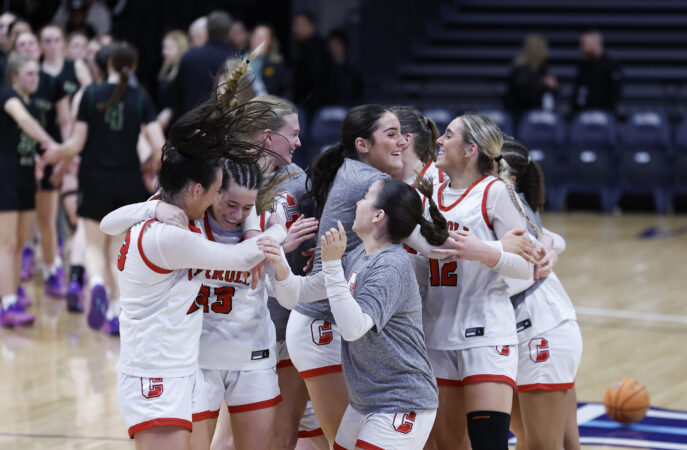
    Members of the Archbishop Carroll team celebrate after beating Archbishop Wood in the Catholic League girls’ basketball semifinals on Monday.