Blog

  • Why are malnutrition deaths soaring in America?

    Why are malnutrition deaths soaring in America?

    Something strange is happening with malnutrition.

    It’s by far the fastest-growing cause of death in America, soaring sixfold over the past decade or so, according to our analysis of death certificate data from the Centers for Disease Control and Prevention.

    To be sure, we wouldn’t yet call it commonplace. But while it accounts for fewer than 1 in 100 deaths, its toll is rising so fast that it’s now in the same league as arterial disease, mental disorders, and deaths from assault.

    But when you dig into the data, it doesn’t look like our mental image of malnutrition, one which revolves around food banks and famine. For starters, it doesn’t quite map to economic hardship.

    It tends to kill somewhat more people in lower-income states, and among folks with less education in general. But the relationship isn’t as strong as you’d think, and it bears surprisingly little relation to state measures of food insecurity or food stamp use.

    More important, we’re worried here about the meteoric rise in deaths, not the level. And the rise is much harder to explain with demographics. We see it across the board. Every state, every education level, every race, every gender.

    When we split the numbers every which way, only one metric showed clear differences: age. Americans 85 or older die of malnutrition at around 60 times the rate of the rest of the population, and such deaths are rising about twice as fast among that group.

    What’s going on? Are older Americans struggling to eat?

    Yes (but). Uche Akobundu, a dietitian who directs nutrition strategy at Meals on Wheels America, told us the program’s local providers “consistently report serving seniors who struggle to afford or access nutritious food while living on fixed incomes and facing rising costs for housing, utilities, and healthcare.”

    Indeed, the share of Americans 65 or older who report some level of food insecurity hit a high in 2023. The rate among the 85-plus crowd was lower, but still near record levels.

    And those records may not be broken, at least after 2024. The source we used, a supplement to the Census Bureau’s Current Population Survey, has been canceled by the Agriculture Department. The forthcoming release could be the last.

    But before we declared this a closed case, we stepped back and put the numbers in context. Food insecurity among older Americans has risen 5% from 2011 to 2023. That’s not a good number, or one you can just wave off. But at the same time, it can’t explain a 746% increase in malnutrition deaths over that period. (And, yes, we adjusted for the aging population.)

    So, we called the American Society for Parenteral and Enteral Nutrition — also known as ASPEN or, more descriptively, the nation’s intravenous-nutrition and feeding-tube experts. If there’d been a sudden surge of malnutrition among older Americans, ASPEN would have noticed.

    Peggi Guenter led clinical practice, quality, and advocacy at ASPEN for two decades. Her best guess is simple: Malnutrition “has always been there. … We’re just identifying and documenting it better than we ever have in the past.”

    What happened in the past? Well, it has never been unusual for someone with a serious condition to lose weight. Watching a loved one waste away isn’t a modern phenomenon. But physicians used to see malnutrition as part of the patient’s overall decline.

    But around 2010, researchers started accumulating evidence that showed what they had long assumed: The lack of nutrients was, itself, a risk factor. A pile of papers now tell that malnourished people have more emergency room visits, spend longer in the hospital, and need more healthcare.

    Doctors weren’t trained to diagnose it separately, especially since research has shown it wasn’t as easy as lab-testing for a single indicator, according to Alison Steiber, chief research, impact, and strategy officer at the Academy of Nutrition and Dietetics.

    That started to change in 2012. That’s when, prompted partly by new research finding malnutrition could be driven by inflammation as well as lack of calories, ASPEN and the nutrition academy released the Consensus Statement on “Characteristics Recommended for the Identification and Documentation of Adult Malnutrition (Undernutrition).”

    Not long after, in 2014, we saw the first big jump in death certificates labeled with malnutrition as the underlying cause of death. Nobody’s willing to say the declaration caused the rise in diagnoses. “Cause” is a sacred, hard-earned word in medicine. But it’s also true that the nutrition academy, ASPEN, and friends went all out to ensure that the statement caused physicians to be aware that they needed to diagnose malnutrition more often.

    The Academy of Nutrition and Dietetics, ASPEN, and their allies taught clinicians from all over the country to diagnose malnutrition by looking not just for weight loss, but also for factors such as muscle loss, loss of under-the-skin fat pads, fluid retention, and simply not eating enough. They held awareness weeks, tons of trainings and — perhaps most notably — launched an ambitious Malnutrition Quality Improvement Initiative, which worked with hundreds of hospitals starting in 2013.

    All those efforts paid off.

    “I started practicing in 2010, and I was not trained to identify malnutrition in my education program, like in my internship,” said Michelle Schneider, ASPEN’s manager of clinical practice. And the 2012 paper and awareness push “is when I myself started … really evaluating the set of clinical characteristics that can identify and diagnose malnutrition.”

    When she and her colleagues started looking for malnutrition, their hospital’s related case numbers went up. It happened all over the country. As a rule of thumb, multiple experts told us that at least 1 in 5 hospital patients probably suffer from some kind of malnutrition. In 2010, about 3% were diagnosed with it. By 2018, it hit 9%, Guenter and her colleagues found.

    “As with other conditions, such as celiac disease, increased prevalence rates do not necessarily reflect more cases, but rather improved detection, diagnosis, and intervention,” Steiber told us.

    But what about older patients specifically? We called on the American Academy of Hospice and Palliative Medicine and got ludicrously lucky: They put us in touch with their chief medical officer, Kristina Newport.

    Newport runs palliative medicine at Penn State Health, speaks in fully formed paragraphs, and probably could have dictated a better version of this column over breakfast before she’d had her first coffee. She confirmed everything we’d heard — then added another variable.

    “The other thing that happened around this timeline is that CMS, the Center for Medicare and Medicaid Services, changed the impact of the diagnosis of some of these diagnoses that fall under malnutrition,” she said.

    “When hospitals are measured on their mortality, the calculation includes a comparison of how many people actually die compared to how many people are expected to die. And that expected number is determined by the complexity of documented illnesses as reflected in diagnosis codes. So when there was more weight given to malnutrition as a diagnosis code — when it was better defined, based on the understanding that nutrition often correlates with severity of illness — all of a sudden, it changed the calculation.”

    So, hospitals and other providers were given a strong incentive to look out for malnutrition, because now official statistics (correctly) recognized it increases the odds that someone will have an awful outcome, which means you’re not penalized as much if said outcome occurs.

    “Long-term care facilities have also started paying very close attention to weight loss and are held accountable for folks having abnormal weight loss,” she added. In fact, nursing homes must have a dietitian or nutrition specialist on staff.

    And hospice, which can be part of many medical or at-home settings, has its own incentives.

    “You’re only eligible for hospice enrollment if you’re expected to die within six months and if you’re not pursuing life-prolonging treatments,” she told us. “The hospice clinicians have to regularly demonstrate that somebody is progressing toward death, which is crazy, right? And so one of the ways that they have to routinely demonstrate that there’s evidence that this person is dying is to routinely assess different aspects of nutrition.”

    It might not be weight loss, since people in failing health might retain water, but you can still look at arm circumference and other metrics. It helps demonstrate the decline needed to maintain eligibility (and payment) for hospice services, she said, and it can be an indirect way to measure the progress of a patient’s disease, particularly for folks who might not have a clear terminal illness.

    “So your 85-year-old woman who has a little bit of cognitive impairment but has never been diagnosed with dementia — she gets a urinary tract infection every once in a while, but she doesn’t have one right now. She had mild diabetes. None of those things are explicitly taking her life,” Newport said. “The most objective thing you can say is she continues to lose weight.”

    “Somebody like that may end up with a diagnosis of malnutrition on her death certificate because none of those other things obviously took her life. Right? But it wasn’t because she didn’t have access to food.”

    In fact, regardless of your condition, weight loss and loss of appetite are one of the most common pathways toward death as the body shuts down.

    So, malnutrition is often a normal part of dying. It hints at the presence of other underlying conditions. So how did it end up as the underlying cause of death on almost 25,000 death certificates last year?

    Newport had a hint for us on that one, too. We cherish death certificates as one of the most authoritative data sources out there — and they are, since they cover pretty much the entire population and are certified by professionals. But those professionals are human.

    “Despite the importance of the cause of death and filling out this form, there’s very little education or standardization of doing it,” she told us. “So that’s just something to keep in mind.”

    And we did. So we set out to learn about death certificates.

    We started with the folks who quarterback the entire certification process and make sure the families and doctors get what they need. We called the funeral directors.

    Chris Robinson just finished his term as president of the National Funeral Directors Association. He also runs Robinson Funeral Homes at the foot of South Carolina’s sliver of the Blue Ridge.

    When someone dies, Robinson gets a report from the hospital, hospice, or coroner. It tells him their next of kin and date of birth. He meets with the family to fill in vital statistics. But he’s not allowed to fill in the cause of death.

    “We submit it electronically to the certifying physician or coroner, whoever’s going to certify the death,” Robinson told us. “And then they send it back to us with the cause of death.” Robinson then sends the certificate to the health department to be finalized, so he can get official paper death certificates for the family.

    That pointed us to the next step in following the certificate on its journey. That step was Reade Quinton. Quinton is president of the National Association of Medical Examiners. He also runs the pathology residency at the Mayo Clinic. Filling out the cause of death on certificates — and teaching others to do so — is a large part of his career.

    “There’s a science and an art to filling out a death certificate,” he told us. It’s a forensic pathologist’s job to ask why, to get to the root of the problem. Ideally, he said, you’ll rarely see malnourishment on a death certificate by itself — the document should also define the underlying cause.

    You see, under cause of death, a typical certificate has four blanks. You start with what Quinton would call the “final insult,” and then tease out the causal chain until, by the fourth blank — if you need that many — you’ve listed the underlying cause.

    So, the chain might go something like: gastrointestinal bleeding due to swollen veins in the esophagus due to cirrhosis due to alcohol use disorder. In that case, the alcohol abuse would be the underlying cause.

    Malnutrition could play a role in that four-step mortality chain. But why are people listing it as the ultimate cause? Quinton’s not sure, but death certification isn’t really taught in depth outside of pathology residencies, and most deaths aren’t certified by pathologists.

    “There’s a large number of people … who fill out death certificates,” Quinton explained. “So you may have forensic pathologists filling them out in certain cases, you may have hospitalists filling them out, residents on service who are still in training, coroners. It’s incredibly variable depending on whose jurisdiction the death occurred in.”

    And looking at the data, we see clues that most of these malnutrition deaths probably weren’t certified by medical examiners.

    For example, we’ve seen very little growth in malnutrition deaths in hospitals in recent years. The increase has been sharpest at nursing homes and long-term care facilities, where some residents may arrive with nutrition issues, followed by deaths at home or hospice. Similarly, almost no patients who had an autopsy got malnutrition listed as a cause of death.

    Is it a perfect smoking gun? No. Malnutrition is a routine part of death. And unless someone suspects neglect, routine deaths often don’t cross the desk of specialists such as Quinton and his protégés.

    But we reckon it’s a hint, especially when paired with something else we heard from Quinton and several others.

    “Electronic records are so accessible now,” he told us. “We have a lot more information at our fingertips than we had 10 or 20 years ago. So is it possible that now they’re getting a better list of underlying conditions and saying, ‘Oh, he’s got malnutrition,’ and so they put that on there as well.”

    And that’s our best guess. A better understanding of malnutrition means it has appeared on more medical charts. And from there, it occasionally makes its way onto a death certificate, perhaps helped by a harried physician.

    But does that mean rising malnutrition deaths are a mirage?

    We didn’t really expect Kurt Soffe to answer that question. The fine folks at the National Funeral Directors Association put us in touch with Soffe, the director of Jenkins-Soffe Funeral Home south of Salt Lake City, to answer questions about death certificates in Utah, the state with the highest rate of malnutrition deaths.

    But when he logged on to Zoom, we saw Soffe was on his phone. He was in the driver’s seat of his vehicle, parked outside the retirement facility where he’d just dropped off his wife. Her 93-year-old father had just entered hospice.

    He said he’d seen diagnoses like malnutrition on more and more death certificates. But all the time he spent with grieving families still didn’t prepare him for the reality.

    “He was a robust healthy man just a few months ago,” Soffe said. “And he basically is 120 pounds of nothing now.”

    His father-in-law suffered a stroke. Doctors removed the blockage, but away from his beloved home and even-more-beloved yard, he lost the desire to eat. He told them everything tasted like “sand.”

    “We tried Boost protein drinks, we tried protein bars, we tried steak and potatoes, we tried everything,” Soffe told us.

    It reminded us of something we heard from Newport, the palliative care physician.

    “One of the main ways we take care of people we love is we feed them, right? And so it’s very distressing for caregivers to look at their loved ones and to see that they don’t want to eat. … We have to understand that in some situations, it’s not something we can fix.”

    We watched Soffe struggle with that conflict in real time.

    “You watch his mental change, his physical change, his capacity to communicate change, and then just watch him decline by the millimeter,” Soffe said, his voice breaking.

    “I’ve been in funeral service all my life and have been a caregiver all my life. Born and raised in the building, and I found myself absent of words because I didn’t know what to even say to my own father-in-law, who I knew was dying.”

    “There really isn’t anything to say other than ‘I love you’ and ‘thank you.’”

    Soffe’s father-in-law died about 12 hours later.

  • Mixing love with renovations | Real Estate Newsletter

    Mixing love with renovations | Real Estate Newsletter

    Renovating a home can be stressful. Tackling it with a romantic partner can either ease or add to the stress.

    A 2025 survey found that some couples felt that renovating or building a home was fulfilling. Others considered breaking up.

    We have some tips on how to protect your relationship while designing the home you want.

    Keep scrolling for that story and more in this week’s edition:

    — Michaelle Bond

    If someone forwarded you this email, sign up for free here.

    Renovations and relationships

    Picture this. You’ve been with your romantic partner for years, and you’ve seen each other through all kinds of ups and downs. Your relationship seems unshakeable. Then you decide to renovate your home.

    Renovations can be a source of stress for individuals and for a relationship.

    As a couples therapist in Center City put it, “the list of things that can trigger people during a renovation is very long.”

    The home remodeling and design platform Houzz surveyed hundreds of couples for its 2025 report on remodeling and relationships.

    According to the study, couples most often fight over:

    🙎🏽 staying on budget

    🙎🏽 deciding on products and materials

    🙎🏽 agreeing on the project’s design or scope

    Don’t feel bad if a renovation strains your relationship. Even a local couple who builds homes for a living had to bring in a third party to help settle disagreements on the design of their own home.

    Sometimes you need a mediator. Keep reading to learn more tips to make sure your relationship lasts through a renovation.

    A bipartisan effort to address homelessness

    At the end of 2024, Montgomery County had no full-time shelters, even though the number of people without homes was growing as the cost of housing increased.

    Now, the county has three emergency shelters.

    The county’s Democratic and Republican commissioners have led an unusually bipartisan effort to tackle homelessness. The Republican commissioner said he and his colleagues came to the job with similar goals around addressing the issue.

    It’s not unusual for residents to fight against new homeless shelters and low-income housing in their backyards. The county commissioners have been getting personally involved in pushing local governments to allow more housing.

    But 2026 will bring more challenges.

    Keep reading to find out what’s ahead this year, where shelters have been built, and why one commissioner says that making sure residents are housed takes “political courage” from local officials.

    The latest news to pay attention to

    Home tour: Apartment in Bella Vista

    What is it with Philly and trees growing in houses?

    While I was reporting my story about dangerous vacant homes last year, I came across two families in two different neighborhoods who were living next to empty houses with trees growing in them.

    And now Nate Carabello says that when he bought a rental property in Bella Vista in 2005, the rowhouse had been boarded up for 30 years and a tree was growing in the middle of it.

    The house is now home for Katie Kring-Schreifels, who lives in one of its apartments.

    She’s filled her space with art and things she’s found in a variety of places, including a Habitat for Humanity ReStore, eBay, and Ikea. A leather trunk in her bedroom was her great-grandmother’s. Her mom found the flock of paper bluebirds at a craft show.

    Peek inside Kring-Schreifels’ home and see how she’s furnished her apartment’s balcony.

    📷 Photo quiz

    Do you know the location this photo shows?

    📮 If you think you do, email me back. You and your memories of visiting this spot might be featured in the newsletter.

    Last week’s quiz showed a photo of the “Weaver’s Knot: Sheet Bend” public artwork on the Delaware River Trail along Columbus Boulevard. The stainless steel piece is between the Cherry Street and Race Street Piers.

    Shoutout to Lars W. for getting that right.

    Enjoy the rest of your week.

    By submitting your written, visual, and/or audio contributions, you agree to The Inquirer’s Terms of Use, including the grant of rights in Section 10.

  • Shapiro is ready to run, as 2028 looms | Morning Newsletter

    Shapiro is ready to run, as 2028 looms | Morning Newsletter

    Hi, Philly. After all that talk of snow in yesterday’s newsletter, we have more, despite this week’s near-balmy temperatures: A snow record is officially on the books in New Jersey, 30 years later after it was set.

    Gov. Josh Shapiro will officially announce today that he is seeking reelection in Pennsylvania. Meanwhile, speculation over a 2028 run for president continues to build.

    And national attention on Philadelphia has been ramping up ahead of big events for the country’s 250th birthday. Below, learn the history of yet another notable first we can claim: a certain city-sponsored New Year’s Day procession.

    — Julie Zeglen (morningnewsletter@inquirer.com)

    If someone forwarded you this email, sign up for free here.

    Ready to run

    With expected stops in Philadelphia and Pittsburgh today, Gov. Shapiro is kicking off his campaign to be Pennsylvania’s chief executive for another four years.

    Speculation over a potential run for president just two years from now is building, too.

    Shapiro has been elusive when asked directly about plans for 2028. But he has made a number of big public moves to raise his national profile in the past year and change since he was on Vice President Kamala Harris’ short list of potential running mates.

    If he does run parallel campaigns, the gubernatorial election must take precedence, observers say.

    Notable quote: “The challenge, of course, is you have to take care of your next election first,” a polling expert told The Inquirer. “Of anything he does, he knows this is the most important thing for his potential success in 2028 if he was to run.”

    Politics reporters Julia Terruso and Gillian McGoldrick have more.

    Plus: State Sen. Doug Mastriano will not seek the GOP nomination for Pennsylvania’s governorship again this year, after months of teasing a potential run. Mastriano lost to Shapiro in the 2022 election by nearly 15 percentage points.

    Philly’s year

    Now that we’re officially in 2026, the year of the United States’ Semiquincentennial, the spotlight of the world’s attention on Philadelphia is getting brighter.

    🔔 The New York Times just stuck Philly (and, yes, some nearby places in the original colonies) at the top of its popular annual “52 Places to Go” list. That distinction came two weeks after the Wall Street Journal named it the world’s top travel destination this year, too.

    🔔 At home, we’ve already begun recognizing American milestones. Philadelphia Historic District Partners’ 52 Weeks of Firsts kicked off last week by celebrating the country’s first hydrogen-powered balloon ride.

    🔔 This week, they’re honoring the first folk parade. You know the one — it involves sequins, feathers, and (probably) a hangover.

    Columnist Elizabeth Wellington has the story on the event that was founded as a festive celebration of Philly’s immigrant communities.

    Further reading: On this week in 1776, Thomas Paine published his 47-page pamphlet Common Senseand helped ignite a revolution.

    What you should know today

    Quote of the day

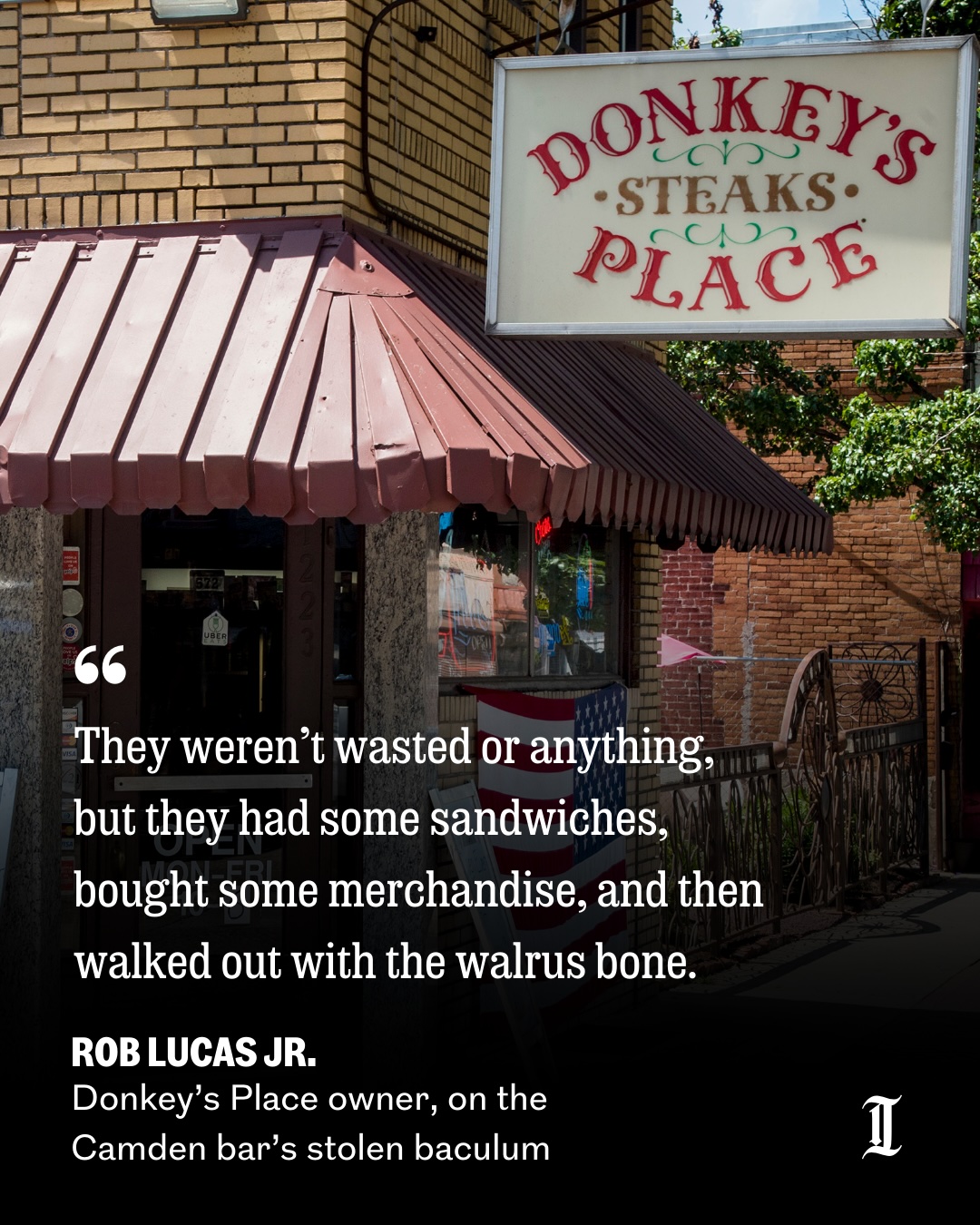
    The third-generation owner of Donkey’s Place doesn’t know where the walrus penis bone came from, but he said it’s been with the bar since he was a kid. A patron was captured on video stealing the oddity on Dec. 29.

    🧠 Trivia time

    To prevent development, Radnor Township is moving to use eminent domain to take 14 acres owned by what?

    A) Cabrini University

    B) Penn Medicine Radnor

    C) Willows Mansion

    D) Valley Forge Military Academy

    Think you know? Check your answer.

    What we’re …

    📺 Anticipating: Donna Kelce’s reality TV debut tonight on The Traitors.

    🦅 Appreciating: Ladder 15’s response to the 49ers fans planning a playoff takeover.

    🏘️ Ogling: This $9.9 million Lower Merion mansion with a bonus house next door.

    🗞️ Mourning: The Pittsburgh Post-Gazette, which will shut down May 3.

    🗳️ Considering: Why Pennsylvania’s leaders are losing Gen Z.

    🧩 Unscramble the anagram

    Hint: Manayunk music festival (three words)

    GNOME SUSHI

    Email us if you know the answer. We’ll select a reader at random to shout out here.

    Cheers to Lee Narozanick, who solved Wednesday’s anagram: Sheetz. Stephen G. Sheetz, the former president and CEO of the Altoona convenience store chain, died Sunday. His legacy — and the Wawa vs. Sheetz rivalry — lives on.

    Photo of the day

    Two of the “Three Kings,” Luis Quinones and Joseph Incandela (right), pose with a reluctant 1-year-old Uriel as his mother tries to take a photo during a Día de los Reyes party Tuesday at the Parish of the Cathedral of the Immaculate Conception in Camden.

    Cheer up, buddy, the weekend’s almost here. See you tomorrow.

    By submitting your written, visual, and/or audio contributions, you agree to The Inquirer’s Terms of Use, including the grant of rights in Section 10.

  • Thomas Paine published ‘Common Sense’ and helped ignite a revolution on this week in Philly history

    Thomas Paine published ‘Common Sense’ and helped ignite a revolution on this week in Philly history

    They just needed a spark.

    The American colonies in the autumn of 1775, then under the thumb of King George III and his sprawling British Empire, were divided on the prospect of independence.

    Revolutionary ideas start in refined quarters, but they must spread to the masses to surge into action.

    And the 13 colonies were divided in threes: those who favored independence from English rule, those who opposed it, and those who wished to remain neutral.

    And then the spark arrived as a pamphlet.

    On Jan. 10, 1776, in a small publishing house at Third and Walnut Streets in present-day Old City, Englishman Thomas Paine published his 47-page document. It promoted the cause of American independence, and stoked the fires of revolution.

    This pamphlet, titled “Common Sense,” was first printed anonymously.

    But the colonists knew who wrote it.

    An original English printing of “Common Sense,” the pamphlet written by Thomas Paine, combined with a rebuke entitled “Plain Truth” by James Chalmers, a British Loyalist officer. The two pamphlets were reprinted together in a book in London in 1776.

    Paine was a self-educated rabble-rouser who had found little success making corsets or collecting taxes.

    And who, upon meeting Benjamin Franklin after giving a speech in London, opted to join the upstart colonists and move to America in 1774.

    After following Franklin to Philadelphia, he followed him into journalism, writing and editing for Pennsylvania Magazine.

    It’s where he displayed a knack for speaking to the common people through essays denouncing slavery, promoting women’s rights, and dumping on English rule.

    And again he took from Franklin, turning his pamphlet into a lightning rod.

    In it he laid out his arguments in plain language.

    An island, he argued, should not rule a continent.

    “Every thing that is right or natural pleads for separation,” he wrote.

    More than 500,000 copies circulated the colonies, convincing the commoners, the people who would actually take up arms against the Royal military, to support a war against Great Britain.

    Despite his outsized role in lighting the fires of rebellion, Paine’s services would go unrecognized for a generation.

    He temporarily returned to Europe after the war, and his later denouncing of Christianity did him no favors on either side of the Atlantic. He died in poverty in New York in 1809 at age 72.

    It wouldn’t be until the mid-1970s for historians to recognize the enduring power of Paine’s pamphlet, which now holds a place of honor a step below Thomas Jefferson’s Declaration of Independence.

  • Meet the township’s five new commissioners | Inquirer Lower Merion

    Meet the township’s five new commissioners | Inquirer Lower Merion

    Hi, Lower Merion! 👋

    Welcome to the first full week of 2026. To kick off the year, we get to know the township’s five new commissioners, who were sworn in Monday. Also this week, a popular Manayunk bakery specializing in gluten-free breads and pastries is moving to Bryn Mawr, plus construction on The Piazza is underway.

    We want your feedback! Tell us what you think of the newsletter by taking our survey or emailing us at lowermerion@inquirer.com.

    If someone forwarded you this email, sign up for free here.

    Get to know Lower Merion’s five new commissioners

    Lower Merion has five new commissioners.

    Five new Lower Merion commissioners were sworn in Monday evening: Michael Daly, Charles Gregory, Christine McGuire, Craig Timberlake, and Shelby Sparrow. Each replaces a township official who chose not to seek reelection.

    The new commissioners come from across the township and have varied backgrounds, including local government, law, forensic psychology, business, and community organizing.

    With its new members now in place, the board will make some big decisions in the year ahead, including negotiating collective bargaining agreements, overseeing Main Line Health’s redevelopment of the St. Charles Borromeo Seminary property, and addressing township finances, The Inquirer’s Denali Sagner reports.

    Learn more about the new commissioners and what’s on the docket for 2026.

    A popular gluten-free bakery is moving to Bryn Mawr

    Lila Colello is bringing her popular gluten-free bakery Flakely to Bryn Mawr.

    Popular Manayunk bakery Flakely is relocating to Bryn Mawr in February, where it will take over a former hookah lounge at 1007 W. Lancaster Ave.

    Flakely is known for its gluten-free breads and pastries and is the brainchild of Lila Colello, who’s worked for the Ritz Carlton and Wolfgang Puck Catering. She came up with the business after being diagnosed with Celiac disease.

    The new location, which will be takeout only, will offer everything from fresh baguettes to browned butter chocolate chip cookies, as well as frozen take-and-bake doughs, The Inquirer’s Beatrice Forman reports.

    Read more about Flakely’s new Main Line location here.

    💡 Community News

    🏫 Schools Briefing

    • Harriton High School is hosting its winter one act plays today through Saturday, and a number of other schools will have concerts next week. There are evening conferences at both high schools tonight and school board committee meetings Monday, in addition to an education association council meeting. See the district’s full calendar here.

    🍽️ On our Plate

    🎳 Things to Do

    🎶 Unforgettable Fire: Tickets are going fast for the U2 tribute band which will perform some of the Irish outfit’s best-known songs. ⏰ Friday, Jan. 9, 8 p.m. 💵 $33.38 📍 Ardmore Music Hall

    🍿 Paddington: See the film adaptation of the beloved children’s series on the big screen. Bryn Mawr Film Institute will have another screening on Jan. 24, plus screenings of the sequel on Jan. 17 and Jan. 31. ⏰ Saturday, Jan. 10, 11 a.m. 💵 $6.75-$7.75 📍 Bryn Mawr Film Institute

    🌹 Create Beautiful Paper Poppies: Add a little color to your winter by learning to make paper versions of these flowers. ⏰ Tuesday, Jan. 13, 6-8 p.m. 💵 $40 📍 Plant 4 Good

    🏡 On the Market

    A century-old stone Colonial in Merion Station

    The stone colonial was built in 1925.

    Built in 1925, this classic five-bedroom stone Colonial mixes modern amenities with classic charm. Its features include a living room with a fireplace, a family room, a dining room, and a modern kitchen with exposed wood beams and white cabinetry.

    See more photos of the property here.

    Price: $1.3M | Size: 3,110 SF | Acreage: 0.32

    🗞️ What other Lower Merion residents are reading this week:

    By submitting your written, visual, and/or audio contributions, you agree to The Inquirer’s Terms of Use, including the grant of rights in Section 10.

    This suburban content is produced with support from the Leslie Miller and Richard Worley Foundation and The Lenfest Institute for Journalism. Editorial content is created independently of the project donors. Gifts to support The Inquirer’s high-impact journalism can be made at inquirer.com/donate. A list of Lenfest Institute donors can be found at lenfestinstitute.org/supporters.

  • Meet this Media biochemist-turned-artist | Inquirer Greater Media

    Meet this Media biochemist-turned-artist | Inquirer Greater Media

    Hi, Greater Media! 👋

    Welcome to the first full week of 2026. To kick off the new year, get to know a Media artist who blends folk art from her native India with scenes from the area. Also this week, the new mayors of Media and Swarthmore have been sworn in, along with county officials, including the new district attorney.

    We want your feedback! Tell us what you think of the newsletter by taking our survey or emailing us at greatermedia@inquirer.com.

    If someone forwarded you this email, sign up for free here.

    How a Media artist blends Indian folk art with local imagery

    Rinal Parikh poses in her Media studio with a few of her paintings.

    It’s not every day that you come across a biochemist who is also an artist, but that’s the case for Rinal Parikh.

    Born in India, Parikh has lived in the U.S. for 20 years, and from her home in Media blends several traditional styles of Indian art, drawing on observations from her own backyard.

    The 43-year-old delved into art after her son was born with health complications, stepping away from the lab to focus on him. She soon found inspiration and an artistic community, including at the Creative Living Room in Swarthmore, The Inquirer’s Denali Sagner reports.

    Today, her work, which spans the traditional Indian folk forms Warli, Madhubani, and Kalamkari, adorns her family’s home and has been exhibited throughout the region.

    Read more about what inspires Parikh’s works here.

    💡 Community News

    • This week marked a new era for a number of municipal and countywide roles, as recently elected officials took office. On Monday evening, Joi Washington was sworn in as the new mayor of Media, making her the first woman and first person of color to hold the office. And in Swarthmore, Conlen Booth was sworn in as mayor, succeeding Marty Spiegel. Booth is Swarthmore fire chief and previously worked for Crozer-Keystone Health System and its successor, Crozer Health. (The Swarthmorean)
    • Delaware County has a new district attorney. Tanner Rouse was sworn in Monday, taking over for Jack Stollsteimer. The Inquirer’s Vinny Vella spoke with Rouse about his goals, including continuing to reduce violent crime and the possibility of reciprocity agreements with his counterparts in other collar counties.
    • Also at the county level, Siddiq Kamara has been sworn in as sheriff. Just 30 years old, Kamara is the youngest sheriff in the U.S., according to the county, and the first Liberian-American to hold the office in Delco. (NBC10)
    • Pennsylvania State Police are investigating a sexual assault that was reported last month on the Chester Creek Trail in Middletown Township. A 24-year-old woman from Chester was allegedly raped shortly after midnight on Dec. 5. No additional details have been released. See the report on Page 8 here.
    • Have a Christmas tree to dispose of? Middletown Township is collecting them through Jan. 16. Trees should be placed curbside by 8 a.m. Swarthmore Borough will conduct a final round of curbside pickups next week. See your schedule here. Media will collect trees wherever you put your trash out throughout the month. And Nether Providence township is collecting trees curbside through Jan. 30.

    🏫 Schools Briefing

    • Rose Tree Media has a school board work session tonight at 6:30 p.m. at Springton Lake Middle School. See the district’s full calendar here.
    • In Wallingford-Swarthmore, there’s a Strath Haven High School Home and School Association meeting tonight at 6:30 p.m. and parent-teacher organization meetings for Wallingford and Nether Providence Elementary Schools on Tuesday evening. See the district’s full calendar here.

    🍽️ On our Plate

    • In case you missed it, The Inquirer’s Michael Klein reflected on the most notable restaurant openings of 2025. Among them is Maris, Loïc Barnieu’s Mediterranean eatery on West State Street in Media that opened late last year. See the full list here.
    • Santucci’s Original Square Pizza, which has a location in Media, is among the best takeout pizza spots in the Philadelphia suburbs, according to The Keystone, which noted the plain pie is served with cheese on the bottom and a generous coating of garlicky sauce on top.

    🎳 Things to Do

    ❄️ Snowy Songs, Stories & Sparkly Art: In this month’s Second Saturday Family Fun Series, kids ages 18 months to 5 years old can explore music, art, and stories with their caregivers. Registration is recommended. ⏰ Saturday, Jan. 10, 10:30-11:30 a.m. 💵 Free 📍Park Avenue Community Center, Swarthmore

    🌱 Winter Gardening: Seed Starting for Pollinators: It’s never too early to start preparing for spring. Learn how and what seeds you can start sowing now. ⏰ Sunday, Jan. 11, 1-2:30 p.m. 💵 $21.25 for members, $25 for non-members 📍Tyler Arboretum, Media

    🖼️ January 2026 Artists Reception: Explore the latest artwork on display at the Community Arts Center, including pieces from Carolyn Kline-Coyle and Jennifer Domal. ⏰ Monday, Jan. 12, 2-4 p.m. 💵 Free 📍Community Arts Center, Wallingford

    🏡 On the Market

    A charming five-bedroom Colonial in Rose Valley

    The Rose Valley home spans over 3,600 square feet.

    Built in 1937, this five-bedroom Colonial in Rose Valley exudes charm thanks to a covered front porch, dormers, and exposed stone along the front façade. Some of its features include a living room that has an ornate fireplace with handmade inlays; a dining room with a large brick fireplace; an updated kitchen; and a family room with another fireplace. The primary suite has its own bathroom as well as built-in wardrobes.

    See more photos of the home here.

    Price: $975,000 | Size: 3,641 SF | Acreage: 0.58

    🗞️ What other Greater Media residents are reading this week:

    By submitting your written, visual, and/or audio contributions, you agree to The Inquirer’s Terms of Use, including the grant of rights in Section 10.

    This suburban content is produced with support from the Leslie Miller and Richard Worley Foundation and The Lenfest Institute for Journalism. Editorial content is created independently of the project donors. Gifts to support The Inquirer’s high-impact journalism can be made at inquirer.com/donate. A list of Lenfest Institute donors can be found at lenfestinstitute.org/supporters.

  • Hahnemann developer secures permits for apartments in advance of Council housing ban

    Hahnemann developer secures permits for apartments in advance of Council housing ban

    Philadelphia Councilmember Jeffery “Jay” Young introduced a bill at the last City Council meeting of 2025 to ban residential development from the area around former Hahnemann University Hospital.

    The proposal covers properties near Broad and Race Streets with owners that include Drexel University, Iron Stone Real Estate Partners, and Brandywine Realty Trust.

    But only one known residential project slated for the area is covered by the bill: Dwight City Group’s proposal to redevelop the Hahnemann Hospital patient towers into hundreds of apartments.

    If enacted by City Council, which returns on Jan. 22, the bill could have stopped that redevelopment.

    But on Dec. 24, Dwight City Group secured a zoning permit for 222-48 N. Broad St. to build a 361-unit apartment building — far larger than the original plan — with space for commercial use on the first floor.

    With that permit secured, the project could move forward regardless of whether Young’s bill is enacted.

    Dwight City Group, however, says they are concentrating on ongoing conversations with Young.

    “We are working along with Councilman Young and the community to ensure that this project meets the needs and goals of the district,” said Judah Angster, CEO of Dwight City Group.

    The permits show some changes to the original plan. In interviews last year, the developer said the plan contained 288 units and that ground-floor commercial was unlikely.

    Young said the proposed housing ban is about preserving jobs by allowing only commercial development at the former hospital site.

    “As the city continues to look for ways to incentivize development, we need to ensure jobs and economic opportunities are at the forefront, with engagement from all stakeholders,” Young said in an email. “We look forward to working [with] all stakeholders as this legislation moves through the process.”

    Young’s bill confused and outraged many observers as a blatant example of spot zoning, in which legislation is used to help or hurt a particular project.

    But the tradition of “councilmanic prerogative” would likely guarantee its passage because other Council members are unlikely to vote against a bill that affects only one district.

    Nevertheless, the housing and transit advocacy group 5th Square has begun a campaign against the legislation and issued a petition earlier this week calling for its withdrawal.

    “The site on Broad and Race Street lies on top of an express subway stop and benefits from proximity to Center City jobs, shops, and cultural amenities,” the petition reads. “Since the shuttering of Hahnemann in 2019, the site currently provides little value to Philadelphians or tax dollars to the city despite its central location.”

    The proposed housing ban legislation comes after repeated controversies that have pitted Young against a variety of parties, including the Philadelphia Housing Authority, Mayor Cherelle L. Parker, multiple North Philadelphia neighborhood groups, safe streets advocates, and the building trades unions.

  • Eagles vs. 49ers predictions: Our writers pick a winner for the wild-card round

    Eagles vs. 49ers predictions: Our writers pick a winner for the wild-card round

    The playoffs commence for the Eagles this Sunday, hot on the heels of a 2025 regular season in which a generally dominant defense fueled an NFC East title run despite a shaky offensive attack.

    The 49ers, who missed on a chance to secure the NFC’s No. 1 seed in a home loss to Seattle last Saturday, limp to Lincoln Financial Field as the Eagles’ wild-card round opponent.

    Will the Birds run their home playoff winning streak to six games with a victory? Our writers make their predictions:

    Jeff Neiburg

    No, the Eagles didn’t get the No. 2 seed and missed out on a chance to play a compromised Green Bay Packers team, but as far as NFC matchups go, this one is pretty favorable for them.

    The 49ers don’t have the same menacing defense they used to. And while their offense has sometimes been among the best in the NFL, the injury bug has bitten them at the worst time. Maybe left tackle Trent Williams ends up playing, but even if he does, he obviously won’t be at 100% after missing last week and the start of this practice week with a hamstring injury.

    The Eagles, meanwhile, could get their star tackle, Lane Johnson, back, and they’re getting linebacker Nakobe Dean back, too. Christian McCaffrey and George Kittle still offer a big challenge for the Eagles’ defense, but McCaffrey had his worst game of the season in Week 18 and touched the ball more than any other skill position player this season. Tired legs or a really good Seattle defense? I think it was both. And the Eagles have the defensive front — a healthier one with Jalen Carter back — and the linebackers to defend the 49ers at a high level.

    It hasn’t been an encouraging season from the Eagles’ offense, to put it mildly, but the 49ers are down multiple linebackers and don’t have an abundance of talent in the secondary. If the Eagles don’t beat themselves, which you can’t rule out, they should be able to establish a running game that gets the offense back on track.

    Prediction: Eagles 24, 49ers 20

    Olivia Reiner

    Whether the Eagles can win this game will hinge on the defense’s ability to dominate, just as it has all season.

    History is on defensive coordinator Vic Fangio’s side. He boasts a 3-1 head-to-head record against Kyle Shanahan as head coaches or coordinators. Shanahan’s offenses haven’t scored a meaningful touchdown in those four games.

    The 49ers offense could get a boost if Williams and wide receiver Ricky Pearsall play. But the primary focus of the Eagles defense ought to be slowing down McCaffrey, who ranks second in the NFL in scrimmage yards (not including return yardage). That’s a tough task, but not impossible for a defense that has excelled against the run in all but two games this season.

    Brock Purdy can extend plays and scramble, but the Eagles have been better against mobile quarterbacks in recent weeks, especially since last month’s loss to the Los Angeles Chargers.

    In theory, the Eagles offense should be able to take advantage of a banged-up 49ers defense, and the game shouldn’t come down to Fangio. But expectations ought to be low for an Eagles offense whose starters were shut out for an entire half the last time they faced a playoff-bound team in the Buffalo Bills.

    Maybe the Eagles can finish what the Seahawks started last week and continue to punish the 49ers on the ground. Maybe Jalen Hurts and the passing attack can exploit the 49ers’ thin inside linebacker corps with passes over the middle of the field. Neither has been characteristic of the offense this season, though.

    Or, maybe, the defense will stifle Shanahan’s offense while Nick Sirianni, Kevin Patullo, and the Eagles offense do just enough to get by. It wouldn’t be the first time.

    Prediction: Eagles 24, 49ers 20

    Matt Breen

    How do you beat the 49ers? Do what Seattle did: run the football and pressure Purdy. The Eagles should be able to do that as the 49ers lost yet another linebacker this week and could again be without Williams at left tackle.

    Yes, the Birds would much rather be playing Sunday against the Packers, but perhaps last week’s rest is what the offensive line needed to perform the way it did last postseason. Saquon Barkley averaged 147.3 yards last season in the NFC playoffs, so the focus on Hurts seems a bit much. For the Eagles to repeat, they’ll need to run the ball better, and Barkley has just two 100-yard games since Halloween. Kenneth Walker and Zach Charbonnet — Seattle’s two-headed rushing attack — combined for 171 yards last week vs. the 49ers, who allowed opponents to run for 110 yards or more in four of their final five regular-season games.

    Christian McCaffrey will be a focal point for the 49ers offense, as usual.

    McCaffrey has been electric as always, but most of his success this season has come on short passes. The Eagles could take that away if they get to Purdy the way Seattle did. The Seahawks applied constant pressure en route to three sacks and eight quarterback hits. Jalyx Hunt and Jaelan Phillips could change this game. Pearsall, who has been slowed by a knee injury all season, could also be out, giving Purdy one fewer option to pair with McCaffrey and Kittle. The Niners had a great finish to the season before their dud against the Seahawks, but they just seem too banged up to hang with the Eagles.

    Prediction: Eagles 24, 49ers 13

  • How can Don Mattingly help Bryce Harper? It starts with his star power.

    How can Don Mattingly help Bryce Harper? It starts with his star power.

    A.J. Preller grew up in New York — Long Island, to be specific — in the ’80s.

    Guess which baseball player was his favorite.

    “Don Mattingly,” the San Diego Padres president of baseball operations said, never hesitating, a few years ago over the phone. “That was the guy. ‘Hitman’ poster on the wall. I was at the last game of the [1984] season, when he won the batting title over [Dave] Winfield. ’85 MVP; ’84-’85-’86-’87, those were my formative baseball years.

    “And he was the guy I grew up with.”

    Preller went on and on, and a generation of fans might as well have nodded in agreement. Because for most of a decade, when baseball could still reasonably call itself America’s pastime, Mattingly was the face of the sport — with a nickname to match.

    “Donnie Baseball” captained the most storied franchise in the biggest city and ranked among the best players in the majors. But he also penetrated into pop culture, guesting with David Letterman and getting booted from Mr. Burns’ power-plant softball team on The Simpsons.

    Don Mattingly (left) is the Phillies’ new bench coach after being hired this week by president of baseball operations Dave Dombrowski.

    And while none of that may mean much to many millennials, it surely does to Bryce Harper, never mind that he was eight days shy of turning 3 in 1995 when Mattingly played his final game.

    “Players that came before, we usually don’t think that this generation of players knows as much about us as they should,” Mike Schmidt said recently on Phillies Extra, The Inquirer’s baseball podcast. “Not with Bryce. He’s very informed about the alumni like myself.”

    Indeed, Harper is a baseball obsessive with a respect for the game’s past. He talks with familiarity about the ’70s Reds, his father’s favorite team. He picked No. 7 in youth baseball after hearing about Mickey Mantle. As Dusty Baker once said when he managed Harper in Washington, “He’s as knowledgeable of baseball history as anybody that I’ve had.”

    So, although Harper met Mattingly only briefly at the 2017 All-Star Game in Miami and may not be able to recite all the pertinent numbers — .307 average, 222 homers, nine Gold Gloves, six All-Star appearances — it’s a safe bet he appreciates his nearly Hall of Fame-level place in the sport.

    And it has been years since Harper played for anyone with those credentials as a player.

    That wasn’t the primary reason the Phillies this week finalized a two-year contract with Mattingly to be the bench coach. They wanted another voice in the dugout alongside manager Rob Thomson. Mattingly managed for 12 seasons with the Dodgers and Marlins; at 64, he insists he doesn’t want to do it again.

    But Thomson also conceded that Mattingly’s distinguished playing career sets him apart among the Phillies’ coaches. Because Thomson didn’t play in the majors. Caleb Cotham (pitching), Kevin Long (hitting), Bobby Dickerson (infield), and others are well-regarded across the majors, but they played in the big leagues only briefly or not at all.

    Mattingly’s career gives him instant credibility among players, especially star players. His impact on Harper could be profound.

    Bryce Harper (left) played for manager Dusty Baker with the Nationals.

    By all accounts, Harper is coachable. He confides in Long, with whom he worked in Washington before Philadelphia. He took a crash course at first base from Dickerson in 2023 and learned the position on the fly.

    But for a two-time MVP who’s likely headed to the Hall of Fame, the conversations with someone like Mattingly must resonate differently.

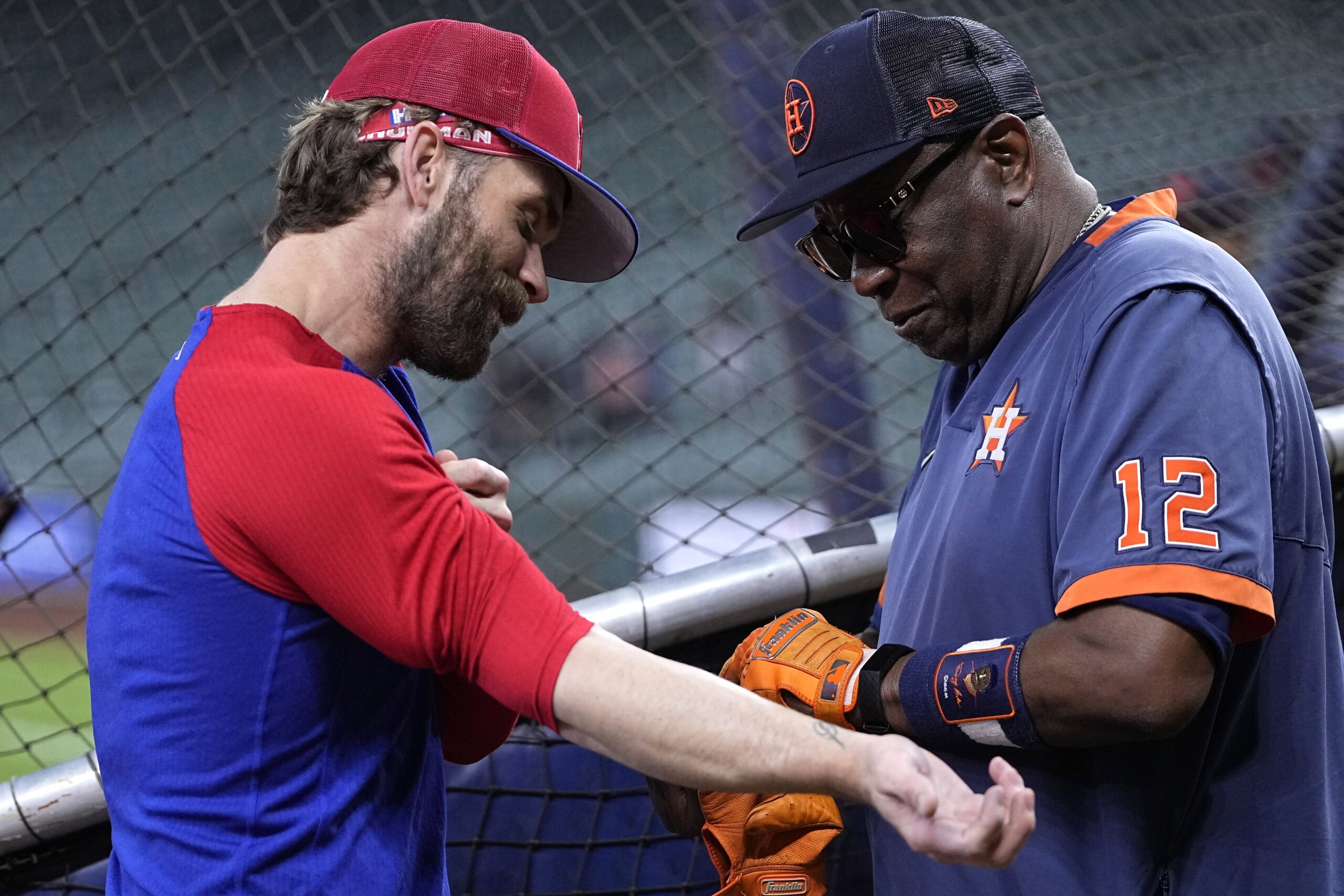
    Harper’s first two Phillies managers — Gabe Kapler and Joe Girardi — had long playing careers. But he hasn’t played for a manager or coach with Mattingly’s name or stature since Baker with the Nationals in 2017.

    Add the fact that Mattingly became an icon at first base, and it would appear that he’s uniquely suited to relate to Harper on multiple levels.

    “If there’s things he wants to talk about from a first-base standpoint, then we can talk about it,” Mattingly said in a video news conference this week. “If there’s things he thinks about at the plate, hitting the lefty or hitting the righty, or a certain style of pitcher, I’m going to be like, ‘Hey, what are you trying to do with this guy? What are you thinking?’ I want to learn, too.”

    Mattingly recalled fondly a conversation with Harper and former Reds star Joey Votto at the 2017 All-Star Game. He also marveled, like most baseball observers, at how good Harper already was upon making his major league debut at age 19.

    “Watching his development over the years, this cat can go,” Mattingly said. “This is a first-ballot Hall of Famer, hands down.”

    (Mattingly and Harper did get into a spring-training rock fight through the media in 2018 over Harper’s criticism of the Marlins’ offseason moves, though eight years is a long time for water to flow under a bridge.)

    In Washington, Harper hit it off with Baker, whose long, successful managerial tenure was preceded by 19 major league seasons in which he got nearly 2,000 hits and slugged 242 homers. It was reciprocal. Baker once called Harper “a pretty cool little dude” and said he’s “pretty hip on a lot of fronts.” Harper batted .319 with a 1.008 OPS for Baker in 2017.

    Nearly a decade later, as one of this generation’s biggest baseball stars, Harper figures to find “Donnie Baseball” to be relatable and potentially helpful.

    “Well, I think we’ll find out, right?” Mattingly said. “You’ve got to build a relationship first. I’ve seen him from afar; I’ve not seen him from the inside. Listen to him, watch him, and just talk.”

    The conversations will begin next month at first base on the spring-training half-field in Clearwater.

  • 🦅 Roll the tape | Sports Daily Newsletter

    🦅 Roll the tape | Sports Daily Newsletter

    Ahead of Sunday’s Eagles wild-card playoff game against San Francisco (4:30 p.m., Fox 29), the question of “how good is this 49ers team, really?” is a fair one.

    Unless you’re a fan of the team, or really like watching game highlights or have multiple games up on your screen on Sunday, you’re like a lot of Eagles fans wondering the same thing. Sure, the team is coming off a season-ending loss, but the Niners lost to the Seattle Seahawks, the No. 1 team in the NFC this season.

    But how effective is Brock Purdy or how elusive is Christian McCaffrey, or how did a 49ers defensive unit get this far, being this banged-up and without one of the best linebackers in the game in Fred Warner? Well, today we’re leading off with the latest from The Inquirer’s Devin Jackson, who for a large part of this season has been analyzing game film on Eagles opponents, pointing out the warning signs alongside the spots the Birds can exploit.

    If you’re reading this as early as we’re dropping it, then grab a cup of coffee, tea, or whatever your go-to morning beverage is and breakdown some game film with us.

    It should be another nice day across the region, with temperatures in the high 40s under partly sunny skies. Perfect.

    — Kerith Gabriel, @phillysport, sports.daily@inquirer.com.

    If someone forwarded you this email, sign up for free here.

    ❓What have you noticed about this 49ers team coming on Sunday? Email us back for a chance to be featured in the newsletter.

    Walker and Barlow’s dwindling days

    Jabari Walker, who previously played on a standard deal in Portland, has outplayed his two-way contract.

    The 76ers loaded up their frontcourt in advance of an uncertain Joel Embiid season. He’s been available more than anyone expected, creating a logjam at center and power forward. One major cause of that is the performance of two-way acquisitions Jabari Walker and Dom Barlow, who have performed more like members of the rotation.

    Because of that, they’ve spent extended time up with the Sixers and their available days on the roster could be dwindling unless their contracts are converted to standard deals. It’s something Walker tries not to focus on.

    “Every now and then, it will pop up in my mind, but just putting my energy toward what I can control right now,” Walker said. “And whatever happens, just knowing that I left an impact on my teammates and left an impact in the game. I think that’s the biggest truth.”

    What we’re …

    👀 Watching: The status of Flyers Jamie Drysdale and Bobby Brink after sustaining injuries from a pair of blindside hits in Tuesday’s game against the Ducks.

    🦾 Introducing: Villanova’s Brynn McCurry, the “bionic” presence on the Wildcats’ women’s basketball team.

    📖 Reading: The latest shenanigans coming off the most recent episode of the Kelce brothers’ New Heights podcast.

    🏀 Sharing: The good news is that, ahead of the Sixers’ win over the Wizards, both Trendon Watford and Kelly Oubre Jr., who were nursing injuries, were full participants at shootaround and played vs. Washington.

    🤔 Wondering: Is Bo Bichette really a possibility for the Phillies? Let’s explore.

    Helping Harper

    In Don Mattingly, right, Bryce Harper now has a former superstar player on the Phillies coaching staff.

    Although Bryce Harper met Don Mattingly only briefly at the 2017 All-Star Game in Miami and may not be able to recite all the pertinent numbers — .307 average, 222 homers, nine Gold Gloves, six All-Star appearances — it’s a safe bet he appreciates his nearly Hall of Fame-level place in the sport.

    And it has been years since Harper played for anyone with those credentials as a player.

    That wasn’t the primary reason the Phillies this week finalized a two-year contract with Mattingly to be the bench coach. They wanted another voice in the dugout alongside manager Rob Thomson.

    But Mattingly’s career gives him instant credibility among players, especially star players. His impact on Harper could be profound.

    Halfway home

    Trevor Zegras celebrates his first goal of the Flyers’ win over the Anaheim Ducks at Xfinity Mobile Arena.

    Hockey is all about the details. So, it should be noted that the Flyers have hit the halfway mark of the NHL season with a 21-12-7 record highlighted by a win against the Anaheim Ducks on Tuesday. Now some believe coach Rick Tocchet has this team looking like one that could crack the NHL playoffs instead of just teasing the notion.

    The Inquirer’s Jackie Spiegel takes a look at some of the highlights of the team’s last game and how it reflects a bigger picture.

    Next up: The Flyers welcome the Toronto Maple Leafs (20-15-7) tonight (7 p.m., NBCSP).

    ‘Control’ freak

    Former Union standout Mark McKenzie practices in Chester with the U.S. men’s national team ahead of its game against Paraguay in November.

    Mark McKenzie is on a roller coaster. In the last six months, the former Union standout has been a regular starter for his new club, Toulouse, in the French first division, has had multiple call-ups with the U.S. men’s national team, and is about three months into fatherhood, welcoming a baby boy in October.

    McKenzie is doing all of this under the backdrop of hoping to be on U.S. men’s manager Mauricio Pochettino’s World Cup roster in a few months. It’s a lot to juggle, but he catches up with The Inquirer to explain how he’s keeping “control” of it all.

    In the women’s side, The Inquirer’s Jonathan Tannenwald has the details on the U.S. women’s national team convening in north Jersey in March for a game against Colombia as part of the SheBelieves Cup tournament.

    On this date

    Jan. 8, 1995: Phillies slugger and 12-time All-Star Mike Schmidt gets into the Hall of Fame. How about two more? On this date in 1972, the NCAA allowed freshmen to compete in college athletics. Fast forward 12 years to 1984, and the NCAA Tournament expanded to a 64-team field.

    Standings, stats, and more

    Looking for detailed stats coming off last night’s Sixers game? Here’s a place to access your favorite Philadelphia teams’ statistics, schedules, and standings in real time.

    What you’re saying about the World Cup

    We asked: Which matchups are you most looking forward to in the World Cup?

    Nothing turns me off more than price gouging. $60,000 for a pair of tickets for a soccer game? Some games are selling for over $100,000 a pair! Seriously now. I could buy two high-end cars and have a little left over for lunch money. — Ronald R.

    I’m looking forward to France and Mbappe, England and Harry Kane. But mostly, I’m looking forward to our USA boys, to see if they can stay healthy and live up to their potential as the strongest USA team ever. Go Brenden! — Joel G.

    We compiled today’s newsletter using reporting from Devin Jackson, Jackie Spiegel, Gustav Elvin, Keith Pompey, Colin Schofield, Scott Lauber, David Murphy, Katie Lewis, Jonathan Tannenwald, and Kerith Gabriel.

    By submitting your written, visual, and/or audio contributions, you agree to The Inquirer’s Terms of Use, including the grant of rights in Section 10.

    That’s my time, Philly. Have a good one, we’ll catch you tomorrow. Kerith