Blog

  • The best wine shops in Philly and the suburbs

    The best wine shops in Philly and the suburbs

    In Philly, it’s easier than ever to swing by a neighborhood shop and leave with a delicious bottle at a friendly price, be it a weeknight wine or a special-occasion splurge. Our local retail scene has been up and coming for a few years now, even as national wine sales have dipped. The selections at the more successful stores demonstrate what is working in the wine industry right now: Big-brand sales are down, while smaller-production and natural-focused wines are on the rise. It’s always nice to find another reason why we’re a city of culinary pioneers — we simply have great taste.

    This list of great independently run bottle shops is curated according to uniqueness of selection, fair pricing (for Pennsylvania), and excellent customer service. To showcase a wide shopping radius, I’ve included some suburban options in Pennsylvania, South Jersey, and one down the Shore.

    Herman’s Coffee

    Herman’s began in Pennsport as a coffee shop/roasterie and has evolved into a specialty shop offering snacks, cheeses, tinned fish, and more. This year, owner Mat Falco squeezed a wine-focused bottle shop into the jam-packed space. “I thought wine was a natural fit for the market. I already carried a lot of higher-quality food items, and wine goes perfectly with food,” Falco explained. A veteran of the craft beer scene, Falco curates Herman’s selection from the perspective of a regular person simply looking for a good bottle at a fair price. The majority of the 100-plus bottles that Herman’s stocks range from $15 to $35, with a small higher-end offering. You’ll find some of the most minuscule price markups in the city here, as well as a wine club and a growing number of tasting events. “I’ve always tried to take a volume-over-top-dollar mentality with the café,” Falco said. “I don’t want going out for coffee to have to feel like a special-occasion thing; neither should wine. We price so that people have good wine on a weekday, not just as a weekend splurge.”

    1313 S. Third St., no phone, hermanscoffee.com

    Solar Myth

    Solar may have been conceived as a coffee/wine bar/music venue, but its boutique bottle shop is not to be missed. General manager and wine director Lauren Demers already offers one of the best natural wine lists in the city. More recently, she’s been expanding the to-go section to include a mishmash of affordable bottles and showstopper rarities. Plans are in motion for more retail shelving in the new year. If the labels are unfamiliar, the smart and friendly staff are excited to walk you through the offerings. A wine shop with genuine service?! We love to see it.

    1131 S. Broad St., no phone, solarmythbar.com

    Richmond Bottle Shop (IGA)

    This old-school grocery store on the edge of Fishtown, a member of the Independent Grocers Alliance, has long housed an excellent no-frills bottle shop with a strong selection and great pricing. Signage on individual wines can be minimal, but the natural and small-production wine section is robust. There are also big callout displays for local producers such as Mural City Cellars. This is not exclusively a specialty store; you’ll have to skim the natural wine shelves or poke around in between big brands on the main shelves for the real gems. Happily, there are many to be found — and at some of the best prices in the city.

    2497 Aramingo Ave., 215-425-5690, therichmondshops.com/bottle-shop.html

    Supérette

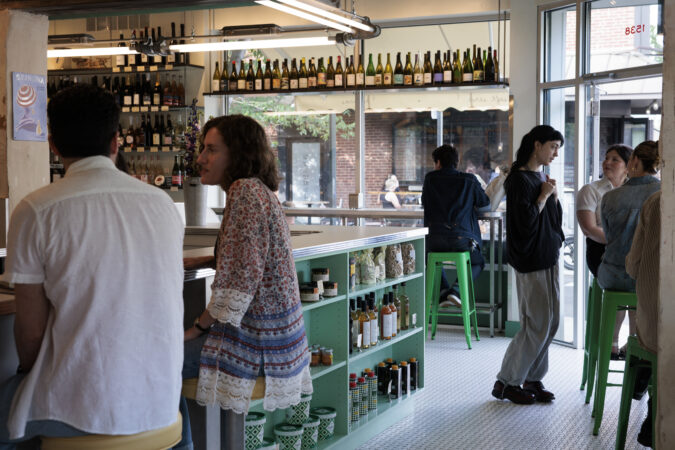
    Pop in for an afternoon snack, leave (or lounge) with a great bottle of wine. Owner Chloe Grigri and partner-in-wine Kait Caruke have been queens in the Philadelphia wine scene for years, so it’s no surprise that their bar/bottle shop hybrid is one of the best additions to the Philly bottle shop scene. Supérette boasts a fresh, eclectic selection of about 100 wines mostly meant to be enjoyed now, with some collector’s items sprinkled onto the shelves. The inventory is French-focused, rounded out by other Old and New World bottles for range. Prices range from high teens to $100, with magnums available as well. Affordability has clearly been prioritized for takeaway bottles, and corkage is just $25 if you stay to sip. Check out the CouCou wine club to have interesting bottles chosen for you monthly.

    1538 E. Passyunk Ave., no phone, superettephl.com

    320 Market Cafe

    These suburban shops were among the first small grocers to offer curated retail wine sets — Media in 2016 and Swarthmore in 2017 — and remain some of the best in the ‘burbs to this day. The stores have offered a natural-dominant selection for even longer. Owner Jack Cunicelli is guided by his own love of minimal-intervention wines, updated classics, and renegade producers. The selections at the respective locations offer a full global representation while remaining laser-focused on producers and styles that made Cunicelli himself fall in love with wine. Expect a rotation of old-school standouts (Frank Cornelissen, Cantina Giardino, and Sylvain Pataille were recent highlights) mixed with new wave American producers to know, like Fossil & Fawn, Franchere, and Monte Rio. With prices starting at $12, there’s something for everyone.

    713 S. Chester Rd., Swarthmore, 610-328-7211; 211 W. State St., Media, 610-565-8320; the320marketcafe.com

    Bloomsday

    This Headhouse Square restaurant/bottle shop offered a range of great Pennsylvania-produced bottles long before the current urban winery boom, showcasing that it’s just as important to celebrate the local scene as the heavy hitters of France, Italy, Spain, and beyond. The retail shop inside the restaurant — formerly dubbed the “Fancy Wine Shop” and now mid-rebrand toward a more neighborhood vibe — has evolved for the better every year. Beverage director Chris Liu has been meticulously refining the selection and revamping the retail pricing structure without sacrificing quality. Beyond wine, the beer and cider offerings are also fantastic. Notably, this is one of the only places in the city where you can pick up Fermentery Form bottles outside of the brewhouse.

    414 S. Second St., 267-319-8018, bloomsdayphilly.com

    Cork

    Pre-pandemic, this Rittenhouse space was Cook, a live-action venue for food and beverage classes taught by local professionals. COVID-19 forced that business model to pause and the space reopened as Cork wine shop in fall 2020, offering a big selection of bottles alongside barware and small-batch cocktail ingredients. Cork did what few others were doing at the time, prioritizing being a neighborhood shop over a specialty wine store. The offering is vast, from wine cans to bottles to liters and bags. You’ll also find one of the largest NA programs in the city. It’s a luxurious stop for snacks — the gummy selection is unrivaled — but the wine and the team running the shop are as friendly as can be.

    253 S. 20th St., 215-735-2665, audreyclairecork.com

    Le Virtù

    This Abruzzo-focused restaurant has been an East Passyunk mainstay for years, and its small bottle shop is an under-the-radar gem. Jack-of-all-trades manager Chris O’Brien pulls double duty between running the wine program and supporting chef Andrew Wood in the kitchen, which brings a special pairing pizzazz to the selection. Le Virtù offers nearly 100 different bottles, predominantly low-intervention wines from southern Italy. Expect to find a few dozen options from Sardinia, Sicily, and northern Italy, starting at $15. Le Virtù also offers a wine club with both two- and four-bottle memberships, and the option for an additional “Somm’s pick” bottle. The first Wednesday of each month is a tasting social, where club members get complimentary snacks (stuzzichini) and tastes of that month’s wines, plus additional special bottles. Nonmembers can partake for $20.

    1927 E. Passyunk Ave., 215-271-5626, levirtu.com

    Moore Brothers

    Seven minutes from the Ben Franklin Bridge, the Pennsauken outpost of this highly regarded wine shop has long been a primary shopping destination for Philly residents looking for options beyond Pennsylvania’s state stores. Moore Brothers exclusively offers wines that they import directly from France, Italy, and Germany, focusing on sustainable and biodynamic producers. Temperature control — from the shipping to in-store storage — is their non-negotiable to keep bottles pristine. Because inventory is built around a direct-import program, the selection doesn’t change often, but the consistency and longtime relationships with their producers shine, vintage after vintage. Make sure to sign up for the email list for great tips on wine pairings.

    7200 N. Park Dr., Pennsauken, N.J., 888-686-6673, moorebrothers.com

    Traino’s Wine & Spirits

    We’ll never throw shade at a South Jersey stock-up, but independently owned stores can be tricky to find there, likely due to the cost and rules for liquor licenses. This unassuming shop, with locations in Marlton and Voorhees, quietly offers one of the more interesting selections in South Jersey. Bottles are displayed by country and style, meaning you’ll find deep-cut small-batch wines tucked casually next to their more mainstream counterparts. A recent trip found Olga Raffault Chinon Rose, a beloved producer from central France, for just $20, displayed next to Whispering Angel, on sale for $24. If wine names mean nothing to you, all good. Simply keep an eye out for “Nina’s Picks” tags, denoting favorite selections from wine director Nina Sygnecki, or ask if she’s around for a recommendation.

    100 Church Rd. E., Marlton, 856-983-0056; 2999 E. Evesham Rd., Voorhees, 856-424-4898, trainoswine.com

    Florida Cold Cuts

    Headed down the Shore? There are dozens of big-box wine shops along the way, but you should really scope out this Ventnor spot with great bottles (and excellent made-to-order sandwiches). The selection is small, tight, and extremely well-curated. Everything is natural-minded, organic, or biodynamically focused, with an emphasis on wines from people and places with a great story. To borrow a line from its monthly wine club, “Leave it to us to find the wines that make the ‘cut’ so you can focus on drinking cleaner and better.” There’s also an excellent selection of cold beers by the bottle or can and canned/bagged wines — perfect for tossing into your beach tote.

    7301 Ventnor Ave., Ventnor City, N.J., 609-822-3545, floridacoldcuts.com
  • New U.S. National Security Strategy slams Europe as greater threat than Russia or China

    New U.S. National Security Strategy slams Europe as greater threat than Russia or China

    Ordinarily, I wouldn’t recommend perusing the annual National Security Strategy of the United States of America. It generally summarizes the foreign policy direction in which the current administration is headed, and makes for lengthy, dry reading.

    But the new 33-page document is so shocking — even given what we already know about this administration’s behavior — that Americans need to pay attention.

    The NSS 2025 ignores the real security threats the U.S. faces in favor of praising white nationalist policies at home and demanding our democratic allies adopt the same. It promotes the myth that President Donald Trump can create a stable world by doing “deals” with authoritarian Moscow and Beijing.

    As for Russia’s invasion and brutalization of Ukraine, no word, except for chastising Europe for obstructing Trump’s efforts to force a pro-Russian “peace” plan on Kyiv. No wonder Kremlin spokesperson Dmitry Peskov quickly announced that the report was “largely consistent with our vision.”

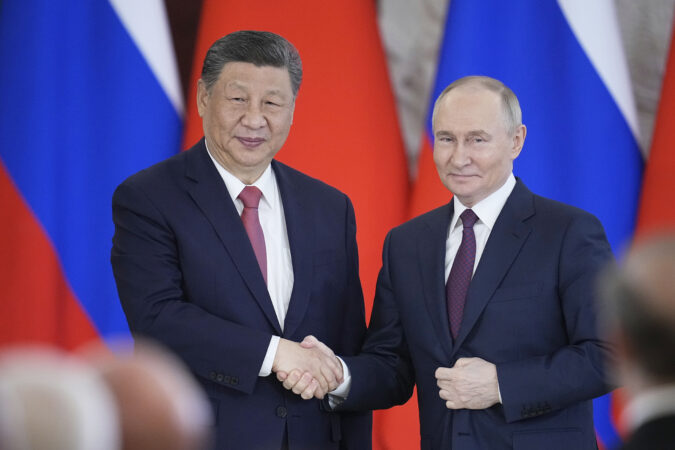
    The document envisions a world in which Trump, Vladimir Putin, and Xi Jinping dominate the globe in concert, each controlling his own sphere of influence; it labels Trump’s intended control over the Western Hemisphere the “Monroe Doctrine Trump Corollary.”

    In reality, if Trump pursues this megalomaniacal mirage, he will facilitate the efforts of China and Russia to undermine U.S. security, destroy U.S. alliances, and dominate the world.

    What’s so revealing about the NSS is how much it has changed from the 2017 version released after Trump’s first year in office. Back then, the strategy referenced “the revisionist powers of China and Russia [who] want to shape a world antithetical to U.S. values and interests.” Russia, the document added, “aims to weaken U.S. influence in the world and divide us from our allies and partners.”

    The security threat from both countries has only worsened since then. What has changed is the personnel around the president.

    Gone are the professionals and knowledgeable advisers (except for Secretary of State Marco Rubio, who has largely been pushed to the sidelines). Present are the sycophants who flatter Trump’s brilliance and advance the white nationalist MAGA line.

    It’s no wonder there’s no reference to rising Chinese military threats to Taiwan. Or to massive Chinese cyberattacks on our country. One, called Salt Typhoon by U.S. intelligence agencies, has compromised U.S. telecommunications networks; another has penetrated U.S. infrastructure, including water supply plants, electricity grids, and transportation.

    Vladimir Putin and Donald Trump.

    Yet, in typical contradictory behavior, the Trump administration just halted plans to impose sanctions on China’s Ministry of State Security in response to Salt Typhoon.

    The security plan devotes pages to Trump’s penchant for trade deals and tariffs with Beijing, which it claims will ensure U.S. superiority in advanced technology.

    In another capitulation, however, Trump just agreed that Nvidia can sell advanced H200 chips to China, threatening that very U.S. superiority in advanced technology. Trump apparently wants to avoid displeasing Xi before traveling to Beijing for a summit in April. The president doesn’t want to interfere with his hopes of closing a brilliant trade deal.

    In other words, national security can be ignored when it contradicts the prospect of illusory economic gains — whether it be deals with China or Russia. And the president counts on his brilliance to secure both with his pals Putin and Xi (although he has repeatedly been bested by each of them).

    This fatal flaw is at the heart of NSS 2025.

    But the uglier and more gut-wrenching flaw is the document’s attack on Europe, its democratic values, and its support for Ukraine.

    The 2017 NSS read: “A strong and free Europe is of vital importance to the United States. We are bound together by our shared commitment to the principles of democracy, individual liberty, and the rule of law.”

    The “Promoting European Greatness” section of the new NSS echoes Vice President JD Vance’s tirade against European democracies, which I heard firsthand at the Munich Security Conference in February. Rather than speaking about the Russian war on Ukraine that threatens all of Europe, Vance denounced Germany for not inviting the extreme right, neo fascist Alternative für Deutschland party into a governing coalition.

    The 2025 NSS contends that Europe is on the verge of “civilizational erasure” because of immigration policies; instead, it promotes (white) nationalist, anti-immigration political parties. It slurs the European Union for its multilateralism (which the United States promoted after World War II, and which brought political and economic stability to the continent).

    And instead of supporting NATO allies as Russia attacks them with drones, cuts their underwater cables, and conducts sabotage and assassinations on European soil, the White House blames the Europeans for “regarding Russia as an existential threat.”

    “Our goal,” the document reads, “should be to help Europe correct its current trajectory.”

    There is something truly sick here.

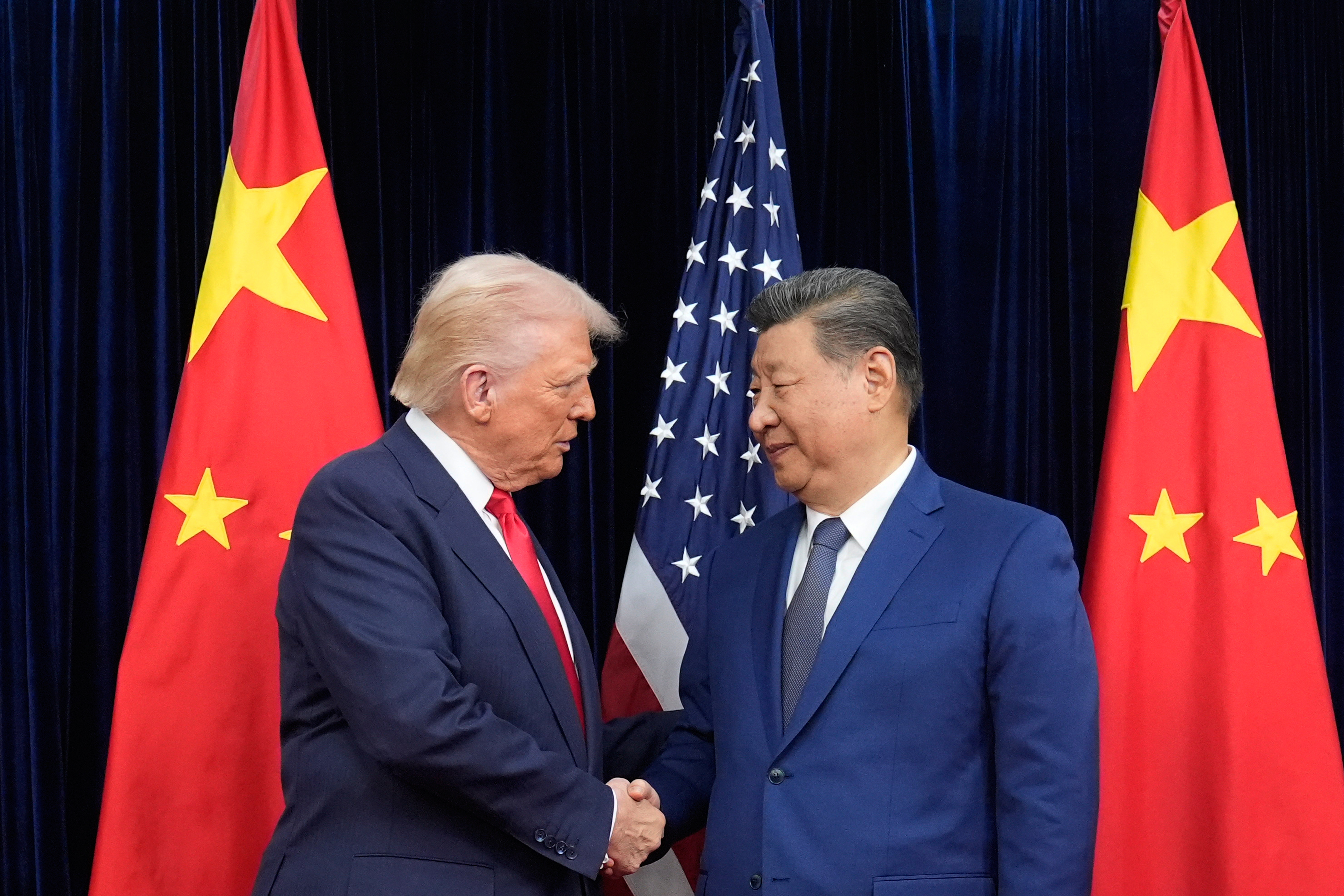
    President Donald Trump and Chinese President Xi Jinping shake hands before their meeting at Gimhae International Airport in Busan, South Korea, in October.

    Trump thinks China and Russia are his potential partners, while Europe is in the way — on Ukraine, on human rights, on warnings about Russia, on its own regulation of technology. Forget about common values or shared commitment to the principles of democracy and the rule of law.

    Unabashed to intervene in domestic European politics, the document calls on Europeans to restore “strategic stability” with Russia, meaning pressure Kyiv into signing a deal that consigns Ukraine to permanent domination by Moscow.

    And the U.S. wants Europe to take over most of NATO’s conventional defense capabilities, from intelligence to missiles by 2027, an impossible feat.

    Moreover, the White House is actively promoting as part of its “security strategy” the success of radical white nationalist parties in Britain, France, Germany, and elsewhere that are pro-Moscow and eager to do any and all business with Beijing. In other words, a Europe led by parties that are hostile to American security interests.

    The NSS 2025 envisions an alliance of authoritarian governments and their imitators, including Russia, China, the United States – and far-right European parties that dislike NATO, want to end the European Union, and prefer deals with dictators to defending democracy.

    This is what Trump advocates, although he doesn’t grasp that it would destroy him as well as his country.

    Fortunately, Europe won’t capitulate, nor will our allies in Asia. Nor would most Americans, I believe, if they only knew what the Trump national security policy is all about.

  • Ale Ayiti: Philly’s Haitian Americans celebrate a rare World Cup bid

    Ale Ayiti: Philly’s Haitian Americans celebrate a rare World Cup bid

    The first World Cup I remember was in 1970. I was a kid in Guatemala, and my brothers and I were so excited. It was the year the Brazilian seleção included Pelé, Jairzinho, Rivellino, Tostão, Gérson, and Zé Maria — there may be no more beautiful example of the sport of soccer than what they showed us.

    The Guatemalan team was not in the World Cup that year (or ever 😢), but El Salvador was, and although they were unlikely to advance very far, we felt a lot of Central American solidarity and rooted for them — the underdoggiest of the underdogs.

    I expect to root for the underdog again next year, when Brazil and Haiti take the field in World Cup play in Philadelphia. Brazil is a five-time world champion; Haiti last competed at this level 52 years ago.

    Philly’s Haitian community doesn’t care if it’s a little lopsided.

    “Most Haitians adore Brazil,” the Rev. Dr. Josephys Dafils told me via email, “and now Haiti will face the mighty Brazil on American soil. This is the thrill and magic of soccer. Haitians and Haitian Americans will travel to be part of this historic moment. Many of us will gather for a tailgate celebration outside the stadium, even without tickets, which are extremely expensive. We will bring food, music, vendors, and a traditional Haitian band called rara.”

    Numa St. Louis agreed: “For Haitian Americans, this event is more than just a game; it’s a moment of immense pride and emotion. As a Haitian American and die-hard soccer fan, the feelings that arise from witnessing Haiti step onto the world stage are overwhelming. It represents a long-cherished dream; a chance for a nation often faced with adversity to showcase its talent, passion, and spirit on an international platform.”

    “The joy of supporting Haiti, coupled with the opportunity to share the occasion with Brazilian fans,” he told me via email, “underscores the camaraderie found in the beautiful game.”

    Dafils, who at one time served as a youth soccer coach in Haiti, said that for the national team to make it to the World Cup at all, they had to overcome almost insurmountable obstacles.

    “Armed groups have taken control of nearly 85% of [Haiti’s] capital, as well as major cities across the country. More than one million Haitians have been forced to flee their homes,” he said. “Many people no longer have access to electricity, clean running water, or food. Families are constantly moving from one neighborhood to another in search of safety. [And] amid this dire situation, the Haitian national soccer team has accomplished the extraordinary.”

    An example of that? They had to play all the qualifying matches outside of Haiti.

    Haiti’s Leverton Pierre controls the ball during a CONCACAF Gold Cup soccer match in June against the United States in Arlington, Texas.

    “I have cried tears of joy since Nov. 18, 2025 — the day Haiti qualified for the 2026 World Cup,” Dafils told me. “Nov. 18 also marks the anniversary of the Battle of Vertières in 1803, when Haiti secured its independence from France. The symbolism is profound.”

    St. Louis makes another historic connection: Next year’s tournament will also coincide with America’s 250th anniversary, adding another layer of significance.

    The Haitian community has a long history in Philadelphia. Hundreds of white slaveholders and those they enslaved fled the Haitian Revolution, first arriving in Philadelphia in 1793; many of those enslaved people gained their freedom here in the years between 1793 and 1796. The community grew and saw waves of immigration throughout the 20th and 21st centuries, prompted by political turmoil and natural disasters.

    It’s estimated that some 12,000 members of the community are currently legally residing under temporary protected status.

    Those Haitian immigrants, like their peers across the U.S., have felt the impact of the singularly ugly lies JD Vance and Donald Trump fabricated about Haitians during the campaign, and after Trump became president, the decision to not renew protected status when it expires in February.

    The shadow of Trump’s immigration policies “loom large” — even over an event like the World Cup match, according to St. Louis.

    “The cancellation of the Temporary Protected Status program threatens to strip many Haitians of their legal ability to remain in the United States, leaving them vulnerable to deportation,” he said. “Furthermore, Haiti is among the 19 countries whose citizens are banned from entering the U.S., which will hinder potential visitors from attending the matches.”

    But he and Dafils always return to the thrill and magic of the World Cup match.

    “It has taken 52 years for Haiti to return to the World Cup. None of us know when we will see this again. I was not yet born in 1974, and I never thought I would witness such a moment,” Dafils said.

    “This match symbolizes hope,” St. Louis said, “a celebration of cultural connections that transcend borders. Even amid political challenges and the looming impact of immigration policies, this gathering promises to foster unity among diverse communities, showcasing the power of sports to uplift and inspire.”

    “As the day approaches, the anticipation grows for what promises to be an exhilarating clash, filled with heartwarming moments, passionate displays, and the acknowledgment of Haiti’s journey,” he added.

    What a beautiful game. Ale Ayiti!

  • Philly is now the No. 1 market for online gambling companies — and addiction helplines are ringing off the hook

    Philly is now the No. 1 market for online gambling companies — and addiction helplines are ringing off the hook

    One man, buried under $20,000 in online gambling debt, became homeless. A woman lost $13,000 and missed her last five mortgage payments. A mother gambled away her son’s college tuition, piling up over $100,000 in debt.

    Such dire stories — shared with gambling helplines in Pennsylvania and New Jersey in recent years — are on the rise. And for the growing number of people, the problem isn’t the casino, but the apps on their phones that let them gamble anywhere, 24-7.

    “My family is hosting fundraisers for my son who had a stroke, and here I am, gambling on my phone,” one caller said. “What’s wrong with me?”

    The Philadelphia media market — which encompasses the city, Southeastern Pennsylvania, and central and southern New Jersey — has become an epicenter of online gambling in the United States. In 2024, internet gaming and sports wagering revenues alone topped $6 billion in Pennsylvania and New Jersey, up from about $3.6 billion in 2021.

    In the same period, the number of calls and texts to 1-800-GAMBLER rose in both Pennsylvania and New Jersey, two of only six states in the U.S. where both sports betting and online casino games are legal. But calls about online gambling problems rose significantly more — 180% in Pennsylvania and 160% in New Jersey in that period. In 2019, only about one in 10 Pennsylvania callers said online gambling was the main issue. By 2024, it was every other caller.

    window.addEventListener(“message”,function(a){if(void 0!==a.data[“datawrapper-height”]){var e=document.querySelectorAll(“iframe”);for(var t in a.data[“datawrapper-height”])for(var r,i=0;r=e[i];i++)if(r.contentWindow===a.source){var d=a.data[“datawrapper-height”][t]+”px”;r.style.height=d}}});

    The Inquirer analyzed anonymized helpline call logs, state revenue reports, and advertising data to shed light on how the Philadelphia-area market has become a hub for the online gambling industry. An increasing volume of gamblers face financial devastation as they struggle to get off the apps.

    As of this fall, the Philadelphia media market outpaced New York City and Las Vegas as the No. 1 market for internet gambling advertisement, with companies spending more than $37 million on ads between January and September, according to data provided by Nielsen Ad Intel.

    As many as 30% of Pennsylvania adults now gamble on online sports with some regularity, according to researchers at Pennsylvania State University who conduct an annual, state-funded survey of online gambling. And as many as 6% of Pennsylvanians, or 785,000 people, are estimated to be problem gamblers, according to the most recent survey, which is not yet published.

    While problem gambling has a range of severity, the American Psychiatric Association recognizes it as a mental health condition. A gambling disorder is defined by a persistent pattern of problematic betting with an inability to limit or stop, leading to emotional, financial, and or relational distress.

    For many, the losses are crushing. In New Jersey, helpline callers reported a combined $28 million in debt at least among people who disclosed this financial information, averaging about $34,000 for each of these callers. In Pennsylvania, 60% of those people willing to share said they owed money, though the state does not track totals.

    Across both states, callers reported they had drained entire retirement accounts, lost homes to bank foreclosure, or blown through entire paychecks. One anonymous caller in New Jersey reported losing $400,000 in a single night — his life savings.

    “We [also] have people who call us and say, ‘I think I’m doing this too much. I think I need a little bit of help,’” said Josh Ercole, executive director of the Council on Compulsive Gambling of Pennsylvania, the state-funded nonprofit that runs the hotline for the commonwealth’s residents.

    Four calls made in New Jersey between 2023 and 2024 were about children under the age of 12 struggling with gambling problems, according to the state’s fiscal year report. Ten other calls were about children under the age of 18. In Pennsylvania, 10 calls involved children between the ages of 13 and 17.

    Experts say the explosion of sports betting and casino apps has fueled what is increasingly seen as a public health crisis, as gambling profits and state tax revenues derived from them have soared since sports betting’s legalization in 2018. And Philadelphia is now viewed as something of a promised land for e-gambling boosters.

    window.addEventListener(“message”,function(a){if(void 0!==a.data[“datawrapper-height”]){var e=document.querySelectorAll(“iframe”);for(var t in a.data[“datawrapper-height”])for(var r,i=0;r=e[i];i++)if(r.contentWindow===a.source){var d=a.data[“datawrapper-height”][t]+”px”;r.style.height=d}}});

    Uttara Madurai Ananthakrishnan, an economics professor at the University of Washington who has studied the psychology of gambling, said lawmakers have struggled to keep pace with the industry’s meteoric growth.

    “I don’t think people expected it to explode at this level,” said Madurai Ananthakrishnan, who previously worked in Pennsylvania. “All of this is going to slowly add up and cause a ton of issues downstream.”

    Harrisburg also benefited handsomely from the high rollers, drawing $165 million last year in gambling taxes, up from $46 million five years prior. About $10 million was earmarked for gambling addiction helplines and treatment programs, which came directly from industry profits.

    Online betting now accounts for nearly half of all gambling revenue in Pennsylvania, according to an Inquirer analysis of state reports. Pennsylvanians wagered a staggering $8.3 billion during the 2024-25 fiscal year in online sports betting alone, making it by far the most popular gambling method. Total revenue for sportsbook and iGaming sites rose past $2.9 billion last year.

    window.addEventListener(“message”,function(a){if(void 0!==a.data[“datawrapper-height”]){var e=document.querySelectorAll(“iframe”);for(var t in a.data[“datawrapper-height”])for(var r,i=0;r=e[i];i++)if(r.contentWindow===a.source){var d=a.data[“datawrapper-height”][t]+”px”;r.style.height=d}}});

    In New Jersey gaming revenue was nearly $6.3 billion in 2024 — $3.3 billion of which came from internet gaming and sports wagering, according to the state’s Casino Control Commission’s annual report.

    Yet the amount spent online is almost certainly higher than what states can track — as is the number of people who have developed online problems.

    Caron Treatment Center, a Pennsylvania-based substance use treatment facility, said 160 people in their inpatient treatment problem were struggling with gambling this year — a 162% increase from five years ago.

    “I’ve been getting call after call about gambling,” said Eric Webber, a behavioral health specialist and gambling counselor at Caron. “It’s a national crisis that doesn’t have a national solution.”

    Fewer than two dozen gambling sites are technically legal in Pennsylvania. But thanks to pervasive online advertising, many gamblers now use so-called offshore gambling sites that are not regulated by the state.

    As of last year, more than 20% of online gamblers were using these illegal or unregulated sites, according to the 2024 Penn State report. Such sites often lack state-mandated guardrails like easily allowing users to set weekly betting limits or request a “self-exclusion” — a voluntary ban from licensed casinos, internet-based gambling, video gaming terminals, and fantasy sports wagering.

    Self-exclusions in Pennsylvania are higher this year than last year — 8,315 people have already opted out compared with the 7,489 people who requested a ban through Dec. 31 of last year.

    Major online sportsbooks say they are going above and beyond.

    Beyond self-imposed spending limits, FanDuel, one of the largest sports betting advertisers in the Philadelphia market, introduced a dashboard to allow gamblers to track their spending habits. The company also began tracking betting patterns on its platform and alerting customers when they bet more than their normal wager.

    “When users attempt to deposit significantly more than their predicted amount, we surface that information to them and prompt them to reduce their deposit or to set a go-forward deposit limit,” a FanDuel spokesperson said.

    DraftKings, in a statement, said it works closely with a gambling company alliance to support responsible betting, “leveraging technology to help detect signs of potentially problematic behavior.”

    Some lawmakers want to see more regulation. State Rep. Tarik Khan, a Democrat who represents parts of Montgomery County and Philadelphia, has called for hearings to examine best practices to rein in an industry that he said heavily targets youth.

    “More and more people, especially young people, are getting addicted to it, and blowing large portions of their paychecks on feeding this addiction,” Khan said. “It’s already pervasive, and it’s going to get worse.”

    ‘I’ve gambled everything away on FanDuel’

    In New Jersey, more than half of the callers to gambling hotlines who disclosed their age were under 35. In Pennsylvania, people under 35 accounted for 41% of callers.

    “Things have shifted to a younger crowd,” said Ercole, of the Council on Compulsive Gambling of Pennsylvania. “Typically our highest call volume used to be in the 35 to 55 ranges.”

    People from all professions are affected — nurses, construction workers, software engineers, chefs, attorneys, postal workers, microbiologists, and tattoo artists. Some are students, retirees, or unemployed.

    Regardless of one’s income level, online gambling can put serious strain on personal and professional lives. Some people told of losing contact with their parents, getting divorced, or being cut off from friends.

    Others lost jobs or had their homes and cars repossessed.

    “I have nothing,” a 30-year-old caller told a New Jersey helpline operator in 2023. “I’ve gambled everything away on FanDuel.”

    Most people are calling about their own gambling problems. But dozens of family members called to ask for help with their loved ones’ betting. In one case, a woman asked if she could use her father’s Social Security number to ban him from online betting apps.

    Many gamblers do not call the hotlines or seek professional help until they face financial ruin or they are confronted by family members.

    At the height of his problem, one man from New Jersey started gambling on Russian table tennis matches and Australian basketball games. His wife, who spoke to The Inquirer on condition of anonymity to discuss a sensitive family matter, said his compulsion had grown so severe that he needed a fix to hold him over between sports seasons.

    “He was betting $1,000 on a sport he knows nothing about, played by people he’s never heard of before,” his wife said.

    The husband kept his gambling hidden for her years, until she found his secret bank account — along with two dozen maxed-out credit cards and records of tribal loans he had taken out, one of them with a 300% interest rate. She also learned that, in 2021, he had quietly lost $70,000 while the newlyweds were on their honeymoon in France.

    “It’s horrifying,” she said.

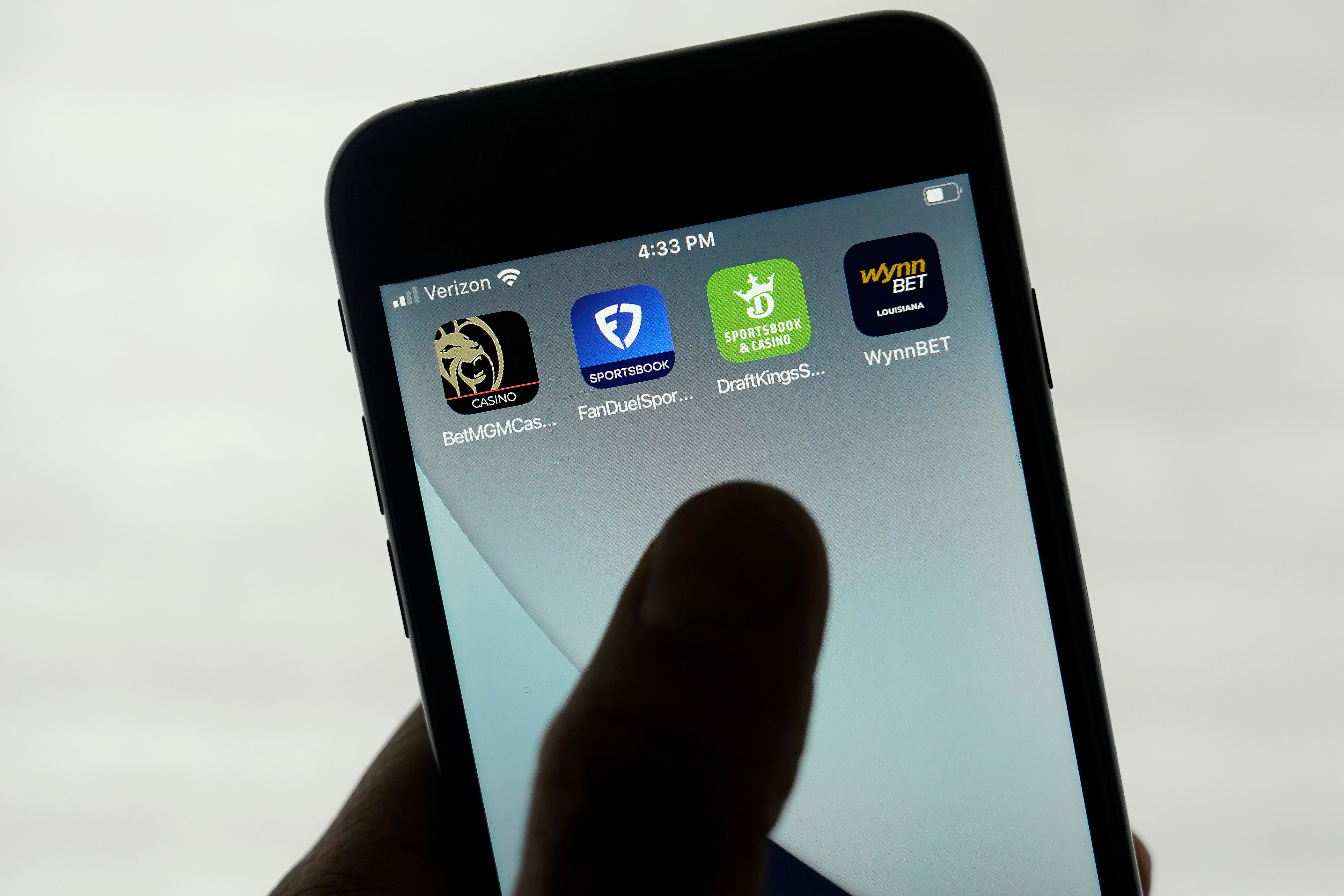
    FanDuel, DraftKings and other online gambling apps are displayed on a phone. (AP Photo/Jeff Chiu, File)

    The casino-to-app pipeline

    Across Pennsylvania, as of 2024, people sought help for addiction to internet games more than any other type of gambling, especially in the suburbs.

    In Montgomery County, the most common type of gambling problem cited was internet slots — with 47 calls. In Bucks, internet sports had the highest volume with 34 calls.

    In Philadelphia, home to both Live! Casino and Rivers Casino, in-person games remain the largest reported problem for struggling gamblers, according to call center logs.

    Some brick-and-mortar casinos, however, have seen business drop as bettors migrate to their phones. At Rivers Casino Philadelphia, sports-betting revenue fell from $29 million in fiscal 2019 — the first full year of legal wagering — to $11 million in 2024, according to state records.

    But even in Philadelphia, a county with two casinos, the number of calls and texts for online gambling shot up in recent years. And experts say that people who gamble exclusively online show heightened risk.

    “You can get cut off at the casino. You could walk away from the machine,” said Gillian Russell, an assistant Penn State professor who works on the annual online gambling survey. “Those things that maybe cause breaks, a lot of those things are removed.”

    About 13% of people who gamble both online and in person were classified as problem or pathological gamblers, according to the 2024 Penn State survey. Online-only gamblers, though just 3% of the total gambling population, showed even greater risk: 37% fell into problem categories.

    Prop bets, the practice of betting on various occurrences within a game rather than just the outcome, are a pointed concern. Such wagers have come under scrutiny as bet-fixing schemes ensnare athletes from the NBA, MLB, the NCAA, and even niche sports like table tennis.

    Among normal gamblers, however, prop bettors are far more likely to develop problems, Russell said. Webber, the gambling counselor, likened in-game prop betting to a constant stream of small dopamine hits, which create a kind of withdrawal.

    And with gambling sites offering bonus cash and rewards points, he said, the temptation can feel constant.

    “DraftKings says, ‘Hey, I haven’t seen you in a couple weeks, here’s $50.’ The local beer distributor doesn’t say, ‘Hey, you haven’t been here in a while, here’s a cold six-pack,’” he said. “That doesn’t help somebody who’s struggling.”

  • Bouncing between Montreal, Warsaw, and Vienna, star countertenor Jakub Józef Orliński is squeezing in his Philly debut

    Bouncing between Montreal, Warsaw, and Vienna, star countertenor Jakub Józef Orliński is squeezing in his Philly debut

    Countertenor Jakub Józef Orliński is mobilized for operatic stardom, and then some.

    Microphones love his richly colored falsetto voice, magazine covers like his looks. And behind a dense schedule of multiple trans-Atlantic flights, lies a supportive private life that has him rooted in his native Warsaw with fiancée, family, and Labrador retriever.

    The Kimmel Center performances of Handel’s Messiah, Dec. 12-14, come as a curious break from solo concerts and high-profile opera productions. Here, Orliński is an equal partner with three high-caliber soloists plus the Philadelphia Orchestra under Yannick Nézet-Séguin.

    But does he really need to do this?

    Countertenor Jakub Józef Orliński will be making his Philadelphia debut with the Philadelphia Orchestra in Handel’s “Messiah.”

    “‘Tis the season. I love singing Messiah. It’s one of the best things. That’s why I jumped on the opportunity to sing it with Maestro (aka Nézet-Séguin),” said Orliński, (whose friends call him J.J.) in a Zoom interview from the Montreal airport.

    “This is the third time [the Philadelphia Orchestra] invited me to do something. Two years ago it was the Bach Mass in B Minor, but I was too busy. Now I have the time.” Sort of.

    Within a two-week period, he will bounce between Montreal, Vienna, and Philadelphia. The precedent of a student visa, dating back to his Juilliard School years (2015-2017), makes the immigration process a little easier, saving him from the kind of entry snafus plaguing many Europe-based artists now.

    Passport officials, he says, can’t help chatting him up about Juilliard, even though he has gone on to win numerous awards, is regularly seen in European fashion magazines, has two Grammy Award nominations (among his eight recordings, most of which are on the Warner/Erato label), and generates much comment for appearing shirtless at seemingly every opportunity. And that included his 2021 Metropolitan Opera debut in Eurydice, playing Orpheus’ alter ego.

    Erin Morley as Eurydice, from left, Joshua Hopkins as Orpheus and Jakub Józef Orliński as Orpheus’s Double appear during a performance of Matthew Aucoin’s “Eurydice” at the Metropolitan Opera in New York in November 2021. (Marty Sohl/Met Opera via AP)

    Orliński’s physique gets discussed among concertgoers and critics, much in the spirit of pianist Yuja Wang’s concert attire. Countertenor Anthony Roth Costanzo, now Opera Philadelphia chief, has also appeared similarly exposed at the Met in years past.

    Is this a possible smoke screen for lack of talent? No, because in all their cases, their artistry wins out.

    Lingering criticism stings though, Orliński admits. But his legions of social media followers do generate ticket sales. Shirt or no shirt, he would always have mixed reactions among chronically opinionated operagoers.

    “It’s OK. I am feeling good with what I’m doing and how I‘m doing it,” he said.

    His life resembles that of a rock star but doesn’t sound like one. Well, maybe a little bit on his 2024 album, #LetsBaRock, which has Monteverdi bathed in modern electronic sound. “In the time of Monteverdi, they would change the instrumentation,” he said, “and that’s exactly what we did.”

    Countertenor Jakub Józef Orliński who will be making his Philadelphia debut with the Philadelphia Orchestra in Handel’s “Messiah.”

    He’s good to his word: The vocal tracks could be lifted out of the electronic context and transplanted exactly into a traditional Monteverdi recording. His recordings (so far) stick close to his home ground in the 18th century, often with worthy pieces previously buried by history.

    Orliński’s Philadelphia stage debut returns him to the scene of an early-career heartbreak when he was fresh out of Warsaw’s Fryderyk Chopin University of Music. “I did audition for the Curtis Institute in 2014,” he said. “Curtis has this incredible focus on the individual because it’s such a small school. Amazing faculty.”

    He didn’t get in for lack of a slot for countertenors — a specialized male-falsetto voice type that has only entered U.S. mainstream opera in the past 30 years, partly thanks to the outreach efforts of fellow countertenor Roth Costanzo.

    Baroque opera, the usual launching point for countertenors, wasn’t often performed in Philadelphia at that time.

    In Juilliard, he studied with the noted soprano Edith Wiens. During his New York years, he sang some of his first Messiah performances in Carnegie Hall. Only a year out of Juilliard, he released his first album, Anima Sacra, in 2018 with a cover showing him with bare shoulders.

    Only a year out of Juilliard, Jakub Józef Orliński released his first album, “Anima Sacra,” in 2018 with a cover showing him with bare shoulders.

    At times, one worries he’ll catch a cold.

    But not Orliński, whose health regimen helps him keep up a daunting schedule that, in the first two months of 2026, has 15 performances in two Handel operas. Among them is a cross-Europe tour in the titular role in Giulio Cesare in Egitto.

    The Philadelphia concerts boast of star soloists Lucy Crowe, Frédéric Antoun, and Quinn Kelsey. Orliński is fine with being a member of this larger ensemble. Though Handel offers no character portrayals to the individual singers, he sees himself and his colleagues as co-conspirators in telling the central story of the Messiah.

    “It’s not just re-creating what was written,” he said. “There are places… where you can write your own cadenzas and ornaments.” Like being a rock star from another century.

    Philadelphia Orchestra performs Handel’s “Messiah.” Through Dec. 14, Marian Anderson Hall, 300 S. Broad St., Phila. $43-$240. philorch.ensembleartsphilly.org

  • A North Philadelphia rowhouse filled to the brim with books

    A North Philadelphia rowhouse filled to the brim with books

    Before moving into his North Philadelphia home 13 years ago, Abel Tootle Jr. had rented small apartments, all under 800 square feet. He decided to make the leap to homeownership to pursue his passion for interior design and create a space that reflects his personal style.

    “The timing was perfect,” said Tootle. And so, he moved into his circa-1910, three-bedroom, 1,200-square-foot house. Becoming a homeowner meant full freedom in designing his space — and no more lugging clothes to the laundromat, a feature of which he is most appreciative, he said.

    His home’s look has been evolving since.

    “I truly believe a home is never done. I was given every opportunity to paint, carpet, and design as I wish; however, I did not make any structural changes at all,” Tootle said. “My focus remains on creating a very English-country-house feel with special attention to my culture and interests.”

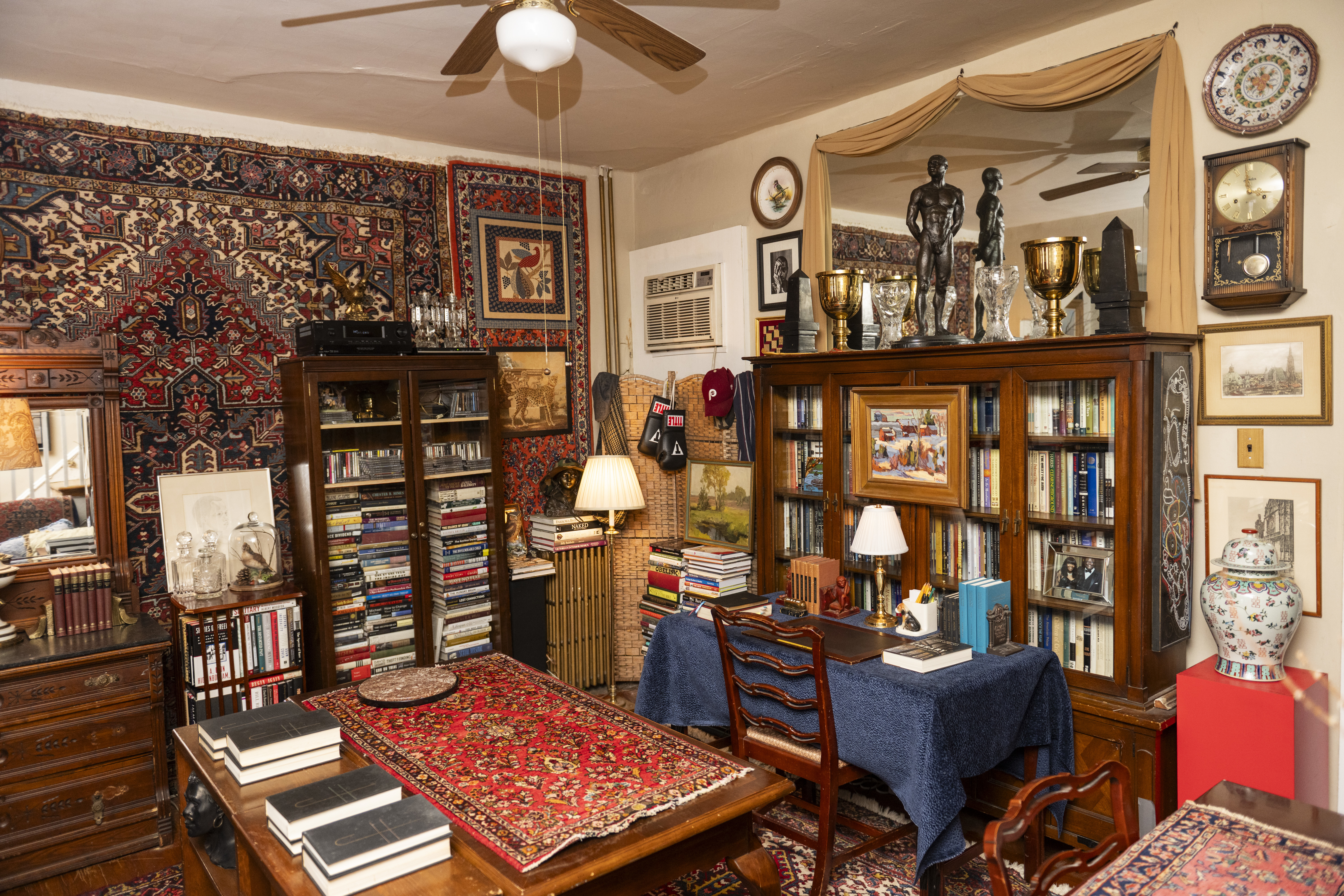
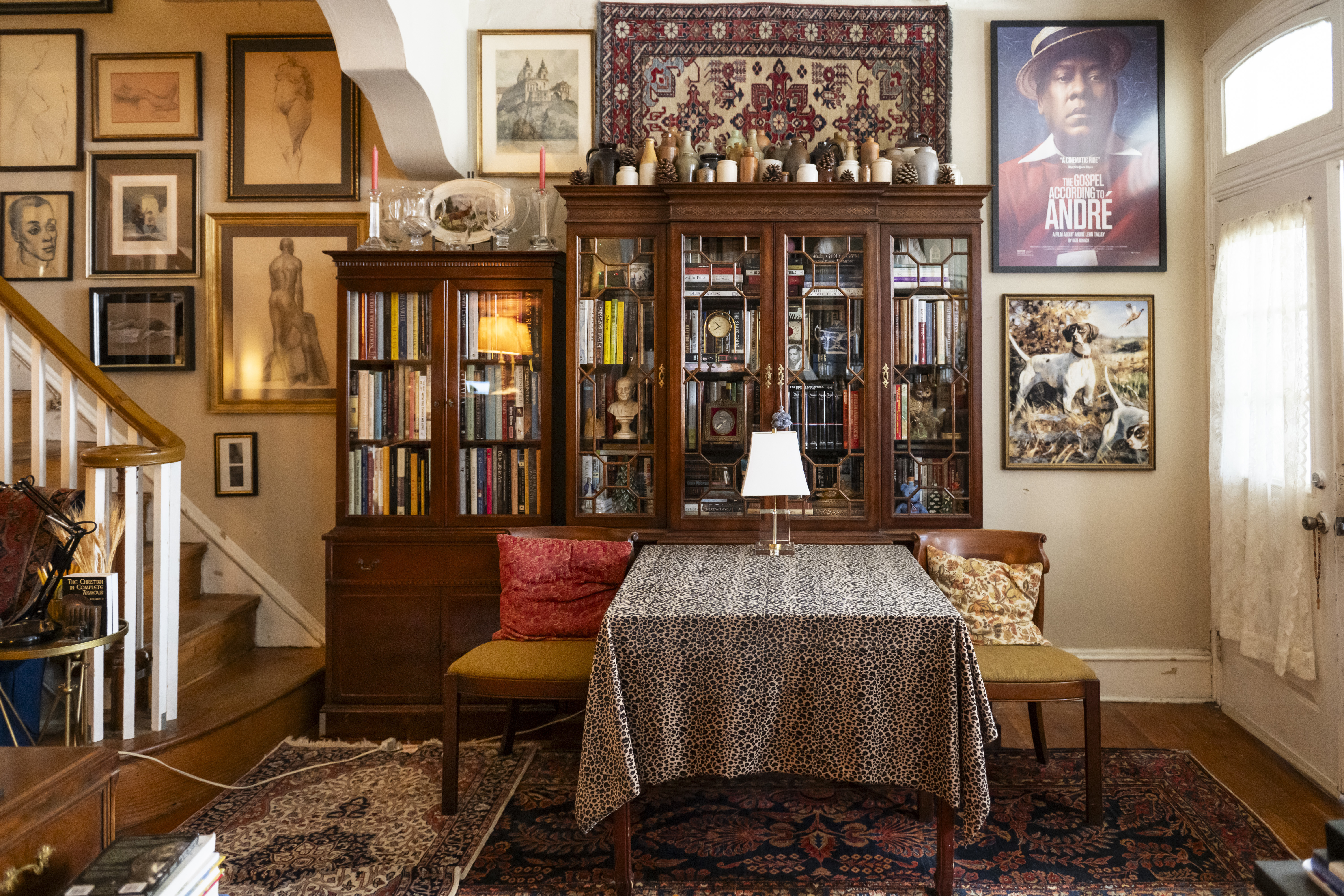
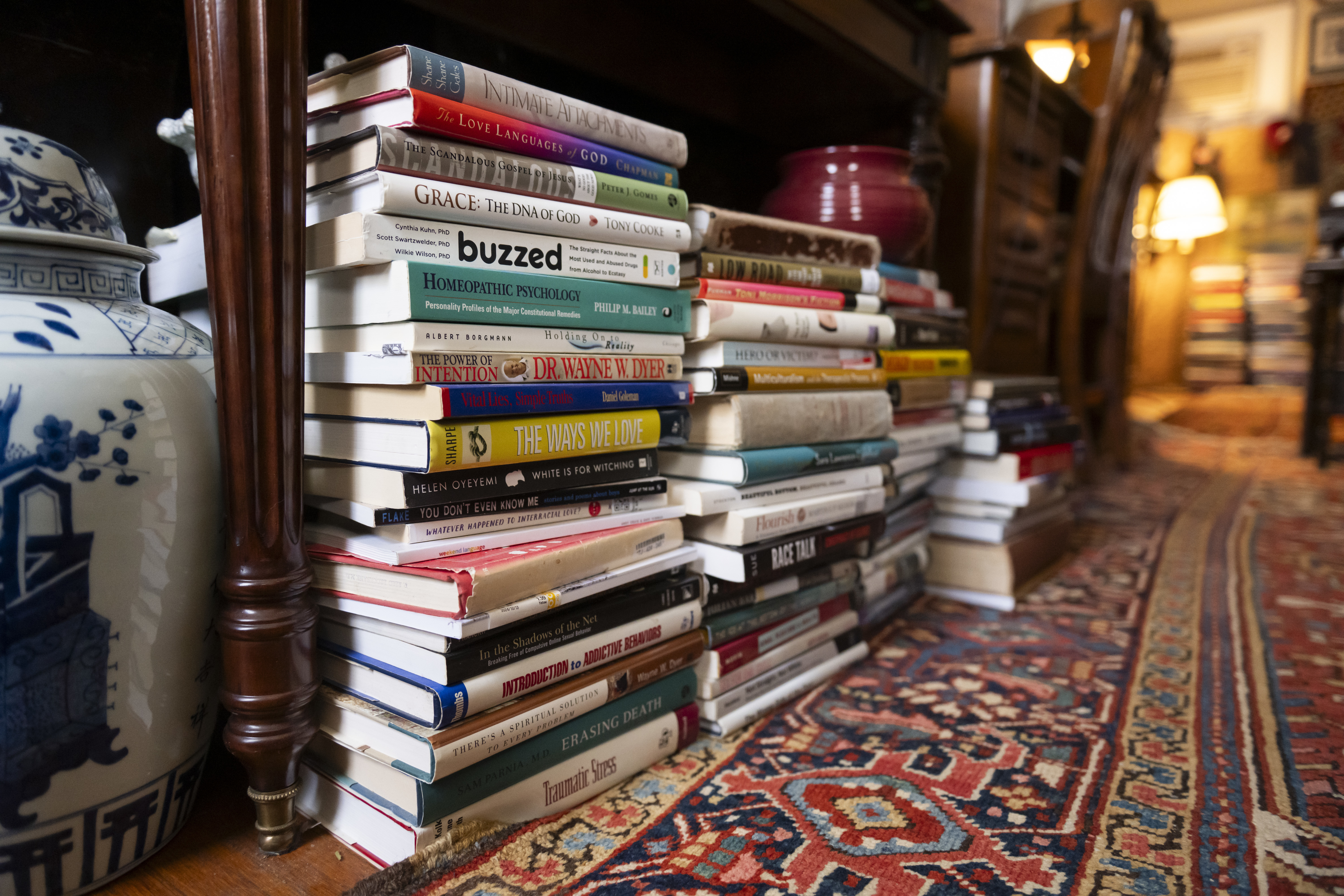
    He favorite design elements include books — there are dozens and dozens displayed throughout the home, not just on shelves but arranged intentionally on and under tables, and stacked in towers rising from the red-pine-hardwood floors — as well as antiques, colorful area rugs in various sizes, art, lighting, and mirrors.

    Colorful patterned rugs adorn not just the floors, but tabletops and walls as well. Tootle says his interior designs are “layered.”
    Books fill a glass-doored cabinet and art covers the wall at the foot of the stairs.
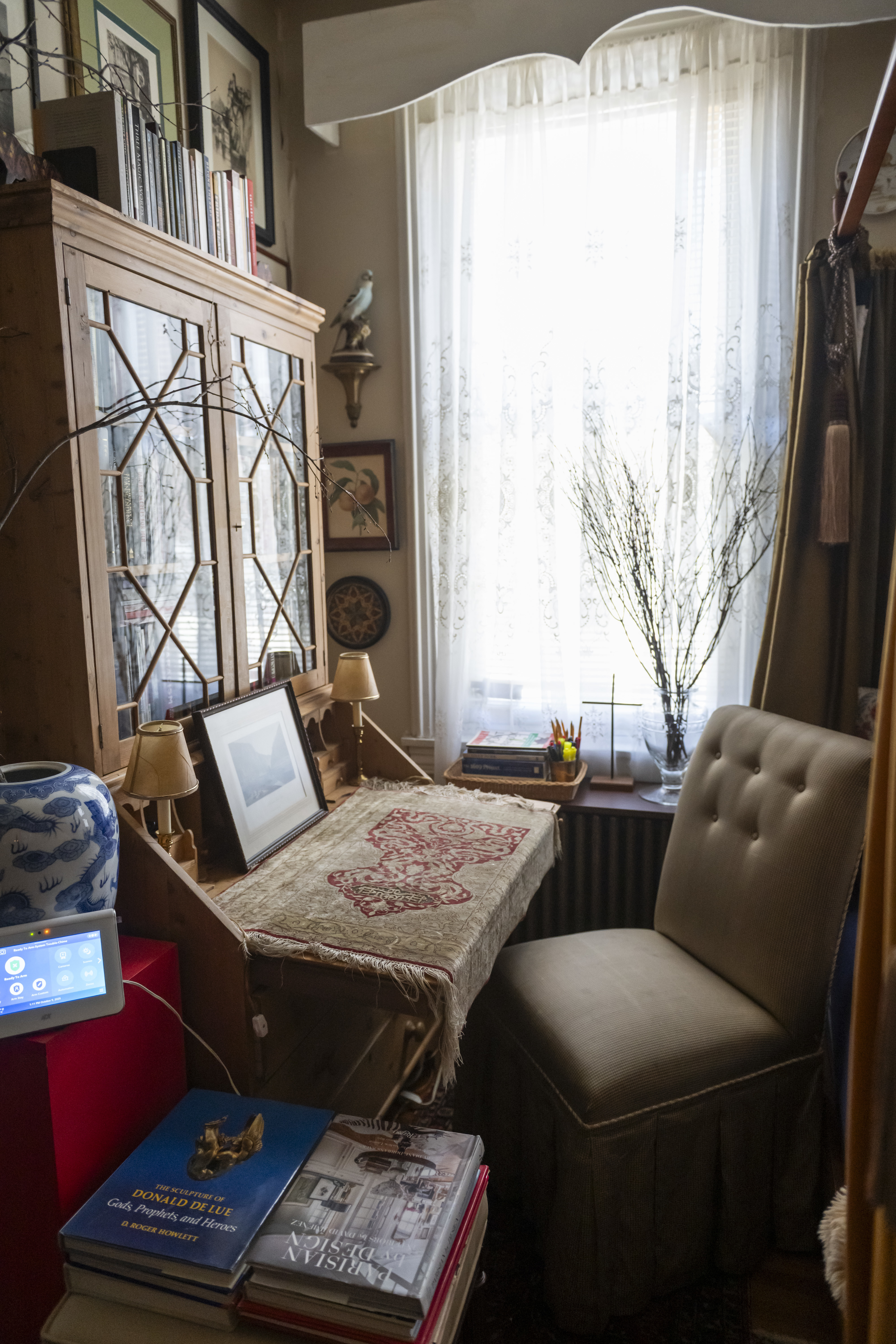
    A desk is topped with a book-filled cabinet, adjacent to the canopy bed.
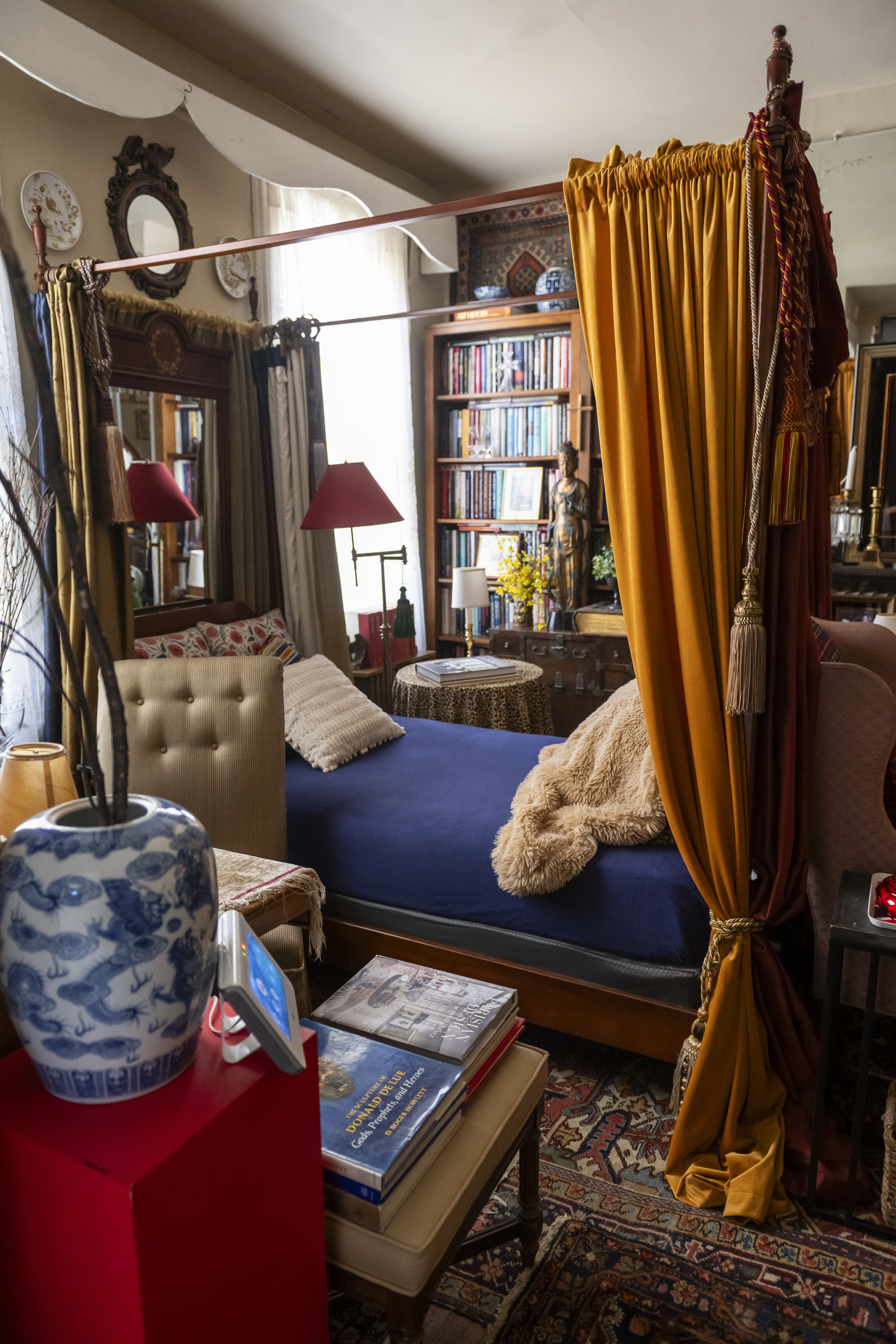
    The canopy bed in Tootle’s double parlor room in his North Philadelphia home.

    Tootle was initially attracted to his home’s location because he worked at Girard Medical Center. The commute was 15 minutes by bicycle or a 30-minute walk.

    “I was raised not too far from my current address as a teenager; hence, I am very familiar with the neighborhood,” he noted. He also appreciates the sense of community, being minutes from Center City, and the architecture of the neighborhood.

    “The classic brick and stone rowhomes, the spacious interiors of the three-story houses, and the rich history of music, art, and civil rights,” Tootle said. “Shopping, arts, and eateries are other reasons I love where I live, and I especially love the many libraries and museums,” added Tootle.

    Tootle’s career is in social work and he has experience in psychotherapy, individual and group therapy, trauma counseling, grief counseling, and drug and alcohol counseling. In his spare time, he enjoys reading, antiquing, and going to the gym.

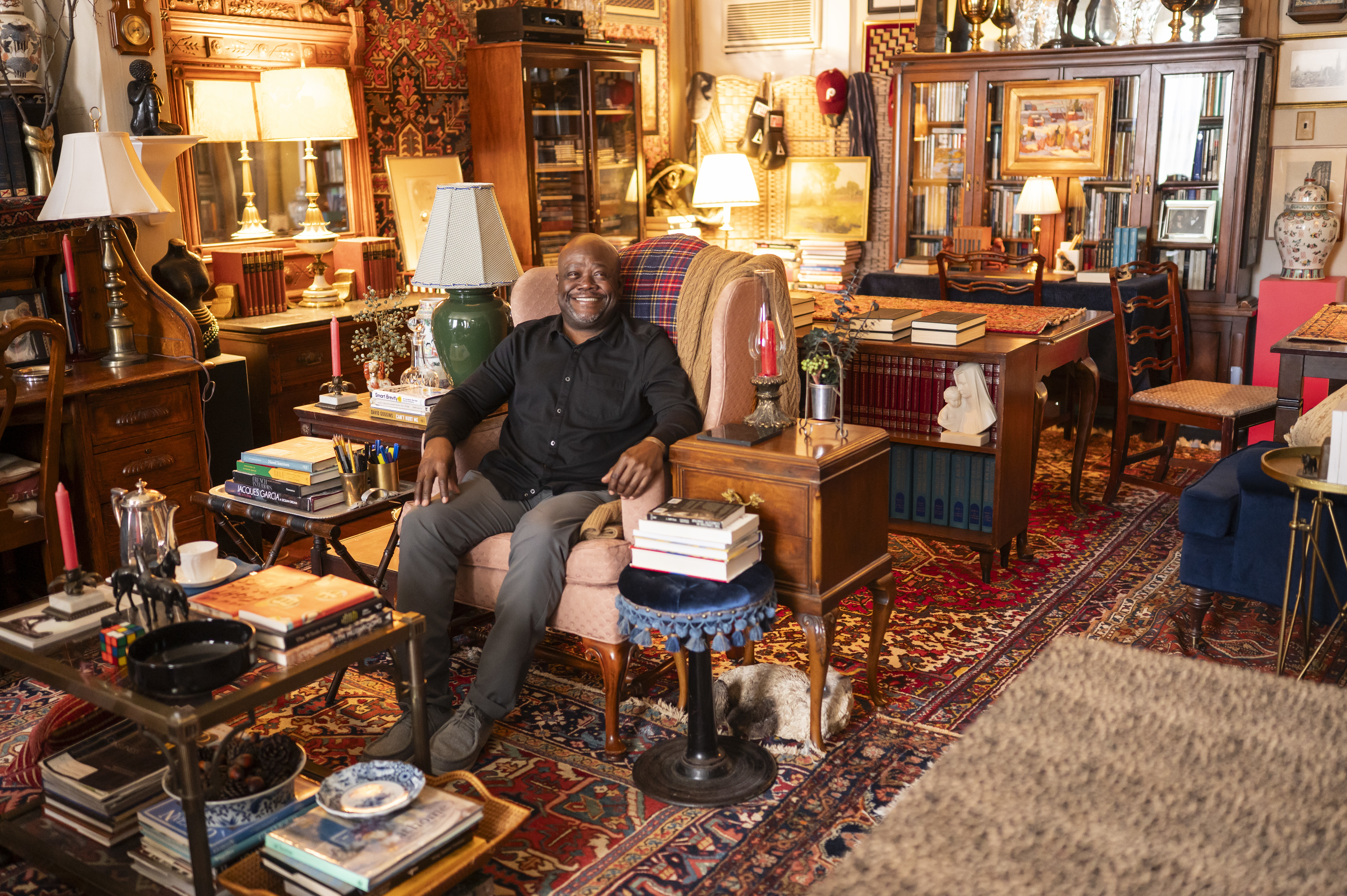
    Books are a central focus in his home — he estimates he owns about 3,000.

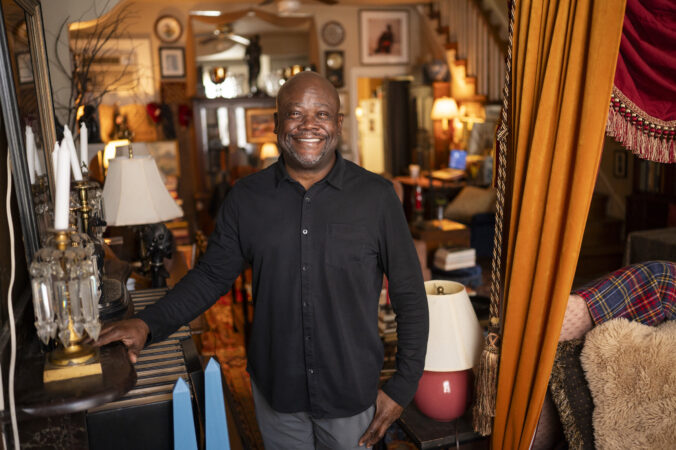
    Tootle sits in his double parlor surrounded by books and antiques.

    “My library is the culmination of 40-plus years of book collecting, trading, and selling. I have purchased books from bookstores, auctions, flea markets, libraries, thrift stores — anywhere books were sold,” he said.

    The bulk of the collection focuses on psychology, spirituality, history, art, and interior design, but it also includes poetry, fiction, and science. His favorite writers include James Baldwin, Toni Morrison, Peter Gomes, Ellen Langer, Carl Jung, and W.E.B. Du Bois, he said.

    “Essentially, I’d like to think my home references the three places I’ve always wanted to live in as a child: a library, a church, and an art gallery or museum — without the pretension,” said Tootle.

    Stacks of books overflow from the shelves and tables and onto the floor.
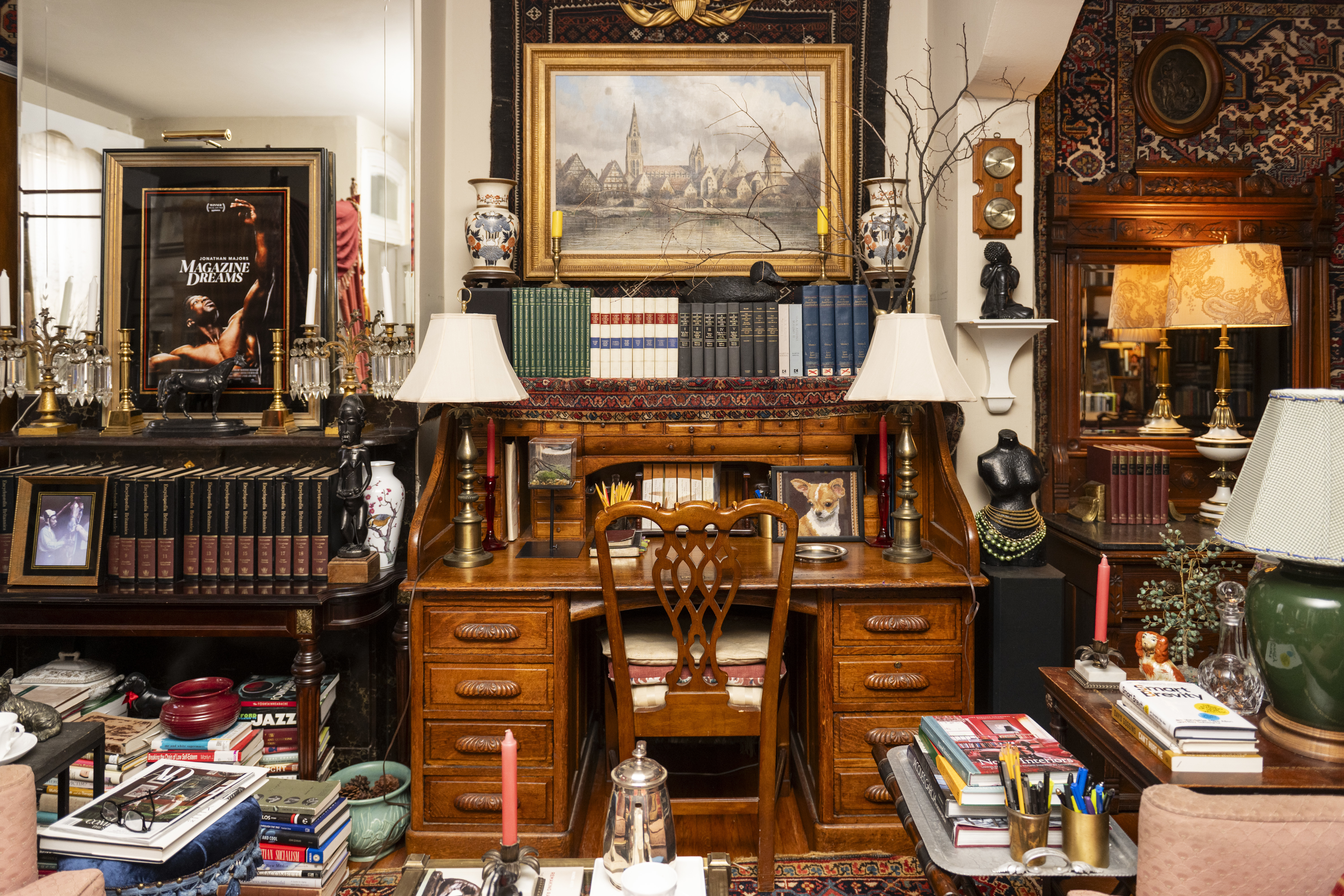
    Tootle’s S-rolltop desk is one of his most prized antiques.

    He’s especially fond of 19th-century antiques.

    “I am a sucker for antique lighting and furnishings of this period and have frequently found gems at auctions, estate sales, flea markets, thrift stores, and on the curbs of sidewalks,” he said.

    One special acquisition is an antique 60-inch-wide Tiger Oak S-rolltop desk, which he bought from a dealer in Bucks County. It was produced in the late Victorian Era, he said, in the 1890s.

    Tootle frequently tries different design layouts by rearranging furniture, changing lighting, and experimenting with colors, patterns, and textures.

    “My design ethos is very intentional and, hence, curatorial. I am a maximalist at heart,” continued Tootle. “My interiors are very layered.”

    Also, he’s planning on featuring more theatrical elements.

    “This includes incorporating more velvets, tassels, deep saturated colors, and sculpture — in the tradition of the late Renzo Mongiardino. Not as a copy, but inspiration,” he said.

    In the backyard, he wants to make a mixed-use space.

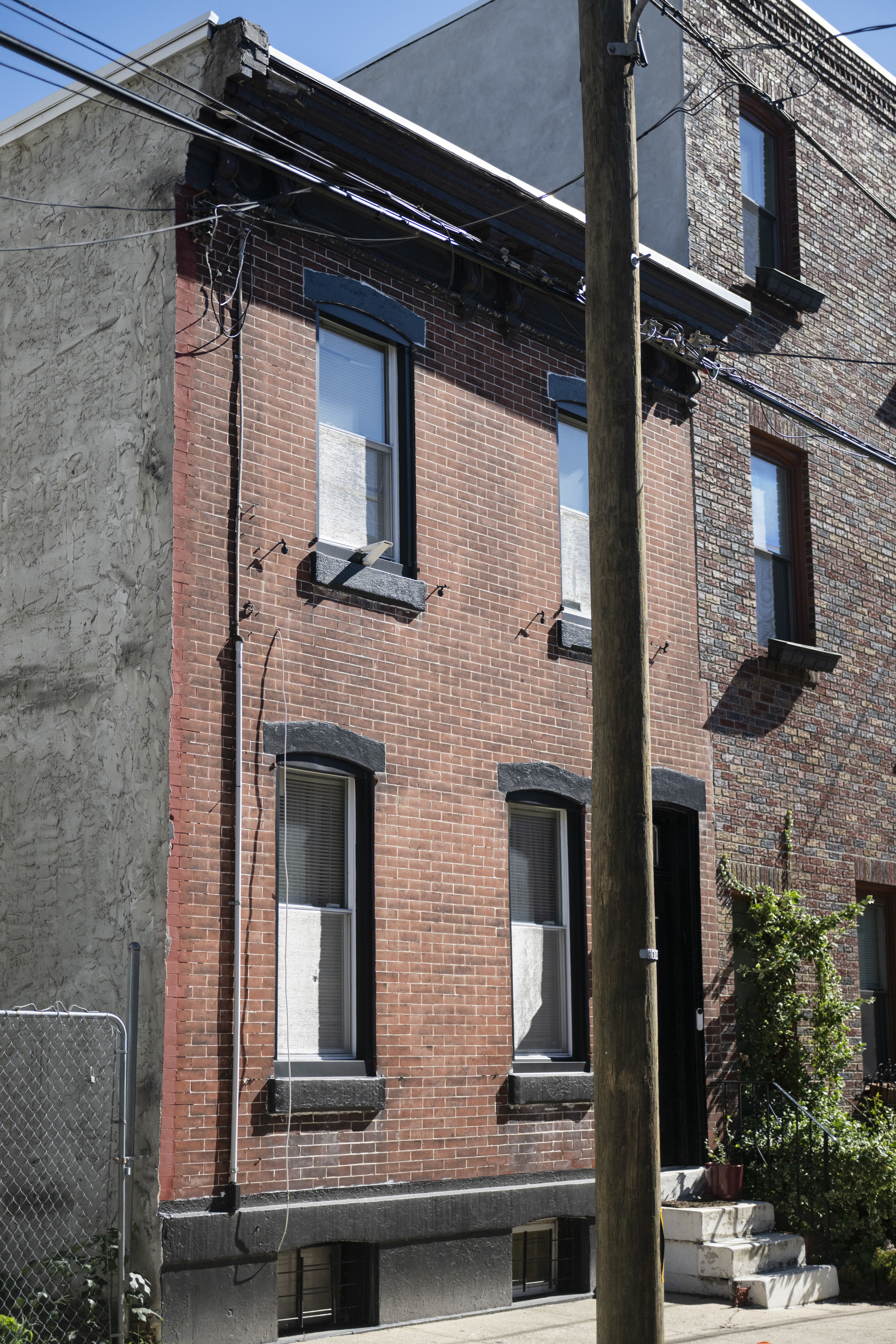
    The exterior of Tootle’s home.

    “I would like to have the soil paved over and start a container garden with trees, shrubs, herbs, and vegetables with a small round table accommodating two to four people,” said Tootle. “I rarely use it as it currently stands.”

    Is your house a Haven? Nominate your home by email (and send some digital photographs) at properties@inquirer.com.

  • Letters to the Editor | Dec. 10, 2025

    Letters to the Editor | Dec. 10, 2025

    Normalizing evil

    On March 23, 1933, the Nazis passed the Enabling Act, which allowed Adolf Hitler and his cabinet to pass any laws — without approval from the Reichstag — even if they were unconstitutional. The Trump administration is effectively doing the same thing by ignoring court orders, disappearing people based on how they look without regard to their citizenship or legal status to reside here, and blowing them out of the water with impunity. Now the U.S. Supreme Court “shadow docket” is allowing racial gerrymandering to try to steal the 2026 midterms. If this is not fascism, it is certainly not democracy.

    James Hohmann, Langhorne

    . . .

    What has happened to the United States of America? Have we become so inured to the craziness of President Donald Trump that we barely seem to bat an eye while the situations and pronouncements become more and more bizarre and evil? Yes, evil. What else can you call what is happening all around us? The bombing of reputed drug smugglers at sea was terrifying. Planes swooping down and obliterating the boats and crew. Now we find out we murdered the survivors. What we did was a war crime. America does not do that, do we? If that news did not shake you to your emotional core, President Trump called the people of Somalia “garbage“ and wants them all out of the country. Where is the moral outrage? Where are we Americans standing up to protect other Americans? Have we become so used to Trump that we accept evil behavior as normal? His behavior, his deputies’ behavior, is not normal; it is not OK. None of it — the drug boat bombings, the U.S. Immigration and Customs Enforcement raids, the racism — none of it is normal, and “We the People “ must stand against it.

    Sheryl Kalick, Philadelphia

    Congressional maps

    The use of the term minorities regarding the gerrymandering of congressional maps in Texas seems inaccurate. A slightly larger number of Texans identify as Hispanic than those who say they are not. And while voters in Texas do not register by party, more Texans choose to participate in primaries as Democrats than as Republicans. In Texas, gerrymandering may be more accurately described as an increasingly extreme attempt to impose the will of a minority on the majority. And that is true regardless of whether the U.S. Supreme Court sees the motivation as racial or political.

    Kris J. Kolo, Philadelphia

    Retirement stability

    Philadelphia’s workers deserve the chance to build real financial security, and I appreciate The Inquirer’s recent coverage of the city’s retirement savings proposal. Too many Philadelphians go their entire careers without access to a basic plan. That gap leaves families vulnerable, and it places additional strain on our social safety net.

    The goal of PhillySaves is simple. It makes it easier for employees who want to save and avoids adding new burdens for small businesses that already manage enough responsibilities. There are no employer fees and no complicated reporting. Just an easy, portable option that follows workers from job to job.

    Before joining City Council, I worked in Harrisburg as a state representative on retirement security issues and legislation. I saw how many Pennsylvanians age into poverty without access to a plan. PhillySaves reflects that experience and the importance of helping workers save steadily.

    Council President Kenyatta Johnson has been clear that improving economic stability for working people is a priority for this Council. PhillySaves is one part of that broader effort. It will not solve every challenge, but it gives thousands of residents a fair chance to start building long-term savings.

    Mike Driscoll, 6th District, Philadelphia City Council

    Dems need direction

    The Democratic Party is a rudderless ship. Its irrational opposition to President Donald Trump has caused it to lose its moral compass and common sense. It no longer works in the best interest of the American people. Its misguided effort at “leverage” betrayed the trust of its constituents and caused unnecessary pain for many. It focused on extending subsidies to the ironically named Affordable Care Act while ignoring the hundreds of billions of dollars in additional spending that it attached to its proposal. Using that time to explore viable alternatives for affordable healthcare would have served everyone better. Extending subsidies implemented during the pandemic is throwing good money after bad.

    Democrats pontificated that nobody was above the law while stressing the importance of upholding the rule of law. For years, they ignored immigration laws and allowed millions to cross our borders. They now demonize law enforcement and encourage active resistance when enforcing those same laws. Anyone who crosses the border illegally has broken federal law and is subject to deportation. Democrats are more concerned with the plight of illegal immigrants than the safety of the American citizens they are sworn to protect. They show little sympathy for victims of crime committed by many of those same people whom they failed to vet.

    Now, Democratic lawmakers are “reminding” armed service members that they do not need to obey illegal orders. Without examples, their goal is to foment division and instability in our government. If national security is at risk or any lives are lost, those lawmakers have opened themselves up to prosecution. These stunts do nothing to move our country forward. Imagine the reaction if GOP lawmakers made a similar statement during the Biden years.

    It is very difficult to understand what Democrats actually stand for. It is painfully obvious what they are against.

    Mark Fenstemaker, Warminster, markfense@gmail.com

    Trade wars

    America is losing the trade wars because the president does not understand trade. While Donald Trump believes trade involves only manufacturing, which contributes about 10% of our economic output, he overlooks the service economy, which includes education and tourism. Trump’s tariffs-based trade war might have made sense in the 1960s, but it is out of step with the current world economy and is helping to fuel our affordability problems.

    The current CEOs of Microsoft, Alphabet (Google), and Nvidia, three of America’s biggest and most innovative companies, were educated here but born overseas. Education is one of America’s leading exports and helps contribute to our prosperity, but the administration devalues it and attacks and extorts our most prestigious universities. When Trump attacks Canada and other countries that contribute to American tourism, many of our destination areas, like the Jersey Shore, are diminished.

    Trump’s worldview is that all confrontations can be won and all collaboration is defeat. History has proven he’s wrong.

    Elliott Miller, Bala Cynwyd

    Another bended knee

    As he was sworn in just two days after his slim victory in the race for the U.S. House of Representatives, Tennessee Republican Matt Van Epps said, “I come to this body as a Christian.” He has also pledged himself to be firmly devoted to Donald Trump and his agenda. How does Rep. Van Epps square the two?

    Trump has expectorated upon the tenets of every religion. He is a thug, a bigot, and the most corrupt president ever to serve, enriching himself and his family of grifters to the tune of billions of dollars. He seeks to divide and conquer, and has clearly expressed his hatred and contempt for those who oppose him, embarking upon a campaign of revenge against them. He has contempt for people of color and immigrants, as he seeks to welcome only white people who seek to live here.

    Can Christian Rep. Epps cite any facet of his faith that is modeled by the president to whom he is so devoted? The question is rhetorical.

    Oren Spiegler, Peters Township

    Imperfect harmony

    I retired in 1999 after 31 years of teaching in Philadelphia. In 2003, I applied for a mortgage with several local banks. None of them would give me a mortgage based on my retirement income, despite my good credit rating. In the last two years, my prescription plan cost has gone up 60%. My wife’s prescription premium for 2026 has increased by 400%. Other costs have increased dramatically, as well. My retirement income is still the same as it was in 2003.

    I read in The Inquirer that Pennsylvania state legislators received a 3.25% cost-of-living raise, and that cost-of-living adjustments, or COLAs, each year are mandated for them. I know that eventually the state will give Pennsylvania teachers a COLA. I would prefer to get mine before I die.

    Mitchell Bernstein, Philadelphia

    Join the conversation: Send letters to letters@inquirer.com. Limit length to 150 words and include home address and day and evening phone number. Letters run in The Inquirer six days a week on the editorial pages and online.

  • Sarah Test 2 – Adding Gallery

    Sarah Test 2 – Adding Gallery

    Hello word!!

    Adding HTML

    (function() { var l2 = function() { new pym.Parent(‘xgraves14’, ‘https://media.inquirer.com/storage/inquirer/projects/innovation/arcgis_iframe/xgraves14.html’); }; if (typeof(pym) === ‘undefined’) { var h = document.getElementsByTagName(‘head’)[0], s = document.createElement(‘script’); s.type = ‘text/javascript’; s.src = ‘https://pym.nprapps.org/pym.v1.min.js’; s.onload = l2; h.appendChild(s); } else { l2(); } })();

  • S test 2 – social

    S test 2 – social

    Instagram video

    X video

    YouTube

    Tik tok

    FACEBOOK video

    Instagram image

    X image

    Spotify

    Soundcloud

    Vimeo

    This is all regular text, no ital or other formatting.
    I’m telling folks that we need to reach out and we need to talk about the accomplishments, and that’s how we bring folks in. It’s not personality-based, it’s performance based.

    Calvin Tucker

  • Horoscopes: Wednesday, Dec. 10, 2025

    ARIES (March 21-April 19). When you count your blessings, you feel fortunate. Most of your problems would be considered minimal on a global scale. Knowing someone, somewhere, would relish your worst-case scenario really puts things in perspective.

    TAURUS (April 20-May 20). The right teacher will be the difference between picking up a skill or not. There are many who know the thing you want to learn, and a bit of shopping around will be well worth the time, effort and money.

    GEMINI (May 21-June 21). You’re feeling impulsive and adventurous, and that’s not a bad thing. When you act with joyful abandon instead of fear or hesitation, even your “mistakes” become stories worth telling. Passion purifies folly.

    CANCER (June 22-July 22). People relax around decisive energy. It feels like safety and direction. And when action begins, clarity follows. So take a breath, step back, and give your nervous system a moment to settle. Then, on your marks, get set … go!

    LEO (July 23-Aug. 22). Saying, “Tell me what you think I know” is a helpful directive because sometimes people think you are privy to information you just don’t have, and you’ll never know where the confusion lies until you ask more questions. You will learn something that sorts out the confusion.

    VIRGO (Aug. 23-Sept. 22). The gears you’ve been grinding are finally turning smooth. Don’t slow down now; stay in rhythm with the magic you’ve built. Momentum is a living thing; feed it gratitude and watch it spin gold from your effort.

    LIBRA (Sept. 23-Oct. 23). Rumors will fly. Don’t be bothered by any unverified information. While you could pursue further investigation, you could also benefit from staying out of it completely for now. What’s important will resurface more fully later, sparing you the work.

    SCORPIO (Oct. 24-Nov. 21). Cancel the noise and keep what’s really helping you execute your plans and stick with your purpose. Every time you prune a bill, habit or regret, your energy comes back doubled. Simplification is freedom.

    SAGITTARIUS (Nov. 22-Dec. 21). Emotional accounting brings surprising profits. Start the day by unloading the stories that weigh you down. When you clear your inner ledger, space opens for decisive action, strategic creation and measurable wins.

    CAPRICORN (Dec. 22-Jan. 19). You may be put on the spot, but it doesn’t mean you should scramble to come up with anything or pretend to be something you’re not. Just your truth, plus good manners, is enough. If they need you to put on a big show, they are the ones mistaking performance for connection.

    AQUARIUS (Jan. 20-Feb. 18). Breaking family patterns is sacred rebellion. It rewrites the DNA of love itself. Celebrate your small daily wins as generational miracles. Also, you may feel like you’re overanalyzing sometimes, but the fact that you care to analyze at all? That’s remarkable.

    PISCES (Feb. 19-March 20). You’re thinking about change, and much of it’s physical. Other plans go better when you feel strong. Training that builds stamina and steadiness builds power, too — the kind that supports every creative, emotional and practical goal you’ve set.

    TODAY’S BIRTHDAY (Dec. 10). Welcome to your Year of the Bright Bridge. With kind observations, a sharp mind and ever-improving communication skills, you’ll connect worlds — art and commerce, old and new, local and global — and find yourself in the sweet spot where magic meets momentum. More highlights: family peace, creative recognition and prosperity that reflects your growth. Aries and Scorpio adore you. Your lucky numbers are: 6, 19, 27, 38 and 21.