Blog

  • Pennsylvania Democrats are beginning their efforts to flip the state Senate in 2026 with this suburban Philly seat

    Pennsylvania Democrats are beginning their efforts to flip the state Senate in 2026 with this suburban Philly seat

    A Montgomery County Democratic Committee leader has set his sights on unseating a Republican state senator in the suburbs — part of a larger effort by Pennsylvania Democrats to flip the state Senate for the first time in 31 years.

    Chris Thomas, the former executive director of the Montgomery County Democratic Committee, who left his role at the end of November to run for Senate, launched his bid on Wednesday to challenge State Sen. Tracy Pennycuick, a first-term senator representing parts of Montgomery and Berks Counties.

    Thomas, 29, is also an Upper Frederick Township volunteer firefighter and taught in a Philadelphia public school for a year prior to his jump into politics. His campaign is focused on increasing public school funding, finding a new funding stream for mass transit, and making Pennsylvania more affordable for working people.
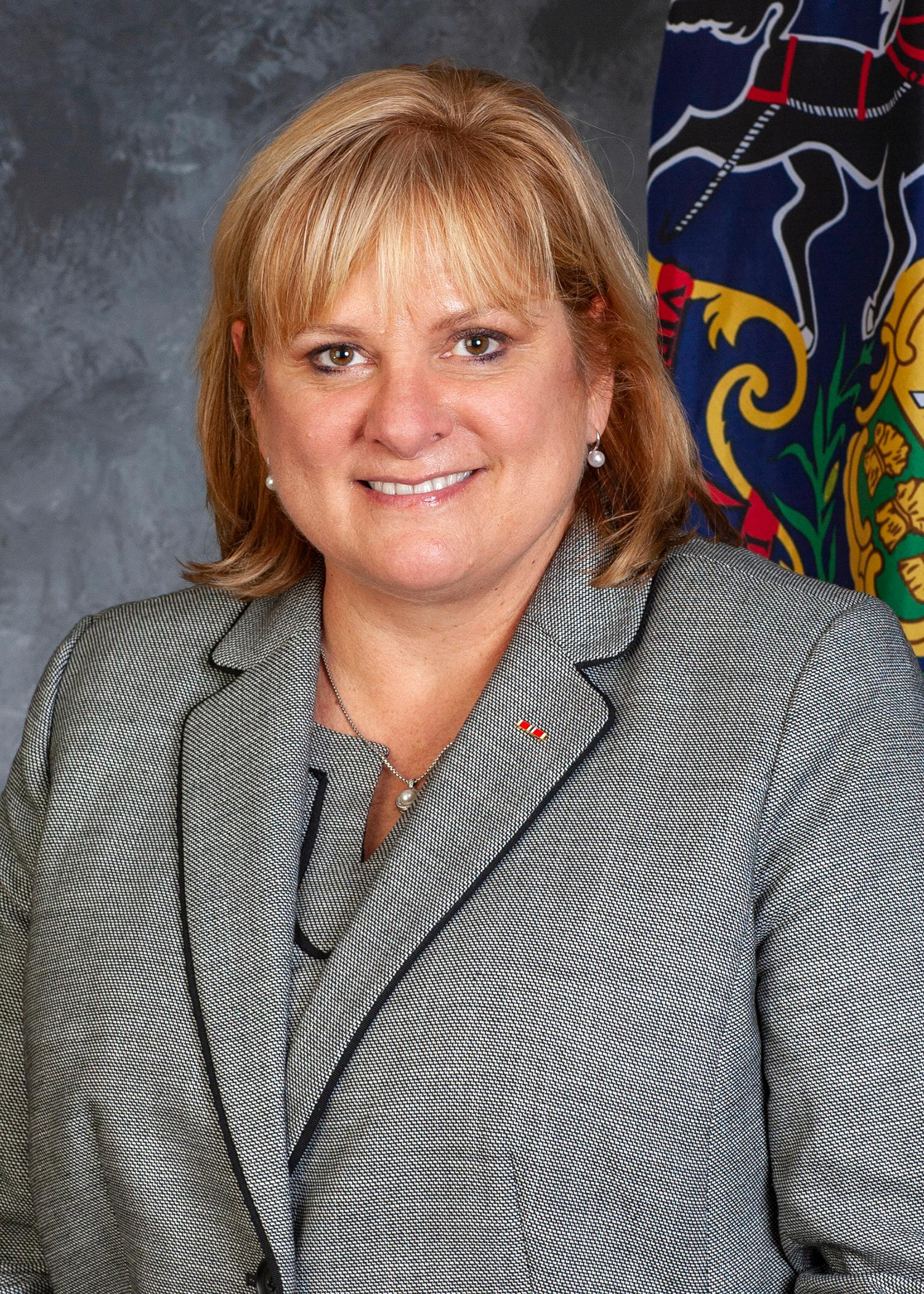
    Pa. state Rep. Tracy Pennycuick (R., Montgomery County). (Photo: Pa. House of Representatives)

    Thomas announced his campaign with dozens of endorsements from state and local elected officials, including five sitting senators from the Philadelphia suburbs. He also secured the endorsement of House Majority Leader Matt Bradford (D., Montgomery), another driving force behind the Democratic efforts to flip the state Senate in the 2026 midterm election in attempts to control all three branches of Pennsylvania’s government.

    Pennsylvania is one of few divided legislatures in the country, where Democrats hold a narrow majority in the state House, 102-101, and Republicans control the Senate, 27-23.

    Gov. Josh Shapiro, a Democrat, and House Democrats frequently butt heads with GOP Senate leaders. By flipping two seats next November, Democrats would tie the chamber 25-25 and Democratic Lt. Gov. Austin Davis would act as a tiebreaker. But Democrats are targeting four GOP-held seats, three of which are in the Philadelphia suburbs, in hopes of gaining control in the upper chamber for the first time in 31 years.

    The GOP-controlled state Senate has been a thorn in the side of Shapiro and House Democrats, as the more conservative members of the GOP Senate caucus have objected to most spending increases and rejected top Democratic priorities, like a long-term revenue source for mass transit. The state budget, passed in November, was 135 days late, requiring school districts, counties, and social service providers to take out loans or lay off staff to continue operating during the monthslong standoff.

    Mirroring national efforts to win control of congressional seats, Pennsylvania Democrats are targeting GOP-held districts that President Donald Trump won in 2024 but Shapiro carried in 2022. With Pennsylvania’s popular first-term governor and potential 2028 contender back at the top of the ticket — and a methodical, behind-the-scenes effort by Shapiro to orchestrate a decisive year for Democrats in 2026 — Democrats see it as possible this time around.

    Thomas’ first order of business if he is elected to Harrisburg and Democrats flip the chamber: electing Democratic floor leaders in the chamber.

    “No meaningful legislation moves in Harrisburg unless we fix who’s in charge, and right now Sen. Pennycuick is supporting a Senate leadership that’s failed working people,” Thomas said.

    Pennycuick said she “welcomes this campaign as an opportunity” to talk about the successes she has achieved while serving in the state Senate, such as her support for public education funding, reducing overreaching regulations, and her bipartisan proposal to create safeguards around artificial intelligence.

    Kofi Osei, a Towamencin Township supervisor and Democrat, has also announced his bid for Senate District 24, which stretches along the northwestern parts of Montgomery County and into parts of Berks County.

    The state Senate Democratic Campaign Committee does not endorse candidates in a primary election, and will support whoever wins the Democratic nomination in Pennsylvania’s May 19 primary. However, State Sen. Vincent Hughes (D., Philadelphia), who chairs the SDCC, said Thomas’ candidacy is “the right time and the right moment.”

    “I’m really excited about having a young person in there, generating young people and getting young people motivated,” Hughes added.

    The state Senate Republican Campaign Committee, meanwhile, is fundraising off Democrats’ efforts to flip the state’s upper chamber, warning voters that Democratic special interest group dollars are already pouring in.

    “State Democrats have made it clear their goal is to have a blue trifecta in Pennsylvania in 2026,” the SRCC wrote in a fundraising email Tuesday. “They know Senate Republicans are the last line of defense against Josh Shapiro and PA House Democrats far-left agenda.”

    Thomas was a public school teacher for one year at the Northeast Community Propel Academy, teaching seventh-grade math and science. He comes from a family of educators, he said, but quickly realized he needed to get more involved to improve the education system and government services to better serve these students. He made the jump to politics to try to make change.

    “I was sitting there, trying to feed my kids in the morning to make sure they had full stomachs to learn, having supplies to make sure they’re fully equipped for the day,” Thomas added. “I saw a system that wasn’t working for our students.”

    If elected, Thomas would be Pennsylvania’s youngest sitting state senator, and would join State Sen. Joe Picozzi (R., Philadelphia), 30, as part of a new generation of leaders hoping to shape the state’s future.

    “Our generation has grown up during economic crashes, school shootings, endless wars, and now we’re watching our parents and grandparents struggle to retire with dignity,” Thomas said.
  • Philly Council votes against Mayor Parker’s vision for her signature housing plan, signaling a win for progressives

    Philly Council votes against Mayor Parker’s vision for her signature housing plan, signaling a win for progressives

    For almost two years, Mayor Cherelle L. Parker has dominated Philadelphia City Hall with an unbending approach to negotiations.

    On Wednesday, City Council signaled those days may be over.

    During a combative hearing on legislation related to Parker’s signature housing initiative, Council President Kenyatta Johnson on Wednesday afternoon refused to allow a vote on an amendment brought by the Parker administration and instead advanced Council’s version of the proposal over the mayor’s objections.

    In a voice vote, Council’s Committee on Fiscal Stability and Intergovernmental Cooperation approved its own changes to the legislation — authorizing the city to take out $800 million in city bonds to fund Parker’s Housing Opportunities Made Easy, or H.O.M.E., initiative — without considering the mayor’s requested tweaks.

    Councilmembers Brian O’Neill, Anthony Phillips, and Curtis Jones Jr. signaled their support for Parker’s vision by voting against the measure, which now heads to the Council floor for a final passage vote or further amendments, either of which could come as soon as January.

    It is unclear how Johnson’s handling of H.O.M.E. will change the tight working relationship Parker and Johnson have maintained since both took office in January 2024. Wednesday’s vote marked their most contentious public disagreement during their tenures. Both officials still agree on many policy goals and have plenty to gain politically from maintaining their alliance.

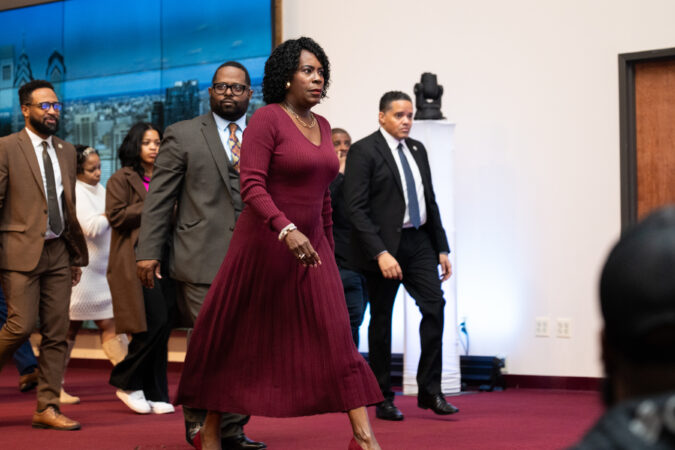
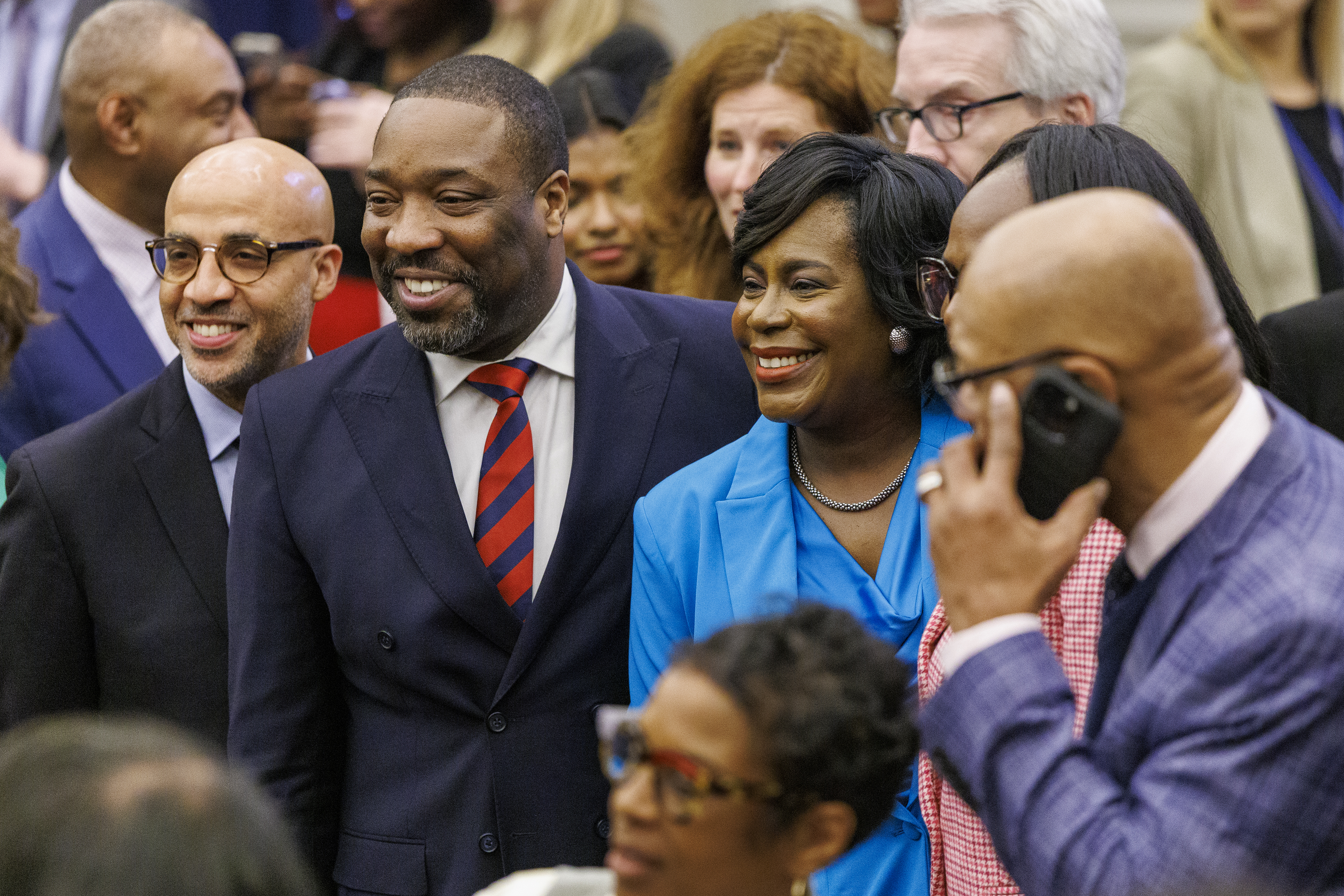
    Philadelphia Mayor Cherelle L. Parker stands beside Council President Kenyatta Johnson (left) after finishing her budget address to City Council in Philadelphia City Hall on Thursday, March 13, 2025.

    The dispute between Parker and Council centers on income eligibility thresholds for two of the housing programs that will be funded by bond proceeds: the Basic Systems Repair Program (BSRP), which provides funding for needed home improvements to eligible owners who might be displaced by costly repairs, and the Adaptive Modification Program (AMP), which funds projects to improve mobility for permanently disabled renters and homeowners.

    Parker had structured the H.O.M.E. initiative with unusually high income cutoffs to make its programs more easily accessible to middle-class households, saying they are often left out of city assistance programs despite being crushed by rising costs.

    “The whole debate over income eligibility limits for BSRP and Adaptive Modifications is to make sure that we leave no working Philadelphian and no qualifying Philly rowhome owner excluded from these vital programs,” Parker said in a statement Wednesday. “If we don’t save Philly rowhomes, we’re going to become a city of used-to-be neighborhoods, blocks that used to be nice but now are showing signs of age and decline. I will not allow that to happen — not on my watch as Mayor of Philadelphia.”

    In a win for progressives, Council instead stuck to its plan of prioritizing lower-income Philadelphians.

    Councilmember Jamie Gauthier, who chairs the Committee on Housing, Neighborhood Development and the Homeless, said Wednesday’s vote sent the message “that Council takes its job seriously as a steward of taxpayer money in the city of Philadelphia, that we are not here to just rubber-stamp in a proposal, that we’re here to work together.”

    Change in fortunes for Parker

    Wednesday’s vote appears to mark the first instance of Parker’s hard-line negotiating tactics failing her since she took office. Even when she could not get negotiating counterparts to bend to her will in the past, Parker has largely prevailed.

    Last year, for instance, Council declined to vote on one of Parker’s school board nominees. But the nominee, incumbent board member Joyce Wilkerson, then pulled out a letter from Parker instructing her to remain on the board until the mayor names a replacement, which she still has not done.

    And in July, when the largest union for city workers went on strike to try to squeeze larger raises out of the administration, Parker stuck to her guns amid increasing pressure to fold as trash piled up across the city and 911 wait times grew longer. The union ultimately folded after an eight-day work stoppage with a new contract that closely aligned with Parker’s last offer before the strike began.

    But this time, Parker appears to be out of options to prevent Council from getting its way because she cannot veto another key piece of legislation to keep the housing initiative in motion that needs to pass before the city can issue the bonds. That measure — a resolution setting the first-year budget for H.O.M.E. that received preliminary approval in a Council committee last week — could see final approval as soon as Thursday.

    In a last-ditch effort to rally public support for her version of how the H.O.M.E. bonds should be spent, Parker on Sunday barnstormed across 10 Philadelphia churches.

    “We’ve got to take care of the people who are most in need, but we can’t penalize the people who are going to work every day, pay their taxes, contribute to the city, and they can’t benefit from home improvement programs,” she said.

    Mayor Cherelle L. Parker speaks to the crowd at The Church of Christian Compassion in the Cobbs Creek neighborhood of West Philadelphia on Sunday, Dec. 7, 2025. Parker visited 10 churches in Philadelphia on Sunday to share details about her H.O.M.E. housing plan.

    That maneuver did not appear to go over well with lawmakers, who likely did not appreciate the mayor encouraging their constituents to oppose Council’s version of the plan.

    Even before chief of staff Tiffany W. Thurman presented Parker’s amendment at Wednesday’s hearing, lawmakers sounded off, with Gauthier saying the administration was spreading “misinformation” and Councilmember Nicolas O’Rourke calling Parker’s approach “Trumpian.”

    “It was in response to misinformation being spread during that tour,” said Gauthier, who, along with fellow progressive Councilmember Rue Landau, led the charge to lower the income eligibility thresholds included in H.O.M.E.

    Gauthier noted that Council’s version of the bill still increases those thresholds beyond what is offered in existing programs.

    “Obviously, the mayor, all of us, have the right to go and talk to our constituents,” she said, “but we have to be operating from a fact-based perspective, and telling folks that the Council proposal excludes them is not factual.”

    No vote on Parker amendment

    The legislative process for approving the city bond issuance — the centerpiece of Parker’s H.O.M.E. initiative, which she first proposed in March — has been long and tortured.

    Council initially approved the bond authorization in June, but lawmakers at that time inserted a provision requiring the administration to get their approval for annual budget resolutions determining how the proceeds will be spent.

    Johnson delayed a vote on the first H.O.M.E. budget resolution for months before allowing it to be approved last week by the Committee of the Whole. But lawmakers made major changes over the mayor’s objections, including granting themselves the right to set income thresholds for the initiative’s programs.

    It was the first sign that Council was serious about enacting its own ideas even if Parker was not on board and, in Council’s view, would not negotiate. In a twist, lawmakers took their latest stand Wednesday at a time when the mayor’s team came to the table with a significant, albeit last-minute, counteroffer.

    Council’s changes to the eligibility requirements for BSRP and AMP would require 90% of the H.O.M.E. bond proceeds for those programs to be spent on households making 60% of Philadelphia’s area median income, which is about $71,640 for a family of four.

    Thurman on Tuesday proposed a compromise in which only 60% of bond money would be set aside for those households. She told lawmakers that Parker, in part, wants to ensure H.O.M.E. helps city workers, who are required to live in Philadelphia but often struggle to make ends meet on municipal salaries. (Parker pointed to the H.O.M.E. plan during the strike as evidence she backed city workers despite opposing higher wages.)

    Johnson responded that he hopes “one day our city workers are getting paid enough where they don’t have to sign up” for assistance programs.

    “You know as well as I do we agree,” Thurman replied, prompting Johnson to cut her off.

    “I’m not acknowledging you yet,” Johnson said, referring to a Council hearing procedure in which the chair must recognize speakers.

    Tiffany Thurman, Mayor Parker’s chief of staff, takes questions from Council members in 2024.

    Parker’s latest offer, which came months into the standoff over H.O.M.E., appears to have been too little, too late.

    Phillips — who voted for the Council budget resolution last week but said he has since changed his mind to support Parker’s vision — wanted to call up the administration’s amendment for a vote, he said in an interview.

    “This week I changed my mind because that’s where my mind really has been,” said Phillips, who represents the Northwest Philadelphia-based 9th District that Parker held when she was on Council. “The 9th District neighbors — they’ve made abundantly clear that our housing policy needs to reflect them. … They’re long-term homeowners, residents who are on fixed incomes, multigenerational families.”

    Under Council rules, only Johnson can call on members to put forward amendments in committee. But instead he blocked it, prompting Jones, Parker’s most vocal ally on Council, to protest.

    “We should do the right thing always, even in spite of its inconvenience and time,” Jones said during Council. “Resolutions and amendments need to be introduced so that they can get the light of day and be heard.”

    Johnson said he pushed through Council’s version because the mayor’s administration did not engage with him about its new proposal ahead of the meeting.

    “Just for the record … I had not officially seen any official amendment prior to this actual hearing,” Johnson said. “The administration just showed up.”

    Despite Wednesday’s vote, the fight over H.O.M.E. may not be over. Councilmember Mike Driscoll, a Parker ally who voted to advance the bond authorization, signaled there may be further changes.

    “I wanted to keep the HOME initiative process moving,” Driscoll said in a statement, “but still hope to influence a reasonable solution which includes program support for row home Philadelphians.”

  • A man and teen were killed during attempted sale of a Rolex in Germantown, police say

    A man and teen were killed during attempted sale of a Rolex in Germantown, police say

    A man and a teenager were killed Tuesday night in Germantown when, investigators believe, a meeting for the sale of a Rolex watch turned into a robbery, and a shootout erupted.

    Tyree Ware, 30, drove to the 500 block of West Queen Lane to sell a Rolex he had listed for sale online, police said. Quaneef Lee, 16, arrived with an acquaintance to purchase it, they said.

    Detectives believe Lee and the other male then attempted to rob Ware of the watch at gunpoint, according to a law enforcement source who spoke on the condition of anonymity to discuss an ongoing investigation.

    Ware also pulled a gun, the source said.

    When officers arrived, they found Ware lying in the street beside the open door of his silver Nissan Maxima. He had been shot multiple times. A 9mm handgun lay beside him.

    Officers found Lee on the ground behind the sedan, shot once in the chest.

    Ware and Lee were rushed to Temple University Hospital, where they died shortly after 5:30 p.m., police said.

    Officers recovered 11 bullet casings from the scene. Deputy Commissioner Frank Vanore said three guns were used in the shootout, but only one was recovered.

    The Rolex, Vanore said, was found inside Ware’s vehicle.

    Investigators are still working to identify the man who accompanied Lee and who may have killed Ware.

    A family member of Lee, when reached by phone Wednesday, declined to speak.

    The shooting comes as Philadelphia is on pace to record its lowest number of homicides in 60 years. Still, violence persists. Lee is one of at least 12 children shot and killed in the city this year.

  • Jason Kelce wants the Eagles to ditch their ‘hokey’ positivity rabbit, and more from ‘New Heights’

    Jason Kelce wants the Eagles to ditch their ‘hokey’ positivity rabbit, and more from ‘New Heights’

    As the Eagles’ losing streak stretched to three games, Jason Kelce chronicled what he called a “comedy of turnovers” on the latest episode of New Heights.

    But Kelce found little to laugh about when it came to the heartbreak of a 22-19 overtime loss to the Chargers on Monday night. He also pointed to what he believes hurt the Eagles most: the lack of an offensive identity — and maybe a bunny.

    Here’s what you may have missed from the podcast …

    The not-so-positive rabbit

    Last week, the Eagles debuted a holiday locker room decoration: an inflatable “positivity rabbit.”

    After NBC Sports Philadelphia reporter Ashlyn Sullivan attributed the rabbit to the Birds’ offensive line, podcast co-host Travis Kelce asked the former Eagles center if it had mysteriously appeared in the locker room before.

    Jason Kelce replied that this was a first for the Eagles — and he was not a fan.

    “There was a lot of negativity in Philadelphia before the game for an 8-4 team that’s first in their division and certainly looking like they’re going to be in the playoffs,” Kelce said. “I think the team was trying to make a statement that we’re all in on this together.

    “To be honest, I don’t really like the rabbit. It’s a little hokey. … It didn’t work. You have to ditch the rabbit.”

    A ‘gut-wrenching’ ending

    The Eagles were on the precipice of a comeback win in overtime against the Chargers. And not even an inflatable bunny could save them, as quarterback Jalen Hurts threw an interception in field-goal range that handed the Birds another preventable loss.

    Jason Kelce shared the fans’ disappointment in the costly turnover.

    “It was just a very frustrating game that ended in a very frustrating fashion,” he said. “We’re putting together a great drive, playing outstanding ball in overtime, driving the length of the field, and then the interception to lose.

    “It was just a gut-wrenching way to end that one. We needed to get some momentum back, and unfortunately, a very sloppy game again left the Eagles in another week of frustration.”

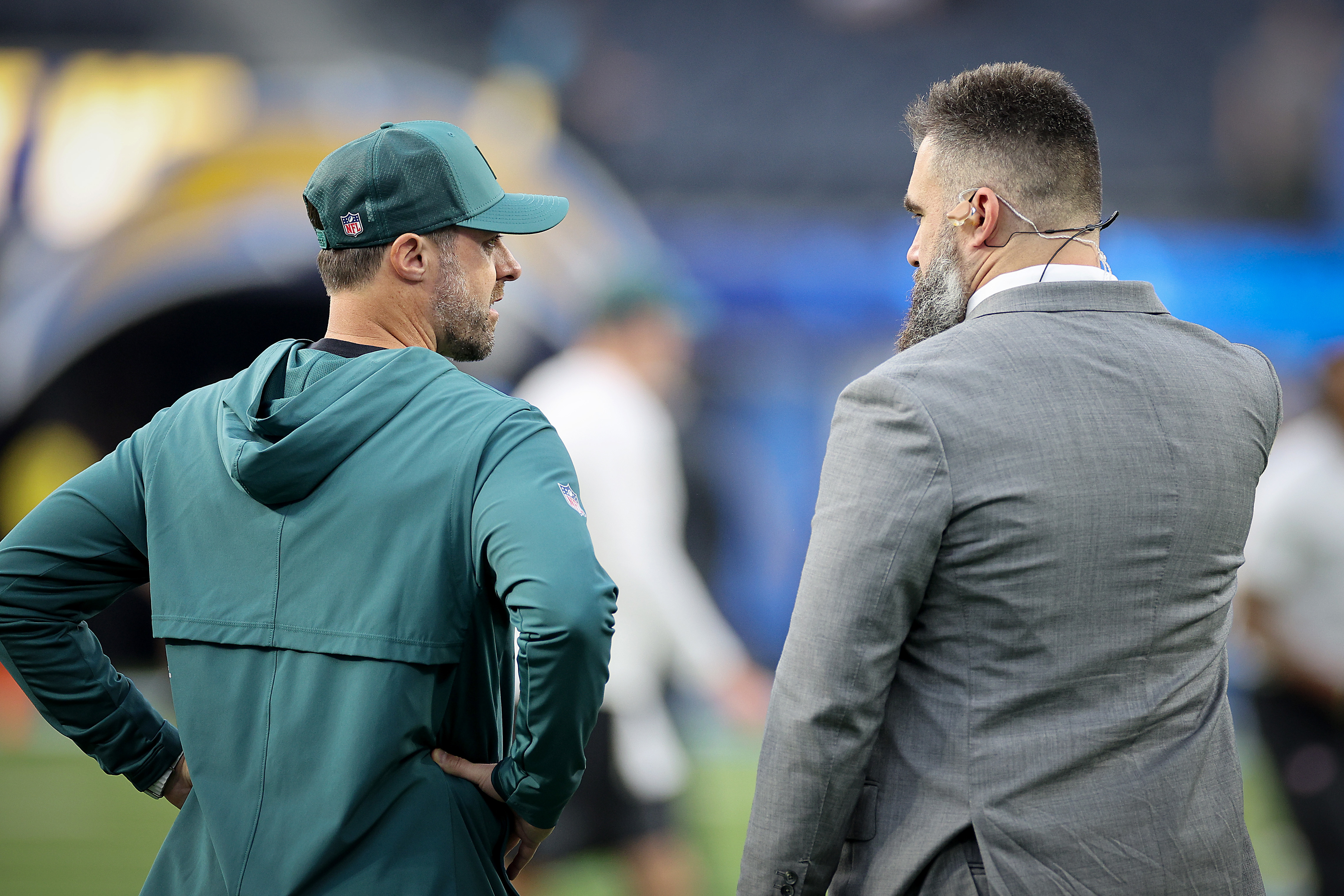
    Eagles offensive coordinator Kevin Patullo (left) chats with Jason Kelce before the game against the Los Angeles Chargers.

    Offense searches for answers

    Much of the blame for the Eagles’ latest loss landed on Hurts, who committed an uncharacteristic five turnovers.

    “It was a horrendous game of ball security,” Kelce said. “I know the last couple weeks have been rough for [Hurts]. This is one of the things he’s done well his whole career, taking care of the football. It’s unfortunately two out-of-character games from him and our team that have really cost us.”

    Kelce also shifted the criticism away from Hurts alone, despite the quarterback’s five turnovers, including the second-quarter play in which he threw an interception, recovered a fumble, then lost a fumble himself. Rather than a lack of talent, Kelce suggested the Birds offense is missing the strong team identity that helped it succeed in past years.

    “This offense has been so stagnant and struggled to get anything going the last couple weeks. … Offensively, [the Eagles] are looking for who they are,” Kelce said. “They’re looking for that identity. There’s so many good pieces … Throughout Jalen’s tenure, what lends itself to the best for this team is that we’ve got to attack the line of scrimmage with [Saquon Barkley], one of the best running backs in the game, and then take our shots down the field.”

    If the Eagles are still searching for an identity with just four games left in the season, they’re running out of time to find it.

  • Trump says the U.S. has seized an oil tanker off the coast of Venezuela

    Trump says the U.S. has seized an oil tanker off the coast of Venezuela

    President Donald Trump said Wednesday that the United States has seized an oil tanker off the coast of Venezuela as tensions mount with the government of President Nicolás Maduro.

    Using U.S. forces to seize an oil tanker is incredibly unusual and marks the Trump administration’s latest push to increase pressure on Maduro, who has been charged with narcoterrorism in the United States. The U.S. has built up the largest military presence in the region in decades and launched a series of deadly strikes on alleged drug-smuggling boats in the Caribbean Sea and eastern Pacific Ocean. The campaign is facing growing scrutiny from Congress.

    “We’ve just seized a tanker on the coast of Venezuela, a large tanker, very large, largest one ever seized, actually,” Trump told reporters at the White House, later adding that “it was seized for a very good reason.”

    Trump did not offer additional details. When asked what would happen to the oil aboard the tanker, Trump said, “Well, we keep it, I guess.”

    The seizure was led by the U.S. Coast Guard and supported by the Navy, according to a U.S. official who was not authorized to comment publicly and spoke on the condition of anonymity. The official added that the seizure was conducted under U.S. law enforcement authority.

    The Coast Guard members were taken to that ship by helicopter from the aircraft carrier USS Gerald R. Ford, the official said. The Ford is in the Caribbean Sea after arriving last month in a major show of force, joining a fleet of other warships that have been increasing pressure on Maduro.

    Video posted online by Attorney General Pam Bondi shows people fast-roping from one of the helicopters involved in the operation as it hovers just feet from the deck.

    The Coast Guard members can be seen in later shots of the video moving throughout the superstructure of the ship with their weapons drawn.

    Bondi wrote that “for multiple years, the oil tanker has been sanctioned by the United States due to its involvement in an illicit oil shipping network supporting foreign terrorist organizations.”

    Half of ship’s oil is tied to Cuban importer

    The U.S. official identified the seized tanker as the Skipper.

    The ship departed Venezuela around Dec. 2 with about 2 million barrels of heavy crude, roughly half of it belonging to a Cuban state-run oil importer, according to documents from the state-owned company Petróleos de Venezuela S.A., commonly known as PDVSA, that were provided on the condition of anonymity because the person did not have permission to share them.

    The Skipper was previously known as the M/T Adisa, according to ship tracking data. The Adisa was sanctioned by the U.S. in 2022 over accusations of belonging to a sophisticated network of shadow tankers that smuggled crude oil on behalf of Iran’s Revolutionary Guard and Lebanon’s Hezbollah militant group.

    The network was reportedly run by a Switzerland-based Ukrainian oil trader, the U.S. Treasury Departmeny said at the time.

    Hitting Venezuela’s sanctioned oil business

    Venezuela has the world’s largest proven oil reserves and produces about 1 million barrels a day. Locked out of global oil markets by U.S. sanctions, the state-owned oil company sells most of its output at a steep discount to refiners in China.

    The transactions usually involve a complex network of shadowy intermediaries, as sanctions have scared away more established traders. Many are shell companies, registered in jurisdictions known for secrecy. The buyers deploy so-called ghost tankers that hide their location and hand off their valuable cargoes in the middle of the ocean before they reach their final destination.

    Maduro did not address the seizure during a speech before a ruling-party organized demonstration in Caracas, Venezuela’s capital. But he told supporters that the country is “prepared to break the teeth of the North American empire if necessary.”

    Maduro, flanked by senior officials, said only the ruling party can “guarantee peace, stability, and the harmonious development of Venezuela, South America and the Caribbean.”

    During past negotiations, among the concessions the U.S. has made to Maduro was approval for oil giant Chevron Corp. to resume pumping and exporting Venezuelan oil. The corporation’s activities in the South American country resulted in a financial lifeline for Maduro’s government.

    Maduro has insisted the real purpose of the U.S. military operations is to force him from office.

    Democrat says move is about ‘regime change’

    Sen. Chris Van Hollen (D., Md.), a member of the Senate Foreign Relations Committee, said the U.S. seizing of the oil tanker cast doubt on the administration’s stated reasons for the military buildup and boat strikes in the region.

    “This shows that their whole cover story — that this is about interdicting drugs — is a big lie,” the senator said. “This is just one more piece of evidence that this is really about regime change — by force.”

    The seizure comes a day after the U.S. military flew a pair of fighter jets over the Gulf of Venezuela in what appeared to be the closest that warplanes had come to the South American country’s airspace. Trump has said land attacks are coming soon but has not offered more details.

    The Trump administration is facing increasing scrutiny from lawmakers over the boat-strike campaign, which has killed at least 87 people in 22 known strikes since early September, including a follow-up strike that killed two survivors clinging to the wreckage of a boat after the first hit.

    Some legal experts and Democrats say that action may have violated the laws governing the use of deadly military force.

    Lawmakers are demanding to get unedited video from the strikes, but Defense Secretary Pete Hegseth told congressional leaders Tuesday he was still weighing whether to release it. Hegseth provided a classified briefing for congressional leaders alongside Secretary of State Marco Rubio and CIA Director John Ratcliffe.

    It was not immediately clear Wednesday who owned the tanker or what national flag it was sailing under. The Coast Guard referred a request for comment to the White House.

  • Former Gov. Ed Rendell endorses State Sen. Sharif Street to succeed Rep. Dwight Evans in Congress

    Former Gov. Ed Rendell endorses State Sen. Sharif Street to succeed Rep. Dwight Evans in Congress

    Former Gov. Ed Rendell endorsed Democratic State Sen. Sharif Street in his bid to represent Philadelphia in Congress.

    In his endorsement, Rendell, who was Philadelphia’s mayor from 1992 to 2000, called Street someone with a track record of delivering for working families in Philadelphia.

    “With our nation in crisis, we need fighters like Sharif Street representing us in Congress,” Rendell said in a statement Wednesday.

    “I’ve known Sharif since he was a teenager, and he’s spent his entire career fighting for our community,” Rendell said, commending Street’s work as a state legislator to help implement Pennsylvania’s Affordable Care Act exchange, Pennie, and delivering money to programs that work to reduce gun violence.

    Street, a former chair of the state Democratic Party, has worked closely with Rendell on party business and fundraising in the past. The candidate’s father, former Mayor John F. Street, served as City Council president during Rendell’s mayorship before succeeding him in the office.

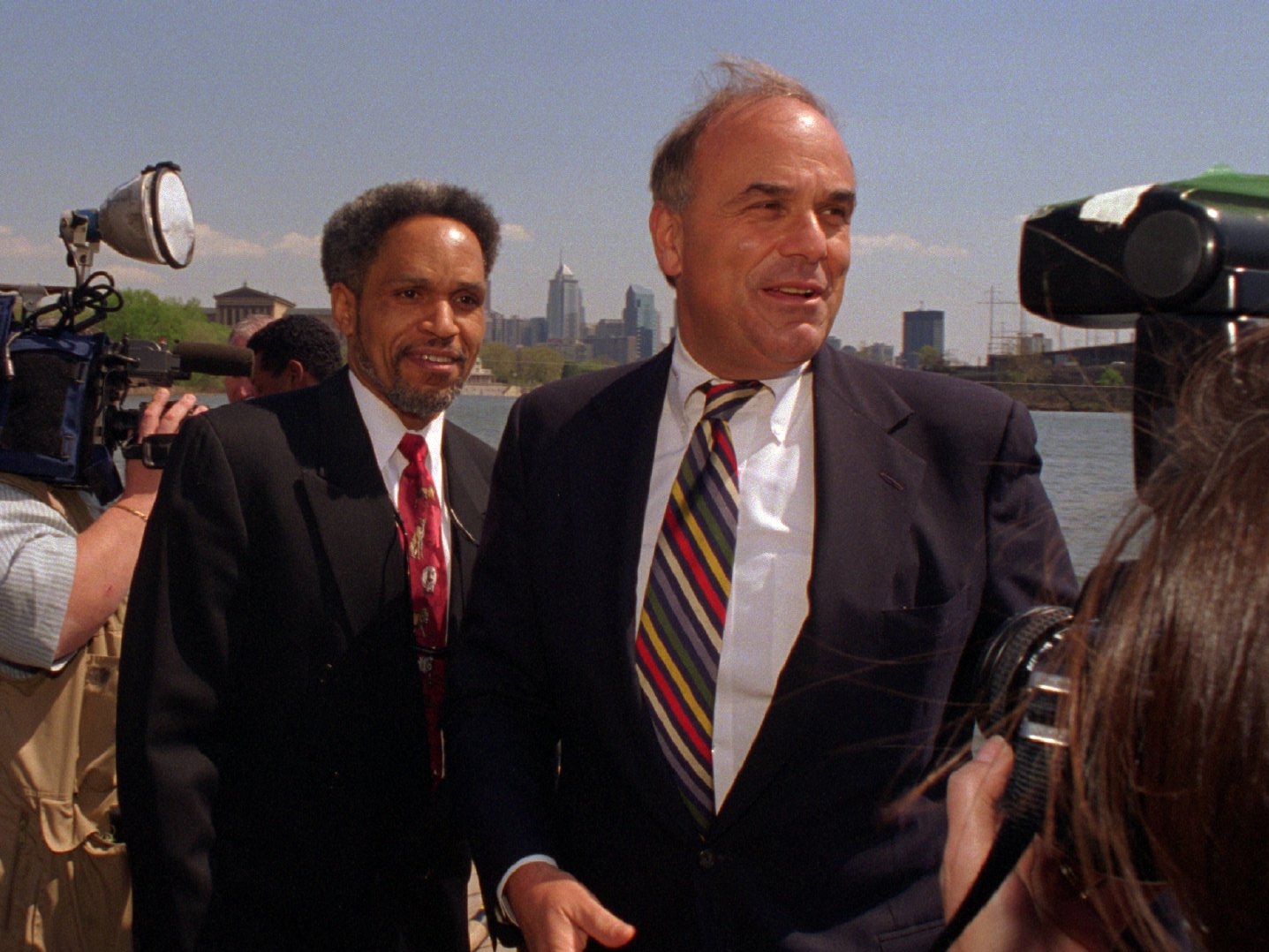
    John Street and Ed Rendell arrive for a 1994 news conference when Rendell was serving as mayor. Street went on to succeed Rendell as mayor after collaborating with him closely as City Council president.

    The endorsement comes as the race for the 3rd Congressional District heats up.

    U.S. Rep. Dwight Evans’ decision to retire has kicked off the city’s first competitive primary in more than a decade — with one of most Democratic-leaning districts in the country up for grabs.

    Evans endorsed Ala Stanford, a physician, founder of Philadelphia’s Black Doctors COVID-19 Consortium, and former regional director at the U.S. Department of Health.

    Two of Street’s Harrisburg colleagues, State Reps. Chris Rabb and Morgan Cephas, are also running, as is intensive-care physician Dave Oxman.

    A half dozen other hopefuls include Jahmiel Jackson, a West Philly native and recent University of Chicago graduate; Isaiah Martin, a 25-year-old real estate developer and executive director of Empowered CDC, which runs community programs in Southwest Philadelphia; Pablo McConnie-Saad, a Bella Vista resident and former U.S. Treasury Department adviser in the Biden administration; Temple University computer science professor Karl Morris; and former city employee Robin Toldens.

    Rendell’s endorsement further solidifies Street as the early Democratic establishment favorite in the race. Street also received endorsements from several city labor unions.

    “I’m honored to accept the endorsement of a leader like Governor Rendell,” Street said in a statement, calling the endorsement part of a “broad-based coalition — from labor unions to elected officials to community activists.”

    Street’s strength with the establishment could become a target in the race. At the first campaign forum, held last week, Rabb said he was running because Philadelphians needed a true progressive representing them, “not another establishment ally.”

    There has been no independent polling done in the race, but an internal poll from Street’s campaign, conducted by Democratic pollster Celinda Lake’s firm, showed him with a 5-percentage-point lead (22%) over Rabb (17%), with Stanford (11%), Cephas (7%), and Oxman (2%) behind them. The survey of 500 likely 2026 Democratic primary voters had a margin of error of plus or minus 4 percentage points.

    But the survey showed a plurality of voters, 36%, were undecided.

  • Israel reopens Jordan crossing as pressure builds to advance Gaza truce

    Israel reopens Jordan crossing as pressure builds to advance Gaza truce

    Trucks carrying goods from Jordan crossed into the West Bank for the first time in months on Wednesday, after Israel said it would reopen a key land bridge with its neighbor, including for aid and other cargo bound for the Gaza Strip.

    It was unclear whether the first trucks out of the gate were transporting humanitarian supplies or commercial items, but a spokesperson for COGAT, the branch of the Israeli Defense Ministry that controls aid flows to Gaza, confirmed that the crossing, known as Allenby, was open for the passage of aid.

    The move to restore Allenby as a transit point for relief comes as pressure builds on Israel to move a tenuous U.S.-backed ceasefire in Gaza into its second phase, and as the United Nations and other aid organizations have warned that nowhere near enough supplies are being allowed into the enclave to meet the needs of the Palestinian population, the majority of whom are displaced and living in makeshift shelters or tents.

    Under the ceasefire agreement between Israel and Hamas, Israeli authorities are supposed to allow at least 600 trucks of aid to enter Gaza each day. But the United Nations and other aid agencies say they continue to face bottlenecks and other restrictions, including delays and denials of cargo, custom clearance challenges and limited routes inside Gaza for transporting humanitarian goods.

    Israel closed the border in September after a Jordanian truck driver killed two Israeli soldiers at the crossing. An Israeli security official, speaking on the condition of anonymity because they were not authorized to speak to the press, said Jordanian truck drivers would undergo stricter screening processes and that a dedicated security force had been assigned to monitor the terminal.

    The reopening also coincided with a visit to Israel and Jordan by the U.S. ambassador to the U.N., Mike Waltz, who met on Monday with Israeli Prime Minister Benjamin Netanyahu. A statement from the U.S. mission to the U.N. said Waltz “welcomed Israel’s cooperation on expanding border crossings,” including Allenby. Waltz also met with Jordan’s King Abdullah on Sunday.

    In recent days, both Israeli and Hamas officials have said that there will be no discussion of moving to the second phase of President Donald Trump’s ceasefire plan until the first phase has been fully implemented. Both continue to point fingers at the other for not holding up their side of the deal. Israel has blamed Hamas for being slow to return the bodies of hostages, with one remaining in Gaza. Hamas has, in turn, pointed to the continued closure of border crossings for medical evacuations and aid and the daily fire that Israeli troops are carrying out in Gaza.

    But as pressure from the U.S. and other mediators to push the deal into the next phase grows, Netanyahu said Sunday that the transition could happen “very shortly” and announced he will meet with Trump on Dec. 29. A Hamas official also told the Associated Press on Sunday that the group is open to “freezing or storing” its weapons arsenal as part of the ceasefire.

    The second phase, which in theory would involve the disarmament of Hamas, withdrawal of Israeli troops from the territory, and the formation of an international force to maintain security, is likely to be far more complicated to achieve than even the first phase. Any delays in reaching that second phase leaves open the prospect of a status quo being established in Gaza in which Israel continues to occupy half of the enclave.

    One remaining step is the return of the remains of Ran Gvili, a 24-year-old Israeli police officer who was killed in Hamas’s Oct. 7, 2023, attack on Israel.

    “Without Gvili, Israel will not begin the talks over phase two,” said an Israeli official, speaking on the condition of anonymity because they were not authorized to speak to the press.

    U.N. agencies have reported an increase in aid that has been allowed into Gaza since the ceasefire came into effect, but say the levels are still far below what is needed for a population trying to recover from widespread malnutrition, famine and infectious diseases with a decimated health care system.

    Israel has allowed commercial operators and aid groups that bypass the U.N. system to scale up their operations more rapidly than other major relief organizations with long-running histories of assistance in Gaza. In particular, Israel has refused to allow UNRWA, the U.N. Relief and Works Agency for Palestinian refugees, to deliver aid, despite its sprawling infrastructure in Gaza and decades-long presence in the territory.

    “A shockingly high number” of children are still suffering from acute malnutrition, said Tess Ingram, a spokeswoman for UNICEF, the U.N. children’s agency, according to comments reported by Reuters.

    Ingram also told reporters on Tuesday that opening the Rafah crossing in southern Gaza, which links it with Egypt, could help bring down the number of children suffering from malnutrition. “We really need to see all types of aid come in, particularly nutritious food through commercial routes as well,” Ingram said.

    Israel said last week that it would reopen the crossing in the coming days, but only for the exit of Palestinians from Gaza.

    Millions of shelter items have also been stuck in Jordan, Egypt and Israel while awaiting Israeli approval to enter, a consortium of humanitarian organizations focused on providing shelter aid said in November.

    A severe winter storm landing in the region this week threatens 850,000 people sheltering in 761 displacement sites particularly vulnerable to flooding in the Gaza Strip, the U.N. Office for the Coordination of Humanitarian Affairs (OCHA) said. On Wednesday, there were reports of flooding in large parts of Gaza City, particularly low-lying areas.

    “The entire services system is unable able to rescue displaced people due to the heavy rain and flooding,” said Mahmoud Basal, a spokesman for Gaza Civil Defense, in a statement to reporters. “Rainwater has risen to more than one meter in some shelter centers.”

    The storm, dubbed Byron, has already hit Greece and Cyprus and is expected to bring as much as eight inches of rain to Israel and Gaza.

    “Low pressure fronts pose a major danger to displaced people and residents because of the destruction inflicted on the infrastructure,” Gaza municipality spokesman Hosni Mhanna told Al Araby TV on Wednesday.

  • EU enlargement chief: Ukraine’s membership ‘inevitable’

    EU enlargement chief: Ukraine’s membership ‘inevitable’

    KYIV, Ukraine — The European Union’s enlargement chief said Wednesday she is confident Hungary will not derail Ukraine’s path to membership, which she described as “inevitable.”

    “I’m not worried,” Commissioner Marta Kos told reporters while visiting a thermal power plant in Western Ukraine that was badly damaged by Russia’s campaign against civilian infrastructure. “I would be worried if there were real concerns.”

    “On EU membership of Ukraine — which is inevitable — I see this as a political anchor of security guarantees,” she said, noting that “There has never been a war on the territory of the European Union.”

    Ukraine hopes to join the bloc by the end of the decade and remains frustrated that its path to NATO membership looks uncertain.

    Kyiv applied for EU membership in 2022 shortly after Russia’s full-scale invasion. Now, Commissioner Kos is convening an informal meeting of European affairs ministers Thursday to prepare for the next stage of accession talks.

    Kos hinted that the process could move even faster, saying “The quicker the reforms which are needed will be done, the quicker the process can be.”

    Hungarian Prime Minister Viktor Orbán has opposed launching membership talks while the war continues. Yet, Kos dismissed his objections saying “We do not need Orbán to do the reforms which are necessary for Ukraine to become a member of the EU.”

    The Slovenian diplomat toured the heavily damaged power plant, where heavy machinery was blackened, control panels melted and a giant hole gaped in the roof of one of the main buildings.

    Andrii, a turbine operator on duty during a recent attack, described the chaos that followed.

    “The first thing you feel is a huge rush of adrenaline. There’s heavy smoke, loud noise, pressure — you can’t hear your colleagues,” he said. “Damaged equipment means escaping steam and high-temperature feedwater. At first it’s very difficult to orient yourself in the smoke.”

    Company officials asked that the plant’s location and the full names of employees not be published for security reasons.

    The thermal power plant is one of six operated by private utility DTEK that have sustained major damage from relentless Russian drone and missile attacks in recent weeks.

    Kos praised the resilience of power workers and Ukrainians in general.

    “There is no other more resistant nation in the world which I know than the Ukrainians,” she said, recalling Russian President Vladimir Putin’s expectation of a quick victory. “Putin said it would take one week. But here we are and it’s been nearly four years, so you are already the winners.”

  • Ukraine to give revised peace plans to U.S. as Kyiv readies for more talks with its coalition partners

    Ukraine to give revised peace plans to U.S. as Kyiv readies for more talks with its coalition partners

    KYIV, Ukraine — Ukraine is expected to give its latest peace proposals to U.S. negotiators this week, President Volodymyr Zelensky said, ahead of his urgent talks with leaders and officials from about 30 other countries supporting Kyiv’s effort to end the war with Russia on acceptable terms.

    As tension builds around a U.S. push for a settlement, German Chancellor Friedrich Merz, British Prime Minister Keir Starmer and French President Emmanuel Macron spoke to President Donald Trump by phone Wednesday, according to officials.

    Negotiations are at “a critical moment,” the European leaders said in official statements.

    Trump said the men discussed Ukraine “in pretty strong terms.” He also said Zelensky “has to be realistic” about the war and that European leaders would like a meeting this coming weekend with both the U.S. and Ukraine.

    “We’ll make a determination depending on what they come back with,” the president told reporters during a question-and-answer session at the White House.

    Washington’s goal of a swift compromise to stop the fighting that followed Russia’s full-scale invasion in 2022 is reducing Kyiv’s room for maneuvering. Zelensky is walking a tightrope between defending Ukrainian interests and showing Trump he is willing to compromise, even as Moscow shows no public sign of budging from its demands.

    Ukraine’s European allies are backing Zelensky’s effort to ensure that any settlement is fair and deters future Russian attacks, as well as accommodating Europe’s defense interests.

    The French government said Ukraine’s allies — dubbed the “Coalition of the Willing” — will discuss the negotiations Thursday by video. Zelensky said it would include those countries’ leaders.

    “We need to bring together 30 colleagues very quickly. And it’s not easy, but nevertheless we will do it,” he said late Tuesday.

    Zelensky said discussions with the U.S. were scheduled later Wednesday to focus on a document detailing plans for Ukraine’s postwar reconstruction and economic development. Also, Ukraine is finalizing work on a separate, 20-point framework for ending the war. Zelensky said Kyiv expects to submit that document to Washington soon.

    Zelensky says he’s ready for an election

    After Trump called for a presidential election in Ukraine, Zelensky said his country would be ready for such a vote within three months if partners can guarantee safe balloting during wartime and if its electoral law can be altered.

    Zelensky’s openness to an election was a response to comments by Trump in which he questioned Ukraine’s democracy and suggested the Ukrainian leader was using the war as an excuse not to stand before voters. Those comments echo similar remarks often made by Russian President Vladimir Putin.

    Zelensky said late Tuesday he is “ready” for an election but needs help from the U.S. and possibly Europe to ensure its security. He suggested Ukraine could hold balloting in 60 to 90 days if that proviso is met.

    “To hold elections, two issues must be addressed: primarily, security — how to conduct them, how to do it under strikes, under missile attacks; and a question regarding our military — how they would vote,” Zelensky said. “And the second issue is the legislative framework required to ensure the legitimacy of elections.”

    Zelensky pointed out previously that balloting can’t legally happen while martial law — imposed due to Russia’s invasion — is in place. He has also asked how a vote could occur when civilian areas of Ukraine are being bombarded and almost 20% of the country is under Russian occupation.

    Zelensky said he has asked lawmakers from his party to draw up legislative proposals allowing for an election while Ukraine is under martial law.

    Ukrainians have on the whole supported Zelensky’s arguments, and have not clamored for an election. Under the law that is in force, Zelensky’s rule is legitimate.

    Putin has repeatedly complained that Zelensky can’t legitimately negotiate a peace settlement because his five-year term that began in 2019 has expired.

    U.S. seeks closer ties with Russia

    A new U.S. national security strategy released Dec. 5 made clear that Trump wants to improve Washington’s relationship with Moscow and “reestablish strategic stability with Russia.” The document also portrays European allies as weak.

    Russian Foreign Minister Sergey Lavrov praised Trump’s role in the Ukraine peace effort, telling the upper house of parliament that Moscow appreciates his “commitment to dialogue.” Trump, Lavrov said, is “the only Western leader” who shows “an understanding of the reasons that made war in Ukraine inevitable.”

    Trump’s peace efforts have run into sharply conflicting demands from Moscow and Kyiv.

    The initial U.S. proposal was heavily slanted toward Russia’s demands. To counter that, Zelensky has turned to his European supporters.

    Zelensky met this week with the leaders of Britain, Germany, and France in London, the heads of NATO and the European Union in Brussels, and then went to Rome to meet the Italian premier and Pope Leo XIV.

    Military aid for Ukraine declines

    Europe’s support is uneven, however, and that has meant a decrease in military aid since the Trump administration this year cut off supplies to Kyiv unless they were paid for by other NATO countries.

    Foreign military help for Ukraine fell sharply over the summer, and that trend continued through September and October, a German body that tracks international help for Ukraine said Wednesday.

    Average annual aid, mostly provided by the U.S. and Europe, was about 41.6 billion euros ($48.4 billion) between 2022–24. But so far this year Ukraine has received just 32.5 billion euros ($37.8 billion), the Kiel Institute said.

    This year, Denmark, Finland, Norway, and Sweden have substantially increased their help for Ukraine, while Germany nearly tripled its average monthly allocations and France and the U.K. both more than doubled their contributions, the Kiel Institute said.

    On the other hand, it said, Spain recorded no new military aid for Kyiv in 2025 while Italy reduced its low contributions by 15% compared with 2022–2024.

  • Trump’s crackdown on immigration is taking a toll on childcare workers

    Trump’s crackdown on immigration is taking a toll on childcare workers

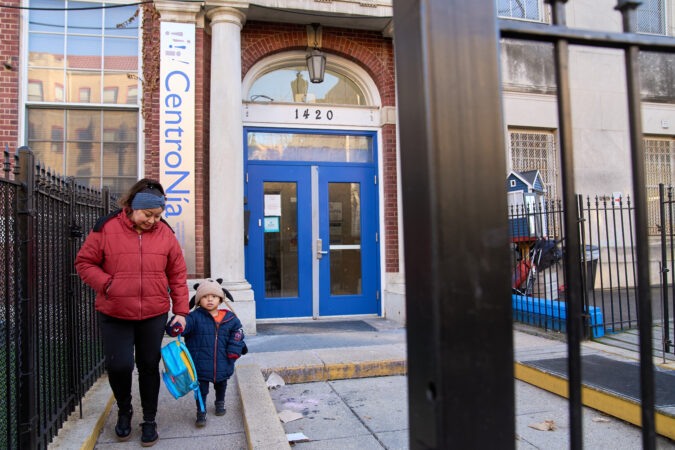
    WASHINGTON — Not long after President Donald Trump took office in January, staff at CentroNía bilingual preschool began rehearsing what to do if Immigration and Customs Enforcement officials came to the door. As ICE became a regular presence in their historically Latino neighborhood this summer, teachers stopped taking children to nearby parks, libraries, and playgrounds that had once been considered an extension of the classroom.

    And in October, the school scrapped its beloved Hispanic Heritage Month parade, when immigrant parents typically dressed their children in costumes and soccer jerseys from their home countries. ICE had begun stopping staff members, all of whom have legal status, and school officials worried about drawing more unwelcome attention.

    All of this transpired before ICE officials arrested a teacher inside a Spanish immersion preschool in Chicago in October. The event left immigrants who work in childcare, along with the families who rely on them, feeling frightened and vulnerable.

    Trump’s push for the largest mass deportation in history has had an outsized impact on the childcare field, which is heavily reliant on immigrants and already strained by a worker shortage. Immigrant childcare workers and preschool teachers, the majority of whom are working and living in the U.S. legally, say they are wracked by anxiety over possible encounters with ICE officials. Some have left the field, and others have been forced out by changes to immigration policy.

    At CentroNía, CEO Myrna Peralta said all staff must have legal status and work authorization. But ICE’s presence and the fear it generates have changed how the school operates.

    “That really dominates all of our decision making,” Peralta said.

    Instead of taking children on walks through the neighborhood, staff members push children on strollers around the hallways. And staff converted a classroom into a miniature library when the school scrapped a partnership with a local library.

    The childcare industry depends on immigrants

    Schools and childcare centers were once off limits to ICE officials, in part to keep children out of harm’s way. But those rules were scrapped not long after Trump’s inauguration. Instead, ICE officials are urged to exercise “common sense.”

    Tricia McLaughlin, spokesperson for the Department of Homeland Security, defended ICE officials’ decision to enter the Chicago preschool. She said the teacher, who had a work permit and was later released, was a passenger in a car that was being pursued by ICE officials. She got out of the car and ran into the preschool, McLaughlin said, emphasizing the teacher was “arrested in the vestibule, not in the school.” The man who had been driving went inside the preschool, where officials arrested him.

    About one-fifth of America’s childcare workers were born outside the United States and one-fifth are Latino. The proportion of immigrants in some places, particularly large cities, is much higher: In the District of Columbia, California, and New York, around 40% of the childcare workforce is foreign-born, according to UC Berkeley’s Center for the Study of Child Care Employment.

    Immigrants in the field tend to be better educated than those born in the United States. Those from Latin America help satisfy the growing demand for Spanish-language preschools, such as CentroNía, where some parents enroll their kids to give them a head start learning another language.

    The American Immigration Council estimated in 2021 that more than three-quarters of immigrants working in early care and education were living and working in the U.S. legally. Preschools like CentroNía conduct rigorous background checks, including verifying employees have work authorization.

    There is evidence the toll on the workforce is mounting. Since January, the number of immigrants working in childcare has dropped by 39,000, according to a report published Wednesday by New America, a left-leaning think tank. This, in turn, made it more challenging for U.S.-born mothers of children under 6 to work. The researchers estimate there are 79,000 fewer of them in the workforce because of the increase in ICE arrests.

    Beyond the deportation efforts, the Trump administration in recent months has stripped legal status from hundreds of thousands of immigrants. Many of them had fled violence, poverty or natural disasters in their homes and received Temporary Protected Status, which allowed them to live and work legally in the U.S. But Trump ended those programs, forcing many out of their jobs — and the country. Just last month, 300,000 immigrants from Venezuela lost their protected status.

    CentroNía lost two employees when they lost their TPS, Peralta said, and a Nicaraguan immigrant working as a teacher left on his own. Tierra Encantada, which runs Spanish immersion preschools in several states, had a dozen teachers leave when they lost their TPS.

    Fear is affecting even those in the U.S. legally

    At CentroNía, one staff member was detained by ICE while walking down the street and held for several hours, all the while unable to contact colleagues to let them know where she was. She was released that evening, said the school’s site director, Joangelee Hernández-Figueroa.

    Another staff member, teacher Edelmira Kitchen, said she was pulled over by ICE on her way to work in September. Officials demanded she get out of her car so they could question her. Kitchen, a U.S. citizen who immigrated from the Dominican Republic as a child, said she refused and they eventually let her go.

    “I felt violated of my rights,” Kitchen said.

    Hernández-Figueroa said ICE’s heightened presence during the federal intervention in the city, has taken a toll on employees’ mental health. Some have gone to the hospital with panic attacks in the middle of the school day.

    When the city sent mental health consultants to the school earlier this year as part of a partnership with the Department of Behavioral Health, school leadership had them work with teachers rather than students, worried their anguish would spill over to the classroom.

    “If the teachers aren’t good,” Hernández-Figueroa said, “the kids won’t be good either.”

    It’s not just adults who are feeling more anxious. At a Guidepost Montessori School in Portland, Ore., teachers observed preschoolers change in the weeks after an ICE arrest near the school in July. After pulling over a father who was driving his child to the school, officials encountered him in the school parking lot and tried to arrest him. In the ensuing commotion, the school went into lockdown: Children were pulled off the playground, and teachers played loud music and had children sing along to drown out the yelling.

    Amy Lomanto, who heads the school, said teachers noticed more outbursts among students, and more students retreating to what the school calls “the regulation station,” an area in the main office with fidget toys kids can use to calm themselves.

    She said what unfolded at her school underscored that even wealthy communities, like the one the school serves, are not immune from exposure to these kinds of events.

    “With the current situation, more and more of us are likely to experience this kind of trauma,” she said. “That level of fear now is permeating a lot more throughout our society.”