Blog

  • Horoscopes: Monday, July 6, 2026

    ARIES (March 21-April 19). The situation that comes up today is not exactly like the last time, but how hard could it be? Experience doesn’t provide all the answers, but it does offer confidence that you’ll figure things out.

    TAURUS (April 20-May 20). It’s wonderful how friendship can survive distance, timing and the complications of adult life. You don’t have to talk every day to matter deeply to one another. When you reconnect, you pick up right where you left off.

    GEMINI (May 21-June 21). Flirting won’t look like flirting. It may look like common courtesy, professional diligence or mild annoyance. Then you notice that one person keeps showing up, asking questions and extending the conversation. The plot thickens.

    CANCER (June 22-July 22). Your wisdom nets you good fortune on several fronts. You can feel a feeling without becoming the feeling. Instead of, “I’m worried, therefore I must act,” you say, “I’m worried. Let me figure out what that’s about.”

    LEO (July 23-Aug. 22). You don’t have to wait for everyone else to decide what they’re doing before making your own move. You’re more adaptable than you realize. Whether plans change, people shift or circumstances evolve, you’ll find a place that works.

    VIRGO (Aug. 23-Sept. 22). You’ll soon be hashing out the details of a deal. If you do your homework, you’ll be impressively articulate and persuasive. Take the time to get clear in your own mind about what you want and what you’re willing to trade for it.

    LIBRA (Sept. 23-Oct. 23). You’re really coming up with good ones today. Sometimes thinking is your favorite activity. It feels nice when those synapses connect. And you don’t need anyone else to understand the enthusiasm, but they’ll feel it and lean in.

    SCORPIO (Oct. 24-Nov. 21). You’re smart, and you’re strong. But those aren’t the qualities that bring home today’s prize. It’s your adaptability that matters. Charles Darwin observed that it’s not the strongest that survives, nor the most intelligent, but the most responsive to change.

    SAGITTARIUS (Nov. 22-Dec. 21). Saying the right thing to the wrong audience can make you feel like it’s you, like you’re wrong. But being outnumbered isn’t the same thing as being wrong. Stand your ground. In a different room, the same words play like beautiful music.

    CAPRICORN (Dec. 22-Jan. 19). Something you’ve been doing for weeks, months or even years starts producing visible results. The improvement may seem sudden to others, though you know exactly how much effort went into it. Persistence finally has something to show for itself.

    AQUARIUS (Jan. 20-Feb. 18). The very thing you once considered too strange to mention is the exact thing that endears and connects you to a kindred soul, proving that it’s not always easy to tell a person’s sensibility. We are often more alike than we think.

    PISCES (Feb. 19-March 20). Wanting comfort and stability is understandable, especially for those with firsthand knowledge of how chaotic life can get. And yet, protection from uncertainty can also mean protection from what makes life vivid. The story doesn’t start until you want something badly enough to be inconvenienced by it.

    TODAY’S BIRTHDAY (July 6). Sankofa is an Akan symbol from Ghana, often depicted as a bird looking back while moving forward. In your Year of Sankofa, a past relationship, skill or dream proves valuable in your new chapter. More highlights: Your instincts prove remarkably reliable, earning you an important position. Love sprinkles your days with small surprises and thoughtful gestures. A financial burden falls away. Aries and Aquarius adore you. Your lucky numbers are: 9, 19, 4, 48 and 1.

  • Flyers’ Trevor Zegras and Jamie Drysdale are among 15 players who have filed for salary arbitration

    Flyers’ Trevor Zegras and Jamie Drysdale are among 15 players who have filed for salary arbitration

    As the Flyers await word on whether the Anaheim Ducks will match the offer sheet they tendered to center Leo Carlsson, two of the organization’s four restricted free agents filed for salary arbitration.

    On Sunday, Jamie Drysdale and forward Trevor Zegras opted for salary arbitration and, therefore, cannot be tendered an offer sheet by another NHL team.

    The hearings are scheduled between July 20 and Aug. 1, and the team and player can still negotiate a deal until the hearing begins. If it does go to the arbitrator, they can only award a one- or two-year contract. Because it was a player’s choice, the Flyers will select the term length. If the Flyers select a two-year contract, the player would walk to unrestricted free agency, but if it is for one year, the player would be a restricted free agent next summer.

    Zegras said he felt like he “had lost a little bit of that drive and passion to win” in Anaheim and felt rejuvenated this past year. He did have a career year, notching highs in goals (26), points (67), power-play goals (10), and power-play points (23) across 81 games. The New York native spent time on the wing and at center this season. How he is viewed, whether as a winger or a center by either side, impacts contract negotiations because, typically, centers are paid more.

    Flyers center Trevor Zegras scored 26 goals during the 2025-26 season.

    At his end-of-season availability, Drysdale said the biggest step he took this year was “just coming to the rink and believing that I was a good player and could make an impact.” The blueliner played in 78 games, his highest total since he played 81 in 2021-22, had a career-high in goals (eight), and tied his career-high in points (32).

    Both got their first taste of the postseason, with Drysdale scoring two goals and four points, and Zegras adding four goals and six points in 10 games apiece.

    Defenseman Hunter McDonald is a restricted free agent and did not elect salary arbitration by the 5 p.m. deadline. Forward Nikita Grebenkin, the final RFA for the Flyers, was not eligible.

    Zegras and Drysdale are two of 15 players to elect salary arbitration. The others are forwards Xavier Bourgault (Ottawa Senators), Kirby Dach (Montreal Canadiens), Alex Jefferies (New York Islanders), Peyton Krebs (Buffalo Sabres), Connor McMichael (St. Louis Blues), Cole Perfetti (Winnipeg Jets), Jason Robertson (Dallas Stars), Nick Robertson (Pittsburgh Penguins), and Cole Sillinger (Columbus Blue Jackets); goalies Jet Greaves (Columbus Blue Jackets) and Akira Schmid (Florida Panthers); and defensemen Braden Schneider (New York Rangers) and Ronan Seeley (Carolina Hurricanes).

    The AAV on the Flyers’ offer would make Leo Carlsson the highest-paid player in the NHL.

    On Friday, the Flyers sent shockwaves through the hockey world by tendering a five-year offer sheet with an average annual value of $18 million to Carlsson, which would make him the highest-paid player in terms of AAV in the NHL.

    According to a league source, it is front-loaded with heavy signing bonuses.

    GM Pat Verbeek and the Ducks have seven days to match the offer. If they don’t, according to the team’s press release, the Flyers would have to transfer their own first-round draft pick in each of the next four seasons as compensation. However, according to PuckPedia, it is four in the next five years.

  • Aaron Nola posts longest outing of the season, but Phillies’ bats go silent in loss to Royals

    Aaron Nola posts longest outing of the season, but Phillies’ bats go silent in loss to Royals

    KANSAS CITY, Mo. — During the seventh-inning stretch here Sunday, as the fans stood for a holiday-weekend rendition of “God Bless America,” Aaron Nola returned to the mound.

    And it was fair to wonder why.

    Never mind that Nola’s pitch count was under control, or that the Phillies were trailing by one run. He started the seventh inning only once in 17 previous starts — and not since April 3.

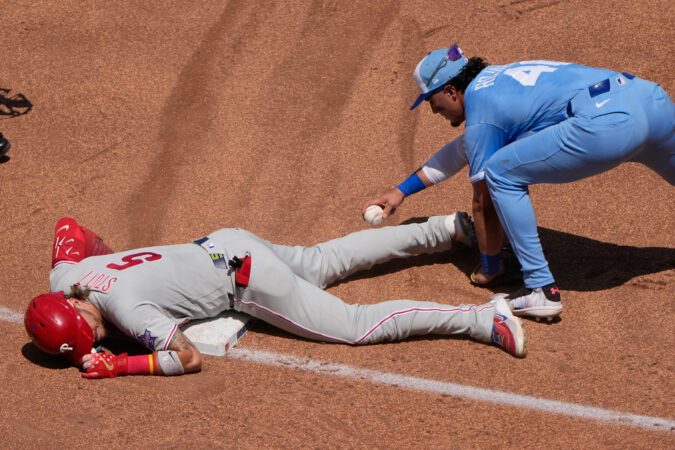
    But Don Mattingly stuck with Nola, who struck out the side to punctuate his best start of the season, the extent of the good news for the Phillies in a series-evening 5-2 loss to the Royals.

    Here’s the thing, though: It would be really good news for the Phillies if three runs on seven hits in seven walk-free innings was the start of a turnaround for Nola.

    “It’s obviously important that [Nola’s] start turns into a [future] game that you feel like you’re in, you’re not scrambling the whole day,” Mattingly said. “It doesn’t necessarily have to be seven. But if we’re in the game through six, five, seven, whatever that is, then it gives us a lot better shot to be able to put some runs up.”

    OK, so that last part didn’t happen on this toasty day in the Midwest. The Phillies generated five hits, including two after the fifth inning. And unlike Saturday night’s series opener, the Royals kept them in the ballpark.

    At least the Phillies were able to look forward to sending Cristopher Sánchez to the mound for Monday’s rubber game.

    Other than Nola — and the pregame ceremony, in which bench coach Dusty Wathan’s dad, John, went into the Royals’ Hall of Fame — there wasn’t much to look back on.

    In that case, let’s talk about Nola, who entered with a 6.04 ERA, second-worst among 64 pitchers who qualified for the ERA title, and gave up hits to three of the Royals’ first five batters.

    Here we go again?

    Not exactly.

    After allowing two first-inning runs on back-to-back singles by Lane Thomas and Michael Massey, Nola knuckled down. Leading again with his signature curveball, he held the Royals off the board save for a fifth-inning run on a leadoff double and a sacrifice fly.

    Nola threw 98 pitches; 31 were curveballs, and 11 of those generated swings and misses.

    “Yeah, curveball felt good,” he said. “Better than it had been in some previous starts. I had a couple ones that kind of popped out [of his hand] a little bit, but overall they felt pretty sharp.”

    Sharpening the curveball was a focus for Nola between starts. His also worked on his changeup, a vital weapon for him against left-handed hitters. Specifically, he wants the changeup to move downward rather than “wiping out to the right side” and into the swing paths of left-handed hitters.

    The Phillies also paired Nola with third-string catcher Garrett Stubbs in hopes of rekindling success that they’ve had working with one another in the past. Nola and Stubbs navigated the Royals’ weak lineup mostly with offspeed pitches. He threw as many changeups (19) as fastballs (19).

    “It’s always a plan to go in and throw that [changeup], just depending on how it’s working and feeling that day,” Nola said. “Today it felt really good, and we threw it quite a bit.”

    Nola was at 83 pitches after six innings. Trailing 3-2 and with the bottom of the Royals’ order due to bat, Mattingly let Nola go back out for the seventh inning. Nola wound up completing the seventh for the first time since he went eight innings last Sept. 26.

    “I felt like he was throwing the ball as good as anybody,” said Mattingly, who had two relievers warming just in case. “I felt like he’d handled those guys pretty well. If anybody gets on there, we’re not going to let him try to face the top of the order. But he got his guys.”

    Nola appreciated the opportunity.

    “Yeah, it’s been a while since I threw seven,” he said. “It’s the first time this year. I don’t know. Felt pretty good. I don’t think I had any walks, which is a plus.”

    Especially if Nola is able to keep it going Friday in Detroit, his last start before the All-Star break.

    The Phillies are already searching for a No. 5 starter after optioning Andrew Painter to triple A last month. Pitching coach Caleb Cotham was encouraged by Painter’s second start for Lehigh Valley: one run on four hits and no walks in six innings Saturday in Rochester, N.Y.

    Mattingly didn’t rule out a swift return to the majors for Painter.

    “I think everything’s on the table,” he said. “I never had any feeling that it was sending him out and forgetting about him, right? It was send him out to work on stuff and help him get better. So, I think anything could happen.”

    Even a resurgence for Nola.

  • An award, a quick stop at Jim’s, and Rita’s water ice: Colman Domingo’s July 4th in his hometown

    An award, a quick stop at Jim’s, and Rita’s water ice: Colman Domingo’s July 4th in his hometown

    It might not have been a long time, but Colman Domingo certainly seemed to have himself a good time during a whirlwind 24 hours in Philadelphia for Saturday’s Fourth of July festivities.

    The West Philly native and Emmy Award-winning actor was in town to accept an award from Mayor Cherelle L. Parker as part of the city’s Semiquincentennial celebration. And he did what many Philadelphians would do to deal with the heat: eat a cheesesteak and wash it down with a water ice.

    “Oh Philly! A time was had in 24 little hours,” Domingo wrote on Instagram on Saturday, with photos from a variety of Philly sites and restaurants, posing with his husband, Raúl Domingo. “Thank you to Mayor Parker for the tremendous honor this morning at Constitution Hall. Got me a cheesesteak and a water ice and I am good!”

    Domingo, who has vaulted to stardom through roles in HBO’s Euphoria and the Academy Award-nominated film Sing Sing, among others, joined the throngs of visitors that filled the city for the celebration of America’s 250th birthday.

    The actor stopped at South Street, where he patronized Jim’s South Street and Rita’s Italian Ice & Frozen Custard.

    “We were in here doing our thing like normal, and [people] were like, ‘Oh, my God,’” Earon Waiters, the manager at Jim’s, said of Domingo’s surprise appearance.

    “He’s a very down-to-earth, chill guy, funny, real relaxed — very pleasant to talk to,” Waiters added. “Some staff recognized him immediately, but he didn’t want any special treatment; he went through the line, placed his order.

    “He was really cool.”

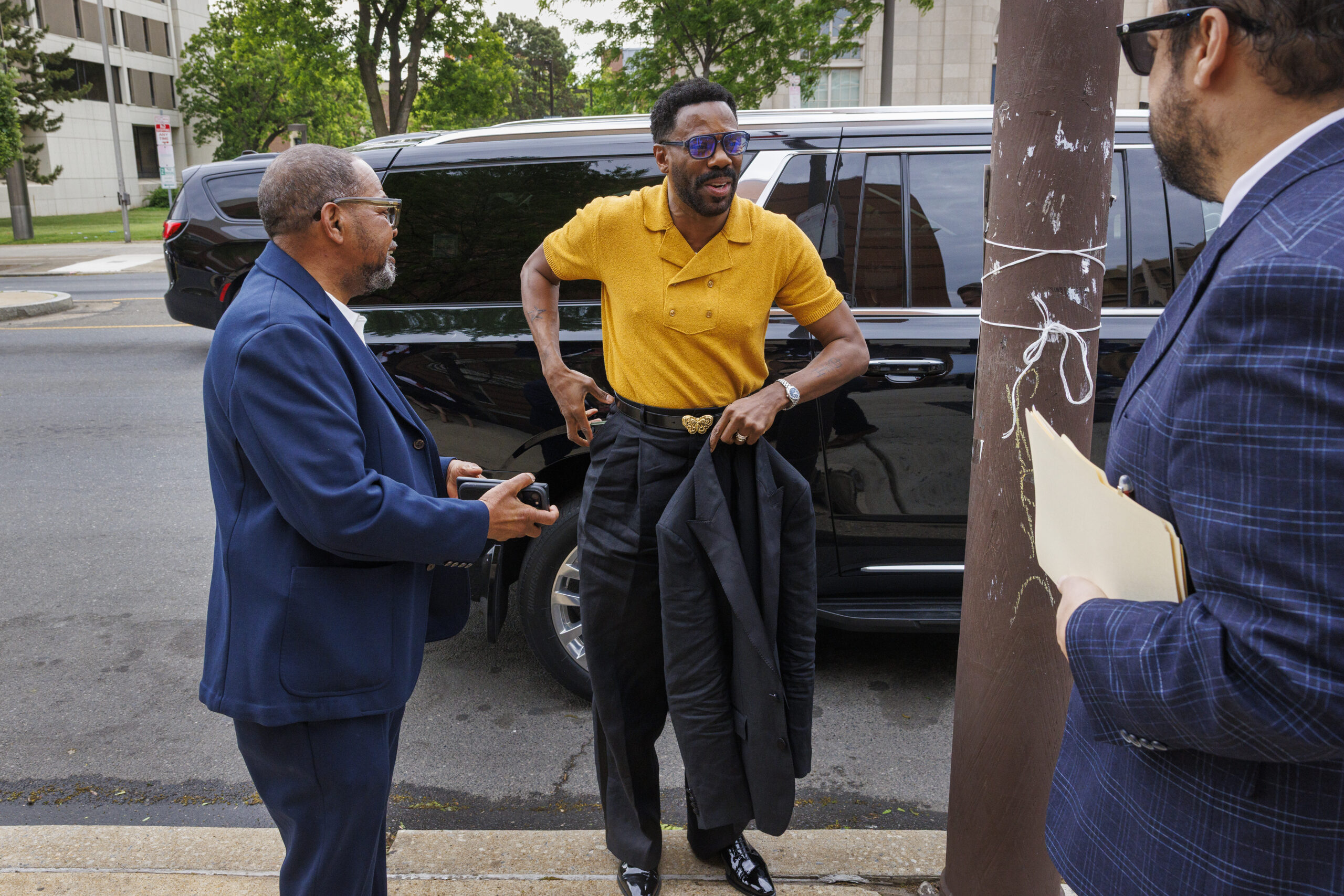
    Colman Domingo, actor and former Temple University student, arriving at graduation at Temple University on May 6, 2026. He was awarded an honorary degree during Temple’s 139th Commencement ceremony and gave the commencement address.

    Waiters said Domingo was at the restaurant for about a half hour, eating and taking photos with customers and members of the staff.

    Asked about Domingo’s order, Waiters paused to check with the cooks.

    “They say he ordered a Whiz with onions,” he reported back.

    (His cheesesteak order, the actor told The Inquirer in 2023, consisted of “cheesesteak with Whiz, grilled onions, salt, pepper — you always gotta say salt, pepper, ketchup — pickle, and sweet peppers.” )

    Domingo’s stop at Rita’s — a few minutes’ walk from Jim’s — was more covert.

    Aaliyah Neal, an employee at Rita’s, was working on Saturday when Domingo stopped by with a group of people. She didn’t immediately know for sure it was him, she said, as he was wearing a hat and sunglasses.

    “Him and all the people he was with were very nice,” said Neal, who recognized the actor from Euphoria and his role in Michael, the recent Michael Jackson biopic. “I recognized him, but … I wasn’t sure if it was him. I didn’t ask, because I didn’t want to bother him.”

    “He got a small water ice — I just don’t remember the two flavors he had gotten,” she added.

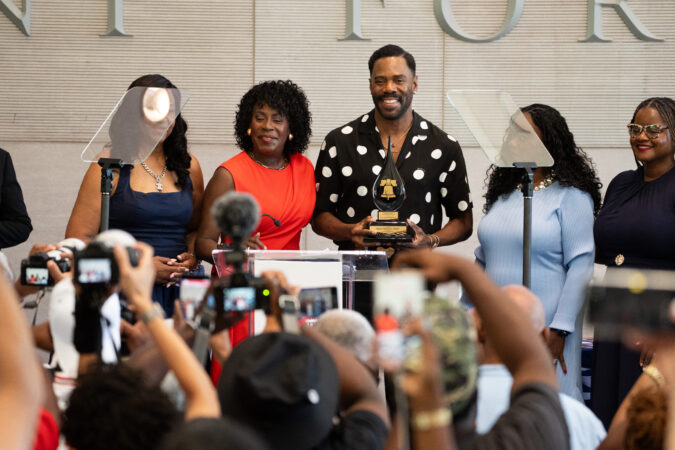
    Colman Domingo and Mayor Cherelle L. Parker, at the Constitution Center during the City of Philadelphia Celebration of Freedom event on July 4, 2026.

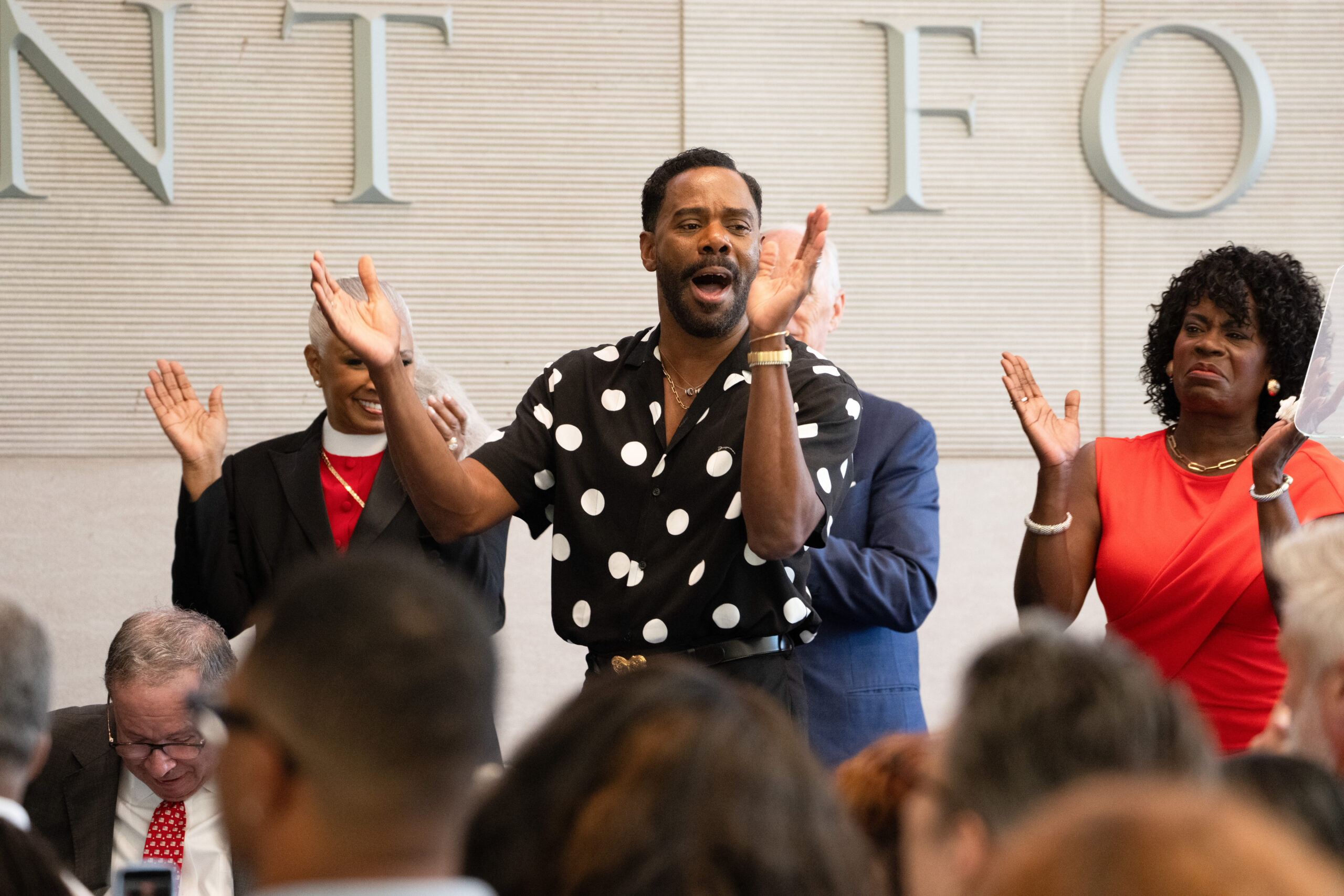
    On Saturday, the actor was honored, along with six others, during a ceremony at the National Constitution Center celebrating the nation’s Semiquincentennial. Domingo, who attended Temple University, was presented with the “One Philly Award for the American Voice” by Parker.

    His social media post included a photo of him with WDAS host Patty Jackson and singer Yolanda Adams, who sang the national anthem at the event.

    As he often does, Domingo spoke glowingly of the city that shaped him.

    “Philadelphia, I love you so much,” he said in his address to the gathered crowd. “I love the people, the spirit. And baby, let me tell you something, when people say, ‘Where do you get your style from?’ I said, ‘I come from Philly.’ ‘Where do you get your work ethic?’, ‘I come from West Philly.’ ‘Where do you get your stride?’ I said, ‘Just look around at the people in Philly — they’ll show you everything.’”

  • Brandon Marsh joins Jhoan Duran as first-time All-Star: ‘It hasn’t hit me yet’

    Brandon Marsh joins Jhoan Duran as first-time All-Star: ‘It hasn’t hit me yet’

    KANSAS CITY, Mo. — Brandon Marsh tried not to think about it. Even as the periodic voting updates rolled in, he claimed to be concerned only with the Phillies’ next game, not the All-Star Game.

    Yet here he was Sunday, finally yielding to his inner 10-year-old over the fulfillment of a lifelong dream.

    “Growing up as a kid, playing in the backyard with the Wiffle bats, you always want to be an All-Star,” said Marsh, one day after being named not only to the National League roster but voted in as a starter by the fans. “You always want to call yourself an All-Star growing up. I’m thankful for all the people that voted, all the fans.”

    Marsh led NL outfielders in the final phase of the fan balloting. The support was merited. Entering play Sunday, he was sixth in the NL batting race with a .310 average. He had the Phillies’ third-best OPS (.856) and was settling into the cleanup spot behind Bryce Harper.

    Five Phillies players were selected for the All-Star Game on July 14 in Citizens Bank Park, with Marsh and closer Jhoan Duran as first-timers. Harper was named to his ninth All-Star Game as the commissioner’s pick, while Kyle Schwarber will make his fourth All-Star appearance and Cristopher Sánchez his second.

    “It’s a dream come true,” Duran said. “I always wanted to be there, and it happened this year.”

    Brandon Marsh was sixth in the NL with a .310 batting average through Saturday.

    Marsh took a winding path to the All-Star Game — in Philly, no less.

    Drafted in the second round by the Angels in 2016, Marsh made his major-league debut in July 2021 and got traded to the Phillies a year later for catcher Logan O’Hoppe. They envisioned him as their future center fielder, but eventually moved him to left.

    And as recently as last winter, even after Marsh batted .303 with an .836 OPS over the final five months of last season, the Phillies were intent on using him in a platoon role because it didn’t seem he would solve left-handed pitching.

    “To be honest, I came into the year having zero expectations for myself personally,” Marsh said. “I feel like I’ve learned that from a lot of the great players in this game. So, I didn’t have many expectations, and I think that’s honestly helped a little bit, just not pressing so hard and stuff like that.”

    Marsh started fast, with two doubles on opening day. But like the rest of the Phillies, he has thrived under interim manager Don Mattingly, batting .315 with 11 homers and an .882 OPS in 59 games entering Sunday.

    In a team meeting Saturday, roughly one hour before the series opener against the Royals, Mattingly held a team meeting to inform the All-Stars of their selections. Marsh didn’t have much time to process it. Not with a game to play.

    “Really, it hasn’t hit me yet, to be honest with you,” Marsh said. “Tonight, when I have a lot of time on my hands after the game, I’ll sit down and I’ll have my moment and just just wrap my head around everything and realize how special it is and how much of an honor it is to be in this in this position.”

    Surely, Marsh will think about his dad, Jake, who died in 2021 due to throat and neck cancer.

    “He’s got the best seat in the house, you know?” Marsh said. “He gets to watch from the front row. I think he’d be super proud. He’s a big reason of why I do it.”

    Phillies ace Cristopher Sanchez is a candidate to start the All-Star Game for the National League.

    A start for Sánchez?

    If Sánchez wasn’t already the leading candidate to be the NL’s starting pitcher, consider this: Brewers ace Jacob Misiorowski is lined up to start the final game before the break, leaving him unable to unleash his historic fastball in the All-Star Game.

    Sánchez, meanwhile, will pitch Monday in Kansas City and again Saturday in Detroit. Mattingly said Sánchez could pitch one inning in the All-Star Game on what would be his between-starts bullpen day.

    What would it mean to Sánchez to get the start?

    “Still a couple of [starts] left,” he said through a team interpreter. “We’ll just have to wait and see.”

    Regardless, Sánchez said he expects to have at least 20 family members and friends in attendance at the All-Star Game.

    “Super excited and happy,” said Sánchez, who has a 2.00 ERA in 18 starts, second in the majors to only Misiorowski. “All the hard work that we’ve been putting in, it was worth it.”

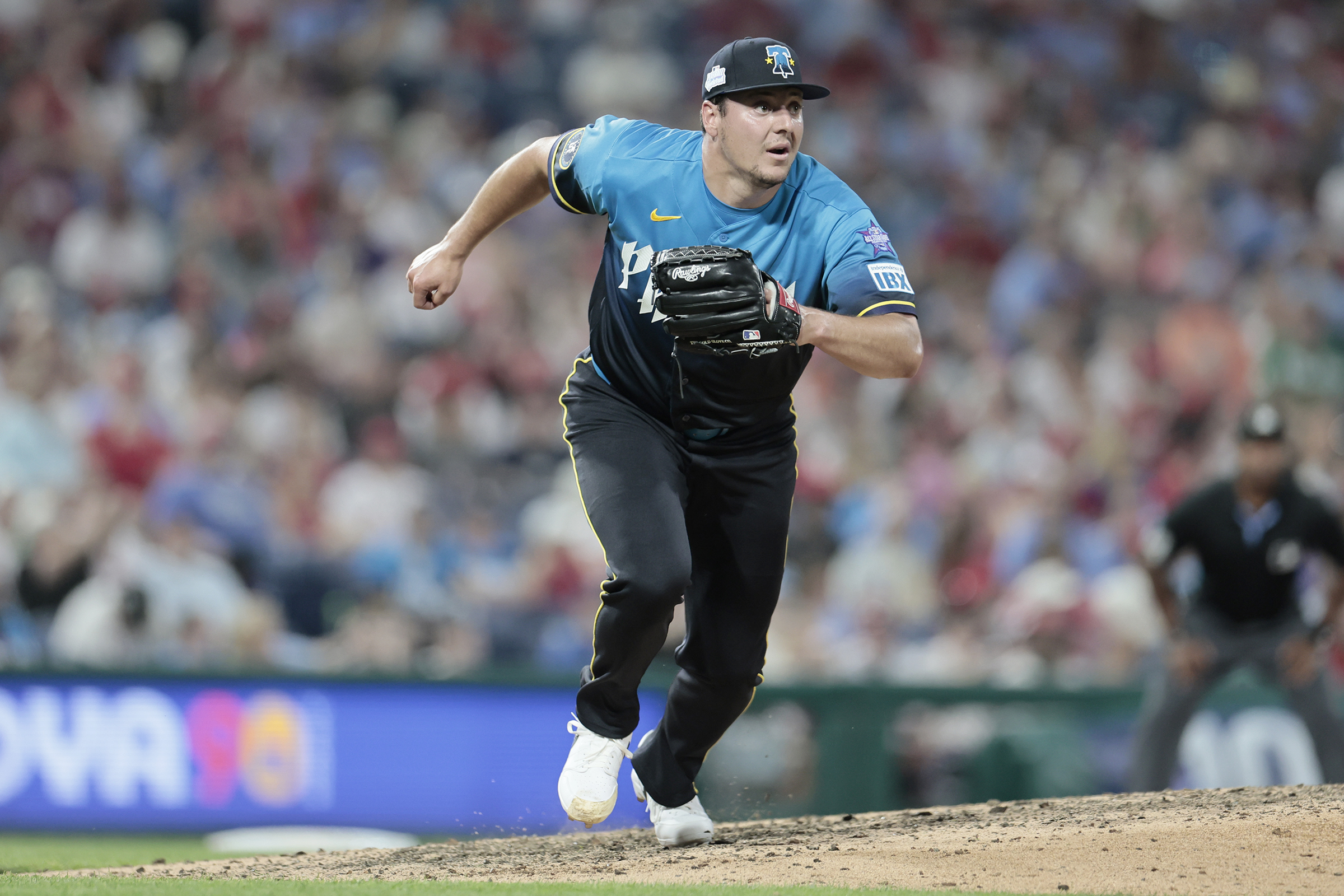
    Phils pitcher Brad Keller runs to cover first base during the Chicago White Sox at Philadelphia Phillies MLB baseball game at Citizens Bank Park in Philadelphia on Friday, June 5, 2026.

    Extra bases

    Reliever Brad Keller (right forearm tendintis) pitched a scoreless inning for triple-A Lehigh Valley in Rochester, N.Y. He could be reinstated from the injured list and rejoin the Phillies’ bullpen as soon as Tuesday night, according to Mattingly. … With a fastball-heavy approach (35 four-seamers out of 69 pitches), Andrew Painter allowed one run on four hits in six walk-free innings Saturday in triple A. … Bench coach Dusty Wathan’s dad, John, was inducted into the Royals’ Hall of Fame before the game. John Wathan was Kansas City’s catcher for 10 years and managed the Royals from 1987-91. … The Phillies signed triple-A outfielder Bryan De La Cruz to a major-league contract, added him to the 40-man roster, and optioned him to Lehigh Valley. De La Cruz exercised an opt-out in his minor-league contract, prompting the move. Right-hander Jean Cabrera, who has a 9.10 ERA between triple A and double A, was designated for assignment. … Sánchez (10-3, 2.00 ERA) will be opposed by Royals lefty Noah Cameron (4-6, 4.95) in the series finale Monday at 2:10 p.m. ET.

  • Philly’s delayed late-night fireworks were prompted by safety and weather concerns, city says

    Philly’s delayed late-night fireworks were prompted by safety and weather concerns, city says

    Philadelphia’s late-night fireworks display was prompted by concerns over safety and a poor long-range weather outlook, city officials said Sunday morning, as work crews were busy cleaning up Philadelphia’s Benjamin Franklin Parkway from the July Fourth celebration.

    A massive Liberty Bell display still hung over the stage near the Philadelphia Art Museum, where hours earlier Meek Mill, Will Smith, and backing band the Roots were the last to perform at the One Philly: Unity Concert for America. Gone were the fireworks and revelers, but the white tents, chain-link fencing, and long rows of porta-potties were reminders of a concert that lasted until nearly 2:45 a.m.

    It wasn’t supposed to go that long. But a summer storm around 9 p.m. rolled in with intense wind gusts, rain, and lightning, leading the city to evacuate the Parkway.

    The city didn’t have an official number, but estimated that “thousands” of concertgoers returned, just after midnight, to get the party started again. So did the performers, with the exception of Christina Aguilera.

    Items from last night’s festivities on the Ben Franklin Parkway wait to be picked up in Philadelphia on Sunday, July 5, 2026.

    Mayor Cherelle L. Parker said she trusted the experts and welcomed people back to the concert venue once it was safe.

    “I want to thank the Roots and all of their incredible guests for their relentless energy and for delivering an incredibly inspiring performance worthy of America’s 250th birthday,” Parker said in a Sunday news release.

    The decision to proceed with the fireworks was made by city experts, led by Managing Director Adam K. Thiel, and the mayor was informed, said Parker spokesperson Joe Grace.

    The weather forecast factored into the decision, Grace said. The city will be under a flood watch starting at 2 p.m., and rain and storms are likely over the next 10 days, so postponing the fireworks to another day did not make sense, he said.

    “Once fireworks are loaded, they cannot be safely unloaded,” Grace said. “From a safety and operational standpoint, completing the fireworks display was the right decision.”

    Some detractors of the late fireworks display turned to online forums to complain about the noise.

    “Ok so I wasn’t dreaming. I was actually awakened by an officially sanctioned fireworks display at 2:30 a.m.,” one Reddit user wrote.

    Comment
    by
    u/southphillydadbar from discussion

    in
    philadelphia

    Mykola Kosyk of Fairmount said it was disappointing that the city waited until nearly 3 a.m. — far too late for children — for a show that lasted only about 10 minutes.

    “It was the worst fireworks display ever,” Kosyk said. He called it a “basic display” that wasn’t on par with the historical significance of the Semiquincentennial.

    Kosyk says he collects fireworks memorabilia dating back to the 1800s, and he and his wife travel the state visiting fireworks displays. He said the company putting on the show, Pyrotecnico, is “well-renowned,” and he blamed the city for not planning a better show.

    As the smoke from the fireworks show settled around 3 a.m., the city’s Department of Sanitation sent out approximately 100 laborers and 50 trucks to clean up the Ben Franklin Parkway and the surrounding area, the city said in the news release.

    By morning, much of the mess was gone. Security magnetometers sat in a pile, ready to be picked up and taken away, while dozens of staff from Imperial Events Services worked to keep runners and curious onlookers out of what was supposed to be a secure area.

    “The joggers are mad at us,” said one staffer, as his team found a gap in the fence that allowed people into the closed-off area.

    Workers dismantle the stage from last night’s concert along the Ben Franklin Parkway in Philadelphia on Sunday, July 5, 2026.

    One visitor was disappointed that the stage breakdown temporarily blocked the front of the Art Museum.

    “We want to see the Rocky steps, but we can’t,” said Angelika Gamez, who flew in from Bogota, Colombia, for the France-Paraguay soccer match Saturday.

    Still, Gamez said her visit to Philly was amazing, weather aside.

    “It was very hot. In Colombia, we don’t have seasons like this.”

  • Peco contract negotiations continue as union members remain on strike

    Peco contract negotiations continue as union members remain on strike

    Peco and its striking unionized workers continued contract negotiations on Sunday, the second day of a strike that occurred as the region was affected by power outages caused by severe storms.

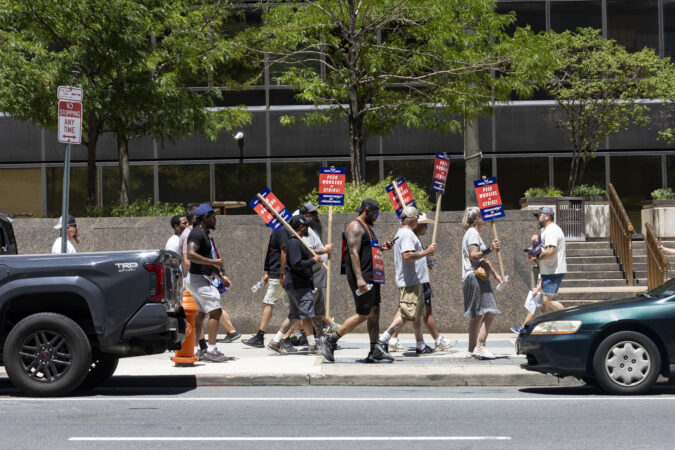
    A dozen striking workers were picketing at Peco’s Philadelphia office on the 2300 block of Market Street, as the company and the International Brotherhood of Electrical Workers Local 614 continued talks.

    The two sides have differed over wages and benefits, with the union seeking to have all of its roughly 1,500 members covered by pensions — 600 of them currently are not.

    It is the first strike in the company’s history.

    Peco has said its contingency plan should prevent customers from experiencing delays or interruptions in service. The company has also said that its contract offer is competitive and fair for employees and customers, adding that it has also offered improved retirement benefits.

    Bargaining was expected to continue through Sunday, according to Melissa McCleery, a union spokesperson.

    Peco’s latest offer, according to Larry Anastasi, president and business manager of IBEW Local 614, would give call center workers a lower wage increase than the rest of the union members. According to the union, 98% of call center workers are women.

    “We will not accept a contract that undercuts the women of our union,” Anastasi said in a statement.

    The company’s current offer, the union said, would bring an average annual wage increase of 3.5% for non-call center workers, between 2027 and 2031. Call center workers would receive 3% annual wage increases in the same time frame.

    To Anastasi, that is unacceptable.

    “Any deal that leaves the call center behind is a deal that will not be signed,” he said in a statement. “PECO’s proposal is an attempt to drive a wedge between our members and that’s not going to work.”

    The company rejected the union’s characterization of its offer.

    “To suggest that PECO would undercut the women of our union is ridiculous,” said a company spokesperson in a statement. “PECO values the contributions of all represented employees, including our customer care professionals, and we reject any suggestion that our goal during negotiations was to diminish the importance of any employee group.”

    The company said that its customer service workers’ average hourly pay is $45.12, well above regional benchmarks of $23.80 for customer consultants and $30.91 for specialized consultants.

    The striking workers in Philadelphia spent a long day in the sun on Sunday, bringing water bottles, coolers, and lawn chairs. They arrived on Market Street as early as 6 a.m., the union said.

    Pulling a megaphone he said he found in his children’s room, union member Tom Jarozynski yelled: “Peco, can you hear us?”

    As cars drove by beeping in support, Jarozynski continued: “What do we want?”

    “A contract,” the crowd replied.

    “When do we want it?”

    “Now.”

    On Saturday, the company said that federal mediation had been offered for the talks. Peco said it had accepted the offer for mediation, but the union did not. An IBEW spokesperson said union negotiators were busy bargaining and not available to answer questions about mediation.

    The union said workers plan to picket at different Peco locations until a contract is reached.

  • Victoria Cruz, veteran of the trans rights movement, dies at 79

    Victoria Cruz, veteran of the trans rights movement, dies at 79

    Victoria Cruz, a matriarchal figure in the New York transgender community who was at the Stonewall Inn in 1969 when a police raid set in motion the gay liberation movement, and who later worked as an advocate for survivors of antitrans violence, died on June 25 in New York City. She was 79.

    Her partner, Charles Wright, confirmed the death, in a hospital, and said the cause was liver cancer.

    Ms. Cruz spent 17 years working for the New York City Anti-Violence Project, which provides counseling and other services for LGTBQ+ and HIV-affected survivors of violence. There, she focused on domestic abuse, but her role in the organization — and in the community — extended far beyond her official duties.

    She understood the intersectional threats that trans people faced in areas like housing discrimination and workplace harassment — expertise that made her a unique resource to thousands of trans New Yorkers.

    “People would come into the office and just ask for Miss Vicky,” Catherine Shugrue-Dos Santos, a former deputy executive director at the organization, said in an interview. “They wouldn’t give their names; they wouldn’t talk to anybody else. She really had the trust of the community.”

    She was especially effective because she came to the group as a survivor herself: In 1996, while working at a nursing home in Brooklyn, she was repeatedly harassed and assaulted by four co-workers.

    “I was very angry. Very angry,” she told Vanity Fair in 2017. “The worst part of it is that I couldn’t feel the ground beneath me.”

    One day she brought a knife to work, intent on fighting back, but then thought better of it. A friend suggested she contact the Anti-Violence Project, which at the time was run by Christine Quinn, who later became the first female and first openly gay speaker of the New York City Council.

    The group helped her file police reports and led protests outside the nursing home. Eventually, two of the four co-workers were convicted of harassment — one of the first times that someone was held legally accountable for antitrans violence in New York State.

    Quinn brought Ms. Cruz on as a volunteer, then hired her to manage the front desk. The job also had her answering the organization’s hotline, a task that connected Cruz with countless at-risk New Yorkers.

    “She was perhaps the strongest person I have ever met,” Quinn said in an interview. “She was part of the birth of the modern LGBT rights movement in New York, and therefore across the country. She was someone who had survived a terrible sexual assault and transformed that horrible moment into beaconlike strength that you felt whenever you were around her.”

    Ms. Cruz was a central figure in David France’s 2017 documentary, The Death and Life of Marsha P. Johnson, about the 1992 death of a trans activist that police ruled a suicide, but many, including Ms. Cruz, suspected was murder.

    The documentary tracks her search for answers and ends with her conclusion that Johnson was murdered by the mafia.

    Ms. Cruz did not know Johnson, but their lives overlapped. Both were at the Stonewall Inn on the night of June 28, 1969, when police conducted one of their routine raids at the bar. This time, though, the largely transgender clientele inside fought back, and a riot ensued.

    Ms. Cruz had been outside with her boyfriend, one of the bar’s bouncers. As the violence escalated, he told her to go home. When she returned in the morning, she found the bar in ruins. She grabbed a beer sign and other memorabilia, and also took home the bar’s dog, Rusty.

    The Stonewall riot sparked the beginning of the gay liberation movement, which had a strong trans presence. Johnson and another well-known community figure, Sylvia Rivera — a friend of Ms. Cruz’s — became particularly active, ensuring that trans people had a place within the movement.

    Ms. Cruz played a quieter role, but over time she became a central figure as well — and a recognizable one, with her homemade outfits topped with a headband adorned with feathers and cowrie shells, in honor of her heritage as a descendant of the Taíno people of Puerto Rico.

    “She was an elder in that community,” France said in an interview. “She was a transgender woman of color who had lived into old age, which is so rare.”

    Victoria Cruz was born on Sept. 19, 1946, in Guánica, on Puerto Rico’s southwestern coast. When she was 4, her family moved to the Red Hook section of Brooklyn, where her father worked as a longshoreman; her mother was a seamstress.

    She identified as female from an early age, and her family was strongly supportive. Her mother made her dresses, and her father, who affectionately called her “El Negro,” on account of her dark skin, switched to using the word’s feminine form, “La Negra.”

    She studied cosmetology in high school and worked as a model, but soon found both routes closed to her because she was trans.

    After high school, she found a doctor in Coney Island who provided her with the medical treatment to help her transition.

    Through the 1970s she was a sex worker and a dancer in West Village clubs. She also developed an addiction to crack cocaine, though she eventually became sober.

    She enrolled at Brooklyn College in 1978 and graduated four years later with a degree in theater.

    But she continued to struggle financially, and ended up on public assistance. The program required her to work, which is how she ended up on the staff at the Brooklyn nursing home.

    Her survivors include Wright and her sister Hedye Cruz. A complete list of survivors was not immediately available.

    In 2012, Ms. Cruz received the National Crime Victims’ Service Award from the U.S. Department of Justice.

    In an interview for the Anti-Violence Project in 2022, Ms. Cruz explained why she committed her life to counseling.

    “If you have been in that situation — everybody’s situation is different but similar,” she said. “If you have the empathy to help out people, that’s half the ordeal. Just having the empathy and letting them know that you’re there to help them, not to judge them.”

    This article originally appeared in the New York Times.

  • Supreme Court’s dramatic moves will reshape elections — and give the GOP a midterm boost

    Supreme Court’s dramatic moves will reshape elections — and give the GOP a midterm boost

    The Supreme Court dramatically reshaped elections in recent months, sharply limiting a law that has been a cornerstone of minority voter empowerment, allowing states to gerrymander maps, and loosening campaign finance regulations.

    The conservative majority says the series of decisions helps correct an election system that has run afoul of the Constitution. In rulings, they cite ideas they have long championed — undoing programs that advantage minorities, allowing partisan redistricting, and eliminating restrictions that impinge on free speech rights.

    Most of the rulings, which have rolled out as the country heads toward pivotal midterm elections, benefit Republicans. That’s led critics — starting with some of the court’s liberal justices — to complain the court’s conservative majority has gone beyond enunciating broad legal principles and put a thumb on the scale in upcoming races.

    What is clear is that the Supreme Court has tilted this fall’s electoral landscape toward Republicans as they struggle with voter discontent.

    In one of the most consequential rulings of the term, the conservative majority in April significantly weakened the Voting Rights Act’s last pillar, which required states to draw congressional districts to ensure the voting power of minorities under certain circumstances. In its opinion, the court said the protection was no longer needed by a country that has made “great strides in ending entrenched racial discrimination.” That decision touched off a push by Republican-controlled states to eliminate districts mostly held by Black Democrats across the South.

    Other rulings cleared the way for specific voting maps preferred by Republicans. And one loosened campaign finance limits — a change that brings the most immediate boost to Republican candidates.

    Democrats notched few outright victories, but they avoided some outcomes that they would have viewed as particularly disruptive. In one case, the court allowed states to continue to tally mail-in ballots even if they arrive after Election Day. Mail voting in recent years has become more popular among Democrats than Republicans.

    Legal experts said the justices’ intervention amid an election cycle and the pace at which the court is moving to implement changes that largely benefit one party is all but unprecedented in recent years.

    Richard L. Hasen, an expert in election law and political science at UCLA, said Chief Justice John G. Roberts Jr., who is known for his slow, methodical approach, lately appears to be a justice “in a rush.”

    “The court has been moving toward weakening voting rights, freeing up campaign money, and letting partisan actors run loose — that’s not a new trend,” Hasen said. “But the speed with which things are happening is much faster.”

    The decisions represent a dramatic coda to more than a decade of work by the justices, who have rewritten election law under Roberts in ways that one analysis found have pushed it to the right of any other court over the past 70 years.

    Republicans face an uphill battle in November’s contests because the president’s party historically loses seats in the midterms, and Trump’s low approval rating, the high price of gas, and the unpopular conflict in Iran have been a drag on GOP candidates.

    Democrats have a shot at taking the House and Senate, but the Supreme Court’s moves have erected a higher hurdle. Today, Republicans control 219 seats to Democrats’ 212 in the House, while Republicans enjoy a more solid advantage in the Senate, with 53 seats to 47.

    Earlier this year, the nonpartisan Cook Political Report had rated 217 House seats out of 435 as leaning Democratic, and projected Democrats needed to win only one of the tossups in November to capture the House.

    Cook recalibrated after the Supreme Court’s landmark Voting Rights Act ruling sparked the push to redistrict. It now lists 206 House seats as leaning toward Democrats, meaning Democrats need to win at least 12 of 18 tossups to gain control.

    “The fundamental question for 2026 is whether or not the structural firewall that Republicans have built up around their majority is strong enough to withstand what is shaping up to be a punishing political environment,” said Amy Walter, the publisher and editor of Cook.

    Democrats have issued bitter recriminations over the rulings as polling shows many in their base believe the court’s rulings are motivated by politics.

    “This is the most partisan Supreme Court in the history of the nation,” Sen. Ruben Gallego (D., Ariz.) recently posted on X.

    Roberts publicly addressed such criticisms at an appearance in early May, denying politics was a factor in the court’s rulings.

    “I think at a very basic level, people think we’re making policy decisions. … We’re saying we think this is what things should be as opposed to this is what the law provides,” Roberts said. “I think they view us as truly political actors, which I don’t think is an accurate understanding of what we do.”

    In its latest ruling, the court struck down limits on political parties spending money in coordination with candidates, finding they violated parties’ constitutional free-speech rights. Justice Brett M. Kavanaugh, writing for the majority, said the ruling ”treats all political parties equally” and will allow them to “participate more freely and compete more fully in the political process.”

    It’s unclear which party will benefit long term, but there’s one clear winner for the midterms: the GOP.

    Republican party committees have amassed a more than $100 million advantage over their Democratic counterparts, some of whom have struggled to raise money.

    Several of the high court’s other rulings have centered around how officials split their states into voting districts, creating maps that can give either political party an edge.

    In one of its earlier cases of the term, the high court greenlit Texas Republicans’ unusual move to redraw the state’s congressional maps between censuses, an effort that touched off a nationwide redistricting war. The decision could net the GOP up to five additional congressional seats in Texas alone.

    The justices later blocked New York from redrawing the district of Republican Rep. Nicole Malliotakis. That reversed the mandate of a state court, which had ordered officials to include more Black and Latino voters, a change that could have likely flipped the seat to Democrats.

    And in May, the court rejected a longshot emergency bid by Virginia Democrats to revive a gerrymandered voting map that would have allowed the party to pick up as many as four seats in the House in November.

    In its most sweeping decision of the term related to voting, the high court pared back a key part of the Voting Rights Act known as Section 2 that required states to draw maps that help minority communities elect candidates of their choice under certain circumstances. In the process, the court struck down a second Black-majority district in Louisiana, saying it was an unconstitutional racial gerrymander.

    With the help of the ruling, Republicans have drawn 16 districts with more favorable lines since last year, compared to six for Democrats.

    In the wake of the VRA ruling, a complicated fight over Alabama’s congressional map has raised questions about what room remains for minority communities to pursue claims that discriminatory redistricting violates the Constitution, possibly signaling even greater gains for Republicans.

    In June, the high court allowed Alabama to revert to a map with one Black-majority congressional district instead of two, a move that will likely flip a Democrat-controlled seat to the GOP.

    The decision came over a lower court finding that Alabama intentionally discriminated against the state’s Black voters in creating the map and then defied a court order to remedy the racial bias. In its ruling, the high court’s majority rejected that finding, citing “our colorblind Constitution.”

    The ruling was notable because the conservative majority held its Voting Rights Act ruling did not disturb the Constitution’s protections for minorities from “present-day intentional racial discrimination regarding voting.”

    But voting rights and minority advocates said the Alabama ruling indicates that protection might be a dead letter. Deuel Ross, director of litigation at the Legal Defense Fund, which advocates for racial justice, said in a statement he worries minority groups will lose political power.

    “The Supreme Court’s decision gives cover to Alabama and others to deliberately and openly discriminate against Black voters without fear of any consequence,” Ross said.

    Not every case went Republicans’ way. The Supreme Court dealt the GOP a setback when it upheld a Mississippi law that allows mail-in ballots to arrive up to five days after polls close. The ruling could have affected 13 other states with similar laws. Voting by mail is particularly popular with Democrats.

    Nevada Secretary of State Cisco Aguilar (D), who oversees elections in his battleground state, praised the Watson v. Republican National Committee case on mail ballots, but said the decision meant less in light of other rulings this term.

    “The fact that they destroyed the Voting Rights Act is detrimental to the fundamental foundation of our democracy,” he said. “Yes, they may have done something with Watson, but in the totality of it, the Supreme Court has become politically active in the overall administration of our election.”

    The clearest win for Democrats came when the court allowed California to gerrymander its voting maps to give Democrats up to five additional House seats. The California push came in response to Texas’ move to redraw its maps.

    The court’s liberals and some legal scholars have not just taken issue with the substance of the court’s decisions, but how the justices have arrived at them.

    The Supreme Court has regularly invoked the Purcell principle, a doctrine that holds federal courts should not change election law too close to elections because it can create confusion among voters.

    In the Texas redistricting case in December, with primary elections a few months away, the conservative majority referenced Purcell in allowing the use of redrawn maps favoring Republicans. A lower court had blocked the maps.

    “The District Court improperly inserted itself into an active primary campaign, causing much confusion and upsetting the delicate federal-state balance in elections,” the majority wrote of the primary scheduled for March.

    But in April during an active primary, the conservative majority struck down Louisiana’s second majority-Black congressional district in the Voting Rights Act decision. The seat is held by a Democrat.

    The decision came after thousands of voters had already returned mail-in ballots in the contest. The Supreme Court then expedited the ruling, paving the way for Louisiana Republicans to quickly redraw the district to favor Republicans.

    Liberal Justice Ketanji Brown Jackson issued a sharp rebuke, saying the conservative majority was willing to employ the Purcell principle in the Texas case when it favored Republicans, but ignore it in Louisiana when it did not.

    “The Court unshackles itself from both constraints today and dives into the fray,” Jackson wrote in a dissent. “And just like that, those principles give way to power.”

    Conservative Justice Samuel A. Alito Jr. shot back in a concurrence that the claim the court was acting in a partisan manner was “a groundless and utterly irresponsible charge” and it needed to act to prevent an election in Louisiana from going forward with an unconstitutional map.

    The court’s liberals have also accused conservatives of misusing Purcell in the Alabama and New York redistricting cases.

    Legal scholars differ over whether the court was employing Purcell in an evenhanded fashion. Edward B. Foley, who specializes in election law at Ohio State University, said the rulings were hard to square.

    “They may think they are being principled and consistent, but it sure doesn’t look that way,” he said of the court’s use of Purcell. “This principle seems to favor Republican partisan results.”

    Derek Muller, a Notre Dame law professor who specializes in election law, said he saw a legal logic to the court’s moves.

    “The Supreme Court is stepping back from cases in Alabama and Louisiana. It’s not issuing a rule to alter the rules of the election,” Muller said. “It’s allowing the legislatures to issue the rules they want.”

    The way the court handled the New York redistricting case also became an issue of contention. Liberal Justice Sonia Sotomayor accused the conservative majority of carrying out an “unprecedented” power grab by ruling before a state Supreme Court had a chance to weigh in.

    Sotomayor said the move trampled precedent against federal courts intervening in state court cases while litigation is still ongoing.

    “The Court’s 101-word unexplained order can be summarized in just 7: ‘Rules for thee, but not for me,’” Sotomayor wrote.

    Alito wrote in a concurring opinion that the intervention was necessary because New York courts approved a map that “blatantly discriminates on the basis of race.”

    Justin Riemer, former chief counsel at the Republican National Committee, rejected the notion the court is making partisan rulings, saying it had issued rulings favoring Democrats in recent years.

    He highlighted decisions dismissing a challenge to Trump’s 2020 election loss and rejecting arguments put forward by Republicans in 2023 that state legislatures could set election rules without interference from state courts.

    “I really don’t think that they’re in the tank one way or the other,” said Riemer, president of the group Restoring Integrity and Trust in Elections. “I think they have a judicial philosophy that they apply … that works for the types of claims we bring.”

    The redistricting and campaign finance decisions may provide immediate benefits to Republicans, but they may not last for long, said New York University law professor Richard Pildes.

    Democrats will have opportunities to redraw congressional districts in states they control after the midterms and political parties typically adapt to campaign finance rulings to keep up with their opponents, he said.

    Democratic anger over the decisions is intense, and it could fuel efforts to ban mid-decade redistricting, limit partisan gerrymandering, and pack the Supreme Court with more justices, he said. One Democratic congressman went so far as to introduce articles of impeachment against Roberts.

    “This is a real sort of avalanche that’s kind of been unleashed,” Pildes said.

    Legal experts said the court’s decisions this term are of a piece with its rulings on voting rights and campaign finance over the last 15 years.

    Those include the 2010 Citizens United decision that loosened campaign finance restrictions on corporations and unions, the 2013 Shelby County ruling that knocked down a section of the Voting Rights Act that required states with a history of racial discrimination to get federal pre-clearance to change voting laws, and the 2019 Rucho decision that found federal courts could not hear partisan gerrymandering claims.

    Guy-Uriel Emmanuel Charles, a Harvard law professor who focuses on political power and race, said regardless of which party benefits, this term’s cases could supercharge the era’s bare-knuckle politics.

    “This Court is sending a clear message: It will not impose many limits,” Charles wrote in an email. “The Court is incentivizing political parties to push the boundaries as far as possible to gain an advantage.”


  • Bryce Harper is ‘grateful’ to be MLB commissioner’s All-Star pick. He’s also earned it.

    Bryce Harper is ‘grateful’ to be MLB commissioner’s All-Star pick. He’s also earned it.

    KANSAS CITY, Mo. — Bryce Harper saw the missed call on his phone Wednesday after the Phillies got off the field at Citizens Bank Park.

    Rob Manfred wanted to chat.

    The last time they talked, almost a year ago, it ended with Harper telling the commissioner to “get the [heck] out of our clubhouse” if he wanted to propose a salary cap in baseball.

    But Manfred had something less divisive on his mind. He wanted to use his one selection to name Harper to the National League team for the 96th All-Star Game on July 14 in Philadelphia.

    “Yeah, he called me and told me I was going to be his pick,” Harper said Sunday. “He said that I’ve had a great first half, and I think the numbers kind of speak for themselves. I think I had an opportunity [to be an All-Star]. Obviously with the fan vote it didn’t happen, so he gave me the opportunity. Definitely grateful for that and excited to be there.”

    So, Harper and Manfred are pals now?

    Harper laughed.

    “No, I’m just grateful for the opportunity,” said Harper, a nine-time All-Star, with more selections than any active player except Mike Trout (12), Chris Sale (10), and Freddie Freeman (10). “He left me a voicemail during the game and told me he wanted to talk about the All-Star Game. I wasn’t sure what the question was going to be at that point, but then we talked and he let me know.

    Bryce Harper said, “I think I deserve to be in the game for the way I’ve played.”

    “I think I deserve to be in the game for the way I’ve played, so definitely grateful for it.”

    Indeed, entering Sunday’s games, Harper was tied for 11th in the majors with a .903 OPS and was among 15 players with at least 20 home runs. He was batting .274 with a .374 on-base percentage.

    The numbers are notable. Last October, in a season-ending news conference, Phillies president of baseball operations Dave Dombrowski wondered aloud if Harper, at age 33, was still elite.

    A few days ago, Harper said a reporter asked him if he has answered the question.

    “It’s like, I don’t care,” Harper said. “It’s up to you guys to decide that. Every year, I come in and I’ve got an opportunity to be great at what I do, you know? Like I said, the numbers show right now, they speak for themselves.

    “But I know they can be better. I know I can be better. I’m going to enjoy it, obviously. But I think I can be better than what I’m doing right now.”

    Harper figures he can always swing at fewer pitches out of the zone or draw more walks. The Phillies have four other All-Stars: Kyle Schwarber, Cristopher Sánchez, and first-timers Brandon Marsh and Jhoan Duran. Marsh is a starter in the National League outfield; Sánchez might be the starting pitcher.

    But it wouldn’t have been an All-Star Game in Philly without Harper, the city’s biggest baseball star.

    The question now: Will he be in the Home Run Derby?

    Harper remains noncommittal. Health isn’t a problem. After dealing with wrist and back issues over the past few seasons, he said his “body feels great.” He has started every game so far this season.

    Bryce Harper and Kyle Schwarber are All-Stars. Will they compete in the Home Run Derby?

    The biggest issue: Finding a pitcher. Harper’s dad, Ron, did the honors in 2018, when Harper won the Home Run Derby in Washington, but hasn’t thrown batting practice in four or five years.

    Harper’s phone has been buzzing with offers.

    “A couple ex-players that throw BP now to their kids and stuff,” he said. “I think I can trust a couple of them, but it’s just hard for me, to tell you the truth, not being able to do it with somebody that I’m super comfortable with. You can’t just pick somebody random to go out there.

    “I’m not going to do something if I’m going to have a half-mentality towards it. If I’m going to do it, I want to be full bore and very confident in winning. Because I’m not going to do it unless I’m going to try to win it. Like, I’m not going out there just to have fun. I want to win the thing.”

    Chalk it up to a competitive streak that continues to fuel Harper in his 15th major-league season.

    None other than Phillies interim manager Don Mattingly, a six-time All-Star as a player, marveled at Harper’s nine All-Star selections for both the longevity and level of excellence.

    “I think the first thing that comes to mind is, ‘Not enough,’” said Harper, who has five years left on his Phillies contract and a desire to play beyond that. “I’ve been in the game a long time. Nine’s a big number. But hopefully I’ll have more after the next couple of years.

    “Every number or anything that I look at right now, it’s just I always kind of tell myself ‘not enough,’ you know? Just got to keep going, keep wanting more, and then hopefully get there.”