Blog

  • After a Philadelphia cancer patient ran out of options, a novel T-cell therapy at Rutgers kept her alive

    After a Philadelphia cancer patient ran out of options, a novel T-cell therapy at Rutgers kept her alive

    Jefferson Health oncologist Jennifer Johnson had exhausted all the standard treatment options for her 49-year-old patient with esophageal cancer, who was likely to die within months.

    Surgery, chemotherapy, radiation, and immunotherapy had kept the Northeast Philadelphia woman alive for six years after her diagnosis, but no longer were enough to stop her cancer from spreading.

    Johnson knew her patient needed something novel. She recalled a presentation several years prior at a conference for head and neck cancers, where a doctor discussed an experimental treatment called T-cell receptor (TCR) therapy.

    This type of cancer immunotherapy works by engineering the immune system to fight cancer, and falls into the same family of treatments as CAR-T, or chimeric antigen receptor (CAR) T cell therapy, an approach pioneered at the University of Pennsylvania that has revolutionized treatment for blood cancers.

    She thought TCR therapy’s clever approach could work against solid tumors, where CAR-T had not been effective.

    “I just remember sitting in the room and watching him present, thinking, I’m gonna use that one day,” the oncologist and cancer researcher recalled.

    As it would happen, the approach was being tested in a phase II clinical trial at Rutgers Cancer Institute against tumors just like her patient’s: metastatic cancers driven by a virus called human papillomavirus 16. One of the most common strains, HPV16 causes roughly half of cervical cancer cases worldwide, as well as cancers of the head and neck area, anus, and genitals.

    Cases that reach the metastatic stage like Johnson’s patient often run out of treatment options. Whether T-cell receptor therapy would work was unknown, but the alternatives were expected to fail.

    “Anything that you might offer them would definitely not be expected to make their cancer go away completely and do it for a long time,” said Christian Hinrichs, the oncologist and scientist heading the trial whose presentation Johnson saw.

    But interim results from the first half of the trial showed improvement in six out of 10 patients, whose tumors at least partially shrank. And two of them had no evidence of cancer after treatment.

    Johnson’s patient, Maria Pascale, was one of the two whose promising early results were presented at a medical conference and highlighted in a research abstract in the Journal for ImmunoTherapy of Cancer in November.

    She arrived at the health system in New Jersey in the summer of 2024 in such poor health that her lungs were starting to collapse.

    The therapy has enabled her to celebrate two birthdays, start martial arts classes, reunite with old friends visiting from Argentina, and see her 23-year-old son get engaged.

    “Imagine the wedding, then later the grandkids, I’m always thinking about [that],” she said.

    What is a T-cell receptor therapy?

    In the immune system, T cells act as frontline defenders against viruses, bacteria, and other threats.

    Sometimes, these cells aren’t great at their jobs.

    In the face of cancer, T cells can become exhausted over time, and fail to recognize invaders or mount attacks.

    The idea behind immunotherapy is to transform these regular immune cells into cancer-fighting super-soldiers.

    The Rutgers approach, an engineered TCR therapy, involves collecting T cells from a patient’s blood and genetically engineering them to better target a cancer cell for attack.

    Afterward, the scientists grow more of the enhanced T cells in the lab and infuse them back into the patient.

    The “prototype” for this style of therapy is CAR-T, a treatment that has saved tens of thousands of lives since the first FDA approval in 2017. Scientists have not yet been able to replicate the therapy’s success in blood cancers in solid cancers, although some early stage trials have shown potential.

    TCR therapy is thought to be more promising against the latter cancer type — which is what’s being treated in the Rutgers trial — due to differences in the way the engineered T cells identify cancer cells.

    CAR-T therapy uses what’s called a chimeric antigen receptor, a protein that recognizes a cell as cancer based on what’s on the outside of the cell.

    It’s like knowing you’re at your friend’s house because of a specific doormat or set of house numbers on the exterior.

    TCR therapy uses what’s called a T-cell receptor, which can recognize cancer cells based on what’s inside the cell.

    It’s like knowing you’re at your friend’s house because you can see your friend inside.

    Sometimes cancer cells have more unique identifiable elements on the outside, but other times they don’t. Imagine if multiple houses had the same doormat.

    “That target would be on other cells that aren’t cancer cells and cause lots of toxicity,” said Carl June, the pioneering cancer scientist at Penn who developed the first FDA-approved CAR-T therapy and was not involved in the Rutgers trial.

    That’s been the problem that’s held back CAR-T’s use in solid tumors.

    The target in the Rutgers trial is a protein called HPV16 E7, found inside the cell. In tumors driven by the virus HPV16, it plays a key role in turning a cell into cancer.

    “That’s like going after its Achilles’ heel,” June said.

    Swarming the cancer

    Pascale first arrived at Thomas Jefferson University Hospital in Center City in 2018 after suffering injuries in a car accident.

    Doctors found a mass in the 43-year-old’s neck that turned out to be cancer.

    Surgeons removed the mass, and she was fine until 2021 when doctors, including Johnson, found the cancer at the top of her esophagus.

    They treated her with a combination of chemotherapy and radiation, which worked until March of 2022, when the cancer started appearing in Pascale’s lungs.

    “All bets were off,” Johnson said.

    Doctors gave Pascale chemotherapy and immunotherapy over the next couple of years, but in the spring of 2024, she developed an allergy to one of her chemotherapy drugs.

    Around the same time, the cancer spread to the skin on Pascale’s back.

    That’s when Johnson transferred her care to Hinrichs’ team at Rutgers.

    Pascale started preparations for the treatment in July 2024, spending a couple weeks in the hospital.

    The Rutgers team took T cells from her blood, gave her chemotherapy to knock her immune system down, and then transfused the engineered cells back into her body.

    Within 48 hours, Pascale started feeling horrible.

    “It was painful. It was my whole body, like I had pneumonia,” she said.

    She had trouble breathing as the cells fought the cancer in her lungs. Hinrichs described it as “the T cells swarming the cancer,” leading to an inflammatory reaction.

    The same thing occurred on her back. When Pascale’s sister came over, she saw one of the tumors in her skin was suddenly the size of a lemon.

    Another one appeared red and felt like someone was burning a cigarette on her back.

    The pain continued for three days, and then she felt well enough to go home. Pascale and her sister could see and feel the nodules on her back get smaller, until eventually they were gone.

    Roughly five months later, Pascale’s scans showed no evidence of cancer. As of last month, a year and a half after she received the treatment, that was still true.

    “What’s three days of pain compared with the opportunity that I have to live a lot of beautiful things with my family and friends?” Pascale said.

    Maria Pascale walks with her sister Maria Durante and her doctor Christian Hinrichs at Rutgers.

    The future of the treatment

    Hinrichs said his team is working to figure out why two of the patients, including Pascale and a patient with anal cancer, responded better to the treatment.

    He cautioned that it’s too early to draw sweeping conclusions since the sample size is small. (Researchers will seek to recruit another 10 patients for the ongoing trial.)

    The patients who had complete responses will need follow-up scans every few months to make sure their cancers have not returned.

    It will still take years to finish evaluating safety and efficacy. Treatments tested in clinical trials often do not advance to become standard practice.

    June, the Penn scientist, called the trial’s early results promising and noted that there weren’t any major safety problems reported.

    Adverse effects seen in the trial were mainly those caused by the chemotherapy.

    However, the drawback of using TCR therapy is that patients need a certain genetic background for it to work, June said. This is similar to how not every organ donor would be a good match for a recipient.

    The genetic profile chosen for the Rutgers therapy is the most common in America. However, it is less common in Black and Asian people compared to white people.

    Scientists hope it could one day be possible to manufacture the therapy with a warehouse approach, where TCR therapies that work across genetic backgrounds could be mixed and matched.

    “It’s a practical issue that the drug companies face,” June said.

    CAR-T, in comparison, can be used more broadly across different genetic backgrounds.

    What matters most, since the treatment is expensive to make, is that the responses hold up over time, June said.

    (The TCR therapy’s cost has not yet been set, Hinrichs said, since it is currently manufactured individually for each patient.)

    “If they’re long lasting, then it’s really going to be a huge advance because nothing else works in the patients he’s treated,” June said.

    At Jefferson, Johnson is cautiously optimistic about the treatment that has kept her patient alive.

    If the therapy makes it through the rest of the trial process and proves effective, she hopes it could become “another thing in our armamentarium against this type of cancer.” (A type that doctors would hope to see less of since the introduction of the HPV vaccine in 2006.)

    “I can’t tell you how wonderful it is to have a patient responding and living well when you saw things going the wrong way,” Johnson said.

    Editor’s note: This story has been updated to clarify where the research has been presented and a reference to the prevalence of the genetic profile used in TCR therapy.

  • Gameday Central: Phillies Extra with J.T. Realmuto

    Gameday Central: Phillies Extra with J.T. Realmuto

    J.T. Realmuto just started his eighth spring training with the Phillies. But for a week in January, he wasn’t sure he’d be back. Realmuto sits down with Phillies Extra, The Inquirer’s baseball podcast, to discuss his roller-coaster offseason contract talks, the release of Nick Castellanos, his outlook for the 2026 starting rotation, and more. Watch here:

  • Letters to the Editor | Feb. 16, 2026

    Letters to the Editor | Feb. 16, 2026

    Get active

    Primary election season is approaching, but for some reason, most Americans do not bother to participate. Typically, in nonpresidential election years, somewhere around 20% of voters take part. So often, because of the poor turnout in the primaries, a tiny fraction of the population decides which candidates will represent the two parties in the general election. This often leads to a situation in which many voters complain that neither candidate excites them. You should keep in mind that about 95% of elected offices are held by either a Republican or a Democrat, and they were all nominated in a primary election. And for those who have decided to register as independent, be aware that in Pennsylvania, New Jersey, and Delaware, the primaries are closed, meaning only Republicans can vote in the Republican primary, and only Democrats in the Democratic primary. Rather than bemoan the system, why not take 10 minutes, look at the party platforms, decide which one comes closer to your worldview, and change your registration so that you can be part of the solution? Registration can be done online in two minutes, and it is free of charge. This year, why not make an effort to get back in the habit of being part of our great democratic process? Your country needs you.

    Patrick J. Ream, Millville

    Opposing ICE

    I am grateful that Sen. John Fetterman has voiced his opposition to the planned immigrant detention centers in Berks and Schuylkill Counties. His reasons, which focus primarily on the strain to the local communities, are valid. But he doesn’t talk about the effect on the people who might be sent to those centers. Since Donald Trump became president, at least 30 people have died in U.S. Immigration and Customs Enforcement custody. Centers have been reported to have inadequate food and housing, and now that the government won’t reimburse for it, medical care is almost nonexistent. Most of these detainees are not dangerous criminals. Most make valuable contributions to our communities. They are our neighbors.

    Almost as troubling is the profit made by the wealthy, well-connected few. For example, records show a Berks County family sold a property for $1.5 million in 2021. It was sold again, in 2024, with a warehouse on it for $57.5 million, and ICE bought it for $84.5 million. Then, there are the profits of the private companies that run the centers and often have no demonstrated capacity to do so.

    Trump’s Environmental Protection Agency established last month that a human life has no value. ICE confirms it.

    Emily Davis, Philadelphia

    Closed schools — or closed minds?

    Twenty public schools are scheduled for closure in Philadelphia, where 90% of the student population is African American and where half the seats are empty. This may seem like a problem, but with imaginative thinking, it can present a great opportunity. Educators should continue to teach in one half of the buildings and use the other half for community services that support building skills for young people, such as operation of retail stores run by students, teaching them about businesses and financial literacy, spaces for town watches and police, protecting the schools and the community, and spaces for the homeless. With hundreds of seats in these school buildings closed, hundreds of minds in our school administration may be opened.

    Leon Williams, Philadelphia

    Truth hurts

    In a recent letter to the editor, Mark Fenstermaker took offense to what he believes is the left-handed slant of The Inquirer. Without citing any factual support, he says that 95% of viewpoints in The Inquirer are slanted to the left. He writes that he hopes the paper would strive to present “unbiased, factual reporting and opinion.” That does not mean the editors at The Inquirer should abandon reality in favor of artificially balancing the number of left vs. right-sided opinions. It seems to me that, like the current herd of Donald Trump followers, truth and facts are your kryptonite. If you don’t like the truth, demean it. If facts get in the way, ignore them. Yes, U.S. Immigration and Customs Enforcement has a legitimate goal in policing illegal immigration. Dressing up like Nazi brownshirts and wearing face masks does not advance that goal or engender public support. And killing two innocent people is “slaughter” under any reasonable definition. By the way, the writer’s MAGA hat is showing: neither of these victims “chose to put themselves in danger.” I find the letters policies of The Inquirer quite fair. If not, why was I subjected to the opinion of Mark Fenstermaker?

    Jim Lynch, Collegeville

    . . .

    In a recent letter to the editor, Mark Fenstermaker asks why The Inquirer does not cover the “tens of thousands” of migrants who have committed violent crimes.

    It’s a fair question in the current climate, where our top officials falsely accuse Haitians of eating dogs and where the president’s comment about “shithole” countries echoes years later. The fact of the matter is, according to the American Immigration Council, violent crime among immigrant populations — both documented and undocumented — is about half what it is among the native-born population. There are not “tens of thousands” of cases to cover.

    During times of economic unrest, immigrant populations have become scapegoats for larger social issues. In fact, during the late 19th and early 20th centuries, the scapegoats were often Southern Europeans, particularly Italians. Earlier, Irish immigrants were assumed to bring increased crime to the U.S. During this time period, fear of Catholicism was baked into the anti-immigrant propaganda, much like fear of migrants today targets Muslims.

    Considering the historic pattern of attacks on migrants helps us understand the propaganda currently promoted by the White House and circulating on social media.

    Ann E. Green, Bala Cynwyd

    . . .

    To rebut statements by the obviously biased person from Warminster: “Tens of thousands of violent, criminal, illegal immigrants” removed from our streets? A gross, unproven exaggeration. About 30% of those arrested have criminal charges pending. Speaking as a retired Philadelphia police sergeant, the two killings by ICE personnel were both manslaughter. The shots were fired by agents who were in no danger, thus making it unnecessary to take innocent lives.

    Words of exaggeration and gross generalization matter.

    Larry Stroup, Warwick

    Toxic brew

    In response to the article about the city no longer dumping snow in the Schuylkill: Granted, the snow piled up on the side of our roads does contain a toxic brew of chemicals, but where does one think those chemicals go when the snow is collected and moved to land-based locations? Do they magically evaporate, never to be seen again? Of course not. The snow melts, and those chemicals are released to either wash into the river or soak into the ground, where they, too, will most likely end up in the river. That part of the argument against dumping accumulated snow into the river doesn’t hold water. Pun intended?

    Tim Reed, Philadelphia

    Learn all history

    I write this having just finished reading the Feb. 8 Opinion section of The Inquirer, which was entirely made up of essays about the 100th anniversary of Black History Month. What a treat to learn about the evolution of what was Negro History Week in 1926 into what became Black History Month in 1976 — and to learn, from the seven essayists, Philadelphia’s role in its growth until now. I concur that “studying the history of Black achievement is integral to understanding the American Experiment.” I am a “Johnny come lately” in learning about the heritage of our African American brothers and sisters. I was studying at Bennett College in Greensboro, N.C., and was able to take an Afro-American studies six-credit course in 1970. It was quite an opportunity for this young white woman from suburban Philadelphia to become someone “ahead of her times” in learning the names, achievements, and obstacles of prominent African Americans such as Alain Locke, W.E.B. Du Bois, Phillis Wheatley, James Weldon Johnson, and Mary McLeod Bethune. As one of the writers in the section, Harold Jackson, pointed out, now, “instead of celebrating individuals, Black History Month should focus more on the events and ideas that continue to impact how Black and White people coexist in an America that continues to struggle with covert and subtle racism.” Black History Month is a good time to reflect on “the uncomfortable reminders of what America was, and to take the steps to avoid slipping into a past we need to remember but not repeat.” We are still being called to a “more perfect union.”

    Mary A. McKenna, Philadelphia

    Join the conversation: Send letters to letters@inquirer.com. Limit length to 150 words and include home address and day and evening phone number. Letters run in The Inquirer six days a week on the editorial pages and online.

  • Horoscopes: Monday, Feb. 16, 2026

    ARIES (March 21-April 19). The thing you used to do for fun may seem to lack luster. Ask the silver spoon — exposure tarnishes shiny things. So you venture out, open to the gleam of new interests. Give this one a rest for now.

    TAURUS (April 20-May 20). Step back from the things or people that consistently stress or destabilize you. It’s self-protection if it’s purposeful and reflective. In your heart, you know the difference between conserving energy and avoiding discomfort.

    GEMINI (May 21-June 21). Be cautious of anyone who profits by convincing you that a complex human problem has a simple, purchasable fix. If the thing you’re struggling with could truly be solved by a product, the fix wouldn’t be secret. It would already be everywhere.

    CANCER (June 22-July 22). Self-esteem isn’t inflated self-regard. It’s realistic self-regard plus self-acceptance. Today, your super talent is seeing yourself clearly, strengths and limits included, and staying on your own side anyway. Positive interactions help, but it’s how those interactions are interpreted that matters most.

    LEO (July 23-Aug. 22). It feels like you’re too busy to ask a lot of questions of the moment. But it’s worth it to be a little curious today because one good question is the difference between routine and fun. Learning a bit more gives the task (and the people involved) texture. Life becomes vivid.

    VIRGO (Aug. 23-Sept. 22). The long story and the short story are essentially the same, except one is harder to follow as it meanders, repeats and requires a nearly saintly level of patience. Your way of asking for and delivering brevity is effective, respectful and attractive.

    LIBRA (Sept. 23-Oct. 23). You’re preparing for an event that will inevitably come, though perhaps you don’t yet know when. Time for another round of practice. Challenges are training moments. Experiments are thrilling gambles with knowledge as the prize.

    SCORPIO (Oct. 24-Nov. 21). Moving takes effort, but some actions wake and energize you. Thinking takes effort, too, but exciting thoughts give back. The trick to staying light, bright and buoyant is to choose actions and thoughts that leave you with a surplus.

    SAGITTARIUS (Nov. 22-Dec. 21). Sometimes it takes crossing a line to realize where it is. It’s the inspiration for building better rules, methods, fences, checklists, schedules and maps. You will come up with new ways to keep yourself in line and act in your own best interest.

    CAPRICORN (Dec. 22-Jan. 19). Your work will be most effectively aimed at one person. After all, there is no such thing as mass appeal. The appeal is to one person, many times over. And what’s “for all” is more often “for none.”

    AQUARIUS (Jan. 20-Feb. 18). You say what you want to do, and then you do it. Sure, there are thoughts that drift through — fear and doubt, fantasies about the options not taken — all along for the ride as the tide of courage surges, and forward you go.

    PISCES (Feb. 19-March 20). Your mind is an ally. Helpful thoughts only. Good sleep and nutrition make it easier. And if, for some reason, your thoughts won’t behave, write out some good ones and feed them to yourself. It’s forced but effective.

    TODAY’S BIRTHDAY (Feb. 16). It’s your Year of Spirited Adventures, when you feel guided by invisible forces to experience the improbable, exhilarating and transformative. Some of it takes money, which arrives in perfect timing, not as a gift but as an opportunity to gain knowledge and skill you can keep cashing in on. More highlights: A playful companion changes your life for the better. Fitness victories. A happy ending to a long story. Leo and Libra adore you. Your lucky numbers are: 19, 2, 33, 16 and 42.

  • Dear Abby | Friendly professional tired of getting hit on at work

    DEAR ABBY: I work in a place where being friendly to customers is part of my job requirement, but I feel like many guys interpret this the wrong way. It seems I am a “jerk attractor,” and I don’t know how to make it stop. The worst of these jerks can’t take a hint that I’m not interested. One of them is a coworker who sexually harasses me all day. Please help me so I stop attracting these losers.

    — FRIENDLY IN MASSACHUSETTS

    DEAR FRIENDLY: While this is certainly not your fault in any way, many women in the hospitality industry wear a wedding ring to discourage the kind of unwelcome attention you have described. However, a coworker doing this is a different story. There are workplace rules to protect women and men, and they should be listed in your employee handbook.

    Start documenting what this person has been doing and warn the other female employees. The next time it happens, inform him that the name for what he’s doing is harassment, it’s unwelcome and you will report it to your boss. If that doesn’t discourage him, follow through, because it could cost him his job.

    ** ** **

    DEAR ABBY: I have a longtime friend with whom I had a wonderful relationship. Over the last couple of years, he has made some bad life decisions. He is now without a job, without a girlfriend and in an apartment that’s less than desirable. For a long time, I kept my opinions to myself. But, finally, I started offering advice with the hope he’d see that his decisions are causing him grief and hardship. I always do it with love, but he becomes very upset when I try to help him. Am I wrong for trying to guide a dear friend toward a better path?

    — IN A DILEMMA IN NEW JERSEY

    DEAR DILEMMA: Your friend may not be ready to listen to someone telling him he has chosen the wrong path. Because the guidance you have so generously offered has fallen on deaf ears, recognize you are wasting your time and turn off your fountain of wisdom.

    ** ** **

    DEAR ABBY: My husband and I are seniors. We got married in 2020. When we were dating, things were fun and good. Now, however, I’m in a no-talk, no-response nightmare. After the first two years, he changed. He never starts conversations and never says “thank you” for anything. He simply doesn’t talk. If I ask questions, he won’t respond or acknowledge me in any way. If someone calls, he talks and talks with them. Does he hate me? I speak my mind and voice my disappointment. Should I still try to fix it or get out?

    — STUCK IN SILENCE

    DEAR STUCK: You can’t fix something that may not be your fault. However, before calling it quits, you can offer your husband the opportunity to get your marriage back on track with the help of a licensed marriage and family therapist. Schedule an appointment with one, and if your husband refuses to go with you, go alone.

  • FBI: DNA recovered from glove found near Guthrie home that appears to match glove worn by suspect

    FBI: DNA recovered from glove found near Guthrie home that appears to match glove worn by suspect

    A glove containing DNA found about two miles from the house of “Today” show host Savannah Guthrie’s mother appears to match those worn by a masked person outside her front door in Tucson the night she vanished, the FBI said Sunday.

    The glove, discovered in a field beside a road, was sent for DNA testing. The FBI said in a statement that it received preliminary results Saturday and was awaiting official confirmation. The development comes as law enforcement gathers more potential evidence as the search for Guthrie’s mother heads into its third week. Authorities had previously said they had not identified a suspect.

    On Sunday night, Savannah Guthrie posted an Instagram video in which she issued an appeal to whoever abducted her mother or anyone who knows where she is being kept. “It is never too late to do the right thing,” Guthrie said. “And we are here. And we believe in the essential goodness of every human being, that it’s never too late.”

    Nancy Guthrie, 84, was last seen at her Arizona home on Jan. 31 and was reported missing the following day. Authorities say her blood was found on the front porch. Purported ransom notes were sent to news outlets, but two deadlines for paying have passed.

    The discovery was revealed days after investigators had released surveillance videos of the masked person outside Guthrie’s front door. A porch camera recorded video of a person with a backpack who was wearing a ski mask, long pants, jacket and gloves.

    On Thursday, the FBI called the person a suspect. It described him as a man about 5 feet, 9 inches tall with a medium build. The agency said he was carrying a 25-liter “Ozark Trail Hiker Pack” backpack.

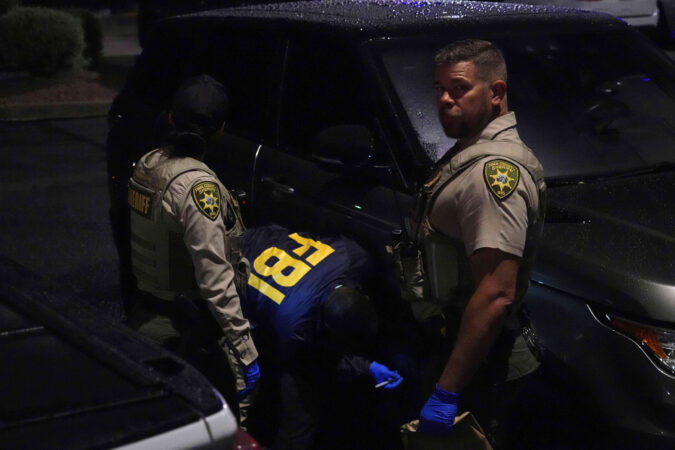
    Late Friday night, law enforcement agents sealed off a road about two miles (3.2 kilometers) from Guthrie’s home as part of their investigation. A series of sheriff’s and FBI vehicles, including forensics vehicles, passed through the roadblock.

    The investigators also tagged and towed a Range Rover SUV from a nearby restaurant parking lot late Friday. The sheriff’s department later said the activity was part of the Guthrie investigation but no arrests were made.

    On Tuesday, sheriff deputies detained a person for questioning during a traffic stop south of Tucson. Authorities didn’t say what led them to stop the man but confirmed he was released. The same day, deputies and FBI agents conducted a court-authorized search in Rio Rico, about an hour’s drive south of the city.

    Authorities have expressed concern about Nancy Guthrie’s health because she needs vital daily medicine. She is said to have a pacemaker and have dealt with high blood pressure and heart issues, according to sheriff’s dispatcher audio on broadcastify.com.

    Earlier in the investigation, authorities had said they had collected DNA from Nancy Guthrie’s property which doesn’t belong to Guthrie or those in close contact with her. Investigators were working to identify who it belongs to.

    The FBI also has said approximately 16 gloves were found in various spots near the house, most of which were searchers’ gloves that had been discarded.

  • There was possible measles exposure at Philadelphia International Airport last week

    There was possible measles exposure at Philadelphia International Airport last week

    A person infected with measles traveled through Philadelphia International Airport last week, city health officials are warning.

    The infected person spent time in Terminal E of the airport between 1:35 and 4:30 p.m. Thursday.

    Measles is highly contagious and spreads via airborne particles when an infected person coughs, sneezes, or talks. The virus can linger in the air for up to two hours after the infected person moves.

    Palak Raval-Nelson, Philadelphia’s health commissioner, said he believed there was no threat to the general public, but encouraged those who are not protected against measles to take action.

    Children under a year old, pregnant people without immunity, and those with a weakened immune system who were exposed and who develop symptoms through March 5 should call their doctor immediately. They’re also asked to call their local health department and Philadelphia’s Health Department if they live outside the city.

    Symptoms of the disease are fever, runny nose, cough, and watery, red eyes — as well as a rash.

    Those who have immunity do not need to do anything. Those with immunity include people born before 1957, those who have already had measles, and those who have received two doses of the measles, mumps, and rubella vaccine.

    Measles, in some cases, can lead to pneumonia, brain infection, and death, health officials say.

    Measles cases are on the rise both internationally and throughout the United States. There’s a large outbreak currently in South Carolina.

  • A service honoring Absalom Jones took on added meaning this year for his church

    A service honoring Absalom Jones took on added meaning this year for his church

    This year’s celebration of African Episcopal Church of St. Thomas’ founder, the Rev. Absalom Jones, was intrinsically political.

    Parishioners on Sunday overwhelmed the pews at the Overbrook Farms church for the annual event honoring Jones, the first Black ordained Episcopal priest. But this year’s service took on new meaning after Jones’ legacy was stripped from the President’s House historical site on Independence Mall, the church’s rector said.

    Last month, the National Park Service dismantled the exhibit memorializing the lives of nine people enslaved at the nation’s first presidential mansion. The illustrative displays chronicled the Atlantic slave trade and President George Washington’s dogged support for the institution. They also elevated early influential Black Philadelphians, like Jones and contemporary Richard Allen. The site was a casualty of President Donald Trump’s push to remove all content that “inappropriately disparages Americans past or living” from federal land — what many have called an attempt to sanitize history by omitting the brutality of slavery from the narrative.

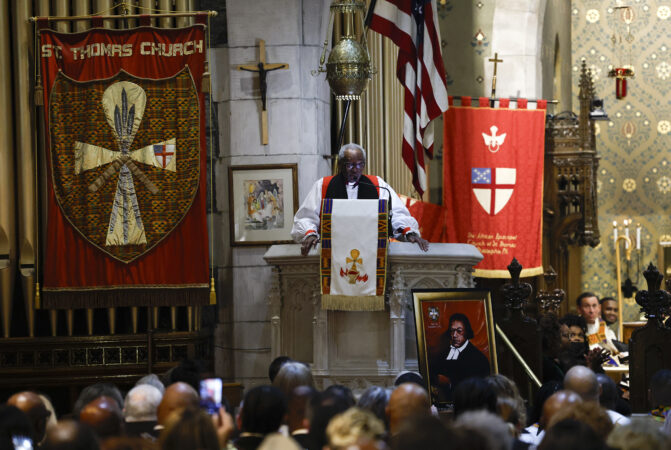
    The 35-minute sermon, delivered by the visiting Rt. Rev. Michael Curry, ran the gamut: From Bad Bunny’s Super Bowl halftime performance, to unrest in Minnesota over Trump’s immigration crackdown, the detention of 5-year-old Liam Conejo Ramos, and dysphoria spreading throughout the country.

    But Curry’s prevailing message was clear: Fight through the vicissitudes. Curry, former presiding bishop and primate of the Episcopal Church, is the first African American presiding bishop in the country.

    “If you want to taste freedom, if you want America to be just again,” Curry said, “if you want an America where every person is a child of God, where there is freedom and justice — not just for some — but for all … don’t you quit. Keep going, keep going.”

    Curry later added: “If we love America, change America.”

    The late afternoon service also featured young singers from Minnesota, faith leaders from other prominent Philadelphia institutions, and descents of the Rev. Allen.

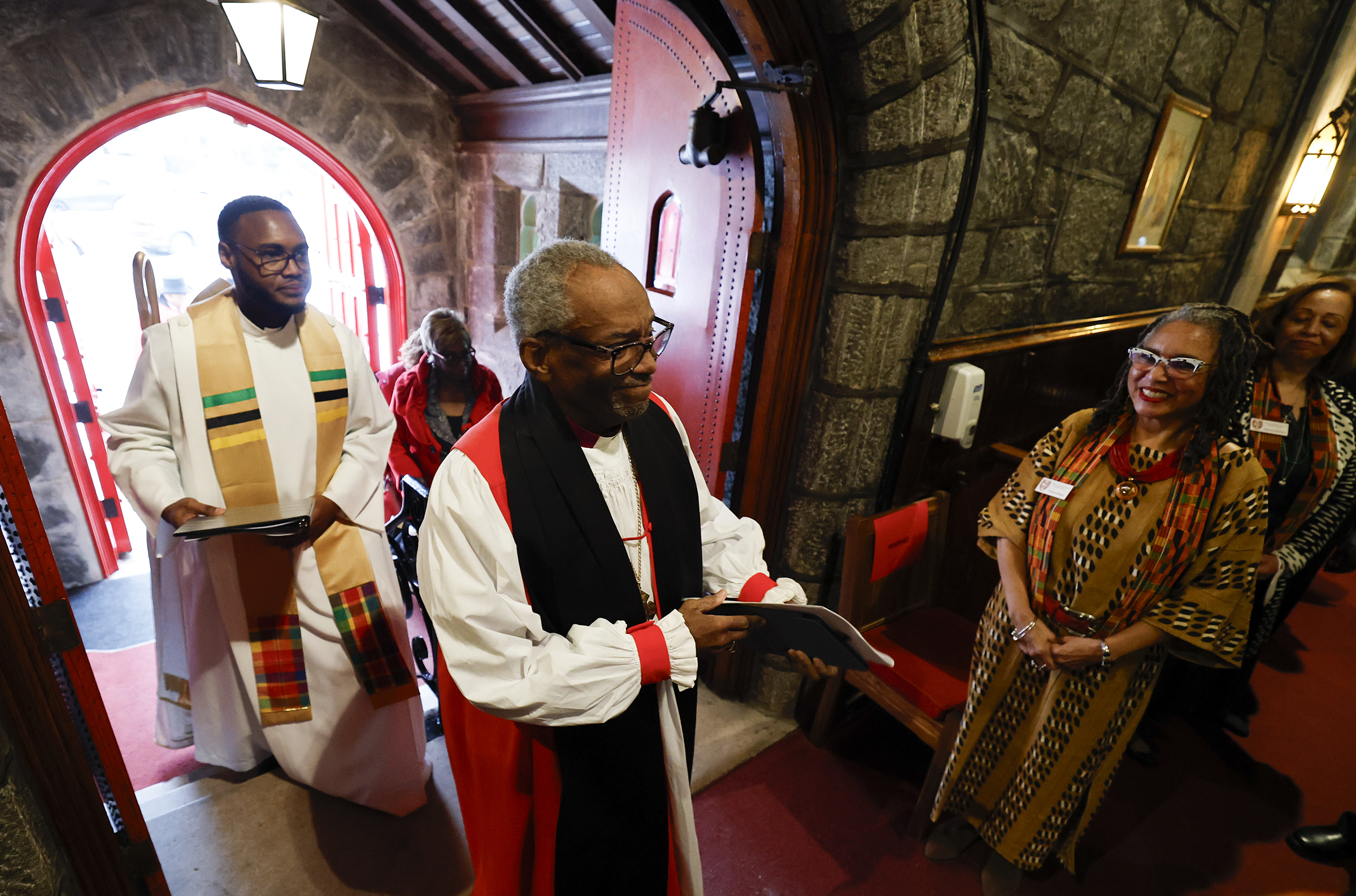
    The Rt. Rev. Michael B. Curry (center) walks into the African Episcopal Church of St. Thomas before providing the sermon in the celebration of the life and ministry of the Rev. Absalom Jones on Sunday.

    Jones and Allen, former slaves who became lay preachers in the 18th century and together created the benevolent Free African Society, were forced out of St. George’s Methodist Church general congregation and forced to worship in segregated pews. Jones went on to form St. Thomas, while Allen built Mother Bethel A.M.E. Church.

    The men’s names and history were invoked throughout the President’s House Site. A panel titled “How Did Enslaved People Become Free?” discussed Jones’ and Allen’s experience at St. George’s, their respective parishes, and how they organized against slavery.

    The erasure of the site — which captured the somber paradox of a young America that exalted freedom for some but deprived others — comes ahead of the country’s Semiquincentennial celebrations putting Philadelphia in the national spotlight.

    The city has filed lawsuits intervening, arguing that the removal of the exhibits is unlawful. A federal judge ordered that the exhibits be kept safe while the court proceedings are ongoing.

    “It brings a totally different emphasis and focus on the celebration this year at the church,” the Rev. Martini Shaw, St. Thomas’ rector, told Episcopal News Service. “But while some want to erase history, we in the church are prepared to celebrate history.”

  • Anthony Edwards claims MVP award, leads Stars to tourney win in 2026 NBA All-Star Game

    Anthony Edwards claims MVP award, leads Stars to tourney win in 2026 NBA All-Star Game

    INGLEWOOD, Calif. — Anthony Edwards won the Most Valuable Player award while leading his “Stars” team past their fellow Americans on the “Stripes” team 47-21 to win the final of the NBA All-Star Game on Sunday.

    The Minnesota Timberwolves star claimed his first All-Star MVP award with a tying 3-pointer in the first round-robin game followed by eight points in the final, which was the only chapter without a dramatic late finish in this mini-tournament comprising the main event of All-Star weekend at the Los Angeles Clippers’ Intuit Dome.

    The NBA’s fourth format in four years matched two teams of American All-Stars against a team representing the World, hoping to stoke nationalistic passion from players and fans during an Olympic year.

    The slightly older Stripes had beaten the slightly younger Stars on De’Aaron Fox’s 3-pointer at the buzzer in the second 12-minute, round-robin game. But Edwards led the Stars to victory in the rematch with the Stripes, who appeared to run out of gas while playing in their third straight mini-game.

    “We chose to compete today, and we came out on top,” Edwards said. “I ain’t going to lie, Wemby set the tone. He came out and played hard, and we had to follow that.”

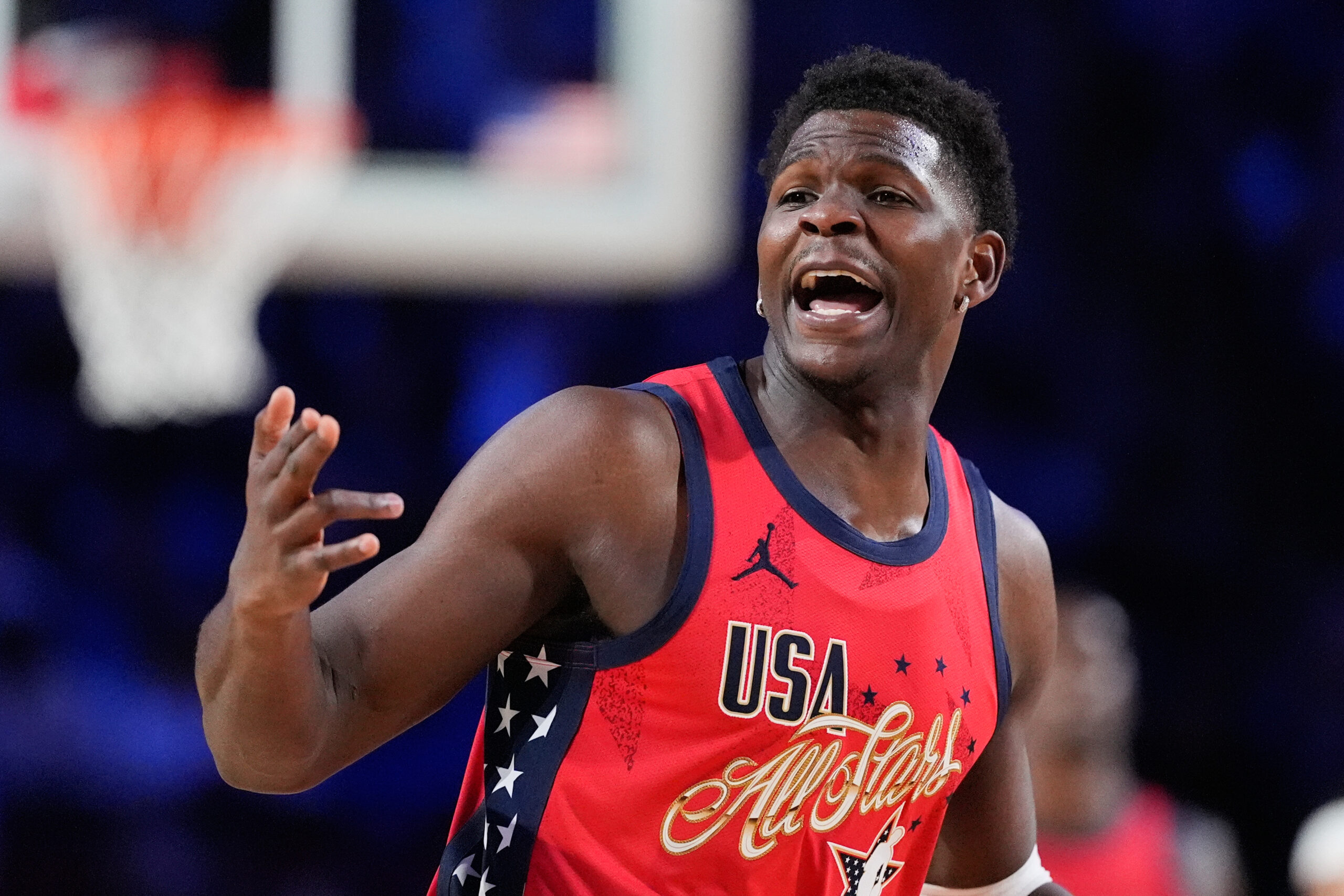
    USA Stars guard Anthony Edwards reacts after scoring during the NBA All-Star basketball game against USA Stripes Sunday, Feb. 15, 2026, in Inglewood, Calif. (AP Photo/Mark J. Terrill)

    Indeed, Victor Wembanyama effectively challenged his fellow All-Stars to take this game seriously, and they largely appeared to do it. Despite going 0-2, Wembanyama led the World team in scoring in both games with 14 points in the opener and 19 in the third game.

    Along with the late-game theatrics, the event generally appeared to be played at a higher level of competitiveness than most All-Star Games in recent years, suggesting the league might have finally cracked the code on the long-standing question of how to make this midseason showcase more entertaining.

    “It was a pretty good display of basketball,” Wembanyama said. “Better than last year, in my opinion. It was fun. … I think being honest with ourselves is good. It’s a game we love, it’s a game I personally cherish, so being competitive is the least I can do.”

    NBA Commissioner Adam Silver thanked the All-Stars for playing hard when he presented the championship trophy to the Stars.

    Kawhi Leonard thrilled his home crowd with a 31-point barrage for the Stripes in the final round-robin game, but he managed just one point in the final. Tyrese Maxey led the Stars with nine points in the clincher.

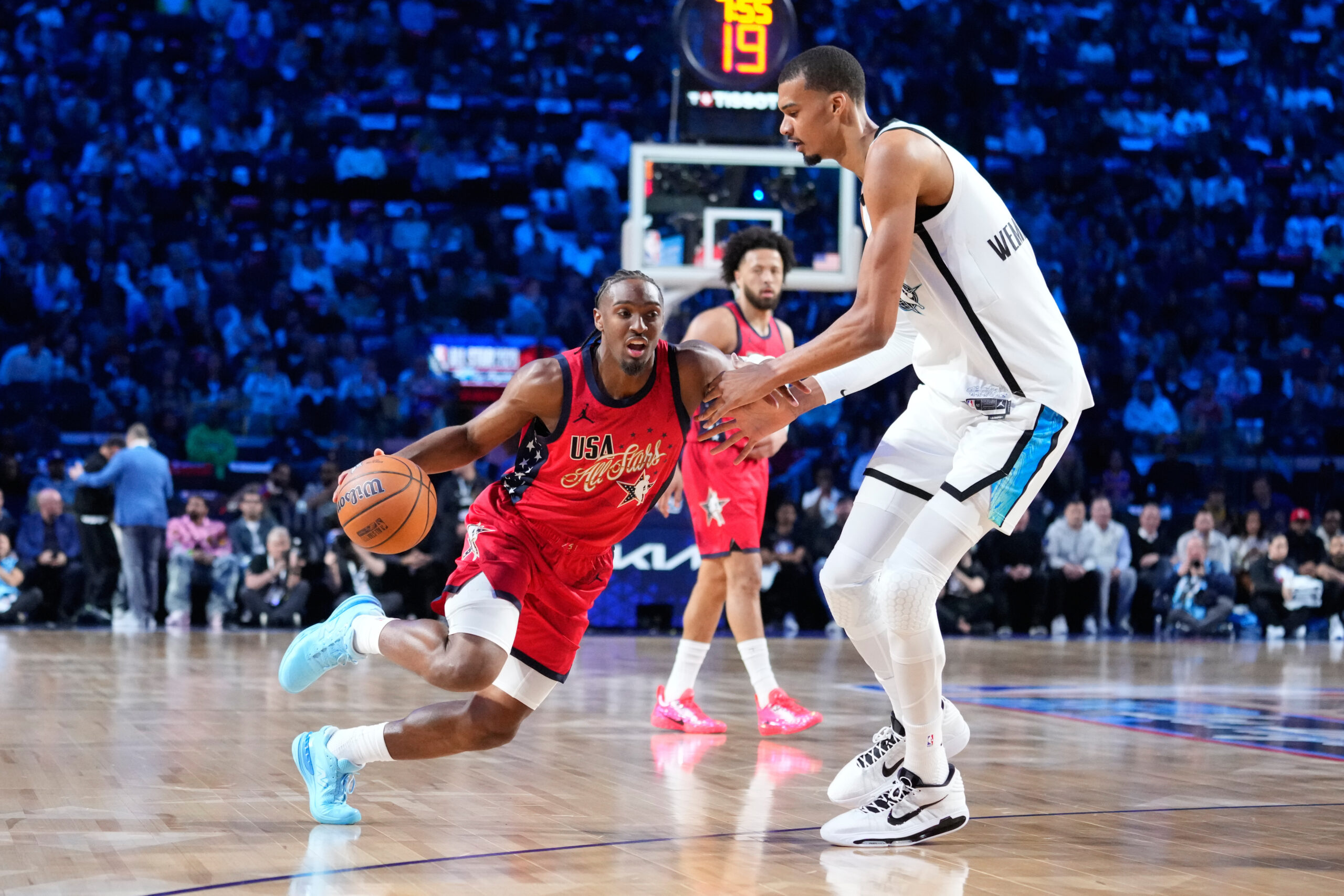
    USA Stars guard Tyrese Maxey, left, is defended by World center Victor Wembanyama, of France, during the NBA All-Star basketball game Sunday, Feb. 15, 2026, in Inglewood, Calif. (AP Photo/Mark J. Terrill)

    Scottie Barnes won the opening 12-minute game for the Stars with a game-ending 3-pointer in overtime, beating the World 37-36 after Edwards forced OT.

    After Fox’s dagger in the second game, Leonard utterly dominated the third game before hitting a tiebreaking 3-pointer with 3.5 seconds left in the Stripes’ 48-45 victory.

    The World team was loaded with talent, but NBA scoring leader Luka Doncic and three-time MVP Nikola Jokic both sat out its second game, likely to preserve the health of two superstars who have struggled with injury in the past month.

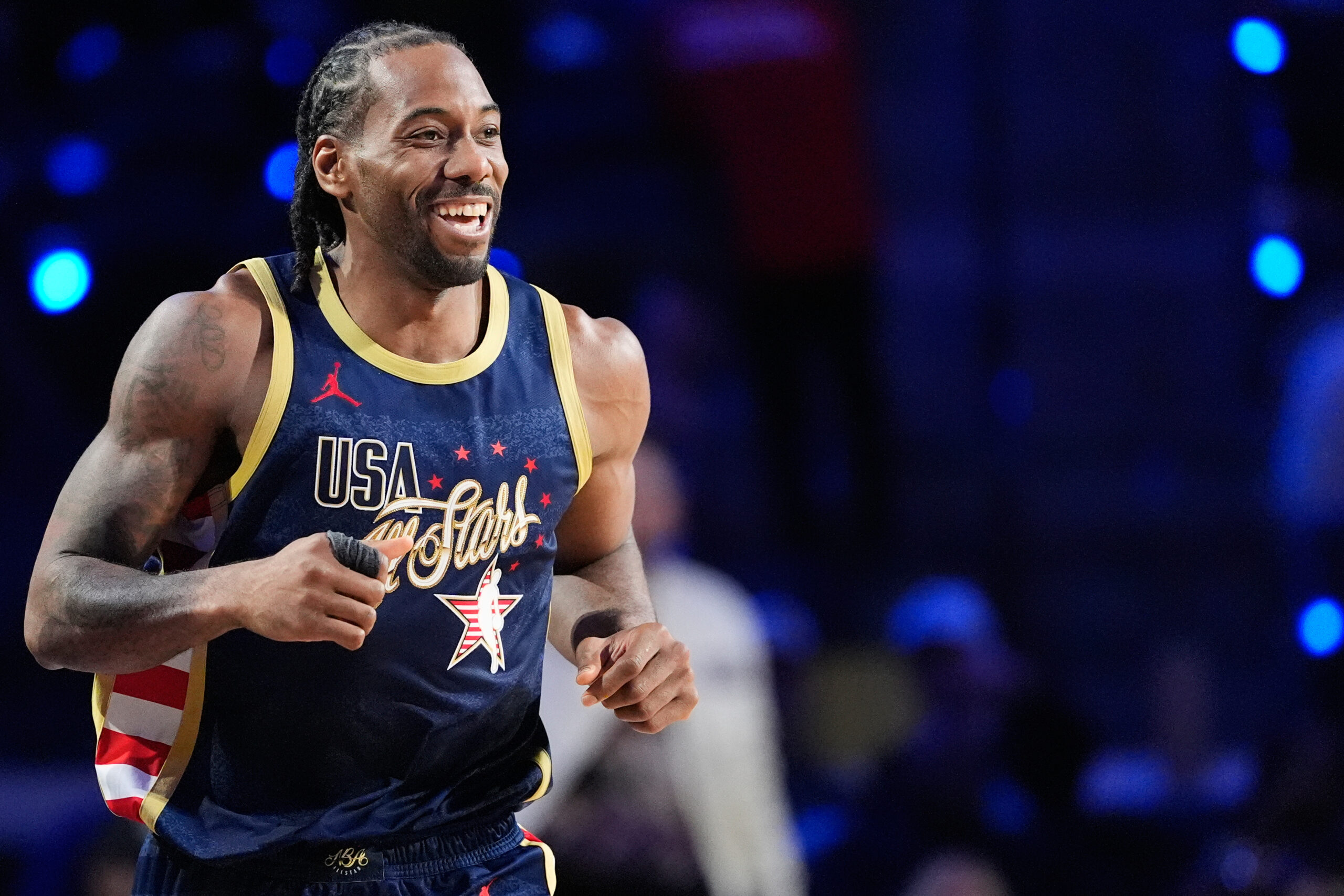
    USA Stripes forward Kawhi Leonard smiles after scoring during the NBA All-Star basketball game against World Sunday, Feb. 15, 2026, in Inglewood, Calif. (AP Photo/Mark J. Terrill)

    John Tesh took the court with his band before the game for a live rendition of “Roundball Rock,” the iconic 1990s theme song of “NBA on NBC,” to mark the league’s return to the network this season. That network partnership is also the reason the All-Star Game was an afternoon affair on the West Coast, because NBC airs the Winter Olympics at night.

    The Intuit Dome crowd included former President Barack Obama, who received a standing ovation pregame.

    First game

    Edwards scored 13 points and forced overtime on a 3-pointer with 13.3 seconds left in regulation to begin the mini-tourney.

    Edwards hit a 14-footer to begin the first-to-five-points overtime period. Wembanyama made a 3-pointer, but Raptors star Barnes ended it by draining his only shot of the game.

    Karl-Anthony Towns added 10 points, but Norman Powell — a born-and-raised Californian who represents Jamaica internationally — missed a potential winning shot for the World at the regulation buzzer.

    NBA scoring leader Doncic played the first 5:05 for the World in the opening game before sitting down. The Lakers superstar hadn’t played since Feb. 5 due to a hamstring strain, but he was determined to play after receiving his sixth All-Star nod.

    Second game

    Donovan Mitchell took a pass under the net from LeBron James and kicked it out to Fox on the perimeter for the winner.

    Jaylen Brown led the Stripes with 11 points, and James scored eight to begin his record 21st All-Star appearance.

    Edwards and Cade Cunningham scored 11 points apiece for the Stars.

    “Old heads 1-0,” James said with a laugh. “We’ve got a lot of guys that have played a lot of basketball, so no matter what’s going on, we know how to keep our composure and execute.”

    A few hours beforehand, the top scorer in NBA history said the game’s presence in the Los Angeles area meant “nothing, because this is not our building. This is a road game.”

    Indeed, the Clippers fans in Intuit Dome booed James and Doncic whenever they touched the ball in the first two games.

    Third game

    Leonard thrilled his home crowd with a dynamic effort, going 11 of 13 and 6 of 7 from beyond the arc. The seven-time All-Star made his first seven shots with five 3-pointers amid raucous cheers from the extra-steep supporters’ section called The Wall behind one basket at this futuristic 18-month-old arena.

    He was unstoppable despite a reasonable defensive effort from the World team led by Wembanyama, who scored 19 points before missing a tying 3-pointer attempt at the buzzer.

    James put the Stripes ahead with 31 seconds left on a putback dunk, but Wembanyama hit two free throws to tie it before Leonard called game.

    Jokic and Doncic didn’t play, leaving the World with just seven players.

  • Michael Jordan’s Daytona 500 ring: Tyler Reddick’s 1-lap lead delivers NASCAR’s biggest win

    Michael Jordan’s Daytona 500 ring: Tyler Reddick’s 1-lap lead delivers NASCAR’s biggest win

    DAYTONA BEACH, Fla. — Michael Jordan, six-time NBA champion, is now a Daytona 500 winner, too.

    Tyler Reddick won “The Great American Race” on Sunday with a last-lap pass at Daytona International Speedway that sent Jordan into a frantic celebration. The NBA Hall of Famer bear-hugged Reddick in victory lane and then jointly hoisted the Harley J. Earl trophy with the 23XI Racing driver.

    Jordan, who turns 63 on Tuesday, will get a Daytona 500 ring for his birthday and made it known in victory lane he wears a size 13.

    “It feels like I won a championship, but until I get my ring, I won’t even know,” Jordan said.

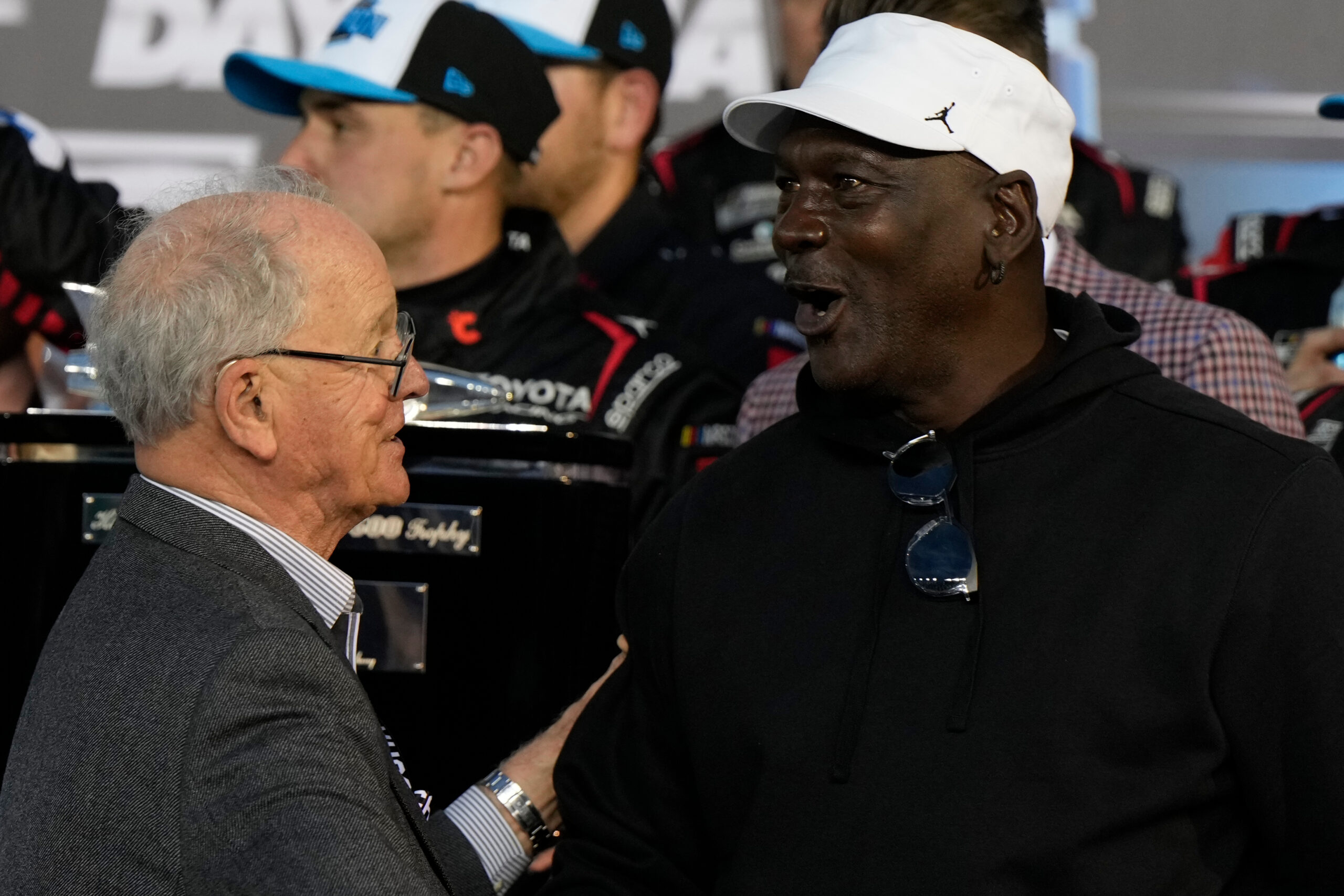
    23XI Racing owner Michael Jordan speaks with CEO and Chairman of NASCAR, Jim Frantz after Tyler Reddick won the NASCAR Daytona 500 auto race at Daytona International Speedway, Sunday, Feb. 15, 2026, in Daytona Beach, Fla. (AP Photo/Nigel Cook)

    The moment captured the message team co-owner Denny Hamlin — who finished 31st in Sunday’s bid to become the third driver in history to win four Daytona 500s — delivered to 23XI employees in a team meeting ahead of NASCAR’s season opener.

    “He loves his race team,” Hamlin said, adding he reminded the team of the fulfillment they saw in Jordan when Reddick won at Talladega in 2024. “I was like ‘You know, you guys understand the responsibilities you have, that you have the power to bring joy to Michael Jordan. You have that power and nobody else can do it.’

    “There’s nothing else that can bring him the joy that seeing what his team can do and they took it to heart.”

    Reddick, in a Toyota, led only one lap Sunday: the one to the checkered flag. He was the 25th different driver to lead a lap for a new Daytona 500 record.

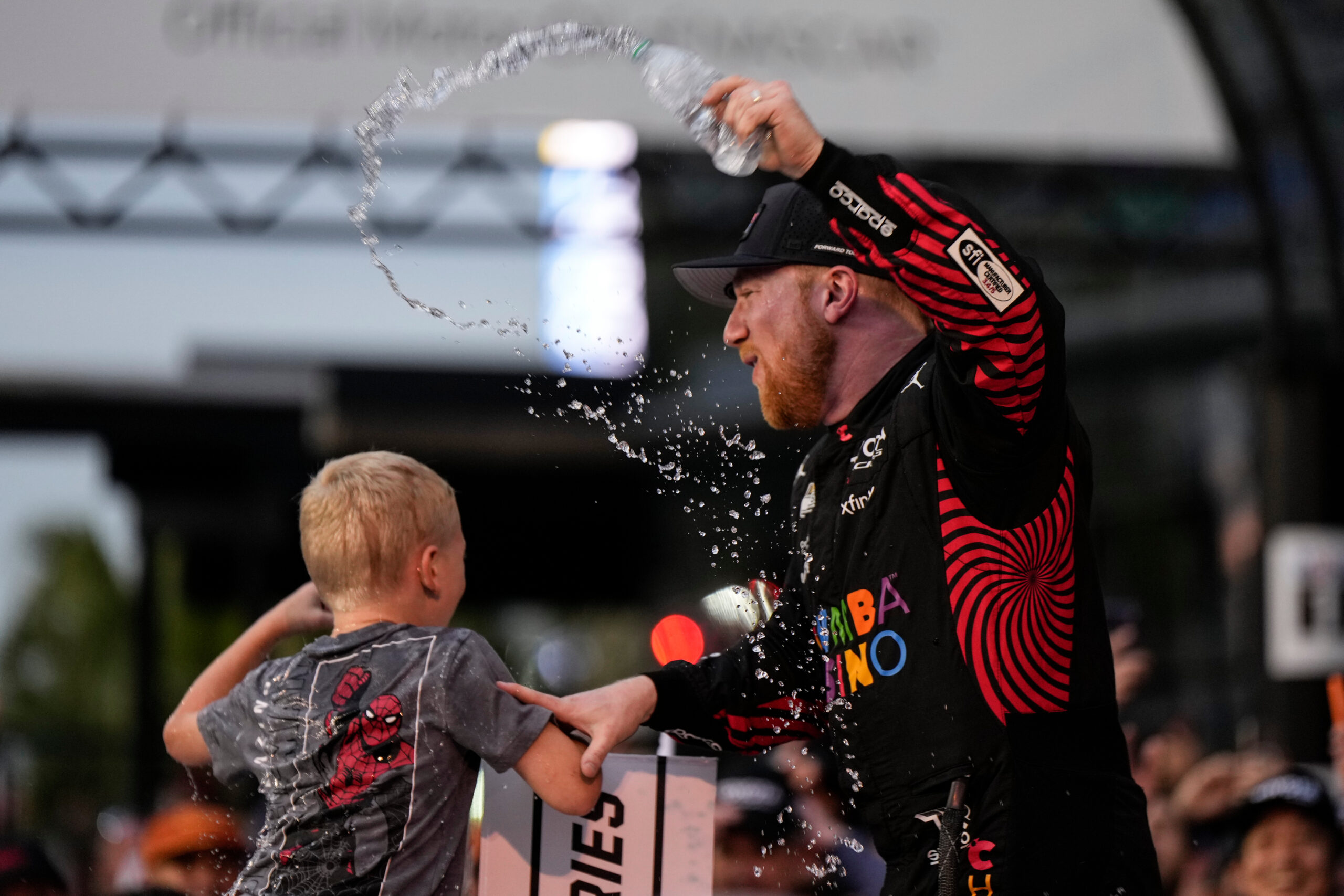
    Tyler Reddick, (45) and his son Beau celebrate with the team after winning the NASCAR Daytona 500 auto race at Daytona International Speedway, Sunday, Feb. 15, 2026, in Daytona Beach, Fla. (AP Photo/Nigel Cook)

    “Just incredible how it all played out. Just true Daytona madness,” Reddick said. “I’ve already lost my voice from screaming. Never thought I’d be Daytona 500 champion.”

    Reddick, a 30-year-old from Corning, California, won for the ninth time in the Cup Series and first time since late in the 2024 season. Winless last year, Reddick was primarily focused on his infant son, who was found to have a tumor in his chest that affected his heart. Reddick opened last year with a runner-up finish in the Daytona 500.

    He snapped the 38-race losing streak by finishing one place higher Sunday and winning to start a celebration that included multiple stars of NASCAR. It included Jordan, a global icon, and Hamlin, at 45 the oldest full-time driver in the Cup Series.

    Reddick is teammates with Bubba Wallace, who went to victory lane in tears after leading a race-high 40 laps before finishing 10th. Jordan wrapped his arms around Wallace from behind and spoke closely into Wallace’s ear in a brief speech of encouragement.

    “I don’t want my emotions to take away from the monumental day they just accomplished. Happy birthday, MJ. That’s a massive birthday present,” Wallace said. “I thought this was our week, the best 500 I’ve ever had, and come up short, sucks.

    “Led a lot of laps, lap leader, I believe. It was a good day for us, but damn. Try again next year.”

    Hamlin, who drives for Joe Gibbs Racing, was involved in the final caution when he and teammate Christopher Bell collided with nine laps remaining. It set up the final push to the finish over the final four laps.

    Elliott grabbed the lead at the start of the final lap when Carson Hocevar was spun off the track. Reddick made a huge surge with an assist from teammate Riley Herbst, made contact with Elliott that caused Elliott to crash, then sailed past to give Jordan a victory in NASCAR’s biggest event of the year.

    “It’s stuff you dream of as a kid,” said Reddick. “Now, I definitely didn’t look into the future and know that I would drive for Michael Jordan. But to be able to have someone like Michael Jordan believe in me enough, someone like Denny Hamlin.

    “I’m just trying to do my best to live on the promises that I made to them and vice versa.”

    Jordan was the face of the December federal antitrust lawsuit that NASCAR settled on the ninth day of trial. The settlement changed the revenue-sharing model in the United States’ top motorsports series.

    Jordan watched the win from a suite overlooking the superspeedway built by the France family — NASCAR founders and private owners — that he just beat in federal court. NASCAR chairman Jim France, who was personally a defendant in the suit, went to victory lane to congratulate the winners.

    “I can’t even believe it. It was so gratifying,” Jordan said of the victory. “You never know how these races are going to end. You just try to survive. We hung in there all day. Great strategy by the team, and we gave ourselves a chance at the end. Look, I’m ecstatic.”

    The victory marked a Daytona sweep for three team owners heavily involved in the trial. Bob Jenkins, who joined 23XI in suing NASCAR, opened the weekend with a victory when Chandler Smith won the Truck Series opener on Friday night for Front Row Motorsports.

    Richard Childress, who testified on behalf of 23XI and Front Row and was the subject of disparaging text messages by since-departed NASCAR chairman Steve Phelps, was the winning team owner Saturday when Austin Hill won.

    Then it was time for Jordan and Hamlin, the two front-facing litigants, as they got their first Daytona 500 victory together.

    “All we do is win,” shrugged Hamlin, who called the trio of weekend winners “coincidence.”

    Former race winners Ricky Stenhouse Jr. and Joey Logano finished second and third as Toyota, Chevrolet and Ford each placed a driver on the podium. Elliott wound up fourth and sat dejected and in disbelief on the outside wall of the track after climbing from his car.

    “We ended up kind of getting gifted the lead … and then at that point in time, you’re just on defense. Man, that’s a really, really tough place to be, truthfully,” Elliott said. “Obviously looking back, you can run it through your mind 1,000 times, do you do something different?”